2 Timothy 3:2
2 Timothy 3:3
2 Timothy 3:4
2 Timothy 3:5
2 Timothy 3:6
2 Timothy 3:7
2 Timothy 3:8
2 Timothy 3:9
2 Timothy 3:10
2 Timothy 3:11
2 Timothy 3:12
2 Timothy 3:13
2 Timothy 3:14
2 Timothy 3:15
2 Timothy 3:16
2 Timothy 3:17
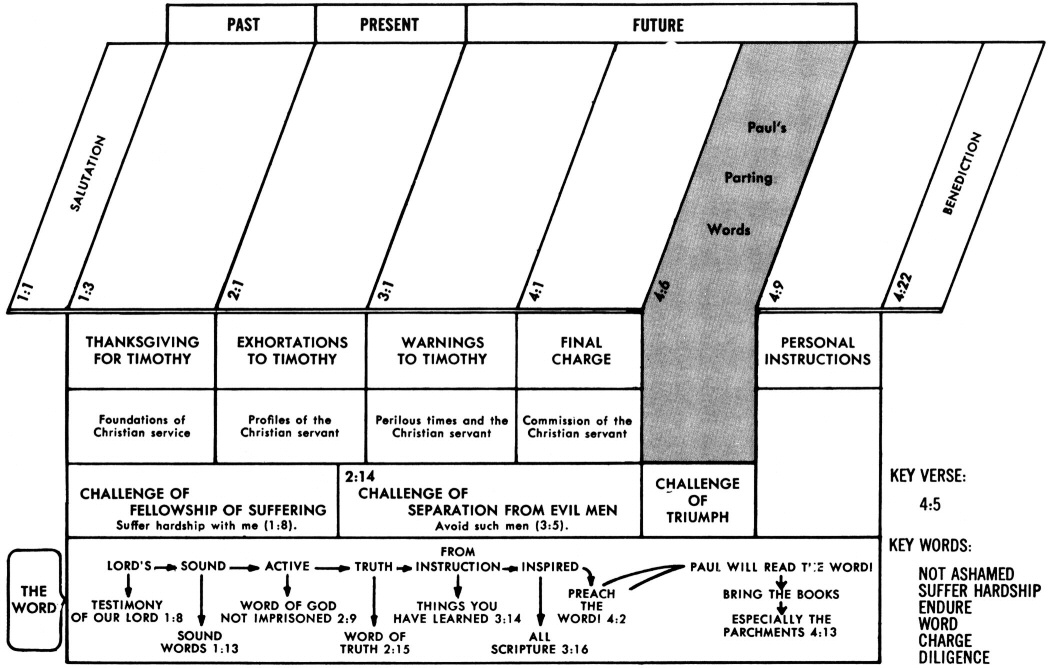
ENDURANCE AND SEPARATION IN THE MINISTRY
Click chart to enlarge
Charts from Jensen's Survey of the NT - used by permission
Second Timothy - Swindoll
| 2 TIMOTHY | |||
| 2 Timothy 1:1-18 | 2 Timothy 2:1-26 | 2 Timothy 3:1-17 | 2 Timothy 4:1-22 |
| Retain the Standard |
Rightly Divide the Word |
Difficult Times Will Come |
Preach the Word |
| PAST | PRESENT | FUTURE | |
| Foundation of Christian Service |
Pictures of Christian Servant |
Dangerous Times for Christian Servant |
Commission of Christian Servant |
| Unashamed as a Witness: Guard the Gospel |
Unashamed as a Workman: Suffer for the Gospel |
Adequate as a Workman: Continue in the Gospel |
Awarded as a Workman: Preach the Gospel |
| Power of the Gospel |
Perseverance of the Gospel Message | Protection of the Gospel |
Proclamation of the Gospel |
| Reminder | Requirements | Resistance | Requests |
| Encouragement in Ministry |
Examples in Ministry |
Exhortations in Ministry |
Exhortations to Fulfill Ministry |
| Commendation & Charge |
Commission to Fulfill |
Conflict to Face |
Course to Finish |
|
Compiled from Jensen's Survey of the NT and Wilkinson's Talk Thru the Bible |
|||
2 Timothy 3:14 You, however, continue (2SPAM) in the things you have learned (2SAAI) and become convinced of (2SAPI) , knowing (RAPMSN) from whom you have learned (2SAAI) them, (NASB: Lockman)
Greek: su de mene (2SPAM) en ois emathes (2SAAI) kai epistothes, (2SAPI) eidos (RAPMSN) para tinon emathes, (2SAAI)
Amplified: But as for you, continue to hold to the things that you have learned and of which you are convinced, knowing from whom you learned [them], (Amplified Bible - Lockman)
KJV: But continue thou in the things which thou hast learned and hast been assured of, knowing of whom thou hast learned them;
NKJV: But you must continue in the things which you have learned and been assured of, knowing from whom you have learned them,
NLT: But you must remain faithful to the things you have been taught. You know they are true, for you know you can trust those who taught you. (NLT - Tyndale House)
Phillips: Yet you must go on steadily in all those things that you have learned and which you know are true. Remember from what sort of people your knowledge has come (Phillips: Touchstone)
Wuest: But, as for you, be remaining as you are in the things which you learned and have been assured of, knowing the persons from whom you personally learned them
Young's Literal: And thou -- be remaining in the things which thou didst learn and wast entrusted with, having known from whom thou didst learn,
YOU HOWEVER CONTINUE: Su de mene (2SPAM):
- 2Ti 1:13; 2:2; 1Ti 4:16
- 2 Timothy 3 Resources - Multiple Sermons and Commentaries
Be remaining in (Literal),
abide thou in (ASV),
see that you keep to, continue to hold (Amp),
you must keep to what you have been taught (NJB),
you must cling to what you have learnt (Weymouth)
you must go on steadily (Phillips),
remain loyal to the things which you have learned (Barclay)
be remaining ..in (Wuest)
In the preceding section Timothy has been warned about guaranteed persecution and deepening deception so that he might be prepared to endure hardship and to fulfill his ministry. In these last 4 verses Paul reminds Timothy that his ultimate source of power to stand firm will come from the Scriptures learned, shown to be reliable and sufficient in the lives of those who had taught him (2Ti 3:14, 15) and firmly grounded in the fully inspired Word of God (2Timothy 3:16; 3:17-note).
You however in the NASB softens the Greek which is more accurately rendered But you which sets up an emphatic contrast with the evil men just described.
However then stands in contrast to the many who will plunge deeper and deeper into the cesspool of deception and darkness (2Timothy 3:13-note and 2 Timothy 3:2ff-note), Timothy is to stand firm on the solid rock of God's unchanging word. This verse begins with the emphatic you (su) which we last saw in (2Timothy 3:10-note). The man of God must pay careful attention to himself and the Scriptures if he is to resist the enticing lure of doctrinal infidelity. As opposition increases, the Scriptures become the believer’s reliance and bulwark.
Proverbs reminds us that
EVERY WORD of God (the Scriptures) is tested. He is a shield to those who take refuge in Him. (Pr 30:5)
Peter adds that
His divine power has granted to us EVERYTHING pertaining to life and godliness, through the TRUE KNOWLEDGE (in the Scriptures) of Him (Jesus)" and "He has granted to us His PRECIOUS and MAGNIFICENT PROMISES (in the Scriptures), in order that by them you might become partakers (sharers) of the divine nature. (see notes 2 Peter 1:3; 1:4).
As Hiebert emphasizes
The remembrance of Paul's heroic sufferings (2 Timothy 3:10; 3:11-note), as well as the realization that suffering is the lot of all believers (2 Timothy 3:12-note), will undergird Timothy's endurance. But the ultimate source of his power to stand firm he must find in the Scriptures. Paul reminds him of his subjective experience with the SACRED WRITINGS (2 Timothy 3:14, 3:15-note) and asserts the objective fact of the nature and function of the SCRIPTURES (see notes 2 Timothy 3:16; 3:17). (caps added)
Continue (3306) (Meno) means to abide or remain in the same place over a period of time. The present imperative calls for a constant, habitual way of life. Timothy is to be a "man of the Book" and thereby armed against the snares and insinuations of seducers. In light of the deepening degradation of these self-willed deceivers it is imperative that Timothy firmly adhere to the divine truth he had previously heard and accepted. Thus Paul commands Timothy to continually abide in the Truth he had learned. Dwell in it and live in it and do not "proceed" or "advance" away from it like the false teachers. To continue however means more than merely continuing in orthodoxy. It calls for a commitment to live and abide in what Timothy had learned. Why? Because it is your very life! (Dt 32:47).
See discussion of the Need for the Holy Spirit to obey NT commands or "How to Keep All 1642 Commandments in the New Testament!"
All true progress must be within not away from the fundamentals of the faith found only in the faithful Word. Are you wondering about or wandering from the "word of truth" (see 2Timothy 2:15-note)?
Are you reading or listening to liberal pastors or teachers who are adding to or taking from the complete revelation of divine Truth? Then run, flee for your spiritual life and
pay close attention (present imperative = command ) to yourself and to your teaching; persevere in these things; for as you do this you will insure salvation both for yourself and for those who hear you. (1Ti 4:16)
retain (present imperative = command to make this your continual pursuit for the tendency is always to drift away from sound doctrine) the standard of sound words which you have heard from me. (2Timothy 1:13-note).
Comment: As the day of Christ's return draws nigh, the drift from the Word of Truth grows ever more subtle, but it does "grow". Jesus said "Feed My sheep." and Scripture gives only one form of "sheep fodder" and that is the pure milk of the Word of God (cp Dt 8:3, Mt 4:4, 1Pe 2:1-note, Heb 5:14-note) Many churches are "substituting" our terms in lieu of God's inspired Word, ostensibly to make the Word more "in vogue" or "hip". This practice is to be assiduously avoided ("like a plague" because that's what it is - the sheep will become "sick") (cp "tampering" with the Word is a most dangerous practice! = Dt 4:2; 12:32, Pr 30:5, 6, Rev 22:18-note, Rev 22:19-note)
See discussion of the Need for the Holy Spirit to obey NT commands or "How to Keep All 1642 Commandments in the New Testament!"
How precious that in his childhood, Timothy was given something to continue in! Are you giving your children the "gift that keeps on giving?"
Kelly translates continue as stand by commenting that "Perhaps one of the severest tests of a believer's character and loyalty is to "stand by" the side of known truth while alluring and scintillating heresies are paraded in front of us. It is no small feat to remain faithful to God's eternal word throughout one's lifetime and many there are who have left its ranks." Or as God says to wayward Israel through the prophet Jeremiah "Stand by the ways and see and ask for the ancient paths, where the good way is, and walk in it; and you shall find rest for your souls. (Jer 6:16)
Mt Henry has an excellent reminder for all "young Timothys": It is not enough to learn that which is good, but we must continue in it, and persevere in it unto the end. Then are we Christ’s disciples indeed," (Jn 8:31). (bolding added)
Oswald Chambers exhorts us by asking "Am I learning how to use my Bible? The way to become complete for the Master’s service is to be well soaked in the Bible, some of us only exploit certain passages. Our Lord wants to give us continuous instruction out of His word; continuous instruction turns hearers into disciples. Beware of “spooned meat”* spirituality, of using the Bible for the sake of getting messages; use it to nourish your own soul. Be a continuous learner, don’t stop short, and the truth will open to you on the right hand and on the left until you find there is no problem in human life with which the Bible does not deal. But remember that there are certain points of truth Our Lord cannot reveal to us until our character is in a fit state to bear it. The discernment of God’s truth and the development of character go together. The life God places in the Christian worker is the life of Jesus Christ, which is continually changing spiritual innocence into glorious practical character. (Complete for the Master’s Service - Approved unto God)
Brothers and sisters let us press on for the prize (Php 3:14-note) and
no longer to be children, tossed here and there by waves, and carried about by every wind of doctrine" (Ephesians 4:12-note) and
Do not be carried away by varied and strange teachings; for it is good for the heart to be strengthened by grace" (Hebrews 13:9-note)
Hall echoes the charge that "God’s servants must continue constant in the truth received. They must not play fast and loose, be off and on; but they must be still the same, like well-tuned bells, which have the same note in foul weather as they have in fair" (Job 1:21) (T. Hall, Biblical Illustrator)
Clarke (critique) adds a note on the importance of continuing in the truth:
No man, however well instructed in the things of God, or grounded in Divine grace, is out of the reach of temptation, apostasy, and final ruin; hence the necessity of watching unto prayer (Mt 26:41), depending upon God (2Cor 3:5, 3:6, 12:9, 12:10, Php 4:13-note, Col 1:11-note), continuing in the faith (Col 1:23-note) , and persevering unto the end (Mt 24:13 Lk 8:15, He 3:6-note).
As Paul reminded Timothy, many others did not continue but went "straying" (1Ti 1:6), "suffered shipwreck" (1Ti 1:19), had "gone astray" (1Ti 6:20), had "turned away" (2Timothy 1:15-note), "deserted" (2Ti 4:10-note; 2Ti 4:16-note).
If you preserve the truth it will preserve you in the hour of temptation (cf Pr 4:8),
Standing or Falling? - Part of the training to be a US Secret Service agent includes learning to detect counterfeit money. Agents-in-training make a thorough study of the genuine bills--not the phonies--so that they can spot the fake currency immediately because of its contrast to the real thing. The child of God can learn a lesson from this. While it is helpful to study false religions and be fully aware of their dangerous dogmas, the best defense against such error is to be so familiar with God's Word that whenever we encounter error, we will spot it at once and won't fall for it. Today many are being led astray because they don't recognize how they are being deceived. For example, if a person isn't solidly grounded in the teaching of salvation by grace, he may swallow the line of the legalists who inject human works into the matter of being saved. If he is not well instructed about the person of Christ, he might accept the error of those who deny the Savior's deity. A thorough knowledge of essential biblical doctrines is the only way to detect counterfeits. Let's be diligent in our study of the Word of God. Then, instead of falling into error, we will stand firmly on the truth. --R W De Haan (Our Daily Bread, Copyright RBC Ministries, Grand Rapids, MI. — Reprinted by permission. All rights reserved)
Lord, grant us wisdom to discern
The truth You have made known,
And may we not believe one word
Beyond what You have shown.
--DJD
Beware! Error often rides to its deadly work on the back of truth!
--Spurgeon
IN THE THINGS YOU HAVE LEARNED: en hois emathes (2SAAI) :
- 2 Timothy 3 Resources - Multiple Sermons and Commentaries
Learned (3129) (manthano - TDNT says is derived from a root meaning to direct one's mind to something) has a basic meaning of to learn with the idea being to gain knowledge by instruction or to come to understand as the result of a process of intentional inquiry and observation. The aorist tense speaks of a historical fact, a past completed event - he had learned indeed learned these things.
Manthano is related to the Greek word for disciple (mathetes = learner, pupil) referring to one (like Timothy) who puts himself under the teaching of someone else (like Paul) and learns from him. The aorist tense identifies the "learning" as a past completed action (historical event). John had a similar thought - "These things I have written to you concerning those who are trying to deceive you." (1Jn 2:26+)
The best antidote for deception is the truth of God's Word is the "things you have learned". This was true for Timothy then and it is just as true for you and I today in a time when even supposed bastions of the Truth such as many seminaries and pulpits are departing from the sufficiency "pure milk of the Word". (1 Pe 2:2+)
It is a blessed state to "know the exact truth about the things you have been taught." (Lk 1:4+)
Mt Henry adds that it is important "not only to know what the truths are, but to know that they are of undoubted certainty. What we have learned we must labour to be more and more assured of, that, being grounded in the truth, we may be guarded against error, for certainty in religion is of great importance and advantage
AND BECOME CONVINCED OF: kai epistothes (2SAPI):
- 1Cor 15:1, 15:2
- Acts 17:31; Ro 14:5; Col 2:2; 1Th 1:5; Heb 6:11; 10:22
- 2 Timothy 3 Resources - Multiple Sermons and Commentaries
and are confident about (NET)
and which you know are true (Phillips)
and know to be true (NJB)
and have been assured of (Wuest)
and have firmly believed (ESV)
and found to be true (GWT)
things of which you are certain (BBE)
of which thou hast been fully persuaded (Darby)
and your belief that has been confirmed (Barclay)
Become convinced (4104) (pistoo from pistos = faithful) means assured, made certain and the aorist tense identifies that a past completed action (historical fact). Timothy not only learned the great truths of the faith, but he had become personally assured of them as well. Timothy had an inner conviction concerning the truth and reliability of these things and such confidence produces personal stability. Without this conviction of heart, it would have been difficult for Timothy to hold fast in the things he had learned amid so many persecutions and deceptions.
Hiebert adds that on the other hand "doubts and uncertainties concerning the Word of God never foster moral steadfastness."
KNOWING FROM WHOM YOU LEARNED: eidos (RAPMSN) para tinon emathes (2SAAI):
- 1 Thessalonians 2:13-note
- 2 Timothy 3 Resources - Multiple Sermons and Commentaries
You know they are true, for you know you can trust those who taught you. (NLT)
Remember from what sort of people your knowledge has come (Phillips)
Knowing (1492) (eido) refers to absolute, positive, beyond a doubt knowledge. It means to see with the mind’s eye and signifies a clear and purely mental perception. The perfect tense speaks of the permanent or abiding state of Timothy's knowing. The Scriptures had been taught to him by those whose lives witnessed to the reality of their faith. Timothy knew that Paul was imprisoned for the sake of the gospel, and that the gospel was not just worth living for but worth dying for.
Whom is a plural pronoun (less reliable manuscripts have singular) which would include the OT prophets ("speaking" through the Scripture), Timothy's grandmother Eunice, his mother Lois (2Ti 1:5-note), and his mentor Paul (2Ti 1:13, 2:2, 3:10-see note 2Ti 1:13, 2:2, 3:10). To successfully learn spiritual convictions from others and to hold them as your own, it is necessary not only to hear them clearly taught but to see them consistently lived. In other words, although the content of the teaching is obviously of critical importance so too is the character of the teacher ("you followed my teaching, conduct...2Ti 3:10-note').
Learned (3129) (see manthano above)
Timothy's personal knowledge of his teachers assured him of the reliability of the things he has learned. Writing to the new converts in Thessalonica Paul said
you know what kind of men we proved to be among you for your sake (1Th 1:5-note).
Similarly, in his parting challenging exhortation to the Ephesian elders Paul said
You yourselves know, from the first day that I set foot in Asia, how I was with you the whole time, serving the Lord with all humility and with tears and with trials which came upon me through the plots of the Jews; how I did not shrink from declaring to you anything that was profitable.... (Acts 20:18-20+).
So we see Paul continually backing up the words of his lips with the works in his life, a profitable practice for all believers to continually strive to imitate (1Cor 11:1+)
Note the important distinction Paul makes, as "things learned" refers primarily to CONTENT, whereas things Timothy had "become convinced of" refers to CONVICTION. Timothy had not only "learned" the truth, but he had "become convinced" of it. "Convinced" is used in secular Greek writings to describe a theory or hypothesis which one had confirmed. You might be asking "So what is the significance of the things we "learn" and those we "become convinced of"? Succinctly stated -- We hold the former while the latter holds us!
The key to spiritual stability in the midst of a sea tossed by ever increasing waves of wickedness and wayward teaching - Trustworthy teachers (Eunice, Lois, Paul) and a firm foundation (the sacred writings).
Keep Going! - In his early years, British statesman Joseph Chamberlain (1836-1914) taught Sunday school. His favorite Bible verse was Ge 12:5, "They went forth to go into the land of Canaan; and into the land of Canaan they came" (KJV).
That verse was a motto well-suited to a man of his iron will. It also gave him a biblical basis for citing two qualifications for success in life. One is to have the right destination—"They went forth to go into the land of Canaan." The second is to keep going after we have started—"into the land of Canaan they came."
As the apostle Paul wrote his second letter to Timothy, he knew that he would die soon, and he reflected on his life. He was not a leaf tossed about by the winds; he was an arrow headed for a target. Paul found his direction and destination in his relationship with Christ, and he wanted to cultivate in Timothy the virtues of a well-lived life. He offered himself as a model: "You have carefully followed my doctrine, manner of life, purpose, faith, longsuffering, love, perseverance" (2 Timothy 3:10). "Stay with it," he seemed to be saying to young Timothy.
Keeping Christ uppermost in our lives will keep us headed right and will give us the strength to keep going. — Haddon W. Robinson (Our Daily Bread, Copyright RBC Ministries, Grand Rapids, MI. Reprinted by permission. All rights reserved)
My life, my love I give to Thee,
Thou Lamb of God who died for me;
O may I ever faithful be,
My Savior and my God! —Hudson
We conquer by continuing.
Spelling Problems - My mother was moving from the house we had called home for 36 years, and we were cleaning out the treasures. As I rummaged through my stuff, I discovered something I felt would be instructive for Steve, my 10-year-old fifth-grader. It was my old fifth-grade spelling book. I thought I would show him how much tougher things were back in those days. But when Steve and I later compared his book with mine, we agreed that his words were harder!
As I considered this, I began to think about the culture in which our children are growing up. It is not just spelling that is harder. Life itself has added layers of toughness since my school days.
With so much overt sinfulness being pushed a child's way, it could be harder to resist temptation and to do what is right. New negative influences challenge a young person as he tries to make wise choices.
Yet the answer is the same as it has always been. "From childhood you have known the Holy Scriptures"--that was how Paul characterized Timothy's training (2Tim. 3:15). This is still the way it should be for our children. No matter how tough the times, the solutions are always spelled out in God's Word. It's one book that never changes. — Dave Branon
Begin to train them early
To fear and love the Lord,
To carry on life's pathway
God's lamp, His holy Word. --Fennema
In a changing world you can trust God's unchanging Word.
2 Timothy 3:15 and that from childhood you have known the sacred writings which are able to give you the wisdom that leads to salvation through faith which is in Christ Jesus. (NASB: Lockman)
Greek: kai oti apo brephous [ta] hiera grammata oidas, (2SRAI) ta dunamena (PPPNPA) se sophisai (AAN) eis soterian dia pisteos tes en Christo Iesou.
Amplified: And how from your childhood you have had a knowledge of and been acquainted with the sacred Writings, which are able to instruct you and give you the understanding for salvation which comes through faith in Christ Jesus [through the leaning of the entire human personality on God in Christ Jesus in absolute trust and confidence in His power, wisdom, and goodness]. (Amplified Bible - Lockman)
KJV: And that from a child thou hast known the holy scriptures, which are able to make thee wise unto salvation through faith which is in Christ Jesus.
Phillips: and how from early childhood your mind has been familiar with the holy scriptures, which can open the mind to the salvation which comes through believing in Christ Jesus. (Phillips: Touchstone)
Wuest: and that from a very young child you know the sacred scriptures which are able to make you wise with respect to salvation through faith, that faith which is in Christ Jesus.
Young's Literal: and because from a babe the Holy Writings thou hast known, which are able to make thee wise -- to salvation, through faith that is in Christ Jesus;
AND THAT FROM CHILDHOOD YOU HAVE KNOWN: kai hoti apo brephous (ta) hiera grammata oidas (2SRAI):
- 2Ti 1:5; 1Sa 2:18; 2Chr 34:3; Ps 71:17; Pr 8:17; 22:6; Eccl 12:1; Lk 1:15;2:40
- 2 Timothy 3 Resources - Multiple Sermons and Commentaries
from infancy (NET)
from a babe (ASV, Young's Literal)
a very young child (Wuest)
Childhood (1025) (brephos) meant a babe and in classical Greek referred to a babe at the breast. Thus the idea is literally “from infancy.” Peter uses the same term to exhort his readers to
like newborn babes, long for the pure milk of the word, that by it you may grow in respect to salvation (see note 1 Peter 2:2)
It was at the knees of his “grandmother Lois, and [his] mother Eunice” (see note 2 Timothy 1:5) that Timothy appears to be led to saving faith, and it was in their lives that he first saw the power of the gospel to produce genuine godliness. By Jewish custom children were taught God's Law at a very early age, and were encouraged to commit it to memory.
Barclay (critique) adds that "It was the glory of the Jews that their children from their earliest days were trained in the law. They claimed that their children learned the law even from their swaddling clothes and drank it in with their mother’s milk. They claimed that the law was so imprinted on the heart and mind of a Jewish child that he would sooner forget his own name than he would forget it. (The Daily Study Bible Online)
Have known (1492) (oida) is perfect tense and conveys that idea that Timothy's knowledge of the "Sacred Writings" began in earliest childhood and continues through the present time. He cannot recall a period when he had not known the sacred writings.
Mt Henry - The age of children is the learning age; and those who would get true learning must get it out of the scriptures.
In Timothy's case the teaching was clearly effectual for "true learning". May all Scriptural teaching to young ones be so effectual.
Albert Barnes adds that "The Jewish writings abound with lessons on this subject. Rabbi Judah says, “The boy of five years of age ought to apply to the study of the sacred Scriptures.” Rabbi Solomon, on (Dt 11:19) says, “When the boy begins to talk, his father ought to converse with him in the sacred language, and to teach him the law; if he does not do that, he seems to bury him.
Spurgeon - Babes receive impressions long before we are aware of the fact. A special vantage-ground is lost when even babyhood is left uncultured. The Holy Scripture may be learned by children as soon as they are capable of understanding anything. It is a very remarkable fact, which I have heard asserted by many teachers, that children will learn to read out of the Bible better than from any other book....Give us the first seven years of a child, with God’s grace, and we may defy the world, the flesh, and the devil to ruin that immortal soul. (The Biblical Illustrator)
Why should parents be diligent to assure that from childhood their offspring know the sacred writings? Contemplate these illustrations:
It is more easy; anything taken when it is young is more easily wrought upon. A twig is easily bent; a disease taken in the beginning is easily cured, when everything by delay grows worse. When the fingers are grown stiff, it is ill learning to play on the lute. An old disease is hardly cured. The longer a tree grows, the harder it is to pull up. The further a nail is driven, the harder it is to pull it out again. The acting of sin strengthens the habit, and when sin is become habitual, connatural, and customary, it is hardly cured (Jer 13:23).(T. Hall, The Biblical Illustrator)
Daniel Webster stated that
from the time that, at my mother’s feet, or on my father’s knee, I first learned to lisp verses from the sacred writings, they have been my daily study and vigilant contemplation. If there be anything in my style or thoughts to be commended, the credit is due to my kind parents in instilling into my mind an early love of the Scriptures.
Begin to train them early
To fear and love the Lord,
To carry on life's pathway
God's lamp, His holy Word
--Fennema
As a teenager, J. Stephen Conn sensed God calling him to be a preacher. But he felt a certain disadvantage. Because he had been saved when he was 7 years old, he would never be able to hold an audience spellbound with stories of a wicked past. So he asked God for permission to backslide—just long enough to get some experience in a life of sin to “enhance” his preaching later on. Deep within he knew that God would not answer such a request, so he decided just to preach the Bible without a dramatic testimony. Some time later Conn wrote, “For the past 11 years I’ve been pastoring a church. I realize now what a great testimony I really have. God not only has the power to deliver from sin, He has the even greater power to keep from sin. God not only saved my soul—He saved my entire life!” (from Our Daily Bread)
Children can surely come to know the Lord Jesus Christ as amply testified by the following well known believers...
Polycarp, the great church father, was nine when he was saved. Matthew Henry was eleven. Jonathan Edwards, America’s greatest theologian, was seven. Hymn writer Isaac Watts was nine. Evangelist Henry Drummond, Moody’s friend, was nine. E. Stanley Jones, the great Methodist missionary statesman, was moved to be a missionary when he was eight years old. He saw a picture of a big tiger standing beside a small Indian boy, and underneath was the caption, “Who will tell me about Jesus?” And Stanley Jones said, “I will.” Corrie ten Boom asked Christ to be her Savior at age five. W. A. Criswell, the famous Southern Baptist pastor, was saved when he was ten, but he felt God calling him into ministry even earlier. “I had been thinking about being a preacher for years, since I was six,” he recalled. “I knew I wasn’t converted yet, hadn’t been saved. But I knew God wanted me to be a preacher. ”Hymnist Philip Bliss was twelve years old when he made his public confession of Christ. William Booth, founder of the Salvation Army, was fifteen. Dr. Harry Ironside was thirteen. Count Nickolaus Ludwig Zinzendorf, who gave rise to modern Protestant missions, was saved at age four.
Returning to his friend’s home after conducting meetings in a town in England, D. L. Moody was asked by his host, “How many were converted tonight in the meeting?” “Two and a half,” replied Moody. “What do you mean?” asked his friend. “Were there two adults and a child?” “No,” said the evangelist, “it was two children and an adult. The children have given their lives to Christ in their youth, while the adult has come with half of his life.” (More Real Stories for the Soul. 2000.. Nashville: Thomas Nelson Publishers)
THE SACRED WRITINGS: (ta) hiera grammata:
- Da 10:21; Mt 22:29; Lk 24:27;24:32 24:45 Acts 17:2; Ro 1:2; 16:26; 1Cor 15:3;15:4 2Pe 1:20;1:21
- 2 Timothy 3 Resources - Multiple Sermons and Commentaries
Sacred (2413) (hieros) meant pertaining to that which is holy or of transcendent purity. Hieros was used in secular Greek of that “belonging to or connected with the gods” and thus meant “holy, hallowed, consecrated” describing earthly things devoted or dedicated by man to a god or to the service of a god.
Writings (1121) (gramma from grapho = engrave, write) in singular means that which is written and can refer to a letter (ie, a character) or to any writing, document or record. Here with the modification of sacred (hieros) grammata refers to the Old Testament Scriptures.
Here Paul applies hieros to the Scriptures or the sacred writings, this exact term being found in the writings of Josephus and Philo and there also referring to the Old Testament Scriptures. Among Greek speaking Jews, of which there were many in the time of the early church, the Jewish Scriptures (OT) were often referred to as hieros grammata (sacred writings).
Sacred points to the esteem and veneration in which the Hebrew Scriptures were held by the Jews and the Christian churches and which gave Timothy the knowledge of divine things. And God will use such men as vessels of honor. It is thus not surprising to read that the famous missionary physician David Livingstone gained a New Testament in Sunday School when only age nine by repeating the 119th Psalm on two successive evenings with only five errors.
John Quincy Adams once wrote that "So great is my veneration for the Bible that the earlier my children begin to read it, the more confident my hope that they will prove useful citizens, and respectful members of society."
Spurgeon - I lay stress upon that word Holy Scriptures. One of the first objects of the Sabbath-school should be to teach the children great reverence for these holy writings, these inspired Scriptures. The Jews esteemed the Old Testament beyond all price; and though unfortunately many of them fell into a superstitious reverence for the letter and lost the spirit of it, yet were they much to be commended for their profound regard to the holy oracles. Especially is this feeling of reverence needed nowadays. Observe that Timothy was taught, not only to reverence holy things in general, but especially to know the Scriptures. Suppose we get the children together on Sabbath days, and then amuse them and make the hours to pass away pleasantly; or instruct them, as we do in the week-days, in the elements of a moral education, what have we done? We have done nothing worthy of the day, or of the Church of God. (The Biblical Illustrator)
Homemade Religion - The idea is becoming increasingly popular—people thinking they can believe in Jesus while accepting unbiblical teaching. Although professing to have a relationship with Jesus Christ, some feel it's okay to also follow the teachings of Buddha or Krishna. They feel that having an additional belief is simply another step toward spiritual fulfillment.
Chuck Colson, who has examined this trend, says that "instead of adhering to a specific set of doctrines, they feel free to pick and choose from all the various belief systems, or to create their own tailor-made religion." He cites studies to show that people claiming to be followers of Jesus Christ have embraced reincarnation, astrology, and communication with the dead.
This is dangerous ground. The true believer knows that Jesus Christ is the only way to God (Acts 4:12), and that the Bible, God's inspired Word, is the only true source of instruction (2Ti 3:15,16). All beliefs and practices relating to spirituality must be based on biblical truth—not on how appealing they may sound.
Don't trust a homemade religion that contains a little of this and a little of that. Make your faith all about Jesus, and test everything by God's Word. Then you can't go wrong. — Dave Branon (Our Daily Bread, Copyright RBC Ministries, Grand Rapids, MI. Reprinted by permission. All rights reserved)
The Bible is a lamp from God,
A sword of truth and light;
It searches heart and soul and mind,
And helps us know what's right. —Bosch
Examine all teaching in the light of God's Word.
Godly Grandmothers - A little boy described grandmothers like this:
"A grandmother is a lady who has no children of her own, so she loves everybody else's. Grandmas don't have to do anything but be there. If they take you for a walk, they slow down past leaves and caterpillars. . . . They can answer questions like why dogs hate cats and why God isn't married. When they read to you, they don't skip parts or mind if it's the same story again. Everyone should have a grandmother because they are the only grown-ups who have time for you."
Timothy is a prime example of how a young life can be greatly influenced by a grandmother, especially if she is a godly woman. He held a position of great responsibility in leading the congregation at Ephesus. It was a difficult assignment for a young man who was timid by nature. To help his young protégé stand firm, the apostle Paul reminded him of the faith of his grandmother Lois (2Ti 1:5). It isn't hard to imagine her playing with him when he was little, teaching him Scripture passages, putting him to bed with hugs and kisses and childlike prayers, and in the process nurturing the faith of her grandson.
God is a wise Father who knows how to help grandmothers--and all of us--to influence young lives. — Haddon W. Robinson (Our Daily Bread, Copyright RBC Ministries, Grand Rapids, MI. — Reprinted by permission. All rights reserved)
TIPS FOR GRANDMOTHERS
Pray for your grandchildren.
Play with your grandchildren.
Pass on your faith to your grandchildren.
If you want your influence to last, put Christ first.
WHICH ARE ABLE TO GIVE YOU THE WISDOM: ta dunamena (PPPNPA) se sophisai (AAN):
- 2 Timothy 3 Resources - Multiple Sermons and Commentaries
INHERENT POWER OF
THE SACRED WRITINGS
Able (1410) (dunamai) means to have power by virtue of inherent ability, referring to the inherent ability of the Scriptures to give wisdom (cf "the gospel...the power of God for salvation" Ro 1:16+). They are able to do what NO secular writings can do.
Able is present tense pointing to the continuous and abiding power resident in these writings. An intellectual apprehension of the truth of Scripture does not assure salvation. Scripture has no magical power that guarantees personal salvation to those who know its contents.
In First Thessalonians Paul emphasizes the "ability" of God's Word to "energize" those who are willing to believe it writing...
we also constantly thank God that when you (Thessalonians) received from us the word of God's message, you accepted it not as the word of men, but for what it really is, the word of God, which also performs its work (energeo ~ energizes) in you who believe (present tense). (see note 1Thessalonians 2:13)
In Romans Paul explains that..
For I am not ashamed of the gospel, for it is the power (dunamis) of God for salvation to everyone who believes, to the Jew first and also to the Greek. (see note Romans 1:16)
Writing to the church at Colossae Paul teaches a similar truth about the power of God's Word...
(The Gospel) which has come to you, just as in all the world also it is constantly bearing fruit and increasing (What is bearing fruit? The Gospel of God which is utilized by the Spirit of God), even as it has been doing in you also since the day you heard of it (the Gospel) and understood the grace of God in truth (See note Colossians 1:6)
Give wisdom (4679)(sophizo from sophos cp sophia) means to make wise. Wisdom by itself is not the end and is of no eternal value, unless it leads to relationship with Messiah. An important distinction needs to be made here for Jesus while in Jerusalem warned the Jews that
You search the Scriptures, because you think that IN THEM you have eternal life and it is these that bear witness of Me (Jn 5:39+)
The point Jesus was making is that the Jews had searched the sacred writings but failed to gain the wisdom that pointed to salvation in the Messiah. Why did they fail to gain this wisdom? Jesus told them
you are unwilling to come to Me, that you may have life. (Jn 5:40+)
To avoid the false trust against which Jesus warned—of trusting the KNOWLEDGE of Scripture alone to give eternal life — Paul, like his Lord, makes clear that the words in sacred writings do not in themselves have power to save but rather that the wisdom they impart leads to salvation through faith. Even to this day the reading of the Torah in the synagogue is accompanied by great ceremony, but tragically although they search the sacred writings they fail to receive the inherent "wisdom that leads to salvation through faith in" the Messiah, because as Jesus said, they are "unwilling to come to" Him. Timothy although a Jew (mother Jewish, father Greek) was willing "to come to" Him.
THOUGHT - Dear reader have you like the Jews searched the sacred writings, yet failed to surrender to the Sacred Writer, "the Word" Who "became flesh...full of grace and truth"? (Jn 1:14) To reiterate, the Scriptures do not save, but they are able to make a man wise unto salvation. Children may know the Scriptures, and yet not be children of God.
Marvin Vincent has an interesting note on "able to give...the wisdom" --To give thee understanding of that which lies behind the letter; to enable thee to detect in the O. T. books various hidden allusions to Christ; to draw from the O. T. the mystery of messianic salvation, and to interpret the O. T. with Christ as the key.
The study of the Scriptures as valuable as this pursuit is will not save the soul unless there is faith in
Christ...the end of the law for righteousness to everyone who believes. (see note Romans 10:4)
As John Wesley says "How much more are the Old and New Testament together able, in God's hand, to make us more abundantly wise unto salvation!
Guzik - many people are wise in many different things - wise for cars, wise for money, wise for health, wise for cooking, wise for computers - but are we also wise for salvation? This is the most important wisdom one can ever have! Where does this wisdom come from? The Holy Scriptures, In and of itself, the Bible does not save us - but it is only through the Bible that we can receive God’s truth about Jesus, and put faith in Him.
THAT LEADS TO SALVATION THROUGH FAITH IN CHRIST JESUS: eis soterian dia pisteos tes en Christo Iesou:
- Ps 19:7; Jn 5:39;5:40 Act 10:43; 13:29;13:38, 39 1Pe 1:10, 11, 12; 1Jn 5:11,12 Rev 19:10
- 2 Timothy 3 Resources - Multiple Sermons and Commentaries
SALVATION IS THROUGH THE DOOR OF FAITH
IN HE WHO IS THE WAY, THE TRUTH AND THE LIFE
That leads (1519) (eis) is a preposition of motion into any place or thing. Figuratively eis marks the object or point toward which anything ends marking that which any person inclines toward or becomes, in this case salvation
Salvation (4991) (soteria from soter = Savior in turn from sozo = save, rescue, deliver) (Click in depth discussion of related terms soter and sozo) describes the rescue or deliverance from danger, destruction and peril. Salvation is a broader term in Greek than we often think of in English. Other concepts that are inherent in soteria include restoration to a state of safety, soundness, health and well being as well as preservation from danger of destruction.
(1) A physical deliverance - rescue from danger deliverance, preservation, safety. For example the writer of Hebrews records that...
By faith Noah, being warned by God about things not yet seen, in reverence prepared an ark for the salvation (soteria) of his household, by which he condemned the world, and became an heir of the righteousness which is according to faith. (see note Hebrews 11:7)
Paul to all those on the ship bound for Rome "Therefore I encourage you to take some food, for this is for your preservation (soteria) for not a hair from the head of any of you shall perish." (Acts 27:34)
Paul to the saints at Philippi "For I know that this shall turn out for my deliverance through your prayers and the provision of the Spirit of Jesus Christ" (see note Philippians 1:19)
(2) A religious technical term describing safety of the soul and so in a spiritual sense referring to salvation
(The preaching of John the Baptist was) To give to His people the knowledge of salvation (soteria) by the forgiveness of their sins (Luke 1:77)
And Jesus said to him (Zacchaeus), "Today salvation (soteria) has come to this house, because he, too, is a son of Abraham." (Luke 19:9)
And there is salvation (soteria) in no one else (other that Messiah); for there is no other name under heaven that has been given among men, by which we must be saved (sozo). (Acts 4:12)
Brethren, sons of Abraham's family, and those among you who fear God, to us the word of this salvation (soteria) (the gospel) is sent out. (Acts 13:26)
Following after Paul and us (Luke, et al), she (a certain slave-girl having a spirit of divination) kept crying out, saying, "These men are bond-servants of the Most High God, who are proclaiming to you the way of salvation. (Acts 16:17)
For I am not ashamed of the gospel, for it is the power of God for salvation (soteria) to everyone who believes, to the Jew first and also to the Greek. (see note Romans 1:16)
for with the heart man believes, resulting in righteousness, and with the mouth he confesses, resulting in salvation. (see note Romans 10:10)
The sorrow that is according to the will of God produces a repentance without regret, leading to salvation (soteria); but the sorrow of the world produces death. (2Corinthians 7:10)
So then, my beloved, just as you have always obeyed, not as in my presence only, but now much more in my absence, work out your salvation (soteria) with fear and trembling (see note Philippians 2:12)
For this reason I endure all things for the sake of those who are chosen, that they also may obtain the salvation (soteria) which is in Christ Jesus and with it eternal glory. (see note 2 Timothy 2:10)
from childhood you (Timothy) have known the sacred writings which are able to give you the wisdom that leads to salvation (soteria) through faith which is in Christ Jesus. (see note 2 Timothy 3:15)
Are they not all ministering spirits, sent out to render service for the sake of those who will inherit salvation (soteria)? (see note Hebrews 1:14)
For it was fitting for Him, for whom are all things, and through whom are all things, in bringing many sons to glory, to perfect the author of their salvation (soteria) through sufferings. (see note Hebrews 2:10)
And having been made perfect, He became to all those who obey Him the source of eternal salvation (soteria) (see note Hebrews 5:9)
But, beloved, we are convinced of better things concerning you, and things that accompany salvation (soteria) , though we are speaking in this way. (see note Hebrews 6:9)
(3) A Messianic deliverance at the end of this present age.
Christ also, having been offered once to bear the sins of many, shall appear a second time for salvation (soteria) without reference to sin, to those who eagerly await Him. (see note Hebrews 9:28)
And this do (do what? express agape love which is unconditional), knowing the time, that it is already the hour for you to awaken from sleep; for now salvation (soteria) is nearer to us than when we believed. (see note Romans 13:11) (cf notes 1Thessalonians 5:9; Hebrews 9:28; 1 Peter 5:5; 5:10; Revelation 12:10)
But since we are of the day, let us be sober, having put on the breastplate of faith and love, and as a helmet, the hope of salvation (soteria). For God has not destined us for wrath, but for obtaining salvation (soteria) through our Lord Jesus Christ (see note 1Thess 5:8; 5:9)
(Those "born again to a living hope") are protected by the power of God through faith for a salvation (soteria) ready to be revealed in the last time." (see note 1 Peter 1:5)
And I heard a loud voice in heaven, saying, "Now the salvation (soteria) , and the power, and the kingdom of our God and the authority of His Christ have come, for the accuser of our brethren has been thrown down, who accuses them before our God day and night. (see note Revelation 12:10)
After these things I heard, as it were, a loud voice of a great multitude in heaven, saying, "Hallelujah! Salvation (soteria) and glory and power belong to our God. (see note Revelation 19:1)
The idea of salvation is that the power of God rescues people from the penalty of sin, which is spiritual death which is followed by eternal separation from the presence of His Glory. Salvation delivers the believer from the power of sin (see discussion on Romans 6-8 beginning at Romans 6:1; 6:2; 6:3)
Salvation carried tremendous meaning in Paul’s day, the most basic being “deliverance,” and it was applied to personal and national deliverance. The emperor was looked on as a "savior" as was the physician who healed you of illness.
It is interesting that Collin's (secular) dictionary defines salvation as
"the act of preserving or the state of being preserved from harm...deliverance by redemption from the power of sin and from the penalties ensuing from it."!
In short, this so great a salvation is not just escape from the penalty of sin but includes the ideas of safety, deliverance from slavery and preservation from danger or destruction.
It is important to note that salvation by faith is not a NT truth previously unrevealed but in fact is clearly present in the sacred writings.
For example, Paul repeatedly quoted Genesis 15:6 in the NT emphasizing that when Abraham
believed in the LORD...He reckoned (credited, accounted) it to him as righteousness. (Ge 15:6+, cf Ro 4:1-3+)
Paul referring to (Gen 12:3) says that
the Scripture (here he personifies the Old Testament as a "preacher of the gospel") foreseeing that God would justify the Gentiles by faith, preached the gospel beforehand to Abraham, saying, "ALL THE NATIONS SHALL BE BLESSED IN YOU. (Gal 3:8+)
Peter in telling the Gentile Cornelius about Jesus referenced the OT saying that
Of Him (Jesus) all the prophets (referring to the Old Testament writings) bear witness that through His Name everyone who believes in Him receives forgiveness of sins. (Acts 10:43+)
Note: For Paul's Scriptural definition of the Gospel (1Corinthians 15:1, 2, 3, 4, 5,6, 7, 8) and discussion see notes
- 1Corinthians 15:1
- 1Corinthians 15:2
- 1Corinthians 15:3
- 1Corinthians 15:4
- 1Corinthians 15:5
- 1Corinthians 15:6
- 1Corinthians 15:7
- 1Corinthians 15:8
Through (1223) (dia) is a preposition which in this verse serves as a marker of the means by which one event (faith in Christ Jesus) makes another event (salvation) possible
Faith (4102) (pistis) is synonymous with trust or belief and is the conviction of the truth of anything, but in Scripture usually speaks of belief respecting man's relationship to God and divine things, generally with the included idea of trust and holy fervor born of faith and joined with it.
Faith is a firm persuasion or belief in the truth of the Gospel of Jesus Christ. Pistis is not just a mental assent but is a firm conviction and surrender to the truth of the Gospel which is evident by a moral conduct that arises from that surrender. In sum, faith shows itself to be genuine saving faith by producing a changed life (cf 2Cor 5:17).
As pistis relates to God, it is the conviction that God exists and is the Creator and Ruler of all things well as the Provider and Bestower of eternal salvation through Christ. As faith relates to Christ it represents a strong and welcome conviction or belief that Jesus is the Messiah, through Whom we obtain eternal salvation and entrance into the Kingdom of Heaven. Stated another way, eternal salvation comes only through belief in Jesus Christ and no other way.
Wayne Grudem defines faith that saves one's soul "Saving faith is trust in Jesus Christ as a living person for forgiveness of sins and for eternal life with God. This definition emphasizes that saving faith is not just a belief in facts but personal trust in Jesus to save me... The definition emphasizes personal trust in Christ, not just belief in facts about Christ. Because saving faith in Scripture involves this personal trust, the word "trust" is a better word to use in contemporary culture than the word "faith" or "belief." The reason is that we can "believe" something to be true with no personal commitment or dependence involved in it. (Grudem, W. A. Systematic Theology: An Introduction to Biblical Doctrine Zondervan - see page 617 of online book) (Bolding added)
Biblical faith is not synonymous with mental assent or acquiescence which by itself is a superficial faith at best and not genuine (saving) faith. For example, the apostle John distinguishes two types of belief (using the related verb pisteuo but still illustrating a truth relevant to the discussion of the noun pistis), one of which is only superficial...
22 When therefore He was raised from the dead, His disciples remembered that He said this; and they believed (pisteuo) the Scripture and the word which Jesus had spoken. (Morris in Defenders Study Bible writes "Note the superior category of faith of the disciples to that of the "many" (John 2:23) who believed "when they saw the miracles," (John 2:23) but soon fell away. The disciples did not believe because of the miracles but because of the Scripture and Jesus' words. It is far better to place one's faith in God's Word than in signs and wonders.")
23 Now when He was in Jerusalem at the Passover, during the feast, many believed (pisteuo) in His name, beholding His signs which He was doing. (Note that their belief was associated with His signs)
24 But Jesus, on His part, was not entrusting (pisteuo) Himself to them, for He knew all men (Morris in Defenders Study Bible writes "Although many in the Jerusalem crowd "believed in his name when they saw the miracles" (John 2:23), Jesus did not "believe" in them because He knew their hearts and knew their outward faith in Him was only superficial)
25 and because He did not need anyone to bear witness concerning man for He Himself knew what was in man. (The (The Ryrie Study Bible notes that "The contrast is between people who put their trust (pisteuo, Gk.) in Jesus, and Jesus, who does not put His trust in people because He knows their motives and thoughts. Enthusiasm for the spectacular is present in them, but Jesus looks for genuine faith." Bolding added) (John 2:22-25)
In another example of belief that fell short of genuine saving belief John records that when Jesus spoke to the Jews "who had believed him" (John 8:31) but as their subsequent actions demonstrated their belief was not genuine for Jesus accused them declaring "you are seeking to kill Me" (John 8:40) and after several heated exchanges, these same "believing" Jews "fulfilled prophecy" and indeed sought to kill Jesus, picking "up stones to throw at Him; but Jesus hid Himself, and went out of the temple." (John 8:59).
True faith that saves one's soul includes at least three main elements (1) firm persuasion or firm conviction, (2) a surrender to that truth and (3) a conduct emanating from that surrender. In sum, faith shows itself genuine by a changed life. (Click here for W E Vine's similar definition of faith)
The highly respected theologian Louis Berkhof defines genuine faith in essentially the same way noting that it includes an intellectual element (notitia), which is "a positive recognition of the truth"; an emotional element (assensus), which includes "a deep conviction of the truth"; and a volitional element (fiducia), which involves "a personal trust in Christ as Savior and Lord, including a surrender … to Christ." (Louis Berkhof, Systematic Theology. Grand Rapids: Eerdmans, 1939)
Charles Swindoll commenting on faith and obedience in John 3:36 concludes that "In John 3:36 the one who "believes in the Son has eternal life" as a present possession. But the one who "does not obey the Son shall not see life." To disbelieve Christ is to disobey Him. And logically, to believe in Christ is to obey Him. As I have noted elsewhere, "This verse clearly indicates that belief is not a matter of passive opinion, but decisive and obedient action." (quoting J. Carl Laney)...Tragically many people are convinced that it doesn't really matter what you believe, so long as you are sincere. This reminds me of a Peanuts cartoon in which Charlie Brown is returning from a disastrous baseball game. The caption read, "174 to nothing! How could we lose when we were so sincere?" The reality is, Charlie Brown, that it takes more than sincerity to win the game of life. Many people are sincere about their beliefs, but they are sincerely wrong!" (Swindoll, C. R., & Zuck, R. B. Understanding Christian Theology.: Thomas Nelson Publishers) (This book is recommended if you are looking for a very readable, non-compromising work on "systematic theology". Wayne Grudem's work noted above is comparable.)
Note that faith is only as good as its object which in this case is Christ Jesus, the Way, the Truth and the Life.
Faith in Christ is, as it were, a torch, by the light of which we can first read aright and understand the dim colonnades and mysterious inscriptions in the ancient venerable temple of the Old Covenant. (Van Oosterzee - The Biblical Illustrator)
When missionary John Paton was translating the Scripture for the South Sea islanders, he was unable to find a word in their vocabulary for the concept of believing, trusting, or having faith. He had no idea how he would convey that to them. One day while he was in his hut translating, a native came running up the stairs into Paton's study and flopped in a chair, exhausted. He said to Paton,
It's so good to rest my whole weight in this chair.
John Paton had his word: Faith is resting your whole weight on God. That word went into the translation of their New Testament and helped bring that civilization of natives to Christ. Believing is putting your whole weight on God. If God said it, then it's true, and we're to believe it.
Nothing before, nothing behind,
The steps of faith
Fall on the seeming void, and find
The rock beneath -- Whittier
Personal Application (adapted from Barnes):
(1) It is proper to teach the Bible to children at as early a period of life as possible.
(2) that there is reason to hope that such instruction will not be forgotten, but will have a salutary influence on their future lives. The piety of Timothy is traced by the apostle to the fact that he had been early taught to read the Scriptures, and a great proportion of those who are in the church have been early made acquainted with the Bible.
(3) it is proper to teach the “Old” Testament to children - since this was all that Timothy had, and this was made the means of his salvation.
(4) we may see the utility of Sunday schools. The great, and almost the sole object of such schools is to teach the Bible, and from the view which Paul had of the advantage to Timothy of having been early made acquainted with the Bible, there can be no doubt that if Sunday-schools had then been in existence, he would have been their hearty patron and friend.
In addition we learn
(1) that the plan of salvation may be learned from the Old Testament. It is not as clearly revealed there as it is in the New, but “it is there;” and if a man had only the Old Testament, he might find the way to be saved. The Jew, then, has no excuse if he is not saved.
(2) the Scriptures have power. They are “able to make one wise to salvation.” They are not a cold, tame, dead thing. There is no book that has “power” as the Bible; none that is so efficient in moving the hearts, and consciences, and intellects of mankind. There is no book that has moved so many minds; none that has produced so deep and permanent effects on the world.
(3) to find the way of salvation, is the best kind of wisdom; and none are wise who do not make that the great object of life."
Matthew Henry
The scriptures we are to know are the holy scriptures; they come from the holy God, were delivered by holy men, contain holy precepts, treat of holy things, and were designed to make us holy and to lead us in the way of holiness to happiness; being called the holy scriptures, they are by this distinguished from profane writings of all sorts, and from those that only treat morality, and common justice and honesty, but do not meddle with holiness. If we would know the holy scriptures, we must read and search them daily, as the noble Bereans did, Acts 17:11 . They must not lie by us neglected, and seldom or never looked into.