
EPHESIANS - CHRIST AND THE CHURCH
Click chart to enlarge
Charts from Jensen's Survey of the NT - used by permission
| SYMMETRY OF EPHESIANS |
|
| EPHESIANS 1-3 | EPHESIANS 4-6 |
|
The Root |
The Fruit |
|
Spiritual Wealth |
Spiritual Walk |
|
Christian Privilege |
Christian Conduct |
|
The Position |
The Practice |
|
God Sees |
World Sees |
|
Privilege |
Practice |
|
Doctrine |
Duty |
|
Doctrinal |
Practical |
|
Revelation |
Responsibility |
|
Christian |
Christian |
|
Belief |
Behavior |
|
Privileges |
Responsibilities |
|
Our Heritage |
Our Life |
|
Know your |
Live by faith in the light of your |
|
The Finished Work |
The Faithful Walk |
|
Work |
Work |
|
We |
Christ |
|
Word |
Walk |
|
Heavenly |
Earthly |
|
Who You Are |
Whose You Are |
|
Identity |
Responsibility |
|
Theology |
Ethics |
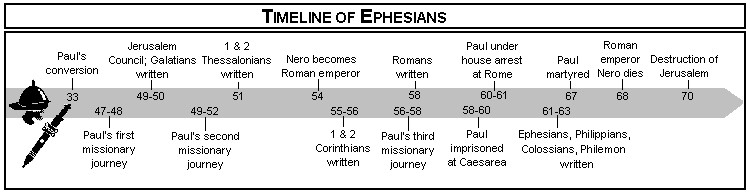
Ryrie Study Bible - NAS
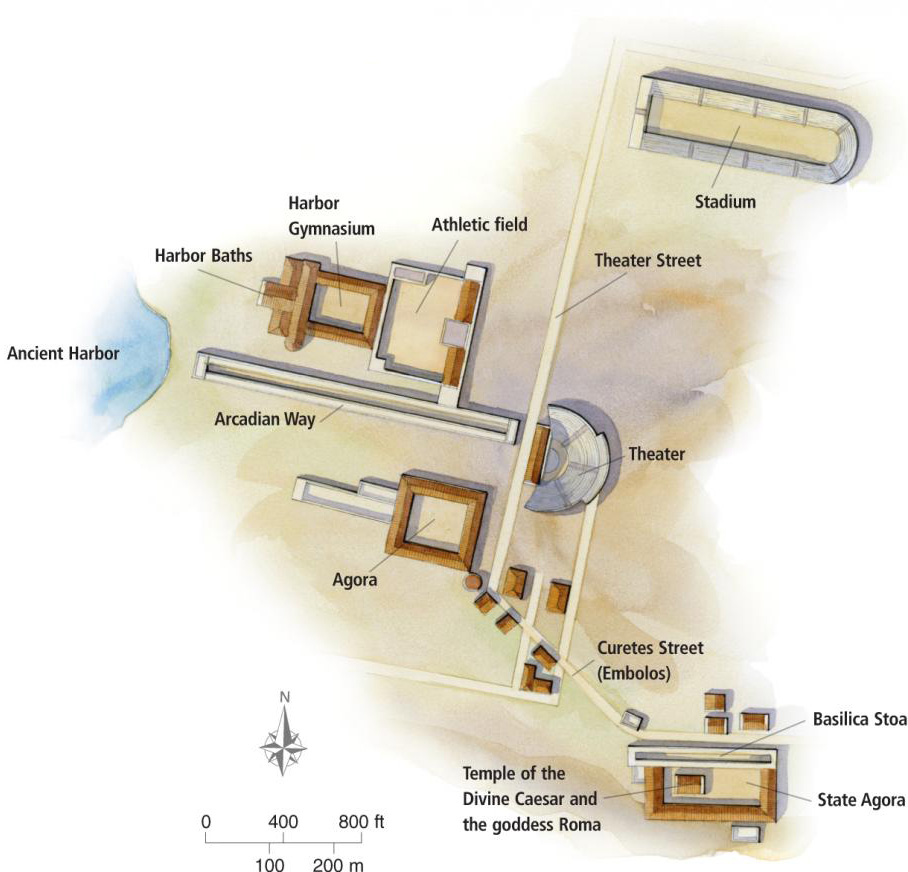
Ephesus in the Time of Paul (c. A.D. 60)
(Click to Enlarge)
Note: These Study Notes roughly correspond with the 10 Lessons of the Precept Upon Precept study of the Book of Ephesians (ESV format, NASB format). They are not meant to replace your personal study of the Word, which is the most important thing you can do if you want to get the Word of Ephesians in your heart and live it out in your walk. (Samples of Lesson 1 Pdf ESV, Lesson 1 Pdf NASB)
- Ephesians Study Questions Lesson 1 - Covers Introduction - Author & Recipients
- Ephesians Study Questions Lesson 2 - Covers Ephesians 1:1-14
- Ephesians Study Questions Lesson 3 - Covers Ephesians 1:15-2:10
- Ephesians Study Questions Lesson 4 - Covers Ephesians 2:11-22
- Ephesians Study Questions Lesson 5 - Covers Ephesians 3:1-21
- Ephesians Study Questions Lesson 6 - Covers Ephesians 4:1-6
- Ephesians Study Questions Lesson 7 - Covers Ephesians 4:7-16
|
Ephesians 4:7,11 |
| Related Topics Onsite:
How is Ephesians divided? Chapters 1-3 = Doctrine Chapters 4-6 = Duty How is Ephesians 4:1-16 divided? Ephesians 4:1-6 = Preserve the Unity in Truth Ephesians 4:7-16 = Unity in Diversity Ephesians 4:7 What does each saint get? Grace according to measure of CHRIST'S GIFT John 7:37-39 What does this teach about Christ's gift? The Gift is the Holy Spirit 1Cor12:13 What does the Spirit do? The Spirit Baptizes each believer into the Body of Christ Baptize = identify with, bring into union 1Cor 12:4-11 1Cor 12:4-6 What does this teach about gifts? Verse 4 Variety gifts-Spirit Verse 5 Ministries – Lord (Eg, Peter had a ministry to Gentiles, Paul to Jews) Verse 6 Effects – God (Eg, same message does not always produce same effect. It's in God's hands.) Note involvement of trinity in the spiritual gifts and utilization of the gifts. 1Cor 12:7 Who receives a gift? Each one given a manifestation (others can see it - helps us discern our gift) Why given? For the common good - profitable, useful The verb "sumphero" is literally "to bring together" and came to mean that which confers a benefit, is profitable, is advantageous or is useful to the body of Christ. 1Cor 12:8-10 What is the pattern repeated in these verses regarding gifts? Gifts differ but there is one Spirit (Unity) 1Cor 12:8-11 What is the emphasis again? One Spirit He distributes as He wills Not something to be sought Romans 12:3-8 Context: Dedication or consecration to God in Romans 12:1, 12:2 Romans 12:3 What is Paul's instruction? Romans 12:4; 12:5 What does Paul reiterate about the Body? Romans 12:6 What is reiterated about the gifts? Gifts differ according to grace given Romans 12:6-8 What pattern do you see in the giving of gifts? Stay in the sphere of your gift – if serving then serve (don't teach) 1Peter 4:10-11 1 Peter 4:10: Who receives a gift? 1 Peter 4:10 What is purpose? Serve one another We are not meant to be the terminals of God’s gifts to us (like the Dead Sea that has no outlet); His grace reaches us but should not end with us. We are intended to be channels through whom the blessing can flow to others. 1 Peter 4:10 How are believers to handle the gifts they receive? As good stewards A steward is literally “one who governs a household.” It speaks of the responsibility of the proper use and disposition of something entrusted to one’s care. Stewards had no wealth of their own, but distributed the Master’s wealth according to the Master’s will and direction. A steward is responsible for another’s resources. Similarly, a Christian does not own his gifts, but God does & God has given him gifts for the proper functioning of His body, the church. 1 Peter 4:11 What are the general categories of gifts? Speaking and serving 1 Peter 4:11 What are we to speak? Utterances of God = Word of God 1 Peter 4:11 How are we to serve? Strength which God supplies 1 Peter 4:11 What is the ultimate purpose of the gifts? To glorify God In summary how would you define "spiritual gifts"? Spiritual gifts are not… Supernatural abilities Sovereignly given to Strengthen Saints who Serve one another as Stewards of grace Spiritual gifts are not… Salvation, Character, Talents, Elders, Deacons, Skills Ephesians 4:11 What does Paul teach about spiritual gifts? Apostles – sent from another with authority Prophets – fore and forth tell (In NT no fore telling prophets, Biblical revelation is complete) Evangelists – proclaim gospel, increase in number of saints Pastor/Teachers - feed the Word, increase in quality of saints |
|
Ephesians 4:8-10 |
| Ephesians 4:8 What is he concluding or explaining? Explains why Christ had right to give gifts = He was the Victor. Gifts are free but it cost something to give them to us to this parenthesis should be a powerful motivator for us to all use our spiritual gifts. We need to remember what if cost our Lord to make them available to us. To not use them as one pastor phrased it is to spite God's gift to us. We will be held accountable for how we used our gifts. How does he illustrate from OT? Quotes Ps 68:18 Note there is some variation - specifically the OT says "received gifts" and NT says "He gives gifts"). The point is you have to receive something to have something to give. Christ received the gift from His Father and gave it to us. For example… Acts 2:33 "Therefore having been exalted to the right hand of God, and having received from the Father the promise of the Holy Spirit, He has poured forth this which you both see and hear. (referring to the promised gift of the Spirit - compare John 7:37-39, John 16:7, Luke 24:49, and even the OT promise included in the promise of the New Covenant in Ezekiel 26:27). What was Ps 68 about? Song of God's victory. Many think historically it was written by King David's at the time he captured Jerusalem but clearly Paul shows that it had a greater prophetic (messianic) fulfillment. What does this Messianic Psalm teach? Christ ascended - after His victory on Cross He led captives a host of captives He gave gifts to men (The Holy Spirit Who then distributes the gifts as He wills). Note: Regarding "Let captive a host of captives" Some think that Hades (the place of the dead which corresponds to the OT word Sheol) was divided into 2 compartments (as suggested by the passage in Lu 16:19-32. This compartmentalization had been taught by the pagan Greeks, in the apocryphal book of Enoch and by Jewish tradition). There is no consensus among conservative evangelical scholars as to whether Hades had 2 compartments. However, this teaching was widely held by the early church fathers who also taught that after His death Christ descended to Hades and that He set free the OT believers from the "cool" side of Hades (cf Luke 16:19-32). This teaching became incorporated into the Apostle's Creed but again to be fair and balanced, we must realize that there is no absolute consensus on these issues. This is not an issue that determines our salvation so we have to remember Paul's exhortation to be diligent to preserve the unity of the Spirit in the bond of peace. We can agree to disagree amicably and we can look forward to the glorious day when faith becomes sight and we no longer look through a mirror dimly! There is an interesting passage from Psalms one of the sons of Korah writing that…
In view of the fact that Hades is used in the Greek Septuagint to translate the Hebrew word Sheol in the OT, if you want more insight consider studying all of the OT passages that utilize Hades for Sheol. Ephesians 4:9; 4:10 How does Paul explain He ascended? First He descended To lower parts of earth What are the 2 (there are more than 2) most common interpretations of "to the lower parts of earth"? 1) Lower, earthly region = to the earth = incarnation Note the NIV rendering (remember the NIV is in part a paraphrase so the way it is rendered will be reflective the translator's favorite interpretation - just another reason to consider using a more literal version like NASB, ESV, NKJV, KJV!) Here is the NIV…
Notice how the translators have added a comma (not in the original Greek). By adding the comma how does it affect your interpretation? Clearly it favors a descent from heaven to earth in terms of incarnation and doesn't leave much room for interpreting it as #2. I'm not saying the NIV is wrong, but I am saying that it lends a definite bias to the passage and you as a good Bereans need to be aware of that fact ("caveat emptor"!) Another paraphrase (which I think is overall one of the better paraphrases available - but only as an adjunct to a more literal rendition) is the New Living Translation which overtly interprets the passage for the reader. Here is the NLT rendering…
2) Below the earth = To Hades (as discussed above) 1 Peter 3:19 What did Jesus do in context of His crucifixion? Jesus in spirit made proclamation to spirits in prison – suggests Christ descended to Hades. But does it say "Hades"? No, it doesn't so this passage is (voluminously) debated as to what Peter meant. Remember every passage has only one legitimate interpretation (many applications) even if we don't all agree. Those who advocate that Christ descended to Hades after His death and burial, utilize this passage to support their interpretation. Again this is one of those areas that we seek to be diligent to preserve the unity of the Spirit! Acts 2:27,31: What does Peter teach regarding Hades in his first sermon? God will not abandon (leave) Jesus soul to Hades. Remember that Hades means (NIV translates it as grave) Here are the verses compared in a more literal translation (NAS) and a paraphrase (so called dynamic paraphrase, the NIV)… NASB…
NIV…
What difference do you observe between the two translations? The NAS transliterates the Greek word, while the NIV offers its interpretation as the "grave" here implying simply the place the dead are laid to rest (Christ's tomb in this case). While the NIV may be correct, the transliteration as "Hades" leaves open the option of a place separate and distinct from the grave. As discussed below Hades seems to have three primary meanings in Scripture - the unseen world of the dead, as a metonym for death or as the place in the earth the dead are laid to rest, specifically the grave. Sometimes the context of the passage allows a clear distinction in the intended meaning, but other times the passage is not quite so clear. Hades is not an easy word to define and a brief study of conservative commentaries and lexicons will reveal that there are several areas in which there is no clear consensus. As the best resources for arriving at a definition of Hades are the Scriptures themselves, the diligent student is advised to compare the "definition" below (probably "description" would be a better term) with the 117 uses in the Scripture (see below for list of verses). With that caveat below is a brief summary of hades. Hades (86) (hades) is the transliteration of the Greek word Hades (from a = negative + eido = to see) literally means "not seen" or "unseen". As noted the understanding of Hades is somewhat confusing, as it changes meaning somewhat from as one moves from the uses in the Old Testament into the uses in the New Testament . That said, in the OT Hades was used most often to describe the region of ALL departed souls. Everyone who died, whether righteous or unrighteous, is described as departing to Hades. But as we move into the NT, we see the progressive revelation of the term, so that Hades gains a more restricted sense and refers not to the place of ALL who die (believers and unbelievers as in the OT) but only to the abode of unbelievers. In other words, in the NT Hades comes to be synonymous with what we refer to as Hell. But to confuse the picture a little, you must realize that even in this sense of meaning "Hell" Hades is only a "temporary holding tank" so to speak, because as shown in Rev 20:14+ Hades ceases to exist for it is thrown into the Lake of fire. Don't be confused. Hell is permanent and in Scripture is clearly described as such. The unrighteous dead will be resurrected in their bodies (The "Second Resurrection" - see Births, Deaths, and Resurrections) at the Great White Throne judgment in Revelation 20:11-15+ and after being judged for their deeds in the body (to determine the degree of punishment in Hell), they are thrown into the Lake of fire which is synonymous with Gehenna. Hades should not be confused with Gehenna, which refers to the final place of punishment (often translated as "hell"). And as discussed below, Hades is also thrown into the Lake of fire (thus the reason it is referred to as temporary) and is never again described in Scripture.
Other thoughts on Hades - In Homer hades is spelled Haides and means obscure, dark, invisible (Homer Iliad 23.244 [“house of Hades”]). Hades is used in the Septuagint where it translates the Hebrew words for Sheol and for death, once for silence (Ps 94:17, 115:17). Hades was the name of Greek god of underworld and then the term for the underworld itself. Hades is pictured as a prison for which Jesus holds the keys (Rev 1:18+). Friberg's (Borrow Analytical Lexicon of the Greek New Testament) simple summary of Hades (literally unseen place)
The reader is strongly advised to do his or her own study of the word Hades as it is used in Scripture and let that study guide the use of the definition in the various lexicons. For example, Vines is a respected conservative lexicon widely used by laymen to aid Greek word study and it has the following entry which I have added a few notes to to explain the lack of consensus among the lexicons and dictionaries on the meaning of hades…
Hades - 111x in 107 verses in the Septuagint - LXX - Note that a majority (about 61) of these uses of Hades are used to translate the Hebrew word Sheol (7585), and some uses translate other Hebrew words such as death. One of the common OT meanings of Sheol was in reference to the place of the departed dead.
Hades in the NT = 10x in 10v - Every use of Hades in the Gospels is by Jesus. All 10 NT uses of Hades refer to the abode of the damned with the EXCEPTION of the uses in Acts 2:27 and Acts 2:31 which are quotes from the OT. These two uses in Acts thus use Hades in the same sense as it was most commonly used in the OT. In other words in Acts 2:27, 31 Hades refers to the abode of the departed dead, not the abode of the damned. In summary, all the uses of Hades by Jesus and John in context refer specifically to the abode of the damned.
Related Resources:
Mt 16:18: What is the relation of Hades to the body of Christ, the church?
Rev 1:18: What is the relation of Jesus and Hades? John records Jesus declaration that He is "the living One; and I was dead, and behold, I am alive forevermore, and I have the keys of death and of Hades."
Lu 16:23
With that caveat and understanding what are the observations one can make from Luke 16:19-32-see verse by verse commentary?
Rev 20:13-14: What do you learn about Hades?
Ephesians 4:10 What is Paul's main point? What does it mean?
What does this mean?
|
|
Ephesians 4:12-16 |
| Ephesians 4:12 What is the purpose of Christ's gift of gifted men to the Church? Equipping of saints (Equipping = katartismos - see word study) Mt 4:21 This verse uses verb form of "equip" – what is the picture it gives? The idea is to make one what he or she ought to be Mend nets: Mending, preparing for service, getting ready for action (See word study of katartizo) Who does this equipping? How? Pastor-Teachers who speak the "utterances of God" (cf notes 1 Peter 4:11) The Word of God (Not devotionals, not commentaries, etc but the pure milk of the word) 1 Peter 2:2 How vital is the Word to equipping? Apart from the word there is no growth in respect to salvation! (Cf Jesus statement that man does not live by bread alone but by every word… What is the critically important point in regard to the local churches? Pastor-Teachers must (not should but must) feed the sheep the Word. Why equip saints? For the work (ergon) of service. Ergon is related to ergs a unit of measuring energy. The point is that the service will take work! The tragedy is that most churches have reversed this dynamic divine design and have the "paid staff" doing the "work of service" that for the sake of the "common good" should be done by equipped gifted saints (Peter says we are all "priests"!) who, for the most part instead of being equipped, are sitting and soaking, listening to tapes, going to seminars, watching videos, etc, but failing to focus on the pure milk of the word, the only resource God promises is able to equip them! This is not meant to be mean spirited diatribe, but a cry in the wilderness for the preaching and teaching of the Word, accepting no substitutes. The substitutes can be very subtle. For example, there may be a very popular book or video series which includes a few Scriptures (often taken out of context) to add a sense of Biblical credibility, but which fails to focus on the pure, unadulterated milk of God's Word. We need to return to the "ancient paths". That is the spirit in which this cry is issued. May God in His great mercy and grace, heed His children's cry for spiritual food and be pleased to send His Word through gifted, faithful men, so that the times of refreshing can come from the presence of the Lord, the Living Word. Amen What do saints? In serving they build up body (quality not quantity) Compare this dynamic to the call to make disciples as in 2 Timothy 2:2 (note) How do saints build up the body? What are their tools? The build with their spiritual gifts, those "tools" which which they are equipped as the gifted men feed them the Word of God. As they eat the Word, they grow in their grace and knowledge of our Lord and Savior Jesus Christ and they become more aware of what gifts they possess and how those gifts are best utilized in the local body to which they belong. In other words, these "tools" are honed and sharpened by the teaching of the pure milk of the word by the Pastor-Teachers -- who should be teaching not just the ABC's of Christianity but solid food! Ephesians 4:13 What are the goals? 1) All attain (in Acts "attain" is used to mean to to arrive at a destination!) to unity of the faith ("the faith" = not "belief" but body of truth believed) 2) Knowledge of Son of God = experiential knowledge, growing intimacy with Jesus (See word study epignosis) Ephesians 4:13 What result attain unity & knowledge? Maturity (wholeness) (See study of root word teleios) In context see what maturity looks like (see notes Ephesians 4:2) Ephesians 4:13 Goal of maturity? Christlikeness - Measure of stature which belongs to fullness of Christ Ephesians 4:14 When we are Christlike what danger avoid? No longer = implies they were at one time acting like children. Children (Literally means "not speaking", word for a helpless infant and in context describes spiritually immature) See: notes Hebrews 5:12; 5:13; 5:14 See also 1Cor 3:1-4 Ephesians 4:14 What happens to immature? What is result of maturity? Tossed (see word study kludonizomai) & carried by (see word study periphero)…
Note: The antidote for all 3 above is Pastor Teachers feeding sheep pure Word, solid food, not just ABC's – so that saints are maturing and able to discern good from evil (cf Heb 5:14) becoming Christlike (Ephesians 4:13) Ephesians 4:15 What proper process for growth in Body? Speaking truth (right doctrine) (includes idea of walking in truth) Doing so in love (right spirit) Ephesians 4:15 What result? Grow up in all aspects into Christ Christ = Goal Ephesians 4:16 What is Christ regarding growth of body? Not only goal but Source of growth Ephesians 4:16 HOW BODY INTEGRATED? Under Lord's direction (present = process)… Being Fitted together Being Held together Under Lord's direction (present tense for both verbs indicates it is a process)…
Note "being" is passive = action on saints from outside Source – shaping them, sanding them, fitting them as living stones into the Temple of the Lord, Dwelling of God cf Eph 2:21-22 Ephesians 4:16 How important is every member? fitting & holding together is by what every joint supplies – each part working properly Ephesians 4:16 What happens to body when each working properly (exercising gifts in His power for His glory)? Each working properly means each and every believer is exercising gifts in His power for His glory) Result is… 1) Body Grows 2) Builds self up In what environment or sphere are they to grow up and build up? In love (agape love = sacrificial, gives w/o expecting in return, fruit of Spirit, divine love as in John 3:16) (See word study of agape) Centrality of love in Ephesians… Ephesians 1:15 Your love for all the saints Ephesians 4:2 Showing tolerance in love Ephesians 4:15 Speaking the truth in love Ephesians 4:16 Building itself up in love Ephesians 3:17 Rooted and grounded in love Ephesians 3:19 Praying they would know the love of Christ which surpasses knowledge Colossians 2:19 What does the parallel passage teach about growth of the body? Must hold fast to Head = Christ Head is ultimate source of growth But "joints and ligament" (gifted saints) hold body together (when Pastor-Teachers are equipping them to understand and use their spiritual gifts) APPLICATION What is your spiritual gift? Is it working properly contributing to the common good of the body? What if a member of our human body is not "contributing"? Are you a channel through which the living waters of the Spirit is flowing to others (as you use your gift) or are you like the dead sea, that is dead because it has no outflow? We will be held accountable for how we used our gift…
|