Hebrews 11:1
Hebrews 11:2
Hebrews 11:3
Hebrews 11:4
Hebrews 11:5
Hebrews 11:6
Hebrews 11:7
Hebrews 11:8
Hebrews 11:9
Hebrews 11:10
Hebrews 11:11
Hebrews 11:12
Hebrews 11:13
Hebrews 11:14
Hebrews 11:15
Hebrews 11:16
Hebrews 11:17
Hebrews 11:18
Hebrews 11:19
Hebrews 11:20
Hebrews 11:21
Hebrews 11:22
Hebrews 11:23
Hebrews 11:24
Hebrews 11:25
Hebrews 11:26
Hebrews 11:27
Hebrews 11:28
Hebrews 11:29
Hebrews 11:30
Hebrews 11:31
Hebrews 11:32
Hebrews 11:33
Hebrews 11:34
Hebrews 11:35
Hebrews 11:36
Hebrews 11:37
Hebrews 11:38
Hebrews 11:39
Hebrews 11:40
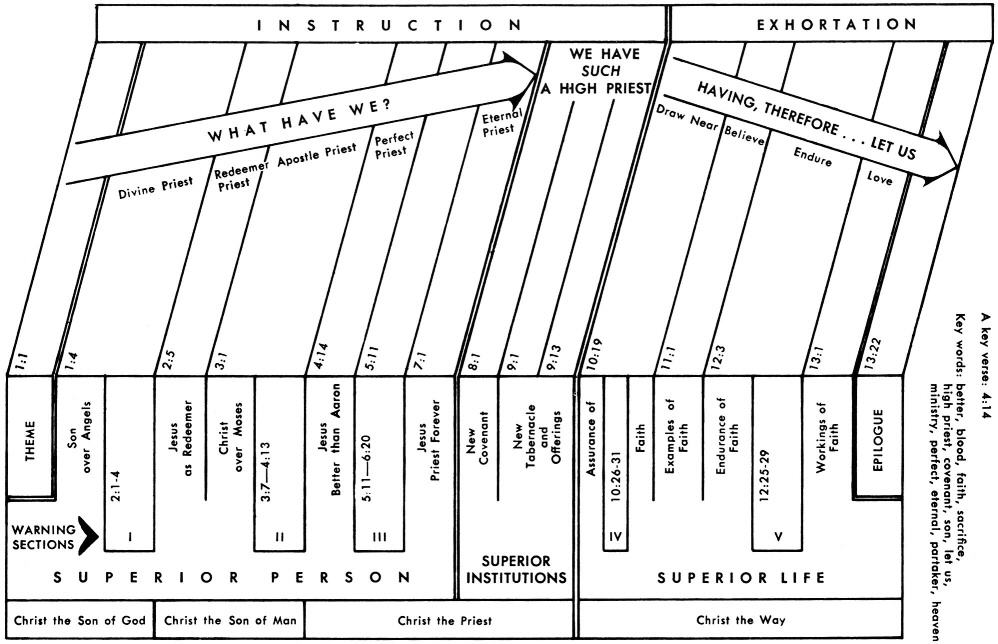
CONSIDER JESUS OUR GREAT HIGH PRIEST
Click chart to enlarge
Charts from Jensen's Survey of the NT - used by permission
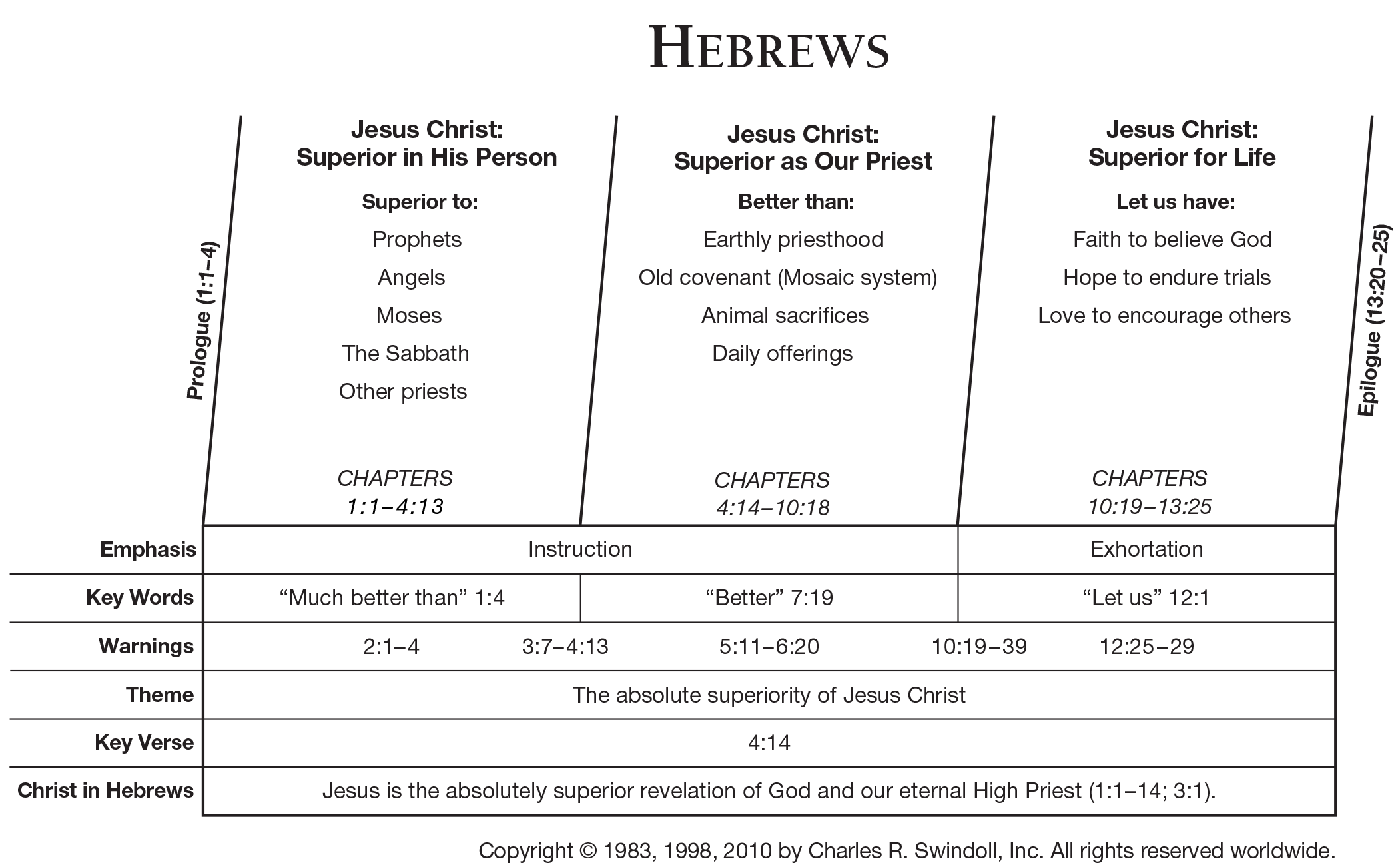
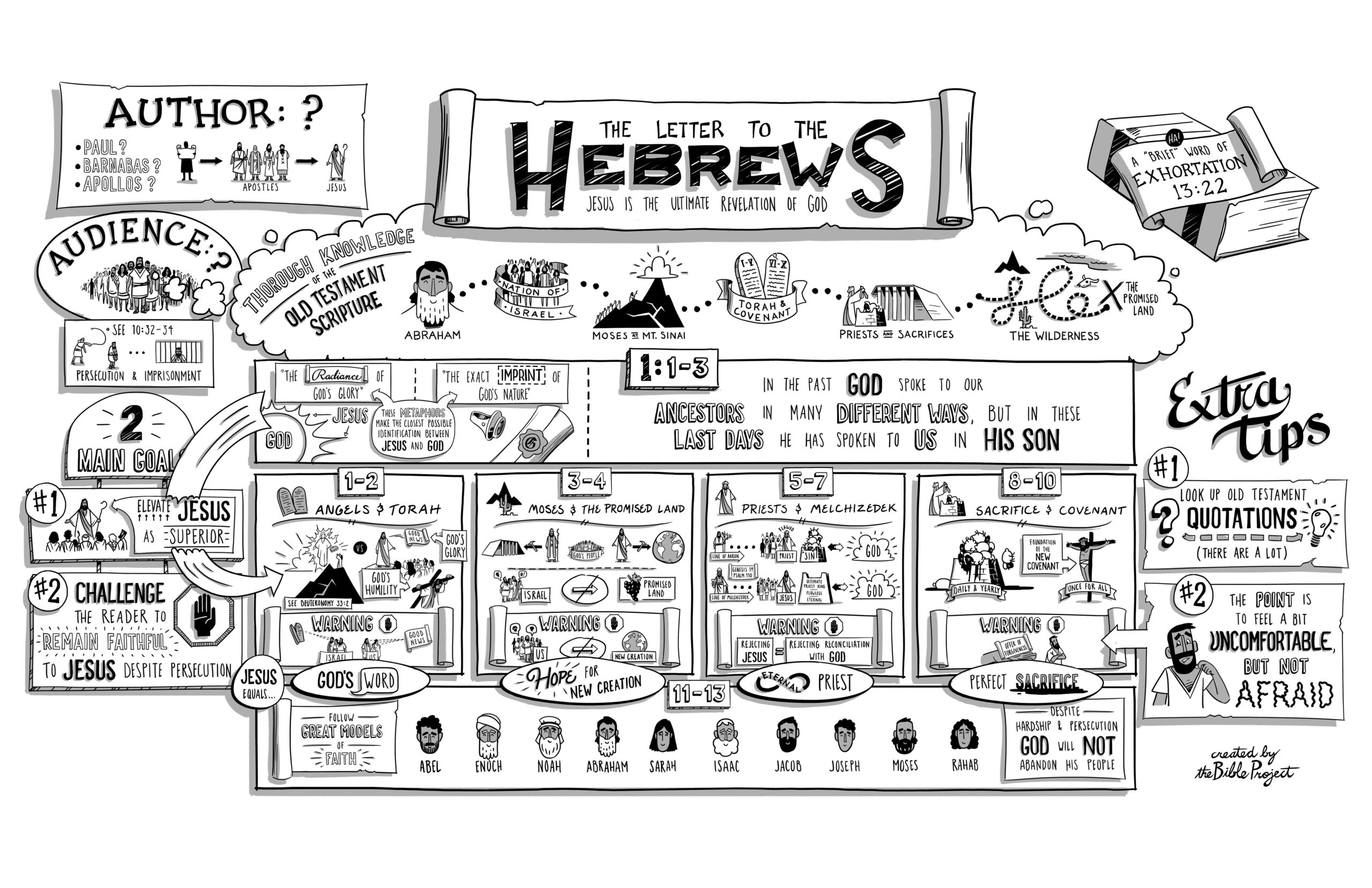
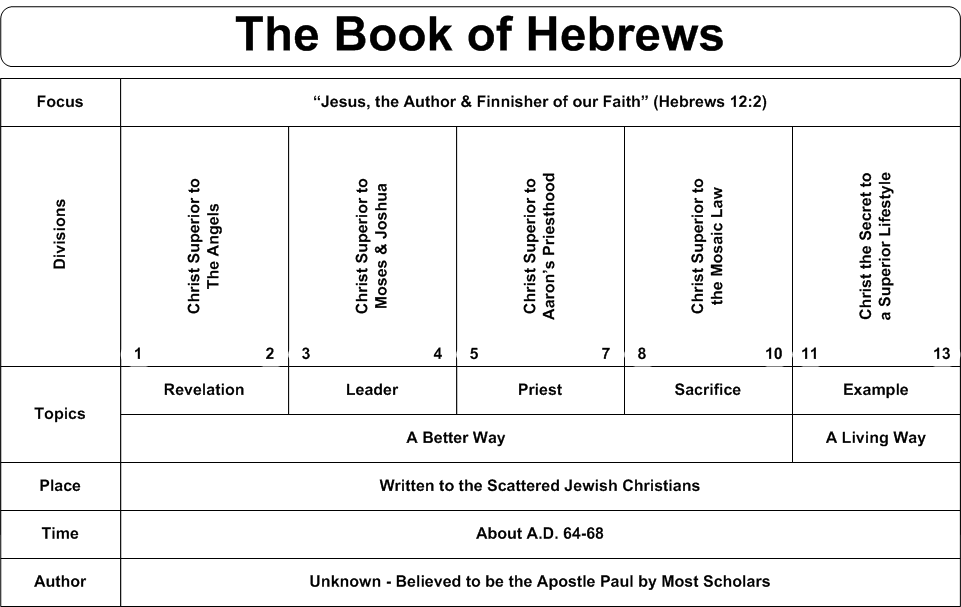
Swindoll's Chart, Interesting Pictorial Chart of Hebrews, Another Chart
|
The Epistle |
||||
| INSTRUCTION Hebrews 1-10:18 |
EXHORTATION Hebrews 10:19-13:25 |
|||
| Superior Person of Christ Hebrews 1:1-4:13 |
Superior Priest in Christ Hebrews 4:14-10:18 |
Superior Life In Christ Hebrews 10:19-13:25 |
||
| BETTER THAN PERSON Hebrews 1:1-4:13 |
BETTER PRIESTHOOD Heb 4:14-7:28 |
BETTER COVENANT Heb 8:1-13 |
BETTER SACRIFICE Heb 9:1-10:18 |
BETTER LIFE |
| MAJESTY OF CHRIST |
MINISTRY OF CHRIST |
MINISTERS FOR CHRIST |
||
|
DOCTRINE |
DUTY |
|||
|
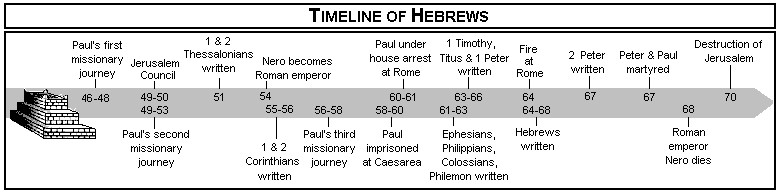
DATE WRITTEN: |
||||

See ESV Study Bible "Introduction to Hebrews"
(See also MacArthur's Introduction to Hebrews)
Borrow Ryrie Study Bible
Hebrews 11:37 They were stoned, they were sawn in two, they were tempted, they were put to death * * with the sword; they went about in sheepskins, in goatskins *, being destitute, afflicted, ill-treated (NASB: Lockman)
Greek: elithasthesan, (3PAPI) epristhesan, (3PAPI) en phono machaires apethanon, (3PAAI) perielthon (3PAAI) en melotais, en aigeiois dermasin, usteroumenoi, (PPPMPN) thlibomenoi, (PPPMPN) kakouchoumenoi, (PPPMPN)
Amplified: They were stoned to death; they were lured with tempting offers [to renounce their faith]; they were sawn asunder; they were slaughtered by the sword; [while they were alive] they had to go about wrapped in the skins of sheep and goats, utterly destitute, oppressed, cruelly treated— (Amplified Bible - Lockman)
KJV: They were stoned, they were sawn asunder, were tempted, were slain with the sword: they wandered about in sheepskins and goatskins; being destitute, afflicted, tormented;
NLT: Some died by stoning, and some were sawed in half; others were killed with the sword. Some went about in skins of sheep and goats, hungry and oppressed and mistreated. (NLT - Tyndale House)
Phillips: They were killed by stoning, by being sawn in two; they were tempted by specious promises of release and then were killed with the sword. Many became refugees with nothing but sheepskins or goatskins to cover them. They lost everything and yet were spurned and ill-treated (Phillips: Touchstone)
Wuest: They were stoned, tested, sawn asunder; they died, slaughtered by the sword; they wandered around in sheepskins and goatskins; being destitute, hard pressed, maltreated,
Young's Literal: they were stoned, they were sawn asunder, they were tried; in the killing of the sword they died; they went about in sheepskins, in goatskins--being destitute, afflicted, injuriously treated,
THEY WERE STONED, THEY WERE SAWN IN TWO, THEY WERE TEMPTED, THEY WERE PUT TO DEATH WITH THE SWORD; THEY WENT ABOUT IN SHEEPSKINS, IN GOATSKINS, BEING DESTITUTE, AFFLICTED, ILL-TREATED: elithasthesan (API), epristhesan (API), en phone machaires apethanon (AAI), perielthon en melotais, en aigeiois dermasin, husteroumenoi, thlibomenoi, kakouchoumenoi:
- Stoned - 1Ki 21:10,13, 14, 15; 2Chr 24:21; Mt 21:35; 23:37; Luke 13:34; Jn 10:31, 32, 33; Acts 7:58,59; 14:19; 2Co 11:25
- Put to death with the sword - 1Sa 22:17, 18, 19; 1Ki 18:4,13; 19:1,10,14; Jer 2:30; 26:23; Lam 4:13,14; Mt 23:35, 36, 37; Luke 11:51, 52, 53, 54; Acts 7:52; 12:2,3
- In sheepskins - 2Ki 1:8; Mt 3:4; Rev 11:3
- Being destitute - He 12:1, 2, 3; Zech 13:9; Mt 8:20; 1Co 4:9, 10, 11, 12, 13; 2Co 11:23, 24, 25, 26, 27; 12:10; Jas 5:10,11
- Hebrews 11 Resources - Multiple Sermons and Commentaries
They were stoned (3034)(lithazo from líthos = a stone) describes a common OT Jewish punishment.
Spurgeon - It is wonderful how God takes care that the victories of faith shall somehow or other be kept in mind. There was a period after the prophets had ceased to prophesy, and before Christ came, in which the Israelite church had to contend against antichrist and other enemies. In the Apocrypha you have the account of some few of the martyrdoms of those who held fast to God and to His truth. Those who were stoned and sawed in two for the truth’s sake shall not be forgotten. If the details be not given they shall yet be recorded in the gross, on the sacred page. If you have been in a piano factory, did you go there for the sake of music? Go into the tuning room, and you will say, “This is a dreadful place to be in; I cannot bear it; I thought you made music here.” They say, “No, we do not produce music here. We make the instruments, and tune them here, and in the process much discord is forthcoming.”Such is the church of God on earth. The Lord makes the instruments down here, and tunes them, and a great deal of discord is easily perceptible, but it is all necessary to prepare us for the everlasting harmonies up yonder.
The prophet Zechariah would qualify for this description - Then the Spirit of God came on Zechariah the son of Jehoiada the priest; and he stood above the people and said to them, “Thus God has said, ‘Why do you transgress the commandments of the Lord and do not prosper? Because you have forsaken the Lord, He has also forsaken you.’ ” 21 So they conspired against him and at the command of the king they stoned him to death in the court of the house of the Lord. (2Chr 24:20, 21)
They were sawn in two - Tradition (again including a number of the Early Church Fathers) also says that Isaiah was sawn in two with a wooden saw by evil King Manasseh.
Henry Morris - According to Jewish tradition, the prophet Isaiah was executed by being sawn in two during the reign of the evil son of King Hezekiah, Manasseh. (Defender's Study Bible)
Lane records that according to "mutually complementary rabbinic sources, Manasseh, enraged because Isaiah had prophesied the destruction of the Temple, ordered his arrest. Isaiah fled to the hill country and hid in the trunk of a cedar tree. He was discovered when the king ordered the tree cut down. Isaiah was tortured with a saw because he had taken refuge in the trunk of a tree. (Lane, W. L. Vol. 47B: Word Biblical Commentary: Hebrews 9-13. Word Biblical Commentary (390). Dallas: Word, Incorporated)
They were tempted (tested) (3985) (peirazo [word study] from the noun peira = test from peíro = perforate, pierce through to test durability of things) is a morally neutral word simply meaning “to test”. Whether the test is for a good (as it proved to be in Heb 11:17) or evil (Mt 4:1) depends on the intent of the one giving the test and also on the response of the one tested. The trials may come from God or in this context more likely under His permissive will from the world, the evil nature (the "flesh"), or the Devil. When the Scriptural context clearly indicates the testing is an enticement to evil, the word is most frequently translated by a form of the English tempt, which carries that negative connotation and this NEVER refers to a test from God.
Spurgeon - It seems to me that the trials and temptations of this life are preparing us for the life to come, building character for eternity. Have you ever been in a piano factory? Did you go there to hear music? Go into the tuning room and you will say, “This is a dreadful place, I cannot stand it, I thought you made music here.” “No, we do not produce music here. We make instruments and tune them, and in the process much discord is produced.” Such is the church of God on earth. The Lord makes the instruments and tunes them down here. A great deal of discord is easily perceptible, but it is all necessary to prepare us for the everlasting harmonies up yonder. I am to stand one day so near to God that between Him and me there will be but one person, and that person is the Lord Jesus Christ, my Lord and Mediator. In Christ, I am to have dominion over all the works of God’s hands and to be crowned with glory and honor. Angels are to be my servants and heaven my inheritance. Will I ever grow proud? Will self-exaltation creep in? No! The character will be fixed for holiness as though etched in eternal brass. It may be that all the afflictions and temptations that God permits to pass over us here below are forming us for eternal bliss. Thus the corn is ripening for the harvester and the fruit is mellowing for the basket. Here, the engraving tool and hammer bring out the beauties that will shine in the courts of the Lord forever, when on us also the record will be written, “They were tempted”.
The presence of temptation in this list is somewhat surprising and expositors have found it difficult to interpret. Kenneth Wuest says that "It is probably best to leave it as it is, and suggest that one of the most fiendish tortures was not that of the body but of the conscience, when the torturer would offer the victim opportunity to recant and thus obtain his freedom.
Put to death with the sword - Wuest writes that "The Greek has it that they “died by sword-slaughter,” indicating mass-slaughters. Examples of this abound in the Maccabean period."
Put to death (599)(apothnesko from apo = marker of dissociation implying a rupture from a former association, separation, departure, cessation + thnesko = die) literally means to die off and speaks here of literal physical death.
Sword (3162)(machaira from mache = a knife, sword) refers to a relatively short sword (even dagger) for cutting and stabbing. It was extremely difficult to approach a soldier well trained in the use of the machaira for it was short and could be moved rapidly. The fact that it was two-edged made it possible to strike on either side without changing its position in the hand, and its razor-sharp point could pierce armor. Machaira is used of the sword of the Spirit (the Word of God) in Eph 6:17.
Sheepskins and goatskins - What does this apparel signify? Where they simply "ascetics"? Was this "self-abasement and severe treatment of the body" (Col 2:23)? Surely not, for this is the chapter of faith, not works or legalistic self-made religion. The simple answer is that these were the only clothing they had to wear.
Destitute (5302) (hustereo from hústeros = last, latter, terminal, hindmost) has the basic meaning of come to late (in time) or to come after (in terms of space) and thus it means to fail in something, come short of, miss, not to reach. Hustereo has the basic meaning of being last or inferior. It means to be left behind in the race and so fail to reach the goal, to fall short of the end, to lack. It means to come late or too tardily.
It means to be excluded in (Hebrews 12:15) or in Hebrews 4:1 as coming too late through one's own fault miss and so to fail to reach the intended objective or goal.
In several of the NT passages hustereo means to be in short supply, to fail, to give out or to lack. Hustereo can mean to experience deficiency in something advantageous or desirable and thus to be lacking, go without or come short of (as in Mt 19:20).
Hustereo - 14 times in the Lxx
Num. 9:7, 13; Neh. 9:21; Job 36:17; Ps. 23:1; 39:4; Eccl. 6:2; 9:8; 10:3; Cant. 7:2; Dan. 4:33; 5:27; Hab. 2:3
Hustereo - 16 times in the NT
Matt. 19:20; Mk. 10:21; Lk. 15:14; 22:35; Jn. 2:3; Rom. 3:23; 1 Co. 1:7; 8:8; 12:24; 2 Co. 11:5, 9; 12:11; Phil. 4:12; Heb. 4:1; 11:37; 12:15)
The meaning of hustereo is further illustrated in the following verses…
(At the wedding in Cana site of Jesus' first recorded miracle) And when the wine gave out, (hustereo) the mother of Jesus said to Him, "They have no wine." (John 2:3)
Now when he (the prodigal son) had spent everything, a severe famine occurred in that country, and he began to be in need (hustereo). (Luke 15:14)
The young man said to Him, "All these things I have kept; what am I still lacking (hustereo)?" (Mt 19:20)
Afflicted (distressed) (2346)(thlibo from tribos = wear away, rub, break in pieces; NIDNTT says thlibo is from the root thlao = squash, crush) (See related word thlipsis) literally means to press, squeeze, crush, squash, hem in and then to be narrow. Thlibo used literally pictures putting pressure upon or pressing in upon or pressing hard upon a person as when when Jesus was forced to get in the boat to keep from crowding Him (Mark 3:9). While some uses of thlibo refers to physical affliction, other uses are figurative and refer to emotional or spiritual affliction (e.g., "conflicts without, fears within" in 2Cor 7:5) And so in Paul’s letters thlibo usually refers to the hardships he and his fellow workers experienced during their missionary journeys (2Cor 1:6; 4:8; 7:5; 1Th 3:4; 2Th 1:1-7).
Ill-treated (2558)(kakoucheo from kakos = badly, ill + écho = to have) means ill–treat, mistreat, afflict, harass, oppress, torment. The present tense speaks that these saints were continually harassed. The only other NT use is Hebrews 13:3 where the writer exhorts us to "Remember the prisoners, as though in prison with them, and those who are ill-treated, since you yourselves also are in the body." Moulton and Milligan say kakoucheo was used in marriage contracts where the husband undertakes as regards his wife (to not oppress or harass her). In another secular use it describes a complaint against a husband.
There are 2 uses of kakoucheo in one verse in the Lxx
1Kgs 2:26 Then to Abiathar the priest the king said, “Go to Anathoth to your own field, for you deserve to die; but I will not put you to death at this time, because you carried the ark of the Lord GOD before my father David, and because you were afflicted (Heb = anah = to be oppressed, bowed down; Lxx = kakoucheo) in everything with which my father was afflicted (Heb = anah = to be oppressed, bowed down; Lxx = kakoucheo).
Hebrews 11:38 (men of whom the world was not worthy), wandering in deserts and mountains and caves and holes in the ground. (NASB: Lockman)
Greek: on ouk en (3SIAI) axios o kosmos, epi eremiais planomenoi (PPPMPN) kai oresin kai spelaiois kai tais opais tes ges
Amplified: [Men] of whom the world was not worthy—roaming over the desolate places and the mountains, and [living] in caves and caverns and holes of the earth. (Amplified Bible - Lockman)
KJV: (Of whom the world was not worthy:) they wandered in deserts, and in mountains, and in dens and caves of the earth.
NLT: They were too good for this world. They wandered over deserts and mountains, hiding in caves and holes in the ground. (NLT - Tyndale House)
Phillips: by a world that was too evil to see their worth. They lived as vagrants in the desert, on the mountains, or in caves or holes in the ground. (Phillips: Touchstone)
Wuest: men of whom the world was not worthy, wandering over deserts and mountains, and in caves and holes of the earth.
Young's Literal: of whom the world was not worthy; in deserts wandering, and in mountains, and in caves, and in the holes of the earth;
(MEN OF WHOM THE WORLD WAS NOT WORTHY), WANDERING IN DESERTS AND MOUNTAINS AND CAVES AND HOLES IN THE GROUND: on ouk en axios o kosmos, epi eremiais planomenoi kai oresin kai spelaiois kai tais opais tes ges:
- Men of whom the world was not worthy - 1 Kings 14:12,13; 2Ki 23:25-29; Isaiah 57:1
- Went about - 1Sa 22:1; 23:15,19,23; 24:1, 2, 3; 26:1; 1Ki 17:3; 18:4,13; 19:9; Psalm 142:1; Ps 142:2, 3, 4, 5, 6, 7
- Hebrews 11 Resources - Multiple Sermons and Commentaries
THE REAL ESTIMATE
OF THE WORTH OF ONE'S LIFE
Men of whom the world was not worthy - Vine comments that "The statement expresses the divine estimate. The world counts those who are true witnesses to God not worthy of itself. God reverses the comparison. Separation from the world and its ways always brings its contempt. The world will one day be compelled to acknowledge that God is right.
Worthy (514) (áxios from ágō = to weigh) strictly speaking means bringing up the other beam of the scales. Having the weight of another thing of like value, worth as much. Counterbalancing - weighing as much (of like value, worth as much).
Bringing into balance and hence equivalent or equal value/similar worth (Ro 8:18, see use in Lxx of Pr 3:15, 8:11). Other nuances of axios include describing that which is fitting or appropriate (1Cor 16:2), that which is deserving (Mt 10:10), that which "deserves" to be considered or accepted (1Ti 1:15), that which is worthy of praise (Rev 4:11), that which corresponds to or is congruent with something else (Mt 3:8, Luke 3:8, 23:41, 26:20). Worthy or deserving of evil (Rev 16:6).
Richards - Axios and kataxioo express the idea of worthiness. In the Gospels, the original sense--of weight or value--predominates (as in Jesus' directive to his disciples to "search for some worthy person" [Mt 10:11]). Compared to the Messiah, who was about to appear, even the prophet John the Baptist viewed himself as of little weight (Mk 1:7).
Related study on the adverb axíōs (516)
NIDNTT writes that in classic Greek axios "(Homer onwards) meant originally tipping the scales, counter-balancing, of like value (TDNT I 379). The term compares two entities, either of the same or of different (anaxios) weight."
TDNT says that in regard to axios -In the NT the thought of merit is excluded; we are worthy of the gospel only as we receive it (cf. Mt. 10:11, 13; 22:8; Acts 13:46; Heb. 11:38; Rev. 3:4). In many expressions a genitive or infinitive is put with áxios to denote the sphere of correspondence (cf. Ro 16:2). Paul admonishes his readers to walk worthy of the gospel, their calling, and the Lord (1 Th. 2:12; Phil. 1:27; Col. 1:10; Eph. 4:1; cf. 3 Jn. 6), thus linking the motive and goal of Christian action, the motivating power residing in God’s prior action. Hence the warning not to receive the Lord’s Supper unworthily (anáxios ) does not refer legalistically to a moral quality but to an attitude determined by the gospel.
Vine says axios means “of weight, worth, worthy,” is said of persons and their deeds: (a) in a good sense, e.g., Matt. 10:10, 11, 13 (twice), 37 (twice), 38; 22:8; Luke 7:4; 10:7; 15:19, 21; John 1:27; Acts 13:25; 1 Tim. 5:18; 6:1; Heb. 11:38; Rev. 3:4; 4:11; 5:2, 4, 9, 12; (b) in a bad sense, Luke 12:48; 23:15; Acts 23:29; 25:11, 25; 26:31; Rom. 1:32; Rev. 16:6. (Worthy, Worthily - Vine's Expository Dictionary of NT Words)
Axios has the root meaning of balancing the scales—what is on one side of the scale should be equal in weight to what is on the other side. By extension, axios came to be applied to anything that was expected to correspond to something else. A person worthy of his pay was one whose day’s work corresponded to his day’s wages.
Axios was used to describe the Roman emperor when he marched in a triumphal procession. He was "worthy" (adjective). John tells us however that the One Who is truly "worthy" (adjective) is the Lamb, recording that he heard all creation rightly declare "Worthy (adjective) is the Lamb that was slain to receive power and riches and wisdom and might and honor and glory and blessing. (Rev 5:12-note)
The Lamb slain (the resurrected and glorified Lord Jesus Christ) is the only One Who is "worthy (adjective) to open the book and to break its seals." (Rev 5:2-note) The Redeemer Alone had the right to consummate the full redemption of His creation, the "final act" of which will begin when He breaks the seven sealed scroll, which many futuristic commentators identify as the "title deed to the earth" (Click discussion).
Jesus addressing the church at Sardis said "But you have a few people in Sardis who have not soiled their garments; and they will walk with Me in white; for they are worthy. (Re 3:4-note)
Axios (adjective) 41x in 39v - appropriate(1), deserve(2), deserving(4), fitting(2), keeping(2), unworthy*(1), worthy(29). -
Matthew 3:8 "Therefore bear fruit in keeping with repentance;
NET Bible: Fruit worthy of repentance refers to the deeds that indicate a change of attitude (heart) on the part of John's hearers.
Matthew 10:10 or a bag for your journey, or even two coats, or sandals, or a staff; for the worker is worthy of his support. 11 "And whatever city or village you enter, inquire who is worthy in it, and stay at his house until you leave that city… 13 "If the house is worthy, give it your blessing of peace. But if it is not worthy, take back your blessing of peace.
Matthew 10:37 "He who loves father or mother more than Me is not worthy of Me; and he who loves son or daughter more than Me is not worthy of Me. 38 "And he who does not take his cross and follow after Me is not worthy of Me.
Matthew 22:8 "Then he said to his slaves, 'The wedding is ready, but those who were invited were not worthy.
Luke 3:8 "Therefore bear fruits in keeping with repentance, and do not begin to say to yourselves, 'We have Abraham for our father,' for I say to you that from these stones God is able to raise up children to Abraham.
Luke 7:4 When they came to Jesus, they earnestly implored Him, saying, "He is worthy for You to grant this to him;
Comment: Here axios carries the meaning of “deserving” something -- the Jewish elders sent to Jesus by the Roman centurion pleaded earnestly that he "deserves" for Jesus to heal his servant.
Luke 10:7 "Stay in that house, eating and drinking what they give you; for the laborer is worthy of his wages. Do not keep moving from house to house.
Luke 12:48 but the one who did not know it, and committed deeds worthy (deserving) of a flogging, will receive but few. From everyone who has been given much, much will be required; and to whom they entrusted much, of him they will ask all the more.
Luke 15:19 I am no longer worthy to be called your son; make me as one of your hired men."'
Luke 15:21 "And the son said to him, 'Father, I have sinned against heaven and in your sight; I am no longer worthy (deserve) to be called your son.'
Luke 23:15 "No, nor has Herod, for he sent Him back to us; and behold, nothing deserving death has been done by Him.
Luke 23:41 "And we indeed are suffering justly, for we are receiving what we deserve for our deeds; but this man has done nothing wrong."
John 1:27 "It is He who comes after me, the thong of whose sandal I am not worthy to untie."
Acts 13:25 "And while John was completing his course, he kept saying, 'What do you suppose that I am? I am not He. But behold, one is coming after me the sandals of whose feet I am not worthy to untie.'
Acts 13:46 Paul and Barnabas spoke out boldly and said, "It was necessary that the word of God be spoken to you first; since you repudiate it and judge yourselves unworthy of eternal life, behold, we are turning to the Gentiles.
Acts 23:29 and I found him to be accused over questions about their Law, but under no accusation deserving death or imprisonment.
Acts 25:11 "If, then, I am a wrongdoer and have committed anything worthy of death, I do not refuse to die; but if none of those things is true of which these men accuse me, no one can hand me over to them. I appeal to Caesar."
Acts 25:25 "But I found that he had committed nothing worthy (i.e., he did not deserve) of death; and since he himself appealed to the Emperor, I decided to send him.
Acts 26:20 but kept declaring both to those of Damascus first, and also at Jerusalem and then throughout all the region of Judea, and even to the Gentiles, that they should repent and turn to God, performing deeds appropriate to repentance.
Acts 26:31 and when they had gone aside, they began talking to one another, saying, "This man is not doing anything worthy of death or imprisonment."
Romans 1:32-note and although they know the ordinance of God, that those who practice such things are worthy of death, they not only do the same, but also give hearty approval to those who practice them.
Romans 8:18-note For I consider (logizomai) that the sufferings of this present time are not worthy to be compared with the glory that is (about) to be revealed to us.
Comment: Sufferings now are not going to "balance the scales" of the glory that results from present suffering! Upshot: "Hangeth thou in there dear child of God." Suffering in life is short when weighed on the scale of glory that accrues to our account!
A T Robertson: We shall be included in the radiance of the coming glory which will put in the shadow the present sufferings.
1 Corinthians 16:4 and if it is fitting for me to go also, they will go with me.
Comment: The idea is that Paul would make the journey if circumstances were "suitable" or such that that the work demanded him to go.
2 Thessalonians 1:3 We ought always to give thanks to God for you, brethren, as is only fitting (proper - the point is the thanksgiving is appropriate in the circumstances), because your faith is greatly enlarged, and the love of each one of you toward one another grows ever greater;
1 Timothy 1:15 It is a trustworthy statement, deserving full acceptance, that Christ Jesus came into the world to save sinners, among whom I am foremost of all.
1 Timothy 4:9 It is a trustworthy statement deserving full acceptance.
1 Timothy 5:18 For the Scripture says, "YOU SHALL NOT MUZZLE THE OX WHILE HE IS THRESHING," and "The laborer is worthy of his wages."
1 Timothy 6:1 All who are under the yoke as slaves are to regard their own masters as worthy of all honor so that the name of God and our doctrine will not be spoken against.
Hebrews 11:38 (men of whom the world was not worthy), wandering in deserts and mountains and caves and holes in the ground.
Revelation 3:4-note 'But you have a few people in Sardis who have not soiled their garments; and they will walk with Me in white, for they are worthy.
Revelation 4:11-note "Worthy are You, our Lord and our God, to receive glory and honor and power; for You created all things, and because of Your will they existed, and were created."
Revelation 5:2-note And I saw a strong angel proclaiming with a loud voice, "Who is worthy to open the book and to break its seals?"
Revelation 5:4-note Then I began to weep greatly because no one was found worthy to open the book or to look into it;
Revelation 5:9-note And they sang a new song, saying, "Worthy are You to take the book and to break its seals; for You were slain, and purchased for God with Your blood men from every tribe and tongue and people and nation.
Revelation 5:12-note saying with a loud voice, "Worthy is the Lamb that was slain to receive power and riches and wisdom and might and honor and glory and blessing."
Revelation 16:6-note for they poured out the blood of saints and prophets, and You have given them blood to drink. They deserve it."
For completeness, below are the 6 NT uses of the related adverbial form of axíōs (516)…
Romans 16:2-note that you receive her in the Lord in a manner worthy of the saints, and that you help her in whatever matter she may have need of you; for she herself has also been a helper of many, and of myself as well.
Ephesians 4:1-note Therefore (term of conclusion - What is Paul concluding?) I, the prisoner of the Lord, implore you to walk (peripateo) in a manner worthy of the calling with which you have been called
Comment: This verse is like a "hinge" on a door. It swings open the practical exhortations of chapters 4-6, exhortations which cannot be carried out without reliance of the foundational truths Paul taught on the "other side of the door." In other words chapters 1-3 are primarily doctrine while chapters 4-6 call believers to duties based on sound doctrine. Belief should always show forth in behavior "in keeping with" ("worthy of") the truth that one believes. Be careful though -- do not try to carry out the exhortations and commands of chapters 4-6 in your strength! You will put yourself under the law and you will surely fail! Take the yoke of Jesus, the yoke of enabling grace, surrendering to the Spirit of Christ. Then, and only then, you will be empowered to walk in a manner worthy of the calling!
Philippians 1:27-note Only conduct yourselves (present imperative = a command to do this as one's lifestyle, which of course can only be obeyed as the believer surrenders to the Spirit, is filled by Him [Eph 5:18-note] and walks by Him [Gal 5:16-note]) in a manner worthy of the Gospel of Christ, so that (term of conclusion - What is Paul concluding?) whether I come and see you or remain absent, I will hear of you that you are standing firm in one spirit, with one mind striving together for the faith (the objective truth) of the Gospel;
Comment: Paul is exhorting them to live their lives like they are citizens of heaven (because they are! Php 3:20-note), so their conduct in a sense "weighs as much as" (axios) the gospel they preach and the faith they profess. In other words, they are to see to it that they practice what they preach, that their experience measures up to their new standing as children of the King. We do not behave (or conduct ourselves in a certain way) in order to go to heaven, as though we could be saved by our good works, but we conduct ourselves because our names are already written in heaven, and our citizenship is in heaven.
Colossians 1:10-note so that (term of conclusion - What is Paul concluding?) you will walk in a manner worthy of the Lord, to please Him in all respects, bearing fruit in every good work and increasing in the knowledge of God;
Wuest Comments: The saints are to see to it that their manner of life, their conduct, weighs as much as the character of their Lord. That is, He is to be their example in life, and the copy must be like the example. Peter says: “Christ also suffered on your behalf, leaving behind for you a model to imitate, in order that by close application you might follow in His footprints” (I Pet. 2:21). Expositors says: “This lofty wisdom and insight is not an end in itself. It must issue in right practice. Doctrines and ethics are for Paul inseparable. Right conduct must be founded on right thinking, but right thinking must also lead to right conduct.”
1 Thessalonians 2:12-note so that (term of conclusion - What is Paul concluding?) you would walk (peripateo) in a manner worthy of the God (How? cp 1Cor 11:1 - Thus walking like Jesus, enabled to do so by the same Spirit on Whom He depended! See Lk 4:1, 14 - See discussion of The Holy Spirit) Who calls you into His Own kingdom and glory.
3 John 1:6 and they have testified to your love before the church. You will do well to send them on their way in a manner worthy of God (Which begs the question - How would God send them on their way?).
A good picture of axios is a set of scales that are perfectly balanced. How is that achieved? Obviously the same weight is on one side of the scale as on the other side of the scale.
MY WALK CHRIST IN ME
So how does a set of scales apply to the life of a follower of Jesus Christ? Well, let's reason this through -- If Jesus is in me, which He is if I am truly born again, then His Spirit indwells me (Col 1:27b-note, Ro 8:9-note, 1Cor 6:19-note). Then, as I study His Word taught by the Spirit and grown in grace, I begin to learn to submit or yield to the leading of the Spirit (Ro 8:14-note, Gal 5:18-note), rejecting self-reliance and learning to lean on Him, depending continually on His ever sufficient grace. As this pattern becomes a reality in my life, I will be enabled to live a lifestyle that will "Measure up" to the Name of the One Who is in me and my words and actions will give a proper opinion to others of the One Who is in me, the otherwise invisible God (Mt 5:16-note). When that happens, we are walking worthy of the Lord, of His Gospel, of God's calling, and of our great name "saints" (set apart ones)! Now that's abundant life! (cp Jn 10:10b)
A worthy walk brings "forth fruit in keeping (axios - adjective) with repentance." (Mt 3:8) Keep in mind that the root idea of axios is having equal weight or worth, and therefore of being appropriate, suitable or fitting. The upshot is that true repentance (in contrast to worldly sorrow - 2Cor 7:10) will have have works which "weigh" as much as the repentance. True repentance brings forth good fruit. False repentance brings forth rotten fruit, which will not "balance the scales." Those who claim to know Christ, who claim to be born again, will demonstrate a new way of living that corresponds to ("has a weight that equates to" or is worthy of) the new birth they profess.
The believer who walks in a manner worthy of the calling with which he has been called is one whose daily living corresponds to his high position as a child of God and fellow heir with Jesus Christ. His practical living matches his privileged position.
As an aside, do not be surprised that when we are walking worthy of our calling (in humility rather than pride, in unity rather than divisiveness, in the new self rather than the old, in love rather than lust, in light rather than darkness, in wisdom rather than foolishness, in the fullness of the Spirit rather than the drunkenness of wine, and in mutual submission rather than self–serving independence), that we will experience opposition and conflict from the world, the flesh and the devil.
The Bible defines a worthy walk as consisting of the following
A worthy walk is a walk in…
- the Holy Spirit (Ro 8:4-note, cp Gal 5:16-note, Gal 5:25-note)
- humility (Ep 4:2-note)
- purity (Ro 13:13-note; Ep 5:3-note)
- contentment (1Co 7:17)
- faith (2Co 5:7-note)
- righteousness (Ep 2:10-note)
- unity (Ep 4:3-note; Php 1:2-note)
- gentleness (Ep 4:2-note)
- patience (Col 1:11-note)
- love (Ep 5:2-note)
- joy (Col 1:11-note)
- thankfulness (Col 1:12-note)
- light (Ep 5:8-note, Ep 5:9-note)
- knowledge (Col 1:10-note)
- wisdom (Ep 5:15-note)
- truth (3Jn 3, 4)
- fruitfulness (Col 1:12-note)
In short, “The one who says he abides in Him ought himself to walk in the same manner as He walked” (1John 2:6), because that pleases God (1Thes 4:1 - note).
Keep in mind that axios was originally used of drawing down a scale and hence it had to do with weight and so of that which is of value. For example when Paul says in Ro 8:18-note "that the sufferings of this present time are not worthy (axios - adjective) to be compared with the glory that is to be revealed to us" the picture he is painting is that present sufferings are of no weight in comparison with future glory and are not even to be balanced on the scale with the "heavy" glory that endures forever.
You honor God's name
When you call Him your Father
And live like His Son
“Am I conducting myself in a manner worthy of the Gospel?” is a good question for us to ask ourselves regularly.
To reiterate this important point -- Right thinking should always lead to right conduct. Knowledge and obedience go together. One cannot separate learning from living. The idea of "worthy" is that the conduct of the saints weigh as much as the character of Christ. Why? Because when we are surrendered to His will, He is living His life through us via His indwelling Spirit. Ultimately His conduct is the only conduct which is truly worthy, for no other conduct would balance God's perfect scales. Christ alone pleases the Father completely and as we allow Christ to rule and reign in our lives, our lives become pleasing to the Father.
A WORTHY WALK UNSEEN
HERE BUT NOT THERE
Men of whom the world was not worthy - Phillips paraphrases it "by a world that was too evil to see their worth."
Constable - Sometimes the faithful person’s reward comes on the other side of the grave. Some of the readers and we might have to endure death. Those who accept death without apostatizing are those the world is not worthy of because they do not turn from following God even under the most severe pressure. (Hebrews 11 Commentary)
Hughes writes that "The language is vividly descriptive of the savage indignities and severe hardships which men and women of faith have been willing to endure rather than deny the truth by which they have been liberated. It depicts, moreover, the fierce hatred of the unbelieving world in its guilty hostility to the truth as it ruthlessly hunts and assaults those whose trust is in the immutability of the divine promises. Rejecting the world they are ejected by the world. For their refusal to conform to this world's fallen standards the world attempts to eliminate them and their witness. But it is precisely these hunted heroes of the faith of whom (as our author declares in a resounding parenthesis) the world was not worthy. Their nobility and their integrity shine forth all the more brilliantly against the world's dark hatred; for in a world darkened and degraded by sin they truly are the light, and theirs is the true blessedness and the everlasting reward (Mt. 5:10-13). As those whose gaze is fixed on a better world they endure and by their faith they overcome, knowing as they do (and as the world refuses to know) that "the world passes away," but that "he who does the will of God abides for ever" (1 Jn. 2:17; 5:4). (A Commentary On The Epistle To The Hebrews)
Spurgeon - You have seen the works of faith and the sufferings of faith; now you see God’s estimate of faith. He counts the believing man to be far beyond the rest of mankind. These worthies lived before Christ came; but, since then, equally noble exploits have been performed by the heroes and heroines of faith. The Christian martyrs have shown the extremity of human endurance when they have been sustained by faith; and the bead-roll of Christian heroes, since their Lord ascended to heaven, is longer and even brighter than that of the faithful ones who came before them in the earlier dispensation. This is the grandest roll of heroes that ever lived, and every one among them was a man or woman of faith. Faith made them so mighty. They were not greater, and in some respects not better than the rest of us, but they believed in God, they were firm in faith, and this became the basis of their conquering character, and thus their names are imperishably recorded here. They did not win the Victoria cross, but they bore the cross for their Lord, and he has honored them with an everlasting crown, which shall never be taken from them.
Steven Cole - Faith's Reward
2. Sometimes God blesses those who trust Him with the grace to endure horrible trials without wavering (Heb 11:35b-38).
“Women receiving back their dead by resurrection” is the apex of the spectacular. It doesn’t get any more impressive than that! Yet without skipping a beat, the author continues (He 11:35b-38), “and others were tortured, not accepting their release, so that they might obtain a better resurrection; and others experienced mockings and scourgings, yes also chains and imprisonment. They were stoned, they were sawn in two, they were tempted [this has weak manuscript support and may not be original], they were put to death with the sword; they went about in sheepskins, in goatskins, being destitute, afflicted, ill-treated (men of whom the world was not worthy), wandering in deserts and mountains and caves and holes in the ground.”
After reading the first part of the list, you want to say, “These guys on the second half of the list must not have had faith, right?” But the author continues (He 11:39), “And all these, having gained approval through their faith,…” Those on the second half of the list were just as much people of faith as those on the first half! In fact, you could argue that they had greater faith, because it’s not as easy to trust God when you’re being scourged, stoned, or sawn in two as it is when you’re seeing foreign armies put to flight and the dead raised to life. While all of us, if we could, would sign up to be in the first group, we need to recognize that sometimes God is pleased to withhold spectacular results and bless us instead with His grace as our sufficiency in overwhelming trials (2Co 12:9, 10).
With one exception, many names could fit into the various categories on this list of persecutions. That exception is “sawn in two,” which is not in the Bible. Tradition says that the wicked King Manasseh killed the prophet Isaiah by sawing him in two. A Jewish work, The Martyrdom of Isaiah, recounts this terrible ordeal, saying, “Isaiah neither cried aloud nor wept, but his lips spoke with the Holy Spirit until he was sawn in two” (in Philip Hughes, A Commentary on the Epistle to the Hebrews [Eerdmans], p. 514).
The description of some being tortured, not accepting their release, may refer to two incidents during the reign of terror of the wicked Antiochus Epiphanes (reported in the apocryphal 2 Maccabees 6 & 7). In the first, an old teacher of the law, Eleazar, was forced to open his mouth to eat pork. But, “preferring an honorable death to an unclean life, he spat it out” (2 Macc. 6:19, New English Bible). They then stretched him on a rack and flogged him.
At one point, they offered that he could eat clean meat, but pretend that it was the pork that the king had ordered. He replied, “Send me quickly to my grave. If I went through with this pretence at my time of life, many of the young might believe that at the age of ninety Eleazar had turned apostate. If I practiced deceit for the sake of a brief moment of life, I should lead them astray and bring stain and pollution on my old age. I might for the present avoid man’s punishment, but, alive or dead, I shall never escape from the hand of the Almighty” (6:24-27). In the other incident, seven sons of one woman were tortured and killed in front of her for refusing to eat pork.
Our text refutes the health and wealth heresy, to say the least! It shows us the fierce opposition that Satan has towards the faithful people of God. It reveals the irrational evil that consumes wicked people to inflict such atrocities on the godly. And, it should en-courage us to endure rejection, ill-treatment, injustice, and even torture and death, if need be, for the sake of the gospel. Although, like the Hebrews (He 12:4), we have not yet resisted to the point of shedding blood in our striving against sin,” it may come to that. If we do suffer for the sake of Christ, we will join a great company of God’s people down through history “of whom the world was not worthy” (He 11:38).
The last two verses of the chapter show us that…
3. God will bless all who trust Him with eternal rewards (He 11:39, 40).
“All these” refers to both groups. They all gained approval (or “a testimony”) through their faith, yet none received “the promise” (literal translation). Abraham received the promise of Isaac (He 11:17). Others “obtained promises” by faith (He 11:33). But none received the promise, which refers to Christ. They saw Him from afar in types and shadows, but we see Him clearly revealed in the New Testament. Most of them were under the old covenant, but God “provided something better for us, so that apart from us they would not be made perfect.” That something better is the new covenant in Christ’s blood. The old covenant with its sacrifices could not make the worshipers perfect (He 10:1). But the new covenant has sanctified us “through the offering of the body of Jesus Christ once for all” (He 10:10). The Old Testament saints were saved, but their salvation was not complete until the cross. Ours is complete because Jesus is the perfect sacrifice.
The author’s point is that if the Old Testament saints were faithful through all of these trials, even though they didn’t receive the promise of Christ in the flesh, how much more should we be faithful, since we have Christ! John Calvin (Calvin's Commentaries [Baker], p. 308) put it, “A small spark of light led them to heaven; when the sun of righteousness shines over us, with what pretence can we excuse ourselves if we still cleave to the earth?”
Any yet, although we have the promise of Christ, we do not yet have the full experience of the glory that is to be revealed with Him in heaven. And so we must, like the Old Testament saints, live by faith in God’s promise as we await the final consummation when Jesus returns. We must endure whatever trials come, even persecution, by fixing our eyes on Jesus (He 12:1, 2, 3).
Conclusion
Let me sum up this section with four applications. I cannot expand on these, but I encourage you to think about how they apply more extensively to your life:
(1) Faith is ready to sacrifice present comfort for future reward with Christ. Faith recognizes that this life is very short in comparison with eternity. With Paul, faith recognizes that “momentary, light affliction is producing for us an eternal weight of glory far beyond all comparison” (2Co 4:17). In Paul’s case, this “light affliction” included beatings, imprisonments, being stoned, shipwrecked, and often being in danger of death (2Co 11:23, 24, 25, 26, 27)! When you experience “light affliction,” do you grumble or do you joyfully trust God?
(2) Faith lives with a God-ward focus, not with a focus on people or things. The saints mentioned in our text could endure mockings, scourgings, imprisonments, and death because their focus was on God, not on other people or things. They were looking to eternity, not to this vapor of life here. Calvin put it this way, “we ought to live only so as to live to God: as soon as we are not permitted to live to God, we ought willingly and not reluctantly to meet death” (ibid., p. 306).
(3) Faith trusts and obeys God, leaving the results to His sovereignty. Some trust and obey God and He grants spectacular results. Others trust and obey the same mighty God and He enables them to endure horrific trials in His strength. The difference is not in the people or in their faith, but in God’s sovereign purpose in each situation. We know the same God that these Old Testament saints knew, and we have even more, in that we know Christ personally. So we should trust Him as they did, whether He chooses to put us to death, as He did with the apostle James, or to deliver us from death for a while, as He did with Peter.
(4) Faithfulness to Jesus Christ counts more than anything else, even than life itself. As Martin Luther put it (“A Mighty Fortress”),
Let goods and kindred go,
this mortal life also;
the body they may kill:
God’s truth abideth still;
His kingdom is forever.
Trust God in whatever difficult situations you face. One day soon you will hear, “Well done, good and faithful slave…. Enter into the joy of your master” (Mt 24:21)
Discussion Questions
Where is the balance between accepting our shortcomings and yet striving by faith to overcome them?
Why is faith not opposed to preparation, planning, and hard work? How can we know whether the power is from God or from our planning and effort?
Why is it wrong to judge whether we have God’s blessing by the visible results? How can we know if we have His blessing?
What are some reasons that God does not always deliver those who trust in Him? (Index to Pastor Steven Cole's sermons by Bible book - Highly Recommended - They read much like a verse by verse commentary)