Hebrews 7:1
Hebrews 7:2
Hebrews 7:3
Hebrews 7:4
Hebrews 7:5
Hebrews 7:6
Hebrews 7:7
Hebrews 7:8
Hebrews 7:9
Hebrews 7:10
Hebrews 7:11
Hebrews 7:12
Hebrews 7:13
Hebrews 7:14
Hebrews 7:15
Hebrews 7:16
Hebrews 7:17
Hebrews 7:18
Hebrews 7:19
Hebrews 7:20
Hebrews 7:21
Hebrews 7:22
Hebrews 7:23
Hebrews 7:24
Hebrews 7:25
Hebrews 7:26
Hebrews 7:27
Hebrews 7:28
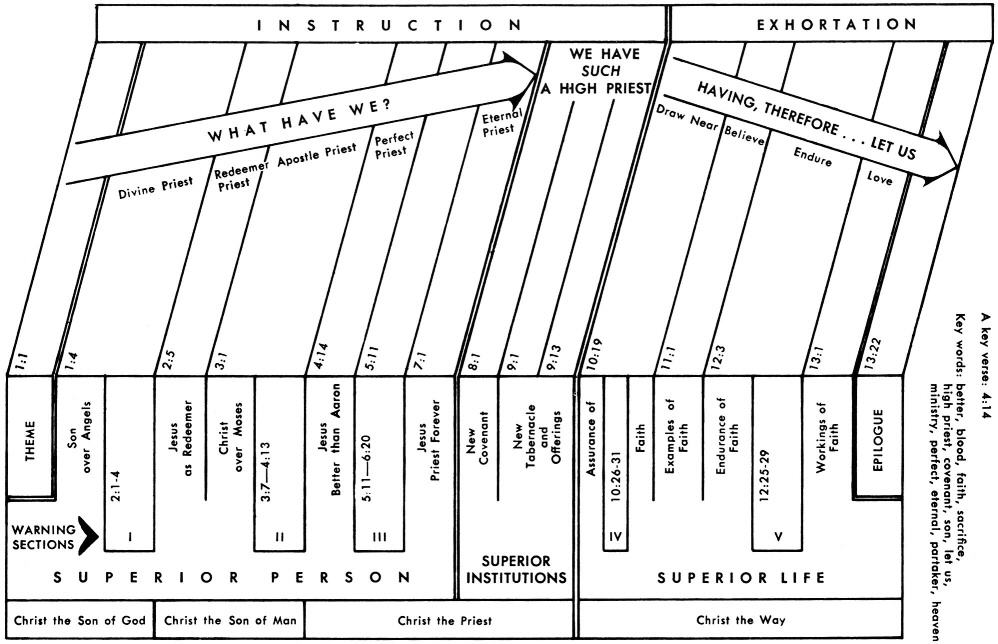
CONSIDER JESUS OUR GREAT HIGH PRIEST
Click chart to enlarge
Charts from Jensen's Survey of the NT - used by permission
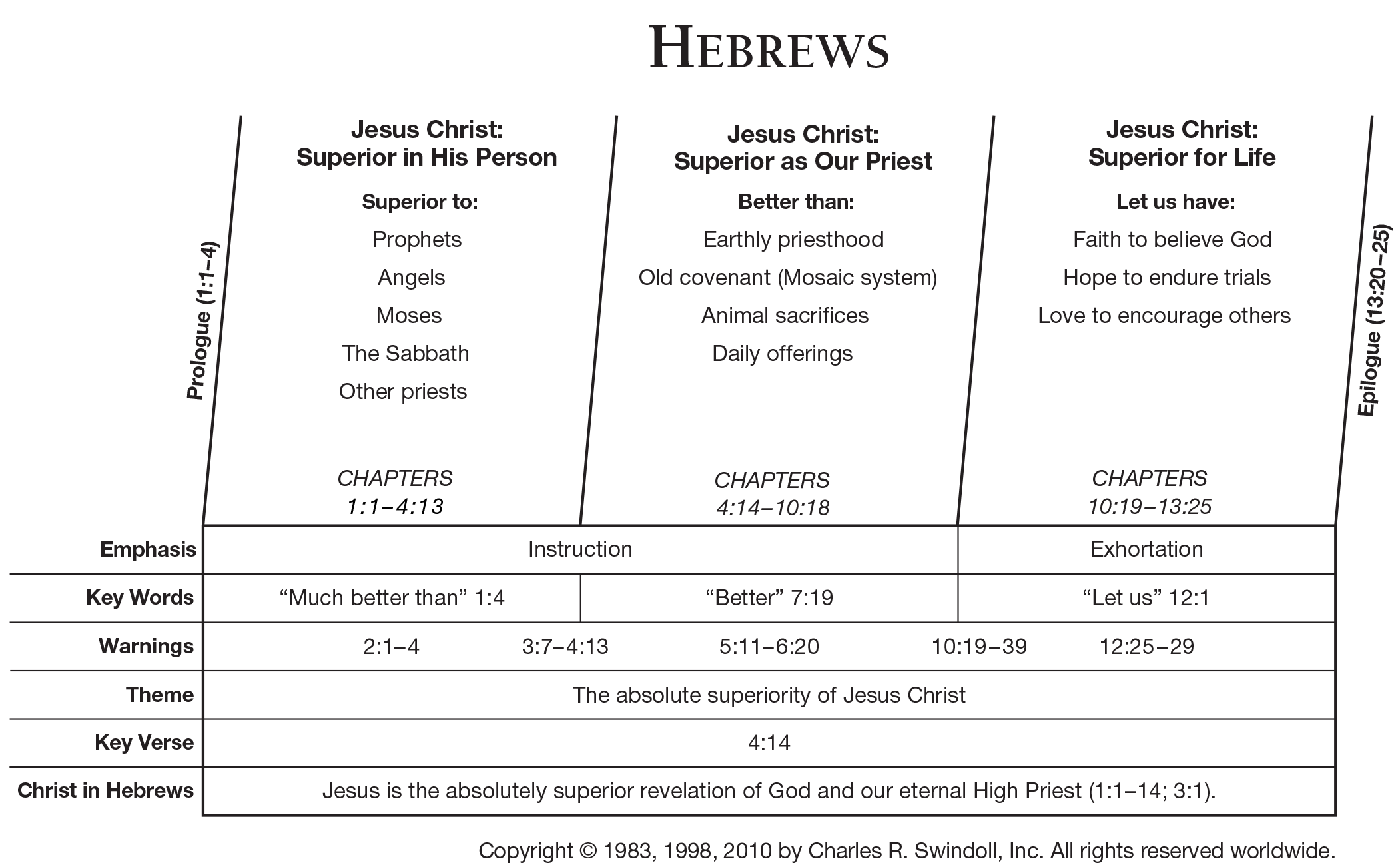
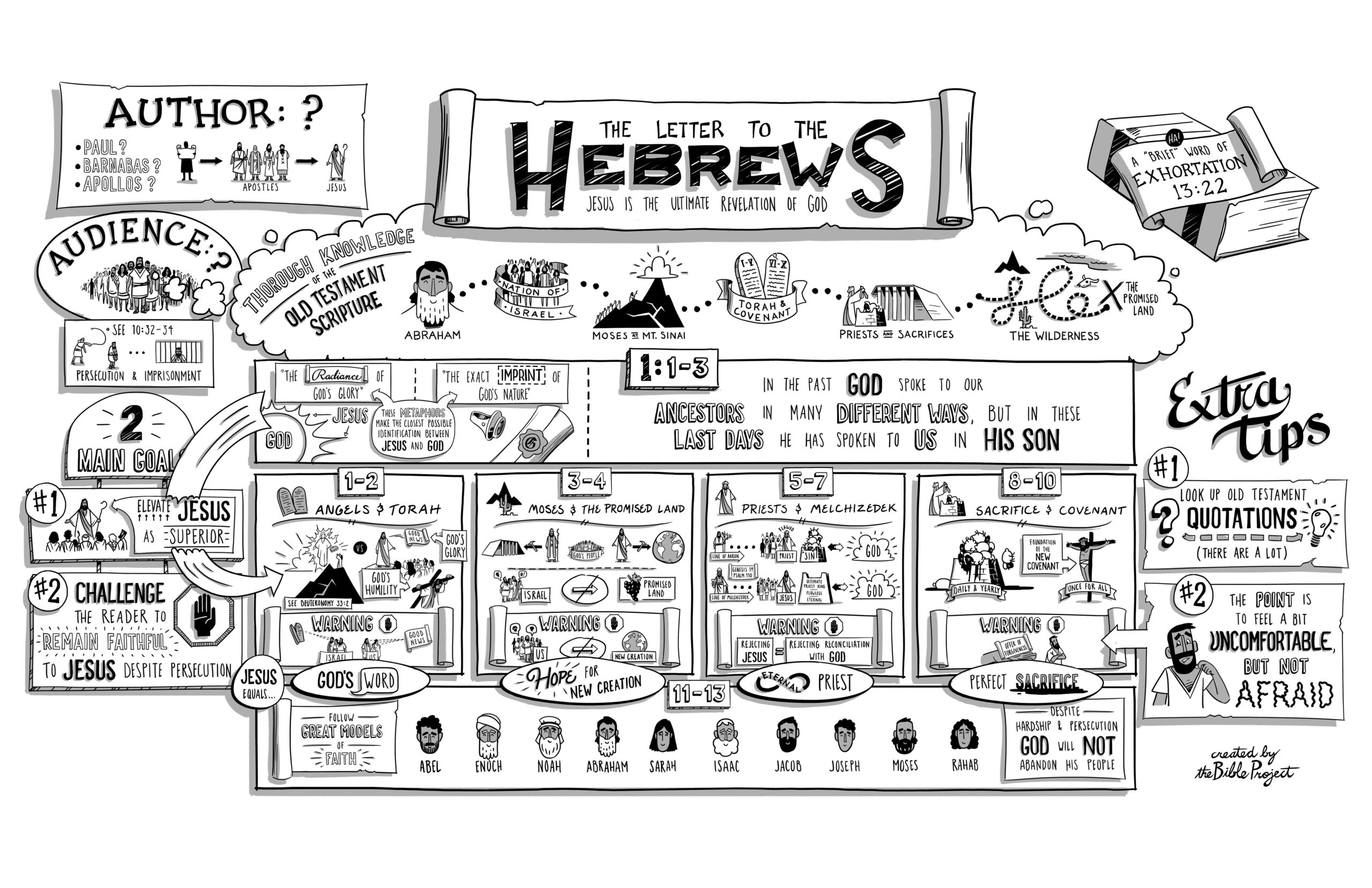
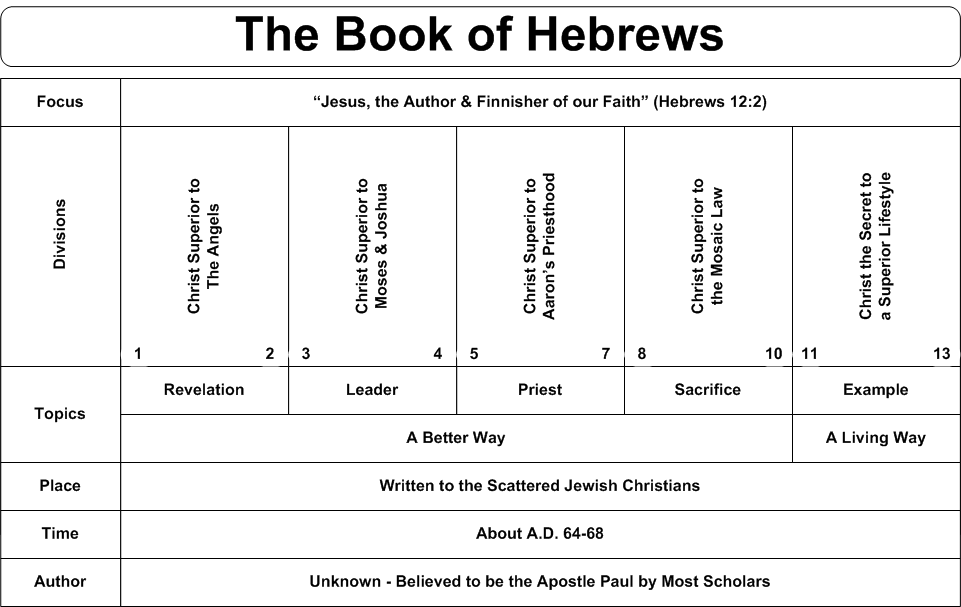
Swindoll's Chart, Interesting Pictorial Chart of Hebrews, Another Chart
|
The Epistle |
||||
| INSTRUCTION Hebrews 1-10:18 |
EXHORTATION Hebrews 10:19-13:25 |
|||
| Superior Person of Christ Hebrews 1:1-4:13 |
Superior Priest in Christ Hebrews 4:14-10:18 |
Superior Life In Christ Hebrews 10:19-13:25 |
||
| BETTER THAN PERSON Hebrews 1:1-4:13 |
BETTER PRIESTHOOD Heb 4:14-7:28 |
BETTER COVENANT Heb 8:1-13 |
BETTER SACRIFICE Heb 9:1-10:18 |
BETTER LIFE |
| MAJESTY OF CHRIST |
MINISTRY OF CHRIST |
MINISTERS FOR CHRIST |
||
|
DOCTRINE |
DUTY |
|||
|
DATE WRITTEN: |
||||

See ESV Study Bible "Introduction to Hebrews"
(See also MacArthur's Introduction to Hebrews)
Borrow Ryrie Study Bible
Hebrews 7:6 But the one whose genealogy is not traced from them collected a tenth from Abraham and blessed the one who had the promises. (NASB: Lockman)
Greek: o de me genealogoumenos (PPPMSN) ex auton dedekatoken (3SRAI) Abraam, kai ton echonta (PAPMSA) tas epaggelias eulogeken. (3SRAI)
BGT ὁ δὲ μὴ γενεαλογούμενος ἐξ αὐτῶν δεδεκάτωκεν Ἀβραὰμ καὶ τὸν ἔχοντα τὰς ἐπαγγελίας εὐλόγηκεν.
Amplified: But this person who has not their Levitical ancestry received tithes from Abraham [himself] and blessed him who possessed the promises [of God]. (Amplified Bible - Lockman)
KJV: But he whose descent is not counted from them received tithes of Abraham, and blessed him that had the promises.
NLT: But Melchizedek, who was not even related to Levi, collected a tenth from Abraham. And Melchizedek placed a blessing upon Abraham, the one who had already received the promises of God. (NLT - Tyndale House)
Young's Literal: and he who was not reckoned by genealogy of them, received tithes from Abraham, and him having the promises he hath blessed,
NKJ but he whose genealogy is not derived from them received tithes from Abraham and blessed him who had the promises.
NET But Melchizedek who does not share their ancestry collected a tithe from Abraham and blessed the one who possessed the promise.
CSB But one without this lineage collected tenths from Abraham and blessed the one who had the promises.
ESV But this man who does not have his descent from them received tithes from Abraham and blessed him who had the promises.
NIV This man, however, did not trace his descent from Levi, yet he collected a tenth from Abraham and blessed him who had the promises.
Paraphrase But this man, who did not descend from Levi, collected a tithe from Abraham and pronounced a blessing on him, the one holding God’s promises.
Paraphrase Melchizedek, though unrelated by genealogy, received a tenth from Abraham and blessed him—the very bearer of the covenant promises.
Paraphrase The one without ancestral ties to Levi received tithes from Abraham and gave a blessing to the promise-holder.
Paraphrase This priest, without family connection to Israel’s priestly line, not only received Abraham’s tithe but also bestowed blessing on him who carried God’s covenant pledges.
- Genealogy - Heb 7:4; Genesis 14:19,20
- Collected - Heb 7:4 Ge 14:19,20
- By the one who had the promises - Heb 6:13-15; Ge 11:13,17; Ge 12:2,13; Ge 13:14-17; Ge 17:4-8; Ge 22:17,18; Acts 3:25; Ro 4:13; 9:4; Gal 3:16
- Hebrews Study Questions - to aid your personal study or leading an inductive Bible study
- Hebrews 7 Resources - sermons and commentaries
THE GENEALOGY THAT
DOES NOT MATTER!
Having noted in Hebrews 7:5 that the sons of Levi were commanded by the Law to receive tithes from their fellow Israelites—even though both groups shared descent from Abraham—the writer now introduces a striking contrast. In Hebrews 7:6, he points out that Melchizedek, who did not trace his lineage from Levi or Abraham, received a tithe from Abraham himself. Even more, Melchizedek is portrayed as the one who blessed Abraham, the very man who carried God’s covenant promises. This double emphasis—Melchizedek receiving the tithe and giving the blessing—further underscores his superiority. The lesser (Abraham, and therefore Levi in his loins) acknowledges the greater (Melchizedek) both by giving and by being blessed. In this way, the writer builds toward his main argument: that Christ’s priesthood, patterned after Melchizedek, is higher than and prior to the Levitical priesthood.
But the one (Melchizedek) whose genealogy is not traced (genealogeo) from them (he did not descend from Levi) collected a tenth (dekatoo - perfect tense) from Abraham and blessed (eulogeo - perfect tense) the one who had the promises.(epaggelia/epangelia) - But (de) introduces a striking contrast (term of contrast). The one whose genealogy is not traced from them more literally this reads "he who is not genealogically derived from them". Obviously, this description refers to Melchizedek who was not a descendant of Abraham. Collected a tenth in the perfect tense signifies that this collection was made historically at a point in time in the past and that it remains on the written record of Scripture. Melchizedek's blessing of Abraham and the fact that Abraham accepted it demonstrated points to the superiority of Melchizedek and his priesthood. Remember that normally the lesser (Abraham) is blessed by the greater (Melchizedek). Who had the promises is a "descriptive synonym" for Abraham who had received the promises (see below). The writer exalts Abraham in order still more to exalt Melchizedek.
In this verse the writer substantiates the fact that the priesthood Melchizedek and by extension the priesthood of Christ (in the order of Melchizedek - Ps 110:4) is superior to the Aaronic (Levitical) priesthood because Levi's great-grandfather Abraham paid tithes to Melchizedek and Levi, though as yet unborn, also so to speak paid tithes (see Hebrews 7:9+). Obviously Levi was not born until many years after the event in Genesis 14 and yet as the Jews well knew Abraham was the father the Hebrew race. It follows that all twelve tribes including the tribe of Levi (and the priestly family) were represented in Abraham in Genesis 14 when he recognized the superiority of Melchizedek by paying a tenth to him and receiving Melchizedek's priestly blessing. And as he goes on to state in the next verse no one disputes the fact that "the lesser is blessed by the greater". Thus in this dual manner (Abraham's tithing and receiving blessing) the surpassing greatness of the royal priesthood of Melchizedek is emphasized.
F F Bruce - Abraham—ancestor alike of the Levites and of their kinsfolk who paid them tithes—recognized the superiority of Melchizedek by paying tithes to him. The priesthood of Melchizedek’s order is thus shown to enjoy higher status than the Levitical priesthood; (That this higher status is permanent may be indicated by the two perfect tenses of v. 6) Melchizedek, like Christ, who has been acclaimed high priest after his order, does not have his genealogy reckoned among the sons of Levi. (See The Epistle to the Hebrews - Page 163)
W E Vine comments on the significance of the perfect tenses of collected a tenth (dekatoo) and blessed (eulogeo) - The two verbs “hath taken tithes” and “hath blessed” are in the perfect tense, not merely describing past events (which the aorist tense would do) but indicating the permanent effects of the acts, in establishing forever the superiority of Christ’s priesthood.
C H Spurgeon - He had no predecessor in his priesthood, and he had no successor. He was not one who took a holy office and then laid it down; but as far as the historic page of Scripture is concerned we have no note of his quitting this mortal scene. He disappears, but we read nothing of his death any more than of his birth. His office was perpetual, and passed not from sire to son; for he was the type of One “who has become a priest not according to a law of physical requirement, but according to the power of an indestructible life” (Heb 7:16). (From sermon The Man Christ Jesus)
Marvin Vincent explains "Melchisedec, who has no part in the Levitical genealogy, and therefore no legal right to exact tithes, took tithes from the patriarch himself. Hence he was greater than Abraham. The right of the Levitical priest to receive tithes was only a legal right, conferred by special statute, and therefore implied no intrinsic superiority to his brethren; but Melchisedec, though having no legal right, received tithes from Abraham as a voluntary gift, which implied Abraham’s recognition of his personal greatness."
William MacDonald notes that this "was an unusual and unconventional transaction. Abraham, called to be the father of the nation from which Messiah would come, was paying deference to one who was not connected with the chosen people. Melchizedek’s priesthood leaped over racial barriers. (Borrow Believer's Bible Commentary page 2178)
John Calvin writes "Let us first know what the word blessed means here. It means indeed a solemn praying, by which he who is invested with some high and public honour, recommends to God men in private stations and under his ministry. Another way of blessing is when we pray for one another, which is commonly done by all the godly. But this blessing mentioned by the apostle was a symbol of greater authority. Thus Isaac blessed his son Jacob, and Jacob himself blessed his grandsons (Gen. 27:27, 48:15). This was not done mutually, for the son could not do like the father; but a higher authority was required for such a blessing as this. And this appears more evident still from Num. 6:23, where a command is given to the priest to bless the people, and then a promise is immediately added, that they would be blessed whom they blessed. It hence appears that the blessing of the priest depended on this,—that it was not so much man’s blessing as that of God. For as the priest in offering sacrifices represented Christ, so in blessing the people he was nothing more than a minister and legate of the supreme God
Adam Clarke quotes Macknight "The blessing here spoken of...is not the simple wishing of good to others, which may be done by inferiors to superiors; but it is the action of a person authorized to declare God’s intention to bestow good things on another."
Leon Morris explains that "There are senses of the word "bless" in which men "bless" God, i.e., praise him, or in which an inferior prays that God will prosper some superior. But the word is not used in such a way here. It is rather the official pronouncement given by an authorized person. When that happens, there is no denying that it proceeds from a superior. (See The Expositor's Bible Commentary - Abridged Edition)
Normally one would suppose that the one who had the promises (Abraham) might be considered to have been above being blessed by any other man. However, as the writer has made amply clear, Melchizedek is not "any other man" but is indeed a unique and great king-priest. This fact again accentuates that the Priesthood of Jesus according to the Order of Melchizedek was greater than the Levitical priesthood. This may seem repetitious to us today for the Temple in Jerusalem has long disappeared and most of us are "wild olive branches" (Gentiles) and not likely to seek to cling to the old ways of the Levitical priesthood. But for a Jew in the time of this writing (the Temple was still standing), this paradigm shift called for such inspired repetition.
Marcus Dods writes that "The point which the writer here brings out is that although Abraham had the promises, and was therefore himself a fountain of blessing to mankind and the person on whom all succeeding generations depended for blessing (cp Ge 12:3 "And I will bless those who bless you, and the one who curses you I will curse. And in you all the families of the earth shall be blessed."), yet Melchizedek blessed him! (Expositor's Greek Testament)
Marvin Vincent explains that "Melchisedec accepted the position accorded to him by Abraham’s gift of tithes by bestowing on Abraham his blessing, and Abraham recognised his superiority by accepting his blessing. He who had received the divine promises might have been supposed to be above being blessed by any man. The significance of this acceptance is brought out in the next verse.
THE ONE WHO HAD
RECEIVED THE PROMISES
The promises include those described in the following passages (these Scriptures are not an exhaustive record of the promises to Abraham, eg, Psalm 105:42, Acts 7:17, Romans 4:13ff, Hebrews 119, 17, et al)...
Genesis 12:1+ Now the LORD said to Abram, "Go forth from your country, And from your relatives And from your father's house, To the land which I will show you; 2 And I will make you a great nation, And I will bless you, And make your name great; And so you shall be a blessing; 3 And I will bless those who bless you, And the one who curses you I will curse. And in you all the families of the earth shall be blessed."...7 And the LORD appeared to Abram and said, "To your descendants I will give this land." So he built an altar there to the LORD who had appeared to him.
Genesis 13:15+ for all the land which you see, I will give it to you and to your descendants forever. 16 "And I will make your descendants as the dust of the earth; so that if anyone can number the dust of the earth, then your descendants can also be numbered. 17 "Arise, walk about the land through its length and breadth; for I will give it to you."
Genesis 15:18+ On that day the LORD made a covenant with Abram, saying, "To your descendants I have given this land, From the river of Egypt as far as the great river, the river Euphrates
Genesis 17:4+ "As for Me, behold, My covenant is with you, And you shall be the father of a multitude of nations. 5 "No longer shall your name be called Abram, But your name shall be Abraham; For I will make you the father of a multitude of nations. 6 "And I will make you exceedingly fruitful, and I will make nations of you, and kings shall come forth from you. 7 "And I will establish My covenant between Me and you and your descendants after you throughout their generations for an everlasting covenant, to be God to you and to your descendants after you. 8"And I will give to you and to your descendants after you, the land of your sojournings, all the land of Canaan, for an everlasting possession; and I will be their God."
Genesis 22:17+ indeed I will greatly bless you, and I will greatly multiply your seed as the stars of the heavens, and as the sand which is on the seashore; and your seed shall possess the gate of their enemies.
Acts 3:25+ "It is you who are the sons of the prophets, and of the covenant which God made with your fathers, saying to Abraham, 'AND IN YOUR SEED ALL THE FAMILIES OF THE EARTH SHALL BE BLESSED.'
Galatians 3:16+ Now the promises were spoken to Abraham and to his seed. He does not say, "And to seeds," as referring to many, but rather to one, "And to your seed," that is, Christ.
Hebrews 6:13+ For when God made the promise to Abraham, since He could swear by no one greater, He swore by Himself, 14 saying, "I WILL SURELY BLESS YOU, AND I WILL SURELY MULTIPLY YOU." 15 And thus, having patiently waited, he obtained the promise.
Genealogy...traced (1075) (genealogeo from genea [from ginomai = to become] = a generation, a race, posterity, that which has been begotten + lego = to choose, to pick out, to reckon) means to reckon or trace a genealogy or ancestry.
The only other use of genealogeo in Scripture is in the Septuagint (LXX)...
1 Chronicles 5:1 Now the sons of Reuben the first-born of Israel (for he was the first-born, but because he defiled his father's bed, his birthright was given to the sons of Joseph the son of Israel; so that he is not enrolled in the genealogy (Hebrew = yachas = to reckon genealogically ; Lxx = genealogeo) according to the birthright.
Collected a tenth (1183) (dekatoo from dekatos = tenth) means to take tithes or a tenth from (active voice as in Hebrews 7:6) or to pay tithes (passive voice in Hebrews 7:9). There is one use in the Septuagint (LXX)...
Nehemiah 10:37 We will also bring the first of our dough, our contributions, the fruit of every tree, the new wine and the oil to the priests at the chambers of the house of our God, and the tithe of our ground to the Levites, for the Levites are they who receive the tithes (Hebrew = 'asar = to take or give a tenth; Lxx = dekatoo) in all the rural towns.
Promises (1860) (epaggelia/epangelia from epí = intensifies verbal meaning + aggéllo = to tell, declare) originally referred to an announcement or declaration (especially of a favorable message) but in later Greek came to mean a declaration to do something with the implication of obligation to carry out what is stated (thus a promise or pledge). Epaggelia was primarily a legal term denoting summons, a promise to do or give something (or to refrain from doing something). The NT promises refer almost exclusively the promises of God. For more on promise see ISBE article.
Clearly promise is a key word in this epistle where epaggelia is used 14X/13V Hebrews 4:1, Heb 6:12, 6:15, 6:17, Heb 7:6, Heb 8:6, Heb 9:15, Heb 10:36, Heb 11:9, 11:13, 11:17, 11:33, 11:39 (27.4% of the 51 NT uses) (See notes Hebrews 4:1, Hebrews 6:12, 6:15, 6:17, Hebrews 7:6, Hebrews 8:6, Hebrews 9:15, Hebrews 10:36, Hebrews 11:9, 11:13, 11:17, 11:33, 11:39)
Blessed (2127)(eulogeo from eu = good + logos = word) is the verb form meaning to speak well of, to celebrate with praises, to praise. When used by men toward men it means to speak well of with praise and thanksgiving (English "eulogize"). It means to invoke God’s blessing upon them.
Hebrews 7:7 But without any dispute the lesser is blessed by the greater. (NASB: Lockman)
Greek: choris de pases antilogias to elatton hupo tou kreittonos eulogeitai. (3SPPI)
BGT χωρὶς δὲ πάσης ἀντιλογίας τὸ ἔλαττον ὑπὸ τοῦ κρείττονος εὐλογεῖται.
Amplified: Yet it is beyond all contradiction that it is the lesser person who is blessed by the greater one. (Amplified Bible - Lockman)
KJV: And without all contradiction the less is blessed of the better.
NLT: And without question, the person who has the power to bless is always greater than the person who is blessed. (NLT - Tyndale House)
Weymouth: And beyond all dispute it is always the inferior who is blessed by the superior.
Young's Literal: and apart from all controversy, the less by the better is blessed--
International Children's Bible And everyone knows that the more important person blesses the less important pers
NKJ Now beyond all contradiction the lesser is blessed by the better.
NET Now without dispute the inferior is blessed by the superior,
CSB Without a doubt, the inferior is blessed by the superior.
ESV It is beyond dispute that the inferior is blessed by the superior.
NIV And without doubt the lesser person is blessed by the greater.
Paraphrase It is undeniable that the one who is blessed is always lesser than the one who gives the blessing.
Paraphrase There’s no argument: blessings are bestowed downward, from the greater to the lesser.
Paraphrase Everyone agrees that the greater person blesses the one beneath him.
Paraphrase It is beyond contradiction that the act of blessing flows from superiority to inferiority.
- without dispute - 1 Timothy 3:16
- the lesser - Heb 11:20,21; Ge 27:20-40; Ge 28:1-4; 47:7-10; 48:15-20; 49:28; Nu 6:23-27; Dt 32:1; 2Sa 6:20; 1Ki 8:55; 2Ch 30:27; Lk 24:50,51; 2Co 13:14
- Hebrews Study Questions - to aid your personal study or leading an inductive Bible study
- Hebrews 7 Resources - sermons and commentaries
THE PRINCIPLE OF BLESSING:
GREATER BLESSES LESSER
This verse represents a brief "parenthesis" in which the writer states a generalization that everyone recognizes. The writer has just emphasized in Hebrews 7:6 that Melchizedek, though outside Abraham’s lineage, both received a tithe and gave a blessing to Abraham. Now, in Heb 7:7, he drives the point home with an axiomatic statement: the one who blesses is greater than the one who is blessed. This principle was self-evident to the Jewish mind—blessing flows from the superior to the inferior. By stating this, the author leaves no doubt: Melchizedek stands above Abraham, and thus above the Levitical line that came from him. Once again he builds the foundation that supports that Christ's priesthood in the order of Melchizedek is greater than the Levitical priesthood.
If a type of Christ is greater than he who has the promises,
how much more so is Christ himself!”
-- Phillip E Hughes
But without (choris) any dispute (antilogia) the lesser (elasson) is blessed (eulogeo) by the greater (kreitton) - The lesser alludes to Abraham. The greater alludes to Melchizedek. The point is that it is such a universally held truth that the inferior individual is blessed by the superior one, there is simply no room for dispute about this matter. This same saying was common in the Greek secular writings when a writer wished to stress the certainty of what he said. This does not signify any personal or moral inferiority, of course, but simply an inferiority of position. As the blesser, Melchizedek indisputably was superior to Abraham. If Melchizedek was superior to Abraham, then he must also be superior to the Levites, Abraham’s descendants. Consequently, his priesthood is superior to theirs.
Although this principle was known in secular Greek, as Fausset comments from a Scriptural viewpoint "The principle that the blesser is superior to him whom he blesses, holds good only in a blessing given with divine authority; not merely a prayerful wish, but one that is divinely efficient in working its purport, as that of the patriarchs on their children: so Christ’s blessing, Lu 24:51 ("while He was blessing them, He departed from them"); Acts 3:26 ("For you first [Jews] God raised up His servant and sent Him to bless you [how?] by turning every one of you from your wicked ways").
F F Bruce - Moreover, great as Abraham’s privileges were by virtue of the promises which he received from God, he recognized the superiority of Melchizedek by accepting a blessing at his hands (See The Epistle to the Hebrews - Page 163)
Marvin Vincent states the writer is "Asserting a principle which no one thinks of questioning: it is the less who is blessed, and the greater who blesses.
Spurgeon - This great man yet further blessed the blessed Abraham, and the father of the faithful was glad to receive benediction at his hands. No small man this: no priest of second rank; but one who overtops the sons of men by more than head and shoulders, and acts a superior’s part among the greatest of them. Therefore, Abraham was less than Melchizedek. He could not bless Melchizedek, but Melchizedek could bless him. How great, then, was he! How far greater still is that Lord of ours of whom Melchizedek was but a type! (From sermon The Man Christ Jesus)
William MacDonald - As we read these arguments based on the OT, we should try to picture the reactions of the Hebrew readers. They had always revered Abraham as one of their greatest national heroes, and rightly so. But now they learn that Abraham acknowledged a "non-Jewish" priest as his superior. Just think! This was in their Bible all the time and they had never noticed it. (Borrow Believer's Bible Commentary page 2178)
Grant Osborne - Of course, there are numerous times when the lesser blesses the greater (Job 31:20; 1 Kings 1:47; 8:66), and we praise and bless God in worship all the time. The author means “in this instance this is the case.” (See Hebrews Verse by Verse)
John Brown offers a qualifying comment "And without all contradiction the less is blessed of the better” (v. 7). This verse summarizes the argument contained in vv. 4–6. These words are plainly to be understood with limitations. It does not follow that, because a priest under the law blessed the king, be was in a civil capacity the king’s superior, any more than that a Christian minister instructing or even reproving a man of high civil rank who is a member of the church of which he is pastor, is civilly his superior. The apostle’s argument is: The person who accepts of priestly benediction from an individual acknowledges his spiritual superiority, just as the highest authority in the land, if he were becoming a member of a voluntary Christian society, would acknowledge that its pastor was ‘over him in the Lord’
Leon Morris explains that "In the Genesis account Melchizedek makes no claims nor does Abraham concede anything in words. But the patriarch gave up a tenth of the spoils, thus implicitly acknowledging the superior place of Melchizedek. And Melchizedek proceeded to bless Abraham, accepting the implied superiority. The situation is clear to all parties. There is no need to spell it out. And the author is simply drawing attention to what the narrative clearly implies when he brings out the superior status of Melchizedek. Even when Abraham is seen as the one "who had the promises," Melchizedek is superior. (See The Expositor's Bible Commentary - Abridged Edition)
Abraham was blessed by Melchizedek. In a similar fashion Aaron was to bless the people in Numbers 6:23+ "Speak to Aaron and to his sons, saying, 'Thus you shall bless the sons of Israel. You shall say to them: 24 The LORD bless you, and keep you; 25 The LORD make His face shine on you, And be gracious to you; 26 The LORD lift up His countenance on you, And give you peace.' 27 "So they shall invoke My name on the sons of Israel, and I then will bless them."
Most of us are Gentile believers but it behooves as we read these arguments to try to place ourselves in the sandals of these first century Jewish readers who had always revered Abraham as their ancestral father and national hero. And yet now they learn the their father Abraham actually acknowledged a "non-Jewish" priest as his superior! Imagine how they must have felt, especially in light of the fact that this very information had been recorded by Moses and they had failed to recognize or understand its significance!
Dwight Pentecost explains that "The Oriental view of superiority and subordination is a concept foreign to our modern Western culture. Therefore it is popular among unbelievers to stand in judgment of God and raise questions like, “How can a loving God allow suffering?” or “How could a God of love send people to hell?” Sometimes this attitude carries over into our Christian lives after we trust Christ as Savior, and we find ourselves questioning His wisdom, His love, or His understanding. interestingly, the Bible seems to indicate that real understanding of God’s work in our lives begins with our humble acknowledgement that He is superior to us, and based on that alone—whether we understand or not—we submit to His will in our lives. This was the lesson Job had to learn, and it was Abraham’s attitude as well. Shouldn’t it be ours? (See Faith That Endures)
Greater (2909) (kreitton/kreisson from kratos = strong, which denotes power in activity and effect) serves as the comparative degree of agathos, “good” (good or fair, intrinsically). Kreisson is a key word in Hebrews (12 uses are in Hebrews out of 19 NT uses = 1Cor 7:9, 38; 11:17; Phil 1:23; Heb 1:4; 6:9; 7:7, 19, 22; 8:6; 9:23; 10:34; 11:16, 35, 40; 12:24; 1Pet 3:17; 2Pet 2:21)
Lesser (1640) (elasson) is the comparative degree of mikros meaning “little”and denotes “less” in quality, age or rank, this latter meaning applying to the present context. 1. relatively small in quantity on any dimension 2. situated lower in status or quality, inferior, 3. used as comp. of mikros ‘smaller’ in age=younger
The choice of ἐλάσσων in Hebrews 7:7 highlights relative inferiority in rank, not in worth or dignity as persons, but in covenantal standing. Abraham (the patriarch, promise-bearer) is nonetheless the “lesser” when compared to Melchizedek, because he receives blessing rather than bestows it. Thus, by using ἐλάσσων, the author strengthens his point: if Abraham (and thus Levi) is “lesser” than Melchizedek, then the priesthood of Melchizedek is superior to Levi’s.
Gilbrant - Elattōn, the Attic form of the word elassōn (see Moulton and Howard, Grammar of the Greek New Testament, 2:107), has several different meanings. The first of these is found in John 2:10 in reference to the wine of “lesser” quality. In Romans 9:12 it is used to refer to the “younger” of Rebecca’s sons. It means “under” in 1 Timothy 5:9 in speaking of widows under the age of 60. In Hebrews 7:7 it refers to the “lesser” of two people.
Classical Greek Usage- LSJ : “smaller, less, weaker, inferior.” Usage note: Often paired with μείζων (“greater”) in contrast.
Homeric and Classical sense: Quantitative: smaller in size/number. Qualitative: lower in rank, inferior in dignity.
Examples:
Herodotus 7.184: οὐκ ἐλάσσω ἢ = “not less than.”
Plato, Republic 553c: ἐλάττων ἀρετῇ = “inferior in virtue.”
ELASSON - 4V - less(1), lesser(1), poorer(1), younger(1). Jn. 2:10; Rom. 9:12; 1 Tim. 5:9; Heb. 7:7
ELASSON IN THE SEPTUAGINT - Gen. 1:16; Gen. 25:23; Gen. 27:6; Exod. 16:17; Exod. 16:18; Lev. 25:16; Num. 26:54; Num. 33:54; Num. 35:8; Jos. 6:26; 1 Sam. 9:21; 2 Ki. 18:24; Job 16:6; Job 18:7; Job 30:1; Prov. 13:11; Prov. 22:16; Prov. 30:24; Isa. 60:22; Jer. 49:20; Dan. 2:39
Andrew Murray in his devotional commentary "Holiest of All" has the following points of application relating to this section...
1. Melchizedek blessed Abraham. The work of thy High Priest, O my soul, Is simply blessing. Learn to think this of Jesus, and seek to have a great confidence that He delights to bless. He Is nothing but a fountain of blessing; rejoice greatly In this and trust Him for it.
2. Remember that the all-comprehensive blessing of thy Melchizedek in heaven is—the Holy Spirit from heaven in thy heart. As It Is written: "Christ redeemed us, that the blessing of Abraham might come upon us, in Jesus Christ; that we might receive the promise of the Spirit through faith." The Holy Spirit "abiding continually" in the heart is the high-priestly blessing.
3. This day He comes to meet thee, as thou returnest from the battle weary and faint. Bow before Him, and let Him bless thee I "Even as the Holy Ghost saith, To-day." Believe that Jesus is all to thee.
Summary of How Hebrews 7-10 Makes Everything BETTER
- Hebrews 7 His better priesthood
- Hebrews 8 His better covenant
- Hebrews 9 His better sanctuary
- Hebrews 10 His better sacrifice.
Family Blessing Illustration
Think of a grandfather laying his hands on his grandson and pronouncing a blessing. The act shows that the elder (greater in age, experience, and honor) imparts something the younger cannot give himself. The grandson may be the heir of promises, but the blessing still flows downward from the greater to the lesser.
Royal Audience Illustration
Imagine a subject being summoned into the presence of a king. The subject kneels, and the king extends his hand in blessing or favor. The subject cannot bless the king — honor only flows from the throne down to the subject. That is the picture: the one in authority blesses, the one under authority receives
Athletic Illustration
Think of a legendary coach or athlete presenting an award to a young rising star. The younger athlete receives honor, but the blessing carries greater weight because it comes from someone universally recognized as superior in skill and stature.