Romans 5:2
Romans 5:3
Romans 5:4
Romans 5:5
Romans 5:6
Romans 5:7
Romans 5:8
Romans 5:9
Romans 5:10
Romans 5:11
Romans 5:12
Romans 5:13
Romans 5:14
Romans 5:15
Romans 5:16
Romans 5:17
Romans 5:18
Romans 5:19
Romans 5:20
Romans 5:21

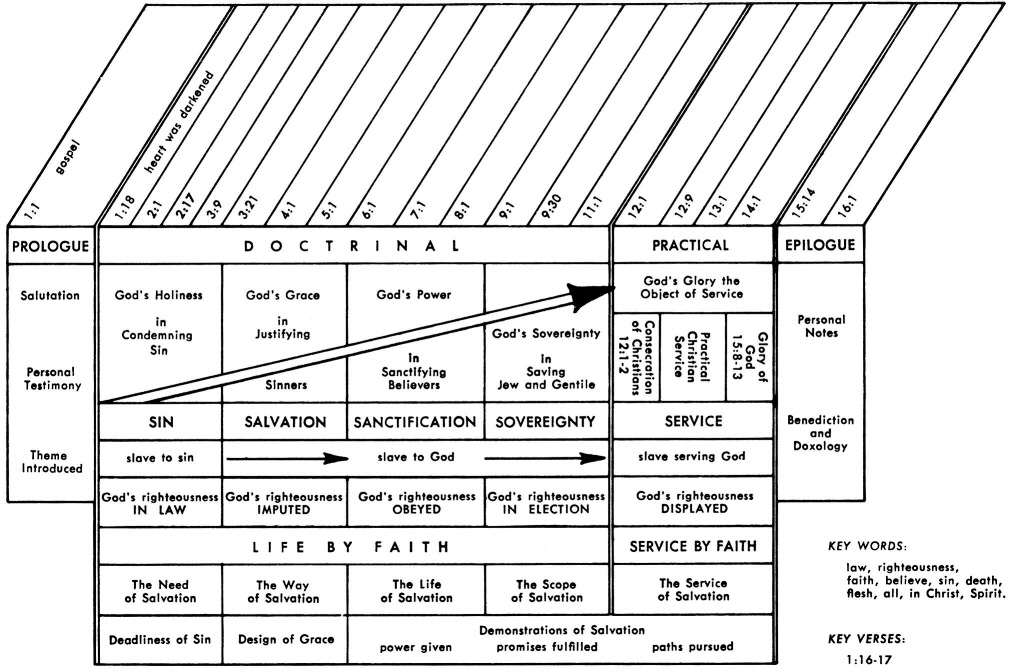
Click chart to enlarge
Chart from recommended resource Jensen's Survey of the NT - used by permission
Romans Overview Chart - Charles Swindoll
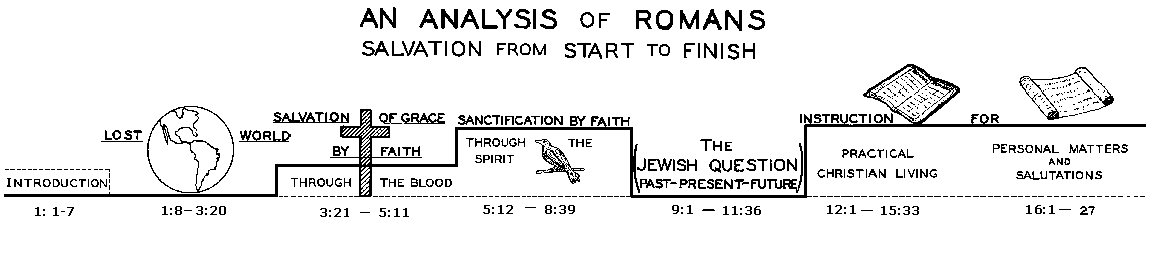
Source: Dr David Cooper
Click to Enlarge
| ROMANS ROAD to RIGHTEOUSNESS |
||||
| Romans 1:18-3:20 | Romans 3:21-5:21 | Romans 6:1-8:39 | Romans 9:1-11:36 | Romans 12:1-16:27 |
| SIN | SALVATION | SANCTIFICATION | SOVEREIGNTY | SERVICE |
| NEED FOR SALVATION |
WAY OF SALVATION |
LIFE OF SALVATION |
SCOPE OF SALVATION |
SERVICE OF SALVATION |
| God's Holiness In Condemning Sin |
God's Grace In Justifying Sinners |
God's Power In Sanctifying Believers |
God's Sovereignty In Saving Jew and Gentile |
Gods Glory The Object of Service |
| Deadliness of Sin |
Design of Grace |
Demonstration of Salvation | ||
| Power Given | Promises Fulfilled | Paths Pursued | ||
| Righteousness Needed |
Righteousness Credited |
Righteousness Demonstrated |
Righteousness Restored to Israel |
Righteousness Applied |
| God's Righteousness IN LAW |
God's Righteousness IMPUTED |
God's Righteousness OBEYED |
God's Righteousness IN ELECTION |
God's Righteousness DISPLAYED |
| Slaves to Sin | Slaves to God | Slaves Serving God | ||
| Doctrine | Duty | |||
| Life by Faith | Service by Faith | |||
|
Modified from Irving L. Jensen's chart above |
||||
Romans 5:6 For while we were still helpless, at the right time Christ died for the ungodly. (NASB: Lockman)
Greek: eti gar Christos onton (PAPMPG) hemon asthenon eti kata kairon huper asebon apethanen. (3SAAI)
Amplified: While we were yet in weakness [powerless to help ourselves], at the fitting time Christ died for (in behalf of) the ungodly. (Amplified Bible - Lockman)
Barclay: While we were still helpless, in God’s good time, Christ died for the ungodly.
NIV: You see, at just the right time, when we were still powerless, Christ died for the ungodly. (NIV - IBS)
NLT: When we were utterly helpless, Christ came at just the right time and died for us sinners. (NLT - Tyndale House)
Phillips: And we can see that it was while we were powerless to help ourselves that Christ died for sinful men. (Phillips: Touchstone)
Wuest: "For when we were yet without strength, in a strategic season, Christ instead of and in behalf of those who do not have reverence for God and are devoid of piety, died"
Young's Literal: For in our being still ailing, Christ in due time did die for the impious;
FOR WHILE WE WERE STILL HELPLESS: eti gar Christos onton (PAPMPGen) hemon asthenon:
- Ezek 16:4, 5, 6, 7, 8; Eph 2:1, 2, 3, 4, 5; Col 2:13; Titus 3:3, 4, 5
- La 1:6; Da 11:15
- Romans 5 Resources - Multiple Sermons and Commentaries
HELPLESS BUT NOT
HOPELESS
For (1063) (gar) introduces Paul's explanation of why the pouring out of God's love assures believers of hope (absolute assurance). In other words, if after reading the previous verse on the pouring out of the love of God in our hearts, you would still ask "But Paul, how do we know His love?". Paul's answer in summary form would be "by His death". And so Christ's death becomes the major subject the apostle expounds in the following verses.
Note that in Romans 5:6 God makes this demonstration of His love…
(1) While we were helpless
(2) At the right time
(3) For the ungodly
Were (5607) (on) is in the present tense, indicating this was our continual state.
The progression in Paul's thought is something like the following - It's hard to love the weak and powerless, but when those same people are also ungodly (opposed to all that God stands for) that kind of love is amazing. The love of God is without any cause outside of Himself.
Still helpless - still without strength; utterly helpless with no way of escape; still ailing; still sick (sin sick); unable to help ourselves; still powerless and too weak to help ourselves, totally unable to rescue ourselves from the effects of the fall. Helpless in this context emphasizes moral frailty rather than physical weakness. We were quite powerless to help ourselves or even to understand.
But a natural man does not accept the things of the Spirit of God; for they are foolishness to him, and he cannot understand them, because they are spiritually appraised. (1 Cor 2:14)
In short we were up a creek without a paddle and did not even understand our abysmal predicament. But God’s love triumphed where human power (and understanding) failed.
Haldane adds that…Christ died for us while we were unable to obey Him, and without ability to save ourselves. This weakness or inability is no doubt sinful; but it is our inability, not our guilt, that the Apostle here designates. When we were unable to keep the law of God, or do anything towards our deliverance from Divine wrath, Christ interposed, and died for those whom He came to redeem. (Romans 5 Commentary)
Charles Hodge draws an important distinction writing…The objection that the church doctrine represents the death of Christ as procuring the love of an unloving God is without a shadow of foundation. The Scriptures represent God’s love to sinners as independent of the work of Christ, and as preceding it. He loved us so much that he gave his one and only Son to reconcile our salvation with his justice. (Romans 5 Commentary)
Helpless (772) (asthenes from a = without + sthénos = strength, bodily vigor) (See study of related verb astheneo - note the concentration of asthenes/astheneo in the epistles to the Corinthians - almost 50% of NT uses) is literally without strength or bodily vigor. Asthenes describes one's state of limited capacity to do or be something and is used literally of physical weakness (most of the uses in the Gospels) and figuratively of weakness in the spiritual arena (weak flesh, weak conscience, weak religious system or commandment [Gal 4:9, Heb 7:18], etc) and thus powerlessness to produce results.
Sanday and Headlam write that asthenes in Romans 5:6 means "incapable of working out any righteousness for ourselves (in loc.)."
Godet adds that asthenes in Romans 5:6…expresses total incapacity for good, the want of all moral life, such as is healthy and fruitful in good works. It was certainly not a state fitted to win for us the sympathy of divine holiness. On the contrary, the spectacle of a race plunged in such shameful impotence was disgusting to it. (Romans 5:1-11 The Certainty of Final Salvation for Believers)
The following is a summary the nuances of meaning of asthenes (modified from BDAG)…
(1) Pertaining to suffering from a debilitating illness - sick, ill
(2) Pertaining to experiencing some incapacity or limitation - weak
a) Of physical weakness - the flesh is weak = gives up too easily (Mt 26:41, Mark 14:38); weaker vessel = sex (1Peter 3:7); personal appearance is weak = unimpressive (1Cor 10:10)
b) Of relative ineffectiveness, whether external or inward weak = feeble, ineffectual (1Cor 4:10); the weaker, less important members (1Cor 12:22); what is weak in (the eyes of) the world (1Cor 1:27)
c) Of the inner life -
Helpless in a moral sense (Romans 5:6)
Of a weakness in faith, which through lack of advanced knowledge, considers externals of the greatest importance (1Cor 8:7, 9, 9:10, cp similar use of related verb astheneo in Romans 14:1 [note]; 14:2)
To those who are weak in faith I became as they are (1Cor 9:22) (Arndt, W., Danker, F. W., & Bauer, W. A Greek-English Lexicon of the New Testament and Other Early Christian Literature)
John MacArthur in his comments on the use of asthenes in 1Thessalonians 5:14 notes that asthenes is…used in a general sense to describe people who are simply deficient in some way (e.g., see 1Cor 1:27). Their deficiency may be a lack of education, opportunities, or finances, or perhaps a physical problem. These people sometimes find it harder to do what is right because of their “weaknesses.” According to Paul, they need more than encouragement: they actually need someone to come alongside and help them to do what they need to do. (MacArthur, J., F., Jr, Mack, W. A., & Master's College. Introduction to Biblical Counseling: Word Pub)
Weak (asthenes) focuses on susceptibility to sin and applies to believers who struggle with abandoning sin and obeying God’s will… The weak are always impediments and stumbling blocks to growth and power in the church. (MacArthur, John: 1 & 2 Thessalonians. Moody Press)
Vine in his discussion of asthenes in 1Thessalonians 5:14 adds that…some believers are weak through lack of knowledge of the will of God, some through lack of courage to trust God; some, who are timorous or over scrupulous, hesitate to use their liberty in Christ, some, through lack of stability or purpose, are easily carried away; some lack courage to face, or will to endure; persecution or criticism; some are unable to control the appetites of the body or the impulses of the mind. These, and all such as these, are to be the peculiar objects of the shepherd’s care, since, more than the rest, they need the sympathy and help of those who are of maturer Christian experience. For characteristic examples of such care see Genesis 33:13, 14; Luke 10:34, 35; John 13:1–17. (Vine, W. Collected writings of W. E. Vine. Nashville: Thomas Nelson)
In regard to being able to save themselves sinful men are weak, unable, strengthless and powerless. There is nothing sinners can do to save themselves or to remedy their lost condition. They are in desperate need of a strong Savior!
Jesus declared that…
No one can come to Me, unless the Father who sent Me draws him; and I will raise him up on the last day. (Jn 6:44)
When we were powerless to escape from our sin, powerless to escape death, powerless to resist Satan, and powerless to please Him in any way, God amazingly sent His Son to die on our behalf. Christ died for the ungodly and loved the unlovely. He loved us though there was nothing loveable in us.
Asthenes is used here in Romans 5:6 in the phrase “while we were still helpless” which is a reminder of our powerlessness to obtain justification by works as set forth in the passage [Romans 3:19-4:25]. Sinners were literally “strengthless.” The immediate cause lies in the fact that we had not received the Holy Spirit, and so had no power to please God.
As Cranfield puts it…He did not wait for us to start helping ourselves, but died for us when we were altogether helpless.
Barclay writes that…asthenes is the standard Greek adjective for weak. When Christ comes to a man, he strengthens the weak will, he buttresses the weak resistance, he nerves the feeble arm for fight, he confirms the weak resolution. Jesus Christ fills our human weakness with his divine power. (Romans 5 Commentary)
Barnes adds that…The word here (Romans 5:6) used (asthenes) is usually applied to those who are sick and feeble, deprived of strength by disease, Mt 25:39; Lu 10:9; Ac 4:9; 5:15. But it is also used in a moral sense, to denote inability or feebleness with regard to any undertaking or duty. Here it means that we were without strength in regard to the case which the apostle was considering; that is, we had no power to devise a scheme of justification, to make an atonement, or to put away the wrath of God, etc. While all hope of man's being saved by any plan of his own was thus taken away-- while he was thus lying exposed to Divine justice, and dependent on the mere mercy of God--God provided a plan which met the case, and secured his salvation. (Romans 5)
Here are the 25 NT uses of asthenes…
Matthew 25:43 I was a stranger, and you did not invite Me in; naked, and you did not clothe Me; sick, and in prison, and you did not visit Me.' 44 "Then they themselves also will answer, saying, 'Lord, when did we see You hungry, or thirsty, or a stranger, or naked, or sick, or in prison, and did not take care of You?'
Matthew 26:41 "Keep watching and praying, that you may not enter into temptation; the spirit is willing, but the flesh is weak." (Comment: The meaning of asthenes is thought by some to refer to the inability of the old nature [the fallen flesh] to obtain success or victory in the spiritual realm. That is a true statement and could be Jesus' meaning - it's analogous to the struggle in Romans 7:14-25 where he does not do what he wishes to do, but does the very thing he does not wish to do - see notes beginning at Romans 7:14)
Mark 14:38 "Keep watching and praying, that you may not come into temptation; the spirit is willing, but the flesh is weak."
Luke 10:9 and heal those in it who are sick, and say to them, 'The kingdom of God has come near to you.'
Acts 4:9 if we are on trial today for a benefit done to a sick man, as to how this man has been made well,
Acts 5:15 to such an extent that they even carried the sick out into the streets, and laid them on cots and pallets, so that when Peter came by, at least his shadow might fall on any one of them. 16 And also the people from the cities in the vicinity of Jerusalem were coming together, bringing people who were sick or afflicted with unclean spirits; and they were all being healed.
Romans 5:6 (note) For while we were still helpless, at the right time Christ died for the ungodly.
1 Corinthians 1:25 Because the foolishness of God is wiser than men, and the weakness of God is stronger than men.
1 Corinthians 1:27 but God has chosen the foolish things of the world to shame the wise, and God has chosen the weak (destitute of power among men) things of the world to shame the things which are strong,
1 Corinthians 4:10 We are fools for Christ's sake, but you are prudent in Christ; we are weak (unable to achieve anything great - relative ineffectiveness, whether external or inward), but you are strong; you are distinguished, but we are without honor.
1 Corinthians 8:7 However not all men have this knowledge; but some, being accustomed to the idol until now, eat food as if it were sacrificed to an idol; and their conscience being weak (lacking in decision and firmness about things lawful and unlawful - vacillating, hesitating) is defiled.
1 Corinthians 8:9 But take care lest this liberty of yours somehow become a stumbling block to the weak (lacking in decision about things lawful and unlawful). 10 For if someone sees you, who have knowledge, dining in an idol's temple, will not his conscience, if he is weak (lacking in decision about things lawful and unlawful), be strengthened to eat things sacrificed to idols?
1 Corinthians 9:22 To the weak I became weak, that I might win the weak; I have become all things to all men, that I may by all means save some.
1 Corinthians 11:30 For this reason many among you are weak and sick, and a number sleep. (Comment: This use refers to physical weakness short of overt illness and represents a judgment on believers for taking "communion" in an unworthy manner! Could this have any relevance to the condition of a believer today who might be experiencing otherwise unexplained weakness or illness?)
1 Corinthians 12:22 On the contrary, it is much truer that the members of the body which seem to be weaker (in the sense of "less important") are necessary;
2 Corinthians 10:10 For they say, "His letters are weighty and strong, but his personal presence is unimpressive, and his speech contemptible."
Galatians 4:9 But now that you have come to know God, or rather to be known by God, how is it that you turn back again to the weak (used of the religious systems anterior to Christ, as having no power to promote piety and salvation) and worthless elemental things (in the spiritual sense the rudiments of Jewish religion had no ability to justify anyone), to which you desire to be enslaved all over again? (Comment: The related verb astheneo is used in Romans 8:3 [note] with a similar meaning, referring to the weakness of the Law to save a man.)
1Thessalonians 5:14 (note) And we urge you, brethren, admonish the unruly, encourage the fainthearted, help the weak, be patient with all men.
Hebrews 7:18 (note) For, on the one hand, there is a setting aside of a former commandment because of its weakness and uselessness
1 Peter 3:7 (note) You husbands likewise, live with your wives in an understanding way, as with a weaker (asthenes in this verse does not refer to moral or intellectual weakness) vessel, since she is a woman; and grant her honor as a fellow heir of the grace of life, so that your prayers may not be hindered.
There are 14 uses of asthenes in the Septuagint (LXX) (Gen. 29:17; Num. 13:18; Jdg. 16:13; 1 Sam. 2:10; 2 Sam. 13:4; Job 4:3; 36:15; Ps. 6:2; Prov. 6:8; 21:13; 22:22; 31:5, 9; Ezek. 17:14; 34:20; Dan. 1:10) Below is a use of asthenes in the LXX…
Psalm 6:2 Have mercy upon me, O LORD; for I am weak (Lxx = asthenes): O LORD, heal me; for my bones are vexed. (KJV)
Spurgeon commenting on helpless in Romans 5:6 writes…
IN this verse the human race is described as a sick man, whose disease is so far advanced that he is altogether without strength: no power remains in his system to throw off his mortal malady, nor does he desire to do so; he could not save himself from his disease if he would, and would not if he could.
I have no doubt that the apostle had in his eye the description of the helpless infant given by the prophet Ezekiel; it was an infant — an infant newly born — an infant deserted by its mother before the necessary offices of tenderness had been performed; left unwashed, unclothed, unfed, a prey to certain death under the most painful circumstances, forlorn, abandoned, hopeless. (See notes Ezekiel 16:2; 16:3; 16:4; 16:5; 16:6)
Our race is like the nation of Israel, its whole head is sick, and its whole heart faint (Isaiah 1:5). Such, unconverted men, are you! Only there in this darker shade in your picture, that your condition is not only your calamity, but your fault. In other diseases men are grieved at their sickness, but this is the worst feature in your case, that you love the evil which is destroying you. In addition to the pity which your case demands, no little blame must be measured out to you: you are without will for that which is good, your “cannot” means “will not,” your inability is not physical but moral, not that of the blind who cannot see for want of eyes, but of the willingly ignorant who refuse to look. (Romans 5:6: For Whom Did Christ Die?)
In another sermon Spurgeon declares…
We were without strength. It was a bad case altogether, and could not be defended. And man, by nature, is morally weak. We are so weak by nature that we are carried about like dust, and driven to and fro lay every wind that blows, and swayed by every influence which assails us. Man is under the dominion of his own lusts — his pride, his sloth, his love of ease, his love of pleasure. Man is such a fool that he will buy pleasure at the most ruinous price; will fling his soul away as if it were some paltry toy, and barter his eternal interests as if they were but trash. For some petty pleasure of an hour he will risk the health of his body; for some paltry gain he will jeopardize his soul. Alas! alas! poor man, thou art as light as the thistledown, which goes this way or that, as the wind may turn. In thy moral constitution thou art as the weathercook (weather vane), which shifts with every breeze. At one time man is driven by the world: the fashions of the age prevail over him, and he obsequiously follows them; at another time a clique of small people, notables in their little way, is in the ascendant, and he is afraid of his fellow-men. Threatenings awe him, though they may be but the frowns of his insignificant neighbors; or he is bribed by the love of approbation, which may possibly mean no more shall the nod of the squire, or merely the recognition of an equal. So be sacrifices principle and runs with the multitude to do evil. Then the evil spirit comes upon him, and the devil tempts him, and away he goes. There is nothing which the devil can suggest, to which man will not yield while he is a stranger to divine grace. And if the devil should let him alone, his own heart suffices. The pomp of this world, the lust of the eye, the pride of life — any of these things will drive men about at random. See them rushing to murder one another with shouts of joy: see them returning blood-red from the battle-field, and listen to the acclamations with which they are greeted, because they have killed their fellow-men. See how they will go where poison is vended to them, and they will drink it till their brain reels, and they fall upon the ground intoxicated and helpless. This is pleasure which they pursue with avidity, and having yielded themselves up to it once they will repeat it again, till the folly of an evil hour becomes the habit of an abandoned life. Nothing seems to be too foolish, nothing too wicked, nothing too insane, for mankind. Man is morally weak — a poor, crazy child. He has lost that strong hand of a well-trained perfect reason which God gave him at the first. His understanding is blinded, and his foolish heart is darkened; and so Christ finds him, when he comes to save him, morally without strength.
Now, I know I have described exactly the condition of some here. They are emphatically without strength. They know how soon they yield. It is only to put sufficient pressure upon them, and they give way despite their resolutions, for their strongest resolves are as weak as reeds, and when but a little trial has come, away they go back to the sins which in their conscience they condemn, though nevertheless they continue to practice them. Here is man’s state, then — legally locale and morally weak.
But, further, man is, above all things, spiritually without strength. When Adam ate of the forbidden fruit he incurred the penalty of death, and in that penalty we are all involved. Not that he at once died naturally, but he died spiritually. The blessed Spirit left him. He became a soulish or natural man. And such are we. We have lost the very being of the Spirit by nature. If he comes to us, there is good need he should, for he is not here in us by nature. We are not made partakers of the Spirit at our natural birth. This is a gift from above to man. He has lost it, and the Spirit — that vital element which the Holy Ghost implants in us at regeneration — is not present in man by his original generation. He has no spiritual faculties, he cannot hear the voice of God, he cannot taste the sweets of holiness. He is dead, ay, and in Scripture he is described as lying like the dry bones that have been parched by the hot winds, and are strewn in the valley dry, utterly dry. Man is dead in sin. He cannot rise to God any more than the dead in the grave can come out of their sepulchres of themselves and live. He is without strength — utterly so. It is a terrible case, but this is what the text says, “
When we were yet without strength, in due time Christ died for the ungodly.
Putting all these things into one, man by nature, where Christ finds him, is utterly devoid of strength of every sort for anything that is good — at least, anything which is good in God’s sight, and is acceptable unto God. It is of no use for him to sit down and say, “I believe I can force my way yet into purity.” Man, you are without strength till God gives you strength. He may sometimes start up in a kind of alarm, and say, “It shall be done,” but he falls back again, like the madman who after an attack of delirium, sinks anon to his old state. It will not be done. “Can the Ethiopian change his skin, or the leopard his spots? “If so, then he that is accustomed to do evil may learn to do well. Not till then, by his own unaided strength can he perform any right and noble purpose. Nay, what am I talking about?
He has no strength of his own at all. He is without strength, and there he lies — hopeless, helpless, ruined, and undone, utterly destroyed; a splendid palace all in ruin, through whose broken walls sweep desolate winds with fearful wailings, where beasts of evil name and birds of foulest wing do haunt, a palace majestic even in ruins, but still utterly ruined and quite incapable of self-restoration. “Without strength.” Alas! alas! poor humanity!…
The glory of the remedy proves the desperateness of the disease.
The grandeur of the Savior is a sure evidence of the terribleness of our lost condition.
Look at it, then, and as man sinks Christ will rise in your esteem, and as you value the Savior so you will be more and more stricken with terror because of the greatness of the sin which needed such a Savior to redeem us from it. (Romans 5:6 The Sad Plight and Sure Relief - Pdf)
AT THE RIGHT TIME CHRIST DIED FOR UNGODLY: eti kata kairon huper asebon apethanen. (3SAAI) :
- Gal 4:4; Hebrews 9:26; 1Pet 1:20
- Ro 5:8; 4:25; 1Thes 5:9
- Ro 4:5; 11:26; Ps 1:1; 1Ti 1:9; Titus 2:12; 2Pet 2:5,6; 3:7; Jude 1:4,15,18
- Romans 5 Resources - Multiple Sermons and Commentaries
IN THE NICK
OF TIME
In The Nick Of Time means just before the last moment when something can be changed or something bad will happen, both senses relevant to ungodly sinners in desperate need of a Savior!
At the right time (2540) (kairos [word study]) means a point of time or period of time, time, period, frequently with the implication of being especially fit for something and without emphasis on precise chronology. It means a moment or period as especially appropriate the right, proper, favorable time (at the right time). Kairos can refer to the time when things are brought to crisis, the decisive epoch waited for or a strategic point in time.
The thought is that there is nothing delayed about Christ's death on the Cross of Calvary. In other words, the sacrificial atoning sacrifice of God's Son was not an afterthought but was the manner in which God from eternity past had determined He would deal with man's sin and which was accomplished when He chose to do so.
Vine writes that at the right time (KJV "in due season") is…Literally, “according to season,” that is to say, a time divinely appointed as opportune for the manifestation of God’s love in Christ. (Collected writings of W. E. Vine. Nashville: Thomas Nelson)
When was the right time? "When we were powerless to escape from our sin, powerless to escape death, powerless to resist Satan, and powerless to please Him in any way, God amazingly sent His Son to die on our behalf." (MacArthur)
Haldane adds that this is …At the time appointed of the Father, Galatians 4:2, 4. The fruits of the earth are gathered in their season; so in His season, that is, at the time appointed, Christ died for us, (Romans 5 Commentary)
Paul writes that…
when the fujlness of the time came, God sent forth His Son, born of a woman, born under the Law, in order that He might redeem those who were under the Law, that we might receive the adoption as sons. (Gal 4:4-5+)
EBC "The law had operated for centuries and had served to expose the weakness and inability of man to measure up to the divine standard of righteousness. No further testing was needed. It was the right time." Gaebelein, F, Editor: Expositor's Bible Commentary 6-Volume New Testament. Zondervan Publishing)
The Gospels repeatedly allude to the right time…
Then He came to the disciples, and said to them, "Are you still sleeping and taking your rest? Behold, the hour is at hand and the Son of Man is being betrayed into the hands of sinners. (Matthew 26:45)
These words He spoke in the treasury, as He taught in the temple; and no one seized Him, because His hour had not yet come. (John 8:20)
"Now My soul has become troubled; and what shall I say, 'Father, save Me from this hour'? But for this purpose I came to this hour. (John 12:27)
These things Jesus spoke; and lifting up His eyes to heaven, He said, "Father, the hour has come; glorify Thy Son, that the Son may glorify Thee, (John 17:1)
Click for all 10 verses in the Gospels that mention the right time ("the hour")
Guzik sums up the right time explaining that…The world was prepared spiritually, economically, linguistically, politically, philosophically and geographically for the coming of Jesus and the spread of the Gospel. (quoting Matthew Poole) “The Scripture everywhere speaks of a certain season or hour assigned for the death of Christ" (Romans 5 Commentary)
Marvin Vincent writes that kairos "implies a particular time; as related to some event, a convenient, appropriate time; absolutely, a particular point of time, or a particular season, like spring or winter." (Word studies in the New Testament. Vol. 1, Page 3-70)
At the appointed time which was the moment God had chosen as opportune for the manifestation of God’s love in Christ. Of course the appointed time was also the appropriate time.
God’s love for His own is unwavering because it is not based on how lovable we are, but on the constancy of His own character. God’s supreme act of love came when we were at our most undesirable.
Spurgeon says the right time…means that the death of Christ occurred at a proper period. I cannot suggest any other period in time which would have been so judiciously chosen for the death of the Redeemer as the one which God elected; nor can I imagine any place more suitable than Calvary, outside the gates of Jerusalem. There was no accident about it. It was all fixed in the eternal purpose, and for infinitely wise reasons. We do not know all the reasons, and must not pretend to know them, but we do know this, that at the time our Savior died sin among mankind in general had reached a climax. (Romans 5:6 The Sad Plight and Sure Relief - Pdf)
Christ - Spurgeon comments "Christ, the name given to our Lord, is an expressive word; it means “Anointed One,” and indicates that He was sent upon a divine errand, commissioned by supreme authority. The Lord Jehovah said of old, “I have laid help upon one that is mighty, I have exalted one chosen out of the people;” (Ps 89:19 - Spurgeon note) and again, “I have given him as a covenant to the people (Isa 42:6), a leader and commander to the people.” Jesus was both set apart to this work, and qualified for it by the anointing of the Holy Ghost. He is no unauthorized Saviour, no amateur Deliverer, but an Ambassador clothed with unbounded power from the great King, a Redeemer with full credentials from the Father. It is this ordained and appointed Savior who has “died for the ungodly.” Remember this, ye ungodly! Consider well Who it was that came to lay down his life for such as you are. (Romans 5:6: For Whom Did Christ Die?)
Died (599) (apothnesko from apo = away from + thnesko = die) literally means "to die off" and as such is used to describe natural death of men in which there is the separation of the soul from the physical body. It should be noted that even as life never means mere existence, so death, the opposite of life, never means nonexistence. Paul uses this verb frequently (some 42 out of 100 NT occurrences) especially in his description (as in Romans 5:6) of the death of Christ for sinners, or of the Christian's death to (the power of) sin.
Notice that Paul lays stress on the word died, as indicated by the fact that died stands emphatically last in the Greek sentence. The order is…
Christ, we being weak, in due season, for ungodly ones, died.
For (5228) (huper) is a Greek preposition which Paul uses 3 times in this section (Romans 5:6, 7, 8) and in the context of each uses expresses the idea of substitution. Instead of for one can render it as Christ died… “in place of, for the benefit of, on behalf of, or instead of." This act of love can never be fully appreciated until we understand exactly who the objects of that love were (unlovable, unlovely, ungodly, helpless to help themselves, sinners constantly rebelling against God's will for their lives, God's mortal enemies!)
For the ungodly - this phrase conveys the idea of Christ's substitutionary sacrifice, the Godly one in place of the ungodly. Huper is used repeatedly in the NT to convey the truth of Christ's death (burial and resurrection) in our place and for our sake as shown in the following passages which when ponder will surely evoke a sacrifice of praise to God…
Mark 14:24 And He said to them, "This is My blood of the covenant, which is poured out for (huper - for the sake of) many.
Luke 22:19 And when He had taken some bread and given thanks, He broke it, and gave it to them, saying, "This is My body which is given for (huper - in place of your body) you; do this in remembrance of Me."
Luke 22:20 And in the same way He took the cup after they had eaten, saying, "This cup which is poured out for (huper - for the sake of) you is the new covenant in My blood.
John 6:51 "I am the living bread that came down out of heaven; if anyone eats of this bread, he shall live forever; and the bread also which I shall give for (huper - as a substitute for) the life of the world is My flesh."
John 10:11 "I am the good shepherd; the good shepherd lays down His life for (huper - as a substitute for) the sheep… 15 even as the Father knows Me and I know the Father; and I lay down My life for the sheep.
John 11:50 nor do you take into account that it is expedient for you that one man should die for (huper - as a substitute for) the people, and that the whole nation should not perish. 51 Now this he did not say on his own initiative; but being high priest that year, he prophesied that Jesus was going to die for (huper - as a substitute for) the nation (of Israel - the gospel is to the Jew first and also to the Greek or Gentiles), 52 and not for the nation only, but that He might also gather together into one the children of God (an allusion to the Gentiles who would be saved by grace through faith) who are scattered abroad.
John 15:13 "Greater love has no one than this, that one lay down his life for (huper - for the sake of) his friends.
John 17:19 "And for their sakes (huper) (Jesus' disciples then and in the future) I sanctify Myself, that they themselves also may be sanctified in truth.
John 18:14 Now Caiaphas was the one who had advised the Jews that it was expedient for one man to die on behalf of (huper) the people.
Romans 5:7 (note) For one will hardly die for (huper - for the sake of) a righteous man; though perhaps for (huper - for the sake of) the good man someone would dare even to die.
Romans 5:8 (note) But God demonstrates His own love toward us, in that while we were yet sinners, Christ died for (huper - as a substitute for) us.
Romans 8:32 (note) He who did not spare His own Son, but delivered Him up for (huper - as a substitute for) us all, how will He not also with Him freely give us all things?
Romans 14:15 (note) For if because of food your brother is hurt, you are no longer walking according to love. Do not destroy with your food him for (huper - for the sake of) whom Christ died.
1 Corinthians 11:24 and when He had given thanks, He broke it, and said, "This is My body, which is for you; do this in remembrance of Me."
1Corinthians 15:3 (note) For I delivered to you as of first importance what I also received, that Christ died for (huper - in our place for) our sins according to the Scriptures,
2 Corinthians 5:14 For the love of Christ controls us, having concluded this, that one died for (huper - for the sake of) all, therefore all died; 15 and He died for (huper - for the sake of) all, that they who live should no longer live for themselves, but for Him who died and rose again on their behalf (huper) (Not only was He our Substitute in death but in resurrection!)
2 Corinthians 5:21 He made Him who knew no sin to be sin on our behalf (huper) that we might become the righteousness of God in Him
Galatians 1:4 who gave Himself for (huper - as a substitute for) our sins, that He might deliver us out of this present evil age, according to the will of our God and Father,
Galatians 2:20 (note) "I have been crucified with Christ; and it is no longer I who live, but Christ lives in me; and the life which I now live in the flesh I live by faith in the Son of God, who loved me, and delivered Himself up for (huper - on behalf of) me.
Galatians 3:13 Christ redeemed us from the curse of the Law, having become a curse for (huper - as a substitute for) us-- for it is written, "Cursed is everyone who hangs on a tree "-- (Comment: This is a graphic picture - We were under [hupo] a curse, Christ became a curse over [huper] us and so between us and the overhanging curse which fell on Him instead of on us. Thus He bought us out [ek] and we are free from the curse which He took on Himself. This use of huper for substitution is common in the papyri and in ancient Greek.)
Ephesians 5:2 (note) and walk in love, just as Christ also loved you, and gave Himself up for (huper - as a substitute for) us, an offering and a sacrifice to God as a fragrant aroma.
Ephesians 5:25 (note) Husbands, love your wives, just as Christ also loved the church and gave Himself up for (huper - as a substitute for) her;
1Thessalonians 5:10 (note) (Christ) Who died for (huper - as a substitute for) us, that whether we are awake or asleep, we may live together with Him.
1 Timothy 2:6 (Christ) Who gave Himself as a ransom for (huper - as a substitute for) all, the testimony borne at the proper time.
Titus 2:14 (note) (Christ ) Who gave Himself for (huper - as a substitute for) us, that He might redeem us from every lawless deed and purify for Himself a people for His own possession, zealous for good deeds.
Hebrews 2:9 (note) But we do see Him Who has been made for a little while lower than the angels, namely, Jesus, because of the suffering of death crowned with glory and honor, that by the grace of God He might taste death for (huper - in place of) everyone (This does not teach "universalism" or that all will be saved but does teach that salvation is available to all!)
1 Peter 2:21 (note) For you have been called for this purpose, since Christ also suffered for (huper - as a substitute for) you, leaving you an example for you to follow in His steps,
1 Peter 3:18 (note) For Christ also died for sins once for all, the just for (huper - as a substitute for) the unjust, in order that He might bring us to God, having been put to death in the flesh, but made alive in the spirit;
1 John 3:16 We know love by this, that He laid down His life for (huper - as a substitute for) us; and we ought to lay down our lives for the brethren.
This same idea of the right time is also brought out by the following passages…
Now these things happened to them as an example, and they were written for our instruction, upon whom the ends of the ages have come. (1Cor 10:11)
(The preceding truth gives them confidence) in the hope of eternal life, which God, Who cannot lie, promised long ages ago, 3 but at the proper time manifested, even His word, in the proclamation with which I was entrusted according to the commandment of God our Savior (See notes Titus 1:2; 1:3)
Otherwise, He would have needed to suffer often since the foundation of the world; but now once at the consummation of the ages He has been manifested to put away sin by the sacrifice of Himself. (see note Hebrews 9:26)
This is Amazing Love…
And can it be that I should gain
An interest in the Savior’s blood?
Died He for me, who caused His pain—
For me, who Him to death pursued?
Amazing love! How can it be,
That Thou, my God, shouldst die for me?
Amazing love! How can it be,
That Thou, my God, shouldst die for me?
--Play Charles Wesley's great hymn
Ungodly (765) (asebes from a = without + sébomai = worship, venerate) (Click for in depth study of asebes which is often translated "wicked" in LXX) describes the man or woman who has no fear, no reverence and no respect for God or the things of God. The ungodly are not necessarily irreligious, but they actively practice the opposite of what the fear of God demands. Godly fear is often described as a strong restraint against evil behavior, Solomon recording…
Do not be wise in your own eyes.
Fear the LORD and turn away from evil. (Proverbs 3:7 cp Job in Job 1:1).
Asebes describes those who live a lifestyle that does not reverence God for Who He is, the Holy and Righteous Judge. In Romans 3:18 Paul sums up the attitude of the ungodly writing…
THERE IS NO FEAR OF GOD BEFORE THEIR EYES (Ro 3:18+)
Haldane notes that…It was not then for those who were in some degree godly, or disposed in some measure to do the will of God, that Christ died. There are none of this character by nature. It is by faith in His death that any are made godly. (Romans 5 Commentary)
Vine notes that…There is no article before the word ungodly in the Greek, and its absence indicates that those who are mentioned are not a distinct class from the godly, but that the term describes mankind in general; the meaning is that Christ died for all as being ungodly. The description, by the very vividness of its reality, serves to bring out more forcibly the character of God’s love (Vine, W. Collected writings of W. E. Vine. Nashville: Thomas Nelson)
EBC writes that…
A still more uncomplimentary description (than helpless) of those who needed the intervention of Christ's death on their behalf is ungodly. The same term was used in the striking statement of Ro 4:5 (see note) that such are the people God justifies. (Ibid)
Spurgeon adds that…
To be ungodly, or godless, is to be in a dreadful state, but as use has softened the expression, perhaps you will see the sense more clearly if I read it, “Christ died for the impious,” for those who have no reverence for God. Christ died for the godless, who, having cast off God, cast off with him all love for that which is right. I do not know a word that could more fitly describe the most irreligious of mankind than the original word in this place, and I believe it is used on purpose by the Spirit of God to convey to us the truth, which we are always slow to receive, that Christ did not die because men were good, or would be good, but died for them as ungodly — or, in other words, “He came to seek and to save that which was lost.” (Lk 19:10)
Observe, then, that when the Son of God determined to die for men, he viewed them as ungodly, and far from God by wicked works. In casting his eye over our race he did not say, “Here and there I see spirits of nobler mould, pure, truthful, truth-seeking, brave, disinterested, and just; and therefore, because of these choice ones, I will die for this fallen race.” No; but looking on them all, he whose judgment is infallible returned this verdict, “They are all gone out of the way; they are together become unprofitable; there is none that doeth good, no, not one.” Putting them down at that estimate, and nothing better, Christ died for them.
He did not please himself with some rosy dream of a superior race yet to come, when the age of iron should give place to the age of gold, — some halcyon (calm, golden, prosperous) period of human development, in which civilization would banish crime, and wisdom would conduct man back to God. Full well He knew that, left to itself, the world would grow worse and worse, and that by its very wisdom it would darken its own eyes. It was not because a golden age would come by natural progress, but just because such a thing was impossible, unless he died to procure it, that Jesus died for a race which, apart from him, could only develop into deeper damnation. Jesus viewed us as we really were, not as our pride fancies be; He saw us to be without God, enemies to our own Creator, dead in trespasses and sins, corrupt, and set on mischief, and even in our occasional cry for good, searching for it with blinded judgment and prejudiced heart, so that we put bitter for sweet and sweet for bitter. He saw that in us was no good thing, but every possible evil, so that we were lost, — utterly, helplessly, hopelessly lost apart from Him: yet viewing us as in that graceless and Godless plight and condition, He died for us…
Christ died for the impious” is a great net which takes in even the leviathan sinner; and of all the creeping sinners innumerable which swarm the sea of sin, there is not one kind which this great net does not encompass. (Romans 5:6: For Whom Did Christ Die?)
But the persons for whom Christ died are viewed by him from the cross as being “ungodly,” that is to say, men without God. “God is not in their thoughts.” They can live for the month together, and no more remember him than if there were no God. God is not in their hearts. If they do remember him, they do not love him. God is scarcely in their fears. They can take his name in vain, profane his Sabbath, and use his name for blasphemy. God is not in their hopes. They do not long to know him, or to be with him, or to be like him. Practically, unconverted men have said, “Who is the Lord, that I should obey his voice? “If they do not say it in so many words, they do imply it by a daily neglect of God. Even if they take up with religion, yet the natural man sticks to the sentiments or the ritual that belong to his profession, subscribing to a creed, or observing a series of customs, while he remains utterly oblivious of that communion with God which all true religion leads us to seek, and therefore he never gets to God. He adapts himself to the outward form, but he does not discern the Spirit. He listens to pious words, but he does not feel them. He joins in holy hymns, but his heart does not sing. He even gets him down on his knees and pretends to pray, and all the while his heart is wandering far from God. He does not commune with his Maker, and he cannot, for he is alienated from his Creator, or, as the text puts it, he is ungodly. (Romans 5:6 The Sad Plight and Sure Relief - Pdf)
Godet writes that mankind's…ungodliness attracts wrath. And it was when we were yet plunged in this repulsive state of impotence (asthenes - helpless) and ungodliness that the greatest proof of love was given us, in that Christ died for us. (Romans 5:1-11 The Certainty of Final Salvation for Believers)
God loves us just the way we are, but He loves us too much to leave us the way we are (Jn 15:16, Php 1:6-note)!
We all know that human love is almost invariably based on the attractiveness of the object of love, and thus men and women are inclined to love those who reciprocate love to us. This same quality of love is therefore falsely ascribed to God. How many (even believers) think that God's love for us is dependent on how good we are or how much we serve Him, etc! But as Jesus taught, even the tax collectors loved those who loved them (Mt 5:46-note).
Charles Hodge adds the qualifier that…If [God] loved us because we loved Him, He would love us only so long as we love Him, and on that condition; and then our salvation would depend on the constancy of our treacherous hearts. But as God loved us as sinners, as Christ died for us as ungodly, our salvation depends, as the apostle argues, not on our loveliness, but on the constancy of the love of God. (And we thank and praise God for this truth!) (Romans 5 Commentary)
C H Spurgeon has the following thoughts from Romans 5:6 that relate to a believer's sense of eternal security…
The argument of our text is this: since the Lord Jesus Christ saved us when we were ungodly, and came to our rescue when we were without strength, we can never be in a worse condition than that; and if He then did the best thing possible for us, namely, died for us, there is nothing which He will not do. In fact, He will give us all things, and He will do all things for us, so as to keep us safely, and bear us through. The argument is that, looking back, we see the great love of God to us in the gift of His dear Son for us when there was nothing good in us, and when we were ungodly, when we had no power to produce anything good, for we were without strength. At such a time, even at such a time, Christ came on wings of love, and up to the bloody tree He went, and laid down His life for our deliverance. We, therefore, feel confident that He will not leave us now, and that He will not keep back anything from us whatever we may need. He has committed Himself to the work of our eternal salvation, and He will not be balked of it. He has done too much for us already ever to run back from His purpose; and in our worst estate, if we are in that condition to-night, we may still confidently appeal to Him, and rest quite sure that He will bring us up even to the heights of joy and safety. That is the drift of the text and of the sermon to-night. (see Romans 5:6 The Underlying Gospel for the Dying Year - Pdf)
><> ><> ><>
You will say, ‘Oh, I am one of the worst in the world.’ Christ died for the worst in the world. ‘Oh, but I have no power to be better.’ Christ died for those that were without strength. ‘Oh, but my case condemns itself.’ Christ died for those that legally are condemned. ‘Ay, but my case is hopeless.’ Christ died for the hopeless. He is the hope of the hopeless. He is the Savior not of those partly lost, but of the wholly lost.
><> ><> ><>
If Christ died for the ungodly, this fact leaves the ungodly no excuse if they do not come to him, and believe in him unto salvation. Had it been otherwise they might have pleaded, ‘We are not fit to come.’ But you are ungodly, and Christ died for the ungodly, why not for you?
><> ><> ><>
Your sense of unworthiness, if it be properly used, should drive you to Christ. You are unworthy, but Jesus died for the unworthy.
><> ><> ><>
Never did the human ear listen to a more astounding and yet cheering truth
><> ><> ><>
I would not mind if I were condemned to live fifty years more and never allowed to speak but these five words, if I might be allowed to utter them in the ear of every man, woman, and child who lives. "Christ Died for the Ungodly" is the best message that even angels could bring to men.
><> ><> ><>
I love to think that the gospel does not address itself to those who might be supposed to have helped themselves a little out of the mire, to those who show signs of lingering goodness. It comes to men ruined in Adam and doubly lost by their own sin. It comes to them in the abyss where sin has hurled them and lifts them up from the gates of hell.
><> ><> ><>
The devil often tells me, "You are not this, and you are not that," and I feel bound to own that the accuser of the brethren makes terrible work of my spiritual finery, so that I have to abandon one ground of glorying after another. But I never knew the devil himself dare to say, "You are not a sinner." He knows I am, and I know it too. And as "in due time Christ died for the ungodly," I just rest in him, and I am saved.
Romans 5:7 For one will hardly die for a righteous man; though perhaps for the good man someone would dare even to die. (NASB: Lockman)
Greek: molis gar huper dikaiou tis apothaneitai; (3SPMI) huper gar tou agathou tacha tis kai tolma (3SPAI) apothanein; (AAN)
Amplified: Now it is an extraordinary thing for one to give his life even for an upright man, though perhaps for a noble and lovable and generous benefactor someone might even dare to die. (Amplified Bible - Lockman)
NIV: Very rarely will anyone die for a righteous man, though for a good man someone might possibly dare to die. (NIV - IBS)
NLT: Now, no one is likely to die for a good person, though someone might be willing to die for a person who is especially good. (NLT - Tyndale House)
Phillips: In human experience it is a rare thing for one man to give his life for another, even if the latter be a good man, though there have been a few who have had the courage to do it. (Phillips: Touchstone)
Wuest: for, very rarely in behalf of one of those individuals who is legally exact and precise in his observance of the customs and rules of the society in which he lives will anyone die, yet perhaps in behalf of the one who is generous in heart, always doing good to others, a person would even dare to die.
Young's Literal: for scarcely for a righteous man will any one die, for for the good man perhaps some one also doth dare to die;
FOR ONE WILL HARDLY DIE FOR (on behalf of, as substitute for) A RIGHTEOUS MAN: molis gar huper dikaiou tis apothaneitai (3SFMI):
- Jn 15:13; 1Jn 3:16
- Romans 5 Resources - Multiple Sermons and Commentaries
For (gar) brings into view a fact that heightens and illustrates the love of God to sinners. Or as Sanday & Headlam express it, the preposition for introduces the explanation of
how this dying for sinners is a conspicuous proof of love. A few may face death for a good man, still fewer for a righteous man, but in the case of Christ there is more even than this; He died for declared enemies of God. (Sanday, W., & Headlam, A. C.. A Critical and Exegetical Commentary on the Epistle of the Romans. Originally published 1897. T. & T. Clark Publishers. 1980)
Hodge introduces this verse with the observation that…The greatness and free nature of God’s love are illustrated in this and the following verse, as Paul makes the unworthiness of its objects more prominent still: “It is hardly to be expected that anyone would die in the place of a merely righteous man, though for the good man this self-denial might possibly be exercised. But we, so far from being good, were not even righteous; we were sinners, ungodly, and enemies.” (Romans 5 Commentary)
Barnes adds that…The design of this verse and the following is to illustrate the great love of God, by comparing it with what man was willing to do. It is an unusual occurrence, an event which is all that we can hope for from the highest human benevolence and the purest friendship, that one would be willing to die for a good man. There are none who would be willing to die for a man who was seeking to do us injury, to calumniate our character, to destroy our happiness or our property. But Christ was willing to die for bitter foes. (Romans 5)
Hardly (3433) (molis from molos = toil) means only with great difficulty, barely or scarcely. It is an event which cannot be expected to occur often. There would scarcely be found an instance in which it would happen.
Paul uses the terms righteous and good here, not with their New Testament sense (or in the NT theological sense - cp "there is none righteous… none who does good" - Ro 3:10, 12-notes 3:10; 12), but as they were typically used in everyday Greek parlance. The idea of righteous (dikaios) in this verse then is simply one who is as rule right in his or her general conduct. In other words, they are not those who has merited salvation or who are righteous before God. Instead righteous describes those who have done what is required among other men. To say it another way, we all understand that in human terms, some people are "better" than others, and Paul is referring to the "better" ones of us.
Similarly, good (agathos) alludes to a person who as a general rule acts beneficially toward others and who devotes himself to their welfare.
Vincent adds that…The distinction is: dikaios (righteous) is simply right or just; doing all that law or justice requires; agathos (good) is benevolent, kind, generous. The righteous man does what he ought, and gives everyone his due. The good man ‘does as much as ever he can, and proves his moral quality by promoting the well-being of him with whom he has to do.’
Ironside paraphrases this verse as follows…Few indeed could be found who would voluntarily die for an upright man, a righteous man, known and acknowledged to be such - much less for a wicked man. Some indeed might be willing to die for a good man, a kindly, benevolent man who has won their hearts by his gracious demeanor. (Ironside, Harry. Romans and Galatians. Kregel. 2006)
And so Paul is using an illustration from human experience explaining that even pagan idol worshipping Greeks would occasionally lay down their life for someone heroic or of of high character, albeit this was certainly not a common practice. And among Jewish people this practice was not highly esteemed. And how much less inclined are people to give their lives to save a person they know to be wicked. Think about what Paul is saying here. If God was so inclined to save us while we were totally depraved and wicked, this truth should buttress our sense of eternal security. In other words, now we are saved, and yes we do still sin, but we can never be as wretched sinners as we were before salvation. And He loved us totally then! And He will love us to the end and forever! This will take an eternity to comprehend!
In modern times we hear of WWII veterans who recount stories of other G.I.'s who fell on grenades to save buddies, but there is no record of a G.I. falling on a grenade to save a Nazi (but see the incredible story from Our Daily Bread below). Here's the point -- a fireman may risk his life to rescue someone from an arson related fire, but the chance of that fireman offering go to prison on behalf of the arsonist is nil. Parents may pay for the ransom of a child, but they are highly unlikely to post bond for their child's kidnapper! And yet this is in essence exactly what God did for us!
Our Daily Bread (Copyright RBC Ministries, Grand Rapids, MI. Reprinted by permission. All rights reserved) has the following illustration…
"The fighting was fierce in the days before Christmas during the first World War. A German soldier emerged from his trench and tried to advance, but he was hit by gunfire and severely wounded. As he tried to crawl back to safety, he became caught in barbed wire. After his screams turned to moans, an American climbed out of his trench and inched his way to the injured man. When the two opposing commanders saw what was happening, they ordered their troops to cease fire. In the eerie silence, the American comforted and freed the wounded German, then carried him to the waiting arms of his comrades. The guns remained silent until he returned to his trench.
Christ's birth brought God to man
Christ's death brings man to God
THOUGH PERHAPS FOR (on behalf of, as substitute for) THE GOOD MAN SOMEONE WOULD DARE EVEN TO DIE : huper gar tou agathou tacha tis kai tolma (3SPAI) apothanein (AAN):
- 2Sa 18:27; Ps 112:5; Acts 11:24) (Ro 16:4; 2Sa 18:3; 23:14, 15, 16, 17
- Romans 5 Resources - Multiple Sermons and Commentaries
A DARING
DEATH
To reiterate as uncommon as such a sacrifice might be for a good man, Paul’s point is that we were neither righteous or good, but were helpless, ungodly sinners -- and yet God still so loved us that He gave His only begotten Son to die in our place!
Godet observes that…To shed light on the wholly exceptional character of the love testified to mankind in this death of Christ, the apostle compares the action of God in this case with the noblest and rarest proofs of devotion presented by the history of our race; and he bids us measure the distance which still separates those acts of heroism from the sacrifice of God, Romans 5:7, 8. In Romans 5:7 he supposes two cases in the relations of man to man, the one so extraordinary that it is hardly conceivable, the other difficult indeed to imagine, but yet supposable…See, then, how far, in some exceedingly rare cases, the devotion of man in its sublimest manifestations can rise. To sacrifice his life for one whose honorable character inspires respect; hardly! to sacrifice yourself on the altar of a cause whose grandeur and holiness have possessed you; perhaps also (kai)! (Romans 5:1-11 The Certainty of Final Salvation for Believers)
Perhaps (5029) (tacha from tachus = quick, prompt, swift) means probably, possibly but not certainly. It expresses some degree of uncertainty or a low probability of occurring. BDAG says that tacha "marker expressing contingency ranging between probability and bare possibility".
Would dare (5111) (tolmao from tólma = courage) means to have courage, boldness or confidence to do something.
A T Robertson commenting on tolmao notes that…Even so in the case of the kindly sympathetic man courage is called for to make the supreme sacrifice. (Word Pictures in the NT)
Leon Morris writes that…Paul is not rating highly the possibility of someone dying for the good man. Yet it might happen. Because it would demand courage, he says that the person would dare to make this sacrifice. (Morris, L. The Epistle to the Romans. W. B. Eerdmans; Inter-Varsity Press)
A person willing to die for a righteous or good man is offering himself as a substitute so that the righteous or good man can continue to live. This is the highest expression of human love and devotion. But helpless and powerless people are not the easiest to love. Several years ago there was a major news story about a Downs Syndrome baby born in Illinois. The parents found it impossible to love that baby and asked the doctors not to feed him. The courts upheld the parents and the baby starved to death despite many offers for adoption. Thank God, that is not the universal response to the weak and helpless, but it is, unfortunately all too common in a society where men are becoming more and more lovers of self (2Ti 3:2-note). Fallen mankind is selfish at the core and thus his or her human love is most often conditional love--conditioned upon receiving love in return–and helpless people are rarely able to love in a way that brings ego satisfaction to the one who extends it. These truths make the extent of God's love all the more emphatic, in that Christ died for men in whom there was nothing that evoked that love.
As Newell rightly remarks…The fact of man's total moral inability is stated here in the gentlest possible terms. It is a bankruptcy of all moral and spiritual inclination toward God and holiness, as well as of power to be or do good. Yet into a scene of helplessness like this, God sends His Son, -for what? To die for the "ungodly." No return or response is demanded: it is absolute grace-for the ungodly. (Romans Verse by Verse)
As Haldane remarks, dying for another "is the greatest trial of love". (Romans 5 Commentary)
Greater love has no one than this, that one lay down his life for his friends. (John 15:13)
We know love by this, that He laid down His life for us; and we ought to lay down our lives for the brethren. (1 John 3:16)
Hendriksen sums up the striking picture in Romans 5:6-8 concluding that…What Paul is saying is that God’s love, as revealed in Jesus Christ, is both unprecedented and unparalleled. No merit from our side could have moved Christ to die for us, for he died for us “while we were still sinners.” Moreover, he died for us “at the appointed time,” that is, at the time appointed by God (cf. Mark 1:15; Gal. 4:4), not by us. This death was unparalleled with respect to the marvel of the implied condescending and pardoning grace. Christ died for those who were bad, bad, bad! In them there was no goodness that could have attracted this love. (Hendriksen, W., & Kistemaker, S. J. NT Commentary Set. Baker Book)
Barnes has an interesting anecdotal story regarding the phrase "though perhaps for the good man someone would dare even to die" writing that…Instances of this kind, though not many, have occurred. The affecting case of Damon and Pythias is one. Damon had been condemned to death by the tyrant Dionysius of Sicily, and obtained leave to go and settle his domestic affairs on promise of returning at a stated hour to the place of execution. Pythias pledged himself to undergo the punishment if Damon should not return in time, and deliver himself into the hands of the tyrant. Damon returned at the appointed moment, just as the sentence was about to be executed on Pythias; and Dionysius was so struck with the fidelity of the two friends, that he remitted their punishment, and entreated them to permit him to share their friendship. (Val. Max. iv. 7.) This case stands almost alone.Our Saviour says that it is the highest expression of love among men. "Greater love hath no man than this, that a man lay down his life for his friends," (Jo 15:13). The friendship of David and Jonathan seems also to have been of this character, that one would have been willing to lay down his life for the other. (Barnes Notes on the NT)
Ed comment: I agree with Barnes' allusion to Jonathan and David who interestingly had made a solemn, binding covenant with one another - see discussions regarding the significance and implications of covenant in Scripture - Covenant: Exchanging of Robes and Covenant: Withholding Nothing)
ILLUSTRATION - Here is an amazing example of someone (who) would dare even to die (from Reader's Digest, 1982):
On January 13, 1982 an airplane (Air Florida Flight 90) crashed and plunged into the icy waters of the Potomac River. Most of the passengers sank into the icy river. Only the broken off tail section remained afloat. Four people--two men and two women--clung to the jagged metal. Another man was treading water nearby. Soon another woman burst out of the water and she joined the others.
Treading water, these five dazed survivors, held on. Some had broken arms, others broken legs. The lungs of two had been collapsed by the impact of the crash. The roar of the U.S. Park Police helicopter was heard about 15 or 20 minutes after the crash. The helicopter crew first dropped a lifeline to Bert Hamilton who was treading water about 10 feet from the tail. He took it and was carried a hundred yards to the Virginia shore. The helicopter crew returned and aimed the line at a balding man named Arland Williams. He caught it, but instead of wrapping it around himself, he passed the line to flight attendant Kelly Duncan. She took the line and held tight as she was carried safely to shore.
Again the helicopter returned. Again they aimed the line at Williams. Once more he caught it and again he passed it on, this time to Joe Stiley the most severely injured survivor. He slipped it around himself and then grabbed Priscilla Tirado who clung to him. Just before the helicopter moved off, Patricia Felch grabbed a second life line. Exhausted, in shock and pain, Stiley felt his hold on Priscilla slipping, and Patricia could feel herself losing her grip on her lifeline. As the chopper carried them toward shore, the women fell back into the icy water. The chopper returned to drop a line to Priscilla Tirado as she struggled to stay afloat. She caught it but her strength was gone. She was about to go under when a courageous onlooker, Lenny Skutnik, plunged into the freezing river to bring her to shore. The helicopter came in low over Patricia Felch, almost touching the ice. Gene Windsor clutched the barely conscious woman and held on to her as she was carried to safety.
It was now 29 minutes since the crash, 10 minutes since the helicopter's first trip--and William's turn had come at last. The chopper turned once more toward the sinking tail, its two-man crew eager to meet that man in the water. They strained for signs of the hero who had saved two lives, but the balding man was gone. Later, telling his wife about it, Officer Gene Windsor wept.
"He could have gone on the first trip," pilot Usher said, "but he put everyone else ahead of himself. Everyone."
ILLUSTRATION - William Barclay tells the following story about T E Lawrence…
In 1915 he was journeying across the desert with some Arabs. Things were desperate. Food was almost done, and water was at its last drop. Their hoods were over their heads to shelter them from the wind which was like a flame and full of the stinging sand of the sandstorm. Suddenly someone said, “Where is Jasmin?” Another said, “Who is Jasmin?” A third answered, “That yellow-faced man from Maan. He killed a Turkish tax-collector and fled to the desert.” The first said, “Look, Jasmin’s camel has no rider. His rifle is strapped to the saddle, but Jasmin is not there.” A second said, “Someone has shot him on the march.” A third said, “He is not strong in the head, perhaps he is lost in a mirage; he is not strong in the body, perhaps he has fainted and fallen off his camel.” Then the first said, “What does it matter? Jasmin was not worth ten pence.” And the Arabs hunched themselves up on their camels and rode on. But Lawrence turned and rode back the way he had come. Alone, in the blazing heat, at the risk of his life, he went back. After an hour and a half’s ride he saw something against the sand. It was Jasmin, blind and mad with heat and thirst, being murdered by the desert. Lawrence lifted him up on his camel, gave him some of the last drops of precious water, slowly plodded back to his company. When he came up to them, the Arabs looked in amazement. “Here is Jasmin,” they said, “Jasmin, not worth ten pence, saved at his own risk by Lawrence, our lord.” That is a parable.
It was not good men Christ died to save but sinners, not God’s friends but men at enmity with him. (Romans 5 Commentary)