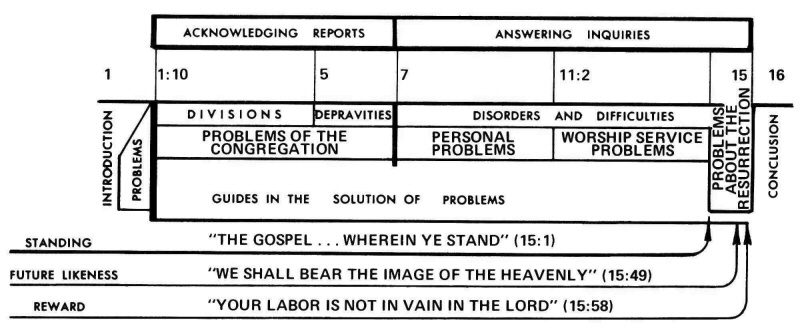
1 CORINTHIANS - PROBLEMS OF A LOCAL CHURCH
Click chart to enlarge
Charts from Jensen's Survey of the NT - used by permission
- 1 Corinthians 9:1 Commentary
- 1 Corinthians 9:2 Commentary
- 1 Corinthians 9:3 Commentary
- 1 Corinthians 9:4 Commentary
- 1 Corinthians 9:5 Commentary
- 1 Corinthians 9:6 Commentary
- 1 Corinthians 9:7 Commentary
- 1 Corinthians 9:8 Commentary
- 1 Corinthians 9:9 Commentary
- 1 Corinthians 9:10 Commentary
- 1 Corinthians 9:11 Commentary
- 1 Corinthians 9:12 Commentary
- 1 Corinthians 9:13 Commentary
- 1 Corinthians 9:14 Commentary
- 1 Corinthians 9:15 Commentary
- 1 Corinthians 9:16 Commentary
- 1 Corinthians 9:17 Commentary
- 1 Corinthians 9:18 Commentary
- 1 Corinthians 9:19 Commentary
- 1 Corinthians 9:20 Commentary
- 1 Corinthians 9:21 Commentary
- 1 Corinthians 9:22 Commentary
- 1 Corinthians 9:23 Commentary
- 1 Corinthians 9:24 Commentary
- 1 Corinthians 9:25 Commentary
- 1 Corinthians 9:26 Commentary
- 1 Corinthians 9:27 Commentary
1 Corinthians 9:26 Therefore I run in such a way, as not without aim; I box in such a way, as not beating the air; (NASB: Lockman)
Greek: ego toinun houtos trecho (1SPAI) os ouk adelos, houtos pukteuo (1SPAI) os ouk aera deron; (PAPMSN)
Amplified: Therefore I do not run uncertainly (without definite aim). I do not box like one beating the air and striking without an adversary. (Amplified Bible - Lockman)
Barclay: I therefore so run as one who knows his goal; I fight, not like one who shadow-boxes (Westminster John Knox Press)
ESV: So I do not run aimlessly; I do not box as one beating the air.
KJV: I therefore so run, not as uncertainly; so fight I, not as one that beateth the air:
NET: So I do not run uncertainly or box like one who hits only air. (NET Bible)
NIV: Therefore I do not run like a man running aimlessly; I do not fight like a man beating the air. (NIV - IBS)
NLT: So I run with purpose in every step. I am not just shadowboxing. (NLT - Tyndale House)
Phillips: I run the race then with determination. I am no shadow-boxer (Phillips: Touchstone)
Wuest: As for myself, therefore, I so run, in no uncertain manner. I so swing my fists, not as one who, when fighting, misses his opponent, merely beating the air and not striking a straight blow which finds its target.
Young's Literal: I, therefore, thus run, not as uncertainly, thus I fight, as not beating air;
THEREFORE I RUN IN SUCH A WAY AS NOT WITHOUT AIM: ego toinun houtos trecho (1SPAI) os ouk adelos:
- Not without aim: 2Co 5:1,8 Php 1:21 2Ti 1:12 2:5 Heb 4:1 1Pe 5:1 2Pe 1:10
- 1 Corinthians 9 Resources - Multiple Sermons and Commentaries
NOTE: BE SURE TO CHECK THE ADDITIONAL COMMENTS ON THIS VERSE BY CLICKING HERE

Ancient Greek Boxer
THE CHRISTIAN LIFE IS
LIKE A FIGHT
Running to Win… What it takes
- 1Cor 9:24 - Determination
- 1Cor 9:25 - Discipline
- 1Cor 9:26 - Direction
- 1Cor 9:27 - Denial
Therefore (5106) (toinun) is a term of conclusion used to introduce an inference. In this case, what's it "there for"? Paul has just described the inestimable value of the imperishable crown promised to all believers who run faithfully to the end of their race (1Cor 9:25). The prospect of gaining this prize or “crown” is what determined and motivated the apostle's behavior. By way of application, this same hope (absolute certainty that God will do good to us in the future) should motivate each of us to live intentionally and purposefully for God's glory as we run toward the goal and for the "gold". An ancient runner could hardly expect that he would win a race if he sauntered lazily down the track, and neither can we expect to hear "Well done" at the end of our race if choose to coast causally to the finish line.
We thank Thee for the crown
Of glory and of life;
’Tis no poor withering wreath of earth,
Man’s prize in mortal strife;
’Tis incorruptible as is the Throne,
The kingdom of our God and
His Incarnate Son.
—Horatius Bonar
I Run - Notice that in the preceding two passages, Paul shifted from the second person plural ("run in such a way that you [plural] may win" 1Co 9:24) to the first person plural ("we an imperishable" 1Co 9:25) indicating that he was counting himself among those who would one day receive an imperishable crown. In the next two passage, Paul goes from the first person plural (we), to the first person singular ("I" 1Co 9:26, 27) in order to direct our attention to his own conduct. He pictures himself as first a spiritual runner and then as a spiritual boxer.
- Easton's Bible Dictionary Games
- Fausset Bible Dictionary Games
- Holman Bible Dictionary Games
- Hastings' Dictionary of the Bible Games
- Hastings' Dictionary of the NT Games Games (2)
- Smith Bible Dictionary Games
- Vines' Expository Dictionary Games
- Webster Dictionary Games
- Watson's Theological Dictionary Games
- 1911 Encyclopedia Britannica Athletics Sports and Games Boxing Sports and Games
- International Standard Bible Encyclopedia Games
- Kitto Biblical Cyclopedia Games
- McClintock and Strong's Bible Encyclopedia Pythian Games Isthmian Games Actian Games
- The Nuttall Encyclopedia Isthmian Games Olympic Games
- The Jewish Encyclopedia Games and Sports
Erwin Lutzer asks us to "Imagine an official firing the gun to start the 100-meter dash and the runners all heading in different directions! A sun lover runs toward the west, another fond of mountains runs toward the east, and a third heads toward the sea. Each would be expending maximum energy, but none would win the race. Only those headed toward the finish line would qualify for the prize. Or, says Paul, consider a boxer. If he throws punches that never hit his opponent, he is wasting his energy. If the opponent takes no hits, it matters not how fast the swing or how powerful the punch. Paul would have none of this for himself; he ran toward the goal, and he boxed so as to make every blow count. (Lutzer, E. W. Your Eternal Reward: Triumph and Tears at the Judgment Seat of Christ. Chicago: Moody Publishers)(Note: Consider clicking the link to Lutzer's book and reading some of the "Customer Reviews" on this well done book dealing with the oft misunderstood and/or under-appreciated "doctrine of rewards". You might even consider reading the entire book).
Related Resources:
- The Bema Seat or Judgment Seat of Christ
- 2 Corinthians 5:10 Exposition on the Judgment Seat of Christ
- What is the Judgment Seat of Christ / Bema Seat of Christ?
- What is the purpose of there being rewards in heaven?
- What do I need to do to hear, "Well done, good and faithful servant" when I arrive in heaven?
- What is the verse about casting our crowns before the feet of Jesus?
- Does God reward us for being obedient to His Word?
Ray Pritchard on "rewards"…
Most Christians don’t know very much about heavenly rewards even though the New Testament has much to say on this subject. If I could summarize the biblical teaching in a few words it would go like this. Salvation is always by grace through faith in the Lord Jesus Christ. Heaven is a free gift that cannot be earned or deserved. But when we get to heaven, we will be judged on the basis of the life we live after coming to Christ. In that day, some people will see all that they have lived for go up in smoke (1Co 3:15). Others will receive great rewards, which are called “crowns” in the New Testament (Ed note: I think some are called "crowns" but not all rewards will be "crowns"). I believe there will be many crowns given, some for faithfulness, others for humble service, still others for those who were martyred for Christ. I’m not sure of all the details about our rewards but this much is clear to me. No one who lives for Christ will ever feel cheated when they finally get to heaven. No one will ever say, “I should have spent more time building an empire on the earth.”… Some years ago I heard Dr. Vernon Grounds say that whenever we are faced with a major decision, we ought to ask ourselves,
“What difference
will this make in 10,000 years?”
Most of the things we worry so much about won’t matter in 3 weeks, let alone 3 months or 3 years. We focus on the trivial and forget to pursue the eternal. But 10,000 times 10,000 years from now, you’ll still be glad you invested your life for Jesus Christ… Several years ago the Mercedes Benz automobile company ran some ads describing a brand-new brake technology they had developed and patented. Although they owned the rights to the technology, they freely shared it with other car companies in the interest of promoting safety. The tag line of the ad contained these sobering words:
Some things in life are
too important not to share.
As Christians, we have been given the best news in all the world. It’s too important not to share with others. May God help us to invest our lives in the things that will last forever. (Heavenly Rewards)
Howard Hendricks gives us all a great piece of advice that relates to wise running in this race of life "Only two things this world are eternal—the Word of God and people. It only makes sense to build your life around those things that will last forever."
Warren Wiersbe…
Many believers have such a comfortable situation here on earth that they rarely think about going to heaven and meeting the Lord. They forget that they must one day stand at the Judgment Seat of Christ. It helps to hold us up and build us up when we recall that Jesus is coming again…
Is the desire for reward
a proper motive for service?
The fact that God does promise rewards is proof that the motive is not a sinful one, even though it may not be the highest motive. Just as parents are happy when their children achieve recognition, so our Lord is pleased when His people are worthy of recognition and reward. The important thing is not the reward itself, but the joy of pleasing Christ and honoring Him. (Wiersbe, W: Bible Exposition Commentary. 1989. Victor ) (Bolding added)
F B Meyer's prayer - Give us grace, O Lord, to work while it is day, fulfilling diligently and patiently whatever duty Thou appointest us; doing small things in the day of small things, and great labours if Thou summon us to any; rising and working, sitting still and suffering, according to Thy word. AMEN.
A BEMA SEAT
MINDSET
Beloved let me offer a "Biblical grid" through which you can (should) filter every thought, word and deed in your life for the rest of your life in light of your future personal appointed appearance at the Bema Seat of Christ…
Whether, then, you eat or drink
or whatever you do,
do all to the glory of God.
1Corinthian 10:31
I run in such a way - Notice how Paul holds himself forth as our example. He is not pompously claiming that his is the "great apostle" and that he has arrived. Paul did not say, "Do what I say" but "Do as I do!" If you are making disciples (You are aren't you? See our Lord's command - Mt 28:19), you are teaching with your lips and your life, your words and your works.
Writing to young Timothy Paul reminded him that…
But (in contrast to the false way described in the previous section, see especially 2Ti 3:5) you followed my teaching, conduct, purpose, faith, patience, love, perseverance (2Ti 3:10)
Comment: What is the first thing Timothy followed? Clearly sound doctrine is imperative to ensure the spiritual growth and health of disciples (to keep the picture here - "followers"). But disciples need to see their teachers live out the truth (conduct).
Paul modeled the Christ life after his Lord who told His disciples…
For I gave you an example that you also should do as I did to you. (Jn 13:15 - see also Jn 10:4,5 2Ti 3:10 Php 3:17 1Co 4:16, 1Co 11:1 Ep 5:1 1Pe 2:21 1Th 1:6,7 2Th 3:7, 8, 9 1Ti 4:12 Titus 2:7, 8 Heb 6:12, 13:7 1Pe 5:3 1Jn 2:6 3Jn 1:11)
Comment: The Lord Jesus has given us an example (1Pe 2:21), of willingness to do menial service (Context = washing the disciple's feet - Jn 13:12) as needed to help others, and should be characteristic of all His disciples.
"A man will venture a knock that is in reach of a crown." "The ambitious will run all risks of cruel wounds, and death itself, to reach a throne; the prize hardens them against all hazards. Even so will every wise man encounter all difficulties for the crown of life; and when, by faith, he sees it within reach, he will count all afflictions light through which he wades to glory. 'If we suffer, we shall also reign with Him.' "
If you desire that crown of glory,
You must the crown of thorns, now wear;
If you desire to share His glory,
You must His suff'rings also share;
So bear your cross in full endeavor,
And to His Name be ever true;
Then from His lips, in God's forever,
You'll hear your name confessed anew.
Run (5143) (trecho from dremo = to run or walk hastily) means literally to move faster than a walk, making rapid linear movement. To speed on or to make progress. Trecho therefore describes someone in haste (Mt 28:8, Mk 5:6, Jn 20:2, 4, Lk 24:12). Figuratively trecho describes rapid propagation of doctrine, spreading without restraint (2Th 3:1). It also pictures one exerting effort, striving hard, spending strength to attain a goal (Ro 9:16, Gal 5:7, 2:2, Php 2:16, He 12:1). In Gal 5:7 trecho describes the course of the conduct.
Webster says to run is "to go steadily by springing steps so that both feet leave the ground for an instant in each step."
In 1Cor 9:24, 26 Paul uses trecho to emphasize the preparation and effort necessary to run spiritually and not with the intent of defeating rivals (as in the actual Olympics) for our fellow believers are not our rivals in this grace race!
BDAG characterizes the figurative use of trecho as "to make an effort to advance spiritually or intellectually."
in LXX trecho is used to describe the running of a warrior in battle. In the Septuagint it meant to run (Ge 18:7; 1Ki 18:46), and in a figurative sense it was used of following the commandments of God (Ps 119:32), or running into lies (61:4), or being immoral in the sense of “running in the way of immorality” (4 Macc. 14:5).
In the NT we see the figurative use of trecho describing the Word (the Gospel) as the authorized messenger of the Lord a picture which is also applied to the prophets as His ''runners'' (2Th 3:1)
Trecho - 20x in 17v in the NAS - ran(7), run(7), running(3), runs(1), rushing(1), spread rapidly(1).
Matthew 27:48 Immediately one of them ran, and taking a sponge, he filled it with sour wine and put it on a reed, and gave Him a drink.
Matthew 28:8 And they left the tomb quickly with fear and great joy and ran to report it to His disciples.
Mark 5:6 Seeing Jesus from a distance, he (Gadarene demoniac) ran up and bowed down before Him (Mk 5:7)
Mark 15:36 Someone ran and filled a sponge with sour wine, put it on a reed, and gave Him a drink, saying, "Let us see whether Elijah will come to take Him down."
Luke 15:20 "So he got up and came to his father. But while he was still a long way off, his father saw him and felt compassion for him, and ran and embraced him and kissed him.
Luke 24:12 But Peter got up and ran to the tomb; stooping and looking in, he saw the linen wrappings only; and he went away to his home, marveling at what had happened.
John 20:2 So she ran and came to Simon Peter and to the other disciple whom Jesus loved, and said to them, "They have taken away the Lord out of the tomb, and we do not know where they have laid Him."… Jn 20:4 The two were running together; and the other disciple ran ahead faster than Peter and came to the tomb first;
Romans 9:16-note So then it does not depend on the man who wills or the man who runs, but on God who has mercy.
Comment: Here trecho means to "exert oneself to the limit of one’s powers in an attempt to go forward, strive to advance… the emphasis is entirely on the effort that the person makes." (BDAG)
1 Corinthians 9:24 Do you not know that those who run in a race all run, but only one receives the prize? Run in such a way that you may win. 26 Therefore I run in such a way, as not without aim; I box in such a way, as not beating the air;
Galatians 2:2 It was because of a revelation that I went up; and I submitted to them the gospel which I preach among the Gentiles, but I did so in private to those who were of reputation, for fear that I might be running, or had run, in vain.
Comment: Paul describes his missionary work of dispensing the gospel in "race terms" and did not want that race to be void of fruit (converts, disciples growing in grace and the knowledge of our Lord and Savior Jesus Christ). His great desire was to finish his course with joy (Acts 20:24; Gal. 2:2; Php. 2:16; 3:12, 13, 14).
Galatians 5:7 You were running well; who hindered you from obeying the truth?
Philippians 2:16-note holding fast the word of life, so that in the day of Christ I will have reason to glory because I did not run in vain nor toil in vain.
2 Thessalonians 3:1 Finally, brethren, pray for us that the word of the Lord will spread rapidly and be glorified, just as it did also with you
Comment: If this verse doesn't excite you, I'm not sure what will -- the "Gospel with legs!". The OT parallel passage is Ps 147:15 concerning which Spurgeon comments
His messages fly throughout his dominions: upon earth his warrants are executed as well as in heaven. From his church his word goes forth; from Zion he missions the nations with the word of life. His word runs very swiftly: his purposes of love are speedily accomplished. Oriental monarchs laboured hard to establish rapid postal communication; the desire, will, and command of the Lord flash in an instant from pole to pole, yea, from heaven to earth. We who dwell in the centre of the Lord's dominions may exceedingly rejoice that to the utmost extremity of the realm the divine commandment speeds with sure result, and is not hindered by distance or time. The Lord can deliver his people right speedily, or send them supplies immediately from his courts above. God's commands in nature and providence are fiats against which no opposition is ever raised; say, rather, to effect which all things rush onward with alacrity. The expressions in the text are so distinctly in the present that they are meant to teach us the present mission and efficiency of the word of the Lord, and thus to prompt us to present praise.
Ralph Robinson - There is not a moment between the shooting out of the arrow and the fastening of it in the mark; both are done in the very same atom and point of time. Therefore we read in the Scripture of the immediate effects of the word of Christ. Saith he to the leprous man; "Be thou clean. And immediately his leprosy was cleansed": Matthew 8:3. And to the blind man, "Go thy way; thy faith hath made thee whole. And immediately he received his sight"; Mark 10:52. No arrow makes so immediate an impression in the mark aimed at as the arrow of Christ's word. No sooner doth Christ say to the soul, Be enlightened, be quickened, be comforted, but the work is done. (note)
Hebrews 12:1-note Therefore, since we have so great a cloud of witnesses surrounding us, let us also lay aside every encumbrance and the sin which so easily entangles us, and let us run with endurance the race that is set before us,
Revelation 9:9-note They had breastplates like breastplates of iron; and the sound of their wings was like the sound of chariots, of many horses rushing to battle.
Trecho - 59x in 54v in the non-apocryphal Septuagint (LXX) -
Ge 18:7; 24:20, 28f; 29:12f; Nu 16:47; Josh 7:22; Jdg 7:21; 13:10; 15:14; 1Sa 3:5; 4:12; 10:23; 17:51; 20:6, 36; 2Sa 18:19, 22, 23, 24, 26; 22:30; 1 Kgs 18:46; 2 Kgs 4:22, 26; 5:20f; 11:13; 2Chr 23:12; 30:6, 10; 35:13; Job 15:26; 16:14; 41:22; Ps 19:5; 59:4; 62:4; 119:32; 147:15; Pr 1:16; 4:12; 7:23; Song 1:4; Isa 40:31; 59:7; Jer 8:6; 12:5; 23:21; Da 8:6; Joel 2:7, 9; Zech 2:4.
Ps 147:15-note He sends forth His command to the earth; His Word runs very swiftly.
The TDNT comments that in the Septuagint (LXX) - trecho occurs in Job 41:14 for “to leap,” in Gen. 18:7 for “to run,” in 2 Kgs. 4:22 for “to ride.” In addition to professional runners, there are those who run for everyday reasons, e.g., to bring good news or to save life (2 Sam. 18:19; Prov. 7:23). Elijah runs when the hand of God is on him (1 Kgs. 18:46). Prophets run even when God has not sent them (Jer. 23:21). This may be related to the spreading of the message or we may have the transferred sense of reading with ease. God’s word runs swiftly (Ps. 147:15), God seems to run against Job like a warrior (Job 16:14), and sinners run as in battle against God (15:26). Running the way of God’s commandments is an emphatic form of walking (Ps. 119:32). The seven martyrs in 4 Macc. 14:5 run the way of immortality by fearlessly hastening to death. (Kittel, G., Friedrich, G., & Bromiley, G. W. Theological Dictionary of the New Testament. Eerdmans)
On a businessman’s desk set the following sign:
In 20 years what will you wish
you had done today?
Do it now!
To which Erwin Lutzer responds "Do you want to win the race? Whatever it takes, just “Do it now!”
Related Resource:
- Rewards - Baker's Evangelical Dictionary of Biblical Theology
- Torrey Topical Textbook Reward of Saints, the
- Holman Bible Dictionary Reward
- Hastings' Dictionary of the NT Reward Reward (2)
- International Standard Bible Encyclopedia Reward
In such a way (3779)(houto) means in such a manner. Therefore I run in such a way, as not without aim; I box in such a way, as not beating the air (the single minded focus, specific aim, desire for every action to count).
Not without aim (84) (adelos from a = without + delos = evident, plain, manifest) is used only here in the Scriptures and means uncertainly, indistinctly, not aimlessly or as one who has no fixed goal. Paul is saying that he is running with a fixed goal. He is running and boxing with purpose. He runs with a view of the finish line and the precious prize that awaits all who "cross the goal". Zodhiates says adelos means "Uncertainly, irresolutely, without attending to the prescribed marks or lines, without exposure to the spectators who are there to judge the race or the performance. (Remember that Paul places a "not" before adelos so he runs "not uncertainly", "not irresolutely", etc.) Adam Clarke notes that adelos can mean "ignorantly; I do not run like one ignorant of what he is about, or of the laws of the course; I know that there is an eternal life; I know the way that leads to it; and I know and feel the power of it.
In other words, Paul does in fact attend to the prescribed marks that outline his "lane". He is determined to stay in the lane which God appointed for him. From the beginning Jesus made it very clear what was to be Paul's "lane" declaring "Go, for he is a chosen instrument (empty vessel for containing things, an implement) of Mine (First note: Paul was not his own), to bear My name (Note second: It was not Paul's ministry but the Lord's ministry) before the Gentiles and kings and the sons of Israel for I will show him how much he must suffer for My name's sake. (Acts 9:15, 16)
In his last communication with Timothy Paul reiterated this principle of single minded focus writing "For this reason (2Ti 1:10, 11-note - because he preaches the gospel) I also suffer these things, but I am not ashamed; for I know Whom (Note it was not "what" he believed as important as that is, but Who he believed - Jesus!) I have believed and I am convinced that He is able to guard what I have entrusted to Him until that day. (2Ti 1:12-note)
(Play "Single Heart" by Craig Smith - old song but listen carefully to the poignantly powerful lyrics)
Kistemaker "Paul is saying to the Corinthians who seemed to be lax in their spiritual pursuit, “Emulate me as you see me running toward the goal to win the prize.”
Barnes writes that adelos "occurs nowhere else in the New Testament. It usually means, in the classic writers, obscurely. Here it means that he did not run as not knowing to what object he aimed.
"I do not run at haphazard; I do not exert myself for naught; I know at what I aim, and I keep my eye fixed on the object; I have the goal and the crown in view."
Probably also the apostle intended to convey this idea, ""I so live and act that I am sure of obtaining the crown. I make it a great and grand point of my life so to live that there may be no room for doubt or hesitancy about this matter. I believe it may be obtained; and that by a proper course there may be a constant certainty of securing it; and I so LIVE."
Oh, how happy and blessed would it be
if all Christians thus lived!
How much doubt, and hesitancy, and despondency would it remove from many a Christian's mind! And yet it is morally certain that if every Christian were to be only as anxious and careful as were the ancient Grecian wrestlers and racers in the games, they would have the undoubted assurance of gaining the prize.
John Phillips writes that adelos "means that Paul was in the arena with a clear understanding of the conditions and the object in view. He knows what he is up against. He is determined to be a winner. He makes no apology for his desire to win the prize. Many Christians do not seem to have this understanding. They take a casual, indifferent, lackadaisical attitude toward the Christian life. They are easily distracted. A shower of rain is all it takes to keep them home. A cottage at the beach can occupy their whole summer. A concert, Jimmy's ballgame, the chance for a free game of golf is all it takes to divert them from the things that really count. They are not in the race to win. All they are doing is playing games. (Phillips, John: Exploring the Bible Series: An Expository Commentary)
David Lowery makes the point that "Paul’s dictum of becoming “all things to all men” (1Co 9:22) could have been construed as the aimless capitulation of an unprincipled man. But it was just the opposite! Every move made in the course of his race was calculated to further his pursuit of the prize (cf. Php 3:13-note, Php 3:14-note). Every blow struck was meant to land squarely on his opponent and send him reeling from the contest (cf. Ep 6:12; Jas 4:7). To achieve this, Paul would not let his body master him (cf. 1Co 6:12); sometimes he denied even its demand for rightful privileges and pleasures (1Co 8:9) for a greater good (1Co 10:33). (Walvoord, J. F., Zuck, R. B., et al: The Bible Knowledge Commentary. 1985. Victor)
One of the clearest statements by Paul regarding his definite aim is in his letter to the Philippians in which his passion is…
that I may know Him and the power of His resurrection and the fellowship of His sufferings, being conformed to His death; 11 in order that I may attain to the resurrection from the dead. 12 Not that I have already obtained it or have already become perfect, but I press on so that I may lay hold of that for which also I was laid hold of by Christ Jesus. 13 Brethren, I do not regard myself as having laid hold of it yet; but one thing I do: forgetting what lies behind and reaching forward to what lies ahead, 14 I press on toward the goal for the prize of the upward call of God in Christ Jesus. (Php 3:10-11-note, Php 3:12-13-note, Php 3:14-note)
Vine makes the excellent point that "Where Christ is the absorbing object of our heart’s devotion, and of all our energies and activities, we are sure to be “running” in such a way as to receive all that the Lord will delight to bestow upon us in the Day to come.
Thomas Carlyle said that "The man without purpose is like a ship without a rudder" and so too is a Christian "runner" without direction and purpose.
William Barclay has a somewhat humorous comment "A distressing thing is the obvious aimlessness of the lives of so many people; they are drifting anywhere instead of going somewhere. Maarten Maartens has a parable. "There was a man once, a satirist. In the natural course of time his friends slew him, and he died. And the people came and stood round about his corpse. 'He treated the whole round world as his football,' they said indignantly, 'and he kicked it.' The dead man opened one eye. 'But,' he said, 'always towards the goal."' Someone once drew a cartoon showing two men on Mars looking down at the people in this world scurrying here, there and everywhere. One said to the other, "What are they doing?" The other replied, "They are going." "But," said the first, "where are they going?" "Oh," said the other, "they are not going anywhere; they are just going." And to go just anywhere is the certain way to arrive nowhere.
HOW THEN
SHALL I RUN?
Here are 10 "running tips" for those who seek to run in light of eternity…
1. Invest in the lives of those who minister the word. (Gal 6:6, 7)
2. Minister to those in need. (Lk 10:42)
3. Sacrifice to follow Christ. (Lk 19:27, 28, 29)
4. Give without fanfare. (Mt 6:1, 3, 4)
5. Be willing to suffer for the sake of Christ. (Mt 5:11, 12)
6. Pray in Secret (Mt 6:5, 6)
7. Engage in spiritual activity without fanfare. (Mt 6:16, 17, 18)
8. Love your enemies by being willing to help them. (Lk 6:35)
9. Give hearty service to the Lord and not just to please men. (Col 3:23, 24)
10. Entertain those who cannot repay you. (Lk 14:12, 13, 14)
(from Going for the Gold - Joe, L Wall- Recommended Reading)
'Tis God's all-animating voice
That calls thee from on high,
'Tis His own hand presents the prize
To thine aspiring eye.
That prize with peerless glories bright,
Which shall new luster boast,
When victor's wreaths and monarch's gems
Shall blend in common dust.
Blest Savior, introduced by Thee
Have I my race begun;
And crowned with victory at Thy feet
I'll lay my honors down.
- Philip Doddridge
Adoniram Judson alluded to the our "once in a lifetime" race when he said…
A life once spent is irrevocable. It will remain to be contemplated through eternity. The same may be said of each day. When it is once past, it is gone forever. All the marks which we put upon it, it will exhibit forever. Each day will not only be a witness of our conduct, but will affect our everlasting destiny. How shall we then wish to see each day marked with usefulness?! It is too late to mend the days that are past. The future is in our power.
Let us, then, each morning,
resolve to send the day into eternity
in such a garb as we shall wish it to wear forever.
And at night let us reflect that one more day is irrevocably gone, indelibly marked. (E. Judson, The Life of Adoniram Judson (Anson, Randolph & Company, 1883, pp. 13-15)
Our salvation depends on what Christ did for us;
our reward depends on how we live for Him.
Will Houghton spoke these words almost as a prayer upon hearing of the martyrdom of missionaries John (bio) and Betty Stamm in China in 1934…
So this is life. This world with its pleasures, struggles, and tears, a smile, a frown, a sigh, friendship so true and love of kin and neighbor? Sometimes it is hard to live—always to die! The world moves on so rapidly for the living; the forms of those who disappear are replaced, and each one dreams that he will be enduring. How soon that one becomes the missing face!
Help me to know the value of these hours.
Help me the folly of all waste to see.
Help me to trust the Christ who bore my sorrows and thus to yield for life or death to Thee. Amen
John Wesley had a good perspective on the time and opportunities God has allotted to each believer to redeem, writing
Do all the good you can,
in all the ways you can,
to all the people you can,
as long as ever you can.
Beloved, if you are struggling with the cost you might have to pay to be one of God's winning runners, or simply struggling with God's will for your life, struggling with what to do with your time, struggling with how you should live in these last days, struggling with whether you are really looking forward to that moment in eternity when you will stand fully revealed before your Lord, then you cannot afford not to watch the following video by John Piper (click the title to go to the 46 minute youtube video).
I BOX IN SUCH A WAY AS NOT BEATING THE AIR: houtos pukteuo (1SPAI) os ouk aera deron; (PAPMSN):
- Box: Mt 11:12 Lk 13:24 Eph 6:12 Col 1:29
- 1 Corinthians 9 Resources - Multiple Sermons and Commentaries
Related Resource:
I box - Paul shifts the metaphor from a runner to a boxer, which was one of the other major competitions at the ancient games, and would be a picture with which his readers would be familiar. Our modern concept of boxing (as brutal as it is) however does not do justice to Paul's analogy. In the ancient world boxing was a serious matter for instead of padded gloves, the boxer's hands were covered with the cestus which consisted of leather bands studded with pieces of lead and iron and as such could inflict terrible punishment. To add to this dire picture is the knowledge that the loser in a Greek wrestling match had his eyes gouged out. This overall picture should give us some appreciation of what a Greek athletic contest consisted of and of the effort such a contest would motivate in the opponents as they prepared for and entered into the pugilistic battle! The implication is that the boxing match is continua and it is against an unspeakably evil, malicious foe. W E Vine makes the point that "It is the lack of the realization of this that leads to aimlessness in the life and defeat by the adversary."
The New Manners and Customs of Bible Times has a slightly different description of the boxing match noting that…
In boxing, there was a difference between the early and later rounds. In the early rounds, arms were bound with soft leather, and the winner was the first person to knock the opponent down. If the spectators became bored because the contest was too even, the arms were bound with studded leather to bring the contest to a bloody climax.
Jonathan Edwards lived what he believed saying that…
God has appointed this whole life to be all as a race or a battle; the state of rest, wherein we shall be so out of danger as to have no need of watching and fighting, is for another world.
Box (4438) (pukteuo) means to be a boxer or to fight with the fists (pugilist). This verb is used only here in the Bible.
Schmidt feels that "What Paul has in mind is either a poor boxer who misses his opponent, or a sham boxer who will not face an opponent at all but simply engages in shadow-boxing. Another possibility is that of boxers engaged only in preliminary sparring. In any case, lack of seriousness is the issue. Paul has no time for incompetent or frivolous lunging. He is engaged in a vital contest and he exerts himself to achieve the prize." (TDNTA)
Nora Grey once said "You must have an aim in life if you want to make a hit" and the same holds for the Christian boxer who desires the eternal reward given for a "knockout punch!"
Early boxing - Boxing was originally nothing more than bare fist fighting between two willing and sometimes unwilling competitors. As a sport, fighting has been around for thousands of years where it first arose in parts of Africa, including Ancient Egypt before spreading to parts of Southern Europe. The Ancient Greeks believed that fighting was a game played by the Gods on Olympus. The Romans had a keen interest in the sport and fighting soon became a common spectator sport. In order for the fighters to protect themselves against their opponents they wrapped leather thongs around their fists. Eventually harder leather was used and the thong soon became a weapon. The Romans even introduced metal studs to the thongs to make the cestus which then led to a more sinister weapon called the myrmex (‘limb piercer’). Fighting events were held at Roman Amphitheatres. The Roman form of boxing was often a fight until death to please the spectators who gathered at such events. However, especially in later times, purchased slaves and trained combat performers were valuable commodities, and their lives were not given up without due consideration. Often slaves were used against one another in a circle marked on the floor. This is where the term ring came from. In 393 AD, during the Roman gladiator period, boxing was abolished due to excessive brutality. It was not until the late 17th century that boxing re-surfaced in London.
PUGILISM (Encyclopedia Britannica - 1911) (from Lat. pugil, boxer, Gr. 7ri), with clenched fist), the practice or sport of fighting with the fists. The first mention of such fighting in literature is found in the 23rd book of the Iliad, and shows that in Homer's time the art was already highly developed. The occasion was the games at the funeral of Patroclus, the champions engaged being Epeus, the builder of the wooden horse, and Euryalus. Each combatant seems to have been naked except for a belt, and to have worn the cestus. The fight ends with the defeat of Euryalus. According to Virgil ( Aeneid, v.) similar games took place within the walls of Troy at the funeral of Hector, the principal boxers being Dares, the winner, and the gigantic Butex, a pupil of Amycus, Paris, the Trojan champion, abstaining from the contests. Further on we find the account of the games on the occasion of the funeral of Anchises, in the course of which Dares, the Trojan, receiving no answer to his challenge from the Sicilians, who stood aghast at his mighty proportions, claims the prize; but, just as it is about to be awarded him, Entellus, an aged but huge and sinewy Sicilian, arises and casts into the arena as a sign of his acceptance of the combat the massive cesti, all stained with blood and brains, which he has inherited from King Eryx, his master in the art of boxing. The Trojans are now appalled in their turn, and Dares, aghast at the fearful implements, refused the battle, which, however, is at length begun after Aeneas has furnished the heroes with equally matched cesti. For some time the young and lusty Dares circles about his gigantic but old and stiff opponent, upon whom he rains a torrent of blows which are avoided by the clever guarding and dodging of the Sicilian hero. At last Entellus, having got his opponent into a favourable position, raises his tremendous right hand on high and aims a terrible blow at the Trojan's head; but the wary Dares deftly steps aside, and Entellus, missing his adversary altogether, falls headlong by the impetus of his own blow, with a crash like that of a falling pine. Shouts of mingled exultation and dismay break from the multitude, and the friends of the aged Sicilian rush forward to raise their fallen champion and bear him from the arena; but, greatly to the astonishment of all, Entellus motions them away and returns to the fight more keenly than before. The old man's blood is stirred, and he attacks his youthful enemy with such furious and headlong rushes, buffeting him grievously with both hands, that Aeneas puts an end to the battle, though barely in time to save the discomfited Trojan from being beaten into insensibility.
Although fist-fighting was supposed by the Greeks of the classic period to have been a feature of the mythological games at Olympia, it was not actually introduced into the historical Olympic contests until the 23rd Olympiad after the re-establishment of the famous games by Iphitus (about 880 B.C.) Onomastos was the first Olympic victor. In heroic times the boxers are supposed to have worn the? "c;? 1 .ca, or belt, but in the Greek games the contestants, except for the cestus, fought entirely naked, since the custom had been introduced in the 15th Olympiad, and was copied by the contestants at the Pythian, Nemean, Isthmian and Panathenaic games (see Classical games). At Olympia the boxers were rubbed with oil to make them supple and limit the flow of perspiration, a precaution the more necessary as the Olympic games were held during the hottest part of the year. The cesti, of which there were several varieties, were bound on the boxers' hands and wrists by attendants or teachers acting as seconds. On account cf the weight of the gloves worn, the style of boxing differed from that now in vogue (see Boxing), the modern straight-from-the-shoulder blow having been little used. Both Homer and Virgil speak of " falling blows," and this was the common method of attack, consisting more in swinging and hammering than in punching. The statue of a Greek boxer in the Louvre shows the right foot forward, the left hand raised as if to ward off a blow from above, and the right hand held opposite the breast, the whole attitude more resembling that of a warrior with sword and shield than of a modern boxer. The pugilists of Rome, who were in many cases Greeks and employed Greek methods, exaggerated the brutality of the fist-fight to please the Roman taste, and the sanguinary contest between Dares and Entellus, described above, although in some respects an anachronism as an account of a pugilistic battle in primitive times, was doubtless an exact portrayal of the encounters to be seen in Virgil's day in the circuses of Rome. Nevertheless it must not be understood that the boxing matches at the Greek games were not themselves severe to the point of brutality, in spite of the fact that style and grace of movement were sedulously taught by the masters of the time. The Greek champions trained for months before the games, but encounters between athletes armed with such terrible weapons as the loaded cestus were bound to result in very serious bruises and even disfigurement. Pluck was as highly thought of as at the present day, and it was related of a certain Eurydamas that, when his teeth were battered in, he swallowed them rather than show that he was hurt, whereupon his antagonist, in despair at seeing his most furious blows devoid of effect, gave up the battle. As, on account of the swinging style of blows, the ears were particularly liable to injury ear-protectors (aµ0coriles) were generally used in practice, though not in serious combats. The socalled " pancratist's ear," swollen and mis-shapen, was a characteristic feature of the Greek boxer. The satirists of the time flung their grim jests at the champion bruisers. Lucilius writing of a Greek boxer .of Etruria ( Anthologia epigrammatum graecorum ), says, " Aulos, the pugilist, consecrates to the God of Pisa all the bones of his cranium, gathering up one by one. Let him but return alive from the Nemean Games, 0 mighty Jupiter, and he will also offer thee, without doubt, the vertebrae of his neck, which is all he has left ! " The rules of Greek boxing were strict. No wrestling, grappling, kicking nor biting were allowed, and the contest ended when one combatant owned himself beaten. On this account pugilism and the pancratium (see below) were forbidden by Lycurgus, lest the Spartans should become accustomed to an acknowledgment of defeat (Plutarch, Lycurgus). In spite of the terrible injuries which often resulted from these contests it was strictly forbidden to kill an adversary, on pain of losing the prize. Rhodes, Aegina, Arcadia and Elis produced most of the Olympic victors in boxing, which was considered as an excellent training for war. According to Lucan ( Anach. 3) Solon recommended it for pedagogic purposes, and the contest with the sphairai, or studded cesti, was added by Plato to his list of warlike exercises as being the nearest approach to actual battle.
The Greek athletic contest called pancratium (7raytcpcirtov, complete, or all-round, contest), which was introduced into the Olympic games in the 38th Olympiad, was a combination of boxing and wrestling in which the contestants, who fought naked, not wearing even the cestus, were allowed to employ any means except biting to wring from each other the acknowledgment of defeat. Boxing, wrestling, kicking, dislocation of joints, breaking of bones, pulling of hair and strangling were freely indulged in. The fight began with sparring for openings and was continued on the ground when the contestants fell. Many pancratists excelled in obtaining quick holds of their opponents' fingers, which they crushed and dislocated so completely that all effective opposition ceased. Sudden attacks resulting in the dislocation of an arm or leg were also taught, reminding one of the Japanese jiu-jitsu. The pancratium was considered by the Greeks the greatest of all athletic contests and, needless to say, only the most powerful athletes attempted it. It became popular in Rome during the Empire and remained so until the time of Justinian.
Diagoras of Rhodes, his three sons and many grandsons, who were sung by Pindar (Olymp. 7 ), were the most celebrated of the Olympic boxing champions. One of the sons, Dorieus, was three times victorious at Olympia in the pancratium, and during his career won eight Olympian, eight Isthmian, seven Nemean and one of the Pythian prizes. Many famous champions also came from the Greek colonies, like the Locrian Euthymus, who conquered three times at Olympia. Another celebrated fighter and wrestler was Milo of Crotona (520 B.C.).
Boxing was evidently in vogue in very ancient times in Italy, imported, in all probability, from Greece, for Livy (i. 35) relates that, at the first celebration of the great Roman games (ludi, romani magnique varie appellati ) by Tarquinius Priscus (6th century B.C.), boxers were brought from outlying provinces; and there was an old tradition that a school of pugilism flourished in Etruria in heroic times. During the republic boxing was cultivated as a gentlemanly exercise, and we find Cato the Elder giving his son instruction in the art (Plutarch, Cato Major). Tacitus (Ann. xvi. 3) says that the emperor Caligula imported the best Campanian and African pugilists for the gladiatorial games, and Strabo (iii. 3) records that the Lusitanians and also the Indians, who gave virgins as prizes, boxed. The art remained popular in Italy down to a late period of the Empire. (Pugilism - 1911 Encyclopedia Britannica - Encyclopedias )
Barnes has an excellent assessment of the meaning and practical application of the phrase not as beating the air…
is taken from the habits of the pugilists or boxers, who were accustomed, before entering the lists, to exercise their limbs with the gauntlet, in order to acquire greater skill and dexterity. There was also, before the real contest commenced, a play with their fists and weapons, by way of show or bravado, which was called skiamacia, (skia = shadow, machomai = fight) a mock-battle, or a fighting the air.
The phrase also is applicable to a missing the aim, when a blow was struck in a real struggle, and when the adversary would elude the blow, so that it would be spent in the empty air.
This last is the idea which Paul means to present. He did not miss his aim; he did not exert himself and spend his strength for naught. Every blow that he struck told; and he did not waste his energies on that which would produce no result. He did not strive with rash, ill-advised, or uncertain blows; but all his efforts were directed, with good account, to the grand purpose of subjugating his enemy--Sin, and the corrupt desires of the flesh--and bringing everything into captivity to God. Much may be learned from this.
Many an effort of Christians is merely beating the air. The energy is expended for naught. There is a want of wisdom, or skill, or perseverance; there is a failure of plan; or there is a mistake in regard to what is to be done, and what should be done. There is often among Christians very little aim or object; there is no plan; and the efforts are wasted, scattered, inefficient efforts; so that, at the close of life, many a man may say that he has spent his ministry or his Christian course mainly, or entirely, in beating the air. Besides, many a one sets up a man of straw, and fights that. He fancies error and heresy in others, and opposes that. He becomes a heresy-hunter; or he opposes some irregularity in religion that, if left alone, would die of itself; or he fixes all his attention on some minor evil, and devotes his life to the destruction of that alone. When death comes, he may have never struck a blow at one of the real and dangerous enemies of the gospel; and the simple record on the tombstone of many a minister and many a private Christian might be, "Here lies one who spent his life in beating the air." (1 Corinthians 9 - Albert Barnes' Notes on the Whole Bible)
Not (3756) (ouk) signifies absolute negation. Paul absolutely was not aimless but incisively intentional in his life choices, words and deeds. Paul used his fists in the spiritual struggle like a boxer who did not miss his aim, but dealt his blows strategically, where they would do the most good for the kingdom of God and most damage to the kingdom of darkness.
Beating (1194) (dero) literally meant to remove the skin (flay = strip off skin) and in the NT is used to depict the action of whipping, beating, thrashing or scourging in a manner calculated to take off the skin (Mt. 21:35; Mk 12:3, 5; Lk 20:10, 11; Ac 16:37; 22:19). Dero is used with its literal meaning once in the Septuagint (2Chr 29:34). Dero can refer either to striking someone on the face or the body (Luke 22:63; John 18:22; 2 Cor. 11:20) or to a total physical beating (Acts 5:40; 16:37; 22:19).
Beat (Webster) - To strike repeatedly; to lay on repeated blows, with a stick, with the hand or fist, or with any instrument, and for any cause, just or unjust, or for punishment
Flay (Webster) - to strip off the skin or surface of; To skin; to strip off the skin of an animal; as, to flay an ox.
Dero - 15x in 15v in NAS - NAS = beat(5), beaten(1), beating(3), flogged(2), hits(1), receive(1), receive… lashes(1), strike(1).
Matthew 21:35 "The vine-growers took his slaves and beat one, and killed another, and stoned a third.
Mark 12:3 "They took him, and beat him and sent him away empty-handed.
5 "And he sent another, and that one they killed; and so with many others, beating some and killing others.
Mark 13:9 "But be on your guard; for they will deliver you to the courts, and you will be flogged in the synagogues, and you will stand before governors and kings for My sake, as a testimony to them.
Luke 12:47 "And that slave who knew his master's will and did not get ready or act in accord with his will, will receive many lashes,
48 but the one who did not know it, and committed deeds worthy of a flogging, will receive but few. From everyone who has been given much, much will be required; and to whom they entrusted much, of him they will ask all the more.
Luke 20:10 "At the harvest time he sent a slave to the vine-growers, so that they would give him some of the produce of the vineyard; but the vine-growers beat him and sent him away empty-handed.
11 "And he proceeded to send another slave; and they beat him also and treated him shamefully and sent him away empty-handed.
Luke 22:63 Now the men who were holding Jesus in custody were mocking Him and beating Him,
John 18:23 Jesus answered him, "If I have spoken wrongly, testify of the wrong; but if rightly, why do you strike Me?"
Acts 5:40 They took his advice; and after calling the apostles in, they flogged them and ordered them not to speak in the name of Jesus, and then released them.
Acts 16:37 But Paul said to them, "They have beaten us in public without trial, men who are Romans, and have thrown us into prison; and now are they sending us away secretly? No indeed! But let them come themselves and bring us out."
Acts 22:19 "And I said, 'Lord, they themselves understand that in one synagogue after another I used to imprison and beat those who believed in You.
1 Corinthians 9:26 Therefore I run in such a way, as not without aim; I box in such a way, as not beating the air;
2 Corinthians 11:20 For you tolerate it if anyone enslaves you, anyone devours you, anyone takes advantage of you, anyone exalts himself, anyone hits you in the face.
Air (109)(aer) refers to the layer of atmosphere immediately surrounding the earth (Rev 9:2, Acts 22:23, 1Th 4:17, Re 16:17) In idioms: beat the air (1Cor. 9:26), speak into the air (1Cor. 14:9). In God’s judgments “the air” is also affected so that we see the smoke from the abyss darkens both it and the sun (Rev 9:12). One of the angels pours his bowl of wrath into the air (Rev 16:17).
Friberg (Summary) - (1) as the space immediately above the earth air, atmosphere (1Cor 14.9, Acts 22:23, 1Th 4:17, Rev 16:17); (2) as a substance air; equivalent to nothing in 1Cor 9.26; (3) as the space between heaven and earth inhabited by spirit-beings sky, air (Eph 2.2)
Classic Greek - According to classic concepts the aer, air, filled the space between the earth and the moon. The Greeks distinguished qualitatively between aer as the lower, impure air (vapor), and the upper, pure air, the ether. Since aer was the less pure element, it was the home of the spirits. This idea is already found in Pythagoras (c. 500 B.C.). Late Jud. also at times regarded the air as the home of the demons (Sl. Enoch 31; Asc. Isa. 11:23). (Colin Brown. New International Dictionary of NT Theology)
BDAG - "beat the air from the language of the arena, of a gladiator who misses a stroke."
Beating the air speaks of Paul's single minded focus, his specific aim and his desire for every action to count. Talk about "intense"!
Wuest - The Greeks had two words which meant “air,” aer and aither. Aer was used to designate the lower air, the thick air or haze that surrounds the earth. Aither was the name given the pure, upper air as opposed to the thick lower air. The pure upper air started at the mountain tops for the Greeks of the ancient world, since they had no way of exploring the regions above these. The word aer, referring to the lower atmosphere, namely, that below the mountain tops, is used in the NT. Aither is not used, although it must have been in common use in the first century. One can understand the use of this word as that which would naturally be expected in such scriptures as Acts 22:23; I Cor. 9:26, 14:9; Rev. 9:2, 16:17. But it gives one pause to see it used in Eph. 2:2 and I Thes. 4:17. Study these latter two scriptures in the light of the particular meaning of the word aer. (Wuest's word studies from the Greek New Testament)
Aer - 7x in 7v - (Only 2x in the Septuagint - 2Sa 22:12, Ps 17:12)
Acts 22:23 And as they were crying out and throwing off their cloaks and tossing dust into the air,
1 Corinthians 9:26 Therefore I run in such a way, as not without aim; I box in such a way, as not beating the air;
1 Corinthians 14:9 So also you, unless you utter by the tongue speech that is clear, how will it be known what is spoken? For you will be speaking into the air.
Ephesians 2:2-note in which you formerly walked according to the course of this world, according to the prince of the power of the air, of the spirit that is now working in the sons of disobedience.
Comment: This passage suggests that Satan has the right and the might over the immediate layer surrounding the earth (the first heaven). We know that he has temporary "squatter's rights" over the earth (Lk 4:5,6)
1Thessalonians 4:17-note Then we who are alive and remain will be caught up together with them in the clouds to meet the Lord in the air, and so we shall always be with the Lord.
Comment: At the rapture (Rapture) we will meet together with our Lord in the atmosphere around planet earth.
Revelation 9:2-note He opened the bottomless pit, and smoke went up out of the pit, like the smoke of a great furnace; and the sun and the air were darkened by the smoke of the pit.
Revelation 16:17-note Then the seventh angel poured out his bowl upon the air, and a loud voice came out of the temple from the throne, saying, "It is done."
Comment: The bowl is poured out into the air, aera . Elsewhere, Scripture gives Satan the title “prince of the power of the air aeros)” (Ep 2:2-note). Paul explains that believers wrestle against “hosts of wickedness in the heavenly places” (Ep 6:12-note), a reference to Satan and the angels which joined him in his rebellion (Rev 12:4-note). Having been cast to the earth (Rev. 12:9-note), they no longer have access to the third heaven (the throne of God) or perhaps even the second heaven (starry space), but now are constrained to the earth and its immediate atmosphere, the “air.” At the Second Coming of Christ, the Beast and the False Prophet are captured and cast alive into the Lake of Fire (Rev. 19:20-note), but no mention is made of the fate of Satan until afterwards. It is at the pouring forth of this seventh bowl, that Satan’s realm is judged. The pouring forth of this bowl corresponds to the binding and sealing of Satan in the abyss (Rev. 20:1-3-note) and the confinement of the demons to the region of the wasteland that was previously Babylon (Rev. 18:2-note).
- Air - Holman Bible Dictionary
- Air - Hastings' Dictionary of the New Testament
- Air - International Standard Bible Encyclopedia
W Foerster writes that "For the Greeks the impure air extended to the moon, being then replaced by the pure ether of the starry regions. Spirits inhabited the air. Later Judaism located demons in it, and Paul could thus refer to a prince of the power of the air (Ep 2:2). Believers will meet Christ in this middle sphere (1Th 4:17). “Speaking into the air” in 1Co 14:9 is a proverbial expression, while “beating the air” in 1 Cor. 9:26 is either engaging in a sham fight or striking aimlessly.
Erwin Lutzer speaking to sports crazed Americans (including many believers) reminds us that "Whatever makes a winning athlete will make a winning Christian. If we were as committed in our walk with God as we are to golf or bowling, we will do well in the Christian life. We can take what we learn in our tennis lessons and apply it to Christian living. Think of the energy, time, and money spent on sports. If we would transfer such resources to the race that really counts, we would all be winners. Society does not develop saints. There is nothing in our culture that will encourage us to have the stamina and encouragement to become winners for Christ. Indeed, we shall have to buck the world at every turn of the road; we shall have to rely on God and His people to help us develop the disciplines that lead to godliness. (Lutzer, E. W. Your Eternal Reward: Triumph and Tears at the Judgment Seat of Christ. Chicago: Moody Publishers) (Note: Consider clicking the link to Lutzer's book and reading some of the "Customer Reviews" on this well done book dealing with the oft misunderstood and/or under-appreciated "doctrine of rewards". You might even consider reading the entire book).
See related discussion: The Bema Seat or Judgment seat of Christ
William Barclay - In this passage Paul sets out a kind of brief philosophy of life.
(i) Life is a battle. As William James put it, "If this life be not a real fight, in which something is eternally gained for the universe by success, it is not better than a game of private theatricals from which one may withdraw at will. But it feels like a fight--as if there were something really wild in the universe which we, with all our idealities and faithfulnesses, are needed to redeem." As Coleridge had it, "So far from the world being a goddess in petticoats, it is rather a devil in a strait waistcoat." A flabby soldier cannot win battles; a slack trainer cannot win races. We must regard ourselves always as men engaged upon a campaign, as men pressing onwards to a goal.
(ii) To win the fight and to be victorious in the race demands discipline. We have to discipline our bodies; it is one of the neglected facts of the spiritual life that very often spiritual depression springs from nothing else than physical unfitness. If a man is going to do his best work in anything he must bring to it a body as fit as he can make it. We have to discipline our minds; it is one of the tragedies of life that men may refuse to think until they become incapable of thinking. We can never solve problems by refusing to see them or by running away from them. We must discipline our souls; we can do so by facing life's sorrows with calm endurance, its temptations with the strength God gives, its disappointments with courage.
(iii) We need to know our goal. A distressing thing is the obvious aimlessness of the lives of so many people; they are drifting anywhere instead of going somewhere. Maarten Maartens has a parable. "There was a man once, a satirist. In the natural course of time his friends slew him, and he died. And the people came and stood round about his corpse. 'He treated the whole round world as his football,' they said indignantly, 'and he kicked it.' The dead man opened one eye. 'But,' he said, 'always towards the goal."' Someone once drew a cartoon showing two men on Mars looking down at the people in this world scurrying here, there and everywhere. One said to the other, "What are they doing?" The other replied, "They are going." "But," said the first, "where are they going?" "Oh," said the other, "they are not going anywhere; they are just going." And to go just anywhere is the certain way to arrive nowhere.
(iv) We need to know the worth of our goal. The great appeal of Jesus was rarely based on penalty and punishment. It was based on the declaration, "Look what you are missing if you do not take my way." The goal is life, and surely it is worth anything to win that.
(v) We cannot save others unless we master ourselves. Freud once said, "Psycho-analysis is learnt first of all on oneself, through the study of one's own personality." The Greeks declared that the first rule of life is, "Man know thyself." Certainly we cannot serve others until we have mastered ourselves; we cannot teach what we do not know; we cannot bring others to Christ until we ourselves have found him. (1 Corinthians 9 - William Barclay's Daily Study Bible)
Plan To Win — Many years ago, a young heavy-weight fighter held the world boxing title. But his reign was short-lived. He was a power hitter—strong as a bull. But he hadn’t learned how to avoid getting hit. He also had a problem exercising self-discipline in his social life. As a result, he soon lost his title.
This boxer’s experience is duplicated all too often in the spiritual arena. Many talented Christians make a fast start in the Lord’s service. But without an overall plan to conquer the enemy, they are soon defeated.
The apostle Paul said that in his battle with sin he tried to make every blow effective. He did not want to be like a boxer whose punches merely strike the air (1 Cor. 9:26). The apostle was a competitor who disciplined himself to make all his moves count toward the ultimate decision.
Paul’s words in 2 Corinthians 6:1-10 show the strategy that is needed to endure spiritual battles and to have a lifetime of effective service for the Lord. He said the Christian life takes commitment, knowledge, stamina, and love, which are gained through the power of the Holy Spirit.
Yes, to have a victorious Christian life, we need a comprehensive strategy for winning. — Mart De Haan (Our Daily Bread, Copyright RBC Ministries, Grand Rapids, MI. Reprinted by permission. All rights reserved)
Come, Lord, and give the vision
To arm me for the fight;
Make me an overcomer
Clothed with Your Spirit's might. —Anon.
Life is a series of battles—Are you training to win?
(Following excerpt from Chapter 4 - "The Greek Games - online")
INDEX TO "THE METAPHORS OF ST PAUL"
The imagery to which our special consideration is to be given now is the most animated of all, being derived from the lively and exciting games of the Greeks.
There is an obvious reason why images of this kind should have been very familiar to St Paul's thoughts, and why, when made the vehicles of instruction, they should have been very helpful to his converts. Wherever he was residing, at Corinth, at Athens, and in all places where a Greek population was predominant, (and this was, in fact, over the whole of the Levant,) the athletic games of the Greeks came before his notice, as a subject which caused the most engrossing and universal interest. The Gymnasium, or place of training, and the Stadium, or ground for running, were among the most conspicuous and most frequented spots in the architecture and embellishment of the cities. Of many of them the remains can still be traced. Wrestling, boxing, and especially footraces, with all the preliminary training, with the assembled and applauding multitudes while the contest was going on, with the formality of the heralds and the strict observance of the rules, with the umpires and prizes and eager congratulations at the close, with the poems which perpetuated great victories like heir-looms through successive generations, — these things were almost a religion among the Greeks, and they caused an enthusiasm which we ourselves can hardly understand, though it does happen that in our day athletic sports are a fancy and a fashion, and really in some cases, it would seem, almost a religion.
(THOUGHT: Howson would doubtless be shocked at our modern American culture where sports is not just a national pastime but a national religion where the athletes are accorded "god-like" status being worshipped and adored by literally millions of fans, many of whom I fear would not deign to give the true God His just desserts!)
THE FOOT-RACE
I said, especially the foot-race. This was pre-eminently the struggle which caused the most eager interest in that age and in those countries. And this is pre-eminently the image which seems to come obviously to the Apostle, when he employs comparisons of this kind. We find instances in the book of Acts. Thus, when he is preaching one of his great missionary sermons at Antioch in Pisidia, and has occasion to mention John the Baptist, he speaks of him as "fulfilling his course" (Acts 13:25) which literally means, "running the race he had to run;" and this lively expression is evidently a fitting representation of that career, which did not last very long, but was very energetic while it lasted.
So in addressing the elders at Miletus, and speaking of himself, and alluding with deep feeling to the "bonds and afflictions" which awaited him, he says:
None of these things move me, neither count I my life dear unto myself, that I may finish my course with joy." (Acts 20:24)
He knows that his course requires a vigorous effort—he feels that there are many things to dissuade him from it and to cause him to turn aside—but he braces himself up, like a runner, for the struggle, throws himself into it with all his force and spirit and thinks of the joy and exultation which await him at the close.
Similarly, and very frequently, in is his language in the Epistles. It is well worth our while to observe how generally and variously this figure is distributed through them. Some phrases of this kind must appear strange to those who do not consider the context of circumstances by which the Apostle was surrounded. Thus, to take as our guide the same English word which we have observed in the Acts :
Pray for us that the word of the Lord may have free course and be glorified." (2Th 3:1)
Here the Gospel itself is the runner, for which he desires a race that shall be vigorous, rapid, free from obstacles, and triumphant at the end. Again, to turn to most pathetic language having reference to himself, he writes to Timothy,
I have fought the good fight: I have finished my course: I have kept the faith : henceforth there is laid up for me the crown of righteousness, which the Lord, the righteous judge, shall give me at that day." (2Ti 4:7, 8)
We must be careful here to give the right meaning to the word " fight." This term has nothing to do with war. It denotes an athletic contest. And the particular kind of athletic contest, which he specifies in his customary way, is the foot-race. But now he is writing near the close of life. The race is nearly run, the struggle is all but over, he is weary, as it were, and panting with the effort, but he is successful, the crown is in sight, and the judge, the "righteous" Judge (2Ti 4:1), Who cannot make a mistake, is there, ready to place that bright wreath upon his head.
And as with the word " course," so with the verb that corresponds with it. "It is not of him that willeth, nor of him that runneth" says St Paul in an argument,! which turns all our confidence towards Him who "hath compassion" and "showeth mercy." (Ro 9:15, 16)
His anxiety regarding the success of his own Apostolic work, is expressed by the same image in two very different Epistles, written at widely-separated points of time. He tells the Galatians that at an early period he negotiated very carefully at Jerusalem, "lest by any means he should run or had run in vain;" (Gal 2:2) and writing long afterwards from Rome to the Philippians, he expresses his desire that they may be consistent, in order that he himself "may rejoice in the day of Christ, that he has not run in vain." (Php 2:16)
And the metaphor which he applies to the progress of the Gospel committed to him, he applies also to the practical consistency and progress of those who had learnt the truth from him. "Ye did run well," he says to some, who had grievously failed and fallen: "who hath hindered you, that ye should not obey the truth?" (Gal 5:7)
"Ye were running the Christian race successfully and well: who put these obstacles in your way, which have thrown you down, and brought you to shame?"
The whole language, as read in the original Greek, is far more easily recognised as applicable to the foot-race, than can possibly be perceived in the English version.
Thus we see that both direct and indirect advantages may be gained, by pursuing a narrow line of thought suggested by mere words. We here perceive the harmony of St Paul's language in his speeches and his letters, and lay hold on one of the small collateral proofs of the genuine and honest character both of the Acts and the Epistles. We are very far, however, as yet from having mentioned all instances of the use of such metaphors in these latter documents; and perhaps their use, in fact, strikes us all the more, when the actual words, to which our attention has hitherto been given, are not employed.
Thus, when St Paul says to Timothy, "Exercise thyself unto godliness," (1Ti 4:7) the word he employs is most distinctly taken from the training and practicing for gymnastic contests. And then he adds: "Bodily exercise profiteth little, but godliness is profitable unto all things, having the promise of the life that now is, and of that which is to come" (1Ti 4:8)—a passage often misinterpreted. It is, in fact, frequently distorted in two ways. The "bodily exercise" is taken to mean religious asceticism, and the contrast is understood to lie between this and some supposed "godliness" not connected with bodily self-denial; whereas the comparison is simply between the training of the body for the games, and the training of the whole man, body, soul, and spirit, in the life of religion. And this helps us to avoid the other mistake, which is often committed in the interpretation of the passage. It would be a strange thing, if St Paul were to urge his disciple to the practice of a strict religious training of his character, by any promise relating chiefly to this life. He does nothing of the kind. He points out that, if the athletes will do so much for a reward which is merely of this world, we ought to do much under the influence of a promise which relates not merely to this world, but also to the next. God has indeed a blessing for this world, as the blessing of Esau, but His highest blessing is for the next world, even as the blessing of Jacob. It is as if St Paul said to Timothy, (and we could well imagine that such recollections of the past were in his mind as he wrote,
"My son Timothy, thou rememberest how, when we were at Corinth, (Acts 18:5,8) with our brother Silas, and Crispus, the ruler of the synagogue, we watched the athletes training for the games; young men of noble forms, eager and active, patient and persevering. It was a foolish toil, for a worthless reward. But we may learn a serviceable lesson from them. The children of this world are in their generation more diligent than the children of light. Train thyself—thy religious character—with the like eagerness and activity, patience and perseverance. Thy reward is not only earthly, but heavenly."
And similar trains of thought might be followed in reference to other phrases, where not obviously at first sight, but still really, images from the games are imbedded in the context of the Epistles. Thus, when he says that he himself has spoken the Gospel of God "with much contention," (1Th 2:2) or that others have been " striving fervently" (Col 4:12) in intercessory prayer, or when he tells Timothy to "fight the good fight of faith," (1Ti 6:12) the metaphor is really agonistic (cp Greek agon = conflict for victory in the games), though the variations in the English version conceal the fact. But we must turn now to more copious passages, where the agonistic allegory is presented in its most animated form.
In the Epistle to the Philippians St Paul writes thus:
"Not as though I had already attained, either were already perfect—but I follow after. This one thing I do, forgetting those things which are behind, and reaching forth unto those things which are before, I press toward the mark for the prize of the high calling of God in Christ Jesus." (Php 3:12, 13, 14)
Was there ever a more vigorous picture of a runner in earnest? Here is the eager pressing towards a definite end in view—the feeling that nothing else is to be thought of for the present—the determination that nothing shall interfere with the matter in hand;—and at the same time, with this strong effort of the will, there is the utmost alacrity and activity of movement. Here is no looking back, no thought of giving up the struggle. The whole energy of mind and body is bent upon success; and till success is achieved, nothing is done. It would be easy to dwell on these points at greater length; but really the best commentary on the passage is supplied by the familiar facts of a well contested foot-race.
And there is yet a still more copious and lively instance of the same kind of illustration. As in the discussions of the other metaphors, some one passage was selected as furnishing the best sample, and as containing in fact the main basis for the discussion, so here we turn naturally to some verses in the ninth chapter of the First Epistle to the Corinthians :
"Know ye not that they which run in a race, run all, but one obtaineth the prize? So run, that ye may obtain. And every man that striveth for the mastery is temperate in all things. Now they do it that they may obtain a fading crown; but we an unfading. I therefore so run, not as uncertainly; so fight I, not as one that beateth the air: but I keep under my body, and bring it into subjection ; lest that by any means, when I have preached to others, I myself should be a castaway." (1Co 9:24, 25, 26, 27)
It may perhaps be a help towards our entering fully into the spiritual meaning of this passage, if we try to associate one practical topic with each one of the four verses.
And the topic which we may associate with the first of the verses is this:
The earnestness of purpose
that is essential to the Christian's career.
"Know ye not that they which run in a race, run all, but one receiveth the prize? So run, that ye may obtain." (1Co 9:24)
St Paul appeals to the experience of the Corinthians. There was nothing with which they were better acquainted than these famous foot-races. Their own games near their own city were among the most celebrated in the world. They "knew" well that each race was eagerly contested, and that "one" obtained the prize. But at this point we must mark a difference. In that race there was competition; and because there was competition, each runner was in earnest.
In the Christian race there is no competition.
The prize is within the reach of all.
But then each runner must be as much in earnest as though there were competition and only one prize. And this is what the Apostle expresses. He does not say (as I understand his words) "run so—in such a way—as to obtain,"—but, " run so—as those runners run—in order that ye may obtain." In their case there is rivalry and therefore they are in earnest. In your case there is no rivalry; but their earnestness of purpose is an example to you.
And certainly no pattern of earnestness can be a more forcible example, than the earnestness that arises from eager competition.
"Run in the Christian race
as the athlete in the footrace runs."
All his nerves and sinews are strung up for the effort he is making. Nothing else is thought of; and as the distance between his feet and the winning-post diminishes, he does not flag, but throws more and more exertion into the movement of his limbs. Whatever strength and elasticity he can summon up, whatever struggling remainder of his short and failing breath he can muster, all may be wanted at the very last moment.
And what a contrast this is to our dull and languid Christianity! We go and take our place in the course as though the prize could be won without any running at all, or as if there were no prize worth running for. We dream and loiter and fold our arms; we turn aside to look at every object of passing interest; or if we did begin with some vigour, all the zest and warmth of the struggle grows feebler and fainter when it ought to become more animated, and, like the Galatians, we care little what hindrances occur to stop our course, and to risk a dishonorable fall.
Earnestness of purpose is what we lack, and there is no picture of earnestness more forcible than that which is drawn from the ardour of competition.
But now we pass to the next verse 1 Corinthians 9:25 —
"Every man that strives for the mastery is temperate in all things;" (1Co 9:25)
and the lesson is pointed by a contrast—
"They do it to obtain a corruptible crown, but we an incorruptible." (1Co 9:25)
The successful athlete in the Greek foot-race received for his prize a crown of green leaves, placed by the judge upon his head. In itself it was of no value; but it was the mark of victory. The winning of this crown was sung in poetry: it was the subject of pride and congratulation to the city from which the successful runner came ; and it was the ground of boasting for long generations afterwards in his family. For the winning of this, exertions were made involving the utmost patience and self-denial, and no waste of strength and activity was thought too great if only it could be secured. And yet it was only a corruptible, a fading crown. Its beauty passed away sooner than the beauty of those leaves which are stripped off from our trees by the winds of November. And indeed all human glory is a fading crown. It must wither and die in the end. Yet what trouble men take to obtain it! And what an example in this respect is the eager lover of glory to the Christian! His crown can never fade. To lose that crown, as it certainly may be lost, by neglect, by indolence, by turning out of the right course, by falling headlong over temptations that lie before our very feet, this is surely the strangest and most unaccountable folly; while to win it is worth far more, ten thousand times, than all the toil of the most faithful servant of Christ, all the torture of the most suffering martyr.
This verse, however, points not to suffering, but to sell-restraint, which self-restraint is itself a blessing; and the topic which we may associate with these words in the Apostle's comparison might be expressed thus—self-restraint inspired by hope.
It is often worth a man's while to give up something
which he values for the sake of some higher good in prospect.
This is what was done in the Greek athletic sports when the competitors were under training ; and so indeed it is now, sometimes to an absurd extent, in English athletic sports. Classical authors furnish us with materials, by help of which we might, if it were necessary, describe the strict discipline to which these young Greeks were subjected under the trainer—the diet, the exercise, the hard life, the fixed hours, the peremptory abstinence from everything likely to hinder the end in view. It is the example to the Christian presented by this discipline which is the point before us. Nor is this the only place where the same Apostle makes a similar reference. In writing another of his Epistles, he says,
"If a man also strive for masteries, yet is he not crowned, except he strive lawfully;" (2Ti 2:5)
i.e., he cannot obtain the prize unless he complies with the regulations; and these regulations included, among other things, very strict and systematic methods of discipline and training. And the gospel strife with earthly sin for a heavenly prize has likewise its strict regulations. There is a preparatory discipline and training to which the Christian must be subjected before he can be fit to enter on his reward. The discipline, however, is, as was said before, itself a blessing. The training is a training for happiness.
The habit of self-restraint
running through the whole life
The Apostle expresses it thus—"temperance in all things;" the habit of self-restraint running through the whole life; a check placed, not only on the passions, but on the words; moderation strictly practised in food and in sleep; those eager desires for amusement and novelty kept in control; so that the man is always master of himself. Thus under God's grace that character is formed, which commands respect and exerts influence in this life, and is prepared to enter on the future life, where no sin and folly disturb the balance of the purified soul. It is the hope of that life which furnishes the motive for self-restraint, just as the hope of victory in the foot-race gives the athlete patience to submit to all the discipline and training required by the rules.
"I therefore so run, not as uncertainly; so fight I, not as one that beats the air,"
is the next of the Apostle's sentences. Definiteness of aim, then, in the Christian's race and contest, is our next topic. And it will be observed that St Paul presents this subject under two images, one drawn from running, the other from boxing. The foot-race was, as I have said, the most popular athletic contest among the Greeks; and it supplied to the Apostle his favourite comparison, in connexion with subjects of this class. But the pugilistic contest was also constant and familiar at the public games, and he combines this contest with the other in illustration of the point which is now before us. Not only does the Christian act with earnestness of purpose, not only is he encouraged to practise self-restraint, but he is definite in his aims. And in two ways he is definite. He has a distinct view of the objects of his desire, and a distinct view of the enemies against which he must contend.
"I so run, not as uncertainly." (1Co 9:26KJV)
(1) A man who does not know his own mind is seldom successful. That is a very unhappy temperament which is easily turned this way and that, and which always yields to the latest influence, is always persuaded by the last new argument. Such a man is continually in the hands of others. He is never his own master. He never does anything well.
(2) And there is another very unhappy habit of mind: when a man does not go direct to his point—when he tries experiments on the right and on the left—when he loses time by hesitation, or follows circuitous methods, whereas the straightforward course is always the best.
SIMPLE HEART
SINGLE EYE
They are both opposed to the true dignity of Christian principle. The disciple of Christ should be known as a simple-hearted man. His eye is single. He has one great object before him. His desire is to be like Christ, to prepare for spending eternity with that Blessed Master, and meanwhile to honour Him by doing good to all around him. And nothing could express this in a more lively manner than the comparison with the runner in a race. Direct—with the goal straight before him—with his whole frame vigorously moving that way—moving, too, by the shortest path—such is his course. Let such be our course.
"Forgetting the things that are behind, and reaching forward to the things that are before, let us press toward the mark of the prize of our high calling."
But still, while we have a course to run, we have also enemies to fight; and, to express this, another metaphor is appropriate—
"So fight I, not as one that beats the air." (1Co 9:26KJV)
St Paul passes here from the runner to the boxer, and, drawing a comparison from this source, he points out that the Christian has very definite antagonists. With the pugilist it is no mere striking for striking's sake, no mere pastime, no dealing of blows in the air for the exercise of the muscles. When the Corinthians or Athenians or Ephesians came in crowds to see their favourite athlete engaged in this contest, it was no showy and unmeaning attitudes that they came to witness, but the vigilant and most active employment of hand and eye for the purpose of victory over an opponent equally active and vigilant.
We must be on the alert
against our besetting sins
And the best application which we can make for ourselves of this apostolic comparison is this—that we must be on the alert against our besetting sins—that we must keep our attention fixed upon them, and deal our blows steadily against them. Now, in order to do this, we must first know what our besetting sins really are. This is a most serious subject. It is not sin in general that we have to contend against, not the sins of our neighbours, not the sins which we have no temptation to commit, but " the sin which doth so easily beset us." (He 12:1) What is that sin? Has the reader discovered his besetting sin? If not—this is not the place for dogmatizing on spiritual things— but it may well be doubted whether it is possible for us to be saved at all, unless we have found out our besetting sin. (Ed: Not sure I totally agree with this statement. Be a Berean!)
Now let us consider the last of these four emphatic verses:
"I keep under my body, and bring it into subjection : lest that by any means, when I have preached unto others, I myself should be a castaway." (1Co 9:27)
The image of the pugilist is still continued here; and we have to observe, first, what the Apostle does, and, secondly, why he does it. He resists his carnal (flesh) nature, systematically attacks it, and perseveres till he has subdued it; and this he does under the influence of a salutary (producing benefit) fear, lest, whilst he has been made a blessing to others, he himself should fail to obtain the reward. The topic then suggested by this part of the passage might be expressed thus:
Persevering effort
inspired by fear.
The simple fact of St Paul using this image at all is a very grave fact. This pugilistic encounter was no mere light and languid amusement. Very often it was a matter of life and death. And certainly there is something very revolting in the thought of such a combat (whether in Ancient Greece or in Modern England) being made an entertainment for a crowd of spectators. But these Corinthians, Ephesians, and Athenians, were heathens, and whatever we may feel on this subject does not affect the strong significance of the Apostle's comparison. It is the intense reality of the struggle which constitutes the point of resemblance.
Those heavy blows, dealt by one combatant with tremendous force upon the other, are taken to signify the resolute and incessant warfare which the Christian maintains with whatever is sinful in his human nature.
These fleshly inclinations are determined to give him no rest, and he is determined to give them no rest: and he perseveres till the blows of this opponent become weak and faint, and he is master of the field. This is a very serious picture of the Christian life in one of its aspects: and it shows it to be very different from what it is sometimes supposed to be—a mere habit of passive acquiescence in certain opinions—a mere decorous compliance with certain rules of society—a mere receiving of impressions from without, unaccompanied by any spring of resolute energy from within.
But it is quite as important, and even more important, to observe the motive of the Apostle in this energetic and vigilant resistance. His persevering effort is inspired by fear.
"I keep under my body, and bring it into subjection: lest that by any means, when I have preached unto others, I myself should be a castaway."
"Lest"—never was a little word more weighty in any sentence; and the writer makes it more emphatic, by the addition of "by any means!"
Could there be a more solemn admonition of danger? Here is this great Apostle, to whom the establishment of Christianity in the world is due more than to any one else, telling us that he carried on a watchful and vigorous warfare against his fleshly nature, for fear lest, in the midst of all these ministrations, he himself should lose his reward. Well, then, may we fear for ourselves; and, most of all, those amongst us who are actively endeavouring to do spiritual good to others. What thought can go with greater power into the very depths of the conscience than this:
"God may be using me for the spiritual good of others, and yet my own heart may not be right; my own soul may not be safe, through the mysterious power of sin in my fleshly nature : I may be falling away farther from God, even while I am drawing others nearer to Him ?" (Ed: Wow! Is anyone else convicted by this poignant remark?!)
TWO POLES OF THE CHRISTIAN'S LIFE:
HOPE AND FEAR
It is of course obvious that we are here brought into contact with the doctrines of predestination and election, and that a difficulty arises when such a passage as this is compared with passages supporting these doctrines. It is easy to range texts on both sides of such a controversy as that, and not easy to reconcile them, except by making one set of texts give way to another. And this we have no right to do. With other parts of Scripture before us, we might meditate with advantage on the sweet comfort which is derived from the conviction that those who have placed their souls in the care of Christ are safe, and that no one can pluck them out of that Saviour's hands. But that is not our subject now. We must take the Bible as we find it. St Paul does most distinctly tell us in this place that with him the fear of being "a castaway" was a commanding motive. Hope and fear are the two poles of the Christian's life; and certainly fear has a very conspicuous place in Holy Scriptures.
"Be not high-minded, but fear." (Ro 11:20KJV)
"Pass the time of your sojourning here in fear" (1Pe 1:17KJV)
"Let him that thinketh he standeth take heed lest he fall." (1Co 10:12KJV)
The general subject of St Paul's habit of taking metaphorical language from the athletic games is by no means yet exhausted. Even in the context which we have been examining at considerable length, there is at least one other agonistic allusion, which might easily escape notice. When St Paul speaks in this passage of "having preached to others," the true rendering is, "having been a herald to others." And the reference is to that officer in the concourse at the games, whose business it was, with his voice, or with a trumpet, to summon the competitors to the exciting struggle. Much more, too, might be said on various points of detail, which have been only lightly touched, such as the training, (1Co 9:25, 1Ti 4:7,8), the rules (2Ti 2:5), the judge (2Ti 4:8), the prize (1Co 9:24, Php 3:14), the attending spectators (1Co 4:9),| and the jubilant joy (Acts 20:24) with which the victor was received at the close of the race. But it is now time to lay the subject aside; and this short series of papers on St Paul's illustrative language may be briefly concluded by two reflections, one of which has reference to the Apostle himself, the other to the Bible at large.
It is impossible not to feel, in pursuing such studies as these, that we have not merely St Paul's instruction and exhortation, but his personal example, before us. We always feel that we should like to know something of the character of a man who produced such wonderful effects in the world as the Apostle Paul. And certainly, we have no lack of materials for forming a judgment on this subject. Among other things, we have his customary language. A man's customary language (at least if he is a man of mark) generally shows something of his character; and perhaps especially the language which he uses in his letters. For in letter-writing we are free from the disturbing influences of conversation, while yet the personal element is strongly present. Four groups of St Paul's favourite similes have been before our attention, and perhaps each of them might furnish a suggestion in regard to his character. Thus, in his architectural imagery we might be reminded of his steady adherence to first principles, and of his constructive ability (under God's Spirit) in regard both to doctrine and the Church; while his illustrations drawn from agriculture seem to present him before us in his sympathizing' care for the spiritual growth of his converts and his reliance on the exercise of God's beneficent power. But perhaps it is more easy to make this use of the metaphors which he draws from Roman soldiers and Greek games. We can hardly be mistaken in believing that by combining them together we obtain an approximate picture of the man. In both cases his references to such subjects are copious, natural, and customary. From this we should conclude that there was something of the Soldier and the Athlete in his moral and religious constitution. And so in truth it was. He had much of what we should call tenacity of character—a great power of elastic recovery, when he was beaten back by opposition—a strong will, not deterred by difficulties—and at the same time a remarkable alacrity and versatility and readiness of resource. We know this to have been the case, from the facts of his life; but we see it also in the imagery which he is in the habit of borrowing from the Roman Soldiers and the Greek Games.
As to Scripture in general, the remark which ' suggests itself in conclusion is this, that the careful student can in every part of it enter upon large and precious trains of thought, and
can find a germinating power even in what seem to be its secondary portions. In these short essays we have been following very narrow paths through a very limited portion of God's Word; and yet we have found a good deal to interest and instruct us. It is a great proof of the endless variety and richness of the Bible, if we can gain so much by merely pursuing the course of a peculiar word or a characteristic metaphor. God's Word is like God's World, very varied, very rich, very beautiful. You never know when you have exhausted all its secrets. The Bible, like Nature, has something for every class of mind. As in the phenomena around us there are resources and invitations both for science and for poetry, so does God's Revelation furnish materials both for exact theological definition and for the free play of devout thought and feeling. Look at the Bible in a new light, and you straightway see some new charm. This is true, even in regard to very minute particulars. The view from a commanding Alpine summit, which has been climbed by great labour. and where half a kingdom is spread before you, is very glorious and not to be forgotten: but the quiet footpath along the slopes of the lower eminences may also be full of beauty at every turn. And such has been our modest course in these essays. It is something to have obtained a deeper conviction than before of the inexhaustible charms and advantages of even the byways of Scripture.