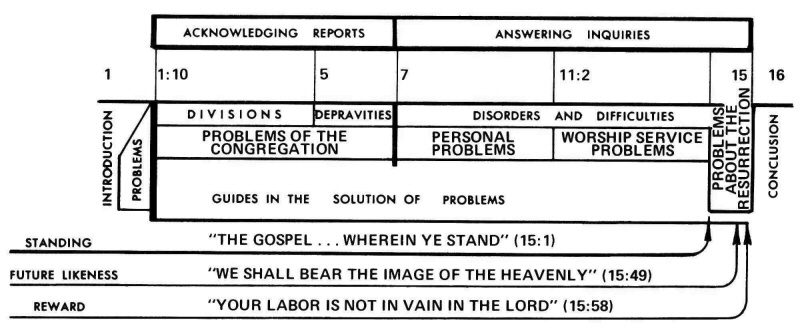
1 CORINTHIANS - PROBLEMS OF A LOCAL CHURCH
Click chart to enlarge
Charts from Jensen's Survey of the NT - used by permission
- 1 Corinthians 9:1 Commentary
- 1 Corinthians 9:2 Commentary
- 1 Corinthians 9:3 Commentary
- 1 Corinthians 9:4 Commentary
- 1 Corinthians 9:5 Commentary
- 1 Corinthians 9:6 Commentary
- 1 Corinthians 9:7 Commentary
- 1 Corinthians 9:8 Commentary
- 1 Corinthians 9:9 Commentary
- 1 Corinthians 9:10 Commentary
- 1 Corinthians 9:11 Commentary
- 1 Corinthians 9:12 Commentary
- 1 Corinthians 9:13 Commentary
- 1 Corinthians 9:14 Commentary
- 1 Corinthians 9:15 Commentary
- 1 Corinthians 9:16 Commentary
- 1 Corinthians 9:17 Commentary
- 1 Corinthians 9:18 Commentary
- 1 Corinthians 9:19 Commentary
- 1 Corinthians 9:20 Commentary
- 1 Corinthians 9:21 Commentary
- 1 Corinthians 9:22 Commentary
- 1 Corinthians 9:23 Commentary
- 1 Corinthians 9:24 Commentary
- 1 Corinthians 9:25 Commentary
- 1 Corinthians 9:26 Commentary
- 1 Corinthians 9:27 Commentary
1 Corinthians 9:27 but I discipline my body and make it my slave, so that, after I have preached to others, I myself will not be disqualified (NASB: Lockman)
Greek: alla hupopiazo (1SPAI) mou to soma kai doulagogo, (1SPAI) me pos allois keruxas (AAPMSN) autos adokimos genomai. (1SAMS)
Amplified: But [like a boxer] I buffet my body [handle it roughly, discipline it by hardships] and subdue it, for fear that after proclaiming to others the Gospel and things pertaining to it, I myself should become unfit [not stand the test, be unapproved and rejected as a counterfeit]. (Amplified Bible - Lockman)
Barclay: but I batter my body; I make it my slave; lest after I have preached to others I myself should fail to stand the test. (Westminster John Knox Press)
Barnhouse (paraphrase): I keep my body in complete subjection to my spirit. If I don't do this, I am likely to be counted as one who did a lot of talking, but finished up with the crowd, far from the prize winners.
ESV: But I discipline my body and keep it under control, lest after preaching to others I myself should be disqualified.
KJV: But I keep under my body, and bring it into subjection: lest that by any means, when I have preached to others, I myself should be a castaway.
NET: Instead I subdue my body and make it my slave, so that after preaching to others I myself will not be disqualified. (NET Bible)
NIV: No, I beat my body and make it my slave so that after I have preached to others, I myself will not be disqualified for the prize. (NIV - IBS)
NLT: I discipline my body like an athlete, training it to do what it should. Otherwise, I fear that after preaching to others I myself might be disqualified. (NLT - Tyndale House)
Phillips: I really fight! I am my body's sternest master, for fear that when I have preached to others I should myself be disqualified. (Phillips: Touchstone)
Wuest: But I beat my body black and blue and make it my abject slave lest somehow, when I have preached to others, I myself should be disqualified [from further Christian service].
Young's Literal: but I chastise my body, and bring it into servitude, lest by any means, having preached to others -- I myself may become disapproved.
BUT I DISCIPLINE MY BODY AND MAKE IT MY SLAVE : alla hupopiazo (1SPAI) mou to soma kai doulagogo (1SPAI):
- Discipline: 1Co 9:25 4:11,12 6:12,13 8:13 Ro 8:13 2Co 6:4,5 11:27 Col 3:5 2Ti 2:22 1Pe 2:11
- Make it my slave: Ro 6:18,19
- 1 Corinthians 9 Resources - Multiple Sermons and Commentaries
NOTE: BE SURE TO CHECK THE ADDITIONAL COMMENTS ON THIS VERSE BY CLICKING HERE
Running to Win… What it takes
1Cor 9:24 - Determination
1Cor 9:25 - Discipline
1Cor 9:26 - Direction
1Cor 9:27 - Denial
As noted earlier, Paul now applies the example from the Greek sports arena directly to himself ("I discipline… I myself") and does so that he might present himself as an example or model for other believers to imitate (cp 1Co 4:16, 11:1, 1Th 1:6, cp Heb 6:12, He 13:7, 3Jn 1:11).
Discipline (buffet, batter, beat my body black and blue) (5299) (hupopiazo from hupo = under + ops = eye) means literally to strike under the eye a description of an "uppercut" to use modern pugilistic parlance. To strike in this manner was generally considered to be a "knockout" punch by the ancient Greek boxers. The idea then is to strike hard and heavy on one's face, rendering it "black and blue." Recall that (apparently not in the first rounds but only in later rounds according to some sources) the boxers wore gloves (the "cestus") made of leather bands and tied into knots in addition to being embedded with metallic objects composed of lead and iron! It is not surprising that these gloves obtained the nickname of "limb-breakers!"
The present tense speaks of this as Paul's continual practice which clearly implies a continual need. Peter alerts us to the fact that our innate "home grown" "fleshly lusts… wage war (present tense = continually) against the soul." (1Pe 2:11). Imagine you are fighting an opponent with "brass knuckles" and when the bell sounds for the next round, you let down your guard and are absolutely pummeled! Beloved, this is exactly what happens when we let down our guard in our fight against our flesh -- we are easily and thoroughly defeated! Paul is giving us his example to imitate so that we might experientially live daily as "more than conquerors in Christ." (Ro 8:37KJV).
SELF-DISCIPLINE IS
A KEY TO USEFULNESS
IN THE KINGDOM OF GOD
Marvin Vincent - A most interesting account is given by Rodolfo Lanziani, “Ancient Rome in the Light of Recent Discoveries, ” of the exhuming at the foundation of the Temple of the Sun, erected by Aurelian, of a sitting bronze statue of a boxer. The accompanying photograph shows the construction of the fur-lined boxing-gloves secured by thongs wound round the forearm half-way to the elbow. The gloves cover the thumb and the hand to the first finger-joints. The writer says; “The nose is swollen from the effects of the last blow received; the ears resemble a fiat and shapeless piece of leather; the neck, the shoulders, the breast, are seamed with scars… The details of the fur-lined boxing-gloves are also interesting, and one wonders how any human being, no matter how strong and powerful, could stand the blows from such weapons as these gloves, made of four or five thicknesses of leather, and fortified with brass knuckles.”
Vine adds that hupopiazo means "to beat the face black and blue. It indicates the suppressive treatment of the body, not merely the physical frame, but that regarded as the instrument of the inward passions and lusts; not the bruising of the body itself, but rigid self-denial in order to keep oneself spiritually fit. (Vine, W. Collected writings of W. E. Vine. Nashville: Thomas Nelson)
Comment: Note that "rigid self denial" is not just me resisting temptation in my own strength. That's just another name for legalism. No, self denial is more accurately designated "Spirit enabled self denial". Yes, I must make a conscious choice to deny the strong desires that continually come from my fallen flesh (My responsibility - Php 2:12) but God provides the "want to" (the desire) and the power (God's provision - Php 2:13).
Fight your sinful impulses with all your might
as a boxer fights an opponent
Paul could hardly give us a more vivid picture of his willingness to severely discipline his own body than the picture invoked by the verb hupopiazo!
In secular Greek hupopiazo was used figuratively to "describe cities terribly scourged and afflicted by war, bearing the marks of devastation." (Thayer)
Hupopiazo is used one other time in the NT in a figurative sense to describe a widow importuning the judge and giving him intolerable annoyance …
yet because this widow bothers me, I will give her legal protection, otherwise by continually coming she will wear me out.'" (Luke 18:5)
Comment: Some think that Luke may intend the literal meaning, that is, that this woman would take out her frustration on the judge not just with verbal assaults but also physical assault! Interesting, but I do not think that is the intended meaning in this context. The idea seems more that she is pestering the judge, greatly annoying him, and wearing down his resolve. Perhaps the best way to express this woman's action is that she "browbeat" him.
Jesus presented a similar instruction to anyone who desires to truly be His disciple…
Then Jesus said to His disciples, "If anyone (continually) wishes to come after Me, let him deny (aorist imperative = this is not "optional" but a clear command to do this now! Do it effectively! Don't delay!) himself (reflexive pronoun referring action of denial back to the "anyone" and with middle voice [deny] the doubly emphasizes that this is our personal responsibility to initiate and participate in), and take up his cross, and follow Me. For whoever wishes to save his life shall lose it; but whoever loses his life for My sake shall find it. For what will a man be profited, if he gains the whole world, and forfeits (Mark 8:34-36)
THOUGHT: Just as Paul is not going to force us to discipline ourselves, neither is Jesus. It is our prerogative, our volitional choice, the decision of our will. "Will I follow Jesus today" (or will I take a break and gratify my flesh?) is the question we must confront ourselves with each morning! Will you today? Will I? Surely we can take a "furlough" today. Remember our mortal enemies (world, flesh, devil) never fall back or call a truce and neither can we if we would seek to be more like Jesus each day. We must (symbolically) take up our cross by voluntarily submitting to die to self (self interests, harsh words, our right to retaliate ["get 'em back" - See "Covenant Defender"], an unforgiving spirit ["I'll forgive them over my dead body!", "You don't understand what they did to me!"-See forgiveness/unforgiveness], self-gratification ["Just one more time!"] in all its deceptive, delectable disguises, and the list goes on, a list unique and as varied as each of us as individuals).
Self Discipline Is
Serious Business
My body (4983) (soma) - We do well to not forget the maxim that much (most) of our temptation to sin comes from within our own body (Jas 1:14, 15), specifically from the fallen flesh that still resides in every believer and will do so until we are glorified (free finally from the punishment, the power, the presence and the pleasure of Sin! Hallelujah!)
Earlier Paul reminded the saints who were living in the "sin"-uous city of Corinth (see "Corinthianize") that their body now belonged to God…
Food is for the stomach, and the stomach is for food; but God will do away with both of them. Yet the body is not for immorality, but for the Lord; and the Lord is for the body… Flee (present imperative = command to continually flee because the enemy is continually assaulting our mind and heart with evil desires) immorality. Every other sin that a man commits is outside the body, but the immoral man sins against his own body. Or do you not know that your body is a temple of the Holy Spirit who is in you, whom you have from God, and that you are not your own? For you have been bought with a price: therefore glorify (give a proper opinion of the great, majestic, supernatural, invisible) God in your body (by you grace infused, Spirit enabled words and works). (1Co 6:13, 1 Cor 6:19, 1Co 6:20)
Jesus called for a variation of "buffeting" one's body in His Sermon on the Mount…
You have heard that it was said, 'YOU SHALL NOT COMMIT ADULTERY'; but I say to you, that everyone who looks on a woman to lust for her has committed adultery with her already in his heart. And if your right eye makes you stumble, tear it out, and throw it from you; for it is better for you that one of the parts of your body perish, than for your whole body to be thrown into hell. And if your right hand makes you stumble, cut it off, and throw it from you; for it is better for you that one of the parts of your body perish, than for your whole body to go into hell. (Mt 5:27, 28, Mt 5:29, 30) (Note: All verbs in red = aorist imperative = Command to do this without delay! Do it effectively! It is serious and demands urgent attention!)
Comment: In these picturesque examples of Paul (1Co 9:27) and Jesus, note that neither was calling for a literal physical response which has been a common misinterpretation (and misapplication)! Just as the physical beating of Paul's body could never bring the flesh into submission, neither could gouging out one's eye or cutting off one's hand control the evil desires of the flesh. One would still have the other eye to view inappropriate content on television or the internet! The point is that both Jesus and Paul are calling for radical (grace infused, Spirit enabled) discipline (not physical mutilation or asceticism) in light of the deadly seriousness of sin. Do I really believe sin is that deadly? If we do, we will heed the warnings of Jesus and Paul to get serious about sin. If that means getting rid of your TV men, than let it be! Whatever keeps you from running the grace race and fighting the faith fight needs to be "jettisoned!" (cp He 12:1, Col 3:5, as John Owen said [paraphrased] "Kill sin before it kills you." - Owen's classic is not easy reading but it is worth the effort > Of the Mortification of Sin in Believers Christian Classics Ethereal Library
Related Resource:
- John MacArthur's article - Mortification of Sin
Notice that the phrase "buffet my body" obviously is related to the example of the Greek athlete's exercise of "self control" described in 1Co 9:25. While the former might be classified as a discipline and the latter as denial (or vice versa), the charge, the means and the effects are similar -- growth in holiness, godliness, Christlikeness (~progressive sanctification). For believers both discipline and denial call for dependence on divine grace and the Helper (Jn 14:16), Who supplies the power (dunamis) necessary to fulfill the objective (cp Acts 1:8, Remember that even Jesus depended on the "power of the Spirit" Lk 4:14, Acts 10:38 leaving us an example to follow in His steps 1Pe 2:21).
Do not misinterpret what Paul is saying here - he is not saying that he subjects his physical body to literal blows or severe discipline as one might in asceticism, where adherents practice self-denial and strict self control (eg, abstaining from foods and other physical pleasures, abstaining from normal relations with one's spouse, etc) in an attempt to attain a higher level of "spirituality". In fact Paul distinctly warned the Colossians of the futility of such practices…
"Do not handle, do not taste, do not touch!" (which all refer to things destined to perish with the using)-- in accordance with the commandments and teachings of men? These are matters which have, to be sure, the appearance of wisdom in self-made religion and self-abasement and severe treatment of the body, but are of no value against fleshly indulgence. (Col 2:21, 22, 23)
Scofield: By creating a reputation for superior sanctity, as some did, they did not really honor God but only satisfied the flesh.
John Calvin in describing how Paul's words "buffet my body" have been misinterpreted (and thus misapplied) wrote that "the monks of long ago, wanting to comply with this direction, thought out many disciplinary exercises; for they used to sleep on benches; they forced themselves to keep unduly long night vigils; and, in their way of life, kept clear of all luxuries."
This describes the kind of self-discipline necessary in order to be a winning spiritual athlete. We must bring our bodies into subjection so that our flesh, with its evil desires, does not dominate us and lead us into sin that will divert us from the goal of godliness and Christ-likeness and winning others to Christ. When we honor the Lord Jesus Christ and focus on loving God and obeying him, motivated by a "glance" at the eternal reward that awaits those who run with faith, this eternal perspective will bring out our best efforts. But dear brother or sister in Christ, make no mistake, this "once in a lifetime" race will require strenuous effort, but as Paul has emphasized repeatedly, it is effort that is possible ONLY by being continually strengthened by God's Spirit and the grace that is in Christ Jesus (2Ti 2:1).
Commenting on this warning to the Corinthians (and to all believers of all ages) John MacArthur writes that…
The athlete’s disciplined self–control is a rebuke of half–hearted, out–of–shape Christians who do almost nothing to prepare themselves to witness to the lost—and consequently seldom do. (MacArthur, J: 1Corinthians. Chicago: Moody Press )
Paul was saying that if the Olympic and Isthmian athletes exercised such great discipline (giving up the good and the better for the best) and self–control in all things, why can't you Corinthian Christians? In this same line of thought we need to remember that Jesus didn’t say, “Follow Me and life will be easy.” He said, “Follow Me, and life will be tough, but your prize will be worth it in the end.” The Christian life is not a race to see who comes in first, but an endurance run to see who finishes faithfully. Remaining faithful to the finish makes us true winners. We are judged by what we finish, not by what we start.
John Phillips - Paul is not advocating the medieval practice of self-flagellation. He is using figurative language and illustrating the need for constant moral and physical discipline. The possibility he systematically fought was the possibility of his body getting the upper hand.
Paul gives us a parallel picture of what it means to "buffet one's body" in Romans 6 writing…
Therefore do not let sin reign (present imperative =command + negative particle = "Stop letting the Sin continue to reign in your physical body") in your mortal body so that you obey its lusts, and do not go on presenting the members of your body to sin as instruments of unrighteousness; but present yourselves to God as those alive from the dead, and your members as instruments of righteousness to God. For sin shall not be master over you, for you are not under law but under grace. (Ro 6:12-14)
Comment: Paul is commanding the saints in Rome to stop letting Sin reign as "king" which is diametrically opposed to Paul's affirmation that he makes his body his slave.
Adam Clarke - The apostle considers his body as an enemy with which he must contend; he must mortify it by self-denial, abstinence, and severe labor; it must be the slave of his soul, and not the soul the slave of the body, which in all unregenerate men is the case.
John MacArthur is probably correct when he writes that "Most people, including many Christians, are instead slaves to their bodies. Their bodies tell their minds what to do. Their bodies decide when to eat, what to eat, how much to eat, when to sleep and get up, and so on. An athlete cannot allow that. He follows the training rules, not his body. He runs when he would rather be resting, he eats a balanced meal when he would rather have a chocolate sundae, he goes to bed when he would rather stay up, and he gets up early to train when he would rather stay in bed. An athlete leads his body; he does not follow it. It is his slave, not the other way around. (MacArthur, J: 1Corinthians. Chicago: Moody Press)
HOW DOES ONE
MAKE THEIR BODY
A SLAVE?
Men cannot "master" their body in their own natural strength. They must put to death sins (and lusts) under the control and empowerment of the Spirit. Writing to the Romans Paul warns his readers…
if you are living (present tense = continually) according to the flesh, you must die; but if by the Spirit you are putting to death (KJV = "mortify") (present tense = continually) the deeds of the body, you will live. (Ro 8:13 see commentary)
Kenneth Wuest comments on Ro 8:13: Assuming that a person lives habitually under the dominion of the evil nature, Paul says, that person is about to be dying. The verb is present in tense, and therefore durative in meaning, indicating habitual action. The individual who lives habitually under the dominion of the evil nature is an unsaved person. That one is on the way to final death in the Lake of Fire. But the person who by the Holy Spirit habitually puts to death the deeds of the body, will live. That person is a saved person. (Wuest, K. S. Wuest's Word Studies from the Greek New Testament: Studies in the Vocabulary of the Greek New Testament: Grand Rapids: Eerdmans)
John MacArthur explains the first part of Romans 8:13 this way: The apostle is not warning genuine believers that they may lose their salvation and be condemned to death if they fall back into some of the ways of the flesh. He has already given the absolute assurance that “there is therefore now no condemnation for those who are in Christ Jesus” (Ro 8:1). He is rather saying that a person whose life is characterized (Ed: continually) by the things of the flesh is not a true Christian and is spiritually dead, no matter what his religious affiliations or activities may be. If he does not come to Christ in true faith, he must die the second death under God’s final judgment. (MacArthur, J: Romans 1-8. Chicago: Moody Press)
Comment: We need to understand what Paul is not saying. He is not saying believers won't ever sin or from time to time fall back into patterns of sin they had before they were regenerated by the Holy Spirit. Clearly legitimate children of God do fall back into sin when their focus turns away from Lord and His sufficiency and onto themselves and to the things of the world. Stated another way, there may be times in a believer's life when a snapshot might show that person as if they were living according to the flesh, but over time they would exhibit evidence of progress in holiness. Neither is Paul suggesting that a believer should “Let go and let God”, a philosophy promoted by some who advocate a so-called "deeper life", in which one progressively rises to higher and higher levels of spirituality until sin and even temptation are virtually absent! As long as a believer is in his or her earth suit, they will be subject to the passions of the wily evil flesh and will daily (cp Lk 9:23 - "daily") need to keep putting sins to death by the power of the indwelling Holy Spirit and His ever sufficient supply of grace. Only in heaven will our need for this "practical" or "progressive" sanctification (growth in holiness) come to complete and final end, for when we see Christ, we shall be like Him (1Jn 3:2, 3 - What is He like? Holy of course. Sinless. Glorified.) Until the consummation of our blessed hope (Titus 2:13), all believers are admonished to continually be about the Father's business of putting sin to death by the Spirit (cp Col 3:5).
Ray Pritchard comments: I once heard Dr. Ryrie call Romans 8:13 the most important single verse on the spiritual life in the New Testament. He liked it because it contains a beautiful balance. There is God’s part—
"if by the Spirit"
—and there is our part—
"you put to death."
Spiritual growth comes when we do our part as we rely upon the Holy Spirit’s enablement. True spirituality is neither entirely passive ("Let go and let God") nor entirely active ("I’ve got to do this all by myself"). This verse balances a moment-by-moment dependence upon the Spirit with a tough-minded attitude toward the flesh. Is the spiritual life dependent upon God or upon me? The answer is Yes!
I cannot do it without God.
God will not do it without me.
(Think of the) illustration about a car versus an elevated train. One operates on the storage principle (You put gas in the tank and you drive it. You burn the gas and when you're out of gas, you stop, you get more gas, you run it again, you burn it, you get more gas, you keep on driving until you run out. You're constantly running and stopping, running and stopping, filling and refilling.), the other on the contact principle (You have the two rails on the outside and the electrified third rail in the middle. What is it that keeps the elevated train going? As long as the train stays in contact with that third rail in the middle, it will go and go and go and never stop. Too many people think that walking with the Holy Spirit is like riding in a car. You get filled with the Holy Spirit and you get run down and you get filled up again and you get run down. So they're constantly up and down, up and down, being filled and emptied, being filled and emptied. That's not the Christian life of the New Testament.) The Christian life operates on the contact principle.
Just as the train moves forward as long it stays in contact with the third rail, even so your spiritual life moves forward as you stay in constant contact with the Holy Spirit.
The whole question of the Spirit-filled life resolves itself into this: Are you keeping in contact with the Holy Spirit? Your job—your only real job as a Christian—is to stay in contact with the Spirit --
Day by day.
Hour by hour.
Moment by moment…
How well have you been staying in contact? (Read his entire messag - Life in the Spirit - Roman 8:5-17 including his discussion of "Three Faulty Ways to Live the Christian Life" - "By rules...By a formula...By an experience")
Paul states a parallel truth in Colossians in the form of a command…
Therefore consider (nekroo) the members of your earthly body as dead to immorality, impurity, passion, evil desire, and greed, which amounts to idolatry. (Col 3:5)
Comment: Note that in this verse nekroo is in the active voice (signifies one makes a volitional choice). Vine says nekroo conveys the "sense of destroying the strength of, depriving of power, with reference to the evil desires which work in the body". Paul is saying in essence "Put an end to the life of" your bodily members and functions in regard to immoral purposes. This command to mortify the evil fleshly desires is another way of saying "I buffet my body and make it my slave".
Make it my slave (1396) (doulagogeo from doulos [word study] = servant, slave + ago = to lead, bring) means literally to bring into a state of servitude, to make a salve, to bring into a state of subjection. Used only here in the Bible. Note that while the body per se is not evil, it is the "base of enemy operations", the camp from which Sin launches its missiles of anti-God impulses and desires that if not deflected by the shield of faith always result in death and destruction to our spiritual life.
Spirit empowered Self denial
This is a description of what I would call "Spirit empowered self denial" and begs the question "Are you a "slave" to your body? Does your body give the orders?" If "yes" then clearly you are not denying your fleshly lusts and it follows that you are not surrendered to the the Holy Spirit -- He is not filling, controlling and empowering you.
A T Robertson writes that the verb doulagogeo "is the metaphor of the victor leading the vanquished as captive and slave."
The use of the present tense signifies that Paul continually brings his body into subjection. The implication of course is that the body continually seeks to have its way and gratify its sinful desires. This reminds me of the continual struggle Paul describes in Galatians 5 after commanding us to continue walk in dependence on and empowerment by the Spirit…
But I say, walk (present imperative = command to continually conduct yourself) by the Spirit, and you will not carry out the (evil, sinful) desire of the flesh. For the flesh sets its desire (epithumeo in the present tense identifies this battle of opposing desires as a lifelong struggle) against the Spirit, and the Spirit against the flesh; for these are in opposition to one another, so that you may not do the things that you please. (Gal 5:16, Gal 5:17)
Comment: As an aside note the order (1) Walk by the Spirit and (2) You will not carry out the desires of the flesh. You are probably saying "That's obvious!" It is, but the trap many believers fall into is to first "not carry out the desires of the flesh" and think that they by so doing they are now walking by the Spirit. That inverts the order and subverts the power of the Spirit. As we learn to surrender our wills to the Spirit (and this is a lifelong process I believe), we experience His desire and His power, both of which are opposed to and superior to the desire and power of the flesh. The result is we don't carry out the desire of the flesh. Notice Paul does not say "Walk by the Spirit and you will not experience the desires of the flesh." In fact verse 17 indicates we will experience the evil desires of the flesh for the rest of our earthly lives.
Vine adds that Paul (and all believers) should be continually "treating (the body) as a bondslave, refusing the indulgence of its desires, and making it constantly subordinate to the spirit. If our body gets the upper hand of us we are marred in spirit. Our natural desires should be those over which we act as complete masters. For this we need the help of the Holy Spirit which (Who) is ever available, but we need also the spiritual determination to respond to His power and direction. (Vine, W. Collected writings of W. E. Vine. Nashville: Thomas Nelson )
Adam Clarke has an interesting note on doulagogeo alleging it was a term used in wrestling and "which signifies to trip, and give the antagonist a fall, and then keep him down when he was down, and having obliged him to acknowledge himself conquered, make him a slave.
Jerome Bible Commentary says that "make it my slave" is "perhaps an allusion to the custom of humiliating the vanquished boxer. The winner of a boxing match would throw a rope about his vanquished opponent and drag him about the arena to the cheers and jeers of the crowd.
Spurgeon also has an interesting remark noting that doulagogeo "according to some, implies getting his body into the same position as a man does, when, in a pugilistic encounter, he gets his adversary’s head under his arm, and smites him with all his might, So Paul says concerning his body, “I bring it into subjection and take care that it feels the full force of my will.” According to other interpreters, the verse may be read, “I drag my body off as a cave;” just as in some of those ancient fights, the victors dragged away their antagonists as slaves, Paul accounted his body to be as a slave to his soul, and dragged it behind him in chains.
David Lowery writes that "Paul would not let his body master him (cf. 1Co 6:12); sometimes he denied even its demand for rightful privileges and pleasures (1Co 8:9) for a greater good (1Co 10:33). (Walvoord, J. F., Zuck, R. B., et al: The Bible Knowledge Commentary. 1985. Victor)
Someone has written that "The body is a bad master though it may be a good servant." Yes, if you truly make it your slave as did Paul.
J C Ryle adds that "Once the body was a perfect home for a soul--now it is all corrupt and disordered, and needs constant watching. It is a burden to the soul--not a helper; a hindrance--not an assistance. It may become a useful servant, but it is always a bad master.
THOUGHT - Dearly beloved of God, do you control the appetites of your body (the flesh) or are you allowing those appetites to control you? While your salvation is secure, your present usefulness as a vessel of honor and your future reward at the bema are not guaranteed.
Faithful service is sure to be rewarded, yet this is the reward of grace and not a merited award. (Geoffrey B. Wilson)
Lehman Strauss writes that "The Apostle Paul never left his first love. He feared being disqualified at the Judgment Seat of Christ (1Co 9:27; 2Co 5:10). That first love burned in his soul until his head was removed on the executioner's block… The contest (struggle) against defilement is real. Paul treated his body, not as his master, but as his servant, lest, by any chance, after he had exhorted others, he might discover in the end that he was disqualified from the competition. We are not shadow boxing. The old man is real and active and wicked. The flesh is at war with the Spirit. The new man, by the implanted Word of God, must dictate to the old nature. Failure here spells failure in effective service for Jesus Christ, and failure in service will mean loss of rewards at the Judgment Seat of Christ. My brother, your refusal to obey the Word of God might not disqualify you as a Christian, but it certainly will disqualify you as a contestant for rewards. The sad condition of the church is the tragedy of its castaways, men and women who are failing in the matter of self-discipline. Many Christians are in real peril of failing to fulfil the purpose in their high calling and thereby stand in jeopardy of being disapproved when our Lord will reward His faithful servants. Those who stand the test in that day will be the men and women whose lives brought forth the sweet, pure fruit of the engrafted Word. Oh, beloved brother, what will the harvest be when we all stand before the Judgment Seat of Christ?
SUBJUGATING MY BODY
BY CONSECRATION AND PRAYER
It strikes me that another way to make my body my slave is to offer it to the Lord each day for His good pleasure (Ro 12:1) and to "watch and pray" (Mt 26:41) with prayers such as those of the psalmist in Psalm 119…
Establish Thy word to Thy servant, as that which produces reverence (holy fear, not trembling dread) for Thee. (Ps 119:38)
And then…
Establish my footsteps in Thy word, And do not let any iniquity have dominion over me. (Ps 119:133)
Do you see the common denominator in this two great prayers? Remember too that the "fear of the Lord is the beginning of wisdom" (Pr 9:10). What a great mindset (and heart attitude) with which to begin each day!
SO THAT AFTER I HAVE PREACHED TO OTHERS I MYSELF WILL NOT BE DISQUALIFIED: me pos allois keruxas (AAPMSN) autos adokimos genomai. (1SAMS):
- So that after: 1Co 13:1, 2, 3 Ps 50:16 Mt 7:21, 22, 23 Lk 12:45, 46, 47 13:26,27 2Pe 2:15
- Disqualified: Jer 6:30 Lk 9:25 Acts 1:25 2Co 13:5,6
- 1 Corinthians 9 Resources - Multiple Sermons and Commentaries
DESIRE TO NOT BE
DISQUALIFIED
Preach (2784) (kerusso from kerux = a herald - one who acts as the medium of the authority of one who proclamation he makes; kerugma = the thing preached or the message) means to proclaim (publicly) or to herald or act as a public crier, the town official who would make a proclamation in a public gathering.
In the context of the Greek games, the herald (kerux) would
proclaim the conditions of the games, display the prizes, exhort the combatants, excite the emulation of those who were to contend, declare the terms (rules) of each contest, pronounce the name of the victors, and put the crown on their heads. (Clarke)
He would also announce the names of any contestants who were disqualified. Paul saw himself as both a "herald" and a "runner." He was concerned lest he get so busy trying to help others in the race that he ignore himself and find himself disqualified. (Wiersbe)
Kerusso like its synonym euaggelizo, is especially used of preaching the gospel with the distinction lying in the literal significance where kerusso signifies to proclaim as a herald (kerux) and euaggelizo means to announce a good message or declare good tidings.
Be disqualified - There are 3 general ways "disqualified" has been interpreted:
(#1) Some feel when Paul says disqualified he is teaching a person can be saved and then lose his salvation (be "disqualified"), a view that is in conflict with the main New Testament teaching regarding salvation. If a person is truly saved, they are saved to the uttermost and can (will) never fall away. (cp Jn 10:27, 28, 29). This is not what Paul is teaching.
(#2) Others feel disqualified refers to eternal damnation. They reason that if there is absolutely no evidence in an individual's life that he or she is running the grace race or fighting the good fight of holiness, then such a person very likely does not possess the Holy Spirit (Ro 8:9) and is most likely not a new creation in Christ (2Co 5:17). In other words an individual who says they are "saved" and never practices self-discipline ("self control" 1Co 9:25, "discipline… body" 1Co 9:27)
As MacDonald puts it "Thinking of the false teachers and how they indulged every passion and appetite, Paul sets forth the general principle that if a person does not keep his body in subjection, this is proof that he never really was born again; and although he might preach to others, he himself will be disqualified."
(#3) A third interpretation of disqualified is that Paul is not speaking of salvation per se but of service. Paul is not suggesting that he might be lost, but that he might not stand the test as far as his service was concerned and might be rejected for the prize. This interpretation fits the meaning of the word disqualified in the athletic context. Paul is saying that if after having preached to others, he fails to discipline himself which might result in his being qualified from service and subsequent rewards. Most modern commentaries favor this interpretation.
Interpretation by John Piper on the meaning of disqualified - Paul will warn the Corinthians in the next chapter (1Co 10:12), "Let anyone who thinks that he stands take heed lest he fall." Now Paul applies it to himself. "If I do not take heed, if I give way to some of the impulses of my body, I could find myself on the slippery slope of disobedience away from Christ, and get to the end of my life and hear the judge of the race say, 'Disqualified! Yes, you prophesied in my name. Yes, you cast out demons in my name. Yes, you did many mighty works in my name. But you left the racetrack of faith and love and righteousness. You are disqualified. Depart from me. I never knew you (Mt 7:22, 23).'" The best evidence perhaps that this is what Paul means is the use of the word "disqualified" (adokimos) in 2Co 13:5. Paul says, "Test yourselves to see if you are in the faith; examine yourselves! Or do you not recognize this about yourselves, that Jesus Christ is in you—unless you are disqualified." The word is exactly the same one from 1 Corinthians 9:27. To be disqualified means that Christ is not in you. The race has been run in vain. It was a sham. (1Corinthians 9:23-27 Olympic Spirituality 1 - Beyond the Gold) (Bolding added)
Clearly Piper holds interpretation #2 which emphasizes the point that excellent expositors are in disagreement on the most accurate interpretation of "disqualified". For what it is worth, I DISAGREE WITH PIPER.
Most of the expositors and commentators that I have consulted favor interpretation #3. In truth, both interpretations describe bad consequences, although #2 is far more serious for it speaks of eternal separation from God. But interpretation #3 speaking of loss of usefulness for service and of future rewards is also quite serious. Regardless of the interpretative view we hold, we can all agree that running a disciplined race to glorify God should be the chief end of our existence and our new life in Christ. As we read comments such as these where clearly excellent commentators disagree, may we strive to take the approach of ancient Bereans (Acts 17:11)
William MacDonald says it this way - In any event, the passage is an extremely serious one and should cause deep heart-searching on the part of everyone who seeks to serve the Lord Christ. Each one should determine that by the grace of God he will never have to learn the meaning of the word (adokimos) by experience. (MacDonald, W & Farstad, A. Believer's Bible Commentary: Thomas Nelson )
Leon Morris - Disqualified translates adokimos, which means ‘which has not stood the test’; it was used of disqualification in the Games. Paul’s fear was not that he might lose his salvation, but that he might suffer loss through failing to satisfy his Lord (cf. 3:15). (Morris, L. Vol. 7: 1Corinthians: An introduction and commentary. Tyndale New Testament Commentaries. Downers Grove, IL: InterVarsity Press)
The KJV Bible Commentary notes that "disqualified" - must not be construed to suggest that Paul was afraid of losing his salvation. His subject is still Christian liberty, and his point is that sometimes the mature Christian will have to restrict himself in order to accomplish the ultimate task. (Dobson, E G, Charles Feinberg, E Hindson, Woodrow Kroll, H L. Wilmington: KJV Bible Commentary: Nelson )
Kenneth Wuest paraphrases the last half of 1Co 9:27 as "I myself should be disqualified [from further Christian service]."
Henry Morris writes that "The Greek for "castaway" (adokimos) means literally "disapproved," but it does not suggest being discarded altogether. Paul had just written about losing all rewards but still being saved (1Corinthians 3:15), and he realized that this could become possible even for him. (Defender's Study Bible Online Notes)
Baker - Disqualification for this prize would come only from Paul’s not doing his Christ-ordained job as an apostle in the rigorous, self-denying way he chose to do it—and ultimately failing to win converts to Christ. (Cornerstone Bible Commentary)
W A Criswell observes that "Paul's assurance of salvation (cf. 2Ti 1:12) and his confidence in the security of the believer (cf. Ro 8:30, 31) go hand-in-hand with self-discipline and watchfulness (1Co 10:12). There is no hint of any possible loss of salvation in the text. Paul disciplines himself rigorously so that he will not become "disqualified." This final word is adokimos (Gk.), suggesting the idea of "disapproved." Paul does not fear loss of salvation, but rather loss of his work and influence as a minister of Christ. (Believer's Study Bible: New King James Version. 1991. Thomas Nelson)
Vine says that adokimos "does not mean a castaway, as in the authorized version., but disapproved as a result of not standing the test, and here it means disapproved, and so rejected from present testimony, with loss of future reward. Such a possibility should be so appalling and abhorrent to any servant of Christ, that he should follow the apostle’s example, which is here given, not simply as a record of his own life, but as a guide to us in all our circumstances. We need to remember also that the apostle is here speaking of the responsibility and joy of winning souls for Christ (Context = 1Co 9:22, 23). To save others should be the pursuit of our lives. The conflict and its issues are so tremendous, that we should never forgo any means of spiritual strength. (Vine, W. Collected writings of W. E. Vine. Nashville: Thomas Nelson )
Everett Harrison writes that "The emphasis in the NT falls rather on self-discipline as the key to dedicated usefulness in the kingdom of God (1Co 9:24-27) (Colossians: Christ All Sufficient. Everyman's Bible Commentary).
Scofield writes that in using adokimos "The apostle is writing of service, not of salvation. He is not expressing fear that he may fail of salvation but of his crown.
Henry Alford on "rejected" "from the prize, not, as some commentators, from the contest altogether. An examination of the victorious combatants took place after the contest, and if it could be proved that they had contended unlawfully, or unfairly, they were deprived of the prize and driven with disgrace from the games. So the Apostle, if he had proclaimed the laws of the combat to others, and not observed them himself, however successful he might apparently be, would be personally rejected as adokimos as unqualified in the great day. And this he says with a view to shew them the necessity of more self-denial, and less going to the extreme limit of their Christian liberty. (The New Testament for English Readers)
Alan Johnson - Paul expresses the irony that without this strict discipline, when all is said and done and the secrets of his heart are brought into the light of God’s judgment (1Co 4:4, 5), he himself, the teacher, might fail the final test of complete faithfulness to Christ (“in all things,” 9:25NRSV). This should not be seen as a loss of salvation but a loss of Christ’s commendation, as in 1Co 3:12, 13, 14, 15 (Ro 14:10, 11, 12; 2Co 5:9, 10). (The IVP New Testament commentary series. Downers Grove, Ill.: InterVarsity Press)
ESV Study Bible - Disqualified (Gk. adokimos, “not approved, not standing the test”) in this context means “disqualified from receiving rewards”.
As Adam Clarke says "To prevent this (rejection, disqualification), he ran, he contended, he denied himself, and brought his body into subjection to his spirit, and had his spirit governed by the Spirit of God. Had this heavenly man lived in our days, he would by a certain class of people have been deemed a legalist; a people who widely differ from the practice of the apostle, for they are conformed to the world, and they feed themselves without fear.
Lowell Johnson - Paul knew he would face temptation and sin all of his life. • The word “castaway” means to be rejected, disqualified, disapproved, unfit, to be put on the shelf, no longer useful. Paul knew the utter necessity to live what he preached. He knew the Lord would not tolerate hypocrisy. It was not a matter of losing his personal salvation. The emphasis is on reward. Nothing in heaven or earth, nor nothing present and nothing to come, could every separate him from the love of God. The Lord is able to keep him until the day of redemption.
Only one life, will soon be past;
Only what's done for Christ will last.
John MacArthur notes that "Many believers start the Christian life with enthusiasm and devotion. They train carefully for a while but soon tire of the effort and begin to “break training.” Before long they are disqualified from being effective witnesses. They do not have what it takes, because they are unwilling to pay the price. The flesh, the world, everyday affairs, personal interests, and often simple laziness hinder spiritual growth and preparation for service. Even good things can interfere with the best. Fulfillment of freedoms can interfere with fulfillment of love. Following our own ways can keep others from knowing the Way. Souls are won by those who are prepared to be used when the Spirit chooses to use them. (MacArthur, J: 1Corinthians. Chicago: Moody Press)
Chuck Swindoll - Throughout this passage, it’s important to remember that Paul isn’t talking about working hard to earn salvation. The whole context is selfless participation in ministry by those already saved. Paul uses an athletic illustration to explain that not all Christians will be rewarded equally for the way they lived and invested their time, energy, and resources.
Craig Blomberg - Verse 27b has been taken as Paul’s concern that he might lose his salvation (a remarkable thought in view of Rom. 8:31–38) or that “the prize” refers to some kind of rewards above and beyond eternal life itself (an idea for which there is no shred of contextual support). More probably, “disqualified” (adokimos) should be interpreted in light of the other reference to testing in the context of Judgment Day in 1 Corinthians (3:12–15). There Paul says God will “test” (dokimasei; v. 13) believers’ works and give out corresponding praise or censure (see the discussion above, pp. 74, 80). But neither one’s salvation nor eternal status in heaven is at stake. (NIVAC-1 Cor)
Albert Barnes on adokimos - The simple idea of Paul is, that he was afraid that he should be disapproved, rejected, cast off; that it would appear, after all, that he had no religion, and would then be cast away as unfit to enter into heaven. (Barnes NT Commentary)
The renowned Presbyterian expositor Donald Grey Barnhouse wrote that…
godly fear made him live like a runner in a race, hurling himself toward the goal with no thought of any other circumstance. His great anxiety was that he might be a castaway even though he had preached to others (1Co 9:27). He had not the slightest fear that he would be cast away from salvation, but he knew that it was possible for him to live in such a way that he would stand disapproved before the Judgment Seat of Christ. He might waste his time on secondary things; he might commit sin which, though confessed and forsaken, would cause him to lose opportunities and time which could never be regained.
We must understand that
everything we do,
everything we say,
everything we think,
everything we are,
has a relationship to God.
Each act, each word, each thought, each moment of life contains the possibility of sin. Each sin, like a coin, has two sides. If a Christian tells a lie, the "heads" side is sin, the "tails" side is a work. The sin side has been dealt with forever by the death of our Lord, but the work side will face him at the Judgment Seat of Christ.
"What shall I do?" may be the cry of the believer when these truths are borne in upon him. There is only one answer. God deals with us in the moment which we are living now. Look back over life in one hasty glance and cry out to the Lord that the whole tangled skein (a length of thread or yarn, loosely coiled and knotted) needs to be cut loose by Him and the threads freshly woven into His pattern. He will hand you fresh skeins whenever you desire them from Him. Then you can say,
"This one thing I do, forgetting what lies behind and straining forward to what lies ahead, I press on toward the goal for the prize of the upward call of God in Christ Jesus" (Php 3:13, 14).
May we be thankful from the depths of our being that we deal with the God Who is the God of ever fresh beginnings. (Expositions of Bible Doctrines Taking the Epistle to the Romans As a Point of Departure – Volume 9: God's Discipline)
Disqualified (castaway, disapproved) (96) (adokimos from a = without + dokimos = tested and thus reliable or acceptable) refers to that which is rejected after a trial or examination because it fails the test. It means to put to the test for the purpose of being approved, but failing to meet the requirements. Adokimos describes that which does not prove itself to be such as it ought and which is therefore disapproved and useless. For example, "sterile soil" (see Hebrews 6:8) is unfit for fulfilling its purpose.
In short adokimos describes that which is worthless, spurious, unqualified, disqualified, corrupted, not approved. Adokimos was commonly used of metals that were rejected by refiners because of impurities (eg, Isa 1:22 uses adokimos to refer to dross [the scum or impurities floating on the top of heated metal]). The dross was discarded, and adokimos therefore came to convey the sense of worthlessness and uselessness.
James Montgomery Boice describes an interesting secular use of adokimos that helps us understand the meaning…
Silver and gold coins were made quite roughly in those days, not milled to exact sizes as our coins are, and people would often cheat with them by carefully trimming off some of the excess metal. We know they did this because hundreds of laws were passed against the practice. After people had trimmed away enough metal, they would sell it for new coins. When coins had been trimmed for a long time, they eventually got so light that the merchants would not take them anymore; then a coin was said to be adokimos, "disqualified." This is what Paul is referring to. He is saying that he does not want to be disqualified, but rather to be judged "fit" as a result of his sufferings and self-discipline. (An Expositional Commentary – Romans, Vol 2: The Reign of Grace Romans 5-8).
Adokimos - 8x in 8v in the NAS - Ro1:28; 1Co 9:27; 2Co 13:5, 2Co 13:6; 2Ti 3:8; Titus 1:16; Heb 6:8.
In the context of the Greek games the idea of "disqualified" implies that there was a judge who made the assessment that the runner (boxer, etc) did not deserve either to compete or did not deserve the prize. The parallel of course is the great judgment by the Righteous Judge at the believer's bema seat at which time Paul might be deemed unworthy of receiving the prize.
The bema [word study] was the stand on which the judges stood to observe and evaluate the actions of athletes in the Olympic contests. If any athlete broke a rule, one or more of the judges (referees or umpires) would point to him and cry, “Adokimos!" (that is, “Disqualified!”). And thus he missed the prize (victor’s wreath -- see discussion of stephanos [word study]) regardless of the place he finished in the race or contest (see discussion of the necessity for athletes to compete according to the rules in 2Ti 2:5). Likewise, when an event was completed, the contestants stood before the bema to hear the judges’ announcement of the results, and to receive such reward as might properly be theirs. This is a uniquely fitting illustration to make clear to us the fact that service and life are to be evaluated by our Lord, with possible reward (cf Lk 16:2). The fear of the possibility happening at the end of his race, served as a strong negative motivator in Paul's life.
To reiterate although clearly there is disagreement on the meaning of disqualified in this verse but most commentators I have consulted favor that disqualified does not equate with losing one's salvation. For example, even disqualified athletes did not lose their citizenship (cp the believer's citizenship… in heaven - Php 3:20). The athletes who failed to meet the requirements could not participate at all in the games and with it he lost the opportunity to win a prize. In context this suggests that a disqualified believer might be "put on the shelf" and no longer be useful to the Master (see 2Ti 2:21, note also that 2Ti 2:22 parallels Paul's teaching on "self control" and "buffeting his body") for His good work, which would in turn lead to suffering loss of potential future eternal rewards! Irregardless of how we interpret disqualified, it is clear that Paul meant to paint a serious picture of the Christian's race. In light of that…
May each of us meditate deeply
on this solemn warning that we may not hear…
DISQUALIFIED!
Earlier in this same epistle Paul had alluded to the believer's appearance at the Bema Seat of Christ at which time they might be in potentially "disqualified" for a reward…
According to the grace of God which was given to me, like a wise master builder I laid a foundation, and another is building on it. But each man must be careful how he builds on it. For no man can lay a foundation other than the one which is laid, which is Jesus Christ. Now if any man builds on the foundation with gold, silver, precious stones, wood, hay, straw, each man's work will become evident; for the day will show it because it is to be revealed with fire, and the fire itself will test the quality of each man's work. If any man's work which he has built on it remains, he will receive a reward. If any man's work is burned up, he will suffer loss; but he himself will be saved, yet so as through fire. (1Co 3:10-15)
Comment: This meaning of this passage is clear - If our works pass the test, we receive a reward. If they are burned up, we lose the reward, but we are still saved "yet so as by fire."
Thomas Watson: As God will put a veil over his people's sins, so he will in free grace set a crown upon their works.
J Vernon McGee…
The translation "castaway" is unfortunate. The Greek word is adokimos, which means "not approved." Paul is thinking of the judgment seat of Christ where the rewards are given. In his Second Epistle to the Corinthians he will talk about the fact that we shall all appear before the judgment seat of Christ where awards are given. Paul says that he is out on that racetrack trying to run so that he will get a reward. That is the reason he preaches the gospel as he does. Paul has liberty. This is the choice that he has made. I think every Christian ought to work for a reward. We do not work for salvation; that is a gift given by the grace of God. My friend, if you are going to get a reward, you will have to work for it. If you are going to get a reward, then you had better get out on the racetrack and start moving…
Paul's goal was to run the Christian race in such a way that the One who is at the end of the race -- the Lord Jesus -- would be able to reward him and be able to say, "Well done, thou good and faithful servant" (Mt. 25:21). A child of God is to "strive"; God intends that he win the race. Every child of God needs to recognize this…
In effect, Paul is saying, "When I come into His presence I don't want to be disapproved. I don't want the Lord Jesus to say to me, 'You have failed. Your life should have been a testimony but it was not.' " Oh, my friend, you are going to hear that if you are not living for Him! I know we don't want to hear these things, but we need to face the facts…
Paul exercised himself -- that is, he didn't give in to the desires of his body -- because he did not want to come before God's presence some day and be disapproved. My friend, whoever you are or wherever you are, it is time to take your sitting-up exercises.
C H Spurgeon writes that "The Greek word, which is translated “a castaway” is “adokimos.” It might better have been rendered “disapproved.” It certainly has no such meaning as that which has been generally given to it. Paul was not afraid of being cast away by God at the last. What he aimed at was this, — as he had entered the lists, as a Christian minister, to fight for Christ, to wrestle against principalities and powers, to seek to win souls for Christ, he must keep his bodily powers and passions so in subjection that, at the last, when the prizes were distributed, he would be found to have won his. This is quite another matter from being “a castaway” from salvation and eternal life. Paul was saved and he knew it; and some of us know, to a certainty, that we are saved; but we also know that there is another crown to be won, which the Lord will give to his servants who win in the great fight with sin. To win this crown is our high ambition and we long to hear the Master say to each one of us, in that day, “Well; done, thou good and faithful servant, thou hast been faithful over a few things, I will make thee ruler other many things: enter thou into the joy of thy Lord.”
Charles Simeon nicely summarizes 1Cor 9:24-27 emphasizing that Paul is teaching that his zeal in ministry was motivated by two essentially opposite considerations…
1. A hope of gaining the prize—
This is manifestly implied in his words: and such a hope is the main spring of activity to every Christian that is under heaven. The Apostle well knew, how infinitely an unfading crown of glory surpasses the perishable chaplets that were awarded to the victors in the different games. He could not endure the idea, that others should take so much pains to obtain a corruptible crown, which vet only one would win; and that he himself should be remiss in seeking an incorruptible crown, which all who contended earnestly for it must obtain. The securing of this he felt to be the one thing needful; and therefore he determined to make it the one object of his ambition.
2. A fear of losing it—
The person who executed the office of herald in the different games, introduced others, and encouraged them to the contest, but did not contend himself. But the Christian herald, who stirs up and encourages others to engage in the race or combat, must himself both run and fight: and, if he do not engage with his whole heart, however he may have animated others, he himself will not be deemed worthy of the prize. Now the Apostle felt that the same exertions were necessary for him as for all others; and that peculiar guilt and shame would attach to him, if he, after having preached successfully to others, should at last fail of success himself. On this account therefore he laboured to “destroy the whole body of sin.” He was conscious that the smallest advantage gained by his bodily appetites might be attended with the most fatal consequences; and therefore he strove to “mortify his earthly members,” and to “crucify his flesh with its affections and lusts.”
Simeon then goes on to apply these truths to four groups (one has to read his exposition slowly because of his older English but your efforts will be rewarded)…
1. Those who are satisfied with the name and profession of Christianity—
Were such a life as yours sufficient to obtain the prize, there were no propriety (Ed: Fitness; suitableness; appropriateness - references to exercising self-control in all things, disciplining one's body, bringing into subjection - these are strong figures) in such figures as the Apostle has used in the text. Be assured, that, if St. Paul found such exertions necessary for himself (Ed: And recall that he switched to the first person in 1Co 9:26, 27), they are no less so for you: and, that if he could not get to heaven without them, much less can you (Ed: He is not saying that Paul or your or my efforts "merit" or "earn" our way to heaven. The idea is that such efforts are "works" that reflect a genuine faith, much like James teaches in chapter 2 ).
2. Those who have relaxed their exertions—
It is not the beginning well, but the enduring to the end, that will avail to the saving of the soul. Some indeed will say, “Once a child of God, and always so:” but God warns you, that if any man turn back, his soul shall have no pleasure in him. It is only by a patient continuance in well-doing that you can obtain the glory and honour and immortality which you profess to seek for. The labour that has been bestowed upon you is all in vain, if you do not maintain your steadfastness even to the end. “Be not weary therefore in well-doing; for in due season you shall reap, if you faint not.”
3. Those who are discouraged through apprehensions of failure—
Well might all be discouraged, if success depended on our own strength. But “God has laid help upon One that is mighty;” and it is our privilege to be “strong in the Lord and in the power of his might.” However weak therefore you yourselves are, and however powerful your enemies, you have no reason to despond, since, “through the strength of Christ you can do all things.”
4. Those who are “contending earnestly for the faith” and practice of the Gospel—
You know not indeed the precise measure of your course: but it is pleasing to reflect, that it may very soon be terminated, and that the prize shall be adjudged, not to the one who surpasses all others, but to all who “run their race with patience.” Methinks, the Saviour, the Judge of all, is holding forth the prize to you; and the whole host of heaven are witnesses of your exertions. Consider the countless multitudes that are already crowned, and that have bid an everlasting adieu to all the dangers of warfare, and the fatigues of running. Soon your hour also shall arrive: only, whenever it may arrive, let it find you exerting yourselves with all your might; that you may be able to say with your dying breath, “I have fought the good fight, I have finished my course, I have kept the faith: henceforth there is laid up for me a crown of righteousness, which the Lord, the righteous Judge, shall give me; and not unto me only, but unto all them also that love his appearing.”
Kistemaker has an interesting analysis of this last clause writing that…
The negative in the clause "so that… I myself not become disqualified" relates to the content of this and the immediately preceding chapter (chap. 8). While proclaiming the good news, Paul enjoyed apostolic freedom. But he denied himself certain foods so as not to offend the weaker brothers, refused remuneration for his services, and thus became all things to all people to advance the gospel.
|
QUALIFICATIONS NECESSARY |
|
|
SECULAR RACE |
HEAVENLY RACE |
| Trueborn Greek |
New creature in Christ 2Co 5:17 |
| Prepare at least 10 months for games Swear to that before a statue of Zeus |
Confess with mouth Jesus as Lord Ro 10:9,10 |
| Compete within specific rules - fail any requirements = automatic disqualification | Compete within the rules 2Ti 2:5 |
Even pagans understood something of the truth that Paul conveys in this passage, which is sad because those who were outside of Christ "ran" toward an entirely different "finish line". For example someone reminded Diogenes, the cynic
Thou art now an old man, rest from thy labors.
Diogenes answered
If I have run long in the race, will it become me to slacken my pace when come near the end; should I not rather stretch forward?" (Diog. Laert., lib. vi. cap. 2. sec. 6.)
This example of Diogenes' mindset even though advanced in age surely convicts many genuine believers who are in their 50's, 60's, 70's and 80's. Surely most have heard a fellow believer say "The Bible does not teach retirement", which I think is an accurate statement. The question is what are these older presumably more spiritually mature believers doing in regard to their race? It strikes me that a crying need is for spiritual mature older men to disciple younger men in their late 20's and their 30's, which can be a difficult time for many of these men spiritually. Where are the older men? Being a grandparent is great but that does not give you a pass to not keep pressing on. If a pagan like Diogenes can do it (with no promise of a future prize after death), why cannot we do it who have great motivation of a promised prize (or the alternative a prize missed because we failed to "buffet our bodies").
A W Tozer - Before the Judgment Seat of Christ my service will not be judged by how much I have done but by how much of me there is in it.
BROTHER DONKEY - "I discipline my body and bring it into subjection, lest… I myself should become disqualified."-- 1 Corinthians 9:27
One of the early church leaders referred to his body as "Brother Donkey." Like that hardy animal with a reputation for being stubborn, his body served him well as long as he placed it under firm discipline.
In today's Scripture reading, the apostle Paul wrote about this matter of self-discipline. Using analogies from athletic competition, he said we must be just as zealous about our spiritual training as athletes are when they compete for a prize. That's a big order when you consider the hard work and personal discipline that a world-class athlete endures to become an Olympic contestant.
Paul said, "I discipline my body" (1Co 9:27). The Greek term for "discipline", says the scholar Henry Alford, means "to strike heavily in the face, to render black and blue." The apostle was speaking figuratively, of course, but his message is clear. If we want to be winners of our spiritual marathon, we must discipline ourselves: reading the Bible, praying, loving self-sacrificially, forgiving freely, and rejecting every sinful thought and inclination.
Lord, help me always to do what is right and to reject sin so that I will never become disqualified in my service for you.-- Herbert Vander Lugt (Our Daily Bread, Copyright RBC Ministries, Grand Rapids, MI. Reprinted by permission. All rights reserved)
If you'd be a winner, Christian,
Over every sin,
You must yield your mind and body
To God's discipline.
-- Hess
Victory is the fruit of dedication and discipline.
MAKE YOUR BODY LISTEN - "I discipline my body and bring it into subjection." -- 1 Corinthians 9:27
The apostle Paul was serious about the gospel. He gave himself to the task of serving God with the same dedication that an athlete devotes to preparation for competition. While athletes train for a temporal prize, Paul endured tremendous hardship to win an eternal reward.
Although he had experienced several years of fruitful ministry, the apostle had every reason to quit. On five occasions he had felt the searing bite of 39 lashes as leather cords tore into his flesh (2Co 11:24). He was also beaten, stoned, and shipwrecked, and he endured hunger, thirst, cold, and many other troubles (2Co 11:25, 26, 27).
Paul's body must have rebelled each time he prepared to go to another place of service. I imagine it told him, "Look, Paul. I'm tired and hurt. I've done enough. Why do you insist on such insane acts of love for these difficult people? There's no way I'm going to risk more abuse. It's time to retire!"
But Paul disciplined his body. "I know you hurt," I can hear him say. "I would like to give in to you. But for the gospel, for Christ's kingdom, for Jesus Christ Himself, I have to keep going. And I can't go without you. Come on!"
Paul made his body his servant and the servant of the gospel. Are we as determined to serve Christ? -- Haddon W. Robinson (Our Daily Bread, Copyright RBC Ministries, Grand Rapids, MI. Reprinted by permission. All rights reserved)
FOR FURTHER THOUGHT
Do you ever feel like quitting?
Where did Jesus find the strength to continue to minister? (Mt. 14:13, 23; 26:36-44).
When you're working for Jesus, it's always too soon to quit.
Grooves Of Grace —A man was traveling in Canada one springtime when frost and melting snow made it nearly impossible to drive farther. He came to a crossroads and saw a sign that said, “Take care which rut you choose. You will be in it for the next 25 miles.” That’s a wise warning for all of us—and not just when we’re driving in rough road conditions.
Whenever we come to a crossroads in life, what choice do we make? In other words, in what direction will we travel and what habits—which ruts of routine—will we establish?
A habit is a pattern of behavior that we follow consistently. We need to decide prayerfully what habits we will practice. Will our habits be mere ruts of routine? Or will they become “grooves of grace”?
Paul referred to his life’s journey as a race. He learned that the only way to stay the course was to “discipline [his] body and bring it into subjection” (1 Corinthians 9:27). That implied establishing a consistent pattern of godly behavior.
Good health habits are important, but spiritual disciplines are far more important. Are we choosing to develop consistent habits of prayer, Bible reading, and kindness?
A habit is just a rut of routine. But good spiritual discipline can transform our ruts into grooves of grace. — by Vernon C. Grounds (Our Daily Bread, Copyright RBC Ministries, Grand Rapids, MI. Reprinted by permission. All rights reserved)
Lord, keep me in Your groove of grace,
The chosen path for me;
Your will I daily will embrace
Until eternity. —Hess
In the beginning we make our habits;
in the end our habits make us.
Remarks. 1. The human side of the Christian life is strongly emphasized in the figure of the race; but along with this we must take the other side of the truth. Without the grace of God we cannot run. Mark the striking combination in Phil. 2:12, 13. 2. Notice the apostle’s self-distrust. He is not ashamed to confess that he brings his body into subjection, “lest by any means, after that I have preached to others, I myself should be rejected.” Compare such outbursts of confident assurance as Ro 8:38, 39, and 2Ti 1:12, and regard the one as the complement of the other. Self-diffidence goes hand-in-hand with genuine assurance. A lesson for all Christians, and especially for all preachers.—B. The pulpit commentary