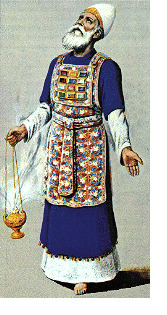
1 Peter 1:2
1 Peter 1:3
1 Peter 1:4
1 Peter 1:5
1 Peter 1:6
1 Peter 1:7
1 Peter 1:8
1 Peter 1:9
1 Peter 1:10
1 Peter 1:11
1 Peter 1:12
1 Peter 1:13
1 Peter 1:14
1 Peter 1:15
1 Peter 1:16
1 Peter 1:17
1 Peter 1:18
1 Peter 1:19
1 Peter 1:20
1 Peter 1:21
1 Peter 1:22
1 Peter 1:23
1 Peter 1:24
1 Peter 1:25
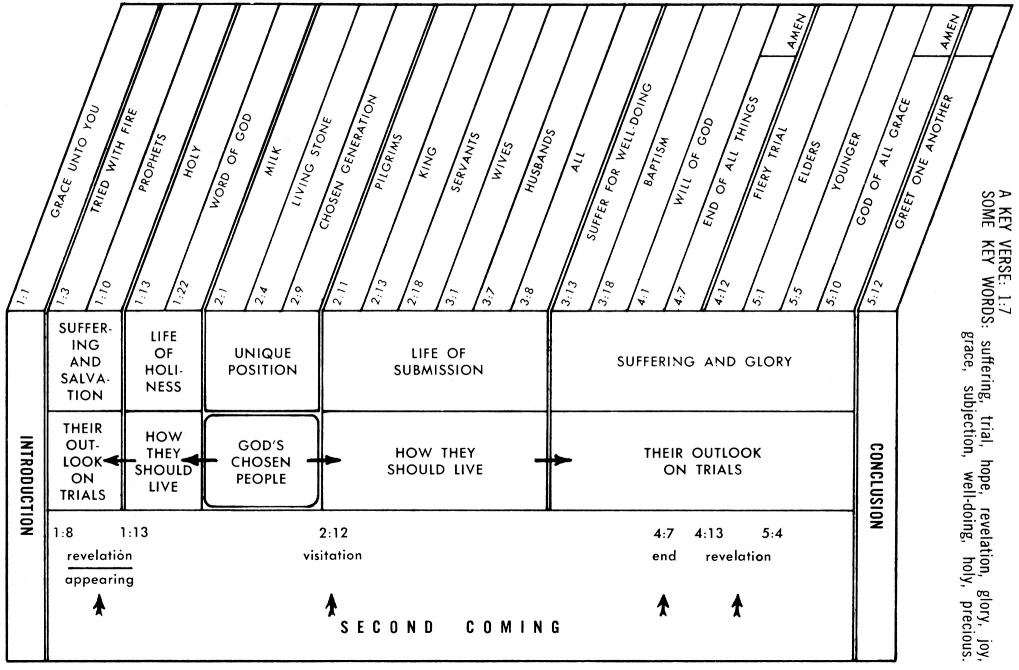
1 Peter: Trials, Holy Living & The Lord's Coming
Click chart to enlarge
Chart from Jensen's Survey of the NT - used by permission
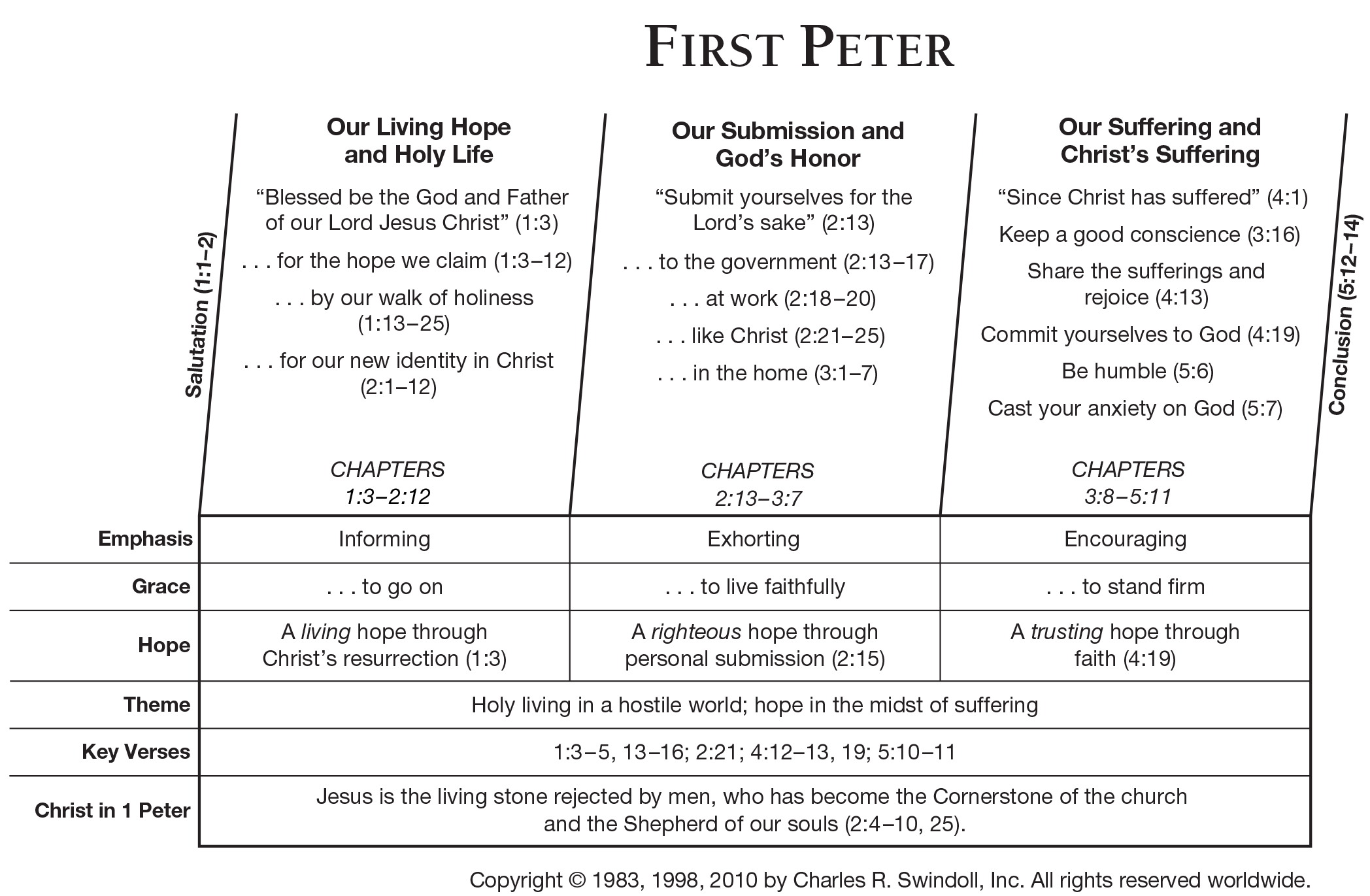
See Another Chart from Charles Swindoll
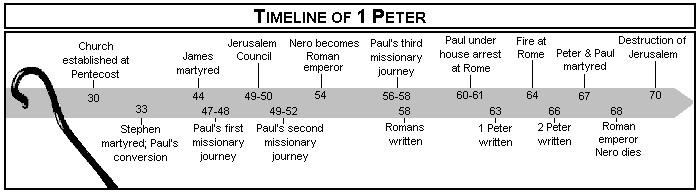
Source: Borrow Ryrie Study Bible
Click to enlarge
PART I: DOCTRINAL FOUNDATION
I. The Opening Salutation (1Pe 1:1-2)
A. The Writer (1Pe 1:1a)
B. The Readers (1Pe 1:1b-2a)
1. True character of the readers (1Pe 1:1b)
2. Geographical location of the readers (1Pe 1:1c)
3. Spiritual supports for the readers (1Pe 1:2a)
C. The Greeting (1Pe 1:2b)
II. The Thanksgiving for Our Salvation (1Pe 1:3-12)
A. The Description of Salvation (1Pe 1:3-5)
1. The author of salvation (1Pe 1:3a-b)
a. His relation to the Savior (1Pe 1:3a)
b. His act of mercy to the saved (1Pe 1:3b)
2. The nature of salvation (1Pe 1:3c-4a)
a. The living hope grounded in Christ's resurrection (1Pe 1:3c)
b. The glorious inheritance awaiting believers (1Pe 1:4a)
3. The certainty of salvation (1Pe 1:4b-5)
a. The safekeeping of the inheritance (1Pe 1:4b)
b. The preservation of the heirs (1Pe 1:5)
B. The Experiences Relating to Salvation (1Pe 1:6-9)
1. The paradoxical nature of the experiences (1Pe 1:6-7)
a. The experience of exultation (1Pe 1:6a)
b. The experience of distress (1Pe 1:66-7)
1. The nature of the distress (1Pe 1:6b)
2. The purpose behind the trials (1Pe 1:7)
a. The testing of faith (1Pe 1:7a)
b. The outcome of the testing (1Pe 1:7b)
2. The sustaining relations of believers (1Pe 1:8-9)
a. Their dual relation to Jesus Christ (1Pe 1:8)
b. Their experiential relation to their salvation (1Pe 1:9)
C. The Magnification of Salvation (1Pe 1:10-12)
1. The magnification through prophetic research (1Pe 1:10-12a)
a. Their intensive search (1Pe 1:10a)
b. Their prophetic function (1Pe 1:10b)
c. Their personal perplexity (1Pe 1:11)
1. The time and circumstances (1Pe 1:11a)
2. The sufferings and the glories (1Pe 1:11b)
d. Their restricted ministry (1Pe 1:12a)
2. The magnification through Christian proclamation (1Pe 1:12b)
3. The magnification through angelic inquiry (1Pe 1:12c)
PART 2: PRACTICAL EXHORTATION
I. Exhortations in View of Our Salvation (1Pe 1:13-2:10)
A. The Life Arising from Salvation (1Pe 1:13-2:3)
1. The Christian life in relation to God (1Pe 1:13-21)
a. A life of steadfast hope (1Pe 1:13)
1. The supports of hope (1Pe 1:13a)
2. The call to hope (1Pe 1:13b)
b. A life of personal holiness (1Pe 1:14-16)
1. The foundation for personal holiness (1Pe 1:14a)
2. The call to personal holiness (1Pe 1:14b-15)
a. The negative demand of holiness (1Pe 1:14b)
b. The positive call to holiness (1Pe 1:15)
3. The justification of the call to holiness (1Pe 1:16)
c. A life of motivated reverence (1Pe 1:17-21)
1. The basis for reverent living (1Pe 1:17a)
2. The call for reverent living (1Pe 1:17b)
3. The knowledge that motivates reverence (1Pe 1:18-21)
a. The means of our redemption (1Pe 1:18-19)
b. The nature of the Redeemer (1Pe 1:20)
c. The characteristics of the redeemed (1Pe 1:21)
2. The Christian life in relation to the brethren (1Pe 1:22-25)
a. The experience of inner purification (1Pe 1:22a)
b. The duty of mutual love (1Pe 1:22b)
c. The foundation in personal regeneration (1Pe 1:23-25)
1. The fact of their regeneration (1Pe 1:23a)
2. The nature of their regeneration (1Pe 1:23b-25a)
3. The evangelization leading to their regeneration (1Pe 1:25b) (D Edmond Hiebert)
1 Peter 1:15 but like the Holy One Who called (AAP) you, be (APM) holy yourselves also in all your behavior (NASB: Lockman)
Greek alla kata ton kalesanta (AAPMSA) humas hagion kai autoi hagioi en pase anastrophe genethete, (2PAPM)
Amplified: But as the One Who called you is holy, you yourselves also be holy in all your conduct and manner of living. (Amplified Bible - Lockman)
Phillips: but be holy in every department of your lives, for the one who has called you is himself holy. (Phillips: Touchstone)
Wuest: but after the pattern of the One who called you, the Holy One, also yourselves become holy persons in every kind of behavior,
NET 1 Peter 1:15 but, like the Holy One who called you, become holy yourselves in all of your conduct,
GNT 1 Peter 1:15 ἀλλὰ κατὰ τὸν καλέσαντα ὑμᾶς ἅγιον καὶ αὐτοὶ ἅγιοι ἐν πάσῃ ἀναστροφῇ γενήθητε,
NLT 1 Peter 1:15 But now you must be holy in everything you do, just as God who chose you is holy.
KJV 1 Peter 1:15 But as he which hath called you is holy, so be ye holy in all manner of conversation;
ESV 1 Peter 1:15 but as he who called you is holy, you also be holy in all your conduct,
ASV 1 Peter 1:15 but like as he who called you is holy, be ye yourselves also holy in all manner of living;
CSB 1 Peter 1:15 But as the One who called you is holy, you also are to be holy in all your conduct;
NIV 1 Peter 1:15 But just as he who called you is holy, so be holy in all you do;
NKJ 1 Peter 1:15 but as He who called you is holy, you also be holy in all your conduct,
NRS 1 Peter 1:15 Instead, as he who called you is holy, be holy yourselves in all your conduct;
YLT 1 Peter 1:15 but according as He who did call you is holy, ye also, become holy in all behaviour,
NAB 1 Peter 1:15 but, as he who called you is holy, be holy yourselves in every aspect of your conduct,
NJB 1 Peter 1:15 but as obedient children, be yourselves holy in all your activity, after the model of the Holy One who calls us,
GWN 1 Peter 1:15 But because the God who called you is holy you must be holy in every aspect of your life.
BBE 1 Peter 1:15 But be holy in every detail of your lives, as he, whose servants you are, is holy;
BUT LIKE THE HOLY ONE WHO CALLED (invited) YOU: alla kata ton kalesanta (AAPMSA) humas hagion
- 1 Peter 2:9; 5:10; Ro 8:28, 29, 30; 9:24; Php 3:14; 1Th 2:12; 4:7; 2Ti 1:9; 2Pe 1:3,10
- Isa 6:3; Rev 3:7; 4:8; 6:10
- 1 Peter 1 Resources - Multiple Sermons and Commentaries
BE HOLY AS
I AM HOLY
But is a conjunction marking a strong contrast or a "change of direction" so to speak. In this case it marks a radical shift in the way we order our steps all the days of our life. What is being contrasted? To answer this question, one is usually "forced" to examine the preceding context.
Spurgeon - See your model. See the copy to which you are to write. You are far short of it. Try again. May the power of Jesus rest upon you, and may He that has wrought us to the self-same thing to which we have attained continue to work in us till we are like our Lord Himself!
Like is a term of comparison - whenever you encounter a "like" or an "as" or a clear metaphor, pause and ask what the inspired text is comparing. In this case Peter points his readers to the perfect pattern to pursue in order to produce personal holiness - "like the Holy One". One caveat - Peter is not using "like" in this instance to introduce a typical comparison of equals but to indicate the divine standard for holiness. God is the Model of all holiness. Isn't it true that we tend to behave like those we associate with? So too, our close association with Him Who is holy can only serve to awaken in us a sense of our need for His holiness. God is holy in all His ways. If we are to be like Him, we must be holy in all that we do and say. In this life we will never be as holy as He is, but we should be holy because He is.
Albert Barnes adds that "It is a great truth, that people everywhere will imitate the God whom they worship. They will form their character in accordance with his. They will regard what he does as right. They will attempt to rise no higher in virtue than the God whom they adore, and they will practice freely what he is supposed to do or approve. Hence, by knowing what are the characteristics of the gods which are worshipped by any people, we may form a correct estimate of the character of the people themselves; and, hence, as the God who is the object of the Christian's worship is perfectly holy, the character of His worshipers should also be holy. And hence, also, we may see that the tendency of true religion is to make people pure. As the worship of the impure gods of the pagan moulds the character of the worshippers into their image, so the worship of Yahweh moulds the character of His professed friends into His image, and they become like him. (Barnes Notes on the NT)
Holy, Holy, Holy
by Reginald Heber
Holy, holy, holy! Lord God Almighty!
Early in the morning our song shall rise to Thee;
Holy, holy, holy, merciful and mighty!
God in three Persons, blessèd Trinity!Holy, holy, holy! All the saints adore Thee,
Casting down their golden crowns around the glassy sea;
Cherubim and seraphim falling down before Thee,
Who was, and is, and evermore shall be.Holy, holy, holy! though the darkness hide Thee,
Though the eye of sinful man Thy glory may not see;
Only Thou art holy; there is none beside Thee,
Perfect in power, in love, and purity.Holy, holy, holy! Lord God Almighty!
All Thy works shall praise Thy Name, in earth, and sky, and sea;
Holy, holy, holy; merciful and mighty!
God in three Persons, blessèd Trinity!
Holy One (40) (hagios) (Click study of hagios) This majestic Name of God is found some 56 times in Scriptures, most uses in the OT and often with the appendage "of Israel". (Click for these 56 occurrences 29 of which are in Isaiah! (Note that the uses in Daniel refer to an angel not God). This would make a great devotional study. Read the passages in context and make a list of the truths you discover about the "Holy One".)
Clarke notes that "Heathenism scarcely produced a god whose example was not the most abominable; their greatest gods, especially, were paragons of impurity; none of their philosophers could propose the objects of their adoration as objects of imitation. Here Christianity has an infinite advantage over heathenism. God is holy, and he calls upon all who believe in him to imitate his holiness; and the reason why they should be holy is, that God who has called them is holy" (Adam Clarke's Commentary on the Bible, 1715-1832)
God is our standard or pattern, not our lusts. As John Calvin notes Peter "reasons from the end for which we are called. God sets us apart as a peculiar people for Himself. Then (it follows) we ought to be free from all pollutions."
Dwight Edwards - "On the cross of Calvary God demonstrated the two great avenues of His character: Love and Holiness. Being a holy God, He had to punish sin. Being a God of great love and mercy, He took the punishment of sin upon himself by allowing his only Son to die in our place (Ro 5:8-9). And these two great qualities of Love and Holiness should so be the two great distinguishing features of our lives. For this reason James penned the words; "Pure and undefiled religion (i.e. true spirituality) before God and the Father is this: to visit the fatherless and widows in their affliction (love) and to keep oneself unspotted from the world (holiness). James 1:27 (note)"
A HIGH CALLING
Peter loves the concept of calling. We are called to be holy (1Pe 1:15). We are called “out of darkness into His marvelous light” (1Pe 2:9). We are called to suffer and follow Christ’s example of meekness (1Pe 2:21). In the midst of persecution, we are called “to inherit a blessing” (1Pe 3:9). Best of all, we are called to “His eternal glory” (1Pe 5:10). God called us before we called on Him for salvation. It is all wholly of grace. In the second letter Peter wrote that we Jesus has "called us by His own glory and excellence" (2Peter 1:3) and because of our holy status positionally, we are to be about the business of making "certain about His calling and choosing" us. (2Peter 1:10).
Called (2564) (kaleo) (See word study of related verbal adjective kletos = the called and also klesis) means to call aloud, to utter in a loud voice, to call to someone in order that he may come or go somewhere as a shepherd calls his flock. A distinctive use of kaleo in the New Testament is to call a person for a definite purpose. Hence, as used in this context, kaleo is synonymous with to select or choose.
- Call - Cyclopedia of Biblical, Theological and Ecclesiastical Literature
- Call of God, the - Torrey's Topical Textbook
- Baker Evangelical Dictionary Call, Calling
- Charles Buck Dictionary Call, Calling
- Holman Bible Dictionary Call, Calling
- Hastings' Dictionary of the NT Call, Calling Call, Called, Calling
- Vines' Expository Dictionary Call, Called, Calling
Kaleo refers to the act of calling someone so that he may hear, come, and do that which is incumbent upon him. And so kaleo becomes a technical term for special relationships. In secular Greek it was used of a summons in the law courts (that's a "special relationship" we'd rather not experience!). On the positive side, kaleo in the New Testament denotes a call from God or in God’s Name, a call to participate in the revelation of grace. Paul’s use of kaleo in general suggests that he only considered those called who obeyed the divine summons. Of a rejected call he never speaks.
At the beginning of His earthly ministry Jesus "saw two other brothers, James the son of Zebedee, and John his brother, in the boat with Zebedee their father, mending their nets; and He called them." (Mt 4:21) Notice that here Jesus only called James and John, not Zebedee. Mark says "And immediately He called them; and they left their father Zebedee in the boat with the hired servants, and went away to follow Him." (Mk 1:20) Paul testifies that "when it pleased God, who separated me from my mother’s womb and called me through His grace," (Gal 1:15).
Paul explains to Timothy that God
has saved us and called us with a holy calling, not according to our works, but according to His own purpose and grace which was given to us in Christ Jesus before time began. (2Ti 1:9).
As kaleo is used in the present context it refers to the divine call of God to a participation in salvation.
The writer of Hebrews identifies believers as
holy (saintly) brethren, partakers (sharers, we are participants in the grand enterprise of redemption and restoration, God has granted us rights and privileges that should boggle our mind and motivate a heavenward behavior!) of the heavenly calling. (Heb 3:1).
Holy Brethren does not mean that we are sinless, but we certainly should sin less.
In the next chapter Peter reminds his readers of their identity and purpose declaring that
you are A CHOSEN RACE, A royal PRIESTHOOD, A HOLY NATION, A PEOPLE FOR God's OWN POSSESSION, that you may proclaim (Because we are partakers, sharers of a heavenly calling, we have the great privilege of being able to tell others of the "pearl of great price"! Are you redeeming the time, on alert each day for a lost one to whom you can proclaim Christ's excellencies or a brother in need of a reminder and encouragement that the best is yet to come?) the excellencies of Him who has called you out of darkness into His marvelous light (cp Col 1:13-14, Acts 26:16-18) (1Pe 2:9).
Peter repeats this truth about calling, prayerfully encouraging his suffering readers asking that
the God of all grace, Who called us to His eternal glory by Christ Jesus, after you have suffered a while" might "perfect, establish, strengthen, and settle you. (1Pe 5:10).
Peter used the related word klesis in a similar way in his second epistle writing
Therefore, brethren, be all the more diligent to make certain about His calling and choosing you; for as long as you practice these things, you will never stumble. (2Pe 1:10)
To summarize, the called are those who have been summoned by God… called…
The called are those who have been summoned by God… called…
- according to His purpose (Romans 8:28)
- to salvation (Romans 8:30)
- saints by calling (1Cor 1:2)
- both Jews and Greeks (1Cor 1:24)
- having been called "with a holy" (2 Timothy 1:9)
- heavenly calling (Hebrews 3:1)
- out of darkness into His marvelous light (1 Peter 2:9)
- to walk worthy (Ephesians 4:1)
- by grace (Gal 1:6)
- not from among Jews only, but also from among Gentiles (Romans 9:24)
- through the "gospel" that we "may gain the glory of our Lord Jesus Christ" (2Th 2:14)
- and be brought "into fellowship with His Son, Jesus Christ our Lord" (1Cor 1:9)
- and return in triumph "with Him" at the end of this age (Revelation 17:14).
These magnificent truths on "called" should cause all the "called of Jesus Christ" to cry out "Glory!"
HOLY, HOLY, HOLY IS THE LORD
by Fanny Crosby
Holy, holy, holy is the Lord!
Sing, O ye people, gladly adore Him;
Let the mountains tremble at His word;
Let the hills be joyful before Him;
Mighty in wisdom, boundless in mercy,
Great is Jehovah, King over all.
Refrain
Holy, holy, holy is the Lord!
Let the hills be joyful before Him.
Praise Him, praise Him! shout aloud for joy,
Watchman of Zion, herald the story;
Sin and death His kingdom shall destroy;
All the earth shall sing of His glory;
Praise Him, ye angels, ye who behold Him,
Robed in His splendor, matchless, divine.
Refrain
King eternal, blessèd be His Name!
So may His children gladly adore Him;
When in Heav’n we join the happy strain,
When we cast our bright crowns before Him;
There in His likeness joyful awaking,
There we shall see Him, there we shall sing:
Refrain
BE HOLY YOURSELVES ALSO: kai autoi hagioi en pase anastrophe genethete (2PAPM):
- Mt 5:48; Lk 1:74,75; 2Co 7:1; Eph 5:1,2; Phil 1:27; 2:15,16; 1Th 4:3, 4, 5, 6, 7; Titus 2:11, 12, 13, 14; 3:8,14; Heb 12:14; 2Pe 1:4, 5, 6, 7, 8, 9, 10
- 1 Peter 1 Resources - Multiple Sermons and Commentaries
Related Resources:
- Holiness-Quotes, Devotionals, Illustrations
- Holiness-J C Ryle - "considered the best book on the Christian life ever written"!
- Called to Be Holy by Ron Dunn-Excellent
- Holiness quotes
- Jehovah Mekeddeshem: The LORD Who Sanctifies ("Makes Holy") (Part 1) (Part 2)
- The Attributes of God - His Holiness
- Why Would Anyone Want to be Holy? - Radio Bible Class
- Word Studies: Holiness: hagiasmos / Holy: hagios / Holy (One) hosios
Spurgeon - Be not only moral, upright, truthful, and so forth; but “be ye holy.” That is a very high attainment: “Be ye holy;” and observe the reason for obedience to the command: “for I am holy.” Children should be like their fathers, there are many children who bear, in their very faces, evidence, of their sonship; you know who their fathers were by the image that the children bear. Oh, that it were always so with all the children of God: “Be ye holy; for I am holy.” See your model. See the copy to which you are to write. You are far short of it. Try again. May the power of Jesus rest upon you, and may he that hath wrought us to the self-same thing to which we have attained continue to work in us till we are like our Lord himself!
In the Sermon on the Mount Jesus called for a response based upon what He had been teaching…
Therefore (term of conclusion) you are to be perfect, as your heavenly Father is perfect. (Mt 5:48)
Mark it down - This command to holiness is impossible in our own strength. However what God commands He always enables us to accomplish. This is a major objective of Jesus in His Sermon on the Mount. Jesus sought to lead the hearer (and us as readers) to a sense of spiritual bankruptcy which recognizes the need for a Savior (and His indwelling Spirit), Who Alone can empower us to "be perfect and holy." When Jesus departed He sent the Promise from His Father to clothe His disciples with power from on high (cp Lk 24:49). The ONLY way to live the Christian life (victoriously, abundantly) is to humble ourselves, presenting ourselves daily as living and holy sacrifices (think about what a "sacrifice" can do!), jettisoning our default mode of self-reliance (most of us have a long time practicing life in our own fleshly power and so it is usually our default mode) and instead choosing to surrender to, to yield to and to depend on the indwelling Spirit Who alone can empower us to keep the Bible's otherwise "impossible" commands (cp Eph 5:18, Gal 5:16). Yes, in our strength divine commands are IMpossilbe, but enabled by the power of the Spirit, they are HIMpossilbe!
The daily prayers in the Jewish synagogue stressed holiness to God, and so the call to holiness would have been familiar to Peter's Jewish readers as well as to Gentiles who had learned Scripture from them.
John MacArthur has these pertinent observations regarding holiness in the modern church…
People have often asked me, “Why is the church in America, even the evangelical church, so unholy?” The issue isn’t necessarily that we have preached the wrong message but that we have neglected its implementation in the lives of the people. We have said in effect, “As long as the sermon is right doctrinally, we really don’t care what you do.” But you can’t raise children in permissiveness that punishes only by reasoning with them. (From his introduction to the topic of Church Discipline - MacArthur, J. The Master's plan for the church. Page 235. Chicago: Moody Press. 1991)
J.C. Ryle, the renowned and godly Anglican bishop and expositor in nineteenth-century England, wrote a book of biographical sketches on the ministries of great British Christian leaders such as George Whitefield, John Wesley, and Daniel Rowlands. At the beginning of his compilation, Ryle offers this telling overview:
They taught constantly the inseparable connection between true faith and personal holiness. They never allowed for a moment that any church membership or religious profession was the proof of a man’s being a true Christian if he lived an ungodly life. A true Christian, they maintained, must always be known by his fruits; and those fruits must be plainly manifest and unmistakable in all relations of life. “No fruits, no grace,” was the unvarying tenor of their preaching. (Christian Leaders of the Eighteenth Century, [Edinburgh: Banner of Truth, 1978 reprint], 28) (from MacArthur, J. 1997. The Power of Integrity: Page 39. Wheaton, Ill.: Crossway Books)
Be (1096) (ginomai) is not the verb of being, but of “becoming.” It means to enter a new state… "to become" … "to become holy." The verb is aorist imperative which is a command calling for a decisive action, even implying a sense of urgency. Beloved holiness is not optional for believers. Modern day evangelicals seldom even discuss this crucial topic. The church must return to her roots and wake up to the fact that the Holy God is calling His Bride to engage herself in the pursuit of righteous acts, thoroughly embracing His call to be holy, passionately pursuing after it - and yet always (and only) in deep dependence upon His transforming grace ministered by His sanctifying (setting apart, making holy) Holy Spirit. Beloved, as we watch our culture inextricably sinking into the abyss of ungodliness, it is urgent for us to let the holy light of Jesus shine forth to those around us that they might see His "Lighthouse", before they crash into the eternally deadly reef of Gehenna.
Those who at one time were wholly controlled by their evil cravings, have now through blood bought salvation entered into a new state of being, that of inward positional holiness, by virtue of the indwelling Holy Spirit, and this inward holiness is now to be worked out in our external expression in daily life. All believers are sharers in the New Covenant prophesied in Ezekiel, in which God promised to the future believing remnant of Israel
I will give you a new (Lxx = kainos = new in quality, never seen before) heart and put a new (Lxx = kainos = new in quality, never seen before) spirit within you; and I will remove the heart of stone from your flesh and give you a heart of flesh. And I will put My Spirit within you and cause you to walk in My statutes, and you will be careful to observe My ordinances. (Ezek 36:26, 27)
Read God's proclamation through Ezekiel again observing (1) God's promise and (2) man's responsibility. Peter is commanding his readers who have a new heart and new spirit to be holy or as God phrases it in Ezekiel to "be careful to observe My ordinances." But the only power we have to obey is His indwelling Holy Spirit which causes us "to walk in (His) statutes", being holy as He is holy. (Cp same spiritual dynamic in Php 2:12, Php 2:13)
Holiness is not merely the absence of the wrong. It is also the unmistakable presence of the right. We are to pass our few days on this earth with our hope riveted upon Christ’s soon return and our conduct increasingly reflective of Christ’s holiness.
Warren Wiersbe…
The privilege of election also involves responsibilities of obedience (Dt 7:6, 11)… The argument here is logical and simple. Children inherit the nature of their parents. God is holy; therefore, as His children, we should live holy lives. We are "partakers of the divine nature" (2Pe 1:4) and ought to reveal that nature in godly living. Peter reminded his readers of what they were before they trusted Christ. They had been children of disobedience (Ep 2:1, 2, 3), but now they were to be obedient children. True salvation always results in obedience (Ro 1:5; 1Pe 1:2). They had also been imitators of the world, "fashioning themselves" after the standards and pleasures of the world. Ro 12:2 translates this same word as "conformed to this world." Unsaved people tell us that they want to be "free and different"; yet they all imitate one another! The cause of all this is ignorance that leads to indulgence. Unsaved people lack spiritual intelligence, and this causes them to give themselves to all kinds of fleshly and worldly indulgences (see Acts 17:30; Eph. 4:17, 18, 19, 20). Since we were born with a fallen nature, it was natural for us to live sinful lives. Nature determines appetites and actions. A dog and a cat behave differently because they have different natures (Bible Exposition Commentary. 1989. Victor)
J C Ryle reminds us that…
Sanctification is always a progressive work (and in this daily process we must not become discouraged, remembering that) there is no holiness without a warfare.
Holy (hagios) (See also discussion of sanctification, hagiasmos) is translated elsewhere as saint and has in it the idea of separation and means set apart from secular, profane, evil and dedicated to worship and service of God. Kittel says that the old related Greek root word hagos signifies the object of awe.
Peter is not calling for an ordinary life but a supernatural separated life, one which is set apart from sin and the moral pollution of the world and unto God’s righteousness. Believers are not to cover up their characteristics as Christians by assuming an outward masquerade, patterned after the costume of this world. Don't sweep it the rug, but put it under the blood.
Holy is not referring to our positional holiness (we are eternally "holy" in Christ) but to our experiential holiness. It is to understand that a saint is one who will strive to be holy, but his holiness, however little or however great it may be, does not make him a saint. He is a saint because he has been set apart by God and that is now and forever his position in Christ. In other words our creed (saints, holy ones) and our conduct (holy behavior, pursuit of holiness) are to be inseparable. One cannot exhibit right "duty" without right doctrine, but right (holy) conduct should always flow out of sound doctrine. Knowledge and action are inseparable. What you belief should affect how you behave. Peter is calling for a separated lifestyle which will be either
an aroma from death to death (or) to the other an aroma from life to life (1Cor 2:16)
We are God's possession by both the right of creation and the right of redemption. When we came to Christ, God set us apart from the rank and file of humanity. We are now the sons of God. Our new set apart character should lead to growth in Christ likeness and consecration to the service of God.
Dr Martyn Lloyd-Jones once made the interesting observation that…
As you go on living this righteous life, and practising it with all your might and energy, and all your time … you will find that the process that went on before, in which you went on from bad to worse and became viler and viler, is entirely reversed. You will become cleaner and cleaner, and purer and purer, and holier and holier, and more and more conformed unto the image of the Son of God. (Romans: An Exposition of Chapter Six. Page , 268–69. Grand Rapids, Mich.: Zondervan, 1972)
MacDonald writes that
Christians are empowered to live holy lives by the indwelling Holy Spirit. Old Testament saints did not have this help and blessing. But since we are more privileged, we are also more responsible. The verse Peter quotes from Leviticus acquires a new depth of meaning in the NT. It is the difference between the formal and the vital. Holiness was God’s ideal in the OT. It has assumed a concrete, everyday quality with the coming of the Spirit of truth. (Believer's Bible Commentary: Thomas Nelson)
Vance Havner quoted Spurgeon
"Holiness is not the way to Christ; Christ is the way to holiness." (then Havner added) Better still, Christ is our holiness.
As our pattern or standard of holiness we have nothing less than God's holiness! Holiness is be the desire and duty of every Christian. We are to do this out of our love for God, as a choice which is based on God's Word. Old Testament holiness called for Israel to separate from everything ritually or morally impure. In Leviticus Moses records God's instruction on holiness writing
For I am the Lord your God. Consecrate yourselves therefore, and be holy; for I am holy. And you shall not make yourselves unclean with any of the swarming things that swarm on the earth. For I am the Lord, who brought you up from the land of Egypt, to be your God; thus you shall be holy for I am holy. (Lev 11:44, 45)
Commenting on this OT section John MacArthur writes that
In all of this, God is teaching His people to live antithetically. That is, He is using these clean and unclean distinctions to separate Israel from other idolatrous nations who have no such restrictions, and He is illustrating by these prescriptions that His people must learn to live His way. Through dietary laws and rituals, God is teaching them the reality of living His way in everything. They are being taught to obey God in every seemingly mundane area of life, so as to learn how crucial obedience is. Sacrifices, rituals, diet, and even clothing and cooking are all carefully ordered by God to teach them that they are to live differently from everyone else. This is to be an external illustration for the separation from sin in their hearts. Because the Lord is their God, they are to be utterly distinct. In Lev 11:44, for the first time the statement “I am the Lord your God” is made, as a reason for the required separation and holiness. After this verse, that phrase is mentioned about 50 more times in this book, along with the equally instructive claim, “I am holy.” Because God is holy and is their God, the people are to be holy in outward ceremonial behavior as an external expression of the greater necessity of heart holiness. The connection between ceremonial holiness carries over into personal holiness. The only motivation given for all these laws is to learn to be holy because God is holy. (The MacArthur Study Bible Nashville: Word)
New Testament holiness calls for living morally pure lives despite the fact that we must live in sinful human society. We are to be holy in all we do, to “abstain from sinful desires,” and to keep our “behavior excellent among the Gentiles" ("the unsaved")” around us (1Pe 2:12). And as already alluded to this holy living is motivated by a God-fearing faith that does not presume upon the redemption that was purchased at so great a cost (1Pe 1:18, 19) but which focuses on the blessed hope of "future grace" (1Jn 3:2, 1Jn 3:3).
The Old Testament Hebrew word for holiness, kadesh, means “something which is cut off, separate or set apart.” It means to be anti-secular, in a category all its own, to elevate out of the sphere of what is ordinary. (Ron Dunn)
F B Meyer - Holiness is wholeness--that is, the whole-hearted devotion of a whole nature to God, the consecration of every power to His service. This leads us to lean hard on God, and to seek His companionship and fellowship. (Our Daily Walk, Feb 18th)
F. B. Meyer was visiting in a Scottish home. It was washday, and the clothes were on the line. It began to snow, and soon the clothes did not look so white against the background of the snow. When Meyer remarked about it, the old Scottish landlady cried, "Mon, what can stand against God Almighty's white!" When Isaiah saw the Lord in His holiness, he saw himself in his sinfulness and the people in their wickedness. A sense of God brought a sense of sin.
H. C. G. Moule - As we actually approach the rules of holiness… (introductory comments on Romans 12-16), let us once more recollect what we have seen all along in the Epistle (of Romans), that holiness is the aim and issue of the entire Gospel. It is indeed an 'evidence of life,' infinitely weighty in the enquiry whether a man knows God indeed and is on the way to his heaven. But it is much more; it is the expression of life; it is the form and action in which life is intended to come out… We who believe are 'chosen' and 'ordained' to 'bring forth fruit' (Jn 15:16), fruit much and lasting The eternal Master walks in His garden for the very purpose of seeing if the trees bear. And the fruit He looks for is. no visionary thing; it is a life of holy serviceableness to Him and to our fellows, in His Name. (Moule, H. The Epistle to the Romans. Page 325. Fort Washington, PA: Christian Literature Crusade)
James Montgomery Boice on holiness…
Subtract love from holiness. What do you get? You get self-righteousness, the kind of virtue that characterized the Pharisees of Christ's day. By the standards of the day the Pharisees lived very holy lives, but they did not love others and were ready to kill Christ when he challenged their standards, and actually did kill him. They were hypocrites…
Jesus is glorified in His own people to the degree that we live a holy life. Holiness is the attribute of God most mentioned in the pages of the Word of God. To hear most people talk about God today you would think that the attribute most mentioned about him is love. But this is not true. To be sure, love is a wonderful attribute. It is all the more wonderful because we do not deserve it. There is nothing in us that could possibly call forth the love of God. Yet he loves. This makes the love of God particularly wonderful. But even with this wonder, it is not the attribute of God most mentioned in the Bible. The attribute most mentioned is holiness. So if we would glorify him, we must make his holiness known as, allowing him to work through us, we attempt to live upright and dedicated lives. If we live in spiritual adultery, compromising with the values of our society, if the priorities of our non-Christian culture become our priorities, we are not living in a way that glorifies him. But if, by contrast, the priorities of the Word of God seize upon us and we strive for holiness in our lives, then we do glorify him…
The second requirement (Ed: First is faith in God) for walking with God is holiness. God is holy, and those who would have fellowship with Him must be holy as well… One way we accommodate ourselves to sin is by calling it by some other name. We call sin "failure," or we say we've made "a mistake." We call pride "self-esteem," selfishness "fulfillment," lust "an instinct." If we cheat in business, we call it "protecting our own interests." If we commit adultery, we call it "an attempt to save the marriage." We call murdering an unborn child "terminating a pregnancy." What hypocrites we are! How offensive we must be to God, who is obviously not taken in by our reinterpretations but who calls sin, sin and evil, evil. Shakespeare said, "A rose by any other name would smell as sweet." Likewise, sin by any other name will smell as putrid. You and I will never grow in holiness unless we see sin for what it is and call it sin, and we will never learn to do that unless we walk closely with God. It is when we walk with God that we learn to call things by God's vocabulary…
(In his introduction to Romans Boice writes) In these studies of Romans, I have been strengthened in my own awareness of the sovereignty, grace, and holiness of God and of the need for holiness in his people, that is, for holiness in those who profess to be Christians. We are not a holy people, not very. But we can become increasingly holy as we draw near to God and live in the mental universe of these great Bible teachings. Indeed, we must!… May God bless us in these sad days of declining evangelicalism, and may we have a recovery of the whole counsel of God (Acts 20:27KJV). I know no better way to move in that direction than by studying, meditating on, and once again preaching from the Book of Romans.
Holiness is the end of the matter, the point to which the entire Epistle of Romans has been heading. Romans is about salvation. But as someone wise has noted, salvation does not mean that Jesus died to save us in our sins but to save us from them.
J. Vernon McGee has these helpful comments on the not too popular topic of holiness:
Holy does not mean sinless perfection, a condition impossible in this life (1Jn 1:8, 9, 10). Holiness is that is very misunderstood. To the average person, holiness means to assume a very pious attitude, to become almost abnormal in everyday life. It is thought to be a superficial thing. My friend, the Lord wants you to be a fully integrated personality. He wants you to enjoy life and have fun—I don’t mean the sinful kind of fun, but real delight and enjoyment in the life He has given to you. Holiness is to the spiritual life what health is to the physical life. You like to see a person who is physically fine, robust, and healthy. Well, holiness is to be healthy and robust spiritually. Oh, how we need folk like this today! (McGee, J V: Thru the Bible Commentary: Thomas Nelson)
The call to holiness is a basic concept of 1 Peter, which has already surfaced in verse 2 (“the sanctifying [from the same Greek root] work of the Spirit”). It is prominent in the descriptions of Christians as a holy temple, a holy priesthood, and a holy people in 1Peter 2:4, 5, 6, 7, 8, 9, 10. Christians are to live as persons dedicated to God’s service.
D A Carson rightly reminds us of the effort involved in being holy as He is holy…
People do not drift toward holiness. Apart from grace-driven effort, people do not gravitate toward godliness, prayer, obedience to Scripture, faith, and delight in the Lord. We drift toward compromise and call it tolerance; we drift toward disobedience and call it freedom; we drift toward superstition and call it faith. We cherish the indiscipline of lost self-control and call it relaxation; we slouch toward prayerlessness and delude ourselves into thinking we have escaped legalism; we slide toward godlessness and convince ourselves we have been liberated. (D. A. Carson, Christianity Today)
IN ALL YOUR BEHAVIOR: en pase anastrophe:
- 1Pe 2:12; 1Pe 3:16; Php 3:20; 1Ti 4:12; Heb 13:5; Jas 3:13; 2Pe 3:11, 12, 13, 14
- 1 Peter 1 Resources - Multiple Sermons and Commentaries
So let our lips and lives express
The holy gospel we profess;
So let our works and virtues shine,
To prove the doctrine all divine.
Isaac Watts
In an excellent synopsis of what holiness looks like and why it is imperative for believers, J C Ryle writes that
(a) Holiness is the habit of agreeing with the mind with God, in accordance as we find His mind described in Scripture…
(b) A holy person will endeavor to turn away from every known sin, and to keep every known commandment…
(c) A holy person will strive to be like our Lord Jesus Christ…
(d) A holy person will pursue meekness, endurance, gentleness, patience, kindness, and control of their tongue…
(e) A holy person will pursue self-control and self-denial…
(f) A holy person will pursue love and brotherly kindness…
(g) A holy person will pursue a spirit of mercy and benevolence towards others…
(h) A holy person will pursue purity of heart…
(i) A holy person will pursue the fear of God…
(j) A holy man will pursue humility…
(k) A holy man will pursue faithfulness in all the duties and relationships in life…
(l) Last, but not least, a holy person will pursue spiritual mindedness." (Read Holiness by J. C. Ryle for discussion of each point and practical application)
In all your behavior - Wholly holy is the idea, so that every thought, word and action reflects the holiness of the Holy One. Practically, this calls not just for holy behavior on Sunday, but holy behavior every where, making no distinction between so-called "secular" and "sacred." Peter is saying in essence that the sum total of life is holy, even the seemingly mundane and ordinary activities of life, so that everything is done to the glory of God (1Co 10:31). This doctrine can be applied practically as a test to all my thoughts, words and deeds --- If I cannot do it to the glory of God, then I can be certain that I am out of the will of God and it is by default unholy behavior.
John Angell James has these thoughts on "in all your behavior"…
Let him turn away from all the conventional piety of the day, and read over with devout attention what is said in a former chapter, of the true nature of genuine piety.
Let him, in a season of closet devotion, examine his own piety, and compare it with this standard.
Let him, upon discovering his great and numerous shortcomings, humble and abase himself before God, in a spirit of true contrition.
Let him reject all excuses which his own deceitful heart, and lukewarm, worldly-minded Christians—will be ever ready to suggest for self-defense, and be thoroughly convinced that nothing can, or will, be admitted by God as an apology for a low state of personal piety.
Let him intensely desire to be raised from his depressed condition into a more exalted state of spirituality, heavenly-mindedness, and devoted zeal. Let him set himself most vigorously to the work of mortifying sin, and crucifying the flesh.
Let him redouble his diligence in attending the means of grace, and especially let him give himself to reading the Scriptures, meditation, and prayer.
Let him add season to season of special humiliation and supplication, to obtain a new and copious effusion of the Holy Spirit of God.
Let him cultivate a new and more delicate sensibility of conscience, in reference to all matters of offence, both towards God and man.
Let him seek to have his mind illuminated by the Spirit and Word of God, in the knowledge of the person, offices, and work, of our Lord Jesus Christ.
Let him give himself to Christian vigilance, watching ever against sin.
Let him, in short, intelligently, resolutely, and unalterably, make up his mind to enter upon a new course of personal godliness; so new that his past attainments shall seem as if they were nothing. There is such a thing as starting afresh, as forgetting the things that are behind—and so must it be with him who would be really in earnest. He will wake up from his slumbering, dreamy profession, saying, "I have slept too long and too much, I must now throw off the spirit of sloth, and give all diligence to make my calling and election sure." (The Church in Earnest) (Main Index)
A W Pink writes that…
Christ was uniformly holy—at one time and place as well as another. The same even tenor of holiness ran through the whole of His life from first to last—so should it be with His followers, "As He who has called you is holy—so be holy in all you do" (1Peter 1:15). Alas, what inconsistencies we have to bemoan—one part of our life heavenly, another earthly! (Christ our Exemplar)
Thomas Watson…
Be like Christ in HOLINESS of life. No temptation could fasten upon Him. Temptation to Christ,
was like a spark of fire upon a marble pillar, which glides off… A Christian should be both a magnet and a diamond! A magnet—in drawing others to Christ; a diamond—in casting a sparkling luster of holiness, in his life. Oh let us be … so just in our dealings, so true in our promises, so devout in our worship, so unblamable in our lives; that we may be the walking pictures of Christ! (Thomas Watson, "Body of Divinity")
Watson goes on to list a holy life as a sign of sanctification…
A fifth sign is a holy life. "But just as he who called you is holy, so be holy in all you do." 1Peter 1:15. Where the heart is sanctified, the life will be holy. The temple had gold without, as well as within. A coin has the king's image and superscription stamped on it. Just so, where there is sanctification, there is not only God's image in the heart—but a superscription of holiness written in the life. Some say they have good hearts—but their lives are wicked. "There is a generation that are pure in their own eyes, and yet is not washed from their filthiness." If the water is foul in the bucket, it cannot be clean in the well. "The king's daughter is all glorious within." Ps 45:13. There is holiness of heart. "Her clothing is of wrought gold." There is holiness of life. Grace is most beautiful, when its light so shines that others may see it; this adorns true religion, and makes proselytes to the faith. (For the other signs of sanctification read Body of Divinity)
><>><>><>
God is not drawn to any person's outward beauty, great abilities, noble blood or worldly grandeur. But He is drawn to a heart embellished with holiness. Christ never admired anything but the beauty of holiness. He slighted the glorious buildings of the temple—but admired the woman's faith, and said, "O woman, great is your faith!" As a king delights to see his image upon a piece of coin; so where God sees His likeness—He gives His love! The Lord has two heavens to dwell in—and the holy heart is one of them! (Thomas Watson, "Body of Divinity")
Behavior (391) (anastrophe from ana = again + strepho = to turn) literally describes a turning around or turning back and is used figuratively to refer to one's conduct, especially focusing on our daily behavior and our general deportment. In essence anastrophe deals with on the whole manner of one's life.
Anastrophe is used of public activity, life in relation to others. Being holy as members of a holy people, they were to show themselves holy in every kind of dealing with other men.
Marvin Vincent writes that behavior (anastrophe) is "a favorite word with Peter; used eight times in the two epistles… The process of development in the meaning of the word is interesting. 1. A turning upside down. 2. A turning about or wheeling. 3. Turning about in a place, going back and forth there about one’s business; and so, 4, one’s mode of life or conduct. This is precisely the idea in the word conversation (Lat., conversare, to turn round) which was used when the AV (KJV) was made, as the common term for general deportment or behavior… "
TLNT…
The most banal sense of the root verb anastrepho is “return, come back from one place to another,” hence “retrace one’s steps” (1Sa 25:12; 2Sa 3:16)—sometimes retains the etymological nuance “to return upside down,” like runaways thrown back on top of each other (1Mac 7:46; cf. Jdt 1:11); sometimes it has the sense of coming and going, “living.” Hence its metaphorical usage: “walk in virtue.”
Only this moral nuance is retained in the noun anastrophe, designating a mode of existence, a way of behaving. This became a technical term in NT spirituality. Just as the way of life of the pagans is stigmatized, so also is “perfect conduct from childhood” praised (2Mac 6:23, kallistē). When Paul testifies concerning his conscience (“It is with simplicity and the purity of God—not in fleshly wisdom, but in the grace of God—that we have conducted ourselves in the world, particularly in our dealings with you,” 2Co 1:12), he contrasts two modes of existence and already gives anastrophe the exemplary sense that will be required especially of ministers of the church; the model, who is particularly visible, ought to be inspiring. Life lived in the faith is a persuasive testimony. It is above all Peter who demands of all Christians an unassailable comportment. Whether with respect to bearing, dress, or behavior in family and social relations, every action and reaction in the context of the community, that is, the concrete life of the believer, should be noble and radiant: “Let your behavior among the nations be noble” (1Pet 2:12), apt as a result to disarm criticisms (1Pe 3:16), notably those of husbands won over by the chaste and quiet deportment of their wives (1Pe 3:1, 2). (Spicq, C., & Ernest, J. D. Theological Lexicon of the New Testament 1:111-112. Peabody, MA.: Hendrickson)
Wuest - In classical Greek, the verb meant among other things “to turn one’s self about, to turn back, round, or about, to dwell in a place,” the noun, “a turning back or about, occupation in a thing, a mode of life, behaviour.” One can see that the ideas of “a mode of life” and “one’s behaviour” are derived from the fact of one’s activity. Thayer’s note is helpful. He says that the verb means “to conduct or behave one’s self, to walk,” the latter meaning not referring here to the physical act of walking but to the act of determining our course of conduct and the carrying out of that determined course of action. The noun means “one’s walk, manner of life, conduct.” In the biblical use of the word, the moral and spiritual aspect of one’s manner of life is in view.
Anastrophe - 13x in 13v - NAS = behavior(6), conduct(4), manner of life(2), way of life(1). There are no uses in the non-apocryphal Septuagint.
Gal 1:13; Eph 4:22; 1 Tim 4:12; Heb 13:7; Jas 3:13; 1 Pet 1:15, 18; 2:12; 3:1f, 16; 2 Pet 2:7; 3:11.
Galatians 1:13 For you have heard of my former manner of life (referring to Paul’s ethical conduct) in Judaism, how I used to persecute the church of God beyond measure and tried to destroy it;
Ephesians 4:22 that, in reference to your former manner of life, you lay aside the old self, which is being corrupted in accordance with the lusts of deceit,
1 Timothy 4:12 Let no one look down (present imperative + negative = stop letting them look down) on your youthfulness, but rather in speech, conduct, love, faith and purity, show yourself an example of those who believe.
Comment: "Speech, conduct" = The Christian's words must always be backed up by their works (behavior, lifestyle).
Hebrews 13:7 Remember (present imperative) those who led you, who spoke the word of God to you; and considering the result of their conduct, imitate (present imperative) their faith.
James 3:13 Who among you is wise and understanding? Let him show (aorist imperative) by his good behavior his deeds in the gentleness of wisdom.
1 Peter 1:15 but like the Holy One who called you, be (aorist imperative) holy yourselves also in all your behavior;
1 Peter 1:18 knowing that you were not redeemed with perishable things like silver or gold from your futile way of life inherited from your forefathers,
1 Peter 2:12 Keep your behavior excellent among the Gentiles, (Why?) so that in the thing in which they slander you as evildoers, they may because of your good deeds, as they observe them, glorify God in the day of visitation.
Comment: Barclay = To modern ears the Authorized Version (1Pe 2:12KJV) can be a little misleading. It speaks about “having your conversation honest among the Gentiles.” That sounds to us as if it meant that the Christian must always speak the truth, but the word translated conversation is anastrophe, which means a man’s whole conduct, not simply his talk. That is, in fact, what conversation did mean in the seventeenth century.
1 Peter 3:1 In the same way, you wives, be submissive to your own husbands so that even if any of them are disobedient to the word, they may be won without a word by the behavior of their wives, 2 as they observe your chaste and respectful behavior.
1 Peter 3:15 but sanctify (aorist imperative) Christ as Lord in your hearts, always being ready to make a defense to everyone who asks you to give an account for the hope that is in you, yet with gentleness and reverence;
2 Peter 2:7 and if He rescued righteous Lot, oppressed by the sensual conduct of unprincipled men
2 Peter 3:11 Since all these things are to be destroyed in this way, what sort of people ought you to be in holy conduct and godliness
Comment: Note the dramatic contrast in conduct in Peters two uses in 2Peter, sensual versus holy.
Dwight Edwards remarks that the related verb form "anastrepho… means to "turn above, back, again, etc." Each of us are like a diamond in God's hand, and He wants to be able to turn any facet of our life to this darkened world so they can see Jesus Christ reflected in that particular area."
John Stott…
On May 28, 1972, the Duke of Windsor, the uncrowned King Edward VIII, died in Paris. On the same evening, a television program recounted the main events of his life. Viewers watched film footage in which the duke answered questions about his upbringing, his brief reign, and his eventual abdication.
Recalling his boyhood as Prince of Wales, he said: "My father [King George V] was a strict disciplinarian. Sometimes when I had done something wrong, he would admonish me, saying, 'My dear boy, you must always remember who you are.'"
It is my conviction that our heavenly Father says the same to us every day: "My dear child, you must always remember who you are."
Let us constantly remind ourselves of who we are [in Christ.] (John Stott, The Message of Romans. InterVarsity, 1994);
All (pas = all with no exceptions - every manner of conduct whether it be work or rest, business or pleasure) of life is holy and to be live bring glory to God. Holiness is not to be compartmentalized into certain “religious” areas of our life. Holiness is a way of life that affects everything we do. Holiness is a lifestyle, not conformity to a list of rules. Even such ordinary activities as eating and drinking can be done to the glory of God (1Cor 10:31). If something cannot be done to the glory of God, then we can be relatively sure that it is not in the will of God.
Albert Barnes - The meaning is, that since God is holy, and we profess to be his followers, we also ought to be holy. (Barnes, A: Barnes' Notes on the Bible)
F B Meyer writes that our daily behavior "is so absolutely important because it is our witness to the world. Our character, as exemplified in our behaviour, is the world's only Bible and sermon (2 Corinthians 3:2-3). Let us learn to walk so as to please God, and to bless mankind. To walk is at first a Matter of considering every little step, but afterwards it becomes the habit of the soul (see note Colossians 1:10). (Our Daily Walk, August 26th)
One man expressed it thus:
You are writing a gospel, a chapter each day;
by the things that you do and the words that you say.
Men read what you write, distorted or true,
what is the gospel according to you?"
Augustine said "Let the acts of the offspring indicate similarity to the Father."
Jesus is our pattern of holiness and although we are to imitate Him we can never equal Him for He is absolute holiness. As the moon is a reflection of the sun's glory, so our lives should be a reflection of the One Who called us to salvation. God calls His children to bear a family resemblance.
Dave Roper commenting on "holiness" writes "I don't know what comes to your mind when you hear the word "holy," but initially I had a very distorted idea. I thought in terms of hair shirts and hermits like Simon Stylites, who spent his life sitting on a pole to isolate himself from the world. Someone who is isolated, withdrawn, who has no contact with reality--that is the picture which often comes to mind when we think of holiness. But this passage indicates, rather, that holiness is conformity to the character of God; it is being godlike. "Be holy," God said, "because I am holy." In the character of God, you see everything you have ever wanted out of life. There is love, compassion, grace, and justice. There is strength, courage, mercy, self-control, poise, power-- everything that we as men and women have ever desired. That is what holiness is-being like God-- and that is what God calls us to." (Read his full message A Secular Salvation)
Raymond Ortlund makes an interesting observation regarding what it means to "be holy" writing that "The logical coherence of our passage tells us what holiness is. Look at verse 14: "As obedient children" That's it. That's holiness. Holy people are God's obedient children. Holiness obeys the Word of God because he's our good Father in heaven who has secured us forever in his love. Through Christ, God has adopted us rebels as his own children. He has poured out upon us family privilege - constant access to him in prayer, for instance. He's preparing a place for us in his eternal home. As obedient children, therefore, we embrace holiness not as a degraded slavery or a hands-off prudishness or stained glass religiosity or a culture of respectability. Holiness cannot be any of these distortions, because holiness radiates from the being of God our gracious Father. "Be holy, because I am holy." Look at the true saints of history. They've had rich human personalities. They were not herded into a one-size-fits-all narrowness. They're the people in history you'd really like to hang out with, like Augustine and Edwards and C. S. Lewis and Eric Liddell. Holiness is a human being so obeying God as Father that the family resemblance begins to show. Holiness is God's personality beautifying your personality. (From a sermon on 1 Peter 1:13, 1Pe 1:14, 1Pe 1:15, 16)
Richison asks a pithy question…
What is the outstanding characteristic of your life? Humanly speaking, what is it? How you answer this question depends on your understanding of the phrase "manner of life." Most people answer by what they do. That is not accurate. Your manner of life is what you do based on what you think. What you really are is what goes on in your mind. What you do is a result of what you think. Our manner of life is what you think and do. This manner of life consists of acquired characteristics as well as inherent characteristics. This is no mere pious fantasy. It is more than a nice idea; it is a divine directive. God wants our lives to match the gospel. So often our lives clash with the gospel. God is greatly exercised about how we behave ourselves with the gospel. He is concerned about the quality of our lives because our lives reflect on Him. "Only let your conduct be worthy of the gospel of Christ, so that whether I come and see you or am absent, I may hear of your affairs, that you stand fast in one spirit, with one mind striving together for the faith of the gospel," (Php 1:27). (1 Peter 1:15 1:15b 1:15c 1:16)
Paul prayed that there would be no grounds of accusation because of unholiness in the lives of the Thessalonian saints writing
may the Lord cause you to increase and abound in love for one another, and for all men, just as we also do for you so that He may establish your hearts unblamable in holiness before our God and Father at the coming of our Lord Jesus with all His saints. (1Th 3:12, 13)
Dearly beloved, is there any ground of accusation because of unholiness in your life? An awareness and anticipation of Christ's imminent return should motivate holy conduct.
One of the goals of God's discipline is holiness, the writer of Hebrews recording that our earthly fathers
disciplined us for a short time as seemed best to them, but He disciplines us for our good, that we may share (partake of) His holiness. (Heb 12:10)
Vincent adds that "Holiness is life. Shall we not be subject to the Father of spirits and live? For, in contrast with the temporary, faultful chastening of the human parent, which, at best, prepares for work and success in time and in worldly things, his chastening results in holiness and eternal life."(Vincent, M. R. Word studies in the New Testament. Vol. 4, Page 544).
J H Jowett writes that "The purpose of God’s chastening is not punitive but creative. He chastens “that we may share His holiness.” The phrase “that we may share” has direction in it, and the direction points toward a purified and beautified life. The fire which is kindled is not a bonfire, blazing heedlessly and unguardedly, and consuming precious things; it is a refiner’s fire, and the Refiner sits by it, and He is firmly and patiently and gently bringing holiness out of carelessness and stability out of weakness. God is always creating even when He is using the darker means of grace. He is producing the fruits and flowers of the Spirit. His love is always in quest of lovely things." (Jowett, J H, Life in the Heights, page 247-248)
Bob Deffinbaugh writes that "Holiness is the choice to march to the beat of a different drum… The desires which characterize the fallen world we live in once dominated us. These desires are themselves to be rejected and replaced by new desires. This is what holiness is all about—not just doing what God wants, but desiring those things in which He delights." (Deffinbaugh: A Call to Holiness)
Douglas Wilson - An old Puritan tells us that a “blurred finger is unfit to wipe away a blot.” This is something we need to hear; we live in a generation that has blurred virtually everything. When this blurring happens, everything about true religion suffers, but nothing suffers more than the concept of the holy. That which is holy is distinct, clear, separate, and other—it is in no way blurred. Christians must recover the doctrine of holiness. (Reformation and Revival Journal)
James Montgomery Boice has some practical thoughts on holiness…
But when we ask… "How can I be holy?" we come to this point at once, for the answer is always, "Through a study of the Bible and the application of its truths to daily life. "Jesus indicates this in our text in regard to sanctification by saying, "Sanctify them in (Ed: in the sphere of or "atmosphere" of) the truth; Thy word is truth" (John 17:17). It is a striking thing, which we realize more and more as we grow in the Christian life, that nearly all that God does in the world today, he does by the Holy Spirit through the instrumentality of his written revelation. This is true of sanctification. Sanctification means to be set apart for God's use. So our text tells us that the only way this will ever happen to us is by an appropriation of God's truth as is recorded for us in the Bible.
So far as the truth goes, the world lives by an illusion, and this is an inevitable problem for us unless we have a sure way of countering and actually overturning its influence. Ray Stedman writes correctly of this problem when he says, "The world lives by what it thinks is truth, by values and standards which are worthless, but which the world esteems highly. Jesus said, 'What is exalted among men is an abomination in the sight of God' (Luke 16:15). That is how the world lives. And how can we live in that kind of a world—touch it and hear it, having it pouring into our ears and exposed to our eyes day and night, and not be conformed to its image and squeezed into its mold? The answer is, we must know the truth. We must know the world and life the way God sees it, the way it really is. We must know it so clearly and strongly that even while we're listening to these alluring lies we can brand them as lies and know that they are wrong."[Stedman, Secrets of the Spirit, 147-48]. Stedman is saying that Christians should be the greatest of all realists, because their realism is that of the truth of God. This by its very nature should lead to their greater and greater sanctification.
Dead Ends to Holiness - If we are to receive the blessings God has for his church, we must receive them in the way God has planned to give them to us, and this means that there are many ways in which holiness will not come to us.
It will not come through preaching or listening to preaching, for instance. Most of us know people who have specialized in Bible conferences and conventions to such a degree that they are fully aware of the points at which one speaker varies from another and even at times of what a speaker is going to say before he says it. One Bible teacher said that "they can readily foretell a speaker's third point while he is still in the midst of the second." But this alone does not produce holiness, as such people often testify. In fact, they are often quite restless and confess to a lack of true blessing in their lives. What is wrong? Simply, they are looking to men for their teaching, rather than to God. And when they do hear the Word of God, they hear it without that full yielding of the spirit to God's truth, which produces growth through obedience.
A second way in which we will not find holiness is through prayer or, still less, through prayer meetings. Prayer is important, and the Christian who is growing in the Christian life will inevitably find that times of prayer, both public and private, are increasingly precious to him or her. But however valuable prayer is, it is not the God-ordained means for growth in holiness. Prayer is preparation for such growth. But at what point in prayer does God actually speak to us and direct us in the way we should go? It is only when God the Holy Spirit brings the words of Scripture to our minds or directs us to the Bible for the direction we need. Apart from this corresponding reflection on the Word of God, prayer is merely a monologue. As such, it may relieve our personal anxieties, but it does not provide direction. On the contrary, when we study the Word and pray over it, God leads us clearly and keeps us from the suggestions of Satan or the kinds of autosuggestion (or wish fulfillment) that all too frequently pass for divine guidance in the lives of some Christians.
Third, we must not expect to find holiness through a special experience, sometimes called a second blessing. There is nothing wrong with special experiences of God's grace; in fact, it is a strange Christian life that does not have many of them. But the error consists in supposing that sanctification will come through one, or even more than one, decisive experience. It does not work that way. Consequently, whenever you find yourself looking for an experience, you are always on the wrong track and in spiritual danger. Sanctification comes rather from seeking always and increasingly to have the Lord Jesus Christ exalted in our lives. And the way to do that is by discovering what He desires of us and for us in His Word.
A boy who had just listened to a long sermon walked out of church with a big frown on his face. His father had pulled his ear during the service to keep him from fidgeting. "What's the matter, Johnny?" asked one of the deacons. "You look so sad." The frustrated young fellow responded quickly, "I am. It's hard to be happy and holy at the same time."
This boy was probably expressing the feelings of many young Christians, and perhaps many adults as well. They have the idea that if they are to be good, they can't possibly be happy. The nineteenth-century South African minister Andrew Murray corrected that misconception. He said, "Holiness is essential to true happiness; happiness is essential to true holiness. If you would have joy, the fullness of joy, an abiding joy which nothing can take away, be holy as God is holy. Holiness is blessedness… If we would live lives of joy, assuring God and man and ourselves that our Lord is everything, is more than all to us, oh, let us be holy! … If you would be a holy Christian, you must be a happy Christian. Jesus was anointed by God with 'the oil of gladness,' that He might give us the 'oil of joy.' In all our efforts after holiness, the wheels will move heavily if there be not the oil of joy."
The joy of Christ should ring through our souls in our most holy moments. We're on the road to spiritual maturity when we've learned that happiness and holiness are not enemies, but friends. —D. C. Egner (Our Daily Bread, Copyright RBC Ministries, Grand Rapids, MI. Reprinted by permission. All rights reserved)
The Importance of How Read: Numbers 4:17-32 |
Assign to each man his work and what he is to carry. Numbers 4:19
While attending Bible college, my friend Charlie and I worked for a furniture store. We often made deliveries accompanied by an interior decorator who talked with the people who had purchased the furniture while we brought it from the truck into the house. Sometimes we had to carry the furniture up several flights of stairs in an apartment building. Charlie and I often wished we had the decorator’s job instead of ours!
During Israel’s 40 years of wandering in the wilderness, three clans from the priestly tribe of Levi—the Kohathites, Gershonites, and Merarites—were assigned the job of transporting the Tent of Meeting (tabernacle). They put it up, took it down, and carried it to the next place, then repeated the process again and again. Their job description was simple: “Carry the things assigned to you” (see Num. 4:32).
All of us can choose our attitude toward the tasks we're given.
I wonder if these “custodians” ever envied the “clergymen” who offered sacrifices and incense using the holy articles in the sanctuary (vv. 4-5,15). That job must have looked much easier and more prestigious. But both assignments were important and came from the Lord.
Many times we don’t get to select the work we do. But all of us can choose our attitude toward the tasks we’re given. How we do the job God gives us is the measure of our service to Him.
Father in heaven, our work in life often causes us to wonder if we are accomplishing anything worthwhile. Give us eyes to see the importance of the tasks You have given us so that we may honor You by the way we do them. (Our Daily Bread, Copyright RBC Ministries, Grand Rapids, MI. Reprinted by permission. All rights reserved)
Humble work becomes holy work when it’s done for God.
Happiness And Holiness - Read: 1 Peter 1:13-21
Pursue peace with all people, and holiness, without which no one will see the Lord. —Hebrews 12:14
At Harvard University, you can take a course in happiness. This popular class helps students discover, as the professor states, “How to get happy.”
That’s not a bad idea. In fact, the Bible even suggests on several occasions the importance of being happy or joyful. Solomon tells us that God grants happiness to us as a privilege (Eccl. 3:12; 7:14; 11:9).
Sometimes, though, we take the search for earthly happiness too far. We see it as the most important pursuit, and even believe that our happiness is God’s highest goal for us. That’s when our thinking gets confused.
God’s Word tells us that true happiness comes by keeping God’s law (Ps. 1:1-2; Prov. 16:20; 29:18). God demands holiness and has called us to live a holy life—one that exemplifies His moral character (1 Thess. 4:7; 2 Peter 3:11). In Peter’s first letter we read, “As He who called you is holy, you also be holy in all your conduct, because it is written, ‘Be holy, for I am holy’” (1 Peter 1:15-16).
When we face decisions about the way we should act or how we should live, we must keep in mind that God’s command is not “Be happy,” but “Be holy.” True joy will come from a holy, God-honoring life. By Dave Branon (Our Daily Bread, Copyright RBC Ministries, Grand Rapids, MI. Reprinted by permission. All rights reserved)
In all I think and say and do,
I long, O God, to honor You;
But may my highest motive be
To love the Christ who died for me.
—D. De Haan
There is no true happiness apart from holiness and no holiness apart from Christ.
Warren Wiersbe recounted the following experience as an example of the trivialization of holiness - "We will stand and sing hymn 325,” announced the worship leader, “ ‘Take Time to Be Holy.’ We will sing verses one and four.” If I had been sitting with the congregation instead of on the platform, I might have laughed out loud. Imagine a Christian congregation singing “Take Time to Be Holy” and not even taking time to sing the entire song! If we can’t take the time (less than four minutes) to sing a song about holiness, we’re not likely to take time to devote ourselves to “perfecting holiness in the fear of God.” (see notes 2Corinthians 7:1).
THE HOLY SPIRIT - A MORAL FLAME - 5A W Tozer commenting on 1 Peter 1:15, 16 ("be holy as I am holy" - see expository notes on 1 Peter 1:15; 1 Peter 1:16) explains the importance of obeying God's command to "Be holy" and being filled with the Holy Spirit -- this makes perfect sense - the Holy Spirit will fill/control holy people! It begs the question - Is there something in your life which is defiling you, stealing your holiness (by looking at it, touching it, lusting for it, etc) and if there is confess it to the Lord, repent as He enables you and walk forth in holiness like the Lord. Here are Tozer's words...
One of the most telling blows which the enemy ever struck at the life of the Church was to create in her a groundless fear of the Holy Spirit! He has been and is so widely misunderstood that the very mention of His Name in some circles is enough to frighten many people into resistance. Perhaps we may help by examining that fire which is the symbol of the Spirit’s Person and Presence.
The Holy Spirit is first of all a moral flame. It is not an accident of language that He is called the Holy Spirit, for whatever else the word holy may mean it does undoubtedly carry with it the idea of moral purity. And the Spirit, being God, must be absolutely and infinitely pure. With Him there are not (as with men) grades and degrees of holiness. He is holiness itself, the sum and essence of all that is unspeakably pure.
No one whose senses have been exercised to know good and evil (Heb 5:14) but must grieve over the sight of zealous souls seeking to be filled with the Holy Spirit while they are yet living in a state of moral carelessness or borderline sin (cf Eph 4:30, 1 Th 5:19). Such a thing is a moral contradiction. Whoever would be filled (Eph 5:18) and indwelt by (NOTE: EVERY GENUINE SAINT IS "INDWELT" - Ro 8:9) the Spirit should first judge his life for any hidden iniquities; he should courageously expel from his heart everything which is out of accord with the character of God as revealed by the Holy Scriptures (cf Pr 28:13).
At the base of all true Christian experience must he a sound and sane morality. No joys are valid, no delights legitimate where sin is allowed to live in life or conduct. No transgression of pure righteousness dare excuse itself on the ground of superior religious experience. To seek high emotional states while living in sin is to throw our whole life open to self deception and the judgment of God. "Be ye holy" is not a mere motto to be framed and hung on the wall. It is a serious commandment (SEE AMPLIFICATION BELOW) from the Lord of the whole earth. "Cleanse your hands, ye sinners; and purify your hearts, ye double minded. Be afflicted, and mourn, and weep: let your laughter be turned into mourning, and your joy into heaviness" (James 4:8-9). The true Christian ideal is not to be happy but to be holy. The holy heart alone can be the habitation of the Holy Ghost.
"The true Christian ideal is not to be happy but to be holy. The holy heart alone can be the habitation of the Holy Ghost."
Draw near to God and He will draw near to you. Cleanse your hands, you sinners; and purify your hearts, you double-minded. 9 Be miserable and mourn and weep; let your laughter be turned into mourning and your joy to gloom.. (James 4:8–9) (Note: All verbs in red are aorist imperative, not suggestions but commands which facilitate holiness and filling by the Holy Spirit. The paradox is we need the "desire" and the "power" to successfully obey these commands! See the "Paradoxical Principle of 100% Dependent and 100% Responsible" (100/100). See also the discussion of our Need for the Holy Spirit to obey NT commands or "How to Keep All 1642 Commandments in the New Testament!")
A W Tozer - Personal Holiness
But as he which hath called you is holy, so be ye holy in all manner of conversation; because it is written, Be ye holy; for I am holy. —1 Peter 1:15–16
You cannot study the Bible diligently and earnestly without being struck by an obvious fact—the whole matter of personal holiness is highly important to God!
Neither do you have to give long study to the attitudes of modern Christian believers to discern that by and large we consider the expression of true Christian holiness to be just a matter of personal option: “I have looked it over and considered it, but I don’t buy it!”…
Personally, I am of the opinion that we who claim to be apostolic Christians do not have the privilege of ignoring such apostolic injunctions. I do not mean that a pastor can forbid or that a church can compel. I only mean that morally we dare not ignore this commandment, “Be holy.”…But, brethren, we are still under the holy authority of the apostolic command. Men of God have reminded us in the Word that God does ask us and expect us to be holy men and women of God, because we are the children of God, who is holy. The doctrine of holiness may have been badly and often wounded—but the provision of God by His pure and gentle and loving Spirit is still the positive answer for those who hunger and thirst for a life and spirit well-pleasing to God.
A W Tozer - Holiness Is Not an Option!
As he which hath called you is holy, so be ye holy in all manner of conversation; because it is written, Be ye holy; for I am holy. —1 Peter 1:15–16
You cannot study the Bible diligently and earnestly without being struck by an obvious fact—the whole matter of personal holiness is highly important to God!
Neither do you have to give long study to the attitudes of modern Christian believers to discern that by and large we consider the expression of true Christian holiness to be just a matter of personal option: “I have looked it over and considered it, but I don’t buy it!”
I have always liked the word exhort better than command so I remind you that Peter has given every Christian a forceful exhortation to holiness of life and conversation. He clearly bases this exhortation on two great facts—first, the character of God, and second, the command of God.[In the New Testament] the emphasis is not upon happiness but upon holiness. God is more concerned with the state of people’s hearts than with the state of their feelings.
A W Tozer - BE YE HOLY!
But as he which hath called you is holy, so be ye holy in all manner of conversation; Because it is written, Be ye holy; for I am holy. —1 Peter 1:15-16
You cannot study the Bible diligently and earnestly without being struck by an obvious fact—the whole matter of personal holiness is highly important to God!
Neither do you have to give long study to the attitudes of modern Christian believers to discern that by and large we consider the expression of true Christian holiness to be just a matter of personal option….
Personally, I am of the opinion that we who claim to be apostolic Christians do not have the privilege of ignoring such apostolic injunctions. I do not mean that a pastor can forbid or that a church can compel. I only mean that morally we dare not ignore this commandment, “Be ye holy.” …
Brethren, we are still under the holy authority of the apostolic command. Men of God have reminded us in the Word that God does ask us and expect us to be holy men and women of God, because we are the children of God, who is holy. The doctrine of holiness may have been badly and often wounded—but the provision of God by His pure and gentle and loving Spirit is still the positive answer for those who hunger and thirst for a life and spirit well-pleasing to God.
A W Tozer - Holiness: commanded
You cannot study the Bible diligently and earnestly without being struck by an obvious fact—the whole matter of personal holiness is highly important to God!
Neither do you have to give long study to the attitudes of modern Christian believers to discern that by and large we consider the expression of true Christian holiness to be just a matter of personal option: “I have looked it over and considered it, but I don’t buy it!”…
Personally, I am of the opinion that we who claim to be apostolic Christians do not have the privilege of ignoring such apostolic injunctions. I do not mean that a pastor can forbid or that a church can compel. I only mean that morally we dare not ignore this commandment, “Be holy.”…But, brethren, we are still under the holy authority of the apostolic command. Men of God have reminded us in the Word that God does ask us and expect us to be holy men and women of God, because we are the children of God, who is holy. The doctrine of holiness may have been badly and often wounded—but the provision of God by His pure and gentle and loving Spirit is still the positive answer for those who hunger and thirst for the life and spirit well-pleasing to God.
Leviticus 19:2; 2 Corinthians 7:1; 1 Peter 1:14–16 I Call It Heresy! (Tozer Topical Reader)
Octavius Winslow devotional (Evening Thoughts) on 1 Peter 1:15, 16…
IF this motive to sanctification came clothed with such solemnity and power, and was so felt by the Jewish Church, what should be its authority and influence with the Church as it now exists! The increased power and solemnity of this motive is drawn from the more resplendent exhibition of God's holiness in the cross of Christ. With no such development of the Divine purity, as an argument to sanctification, were the saints of the Old Testament favored. But we possess it; so that if we continue in sin, after we have believed, we are "without excuse," and God is "clear when He judges." Here, in the cross, is God's grand demonstration of His holiness. Here has He, as it were, unveiled His great perfections, and shown what a sin-hating, holiness-loving God He is. What! could He not pass by His dear Son—did He give Him up to the "shame and the spitting,"—did He not withhold His "darling from the potter of the dog,"—did justice sheathe its sword in the heart of Jesus—did it smite the Shepherd? And why all this? The answer comes from Calvary, "I, the Lord, am a holy God." And then follows the precept—oh how touching!—"Be you holy, for I am holy." See how the justice of God (and what is the justice of God but His holiness in exercise?) revealed itself as a "consuming fire" on Calvary. Our dear Lord was "a whole burned-offering" for His people; and the fire that descended and consumed the sacrifice was the holiness of God in active and fearful process. Here, then, springs the solemn necessity for sanctification in the believer. The God he loves is holy—his Father is holy, and He has written out that holiness, in awful letters, in the cross of His well-beloved Son. "Be you holy, for I am holy." We must study God in Christ. There we see His holiness, justice, wisdom, grace, truth, love, and mercy, all unfolded in their richest glory and most benevolent exercise.
The necessity for sanctification also springs from the work of Christ. The Lord Jesus became incarnate and died as much for the sanctification as for the pardon and justification of His Church; as much for her deliverance from the indwelling power of sin as from the condemnatory power of sin. His work had been but partial and incomplete, had no provision been made for the holiness of the believer. But He came not only to blot out sin, but to rend asunder its chain—not only to remove its curse, but to break its scepter. The believer in Jesus may be but imperfectly aware how closely associated his sanctification is with the obedience and death of Christ. Yes, that the very death of Christ for sin out of him, is the death of sin in him—that no inroads are made upon the dominion of indwelling sin, no conquests obtained, no flesh crucified, no easy-besetting sin laid aside, save only as the believer hangs daily upon the cross. Observe how the Holy Spirit connects the two—the death of Christ and the holiness of the believer "And for their sakes," says Jesus, "I sanctify myself, that they also might be sanctified through the truth." As their High Priest to atone and purify, He set Himself apart as a holy sacrifice to the Lord God for the Church's sake: "For their sakes I sanctify myself," or set apart myself. Oh, what a motive to holiness is this! Saint of God! can you resist it?
(Click here for other resources to Discipline Yourself)
As I sat in the doctor’s waiting room, my attention was drawn to a portrait of a man sculpted out of a block of marble. The sculpture was complete down to about mid-thigh, but below that the partially chipped away marble gradually phased into the outline of the original block. The man in the sculpture was handsome and robust, the kind of body any man would like to have. But the arresting thing about the picture was that the sculptor’s hammer and chisel were in the hands of the man being sculpted. The man was sculpting himself. As I pondered the painting, I was struck by its graphic portrayal of how many Christians seek to grow in personal holiness. We try, as it were, to sculpt or mold ourselves. We seek to grow in holiness through our own personal efforts and willpower. And we’re just as ludicrous as a block of marble trying to sculpt itself.
Holiness is not, as is so often thought, adherence to a set of rules. It is conformity to the character of God—nothing more, nothing less. It is God’s plan for us. He has “predestined [us] to be conformed to the likeness of his Son” (Ro 8:29). To this end, Paul says, “We are being transformed into his likeness with ever-increasing glory, which comes from the Lord, who is the Spirit” (2Cor 3:18). The words conform and transform in these verses have the same root. A form is a pattern or model. Transformed speaks of the process; conformed speaks of the end result. We are being transformed into the likeness of Christ so that we might finally be conformed to the likeness of Him who is our pattern or model.
Who, then, transforms us? Paul tells us in 2Cor 3:18 that it is the Spirit. We are not sculpting ourselves into the likeness of Christ. Only the Holy Spirit can do that. The writer of Hebrews recognized this when he prayed, “May the God of peace … work in us what is pleasing to him” (He 13:20, 21-notes). Paul prayed similarly for the Thessalonian believers, “May God himself, the God of peace, sanctify you [make you holy] through and through” (1Th 5:23). We as believers can no more make ourselves holy than a block of marble can transform itself into a beautiful statue. We are totally dependent on the Holy Spirit to do this work in us. Yet over and over we place the entire burden for growing in holiness on ourselves. We make resolutions, we try harder, and we may even succeed in changing some of our outward conduct. But we cannot change our hearts. Only God can do that.
It was said of the Lord Jesus, for example, that He “loved righteousness and hated wickedness” (He 1:9). To be transformed into His likeness, then, is to be brought to where we, too, love righteousness and hate wickedness. This is more than merely changing our conduct or conforming to a set of rules. It is a complete renovation of our hearts, something only the Holy Spirit can do. Is the road to holiness, then, one of dependence on God, or of personal discipline? Surely it is one of dependence on God.
THE MYSTERY
OF SANCTIFICATION
We must not, however, carry the analogy of the marble statue too far. After all, a piece of marble is absolutely lifeless. It has no mind, no heart, no will. The sculptor receives no cooperation from the lifeless block of marble, and expects none. The same is not true of believers. God has given us mind, heart, and will with which to respond to His work in us, with which to cooperate with His Spirit in the process of transforming us into the likeness of Christ. He intends that we understand His will with our minds, that we yearn to do it with our hearts, and that we actually make choices of obedience with our wills. We are to “make every effort … to be holy” (He 12:14). We are to train, or discipline, ourselves to be godly (1Ti 4:7). We are to put to death the traits of our sinful nature and clothe ourselves with the traits of godly character (Col 3:5; Col 3:12). The New Testament is filled with injunctions about holy character that address our responsibility. In the pursuit of holiness, we must not be passive blocks of marble in the hands of a sculptor.
Is the road to holiness, then, one of dependence on God, or of personal discipline? Surely it is one of personal discipline. But how can this be? If the work of transforming us into Christ’s likeness is the Holy Spirit’s ministry, where does our responsibility fit in? How can we be simultaneously responsible for pursuing holiness and totally dependent on the Spirit?
I am an engineer, both by training and by temperament. One characteristic of engineers is that we always want to know how things work. I carried this analytical attitude into the Christian life. For years I tried to analyze the precise relationship between the Holy Spirit and the human personality. I visualized two gears, one representing the Spirit and one representing my own personality, and I wanted to know just how they meshed. I kept trying to answer the question of exactly how my personal responsibility for growing in holiness fit together with the work of the Holy Spirit.
I finally gave up. I concluded that God has not answered that question anywhere in the Bible. The mutual relationship of the Holy Spirit and the human personality in the work of sanctification is a mystery known only to God. But our inability to explain just how God works in and through our personalities should not keep us from believing that He does. He not only instructs us to “work out [our] own salvation with fear and trembling,” but also assures us that He Himself “works in [us] to will and to act according to his good purpose” (Php 2:12; Php 2:13). Although God has not explained to us the mystery of how He works in us, He has made our responsibility clear. He has also made it clear that, in carrying out that responsibility, we are dependent upon Him. I call this dependent discipline.
The word discipline sums up our responsibility to grow in holiness. The qualifying word dependent emphasizes our need for God’s work in all that we do. Apart from Him, we can do nothing (Jn15:5). What, then, are our responsibilities for growing in holiness?
Let’s look at four words that I believe summarize our responsibilities: renewing, watching, choosing, and praying.
RENEWING
RENEWING OUR MINDS: Paul tells us that we are to be transformed by the renewing of our minds (Ro 12:2). He is not talking of a mere acquisition of information. He is talking about a fundamental change in our values. Nevertheless, in order to change our values we must know what God’s values are, and this does mean we must acquire new information, In Titus1:1, Paul writes that “the knowledge of the truth … leads to godliness.” We must know the truth about sin and righteousness before we can hate the one and love the other. Our hearts cannot love or hate what our minds know nothing about.
To gain “the knowledge of the truth that leads to godliness” we must diligently study the Word of God. Although there are many different methods of Bible study, all of them require diligence (Click here for synopsis of the most profitable Bible study methods -- Inductive Bible Study). We are to “look for [the truth of God’s Word] as for silver and search for it as for hidden treasure” (Pr 2:4). No Christian who treats the Word of God with casual indifference or approaches it only sporadically and haphazardly will progress much in holiness. We are transformed by the Holy Spirit, but He does this as our minds are renewed by His Word. Not only must we study God’s Word, we must also hide it in our hearts. (Click for discussion of Biblical Meditation, Click for a "Primer of Biblical Meditation") The psalmist wrote, “I have hidden your word in my heart that I might not sin against you” (Ps 119:11). The word hidden conveys the thought of storing something up against a time of future need. We do this by meditating continually on God’s Word, by constantly thinking about it, and by applying its truths to the everyday situations of life. I personally have found a systematic Scripture memorization program to be absolutely necessary to continual meditation on God’s Word. I cannot think throughout the day about what I do not have in my memory.
WATCHING
WATCHING AGAINST TEMPTATION: Jesus said, “Watch and pray so that you will not fall into temptation” (Mt 26:41). This is another area of discipline. It is something we must do. We must continually watch, or guard, against temptation. We must guard against temptation within ourselves. James wrote, “Each one [of us] is tempted when, by his own evil desire, he is dragged away and enticed” (Jas 1:14). We must face the fact that evil desire lurks in our hearts. It searches constantly for occasions to express itself.
Evil desire comes in many forms. We often think of grosser desires like lust, but there are other, more subtle, ones: the acquisitive urge always to have the latest gadgetry; the feeling that we always need one more outfit to complete our wardrobe; the compulsion to “win” in all our relationships; the will to intimidate or manipulate other people. Watching against temptation from within ourselves requires honest, humble self-examination to learn what particular evil desires hide in our hearts and when and how we are most vulnerable to them.
We must also guard against temptations that come from the world around us. As our minds are renewed and our values changed, we begin to recognize temptations from our environment that we didn’t notice before. But we must make conscious decisions to keep from falling into those temptations.
I once became aware that my favorite news magazine always ran several articles calculated to appeal to unhealthy sexual interests and that I always read those articles. Conscious decision for me was to cancel my subscription. Someone else, tempted to live beyond his means through the “just say charge it” credit card philosophy, might need to cancel his credit cards. “The prudent see danger and take refuge,” Solomon said, “but the simple keep going and suffer for it” (Pr 27:12). The person pursuing holiness must be prudent. He must watch for the moral danger of temptations. Most of us know our areas of vulnerability; we should take special precautions to guard against temptations in them.
CHOOSING
CHOOSING OBEDIENCE: In The Freedom of Obedience Martha Thatcher writes of practicing obedience one step at a time. Our daily lives contain a constant stream of moral choices that are made one at a time. Some choices can be made deliberately and with reflection; others must be made spontaneously and instantly. But whether deliberately or spontaneously, we are choosing all day long, every day. Someone sends you an angry letter, unjustly criticizing you. You choose to respond in kind or to be gracious and forgiving. The cashier at a restaurant gives you ten dollars too much change. You choose to keep it or to give it back. We choose to tell the truth or to lie, to forgive or to harbor anger and resentment, to entertain lustful thoughts and looks or to refuse them. We choose to respond to opportunities to show compassion and care for others or to ignore them in favor of our own interests. Choices like these, made over time, develop our character in one direction or the other.
In 2Pe 2:14 (note), Peter writes of false teachers who “are experts in greed.” Another Bible version says they have hearts “trained in greed” (NASB). The word trained could also be rendered “disciplined.” These false teachers had disciplined themselves in greediness until they were trained in it—experts in greed. They were disciplined, all right, but in the wrong direction. How had they become experts? One choice at a time. God wants us to be experts in purity, experts in honesty, experts in compassion and forgiveness. How will we become such experts? One choice at a time.
Dawson Trotman (Born to Reproduce), founder of The Navigators, used to say, “You are going to be what you are now becoming.” The choices we make each day determine the person we will be in the future.
PRAYING
PRAYING FOR HOLINESS: (Other related resources: Praying His Word, Spurgeon's Gems on Prayer) Prayer is not the last in a series of four disciplines but a necessary companion to each of the other three. We are to pray for God to renew our minds as we study the Bible and meditate on its truths. We are to “call out for insight and cry aloud for understanding” (Pr 2:3). We should pray not only for understanding of the truth in our minds but also for the rooting and building of biblical convictions in our hearts. We should pray that God will make us alert as we watch for internal sinful desires and external temptations to which we are vulnerable. We need to ask God to reveal to us matters in which we are not living according to the truth. And we should pray to God for strength to choose right, to say no to temptation and yes to His will. We should pray that He will change our deeply rooted desires so that we will, like Jesus, love righteousness and hate wickedness. We cannot effectively renew our minds through God’s Word, watch against temptation, or choose what is right without the enabling power of the Holy Spirit. We must be faithful in these disciplines, but we can only be effective in them as the Spirit both enables us and blesses our efforts.
Prayer for holiness should be of two kinds. First, we must have daily, persistent, persevering prayer asking God to enable us and to bless us in our discipline. We should pray daily about the areas of sin where we are especially vulnerable, whether they involve doing things we should not do or failing to do things we should do, or even harboring sinful attitudes like resentment, self-pity, or covetousness. Then we should develop the habit of short, spontaneous prayers throughout the day when ever we must make choices. A brief “Lord, help me,” uttered silently in the very face of temptation, is an acknowledgement of our dependence on the Holy Spirit to supply the power to resist temptation and choose His will.
FINAL DEPENDENCE: As successful as we may be in the needed disciplines, however, we must not think that the disciplines themselves make us more like Christ. That is the work of the Holy Spirit. Only He can produce spiritual growth in us. Consider a farmer and his crops. There are certain “disciplines,” or tasks, he must do. He must plow, plant, fertilize, and cultivate. In some areas, he must irrigate. But he cannot make the seed germinate and grow. Only God can do that. The farmer, whether he recognizes it or not, depends on God both for the physical and mental ability to do his tasks and for the capital to buy his supplies and equipment. And he obviously depends on God for the growth of his crops. In the same way, the Christian depends on God to enable him to perform his disciplines. But the performance of the disciplines does not itself produce spiritual growth. Only God can do that. Growth in holiness, then, is not a matter of personal discipline plus God’s work. It is a matter of dependent discipline, of recognizing that we are dependent on God to enable us to do what we are responsible to do. Then it is a recognition that even when we have performed our duties, we must still look to Him to produce the growth. “So neither he who plants nor he who waters is anything, but only God, who makes things grow” (1Co 3:7). (Jerry Bridges - Bolding and Links added)
- Believing God -Mark 11:22; John 14:11,12
- Fearing God -Ecclesiastes 12:13; 1 Peter 2:17
- Loving God -Deuteronomy 6:5; Matthew 22:37
- Following God -Ephesians 5:1; 1 Peter 1:15,16
- Obeying God -Luke 1:6; 1 John 5:3
- Rejoicing in God -Psalms 33:1; Habakkuk 3:18
- Believing in Christ -John 6:29; 1 John 3:23
- Loving Christ -John 21:15; 1 Peter 1:7,8
- Following the example of Christ -John 13:15; 1 Peter 2:21-24
- Obeying Christ -John 14:21; 15:14
LIVING
- To Christ -Romans 14:8; 2 Corinthians 5:15
- To righteousness -Micah 6:8; Romans 6:18; 1 Peter 2:24
- Soberly, righteously, and godly -Titus 2:12
WALKING
- Honestly -1 Thessalonians 4:12
- Worthy of God -1 Thessalonians 2:12
- Worthy of the Lord -Colossians 1:10
- In the Spirit -Galatians 5:25
- After the Spirit -Romans 8:1
- In newness of life -Romans 6:4
- Worthy of vocation -Ephesians 4:1
- As children of light -Ephesians 5:8
- Rejoicing in Christ -Philippians 3:1; 4:4
- Loving one another -Jn 15:12; Ro 12:10; 1Co 13:1-13; Ep 5:2; He 13:1
- Striving for the faith -Philippians 1:27; Jude 1:3
- Putting away all sin -1 Corinthians 5:7; Hebrews 12:1
- Abstaining from all appearance of evil -1 Thessalonians 5:22
- Perfecting holiness -Matthew 5:48; 2 Corinthians 7:1; 2 Timothy 3:17
- Hating defilement -Jude 1:23
- Following after that which is good -Philippians 4:8; 1Th 5:15; 1Ti 6:11
- Overcoming the world -1 John 5:4,5
- Adorning the gospel -Matthew 5:16; Titus 2:10
- Showing a good example 1 Timothy 4:12; 1 Peter 2:12; Titus 2:7
- Abounding in the work of the Lord -1Co 15:58; 2Co 8:7; 1Th 4:1
- Shunning the wicked -Psalms 1:1; 2 Thessalonians 3:6
- Controlling the body -1 Corinthians 9:27; Colossians 3:5
- Subduing the temper -Ephesians 4:26; James 1:19
- Submitting to injuries -Matthew 5:39-41; 1 Corinthians 6:7
- Forgiving injuries -Matthew 6:14; Romans 12:20
- Living peaceably with all -Romans 12:18; Hebrews 12:14
- Visiting the afflicted -Matthew 25:36; James 1:27
- Doing as we would be done by -Matthew 7:12; Luke 6:31
- Sympathising with others -Galatians 6:2; 1 Thessalonians 5:14
- Honouring others -Psalms 15:4; Romans 12:10
- Fulfilling domestic duties -Ephesians 6:1-8; 1 Peter 3:1-7
- Submitting to Authorities -Romans 13:1-7
- Being liberal to others -Acts 20:35; Romans 12:13
- Being contented -Philippians 4:11; Hebrews 13:5
- Blessedness of maintaining -Ps 1:1-3; 19:9-11; 50:23; Mt 5:3-12; Jn 15:10; 7:17
1 Peter 1:16 because it is written (3SRPI ) "YOU SHALL BE ( 2PFMI ) HOLY , FOR I AM (1SPAI) HOLY ." (NASB: Lockman)
Greek: dioti gegraptai (3SRPI ) hoti hagioi esesthe, ( 2PFMI ) hoti ego hagios [eimi]. ( 1SPAI )
NLT: For he himself has said, “You must be holy because I am holy.” (NLT - Tyndale House)
Wuest: because it has been written and as a present result is on record, Holy ones be ye, because I am holy. (Eerdmans)
Young's Literal: because it hath been written, 'Become ye holy, because I am holy;'
BECAUSE IT IS WRITTEN: dioti gegraptai (3SRPI) (hoti):
- 1 Peter 1 Resources - Multiple Sermons and Commentaries
IT IS WRITTEN
AND REMAINS IN FORCE
Because (hoti = on account of, for the reason that) explains the reason that holiness is necessary.
It is written - 76 times in the NAS -
Josh 8:31; 2 Sam 1:18; 2 Kgs 23:21; 2 Chr 23:18; 25:4; 31:3; 35:12; Ezra 3:2, 4; 6:18; Neh 8:15; 10:34, 36; Ps 40:7; Isa 65:6; Dan 9:13; Matt 4:4, 6f, 10; 11:10; 21:13; 26:24, 31; Mark 1:2; 7:6; 9:13; 14:21, 27; Luke 2:23; 3:4; 4:4, 8, 10; 7:27; 19:46; 24:46; John 6:31, 45; 12:14; Acts 1:20; 7:42; 15:15; 23:5; Rom 1:17; 2:24; 3:4, 10; 4:17; 8:36; 9:13, 33; 10:15; 11:8, 26; 12:19; 14:11; 15:3, 9, 21; 1 Cor 1:19, 31; 2:9; 3:19; 9:9; 10:7; 14:21; 15:45; 2 Cor 8:15; 9:9; Gal 3:10, 13; 4:22, 27; Heb 10:7; 1 Pet 1:16
When we were children and our parents told us to do something and we questioned "Why?", the answer was usually "Because I said so!". Why are we commanded to be holy? Because God said so! A popular saying is "God said it, I believe it, that settles it". This sounds good but isn't accurate because God's Word is true, irregardless of whether we believe it or not. A more accurate "saying" would be…
"God said it, that settles it!"
It is written should put a stop to every complaint or excuse as it conveys the full authority of God Himself. It is as if God is speaking, because He is (cp a similar phrase "saith the LORD" which occurs in over 800 verses in the NAS). Peter told his readers to "Be holy" because that is what God expects of His children. In Jesus' prayer for believers He prayed "Sanctify (make them holy) them in the truth, Thy Word is truth." (Jn 17:17). Clearly, the intake of the pure milk of the Word (not books about the Word, including even these notes you are reading) is of vital importance to our spiritual health (Mt 4:4) so that we might grow with respect to our salvation (1Pe 2:2), salvation here referring not to our initial salvation experience (when by grace through faith were justified), but to our daily setting apart from the evil, godless world and unto God as vessels for His use (sanctification or present tense salvation).
I love the way Wiersbe phrases it "The Word reveals God's mind, so we should learn it; God's heart, so we should love it; God's will, so we should live it. Our whole being—mind, will, and heart—should be controlled by the Word of God… The first step toward keeping clean in a filthy world is to ask, "What does the Bible say?" In the Scriptures, we will find precepts, principles, promises, and persons to guide us in today's decisions. If we are really willing to obey God, He will show us His truth (John 7:17). While God's methods of working may change from age to age, His character remains the same and His spiritual principles never vary. We do not study the Bible just to get to know the Bible. We study the Bible that we might get to know God better. Too many earnest Bible students are content with outlines and explanations, and do not really get to know God. It is good to know the Word of God, but this should help us better know the God of the Word. (Ibid)
Written (1125)(grapho from root graph- = primarily means to scratch on or engrave as on an ornament, reports, letters, etc; English = graph, graphic, etc) means to engrave or inscribe with a pen or stylus characters or letters on a surface which can be wood, wax, metal, leather, stone, parchment, dirt (John ), paper, etc.
The original sense of grapho was to carve or to engrave as deduced from uses in the Septuagint (where grapho occurs some 300 times usually for the Hebrew kathab 3789) such as the following…
Write (Lxx = grapho) on them (Lxx = lithos = stones) all the words of this law (Dt 27:3)
Then he (Solomon) carved (Lxx = egkolapto = cut or carve) all the walls of the house round about with carved (Lxx = grapho) engravings of cherubim… (1Ki 6:29)
… You who carve (Lxx = grapho) a resting place for yourself in the rock? (Is 22:16)
NIDNTT has a historical note writing that "grapho is found in its original sense in Homer, Il. 17, 599. In Herodotus, 4, 36 the word is used meaning to draw, of lines on maps; and scholars of the 3rd cent. B.C. used it of drawing of mathematical figures. In Homer grapho is already used in the sense of scratching signs on a tablet as a kind of letter (Il. 6, 169). From the time of Herodotus. it is used generally in the normal sense of to write, and from the time of Pindar in the derived sense of to prescribe, to order. From the practice of handing in a written accusation, grapho came in judicial language to mean to accuse (Plato, Euthyphro 2b). (Brown, Colin, Editor. New International Dictionary of NT Theology. 1986. Zondervan)
The verb grapho is perfect tense (gegraphtai) signifies that God's Word has been written down at a point of time in the past (cf Lev 11:44, 19:2, 20:7 were originally inscribed with a stylus by Moses probably on clay tablets under the inspiration of the Holy Spirit circa 1500BC) and remains on record as the eternal, unchanging Word of God. In addition the perfect tense context signifies the permanence of this written Word. The phrase it is written is a regular "formula" in the New Testament (e.g., Mt 4:4, 4:6, 4:7, 4:10, 11:10 - some 60 times in all 4 gospels and by Paul and Peter) and always refers directly or indirectly to an Old Testament quotation and thus it carries great authority for the believer.
The idea is that this divine revelation was written down at a specific time in the past and stands written and effective. As Jesus declared "Heaven and earth will pass away, but My words shall not pass away. (Mt 24:35)
Warren Wiersbe commenting on the significance of the phrase it is written reminds us that
Our Lord used the Word of God to defeat Satan, and so may we (Mt 4:1-11; Eph 6:17). But the Word of God is not only a sword for battle; it is also a light to guide us in this dark world (Ps 119:105; 2Pe 1:19), food that strengthens us (Mt 4:4; 1 Peter 2:2), and water that washes us (Eph 5:25-27). The Word of God has a sanctifying ministry in the lives of dedicated believers (Jn 17:17). Those who delight in God’s Word, meditate on it, and seek to obey it will experience God’s direction and blessing in their lives (Ps 1:1-3). The Word reveals God’s mind, so we should learn it; God’s heart, so we should love it; God’s will, so we should live it. Our whole being—mind, will, and heart—should be controlled by the Word of God… Does this mean that the Old Testament Law is authoritative today for New Testament Christians? Keep in mind that the early Christians did not even have the New Testament. The only Word of God they possessed was the Old Testament, and God used that Word to direct and nurture them. Believers today are not under the ceremonial laws given to Israel; however, even in these laws we see moral and spiritual principles revealed. Nine of the Ten Commandments are repeated in the Epistles, so we must obey them. (The Sabbath commandment was given especially to Israel and does not apply to us today. See Ro 14:1-9.) As we read and study the Old Testament, we will learn much about God’s character and working, and we will see truths pictured in types and symbols. first step toward keeping clean in a filthy world is to ask, “What does the Bible say?” In the Scriptures, we will find precepts, principles, promises, and persons to guide us in today’s decisions. If we are really willing to obey God, He will show us His truth (Jn 7:17). While God’s methods of working may change from age to age, His character remains the same and His spiritual principles never vary. We do not study the Bible just to get to know the Bible. We study the Bible that we might get to know God better. Too many earnest Bible students are content with outlines and explanations, and do not really get to know God. It is good to know the Word of God, but this should help us better know the God of the Word." (Wiersbe, W: Bible Exposition Commentary. 1989. Victor)
YOU SHALL BE HOLY: hagioi esesthe (2PFMI):
- Lev 11:44; 19:2; 20:7; Amos 3:3
- 1 Peter 1 Resources - Multiple Sermons and Commentaries
THE UNCHANGING CHARGE
BE HOLY
Be holy - God through the apostle Peter is calling for His children to "bear a family resemblance". Like Father, like son is the charge, so that the world might know the Father (Mt 5:16)
Be holy - This phrase is used 35x in 34v in OT and NT -
Ex 22:31; 29:37; 30:29, 32, 37; 40:9; Lev 11:44, 45; 19:2, 24; 20:7, 26; 21:6, 8; 23:20; 25:12; 27:9, 21, 32; Num 6:5; 15:40; 18:10; Deut 23:14; 1 Sam 21:5; Jer 31:40; Ezek 45:1; Joel 3:17; Obad 1:17; Zech 14:21; 1 Cor 7:34; Eph 1:4; 5:27; 1 Pet 1:15, 16
Holiness for believers means loving what God loves and hating what God hates. God does not call us to pursue happiness (which ought to be spelled "happen-ness," since it depends on what happens) but instead He calls us to pursue holiness (cp He 12:14NKJV) and there are no exceptions to this call ("all your behavior" is all inclusive!). This call is not just for those thought to be the "spiritually elite", such as the missionaries (we're all on mission!), the pastors, etc. We need to beware of what Jerry Bridges calls the deception of "cultural holiness" where we as believers adapt to the pattern of behavior we observe in other believers. Other believers are not to be our standard for holiness. Only God establishes the standard of holiness. Why? Clearly it is because our godless culture has a tendency to erode the "standard" of holiness even in sincere, serious believers, and as they become less holy, we become less holy if they are our standard for holy behavior. In the wisdom and omniscience of God He calls us to nothing less than conformity to His character, the character of His Son (Ro 8:29). Stated another way, holiness is God-likeness. God always acts consistent with His holy character and it is this standard that He has called us.
Vance Havner has some pithy quips on holiness - God saved us to make us holy, not happy. Some experiences may not contribute to our happiness, but all can be made to contribute to our holiness… If you want to be popular, preach happiness. If you want to be unpopular, preach holiness… The old mystics tried to make themselves holier by hiding from society, but living in a hole does not make you holier!… We are weary of the success and happiness school. We need holy men of God who are in touch with Headquarters, who remind us of another world than this.
A W Tozer - Christ calls men to carry a cross; we call them to have fun in His name. He calls them to forsake the world; we assure them that if they but accept Jesus the world is their oyster. He calls them to suffer; we call them to enjoy all the bourgeois comforts modern civilization affords. He calls them to self-abnegation and death; we call them to spread themselves like green bay trees or perchance even to become stars in a pitiful fifth-rate religious zodiac. He calls them to holiness; we call them to a cheap and tawdry happiness that would have been rejected with scorn by the least of the Stoic philosophers. -- Gems from Tozer.
Real faith invariably produces holiness of heart and righteousness of life. -- Gems from Tozer.
Martyn Lloyd-Jones - Holiness is not something to be received in a meeting; it is a life to be lived and to be lived in detail.
John Brown - Holiness does not consist in mystic speculations, enthusiastic fervors, or uncommanded austerities it consists in thinking as God thinks, and willing as God wills. (Expository Dictionary on 1 Peter, 1848)
A W Pink - Everything in Scripture has in view the promotion of holiness.
A T Pierson - The eagle is built for a solitary life. There is no bird so alone; other birds go in flocks—the eagle never, two at most together, and they are mates. Its majesty consists partly in its solitariness. It lives apart because other birds can not live where and as it lives, and follow where it leads. The true child of God must consent to a lonely life apart with God, and often the condition of holiness is separation.
C H Spurgeon…
I believe that great holiness sets us free from the love of this world and makes us ready to depart. By great holiness I mean great horror of sin and great longing after perfect purity.
The further a man goes in lust and iniquity the more dead he becomes to purity and holiness; he loses the power to appreciate the beauties of virtue or to be disgusted with the abominations of vice.
When we quit the King's highway of holiness, the King's protection is no longer guaranteed us.
Holiness is another word for wholeness of soul and life.
We see everywhere persons who know more than they practise, and have more conceit than industry, more doctrine in the head than holiness in the life. Let such men serve us as beacons.
Luther says, "Holiness consisteth not in a cowl (hooded robe worn especially by a monk), nor in a garment of grey. When God purifies the heart by faith, the market is sacred as well as the sanctuary."
J. C. Ryle - Wrong views about holiness are generally traceable to wrong views about human corruption.
Calvin - God sets us apart as a peculiar people for himself; then we ought to be free from all pollutions. And he quotes a sentence which had been often repeated by Moses. For as the people of Israel were on every side surrounded by heathens, from whom they might have easily adopted the worst examples and innumerable corruptions, the Lord frequently recalled them to himself, as though he had said, "Ye have to do with Me, ye are Mine; then abstain from the pollutions of the Gentiles." We are too ready to look to men, so as to follow their common way of living. Thus it happens, that some lead others in troops to all kinds of evil, until the Lord by His calling separates them.
F F Bruce- Christian holiness is not a matter of painstaking conformity to the individual precepts of an external law code; it is rather a question of the Holy Spirit’s producing His fruit in the life, reproducing those graces which were seen in perfection in the life of Christ.
Peter quotes from the Septuagint (Greek translation of the Hebrew OT - most NT writers quote from the Septuagint rather than the Hebrew) where Jehovah says
"I am the Lord your God. Consecrate yourselves therefore, and be holy; for I am holy. And you shall not make yourselves unclean with any of the swarming things that swarm on the earth." (Lev 11:44)
"Then the Lord spoke to Moses, saying, “Speak to all the congregation of the sons of Israel and say to them, ‘You shall be holy, for I the Lord your God am holy." (Lev 19:2)
Even in the midst of a list of abominable sins that called for death, God graciously extended the exhortation to Israel -- "You shall consecrate (set apart, withdraw from profane or ordinary use) yourselves therefore and be holy, for I am the Lord your God." (Lev 20:7).
Jesus declared "Therefore you are to be perfect (growing into complete maturity of godliness in mind and character, having reached the proper height of virtue and integrity), as your heavenly Father is perfect. (Mt 5:48-note) Perfect is teleios (from telos = an end, a purpose, an aim, a goal) which means complete, mature, fully developed, full grown, brought to its end, finished, wanting nothing necessary to completeness, in good working order. Teleios signifies consummate soundness, includes the idea of being whole (cp "wholly holy"). Teleios means to reach an intended end (Peter says this is "holiness").
Paul writes that because we have such incredible ""promises (of potential for intimate fellowship with our Creator and Lord 2Co 6:16-18 - these divine promises entail spiritual responsibilities) beloved, let us cleanse ourselves from (apo = marker indicating separation from a place, whether person or thing = away from) all defilement (Greek word used 3x in the Septuagint - LXX) - Greek OT - to refer to religious defilement or unholy alliances with idols, idol feasts, temple prostitutes, sacrifices, and festivals of worship) of flesh and spirit, perfecting holiness (separation from all that would defile both the body and the mind) in the fear of God (reverential not tormenting fear)." (2Corinthians 7:1)
A T Robertson notes that in 2Co 7:1-note "perfecting holiness" is "not merely negative goodness (cleansing), but aggressive and progressive (present tense = continuous action is called for) holiness, not a sudden attainment of complete holiness, but a continuous process. (Robertson, A. Word Pictures in the New Testament)
It is not enough to ask God to cleanse us; we must clean up our own lives and get rid of those things that make it easy for us to sin (cp making no "provision for the flesh" Ro 13:14).
MacDonald notes that "Peter reaches back into the OT (Lv 11:44; 19:2; 20:7; Am 3:3) for proof that God expects His people to be like Himself. Christians are empowered to live holy lives by the indwelling Holy Spirit. Old Testament saints did not have this help and blessing. But since we are more privileged, we are also more responsible. The verse Peter quotes from Leviticus acquires a new depth of meaning in the NT. It is the difference between the formal and the vital. Holiness was God’s ideal in the OT. It has assumed a concrete, everyday quality with the coming of the Spirit of truth. (Believer's Bible Commentary: Thomas Nelson)
It is a great deal better to live a holy life than to talk about it.
Lighthouses do not ring bells and fire cannon to call attention to their shining—
they just shine!
-- D. L. Moody
Barclay - The Christ-filled life is the life of obedience and of holiness (1 Peter 1:14-16). To be chosen by God is to enter, not only into great privilege, but also into great responsibility. Peter remembers the ancient command at the very heart of all Hebrew religion. It was God's insistence to his people that they must be holy because he was holy (Leviticus 11:44; Leviticus 19:2; Leviticus 20:7; Leviticus 20:26). The word for holy is hagios whose root meaning is different. The Temple is hagios because it is different from other buildings; the Sabbath is hagios because it is different from other days; the Christian is hagios because he is different from other men (Ed: Not weird, but different!). The Christian is God's man by God's choice. He is chosen for a task in the world and for a destiny in eternity. He is chosen to live for God in time and with him in eternity. In the world he must obey his law and reproduce his life. There is laid on the Christian the task of being different. (Daily Study Bible)
One of the marks of being mature in the faith is that one's great goal in life is holiness, not happiness. No man can claim to be a mature Christian if this isn't his primary goal! Most Americans, even many who claim to be "born again", seem to be far more concerned in seeking success and happiness rather than the surrender and holiness, which to them is antiquated and smacks of "Puritanism"! This worldview dominates our modern mindset.
A recent survey of Japanese and American parents revealed much about the values that people in various cultures hold dear. The question was submitted to these parents, ""What do you wish most for your children?"" The leading response among Japanese parents was that they wanted their children to be successful--a reflection of the high value Japanese culture places on marketplace success. The most frequent wish of American parents for their children was happiness--a reflection of our ""feel good"" culture…
Success and happiness are not evil in themselves. But they're not primary on God's ""wish list"" for His children. One problem with pursuing success or happiness as our main ambition is that the pursuit itself can lead us into desires that definitely are evil. It's hard to live in ""reverent fear"" when we are running after temporal things. With that in mind, take a close look at your schedule over the past week. Does it allow for time to be holy--to seek God, to confess sin, to learn His will for you? Based on your answer, make any adjustments necessary. (Today in the Word )
J C Ryle writes that "Holiness will show itself in all their conversation, in humility, spiritual-mindedness, patience, meekness and love. There will be something that can be seen. The true work of the Holy Spirit cannot be hidden. (Ryle, J. C. Mark)
Dave Roper commenting on holiness writes "I don't know what comes to your mind when you hear the word "holy," but initially I had a very distorted idea. I thought in terms of hair shirts and hermits like Simon Stylites, who spent his life sitting on a pole to isolate himself from the world. Someone who is isolated, withdrawn, who has no contact with reality--that is the picture which often comes to mind when we think of holiness. But this passage indicates, rather, that holiness is conformity to the character of God; it is being godlike. "Be holy," God said, "because I am holy." In the character of God, you see everything you have ever wanted out of life. There is love, compassion, grace, and justice. There is strength, courage, mercy, self-control, poise, power-- everything that we as men and women have ever desired. That is what holiness is-being like God-- and that is what God calls us to. (A Secular Salvation )
Raymond Ortlund makes an interesting observation regarding what it means to be holy writing that "The logical coherence of our passage tells us what holiness is. Look at verse 14: "As obedient children, … " That's it. That's holiness. Holy people are God's obedient children. Holiness obeys the Word of God because he's our good Father in heaven who has secured us forever in his love. Through Christ, God has adopted us rebels as his own children. He has poured out upon us family privilege - constant access to him in prayer, for instance. He's preparing a place for us in his eternal home. As obedient children, therefore, we embrace holiness not as a degraded slavery or a hands-off prudishness or stained glass religiosity or a culture of respectability. Holiness cannot be any of these distortions, because holiness radiates from the being of God our gracious Father. "Be holy, because I am holy." Look at the true saints of history. They've had rich human personalities. They were not herded into a one-size-fits-all narrowness. They're the people in history you'd really like to hang out with, like Augustine and Edwards and C. S. Lewis and Eric Liddell. Holiness is a human being so obeying God as Father that the family resemblance begins to show. Holiness is God's personality beautifying your personality. (Source ?)
In Destiny of Holiness Chambers exhorts us to
Continually restate to yourself what the purpose of your life is. The destined end of man is not happiness, nor health, but holiness. Nowadays we have far too many affinities, we are dissipated with them; right, good, noble affinities which will yet have their fulfilment, but in the meantime God has to atrophy them. The one thing that matters is whether a man will accept the God Who will make him holy. At all costs a man must be rightly related to God.
Do I believe I need to be holy? Do I believe God can come into me and make me holy? If by your preaching you convince me that I am unholy, I resent your preaching. The preaching of the gospel awakens an intense resentment because it must reveal that I am unholy; but it also awakens an intense craving. God has one destined end for mankind, viz., holiness. His one aim is the production of saints. God is not an eternal blessing-machine for men; He did not come to save men out of pity: He came to save men because He had created them to be holy. The Atonement means that God can put me back into perfect union with Himself, without a shadow between, through the Death of Jesus Christ.
Never tolerate through sympathy with yourself or with others any practice that is not in keeping with a holy God. Holiness means unsullied walking with the feet, unsullied talking with the tongue, unsullied thinking with the mind—every detail of the life under the scrutiny of God. Holiness is not only what God gives me, but what I manifest that God has given me.
Easton's Bible Dictionary - Holiness and Sanctification
In the highest sense belongs to God (Is 6:3; Re 15:4), and to Christians as consecrated to God's service, and in so far as they are conformed in all things to the will of God (Ro 6:19,22; Ep 1:4; Titus 1:8; 1Pe 1:15). Personal holiness is a work of gradual development. It is carried on under many hindrances, hence the frequent admonitions to watchfulness, prayer, and perseverance (1Co 1:30; 2Co 7:1; Ep 4:23,24).
Sanctification - Involves more than a mere moral reformation of character, brought about by the power of the truth: it is the work of the Holy Spirit bringing the whole nature more and more under the influences of the new gracious principles implanted in the soul in regeneration. In other words, sanctification is the carrying on to perfection the work begun in regeneration, and it extends to the whole man (Ro 6:13; 2Co 4:6; Col 3:10; 1Jn 4:7; 1Co 6:19). It is the special office of the Holy Spirit in the plan of redemption to carry on this work (1Co 6:11; 2Th 2:13). Faith is instrumental in securing sanctification, inasmuch as it (1) secures union to Christ (Gal 2:20), and (2) brings the believer into living contact with the truth, whereby he is led to yield obedience "to the commands, trembling at the threatenings, and embracing the promises of God for this life and that which is to come."
Perfect sanctification is not attainable in this life (1Ki 8:46; Pr 20:9; Eccl 7:20; Jas 3:2; 1Jn 1:8). See Paul's account of himself in Ro 7:14-25; Php 3:12, 13, 14; and 1Ti 1:15; also the confessions of David (Ps 19:12,13; 51), of Moses (Ps 90:8), of (Job 42:5,6), and of (Da 9:3-20).
The more holy a man is, the more humble, self-renouncing, self-abhorring, and the more sensitive to every sin he becomes, and the more closely he clings to Christ. The moral imperfections which cling to him he feels to be sins, which he laments and strives to overcome. Believers find that their life is a constant warfare (Gal 5:17, 1Pe 2:11), and they need to take the kingdom of heaven by storm, and watch while they pray (Mt 26:41). They are always subject to the constant chastisement of their Father's loving hand, which can only be designed to correct their imperfections and to confirm their graces (He 12:5, 6, 7, 8, 9, 10, 11). And it has been notoriously the fact that the best Christians have been those who have been the least prone to claim the attainment of perfection for themselves. (Hodge's Outlines)
FOR I AM HOLY: hoti ego hagios (eimi [ISPAI]):
- Quoting Leviticus 19:2.
- 1 Peter 1 Resources - Multiple Sermons and Commentaries
Related Resources:
- Study of holiness of God under His Attributes
- Torrey's Topic - The Holiness of God
For (hoti) is a preposition which in this context is causal and could be translated because or since. Peter is explaining why it is believers are commanded to be holy.
Note the practical application of this passage. The Holy Spirit does not base the appeal “Be holy” so much on duty but on relationship. We are holy because our Father is holy. Now that glorious truth should motivate us to fulfill our purpose and our identity this short time we reside as aliens on earth.
“I” is intensive, the emphatic use of the personal pronoun being in the Greek text. The idea conveyed is that “I, in contradistinction to anyone else, am holy.”
God is holy and so if we profess to be his followers, we also ought to be holy. Are you pursuing eternal holiness or temporal happiness? God produces holy people. Are you in the process of becoming more like God?
Jerry Bridges has a practical application - "Frequent contemplation on the holiness of God and His consequent hatred of sin is a strong deterrent against trifling with sin. We are told to live our lives on earth as strangers in reverence and fear (1 Peter 1:17). Granted, the love of God to us through Jesus Christ should be our primary motivation to holiness. But a motivation prompted by God’s hatred of sin and His consequent judgment on it is no less biblical. (Bridges, J. The Pursuit of Holiness)
Albert Barnes - The meaning here is, that the model or example in accordance with which they were to frame their lives, should be the character of that God who had called them into his kingdom. They were to be like him. Comp. Matthew 5:48.
Adam Clarke…
Heathenism scarcely produced a god whose example was not the most abominable; their greatest gods, especially, were paragons of impurity; none of their philosophers could propose the objects of their adoration as objects of imitation. Here Christianity has an infinite advantage over heathenism. God is holy, and he calls upon all who believe in him to imitate his holiness; and the reason why they should be holy is, that God who has called them is holy, 1 Peter 1:15.
This command was addressed at first to the Israelites, but it is with equal propriety addressed to Christians, as the professed people of compared. The foundation of the command is, that they professed to be his people, and that as his people they ought to be like their God. Micah 4:5. It is a great truth, that men everywhere will imitate the God whom they worship. They will form their character in accordance with his. They will regard what he does as right. They will attempt to rise no higher in virtue than the God whom they adore, and they will practise freely what he is supposed to do or approve. Hence, by knowing what are the characteristics of the gods which are worshipped by any people, we may form a correct estimate of the character of the people themselves; and hence, as the God who is the object of the Christian's worship is perfectly holy, the character of his worshippers should also be holy. And hence, also, we may see that the tendency of true religion is to make men pure. As the worship of the impure gods of the heathen moulds the character of the worshippers into their image, so the worship of Jehovah moulds the character of his professed friends into his image, and they become like him.
Tozer…
Holy is the way God is. To be holy He does not conform to a standard. He is that standard. He is absolutely holy with an infinite, incomprehensible fullness of purity that is incapable of being other than it is. Because He is holy, all His attributes are holy; that is, whatever we think of as belonging to God must be thought of as holy.
Go to God and have an understanding. Tell Him that it is your desire to be holy at any cost and then ask Him never to give you more happiness than holiness. When your holiness becomes tarnished, let your joy become dim. And ask Him to make you holy whether you are happy or not. Be assured that in the end you will be as happy as you are holy; but for the time being let your whole ambition be to serve God and be Christlike.
… although God wants His people to be holy as He is holy, He does not deal with us according to the degree of our holiness but according to the abundance of His mercy. Honesty requires us to admit this.
You cannot study the Bible diligently and earnestly without being struck by an obvious fact—the whole matter of personal holiness is highly important to God!
The whole purpose of God in redemption is to make us holy and to restore us to the image of God. To accomplish this He disengages us from earthly ambitions and draws us away from the cheap and unworthy prizes that worldly men set their hearts upon.
No man should desire to be happy who is not at the same time holy. He should spend his efforts in seeking to know and do the will of God, leaving to Christ the matter of how happy he shall be.
The more we learn of God and His ways and of man and his nature we are bound to reach the conclusion that we are all just about as holy as we want to be. We are all just about as full of the Spirit as we want to be. Thus when we tell ourselves that we want to be more holy but we are really as holy as we care to be, it is small wonder that the dark night of the soul takes so long! -Quotable Tozer
Moses writes "Who is like Thee among the gods, O LORD? Who is like Thee majestic in holiness, awesome in praises, working wonders?" (Ex 15:11)
Isaiah wrote "Holy, Holy, Holy is the LORD of hosts. The whole earth is full of His glory." (Isa 6:3)
Arthur W. Pink
"Who shall not fear You, O Lord, and glorify Your name? for You alone are holy" (Re 15:4). God only is independently, infinitely, immutably holy. In Scripture He is frequently styled "The Holy ONE": He is so because the sum of all moral excellency is found in Him. He is absolute Purity, unsullied even by the shadow of sin. "God is light, and in Him is no darkness at all" (1John 1:5). Holiness is the very excellency of the divine nature: the great God is "glorious in holiness" (Ex 15:11). Therefore do we read, "You are of purer eyes than to behold evil, and can not look on iniquity" (Hab 1:13). As God's power is the opposite of the native weakness of the creature; as His wisdom is in complete contrast from the least defect of understanding or folly; so His holiness is the very antithesis of all moral blemish or defilement. Of old God appointed singers in Israel "that should praise the beauty of holiness" (2Chr 20:21).
"Power is God's hand or arm; omniscience His eye; mercy, His heart; eternity His duration, but holiness is His beauty" (S. Charnock).
It is this, supremely, which renders Him lovely to those who are delivered from sin's dominion. A chief emphasis is placed upon this perfection of God:
God is more often styled Holy than Almighty, and set forth by this part of His dignity more than by any other. This is more fixed on as an epithet to His name than any other. You never find it expressed 'His mighty name' or 'His wise name' but His great name, and most of all, His holy name. This is the greatest title of honor; in this latter does the majesty and venerableness of His name appear (S. Charnock)
This perfection, as none other, is solemnly celebrated before the Throne of Heaven, the seraphim crying, "Holy, holy, holy, is the Lord of hosts" (Isa 6:3). God Himself singles out this perfection, "Once have I sworn by My holiness" (Psalm 89:35). God swears by His "holiness" because that is a fuller expression of Himself than anything else. Therefore we are exhorted, "Sing unto the Lord, O saints of His, and give thanks at the remembrance of His holiness" (Psalm 30:4).
"Holiness may be said to be a transcendental attribute, that, as it were, runs through the rest, and casts luster upon them. It is an attribute of attributes" (J. Howe, 1670).
Thus we read: "the beauty of the Lord" (Psalm 27:4), which is none other than "the beauty of holiness" (Psalm 110:3).
"As holiness seems to claim an excellency above all His other perfections, so it is the glory of all the rest: as it is the glory of the Godhead, so it is the glory of every perfection in the Godhead; as His power is the strength of them, so His holiness is the beauty of them; as all would be weak without almightiness to back them, so all would be uncommonly without holiness to adorn them. Should this be sullied, all the rest would lose their honor; as at the same instant the sun should lose its light, it would lose its heat, its strength, its generative and quickening virtue. As sincerity is the luster of every grace in a Christian, so is purity the splendor of every attribute in the Godhead. His justice is a holy justice, His wisdom a holy wisdom, His power a 'holy arm' (Psalm 98:1). His truth or promise a 'holy promise' (Psalm 105:42). His name, which signifies all His attributes in conjunction is 'holy'" (Psalm 103:1) (S. Charnock).
God's holiness is manifested in His works. "The Lord is righteous in all His ways, and holy in all His works" (Psalm 145:17). Nothing but that which is excellent can proceed from Him. Holiness is the rule of all His actions. At the beginning He pronounced all that He made "very good" (Ge 1:31), which He could not have done had there been anything imperfect or unholy in them. Man was made "upright" (Eccl 7:29), in the image and likeness of his Creator. The angels that fell were created holy, for we are told that they "kept not their first habitation" (Jude 6). Of Satan it is written, "You were perfect in your ways from the day that the were created, until iniquity was found in you" (Ezek 28:15).
God's holiness is manifested in His law. That law forbids sin in all of its modifications: in its most refined as well as its grossest forms, the intent of the mind as well as the pollution of the body, the secret desire as well as the overt act. Therefore do we read, "The law is holy, and the commandment holy, and just, and good" (Ro 7:12). Yes, "the commandment of the Lord is pure, enlightening the eyes. The fear of the Lord is clean, enduring forever: the judgments of the Lord are true and righteous altogether" (Psalm 19:8,9).
God's holiness is best manifested at the cross. Wondrously and yet most solemnly does the atonement display God's infinite holiness and abhorrence of sin. How hateful sin must be to God for Him to punish it to its utmost deserts when it was imputed to His Son!
"Not all the vials of judgment that have or shall be poured out upon the wicked world, nor the flaming furnace of a sinner's conscience, nor the irreversible sentence pronounced against the rebellious demons, nor the groans of the damned creatures, give such a demonstration of God's hatred of sin, as the wrath of God let loose upon His Son! Never did divine holiness appear more beautiful and lovely than at the time our Savior’s countenance was most marred in the midst of His dying groans. This He Himself acknowledges in Psalm 22. When God had turned His smiling face from Him, and thrust His sharp knife into His heart, which forced that terrible cry from Him, 'My God, My God, why have You forsaken Me?' He adores this perfection—'You are holy'" (Ps 22:3) (S. Charnock).
Because God is holy He hates all sin. He loves everything which is in conformity to His laws, and loathes everything which is contrary to it. His Word plainly declares, "wicked people are an abomination to the Lord" (Pr 3:32). And again, "The thoughts of the wicked are an abomination to the Lord" (Pr 15:26). It follows, therefore, that He must necessarily punish sin. Sin can no more exist without demanding His punishment than without requiring His hatred of it. God has often forgiven sinners, but He never forgives sin; and the sinner is only forgiven on the ground of Another having born his punishment: for "without shedding of blood is no remission" (He 9:22). Therefore we are told "The Lord will take vengeance on His adversaries, and He reserves wrath for His enemies" (Nahum 1:2). For one sin God banished our first parents from Eden. For one sin all the posterity of Canaan, fell under a curse which remains over them to this day (Ge 9:21). For one sin Moses was excluded from Canaan. For one sin Elisha's servant smitten with leprosy. For one sin Ananias and Sapphira were cut off out of the land of the living.
Herein we find proof for the divine inspiration of the Scriptures. The unregenerate do not really believe in the holiness of God. Their conception of His character is altogether one-sided. They fondly hope that His mercy will override everything else. "You thought that I was just like you" (Psalm 50:21) is God's charge against them. They think only of a "God" patterned after their own evil hearts. Hence their continuance in a course of mad folly. Such is the holiness ascribed to the divine nature and character in the Scriptures, that it clearly demonstrates their superhuman origin. The character attributed to the "gods" of the ancients and of modern heathendom is the very reverse of that immaculate purity which pertains to the true God. An ineffably holy God, who has the utmost abhorrence of all sin, was never invented by any of Adam’s fallen descendants! The fact is, that nothing makes more manifest the terrible depravity of man's heart and his enmity against the living God, than to have set before him One who is infinitely and immutably holy. His own idea of sin is practically limited to what the world calls "crime." Anything short of that, man palliates as "defects," "mistakes," "infirmities," etc. And even where sin is owned at all, excuses and extenuations are made for it.
The god which the vast majority of professing Christians "love" is looked upon very much like an indulgent old man, who himself has no relish for folly, but leniently winks at the "indiscretions" of youth. But the Word says, "You hate all workers of iniquity" (Psalm 5:5). And again, "God is angry with the wicked every day" (Psalm 7:11). But men refuse to believe in this God, and gnash their teeth when His hatred of sin is faithfully pressed upon their attention. No, sinful man was no more likely to devise a holy God than to create the Lake of Fire in which he will be tormented forever and ever!
Because God is holy, acceptance with Him on the ground of creature doings is utterly impossible. A fallen creature could sooner create a world than produce that which would meet the approval of infinite Purity. Can darkness dwell with Light? Can the Immaculate One take pleasure in "filthy rags" (Isa 64:6)? The best that sinful man brings forth is defiled. A corrupt tree cannot bear good fruit. God would deny Himself, vilify His perfections, were He to account as righteous and holy that which is not so in itself; and nothing is so which has the least stain upon it contrary to the nature of God. But blessed be His name, that which His holiness demanded, His grace has provided in Christ Jesus our Lord. Every poor sinner who has fled to Him for refuge stands "accepted in the Beloved" (Eph 1:6). Hallelujah!
Because God is holy the utmost reverence becomes our approaches unto Him. "God is greatly to be feared in the assembly of the saints, and to be had in reverence of all those who are about Him" (Psalm 89:7). Then "Exalt the Lord our God, and worship at His footstool; He is holy" (Psalm 99:5). Yes, "at His footstool," in the lowest posture of humility, prostrate before Him. When Moses would approach unto the burning bush, God said, "Take off your shoes from off your feet" (Ex 3:5). He is to be served "with fear" (Psalm 2:11). Of Israel His demand was, "I will show Myself holy among those who are near me. I will be glorified before all the people." (Lev 10:3). The more our hearts are awed by His ineffable holiness, the more acceptable will be our approaches unto Him.
Because God is holy we should desire to be conformed to Him. His commandment is, "Be holy, for I am holy" (1Pe 1:16). We are not bidden to be omnipotent or omniscient as God is, but "as the One who called you is holy, you also are to be holy in all your conduct" (1Pe 1:15).
"This is the prime way of honoring God. We do not so glorify God by elevated admirations, or eloquent expressions, or pompous services for Him, as when we aspire to a conversing with Him with unstained spirits, and live to Him in living like Him" (S. Charnock).
Then as God alone is the Source and Fount of holiness, let us earnestly seek holiness from Him; let our daily prayer be that He may "sanctify us wholly; and our whole spirit and soul and body be preserved blameless unto the coming of our Lord Jesus Christ" (1Th 5:23). (One of numerous chapters in A W Pink's book The Attributes of God)
"Know ye not that your body is a sanctuary of the Holy Ghost which is in you, which ye have from God? and ye are not your own; for ye were bought with a price: glorify God therefore in your body."-- 1Cor 6:19-20
THE FACT that we have been bought with a price, not with corruptible things, as silver or gold, but with the precious Blood of Christ, lies at the foundation of all consecration (see note 1 Peter 1:18). In consecration we do not make ourselves Christ's but recognize that we are His by an unalienable right. In the slave market human beings were sold like cattle; but this institution is set forth as the first step in our devotion to the service and person of Jesus Christ, the Lord who bought us. Slaves pass from one master to another. Among the Hebrews an Israelite would sometimes sell himself into slavery until the year of Jubilee, or until one of his kinsmen redeemed him (Lev 25:47-50). So our Kinsman, Christ, bought us back from sin and guilt and condemnation; He says, as He buys us: "Ye shall be for Me, ye shall not be for another."
Our Lord's claim upon us is built on His own supreme sacrifice. "He gave Himself for us," says the Apostle Paul, "that He might redeem us from all iniquity" (see note Titus 2:14). He gave Himself up to the Death of the Cross, that we might reckon ourselves to be dead unto sin. The Apostles constantly speak of themselves as "the slaves of Jesus Christ." Oh, that we might all live like this, counting nothing as our exclusive possession, but believing that all we have has been given to us to use in trust for our Lord and Master. He assigns to us each and all the work that we can do best. Some are called to work for Him in the high places of the Church, and others to toil in lowly obscurity, but everything is important in the great House of the Master, and all He requires is faithful service. I shall never forget when I first entered into the realization of the Ownership of my Lord; that I was His chattel, and had no longer any option or choice for one's enjoyment or emolument (the profit arising from an office or employment, usually in the form of fees or wages). The life which was commenced then has been one of perfect freedom, for this is the enigma of His service, that Christ's slaves are alone free; and that the more absolutely they obey Him, the more completely do they drink of the sweet cup of liberty!
PRAYER: O Lord, I give myself to Thee. I am born to serve Thee, to be Thine, to be Thy instrument. I ask not to see--I ask not to know--I ask simply to be used. AMEN.--- F B Meyer. Our Daily Walk.
**Consecrate = to dedicate one's life, time, etc to a specific purpose. This word stresses investment with a solemn or sacred quality.
- Commanded -Leviticus 11:45; 20:7; Ephesians 5:8; Colossians 3:12; Romans 12:1
CHRIST
- Desires for his people -John 17:17
- Effects, in his people -Ephesians 5:25-27
- An example of -Hebrews 7:26; 1 Peter 2:21,22
- The character of God, the standard of -Leviticus 19:2; 1 Peter 1:15,16; Ephesians 5:1
- The character of Christ, the standard of -Romans 8:29; 1 John 2:6; Philippians 2:5
- The gospel the way of -Isaiah 35:8
- Necessary to God’s worship -Psalms 24:3,4
- None shall see God without -Ephesians 5:5; Hebrews 12:14
SAINTS
- Elected to -Romans 8:29; Ephesians 1:4
- Called to -1 Thessalonians 4:7; 2 Timothy 1:9
- New created in -Ephesians 4:24
- Possess -1 Corinthians 3:17; Hebrews 3:1
- Have their fruit to -Romans 6:22
- Should follow after -Hebrews 12:14
- Should serve God in -Luke 1:74,75
- Should yield their members as instruments of -Romans 6:13,19 -
- Should present their bodies to God in -Romans 12:1
- Should have their conversation in -1 Peter 1:15; 2 Peter 3:11
- Should continue in -Luke 1:75
- Should seek perfection in -2 Corinthians 7:1
- Shall be presented to God in -Colossians 1:22; 1 Thessalonians 3:13
- Shall continue in, for ever -Revelation 22:11
- Behaviour of aged women should be as becomes -Titus 2:3
- Promise to women who continue in -1 Timothy 2:15
- Promised to the Church -Isaiah 35:8; Obadiah 1:17; Zechariah 14:20,21
- Becoming to the Church -Psalms 93:5
- The Church is the beauty of -1 Chronicles 16:29; Psalms 29:2
- The word of God the means of producing -John 17:17; 2 Timothy 3:16,17
IS THE RESULT OF
- The manifestation of God’s grace -Titus 2:3,11,12
- Subjection to God -Romans 6:22
- God’s keeping -John 17:15
- Union with Christ -John 15:4,5; 17:9
- Required in prayer -1 Timothy 2:8
MINISTERS SHOULD
- Possess -Titus 1:8
- Avoid everything inconsistent with -Leviticus 21:6; Isaiah 52:11
- Be examples of -1 Timothy 4:12
- Exhort to -Hebrews 12:14; 1 Peter 1:14-16
MOTIVES TO
- The glory of God -John 15:8; Philippians 1:11
- The love of Christ -2Corinthians 5:14,15 (His love for us, not ours for Him!)
- The mercies of God -Romans 12:1,2
- The dissolution of all things -2 Peter 3:11
- Chastisements are intended to produce, in saints -Hebrews 12:10; James 1:2,3
- Should lead to separation from the wicked -Numbers 16:21,26; 2 Corinthians 6:17,18
- The wicked are without -1 Timothy 1:9; 2 Timothy 3:2
Exemplified
- David -Psalms 86:2
- Israel -Jeremiah 2:3
- John the Baptist -Mark 6:20
- Prophets -Luke 1:70
- Paul -1 Thessalonians 2:10
- Wives of Patriarchs -1 Peter 3:5