1 Peter 1:2
1 Peter 1:3
1 Peter 1:4
1 Peter 1:5
1 Peter 1:6
1 Peter 1:7
1 Peter 1:8
1 Peter 1:9
1 Peter 1:10
1 Peter 1:11
1 Peter 1:12
1 Peter 1:13
1 Peter 1:14
1 Peter 1:15
1 Peter 1:16
1 Peter 1:17
1 Peter 1:18
1 Peter 1:19
1 Peter 1:20
1 Peter 1:21
1 Peter 1:22
1 Peter 1:23
1 Peter 1:24
1 Peter 1:25
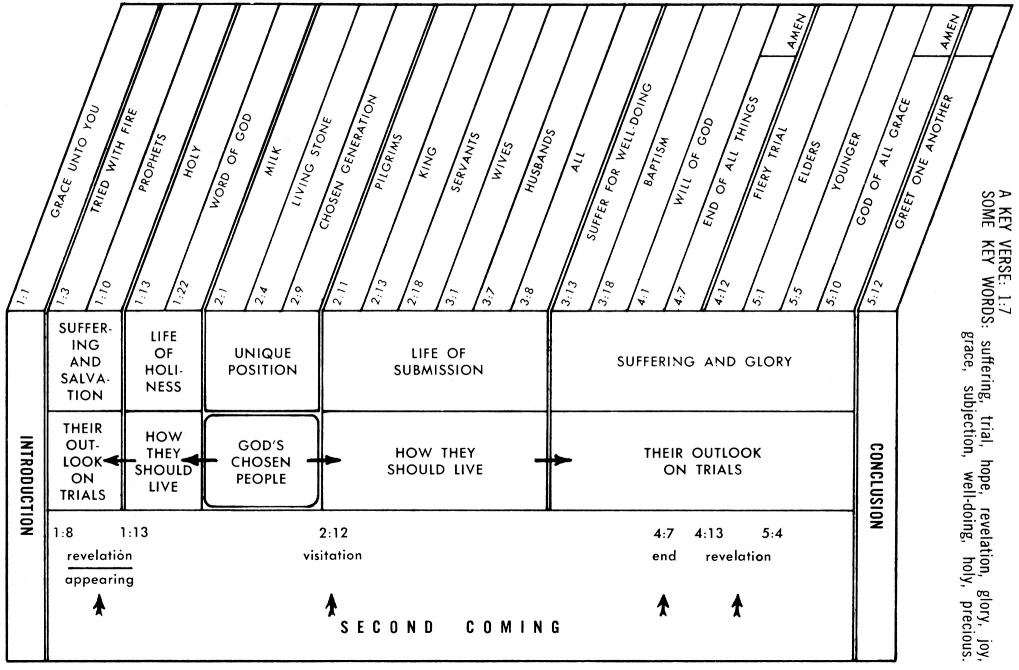
1 Peter: Trials, Holy Living & The Lord's Coming
Click chart to enlarge
Chart from Jensen's Survey of the NT - used by permission
See Another Chart from Charles Swindoll
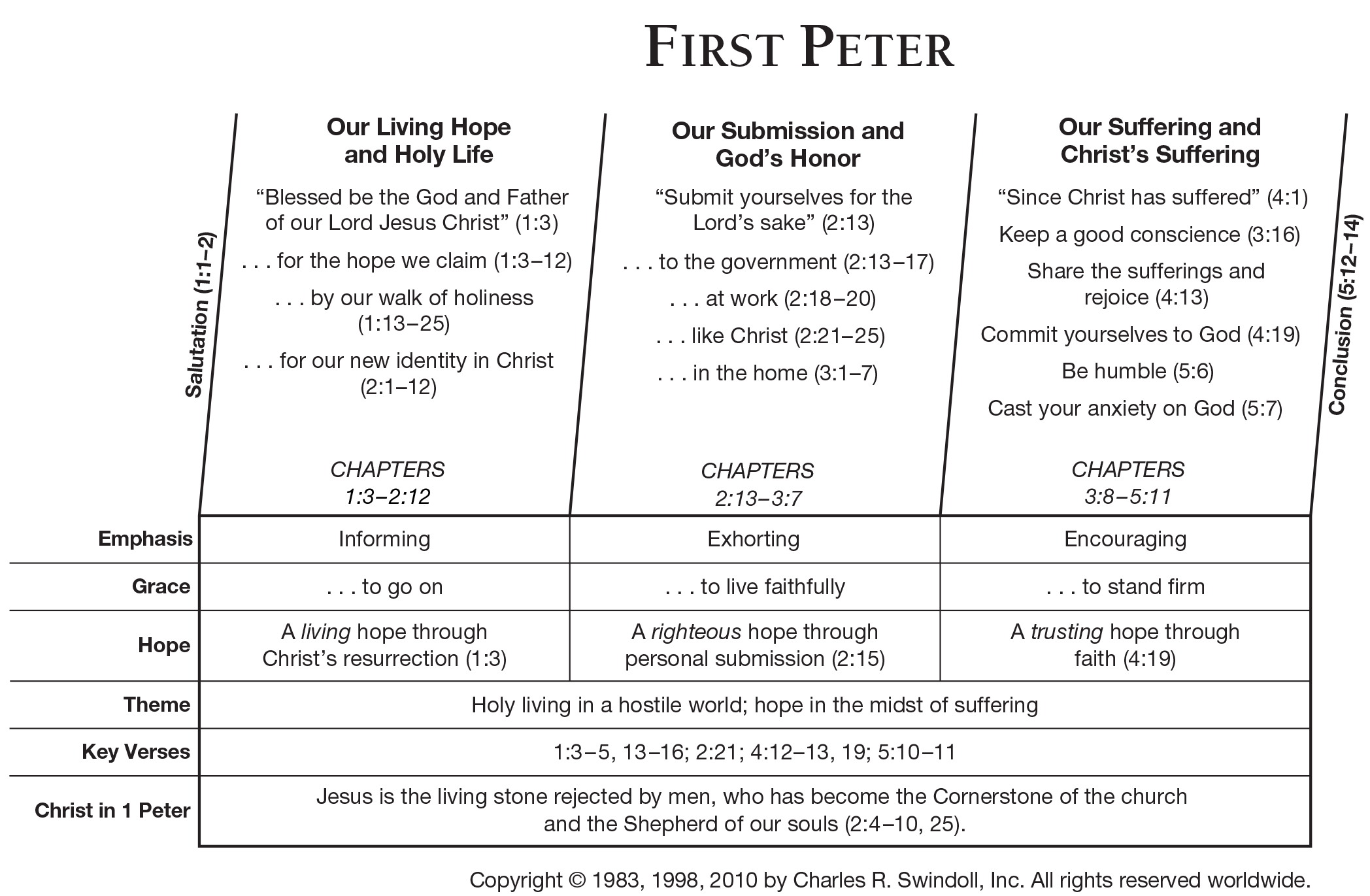
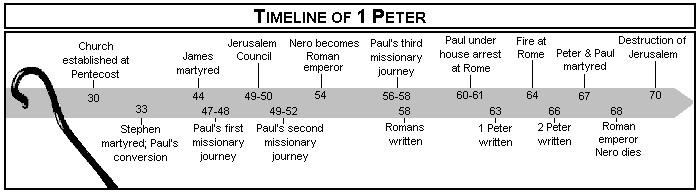
Source: Borrow Ryrie Study Bible
Click to enlarge
PART I: DOCTRINAL FOUNDATION
I. The Opening Salutation (1Pe 1:1-2)
A. The Writer (1Pe 1:1a)
B. The Readers (1Pe 1:1b-2a)
1. True character of the readers (1Pe 1:1b)
2. Geographical location of the readers (1Pe 1:1c)
3. Spiritual supports for the readers (1Pe 1:2a)
C. The Greeting (1Pe 1:2b)
II. The Thanksgiving for Our Salvation (1Pe 1:3-12)
A. The Description of Salvation (1Pe 1:3-5)
1. The author of salvation (1Pe 1:3a-b)
a. His relation to the Savior (1Pe 1:3a)
b. His act of mercy to the saved (1Pe 1:3b)
2. The nature of salvation (1Pe 1:3c-4a)
a. The living hope grounded in Christ's resurrection (1Pe 1:3c)
b. The glorious inheritance awaiting believers (1Pe 1:4a)
3. The certainty of salvation (1Pe 1:4b-5)
a. The safekeeping of the inheritance (1Pe 1:4b)
b. The preservation of the heirs (1Pe 1:5)
B. The Experiences Relating to Salvation (1Pe 1:6-9)
1. The paradoxical nature of the experiences (1Pe 1:6-7)
a. The experience of exultation (1Pe 1:6a)
b. The experience of distress (1Pe 1:66-7)
1. The nature of the distress (1Pe 1:6b)
2. The purpose behind the trials (1Pe 1:7)
a. The testing of faith (1Pe 1:7a)
b. The outcome of the testing (1Pe 1:7b)
2. The sustaining relations of believers (1Pe 1:8-9)
a. Their dual relation to Jesus Christ (1Pe 1:8)
b. Their experiential relation to their salvation (1Pe 1:9)
C. The Magnification of Salvation (1Pe 1:10-12)
1. The magnification through prophetic research (1Pe 1:10-12a)
a. Their intensive search (1Pe 1:10a)
b. Their prophetic function (1Pe 1:10b)
c. Their personal perplexity (1Pe 1:11)
1. The time and circumstances (1Pe 1:11a)
2. The sufferings and the glories (1Pe 1:11b)
d. Their restricted ministry (1Pe 1:12a)
2. The magnification through Christian proclamation (1Pe 1:12b)
3. The magnification through angelic inquiry (1Pe 1:12c)
PART 2: PRACTICAL EXHORTATION
I. Exhortations in View of Our Salvation (1Pe 1:13-2:10)
A. The Life Arising from Salvation (1Pe 1:13-2:3)
1. The Christian life in relation to God (1Pe 1:13-21)
a. A life of steadfast hope (1Pe 1:13)
1. The supports of hope (1Pe 1:13a)
2. The call to hope (1Pe 1:13b)
b. A life of personal holiness (1Pe 1:14-16)
1. The foundation for personal holiness (1Pe 1:14a)
2. The call to personal holiness (1Pe 1:14b-15)
a. The negative demand of holiness (1Pe 1:14b)
b. The positive call to holiness (1Pe 1:15)
3. The justification of the call to holiness (1Pe 1:16)
c. A life of motivated reverence (1Pe 1:17-21)
1. The basis for reverent living (1Pe 1:17a)
2. The call for reverent living (1Pe 1:17b)
3. The knowledge that motivates reverence (1Pe 1:18-21)
a. The means of our redemption (1Pe 1:18-19)
b. The nature of the Redeemer (1Pe 1:20)
c. The characteristics of the redeemed (1Pe 1:21)
2. The Christian life in relation to the brethren (1Pe 1:22-25)
a. The experience of inner purification (1Pe 1:22a)
b. The duty of mutual love (1Pe 1:22b)
c. The foundation in personal regeneration (1Pe 1:23-25)
1. The fact of their regeneration (1Pe 1:23a)
2. The nature of their regeneration (1Pe 1:23b-25a)
3. The evangelization leading to their regeneration (1Pe 1:25b) (D Edmond Hiebert)
1 Peter 1:5 who are protected (PPP) by the power of God through faith for a salvation ready to be revealed (APN) in the last time (NASB: Lockman)
Greek: tous en dunamei theou phrouroumenous (PPPMPA) dia pisteoo eis soterian hetoimen apokaluphthenai (APN) en kairo eschato.
Amplified: Who are being guarded (garrisoned) by God’s power through [your] faith [till you fully inherit that final] salvation that is ready to be revealed [for you] in the last time. (Amplified Bible - Lockman)
Amplified (2015) who are being protected and shielded by the power of God through your faith for salvation that is ready to be revealed [for you] in the last time.
NLT: And God, in his mighty power, will protect you until you receive this salvation, because you are trusting him. It will be revealed on the last day for all to see. (NLT - Tyndale House)
Phillips: And in the meantime you are guarded by the power of God operating through your faith, till you enter fully into the salvation which is all ready for the dénouement of the last day. (Phillips: Touchstone)
Wuest: who are constantly being kept guarded by the power of God through faith for a salvation ready to be revealed in a last season which is epochal and strategic in its significance. (Eerdmans)
Young's Literal: who, in the power of God are being guarded, through faith, unto salvation, ready to be revealed in the last time,
WHO ARE PROTECTED: tous en dunamei theou phrouroumenous (PPPMPA):
- 1Sa 2:9; Ps 37:23,24; Ps 37:28, 103:17,18;125:1,2; Pr 2:8; Isa 54:17; Jer 32:40; Jn 4:14; 5:24; 10:28, 29, 30; 17:11, 17:12, 17:15, Ro 8:31, 32, 33, 34, 35, 36, 37, 38, 39 Php1:6; Jude1:24
- 1 Peter 1 Resources - Multiple Sermons and Commentaries
VERTICAL AND HORIZONTAL
SECURITY
Note the protection is by and through. By speaks of our vertical security (our God) and through of our horizontal security (our faith).
Notice how the Greek appropriately places the power of God first in the sentence for emphasis. Indeed God is the "first Cause" Who Alone has supernatural "keeping power!" God grant us by Your Spirit the desire and power (Php 2:13NLT-note) to run to Your Protecting Name "The Power of God" as if running into a strong tower...
The name of the LORD is a strong tower; The righteous (Our Responsibility) runs into it and is safe (God's Sovereign Keeping Power -Hebrew = sagab = lifted high). (Pr 18:10-note)
Grant Osborne adds that "In the Greek, the first and preeminent idea is God's power as the basis of protection; faith is our "passive" part in the process (Ed: We "run" into His Name and His Power by faith). This means that we rely entirely on the divine might exercised on our behalf, not on what we can do....In 1 Peter 1:5 it (protecting power) refers to the hosts of heaven, the "power of God," that stands against the vicissitudes of life. It is important to realize that this protection is entirely supplied by God, Who exercises His might on our behalf. It is nothing we can do, as if we could control His power and so guard ourselves. We respond with "faith," that is, a total reliance on God Who Alone keeps us secure. This does not mean we are inactive (Ed: Like the catchy but theologically inaccurate aphorism says "Let go and Let God."), as if we sit back and wait for God to do everything for us. Rather, we actively seek God and both His might and wisdom as we work through our difficulties. The key is our utter dependence on Him. " (Cornerstone Biblical Commentary – Volume 18: James, 1-2 Peter, Jude, Revelation) (Bolding added)
An OT parallel of the truth in 1 Peter 1:5 is found in the life of Abram our example for a life of faith. In Genesis 15:1 God told Abram "Do not fear, Abram, I am a shield to you; Your reward shall be very great.” (See notes). And He is still a shield to all who are of the faith of Abraham (Gal 3:26, 29-note)
Protected (5432) (phroureo) is derived from phrouros which means a sentinel. Phrouros in turn is derived from pro = before, toward + horao = behold, take special notice of, stare at more. The verb phroureo therefore means to pay attention to something, thus giving us a clear picture of the action involved in guarding or protecting.
Phroureo is a military metaphor speaking of a fortress with strong walls being guarded by a battalion of soldiers. This term in this context also implies that those who have been born again are in a holy war and are under constant enemy attack from a host of unholy enemies = the world, the flesh and the devil (cp similar military metaphor in 1Pe 2:11-note)
Phroureo is used 4x in the NT (2 Cor 11:32; Gal 3:23; Phil 4:7; 1 Pet 1:5) and in the NAS is translated guard, 1; guarding, 1; kept in custody, 1; protected, 1. Phroureo is found in the Septuagint (LXX) 4 times but only in the apocryphal books.
Phroureo has three primary nuances:
(1) to maintain a watch, guard. Phroureo was was a military term used to describe the guarding performed by posting sentries. It carries the idea of setting a protective guard. It also conveys the idea of a garrison keeping watch over a town either in order to prevent hostile invasion or to keep the inhabitants of a besieged city from flight. Phroureo described the soldiers guarding Damascus when Paul made his escape:
In Damascus the ethnarch under Aretas the king was guarding the city of the Damascenes in order to seize me, (2 Corinthians 11:32)
(2) to hold in custody, detain, confine as in Galatians where Paul explained that…
"before faith came, we were kept in custody (phroureo) under the law, being shut up to the faith which was later to be revealed." (Galatians 3:23)
This meaning was consistent with the Roman use of prisons principally for holding of prisoners until disposition of their cases, just as the Law supervised us until we could place our faith in Christ.
(3) to provide security, guard, protect, keep, this being the primary meaning in the present context.
It is encouraging to examine three of the four uses of phroureo. In the past, the Lord kept us safe until we heard the Gospel and responded to it (Galatians 3:23). In the present, the peace of God keeps our hearts and minds at peace in troubled times (Php 4:7-note). Finally as Peter teaches, the Lord keeps us and will reveal His glory in us when Christ returns (1 Peter 1:5). The keeping power of our Lord is awesome. It is as strong as His strength and as eternal as His person. No Christian should ever doubt this providential care of the Lord.
Spurgeon expresses the encouraging truth of God's guarding providence writing that…
As sure as ever God puts His children in the furnace He will be in the furnace with them."
John Nelson Darby (1800-1882) founder of the Christian Brethren movement speaking of God's protective care said that…
God's ways are behind the scenes, but He moves all the scenes which He is behind.
Phroureo is in the present tense which emphasizes God's ever available power and our need for His continual supernatural protection in our struggle in this present life (and our 3 enemies = the world, the flesh and the devil) as we await our day of redemption (Eph 4:20-note) and our life of eternal glory. Hallelujah! We are constantly being kept guarded by the omnipotent power of God which guarantees every believer's final victory even what may seen to them now as "against all odds"! The passive voice (so called "Divine passive" in this context) indicates that the "guarding" is being carried out by an outside force, specifically God, Whose power is continuously guarding us. Peter's point is that we will make it to heaven no matter what trials we experience here, so hangeth thou in there! As Peter says in 1 Peter 1:6-note although the trials may feel like they are never ending, they are only "for a little while!" (cp "momentary, light affliction" in 2 Cor 4:17-note) God's keeping power is sufficient to bring us safely through the trials and afflictions.
Through many dangers, toils and snares
I have already come;
'Tis Grace that brought me safe thus far
and Grace will lead me home.
- Amazing Grace
Barnes adds that the idea of phroureo is that "there was a faithful guardianship exercised over them to save them from danger, as a castle or garrison is watched to guard it against the approach of an enemy (see expositional notes on Psalm 121 describing our Helper and Keeper). The meaning is, that they were weak in themselves, and were surrounded by temptations; and that the only reason why they were preserved was, that God exerted His power to keep them. The only reason which any Christians have to suppose they will ever reach heaven, is the fact that God keeps them by His own power. If it were left to the will of man; to the strength of his own resolutions; to his power to meet temptations, and to any probability that he would of himself continue to walk in the path of life, there would be no certainty that anyone would be saved." (Barnes' Notes on the Bible)
While our inheritance is being kept guarded in heaven under the watchful eye of God, we are being garrisoned about by God’s protecting care for it. The Almighty God stands sentinel over us all our days guarding our "going out and our coming in from this day forth and forever" (see notes on Psalm 121). The Guard is never changed. He is on duty 24 hrs/day ("24/7"), year in and year out until we arrive safely home. Believers are not kept by their own power, but by the power of God. Our faith in Christ has so united us to Him that His power now guards us and guides us. We are not kept by our strength, but by His faithfulness. How long will He guard us? Until Jesus Christ returns We are in His hand (Jn 10:29).
The story is told of a Scotsman, who was typically economical, leaving instructions that only one word should be engraved upon his tombstone. That word taken from this verse was the single word KEPT (KJV translation). Eternal security is not based on the faith of men, but on the faithfulness of God. Aren't we all thankful for this truth!
J Vernon McGee: in his quaint style writes…
My friend, do you think He can keep you? Oh, I am weary of the emphasis being put on the work of the flesh. We are being told that if we follow some little set of rules, we can become “adequate Christians.” I wonder if the fellows who are giving all these messages have reached some celestial level which the rest of us have not been able to attain. They ask, “Are you sufficient, are you satisfied?” My answer is, “No—I am pressing on the upward way, I am pressing toward the mark for the prize of the high calling of God in Christ Jesus. I am not satisfied. I have not found life sufficient.” My friend, let me add a strong statement that may startle you: You cannot live the Christian life! Perhaps you are asking, “Do you really mean that?” Yes, I do. I would challenge you to show me a verse or any Scripture where God has asked you to live the Christian life. He has never done that… The only way in the world that you can live the Christian life is by the power of the Holy Spirit and by the fact that you are kept by the power of God—right on through until the day when you will be delivered to Him in heaven. (McGee, J V: Thru the Bible Commentary: Thomas Nelson)
BY THE POWER OF GOD THROUGH FAITH: tous en dunamei theou dia pisteos:
- 1 Peter 1 Resources - Multiple Sermons and Commentaries
By the power of God - The guard on duty is not like a human guard who might fall asleep and fail to guard us from the enemy. Perhaps you might want to "refresh" your mind regarding the "Guard" Who is protecting you until the last time…
Psalm 121
1 I Will lift up my eyes to the mountains; From whence shall my help come?
2 My help comes from the LORD, Who made heaven and earth.
3 He will not allow your foot to slip; He who keeps you will not slumber.
4 Behold, He who keeps Israel Will neither slumber nor sleep.
5 The LORD is your keeper; The LORD is your shade on your right hand.
6 The sun will not smite you by day, Nor the moon by night.
7 The LORD will protect you from all evil; He will keep your soul.
8 The LORD will guard your going out and your coming in From this time forth and forever.
(See verse by verse commentary on site - Psalm 121: A Commentary)
Power (1411) (dunamis from dunamai = to be able, to have power) is the capability as well as power. Inherent power residing in something (God in this case) by virtue of its nature (His Omnipotence among other attributes)
Dunamis refers especially to achieving power, to intrinsic power or inherent ability, the power or ability to carry out some function, the potential for functioning in some way (power, might, strength, ability, capability), the power residing in a thing by virtue of its nature.
Dunamis is the implied ability or capacity to perform. It conveys the idea of effective, productive energy, rather than that which is raw and unbridled.
Through (dia) refers the instrument, the intermediate or efficient cause of activating the dunamis (inherent power) of God… it is faith.
In other words this
protection is God’s response to our faith which we exercised in the Lord Jesus as Saviour and which now rests in Him as our Preserver. Our faith lays hold of this power, and this power strengthens our faith, and thus we are preserved. (Wuest, K. S. Wuest's Word Studies from the Greek New Testament: Eerdmans)
J C Philpot - The elect are preserved in Christ, BEFORE they are called by grace. They are kept by the power of God from perishing in their unregeneracy. Have not you been almost miraculously preserved in the midst of dangers, and escaped when others perished by your side—or been raised up as it were, from the very brink of destruction and the very borders of the grave? Besides some striking escapes from what are called 'accidents,' three times in my life—once in infancy, once in boyhood, and once in manhood—I have been raised up from the borders of the grave, when almost everyone who surrounded my bed thought I would not survive the violence of the attack. Were not these instances of being kept by the power of God? I could not die until God had manifested His purposes of electing grace and mercy to my soul. But the elect are also kept by the mighty power of God AFTER they are called by grace—for they are in the hollow of His hand, and are kept as the apple of His eye. I will not say they are kept from all sins. Yet I will say that they are kept from damning sins. They are kept especially from three things—from the dominion of sin, from daring and final presumption, from lasting and damnable error. They are never drowned in the sins and evils of the present life so as to be swallowed up in them—for it is impossible that they can ever be lost! They are therefore preserved in hours of temptation, for they are guarded by all the power of Omnipotence, shielded by the unceasing care and watchfulness of Him who can neither slumber nor sleep. Looking back through a long vista of years, can you not see how the hand of God has been with you—how He has held you up, and brought you through many a storm, and preserved you under powerful temptations? How gently He sometimes drew you on, or sometimes kept you back? "I give to them eternal life; and they shall never perish, neither shall any man pluck them out of My hand!" Having chosen us, God begets us with His word, regenerates us by a divine influence, and makes us new creatures by the power and influence of the Holy Spirit.
Salter - A kite soaring on high is in a situation quite foreign to its nature; as much as the soul of man is, when raised above this lower world to high and heavenly pursuits. A person at a distance sees not how it is kept in its exalted situation; he sees not the wind that blows it, nor the hand that holds it, nor the string by whose instrumentality it is held. But all of these powers are necessary to its preservation in that preternatural state. If the wind were to sink, it would fall. It has nothing whatever in itself to uphold itself: it has the same tendency to gravitate to the earth that it ever had, and, if left for a moment to itself, it would fall. Thus it is with the soul of every true believer. It has been raised by the Spirit of God to a new, a preternatural, a heavenly state; and in that state it is upheld by an invisible and almighty hand, through the medium of faith. And upheld it shall be, but not by any power in itself. If left for a moment, it would fall as much as ever. The whole strength is in God alone; and its whole security is in the unchangeableness of His nature, and in the efficacy of His grace. In a word, “it is kept by the power of God, through faith, unto salvation.”
Richard Hawker - Who are kept by the power of God, through faith unto salvation.—1 Peter 1:5.
When I call to mind, that “in me, that is in my flesh, dwelleth no good thing;” when I stand convinced (as I do most fully, blessed he God the Holy Ghost, for having exercised his gracious office in my soul to this gracious effect), that though renewed in the spirit of my mind, yet in that unrenewed part of myself, which is hastening to the grave, every member is virtually all sin; when I know, that never did sin break in acts of open wickedness in any son or daughter of Adam, but that the seeds of the same sin are in me and my nature; I long not only to know, but always to keep in remembrance by what means, and from what cause, it is, that those seeds do not ripen in my heart as well as in others; that while corrupt nature is the same in all, it is restrained in me, while so many of my fellow-creatures and fellow-sinners fall a prey to temptation. Blessed Spirit! the merciful scripture of the evening answers the important question. They who are kept, “are kept by the power of God, through faith unto salvation.” Here is the solution of the whole subject. With what humbleness of soul, then, ought every child of God to fall down before the throne of grace, under the deepest sense of distinguishing love, in the consciousness that it is divine restraint, and not creature merit, which maketh all the difference. Help me, Lord, to go humble all my days in this view, and let it be my morning thought and my mid-day and evening meditation, that I am kept by thy power through faith unto salvation. Almighty Father! help me to be living upon thy faithfulness in the covenant of grace, established and sealed as it is in the blood of thy dear Son, that thou wilt not turn away from me to do me good; and that thou wilt put thy fear in my heart, that I shall not depart from thee. (Jer. 32:40.) Precious Lord Jesus! give me to rest also upon a union with thee, a communion of grace from thee, and a participation in thee, in all the blessings of thy redemption. Surely I am the purchase of thy blood, and thou hast said, “Thy sheep shall never perish, neither shall any pluck them out of thine hand.” (John 10:28.) And, O thou blessed Spirit of all truth, be thou to me an indwelling security from sin, to keep me from falling, and to preserve me faultless in Jesus until the day of his coming. Make my body thy temple, and cause me, by thy sweet constraining love, “to glorify God in my body, and in my spirit, which are his.” (1 Cor. 6:20.)
Kept by the Power of God BY THOMAS WATSON
There is nothing that more troubles a child of God, than that he fears he shall never hold out. "These weak legs of mine," he says, "will never carry me to Heaven!" But he is kept by the power of God! Once in Christ — forever in Christ. A believer may fall from some degrees of grace — but not from the state of grace.
How despairing is the Arminian doctrine of falling from grace! Today a saint — tomorrow a reprobate; today a Peter — tomorrow a Judas! This is like boring a hole in a vessel — to make all the wine of his joy run out. Were the Arminian doctrine true, what comfort would it be — to have one's name written in the book of life — if it might be blotted out again? But be assured, for your comfort, that grace — if it is true — though ever so weak, shall persevere.
"Who are kept by the power of God through faith unto salvation." 1 Peter 1:5. See whence it is, that believers persevere in holiness. It is to be ascribed solely to the power of God.
It is a wonder that any Christian perseveres, if you consider:
(1.) Corruption within. There is more sin than grace; yet grace is habitually predominant. Grace is like a spark in the sea — it is a wonder that it is not quenched! It is a wonder that sin does not destroy grace.
(2.) Temptations without. Satan envies us happiness, and he raises his militia, and stirs up persecution. He shoots his fiery darts of temptations — which are called darts for their swiftness, fiery for their terribleness. We are every day beset with devils! As it was a wonder that Daniel was kept alive in the midst of the roaring lions, so there are many roaring devils around us — and yet we are not torn in pieces! Now, whence is it, that we stand against these powerful temptations? We are kept by the power of God!
(3.) The world's old snares — riches and pleasure. How many have been shipwrecked upon these golden rocks! "Demas has deserted me, because he loved this present world." 2 Timothy 4:10
What a wonder any persevere in holiness — that the earth does not choke the fire of all holy affections! Whence is this, but from the power of God? We are kept by His power.
"My sheep hear My voice, I know them, and they follow Me. I give them eternal life, and they will never perish — ever! No one will snatch them out of My hand. My Father, who has given them to Me, is greater than all. No one is able to snatch them out of the Father's hand!" John 10:27-29 (A Body of Divinity - A Puritan's Mind)
FOR A SALVATION READY TO BE REVEALED IN THE LAST TIME : eis soterian hetoimen apokaluphthenai (APN) en kairo eschato:
- Heb 9:28) (1Pe 1:13; 1Ti 6:14,15; Titus 2:13; 1Jn 3:2 Job 19:25
- 1 Peter 1 Resources - Multiple Sermons and Commentaries
OUR PREPARED FUTURE:
GLORIFICATION, FOREVER!
The writer of Hebrews says "Christ also, having been offered once to bear the sins of many (Past History), shall appear a second time (Future History) for salvation without [reference to] sin (Future Tense salvation - Glorification! Hallelujah!), to those who eagerly await (apekdechomai) Him." (Heb 9:28) God grant us grace to wait with patience and expectation for He Himself said (four times!) "I am coming quickly!" (Rev 3:11, Rev 22:7, 12, 20)
For (eis) unto. The purpose of or result of our protection. We will be protected by God's power until the last time! Do not fear dear child of the Living God! Let this truth from Peter's pen regarding our secure future stabilize your heart and mind in the present, so that you might be enabled by His Spirit (Who uses His Word - cp Eph 6:17) to bear up under the various trials and afflictions you are now going through (and most of us are going through something! Some are "big" and others not "so big" but they are still trials and afflictions!) Hold fast to the One Who is holding you fast in His power!
Grant Osborne writes that this salvation is "the result of the "ransom" paid by Christ that saved us via his "precious blood" as the "sinless, spotless Lamb of God" (1 Peter 1:18-19-note), who also is yet to be "revealed," bringing our final "gracious salvation" (1 Peter 1:13-note). So salvation in this epistle is past, present, and especially future (emphasized here and in the rest of the book). The basic meaning of "ransom" is rescue or deliverance from danger, here from sin (1 Peter 1:18-note) and final judgment (1 Peter 1:17-note). The eschatological reality of our deliverance is demonstrated in what follows, "this salvation, which is ready to be revealed on the last day for all to see" (1 Peter 1:5). When Christ is revealed on the last day (1 Peter 1:13-note), our eternal salvation will also be made visible to all. The "last day" is the eschaton—the final events inaugurated by Jesus' return and final judgment (cf. Rev 19-20). The "great expectation" is faith in the certainly that our final "inheritance" and "salvation" are a secure promise awaiting us. At the present time we are "foreigners" (1 Peter 1:1, 17-note) living in alienation and rejection in a world that killed Christ and persecutes us. But we also live in the certain expectation of vindication and deliverance from this evil world. Jobes (2005:88) says it well: "The certainty of future salvation animates the hope in which Christians now live, making the eschatological future a present reality. This is a consolatory technique intended to relieve feelings of oppression by so closely interweaving the glories of the future with the present that the present is transformed in the thought-world of Peter's readers." (Cornerstone Biblical Commentary – Volume 18: James, 1-2 Peter, Jude, Revelation)
Salvation (4991) (soteria from soter = a savior or deliverer) means safety, deliverance, preservation from danger or destruction.
Stated another way In the salvation referred to here is "future tense" (see Three Tenses of Salvation), the consummation referred to as glorification of our mortal bodies, free from corruption, free from the presence of sin, free from the pleasure of sin. Oh happy day!
The salvation spoken of here is "future tense salvation" culminating in the glorification of our bodies. We received our justification at the moment we believed (past tense salvation). We are receiving our sanctification, namely victory over sin and growth in the Christian life now (present tense salvation). We will yet receive that part of salvation which awaits us in Glory (future tense salvation). (See Three Tenses of Salvation)
Soteria - 46x in 45v - NAS = deliverance(2), preservation(1), salvation(42).
Mark 16:8; Luke 1:69, 71, 77; 19:9; John 4:22; Acts 4:12; 7:25; 13:26, 47; 16:17; 27:34; Rom 1:16; 10:1, 10; 11:11; 13:11; 2 Cor 1:6; 6:2; 7:10; Eph 1:13; Phil 1:19, 28; 2:12; 1 Thess 5:8f; 2 Thess 2:13; 2 Tim 2:10; 3:15; Heb 1:14; 2:3, 10; 5:9; 6:9; 9:28; 11:7; 1 Pet 1:5, 9f; 2:2; 2 Pet 3:15; Jude 1:3; Rev 7:10; 12:10; 19:1.
As Barclay writes "Salvation is a many-sided thing. In it there is deliverance from danger, deliverance from disease, deliverance from condemnation and deliverance from sin. And it is that, and nothing less than that, to which the Christian can look forward at the end." (1 Peter 1 Commentary)
Ready (2092) (hetoimos from an old noun heteos = fitness) means ready, prepared, in a state of readiness. Hetoimos is a stronger word than "about to be", or "destined to be", as it implies a state of waiting or preparedness and thus harmonizes well with "reserved"
Hetoimos - 17x in 17v - Matt 22:4, 8; 24:44; 25:10; Mark 14:15; Luke 12:40; 14:17; 22:33; John 7:6; Acts 23:15, 21; 2 Cor 9:5; 10:6, 16; Titus 3:1; 1 Pet 1:5; 3:15. NAS = accomplished(1), opportune(1), ready(15).
THE BEST IS
YET TO COME
Revealed (601) (apokalupto from apó = from + kalúpto = to cover, conceal) (See study of related word apokalupsis) means literally to remove the cover from. To make manifest or reveal a thing previously secret or unknown.
Apokalupto - 26x in 26v -
Matt 10:26; 11:25, 27; 16:17; Luke 2:35; 10:21f; 12:2; 17:30; John 12:38; Rom 1:17f; 8:18; 1 Cor 2:10; 3:13; 14:30; Gal 1:16; 3:23; Eph 3:5; Phil 3:15; 2 Thess 2:3, 6, 8; 1 Pet 1:5, 12; 5:1
The veil or covering will one day be removed exposing to open view for all to see what was before hidden… our "future tense salvation" or glorification.
The world does not understand who we are as believers nor the future glory we shall experience. But one day that will all change. In the meantime "hangeth thou in there."
Note that apokalupto is in the passive voice indicating that the action is performed by an outside force, in context referring to God Himself.
The last time comprises the period between Christ’s first and second comings. "Last" (eschatos) is the source of our English word eschatology.
The assurance of heaven is a great help to us today.
As Dr. James M. Gray expressed it in one of his songs, “Who can mind the journey, when the road leads home?” And like the Steven Curtis Chapman song says "We Are Not Home Yet!"
The idea that we are not home yet is one we all would do well to keep foremost in our mind as illustrated by the true story of Henry C. Morrison a little known "hardworking farmer" in God's missionary fields, toiling some forty years in the difficult fields of Africa. As the story is told, he became sick and had to return home to America, and as providence would have it, the boat he returned on was also carrying a well known guest. As the great ocean liner docked in New York Harbor there was a great crowd gathered to greet President Teddy Roosevelt who received a grand welcome-home-party after his widely publicized African Safari. Resentment seized the "hardworking farmer", Henry Morrison, and he turned to God saying "I have come back home after all this time and service to the church and there is no one, not even one person here to welcome me home." Then a small voice came to Morrison reminding him "You're not home yet." Our ultimate harvest is yet future and our future reward is out of this world! Ready to be revealed in the last time! Praise the Lord.
If we can get the truth firmly planted in our mind that suffering today means glory tomorrow, then suffering becomes a blessing to us.
The unsaved have their “glory” now, but it will be followed by eternal suffering away from the glory of God (2Th 1:3, 4, 5, 6, 7,8, 9, 10).
In the light of this, ponder (2Co 4:17, 18)—and rejoice!
For momentary, light affliction is producing for us an eternal weight of glory far beyond all comparison, while we look not at the things which are seen, but at the things which are not seen; for the things which are seen are temporal, but the things which are not seen are eternal.
Richard Hawker - Ready to be revealed in the last time.—1 Peter 1:5.
My soul! hast thou ever considered the very great and blessed things contained in these few words? Sit down, this evening, and look them over. Dost thou ask, what is ready to be revealed in the last time? The answer is direct. All the fulness, glory, grace, provision, peace, and everlasting happiness, that are in the covenant of redemption, and all centered in the person and finished work of the Lord Jesus Christ. Thou hast now but obscure views of Jesus, and his fulness, suitableness, and all-sufficiency. Thou hast believed indeed unto salvation, and art resting upon Christ for thy justification, and sanctification, and comfort; but of the fulness in which believers stand complete in Christ, no saint upon earth hath ever had a conception equal to what it really is. “Beloved,” saith John, “now are we the sons of God! and it doth not yet appear what we shall be: but we know that when he shall appear we shall be like him, for we shall see him as he is.” (1 John 3:2.) Now the blessedness of these things, in all their fulness, and in all their glory, is reserved to be “revealed in the last time:” and they are now already. Angels are always upon the wing, and are waiting to bring the heirs of the kingdom into the immediate possession, and immediate enjoyment of them. And although clouds here arise between, to obscure those bright and glorious objects, yet the heirs of promise ought to enjoy them now by faith; for they are eternally secure, and, through the Lord of them, eternally their own. Now, my soul, what sayest thou to these things? Are they ready to be revealed in the last time? Are they thine now? Hast thou Jesus, and with him all things? Is the last time approaching? Are angels waiting? Is Jesus waiting to unfold all to thy ravished view? and every thing ready? What sayest thou, my soul! Art thou ready also? Lord Jesus! give me grace to be always on the look-out for thy coming, and to be as delighted with thy approach as they that wait for the morning!
Jon Courson - ..Through faith unto salvation ready to be revealed in the last time. I Peter 1:5
A young man who was being hazed by a college fraternity was taken to a secluded spot where he was told to hold on to a knot at the end of a greased rope as his fraternity brothers lowered him into a dark well. Thinking they would pull him up after a few minutes, he was terrified to see them tie their end of the rope to the bar across the top of the well, leaving him suspended in mid-air.
‘This can’t be!’ he thought as he called for help. But none came.
As he approached the 15-minute mark, his arms aching unbelievably and his shoulders feeling as though they were on fire, he started to cry.
Finally, after about 25 tortuous minutes, able to hang on no longer, he let go—and fell two inches—just as his fraternity brothers had calculated.
Isn’t that just like us? ‘Where are You, God? I don’t know if I’m going to make it,’ we cry. We fret and blubber and scream until finally we let go. And guess what we find? We discover that our Solid Rock, Jesus Christ, was there all along.
A bunch of us have burning shoulders and aching arms for absolutely no reason. We’re trying to hang on through our own efforts, by our own spirituality. We get disgusted with ourselves and worried we’re not going to make it. But if we would just let go of the rope and rest in what Jesus did on the Cross of Calvary, we would realize it’s not our puny efforts which will see us through, but the power of God.
This is what Peter is telling the believers who no doubt were wondering whether, when the temperature rose and persecution came down, they would be able to hang in there.
‘I want you to know something,’ Peter said. ‘You have an inheritance waiting for you which can’t be taken from you. You are kept by the power of God who is committed to see you through. And all that remains for you to do is believe.’
Octavius Winslow - Evening Thoughts
This salvation takes in all the circumstances of a child of God. It is not only a salvation from wrath to come—that were an immeasurable act of grace—but it is a present salvation, anticipating and providing for every exigency of the life that now is, including deliverance from all evil, help in all trouble; comfort in all sorrow, the supply of all want, and through all conflicts, assaults, and difficulties, perfect safety and final triumph. The present and certain security of the believer is provided for in the covenant of grace, made sure in Jesus the covenant Head, and revealed in the glorious covenant plan of salvation. May the Holy Spirit unfold to us this great and consoling truth, that in the midst of all their weakness, waywardness, and tendency to wander, the Lord is the keeper of His people, and that they whom He keeps are well and eternally kept.
The Lord could not in truth be said to be the keeper of His people, if there were anything of self-power in the believer, any ability to keep himself—if he were not weakness, all weakness, and nothing but weakness. Of this the believer needs to be perpetually put in remembrance. The principle of self-confidence is the natural product of the human heart; the great characteristic of our apostate race is a desire to live, and think, and act independently of God. What is the great citadel, to the overthrow of which Divine grace first directs its power? what is the first step it takes in the subjection of the sinner to God? what, but the breaking down of this lofty, towering, independent conceit of himself, so natural to man, and so abhorrent to God? Now, let it be remembered, that Divine and sovereign grace undertakes not the extraction of the root of this depraved principle from the heart of its subjects. The root remains to the very close of life's pilgrimage; though in a measure weakened, subdued, mortified, still it remains; demanding the most rigid watchfulness, connected with ceaseless prayer, lest it should spring upward, to the destruction of his soul's prosperity, the grieving of the Spirit, and the dishonoring of God. Oh how much the tender, faithful discipline of a covenant God may have the subjection and mortification of this hateful principle for its blessed end, who can tell? We shall never fully know until we reach our Father's house, where the dark and, to us, mysterious dealings of that loving Father with us here below shall unfold themselves in light and glory, elevating the soul in love and praise!
What an affecting confirmation do the histories of some of the most eminent of God's saints afford to this most important truth, that the creature, left to itself, is perfect weakness! If the angels in their purity, if Adam in his state of innocence, fell in consequence of being left, in the sovereign will of God, to their own keeping, what may we expect from a fallen, sinful, imperfect creature, even though renewed? Do we look into God's blessed word, and read what is there declared, touching the power of a renewed creature to keep itself? How affecting, and at the same time conclusive, these declarations are: "Having no might;" "Without strength;" "Weak through the flesh;" "Out of weakness were made strong"! Could language more forcibly set forth the utter weakness of a child of God? An what are their own acknowledgments? "The Lord is the strength of my life;" "Hold You me up, and I shall be safe;" "Hold up my goings in Your paths, that my footsteps slip not;" "Yet not I, but the grace of God which was with me;" "By the grace of God I am what I am." And what are the examples? Look at the intemperance of Noah, the unbelief of Abraham, the adultery and murder of David, the idolatry of Solomon, the self-righteousness of Job, the impatience of Moses, the self-confidence and trimming, temporizing policy of Peter. Solemn are these lessons of the creature's nothingness; affecting these examples of his perfect weakness!
But why speak of others? Let the reader, if he is a professing child of God, pause and survey the past of his own life. What marks of perfect weakness may he discover, what evidences of his own fickleness, folly, immature judgment, may he trace, what outbreakings of deep iniquity, what disclosures of hidden corruption, what startling symptoms of the most awful departure and apostasy from God, does the review present! And, this, too, let it be remembered, is the history of a believer in Jesus, a renewed child of God, a partaker of the Divine nature, an expectant of eternal glory! Holy and blessed are they who, relinquishing all their fond conceit of self-power and self-keeping, shall pray, and cease not to pray, "Lord, hold You me up, and I shall be safe!" "Let him that thinks he stands, take heed lest he fall."
J C Philpot - 1 Peter 1:5 Devotional
Those who are kept by the power of God through faith, are often in their minds troubled and anxious, fearing whether this salvation will ever reach their souls--whether they may not prove castaways--whether the work upon their heart is genuine--whether they are under divine teachings. But the Lord says they are "kept by his power through faith unto salvation"--kept as in this garrisoned city, until salvation shall come in all its glory, sweetness, bliss and blessedness into their heart; preserved and encompassed by all the attributes of God from making shipwreck of faith, until they "receive the end of their faith, even the salvation of their souls."
Then poor, doubting, distressed, fearing, guilty sinner--this promise is for you. Your soul is bound up in the bundle of life with the Lord your God; your character and your name are contained here. And it is a promise suitable to you--yes, it is a promise suitable to us all. Suitable to us when we meet together, suitable when absent from each other, suitable for town, suitable for country; suitable for a child of God in a state of trial and temptation, and suitable when he enjoys a temporary respite from them; suitable for him in war, suitable for him in peace; suitable for him when the cannons roar and the earth trembles, suitable for him when he seems to have no enemy near, for the enemy then may be approaching by stratagem.
Yes, could you point out a single moment when this promise is not suitable to you, that would be the very moment in which the promise would be needed by you most. Could you ever arrive at such a spot as to say, "Now I need the promise no more," that very feeling would show that you were on the brink of a fall, and therefore never needed the promise so much as then. (Devotional)
Pastor Steven Cole…
We are securely guarded by God’s power through faith (1Pe 1:5). “Protected” is a military term (see 2Co 11:32) that implies that those who are born again are under enemy attack. Satan wants to keep us from gaining our inheritance. But we are surrounded by a garrison of troops conducting us with safe passage to the place where our eternal inheritance awaits us. But it is no vulnerable earthly army that protects us—it is the very power of God! What could be more powerful than the power of the God who spoke the universe into existence! Thus we are guarded for our salvation.
When Peter says that our salvation is “ready to be revealed in the last time,” he means that we now only enjoy a small part of what God has laid in store for us. We couldn’t even begin to comprehend it all, but we can trust God that it will be far better than we can imagine. Heaven will not be the boring picture you see in cartoons—sitting around on clouds in white robes strumming harps forever. The creative God who made such a complex universe that modern science cannot even begin to figure it out can keep us creatively engaged throughout eternity. Our salvation is ready to be revealed, like a statue waiting to be unveiled.
The word “ready” is also used in 1Peter 4:5 (note) to warn that God is ready to judge the living and the dead. The future holds one or the other for every person: Either you wait to see the veil lifted on your salvation, or you wait to face God in judgment. Both are prepared. What determines your future is seen in the phrase, “through faith.” We receive God’s salvation and live the Christian life through faith.
Maybe you’re thinking, “I only wish I could have that kind of faith, but I don’t!” Ah, but you do! You have plenty of faith. The problem is, you’re putting it in the wrong object if it is not in the Lord Jesus Christ and what He did for you on the cross. If your faith is not in Him, then it is in yourself or in some god of your own making. If your faith is in yourself, then you’re saying, “I believe that I’m a good enough person to get to heaven by my own efforts.” That’s tremendous faith, but it’s placed on a very faulty and inadequate object. God says that no flesh will boast in His sight. If you could get to heaven by your own good works, then you could boast in yourself. But God alone is worthy of glory. So He humbles us by making us let go of all trust in ourselves. We must cast ourselves completely on His great mercy. We cannot do this in and of ourselves. He must impart saving faith to us, which humbles our pride and gives all the glory to what God has done in Jesus Christ. Thus God has ordained that we receive His salvation by faith, not in ourselves, but in Christ alone. We live the Christian life in the same manner, trusting each day in what Christ is to us and what He has done for us. Those who have tasted of His mercy will persevere in faith until that great day when faith becomes sight.
Conclusion - Many years ago a team of mountain climbers began the dangerous descent of one of the peaks in the Swiss Alps. The first man in the line lost his foothold and slipped over the ledge. The next two men were dragged after him, but the experienced climbers above braced themselves and stood firm to bear the shock. But when the rope ran its length, rather than bearing the weight, it snapped like a string. Horrified, the climbers saw their friends fall to their deaths on the glacier 4,000 feet below. For half an hour the other three stayed immobilized with fear. Finally they nerved themselves to continue their perilous descent. Hours later they arrived in Zermatt to tell their sad story. When the climbers examined the rope to find out why it failed, they were shocked. True Alpine Club rope has a red strand running through it, but this rope did not. It was a weak substitute. (“Our Daily Bread,” 6/82.) The death and resurrection of the Lord Jesus Christ is the only thing strong enough to save us from our sins. If your faith is in yourself or your own goodness, the rope will snap and you will perish. If your faith is in what God has done through Christ because of His great mercy, then no matter what problems you face now, you can join Peter in proclaiming, “Blessed be the God and Father of our Lord Jesus Christ, because He has saved me according to His great mercy. Because my salvation is not from myself, but from God, I am saved unto eternity!” It’s far better than inheriting $100 million! (Read the full sermon)
J H Jowett Devotional - MY INHERITANCE IN THE RISEN LORD
April The Eighth
1 Peter 1:1-9.
IN my risen Lord I am born into “a living hope,” a hope not only vital, but vitalizing, sending its mystic, vivifying influences through every highway and by-way of my soul.
In my risen Lord mine is “an inheritance incorruptible.” It is not exposed to the gnawing tooth of time. Moth and rust can not impair the treasure. It will not grow less as I grow old. Its glories are as invulnerable as my Lord.
In my risen Lord mine is “an inheritance … undefiled.” There is no alloy in the fine gold. The King will give me of His best. “Bring forth the best robe, and put it on him.” The holiest ideal proclaims my possibility, and foretells my ultimate attainment. Heaven’s wine is not to be mixed with water. I am to awake “in His likeness.”
And mine is “an inheritance … that fadeth not away.” It shall not be as the garlands offered by men—green to-day and to-morrow sere and yellow. “Its leaf also shall not wither.” It shall always retain its freshness, and shall offer me a continually fresh delight. And these are all mine in Him!
“Thou, O Christ, art all I want.”
William Arnot - MIGHTY TO SAVE
“Who are kept by the power of God through faith.”—1 PETER 1:5.
WHAT is done for the heirs while they are here in the body? They are kept. Nothing more is needed here than to give a definition of the word and its meaning. There are various kinds of keeping. It concerns us to define exactly what kind is promised here.
In the first place, it is a keeping within walls and gates. To this meaning the term is limited by the well-known usage of the original language. But even within these limits there are two kinds of keeping, very diverse in design and effect. Stone walls may close around you either for the purpose of keeping you in, or for the purpose of keeping your enemy out. The first is a prison, the second a fortress. In construction and appearance the two species of fastness are in many respects similar. In both cases the walls are high, the gates strong, and the guards trusty. But they differ in this—that the prison is constructed to prevent escape from within, the fortress to defy assault from without. In their design and effect they are direct and exact contraries. The one secures the bondage, the other the freedom, of its inmates. In both cases it is a keep, and in both the keep is strong: the one is strong to keep the enemy out, the other is strong to keep the prisoner in. In the Greek of the New Testament two completely distinct words are employed respectively to designate these two places of strength. Both terms alike signify to guard; but the one (φνλακη) signifies a prison, the other (φρονρη) signifies a fort. The word employed here is not prison, but fort. It is a place strong to preserve liberty, not to take it away.
From David downward, the godly in times of trouble have ever found and confessed that God is a strong tower, in which the righteous are safe. In times of persecution the name is best understood, and the thing most valued: when and where war rages, strongholds are desired and appreciated.
In this life a Christian is safe; but his safety consists in the protection of a fort. He is neither the slave of a tyrant on the one hand, nor beyond the reach of assault on the other. He is no longer in the kingdom of darkness, but neither has he been admitted yet into the mansions of the Father’s house. He is in a middle region; and in all that region he is safe, but his safety cometh from the Lord. Before he was converted, he did not get this keeping; and when he is glorified, he will no longer need it. Before he came over to God’s side, he was not preserved from his enemies; after he is taken to God’s presence, there will no longer be any enemies to be defended from. But all through this middle passage, between Egypt and Canaan, he needs and gets his Redeemer to be a wall of fire round about him. This is the kind and measure of safe-conduct which the King bestows upon the pilgrim: “I pray not that thou shouldest take them out of the world, but that thou shouldest keep them from the evil.” This is precisely what the Mediator asks and the Father bestows.
Some, mistaking the fortress for a prison, refuse to enter it. They give a wide berth to all earnest personal religion, as a dungeon in which, if they should venture too near, they might possibly be immured for life. The enemy of souls, taking advantage of this terror, which is natural to the guilty, sends scouts all over the plain through which the pilgrims are marching, who falsely tell them that this stronghold which the King has built for their protection is a prison in which they will be cruelly shut up. If vice and unbelief slay their thousands, ten thousand fall under the false opinion that to come personally to Christ, though necessary for safety at the end of life, is to dwell in a prison through its course. Believe not this false testimony. “Godliness is profitable unto all things, having the promise both of the life that now is and of that which is to come.”
Whereby are the heirs kept? By the power of God. Omnipotence is pledged on their behalf. But it is a different exercise of divine power from that which is exhibited in creation. It is specifically described in Philippians 4:7: “The peace of God, which passeth all understanding, shall keep your hearts and minds through Christ Jesus.” This is a most interesting and instructive definition. It tells both that in God which he holds them with, and that in men which he holds them by. In him it is “the peace of God” that takes hold; in them, it is “the heart and mind” that it seizes. God’s peace streaming forth through the Mediator, and wrapping itself round the heart and mind,—behold the specific exercise of divine power by which the heir is kept for his inheritance.
Through what means are believers kept? Through faith. The cause is God’s power; the manner, through our believing. Men are not kept from falling into sin precisely as the worlds are kept from falling away into unlighted space. Both effects are produced by the power of the same God; but there are diversities of operation. In the case of those coursing worlds, it is power on the one side and nothing on the other; it is simple omnipotence. With all their bulk and all their brightness, they lie like clods in the law of God. Worlds were made by God’s word; but man was made in his image. Renewed man, living and sensitive, feels his Creator’s hand around him, and responds by a reciprocating grasp. This feeble people have no strength, but they make their nest in the Rock of Ages. A believer is not like a god on the one hand, and not like a clod on the other. He does not save himself; but neither is he saved by mere omnipotence. He stands in the middle between these two. He is like a piece of matter in its weakness, but like God in having an intelligent will to choose and refuse. Equally with inanimate matter, he is indebted to divine power for his upholding; but unlike it, he knows his need, and gladly casts his burden on the Lord. God holds him up, and he trusts in God.
Take a glance at these two points now, in their union and relations. They are the two sides, the upper and the lower, of one salvation. The double seal is elsewhere exhibited with both its inscriptions in view: “The Lord knoweth them that are his. And, Let every one that nameth the name of Christ depart from iniquity” (2 Tim. 2:19). He hath done all things well. He acts as becomes himself; and he exercises also the faculties which he has imparted to his creatures. Nothing unnecessary is introduced, and nothing is left undone. Both on the heavenward side and the earthward side salvation is secure. The strongest thing in heaven and the strongest thing on earth are entwined into each other to bear up a believer, that he may not in time of temptation drop away. The strongest thing in heaven is the power of God, and that on high holds fast a Christian; the strongest thing on earth, removing mountains if need be, and overcoming the world—the strongest thing on earth is man’s faith, and that below makes fast a Christian. If one of the least of these should begin to say, Oh! wretched man that I am, my faith is weak; some day the adversary will gain an advantage over me, and I shall let go my hold,—the reproof and encouragement are ready here. It is not by your faith that you are kept, but by God’s power. Behold, he that keeps Israel, he slumbers not nor sleeps. Again, if the subtle temptation is injected into his heart, If God keeps me by his power, I need not be at the trouble of keeping myself,—he will find in this text a scourge ready plaited to his hand wherewith he may drive the tempter out. My God, who keeps me, keeps me through my own faith. He gives me himself to lean on; but he expects me to lean on himself. If I in carelessness or presumption neglect to hold, I fall, and my perdition is my own deed.
But in such a case the purpose to escape the trouble of holding, on the plea that omnipotence is enough, is already evidence that this soul has no part in the salvation of Christ. He is a God, not of the dead, but of the living. If the soul lives, it will grasp its almighty Protector’s arm; and if it does not grasp, the fact is evidence that it lives not yet. The mother holds her infant, when danger presses; but the infant, if it is living, also grasps the mother. If it is dead, it does not; and if it does not, it is dead. It is the mother’s hold of the infant, and not the infant’s hold of the mother, that really secures its safety; but if the infant cease to meet the mother, in time of danger, with an answering grasp, the mother will fling the child away—will hide the dead in the earth out of her sight.
William Arnot - THE LATTER END IS PEACE
“Unto salvation ready to be revealed in the last time.”—1 PETER 1:5.
UNTO what end are Christians kept? “Unto salvation ready to be revealed in the last time.”
The word is expressly spoken to Christians. The Lord tenderly regards them, and sends them messages of love to cheer them in the house of their pilgrimage.
1. They are kept unto salvation, not to perdition. It is the fortress of their King in which they are enclosed to-day; and when at length they are led forth from it, they are led to the palace of the King, that they may be princes there for ever. There are many dark pages of this world’s history connected with those who have been long kept in a stronghold, and led forth at length,—led forth to execution. The bridge across the narrow canal in Venice, between the duke’s palace and the prison, consisting of a secret path for leading the prisoners to and fro, is called the Bridge of Sighs; and the sight of its solemn gray mass spanning the narrow opening aloft upon the sky, makes the spectator stand and sigh to-day, if he knows some points of its awful history. Many a death procession marched across that gloomy bridge in those gloomy times. Often the great and noble were kept long in those strongholds—kept unto a cruel death at last.
Christ keeps his people not in a prison. If the Son make you free, ye shall be free indeed. He keeps unto salvation. O thou of little faith, wherefore didst thou doubt? Our Lord does not desire that we should pass a life of terror, as prisoners held over for execution. The express design of his sacrifice was “to deliver them who through fear of death were all their life-time subject to bondage” (Heb. 2:15). He offers us deliverance from the bondage of fear. He offers us blessed hope; he commands us to rejoice in the Lord. When one of Christ’s disciples is led away, it is to life eternal. It is to depart and to be with Christ.
And many of those who have been by wicked men kept in prison, and led forth to die, have gone forth with glad songs, knowing that they would soon be with their Lord. Argyle’s sleep on the night before his execution was sweeter than that of his persecutors. The hope and joy of the martyrs in the immediate prospect of complete deliverance have usually been brighter and stronger than other believers enjoyed, on the principle of compensation which may be seen running through both the kingdom of nature and the kingdom of grace.
2. Salvation is ready. Salvation has two sides, and both are ready. One of its sides is in heaven, and the other is in a believing soul. The kingdom of heaven is at God’s right hand for evermore; and the kingdom of heaven is also within you. On both sides it is ready for any sudden call. On high, Christ’s work is perfect; his covenant is sure; his sacrifice has been accepted; his people have already been accepted in his righteousness, and their names are recorded in the Lamb’s book of life. They shall not come into condemnation—into judgment—because they have believed in the only-begotten Son of God. They shall not be tried and judged for life at all. That trial is past. They have, in Christ their Substitute, already stood before that tribunal and been approved. The place is ready, the mansions of the Father’s house, to receive his children. The company is ready—ten thousand times ten thousand,—all the unfallen, and all the fallen who have been redeemed and taken to glory. Here, on earth, too, the salvation is ready. There is a Christ in the midst of the throne, and a Christ in each Christian indwelling. The salvation is ready within the saved: they have passed from death unto life; there is now to them no longer any condemnation. They have been sprinkled from an evil conscience, and reconciled to God.
3. The salvation is ready to be revealed. Mark this well. It is now concealed. On neither of its two sides is it exposed to the view of men. The finished work of Christ, the prepared home in heaven and the peace of God within a believer’s heart—these are both and both alike hidden, secret things.
But these things are, although they are not seen. They are all ready underneath the covering veil; and when that veil is removed, every eye shall see them. When the Lord shall come again, his coming will be like the morning. As the daylight reveals the green herbs and growing-flowers, which the veil of night had concealed, the coming of the Lord will expose to view a new heaven and a new earth wherein dwelleth righteousness. The flowers and forests, the hills and streams, were all there in the night, though they were not seen. They needed not to be made in the morning. They were ready to be revealed. Suppose a creature with the intelligence of a man, but with the term of life allotted to some of the insects—a day. Suppose that creature’s life begins after sunset. At midnight and in the early morning watches he looks around, but sees nothing. He reasons, and loses himself in dark speculation. A voice from the abyss above reaches his ear, and tells him that a beautiful, furnished world is ready to be revealed, and will be revealed in the morning. He believes, and waits: the promise is fulfilled. The glory of the world when the sun is up surpasses all his expectation. Such a creature is redeemed man. All is ready. The inheritance needs only to be unveiled. The unveiling only remains for the last time. Now is the time for seeking and obtaining it: then, it only remains that it should be fully displayed.
Kept by God By Rev. Billie Friel
SCRIPTURE: 1 Peter 1:5
INTRODUCTION: People are insecure. Many people protect themselves by elaborate alarm systems or sophisticated locks. What about our salvation––are we secure? The Bible says we are “kept by the power of God.” We are “kept” by …
1. Christ’s Promises. Note “not perish” in John 3:15, “lose nothing” in John 6:39, the seven-strand rope of security in John 10:28–30, and the seventeen things that cannot separate the believer from Christ in Romans 8:35–39.
2. Christ’s Prayers. Jesus’ effectual prayers enable believers to persevere (see 1 Peter 1:9, 11, 15). Believers are kept by Christ’s prayers (see Luke 22:31–32).
3. Christ’s Priesthood. Our Savior continues to support and sustain the saved through His priesthood ministry (Heb. 7:23–25). As our High Priest, Jesus continues forever and makes intercession for us.
4. Christ’s Presence. Jesus would never leave or forsake us (Heb. 13:15). The believer, at salvation, is sealed with the Holy Spirit (Eph. 1:13) until the day of redemption (Eph. 4:30; see also John 14:15, 17).
CONCLUSION: Nothing is safe from loss except that which is kept by the power of God. (Nelson's Annual Preacher's Sourcebook - 2016)
Salvation Security - John Butler
1 Peter 1:5 "Who are kept by the power of God through faith unto salvation ready to be revealed in the last time" (I Peter 1:5).
Salvation provides our soul with great protection. No insurance policy on this earth can protect like this protection.
FIRST—THE SOULS PROTECTED
"Who are kept." The "Who" refers to the people which the epistle is written to, namely, the "Elect" (I Peter 1:2), that is those who are saved, redeemed, called "strangers" (I Peter 1:1) in the world because they do not fit in the world. This text is not about mere church members or those who have been baptized or confirmed. It is speaking of the protection of the believers, the redeemed.
SECOND—THE STEADFASTNESS OF THE PROTECTION
"Kept." The word "kept" is in a continuous tense which means the protection is 24/7 protection. Here the great security of the believer is described. Once you are saved, your salvation status is protected steadfastly. You will never be lost.
THIRD—THE STRENGTH OF THE PROTECTION
"Kept by the power of God." No power is greater than God's power. John 10:28, 29 amplifies this power by noting that there isn't anything that can take these souls from the protection custody of God. Any attack on these souls must overcome the power of God to have victory. But nothing has or will ever overcome the power of God.
FOURTH—THE SECURING OF THE PROTECTION
"Through faith." This tells us how to get the protection. You come to Christ by faith, not by works. It is faith in Christ—in his finished work on Calvary and His resurrection that will secure you this protection. And unsaved person is not under this policy.
FIFTH—THE SALVATION IN THE PROTECTION
"Unto salvation." This is speaking of the perfecting of our salvation, not our initial coming to Christ in salvation. It is the same as "He which hath begun a good work in you will perform it until the day of Jesus Christ." (Philippians 1:6). The believer was justified when he became saved. Then in this life he is sanctified. In eternity is the final stage, namely, the saved will be glorified. This protection guarantees that the believer will experience the perfecting of his redemption.
SIXTH—THE SHOWING IN THE PROTECTION
"Ready to be revealed in the last time." The believer will be revealed in eternity as one of God's family. The believer may be nothing in this life on earth. The believer may be very insignificant compared to all the worldlings in this life who strut their glory and fame, but in eternity the believer will be revealed as God's child while those who strutted on the earth in unbelief will be forever humbled as a nobody without distinction. This vindication will come to the believer in Jesus Christ. God will preserve and protect the believer for this grand revelation of the believer's soul salvation. The best is yet ahead. (Sermon Starters)
KEPT BY THE POWER OF GOD Andrew Murray (from Absolute Surrender)
The words from which I speak, you will find in 1 Pet. 1:5. The third and fourth verses are: “Blessed be the God and Father of our Lord Jesus Christ, who, … hath begotten us again unto a lively hope by the resurrection of Jesus Christ from the dead; to an inheritance incorruptible … reserved in heaven for you” (and then the fifth verse), “who are kept by the power of God through faith unto salvation.” The words of my text are: “Kept by the power of God through faith.”
There we have two wonderful, blessed truths about the keeping by which a believer is kept unto salvation. One truth is, Kept by the power of God; and the other truth is, Kept through faith. We should look at the two sides—at God’s side and His almighty power; offered to us to be our Keeper every moment of the day; and at the human side, we having nothing to do but in faith to let God do His keeping work. We are begotten again to an inheritance kept in heaven for us; and we are kept here on earth by the power of God. We see there is a double keeping—the inheritance kept for me in heaven, and I on earth kept for the inheritance there.
Now, as to the first part of this keeping, there is no doubt and no question. God keeps the inheritance in heaven very wonderfully and perfectly, and it is waiting there most safely. And the same God keeps me for the inheritance. That is what I want to understand.
You know it is very foolish of a father to take great trouble to have an inheritance for his children, and to keep it for them, if he does not keep them for it. What would you think of a man spending his whole time and making every sacrifice to amass money, and as he gets his tens of thousands, you ask him why it is that he sacrifices himself so, and his answer is: “I want to leave my children a large inheritance, and I am keeping it for them”—if you were then to hear that that man takes no trouble to educate his children, that he allows them to run upon the street wild, and to go on in paths of sin and ignorance and folly, what would you think of him? Would not you say: “Poor man! he is keeping an inheritance for his children, but he is not keeping or preparing his children for the inheritance”! And there are so many Christians who think: “My God is keeping the inheritance for me”; but they cannot believe: “My God is keeping me for that inheritance.” The same power, the same love, the same God doing the double work.
Now, I want to speak about a work God does upon us—keeping us for the inheritance. I have already said that we have two very simple truths: the one the divine side—we are kept by the power of God; the other, the human side—we are kept through faith.
I First, look at the divine side—
KEPT BY THE POWER OF GOD
Think, first of all, that this keeping is all-inclusive.
What is kept? You are kept. How much of you? The whole being. Does God keep one part of you and not another? No. Some people have an idea that this is a sort of vague, general keeping, and that God will keep them in such a way that when they die they will get to heaven. But they do not apply that word kept to everything in their being and nature. And yet that is what God wants.
Here I have a watch. Suppose that this watch had been borrowed from a friend, and he said to me:
“When you go to Europe I will let you take it with you, but mind you keep it safely and bring it back.”
And suppose I injured the watch, and had the hands broken, and the face defaced, and some of the wheels and springs spoiled, and took it back in that condition, and handed it to my friend, he would say:
“Ah, but I gave you that watch on condition that you would keep it.”
“Have I not kept it? There is the watch.”
“But I did not want you to keep it in that general way, so that you should bring me back only the shell of the watch, or the remains. I expected you to keep every part of it.”
And so God does not want to keep us in this general way, so that at the last, somehow or other, we shall be saved as by fire, and just get into heaven. But the keeping power and the love of God applies to every particular of our being.
There are some people who think God will keep them in spiritual things, but not in temporal things. This latter, they say, lies outside of His line. Now, God sends you to work in the world, but He did not say: “I must now leave you to go and earn your own money, and to get your livelihood for yourself.” He knows you are not able to keep yourself. But God says: “My child, there is no work you are to do, and no business in which you are engaged, and not a cent which you are to spend, but I, your Father, will take that up into my keeping.” God not only cares for the spiritual, but for the temporal also. The greater part of the life of many people must be spent, sometimes eight or nine or ten hours a day, amid the temptations and distractions of business; but God will care for you there. The keeping of God includes all.
There are other people who think: “Ah! in time of trial God keeps me, but in times of prosperity I do not need His keeping; then I forget Him and let Him go.” Others, again, think the very opposite. They think: “In time of prosperity, when things are smooth and quiet, I am able to cling to God, but when heavy trials come, somehow or other my will rebels, and God does not keep me then.”
Now, I bring you the message that in prosperity as in adversity, in the sunshine as in the dark, your God is ready to keep you all the time.
Then again, there are others who think of this keeping thus: “God will keep me from doing very great wickedness, but there are small sins I cannot expect God to keep me from. There is the sin of temper. I cannot expect God to conquer that.”
When you hear of some man who has been tempted and gone astray or fallen into drunkenness or murder, you thank God for His keeping power.
“I might have done the same as that man,” you say, “if God had not kept me.” And you believe He kept you from drunkenness and murder.
And why do you not believe that God can keep you from outbreaks of temper? You thought that this was of less importance; you did not remember that the great commandment of the New Testament is—“Love one another as I have loved you.” And when your temper and hasty judgment and sharp words came out, you sinned against the highest law—the law of God’s love. And yet you say: “God will not, God cannot”—no, you will not say, God cannot; but you say, “God does not keep me from that.” You perhaps say: “He can; but there is something in me that cannot attain to it, and which God does not take away.”
I want to ask you, Can believers live a holier life than is generally lived? Can believers experience the keeping power of God all the day, to keep them from sin? Can believers be kept in fellowship with God? And I bring you a message from the Word of God, in these words: Kept by the power of God. There is no qualifying clause to them. The meaning is, that if you will intrust yourself entirely and absolutely to the omnipotence of God,
HE WILL DELIGHT TO KEEP YOU
Some people think that they never can get so far as that every word of their mouth should be to the glory of God. But it is what God wants of them, it is what God expects of them. God is willing to set a watch at the door of their mouth, and if God will do that, cannot He keep their tongue and their lips? He can; and that is what God is going to do for them that trust Him. God’s keeping is all-inclusive, and let every one who longs to live a holy life think out all their needs, and all their weaknesses, and all their shortcomings, and all their sins, and say deliberately: “Is there any sin that my God can not keep me from?” And the heart will have to answer: “No; God can help me from every sin.”
Secondly, if you want to understand this keeping, remember that it is not only an all-inclusive keeping, but it is
AN ALMIGHTY KEEPING
I want to get that truth burned into my soul, I want to worship God until my whole heart is filled with the thought of His omnipotence. God is almighty, and the Almighty God offers Himself to work in my heart, to do the work of keeping me; and I want to get linked with Omnipotence, or rather, linked to the Omnipotent One, to the living God, and to have my place in the hollow of His hand. You read the Psalms, and you think of the wonderful thoughts in many of the expressions that David uses; as, for instance, when he speaks about God being our God, our Fortress, our Refuge, our Strong Tower, our Strength, and our Salvation. David had very wonderful views of how the everlasting God is Himself the hiding place of the believing soul, and of how He takes the believer and keeps him in the very hollow of His hand, in the secret of His pavilion, under the shadow of His wings, under His very feathers. And there David lived. And oh, we who are the children of Pentecost, we who have known Christ and His blood and the Holy Ghost sent down from heaven, why is it we know so little of what it is to walk tremblingly step by step with the Almighty God as our Keeper?
Have you ever thought that in every action of grace in your heart you have the whole omnipotence of God engaged to bless you? When I come to a man and he bestows upon me a gift of money, I get it and go away with it. He has given me something of his; the rest he keeps for himself. But that is not the way with the power of God. God can part with nothing of His own power, and therefore I can experience the power and goodness of God only so far as I am in contact and fellowship with Himself; and when I come into contact and fellowship with Himself I come into contact and fellowship with the whole omnipotence of God, and have the omnipotence of God to help me every day.
A son has, perhaps, a very rich father, and as the former is about to commence business the father says: “You can have as much money as you want for your undertaking.” All the father has is at the disposal of the son. And that is the way with God, your Almighty God. You can hardly take it in; you feel yourself such a little worm. His omnipotence needed to keep a little worm! Yes, His omnipotence is needed to keep every little worm that lives in the dust, and also to keep the universe, and therefore His omnipotence is much more needed in keeping your soul and mine from the power of sin.
Oh, if you want to grow in grace, do learn to begin here. In all your judgings and meditations and thoughts and deeds and questionings and studies and prayers, learn to be kept by your Almighty God. What is Almighty God not going to do for the child that trusts Him? The Bible says: “Above all that we can ask or think.” It is Omnipotence you must learn to know and trust, and then you will live as a Christian ought to live. How little we have learned to study God, and to understand that a godly life is a life full of God, a life that loves God and waits on Him, and trusts Him, and allows Him to bless it! We cannot do the will of God except by the power of God. God gives us the first experience of His power to prepare us to long for more, and to come and claim all that He can do. God help us to trust Him every day.
Another thought. This keeping is not only all-inclusive and omnipotent, but also
CONTINUOUS AND UNBROKEN
People sometimes say: “For a week or a month God has kept me very wonderfully: I have lived in the light of His countenance, and I cannot say what joy I have not had in fellowship with Him. He has blessed me in my work for others. He has given me souls, and at times I felt as if I were carried heavenwards eagle wings. But it did not continue. It was too good; it could not last.” And some say: “It was necessary that I should fall to keep me humble.” And others say: “I know it was my own fault; but somehow you cannot always live up in the heights.”
Oh beloved, why is it? Can there be any reason why the keeping of God should not be continuous and unbroken? Just think. All life is in unbroken continuity. If my life were stopped for half an hour I would be dead, and my life gone. Life is a continuous thing, and the life of God is the life of His Church, and the life of God is His almighty power working in us. And God comes to us as the Almighty One, and without any condition He offers to be my Keeper, and His keeping means that day by day, moment by moment, God is going to keep us.
If I were to ask you the question: “Do you think God is able to keep you one day from actual transgression?” you would answer: “I not only know He is able to do it, but I think He has done it. There have been days in which He has kept my heart in His holy presence, when, though I have always had a sinful nature within me, He has kept me from conscious, actual transgression.”
Now, if He can do that for an hour or a day, why not for two days? Oh! let us make God’s omnipotence as revealed in His word the measure of our expectations. Has God not said in His Word: “I, the Lord, do keep it, and will water it every moment”? What can that mean? Does “every moment” mean every moment? Did God promise of that vineyard of red wine that every moment He would water it so that the heat of the sun and the scorching wind might never dry it up? Yes. In South Africa they sometimes make a graft, and above it they tie a bottle of water, so that now and then there shall be a drop to saturate what they have put about it. And so the moisture is kept there unceasingly until the graft has had time to strike, and resist the heat of the sun.
Will our God, in His tender-hearted love towards us, not keep us every moment when He has promised to do so? Oh! if we once got hold of the thought: Our whole religious life is to be God’s doing—“It is God that worketh in us to will and to do of His good pleasure”—when once we get faith to expect that from God, God will do all for us.
The keeping is to be continuous. Every morning God will meet you as you wake. It is not a question: If I forgot to wake in the morning with the thought of Him, what will come of it? If you trust your waking to God, God will meet you in the morning as you wake with His divine sunshine and love, and He will give you the consciousness that through the day you have got God to take charge of you continuously with His almighty power. And God will meet you the next day and every day; and never mind if in the practice of fellowship there comes failure sometimes. If you maintain your position and say: “Lord, I am going to expect Thee to do Thy utmost, and I am going to trust Thee day by day to keep me absolutely,” your faith will grow stronger and stronger, and you will know the keeping power of God in unbrokenness.
II
And now the other side—Believing. “Kept by the power of God through faith.” How must we look at this faith?
Let me say, first of all, that this faith means
UTTER IMPOTENCE AND HELPLESSNESS BEFORE GOD
At the bottom of all faith there is a feeling of helplessness. If I have a bit of business to transact, perhaps to buy a house, the conveyancer must do the work of getting the transfer of the property in my name, and making all the arrangements. I cannot do that work, and in trusting that agent I confess I cannot do it. And so faith always means helplessness. In many cases it means: I can do it with a great deal of trouble, but another can do it better. But in most cases it is utter helplessness; another must do it for me. And that is the secret of the spiritual life. A man must learn to say: “I give up everything; I have tried and longed, and thought and prayed, but failure has come. God has blessed me and helped me, but still, in the long run, there has been so much of sin and sadness.” What a change comes when a man is thus broken down into utter helplessness and self-despair, and says: “I can do nothing!”
Remember Paul. He was living a blessed life, and he had been taken up into the third heaven, and then the thorn in the flesh came, “a messenger of Satan to buffet him.” And what happened? Paul could not understand it, and he prayed the Lord three times to take it away; but the Lord said, in effect:
“No; it is possible thou mightest exalt thyself, and therefore I have sent thee this trial to keep thee weak and humble.”
And Paul then learned a lesson that he never forgot, and that was—to rejoice in his infirmities. He said that the weaker he was the better it was for him, for when he was weak he was strong in his Lord Christ.
Do you want to enter what people call “the higher life”? Then go a step lower down. I remember Dr. Boardman telling how that once he was invited by a gentleman to go and see some works where they made fine shot, and I believe the workmen did so by pouring down molten lead from a great height. This gentleman wanted to take Dr. Boardman up to the top of the tower to see how the work was done. The doctor came to the tower, he entered by the door, and began going upstairs; but when he had gone a few steps the gentleman called out:
“That is the wrong way. You must come down this way; that stair is locked up.”
The gentleman took him downstairs a good many steps, and there an elevator was ready to take him to the top; and he said:
“I have learned a lesson that going down is often the best way to get up.”
Ah yes, God will have to bring us very low down; there will have to come upon us a sense of emptiness and despair and nothingness. It is when we sink down in utter helplessness that the everlasting God will reveal Himself in His power, and that our hearts will learn to trust God alone.
What is it that keeps us from trusting Him perfectly?
Many a one says: “I believe what you say, but there is one difficulty. If my trust were perfect and always abiding, all would come right, for I know God will honor trust. But how am I to get that trust?”
My answer is: “By the death of self. The great hindrance to trust is self-effort. So long as you have got your own wisdom and thoughts and strength, you cannot fully trust God. But when God breaks you down, when everything begins to grow dim before your eyes, and you see that you understand nothing, then God is coming nigh, and if you will bow down in nothingness and wait upon God, He will become all.”
As long as we are something, God cannot be all, and His omnipotence cannot do its full work. That is the beginning of faith—utter despair of self, a ceasing from man and everything on earth, and finding our hope in God alone.
And then, next, we must understand that faith is
REST
In the beginning of the faith-life, faith is struggling; but as long as faith is struggling, faith has not attained its strength. But when faith in its struggling gets to the end of itself, and just throws itself upon God and rests on Him, then comes joy and victory.
Perhaps I can make it plainer if I tell the story of how the Keswick Convention began. Canon Battersby was an evangelical clergyman of the Church of England for more than twenty years, a man of deep and tender godliness, but he had not the consciousness of rest and victory over sin, and often was deeply sad at the thought of stumbling and failure and sin. When he heard about the possibility of victory, he felt it was desirable, but it was as if he could not attain to it. On one occasion, he heard an address on “Rest and Faith,” from the story of the nobleman who came from Capernaum to Cana to ask Christ to heal his child. In the address it was shown that the nobleman believed that Christ could help him in a general way, but he came to Jesus a good deal by way of an experiment. He hoped Christ would help him, but he had not any assurance of that help. But what happened? When Christ said to him: “Go thy way, for thy child liveth,” that man believed the word that Jesus spoke; he rested in that word. He had no proof that his child was well again, and he had to walk back seven hours’ journey to Capernaum. He walked back, and on the way met his servant, and got the first news that the child was well, that at one o’clock on the afternoon of the previous day, at the very time that Jesus spoke to him, the fever left the child. That father rested upon the word of Jesus and His work, and he went down to Capernaum and found his child well; and he praised God, and became with his whole house a believer and disciple of Jesus.
Oh, friends, that is faith! When God comes to me with the promise of His keeping, and I have nothing on earth to trust in, I say to God: “Thy word is enough; kept by the power of God.” That is faith, that is rest.
When Canon Battersby heard that address, he went home that night, and in the darkness of the night found rest. He rested on the word of Jesus. And the next morning, in the streets of Oxford, he said to a friend: “I have found it!” Then he went and told others, and asked that the Keswick Convention might be begun, and those at the Convention with himself should testify simply what God had done.
It is a great thing when a man comes to rest on God’s almighty power for every moment of his life, in prospect of temptations to temper and haste and anger and unlovingness and pride and sin. It is a great thing in prospect of these to enter into a covenant with the omnipotent Jehovah, not on account of anything that any man says, or of anything that my heart feels, but on the strength of the Word of God: “Kept by the power of God through faith.”
Oh, let us say to God that we are going to prove Him to the very uttermost. Let us say: We ask Thee for nothing more than Thou canst give, but we want nothing less. Let us say: My God, let my life be a proof of what the omnipotent God can do. Let these be the two dispositions of our souls every day—deep helplessness, and simple, childlike rest.
That brings me to just one more thought in regard to faith—faith implies
FELLOWSHIP WITH GOD
Many people want to take the Word and believe that, and they find they cannot believe it. Ah no! you cannot separate God from His Word. No goodness or power can be received separate from God, and if you want to get into this life of godliness you must take time for fellowship with God.
People sometimes tell me: “My life is one of such scurry and bustle that I have no time for fellowship with God.” A dear missionary said to me: “People do not know how we missionaries are tempted. I get up at five o’clock in the morning, and there are the natives waiting for their orders for work. Then I have to go to the school and spend hours there; and then there is other work, and sixteen hours rush along, and I hardly get time to be alone with God.”
Ah! there is the want. I pray you, remember two things. I have not told you to trust the omnipotence of God as a thing, and I have not told you to trust the Word of God as a written book, but I have told you to go to the God of omnipotence and the God of the Word. Deal with God as that nobleman dealt with the living Christ. Why was he able to believe the word that Christ spoke to him? Because in the very eyes and tones and voice of Jesus, the Son of God, he saw and heard something which made him feel that he could trust Him. And that is what Christ can do for you and me. Do not try to stir and arouse faith from within. How often I have tried to do that, and made a fool of myself! You cannot stir up faith from the depths of your heart. Leave your heart, and look into the face of Christ, and listen to what He tells you about how He will keep you. Look up into the face of your loving Father, and take time every day with Him, and begin a new life with the deep emptiness and poverty of a man who has got nothing, and who wants to get everything from Him; with the deep restfulness of a man who rests on the living God, the omnipotent Jehovah; and try God, and prove Him if He will not open the windows of heaven and pour out a blessing that there shall not be room to receive it.
I close by asking if you are willing to experience to the very full the heavenly keeping for the heavenly inheritance? Robert Murray M’Cheyne says, somewhere: “Oh, God, make me as holy as a pardoned sinner can be made.” And if that prayer is in your heart, come now, and let us enter into a covenant with the everlasting and omnipotent Jehovah afresh, and in great helplessness, but in great restfulness, place ourselves in His hands. And then as we enter into our covenant, let us have the one prayer—that we may believe fully that the everlasting God is going to be our Companion, holding our hand every moment of the day; our Keeper, watching over us without a moment’s interval; our Father, delighting to reveal Himself in our souls always. He has the power to let the sunshine of His love be with us all the day. Do not be afraid because you have got your business that you cannot have God with you always. Learn the lesson that the natural sun shines upon you all the day, and you enjoy its light, and wherever you are you have got the sun; God takes care that it shines upon you. And God will take care that His own divine light shines upon you, and that you shall abide in that light, if you will only trust Him for it. Let us trust God to do that with a great and entire trust.
Here is the omnipotence of God, and here is faith reaching out to the measure of that omnipotence. Shall we not say: “All that that omnipotence can do, I am going to trust my God for”? Are not the two sides of this heavenly life wonderful? God’s omnipotence covering me, and my will in its littleness resting in that omnipotence, and rejoicing in it!
Moment by moment, I’m kept in His love;
Moment by moment, I’ve life from above;
Looking to Jesus, the glory doth shine;
Moment by moment, Oh Lord, I am Thine!
H F Kohlbrugge - SERMON III
“You who are kept by the power of God through faith unto salvation ready to be revealed in the last time. Wherein ye greatly rejoice, though now for a season, if need be, ye are in heaviness through manifold temptations.”—1 Peter 1:5, 6.
WHEN the poor in spirit, who are sorely pressed down with outward and inward trials because they will not hasten after another god, and will not offer impious drink-offerings of blood, whatever pious names they may assume, and especially because, as they love not the world nor the things that are in the world, therefore the world hateth them;—when these afflicted ones learn what an inheritance God has in store for them, surely their mouths must be opened to declare the praises of God. “The lines are fallen to me in pleasant places, yea, I have a goodly heritage.” This is what each one of you who are children of God, will acknowledge with joy and thankfulness, to the praise of His grace, when, having been made alive by the Spirit of the Lord, he apprehends, from God’s word, that however poor, and oppressed, and persecuted, by powers visible and invisible, he may be in this world, he has an inheritance “incorruptible, undefiled, and unfading;” incorruptible, because it proceeds from the everlasting love of the Father; undefiled, because it is the possession of Him who “offered Himself without spot unto God,” honourably acquired through the travail of His soul; unfading, because we are made partakers of the same through the eternal Spirit, who also maintains in our hearts a living hope of this inheritance. Truly, when we inwardly realize what a treasure God has laid up for us in heaven, and preserves for us there, what cause have we to be astonished and to exclaim in devout wonder: “O, how great is thy goodness which thou hast laid up for them that fear thee, which thou hast wrought for them that trust in thee before the children of men!” And again: “Blessed be the Lord, for he hath shewed me his marvellous loving-kindness in a strong city.”* This it was which so comforted the apostle Paul, that he joyfully wrote to his son Timothy: “For I know whom I have believed, and am persuaded he is able to keep that which I have committed unto him against that day.”† Yes, that He can, and that He will do also; for our God can do all things, and His promise is true and faithful; and so will each one of us testify and say: mercy hath compassed me about.
But if it is comforting to know that God has an inheritance reserved in heaven for us who suffer here, no less comforting is it to know, that even unto the time when we can say with Paul, “I have fought a good fight, I have finished my course, I have kept the faith:” we are preserved by God here in this world, in order that we may in due season receive this inheritance. So the apostle writes in verse 5: “You, who are kept by the power of God through faith unto salvation ready to be revealed in the last time.”
Here the apostle comforts us with the grace of perseverance, which is an unspeakable consolation to us when we consider, that we know not what may befall us each day and hour of our life; and that all we know is, that we are continually exposed to the cunning arts of the devil and the world, and that the enemies of our souls are ever laying traps and snares in order that they may catch us in their net. Alas! when we feel ourselves here so powerless, and, having, as it were, lost our eyesight, while our malicious enemies waylay us, and are well aware of our weakness, may we not fear with David that we shall one day fall into the hands of Saul? True it is that the devil goeth about as a roaring lion, seeking whom he may devour. It is also certain that flesh and blood shrink from suffering, and that carnal reason will furnish them with many excuses for so doing. It continually suggests to our minds all manner of things calculated to put us in fear, and to make us afraid that the way in which we are going will lead to no good in the end. Ah! what disquieting thoughts, what cares, what griefs, is the soul exposed to, through its inward trouble and outward persecution, so that the Christian daily bears his life in his hand! And then, what fierce attacks from within! His hope in God might be brought to shame, or it might prove to be altogether imaginary. How many times does the darkness of night brood over the soul, so that the life is consumed by sorrow, and the man feels as if he were drawing near to hell; in such attacks all power and courage seem to have fled. Nay, there is no child of God can preserve himself; but the true covenant God does it out of pure compassion. It could not enter into the mind of God to appoint an inheritance, and neglect the heirs of the inheritance, so that none ever came into possession of it; but as He keeps the promised inheritance in heaven for His own, so He keeps them safe in this world, that the heirs of the promise may obtain the promise, even as he hath sworn by Himself. This is the fruit of that prayer of our true High Priest, which we read of in John 17: “I pray not for the world, but for them which thou hast given me, because they are thine:” and again, “Holy Father, keep through thine own name those whom thou hast given me, that they may be one as we are.” “I pray not that thou shouldst take them out of the world, but that thou shouldst keep them from the evil.” And He, the true Father of all those who are of the Father, how does He preserve us? The word signifies such a watching over us, as if we were surrounded by a guard; even as we read in Psalm 34: “The angel of the Lord encampeth round about them that fear him, and delivereth them;” and, “the Lord is nigh unto them that are of a broken heart, and saveth such as be of a contrite spirit.” And again, in the ninety-first Psalm, “He shall cover thee with His feathers, and under His wings shalt thou trust.”
Our God protects us, even “as a hen gathereth her brood under her wings.” He guards us as a king doth his palace and the frontiers of his kingdom; as the leader of an army, his fortified camp; as the commander of the fortress does the besieged city intrusted to his care. Because there are many Sennacheribs who would besiege Jerusalem, and declare, as if with a voice from on high, that the God of Jacob, the true watchman of Israel, is not in our midst. Peter declares that we are “kept by the power of God.” This is said for our comfort, because we are always regarding the strength of our enemies, and thereby are ever reminded of our own utter weakness. But it will ever be true that He who is with us, is mightier than all they that are against us. The power of our enemies is indeed terrible; and who among the children of God fully comprehends the amount of his own weakness? Alas! Peter himself thought he had grown to be a giant, and yet in the hall of Caiaphas he fell at the word of a damsel, and denied his Lord! And how often is it so with us! But who or what can do anything against the power of God? The God and Father of our Lord Jesus Christ, who hath planted a new Eden for us, will not permit that we, my beloved brethren, who are chosen to inherit it, should be by any one, or by anything, overpowered or slain on our journey towards it. “No man shall take my sheep out of my Father’s hands,” is the promise of our Lord Jesus.
Wherein does this power lie? The apostle tells us that we are kept by the power of God, “through faith” unto salvation. This is again an exceedingly great comfort to those who are tried and assailed, to every one who feels himself so weak, that he knows his salvation would fail altogether, if it were not grounded on the power of God. For he is certain of this, that his salvation is secured to him, not merely for to-day, but for the future; because God has bound Himself by His word of promise, and this word is, “the power of God unto salvation to every one that believeth.” But in suffering under the cross, under affliction, temptation, and persecution, the Christian sees nothing but destruction, and has nothing to rest upon but faith. Then to the eyes of the world it appears ridiculous that he should believe the very contrary of all that is apparent; ridiculous that he should hope for things that seem utterly impossible to be accomplished. O how naked and bald is this faith when one sees nothing but desolation and ruin before him! The world has an abundance of visible things, which it can present to the eye; the people of God, on the contrary, have nothing but faith in a word, which is, indeed, a word uttered by God, but which, it will be sometimes suggested to them when under trial, is not meant as a word to them. Such an apostolic saying as this gives us courage, by assuring us that in the word which we simply and unconditionally believe, in spite of all appearances that contradict it, the power of God is pledged that we shall be preserved unto salvation. It rests not with us, it lies in that mighty word by which the heavens and the earth were created. And according as we believe, so it happens to us; we attain unto salvation. “To salvation,” says the apostle; that is, to entire redemption, and to the full possession of that glory which God has prepared for His own. This salvation may appear to be long delayed; but what then? A thousand years in God’s sight are but as one day, and so they are also to the eye of faith. “Though it tarry, wait for it; because it will surely come, it will not tarry.”*
This salvation is ready, “ready to be revealed in the last time.” It is at present hidden beneath the mask of the cross; and, therefore, the words of the apostle are very comforting to our hearts: “Ye have need of patience, that when ye have done the will of God ye may receive the promise; for yet a little while and he that shall come will come, and will not tarry.” Here, the crown of glory is hid from our eyes. All that which shall certainly come to destruction appears, for the present, most happy and glorious; while, on the contrary, the beloved of the Father appear to be under the weight of the curse, and are made “as the offscouring of all things.” It is “within,” that “the king’s daughter is all glorious;” outwardly, she seems continually exposed to oppression and degradation; but when the Lord Jesus comes with the clouds of heaven, then shall it be seen that she is His beloved. The apostle exhorts us to patience and continuance in faith, that we may remember, and inwardly rejoice at the prospect that matters will, at length, be altogether altered; and therefore he says the salvation shall be “revealed in the last time.” As if he would say: Now ye have no form nor comeliness; ye must be regarded as utterly contemptible, despised, and rejected by the world; nevertheless ye are blessed, and are the children of the kingdom. Have patience, even as God hath patience; it will soon be evident that it has been even as ye believed: then shall ye be for ever removed from all suffering, when He whom you now wait for shall come in the day of judgment.
In prospect of this blessed consummation and glorious time, let all those rejoice who desire to live godly in Christ Jesus, and who will, on that account, be persecuted; as the apostle further says, “Wherein ye greatly rejoice, though now for a season, if need be, ye are in heaviness through manifold temptations.” And this is truly the case. The temptations, that is, the suffering, the trials, and the afflictions of the believer, are very numerous. His life is often so full of cares and embarrassments, that he sometimes fears he shall sink under them altogether. His trials never cease; first one comes, then another: indeed there is no web composed of so many different threads, nor so variously chequered, as the web of suffering of God’s saints. As it is said: “Many are the afflictions of the righteous;” and again: “The righteous falleth seven times a day.” But “it is good for a man that he bear the yoke in his youth.” “Before I was afflicted I went astray, but now have I kept thy precepts,” said the Psalmist. And again we read: “These are they that have come out of great tribulation;” and “I have chosen thee in the furnace of affliction, saith the Lord.” We do not need to seek the cross, as some imagine, who think it cannot be well with them unless they are in trouble, and so bring many crosses upon themselves. God will bestow the cross upon us whenever it is necessary; as the apostle says, “if need be;” as we also read in the same epistle, c. 3:17: “For it is better, if the will of God be so, that ye suffer for well-doing;” and again in c. 4:19, “Wherefore, let them that suffer according to the will of God, commit the keeping of their souls to him in well-doing, as unto a faithful Creator.” In the midst of such temptations we are indeed “in heaviness;” for it is a sore trial to the soul, and makes the believer feel, as it were, “a sword in his bones,” when he perceives so much within him and around him that turns to night and darkness all that he has learnt, seen, believed, and experienced of the day of salvation. The saints of God have not hearts of steel and iron, that they should not feel the rod wherewith they are smitten, the chastisements wherewith they are visited, or the temptations by which the devil, the world, and their own evil hearts, seek to draw them from the faith. Ah! how often must they hear the evil counsel that Job received from his wife: “Dost thou still retain thine integrity? Curse God and die.” The saints of God are not hypocrites, who disregard all such chastisements, and rise above them in their own strength: who, when they meet a suffering saint, act the part of Job’s friends; because the hypocrite rests not on the promises of God, and therefore understands not how the saint is brought down unto the dust of death, in order that the promise may bring him forth alive again. The lip-christian humbles not himself under the mighty power of God, but hardens himself by a mock faith and a mock patience. The saints of God, on the contrary, are often in darkness concerning God’s ways and dealings, yet they have a tender heart, love all men, and stay themselves upon the promises of God. When something occurs that seems the very opposite of the promise, they are sorely tried; when trouble in every form oppresses and weighs them down, then they cry out with David: “All the night make I my bed to swim; I water my couch with my tears: mine eye is consumed because of grief, it waxeth old because of all mine enemies.”*
Thus it is “now,” ye are now “in heaviness,” but, blessed be God, it will not continue long, it is only “for a season,” for a little while. Even if it should last during a whole life-time, this is still but a little while. What is all the suffering of this present time, when compared with everlasting glory? All our afflictions are sent, in order that we may not put our trust in ourselves, or in the creature, but in God who raiseth the dead. “Our light affliction, which is but for a moment, worketh for us a far more exceeding and eternal weight of glory; while we look not at the things which are seen, but at the things which are not seen,”† says the apostle Paul. And again: “As the sufferings of Christ abound in us, so our consolation also aboundeth by Christ.” Yes, it is indeed true that our consolation is abundant; the expression used by the apostle is very remarkable: “in which ye greatly rejoice;” in the original it is, ye exult, or triumph, with joy. I may here remark that some consider the words “in which,” or in whom, to refer to God, while others believe they refer to the entire subject, namely, the redemption that is to come. We shall not be far wrong, however, if we understand them to mean “the last time.” The world has the present time, and therein it rejoices, and delights itself with a thousand trifles; but the world has no real joy, and even the poor enjoyment it possesses soon runs into passionate excess, and is then consumed and annihilated, and after this comes everlasting weeping and wailing in hell. The world has a future on which it can never think without terror; and its keen pursuit of pleasure is in reality an effort to drive from its thoughts the anticipation of the wrath to come. But the people of God live not in their hearts in this time and hour of their mortal existence; they live in that time and hour which is known to the Lord alone, even in that time in which the Bridegroom shall come. Towards this day and hour are their regards directed, and therein do they rejoice exceedingly, even in the midst of tribulation. How this can be is more easily felt than described. Temptation teaches them to cleave to the word of promise; and it is impossible to describe the heavenly joy with which the believer is often filled even in his hardest struggles, when he reads in the Scriptures of truth the blessed words,—“Yet a little while and he that shall come will come.” They make unto him crystal windows, through which he sees in spirit the King coming in his glory and majesty. This is what our catechism calls, “in all affliction and persecution, waiting with uplifted head for Him who is expected from heaven, to take away the curse from us.” And again it describes it: “To experience now in the heart the beginning of eternal joy.” And the apostle Paul testifies: “We glory also in tribulation,” “we make our boast in God;” and in the same way Job, in the midst of his troubles and inward grief, cries out, “I know that my Redeemer liveth!” Truly “hope maketh not ashamed.”
Ye, therefore, who feel yourselves wholly powerless against your enemies, have no occasion to give way to desponding thoughts, when you perceive how God surrounds you with a strong and faithful guard; neither should you let yourselves be beaten from the field, because you have no defence but faith, for even this bare and naked faith shall come off “more than conqueror.” Neither have you any cause to despond because He delays His coming, since the salvation is “ready to be revealed;” still less have you reason to suspect God’s kindness towards you, though your troubles are new every morning and every night; if such be His will concerning you, wherefore should you not persevere, when He has said: “My grace is sufficient for thee.” Therefore, go not to law against the accusing devil, but cleave the more to Christ through faith, and then you have reason to rejoice in your hearts, yea, even to leap for joy, when you read, for example, such words as those of the sixty-eighth Psalm: “He that is our God, is the God of salvation; and unto God the Lord belong the issues from death; but God shall wound the head of his enemies.”
But ye who do not believe in the truth and faithfulness of the Lord God of heaven, who deny the faith, and seek to escape the afflictions and persecutions with which God’s people are visited, by conformity to the world, must not imagine that you are kept by the power of God unto salvation. Therefore I counsel you to go and learn that God’s people hold fast by God’s promises, word, and precepts, and have separated from the world; that they have been truly converted to God, and have renounced the service of sin, the world, and the devil. “For the wages of sin is death; but the gift of God is eternal life, through Jesus Christ our Lord;” it is everlasting joy to those who persevere through all temptations. Amen.