
1 Peter 1:2
1 Peter 1:3
1 Peter 1:4
1 Peter 1:5
1 Peter 1:6
1 Peter 1:7
1 Peter 1:8
1 Peter 1:9
1 Peter 1:10
1 Peter 1:11
1 Peter 1:12
1 Peter 1:13
1 Peter 1:14
1 Peter 1:15
1 Peter 1:16
1 Peter 1:17
1 Peter 1:18
1 Peter 1:19
1 Peter 1:20
1 Peter 1:21
1 Peter 1:22
1 Peter 1:23
1 Peter 1:24
1 Peter 1:25
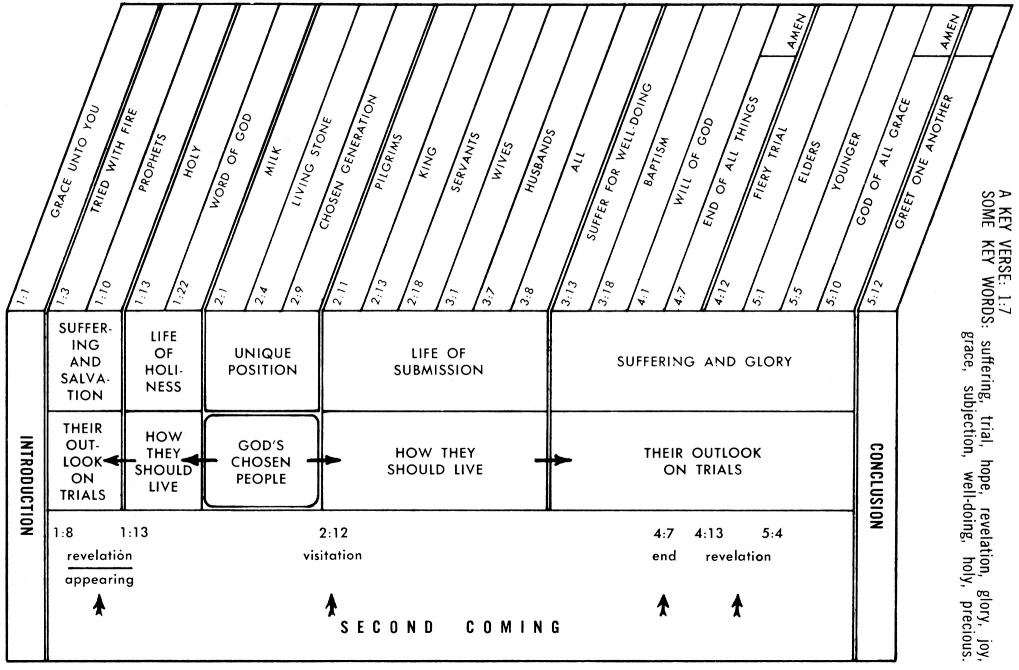
1 Peter: Trials, Holy Living & The Lord's Coming
Click chart to enlarge
Chart from Jensen's Survey of the NT - used by permission
See Another Chart from Charles Swindoll
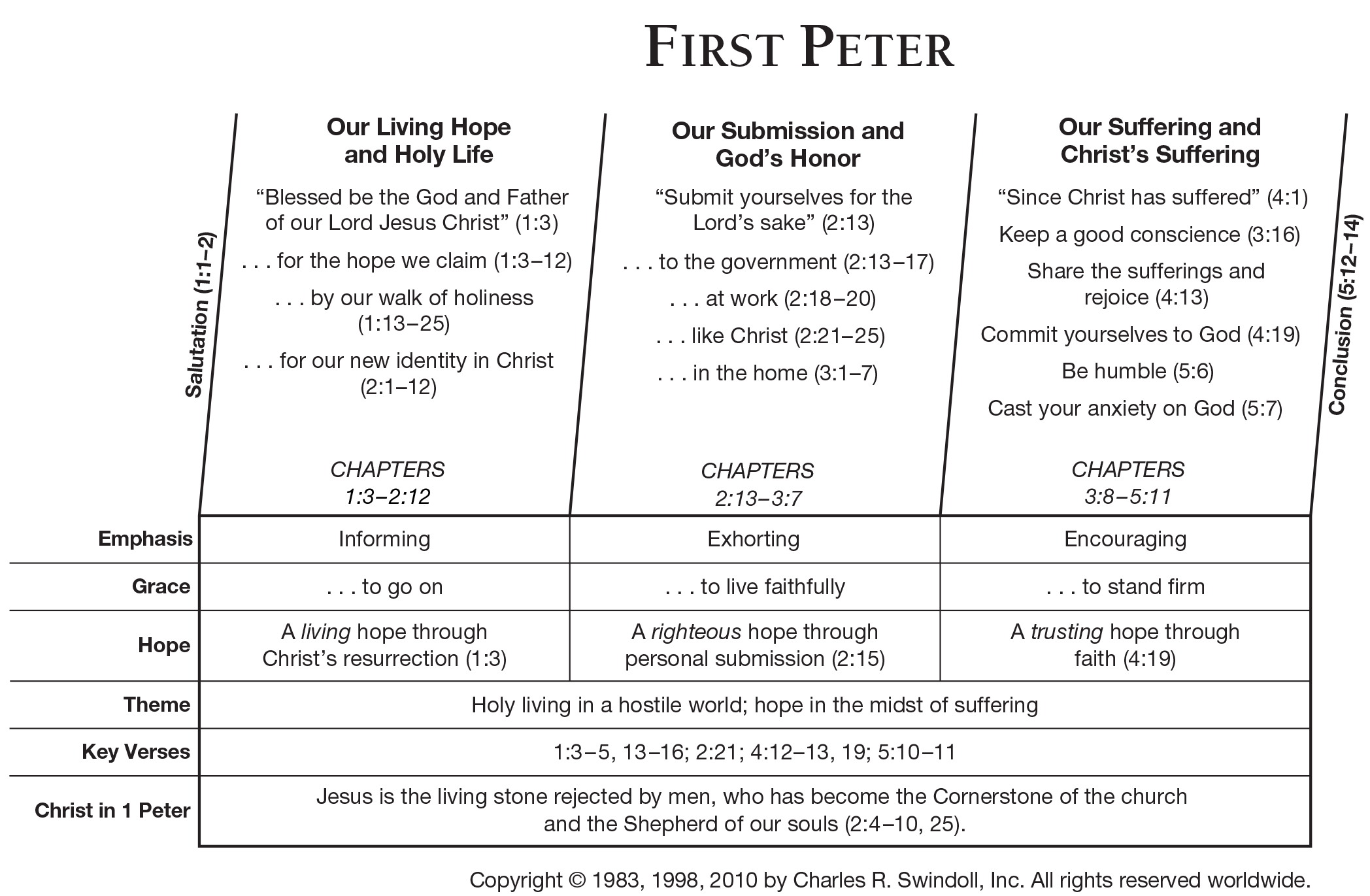
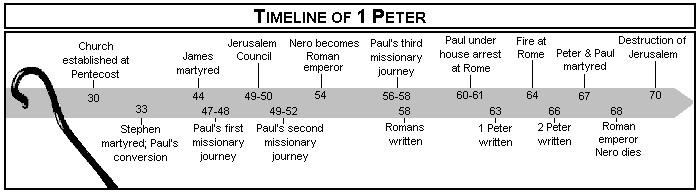
Source: Borrow Ryrie Study Bible
Click to enlarge
PART I: DOCTRINAL FOUNDATION
I. The Opening Salutation (1Pe 1:1-2)
A. The Writer (1Pe 1:1a)
B. The Readers (1Pe 1:1b-2a)
1. True character of the readers (1Pe 1:1b)
2. Geographical location of the readers (1Pe 1:1c)
3. Spiritual supports for the readers (1Pe 1:2a)
C. The Greeting (1Pe 1:2b)
II. The Thanksgiving for Our Salvation (1Pe 1:3-12)
A. The Description of Salvation (1Pe 1:3-5)
1. The author of salvation (1Pe 1:3a-b)
a. His relation to the Savior (1Pe 1:3a)
b. His act of mercy to the saved (1Pe 1:3b)
2. The nature of salvation (1Pe 1:3c-4a)
a. The living hope grounded in Christ's resurrection (1Pe 1:3c)
b. The glorious inheritance awaiting believers (1Pe 1:4a)
3. The certainty of salvation (1Pe 1:4b-5)
a. The safekeeping of the inheritance (1Pe 1:4b)
b. The preservation of the heirs (1Pe 1:5)
B. The Experiences Relating to Salvation (1Pe 1:6-9)
1. The paradoxical nature of the experiences (1Pe 1:6-7)
a. The experience of exultation (1Pe 1:6a)
b. The experience of distress (1Pe 1:66-7)
1. The nature of the distress (1Pe 1:6b)
2. The purpose behind the trials (1Pe 1:7)
a. The testing of faith (1Pe 1:7a)
b. The outcome of the testing (1Pe 1:7b)
2. The sustaining relations of believers (1Pe 1:8-9)
a. Their dual relation to Jesus Christ (1Pe 1:8)
b. Their experiential relation to their salvation (1Pe 1:9)
C. The Magnification of Salvation (1Pe 1:10-12)
1. The magnification through prophetic research (1Pe 1:10-12a)
a. Their intensive search (1Pe 1:10a)
b. Their prophetic function (1Pe 1:10b)
c. Their personal perplexity (1Pe 1:11)
1. The time and circumstances (1Pe 1:11a)
2. The sufferings and the glories (1Pe 1:11b)
d. Their restricted ministry (1Pe 1:12a)
2. The magnification through Christian proclamation (1Pe 1:12b)
3. The magnification through angelic inquiry (1Pe 1:12c)
PART 2: PRACTICAL EXHORTATION
I. Exhortations in View of Our Salvation (1Pe 1:13-2:10)
A. The Life Arising from Salvation (1Pe 1:13-2:3)
1. The Christian life in relation to God (1Pe 1:13-21)
a. A life of steadfast hope (1Pe 1:13)
1. The supports of hope (1Pe 1:13a)
2. The call to hope (1Pe 1:13b)
b. A life of personal holiness (1Pe 1:14-16)
1. The foundation for personal holiness (1Pe 1:14a)
2. The call to personal holiness (1Pe 1:14b-15)
a. The negative demand of holiness (1Pe 1:14b)
b. The positive call to holiness (1Pe 1:15)
3. The justification of the call to holiness (1Pe 1:16)
c. A life of motivated reverence (1Pe 1:17-21)
1. The basis for reverent living (1Pe 1:17a)
2. The call for reverent living (1Pe 1:17b)
3. The knowledge that motivates reverence (1Pe 1:18-21)
a. The means of our redemption (1Pe 1:18-19)
b. The nature of the Redeemer (1Pe 1:20)
c. The characteristics of the redeemed (1Pe 1:21)
2. The Christian life in relation to the brethren (1Pe 1:22-25)
a. The experience of inner purification (1Pe 1:22a)
b. The duty of mutual love (1Pe 1:22b)
c. The foundation in personal regeneration (1Pe 1:23-25)
1. The fact of their regeneration (1Pe 1:23a)
2. The nature of their regeneration (1Pe 1:23b-25a)
3. The evangelization leading to their regeneration (1Pe 1:25b) (D Edmond Hiebert)
1 Peter 1:7 so that the proof of your faith, being more precious than gold which is perishable, even though tested by fire, may be found to result in praise and glory and honor at the revelation of Jesus Christ (NASB: Lockman)
Greek: hina to dokimion humon tes pisteos polutimoteron chrusiou tou apollumenou, (PMPNSG) dia puros de dokimazomenou, (PPPNSG) eurethe (3SAPS) eis epainon kai doxan kai timen en apokalupsei Iesou Christou.
Amplified: So that [the genuineness] of your faith may be tested, [your faith] which is infinitely more precious than the perishable gold which is tested and purified by fire. [This proving of your faith is intended] to redound to [your] praise and glory and honor when Jesus Christ (the Messiah, the Anointed One) is revealed. (Amplified Bible - Lockman)
NLT: These trials will show that your faith is genuine. It is being tested as fire tests and purifies gold—though your faith is far more precious than mere gold. So when your faith remains strong through many trials, it will bring you much praise and glory and honor on the day when Jesus Christ is revealed to the whole world. (NLT - Tyndale House)
Phillips: This is no accident - it happens to prove your faith, which is infinitely more valuable than gold, and gold, as you know, even though it is ultimately perishable, must be purified by fire. This proving of your faith is planned to bring you praise and honour and glory in the day when Jesus Christ reveals himself. (Phillips: Touchstone)
Wuest: in order that the approval of your faith, which faith was examined by testing for the purpose of being approved, that approval being much more precious than the approval of gold which perishes, even though that gold be approved by fire-testing, may be discovered after scrutiny to result in praise and glory and honor at the time of the revelation of Jesus Christ (Eerdmans)
Young's Literal: that the proof of your faith -- much more precious than of gold that is perishing, and through fire being approved -- may be found to praise, and honour, and glory, in the revelation of Jesus Christ,
THAT THE PROOF OF YOUR FAITH: hina to dokimion humon tes pisteo:
- 1 Peter 4:12; Job 23:10; Ps 66:10, 11, 12; Pr 17:3; Is 48:10; Je 9:7; Zec 13:9; Mal 3:3; Ro 5:3,4; Jas 1:3,4;1:12 Rev 2:10; 3:10
- Torrey's Topic Afflictions made beneficial
- Joy Through the Fiery Trial of Genuine Faith - John Piper
- 1 Peter 1:6-9 Joy From The Pits - Steven Cole
- 1 Peter 1:6-9 The Perseverance of the Saints, Part 3 - John MacArthur
- 1 Peter 1:6-7 The Joy of Salvation, Pt 1 - John MacArthur
- 1 Peter 1:8-9 The Joy of Salvation, Pt 2 - John MacArthur
- John Piper's book - The Hidden Smile of God - The Fruit of Affliction in the Lives of John Bunyan, William Cowper, and David Brainerd
- 1 Peter 1 Resources - Multiple Sermons and Commentaries
TESTED AND PROVED
FAITH
Spurgeon - Gilt looks very much like gold but it will not stand the fire. It curls and disappears. Oh! to be solid gold through and through. If so, you need not mind the trials of to-day, since they will only prepare you for the glories eternal at the appearing of Jesus Christ. (1 Peter 1- Commentary)
Matthew Henry - Afflictions are sent for this end, to bring us to the throne of grace, to teach us to pray and to make the word of God's grace precious to us… Many are taught with the briars and thorns of affliction that would not learn otherwise.
Henry Law - This school of trial best discloses the hidden vileness of the heart and the vast riches of a Saviour's grace.
D. Martyn Lloyd-Jones- Christian people are generally at their best when they are in the furnace of affliction and being persecuted and tried… Trials and tribulations are very good for us in that they help us to know ourselves better than we knew ourselves before.
Proof(1383) (dokimon from dokimazo from dokimos = proved, tried as metals by fire and thus purified, in turn from dechomai = to accept deliberately and readily, receive) describes both the process of determining the genuineness of something (in this case of our faith) or the result, this latter specifically referring to the genuineness of something (our faith) as the result of testing.
The verb dokimazo describes putting someone or something to the test with a view of determining whether it is worthy of being approved or not, the test being made with the intention of approving if possible. Dokimazo was used of the act of examining candidates for the degree of Doctor of Medicine.
In a similar way, Thomas Manton explained that "Trial is not only to approve, but to improve."
The genuine element in the faith of Peter's readers would be proven by a process similar to that of metal refining and ultimately would be found to be something more precious than even these precious metals.
James in the only other NT use of dokimon exhorts tried saints to
Consider (A command - just try to do this NATURALLY! You can't. It can only be accomplished as you are filled with the Spirit, Who alone can enable you to make the SUPERNATURAL choice to rejoice) it all joy, my brethren, when you encounter various trials, knowing that the testing (dokimon) of your faith produces endurance." (Jas 1:2,3 - see note)
As Matthew Henry says "the faith of good people is tried, that they themselves may have the comfort of it, God the glory of it, and others the benefit of it.
J. Vernon McGee - When God tests us today, He puts us into the furnace. He doesn’t do that to destroy us or to hurt or harm us. But He wants pure gold, and that is the way He will get it. Friend, that is what develops Christian character. At the time of testing, the dross is drawn off and the precious gold appears. That is God’s method. That is God’s school. We don’t hear that teaching very much in our day. Rather, we are being taught to become sufficient within ourselves. Oh, my friend, you and I are not adequate; we are not sufficient, and we never will be. We simply come to God as sinners, and He saves us by His grace through the blood of Christ. Then He wants to live His life through us. He tries to teach us this through our trials. He is drawing us closer to Him. (McGee, J V: Thru the Bible Commentary: Thomas Nelson)
Spurgeon on the proof of your faith - “The proven character of your faith.” Let us not be mistaken: God never gave us faith to play with. Faith is a sword. But it was not made to exhibit upon a parade ground. It was meant to cut and wound and slay. Whoever has it may expect, between here and heaven, to learn what battle means. God has made nothing in vain; he especially makes nothing in the spiritual kingdom in vain. He made faith with the intent that it should be used to the utmost and exercised to the full. We must expect trial because trial is the element of faith. Faith without trial is like a diamond uncut, the brilliance of which has never been seen. A fish without water or a bird without air is faith without trial. We may surely expect that our faith will be tested.
Roger M. Raymer writes that
Knowledge alone cannot produce the great joy of experiential security and freedom from fear in the face of persecution. God’s omnipotent sovereignty needs to be coupled with human responsibility. Christians are responsible to respond in faith. Faith turns sound doctrine into sound practice. Faith acts on the content of theology and produces conduct that corresponds to that content. Faith makes theological security experiential. The Apostle John wrote, “This is the victory that has overcome the world, even our faith” (1Jn 5:4). This kind of faith or living hope can enable believers to rejoice even when they are called on to suffer grief. (Walvoord, J. F., Zuck, R. B., et al: The Bible Knowledge Commentary. 1985. Victor)
Thomas Watson…
Faith is a furnace grace. 'Though it is tried with fire, it is found unto praise and honor' (1 Peter 1:7). Faith, like Hercules' club, beats down all oppositions. By faith we resist the devil (1Peter 5:9). By faith we resist unto blood (He 11:34). (Beatitudes)
Genuine faith is indestructible. Job suffered more intense "multi colored trials" in one day than probably any other individual in history and yet he was able to say
Though He slay me, I will hope (wait for) in Him." (Job 13:15)
Comment: The Hebrew verb for hope is yachal has the idea of tarrying, and here pictures Job as a man who exhibits a confident expectation or trust in God. To be certain, Job longs to understand why God is allowing him to suffer so, but he will not waver in unbelief but instead he resolutely holds fast to his faith, even it he must die in doing so. (cp martyrs below). This is the ultimate mark of a genuine believer… one who holds fast his confidence until the end (cp Heb 3:6, 14, 10:35,36, Mt 24:13, 10:22, Lk 8:15, 2Jn 9 1Co 15:2, 2Ti2:12, Col1:23)
A weak faith may appear to be strong when friends are true, the body is healthy, and the business is profitable. But a truly strong faith clings to the Lord's promises and relies on His faithfulness when loved ones leave, health departs, and dark clouds obscure the future.
Evangelist D. L. Moody once said, "Trust in yourself and you are doomed to disappointment; trust in your friends, and they will die and leave you; but trust in God, and you will never be confounded in time or eternity." Trials are the soil in which faith can flourish.
It is estimated that more than 50 million Christians died for their faith in the Dark Ages. It is estimated that a million Christians died for their faith when the Communists seized China. Unnumbered thousands died as martyrs in the revolutions and civil wars in Africa.
The following are from unknown sources…
Polycarp, venerable bishop of Smyrna was a personal friend and pupil of John the Apostle. When he was age 86, he was urged by the Roman proconsul to reproach Christ and be set free. “Eighty and six years have I served Him and He never did me any injury. How then can I blaspheme my King and my Saviour?” The proconsul said: “I have respect for your age. Simply say, “Away with the Atheists” and be set free.” Polycarp solemnly said, “Away with the Atheists”—pointing to the pagan crowd. He joyfully went to the stake, thanking God for counting him worthy to be numbered among the martyrs.
John Huss, the courageous pastor of Prague, was arrested, condemned, and sentenced to be burned by a church council in 1415. When Huss heard his sentence pronounced, he fell to his knees and prayed, “Lord Jesus, forgive my enemies.” Then when he was chained to the stake, he prayed, “In Thee, O Lord, do I put my TRUST; let me never be ashamed.” Then flames snuffed out the life of “The Morning Star of the Reformation.”
On July 1st, 1555, John Bradford was burned to death. He was chaplain to King Edward Sixth of England, and was one of the most popular preachers of his day. But he was a martyr to his faith. As he was being driven out to Newgate to be burned, permission was given him to speak, and from the wagon in which he rode to his death the entire way out from West London to Newgate he shouted: “Christ, Christ, none but Christ!”
Having been banished, Cyprian suffered martyrdom in Carthage in 258. When the sentence of death was read to him he said, “I heartily thank Almighty God who is pleased to set me free from the chains of the body.”
More Last Words Of Martyrs
Henry Vos—“If I had twin heads, they should all be off for Christ.”
Castilla Rupea—“Though you throw my body down off this steep hill, yet will my soul mount upwards again.”
John Buisson—“I shall have a double jail delivery: out of my sinful flesh and out of the loathsome dungeon I have long lain in.”
Taylor—“Now lack I but two steps, and I am even at my Father’s house.”
Carpenter—“All Bavaria is not as dear to me as my wife and children, but, for Christ’s sake, I gladly forsake them.”
During the terrible Boxer Rebellion in China the insurgents captured a mission station, blocked all the gates but one, and before this placed a cross flat on the ground. Then the word was passed to those inside that any who trampled the cross underfoot (cp He 10:29) would be permitted their freedom and life, but that any refusing would be shot to death. Terribly frightened, the first seven students trampled the cross under their feet and were allowed to go free. But the eighth student, a young girl, refused to commit the sacrilegious act. Kneeling beside the cross in prayer for strength, she arose, and moved carefully around the cross and went out to face the firing squad. Strengthened by her example, every one of the remaining ninety-two students followed her to death.
Forty Wrestlers For Christ - In the days of the Roman Emperor Nero, there lived and served him a band of soldiers known as the “Emperor’s Wrestlers.” Fine, stalwart men they were, picked from the best and the bravest of the land, recruited from the great athletes of the Roman amphitheater.
In the great amphitheater they upheld the arms of the emperor against all challengers. Before each contest they stood before the emperor’s throne. Then through the courts of Rome rang the cry: “We, the wrestlers, wrestling for thee, O Emperor, to win for thee the victory and from thee, the victor’s crown.”
When the great Roman army was sent to fight in far-away Gaul, no soldiers were braver or more loyal than this band of wrestlers led by their centurion Vespasian. But news reached Nero that many Roman soldiers had accepted the Christian faith. Therefore, this decree was dispatched to the centurion Vespasian: “If there be any among your soldiers who cling to the faith of the Christian, they must die!”
The decree was received in the dead of winter. The soldiers were camped on the shore of a frozen inland lake. It was with sinking heart that Vespasian, the centurion, read the emperor’s message.
Vespasian called the soldiers together and asked the question: “Are there any among you who cling to the faith of the Christian? If so, let him step forward!” Forty wrestlers instantly stepped forward two paces, respectfully saluted, and stood at attention. Vespasian paused. He had not expected so many, nor such select ones. “Until sundown I shall await your answer,” said Vespasian. Sundown came. Again the question was asked. Again the forty wrestlers stepped forward.
Vespasian pleaded with them long and earnestly without prevailing upon a single man to deny his Lord. Finally he said, “The decree of the emperor must be obeyed, but I am not willing that your comrades should shed your blood. I am going to order that you march out upon the lake of ice, and I shall leave you there to the mercy of the elements.”
The forty wrestlers were stripped and then, falling into columns of four, marched toward the center of the lake of ice. As they marched they broke into the chant of the arena: “Forty wrestlers, wrestling for Thee, O Christ, to win for Thee the victory and from Thee, the victor’s crown!” Through the long hours of the night Vespasian stood by his campfire and watched. As he waited through the long night, there came to him fainter and fainter the wrestlers’ song.
As morning drew near one figure, overcome by exposure, crept quietly toward the fire; in the extremity of his suffering he had renounced his Lord. Faintly but clearly from the darkness came the song: “Thirty-nine wrestlers, wrestling for Thee, O Christ, to win for Thee the victory and from Thee, the victor’s crown!”
Vespasian looked at the figure drawing close to the fire. Perhaps he saw eternal light shining there toward the center of the lake. Who can say? But off came his helmet and clothing, and he sprang upon the ice, crying, “Forty wrestlers, wrestling for Thee, O Christ, to win for Thee the victory” and from Thee, the victor’s crown! (Source Unknown)
The Builder Of Coliseum - Years ago, a Roman emperor said to a Greek architect: “Build me a Coliseum, and when it is done, I will crown you, and I will make your name famous through all the world.” The work was done. The emperor said: “Now, we will crown that architect. We will have a grand celebration.”
The Coliseum was crowded with a great host. The emperor was there and the Greek architect, who was to be crowned for putting up this building. And they brought out some Christians, who were ready to die for the truth and from the doors underneath were let out the hungry lions.
The emperor arose amid the shouting assemblage and said: “The Coliseum is done, and we have Christians at the mouth of these lions, and we have come here to honour the architect who has constructed this wonderful building. The time has come for me to honour him, and we further celebrate his triumph by the slaying of these Christians.” Whereupon, the Greek architect sprang to his feet and shouted: “I also am a Christian.” And they flung him to the wild beasts, and his body, bleeding and dead, was trumpled into the dust of the amphitheatre.
Last Martyr Of Coliseum - After three centuries, notwithstanding the spread of Christianity, gladiatorial combats continued to be the favorite pastime of a large proportion of the Roman citizens. Constantine prohibited them. The populace persisted. To avoid an insurrection they were allowed to have their will. Honorious re-enacted the prohibition. It was also in vain.
One day, as the gladiatorial fight was about to commence, Telemachus rushed down into the arena and separated the combatants. Then the spectators, indignant at this interruption, tore up the marble benches and hurled them down upon him “from the amphitheatre, which seemed crowded with so many demons raging for human blood.” But on his death the benevolent monk Telemachus was victorious—rage yielded to admiration—and gladiatorial combats ceased for ever. He became the last martyr of the Coliseum. (Source Unknown)
"Though He slay me, I will trust Him,"
Said the sainted Job of old;
"Though He try me in the furnace,
I shall then come forth as gold."Though the 'worms of deep affliction'
Cause this body to decay,
In my flesh I shall behold Him--
My Redeemer--some glad day.""Though He slay me"--can I say it
When I feel the searing fire,
When my fondest dreams lie shattered--
Gone my hope and fond desire?"Though He slay me, I will trust Him,"
For He knows just how to mold,
How to melt and shape my spirit--
I shall then come forth as gold!
-Mary Kimbrough
Wiersbe comments that "Job 13:15 is one of the greatest declarations of faith found anywhere in Scripture, but it must be understood in its context. Job is saying, “I will take my case directly to God and prove my integrity. I know I am taking my life in my hands in approaching God, because He is able to slay me. But if He doesn’t slay me, it is proof that I am not the hypocrite you say I am." (Be patient. An Old Testament study)
Later Job declared "He (God) knows the way I take. When He has tried me, I shall come forth as gold." (Job 23:10)
God knew that Job was in the furnace of affliction, but it was a furnace of God’s appointment and was not because of Job’s sin. Furthermore, God would use Job’s affliction to purify him and make him a better man. This is not the only answer to the frequently asked question, “Why do the righteous suffer?” but it is one of the best, and it can bring the sufferer great encouragement.
Warren Wiersbe aptly describes the process of divine testing writing that
When God puts His own people into the furnace, He keeps His eye on the clock and His hand on the thermostat. He knows how long and how much. (If we rebel, He may have to reset the clock; but if we submit, He will not permit us to suffer one minute too long. The important thing is that we learn the lesson He wants to teach us and that we bring glory to Him alone.) We may question why He does it to begin with, or why He doesn’t turn down the heat or even turn it off; but our questions are only evidences of unbelief. (Job 23:10) is the answer: “But He knows the way that I take; when He has tested me, I shall come come forth as gold” (NKJV). Gold does not fear the fire. The furnace can only make the gold purer and brighter." (Ibid)
Shadrach, Meshach and Abed-nego were literally tested by an "extremely hot… furnace of blazing fire". The Babylonian furnace proved their faith to be real and burned away the ropes that held them, setting them free. King Nebuchadnezzar in utter astonishment observed
"four men loosed & walking about in the midst of the fire without harm & the appearance of the fourth is like a son of the gods". In their "multi colored fiery trial", they also came to experience the companionship of a fourth Person in the fire Who many consider to be “the Son of God” Who provided just the right "color" of grace to meet their need. (Read Da 3:12-30, see especially their bold faithful testimony in Da 3:15, 16, 17, 18)
A dark hour makes Jesus bright.
--Robert Murray M'Cheyne
Gold is tested by fire
Man is tested by adversity
(See Our Daily Bread)
Related Resources:
- What does the Bible say about affliction?
- Is it sometimes God's will for believers to be sick?
- Why does God allow bad things to happen to good people?
- Afflictions made beneficial - Torrey's Topic
- Afflicted Saints - Torrey's Topic
- Afflicted, Duty Toward The - Torrey's Topic
- Affliction, Consolation Under - Torrey's Topic
- Affliction, Prayer Under - Torrey's Topic
- Afflictions - Torrey's Topic
- Afflictions of the Wicked, the - Torrey's Topic
- Afflictions and Adversities - Nave's Topical Bible
- Baker Evangelical Dictionary Affliction
- Charles Buck Dictionary Affliction
- Easton's Bible Dictionary Afflictions
- Holman Bible Dictionary Affliction
- Hastings' Dictionary of the NT Affliction Affliction (2)
- Vines' Expository Dictionary Afflict, Affliction
- Webster Dictionary Affliction
- International Standard Bible Encyclopedia Affliction
- International Standard Bible Encyclopedia Suffering
- Nave Topical Bible Suffering
- The Topic Concordance Suffering
- Holman Bible Dictionary Suffering
- Hastings' Dictionary of the NT Suffering Suffering (2)
- Vines' Expository Dictionary Suffering
F. B. Meyer (Our Daily Walk, Feb 21) comments on on 1 Peter 1:7 in his devotional entitled The Refiner's Fire…
NOTHING IS harder to bear than the apparent aimlessness of suffering.
They say that what breaks a convict's heart in gaol (Ed note: a prison) is to set him to say carry stones from one side of the prison to the other, and then back again!
But we must never look upon the trials of life as punishments, because all penalty was borne by our Lord Himself.
They are intended to destroy the weeds and rubbish of our natures, as the bonfires do in the gardens. Christ regards us in the light of our eternal interests, of which He alone can judge. If you and I knew what sphere we were to fulfill in the other world, we should understand the significance of His dealings with us, as now we cannot do.
The Refiner has a purpose in view, of which those who stand beside Him are ignorant, and, therefore, they are unable to judge the process which He is employing.
Dare to believe that Christ is working to a plan in your life. He loves you. Be patient! He would not take so much trouble unless He knew that it was worth while.
"We do not prune brambles,
or cast common stones into the crucible
or plough sea-sands!"
You must be capable of some special service, which can only be done by a carefully-prepared instrument, and so Christ sits beside you as the Refiner, year after year, that you may miss nothing. Whilst the Fire is hot keep conversing with the Refiner. Ponder these words: "He shall sit as a Refiner and Purifier of silver." (Malachi 3:3) The thought is specially suitable for those who cannot make long prayers, but they can talk to Christ as He sits beside them. Nicholas Hermann tells us that, as he could not concentrate his mind on prolonged prayer, he gave up set times of prayer and sought constant conversations with Christ. So speak with Him, then, in the midst of your daily toil. He hears the unspoken prayer, and catches your whispers. Talk to Christ about your trials, sorrows, and anxieties! Make Him your Confidant in your joy and happiness! Nothing makes Him so real as to talk to Him aloud about everything! PRAYER: Let the Fire of Thy Love consume in me all sinful desires of the flesh and of the mind, that I may henceforth continually abide in Jesus Christ my Lord, and seek the things where He sits at Thy right hand. AMEN."
From Moody's Today in the Word -
Trials have an uncanny way of revealing what's inside a person. Consider the behavior of some passengers aboard the doomed luxury liner Titanic. As the great ship was sinking and the few lifeboats were being filled, the command on deck was ""women and children first."" According to one survivor, most of the men and older boys obeyed the order. But some men ran back to the ship's staterooms and changed into women's clothing in an effort to gain a seat on a lifeboat. The crisis brought out the worst in these men. What about us? When God sends trials our way, do we respond in fear or in faith?" (Excerpt from Today in the Word)
GOD MOVES IN A MYSTERIOUS WAY
by William Cowper
(Piper's discussion of his life)
God moves in a mysterious way
His wonders to perform;
He plants His footsteps in the sea
And rides upon the storm.Deep in unfathomable mines
Of never failing skill
He treasures up His bright designs
And works His sovereign will.Ye fearful saints, fresh courage take;
The clouds ye so much dread
Are big with mercy and shall break
In blessings on your head.Judge not the Lord by feeble sense,
But trust Him for His grace;
Behind a frowning providence
He hides a smiling face.His purposes will ripen fast,
Unfolding every hour;
The bud may have a bitter taste,
But sweet will be the flower.Blind unbelief is sure to err
And scan His work in vain;
God is His own interpreter,
And He will make it plain.
MORE PRECIOUS THAN GOLD WHICH IS PERISHABLE: polutimoteron chrusiou tou apollumenou (PMPNSG):
- 1 Peter 1:6-9 Joy From The Pits - Steven Cole
- 1 Peter 1:6-9 The Perseverance of the Saints, Part 3 - John MacArthur
- 1 Peter 1:6-7 The Joy of Salvation, Pt 1 - John MacArthur
- 1 Peter 1:8-9 The Joy of Salvation, Pt 2 - John MacArthur
- 1 Peter 1 Resources - Multiple Sermons and Commentaries
Precious (4186) (polytimos from polus = much, great + time = price, honor) literally means "of great price", as that which is very high on a monetary scale and thus very precious or far more valuable and much revered. It is a word some might think would more likely be used by ladies, but Peter is very fond of "precious" using it some 7 times (not all are "polytimos") in both his epistles (Click for all NT uses of "precious" by Peter and one by James).
Polytimos is used 3 times in the NT: (1x Mt;1x Jn;1x1 P)
Jesus used polytimos describing the "the kingdom of heaven" which He declared
is like a merchant seeking fine pearls, and upon finding one pearl of great value, he went and sold all that he had, and bought it. (Mt 13:45-46)
Jesus pictures salvation as something hidden from most people but so very precious that people who have it revealed to them are willing to give up all they have to possess it. How "precious" is genuine faith to the great Refiner's eye!
In describing Mary's (the "Mary" of "Martha and Mary" see Lu 10:39ff) act of love and deep devotion, John records that she
"therefore took a pound of very costly (polytimos) perfume of pure nard and anointed the feet of Jesus and wiped His feet with her hair and the house was filled with the fragrance of the perfume." (Jn 12:3)
Raymer writes that "Even refined gold, though it lasts a long time, eventually perishes (see note 1 Peter 1:18; Js 5:3). It will be valueless in the marketplace of eternity. But faith “purchases” an inheritance that can never perish." (Walvoord, J. F., Zuck, R. B., et al: The Bible Knowledge Commentary. 1985. Victor)
John echoes this truth about gold and other things the world holds precious, declaring that
the world is passing away and also its lusts" (1John 2:17)
Matthew Henry - Gold is the most valuable, pure, useful, and durable, of all the metals; so is faith among the Christian virtues; it lasts till it brings the soul to heaven, and then it issues in the glorious fruition of God for ever. The trial of faith is much more precious than the trial of gold; in both there is a purification, a separation of the dross, and a discovery of the soundness and goodness of the things. Gold does not increase and multiply by trial in the fire, it rather grows less; but faith is established, improved, and multiplied, by the oppositions and afflictions that it meets with.
It is not the approved faith, but the approval itself that is in the apostle’s mind here. To illustrate this distinction imagine a gold-mining company wishes to buy a proposed site where gold is said to have been found. But it is not sure whether the metal is real gold or not and whether it is there in sufficient quantity so that a mine if sunk would be a profitable venture. It engages an assayer of metals to take samples of the gold ore to his laboratory and examine them. The assayer sends his report to the effect that the ore contains true gold, and that the gold is found in sufficient quantity so that the venture will pay. The report of the assayer approving the gold ore is of far more value to the mining company than the gold he returns with his report, for upon the basis of the report, the company can go ahead with assurance and buy the land and begin mining operations. The fact that God finds our faith to be one which He can approve, is of far more value to Him and to His glory, than the approved faith, for He has something to work with, a faith that He knows can stand the testing and the trials which may come to the Christian. The fact that God can trust a Christian as one that is dependable, is of great value to Him, God is looking for faithful, dependable workers, not necessarily gifted, educated, cultured ones. It is a “well done, thou good and faithful servant” that will greet the ears of the saint at the Judgment Seat of Christ.
Why compare our faith to gold? - In the ancient world gold was considered the most expensive & rarest of all metals. It was used in the worship of the gods, and was very prominent in the temple of Jerusalem, where the true God was worshipped. Emperors & heroes were know for their lavish use of gold. Under Augustus and Nero the price of the Roman gold coin, the aureus, was worth 45 denarii (a Roman soldier got 225 denarii a year and one denarius was considered to be a day's wage. All of this indicates that a tried, genuine faith is extremely valuable! The known quantity in this statement is the preciousness of gold -- a genuine faith is much more precious than that. (Reinecker & Rogers page 567)
EVEN THOUGH TESTED (and found approved) BY FIRE: dia puros de dokimazomenou (PPPNSG) :
- Behind a Frowning Providence - Why Christians Suffer by John A Murray
- See also Afflictions-Suffering-Quotes, Devotionals, Illustrations
- 1 Peter 1 Resources - Multiple Sermons and Commentaries
- 1 Peter 1:6-9 Joy From The Pits - Steven Cole
- 1 Peter 1:6-9 The Perseverance of the Saints, Part 3 - John MacArthur
- 1 Peter 1:6-7 The Joy of Salvation, Pt 1 - John MacArthur
- 1 Peter 1:8-9 The Joy of Salvation, Pt 2 - John MacArthur
Pithy quotes and sayings relating to adversities and trials…
God will not permit any troubles to come upon us, unless He has a specific plan by which great blessing can come out of the difficulty. -- Peter Marshall
Afflictions are but the shadow of God's wings. -- George MacDonald
Fire is the test of gold, adversity of strong men.
Our great Teacher writes many a bright lesson on the blackboard of affliction.
As in nature and in the arts, so in grace: it is rough treatment that gives souls, as well as stones, their luster. The more the diamond is cut, the brighter it sparkles, and in what seems hard dealings God has no end in view but to perfect our graces. -- Thomas Guthrie
When I am in the cellar of affliction, I look for the Lord’s choicest wines. -- Samuel Rutherford
If God has made your cup sweet, drink it with grace. If he has made it bitter; drink it in communion with him. -- Oswald Chambers
Some hearts, like evening primroses, open more beautifully in the shadows of life.
Affliction is the school of faith and trial is the school of trust.
The Lord gets his best soldiers out of the highlands of affliction. -- C H Spurgeon
Stars may be seen from the bottom of a deep well, when they cannot be discerned from the top of a mountain. So are many things learned in adversity which the prosperous man dreams not of. --C. H. Spurgeon
Nothing can render affliction so insupportable as the load of sin. Would you then be fitted for afflictions? Be sure to get the burden of your sins laid aside, and then what affliction soever you may meet with will be very easy to you. -- John Bunyan.
It takes the grindstone to sharpen the axe. -- Vance Havner
Can we think it pleases His loving heart
To cause us a moment’s pain?
Ah, no, but He sees through the present cross
The bliss of eternal gain.
So He waited there with a watchful eye
With a love that is strong and sure,
And His gold did not suffer a bit more heat
Than was needed to make it pure.
Tested (1381) (dokimazo from dokimos = tested, proved or approved, tried as metals by fire and thus purified from dechomai = to accept, receive) means to assay, to test, to prove, to put to the test, to make a trial of, to verify, to discern to approve. Dokimazo involves not only testing but determining the genuineness or value of an event or object. That which has been tested is demonstrated to be genuine and trustworthy.
Dokimazo is used 22 in the NT…
Luke 12:56 "You hypocrites! You know how to analyze the appearance of the earth and the sky, but why do you not analyze this present time?
Luke 14:19 "And another one said, 'I have bought five yoke of oxen, and I am going to try them out; please consider me excused.'
Romans 1:28 (note) And just as they did not see fit to acknowledge God any longer, God gave them over to a depraved mind, to do those things which are not proper, (Literally = And, according as they did not approve [dokimazo] of having God in knowledge, God gave them up to a disapproved mind, to do the things not seemly)
Romans 2:18 (note) and know His will, and approve the things that are essential, being instructed out of the Law,
Romans 12:2 (note) And do not be conformed to this world, but be transformed by the renewing of your mind, that you may prove what the will of God is, that which is good and acceptable and perfect.
Romans 14:22 (note) The faith which you have, have as your own conviction before God. Happy is he who does not condemn himself in what he approves.
1 Corinthians 3:13 each man's work will become evident; for the day will show it, because it is to be revealed with fire; and the fire itself will test the quality of each man's work.
1 Corinthians 11:28 But let a man examine himself, and so let him eat of the bread and drink of the cup.
1 Corinthians 16:3 And when I arrive, whomever you may approve, I shall send them with letters to carry your gift to Jerusalem;
2 Corinthians 8:8 I am not speaking this as a command, but as proving through the earnestness of others the sincerity of your love also.
2 Corinthians 8:22 And we have sent with them our brother, whom we have often tested and found diligent in many things, but now even more diligent, because of his great confidence in you.
2 Corinthians 13:5 Test (peirazo - present imperative) yourselves to see if you are in the faith; examine (dokimazo - present imperative) yourselves! Or do you not recognize this about yourselves, that Jesus Christ is in you-- unless indeed you fail the test?
Galatians 6:4 But let each one examine his own work, and then he will have reason for boasting in regard to himself alone, and not in regard to another.
Ephesians 5:10 (note) trying to learn what is pleasing to the Lord.
Philippians 1:10 (note) so that you may approve the things that are excellent, in order to be sincere and blameless until the day of Christ;
1 Thessalonians 2:4 (note) but just as we have been approved by God to be entrusted with the gospel, so we speak, not as pleasing men but God, who examines our hearts.
1 Thessalonians 5:21 (note) But examine everything carefully; hold fast to that which is good;
1 Timothy 3:10 And let these also first be tested; then let them serve as deacons if they are beyond reproach.
1 Peter 1:7 (note) that the proof of your faith, being more precious than gold which is perishable, even though tested by fire, may be found to result in praise and glory and honor at the revelation of Jesus Christ;
1 John 4:1 Beloved, do not believe every spirit, but test (dokimazo - present imperative) the spirits to see whether they are from God; because many false prophets have gone out into the world.
Dokimazo is used 18 times in the non-apocryphal Septuagint (LXX) (Job 34:3; Ps 17:3; 26:2; 66:10; 68:30; 81:7; 95:9; 139:1, 23; Pr 8:10; 17:3; 27:21; Jer 6:27; 9:7; 11:20; 12:3; 17:10; 20:12; Zech 11:13; 13:9). Here is an interesting use…
Psalm 26:2 (David's incredible plea to God) Examine (Lxx = dokimazo = present imperative) me, O LORD, and try (Lxx = peirazo = present imperative) me; Test (Lxx = puroo [heating precious metals red hot in order to refine them] = aorist imperative) my mind and my heart. (Ed: Do we dare pray this prayer? Considering the gold that comes from the furnace of affliction, do we dare not?)
Spurgeon comments on this Psalm:
There are three modes of trial here challenged, which are said in the original to refer to trial by touch, trial by smell, and trial by fire. The psalmist was so clear from the charge laid against him, that he submitted himself unconditionally to any form of examination which the Lord might see fit to employ. Examine me, O Lord. Look me through and through; make a minute survey; put me to the question, cross examine my evidence. And prove me. Put me again to trial; and see if I would follow such wicked designs as my enemies impute to me. Try my reins and my heart. Assay me as metals are assayed in the furnace, and do this to my most secret parts, where my affections hold their court; see, O God, whether or no I love murder, and treason, and deceit. All this is a very bold appeal, and made by a man like David, who feared the Lord exceedingly, it manifests a most solemn and complete conviction of innocence. The expressions here used should teach us the thoroughness of the divine judgment, and the necessity of being in all things profoundly sincere, lest we be found wanting at the last. Our enemies are severe with us with the severity of spite, and this a brave man endures without fear; but God's severity is that of unswerving right. Who shall stand against such a trial? The sweet singer says "Who can stand before his cold?" and we may well enquire, "Who can stand before the heat of his justice?"
These words are designed to include all the modes in which the reality of anything is tested; and they imply together that he wished the most thorough investigation to be made; he did not shrink from any test. Albert Barnes.
As gold, by fire, is severed and parted from dross, so singleness of heart and true Christian simplicity is best seen and made most evident in troubles and afflictions. In prosperity every man will seem godly, but afflictions do draw out of the heart whatsoever is there, whether it be good or bad. Robert Cawdray.
When your life is whole before God and others, when you're practicing integrity, when you have a good conscience, you don't have to be afraid of the battle or the furnace or the X ray or the testing. God will see you through. When you walk with integrity, you walk on solid ground. Never try to serve two masters. Always keep your heart undivided before the Lord -- Warren Wiersbe. Prayer, Praise and Promises
Psalm 66:10 For Thou hast tried (Lxx = dokimazo) us, O God; Thou hast refined (Lxx = puroo = heating precious metals red hot in order to refine) us as silver is refined.
Spurgeon comments on this Psalm:
For thou, O God, hast proved us. He proved his Israel with sore trials. David had his temptations. All the saints must go to the proving house; God had one Son without sin, but he never had a son without trial. Why ought we to complain if we are subjected to the rule which is common to all the family, and from which so much benefit has flowed to them? The Lord Himself proves us, who then shall raise a question as to the wisdom and the love which are displayed in the operation? The day may come when, as in this case, we shall make hymns out of our griefs, and sing all the more sweetly because our mouths have been purified with bitter draughts.
Thou hast tried us, as silver is tried. Searching and repeated, severe and thorough, has been the test; the same result has followed us as in the case of precious metal, for the dross and tin have been consumed, and the pure ore has been discovered. Since trial is sanctified to so desirable an end, ought we not to submit to it with abounding resignation
Spurgeon adds another note: Convinced from the frequent use of this illustration, that there was something more than usually instructive in the process of assaying and purifying silver, I have collected some few facts upon the subject.
The hackneyed story of the refiner seeing his image in the molten silver while in the fire, has so charmed most of us, that we have not looked further; yet, with more careful study, much could be brought out. To assay silver requires great personal care in the operator.
"The principle of assaying gold and silver is very simple theoretically, but in practice great experience is necessary to insure accuracy; and there is no branch of business which demands more personal and undivided attention. The result is liable to the influence of so many contingencies, that no assayer who regards his reputation will delegate the principal process to one not equally skilled with himself. Besides the result ascertainable by weight, there are allowances and compensations to be made, which are known only to an experienced assayer, and if these were disregarded, as might be the case with the mere novice, the report would be wide from the truth." (Encyclopaedia Britannica.)
Pagnini's version reads: "Thou hast melted us by blowing upon us," and in the monuments of Egypt, artificers are seen with the blowpipe operating with small fire places, with cheeks to confine and reflect the heat; the worker evidently paying personal attention, which is evident also in Malachi 3:3,, "He shall sit as a refiner and purifier of silver."
To assay silver requires a skillfully constructed furnace. The description of this furnace would only weary the reader, but it is evidently a work of art in itself.
Even the trial of our faith is much more precious than that of gold which perisheth. He has refined us, but not with silver, he would not trust us there, the furnace of affliction is far more skillfully arranged than that. To assay silver the heat must be nicely regulated.
"During the operation, the assayer's attention should be directed to the heat of the furnace, which must be neither too hot nor too cold: if too hot, minute portions of silver will be carried off with the lead, and so vitiate the assay; moreover, the pores of the cupel (Ed: a small shallow porous cup especially of bone ash used in assaying to separate precious metals from lead) being more open, greater absorption will ensue, and there is liability to loss from that cause. One indication of an excess of heat in the furnace, is the rapid and perpendicular rising of the fumes to the ceiling of the muffle, the mode of checking and controlling which has been pointed out in the description of the improved furnace. When the fumes are observed to fall to the bottom of the muffle, the furnace is then too cold; and if left unaltered, it will be found that the cupellation has been imperfectly performed, and the silver will not have entirely freed itself from the base metals. (Encyclopaedia Britannica.)
The assayer repeats his trying process. Usually two or more trials of the same piece are made, so that great accuracy may be secured. Seven times silver is said to be purified, and the saints through varied trials reach the promised rest. C. H. S.
WW: The reason God tries us and tests us is to prove us. He's proving nothing to Himself. He knows us from top to bottom. Instead, He's proving something to us. God considers us as valuable as silver, and He puts us into situations that test and strengthen us. -- Warren Wiersbe. Prayer, Praise and Promises
Psalm 139:23 Search (Lxx = dokimazo = aorist imperative) me, O God, and know (Lxx = ginosko [know intimately, experientially] = aorist imperative) my heart; Try (Lxx = hetazo [examine, test, afflict] = aorist imperative) me and know (Lxx = ginosko [know intimately, experientially] = aorist imperative) my anxious thoughts;
Spurgeon comments on this Psalm:
Search me, O God, and know my heart. David is no accomplice with traitors. He has disowned them in set form, and now he appeals to God that he does not harbour a trace of fellowship with them. He will have God himself search him, and search him thoroughly, till every point of his being is known, and read, and understood; for he is sure that even by such an investigation there will be found in him no complicity with wicked men. He challenges the fullest investigation, the innermost search: he had need be a true man who can put himself deliberately into such a crucible. Yet we may each one desire such searching; for it would be a terrible calamity to us for sin to remain in our hearts unknown and undiscovered.
Try me, and know my thoughts. Exercise any and every test upon me. By fire and by water let me be examined. Read not alone the desires of my heart, but the fugitive thoughts of my head. Know with all penetrating knowledge all that is or has been in the chambers of my mind. What a mercy that there is one being who can know us to perfection! He is intimately at home with us. He is graciously inclined towards us, and is willing to bend His omniscience to serve the end of our sanctification. Let us pray as David did, and let us be as honest as he. We cannot hide our sin: salvation lies the other way, in a plain discovery of evil, and an effectual severance from it.
Dokimazo was used in classic Greek to describe the assaying of precious metals (especially gold or silver coins), usually by fire, to prove the whether they were authentic and whether they measured up to the stated worth. That which endures the test was called dokimos and that which fails is called adokimos.
Dokimazo means to put to the test for the purpose of approving, and finding that the person tested meets the specifications prescribed, to put one’s approval upon him. For example Paul writes that unregenerate mankind
did not approve (dokimazo) of having God in knowledge, God gave them up to a disapproved mind, to do the things not seemly. (Young's literal translation see note Romans 1:28)
In this incredible verse in Romans 1, fallen men presumptuously put God to the test for the purpose of approving Him to see He if He would meet the specifications which they laid down for a God Who would be to their liking! But sinful man did not stop there, for finding that He did not meet their specifications, they refused to approve (dokimazo) Him as the God to be worshipped or to be kept in its knowledge! They tested the infinitely precious God as they would a mere coin, and chose to turn aside from Him!
Dokimazo means to make a critical examination of something to determine its genuineness. Dokimazo was used in a manuscript of 140AD which contains a plea for the exemption of physicians, and especially of those who have passed the examination (dokimazo). Dokimazo was thus used as a technical expression referring to the action of an examining board putting its approval upon those who had successfully passed the examinations for the degree of Doctor of Medicine. Dokimazo was also used to describe the passing of a candidate as fit for election to public office.
Richison adds that…
Greek literature used the word “test” for examining candidates for a medical doctorate. Candidates for a medical doctorate must be tested. It is crucial to find out if they are the genuine thing. We do not want an incompetent surgeon operating on us. When doctors prove genuine by examining, they meet the attestation.
It is obvious that God wants to discover what constitutes our character. Character is best ascertained when we are placed under duress. God will detect our weakness and strength by giving us an exam. It will be a difficult exam. Get out your blue books. God is about to find out the genuineness of your faith!
God refines our faith by trial. When it comes to trials, everyone is in one of these three stages: They are experiencing a trial, coming out of a trial or about to go into a trial!
In the Detroit, Mich., area there are proving grounds for automobiles. The purpose of these proving grounds is to test the mechanical soundness of cars before they are out on the market. Test drivers run these cars for days without turning off the motor. The cars are put through bumps, curves, water, hills and many more obstacles for long periods of time. The manufacturing companies want to know whether the shocks and brakes are going to hold up under punishment. In the same way, God wants to develop our faith so that we will stand up to the bumps of life.
Have you assayed your life? Have you found it genuine? Will you pass the exam? Will God regard you as appropriate for His service?
God makes His assessment after He puts us to the test. He will judge us to ensure we are real and genuine, and if we are He will approve us for service. (Excellent verse by verse analysis)
On the basis of the truth in Romans 1-11, in Romans 12:2 Paul charges believers to
not be conformed (assuming an outward expression not reflective of Christ Who is really inside you) to this world (the beliefs, values, moral atmosphere, etc of this present evil age which is ruled by Satan), but be transformed (daily, continually be undergoing a metamorphosis or change in your outward appearance which manifests your new, inner redeemed nature) by the renewing (re-programming your mind, as the Spirit changes your thinking as you saturate your mind with Scripture allowing it to control and guide your steps) of your mind, that you may prove (dokimazo) what the will of God is, that which is good and acceptable and perfect." (see note Romans 12:2)
In a similar exhortation to the Ephesians who were formerly in spiritual darkness but now were light in the Lord, because of who they were in Christ, they should walk as children of light continually
trying to learn (dokimazo - continually putting every thought, word and deed to the test in order to prove) what is pleasing to the Lord (The one point of all moral investigation is, does it please God?). (see note Ephesians 5:10)
Walking in the light, in the Spirit, according to the Word and the revealed will of God is a sure way to test and approve what pleases our Lord.
MacDonald puts it this way
What does the Lord think about this? How does it appear in His presence? Every area of life comes under the searchlight (what a picture of "dokimazo"!)—conversation, standard of living, clothes, books, business, pleasures, entertainments, furniture, friendships, vacations, cars, and sports. (MacDonald, W & Farstad, A. Believer's Bible Commentary: Thomas Nelson)
Paul prays for the saints at Philippi (and a good model prayer for us today)
that your love may abound still more and more in real knowledge and all discernment, so that you may approve (dokimazo) (continually like a "spiritual metallurgist" assaying the things in their lives that were of real value, as to discern that which was true and genuine) the things that are excellent (some things are good and others are better - the good is often the enemy of the best. Dokimazo speaks of investigating to determine which is the best), in order to be sincere and blameless until the day of Christ." (see notes Philippians 1:9; 1:10)
Two good tests to enable you to exercise spiritual discernment include
(1). Will it make you or others stumble? (Mk 9:42, 43, 45, 47; Lk 17:2)
(2) Will I be ashamed if Jesus should return? (1Jn 2:28, 3:2,3, 3:21; 4:17)
Ben Patterson wrote that
The American Banking Association once sponsored a two-week training program to help tellers detect counterfeit bills. The program was unique--never during the two-week training did the tellers even look at a counterfeit bill, not did they listen to any lectures concerning the characteristics of counterfeit bills… All they did for two weeks was handle authentic currency, hour after hour and day after day, until they were so familiar with the true that they could not possibly be fooled by the false." (Ben Patterson, Waiting: InterVarsity Press, 1989)
Regarding men being considered for church leadership Paul states
"let these also first be tested (dokimazo - present tense indicates an ongoing test not a onetime test or probationary period) then let them serve as deacons if they are beyond reproach." (1Ti 3:10)
The test and approval here do not refer to a formal examination, but have reference to the general assessment of a believer’s service by the church as to whether they fulfill the specifications set down in (1Ti 3:8) Once they become officially recognized as deacons, this evaluation is still to be continuous (reflecting dokimazo in the present tense). Note the word "also" indicates that elders likewise are subject to ongoing "dokimazo".
In Luke 12:56 dokimazo is translated “analyze” and is used in reference to predicting the weather, Jesus declaring to a multitude who had come out to hear Him:
You hypocrites! You know how to analyze the appearance of the earth and the sky, but why do you not analyze this present time?”
A short while later, in telling a parable of the kingdom while dining with a group of leading Pharisees, He spoke of a man who excused himself from attending a dinner given by a wealthy man because he had
bought five yoke of oxen, and [was] going to try them out (dokimazo)" (Lk 14:19).
Paul uses dokimazo to describe the future Judgment Seat of Christ (2Cor 5:10) of believers (not for punishment but to determine reward) when
each man’s work will become (plainly, openly) evident (shown for what it really is); for the day will show (disclose, declare) it, because it is to be revealed with fire; and the fire itself will test (dokimazo) (and critically appraise) the quality (character and eternal worth) of each man’s work." (1Cor 3:13)
Tested by fire - Fire is the symbol of testing. Just as it purifies metal, so will the fire of God’s discernment burn up the dross and leave what is pure and valuable. Or as William Dyer put it "Fiery trials make golden Christians."
Jonathan Edwards adds that…
Eminent virtue always shows brightest in the fire. Pure gold shows its purity chiefly in the furnace.
Stephen Charnock (Puritan author of The Attributes of God) wrote that…
We often learn more under the rod that strikes us, than under the staff that comforts us.
Paul charges the Thessalonians (in context referring to prophetic utterances, but applicable as a general principle) to continually
examine (present imperative) (sift and test to prove whether genuine, worthy, authentic, discerning between true/false, right/wrong, good/bad) everything (Greek = "no exceptions"!) carefully; hold fast (present imperative) (embrace wholeheartedly, take possession of) to that which is good (inherently genuine, true, noble, right, not just what might appear beautiful on the outside); abstain (present imperative) (continually hold oneself away) from every form of (actively harmful, malignant) evil." (see notes 1Thes 5:21-22)
Comment: All of the present imperatives call for these actions to be our lifestyle, our continual or habitual practice. But be careful! Do not depend on your old flesh nature to obey these commands. Faith renounces self-reliance and instead relies on the Holy Spirit, our Enabler to carry out these commands (and in fact every command . We don't just need a little help [this implies we just need a little "push" for example] to abstain from every form of evil! The true is that we need 100% of the Spirit's supernatural enablement - He is at work in us, energizing us, giving us both the desire and the power to obey - cf Php 2:13NLT!
To avoid being pulled into error,
keep a firm grip on the truth.
Spurgeon said it well
Beware! Error often rides to its deadly work on the back of truth!
John has a similar charge writing
Beloved, do not believe every spirit, but test (dokimazo - present imperative - continually, to determine their authenticity) the spirits to see whether they are from God; because many false prophets have gone out into the world (they profess Christianity, but teach another gospel). (1Jn 4:1)
The teacher, for example, is not to be put to the test for the purpose of condemnation but with the intent to approve.
Paul combines dokimazo and peirazo (see related word peirasmos) in a warning to the Corinthians to
Test (present imperative) yourselves (peirázō) to see if you are in the faith; examine (dokimazo - present imperative) yourselves! Or do you not recognize this about yourselves, that Jesus Christ is in you-- unless indeed you fail the test?" (2Cor 13:5)
Paul reminds the Corinthians--and us--that it is quite possible for a man or woman to profess Christ and salvation, yet still be unsaved (cf note Titus 1:16). They may even deceive themselves into thinking that such a profession has saved them. Therefore, we need to examine ourselves to prove ourselves. The sure proof is the realization that Christ is indwelling us, by the Holy Spirit, resulting in godly lives and glad acceptance of all the revealed Word of God, as inspired by the same Holy Spirit. Self-examination is one test from which no Christian is excused.
Afflictions, they are but our Father's goldsmiths
who are working to add pearls to our crowns.
--Thomas Brooks
Peter tells us that this approval of our faith is much more precious than the approval of gold, even though that gold be tested and shown to be genuine through testing by fire. No goldsmith would deliberately waste the precious ore. He would put the crude gold ore in a crucible in a smelting furnace, subject it to intense heat, in order to liquefy the solid ore. In the liquid state, the worthless impurities in the gold ore would rise to the surface and be skimmed off as dross (the scum that forms on the surface of molten metal). When the goldsmith was finally able to see his face reflected in gold remaining in the crucible, he would remove it from the fire, for he knew that he had pure gold. So our Lord keeps us in the furnace of suffering until we reflect the glory and beauty of Jesus Christ. Christ-likeness is God’s ideal for His child. Christian suffering is one of the tools He uses to bring about that result.
Thomas Brooks put it this way…
Stars shine brightest in the darkest night. Torches are the better for beating. Grapes come not to the proof till they come to the press. Spices smell sweetest when pounded. Young trees root the faster for shaking. Vines are the better for bleeding. Gold looks the brighter for scouring; and juniper smells sweeter in the fire.
John Calvin wrote that Peter's
argument is from the less to the greater; for if gold, a corruptible metal, is deemed of so much value that we prove it by fire, that it may become really valuable, what wonder is it that God should require a similar trial as to faith, since faith is deemed by him so excellent?… Gold is, indeed, tried twice by fire; first. when it is separated from its dross; and then, when a judgment. is to be formed of its purity. Both modes of trial may very suitably be applied to faith; for when there is much of the dregs of unbelief remaining in us, and when by various afflictions we are refined as it were in God’s furnace, the dross of our faith is removed, so that it. becomes pure and clean before God; and, at the same time, a trial of it is made, as to whether it be true or fictitious… Afflictions ought ever to be estimated by their end… Our afflictions prepare us for receiving the grace of God… Our faith is really and truly tested only when we are brought into very severe conflicts, and when even hell itself seems opened to swallow us up… The more we are afflicted by adversities, the more surely our fellowship with Christ is confirmed!
It is the usual way of providence with me
that blessings come through several iron gates.
--Thomas Boston
George Mueller once said that
God delights to increase the faith of His children. We ought, instead of wanting no trials before victory, no exercise for patience, to be willing to take them from God’s hand as a means. I say—and say it deliberately—trials, obstacles, difficulties, and sometimes defeats, are the very food of faith
Affliction is the shaking of the torch
that it may blaze the brighter.
--Horatius Bonar
MacDonald adds
When prevailing conditions are favorable, it might be easy to be a Christian. But when public confession of Christ brings persecution and suffering, then the casual followers drift away and are lost in the crowd. A religion which costs nothing is worth nothing. Faith which refuses to pay the price is spurious. It is the kind of say-so faith that James condemns. (MacDonald, W & Farstad, A. Believer's Bible Commentary: Thomas Nelson or Logos)
A faith that cannot be tested cannot be trusted!
The darker the night, the brighter the stars;
the hotter the fire, the purer the gold.
Too many professing Christians have a “false faith” which will be "proved" no faith in the trials of life as Jesus illustrated in His parable on the soils
The one on whom seed was sown on the rocky places… is the man who hears the word and immediately receives it with joy yet he has no firm root in himself, but is only temporary, and when affliction or persecution arises because of the word, immediately he falls away" (Mt 13:20, 21).
The person who abandons his "faith” when the going gets tough proves that he really did not possess genuine saving faith.
On the other hand the more a tree of righteousness is shaken by the wind, the more it is rooted in Christ.
Spurgeon addresses the relationship of trials and a believer's faith explaining that…
Faith untried may be true faith, but it is sure to be little faith, and it is likely to remain dwarfish so long as it is without trials. Faith never prospers so well as when all things are against her: tempests are her trainers, and lightnings are her illuminators.
When a calm reigns on the sea, spread the sails as you will, the ship moves not to its harbour; for on a slumbering ocean the keel sleeps too. Let the winds rush howling forth, and let the waters lift up themselves, then, though the vessel may rock, and her deck may be washed with waves, and her mast may creak under the pressure of the full and swelling sail, it is then that she makes headway towards her desired haven.
No flowers wear so lovely a blue as those which grow at the foot of the frozen glacier
No stars gleam so brightly as those which glisten in the polar sky
No water tastes so sweet as that which springs amid the desert sand
And no faith is so precious as that which lives and triumphs in adversity.
Tried faith brings experience. You could not have believed your own weakness had you not been compelled to pass through the rivers; and you would never have known God’s strength had you not been supported amid the water-floods.
Faith increases in solidity, assurance, and intensity, the more it is exercised with tribulation.
Faith is precious, and its trial is precious too.
Let not this, however, discourage those who are young in faith. You will have trials enough without seeking them: the full portion will be measured out to you in due season. Meanwhile, if you cannot yet claim the result of long experience, thank God for what grace you have; praise Him for that degree of holy confidence whereunto you have attained: walk according to that rule, and you shall yet have more and more of the blessing of God, till your faith shall remove mountains and conquer impossibilities. (Spurgeon, C. H. Morning and evening : Daily readings November 12 AM)
The gem cannot be polished without friction,
nor man perfected without trials.
Dokimazo is used 20 times in the Septuagint (LXX), Job recording that
the ear tests (dokimazo) words, as the palate tastes food." (Job 34:3)
In an OT parallel of faith tested and found authentic, David says to God
Thou hast tried (dokimazo - subjected it to the Refiner's fire and assayed "pure"!) my heart… and dost find nothing." (Ps 17:3 - Spurgeon's note)
That declaration might have some relation to his prayer to
Examine (dokimazo) me, O LORD, and try (peirazo) me. Test my mind and my heart." (Ps 26:2 - Spurgeon's note)
The psalmist records
Thou hast tried (dokimazo) us, O God; Thou hast refined us as silver is refined. (Ps 66:10 - Spurgeon's note)
Sadly we see faithless Israel trying God, the psalmist recording
When your fathers tested (peirazo) Me, they tried (dokimazo) Me, though they had seen My work." (Ps 95:9 - Spurgeon's note)
David declares
"O Lord, Thou hast searched (dokimazo) me and known me." (Ps 139:1 - Spurgeon's note)
And yet even knowing God had already "assayed" him for authenticity, David ends his song with this prayer
Search (dokimazo) me, O God and know my heart; Try me and know my anxious thoughts." (Ps 139:23 - Spurgeon's note)
Little wonder that David was declared by God Himself as
a man after My heart who will do all My will" (Acts 13:22)!
Solomon instructs us to
Take my instruction, and not silver, and knowledge rather than choicest (dokimazo - tried and proved authentic) gold." (Pr 8:10)
Solomon writes that
As silver and gold are tried (dokimazo) in a furnace, so are choice hearts with the Lord." (Brenton's English translation of the Greek Septuagint Pr 17:3)
The NASB reads
The refining pot is for silver and the furnace for gold, but the Lord tests hearts.
In a prophetic reference describing the elect remnant of Jews who will see their Messiah and call on Him as Savior and Lord Zechariah records God's prediction: "
And I will bring the third part through the fire, refine them as silver is refined, and test (dokimazo) them as gold is tested (dokimazo). They will call on My name, and I will answer them; I will say, ‘They are My people,’ And they will say, ‘The Lord is my God.’” (Zech 13:9)
Those of Israel who "pass the test" (see study of the Jewish remnant) will thus be saved and restored to covenant relationship with the Lord. (cf Ro 11:25, 26, 27 - see notes Ro 11:25; 26; 27)
Bishop Trench adds that dokimazo means that
The ore is not thrown into the fining pot—and this is the image which continually underlies the use of the word in the O T—except in the expectation and belief that, whatever of dross may be found mingled with it, yet it is not all dross, but that some good metal, and better now than before, will come forth from the fiery trial. It is ever so with the proofs to which He who sits as a Refiner in His Church submits His own; His intention in these being ever, not indeed to find His saints pure gold (for that He knows they are not), but to make them such; to purge out their dross, never to make evident that they are all dross. As such, He is the Refiner of hearts ( "God… examines [dokimazo] our hearts" 1Th 2:4)." (See online for Trench's full discussion of dokimazo and peirazo) )
ARE YOU IN GOD'S "POUNDER ROOM"? - The Most High God is in control of all the adverse and difficult circumstances of our lives. You may be going through an adverse experience as you read these notes. Let's call it ,for illustration purposes, a "STEINWAY EXPERIENCE" (read on). If you had to name the most famous piano, the one that produced the most beautiful sound in the world which one would you name? Most people would say "Steinway". The Steinway piano has been preferred by keyboard masters such as Rachmaninoff, Horowitz, Cliburn, and Liszt and for good reason. It is a skillfully crafted instrument that produces a phenomenal sound. Steinway pianos are built today the same way they were 140 years ago when Henry Steinway started his business. 200 craftsmen and 12,000 parts are required to produce one of these magnificent instruments. Most crucial is the rim-bending process, where 18 layers of maple are bent around an iron press to create the shape of a Steinway grand. Five coats of lacquer are applied and then hand-rubbed to give the piano its outer glow. The instrument then goes into the "Pounder Room", where each key is pounded 10,000 times to ensure quality and durability. Followers of Jesus Christ, much like the grand Steinway, are being "handcrafted" with all of the steps being watched over and directed by our Most High God, El Elyon, the One Who is in sovereign control of every detail of this process often referred to as (progressive) "sanctification". We are being pressed and formed and shaped for a divine purpose, that we might "become conformed (molded with an inner and essential and not merely superficial conformity) to the image of His Son" (Ro 8:29). We are being polished, sometimes with what seems like excessive "rubbing of affliction", until we "glow." We are then being continually tested in the laboratory of everyday human experience. The process of sanctification is not always pleasant, but we can persevere with hope (absolute assurance of future good), knowing that our lives will increasingly reflect the beauty of holiness to the eternal praise of the Most High God. Amen.
Are you going through a Steinway Piano experience? Is the Most High God bending, shaping, or polishing you right now? Can I trust El Elyon Who is in control of circumstances, demonic spirits, life/death, kings & nations? Knowing the truth about His Name El Elyon can I thank Him even in the painful times?
Remember that He does not allow trials to provoke us or destroy us but to refine us & ultimately make us more like Jesus…Never forget the grand purpose for which He created you – to give Him glory.
THE TRIAL OF FAITH. - James Smith in Handfuls of Purpose
1 Peter 1:7.
1. What is to be Tried? Your faith? Some have "no faith." Some have "little faith." Some have "great faith."
2. How is Faith Tried? Our faith may be tried—
Like Job's, by prolonged adversity.
Like Abraham's, by a call to sacrifice.
Like Joseph's, by a temptation to sin.
Like Daniel's, by evil workers.
3. Why is Faith Tried? Because, like silver and gold, it becomes more precious (2 Peter 1:1). Because it makes it more fruitful. "Praise and honour and glory."
THE BIRTH OF A PARADOX. - James Smith in Handfuls of Purpose
1 Peter 1:6, 7.
In our last study we were tracking a doxology to its source; in this we are to watch the birth of a paradox. In 2 Cor. 6:9, 10, we have a cluster of paradoxes. Here is Peter's paradox: "Leaping for joy," and yet "in heaviness."
I. The Paradox.
1. An Exuberant Joy. "Wherein ye greatly rejoice." "Wherein, ye leap for joy" is another rendering. The one thing that amazed the heathen world of that time was the joy the believers enjoyed and exhibited in the midst of suffering.
Our Christian faith enables us to face trials with un-diminished and undimmed serenity and cheerfulness. Our salvation is one that leads to great gladness.
2. A Depressing Sadness. But the joy mentioned here is gladness plus sadness. "Though now for a season ("for the passing moment," M.), if need be, ye are in heaviness ("ye are put to grief," R.)." "Though for the passing moment you may need to suffer various trials; that is only to prove your faith is sterling" (M.).
How can an exultant joy and a depressing sadness exist together in our experience. That we have "heaviness" is beyond question—on account of personal trials, and outside pressure; that we "greatly rejoice" is also beyond question.
II. The Explanation.
There is a great difference between always and only rejoicing. The joy and the sadness do co-exist. The joy does not deprive the heaviness of all its weight, nor the sorrow of all its sting. There is no artificial stoicism about the Christian faith; nor any attempt to explain things away.
III. The Possibility. What is necessary to make this paradox possible?
1. Contemplation of our Glorious Privileges. That little word "wherein" connects what has gone before with this statement. We are not asked to manufacture spiritual emotion. We are urged to determine what to think about most, and what to look at most. The possibility of this paradox depends on the object of our contemplation. Are we dwelling on the truths proclaimed in verses 3 to 5? Then this paradox is possible.
2. The Remembrance of the Transciency of Sorrow. "For a season if need be," is the A.V., or, as M., "For the passing moment." How quickly will this moment pass.
3. Recognition of the Purpose and Results of the Trial. "If need be." There is therefore a needs be. Faith is very precious. As a man's faith is, so is the man. Fire tries and refines. The word "prove" in the R.V. means more than test. It really means to reveal, strengthen, confirm.
4. A Remembrance of the Great Reward. "Might be found unto praise and honour and glory at the appearing of Jesus Christ." When suffering, keep your eye on the Coming of the Lord. Keep in mind the joy of hearing His "Well done, good and faithful servant."
Gold perishes (1 Pet. 1:7), grace perseveres. - Puritan Daily Reading
Resource: 10 Reasons to Believe in a God Who Allows Suffering
Here is one of the reasons (click link for the other 9 reasons)
Suffering Reveals What Is In Our Hearts - Suffering often occurs at the hand of others. But it has a way of revealing what is in our own hearts. Capacities for love, mercy, anger, envy, and pride can lie dormant until awakened by circumstances. Strength and weakness of heart is found not when everything is going our way but when flames of suffering and temptation test the mettle of our character. As gold and silver are refined by fire, and as coal needs time and pressure to become a diamond, the human heart is revealed and developed by enduring the pressure and heat of time and circumstance. Strength of character is shown not when all is well with our world but in the presence of human pain and suffering (Job 42:1-17; Romans 5:3-5; James 1:2-5; 1 Peter 1:6-8).
THE JOY OF ANTICIPATED REWARD(1 Peter 1:7)
Your future reward is directly related to your present service.
The joy you experience after your faith has been tested and proven genuine is largely due to your present blessings and assurance of salvation. But there’s a future aspect as well—the joy of anticipating the reward you’ll receive from Jesus when you see Him face to face and hear, “Well done, good and faithful servant! … Come and share your master’s happiness!” (Matt. 25:21, NIV). Peter described it as the “praise and glory and honor [you’ll receive] at the revelation of Jesus Christ” (1 Peter 1:7).
“Praise” in that text speaks of verbal commendation. To receive “glory” is to be made like Christ. Jesus is the incarnation of God’s glory (John 1:14), and we know that when He appears, “we shall be like Him, because we shall see Him just as He is” (1 John 3:2). Paul spoke of those who “by perseverance in doing good seek for glory and honor and immortality” (Rom. 2:7). As a result they will receive what they seek (v. 10).
Peter probably used “honor” as a synonym for rewards, which God will grant to all who faithfully serve Him. I believe those rewards are various capacities for heavenly service and are directly related to the believer’s service in this life. Jesus said, “Behold, I am coming quickly, and My reward is with Me, to render to every man according to what he has done” (Rev. 22:12, emphasis added). Paul said, “He who plants and he who waters are one; but each will receive his own reward according to his own labor” (1 Cor. 3:8, emphasis added).
God alone is worthy of praise, glory, and honor, but He will give you all three because you’ll be in the image of Jesus Christ—sinless and fully glorified (1 John 3:2). Until that time, “watch yourselves, that you might not lose what we have accomplished, but that you may receive a full reward” (2 John 8).
Suggestions for Prayer: Praise the Lord for the joy of anticipating your future reward.
The New Vision of Suffering - Robert Neighbour
"That the trial of your faith, being much more precious than of gold that perisheth, though it be tried with fire, might be found unto praise and honour and glory at the appearing of Jesus Christ" (I Peter 1:7).
It seems to us that the very thorns which pierce the brow will become a crown, sparkling with precious jewels over there.
There are two things which may be said concerning this new vision of suffering.
1. What suffering does for us. "But the God of all grace, * * after ye have suffered a while, make you perfect, stablish, strengthen, settle you." Let us notice, singly, this fourfold result of suffering.
(1) "Perfect you." Jesus Christ sits as a purifier of silver. We quote the following: Illustration: "A visitor was watching a silversmith heat the silver in his crucible. Hotter and hotter grew the fires. All the while the smith was scanning closely the crucible. Presently the visitor said: "Why do you watch the silver so closely? What are you looking for?" "I am looking for my face," was the answer. "When I see my own image in the silver, then I stop. The work is done."
Why did the silversmith light the fires under the silver? To purify and perfect it. Is God's child-training an executioner visiting upon us the wrath of God? Nay, it is rather a cleansing angel pouring forth upon us the love of God. The furnace, the suffering, the agony of child-training, What do they mean? God is looking for a face! It is the face of His Son. "For He hath foreordained us to be conformed to the image of His Son."
Like all true parents, God has a model, a pattern to which He is fashioning the lives of His children. That pattern is Jesus Christ; and God's great purpose is that Christ should be "formed in us." Thus the will of the Father is to perfect us.
Have we not ever noticed that the photographer must do his work in a dark room that he may perfect his picture? So must our Lord use ofttimes darkness and sorrow and suffering in order to perfect His image in our lives. Oh, what a wonderful blessing comes to us through our sufferings! We use another quotation.
Illustration: "There is an old, familiar story of the man who went into the famous Gobelin tapestry works in Paris, and standing behind the scenes, saw the skilled workmen busy making a splendid piece of tapestry. They had their hands filled with threads of every color, and they were weaving them into what seemed to him a great, ugly fabric of patchwork. He said to his conductor, the director of the loom: 'I do not see any special artistic beauty in. that piece of work.' The other replied: 'No, not yet, but come again in a month, and see it when it is finished.' At the end of the appointed time the man went back, and saw the great piece of tapestry stretched out on the loom just as the finishing touches were being put into it. He was sorely disappointed at the rude jumble of colors, and said: 'I am still unable to see artistic beauty in the work.' 'No,' said the master workman. 'I dare say you do not, but come with me.' He followed the master to the other side of the loom. How wonderful the beauty that met his vision! What a mingling of colors, what exquisite design! He could not find words to express his admiration over this transcendent mechanism." Today we are looking on the wrong side of the loom of our lives. In the "Beyond" the Master will show us the completed design from the Divine side. Today the Master has hold of the threads and is weaving a pattern according to His own will, and according to a pattern which He alone knows. The dark and unsightly patches in our lives, according to our view, and which seem to fatally mar its beauty, will be seen in their true light, and we shall find that all was for the best."
(2) Establish. The Lord not only perfects us but He establishes us. He puts us on a solid foundation. Peter once had been impetuous, impulsive, quick to speak, untrue in a crisis, but, think of what Peter became when, through his sufferings, the Holy-Spirit established him in Christ. This was all anticipated in the words of Christ when He said, "Thou art Peter, thou shalt be rock."
(3) Strengthen. We spoke a moment ago of the failures of Peter, but they were due to the weaknesses of his flesh. What Peter needed was iron put into his blood. He knew the enduement of the Spirit. We can do all things when we are strengthened in Christ Jesus. In the flesh we can do nothing. Now our sufferings have much to do with the impartation of this strength. It is Christ Who strengthens us, but our sufferings throw us upon Him. They teach us the nothingness of self. Giants and gymnasts were never made by luxury. The blacksmith is strong of arm because he is strong in his task. We will find strength as the enemy's reproaches throw us, again and again, upon the resources of our God. The effect of suffering is — "He will strengthen you."
(4) Settle you. God wants to put us in a place where He can trust us. He led the children of Israel, that He might see what was in them, and whether they would be true, dependable, trustworthy. God can not afford to commit unto us a responsibility of task, until we have been perfected, established, strengthened and settled.
2. What it does for Him. "That the trial of your faith * * might be found unto praise and honour and glory at the appearing of Jesus Christ." This might be taken as praise and honor and glory unto us, and this is true, but it is more happily true that our sufferings here will add accumulated praise, honor and glory to Him both now and hereafter. He wants to show forth the praises of His name.
I look to Thee in every need
And never look in vain;
I feel Thy strong and tender love
And all is well again:
The thought of Thee is mightier far
Than sin and pain and sorrow are.
--Samuel Longfellow
For every one look at your problems, your weaknesses, your failures -- take ten looks at Jesus. --Robert Murray McCheyne,
Robert Neighbour - The Faith Which Is in Christ Jesus
• The Faith That Saves (Acts 16:31).
• The Faith That Grows (II Thess. 1:3).
• The Faith That Overcomes (I John 5:4,5).
• The Faith That Secures Access (Eph. 3:12).
• The Faith That Commits (II Tim. 1:12).
• The Faith That Walks (II Cor. 5:7).
• The Faith That Works (James 2:17).
• The Faith That Stands the Test (I Peter 1:7).
• The Faith That Keeps the Faith (II Tim. 4:7).
Faith is a living life, not a dead corpse. Faith is active, not passive: it is aggressive, not inert.
Faith is classed along with Love and Hope as the three great graces which abide.
The deeds of faith would suffice to compose many a striking volume in Heaven's library. Faith has wrought wonders. Faith has suffered persecutions. Faith has followed unswervingly on in the darkest of hours.
To-day we study the accomplishments of faith. We are to consider faith moving out in various channels of activity. May God bless our studies.
The Faith That Stands the Test - Robert Neighbour
"That the trial of your faith, being much more precious than of gold that perisheth, though it be tried with fire, might be found unto praise and honour and glory at the appearing of Jesus Christ" (I Peter 1:7).
Believers should never think it strange "concerning the fiery trial" that takes place among them, as though some strange thing happened unto them (see I Peter 4:12, 13).
Tribulation always worketh patience; suffering always gives promise of a glory to be revealed; testings rightly borne reap crowns of life in the days to come.
Let us then count it all joy when we fall into divers temptations; for faith will give the victory every time.
God did test Abraham, but Abraham's faith made the stones of testing, steps of enlarged blessings.
Paul was tried beyond measure, but Paul manifested a faith in God that made him cry at the last — "Henceforth there is laid up for me a crown of righteousness."
There were many saints of old who had "trial of cruel mockings and scourgings, yea, moreover of bonds and imprisonment: they were stoned, they were sawn asunder, were tempted, were slain with the sword: they wandered about in sheepskins and goatskins; being destitute, afflicted, tormented" (Heb. 11:36-38). These all obtained a good testimony through faith. They stood the testings, they reckoned that God was faithful; they saw beyond their trials and promised rewards, and they died in faith.
God delights in the faith that fails not; God delights in the faith that is rooted and grounded, and cannot be moved by difficulties and testings in the way; God delights in a faith that stands steadfast and which cannot be shaken, a faith established in Him.
When God has tried us and found our faith true, He always brings us forth as gold.
Job was tried but remember his latter end.
Joseph was tried but consider his exaltation.
Moses was tried, but behold him with Christ on the mount.
The testings from God bring the blessings every time. The sufferings of this present time are not worthy to be compared to the glory that shall be revealed
MAY BE FOUND TO RESULT IN PRAISE AND GLORY & HONOR AT THE REVELATION OF JESUS CHRIST: eurethe (3SAPS) eis epainon kai doxan kai timen en apokalupsei Iesou Christou:
- 1 Peter 1 Resources - Multiple Sermons and Commentaries
- 1 Peter 1:6-9 Joy From The Pits - Steven Cole
- 1 Peter 1:6-9 The Perseverance of the Saints, Part 3 - John MacArthur
- 1 Peter 1:6-7 The Joy of Salvation, Pt 1 - John MacArthur
- 1 Peter 1:8-9 The Joy of Salvation, Pt 2 - John MacArthur
Thomas Watson writing on 1 Peter 1:2 says "True grace will make us willing to suffer for Christ. Grace is like gold: it will abide the fiery trial (1Peter 1:7). And if, upon a serious scrutiny and trial, we find that we have the right jewel, the grace of God in truth (Colossians 1:6), this will be a deathbed cordial. We may, with Simeon, depart in peace, being assured that though we cannot resist death—yet we shall overcome it. (The Beauty of Grace)
Jowett explains that "The purpose of God’s chastening is not punitive but creative. He chastens “that we may share His holiness. (cp He 12:10, He 12:11)
Glory (1391)(doxa [word study]) means the condition of being bright or shining, brightness, splendor, radiance and also can mean to give a proper opinion of something. and is obviously a favorite word for Peter being used 10x in this epistle (1Pe 1:7, 11, 21, 24; 4:11, 13, 14; 5:1, 4, 10; cp 2Pet 1:3, 17; 2:10; 3:18).
Glory is not fully revealed until Jesus returns but Peter assures us that our trying experiences today are preparing us for glory tomorrow.
Thomas Brooks…
Grace and glory differ in degree, not in kind. Grace differs very little from glory. The one is the seed, the other the flower. Grace is glory militant, and glory is grace triumphant. Grace is a beginning of glory. It may be compared to the golden chain in Homer, whose top was fastened to the chair of Jupiter. Grace and glory are individual, yet inseparable. The psalmist joins them together, "The Lord will give grace and glory," Psalm 84:11. Grace is a living spring which never fails, a seed which never dies, a jewel which never consumes, a sun which never sets. All other gifts of whatever kind, worth, or excellency, are but like a cloud soon dispelled, a vessel of clay soon broken, a sandy foundation soon sunk.
Grace is more excellent than gold. Gold draws the heart from God, grace draws the heart to God; gold does but enrich the mortal part, the ignoble part—but grace enriches the angelical part, the noble part; gold perishes—but grace perseveres, 1Peter 1:7. If grace were not permanent, it could not be excellent; if grace were not durable, it could not be pleasurable; if grace were not lasting, yes everlasting, it could not be a Christian's comfort in life, his support in death, and his glorious crown in the great day of account. Grace in itself is permanent, incorruptible; it never fades away; it is a birth which shall never die; it is a plant of renown which shall never wither—but grow up more and more until grace is turned into glory. Upon which account, Jerome would rather have Paul's poor coat with his heavenly graces—than the purple of kings with their kingdoms. No troubles, no distresses, no dangers can deprive us of our graces, can rob us of our spiritual treasure. (Suffering)
John MacDuff…
Now affliction is a school, under the blessing of God, to ripen us for an exceeding and eternal weight of glory. And vain as is the common imagination that those who are tried here are saved from all sorrow hereafter, be they united to Christ or not, it is yet a true doctrine, that, as there are degrees of glory, so the most severely-afflicted ones, who are also believers in Jesus, will shine the brightest in that glory—not so much because of their suffering, as of the grace wrought to purification in their souls, by the Spirit of God, through the agency of suffering.
Take courage, then, sons and daughters of tribulation; if united to Jesus by a living faith, you are training, through your very afflictions, for superior glory! The clouds that now darken your horizon will soon disappear before the brightness of the sun, and your spirit of heaviness shall be exchanged for the garments of joy. Be resting on Jesus for all your strength, hope, and deliverance. Ask of Him in every fresh trial, and under every circumstance of the trial, "Lord, what would You have me to do?" Beg of Him increasing submission and thankfulness of spirit. Pray that He may be pleased to lighten your affliction; but beg Him not to withhold chastisement—"if need be."
Be assured, if you are of Christ's flock, that all shall be well with you. You will enter a land where there is no pain, no suffering; sorrow and sighing shall cease, and God shall wipe away all tears from all eyes. Yet a little more toil, a little more labor, a little more endurance, and your probation state will finish, and that Savior, whom you are now delighting to serve, "will come again, and receive you unto Himself, that where He is, there you may be also." (IF NEED BE)
Revelation (602) (apokalupsis/apokalypsis from apó = from + kalúpto = cover, conceal, English = apocalypse) literally means cover from and so the idea is to remove that which conceals something.
Apokalupsis conveys the idea of "taking the lid off" and means to remove the cover and expose to open view that which was heretofore not visible, known or disclosed. It means to make manifest or reveal a thing previously secret or unknown. It describes removing of a veil (an unveiling) or covering thus exposing to open view what was concealed. In all its uses, revelation refers to something or someone, once hidden, becoming visible and now made fully known.
Originally in secular Greek apokalupsis was not an especially religious word (other words were used in secular Greek to designate divine revelations) but meant simply the disclosure of any fact. It was used to mean "uncovering" as of one's head. It was used to describe the "disclosing" of hidden springs. In contrast apokalupsis as used in the NT always has theological meaning (as discussed more below).
The last book of the Bible, the Revelation of Jesus Christ (See commentary), is therefore the revelation, uncovering (exposing to view by removing the cover), unveiling or disclosing of Jesus Christ, especially of the truths about Him and His final victory that were alluded to in the other Scripture. Therefore the book of Revelation contains truths that had been concealed, but have now been revealed and made fully known. As an aside, note that although the Revelation nowhere directly quotes the Old Testament, 278 of its 404 verses allude to Old Testament prophetic truths. Thus the Revelation in fact amplifies what was only initially suggested in the Old Testament. Isn't it ironically amazing that a book that God says is an unveiling is one of the books most cloaked in confusion and mystery as the result of the manifold interpretations!
It is indeed sad to read comments by respected evangelical authors like Kistemaker who says that
The Book of Revelation appears not to accomplish what its title promises, confusing its readers by all the images, figures, and numbers they encounter. (Hendriksen, W., & Kistemaker, S. J. NT Commentary Set. Baker Book) (Ed note: I strongly disagree and refer the judicious reader to Tony Garland's excellent, lucid exposition of this wonderful "terminus" to God's plan for the ages - see : A Testimony of Jesus Christ).
Notice that Kistemaker refers to the "title", but the book title is not as relevant as the first verse which "promises" "the revelation of Jesus Christ", John recording…
The Revelation (apokalupsis) of Jesus Christ, which God gave Him to show to His bond-servants, the things which must shortly take place; and He sent and communicated it by His angel to His bond-servant John, 2 who bore witness to the word of God and to the testimony of Jesus Christ, even to all that he saw. (Rev 1:1-2)
Comment: God is not a God of confusion but order. Even from a logical standpoint it would make little sense that in His final Word to man, God would not bring "order" out of the chaos of this sinful world. Indeed by definition the inspired word (not a title given by men) clearly states that this book is an unveiling of Jesus Christ. God accomplishes what He intends in the Revelation for as His servant Joshua (23:14) said centuries earlier "not one word of all the good words which the LORD your God spoke concerning you has failed; all have been fulfilled for you, not one of them has failed" and this statement is true in regard to "the Revelation of Jesus Christ".
Dr John MacArthur also strongly refutes Kistemaker's conclusion that "the Revelation" does not accomplish what its writer promises writing that…
The late British prime minister Winston Churchill once described the former Soviet Union as “a riddle wrapped in a mystery inside an enigma.”many Christians view the book of Revelation in much the same way. Bewildered by its mystifying symbolism and striking imagery, many believers (including some pastors, who never preach through Revelation) avoid serious study of the book. Even John Calvin, the greatest commentator of the Reformation, who wrote commentaries on the other books, did not attempt to write a commentary on Revelation." MacArthur goes on to explain that "Far from being the mysterious, incomprehensible book many imagine it to be, Revelation’s purpose is to reveal truth, not to obscure it. That fact is evident in its title, “The Revelation of Jesus Christ” (Re 1:1), primarily in His second coming glory. Apokalupsis (“Revelation”) could be translated “an uncovering,” “an unveiling,” or “a disclosure.”… In each case, apokalupsis describes something (or someone) that was formerly hidden, but now becomes visible. Revelation unveils truths about Jesus Christ, and makes clear features of prophetic truth only hinted at in the Old Testament and other New Testament books. This clarity is often obscured by a rejection of the principles of literal interpretation in favor of an allegorical or spiritualizing hermeneutical method (Ed note: click here for comments on Revelation commentaries). Such approaches attempt to place Revelation’s account in the past and present rather than the future. But once the plain meaning of the text is denied, an interpreter is left to his own imagination, and the truths of this book are lost in a maze of human inventions void of authenticity."… Many people are confused by the book of Revelation, viewing it as a mysterious, bizarre, indecipherable mystery. But nothing could be further from the truth. Far from hiding the truth, the book of Revelation reveals it. This is the last chapter in God’s story of redemption. It tells how it all ends. As the account of the Creation in the beginning was not vague or obscure, but clear, so God has given a detailed and lucid record of the ending. It is unthinkable to believe that God would speak with precision and clarity from Genesis to Jude, and then when it comes to the end abandon all precision and clarity. Yet, many theologians today think Revelation is not the precise record of the end in spite of what it says. They also are convinced that its mysteries are so vague that the end is left in confusion. As we shall see in this commentary, this is a serious error that strips the saga of redemption of its climax as given by God." (MacArthur, J. Revelation 1-11. Chicago: Moody Press or - this work is also highly recommended for it's lucid, literal, balanced interpretation) (Bolding added)
The NT uses apokalupsis in three general ways
(a.) The unveiling of something hidden (Lk 2:32, Ro 16:25, Ep 3:3. Gal 1:12, Gal 2:2)
(b.) Insight into spiritual truth. (Ep 1:17. 1Co 14:6, 26 2Co 12:1,7)
(c.) The return of Christ (Ro 2:5, Ro 8:19, 1Cor 1:7, 2Th 1:7, Rev 1:1) (See related resource - Table comparing Rapture vs Second Coming)
Apokalupsis here in first Peter clearly is a reference to the Second Coming of Jesus Christ.
Below are the 18 uses of apokalupsis in the NAS, most by Paul (and the same observation applies to the corresponding verb apokalupto).
Luke 2:32 A light of revelation to the Gentiles, And the glory of Thy people Israel."
Comment: Simeon exulted that the Messiah Who had been veiled in the prophetic OT passages, now at His advent had been made fully known.
Romans 2:5 But because of your stubbornness (sklerotes = hardness, the medical term sclerosis) and unrepentant heart you are storing up wrath for yourself in the day of wrath and revelation (apokalupsis) of the righteous judgment of God,
Comment: When will God's wrath be fully disclosed? The consummation of His wrath will occur at the Great White Throne judgment of unbelievers (Rev 20:11, 12, 13, 14-see notes Rev 20:11ff) The increasing treasure of wrath, hidden now, will then be uncovered for all to witness. In that day the judgment of God will be seen to be absolutely righteous, without prejudice or injustice of any kind.
Romans 8:18 (for context) For I consider that the sufferings of this present time are not worthy to be compared with the glory that is to be revealed (verb apokalupto) to us.
Romans 8:19+ For the anxious longing of the creation waits eagerly for the revealing (noun - apokalupsis) of the sons of God.
Comment: Ray Stedman explains the revelation of the sons of God - In other words, this present life in which we are living is just a school time that we Christians are going through, and here we have been placed to learn some lessons that are preparing us for the great day yet to come. And one of these days it is going to be graduation day -- the day when the sons of God will shed their humble attire and manifest that they have been princes in disguise all along (Ed note: synonymous with the apokalupsis or revelation), indwelt by the same wonderful secret of life that Jesus Christ had when he was here, indwelt by divine life, a man who is the vehicle of the divine life."
William Newell adds that the unveiling of glorified saints will be "as when some wonderful statue has been completed and a veil thrown over it, people assemble for the ‘unveiling’ of this work of art. It will be as when sky rockets are sent up on a festival night: rockets which, covered with brown paper, seem quite common and unattractive, but up they are sent into the air and then they are revealed in all colors of beauty, and the multitude waiting below shout in admiration. Now the saints are wrapped up in the common brown paper of flesh, looking outwardly like other folks. But the whole creation is waiting for their unveiling at Christ’s coming, for they are connected with Christ, one with Him, and are to be glorified with Him at His coming."
Romans 16:25 (note) Now to Him who is able to establish you according to my gospel and the preaching of Jesus Christ, according to the revelation of the mystery (musterion - spiritual truth not previously known but now made known) which has been kept secret for long ages past (Note that this is Paul's longest closing benediction.)
Comment: The "mystery" that had not been disclosed in the OT but now had been fully disclosed was that of God's program of uniting believing Jews and Gentiles in one body, the Church. At present the world does not truly understand who Christians actually are (and many of us don't really understand either who we are in Christ!)
1 Corinthians 1:7 so that you are not lacking in any gift, awaiting eagerly (apekdechomai) the revelation of our Lord Jesus Christ,
1 Corinthians 14:6 But now, brethren, if I come to you speaking in tongues, what shall I profit you, unless I speak to you either by way of revelation or of knowledge or of prophecy or of teaching?
1 Corinthians 14:26 What is the outcome then, brethren? When you assemble, each one has a psalm, has a teaching, has a revelation, has a tongue, has an interpretation. Let all things be done for edification.
2 Corinthians 12:1 Boasting is necessary, though it is not profitable; but I will go on to visions and revelations of the Lord.
2 Corinthians 12:7 And because of the surpassing greatness of the revelations, for this reason, to keep me from exalting myself, there was given me a thorn in the flesh, a messenger of Satan to buffet me-- to keep me from exalting myself!
Galatians 1:12 For I neither received it from man, nor was I taught it, but I received it through a revelation of Jesus Christ.
Galatians 2:2 And it was because of a revelation that I went up; and I submitted to them the gospel which I preach among the Gentiles, but I did so in private to those who were of reputation, for fear that I might be running, or had run, in vain.
Ephesians 1:17 that the God of our Lord Jesus Christ, the Father of glory, may give to you a spirit of wisdom and of revelation in the knowledge of Him.
Ephesians 3:3 that by revelation there was made known to me the mystery (of the church composed of Jews and Gentiles), as I wrote before in brief.
2 Thessalonians 1:7 and to give relief to you who are afflicted and to us as well when the Lord Jesus shall be revealed from heaven with His mighty angels in flaming fire
Comment: "Shall be revealed" looks like a verb reveal but is actually the noun apokalupsis and the Greek is more literally rendered "rest with us in the revelation of the Lord Jesus from heaven". This verse appears to specifically have reference to Christ's Second Coming (See Table comparing Rapture vs Second Coming)
1 Peter 1:7 that the proof of your faith, being more precious than gold which is perishable, even though tested by fire, may be found to result in praise and glory and honor at the revelation of Jesus Christ;
Comment: This verse could refer to the Second Coming at the end of the Great Tribulation, but as it is addressed to believers, more likely refers to the revelation of Jesus when He returns to Rapture His Bride and rescue her from all affliction and adversity, following which there will be a time of reward at the Bema Seat. Although it is difficult to be absolutely dogmatic, the Bema seat appears to follow the Rapture and precedes the Second Coming of Christ at the end of the Great Tribulation. One still has to wonder about when and how the saints who are saved during the Tribulation and Great Tribulation will be rewarded, and thus the importance of not being absolutely dogmatic regarding the timing of the Bema Seat Judgment of believers. (See Table comparing Rapture vs Second Coming)
1 Peter 1:13 Therefore, gird your minds for action, keep sober in spirit, fix your hope completely on the grace to be brought to you at the revelation of Jesus Christ.
Comment: This could refer to the Rapture, but it would be difficult to exclude the possibility that it refers to the Second Coming at the end of the Great Tribulation. (See Table comparing Rapture vs Second Coming)
1 Peter 4:13 but to the degree that you share the sufferings of Christ, keep on rejoicing; so that also at the revelation of His glory, you may rejoice with exultation.
Comment: This revelation of His glory could refer to the Rapture, but it would be difficult to exclude the possibility that it refers to the Second Coming at the end of the Great Tribulation. (See Table comparing Rapture vs Second Coming)
Revelation 1:1 The Revelation of Jesus Christ, which God gave Him to show to His bond-servants, the things which must shortly take place; and He sent and communicated it by His angel to His bond-servant John,
Writing to the Galatians defending his ministry, Paul explained that the gospel he preached was not an invention of man for he
neither received it from man, nor was… taught it, but… received it through a revelation of Jesus Christ." (Gal 1:12)
As he explained to the Corinthian church, it is only when a person turns to the Lord that the veil of spiritual ignorance and separation from God is removed (1Cor 3:14, 15, 16), so that the truth received can be understood. And for Paul the details and distinctions of that gospel truth came by special revelation directly from God.
Writing to the Corinthian saints Paul describes them as
awaiting eagerly (waiting assiduously or marked by a lifestyle of unremitting attention and expectation in looking for) the revelation of our Lord Jesus Christ." (1Cor 3:14-16)
The saintly Presbyterian pastor Robert Murray McCheyne was known to on occasion ask people
Do you believe that Jesus is coming today?” If they replied in the negative, he would say, “Then you had better be ready, for He is coming at an hour when you think not!
Calvin - This (truth about the 2nd Coming of Jesus Christ) is added, that the faithful might learn to hold on courageously to the last day. For our life is now hidden in Christ (Col 3:3), and will remain hidden, and as it were buried, until Christ shall appear from heaven… "
Matthew Henry - Jesus Christ will appear again in glory, and, when He does so, the saints will appear with Him, and their graces will appear illustrious; and the more they have been tried the more bright they will then appear. The trial will soon be over, but the glory, honour, and praise will last to eternity. This should reconcile you to your present afflictions.
The purpose of these trials is that the trial of our faith might result in praise and honor and glory at the appearing of Jesus Christ. Some of the translations (ICB, NCV, TLB, TEV, CEV, Amplified, NLT) translate this verse as if it is believers who are the recipient of the praise. Other versions translate this verse conveying the thought that the praise goes to our Lord Jesus Christ (GWT). Still others (more literal versions) leave the intended meaning somewhat ambiguous (NASB, NKJV, KJV, RSV, NRSV, NIV). This difference of opinion will pale when we see Him face to face (Ro 11:33, 34, 35, 36-see notes Ro 11:33; 34; 35; 36)
When a believer comes through a trial still trusting the Lord, he is assured that his faith is genuine (Ge 22:1, 12) Comparing (Job 1:20, 21, 22) with the end of his story in (Job 42:5,6) we note that Job's perseverance in the face of crushing affliction ultimately resulted in a clearer revelation of God and His character. Occasionally believers bring the trials on themselves, but even then God's hand of discipline is not without purpose for the trial proves to be a sign that we are legitimate sons (He 12:7, 8-see notes)
And so Peter instructs his readers who are undergoing or will soon undergo trials that they can stand firm in the face of whatever comes their way by recalling to mind that every trial is in fact a test, not a test to destroy us but to refine us. (cf 1Pe 5:10) The trials which come test our faith and out of them our faith can emerge stronger than before. The rigors which the athlete endures in his training are not meant to make him collapse but to enable him to develop more strength and staying power. And so too in this world our trials are not meant to take the strength out of us, but to put His strength into us. For the believer, afflictions, persecutions & troubles are not the end but the means in a sense for beyond the temporal trials lies the certainty of eternal glory and this hope of future glory gives us a mindset that allows us to hold on no matter what life brings. One of the basic principles of human life is that a man or woman can endure anything so long as they know it will eventually end and that they have something to look forward to. And so Peter renews their mind with God's "precious & magnificent promises" (2Pe 1:4) of future praise, glory & honor. For a Christian, the best is truly yet to come!
Kenneth Wuest adds Peter reminds us of "the reason and purpose of these trials, namely, that the trial of our faith might result in praise and honor and glory at the appearing of Jesus Christ. The word “trial” is the translation of dokimion the noun, dokimazo being the verb of the same root, the latter referring to the act of putting someone or something to the test with a view of determining whether it is worthy of being approved or not, the test being made with the intention of approving if possible. The word was used of the act of examining candidates for the degree of Doctor of Medicine. It is the approval of our faith which is to resound to the praise of the Lord Jesus. Testing times put our faith to the test, and as we are submissive to God and remain faithful to Him and are ready to have Him teach us the lessons He would have us learn through them, we demonstrate by our actions that the faith we have is a genuine God-given, Holy Spirit produced faith, the genuine article. This faith and its working in our lives is to the glory of the Lord Jesus. It is not the testing of our faith that is to the glory of God, but the fact that our faith has met the test and has been approved, that redounds to His glory. This is made very clear by the Greek grammar involved in the statement. (Wuest, K. S. Wuest's Word Studies from the Greek New Testament: Eerdmans)
Invisible Gold - In the 1980s, Northern Nevada was the site of a gold strike. The discovery would have been beyond the imagination of 19th-century prospectors, for the gold in those western hills is virtually invisible. Even after being magnified 1,500 times, most of the particles remain imperceptible. Modern technology, however, has found a way to extract the gold. First, tons of ore are crushed to the consistency of fine sand. Then cyanide is added to dissolve the granules into a clear solution. When zinc dust is blended in, the gold separates from the mixture. The gold was there all the time, but it couldn't be seen. There's a similarity here to Peter's explanation of suffering in his first New Testament letter. He saw great potential in the mountains of adversity & affliction that faced the Lord's people. So he encouraged them to look beyond the heat and pressure produced by their suffering to the precious faith the Lord was developing from it (1Pe 1:6, 7). He showed them that the "faith processing" experience was of great value to their spiritual lives. Therefore, they could actually rejoice in it (1Pe 1:8).
Don't give in to life's troubles. You may not see in them the rich potential of a strong faith, but it's there. To have it developed is much more precious than gold! --M R De Haan II (Our Daily Bread, Copyright RBC Ministries, Grand Rapids, MI. Reprinted by permission. All rights reserved)
God watches us with patient eye,
With love that's strong and sure:
His gold endures the fervent heat
Required to make it pure. --Anonymous
Faith-testing times can be faith-strengthening times.
The refiner is never very far from the mouth of the furnace
when his gold is in the fire. - Spurgeon
J C Philpot - 1 Peter 1:7 - Devotional
Trial of faith - Very Precious
Trials and temptations are the means which God employs to manifest to the soul the reality and strength of the faith which He bestows upon it; for there is in every trial and temptation opposition made to the faith that is in the heart; and every trial and temptation, so to speak, threaten the life of faith. And they threaten it in this way--Under the trial God for the most part hides Himself. He puts forth, indeed, a secret power whereby the soul is held up, or otherwise it would sink into utter despair, and be overcome and swallowed up by the power of unbelief. Hence comes the conflict between the trial that fights against the faith and the faith which fights against or rather under the trial.
Now, when in this trial, in this sharp conflict, in this hot furnace, faith does not give way, is not burned up, is not destroyed, but keeps its firm hold upon the promise and the faithfulness of Him Who has given it, this trial of faith becomes very precious. It is precious to the soul when God again smiles upon it, and becomes thus manifest as genuine. It is precious in the sight of God's people, who see it and derive strength and comfort from what they witness in the experience of a saint thus tried and blessed; and it is precious also in the sight of God Himself, Who crowns it with His own manifest approbation, and puts upon it the attesting seal of His own approving smile. But above all things, it will be found precious at the appearing of Jesus Christ, and that not only in His various appearings in grace, but in His final appearance in glory, for of that the Apostle mainly speaks when he says that "it may be found unto praise and honor and glory at the appearing of Jesus Christ."
Our Daily Bread Devotional - The abrasive experiences we encounter each day help to prepare us for heaven. God uses all of life's troubles to polish and perfect our character. If we accept our trials with the right attitude and recognize that the heavenly Father is working through them, we will someday shine with splendor before Him.
In the rough, a diamond looks like a common pebble, but after it is cut, its hidden beauty begins to emerge. The stone then undergoes a finishing process to bring out its full radiance. A skilled craftsman holds the gem against the surface of a large grinding wheel. No other substance is hard enough to polish the stone, so the wheel is covered with diamond dust. This process may take a long time, depending on the quality desired by the one who will buy it.
This is similar to the way God works with us. The procedure is not pleasant, nor is it intended to be. The Divine Workman, however, has our final glory in view. We may be "grieved by various trials," as Peter said, but when we understand what is behind them we can rejoice even in adversity. God has one goal in mind during the refining process: that our faith "may be found to praise, honor, and glory at the revelation of Jesus Christ." Knowing this enables us to look beyond the unpleasantness of "polishing" to see the outcome. P. R. Van Gorder (Our Daily Bread, Copyright RBC Ministries, Grand Rapids, MI. Reprinted by permission. All rights reserved)
A gem cannot be polished without friction,
nor a man perfected without adversity.
Affliction is a stern schoolmaster,
but a good instructor. - Spurgeon
Praise God for the hammer,
the file and the furnace!
--Samuel Rutherford
Afflictions by God's grace
set our graces going. - Spurgeon
Acid Test - A severe trial is sometimes called an “acid test.”
This term originated during times when gold was widely circulated. Nitric acid was applied to an object of gold to see if it was genuine or not. If it was fake, the acid decomposed it; if it was genuine, the gold was unaffected.
In God’s view, our faith is “much more precious than gold,” and it too MUST be tested (1 Pe 1:6, 7). But these “acid tests” are positive ones. The Lord is working to reveal genuine faith, not to expose false faith. During hard times, though, we may feel overwhelmed with the fear that our faith is decomposing.
Ronald Dunn, a Bible teacher who has experienced much personal tragedy, knows what we are going through. He writes
I’m often mystified. I don’t understand why it is that as I endeavor to live for God and pray and believe, everything seems to be falling apart. Sometimes I struggle, and I say, ‘Dear Lord, why are You allowing this to happen?
Dunn concludes - It’s good for us to remember that God is not an arsonist; He’s a Refiner!” (Our Daily Bread, Copyright RBC Ministries, Grand Rapids, MI. Reprinted by permission. All rights reserved)
TESTED BY FIRE - Martin Luther
Do not be surprised at the painful trial you are suffering, as though something strange were happening to you. But rejoice that you participate in the sufferings of Christ, so that you may be overjoyed when his glory is revealed.
1 Peter 4:12–13
Peter uses unusual imagery to remind us what Scripture says about suffering. Throughout the Bible, suffering is described as a hot, fiery oven. Elsewhere, Peter says that these trials test our faith just as fire refines gold (1 Peter 1:7). In the book of Isaiah, God says, “I have tested you in the furnace of affliction” (Isaiah 48:10). In Psalms, David says of God, “You probe my heart and examine me at night . . . you test me” (Psalm 17:3). And regarding Israel, the psalmist says, “We went through fire and water” (Psalm 66:12). So the Bible speaks of suffering as being engulfed in fire or tested by fire. Peter says we shouldn’t become upset or think it’s strange when we experience this fire. We are tested by fire just as gold is refined by fire.
When we begin to believe, God doesn’t abandon us but lays a holy cross upon our backs to strengthen our faith. The gospel is a powerful word, but it cannot do its work without trials. No one will discover its power unless they experience it. The gospel can show its power only where there is a cross and where there is suffering. Because it’s a word of life, it must exercise all its power in death. If dying and death are absent, then it can do nothing. No one would discover that it’s stronger than sin and death.
Peter says painful trials come on us to test us. This fire or heat is the cross and suffering that make us burn. God inflicts this fire for no other reason except to test us, to see whether we’re depending on his Word. That’s why God imposes the cross on all believers. He wants us to experience and demonstrate God’s power.
I have learned, dear friends, that at the Red Sea of affliction
we see most of the right arm of God. - Spurgeon
Adversity does not make us frail;
it only shows us how frail we are.
The north wind finds out the cracks in the (wall of the) house.
Affliction tests our religion, and lets us see our failures of faith, patience, and temper. Blame not the wind, but the wall. - Spurgeon
Affliction is the shadow of God's wings. Affliction scours the rust from faith. Afflictions are flails to thresh off our husks. - Spurgeon
Be it ours, when we cannot see the face of God,
to trust under the shadow of His wings. - Spurgeon
Crucible Steel- Frank has a toolbox full of knives and chisels that are designed for his woodcarving hobby. His favorite is a German-made, all-purpose carving knife. He has honed it repeatedly, and it still holds an edge. "I'm going to be sad," Frank said, looking fondly at his knife, "when this blade gets too thin to sharpen."
Like all reliable carving tools, that knife is constructed of "crucible steel." To produce this durable metal, raw material is placed in a crucible where it is subjected to intense heat. Once it is glowing with molten brightness, the white-hot metal is maintained at precisely the right temperature until it qualifies as crucible steel. When it cools, it is neither so soft that it won't hold an edge nor so hard that it is brittle.
Christians, as the handiwork of God, are shaped and formed by His will. Sometimes He places us in a crucible of affliction. Peter wrote about the faith of Christians and said that it may be "tested by fire" (1Pe 1:7). That testing may come in the form of "various trials" to refine our faith (1Pe 1:6).
If you're in a crucible of testing right now, don't be discouraged. God knows what He is doing. He has promised to stay with you and help you to become a useful tool in His strong, loving hands. —David C. Egner (Our Daily Bread, Copyright RBC Ministries, Grand Rapids, MI. Reprinted by permission. All rights reserved)
All things work out for good we know--
Such is God's great design;
He orders all our steps below
For purposes divine. --Peterson © 1961 Singspiration, Inc.
><> ><> ><>
Gold is tested by fire;
man is tested by adversity
While the fire is hot,
keep conversing with the Refiner.
--F. B. Meyer
Bless God for your afflictions,
and your afflictions will be your greatest blessings.
Octavius Winslow- Morning Thoughts (Devotional) - 1 Peter 1:7
The trial of faith is a test of its character
It is the furnace that tries the ore of what kind it is- it may be brass, or iron, or clay, or perhaps precious gold; but the crucible will test it. There is much that passes for real faith, which is no faith; there is much spurious, counterfeit metal; it is the trial that brings out its real character. The true character of Judas was not known until his covetousness was tempted; Simon Magus was not discovered to possess a spurious faith, until he thought to purchase the gift of God with money (Acts 8:13, 18, 19, 20, 21, 22, 23, 24); Demas did not forsake the apostle, until the world drew him away (Col 4:14, Philemon 1:24, 2Ti 4:10). But true faith stands the trial; where there is a real work of grace in the heart, no tribulation, or persecution, or power of this world, will ever be able to expel it thence; but if all is chaff, the wind will scatter it; if all is but dross and tinsel, the fire will consume it. Let the humble and tried believer, then, thank God for every test that brings out the real character of his faith, and proves it to be "the faith of God's elect." (Titus 1:1KJV) God will test His own work in the gracious soul; every grace of His own Spirit He will at one time or another place in the crucible; but never will He remove His eye from off it; He will 'sit as a refiner,' and watch that not a grain of the precious metal is consumed; He will be with His child in all and every affliction (He 13:5); not for one moment will He leave him. Let gratitude rather than murmuring (Php 2:14), joy rather than sorrow, attend every test which a loving and faithful Father brings to His own gracious work, "that the trial of your faith might be found unto praise and honor and glory at the appearing of Jesus Christ."
Our Daily Bread - Great Preachers - The greatest sermons I have ever heard were not preached from pulpits but from sickbeds. The deepest truths of God's Word have often been taught by those humble souls who have gone through the seminary of affliction.
The most cheerful people I have met, with few exceptions, have been those who've had the least sunshine and the most pain and suffering in their lives. The most grateful people I have ever known were not those who had traveled a pathway of roses all their lives, but those who were confined to their homes, some to their beds, and had learned to depend on God.
The gripers, on the other hand, are usually those who have the least to complain about. The men and women who are the most cheerful and the most grateful for the blessings of Almighty God are often those who have gone through the greatest trials.
The Bible tells us that if we respond properly to the trials of life, we will develop patience and godly maturity (Romans 5:3, 4, 5; James 1:3, 4). We must keep in mind that our present sufferings are "but for a moment" and that they are being used by God for our eternal good (2Co 4:17,18).
So take heart, suffering one. Someday you too will realize that it was worth it all (1Pe 1:7). —M R De Haan (Our Daily Bread, Copyright RBC Ministries, Grand Rapids, MI. Reprinted by permission. All rights reserved)
It will be worth it all when we see Jesus,
Life's trials will seem so small when we see Christ;
One glimpse of His dear face all sorrow will erase,
So bravely run the race till we see Christ. — Esther Kerr Rusthoi
(c) Renewal 1969 Singspiration, Inc.
Some of life's greatest lessons
are learned in the school of affliction.
We are all at school, and our great Teacher
writes many a bright lesson on the black-board of affliction. --Spurgeon
- Excellent sermon on trials in the believer's life from Keep Believing Ministries
On April 5, 1943, Dietrich Bonhoeffer was arrested and imprisoned by the Gestapo for his resistance to the Nazi regime in Germany. For several years he had spoken out against the Nazis, and eventually it caught up with him. As he saw his country sliding into the abyss, he felt that he could not remain silent. Two years later, only a few weeks from the end of World War II, he found himself in Buchenwald Concentration Camp, facing the death sentence. On Sunday, April 8, he led a service for other prisoners. Shortly after the final prayer, the door opened and two civilians entered. “Prisoner Bonhoeffer, come with us,” they said. Everyone knew what that meant—the gallows. Quickly the other men said goodbye to him. An English prisoner who survived the war describes the moment: “He took me aside [and said], ‘This is the end; but for me it is the beginning of life.’” The next day he was hanged at Flossenburg Prison. The SS doctor who witnessed his death called him brave and composed and devout to the very end. “Through the half-open door I saw Pastor Bonhoeffer still in his prison clothes, kneeling in fervent prayer to the Lord his God. The devotion and evident conviction of being heard that I saw in the prayer of this intensely captivating man moved me to the depths.”
“This is the end; but for me it is the beginning of life.” What makes a man facing certain death talk like that? Where do you find faith like that? Surely such a man has discovered the “living hope” that goes beyond the grave. How else do you explain it?
Why God Sends Trials
British journalist Malcolm Muggeridge, who became a Christian before his death, said late in life, “Contrary to what might be expected, I look back on experiences that at the time seemed especially desolating and painful with particular satisfaction. Indeed, everything I have learned, everything that has truly enhanced and enlightened my existence, has been through affliction and not through happiness.”
Every thoughtful person has wondered why God sends trials to his children. You don’t live very long before that question stares you in the face. It might be a critical illness, death of a loved one, loss of a job, the breakup of a marriage, trouble with your children, a season of depression, financial difficulties, or a time of intense persecution from others because of your faith. Those things happen to all of us sooner or later. If you’ve never pondered why God allows such things, you ought to.
When we turn to the Bible, we find many perspectives that help us understand why trials come to God’s children. I Peter 1:6-7 offers an important perspective that we need to know. It doesn’t answer every question we could ask about trials, trouble, and the sufferings of this life. No single text could answer every question. But it does provide a crucial framework for seeing the hand of God at work in the worst moments of life.
Before we jump into the text, let’s notice two key words. The first is the word “trials” at the end of verse 6. The Greek word is peirasmos, a word that appears often in the New Testament. It can mean “test,” or “trial,” or even “temptation.” Depending on the context, it can have a positive or negative connotation. When we face a test in school, we either pass or fail. The same is true of the tests of life. God sends those tests so that what is in the heart will be revealed for all to see. The same event may be both a test and a temptation. That is, it may be sent by God to test us, and Satan may use it as an occasion for temptation. It all depends on how we respond.
When trouble comes …
We may turn to God in prayer,
or we may become bitter.
We may become quiet and thoughtful,
or we may begin to complain.
We may become tender and compassionate,
or we may become harsh and cruel.
We may learn new trust in God,
or we may rebel against Him.
We may take courage,
or we may give in to fear.
We may draw close to God,
or we may turn away from Him.
The same event in all cases—but vastly different results. It all depends on how we respond.
The second word comes from the first phrase of verse 6: “In this you greatly rejoice.” Take the root word joy and consider it for a moment. What is joy? It’s a difficult word to define. We know that joy and happiness are two different things. Happiness depends on circumstances, and comes and goes depending on the emotions of the moment. But joy is deeper and more profound because it comes from God. Last night as I pondered the matter, this thought came to me: Joy comes from “satisfaction with God.” When we are satisfied with God, we will have joy even in the hardest moments of life. G. K. Chesterton called joy “the gigantic secret of the Christian life.” Joy, he said, is always at the center for the Christian; trials are at the periphery of life. I put these ideas together this way: Joy is the ability to face reality—the good and bad, the happy and the sad, the positive and the negative, the best and the worst—because we are satisfied with God.
Seen in that light, this is no contradiction between joy and trials. They belong together.
Our text teaches us four important truths about the trials of life.
I. Our Trials are Brief
Peter begins by assuring his readers that their trials would only last “a little while.” Of course, that “little while” seems to last forever when we are in the furnace. Early Sunday morning when I asked a man how things were going, he shook his head and said, “Things are falling apart.” I told him that he should listen closely to my sermon because I was preaching on how our trials are brief. He chuckled and said, “They don’t seem brief to me.” We all understand that. When you sit by the bedside of a loved one in the hospital, time seems to slow to a crawl. When your marriage crumbles or your children are in trouble or you lose your job and can’t pay your bills, the trial seems to go on forever. In what sense can Peter say that our trials are brief? The answer is, everything in this life is brief when compared to eternity. It’s all a matter of perspective. If I say I know a man who can hold his breath a long time, I mean he can hold it for two or three minutes. That’s a long time for breath-holding. But if you say, “Pastor Ray, you’ve been at Calvary a long time,” you mean that I’ve been here for 15 years. That’s a long time for a pastor to be at one church. Our trials may last for weeks or months or years, sometimes they last for decades, but seen against the endless ages of eternity, even the worst trials here are brief by comparison. Our problem is a kind of spiritual nearsightedness that views this world as the “real” world and counts eternity as nothing by comparison. God never asks us to deny the harsh reality of our trials. He asks only that we take his perspective on our suffering.
A wise pastor friend of mine wrote recently to say that his responsibility is not just to help people live well but to help them live with the great expectancy of heaven. “It is to prepare them to die well, even with excitement toward heaven and not regret.” He went on to speak of a man who died while a pacemaker was being installed because the doctor clipped an artery without knowing it. The man had been in good health, but suddenly his life was over. It all changed with one prick of a wire. My friend said that he thinks about this more often now because he is 50, and he is seeing friends his age (and younger) begin to die. When we are young, death seems rather theoretical, and even when it happens, it seems remote from our own experience. But time has a way of changing our thinking. He spoke of a nine-year-old boy in his congregation with a cancerous tumor in his brain. Chemo didn’t work, and he faces radiation soon. His vision is going quickly. “Every time I see him or think of him, I realize my ministry to him, unless the Lord intervenes, is to help him die with joy and anticipation of Christ. And it is to help the parents understand that his life cut short is not loss but gain.” My friend speaks words that come from the heart of God. Life is short for all of us compared to eternity. And in the worst of our trials, we can rejoice because we know they will not, they cannot, last forever.
II. Our Trials are Necessary
Note how Peter puts it: “You may have had to suffer.” Literally, the Greek reads, “If necessary for a little while.” Peter could not be sure how long they would suffer, but he knows that the suffering itself is necessary. Whether long or short, hard times come to every believer. Those hard times come in many varieties. (When I said that on Sunday morning, a voice from the back of the sanctuary said, “Amen!”) And they come over and over again. And those hard times come to every believer. No Christian is exempt from trials. Some have more, others less, but all share in the “many trials” Peter mentions. Those trials are necessary to help us grow spiritually. That’s why Martin Luther called adversity “the very best book in my library.” And George Whitefield declared, “God puts burs in our bed to keep us watchful and awake.” Perhaps that is why you could not sleep last night. Those trials are proof that we belong to the Lord. John Duncan put it this way: “If we have not got a cross, alas! We may conclude that we have not Christ, for it is the first of his gifts.”
III. Our Trials are Purifying
We have arrived at the heart of Peter’s message. Trials come “come so that your faith—of greater worth than gold, which perishes even though refined by fire—may be proved genuine” (v. 7). Note the little phrase “so that” in the text. Circle it, underline it, highlight it. No phrase is more hopeful or more needed. The words “so that” tell us that our trials have a purpose. They don’t just happen by chance or by some random act of fate. There are no accidents for the children of God. Everything happens for a reason. Even though we may not see the reason, our faith can survive if we know that a reason really does exist.
Peter goes on to explain that God sends trials in order to test and purify our faith. The phrase “proved genuine” translates the Greek word dokimos, which means to test something in order to prove that it will not fail. Let me illustrate. When Chevrolet tests Ford pickup trucks, they do it to prove that Ford trucks won’t pass the test. But when Chevrolet tests its own trucks, they do it to prove that their trucks will pass the same test. That’s the Greek word used here. God puts our faith to the test by allowing hard times to come, not to destroy us but to demonstrate that our faith is genuine. Note the contrast between faith and pure gold. Did you know that it takes four tons of gold ore to produce one ounce of pure gold? During the refining process, the gold ore is heated in a giant furnace until it liquefies; the dross or waste material is skimmed off, leaving only the pure gold at the bottom. In ancient times goldsmiths knew they had pure gold when they could look at the gold and see their reflection. That’s what God intends through our trials. He puts us in the furnace to burn off the greed, the impatience, the unkindness, the anger, the bitterness, the hatred, the lust, and the selfishness. For most of us, that’s a lifetime process. But in the end, the image of Jesus is formed in us. I have seen that happen over and over again in the lives of suffering saints. “Joe, you look like Jesus to me.” “Sandra, I can see Jesus in your face.”
God wants to prove your faith is genuine, and trials provide the most reliable proof. We may all mouth certain phrases that make us sound spiritual when things are going well, but how we respond when life tumbles in around us tells the real story of what we truly believe. God “proves” our faith to us, to our loved ones, and to a watching world. Outside the four walls of the church are millions of people who watch the way we live. They may not understand what we believe, but they watch us from a distance to see how we respond when hard times come. And even if they don’t understand it all, they are profoundly moved by a believer whose faith remains strong in the time of trouble. They know our faith is real, and that draws them one step closer to Jesus.
This is how it works:
You lost your money, but gained devoted faith.
You lost your health, but gained patient faith.
You lost your job, but gained resilient faith.
You lost your loved ones, but gained grieving faith.
You lost your friends, but gained courageous faith.
Thus does God bring triumph out of our trials, and from the pit of despair, he lifts us to the pinnacle of faith. Hard times make strong saints. There is no other way.
IV. Our Trials are Eternally Significant
Our text suggests one final truth about our trials. God sends trials to prove our faith is genuine so that it “may result in praise, glory and honor when Jesus Christ is revealed” (v. 7). Normally when we read words like praise, glory and honor, we associate them with Jesus Christ himself. But Peter says we are the ones who gain praise, glory and honor. That is, the Lord himself bestows upon us praise and glory and honor. Or more properly, because of our faithfulness during our trials in this life, we will share in the praise, glory and honor that belongs to our Lord. What a thought that is. What an incredible scene in heaven, when the faithful saints of God are crowned with glory, praise and honor, by our Lord himself. I imagine Jesus saying, “Father, this is Mario. He suffered for my sake on the earth, and he never denied my name. He is one of my faithful ones.” As those words are spoken, a vast cheer rolls across the universe from the assembled multitudes. And so it will go as one by one those who suffered so much in this life, those who endured ridicule, hatred and martyrdom are revealed and rewarded for their faithfulness. And those who suffered illness with joy, who lost their possessions but not their faith, who walked a hard road on the earth but never gave up, are recognized and honored by the Lord.
When Jesus finally appears, we will find out what our trials have accomplished. Things that seemed useless and unfair will be seen as instruments of God’s grace. Things we thought were hard and even cruel, we will discover were tempered by God’s mercy.
And we will all say,
“He was nearest when I thought him farthest away.”
“He was faithful when I had no faith to believe.”
“He used my trials to develop my faith.”
“He used my faith to encourage others.”
We don’t see those things very clearly now, but in that day, all will be made plain. And as we look back across the pathway of life, we will see that nothing was wasted. God knew what he was doing all along.
Three Final Thoughts
Before we wrap up this message, here are three concluding thoughts about the troubles of life that we all face sooner or later.
A. Trouble is something we should all take for granted.
After what our Lord endured 2,000 years ago, how can we ever say, “I can’t believe this is happening to me?” Better to face the trials of life with wide-eyed realism, understanding that suffering is the first course in God’s curriculum in the School of Spiritual Growth.
B. Trouble is meant to draw us closer to the Lord, not push us further away.
Strange as it may seem, our troubles are a sign of God’s love, for if he did not love us, he would not discipline us (see Hebrews 12:4-11). Some of you may say, “If that’s the case, then God must love me a lot.” I am certain that he does, and your trials and your tears, and the confusion you experience, do not invalidate his love for you. C. S. Lewis remarked that God whispers to us in our pleasure but shouts to us in our pain. He called pain “God’s megaphone” to rouse a sleeping world. Many times God speaks to us through our pain because we won’t listen to him any other way.
C. Trouble is meant to be used and not wasted.
Our hard times are not easy and sometimes they are not good at all, but God can use them for our good and for his glory. He intends to “prove” our faith genuine by the way we respond to our trials. Think of it this way:
Before our trials, our faith is unproved.
After our trials, our faith is improved.
A faith God approves brings him great glory. Here is good news for all of us.
God is not looking for educated people.
God is not looking for rich people.
God is not looking for talented people.
God is not looking for beautiful people.
God is looking for faithful disciples who having passed through the fiery trials, are stamped for all the world to see, “Approved by God.”
As I write these words, I know that some of you are going through incredibly difficult things at this very moment. What is God saying to you?
1) It will not last forever.
2) It is necessary for your spiritual growth.
3) It is sent to help you, not to hurt you.
And if you find yourself in the furnace right now, be of good cheer. It is your Father’s kindness that has put you there. On Sunday a man told me that he is being “barbecued” by what he is going through. But he did not seem angry at all. He knows that the pain is helping him grow and become a new man by God’s grace. Nothing of value will be taken while you are in the furnace. The only things taken from you will be those things you didn’t need anyway.
Joy and Trials
And so I come back to the two words I mentioned at the beginning: Joy and Trials. Now we can see clearly how these two always work together.
The Christian position is not:
Joy, then trials, or
Trials, then joy, or
Joy or trials.
It is always joy and trials, at the same time, working together, mixed together, so that we have joy in our trials, joy beside our trials, joy within our trials, and sometimes even joy in spite of our trials. Thus could David say in Psalm 34:8, after mentioning his fears and his troubles, “Taste and see that the Lord is good.” Indeed, his mercies endure forever, but most of us only discover that truth in the furnace. Like the three Hebrew children of Daniel 3, when we are cast into the furnace, suddenly we discover “the fourth man” is there with us. Jesus comes to us in our time of direst need, and just when we need him most, he is there.
So this is my final word to you. This is what we must say:
Whatever it takes, Lord, do your work in me.
Whatever it takes to purify my heart, do your work in me.
Whatever it takes to build my faith, do your work in me.
Whatever it takes to make me like Jesus, do your work in me.
If that means doing some “furnace time,” do your work in me.
If that means fiery trials today and more tomorrow, do your work in me.
Lord, I want my life to be approved by you, so do your work in me.
This is God’s call to all of us. Embrace the cross God is calling you to bear. Stop fighting with God. Stop complaining. Stop blaming others. And open your heart to exceeding great joy. Some of us have never discovered this kind of joy because we fight God at the point of our trials. But joy and trials come together in God’s plan. There is no exceeding great joy without the suffering that goes with it. Don’t fear great rejoicing. Humble yourself under the mighty hand of God, do not resist his work in your life, and he will lift you up. Let God do his work in you, and you will know joy unspeakable and full of glory. Amen.
From his book Tried by Fire
"In heaviness through manifold temptations: that the trial of your faith, being much more precious than of gold that perisheth, though it be tried with fire, might be found unto praise and honour and glory at the appearing of Jesus Christ."--1 Peter 1:6-7.
1. HEAVINESS!
"He began to be sorrowful, and very heavy."
It was only through the darkness of that garden that He could pass upward to the glory of the resurrection morn. And it is impossible to depict the condition of deep human suffering more accurately than by the words in heaviness. As the leaves of the laurel are pressed to the earth by the weight of a thunder shower, so are souls made heavy "by manifold temptations."
Temptation here is equivalent to trial. In other days the same word was used indiscriminately of the testings, which befall the saints, on the part of God and of the devil. The one, that we may know ourselves as He knows us, and that the first small germs of good which He has implanted may develop by use into strong and beautiful maturity. The other, that the evil within us may be made manifest, and hurried into such action as will cast down our hopes, and sow the seeds of future indulgence. The motive of God's testings is benevolence, that we may be nobler, sweeter, riper. The motive of Satan's is malignity, that we may be hastened down the sliding-scale of sin. Thus God is said in the Scriptures to tempt men, and yet not to tempt them (Gen. 22:1; James 1:13). He tests and tries them, but never allures them into evil.
In our desire to distinguish between these two methods of testing, we for the most part employ different words, using trial of the divinely-ordered discipline of life, and temptation of the attacks of the great enemy of our souls. And, therefore, it is more appropriate to modern usage to speak of being in heaviness "through manifold trials." This is also suggested by the Revised Version. (See also James 1:2)
"Manifold trials."--In this Epistle, as in a mirror, we can see reflected the dark shadows which were gathering over these scattered saints. Buffeted for doing well; reviled and suffering; exposed to railing and terror; evil spoken of; tried in a fiery trial; partakers of Christ's sufferings; reproached for the name of Christ; judgment beginning at the house of God; experiencing the same afflictions as fell to the lot of brethren throughout the world: such are some of the hints given throughout this Epistle of the sources of their manifold trials. To "suffer as a Christian" (1 Peter 1:16), meant the loss of business, repute, and home; desertion by parents, children, and friends; misrepresentation, hatred, and even death. The new convert became the target for every weapon, hurled from any quarter.
For ourselves, trials come generally from three sources: those brought on us by others; those caused by our own sins, mistakes, and indiscretions; and those sent to us directly from God, our Father. And beneath this various pressure, what wonder that the heart is bowed down! How apt was the summons of Jesus to the heavy-laden; and how incessant the great procession of such passing down into the Vale of Tears, at the end of which stands his cross, behind which the light of morning is breaking!
The Apostle does not blame this heaviness.--The Stoic scorns to shed a tear: the Christian is not forbidden to weep; yea, he follows the best example in letting his tears have free course. We must not despise the chastening of the Lord, any more than we should faint under it. Strong crying and tears befit sons who are learning obedience by suffering. The soul may be dumb with excessive grief, as the shearer's scissors pass over the quivering flesh; or, when the heart is on the point of breaking beneath the meeting surges of trial, the sufferer may seek relief by crying out with a loud voice.
But there is something even better. They say that springs of sweet fresh water well up amid the brine of salt seas; that the fairest Alpine flowers bloom in the wildest and most rugged mountain passes; that the noblest psalms were the outcome of the profoundest agony of soul. Be it so. And thus amid manifold trials souls which love God will find reasons for bounding, leaping joy. Though deep call to deep, yet the Lord's song will be heard in silver cadence through the night. And it is possible in the darkest hour that ever swept a human life to bless the God and Father of our Lord Jesus Christ. Have you learnt this lesson yet? Not simply to endure God's will; nor only to choose it; nor only to trust it--but to rejoice in it with joy unspeakable and full of glory.
Of such joy there are two sources: first, the understanding of the nature and meaning of trial; second, the soul's love and faith in its unseen Lord. There is enough in these two for unsullied and transcendent joy; in fact, we may question whether we ever truly drink of Christ's joy, till all other sources of joy are eliminated by earthly sorrow, and we are driven to seek that joyous blessedness which no earthly sun can wither and no winter freeze (Hab. 3:17-19).
2. THE NATURE AND MEANING OF TRIAL
Trial is here compared to fire; that subtle element, which is capable of inflicting such exquisite torture on our seared and agonized flesh; which cannot endure the least taint or remnant of impurity, but wraps its arms around objects committed to it with eager intensity to set them free and make them pure; which is careless of agony, if only its passionate yearning may be satisfied; which lays hold of things more material than itself, loosening their texture, snapping their fetters, and bearing them upwards in its heaven-aspiring energy. What better emblem could there be for God, and for those trials which He permits or sends, and in the heart of which He is to be found? Ah, the agony of suffering is keen to bear--when friends forsake, and enemies reproach, and the work of years is suddenly shattered, and the soul is stung with pain and shame and ingratitude, with disappointment and bereavement: such suffering is to the soul what fire is to the flesh.
(1) But this fire is a refiner's fire.--
The reference is evident. And we are taken back to an olden prophecy, from which we learn that when the Lord comes to his temple, He sits as a refiner beside the crucible (Mal. 3:3). We may well take the shoes from off our feet, when we enter the chamber of some tried Christian, for certainly the Lord is there.
It is He who permits the trial--The evil thing may originate in the malignity of a Judas; but by the time it reaches us it has become the cup which our Father has given us to drink. The waster may purpose his own lawless and destructive work; but he cannot go an inch beyond the determinate counsel and foreknowledge of God. Satan himself must ask permission ere he touches a hair of the patriarch's head (Job 1:8-12). The point up to which we may be tested is fixed by consummate wisdom. The weapon may hurt and the fire sting; but they are in the hands which redeemed us. Nothing can befall us without God's permission, and his permissions are his appointments, we cannot be the sport of blind fate or chance; for in trial we are still in the hands of the living Saviour.
It is He who superintends the trial.--No earthly friend may be near; but in every furnace there is One like the Son of Man. In every flood of high waters He stands beside us--staying the heart with promises, instilling words of faith and hope, recalling the blessed past, pointing to the radiant future, hushing fear, as once He stilled the dismay of his disciples on the lake: such is the ministry of Jesus. And as the sufferer looks back on the trial, he says, "I never felt Him so near before; and if it had not been for what He was to me, I could never have lived through it."
It is He who watches the progress of the trial--No mother bending over her suffering child is more solicitous than is He--suiting the trial to your strength--keeping his finger on your pulse so as to stay the flame when the heart begins to flutter--only too eager to see the scum pass off, and his own face reflected from the face of the molten metal.
Happy would it be for us if, instead of looking at our trials, we would look away to his face, only eager to understand his meaning, and to learn his intended lesson, so that as the outward man perishes, the inward man may be renewed day after day. Whilst the marble wastes beneath the sculptor's hand, the image grows; so should each loss in our estate or circumstance have a corresponding gain in spiritual conformity to Christ.
(2) Trial is only for a season.--" Now for a season, ye are in heaviness" (1 Peter 1:6).
The great Husbandman is not always threshing. The showers soon pass. Weeping may only tarry for the few hours of the short summer night: it must be gone at daybreak. Our light affliction is but for a moment.
There is a subtle distinction here between the most precious and enduring of material substances and the faith of the Christian soul. "Gold that perisheth” (1 Peter 1:7). Gold outlasts carved wood, and the potter's art, and most things else. It may be attenuated and worn by long use, yet will it survive the gentle hand on which it has spoken of unending love for half a century. Yet gold will eventually wear out. But there is that in each of us which cannot perish. The mere accident of death cannot affect it, nor the flight of time, nor the descent of all created things into the gulf of oblivion. It is eternal as the God who inspired it. And compared to that boundless existence which is its birthright, how paltry and insignificant do the longest trials appear, though they have lain for many years on the soul and life! Judged by the measureless span of eternity, they are but for a season, and will pass as completely from memory as the clouds of early morning before the meridian glory of a long summer day.
(3) Trial is for a purpose.--" It needs be."
There is nothing harder to bear than the apparent aimlessness of sorrow. A new interest comes into the monotony of prison-discipline as soon as the convicts feel that their toils are achieving some positive result. And when no purpose seems secured by our sufferings or toils, hope dies.
With the Christian there is no fear of this. There is a utility in every trial. It is intended to reveal the secrets of our hearts; to humble us and prove us; to winnow us as corn is shaken in a sieve; to detach us from the earthly and visible; to create in us an eager desire for the realities which can alone quench our cravings and endure for ever. We must not look on trial as punishment for the past; because all penalty has been borne for us by our Redeemer. But each trial points to the future, and is intended to make us partakers of his holiness, and to work in us the peaceable fruit of righteousness. The very fact of trial proves that there is something in us very precious to our Lord: else He would not spend so much pains and time on us. "We do not prune brambles, or cast stones into the crucible, or plough the sea-sands." And Christ would not test us if He did not see the precious ore of faith mingled in the rocky matrix of our nature; and it is to bring this out into purity and beauty that He forces us through the fiery ordeal. Be patient, O sufferer: He must love you, or He would not chasten you; you must be his, or He would not take such pains with you; you must be capable of some high service which can only be secured through pain, or He would not plunge you into the refining fires. You must be able to bear the fire, or He would not pass you through it (Num. 31:23).
The result will more than compensate us.--"Found unto praise, and honour, and glory, at the appearing of Jesus Christ."
The gold is well repaid for the fires when it encircles the monarch's brow; the diamond for the lapidary's wheel when it glistens on the neck of beauty. And we shall be more than recompensed for all our trials, when we see how they wrought out the far more exceeding and eternal weight of glory. To have one word of God's commendation; to be honoured before the holy angels; to be glorified in Christ, so as to be better able to flash back his glory on Himself--ah! this will more than repay for all. Let us live more constantly in that future, under the powers of the world to come!--as soldiers solace themselves in the arduous campaign by talking over their watch-fires of the welcome and rewards which will greet them on their return. "Now they do it to receive a corruptible crown, but we an incorruptible" (1 Cor. 9:25). All the blessings which accrue through trial are only possible to us, however, when the heart meekly accepts it from the hand of God, and opens to the operation of the Holy Spirit. Trial alone may harden, as the fire which softens wax hardens clay to bricks. But when trial is accompanied with the gracious influences of the Holy Spirit, it is as a precious oil that does not break the head (Psa. 141:5 - Spurgeon's note).
See how much God thinks of faith.--It is priceless in his esteem. What gold is to the miser, faith is to God. It is the root of all other grace, the germ of the saintly life, the key to the Divine storehouse, the foot of the heavenly ladder, the earthward pier of the arch that bridges the abyss between the unseen and the seen. To make it strong in one poor heart is a matter of extreme value in his sight. And since it can only grow strong by use, and exercise, and strain, be not surprised if He expose you to discipline, graduated according to your power, but becoming ever severer, until beneath his gracious tuition the faith, which once shivered at sight of the shallows, will plunge fearlessly into the deep, and do business in mighty waters. (From F. B. Meyer's exposition of 1 Peter - Tried By Fire)