1 John 1:2
1 John 1:3
1 John 1:4
1 John 1:5
1 John 1:6
1 John 1:7
1 John 1:8
1 John 1:9
1 John 1:10
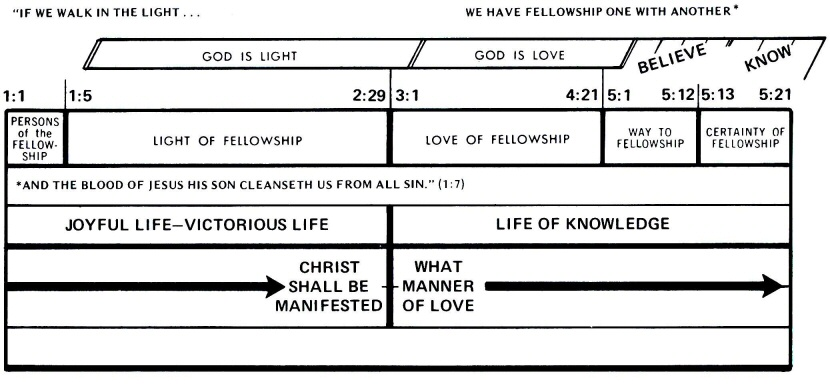
FELLOWSHIP WITH GOD AND HIS CHILDREN
Click chart to enlarge
Charts from Jensen's Survey of the NT - used by permission
Another Overview Chart - 1 John - Charles Swindoll
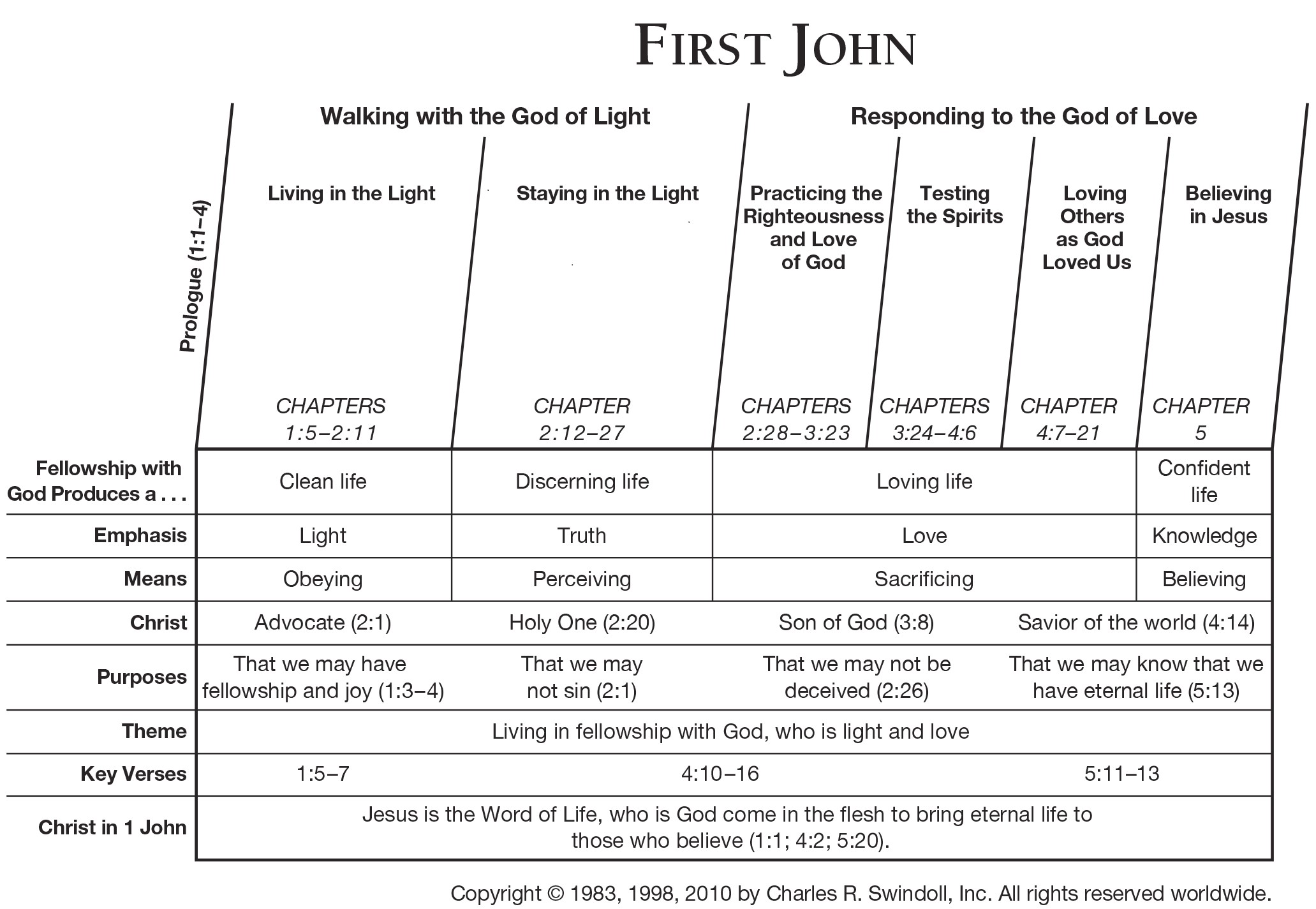
| BASIS OF FELLOWSHIP | BEHAVIOR OF FELLOWSHIP | ||||
| Conditions of Fellowship |
Cautions of Fellowship |
Fellowship Characteristics |
Fellowship Consequences |
||
| Meaning of Fellowship 1 Jn 1:1-2:27 |
Manifestations of Fellowship 1 Jn 2:28-5:21 |
||||
| Abiding in God's Light |
Abiding in God's Love |
||||
| Written in Ephesus | |||||
| circa 90 AD | |||||
| From Talk Thru the Bible | |||||
What is this? On the photograph of the Observation Worksheet for this chapter you will find handwritten 5W/H questions (Who? What? Where? When? Why? How?) on each verse to help you either personally study or lead a discussion on this chapter. The questions are generally very simple and are stated in such a way as to stimulate you to observe the text to discern the answer. As a reminder, given the truth that your ultimate Teacher is the Holy Spirit, begin your time with God with prayer such as Psalm 119:12+ "Blessed are You, O LORD; Teach me Your statutes." (you can vary it with similar prayers - Ps 119:18, 26, 33, 64, 66, 68, 108, 124, 135, 171, etc) The questions are generally highlighted in yellow and the answers in green. Some questions have no answers and are left to your observations and the illuminating/teaching ministry of the Holy Spirit. Some qualifying thoughts - (1) Use "As is" - these are handwritten and will include mistakes I made, etc. (2) They may not be the best question for a given verse and my guess is that on some verses you will think of a far superior 5W/H question and/or many other questions.
Dr Howard Hendricks once gave an assignment to his seminary students to list as many observations as they could from Acts 1:8. He said "So far they’ve come up with more than 600 different ones! Imagine what fun you could have with 600 observations on this passage. Would you like to see Scripture with eyes like that?" (P. 63 Living by the Book - borrow) With practice you can! And needless to say, you will likely make many more observations and related questions than I recorded on the pages below and in fact I pray that the Spirit would indeed lead you to discover a veritable treasure chest of observations and questions! In Jesus' Name. Amen
Why am I doing this? Mortimer Adler among others helped me develop a questioning mindset as I read, seeking to read actively rather than passively. Over the years I have discovered that as I have practiced reading with a 5W/H questioning mindset, it has yielded more accurate interpretation and the good fruit of meditation. In other words, consciously interacting with the inspired Holy Word of God and the illuminating Holy Spirit has honed my ability to meditate on the Scripture, and my prayer is that this tool will have the same impact in your spiritual life. The benefits of meditation are literally priceless in regard to their value in this life and in the life to come (cf discipline yourself for godliness in 1Ti 4:8+.) For some of the benefits - see Joshua 1:8+ and Psalm 1:2-3+. It will take diligence and mental effort to develop an "inductive" (especially an "observational"), interrogative mindset as you read God's Word, but it bears repeating that the benefits in this life and the rewards in the next will make it more than worth the effort you invest! Dear Christian reader let me encourage you to strongly consider learning the skills of inductive Bible study and spending the rest of your life practicing them on the Scriptures and living them out in your daily walk with Christ.
Although Mortimer Adler's advice is from a secular perspective, his words are worth pondering...
Strictly, all reading is active. What we call passive is simply less active. Reading is better or worse according as it is more or less active. And one reader is better than another in proportion as he is capable of a greater range of activity in reading. (Adler's classic book How to Read a Book is free online)
John Piper adds that "Insight or understanding is the product of intensive, headache-producing meditation on two or three verses and how they fit together. This kind of reflection and rumination is provoked by asking questions of the text. And you cannot do it if you hurry. Therefore, we must resist the deceptive urge to carve notches in our bibliographic gun. Take two hours to ask ten questions of Galatians 2:20+ and you will gain one hundred times the insight you would have attained by reading thirty pages of the New Testament or any other book. Slow down. Query. Ponder. Chew.... (John Dewey rightly said) "People only truly think when they are confronted with a problem. Without some kind of dilemma to stimulate thought, behavior becomes habitual rather than thoughtful.”
“Asking questions is the key to understanding.”
--Jonathan Edwards
That said, below are the 5W/H questions for each verse in this chapter (click page to enlarge). This is not neatly typed but is handwritten and was used for leading a class discussion on this chapter, so you are welcome to use it in this "as is" condition...

1 John 1:1 What was from the beginning, what we have heard, what we have seen with our eyes, what we have looked at and touched with our hands, concerning the Word of Life-- (NASB: Lockman)
Greek: O en (3SIAI) ap' arches, o akekoamen, (1PRAI) o eorakamen (1PRAI) tois ophthalmois hemon, o etheasametha (1PAMI) kai ai cheires hemon epselaphesan, (3PAAI) peri tou logou tes zoes
Amplified: [WE ARE writing] about the Word of Life [in] Him Who existed from the beginning, Whom we have heard, Whom we have seen with our [own] eyes, Whom we have gazed upon [for ourselves] and have touched with our [own] hands. (Amplified Bible - Lockman)
ESV: That which was from the beginning, which we have heard, which we have seen with our eyes, which we looked upon and have touched with our hands, concerning the word of life— (ESVBible.org)
KJV: That which was from the beginning, which we have heard, which we have seen with our eyes, which we have looked upon, and our hands have handled, of the Word of life;
NLT: We proclaim to you the one who existed from the beginning,* whom we have heard and seen. We saw him with our own eyes and touched him with our own hands. He is the Word of life. (NLT - Tyndale House)
Phillips: We are writing to you about something which has always existed yet which we ourselves actually saw and heard: something which we had an opportunity to observe closely and even to hold in our hands, and yet, as we know now, was something of the very Word of life himself! (Phillips: Touchstone)
Wuest: That which was from the beginning, that which we have heard with the present result that it is ringing in our ears, that which we have discerningly seen with our eyes with the present result that it is in our mind’s eye, that which we gazed upon as a spectacle, and our hands handled with a view to investigation, that which is concerning the Word of the life
Young's Literal: That which was from the beginning, that which we have heard, that which we have seen with our eyes, that which we did behold, and our hands did handle, concerning the Word of the Life--
Greek - O en (3SIAI) ap' arches, o akekoamen, (1PRAI) o eorakamen (1PRAI) tois ophthalmois hemon, o etheasametha (1PAMI) kai ai cheires hemon epselaphesan, (3PAAI) peri tou logou tes zoes:
- What was from the beginning: 1Jn 2:13 Pr 8:22-31 Isa 41:4 Mic 5:2 Jn 1:1,2-18 John 8:58; Rev 1:8,11,17,18 2:8
- Have heard… seen… looked at: 1Jn 4:14 Lk 1:2 Jn 1:14 Ac 1:3 4:20 2Pe 1:16-18
- and touched with our hands: Lk 24:39 Jn 20:27
- Word of Life: 1Jn 5:7 Jn 1:14 5:26 Rev 19:13)
- 1 John 1 Resources
WHAT WAS FROM
THE BEGINNING
NET Bible Note - In the Greek text the prologue to 1 John 1:1-4 makes up a single sentence. This is awkward in Greek, and a literal translation produces almost impossible English.
What was (eimi - imperfect tense) from the beginning (arche), what we have heard (akouo - perfect tense = abiding results), what we have seen (perfect tense = abiding results) with our eyes (opthalmos), what we have looked at (theaomai) and touched with our hands, concerning the Word (logos) of Life (zoe) - What is the repeated pronoun? What is used four times. And each time what identifies an attribute that could be recognized by hearing, seeing or touching. John doubles down on the visual aspect (seen...looked at), which emphasizes John really did see the "What", the One which he goes on to identify as the Word of Life (phrase used in Php 2:16+). It is interesting that some translations capitalize "Word" while others do not. In context, I favor capitalizing Word for this "Word" is clearly a reference to the Lord Jesus Christ. John is saying essentially that the Word of Life became flesh, became a Man Who could be heard, seen and touched. He was not a phantom as deceivers taught (see 2Jn 1:6) (Cf Docetism). Why does John call Jesus the Word of Life? He is the Source of true life, eternal life, abundant life, life from the dead (resurrection life), etc.
Did you notice the repeated pronouns in this first verse? WE is used 3 times and OUR once. What is John seeking to convey? It would seem as if he is speaking for all the other apostles who also had experienced all these things - heard, seen, looked at, touched.
Utley says that the neuter pronoun WHAT "speaks of the dual aspects of God’s message which are: (1) the message about Jesus; and (2) the person of Jesus Himself (cf. 1Jn 1:8, 10; 2:20, 24; 3:11, 14). The gospel is a message, a person, and a lifestyle."
What was (eimi - imperfect tense) from the beginning (arche) - Vincent says the idea of eimi in the imperfect tense is that the "What" "was already existing when the succession of life began" which speaks of Jesus' pre-existence, a repeated theme in John's writings ( 2 John 1:1, 15; 3:13; 8:57–58; 17:5). This parallels the same truth Jn 1:1 which has "In the beginning was (imperfect tense) the Word." In a sense, even this understanding of WAS in the imperfect tense speaks of the Deity of Christ because only God could have pre-existence. Wuest has a similar comment that was (eimi) in the imperfect tense "speaks of an abiding state in past time. Thus, John has reference to those things that were true of our Lord since the beginning." This interpretation of pre-existence is obviously based on interpreting the beginning as from the beginning of creation, but not everyone agrees that is the meaning of beginning in this passage (see below)
W E Vine adds that the idea is "Having been preexistent He (Jesus) became manifested. Neither in the Gospel nor in the epistle does he open with the phrase “that which came to be,” which would imply that Christ had a beginning (Ed: As taught by cults such as Jehovah's Witnesses). He did not begin to be, He essentially “was.” This statement at once combats one of the great errors of the Gnostics, who regarded Christ as impersonal, a mere emanation. On the contrary the apostles had themselves been in intimate contact with His person. (Collected writings of W. E. Vine)
Thou Breath of Life since time began,
Breathing upon the lips of man,
Hast taught each kindred race to raise
United word to sound Thy praise.
-Laurence Housman
What was from the beginning - There are two main interpretations by conservative scholars:
(#1) From the beginning of the Gospel message - favored by A W Pink, F F Bruce, Robert Law, John MacArthur, Steven Cole, D Edmond Hiebert.
(#2) From eternity past - He was there from the beginning of time signifying He had to pre-date the beginning of time. (Favored by John Piper, John Stott).
Those who favor interpretation #2 obviously appeal to the similar phrases in Genesis and John which clearly refers to eternity past…
IN the beginning God created the heavens and the earth. (Ge 1:1+)
Comment: Christ is the Creator of the beginning of this world, so obviously He had to be present before it was created which supports His eternality. Similar reasoning applies to John's verse below.
IN the beginning was the Word (= Jesus see Jn 1:14+), and the Word was with God, and the Word was God. 2 He was in the beginning with God. 3 All things came into being by Him, and apart from Him nothing came into being that has come into being. (Jn 1:1-3+)
Hiebert summarizes the interpretations of from the beginning and explains why he favors interpretation #1 that beginning refers to the beginning of the Gospel message:
The “beginning” in view here has been variously understood. Some, like Plummer and Burdick, understand the expression to mean “from all eternity.” The expression has also been taken to mean from the beginning of creation, from the beginning of Christ’s ministry, or even from “the earliest stage of the Christian Church.” The meaning of “the beginning” must always be determined by the context. In keeping with the following clauses, it seems best to understand that “beginning” here points to the unique events, described in Luke 1–2 that characterized the actual Incarnation, which John is proclaiming. “John’s message must seem incredible until we start where he starts—at Bethlehem.” Used without the definite article, “beginning” (arche) does not so much point to a specific event, which went largely unnoticed by the world, but rather serves to characterize the event as a new beginning in God’s manner of speaking to mankind (Heb 1:1,2+). This clause starts with the Incarnation, while the following clauses focus attention on the manifestation of the incarnate Christ during His ministry. The manifestation of the Christ did not begin at Jesus’ baptism, as Cerinthus taught; the verb “was” (en) marks the continued fact of the Incarnation since the birth of the Virgin Mary’s Babe in Bethlehem. John’s thought in this verse parallels John 1:14, “The Word became flesh, and dwelt among us, and we beheld His glory.” (Online An Exposition of 1 John 1:1-4 - excellent)
Steven Cole explains his reasons for favoring interpretation (#2) stating that "while not denying the eternality of the Son, argue that that is not John’s meaning here. They would argue that instead the phrase means what it later means in 1 John 2:7, 2:24, and 1 Jn 3:11, namely, the beginning of the gospel. They point out that John’s emphasis here, to counter the recent message of the false teachers, is that the apostolic message has not changed. It is the same message that has been proclaimed from the earliest days of the gospel. Also, the emphasis of the rest of 1Jn 1:1 is on Christ’s humanity. So John’s point would be that his message is not the new message of the Gnostics. Rather, it is the old message, which has been proclaimed from the earliest days of Christ’s ministry. It is the same message that his readers had heard and believed from the beginning of their Christian experience. (F. F. Bruce, The Gospel and epistles of John; A. W. Pink, Exposition of 1 John; and Robert Law, The Tests of Life, argue for this view.) It is difficult to decide between these two views, but I lean toward the second view (ED: BEGINNING = JESUS EARTHLY MINISTRY), in that John here seems to be appealing to his apostolic authority, and the fact that he had been with Jesus from the beginning of His earthly ministry. Thus the records of the four Gospels bear witness to the person of Jesus Christ. (1 John 1:1-3 The Tests of True Christianity) (BOLDING ADDED)
Henry Morris a Biblical creationist favors interpretation #2 - Note the similarity between the opening verses of John's gospel and his first epistle; both starting with a reference back to creation. The gospel of John looks back before the beginning of time when only God existed, and Jesus Christ was God. His epistle, on the other hand, proceeds forward from that beginning of time (Genesis 1:1) to the incarnation of the eternal "Word," which became "the Word of life;" the manifestation of the Father in "His Son Jesus Christ" (1 John 1:3). (BORROW Defender's Study Bible)
John Piper favors interpretation #2 writing that "This life is eternal. "The life was made manifest … and we proclaim to you the eternal life." (1Jn 1:2) This is the best commentary on the first phrase of 1Jn 1:1: "That which was from the beginning… " "From the beginning" means, Christ our Life was when creation began. He is eternal. He had no beginning. He will have no ending. He is not part of creation (ED: WHILE THIS IS TRUE WHAT JOHN IS TRYING TO SHOW IS THAT CHRIST INVADED TIME IN THE FLESH, THE VERY TRUTH THE GNOSTICS WERE PERVERTING). In the beginning He is the source of creation. All life comes from Him. He is the spring, not part of the river. "In the beginning was the Word, and the Word was with God and the Word was God. He was in the beginning with God; all things were made through him, and without him was not anything made that was made" (John 1:1–3). (Eternal Life Has Appeared in Christ)
Utley dogmatically favors interpretation #2 - This is an obvious allusion to Gen. 1 and John 1. The coming of Jesus was not “plan B.” The gospel was always God’s plan of redemption (cf. Gen. 3:15; Acts 2:23; 3:18; 4:28; 13:29).
The phrase "in the beginning" is key in First John occurring 8x in 7 verses - 1 John 1:1, 1 John 2:7, 2:13, 2:14, 2:24 , 1 John 3:8, 3:11.
Robert Lightner notes that "Three great beginnings are referred to in Scripture. In Genesis 1:1 "the beginning" refers to the beginning of time. "In the beginning" in John 1:1 speaks of eternity before the universe was. In 1 John 1:1 "the beginning" refers to the beginning of the Christian era and relates the Savior to His life on earth. In other words, John wrote in his gospel of the preincarnate Christ and in His first epistle of the incarnate Christ. This is such language as John would use respecting him, and indeed the phrase "the beginning," as applicable to the Lord Jesus, is peculiar to John in the writings of the New Testament; and the language here may be regarded as one proof that this epistle was written by him, for it is just such an expression as he would use. (The Books of 1, 2, 3 John and Jude)
Heard… seen… beheld… handled - These verbs speak of Jesus' incarnation-- He would have to had to be true "flesh and blood" (and not an apparition as some heretically taught) for all of these verbs to actually be experienced by John and the other apostles in their encounters with Jesus.
WHAT WE
HEARD
What we have heard (akouo - perfect tense = abiding results), what we have seen (perfect tense = abiding results) with our eyes (opthalmos), what we have looked at (theaomai) and touched with our hands, concerning the Word (logos) of Life (zoe) - John proceeds to present first hand personal knowledge of the apostle's objective, historical auditory, visual and tactile interactions proving that Jesus Christ was God and Man, a knowledge which would far surpass any so-called superior knowledge of the Gnostics. Most scholars agree that John was refuting some aspect of Gnosticism, which in simple terms taught that salvation was achieved by obtained special knowledge (gnosis) and they denied various truths about Christ.
What we have heard (akouo) - Heard is in the perfect tense which speaks of an abiding effect. When John wrote this letter, some 60 years had passed since he had last heard the voice of Jesus and yet, the words of His Lord were still an abiding truth in his heart! Imagine that you had heard Jesus speak! Would not His majestic words continue to reverberate and resonate in your mind for the rest of your days on earth? I think they would!
J M Boice adds that "The Gnostics had a system, just as many professional religionists have a system today. But a system is not life, nor does it transform a life. A system in and of itself is nothing. What Christianity has and the others do not have is life, in fact, the life of Jesus Himself, the One who is the creator and sustainer of all life and who as the life is also the light of men (John 1:4). It is Christ, then, who is proclaimed in Christianity. (The Epistles of John or BORROW)
Steven Cole - John and the other apostles (the “we” of 1Jn 1:1-4) had heard the very words of Jesus, and what amazing words they were! Even His enemies testified (John 7:46), “Never has a man spoken the way this man speaks.” How true! If you are trying to bear witness to someone who has never read the Gospels, direct him to do that. The words of Jesus bear witness of Who He is (cp Jn 20:31). (1 John 1:1-3 The Tests of True Christianity)
Henry Morris - Tradition suggests John was writing from Ephesus where he served many years as bishop and pastor, possibly intending his letter to be circulated among all the churches of the region, including the seven churches of Revelation 2 and 3. He stressed to his readers of the younger generation that he and the other apostles had actually heard Jesus speak (John 5:24), seen Him with their own eyes (John 1:18), "beheld" Him in His glory (John 1:14) and handled Him with their own hands (Luke 24:39). (BORROW Defender's Study Bible)
Brian Bell observes that "The word “heresy” means to “select or choose.” False teachers teach some truth but then mix in their opinion as they select certain themes and ideas to focus on (Ed: or "to choose"). John is dealing with a false teaching called Gnosticism which taught that matter is evil and only the spirit is good. This has a lot of nuances but the most dangerous is that they believed Jesus did not really have a flesh and blood body but was more like a phantom. According to this view, Jesus didn’t really die or rise from the dead. Gnosticism, which got its name from the word “knowledge” in Greek, also taught that only those who had special knowledge could be saved. Because of this belief, two behaviors emerged. By the way, wrong beliefs always lead to wrong behaviors. Flesh fasting – Since the body is evil, any urge must be purged. In this view, people would unplug from the world. Flesh feasting – Do whatever you want because matter doesn’t matter. These people went to the other extreme and unplugged from any moral restraint. There’s a legendary story that one day John went to bathe and noticed that a false teacher named Cerinthus was beginning to descend into the pool. John immediately rushed out and is reported to have said, “Let us fly, lest even the bathhouse fall down, because Cerinthus, the enemy of the truth, is within.” John doesn’t waste any time getting to the core issue of Christianity, which is Christ Himself. I don’t have to tell you that there is much confusion today on the street about the essence of true Christianity. As we will see, Christianity is not just a system of thought or a philosophy. It is a person – Jesus Christ – and He is a fact, He is to be proclaimed, He is to be shared and He leads us to joy. (Walk the Talk)
Related Resource:
- Chart Illustrating the Main Beliefs of Gnosticism (Note - this link allows you to download a Word Document)
D Edmond Hiebert writes that…
It is generally agreed that the heresy confronted in First John was some form or forms of Gnosticism, but it is unwarranted to identify it with the full-blown Gnosticism of the second century. Among the numerous converts won to Christianity in Asia doubtless were former adherents of religious systems marked by Gnostic tendencies. Some of those converts soon sought to syncretize their old views with their newly accepted Christianity. Sharp controversy arose when they sought to propagate their new interpretations and they withdrew (1Jn 2:19 But they did not sever all their contacts with members of the churches (1Jn 2:26). A fuller development of the varied Gnostic views may indeed have been promoted by these heretics after their withdrawal from the churches. That the incipient elements of Gnosticism were active in the first century is clear.
As a speculative philosophy of religion, Gnosticism was marked by a kaleidoscopic variety of views. Basic was the dualistic view that spirit is good and matter is inherently evil, and that the two are in perpetual antagonism. This assumed dualism created a gulf between the true God and this material world. The Gnostics, meaning “knowing ones,” held that spiritual excellence consisted not in a holy life but in their superior knowledge, which enabled them to rise above the earthbound chains of matter in their apprehension of the heavenly truth that had been made known to them. This knowledge, they claimed, had been made known to them through Christ as the Messenger of the true God. Thus “the Gnostic Christ was not a Saviour; he was a revealer. He came for the express purpose of communicating his secret gnosis.”8 This undermined the Christian view of sin and the atonement.
Acceptance of Gnostic dualism made the Christian doctrine of the Incarnation unthinkable; two alternative views were advanced.
Docetic Gnosticism held that Christ seemed to have a human body; His supposed humanity was a phantom.
Cerinthian Gnosticism, named after Cerinthus, a late contemporary of John at Ephesus, held that the man Jesus, son of Joseph and Mary, was preeminent in righteousness and wisdom, that “the Christ” came on Him at His baptism and empowered His ministry, but left Him before His crucifixion; it was only a man who died and rose again.
Either view eliminated the Incarnation and nullified Christ’s atoning work.
Since the Gnostics held that fellowship with God comes through the esoteric knowledge brought by Christ, they often expressed their assumed enlightenment in scandalous disregard of the ethical demands of Christianity (Ed: "Licentious Living" = Practicing Sin as a Lifestyle). At other times their view led to asceticism. In opposition, John insisted that true Christian knowledge, which comes as a result of the anointing of the Holy One (1Jn 2:20), involves spiritual enlightenment as well as holiness of life (1Jn 1:5–2:5). For true assurance of eternal life (1Jn 5:13) the Christological test as well as the ethical test must be applied. (Online An Exposition of 1 John 1:1-4 - excellent)
Luke records Peter's address to the other 10 disciples [Acts 1:12, 13+] in the upper room as they prepared to select a replacement for Judas Iscariot)…
Therefore it is necessary that of the men who have accompanied us all the time that the Lord Jesus went in and out among us— beginning with the baptism of John until the day that He was taken up from us—one of these must become a witness with us of His resurrection." (Acts 1:21, 22+)
THOUGHT - May we go to His Word desiring to hear from Him even as John first heard Him. And may this "foretaste" make us long for (and live for) eternity future when we shall have the holy privilege of hearing His voice… and see His glorious Face… forever and ever! Amen! The prophet Isaiah's words should be our "watchword" as we await His return…
Your eyes will see
the King in His beauty…
-- Isaiah 33:17
HALLELUJAH!
SEEN WITH
OUR EYES
What we have seen with our eyes - The verb have seen is in the perfect tense signifying past completed action with abiding results or effect. In other words the apostles had seen Jesus in the past (the 3 years they traveled with Jesus) and an image of the living Word of God (Jn 1:1) had, so speak, been "burned" on their mind's eye. They were "eyewitnesses". One can only imagine--what an image it must have been! John adds the phrase with our eyes (opthalmos) to emphasize that they did not imagine they saw Him (they did not see Him in their mind), but they literally saw Him physically. He was not a phantom or vision, but a flesh and blood Man they saw with their eyes.
Wuest beautifully conveys the idea of the perfect tense in his excellent paraphrase -
"That which was from the beginning, that which we have heard with the present result that it is ringing in our ears, that which we have discerningly seen with our eyes with the present result that it is in our mind’s eye, that which we gazed upon as a spectacle (theaomai), and our hands handled with a view to investigation, that which is concerning the Word of the life." (Eerdmans Publishing - used by permission)
John could have just said "we have seen" but he adds the phrase "with our eyes" which emphasizes the apostle's "direct, personal experience in a marvelous matter." (Vincent - Word Studies)
A T Robertson adds "with our eyes" shows "it was not imagination on John’s part, not an optical illusion as the Docetists claimed, for Jesus had an actual human body. He could be heard and seen.
Steven Cole adds that the phrase seen with our eyes "shows that John is not talking about a mystical “vision” of Christ, but of actually watching Jesus as He lived before them. The apostles saw Jesus turn the water into wine, feed the 5,000, walk on water, heal the multitudes, and raise the dead. The 35 miracles recorded in the four gospels are only a fraction of those that the apostles witnessed. John (Jn 21:25) ends his gospel by stating that if all the things that Jesus did were written in detail, the whole world couldn’t contain the books. Jesus’ sinless life and the powerful miracles He performed validate that He is the unique Son of God. (1 John 1:1-3 The Tests of True Christianity)
Matthew Henry on seen with our eyes - "That which we have seen with our eyes,” the Word would become visible, would not only be heard, but seen, seen publicly, privately, at a distance and at nearest approach, which may be intimated in the expression, with our eyes – with all the use and exercise that we could make of our eyes. We saw Him in His life and ministry; we saw Him in His transfiguration on the mount, hanging, bleeding, dying, and dead, upon the cross, and we saw Him after His return from the grave and resurrection from the dead. His apostles must be eye-witnesses as well as ear-witnesses of him. Wherefore, of these men that have accompanied with us all the time that the Lord Jesus went in and out among us, beginning from the baptism of John, must one be ordained to be a witness with us of his resurrection (Acts 1:21, 22).
Peter records his eyewitness and ear witness testimony…
For we did not follow cleverly devised tales when we made known to you the power and coming of our Lord Jesus Christ, but we were eyewitnesses of His majesty. For when He received honor and glory from God the Father, such an utterance as this was made to Him by the Majestic Glory, "This is My beloved Son with whom I am well-pleased"--and we ourselves heard this utterance made from heaven when we were with Him on the holy mountain. And so we have the prophetic word made more sure, to which you do well to pay attention as to a lamp shining in a dark place (cp Ps 119:105, 1Jn 1:5), until the day dawns and the morning star arises in your hearts. (2Pe 1:16-18+ 1:19-+)
WHAT WE
LOOKED AT
What we looked at (theaomai - beheld) - This is not simply a repetition of "seen". Paul Apple describes the two visual aspects as (1) Long Distance -- "what we have seen with our eyes" and (2) Up Close and Personal -- "what we beheld". John used this same verb twice in his introduction of his Gospel...
John 1:14+ And the Word became flesh, and dwelt among us, and we saw (theaomai - beheld) His glory, glory as of the only begotten from the Father, full of grace and truth.
John 1:32+ John testified saying, “I have seen (theaomai - beheld) the Spirit descending as a dove out of heaven, and He remained upon Him.
A R Fausset - The apostle is not weary of describing faith’s various actings in the soul. And it is for our edification that he sets before us his own experience in this matter. It is in order that such of us as have heard and seen Jesus may still fix on Him the eyes of our understanding with an intent and protracted gaze. And can one view of “the King in His beauty” satisfy the spiritual eye? No; it will rest with a mingled feeling of sorrow and joy on Him whom our sins have pierced. When Jesus has been seen as “full of grace and truth” — “fairer than the children of men” — the believer will surely look upon Him with a steady contemplation of the soul and fixed devotion of the heart, It may be that it is not given to all believers to attain to the full experience of the beloved disciple, or to realize all He felt when He says “which we have looked upon”; but in a measure the same contemplative faith is proper to all the saints. And without it there could be no due assimilation to the image of Christ. It is by the contemplation of Christ’s Person that we become in a measure changed into His likeness. Christ looked upon as a wondrous spectacle, steadfastly, deeply, contemplatively. (see 2 Cor 3:18+)
WHAT OUR HANDS
HANDLED
Our hands handled (pselaphao) - The verb handled (pselaphao) means to feel or grope, and thereby verifying by contact. This is an amazing statement. John (and the other apostles) literally touched the Lord Jesus Christ during His time on earth! One wonders if we will touch Him or He will touch us in eternity future? (Play I Can Only Imagine) I have no doubt we will see the scars on His hands (John sees Jesus slain in Rev 5:6, 9+). Whether this touching of Jesus refers to before or after the resurrection is not clear, thus it could refer to both (cp Lk 24:39+ which supports possible post-resurrection touching and Mt 14:29, 30, 31 is clearly touching prior to His resurrection).ared to the disciples. He said (Luke 24:39+), “See My hands and My feet, that it is I Myself; touch Me and see, for a spirit does not have flesh and bones as you see that I have” (see also, John 20:27+). So John is saying that Jesus Christ was revealed and that He was historically validated by the apostles in all of these objective ways ("heard… seen… beheld… hands handled"), both before and after the resurrection.
The experience of deliberate touch is
the culminating evidence for the reality of the Incarnation.
-- D Edmond Hiebert
IVP Bible Background Commentary "By saying that Jesus’ witnesses had touched and felt him, John indicates that Jesus had been fully human; he was not simply a divine apparition like the current “manifestations” of the gods in which the Greeks believed."
Paul Apple applies John's experience with Christ to our lives today as believers - What is the result of people's first-hand interaction with us? We are as close as they are going to get to the current historical manifestation of this life of God. What do they hear from us? What do they see? What do they closely observe as they check us out? May it be the eternal life that is Christ Himself living through us. (cf. Out of the Salt Shaker -- there is a danger that we isolate ourselves in Christian circles and never allow the world to examine us. The willingness to be proclaimers involves the spirit behind the evangelism book entitled: "I'm Glad You Asked" (1 John - Tests of Eternal Life)
John Stott - The historical manifestation of the Eternal Life was proclaimed, not monopolized. The revelation was given to the few for the many. They were to dispense it to the world. (BORROW The Epistles of John : an introduction and commentary)
THOUGHT - It is vital that we point people to the historical facts of the life, death and resurrection of Jesus Christ and not get sidetracked into debates about other less important issues!
THE WORD
OF LIFE
Concerning the Word (logos) of Life (zoe) - This is John's designation for Jesus Christ, Whom He identifies specifically by Name in 1Jn 1:3. In the only other use of this phrase, Paul uses Word of life as a description for the Scriptures in Phil 2:16.
Spread, O Spread, Thou Mighty Word
Word of Life, most pure and strong,
Lo! for Thee the nations long,
Spread, till from its dreary night
All the world awakes to light.
Hiebert - That “the Word” here carries a personal implication seems obvious. But in reality the subject matter and the Person are identical in a unique fashion. The incarnate Christ is both God’s message and Himself the Messenger. He is the embodiment of divine life and the Revealer of that life to mankind (John 14:6–9). (Online An Exposition of 1 John 1:1-4 - excellent)
In John's description of the Second Coming of Christ he writes that Jesus is
clothed with a robe dipped in blood; and His name is called The Word (Logos) of God." (Rev 19:13+)
Tony Garland comments: Like God’s literal word which He has magnified above His name (Ps 138:2), God highly exalted Jesus and has given Him the name above every name (Php 2:9). Scripture informs us: “By the word of the LORD the heavens were made and all the host of them by the breath of His mouth” (Ps 33:6 cf. Heb 11:3; 2Pe 3:5). Elsewhere, John uses this title to emphasis Jesus as the revelation of God in His incarnation (1Jn 1:1-3) The Logos or Word is the expression of God’s nature in understandable terms, and whether those terms be mercy or judgment they are both equally the message of God. This title also emphasizes Jesus’ role in creation (John 1:1-3; Eph 3:9; Col 1:16; Heb. 1:2; Rev. 3:14)—a key theme explaining why God has ultimate dominion to retake the earth at His Second Coming (Rev 3:14; 4:11; 10:6).
Marvin Vincent on the Word of Life - The phrase "ho logos tes zoes", the Word of the Life, occurs nowhere else in the New Testament. The nearest approach to it is Phil 2:16; but there neither word has the article (ho or tes). In the phrase words of eternal life (John 6:68), and in Acts 5:20, all the words of this life, rhema is used. The question is whether logos is used here of the Personal Word (Ed: I.e., is a name for Jesus), as John 1:1, or of the divine message or revelation. In the four passages of the Gospel where logos is used in a personal sense (John 1:1, 14), it is used absolutely, the Word (compare Rev 19:13). On the other hand, it is often used relatively in the New Testament; as word of the kingdom (Mt 13:19); word of this salvation (Acts 13:26); word of His grace (Acts 20:32); word of truth (Jas 1:18). By John zoes of life, is often used in order to characterize the word which accompanies it. Thus, crown of life (Rev 2:10); water of life (Rev 21:6); book of life (Rev 3:5); bread of life (John 6:35); i.e., the water which is living and communicates life; the book which contains the revelation of life; the bread which imparts life. In the same sense, John 6:68; Acts 5:20. Compare Titus 1:2, 3 Though the phrase, the Word of the Life, does not elsewhere occur in a personal sense, I incline to regard its primary reference as personal, from the obvious connection of the thought with John 1:1, 4. “In the beginning was the Word, — in Him was life.” “As John does not purpose to say that he announces Christ as an abstract single idea, but that he declares his own concrete historical experiences concerning Christ, — so now he continues, not the Logos (Word), but concerning the Word, we make annunciation to you” (Ebrard). At the same time, I agree with Canon Westcott that it is most probable that the two interpretations are not to be sharply separated. “The revelation proclaims that which it includes; it has, announces, gives life. In Christ life as the subject, and life as the character of the revelation, were absolutely united.” (Word Studies)
John Phillips…The Word! Thoughts remain invisible and inaudible until they are clothed in words. With words, what we think and feel and are can be known. And just as our words reveal us, so, too, the Lord Jesus, as "the Word of life," clothes and reveals the great thoughts and feelings of God regarding our sin and our salvation.
Come, Holy Ghost, God & Lord
by Martin Luther
Thou holy Light, Guide divine,
Oh, cause the Word of Life to shine!
Teach us to know our God aright
And call Him Father with delight.
From every error keep us free;
Let none but Christ our Master be
That we in living faith abide,
In Him, our Lord, with all our might confide.
Hallelujah! Hallelujah!
Vincent (commenting on Logos in John 1:1) adds that "This expression ("the Word") is the keynote and theme of the entire Gospel of John. Logos is from the root leg, appearing in lego, the primitive meaning of which is to lay: then, to pick out, gather, pick up: hence to gather or put words together, and so, to speak. Hence logos is, first of all, a collecting or collection both of things in the mind, and of words by which they are expressed. It therefore signifies both the outward form by which the inward thought is expressed, and the inward thought itself, the Latin oratio and ratio: compare the Italian ragionare, “to think” and “to speak.” (See Word Studies in the New Testament where Vincent has several pages of notes on "Logos" if you are interested)
In the Greek mind and as used by secular and philosophical Greek writers, lógos did not mean merely the name of an object but was an expression of the thought behind that object's name. Let me illustrate this somewhat subtle nuance in the meaning of lógos with an example from the Septuagint (LXX) (Greek of the Hebrew OT) in which lógos is used in the well known phrase the Ten Commandments. The Septuagint translates this phrase using the word lógos as “the ten (deka) words (logoi)” (Ex 34:28), this phrase giving us the familiar term Decalogue. Clearly each of the "Ten Commandments" is not just words but words which express a thought or concept behind those words. This then is the essence of the meaning of lógos and so it should not be surprising that depending on the context lógos is translated with words such as "saying, instruction, message, news, preaching, question, statement, teaching, etc". This understanding of lógos also helps understand John's repeated usage of this Greek word as a synonym for the second Person of the Godhead, the Lord Jesus Christ.
Lógos then is a general term for speaking, but always used for speaking with rational content. Lógos is a word uttered by the human voice which embodies an underlying concept or idea. When one has spoken the sum total of their thoughts concerning something, they have given to their hearer a total concept of that thing. Thus the word lógos conveys the idea of “a total concept” of anything. Lógos means the word or outward form by which the inward thought is expressed and made known. It can also refer to the inward thought or reason itself. Note then that lógos does not refer merely to a part of speech but to a concept or idea. In other words, in classical Greek, lógos never meant just a word in the grammatical sense as the mere name of a thing, but rather the thing referred to, the material, not the formal part. In fact, the Greek language has 3 other words (rhema, onoma, epos) which designate a word in its grammatical sense. Lógos refers to the total expression whereas rhema (see word study) for example is used of a part of speech in a sentence. In other words rhema, emphasizes the parts rather than the whole.
Lógos was in use among Greeks before John used it, the Greeks using it to denote the principle which maintains order in world. In connection with the Greek word for “seed” in its adjective form, Lógos was used to express the generative principle or creative force in nature. The Stoics believed that this world was permeated with that Lógos. It was the Lógos which put sense into the world. It was the Lógos which kept the stars in their courses and the planets in their appointed tracks. It was the Lógos which controlled the ordered succession of night and day, and summer and winter and spring and autumn. The Lógos was the reason and the mind of God in the universe, making it an order and not a chaos. In summary, Greek philosophers, in attempting to understand the relationship between God and the universe, spoke of an unknown mediator between God and the universe, naming this mediator, “Logos”. John tells them that this mediator unknown to them is our Lord Jesus, and thus he uses the same name “Lógos.” In the first verse of his gospel John gives us a summary outline of Jesus' preexistence, His fellowship with God the Father in His preincarnate state and His absolute deity writing that
In the beginning was the Lógos, and the Lógos was with God, and the Lógos was God." (Jn 1:1)
If there is any doubt about Who John was referring to, he goes on to describe the incarnation writing that
the Lógos became flesh, and dwelt among us, and we beheld His glory, glory as of the only begotten from the Father, full of grace and truth. (Jn 1:14)
The Word of Life - Jesus Christ, the One Who is essence of life and reveals that life to men. Note that Life (zoe) is a key word in John's Gospel and in his first epistle. Life (zoe) is found 10x in First John - 1Jn1:1, 1:2, 2:25, 3:14, 3:15, 5:11, 5:12, 5:13, 5:16, 5:20. (zoe = 36x in the Gospel of John - John 1:4; 3:15, 16, 36; 4:14, 36; 5:24, 26, 29, 39, 40; 6:27, 33, 35, 40, 47, 48, 51, 53, 54, 63, 68; 8:12; 10:10, 28; 11:25; 12:25, 50; 14:6; 17:2, 3; 20:31). It is notable that John's letter begins (1Jn 1:2) and ends (1Jn 5:20) with the theme of eternal life.
As an aside some commentators see Word of Life as a reference to the Gospel, which while not unreasonable is not as congruent with the context of John's presentation of the Person Who Himself is the foundation stone for that Gospel.
Christ, the blessèd One, gives to all wonderful Words of Life;
Sinner, list to the loving call, wonderful Words of Life;
All so freely given, wooing us to heaven.
Beautiful words, wonderful words, wonderful words of life,
Beautiful words, wonderful words, wonderful words of life.
Wonderful Words of Life by Philip Bliss
S E Pierce comments on the phrase Word of Life - He (John) styles Him (Jesus as) “The Word of life.” (Generally speaking a) word is the index of the mind. By what is contained in the mind is expressed. So Christ, as One in the self-existing Essence, speaks out the mind of the Eternal Father. It was by His Almighty fiat the heavens and the earth were created, and all the host of them. It was by Him all the secrets of the Most High were spoken out and proclaimed, and the invisible God brought out of His invisibility. It is in Him the full revelation of Godhead is made known. It is in the essential Word all the mind of God is opened, all the love of God expressed, the whole of God declared. It is as this essential Word, and only begotten Son of God, shines forth as God-Man, in His most glorious Person, mediation, work, grace, and salvation, in the everlasting Gospel, and enlightens His Church therewith, that they in His light see light. (1John - Biblical Illustrator)
Heard (191) akouo means to hear with attention, to hear with the "ear" of the mind, to hear with understanding. As used in the Scriptures akouo often signifies obedient hearing. In other words one hears the truth with conviction of one's mind, and this disposes the mind to submit itself to the doctrine presented. In fact, Paul says it is in this way that faith springs up (Ro 10:17+).
Looked at (2300)(theaomai from tháomai =to wonder, from thaúma = wonder, admiration <> English = theatrical spectacular performance) means (1) to have an attentive look, to have regard for something, to contemplate, to take in with one's eyes (implying that one is impressed by what he sees - see use in Mt 22:11). Theaomai implies an intent contemplative gaze. The point is that it is not a mere glance or quick look, but a long, searching gaze (e.g., Lk 23:55). Theaomai describes intelligent beholding, a "careful and deliberate vision which interprets its object" (G. Abbott-Smith). It means to gaze at a show or demonstration or to watch as in a theater. (thus giving us the origin of our English word "theater"). (2) Theaomai can mean to see for the purpose of visiting as in Ro 15:24. (3) Finally some lexicon's (BDAG) state theaomai can mean to perceive something above and beyond what is merely seen with the eye (this nuance clearly overlaps with definition #1 above).
Vincent notes that in 1Jn 1:1 - The tense (of theaomai) is the aorist ; marking not the abiding effect of the vision upon the beholder, but the historical manifestation to special witnesses. (Ed: As in John 1:14)
A T Robertson says theaomai in this passage means "a spectacle which broke on our astonished vision (D. Smith)."
Westcott says theaomai "expresses the calm, intentional continuous contemplation of an object."
William Barclay writes that "The verb for to gaze is theaomai, and it means to gaze at someone or something until something has been grasped of the significance of that person or thing. So Jesus, speaking to the crowds of John the Baptist, asked: ‘What did you go out into the wilderness to look at [theaomai]?’ (Luke 7:24); and in that word he describes how the crowds flocked out to gaze at John and wonder who and what this man might be. Speaking of Jesus in the prologue to his gospel, John says: ‘We have seen his glory’ (John 1:14). The verb is again theaomai, and the idea is not that of a passing glance but of a steadfast searching gaze which seeks to discover something of the mystery of Christ." (Daily Study Bible)
Theaomai - 22x in 22v in the NAS - Translated look(1), look over(1), looked(1), noticed(3), saw(5), see(3), seeing(2), seen(5), watched(1).
Matthew 6:1 "Beware of practicing your righteousness before men to be noticed by them; otherwise you have no reward with your Father who is in heaven.
Matthew 11:7 As these men were going away, Jesus began to speak to the crowds about John, "What did you go out into the wilderness to see? A reed shaken by the wind?
Matthew 22:11 "But when the king came in to look over the dinner guests, he saw a man there who was not dressed in wedding clothes,
Comment: This verse helps us discern the added attention inherent in the verb theaomai (to look over) compared with simply seeing (he saw a man). He saw the man was distinctive because he had looked attentively (theaomai) over the guests.
Matthew 23:5 "But they do all their deeds to be noticed by men; for they broaden their phylacteries and lengthen the tassels of their garments.
Comment: The ostentatious religious leaders did not just want others to see them, but to see them with special attention (theaomai).
Mark 16:11 When they heard that He was alive and had been seen by her, they refused to believe it.
Mark 16:14 Afterward He appeared to the eleven themselves as they were reclining at the table; and He reproached them for their unbelief and hardness of heart, because they had not believed those who had seen Him after He had risen.
Luke 5:27 After that He went out and noticed a tax collector named Levi sitting in the tax booth, and He said to him, "Follow Me."
Comment: Jesus not only saw Levi (Matthew) but gave him special attention (theaomai).
Luke 7:24 When the messengers of John had left, He began to speak to the crowds about John, "What did you go out into the wilderness to see? A reed shaken by the wind?
Luke 23:55 Now the women who had come with Him out of Galilee followed, and saw the tomb and how His body was laid.
Comment: They looked at the empty tomb with special attentiveness.
John 1:14 And the Word became flesh, and dwelt among us, and we saw (Beheld - theaomai) His glory, glory as of the only begotten from the Father, full of grace and truth.
Comment: This might refer to John's experience on the Mount of Trans-figuration, when he and Peter and James saw Jesus’ glory unveiled (Mk 9:2-7, Mt 17:11-13, Lk 9:28-36). Peter also refers to the transfiguration in his second letter to emphasize that he and the other two apostles "did not follow cleverly devised tales" but that they "were eyewitnesses of His majesty.” (2Pe 1:16-note). This use of theaomai helps one understand that this verb does not describe a mere casual glance, but an intentional, contemplative gaze.
John 1:32 John testified saying, "I have seen the Spirit descending as a dove out of heaven, and He remained upon Him.
John 1:38 And Jesus turned and saw them following, and said to them, "What do you seek?" They said to Him, "Rabbi (which translated means Teacher), where are You staying?"
John 4:35 "Do you not say, 'There are yet four months, and then comes the harvest '? Behold, I say to you, lift up your eyes and look on the fields, that they are white for harvest.
Comment: Jesus used theaomai rather than a verb meaning simple sight, because He wanted His disciples not only to see the people streaming out of the city, but to contemplate the meaning and significance of this.
John 6:5 Therefore Jesus, lifting up His eyes and seeing that a large crowd was coming to Him, said to Philip, "Where are we to buy bread, so that these may eat?"
John 11:45 Therefore many of the Jews who came to Mary, and saw what He had done, believed in Him.
Comment: They had come and were there to be eyewitnesses to the miracle of Lazarus' resurrection from the dead. Their "seeing" including their contemplating what they saw with the result that they believed in Jesus.
Acts 1:11 They also said, "Men of Galilee, why do you stand looking into the sky? This Jesus, who has been taken up from you into heaven, will come in just the same way as you have watched Him go into heaven."
Comment: The 11 disciples had followed this Man for three years and now He was gone. This is the last time they would see Him in this lifetime, so they were not just casually looking into the sky.
Acts 21:27 When the seven days were almost over, the Jews from Asia, upon seeing him (Paul) in the temple, began to stir up all the crowd and laid hands on him,
Acts 22:9 "And those who were with me saw the light, to be sure, but did not understand the voice of the One who was speaking to me.
Romans 15:24 whenever I go to Spain-- for I hope to see you in passing, and to be helped on my way there by you, when I have first enjoyed your company for a while--
1 John 1:1 What was from the beginning, what we have heard, what we have seen with our eyes, what we have looked at and touched with our hands, concerning the Word of Life--
1 John 4:12 No one has seen God at any time; if (ean = used in a 3rd.-class conditional clause. which views the condition as possible) we love one another, God abides in us, and His love is perfected (brought to completion or to the goal) in us.
Westcott comments that "Here the thought is of the continuous beholding that answers to abiding fellowship."
1 John 4:14 We have seen and testify that the Father has sent the Son to be the Savior of the world.
Handled (5584) (pselaphao from psáo = touch lightly) means to feel or grope about expressing motion of hands over a surface, so as to feel it. To verify by contact (see Ge 27:21,22). The figurative sense means to search for or to make an effort to come to know something (Acts 17:27). Thus pselaphao denotes not merely the bare handling, but the searching, exploring use of the hands, that tests by handling.
The New Linguistic & Exegetical Key to the New Testament says pselaphao means "to grope or feel after in order to find, like one blind or in the dark; hence, “to handle, to touch.” The idea of searching sometimes disappears altogether; here (1Jn 1:1) it naturally suggest all the evidence available for sense perception other than hearing and sight. The author is claiming a physical contact with Jesus. Perhaps this is to combat a type of Docetism (Editorial Comment: In simple terms this heresy taught Jesus only seemed to have a body -- He did not really have a flesh and blood body but was only a ghost in human form! They refused to believe that God could ever degrade himself by taking human flesh and blood upon Himself. John would counter by saying we touched Him! Understand the import of this genre of heresy -- if Jesus did not have a real human body, then He would not be qualified to serve as genuine atoning sacrifice for sins for such a sacrifice demanded a perfect victim and spillage of His blood. John more directly refutes this heresy in 1Jn 4:2,3 and in 2John 7). (The New Linguistic and Exegetical Key to the Greek New Testament)
Vincent has this note on pselaphao "“It never expresses the so handling an object as to exercise a molding, modifying influence upon it, but at most a feeling of its surface (Lk 24:39, 1Jn 1:1); this, it may be, with the intention of learning its composition (Ge 27:12, 21, 22); while, not seldom, it signifies no more than a feeling for or after an object, without any actual coming in contact with it at all” (Page 58 in Trench's Synonyms of the New Testament). Compare Acts 17:27. Used of groping in the dark, Job 5:14; of the blind, Isa. 59:10; Deut. 28:29; Judges, 16:26. See on Heb. 12:18. (Word Studies)
There are 4 uses of pselaphao in the NT. Here are the other 3 uses…
Luke 24:39 (Context - Jesus' appearance to His disciples after His Crucifixion and Resurrection) "See (aorist imperative) My hands and My feet, that it is I Myself; touch (aorist imperative) Me and see (also aorist imperative) , for a spirit (NET = "ghost") does not have flesh and bones as you see (theoreo - observe with sustained attention, be a spectator) that I have."
Jamieson comments that here Jesus "lovingly offering them both ocular (sense of sight) and tangible (sense of touch) demonstration of the reality of His resurrection." Compare this to John's affirmation in 1Jn 1:1 - heard, saw, beheld, held (touched). As he saying goes "looks can be deceiving" but touch would not. So He commands the disciples to touch Him and verify that He had a human body and that He was not a ghost. Clearly the apostle John got the point! They heard His command, saw His Body and presumably touched His Body, the very order John follows in his description on 1Jn 1:1
Acts 17:27 (Context - Acts 17:24, 25, 26) that they would seek God, if perhaps they might grope for Him and find Him, though He is not far from each one of us;
Comment: The verb gives the idea of groping after God in the darkness when the light of His full revelation is not available. (Bruce)
Hebrews 12:18-note For you have not come to a mountain that can be touched and to a blazing fire, and to darkness and gloom and whirlwind
Pselaphao - 17x in 15x in the Septuagint (Lxx)- Gen 27:12, 21,2; Deut 28:29 (2x); Jdg 16:26; Ps 113:15; 134:17; Job 5:14; 12:25; Nah 3:1; Zech 3:9; 9:13; Isa 59:10 (2x). Virtually all of the Lxx use denote literal touching with the hands. Here are some uses of pselaphao (3x) in the Old Testament…
Genesis 27:12 "Perhaps my father will feel (Hebrew = mashash = feel or grope as with one's hands; Lxx = pselaphao) me, then I will be as a deceiver in his sight, and I will bring upon myself a curse and not a blessing."… 21 Then Isaac said to Jacob, "Please come close, that I may feel (Hebrew = mush = handle an object with one's hands; Lxx = pselaphao) you, my son, whether you are really my son Esau or not." 22 So Jacob came close to Isaac his father, and he felt him and said, "The voice is the voice of Jacob, but the hands are the hands of Esau."
Deuteronomy 28:29 and you will grope at noon, as the blind man gropes in darkness, and you will not prosper in your ways; but you shall only be oppressed and robbed continually, with none to save you.
Judges 16:26-note Then Samson said to the boy who was holding his hand, "Let me feel (Hebrew = mush = handle an object with one's hands; Lxx = pselaphao) the pillars on which the house rests, that I may lean against them."
Psalm 115:7-note They (idols) have hands, but they cannot feel; They have feet, but they cannot walk; They cannot make a sound with their throat.
Life (2222)(zoe) signifies the state of one who is possessed of vitality or is animate. Zoe is life real and genuine, active and vigorous. Zoe is the absolute fullness of life, both essential and ethical, which belongs to God. In the New Testament zoe speaks of life as a principle, life in the absolute sense, life as God has it, that which the Father has in Himself, and as John says "is in His Son." (1Jn 1:2) Zoe is "the higher life", the life that is really worthwhile. True life is only in Christ. Eternal life (zoe) is the present possession of the believer because of his or her relationship with Christ (Jn5:24, 1Jn 3:14). This zoe is assured by the Resurrection of Christ (2Ti 1:10, 1Cor 15:19, 20, 21, 22, 2Cor 5:4)
Contrast the other Greek Word for life = bios- used by John in 1Jn 2:16+, 1Jn 3:17. Bios refers to everyday life including the daily functions of one's life on earth, such as our natural preoccupation with food, clothing and shelter
Kenneth Wuest in his comments on Phil 1:21+ has this description of zoe "Christ is Paul's life in that He is that eternal life which Paul received in salvation, a life which is ethical in its content, and which operates in Paul as a motivating, energizing, pulsating principle of existence that transforms Paul's life, a divine Person living His life in and through the apostle. All of Paul's activities, all of his interests, the entire round of his existence is ensphered within that circumference which is Christ. (Comment: And beloved believer what was true in Paul's life is true in your life. Do you really believe this statement? It is true whether you believe it or not. And God wants us to live the rest of our days in light of this grand truth. (Eerdmans Publishing - used by permission)
John later emphasizes the incredible, difficult to fully grasp, truth that Jesus is now the believer's very life (!)…
And the witness is this, that God has given us eternal life , and this life is in His Son. He who has the Son has the life; he who does not have the Son of God does not have the life. (1Jn 5:11-12)
Comment: Observe that John uses the word "witness" indicating that this truth is something the believer knows because of the inner witness of the Holy Spirit (1Jn 5:7) and the witness of the Word (1Jn 5:13). While in this lifetime we can hardly begin to comprehend all that this truth signifies, we nevertheless can know beyond a shadow of a doubt that it is true of us now and forever! Hallelujah! "Given" signifies a gift from God, not something we earn (Jn 10:27, 28, 29, Ro 6:23, Eph 2:8, 9) and that this gift is not a concept or an idea but a Person, Christ Jesus! In 1Jn 5:12 the definite article ("the" in Greek) appears before the word “life,” pointing out a particular life, specifically that life which God is and which He gives sinners who place their faith in His Son. In other words, believers receive not just “life” but “the life”—the life “which is life indeed” (cp 1Ti 6:19).
John has a similar opening in his Gospel…
John 1:1+ In the beginning was the Word, and the Word was with God, and the Word was God. 2 He was in the beginning with God. 3 All things came into being by Him, and apart from Him nothing came into being that has come into being. 4 In Him was life, and the life was the light of men.
Comment: Observe (1) The Word (Whom John unequivocally identifies as Jesus in Jn 1:14) was present at the beginning (twice) with God emphasizing His pre-existence (2) He was the Creator of all things. (3) He is life. (4) He is light.
John introduces the reader to contrastive themes that occur throughout the gospel. “Life” and “light” are qualities of the Word that are shared not only among the Godhead (5:26) but also by those who respond to the gospel message regarding Jesus Christ (Jn 8:12; 9:5; 10:28; 11:25; 14:6). John uses the word “life” (zoe) about 36x (in 32v) in his Gospel, far more than any other NT book. It refers not only in a broad sense to physical and temporal life that the Son imparted to the created world through His involvement as the agent of creation (v3), but especially to spiritual and eternal life imparted as a gift through belief in Him (3:15; 17:3; Eph. 2:5).
Paul relates zoe to Jesus in the opening verse of his last letter…
Paul, an apostle of Christ Jesus by the will of God, according to the promise of life (zoe) in Christ Jesus (2Ti 1:1+)
Comment: Here Paul uses zoe in the genitive (possessive case) indicating that the content of the promise is life and then explaining that this life is found in Christ Jesus.
Writing to the Colossians Paul explained to the believers their source of spiritual existence…
When Christ Who is our life (zoe), is revealed, then you also will be revealed with Him in glory. (Col 3:4+)
Comment: The verse more literally (and powerfully) reads "When the Christ -- our life -- is revealed… " There is no verb "is" in the original Greek. The phrase "Who is'' is added by the translators, but I think "Christ our life" is even better! We as His bride are to be so focused on His return to take us home to His Father's house that (in the context of the practical section of Colossians 3) we are thereby motivated to lay aside our old filthy fleshly garments and put on His robe of righteous acts (see Col 3:5,10,12 for what those ''acts'' consist of… they in fact constitute our "wedding gowns" which we are in the process of making ready as John describes in Rev 19:7). See Jn 1:4. The life is not only "with" Christ, it "is" Christ. [Cp Jn14:6; 2Co 4:10,11; 1Jn4:9, 5:11,12, 2Ti1:1].
If your life does not demonstrate this new life in Christ you have missed the whole point about what this new life is about.
Wayne Barber comments: Living the Christ life is daily surrendering to His will and Word which allows us to enter into His divine enablement. I must decrease and He must increase (Ed: Actually the opposite - as He increases, I will decrease - see discussion Jn 3:30). As I am willing to deny self, and surrender to Him, He (His Spirit) takes it from there and energizes my very being, empowering me to do what He has commanded me to do. "For to me to live is Christ and to die is gain." (Phil 1:21) (Ed: Compare Paul's command to walk by the Spirit in Gal 5:16)
When the angel of the Lord opened the prison gates to release Peter, his message was…
"Go your way, stand and speak to the people in the temple the whole message of this Life." (zoe) (Acts 5:20+)
Paul explains this "life" in the "resurrection" chapter, First Corinthians 15…
If we have hoped in Christ in this life only, we are of all men most to be pitied. But now Christ has been raised from the dead, the first fruits of those who are asleep. (1Cor 15:19, 20+)
Jesus Himself explained the relationship of the lie and the Spirit declaring to His disciples…
It is the Spirit who gives life (zoopoieo) ; the flesh profits nothing; the words that I have spoken to you are spirit and are life (zoe). (Jn 6:63) (To which Peter responded) "Lord, to whom shall we go? You have words of eternal life." (Jn 6:63, 68+)
QUESTION - Who wrote the book of 1 John?
ANSWER - The book of 1 John is one of three letters traditionally attributed to the apostle John. Although it lacks an explicit salutation, our earliest witnesses point toward John being the author. One of the most influential witnesses to Johannine authorship of 1 John is Polycarp, a second-century bishop who knew John personally. As internal evidence, the author himself claimed to be an eyewitness to the life and ministry of Jesus, and John certainly was that. The recipients of 1 John remain unidentified, but the epistle was likely read in different churches. It shares similarities with the Gospel of John, suggesting that they were written by the same author.
The style of 1 John diverges from that of other epistles, with the introduction lacking the customary greeting. The letter is composed in Koine Greek, characterized by a straightforward presentation of ideas. John employs antithetical parallelisms to present many of his points. Christ is contrasted with the Antichrist, light with darkness, the Father’s love with that of the world, etc. This black-and-white presentation of truth offers a profound glimpse into living for Christ. There is no middle ground. We’re either in or out.
There also seems to be no middle ground regarding the authorship of 1 John. While some scholars uphold the traditional attribution, others argue for a distinction between John the evangelist and John the apostle. The more critical scholars argue in favor of anonymity, given the absence of explicit evidence. However, the testimony of figures like Polycarp lends weight to Johannine authorship. It is worth noting that the book of 1 John was considered authoritative by the early church, with no controversies surrounding authorship.
The dual purpose of 1 John is explicit:
1) “We proclaim to you what we have seen and heard, that you . . . may have fellowship with us. And our fellowship is with the Father and with his Son, Jesus Christ” (1 John 1:3); and
2) “I write these things to you who believe in the name of the Son of God so that you may know that you have eternal life” (1 John 5:13).
Within this framework, John emphasizes love, both from God and among believers. He also warns against antichrists and those who profess to follow Christ but live differently. Modern readers can learn that God expects consistency in our lives. Struggling with sin is expected as we become more like Christ, and forgiveness is always available (1 John 1:9). Living an unrepentant sinful lifestyle, however, is inconsistent with the Christian faith.
QUESTION - What is the Word of life in 1 John 1:1?
ANSWER - In 1 John 1:1, John begins his letter by proclaiming the Word of life: “That which was from the beginning, which we have heard, which we have seen with our eyes, which we have looked at and our hands have touched—this we proclaim concerning the Word of life.” The “Word of life” refers to Jesus, and can also refer to the gospel, the message of salvation and reconciliation made possible by the Son of God (Philippians 2:16).
The Greek term for “word” is logos, recognized by Greeks as the medium through which God created the world and communicated with His creation. The Jews understood “the word” in the Old Testament as the means through which God created the cosmos (Psalm 33:6). Given these understandings, John aptly introduces Jesus as the Logos in both his Gospel and his first letter, emphasizing Jesus as the One through whom the world was made and life blossomed (John 1:3–4).
Eternal life also comes through Jesus, confirming His role as the Word of life. As John 3:16 indicates, “For this is how God loved the world: He gave his one and only Son, so that everyone who believes in him will not perish but have eternal life” (NLT). Jesus, in John 14:6, identifies Himself as “the way, the truth and the life.”
Thus, only the Word of Life imparts true life; seeking eternal life apart from Him proves futile. Jesus is not just the Giver of life; He is life. Believing in the person and redemptive work of the Word of life grants eternal life.
Today, Christians are often considered intolerant for proclaiming Jesus as the only way to God. In light of many options, why should we hold on to the exclusivity of Christ? Even professed Christians struggle with this. However, it is not intolerant for God to possess the key to His presence. He controls access to His home in heaven, just as we possess access to ours on earth.
The crucial question is whether Jesus is who Scripture presents Him to be. If yes, denying His exclusivity would be unloving, especially when we profess Him as Savior. The only loving response to those who are spiritually hungry is to point them to where the Bread is.
Following Jesus’ miracle of the feeding of five thousand, the Lord gave a discourse on His being the Bread of life that came down from heaven (John 6:35). Many turned away from Jesus at that time (verse 66). “Then Jesus turned to the Twelve and asked, ‘Are you also going to leave?’ Simon Peter replied, ‘Lord, to whom would we go? You have the words that give eternal life’” (verses 67–68, NLT). The Bread of life is the Word of life, and the disciples recognized this truth.
Jesus is the Word of life, the Logos that gave life at creation and gives life in the new creation.
D C Hughes outlines the first verses…
I. THE APOSTLES’ TESTIMONY CONCERNING CHRIST AS A PERFECT SAVIOUR (1Jn 1:1, 2).
1. No stronger evidence can be conceived.
2. The statement of such evidence proves the importance of giving facts as the foundation of Christianity.
3. The terms of this statement deserve careful study.
(1) The pre-existence of our Lord.
(2) The real, objective humanity of our Lord.
(3) The life-giving power of our Lord.
II. THE DESIGN OF THIS TESTIMONY — that others might participate in the peculiar privileges of the apostles of Christ (1Jn 1:3).
1. Fellowship.
2. Fulness of joy.
III. THE EVIDENCES OF REAL UNION WITH CHRIST AS PERFECT SAVIOUR.
1. A life of practical holiness (1Jn 1:5-7).
2. A Scriptural sentiment (1Jn 1:8-10).
3. Compliance with the condition of forgiveness and cleansing (1Jn 1:9).
Lessons:
1. The solid basis of Christianity — a historical Christ, attested by unimpeachable witnesses.
2. The distinguished privileges of a believer in Christ.
(1) Divine fellowship.
(2) Divine cleansing.
(3) Divine forgiveness.
3. The blessed and royal life of the Christian. To “walk in the light.” (1 John 1 Biblical Illustrator)
David Jeremiah - THE WORDS OF GOD
1 John 1:1 NIV The which was from the beginning, which we have heard, which we have seen with our eyes, which we have looked at and our hands have touched—this we proclaim concerning the Word of Life.
It was the ancient Greeks who first sent representatives to conduct official business on behalf of their government. Today, ambassadors speak with the full authority of their governments and embassies are considered inviolable territory. In short, how a nation treats another nation’s ambassador and embassy is a good indication of the esteem in which it holds the foreign nation as a whole.
The idea of identifying and valuing two entities as equals is a biblical concept. For two people in covenant, to harm one was to harm the other (1 Samuel 18:1–4). And to disregard a person’s word was to disparage the person himself (Luke 6:46). Therefore, how we value the Living Word of God, Jesus Christ, is a good indicator of how we value the written Word of God, the Bible. What conclusions would someone draw about your love for the Savior after observing your relationship to the Scriptures for a few weeks? Since both the Bible and Jesus Christ are the Word of God, it’s impossible to value one and not the other.
A proven way to grow closer to God is to grow closer to God’s Word. (See Sanctuary: Finding Moments of Refuge in the Presence of God)
The Life Appeared! SCRIPTURE: 1 John 1:1–4 (NIV)
INTRODUCTION: Here in the prologue of 1 John we have—not the history of Christmas—but the history of the Christ of Christmas. John gives it to us in four stages, and each stage is seen readily in the first phrase of each of these four verses.
- The Beginning of Christ (v. 1): That which was from the beginning.… Three books of the Bible begin in the same way: Genesis, John, and 1 John all begin with “the beginning.” Christ preexisted prior to His birth.
- The Appearance of Christ (v. 2): The life appeared.… That’s described in Matthew 2 and Luke 2.
- The Preaching of Christ (v. 3): We proclaim to you.… This isn’t a reality to be kept quiet. We shout it from the mountaintop.
- The Joy of Christ (v. 4): We write this to make our joy complete. As we receive this message, we discover joy unspeakable and full of glory—joy to the world!
CONCLUSION: During this Christmas season, I hope you’ll dedicate yourself fully to the Lord Jesus Christ, God in flesh, Christ by highest heaven adored, Christ the everlasting Lord. That which was from the beginning.… This life appeared.… We proclaim to you.… That your joy may be complete!
A Special Name SCRIPTURE: 1 John 1:1
INTRODUCTION: Sometimes when we love someone we coin a new name for them, a personal one used only by us. John, “the disciple whom Jesus loved,” coined a new name for Jesus, a theological one, used only by Him in Scripture. Jesus is the logos—the Word, God’s ultimate communication to humans. John used this term as a title for Christ five times in three books, telling us five different things about Christ:
- The Deity of the Logos (John 1:1): The Word is God Himself.
- The Humanity of the Logos (John 1:14): The Word became flesh.
- The Accessibility of the Logos (1 John 1:1): The Word was the manifestation of God among us, and John touched Him, saw Him, handled Him, and testifies about Him.
- The Activity of the Logos (1 John 5:7): The Word is the Second Person of the Trinity who makes known to us and testifies to the truth.
- The Eternity of the Logos (Rev. 19:13): The Word is coming again to usher in eternity.
CONCLUSION: The Logos was John’s special word for Christ, and Christ is God’s special Word for you and me.
That which was from the beginning, which we have heard, which we have seen with our eyes . . . this we proclaim concerning the Word of life.1 John 1:1
Today's Scripture & Insight : 1 John 1:1–4
Early in my days of working as an editor for Our Daily Bread, I selected the cover verse for each month’s devotional. After a while, I began to wonder if it made a difference.
Not long after that, a reader wrote and described how she had prayed for her son for more than twenty years, yet he wanted nothing to do with Jesus. Then one day he stopped by to visit her, and he read the verse on the cover of the booklet that sat on her table. The Spirit used those words to convict him, and he gave his life to Jesus at that very moment.
I don’t recall the verse or the woman’s name. But I’ll never forget the clarity of God’s message to me that day. He had chosen to answer a woman’s prayers through a verse selected nearly a year earlier. From a place beyond time, He brought the wonder of His presence to my work and His words.
John the disciple called Jesus “the Word of life” (1 John 1:1). He wanted everyone to know what that meant. “We proclaim to you the eternal life, which was with the Father and has appeared to us,” he wrote of Jesus (v. 2). “We proclaim to you what we have seen and heard, so that you also may have fellowship with us” (v. 3).
There is nothing magical in putting words on a page. But there is life-changing power in the words of Scripture because they point us to the Word of life—Jesus. By: Tim Gustafson (Reprinted by permission from Our Daily Bread Ministries. Please do not repost the full devotional without their permission.)
Thank You, Father, that Your Word is living and powerful!
Words that point us to Christ are always words that matter.
In the beginning was the Word . . . . Through him all things were made. John 1:1, 3
Today's Scripture & Insight : John 1:1-14
Why did Jesus come to Earth before the invention of photography and video? Couldn’t He have reached more people if everyone could see Him? After all, a picture is worth a thousand words.
“No,” says Ravi Zacharias, who asserts that a word can be worth “a thousand pictures.” As evidence, he quotes poet Richard Crashaw’s magnificent line, “The conscious water saw its Master and blushed.” In one simple line, Crashaw captures the essence of Jesus’ first miracle (John 2:1-11). Creation itself recognizes Jesus as the Creator. No mere carpenter could turn water to wine.
Another time, when Christ calmed a storm with the words, “Quiet! Be still,” His stunned disciples asked, “Who is this? Even the wind and the waves obey him!” (Mark 4:39, 41). Later, Jesus told the Pharisees that if the crowd did not praise Him, “the stones will cry out” (Luke 19:40). Even the rocks know who He is.
John tells us, “The Word became flesh and made his dwelling among us. We have seen His glory” (John 1:14). Out of that eyewitness experience John also wrote, “We proclaim to you the one who existed from the beginning, whom we have heard and seen. . . . He is the Word of life” (1 John 1:1 nlt). Like John, we can use our words to introduce others to Jesus whom wind and water obey. By: Tim Gustafson (Reprinted by permission from Our Daily Bread Ministries. Please do not repost the full devotional without their permission.)
Jesus, we acknowledge You as the Creator who knows and loves His creation. Yet You wait for us to invite You into every aspect of our lives. Forgive us for those times we keep You at a safe distance. Today we choose to risk knowing You more completely.
The written Word reveals the Living Word.
We Touched Him! - Mythology is filled with legends of ancient gods who descended from heaven and took human form, but no one ever heard or saw them, and no one ever touched them. These were dreams born of human desire for God and the hope that someday He would draw near. The incarnation of Jesus—God who came in the flesh—is how those dreams came true.
Author Dorothy Sayers put it this way: [God] can exact nothing from man that He has not exacted from Himself. He has Himself gone through the whole of human experience, from the trivial irritations of family life and the cramping restrictions of hard work and lack of money to the worst horrors of pain and humiliation, defeat, despair, and death. When He was a man, He played the man. He was born in poverty and died in disgrace and thought it well worthwhile.
The incarnation of Jesus Christ is the irrefutable proof that God will do anything to draw near to us.
Augustine said, "[God] gave Himself for a time to be handled by the hands of men."
And we have the written record of John, a man who actually did touch Him. We can trust his account—and we can trust that God wants to be near to you and me.-David H Roper (Reprinted by permission from Our Daily Bread Ministries. Please do not repost the full devotional without their permission.)
Absolutely tender! Absolutely true!
Understanding all things; understanding you;
Infinitely loving, good and kind and near—
That is Christ our Savior. What have we to fear?
—Anon.
Love was when God became a man.
—Walvoord
The Human Camera - Steven Wiltshire, who has been called “the human camera,” has the amazing ability to recall tiny details about anything he has seen and then reproduce them in drawings. For example, after Steven was flown over the city of Rome, he was asked to draw the city center on blank paper. Astonishingly, he accurately reproduced from memory the winding streets, the buildings, the windows, and other details.
Wiltshire’s memory is remarkable. Yet there’s another kind of memory that’s even more amazing—and much more vital. Before Jesus’ return to heaven, He promised His disciples that He would send the Holy Spirit to give them supernatural memory of what they had experienced: “The Helper, the Holy Spirit … will … bring to your remembrance all things that I said to you” (John 14:26).
The disciples heard Christ’s marvelous teachings. They heard Him command the blind to see, the deaf to hear, and the dead to be raised. Yet when the Gospel writers recorded these events, their words were not the product of a gifted human memory. Their recollections came from a divine Helper who made sure they compiled a trustworthy record of Christ’s life.
Trust the Bible with confidence. It was written with guidance from the “divine camera,” the Holy Spirit. — by Dennis Fisher (Reprinted by permission from Our Daily Bread Ministries. Please do not repost the full devotional without their permission.)
The stories in the Word of God
Are there for us to see
How God has worked in people’s lives
Throughout all history.
—Sper
The Spirit of God
uses the Word of God
to teach the people of God.
REVEALING WORDS - Warren Wiersbe
Christ reveals to us the mind and heart of God.
He is the living means of communication between God and men.
If you were God, how would you go about revealing yourself to men? How could you tell them about, and give them, the kind of life you wanted them to enjoy? God has revealed Himself in creation (Rom. 1:20), but creation alone could never tell us the story of God's love. God has also revealed Himself much more fully in His Word, the Bible. But God's final and most complete revelation is in His Son, Jesus Christ. Jesus said, "Anyone who has seen me has seen the Father" (John 14:9). Because Jesus is God's revelation of Himself, He has a very special name: "The Word of Life" (1 John 1:1). This same title opens John's Gospel: "In the beginning was the Word, and the Word was with God, and the Word was God" (John 1:1). Why does Jesus Christ have this name? Because Christ is to us what our words are to others. Our words reveal to others just what we think and how we feel. Christ reveals to us the mind and heart of God. He is the living means of communication between God and men. To know Jesus Christ is to know God! (Be Real - Page 12)
Eyewitness -
“You don’t want to interview me for your television program,” the man told me. “You need someone who is young and photogenic, and I’m neither.” I replied that we indeed wanted him because he had known C. S. Lewis, the noted author and the subject of our documentary. “Sir,” I said, “when it comes to telling the story of a person’s life, there is no substitute for an eyewitness.”
As Christians, we often refer to sharing our faith in Christ as “witnessing” or “giving our testimony.” It’s an accurate concept taken directly from the Bible. John, a companion and disciple of Jesus, wrote: “We have seen, and bear witness, and declare to you that eternal life which was with the Father and was manifested to us—that which we have seen and heard we declare to you” (1 John 1:2-3).
If you know Jesus as your Savior and have experienced His love, grace, and forgiveness, you can tell someone else about Him. Youth, beauty, and theological training are not required. Reality and enthusiasm are more valuable than a training course in how to share your faith.
When it comes to telling someone the wonderful story of how Jesus Christ can transform a person’s life, there is no substitute for a firsthand witness like you.— by David C. McCasland (Reprinted by permission from Our Daily Bread Ministries. Please do not repost the full devotional without their permission.)
Let us go forth, as called of God,
Redeemed by Jesus' precious blood,
His love to show, His life to live,
His message speak, His mercy give. —Whittle
Jesus doesn't need lawyers.
He needs witnesses!