1 John 1:2
1 John 1:3
1 John 1:4
1 John 1:5
1 John 1:6
1 John 1:7
1 John 1:8
1 John 1:9
1 John 1:10
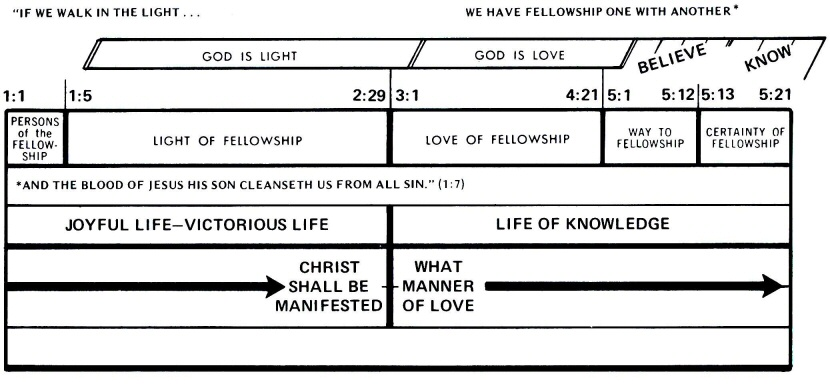
FELLOWSHIP WITH GOD AND HIS CHILDREN
Click chart to enlarge
Charts from Jensen's Survey of the NT - used by permission
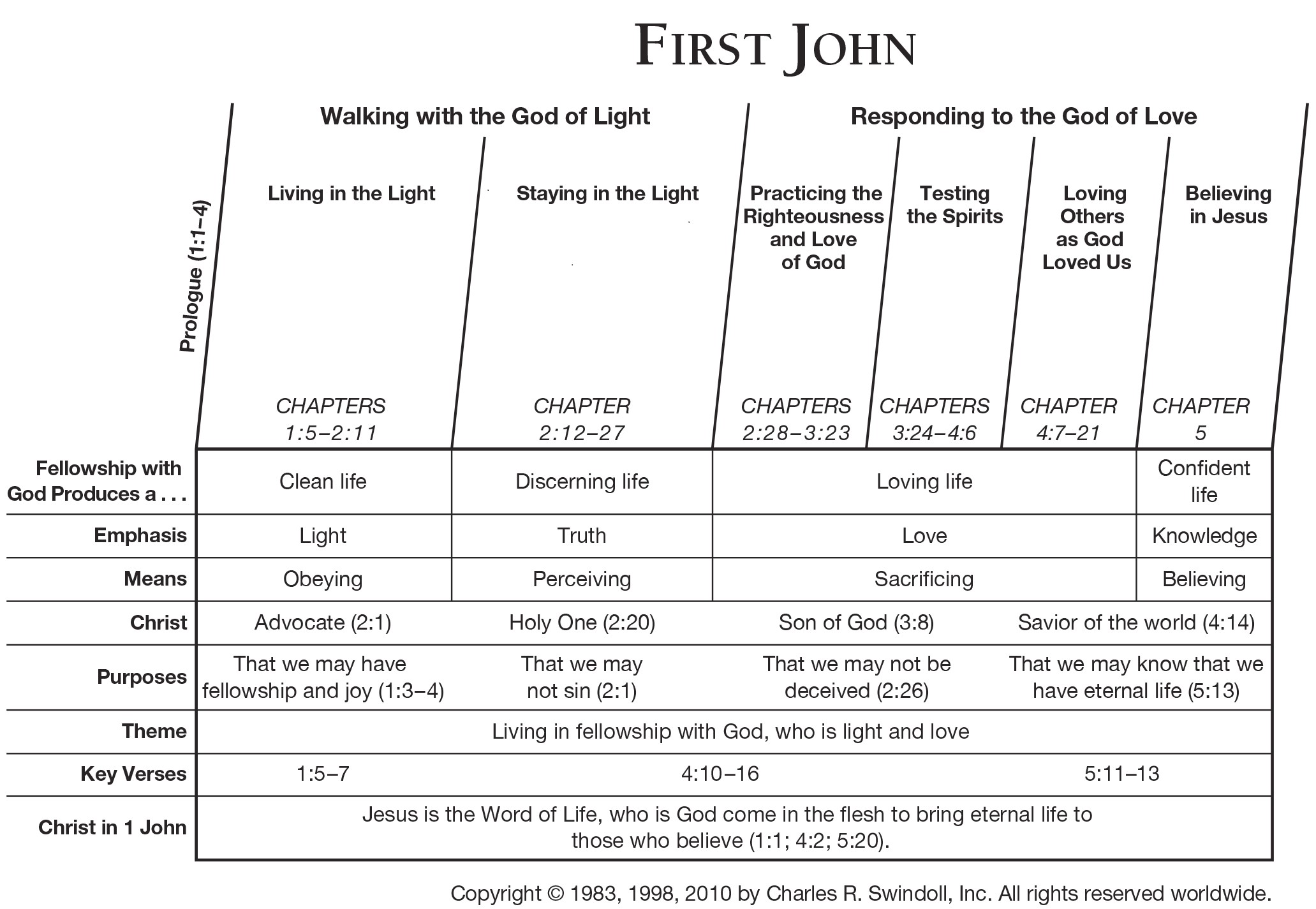
Another Overview Chart - 1 John - Charles Swindoll
| BASIS OF FELLOWSHIP | BEHAVIOR OF FELLOWSHIP | ||||
| Conditions of Fellowship |
Cautions of Fellowship |
Fellowship Characteristics |
Fellowship Consequences |
||
| Meaning of Fellowship 1 Jn 1:1-2:27 |
Manifestations of Fellowship 1 Jn 2:28-5:21 |
||||
| Abiding in God's Light |
Abiding in God's Love |
||||
| Written in Ephesus | |||||
| circa 90 AD | |||||
| From Talk Thru the Bible | |||||
What is this? On the photograph of the Observation Worksheet for this chapter you will find handwritten 5W/H questions (Who? What? Where? When? Why? How?) on each verse to help you either personally study or lead a discussion on this chapter. The questions are generally very simple and are stated in such a way as to stimulate you to observe the text to discern the answer. As a reminder, given the truth that your ultimate Teacher is the Holy Spirit, begin your time with God with prayer such as Psalm 119:12+ "Blessed are You, O LORD; Teach me Your statutes." (you can vary it with similar prayers - Ps 119:18, 26, 33, 64, 66, 68, 108, 124, 135, 171, etc) The questions are generally highlighted in yellow and the answers in green. Some questions have no answers and are left to your observations and the illuminating/teaching ministry of the Holy Spirit. Some qualifying thoughts - (1) Use "As is" - these are handwritten and will include mistakes I made, etc. (2) They may not be the best question for a given verse and my guess is that on some verses you will think of a far superior 5W/H question and/or many other questions.
Dr Howard Hendricks once gave an assignment to his seminary students to list as many observations as they could from Acts 1:8. He said "So far they’ve come up with more than 600 different ones! Imagine what fun you could have with 600 observations on this passage. Would you like to see Scripture with eyes like that?" (P. 63 Living by the Book - borrow) With practice you can! And needless to say, you will likely make many more observations and related questions than I recorded on the pages below and in fact I pray that the Spirit would indeed lead you to discover a veritable treasure chest of observations and questions! In Jesus' Name. Amen
Why am I doing this? Mortimer Adler among others helped me develop a questioning mindset as I read, seeking to read actively rather than passively. Over the years I have discovered that as I have practiced reading with a 5W/H questioning mindset, it has yielded more accurate interpretation and the good fruit of meditation. In other words, consciously interacting with the inspired Holy Word of God and the illuminating Holy Spirit has honed my ability to meditate on the Scripture, and my prayer is that this tool will have the same impact in your spiritual life. The benefits of meditation are literally priceless in regard to their value in this life and in the life to come (cf discipline yourself for godliness in 1Ti 4:8+.) For some of the benefits - see Joshua 1:8+ and Psalm 1:2-3+. It will take diligence and mental effort to develop an "inductive" (especially an "observational"), interrogative mindset as you read God's Word, but it bears repeating that the benefits in this life and the rewards in the next will make it more than worth the effort you invest! Dear Christian reader let me encourage you to strongly consider learning the skills of inductive Bible study and spending the rest of your life practicing them on the Scriptures and living them out in your daily walk with Christ.
Although Mortimer Adler's advice is from a secular perspective, his words are worth pondering...
Strictly, all reading is active. What we call passive is simply less active. Reading is better or worse according as it is more or less active. And one reader is better than another in proportion as he is capable of a greater range of activity in reading. (Adler's classic book How to Read a Book is free online)
John Piper adds that "Insight or understanding is the product of intensive, headache-producing meditation on two or three verses and how they fit together. This kind of reflection and rumination is provoked by asking questions of the text. And you cannot do it if you hurry. Therefore, we must resist the deceptive urge to carve notches in our bibliographic gun. Take two hours to ask ten questions of Galatians 2:20+ and you will gain one hundred times the insight you would have attained by reading thirty pages of the New Testament or any other book. Slow down. Query. Ponder. Chew.... (John Dewey rightly said) "People only truly think when they are confronted with a problem. Without some kind of dilemma to stimulate thought, behavior becomes habitual rather than thoughtful.”
“Asking questions is the key to understanding.”
--Jonathan Edwards
That said, below are the 5W/H questions for each verse in this chapter (click page to enlarge). This is not neatly typed but is handwritten and was used for leading a class discussion on this chapter, so you are welcome to use it in this "as is" condition...

1 John 1:2 and the life was manifested, and we have seen and testify and proclaim to you the eternal life, which was with the Father and was manifested to us-- (NASB: Lockman)
Greek: kai e zoe ephanerothe, (3SAPI) kai eorakamen (1PRAI) kai marturoumen (1PPAI) kai apaggellomen (1PPAI) humin ten zoen ten aionion etis en (3SIAI) pros ton patera kai ephanerothe (3SAPI) ehein
Amplified: And the Life [an aspect of His being] was revealed (made manifest, demonstrated), and we saw [as eyewitnesses] and are testifying to and declare to you the Life, the eternal Life [in Him] Who already existed with the Father and Who [actually] was made visible (was revealed) to us [His followers]. (Amplified Bible - Lockman)
ESV: the life was made manifest, and we have seen it, and testify to it and proclaim to you the eternal life, which was with the Father and was made manifest to us— (ESVBible.org)
KJV: (For the life was manifested, and we have seen it, and bear witness, and shew unto you that eternal life, which was with the Father, and was manifested unto us;)
NLT: This one who is life itself was revealed to us, and we have seen him. And now we testify and proclaim to you that he is the one who is eternal life. He was with the Father, and then he was revealed to us. (NLT - Tyndale House)
Phillips: For it was life which appeared before us: we saw it, we are eye-witnesses of it, and are now writing to you about it. It was the very life of all ages, the life that has always existed with the Father, which actually became visible in person to us mortal men. (Phillips: Touchstone) (1John Online)
Wuest: And this aforementioned life was made visible, and we have seen it with discernment and have it in our mind’s eye, and are bearing witness and bringing back to you a message concerning the life, the eternal life, which is of such a nature as to have been in fellowship with the Father and was made visible to us. (Eerdmans Publishing - used by permission)
Young's Literal: and the Life was manifested, and we have seen, and do testify, and declare to you the Life, the age-during, which was with the Father, and was manifested to us
- the life: 1Jn 5:11,20 Jn 1:4 11:25,26 14:6
- manifested: 1Jn 3:5,8 Ro 16:25,26 1Ti 3:16 2Ti 1:10 Tit 1:2
- testify: Jn 15:27 21:14 Ac 1:22 2:32 3:15 5:32 10:41 1Pe 5:1
- proclaim: 1Jn 5:20
- eternal: Jn 17:3
- 1 John 1 Resources
THE INFINITE
BECOMES FINITE
NET Bible Note - In the Greek text the prologue to 1 John 1:1-4 makes up a single sentence. This is awkward in Greek, and a literal translation produces almost impossible English.
And (kai) - Note that many of the translations omit this conjunction "and" (e.g., see ESV above). And (kai) points to another thought added to what has already been said, affirming the historical appearing and eternal nature of “the life” just mentioned. Kistemaker writes that "To be sure, this conjunction (kai = "and") conveys an affirmative intent that can be translated "indeed." That is, "indeed the life appeared." (New Testament Commentary - James, Epistles of John, Peter, and Jude)
And the life (zoe) was manifested (phaneroo - aorist - at a point in time), and we have seen (horao) and testify (martureo) and proclaim (apaggello - present tense) to you the eternal (aionios) life (zoe), which was (imperfect tense as in Jn 1:1+) with (pros = toward) the Father and was manifested (phaneroo - aorist - at a point in time) to us John is confirming and amplifying 1Jn 1:1, especially explaining the word Life. Many commentators consider verse 2 a parenthesis (a "parenthetical remark"), in which John pauses so to speak to make an explanatory comment on what he has just stated in verse 1, and then resumes his train of thought in 1Jn 1:3. The eternal life is another way to say Jesus Christ.
The Life - What life? The Life of Christ Who is Life. Notice John's repetition for emphasis -- "The Word of Life"… "The Life"… "The Eternal Life." In short order John emphasizes Jesus is the personification of life. All uses of "Life" in 1John - 1 John 1:1, 1:2, 2:16, 2:25, 3:14, 15, 16, 5:11, 12, 13, 16, 20
Ligon Duncan notes that "Verse 2 is a very important pause (parenthesis) though, because in it he says that the blessed life, the joyful life, the meaningful life, eternal life and fellowship with God was manifested objectively in Jesus Christ. Here’s how he puts it. “The life was manifested and we have seen and testify and proclaim to you the eternal life which was with the Father and was manifested to us.” He pauses and he is telling you that the eternal word entered our space and time and was made manifest to men. In particular, he is stressing that we, that apostles, have seen and testify and proclaim the Jesus who was visibly manifested in the flesh. (1 John 1:1-4 The Word of Life Appeared to Us)
The life (zoe) was manifested (revealed, has appeared - phaneroo) - Jesus Christ Who has always been God, became manifest in Human History as a flesh and blood Man, Who was seen by John. This is John's "shorthand" description of the incarnation of Christ. John's description parallels Paul's description stating that Jesus was "made in the likeness and men" (Phil 2:7+) and was "found in appearance as a man" (Phil 2:8+). The life Jesus manifested before His family, His disciples, and the world was a supernatural, eternal life, the life of God Himself.
Wuest explains "This life which is invisible was made visible to the human race through the humanity of our Lord. We put light which is invisible through a prism, break it up into its component parts, and it becomes visible. The beauty of the life that God is, broken up into its various parts such as love, grace, humility, kindness, etc., is seen through the prism of the human life of our Lord. (Eerdmans Publishing - used by permission)
Near the end of this letter John again writes how one attains real life, eternal life in this short life on earth…
And the witness is this, that God has given us eternal life, and this life is in His Son. 12 He who has the Son has the life; he who does not have the Son of God does not have the life. (1Jn 5:11,12+)
In his Gospel John notes that the Word had life writing that…
IN the beginning was the Word, and the Word was with God, and the Word was God. 2 He was in the beginning with God. 3 All things came into being by Him, and apart from Him nothing came into being that has come into being. 4 In Him was life, and the life was the light of men. (Jn 1:1-4+)
Later in this same Gospel Jesus declared that…
just as the Father has life in Himself, even so He gave to the Son also to have life in Himself (Jn 5:26+)
Preparatory to His resurrection of Lazarus Jesus declared to Martha…
Jesus said to her, “I am the resurrection and the life; he who believes in Me shall live even if he dies, 26 and everyone who lives and believes in Me shall never die. Do you believe this?” (Jn 11:25-26+)
Paul adds that Christ Jesus…
has been revealed (phaneroo - manifested, made visible) by the appearing of our Savior Christ Jesus (The Historical Fact of Jesus birth - His incarnation), Who abolished death, and brought life (Jesus is the essence of Life which parallels John's description of Him in 1Jn 1:2 as "the Eternal Life") and immortality to light (to a world in spiritual darkness) through the Gospel (2Ti 1:10+).
Manifested (5319)(phaneroo from the adjective phanerós = manifest, visible, conspicuous from the verb phaino = to give light; to illuminate; to become visible from the noun phos = light) is literally "to bring to light" and primarily means "to make visible" or to cause to become visible. The basic meaning of phaneroo is to make known or to clearly reveal giving an external manifestation to the senses which is visible to all. Thayer adds that phaneroo means “to make manifest or visible or known what has been hidden or unknown”. Note that the idea of to be manifested in the Scriptural sense means more than just to appear. For example, a person may appear in a false guise or without a disclosure of what he truly is (this is especially the meaning of phaneroo, see, e.g., John 3:21; 1Co 4:5; 2Cor. 5:10, 11; Ep 5:13). Thus as used of Jesus, phaneroo conveys the sense of Him being revealed in His true character. In 1Jn 1:2 John, the apostle uses phaneroo to describe the revelation of the Lord at His first coming and in Col. 3:4+ the apostle Paul employs the same verb (phaneroo) to describe His Second Coming. Kistemaker writes that "To be sure, this conjunction (kai = "and") conveys an affirmative intent that can be translated "indeed." That is, "indeed the life appeared." (New Testament Commentary - James, Epistles of John, Peter, and Jude) Phaneroo is frequently used in the Gospel of John to refer to Jesus’ revelation of Himself to His disciples (John 2:11, 21:1; 21:14).
PHANEROO IN JOHN'S WRITINGS - Jn. 1:31; Jn. 2:11; Jn. 3:21; Jn. 7:4; Jn. 9:3; Jn. 17:6; Jn. 21:1; Jn. 21:14; 1 Jn. 1:2; 1 Jn. 2:19; 1 Jn. 2:28; 1 Jn. 3:2; 1 Jn. 3:5; 1 Jn. 3:8; 1 Jn. 4:9; Rev. 3:18; Rev. 15:4
Marvin Vincent has this note on phaneroo…Occurring frequently in the New Testament, it is used most frequently of God and Christ, or of men in their relation to these. Thus, of Christ in person while upon earth (Mark 16:12, 14; John 1:31; 2:11; 1Pet. 1:20; 1John 1:2). Of the works of Christ (John 2:11; 9:3; 1 John 3:5). Of Christ in redemption (1 John 3:5). Of Christ in His second coming (1 John 2:28). Of Christ in glory (1 John 3:2; Col. 3:4). It is used of God. Of His revelation to men of the knowledge of Himself (Rom. 1:19). Of His manifestation in Christ (1 Tim. 3:16). Of His righteousness (Rom. 3:21). Of His love (1 John 4:9). It is used of men. As epistles manifesting the character and spirit of Christ (2Cor. 3:3; 5:11). In the judgment (2Cor 5:10). In all these cases the appearing is not merely an appeal to sense, but is addressed to spiritual perception, and contemplates a moral and spiritual effect. It is the setting forth of the law or will or character of God; of the person or work of Christ; of the character or deeds of men, with a view to the disclosure of their quality and to the producing of a moral impression. (Vincent - Word Studies)
George G Findlay observes that…JOHN HAD WITNESSED, AS HE BELIEVED, THE SUPREME MANIFESTATION OF GOD. The secret of the universe stood unveiled before his eyes, the everlasting fact and truth of things, the reality underlying all appearances, “that which was from the beginning.” Here he touched the Spring of being, the Principle that animates creation from star to farthest star, from the archangel to the worm in the sod:
“The life was manifested, the life eternal which existed with the Father, was manifested to us.” If “the life” of this passage is identical with that of the Gospel prologue, it has all this breadth of meaning; it receives a limitless extension when it is defined as “that which was from the beginning.”
The Source of spiritual life to men is that which was, in the first instance, the source of natural life to all creatures. Here lies the foundation of St. John’s theology. It assumes the solidarity of being, the unity of the seen and unseen. It contradicts and excludes, from the outset, all Gnostic, dualistic, and Docetic conceptions of the world. This essential and aboriginal (being the first or earliest known of its kind present in a region) Life, he tells us, became incarnate, that it may have fellowship with men; it (He) was slain, that its (His) blood may cleanse them from iniquity. (1 John Commentary)
We have seen (horao) refers not merely to the act of seeing, but also conveys the idea that there is the actual perception of what is seen. Notice John's use of "seen" is in the perfect tense which signifies, yes they saw Jesus and that image continues to be present in their mind. Wuest paraphrases it this way "we have seen it with discernment and have it in our mind’s eye."
THOUGHT - May God's Spirit so reveal Jesus to us through His Word that we like John might have His image "burned" forever in our mind and heart, in such a way that it motivates and energizes us to share that "image" with those who have never seen the Life, the Eternal One! Amen.
In 1Jn 3:6 John uses horao in a context which emphasizes that this verb means more than simply seeing, but includes the idea of seeing with discernment…
No one who abides in Him sins; no one who sins has seen (horao) Him or knows (ginosko = knows by experience) Him.
Comment: This is a description of an unsaved person and not the description of a believer. Both "abides" and "sins" are in the present tense which speaks of continuous activity.
Horao is used by Jesus who declared to His disciples…
If you had known Me, you would have known My Father also; from now on you know Him, and have seen (horao) Him." (Jn 14:7+)
Comment: At this time the disciples (including John) did not understand Jesus' statement (see Jn 14:8), but Jesus knew they would and spoke of it as if it were already true ("from now on you know Him"). Jesus' point is that He was God and to see Him was to see God. Here in John's epistle, he is testifying to that he saw Jesus. (Read Jn 14:9 which also uses horao = "have seen").
We testify (bear witness) (3140)(martureo from mártus = witness = one who has information or knowledge of something and can bring to light or confirm something. English = martyr) in its most basic sense refers to a legal witness. Thus the verb martureo means to be a witness, to testify, to give evidence, to give testimony, to bear record, to affirm that one has seen or heard or experienced something. John is using the verb in that sense, indicating that what he is saying is related to fact, not opinion, even as if he were giving sworn testimony in a courtroom setting.
Notice that testify (bear witness) and proclaim are both in the present tense, signifying this was John's lifestyle, his habitual practice and beloved it should also be our "reason for living" as they say! Let your light shine!
To bear witness of the real life and death and burial and resurrection of the God-Man, Christ Jesus was indeed the chief office to which the apostles were designed by Christ, and in order that they might be enabled to the faithful discharge of it, He promised the power of the Holy Spirit (Jn 15:26, 27; Acts 1:8).
THOUGHT - Beloved follower of Christ, does He not call us to the same task and provide us with the same Power, the permanent, personal possession of His indwelling Spirit? Are we faithfully discharging our duty by bearing witness of our Master Jesus, the Savior of the World? The first two letters in "Gospel" spell "Go" which is what the early church did for they could not stop speaking what they had seen and heard. (Acts 4:20+)
Where does John continually testify? Clearly, he continues to testify to what he has seen of the Eternal Life in the Gospel which bears his name, writing…
Many other signs therefore Jesus also performed in the presence of the disciples, which are not written in this book; but these have been written that you may believe that Jesus is the Christ, the Son of God; and that believing you may have life in His name… This is the disciple who bears witness of these things, and wrote these things; and we know that his witness is true. (Jn 20:30, 31+, Jn 21:24)
Guy King adds that "A "witness" is a two-sided being - the one side of him sees, the other side of him shows (Show and tell); and it is just that dual function that is incumbent upon every true believer - "ye shall be witnesses… " (Acts 1:8). (The Pleasure of the Fellowship)
John MacArthur comments "Because of his widespread reputation as one who had been with Jesus as an apostle (cf. Jn 1:14, 16–18, 37–51), John was a true and credible witness (Jn 19:35–37). Other New Testament books written by apostles or their associates also present eyewitness accounts of Jesus and the truth of the gospel. The other Gospels do that (cf. Lk 1:1–4), as does the book of Acts (cf. 1:1–3) and the epistles (e.g., 2Pe 1:16–21). (1-3 John Commentary - Page 18)
Seen… bear witness… proclaim - Vincent refers to these as "Three ideas in the apostolic message: experience, testimony, announcement." (Vincent - Word Studies) In "seen" the emphasis is on the communication of truth to the apostles (and now to us) and in "bear witness… proclaim" the emphasis is on the communication of truth to others who are dead in their trespasses and sin (Eph 2:1)! What is it that John (and the apostles) proclaim (and we are to proclaim today)? The life (that) was manifested, the incarnation of God in a Man, sent from His eternal fellowship with the Father on mission to die as sinful man's substitutionary sacrifice. This is the Good News we need to proclaim to those who have only bad news awaiting them outside of Christ!
THOUGHT - Are you sitting and soaking up the truth? Or are you diligently, intentionally seeking to proclaim the Truth, Word of Life, the Eternal Life?
William MacDonald writes that "The following lines by an unknown author show the practical implications of these first two verses for our lives: I am glad that my knowledge of eternal life is not built on the speculations of philosophers or even theologians but on the unimpeachable testimony of those who heard, saw, gazed at, and handled Him in whom it was incarnate. It is not merely a lovely dream, but solid fact, carefully observed and an accurately recorded fact. (Borrow Believer's Bible Commentary)
A DIVINE STEREOPTICON

THE DIVINE AND THE HUMAN IN CHRIST - The picture produced in the stereopticon (depicted above) is fuller, rounder and more natural than the same picture seen without the use of that instrument. But to produce the stereoscopic picture there must be two pictures blended into one by the use of the stereopticon, and both the eyes of the observer are brought into requisition at the same time, looking each through a separate lens. Thus Christ is only seen in His true and proper light, when the record of His human nature and the statement of His Divine are blended. It is a flat, unfinished Christ with either left out. But it is as seen in the Word, with the moral and mental powers of our being both engaged in the consideration, and thus only, that we get the full and true result.
Jesus came to proclaim (preach) Good News. He trained His disciples to do the same. John is doing what he was trained to do. Our mission today as His disciples is still the same -- to share the Eternal Life found in Christ with the lost world around us. Are you fulfilling your privileged duty (under grace not law, enabled by the Spirit, not your fallen flesh) of passing on the Word of Life, the Eternal Life, to those who live in spiritual darkness, with a sword of Damocles hanging over their head promising nothing but eternal spiritual death (Eph 2:1, 2)?
Proclaim (518) (apaggello from apó = from + aggéllo = tell, declare from aggelos = messenger, one who speaks in place of one who has sent him) means to bring a message from any person or place. To bring tidings from a person or thing. To relate, inform, tell what has occurred. In the present context the idea is to announce openly. Apaggello summarized - (1) Carry back a message from a happening and thus give an account of something (to report, announce, tell, inform) (2) To proclaim or announce. To make something known publicly. It was used of a messenger, to bring tidings, report, announce Apaggello is the carrying of tidings or messages from the authentic source. As discussed above, proclaim in this verse is in the present tense. Note: Do not confuse apaggello with the similar word anaggello (see note).
Alfred Plummer comments that apaggello "has merely the notion of proclaiming and making known, (anaggello) has the notion of proclaiming again what has been received elsewhere." (1 John 1 Commentary)
Detzler comments on the root word aggéllo - We find echoes of this word in such English words as "angel" (one who brings a message from God), "evangelism" (a declaration of the Gospel), and "evangelical" (one who believes in the Gospel message). (New Testament Words in Today's Language)
Apaggello - 45x in 45v in the NAS - announced(1), declared(1), declaring(3), proclaim(4), report(10), reported(22), take word(1), tell(1), told(3). Matt. 2:8; Matt. 8:33; Matt. 11:4; Matt. 12:18; Matt. 14:12; Matt. 28:8; Matt. 28:10; Matt. 28:11; Mk. 5:14; Mk. 5:19; Mk. 6:30; Mk. 16:10; Mk. 16:13; Lk. 7:18; Lk. 7:22; Lk. 8:20; Lk. 8:34; Lk. 8:36; Lk. 8:47; Lk. 9:36; Lk. 13:1; Lk. 14:21; Lk. 18:37; Lk. 24:9; Jn. 16:25; Acts 4:23; Acts 5:22; Acts 5:25; Acts 11:13; Acts 12:14; Acts 12:17; Acts 15:27; Acts 16:36; Acts 16:38; Acts 17:30; Acts 22:26; Acts 23:16; Acts 23:17; Acts 23:19; Acts 26:20; Acts 28:21; 1 Co. 14:25; 1 Thess. 1:9; Heb. 2:12; 1 Jn. 1:2; 1 Jn. 1:3
Wuest's note on apaggello in Mk 514: The word “told” (reported in NAS) is apaggellō “to bring tidings from a person or thing, bring word.” The prefixed preposition (apo) which means “off from” adds to the meaning already existing in the simple verb aggellō “to announce,” the idea being that what one announces, he openly lays, as it were, off from himself. The swineherds were charged with the responsibility of safeguarding the animals under their care, and to have two thousand hogs piled up in heaps in shallow water, all dead, was something to explain. (Eerdmans Publishing - used by permission)
Apaggello is used 234x in the Septuagint (Lxx). Here are a few examples to study…
Genesis 12:18 Then Pharaoh called Abram and said, "What is this you have done to me? Why did you not tell (Hebrew = nagad = to be or make conspicuous; Lxx = apaggello) me that she was your wife?
Genesis 37:5 Then Joseph had a dream, and when he told (Hebrew = nagad = to be or make conspicuous; Lxx = apaggello) it to his brothers, they hated him even more.
Genesis 48:1 Now it came about after these things that Joseph was told Hebrew = amar = to utter or say; Lxx = apaggello), "Behold, your father is sick." So he took his two sons Manasseh and Ephraim with him.
Ruth 2:11 Boaz replied to her, "All that you have done for your mother-in-law after the death of your husband has been fully reported (Hebrew = nagad = to be or make conspicuous; Lxx = apaggello- in Greek "apaggelia [noun] apeggele [verb]" = Literally "a report reported") to me, and how you left your father and your mother and the land of your birth, and came to a people that you did not previously know.
Ruth 2:19 Her mother-in-law then said to her, "Where did you glean today and where did you work? May he who took notice of you be blessed." So she told (Hebrew = nagad = to be or make conspicuous; Lxx = apaggello) her mother-in-law with whom she had worked and said, "The name of the man with whom I worked today is Boaz."
Ruth 3:4 "It shall be when he lies down, that you shall notice the place where he lies, and you shall go and uncover his feet and lie down; then he will tell (Hebrew = nagad = to be or make conspicuous; Lxx = apaggello) you what you shall do."
1 Samuel 3:15 So Samuel lay down until morning. Then he opened the doors of the house of the LORD. But Samuel was afraid to tell (Hebrew = nagad = to be or make conspicuous; Lxx = apaggello) the vision to Eli.
Psalm 71:18 (In the last decade or so of my life, this verse is especially significant to me and motivates me to continue adding to this website!) And even when I am old and gray, O God, do not forsake me, Until I declare (Hebrew = nagad = to be or make conspicuous; Lxx = apaggello) Your strength to this generation, Your power to all who are to come. (I pray these notes do just that - declare His strength and His power to all generations yet to come, however long the Lord should tarry. In His Name and for His glory. Amen)
Psalm 78:6 (Context = Ps 78:5) That the generation to come might know, even the children yet to be born, That they may arise and tell (Hebrew = saphar = recount, relate; Lxx = apaggello) them to their children
Comment: Here is the NET Bible rendering which is somewhat clearer - "so that the next generation, children yet to be born, might know about them. They will grow up and tell their descendants about them." Is there not inherent in this great passage the charge by our Lord to make disciples? What better disciples than our children, who follow hard after Christ!
THE EPISTLE OF
ETERNAL LIFE
The Eternal (aionios) Life (zoe) - Literally this reads "the Life, the eternal." This descriptive phrase functions in this context as virtually a name of Jesus. It is notable that John's letter begins (1Jn 1:2) and ends (1Jn 5:20) with the theme of eternal life! John desires that his readers have full assurance of eternal life (1 John 5:13). Jesus Christ is Himself “the resurrection and the life (zoe).” (John 11:25+).
A T Robertson writes that in 1John 1:2 eternal life "means the divine life which the Logos was and is (John 1:4; 1John 1:1)."
Vincent writes that aionios or eternal in this verse "describes the life in its quality of not being measured by time, a larger idea than that of mere duration." (Vincent - Word Studies)
Robert Lightner sees another significance to this phrase that "Only God possesses eternal life. Since John speaks of Christ as "the eternal life, which was with the Father," this verse therefore assigns full and absolute deity to Christ. This is the One said to be heard, seen, and touched. He was and is the God-man." (The Books of 1, 2, 3 John and Jude)
Eternal (aionios) Life (zoe) - This important phrase is used six times in First John…
1 John 1:2 and the life was manifested, and we have seen and bear witness and proclaim to you the eternal life, which was with the Father and was manifested to us--
1 John 2:25 And this is the promise which He Himself made to us: eternal life.
1 John 3:15 Everyone who hates his brother is a murderer; and you know that no murderer has eternal life abiding in him.
1 John 5:11 And the witness is this, that God has given us eternal life, and this life is in His Son.
1 John 5:13 These things I have written to you who believe in the name of the Son of God, in order that you may know that you have eternal life.
1 John 5:20 And we know that the Son of God has come, and has given us understanding, in order that we might know Him who is true, and we are in Him who is true, in His Son Jesus Christ. This is the true God and eternal life.
The other NT uses of "eternal life": 15x in John's Gospel - John 3:15, 16, 36; 4:14; 5:24, 39; 6:27, 40, 47, 54, 68; 10:28; 12:50; 17:2, 3. 20x in rest of NT - Mt 19:16, 29; 25:46; Mk 10:17, 30; Lk 10:25; 18:18, 30; Acts 13:46, 48; Ro 2:7; 5:21; 6:22, 23; Gal 6:8; 1Ti 1:16; 6:12; Titus 1:2; 3:7; Jude 1:21.See also related phrase = "life eternal" used in John 4:36 12:25.
John emphasizes that Jesus, Who was manifest as a Man, is without beginning or end, a truth which counters the heretical teaching of many cults (eg, Jehovah's Witnesses) which say that Jesus was a created being, that He had a beginning. John would say "no"! As hard as it is for us to comprehend this truth, the life of Jesus is eternal! Let us who now possess the Hope (absolute certainty of future good) of this Eternal Life (Col 1:27b-note), praise Him for opening our blind eyes (Isa 29:18, Lk 4:18, Acts 26:18, 2Co 4:6) and our rebellious hearts (Ezek 11:19, 36:26 Acts 16:14, 2Cor 3:14, Lk 24:45) and revealing this glorious, transcendent truth! (See God's Attribute - Eternal)
S Lewis Johnson writes that "John's message is very simple. He wants to make us certain about Christ. He wants us to realize that the testimony that is preserved by the apostles and now in the church and expounded in the church is a reliable testimony, and he wants us to be certain about eternal life. He sums it up at the end of the epistle when he says, "And we know that the Son of God has come and has given us understanding in order that we may know Him, who is true, and we are in Him, who is true, in His Son Jesus Christ, this is the true God and eternal life. Little children, guard yourself from idols." (1Jn 5:20, 21)
F F Bruce comments that John's epistle "is justly called the epistle of eternal life. It shows how and in Whom that life was uniquely and perfectly manifested; it shows how the presence of that life in men and women may be recognized. John's own experience of that life entitles him to speak of it with assurance and communicate his assurance to others: this, he says, we have seen; to this we bear witness; this we make known to you."
Jesus declared to the religious Jews…
You search the Scriptures, because you think that in them you have eternal life; and it is these that bear witness of Me; and you are unwilling to come to Me, that you may have life. (Jn 5:39-40+)
Jesus explained to His disciples
I am the Way, and the Truth, and the Life; (absolutely) no one comes to the Father, but through Me. (Jn 14:6)
Eternal (166)(aionios from aion) means existing at all times, perpetual, pertaining to an unlimited duration of time (Ro 1:20 - God's power, Mt 18:8 - God's place of judgment, Ro 16:26 - God's attribute, and here in 1Jn 1:2, God's life!).
A T Robertson writes that "John defines the term by the adjective aionios, used 71 times in the NT, 44 times with zōē and 23 in John’s Gospel and Epistles (only so used in these books by John).
AIONIOS IN JOHN'S WRITINGS - Jn. 3:15; Jn. 3:16; Jn. 3:36; Jn. 4:14; Jn. 4:36; Jn. 5:24; Jn. 5:39; Jn. 6:27; Jn. 6:40; Jn. 6:47; Jn. 6:54; Jn. 6:68; Jn. 10:28; Jn. 12:25; Jn. 12:50; Jn. 17:2; Jn. 17:3; 1 Jn. 1:2; 1 Jn. 2:25; 1 Jn. 3:15; 1 Jn. 5:11; 1 Jn. 5:13; 1 Jn. 5:20; Rev. 14:6
Life (2222)(zoe) refers to the life of Jesus in this context. Thayer describes zoe as “the absolute fulness of life, both essential and ethical, which belongs to God.” In this verse, John uses the definite article "the Life", indicating not just any life, but the fullness of life in Jesus Christ. Simply put, the essence of life that God intends for His creation (and especially His children) is not a concept, but a Person, the God-Man Jesus Christ, Who Paul states is now and forever "our life." (Col 3:4-note, as does John in Jn 20:31, 14:19, 1Jn 5:11, 13).
ZOE IN JOHN'S WRITINGS - Jn. 1:4; Jn. 3:15; Jn. 3:16; Jn. 3:36; Jn. 4:14; Jn. 4:36; Jn. 5:24; Jn. 5:26; Jn. 5:29; Jn. 5:39; Jn. 5:40; Jn. 6:27; Jn. 6:33; Jn. 6:35; Jn. 6:40; Jn. 6:47; Jn. 6:48; Jn. 6:51; Jn. 6:53; Jn. 6:54; Jn. 6:63; Jn. 6:68; Jn. 8:12; Jn. 10:10; Jn. 10:28; Jn. 11:25; Jn. 12:25; Jn. 12:50; Jn. 14:6; Jn. 17:2; Jn. 17:3; Jn. 20:31; 1 Jn. 1:1; 1 Jn. 1:2; 1 Jn. 2:25; 1 Jn. 3:14; 1 Jn. 3:15; 1 Jn. 5:11; 1 Jn. 5:12; 1 Jn. 5:13; 1 Jn. 5:16; 1 Jn. 5:20; Rev. 2:7; Rev. 2:10; Rev. 3:5; Rev. 7:17; Rev. 11:11; Rev. 13:8; Rev. 16:3; Rev. 17:8; Rev. 20:12; Rev. 20:15; Rev. 21:6; Rev. 21:27; Rev. 22:1; Rev. 22:2; Rev. 22:14; Rev. 22:17; Rev. 22:19
Wuest adds that "this life that God is, is not to be defined as merely animation, but as definitely ethical in its content. God is not the mere reason for the universe, as the Greeks thought, but a Person with the characteristics and qualities of a divine Person. The ethical and spiritual qualities of this life which God is, are communicated to the sinner when the latter places his faith in the Lord Jesus as Saviour, and this becomes the new, animating, energizing, motivating principle which transforms the experience of that individual, and the saint thus lives a Christian life. The message of John is that since the believer is a partaker of this life, it is an absolute necessity that he show the ethical and spiritual qualities that are part of the essential nature of God, in his own life. If these are entirely absent, John says, that person is devoid of the life of God, and is unsaved. The ethical and spiritual qualities of this life were exhibited to the human race in the earthly life of the Lord Jesus. His life thus becomes the pattern of what our lives should be in holiness, self-sacrifice, humility, and love. (Eerdmans Publishing - used by permission)
As someone has well written "Life with Christ is an endless hope, without Him a hopeless end." Genuine, fulfilling, lasting, meaningful life is to be found only in our mystical union, our perfect oneness, our new covenant bond with "the Life" Jesus Christ the Son of God.
Vincent comments on "The Life" noting that this describes Jesus "The Word Himself Who is the Life. Compare John 14:6; 5:26; 1 John 5:11, 12. Life expresses the nature of the Word (John 1:4). The phrase, the Life, besides being equivalent to the Word, also indicates, like the Truth and the Light, an aspect of His being. (Vincent - Word Studies)
QUESTION - What is eternal life?
ANSWER - When the Bible speaks of eternal life, it refers to a gift of God that comes only “through Jesus Christ our Lord” (Romans 6:23). This gift is in contrast to the “death” that is the natural result of sin. (ED: In 1Jn 1:2 "the eternal life" in context is essentially a descriptive name of Jesus Christ.)
The gift of eternal life comes to those who believe in Jesus Christ, who is Himself “the resurrection and the life” (John 11:25). The fact that this life is “eternal” indicates that it is perpetual life—it goes on and on and on, with no end.
It is a mistake, however, to view eternal life as simply an unending progression of years. A common New Testament word for “eternal” is aiónios, which carries the idea of quality as well as quantity. In fact, eternal life is not really associated with “years” at all, as it is independent of time. Eternal life can function outside of and beyond time, as well as within time.
For this reason, eternal life can be thought of as something that Christians experience now. Believers don’t have to “wait” for eternal life, because it’s not something that starts when they die. Rather, eternal life begins the moment a person exercises faith in Christ. It is our current possession. John 3:36 says, “Whoever believes in the Son has eternal life.” Note that the believer “has” (present tense) this life (the verb is present tense in the Greek, too). We find similar present-tense constructions in John 5:24 and John 6:47. The focus of eternal life is not on our future, but on our current standing in Christ.
The Bible inextricably links eternal life with the Person of Jesus Christ. John 17:3 is an important passage in this regard, as Jesus prays, “Now this is eternal life: that they know you, the only true God, and Jesus Christ, whom you have sent.” Here, Jesus equates “eternal life” with a knowledge of God and of the Son. There is no knowledge of God without the Son, for it is through the Son that the Father reveals Himself to the elect (John 17:6; 14:9).
This life-giving knowledge of the Father and the Son is a true, personal knowledge, not just an academic awareness. There will be some on Judgment Day who had claimed to be followers of Christ but never really had a relationship with Him. To those false professors, Jesus will say, “I never knew you. Away from me, you evildoers!” (Matthew 7:23). The apostle Paul made it his goal to know the Lord, and he linked that knowledge to resurrection from the dead: “I want to know Christ—yes, to know the power of his resurrection and participation in his sufferings, becoming like him in his death, and so, somehow, attaining to the resurrection from the dead” (Philippians 3:10–11).
In the New Jerusalem, the apostle John sees a river flowing from “the throne of God and of the Lamb,” and “on each side of the river stood the tree of life. . . . And the leaves of the tree are for the healing of the nations” (Revelation 22:1–2). In Eden, we rebelled against God and were banished from the tree of life (Genesis 3:24). In the end, God graciously restores our access to the tree of life. This access is provided through Jesus Christ, the Lamb of God who takes away the sin of the world (John 1:29).
Right now, every sinner is invited to know Christ and to receive eternal life: “Let the one who is thirsty come; and let the one who wishes take the free gift of the water of life” (Revelation 22:17).
How can you know that you have eternal life? First, confess your sin before God. Then accept God’s provision of a Savior on your behalf. “Everyone who calls on the name of the Lord will be saved” (Romans 10:13). Jesus Christ, the Son of God, died for your sins, and He rose again the third day. Believe this good news; trust the Lord Jesus as your Savior, and you will be saved (Acts 16:31; Romans 10:9–10).
John puts it so simply: “God has given us eternal life, and this life is in his Son. Whoever has the Son has life; whoever does not have the Son of God does not have life” (1 John 5:11–12).
WHICH WAS WITH THE FATHER AND WAS MANIFESTED TO US: etis en (3SIAI) pros ton patera kai ephanerothe (3SAPI) ehein:
- which was: Pr 8:22-30 Jn 1:1,2,18 Jn 3:13 7:29 8:38 16:28 17:5 Ro 8:3 Ga 4:4
- 1 John 1 Resources
Related Passages:
Proverbs 8:22-30 “The LORD possessed me at the beginning of His way, Before His works of old. 23 “From everlasting I was established, From the beginning, from the earliest times of the earth. 24 “When there were no depths I was brought forth, When there were no springs abounding with water. 25 “Before the mountains were settled, Before the hills I was brought forth; 26 While He had not yet made the earth and the fields, Nor the first dust of the world. 27 “When He established the heavens, I was there, When He inscribed a circle on the face of the deep, 28 When He made firm the skies above, When the springs of the deep became fixed, 29 When He set for the sea its boundary So that the water would not transgress His command, When He marked out the foundations of the earth; 30 Then I was beside Him, as a master workman; And I was daily His delight, Rejoicing always before Him,
John 1:1,2,18 In the beginning was the Word, and the Word was with God, and the Word was God 2 He was in the beginning with God....1:18 No one has seen God at any time; the only begotten God who is in the bosom of the Father, He has explained Him.
JESUS WAS ALWAYS
WITH AND BEFORE THE FATHER
Which (hostis > etis) - BDAG says "hostis" refers to "any person, whoever, every one who, in a generalizing sense." In the present context, the pronoun clearly refers to Jesus Christ, Who John has just identified as the Eternal Life.
According to Kenneth Wuest the pronoun "Which" is important because "It speaks of character or nature. The Life, the Lord Jesus, is of such a nature as to have been in fellowship with God the Father, very God of very God Himself, possessing co-eternally with God the Father and God the Spirit, the divine essence. This life, a Person, the Lord Jesus, is described by John as aiōnios (aion), “without beginning and without end, that which always has been and always will be, eternal.” Since this Life is without beginning, it must be uncreated, thus, deity in its essence. (Eerdmans Publishing - used by permission)
Was (imperfect) with (pros) the Father - "The verb “was” denotes the past continuous existence of this life" (Hiebert) "The life" (Jesus) was with the Father. Jesus showed that life to John and the other apostles. John and those who believed in the Lord Jesus saw this real life.
Wuest adds that "“With” is an important word here. It is pros, which means “facing” and implies fellowship. All of which means that the life here referred to is a Person, for it requires a person to have fellowship. A mere abstraction can have no fellowship. The life here is none other than the Lord Jesus Himself who is said by John to have been in fellowship with the Father. (Eerdmans Publishing - used by permission)
Vine adds that "The word pros, “with,” as in the first verse of the Gospel (John 1:1), signifies not merely an accompaniment, but a living, active relation to, and communion with, the Father. (Bolding added)
W Hall Harris notes that "The author’s statement here that it was the eternal life that was with the Father echoes John 1:1 where it was the Word who was with the Father. Thus in 1Jn 1:1–4 it is the term life rather than word which refers to Jesus as He revealed Himself in His earthly career, including His person, words, works, death, and resurrection. This subtle shift in emphasis is precisely in keeping with the author’s stress on the importance of the earthly career of Jesus of Nazareth as the incarnate Word in his dispute with the opponents. (1, 2, 3 John - Comfort and Counsel for a Church in Crisis)
Eternal Life which was (imperfect tense as in Jn 1:1+) with (pros = toward) the Father and was manifested (phaneroo - aorist - at a point in time) to us (Literally - "and the life appeared") - As previously noted, John's first use of "manifested" describes that which was previously invisible becoming visible in the incarnation of Jesus. The second use of "manifested" speaks of the spiritual eyes of John and the apostles being opened (by the Spirit) to see and discern the true character of Jesus the Man, His Message and His Mission.
Let the acts of the offspring
indicate similarity to the Father.
-Augustine
Vincent agrees adding that "The life was manifested, sets forth the unfolding of that fact in the various operations of life. The one (Ed: The first use of "manifested" in 1Jn 1:2) denotes the objective process of the incarnation as such, the other (Ed: The second use of "manifested" in 1Jn 1:2) the result of that process as related to human capacity of receiving and understanding it. (Vincent - Word Studies)
Wuest writes "the incarnation of the Son of God was the making visible to human understanding, the life which God is." (Eerdmans Publishing - used by permission)
Steven Cole (1 John 1:1-3 The Tests of True Christianity) amplifies Vincent's explanation of John's two uses of manifested, writing that…
John states (1Jn 1:2), “the life was manifested,” and then repeats that this eternal life “was manifested to us” (the apostles). In other words, the apostles not only had Jesus Christ revealed to them in an objective, historical way; but also, He was manifested to them in a spiritual way as “the life, the eternal one” (literal translation of the Greek). God opened their eyes to see that the man, Jesus, was not just a godly man or a great teacher. It was revealed to them that He is “the Christ, the Son of the living God” (Matt. 16:16-17).
Why didn’t the multitudes that heard the same teaching and saw the same miracles as the apostles also see and believe in Christ as the life-giving Savior? Jesus explained (Luke 10:21+) that the Father had hidden these things from the wise and revealed them to infants (see also, Mt 13:10-17+). Then (Luke 10:22+) He added, “All things have been handed over to Me by My Father, and no one knows who the Son is except the Father, and who the Father is except the Son, and anyone to whom the Son wills to reveal Him.” In a similar vein, Paul explained (2Cor. 4:4+), “… the god of this world has blinded the minds of the unbelieving so that they might not see the light of the gospel of the glory of Christ, who is the image of God.” Unless God shines into our hearts to give sight (2Cor 4:6+), we cannot and will not see the truth about who Jesus Christ really is. At its core,
TRUE CHRISTIANITY IS
JESUS CHRIST REVEALED
George G Findlay calls us to…
observe the energy with which the apostle asserts THE ACTUALITY of the manifestation of the life of God in Jesus Christ. Thrice in three verses he reiterates, “we have seen” it, twice “we have heard”; and twice he repeats, “the life was manifested.”
This stupendous fact has, naturally, always had its doubters and deniers. In any age of the world, and under any system of thought, such a revelation as that made in Jesus Christ was sure to be met with incredulity. It is equally opposed to the superstitions and to the skepticisms natural to the human mind. In truth, the mind that is not surprised and sometimes staggered by the claims of Christ and the doctrines of Christianity, that has not felt the shock they give to our ordinary experience and native convictions, has hardly awakened yet to their full import.
John feels that the things he declares demand the strongest evidence. He has not believed them lightly, and he does not expect others to believe them lightly.
This passage, like many besides in the New Testament record, goes to show that the apostles were well aware of the importance of historical truth; they were conscientious and jealously observant in regard to this cardinal requirement. Their faith was calm, rational, and sagacious. They were perfectly certain of the things they attested, and believed only upon commanding and irresistible proof, that covered the whole extent of the case. But the facts they built their faith upon are so largely of the spiritual order, that without a corresponding spiritual sense and faculty they can never be absolutely convincing.
Already, in John’s old age, the solvents of philosophical analysis were being applied to the Gospel history and doctrine (Ed: E.g., the rise of Gnosticism). The Godhead incarnate, the manifestation of the infinite in the finite, was pronounced impossible and self-contradictory; we know beforehand, the wise of the world said, that it cannot be (cp 1Cor 1:25, 26, 27, 28, 29). The incarnation, the miracles, the resurrection, the ascension — what are they but a myth (2Ti 4:3, 4+), a beautiful poetic dream, a pictorial representation of spiritual truth, from which we must extract for ourselves a higher creed, leaving behind all the supernatural as so much mere wrappage and imaginative dress!
So the Apostle John confronts them, and their like in every age, with his impressive and authoritative declaration. Behind him lies the whole weight of the character, intelligence, and disciplined experience of the witnesses of Jesus. Of what use was it for men at a distance to argue that this thing and that thing could not be? “I tell you,” says the great apostle, “we have seen Him with our eyes, we have heard Him with our very ears; we have touched and tested and handled these things at every point, and we know that they are so.” As he puts it, at the end of his letter, “We know that the Son of God is come; and He hath given us an understanding that we may know Him that is true.” (1Jn 5:20KJV)
The men who have founded Christianity and written the New Testament were no fools. They knew what they were talking about. No dreamer, no fanatic, no deceiver, since the world began, ever wrote like the author of this Epistle. (1 John Commentary)
Vine summarizes three facts about Jesus which John gives us in 1John 1:2…
1. The unoriginated existence of the Person. This is intimated in the repetition of the word “the Life,” with the addition of “eternal.”
2. His Godhood in relation to the Father. (As noted above) The word pros, “with,” as in the first verse of the Gospel, signifies not merely an accompaniment, but a living, active relation to, and communion with, the Father.
3. His manifestation through His incarnation.
These opening statements of the epistle are convincing evidence of the authenticity of the apostolic testimony as recorded in the New Testament. There is complete absence of aiming at originality or concoction. They are plain, simple declarations of facts of experience, and bear the marks of genuineness. (Collected writings of W. E. Vine.)
In 1Timothy 3:16 Paul records what was probably a hymn that the first century Christians sang, a hymn which testified to Jesus' appearance as the God Man
THOUGHT - As an aside, the words we sing are so important to our soul and should be thoroughly "Bibliocentric" - Does this describe the songs you sing in worship?
He appeared in a body,
was vindicated by the Spirit,
was seen by angels,
was preached among the nations,
was believed on in the world,
was taken up in glory.
Compare Paul's words to the familiar (at least to some of us) "Apostle's Creed" (which was used by the church as early as A.D. 150) (As an aside, as you read and come to understand John's purpose for writing, you can begin to understand why the early church composed creeds - sadly the repeated recital of such creeds have had a tendency to become words simply mouthed rather than words truly believed. John would want them to be words we truly believe. You might want to take a moment now and prayerfully, ponderingly recite this ancient, albeit timeless, classic creed.)
THE APOSTLE'S CREED
I believe in God the Father Almighty,
Maker of heaven and earth;
And in Jesus Christ his only Son our Lord;
Who was conceived by the Holy Ghost,
born of the Virgin Mary,
and suffered under Pontius Pilate,
was crucified, dead, and buried;
He descended into hell;
the third day He rose again from the dead;
He ascended into heaven,
And sitteth on the right hand of God the Father Almighty;
from thence He shall come to judge the quick and the dead.
I believe in the Holy Ghost;
the holy catholic Church;
the communion of saints;
the forgiveness of sins;
the resurrection of body;
and the life everlasting.
Amen.
|
THREE COMPONENTS |
||
|
HAVE SEEN |
TESTIFY |
PROCLAIM |
|
Experience |
Testimony |
Announcement |
|
PERSONAL |
PUBLIC |
PUBLIC |
THOUGHT - Is this apostolic pattern not a good pattern for all followers of Christ to emulate/imitate? See Him > Testify of Him > Proclaim Him!
As we who have seen Jesus in His Word (cp 2Co 4:18, 2Co 5:7, Heb 11:1) taught by His Spirit practically live out His life in us enabled by His Spirit before the watching public, our supernaturally enabled conduct will give us a platform for public proclamation! (See related discussion of adorning the doctrine of God)
We can preach a better sermon with our lives than with our lips
The lost world reads us a great deal more than they read the Bible.
Don't let your behavior contradict the belief you profess.
We are illuminating the truth of the Gospel by our life and our lips.
The message we proclaim with our lips should match the message we proclaim with our lives.
Is my life "proclaiming" what my lips are "proclaiming"?
It's the life behind our words that makes our testimony ring true.
Don't let your life and your lips proclaim a mixed message!
When actions and words agree, the message is loud and clear.
Proclaim the Gospel of Jesus Christ and if necessary (IT IS ALWAYS NECESSARY) use words!
God put us on earth to shine as lights,
not to get used to the dark.
You are writing a Gospel,
A chapter each day,
By the deeds that you do
And the words that you say.
Men read what you write,
Whether faithful or true:
Just what is the Gospel
According to you?
- Author unknown
The life appeared; we have seen it and testify to it, and we proclaim to you the eternal life, which was with the Father and has appeared to us. 1 John 1:2
Today's Scripture & Insight : 1 John 1:1–8
More than a million young people take part in the International Letter-Writing Competition each year. In 2018, the theme of the competition was this: “Imagine you are a letter traveling through time. What message do you want to convey to your readers?”
In the Bible, we have a collection of letters that—thanks to the inspiration and guidance of the Holy Spirit—have made their way through time to us. As the Christian church grew, Jesus’ disciples wrote to local churches across Europe and Asia Minor to help the people understand their new life in Christ; many of those letters were collected in the Bible we read today.
What did these letter-writers want to convey to readers? John explains, in his first letter, that he’s writing about “that which was from the beginning, which we have heard, which we have seen with our eyes, which we have looked at and our hands have touched.” He’s writing about his encounter with the living Christ (1 John 1:1). He writes so that his readers may “have fellowship with” one another, and with “the Father and with his Son, Jesus Christ” (v. 3). When we have fellowship together, he writes, our joy will be complete (v. 4). The letters in the Bible draw us into a fellowship that’s beyond time—fellowship with the eternal God. By: Amy Peterson (Reprinted by permission from Our Daily Bread Ministries. Please do not repost the full devotional without their permission.)
If God wrote a letter to you today, what would it say? If you wrote a letter to a friend telling about how you’ve encountered the living God, what would it say?
Thank You, Father, for the fellowship I have with You.
We have seen, and bear witness, and declare to you that eternal life which was with the Father and was manifested to us. —1 John 1:2
Today's Scripture : 1 John 1:1-7
Pulitzer Prize-winning author David Halberstam died in a traffic accident 5 months before the publication of his landmark book about the US war in Korea. In the days following the author’s death, fellow writers and colleagues volunteered to conduct a national book tour on his behalf. During every engagement, they paid tribute to Halberstam by reading from his new book and offering personal recollections of their friend.
When it comes to conveying the essence and importance of a person, there’s no substitute for a friend. After the resurrection and ascension of Jesus Christ, His followers began to tell others about the unique Person they had known. “We have seen, and bear witness, and declare to you that eternal life which was with the Father and was manifested to us” (1 John 1:2). Their purpose was that others might come to know God the Father and Christ His Son (v.3).
At times we may feel that witnessing to others about our faith in Christ is a frightening task or a burdensome duty. But talking about a Friend whose presence and influence have transformed our lives helps us see it in a new light.
The gospel of Christ has always been most powerfully presented by the witness of His friends. By: David C. McCasland (Reprinted by permission from Our Daily Bread Ministries. Please do not repost the full devotional without their permission.)
Lord, help us see, through transformed eyes,
This world of people in despair;
We want to reach out with
Your love To tell them just how much You care.
—Sper
The more you love Jesus, the more you’ll talk about Him.
Celebrate the Man - A survey of visitors at Walt Disney World in Orlando, Florida, revealed that many of the park’s guests under the age of 15 didn’t know that Walt Disney was a real person. They thought that “Disney” was just a company name. When corporate officials planned the celebrations commemorating the 100th anniversary of Walt Disney’s birth, they made a special effort to highlight the life and impact of the real man.
With Christmas still a few weeks away, it’s not too early to ponder how we can celebrate the Savior’s birth in a way that helps others know that Jesus lived on this earth as a real man. What can we do to communicate that a baby born in Bethlehem was the one and only Son of God who gave His life to save us from sin?
The apostle John, a companion of Jesus, taught that to live as a forgiven, transformed person is the best testimony we can give that Jesus was truly the Son of God, a real person. He wrote, “If we walk in the light as He is in the light, we have fellowship with one another, and the blood of Jesus Christ His Son cleanses us from all sin” (1Jn 1:7). And “He who loves his brother abides in the light” (1Jn 2:10).
More than the gifts we give, it is how we live that will point to the reality of Christ this Christmas. — by David C. McCasland (Reprinted by permission from Our Daily Bread Ministries. Please do not repost the full devotional without their permission.)
Putting It Into Practice
- What does it mean to "walk in the light"?
- Review these verses for insight: Ephesians 5:8-10;
- Colossians 3:12-15; James 3:17; 1 Peter 1:15-16.
Does your life shed light
or cast shadows?
Contact - We… declare to you that eternal life which was with the Father and was manifested to us. —1John1:2
When Apollo 11 neared the moon in July 1969, the editors of The New York Times felt their coverage of the first step on lunar soil should go beyond headlines and photos to embrace an achievement shared by all humanity. So they asked Pulitzer Prize-winner Archibald MacLeish to write a poem. The day after Neil Armstrong and Edwin Aldrin Jr. walked on the moon, the front page contained these words:
You were a wonder to us, unattainable,
A longing past the reach of longing,
A light beyond our light, our lives—
Perhaps a meaning to us …
Our hands have touched you in your depth of night.
That day, through the hands of others, we "touched the moon."
The apostle John wrote some memorable words about an even more significant historical event—the visit of God’s Son to this planet. He wrote,
That which was from the beginning, Which we have heard, Which we have seen with our eyes, Which we have looked upon, and our hands have handled, concerning the Word of Life… we declare to you (1Jn 1:1,3).
John touched Jesus. And today, so can we. As surely as John held Him in the flesh, we can grasp the Son of God through faith. We too can experience the joy of having a close relationship with the Father and the Son (1Jn 1:3, 4).
In faith, in fellowship, in times of greatest need, we can say, “Our hands have touched You.” — by David C. McCasland (Reprinted by permission from Our Daily Bread Ministries. Please do not repost the full devotional without their permission.)
We can come to Jesus
because Jesus came to us.
DON'T BE FOOLED BY IMITATIONS - Warren Wiersbe
There are two kinds of children in this world: the children of God and the children of the devil (3:10). You would think that a "child of the devil" would be a person who lives in gross sin, but such is not always the case. An unbeliever is a "child of the devil." He may be moral and even religious; he may be a counterfeit Christian. But because he has never been "born of God" and experienced spiritual life personally, he is still Satan's "child."
A counterfeit Christian—and they are common—is something like a counterfeit ten-dollar bill. Suppose you have a counterfeit bill and actually think it is genuine. You use it to pay for a tank of gas. The gas station manager uses the bill to buy supplies. The supplier uses the bill to pay the grocer. The grocer bundles the bill up with forty-nine other ten-dollar bills and takes it to the bank. And the teller says, "I'm sorry, but this bill is a counterfeit."
That ten-dollar bill may have done a lot of good while it was in circulation, but when it arrived at the bank it was exposed for what it really was, and put out of circulation.
So with a counterfeit Christian. He may do many good things in this life, but when he faces the final judgment he will be rejected. Each of us must ask himself honestly, "Am I a true child of God or am I a counterfeit Christian? Have I truly been born of God?"
Applying God's Truth:
1. Was there a time in your life when you were moral, or even religious, yet not a "child of God"? If so, what happened to help you see your situation more clearly?
2. By what characteristics do you identify "counterfeit Christians" with whom you might come into contact?
3. Even when one's Christian commitment is genuine, what are some "counterfeit" behaviors that can affect spiritual growth? (Borrow Pause for power : a 365-day journey through the Scriptures)
The Needed Antenna - How would you answer the question, “What is the meaning of life?” Jonathan Gabay of England has published a book containing the answers of well-known individuals to that query. One of them, a church leader, gave an arresting testimony. As a child, he says, he watched his family’s black and white TV, wishing that he could get a clearer picture. But he was glad they had even that unsatisfactory set.
Then his family learned that an outside antenna was needed. “Suddenly,” he said, “we found that we could get clear and distinct pictures. Our enjoyment was transformed.” Then he draws this comparison: “Life without a relationship with God through Jesus Christ is like the television without the antenna.”
Without a knowledge of God and His purposes revealed in Scripture and in Jesus Christ, we finite humans with our sin-darkened minds have at best a blurred picture of the invisible, holy Creator. But when we pick up the Bible and encounter Jesus, the Man who was God-in-the-flesh, the fuzziness vanishes. As the Savior Himself declared, “He who has seen Me has seen the Father” (Jn 14:9).
Have you seen Jesus clearly in God’s Word? Are you helping others to see Him too? (1Jn 1:1-3; Acts 1:8).— by Vernon C. Grounds (Reprinted by permission from Our Daily Bread Ministries. Please do not repost the full devotional without their permission.)
O send Thy Spirit, Lord, now unto me,
That He may touch my eyes and make me see;
Show me the truth concealed within Thy Word,
And in Thy book revealed I see Thee, Lord.
—Lathbury
You can't get a clear picture of Christ
unless you see Him in the Bible!