1 John 2:2
1 John 2:3
1 John 2:4
1 John 2:5
1 John 2:6
1 John 2:7
1 John 2:8
1 John 2:9
1 John 2:10
1 John 2:11
1 John 2:12
1 John 2:13
1 John 2:14
1 John 2:15
1 John 2:16
1 John 2:17
1 John 2:18
1 John 2:19
1 John 2:20
1 John 2:21
1 John 2:22
1 John 2:23
1 John 2:24
1 John 2:25
1 John 2:26
1 John 2:27
1 John 2:28
1 John 2:29
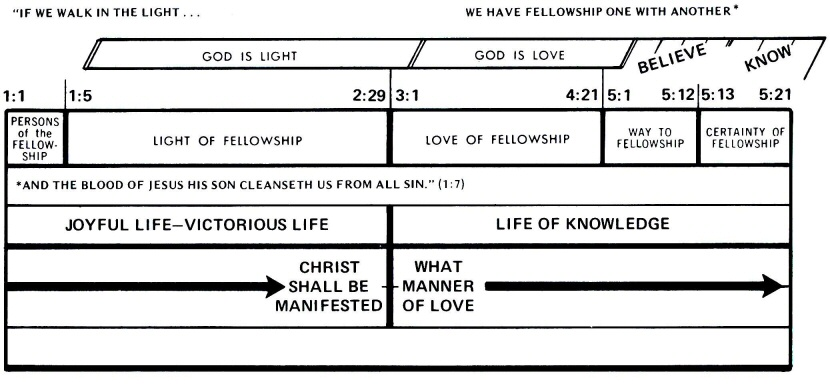
FELLOWSHIP WITH GOD AND HIS CHILDREN
Click chart to enlarge
Charts from Jensen's Survey of the NT - used by permission
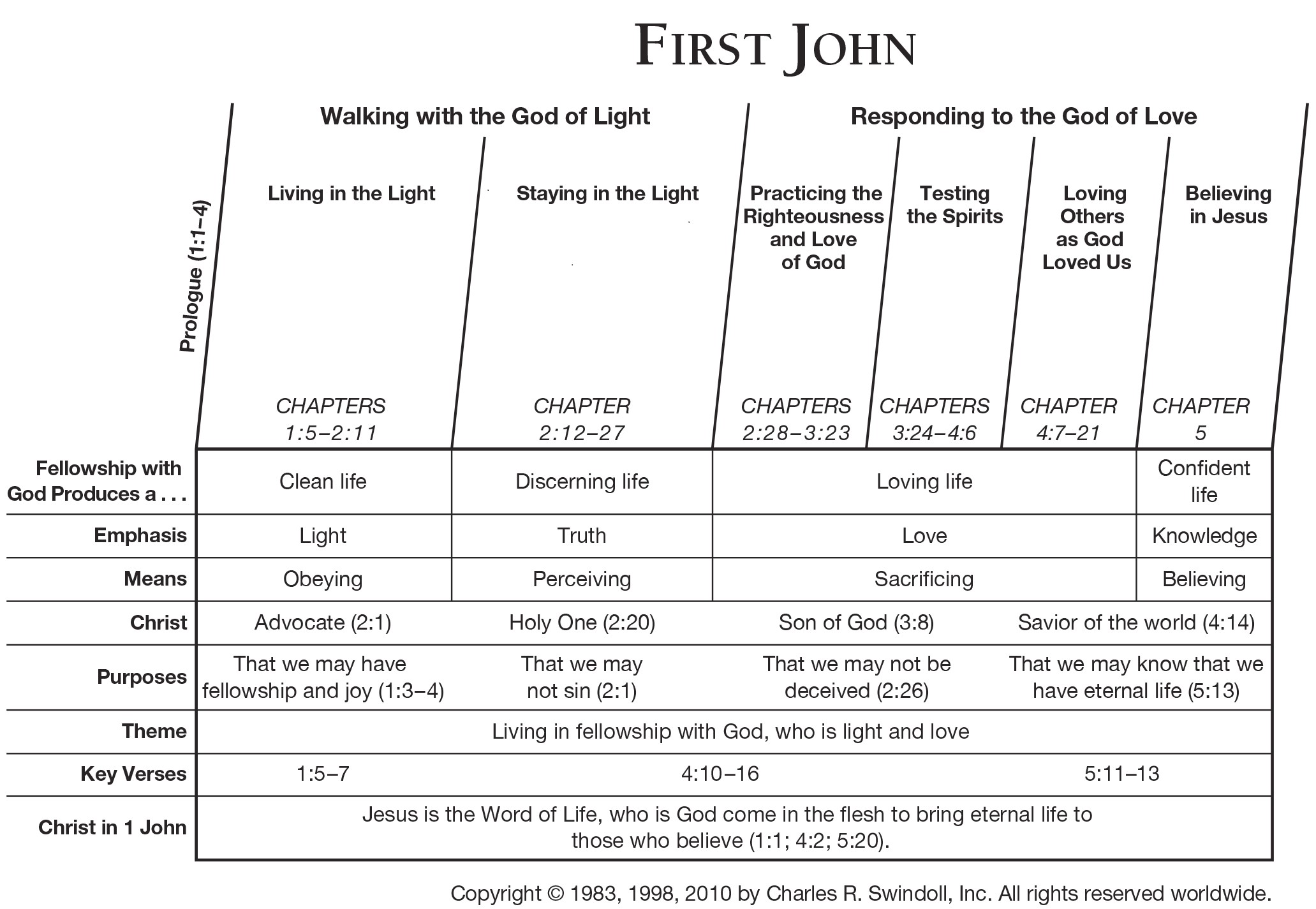
Another Overview Chart - 1 John - Charles Swindoll
| BASIS OF FELLOWSHIP | BEHAVIOR OF FELLOWSHIP | ||||
| Conditions of Fellowship |
Cautions of Fellowship |
Fellowship Characteristics |
Fellowship Consequences |
||
| Meaning of Fellowship 1 Jn 1:1-2:27 |
Manifestations of Fellowship 1 Jn 2:28-5:21 |
||||
| Abiding in God's Light |
Abiding in God's Love |
||||
| Written in Ephesus | |||||
| circa 90 AD | |||||
| From Talk Thru the Bible | |||||
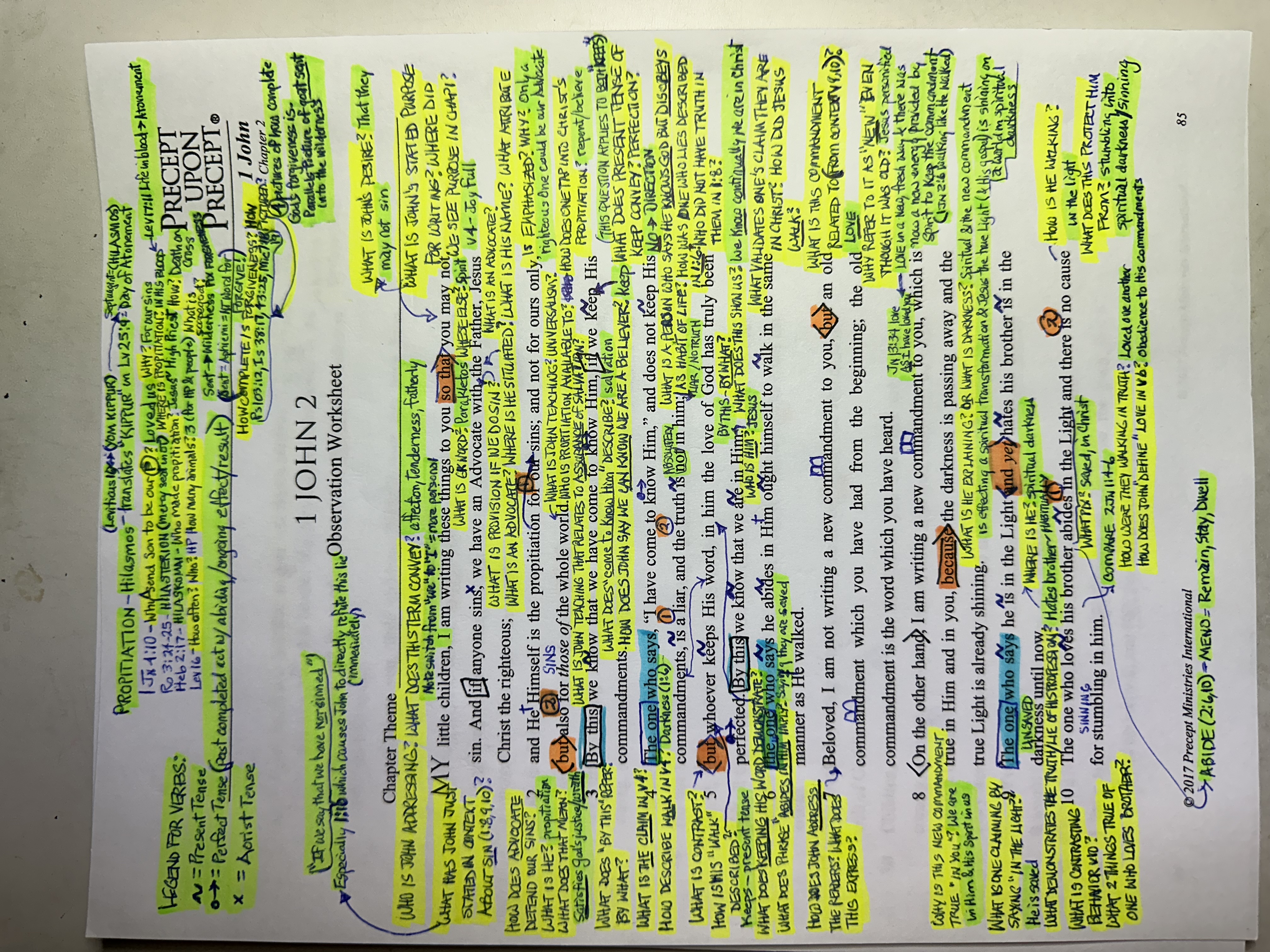
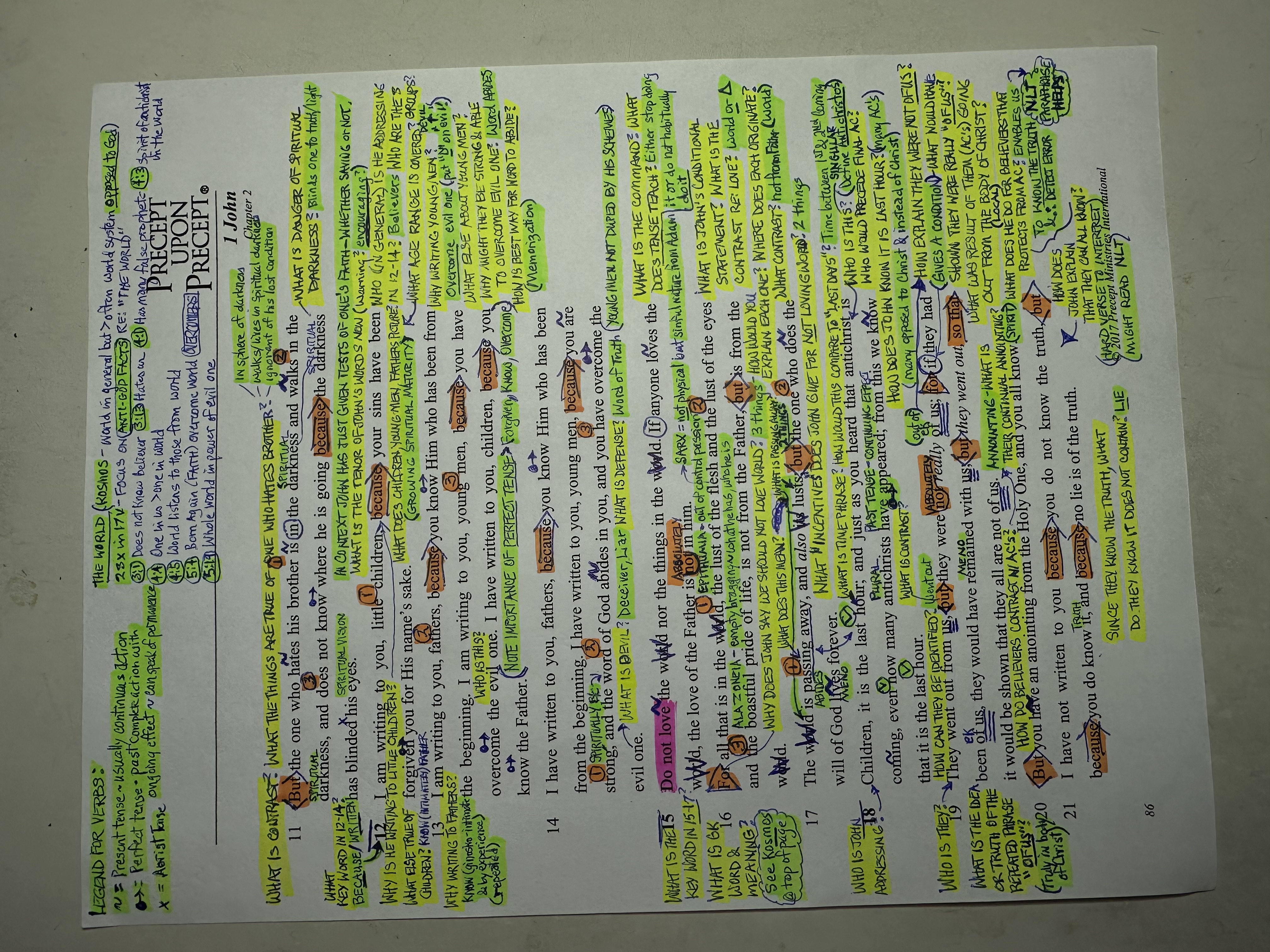
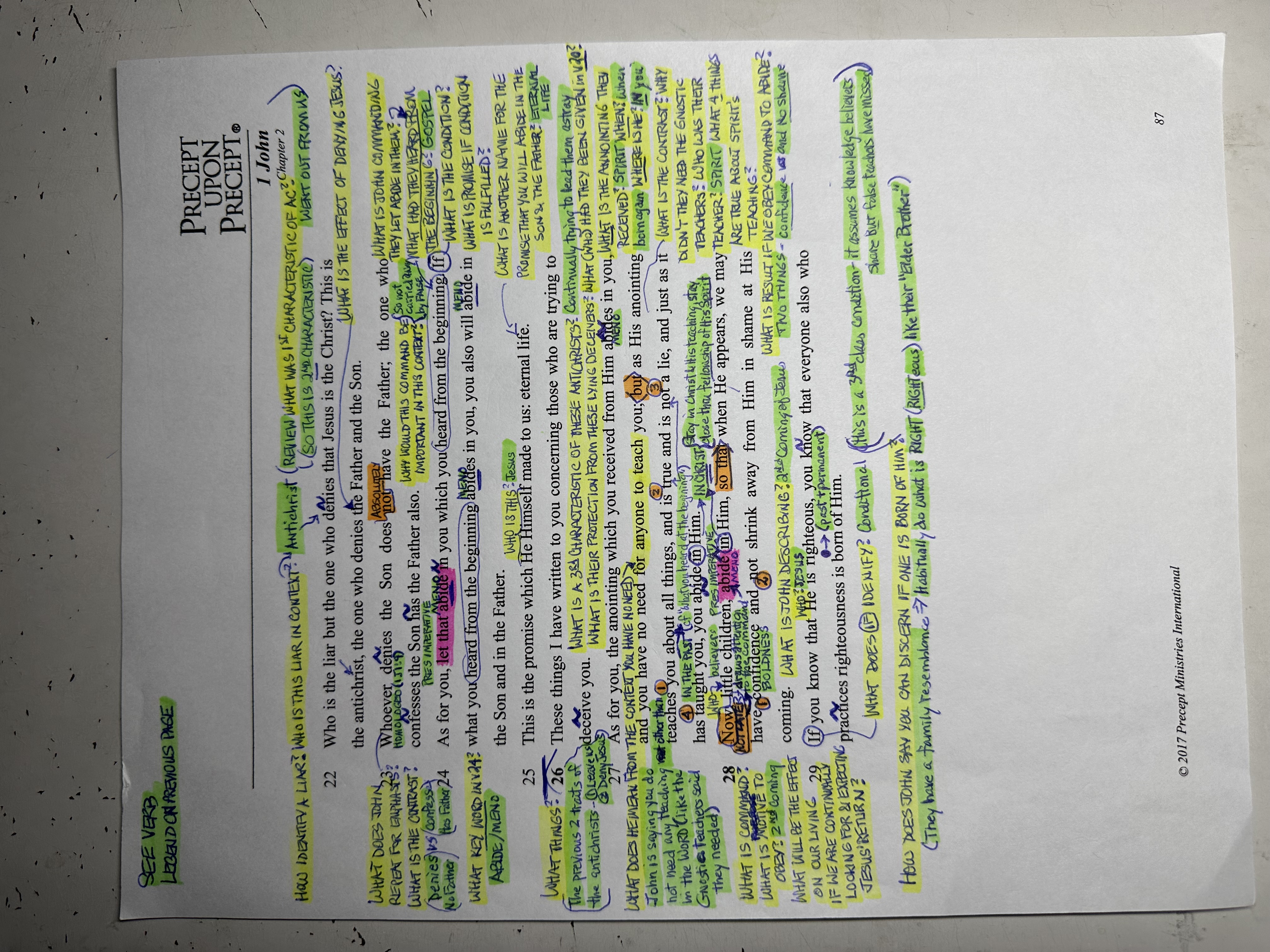
What is this? On the photograph of the Observation Worksheet for this chapter you will find handwritten 5W/H questions (Who? What? Where? When? Why? How?) on each verse to help you either personally study or lead a discussion on this chapter. The questions are generally very simple and are stated in such a way as to stimulate you to observe the text to discern the answer. As a reminder, given the truth that your ultimate Teacher is the Holy Spirit, begin your time with God with prayer such as Psalm 119:12 "Blessed are You, O LORD; Teach me Your statutes." (you can vary it with similar prayers - Ps 119:18, 26, 33, 64, 66, 68, 108, 124, 135, 171, etc) The questions are generally highlighted in yellow and the answers in green. Some questions have no answers and are left to your observations and the illuminating/teaching ministry of the Holy Spirit. Some qualifying thoughts - (1) Use "As is" - these are handwritten and will include mistakes I made, etc. (2) They may not be the best question for a given verse and my guess is that on some verses you will think of a far superior 5W/H question and/or many other questions.
Dr Howard Hendricks once gave an assignment to his seminary students to list as many observations as they could from Acts 1:8. He said "So far they’ve come up with more than 600 different ones! Imagine what fun you could have with 600 observations on this passage. Would you like to see Scripture with eyes like that?" (P. 63 Living by the Book - borrow) With practice you can! And needless to say, you will likely make many more observations and related questions than I recorded on the pages below and in fact I pray that the Spirit would indeed lead you to discover a veritable treasure chest of observations and questions! In Jesus' Name. Amen
Why am I doing this? Mortimer Adler among others helped me develop a questioning mindset as I read, seeking to read actively rather than passively. Over the years I have discovered that as I have practiced reading with a 5W/H questioning mindset, it has yielded more accurate interpretation and the good fruit of meditation. In other words, consciously interacting with the inspired Holy Word of God and the illuminating Holy Spirit has honed my ability to meditate on the Scripture, and my prayer is that this tool will have the same impact in your spiritual life. The benefits of meditation are literally priceless in regard to their value in this life and in the life to come (cf discipline yourself for godliness in 1Ti 4:8.) For some of the benefits - see Joshua 1:8 and Psalm 1:2-3. It will take diligence and mental effort to develop an "inductive" (especially an "observational"), interrogative mindset as you read God's Word, but it bears repeating that the benefits in this life and the rewards in the next will make it more than worth the effort you invest! Dear Christian reader let me encourage you to strongly consider learning the skills of inductive Bible study and spending the rest of your life practicing them on the Scriptures and living them out in your daily walk with Christ.
Although Mortimer Adler's advice is from a secular perspective, his words are worth pondering...
Strictly, all reading is active. What we call passive is simply less active. Reading is better or worse according as it is more or less active. And one reader is better than another in proportion as he is capable of a greater range of activity in reading. (Adler's classic book How to Read a Book is free online)
John Piper adds that "Insight or understanding is the product of intensive, headache-producing meditation on two or three verses and how they fit together. This kind of reflection and rumination is provoked by asking questions of the text. And you cannot do it if you hurry. Therefore, we must resist the deceptive urge to carve notches in our bibliographic gun. Take two hours to ask ten questions of Galatians 2:20 and you will gain one hundred times the insight you would have attained by reading thirty pages of the New Testament or any other book. Slow down. Query. Ponder. Chew.... (John Dewey rightly said) "People only truly think when they are confronted with a problem. Without some kind of dilemma to stimulate thought, behavior becomes habitual rather than thoughtful.”
“Asking questions is the key to understanding.”
--Jonathan Edwards
That said, below are the 5W/H questions for each verse in this chapter (click page to enlarge). This is not neatly typed but is handwritten and was used for leading a class discussion on this chapter, so you are welcome to use it in this "as is" condition...
 |
 |
 |
1 John 2:15 Do not love the world nor the things in the world. If anyone loves the world, the love of the Father is not in him. (NASB: Lockman)
Greek: Me agapate (2PPAM) ton kosmon mede ta en to kosmo. ean tis agapa (3SPAI) ton kosmon, ouk estin (3SPAI) e agape tou patros en auto;
Amplified: Do not love or cherish the world or the things that are in the world. If anyone loves the world, love for the Father is not in him. (Amplified Bible - Lockman)
ASV: Love not the world, neither the things that are in the world. If any man love the world, the love of the Father is not in him.
BBE: Have no love for the world or for the things which are in the world. If any man has love for the world, the love of the Father is not in him.
GWT: Don't love the world and what it offers. Those who love the world don't have the Father's love in them. (GWT)
ICB: Do not love the world or the things in the world. If anyone loves the world, the love of the Father is not in him. (ICB: Nelson)
ISV: Stop loving the world and the things that are in the world. If anyone persists in loving the world, the Father's love is not in him.
KJV: Love not the world, neither the things that are in the world. If any man love the world, the love of the Father is not in him.
Macent: Love not the world, nor let worldly things engage your affections. he that is worldly affected is a stranger to divine love.
NAB: Do not love the world or the things of the world. If anyone loves the world, the love of the Father is not in him.
NCV: Do not love the world or the things in the world. If you love the world, the love of the Father is not in you. (NCV)
NJB: Do not love the world or what is in the world. If anyone does love the world, the love of the Father finds no place in him,
NLT: Do not love this world nor the things it offers you, for when you love the world, you do not have the love of the Father in you. (NLT - Tyndale House)
Phillips: Never give your hearts to this world or to any of the things in it. A man cannot love the Father and love the world at the same time. (Phillips: Touchstone)
TEV: Do not love the world or anything that belongs to the world. If you love the world, you do not love the Father.
Wuest: Stop considering the world precious with the result that you love it, and the things in the world. If anyone as a habit of life is considering the world precious and is therefore loving it, there does not exist the Father's love in him. (Erdmans)
Young's Literal: Do not love the world, nor the things in the world. If any one loves the world, there is no love in his heart for the Father.
Do not love the world nor the things in the world: Me agapate (2PPAM) ton kosmon mede ta en to kosmo:
- 1Jn 4:5; 5:4,5,10; John 15:19; Romans 12:2; Galatians 1:10; Ephesians 2:2; Colossians 3:1,2; 1Timothy 6:10
- 1 John 2 Resources - Multiple Sermons and Commentaries
- 1 John 2:15-17 The Love God Hates - John MacArthur
- 1 John 2:15-17 Why Christians Don't Love the World - John MacArthur
- 1 John 2:15: The Love God Hates 1 Study Guide - John MacArthur
- 1 John 2:15: The Love God Hates 1 - John MacArthur
- 1 John 2 Do Not Love the World - question/answer - John MacArthur
- 1 John 2:12-14: The Love God Hates 2 Study Guide - John MacArthur
- 1 John 2:15-17: The Love God Hates 3 Study Guide - John MacArthur

The Worship of Mammon
Evelyn De Morgan
INTRODUCTION
1 John 2:15-17 is a familiar passage to most Christians and is clearly a very important passage regarding John's instructions on how one can walk worthy of the Lord who called him (Eph 4:1) with a holy calling (2Ti 1:9). First, notice that John gives only one command (Do not love… ) in this section, which serves to indicate that this is his main emphasis. The subsequent passages provide "incentives" to encourage us to obey this command.
(1) First "incentive" (1Jn 2:15b) = The first "incentive" is the truth of the spiritual dynamic that love of the world will displace love of God. Conversely, love of God, will displace love of the world. In 1Jn 2:16 explains why this "incentive" is valid -- because everything in the world is not of God. If you love God you cannot set your heart on what is not of God! Jesus taught the same principle in Mt 6:24 (note) explaining that one cannot love God and money.
(2) Second "incentive" (1Jn 2:17a) = The world is passing away and also it's lusts -- This truth explains the second incentive for not loving the world. If you love what is passing away, you will pass away. In other words if your life is composed of loving the desires of the world which are passing away, so too will you!
(3) Third "incentive" (1Jn 2:17b) = If you do His will you have eternal life. Doing good as the general direction of your life does not save you, but it does prove that you are saved. The opposite of loving the world is not only loving God but doing the will of the Father (1Jn 2:17b, cp 1Jn 5:3, Jesus' words in Jn 14:15). The point is that if you love God, you love His will. Don't say you love God and don't love what He tells me to do. (Adapted from John Piper's sermon Do Not Love the World - delivered in 1985)
RELATIONSHIP BETWEEN
LOVE FOR GOD
AND
SAVING FAITH
Be aware there are some commentators who state that you can be a Christian even if you habitually or continually love the godless world system. I believe that is an erroneous and dangerous teaching as it might lead one who simply professes Christ to falsely believe they are saved.
R C H Lenski - John says now that anyone who loves the world prevents the Father from loving him and coming into that man’s heart to make an abode there. To be sure, this man does not love the Father, which is, however, only the reason that the Father’s love for him can find no place in him. That place is already occupied, the Father’s love is kept out.
Jesus taught His apostles that where there is no love for God,
there can be no saving faith.
Dr. Piper goes on to explain the vital relationship between genuine or saving faith and love for God…
We have been well taught that we are saved by FAITH! “BELIEVE on the Lord Jesus and you will be saved!” (Acts 16:31). But we have not been as well taught what saving faith is. For example, how often do we discuss the relationship between trusting Christ and loving Christ. Can you trust Him savingly and not love Him? Evidently John doesn’t think so, because the issue in this text is whether you love God or love the world, and the result is whether you die with the world or have eternal life with God. But John knows that eternal life comes through faith.
John says in 1Jn 5:13, “I write this to you who BELIEVE in the name of the Son of God, that you may know that you have eternal life.”
So eternal life does depend on believing in the Christ. But what is this “believing”? If we are courteous, and let John speak for himself, his letter fills out what he means. When he says that not loving the world but loving God so much that we do His will is what leads to eternal life, we learn that saving faith and love for God are inseparable. Both are the path to eternal life because they are the same path.
In John 5:42, 43, 44 Jesus confronts the Jewish leaders who do not believe on Him with these words, “I know that you have not the love of God within you. I have come in my Father’s name and you do not receive Me … How can you believe, who receive glory from one another and do not seek the glory that comes from the only God?”
In other words the reason they do not receive or believe on Jesus is that they do not love God. They love the world—the glory of men—not the glory of God. So Jesus taught His apostles that where there is no love for God, there can be no saving faith. (See John 3:18, 19.) (Ed note: Dr Piper goes on to explain how an understanding of love for God and saving faith will unpack the meaning of other NT texts such as Ro 8:28, 1Co 2:9, 16:22, Jas 1:12, 2:5, 2Ti 4:8. A clear understanding of this relationship refutes much of the tepid teaching in the modern church which says "Just believe in Jesus" [which is true!] but the question is "What does that belief 'look like' when one examines other NT passages?" The interested reader is strongly encouraged to see Dr Piper's entire message on this important topic - Do Not Love the World - listen to the audio, for the transcript does not pick up the passion of Dr Piper regarding this crucially important message for the Church of Jesus Christ in these last days!)
As Billy Graham has said
"No man can be said to be truly converted to Christ who has not bent his will to Christ. He may give intellectual assent to the claims of Christ and may have had emotional religious experiences; however, he is not truly converted until he has surrendered his will to Christ as Lord, Savior, and Master."
He loves Thee too little
who loves anything together with Thee
which he loves not for Thy sake.
- Augustine
(cp Ps 73:25, 26)
Hiebert sets this passage in context noting that "In 1Jn 2:9, 10, 11 John insists that the Christian life must be characterized by love of the brethren; he now insists upon the complementary duty of separation from the world as the object of their love. As an appeal to the will, his negative command implies that love can be misdirected. His appeal again underlines that Christian faith and behavior are inextricably linked. His expressed assurances concerning their spiritual condition provide the basis for his appeal to maintain a proper attitude toward the world. It offers a danger no matter how far they have advanced in their spiritual maturity. (The Epistles of John An Expositional Commentary D. Edmond Hiebert) (See Hiebert's Excellent Online Paper on 1 John 2:2-17 in Bibliotheca Sacra)
Westcott - In the preceding verses St John has set forth the privileges of Christians both generally in their sense of forgiveness and of a Divine Fatherhood, and specially in the far-reaching wisdom of the old, and the victorious strength of the young: he now goes on to enforce the consequence which is made possible. A great ‘love not’ follows on the command to love. The structure of the passage is simple and regular. The prohibition (15 a) is followed by a view of its overwhelming necessity. The love of the world is incompatible with the love of the Father (15 b), for the objects of love determine its character (1Jn 2:16). And further: there is between them the contrast of time and eternity, of transition and abiding (1Jn 2:17) (1 John 2 Commentary)
Ray Stedman remarks that 1 John 2:15-17 deals with "the supreme peril to fellowship and therefore the greatest peril to Christian maturity. Here is a great enemy of the Christian, the siren voice that seeks to lure us aside, trap us, delude us and ultimately to defeat us, in our Christian experience. (1 John 2:15-17: The Enemy Around)
William MacDonald notes that "We are plainly warned not to love the world or the things that are in the world, for the simple reason that love for the world is not compatible with love for the Father. (Believer's Bible Commentary: Thomas Nelson)
Believers are not to love the world
but are to love the souls in the world.
David Clarkson (1621-1686) observes "That which we most love—we worship as our God. For love is an act of soul-worship. To love and to adore are sometimes both one. That which one loves—he worships. This is undoubtedly true, if we intend hereby that love which is superlative and transcendent—for to be loved above all things is an act of honor and worship, which the Lord demands as His due in peculiar (Deut. 6:5). In this the Lord Christ summed up all that worship which is required of man (Mt. 22:37). Other things may be loved—but He will be loved above all other things. He is to be loved transcendently, absolutely, and for Himself. All other things are to be loved in Him and for Him. He looks upon us as not worshiping Him at all, not taking Him for a God, when we love other things more or as much as Himself (1 John 2:15). Love to the creature, whenever it is inordinate, it is an idolatrous affection. (From his paper entitled Soul Idolatry Excludes Men out of Heaven)
YOUR CHOICE:
LOVE THE FATHER OR
LOVE THE WORLD
As discussed, love for the world precludes and even "pushes out" love for God -- the best "antidote" in our fight against this pervasive powerful pull to love the world is to be zealous to love the Father (cp Mk 12:30, Mt 6:24), and by fighting this good fight of faith (only possible by His Spirit and His grace - not by a legalistic lists of do's and don'ts!) we avoid the shipwreck of our souls on the "deadly reefs" of the world (cp 1Ti 1:5, 18, 19). The choice is between the world's lie and the Word's truth. The battle ground is our mind. And the battle will be life long. The battle will continually rage between being "lovers of pleasure rather than lovers of God." (2Ti 3:4) And while it is important in our Christian journey to "pursue righteousness, faith, love and peace, with those who call on the Lord from a pure heart" (2Ti 2:22), not even godly companions can guarantee we will not fall prey to the subtle, seductive lies of the world, for as Paul wrote with much grief even "Demas having loved this present world, has deserted me and gone to Thessalonica" (2Ti 4:10; see chronological chart of Demas' tragic life in Col 4:14 commentary).
Believers are to be IN the world
but not OF the world.
John MacArthur comments that Demas "loved the world system, with its sin, human wisdom, and satanic deceptions, more than he loved God’s kingdom. Demas’ life exhibited characteristics of both the shallow, rocky soil, in which the seed of the Word flourished briefly but withered and died in the face of tribulation and persecution; and the thorny soil, in which the seed was smothered under the cares of the world and the deceitfulness of wealth (see Jesus’ parable in Matt. 13:3–23). While Paul willingly anticipated martyrdom for his faith, Demas decided that he was unwilling to pay a similar price. Therefore he forsook his co-laborers and went “to Thessalonica,” a large, cosmopolitan city on the main east-west trade route of Asia Minor that offered all the materialistic, immoral, and philosophical allurements of the world he loved. In so doing, Demas proved he was never a lover of God. (See 1-3 John MacArthur New Testament Commentary - Page 80)
See also - James Smith's fascinating (frightening) article - An almost Christian Also George Whitfield's sermon The Almost Christian
The world's philosophy continually shouts that "The only important thing that is important is this life". "Just do it". "You only go around once so grab for all the gusto you can get!". "It doesn't get much better than this!" (Wrong! It will get a whole lot worse! see Isa 66:24)
Ray Stedman offers the following secular quote of how the world describes the love of the world "There is nothing better, there is nothing higher, there is nothing more precious than what this earth can give you: its money, its pleasures, its fame. You had best eat, drink, and be merry, for there is no nobler life than that." (1 John 2:15-17: The Enemy Around)
O Lord, help us to recognize
When we begin to compromise;
And give us strength to follow through
With what we know is right and true.
-- Sper
Do not love the world nor the things in the world. If anyone loves the world, the love of the Father is not in him. - Love (verb) (25) (agapao - see related study of noun agape) means to love and in its highest, most pure form speaks of the unconditional, sacrificial love which God Himself expresses toward undeserving, sinful men (John 3:16), its the love with which He loves His Son (Jn 3:35, 15:9, 17:23, 24) its the love which He is by nature (1Jn 4:8), and it is the love which is produced in the heart of the yielded saint by the Holy Spirit (Gal 5:22). Agapao speaks of a love which is based on evaluation and choice and reflects exertion of one's will and action. This quality of love is awakened by a sense of value in an object which causes one to prize it, in this case the fallen, evil world system! This love springs from an apprehension of the preciousness of the object (again the evil "world")!
Do not love is a present imperative coupled with a negative particle (me agapate) which can have one of two meanings. In one use this combination signifies an action which is in progress must be stopped. In this use, the implication is that the readers were loving the world to some degree. John is saying stop having a warm regard for and interest in the world! Don't cherish the world! Stop exhibiting affection for the world! Stop showing special devotion to the world. Stop loving the world with a love called out of your hearts because of its preciousness. Don't strive after the world (cp Lk 11:43)
Anything that competes with our love of God,
is tantamount to an idol
The second sense of the present imperative with a negative is as a prohibition of a practice which could be paraphrased like this --"Don't begin loving the world". This sense does not necessarily assert that the readers were actually loving the world. Loving the world was a danger which the readers must be continually on guard against. How we even begin to obey this command? The truth is that we in our natural strength cannot possibly hope to obey this command as our lifestyle. We must continually seek to be filled with the Holy Spirit, Who will give us the supernatural power that enables us to obey John's command. Sure, we will falter and fail to keep this commandment from time to time. Only Jesus could keep it perfectly. But John is not advocating perfection (that's called glorification!) but he is advocating "direction." In other words, we can look at our life and determine from the things we watch, the places we go, the items we purchase, etc, whether the general direction of our life is "heavenward" (Php 3:20, Col 3:1-2) or not. It is possible to use the things of the world (e.g., Iphones, cars, etc) without loving them with an agape love. Remember that anything that competes with our love of God, is tantamount to an idol! You might read that again! So reiterate, don't try to keep this command in your own strength, for you don't stand a chance! Every command in the NT in fact should remind us of our need to jettison self-reliance and rely wholly on the Holy Spirit. (See See discussion of commands and need for the Spirit) Notice also that filling with God's Word (Col 3:16) parallels being filled with God's Spirit (See Filled with His Spirit/Richly Indwelt with His Word). Are you daily taking in the Word? If not, then there is a good chance you are not continually being filled with His Spirit (Ephesian 5:18)!
Colin Kruse - The present form of the imperative is used in the prohibition, ‘do not love’ (mē agapate), indicating that the author is presenting the love of the world which he counsels his readers against here as an ongoing action.The love involved in this exhortation carries a different meaning from the love (of fellow believers) mentioned in 1Jn 2:10. There love is focussed on the well-being of another, whereas here it is focussed on the pleasure and gratification one hopes to receive. (See The Letters of John - Page 94)
John Stott - The command not to love the world is grounded on two arguments; first, the incompatibility of love for the world and love for the Father (1Jn 2:15–16) and secondly, the transience of the world as contrasted with the eternity of those who do God’s will (1Jn 2:17).....Love is a fit subject for such commandment and prohibition because it is not an uncontrollable emotion but the steady devotion of the will. The reason why we are enjoined not to love the world is because ‘love for the Father’ (RSV) and love for the world are mutually exclusive. If we are engrossed in the outlook and pursuits of the world which rejects Christ, it is evident that we have no love for the Father. ‘Friendship with the world is hatred towards God’ (Jas 4:4). ‘No-one can serve two masters’ (Matt. 6:24; Luke 16:13), and if we cannot serve God and mammon, neither can we love the Father and the world.(Borrow The Letters of John : an Introduction and Commentary)
It is important that we not read into John's command something he did not say. John does not say: "Don't love the world too much" but "not at all" Compare similar ideas in Do not be conformed to the world = Ro 12:2; we have been rescued from this present evil age = Gal 1:4; friendship with the world is hostility toward God = James 4:4, men loved darkness = Jn 3:19; we must keep ourselves unstained from the world = Jas 1:27).
Remember also that in Scripture Jesus uses the verb ''love'' (agapao) at times to indicate obedience (Jn 14:15). It follows that if we love the world we are obeying the dictates of the world system and going along with the crowd, walking on the broad way (Mt 7:13) of destruction, walking in darkness (Eph 4:17,18, Eph 5:8, Eph 5:15, Col 1:13). John is saying that if we really love the Lord, we will obey the Lord and avoid listening to the "commands" of the world ("buy this", "you've got to have this to keep up with neighbors", etc).
David Guzik - John has told us that if we walk in sin’s darkness and claim to be in fellowship with God, we are lying (1John 1:6). Now John points out a specific area of sin that especially threatens our fellowship with God: worldliness… Do not love the world (means)… we are not to love either the world’s system or its way of doing things. There is a secular, anti-God or ignoring-God way of doing things that characterizes human society, and it is easy to love the world in this sense. Notice what the world wants from us: love. This love is expressed in time, attention, and expense. We are encouraged and persuaded to give our time, attention, and money to the things of this world instead of the things of God.
Westcott -The command is not given to any particular class (as to the young) but to all. That which man may not do, being what he is, God can do, John 3:16. God looks through the surface of things by which man is misled to the very being which He created… the world, the order of finite being regarded as apart from God. The Roman empire with its idolatry of the Emperor as the representative of the State, presented the idea in a concrete and impressive form… With ‘the world’ are joined ‘the things in the world,’ all, that is, which finds its proper sphere and fulfilment in a finite order and without God. ‘To be in the world’ is the opposite to ‘being in God.’ The question is not of the present necessary limitations of thought and action but of their aim and object. Whatever is treated as complete without reference to God is so far a rival to God… There can be but one supreme object of moral devotion. All secondary objects will be referred to this. The love of the finite as an absolute object necessarily excludes the love of the Creator (the Father). Comp. Ro 1:25… Here as elsewhere St John places the contrast before his readers in its ultimate essential form, as of light and darkness, love and hatred. He assumes that there cannot be a vacuum in the soul… By the ‘love of the world, and of the things in the world’ the sense of the personal relationship to God is lost, and not merely the sense of a divine presence. Of the man who is swayed by such a passion it must be said that the love of the Father is not in him as an animating, inspiring power (c. 1Jn 1:10. This phrase expresses more than ‘he loveth not God’ or ‘he loveth not the Father.’ That form of expression would describe a simple fact: this presents the fact as a ruling principle. The exact order of the Greek is remarkable: ‘there exists not, whatever he may say, the love of the Father in him.’ Comp. 1Jn 1:5; 4:16-17.; John 5:45; 6:45; 7:28; 8:44, Jn 8:50, Jn 8:54; 9:16; Jn 10:12, Jn 10:34; Jn 13:10, Jn 13:16. (1 John 2 Commentary)
Viewed as people, the world must be loved. Viewed as an evil system, organized
under the dominion of Satan and not of God, it is not to be loved
-- John Stott
World (2889) (kosmos related to the verb kosmeo = to order or adorn, to put in order [Mt 25:7 = "trimmed"], to adorn literally [1Ti 2:9], to adorn figuratively [Titus 2:9]) means essentially something that is well-arranged, that which has order or something arranged harmoniously. Kosmos refers to an ordered system or a system where order prevails. As explained below however, kosmos as used here in 1John 2:15-17 with its moral/ethical sense to describe all that is opposed to God. In other words, the "world" here in 1John does not refer to the earth or even to its people (God Himself so loved the world that He gave His Son to save its people, Jn 3:16), but rather the world as an anti-God, anti-Christ "system," with its possessions, positions and pleasures, all radically, irrevocably alienated against the Almighty.
The world - Kosmos is used 6 times in these 3 verses (1Jn 2:15-17) and is a favorite term of the Apostle John (see discussion A Look at Kosmos in the Johannine Literature)
Marvin Vincent defines kosmos (in its ethical sense) as "The sum-total of human life in the ordered world, considered apart from, alienated from, and hostile to God, and of the earthly things which seduce from God (Jn 7:7; 15:18; John 17:9,14; 1Co 1:20, 21; 2Co 7:10; Jas 4:4).
James Montgomery Boice writes that John's use of kosmos in this section is in its ethical sense "The idea here is of the world of men in rebellion against God and therefore characterized by all that is in opposition to God. This is what we might call “the world system.” It involves the world’s values, pleasures, pastimes, and aspirations. John says of this world that the world lies in the grip of the evil one (1Jn 5:19), that it rejected Jesus when He came (Jn 1:10), that it does not know Him (1Jn 3:1), and consequently that it does not know and therefore also hates His followers (John 15:18,19, 20, 21; 17:14). It is in this sense that John speaks of the world in the passage before us. (borrow The Epistles of John : [an expositional commentary])
The greater your worldliness,
the lesser your walk in the light.
H A Ironside explains that the "world" is that "system that man has built up in this scene, in which he is trying to make himself happy without God. You get it away back in Genesis, where Cain went out from the presence of the Lord and built a city, and there what we call the world really began (Ge 4:16, 17, 18, 19, 20, 21, 22, 23, 24). It was a wonderful world; they were exercised in all kinds of arts, sciences, business, and pleasure, anything and everything to make them happy without God; but it ended in corruption and violence, and God had to sweep the whole thing away with a flood. (cp Ge 6:5) The principles of the world that caused the corruption and violence before the flood were carried into the ark in the hearts of some of Noah's children. They brought the world into the ark, and when the new world was started after the judgment of the flood, they brought the world out of the ark with them, and again set it up. (Epistles of John)
The world will try to pressure us
To fit into its mold,
But with God's help we can resist
If to His truth we hold.
—Sper
Michael Eaton wisely observes that we need to understand what world or worldly does not mean
"It is not ‘worldly’ to follow a career in politics, to get married, to have children, to be involved in earning a living. None of these are what John has in mind by ‘the world’. Nor is John concerned about a list of ‘taboos’. Every group of Christians has a list of activities or practices that are frowned upon. Christians tended to think, in days gone by, that ‘worldliness’ was a matter of whether one went to dances or to the cinema (Ed: Although I would add today one has to be very discerning in what movie or television show one chooses to watch, for there is a strong anti-god bias in the media. (cp 1Th 5:21, 22). Such ‘taboos’ vary from age to age. What was forbidden ten years ago is allowed today. Such banned activities also vary from culture to culture. In one part of the world Christians might frown upon bearing arms, or wearing upon earrings, or upon allowing the soles of the feet to become visible … or whatever! But none of this is what John has in mind. (On the other hand world or worldly) … is the anti–God mentality of the human race, the worldwide fondness for sin and self which causes men and women to stumble into wickedness. ‘Woe to the world because of occasions of stumbling,’ said Jesus (Mt 18:7). It is rebelliousness, spiritual ignorance (1Jn 3:1; Jn 1:10), combined with hostility towards God (see Jas 4:4). Behind it is the grip of Satan (1Jn 5:19, Jn 12:31, Lk 4:6). ‘Worldliness’ is the inclination to be drawn into the ways of the people around us who do not know God. (Eaton, M. Focus on the Bible: 1, 2, 3 John)
The world is whatever cools our affection for Christ!
See Puritan Thomas Watson's words on the world (click) and Pastor Steven Cole's definition of the world or worldliness (click)
Christians must live in the world
but not let the world live in them.
John uses kosmos primarily with the moral/ethical sense (although there are some exceptions as noted) in this same epistle…
and He Himself is the propitiation for our sins; and not for ours only, but also for those of the whole world (kosmos here means the the inhabitants of the earth). (1 Jn 2:2)
See how great a love the Father has bestowed upon us, that we should be called children of God; and such we are. For this reason the world (the evil world system) does not know us, because it did not know Him. (1Jn 3:1)
Do not be surprised, brethren, if the world (the evil world system) hates you. (1 Jn 3:13).
But whoever has the world's (kosmos here is not the evil world system per se but is used in a more neutral sense) goods, and beholds his brother in need and closes his heart against him, how does the love of God abide in him? (1Jn 3:17)
Beloved, do not believe every spirit, but test the spirits to see whether they are from God; because many false prophets have gone out into the world (Here the meaning of the word kosmos is somewhat unclear - it could mean the world filled with people but could also refer to the evil world system or both). (1Jn 4:1)
and every spirit that does not confess Jesus is not from God; and this is the spirit of the antichrist, of which you have heard that it is coming, and now it is already in the world (evil world system). (1Jn 4:3)
You are from God, little children, and have overcome them; because greater is He who is in you than he who is in the world (evil world system). They are from the world (evil world system); therefore they speak as from the world (evil world system), and the world (evil world system)listens to them. (1 Jn 4:4, 5)
By this, love is perfected with us, so that we may have confidence in the day of judgment; because as He is, so also are we in this world. (1 Jn 4:17).
They are from the world (the evil world system); therefore they speak as from the world (evil world system), and the world (which is opposed to God) listens to them. (1Jn 4:5)
For whatever is born of God overcomes the world (the evil world system and its influence even on believers); and this is the victory that has overcome the world-- our faith. And who is the one who overcomes the world (the evil world system and its influence even on believers), but he who believes that Jesus is the Son of God? (1 John 5:4, 5)
We know that we are of God, and that the whole world (evil world system) lies in the power of the evil one. (1 John 5:19)
In John 15 Jesus warned His disciples…
If the world (kosmos - evil world system opposed to God and composed of God's enemies) hates you, you know that it has hated Me before it hated you. If you were OF the world, the world would love its own; but because you are (ABSOLUTELY) not OF (ek = from, out of) the world, but I chose you OUT OF the world, therefore the world (present tense - continually) hates you. (John 15:18, 19)
In His prayer to His Father Jesus prayed…
I have given them (His disciples) Thy word; and the world has hated them, because they are not OF (ek = from, out of) the world (cp similar sentiment expressed in 1Jn 3:1), even as I am not OF (ek = from, out of) the world. (John 17:14)
The basic meaning of kosmos is order which leads to the two main uses…
(1) Adornment, decoration, eternal adorning (used this way in NT only in 1Pe 3:3, where kosmos speaks of the woman wearing that which is fitting with her character as a believer and not incongruous or "out of order". In the context of Jas 4:4 she should not be a believer who seeks external adornment that mimics that of the world [cp "friendship with the world"]! Beloved, a believing woman's attire should always be so "ordered" as to draw attention to her face, not her form! Compare God's desired "adornment" in 1Pe 3:4)
(2) The world, which as alluded to above has a variety of nuances which must be determined by examining the context. For example John used kosmos to refer to the people of the world in general in 1Jn 2:2 (much like Jn 3:16)
Kosmos/kosmeo give us our English words cosmos (the ordered universe), cosmopolitan (literally a citizen of the world!) and cosmetics (those things we put on in order to bring order out of "chaos"!) English terms. A matter of "cosmic" significance, is something which is important for the whole world. When one speaks of a "cosmopolitan" city, it means a city which has citizens from many parts of the world.
Kosmos is the absolute antithesis of chaos (a Greek word meaning a rude, unformed mass), chaos being the fantasized condition with which the theory of evolution begins! The Bible on the other hand uses kosmos to describe the original condition of the universe (cp kosmos in 2Pe 3:6) as one of perfection ("it was very good" Ge 1:31, not very chaotic! Kosmos is used the first time in LXX of Ge 2:1 all their hosts = "and the whole world". The sons of God (the angels) did not shout for joy over chaos, but kosmos when they saw this universe come into existence by the creative fiat of God (Job 38:4, 5, 6, 7)!
David Guzik comments on the meaning of John's use of kosmos in 1Jn 2:15 writing that "One of the first examples of this idea of the world in the Bible helps us to understand this point. Genesis 11:1-9 speaks of human society’s united rebellion against God at the tower of Babel. At the tower of Babel, there was an anti-God leader of humanity (whose name was Nimrod - Ge 10:8, 9 where v9 "before the LORD" could be "in the face of Jehovah" or "against Jehovah"). There was organized rebellion against God (in disobeying the command to disperse over the whole earth). There was direct distrust of God’s word and promise (in building what was probably a water-safe tower to protect against a future flood from heaven). The whole story of the tower of Babel also shows us another fundamental fact about the world system. The world’s progress, technology, government, and organization can make man better off, but not better. Because we like being better off, it is easy to fall in love with the world. Finally, the story of the tower of Babel shows us that the world system - as impressive and winning as it appears to be - will never win out over God. The Lord defeated the rebellion at the tower of Babel easily. The world system will never win out over God.
The term predominantly has an ethical import,
the human race in its alienation from and opposition to God.
Hiebert adds that kosmos "basically denotes order, arrangement (the opposite of chaos; cf. our English word "cosmetics"), hence an ordered system. The term is used to denote the earth (John 21:25) because of the order and system observed in our material world. It is also used to denote the human race, mankind in its various organizations and systems (John 3:16). But because of the fallen nature of the human race, the term predominantly has an ethical import, the human race in its alienation from and opposition to God. John here has in view the world of humanity steeped in sin and dominated by the evil one (1Jn 5:19). As such, it is quite synonymous with "the darkness" in John 1. John is not calling for a monastic separation from the world but for an inner attitude of separation from the sinful world and its practices. As those loyal to God, John's readers are to be on guard against a permissive or kindly feeling towards the world's evil and are not to establish intimate relations of loyalty with it (ED: DON'T "FLIRT" WITH IT AS IT IS VERY SEDUCTIVE!) (The Epistles of John An Expositional Commentary D. Edmond Hiebert) (See Hiebert's Excellent Online Paper on 1 John 2:2-17 in Bibliotheca Sacra)
THE WORLD'S MAGNET...
"THINGS OF THE WORLD"
Nor the things of the world - In other words, John is prohibiting his readers from a "love relationship" with any and all specific aspects of the fallen, evil world system and he will amplify this in the next verse 1Jn 2:16 as under the "umbrella" of those things that incite "the lust of the flesh and the lust of the eyes and the boastful pride of life".
There's no room for double occupancy
in the Christian's heart!
Things can include material objects which are otherwise "ethically neutral" and which one can innocently desire to possess (e.g., fine clothes, expensive homes, sports cars, pleasure boats, etc). Those things are not wrong or evil in themselves, unless they disclose a heart attitude that loves and desires them more than it loves and desires the ineffably desirable God. Hear David's solution for this ever present danger…
Delight yourself in the LORD and He will give you the desires of your heart.
Spurgeon comments on Ps 37:4: There is an ascent in this third precept. He who was first bidden not to fret, was then commanded actively to trust, and now is told with holy desire to delight in God. Delight thyself also in the Lord. Make Jehovah the joy and rejoicing of thy spirit. Bad men delight in carnal objects; do not envy them if they are allowed to take their fill in such vain idols; look thou to thy better delight, and fill thyself to the full with thy more sublime portion. In a certain sense imitate the wicked; they delight in their portion -- take care to delight in yours, and so far from envying you will pity them. There is no room for fretting if we remember that God is ours, but there is every incentive to sacred enjoyment of the most elevated and ecstatic kind. Every name, attribute, word, or deed of Jehovah, should be delightful to us, and in meditating thereon our soul should be as glad as is the epicure who feeds delicately with a profound relish for his dainties. And he shall give thee the desires of thine heart. A pleasant duty is here rewarded with another pleasure. Men who delight in God desire or ask for nothing but what will please God; hence it is safe to give them carte blanche. Their will is subdued to God's will, and now they may have what they will. Our innermost desires are here meant, not our casual wishes; there are many things which nature might desire which grace would never permit us to ask for; these deep, prayerful, asking desires are those to which the promise is made.
You can be poor in things but still love them
while one who is rich in things can use them as a good steward of God.
You can be poor in things but still love them while one who is rich in things can use them as a good steward of God. So things are not the problem. John does not say possessing these things is in itself wrong. The problem as someone has well said is when the possessions begin to "possess" us, and specifically begin to "possess" our (heart) affections in such a way that it results in a "cooling" of our affection from God or even an outright attitude of alienation from God. Any affection of a thing which leads to love of the thing rather than the love of God is what John is prohibiting.
Note that John is not saying we are not to love the natural beauty of this world (kosmos), God's creation (cf Ps 19:1-2), nor are we not to love the world's people with the love God loved them with on Calvary (Jn 3:16). He is speaking more of material things and/or ideas, etc, that are at their core anti-God and anti-Christ. It is not true like the bumper sticker says that "He who dies with the most toys (things) wins!" In fact it is exactly the reverse, for as John says in 1Jn 2:17 this world is passing away (and that would include its "things"). Do not be lured, snared, trapped or deceived by the shiny "bobbles" or subtle seductions of the "serpentine" world system.
Though “things” are not evil in and of themselves,
loving them does make one worldly
Eaton adds that "The things of the world are the ways in which the world’s magnetism operates. To refuse to love the world means a decisive rejection of the ‘world’s’ aspirations and outlooks. It is not going out of earthly society altogether, but it is a refusal to be dragged into its grumbling, its bitterness, its covetousness, its obsession with ‘cares and riches and pleasures’ (Lk 8:14, 16:13, Lk 17:26, 27, 28, 29, 30, 18:24, 25), its preoccupation with receiving praise from fellow human beings. (Ibid)
Jesus warned His disciples to
"Be on guard (present imperative = Jesus commands us to continually be on "high [spiritual] alert", lest we fall prey to the lures of this evil world -- Disciples are to continually keep a guard posted at the door of their heart [Pr 4:23]! No downtime in wartime! If you become too absorbed with everyday worldly life [cp 2Ti 2:3,4], you will stop guarding your heart and will be at grave risk for committing spiritual adultery against your Bridegroom Christ Jesus [Jas 4:4]), that your hearts may not be weighted down with dissipation (carousing and the [spiritual] dizziness and staggering that results from such empty behavior) and drunkenness and the worries of life (worries = merimna = from merizo = to divide or draw in different directions and here referring to one's heart and mind! See the deadening effect of the worries of the world on the Word of God [Mk 4:19]), and that day come on you suddenly ( = The Second Coming of Christ - It will come unexpectedly. How?) like a trap (a vivid simile! Greek = pagis = a trick or stratagem [temptation] picturing that which springs suddenly even as a snare entices the bird who is suddenly trapped. Pagis further describes that which fastens and holds one fast! Look out!) for it will come upon all those who dwell on the face of all the earth (and who live a lifestyle of loving the world rather than loving God!) (Lk 21:34, 35)
The apostle James also warned his readers of the danger of loving the world, which for a believer amounts to unfaithfulness and spiritual harlotry writing…
You adulteresses, do you not know that friendship with the world is hostility toward God? Therefore whoever wishes to be a friend of the world makes himself an enemy of God. (Jas 4:4)
Perhaps after reading John's words and these notes, your spirit is convicted of that tendency of your heart (like mine) to wander from the God you love. Let me encourage you to take a moment and sing the following stanza from Come, Thou Fount of Every Blessing) as a prayer to your Father in heaven…
O to grace how great a debtor
Daily I’m constrained to be!
Let Thy goodness, like a fetter,
Bind my wandering heart to Thee.
Prone to wander, Lord, I feel it,
Prone to leave the God I love;
Here’s my heart, O take and seal it,
Seal it for Thy courts above.
O that day when freed from sinning,
I shall see Thy lovely face;
Clothed then in blood washed linen
How I’ll sing Thy sovereign grace;
Come, my Lord, no longer tarry,
Take my ransomed soul away;
Send thine angels now to carry
Me to realms of endless day.
Life Application Study Bible (borrow) - Some people think that worldliness is limited to external behavior-the people we associate with, the places we go, the activities we enjoy. Worldliness is also internal because it begins in the heart and is characterized by three attitudes: (1) craving for physical pleasure-preoccupation with gratifying physical desires; (2) craving for everything we see-coveting and accumulating things, bowing to the god of materialism; and (3)pride in our achievements and possessions-obsession with one's status or importance.
Quotes on Worldliness (From Complete Gathered Gold by John Blanchard which I highly recommend for your personal library)
There is no surer evidence of an unconverted state than to have the things of the world uppermost in our aim, love and estimation. - Joseph Alleine
If we loved the world the way God loves it, we wouldn't love it the way we shouldn't love it. -Anon.
If you have a distorted view of the Christian life you have let the world develop the negative. - Anon.
The Christian must live in the world, but he must not let the world live in him. - Anon.
If you are wise, let the world pass, lest you pass away with the world. - Augustine
A man caught up with this world is not ready for the next one. - John Blanchard
Jesus did not pray that his Father would take Christians out of the world, but that he would take the world out of Christians. - John Blanchard
I looked for the church and I found it in the world; I looked for the world and I found it in the church. - Horatius Bonar
The stars which have least circuit are nearest the pole; and men whose earths are least entangled with the world are always nearest to God and to the assurance of his favour. - Thomas Brooks
The two poles could sooner meet, than the love of Christ and the love of the world. - Thomas Brooks
It is infinitely better to have the whole world for our enemies and God for our friend, than to have the whole world for our friends and God for our enemy. - John Brown
The mind of a Christian ought not to be filled with thoughts of earthly things, or find satisfaction in them, for we ought to be living as if we might have to leave this world at any moment. - John Calvin
We are of the world, and until Christ rescues us from it, the world reigns in us and we live unto it. - John Calvin
There are Christians living on spiritual stale bread and mouldy cheese when they might be enjoying roast turkey from heaven! - A. Lindsay Glegg
Nothing is more contrary to a heavenly hope than an earthly heart. - William Gurnall
The bee will not sit on a flower where no honey can be sucked, neither should the Christian. - William Gurnall
If you find yourself loving any pleasure better than your prayers, any book better than the Bible, any house better than the house of God, any table better than the Lord's table, any person better than Christ, any indulgence better than the hope of heaven—take alarm! - Thomas Guthrie
If you stand on the Word you do not stand in with the world. - Vance Havner
Many Christians are still in the wilderness, longing for garlic instead of grace, melons instead of manna! - Vance Havner
The path of the Word and the path of the world do not run parallel. - Vance Harmer
We cannot have a heavenly fellowship if we allow a hindering fellowship. - Vance Havner
We must deal with the carnalities if we desire the spiritualities. - Vance Havner
When the nightclub invades the sanctuary it ought not to be difficult for any Bible Christian to discern the time of day. - Vance Havner
Worldliness is rampant in the church. The devil is not fighting churches, he is joining them! He isn't persecuting Christianity, he is professing it. - Vance Havner
Worldlings make gold their god; saints make God their gold. - Matthew Henry
Whoever marries the spirit of this age will find himself a widower in the next. - William Ralph Inge
To forsake Christ for the world is to leave a treasure for a trifle… eternity for a moment, reality for a shadow. - William Jenkyn
Worldliness is a spirit, a temperament, an attitude of soul. It is life without high callings, life devoid of lofty ideals. It is a gaze horizontal, never vertical. Its motto is 'Forward', never 'Upward'. - John Henry Jowett
It is better to trust in the Lord than in men or princes; whereas whoever will live on worldly principles must carry the same strain and care as does the man of the world. - G. H. Lang
God lays down one programme of life for his children; the world proposes another and totally incompatible programme for its servants. So love for the one excludes love for the other. - Robert Law
The health of our bodies, the passions of our minds, the noise and hurry and pleasures and business of the world, lead us on with eyes that see not and ears that hear not. - William Law
The carnal mind sees God in nothing, not even in spiritual things. The spiritual mind sees him in everything, even in natural things. - Robert Leighton
The legitimate courtesies of life become positively sinful when they take priority over the interests of the Lord Jesus. - William MacDonald
A carnal Christian is the carcase of a true Christian. - Thomas Manton
The world and grace are incompatible. - Thomas Manton
The world is a dirty, defiling thing. A man can hardly walk here but he shall defile his garments. The men of the world are dirty, sooty creatures. We cannot converse with them but they leave their filthiness upon us. - Thomas Manton
Depend upon it, as long as the church is living so much like the world, we cannot expect our children to be brought into the fold. - D. L. Moody
If I walk with the world, I can't walk with God. - D. L. Moody
The only ultimate disaster that can befall us is to feel ourselves at home on this earth. - Malcolm Muggeridge
Conformity to the world can be overcome by nothing but conformity to Jesus. - Andrew Murray
The spirit of this world is devotion to the visible. - Andrew Murray
There is nothing the Christian life suffers more from than the subtle and indescribable worldliness that comes from the cares or the possessions of this life. - Andrew Murray
Being of the world means being controlled by what preoccupies the world, the quest for pleasure, profit and position. - J. I. Packer
Those who love the world serve and worship themselves every moment: it is their full-time job. - J. I. Packer
Worldliness means yielding to the spirit that animates fallen mankind, the spirit of self-seeking and self-indulgence without regard for God. - J. I. Packer
Worldliness and Christianity are two such ends as never meet. - Nehemiah Rogers
It is dangerous dressing for another world by the looking-glass of this world. - William Secker
To accommodate to the world spirit about us in our age is nothing less than the most gross form of worldliness in the proper definition of that word. - Francis Schaeffer
It strikes me that some people want only as much of God's salvation as will keep them out of hell, and they measure out with unconscious precision how much worldliness and sin they can still hang on to without jeopardizing their chances. - David Shepherd
He that loves the world is a worldling. - Richard Sibbes
All earthly things are as salt water, that increases the appetite, but satisfies not. - Richard Sibbes
The world's fashion is the worst fashion of all. - Richard Sibbes
You might as well talk about a heavenly devil as talk about a worldly Christian. - Billy Sunday
A worldly Christian is spiritually diseased. - C. H. Spurgeon
He who has the smile of the ungodly must look for the frown of God. - C. H. Spurgeon
Take care if the world does hate you that it hates you without cause. - C. H. Spurgeon
Worldly policy is a poor short-sighted thing, and when men choose it as their road it leads them over dark mountains. - C. H. Spurgeon
Worldliness is a spirit, an atmosphere, an influence permeating the whole of life and human society, and it needs to be guarded against constantly and strenuously. - W. H. Griffith Thomas
If I find anyone who is settled down too snugly into this world, I am made to doubt whether he's ever truly been born again. - A. W. Tozer
It is scarcely possible in most places to get anyone to attend a meeting where the only attraction is God. - A. W. Tozer
Of all the calamities that have been visited upon the world, the surrender of the human spirit to this present world and its ways is the worst, without any doubt. - A. W. Tozer
Pleasure, profit, preferment are the worldling's trinity. - John Trapp
There is not a minute to waste in getting the world out of the church and the church into the world. - Foy Valentine
If men do not put the love of the world to death, the love of the world will put them to death. - Ralph Venning
He that is in love with the world will be out of love with the cross. - Thomas Watson
Make no mistake about it, the world with its unbelief is a spiritual ice-house, and too much contact with it will quickly cool the spirit. - Malcolm Watts
Identification with the world and its needs is one thing; imitation of the world and its foolishness is quite another.
SPIRITUAL ADAPTATION (See Article on Physical Adaptation of the Human Eye) - The ungodly world-system stands as an enemy of the soul. David Wells defines worldliness as "what any particular culture does to make sin look normal and righteousness look strange."
As Christians, we are in the world, but we must be on guard against its influence. We make our living in the world of business. We gain learning in the world of education. We are amused by the world of entertainment. We cheer for teams in the world of sports. We participate in discussions of religion. Like the air we breathe, the world is everywhere.
On a bright sunny day when you first walk into a dark auditorium, you are blinded by the darkness. After a few moments the darkness seems to lighten and you can see again. Before long, you can see normally. Normally, that is, until the lights are turned up or you stroll out into the sunlight again and the brightness forces you to shield your eyes.
Followers of Jesus live in a dimly lighted world where sin looks attractive and righteousness looks drab. Yet we are people of the light. We must be on guard that we do not become so accustomed to the darkness of our society that we think it is normal. Instead, we need to keep our eyes on what God declares is bright and right. --H W Robinson
I would live for Thee, Lord Jesus,
Keep my eyes so turned toward Thee
That the world and all its system
May attract no part of me.
--Graves
Worldliness conceals
the light of Christ in your life
ILLUSTRATION - When the Spanish explorer Hernando Cortez landed at Vera Cruz, Mexico in 1519 he was intent on conquest. To assure the devotion of his men, Cortez set fire to his fleet of eleven ships! With no means of retreat Cortez’s army had only one direction to move, into the Mexican interior. Cortez understood the price of commitment—and he paid it. He did not want his soldiers to possess a divided loyalty (cp a double minded ["two souled"] man!, cp Lk 16:13, Mt 6:24). John is not quite as radical as Cortez! In fact John records that believers are to be in the world but not of the world (see Jesus' prayer in Jn 17:11, 16). Unlike Cortez's ships the world cannot be destroyed (at least not yet - cp 2Pe 3:7, 2Pe 3:10, 2Pe 3:11) and so believers are to be like a ship in water. A ship in the water (think "saints in the world") is by design (e.g., Mt 5:16) but a ship full of water is disaster!
WHY? (Horatius Bonar)
"Do not love the world or anything in the world." 1 John 2:15
WHY?
1. Because the gain of it, is the loss of the soul — Matthew 16:25-26.
2. Because its friendship is enmity to God — James 4:4.
3. Because it did not know Christ — John 1:10; 17:25.
4. Because it hates Christ — John 7:7; 15:18.
5. Because the Holy Spirit has forbidden us — 1 John 2:15.
6. Because Christ did not pray for it — John 17:9.
7. Because Christ's people do not belong to it — John 17:16.
8. Because its Prince is Satan — John 13:31; 16:11.
9. Because Christ's kingdom is not of it — John 18:36.
10. Because its wisdom is foolishness — 1 Corinthians 1:20.
11. Because Christ does not belong to it — John 8:23.
12. Because it is condemned — 1 Corinthians 11:32.
13. Because it is passing away — 1 Corinthians 7:31.
14. Because it slew Christ — James 5:6; Matthew 21:39.
15. Because it is crucified to us — Galatians 6:14.
16. Because we are crucified to it — Galatians 6:14.
17. Because it is the seat of wickedness — 2 Peter 1:4; 1 John 5:19.
18. Because its god is the evil one — 2 Corinthians 4:4.
LOT, AN OT ILLUSTRATION OF LOVING THE WORLD - If we had only the OT account of Lot, we might not think Lot was a true believer. In Genesis he almost appears as a status-seeking opportunist, willing to put up with sin and corruption in order to make a place and name for himself in the world (cp "the world" of that day = Ge 18:20, 31, 32, Ge 19:24, 25, 29). But Peter under the inspiration of the Spirit declares three times that Lot was a righteous man (cp 2Pe 2:6, 7, 8). Yes, Lot was a righteous man but he had a spiritual heart problem, for he loved the world (And what world did he love? Sodom [hold mouse over link] and Gomorrah!)
Tragically, there is a lot of Lot
in a lot of believers today, yours truly included!
Wiersbe has an interesting analysis of this "righteous man" observing that "When Lot had to choose a new area for his home, he measured it by what he had seen in Egypt (Ge 13:10, 11 Ed: Contrast how Moses saw the world [He 11:25, 26, He 11:27] and how we too should "see", 2Co 4:18!). Abraham took Lot out of Egypt, but he could not take Egypt out of Lot (Ed: Egypt = a picture of the "evil world system"). Lot “pitched his tent toward Sodom” (Ge 13:12), and then finally moved into Sodom (Ge 14:12). God even used a local war to try to get Lot out of Sodom (Ge 14:14, 15, 16), but he went right back. (Ed: "Why?") That is where his heart was (cp Mt 6:21). (Borrow Wiersbe's Expository Outlines on the New Testament) (bolding added)
Lot looked, chose, and settled
Lot looked, chose, and settled ("became comfortable" rather than living as an alien and stranger - see 1Pe 1:1; 1Pe 2:11) and missed the good hand of the LORD. In Genesis 19:16 we see that Lot was so settled in Sodom that the hand of God's angels had to yank he and his whole family out of that moral cesspool! Let us remember Lot's example, lest our looking and choosing in this fleeting life cause us to miss the good hand of the Lord on our life, our family, our ministry! Or as Jesus commanded his listeners in (Lk 17:32) "Remember (present imperative = keep on remembering. Why? Because our tendency is to drift, to forget!) Lot's wife" because she lingered and looked back (Ge 19:26) and paid for her disobedience with her life.
Believers must be separated from the world (cp Ps 1:1); 1Cor 6:16, 17, 18, 19, 20, 2Co 7:1). The world is anything that separates us from God or causes us to disobey Him. Separation is not isolation but contact without contamination. One's seduction by the world is usually a gradual process. Notice the gradual decline in Psalm 1:1. First, we are walking (Mark 14:54), then we are standing (John 18:18) and finally we end up sitting (Lk 22:55) with the world! Becoming worldly is progressive and happens by degrees. We make friends with the world (Jas 4:4). We become spotted by the world (Jas 1:27) We love the world (1Jn 2:15). We become conformed to the world (Ro 12:2). And if we are not careful we end up condemned with it. Lot is an example of someone who became worldly. He looked toward Sodom, pitched his tent toward Sodom, lived in Sodom and lost everything he had acquired in Sodom when God destroyed Sodom!
THOUGHT (PRAYER) - May God grant each of us grace and mercy so that we as godly men and women will not forget the tragic OT example of Lot who loved this present world and missed the blessing of the good hand of the LORD (cp Ezra 7:10, Ps 1:3)! Only possible in Christ. Amen
If anyone loves the world, the love of the Father is not in him: ean tis agapa (3SPAI) ton kosmon, ouk estin (3SPAI) e agape tou patros en auto:
- Matthew 6:24; Luke 16:13; James 4:4
- 1Jn 3:17
- 1 John 2 Resources - Multiple Sermons and Commentaries
- 1 John 2:15-17 The Love God Hates - John MacArthur
- 1 John 2:15-17 Why Christians Don't Love the World - John MacArthur
- 1 John 2:15: The Love God Hates 1 Study Guide - John MacArthur
- 1 John 2:15: The Love God Hates 1 - John MacArthur
- 1 John 2 Do Not Love the World - question/answer - John MacArthur
- 1 John 2:12-14: The Love God Hates 2 Study Guide - John MacArthur
- 1 John 2:15-17: The Love God Hates 3 Study Guide - John MacArthur
THE DANGER OF HABITUALLY
LOVING THE WORLD
If anyone - This introduces a hypothetical case and as noted below the verb loves (agapao) is in the present tense which pictures this "anyone" as continually loving God's enemy, the world. And for "anyone" who meets this "qualification", John gives the inevitable, fateful diagnosis of his spiritual condition - the love of the Father is not in him.
Loves the world… love of the Father - John is setting these two loves in direct opposition. They are like oil and water - they do not mix. Never. Ever! These two affections are by their very nature antagonistic and cannot coexist "amicably" in our heart (the "control center" of our being). This oppositional relationship is similar to the one John described in chapter 1, where he explained that spiritual light cannot coexist with spiritual darkness and vice versa (pun intended). The NLT paraphrases it this way…
The light shines through the darkness, and the darkness can never extinguish it. (Jn 1:5NLT)
Loves (verb) (25) (agapao - see related study of noun agape) can mean to to love unconditionally and sacrificially as God Himself loves sinful men (John 3:16), the way He loves the Son (John 3:35, Jn 15:9, 17:23, 24). In the present context the sense of agapao is that of showing a warm regard for the world, of cherishing the world, of showing affection for the world or of showing special devotion to the world.
Note that the present tense speaks of continuous action. In other words, this "anyone" is any person who habitually loves God's mortal enemy, the ungodly, profane, fallen world. Such an ungodly lifestyle hardly becomes a believer and in fact if one continually manifests such a "lifestyle", they would do well be examine themselves (2Co 13:5) and confirm that their salvation is genuine (cp 2Pe 1:10, 11).
MacArthur although describing agapao in its highest form emphasizes that this love reflects a decision of one's will writing that it "expresses the purest, noblest form of love, which is volitionally driven. (See 1 & 2 Thessalonians MacArthur New Testament Commentary)
Wuest adds that "Agapao speaks of a love which is awakened by a sense of value in an object which causes one to prize it (Ed: Think of prizing the profane world more than the Holy God!). It springs from an apprehension of the preciousness of an object (Ed: either the World or God!). It is a love of esteem and approbation (a commendation or an act of formally approving). (Eerdmans Publishing - used by permission)
Vine writes that "Love can be known only from the actions it prompts. God’s love is seen in the gift of His Son, 1John 4:9, 10. But obviously this is not the love of complacency, or affection, that is, it was not drawn out by any excellency in its objects, Ro 5:8 (note). It was an exercise of the divine will in deliberate choice, made without assignable cause save that which lies in the nature of God Himself, cp. Deuteronomy 7:7, 8. Love had its perfect expression among men in the Lord Jesus Christ, 2Co 5:14; Eph 2:4 (note); Eph 3:19 (note); Eph 5:2 (note); Christian love is the fruit of His Spirit in the Christian, Galatians 5:22 (note). Christian love has God for its primary object, and expresses itself first of all in implicit obedience to His commandments, John 14:15, 21, 23; 15:10; 1Jn 2:5; 5:3; 2Jn 6. Self-will, that is, self-pleasing, is the negation of love to God. (Vine, W. Collected writings of W. E. Vine. Nashville: Thomas Nelson)
The love of the Father - This is the only NT use of this particular phrase.
Gary Derickson - What John is saying is that love of the world reflects a lack of love for God. It is impossible to love both the world and God. Anyone loving the world can be certain, without a doubt, that he or she does not love God. (1, 2 & 3 John: Evangelical Exegetical Commentary)
Walter Burdick points out that "It may refer to love that comes from the Father (ablative of source), it may refer to the Father's love for the person involved (subjective genitive), or it may speak of the person's love for the Father (objective genitive). (borrow The letters of John the Apostle : an in-depth commentary )
Considering the context in which John is commanding individuals not to love the world, the most natural intent would be that if they are loving the world they cannot harbor love for God the Father. This statement has a parallel in Matthew where Jesus declared that…
No one (Greek word = absolute negation, no exceptions here) can serve (bow to and submit their will to) two masters; for either he will hate the one and love the other, or he will hold to one and despise the other. (Jesus repeats this clear teaching now beginning to "meddle" as they say - honing down on "mammon" or wealth, something of value) You cannot serve God and mammon. (Mt 6:24)
John Trapp - A man may be very mortified, and yet very apt to dote on the world. If any man love the world] Have it he may, and use it too, as the traveler uses his staff (which either he keeps or casts away, as it furthers or hinders his journey), but love it he must not, unless he will renounce the love of God. {See Trapp's lengthy discourse on Mt 6:24 = Matthew 6 - John Trapp} {See also Trapp on "Colossians 3:2} The love of the Father is not in him = The sunbeams extinguish the fire; so doth the love of the world the love of God.
Matthew Henry illustrates how these two masters are in diametric opposition to one another…
| GOD SAYS | MAMMON SAYS |
| "My son, give me thy heart.’’ | "No, give it me.’’ |
| "Be content with such things as ye have." | "Grasp at all that ever thou canst. Rem, rem, quocunque modo rem Money, money; by fair means or by foul, money.’’ |
| "Defraud not, never lie, be honest and just in all thy dealings.’’ |
"Cheat thine own Father, if thou canst gain by it.’’ |
| "Be charitable.’’ | "Hold thy own: this giving undoes us all.’’ |
| "Be careful (anxious) for nothing.’’ | "Be careful (anxious) for every thing.’’ |
| "Keep holy thy sabbath-day.’’ | "Make use of that day as well as any other for the world.’’ |
|
Thus inconsistent are the commands of God and Mammon, so that we cannot serve both. Let us not then halt between God and Baal (1 Ki 18:21), but choose ye this day whom ye will serve, and abide by our choice. (Matthew 6) Addendum: As quoted above but worth repeating Jesus Declared "(ABSOLUTELY) No one (NO EXCEPTIONS) can serve two masters; for either he will hate the one and love the other, or he will be devoted to one and despise the other. You cannot serve God and wealth (MAMMON - see picture of this idol).." (Mt 6:24).
|
|

Hiebert concludes that "The tragic truth concerning such an individual is that love for God "is not in him," is not a motivating reality in his heart and life. He does not have that love for "the Father" which is the mark of those born into the family of God. But since our love for the Father is the result of His love for us (1Jn 4:19), the subjective meaning, God's love for this individual, cannot be rigidly excluded. Smalley notes that "both ideas are probably present (cf. 1Jn 2:5): love for the world inhibits a love for God which both answers his and derives from it.' (The Epistles of John An Expositional Commentary D. Edmond Hiebert) (See Hiebert's Excellent Online Paper on 1John 2:2-17 in Bibliotheca Sacra)
This marks this hypothetical person as one who loves the world as a habit of life
to the exclusion of any love for God. This is an unsaved person.
Wuest = The expression if any man love the world is a hypothetical condition in the subjunctive mode. The verb is in the present tense. John could have used the aorist tense, expressing merely the fact of loving the world. But he goes out of his way to use the present tense, which tense in the subjunctive mode always stresses continuous, habitual action. This marks this hypothetical person as one who loves the world as a habit of life to the exclusion of any love for God. This is an unsaved person. In this person, the love of the Father does not exist. This is love for the Father as generated in the heart of the yielded believer by the Holy Spirit. (Eerdmans Publishing - used by permission)
David Guzik - Love for the world is incompatible with love for the Father. Therefore if one claims to love God and yet loves the world, there is something wrong with his claim to love God. Through the centuries, Christians have dealt with the magnetic pull of the world in different ways. At one time it was thought that if you were a really committed Christian and really wanted to love God instead of the world, you would leave human society and live as a monk or a nun out in a desolate monastery.. This approach, and other approaches that seek to take us out of the world, have two problems. The first problem is that we bring the world with us into our monastery. The other problem is that Jesus intended us to be in the world but not of the world. We see this in His prayer for us in John 17:14, 15, 16, 17, 18.
Vincent commenting on the phrase is not in him says "This means more than that he does not love God: rather, that the love of God does not dwell in him as the ruling principle of his life. Westcott cites a parallel from Philo: ‘It is impossible for love to the world to coexist with love to God, as it is impossible for light and darkness to coexist.’
Here is a paradoxical play on words -- On one hand a believer is not to love the world, but on the other hand a believer should love the world! You say, "Now wait a minute!" So let's clarify the second phrase -- we are not to love the world system but we should the world's souls -- Believers SHOULD LOVE those IN the WORLD (Jn 3:16)...
To tell the lost about God's love
If we don't love them too
Is insincere and lacks the strength
Of words that should ring true.
—Sper
THOUGHT - A mature Christian said to a young, enthusiastic believer, “You love to witness to people, don’t you?” “Yes, I do,” was the hasty reply. “But do you love the people you witness to?” he probed. He knew the possibility of witnessing to people without necessarily loving them as individuals.Let’s be careful we don’t go through the motions without loving those we’re talking to. Our witness will lack power without the force of God’s love. (J Yoder)
Love (26) (agape) describes an unconditional, sacrificial love and Biblically refers to a love that God is (1Jn 4:8,16), that God shows (Jn 3:16, 1Jn 4:9) and that God enables in His children (see note on fruit of the Spirit - Gal 5:22). Agape love does not depend on the world’s criteria for love, such as attractiveness, emotions, or sentimentality.
Agape in the Greek classics spoke of a love called out of one’s heart by the preciousness of the object loved. This is the idea inherent in the Father's proclamation "This is My beloved Son… " Agape is the love that was shown at Calvary. Thus agape is God’s love, and is the love that God is. It is not human affection but is a divine love, commanded by God, produced as fruit in the heart of a surrendered saint by the Holy Spirit (God Who is at work in us to will and to work to His good pleasure) (Ro 5:5 Gal 5:22), self-sacrificial in nature seeking the benefit of the one who is loved, a love which means death to self and defeat for sin since the essence of sin is self-will and self-gratification, a love activated by personal choice of our will (working out our salvation in fear and trembling) not based on our feelings toward the object of our love and manifested by specific actions (1Co 13:4, 5, 6, 7, 8 is an excellent source definition of "love in action") not just to fellow believers but to all men everywhere.
Kenneth Wuest describes agape love - Agape love speaks of a love which is awakened by a sense of value in an object which causes one to prize it. It springs from an apprehension of the preciousness of an object. It is a love of esteem and approbation. The quality of this love is determined by the character of the one who loves, and that of the object loved. (In Jn 3:16) God’s love for a sinful and lost race springs from His heart in response to the high value He places upon each human soul. Every sinner is exceedingly precious in His sight. (Agape is) a love that denies self for the benefit of the object loved. (Agape describes the) love of the Spirit-filled husband, purified and made heavenly in character.(Eerdmans Publishing - used by permission) (Bolding added)
Donald W. Burdick notes that agape love "is spontaneous. There was nothing of value in the persons loved that called forth such sacrificial love. God of His own free will set His love on us in spite of our enmity and sin. [Agape] is love that is initiated by the lover because he wills to love, not because of the value or lovableness of the person loved. [Agape] is self-giving. and is not interested in what it can gain, but in what it can give. It is not bent on satisfying the lover, but on helping the one loved whatever the cost. [Agape] is active and is not mere sentiment cherished in the heart. Nor is it mere words however eloquent. It does involve feeling and may express itself in words, but it is primarily an attitude toward another that moves the will to act in helping to meet the need of the one loved." (borrow The letters of John the Apostle : an in-depth commentary page 351)
William Barclay writes that agape indicates an…
… unconquerable benevolence, invincible goodwill… If we regard a person with agape, it means that no matter what that person does to us, no matter how he treats us, no matter if he insults us or injures us or grieves us, we will never allow any bitterness against him to invade our hearts, but will regard him with that unconquerable benevolence and goodwill which will seek nothing but his highest good."
… In the case of our nearest and our dearest we cannot help loving them; we speak of falling in love; it is something which comes to us quite unsought; it is something which is born of the emotions of the heart. But in the case of our enemies, (agape) love is not only something of the heart; it is also something of the will. It is not something which we cannot help; it is something which we have to will ourselves into doing (Ed note: enabled by the Spirit Whose "fruit" in yielded believers is "agape love"). It is in fact a victory over that which comes instinctively to the natural man. Agape does not mean a feeling of the heart, which we cannot help, and which comes unbidden and unsought; it means a determination of the mind, whereby we achieve this unconquerable goodwill even to those who hurt and injure us. Agape, someone has said, is the power to love those whom we do not like and who may not like us. In point of fact we can only have agape when Jesus Christ enables us to conquer our natural tendency to anger and to bitterness, and to achieve this invincible goodwill to all men.
Agape, is that unconquerable benevolence, that undefeatable good-will, which will never seek anything but the highest good of others, no matter what they do to us, and no matter how they treat us. That love can come to us only when Christ, Who is that love, comes to dwell within our hearts…
(Agape)… will never dream of revenge, but will meet all injuries and rebuffs with undefeatable good will. Agape is that quality of mind and heart which compels a Christian never to feel any bitterness, never to feel any desire for revenge, but always to seek the highest good of every man no matter what he may be. If a man has agape, no matter what other people do to him or say of him, he will seek nothing but their good. He will never be bitter, never resentful, never vengeful; he will never allow himself to hate; he will never refuse to forgive.
Love, agape, is the virtue of the man who, even if he tried, could not forget what God has done for him nor the love of God to men.
Agape is the word for Christian love. Agape is not passion with its ebb and flow, its flicker and its flame; nor is it an easy-going and indulgent sentimentalism. And it is not an easy thing to acquire or a light thing to exercise. Agape is undefeatable goodwill; it is the attitude towards others which, no matter what they do, will never feel bitterness and will always seek their highest good. There is a love which seeks to possess; there is a love which softens and enervates; there is a love which withdraws a man from the battle; there is a love which shuts its eyes to faults and to ways which end in ruin. But Christian love will always seek the highest good of others and will accept all the difficulties, all the problems and all the toil which search involves. (Daily Study Bible)
The love of the world is essentially idolatry,
and God will not be worshipped side by side with idols.
Spurgeon - If any man love the world, the love of the Father is not in him. = These two things are such deadly opposites that they cannot live together where the love of the Father is, there cannot be the love of the world. There is no room in us for two loves. The love of the world is essentially idolatry, and God will not be worshipped side by side with idols. “If any man love the world, the love of the Father is not in him.” Does not that text draw a very sharp distinction between those who love the Lord, and those who love him not? Remember children of God, that this is the language of John, the apostle of love; but true love is honest, outspoken, heart-searching, heart-trying. Do not imagine that there is any love to your souls in the heart of the preacher who preaches smooth things, and who flatters you with his “Peace, peace,” when there is no peace. No, the highest, deepest, most heaven-inspired love is that which searches and tries the heart felt there should be any deception there. (Woe!) (Spurgeon on 1 John)
if they say they are Christians but live only to possess things,
they may not be true Christians at all
and have never experienced the Father’s love in salvation
Jack Arnold - “If anyone loves (habitually) the world, the love of the Father is not in him.” -- The word “loves” is the Greek present tense, which means “continually” or “habitually.” Here is a warning to Christians, for, if they say they are Christians but live only to possess things, they may not be true Christians at all and have never experienced the Father’s love in salvation. Materialistic America needs to examine this warning with earnest prayer, for Jesus said, [“No man can serve two masters for he cannot serve God and mammon.”] or riches....You, who are living only for self and to get what you can out of this life materialistically, have adopted the philosophy of the world and are steeped in the Satanic world system, which has separated you from God and will lead ultimately to eternal judgment.
Do you want to know what a believer is?
He cannot in any way habitually, consistently, be in love with this world.
Wayne Barber - "If anyone loves this world [present tense again, as a lifestyle loves this world], the love of the Father is (absolutely) not in him." He uses the word for "not" there that means absolutely in no way possible is it in Him. You see, the unbeliever is delighted with the world. If you will read Scripture, you will find out that a person who does not know Christ loves this world and lives in its system. In some churches you ought to just choose a night to worship the dollar bill. Just hang a big dollar bill across the front of the church and have everybody come down and bow down to it because that seems like what everybody is pursuing. It takes their time, their energy and everything else. They love this world. They do it as a lifestyle. They drop in church periodically to pay their token appreciation to God and think for some reason that they know Jesus Christ. No sir! John is asking, "Do you want to know what a believer is? He cannot in any way habitually, consistently, be in love with this world. Whatever else he thinks, he knows the Holy Spirit has separated him and this world is not what is to be pursued." They live for it. The Spirit of God draws the people of the world, but they live for it. The Spirit of God in a believer causes us to be pulled away from the desire of what the world offers and enables us to live in it but not be of it.
F B Meyer has the following description of agape love = Wherever there is true love, there must be giving, and giving to the point of sacrifice. Love is not satisfied with giving trinkets; it must give at the cost of sacrifice: it must give blood, life, all. And it was so with the love of God. "He so loved the world, that He gave his only-begotten Son." "Christ also loved and gave Himself up, an offering and a sacrifice to God." (Eph 5:2) We are to imitate God's love in Christ. The love that gives, that counts no cost too great, and, in sacrificing itself for others, offers all to God, and does all for His sake. Such was the love of Jesus--sweet to God, as the scent of fields of new-mown grass in June; and this must be our model.Not to those who love us, but who hate; not to those who are pleasant and agreeable, but who repel; not because our natural feelings are excited, but because we will to minister, even to the point of the cross, must our love go out. And every time we thus sacrifice ourselves to another for the sake of the love of God, we enter into some of the meaning of the sacrifice of Calvary, and there is wafted up to God the odor of a sweet smell. (Devotional Commentary on Ephesians)
The predominant love of the world...
is the sure evidence of an unsanctified heart.
-- Joseph Alleine
Daniel Akin writes "In the book Embracing Obscurity (p.87), a beautiful contrast is drawn between the things of the world and the things of the Father. I make only a few slight adjustments and additions. The differences between the two could not be more striking.
|
THINGS OF THE WORLD |
THINGS OF THE FATHER |
|
The focus is on me. |
The focus is on God. |
|
Make as much money as possible |
Give as much money away as possible, and spend even yourself on others |
|
Live comfortably. |
Life is not about comfort, but about doing hard things now so that we can reap rewards in the life to come. |
|
Make a name for yourself |
Make His name great. |
|
Do whatever makes you happiest. |
Do whatever makes God happiest. |
|
Teach your children to love themselves and seek self-fulfillment. |
Teach your children to love and obey God. (“Behaving” is often, but not always, a blessed by-product.) |
|
Look like a model in a magazine and turn your physical appearance into an idol. |
Treat your body as the temple of the Holy Spirit, and cultivate an inner beauty. |
|
Offer “acts of service” when you feel like it (on your terms). |
Be a servant, even when it is uncomfortable or inconvenient. |
|
Stay married as long as your spouse meets your needs. |
Serve your spouse (the way Christ modeled servanthood), and choose to love him or her for life. |
|
Come across as powerful, influential, and/or interesting. |
Give preference to others in words and actions |
|
Use (worldly) wisdom to accrue wealth. |
Value true wisdom (which is the fear of God) over all the treasures on earth. |
|
Stay up to date with the fashions. |
Be content just to have clothes. |
|
They are passing away. |
They will abide forever. |
|
I do the will of the world. |
I do the will of the Father. |
J C Ryle - Happy, indeed, is that Christian who can be in the world — and yet not of the world; who can do his duty in it — and yet not be conformed to it; who can pass through it unmoved by …
its smiles or its frowns,
its flattery or its enmity,
its open opposition or its hurtful ridicule,
its sweets or its bitters,
its gold or its sword!
When I think what the world is, and see what harm it has done and is doing to souls, I do not wonder that Scripture warns against loving it. Resolve to be very thorough, very decided, very watchful, very careful about the state of your soul. (In the world--and yet not of the world) (See also John Angell James' An inundation of worldliness)
John Angell James - Christ is … the supreme object of a true Christian's love, the chief source of his felicity, the highest end of his life.
The first object of a Christian's desire, pursuit and expectation—is the salvation of his soul.
Our great business on earth—is to fit for heaven.
Our main concern in time—is to prepare for eternity.
The world is, indeed, a very dangerous foe to the believer. To very, very many, it is the most destructive one. They are not so likely to be subdued by 'open vice' as by worldly-mindedness.
Worldliness is the sin of the age, and has deeply infected the church of Christ.
Puritan preacher Thomas Watson (ca 1620-1686) warns us about the deadening effect of the love of the world on our spiritual health by asking a question…
How may we keep up the briskness and fervor of grace, in times of apostasy? Answer: Let us beware of having our hearts (cp Pr 4:23) too much linked to the world. The world damps zeal—as earth chokes the fire. We are bid to love our enemies (Mt 5:44); but the world is such an enemy as we must not love, "Do not love the world or anything in the world." (1 John 2:15). The world bewitches with her blandishments (allurements, enticements, charms), and kills with her silver darts! He who is a Demas—will be a Judas (cp 2Ti 4:10, Jn 6:71, Jn 12:4, Jn 13:2, Jn 18:2,5, Lk 22:48, Mt 27:3)! A lover of the world will, for a piece of money, betray a holy cause, and make shipwreck of a good conscience (1Ti 1:19). (The Great Gain of Godliness)
I do not say lay aside the use of the world—
but the love of the world,
Thomas Watson in his exhortation regarding our heavenly race (cp He 12:1; He 12:-) observes that the world is "a golden weight which has hindered many and made them lose their race (cp 1Co 9:24, 25, 26, 27, 2Ti 2:5). "Demas has deserted me, because he loved this present world!" 2Ti 4:10. So far as the world is a weight, throw it off. I do not say lay aside the use of the world—but the love of the world, 1Jn 2:15. When the golden dust of the world is blown in men's eyes, it blinds them so that they cannot see their race. (The Heavenly Race)
Henry Law - The world ("Gleanings from the Book of Life")
The world forges chains to bind its captives.
The world is confessedly the enemy of God- "The friendship of the world is enmity with God."
The exhortation is clear, "Do not love the world or anything in the world. If anyone loves the world,
the love of the Father is not in him." 1 John 2:15
The power of this tyrant is mainly in its fascinating arts.
The world coaxes, it entices, it allures.
The world presents attractive baits.
The world shows its votaries decked in enchanting guise.
The world presents goblets filled to the brim with intoxicating draughts.
The world points to the merry laugh and noisy revelries of its infatuated crowds.
The world uses ridicule and scorn to deter those who venture to prefer another path.
Frightful are its triumphs!
How many have fallen slain at its feet!
How many throng the cells of hell, enticed and ruined by its fascinations!
From this enemy Jesus makes the believer free. He sends His Holy Spirit, and then the enslaving chain is broken.
He tears the deceiving mask from the world's features, and shows its native hideousness.
He exposes … its hollow insipidity, its utter emptiness, its thorough insufficiency to give real peace.
The believer sees that all its ways lead to disappointment and to shame.
He mourns the folly of ever yielding to its poor fallacies
Congregational preacher John Angell James (1785-1859) writes that for believers the antidote for the love of the world is our love for Christ (cp 2Co 5:14)…
Christ is… the supreme object of a true Christian's love, the chief source of his felicity, the highest end of his life. The first object of a Christian's desire, pursuit and expectation—is the salvation of his soul. Our great business on earth—is to fit (ourselves) for heaven (cp 1Ti 4:7, 8). Our main concern in time—is to prepare for eternity (cp Eph 5:16 KJV)… The world is, indeed, a very dangerous foe to the believer. To very, very many, it is the most destructive one. They are not so likely to be subdued by 'open vice' as by worldly-mindedness… Worldliness is the sin of the age, and has deeply infected the church of Christ…
"If any man loves the world," says the apostle, in a passage which ought to ring through all Christendom, and make the ears of millions tingle, and their hearts to palpitate with fear and alarm—"If any man loves the world, the love of the Father is not in him."
What is the world? Not merely open sin and vice, profligacy, idolatry, infidelity, heresy! Oh no, the world contains many things besides the lust of the eye, the lust of the flesh, and the pride of life—things more decent, more innocent, more rational, more commendable than these vile objects. Everything on earth, however fair, laudable and excellent in itself, everything besides God, is the world. Your business is the world, your family is the world; your house and comfortable home are the world, the wife of your bosom, the children whom God has given you, are the world. "What! then," you exclaim, "are we not to love these?" Yes, in proper degrees—but not more than God. You are not to seek from them your highest happiness. You are not to be more solicitous to secure them than heaven. It is of a 'supreme love' the apostle speaks.
How plain is this from our Lord's exposition and summary of the law, "You shall love the Lord your God with all your mind, and soul, and strength." (Mk 12:30)
How still more explicit from the other words of Christ, "Anyone who loves his father or mother more than me is not worthy of me; anyone who loves his son or daughter more than me is not worthy of me." Mt 10:37.
Christian professors, there is need to have these solemn, yet righteous, demands sent with a voice of thunder into your places of business and scenes of domestic comfort. You have need to be told that all this engrossing solicitude about business; all this eager haste to be rich; all this ambition to add house to house, and field to field; all this taste for elegance, show and fashion; all this competition for name and fame, which leads to a neglect of salvation, to departure from God, to indifference to heaven, is the love of the world, which is incompatible with the love of the Father; and not less so that supreme and exclusive concern about domestic enjoyment, that taste for fashionable amusements, or even that more refined and simple love of home-bred delights, which still leaves out God, salvation, heaven and eternity. Here, here, I repeat, is your peril.
WORLDLY-MINDEDNESS
Here the enemy with which you have to do battle. It is not vice, I say, it is not profligacy, it is worldly-mindedness.
Do we not see mere professors throwing themselves wholly—body, soul, and spirit … into their trade, into the cherished objects of their ambition, into their entire devotedness to a worldly life. In these things, and for them, they live! These things … bind round and overgrow their heart, stifle all serious thoughts, smother all heavenly desires… The road that leads to destruction is broad enough to comprise many parallel paths. And there is one path crowded with professors of religion, walking in company, with cheerful appearance, and elegant attire, and elastic step—but still walking to perdition! Oh, yes, there is a way 'through the church'—a decent, flowery, down-hill way to eternal destruction, and there are many who take that road! (CHRISTIAN HOPE)
Every intentional sin will be to your happiness
as water to the fire. It will quench your joy.
Puritan theologian Richard Baxter (1615-1691) in his chapter Hindrances to a Heavenly Life on Earth warns that "LIVING IN ANY KNOWN SIN is a great impediment to a heavenly life. If this be your situation, I dare say that heaven and your soul are strangers. These beams in your eye (Mt 7:4) will not let you look to heaven. They will be a cloud between you and God. When you attempt to study eternity and gather refreshment from the life to come, your sin will look you in the face and say, "These things do not belong to you." How can you take comfort from heaven when you take so much pleasure in the lusts of the flesh? Every intentional sin will be to your happiness as water to the fire. It will quench your joy. It will disable you, so that you can no more ascend in divine meditation than a bird can fly with clipped wings. We surely need to pray daily, "Lead us not into temptation, but deliver us from evil" (Mt. 6:13).....AN EARTHLY MIND is another hindrance to be avoided. When the heavenly believer is rejoicing in hope of the glory to come, perhaps you are blessing yourself with thoughts of worldly prosperity. You are rejoicing in hopes of earthly success. When he is comforting his soul with the views of Christ, of angels and saints, with whom he shall live forever; you are comforting yourself with your money, and in thinking of the advancement of your family. Your earthly mind may coexist with church membership and formal religious activities, but it cannot coexist with heavenly contemplation. Keep worldly matters as loose as a light jacket, that you may take it off whenever you can; but let God and heaven be next to your heart. Ever remember, that "the friendship of the world is enmity with God. Whoever therefore will be a friend of the world is the enemy of God" (Jas 4:4). "Love not the world, neither the things that are in the world. If any man loves the world, the love of the Father is not in him" (1John 2:15). This is plain speaking, and happy is he who faithfully receives it. (From his book THE SAINTS EVERLASTING REST)
The Puritan writer Thomas Watson (1669) has these words regarding the world…
It is a part of our Christian profession—to fight under Christ's banner—against the world.
The world is a flattering enemy. It shows its golden apple. It is given to some—as a snare. Take heed of being drowned in the world's luscious delights!
It must be a strong brain that can bear heady wine. He had need have a great deal of wisdom and grace, who knows how to maintain a great estate. Riches often send up intoxicating fumes, which make men's heads giddy with pride. It is hard to climb up the hill of God—with too many golden weights!
The world shows its two breasts of pleasure and profit —and many fall asleep with the breast in their mouth!
The world never kisses us—except with an intention to betray us.
The world is a silken halter.
The world is no friend to grace; it chokes our love for heavenly things—the earth puts out the fire.
Naturally we love the world. Too many are wedded to their money—they live together as man and wife.
O let us take heed of being entangled in this pleasing snare! Many who have escaped the rock of scandalous sins—yet have sunk in the world's golden quicksands!
The sin is not in using the world—but in loving it. "Do not love the world or anything in the world. If anyone loves the world, the love of the Father is not in him." (1John 2:15)
Believers are called out of the world. "They are not of the world, even as I am not of it." (John 17:16). They are in the world—but not of it. A true saint is crucified in his affections, to the world, (Gal. 6:14). He is dead to the honors and pleasures of it. What delight does a dead man take in pictures or music?
Jesus Christ gave Himself "to redeem us from this present evil world." (Galatians 1:4)
Living fish swim against the stream. We must swim against the world, else we shall be carried down the stream, and fall into the dead sea of hell!
The world is DECEITFUL. Our Savior calls it, "The deceitfulness of riches." (Mt 13:22, cp Lk 8:14, Mk 4:18,19). The world promises happiness—but gives weariness. It promises us Rachel—but gives us bleary-eyed Leah (Ed: Her name means "weary")! The world promises to satisfy our desires—but only increases them. The world gives poisoned pills—but wraps them in sugar!
The world is POLLUTING. "Religion that God our Father accepts as pure and faultless is this: … to keep oneself from being polluted by the world." It is called filthy lucre—because it makes men so filthy!
Men will damn themselves to get the world. Ahab would have Naboth's vineyard, though he swam to it in blood.
The world is PERISHING. "The world and its desires pass away." (1Jn 2:17)
The world is like a flower—which withers while we are smelling it! (Excerpt from Watson's book The Christian Soldier)
See A W Pink's NONCONFORMITY
Thomas Watson warns believers that…
We may hold the world as a posy in our hand—but it must not lie too near our heart (cp Pr 4:23)! We may use it as an inn where we take a meal—but it must not be our home. Perhaps these secular things steal away the heart too much. Godly men are sometimes weighed down with an overabundance of temporal things, and drunk with the luscious delights of prosperity.
And having spotted their silver wings of grace, and much defaced God's image by rubbing it against the earth—the Lord, to recover them from this, hides His face in a cloud. This eclipse has good effects—it darkens all the glory of the world, and causes it to disappear. (The WORST things)
John Mason spares on words warning that…
If the world is our portion here, hell will be our portion hereafter.
Be not proud of riches but afraid of them, lest they be as silver bars to barricade the way to heaven!
As you love your souls, beware of the world! It has slain its thousands and tens of thousands!
What ruined Lot's wife? The world! (Lk 17:32, 33, Ge 19:17, 26, Lk 17:32)
What ruined Judas? The world! (Jn 12:4, 5, 6, Mt 26:14, 15, 16, Mt 27:5, Ac 1:16, 17, 18, 19, 20)
What ruined Simon Magus? The world! (Ac 8:18, 19, 20, 21, 22, 23, 24)
What ruined Demas? The world! (2Ti 4:10)
Thomas Watson asks us…
Consider how UNWORTHY it is for a Christian to have his heart set upon the world.
It is unworthy of his soul. The soul is dignified with honor, it is a noble coin that has a divine impress stamped upon it; it is capable of communion with God and angels; now it is too far below a man to spend the affections and energies of this heaven-born soul, upon drossy things. It is as if one should embroider sackcloth with gold, or set a diamond in clay.
It is unworthy of his profession. 'Are you seeking great things for yourself?" Jer 45:5. What! you Baruk? you who are a godly man? a Levite? Oh, how sordid is it for him that has his hope in heaven—to have his heart upon the earth! It is just as if a king should leave his throne—and follow the plough; or as if a man should leave a golden mine—to dig in a gravel pit. The lapwing has a crown on her head—and yet feeds on dung. A fit emblem of those who have a crown of profession on their head—yet feed with eagerness on these things below. Christians should deny themselves—but not undervalue themselves; they should be humble—but not base. If Alexander would not exercise at the Olympics, it being too far below him; shall they then who are the holy seed, the heirs of glory—disparage themselves by too eager pursuit after these contemptible things? "Since, then, you have been raised with Christ, set your hearts on things above, where Christ is seated at the right hand of God. Set your minds on things above, not on earthly things." Col 3:1, Col 3:2. (A Christian on Earth, Still in Heaven)
You can't love God and the world by James A. La Belle
"You adulterous people! Do you not know that friendship with the world is enmity with God? Therefore whoever wishes to be a friend of the world makes himself an enemy of God." James 4:4
It is my firm conviction that worldliness is destroying the church of Jesus Christ. The church is more and more becoming . . .
like the world,
indistinguishable from the world,
pursuers of the world,
lovers of the world.Our relationship with Jesus Christ is hardly more than an appendage or appendix to our busy, worldly lives. We are no longer distinguished as separate, consecrated, pilgrims, sojourners, or holy unto the Lord; instead, we have . . .
eyes full of the world,
hearts in love with the world,
ears attentive to the world,
lips filled with worldly speech,
hands filled with worldly things,
feet comfortable with worldly paths, and
bodies no longer ready to depart and be with Jesus since that would mean giving up the world.There is a heaven to be won and a hell to be shunned, and all those who have no visible, practical, transforming, determinative, self-denying, world-abhorring love for Jesus Christ — will be anathema at His coming!
THE SECRET SIN OF
LOVING THE WORLD
Joseph Alleine (1671) in his famous treatise Alarm to the Unconverted classified a predominant love of the world with his list of 12 "secret sins" (secret sins on earth are open scandal in heaven). Let us all read Alleine's words with open hearts and minds, and ask God to search us and know our hearts, trying us and knowing our anxious thoughts, that His Spirit might point out anything in us that is offensive to God and then lead us in the path of everlasting life, now and unto the day of eternity in Christ Jesus, Amen. (cp Ps 139:23, 24-notes)
SECRET sinners. And now I imagine many will begin to bless themselves, and think all is well, because they cannot be reproached with these grosser evils. But I must tell you that there is another sort of unsanctified people, who carry their mark not in their foreheads—but more secretly and covertly. These frequently deceive themselves and others, and pass for good Christians, when they are all the while unsound at heart. Many pass undiscovered until death and judgment bring all to light. These self-deceivers seem to come even to heaven's gate with confidence of their admission, and yet are turned away at last (Mt 7:22). I beseech you deeply to lay to heart and firmly retain this awakening consideration—that multitudes perish by the hand of some secret sin, that is not only hidden from others—but from lack of observing their own hearts—is hidden even from themselves. A man may be free from open pollutions, and yet die at last by the hand of some unobserved iniquity; and there are these twelve hidden sins, through which souls go down by numbers into the chambers of eternal death.
These you must search carefully for, and take them as black marks wherever they are found, revealing a graceless and unconverted state; and as you love your lives, read carefully with a holy jealousy of yourselves, lest you should be the people concerned…
The predominant love of the world...
is the sure evidence of an unsanctified heart.(Secret Sin #8) The predominant love of the world. This is the sure evidence of an unsanctified heart. 'If any man loves the world, the love of the Father is not in him' (1 John 2:15). But how often does this sin lurk under the fair cover of profession. Yes, such a power of deceit is there in this sin that many times, when everybody else can see the man's worldliness and covetousness, he cannot see it himself—but has so many excuses and pretenses for his eagerness after the world, that he blinds his own eyes and perishes in his self-deceit! How many professing Christians are there, with whom the world has more of their hearts and affections than Christ, 'who mind earthly things', and thereby are evidently after the flesh, and likely to end in destruction (Ro 8:5; Phil 3:19). Yet ask these men, and they will tell you confidently they prize Christ above all; for they do not see their own earthly-mindedness for lack of a strict observance of the workings of their own hearts. Did they but carefully search, they would quickly see that their greatest satisfaction is in the world, and that their greatest care and main endeavor are to get and secure the world—which are the certain signs of an unconverted sinner. May the professing part of the world take earnest heed lest they perish by the hand of this sin unobserved. Men may be, and often are, kept off from Christ as effectually by the inordinate love of lawful comforts, as by the most wicked lives. (Take a moment to read all 12 of the secret sins - Alarm to the Unconverted)
Love not the world: its smiles, its hopes
May lure you on;
But cup of joy, and dream of bliss
Will soon be gone.
Those dreams will fade, as mist in morn,
Those hopes will die;
And in that cup of seeming joy
Deep sorrows lie.
Love not the world: it, with its lusts,
Must pass away;
Its pleasures sweet, its hopes so bright,
Must all decay.
Its glories, too, must have an end,
Must pale and die,
And all its empty bubbles burst;
They're Satan's lie.
But he who does the will of God,
Will forever live,
And drink the streams of Heaven's delights,
Which Christ will give.
He'll weep no more on that blessed shore:
No marvel this,
For joys well up, and fill his cup;
Naught, naught but bliss.
Dear fellow pilgrim in the path,
Look up! Look on!
There waits above, a home of love,
Where Christ is gone.
And pleasures bright, in courts of light
Shall ever be,
Throughout a happy, long and blessed
Eternity.
J. C. Philpot in his devotional Daily Portions has the following entry on 1Jn 2:15…
"Do not love the world or anything in the world."
This is a very wide sentence. It stretches forth a hand of vast grasp. It places us, as it were, upon a high mountain, such as the Lord stood upon when tempted of Satan, and it says to us, "Look around you--now there is not one of these things which you must love." It takes us, again, to the streets of a crowded city; it shows us shop windows filled with objects of beauty and ornament; it points us to all the wealth and grandeur of the rich and noble, and everything that the human heart admires and loves. And having thus set before us, as Satan did before our Lord upon the high mountain, the kingdoms of the world, it says, not as he did, "All this will I give you," but, "All this I take from you. None of these things are for you. You must not love one of these glittering baubles; you must not touch one of them, or scarcely look at them, lest, as with Achan (Josh 7:20, 21, 25), the golden wedge and the Babylonish garment should tempt you to take them and hide them in your tent."
The precept takes us through the world as a mother takes a child through a bazaar, with playthings and ornaments on every side, and says, "You must not touch one of these things." In some such similar way the precept would, as it were, take us through the world, and when we had looked at all its playthings and its ornaments, it would sound in our ears, "Don't touch any one of them; they are not yours; not for you to enjoy, not for you even to covet." Can anything less than this be intended by those words which should be ever sounding in the ears of the children of God, "Love not the world, neither the things that are in the world?" J. C. Philpot. Daily Portions
ILLUSTRATION - Love not the world, neither the things that are in the world.
An eagle, flying over a valley of ice, discovered a carcass, upon which it descended, and feasted so long, that its wings became frozen to the ice. In vain it struggled to mount upward: a vivid emblem of worldly desires.
If you will go to the banks of a little stream, and watch the flies that come to bathe in it, you will notice, that, while they plunge their bodies in the water, they keep their wings high out of the water; and, after swimming about a little while, they fly away with their wings unwet through the sunny air. Now, that is a lesson for us. Here we are immersed in the cares and business of the world; but let us keep the wings of our soul, our faith, and our love, out of the world, that, with these unclogged, we may be ready to take our flight to heaven.
John MacArthur - REJECTING THE WORLD
“Do not love the world, nor the things in the world. If any one loves the world, the love of the Father is not in him” (1 John 2:15).
The world is opposed to everything God stands for.
Loving the world begins with thinking that God doesn’t know what’s best for you
and is trying to cheat you out of something you deserve.
Loving the world begins with thinking that God doesn’t know what’s best for you and is trying to cheat you out of something you deserve. That thought soon blossoms into a willingness to disregard God’s warnings altogether and take whatever Satan has to offer.
Love of the world started in the Garden of Eden and continues to this day. Genesis 3:6 says, “When the woman saw that the tree was good for food, and that it was a delight to the eyes, and that the tree was desirable to make one wise, she took from its fruit and ate; and she gave also to her husband with her, and he ate.” What made them think the fruit was good for food or able to make them wise? God didn’t tell them that. In fact, He warned them that they would die if they ate the fruit (Gen. 2:17). But Eve believed the serpent’s lie, and Adam followed suit.
Satan continues to propagate his lies, but you needn’t fall prey to them if you love God and remember that the world is opposed to everything He stands for. It is spiritually dead, void of the Spirit (John 14:17), morally defiled, and dominated by pride, greed, and evil desires. It produces wrong opinions, selfish aims, sinful pleasures, demoralizing influences, corrupt politics, empty honors, and fickle love.
You can’t love the world and God at the same time, because love knows no rivals. It gives its object first place. If you love God, He will have first place in your life. If you love the world, the love of the Father isn’t in you (1 John 2:15).
Galatians 1:3–5 explains that Jesus “gave Himself for our sins, that He might deliver us out of this present evil age, according to the will of our God and Father, to whom be the glory forevermore.” Christ died to deliver us from Satan’s evil system. What greater motivation could there be to reject the world and live to God’s glory?
Suggestions for Prayer: Ask God for greater wisdom and for grace to resist the world’s influences.
For Further Study: According to Ephesians 6:10–18, how can you as a believer protect yourself against Satan’s evil system? (See Drawing Near: Daily Readings for a Deeper Faith - Page 39)
Guthrie - Love it not, and yet love it. Love it with the love of Him who gave His Son to die for it. Love it with the love of Him who shed His blood for it. Love it with the love of angels who rejoice in its conversion. Love it to do it good, giving your tears to its sufferings, your pity to its sorrows, your wealth to its wants, your prayers to its miseries, and to its fields of charity, and philanthropy, and Christian piety, your powers and hours of labor. You cannot live without affecting it, or being affected by it. You will make the world better, or it will make you worse.
God help you by His grace and Holy Spirit so to live in the world as to live above it, and look beyond it; and so to love it that when you leave it, you may leave it better than you found it.
Illustration of 1Jn 2:15-17 - Today in the Word - When rescuers were finally able to pull a middle-aged man from the wreckage of a horrible car accident, he was taken to a nearby hospital. But it soon became apparent that he would die. As the chaplain comforted him, the man, who was a Christian, exclaimed, “As I look squarely at eternity, I realize now just how much I wasted my life on things that don’t matter.”
What a sad revelation! Today’s passage offers a strong challenge to those who “waste their lives on things that don’t matter.” John opens this passage with uncompromising words: “Do not love the world or anything in the world.” At first glance, verse 15 may seem at odds with John 3:16: “For God so loved the world that he gave his one and only Son.” Most likely, John is using the word world differently in these two texts. In John 3:16, world refers to the lost people of the world, whereas in 1 John 2:15, world refers to an entire system of beliefs and values–what we might call a “worldview.” This worldview is completely opposed to God and His ways.
To clarify what he means, John lists three elements of this worldview in verse 16. First, he warns against “cravings.” These are misplaced appetites for some of our most powerful drives such as for food, for intimacy, and for recognition.
Next, John talks about the “lust of the eyes.” This includes both what we can see and what we can imagine. This can best be summarized as our tendency to look at the external qualities without really inquiring about what’s inside. For example, many people are tempted by the pursuit of wealth because of all they imagine it will enable them to possess.
Finally, John addresses pride, or that self-sufficiency that attempts to manufacture what God has promised–or what He has forbidden–rather than humbly allowing Him to give what we need.
TODAY ALONG THE WAY- Today’s passage doesn’t condemn everything material as evil. Instead, it focuses on the affection that we have for the “stuff” around us. In others words, it’s not so much about what kind of car we drive, but rather the reasons we might have for wanting it or the intensity of our desire for it. What John is saying, however, is that we can’t ever let these things distract us from the eternal: God Himself. All these things will eventually be gone, but God is everlasting. That’s a reminder we all need to hear again.
Pastor Steven Cole has an excellent message on 1John 2:15-17 entitled Choose Your Love: the World or the Father?…
Few problems have been more troublesome for believers down through the centuries than worldliness. In an effort to be “relevant” and reach our culture, there is the very real danger that we will become just like the culture and lose our distinctiveness. The apostle Paul warned of the danger in Romans 12:2, when he wrote, “And do not be conformed to this world, but be transformed by the renewing of your mind….” J. B. Phillips (The New Testament in Modern English [Geoffrey Bles], p. 332) paraphrases it, “Don’t let the world around you squeeze you into its own mold, but let God remold your lives from within.”
Toward the end of his life, Paul sadly wrote to Timothy (2Ti 4:10), “For Demas, having loved this present world, has deserted me and gone to Thessalonica.” Even though he had once been a fellow-worker with the great apostle Paul (Philemon 24), Demas succumbed to the lure of the world.
I would argue that with the pervasive influence of modern media, the tug of the world is greater now than it ever has been. Daily we are bombarded with attractive people telling us that we can’t be happy unless we own the product that they are selling or adopt the lifestyle that they are pursuing. We thumb through magazines that lure us with beautiful homes, new cars, luxury items, or expensive vacations that all can be ours, if we just get enough money or go into enough debt. There are plenty of credit card offers that will help us get hopelessly in debt, if we’re not careful. It is lust for the things of the world that prompts Americans to spend billions on casino gambling and lottery tickets. Just one lucky hit and you will have it all!
Christian attempts to counter worldliness often have swung to the opposite direction: withdrawal from the world, along with extra rules to reign in the flesh. This is the method of the monastic movement and of isolationist groups, such as the Amish. An extreme example of the ascetic approach was Simeon the Stylite (c. 390-459), who lived in extreme austerity for 36 years on top of a platform on a 60-foot pillar. Thousands of people flocked to see this “unworldly” man and listen to his preaching. I doubt that Simon is a model of what John had in mind when he warned us not to love the world!
I grew up in Fundamentalist circles that had lists of what constituted “worldly” behavior. It usually included the “filthy five”: drinking, smoking, attending movies, playing cards, and dancing. Many Christian colleges required their students to sign pledges not to participate in these “worldly” activities. But they often went farther than that. When my dad was a student at one such Bible institute, he could not hold hands with my mother on campus, even though they were married! A student who was near graduation was publicly dismissed from the school because he put his arm around his fiancée in the back of the Institute bus, and a supporter of the school saw this “worldly” behavior and reported him!
Concerning such manmade rules, Paul wrote (Col 2:23), “These are matters which have, to be sure, the appearance of wisdom in self-made religion and self-abasement and severe treatment of the body, but are of no value against fleshly indulgence.” The rules approach to the problem of worldliness doesn’t work!
Worldliness is, at its core, a matter of the heart. If your heart is captured by the world, you will love the things of the world. If your heart is captured by the love of God, you will be drawn to Him and to the things of God. The only way that our hearts can be transformed so that we love God is by the supernatural new birth.
John wrote this letter to churches that were being infected and confused by certain heretics. They claimed to have enlightenment, but John says that they were still in the darkness. They tried to draw people into their inner circle of knowledge, but their doctrine and their practice revealed that they did not truly know God.
John gives three tests by which his readers could evaluate these teachers and by which they could tell whether their own faith was sound: the moral test (obedience); the relational test (love for others); and, the doctrinal test (believing the truth about Jesus Christ).
In 1John 2:3, 4, 5, 6, John applies the first test:
authentic faith obeys God’s commandments.
In 1Jn 2:7, 8, 9, 10, 11, he applies the second test:
authentic faith loves God’s people.
Then he pauses (1Jn 2:12, 13, 14) to give an assuring clarification, showing his confidence that his readers do have authentic faith.
Now, he resumes his application of the tests by showing that authentic faith is not of the world (1Jn 2:15-17), but rather it knows and believes the truth about Jesus Christ (1Jn 2:18-27).
John characteristically draws a sharp line, with no middle ground: If you love the world, you do not love the Father. He shows that…You must choose your love and then maintain your choice: you love either the world or the Father, but not both.
He’s saying the same thing that Jesus said (Luke 16:13), “You cannot serve God and Mammon.” He did not say, “You should not serve God and Mammon,” but, “you cannot” serve them both. You must make a basic decision in life: Will you live to know God and His eternal love, or will you live for this world and its fleeting pleasures? You can’t take a little of both.
Once you’ve made that decision, you must fight to maintain your choice against the strong current of the world. “Do not love” is a present imperative, indicating that it is an ongoing battle. “Love” is the Greek agape, indicating that it is a commitment, not a feeling, that John is commanding. The only way that you can fight the love of the world is to maintain and grow in your love for the Father. The old Scottish preacher, Thomas Chalmers, has a sermon, “The Expulsive Power of a New Affection,” where he argues that the only thing powerful enough to drive out our love for the world is our new love for the Father. We need to define the key term:
The Greek word for “world,” kosmos, occurs 185 times in the New Testament. John uses it 105 of those times (78 in his Gospel, 24 in his epistles, and 3 in Revelation). It originally meant “order,” and it came to refer to the universe as the well-ordered ornament of God. (Our word “cosmetics” comes from the word. Applying cosmetics is an attempt to bring order!” It may refer to the physical world (Jn 1:10) or to the people of the world collectively (Jn 3:16; 1Jn 2:2). In those senses, there is nothing wrong with loving the world. We should enjoy God’s creation and we should love sinful people who need to know the Savior.
But John also uses the word to refer to the evil, organized system under Satan, which operates through unbelieving people who are God’s enemies. He writes (1Jn 5:19), “We know that we are of God, and that the whole world lies in the power of the evil one.” Jesus spoke of the world hating both Him and those who follow Him (John 15:18, 19). It operates on the basis of ungodly thoughts, attitudes, motives, values, and goals (Isa. 55:8, 9). It does not seek to promote God’s glory or to submit to His sovereign authority. It is in this sense that we must not love the world.
When John adds that we are not to love “the things of the world,” he does not mean that you must hate your house and your car, although I sometimes do hate my car! Rather, he elaborates on those “things” in 1Jn 2:16 as, “the lust of the flesh and the lust of the eyes and the boastful pride of life.”
In other words, worldliness is primarily an attitude that is motivated by wrong desires and the wrongful promotion of self. A poor man who does not have many possessions may be very worldly because he desires those things as the key to happiness. But, a wealthy man may not be worldly in that he uses his possessions as a steward of God and as a means of promoting God’s purpose and glory.
So, to be worldly is to operate on the same principles as unregenerate people. It is to think and act out of selfishness, greed, pride, and personal ambition. It is to have a selfish desire for the things that you do not have and a sinful pride in the things that you do have. Rather than living to please God, who examines the heart, the worldly person tries to impress people, who look on things outwardly.
For example, if you refrain from drinking alcoholic beverages because you want to impress others with how spiritual you are, and you take pride in your not drinking and look with contempt on those who do, you are actually being worldly by not drinking! I don’t say that to encourage anyone to drink! I’m only pointing out that worldliness is not a matter of keeping some list of dos and don’ts. It is a matter of your heart motives before God.
John makes two main points:
1. Choose your love: either the world or the Father, but not both (1Jn 2:15).
John states the main command: “Do not love the world nor the things in the world.” Then, he gives the implication: “If anyone loves the world, the love of the Father is not in him.” It is either/or, not both/and. “The love of the Father,” could mean His love for us. But to be parallel to the first half of the verse, it probably refers primarily to our love for God. John means that the one who loves the world does not love God. Or, conversely, our love for God should be the ruling principle of our lives. The only way that we can overcome the strong desires of the flesh and the world is to be consumed with loving God.
John uses “Father” to describe God in 1Jn 2:15 and 1Jn 2:16, as he did in 1Jn 2:13, where he said that the children had come to know the Father. It focuses us on God’s tender love for us as His children (1Jn 3:1). It is the Father’s first love for us that motivates us to love Him in response (1Jn 4:19). In light of the Father’s great love in sending His own Son to be the propitiation for our sins and adopting us as His children, loving Him should be our great delight and joy.
It is significant that the Bible directs its commandments to our hearts or affections. The greatest commandment is, “You shall love the Lord your God with all your heart, and with all your soul, and with all your mind” (Mt 22:37). Solomon wrote (Pr. 4:23), “Watch over your heart with all diligence, for from it flow the springs of life.”
As Jonathan Edwards argued in his The Treatise on Religious Affections (The Works of Jonathan Edwards [Banner of Truth], 1:236),
True religion, in great part, consists in holy affections.” If your heart is cold toward the Father and captivated by the glitz of the world, you need to ask yourself, “Do I belong to the Father or to the world?
So John’s commandment (1Jn 2:15) challenges us:
Choose your love. Either you love the world or you love the Father. You cannot straddle the line. The Father is a jealous lover who deserves and demands total allegiance. Loving the Father begins at the cross when you receive His supreme gift of love, the Lord Jesus Christ, as the substitute for your sins. (Read the full sermon 1 John 2:15-17 Choose Your Love: the World or the Father?)
Thomas Watson - The creature has a little honey in its mouth — but it has wings! ("A Divine Cordial" 1663)
- "Do not love the world — or anything in the world." 1 John 2:15
- It is better to love God, than the world.
- If you set your love on worldly things — they will not satisfy. You may as well satisfy your body with air — as your soul with earth! If the globe of the world were yours — it would not fill your soul. Will you set your love on that which will never give you contentment? Is it not better to love God? He will give you that which shall satisfy your soul to all eternity!
- If you love worldly things — they cannot remove trouble of mind. If there is a thorn in the conscience — all the world cannot pluck it out. King Saul, being perplexed in mind, all his crown jewels could not comfort him (1 Samuel 28:15). But if you love God, He can give you peace when nothing else can. He can apply Christ's blood to refresh your soul. He can whisper His love by the Spirit, and with one smile scatter all your fears and disquiets.
- If you love the world — you love that which may keep you out of heaven. "How hard it is for those who have wealth to enter the kingdom of God!" (Mark 10:23). Prosperity, to many, is like a large sail to a small boat, which quickly overturns it.
- By loving the world — you love that which will endanger you. But if you love God, there is no fear of losing heaven. He will be a Rock to hide you — but not to hurt you. By loving Him, we come to enjoy Him forever.
- You may love worldly things — but they cannot love you in return. You love gold and silver — but your gold cannot love you in return. You give away your love to the creature — and receive no love back. But if you love God, He will love you in return. "If any man loves me, my Father will love him, and we will come unto him, and make our abode with him" (John 14:23). God will not be behindhand in love to us. For our drop of love to Him — we shall receive an ocean of His love!
- While you love the world — you love that which is infinitely below the worth of your souls. When you lay out your love upon the world, you hang a pearl upon a swine — you love that which is inferior to yourself. As Christ speaks in another sense of the birds of the air: "Are you nor much better than they?" (Matthew 6:26), so I say of worldly things: "Are you not much better than they? You love a fair house, or a beautiful garment — are you not much better than they?" But if you love God, you place your love on the most noble and sublime object — you love that which is better than yourselves. God is better than the soul, better than angels, better than heaven!
- You may love the world — and receive hatred for your love. Would it not vex one, to lay out money upon a piece of ground which, instead of bringing forth grain or fruit — should yield nothing but nettles? Thus it is with all earthly things — we love them, and they prove nettles to sting us! We meet with nothing but disappointment. But if we love God, He will not return hatred for love. "I love those who love me" (Proverbs 8:17). God may chastise His children — but He cannot hate them. Every believer is part of Christ, and God can as well hate Christ, as hate a believer.
- You may over-love the creature. You may love wine too much, and silver too much; but you cannot love God too much. It is our sin that we cannot love God enough. How weak is our love to God! If we could love God far more than we do — yet it can never be proportionate to His worth; so that there is no danger of excess in our love to God.
- You may love worldly things — and they die and leave you. Riches take wings! Relations drop away! There is nothing here abiding. The creature has a little honey in its mouth — but it has wings! It will soon fly away. But if you love God, He is "a portion forever" (Psalm 73:26). As He is called a Sun for comfort, so a Rock for eternity.
Thus we see, that it is better to love God than the world.
"Do not love the world — or anything in the world." 1 John 2:15
Here is a quote from a sermon by Dr Martyn Lloyd-Jones in which he is describing how believers are to put on the new and put off the old. He writes "Indeed, as I have already said, you cannot truly deal with the negative unless you are at the same time doing the positive. (AMEN TO THAT - NOTICE THE ORDER - Col 3:1-4 MUST BE "PUT ON" BEFORE YOU CAN EFFECTIVELY KILL SIN in Col 3:5. IN Gal 5:16 YOU ARE TO FIRST WALK BY THE SPIRIT AND THEN AND ONLY THEN WILL YOU BE ENABLED TO NOT CARRY OUT THE DEEDS OF THE FLESH! OUR FALLEN FLESH TRIES TO INVERT THE ORDER AND THE RESULT IS INVARIABLY FAILURE TO KILL SIN! IN Ro 8:13 IT IS BY THE SPIRIT YOU PUT TO DEATH THE DEEDS OF THE BODY!) The way to get rid of the defects is to cultivate the virtues. To use a well-known phrase of Thomas Chalmers, what we need is to apply the “The Expulsive Power of a New Affection”. I use a simple illustration. The way the dead leaves of winter are removed from some trees is not that people go around plucking them off; no, it is the new life, the shoot that comes and pushes off the dead in order to make room for itself. In the same way the Christian gets rid of all such things as bitterness and wrath and anger and clamour and evil speaking and all malice. The new qualities develop and the others simply have no room; they are pushed out and they are pushed off.
“Loving the created world is not wrong as long as our loving God is not diminished. To love the world and fail to love God would be like a bride, who, being given a ring by her bridegroom, loves the ring more than the bridegroom who gave it. Of course, she should love what the bridegroom gave her, but to love the ring and despise him who gave it is to reject the very meaning of the ring as a token of his love. Likewise, men who love creation and not the creator are rejecting the whole meaning of creation. We ought to appreciate the creation and love the creator because of it.” (From Augustine, “Homilies on the first Epistle of John.”)
I fear, lest somehow, as the serpent deceived Eve . . . , so your minds may be corrupted. — 2 Corinthians 11:3
Today's Scripture : 1 John 2:15-29
It’s often difficult to understand why people give in to certain temptations. From our vantage point, their problem should be easy to handle.
We may even wonder how Adam and Eve could have been so foolish as to have thrown aside all that God had given them in the dawn of their existence. We wouldn’t have fallen so easily—or would we?
Part of the problem is that Satan wears a disguise when he slithers into our lives. As Mephistopheles says in the drama Faust, “People do not know the devil is there even when he has them by the throat.”
The Bible tells us that the serpent was “more cunning than any beast of the field” (Genesis 3:1). No ominous hissing or rattling warned of danger. He didn’t ask, “Pardon me, may I have 20 minutes to destroy your life?”
Public Enemy No. 1 uses the same tactics today as he did back then. He appeals to our sinful desires (1 John 2:15-16). Satan even disguises himself as an angel of light, and his cohorts appear as ministers of righteousness (2 Corinthians 11:14-15; 1 John 2:18-19).
To resist temptation and to detect Satan’s deceptions, we must live in close fellowship with Christ (1 John 2:28). Then we won’t be fooled by Satan’s disguises. — Haddon W. Robinson (Reprinted by permission from Our Daily Bread Ministries. Please do not repost the full devotional without their permission.)
When sin entices and allures,
Its lies must be ignored;
The strength to gain the victory
Comes when we trust the Lord.
—Sper
You need to know God's truth to see through Satan's lies.
Do not love the world or the things in the world. If anyone loves the world, the love of the Father is not in him. — 1 John 2:15
Today's Scripture : Mark 10:17-22
A crane was wading in a stream and looking for snails to eat when a beautiful swan landed nearby. The crane had never seen a swan before, so he asked, “What are you?”
“I’m a swan,” came the reply.
“And where did you come from?” the crane inquired.
“Heaven,” the swan answered, and he eagerly spoke of a city of pure gold with jasper walls and pearly gates.
At that point the crane interrupted, “Tell me, are there snails in heaven?”
“No, I’m afraid not,” the swan said.
“Then I don’t care to go there,” the crane stated decisively. “I like snails!”
Some people think like the crane in this old fable. They are so enamored by earthly possessions that they fail to appreciate the eternal riches of Christ and all He offers. Like the rich young ruler in Mark 10, they foolishly choose the things of earth instead of the wonderful realities of heaven.
If you have never trusted Christ for salvation, it may be that some temporal pleasure or possession is standing in your way. Don’t allow anything to keep you from coming to the Savior. And after you have placed your faith in Him, “Set your mind on things above, not on things on the earth” (Colossians 3:2). Compared to the glories of heaven, the best things of this world are but snails! — Richard DeHaan (Reprinted by permission from Our Daily Bread Ministries. Please do not repost the full devotional without their permission.)
I would live for Thee, Lord Jesus—
Keep my eyes so turned toward Thee
That the world and all its systems
May attract no part of me.
—Graves
He is no fool who gives what he cannot keep
to gain what he cannot lose.
—Jim Elliot
Do not love the world or the things in the world. If anyone loves the world, the love of the Father is not in him. — 1 John 2:15
Today's Scripture : 1 John 2:15-17
I once read about an interesting method used by people in North Africa to catch monkeys. A hunter hollows out a gourd and makes a hole in its side just large enough for a monkey to insert his open hand. The gourd is then filled with nuts and tied to a tree.
The curious monkey is attracted by the smell of the nuts and reaches inside and grasps them. The hole in the gourd is too small, however, for the animal to withdraw his fist as long as it is tightly closed around the nuts. Because he refuses to release his prize, the unsuspecting monkey falls easy prey to his captor. Unwilling to relax his grasp, he actually traps himself!
Satan uses a similar method to ensnare us. He tempts us to grasp after more and more material possessions, which we think will bring us security. As long as we tenaciously hold on to them, we are enslaved. How relevant is the biblical warning, “Do not love the world or the things in the world” (1 John 2:15). The apostle John also said that “the world is passing away, and the lust of it; but he who does the will of God abides forever” (v.17).
Remember what happened to the monkey. Don’t be fooled by the devil’s bait! By: Richard DeHaan (Reprinted by permission from Our Daily Bread Ministries. Please do not repost the full devotional without their permission.)
Take the world, but give me Jesus—
All its joys are but a name;
But His love abideth ever,
Through eternal years the same.
—Crosby
You can't store up treasures in heaven if you're holding on to the treasures of earth.
Do not love the world or the things in the world. If anyone loves the world, the love of the Father is not in him. — 1 John 2:15
Today's Scripture : 1 John 2:15-17
I was at a conference to conduct a seminar. Other speakers were there as well, including a well-known Christian leader whose seminar was at the same time as mine. When the director of the conference announced the meetings, he urged as many people as possible to attend the well-known speaker’s seminar, and he said, “It’s such an honor to have him here.”
I thought, I probably spent as much time as he did getting my presentation ready. I took time away from my family to be here. And now the conference director tells everyone to go to the other seminar? What’s that all about?
I felt humiliated, hurt, and angry. But as I walked toward the room to start my seminar, the Holy Spirit convicted me that I was reacting in pride and envy. He also reminded me that He would direct the people He wanted to be there. I asked the Lord to forgive me for the “envy and self-seeking” in my heart (James 3:14).
Sometimes we experience spiritual setbacks because we are guilty of wrong thinking. We get caught up in worldly pride and self-centeredness (1 John 2:16). When this happens, we have some important spiritual work to do. We must repent, confessing our pride to God and asking for His forgiveness. By: David C. Egner (Reprinted by permission from Our Daily Bread Ministries. Please do not repost the full devotional without their permission.)
Blessed Savior, make us humble,
Take away our sinful pride;
In ourselves we're sure to stumble,
Help us stay close by Your side.
—D. De Haan
Unless we're humble, we're sure to stumble.
John MacArthur - THE LOVE GOD HATES - 1 John 2:15-17
If you love the world,
you’re engaging in a love God hates.
Satan, from the very beginning of his rebellious activities, has been developing an invisible spiritual system of evil designed to oppose God and enslave people to sin. The Apostle John identified that system as “the world” and warned us not to love it.
Satan has had many centuries to develop his evil system; so it is very effective on those who reject Christ. First John 5:19 explains that while we as Christians belong to God, “the whole world lies in the power of the evil one,” whom Jesus called “the ruler of this world” (John 12:31). In John 8:44 He identified certain unbelievers as children of their father, the Devil, who is a “murderer” and “the father of lies.” That’s how completely unbelievers are identified with Satan.
As a believer, you are identified with God. You have been delivered out of the domain of darkness and placed into the Kingdom of Christ (Col. 1:13). You are from God and have overcome the evil one because the Holy Spirit who indwells you is greater than he who controls the world (1 John 4:4).
Sadly, Christians sometimes flirt with the very things they’ve been saved from. Don’t do that! Satan and his system have nothing to offer you. They are doomed. First John 2:17 says, “The world is passing away, and also its lusts; but the one who does the will of God abides forever.”
Suggestions for Prayer: If you’ve been flirting with the world, ask God’s forgiveness. ✧ Praise God that someday Satan and his evil system will be vanquished.
For Further Study: Read the epistle of 1 John, noting the contrasts between the children of God and the children of Satan. (See Drawing Near: Daily Readings for a Deeper Faith - Page 30)
1 John 2:15 J. C. Philpot. Daily Portions
"Do not love the world or anything in the world." –1 John 2:15
This is a very wide sentence. It stretches forth a hand of vast grasp. It places us, as it were, upon a high mountain, such as the Lord stood upon when tempted of Satan, and it says to us, "Look around you--now there is not one of these things which you must love." It takes us, again, to the streets of a crowded city; it shows us shop windows filled with objects of beauty and ornament; it points us to all the wealth and grandeur of the rich and noble, and everything that the human heart admires and loves. And having thus set before us, as Satan did before our Lord upon the high mountain, the kingdoms of the world, it says, not as he did, "All this will I give you," but, "All this I take from you. None of these things are for you. You must not love one of these glittering baubles; you must not touch one of them, or scarcely look at them, lest, as with Achan, the golden wedge and the Babylonish garment should tempt you to take them and hide them in your tent."
The precept takes us through the world as a mother takes a child through a bazaar, with playthings and ornaments on every side, and says, "You must not touch one of these things." In some such similar way the precept would, as it were, take us through the world, and when we had looked at all its playthings and its ornaments, it would sound in our ears, "Don't touch any one of them; they are not yours; not for you to enjoy, not for you even to covet." Can anything less than this be intended by those words which should be ever sounding in the ears of the children of God, "Love not the world, neither the things that are in the world?" J. C. Philpot. Daily Portions
1 John 2:15a J. C. Philpot. RICHES
You must not love one of these glittering baubles
"Love not the world, neither the things that are in the world." 1 John 2:15
This is a very wide sentence. It stretches forth a hand of vast grasp. It places us, as it were, upon a high mountain, and it says to us, "Look around you—there is not one of these things which you must love." It takes us, again, to the streets of a crowded city—it shows us shop windows filled with objects of beauty and ornament—it points us to all the wealth and grandeur of the rich and noble, and everything that the human heart admires and loves. And having thus set before us, it says, "None of these things are for you. You must not love one of these glittering baubles—you must not touch one of them, or scarcely look at them, lest, as with Achan, the golden wedge and the Babylonish garment should tempt you to take them and hide them in your tent."
The precept takes us through the world as a mother takes a child through a bazaar with playthings and ornaments on every side, and says—"You must not touch one of these things." In some such similar way the precept would, as it were, take us through the world—and when we had looked at all its playthings and its ornaments, it would sound in our ears—"Don't touch any one of them—they are not yours—not for you to enjoy—not for you even to covet!" Can anything less than this be intended by those words which should be ever sounding in the ears of the children of God—Love not the world, neither the things that are in the world? - J. C. Philpot. RICHES
1 John 2:15 RICHES Love not the world
"Love not the world, neither the things that are in the world. If any man loves the world, the love of the Father is not in him." 1 John 2:15
If the love of the Father is in us, we will not love the world—nor will the world love us! If your heart and spirit are still in the world—and you are not separated from its society, its amusements, its pursuits, its pleasures, its delights, its men, its maxims—you certainly lack any evidence of a divine change having been wrought in your soul. "Whoever therefore wants to be a friend of the world, makes himself an enemy of God."- J. C. Philpot.
Theodore Epp - WATCH OUT FOR WORLDLINESS!
1 John 2:12-17
Ask yourself these questions: What is the purpose of my life? What am I going after? What are my pleasures? What are my practices? What kind of places do I frequent? Could I invite God to look with approval on all that I do and seek for?
Worldliness in its final analysis is an attitude of heart toward things and persons. It is the old-nature attitude and can affect every phase of our lives.
The word "lust" does not necessarily mean something evil. The context helps to determine whether it is used in a good sense or a bad one. The word itself means a passionate desire or a craving after something.
In this passage it is used in a bad sense, and we are warned first of all to not have a passionate craving for, or a reaching after, things of the flesh, which is the old nature.
The eyes must be carefully guarded. We are warned concerning the lust of the eyes, or the strong, passionate desires that arise because of what the eyes see. A great deal of our present-day advertising is built on eye appeal and is designed to stimulate our baser passions.
The pride of life incorporates the idea of one who claims credit and glory for something that is not really his. We can see it very clearly in the person who constantly brags about his own resources and possessions.
"Who gave himself for our sins, that he might deliver us from this present evil world, according to the will of God and our Father" (Gal. 1:4).
THE BETTER LAND James Smith, 1860
THE BORDER LAND
"The time has come for my departure. I have fought the good fight, I have finished the race, I have kept the faith. Now there is in store for me the crown of righteousness, which the Lord, the righteous Judge, will award to me on that day!" 2 Timothy 4:6-8
Aged Christian, your day is far spent, your journey is nearly ended! The greatest part of the wilderness is behind you! You have traveled many a weary mile, and have spent many a sorrowful day. But you have not much farther to go! You have not many more days to spend here in this bleak desert. You are just on the edge of the wilderness, on the borders of the promised land! Soon, very soon, your Lord will send his messenger, 'death', to call you home. The year of release is just at hand. Do not, therefore, give way to fear. Do not hang down your head like a bulrush—but look up, for your redemption draws near! Let us talk together a little of the past, the present, and the future; and let us try and comfort one another with God's own precious words.
We have not much time left—let us not waste it! We have not far to go—let us not loiter! We are in the border country—let us expect some glimpses of "The Better Land." We are hastening from danger and a country that is doomed; let us not look back! Every step now brings us sensibly nearer home! Every hour counts, and the last hour will soon be here!
Let us attend to the Apostle's admonition,
"What I mean, brothers, is that the time is short. From now on those who have wives should live as if they had none; those who mourn, as if they did not; those who are happy, as if they were not; those who buy something, as if it were not theirs to keep; those who use the things of the world, as if not engrossed in them. For this world in its present form is passing away. I would like you to be free from concern." 1 Corinthians 7:29-32
Worldliness! Frederick Marsh
"Do not love the world or anything in the world. If anyone loves the world, the love of the Father is not in him. For everything in the world - the cravings of sinful man, the lust of his eyes and the boasting of what he has and does - comes not from the Father but from the world. The world and its desires pass away, but the man who does the will of God lives forever." 1 John 2:15-17
1. Worldliness is evil in its nature. Galatians 1:4
2. Worldliness is downward in its tendency. Ephesians 2:1-4
3. Worldliness is contaminating in its influence. James 1:27
4. Worldliness is antagonistic to God. James 4:4
5. Worldliness is corrupting in its association. 2 Peter 1:4; 2 Peter 2:20
6. Worldliness is unsatisfying in its pleasures. 1 Corinthians 7:31; 1 John 2:17
7. Worldliness is hateful in its opposition. 1 John 3:13
Separation from the world is the Lord's clear and definite direction. To be specific in our desires and efforts to be separate from the world - the following rules should be followed:
1. Go to no place where the Lord would not take you.
2. Be found in no company that is not helpful to your Christian life.
3. Be no party to any transaction upon which you cannot seek your Lord's approval.
4. Listen to no voice which would lead you away from the truth of God's Word.
5. Allow no pleasure to interfere with your attendance at the means of Grace.
6. Whatever you do - do all to the glory of God!
Strive to do the will of God, as found in His Word - nothing less, nothing more, nothing else!
The best way to overcome the world! - Thomas Chalmers
"Do not love the world or anything in the world." 1 John 2:15
There are two ways in which a person may attempt to displace the love of the world from the heart:
1. By a demonstration of the world's vanity, so that the heart shall be prevailed upon simply to withdraw its regards from an object that is not worthy of it.
"When I surveyed all that I had accomplished and what I had toiled to achieve-everything was meaningless, a chasing after the wind; nothing was gained under the sun!" Ecclesiastes 2:11
"This world is passing away along with its desires!" 1 John 2:17
2. By setting forth another object, even Christ, as more worthy of its attachment, so that the heart shall be prevailed upon to exchange an old affection for a new one. The best way to overcome the world, is not with morality or self-discipline. Christians overcome the world by seeing the beauty and excellence of Christ. They overcome the world by seeing something more attractive than the world-the Lord Jesus Christ!
DON'T COURT THE WORLD BY THEODORE EPP 1 John 2:15
James 4:4-7
Consider the accusation of James concerning the illicit love affair with the world as stated in the following paraphrase: "You [are like] unfaithful wives [having illicit love affairs with the world and breaking your marriage vow to God]! Do you not know that being the world's friend is being God's enemy? So whoever chooses to be a friend of the world takes his stand as an enemy of God."(James 4:4, Amplified Bible).
Being a friend of the world indicates that the person agrees with the values of the world system. The Old Testament Prophet Amos asked, "Can two walk together, except they be agreed?" (Amos 3:3).
The believer who is able to be in agreement with this evil world system is woefully out of fellowship with Almighty God, who saved him from the penalty and power of sin.
If a person has a consistently worldly life-style, it is a clear signal that he has never trusted Jesus Christ as his personal Saviour.
On the other hand, there are believers who are out of fellowship with the Lord and who are worldly for a time. Perhaps this is because many want Christ as Saviour but not as Lord.
They want the assurance and peace of knowing that they are saved from eternal condemnation, but they also want to live to please themselves rather than letting Christ be the Master of their lives.
"Love not the world, neither the things that are in the world. If any man love the world, the love of the Father is not in him" (1 John 2:15).
She Loves Me, . . . She Loves Me Not - Joe Stowell
Did you ever try to figure out whether or not someone you loved, loved you in return? Who knows when, but a long time ago some romantic had the idea that you could solve the dilemma by pulling petals off of a daisy. Remember how it works? “She loves me, she loves me not . . .” When you got to the last petal, you’d have it figured out. And, the beauty of it was, if you didn’t like the outcome, you could grab another flower and start over!
Sometimes I wonder if that’s how God feels about our love for Him. We know from Scripture that God’s love toward us is faithful, undaunted, and unchanging (Lamentations 3:22-23). But, quite frankly, our love for Him is often fickle and erratic. One day it’s “we love Him,” and a couple of days later it looks like “we love him not.” And while we would never say it that way, sometimes that’s really what it is! One day we resonate with intimacy toward God, and the next, we feel distant and disconnected.
I suspect that part of the problem is our understanding of the word love. We use the same English word to speak about so many things. I could say, “I love the Chicago Cubs; I love deep-dish pizza; I love the family dog; and I love my wife” using the same word for all, but meaning dramatically different things. Then we take that same word and say, “I love God.” No wonder the meaning gets lost!
That’s why I’m thankful for the writings of the apostle John. He moves the discussion about our love for God from the realm of our fickle feelings to tangible, practical ways that we can express our love to God regardless of how we feel. John tells us that God feels loved by us when we surrender to Him and obey (1 John 5:3). He also tells us that loving God is expressed to Him by loving our brothers and sisters in Christ (1 John 4:21). And in today’s verse we see that our love for God is also proven when we choose to love God more than the world! “If anyone loves the world, the love of the Father is not in him” (1 John 2:15).
So, thankfully, our love for God doesn’t need to rise and fall on how we feel on a given day. Loving Him is about our choice to put Him first and care about the things He cares about! And that is something we can do on a regular basis regardless.
If you’ve been caught in a “petal-pulling” love relationship with Jesus, set yourself free by choosing to express your love to Him in concrete ways every day. You’ll be surprised at how quickly the good feelings follow your good choices!
YOUR JOURNEY…
Take some time to evaluate your love for God. Is it based on your feelings or on the facts you know to be true about Him? In what ways do you express your love for Him?
How are you doing in terms of not loving the world? What are some things in the world that attract your attention, distracting you from your relationship with God?
According to 1 John 2:17, what will happen to the world? Can you be described as a person “who does the will of God”? Take some time to prayerfully ask the Lord to anchor your heart with this desire.
The following is a transcript from John MacArthur's sermon on Oct 27, 2002, entitled "Why Christians Don't Love the World" on 1 John 2:15-17. This sermon is one of the most Biblically sound, practical treatments of the WORLD as John uses it in its negative nuance that I highly recommend listening to the audio message in addition to reading the transcript below. It is one of the best treatments I have ever read on the subject of the our inveterate enemy THE WORLD. Note that versification and bolding is added for clarification and emphasis.
Tonight we continue in our study of 1 John and chapter 2, verses 15 through 17. I want to read these three verses again simply because it’s a brief passage, it’ll set it in your mind, and then we’ll address the issues that are contained in it. First John 2:15-17.
“Do not love the world, nor the things in the world. If anyone loves the world, the love of the Father is not in him. For all that is in the world, the lust of the flesh and the lust of the eyes and the boastful pride of life, is not from the Father but is from the world. And the world is passing away, and also its lusts; but the one who does the will of God abides forever.”
Here we again have the test of true Christianity. This time the test is loving or not loving the world. We’ve had doctrinal tests in this remarkable epistle of John, the test of true understanding of Jesus Christ, the test of the true understanding of one’s sinfulness. We’ve had moral tests, the moral test of obedience, the moral test of loving others, and we come to another test that fits in again the moral category or the behavioral category and that has to do with not loving the world. If anybody loves the world, the love of the Father is not in him; that is to say, he has no relationship with God.
Just a personal introduction as we begin. For me, the most devastating issue to deal with in ministry is the issue of spiritual defection. It is the issue of those people who claim to follow Christ and then at some point forsake Him. We were just talking about such a person in our elders’ prayer time before the service began, one who came here, professed Christ, made all of the public claims to identify with Jesus Christ, to be delivered from a life of drugs and sin and crime, and that was a few years ago.
And now this person has abandoned the church, abandoned the faith, abandoned his family in terms of his conduct, and stepped back with full affection for the world. That is always a very difficult thing to deal with. It’s heartbreaking because you grow to care for those kinds of people.
And for me, the concern about that goes way back, if I can just be personal. I remember when I was in high school, I had a friend in high school, in fact, we were involved in athletic teams together. So much of my youth was spent in athletics that my close relationships were developed on a football field, usually. This was a young man who was also a football player in high school, and we got to be good friends. He was the president of the youth group in his church, I was the head of the youth group, president of the youth group in my church, and we professed, of course, our faith in Jesus Christ.
One of the things we used to like to do was on a Saturday was to go down to a place in the city of Los Angeles where we could witness to people. And we would go and sometimes take other kids with us, and we would give our testimony for Christ.
I went away to college and he went away to college. My college experience enriched me, drew me nearer to the Lord. It was during my college days that I really got serious about my life, that I really began to contemplate the ministry, committed myself to ministry. He went away to college and within a matter of a couple of years, he abandoned the faith, he denied Jesus Christ. Was very hard for me to understand, very difficult.
It was also true that when I went to college, I had a couple of friends, one named Don, another named George. I played baseball with George, got to know him pretty well. Played football with Don - in fact, we ran in the same backfield together. He was a Bible study teacher at his church, I was a Bible study teacher at my church. George was involved in ministry. All three of us went to seminary. The two of them denied the faith. Don profaned the faith. George became a bartender.
And then I went to seminary. I became close friends with the son of the dean at the seminary. We sang in a quartet together. We ministered together in a number of ways, and we had a lot of fun through our seminary years. I graduated from seminary and eventually came here. He graduated from seminary and set up a Buddhist altar in his house. Very personal for me to understand that kind of defection. And through the years, you see that, as a pastor, you see it in the church.
You see people who come and name the name of Christ and demonstrate what appears to be some kind of spiritual life, only to find out that it’s superficial. It’s hard to take. From early in my ministry here at Grace, there have been some people like that that I’ve had to deal with, some with whom I made a very personal and somewhat long-term commitment to discipleship who defected. On the other hand, I’m very thankful for the very, very large group of faithful people who have served with me here and who have been true to the Lord and true to the faith. Obviously, you are among them.
The defectors, that’s sad, that’s extremely painful because you give your heart to those people. I suppose this kind of pain and suffering would be far more acute if it weren’t for Judas. Judas provides a sort of strange encouragement to me because even under the Lord of Lords’ tutelage and discipleship, there was a defector.
There’s another New Testament defector that I want to draw your attention to. As we begin our study tonight, turn in your Bible, if you will, before we go to our text, to 2 Timothy chapter 4. The apostle Paul set a model for ministry that all of us follow and that is a model to do your ministry in a partnership, with a team of faithful men and even women who come alongside to serve. And Paul refers to these people on numerous occasions and even indicates how dependent he is upon them.
It is typical for Paul to refer to them in his epistles. Some of them are further identified in the book of Acts. But 2 Timothy 4 has a good list that is representative of Paul’s partnership. In 2Ti 4:10, there is the name of Demas....which sort of heads the list, and then there is Crescens and then there is Titus and then there is Luke and then there’s reference to Mark in 2Ti 4:11 and Tychicus in 2Ti 4:12.
And if you go on down a little further, greet Prisca and Aquila in 2Ti 4:19-21, “the household of Onesiphorus. Erastus, who remained at Corinth. Trophimus, I left at Miletus. Then there is Eubulus and there is Pudens, Linus, Claudia, all the brethren.” This indicates that there was this group of people that were around Paul throughout his ministry. We’re very familiar with that.
What makes this chapter particularly unique is this is the last chapter he ever wrote. This is the finale. This is his swan song. This is the end of his life. Soon after this, he was martyred. And he indicates that that’s obviously on the horizon, 2Ti 4:6-7, “I’m already being poured out as a drink offering.” He was a prisoner when he wrote this. “The time of my departure has come. I have fought the good fight. I have finished the course. I have kept the faith.”
And he’s now looking forward to the crown of righteousness laid up for him “which the Lord, the righteous judge, will award to me on that day, not only to me but all those who loved His appearing.” (2Ti 4:8) So he knows that he’s at the end. His ministry is over. He’s been faithful to the end. He will soon be executed. This great life, this most noble of all human lives has come to its end.
And from my standpoint, he is my hero. He is absolutely - on the human level, apart from Jesus Christ - my great hero. And he should have gone out with a hero’s ending. He should have gone out with an appropriate fanfare. Everybody around him should have given him a tribute, a tribute that would have exceeded all the people, perhaps, who’ve ever lived. The greatest calling that anybody could ever have would be to be an apostle of Jesus Christ. He had that. And of all the apostles, he’s the most greatly used apostle because he was used to write at least 13 books of the New Testament.
The accumulated power of his life, the power of his message, the breadth and height and length and depth of the contribution he made in the inspired writings that he gave, the spread of the gospel to the Gentile world which, in effect, makes him the founder, as it were, of the Gentile church and all that comes beyond that really flows out of his ministry, should have caused the greatest of accolades to be given to him at the end of his life. Yet at his last hour, the story is, humanly speaking, tragic. It’s heartbreaking.
If you go back to chapter 1, for a minute, of 2 Timothy, Paul is concerned to pass the baton of ministry to young Timothy (2Ti 2:2). He wants to have Timothy take over his ministry. Every pastor who gets to the later years of his life (I can certainly speak for that) becomes very conscious of who’s going to follow, who is going to pick up the ministry, who is going to take the baton, who is going to receive the mantle to carry on what has been begun. And Timothy, of course, was Paul’s choice, but Timothy was struggling seriously.
He says to Timothy in 2Ti 1:6, “Kindle afresh the gift of God which is in you,” because Timothy was obviously letting his gift fall into disuse. He tells him not to be a coward in 2Ti 1:7, “God hasn’t given us a spirit of timidity or a spirit of cowardice.” He tells him in 2Ti 1:8, “Don’t be ashamed of the testimony of the Lord. Don’t be ashamed of me, His prisoner. Be willing to suffer.” It’s really an interesting insight into what Timothy was like at this particular time, at the most crucial time in Paul’s life when he wanted to pass the baton, pass the mantle, have Timothy take up the work. Timothy needed to be using his gift. He needed to be strong. He needed to be courageous. He needed to be unashamed and bold for the cause of Christ and of Paul. He needed to be willing to suffer. And, in fact, the opposite was true. All of his tendencies were in the other direction. 2Ti 1:13, he says, “Hold onto sound words,” which means that Timothy may have been on the brink of even abandoning the truth because it brought so much persecution and so much hostility. 2Ti 1:14, he tells him to guard the treasure, which is the Word of God.
And then he reminds him (in 2Ti 1:15) of this really remarkable reality, “You are aware of the fact that all who are in Asia turned away from me.” How can it be that everybody in Asia Minor, the very place where Paul ministered most, have all abandoned him? The price was too high. How many defectors did Paul have? How many people in whom he invested his life defected? He says, “All who were in Asia have turned away from me,” and he names Phygelus and Hermogenes as a couple of examples. He probably named them because of their prominence. There’s probably some shock value in that, as if, “Can you believe it, Timothy, that Phygelus and Hermogenes have defected and abandoned me?” And then he does refer to the house of Onesiphorus, “The Lord grant mercy to the house of Onesiphorus, for he often refreshed me and wasn’t ashamed of my chains.” (2Ti 1:16-18) There was at least the household of Onesiphorus who was faithful.
Over in 2Ti 4:16-17, rather, he says, “At my first defense, no one supported me, but all deserted me. May it not be counted against them.” That’s the attitude of Stephen, that’s the attitude of Jesus on the cross. “The Lord stood with me and strengthened me.” “I was” - the end of that verse - “delivered out of the lion’s mouth.”
But here Paul comes to the end of his life, at the time when he should be receiving all the kudos and all the accolades and all the affirmation and all the honors, when everybody should be rising in a great chorus - triumphant thankfulness to God for this man’s life, people are abandoning him in every direction.
And that takes us to 2Ti 4:10-12, where he says, “Demas, having loved this present world, has deserted me and gone to Thessalonica. Crescens is in Galatia,” - not a defection, probably sent by Paul - “Titus is in Dalmatia. Only Luke is here. Timothy, when you come, would you bring Mark with you? He’s useful to me. Tychicus is in Ephesus." It’s getting cold here, by the way. When you come, could you bring my cloak, which I left at Troas with Carpus, and could you bring me the books, especially the parchments?” (2Ti 4:13)
I mean you get this very sort of sad sense. He’s alone, only Luke is there. A combination of missionary work and defection has scattered his beloved friends. But the only one who’s really noted as a defector here in chapter 4 - Phygelus and Hermogenes in 2Ti 1:15 - is this man, Demas, in 2Ti 4:10. You need to know that Demas had been a coworker with Paul for many years. He was a close friend of the apostle Paul. What a privilege. I would cherish that. I would love to have followed around the apostle Paul.
In Colossians 4:12-14, Paul writes, “Epaphras, who is one of your number” - that is, he was from the church in Colossae. “Epaphras, who is one of your number, a bondslave of Jesus Christ, sends you his greetings, always laboring earnestly for you in his prayers that you may stand perfect and fully assured in all the will of God, for I bear him witness that he has a deep concern for you and for those who are at Laodicea and Hierapolis. Luke, the beloved physician, sends you his greetings, and also Demas.”
This man, Demas, was in some pretty rich company - very rich company, come to think of it. Epaphras, a bondslave of Jesus Christ, what kind of spiritual character did he have? A man who labored earnestly in prayer for his beloved church that they would stand perfect and fully assured in all the will of God, the man who had a deep concern for the believers there, a spiritual man. And then Luke, the great biographer, who wrote the Gospel of Luke and the book of Acts, the physician of Paul, the private, personal physician.
At the end of the book of Philemon 1:23-24 we read this, Paul sending greetings, “Epaphras, my fellow prisoner in Christ Jesus, greets you, as do Mark, Aristarchus, Demas, Luke, my fellow workers.” This man, Demas, was around the best - Paul, Epaphras, Luke, Mark, Aristarchus. Luke’s influence alone as the personal physician and companion of Paul through his missionary journeys, Luke the historian, the biographer of Jesus Christ, and also the historian and biographer of the Holy Spirit as He did his work as chronicled in the book of Acts.
And then there was that beloved Epaphras. Epaphras was Paul’s personal companion and preacher. Epaphras founded the church at Colossae, that we learn in the Colossian letter. In fact, Epaphras was saved on a visit to Ephesus and then returned home to start the church in Colossae. Several years after the Colossian church began, a deadly heresy came in and threatened the life of the church. It had elements of Judaism mixed with elements of Gnosticism. It was a heresy that asserted that God was good but matter was evil, that Jesus was not God but an emanation from God, a created being, that Jesus was neither God nor man. It asserted a kind of asceticism or self-denial, as well as a kind of legalism. It involved worshiping angels and mysticism, and Epaphras was so concerned that it had invaded the church that he founded, that he left Colossae and he came to Rome to meet with Paul. And in response to what he was told by Epaphras, Paul wrote the great Colossian letter, which affirms the character of Christ and dismantles the heresy that existed there. By the way, Epaphras when he got to Rome, stayed long enough for Paul to teach him even further so that he could be a more faithful preacher and defender of the faith.
All that to show you that Demas was associated with some very formidable men, preachers of the Word of God, faithful men, men of prayer, church planters, men who suffered. Yet it was in that very company, back to our text, 2 Timothy 4:10, as we look back at Demas to read, “Demas, having loved this present world, has deserted me.” Deserted me. Demas has deserted me. Strong word, the verb (egkataleipo) in the Greek means to completely forsake. It means to utterly abandon. The idea is to leave someone in serious need. Just ask yourself, “How could he do that? After having lived under the influence of the apostle Paul himself, incredible example, all the others that he was surrounded with, the influence of men like Timothy and Luke and Epaphras and Aristarchus and Mark and Onesimus, there was influence there, tremendous influence. But he left. Why? 2Ti 4:10 says it all, “Having loved (agapao) this present world.” Having loved this present world.
There it is. “If you love the world, the love of the Father is not in you.” (1Jn 2:15) What is the world? We saw that last week, the system of evil, the system of lies and deceptions and falsehoods and the evil conduct that goes with it. All the ideologies raised up against the knowledge of God, as 2 Corinthians 10:5, any ungodly idea. He loved the world. He loved the system of the world, human wisdom, human thought, human ideologies. The religions of the world, theories, philosophies, had his heart.
So we conclude, then, that Demas was rocky ground, that the seed went in, a plant popped up for a little while (Lk 8:6, 13), but when the cost was persecution and suffering and tribulation, it withered and died. He was also weedy soil, where the cares of the world and the deceitfulness of riches choked out the seed (Lk 8:7,14). Jesus describes that in His parable of the soils. The gospel seed died before it ever bore fruit.
This is what it is to love the world. You can be around the truth, you can make profession of the truth, you can get into the association of the most elite people in Christian ministry, even be a companion and co-laborer and coworker with the apostle Paul and not be the real thing. Do I think that Paul knew that? No. Do I think that Luke or Timothy or Epaphras knew it? No. But time and truth go hand-in-hand and eventually the reality became known. And when Paul was about to be martyred for the faith, Demas saw, as it were, the handwriting on the wall.
The price was more than he wanted to pay, and he departed,
forsaking the apostle because he loved this present world.
He loved the system more than he loved God.
The price was more than he wanted to pay, and he departed, forsaking the apostle because he loved this present world. He loved the system more than he loved God. He loved what the world offered him with its ideas and its conduct more than he loved what God offered him in His kingdom. This is deadly to saving faith.
There is an inherent, systemic, mutual exclusivity
between the world and the kingdom of God
James 4:4, is a verse that builds on this, before we look again into our text, James 4:4, “You adulteresses (moichalis),” very strong language from James, you harlots, you prostitutes, “do you not know that friendship with the world is hostility toward God? Therefore, whoever wishes to be a friend of the world makes himself an enemy of God.” I’ve been saying this all along, there is an inherent, systemic, mutual exclusivity between the world and the kingdom of God.
There is antipathy in the heart of the unregenerate world
toward the truth of the gospel.
There is antipathy in the heart of the unregenerate world toward the truth of the gospel. You cannot love the world and know God because the world hates the truth, the world that we’re talking about. We’re not talking about the created order, we’re not talking about the world of humanity, we’re talking about the system of human thought, sinful, corrupt, fallen human thought. Whatever form it takes, whether philosophical or religious, anything that is against the revealed Word of God constitutes the world.
You remember James, when James said that, he was writing, of course, to Jewish readers. James 1:1 says, “James, a bondservant of God and of the Lord Jesus Christ, to the twelve tribes who are dispersed abroad.” James, writing to twelve tribes, scattered Jews, dispersed abroad, those who were professing Christ, obviously, but writing to Jews, he speaks to them of spiritual adultery, he speaks to them of spiritual harlotry and that’s because that’s very familiar to them.
Jewish readers would know that the Old Testament chronicles Israel’s spiritual adultery. In fact, 2 Chronicles, the book itself, is a good place to note that. Let me just read you some things out of 2 Chronicles 21:11. “Moreover, he made high places in the mountains of Judah, caused the inhabitants of Jerusalem to play the harlot.” This is pretty much what the kings did, but this is referring to Jehoram. “He made high places in the mountains of Judah, caused the inhabitants of Jerusalem to play the harlot” (Hebrew - zanah) - that is, metaphorically to commit spiritual adultery. And, of course, then it goes on to talk about the judgment of God.
Jeremiah wrote about that - oh, there are lots of places in the Old Testament, but just a few - Jeremiah 2:20, “For long ago, I broke your yoke and tore off your bonds, but you said, ‘I will not serve God.’” He’s saying, you know, I took you out of slavery, I made you my free servant, you said, “I will not serve.” On every high hill, under every green tree, you have lain down like a harlot (Hebrew - zanah)." What did they do? On every high hill and with every green tree, they created ashrams, as it were, they created places to worship idols. This is spiritual adultery.
Jeremiah 3:1, God says, “If a husband divorces his wife and she goes from him and belongs to another man, will he still return to her? Will not that land be completely polluted? But you are a harlot with many lovers, yet you turn to me,” declares the Lord, as if to say what do you expect me to do, take you back after you’ve polluted the land with your harlotry and with your wickedness? Spiritual defection, then, is described as a kind of harlotry.
In Jeremiah 3:6-9, “The Lord said to me in the days of Josiah, the king, ‘Have you seen what faithless Israel did? She went up on every high hill, under every green tree, she was a harlot (Hebrew - zanah) there, and I thought after she had done all these things, she will return to me. But she didn’t return and her treacherous sister Judah saw it’” - southern kingdom - “‘and I saw that for all the adulteries of faithless Israel, I sent her away and gave her a writ of divorce.’ And yet her treacherous sister Judah didn’t fear, she went and was a harlot (Hebrew - zanah) also. It came about because of the lightness of her harlotry that she polluted the land and committed adultery with stones and trees.”
This is a way to describe Israel’s spiritual defection. It is a kind of harlotry. I suppose you could read it also in Ezekiel 16, but it’s the book of Hosea that most directly confronts this. In Hosea 1:2, the Lord first spoke through Hosea, the Lord said to Hosea, “Go take yourself a wife of harlotry,” this was because - he was literally going to be a living illustration of the spiritual harlotries of Israel, which defines her worshiping of other gods, idols. Hos 4:15, Israel plays the harlot (Hebrew - zanah). Hosea 9:1, same thing.
So that’s just background to what we’re seeing. Back to James 4:4 for a minute. And I know I’m taking time to get into the text, but it’s important to understand this. In James 4:4, “You adulteresses,” so he’s borrowing language very familiar to his Jewish readers and he’s saying, “You adulteresses, if you are a friend of the world, you literally have committed harlotry against God. You are in a hostile posture. You have made yourself God’s enemy.” God’s enemy, that’s another Old Testament concept. Deuteronomy 32:41, “I will render vengeance to my enemies and repay those who hate me.”
Psalm 21:8-9, “Your hand will find all your enemies, your right hand will find those who hate you, you’ll make them as a fiery oven in the time of your anger.” Psalm 68:21, “God will wound the head of His enemies.” Psalm 72:9, “His enemies will lick the dust.” Nahum 1:2, “He reserves wrath for His enemies.” And so it goes.
Demas was guilty of spiritual harlotry.
Demas was guilty of spiritual harlotry. Demas had become the enemy of God. And all I can say is what wasted opportunity, what wasted privilege. Where did Demas go? Turn back to 2 Timothy 4"10 for one final note there. “Demas, having loved this present world, has deserted me” - Paul says - “and gone to Thessalonica.” Why did he go there? I don’t know specifically, some worldly reason. Maybe it was some friendships that he had. He was going back to the life that he used to live and had hypocritically subdued for a few years. But Thessalonica was a big city, about 200,000 people, so he could get lost there. It was right on the Via Egnatia, the main trade route, so everything in the world was there (map). All the philosophies were being espoused there. All the material things in the world that were being carried back and forth from the West to the East came through there, a crossroads city. All that the world offered would be available. That’s where he went. And he proved in the doing that he was not a child of God.

Now let’s go back to 1 John. And the command here is in 1Jn 2:15, “Do not love the world, nor the things in the world. If anyone loves the world, the love of the Father is not in him.” Demas did not have a love relationship with God. He didn’t love God and God didn’t love him savingly. He failed the test. He loved the world. Loving the world, as I told you last week, is impossible for true believers because the world is an anti-God system, and you can’t love God and love the world. You can’t, as Jesus said, serve God and mammon.
Salvation is a deliverance from the world, its ideologies,
its viewpoints, its anti-God posture.
Salvation is a deliverance from the world, its ideologies, its viewpoints, its anti-God posture. In 1Jn 4:5, “They” - writes John - “they are from the world; therefore, they speak as from the world and the world listens to them. We are from God. He who knows God listens to us. He who is not from God does not listen to us. By this we know the Spirit of truth and the spirit of error.” Listen, when you became a Christian, you moved from believing error to believing truth. That moved you from the kingdom of the world to the kingdom of God....
When we say you’ve died to the world, you’ve been crucified to the world (Gal 6:14), you no longer love the world, we’re not saying you’re not attracted to the things of the world, you don’t have any temptation. We’re simply saying that ideologically, in terms of what you believe, you have turned from error (which defines the world) and lies concerning God to the truth of the gospel. And I hope we made that clear last time.
When you stop believing the lies of the world and you believe the truth of God,
you’ve passed from the kingdom of darkness into the kingdom of God’s dear Son
Down in 1Jn 5:4, you remember, “Whatever is born of God overcomes the world.” And what is it that overcomes the world? “The victory that overcomes the world is our faith.” When you stop believing the lies of the world and you believe the truth of God, you’ve passed from the kingdom of darkness into the kingdom of God’s dear Son, you’ve passed from the world into God’s realm. You now love the truth. You are known as the children of God because you believe the gospel of God. You have been taken out of the world, you are now the enemy of the world. Jesus said in John 15:19, and the world hates you.
John gives them tests, not to cause them to question their own salvation,
but by taking the test they would affirm their own salvation and unmask the others
The world is simply the system of evil. Now, in the church to which John is writing, there were people who claimed to be Christians. They were confusing believers. And so John gives them tests, not to cause them to question their own salvation, but by taking the test they would affirm their own salvation and unmask the others. False religion cannot produce love of the truth. False religion is part of the lie. False religion is part of the system.
Now, the command, then, very clearly, 1Jn 2:15, “Love not the world because if you do, you’re not a believer.”
True Christians don’t love the world. Let me give you some reasons why.
Number one, because of what it is - because of what it is.
And I know it’s a brief passage, but I have to take the time to work through it because there’s so much here. Because of what it is. What is it? It is the system of satanic lies and deceptions that oppose God, that’s what it is. It is contrary to the truth. It is hostile to the truth. It is hostile to those who believe the truth and those who love the truth.
You can always tell something that’s part of the world
because their view of Christ is erroneous.
For example, look at 1Jn 4:1-3, here’s an illustration. Don’t believe everybody, don’t believe every attitude, every spirit, every theory, every ideology that’s propounded. Test the spirits to see whether they’re from God because so many false prophets have gone out into the world. By this, you know the Spirit of God. Every spirit that confesses that Jesus Christ has come in the flesh is from God, every spirit that does not confess Jesus is not from God. So here’s a very clear test. You can always tell something that’s part of the world because their view of Christ is erroneous.
This, on the other hand, 1Jn 4:3 says is the spirit of the antichrist, which you have heard that it is coming, and now it is already in the world. There is already in the world the anti-Christ attitude, anything that opposes Christ, that opposes the gospel, is the world. Then he says in 1Jn 4:4, “You’re from God, little children, and have overcome them because greater is He who is in you than he who is in the world.” The world is an anti-God, anti-Christ system of ideologies under many, many names and titles, framed up many different ways.
The bottom line, it is alien to the truth, it is in opposition to the truth, it hates the truth, and it hates the people who embrace the truth. In other words, we don’t love the world because it is utterly in antipathy to everything we have come to believe by the mighty work of God in our hearts. We have been awakened by God’s grace to the truth.
it’s as if the whole world is literally embedded in the grip of the evil one,
and the evil one has one agenda and that is to assault the truth with his lies.
To put it another way, look at the end of 1 John 5:19. “We know that we are of God.” We are of God; that is, we embrace the things of God, we love God, believe in God, believe in His Word. On the other hand, “The whole world lies in the evil one.” The Greek literally says, “lies in the evil one,” it’s as if the whole world is literally embedded in the grip of the evil one, and the evil one has one agenda and that is to assault the truth with his lies.
All unsaved people are in the world, all unsaved people are children of the world, all unsaved people are under the prince of the power of the air (Eph 2:2), who is the spiritual ruler of this world. We are not. We have rejected that and embraced the truth. We have, then, overcome the world of lies by believing the truth. The world is hostile to godliness because it is dominated by carnal ambition, pride, greed, self-pleasure, evil desire.
Its opinions are wrong. Its aims are selfish. Its pleasures are sinful. Its influence is demoralizing. Its politics are corrupt. Its honors are empty. Its smiles are fake, and its love is fickle. The world is the system of rebellion toward God, run by Satan, set up on earth as the very antithesis of the gospel of salvation. We give no supreme affection to that and at the same time say we love God and love Jesus Christ. The two are mutually exclusive.
At one time, Paul loved the world, and his world was the hypocrisy and self-righteousness of Judaism. But he saw it as manure compared to Christ, and he didn’t love it anymore, he counted it but dung, he said, when he found Christ (cf Php 3:1-8). We do not love the world because of what it is.
Secondly, we do not love the world because of who we are.
And we’ve already noted that down in 1Jn 2:12-14. Really ties into this. “I’m writing to you, little children, because your sins are forgiven you for His name’s sake. I’m writing to you, fathers, because you know Him who has been from the beginning. I’m writing to you, young men, because you’ve overcome the evil one. I’ve written to you, children, because you know the Father. I’ve written to you, fathers, because you know Him who has been from the beginning. I’ve written to you, young men, because you’re strong, the Word of God abides in you and you’ve overcome the evil one.”
You know why we don’t love the world? Because we know the Father, because the Word is strong in us, and because we’re progressing toward a deep and intimate knowledge of the eternal God. All of that simply says we are God’s children, we are in the family, and that is mutually exclusive from loving the world. And we’ve said that in a number of passages that we’ve already read from 1 John. We are God’s children at varying levels of maturity, but we love the Father. We love the truth the Father has revealed. And we even become spiritual fathers as we grow and we have a deep love for the glory of our great God.
No way does the family of God love the world, and if someone defects and goes after the world, goes hard after the world, demonstrating affection for the world and all its systems, both theoretical and behavioral, they give evidence that their claim to know God and to love Christ was a lie. Nothing but a lie. It’s just absolutely impossible. We cannot love it because of what it is, it is the lie, and we have affirmed the truth. We cannot love it because of who we are, it is the children of Satan, we are the children of God.
It does not mean that the world doesn’t still allure us
because it can. It is seductive....
I’m talking about flirting with the world.
And yet I need to just add a little caveat in here. It does not mean that the world doesn’t still allure us because it can. It is seductive. We might reject its philosophy because we’ve embrace Christianity. We might reject and certainly do reject its religions, its false religions of human achievement. We reject all of the ideologies of the world and yet we’re lured and seduced by some of its behavior. “What are you talking about?” Well, I’m talking about flirting with the world. You don’t love it, you’re not married to it, you’ve been separated from it, you’ve come into the family of God and yet it is alluring to you because of your fallenness.
What am I talking about? What books do you love the most? If you love any worldly books more than the Word, if you love any worldly songs more than the hymns, if you love worldly people more than people of God, if you love worldly activity more than worship, if you love any endeavor more than service to Christ, if you seek any reward more than “Well done, good and faithful servant,” you are being seduced to flirt with the world. And Scripture says, “Set your affections on things above and not on things on the earth.” Be that spiritual young man, strong in the Word, who overcomes the world.
We don’t love the world because of what it is and because of who we are.
Thirdly, we don’t love the world because of what it does.
We don’t love the world because of what it does. What does it do? It incites to sin - it incites to sin. “For all that is in the world, says 1Jn 2:16, the lust of the flesh and the lust of the eyes and the boastful pride of life is not from the Father but is from the world.” He says, don’t love the world, don’t be seduced, don’t be lured into it, all it is is a bundle of incitement to sin. That’s all that’s in it.
It is as impossible for love of the world to coexist with love for God
as it is impossible for light and darkness to coexist.
-- Philo
That’s the comprehensive statement at the beginning of 1Jn 2:16, “For all that is in the world, there’s nothing there but what incites to sin.” Philo said, “It is as impossible for love of the world to coexist with love for God as it is impossible for light and darkness to coexist.” The two are mutually exclusive. You are in the light, you are in the kingdom, you believe the truth, you’ve overcome the world. Don’t flirt with it because all it will do is lure you into the seduction of its temptations. It incites to sin. And for the believer, that’s the last thing that you long to experience. Your heart longs to be delivered from sin. True Christians say with Paul in Romans 7:19, “I do what I don’t want to do, I don’t do what I want to do, there’s a wretched man within me, and I want to be delivered from it.” So John writes, “Stop loving the world.” It’s not consistent with being a Christian.
Don’t love the things that are in the world, its treasures, its pleasures, its theories, its viewpoints, its morality, its judgments, its honors, its power, its wealth, its wisdom, its education, whatever it is. Whatever element of its anti-God, anti-Christ ideology, you want nothing to do with it.
Now, we’re not talking about material things like a house and a car and money. You can have those things. Go over to 1Jn 3:17, and here John says, “Whoever has the world’s goods, that’s fine.” Goods, one thing. Luring, seductive ideologies are another. If you have the world’s goods, that’s all right, but when you see your brother in need, don’t close your heart against him or we’re going to question whether the love of God is in you. If you have the world’s goods, and you see somebody in need, you’re going to share the world’s goods, which assumes we have them. It’s not wrong, as I said last time, to enjoy the things that God has richly provided for us. That just becomes a test, you know, possessing the world’s goods just becomes a test of your Christianity because if you see somebody in need, you’re going to let them go to meet that need.
So as we look, then, at the third reason we don’t love the world, we don’t love the world because of what it does. And what it does is incite to sin. 1Jn 2:16 says, “All that is in the world” - we’ll skip to the end - “is not from the Father but is from the world.” All that is in the world is worldly, it’s not from God, and all it does is incite to sin. Here’s what’s in the world: “The lust of the flesh, the lust of the eyes, and the boastful pride of life.” That is the sum of everything going on in the human system.
Those are the three gateways to sin. Those are the three gateways to sin. That’s all that the world does, it just seduces people into sin. And it does it on these three fronts: the lust of the flesh, the lust of the eyes, and the pride of life. That’s all it has to offer. Those are the only gateways really available for sin to work its work.
I think we understand what the lust of the flesh means. It refers to that deep, profound part of fallenness that we talked about recently that the Old Testament calls the imagination that is buried deep within men, underneath his rationality, that corrupts his thinking. And then there is the lust of the eyes. What is that? That is that seductive vision that you see something and because you see it, it allures you and you want it, and it leads to covetousness and it leads to all kinds of other sins because when you see something you want, James says, you lust because you don’t have it and you’ll even make war and kill to get it.
And then there is that boastful pride of life that really underlies everything, that arrogance of self-fulfillment that says, “I want what I want when I want it, and I’m going to get it.” That’s all that’s there, folks, I mean that’s all that’s there. And next week I’m going to talk more about this because I think these three bridgeheads to sin need to be understood because they are what define human life. You want to ask the question, why do people in the world do what they do? Why do they think the way they think and behave the way they behave?
And here is the answer in no uncertain terms: They are driven by (one) the lust of the flesh, they’re driven by their depravity, they’re driven by that down-deep corruption and deception that corrupts even their rationality and every other element of their life, their thinking, their behavior. They are also driven not only from the depths of their being, but on the surface by what they see. What they see attaches to the longings of their heart that are evil and causes them to do what is necessary to get what they want, no matter how corrupt the method.
And underlying all of it is this driving pride that essentially says, “I’m the most important person on the planet and I’m going to get what I want, when I want it, how I want it.” That’s all the world has, that’s all it is. It’s just a web of those three areas of temptation. Next week, I’m going to take you back to Genesis, those are the three that are there. I’m going to take you into the temptation of Jesus, those are the three that Satan used to tempt Him. That’s all there is in the world. That’s all there is. More about that next time.
We do not, then, love the world because of what it is, because of who we are, and because of what it does, it incites to sin.
There’s a fourth and last reason we don’t love the world and that is because of where it is going.
1Jn 2:17, “And the world is passing away and also its lusts, but the one who does the will of God abides forever.”
We’re going to look at that last phrase a little bit next week also, but to close tonight, the fourth reason that we don’t love the world is because where it is going is very different than where we’re going. The world is passing away and we’re not. Two destinies here. We have two different principles operating. In the world is a principle of death operating. In the people of God who’ve overcome the world is a principle of life operating. The system is doomed; we live forever.
The world paragetai (parago), present tense. The world is in the process of disintegrating. We’re not just talking about the second law of thermodynamics, the law of entropy, that all matter is breaking down, although that certainly is an element of it. The present tense indicates that the world is in the process of dissolution, it is the opposite of evolution, it is devolution, it is in the self-destructing mode, the death principle is already in the universe wreaking its process of havoc. The world, the earth, the universe, the system of man, all of it, has within itself the forces of its own disintegration. It is in a death spiral. 2 Timothy 3:13 says, “Evil men grow worse and worse, deceiving and being deceived.” We’re talking about the world and the planets and the universe. We know that the Lord is going to destroy all that at the coming of Jesus Christ, the elements will melt with fervent heat, 2 Peter 3:10-12, the whole universe as we know it at the return of Christ will be - will be changed, renovated.
The tribulation will start the renovation by judgment, the return of Christ will start - will further the renovation of the renewed earth for the millennial kingdom. At the end of the millennial kingdom, when the second coming of Christ is culminated, there will be a total destruction of the entire universe as we know it (Rev 20:11), and replacing it will be a new heaven and the new earth, that’s in the book of Revelation (Rev 21:1). But here, though that’s true, we’re talking about something else because the world we’re talking about is not the created order. The world we’re talking about is the systems of man. And what we’re looking at here is the destruction of Satan, his casting into the lake of fire (Rev 20:10), the destruction of demons as they, too, are put into the place prepared for the devil and his angels where they’ll burn forever in torment (Mt 25:41).
We’re talking about all the human beings who have followed the world’s system, all the people in false religion from all of human history, all of the anti-Christ, anti-God people, all those who live their lives within the framework of the world, under the power of Satan. They are all in a death spiral and they are catapulting at a rapid rate into eternal hell. That’s what the Bible says in terms that are quite clear.
I’m drawn back to 2 Thessalonians 1:7-9. This is a plain indication of God’s righteous judgment. You want some straightforward, plain talk? Here it comes. “God is going to repay with affliction all who afflict you,” Paul says, “and give relief to you who are afflicted and to us as well when the Lord Jesus shall be revealed from heaven with His mighty angels in flaming fire, dealing out retribution to those who do not know God and to those who do not obey the gospel of our Lord Jesus, and these will pay the penalty of eternal destruction, away from the presence of the Lord and from the glory of His power.” That’s it. It’s going to come in destruction. It’s going to come in vengeance. This is already in motion.
The wicked of the world, as I said, are in a death spiral. All the religions of the world, all the people caught in those false religions, all the people trapped in all the ideologies and all the kinds of thinking and all the kinds of conduct that make up the world system, all that is outside the kingdom of God, the realm of salvation, is going to die and it’s going to die an eternal death; that is to say, it’s not going to go out of existence, but it’s going to die that unending death of punishment in everlasting hell. Satan will be there, all the demons will be there, and all the human beings who’ve ever lived and rejected God will be there.
We are not lovers of the world because of what it is, because of who we are, because of what it does, and because of where it’s going. Its destiny is very different than our destiny. 1 Corinthians 7:31, Paul said, “The fashion of this world, the form of this world is passing away (parago - present tense).”
Are you surprised that things are as bad as they are? You say, “Things have never been this bad in my life.” Well, that’s right, they’ve never been this bad in anybody’s life because they’re getting worse and worse and worse. We can assume they’re going to be worse in the next generation and worse in the generation after that and the generation after that until Jesus comes.
Sin is destroying the system it thrives on. It’s like cancer, it’s eating itself. Is that a threat to us? No. Because 1Jn 2:17 says the one who does the will of God abides how long? Forever - forever! Who is the one who does the will of God? Believers. Believers - we are defined as the ones who do the will of God. What is the will of God? “This is my beloved Son, hear Him,” (Mt 17:5) that’s the will of God - we did that. It is the will of God that we believe the gospel - we’ve done that. It is the will of God that we embrace Jesus Christ as Lord and Savior - we’ve done that. That’s the will of God.
It is the will of God that we love the Son, we obey the Father. “This is the will of my Father,” John 6:40, “that everyone who beholds the Son and believes in Him may have eternal life.” That’s the will of the Father. It’s just another way to talk about believers - we’re believers. We’re those who do the will of God. The will of God is that, “This is my Son. Believe in Him,” John 6:40. Christians have done that and we live forever.
We’re not going where the system is going. The system is going into death and we’re going into life.
We can’t love the world because of what it is, the system of Satan.
Who we are, the children of God.
What it does, it incites to sin, and we resist that and long for righteousness.
And because of where it’s going
So we can’t love the world because of what it is, the system of Satan. Who we are, the children of God. What it does, it incites to sin, and we resist that and long for righteousness. And because of where it’s going, it’s spiraling into death, and we’re headed for eternal life. How foolish, then, to flirt with it! And not to be consumed with the things of the eternal kingdom. More next week on those three categories in which the world seduces.
Father, again this evening, we have heard from heaven no less than that. What a joy, what a privilege, what an opportunity. This is not the word of men, this is your Word to us. How privileged are we. We are now responsible for its glorious truths, to live them out and to proclaim them to others. May we pass these things on, may we not become the bucket, the cul-de-sac, the dead-end street, but may we be the channel for these truths to others around us.
Thank you for delivering us from this present world. Thank you for giving us a love for others, a love for Christ, and not a love for the world. We love the truth, incarnate and written. And we renew our commitment to demonstrate that love in the way we live. Keep us from flirting with the world and its seductiveness. These things we ask for your glory and our usefulness in Christ’s name, Amen.
NOTE - See brief word above from Dr Martyn Lloyd-Jones.
Love not the world, neither the things that are in the world. If any man love the world, the love of the Father is not in him.—1 John 2:15.
Related Resource:
THERE are two ways in which a practical moralist may attempt to displace from the human heart its love of the world; either by a demonstration of the world’s vanity, so as that the heart shall be prevailed upon simply to withdraw its regards from an object that is not worthy of it; or, by setting forth another object, even God, as more worthy of its attachment; so as that the heart shall be prevailed upon, not to resign an old affection which shall have nothing to succeed it, but to exchange an old affection for a new one. My purpose is to show, that from the constitution of our nature, the former method is altogether incompetent and ineffectual—and that the latter method will alone suffice for the rescue and recovery of the heart from the wrong affection that domineers over it. After having accomplished this purpose, I shall attempt a few practical observations.
Love may be regarded in two different conditions. The first is when its object is at a distance, and when it becomes love in a state of desire. The second is when its object is in possession, and then it becomes love in a state of indulgence. Under the impulse of desire, man feels himself urged onward in some path or pursuit of activity for its gratification. The faculties of his mind are put into busy exercise. In the steady direction of one great and engrossing interest, his attention is recalled from the many reveries into which it might otherwise have wandered; and the powers of his body are forced away from an indolence in which it else might have languished; and that time is crowded with occupation, which but for some object of keen and devoted ambition, might have driveled along in successive hours of weariness and distaste—and tho hope does not always enliven, and success does not always crown the career of exertion, yet in the midst of this very variety, and with the alternations of occasional disappointment, is the machinery of the whole man kept in a sort of congenial play, and upholden in that tone and temper which are most agreeable to it; insomuch that, if through the extirpation of that desire which forms the originating principle of all this movement, the machinery were to stop, and to receive no impulse from another desire substituted in its place, the man would be left with all his propensities to action in a state of most painful and unnatural abandonment. A sensitive being suffers, and is in violence, if, after having thoroughly rested from his fatigue, or been relieved from his pain, he continue in possession of powers without any excitement to these powers; if he possess a capacity of desire without having an object of desire; or if he have a spare energy upon his person, without a counterpart, and without a stimulus to call it into operation. The misery of such a condition is often realized by him who is retired from business, or who is retired from law, or who is even retired from the occupations of the chase, and of the gaming-table. Such is the demand of our nature for an object in pursuit, that no accumulation of previous success can extinguish it—and thus it is, that the most prosperous merchant, and the most victorious general, and the most fortunate gamester, when the labor of their respective vocations has come to a close, are often found to languish in the midst of all their acquisitions, as if out of their kindred and rejoicing element. It is quite in vain, with such a constitutional appetite for employment in man, to attempt cutting away from him the spring or the principle of one employment, without providing him with another. The whole heart and habit will rise in resistance against such an undertaking. The else unoccupied female, who spends the hours of every evening at some play of hazard, knows as well as you, that the pecuniary gain, or the honorable triumph of a successful contest, are altogether paltry. It is not such a demonstration of vanity as this that will force her away from her dear and delightful occupation. The habit can not so be displaced as to leave nothing but a negative and cheerless vacancy behind it—tho it may be so supplanted as to be followed up by another habit of employment, to which the power of some new affection has constrained her. It is willingly suspended, for example, on any single evening, should the time that is wont to be allotted to gaming be required to be spent on the preparations of an approaching assembly.
The ascendant power of a second affection will do what no exposition, however forcible, of the folly and worthlessness of the first, ever could effectuate. And it is the same in the great world. You never will be able to arrest any of its leading pursuits by a naked demonstration of their vanity. It is quite in vain to think of stopping one of these pursuits in any way else but by stimulating to another. In attempting to bring a worthy man, intent and busied with the prosecution of his objects, to a dead stand, you have not merely to encounter the charm which he annexes to these objects, but you have to encounter the pleasure which he feels in the very prosecution of them. It is not enough, then, that you dissipate the charm by your moral and eloquent and affecting exposure of its illusiveness. You must address to the eye of his mind another object, with a charm powerful enough to dispossess the first of its influence, and to engage him in some other prosecution as full of interest and hope and congenial activity as the former. It is this which stamps an impotency on all moral and pathetic declamation about the insignificance of the world. A man will no more consent to the misery of being without an object, because that object is a trifle, or of being without a pursuit, because that pursuit terminates in some frivolous or fugitive acquirement, than he will voluntarily submit himself to the torture, because that torture is to be of short duration. If to be without desire and without exertion altogether is a state of violence and discomfort, then the present desire, with its correspondent train of exertion, is not to be got rid of simply by destroying it. It must be by substituting another desire, and another line or habit of exertion in its place, and the most effectual way of withdrawing the mind from one object is not by turning it away upon desolate and unpeopled vacancy, but by presenting to its regards another object still more alluring.
These remarks apply not merely to love considered in its state of desire for an object not yet obtained. They apply also to love considered in its state of indulgence, or placid gratification, with an object already in possession. It is seldom that any of our tastes are made to disappear by a mere process of natural extinction. At least, it is very seldom that this is done through the instrumentality of reasoning. It may be done by excessive pampering, but it is almost never done by the mere force of mental determination. But what can not be thus destroyed, may be dispossest—and one taste may be made to give way to another, and to lose its power entirely as the reigning affection of the mind. It is thus that the boy ceases, at length, to be the slave of his appetite; but it is because a manlier taste has now brought it into subordination, and that the youth ceases to idolize pleasure; but it is because the idol of wealth has become the stronger and gotten the ascendency, and that even the love of money ceases to have the mastery over the heart of many a thriving citizen; but it is because, drawn into the whirl of city politics, another affection has been wrought into his moral system, and he is now lorded over by the love of power. There is not one of these transformations in which the heart is left without an object. Its desire for one particular object may be conquered; but as to its desire for having some one object or other, this is unconquerable. Its adhesion to that on which it has fastened the preference of its regards, can not willingly be overcome by the rending away of a simple separation. It can be done only by the application of something else, to which it may feel the adhesion of a still stronger and more powerful preference. Such is the grasping tendency of the human heart, that it must have a something to lay hold of—and which, if wrested away without the substitution of another something in its place, would leave a void and a vacancy as painful to the mind as hunger is to the natural system. It may be dispossest of one object, or of any, but it can not be desolated of all. Let there be a breathing and a sensitive heart, but without a liking and without affinity to any of the things that are around it, and in a state of cheerless abandonment, it would be alive to nothing but the burden of its own consciousness, and feel it to be intolerable. It would make no difference to its owner, whether he dwelt in the midst of a gay and a goodly world, or, placed afar beyond the outskirts of creation, he dwelt a solitary unit in dark and unpeopled nothingness. The heart must have something to cling to—and never, by its own voluntary consent, will it so denude itself of all its attachments that there shall not be one remaining object that can draw or solicit it.
The misery of a heart thus bereft of all relish for that which is wont to minister enjoyment, is strikingly exemplified in those who, satiated with indulgence, have been so belabored, as it were, with the variety and the poignancy of the pleasurable sensations that they have experienced, that they are at length fatigued out of all capacity for sensation whatever. The disease of ennui is more frequent in the French metropolis, where amusement is more exclusively the occupation of higher classes, than it is in the British metropolis, where the longings of the heart are more diversified by the resources of business and politics. There are the votaries of fashion, who, in this way, have at length become the victims of fashionable excess; in whom the very multitude of their enjoyments has at last extinguished their power of enjoyment; who, with the gratifications of art and nature at command, now look upon all that is around them with an eye of tastelessness; who, plied with the delights of sense and of splendor even to weariness, and incapable of higher delights, have come to the end of all their perfection, and, like Solomon of old, found it to be vanity and vexation. The man whose heart has thus been turned into a desert can vouch for the insupportable languor which must ensue, when one affection is thus plucked away from the bosom, without another to replace it. It is not necessary that a man receive pain from anything, in order to become miserable. It is barely enough that he looks with distaste to everything, and in that asylum which is the repository of minds out of joint, and where the organ of feeling as well as the organ of intellect has been impaired, it is not in the cell of loud and frantic outcries where you will meet with the acme of mental suffering; but that is the individual who outpeers in wretchedness all his fellows, who throughout the whole expanse of nature and society meets not an object that has at all the power to detain or to interest him; who neither in earth beneath, nor in heaven above, knows of a single charm to which his heart can send forth one desirous or responding movement; to whom the world, in his eye a vast and empty desolation, has left him nothing but his own consciousness to feed upon, dead to all that is without him, and alive to nothing but to the load of his own torpid and useless existence.
We know not a more sweeping interdict upon the affections of nature, than that which is delivered by the apostle in the verse before us. To bid a man into whom there is not yet entered the great and ascendant influence of the principle of regeneration, to bid him withdraw his love from all the things that are in the world, is to bid him give up all the affections that are in his heart. The world is the all of a natural man. He has not a taste, nor a desire, that points not to a something placed within the confines of its visible horizon. He loves nothing above it, and he cares for nothing beyond it; and to bid him love not the world is to pass a sentence of expulsion on all the inmates of his bosom. To estimate the magnitude and the difficulty of such a surrender, let us only think that it were just as arduous to prevail on him not to love wealth, which is but one of the things in the world, as to prevail on him to set wilful fire to his own property. This he might do with sore and painful reluctance, if he saw that the salvation of his life hung upon it. But this he would do willingly if he saw that a new property of tenfold value was instantly to emerge from the wreck of the old one. In this case there is something more than the mere displacement of an affection. There is the overbearing of one affection by another. But to desolate his heart of all love for the things of the world without the substitution of any love in its place, were to him a process of as unnatural violence as to destroy all the things he has in the world, and give him nothing in their room. So if to love not the world be indispensable to one’s Christianity, then the crucifixion of the old man is not too strong a term to mark that transition in his history, when all old things are done away, and all things are become new.
The love of the world can not be expunged by a mere demonstration of the world’s worthlessness. But may it not be supplanted by the love of that which is more worthy than itself? The heart can not be prevailed upon to part with the world, by a simple act of resignation. But may not the heart be prevailed upon to admit into its preference another, who shall subordinate the world, and bring it down from its wonted ascendency? If the throne which is placed there must have an occupier, and the tyrant that now reigns has occupied it wrongfully, he may not leave a bosom which would rather detain him than be left in desolation. But may he not give way to the lawful Sovereign, appearing with every charm that can secure His willing admittance, and taking unto Himself His great power to subdue the moral nature of man, and to reign over it? In a word, if the way to disengage the heart from the positive love of one great and ascendant object is to fasten it in positive love to another, then it is not by exposing the worthlessness of the former, but by addressing to the mental eye the worth and excellence of the latter, that all old things are to be done away, and all things are to become new.
This, we trust, will explain the operation of that charm which accompanies the effectual preaching of the gospel. The love of God, and the love of the world, are two affections, not merely in a state of rivalship, but in a state of enmity, and that so irreconcilable that they can not dwell together in the same bosom. We have already affirmed how impossible it were for the heart, by any innate elasticity of its own, to cast the world away from it, and thus reduce itself to a wilderness. The heart is not so constituted, and the only way to dispossess it of an old affection is by the expulsive power of a new one. Nothing can exceed the magnitude of the required change in a man’s character—when bidden, as he is in the New Testament, to love not the world; no, nor any of the things that are in the world—for this so comprehends all that is dear to him in existence as to be equivalent to a command of self-annihilation. But the same revelation which dictates so mighty an obedience places within our reach as mighty an instrument of obedience. It brings for admittance, to the very door of our heart, an affection which, once seated upon its throne, will either subordinate every previous inmate, or bid it away. Beside the world it places before the eye of the mind Him who made the world, and with this peculiarity, which is all its own—that in the gospel do we so behold God as that we may love God. It is there, and there only, where God stands revealed as an object of confidence to sinners—and where our desire after Him is not chilled into apathy by that barrier of human guilt which intercepts every approach that is not made to Him through the appointed Mediator. It is the bringing in of this better hope, whereby we draw nigh unto God—and to live without hope is to live without God, and if the heart be without God the world will then have all the ascendency. It is God apprehended by the believer as God in Christ who alone can dispost it from this ascendency. It is when He stands dismantled of the terrors which belong to Him as an offended lawgiver, and when we are enabled by faith, which is His own gift, to see His glory in the face of Jesus Christ, and to hear His beseeching voice, as it protests good-will to men, and entreats the return of all who will to a full pardon, and a gracious acceptance—it is then that a love paramount to the love of the world, and at length expulsive of it, first arises in the regenerating bosom. It is when released from the spirit of bondage, with which love can not dwell, and when admitted into the number of God’s children, through the faith that is in Christ Jesus, the spirit of adoption is poured upon us—it is then that the heart, brought under the mastery of one great and predominant affection, is delivered from the tyranny of its former desires, and in the only way in which deliverance is possible. And that faith which is revealed to us from heaven, as indispensable to a sinner’s justification in the sight of God, is also the instrument of the greatest of all moral and spiritual achievements on a nature dead to the influence, and beyond the reach of every other application.
Let us not cease then to ply the only instrument of powerful and positive operation, to do away from you the love of the world. Let us try every legitimate method of finding access to your hearts for the love of Him who is greater than the world. For this purpose let us, if possible, clear away that shroud of unbelief which so hides and darkens the face of Deity. Let us insist on His claims to your affection; and whether in the shape of gratitude, or in the shape of esteem, let us never cease to affirm that in the whole of that wondrous economy, the purpose of which is to reclaim a sinful world unto Himself, He, the God of love, so sets Himself forth in characters of endearment that naught but faith, and naught but understanding are wanting, on your part, to call forth the love of your hearts back again.
And here let me advert to the incredulity of a worldly man when he brings his own sound and secular experience to bear upon the high doctrines of Christianity, when he looks on regeneration as a thing impossible, when, feeling, as he does, the obstinacies of his own heart on the side of things present, and casting an intelligent eye, much exercised perhaps in the observation of human life, on the equal obstinacies of all who are around him, he pronounces this whole matter about the crucifixion of the old man, and the resurrection of a new man in his place, to be in downright opposition to all that is known and witnessed of the real nature of humanity. We think that we have seen such men, who, firmly trenched in their own vigorous and home-bred sagacity, and shrewdly regardful of all that passes before them through the week, and upon the scenes of ordinary business, look on that transition of the heart by which it gradually dies unto time, and awakens in all the life of a new-felt and ever-growing desire toward God, as a mere Sabbath speculation; and who thus, with all their attention engrossed upon the concerns of earthliness, continue unmoved, to the end of their days, among the feelings, and the appetites, and the pursuits of earthliness. If the thought of death, and another state of being after it, comes across them at all, it is not with a change so radical as that of being born again that they ever connect the idea of preparation. They have some vague conception of its being quite enough that they acquit themselves in some decent and tolerable way of their relative obligations; and that, upon the strength of some such social and domestic moralities as are often realized by him in whose heart the love of God has never entered, they will be transplanted in safety from this world, where God is the Being with whom, it may almost be said that, they have had nothing to do, to that world where God is the Being with whom they will have mainly and immediately to do throughout all eternity. They will admit all that is said of the utter vanity of time, when taken up with as a resting-place. But they resist every application made upon the heart of man, with the view of so shifting its tendencies that it shall not henceforth find in the interests of time all its rest and all its refreshment. They, in fact, regard such an attempt as an enterprise that is altogether aerial—and with a tone of secular wisdom, caught from the familiarities of every day of experience, do they see a visionary character in all that is said of setting our affections on the things that are above; and of walking by faith; and of keeping our hearts in such a love of God as shall shut out from them the love of the world; and of having no confidence in the flesh; and of so renouncing earthly things as to have our conversation in heaven.
Now, it is altogether worthy of being remarked of those men who thus disrelish spiritual Christianity, and, in fact, deem it an impracticable acquirement, how much of a piece their incredulity about the demands of Christianity, and their incredulity about the doctrines of Christianity, are with one another. No wonder that they feel the work of the New Testament to be beyond their strength, so long as they hold the words of the New Testament to be beneath their attention. Neither they nor anyone else can dispossess the heart of an old affection, but by the impulsive power of a new one—and, if that new affection be the love of God, neither they nor anyone else can be made to entertain it, but on such a representation of the Deity as shall draw the heart of the sinner toward Him. Now it is just their belief which screens from the discernment of their minds this representation. They do not see the love of God in sending His Son into the world. They do not see the expression of His tenderness to men, in sparing Him not, but giving Him up unto the death for us all. They do not see the sufficiency of the atonement, or of the sufferings that were endured by Him who bore the burden that sinners should have borne. They do not see the blended holiness and compassion of the Godhead, in that He passed by the transgressions of His creatures, yet could not pass them by without an expiation. It is a mystery to them how a man should pass to the state of godliness from a state of nature—but had they only a believing view of God manifest in the flesh, this would resolve for them the whole mystery of godliness. As it is, they can not get quit of their old affections, because they are out of sight from all those truths which have influence to raise a new one. They are like the children of Israel in the land of Egypt, when required to make bricks without straw they cannot love God, while they want the only food which can aliment this affection in a sinner’s bosom—and however great their errors may be, both in resisting the demands of the gospel as impracticable, and in rejecting the doctrines of the gospel as inadmissible, yet there is not a spiritual man (and it is the prerogative of him who is spiritual to judge all men) who will not perceive that there is a consistency in these errors.
But if there be a consistency in the errors, in like manner, is there a consistency in the truths which are opposite to them? The man who believes in the peculiar doctrines will readily bow to the peculiar demands of Christianity. When he is told to love God supremely, this may startle another, but it will not startle him to whom God has been revealed in peace, and in pardon, and in all the freeness of an offered reconciliation. When told to shut out the world from his heart, this may be impossible with him who has nothing to replace it—but not impossible with him who has found in God a sure and satisfying portion. When told to withdraw his affections from the things that are beneath, this were laying an order of self-extinction upon the man, who knows not another quarter in the whole sphere of his contemplation to which he could transfer them, but it were not grievous to him whose view had been opened to the loveliness and glory of the things that are above, and can there find, for every feeling of his soul, a most ample and delighted occupation. When told to look not to the things that are seen and temporal, this were blotting out the light of all that is visible from the prospect of him in whose eye there is a wall of partition between guilty nature and the joys of eternity—but he who believes that Christ has broken down this wall finds a gathering radiance upon his soul, as he looks onward in faith to the things that are unseen and eternal. Tell a man to be holy—and how can he compass such a performance, when his fellowship with holiness is a fellowship of despair? It is the atonement of the cross reconciling the holiness of the lawgiver with the safety of the offender, that hath opened the way for a sanctifying influence into the sinner’s heart, and he can take a kindred impression from the character of God now brought nigh, and now at peace with him. Separate the demand from the doctrine, and you have either a system of righteousness that is impracticable, or a barren orthodoxy. Bring the demand and the doctrine together, and the true disciple of Christ is able to do the one, through the other strengthening him. The motive is adequate to the movement; and the bidden obedience to the gospel is not beyond the measure of his strength, just because the doctrine of the gospel is not beyond the measure of his acceptance. The shield of faith, and the hope of salvation, and the Word of God, and the girdle of truth, these are the armor that he has put on; and with these the battle is won, and the eminence is reached, and the man stands on the vantage ground of a new field and a new prospect. The effect is great, but the cause is equal to it, and stupendous as this moral resurrection to the precepts of Christianity undoubtedly is, there is an element of strength enough to give it being and continuance in the principles of Christianity.
The object of the gospel is both to pacify the sinner’s conscience and to purify his heart; and it is of importance to observe, that what mars the one of these objects mars the other also. The best way of casting out an impure affection is to admit a pure one; and by the love of what is good to expel the love of what is evil. Thus it is, that the freer gospel, the more sanctifying is the gospel; and the more it is received as a doctrine of grace, the more will it be felt as a doctrine according to godliness. This is one of the secrets of the Christian life, that the more a man holds of God as a pensioner, the greater is the payment of service that He renders back again. On the venture of “Do this and live,” a spirit of fearfulness is sure to enter; and the jealousies of a legal bargain chase away all confidence from the intercourse between God and man; and the creature striving to be square and even with his creator is, in fact, pursuing all the while his own selfishness instead of God’s glory; and with all the conformities which he labors to accomplish, the soul of obedience is not there, the mind is not subject to the law of God, nor indeed under such an economy ever can be. It is only when, as in the gospel, acceptance is bestowed as a present, without money and without price, that the security which man feels in God is placed beyond the reach of disturbance, or that he can repose in Him as one friend reposes in another; or that any liberal and generous understanding can be established betwixt them, the one party rejoicing over the other to do him good, the other finding that the truest gladness of his heart lies in the impulse of a gratitude by which it is awakened to the charms of a new moral existence. Salvation by grace—salvation by free grace—salvation not of works, but according to the mercy of God, salvation on such a footing is not more indispensable to the deliverance of our persons from the hand of justice than it is to the deliverance of our hearts from the chill and the weight of ungodliness. Retain a single shred or fragment of legality with the gospel, and you raise a topic of distrust between man and God. You take away from the power of the gospel to melt and to conciliate. For this purpose the freer it is the better it is. That very peculiarity which so many dread as the germ of Antinomianism, is, in fact, the germ of a new spirit and a new inclination against it. Along with the lights of a free gospel does there enter the love of the gospel, which, in proportion as you impair the freeness, you are sure to chase away. And never does the sinner find within himself so mighty a moral transformation as when, under the belief that he is saved by grace, he feels constrained thereby to offer his heart a devoted thing, and to deny ungodliness.
To do any work in the best manner, you would make use of the fittest tools for it. And we trust that what has been said may serve in some degree for the practical guidance of those who would like to reach the great moral achievement of our text, but feel that the tendencies and desires of nature are too strong for them. We know of no other way by which to keep the love of the world out of our heart than to keep in our hearts the love of God—and no other way by which to keep our hearts in the love of God, than by building ourselves on our most holy faith. That denial of the world which is not possible to him that dissents from the gospel testimony, is possible, even as all things are possible, to him that believeth. To try this without faith is to work without the right tool or the right instrument. But faith worketh by love; and the way of expelling from the heart the love that transgresseth the law is to admit into its receptacles the love which fulfilleth the law.
Conceive a man to be standing on the margin of this green world, and that, when he looked toward it, he saw abundance smiling upon every field, and all the blessings which earth can afford scattered in profusion throughout every family, and the light of the sun sweetly resting upon all the pleasant habitations, and the joys of human companionship brightening many a happy circle of society; conceive this to be the general character of the scene upon one side of his contemplation, and that on the other, beyond the verge of the goodly planet on which he was situated, he could descry nothing but a dark and fathomless unknown. Think you that he would bid a voluntary adieu to all the brightness and all the beauty that were before him upon earth, and commit himself to the frightful solitude away from it? Would he leave its peopled dwelling places, and become a solitary wanderer through the fields of nonentity? If space offered him nothing but a wilderness, would he for it abandon the home-bred scenes of life and cheerfulness that lay so near, and exerted such a power of urgency to detain him? Would not he cling to the regions of sense, and of life, and of society? Shrinking away from the desolation that was beyond it, would not he be glad to keep his firm footing on the territory of this world, and to take shelter under the silver canopy that was stretched over it?
But if, during the time of his contemplation, some happy island of the blest had floated by, and there had burst upon his senses the light of surpassing glories, and its sounds of sweeter melody, and he clearly saw there a purer beauty rested upon every field, and a more heartfelt joy spread itself among all the families, and he could discern there a peace, and a piety, and a benevolence which put a moral gladness into every bosom, and united the whole society in one rejoicing sympathy with each other, and with the beneficent Father of them all. Could he further see that pain and mortality were there unknown, and above all, that signals of welcome were hung out, and an avenue of communication was made before him—perceive you not that what was before the wilderness, would become the land of invitation, and that now the world would be the wilderness? What unpeopled space could not do, can be done by space teeming with beatific scenes, and beatific society. And let the existing tendencies of the heart be what they may to the scene that is near and visible around us, still if another stood revealed to the prospect of man, either through the channel of faith or through the channel of his senses—then, without violence done to the constitution of his moral nature, may he die unto the present world, and live to the lovelier world that stands in the distance away from it.
James Smith "The Way of Salvation Set Forth"
"Then Agrippa said to Paul: You almost persuade me to become a Christian!" Acts 26:28
There are many who conclude that they are Christians, because they have been enlightened to see something of their state, danger, and deserved doom. But many are only lighted to Hell, for light in the mind — is not life in the soul. Hebrews 6:4, 10:20.
A person may be awakened to feel, to tremble, to desire salvation — as did Felix and Balaam, Acts 24:25, Numbers 23:10.
He may be reformed, and turn from open profanity to strict morality — as did some in Peter's day, 2 Peter 2:20.
He may be assisted to do many things which are in themselves good, such as reading the Scripture, attending divine ordinances, engaging in prayer, and working miracles, Matthew 7:21-23, Mark 6:20, 1 Corinthians 13:3.
He may experience God's power put forth restraining him, and keeping him back from sin, as did Abimelech, Genesis 20:6.
He may humble himself before God, as did Ahab, 1 Kings 21:27-30.
He may possess joy and be exceeding glad under the Word, Matthew 13:20.
He may believe the Word, receive the testimony, and admire the preacher, Luke 4:22-29, 8:13, Ezekiel 33:31-32.
He may be filled with zeal for Christ and his cause, like the multitude, John 6:15, 16; Matthew 21:8-11; Luke 23:18-23.
He may be baptized upon a profession of faith, join a Christian church, and imitate the saints in his conduct — as did Simon Magus, Acts 8:13.
He may fill an office in the church, preach the gospel, and act consistent for a time — as did Judas; and yet Judas by transgression fell, that he might go to his own place, Acts 1:25.
He may be highly esteemed by others, be sound in doctrine, and suffer for the cause of Christ, and yet be destitute of the vital principle of saving faith — like Demas, Alexander, Hymeneus, and Philetus, 2 Timothy 2:16-18, 4:10-14, 1 John 2:15.
He may have many excellent qualities, so that he may be admired and loved by others, like the rich young ruler in Matthew 19.
He may have all that has been named above — but ONE THING may be lacking, and he be found at last, merely an almost Christian.
1 John 5:13 THESE THINGS I have written to you who believe in the name of the Son of God, so that you may know that you have eternal life.
THESE THINGS: This phrase has reference to all that John has written in his letter. (The MacArthur Bible Commentary)
TRUE CHRISTIAN
I. DOCTRINAL TESTS
1. Scriptural views of SIN
Confesses sin.
1 John 1:9 If we confess our sins, He is faithful and just and will forgive us our sins and purify us from all unrighteousness.
2. Scriptural views of JESUS
Believes Jesus is man.
1 John 4:2 This is how you can recognize the Spirit of God: Every spirit that acknowledges that Jesus Christ has come in the flesh is from God
Believes Jesus is God.
1 John 4:15 If anyone acknowledges that Jesus is the Son of God, God lives in him and he in God.
Believes Jesus is the Messiah.
1 John 5:1 Everyone who believes that Jesus is the Christ is born of God
II. ETHICAL/MORAL TESTS
1. Obeys God
Obeys/Keeps God's commands.
1 John 2:3 By this we know that we have come to know Him, if we keep His commandments.
1 John 3:24 The one who keeps His commandments abides in Him, and He in him.
Does God's will.
1 John 2:17 the one who does the will of God lives forever.
2. Lives a righteous life (a life of holiness)
Walks in the light.
1 John 1:7 but if we walk in the Light as He Himself is in the Light, we have fellowship with one another, and the blood of Jesus His Son cleanses us from all sin.
Walks as Jesus did.
1 John 2:6 Whoever claims to live in Him must walk as Jesus did.
Practices righteousness.
1 John 2:29 If you know that He is righteous, you know that everyone also who practices righteousness is born of Him.
1 John 3:7 Little children, make sure no one deceives you; the one who practices righteousness is righteous, just as He is righteous
Purifies himself.
1 John 3:3 And every one who has this hope fixed on Him purifies himself, just as He is pure.
Does not practice sin.
1 John 3:9 No one who is born of God practices sin, because His seed abides in him
1 John 5:18 We know that anyone born of God does not continue to sin
3. Loves the brethren
Loves the brethren.
1 John 2:10 The one who loves his brother abides in the Light
1 John 3:14 We know that we have passed out of death into life, because we love the brethren. He who does not love abides in death.
1 John 4:7 Beloved, let us love one another, for love is from God; and everyone who loves is born of God and knows God.
1 John 4:12 if we love one another, God abides in us
Meets his brother's needs.
1 John 3:17 But whoever has the world's goods, and sees his brother in need and closes his heart against him, how does the love of God abide in him?
Loves with actions and truth.
1 John 3:18 Dear children, let us not love with words or tongue but with actions and in truth.
4. Does not love the world
Does not love the world.
1 John 2:15 Do not love the world nor the things in the world. If anyone loves the world, the love of the Father is not in him.
Overcomes the world.
1 John 5:4 every one born of God overcomes the world. This is the victory that has overcome the world, even our faith.
5. Perseveres
Remains with us.
1 John 2:19 They went out from us, but they did not really belong to us. For if they had belonged to us, they would have remained with us; but their going showed that none of them belonged to us.
Overcomes false teachers/teaching.
1 John 4:4 You, dear children, are from God and have overcome them, because the one who is in you is greater than the one who is in the world.
Listens to God's people.
1 John 4:6 We are from God, and whoever knows God listens to us; but whoever is not from God does not listen to us. This is how we recognize the Spirit of truth and the spirit of falsehood.
6. Has the Holy Spirit
1 John 2:20 But you have an anointing from the Holy One, and all of you know the truth.
1 John 3:24 And this is how we know that He lives in us: We know it by the Spirit He gave us.
1 John 3:24 And this is how we know that He lives in us: We know it by the Spirit He gave us.
FALSE CHRISTIAN/PROFESSOR
I. DOCTRINAL TESTS
1. Unscriptural views of SIN
Claims to be without sin.
1 John 1:8 If we say that we have no sin, we are deceiving ourselves and the truth is not in us.
1 John 1:10 If we say that we have not sinned, we make Him a liar and His word is not in us.
2. Unscriptural views of JESUS
Denies that Jesus is the Messiah.
1 John 2:22 Who is the liar but the one who denies that Jesus is the Christ?
Denies Jesus.
1 John 2:23 Whoever denies the Son does not have the Father; the one who confesses the Son has the Father also.
Does not believe testimony about Jesus.
1 John 4:3 every spirit that does not confess Jesus is not from God
1 John 5:10 Anyone who believes in the Son of God has this testimony in his heart. Anyone who does not believe God has made him out to be a liar, because he has not believed the testimony God has given about his Son.
II. ETHICAL/MORAL TESTS
1. Does not obey God
Does not do what Jesus commands.
1 John 2:4 The man who says, "I know him," but does not do what He commands is a liar, and the truth is not in him.
2. Lives a sinful life.
Walks in the darkness.
1 John 1:6 If we say that we have fellowship with Him and yet walk in the darkness, we lie and do not practice the truth
Practices sin.
1 John 3:6 No one who lives in him keeps on sinning. No one who continues to sin has either seen Him or known Him.
1 John 3:8 the one who practices sin is of the devil
Does not practice righteousness.
1 John 3:10 By this the children of God and the children of the devil are obvious: anyone who does not practice righteousness is not of God, nor the one who does not love his brother.
3. Does not love the brethren
Hates the brethren.
1 John 2:9 The one who says he is in the Light and yet hates his brother is in the darkness until now.
1 John 2:11 But the one who hates his brother is in the darkness and walks in the darkness
1 John 3:15 Everyone who hates his brother is a murderer; and you know that no murderer has eternal life abiding in him.
1 John 4:20 If anyone says, "I love God," yet hates his brother, he is a liar. For anyone who does not love his brother, whom he has seen, cannot love God, whom he has not seen.
Does not love the brethren.
1 John 3:10 By this the children of God and the children of the devil are obvious: anyone who does not practice righteousness is not of God, nor the one who does not love his brother.
1 John 3:14 We know that we have passed out of death into life, because we love the brethren. He who does not love abides in death.
1 John 4:8 Whoever does not love does not know God, because God is love.
Shows no mercy to needy brethren.
1 John 3:17 If anyone has material possessions and sees his brother in need but has no pity on him, how can the love of God be in him?
4. Loves the world
Loves the world.
1 John 2:15 Do not love the world or anything in the world. If anyone loves the world, the love of the Father is not in him.
Has worldly values.
1 John 4:5 They are from the world and therefore speak from the viewpoint of the world, and the world listens to them.
5. Does not persevere
Abandons the brethren.
1 John 2:19 They went out from us, but they did not really belong to us. For if they had belonged to us, they would have remained with us; but their going showed that none of them belonged to us.
Does not listen to God's people.
1 John 4:6 We are from God, and whoever knows God listens to us; but whoever is not from God does not listen to us.
6. Does not have the Holy Spirit
1 John 2:20 But you have an anointing from the Holy One, and all of you know the truth.
1 John 3:24 And this is how we know that He lives in us: We know it by the Spirit He gave us.
1 John 3:24 And this is how we know that He lives in us: We know it by the Spirit He gave us.