2 Timothy 2:2
2 Timothy 2:3
2 Timothy 2:4
2 Timothy 2:5
2 Timothy 2:6
2 Timothy 2:7
2 Timothy 2:8
2 Timothy 2:9
2 Timothy 2:10
2 Timothy 2:11
2 Timothy 2:12
2 Timothy 2:13
2 Timothy 2:14
2 Timothy 2:15
2 Timothy 2:16
2 Timothy 2:17
2 Timothy 2:18
2 Timothy 2:19
2 Timothy 2:20
2 Timothy 2:21
2 Timothy 2:22
2 Timothy 2:23
2 Timothy 2:24
2 Timothy 2:25
2 Timothy 2:26
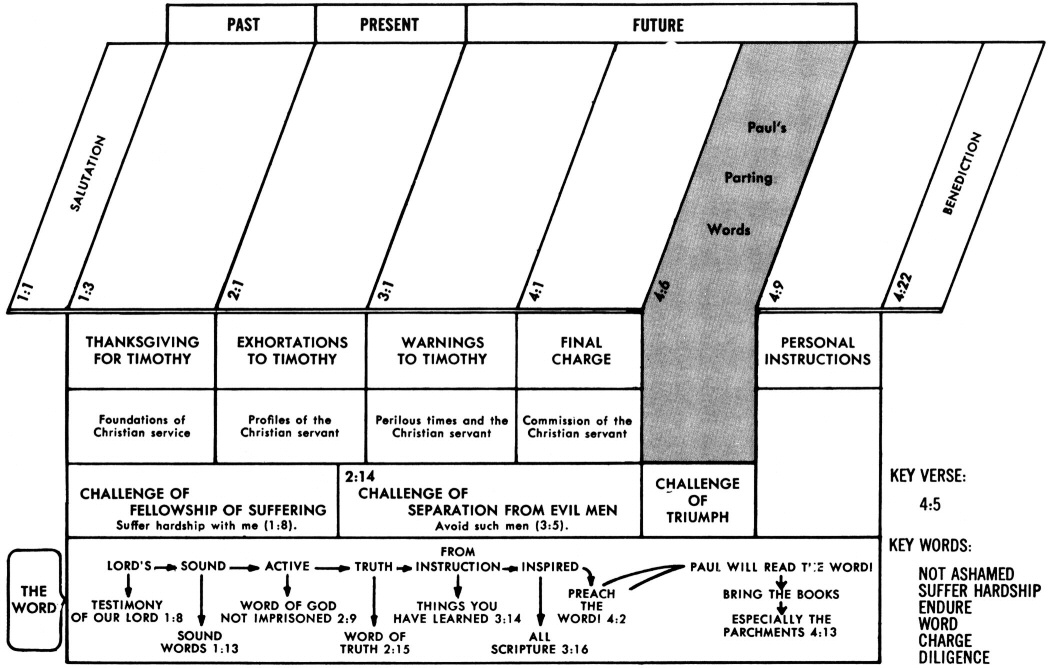
ENDURANCE AND SEPARATION IN THE MINISTRY
Click chart to enlarge
Charts from Jensen's Survey of the NT - used by permission
Second Timothy - Swindoll
| 2 TIMOTHY | |||
| 2 Timothy 1:1-18 | 2 Timothy 2:1-26 | 2 Timothy 3:1-17 | 2 Timothy 4:1-22 |
| Retain the Standard |
Rightly Divide the Word |
Difficult Times Will Come |
Preach the Word |
| PAST | PRESENT | FUTURE | |
| Foundation of Christian Service |
Pictures of Christian Servant |
Dangerous Times for Christian Servant |
Commission of Christian Servant |
| Unashamed as a Witness: Guard the Gospel |
Unashamed as a Workman: Suffer for the Gospel |
Adequate as a Workman: Continue in the Gospel |
Awarded as a Workman: Preach the Gospel |
| Power of the Gospel |
Perseverance of the Gospel Message | Protection of the Gospel |
Proclamation of the Gospel |
| Reminder | Requirements | Resistance | Requests |
| Encouragement in Ministry |
Examples in Ministry |
Exhortations in Ministry |
Exhortations to Fulfill Ministry |
| Commendation & Charge |
Commission to Fulfill |
Conflict to Face |
Course to Finish |
|
Compiled from Jensen's Survey of the NT and Wilkinson's Talk Thru the Bible |
|||
2 Timothy 2:5 Also if anyone competes (3SPAS) as an athlete, he does not win the prize (3SPPI) unless * he competes (3SAAS) according to the rules. (NASB: Lockman)
Greek: ean de kai athle (3SPAS) tis, ou stephanoutai (3SPPI) ean me nomimos athlese. (3SAAS)
Amplified: And if anyone enters competitive games, he is not crowned unless he competes lawfully (fairly, according to the rules laid down). (Amplified Bible - Lockman)
ICB: If an athlete is running a race, he must obey all the rules in order to win. (ICB: Nelson)
KJV: And if a man also strive for masteries, yet is he not crowned, except he strive lawfully.
NJB: or again someone who enters an athletic contest wins only by competing in the sports—a prize can be won only by competing according to the rules; (NJB)
NLT: Follow the Lord's rules for doing his work, just as an athlete either follows the rules or is disqualified and wins no prize. (NLT - Tyndale House)
Phillips: A man who enters an athletic contest wins no prize unless he keeps the rules laid down. (Phillips: Touchstone)
Weymouth: And if any one takes part in an athletic contest, he gets no prize unless he obeys the rules.
Wuest: And if a person contends in the athletic games, he is not crowned as the victor unless he engages in the athletic contest according to the prescribed rules.
Young's Literal: and if also any one may strive, he is not crowned, except he may strive lawfully
AND ALSO IF ANYONE COMPETES AS AN ATHLETE: ean de kai athle (3SPAS) tis:
- Lk 13:24; 1Co 9:25, 26, 27; Php 1:15, 3:14; Col 1:29; 1Ti4:7, 4:8 Heb 12:1, 2, 3, 4
- 2 Timothy Resources - Multiple Sermons and Commentaries
- 2 Timothy 2:3-7 Embracing Hardship for Gospel - Steven Cole
- 2 Timothy 2:3-7: Elements of a Strong Spiritual Life 2 - John MacArthur
If an athlete is running a race (ICB)
if a person contends in the athletic games (Wuest),
if anyone enters competitive games (Amp),
strive in the games (Alford)
strive for masteries (KJV)
Related Resources:
- Notes on Disqualification- 1Corinthians 9:24; 1Cors 9:25; 1Cor 9:26; 1Cor 9:27
- Exposition Hebrews 12:1 Run the Race w Endurance
- Commentary on Isaiah 40:31 How to Fly Like An Eagle
- Click for more discussion of the athletic metaphor
- Athletics in Ancient Greece - The Metropolitan Museum of Art
- The Real Story of the Ancient Olympic Games
- Ancient Olympic Games - Wikipedia
- Ancient Sports - Perseus
Competes as an athlete (118) (athleo from áthlos = contest in war or sport especially for a prize) means to strive or contend, to engage in competition or conflict, to compete in an athletic contest in the arena. To be a champion in public games. The picture conveyed by athleo is one of a struggle requiring great exertion, readiness for sacrifice, discipline, determination and perseverance to win. Athleo is used only in this verse in the NT. In the LXX athleo is found only in later writings such as 4 Maccabees, where it denotes the conflict of martyrs.
McGee has a pithy comment regarding many Christian "athletes" - "The only exercise some Christians get is jumping to conclusions, running down their friends, sidestepping responsibility, and pushing their luck.” That is not the kind of exercise Paul is talking about." (Bolding added)
Paul frequently used the athletic metaphor for he knew that the Romans considered sports a good source of entertainment and the Greeks saw athletics as a means of personal enrichment, reasoning that a healthy body was associated with a healthy mind. Furthermore, gymnasiums (where the athletes trained) and stadiums (where they competed) were conspicuous in most major Greco-Roman cities. Paul also knew that whereas in modern day America, sports are like a religion, in ancient Greece they were distinctly a religious event that even including sacrifices to the patron gods (e.g., Zeus at the Olympic games). The games were so esteemed in ancient times that states involved in wars would call a cessation of war to allow the games to go on unhindered. In fact many of the competing Greek athletes were also soldiers. At a young age most Greek boys were enrolled in the gymnasium which was found in virtually every town of substantial size. And so writes these words in the background or context of a culture well acquainted with and seriously committed to their "Olympic" games (in addition to the most famous, the Olympics, there were biennial Isthmian games at Corinth, et al).
Successful secular athletes like "successful Christian athletes" exerted self-denial, self-control and self-discipline, in order that they might put forth maximum effort. Note well that We do not have the right to give up our freedom, for that was purchased by Christ, but we do have the freedom to give up our rights.
They did so with a specific goal in mind and an eye on the prize in the future. They would train and compete according to the rules lest they be disqualified. As an aside and I am sure you will agree that it is a relatively easy matter to deny things, but it is painful to deny self. In fact, many of us deny things as a substitute for the real sacrifice God wants, denying ourselves! Do not be deceived.
Every athlete has a specific goal - to win the prize. This was no small matter in ancient Greece as victorious athletes not just a perishable wreath but also received great benefits from their home city for the rest of their lives, including such perks as free meals, invitations to banquets, and specially reserved places in the theatre. It is said that in some cases when a victorious athlete returned to their home cities, their compatriots would pull down part of the walls to allow them to enter. In the ancient Olympic games every athlete had to meet three basic rules including being a true-born Greek, swearing an oath before Zeus that he had prepared for ten months before the games (thus giving Zeus liberty to take his life if he lied) and abiding by the rules that applied to his specific event (for example, in wrestling kicking your opponent in the stomach was allowed but gouging one's eyes out was not!). Failure to comply with these rules resulted in immediate disqualification.
It is interesting to note that Greek athletes competing in the games were often coached by past victors, which makes a good parallel with Christian discipleship, Paul the soon to be "past victor" (2Ti 4:7-8) coaching (discipling) the younger Timothy, who was now running the race. Who "coached" you? When I was born again 30 years ago, I went to the leadership of a local Bible church (the largest one in Austin at that time) and appealed to them to give me the name of an older man to disciple me. Instead they gave me a book on how to grow in Christ! Did you even have a "coach" in this spiritual race? The great travesty and tragedy in the modern church is a loss of the sense of value and importance of making disciples. Where are those older men (the "Paul's") who are in the 60's (perhaps even with time on their hands because of retirement), who have walked with and fought for Jesus faithfully for two, three, even four decades? Are they discipling younger men in their 20's and 30's? I fear not (with rare exceptions). Why not? I think the biggest obstacle is time -- it takes time to disciple. Another obstacle is that older men may have been believers for years but they have never really learned how to read and study the living and active Word and therefore cannot pass it on to the younger men. And let's be honest, the most crucial need for younger men is to be fed and fortified with the Word. Let me give you an example -- I approached the young (mid-30's) leaders of a 5000+ member church in Austin, Texas and proposed that I be allowed to gather and train up a group of older (60+) men in their church (men I knew personally and who had been committed to Jesus for several decades) and those equipped men could then each take on 1 or 2 younger disciples in a serious discipleship program, focusing on Bible memorization and in depth study of God's Word. These young leaders did not receive my proposal, because they had plans to disciple in their way -- 30 year olds discipling 30 year olds. I am not saying a 30 year olds cannot be spiritually mature, but I am saying it is a tragedy when a church fails to utilize godly men who have walked with Jesus for decades, most of of them longer than the young leaders have even been alive. So here is my appeal young pastors -- do you have any older men in your church who might make good "Paul's"? If so, I believe the God ordained pattern is 2 Timothy 2:2 - Paul (older) > Timothy (younger) > faithful men.
Corinth was the home of the biennial (every 2 years) Isthmian games (and also the picture of ruins of bema at Corinth), so it seems quite likely that Paul would have been present in Corinth at the time of these celebrated athletic contests, because Dr. Luke records that Paul...

"settled there a year and six months, teaching the word of God among them." (Acts 18:11).
Writing to the Olympic (actually the Isthmian games) minded Corinthians, Paul asked them rhetorically (note the preceding context is Paul's willingness to do anything in order to win lost souls)...
24 "Do you not know (rhetorical because every Corinthian would be very familiar with the races at the Isthmian games in Corinth) that those who run in a race all run, but only one receives the prize? Run in such a way (by setting aside anything that might hinder your witness) that you may win. (every Christian can win if he or she runs with self-discipline, strenuous effort, definiteness of purpose)
25 And everyone who competes (agonizomai [word study] - present tense = continuous action) in the games exercises self-control (present tense) - How possible for spiritual athletes? Only Gal 5:16;, Gal 5:23) in all things. They then do it to receive a perishable wreath (stephanos - word study), but we an imperishable (the prize is a reward for faithful service and is not salvation which is a gift).
26 Therefore I run in such a way, as not without aim; I box in such a way, as not beating the air (the single minded focus, specific aim, desire for every action to count);
27 but I buffet my body (literally = hit under the eye and figuratively knock out the bodily impulses to keep them from preventing Paul from winning souls to Christ) and make it my slave (Spirit empowered self denial [cp Mk 8:34, Php 2:12, Php 2:13] - are you a "slave" to your body? Does your body [especially the flesh] give the orders?), lest possibly, after I have preached to others, I myself should be disqualified (adokimos [word study] [see also bema] = means to test and find not passing the test. It does not = losing one's salvation - disqualified athletes did not lose citizenship - those who failed to meet requirements could not participate at all - in context seems to refer especially to fleshly sins, especial sexual immorality, that disqualify - a disqualified believer might be "put on the shelf" and was no longer usable by the Lord in addition to suffering loss of one's eternal reward! Meditate deeply on this warning beloved)." (1 Corinthians 9:24-27) (See John Piper's sermons on "Olympic Spirituality: Part 1 - Beyond the Gold and Part 2 - How Shall We Run?)
See more in depth commentary on 1Corinthians 9:24-17:
This describes the kind of self-discipline necessary in order to be a winning spiritual athlete. We must bring our bodies into subjection so that our flesh, with its evil desires, does not dominate us and lead us into sin that will divert us from the goal of godliness and Christ-likeness and winning others to Christ. When we honor the Lord Jesus Christ and focus on the eternal reward that awaits those who run with faith, this eternal perspective will bring out our best efforts - and make no mistake - it will require effort, but as Paul has already emphasized it is possible ONLY by being continually strengthened with the grace that is in Christ Jesus (2Ti 2:1).
It's as true in our spiritual life as it is in Olympic running: Only the determined achieve their goals. Olympic medals don't go to the out of shape athlete who has neglected his or her training. Eric Liddell, as portrayed in the excellent film "Chariots of Fire," illustrates this principle. Just before the first turn in a 400-meter race, Liddell was shoved off balance, and he stumbled onto the infield grass. As he looked up, he saw the field pulling away, but with intense determination, Eric jumped to his feet, and with his back cocked and his arms flailing he flew like the wind. He was determined not only to catch up with the pack, but to win, which is exactly what he did! This is the kind of spiritual determination that the apostle Paul brought to his ministry and desires all believers. Dear believer, have you determined not just to compete but like an Olympic athlete competing for the perishable crown or medal and so straining every muscle, nerve, and sinew to get to the finish line and win the imperishable crown? It's just as true in the spiritual race as in the Olympics that winners never quit, and quitters never win. It's always too soon to quit, dear Christian runner.
Commenting on this warning to the Corinthians (and to all believers of all ages) John MacArthur writes that...
The athlete’s disciplined self–control is a rebuke of half–hearted, out–of–shape Christians who do almost nothing to prepare themselves to witness to the lost—and consequently seldom do. (MacArthur, J: 1Corinthians. Chicago: Moody Press)
Paul was saying that if the Olympic and Isthmian athletes exercised such great discipline (giving up the good and the better for the best) and self–control in all things, why can't you Corinthian Christians? In this same line of thought we need to remember that Jesus didn’t say, “Follow Me and life will be easy.” He said, “Follow Me, and life will be tough, but your prize will be worth it in the end.” The Christian life is not a race to see who comes in first, but an endurance run to see who finishes faithfully. Remaining faithful to the finish makes us true winners. We are judged by what we finish, not by what we start.
In the first epistle to Timothy Paul had also utilized an athletic metaphor, exhorting his young disciple to...
7 "have nothing to do with (present imperative = continually refuse, shun, reject = a strong word) worldly (profane not sacred, void of piety, opposite of holy = that which is set apart to God) fables (myths = essentially manufactured stories that have no basis in fact) fit only for old women. On the other hand, discipline (gymnazo click for in depth definition = rigorous, strenuous, self-sacrificing training an athlete undergoes; present imperative) yourself for the purpose of godliness (NIV = train yourself to be godly)
8 for bodily discipline is only of little profit, but godliness is profitable for all things, since it holds promise for the present life and also for the life to come.
9 It is a trustworthy statement deserving full acceptance.
10 For it is for this we labor and strive, because we have fixed our hope (perfect tense; see also our blessed hope) on the living God, who is the Savior of all men, especially of believers." (see notes 1Timothy 4:7; 4:8; 4:9; 4:10;)
In short Paul is commanding Timothy to "work out" strenuously that he might develop "spiritual muscles" for godliness!
Timothy would have been very familiar gymnazo because every Greek city had a gymnasium and Ephesus (where Timothy apparently resided at the time of 1Timothy) was no exception. Youths customarily spent much of their time from ages 16-18 in physical training as their culture placed great emphasis on such training and the glory of winning athletic events. Paul plays off this cultural phenomenon and applies gymnazo to the spiritual realm. So just as Greek culture emphasized dedicated training of the body, Paul urged Timothy to strenuous training of his mind, soul and spirit for the purpose of godliness. Timothy was to be a dedicated "Christian athlete" never ceasing to do what it took to train his inner man for godliness. Are you as serious about training yourself for godliness as you are in pumping iron, running 10K's, eating the latest fad diet, all for the "glory" of your body which is fading away anyway?
The Jewish historian Josephus uses gymnazo in his description of the Roman soldier writing that...
"...their military exercises differ not at all from the real use of their arms, but every soldier is every day exercised (gymnazo), and that with great diligence, as if it were in time of war which is the reason why they bear the fatigue of battles so easily." (Josephus, F. The Works of Josephus. Wars 3.73)
Vine comments that discipline like that of a serious athlete involves...
"spiritual training which must not be discontinued. Godliness, of which the discipline is the motive and aim, involves fellowship with God, which can be cultivated only by constant meditation in the word of God and by the habit of prayer. Godliness, thus maintained, involves our overcoming every kind of enticement to evil and our living so as to please God. (Vine, W. Collected writings of W. E. Vine. Nashville: Thomas Nelson)
Hebrews 12:1-4 (See exposition of Hebrews 12:1, 12:2)
In Hebrews 12 the writer of Hebrews exhorts his readers using the metaphor of a runner declaring...
1 Therefore (term of conclusion check the immediate context to see why it's "there for"), since we have so great a cloud of witnesses (present tense = continually - they have finished the race and this should encourage us that we too can run to the end) surrounding us (those saints in Hebrews 11 who have victoriously finished the race of faith and won the prize are to be motivating models for imitation), let us also (as those in Hebrews 11 had to do in order to run unimpeded) lay aside (casting them off like older dirty clothes) every (how many?) encumbrance (excess body weight), and the sin which so easily entangles (that sin which so deftly and cleverly places itself in an entangling way around us - the besetting sin that encircles and trips us up like a long, loose robe) us, and let us run (present tense - to stand still or to go backward is to forfeit the prize) with endurance (hupomone = bearing up under the load = steady determination to keep going, continuing even when everything in you wants to slow down or give up = Christian race is a marathon or long-distance race, not a sprint) the race (Greek = agon = speaks of a demanding, agonizing event - the specific race = stay in your lane) that is set before us (like a road that stretches before our gaze),
2 fixing our eyes (aphorao = apo [away from = The minute the Greek runner in the stadium takes his attention away from the race course and the goal to which he is speeding, and turns it upon the onlooking crowds, his speed is slackened] + horao =turning one's eyes away from other things and fixing them on) on Jesus (supreme example to which his readers should look as they run life’s race), the author and perfecter of faith, who for the joy set before Him endured the cross, despising the shame, and has sat down at the right hand of the throne of God.
3 For consider Him who has endured such hostility by sinners against Himself, so that you may not grow weary and lose heart.
4 You have not yet resisted to the point of shedding blood in your striving against sin. (see notes Hebrews 12:1; 12:2; 12:3; 12:4)
THE WEIGHT
TEST
In every task you consider undertaking in this short life dear believer, always assess the task with the "weight test". As yourself the question:
"Could this task or activity slacken or sidetrack me
from running the race with endurance,
from finishing well and
from winning the prize?"
It is a question worth soberly pondering with all seriousness, for the answer you give will have eternal impact!
As one has well said "Keep in step with God, for He has planned every step of the way."
How important is it to keep your eyes fixed on Jesus? The following true story illustrates how critical it is that we each run our spiritual race with a proper focus. On May 6, 1954, Roger Bannister became the first man in history to run a mile in less than 4 minutes. Within 2 months, John Landy eclipsed the record by 1.4 seconds. On August 7, 1954, the two met together for a historic race. As they moved into the last lap, Landy held the lead. It looked as if he would win, but as he neared the finish he was haunted by the question, "Where is Bannister?" As he turned to look, Bannister took the lead. Landy later told a Time magazine reporter, "If I hadn't looked back, I would have won!" We cannot make spiritual progress by looking back. (See Paul's advice in section below - Php 3:13-14)
Another "wait" test is found in Isaiah 40:31 - "Yet those who wait for the LORD Will gain new strength; They will mount up with wings like eagles, They will run and not get tired, They will walk and not become weary." (see exposition)
Paul himself saw the Christian life as a race, (some feel he was referring to a chariot race in this description) writing to the Philippians
13 "Brethren, I do not regard myself as having laid hold of it yet (spiritual perfection which is not attainable in this life); but one thing [I do] ("I do" not in Greek. "One thing" = single minded focus and oneness of purpose in Paul's pursuit of Christlikeness) forgetting what lies behind (= completely forgetting = pix of a runner completely forgetting his opponents he had passed. A runner who looks back risks being passed. Nor does a runner’s performance in past races guarantee success or failure in present or future races. The past is not relevant; what matters is making the maximum effort in the present so as to sustain momentum in the future. "Just as a runner’s speed is slackened should he think of those behind him, and the thud, thud of their pounding feet, so the Christian’s onward progress is hindered should he dwell on the past full of failures and sins, full of heartaches and discouragements, full of disappointments and thwarted hopes and plans. As long as a Christian has made things right with God and man, he should completely forget the past" - Wuest) and reaching forward (describes the runner whose eye outstrips and draws onward the hand, and the hand the foot.” = stretching muscles to their limit, picturing a runner straining every muscle to reach the finish line) to what lies ahead,
14 I press on (pursue, chase after - present tense) toward (down = idea of bearing down in the direction of) the goal (skopos = a mark on which to fix one’s eyes - describes runner racing hard with head forward, body bent and angled, and eyes on nothing but the goal of Christlikeness) for the prize of the upward call of God in Christ Jesus. (See notes Philippians 3:13; 3:14)
Chrysostom - "He that runs looks not at the spectators, but at the prize. Whether they be rich or poor, if one mock them, applaud them, insult them, throw stones at them — if one plunder their house, if they see children or wife or anything whatsoever — the runner is not turned aside, but is concerned only with his running and winning the prize. He that runneth stoppeth nowhere; since, if he be a little remiss, all is lost. He that runneth relaxeth in no respect before the end, but then, most of all, stretcheth over the course."
Two men walking down a country road decided to take a shortcut home. They passed through a field where a number of cattle were grazing. Deeply engrossed in conversation when they reached the other side of the pasture, they forgot to shut the gate behind them. A few minutes later one of them noticed the oversight and ran back to close the gate. As he did, he remembered the last words of an old friend who summoned all his children to his bedside and gave them this wise counsel:
"As you travel down life's pathway,
remember to close the gates behind you."
The man knew that problems, difficult situations, heartbreaks, and failures were inevitable, but he wanted his children to know that they didn't have to allow those things to follow them through life. This is especially true for believers. Once we have confessed a sin and have done what we can to right the wrong, we must put the incident behind us. When it comes to the failures of the past, we can always close the gate behind us. We invite defeat when we remember what we should forget.
I'm pressing on the upward way,
New heights I'm gaining ev'ry day;
Still praying as I onward bound,
"Lord, plant my feet on higher ground."
—J. Oatman, Jr.
The spiritually healthy Christian "runner" knows what to remember and what to forget.
Guy King comments that for the Christian "athlete"...
There are things to be obeyed - "strive lawfully". The Christian cannot do as he likes, any more than the athlete can make up his own rules, or follow his own dictates.
In the case of the Greek Games, which Paul was here thinking of, there were various laws to be observed by any competitor who desired to succeed - rules of the track, rules of the training. The one which I find so fascinating is that which requires that all entrants must show themselves to be True Born Greeks, none other were allowed to strive in the Arena: even as the Christian Race is open only to those who are New Born Christians.
That is the first and fundamental law of our running; and there are other commandments following. We are called upon to put aside our own wishes, to deny our own desires, and to perform only His will - "not as I will, but as Thou wilt", as the Master taught us (Matthew 26:3 9) by the blessed example of His own unique sacrifice.
So, by all these various implications, Paul impresses upon his protégé the sacrificial nature of the life to which he has been called - whether as a private individual Christian, or as a public leader of the church. Self is to go, every time and all the time. I often think, and say, that Self is the believer's main problem. It has such a way of creeping in and spoiling things: self-consciousness, self-pity, self-importance, self-confidence, self-will, self-seeking. "Let him deny himself" - again we quote the Master's words. This is a law - perhaps the law: the Law of Success in Christian living. This is one of the things that we believers need most to understand - and, having grasped, need most to practice.
"I must decrease," says John the Baptist, with becoming modesty; and that for the simple reason that it is of the very warp and woof of his ministry that "He must increase," John 3:30. Or, to quote our Paul's secret, "Not I, but Christ", Galatians 2:20. Is anyone inclined to say that this is hard doctrine which we have been preaching? Well - not "we," it is Paul; and really, not he, but the HOLY SPIRIT Who inspired him. (2 Timothy 2:1-7 Some Things Every Christian)
DISQUALIFIED? - The downhill slalom racer was greeted at the bottom of the course by his ski coach: "The good news is that you arrived at the finish marker faster than any of my other students. In fact, your time was the fastest ever on this course, perhaps even faster than the world record! The bad news is that when you miss even one flag, you are disqualified." To which the novice slalom skier replied, "Flags? What flags?" A good slalom racer understands that the route taken to get downhill is more important than just reaching the goal. Any basketball player understands that making a basket is not as important as making sure he is aiming toward the right basket. In most sports, both the goal and the manner of attaining the goal are vital. Yet what is often remembered in sports is too often forgotten in the Christian walk. We have lost sight of which of our acts will be rewarded in heaven and which will be disqualified as missing the flags of proper motivations, godly direction, and willful obedience. We have lost a sense of heaven and therefore have lost a sense of how this life is to be lived for eternal impact. (Howard Hendricks in the Foreword of "Reward and Loss at the Judgment of Believers" by Joe Wall)
A wise pastor once said that whenever he begin to feel discouraged he would bring to mind the awe and wonder he sensed when God first saved him. But he added that he deliberately avoided thinking about two men who did him a great wrong in his first pastorate and never made it right. Why? Because when he recalled that time in his life, it aroused old feelings of resentment and hurt that would always destroy his peace.
David wrote, "Forget not all His benefits." It's good to remember God's past mercies, including how He forgave our sins, healed us, sustained us, and lavished His blessings upon us. Thinking these thoughts will help us become more thankful and trustful. In this passage from Philippians 3 if Paul had continually dwelt upon his sins of persecuting Christians it may well have depressed or discouraged him. On the other side, if he were to glory in his successes as a Pharisee of Pharisees, it would have kindled feelings of pride. It is wrong to live in the sagging spirit of regret over past failures; but we can also make the mistake of resting on the laurels of yesterday's spiritual victories to the point that we think we have arrived at the finish line. Paul's exhortation to the Philippians and to all who would run the race set before them with endurance is to be selective in what we remember. We should cherish the memories that make Jesus and His salvation more precious, but we should forget those that hinder us as we run the race.
We invite defeat in our race
by forgetting what we should remember
and remembering what we should forget.
Run the straight race through God's good grace,
Lift up thine eyes and seek His face;
Life with its way before us lies,
Christ is the path and Christ the prize. -- Monsell
In Paul's closing words to Timothy he wrote
I have fought (agonizomai) the good fight (agon), I have finished (teleo) the course (dromos = the "race"), I have kept (tereo) the faith in the future there is laid up for me the crown (stephanos) of righteousness, which the Lord, the righteous Judge, will award to me on that day; and not only to me, but also to all who have loved His appearing." (see notes 2 Timothy 4:7-8) See RBC booklet Finishing Well
Take up thy cross and follow on,
Nor think till death to lay it down,
For only he who bears the cross
May hope to wear the glorious crown. --Everest
Christ showed His love by dying for us. We show our love by living for Him.
Related Resources:
- Maranatha Mindset
- Maranatha - Our Lord Come!
- Vertical Vision
- Second Coming of Christ-Quotes, Devotionals & Illustrations
In light of the truth that those who love His appearing will be awarded the crown of righteousness (2 Ti 4:8), assay every thought, word and deed with the question
"Will I be ashamed to be found engaged in this activity if He were to return today?"
(see 1 John 2:28-exposition)
HE DOES NOT WIN THE PRIZE UNLESS HE COMPETES ACCORDING TO THE RULES: ou stephanoutai (3SPPI) ean me nomimos athlese (3SAAS):
- 2 Ti 4:7;4:8 Jas 1:12; 1Pe 5:4; Rev 2:10; 3:11; 4:4, 4:10
- 2 Timothy Resources - Multiple Sermons and Commentaries
- 2 Timothy 2:3-7 Embracing Hardship for Gospel - Steven Cole
- 2 Timothy 2:3-7: Elements of a Strong Spiritual Life 2 - John MacArthur
he is not crowned [Literally = never being crowned], except he may strive lawfully (YLT)
he will not be crowned as the winner (NET)
a prize can be won only by competing according to the rules (NJB)
he is not crowned unless he competes lawfully (fairly, according to the rules laid down). (Amp)
he does not receive the victor's crown unless he competes according to the rules (NIV)
he must obey all the rules in order to win (ICB)
he is not crowned except he have contended lawfully (ASV)
Does not (ou) - This signifies absolute negation. Let every Christian runner ponder the seriousness of this qualifying statement lest we end up in heaven "smelling like smoke" (1Co 3:15)! And don't forget to check your motivation - why do you do the Christian work you do? (1Co 4:5, Jn 15:5).
Win the prize (4737) (stephanoo [word study] from stephanos [word study] = crown) literally means to be crowned or to have a wreath placed around (encircling) one's head, as was the custom in ancient Greece when one won an athletic contest.
Stephanoo - 3x in 3v - 2 Tim 2:5; Heb 2:7, 9
Friberg says that the figurative use speaks "of the dignity and exaltation accorded to Jesus for victoriously achieving the atonement -- honor, reward (Friberg, T., Friberg, B., & Miller, N. F. Analytical Lexicon of the Greek New Testament. Baker Academic)
Stephanos is derived from stepho meaning to encircle and in classic Greek referred not to the crown of a king but to the crown of victory in public (athletic) games and also was conveyed to those who demonstrated civic worth, military valor, nuptial joy or festival gladness. The stephanos was woven of oak, ivy, myrtle, olive leaves or flowers and used as a wreath or garland on one's head.
Paul is giving a serious warning! Break the rules and you will not be crowned as a victor in the public games! This should be a divine deterrent to our natural inclination to "take a short cut" when the road of discipleship becomes difficult to run. It is shorter and easier to run across the track, but taking the "easy way out" will disqualify us from the victor's exaltation. The reward once again far outweighs the responsibility.
Guzik adds that "Too many Christians think they are “competing” for God, but they make up their own rules, thinking they have a special arrangement with God. For some people, their special arrangement goes something like this: “I know this is sin, but God understands, so I’ll just keep going in this sin.
They don't understand the maxim that our present choices determine our future reward. Remember too that we will be judged by how we finished the race, not by how we started. You can't lose if you stay with God's game plan.
Related Resource:
According to the rules - The adverb nomimos (from nómos = law) means legitimately, in accordance with to the rules, according to law and custom. Lawfully. Agreeably to the law. Properly. Correctly. Fairly.
In the Greco-Roman world these rules included requirements for training as well as for the competition itself. Every participant had to meet three qualifications:
(1). Trueborn Greek - contending athletes were required to produce a Greek birth certificate
(2). All Greek athletes had to train for 10 months prior to the actual competition. This training period involved rigid, prescribed exercises, living a strictly separated life in regard to the ordinary and lawful pursuits of life and partaking of a rigid diet. At the end of the 10 months the athlete had to swear before Zeus that he had kept faithfully fulfilled these requirements and if not he was disqualified.
(3). Finally, the athlete had to compete within specific rules for the individual athletic event.
Should the athlete break any of these rules, he would be barred from engaging in the athletic contest and have no opportunity for the highly sought after "stephanos". One begins to get a picture of the seriousness of Paul's warning to Timothy and to all believers. By analogy, all who would run in God's race, must be spiritually re-born of God, must exercise self-control and endurance, and must always act in conformity with the regulations (the word of God).
Spurgeon - There were rules in the Grecian games. When they struck each other, the blow was not to be given except upon a certain part of the body, and if a man fought unlawfully, he could not get the prize. So there are laws, too, for the Christian ministry, and also .holy regulations for the ;great wrestling of Christians.
Epictetus - "Would you be a victor in the Olympic games? So in good truth would I, for it is a glorious thing; but pray consider what must go before and what may follow, and so precede to the attempt. You must then live by rule, eat what will be disagreeable, refrain from delicacies; you must oblige yourself to constant exercise at the appointed hour, in heat and cold. You must abstain from wine and cold liquor; in a word, you must be as submissive to all the directions of your master as to those of a physician."
Although Paul's main point is clearly that if we do not compete according to God's rules, we will not win the prize. But the metaphor of an athlete also speaks of the need for the "Christian athlete" to be disciplined, committed and controlled. Becoming an Olympic champion does not come easy but when that athlete receives the Olympic gold, he or she quickly forgets all the years of difficult training. How much more will this be true of us as Christian athletes when we see Jesus and hear "Well done, my good and faithful servant."
We thank Thee for the crown
Of glory and of life;
’Tis no poor withering wreath of earth,
Man’s prize in mortal strife;
’Tis incorruptible as is the Throne,
The kingdom of our God and
His Incarnate Son.
—Horatius Bonar
It is now common knowledge that in the past five Olympics women athletes, notably swimmers from the former East Germany used steroids and probably other performance-enhancing drugs to gain tremendous strength advantages over the competition. The 1996 Olympics in Atlanta revealed that many athletes from Mainland China had engaged in similar rules violations. And there was the famous albeit tragic case of the great Canadian sprinter Ben Johnson, who violated the rules at the 1988 Seoul Olympics. He completed a brilliant Gold-Medal performance in the 100-meter dash, setting a new Olympic and World record and shocking the sporting world by beating America's leading contender, Carl Lewis. After the race, the judges learned that Johnson had tested positive for an illegal substance, so they stripped him of his Olympic gold medal and all of the fame and fortune associated with the title of "fastest man in the world"! Though Ben Johnson had run faster than any man had ever run and made an incredible impression on all who witnessed the race, he failed to "compete according to the rules" and thus did not win the prize. Dear saint run the only race that has eternal significance according to the rules!
9 "Therefore also we have as our ambition (Greek word places emphasis on longing that a thing shall be accomplished and thus to fully give oneself to do the task), whether at home or absent, to be pleasing (see discussion of euarestos related to verb aresko used of soldier pleasing the one who enlisted him - see 2Timothy 2:4) to Him (why is this Paul's ambition?).
10 For we (Paul includes himself so this refers to believers) must (a binding obligation) all appear (open to all = that which has been hidden now visible, uncovered, laid bare, revealed. Way translates it "stripped of all disguise" = The Judgment Seat of Christ will be a place of revelation; for the word appear means “be revealed.” As work on earth, it is easy for us to hide and pretend; but Paul says that the true character of our works will be exposed before the searching eyes of the Saviour. Even our motives will be revealed - see 1Cor 4:5) before (in front of) the judgment seat (see discussion of bema) of Christ, (why?) that (in order that = expresses the purpose of the judging) each one (note we will stand individually) may be recompensed (receive back what is one's own - if we have been faithful the bema will be a place of reward - the important thing is not the reward but the joy of being pleasing to Jesus) for his deeds in the body (actions which happened during the believer’s time on earth. Paul does not mean sins for they were fully paid for at the cross by the One Who now sits as Righteous Judge!), according to what he has done, whether good or bad (KJV is based on Greek Textus Receptus which has "kakos" = evil. Greek texts accepted as more accurate have the word "phaulos" = worthless, good for nothing). (2Cor 5:9; 2Cor 5:10)
Barclay - One thing remains in all three pictures. The soldier is upheld by the thought of final victory. The athlete is upheld by the vision of the crown. The husbandman is upheld by the hope of the harvest. Each submits to the discipline and the toil for the sake of the glory which shall be. It is so with the Christian. The Christian struggle is not without a goal; it is always going somewhere. The Christian can be certain that after the effort of the Christian life, there comes the joy of heaven; and the greater the struggle, the greater the joy.
As Jesus Himself clearly declared...
"If anyone wishes to come after Me, let him deny himself, and take up his cross, and follow Me. 25 "For whoever wishes to save his life shall lose it; but whoever loses his life for My sake shall find it. 26 For what will a man be profited, if he gains the whole world, and forfeits his soul? Or what will a man give in exchange for his soul? 27 "For the Son of Man is going to come in the glory of His Father with His angels; and WILL THEN RECOMPENSE EVERY MAN (believers and unbelievers - see chart below) ACCORDING TO HIS DEEDS." (Matthew 16:24-27)
|
TWO JUDGMENTS |
|
| 2Corinthians 5:9,10 | Rev 20:11, 12, 13, 14, 15 (note) |
| Judgment Seat of Christ | Great White Throne Judgment |
| Only believers | Only unbelievers |
| After the Rapture Before the Millennium |
After the 1000 year reign of Messiah Before the New Heaven and Earth |
| Determines rewards for service |
Determines degree of eternal judgment |
8 Now he who plants and he who waters are one; but each will receive his own reward according to his own labor...
12 Now if any man builds upon the foundation with gold, silver, precious stones, wood, hay, straw,
13 each man's work will become evident; for the day will show it, because it is to be revealed with fire; and the fire itself will test the quality of each man's work.
14 If any man's work which he has built upon it remains, he shall receive a reward.
15 If any man's work is burned up, he shall suffer loss; but he himself shall be saved, yet so as through fire (Unconfessed sin keeps one from serving Christ as we should, and this means loss of reward, which is pictured by Lot who was not walking with the Lord. As a result, Lot lost his testimony with his own family and everything he had lived for which was destroyed by the fire and brimstone. Lot was saved but “as by fire.”
What (who) are you investing your life in, beloved?
Barnes adds that
the prize...was conferred on the successful champion on the last day of the games and with great solemnity, pomp, congratulation, and rejoicing. Everyone thronged to see and congratulate them; their relations, friends, and countrymen, shedding tears of tenderness and joy, lifted them on their shoulders to show them to the crowd, and held them up to the applauses of the whole assembly, who strewed handfuls of flowers over them. Nay, at their return home, they rode in a triumphal chariot; the walls of the city were broken down to give them entrance; and in many cities a subsistence was given them out of the public treasury, and they were exempted from taxes. Cicero says that a victory at the Olympic games was not much less honorable than a triumph at Rome.
Edwards writes that
The weary athlete is summoned before the judgment seat and there is crowned with the victor's wreath. All his sacrifice and suffering is overwhelmingly compensated for in that brief moment of glory. For us, however, the reward will be a crown which is "imperishable," and does not fade with the passing of time. (see notes 1 Corinthians 9:24ff) It is also a crown which comes not from human judges, but from the King of kings and Lord of lords. No earthly crown or trophy can possibly come close to matching the value of this heavenly crown. The eternal thrill of the most important of all victories will immeasurably repay the sacrifice and suffering which comes to all who KNOW and OBEY the rules of discipleship.
If an athlete in the ancient Olympic or Isthmian games (at Corinth) won an event but was later found to have broken the rules, he had to forfeit his crown. A tragic modern illustration occurred in the 1912 Olympics when the talented American athlete Jim Thorpe won not only the decathlon but also the pentathlon (a total of 15 grueling events!) The following year Thorpe was forced to return his gold medals (he did "not win the prize") because it was discovered he had played professional baseball in 1911 and at that time professional athletes were barred from Olympic competition. He had won the events but had broken the rules and so he forfeited "the prize". As an aside, at the 1984 Olympic Games in Los Angeles the Olympic committee restored Thorpe's "prize" but that is where the illustration does not parallel Paul's teaching, where no restoration of the "prize" is implied for a Christian athlete who breaks the rules.
J Vernon McGee has some excellent insights reminding us that
There is no shortcut toward living the Christian life. Forget the gimmickry today that condenses Christianity into a little course or a few rules and regulations. God gave us sixty-six books, and each one of them is very important. It takes the composite picture to give us the mind and the Word of God (Ed note: Do you spend sufficient time in the Old Testament or just focus on the New?). We are to study the whole Bible. An athlete can’t cut the corner of a racetrack (Ed note: in fact the corners were very dangerous in the ancient Olympics and related games as that is where other runners often sought to trip up or otherwise hinder their competitors). Neither can a baseball player run by second base without touching it; he has to touch all the bases to score. (Ed note: he would be called out ~ "disqualified"). A child of God has to do that, too. If you’re going to win, you can’t take any shortcuts." (McGee, J V: Thru the Bible Commentary: Thomas Nelson)
Winners never quit and quitters never win.|
A part-time Christian is a contradiction in terms.
A man’s or woman's whole life should be one strenuous endeavor to live out their Christianity in every moment and in every sphere. Like the ancient Olympic athletes who were wholly absorbed in their pursuit in order to be win the coveted prize at the games, the Christian "athlete" cannot afford engage in their task in a listless, lazy or indifferent manner but must focus intently on their goal.
William Barclay on the Christian athlete - Paul has just used the picture of the soldier to represent the Christian, and now he uses two other pictures--those of the athlete and of the toiling husbandman. He uses the same three pictures close together in 1 Corinthians 9:6-7; 1 Corinthians 9:24-27.
Paul says that the athlete does not win the crown of victory unless he observes the rules of the contest. There is a very interesting point in the Greek here which is difficult to bring out in translation. The King James Version speaks of striving lawfully. The Greek is athlein (Greek #118) nomimos (Greek #3545). In fact that is the Greek phrase which was used by the later writers to describe a professional as opposed to an amateur athlete. The man who strove nomimos (Greek #3545) was the man who concentrated everything on his struggle. His struggle was not just a spare-time thing, as it might be for an amateur; it was a whole-time dedication of his life to excellence in the contest which he had chosen. Here then we have the same idea as in Paul's picture of the Christian as a soldier. A Christian's life must be concentrated upon his Christianity just as a professional athlete's life is concentrated upon his chosen contest. The spare-time Christian is a contradiction in terms; a man's whole life should be an endeavor to live out his Christianity. What then are the characteristics of the athlete which are in Paul's mind?
(i) The athlete is a man under discipline and self-denial. He must keep to his schedule of training and let nothing interfere with it. There will be days when he would like to drop his training and relax his discipline; but he must not do so. There will be pleasures and indulgences he would like to allow himself; but he must refuse them. The athlete who would excel knows that he must let nothing interfere with that standard of physical fitness which he has set himself. There must be discipline in the Christian life. There are times when the easy way is very attractive; there are times when the right thing is the hard thing; there are times when we are tempted to relax our standards. The Christian must train himself never to relax in the life-long attempt to make his soul pure and strong.
(ii) The athlete is a man who observes the rules. After the discipline and the rules of the training, there come the contest and the rules of the contest. An athlete cannot win unless he plays the game. The Christian, too, is often brought into contest with his fellow-men. He must defend his faith; he must seek to convince and to persuade; he will have to argue and to debate. He must do so by the Christian rules. No matter how hot the argument, he must never forget his courtesy. He must never be anything else but honest about his own position and fair to that of his opponent. The odium theologicum, the hatred of theologians, has become a byword. There is often no bitterness like religious bitterness. But the real Christian knows that the supreme rule of the Christian life is love, and he will carry that love into every debate in which he is engaged. (2 Timothy 2 - William Barclay's Daily Study Bible) (Bolding added)
Ray Stedman writes that the athletic metaphor presents us with what ...
"is really a form of ambition, but a very proper ambition. Every athlete learns that he has to deny himself certain things if he wants to win. He cannot eat just any kind of food; he has to give up chocolate sundaes, strawberry shortcake, and all the rich, luxurious indulgences that others can freely have. He may have to sit and eat cardboard while others enjoy something else, but he does it. The athlete does not indulge in certain pleasures. He does not go in for late nights, wild living, revelings, carousings and drunkenness that others may go in for. He resolutely predetermines that he is not going to involve himself in those, so that when the occasion arises he says, No. He does not indulge in certain vices. He gives up smoking and drinking because it hurts and harms the body. The athlete does so because he wants to win; that is the point. He wants to be "crowned." (That is what the apostle speaks of here.) These crowns are not something we earn by our faithfulness. Rather, they represent a test (we will see more of that in a moment) that reveals whether we really are athletes for Christ or not; they represent a proper goal in our life. We do not want to lose out on what God has for us; we want to achieve all that he has made available, so we are ready to say no to many things in order to gain that...A Christian is called to say "No" to many things today. There are visual stimuli on every side that tempt us to give in, to indulge ourselves, to seize hold of life and enjoy it now. But a Christian soldier (athlete) has to say, "No! I won't do it. Those things lead to distraction, to disruption and to a lessening of spiritual intensity in my life; I won't do them." That is the discipline of an athlete." (Soldiers, Athletes and Farmers )
Hiebert comments that...
Two significant qualities...emerge from this image of the athlete. First, he must be a person with strong self-discipline, willing and able to conform his activities to the demands of truth and justice. Second, he must be motivated by the hope of future reward for present faithful service. (Hiebert, Bib Sac. 1996, p220)
Run the straight race through God's good grace,
Lift up your eyes and seek His face;
Life with its way before us lies,
Christ is the path and Christ is the prize.
-- Monsell
Wiersbe sums this section up with the observation that
"from the human point of view, Paul was a loser. There was nobody in the grandstands cheering him, for “all they which are in Asia” had turned away from him (see note 2 Timothy 1:15). He was in prison, suffering as an evildoer. Yet, Paul was a winner! He had kept the rules laid down in the Word of God, and one day he would get his reward from Jesus Christ. Paul was saying to young Timothy, “The important thing is that you obey the Word of God, no matter what people may say. You are not running the race to please people or to get fame. You are running to please Jesus Christ.” (Wiersbe, W: Bible Exposition Commentary. 1989. Victor)
In the soldier metaphor the motivation was a desire to be pleasing to the Commander and in the athletic (and farmer) metaphor the motive was the reward.
Steven Cole writes...
To be a fruitful Christian, willingly embrace the hardship of the athlete: Discipline within limits (2Ti 2:5). Observe three things:
A. You do not become godly by accident.
We’re all suckers for quick and easy remedies for difficult problems. Almost daily I get emails trying to sell me a pill that will take off pounds without the discipline of dieting or exercise. Spiritually, we fall for the same easy-remedy approach: “Get baptized in the Spirit and speak in tongues and you’ll instantly be transported to a higher level where you’ll never struggle with temptation again.” But it doesn’t work.
The athlete metaphor shows that it is only by discipline that the athlete may compete and win. Every athlete knows that occasional jogging won’t prepare you to compete in the Olympics. To compete on a winning level, you must daily discipline your body through exercise, diet, and proper rest.
Paul writes (1 Tim. 4:7), “discipline yourself for the purpose of godliness.” You can wish for godliness, you can try magic remedies for godliness, but you won’t become godly apart from the daily discipline of making the time to spend in the Word and in prayer. There are no shortcuts.
B. You must compete according to the rules of God’s Word.
If an athlete disobeys the rules of his sport, he is instantly disqualified. Yet many Christians, even Christian leaders, think that they have a special exemption that allows them to disobey God’s Word and yet expect His blessing. But it doesn’t work that way! To put it bluntly, men, you can’t engage in mental lust or look at pornography and then pray, “Lord, keep my children morally pure.” You can’t cheat in your business and ask God to bless it.
C. Your aim in competing is to win the prize.
Paul tells us (1Cor. 9:24) to run in such a way that we might win. In the Christian race, we’re not competing against each other. And, there will be multiple winners. We all can win. But Paul wants us to adopt a mindset that says, “I’m not going to dink around in my Christian life. I’m running to win!”
Charles Simeon (Brothers, We Must Not Mind a Little Suffering - John Piper's Meditations on Life of Charles Simeon), a godly Anglican pastor in the early 19th century, saw many young men under his influence go out into the cause of world missions. One such young man was Henry Martyn (bio), who went to India and Persia, where he died at age 31 of tuberculosis. This was before photography, but someone had painted a portrait of Martyn just before he died and sent it to Simeon. He was shocked when he saw it, at the obvious toll that the hardship of missionary life had taken on his young disciple. Simeon hung the portrait over the mantle in his study, where he looked at it often. He said that it reminded him, “Don’t trifle! Don’t trifle!”
Thus to be a fruitful Christian, willingly embrace the hardship of the soldier and the athlete. (Read Pastor Cole's full sermon)
Warren Wiersbe quips that
"If Christians were putting into their spiritual walk the kind of discipline that athletes put into their chosen sport, the church would be pulsating with revival life. " (Wiersbe, W. W. Be Decisive)
Isaac Watts’ great hymn says the same thing:
“Love so amazing, so divine, demands my heart, my life, my all.”
C. T. Studd the great British athlete turned missionary wrote that
“If Jesus Christ be God and died for me, then no sacrifice can be too great for me to make for him.”
A. W. Pink writes in "An Exposition of Hebrews" on running the race:
The principal thoughts suggested by the figure of the “race” are rigorous self-denial and discipline, vigorous exertion, persevering endurance. The Christian life is not a thing of passive luxuriation, but of active “ fighting the good fight of faith” The Christian is not called to lie down on flowery beds of ease, but to run a race, and athletics are strenuous, demanding self-sacrifice, hard training, the putting forth of every ounce of energy possessed. I am afraid that in this work-hating and pleasure-loving age, we do not keep this aspect of the truth sufficiently before us: we take things too placidly and lazily. The charge which God brought against Israel of old applies very largely to Christendom today: “Woe to them that are at ease in Zion” (Amos 6:1): to be “at ease” is the very opposite of “running the race.”
The “race” is that life of faith and obedience, that pursuit of personal holiness, to which the Christian is called by God. Turning from sin and the world in penitence and trust to Christ is not the finishing-post, but only the starting-point. The Christian race begins at the new birth, and ends not till we are summoned to leave this world. The prize to be run for is heavenly glory. The ground to be covered is our journey through this life. The track itself is “set before us”: marked out in the Word. The rules to be observed, the path which is to be traversed, the difficulties to be overcome, the dangers to be avoided, the source and secret of the needed strength, are all plainly revealed in the holy Scriptures. If we lose, the blame is entirely ours; if we succeed, the glory belongs to God alone.
The prime thought suggested in the figure of running the race set before us is not that of speed, but of self-discipline, whole-hearted endeavour, the calling into action of every spiritual faculty possessed by the new man. In his helpful commentary, J. Brown pointed out that a race is vigorous exercise. Christianity consists not in abstract speculations, enthusiastic feelings, or specious talk, but in directing all our energies into holy actions. It is a laborious exertion: the fiesh, the world, the devil are like a fierce gale blowing against us, and only intense effort can overcome them. It is a regulated exertion: to run around in a circle is strenuous activity, but it will not bring us to the goal; we must follow strictly the prescribed course. It is progressive exertion: there is to be a growth in grace, an adding to faith of virtue, etc. (2Pe 1:5, 6, 7-see notes 2Peter 1:5 1:6-7), a reaching forth unto those things which are before.
“Let us run with patience the race that is set before us.” We only “run” when we are very anxious to get to a certain place, when there is some attraction stimulating us. That word “run” then presupposes the heart eagerly set upon the goal. That “goal” is complete deliverance from the power of indwelling sin, perfect conformity to the lovely image of Christ, entrance into the promised rest and bliss on High. It is only as that is kept steadily in view, only as faith and hope are in real and daily exercise, that we shall progress along the path of obedience. To look back will cause us to halt or stumble; to look down at the roughness and difficulties of the way will discourage and produce slackening, but to keep the prize in view will nerve to steady endeavour. It was thus our great Exemplar ran: “Who for the JOY that was set before Him ” (He 12:1, 2-notes of He 12:1, 12:2)
But let us now consider, secondly, the means prescribed: “let us lay aside every weight, and the sin which doth so easily beset us.” That might be tersely expressed in several different forms: let us relinquish those things which would impede our spiritual progress; let us endeavour with might and main to overcome every hindering obstacle; let us attend diligently unto the way or method which will enable us to make the best speed. While sitting at our ease we are hardly conscious of the weight of our clothes, the articles held in our hands, or the cumbersome objects we may have in our pockets. But let us be aroused by the howlings of fierce animals, let us be pursued by hungry wolves, and methinks that none of us would have much difficulty in understanding the meaning of those words “let us lay aside every weight !”
“Let us lay aside every weight, and the sin which doth so easily beset us.” While no doubt each of these expressions has a definite and separate force, yet we are satisfied that a certain school of writers err in drawing too sharp and broad a line of distinction between them, for a careful examination of their contentions will show that the very things they consider to be merely “weights,” are, in reality, sins . The fact is that in most quarters there has been, for many years past, a deplorable lowering of the standard of Divine holiness, and numerous infractions of God’s righteous law have been wrongly termed “failures…. mistakes,” and “minor blemishes,” etc. Anything which minimizes the reality and enormity of sin is to be steadfastly resisted; anything which tends to excuse human “weaknesses” is to be rejected; anything which reduces that standard of absolute perfection which God requires us to constantly aim at— every missing of which is a sin —is to be shunned.
“Let us lay aside every weight, and the sin which doth so easily beset us” is parallel with, “If any man will come after Me, let him deny himself, and take up his cross” (Mt. 16:24), and “let us cleanse ourselves from all filthiness of the flesh and of the spirit” (2Co 7:1-note). In other words, this exhortation is a calling upon the Christian to “mortify the deeds of the body” (Ro 8:13-note), to “abstain from fleshly lusts which war against the soul” (1Pe 2:11-note). There are two things which racers discard: all unnecessary burdens, and long flowing garments which would entangle them. Probably there is a reference to both of these in our text: the former being considered under “weights,” or those things we voluntarily encumber ourselves with, but which should be dropped; the latter, “the sin which doth so easily beset us” referring to inward depravity.
William MacDonald writes that
"The Christian life is like a race. It requires self-discipline. It calls for strenuous effort. It demands definiteness of purpose. The verse (1Cor 9:24, 25, 26, 27) does not, however, suggest that in the Christian race only one can win the prize. It simply teaches that we should all run as winners. We should all practice the same kind of self-denial that the Apostle Paul himself practiced. Here, of course, the prize is not salvation, but a reward for faithful service. Salvation is nowhere stated to be the result of our faithfulness in running the race. Salvation is the free gift of God through faith in the Lord Jesus Christ."(MacDonald, W & Farstad, A. Believer's Bible Commentary: Thomas Nelson or Logos)
Jerry Hullinger discusses the Historical Background of Paul's Athletic Allusions...
One of the apostle Paul’s favorite methods for applying and illustrating Christian responsibility was through the use of athletic metaphors. For example he used words for “running” and the “race” on numerous occasions (Acts 13:25; 20:24; Ro 9:16-note; 1Co 9:24; Gal. 2:2; 5:7; Phil. 2:16-note; 2Th 3:1; 2Ti 4:7-note). In addition he referred to other sports such as boxing (1Cor. 9:26) and wrestling (Eph. 6:12-note). Paul also used words that would have conjured up images of the games in his readers’ minds. These include “prize” (1Co 9:24), “crown” (1Co 9:25), “goal” (Phil. 3:14-note), being disqualified (1Co 9:27), “strive lawfully” (2Ti 2:5-note), and the giving of the crown by the righteous Judge (2Ti 4:8-note).
To feel the full impact of Paul’s words, one must understand this part of his historical milieu.1 This study seeks to demonstrate that Paul’s athletic allusions are indeed based on the local games with which he and his readers would have been familiar. It also seeks to provide background material that will illumine Paul’s words and give further insight into why he chose these metaphors.
The History of the Games - The Olympic Games
The chief athletic contest in Greece was the Olympic games. Founded in 776 B.C., these games were held every four years. In 472 B.C. the Olympics were extended to five days. The first day was occupied with sacrifices to the gods and the taking of oaths by the judges and competitors. The second morning began with the naming of the competitors by the herald, and was followed by chariot races, horse races, and the pentathlon for men. Contests for boys were held on the third day. On the fourth day the men’s games in foot racing, jumping, wrestling, boxing, and pankration were held. The final day of the games was spent in sacrifices and an evening banquet in which the victors were entertained. (Jerry Hullinger - Historical Background Paul's Athletic Allusions from Bibliotheca Sacra 161:643 July 2004)
Related Resource:
- A Preacher's Language: Athletic Images of 1 Corinthians 9:24-27 - Dong-gee Lyu - 12 Pages
- New Testament Athletic Metaphors - Wikipedia
Warren Wiersbe commenting on Romans 15:30 writes that "The words “strive together” (sunagonizomai, see discussion of agonizomai) in Romans 15:30 suggest an athlete giving his best in the contest. Perhaps the words “wrestling together” better express the idea. This same term is used of the praying of Epaphras in Colossians 4:12 . This verse does not mean that we must fight with God to get what we need. Rather, it means our praying must not be a casual experience that has no heart or earnestness. We should put as much fervor into our praying as a wrestler does into his wrestling! (Wiersbe, W: Bible Exposition Commentary. 1989. Victor)
Commenting on 1Cor 9:15 Wiersbe writes "An athlete must be disciplined if he is to win the prize. Discipline means giving up the good and the better for the best. The athlete must watch his diet as well as his hours. He must smile and say “No, thank you” when people offer him fattening desserts or invite him to late-night parties. There is nothing wrong with food or fun, but if they interfere with your highest goals, then they are hindrances and not helps. " (Ibid)
Commenting on Gal 5:7 Wiersbe writes "A contestant in the Greek games had to be a citizen before he could compete. We become citizens of heaven through faith in Christ; then the Lord puts us on our course and we run to win the prize (see Phil. 3:12–21 ). We do not run to be saved; we run because we are already saved and want to fulfill God’s will in our lives ( Acts 20:24 ). (Ibid)
Commenting on Phil 3:13 Wiersbe writes "Too many Christians are too involved in “many things,” when the secret of progress is to concentrate on “one thing.” It was this decision that was a turning point in D. L. Moody’s life. Before the tragedy of the Chicago fire in 1871, Mr. Moody was involved in Sunday School promotion, YMCA work, evangelistic meetings, and many other activities; but after the fire, he determined to devote himself exclusively to evangelism. “This one thing I do!” became a reality to him. As a result, millions of people heard the Gospel...I press!” This same verb is translated “I follow after” in Philippians 3:12 , and it carries the idea of intense endeavor. The Greeks used it to describe a hunter eagerly pursuing his prey. A man does not become a winning athlete by listening to lectures, watching movies, reading books, or cheering at the games. He becomes a winning athlete by getting into the game and determining to win! The same zeal that Paul employed when he persecuted the church ( Phil. 3:6 ), he displayed in serving Christ. Come to think of it, wouldn’t it be wonderful if Christians put as much determination into their spiritual life as they do their golfing, fishing, or bowling? There are two extremes to avoid here: (1) “I must do it all” and (2) “God must do it all!” The first describes the activist, the second the quietist, and both are heading for failure. “Let go and let God!” is a clever slogan, but it does not fully describe the process of Christian living. What quarterback would say to his team, “OK, men, just let go and let the coach do it all!” On the other hand, no quarterback would say, “Listen to me and forget what the coach says!” Both extremes are wrong." (Wiersbe, W: Bible Exposition Commentary. 1989. Victor)
George Washington wrote to the Virginia regiments in 1759 that “Discipline is the soul of an army. It makes small numbers formidable; procures success to the weak, and esteem to all.”
Samson is an example of a believer who did not practice discipline (Judges 13, 14, 15, 16). Instead of keeping his body under control, Samson lived to please himself, and the consequences were tragic. His sad career has been duplicated more than once by naive people who defend their sins and lack of self-control as “enjoying freedom in Christ.” Such “freedom” is the worst kind of bondage.
The great Puritan Richard Baxter wrote of the Christian's race that..."It is a most lamentable thing to see how most people spend their time and their energy for trifles, while God is cast aside. He who is all seems to them as nothing, and that which is nothing seems to them as good as all. It is lamentable indeed, knowing that God has set mankind in such a race where heaven or hell is their certain end, that they should sit down and loiter, or run after the childish toys of the world, forgetting the prize they should run for. Were it but possible for one of us to see this business as the all-seeing God does, and see what most men and women in the world are interested in and what they are doing every day, it would be the saddest sight imaginable. Oh, how we should marvel at their madness and lament their self-delusion! If God had never told them what they were sent into the world to do, or what was before them in another world, then there would have been some excuse. But it is His sealed word, and they profess to believe it."
The Christian athlete must compete according to the rules. One of the most tragic examples in sports history occurred in 1912 when the American athlete Jim Thorpe won the decathlon and the pentathlon at the Olympic Games in Stockholm. But the next year he had to give back his gold medals because it was discovered he had played professional baseball in 1911. He had won the events but had broken the rules, so he lost his prizes. At the 1984 Olympic Games in Los Angeles the committee restored his awards. But even this did not alter that fact that Thorpe had broken the rules.
According to the rules...“Marathoner Loses by a Mustache.” So read the headline of a recent Associated Press story. It appeared that Abbes Tehami of Algeria was an easy winner of the Brussels Marathon—until someone wondered where his mustache had gone! Checking eyewitness accounts, it quickly became evident that the mustache belonged to Tehami’s coach, Bensalem Hamiani. Hamiani had run the first seven-and-a-half miles of the race for Tehami, then dropped out of the pack and disappeared into the woods to pass race number 62 on to his pupil. “They looked about the same,” race organizers said. “Only one had a mustache.” It’s expected that the two will never again be allowed to run in Belgium. (Today in the Word, Moody Bible Institute, Jan, 1992)
William Barclay writes that "Eric Liddell was one of Britain’s great athletes, and later became a missionary who died for the cause of Christ. In 1924 he was to run for Britain in the Olympic games. It was discovered that the preliminary heats of the hundred meters race were on Sunday. Quietly, but definitely, Liddell said, “I’m not running.” Through a series of events the situation changed. The day of the 400 meters came. As Liddell went to the starting point an unknown man slipped a little piece of paper into his hand. Liddell opened it and read it. It was a text: 1Sam. 2 :30 ”Them that honor me, I will honor.” That day Eric Liddell set a world’s record time for the 400 meters race; and who will deny that that slip of paper gave him a strength to run as he had never run before. Jesus Christ never fails the man who refuses to fail Him." (Barclay, W: The Daily Study Bible Series. The Westminster Press)
We often go back to our ancient history and think about the original Olympic games in Greece. In the ancient Olympic games the stadium was an ellipse or circle, and the starting point was also the goal; instead of running from one end of the racecourse to the other in a straight line, the athlete ran around the curve at its far end and returned to the point where he started. The Christian life has Jesus as Author and Finisher because we begin with Him on earth as Savior, we finish with Him as Lord and Rewarder in heaven.
As the victorious Grecian athlete appeared before the bema receive his perishable award, so the Christian will appear before Christ’s bema to receive his imperishable award. The judge at the bema bestowed rewards to the victors. He did not whip the losers .
Finishing the race..."The 1992 Summer Olympics featured two tremendously poignant moments. American sprinter Gail Devers, the clear leader in the 100 meter hurdles, tripped over the last barrier. She agonizingly pulled herself to her knees and crawled the last five meters, finishing fifth—but finishing.Even more heart-rending was the 400 meter semifinal in which British runner Derek Redmond tore a hamstring and fell to the track. He struggled to his feet and began to hobble, determined to complete the race. His father ran from the stands to help him off the track, but the athlete refused to quit. He leaned on his father, and the two limped to the finish line together, to deafening applause." (“What Makes Olympic Champions? John E. Anderson, February, 1994. Reader’s Digest)
Remember: We are judged by what we finish, not by what we start and that triumph is just umph added to try.
C. H. Spurgeon reminds us that...By perseverance the snail reached the ark.
Dr. D. Martyn Lloyd-Jones said that “The thing that ultimately is going to test the value of our professed Christian faith is the way in which we face old age, is the way in which we face death. When I come to be an old man, and when I come to die, if I am truly Christian, death to me will be but an entrance, an entrance into a glorious life” (Expository Sermons on 2 Peter).
The late president of Moody Bible Institute, Dr. William Culbertson, often prayed, “Father, may we end well.”
Among ancient Greeks the runner who won the race was not the man who crossed the line in the shortest time, but the man who crossed it in the least time with his torch still burning. We are so often so busy with life’s activities that we are in danger of allowing the torch of our spiritual life to become extinguished. A good woman once said that in the rush and hurry of her life she felt in danger of being “jostled out of her spirituality.” There is a real danger of being too busy to be good, of running too fast to keep our torch burning.
Joseph Stowell president of Moody Bible Institute also alluding to the torch race wrote that...
"The Greeks had a race in their Olympic games that was unique. The winner was not the runner who finished first. It was the runner who finished with his torch still lit. I want to run all the way with the flame of my torch still lit for Him." (Stowell, J: Fan the Flame. Page 32, Moody).
The renowned and eloquent British evangelist, George Whitfield, in his dying words prayed "Lord Jesus, I am weary in Thy work, but not of Thy work. If I have not yet finished my course, let me go and speak for Thee once more in the fields, seal the the truth and come home to die."
The well-known British Bible teacher, Dr. F. B. Meyer, was greatly concerned that his life “not end in a swamp.” - More than one person in the Bible started gloriously but ended tragically -- The Bible is filled with people who began the race with great success but failed at the end because they disregarded God’s rules. They did not lose their salvation, but they did lose their rewards (1 Cor 3:15). It will be even more exciting when we experience that “upward calling” and Jesus returns to take us to heaven! Then we will stand before the bema to receive our rewards! It was this future prospect that motivated Paul, and it can also motivate us.Of course, we want to end well and receive the reward, not to boast, but to bring honor and glory to our Savior. No matter how glorious may be the beginning of the race, the important thing is how it ends.
Someone has defined a football game as an event in which thousands of people who need exercise pay for the privilege of cheering for twenty-two healthy men who need no exercise.
Guy King asks...
What is this about a crown? Why, this is the reward of the Returning Lord for His faithful servants,
"Behold, I come quickly; and My reward is with Me, to give to every man according as his work shall be," (see notes Revelation 22:12).
This is the award which, in Paul's eyes, was worth all the "toil and sweat and tears" of his utmost endeavouring,
"Forgetting those things which are behind, and reaching forth unto those things which are before, I press toward the mark for the prize of the high calling of God in Christ Jesus," (see notes Philippians 3:13; 3:14).
Dwell for a bit on that "upward" calling for the prize, the crown. Presiding over the Greek Games would be some important personage, perhaps even the Emperor himself. From his "royal" box, perched high at the top of the tiered seats, he would watch the contests. When the programme was completed, this Person would distribute the awards. A herald, in announcing the name of a winner, would call him to come upward to the Box to receive his Prize, amid the plaudits of the crowd - he had successfully pressed toward the mark, and now he has come to receive a prize at the upward calling.
So will it be when Earth's Programme is done. The Lord has watched us from His throne, as Alice Janvrin sings:
He who died for us is watching
From the skiesWhen the time of the awards has come, He will give to those who have [not after the manner of Galatians 5:7] "run well" to the end, the "call" to come "upward", to receive their "prize", their "crown" at His hands.
What then will they think of their strenuousness and of their sacrifices? The "fruits" now, and the "crown" then, will vastly outweigh any giving-up there may have been. When a man said to Hudson Taylor, "You must have made many sacrifices", the veteran missionary replied, almost angrily, "Sir, I never made a sacrifice in my life".
It was his experience of the generous grace of his Master, that he always got more than he gave. But, if we want the gains, we must have the pains; or, as Dr, Alfred Plummer said, in summing this matter up, "No cross, no crown!" (2 Timothy 2:1-7 Some Things Every Christian)