
TOOLS TO STUDY ORIGINAL LANGUAGES
- Greek Lexicon - List of Greek Word Studies Online
- Hebrew Lexicon - List of Hebrew Word Studies Online
- Greek Quick Reference Guide
- Web Tools to perform a Greek Word Study
- Vine's Expository Dictionary of Old & New Testament
- Trench's Synonyms of the New Testament
- Girdlestone's Synonyms of the Old Testament
- Thayer's Greek Lexicon
- Hebrew Lexicon - List Hebrew Word Studies online
- Basics of Bible Interpretation
- Figurative Language
- A T Robertson's Word Pictures
- Vincent's New Testament Word Studies
- Webster's 1828 Dictionary
- From God to Us: How We Got our Bible - Norman Geisler
- Greek Septuagint (LXX)
- Observe, Interpret and Assiduously Apply the Bible
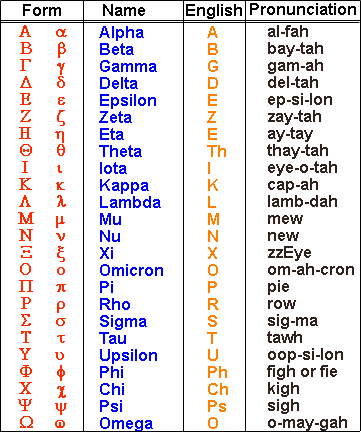
- Greek Alphabet Greek script, English transliteration & pronunciation guide.
- Bible Versions - Comparison of Literalness
- The Importance of the Septuagint for Biblical Studies - Everett F Harrison
This page contains on site in depth definitions of over 2000 Greek words, alphabetized by the English word, Strong's number and the Greek word. For example, Click and scroll to approve. Then click dokimazo for the definition. This is a dynamic, ongoing project (even words that are listed are frequently updated/revised) so check back frequently for new words and updates of old words. Most of these definitions were gleaned from the word study resources listed below (all of which are available for check out at Archive.org).
Note I have also included several Hebrew word study resources in this list.
WORD STUDY RESOURCES
GREEK AND HEBREW
NOTE - All of these resources can be borrowed from archive.org.
- The New International Dictionary of New Testament Theology Click here for a more detailed discussion of how to use this valuable 3 volume resource which has no restrictions and allows copy and paste. THIS IS A "GOLD MINE" OF INFORMATION!
- (FREE AND FULLY ACCESSIBLE) A Manual Grammar of the Greek New Testament - H. E. Dana and J. R. Mantey - 384 page Pdf. A classic work on Greek Grammar.
- The Complete Word Study Dictionary: New Testament by Zodhiates, Spiros - This is my "go to" resource for Greek word studies. One on the best lexicons for laymen. Highly Recommended for Greek Word Studies to aid your interpretation of a passage.
- Analytical Lexicon of the Greek New Testament by Friberg, Timothy. Shorter definitions than Zodhiates but does an excellent job in summarizing the various nuances of a specific Greek word. One of my favorites.
- Shorter Lexicon of the Greek New Testament by Gingrich, F. Wilbur. Similar to Friberg but shorter definitions. Gingrich however gives more Scriptures for each nuance, whereas Friberg generally gives only one representative Scripture.
- The New Linguistic and Exegetical Key to the Greek New Testament by Rogers, Cleon - This book is a gold mine of little gems on individual Greek words in any NT passage you are studying. If you have time it is always worth checking out! I use it in my Greek word studies all the time.
- New Testament Words - William Barclay - very interesting resource - covers about 70 NT Greek words in Barclay's unique style. On page 289 there is a helpful index of English words with the corresponding Greek word, in turn followed by the places Barclay described them in New Testament Words and in his Daily Study Bible series (see list of DSB commentaries here). E.g., take the Greek word for "Covetousness" which is pleonexia and is found in New Testament Words on page 61 and pp 233-235 and is also described in the Daily Study Bible entries for : Mark 7:14-23; Ro 1:28-32; Eph. 4:17-24; Col. 3:5. So you can click the DSB commentary on Mark 7 and scroll down to Mark 7:14 to see Barclay's entry for pleonexia which concludes "Pleonexia ( G4124) is that lust for having which is in the heart of the man who sees happiness in things instead of in God." Interesting!
- Expository Dictionary of Bible words by Richards, Larry - 744 pages. Hebrew and Greek definitions, which are generally brief but can give some interesting additional insights.
- Greek-English lexicon of the New Testament : based on semantic domains - Louw Nida. Brief but nice definitions. Not easy to use - you need to know some Greek. Classifies Greek words into 93 "semantic domains" (see list on page XXV) and if you can categorize the word you are looking for in one of the domains, it can help find the specific word you are interested in.
- Kittel's Theological Dictionary of the New Testament : abridged in one volume - Classic ("Little Kittel") work summarizing the 10 volume set by Kittel. For most of us the abridged definition is "more than enough!"
- A Greek-English lexicon of the New Testament, and other early Christian literature; by Bauer, Walter, More detailed definitions but need to know Greek. Zodhiates and Friberg much easier to use.
- Liddell and Scott's Greek-English lexicon, abridged : the little Liddell by Liddell, Henry George. The abridged version. You need to know Greek to use.
- Exegetical dictionary of the New Testament (Volume 1 - A thru E); Exegetical dictionary of the New Testament (Volume 3- P thru ...) Volume 2 not available. I do not find this adds much to the easier to use resources like Zodhiates and Friberg.
- A pocket lexicon to the Greek New Testament by Souter, Alexander. Brief definitions. Need to know some Greek. Not that helpful.
- Vine's Expository Dictionary of Old Testament and New Testament Words - pdf. The old standby. You can also borrow Vine's complete expository dictionary of Old and New Testament words
- Theological wordbook of the Old Testament (TWOT) by Harris, R. Laird - One of the best Hebrew lexicons for laymen. Here is another link to the TWOT which has no time limit on use and does allow copy and paste.
- Hebrew honey : a simple and deep word study of the Old Testament by Novak, Alfons, (332 pages) Indexed by English words. No Strong's numbers to help you determine if you are researching the correct Hebrew word. Here is a "work around" - go to page 289 and see if there is an annotation of the Scripture you are studying. E.g., say you want to see if there is anything for "heart" in Ezek 11:19. In the Scripture list find an entry for Ezek 11:19 with the English word "Heart." Now go look up "Heart" (on page 123). It does take some effort, but you might glean an insight not described in other Hebrew lexicons.
- Nelson's Expository Dictionary of the Old Testament by Unger, Merrill. Indexed by English word and then any related Hebrew nouns or verbs. Definitions are solid and geared to the lay person.
- Zondervan NASB exhaustive concordance - 1589 pages
- Pocket dictionary for the study of New Testament Greek by DeMoss, Matthew S. If you want to dig a little deeper into Greek. 66 ratings
- Analytical concordance to the Holy Bible : containing about 311,000 references, subdivided under the Hebrew and Greek original with the literal meaning and pronunciation of each by Young, Robert,
- The Englishman's Greek concordance of the New Testament by Wigram, George
- Synonyms of the New Testament by Trench, Richard Chenevix - or click here for list of 108 entries.
- Girdlestone's Synonyms of the Old Testament - list of 127 entries
In depth studies similar to the Greek Word studies (1). This is a work in progress (April 25, 2015 >400 word studies) and new Hebrew words are added frequently.
Related Resource:
- Bob Utley's summary of Hebrew Grammar - good introduction to the Hebrew
This table presents simple explanations of the meaning of the Greek verb tense, voice and mood with Scriptural examples. See also
Related Resources:
- Dana and Mantey's 384 page A Manual Grammar of the Greek New Testament in Pdf - especially if you want more detail than given below . See Reviews = 4.3/5 stars
- Bob Utley's Topic - Greek Grammatical Terms - Good Summary - Verbs, Nouns, Conjunctions, Conditional clauses, Prohibitions, Ways to show emphasis in the Greek
Click for a step by step exercise in how to perform a simple Greek word study (without knowing any Greek) using as an example the wonderful word "redemption". You will learn how to utilize some of the excellent Reference material available on the WEB.
See also: How to Perform a Hebrew Word Study using resources on the WEB
Vine is the classic "old standby" for Greek word definitions. This resource includes both Hebrew and Greek words. Probably the best way to search is to do a "find on page" (Control + F for windows). Vine only has a selective list of OT words.
There are one hundred and seventeen sets of synonyms given and compared. A thorough discussion is given of the meaning and use of each Greek word. Then a comparison between them shows why they are used in various parts of the Holy Scriptures.
This 1897 work on the Hebrew synonyms examines 127 Hebrew terms (e.g., altar, almighty, atonement, etc). Using the Septuagint (see #18 below), Girdlestone explains the relation of the Hebrew word to the corresponding Greek word in the NT. This work is designed to be used by those who understand little or no Hebrew. Choose a letter to see if Girdlestone has a discussion of an English word.
Click on the Interlinear Bible and find Chapter and Verse of interest. This interlinear gives you both the New Testament and the Old Testament. The Greek word in the OT is the Septuagint Translation.
Example - Go to New Testament. Click Matthew. Then select Chapter 1. Then click on the first word "biblos" (book). Then scroll down and you have entries from 4 Lexicons including Thayer and Liddell-Scott. On the Frequency list you can see the all the uses in a given translation and if you click the numbers it brings up the verses in that Book of the Bible in that translation.
- Brown-Driver-Briggs (BDB) and Gesenius' Hebrew & Chaldee Definition
Click on the Interlinear Bible and find Book/Chapter/Verse of interest. Notice just beneath "Interlinear Study Bible" (top left of the page) you will see "Greek Language ⇌". Click it to toggle between to the Hebrew so that you can see the original Hebrew word.
Example: Go to Interlinear. Select Genesis. Click "Greek Language ⇌" to change to Hebrew. Go to Chapter 1. Click first word "Created" (bara) and you have frequency of usage of "bara" with Hebrew definitions. I personally do not find the Hebrew definitions that helpful in Brown-Driver-Briggs. I use the Theological Wordbook of the Old Testament but TWOT does not use Strong's numbers so you have to do a little more work. My suggestion is use the "Search Inside" function on the left side of the TWOT page. E.g., I typed "create" and retrieved 30 hits and found "bara" on page 127. (Click here). As you can see the Hebrew definitions are more user friendly in the TWOT.
146 page book by Bob Smith (click for Pdf)
b) The Greeks Had a Word for It (chapter 10) - This link is a practical discussion on the value of Greek Word Studies for the lay person (chapter from Basics of Bible Interpretation)
c) Helpful Hints on Hebrew (chapter 11) - Bob Smith writes that "The only Hebrew I know, as the saying goes, is the man who has the tailor shop around the corner. And this doesn't help much toward understanding the Hebrew language, because usually he doesn't know it either. But Strong's Exhaustive Concordance comes to my rescue for whatever I, personally, can gain of the meaning of Hebrew terms." Dave Roper adds that most of us have "never encountered anything quite like Hebrew. Certainly the script is peculiar. It reads from right to left, and there are a host of other rather obvious disparities. However, the real difference is less obvious, and it is this difference that is the real crux of the matter: Hebrew is a vehicle for expressing a uniquely Eastern viewpoint. The problem then, is not merely one of understanding another language, but of understanding another way of looking at life and things. It is this point that most English readers do not fully appreciate. There are many specialized language tools which can be used to define terms and better understand nuances of meaning, but these in themselves are inadequate, simply because they can't reproduce this cultural dimension. In fact, I don't know that it can be adequately reproduced. The only way to fully understand a people is to get fully involved in their language, literature, and customs. Unfortunately, that just isn't possible for most folks. Few have the time or inclination to learn the requisite number of dead Semitic languages and then immerse themselves in the literature. (Some who did, it appears, never came up!) There are, however, some basic perspectives which, when maintained, will enable anyone to more fully appreciate and more accurately interpret the Old Testament."
d) Figures of Speech (chapter 7) - Bob Smith quotes Max Muller on the value of understanding figures of speech observing that "It is not too much to say...that the whole dictionary of ancient religion is made up of metaphors. With us these metaphors are all forgotten. We speak of spirit without thinking of breath, of heaven without thinking of sky, of pardon without thinking of a release, of revelation without thinking of a veil. But in ancient language every one of these words, nay, every word that does not refer to sensuous objects, is still in a chrysalis stage, half material and half spiritual, and rising and falling in its character according to the capacities of its speakers and hearers."
<
b) Interpreting Symbols - excellent discussion by Dr Tony Garland
c) Interpretation of Figurative Language - Steve Lewis
c) Figurative Language - 1895 textbook by Milton Terry
d) Hermeneutics - The Study of the Interpretation of Scriptures - by Dr Stephen R Lewis - scroll to page 88 for "Methods for distinguishing between literal and figurative" - see also next page for topic "VIII FIGURES OF SPEECH." Scroll to page 22. for summary of how God's Word has been interpreted over the last 2000 years beginning with the Early Church fathers (if you don't already know, you might be surprised at how they began to interpret the Word!), the Middle Ages (I sometimes think how God's Word of truth and life was handled and mishandled in this lengthy period had something to do with the "dark" in "Dark Ages"! Judge for yourself), the Reformation Era and then into the Modern era. A very enlightening and informative "trip".
e) Hermeneutics Textbook - Bob Utley
Robertson's 6 volume work offers insights on the Greek text of virtually every NT verse. Some knowledge of Greek is helpful, but it is still useful even if you cannot read Greek. You should also be aware that Robertson is not a believer in a literal interpretation of the 1000 in Revelation 20, commenting that "Here we confront the same problem found in the 1260 days. In this book of symbols how long is a thousand years? All sorts of theories are proposed, none of which fully satisfy one. Perhaps Peter has given us the only solution open to us in 2Pe 3:8 (note) when he argues that “one day with the Lord is as a thousand years and a thousand years as one day.” It will help us all to remember that God’s clock does not run by ours and that times and seasons and programs are with him. This wonderful book was written to comfort the saints in a time of great trial, not to create strife among them. (Robertson's comment on Revelation 20:2-see lucid, logical, fair-minded discussion of Millennium by Dr Tony Garland) (Comment: The problem with invoking 2Pe 3:8 to "allegorically" or "spiritually" interpret the 1000 years is that John does not use the term of comparison "like" or "as" but flatly states 1000 years.)
A T Robertson also has a massive work (1528 pages) online - Grammar of the Greek New Testament in the Light of Historical Research - This book is a treasure trove of information about Greek grammar but is definitely for advanced (but not even intermediate) students. It is not for those who have only a minimal background in NT Greek as Robertson does not translate his examples from Greek to English.
Highly respected Greek word studies by Marvin Vincent covering all 27 NT books. Vincent is generally conservative and sound with interesting insights into Greek words that cannot be found in other resources. He is always worth checking but remember that he is a "commentary" so as always you need to be an Acts 17:11 Berean.
Marvin Vincent's notes often will make the statement: See (specific cross reference) To see Vincent's cross reference notation, you must return to the main menu of Vincent's New Testament Word Studies where the NT books are listed. Then go to the specific Book and chapter that you are interested in and scroll to the verse that corresponds to Vincent's cross reference (or do a control + find to search the page).
Don't overlook the value of a simple study of Webster's dictionary when doing GREEK WORD STUDIES. For the plain definition of a word, I prefer the 1828 edition as it is more "bibliocentric" (often using Scripture to illustrate definitions).
Also check the excellent resource Free Dictionary which searches multiple dictionaries and encyclopedias.
Perform a Practice Search - In order to see the potential value of the English dictionary, take a moment and do the following exercise. I am sure that you will derive some useful insights on 2 words commonly found in Scripture. Click Memidex or the Modern Merriam-Webster Dictionary (the 1828 version does not have info on the origin of words) and look up anxious. Note the comment regarding the Origin of this word. Now type in worry and note the origin as well as the definitions. What a picture of what anxiety and worry can do to us! Now you have some additional insight into why Jesus spent so much time exhorting us not to worry or be anxious in the Sermon on the Mount. (study Mt 6:25-34) He knew the negative impact worry and anxiety could have on our spiritual life and our life in general. So utilize Webster's frequently in your Word Studies and you will often be rewarded with useful insights. Here are the onsite word studies on anxious (merimnao) and worry (merimna).
Below is a representative excerpt from Geisler's excellent book which can be borrowed from archive.org - click link. If book is unavailable try this link (search is on "Bible" which retrievers over 700 hits which you can click - this should allow you to acces most of the 420 pages).
THE NATURE OF INSPIRATION
THE FIRST GREAT LINK in the chain of communication “from God to us” is inspiration. There are several theories about inspiration, some of which fall short of the biblical teaching on the subject. Our purpose in this chapter will be twofold: first, to examine these theories about inspiration and, second, to determine precisely what is implied in the teaching of the Bible as to its own inspiration.
SEVERAL THEORIES
ABOUT INSPIRATION
Historically, theories about the inspiration of the Bible have varied with the essential characteristics of the three theological movements: orthodoxy, modernism, and neoorthodoxy. Although these three views are not limited to one time period only, their primary manifestation is characteristic of three successive periods in the Christian church.
For most of church history the orthodox view held sway, namely, the Bible is the Word of God. With the rise of modernism many came to believe that the Bible merely contains the Word of God. Even more recently, under the influence of contemporary existentialism, neoorthodox theologians have held the Bible becomes the Word of God when one personally encounters God through it.
ORTHODOXY:
THE BIBLE IS THE WORD OF GOD
For some eighteen centuries of church history the orthodox view of inspiration prevailed. With only minor dissenting voices, the great fathers of the church held firmly that the Bible is the Word of God written down. Orthodox theologians through the centuries have agreed that the Bible is verbally inspired, i.e., the written record came by God’s inspiration. However, attempts to seek an explanation as to just how the written record can be God’s Word when it was obviously composed by human authors with differing styles has led to two opposing views among orthodox thinkers. On the one hand, some have held to “verbal dictation,” arguing that the biblical authors wrote only what God dictated word for word. On the other hand, some have opted for the “inspired concept” theory that God only gave the thoughts which the prophets were free to put into their own words.
Verbal dictation. A clear and articulate presentation of verbal dictation is found in John R. Rice’s Our God-Breathed Book—The Bible.1 Disclaiming that verbal dictation is mechanical, the author argues that God gave the dictation through the personality of the author. For God by his special province formed the very personalities upon which the Holy Spirit was later to call for His word-for-word dictation. Thus, argues Rice, God had prepared in advance the particular styles he desired in order to produce His exact words by using the predetermined vocabularies and styles of the different human authors. The final result, then, is a word-for-word verbal dictation of God in Holy Scripture.
Inspired concepts. In his Systematic Theology, A. H. Strong takes a view which has been called conceptual inspiration.2 God inspired only the concepts and not the particular literary expression into which each biblical author cast them. God gave the thoughts to the prophets who were at liberty to put them into their own terms. In this way Strong hoped to avoid any mechanical implications of verbal dictation and still preserve the divine origin of the Scriptures. God provided the conceptual inspiration and the men of God gave it a verbal expression characteristic of their own styles.
MODERNISM:
THE BIBLE CONTAINS THE WORD OF GOD
Along with the rise of German idealism and biblical criticism (see chap. 14) a new view of biblical inspiration evolved with theological modernism or liberalism. In contrast to the traditional orthodox view that the Bible is the Word of God, the modernists contend that the Bible merely contains the Word of God. Certain parts of the Bible are divine and true, but other parts are clearly human and in error. They feel the Bible is a victim of its times like any other book. They say that many of the legends, myths, and false beliefs about science were incorporated into the Bible. They argue that since these are not inspired of God they must be rejected by enlightened men as remnants of a primitive mentality unworthy of Christian belief. Only the divine truths contained within this admixture of ancient ignorance and error are truly inspired of God.
Illumination view. Some argue that the “inspired sections” of the Bible result from a kind of divine illumination wherein God granted deep religious insight to pious men. These insights were enjoyed with varying degrees of understanding and were recorded with admixtures of erroneous religious lore and scientific belief common to their day. Hence, the Bible expresses degrees of inspiration dependent on the depth of religious illumination which the author experienced.
Intuition view. On the other end of the modernistic camp are those who deny any divine element in the Bible whatsoever. To them the Bible is merely a Jewish scrapbook of legends, stories, poems, etc., with no essential historical value.3 What others call divine inspiration is nothing but intensive human intuition. Within this Jewish folklore known as the Bible may be found some significant examples of heightened moral and religious genius. But these spiritual insights are purely naturalistic. In no sense are they anything more than human intuition; there is no supernatural inspiration or illumination.....
Related Resource:
WHAT THE BIBLE TEACHES
ABOUT ITS OWN INSPIRATION
....In the preceding chapter we have already examined in general the teaching of the two great texts of the New Testament on the subject of inspiration (2 Ti. 3:16 and 2 Pe. 1:21). The Bible claims to be a divinely authoritative book resulting from a process whereby Spirit-moved men wrote God-breathed words. Now let us examine in detail what is meant by this claim.
Inspiration is verbal. Whatever else may be claimed about the Bible, it is clear that the Bible claims a verbal inspiration for itself. The cinspiration (2 Ti. 3:16 and 2 Pe. 1:21) lassical text in 2 Timothy 3:16 declares that it is the graphā or writings which are inspired. “Moses wrote all the words of the Lord” (Ex. 24:4). Isaiah was told to inscribe in a book God’s everlasting message (Is. 30:8). David confessed, “The Spirit of the Lord speaks by me, his word is upon my tongue” (2 Sa. 23:2). It was the word of the Lord which came to the prophets hundreds of times in the Old Testament. Jeremiah was told, “diminish not a word” (Jer. 26:2, KJV).
In the New Testament Jesus and the apostles stressed the recorded revelation by the oft repeated phrase, “it is written” (see Mt. 4:4, 7, 10; Lk. 24:27, 44). The apostle Paul testified that he spoke in “words … taught by the Spirit” (1 Co. 2:13) John warned not to subtract from the “words of … the prophecy” of his revelation (Rev. 22:19). The Scriptures (i.e., writings) of the Old Testament are continually referred to as the Word of God. In the famous Sermon on the Mount Jesus declared that not only the very words but even the smallest part of a Hebrew word was from God: “For truly I say to you, till heaven and earth pass away, not an iota, not a dot, will pass from (Jer. 26:2, KJVthe law until all is accomplished” (Mt. 5:18). Whatever may be theorized about the inspiration of Scripture notwithstanding, it is clear that the Bible claims for itself verbal or written authority. Its very words are said to be from God.
Inspiration is plenary. The Bible claims to be inspired in all its parts. Inspiration is plenary or full. “All scripture is inspired by God” (2 Ti. 3:16). No part of Scripture is without full doctrinal authority. For the whole Old Testament, wrote Paul, “is profitable for doctrine, for reproof, for correction, for instruction in righteousness” (2 Ti. 3:16, KJV). Again, he wrote, “Whatever was written in former days was written for our instruction” (Ro. 15:4). Jesus and New Testament writers amply illustrate their belief in the full and complete inspiration of the Old Testament by quoting from every part of the Scriptures as authoritative, including some of its most disputed teachings. The creation of Adam and Eve, the destruction of the world by a flood, the miracle of Jonah and the whale, and many other incidents are quoted authoritatively by Jesus (see chap. 3). No part of Sacred Writ claims less than full and complete authority. Biblical inspiration is plenary.
Of course plenary inspiration extends only to the teachings of the autographs, as has already been discussed (chap. 1). But everything the Bible teaches, whether in Old or New Testaments, is fully and completely authoritative. No teaching of Scripture is without divine origin. God inspired the very written expression of all prophetic teaching. Inspiration is plenary, that is, full and complete, extending to every part.
Inspiration gives authority. Already apparent is the fact that inspiration conveys final authority of the written document. Jesus said, “The scripture cannot be broken” (Jn. 10:35). On numerous occasions our Lord appealed to the written Word of God as final arbitrator for faith and practice. He claimed Scripture as His authority for cleansing the temple (Mk. 11:17); for rebuking the tradition of the Pharisees (Mt. 15:3, 4); for settling doctrinal disputes (Mt. 22:29). Even Satan was resisted by Christ on the authority of the written Word, “It is written … It is written … It is written …,” Jesus responded to Satan’s temptations (Mt. 4:4, 7, 10).
On occasion Jesus would say, “Everything written … must be fulfilled” (Lk. 24:44). But an even stronger affirmation of the final authority of Scripture is found in His pronouncement, “It is easier for heaven and earth to pass away than for one dot of the law to become void” (Lk. 16:17). The written Word is unbreakable. It comes from God and it has the authority of God invested in it.
SOME IMPLICATIONS OF THE
BIBLICAL DOCTRINE OF INSPIRATION
There are several things not formally presented in the doctrine of inspiration which are nonetheless clearly implied in it. Three of these will be discussed here: the equality of the New Testament with the Old, the variety of literary expression, and the inerrancy of the record.
Inspiration refers to the New Testament and the Old. Most of the passages cited above on the plenary nature of inspiration refer directly only to the Old Testament. On what basis can they be extended to the New Testament? The answer to this question is that the New Testament, like the Old, claims to be Scripture and prophetic writings, and all Scripture and prophetic writings are held to be inspired of God.
According to 2 Timothy 3:16, all Scripture is inspired. Although the explicit reference here is to the Old Testament, it is true that the New Testament is also considered Scripture. Peter, for example, classes the epistles of Paul along with the “other scriptures” of the Old Testament (2 Pe. 3:16). First Timothy 5:18, in quoting the gospel of Luke (Lk 10:7), refers to it as “scripture.” This is even more significant when one considers that neither Luke nor Paul were among the twelve apostles. Since the epistles of Paul and writings of Luke (Luke and Acts; see Ac. 1:1, Lk. 1:1–4) were classified as Scripture, then by direct implication the rest of the New Testament written by the apostles was also considered to be inspired Scripture. In brief, if “all Scripture is God-breathed,” and the New Testament is considered to be Scripture, then by clear implication the New Testament is considered to be on an equal level of authority with the Old Testament. Indeed, this is precisely how Christians since the times of the apostles have viewed the New Testament. They have regarded it as equally authoritative with the Old.
Furthermore, according to 2 Peter 1:20–21, all prophetic writings are God-given or inspired. And since the New Testament claims to be a prophetic writing, then it follows that it too is claiming to be of equal authority with the Old Testament prophetic writings. John, for example, referred to the Book of Revelation as “the words of the prophecy of this book” (Rev 22:18). Paul claimed that the church is built upon the foundation of the New Testament apostles and prophets (Eph. 2:20; 3:5). Since the New Testament is, like the Old, a writing of God’s prophets, it possesses the same authority as the Old Testament inspired Scriptures.
Inspiration includes variety of literary sources and styles. The fact that inspiration is verbal or written does not exclude the use of literary documents and differing literary styles. The Scriptures are not dictated word for word in the usual sense of that phrase. To be sure, there were small sections of the Bible, such as the Ten Commandments, which were given through direct words from God (see Deu 4:10), but nowhere is it either stated or implied that the Bible is a word-for-word dictation. The writers of Holy Scripture were authors and composers, not merely secretaries or stenographers.
There are several factors in the makeup of Scripture which support this contention. First, there is a marked difference in vocabulary and style from writer to writer. Compare the powerful literary expressions of Isaiah to the mournful tones of Jeremiah. Compare the complex literary construction of Hebrews to the simple style of John. The more technical language of Luke the physician is easily distinguished from the pastoral images of James.
Second, the Bible makes use of nonbiblical documents such as the book of Jasher (Jos. 10:13), the book of Enoch (Jude 14) and even the poet Epimenides (Ac. 17:28). We are informed that many of the proverbs of Solomon were edited by the men of Hezekiah (Pr. 25:1). Luke acknowledges the use of many written sources of Jesus’ life in the composition of his own gospel (Lk. 1:1–4).
Third, the biblical authors employed a variety of literary devices not characteristic of a wooden word-for-word dictation. Much of the Scripture is poetry (for example, Job, Psalms, Proverbs). The gospels are filled with parables. Jesus used satire (see Mt. 19:24), Paul employed an allegory (Gal. 4) and even hyperbole (Col. 1:23), and James wrote with many metaphors and similes.
Finally, the Bible uses the common-sense, everyday language of appearance as opposed to a technical or scientific language. This is not to say that it is unscientific, but that it is nonscientific. It is no more unscientific to speak of the sun standing still (Jos. 10:12) than of the sun rising (Jos. 1:15). To say the Queen of Sheba came “from the end of the earth” or the people at Pentecost came “from every nation under heaven,” is not to speak with scientific exactness. The writers used common, grammatic modes of expressing their topic.
So whatever else is implied in the doctrine of inspired writings, the data of Scripture clearly indicates that it includes the usage of a variety of literary sources and styles of expression. Not everything came directly from God by dictation. And not everything was expressed in a uniform and literal way. Inspiration is to be understood historically and grammatically. It is not to be understood as a uniform, divine dictation exclusive of human sources, personalities, and varieties of expression.
Inspiration implies inerrancy. Not only is the Bible inspired, but by means of this inspiration it is inerrant, or without error. Whatever God utters is the truth without error. In fact, the Scriptures claim to be the utterance, indeed the very words, of God. Whatever the Bible teaches is inerrant, since inerrancy is logically entailed in inspiration. God cannot lie (Heb. 6:18); His Word is truth (Jn. 17:17). Hence, whatever subject the Bible speaks upon, it speaks truly. There are no historical nor scientific errors in the teaching of Scripture. Everything the Bible teaches is of God and, therefore, without error.
It is not possible to evade the implications of factual inerrancy by claiming that the Bible has nothing to say about factual or historical matters. Much of the Bible is presented as history. The very tedious genealogies alone attest to this fact. Some of the great teachings of the Bible, such as creation, the virgin birth of Christ, the crucifixion and the bodily resurrection, clearly involve factual matters. There is no way to “spiritualize” away the factual and historical nature of these biblical truths without doing violence to an honest cultural and grammatical analysis of the text.
The Bible is not a scientific textbook, but when it touches upon scientific matters in its teaching, it does so without error. The Bible is not a secular history book, but where secular and sacred history meet in its pages, the Bible speaks inerrantly. If the Bible is not correct in factual and empirical matters which are verifiable, then how could it be trusted in spiritual matters which are not subject to such tests? Or, in Jesus’ words to Nicodemus, “If I have told you earthly things and you do not believe, how can you believe, if I tell you heavenly things?” (Jn. 3:12). (For full article see From God to Us : How We Got our Bible)
Related Resource: Dr Wayne Grudem's Systematic Theology - An Introduction to Bible Doctrine (first edition)
- The Four Characteristics of Scripture: (1) Authority - How do we know that the Bible is God’s Word?
- The Four Characteristics of Scripture: (2) Clarity - Can only Bible scholars understand the Bible rightly?
- The Four Characteristics of Scripture: (3) Necessity - For what purposes is the Bible necessary? How much can people know about God without the Bible?
- The Four Characteristics of Scripture: (4) Sufficiency - Is the Bible enough for knowing what God wants us to think or do?
Preceptaustin.org makes frequent use of the Septuagint (LXX) which often provides useful insights on Old Testament passages that cannot be gleaned from other resources. Ferdinand Hitzig, an Hebrew authority used to ask his class "Have you a Septuagint? If not, sell all you have, and buy one.” See note above about how to find the Septuagint Greek word for a specific Hebrew word.
What is the Septuagint (usually abbreviated LXX)?
In simple terms the Septuagint (LXX) is the Greek translation of the Hebrew Old Testament.
The Hebrew scholar Gesenius explains that "At the time when the old Hebrew language was gradually becoming extinct, and the formation of the O. T. canon was approaching completion, the Jews began to explain and critically revise their sacred text, and sometimes to translate it into the vernacular languages which in various countries had become current among them. The oldest translation is the Greek of the Seventy (more correctly Seventy-two) Interpreters (LXX), which was begun with the Pentateuch at Alexandria under Ptolemy Philadelphus, but only completed later. It was the work of various authors, some of whom had a living knowledge of the original, and was intended for the use of Greek-speaking Jews, especially in Alexandria. (Gesenius, F. W. Gesenius' Hebrew grammar. Page 17)
The International Standard Bible Encyclopedia adds some interesting details regarding the importance of the Septuagint (LXX): The Greek version of the Old Testament commonly known as the Septuagint holds a unique place among translations. Its importance is many sided. Its chief value lies in the fact that it is a version of a Hebrew text earlier by about a millennium than the earliest dated Hebrew manuscript extant (916 AD), a version, in particular, prior to the formal rabbinical revision of the Hebrew which took place early in the 2nd century AD. It supplies the materials for the reconstruction of an older form of the Hebrew than the Masoretic Text reproduced in our modern Bibles.
It is, moreover, a pioneering work; there was probably no precedent in the world’s history for a series of translations from one language into another on so extensive a scale. It was the first attempt to reproduce the Hebrew Scriptures in another tongue. It is one of the outstanding results of the breaking-down of international barriers by the conquests of Alexander the Great and the dissemination of the Greek language, which were fraught with such vital consequences for the history of religion. The cosmopolitan city which he founded in the Delta witnessed the first attempt to bridge the gulf between Jewish and Greek thought. The Jewish commercial settlers at Alexandria, forced by circumstances to abandon their language, clung tenaciously to their faith; and the translation of the Scriptures into their adopted language, produced to meet their own needs, had the further result of introducing the outside world to a knowledge of their history and religion.
Then came the most momentous event in its history, the starting-point of a new life; the translation was taken over from the Jews by the Christian church. It was the Bible of most writers of the New Testament. Not only are the majority of their express citations from Scripture borrowed from it, but their writings contain numerous reminiscences of its language. Its words are household words to them. It laid for them the foundations of a new religious terminology.
It was a potent weapon for missionary work, and, when versions of the Scriptures into other languages became necessary, it was in most cases the Septuagint and not the Hebrew from which they were made.
Preeminent among these daughter versions was the Old Latin which preceded the Vulgate (Jerome’s Latin Bible, 390-405 A.D.), for the most part a direct translation from the Hebrew, was in portions a mere revision of the Old Latin; our Prayer-book version of the Psalter preserves peculiarities of the Septuagint, transmitted through the medium of the Old Latin.
The Septuagint was also the Bible of the early Greek Fathers, and helped to mold dogma; it furnished proof-texts to both parties in the Arian controversy. Its language gives it another strong claim to recognition.
Uncouth and unclassical as much of it appears, we now know that this is not wholly due to the hampering effects of translation. “Biblical Greek,” once considered a distinct species, is now a rather discredited term. The hundreds of contemporary papyrus records (letters, business and legal documents, etc.) recently discovered in Egypt illustrate much of the vocabulary and grammar and go to show that many so-called “Hebraisms” were in truth integral parts of the koine, or “common language,” i.e. the international form of Greek which, since the time of Alexander, replaced the old dialects, and of which the spoken Greek of today is the lineal descendant.
The version was made for the populace and written in large measure in the language of their everyday life. (Orr, J., M.A., D.D. The International Standard Bible encyclopedia: 1915 edition - if you are interested in further study read Click Septuagint-1 and Septuagint-2)
Why study the Septuagint (LXX)?
The Hebrew Masoretic text (mentioned above) is the original language text used by virtually all popular English versions when translating the Old Testament into English. Virtually all modern English Bible translations utilize the original Hebrew text rather than the Septuagint to translate the Old Testament. This fact however by no means depreciates the value of the Septuagint (LXX) in the study of the Old Testament Scriptures.
Remember that Jesus and his disciples most often used the Septuagint (LXX) manuscripts rather than the original Hebrew Old Testament scrolls. Why? First, the Septuagint (LXX) was widely available and secondly the majority of the culture used Greek as the common language. Without getting too technical, it is notable that when quoting OT passages in the NT the New Testament writers chose to quote the Greek text (Septuagint) over the Hebrew text approximately 93% of the time. One can conclude that the "men moved by the Holy Spirit (who) spoke from God" clearly were confident that the Septuagint (LXX) manuscripts were authentic and reliable resources in their writings. It follows that the modern student can likewise use the Septuagint (LXX) with complete confidence.
To reiterate, the Septuagint (LXX) was the "version" most often quoted by Jesus and the New Testament writers. Stated another way, most of the New Testament quotes of the Old Testament are not taken directly from the Hebrew but the Greek translation of the Hebrew.
In view of the widespread use of the Septuagint (LXX) by Jesus and the NT writers, it is surprising that the value of the Septuagint especially for exposition and interpretation by pastors and teachers has been underestimated and underutilized. It would be interesting to know how many pastors routinely study the Septuagint when preparing expositional messages from the Old Testament.
Below are some specific ways the Septuagint
(LXX) can be profitably utilized .
LXX in Greek Word Studies
Since many of the Greek Words in the Septuagint are also used in the Greek New Testament, by studying the Septuagint Greek, one can often glean wonderful insights not available by restricting one's study to the NT Greek. A good example is the verb boetheo (come to the aid, help) which is used 8x in the NT compared with 77x in the Septuagint. A cognate boethos is used only once (Heb 13:6-note) in the NT but some 45x in the Septuagint. In both cases one gains considerable amplification of the meaning by examining the uses in the Septuagint.
LXX as a "Mini-Commentary"
This aspect of the LXX will probably only apply to those who do more in depth Bible study and have some familiarity with the original languages. In my experience as a Bible teacher for over 20 years, when one studies the Old Testament in a modern version like the NASB and the parallel passages in the Greek Septuagint, the Septuagint often functions like a "mini-commentary", not altering the meaning of the verse but adding color, vibrancy and life that would otherwise go unnoticed and unappreciated. As an aside, I don't find simply using Brenton's English translation of the LXX to be helpful. One needs to go to the original Greek texts (which can be done with relative ease utilizing computer programs such as Logos Bible Software which has a Greek lexicon that defines words found only in the O.T). This type of ancillary study will of course take more time, but the reward in the form of instructive insights is worth the investment. if you are a pastor/teacher of God's Word, it behooves you to consider utilizing these resources to supplement your sermon and lesson preparation.
What Do the Experts Say about the
Value of the Septuagint (LXX)?
Adolph Deissmann in his book "The Philology of the Greek Bible" makes the following statement regarding the significance of the Septuagint (LXX):
The daughter belongs of right to the mother; the Greek Old and New Testaments form by their contents and by their fortunes an inseparable unity. The oldest manuscript Bibles that we possess are complete Bibles in Greek. But what history has joined together, doctrine has put asunder; the Greek Bible has been torn in halves. On the table of our theological students you will generally see the Hebrew Old Testament lying side by side with the Greek New Testament. It is one of the most painful deficiencies of Biblical study at the present day that the reading of the Septuagint has been pushed into the background, while its exegesis has been scarcely begun...A single hour lovingly devoted to the text of the Septuagint will further our exegetical knowledge of the Pauline Epistles more than a whole day spent over a commentary.
QUESTION - WHAT IS THE SEPTUAGINT? GOTQUESTIONS.ORG
ANSWER - The Septuagint (also known as the LXX) is a translation of the Hebrew Bible into the Greek language. The name Septuagint comes from the Latin word for “seventy.” The tradition is that 70 (or 72) Jewish scholars were the translators behind the Septuagint. The Septuagint was translated in the third and second centuries BC in Alexandria, Egypt. As Israel was under the authority of Greece for several centuries, the Greek language became more and more common. By the second and first centuries BC, most people in Israel spoke Greek as their primary language. That is why the effort was made to translate the Hebrew Bible into Greek—so that those who did not understand Hebrew could have the Scriptures in a language they could understand. The Septuagint represents the first major effort at translating a significant religious text from one language into another.
In comparing the New Testament quotations of the Hebrew Bible, it is clear that the Septuagint was often used. Many of the New Testament quotes from the Hebrew Bible are taken from the Septuagint. This is the result of the fact that by the late first century BC, and especially the first century AD, the Septuagint had “replaced” the Hebrew Bible as the Scriptures most people used. Since most people spoke and read Greek as their primary language, and the Greek authorities strongly encouraged the use of Greek, the Septuagint became much more common than the Hebrew Old Testament.
As faithful as the Septuagint translators strove to be in accurately rendering the Hebrew text into Greek, some translational differences arose. But the fact that the apostles and New Testament authors felt comfortable, under the direction of the Holy Spirit, in using the Septuagint should give us assurance that a translation of the original languages of the Bible is still the authoritative Word of God.
Related Resources:
- Notes by Dr Norman Geisler related to the Septuagint (see the left side for the "hits")
- Everett F. Harrison's excellent articles on the value of the Septuagint at bottom of this page
- Why is it important to know Greek and Hebrew when studying the Bible?
- What were the 400 years of silence?
- What is the Latin Vulgate Bible?
- What are the Apocrypha / Deuterocanonical books?
- What are the Dead Sea Scrolls and why are they important?
- How and when was the canon of the Bible put together?
- How do we decide which books belong in the Bible since the Bible does not say which books belong in the Bible?
- The closed canon—what are the implications?
ISBE article on Septuagint -The Greek version of the Old Testament commonly known as the Septuagint holds a unique place among translations. Its importance is manysided. Its chief value lies in the fact that it is a version of a Hebrew text earlier by about a millennium than the earliest dated Hebrew manuscript extant (916 AD), a version, in particular, prior to the formal rabbinical revision of the Hebrew which took place early in the 2nd century AD. It supplies the materials for the reconstruction of an older form of the Hebrew than the Massoretic Text reproduced in our modern Bibles. It is, moreover, a pioneering work; there was probably no precedent in the world's history for a series of translations from one language into another on so extensive a scale. It was the first attempt to reproduce the Hebrew Scriptures in another tongue. It is one of the outstanding results of the breaking-down of international barriers by the conquests of Alexander the Great and the dissemination of the Greek language, which were fraught with such vital consequences for the history of religion. The cosmopolitan city which he founded in the Delta witnessed the first attempt to bridge the gulf between Jewish and Greek thought. The Jewish commercial settlers at Alexandria, forced by circumstances to abandon their language, clung tenaciously to their faith; and the translation of the Scriptures into their adopted language, produced to meet their own needs, had the further result of introducing the outside world to a knowledge of their history and religion. Then came the most momentous event in its history, the starting-point of a new life; the translation was taken over from the Jews by the Christian church. It was the Bible of most writers of the New Testament. Not only are the majority of their express citations from Scripture borrowed from it, but their writings contain numerous reminiscences of its language. Its words are household words to them. It laid for them the foundations of a new religious terminology. It was a potent weapon for missionary work, and, when versions of the Scriptures into other languages became necessary, it was in most cases the Septuagint and not the Hebrew from which they were made. Preeminent among these daughter versions was the Old Latin which preceded the Vulgate (Jerome's Latin Bible, 390-405 A.D.), for the most part a direct translation from the Hebrew, was in portions a mere revision of the Old Latin; our Prayer-book version of the Psalter preserves peculiarities of the Septuagint, transmitted through the medium of the Old Latin. The Septuagint was also the Bible of the early Greek Fathers, and helped to mold dogma; it furnished proof-texts to both parties in the Arian controversy. Its language gives it another strong claim to recognition. Uncouth and unclassical as much of it appears, we now know that this is not wholly due to the hampering effects of translation. "Biblical Greek," once considered a distinct species, is now a rather discredited term. The hundreds of contemporary papyrus records (letters, business and legal documents, etc.) recently discovered in Egypt illustrate much of the vocabulary and grammar and go to show that many so-called "Hebraisms" were in truth integral parts of the koinḗ , or "common language," i.e. the international form of Greek which, since the time of Alexander, replaced the old dialects, and of which the spoken Greek of today is the lineal descendant. The version was made for the populace and written in large measure in the language of their everyday life. (Septuagint 1 ; Septuagint 2 - International Standard Bible Encyclopedia - - Lengthy Discussion)
Where Can One Find Resources on the Septuagint (LXX)?
1) Study of the Septuagint (LXX) is best performed using one of the commercial Bible software products, especially Logos Bible Software
See note above about how to find the Septuagint Greek word for a specific Hebrew word.
2) English translations of the Septuagint (LXX)
a) Brenton's translation is available online at Apostles' Bible. This translation is interesting but does not yield as many insights into the OT passage as can be gleaned from studying the original Greek translation of the Hebrew. If you use Internet Explorer, you might consider placing the "Apostles' Bible" as an icon on your toolbar.
b) A new translation is available - NETS- Septuagint Electronic Edition
3) Two other free programs that have Brenton's Translation are E-Sword and TheWord both of which include some excellent features and a ever growing library of free resources.
4) Dictionary Articles Related to the Septuagint
- American Tract Society Septuagint
- Bridgeway Bible Dictionary Septuagint
- Charles Buck Dictionary Septuagint Septuagint Chronology
- Easton's Bible Dictionary Septuagint
- Fausset Bible Dictionary Septuagint
- Holman Bible Dictionary Septuagint
- Hastings' Dictionary of the Bible Septuagint
- Hastings' Dictionary of the NT Septuagint
- Watson's Theological Dictionary Septuagint Chronology Septuagint
- 1911 Encyclopedia Britannica The Septuagint
- International Standard Bible Encyclopedia Septuagint
- McClintock and Strong's Bible Encyclopedia Syriac (Peshito) Version, Relation of, to the Septuagint Septuagint
- The Nuttall Encyclopedia Septuagint
- The Jewish Encyclopedia Septuagint
Inductive Bible study - Why study the Bible Inductively?
- context
- key words
- mark key words
- interrogate with the 5W/H questions
- term of conclusion
- term of explanation
- term of contrast
- expression of time
- term of comparison// simile// metaphor
- Observe With a Purpose
- Keep Context King
- Read Literally
- Compare Scripture with Scripture
- Consult Conservative Commentaries
Overview to Inductive Bible Study - PowerPoint Presentation (2002)
|
MORE |
MORE |
|||||||||
| Young's Literal |
NAS ASV CSB |
Amp ESV |
KJV NKJV RSV |
NRSV NAB |
NIV NJB |
NCV ICB |
NLT Phillips |
GNT CEV |
TLB | Msg |
| NAS = New American Standard Amp = Amplified Version ASV = Authorized Std Version 1901 ESV = English Standard Version CSB = Homan Christian Standard RSV = Revised Standard Version KJV = King James Version NKJV = New King James Version |
NRSV = New Revised Std NAB = New American Bible NJB = New Jerusalem Bible NIV = New International Version NCV = New Century Version ICB = International Children's |
NLT = New Living Translation Phillips = J B Phillips Paraphrase GNT = Good News Translation CEV = Contemporary English TLB = The Living Bible Msg = Message (Be a Berean!) |
||||||||
|
** MORE INTERPRETATIVE: For the most objective, non-biased and "pure" inductive study, do not use paraphrased versions as your primary resource for they provide no way to determine whether or not the translator's interpretation of the original Greek and Hebrew is accurate. The more literal versions such as NAS, ESV, CSB KJV, NKJV more accurately render the words of the original biblical authors and are therefore recommended for inductive Bible study. Although more literal, the Amplified is not recommended as your primary text, but can be helpful once you have done your study because in many verses it functions like a "mini-commentary". Consultation (after your own inductive study) with some paraphrases (e.g., NLT and Phillips) may also yield insights into the meaning of the passage. Note that the NIV is a thought-for-thought (dynamic equivalence) translation which can be helpful for new believers, but it is not recommended for in depth bible study because of the inconsistent way in which it renders the Hebrew and Greek texts. In some cases, the NIV includes significant interpretation which leaves the reader without any indication of the other possible ways to understand that particular verse. Although every translation has some degree of interpretation, the NAS is the least interpretative and has the advantage over the NIV in that it identifies words in italics that are not in the original language but which have been added by the translators to make the passage more readable and/or understandable. Do not base your interpretation on the words in italics. |
||||||||||
[Editor’s Note: Dr. Harrison is Professor of New Testament at Fuller Theological Seminary, Pasadena, California and an outstanding evangelical New Testament scholar.]
In these days when the study of Greek as an element in ministerial training is being viewed with waning enthusiasm in many quarters, being reduced from a required to an elective status in institution after institution, some courage is required to maintain that the scope of Greek studies not only should be retained but broadened. Yet this is our conviction. How many seminary graduates of our era have made the acquaintance with the Greek Fathers through the original texts? Fortunately this deficiency is compensated for to some degree where there are courses in early church history which go into the source materials. But in the case of the Septuagint nothing in the curriculum helps to overcome the lack of familiarity with the Old Testament in Greek.
First Translation of Old Testament
What Deissmann wrote years ago is worthy of repetition today.
"The daughter belongs of right to the mother; the Greek Old and New Testaments form by their contents and by their fortunes an inseparable unity. The oldest manuscript Bibles that we possess are complete Bibles in Greek. But what history has joined together, doctrine has put asunder; the Greek Bible has been torn in halves. On the table of our theological students you will generally see the Hebrew Old Testament lying side by side with the Greek New Testament. It is one of the most painful deficiencies of Biblical study at the present day that the reading of the Septuagint has been pushed into the background, while its exegesis has been scarcely begun."
The same writer holds out this inducement to the uninitiated:
"A single hour lovingly devoted to the text of the Septuagint will further our exegetical knowledge of the Pauline Epistles more than a whole day spent over a commentary."2
This was not theoretical with Deissmann, for he testified in another place,
"In preparation on my first piece of work on the formula ‘in Christ Jesus’ I read rapidly through the whole Septuagint in order to establish the use in construction of the preposition "en." (The English Concordance [Hatch and Redpath] fortunately had not then reached "e"). I am indebted to this reading for great and continuous stimulus. For some years now there have been lectures and classes on the exegesis of the Septuagint held in the Theological Faculty at Berlin."
To the Septuagint belongs the honor of being the oldest version of the Old Testament. Tradition tells us that the work was begun in Egypt during the reign of Ptolemy Philadelphus (285-246 B.C.). At first the translation was confined to the Pentateuch, but within a century or thereabouts the remainder of the Old Testament had been rendered into Greek. Though the Letter of Aristeas ascribes the translation of the Law to the royal interest in literature, it is clear from the Letter itself, as Swete perceived, that the real inspiration for the version sprang from the need of the Jews in Alexandria for the Scriptures in their adopted language. Some Egyptians words, in fact, are imbedded in the text, testifying to its Alexandrian provenance. Examples are kondu, a vessel or cup (Gen 44:2); thibis, ark (Ex 2:3); and papuros, which is well known in English in its transliterated form papyrus (Job 8:11). In addition, certain Greek words are chosen by the translators as specially fitted to convey information peculiar to Egyptian conditions. Such is the expression apheseis hudaton (channels of waters) in Joel 1:20, reflecting the network of channels or canals familiar to residents of Egypt. Deissmann notes that in Genesis 50:2 the Septuagint does not use the ordinary term for physician in rendering the Hebrew, but rather entaphiastes, (embalmers) "the technical term for members of the guild that looked after embalming." The facts seem to warrant Kahle’s contention that, "It is clear that the version was not made by Palestinian Jews, but by people acquainted with the language spoken in Egypt."6
In the history of Bible translation, then, the Septuagint took a pioneering place, becoming the first of many hundreds of attempts to place the Scriptures, whether in whole or in part, in the hands of the people in a form they are able to comprehend for themselves. During the course of the early Christian centuries several linguistic groups derived their Old Testament from the Septuagint rather than from the Hebrew. The most important of these versions were the Coptic, Syriac, and the Old Latin (in distinction from the Latin Vulgate of Jerome, who used both Hebrew and Greek in his work). But the influence of the Septuagint was even greater and more continuous throughout the Greek-speaking church. Few of the Greek Fathers were conversant with Hebrew, so they read their Old Testaments in Greek and built their homilies on this text. Of the influence on the New Testament it will be necessary to comment later and in more detail.
Relation to Old Testament Canon
The Septuagint necessarily enters into the discussion about the (Biblical) canon of the Old Testament. Our great uncial manuscripts of the Greek Bible, namely, Aleph, B, A, and C all contain the Old Testament Apocrypha whether in whole or in part. From this the conclusion has often been drawn that originally there was no clear-cut line between such books and the canonical Old Testament Scriptures, or at least that a more liberal attitude prevailed in Alexandria than in Palestine. The Palestinian view of the canon is set forth in Josephus’ work Contra Apionem I,8. Here it is indicated that the Jewish Scriptures consist of twenty-two books. Certain groups of books were treated as one in such an enumeration. It is clear that the canon did not admit of the inclusion of the Apocryphal books. New Testament use of the Old supports this restricted canon.
As to the attitude of Alexandrian Jews, we are fortunate in possessing a considerable body of writings from the pen of Philo, who flourished near the middle of the first Christian century. Philo’s great preoccupation was with the Pentateuch, which he quotes about 2,000 times as over against some 50 times for the balance of the canonical Old Testament. But what of the Apocrypha? H. E. Ryle comments as follows on this matter: "Philo makes no quotations from the Apocrypha; and he gives not the slightest ground for the supposition that the Jews of Alexandria, in his time, were disposed to accept any of the books of the Apocrypha in their Canon of Holy Scripture. That there are occasional instances of correspondence in subject-matter and in phraseology between Philo and the books of the Apocrypha, in particular the Sapiential books, no one will dispute. But it is very doubtful whether the instances contain actual allusions to the Apocryphal writings. It is more probable that the use of similar terms arises merely from the discussion of similar topics. The phraseology of Philo helps to illustrate and explain that of the Apocrypha, and vice versa. More than this can hardly be affirmed with any confidence." It should be noted also in this connection that in no case where there is a supposed allusion to the Apocrypha does Philo make use of a formula of citation such as he employs when quoting passages from the acknowledged canon.
Some of the above-mentioned manuscripts of the Greek Bible include works of the early post-apostolic age also, such as the Epistle of Barnabas, the Shepherd of Hermas, and First Clement, which occupied a deutero-canonical position at best in the eyes of those who regarded them highly. Their presence, however, appended to the sacred text, helps us to understand the inclusion of the Old Testament Apocrypha. F. F. Bruce makes a suggestion as to the manner in which these latter books became joined to the canonical Old Testament Scriptures. "There is no evidence that these books were ever regarded as canonical by any Jews, whether inside or outside Palestine, whether they read the Bible in Hebrew or in Greek. The books of the Apocrypha were first given canonical status by Greek-speaking Christians, quite possibly through a mistaken belief that they already formed part of an Alexandrian canon. The Alexandrian Jews may have added these books to their versions of the Scriptures, but that was a different matter from canonizing them. As a matter of fact, the inclusion of the apocryphal books in the Septuagint may partly be due to ancient bibliographical conditions. When each book was a papyrus or parchment roll, and a number of such rolls were kept together in a box, it was quite likely that uncanonical documents might be kept in a box along with canonical documents, without acquiring canonical status. Obviously the connection between various rolls in a box is much looser than that between various documents which are bound together in a volume."
Relation to Old Testament Text
Another area in which the Septuagint proves its value is in the opportunity it affords us to compare the extent of the text in each book with the text as we have received it from the Hebrew tradition. Antedating as it does our Hebrew manuscripts of the Old Testament, it gives us a check on the actual amount of the text. The agreement is not complete, but substantially so, especially when the addition to Daniel and Esther are excepted, since they really form part of the Apocrypha. Ordinarily one may read chapter after chapter and find that the text underlying the Greek is the same in its length as the text of our Hebrew Old Testament. The differences in order, especially in Jeremiah, constitute a vexed problem, but it a rather peripheral problem as compared to the possession of the text itself.
One who has a strictly linguistic interest finds the Septuagint worthy of his attention. There was a day when men thought of the language of the Greek Old Testament as a literary vehicle which was forged out by the translators themselves in large part as an attempt to render a Semitic original in a Greek dress. It was doubted that the Septuagint at all accurately reflected any Greek being spoken at the time. But all this has been changed through the papyri discoveries made in the very region where the Septuagint was created. These fragments, covering a wide range of human activities and relationships, are obviously in the language of every-day life. Misspellings are not infrequent. Enough parallels have been established between these non-literary papyri and the Septuagint to make it apparent that the latter represents a living form of Greek, so that the Septuagint must be included in any list of sources for the koine.
The student of the history of religion also will find the study of the Septuagint rewarding. For example, the New Testament acquaints us with the fact that Judaism had been active for some time making proselytes among the Gentiles (Acts 2:10; 6:5; 13:43). The zeal of the Pharisees on behalf of their own sect is also noted (Matt 23:15). Now the word proselyte is Greek, and makes its first appearance in Ex 12:48–49—ἐὰν δέ τις προσέλθῃ πρὸς ὑμᾶς προσήλυτος ποιῆσαι τὸ πάσχα κυρίῳ, περιτεμεῖς αὐτοῦ πᾶν ἀρσενικόν, καὶ τότε προσελεύσεται ποιῆσαι αὐτὸ καὶ ἒσται ὥσπερ καὶ ὁ αὐτόχθων τῆς γῆς. πᾶς ἀπερίτμητος οὐκ ἒδεται ἀπ ᾿ αὐτοῦ. νόμος εἶς ἒσται τῷ ἐγχωρίῳ καὶ τῷ προσελθόντι προσηλύτῳ ἐν ὑμῖν. Here one catches the flavor of the word. It denotes literally one who draws near. He has a desire to identify himself with the Hebrew nation, especially in the observance of this great national festival of the Passover. The noun and the verb forms of the same root jostle one another in the passage. It is interesting to observe that in the Epistle to the Hebrews the verb has an almost technical sense as a designation for a worshipper, being translated come or draw near (e.g. Heb 4:12; 11:6). Incidentally, the statement in Hebrews 11:28 concerning Moses, pepoieken to pascha, may be said to gain illumination from Exodus 12:48, just cited, where poieo is used in the sense of observance of the Passover.
A chapter in the history of polemics belongs to the Septuagint. Although the Jews of the Dispersion highly regarded this translation at first (even Philo acknowledged its inspiration), the increasing use of it by Christians, especially in their appeal to it for the verification of the Messianic dignity of Jesus of Nazareth, gradually estranged the Jews. We find Justin Martyr in his Dialogue with Trypho the Jew registering the accusation that Trypho’s people had tampered with the sacred text in order to remove proof texts favorable to the Christians. One of the most famous of these passages is Psalm 96:10, which according to Justin Martyr properly read, Tell ye among the nations that the Lord hath reigned from the wood (cross). Of this alleged original there is no trace. The last three words must be put down as a Christian invention. Even more famous as a ground of contention was Isaiah 7:14 (note). Christians pressed the fact that it was the Jews themselves who had translated the Hebrew עלמה by parthenos virgin. The pressure of debate forced the Jews to construct a new Septuagint, which was undertaken by Aquila in the second century. It used neanis, ‘young woman,’ in Isaiah 7:14. In general the translation was marked by an almost painful literalness in rendering the Hebrew. But at least it gave the Greek-speaking Jews a version which they could use after the Septuagint was proscribed by the synagogue.
In the discussions on Christian theology the Septuagint has ever and again played an important role. A good example of this is the battle which raged over Proverbs 8:22f in the Arian controversy. This famous passage on Wisdom runs as follows according to the Septuagint: "The Lord created me as (the) beginning of his ways for his works; before time (the age) he established (founded) me, in the beginning before he made the earth…" Here the crucial word is κτισε which we have translated "created." The Arians found a basis here for their doctrine of the creaturehood of Christ, that there was a time when he was not. Athanasius sought to meet the exegesis by asserting that it was our Lord’s humanity which was created and manifested to us for our salvation. The stamp of this controversy remained on the text of Scripture for many centuries. To avoid any possible Arian connotation, the Vulgate rendered the crucial word possedit. Both the A.V. and the R.V. have possessed, showing their dependence on the Vulgate. However, the Hebrew קנה has the thought of acquisition rather than possession, and the Septuagint has rendered it faithfully. The student will find it interesting to note that in a passage like Genesis 14:19, removed from theological controversy, the Vulgate rendered the same root by creavit.
Scholars have long recognized the value of the Septuagint as an instrument for textual criticism of the Old Testament. While the consensus of opinion has been to the effect that in places where the Massoretic Text and the Septuagint diverge, the former must be given the preference in the vast majority of cases, especially since it is often possible to trace the very processes by which the Greek translators have strayed from the path, yet it has been conceded that here and there the Greek rendering has undoubtedly preserved the original. One of the clearest cases is Genesis 4:8, where the words "let us go into the field" have dropped out of the Hebrew text in some way. That something is needed at this point is evident because the verb אמר does not mean to speak with but to say. In this case the Septuagint does not stand alone, but is supported by the Samaritan Pentateuch, the Targums, the Latin and the Syriac versions.
A common objection raised against the Revised Standard Version is that too large a use has been made of the Septuagint (and other ancient versions) instead of clinging to the Massoretic Text as the basis of translation. It is possible that the translators have erred in judgment in certain passages by relying on the Septuagint as opposed to the Massoretic Text, but it is certain that their procedure is not faulty as to principle. Modern research has demonstrated that the Hebrew text was revised and fixed in its present form early in the Christian era and that it does not represent throughout a pure text which can with confidence be said to represent the original. Students of the Septuagint have long been suspicious that the Greek Old Testament is more trustworthy here and there than the Massoretic Text. Archaeology has begun to confirm this conjecture. Hebrew manuscripts of the Old Testament are coming to light in the Dead Sea region which in some cases (others agree closely with the MT) correspond to the Septuagint rather than to the Hebrew. This is particularly true of Samuel. Frank M. Cross Jr. writes, "In these Samuel fragments there is now direct proof that there were Palestianian Hebrew texts of Samuel of precisely the type used by the Greek translators, and that the Greek version is a literal and faithful translation of its Hebrew predecessor. Hence reconstruction of the text of Samuel in the future must put serious weight on the witness of the Septuagint."
Relation to New Testament Quotations
We come now to quotations. Everyone knows that the New Testament is written in Greek, although its writers, with the probable single exception of Luke, were Hebrews. It is natural, then, that when they desire to draw excerpts out of the Old Testament, that they should resort to the Septuagint. Certainly the vast preponderance of quotations lies on the side of the Greek rather than the Hebrew original, although some New Testament writers knew Hebrew and resorted to the Hebrew text on occasion. An example of this is found in Matthew 8:17, where a slavish adherence to the Septuagint would have resulted in support for the idea that our Lord bore men’s sins during His ministry and not simply at His death. Therefore Matthew made use of the Hebrew text which has "sicknesses" rather than the Septuagint text which has "sins." The context of Matthew 8:17 is Jesus’ healing activity. But the general fact is undisputed, that the large use of the Septuagint in the quotations shows its dominant position in the early church and the high regard in which it was held. However, the presence of a considerable number of quotations agreeing neither with the Hebrew nor with the Septuagint constitutes a difficult problem.
Matthew’s Gospel offers an especially interesting area in which to study the quotations. H. St. J. Thackeray noted that in addition to quotations from the Septuagint which Matthew has in common with other Synoptists there is a group of eleven "proof-texts" introduced by the formula, "that it might be fulfilled," which derive from another source. This he thought may have been a "Testimony Book" which possibly contained this material already in Greek dress, which Matthew utilized.
The subject of Testimonia has engrossed scholars both in the ancient and the modern church. Cyprian was one of the first to draw up such a list of passages, but it was based on earlier attempts of the same kind. One of the most outstanding is in the New Testament itself. Among modern writers Rendel Harris in his two volumes entitled Testimonies sought to demonstrate that the New Testament quotations were drawn up according to subjects and with indications of the source of their quotations. Such groupings of Scripture, if they were thus utilized as a source for New Testament quotations, would help to explain the composite character of some of the quotations and also the attribution to one Old Testament writer of what is found in another, as in Matthew 27:9. But further research has put Harris’ position in doubt, especially with regard to the materials in Matthew. According to J. A. Findlay, "Subsequent collections of testimonies do not follow his (Matthew’s) model either in order or language."
Krister Stendahl has opened a new line of investigation. He builds upon the discovery of J. C. Hawkins that whereas the quotations in Matthew which occur in the common Synoptic narrative tradition (Mark or Luke or both) follow the Septuagint very closely in the main, those which are introduced by the writer of the First Gospel show much less agreement with the Septuagint, only slightly more than half the words being derived from that source.
This latter group is the same as that which Thackeray commented on, as noted above. It may be said to consist of formula quotations. Stendahl believes that the situation receives illumination from the Habakkuk Commentary of the Dead Sea Scrolls, where the Hebrew text of the first two chapters of this prophecy is quoted with considerable alteration and adaptation in order to fit the belief of the sect responsible for the scroll that the Teacher of Righteousness, as he is called, had fulfilled the terms of Habakkuk’s prophecy. Stendahl finds in Matthew’s formula quotations "scholarly interpretations" akin to those of the Qumran sect, except that Matthew’s interest centers in Jesus of Nazareth rather than the Teacher of Righteousness.
The whole of Stendahl’s thesis regarding the nature and origin of Matthew need not detain us here, but he favors the view that the Gospel reflects the interest in theology and teaching of the particular group from within which it sprang. His conclusion on the quotations is that, "The formula quotations would thus have taken shape within the Matthean church’s study of the Scriptures, while the form of the remainder is on the whole that of the Palestinian LXX text." This is a highly interesting observation and one which promises to be fruitful for farther study. It is clear that in the New Testament generally the actual form of the quotations is determined by the use to which they are put, their New Testament setting demanding some alteration for purposes of smooth and suitable application as well as to bring out the element of fulfillment. Certainly the New Testament conception of fulfillment is not exhausted by a "this is that" correspondence between the Old and the New. It includes the clear by the fuller revelation of the New (note, for example, how the word fulfill is used in Romans 8:4).
In addition to passages of greater or lesser length which are clearly intended to be quotations either by the presence of some formula of citation or by the way in which they are treated in the context, the Greek text of the New Testament abounds in words and phrases which modern editors have put in bold type in order to show their Old Testament provenance. In the margin of the Nestle text the location of the Old Testament passage is indicated. Even so, there is room for further work in identifying passages in the Old Testament upon which the New Testament writers have drawn. Recently the present writer was reading in the Septuagint text of Deuteronomy 1:16 and noticed the striking verbal agreement of ana meson adephou with Paul’s language in 1 Corinthians 6:5 (ana meson tou adelphou). His word sophos may well have its seed-plot also in the previous verse, where it occurs in the plural.
A question naturally arises, in view of the large use made of the Septuagint in the composition of the New Testament and the high regard in which it was held in the early church, as to its authority in relation to the Hebrew text. Does it have equal inspiration with the Hebrew, or does it have any at all? We have no basis on which to plead its inspiration except in the broad, uncritical sense in which people today designate their English Bible as inspired. A version is entitled to be called the Word of God if it represents an honest and faithful attempt to reproduce the original text. But the Septuagint is unique in this respect, namely, that some hundreds of verses from its corpus have been lifted out and transplanted into the organism known as the New Testament, and there they have taken their place in the category of inspired Scripture as truly as the text around them which they are called upon to support or explain.
The Influence of the Septuagint on the New Testament Vocabulary
A reader of the New Testament who approaches it by way of familiarity with the Old Testament is likely to recognize a certain similarity of structure and idiom, but he will not think of it as strange because his mind has been conditioned by the reading of the Old Testament. But if one were to come to the reading of the Greek New Testament without this background, having only an acquaintance with classical Greek, let us say, he would be impressed with certain features that would strike him as peculiar. In other words, he would discover that the New Testament, although written in a language to which he is accustomed, possesses constructions and meanings of words for which his knowledge of classical Greek provides him no preparation. These are especially marked in the quotations, but also characterize the composition of the various books to a greater or lesser degree. The technical term for these features is Semitism, a term broad enough to include both Hebraism and Aramaism (the general subject of Semitisms can be explored to good advantage in J. H. Moulton, Grammar of New Testament Greek, II, 411–85).
Semitisms
Even Luke, the one New Testament writer who can be safely judged to have been a Gentile, shows Semitic influence. In his case it is chiefly due, no doubt, to the use of Semitic source materials. The first two chapters of his Gospel, for example, bear evidences of Semitic influence to a marked degree. One instance will suffice to establish the point—the use of kai egeneto in temporal clauses, a recognized Semitism (Luke 1:23, 41, 59; 2:15) which reflects the wayehi ("and it came to pass") which is so common in narrative portions of the Old Testament.
Another example is the cognate accusative, in which a verb is followed by a noun of the same root used in an adverbial sense. So in Mark 4:41, we read that the disciples "feared a great fear," which means that they feared greatly. It would not occur to a native Greek to write this way, as the adverb would be an entirely natural and adequate means of expressing the same idea.
Much more important, however, than the influence of Semitic constructions upon the New Testament is the shaping of the concepts which it contains. Hebrew mentality and usage is impressed upon Greek terminology. In large part this influence is due to the Septuagint. In the making of this version the translators were faced with the necessity of giving their sacred writings a Greek dress. New meanings became imparted to familiar Greek words, reflecting the peculiar nature of the Hebrew revelation, which necessarily differed considerably from Greek religious thought.
In the first flush of the discovery that the language of the New Testament was basically the language of every-day life, as revealed by the nonliterary papyri, it was natural that Deissmann should underestimate the Semitic influence in the Greek of the New Testament. J. H. Moulton largely shared his point of view, but he became more cautious toward the end of his life, granting a larger degree of Semitic influence than he was prepared to admit at the beginning (ibid., p. 413).
As time has passed and investigation has proceeded, the consensus of judgment is that the influence of the Septuagint upon the New Testament is so important as to be crucial in the field of interpretation. This was the conviction of Gerhard Kittel, the first editor of the Theologisches Wörterbuch zum Neuen Testament, and it is reflected in the articles which have been contributed to this monumental work by a large coterie of German scholars. Each important word of the New Testament is traced from its classical Greek setting through the Septuagint into the New Testament, with attention also to the papyri and the Hellenistic sources. Only a few of these articles have so far been translated into English. (See Theological Dictionary of the New Testament 10 Volume Set)
It is unquestionably true that the use of the terms in the New Testament not only reflects Septuagint usage but goes beyond it in some instances. This is due to the climactic character of revelation in the person and work of Christ and in the church which He established. To trace the added features which the New Testament supplies over and above the contribution of the Septuagint is a task which can only with difficulty be disengaged from the process of discovering Septuagintal influence proper.
Word Studies
The best way to gain some conception of the debt of the New Testament to the Septuagint is to select a few samples from the vocabulary of the New Testament and trace their use from classical Greek writers through the Septuagint into the New Testament, much in the manner of the Kittel volumes.
A good starting point is the word adelphos, which in classical usage means blood brother. This meaning is naturally retained in the Septuagint, but here the word also means neighbor and then further denotes a member of the same nation (see H. A. A. Kennedy, Sources of New Testament Greek, pp. 95-96, for illustrative passages). In the New Testament all of these meanings make their appearance, plus one which is new, for Christians find this term suitable as a description of themselves, no matter what their place of residence or nationality may be. Because believers form the family of the redeemed and constitute, so to speak, a new nation, a group with a distinctive character and cohesion all their own (1 Pet 2:9–10), adelphos is deemed an appropriate term to set forth this new relationship within the Christian church.
A second line of investigation leads us to consider the word truth (for useful epitomes, see G. Kittel, Die Religiousgeschichte und das Urchristentum, especially pp. 86-88; G.H. Dodd, The Bible and the Greeks, pp. 65-75). In Homer aletheia denotes veracity as opposed to falsehood. Later classical times witness an enlargement of usage, since it comes to express what is real or factual as opposed to appearance or opinion. That which is true corresponds with the nature of things. In this sense the truth is eternal and divine, for the Greek recognized no distinction between the natural and the supernatural. These values are continued in the Septuagint use of aletheia, but because of the circumstance that it was often used to translate 'emeth, a Hebrew word for truth which stresses the elements of reliability and trustworthiness, a new content becomes added. Often the word is used to describe God and also His Word. On these one may rest with confidence, for they will not fail. So, whereas the classical aletheia largely serves as an intellectual term, the same word in its Septuagint setting has often a decidedly moral connotation, especially when used with reference to the divine.
New Testament writers draw from both streams of meaning, so that the exegete must be constantly on the alert to detect, if he can, whether aletheia means reality or trustworthiness. John and Paul make largest use of the term. The Greek sense seems clearly present in passages like Romans 1:25, whereas a comparison of Romans 3:3 and 3:4 shows with equal clearness that here the Hebraic background is powerfully operative. Paul is especially fond of linking the word truth with the gospel. Here the two strains may be said to unite, for the gospel message corresponds to reality (that is, it is ultimate truth, much in the same way that the writer to the Hebrews argues the finality of the Christian dispensation with the aid of the related word alethinos, as John does likewise), and for that very reason is reliable, but even more so because the gospel originates with God and possesses His own guarantee.
For John the acme of the concept lies in its application to Jesus Christ. To be set free by the truth and to be set free by the Son are two ways of saying the same thing (John 8:32, 36). Dodd observes that whereas the Jewish conception was to the effect that the divine truth ('emeth) was expressed in the Torah, John places it in the person of Christ (see the discussion in Kittel, op. cit., pp. 88-90). Paul comes close to doing the same thing (Eph 4:21). The New Testament, then, has arrived at a synthesis of the two approaches to truth, and this synthesis is thoroughly defensible in the court of reason, for only that which possesses reality is worthy of confidence. But the daring step taken here is in the identification of truth in all its finality with the man Christ Jesus.
Another term with an interesting semantic history is kosmos. We can only summarize here. The classical meaning is order, adornment, beauty. This basic concept appears also the Septuagint and in the New Testament. An easy application of this notion finds the word employed in the Greek philosophers for the universe. Here the Greek thinkers found system and order. But in turning to the Septuagint we do not find kosmos used in this sense. Where we might expect to find it, in Genesis 1:1, we find instead a duality—"the heavens and the earth." To be sure, kosmos is employed in connection with the creation story (Ge 2:1), but only in the sense of "host" or of "order." The latter meaning is very attractive because it fits better the application to the earth. While host is a fitting term to apply to the vast array of heavenly bodies, the term order is also appropriate, and it certainly accords well with the thought that the creation had stocked the earth with things of beauty designed to fill a well-ordered place in an integrated existence.
As Kittel observes, however, the essential thing in the Old Testament is not so much the element of order as the fact of creation by God. The unity of order lies not in the kosmos but in the Creator. At any rate, the point which is very clear and must be stressed is that the Greek concept of universe is lacking in the Septuagint.
In the books of Maccabees, we begin to find kosmos used of this world over which God stands as Creator and Sovereign (2 Macc 7:9, 23; 4 Macc 5:25). Here the word does not describe the universe, but the lower half, so to speak, this world. We read of birth as a "coming into the world" (4 Macc 16:18).
But because this world is a place of man’s abode and activity, and because he is a sinful creature, the way is prepared for that peculiar usage of kosmos found in the New Testament, wherein that which by its original Greek significance should express order is now found to be riddled by rebellion and chaos and evil. The kingdoms of this world are under Satan’s dominion, and the men of this world are alienated from the life of God. Yet the one element of hope in this disordered cosmos is the reconciling mission of the Son of God which results in restoration, the re-establishment of order.
One or two sidelights clamor for attention before leaving this word. The versatility of the Apostle Paul is shown by the fact that in addressing a Greek audience at Athens he allows himself to use kosmos in a way which would appeal to his audience, namely, as inclusive of heaven and earth, even though this concept was not a part of his Hebraic inheritance (Acts 17:14). The Revised Standard Version has Paul referring to "the elemental spirits of the universe" on several occasions (Gal 4:3; Col 2:8, 20). It is not our purpose to deal with the expression "elemental spirits," though this rendering is subject to serious question. Rather, we are content here to point out that the translation "universe" violates the trend which the word kosmos has taken in its Biblical setting, as our brief study has shown. It is doubtful that Paul would be conceding anything to Greek thought in letters addressed to Christians. The situation is quite different from that in Acts 17. While it is true that kosmos and the term "elements" are found conjoined in a pre-Christian setting in Wisdom 7:17, "world" has an earthly connotation and "elements" refers to physical ingredients (cf. 2 Pet 3:10, 12) rather than to an order of spiritual intelligences (see W. J. Deane, The Book of Wisdom, p. 148).
Another word with a fascinating history is doxa, which in the New Testament is most frequently rendered glory. By reason of the fact that the root dokeō means to think and to seem, the noun followed the same double pattern. As the result of thought-activity, it came to mean opinion. A variation of this, the opinion in which one is held by others, yields the meaning reputation. Ordinarily this occurs in a favorable setting, hence carries the idea of fame, honor, glory; if the sense is adverse, an adjective readily gives it the flavor of notoriety. Branching out from the other meaning of the verb, doxa comes to signify appearance or fancy. This summarizes broadly the classical usage. With the decline of Greek civilization and the growing habit of looking backward with veneration to the views of the leading philosophers, our word tends to appear in a somewhat technical sense, descriptive of a given philosophical point of view or tenet. This usage is reflected in the term doxographer.
In the Septuagint the meaning opinion is dropped, and this applies likewise to the New Testament. Reputation and related ideas continue to be associated with doxa, however, thus providing a link with the classical background. Some twenty-five Hebrew words are translated by it, some of these having only remote connection with established meanings of the word. Most often, doxa appears as the translation of kabod, which derives from a root meaning to be heavy. This term fits readily into a metaphorical setting in the sense of importance, wealth, power, etc. Since one of the meanings of this Hebrew word is reputation (or honor, or prestige) and another is praise, one can understand how doxa was chosen to render it, since these meanings are congenial to the Greek word. But kabod has certain meanings originally unknown to doxa, such as majesty, splendor, riches, beauty, might, and even person or self. A highly specialized use of the word is its employment in the Old Testament to denote the glory of God, the outward, visible manifestation of brilliant light which appropriately expressed the excellence of His spirit-nature. This revelational use of the word comes out in connection with the pillar of cloud and fire, in the visions of Ezekiel, and elsewhere.
The problem facing us here is to explain, if possible, the appearance of a whole bevy of new concepts in the use of doxa which are not found in the classical setting. The explanation put forward tentatively by Deissmann that the concept of light belonged to doxa in popular Greek usage, but for some reason did not appear in the literature, is highly dubious. It lacks evidence. The same thing is true of Reitzenstein’s attempt to trace the light-element back to Iranian sources by way of Egypt.
Rather, the problem should be approached from within the Septuagint itself. As we have noted, a continuum in the use of the word from older times is the meaning reputation. It was not too difficult to extend the use of doxa from that point to include the concept of majesty, which belonged natively to kabhodh but not to doxa. Once this extension was accomplished, it was not felt too strange to go a step further and make the word do service for outward display of majesty, the revelation glory of the true God. Then all the other meanings which adhered to kabhodh became transferred to doxa, such as riches, might, person, etc. So before we are through, we are face to face with one of the most startling semantic changes known to us. New wine is being poured into the old wineskin.
It remains to note, however briefly, the debt of the New Testament to the Septuagint in perpetuating the new emphases given to doxa. In several passages Paul links the term riches with glory in away which suggests the Old Testament association (Rom 9:23; Eph 1:18; 3:16; Phil 4:19; Col 1:27). Not less striking is the employment of doxa to suggest power, especially in relation to the theme of resurrection (Rom 6:4; John 11:40). In John 2:11 something of this usage seems to be present also. In Luke 9:32 the transfiguration glory of Christ recalls the light-revelation passages of the Old Covenant. At his conversion Saul of Tarsus glimpsed the glory of the risen, ascended Lord (Acts 22:11).
The highest point is reached when the word is used not exclusively of the visible manifestation of God but of the intrinsic excellence and worth of the Lord. John links the doxa of Christ with inward realities, even grace and truth (John 1:14). Paul sees the Christian being conformed to the image of Christ’s moral glory by the ministry of the Holy Spirit (2 Cor 3:18).
We find it rather natural to associate the person and manifestation of the Lord God with light, though we may find it hard to analyze the significance of the association. Perhaps in addition to moral perfection ("God is light and in Him is no darkness at all") we should grant with Karl Barth (Die Kirkliche Dogmatik, third edition, II, 722,733,735) that the glory of God is another way of stating the beauty of God. God as infinite and eternal is overpowering to our finite minds. But as light, He is a Person of beauty in whose fellowship the saints will find endless delight.
In conclusion, it should be stated that not all the important terms of the Septuagint manifest serious alteration in meaning, but from these few examples it will be obvious that the student of Scripture cannot afford to be indifferent to the Semitic influence which has flowed into the Greek of the New Testament by way of the Septuagint, and must learn to examine New Testament concepts in the light both of their Greek and Hebrew provenance.
Sources:
- The Importance of the Septuagint for Biblical Studies, Part I, Bibliotheca Sacra 112: 448 (1955): 344-355
- The Influence of the Septuagint on the NT Vocabulary Bibliotheca Sacra 113 (Jan. 1956) 37-45
Here is another article by Dr Harrison which you may want to read
|
DISCLAIMER These links are listed for your convenience and their inclusion does not necessarily signify that I agree with everything written on each site. The best policy is to - Examine everything carefully. Hold fast to that which is good. Abstain from every form of evil. (1Th 5:21-22, cf Acts 17:11) Note: Examine, Hold fast and Abstain are all present imperative which is a command calling for this to be one's lifestyle, only possible as we dependent, yield, surrender to the Holy Spirit's enabling power. |