Colossians 1:2
Colossians 1:3
Colossians 1:4
Colossians 1:5
Colossians 1:6
Colossians 1:7
Colossians 1:8
Colossians 1:9
Colossians 1:10
Colossians 1:11
Colossians 1:12
Colossians 1:13
Colossians 1:14
Colossians 1:15
Colossians 1:16
Colossians 1:17
Colossians 1:18
Colossians 1:19
Colossians 1:20
Colossians 1:21
Colossians 1:22
Colossians 1:23
Colossians 1:24
Colossians 1:25
Colossians 1:26
Colossians 1:27
Colossians 1:28
Colossians 1:29
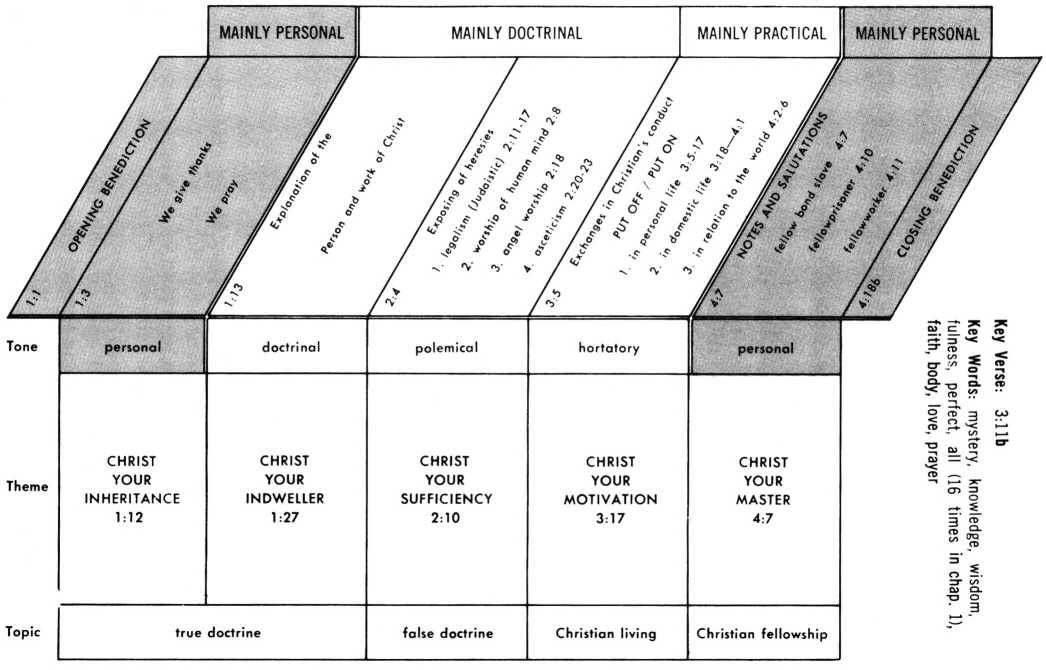
CHRIST IS ALL IN ALL
Click chart to enlarge
Charts from Jensen's Survey of the NT - used by permission
Colossians Overview - Click Chart on right side
| Christ Preeminent in All Things Supreme Lord - Sufficient Savior |
|||
| Colossians 1 | Colossians 2 | Colossians 3 | Colossians 4 |
| Supremacy of Christ |
Submission to Christ |
||
| Doctrinal and Corrective |
Practical and Reassuring |
||
| What Christ Did For Us |
What Christ Does Through Us |
||
| Christ Our Lord |
Christ Our Life |
Christ our Love |
|
| Christ the Head of the Body |
Christ the Lord of the Universe |
Christ the Head of the Home |
|
| Instruction | Warnings | Exhortations | Reminders |
| Reconciliation | Creation | Submission | Conversation |
| His Person and Word |
His Peace and Presence |
||
Colossians 1:29 For this purpose also I labor (1SPAI) striving (PMPMSN) according to His power which mightily works (PMPFSA) within me (NASB: Lockman)
Greek: eis ho kai kopio (1SPAI) agonizomenos (PMPMSN) kata ten energeian autou ten energoumenen (PMPFSA) en emoi en dunamei.
Amplified: For this I labor [unto weariness], striving with all the superhuman energy which He so mightily enkindles and works within me. (Amplified Bible - Lockman)
Analyzed Literal: "for which also I labor, striving according to His supernatural working, the one supernaturally working in me in power."
Lightfoot: For this end I train myself in the discipline of self-denial; for this end I commit myself to the arena of suffering and toil, putting forth in the conflict all that energy which He inspires, and which works in me so powerfully.’
Moffatt: I labour for that end, striving for it with the divine energy which is a power within me
Net: Toward this goal I also labor, struggling according to his power that powerfully works in me. (NET Bible)
NKJV: To this end I also labor, striving according to His working which works in me mightily
Phillips: This is what I am working at all the time, with all the strength that God gives me. (Phillips: Touchstone)
Weymouth: To this end, like an earnest wrestler, I exert all my strength in reliance upon the power of Him who is mightily at work within me.
Wuest: to which end also I am constantly laboring to the point of exhaustion, engaging in a contest in which I am controlled by His energy which operates in me in power.
Young's Literal: I work very hard at this, as I depend on Christ's mighty power that works within me.
AND FOR THIS PURPOSE I LABOR: eis o kai kopio (1SPAI) agonizomenos (PMPMSN):
- labour: Col 4:12 Acts 20:35 1Co 15:10 2Co 5:9 6:5 2Co 11:21-33 Php 2:16 1Th 2:9 2Th 3:8 2Ti 2:10 Rev 2:3
- Colossians 1 Resources - Multiple Sermons and Commentaries
For this end I train myself in the discipline of self-denial; for this end I commit myself to the arena of suffering and toil’ (Lightfoot)
to which end also I am constantly laboring to the point of exhaustion (Wuest)
For this I labor unto weariness] (Amplified)
for which also I labor, striving according to His supernatural working, the one supernaturally working in me in power. (Analyzed Literal)
Toward this goal I also labor (NET)
Purpose (for this end, unto this end) is not in the original Greek sentence but it is implied. The idea of the preposition for (eis) expresses motion toward, thus one could translate it "toward this end". What end? Every man complete in Christ. One is reminded of Paul's description of his physical toil in 2Co 11:21-33 and the revealing addition, "Apart from such external things, there is the daily pressure upon me of concern for all the churches." (2Co 11:28).
As an aside (hopefully an encouragement and a challenge), Colossians 1:29 is one of those verses (along with Colossians 1:28) upon which we do well to frequently meditate, begging the Spirit to open the eyes of our heart to understand and experience "the surpassing greatness of His power" (the same power that raised Jesus from the dead! - see Eph 1:18-20-note) in our lives, our marriages, our ministry, our workplaces, etc. Begin by committing Colossians 1:28-29 to memory. Then take a few moments each day to prayerfully meditate on these two passages, even taking time to record your observations and praying these truths back to God, that you might imitate Paul's experience of a supernatural life, in which, yes, the labor is to the point of fainting, but the life is one of His power working in and through you for His glory. I can guarantee time and eternity will show that this was time well spent!
In his letter to the saints in Thessalonica he sums up the effort required writing "For you recall, brethren, our labor (kopos = engage in an activity that is burdensome with associated distress, trouble, discomfort, difficulty)) and hardship, how working night and day so as not to be a burden to any of you, we proclaimed to you the gospel of God. (1Thes 2:9-note)
Adam Clarke - Whoever considers the original words (the Greek sentence)...will find that no verbal translation can convey their sense. God worked energetically in St. Paul, and he wrought energetically with God; (Colossians 1 - Adam Clarke Commentary)
John Eadie - To attain this blessed end, I also toil — agonizomenos — “intensely struggling,” or as Wycliffe renders—I traueile in stryuynge. It was no light work, no pastime; it made a demand upon every faculty and every moment. 1Ti 4:10. Since the apostle had many adversaries to contend with, as is evident from numerous allusions in his epistles, Php 1:29, 30, 1Ti 6:5, 2Th. 3:2, many suppose that such struggles are either prominently alluded to here, or at least are distinctly implied in the use of the participle. But the context does not favour such a hypothesis. It would seem from the following verses, that it is to an agony of spiritual earnestness that the apostle refers—to that profound yearning which occasioned so many wrestlings in prayer, and drew from him so many tears; meta polles tes spoudes, as Chrysostom paraphrases it. When we reflect upon the motive—the presentation of perfect men to God, and upon the instrument—the preaching of the cross, we cease to wonder at the apostle's zeal and toils. For there is no function (pursuit in life) so momentous,—not that which studies the constitution of man, in order to ascertain his diseases and remove them; nor that which labors for social improvement, and the promotion of science and civilization; nor that which unfolds the resources of a nation, and secures it a free and patriotic government—far more important than all, is the function of the Christian ministry. What in other spheres is enthusiasm, is in it but sobriety. Barnes well says—“In such a work it is a privilege to exhaust our strength; in the performance of the duties of such an office, it is an honor to be permitted to wear out life itself.” It was, indeed, no sluggish heart that beat in the apostle's bosom. His was no torpid temperament. There was such a keenness in all its emotions and anxieties, that its resolve and action were simultaneous movements. But though he labored so industriously, and suffered so bravely in the aim of winning souls to Christ and glory, still he owned that all was owing to Divine power lodged within him— (Colossians - Eadie)
The work to be perform'd is ours,
The strength is all His own;'Tis He that works to will,
'Tis He that works to do;
His is the power by which we act,
His be the glory too.
Labor (2872) (kopiao from kopos = labor which involves toil and weariness and sorrow) means to engage in hard work and implies difficulties and trouble. Kopiao speaks of intense toil even sweating and straining to the point of exhaustion if necessary. (present tense = continually) Kopiao was used for work which left one so weary it was as if the person had taken a beating. Henry Blackaby says that God will wear you out when you are in the center of His will. It is not surprising to see that Paul uses kopiao frequently to describe the quality of labor involved in ministry for the Lord . Kopiao was sometimes used to refer to athletic training. It was also common used among the down-trodden masses of the Roman world.
The present tense emphasizes that this was Paul's lifestyle. The active voice indicates this is his volitional choice. Remember that Paul calls us all to be imitators of him, just as he is of Christ Jesus!
Kopiao -23x in 21v - Study all of Paul's uses of kopiao to get a good sense of what it means to toil and labor in ministry - Meditate especially on 1 Corinthians 15:10. Memorize it. Imitate it! See commentary on 1 Corinthians 15:10.
Kopiao is translated in the NAS as: diligently labor, 1; grown weary, 1; hard-working, 1; labor, 3; labored, 4; labors, 1; toil, 4; wearied, 1; weary, 1; work hard, 1; worked, 2; worked hard, 1; worked hard, 1; workers, 1; working hard, 1.
Matthew 6:28+ "And why are you worried about clothing? Observe how the lilies of the field grow; they do not toil nor do they spin,
Matthew 11:28+ "Come to Me, all who are weary and heavy-laden, and I will give you rest.
Luke 5:5+ Simon answered and said, "Master, we worked hard all night and caught nothing, but I will do as You say and let down the nets."
Luke 12:27+ "Consider the lilies, how they grow: they neither toil nor spin; but I tell you, not even Solomon in all his glory clothed himself like one of these.
John 4:6 and Jacob's well was there. So Jesus, being wearied from His journey, was sitting thus by the well. It was about the sixth hour.
John 4:38 "I sent you to reap that for which you have not labored; others have labored and you have entered into their labor (kopos)."
Acts 20:35+ "In everything I showed you that by working hard in this manner you must help the weak and remember the words of the Lord Jesus, that He Himself said, 'It is more blessed to give than to receive.'"
Romans 16:6+ Greet Mary, who has worked hard for you.
Romans 16:12+ Greet Tryphaena and Tryphosa, workers in the Lord. Greet Persis the beloved, who has worked hard in the Lord.
1 Corinthians 4:12 and we toil, working with our own hands; when we are reviled, we bless; when we are persecuted, we endure;
1 Corinthians 15:10+ But by the grace of God I am what I am, and His grace toward me did not prove vain; but I labored even more than all of them, yet not I, but the grace of God with me.
1 Corinthians 16:16 that you also be in subjection to such men and to everyone who helps in the work and labors.
Galatians 4:11+ I fear for you, that perhaps I have labored over you in vain.
Ephesians 4:28+ He who steals must steal no longer; but rather he must labor, performing with his own hands what is good, so that he will have something to share with one who has need.
Philippians 2:16+ holding fast the word of life, so that in the day of Christ I will have reason to glory because I did not run in vain nor toil in vain.
Colossians 1:29 For this purpose also I labor, striving according to His power, which mightily works within me.
1 Thessalonians 5:12+ But we request of you, brethren, that you appreciate those who diligently labor among you, and have charge over you in the Lord and give you instruction,
1 Timothy 4:10 For it is for this we labor and strive, because we have fixed our hope on the living God, who is the Savior of all men, especially of believers.
1 Timothy 5:17 The elders who rule well are to be considered worthy of double honor, especially those who work hard at preaching and teaching.
2 Timothy 2:6+ The hard-working farmer ought to be the first to receive his share of the crops.
Revelation 2:3+ and you have perseverance and have endured for My name's sake, and have not grown weary.
Kopiao is the word Jesus used in His famous invitation "Come (Yes, Jesus invites, but He does so by issuing the invitation in the form of a loving command - ) to Me, all who are weary (worn out, ready to faint from exhaustion) and heavy-laden, and I will give you rest." (Mt 11:28-note)
Come, ye weary, heavy laden,
Lost and ruined by the fall;
If you tarry till you’re better,
You will never come at all.
(Sung by Fernando Ortega & Amy Grant)
A FISH
ILLUSTRATION
An excellent illustration of toiling according to our power versus God's power is found in Luke 5. Peter the famous fisherman is given instructions by Jesus to "Put out into the deep water and let down your nets for a catch". (Lk 5:4) Peter was an experienced fisherman and could have ignored Jesus' command, but instead he submitted and said "Master, we worked hard (kopiao) all night and caught nothing, but (this term of contrast is like a hinge - here it separates spiritual failure, from spiritual victory!) at Your bidding I will let down the nets." (Luke 5:5) What was the result when Peter worked according to "His power"? Luke records that he experienced supernatural results and "enclosed a great quantity of fish; and their nets began to break!" (Luke 5:6)
THOUGHT - Beloved, may our hearts be so inclined to the still small voice of the Spirit of Jesus, that we continually experience our "nets breaking" for the glory of the Lord. Amen!
Paul knew that investment now would bear fruit for eternity and thus encouraged Timothy to "Let the elders who rule well be considered worthy of double honor, especially those who work hard (kopiao) at preaching and teaching (didaskalia = derived from didasko used in Col 1:28)." (1Ti 5:17) What would be the result of such a Spirit enabled ministry? It would be a body of believers who were becoming more and more like Christ, becoming compete in Christ (Col 1:28). Preaching and teaching are hard work, but the benefits can be eternal.
In a parallel passage to encourage Timothy Paul wrote that "The hard-working (kopiao) farmer ought to be the first to receive his share of the crops (fruit)." (2Ti 2:6-note)
Dear laborer in God's field, do you ever feel like you're at the end of your rope? You've labored in the fields where God has placed you (see Eph 2:10) and yet you encounter so little pursuit of godliness and holiness and fear of the Lord. You are exhausted to the point of giving up. Paul would encourage you "Let us not "lose heart in doing good for in due time we shall reap if we do not grow weary" (Gal 6:9-10-note). "Be (present imperative = command to continually be - See discussion of the Need for the Holy Spirit to obey NT commands) steadfast, immovable, always abounding in the work of the Lord, knowing that your toil (kopos) is not in vain in the Lord. (1Cor 15:58-note).
John MacArthur is undoubtedly one of the greatest modern expositors of God's Word and so it is interesting to read his comments on this section...he writes "People sometimes tell me that I work too hard. But compared to Paul, I am not working hard enough. It saddens me to hear of pastors or seminary students who are looking for an easy pastorate. When I was a young pastor, a lady (Who did not know I was a pastor) advised me to go into the ministry. When I asked her why, she replied that ministers did not have to do anything and could make lots of money....No one can successfully serve Jesus Christ without working hard. Lazy pastors, Christian leaders, or laymen will never fulfill the ministry the Lord has called them to. Striving...refers to competing in an athletic event. Our English word agonize is derived from it. Success in serving the Lord, like success in sports, demands maximum effort." (MacArthur, J. Colossians. Chicago: Moody Press )
Paul uses the same combination of words (kopiao and agonizomai) in reminding Timothy that "it is for this (disciplining one's self for godliness 1Ti 4:7, 8, 9-notes) we labor (kopiao) and strive (agonizomai - Note: Textus Receptus has oneidizo), because (This is a strategic term of explanation -
THOUGHT - What is the question it begs? Check the preceding context? What motivates Paul's willingness to work so hard?) we have fixed our hope on the living God (So if we are feeling burnt out in ministry, what Biblical truth might we consider meditating on that the Holy Spirit might use it to renew our mind and fan the flames of our passion for the Gospel?), Who is the Savior of all men, especially of believers." (1Ti 4:10+)
LIghtfoot comments that kopiao is "used especially of the labor undergone by the athlete in his training and therefore fitly introduces the metaphor of agonizomenos."
A T Robertson writes that "Paul toils on...In order to present every man perfect in Christ, Paul undergoes labor like the athlete in training and even to the point of weariness, if needs be. . . . Every preacher is called upon to be a spiritual athlete like Paul (1Cor 9:25). The struggle is both inward and outward. . . . Jesus as God's Son had fullness of power in touch with His Father, and yet He sat in weariness (kopiao) on the curbstone of Jacob's well (John 4:6), slept for sheer weariness on the cushion in the stern of the boat (Mark 4:38). Even Jesus felt power gone out of Him when He labored for men. And the spiritual agony of Jesus in the garden of Gethsemane is expressed with the same root by Luke in Lk 22:44. Paul's struggle, like that of the true preacher always, "is carried on in proportion not to his natural powers, but to the mightily working energy within him" (Peake). The context does not make clear that energy is God's or Christ's. In Php 4:13 Christ is the one who gives Paul all strength. The context here rather calls for Christ. Here the "energy" works "in power," while Eph 3:20 it is "the power" that works in us. But in both instances it is divine power, not mere human energy. Paul is able to make superhuman struggles because he has the strength of Christ to help him. He wishes no men under his ministry with talents hidden in a napkin (Paul and the Intellectuals, pp. 69-72). (Colossians 1:24-2:5 The Mystery of God in Christ Made Manifest)
STRIVING ACCORDING TO HIS POWER WHICH MIGHTILY WORKS WITHIN ME: agonizomenos (PMPMSN) kata ten energeian autou ten energoumenen (PMPFSA) en emoi en dunamei:
- striving: Col 2:1 Lu 13:24 Ro 15:20,30 1Co 9:25-27 Php 1:27,301Ti6:12 2Ti 4:7 Heb 12:4
- His: 1Co 12:6,11 Eph 1:19 3:7,20 Php 2:13 Heb 13:21
- mightily : 2Co 12:9,10 13:3
- Colossians 1 Resources - Multiple Sermons and Commentaries
MY RESPONSIBILITY
GOD'S SOVEREIGNTY
Here is my expanded paraphrase (taking into consideration the tenses)...
I am continually striving even to the point of agonizing (laboring fervently, exerting great effort intensely like an Olympic athlete contending in the competitive games) according to (not out of but proportionate to) His (indwelling Spirit's) supernatural, effectual working (in me), continually supernaturally energizing in me in (Spirit enabled) power (supernatural ability to accomplish my task)
Here are some other renderings of this great passage...
putting forth in the conflict all that energy which He inspires, and which works in me so powerfully.’ (Lightfoot):
engaging in a contest in which I am controlled by His energy which operates in me in power (Wuest)
striving according to his working that is working in me in power. (Young's Literal)
striving with all the superhuman energy which He so mightily enkindles and works within me. (Amplified)
striving with His strength that works powerfully in me (CSB)
struggling according to his power that powerfully works in me (NET)
by His active energy which is mightily working in me (Williams)
contending according to His energy which is energizing itself in me with power. (Rhm),
striving with all the energy that he stirs up in me so mightily (Jewish NT)
striving according to His working that is working in me in power. (Young's Literal)
Weymouth also words it beautifully - To this end, like an earnest wrestler, I exert all my strength in reliance upon the power of Him who is mightily at work within me.
Paul labors. Paul strives. But it is by the mighty power of Christ that works in him, enabling him.
NOT INSTEAD OF OUR WORKING
BUT THROUGH OUR WORKING
John Piper said it this way - "God does not work instead of our working, but through our working. God does not energize instead of our having energy; he energizes our energy. Therefore it is unbiblical and irrational to say that because the grace of God produces an active trust in God, we don't need to exert an active trust in God. At the end of your life, after decades of loving ministry, however God uses you to stir up the obedience of faith in others, what are you going to say about the grace of God and your lifelong labors? Are you going to boast? No. You are going to use the words of Paul in Ro 15:18-note, "For I will not presume to speak of anything except what Christ has accomplished through me, resulting in the obedience of the Gentiles." You will say something like a paraphrase of 1Corinthians 4:7, "What did I have that I did not receive? If then I received it, why should I boast as if it were not a gift?" (God Has Allotted to each a Measure of Faith)
R B Kuiper relates God's Sovereignty and Man's Responsibility to two ropes "I liken them to two ropes going through two holes in the ceiling and over a pulley above. If I wish to support myself by them, I must cling to them both. If I cling only to one and not the other, I go down. I read the many teachings of the Bible regarding God’s election, predestination, his chosen, and so on, I read also the many teachings regarding, ‘whosoever will may come’ and urging people to exercise their responsibility as human beings. These seeming contradictions cannot be reconciled by the puny human mind. With childlike faith, I cling to both ropes, fully confident that in eternity I will see that both strands of truth are, after all, of one piece.” (NETBible- Sermon Illustrations -- Hang On to Both Ropes) Comment: All natural analogies of course are imperfect in attempting to define any of God's perfect attributes. That said, Kuiper's illustration brings to mind a row boat - unless both oars (God's sovereignty, Man's responsibility) are effectively engaged in the endeavor, the rowing is ineffective.
Martin Luther alluded to the mysterious interaction of God's sovereignty and Man's responsibility when he said "If God did not bless, not one hair, not a solitary wisp of straw, would grow; but there would be an end of everything. At the same time God wants me to take this stance: I would have nothing whatever if I did not plow and sow. God does not want to have success come without work, and yet I am not to achieve it by my work. He does not want me to sit at home, to loaf, to commit matters to God, and to wait till a fried chicken flies into my mouth. That would be tempting God.
Compare the "natural and supernatural balance" in Paul's testimony in First Corinthians "But (term of contrast - forces us to check context - 1Cor 15:9-note) by the grace of God I am what I am, and His grace toward me did not prove vain; but (Another "change of direction") I labored (kopiao) even more than all of them, yet not (strongest negative = absolute negation) I, but (His fourth term of contrast - Paul wants to make sure we don't miss the importance of this last great truth) the grace of God with me. (1Cor 15:10-note)
"A SYNERGISTIC SYMPHONY"
ALL OF CHRIST <> ALL OF ME
Believers are 100 percent dependent on the power of the Spirit of Christ in order to participate in the work He has prepared for us (Eph 2:10+). As the psalmist writes "Unless the Lord builds the house (God's part), those who build it (Our part) labor in vain. Unless the Lord (God's part) watches over the city, the watchman (Our part) stays awake in vain (Psalm 127:1).
Comment: Do not miss the simple yet vital, profound truth - UNLESS we rely on God's supernatural enablement (cp Php 2:13+), our human efforts are just that -- our effort and will avail nothing of eternal value (Jn 15:5)! This is very humbling, but it is the secret of the fruitful Christian life, learning to daily, moment by moment dependent on the enabling power of the indwelling Spirit of Christ, trusting His power, submitting to His leadership, walking with His energizing strength. Notice in this Psalm, Jehovah does not just "help" us build, but He actually builds! Mysterious? Indeed it is. True? Absolutely. And so we walk out in faith, trusting that His grace is sufficient, that we can do all things through Him Who strengthens us. Notice what this passage does not say - Let go, let God. A better saying would be "Let God and let's go!" Think of it this way -- God supplies all the enabling power, and believers do all the tangible work.
Related Resource:
Life Application Bible Commentary - This verse vividly portrays the necessity of cooperation and combined effort between believers and Christ. The will of Christ and the will of the person must work together. The work of salvation is "all of Christ and none of me." The daily practice of servanthood is "all of Christ and all of me."
Striving (75) (agonizomai) (intensely struggling like an athlete, agonizing with great intensity, purpose and effort, fighting, competing in the games, contending with adversaries, struggling with difficulties and dangers, endeavoring with strenuous zeal to obtain something)
The Greek agonizomai gives us our English words "agony" (a violent struggle suggesting pain too intense to be borne. Agony can describe the struggle that precedes death), "agonize" - to suffer agony, torture, or anguish. agonizomai is in the present tense which describes this as continuous effort on Paul's part. The middle voice of the verb indicates that Paul initiated the striving and participated in the results or effects.
Agonizomai means to strive or contend for victory in the public athletic games, to wrestle as in a prize contest, straining every nerve to the uttermost towards the goal.
Paul uses this word in his exhortation to the Corinthians writing "And everyone who competes (agonizomai) in the games exercises self-control in all things. They then do it to receive a perishable wreath, but we an imperishable. (1Cor 9:25-note)
Moule adds "By usage, the word agonizomai gives the thought of the strife and stress of the athletic arena; a thought conspicuous in e.g. 1 Corinthians 9:25; 1 Timothy 6:12. It thus conveys an impression of contest with obstacles in view of a definite goal." (Colossians 1 Cambridge Bible for Schools and Colleges)
Martin Luther clearly understood the vital importance of Colossians 1:29 in every Christian's life writing those famous word "Did we in our own strength confide, our striving would be losing" (A Mighty Fortress is our God)
The root word is agon which Vincent notes referred "originally to an assembly, a place of assembly, especially for viewing the games. Hence the contest itself, the word being united with different adjectives indicating the character of the contest, as of horses; gymnastic; of music, where the prize is a brazen shield, etc. Generally, any struggle or trial."
One thing is clear -- spiritual "exercise" is not easy! A Christian who wants to do the work of His Lord must not approach it with a half-hearted attitude for to excel must really work at it, by the grace of God and to the glory of God. This was no light work Paul refers to, no pleasurable pastime but a work that made a demand upon every faculty and every moment.
Why is Paul willing to strenuously strive and struggle? Eadie addresses this question writing that "When we reflect upon the motive—the presentation of perfect men to God, and upon the instrument—the preaching of the cross, we cease to wonder at the apostle's zeal and toils. For there is no function so momentous,—not that which studies the constitution of man, in order to ascertain his diseases and remove them; nor that which labours for social improvement, and the promotion of science and civilization; nor that which unfolds the resources of a nation, and secures it a free and patriotic government—far more important than all, is the function of the Christian ministry. What in other spheres is enthusiasm, is in it but sobriety. Barnes well says—“In such a work it is a privilege to exhaust our strength; in the performance of the duties of such an office, it is an honour to be permitted to wear out life itself.” This is a truth which every minister of Christ (remembering all believers are "in ministry") needs to recall frequently to spur them to press on. (Colossians 1 - Eadie's Commentary on Colossians)
Wuest discussing the meaning of agonizomai adds that ""The first-century Roman world was acquainted with these Greek athletic terms, for the Greek stadium was a familiar sight, and the Greek athletic games were well known in the large cities of the Empire. The Bible writers seized upon these terms, and used them to illustrate in a most vivid manner, the intensity of purpose and activity that should characterize both Christian living and Christian service. The present day football game is a fair example of the terrific struggle for supremacy in the Greek athletic games that was commonly seen by the first-century stadium crowds. The point is that if we Christians would live our Christian lives and serve the Lord Jesus with the intensity of purpose and effort that is put forth in a football contest, what God-glorifying lives we would live." (Eerdmans)
Would it be true of all of us at the end of our "race" that we would be able say with confidence like Paul "I have fought (agonizomai) the good fight (agon), I have finished the course, I have kept the faith" (2Ti 4:7-note) or as Wuest paraphrases his words "The desperate, straining, agonizing contest marked by its beauty of technique, I, like a wrestler, have fought to the finish, and at present am resting in its victory. My race, I, like a runner, have finished, and at present am resting at the goal. The Faith committed to my care, I, like a soldier, have kept safely through everlasting vigilance, and have delivered it again to my Captain”. (Eerdmans)
Lord, may his tribe increase in our day. Amen.
Paul was continually striving, contending, fighting, wrestling, straining every nerve to the uttermost to reach the goal. This pictures our task as one calling for us to persevere amid great temptation and intense opposition.
Agonizomai was used in reference to the athletes who took part in the marathon races, willing to undergo the most self-denying discipline to be at their fittest, thereby hoping to win an earthly crown. The athlete engaged in the intense competition of the games even to the point of physical agony. What a commentary this is upon first-century Christianity. What intense lives these early Christians must have lived. With what desperate earnestness they must have worked for the Lord. What fervor and intensity there must have been in their prayers.
Do You Struggle? (George Noble)
• In prayer Col. 4:12
• In ministry Col. 1:29
• In conflict 2 Tim. 4:7
• In running 1 Cor. 9:25
Paul strained his "spiritual sinew" to the maximum in order to present every man complete in Christ. We see a similar picture in Thessalonians "For you recall, brethren, our labor (kopos = labor involving toil and weariness and sorrow) and hardship, how working night and day so as not to be a burden to any of you, we proclaimed to you the gospel of God. (1Th 2:9-note)
Surely you remember, brothers, our toil and hardship; we worked night and day in order not to be a burden to anyone while we preached the gospel of God.
Paul reminds the Colossian saints of a worthy example of one who had agonized to present them mature mentioning "Epaphras, who is one of your number, a bondslave of Jesus Christ...always laboring earnestly (agonizomai) for you in his prayers, that you may stand perfect and fully assured in all the will of God. (Col 4:12-note)
As someone has well said "If church members today put as much concern and enthusiasm into their praying as they did into their baseball games or bowling, we would have revival!"
Striving - I find the great thing in this world is not so much where we stand, as in what direction we are moving: To reach the port of heaven, we must sail sometimes with the wind and sometimes against it—but we must sail, and not drift, nor lie at anchor.—Oliver Wendell Holmes
According to - Greek preposition kata, which does not mean 'out of' but in proportion to God's infinite, inexhaustible supply. Let's illustrate the meaning by imagining you are a billionaire and you give me one dollar. You have given me out of your riches like Mr. Rockefeller who used to give his caddy a dime! Now on the other hand if you give me a million dollars, you have given me according to your riches. The first gift is a portion while the second is a proportion. Annie Johnson Flint's beautiful poem put to music captures the idea...
HE GIVETH MORE GRACE
Listen to this powerful vocal by Ben Markley
He giveth more grace as our burdens grow greater,
He sendeth more strength as our labors increase;
To added afflictions He addeth His mercy,
To multiplied trials he multiplies peace.
When we have exhausted our store of endurance,
When our strength has failed ere the day is half done,
When we reach the end of our hoarded resources
Our Father’s full giving is only begun.
His love has no limits, His grace has no measure,
His power no boundary known unto men;
For out of His infinite riches in Jesus
He giveth, and giveth, and giveth again.
Where does the energy come from? This amazing apostle, with his indefatigable journeying night and day, through shipwreck and hardship of every kind, working with his hands, laboring, traveling up and down the length and breadth of the entire Roman empire, is ceaseless in his endeavors...but he is ever conscious that it was only as he was empowered by the Lord that he was able to serve Him at all.
THOUGHT - Are you conscious of your need to be totally dependent on Him for His Spirit's supernatural power and that you are but a tiny, frail "branch" and Christ Alone is the Vine and that apart from Him you can do absolutely nothing that will last throughout eternity? (cf Jn 15:5)
John Eadie - According to His working, that works in me with might - The preposition kata expresses the measure of Paul's apostolic labor. He labored not only under the prompting of the Divine energy, but he labored just so far as that imparted energy enabled him. 1Cor 15:10. “By the grace of God I am what I am: and His grace which was bestowed upon me was not in vain; but I labored more abundantly than they all: yet not I, but the grace of God which was with me.” The pronoun autou = refers not to God, as many imagine, but to Christ. The participle is not in the passive, but the middle voice, as in Gal 5:6. [Eph. 3:20-note]. The phrase en dunamei...has an adverbial sense, specifying the mode of operation. Ro. 1:4-note; 2Th. 1:11. The occurrence of the noun and a correlate verb intensifies the meaning. [Eph 1:5, 6-note] It was no feeble manifestation of Divine power that showed itself in the great apostle of the Gentiles. Its ample energies clothed him with a species of moral omnipotence. Phil 4:13-note. The sublime motive to present every man perfect in Christ, through the preaching of Christ, could only be realized by the conferment of Divine qualification and assistance. Mere human influence cannot reach it, though the faculties be kept in full tension, and the mind be disciplined into symmetrical operation. Learning, industry, and genius, are of little avail, without piety and spiritual support. “Our sufficiency is of God.” 2Co 3:5, 6 (cp 2Co 12:9-note, 2Co 12:10-note). (Amen!) (Colossians 1 - Eadie's Commentary on Colossians)
Ray Stedman writes "Christ in you! The hope of glory. Now that is why I say if Christians would begin to understand what it is that God has made available to them, they would never be the same again. We would never have to plead with people in the church to take on needed enterprises, ministries, or teaching Sunday School. We would not be met with the excuse, "Oh, I just don't have the strength to do it. I don't have the energy." You see, here is a source of energy, Paul says, that is constant and consistent and which flows through him, created by the Spirit of God indwelling him. As he saw the task, he moved to meet it with energy which God gave. That is resurrection power. (Overview of Colossians- Power to Endure with Joy)
Prayerfully sing this little chorus...
Resurrection power, fill me this hour.
Jesus be Jesus in me.
According to His power which mightily works within me - This reads more literally "the working (energeia = noun) of Him Who is working (energeo = verb) in me in power (dunamis)". "Struggling according to His energy which energizes me in power".
Two different words for power are used. NKJV translates it "striving according to His working which works in me mightily." Note the play on words describing God's "working works" or "energy energized" in Paul! What an awesome description of a saint's sufficient supply to carry out the stretching, strenuous ministry of presenting men complete in Christ.
R Kent Hughes offers a challenging comment on this section - It is often said, "When all is said and done, there is more said than done." It ought not to be that way! Luther worked so hard that many days, according to his biographers, he fell into bed. Moody's bedtime prayer on one occasion, as he rolled his bulk into bed, was, "Lord, I'm tired! Amen." John Wesley rode sixty to seventy miles many days of his life and preached an average of three sermons a day, whether he was riding or not. Alexander Maclaren would get to his office when the workmen went to work so he could hear their boots outside, and would put on workmen's boots to remind him why he was in his study. G. Campbell Morgan kept a newspaper clipping for twenty years, entitled "Sheer Hard Work," and said: "What is true of the minister is true of every man who bears the name of Christ. We have not begun to touch the great business of salvation when we have sung, "Rescue the perishing, care for the dying." We have not entered into the business of evangelizing the city or the world until we have put our own lives into the business, our own immediate physical endeavor, inspired by spiritual devotion." [Read G. Campbell Morgan's entire article "My Lambs-My Sheep"]. Paul's ministerial drive is a model for us all. We will never have an authentic, apostolic ministry unless we are willing to work to the point of exhaustion...Some years ago a woman in Africa became a Christian. Being filled with gratitude, she decided to do something for Christ. She was blind, uneducated, and seventy years of age. She came to her missionary with her French Bible and asked her to underline John 3:16 in red ink. mystified, the missionary watched her as she took her Bible and sat in front of a boys' school in the afternoon. When school dismissed, she would call a boy or two and ask them if they knew French. When they proudly responded that they did, she would say, "Please read the passage underlined in red." When they did, she would ask, "Do you know what this means?" And she would tell them about Christ. The missionary says that over the years twenty-four young men became pastors due to her work. (Hughes, R. K. Colossians and Philemon: The Supremacy of Christ: Crossway Books ).
Moule - Observe the intimation, at once restful and animating, that the presence and movement within him of the power (“works [energeia] within me") of God were the force behind all his apostolic activity. “By Him he moves, in Him he lives;” while yet the man’s “moving” and “living” is none the less genuinely personal. Cp. 1 Corinthians 15:10; 2 Corinthians 3:5; 2 Corinthians 4:7; 2 Corinthians 12:9-10; Php 2:12-13; Php 4:13; and above, Colossians 1:11. (Colossians 1 Cambridge Bible for Schools and Colleges)
Power (1753) (energeia from en = in + érgon = work) describes working, efficiency or active, effective power and is exclusively a Pauline word used only to describe superhuman power, whether of God or of the devil; of God. Energeia is found in the classic Greek writings first in Aristotle describing diabolic influences. And so in In Hellenism, as in Philo, the word group energeia/energeo (noun/verb) is used of cosmic or physical forces at work in man or the world around.
New American Commentary notes that in this verse energeia "stresses the inner strength supplied by the Lord. The Greek text actually reads with a double emphasis: “struggling according to his energy which energizes me in power.” Two different words for power are used, and the interpretation above attempts to capture the spirit of the Greek expression."
Energeia - 8x in 8v - NAS = activity, 1; exertion, 1; influence, 1; working, 4. The KJV translates the word with a slightly different flavor - effectual working, 2; operation, 1; strong, 1; working, 4.
Eph 1:19; 3:7; 4:16; Phil 3:21; Col 1:29; 2:12; 2 Thess 2:9, 11
Energeia is not used in the Septuagint (not counting the Apocrypha where there are 8 uses).
Energeia is found in the classic Greek writings first in Aristotle describing diabolic influences. And so in In Hellenism, as in Philo, the word group energeia/energeo (noun/verb) is used of cosmic or physical forces at work in man or the world around.
Energeia, for example, is describes God’s power in raising Christ, Paul instructing the Colossian saints that they have "been buried with Him (Christ) in baptism, in which you were also raised up with Him through faith in the (supernatural) working (energeia) of God, Who raised Him from the dead (Col 2:12- note).
In Php 3:21 (note) our Lord Jesus Christ "will transform the body of our humble state into conformity with the body of His glory, by the (supernatural) exertion (energeia) of the power that He has even to subject all things to Himself."
Energeia describes Satan's supernatural power Paul recording that the "Antichrist" or "lawless one" "is the one whose coming is in accord with the (supernatural) activity (energeia) of Satan, with all power and signs and false wonders and with all the deception of wickedness for those who perish, because they did not receive the love of the truth so as to be saved." (2Thes 2:9, 10)
The other uses of energeia in the NT are found in:
Ephesians 1:19 (note) and what is the surpassing greatness of His power toward us who believe. These are in accordance with the working of the strength of His might." In context energeia here speaks of the energy put forth or effectual power of God that was active in the resurrection of Christ.
Ephesians 3:7 (note) of which I was made a minister, according to the gift of God's grace which was given to me according to the working of His power.
Ephesians 4:16 (note) from whom the whole body, being fitted and held together by that which every joint supplies, according to the proper working of each individual part, causes the growth of the body for the building up of itself in love.
2 Thessalonians 2:9 that is, the one whose coming is in accord with the activity of Satan, with all power and signs and false wonders...11 And for this reason God will send upon them a deluding influence so that they might believe what is false,
Works (1754) (energeo from en = in + érgon = work. English = energetic) means to work effectively to cause something to happen. To energize, to operate, to work effectually in. It means power in exercise, and is used only of superhuman power. To work energetically, effectively and/or efficiently. To put forth energy. To be at work. To produce results.
The present tense = continually works. This refers to energy that "powerfully works" or "energizes" in the apostle. In a similar use of energeo, Paul exhorts the Philippian saints, motivated by the truth that one day every tongue will confess Jesus Christ is Lord to the glory of the Father, to "work out (present imperative = as your lifestyle, the pattern of your life. Not perfection but direction. How is this even possible? Notice the strategic "for" that begins the next verse! Work out...) your salvation with fear and trembling, for (see the value of learning to interrogate this term of explanation) it is God Who is at work (energeo) in you, both to will and to work (energeo) for His good pleasure." (Phil 2:12-note, Phil 2:13-note) Phil 2:13 can be accurately paraphrased God Himself (the indwelling Spirit) gives us both "the desire and the power to do what pleases Him." (Php 2:13NLT)
Paul's point is that God's indwelling Spirit energizes His children to obey and serve Him. His energy enables our ongoing, daily process of sanctification. The truth is that believers can do nothing holy or righteous in their own power or resources and this even includes "church work" (if that work is done in our own power and motivation!) (cp Jn 15:5, 1Co 3:11-15)
Paul uses energeo in his great benediction - "Now to Him Who is able (God is Able) to do exceeding abundantly beyond all that we ask or think, according to (not simply a little portion but in proportion to) the power (dunamis) that works (energeo) within us (A power in us is "description" of the Holy Spirit Who indwells us! cp Acts 1:8-note), (Eph. 3:20-note) Warren Wiersbe commenting on Eph 3:20 issues a challenge to all of us, writing - "It is the Holy Spirit Who releases the resurrection power of Christ in our lives...(many Christians) have been cut off from their source of power. Unbelief, unconfessed sin, careless living, worldliness in action or attitude—all of these can rob us of power. And a Christian robbed of power cannot be used of God. “Without Me, ye can do nothing” (John 15:5)...Get your hands on your spiritual wealth by opening your heart to the Holy Spirit, and praying with Paul for strength for the inner man... for a new depth of love... for spiritual apprehension... and for spiritual fullness. “Ye have not because ye ask not” (James 4:2)."
Energeo - 21x in 19v - NAS = accomplish(1), brought about(1), effective(2), effectually worked(2), performs... work(1), work(6), working(2), works(7).
Matt 14:2; Mark 6:14; Ro 7:5; 1Cor 12:6, 11; 2Cor 1:6; 4:12; Gal 2:8; 3:5; 5:6; Eph 1:11, 20; 2:2; 3:20; Phil 2:13; Col 1:29; 1Th 2:13; 2Th 2:7; Jas 5:16.
HIS MIGHTY POWER - What an encouragement to the Christian. Like those who light their lamp from power generated by the mighty Niagara, we plug our lives into the omnipotence of God, finding power for victorious living. Paul talked about God’s “energy which so powerfully works in me” (Colossians 1:29, NIV), and he prayed that the Ephesians might understand the exceeding greatness of His power toward us who believe” (Ephesians 1:19-20). Much of our anger and anxiety in life comes from underestimating the implications of the omnipotence of God in our lives. (Rob Morgan Sermon)
Mightily (1411) (dunamis [word study]) refers to inherent power residing in a thing by virtue of its nature and is especially "achieving power" or power which overcomes resistance. For example the Gospel is the inherent, omnipotent power of God operating in the salvation of a lost soul who accepts it (Ro 1:16-note). Paul is saying he has that same power residing in him, enabling him to labor and strive to present every man and woman complete in Christ.
John Piper (Godward Life Book Two) - The point is this: God does not will instead of our willing; he wills in and through our willing. God does not work instead of our working, but through our working. God does not energize instead of our having energy; he energizes our energy. Therefore it is unbiblical and irrational to say that because the grace of God produces an active trust in God, we don't need to exert an active trust in God.
A T Robertson - Paul was conscious of God‘s “energy” at work in him “mightily” (en dunamei), “in power” like dynamite. (Colossians 1 - Robertson's Word Pictures of the New Testament)
Eadie writes "It was, indeed, no sluggish heart that beat in the apostle's bosom. His was no torpid temperament. There was such a keenness in all its emotions and anxieties, that its resolve and action were simultaneous movements. But though he labored so industriously, and suffered so bravely in the aim of winning souls to Christ and glory, still he owned that all was owing to Divine power lodged within him—
The work to be performed is ours,
The strength is all His own;
'Tis He that works to will,
'Tis He that works to do;
His is the power by which we act,
His be the glory too.
See Discussions below that relate to the vital need for Holy Spirit in the Life of every believer:
- See discussion of Scriptural commands all of which call on us to rely not on the flesh but on the Spirit for obedience
- 1 Corinthians 2:10-16 Commentary
- 1 John 4:4 Commentary
- A Spirit Filled Church
- Acts 1:8 Commentary
- Ephesians 5:18 Commentary
- Illumination of the Bible
- Loving Obedience-Obedient Love
- Our Anointing - The Holy Spirit
- Praying in the Spirit
- Spirit-Filled Believers Are Like Artesian Wells
- The Holy Spirit-2
- The Holy Spirit-Walking Like Jesus Walked!
Eadie goes on to add "It was no feeble manifestation of Divine power that showed itself in the great apostle of the Gentiles. Its ample energies clothed him with a species of moral omnipotence. The sublime motive to present every man perfect in Christ, through the preaching of Christ, could only be realized by the conferment of Divine qualification and assistance. Mere human influence cannot reach it, though the faculties be kept in full tension, and the mind be disciplined into symmetrical operation. Learning, industry, and genius, are of little avail, without piety and spiritual support." (Colossians 1 - Eadie's Commentary on Colossians)
Paul's words to the Corinthians are apropos "Not that we are adequate in ourselves to consider anything as coming from ourselves, but our adequacy is from God, who also made us adequate as servants of a new covenant, not of the letter, but of the Spirit; for the letter kills, but the Spirit gives life. (2Cor 3:5, 6-note).
All Christians serve Christ in some capacity. Paul’s message to all in this passage is "The things you have learned and received and heard and seen in me (including laboring to the point of exhaustion and struggling like an athlete in a strenuous contest), practice (present imperative = command to make this the dominant pattern of your life, something only possible if we are continually filled with and enabled by the Holy Spirit! Supernatural living always requires a supernatural Source!) these things” (Php 4:9-note).
J Vernon McGee sums up this section with this plea "Oh, this should be the desire of everyone today who is working for Christ—that He would work in us mightily to do two things: to get out the gospel that men might be saved and then to build them up in the faith. These are the two things the church should be doing today." (Thru the Bible Commentary)
This is the secret of the apostle’s remarkably successful ministry. It was not his education, considerable though it may have been, nor his culture, deeply rooted in the life and literature of God’s ancient people, nor his shrewd methodology—and he was a master of missionary strategy—nor was it simply hard work. His secret lay in his Companion. Like King Asa who before joining battle with the Ethiopians prayed "help us, O LORD our God, for we trust (rest ~ lean on) in Thee, and in Thy name have come against this multitude. (2Chr 14:11)
Paul labored in the strength which Christ supplied (cf. Php 4:13-note).
Writing to the Corinthians Paul reiterated this vital principle of a truly effective ministry declaring that "by the grace of God I am what I am, and His grace toward me did not prove vain (fruitless, without usefulness in terms of furthering God's kingdom, unaccompanied by the demonstration of the Spirit and supernatural power) but I labored (kopiao) even more than all of them, yet not I, but the grace of God with me. (1Co 15:10-note)
Spurgeon (as usual) was correct when he said "There will never be any mighty work come from us unless there be first a mighty work in us, no man truly labors for souls unless the Holy Ghost has first wrought mightily in him."
Successful, supernatural ministry occurs only in, through, with and by the unseen Spirit of Christ in us the Hope of glory. You might call it the "YET NOT I" principle of successful ministry!
TOO OFTEN MORE
SAID THAN DONE!
Kent Hughes - R. C. Sproul is right: the ministry of the gospel is a glorious thing. But we do not have to be an apostle or a reformer or a preacher to do it. Some years ago a woman in Africa became a Christian. Being filled with gratitude, she decided to do something for Christ. She was blind, uneducated, and seventy years of age. She came to her missionary with her French Bible and asked her to underline John 3:16 in red ink. Mystified, the missionary watched her as she took her Bible and sat in front of a boys’ school in the afternoon. When school dismissed, she would call a boy or two and ask them if they knew French. When they proudly responded that they did, she would say, “Please read the passage underlined in red.” When they did, she would ask, “Do you know what this means?” And she would tell them about Christ. The missionary says that over the years twenty-four young men became pastors due to her work. She had it all: • a ministerial attitude. • a ministerial charge. • a ministerial purpose. • a ministerial energy. This call is for all of us! (Hughes, R. K. Colossians and Philemon: The Supremacy of Christ: Crossway Books).
Major Ian Thomas, (Click to listen to many of the Major's powerful sermons) former British Army officer, who made it his lifelong ministry to travel all over the world and teach the wonderful truth of "Christ in you, the hope of glory" put it succinctly speaking of Paul's powerful enduring ministry -- "He had to be what He was, in order to do what he did! In the same way, Jesus had to be both God and man in order to die in our place, be raised again, ascend into the heavens, and send the Holy Spirit, and thus come into our life. Second, He had to do what He did, in order that we might have what He is. We could never have this new power, this new source of energy, this new comfort and strength in our life, if Jesus had not done what He did. It is on the basis of His death and resurrection that we have what He is. Third, we must have what He is, in order to be what He was. The world knows nothing of this mystery. You will never find it mentioned by the media, except by Christians. You will never learn about it in the great universities of the world. In all secular wisdom and knowledge there is no recognition of this incomparable source of change in a human life. It is found only in the gospel of Jesus Christ. That is why this message is such a powerful, world transforming, revolutionary statement, and why we ought to give ourselves to understanding it more than any other thing in life. The apostle points out three stages of change. First, the new birth begins a process which is intended to perfect us, spirit, soul and body. To advance that process requires pain and commitment on the part of others on our behalf; and when we come to Christ we are to undertake that same pain and commitment on behalf of others. Finally, all progress occurs only by coming to understand and to practice the mystery of "Christ in you, the hope of glory." That is how to stop the terrible downward slide of any human life!"
The same truth of God working in us is not new to the NT but was promised to all Jews who would eventually place their faith in the Messiah, Ezekiel recording God's promise that "Moreover, I will give you a new heart and put a new spirit within you; and I will remove the heart of stone from your flesh and give you a heart of flesh (This is clearly God's supernatural, sovereign work of grace!). And I will put My Spirit within you and cause you to walk in My statutes (Again, clearly this is a gift of God's sovereign grace = "His power which mightily works within me"), and you will be careful to observe My ordinances (Man's responsibility = "for this purpose I labor")." (Ezek 36:26-27-note).
In the great prayer ending the epistle to the Hebrews we find the same truth "Now the God of peace, who brought up from the dead the great Shepherd of the sheep through the blood of the eternal covenant, even Jesus our Lord, equip you in every good thing to do (MY RESPONSIBILITY) His will, working (GOD'S PROVISION OF POWER - working is in the present tense = continually) in us that which is pleasing in His sight, through Jesus Christ, to Whom be the glory forever and ever. Amen." (Heb 13:20, 21-note)
In light of this great truth that although we do have to exercise our will to obey, ultimately the results are up to God working in and through us, let us pray "Now to Him who is able to do exceeding abundantly beyond all that we ask or think, according to the power that works (energeo = efficient, effectual working; present tense = continually) within us" (Eph 3:20-note)
I LABOR...HIS POWER
DEPENDENT RESPONSIBILITY
Jerry Bridges has a great explanation of the spiritual dynamic in Colossians 1:29 in his book which I strongly recommend The Bookends of the Christian Life. In Chapter 7 entitled "Dependent Responsibility" Bridges begins by quoting Paul in Romans 8:13-note "But if by the Spirit (God's Part) you put to death the deeds of the body (Our Part), you will live." (Ro 8:13). Bridges then asks "So where does our own responsibility come into the picture? In responding to the synergistic work of the Holy Spirit in the second bookend, where do we draw the line between what we are to do and what he is to do? Does such a line even exist? Throughout the New Testament, the answers to these questions are consistent: we’re both responsible and dependent. This is true whether we’re referring to our growth in character or our effectiveness in ministry. In the same letter in which Paul urged Timothy to be “strengthened by the grace that is in Christ Jesus,” (2Ti 2:1-note) he also exhorted him, “Do your best to present yourself to God as one approved, a worker who has no need to be ashamed” (2Timothy 2:15-note). “Do your best” could also be translated “Be diligent” or “Make every effort.” Timothy’s dependence on the Spirit did not negate his own responsibility to work hard. Paul’s life exemplified dependent responsibility. Referring to his ministry he wrote, “For this I toil, struggling with all his energy that he powerfully works within me” (Colossians 1:29). Toil means to labor to the point of exhaustion, and struggling translates a Greek word from which we get our English word “agonize.” Obviously Paul was unusually gifted, and he worked extremely hard. He was a theologian, an evangelist, a church planter, and a cross-cultural missionary. Meanwhile he partially or completely supported himself through his trade of tent-making (Acts 18:3-4; Acts 20:34-35-note). And yet Paul’s giftedness wasn’t a substitute for relying on the power of Christ as applied by the Holy Spirit. Paul realized he needed divine enablement to perform “with all his energy that he powerfully works within me.” Some have misunderstood Paul’s words to mean he never got tired, as if Paul were a mere pipeline through which Christ’s power flowed. Rather, the Spirit worked through Paul in such a way that all his physical, mental, and emotional faculties were fully engaged. The Spirit’s role was not to make Paul’s own energy unnecessary but, rather, to make it effective. And of course even Paul’s natural abilities and spiritual giftedness were the result of the Spirit’s work. Although Colossians 1:29 is in the context of Paul’s ministry, the same principle of dependent responsibility applies to our effort to grow in Christlikeness. In Colossians 3:12-14-note, Paul makes it clear we’re to actively “put on” a number of Christlike character traits. Yet he elsewhere calls a similar list of traits “the fruit of the Spirit” (Galatians 5:22-23-note). So while the putting on is 100 percent our responsibility, we’re at the same time 100 percent dependent on the Spirit of God to produce the fruit. Earlier we looked briefly at Philippians 2:12-note, Phil 2:13-note, calling attention to our dependence on the Spirit of God for our transformation as seen in the phrase, “For it is God who works in you, both to will and to work.” Here we want to emphasize Paul’s preceding phrase: “Work out your own salvation with fear and trembling.” We’re to work diligently at our Christian growth but in the assurance that God is at work in us. (The Bookends of the Christian Life) I cannot recommend this book too strongly - I have personally read through it probably 7 times. I know what you're saying - "Why don't you begin to practice what you've read!" And I agree! Like you I am a work in progress and I am confident that God Who began a good work in me (and you) will finish it in the day of Christ Jesus. (Phil 1:6-note).
The more earnestly you are at work for Jesus, the more you need times when what you are doing for Him passes totally out of your mind, and the only thing worth thinking of seems to be what He is doing for you. That is the real meaning of the days of discouragement and self-contempt which come to all of us. PHILLIPS BROOKS
BEING SELF–DISCIPLINED
To this end I also labor, striving according to His working which works in me mightily.COLOSSIANS 1:29
As a Christian, learn to cultivate self–discipline. Here are some practical ways to reach that objective:
Start small. In your home, for example, begin the housekeeping in the main bedroom. When that discipline is established, extend it to the rest of your home.
Be punctual. Make it a habit to be on time.
Deal with difficult tasks first. If you do the hardest jobs first, you will not leave them undone.
Be organized. Instead of merely reacting to circumstances, plan your day and your week.
Be grateful for correction. Don’t shun constructive criticism; welcome it as a means for self–improvement.
Practice self–denial. This can begin in simple ways—substitute a healthy snack for junk food. Discipline in the physical realm carries over to the spiritual realm.
Take on responsibilities. Welcoming a new opportunity forces you to be organized.
These may seem insignificant, but they can be good practice in becoming a better servant of Christ. (Truth for Today-MacArthur)
Whereunto I also labour, striving according to his working, which worketh in me mightily. Colossians 1:29
Mom and Dad, that which you will most effectively communicate to your kids is that which works in you. Sunday school teacher, youth worker, home group leader—what will ultimately be fruitful in your ministry is that which has personally been worked through and lived out by you. So many ministries lack power because they are based on sharing concepts which are true but which lack impact because they haven’t been worked out in the life of the teacher.
Gang, I’ll tell you what to share with your kids, neighbors, friends, or third-grade Sunday school class: share what works in your life because it’s not how much you know, it’s how well you know what you know.
Has what you’re teaching been worked out through your life? Has it become a part of you? If you share only what you’ve heard from others, your teaching will be dry. However, if, like Paul, you share that which ‘worketh in you mightily,’ your teaching will be anointed because it will truly be Christ in you ministering the hope of glory. (Jon Courson)
Better Than Your Best - When John became a salesman in a well-known insurance company years ago, his aim was to work effectively in his firm without compromising his Christian integrity. But there were those who considered him naive. In their view, one could possess job security or Christian integrity--not both. But John did not waver in his commitment to be a godly witness in the business world. Although he was in a job that required accurate calculations, he had a weakness when it came to simple arithmetic. This forced him to depend more on Christ in everything, which enhanced his witness. John eventually became the company's top salesman, and God used him to win many colleagues to Christ. Later, as branch manager, John and his team became the company's largest branch worldwide--all without compromising Christian integrity. Are you striving to live and work without compromise in a tough place? Are you doing your best, but your best is not enough? Colossians 1:29 reminds us that dependence on God's mighty power within us is what makes us effective. John, the businessman, summed it up like this: "God helps me do better than I can!" He will do the same for you. — Joanie Yoder (Our Daily Bread, Copyright RBC Ministries, Grand Rapids, MI. — Reprinted by permission. All rights reserved)
Savior, let me walk beside Thee,
Let me feel my hand in Thine;
Let me know the joy of walking
In Thy strength and not in mine.
-Sidebotham
May our boast be not in what we do for Christ,
but in what Christ does for us.
(1Co 1:31, Jer 9:23)
Dartboard Or Pipeline? - One day during my devotional time, this thought came to my mind: "Don't let life happen to you. Let life happen through you."
The first phrase described me to a T, for I tended to see life as something coming at me. I felt like a worn-out dartboard. I was using all my energies to shield myself from the darts of life's trials.
But the second phrase, "Let life happen through you," presented a different approach. Instead of dodging life's fiery darts, I was to let God's life and love be channeled through me, blessing me on its way to blessing others.
Instead of being life's dartboard, I chose that day to become God's pipeline. Then I could begin living more effectively for Him.
Some days I revert to being a dartboard, but I soon run out of the love and power to bless others. Then through confession, faith, and obedience, I reconnect myself to my heavenly supply center and resume pipeline living.
In his letter to the Colossians, Paul mentioned the many troubles he was facing. Yet he was determined to be a channel of blessing by allowing God to work through him.
What about you? Are you a dartboard or a pipeline? It's a God-given challenge and choice for every believer. — Joanie Yoder (Our Daily Bread, Copyright RBC Ministries, Grand Rapids, MI. — Reprinted by permission. All rights reserved)
Give as 'twas given to you in your need,
Love as the Master loved you;
Be to the helpless a helper indeed,
Unto your mission be true.
--Wilson
© Renewal 1952 The Rodeheaver Company
God blesses you to bless others.
A Mighty Fortress is Our God
by Martin Luther
Click to play
A mighty fortress is our God, a bulwark never failing;
Our helper He, amid the flood of mortal ills prevailing:
For still our ancient foe doth seek to work us woe;
His craft and power are great, and, armed with cruel hate,
On earth is not his equal.
Did we in our own strength confide, our striving would be losing;
Were not the right Man on our side, the Man of God’s own choosing:
Dost ask who that may be? Christ Jesus, it is He;
Lord Sabaoth, His Name, from age to age the same,
And He must win the battle.
And though this world, with devils filled, should threaten to undo us,
We will not fear, for God hath willed His truth to triumph through us:
The Prince of Darkness grim, we tremble not for him;
His rage we can endure, for lo, his doom is sure,
One little word shall fell him.
That word above all earthly powers, no thanks to them, abideth;
The Spirit and the gifts are ours through Him Who with us sideth:
Let goods and kindred go, this mortal life also;
The body they may kill: God’s truth abideth still,
His kingdom is forever
THOUGHT - Now we fight now not so much for "victory" as from victory," the victory Jesus won for us on Calvary, defeating Sin, Satan and death. Now filled by the Spirit of Jesus we are enabled to walk forth from His victory on the Cross to our moment by moment victory over the temptations of our defeated (but still alive) flesh, the godless world system and the devil.
Alexander Maclaren
I HAVE chosen this text principally because it brings together the two subjects which are naturally before us to-day. All ‘Western Christendom,’ as it is called, is to-day commemorating the Pentecostal gift. My text speaks about that power that’ worketh in us mightily.’ True, the Apostle is speaking in reference to the fiery energy and persistent toil which characterized him in proclaiming Christ, that he might present men perfect before Him. But the same energy which he expended on his apostolic office he expended on his individual personality. And he would not have discharged the one unless he had first laboured on the other. And although in a letter contemporary with this one from which my text is taken he speaks of himself as no longer young, but’ such an one as Paul the aged, and likewise, also a prisoner of Jesus Christ,’ the young spirit was in him, and the continual pressing forward to unattained heights. And that is the spirit, not only of a section of the Church divided from the rest by youth and by special effort, but of the whole Church if it is worth calling a Church, and unless it is thus instinct, it is a mere dead organization.
So I hope that what few things I have to say may apply to, and be felt to be suitable by all of us, whether we are nominally Christian Endeavourers or not. If we are Christian people, we are such. If we are not endeavoring, shall I venture to say we are not Christians? At any rate, we are very poor ones.
Now here, then, are two plain things, a great universal Christian duty and a sufficient universal Christian endowment. ‘I work striving’; that is the description of every true Christian. ‘I work striving, according to His working, who worketh in me mightily’: there is the great gift which makes the work and the striving possible. Let me briefly deal, then, with these two.
I. The Solemn Universal Christian Obligation.
Now the two words which the Apostle employs here are both of them very emphatic. ‘His words were half battles,’ was said about Luther. It may be as truly said about Paul. And that word ‘work’ which he employs, means, not work with one hand, or with a delicate forefinger, but it means toil up to the verge of weariness. The notion of fatigue is almost, I might say, uppermost in the word as it is used in the New Testament. Some people like to’ labour’ so as never to turn a hair, or bring a sweat-drop on to their foreheads. That is not Christian Endeavour. Work that does not ‘take it out of you’ is not worth doing. The other word ‘striving’ brings up the picture of the arena with the combatants’ strain of muscle, their set teeth, their quick, short breathing, their deadly struggle. That is Paul’s notion of Endeavour. Now’ Endeavour,’ like a great many other words, has a baser and a nobler side to it. Some people, when they say, ‘I will endeavor,’ mean that they are going to try in a halfhearted way, with no prospect of succeeding. That is not Christian Endeavour. The meaning of the word —for the expression in my text might just as well be rendered ‘endeavouring’ as ‘striving’— is that of a buoyant confident effort of all the concentrated powers, with the certainty of success. That is the endeavor that we have to cultivate as Christian men. And there is only one field of human effort in which that absolute confidence that it shall not be in vain is anything but presumptuous arrogance; namely, in the effort after making ourselves what God means us to be, what Jesus Christ longs for us to be, what the Spirit of God is given to us in order that we should be. ‘We shall not fail,’ ought to be the word of every man and woman when they set themselves to the great task of working out, in their own characters and personalities, the Divine intention which is made a Divine possibility by the sacrifice of Jesus Christ and the gift of the Divine Spirit.
So then what we come to is just this, dear brethren, if we are Christians at all, we have to make a business of our religion; to go about it as if we meant work. Ah I what a contrast there is between the languid way in which Christian men pursue what the Bible designates their ‘calling’ and that in which men with far paltrier aims pursue theirs I And what a still sadder contrast there is between the way in which we Christians go about our daily business, and the way in which we go about our Christian life I Why, a man will take more pains to learn some ornamental art, or some game, than he will ever take to make himself a better Christian. The one is work. What is the other? To a very large extent dawdling and make-believe.
You remember the old story,—it may raise a smile, but there should be a deep thought below the smile,—of the little child that said as to his father that ‘he was a Christian, but he had not been working much at it lately.’ Do not laugh. It is a great deal too true of.- I will not venture to say what percentage of—the professing Christians of this day. Work at your religion. That is the great lesson of my text. Endeavour with confidence of success. The Book of Proverbs says: ‘He that is slothful in his work is brother to him that is a great waster,’ and that is true. A man that does ‘the work of the Lord negligently’ is scarcely to be credited with doing it at all Dear friends, young or old, if you name the name of Christ, be in earnest, and make earnest work of your Christian character.
And now may I venture two or three very plain exhortations? First, I would say—if you mean to make your Christian life a piece of genuine work and striving, the first thing that you have to do is to endeavor in the direction of keeping its aim very clear before you. There are many ways in which we may state the goal of the Christian life, but let us put it now into the all-comprehensive form of likeness to Jesus Christ, by entire conformity to His Example and full interpretation of His life. I do not say ‘Heaven’; I say ‘Christ.’
That is our aim, the loftiest idea of development that any human spirit can grasp, and rising high above a great many others which are noble but incomplete. The Christian ideal is the greatest in the universe. There is no other system of thought that paints man as he is, so darkly; there is none that paints man as he is meant to be, in such radiant colors. The blacks upon the palette of Christianity are blacker, and the whites are whiter, and the golden is more radiant, than any other painter has ever mixed. And so just because the aim which lies before the least and lowest of us, possessing the most imperfect and rudimentary Christianity’, is so transcendent and lofty, it is hard to keep it clear before our eyes, especially when all the shabby little necessities of daily life come in to clutter up the foreground, and hide the great distance. Men may live up at Darjeeling there on the heights for weeks, and never see the Himalayas towering opposite. The lower hills are clear; the peaks are wreathed in cloud. So the little aims, the nearer purposes, stand out distinct and obtrusive, and force themselves, as it were, upon our eyeballs, and the solemn white Throne of the Eternal away across the marshy levels, is often hid, and it needs an effort for us to keep it clear before us. One of the main reasons for much that is unsatisfactory in the spiritual condition of the average Christian of this day is precisely that he has not burning ever before him there, the great aim to which he ought to be tending. So he gets loose and diffused, and vague and uncertain. That is what Paul tells you when he proposes himself as an example: ‘So run I, not as uncertainly.’ The man who knows where he is running makes a bee-line for the goal. If he is not sure of his destination, of course he zigzags. ‘So fight I, not as one that beateth the air’—if I see my antagonist I can hit him. If I do not see him clearly I strike like a swordsman in the dark, at random, and my sword comes back unstained. If you want to make the harbor, keep the harbor lights always clear before you, or you will go yawing about, and washing here and there, in the trough of the wave, and the tempest will be your master. If you do not know where you are going you will have to say, like the men in the old story in the Old Book, ‘Thy servant went no whither.’ If you are going to endeavor, endeavor first to keep the goal clear before you.
And endeavor next to keep up communion with Jesus Christ, which is the secret of all peaceful and of all noble living. And endeavor next after concentration. And what does that mean? It means that you have to detach yourself from hindrances. It means that you have to prosecute the Christian aim all through the common things of Christian life. If it were not possible to be pursuing the great aim of likeness to Jesus Christ, in the veriest secularities of the most insignificant and trivial occupations, then it would be no use talking about that being our aim. If we are not making ourselves more like Jesus Christ by the way in which we handle our books, or our pen, or our loom, or our scalpel, or our kitchen utensils, then there is little chance of our ever making ourselves like Jesus Christ. For it is these trifles that make life, and to concentrate ourselves on the pursuit of the Christian aim is, in other words, to carry that Christian aim into every triviality of our daily lives.
There are three Scripture passages which set forth various aspects of the aim that we have before us, and from each of these aspects deduce the one same lesson. The Apostle says ‘giving all diligence, add to your faith virtue,’ etc., ‘for if ye do these things ye shall never fail.’ He also exhorts: ‘Give diligence to make your calling and election sure.’ And finally he says: ‘Be diligent, that ye may be found of Him in peace, without spot, blameless.’ There are three aspects of the Christian course, and the Christian aim, the addition to our faith of all the clustering graces and virtues and powers that can be hung upon it, like jewels on the neck of a queen; the making our calling and election sure, and the being found at last tranquil, spotless, stainless, and being found so by Him. These great aims are incumbent on all Christians, they require diligence, and ennoble the diligence which they require.
So, brethren, we have all to be Endeavourers if we are Christians, and that to the very end of our lives. For our path is the only path on which men tread that has for its goal an object so far off that it never can be attained, so near that it can ever be approached. This infinite goal of the Christian Endeavour means inspiration for youth, and freshness for old age, and that man is happy who can say: ‘Not as though I had already attained’ at the end of a long life, and can say it, not because he has failed, but because in a measure he has succeeded. Other courses of life are like the voyages of the old mariners which were confined within the narrow limits of the Mediterranean, and steered from headland to headland. But the Christian passes through the jaws of the straits, and comes out on a boundless sunlit ocean where, though he sees no land ahead, he knows there is a peaceful shore, beyond the western waves. ‘I work striving.’
Now one word as to the other thought that is here, and that is,
II. The All-Sufficient Christian Gift.
‘According to His working, which worketh in me mightily.’ I need not discuss whether’ His’ in my text refers to God or to Christ. The thing meant is the operation upon the Christian spirit, of that Divine Spirit whose descent the Church to-day commemorates. At this stage of my sermon I can only remind you in a word, first of all, that the Apostle here is arrogating to himself no special or peculiar gift, is not egotistically setting forth something which he possessed and other Christian people did not—that power which, ‘working in him mightily,’ worked in all his brethren as well. It was his conviction and his teaching —would that it were more operatively and vitally the conviction of all professing Christians to-day, and would that it were more conspicuously, and in due proportion to the rest of Christian truth, the teaching of all Christian teachers to-day!—that that Divine power is in the very act of faith received and implanted in every believing soul. ‘Know ye not,’ the Apostle could say to his hearers, ‘that ye have the Spirit of God, except ye be reprobates.’ I doubt whether the affirmative response would spring to the lips of all professing or real Christians to-day as swiftly as it would have done then. And I cannot help feeling, and feeling with increasing gravity of pressure as the days go on, that the thing that our churches, and we as individuals, perhaps need most to-day, is the replacing of that great truth—I do not call it a ‘doctrine,’ that is cold, it is experience—in its proper place. They who believe on Him do receive a new life, a supernatural communication of the new Spirit, to be the very power that rules in their lives.
It is an inward gift. It is not like the help that men can render us, given from without and apprehended and incorporated with ourselves through the medium of the understanding or of the heart. There is an old story in the history of Israel about a young king that was bid by the prophet to bend his bow against the enemies of Israel, as a symbol; and the old prophet put his withered, skinny brown hand on the young man’s fleshy one, and then said to him, ‘Shoot.’ But this Divine Spirit comes to strengthen us in a more intimate and blessed fashion than that, for it glides into our hearts and dwells in our spirits, and our work, as my text says, is His working. This ‘working within’ is stated in the original of my text most emphatically, for it is literally ‘the inworking which inworketh in me mightily.’
So, dear brethren, the first direct aim of all our endeavor ought to be to receive and to keep and to increase our gift of that Divine Spirit. The work and the striving of which my text speaks would be sheer slavery unless we had that help. It would be impossible of accomplishment unless we had it.
‘If any power we have, it is to ill,
And all the power is Thine, to do and eke to will.’
Let us, then, begin our endeavor, not by working but by receiving. Is not that the very meaning of the doctrine that we are always talking about, that men are saved, not by works but by faith? Does not that mean that the first step is reception, and the first requisite is receptiveness, and that then, and after that, second and not first, come working and striving? To keep our hearts open by desire, to keep them open by purity, are the essentials. The dove will not come into a fouled nest. It is said that they forsake polluted places. But also we have to use the power which is inwrought. Use is the way to increase all gifts, from the muscle in your arm to the Christian life in your spirit. Use it, and it grows. Neglect it, and it vanishes, and like the old Jewish heroes, a man may go forth to exercise himself as of old time, and know not that the Spirit of God hath departed from him. Dear friends, do not bind yourselves to the slavery of Endeavour, until you come into the liberty and wealth of receiving. He gives first, and then says to you, ‘Now go to work and keep that good thing which is committed unto thee’ There is but one thought more in this last part of my text, which I must not leave untouched, and that is that this sufficient and universal gift is not only the means by which the great universal duty can be discharged, but it ought to be the measure in which it is discharged. ‘I work according to the working in me.’ That is, all the force that came into Paul by that Divine Spirit, came out of Paul in his Christian conduct, and the gift was not only the source, but also the measure, of this man’s Christian Endeavour. Is that true about us? They say that the steam-engine is a most wasteful application of power, that a great deal of the energy which is generated goes without ever doing any work. They tell us that one of the great difficulties in the way of economic application of electricity is the loss which comes through using accumulators. Is not that like a great many of us? So much power poured into us; so little coming out from us and translated into actual work! Such a ‘rushing mighty wind,’ and the air about us so heavy and stagnant and corrupt! Such a blaze of fire, and we so cold! Such a cataract of the river of the water of life, and our lips parched and our crops seared and worthless! Ah, brethren! when we look at ourselves, and when we think of the condition of so many of the churches to which we belong, the old rebuke of the prophet comes back to us in this generation, ‘Thou that art named the House of Israel, is the Spirit of the Lord straitened? Are these His doings?’ We have an all-sufficient power. May our working and striving be according to it, and may we work mightily, being ‘strong in the Lord, and in the power of His might!’
J R Miller has a few words on the hard work that Paul alludes to in this verse...
Choosing to Do HARD Things
"I labor, struggling with all His energy, which so powerfully works in me!" Colossians 1:29
The man who seeks only easy things—will never make much of his life. One who is afraid of hard work—will never achieve anything worth while.
In an art gallery, before a great painting, a young artist said to Ruskin, "Ah! If only I could put such a dream on canvas!" "Dream on canvas!" growled the old master. "It will take ten thousand touches of the brush on the canvas—to put your dream there!" No doubt, many beautiful dreams die in the brains and hearts of people—for lack of effort to make them realities.
On the tomb of Joseph II, of Austria, in the royal cemetery at Vienna, is this pitiable epitaph, prepared by direction of the king himself. "Here lies a monarch who, with the best intentions, never carried out a single plan."
There are too many people who try to shirk the hard things. They want to get along as easily as possible. They have ambition of a certain sort—but it is ambition to have the victory without the battle; to get the gold without digging for it. They would like to be learned and wise—but they do not care to toil in study, and "burn the midnight oil," as they must do—if they would realize their desire. They wish to have plenty of money—but they hope to get it from some generous relative as an inheritance, or to have some wealthy person endow them. They have no thought of working hard year after year, toiling and saving as people have to do—to earn for themselves, with their own hands, the fortune of their dreams. They may have a certain longing to be noble and Christlike, with a character that will command respect and confidence—but they have not the spirit of self-denial and of earnest moral purpose, which alone can produce such a character.
They may want to be godly and to grow into worthy manhood—but lack that passionate earnestness which alone will yield vigorous piety, and manly virtue, and the heroic qualities of true Christlikeness. Mere "holy dreaming" will yield nothing better than spiritual effeminacy! No religion is worthy—which does not seek to attain the best things; and the best can be won only by the bravest struggle and the most persistent striving!
In all departments of life this indolent, easygoing way of getting on—is working its mischief. There is much of it in school or college. It also abounds in the trades and professions. A successful business man says that the chief reason why so many young men never get advancement nor make anything worth while of their lives—is the lack of thoroughness. They do only what is easy, and never grapple with anything that is hard. Consequently, they do not fit themselves for any but the easiest places, and no position of importance ever can be easily filled.
Indolence is the bane of countless lives! The capacities in them are never developed, for lack of energy. They do not rise—because they have not the courage and persistence to climb.
A mark of a all noble character—is its desire to do hard things! Easy things—do not satisfy it. It is happiest when it is wrestling with some task which requires it to do its best. Young people are fortunate when they are required to do things, which it seems to them they cannot do. It is under such pressure, that they grow into their best.
One is usually thought to be particularly favored, who misses difficult experiences and the enduring of hardships in youth. "Until I was fourteen years old," said a lady in middle life, "I never had a disappointment of any kind." It was regarded as remarkably fortunate that her early life had been so easy—so free from anxiety or burden. But those who knew the woman well—saw in this very fact, the secret of much in her life that was not beautiful. Her indulged and petted girlhood—was not the best preparation for womanhood. She had not learned to endure, to submit to things that are hard. She had not grown strong, nor had she acquired self-discipline. Even in her mature womanhood, she was only a spoiled child who chafed when things did not go to please her.
It is not so easy—but it is better, if young people have disappointments, burdens and responsibilities, and do not always have their own way. Thus, they will be trained to self-restraint, and taught to submit their wills to God's.
Of course, not always do people get the lessons and the character they should get—out of the hard things of earlier years. Some are not good learners in life's school. Some grow bitter in disappointment, and lose the sweetness out of their lives when they have to endure trial.
But in all that is hard—there is the possibility of blessing. The goal of noble living, is to gather new virtue and grace—from all life's struggles, cares and sorrows.
It is perilous presumption, to rush into the battle when we have no business in it, when it is not our battle. Yet, on the other hand, we are not to be afraid of any struggle or temptation, when it lies in the way of our duty. It is cowardly to shrink from the battle—when we are called into it. When God leads us—he means to help us. No task which he assigns, will ever prove too hard for us—if we do our best in Christ's name. When we face a new condition for which it seems to us we have neither strength nor skill, the only question is, "Is it our duty?" If so, there is no doubt as to what we should do, nor need we have any fear of failure. Hard things become easy—when we meet them with faith and courage.
Some people have a habit of skipping the hard things. It begins in childhood in school. The easy lessons are learned, because they require no great effort—but when a hard one comes in the course, it is given up after a half-hearted trial. The habit thus allowed to begin in school—work easily finds its way into all the life.
The boy does the same thing on the playground. When the game requires no special exertion, he goes through it in a creditable enough way. But when it is hotly contested, and when only by intense struggle can the victory be won—he drops out. He does not have the courage or the persistence to make an intense effort.
The girl who lets her school lessons master her, who leaves the hard problems unsolved and goes on—soon begins to allow other hard things to master her. The home tasks that are disagreeable, or that would require unusual effort—she leaves unattempted. It is not long until the habit of doing only the easy things and skipping whatever is hard pervades all the life. The result is that nothing brave or noble is ever accomplished; that the person never rises to anything above the commonplace.
In many ways does this habit of failing at hard things hurt the life. These difficult things are put in our way, not to stop us in our course, but to call out our strength and develop our energy! If we never had any but easy things to do, things requiring no effort—we would never become strong! If we timidly give up whenever we come to something that is hard—we shall never get beyond the attainments of childhood! If we decline the effort, and weakly say we are not able to make it—we have lost our chance of acquiring a new measure of strength and ability.
We should not forget, that no one ever did anything of great value for others—without cost. A quaint old proverb says, "One cannot have an omelet—without breaking eggs!" If we would do anything really worth while, that will be a blessing in the world—we must put into it not merely easy efforts, languid sympathies, conventional good wishes, and courtesies that cost nothing. We must put into it thought, time, patience, self-denial, sleepless nights, exhausting toil.
There is a legend of an artist who had found the secret of a wonderful 'red' which no other artist could imitate. The secret of his color died with him. But after his death an old wound was discovered over his heart. This revealed the source of the matchless hue in his pictures. The legend teaches that no great achievement can be made, no lofty attainment can be reached, nothing of much value to the world can be done—except at the cost of heart's blood!