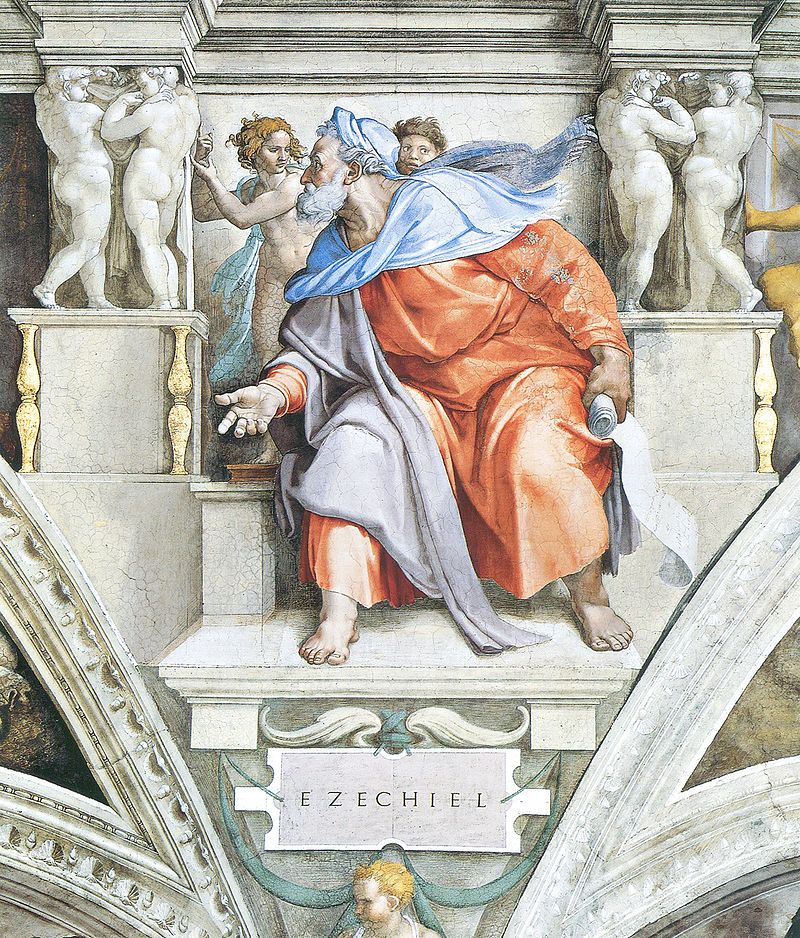
Michelangelo's Ezekiel on the Sistine Chapel
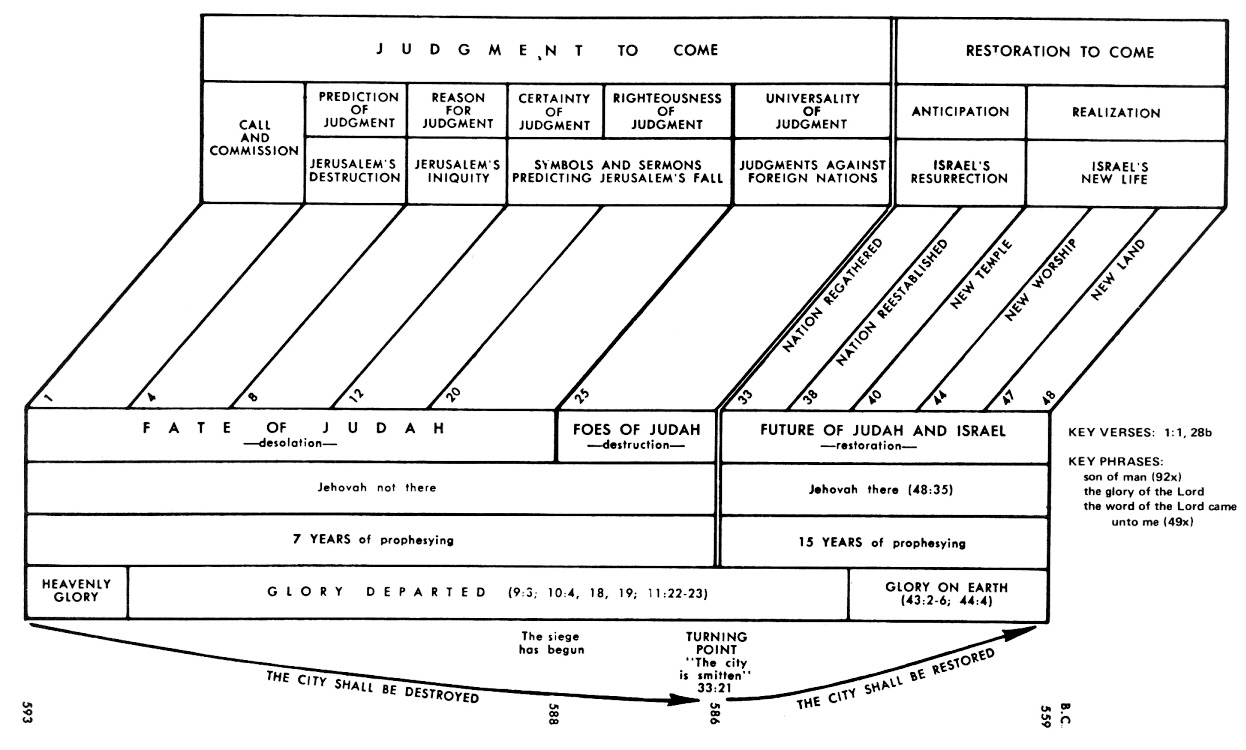
Click chart to enlarge
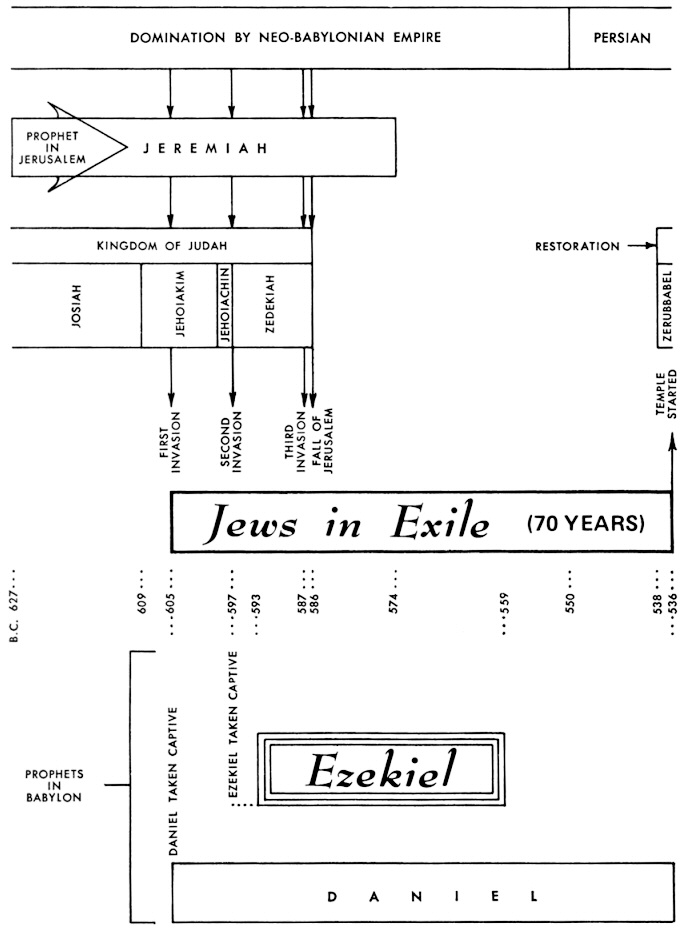
Click chart to enlarge
Chart from recommended resource Jensen's Survey of the OT - used by permission
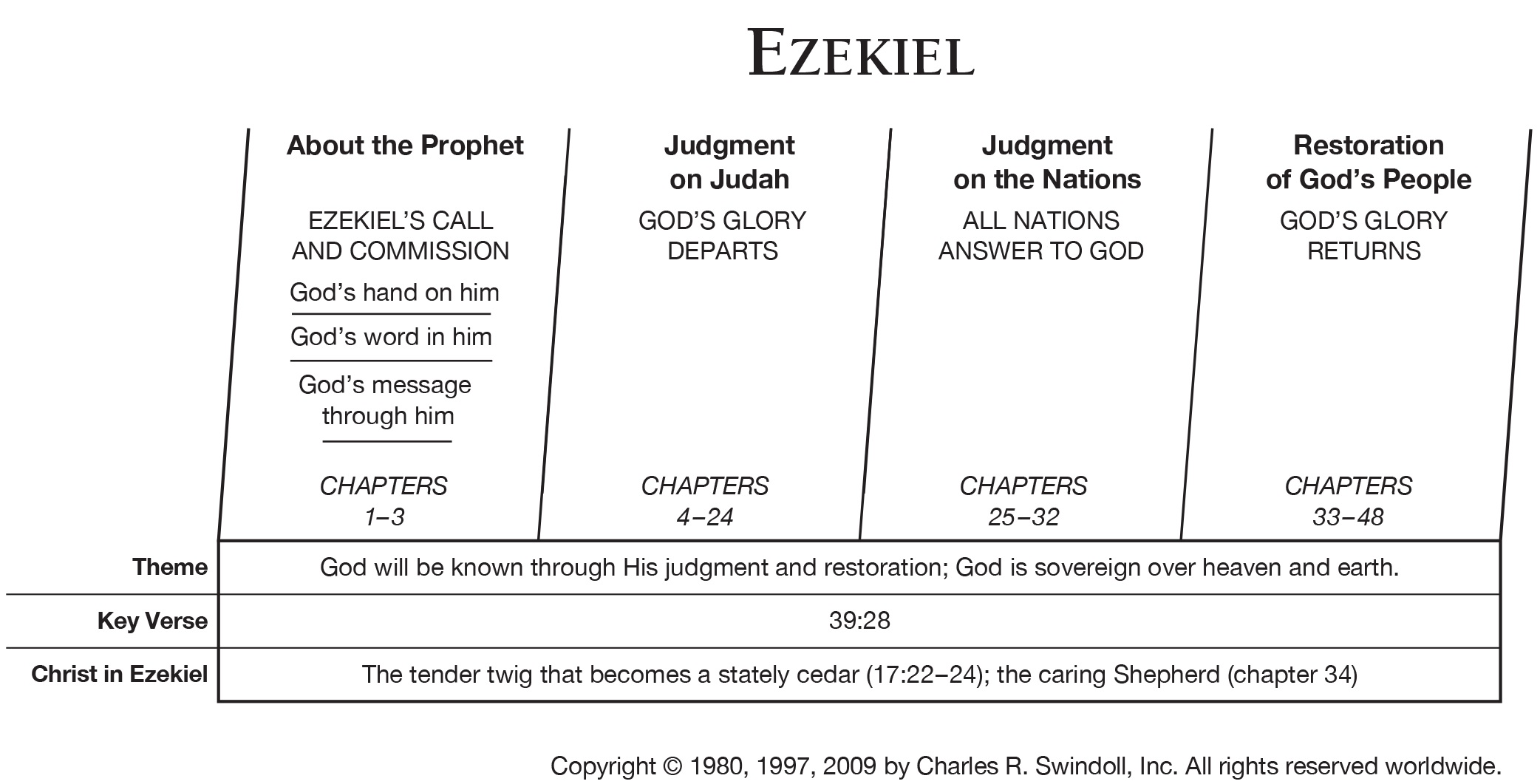
Click Chart from Charles Swindoll
|
PROPHECY OF |
PROPHECY OF |
|||
| FATE OF JUDAH Before the Siege |
FOES OF JUDAH During the Siege |
FUTURE OF JUDAH After the Siege |
||
|
593-588 BC |
587-586 |
586-571 |
||
|
7 YEARS |
15 YEARS |
|||
| Ezekiel 1:1-3:27 Ezekiel Sees the Glory & Receives the Call |
Ezekiel 4:1-24:27 Judgments Against Judah |
Ezekiel 25:1-32:32 Judgments Against the Gloating Nations |
Ezekiel 33:1-39:29 Restoration of Israel to the LORD |
Ezekiel 40:1-48:35 Visions of the Temple Jehovah Shammah |
Outline of the Book of Ezekiel from Dr John MacArthur - The book can be largely divided into sections about condemnation/retribution and then consolation/restoration. A more detailed look divides the book into 4 sections. First, are prophecies on the ruin of Jerusalem (Ezekiel 1:1–24:27). Second, are prophecies of retribution on nearby nations (Ezekiel 25:1–32:32), with a glimpse at God’s future restoration of Israel (Ezekiel 28:25,26). Thirdly, there is a transition chapter (Ezekiel 33:1-33) which gives instruction concerning a last call for Israel to repent. Finally, the fourth division includes rich expectations involving God’s future restoration of Israel (Ezekiel 34:1–48:35). (Reference)
I. Prophecies of Jerusalem’s Ruin (Ezekiel 1:1–24:27)
A. Preparation and Commission of Ezekiel (Ezekiel 1:1–3:27)
1. Divine appearance to Ezekiel (Ezekiel 1:1–28)|
2. Divine assignment to Ezekiel (Ezekiel 2:1–3:27)
B. Proclamation of Jerusalem’s Condemnation (Ezekiel 4:1–24:27)
1. Signs of coming judgment (Ezekiel 4:1–5:4)
2. Messages concerning judgment (Ezekiel 5:5–7:27)
3. Visions concerning abomination in the city and temple (Ezekiel 8:1–11:25)
4. Explanations of judgment (Ezekiel 12:1–24:27)
II. Prophecies of Retribution to the Nations (Ezekiel 25:1–32:32)
A. Ammon (Ezekiel 25:1–7)
B. Moab (Ezekiel 25:8–11)
C. Edom (Ezekiel 25:12–14)
D. Philistia (Ezekiel 25:15–17)
E. Tyre (Ezekiel 26:1–28:19)
F. Sidon (Ezekiel 28:20–24)
Excursus: The Restoration of Israel (Ezekiel 28:25, 26)
G. Egypt (Ezekiel 29:1–32:32)
III. Provision for Israel’s Repentance (Ezekiel 33:1–33)
IV. Prophecies of Israel’s Restoration (Ezekiel 34:1–48:35)
A. Regathering of Israel to the Land (Ezekiel 34:1–37:28)
1. Promise of a True Shepherd (Ezekiel 34:1–31)
2. Punishment of the nations (Ezekiel 35:1–36:7)
3. Purposes of restoration (Ezekiel 36:8–38)
4. Pictures of restoration—dry bones and two sticks (Ezekiel 37:1–28)
B. Removal of Israel’s Enemies from the Land (Ezekiel 38:1–39:29)
1. Invasion of Gog to plunder Israel (Ezekiel 38:1–16)
2. Intervention of God to protect Israel (Ezekiel 38:17–39:29)
C. Reinstatement of True Worship in Israel (Ezekiel 40:1–46:24)
1. New temple (Ezekiel 40:1–43:12)
2. New worship (Ezekiel 43:13–46:24)
D. Redistribution of the Land in Israel (Ezekiel 47:1–48:35)
1. Position of the river (Ezekiel 47:1–12)
2. Portions for the tribes (Ezekiel 47:13–48:35)
Hannah's Bible Outlines.
- The vision of the coals of fire (Ezekiel 10:1-22)
- The instruction to the man clothed in linen (Ezekiel 10:1-2)
- The movement of God's glory to the threshold (Ezekiel 10:3-5)
- The action of the cherub (Ezekiel 10:6-8)
- The description of the cherubim (Ezekiel 10:9-17)
- The movement of God's glory to the east gate (Ezekiel 10:18-19)
- The identification of the cherubim (Ezekiel 10:20-22)
Ezekiel 10:1 Then I looked, and behold, in the expanse that was over the heads of the cherubim something like a sapphire stone, in appearance resembling a throne, appeared above them.
Amplified: THEN I looked and behold, in the firmament that was over the heads of the cherubim there appeared above them something looking like a sapphire stone, in form resembling a throne.
NLT: As I looked, I saw what appeared to be a throne of blue sapphire above the crystal surface over the heads of the cherubim.
Young's Literal: And I look, and lo, on the expanse that is above the head of the cherubs, as a sapphire stone, as the appearance of the likeness of a throne, He hath been seen over them.
THEN I LOOKED AND BEHOLD:
- Isa 21:8,9
Wiersbe comments that "If all you do is look at the sins of the land, you will end up very discouraged. Do as the prophet did: lift your eyes higher and get a new vision of the throne of God (Jer 17:12)."
And so Ezekiel again sees the glorious appearance of the majesty of God (almost certainly the pre-incarnate Christ in the glory that He had before His incarnation) to inspire us with a holy awe and dread of God and to fill us with His fear as we get a glimpse into the invisible world via these incredible descriptions. Although much of this chapter repeats or overlaps with the description of God's chariot throne in Ezekiel 1, it would be a shame to read this chapter and be bored by the repetition. This is the God of the universe Ezekiel is describing. If nothing else is gleaned from this chapter, let a slow reading of it at least prompt a desire to worship the Worthy One and then to go forth and to live in a manner worthy of His majesty glory herein revealed in only a small degree.
Matthew Henry commenting on this description writes that "here is enough to oblige us all to the utmost reverence in our thoughts of God and approaches to Him, if we will but admit the impressions this discovery of Him will make."
I looked - Ezekiel was called to be a watchman (Ezek 3:17, 33:2,6-7), and here we see him faithful at his post like the lookout described in Isaiah who said "O Lord, I stand continually by day on the watchtower, and I am stationed every night at my guard post."
Would all of His saints be so alert and focused, for all have been given the charge to at least "Watch over your heart with all diligence, for from it flow the springs of life." (Pr 4:23-notes)
We all need to pray that we might have the attitude of God's watchmen like Ezekiel and Isaiah and like Habakkuk who said "I will stand on my guard post and station myself on the rampart; and I will keep watch to see what He will speak to me, and how I may reply when I am reproved" (Hab2:1)
IN THE EXPANSE THAT WAS OVER THE HEADS OF THE CHERUBIM:
- Ezek 1:22, 23, 24, 25, 26) (Ezek 10:20; 11:22; Ps 18:10; 68:17,18; Ep1:20; 1Pe 3:22
"in the firmament that was over the heads of the cherubim there appeared above them something looking like a sapphire stone, in form resembling a throne." (Amp)
"I saw that on the arch which was over the head of the winged ones" (BBE)
"I looked at the dome over the heads of the living creatures" (GNB)
In the expanse (raqia) is described in (Ezek 1:22) as "like the awesome gleam of crystal" This description is similar to that in Exodus where the elders "saw the God of Israel; and under His feet there appeared to be a pavement of sapphire, as clear as the sky itself" (Ex 24:10)
Over the heads of the cherubim (kerub) - "God is above the head of the cherubim, in respect not only of his dignity above them, but of His dominion over them. Cherubim have great power, and wisdom, and influence, but they are all subject to God and Christ." (Matthew Henry )
Elsewhere we read the description of "the ark of the covenant of the LORD of hosts Who sits above the cherubim… " (1Sa 4:4)
Cherubim (03742)(kerub are angelic heavenly beings who dwell in God's presence and minister to Him. Note that cherubim which are frequently depicted as chubby infants with wings or as feminine creatures has absolutely no scriptural support (Which makes the point again that one should not glean his theology from Biblical art but from the Bible - in fact the first use in Ge 3:24 hardly depicts them as "chubby little babies" but as fearful beings!) In other cultures of the ancient world, cherubim were minor deities protective of palaces and temples; in Israel they symbolized angelic guardians (Gen 3:24).
In the OT the cherubim were symbolic attendants that marked the place of the Lord's "enthronement" in his earthly kingdom
- 1Sa 4:4 = "the LORD of hosts who sits above the cherubim";
- 2Sa 6:2 = "the LORD of hosts who is enthroned above the cherubim";
- 2Ki 19:15 = "the God of Israel, who are enthroned above the cherubim";
- Ps 99:1 = "The LORD reigns, let the peoples tremble; He is enthroned above the cherubim, let the earth shake!"
Kerub in Ezekiel - Ezek. 9:3; Ezek. 10:1; Ezek. 10:2; Ezek. 10:3; Ezek. 10:4; Ezek. 10:5; Ezek. 10:6; Ezek. 10:7; Ezek. 10:8; Ezek. 10:9; Ezek. 10:14; Ezek. 10:15; Ezek. 10:16; Ezek. 10:18; Ezek. 10:19; Ezek. 10:20; Ezek. 11:22; Ezek. 28:14; Ezek. 28:16; Ezek. 41:18; Ezek. 41:20; Ezek. 41:25
QUESTION - What are cherubim? Are cherubs angels?
ANSWER - Cherubim/cherubs are angelic beings involved in the worship and praise of God. The cherubim are first mentioned in the Bible in Genesis 3:24, “After He drove the man out, He placed on the east side of the Garden of Eden cherubim and a flaming sword flashing back and forth to guard the way to the tree of life.” Prior to his rebellion, Satan was a cherub (Ezekiel 28:12-15). The tabernacle and temple along with their articles contained many representations of cherubim (Exodus 25:17-22; 26:1, 31; 36:8; 1 Kings 6:23-35; 7:29-36; 8:6-7; 1 Chronicles 28:18; 2 Chronicles 3:7-14; 2 Chronicles 3:10-13; 5:7-8; Hebrews 9:5).
Chapters 1 and 10 of the book of Ezekiel describe the “four living creatures” (Ezekiel 1:5) as the same beings as the cherubim (Ezekiel 10). Each had four faces—that of a man, a lion, an ox, and an eagle (Ezekiel 1:10; also 10:14)—and each had four wings. In their appearance, the cherubim “had the likeness of a man” (Ezekiel 1:5). These cherubim used two of their wings for flying and the other two for covering their bodies (Ezekiel 1:6, 11, 23). Under their wings the cherubim appeared to have the form, or likeness, of a man’s hand (Ezekiel 1:8; 10:7-8, 21).
The imagery of Revelation 4:6-9 also seems to be describing cherubim. The cherubim serve the purpose of magnifying the holiness and power of God. This is one of their main responsibilities throughout the Bible. In addition to praising God, they also serve as a visible reminder of the majesty and glory of God and His abiding presence with His people. GotQuestions.org
SOMETHING LIKE A SAPPHIRE STONE, IN APPEARANCE RESEMBLING A THRONE, APPEARED ABOVE THEM:
- Ezek 1:22,26; Ge18:2,17,22,31; 32:24,30; Josh 5:13, 14, 15; 6:2; Jer13:6,8; Jer13:18, 19, 20, 21, 22; Jn1:18; Rev 1:13
"there appeared above them something looking like a sapphire stone, in form resembling a throne." (Amp)
"there was seen over them what seemed like a sapphire stone, having the form of a king's seat" (BBE)
"what appeared to be a throne of blue sapphire above the crystal surface over the heads of the cherubim." (CSB)
"above them was something that seemed to be a throne made of sapphire." (GNB)
Ezekiel's vision of the glory of God is similar but not identical to what he had seen in (Ezek1:1–28).
Something like a sapphire stone (lapis lazuli, azure blue, sky blue) parallels Ezekiel's description in (Ezek 1:26) where he writes that "over their heads there was something resembling a throne, like lapis lazuli in appearance, and on that which resembled a throne, high up was a figure with the appearance of a man," again an carefully worded attempt by the finite mind to describe the infinite One, the glorious Messiah. In another apocalyptic book, John describes his experience this way: "Immediately I was in the Spirit; and behold, a throne was standing in heaven, and One sitting on the throne. And He who was sitting was like a jasper stone and a sardius in appearance; and there was a rainbow around the throne, like an emerald in appearance." (Rev 4:2,3-note)
Notice that different stones (lapis lazuli ~ sapphire) are employed, for no description of beauty is sufficient to describe God's radiant throne.
THOUGHT - Let us bow down to the One so matchless in form and beauty, and ponder the precious privilege we have as believers to "draw near with confidence to the throne of grace, that we may receive mercy and may find grace to help in time of need." (Heb 4:16+) Have you drawn near today? Do you have some genuine need that you have not brought before Him? He is able!
Resembling a throne the seat of the King, Who rules with dignity and authority and judges righteously as portrayed in this chapter. There shall come a time when Jerusalem, the city now being judged, shall be called “the throne of Yahweh” (Jer 3:17) In his last vision Ezekiel records that "this is the place (referring to the millennial Temple in Jerusalem) of My throne and the place of the soles of My feet, where I will dwell among the sons of Israel forever. And the house of Israel will not again defile My holy name, neither they nor their kings, by their harlotry and by the corpses of their kings when they die." (Eze 43:7) The prophet Zechariah records that "Yes, it is He who will build the temple of the LORD, and He who will bear the honor and sit and rule on His throne. Thus, He will be a priest on His throne, and the counsel of peace will be between the two offices."' (Zec 6:13)
Wiersbe -The throne (1). If all you do is look at the sins of the land, you will end up very discouraged. Do as the prophet did: lift your eyes higher and get a new vision of the throne of God (Jer. 17:12). The fire (Ezek 10:2–17). Coals from the altar brought cleansing to Isaiah (Isa. 6:6–7), but they brought judgment to Jerusalem. The altar is the place where sin is atoned for because sin is judged. Had the nation sought God’s mercy and obeyed His Word, the coals would have brought cleansing. Yet even in the midst of terrible judgment, God’s “wheels” were still turning and His purposes being worked out in the world. The glory (Ezek 10:18–22). God will not share His glory with idols (Isa. 42:8); therefore, He had to abandon His house. His glory moved to the door of the east gate, poised to move again (Ezek 11:22–23). If the nation would not glorify God in their obedience, they would glorify Him in judgment. The Fullness of the Spirit In Old Testament times, the Spirit came upon people temporarily for special reasons, but Jesus promised that the Holy Spirit would stay with His church forever (John 14:16). God took His Spirit from King Saul (1 Sam. 16:14), and David prayed that the Spirit would not depart from him (Ps. 51:11). Our prayer must be that we not grieve the Spirit (Eph. 4:30), lie to the Spirit (Acts 5), or quench the Spirit (1 Thess. 5:19) but have the Spirit’s fullness for life and service each day (Eph. 5:18ff.). (Borrow copy of With the Word)
Ezekiel 10:2 And He spoke to the man clothed in linen and said, "Enter between the whirling wheels under the cherubim and fill your hands with coals of fire from between the cherubim and scatter them over the city." And he entered in my sight.
Amplified: And [the Lord] spoke to the man clothed in linen and said, Go in among the whirling wheels under the cherubim; fill your hands with coals of fire from between the cherubim and scatter them over the city. And he went in before my eyes.(1)
Young's Literal: And I look, and lo, on the expanse that is above the head of the cherubs, as a sapphire stone, as the appearance of the likeness of a throne, He hath been seen over them.
AND HE SPOKE TO THE MAN CLOTHED IN LINEN AND SAID:
He spoke that is, the Lord, the preincarnate Messiah. Notice that in contrast to chapter 1, this time Ezekiel does not even attempt a description of the Lord.
Man clothed in linen in the previous chapter (see Ezek 9:2,11) had performed an act of mercy (putting a mark on those who sign and groan and who were to be spared) but here his actions are associated with judgment on Jerusalem.
ENTER BETWEEN THE WHIRLING WHEELS UNDER THE CHERUBIM:
Go in between the wheels, under the winged ones" (BBE)
Whirling wheels (galgal) often refers to chariot wheels (Isa 5:28).
AND FILL YOUR HANDS WITH COALS OF FIRE FROM BETWEEN THE CHERUBIM:
- Ezek 10:7) (Ezek 10:8, 9, 10, 11, 12, 13,16; 1:15, 16, 17, 18, 19, 20) (Ps 18:12,13; 140:10; Isa 6:6,7; Rev 8:5)
"and get your two hands full of burning coals from between the winged ones" (BBE),
"and fill the hollow of thy hands with coals of fire from between the cherubim" (Darby)
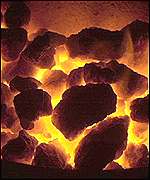
Coals (gahelet) In chapter 1 Ezekiel had described "In the midst of the living beings (cherubim) there was something that looked like burning coals of fire, like torches darting back and forth among the living beings. The fire was bright, and lightning was flashing from the fire." (Ezek1:13)
In the present context, the coals of fire are associated with judgment in contrast to the coal that brought cleansing to Isaiah's lips in Isaiah 6, the prophet recording "Then one of the seraphim flew to me, with a burning coal in his hand which he had taken from the altar with tongs. And he touched my mouth with it and said, "Behold, this has touched your lips; and your iniquity is taken away, and your sin is forgiven." (Isa 6:6, 7)
Had Judah sought God's mercy and obeyed His Word, the coals would have brought cleansing not calamity. They had refused the grace, mercy and redemption of God, so now must bear the judgment of God, as must all who "think lightly of the riches of His kindness and forbearance and patience, not knowing that the kindness of God leads you to repentance?" (Ro2:4)
McGee draws this parallel between the coals from between the cherubim and the cross of Christ "It is just as simple as this: God sent His Son because He loves you. Because He is holy, He had to pay the penalty for your sin and mine; He had to die on the cross. Christ is the propitiation, He is the mercy seat for our sins—not for ours only, but for the sins of the whole world. There is a mercy seat which you can come to, but, if you reject it, the judgment of God must come upon you. Christ bore your judgment, and that is the only way God forgives you. It is not because you are a sweet little boy or a nice little Pollyanna glad-girl. You are a sinner and in rebellion against Him. The best that Christians can say today is that we are saved sinners; we are not superior people at all."
AND SCATTER {THEM} OVER THE CITY" AND HE ENTERED IN MY SIGHT:
- Ezek 20:47,48; 24:9, 10, 11, 12, 13, 14; Isa30:30; Jer24:8, 9, 10
"and get your two hands full of burning coals from between the winged ones and send them in a shower over the town. And he went in before my eyes" (BBE)
"He did this as I watched" (CSB),
"I watched him as he followed the LORD's instructions" (CEV)
Ezekiel later records the LORD's words "Behold, I am about to kindle a fire in you, and it shall consume every green tree in you (ancient Palestine was heavily forested), as well as every dry tree; the blazing flame will not be quenched, and the whole surface from south to north will be burned by it. And all flesh will see that I, the LORD, have kindled it; it shall not be quenched." (Ezek 20:47-48)
In 2 Kings, Nebuzaradan, the captain of the guard, a servant of Nebuchadnezzar, king of Babylon, came to Jerusalem and literally fulfilled (at least in part) Ezekiel's prophecy for "He burned the house of the LORD, the king's house, and all the houses of Jerusalem; even every great house he burned with fire." (2Ki25:9)
The picture of scattering coals over the wicked city of Jerusalem reminds one of God's judgment on the wicked cities in Genesis, Moses recording that "the Lord rained on Sodom and Gomorrah brimstone and fire from the Lord out of heaven and He overthrew those cities and all the valley, and all the inhabitants of the cities, and what grew on the ground" (Ge 19:24-25)
Craigie commenting on the "coals" adds that "God’s burning purity may hold either threat or promise. To those that seek to walk in God’s way, the coals of God may purify and heal, as Isaiah discovered in his great vision of God in the temple (Isa 6:6). But the same coals may consume the impure, as the inhabitants of Sodom and Gomorrah had discovered to their cost (Ge 19:24). The tragedy of Jerusalem was that it was going the way of those sinful cities of the Dead Sea valley." (Borrow Ezekiel. The Daily study Bible)
The picture of scattering coals over Jerusalem for judgment is paralleled in John's description of the final outpouring of God's wrath in Revelation where "the angel took the censer and he filled it with the fire of the altar and threw it to the earth; and there followed peals of thunder and sounds and flashes of lightning and an earthquake." (Rev 8:5)
The city of Jerusalem would be judged but God was far from finished with her as outlined in the next chapter. Someone has said "Palestine became the nerve-center of the earth in the days of Abraham. Later on, the country became the truth-center because of Moses and the prophets. Ultimately, it became the salvation-center by the manifestation of Christ. His rejection led to its becoming the storm-center, as it has continued to be throughout many centuries. The Scriptures predict that it is to be the peace-center under the messianic kingdom, and it will be the glory-center in a new universe yet to be experienced.”
Ezekiel 10:3 Now the cherubim were standing on the right side of the temple when the man entered, and the cloud filled the inner court.
Young's Literal: And He speaketh unto the man clothed with linen, and saith, 'Go in unto the midst of the wheel, unto the place of the cherub, and fill thy hands with coals of fire from between the cherubs, and scatter over the city.' And he goeth in before mine eyes.
CSB The cherubim were standing at the south end of the Temple when the man went in, and the cloud of glory filled the inner courtyard.
NOW THE CHERUBIM WERE STANDING ON THE RIGHT SIDE OF THE TEMPLE WHEN THE MAN ENTERED, AND THE CLOUD FILLED THE INNER COURT:
- Ezek 10:3; 9:3; 43:4
Right side (yamiyn) generally in Scripture is used as a reference to the "south" side and it is translated "south" by several of the translations.
Golden carvings of cherubim were placed over the mercy seat of the Ark of the Covenant (Ex 25:18-22), which represented the actual throne of God as seen here by Ezekiel. Apparently one of the responsibilities of the cherubim is to carry God’s throne.
"The cloud" God took possession of the tabernacle and the temple in a cloud, which was always the symbol of his presence. In the temple above there will be no cloud, but we shall see face to face.
Ezekiel 10:4 Then the glory of the LORD went up from the cherub to the threshold of the temple, and the temple was filled with the cloud and the court was filled with the brightness of the glory of the LORD.
Young's Literal: and become high doth the honour of Jehovah above the cherub, over the threshold of the house, and the house is filled with the cloud, and the court hath been filled with the brightness of the honour of Jehovah.
Amplified: Now the cherubim stood on the south side of the house when the man went in; and the cloud [the Shekinah] filled the inner court.
CSB: Then the glory of the LORD rose up from above the cherubim and went over to the door of the Temple. The Temple was filled with this cloud of glory, and the Temple courtyard glowed brightly with the glory of the LORD.
THEN THE GLORY OF THE LORD WENT UP FROM THE CHERUB TO THE THRESHOLD OF THE TEMPLE:
- Ezek 1:28; 9:3; 11:22,23; Nu16:19) (Ezek 43:5; Ex40:35; 1Ki8:10, 11, 12; 2Ch5:13,14; Hag 2:9; Rev 15:8)
"The dazzling light of the LORD's presence rose up from the creatures and moved to the entrance of the Temple" (GNB)
"The LORD'S glory rose from the angels to the entrance of the temple" (GWT)
The Glory of the LORD was God's visible manifestation of His presence. This exact phrase appears 36 times in the NASB (which book has the most occurrences?). Click here to read the verses and for an interesting study, make a list of the "why, what, when, where and how" observations that are associated with the appearance of His glory. Apparently from the days when the glory had filled the Tabernacle of Moses and later the Temple of Solomon's, "the (Shekinah glory cloud) glory of Jehovah" had been a visible reminder of God's presence in the Holy Place. In Ezekiel 9-11 we see the Shekinah glory departing the Holy Place between the cherubim and hovering over the threshold of the temple.
Went up from the cherub to the threshold appears to be a repetition of a similar movement in Ezek 9:3 where Ezekiel records that "the glory of the God of Israel went up from the cherub on which it had been, to the threshold of the temple." Ezekiel adds later that "the glory of the LORD departed from the threshold of the temple and stood over the cherubim." (Ezek 10:18) from whence "the cherubim departed" until "they stood still at the entrance of the east gate of the LORD'S house. And the glory of the God of Israel hovered over them." (Ezek 10:1)
Related Resource
Other Scriptures repeatedly emphasize that the LORD Who is "enthroned above the cherubim" (click Scriptures).
Craigie comments that 'this first step in God’s evacuation of His temple is forced upon Him. He does not want to move, but is evicted by an evil people. The ultimate privilege of religion is the presence of God, however elusive. The most awful loss is the removal of that presence. But Ezekiel makes it clear that the divine presence is not lost without cause, but only as the consequence of the steadfast pursuit of evil" (Borrow Ezekiel. The Daily study Bible)
AND THE TEMPLE WAS FILLED WITH THE CLOUD AND THE COURT WAS FILLED WITH THE BRIGHTNESS OF THE GLORY OF THE LORD:
"Then the cloud filled the Temple, and the courtyard was blazing with the light" (GNB)
"and the brightness of the LORD'S glory filled the courtyard" (GWT)
Filled with the brightness describes God's glory as radiant, brilliant, sparkling in luster so that not one square inch of the courtyard failed to manifest His glory. This is a foretaste of that future day Habakkuk prophesied of when "the earth will be filled With the knowledge of the glory of the LORD, as the waters cover the sea." (Hab2:14), that day when "the LORD will be king over all the earth; in that day the LORD will be the only one, and His name the only one." (Zech 14:8)
In these verses we see that the cloud equates with “the glory of the Lord” which now as from the very outset (see initial appearance of the Shekinah glory cloud Ex 13:21, 22 which as Matthew Henry puts it was a “constant standing miracle” cf Ex16:7), was the visible symbol of God’s presence.
We see a striking contrast to the completion of the tabernacle and the completion and dedication of Solomon's Temple, for in both instances the glory of the LORD filled the structures, and was confirmation that all the work for setting up God’s dwelling place had been properly done. Here in Ezekiel the beginning stages of the departure of God's glory were in a way also a testimony of all the evil that had been done in His Temple, forcing Him to leave His dwelling place and His beloved city.
In Exodus God made reference to the Tabernacle stating "I will meet there with the sons of Israel, and it shall be consecrated (set apart from secular or common use and unto God and His use) by My glory." (Ex29:43) Judah refused to be consecrated or set apart by His Shekinah glory and even turned their backs on His glory in the previous chapter choosing instead to worship the creation (a sun) rather than the Creator (the Son). (Ezek 8:1ff).
How sad the contrast between these actions of apostasy by the leaders and the actions of the spiritual leaders on the occasion of the completion of Solomon's Temple: "Now when Solomon had finished praying, fire came down from heaven and consumed the burnt offering and the sacrifices; and the glory of the Lord filled the house. And the priests could not enter into the house of the Lord, because the glory of the Lord filled the Lord’s house. And all the sons of Israel, seeing the fire come down and the glory of the Lord upon the house, bowed down on the pavement with their faces to the ground, and they worshiped and gave praise to the Lord, saying, “Truly He is good, truly His lovingkindness is everlasting.” (2Chr7:1-3)
It is interesting to read God's warning also given at the dedication of the first Temple
"But if you turn away and forsake My statutes and My commandments which I have set before you and shall go and serve other gods and worship them, then I will uproot you from My land (exile) which I have given you, and this house which I have consecrated for My name I will cast out of My sight, and I will make it a proverb and a byword among all peoples. As for this house, which was exalted, everyone who passes by it will be astonished and say, ‘Why has the Lord done thus to this land and to this house?’ And they will say, ‘Because they forsook the Lord, the God of their fathers, who brought them from the land of Egypt, and they adopted other gods and worshiped them and served them, therefore He has brought all this adversity on them.’” (2Chr 7:19-22)
Ezekiel 10:5 Moreover, the sound of the wings of the cherubim was heard as far as the outer court, like the voice of God Almighty when He speaks.
Young's Literal: And a noise of the wings of the cherubs hath been heard unto the outer court, as the voice of God -- the Mighty One -- in His speaking.
Amplified: And the sound of the wings of the cherubim was heard even to the outer court, like the voice of God Almighty when He speaks.(3)
MOREOVER, THE SOUND OF THE WINGS OF THE CHERUBIM WAS HEARD AS FAR AS THE OUTER COURT, LIKE THE VOICE OF GOD ALMIGHTY WHEN HE SPEAKS:
- Ezek 46:21; 1Ki7:9; 2Ch 4:9) (Ex 19:16,19; 20:18,19; Dt 4:12,13; Job 37:2-5 Ps 29:3-9; 68:33; 77:17; Jn 12:28,29; Heb12:18,19; Rev10:3,4
Sound of the wings in chapter 1 was "like the sound of abundant waters as they went, like the voice of the Almighty, a sound of tumult like the sound of an army camp… " (Ezek 1:24)
Like the voice of God Almighty or El Shaddai. What is His voice like? The psalmist says "The voice of the LORD is upon the waters; the God of glory thunders, the LORD is over many waters." (Ps 29:3)
At Mt Sinai "when the sound of the trumpet grew louder and louder, Moses spoke and God answered him with thunder" (Ex 19:19)
The Lord Himself ask Job "do you have an arm like God, and can you thunder with a voice like His?" (Job 40:9)
Related Resource:
Ezekiel 10:6 It came about when He commanded the man clothed in linen, saying, "Take fire from between the whirling wheels, from between the cherubim," he entered and stood beside a wheel.
Young's Literal: And it cometh to pass, in His commanding the man clothed with linen, saying, 'Take fire from between the wheel, from between the cherubs,' and he goeth in and standeth near the wheel,
Amplified: And when He commanded the man clothed in linen, saying, Take fire from between the whirling wheels, from between the cherubim, [the man] went in and stood beside a wheel.
IT CAME ABOUT WHEN HE COMMANDED THE MAN CLOTHED IN LINEN, SAYING, "TAKE FIRE FROM BETWEEN THE WHIRLING WHEELS, FROM BETWEEN THE CHERUBIM," HE ENTERED AND STOOD BESIDE A WHEEL:
- Ezek 10:2; Ps80:1; 99:1
"He entered" not into the temple, but between the cherubim, for as he had described earlier "In the midst of the living beings there was something that looked like burning coals of fire, like torches darting back and forth among the living beings. The fire was bright, and lightning was flashing from the fire" (Ezek 1:13).
The cherubim, once the ministers of grace, are now the ministers of vengeance.
Ezekiel 10:7 Then the cherub stretched out his hand from between the cherubim to the fire which was between the cherubim, took some and put it into the hands of the one clothed in linen, who took it and went out
Young's Literal: that the one cherub putteth forth his hand from between the cherubs unto the fire that is between the cherubs, and lifteth up, and giveth into the hands of him who is clothed with linen, and he receiveth, and cometh forth.
THEN THE CHERUB STRETCHED OUT HIS HAND FROM BETWEEN THE CHERUBIM TO THE FIRE WHICH WAS BETWEEN THE CHERUBIM:
- Ezek 10:6; 1:13
His hand Earlier Ezekiel had described the appearance of the cherubim writing that "Under their wings on their four sides were human hands… " (Ezek 1:8)
TOOK SOME AND PUT IT INTO THE HANDS OF THE ONE CLOTHED IN LINEN, WHO TOOK IT AND WENT OUT:
- Ezek 41:23, 24, 25, 26
The account is silent about his scattering the coals of fire over the city, but this is assumed. So here we see the man in linen previously the agent of mercy to the righteous (Ezekiel 9:2, 3, 4), now being used by the Lord to bring punishment on the evildoers.
In a similar way in the NT Jesus prophesies that "the Son of Man will send forth His angels, and they will gather out of His kingdom all stumbling blocks, and those who commit lawlessness, and will throw them into the furnace of fire; in that place there will be weeping and gnashing of teeth." (Mt13:41, 42) and adds that "So it will be at the end of the age; the angels will come forth and take out the wicked from among the righteous, and will throw them into the furnace of fire; in that place there will be weeping and gnashing of teeth" (Mt 13:49, 50)
Ezekiel 10:8 The cherubim appeared to have the form of a man's hand under their wings.
Young's Literal: And there appeareth in the cherubs the form of a hand of man under their wings,
Amplified: And the cherubim seemed to have the form of a man's hand under their wings.
THE CHERUBIM APPEARED TO HAVE THE FORM OF A MAN'S HAND UNDER THEIR WINGS:
- Ezek 10:21
Isaiah records that "one of the seraphim flew to me with a burning coal in his hand, which he had taken from the altar with tongs." (Isa 6:6-note)
Jamieson has an interesting comment that "The "wings" denote alacrity, the "hands" efficacy and aptness, in executing the functions" assigned to them."
Ezekiel 10:9 Then I looked, and behold, four wheels beside the cherubim, one wheel beside each cherub; and the appearance of the wheels was like the gleam of a Tarshish stone
Amplified: And I looked and behold, there were four wheels beside the cherubim, one wheel beside one cherub and another wheel beside another cherub; and the appearance of the wheels was like sparkling chrysolite.
Young's Literal: and I look, and lo, four wheels near the cherubs, one wheel near the one cherub, and another wheel near the other cherub, and the appearance of the wheels is as the colour of a beryl stone.
THEN I LOOKED, AND BEHOLD, FOUR WHEELS BESIDE THE CHERUBIM, ONE WHEEL BESIDE EACH CHERUB; AND THE APPEARANCE OF THE WHEELS WAS LIKE THE GLEAM OF A TARSHISH STONE:
- Ezek 1:15, 16, 17
- Da 10:6; Rev 21:20
Tarshish stone - also translated beryl stone or chrysolite.
Ezekiel 10:10 As for their appearance, all four of them had the same likeness, as if one wheel were within another wheel.
Amplified: And as for their appearance, they four looked alike, as if a wheel had been within a wheel.
Young's Literal: As to their appearances, one likeness is to them four, as it were the wheel in the midst of the wheel.
AS FOR THEIR APPEARANCE, ALL FOUR OF THEM HAD THE SAME LIKENESS, AS IF ONE WHEEL WERE WITHIN ANOTHER WHEEL:
- Ezek 1:16; Ps 36:6; 97:2
the same likeness is the Hebrew word echad which stresses unity while recognizing diversity within that oneness.
As Jamieson comments that "In the wonderful variety of God's works there is the greatest harmony"
In human works, though labored on with pain,
One thousand movements scarce one purpose gain;
In God's one single doth its end produce,
Yet serves to second, too, some other use.
Although in a different context Paul's declaration in Romans is appropriate to Ezekiel's description of the wheels, for Paul says "Oh, the depth of the riches both of the wisdom and knowledge of God! How unsearchable are His judgments and unfathomable His ways!" (Ro 11:33)
The psalmist adds "O LORD, how many are Thy works! In wisdom Thou hast made them all; The earth is full of Thy possessions" (Ps 104:24)
Ezekiel 10:11 When they moved, they went in any of their four directions without turning as they went; but they followed * in the direction which they faced *, without turning as they went.
Amplified: When they went, they went in any one of the four directions [in which their four individual faces were turned]; they did not turn as they went, but to the place to which the front wheel faced the others followed; they turned not as they went.
Young's Literal: In their going, on their four sides they go; they turn not round in their going, for to the place whither the head turneth, after it they go, they turn not round in their going.
WHEN THEY MOVED, THEY WENT IN ANY OF THEIR FOUR DIRECTIONS WITHOUT TURNING AS THEY WENT; BUT THEY FOLLOWED IN THE DIRECTION WHICH THEY FACED, WITHOUT TURNING AS THEY WENT:
- Ezek 10:22; 1:17) (Ezek 1:20; Matthew 8:8, 9, 10
Compare - Ezek 1:20 Wherever the spirit was about to go, they would go in that direction. And the wheels rose close beside them; for the spirit of the living beings [was] in the wheels.
Ezekiel 10:12 Their whole body, their backs, their hands, their wings and the wheels were full of eyes all around, the wheels belonging to all four of them.
Amplified: And their whole body, their backs, their hands, and their wings, and the wheels, were full of eyes round about, even the wheels that each had.
Young's Literal: And all their flesh, and their backs, and their hands, and their wings, and the wheels, are full of eyes round about; to them four are their wheels.
THEIR WHOLE BODY, THEIR BACKS, THEIR HANDS, THEIR WINGS AND THE WHEELS WERE FULL OF EYES ALL AROUND, THE WHEELS BELONGING TO ALL FOUR OF THEM:
- Ezek 1:18; Revelation 4:6,8
Ezek 1:18 As for their rims they were lofty and awesome, and the rims of all four of them were full of eyes round about.
Ezekiel 10:13 The wheels were called in my hearing, the whirling wheels.
Amplified: As regarding the wheels [attached to them], they were called in my hearing the whirling wheels.
Young's Literal: To the wheels -- to them is one calling in mine ears, 'O wheel!'
THE WHEELS WERE CALLED IN MY HEARING, THE WHIRLING WHEELS.
Ezekiel 10:14 And each one had four faces. The first face was the face of a cherub, the second face was the face of a man, the third the face of a lion, and the fourth the face of an eagle.
Amplified: And every one had four faces: the first face was the face of the cherub, the second the face of a man, the third the face of a lion, and the fourth the face of an eagle.
Young's Literal And four faces are to each; the face of the one is the face of the cherub, and the face of the second the face of man, and of the third the face of a lion, and of the fourth the face of an eagle.
AND EACH ONE HAD FOUR FACES. THE FIRST FACE WAS THE FACE OF A CHERUB, THE SECOND FACE WAS THE FACE OF A MAN, THE THIRD THE FACE OF A LION, AND THE FOURTH THE FACE OF AN EAGLE:
- Ezek 10:21; 1:6, 7, 8, 9, 10; 1 Kings 7:29,36; Revelation 4:7
Ezek 1:6 Each of them had four faces and four wings. 7 And their legs were straight and their feet were like a calf’s hoof, and they gleamed like burnished bronze. 8 Under their wings on their four sides [were] human hands. As for the faces and wings of the four of them, 9 their wings touched one another; their [faces] did not turn when they moved, each went straight forward.10 As for the form of their faces, [each] had the face of a man, all four had the face of a lion on the right and the face of a bull on the left, and all four had the face of an eagle.
Compare John's vision - Rev 4:7-note And the first creature [was] like a lion, and the second creature like a calf, and the third creature had a face like that of a man, and the fourth creature [was] like a flying eagle.