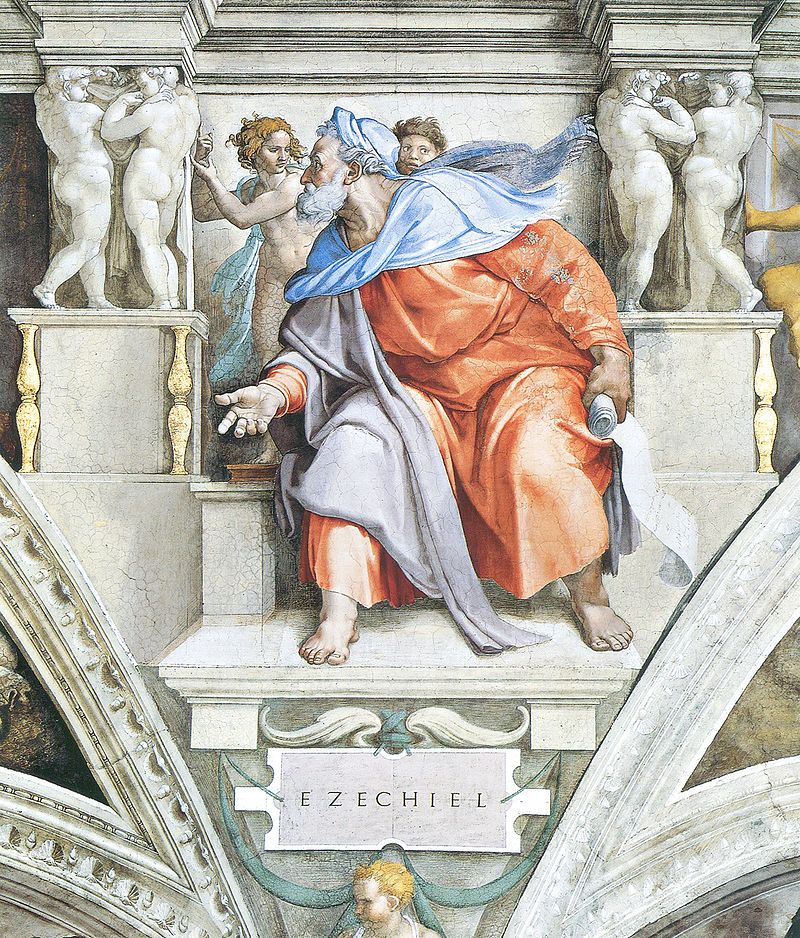
Michelangelo's Ezekiel on the Sistine Chapel
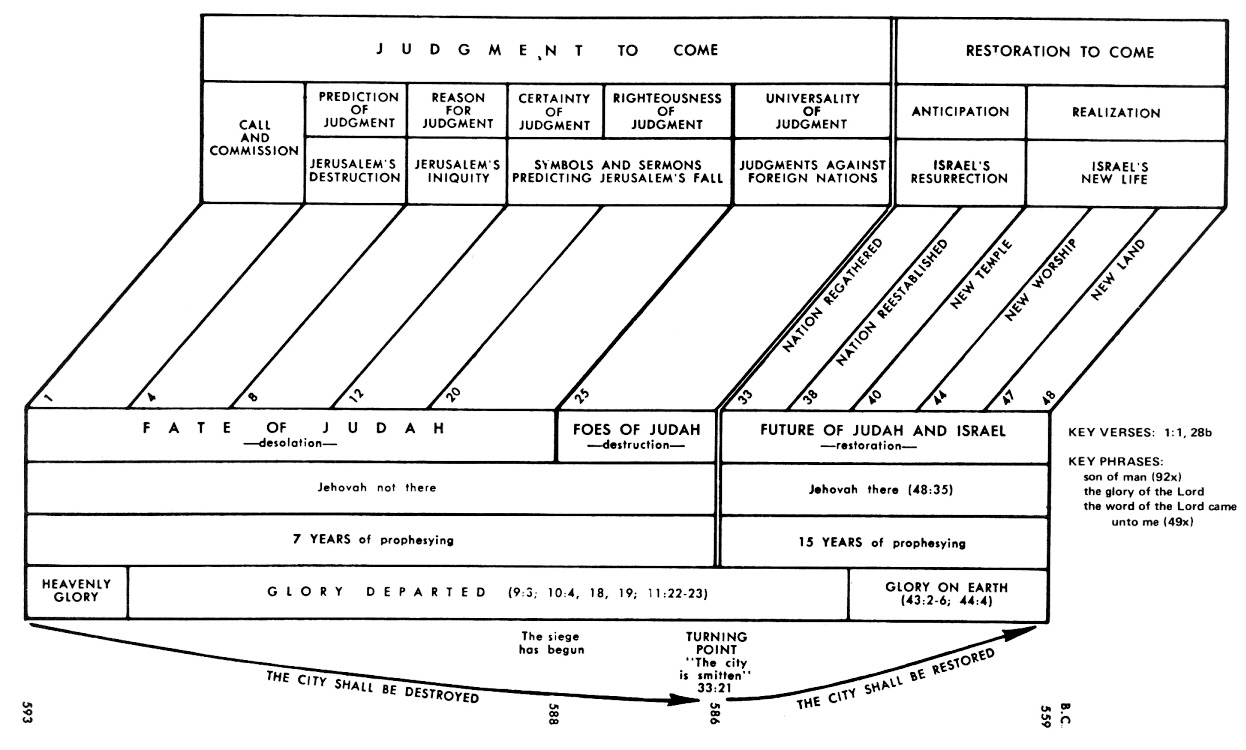
Click chart to enlarge
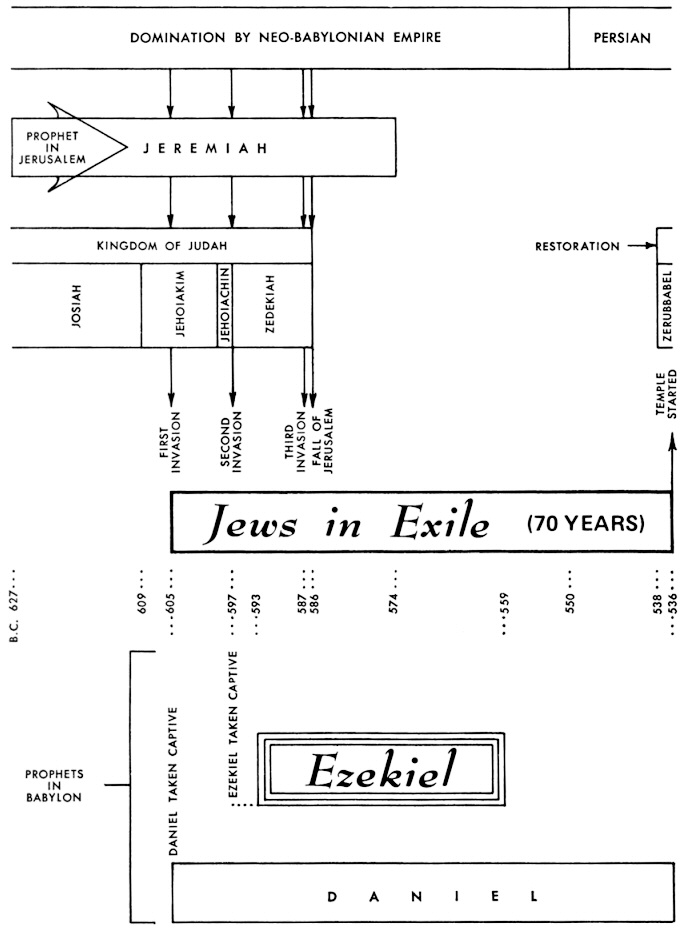
Click chart to enlarge
Chart from recommended resource Jensen's Survey of the OT - used by permission
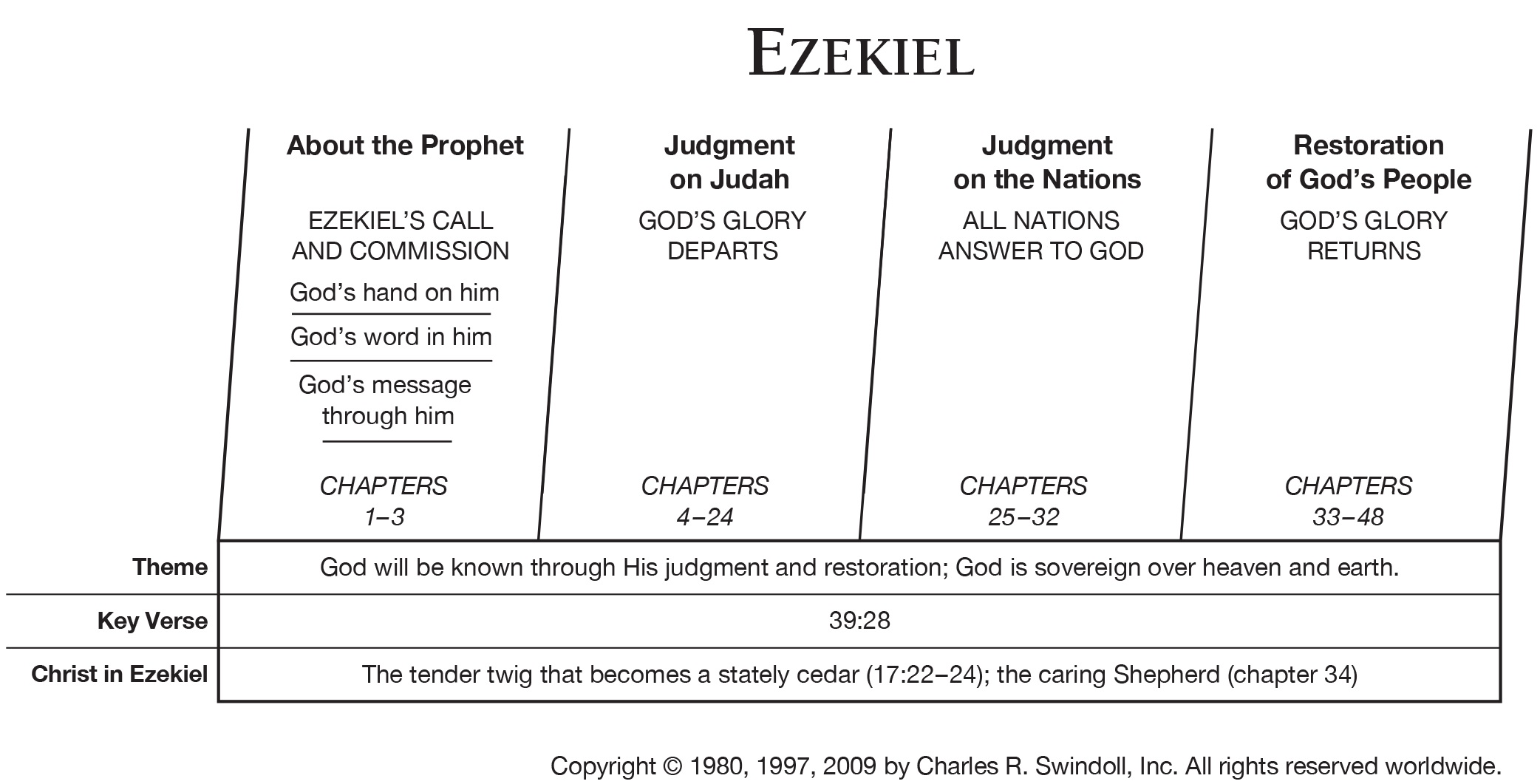
Click Chart from Charles Swindoll
|
PROPHECY OF |
PROPHECY OF |
|||
| FATE OF JUDAH Before the Siege |
FOES OF JUDAH During the Siege |
FUTURE OF JUDAH After the Siege |
||
|
593-588 BC |
587-586 |
586-571 |
||
|
7 YEARS |
15 YEARS |
|||
| Ezekiel 1:1-3:27 Ezekiel Sees the Glory & Receives the Call |
Ezekiel 4:1-24:27 Judgments Against Judah |
Ezekiel 25:1-32:32 Judgments Against the Gloating Nations |
Ezekiel 33:1-39:29 Restoration of Israel to the LORD |
Ezekiel 40:1-48:35 Visions of the Temple Jehovah Shammah |
Outline of the Book of Ezekiel from Dr John MacArthur - The book can be largely divided into sections about condemnation/retribution and then consolation/restoration. A more detailed look divides the book into 4 sections. First, are prophecies on the ruin of Jerusalem (Ezekiel 1:1–24:27). Second, are prophecies of retribution on nearby nations (Ezekiel 25:1–32:32), with a glimpse at God’s future restoration of Israel (Ezekiel 28:25,26). Thirdly, there is a transition chapter (Ezekiel 33:1-33) which gives instruction concerning a last call for Israel to repent. Finally, the fourth division includes rich expectations involving God’s future restoration of Israel (Ezekiel 34:1–48:35). (Reference)
I. Prophecies of Jerusalem’s Ruin (Ezekiel 1:1–24:27)
A. Preparation and Commission of Ezekiel (Ezekiel 1:1–3:27)
1. Divine appearance to Ezekiel (Ezekiel 1:1–28)|
2. Divine assignment to Ezekiel (Ezekiel 2:1–3:27)
B. Proclamation of Jerusalem’s Condemnation (Ezekiel 4:1–24:27)
1. Signs of coming judgment (Ezekiel 4:1–5:4)
2. Messages concerning judgment (Ezekiel 5:5–7:27)
3. Visions concerning abomination in the city and temple (Ezekiel 8:1–11:25)
4. Explanations of judgment (Ezekiel 12:1–24:27)
II. Prophecies of Retribution to the Nations (Ezekiel 25:1–32:32)
A. Ammon (Ezekiel 25:1–7)
B. Moab (Ezekiel 25:8–11)
C. Edom (Ezekiel 25:12–14)
D. Philistia (Ezekiel 25:15–17)
E. Tyre (Ezekiel 26:1–28:19)
F. Sidon (Ezekiel 28:20–24)
Excursus: The Restoration of Israel (Ezekiel 28:25, 26)
G. Egypt (Ezekiel 29:1–32:32)
III. Provision for Israel’s Repentance (Ezekiel 33:1–33)
IV. Prophecies of Israel’s Restoration (Ezekiel 34:1–48:35)
A. Regathering of Israel to the Land (Ezekiel 34:1–37:28)
1. Promise of a True Shepherd (Ezekiel 34:1–31)
2. Punishment of the nations (Ezekiel 35:1–36:7)
3. Purposes of restoration (Ezekiel 36:8–38)
4. Pictures of restoration—dry bones and two sticks (Ezekiel 37:1–28)
B. Removal of Israel’s Enemies from the Land (Ezekiel 38:1–39:29)
1. Invasion of Gog to plunder Israel (Ezekiel 38:1–16)
2. Intervention of God to protect Israel (Ezekiel 38:17–39:29)
C. Reinstatement of True Worship in Israel (Ezekiel 40:1–46:24)
1. New temple (Ezekiel 40:1–43:12)
2. New worship (Ezekiel 43:13–46:24)
D. Redistribution of the Land in Israel (Ezekiel 47:1–48:35)
1. Position of the river (Ezekiel 47:1–12)
2. Portions for the tribes (Ezekiel 47:13–48:35)
640 Josiah begins his reign in Judah (see 2Ki 22-23) Book of Law that had been lost in the house of God(!) was found King Josiah convicted by word of God in Book of Law Godly King Josiah abolishes idolatry & institutes sweeping reform Ezekiel was a young boy during this time of Josiah's reforms Tragically Josiah is killed in battle
609 Jehoahaz becomes king for 3 months (2Ki 23:30-34)
608 Jehoiakim follows as king of Judah (2Ki 23:34-24:19)
605 The first Jewish captives are taken to Babylon (Da 1:1-2) Daniel is among the captives in this group
598 Jehoiachin becomes king for 3 months (2Ki 24:17-25:7)
597 The second group of Jewish captives are taken to Babylon Ezekiel is in this group of 10,000 (2Ki 24:14) Jehoiachin taken into exile
597 Zedekiah, last king, begins reign in Judah (2Ki 24:6-25:30, 2Chr 36:11ff)
593 Ezekiel’s prophetic ministry begins at age 30 (Ezekiel 1:1)
The fifth year of Jehoiachin's exile (Ezekiel 1:2)
Events in chapters 1-7 take place during the first 14 months
592 September, 592 marks beginning of a series of visions (Ezekiel 8-11)
Visions include defilement of the Temple and departure of God's glory
These visions begin 14 mo after Ezekiel received his call
Ezekiel's prophecy consummated in departure of God's glory (Ez8-11)
588 Final siege of Jerusalem begins & lasts for 18 months (2Ki 25:1-2)
This fact helps understand the signs of siege & starvation in Ezek 4
586 Babylonians destroy Jerusalem and Temple (2Ki 25:2ff, 2Chr 36:17-21)
This represents the third and final Babylonian invasion
571 Ezekiel's ministry lasts for at least 22 years
First 7 years: He prophesied judgment
Last 15 years: He prophesied hope and restoration
Ezekiel 1:1 Now it came about in the thirtieth year, on the fifth day of the fourth month, while I was by the river Chebar among the exiles, the heavens were opened and I saw visions of God (NASB: Lockman)
NLT: On July 31 of my thirtieth year, while I was with the Judean exiles beside the Kebar River in Babylon, the heavens were opened to me, and I saw visions of God.
Young's Literal: And it cometh to pass, in the thirtieth year, in the fourth month, in the fifth of the month, and I am in the midst of the Removed by the river Chebar, the heavens have been opened, and I see visions of God.
- in the thirtieth: Nu 4:3 Lu 3:23
- while I was : Ec 9:1,2 Jer 24:5-7
- by the river Chebar: Eze 1:3 3:15,23 10:15,20,22 43:3
- the heavens: Mt 3:16 Lu 3:21 Joh 1:51 Ac 7:56 10:11 Rev 4:1 19:11
- I saw: Eze 8:3 11:24 Ge 15:1 46:2 Nu 12:6 Isa 1:1 Da 8:1,2 Ho 12:10 Joe 2:28 Mt 17:9 Ac 9:10-12 10:3 2Co 12:1
|
SIMPLE OUTLINE OF THE |
||
|
Ezekiel's Call |
1–3 |
Before the siege of Jerusalem |
|
God’s judgment on Jerusalem |
4–24 |
Before the siege of Jerusalem |
|
God’s judgment on the surrounding nations |
25–32 |
During the siege |
|
God’s restoration of the Jews in the kingdom, |
33–48. |
After the siege. |
INTRODUCTION TO EZEKIEL'S
FIRST VISION
The Word in Life Study Bible - Few assignments are more difficult than to proclaim God’s truth to the spiritually hard of heart—people who have departed from the Lord yet continue to practice the formalities of religion. Armed with tradition and resolute in their cynicism, they tend to resent the message and reject the messenger...Ezekiel is a model for modern-day messengers to those who are calloused toward God. It helps to know that a cool reception to the truth may be a vindication of one’s work, not a negation of it.
Allan McRae in a wonderful note that should encourage you to consider a serious study of this book, writes that "Ezekiel is one of the Bible’s most neglected books. This is because its full understanding requires an appreciation of the situation in which Ezekiel was involved (Ed note: see Timeline of Ezekiel on this website). Another reason for widespread avoidance of the Book of Ezekiel is the impression that its first chapter [Ezek. 1] gives of being extraordinarily symbolical and quite remote from normal human experience. A few people spend considerable time studying the last chapters of Ezekiel (Ed note: for instance, I found that almost 25% of the 130+ sermons on Ezekiel listed at Sermon Central were from Chapter 37!) and the marvelous prophecies of the distant future that these chapters contain, but many of them pay little attention to the first two-thirds of the book. If the key to Ezekiel’s first thirty chapters is firmly grasped, every Christian can derive much blessing from the study of the entire book." (from his article The Key to Ezekiel's First Thirty Chapters)
Warren Wiersbe gives a good summary of the background for Ezekiel's prophecy - In the year 606 B.C., the Babylonians began the first of several deportations of the Jews; Daniel was in this group. In the second group (597 B.C.) was young Ezekiel, then about twenty-five years old. He was taken to Tel-abib near the ship canal Chebar (Ezekiel 3:15). There he lived in his own house with his beloved wife (Ezekiel 8:1; 24:16ff). Five years after Ezekiel came to Tel-abib, he was called to be a prophet of God, when he was thirty years old (592 B.C.). This was six years before the destruction of Jerusalem in 586 B.C., so while Jeremiah was ministering to the people back home, Ezekiel was preaching to the Jews of the captivity in Babylon. Like Jeremiah, Ezekiel was a priest called to be a prophet. (See context in Wiersbe's Expository Outlines on the Old Testament or borrow a copy of Wiersbe's Expository Outlines on the Old Testament)
In his comment Wiersbe adds "It was a dark day for Israel, and the first thing Ezekiel needed to understand was that, no matter how discouraging the circumstances, God was still on the throne accomplishing His divine purposes in the world. There are many unexplained mysteries in the vision Ezekiel had, but one message comes through with clarity and power: Jehovah is the sovereign Lord of Israel and of all the nations of the earth." (See context in The Bible Exposition Commentary)
Ezekiel's name means God Strengthens and from the summary of the symbolic acts Yahweh called His prophet to carry out (below) one can readily understand why he had this name. There is no way a mere human being could carry out these symbolic acts in his or her own power. We are reminded of the words to Zechariah "‘Not by might nor by power, but by My Spirit,’ says the LORD of hosts." (Zechariah 4:6)
THOUGHT - There is no way a follower of Christ can live a supernatural live relying on their innate human strength. The only way possible is by daily learning to lean fully on the Holy Spirit of Jesus Christ and walking in His supernatural power! (cf Eph 5:18+, Gal 5:16+, Php 2:13NLT+).
Summary of the Symbolic Acts of Ezekiel - Purpose = to get the attention of the exiles!
- Play at war (Ezekiel 4:1–3)
- Lie on his side a certain number of days (Ezekiel 4:4–17)
- Shave his hair and beard (Ezekiel 5:1–4)
- Act like someone fleeing from war (Ezekiel 12:1–16)
- Sit and sigh (Ezekiel 21:1–7)
- Have his wife die (Ezekiel 24:15–27)
Now it came about in the thirtieth year, on the fifth day of the fourth month : Note that the date of this vision is stated in two ways (v1 & v2), which emphasizes Ezekiel's careful attention to chronological detail. Remember that Ezekiel's prophecy is generally given chronologically, making it easier to follow then for example Jeremiah in which the chapters are not in strict chronological order.
NET NOTE - The meaning of the thirtieth year is problematic. Some take it to mean the age of Ezekiel when he prophesied (e.g., Origen). The Aramaic Targum explains the thirtieth year as the thirtieth year dated from the recovery of the book of the Torah in the temple in Jerusalem (2 Kgs 22:3–9). The number seems somehow to be equated with the fifth year of Jehoiachin’s exile in 1:2, i.e., 593 B.C.
Jeremiah had been prophesying for approximately 35 years and Daniel for approximately 9 years when Ezekiel began his ministry. Note from the Timeline (click) that Ezekiel had been taken into exile into Babylon during the second invasion of Jerusalem by Nebuchadnezzar in 597 BC (see 2Ki 24:14) and was about twenty-five years of age. From Numbers 4:3 (cf Nu 4:23 4:30 4:39 4:43 1Chr 23:3) we know that Jewish priests begin their ministry at age 30, which supports the time reference of "30th year" as a reference to Ezekiel's 30th birthday. Luke records that the greater Son of Man likewise "was about thirty years of age"..."when He began His ministry." (Lu 3:23).
God's plan for Ezekiel in this 30th year would radically change the course of his life. Solomon records that "the mind of man plans his way, but the LORD directs his steps" (Pr 16:9) -- it is one thing to know this truth and quite another thing to walk out in complete confidence in that truth and to do so all the days of one's life as Ezekiel did. You might be able to identify with Ezekiel. Even as Ezekiel thought he was being prepared for the priesthood, you may have felt you were being prepared for a certain course in your life, only to have those plans radically altered by unexpected circumstances which God allowed or sent. Jehovah is also El Elyon, the Most High God and as such He is in absolute sovereign control of all the events of our life. He is the Potter and we are but clay. As believers we must remember that our "body is a temple of the Holy Spirit Who is in (us), Whom (we) have from God, and that (we) are not (our) own" but that we "have been bought with a price" and we should seek to "therefore glorify God in (our) body" (1Cor 6:19 20) regardless of what God calls us to do. Ezekiel may have been looking forward to the prestige of a priest even in exile, but is now called to be God's prophet to the exiles. Note that Ezekiel's prophetic ministry begins not with serving, but with seeing God’s glory. This is God’s pattern in preparing a man or woman -- knowing always precedes doing – seeing comes before serving – worship comes before work. Before Ezekiel is given a ministry for God, He’s given a vision of God. God has a ministry for every believer (cf 1Pe 4:10). Be patient. First catch a vision of God and His glory! You'll never be the same and your ministry for His Name will be transformed forever as was Ezekiel's.
Over 20 years later Ezekiel still remembered this encounter as he described the vision in Chapter 40 as
like the appearance of the vision which I saw, like the vision which I saw when He came to destroy the city. And the visions were like the vision which I saw by the river Chebar; and I fell on my face. (Ezek 40:3)
Ezekiel is one of the most often slighted books in Scripture and is undoubtedly the most neglected prophetic book. When was the last time you read Ezekiel "cover to cover"?. How will you feel one day in eternity, when you bump into Ezekiel, and he says “Hello brother, how did you like my book?” It is surprising that a book as exciting as Ezekiel is as neglected as it is. Whereas Jeremiah saw through sobbing eyes, Ezekiel saw through surreal eyes, eyes of a visionary and a biblical mystic who possessed a spiritually-sensitive, other-worldly focus. Pray and read and then pause and ponder so that you can practice and apply the truths found in this great book. Then you will come to experience in a real way the repeated promise God gave in Ezekiel: You will know that I am the LORD and when we all come to take our last breath, isn't this the most glorious, rewarding and fulfilling experience we could ever have! Jesus said
And this is eternal life, that they may know (by personal, intimate experience) Thee, the Only True God and Jesus Christ Whom Thou hast sent. (Jn 17:3)
Ralph Alexander notes that "Few books of the Bible use such a wide variety of literary forms as does Ezekiel. Though most of the book is prose, some of it is poetry. Ezekiel uses almost every kind of literary device and imagery to communicate graphically the messages of judgment and blessing: dream-visions (Ezekiel 1-3; 8-11); apocalyptic literature (Ezek 37:1-14; 40-48); drama (Ezek 4-5; 12); allegory, parable, proverbs (Ezek 16:44; 18:2); and funeral dirges (Ezek 1:19; 26-28; 32). The frequent rhetorical questions and repetitious phrases enhance the vitality and thrust of the oracles. (See context in Ezekiel in Expositor's Bible Commentary)
while I was by the river Chebar: Ezekiel received this vision in a region now occupied by the modern nation of Iraq. The River Chebar is mentioned in Babylonian texts (referred to as "nar Kabaru") from the city of Nippur in the fifth century BC and was apparently a canal which provided artificial irrigation from the Euphrates. The River Chebar is mentioned 8 times in Scripture, all in Ezekiel (see below). The Chebar River flowed from the Euphrates River, south of the city of Babylon, where the Jewish exiles gathered for prayer. Ezekiel's ministry was among the exiles whereas Daniel's ministry was among the ruling powers and Jeremiah's among the Jews in Judah.
Keep in mind the historical context which will help understand Ezekiel's messages -- The year is 593 BC, indicating that five years had passed since invaders from Babylon had entered Jerusalem and taken Ezekiel and a group of 10,000 of his fellow Israelites captive. The final Babylonian destruction of Jerusalem in 586 BC was still 7 years away as he receives his prophetic call from God. In Babylon, the Jewish prisoners of war had been treated surprisingly well. They were given decent housing and a good deal of freedom. They were allowed to practice their trades and to work the fertile fields allocated to them. All was not well, however. Many of the captives were not satisfied with a comfortable existence in a pagan land. They longed for the temple in Jerusalem and wondered why their God remained silent and unresponsive to their needs.
Chebar - 8v - Ezek. 1:1; Ezek. 1:3; Ezek. 3:15; Ezek. 3:23; Ezek. 10:15; Ezek. 10:20; Ezek. 10:22; Ezek. 43:3
NET NOTE - The Kebar River is mentioned in Babylonian texts from the city of Nippur in the fifth century B.C. It provided artificial irrigation from the Euphrates.
Chebar [EBD] length, a river in the "land of the Chaldeans" (Ezek. 1:3), on the banks of which were located some of the Jews of the Captivity (Ezek. 1:1; 3:15, 23; 10:15, 20, 22). It has been supposed to be identical with the river Habor, the Chaboras, or modern Khabour, which falls into the Euphrates at Circesium. To the banks of this river some of the Israelites were removed by the Assyrians (2 Kings 17:6). An opinion that has much to support it is that the "Chebar" was the royal canal of Nebuchadnezzar, the Nahr Malcha, the greatest in Mesopotamia, which connected the Tigris with the Euphrates, in the excavation of which the Jewish captives were probably employed.
CHEBAR [ISBE] - ke'-bar (kebhar, "joining" (Young), "length" (Strong); Chobar): The river by the side of which his first vision was vouchsafed to Ezekiel (1:1). It is described as in "the land of the Chaldeans," and is not, therefore, to be sought in northern Mesopotamia. This rules out the Habor, the modern Chabour, with which it is often identified. The two names are radically distinct: chabhor could not be derived from kebhar. One of the great Babylonian canals is doubtless intended. Hilprecht found mention made of (naru) kabaru, one of these canals large enough to be navigable, to the East of Nippur, "in the land of the Chaldeans." This "great canal" he identifies with the rood. shaTT en-Nil, in which probably we should recognize the ancient Chebar. W. Ewing
among the exiles, : in the midst of captivity (Amp) Don't miss this word the word among -- Where was Ezekiel? Not off to the side in a "holy huddle" but right in the middle (the Greek word mesos which is the word the Septuagint uses to translate the Hebrew and which means "in the middle") of all the other sinners, a good place to be if you are going to speak to them about your God. Where are you located? At work, in your neighborhood, etc, do you make a point to fraternize with the brethren to the exclusion of the pagans?
NET NOTE on exiles - The Assyrians started the tactic of deportation, the large-scale forced displacement of conquered populations, in order to stifle rebellions. The task of uniting groups of deportees, gaining freedom from one’s overlords and returning to retake one’s own country would be considerably more complicated than living in one’s homeland and waiting for an opportune moment to drive out the enemy’s soldiers. The Babylonians adopted this practice also, after defeating the Assyrians. The Babylonians deported Judeans on three occasions. The practice of deportation was reversed by the Persian conquerors of Babylon, who gained favor from their subjects for allowing them to return to their homeland and, as polytheists, sought the favor of the gods of the various countries which had come under their control.
As Cooper writes "Ezekiel had a unique consciousness about his role and relationship with those to whom he was to minister. He saw himself as a prophet “in the midst” of a time, place, and people who desperately needed a word from Yahweh. Ezekiel used the Hebrew word betôk, translated “among” and “in the midst,” 116 times, substantially more than any other Old Testament book and more than all others combined.
Both the Assyrians and the Babylonians had a policy of deporting large populations of conquered enemies. The Babylonian practice of settling the exiles in self-contained villages is demonstrated in extra-Biblical texts from the region of Nippur. While it was a traumatic event for the people of Judah, they were encouraged to settle into their new situation (Jer 29:4–23) and many followed this advice too well and became so comfortable in Babylon that they choose to remain there even though being freed by King Cyrus to return and rebuild their Temple. Ezra characterized those who choose to return as those "whose spirit God had stirred to go up and rebuild the house of the LORD which is in Jerusalem." (Ezra 1:5)
the heavens were opened - This description was also associated with the inauguration of the ministry of the Son of Man, Luke recording that "Jesus...was baptized and while He was praying, heaven was opened." (Lu 3:21+) and will also mark His triumphant return at the end of this age and the Great Tribulation (Mt 24:21+) when the heavens will be "opened" revealing the Son of Man as the King of kings "Faithful and True"...the One Who "in righteousness...judges and wages war." (Rev 19:11+) The difference is that God was speaking to Ezekiel while Jesus, the God-Man, was speaking to His Father.
NET NOTE- For the concept of the heavens opened in later literature, see 3 Macc 6:18; 2 Bar. 22:1; T. Levi 5:1; Matt 3:16; Acts 7:56; Rev 19:11.
and I saw visions of God: Visions of God here includes visions given by God and visions in which God was seen and is always in the plural and always with the word "God" (not "LORD"). This exact phrase "Visions of God" occurs only three times in the NASB, all in Ezekiel` this verse, Ezekiel 8:3 and Ezekiel 40:2 and its occurrence is a marker in a sense, as it divides Ezekiel's prophecy into three sections. Saul of Tarsus had a somewhat similar life changing encounter
as he journeyed...approaching Damascus and suddenly a light from heaven flashed around him and he fell to the ground, and heard a voice saying to him, "Saul, Saul, why are you persecuting Me?" Like Ezekiel, Saul of Tarsus' was never the same after that encounter. (see Acts 9:3-6, 15, 16, 20+)
John MacArthur observes that "This scene has similarities to the visions of God’s throne in Rev 4 , Rev 5 where the emphasis is also on a glimpse of that throne just before judgment is released in Rev 6-19." (See context in The MacArthur Bible Commentary)
To sum up the guidelines in simple terms, don’t focus on the details of Ezekiel’s vision, but on the overall impression it conveys.
Larry Richards adds that although "Some people have become bogged down seeking to explain the details of Ezekiel’s vision, and artists have even toiled to portray them...the best way to sense the reality Ezekiel portrays is to read the chapter quickly, opening ourselves to receive an impression of the awe-inspiring majesty of our God." (The Bible Reader's Companion)
Ray Stedman adds that "The story of this book is the story of human life and the book begins with a tremendous vision of God, because all life starts with God. God is the greatest fact in existence, in history. If you are going to think about anything, you have to start somewhere. Anyone who wants to think logically about life must always begin with God. That is where the Bible begins. "In the beginning God created the heavens and the earth." This book of Ezekiel begins, then, with a mystic vision of God. The glory of the prophet Ezekiel was that he saw God more clearly than any of the other prophets. If your heart needs to be set on fire by the revelation of the character and glory of God, read Ezekiel. He is the great prophet who saw the glory of God." (See Ezekiel: Wheel, Bones, and Restoration)
Ezekiel begins with a vision and then the call similar to the prophet Isaiah’s call in Isaiah chapter 6. Like Isaiah, Ezekiel’s vision reveals the character of God. Isaiah saw God seated on a throne, high and exalted and as this chapter describes Ezekiel saw God seated on a throne high above.
C. H. Spurgeon makes an interesting comment in his introduction to the sermon on Jehovah-Shammah (Ezek 48:35)
The prophet Ezekiel has been telling us many remarkable things which I shall not attempt to explain to you; and my chief reason for not doing so is the fact that I do not understand them.
And so we too must approach this great book with humility and the realization that
now we see in a mirror dimly, but then face to face; now I know in part, but then (we) shall know fully just as (we) also have been fully known." (1Cor 13:12+).
We must continually remain in total dependence upon the Spirit's teaching (1Jn 2:27) for "we have received, not the spirit of the world, but the Spirit who is from God, that we might know the things freely given to us by God" (1Cor 2:12+)
As New Testament saints we must remember that
these things (taught in the Old Testament, click verse at end of this quote to read the immediate context) happened as examples for us, that we should not crave evil things, as they also craved." (1Cor 10:6+)
Paul reiterates to the Corinthians and to us that
these things (click on the passage at the end of this verse to read what "these things" refers to in context) happened to them as an example (Gk = tupos = English "type"), and they were written for our instruction (NIV = warnings, NKJV=admonition), upon whom the ends of the ages have come." (1Cor 10:11+)
THOUGHT - The children of Israel and the facts of their history are shadows for believers today, because we will be conformed to the seductive world system if we do not exercise caution (Ro 12:2+). We may lose our effectiveness as ambassadors for Christ, because the world cannot see any (supernatural) difference in our lives. Therefore, the great book of Ezekiel stands as a stern warning to all who would toy with the "deceitfulness of sin" (Hebrews 3:13 - see Deceitfulness of Sin) or would "love the world (and) the things in the world." (1Jn 2:15+). "Do not be deceived (GWT = make no mistake about this, NLT = don't be misled), God is not mocked; for whatever a man sows, this he will also reap." (Gal 6:7+)
On the positive side Paul adds that
whatever was written in earlier times was written for our instruction (NIV = to teach us), that through perseverance and the encouragement of the Scriptures we might have hope." (see note Romans 15:4+)
Indeed the message of Ezekiel begins with warnings of judgment but ends with promises of hope and restoration. In the midst of wrath our loving God always remembers mercy. Have you thanked Him for His undeserved mercy lately?
Scofield divides Ezekiel into "seven great prophetic strains indicated by the expression, "The hand of the Lord was upon me." (Ezek 1:3; 3:14,22; 8:1; 33:22; 37:1; Ezek 40:1)
It should be noted that the verse by verse notes on this website reflect a literal, historical interpretation of Ezekiel's prophecy. Even well respected sources like the New Bible Dictionary have statements like the following
"Considerable controversy exists as to how Ezekiel’s symbolic actions are to be interpreted. Some, e.g. A. B. Davidson, Ezekiel (Cambridge Bible for Schools & Colleges), page 30), and J. Skinner, (Hastings Dictionary of the Bible, page 817) have held they took place purely in the prophet’s mind (ED: THEY ARE CATEGORICALLY WRONG!). More usual is the conception that, though they were carried out, in our understanding of them we must allow for a metaphorical element inconsistent with a purely literal interpretation." (ED: )
Read the Bible Literally unless it is clearly figurative but even figurative still has a literal meaning and cannot be left to our imagination to arrive at an interpretation! Although I think a literal interpretation is the correct approach to interpretation of Ezekiel, clearly some passages are difficult to interpret. Where the plain sense makes good sense, we should not attempt to make any other sense or it potentially will be "nonsense". We must be especially on guard against allegorical interpretation which usually lead one far afield of the intended meaning of the text! See The Rise of Allegorical Interpretation.
CULTURAL/SPIRITUAL CONTEXT OF ISRAEL IN CAPTIVITY - The Psalmist gives us a description of the spiritual condition of the Jews captive in Babylon, the audience to whom Ezekiel was sent. Understanding their spiritual state helps understand the ministry of Ezekiel...
Psalms 137
1 By the rivers of Babylon, There we sat down and wept, When we remembered Zion.
2 Upon the willows in the midst of it We hung our harps.
3 For there our captors demanded of us songs, And our tormentors mirth, saying, “Sing us one of the songs of Zion.”
4 How can we sing the LORD’S song In a foreign land?
5 If I forget you, O Jerusalem, May my right hand forget her skill.
6 May my tongue cling to the roof of my mouth If I do not remember you, If I do not exalt Jerusalem Above my chief joy.
7 Remember, O LORD, against the sons of Edom The day of Jerusalem, Who said, “Raze it, raze it To its very foundation.”
8 O daughter of Babylon, you devastated one, How blessed will be the one who repays you With the recompense with which you have repaid us.
9 How blessed will be the one who seizes and dashes your little ones Against the rock.Warren Wiersbe explains that "Jeremiah had told them to settle down in Babylon for seventy years, but the false prophets told the people that God would destroy Babylon and set the captives free (read Jer. 28–29). It was Ezekiel’s task to tell the people that God would destroy Jerusalem, not Babylon, but that there would one day be a glorious restoration of the people and a rebuilding of the temple. (See context in Wiersbe's Expository Outlines on the Old Testament or borrow Wiersbe's Expository Outlines on the Old Testament- excellent insights to help your preaching OT passages!)
GUIDELINES FOR INTERPRETATION OF VISIONS
1. Seek to understand the major idea presented through the vision and do not dwell on minutiae. This guideline is underscored in the second principle.
2. Follow the divine interpretations normally accompanying the visions. These divine interpretations concentrate on the overall concept rather than on details. (In Ezekiel's first vision, this divine interpretation is stated in 1:28 - God and His glory.)
3. Be keenly aware of parallel passages and the harmony of Scripture, since the prophets normally sought to apply past revelations of God to their contemporary situations. The general prophetic message among the prophets is essentially the same.
4. Use the same approach with the symbols and imagery of visionary literature as used with figurative language. Thus symbols and imagery are properly understood as figures and are not to be taken literally. (from Expositor's Bible Commentary and http://www.path-light.com/Ezekiel02b.htm)
Ezekiel 1:2 On the fifth of the month in the fifth year of King Jehoiachin's exile, (NASB: Lockman)
- Ezek 8:1; 20:1; 29:1 29:17; 31:1; 40:1; 2 Ki 24:12-15
|
Timeline of |
||||||||
| 640 | 630 | 620 | 610 | 600 | 590 | 580 | 570 | |
| Kings of Judah | ||||||||
|
(2) Jehoahaz - 3 mo 609bc |
(4)Jehoiachin -- 3 mo 598bc |
|||||||
|
(1) Josiah |
^ ^ ^ |
(3) Jehoiakim |
^ ^ ^ |
(5) Zedekiah |
|
Kings of Babylon |
||
|
Nabopolassar |
Nebuchadnezzar |
|
On the fifth of the month in the fifth year of King Jehoiachin's exile - This is clearly a very specific date on which this incredible vision took place. It was a real day and it was a real vision. Ezekiel was the first prophet to date his messages chronologically.
Ralph Alexander - "The book is not only developed logically but is also arranged chronologically. The pivotal point historically and chronologically is the Fall of Jerusalem in 586 B.C. The messages contained in chapters 1–24 are all dated prior to the Fall of Jerusalem, preparing the exiles for the judgment that was to come on Jerusalem. Once that judgment had come, as described in chapter 24, Ezekiel turned his attention to judgment on the nations. These messages (chs. 25–33) were given during and following the siege of Jerusalem, in 586–585 B.C. One exception is the message in 29:17–30:19, included in this chronological section because of its logical relationship to the judgment on the foreign nations (cf. commentary at 29:17–30:19). Then 33:21–39:29 was delivered on the night before the fugitive arrived in Babylon to tell the exiles that Jerusalem had fallen (Dec./Jan. 586/585 B.C.). These messages encouraged the exiles when that news came. Fourteen years later, the final section of the prophecy in chapters 40–48 was delivered, culminating the logical development of the book. (See context in Ezekiel in the Expositor's Bible Commentary)
In 597 BC Nebuchadnezzar (see Timeline of Last Five Kings of Judah above)
led Jehoiachin away into exile to Babylon; also the king's mother and the king's wives and his officials and the leading men of the land, he led away into exile from Jerusalem to Babylon." (2 Ki 24:15)
Therefore Ezekiel's reference would be 593 BC, the date of the beginning of Ezekiel's prophecy. The last date that he mentions in the book are the “twenty-seventh year” (Ezek 29:17) undoubtedly referring to the length of captivity”. Ezekiel thus prophesied almost 22 years among the captives or until about 571-2 BC. For the first 7 years he prophesied coming judgment and the last 15 years he foretold of God's promise of the blessed hope of a literal national restoration of Israel and Judah.
Jehoiachin means "Yahweh will uphold" and his name can be confusing to trace in Scripture because he is also called also "Jeconiah" (1Chr 3:16 Jer 24:1) meaning "Yahweh will be steadfast," and "Coniah" (Jer 22:24,28) meaning "Yahweh has upheld him". Jehoiachin was the next to last king of Judah (Zedekiah being the last) having succeeded his father Jehoiakim. Jehoiachin reigned only three months before surrendering to Nebuchadnezzar and being carried off to Babylonian exile. The story of Jehoiachin's reign is told in 2 Ki 24:8-16 and 2Chr 36:9-10. In the first year of the reign of Nebuchadnezzar's successor, a strange thing occurred. Scripture records that
it came about in the thirty-seventh year of the exile of Jehoiachin king of Judah, in the twelfth month, on the twenty-seventh day of the month, that Evil-merodach king of Babylon, in the year that he became king, released Jehoiachin king of Judah from prison and he spoke kindly to him and set his throne above the throne of the kings who were with him in Babylon. And Jehoiachin changed his prison clothes, and had his meals in the king's presence regularly all the days of his life and for his allowance, a regular allowance was given him by the king, a portion for each day, all the days of his life." (2 Ki 25:27-30; cf Jer 52:31-34).
The IVP Bible Background Commentary - Babylonian ration lists include mention of quantities of oil being supplied to the “king of Judah” along with other high-ranking prisoners of war and dependents of the royal household. Eventually, in 561 BC, during the reign of Nebuchadnezzar’s successor, Amel-Marduk (the biblical Evil-Merodach), Jehoiachin was freed from his imprisonment (probably house arrest) and allowed the freedom of the king’s court. He died in exile, bringing an official end to the Judean monarchy." (See context in The IVP Bible Background Commentary: Old Testament)
|
The Fourteen Specific Dates in Ezekiel |
||||
|
Verse |
Year |
Month |
Day |
Event |
|
30/5 |
4 |
5 |
Vision of throne chariot/Glory of the Lord |
|
|
[5]* |
[4]* |
[12]* |
Called to be Watchman @ end of 7 days |
|
|
6 |
6 |
5 |
Visions of Temple (spans chap 8-11) |
|
|
7 |
5 |
10 |
Historical discourse |
|
|
9 |
10 |
10 |
Day of Babylonian Siege of Jerusalem |
|
|
11 |
|
1 |
Judgment against Tyre |
|
|
10 |
10 |
12 |
Judgment against Pharaoh |
|
|
27 |
1 |
|
Judgment against Egypt |
|
|
11 |
1 |
7 |
Judgment against Pharaoh |
|
|
11 |
3 |
1 |
Judgment against Pharaoh |
|
|
12 |
12 |
1 |
Lament over Pharaoh |
|
|
12 |
|
15 |
Lament over Egypt |
|
|
12 |
10 |
5 |
Jerusalem fallen |
|
|
25** |
"beginning of year" |
10 |
Vision of the Millennial Temple |
|
|
* [ ] Information is implied ** "the fourteenth year after the city was taken" |
||||
Ezekiel 1:3 the word of the LORD came expressly to Ezekiel the priest, son of Buzi, in the land of the Chaldeans by the river Chebar; and there the hand of the LORD came upon him.) (NASB: Lockman)
GWT: the LORD spoke his word to the priest Ezekiel, son of Buzi, in Babylon by the Chebar River. The power of the LORD came over Ezekiel.
- word: Jer 1:2,4 Ho 1:1 Joe 1:1 1Ti 4:1
- and there the hand of the LORD: Eze 3:14,22 8:1 33:22 37:1 40:1 1Ki 18:46 2Ki 3:15
THE WORD OF THE LORD AND
THE HAND OF THE LORD
the word of the LORD came expressly to Ezekiel the priest, son of Buzi, in the land of the Chaldeans by the river Chebar Families had been torn apart, and Jerusalem lay hundreds of miles away (SEE PSALM 137 ABOVE). God’s people remained rebellious and hard-hearted. These “extraordinary times called for an extraordinary man”, specifically for God's man Ezekiel (Yechezqe'l from chazaq = strengthen, harden + 'el = God) which means "May God strengthen" (a prayer) or "God will strengthen" ("God strengthens"). (a statement of fact). Ezekiel's name is found only three times - here, in Ezekiel 24:24 and in 1Chr 24:16 where it is translated "Jechezkel" the name of the head of one of the priestly orders. Ezekiel’s name is the same as Hezekiah’s, except that God’s name in “Ezekiel” is -el, while in “Hezekiah” it ends in -iah, the abbreviation of Yahweh or Jehovah and thus means "Jehovah is my strength".
Warren Wiersbe explains that "The phrase “The Word of the Lord came” is used nearly fifty times in this book. How wonderful to know that God’s Word is never far from God’s people if they will only listen. John heard the Word when an exile on Patmos (Rev. 1:9ff), and Paul received the Word when in prison.(See context in Wiersbe's Expository Outlines on the Old Testament or borrow Wiersbe's Expository Outlines on the Old Testament - excellent insights to help your preaching OT passages!)
The word of the Lord brings enlightenment and the hand of the Lord enablement
-- Wiersbe
Word of the LORD in Ezekiel - Ezek. 1:3; Ezek. 3:16; Ezek. 6:1; Ezek. 6:3; Ezek. 7:1; Ezek. 11:14; Ezek. 12:1; Ezek. 12:8; Ezek. 12:17; Ezek. 12:21; Ezek. 12:26; Ezek. 13:1; Ezek. 13:2; Ezek. 14:2; Ezek. 14:12; Ezek. 15:1; Ezek. 16:1; Ezek. 16:35; Ezek. 17:1; Ezek. 17:11; Ezek. 18:1; Ezek. 20:2; Ezek. 20:45; Ezek. 20:47; Ezek. 21:1; Ezek. 21:8; Ezek. 21:18; Ezek. 22:1; Ezek. 22:17; Ezek. 22:23; Ezek. 23:1; Ezek. 24:1; Ezek. 24:15; Ezek. 24:20; Ezek. 25:1; Ezek. 25:3; Ezek. 26:1; Ezek. 27:1; Ezek. 28:1; Ezek. 28:11; Ezek. 28:20; Ezek. 29:1; Ezek. 29:17; Ezek. 30:1; Ezek. 30:20; Ezek. 31:1; Ezek. 32:1; Ezek. 32:17; Ezek. 33:1; Ezek. 33:23; Ezek. 34:1; Ezek. 34:7; Ezek. 34:9; Ezek. 35:1; Ezek. 36:1; Ezek. 36:4; Ezek. 36:16; Ezek. 37:4; Ezek. 37:15; Ezek. 38:1
Ezekiel was married to a woman who was “the desire" (precious & valued) of his eyes (Ezek 24:16) this Hebrew phrase being more literally the "treasure of the eye" with a focus on the loveliness and desirability his spouse.
THOUGHT - Husbands, is your spouse the "treasure of your eye"?. It follows that one of the saddest personal events was the death of his beloved.
Ezekiel had been in captivity for five years when his call came from God. Priests normally began their ministry at the age of thirty (Nu 4:3+), which was Ezekiel's current age (Ezek 1:1). The priest became a prophet. Other prophets with a priestly background include Samuel (1Sa 7:9 ; 11:14 ; 16:2), Jeremiah (Jer 1:1) and Zechariah (Zech 1:7 ; Neh 12:4 , 16). As a priest Ezekiel would have been well acquainted with the Mosaic covenant and the priestly functions of the temple, various aspects of which permeate his messages of both judgment and restoration. Ezekiel was able to describe clearly the glory of God in the temple and the temple functions. He also was prepared to evaluate accurately the rebellion of his people against the explicit commands of the law, which was the basis for the Lord's judgments that Ezekiel announced. Finally, this priestly background enabled Ezekiel to understand the temple vision concluding the prophecy.
Concerning son of Buzi nothing else is known of his father Buzi though as Ezekiel's father he would also have been a priest. The Jewish tradition that Buzi was Jeremiah must be firmly rejected, being based on an unwarranted supposition and fanciful etymology.
Land of the Chaldeans is simply another name for Babylon. "Chaldeans" were an Aramaic people group who won their independence from the Assyrians in 625 BC. Chaldeans were so called until the time of Judea's exile to Babylon (2Ki 25; Isa 13:19; 23:13), when, especially in the Book of Daniel (Da 5:30; 9:1), the name began to be used with special reference to a class of learned men ranked with the magicians and astronomers.
CHALDEANS, OR CHALDEES [SMITH] It appears that the Chaldeans (Kaldai or Kaldi) were in the earliest times merely one out of many Cushite tribes inhabiting the great alluvial plain known afterwards as Chaldea or Babylonia. Their special seat was probably that southern portion of the country which is found to have so late retained the name of Chaldea. In process of time, as the Kaldi grew in power, their name gradually prevailed over those of the other tribes inhabiting the country; and by the era of the Jewish captivity it had begun to be used generally for all the inhabitants of Babylonia. It appears that while, both in Assyria and in later Babylonia, the Shemitic type of speech prevailed for civil purposes, the ancient Cushite dialect was retained, as a learned language for scientific and religious literature. This is no doubt the "learning" and the "tongue" to which reference it made in the book of Daniel, (Daniel 1:4) The Chaldeans were really the learned class; they were priests, magicians or astronomers, and in the last of the three capacities they probably effected discoveries of great importance. In later times they seem to have degenerated into mere fortune-tellers.
NET NOTE on Chaldeans - Heb “Chaldeans.” The name of the tribal group ruling Babylon, “Chaldeans” is used as metonymy for the whole empire of Babylon. The Babylonians worked with the Medes to destroy the Assyrian Empire near the end of the 7th century B.C. Then, over the next century, the Babylonians dominated the West Semitic states (such as Phoenicia, Aram, Moab, Edom, and Judah in the modern countries of Syria, Lebanon, Jordan, and Israel) and made incursions into Egypt.
and there the hand of the LORD came upon him: "There he felt the power of the Lord." (ICB) I felt the hand of the LORD take hold of me (NLT) There he felt the power of the LORD" (NCV) and I felt his power (TEV) In context, this is clearly the "good" hand of the LORD, which gave him supernatural power and supernatural (inspired) speech as God's prophet (2Pe 1:21+) to the exiled rebels, the unfaithful wife of Jehovah.
Hand of the LORD - 37 times in the Bible - note 2x in NT - Exod. 9:3; Deut. 2:15; Jos. 4:24; Jos. 22:31; Jdg. 2:15; Ruth 1:13; 1 Sam. 5:6; 1 Sam. 5:9; 1 Sam. 7:13; 1 Sam. 12:15; 2 Sam. 24:14; 1 Ki. 18:46; 2 Ki. 3:15; 1 Chr. 21:13; Ezr. 7:6; Ezr. 7:28; Job 12:9; Ps. 75:8; Ps. 118:15; Ps. 118:16; Prov. 21:1; Isa. 19:16; Isa. 25:10; Isa. 41:20; Isa. 62:3; Isa. 66:14; Jer. 51:7; Ezek. 1:3; Ezek. 3:14; Ezek. 3:22; Ezek. 8:1; Ezek. 33:22; Ezek. 37:1; Ezek. 40:1; Lk. 1:66; Acts 11:21; Acts 13:11
NET NOTE- Hand in the OT can refer metaphorically to power, authority, or influence. In Ezekiel God’s “hand” being on the prophet is regularly associated with communication or a vision from God (3:14, 22; 8:1; 37:1; 40:1).
THOUGHT - Study The Hand of the Lord.
Hand of the LORD in the Old Testament often refers to "power". When the hand of God came upon Elijah he received supernatural strength and direction (1Ki 18:46).
Hand of the LORD is found 7 times in Ezekiel (see above). As the LORD had prepared Isaiah (Is 6:5ff) and Jeremiah (Jer 1:4-19), here we see the Lord preparing Ezekiel by giving him revelation and strength for the unpopular task of speaking righteous judgment as God's mouthpiece. He was not acting on his own initiative but was the human agent constrained and compelled by God to prophesy according to His will. For the hand of the Lord to come on the prophet is to assure him of the Lord’s affirmation and enablement. We can be confident that God's call always includes God's enablement.
You may be wondering how are these Old Testament visions of God of any practical application to New Testament believers? One of the most basic weaknesses of the church today is lack of emphasis on God's nature and ways as richly revealed in the Old Testament.
J. I. Packer, in the preface of Knowing God writes "that ignorance of God...both of His ways and of the practice of communion with Him – lies at the root of much of the church’s weakness today...The modern way with God is to set Him at distance, if not to deny Him altogether; and the irony is that modern Christians, preoccupied with maintaining religious practices in an irreligious world, have allowed God to become remote...We must seek, in studying God, to be led to God. It was for this purpose that revelation was given, and it is to this use that we must put it. (Borrow and read this classic book Knowing God)
Ezekiel begins with one of the most incredible revelations of the glory of God in the Old Testament. You cannot walk away from this chapter without a sense of awe and wonder at the majesty and mystery of the Almighty.
Ezekiel's repetition (some 70 times) of the phrase you shall know that I am the Lord indicates that knowing God is a basic goal of his prophecy. Indeed is this not the fundamental purpose of live (and meaning of life) - to know God (Jn 17:3). As God says in Jeremiah
Let not a wise man boast of his wisdom, and let not the mighty man boast of his might, let not a rich man boast of his riches but let him who boasts boast of this, that he understands and knows Me, that I am the LORD Who exercises lovingkindness, justice, and righteousness on earth; for I delight in these things.... (Jer 9:23-24)
Speaking of Israel, Jehovah says
Sons I have reared and brought up, but they have revolted against Me. An ox knows its owner, and a donkey its master's manger, but Israel does not know, My people do not understand. (Isa 1:2-3+)
A serious study of Ezekiel is the perfect antidote to counter this dearth of knowledge and understanding of the character, attributes and ways of God which plagues much of modern-day Christendom.
A. W. Tozer writes that "The church has surrendered her once lofty concept of God and has substituted it for one so low, so ignoble as to be utterly unworthy of thinking, worshipping men. This she has done not deliberately, but little by little and without her knowledge; and her very unawareness only makes her situation all the more tragic. The low view of God entertained almost universally among Christians is the cause of a hundred lesser evils everywhere among us. A whole new philosophy of the Christian life has resulted from this one basic error in our religious thinking. With our losses of the sense of majesty has come the further loss of religious awe and consciousness of the divine Presence. We have lost our spirit of worship and our ability to withdraw inwardly to meet God in adoring silence. Modern Christianity is simply not producing the kind of Christian who can appreciate or experience the life in the Spirit. The words, “Be still, and know that I am God,” mean next to nothing to the self-confident, bustling worshiper in this middle period of the twentieth century. This loss of the concept of majesty has come just when the forces of religion are making dramatic gains and the churches are more prosperous than at any time within the past several hundred years. But the alarming thing is that our gains are mostly external and our losses wholly internal; and since it is the quality of our religion that is affected by internal conditions, it may be that our supposed gains are but losses spread over a wider field. The only way to recoup our spiritual losses is to go back to the cause of them and make such corrections as the truth warrants. The decline of the knowledge of the Holy has brought on our troubles. A rediscovery of the majesty of God will go a long way toward curing them. It is impossible to keep our moral practices sound and our inward attitudes right while our idea of God is erroneous or inadequate. If we would bring back spiritual power to our lives, we must begin to think of God more nearly as He is. (From the Preface of the Classic book [recommended reading] - page 3 in The Knowledge of the Holy.)
THOUGHT - Take time to grow in awe of Ezekiel's God studying this book not as an academic exercise to know Him intellectually but to know Him intimately. Ezekiel's prophecy will counter a low view of God and replace it with a revelation of the truth that our God is an awesome God. God is not tied to a place, even His holy temple in Jerusalem. He can be in a dungeon, a prison, a Babylon, etc. No place is so wicked that God cannot raise up instruments to do His service. The godly are wrapped up in the same calamity with the wicked.
Illustration of the Call of God - Alexander MacKay was a Scottish missionary pioneer to Uganda, the story of whose ministry is almost unbelievable. How did God call him to be a missionary? Perhaps you recall the story of David Livingstone’s disappearance from view into the heart of deepest Africa. At length, a British newspaper sent reporter Henry Stanley to locate him him, and upon finding him, Stanley uttered those famous words, “Dr. Livingstone, I presume?” Well, Stanley was so moved by his time with Livingstone that he himself later became a missionary, and he went to the heart of Africa, to Uganda. There, on April 12, 1875, Henry Stanley wrote a letter appealing for workers to come and evangelize the region. He gave the letter to a Frenchman, Colonel Linant de Ballefonds, who then left by caravan for the coast. But de Ballefonds was suddenly attacked by a savage tribe. He was killed and his body was left unburied on the sand where it was discovered by some English soldiers who happened to be passing that way. The soldiers buried the French Colonel, but before doing so they pulled off his boots. In one of them was Stanley’s letter, stained with the dead man’s blood. They sent the letter to the English General in Egypt who sent it to a newspaper in London. In December of that year, 1875, as Alexander MacKay read Stanley’s letter in the newspaper, God spoke to him and called him to be a missionary to Uganda. (Don't Hang Up)
Ezekiel 1:4 As I looked, behold, a storm wind was coming from the north, a great cloud with fire flashing forth continually and a bright light around it, and in its midst something like glowing metal in the midst of the fire. (NASB: Lockman)
Keil & Delitzsch: And I saw, and, lo, a tempestuous wind came from the north, a great cloud, and a fire rolled together like a ball, and the brightness of light round about it, and out of its midst, as the appearance of glowing metal from the midst of the fire
NLT: As I looked, I saw a great storm coming toward me from the north, driving before it a huge cloud that flashed with lightning and shone with brilliant light. The fire inside the cloud glowed like gleaming amber. (NLT - Tyndale House)
NET As I watched, I noticed a windstorm coming from the north– an enormous cloud, with lightning flashing, such that bright light rimmed it and came from it like glowing amber from the middle of a fire.
NIV: I looked, and I saw a windstorm coming out of the north--an immense cloud with flashing lightning and surrounded by brilliant light. The center of the fire looked like glowing metal, (NIV - IBS)
Young's Literal: And I look, and lo, a tempestuous wind is coming from the north, a great cloud and fire catching itself, and brightness to it round about and out of its midst as the colour of copper, out of the midst of the fire.
- a storm wind was coming: Isa 21:1 Jer 1:13,14 4:6 6:1 23:19 25:9,32 Hab 1:8,9
- a great cloud with fire flashing forth continually: Eze 10:2-4 Ex 19:16-18 24:16,17 De 4:11,12 2Ch 5:13,14 6:1 7:1-3 Ps 18:11-13 50:3 97:2,3 104:3,4 Isa 19:1 Na 1:3-6 Hab 3:3-5 Heb 12:29
- something like glowing metal Eze 1:27 8:2 10:8,9 Rev 1:15
Related Passage:
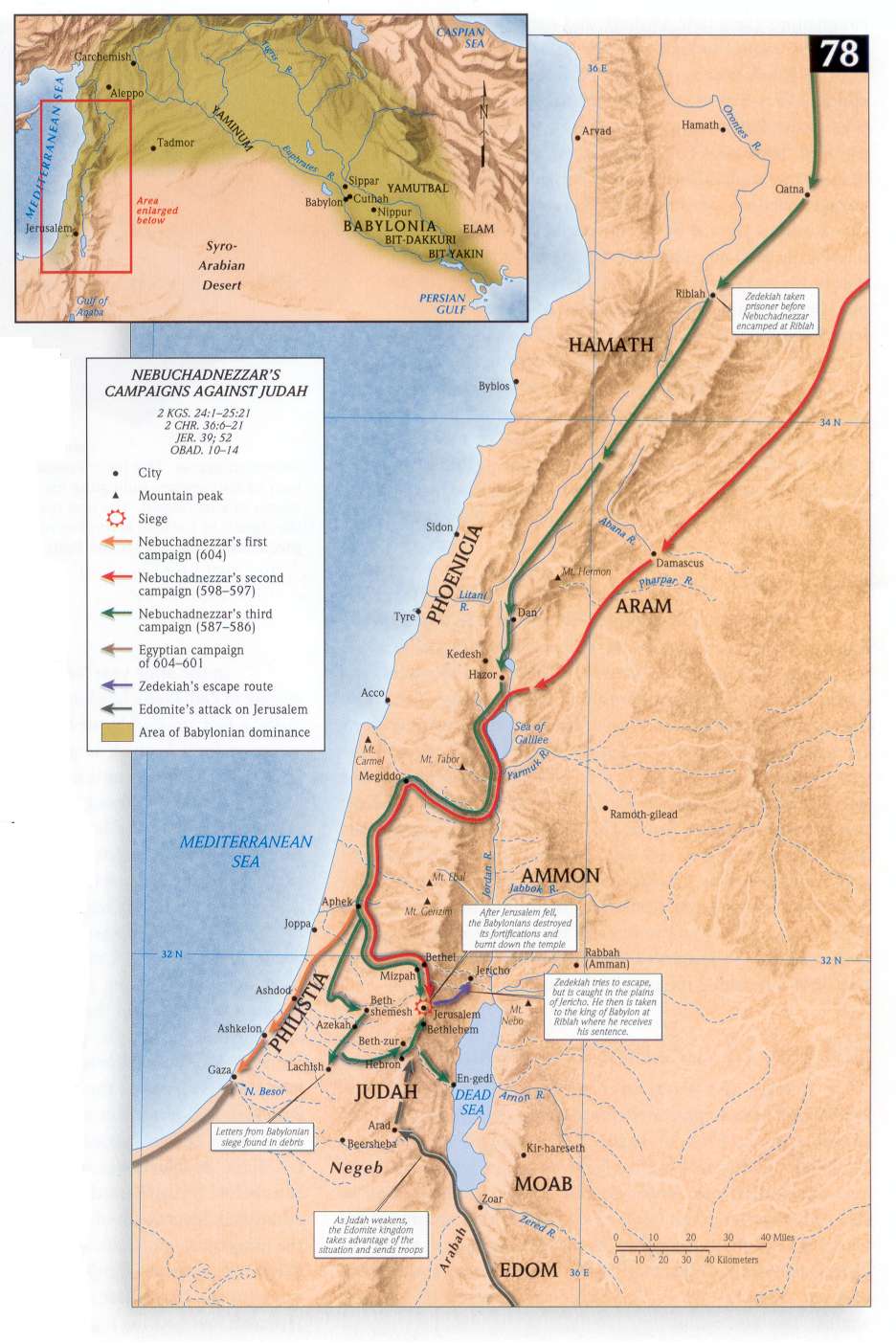
Jeremiah 1:13-16 (JEREMIAH'S SIMILAR VISION) The word of the LORD came to me a second time saying, “What do you see?” And I said, “I see a boiling pot, facing away from the north.” (SYMBOL OF BABYLON) 14 Then the LORD said to me, “Out of the north (BABYLON - SEE map describing Nebuchadnezzar's campaigns against Judah coming from North) the evil will break forth on all the inhabitants of the land. 15 “For, behold, I am calling all the families of the kingdoms of the north,” declares the LORD; “and they will come and they will set each one his throne at the entrance of the gates of Jerusalem, and against all its walls round about and against all the cities of Judah. 16 “I will pronounce My judgments on them concerning all their wickedness, whereby they have forsaken Me and have offered sacrifices to other gods, and worshiped the works of their own hands.
A VISION OF THE
FIERY WHIRLWIND
As I looked, behold, a storm wind was coming from the north - As I looked introduces the first part of the vision: storm and living creatures (v4-14). The "I looked" of v15 introduces the second part describing wheels and the glory of the Lord. "In Scripture, a storm is often an image of divine judgment (Prov. 1:27; Isa. 66:15; Jer. 4:13; 23:19; Nahum 1:3)....For forty years, God had graciously led Israel by a fiery cloud; but now a fiery cloud was bringing chastening to His disobedient people." (Wiersbe) Behold (hinneh) indicates Ezekiel became acutely aware of the changing sky.
THOUGHT- Being in captivity in a pagan, idol worshipping land of Babylon did not prevent the prophet from seeing a high and lofty vision of God. 2022 America has become a pagan land, but followers of Jesus who are pursuing holiness and the Holy One can still see a lofty vision of the glory of God in the midst of this encroaching darkness!
What looks like a storm to us is the tool of His providence!
-- Warren Wiersbe
NET NOTE - Storms are often associated with appearances of God (see Nah 1:3; Ps 18:12). In some passages, the “storm” (סְעָרָה, sé’arah) may be a whirlwind (Job 38:1, 2 Kgs 2:1).
A storm wind -- Jeremiah uses a similar phrase figuratively describing the LORD's wrath writing
Behold, the storm of the LORD has gone forth in wrath, even a whirling tempest. It will swirl down on the head of the wicked." (Jer 23:19)
The exact meaning of from the North is uncertain but Ezekiel's contemporary Jeremiah makes several references to the north prophesying that
the word of the LORD came to me a second time saying, "What do you see?" And I said, "I see a boiling pot, facing away from the north." Then the LORD said to me, "Out of the north the evil will break forth on all the inhabitants of the land. (Jer 1:13 14)...
Lift up a standard toward Zion! Seek refuge, do not stand still, for I am bringing evil from the north, and great destruction. (Jer 4:6)
Later Jeremiah says that
evil looks down from the north, and a great destruction. (Jer 6:1)
Clearly in Jeremiah's allusions to the north, he was referring to Babylon’s army, which would invade from that direction. See a map describing Nebuchadnezzar's campaigns against Judah.
Craigie writes that "The vision begins in physical reality, and then transcends the immediate environment. Ezekiel sees a storm coming towards him from the north, accompanied by clouds and flashes of lightning. But as he watches the approaching storm clouds, it is as if they are the curtains on a stage, suddenly drawn back to reveal a heavenly scene, beyond the immediate curtain of earthly reality." (Borrow Ezekiel. The Daily study Bible)
As you read Ezekiel's description, consider sketching out what he sees, paying appropriate attention to the details, so that you have an accurate, albeit not necessarily artistic rendering. You will find that a picture is indeed worth a thousand words. You will not necessarily completely understand Ezekiel's portrayal, but by drawing it out you will become more involved with the author, who clearly also had difficulty describing in human terms what was gloriously divine.
Liberal scholars have branded Ezekiel as ecstatic, visionary, neurotic, someone who periodically practiced acts of levitation, and the one who was psychotic and schizophrenic. However, no other prophet in the Bible is so creative in his presentation and forceful in his message as the prophet Ezekiel.
|
EZEKIEL'S VISIONS |
||
|
1 |
Ezek 1:3-28 |
Vision of the Glory of the LORD |
|
2 |
Ezek 2:9-33 |
Vision of the Scroll in a "Hand" |
|
3 |
Ezek 3:22-23 |
Vision of the Glory of the LORD on the Plain |
|
4 |
Visions of Jerusalem |
|
|
4a |
Ezek 8:1-18 |
Defilement of the Holy Temple |
|
4b |
Ezek 9:1-11 |
Destruction of the inhabitants of Jerusalem |
|
4c |
Ezek 10:1-22 |
Destruction of Jerusalem and the temple |
|
4d |
Ezek 11:1-25 |
Departure of God's glory prior to destruction |
|
5 |
Ezek 37:1-10 |
Vision of Dry Bones |
|
6 |
Ezek 40-48:35 |
Vision of New Temple, New Worship, Restored Land |
a great cloud with fire flashing forth continually and a bright light around it Ezekiel's vision of a great cloud should be interpreted in light of the context that of the Palestinian climate in the summer (remember Ezekiel receives this vision in late July) for there is hardly a cloud in the sky from early May to the late September. During this season clouds so seldom appear as to seem phenomenal when they do appear. Not only that but this wasn't just any cloud but had "fire flashing continually." For just a moment, close your eyes and imagine the scene. Picture fire flashing forth from the fiery cloud. How would you react?
NET NOTE on fire flashing - Heb “fire taking hold of itself,” perhaps repeatedly. The phrase occurs elsewhere only in Exod 9:24 in association with a hailstorm. The LXX interprets the phrase as fire flashing like lightning, but it is possibly a self-sustaining blaze of divine origin. The LXX also reverses the order of the descriptors, i.e., “light went around it and fire flashed like lightning within it.”.... GLOWING METAL (GLOWING AMBER) - The LXX translates חַשְׁמַל (khashmal) with the word ἤλεκτρον (ēlektron, “electrum”; so NAB), an alloy of silver and gold, perhaps envisioning a comparison to the glow of molten metal.
Moses describes a similar scene preparatory to the giving of the Law at Mt Sinai recording that
on the third day, when it was morning, that there were thunder and lightning flashes and a thick cloud upon the mountain and a very loud trumpet sound, so that all the people who were in the camp trembled. And Moses brought the people out of the camp to meet God, and they stood at the foot of the mountain. Now Mount Sinai was all in smoke because the LORD descended upon it in fire; and its smoke ascended like the smoke of a furnace, and the whole mountain quaked violently." (Ex 19:16-18+ cf Dt 4:11-12+)
Ezekiel's vision is also reminiscent of Moses description in Exodus, writing that
the glory of the LORD rested on Mount Sinai, and the cloud covered it for six days; and on the seventh day He called to Moses from the midst of the cloud. And to the eyes of the sons of Israel the appearance of the glory of the LORD was like a consuming fire on the mountain top. And Moses entered the midst of the cloud as he went up to the mountain; and Moses was on the mountain forty days and forty nights." (Ex 24:16-18+)
Fire congers up a reminder of God's holiness and judgment
Deuteronomy 4:24 “For the LORD your God is a consuming fire, a jealous God.
Hebrews 12:29 for our God is a consuming fire.
Solomon speaking of God's glory filling the newly dedicated Temple reminded the people that
Jehovah has said that He would dwell in the thick cloud" (2Chr 6:1)
Solomon is clearly alluding to the "Shekinah" glory of Jehovah resting between the cherubim over the mercy seat of the Ark in the Temple in Jerusalem even as Ezekiel was receiving this vision. (Click Glory of the LORD)
The description of Jehovah in Psalm 97:1 parallels Ezekiel's description in this chapter, the psalmist recording that
The LORD reigns. Let the earth rejoice. Let the many islands be glad. Clouds and thick darkness surround Him. Righteousness and justice are the foundation of His throne. Fire goes before Him, and burns up His adversaries round about." (Ps 97:1 97:2 97:3)
Ps 104 says Jehovah "makes the clouds His chariot. He walks upon the wings of the wind." (Ps 104:3)
Isaiah says
the LORD is riding on a swift cloud and is about to come to Egypt... (Isa 19:1)
Nahum describing Jehovah says
In whirlwind and storm is His way, and clouds are the dust beneath His feet (Nah 1:3)
The writer of Hebrews exhorts us to
offer to God an acceptable service with reverence and awe for our God is a consuming fire." (Heb 12:28-29+)
Ezekiel's description is a theophany.
Nelson's New Illustrated Bible Dictionary defines a theophany is "any direct, visual manifestation of the presence of God. The key word is visual, since God makes His presence and power known throughout the Bible in a variety of ways. But even in a theophany a person does not actually see God Himself...What a person sees are the effects of God’s unmediated presence. Theophanies proper are limited to the Old Testament. They are most common in the books of Genesis and Exodus; but they also occur in the writings of the prophets, especially in connection with the calling of a prophet. The most frequent visible manifestation of God’s presence in the Old Testament is the “Angel of the Lord.” (See notes on Angel of Jehovah). Other theophanies are the burning bush (Ex 3:1–6), the pillar of cloud and the pillar of fire (Ex 13:21–22), the cloud and fire of Sinai (Ex 24:16–18), and the cloud of the glory of the Lord (Ex 40:34–38).The Shekinah glory that dwelt in the Holy of Holies in the tabernacle and the Temple may also be thought of as a specialized, permanent theophany. Theophanies are never given for their own sake, to satisfy a curiosity about God, but to convey some revelation or truth about Him." (Nelson's New Illustrated Bible Dictionary)
A study of OT theophanies reveals that God’s person is never actually described in great detail, and that there is often a great sense of dread on the part of the human involved. A proper reverential fear and awe is generated by the power evidenced in God’s “glory”. It is notable that every major prophet experienced a theophany which marked the beginning of their ministry (Isaiah’s 6, Jeremiah 1). And so Ezekiel received God's call in the context of clear evidence that the God of Israel was still in control.
and in its midst something like glowing metal in the midst of the fire - Glowing metal (see Ezek 1:27; 8:2; 10:8 10:9) is the Hebrew word translated in the Septuagint by the Greek term ēlektron and electrum by the Latin Vulgate. In the Revelation John describes the Jesus' "feet...like burnished bronze, when it has been caused to glow in a furnace...." (Revelation 1:15+)
Wind … bright light … fire were all natural phenomena that had in times past been associated with divine revelation (Ex 14:24; Dt 4:24; 1Ki 19:1ff; Ps 104:1ff; Isa 10:17; Nah 1:3). The association of these now with the vision of the glory of the LORD would keep Ezekiel from doubting God's power in comparison to the Babylonian myths of Marduk, the lord of the storm and Shamash, the god of light.
Note that Ezekiel uses words such as like, likeness, appearance 27 times in this chapter, emphasizing that he had some difficulty in describing the supernatural vision in terms understandable to natural man. These terms of comparison are especially concentrated in the last few verses of this chapter. A vision of God's glory is too magnificent for human words. This is the God we should all desire to come to know...the omnipotent, transcendent, infinite, holy and just God. This chapter pictures a God Who on one hand is incomprehensible. Man cannot plumb the depths or limits of God. In Job we encounter a question we can all relate to --
Can you discover the depths of God? Can you discover the limits of the Almighty? (Job 11:7)
Behold, these (mind stretching pictures in Ezekiel 1) are the fringes of His ways; and how faint a word we hear of Him! But His mighty thunder, who can understand?" (Job 26:14) (click incomprehensible attributes of God)
I agree with Herb Vander Lugt, RBC Senior Research Editor who writes that "A well-known businessman recently said that in spite of all his wealth and fame he is a troubled man. He worries about the future of our planet. He fears a nuclear holocaust, a disaster caused by pollution, or a plague that is resistant to all known medicine. I do not share his fear that all life will end through a natural catastrophe. I believe the Bible when it says that an unseen God is in control and that the future will play out according to the predictions of the prophets of the nation of Israel. Ezekiel is one of those prophets who speaks strangely but eloquently to the fears and hopes that mark our day. His words are both timely and insightful for our generation.
THOUGHT - As an aside if you are not familiar with God's sovereign dealings the modern Israel, let me recommend a secular production which chronicles the incredible events over about the past 100 years. The name of this thoroughly engrossing 6 hour video series is "Israel: A Nation Is Born With Abba Eban, A Personal Witness". I assure you that if you watch this video, you will not fail to see the glory of God acting sovereignly in human history to fulfill His covenant promises to Abraham (Ge 12:1-4) and Ezekiel's prophecies of restoration and reunion of Judah and Israel in the last 24 chapters.
If you think God is finished with Israel, you need to set aside some time and watch this incredible documentary and see if you do not agree that some of the things that took place in this multi-part documentary are nothing short of supernatural invention by the Almighty God! And when you click you will notice that Youtube has flagged this video with the following message ("The following content has been identified by the YouTube community as inappropriate or offensive to some audiences. Viewer discretion is advised" - there is NOTHING "inappropriate" or "offensive" in this series, UNLESS you find God's hand on Israel to be offensive!) It is fascinating that this "warning" was not present several years ago when I watched the series. I would not be surprised to see youtube take it off entirely so you better watch it while you can. Here is the link that should bring up all 6 videos - be sure and watch them in order for the full effect.
In my opinion Ezekiel was perfectly sane in recording this incredible revelation and the excerpt below is included not to denigrate or disparage the integrity of this wonderful plenary inspired, God glorifying, inerrant prophecy but to illustrate why some scholars have difficulty accepting and interpreting the prophecy of Ezekiel. This excerpt is from the section entitled "The Prophet's Mental Health"!
Anyone reading the book cannot but be impressed with the power and intensity of the prophet’s experience. By modern Western standards the prophet’s behavior is often judged as pathological. He lies motionless for protracted periods (Ezek. 4:4-7), is dumb, or mute (Ezek 3:24-27; 24:25-27; 33:22), does not mourn at the death of his wife (Ezek 24:15-27), has visionary transports (Ezek 8:1-4), reports extraordinary stories and visions (Ezek 1-3; 8-11; 15-18; 21; 23-24; 37-48), and engages in almost bizarre conduct (Ezek 4:12; 5:1-4; 12:3-5). Psychoanalysis is difficult at best when dealing with a living patient who is a product of one’s own culture, but this has not dissuaded people from making a variety of efforts to assign a clinical diagnosis to Ezekiel’s behavior from a vantage culturally far removed and twenty-five hundred years later. The common language of daily life used by the prophet to describe his experiences in the book gives way to the textbook vocabulary of psychoanalysts, and Ezekiel is identified as psychic, schizophrenic, epileptic, catatonic, psychotic, or paranoid or given other such labels, depending on the particular school of psychoanalysis in vogue at the time. Perhaps the most notorious example of this sort of approach to the prophet was the Freudian analysis offered by E. C. Broome (1946, 291-92), who concluded that Ezekiel was “a true psychotic” characterized by “a narcissistic- masochistic conflict, with attendant phantasies of castration and unconscious sexual regression,” “schizophrenic withdrawal,” and “delusions of persecution and grandeur.” However, similar behavior to that of Ezekiel is reported in other prophetic books (e.g., Jer 16:2; 27:2; 28:10; 32:8-15), but scholars have not felt compelled to regard such behavior as symptomatic of mental pathology. The book of Ezekiel is different from other prophetic books primarily in the frequency with which such actions are encountered. While modern preachers tend to illustrate their sermons with stories, Israel’s prophets more often used props and presented their sermons in symbolic actions. Their behavior was the culturally expected and symptomatic behavior of those possessed by God’s Spirit. The prophet so identified with the fate of his people as vicariously to take their suffering on himself and to dramatize their fate in his own agony. Rather than find his behavior peculiar or appalling, we ought to see in it the depths of his commitment to God and to his people and to appreciate the way in which the prophet was bearing the shame that so often accompanied proclaiming God’s Word. Ezekiel became “a prophetic symbol of his people even in his bodily life, as it were submerged in their dying, overwhelmed by the destructive power of the divine wrath which he himself proclaimed, anticipating the punishment of his fellow countrymen by willingly bearing their guilt” (Eichrodt 1970, 33). (Source: AN INTRODUCTION to the OLD TESTAMENT by Raymond B. Dillard and Tremper Longman III) or borrow a copy of this book)
QUESTION - What were the wheels in Ezekiel 1?
ANSWER - Ezekiel’s vision of the four wheels dramatically illustrates the omnipresence and omniscience of God. These wheels were associated with the “four living creatures” (Ezekiel 1:4), who were later described (Ezekiel 10:5, 20) as cherubim, angelic beings appointed as guardians of the holiness of God.
Each wheel was actually two in one, with one apparently set inside the other at right angles which enabled the “living creatures” to move in any direction instantly without having to turn, like a flash of lightning. These wheels had the appearance of chrysolite, which may have been a topaz or other semiprecious stone. The outer rim of the wheels was described as high and awesome with the outer edge of the rims inset with “eyes” (Ezekiel 1:14-18).
The Spirit of the living creatures was in the wheels (Ezekiel 1:20-21). As a result, the creatures were able to move any direction the wheels moved. Most biblical scholars hold to the idea that the Spirit of God gave direction to the wheels through direct knowledge of and access to the will of God. The mobility of the wheels suggests the omnipresence of God; the eyes, His omniscience; and the elevated position, His omnipotence.
This vision appeared to Ezekiel as a powerful imagery of movement and action demonstrating the characteristics of God’s divine nature. It presented God as being on a chariot-like throne, His glory both supreme and immanent, existing in and extending into all the created universe. As such, the whole revelation by God in this vision to Ezekiel, i.e., the cherubim, the chariot, the Spirit, and the wheels, emphasized their unity and coordination.
As terrifying as this vision was, it vividly displayed the majesty and glory of God (Ezekiel 1:28), who came to Ezekiel and the children of Israel in the midst of their Babylonian exile. It reminded them of His holiness and power as the Lord of all creation. The message was clear: though His people were in exile and their nation was about to be destroyed, God was still on the throne and able to handle every situation. The lesson for us today is that, through His marvelous providence, God moves in the affairs of all nations to work out His own unseen plan, always at work, intricately designed, never wrong, and never late (Romans 8:28).GotQuestions.org
Ezekiel 1:5 Within it there were figures resembling four living beings. And this was their appearance: they had human form. (NASB: Lockman)
GWT: In the center of the cloud I saw what looked like four living creatures. They were shaped like humans, (GWT)
NET In the fire1 were what looked like four living beings. In their appearance they had human form,
NLT: From the center of the cloud came four living beings that looked human, (NLT - Tyndale House)
Within it there were figures resembling four living beings. And this was their appearance: they had human form (demut) - see notes Revelation 4:6; and Revelation 6:6+. The Hebrew word demut translates form and is first used in Ge 1:26+ referring to man as being according to God’s “likeness.” Demut occurs 9 times in the first chapter of Ezekiel and thus is clearly a key word. Later in
Ezekiel 10:15 he identifies the 4 supernatural creatures as cherubim. "As he describes this vision, Ezekiel uses the words “like” and “likeness” at least twenty-five times, indicating that what he saw was symbolic of realities God wanted to reveal to him" (Wiersbe)
The Bible Knowledge Commentary notes that cherubim "have special access to God (cf Ezek 28:14 28:16) and are bearers of God’s throne-chariot. On the tabernacle’s ark of the covenant, gold images of cherubim, with outstretched wings, guarded the mercy seat where the glory of the Lord dwelt (Ex 25:18-20 ; Nu 7:89). God was ”enthroned between the cherubim“ of the ark of the covenant (1 Sa 4:4; 2 Sa6:2 Ps 80:1; 99:1; 1Ki 8:6,7; 2Ch 5:7,8 ; 2 Ki 9:15). This place where God was enthroned was called ”the chariot“ (1Chr 28:18). Since the earthly tabernacle and temple were a copy of the heavenly reality (see note Hebrews 8:5), Ezekiel’s vision was of the actual throne-chariot of God, borne by cherubim. (See context in The Bible Knowledge Commentary: Old Testament)
After the fall, the LORD God "stationed the cherubim, and the flaming sword which turned every direction, to guard the way to the tree of life." (Ge 3:24+)
Their likeness was embroidered on the curtain of the tabernacle to guard the holy of holies against unauthorized entry (Ex 26:1,31). Within the holy of holies their likeness was placed atop the ark bearing the tablets of covenant (Ex 25:18-20). A pair of colossal cherubim overshadowed the mercy seat in Solomon’s temple with the canopy of their
their wings...touching each other in the center of the house. (1 Ki 6:27)
Easton's Bible Dictionary says that the cherubim "on the ark are called the "cherubim of glory" (Heb 9:5+), i.e., of the Shekinah, or cloud of glory, (Click discussion of the glory of the LORD), for on them the visible glory of God rested. They were placed one at each end of the mercy-seat, with wings stretched upward, and their faces "toward each other and toward the mercy-seat.
There is a fascinating parallel between Easton's description of the position of the cherubim and the Ark of the Covenant and their position beneath the expanse over which Ezekiel saw the (Shekinah) glory of the LORD. (See also Overview: The Glory of the LORD)
Scofield adds that "the effect (of this passage) was the revelation to the prophet of the Shekinah glory of the Lord. Such revelations are connected invariably with new blessing and service. Cf. ; Ex 3:2-10; Isa 6:1-10; Da 10:5-14; Rev 1:12-19.
Related Resources:
- Torrey's Topic Cherubim
- ISBE article on cherubim
- W E Vine has an interesting discussion of cherubim here - scroll to page 630
Form (01823) demut - from damah - to be like, to resemble) means likeness, shape, form, figure, pattern. Demut is a simile comparing two unlike things - wickedness of people and the venom of a snake (Ps. 58:4), sound of God's gathering warriors and of many people (Isa 13:4), an angelic messenger and a human being (Da 10:16). Describes the likeness of Seth to Adam (Ge 5:3). Ezekiel uses demut to describe his visions by comparing what he saw to something similar on earth (Ezek. 1:5, 16; 10:1).
Demuth - 21v - figure(1), figures like(1), figures resembling(1), form(4), like(4), likeness(8), pattern(1), resembling(1), something resembling(1), which resembled(1), who resembled(1). Gen. 1:26; Gen. 5:1; Gen. 5:3; 2 Ki. 16:10; 2 Chr. 4:3; Ps. 58:4; Isa. 13:4; Isa. 40:18; Ezek. 1:5; Ezek. 1:10; Ezek. 1:16; Ezek. 1:22; Ezek. 1:26; Ezek. 1:28; Ezek. 8:2; Ezek. 10:1; Ezek. 10:10; Ezek. 10:21; Ezek. 10:22; Ezek. 23:15; Dan. 10:16
Ezekiel 1:6 Each of them had four faces and four wings. (NASB: Lockman)
NIV: but each of them had four faces and four wings. (NIV - IBS)
- four faces Eze 1:10,15 10:10,14,21,22 Rev 4:7,8
- four wings: Eze 1:8-11 Ex 25:20 1Ki 6:24-27 Isa 6:2
Each of them had four faces : (see other descriptions of them Ezekiel 1:10 15; 10:10 14 21 22)
Some of the early Church Fathers connected the four faces with the four Gospels, and although I cannot totally discount that possibility, I think that manner of interpretation leads to speculation which cannot be Scripturally verified. There are many aspects of this vision which will and probably should remain a mystery until we see our LORD face to face. And yet even then God will remain the infinite, incomprehensible One.
Ezekiel describes the four living creatures in a later vision adding that
As for the likeness of their faces, they were the same faces whose appearance I had seen by the river Chebar. Each one went straight ahead. (Ezek 10:22)
and four wings: In the description of the Ark Moses writes that "the cherubim shall have their wings spread upward, covering the mercy seat with their wings and facing one another; the faces of the cherubim are to be turned toward the mercy seat. (Ex 25:20+)
Isaiah records that the related but apparently distinct
Seraphim stood above Him (Jehovah), each having six wings; with two he covered his face, and with two he covered his feet, and with two he flew. (Isa 6:2)
In Revelation John describes "the four living creatures, each...having six wings..." like in Isaiah's vision. (Rev 4:8+)
Ezekiel 1:7 Their legs were straight and their feet were like a calf's hoof *, and they gleamed like burnished bronze. (NASB: Lockman)
NLT: Their legs were straight like human legs, but their feet were split like calves' feet and shone like burnished bronze. (NLT - Tyndale House)
- their feet were like a calf's hoof: Lev 11:3,47
- they gleamed like burnished bronze Eze 1:13 Ps 104:4 Da 10:6 Rev 1:15
Their legs were straight and their feet were like a calf's hoof - Feet...like a calf's hoof may picture stability and firm stance, but remember it is important in studying visions not to get too "focused" on minutiae. Clearly even Ezekiel had difficulty in describing what he saw, so it should not surprise us that we would have difficulty in completely understanding what he meant by what he saw! The Septuagint has a "curious" translation, recording that "their feet were winged"!
and they gleamed like burnished bronze - Like Burnished bronze is the same phrase John uses to describe the risen, glorified Lord Jesus in the Revelation writing that "His feet were like burnished bronze, when it has been caused to glow in a furnace... (Rev 1:15+)
Ezekiel 1:8 Under their wings on their four sides were human hands. As for the faces and wings of the four of them (NASB: Lockman)
- Ezekiel 8:3; 10:2 10:7 10:8 10:18 10:21 Isa 6:6
Under their wings on their four sides were human hands. As for the faces and wings of the four of them - In this verse and verse 9, Ezekiel explains how the four creatures functioned as a unit.
Ezekiel 1:9 their wings touched one another; their faces did not turn when they moved, each went straight * * forward. (NASB: Lockman)
- Wings Eze 1:11 2Ch 3:11,12 1Co 1:10
- They moved - Eze 1:12 10:11,22 Pr 4:25-27 Lu 9:51,62
Related Passage:
1 Kings 6:27 He placed the cherubim in the midst of the inner house, and the wings of the cherubim were spread out, so that the wing of the one was touching the one wall, and the wing of the other cherub was touching the other wall. So their wings were touching each other in the center of the house.
2 Chronicles 3:11-12 The wingspan of the cherubim was twenty cubits; the wing of one, of five cubits, touched the wall of the house, and its other wing, of five cubits, touched the wing of the other cherub. 12The wing of the other cherub, of five cubits, touched the wall of the house; and its other wing of five cubits was attached to the wing of the first cherub.
Their wings ouched one another is a description similar to that of the wings of the cherubim over the ark in the Most Holy Place of the temple (2Chr 3:11-12). As described later (Ezek 1:11,24) two of the wings were always down and when the living moved, two were extended upwards, so that their tips touched, and were in this sense "joined." When at rest, these were let down again (Ezek 1:24). Since the creatures have a face looking in all four directions whatever direction they move they’re headed forward.
Note the emphasis of the threefold repetition of this fact (their faces did not turn when they moved) (Ezek 1:9, 12, 17).
ESV note - The four-sided form of the creatures ensures that they can always do the impossible: go straight forward, in any direction, but without turning (cf. “went straight forward” [Ezek. 1:12] with “darted to and fro” [Ezek 1:14]).(See context in ESV Study Bible)
Ezekiel 1:10 As for the form of their faces, each had the face of a man; all four had the face of a lion on the right and the face of a bull on the left, and all four had the face of an eagle. (NASB: Lockman)
- As for the form of their faces: Eze 10:14 Rev 4:7
- the face of a man: Nu 2:10 Isa 46:8 Lu 15:10 1Co 14:20
- the face of a lion: Nu 2:3 Jud 14:18 1Ch 12:8 Rev 5:5
- the face of a bull: Eze 10:14, Cherub, Nu 2:18 Pr 14:4 1Co 9:9,10
- the face of an eagle: Nu 2:25 De 28:49 Job 39:27 Isa 40:31 Da 7:4
As for the form of their faces, each had the face of a man; all four had the face of a lion on the right and the face of a bull on the left, and all four had the face of an eagle
In the Revelation John has a similar description of the 4 living creatures who were in the center and all around God's throne
the first creature was like a lion and the second creature like a calf, and the third creature had a face like that of a man, and the fourth creature was like a flying eagle. And the four living creatures, each one of them having six wings, are full of eyes around and within; and day and night they do not cease to say, "HOLY, HOLY, HOLY, is THE LORD GOD, THE ALMIGHTY, WHO WAS AND WHO IS AND WHO IS TO COME." (Rev 4:7-8+)
Bible Knowledge Commentary adds that Some interpreters feel that these represent intelligence (man), power (lion), service (ox), and swiftness (eagle). However, it seems better to see the faces as representing the highest forms of life in God’s created realm. Man was mentioned first because he was the acme of God’s creative work. He was followed by the lion, ”king“ among wild beasts; the ox, one of the strongest of domestic animals; and the eagle, the ”lord“ of the birds." (See context in The Bible Knowledge Commentary: Old Testament)
Ray Stedman writes that "We can't interpret all of this, because there is a mystery about the person of God. But what Ezekiel sees is, generally speaking, the power and the majesty of God. It is interesting that the four living creatures setting forth the character of God are always described as having the faces of a lion, a man, an ox, and an eagle. And throughout all of history these things have symbolically represented certain qualities. A lion is always a picture of sovereignty, of supremacy -- "the king of the beasts." A man is the picture of intelligence, of understanding. An ox is always the symbol of servitude, of sacrifice. And an eagle is the symbol of power and deity, of soaring over all creation. Now the significant thing is that the four gospels present exactly these same qualities in Jesus Christ. He appears first in the Gospel of Matthew as the king -- the lion, the king of beasts, the sovereign of all. He appears in the Gospel of Mark as the servant, the ox. In the Gospel of Luke, he is man in his intelligence, in his insight, in his understanding of life. And in the Gospel of John he is deity. These four reflect the character of Jesus Christ. Now, even though Ezekiel doesn't understand this, even though he doesn't perceive the significance of his vision; he saw nonetheless the glory of God in the face of Jesus Christ. (2 Cor. 4:6) That is because God reveals himself through Christ. Ezekiel saw as clearly as he could the revelation of God in Jesus Christ. (see sermon Ezekiel: Wheel, Bones, and Restoration)
Ezekiel 1:11 Such were their faces. Their wings were spread out above *; each had two touching another being, and two covering their bodies. (NASB: Lockman)
- Their wings: Eze 10:16,19
- and two Eze 1:23 Isa 6:2
Such were their faces. Their wings were spread out above; each had two touching another being, and two covering their bodies - Ezekiel's description parallels that of the prophet Isaiah when He too saw the LORD high and lifted up, describing the scene "Seraphim stood above Him, each having six wings: with two he covered his face, and with two he covered his feet, and with two he flew." (Isa 6:2+)
Ezekiel 1:12 And each went straight * * forward; wherever * * the spirit was about to go, they would go, without turning as they went. (NASB: Lockman)
- they went: Eze 1:9,17 10:22
- wherever the spirit was about to go: Eze 1:20,21 Heb 1:14
And each went straight forward; wherever the spirit was about to go, they would go, without turning as they went. - Some versions capitalize "spirit" (CSB, Darby) favoring this being the Holy Spirit. They were directed in their motion by the spirit, which certainly could be God’s Spirit. The Pulpit Commentary agrees, adding that "The description passes on to the originating force of the movement of the mysterious forms. The Hebrew noun may mean "breath," "wind," or "spirit," the meanings often overlapping one another. Here the higher meaning is probably the true one. The "Spirit" is the Divine Source of life in all its forms, especially in its highest form, moral, intellectual, spiritual. It is this which gave unity and harmony to the movements of the "living creatures," as it gives a life, harmony, and unity to all the manifold manifestations of the might of God of which they were the symbols."
In a similar description Ezekiel records that
Wherever the spirit was about to go, they would go in that direction. And the wheels rose close beside them; for the spirit of the living beings was in the wheels." (Ezekiel 1:20)
Ezekiel 1:13 In the midst of the living beings there was something that looked like burning coals of fire, like torches darting back and forth among the living beings. The fire was bright, and lightning was flashing from the fire. (NASB: Lockman)
GWT: Among the creatures there was something that looked like a blazing torch, constantly moving. The fire would blaze up and shoot out flashes of lightning.
NIV: The appearance of the living creatures was like burning coals of fire or like torches. Fire moved back and forth among the creatures; it was bright, and lightning flashed out of it.
NLT: The living beings looked like bright coals of fire or brilliant torches, and it looked as though lightning was flashing back and forth among them.
- Eze 1:7 Ge 15:17 Ps 104:4 Da 10:5,6 Mt 28:3 Rev 4:5 10:1 18:1
In the midst of the living beings there was something that looked like burning coals of fire, like torches darting back and forth among the living beings. The fire was bright, and lightning was flashing from the fire -- Burning coals of fire are an element of other visions of God (cf 2Sa 22:9, 13; Ps 18:8). Note however that Ezekiel does not say that these were literal burning coals but that there was something that looked like burning coals. So again one must be careful in trying to interpret too much into this aspect of his vision. From other Scripture, we know that burning coals from the altar brought cleansing to Isaiah in (Isa 6:6–7), and that burning coals upon the altar were used to burn the sacrifices which atoned for sins. But in the present context (especially the subsequent chapters), since Judah stubbornly refused to repent and be cleansed and healed, it is reasonable to suggest that something like burning coals presages judgment.
Ezekiel 1:14 And the living beings ran to and fro like bolts of lightning. (NASB: Lockman)
- Ps 147:15; Da 9:21; Zec 2:3 2:4; 4:10; Mt 24:27 24:31; Mk 13:27
And the living beings ran to and fro like bolts of lightning - NLT - "And the living beings darted to and fro like flashes of lightning."