
Michelangelo's Ezekiel on the Sistine Chapel
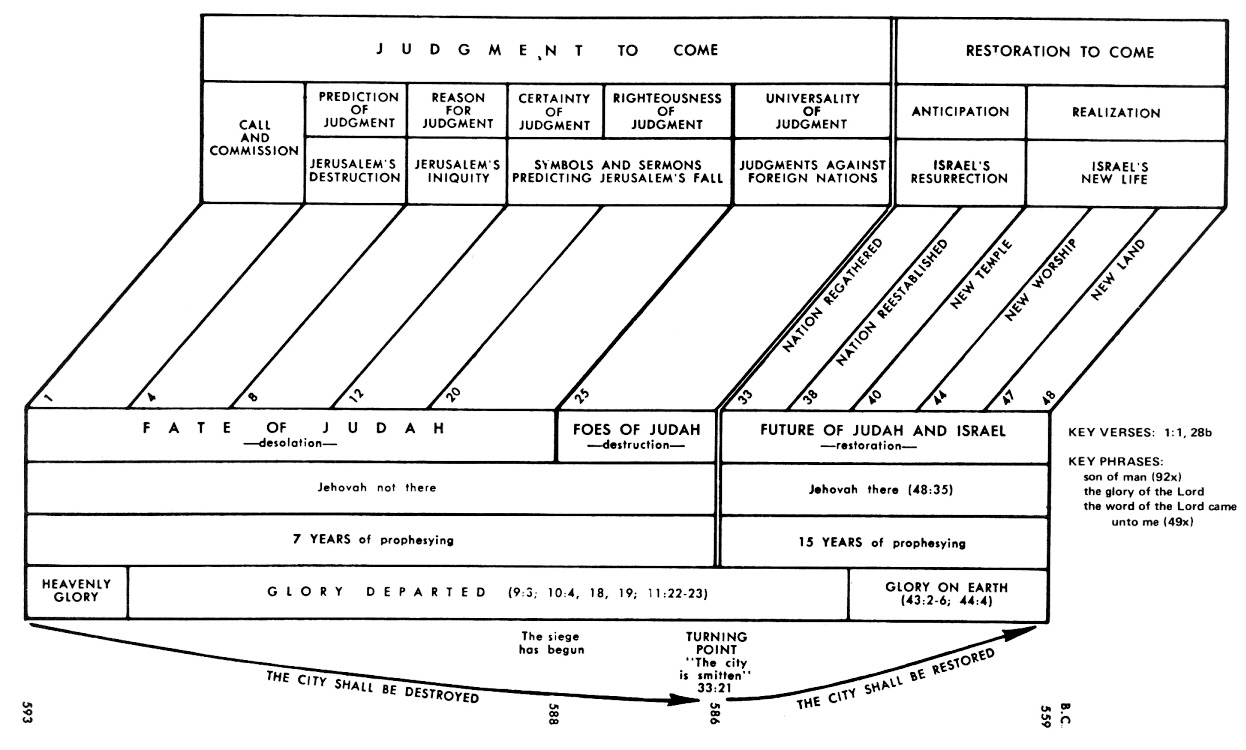
Click chart to enlarge
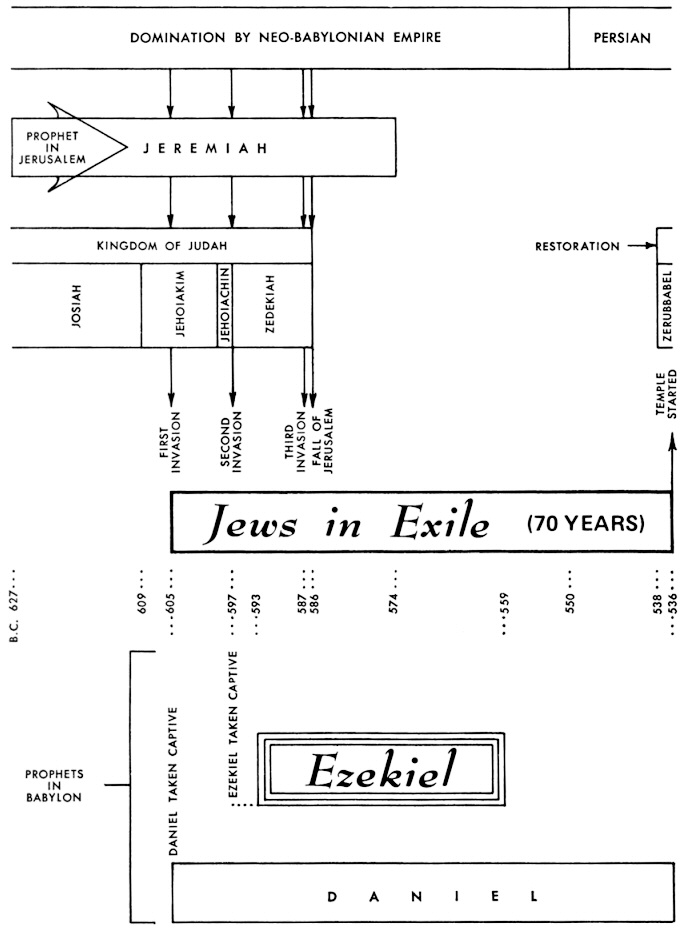
Click chart to enlarge
Chart from recommended resource Jensen's Survey of the OT - used by permission
Click Chart from Charles Swindoll
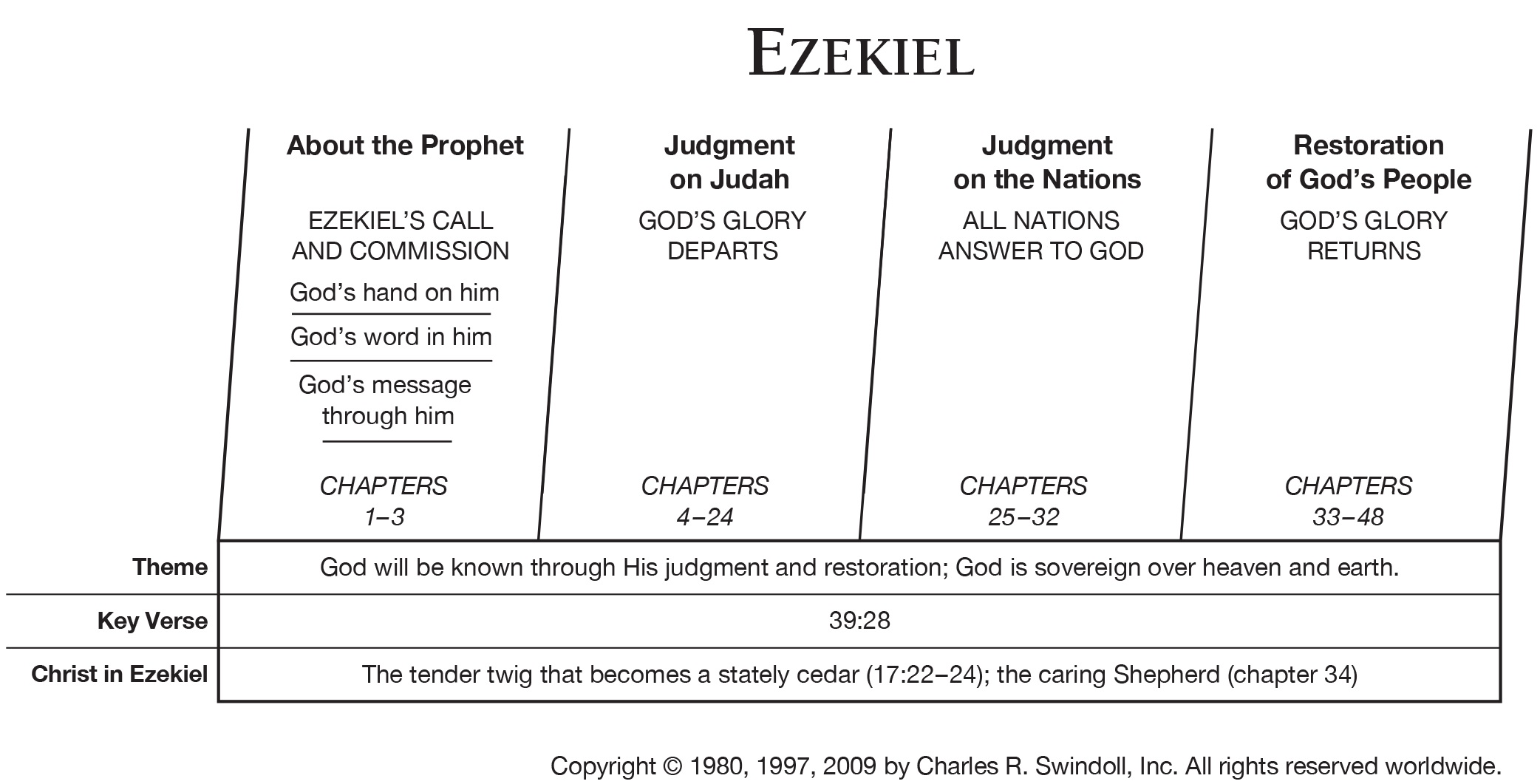
|
PROPHECY OF |
PROPHECY OF |
|||
| FATE OF JUDAH Before the Siege |
FOES OF JUDAH During the Siege |
FUTURE OF JUDAH After the Siege |
||
|
593-588 BC |
587-586 |
586-571 |
||
|
7 YEARS |
15 YEARS |
|||
| Ezekiel 1:1-3:27 Ezekiel Sees the Glory & Receives the Call |
Ezekiel 4:1-24:27 Judgments Against Judah |
Ezekiel 25:1-32:32 Judgments Against the Gloating Nations |
Ezekiel 33:1-39:29 Restoration of Israel to the LORD |
Ezekiel 40:1-48:35 Visions of the Temple Jehovah Shammah |
Outline of the Book of Ezekiel from Dr John MacArthur - The book can be largely divided into sections about condemnation/retribution and then consolation/restoration. A more detailed look divides the book into 4 sections. First, are prophecies on the ruin of Jerusalem (Ezekiel 1:1–24:27). Second, are prophecies of retribution on nearby nations (Ezekiel 25:1–32:32), with a glimpse at God’s future restoration of Israel (Ezekiel 28:25,26). Thirdly, there is a transition chapter (Ezekiel 33:1-33) which gives instruction concerning a last call for Israel to repent. Finally, the fourth division includes rich expectations involving God’s future restoration of Israel (Ezekiel 34:1–48:35). (Reference)
I. Prophecies of Jerusalem’s Ruin (Ezekiel 1:1–24:27)
A. Preparation and Commission of Ezekiel (Ezekiel 1:1–3:27)
1. Divine appearance to Ezekiel (Ezekiel 1:1–28)|
2. Divine assignment to Ezekiel (Ezekiel 2:1–3:27)
B. Proclamation of Jerusalem’s Condemnation (Ezekiel 4:1–24:27)
1. Signs of coming judgment (Ezekiel 4:1–5:4)
2. Messages concerning judgment (Ezekiel 5:5–7:27)
3. Visions concerning abomination in the city and temple (Ezekiel 8:1–11:25)
4. Explanations of judgment (Ezekiel 12:1–24:27)
II. Prophecies of Retribution to the Nations (Ezekiel 25:1–32:32)
A. Ammon (Ezekiel 25:1–7)
B. Moab (Ezekiel 25:8–11)
C. Edom (Ezekiel 25:12–14)
D. Philistia (Ezekiel 25:15–17)
E. Tyre (Ezekiel 26:1–28:19)
F. Sidon (Ezekiel 28:20–24)
Excursus: The Restoration of Israel (Ezekiel 28:25, 26)
G. Egypt (Ezekiel 29:1–32:32)
III. Provision for Israel’s Repentance (Ezekiel 33:1–33)
IV. Prophecies of Israel’s Restoration (Ezekiel 34:1–48:35)
A. Regathering of Israel to the Land (Ezekiel 34:1–37:28)
1. Promise of a True Shepherd (Ezekiel 34:1–31)
2. Punishment of the nations (Ezekiel 35:1–36:7)
3. Purposes of restoration (Ezekiel 36:8–38)
4. Pictures of restoration—dry bones and two sticks (Ezekiel 37:1–28)
B. Removal of Israel’s Enemies from the Land (Ezekiel 38:1–39:29)
1. Invasion of Gog to plunder Israel (Ezekiel 38:1–16)
2. Intervention of God to protect Israel (Ezekiel 38:17–39:29)
C. Reinstatement of True Worship in Israel (Ezekiel 40:1–46:24)
1. New temple (Ezekiel 40:1–43:12)
2. New worship (Ezekiel 43:13–46:24)
D. Redistribution of the Land in Israel (Ezekiel 47:1–48:35)
1. Position of the river (Ezekiel 47:1–12)
2. Portions for the tribes (Ezekiel 47:13–48:35)
Ezekiel 14:12 Then the word of the LORD came to me saying,
Remember that the messages from Ezekiel 12 through Ezekiel 19 are occurring over about a one year period, all being given about 5 years before the fall of Jerusalem. Although the message of defeat and destruction of Jerusalem should have been obvious by now, the people were still not ready to believe Ezekiel's prophecy. In fact, based on the subject discussed in this section, it seems that they still harbored the thought that God would preserve Jerusalem because of a "righteous remnant". They might have thought of Abraham's request (Gen 18) that God deliver Sodom if a sufficient number of righteous people were found there. Perhaps the Lord would do the same now for Jerusalem. They were self deceived. Yes God would honor the presence of any righteous persons, but their presence would not save Jerusalem.
Keil and Delitzsch make an interesting comment that "The threat contained in the preceding word of God, that if the idolaters did not repent, God would not answer them in any other way than with an exterminating judgment, left the possibility still open, that He would avert the destruction of Judah and Jerusalem for the sake of the righteous therein, as He had promised the patriarch Abraham that He would do in the case of Sodom and Gomorrah (Ge18:23)."
Ezekiel 14:13 "Son of man, if a country sins against Me by committing unfaithfulness, and I stretch out My hand against it, destroy its supply of bread, send famine against it and cut off from it both man and beast,
ICB: Human being, sometimes the people of a country will sin against me by not being loyal. When that happens, I will use my power against them. I will cut off their supply of food. I will send them a time of hunger. I will destroy both their people and animals.
- if a country sins against Me: Eze 9:9 Ezr 9:6 Isa 24:20 La 1:8,20 Da 9:5,10-12
- I stretch out My hand against it, destroy its supply of bread: Eze 4:16 5:16 Lev 26:26 Isa 3:1 Jer 15:2,3 La 4:9,10
- cut off from it both man and beast: Eze 14:17,19,21 25:13 Ge 6:7 Jer 7:20 32:43 36:29
Son of man, if a country sins against Me by committing unfaithfulness, and I stretch out My hand against it, destroy its supply of bread, send famine against it and cut off from it both man and beast,
Beloved, while God is directly addressing this warning to Judah, the phraseology widens the scope of the warning - "if a country", not just Judah, sins against God, she will eventually incur the Righteous Wrath of the Holy God (eg, cp Ge 15:16). For some reason, many in "Christian" America think we are immune to God's immutable laws of justice. And yet surely circa 2009 we can see the fraying of the fabric of our society, with portrayals (even celebrations) of sin in the movies, television and media that are not just "off color" but are grossly repulsive and constitute an abomination and an abhorrence to God's eyes. Let all who are God's people entreat our Father earnestly and urgently to send a Spirit empowered, Word centered, Christ exalting revival before there is no remedy (2Chr 36:15, 16)!
Jerusalem sinned greatly, therefore she has become an unclean thing. All who honored her despise her because they have seen her nakedness; even she herself groans and turns away." (Lam 1:8)
The argument is presented four times in parallel, slightly different terms, like four heavy hammer blows that crash down on a precious object and smash it to oblivion. God is very definite, and He means what He says. Judgment is unavoidable.
"Committing unfaithfulness" (by treacherously committing treachery) The Hebrew word for "unfaithfulness" (ma'al) is a violation of trust, an act of treachery or a breaking of faith, which presumes a prior relationship. As alluded to earlier, Israel is described as the "wife" of God (even as Jesus is the husband of the church, His bride) and had acted as an "unfaithful" spouse. God referring to Israel accuses "her" of breaking "My covenant… although I was a husband to them." (Jer 31:32)
Related Resource:
In 1 Chronicles the writer records that
Judah was carried away into exile to Babylon for their unfaithfulness." (1Chr 9:1)
In 2 Chronicles
all the officials of the priests and the people were very unfaithful following all the abominations of the nations; and they defiled the house of the Lord which He had sanctified in Jerusalem" (2Ch 36:14).
Daniel in his powerful prayer in Daniel 9 confessed "we have sinned, committed iniquity, acted wickedly, and rebelled, even turning aside from Thy commandments and ordinances… nor have we obeyed the voice of the LORD our God, to walk in His teachings which He set before us through His servants the prophets. Indeed all Israel has transgressed Thy law and turned aside, not obeying Thy voice; so the curse has been poured out on us, along with the oath which is written in the law of Moses the servant of God, for we have sinned against Him." (Da 9:5,10, 11, 12)
The fourfold judgment of Jerusalem in this section is a reiteration of the judgment foretold in Ezekiel 5 where God declared
I will send on you famine and wild beasts, and they will bereave you of children; plague and bloodshed also will pass through you, and I will bring the sword on you. I, the Lord, have spoken. (Ezek5:17)
Destroy (break, crush, smash) its supply of bread - The first of four punishments that parallel those seen with the breaking of the fourth seal of the scroll and the unleashing of the "ashen" horse
"and he who sat on it had the name Death; and Hades was following with him. And authority was given to them over a fourth of the earth, to kill with sword and with famine and with pestilence and by the wild beasts of the earth." (Rev6:8)
God had warned Israel in Leviticus
When I break your staff of bread, ten women will bake your bread in one oven, and they will bring back your bread in rationed amounts, so that you will eat and not be satisfied." (Lev 26:26)
Through His prophet God had warned…
For behold, the Lord GOD of hosts is going to remove from Jerusalem and Judah Both supply and support, the whole supply of bread And the whole supply of water." (Isa 3:1+)
One might ask "How severe was the famine?". In Lamentations Jeremiah records
Better are those slain with the sword than those slain with hunger; for they pine away, being stricken for lack of the fruits of the field. The hands of compassionate women boiled their own children. They became food for them because of the destruction of the daughter of my people." (La 4:9, 10)
Cut off… man and beast" Jeremiah echoes this prophecy recording "Therefore thus says the Lord GOD, "Behold, My anger and My wrath will be poured out on this place, on man and on beast and on the trees of the field and on the fruit of the ground; and it will burn and not be quenched." (Jer 7:20)
Ezekiel 14:14 even though these three men, Noah, Daniel and Job were in its midst, by their own righteousness they could only deliver themselves," declares the Lord GOD.
- these: Eze 14:16,18,20
- Noah: Ge 6:8 7:1 8:20,21 Heb 11:7
- Daniel: Eze 28:3 Da 9:21 10:11
- Job: Job 1:5 42:8,9 Jer 7:16 11:14 14:11,12 15:1
- deliver: Eze 14:20 Pr 11:4 2Pe 2:9
Now God emphasizes the certainty of the national and individual judgment on Judah and Jerusalem by noting three striking instances of men of high integrity who were delivered from the ruin which fell upon others.
Noah (was a righteous man and blameless among those of his generation. Peter records that although "Noah, a preacher of righteousness" (2Peter 2:5+), no one heeded his warning and the world was not spared because of Noah's presence. Neither would Jerusalem be spared by his presence, his preaching or his petitioning!
Moses records that although God was sorry that He had made mankind because of their continual evil,
Noah found favor in the eyes of the Lord. These are the records of the generations of Noah. Noah was a righteous man, blameless in his time. Noah walked with God." (Ge 6:8, 9)
God later tells Noah to
Enter the ark, you and all your household; for you alone I have seen to be righteous before Me in this time." (Ge 7:1)
Why was Noah righteous? Was it by his works? The only righteousness acceptable to God comes by faith and ultimately his faith was in the only Source of true eternal righteousness, Jesus Christ, the Righteous Branch (Jer 23:5, cf 1Co 1:30-31+, 2Co 5:21+).
"by faith Noah, being warned by God about things not yet seen, in reverence prepared an ark for the salvation of his household, by which he condemned the world, and became an heir of the righteousness which is according to faith." (Heb 11:7+)
McGee quips that "If Noah were in the city of Jerusalem, the Lord says, they would not listen to him. Just imagine what a warning Noah would have been to those people! But the people in Noah’s day did not listen to him, and the people of Jerusalem would not have listened to him had he been there."
Daniel - This is a crucial contemporaneous witness to the historicity of Daniel. It is notable that Daniel, a fellow captive with Ezekiel (preceding him by about 8 years) and probably in the range of only 30-35 at this time, and yet appears to be as well known for his righteousness as were Noah and Job. He was given wisdom by God (Da 2:20-23) and had a respected place of leadership among the exiles (Da 2:45-49).
Some scholars have identified “Daniel” with “Dani’el” of the Ugaritic legend discovered in the Ras Shamra Tablets but the Bible Knowledge Commentary has an interesting discussion on the "identity" of Daniel noting that "there is some question on the identity of Daniel. Ezekiel’s spelling of the name differs slightly from the statesman-prophet who wrote the Book of Daniel. Many scholars feel that Ezekiel was referring to the mythical Dan’el in Ugaritic texts who, as a righteous ruler and judge, could not protect his sons from the wrath of the goddess Anat. But this identification should probably be rejected. The minor difference in spelling could be explained by the common practice of multiple spellings of a given name (cf. ”Azariah“=”Uzziah, “2Kings 15:1; 2Chr 26:1; ”Jehoram“=”Joram,“ 2Kings 3:1; 8:16). The Prophet Daniel, well known in Babylon, would have been familiar to Ezekiel and his audience. There is no indication in the Old Testament that the mythical character Dan’el was known to the Jews or accepted as a model of righteousness. It was Ezekiel’s purpose (Ezek. 14:1-11) to lambast idolatry. Would he use an idolatrous myth as a model of righteousness? By contrast, the biblical Daniel is the perfect example of a man who refused to compromise his beliefs." (See context in Bible Knowledge Commentary - Old Testament - borrow)
Others have pointed out that the "mythical" character had a record (a participant in drunkenness, cursing, and murder) that was far from righteous which would also refute this liberal interpretation.
Job (Job 1:5; 42:8,9) Scripture records that
There was a man in the land of Uz, whose name was Job, and that man was blameless, upright (conveys idea of "righteous" and Greek word used to translate the Hebrew here actually is dikaios = righteous) , fearing God, and turning away from evil." (Job1:1)
Could deliver only themselves (Pr 11:4; 2Pe 2:9) The Hebrew word for deliver (natsal) occurs 5 times (Ezek 14:14, 16, 18, 20) and all except verse 20 is translated with the Greek verb sozo which means to be saved, preserved from harm, rescued and is the NT word for salvation of men from sin's penalty and power.
As Warren Wiersbe says "Noah saved his family (Heb11:7), Daniel rescued his friends (Dan. 2), and Job prayed for his three friends and delivered them (Job 42:7, 8, 9, 10); but nobody’s intercession would save Jerusalem or anybody in it. A person’s righteousness could save only himself or herself; it could not save another." (Borrow a copy of With the Word: Chapter-by-Chapter Bible Handbook)
MacArthur explaining why these specific men were noted, writes that these heroes "exhibited power in intercession on behalf of others (cf. Gen. 6:18; Job 42:7, 8, 9, 10; Dan. 1,2) at strategic points in redemptive history, and even they could not deliver anyone but themselves if they were there praying earnestly. Even the presence and prayers of the godly could not stop the coming judgment."(Borrow MacArthur Study Bible )
God repeatedly instructed Jeremiah to not pray for the people declaring "As for you, do not pray for this people, and do not lift up cry or prayer for them, and do not intercede with Me; for I do not hear you." (Jer 7:16)
"… do not pray for this people, nor lift up a cry or prayer for them; for I will not listen when they call to Me because of their disaster." (Jer 11:14)
"Do not pray for the welfare of this people. When they fast, I am not going to listen to their cry; and when they offer burnt offering and grain offering, I am not going to accept them. Rather I am going to make an end of them by the sword, famine and pestilence." (Jer 14:11, 12)
"Even though Moses and Samuel were to stand before Me, My heart would not be with this people; send them away from My presence and let them go!" (Jer 15:1)
Lord God" Adonai Yahweh, is distinct from the more common Yahweh Elohim, and occurs over 200 times in Ezekiel but only about 100 times in all the rest of the Old Testament.
Ezekiel 14:15 "If I were to cause wild beasts to pass through the land and they depopulated it, and it became desolate so that no one would pass through it because of the beasts,
- Eze 5:17 Lev 26:22 1Ki 20:36 2Ki 17:25 Jer 15:3
The visitation of "Wild beasts" (Ezek 5:17;1Ki20:36; 2Ki17:25; Jer 15:3) constituted the second judgment so that the land "became desolate (shemamah)", referring to land that is in a state of utter ruin, abandoned, deserted and forsaken. In Leviticus God had clearly warned Israel that if they disobeyed, He would "let loose among (them) the beasts of the field, which (would bereave them) of (their) children and destroy (their) cattle and reduce (their) number so that (their) roads (would) lie deserted." (Lev 26:22+)
Ezekiel 14:16 though these three men were in its midst, as I live," declares the Lord GOD, "they could not deliver either their sons or their daughters. They alone would be delivered, but the country would be desolate.
- these : Eze 14:14,18 Mt 18:19,20 Jas 5:16
- as I live: Eze 14:20 33:11 Nu 14:28,29
- they could: Ge 18:23-33 19:29 Job 22:20 Ac 27:24 Heb 11:7
As I live represents a solemn oath by God in which He pledges His very existence for the fulfillment of the prophecy. God's personal oath emphasizes the certainty of their peril and notably accompanies each of the last three devastations (v16, 18, 20).
As I Live - Num. 14:21; Num. 14:28; Deut. 32:40; Ps. 63:4; Ps. 104:33; Ps. 116:2; Isa. 49:18; Jer. 22:24; Jer. 46:18; Ezek. 5:11; Ezek. 14:16; Ezek. 14:18; Ezek. 14:20; Ezek. 16:48; Ezek. 17:16; Ezek. 17:19; Ezek. 18:3; Ezek. 20:3; Ezek. 20:31; Ezek. 20:33; Ezek. 33:11; Ezek. 33:27; Ezek. 34:8; Ezek. 35:6; Ezek. 35:11; Zeph. 2:9; Rom. 14:11
Cooper adds that "This oath formula is found sixteen times in Ezekiel and only six times elsewhere. It is a variation of the formula “as the Lord lives” (forty-one times in the OT) and “as God lives” (2Sa2:27; Job 27:2), which involves invoking God to watch over the oath to see that it is kept (cf. 1Sa20:23). It is connected to the concept of Yahweh as “the Living God,” which means that he “acts effectually.” Unlike the pagan gods, who were thought to die and rise or to sleep, the Lord is always watching and working on behalf of his people and his word… There is nothing more certain than “as surely as I live.”" (Ezekiel: An Exegetical and Theological Exposition)
Sons or their daughters Children would be victims of the judgment that would befall the land. This is a perennial consequence of war and conquest. Children often suffer the most.
They alone would be delivered - Only those individual with personal righteousness (by grace through faith) would be delivered.
Ezekiel 14:17 "Or if I should bring a sword on that country and say, 'Let the sword pass through the country and cut off man and beast from it,'
- bring: Eze 5:12,17 21:3,4,9-15 29:8 38:21,22 Lev 26:25 Jer 25:9 47:6
- cut off: Eze 14:13 25:13 Jer 33:12 Ho 4:3 Zep 1:3
Or if I should bring a sword on that country and say, 'Let the sword pass through the country and cut off man and beast from it,'God had warned Israel in Leviticus of the consequences of disobedience: "I will also bring upon you a sword which will execute vengeance for the covenant; and when you gather together into your cities, I will send pestilence among you, so that you shall be delivered into enemy hands." (Lev 26:25)
Ezekiel 14:18 even though these three men were in its midst, as I live," declares the Lord GOD, "they could not deliver either their sons or their daughters, but they alone would be delivered.
NET Even if these three men were in it, as surely as I live, declares the sovereign LORD, they could not save their own sons or daughters– they would save only their own lives.
CSB even if these three men were in it, as I live"-- the declaration of the Lord GOD-- "they could not deliver their sons or daughters, but they alone would be delivered.
ERV though these three men were in it, as I live, saith the Lord GOD; they shall deliver neither sons nor daughters, but they only shall be delivered themselves.
ESV though these three men were in it, as I live, declares the Lord GOD, they would deliver neither sons nor daughters, but they alone would be delivered.
NIV as surely as I live, declares the Sovereign LORD, even if these three men were in it, they could not save their own sons or daughters. They alone would be saved.
NLT As surely as I live, says the Sovereign LORD, even if those three men were there, they wouldn't be able to save their own sons or daughters. They alone would be saved.
even though these three men were in its midst, as I live," declares the Lord GOD, "they could not deliver either their sons or their daughters, but they alone would be delivered.
Ezekiel 14:19 "Or if I should send a plague against that country and pour out My wrath in blood on it to cut off man and beast from it,
NET "Or suppose I were to send a plague into that land, and pour out my rage on it with bloodshed, killing both people and animals.
CSB "Or if I send a plague into that land and pour out My wrath on it with bloodshed to wipe out both man and animal from it,
ERV Or if I send a pestilence into that land, and pour out my fury upon it in blood, to cut off from it man and beast:
ESV "Or if I send a pestilence into that land and pour out my wrath upon it with blood, to cut off from it man and beast,
NIV "Or if I send a plague into that land and pour out my wrath upon it through bloodshed, killing its men and their animals,
NLT "Or suppose I were to pour out my fury by sending an epidemic into the land, and the disease killed people and animals alike.
- Plague Eze 5:12 38:22 Nu 14:12 16:46-50 De 28:21,22,59-61 2Sa 24:13,15 1Ki 8:37 2Ch 6:28 7:13 20:9 Ps 91:3,6 Isa 37:36 Jer 14:12 Jer 21:6,9 24:10 Am 4:10 Mt 24:7
- pour: Eze 7:8 36:18 Rev 16:3-6
Or if I should send a plague against that country and pour out My wrath in blood on it to cut off man and beast from it,
Ezekiel 14:20 even though Noah, Daniel and Job were in its midst, as I live," declares the Lord GOD, "they could not deliver either their son or their daughter. They would deliver only themselves by their righteousness."
NET Even if Noah, Daniel, and Job were in it, as surely as I live, declares the sovereign LORD, they could not save their own son or daughter; they would save only their own lives by their righteousness.
CSB even if Noah, Daniel, and Job were in it, as I live"-- the declaration of the Lord GOD-- "they could not deliver their son or daughter. They would deliver only themselves by their righteousness.
ERV though Noah, Daniel, and Job, were in it, as I live, saith the Lord GOD, they shall deliver neither son nor daughter; they shall but deliver their own souls by their righteousness.
ESV even if Noah, Daniel, and Job were in it, as I live, declares the Lord GOD, they would deliver neither son nor daughter. They would deliver but their own lives by their righteousness.
NIV as surely as I live, declares the Sovereign LORD, even if Noah, Daniel and Job were in it, they could save neither son nor daughter. They would save only themselves by their righteousness.
NLT As surely as I live, says the Sovereign LORD, even if Noah, Daniel, and Job were there, they wouldn't be able to save their own sons or daughters. They alone would be saved by their righteousness.
- Noah: Eze 14:14,16
- by: Eze 18:20,22 Job 5:19-24 Ps 33:18,19 Isa 3:10 Ho 10:12 Zep 2:3 Ac 10:35 1Jn 2:29 3:7,10
even though Noah, Daniel and Job were in its midst, as I live," declares the Lord GOD, "they could not deliver either their son or their daughter. They would deliver only themselves by their righteousness
The historicity of "Noah, Daniel and Job" has been denied by Bible critics. Ezekiel, however, confirms both their historical existence and their exemplary lives.
Pour out My wrath is a key phrase in Ezekiel occurring 6 times (Ezek 7:8; 14:19; 20:8, 13, 21; 30:15). The Hebrew word for wrath (chemah from the verb yaham = be hot) refers to God's hot displeasure, which ultimately poured out on Jerusalem culminating in defeat and exile of Judah to Babylon. This outpouring of God's wrath on His chose people because of their sin is in a sense a foretaste of God's future wrath which will be poured out in Revelation 16 upon the city of Babylon (see notes) this outpouring being summarized in Rev 16:19 "the great city was split into three parts, and the cities of the nations fell. And Babylon the great was remembered before God, to give her the cup of the wine of His fierce wrath." (Revelation 17-18-notes) gives more details upon this pouring out of God's wrath upon "Babylon the great".
The metaphor of pouring is of a cup filled to the brim with God's wrath with no room for another drop, the handle being held by the sure hand of God Who would pour it forth when He desired.
Jeremiah records that
The Lord has accomplished (kalah = to cease or stop) His wrath. He has poured out His fierce anger and He has kindled a fire in Zion which has consumed its foundations." (La 4:11)
By their righteousness - This allusion of the "potential deterrent power" of the righteous was clearly a reference to (Ge18:22–33) where Abraham sought to intercede on behalf of Sodom and God agreed to spare the cities if ten righteous were found. Yet God would not spare Jerusalem even if there were three of the most outstanding Biblical examples of righteousness and integrity within this land.
In Jeremiah God tells his prophet in Jerusalem to
"Roam to and fro through the streets of Jerusalem, and look now, and take note. And seek in her open squares, if you can find a man, if there is one who does justice, who seeks truth, then I will pardon her." (Jer 5:1)
Jerusalem was too sinful to have even one man who, by truth and justice, could qualify to be an advocate to secure pardon for Judah!
The point of this section is that Jerusalem had become so evil that Jehovah's judgment was certain and imminent and unavoidable. The presence of godly people in society will not alone deter deserved judgment. People must respond personally to God by confession, repentance, and faith.
Ezekiel 14:21 For thus says the Lord GOD, "How much more when I send My four severe judgments against Jerusalem: sword, famine, wild beasts and plague to cut off man and beast from it!
NET "For this is what the sovereign LORD says: How much worse will it be when I send my four terrible judgments– sword, famine, wild animals, and plague– to Jerusalem to kill both people and animals!
CSB "For this is what the Lord GOD says: How much worse will it be when I send My four devastating judgments against Jerusalem-- sword, famine, dangerous animals, and plague-- in order to wipe out both man and animal from it!
ERV For thus saith the Lord GOD: How much more when I send my four sore judgments upon Jerusalem, the sword, and the famine, and the noisome beasts, and the pestilence, to cut off from it man and beast?
ESV "For thus says the Lord GOD: How much more when I send upon Jerusalem my four disastrous acts of judgment, sword, famine, wild beasts, and pestilence, to cut off from it man and beast!
NIV "For this is what the Sovereign LORD says: How much worse will it be when I send against Jerusalem my four dreadful judgments--sword and famine and wild beasts and plague--to kill its men and their animals!
NLT "Now this is what the Sovereign LORD says: How terrible it will be when all four of these dreadful punishments fall upon Jerusalem-- war, famine, wild animals, and disease-- destroying all her people and animals.
- my four: Eze 14:13,15,17,19 5:12,17 6:11,12 33:27 Jer 15:2,3 Am 4:6-12 Rev 6:4-8
For thus says the Lord GOD, "How much more when I send My four severe judgments against Jerusalem: sword, famine, wild beasts and plague to cut off man and beast from it! - how much worse it will be for Israel. What an unthinkable tragedy when God’s own people, who should know better, incur His righteous judgment, a judgment the righteousness of the godly can not avert.
Richards makes an excellent point that just as the Jews thought God would save their country because of a "righteous remnant", there is a similar mindset in America which "is just as erroneous. You’ve no doubt heard, or thought, something like… God will spare the United States because (a) We supply most of the world’s missionaries, (b) We have the highest percent of churchgoers in the Western world, (c) We are a “Christian” nation, (d) Democracy is closer to the divine ideal than any other form of government, (e) Any other, similar reason (Ed note: because we support Israel). Ezekiel suggested that such notions foster false hope. God deals with any nation as its deeds require. The righteousness of the few will in no way preserve the wicked." (Borrow The 365 day devotional commentary)
Ezekiel 14:22 "Yet, behold, survivors will be left in it who will be brought out, both sons and daughters. Behold, they are going to come forth to you and you will see their conduct and actions; then you will be comforted for the calamity which I have brought against Jerusalem for everything which I have brought upon it.
AMP: And yet, behold, in it shall be left a remnant (an escaped portion), both sons and daughters. They shall be carried forth to you [in Babylon], and when you see their [ungodly] walk and their [wicked] doings, you will be consoled for the evil that I have brought upon Jerusalem,
GNB: If anyone does survive and save his children, look at them when they come to you. See how evil they are, and be convinced that the punishment I am bringing on Jerusalem is justified
GWT: But some people will survive. Some of your sons and daughters will be brought out. When they come out to you, you will see how they live. Then you will be comforted after the disasters that I will bring on Jerusalem, after every disaster that I will bring against it.
NCV: But some people will escape; some sons and daughters will be led out. They will come out to you, and you will see what happens to people who live as they did. Then you will be comforted after the disasters I have brought against Jerusalem, after all the things I have brought against it.
Young's Literal: yet, lo, there hath been left in it an escape, who are brought forth, sons and daughters, lo, they are coming forth unto you, and ye have seen their way, and their doings, and have been comforted concerning the evil that I have brought in against Jerusalem, all that which I have brought in against it.
- Yet, behold, survivors will be left Eze 6:8 De 4:31 2Ch 36:20 Isa 6:13 10:20-22 17:4-6 24:13 40:1,2 Isa 65:8,9 Jer 4:27 5:19 30:11 52:27-30 Mic 5:7 Mk 13:20 Heb 12:6-11
- You will see Eze 6:9,10 16:63 20:43 36:31 Jer 31:17-21
- shall be comforted: Jer 3:21-25
Survivors will be left (remnant) For an in depth discussion of the Biblical concept of "the remnant" click here.
"You will see" referring to exiles with the implication that they are murmuring at the severity of God's judgment about to be inflicted on Jerusalem. God Who does not ever have to justify His actions, nevertheless condescends here to show the reasonableness and inevitability of His severe judgment of Judah and Jerusalem.
Why would the Jewish exiles in Babylon be comforted when they saw the survivors who were brought from Jerusalem after it fell in 586BC? Several commentaries interpret this passage as a reference to a righteous remnant but the context more clearly points to a "wicked remnant", whose evil deeds justified the actions of God's judgment on Jerusalem. The captives would see their "conduct and actions" and understand. Both of these words are used elsewhere in Ezekiel to refer to evil conduct and actions, which further supports this interpretation. "Conduct" (derek) figuratively refers to the road, path or journey one chooses to walk down. The psalmist records
the LORD knows the way (derek) of the righteous, but the way (derek) of the wicked will perish." (Ps1:6-see note )
The NLT paraphrases it (note that is an interpretative translation - in this case I think it is excellent but it is always best to check a more literal translation like NASB or ESV, both more literal than the more popular NIV) this way
"You will see with your own eyes how wicked they are, and then you will feel better about what I have done to Jerusalem."
In contrast to this wicked "remnant", Ezekiel describes the "righteous remnant", writing that "you will remember your ways and all your deeds with which you have defiled yourselves and you will loathe yourselves in your own sight for all the evil things that you have done. " (Ezek 20:43)
THOUGHT - Although this verse would refer to any of the exiles who sought God with all their heart, the complete fulfillment awaits the end of the age and the "time of Jacob's trouble" (Jer 30:7+) or what Jesus referred to as the "great tribulation" (Mt 24:15+), at the triumphant return of the Deliverer (Ro 11:26+) when this remnant will recognize that Jesus is their Messiah and their Redeemer (cf Zech 12:10+).
Ezekiel 14:23 Then they will comfort you when you see their conduct and actions, for you will know that I have not done in vain whatever I did to it," declares the Lord GOD.
AMP: And they shall console you when you see their evil ways and their rebellious actions. Then you shall know (understand and realize) that I have not done without cause all that I have done in Jerusalem, says the Lord God.
GWT: You will be comforted when you see how they live. Then you will know that everything I have done was done for a reason," declares the Almighty LORD.
NCV: You will be comforted when you see what happens to them for living as they did, because you will know there was a good reason for what I did to Jerusalem, says the Lord GOD."
NLT: When you meet them and see their behavior, you will agree that these things are not being done to Israel without cause, says the Sovereign LORD."
Young's Literal: And they have comforted you, for ye see their way and their doings, and ye have known that not for nought have I done all that which I have done in her -- an affirmation of the Lord Jehovah.'
- I have not done in vain" Ezek 8:6-18; 9:8,9; Ge18:22-33; Dt8:2; Pr26:2; Jer7:17-28; Jer22:8,9; Da9:7,14; Ro2:5; Rev15:4; 16:6)
Nehemiah assessed God's judgment of Jerusalem as righteous declaring that
Thou art just in all that has come upon us for Thou hast dealt faithfully, but we have acted wickedly." (Neh9:33)
In Leviticus God says that 'If they confess their iniquity and the iniquity of their forefathers, in their unfaithfulness which they committed against Me, and also in their acting with hostility against Me--I also was acting with hostility against them, to bring them into the land of their enemies-- or if their uncircumcised heart becomes humbled so that they then make amends for their iniquity, then I will remember My covenant with Jacob, and I will remember also My covenant with Isaac, and My covenant with Abraham as well, and I will remember the land." (Lev 26:40-42)
Barnes writes that "when a people is so corrupt as to call down national judgment, individual piety shall save none but the individuals themselves" adding that "The corrupt condition of the people shall be made so manifest, that none will question the justice of God in dealing thus severely with them. (Ezekiel 14 - Barnes' Notes on the Whole Bible)