Galatians 5:2
Galatians 5:3
Galatians 5:4
Galatians 5:5
Galatians 5:6
Galatians 5:7
Galatians 5:8
Galatians 5:9
Galatians 5:10
Galatians 5:11
Galatians 5:12
Galatians 5:13
Galatians 5:14
Galatians 5:15
Galatians 5:16
Galatians 5:17
Galatians 5:18
Galatians 5:19
Galatians 5:20
Galatians 5:21
Galatians 5:22
Galatians 5:23
Galatians 5:24
Galatians 5:25
Galatians 5:26
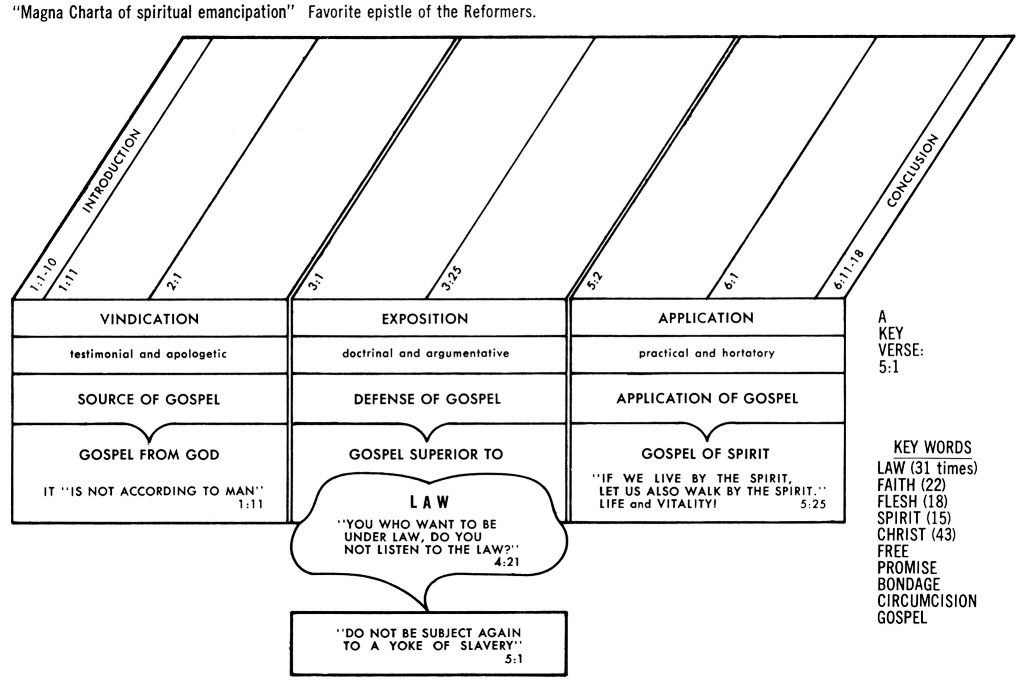
Magna Carta of Spiritual Emancipation
Click chart to enlarge
Charts from Jensen's Survey of the NT - used by permission
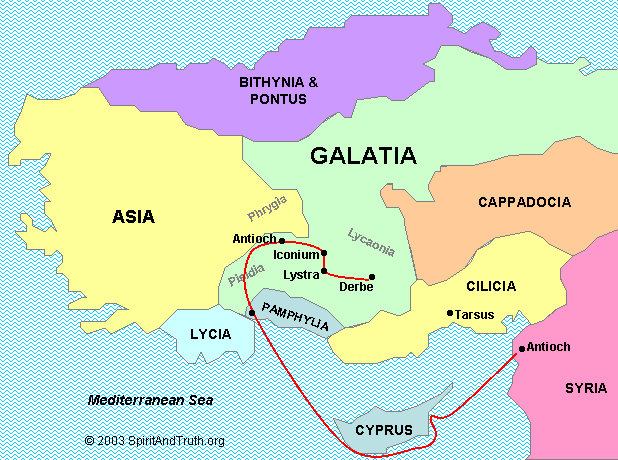
Click to Enlarge
See Also:
Paul's First Missionary Journey
Paul's Second Missionary Journey
Paul's Third Missionary Journey
Maps from Holman Bible Atlas (digital book; Hardcover/Paperback version) copyright © 1998 B&H Publishing Group, used by permission, all rights reserved.
This is one of the best resources for Bible maps as the maps also include helpful short descriptions of the events portrayed on the maps.
| SUMMARY CHART: EPISTLE TO THE GALATIANS |
|||||||
| Gospel of Grace Defended |
Gospel of Grace Explained |
Gospel of Grace Applied |
|||||
| Defense of the Gospel Gal 1:1-2:21 |
Freedom from Legalism Gal 3:1-4:31 |
Freedom to Love and to Serve Gal 5:1-6:18 |
|||||
| Labor | Liberty | Life | |||||
| Authority Not Opinion |
Freedom Not Bondage |
Spirit Not Flesh |
|||||
| Personal Autobiography |
Doctrinal Accuracy |
Practical Application |
|||||
| Paul the Apostle (Gal 1:1-24) |
Paul's Authority (Gal 2:1-21) |
Justified by Faith not Works (Gal 3:1-9) |
Justified by Faith not the Law (Gal 3:10-4:20) |
Grace and Law Cannot Co-Exist (Gal 4:21-31) |
Position and Practice of Liberty (Gal 5:1-15) |
Power of Liberty
(Gal 5:16-26) |
Performance in Liberty
(Gal 6:1-18) |
| Vindication | Exposition | Application | |||||
| Testimonial and Apologetic |
Doctrinal and Argumentative |
Practical and Hortatory |
|||||
| Biographical Explanation |
Doctrinal Exposition |
Practical Exhortation |
|||||
| Authentication of Liberty |
Argumentation for Liberty |
Application of Liberty |
|||||
|
Style or Tone: Vigorous, blunt, aggressive, direct, corrective, urgent, brief, righteous anger, strong words |
|||||||
|
Theme: Justification by Faith and not by Works of the Law |
|||||||
|
Author: Paul in large letters (Gal 6:11) |
|||||||
|
Recipients: Churches in Galatia (Gal 1:2) (Most likely the Southern Region) |
|||||||
|
Christ in Galatians: Jesus is the Source and Power for the believer's New Life. (Gal 2:20, 5:16) |
|||||||
Related Resource: Purpose of the Law
An Outline of Galatians - D Edmond Hiebert
THE INTRODUCTION (Galatians 1:1-10)
1. The salutation (Galatians 1:1-5)
a. The writer (Galatians 1:1-2a)
i. Paul, the Apostle (Galatians 1: 1)
ii. The brethren with him (Galatians 1:2a)
b. The readers (Galatians 1:2b)
c. The greeting (Galatians 1:3-5)
i. The contents of the greeting (Galatians 1:3a)
ii. The source of the grace and peace (Galatians 1:3b-4)
iii. The doxology (Galatians 1:5)
2. The rebuke (Galatians 1:6-10)
a. His astonishment at their fickleness (Galatians 1:6-7)
i. The reason for the astonishment (Galatians 1:6)
ii. The explanation of the departure (Galatians 1:7)
b. His assertion about its seriousness Galatians 1:8-9)
i. The seriousness asserted (Galatians 1:8)
ii. The seriousness reaffirmed (Galatians 1:9)
c. His attitude in the matter (Galatians 1:10)
I. PERSONAL: THE VINDICATION OF HIS APOSTOLIC AUTHORITY (Galatians 1:11-2:21)
1. How he got his Gospel (Galatians 1:11-24)
a. The origin of his Gospel through revelation (Galatians 1: 11-12)
i. The assertion as to its nature (Galatians 1:11)
ii. The manner of its reception (Galatians 1:12)
b. The previous conduct of the one given the revelation (Galatians 1:13-14)
i. The manner of his former life known to them Galatians 1:13a)
ii. The description of his former life (Galatians 1:13b-14)
a. In relation to the Church of God (Galatians 1:13b)
b. In relation to Judaism (Galatians 1:14)
c. The description of the revelation received (Galatians 1:15-17)
i. The source of the revelation (Galatians 1:15)
ii. The subject of the revelation (Galatians 1:16a)
iii. The purpose of the revelation (Galatians 1:16b)
iv. The response to the revelation (Galatians 1:16c-17)
d. His independence of the Jerusalem apostles (Galatians 1:18-24)
i. The first visit to Jerusalem (Galatians 1:18-20)
a. The time of the visit (Galatians 1:18a)
b. The purpose of the visit (Galatians 1:18b)
c. The duration of the visit (Galatians 1:18c)
d. The scope of contacts during the visit (Galatians 1:19-20)
ii. The subsequent absence from Jerusalem (Galatians 1:21-24)
a. The place of his withdrawal (Galatians 1:21)
b. The lack of acquaintance with the Judean churches (Galatians 1:22)
c. The response of the churches to reports about him (Galatians 1:23-24)
2. How his Gospel was confirmed by the apostles at Jerusalem (Galatians 2:1-10)
a. The circumstances of its presentation to them (Galatians 2:1-2)
i. The journey to Jerusalem (Galatians 2:1-2a)
ii. The presentation made at Jerusalem (Galatians 2:2b)
b. The outcome of his presentation of his Gospel to them (Galatians 2:3-10)
i. The maintenance of his position, as seen in Titus Galatians 2:3)
ii. The conflict with the false brethren (Galatians 2:4-5)
a. The presence of the false brethren (Galatians 2:4)
b. The refusal to yield to their demands (Galatians 2:5)
iii. The approval of his Gospel by the Jerusalem leaders (Galatians 2:6-10)
a. Their failure to add anything to his Gospel (Galatians 2:6)
b. Their approval of his Gospel in full (Galatians 2:7-10)
1. The basis of their approval (Galatians 2:7-9a)
2. The expression of their approval (Galatians 2:9b)
3. The one request with their approval (Galatians 2:10)
3. How he rebuked Peter's inconsistent conduct (Galatians 2:11-21)
a. The circumstances when giving the rebuke (Galatians 2:11-13)
i. The fact of his rebuke of Peter (Galatians 2:11)
ii. The reason for his rebuke of Peter (Galatians 2:12)
iii. The effect of the inconsistent conduct of Peter (Galatians 2:13)
b. The justification for giving the rebuke (Galatians 2:14-21)
i. His question of rebuke to Peter (Galatians 2:14)
ii. His explanation of his doctrinal position (Galatians 2:15-21)
a. The insufficiency of the law (Galatians 2:15-18)
1. The discovery of believing Jews about justification (Galatians 2:15-16)
2. The rejection of a conclusion from Peter's action (Galatians 2:17)
3. The significance of a return to law-works (Galatians 2:18)
b. The new life in Christ (Galatians 2:19-21)
1. The effect of the law led to the new life (Galatians 2:19)
2. The nature of the new life (Galatians 2:20)
3. The grace of God nullified by law-keeping (Galatians 2:21)
II. DOCTRINAL: THE EXPOSITION OF JUSTIFICATION BY FAITH (Galatians 3:1-4:31)
1. The elaboration of the doctrine of justification (Galatians 3:1-4:7)
a. The nature of justification as by faith, not law (Galatians 3:1-14)
i. The inconsistency of their conduct (Galatians 3:1-5)
a. The question about their turning from the crucified Christ (Galatians 3:1)
b. The question about the beginning of their Christian life (Galatians 3:2)
c. The question about their method of perfection (Galatians 3:3)
d. The question about their sufferings as believers (Galatians 3:4)
e. The question about the basis of God's work among them (Galatians 3:5)
ii. The example of Abraham's justification (Galatians 3:6-9)
a. The means of Abraham's justification (Galatians 3:6)
b. The identity of the sons of Abraham (Galatians 3:7)
c. The announcement to Abraham concerning Gentile justification by faith (Galatians 3:8)
d. The sharers in the blessings of Abraham (Galatians 3:9)
iii. The deliverance from law-works through Christ (Galatians 3:10-14)
a. The curse upon those under law-works (Galatians 3:10)
b. The inability of law-works to justify (Galatians 3:11-12)
c. The deliverance from the curse through Christ (Galatians 3:13-14)
1. The fact of our deliverance through Christ (Galatians 3:13a)
2. The means of our deliverance from the curse (Galatians 3:13b)
3. The purpose in our deliverance from the curse (Galatians 3:14)
b. The limitations of the law and its relations to faith (Galatians 3:15-4:7)
i. The covenant with Abraham unaltered by the law (Galatians 3:15-18)
a. The illustration of a man's covenant as binding (Galatians 3:15)
b. The fact illustrated is the divine promise to Abraham (Galatians 3:16)
c. The application of the principle of an unalterable covenant (Galatians 3:17-18)
1. The law did not alter the promise (Galatians 3:17)
2. The inheritance is not through law but promise (Galatians 3:18)
ii. The true place and purpose of the law (Galatians 3:19-29)
a. The temporary nature of the law (Galatians 3:19-20)
1. The reason for the adding of the law (Galatians 3:19a)
2. The time limit for the law (Galatians 3:19b)
3. The manner of the establishment of the law (Galatians 3:19c-20)
b. The inability of the law to produce life (Galatians 3:21-22)
1. The law not contrary to the promise (Galatians 3:21a)
2. The law unable to produce life (Galatians 3:21b)
3. The Scripture shut up all to faith in Christ (Galatians 3:22)
c. The law as a child-leader to Christ with His blessings (Galatians 3:23-29)
1. The old position under law (Galatians 3:23-24)
a. The position of confinement under law (Galatians 3:23)
b. The function of the law as child-leader to Christ (Galatians 3:24)
2. The new position in Christ (Galatians 3:25-29)
a. The nature of the new position (Galatians 3:25-26)
b. The entry into the new life (Galatians 3:27)
c. The effect of the new life (Galatians 3:28)
d. The fulfillment of the promise to Abraham (Galatians 3:29)
iii. The contrasted position under law and faith (Galatians 4:1-7)
a. The illustration of the position of the heir as a minor (Galatians 4:1-2)
b. The application of the illustration to believers (Galatians 4:3-6)
1. The condition of bondage as minors (Galatians 4:3)
2. The position as free sons through God's Son (Galatians 4:4-6)
a. The sending of the Son of God (Galatians 4:4-5)
b. The sending of the Spirit of God (Galatians 4:6)
3. The conclusion for the believer (Galatians 4:7)
2. The appeal for them to drop their legalism (Galatians 4:8-31)
a. The acceptance of Jewish legalism is a return to bondage (Galatians 4:8-11)
i. Their past condition of bondage (Galatians 4:8)
ii. Their present deliverance from bondage (Galatians 4:9a)
iii. Their legalism as a return to bondage (Galatians 4:9b-10)
iv. Their action a cause of concern to him (Galatians 4:11)
b. The appeal from his relations to them (Galatians 4:12-20)
i. The appeal for them to adopt his position (Galatians 4:12a)
ii. The reminder of his past relations to them (Galatians 4:12b-14)
iii. The change in their relation to him (Galatians 4:15-18)
iv. The travail he is undergoing for them (Galatians 4:19-20)
c. The appeal from the two contrasted covenants (Galatians 4:21-31)
i. The question to those desiring to be under law (Galatians 4:21)
ii. The story of Abraham's two sons (Galatians 4:22-23)
iii. The allegorical interpretation of the story (Galatians 4:24-30)
a. The two mothers representing two covenants (Galatians 4:24a)
b. The description of the two covenants (Galatians 4:24b-28)
1. The one representing a covenant of bondage (Galatians 4:24b-25)
2. The other representing a covenant of freedom (Galatians 4:26-28)
c. The expulsion of the slave woman and her son (Galatians 4:29-30)
iv. The conclusion from the story (Galatians 4:31)
III. PRACTICAL: THE LIFE OF CHRISTIAN LIBERTY (Galatians 5:1-6:10)
1. The call to maintain their Christian liberty (Galatians 5:1)
2. The peril to Christian liberty (Galatians 5:2-12)
a. The peril to them in circumcision (Galatians 5:2-6)
i. The consequences of accepting circumcision (Galatians 5:2-4)
a. It renders Christ useless to them (Galatians 5:2)
b. It makes a man debtor to do the whole law (Galatians 5:3)
c. It severs them from Christ (Galatians 5:4a)
d. It constitutes a fall from grace (Galatians 5:4b)
ii. The attitude of the true believer (Galatians 5:5-6)
b. The condemnation of the false teacher (Galatians 5:7-12)
i. The explanation for their defection (Galatians 5:7)
ii. The characterization of the teaching (Galatians 5:8-9)
iii. The condemnation of the one troubling them (Galatians 5:10-12)
a. The confidence he has in them (Galatians 5:10a)
b. The troubler will bear his judgment (Galatians 5:10b)
c. The refutation of charges that he preaches circumcision (Galatians 5:11)
d. The wish that these teachers would go to the consistent end (Galatians 5:12)
3. The life of Christian liberty (Galatians 5:13-6:10)
a. It is directed by love (Galatians 5:13-15)
i. The believer called to liberty (Galatians 5:13a)
ii. The use of Christian liberty (Galatians 5:13b)
iii. The fulfillment of the law through love (Galatians 5:14)
iv. The results of the lack of love (Galatians 5:15)
b. It is a walk in the Spirit, not in the flesh (Galatians 5:16-25)
i. The command to walk by the Spirit (Galatians 5:16)
ii. The conflict between the Spirit and the flesh (Galatians 5:17-18)
iii. The contrasted products of the flesh and the Spirit (Galatians 5:19-23)
a. The works of the flesh (Galatians 5:19-21)
b. The fruit of the Spirit (Galatians 5:22-23)
iv. The persons living by the Spirit (Galatians 5:24-25)
c. It is a life of mutual burden-bearing (Galatians 5:26-6:10)
i. The burden of moral faults (Galatians 5:26-6:5)
a. The warning against wrong attitudes towards others (Galatians 5:26)
b. The attitude of humility in restoring the fallen (Galatians 6:1)
c. The duty of mutual burden-bearing (Galatians 6:2)
d. The proper attitude toward self (Galatians 6:3-5)
ii. The burden of temporal needs (Galatians 6:6-10)
a. The exhortation to communicate with their teachers (Galatians 6:6)
b. The law of the spiritual harvest (Galatians 6:7-8)
c. The encouragement to welldoing (Galatians 6:9-10)
THE CONCLUSION (Galatians 6:11-17)
1. His reference to his large letters (Galatians 6:11)
2. His rebuke of his adversaries (Galatians 6:12-13)
3. His confidence in the cross (Galatians 6:14-16)
a. His glorying only in the cross (Galatians 6:14a)
b. His crucifixion through the cross (Galatians 6:14b)
c. His evaluation of things through the cross (Galatians 6:15)
d. His benediction upon those accepting this principle (Galatians 6:16)
4. His marks of apostleship (Galatians 6:17)
THE BENEDICTION (Galatians 6:18)
Galatians 5:23 gentleness, self-control; against such things there is no law. (NASB: Lockman)
Greek: prautes, egkrateia; kata ton toiouton ouk estin (3SPAI) nomos.
Amplified: Gentleness (meekness, humility), self-control (self-restraint, continence). Against such things there is no law [that can bring a charge]. (Amplified Bible - Lockman)
Barclay: gentleness, self-control. There is no law which condemns things like that. (Westminster Press)
GWT: gentleness, and self-control. There are no laws against things like that. (GWT)
KJV: Meekness, temperance: against such there is no law.
NLT: gentleness, and self-control. Here there is no conflict with the law. (NLT - Tyndale House)
Phillips: tolerance and self-control - and no law exists against any of them. (Phillips: Touchstone)
Wuest: meekness, self-control. Against such things as these there is no law. (Eerdmans)
Young's Literal: meekness, temperance: against such there is no law;
GENTLENESS , SELF-CONTROL; AGAINST SUCH THINGS THERE IS NO LAW: prautes, egkrateia; kata ton toiouton ouk estin (3SPAI) nomos:
Gentle Spirit, dwell with me,
I myself would gentle be;
And with words that help and heal,
Would Thy life in mine reveal.
Author Unknown
- Galatians 5 Resources - Multiple Sermons and Commentaries
Gentleness (4240) (prautes) describes the quality of not being overly impressed by a sense of one’s self-importance. Prautes is a quality of gentle friendliness - gentleness, meekness (as strength that accommodates to another's weakness), consideration, restrained patience, patient trust in the midst of difficult circumstances.
As Ryrie says gentleness could be rendered "gentlemanliness"!
C Norman Bartlett says that gentleness (or meekness) "cannot be too strongly insisted upon that meekness is not weakness. It is strength held under control, power kept in reserve. Steam does the most work when it makes the least noise. Not a few of us need less noise and more poise. Things need not shatter to matter. There is more might in the sunlight falling silently upon a small patch of earth than in the crashing of thunder and flashing of lightning in a terrific storm. We do well to store up the capital of quietude against the day of need. (C. Norman Bartlett: Galatians and You: Studies in the Epistle of Paul to the Galatians, 1948)
Prautes - 11 times in the NT in the NAS - translated: consideration, 1; gentleness, 8; humility, 1; meekness, 1.
1Co. 4:21; 2Co. 10:1; Gal. 5:23; 6:1; Eph. 4:2; Col. 3:12; 2Ti 2:25; Titus 3:2; James. 1:21; 3:13; 1Pet. 3:16
Click for an in depth discussion of the closely related word praus (4239). Used 4x in Lxx - Esther 5:1; Ps 45:4; 90:10; 132:1;
Eadie - This Christian grace is universal in its operation—submission Godward, meekness manward, which seems to be its special reference.
Spurgeon on gentleness - This does not push itself to the front and does not easily get provoked. Some people are very hard, stern, severe, quick-tempered, passionate, but the true follower of Christ will be gentle and tender, even as He was… Familiarity with Christ soon begets congeniality of disposition and spirit, for those who are much with Christ become much like Christ. He who lies on a bed of spices will naturally find his garments smell of the same. A mirror upon which the sun is shining is bright itself and flashes its reflected rays. He who walks with wise men will be wise, but he who dwells with infinite wisdom will be taught of God. Doubtless happy couples who live together in mutual affection and confidence become very much like each other. The one becomes the other’s self. They have the same aims and objects. They are often surprised to find that they have thought the same thought and are about to say the same words at the same moment. So do the saint and the Savior grow like each other after years of acquaintance, only the growth is all on one side—we grow up unto Him in all things who is the head (Eph 4:15).
In Greek literature prautes was sometimes used of a feigned, hypocritical concern for others that is motivated by self-interest. But in the New Testament it is always used of genuine consideration for others.
Prautes denotes the humble and gentle attitude which expresses itself, in particular, in a patient submissiveness to offense, free from malice and desire for revenge… controlled strength, the ability to bear reproaches and slights without bitterness and resentment; the ability to provide a soothing influence on someone who is in a state of anger, bitterness and resentment against life… the word indicates an obedient submissiveness to God and His will, with unwavering faith and enduring patience displaying itself in a gentle attitude and kind acts toward others, and this often in the face of opposition. It is the restrained and obedient powers of the personality brought into subjection and submission to God’s will by the Holy Spirit (Gal 5:23)… the opposite of arrogance… the word stands in contrast to the term orge (wrath, anger as a state of mind)… It denotes the humble and gentle attitude which expresses itself, in particular, in a patient submissiveness to offense, a freedom from malice and desire for revenge… mildness, patient trust in the midst of difficult circumstances. (2Co 10:1) (Compiled from the Linguistic and Exegetical Key to the Greek NT)
Prautes was used in secular Greek writings to describe a soothing wind, a healing medicine, and a colt that had been broken. In each instance, there is power for a wind can become a storm, too much medicine can kill and a horse can break loose.
The Greeks used prautes to describe strong animals that were brought under control, Xenophon writing that horses that work together are more likely to “stand quietly” together. Aristotle wrote of the “easy-tempered and easily domesticated” elephant. Plato described a mighty and strong beast which could be tamed and fed by a man who learned how to handle it.
Thus prautes describes power under control. Just as wisdom is the right use of knowledge, so gentleness is the right use of authority and power.
Prautes is an interesting word. Aristotle defined it as the correct mean between being too angry and being never angry at all. It is the quality of the man whose anger is so controlled that he is always angry at the right time and never at the wrong time. It describes the man who is never angry at any personal wrong he may receive, but who is capable of righteous anger when he sees others wronged.
The meek person does not have to fly off the handle because he has everything under control. A perfect picture is found in our Lord Jesus Christ. Quoting from the Septuagint (LXX = Greek of the Hebrew Old Testament) rendering of Zechariah 9:9, which predicts the Lord’s triumphal entry into Jerusalem, Matthew uses the adjective form of prautes (praus) to describe Jesus as
“gentle (praus) and mounted on a donkey, even on a colt, the foal of a beast of burden” (Mt 21:5).
In a gracious appeal to His followers, Jesus used the same adjective of Himself, saying,
“Take My yoke upon you, and learn from Me, for I am gentle ((praus) and humble in heart; and you shall find rest for your souls” (Mt 11:29).
James uses prautes in his discussion of a teachable spirit instructing his readers to
Therefore (to "achieve the righteousness of God" and manifest ourselves as "the firstfruits among His creatures") putting aside all filthiness and all that remains of wickedness, in humility (praǘtēs) receive the word implanted, which is able to save your souls. (James 1:21)
Barclay comments on this verse writing that this man "will receive the word with gentleness. (humility = praǘtēs). Gentleness is an attempt to translate the untranslatable word praǘtēs. This is a great Greek word which has no precise English equivalent. Aristotle defined it as the mean between excessive anger and excessive angerlessness; it is the quality of the man whose feelings and emotions are under perfect control. Andronicus Rhodius, commenting on Aristotle, writes, “Praǘtēs is moderation in regard to anger … You might define praǘtēs as serenity and the power, not to be lead away by emotion, but to control emotion as right reason dictates.” The Platonic definitions say that praǘtēs is the regulation of the movement of the soul caused by anger. It is the temperament (krasis) of a soul in which everything is mixed in the right proportions. No one can ever find one English word to translate what is a one word summary of the truly teachable spirit. The teachable spirit is docile and tractable, and therefore humble enough to learn. The teachable spirit is without resentment and without anger and is, therefore, able to face the truth, even when it hurts and condemns. The teachable spirit is not blinded by its own overmastering prejudices but is clear-eyed to the truth. The teachable spirit is not seduced by laziness but is so self-controlled that it can willingly and faithfully accept the discipline of learning. Praǘtēs describes the perfect conquest and control of everything in a man’s nature which would be a hindrance to his seeing, learning and obeying the truth. (Galatians 5 Commentary )
James in the context of discussion the control of one's tongue again uses praǘtēs in his answer to the rhetorical question
Who among you is wise and understanding (mental perception and comprehension)? Let him show (expose to the eyes, giving evidence or proof of it) by his good behavior his deeds in the gentleness (praǘtēs) of wisdom (the ability to view life from God’s perspective). (Js 3:13)
We can perceive understanding in others quite easily, but wisdom is more difficult to identify. James said to look at a person’s behavior if you want to see if he or she is wise. In other words if a man or woman is wise and understanding, they will demonstrate it by their good conduct coupled with the gentle spirit that comes from godly wisdom. The wisdom James had in mind did not result so much in what one thinks or says but in what one does. One of the marks of godly wisdom is praǘtēs -- gentleness, meekness or humility.
Knowledge is proud that she has learned so much. Wisdom is humble that she knows no more.”
Constable in his note on this verse adds that "The Greek word praǘtēs (“gentleness”) occurs in non-biblical literature to describe a horse that someone had broken and had trained to submit to a bridle. It pictures strength under control, specifically the Holy Spirit’s control. The evidence of this attitude is a deliberate placing of oneself under divine authority. The only way to control the tongue is to place one’s mind deliberately under the authority of God and to let Him control it . (Thomas Constable's Expository Notes on the Bible)
A believer's attitude toward unbelievers should always reflect a spirit of gentleness, being indulgent toward the infirmities of the unsaved. Peter writes that even when unbelievers intimidate us we should still
“sanctify Christ as Lord in your hearts,“always being ready to make a defense to everyone who asks you to give an account for the hope that is in you, yet with gentleness (prautes) and reverence” (see note 1 Peter 3:15)
and “with gentleness (prautes) correcting those who are in opposition (could refer to unbelievers or rebellious unbelievers), if perhaps God may grant them repentance leading to the knowledge of the truth” (see note 2 Timothy 2:25).
Those "who are spiritual" are to deal with disobedient fellow believers “in a spirit of gentleness (prautes)” (Gal 6:1). How is this possible? Paul had just written that
the fruit of the Spirit is love, joy, peace, patience, kindness, goodness, faithfulness, gentleness (prautes), self-control; against such things there is no law. (Gal 5:22-23)
It follows that the Spirit filled/controlled believer is the one most suited to "restore (a man caught in trespass) in a spirit of gentleness."
Meekness is that unassuming inner spirit of mildness and gentleness which is the opposite of haughtiness, harshness and self-assertiveness.
Meekness is a willingness to waive one's rights for a good cause, just as Jesus waived His rights to His rule as King as he rode into Jerusalem mounted on a donkey (see above). Set aside your rights! Do not demand that you be satisfied, but for the sake of the gospel of Jesus Christ be willing to suffer loss. Meekness is the opposite of rudeness and abrasiveness.
Ray Stedman describes meekness as "strength under control" adding that "It is real strength, but it does not have to display itself or show off how strong it is. This is what our Lord beautifully displayed He described himself as "meek and lowly in heart." The first curriculum of the Holy Spirit is that we must do what Jesus said, "take my yoke upon you and learn of me, for I am meek and lowly of heart."
Meekness and weakness are not synonymous. Meekness says, "God, in this situation, You have a purpose. You're in control, sovereign, and ruling over all."
Meekness is seeing everything as coming from God and accepting it without murmuring and without disputing, patiently submitting to any and every offense, without any desire for revenge or retribution!
Barclay says the best illustration of prautes is the watchdog "who is bravely hostile to strangers and gently friendly with familiars whom he knows and loves." (Galatians 5 Commentary )
Trench adds that prautes “is closely linked with humility, and follows directly upon it (see Eph 4:2; Col 3:12) because it is only the humble heart which is also the meek; and which, as such, does not fight against God, and more or less struggle and contend with Him. This meekness, however, being first of all meekness before God, is also such in the face of men, even of evil men, out of a sense that these, with the insults and injuries which they may inflict, are permitted and employed by Him for the chastening and purifying of His elect. This was the root of David’s (meekness) when Shimei cursed and flung stones at him—the consideration that the Lord had bidden him (2Sa 16:11), that it was just for him to suffer these things, however unjustly the other might inflict them; and out of like convictions all true Christian (meekness) must spring. He that is meek indeed will know himself a sinner among sinners… and this knowledge of his own sin will teach him to endure meekly the provocations with which they may provoke him, and not withdraw himself from the burdens which their sin may impose (Ibid)
Barclay adds that prautes "describes the man whose temper is always under complete control. He knows when to be angry and when not to be angry. He patiently bears wrongs done to himself but is ever chivalrously ready to spring to the help of others who are wronged." (Galatians 5 Commentary )
F B Meyer has a devotional based on 2 Timothy 2:24 (note) entitled "The Fruit of the Spirit - Gentleness"
IT IS not easy to cultivate this fruit of the Spirit because it has many counterfeits. Some people are naturally easy-going, devoid of energy and ambition, at heart cowardly, or in spirit mean. Many of us are characterized by a moral weakness and decrepitude that make it easy for us to yield rather than contest in the physical or intellectual arena.
But in gentleness there must be the consciousness of a considerable reserve of force. The gentleness of God is combined with omnipotence. The movements of creation, in which there is neither voice nor language, prove the infinite forces which are at work. When a boy is trying to lift or carry a heavy beam, as likely as not there will be a great crash when he reaches the end of his task, and puts it on the ground. His strength is so nearly exhausted that he is only too glad to get rid of his burden, anyhow, and at any cost. But if a strong man shoulders the same burden, and carries it for the same distance, he puts it down gently, because he has not taxed his strength and has plenty left.
It is the prerogative of great strength to be gentle. Always remember that you are linked with the Infinite God, and that all things are possible to you. There must also be infinite pity. We must be tolerant and pitiful to those who abuse us, or have been embittered by disappointment, or have been ill-used. It must be our aim to make allowances for such, and always to be sweetly reasonable towards any brusqueness, rudeness and bad manners of their behaviour. Let us be willing to admit that much is due to congenital moroseness. Therefore, we bear gently with the erring, and with those who are out of the way, because we also are encompassed with infirmity.
It is necessary also that there should be a deep humility. Thomas a Kempis says: "If thou wilt be borne with, bear also with another. Endeavour to be patient in bearing with the defects and infirmities of others, what sort soever they be: for that thyself also hast many failings which must be borne by others." Our resentment against others should be always tempered by our remembrance of our own sins. So shall we be God's own gentlefolk.
PRAYER - O God, our behaviour has not manifested all the fruits of the Spirit, or been full of the graciousness and gentleness of Christ. Forgive us, and enable us so to live that His beauty may be on our faces, the tone of His voice in our speech, the gentleness of His tread in our steps, the unselfishness of His deeds in our hands. AMEN. (F B Meyer. Our Daily Walk)
- Galatians 5 Resources - Multiple Sermons and Commentaries
Self control cross references
Acts 24:25 And as he was discussing righteousness, self-control and the judgment to come, Felix became frightened and said, “Go away for the present, and when I find time, I will summon you.”
1 Corinthians 9:25 And everyone who competes in the games exercises self-control in all things. They then do it to receive a perishable wreath, but we an imperishable.
Titus 1:8 but hospitable, loving what is good, sensible, just, devout, self-controlled,
Titus 2:2 Older men are to be temperate, dignified, sensible, sound in faith, in love, in perseverance.
See related study: Exercising self-control so you can run to win!
Self Control (KJV = temperance) (1466)(egkrateia or enkrateia from en = in + kratos = power to rule <> the stem krat- speaks of power or lordship) means literally a holding oneself in or the ability to take a grip of oneself. This meaning reminds one of our modern slang expression "Get a grip"! Egkrateia refers to the restraining of passions and appetites that originate from the Old Self.
Egkrateia - 4x in 3v - Acts 24:25; Gal 5:23; 2 Pet 1:6 (Not in the Septuagint)
To be self-controlled is to not live in bondage to the desires, passions and appetites of the flesh. The physical human body is a good servant but a miserable master!
In short egkrateia/enkrateia describes the personal rule or mastery over fleshly (see flesh) impulses that would be impossible without the Holy Spirit’s control. Notice that it is easily to fall into the trap of emphasizing the "self" prefix of self-control. Yes, the "en" in enkrateia does mean "in" and speaks of believers being controlled by an inward strength. This inward strength ultimately however is the power of the Holy Spirit in us, not our own intrinsic power. We absolutely cannot control the flesh in our own power… not now and not ever! Don't fall into this trap. The only One Who can control the fallen, anti-God energy of the flesh is the Holy Spirit! Our part is to walk by the Spirit (Gal 5:16) - acknowledging we don't have the power, crying out to Him in the time of urgent need (when our fleshly impulses feel like they will overwhelm us… which they will without the Spirit's help), trusting in God's provision of power to walk (for what God commands, He always enables), submitting or yielding to the Spirit's leading, guiding and empowering and in the end experiencing the victory of Spirit enabled "self" control.
Norman Harrison - One confesses sadly, "I don't know why I act this way; I just lost control of myself." Fine confession! You are on the wrong side of the cross. Get over onto His Side and the Spirit will operate on your self-life that causes this lack of control; He will take you in hand. Spirit-controlled, you will be genuinely, inwardly self-controlled. (Galatians 5:16-23 Spirit versus Flesh)
Spurgeon on self control - This keeps every passion under control, not only with respect to meats and drinks, but with regard to everything else.
To the ancient Greeks, self-control was in essence the proper ordering and balancing of the individual. For example, Aristotle said
I count him braver who overcomes his desires than him who conquers his enemies; for the hardest victory is the victory over self. (Not bad theology from an erudite pagan!)
Plato believed that our animal urges must be governed or else they will produce “a feverish state in the soul, a city of pigs” which knows no limits. When we’re not self-controlled, our life is like a pigsty. That’s quite a word picture. Plato in another place wrote that egkrateia
is the ordering or controlling of certain pleasures and desires … implied in the saying of ‘a man being his own master.’
Plato thus used egkrateia to refer to self-mastery meaning that it was the spirit which has mastered its desires and its love of pleasure.
Socrates regarded egkrateia as a cardinal virtue and Philo described it as superiority expressed in self-restraint.
Other secular Greek writers used egkrateia to describe the virtue of an Emperor who never lets his private interests influence the government of his people. It is the virtue which makes a man so master of himself that he is fit to be the servant of others.
The rendering of egkrateia as self-control can be misleading if one places the emphasis on "self", deceptively thinking he can control the body through will power and self determination. As most believers have discovered, self control is far from the world's concept of self-help. Paul in fact alludes to this dilemma in Romans 7 writing…
I know that nothing good dwells in me, that is, in my flesh; for the wishing is present in me, but the doing of the good is not. (see note Romans 7:18)
Greeks used this term especially to describe one who had his sexual passions under control, but the NT extends the meaning to all areas of life where the discernment between good and evil is important (cf 1Th 5:21, 22).
In his first epistle to the Corinthians (who lived in a "sex crazed" society) Paul uses the related verb egkrateuomai writing that…
if (the unmarried) do not have self-control, let them marry; for it is better to marry than to burn (to seethe inwardly with destructive lusts). (1Corinthians 7:9)
Paul implies that one needs to exercise self control in regard to sexual behavior, which is quite applicable to believers in America, where even the commercials have become "R rated" and filled with sexual innuendos! In the present context however the self control is not just in the area of sexuality but in any area where one needs to exercise restraint (e.g., drunkenness, carousing and things like these… )
C Norman Bartlett writes that…
By temperance is meant self-control in the broadest and fullest sense of the term. We need to go into training for CHRIST and to keep ourselves spiritually fit at all times, for we never know when a critical test may come or a golden opportunity arise that will call upon our spiritual reserves. To this end we should be prepared to give up whatever mars our witness and hinders usefulness in the Master’s service. Attaining to the best may necessitate abstaining from the rest. The lesser must sometimes be sacrificed to the higher good. (C. Norman Bartlett: Galatians and You: Studies in the Epistle of Paul to the Galatians, 1948)
Brian Bill writes that…
Nestled among the Spirit’s produce is the seemingly out-of-place fruit of self-control. This characteristic of a Christ-follower seems to focus more on me instead of on my relationships with other people. I can exercise self-control when I’m the only person in the house. In fact, sometimes the hidden, private moments when no one else is looking is precisely when I need self-control the most. However, if we properly exercise the fruit of self-control, it will benefit those around us. In some ways, we might consider this virtue the most important because without self-control the works of the flesh cannot be overcome and the other elements of the Fruit of the Spirit will not be evident.
When the Greeks wanted to illustrate self-control, they built a statue of a man or a woman in perfect proportion. To them, self-control was the proper ordering and balancing of the individual. (Galatians 5:23 Seizing Self-Control)
In the ancient world, self-control characterized athletes who sought to be self-restrained and self-disciplined, qualities which were crucial in their quest for victory in the intense competition of the elite Olympic Games.
In 1 Corinthians 9 Paul used the cognate verb egkrateuomai to describe the attitude believers need in order to win the prize, comparing them to Olympic athletes explaining that…
everyone who competes in the games exercises self-control (egkrateuomai) in all things (How many things? Why do they do this?). They then do it to receive a perishable wreath, but we an imperishable ("Chew the cud of this contrast for a moment." - in other words Meditate). Therefore (after thinking about the contrast and remembering that believers are destined for eternity, let your mind come to the same conclusion and determination that Paul came to… ) I run in such a way, as not without aim; I box in such a way, as not beating the air but I buffet my body and make it my slave, lest possibly, after I have preached to others, I myself should be disqualified. (1Corinthians 9:25-27) (But be careful… remember Paul's running and boxing and buffeting were not a reflection of self effort but were grace based, Spirit empowered effort, for as he said elsewhere "by the grace of God I am what I am, and His grace toward me did not prove vain; but I labored [see meaning of kopiao] [this was Paul's and is every believer's responsibility] even more than all of them, yet not I, but the grace of God [God's "responsibility" - His sovereignly bestowed unmerited favor] with me [and also available to each and every believer]." 1Corinthians 15:10)
Paul argues that athletes exercise self-control because they are motivated by a clearly defined goal and understand that in order to achieve that goal, they must (at least for a time) resist the distractions that originate from their bodily passions and desires.
In a similar way, believers are charged to control their flesh (not the physical body but the evil disposition that still lives in our mortal bodies), with its corrupt, deceptive passions and desires, rather than allowing themselves to be controlled by them. However, what is referred to as self-control is actually (and only) the result of letting the Spirit take control (Spirit enabled "self" control), so that one is walking in Him, walking by the Spirit, keeping in step with the Spirit.
In a parallel thought Paul wrote to the Colossian saints who were being tempted to try all manner of methods and mysticism to "corral the flesh" (see summation in Col 2:23 )
As you therefore have received Christ Jesus the Lord (How? By faith. By believing the Biblical truth about Him.), so walk (present imperative - make it your habit to seek to conduct you life in the atmosphere of Christ, His teachings, His example, His Spirit) in Him (see note Colossians 2:6)
Vincent adds this historical note on self control in ancient athletes
The candidate for the races was required to be ten months in training, and to practice in the gymnasium immediately before the games, under the direction of judges who had themselves been instructed for ten months in the details of the games. The training was largely dietary. Epictetus says: “Thou must be orderly, living on spare food; abstain from confections; make a point of exercising at the appointed time, in heat and in cold; nor drink cold water nor wine at hazard.” Horace says: “The youth who would win in the race hath borne and done much; he hath sweat and been cold; he hath abstained from love and wine” (“Ars Poetica,” 412). Tertullian, commending the example of the athletes to persecuted Christians, says: “Coguntur, cruciantur, fatigantur.” “They are constrained, harassed, wearied” (“Ad Martyres,” 3). Compare 2Ti 2:5 [note])
Paul's point is that each believer should be like a highly trained athlete who exercises control over his or her body (the seat of the strong desires) during the period in which they are training for the Olympics. While the athlete says "No" to these bodily desires in their own strength, in contrast, Spirit controlled believers are enabled to exercise supernatural self control in the strength of the Holy Spirit. When we say "Yes" to the Spirit, we cannot say "Yes" to the flesh for these are in opposition to one another (Gal 5:17).
In His incarnation Christ was the epitome of self-control. He was never tempted or tricked into doing or saying anything that was not consistent with His Father’s will and His own divine nature. He left us an example for us to follow in His steps (1Pe 2:21)
Egkrateia points to a supernatural inner power to control one's old desires and cravings inherited from Adam (Ro 5:12). Sometimes we as saints forget that even though we have been crucified with Christ (Gal 2:20; Ro 6:6) and are dead to the domination and/or power of Sin (Ro 6:11, 12, 13, 14, 15, 16, 17, 18 --see notes Ro 6:11; 12-13, 14, 17, 18), the old desires are still latent and are able to be activated in our mortal bodies. Paul alluded to this spiritual dynamic earlier writing…
But I say, walk (present imperative = not a suggestion but a command to make it your lifestyle or your habitual practice to conduct all of the aspects of you life) by the Spirit and (here is the conditional promise - conditioned on choosing to walk by the Spirit) you will (absolutely) not carry out (not that you won't still experience them but that you won't act on them!) the (strong) desire of the flesh (see note Galatians 5:16).
The highly respected nineteenth century Scottish theologian John Eadie wrote that self control is…
the holding in of passions and appetites, distinguished by Diogenes Laertius from sophrosune (see study of related word sophronos) in that it bridles the stronger desires… The word is to be taken in its widest significance, and not principally in reference to sexual sin—as Origen (so interpreted it)… This virtue guards against all sins of personal excess, and is specially opposed to drunkenness and revellings as works of the flesh. (Eadie, John: Epistle of St Paul to the Galatians - 702 Page Pdf)
Adam Clark writes that egkrateia means…
Continence (Webster = exercising self restraint, especially a refraining from sexual intercourse), self-government, or moderation, principally with regard to sensual or animal appetites. Moderation in eating, drinking, sleeping, etc.
The Greek word egkrateia has the idea of to get a grip on one's self, on one's passions! Many of the early Christian heresies taught that since the (physical) body was evil (which it is not - it is morally neutral and is solely an instrument either of the Spirit or of Sin) it was not necessary to curb evil lusts, but that one only had to think correctly. In contrast, Paul teaches that self-control is not a result of self-effort but a fruit wrought by the Spirit as we rest in Him, trust in Him and walk by Him. Then God receives the praise and the glory for the victory instead of self (flesh), which ever seeks to usurp God's rightful place and receive the glory due only to Him!
The writer of Proverbs alludes to the subject of self control writing that
He who is slow to anger is better than the mighty, and he who rules his spirit, than he who captures a city. (Proverbs 16:32)
Comment: Have you ever tried in your own strength (self effort) to control your temper or restrain the desire follow through with a sudden outburst of anger? I have and it might work for a moment, but Sin remains crouching at the door of my mind and heart just waiting for the opportunity to "pounce", and unfortunately it often does. How difficult is it for us to achieve victory in this area? The writer says that it is easier to gain a victory over a city (and in ancient times these were walled, well fortified cities, totally unlike our modern cities!) then to conquer one's temper! In my own strength I cannot control the overwhelming, powerful, compelling urge to lash out, but the Spirit of the Gentle Shepherd can control it as I yield my "rights" to Him and rest in His sufficiency to enable me to work out my salvation in the area of "Anger Management 101" (recall Paul's power in 1Corinthians 15:10 quoted above).
MacDonald (Ref) adds that "Peter the Great, although one of the mightiest of the Czars of Russia, failed here. In a fit of temper he struck his gardener, and a few days afterwards the gardener died. “Alas,” said Peter, sadly, “I have conquered other nations, but I have not been able to conquer myself! Woe! There, beloved, is a picture of all of us apart from the grace of God (1Cor 15:10) and the controlling fruit of the Spirit of God!
Paul uses egkrateia in his appearance before Felix, and in this context apparently referring to self–control in the area of sex. It is indeed fascinating that Paul's presentation of the gospel emphasized self control. As Paul spoke before the Roman governor Felix and his wife Drusilla, he spoke of…
righteousness, self–control and the judgment to come, (and) Felix became frightened and said, ‘Go away for the present, and when I find time, I will summon you’ ” (Acts 24:24-25).
Felix had stolen Drusilla from her former husband and was therefore living with her in an adulterous relationship. The sexual self–control of which Paul spoke pertained to lustful passion, and Felix clearly understood Paul's warning. The message to the governor was that he was living contrary to God’s righteousness by refusing to discipline his sexual desire, and for that he was subject to God’s judgment.
Pastor Brian Bill adds that…
Felix was no different than many others in the Roman Empire. Scholars tell us that when ancient Rome was disciplined and controlled, it was a great nation, but when it became saturated in its own sin it lost its glory. Drunkenness, orgies, and an “anything goes” mindset caused Rome to cave inward and implode upon itself. The decline of the Roman Empire went hand-in-hand with self-indulgence. I wonder if America is going down that same road? (Galatians 5:23 Seizing Self-Control)
Barclay - Egkrateia is that great quality which comes to a man when Christ is in his heart, that quality which makes him able to live and to walk in the world, and yet to keep his garments unspotted from the world. (Galatians 5 Commentary )
Self-control means mastering one’s emotions rather than being mastered by them. Lack of self control played a significant role in abominable deeds of the false teachers Peter exposed in chapter 2 of his second epistle.
For speaking out arrogant words of vanity they (the false teachers) entice by fleshly desires (What manner of "desires"? Those that originate in the fallen flesh), by sensuality, those who barely escape from the ones who live in error, promising them freedom while they themselves are slaves of corruption; for by what a man is overcome, by this he is enslaved (perfect tense - speaks of the permanence of this bondage). (See notes 2 Peter 2:18; 19)
Sow a thought, reap an action.
Sow an action, reap a habit.
Sow a habit, reap a character.
Sow a character, reap a destiny!
The false teachers in 2 Peter claimed that "liberty" was a warrant for licentiousness rather than life as it should be lived in the Spirit. These men instead of self control were "sensuality controlled", enslaved to greed and fleshly desires. They believed and taught that knowledge freed people from the need to control their passions. Peter countered their false doctrine that claimed that knowledge emancipates men from the obligations of morality.
In another pithy proverb, Solomon gives a vivid picture of the danger of the lack of self-control writing…
Like a city that is broken into and without walls is a man who has no control over his spirit. (Proverbs 25:28)
As alluded to earlier, the city states of those days were walled for protection from marauders. No wall around a city meant no protection. No self control by analogy means one is wide open to attack from the Evil One and the old sinful flesh nature (flesh)! Without self control, they are not able to resist those things that can destroy their lives and the lives of others. Such a man or woman is an easy victim when attacked by tempting desires and impulses. The Bible offers numerous illustrations of those who failed to "build a wall around the city" of their heart and mind, but instead kept the "opened wide the gates" to the wisdom of the world, the flesh and the devil. Woe! Take for example, the sad saga of Samson and his self destruction and defeat at the hands of a seductive temptress. (see notes Judges 14; Judges 15; Judges 16). Like Samson, we all have the deceptive flesh lurking and waiting for a moment of weakness (we are tired, frustrated with others, disappointed with our circumstances, we have just been successful in some venture be it secular or spiritual, etc) and would do well to heed Solomon's advice (which sadly and paradoxically he himself did not heed, miserably failing to exercise self control, especially in 1 Kings 11:1-13 - read the last half of the chapter for the wide ranging consequences!)…
Watch (command to) over your heart with all diligence, (Why is this discipline so critically important?), for from it flow the springs of life. (Proverbs 4:23-note) (The NLT poignantly paraphrases it "Above all else, guard your heart, for it affects everything you do.") (See also Puritan John Flavel's online book "Keeping the Heart" acclaimed by some as one of the best Christian books ever written!)
Remember that when we take time off from disciplining ourselves for godliness we don't remain "static" spiritually, but we begin to drift back toward the subtle, seductive lures of the world, the flesh and/or the devil. Do not be deceived thinking you are "okay" if you are taking a "spiritual hiatus"! In fact, you are in grave danger, for fleshly lusts continually wage war against your soul (1Pe 2:11). Paul understood the critical importance of the necessity of maintaining a program of spiritual discipline (under grace of course, not under law - an easy trap to fall into in the area of the spiritual disciplines - read Ray Stedman's excellent admonition to be alert to Legalism or better yet listen to his Mp3) exhorting his young disciple Timothy (and all disciples of all ages)…
Discipline (present imperative - not a suggestion but a command to make it your habit gymnazo [the Greek verb for discipline] yourself - working out in "God's gym" of His Word, prayer, fellowship, breaking of bread, etc) yourself for the purpose of godliness; for bodily discipline is only of little profit, but godliness is profitable for all things, since it holds promise for the present life (literally "the now life") and also for the life to come (literally "the coming life" = it's already on its way for believers). It is a trustworthy statement deserving full acceptance. For it is for this (the promise which godliness holds forth -- that it may be fulfilled) we labor (intensely toiling to the point of utter exhaustion!) and strive (agonizomai = an intensely struggling for victory or more accurately for believers "from victory", the Victory having been procured for us at Calvary by Christ), because we have fixed our hope (our certainty) on the living God, Who is the Savior of all men, especially of believers. (1Ti 4:7, 8, 9, 10-see notes 1Timothy 4:7; 4:8; 4:9; 4:10)
Just as ceasing to exercise physically results in loss of muscle and bone mass, decreased strength and endurance, etc, so too, the same dynamic occurs in the spiritual realm when we cease to discipline ourselves for godliness.
Pastor Steve Cole observes that…
There is a paradox here: to be Spirit-controlled results in being self-controlled. As we walk by the Spirit (Gal 5:16), He produces in us the ability to control every area of our lives in line with His holy purposes. This implies active responsibility on your part. Sometimes, speakers on the spiritual life state that you are to be completely passive
“Just let go and let God.”
“If you’re striving, you’re not trusting.”
This is clearly unbiblical. Paul wrote, "For this purpose also I labor, striving (see agonizomai) according to His power, which mightily works within me. "(Col 1:29) Both are true…the self-controlled person is submitting himself to God’s will as revealed in His Word, whereas the self willed person is acting for his own selfish desires, disregarding what God wills. Because God has given us new life in Christ and has given His Holy Spirit to indwell us, we have both the responsibility and the ability to yield our self-will to His revealed will. (Read full sermon Learning to Control Yourself )
Pastor Cole goes on to describe how we cultivate the grace of self control, summing it up noting that…
Walk by means of the Holy Spirit every day. This undergirds the whole process. Note Galatians 5:16,
But I say, walk by the Spirit, and you will not carry out the desire of the flesh.
He goes on to talk about the strong desires of the flesh that war against the Spirit. If you do not conquer these desires, you will not grow in godliness. You don’t win wars accidentally! You must devote yourself to the battle, committed to fight with everything you’ve got. Anything less will result in defeat. To walk by the Spirit means to depend upon and yield to the indwelling Holy Spirit moment by moment every day. Walking is not as spectacular as leaping or flying, but if you keep at it, you’ll get where you’re going.
Also, the picture of fruit implies a slow, deliberate process. There will be setbacks and difficulties along the way. The question is, are you actively, purposefully walking by the Spirit, coming back to dependence on Him when you have fallen, so that over the long haul, the fruit of the Spirit, including self control, is growing in your life? (Read full sermon Learning to Control Yourself ) (Bolding added)
Wayne Barber discusses Peter's mention of self control in 2Pe 1:6 (note) ("and in your knowledge, self-control… "), reminding us that…
… this self-control arises from and is accompanied by our knowledge which comes out of obedience to the Word of God. It comes right out of that faith that God gives us.
The definition of self control means to be able to hold one's self in. 1Co 9:25 Paul is talking about an athlete and how he has to have self-control (Ed Note: not egkrateia but the related verb egkrateuomai) ("And everyone who competes in the games exercises self-control in all things… " ) This would include control over his appetite, his temper, his schedule (an athlete needs priorities or he will become undisciplined). If you wanted to play on the basketball team in college, you had to have discipline or self-control.
Remember that the definite article ("the" in the Greek of 2Pe 1:6) is before each godly characteristic so Peter is talking about the self-control, the very self-control and self-restraint that Jesus had, even as He Himself was tempted as all men are. And yet God gives us access to that same self-control! So that's where the analogy breaks down… it's not human energized self-control Peter is talking about but that which is available by faith (obedience) from Christ in us. The Christian ought to have control over his appetite.
Dr Barber goes on to make the point that when he is in the Word of God, he is a controlled person. He asks…
How many diets have you been on? You lose some but then you gain it right back. Remember that Scripture repeatedly links idolatry and immorality (Nu 25:1,2). Immorality and a person with an uncontrolled appetite is closely related all the way through Scripture. Believers because of Christ within them, possess the potential to control their temper, to exercise control over their desires, the power to say "no", the power to set godly priorities, the power within them so that they can turn off the television and go to bed early so they can arise early to be fresh with God in the morning, the self control to get out of bed in the morning to be alone with God, etc. And all of this self-control comes out of our faith. (2Pe 1:5) We don't have to go to a course or read a book on how to become self-controlled! That control is within us and if we are diligent to see results, then we will see God work it out in our life and move us into His victory.
For additional insights on self control, see John Piper's article entitled Fierce Fruit of Self-Control.
Are these nine aspects of the fruit of the Spirit something we do, or things the Spirit does for us? Clearly the Spirit is the Planter and Producer of the supernatural fruit for He alone can initiate and empower these graces, however each of these nine graces are also commanded of believers -
- Love (John 13:34,
- Joy (Phil 4:4),
- Peace (2 Cor 13:11),
- Patience (Eph 4:2),
- Kindness (Eph 4:32),
- Faithfulness (Rev 2:10),
- Gentleness (Eph 4:2),
- Self-control (2 Pe 1:5,6 - note v5; note v6).
Every believer has the potential to bear a "bumper crop" for as Paul explained we have "been filled with the fruit of righteousness which comes through Jesus Christ, to the glory and praise of God." (Php 1:11) Our task on earth as obedient children is to work out what God has worked in. Or as Paul instructed the saints at Philippi…
work out (present imperative = command to make this our lifestyle, only possible as we learn to daily depend on the Holy Spirit) your salvation with fear and trembling, FOR (note this is a strategic term of explanation - it explains how it is possible for us to work out our salvation!) it is God Who is (CONTINUALLY) at work in you (HERE REFERS TO GOD THE HOLY SPIRIT), both to (CONTINUALLY) will and to (CONTINUALLY) work ("the DESIRE and the POWER" = Php 2:13NLT) for His good pleasure. (Php 2:12, 13-see notes Php 2:12; 2:13)
Spurgeon is careful to add that…
Fruit again calls for care. If you have a garden you will soon know this. We had a profusion of flowers upon our pear trees this year, and for a few weeks the weather was warm beyond the usual heat of April, but nights of frost followed and cut off nearly all the fruit. Other kinds of fruit which survived the frost are now in danger from the dry weather which has developed and endless variety of insect blight, so that we wonder whether any of it will survive. If we get over this trial an the fruit grows well we shall yet expect to see many apples fall before autumn, because the worm has eaten into their hearts and effectually destroyed them. So is it with Christian life: I have seen a work for the Lord prospering splendidly like a fruitful vine, when suddenly there has come a frosty night and fond hopes have been nipped: or else new notions, and wild ideas have descended like insect blights and the fruit has been spoiled; or if the work has escaped these causes of damage, some immorality in a leading member, or a quarrelsome spirit, has appeared unawares like a worm in the centre of the apple, and down it has fallen never to flourish again. (The First Fruit of the Spirit)
AGAINST SUCH THINGS THERE IS NO LAW: kata ton toiouton ouk estin (3SPAI) nomos:
- 1Timothy 1:9
- Galatians 5 Resources - Multiple Sermons and Commentaries
Against such things there is no law [that can bring a charge]. (Amplified)
There is no law which condemns things like that. (Barclay)
There is no law against behaving in any of these ways. (CEV)
There is no law that says these things are wrong. (ICB)
no law can touch such things as these (NJB)
Here there is no conflict with the law. (NLT)
here there is no conflict with Jewish laws. (TLB)
Every virtue we possess,
And every victory won,
And every thought of holiness,
Are His alone.
Author Unknown
There is no law - God does not make a law against the nine-fold fruit of the Spirit for these are the very virtues that God desires believers to supernaturally manifest in a Christ like walk. And just as there is “no law” against the fruit of the Spirit, there is likewise no law which will produce them for they cannot be produced by your self effort, including attempts to keep the law.
C Norman Bartlett writes that although there is no law against the aforementioned fruit of the Spirit…
many Christians live and act as if there were, if one judges by the meagerness of spiritual fruit bearing in their lives. Law can neither produce nor prevent the fruit of the Spirit mentioned in these verses. Legality, however, militates against the vitality so essential to their production. Memorize Galatians 5:22,23. (C. Norman Bartlett: Galatians and You: Studies in the Epistle of Paul to the Galatians, 1948)
S Lewis Johnson writes that…
in the concluding words of Galatians 5:23 there is an important point made by Paul. The Law of Moses finds no flaw in the fruit of the Spirit. The flesh may imitate, or counterfeit, certain of the virtues, but it can never produce them. The Spirit alone can do that, and the result satisfies all the demands of the moral law in the believer's life. It is sometimes forgotten that life by the Spirit is not a lower standard than life by the moral law, or the Ten Commandments. It is, if anything a higher standard. Arthur Way has caught that in his rendering of Galatians 5:18 "But if you definitely surrender yourselves to the Spirit's guidance, you are then not under the law, but ON A HIGHER PLANE."
Vincent explains that…
Against such virtues there is no law to condemn them. The law can bring no charge against them.
Paul explained to Timothy…
the fact that law is not made for a righteous man, but for those who are lawless and rebellious, for the ungodly and sinners, for the unholy and profane, for those who kill their fathers or mothers, for murderers and immoral men and homosexuals and kidnappers and liars and perjurers, and whatever else is contrary to sound teaching (1 Timothy 1:9-10)
Lightfoot notes that…
Law exists for the purpose of restraint, but in the works of the Spirit there is nothing to restrain; compare 1Ti 1:9 Thus then the Apostle substantiates the proposition stated in Gal 5:18, ‘If ye are led by the Spirit, ye are not under law.’ (St. Paul's Epistle to the Galatians)
Wuest adds that Paul's words at the end of Galatians 5:23…
are an understatement of Paul’s thought in the premises, and are for the purpose of rhetorical effect. This mild assertion to the effect that there is no law against such things, has the effect of an emphatic statement that these things fully meet the demands of the law. (Wuest, K. S. Wuest's Word Studies from the Greek New Testament: Eerdmans)
Spurgeon comments that…
Neither God nor man has ever made a law against these things; the more there is of them, the better will it be for everybody. Oh, that they prevailed all over the world!
(No law) Neither human nor divine. Good men make no law against these things, nor does God, for He approves of them. What a wonderful cluster of the grapes of Eshcol we have here! “The fruit of the Spirit” — as if all this were but one after all; — many luscious berries forming one great cluster. Oh, that all these things may be in us and abound, that we may be neither barren nor unfruitful!
there is no law - For the works of the flesh there is no gospel, and against the works of the Spirit there is no law. These are things that are commended on all hands. But if we do not have them—if they are not found in us—then we do not have the Spirit; for if we had the Spirit, we should bear the fruit of the Spirit.
Richards - Laws are passed against sinful acts. No one would think of passing a law against love, joy, kindness, goodness, or patience. It follows then that Law is irrelevant to Christians who live by the Spirit. What need is there for Law in a heart where love, kindness, and goodness reign? Commit yourself to Jesus, actively love others, and trust the Spirit to express Himself through you. Do this, and you need not worry about the Law. (Richards, L.. The 365 Day Devotional Commentary)
Boice writes that this last "clause is most likely an understatement used for rhetorical effect. The law, as Paul has said, was given to restrain evil; but these qualities do not need to be restrained. Hence, no law opposes them. There may also be a sense, however, in which Paul is suggesting that the law cannot be against such as live in this manner because of the very fact that by being so led they are in principle fulfilling all that the law requires.
William Kelly asks "When did law ever produce these? So the law will never condemn those who walk in these things… If you are producing these fruits of the Spirit, there is no condemnation against them. (Kelly, W. Lectures On The Epistle Of Paul The Apostle To The Galatians. page 154)
The UBS Handbook has an interesting explanation of this verse
What does Paul mean by concluding this enumeration with the statement There is no law against such things as these? What he probably means is that the law just has no part to play in the realm of the Spirit. The law exists for restraint, but there is nothing to restrain in these qualities. This meaning is reflected in NEB: “There is no law dealing with such things as these.” One may also translate as “The laws do not even speak about such matters as these,” or “These actions are not even contained in any of the laws.”
It is possible to understand the statement in another sense, and that is to read the Greek word for such things as these as masculine, in which case Paul would be saying “There is no law against such men.” This is reflected in Knox: “No law can touch lives such as these.” The law was never meant for people who demonstrate these qualities, since no law can check or condemn their conduct.
One may also translate “There are no laws which speak against people who live in this way,” or “…who do these things.” (The United Bible Societies' New Testament Handbook Series)
O THOU MOST HIGH,
In the way of Thy appointment I am waiting for Thee,
My desire is to Thy Name,My mind to remembrance of Thee.
I am a sinner, but not insensible of my state.
My iniquities are great and numberless,
but Thou art adequate to my relief, for Thou art rich in mercy;
the blood of Thy Son can cleanse from all sin;
the agency of Thy Spirit can subdue my most powerful lusts.
Give me a tender, wakeful conscience
that can smite and torment me when I sin.
May I be consistent in conversation and conduct,
the same alone as in company,
in prosperity and adversity,
accepting all thy commandments as right,
and hating every false way.
May I never be satisfied with my present spiritual progress,
but to faith add virtue, knowledge, temperance, godliness,
brotherly kindness, charity.
May I never neglect
what is necessary to constitute Christian character,
and needful to complete it.
May I cultivate the expedient,
develop the lovely,
adorn the gospel,
recommend the religion of Jesus,
accommodate myself to thy providence.
Keep me from sinking or sinning in the evil day;
Help me to carry into ordinary life portions of divine truth
and use them on suitable occasions, so that
its doctrines may inform,
its warnings caution,
its rules guide,
its promises comfort me.
The Valley of Vision (Banner of Truth, 1975, p109) Recommended