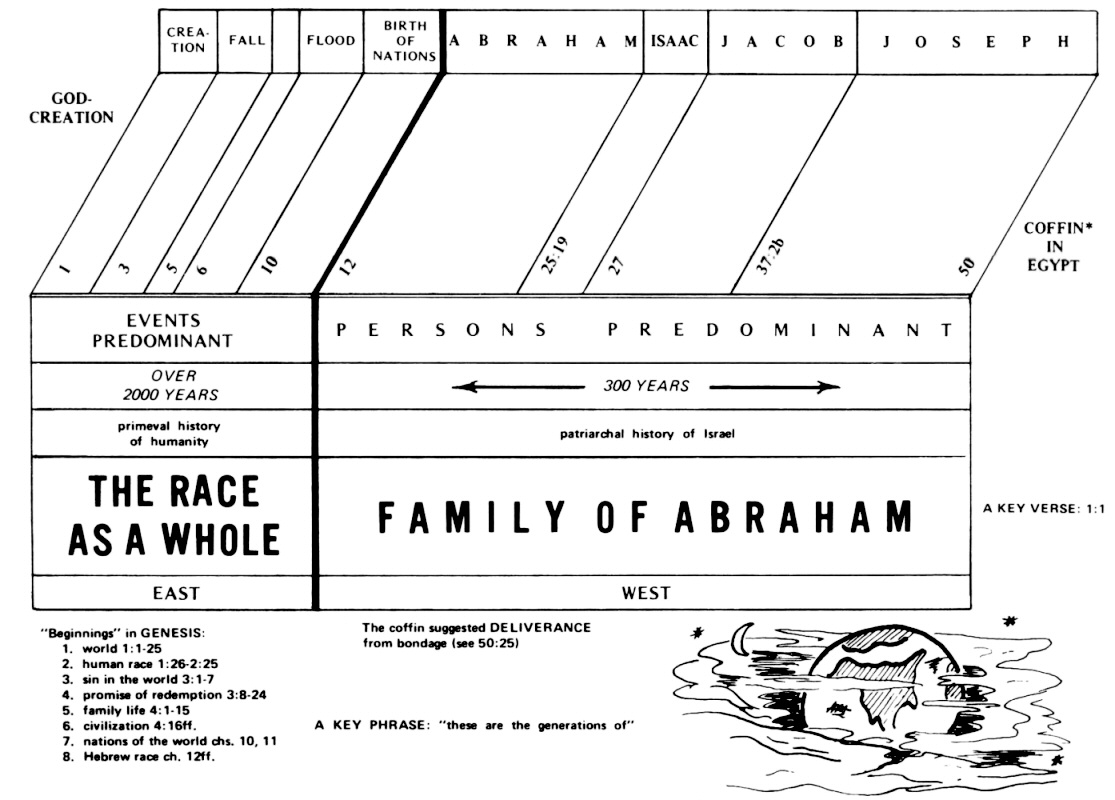
Click chart to enlarge
cChart from recommended resource Jensen's Survey of the OT - used by permission
| Summary Chart of The Book of Genesis |
||||||||
| Focus | Foundation Events (Four Events) (Events Predominant) |
Foundation People (Four People) (People Predominant) |
||||||
| Divisions | Creation (Ge 1-2) |
Fall (Ge 3-5) |
Flood (Ge 6-9) |
Nations (Ge 10-12) |
Abraham's Faith (Ge 12-24) |
Isaac's Family (Ge 25-26) |
Jacob's Conflicts (Ge 27-36) |
Joseph's Calamity (Ge 37-50) |
| Topics | Beginning of the Human Race (Race As A Whole) |
Beginning of the Hebrew Race (Family of Abraham) |
||||||
| Faithfulness of Mankind (Noah) |
Faithfulness of One Man's Family (Abraham) |
|||||||
| Historical | Biographical | |||||||
| Place | Eastward From Eden to Ur |
Westward From Canaan to Egypt |
||||||
| Time | ~2000+ Years (20% of Genesis) (~4004-2090BC) |
About 300 Years 193 Yr in Canaan, 93 Yr in Egypt (80% of Genesis) (2090-1804BC) |
||||||
| Primeval History of Humanity |
Patriarchal History of Israel |
|||||||
| Author | Moses | |||||||
|
BEGINNINGS
|
||||||||
NOTE: The following list comprises not only biblical commentaries but also a range of Christian works authored by recognized evangelical scholars and writers. The majority of these volumes are relatively recent publications (primarily post-1970) that were, until recently, accessible only through purchase in print form or via proprietary Bible software platforms. They are now available without cost through archive.org, though several limitations should be noted. First, the platform disables direct copy-and-paste functionality. Second, materials are loaned on a one-hour checkout basis, although renewal is permitted immediately upon expiration, enabling extended reading and note-taking. Third, access requires the creation of a free archive.org account. This may be completed by navigating to archive.org, selecting the profile icon in the upper-right corner, and registering with an email address and password. For hundreds of other commentaries and books that can be borrowed see Christian Commentaries Online.
While I have consulted or made use of many (though not all) of these works, readers are strongly encouraged to emulate the Bereans of Acts 17:11 by evaluating all material in light of Scripture. The selections represented here have been chosen for their generally conservative theological orientation and their commitment to biblical fidelity. Should you encounter a work that appears not to meet these criteria, you are invited to communicate your concerns via the contact form at: https://www.preceptaustin.org/
WHEN BOOKS SAY "UNAVAILABLE" - As this resource on archive.org grows in popularity, you will occasionally encounter a commentary marked “Borrow Unavailable.” This simply indicates that another user has it checked out for the current hour. Because users may immediately renew their one-hour loan, a volume can remain unavailable for an extended period. Below are several practical strategies that I have found helpful to see portions of a book which is unavailable:
(1) If I have the exact quote from the book and want to see the context, I search with a few words from the quote (putting them in quotation marks so that they are the specific words searched). That will allow me to open the page and see the context. Here is an example from Gordon J Wenham's Genesis 1-15 which is almost always listed as "Borrow Unavailable."
(a) So I have this quote from Genesis 3 and want to see the context - "Now, explicit characterization of actors in the story is rare in Hebrew narrative, so it seems likely that in noting the snake’s shrewdness the narrator is hinting that his remarks should be examined very carefully"
(b) I selected "Now, explicit characterization" and searched it (with the quotes) and found 1 hit, clicked it and retrieved the page with the quote in context. See the page with this quote and notice it allows you to read 2 pages.
(2) A second trick I use is to put one word in the title in search.
(a) E.g., I searched "genesis" and retrieved 522 hits. Note the page numbers it retrieved which is most of the pages.
(b) You will have to hunt to find what you want but this can occasionally be helpful.
(c) Sometimes you encounter "Limited Preview. Some pages are omittedl" You can try trick #4 but it may not work. Then you have to wait until you can borrow the book.
(3) Now let's say you want to look up comments on Genesis 15, the story of Abraham.
(a) Search "genesis 15" and you retrieve 8 hits and notice you have access to almost 12 pages of comments. Remember each hit gives you access to 2 pages.
(b) Click this one and you see beginning comments on Genesis 15:1-21.
(4) ONE CAVEAT - Let's say you perform the maneuvers listed above, click on the page and it is blacked out. What you can try to REFRESH that page and many times (not always) it will allow you to read that page. Note this will not always work because it will say "Some pages are omitted."
(5) You need to be "creative" in how you search for specific "unavailable" book. Sometimes I just put a number in the search queue. E.g., I put 7 in the search box and it retrieved 518 hits. Yes, you have to hunt around, but this might allow you to read the comments you are seeking.
(6) One other trick I use since these book do not allow copy and paste is I will do my search and find a quote I want to copy in the actual search column. E.g., search Wenham's popular book on Genesis 1-15 for "genesis 15." Notice the first hit on page 300. You can copy and paste this hit quote shown below.
"Page 300 The uncountability of Abram’s descendants is a perennial theme of Genesis 15:5; 16:10; 28:14; 32:12. Balaam, the prophet hired by the king of Moab to curse Israel, said Israel was already beyond counting in his day (Num 23:10). Solomon said the same thing some centuries later (1 Kgs 3:8), though of course both eras were famed for their censuses. The NT sees believing Gentiles as well as faithful Jews as being counted as Abram’s descendants (Rom 4:16—18; Gal 3:29), so that in heaven there will be “a great multitude which no man can number, from every nation, from all tribes and peoples and tongues” (Rev 7:9)."
(7) The more you play around with this on a "Borrow unavailable" book, the better you will become at finding what you are looking for.

RECOMMENDED WORK-AROUND
WHEN A LINK SAYS “PAGE NOT FOUND” (404 ERROR)
Many older links may become "broken," especially those from early versions of my website, and may return a “Page Not Found” (404) message. In many cases, however, the following simple workaround can successfully restore access to the intended page:
- Go to: https://web.archive.org/
- Copy and paste the URL that produced the dead link.
Example: Devotional
URL: https://getmorestrength.org/daily/jesus-at-the-crossroad/
Paste this URL into the search box on archive.org. - Press Enter on your keyboard.
- A Timeline will appear, with vertical black bars showing the years the page was archived (this example shows multiple lines)
- Click one of the years—I usually recommend choosing one of the earlier years.
- After selecting a year (e.g., select 2018) a 12-month calendar appears. Dates highlighted in blue indicate an archived version.
- Hover over the blue date (JUL 18) and you will see a timestamp (08:25:49)
- Click that link.
- The archived page—in this case "Jesus at the Crossroad"—should now load. (loading is sometimes slow)
This process may seem a bit intimidating at first, but after doing it a few times it becomes quite simple. If the first year you choose does not reveal the page, just try another year on the timeline. Over the past decade, this method has helped me recover about 90% of those “missing” pages.
If you come across a bad link, would you kindly let me know? Please send the broken link AND the page where you found it using the contact form. Thank you for helping keep the site useful for everyone.
Genesis: beginning and blessing by Hughes, R. Kent, 76 ratings
"R. Kent Hughes, respected pastor and author of many other commentaries in this series, takes readers back to the beginning of the Bible and moves through Genesis with careful exegesis. He explores the superbly crafted structure of the book as well as the weighty themes it contains. For those who preach, teach, and study God’s Word, this exceptionally detailed work will reveal much about the beginnings of God’s great story."
Cyril Barber - This well-outlined exposition of 702 pp. (replete with an index of Hughes’ sermon illustrations) gives evidence of careful preparation. The stories in the book of Genesis are well-known to us, and here they receive fresh analysis and application. Hughes’ critique of human nature is prominent throughout, and he boldly points out the origin of our rebellion against God and continued sinfulness. Also prominent is God’s grace freely bestowed upon His undeserving creatures. Preachers will find that this work contains an abundance
The Genesis Record : a Scientific and Devotional Commentary - by Dr Henry Morris
Cyril Barber on Morris' The Genesis Record : a Scientific and Devotional Commentary (It can be borrowed) - Valuable as corollary reading. Of great importance for the scientific data that has been included in the author's exposition. Should be consulted by all who wish to be well-informed on the issues alluded to by Moses.
Exploring Genesis: An Expository Commentary. (3 copies available) John Phillips.
Designed for beginning Bible students, this work contains some valid applications of truth to life, but does not deal convincingly with some of the problems.
The Defender's Study Bible : King James Version by Morris, Henry M. Excellent notes by well known creationist. 45 ratings
The Henry Morris KJV Study Bible is an invaluable apologetic Bible study tool for the defense of the Christian faith, including biblical creationism, that highlights the foundational truths of Genesis found in all the other 65 books of the KJV Bible. The comprehensive apologetic study bible notes provide answers to questions related to doctrinal issues, as well as scientific matters, such as geology, earth history, astronomy, biology, and other sciences.
The Genesis Flood : the Biblical Record and its Scientific Implications - John Whitcomb and Henry Morris 469 ratings
Over 250,000 copies sold. This anniversary edition celebrates 50 years of Whitcomb and Morris's biblically-based system of creationism and catastrophism that unifies and correlates scientific data from early earth history a modern creationist classic.
Genesis: an introduction and commentary (Tyndale OT Commentary Series) by Kidner, Derek 9 ratings
Derek Kidner not only provides a verse-by-verse exegetical commentary but also lucidly handles the tough issues that Genesis raises. Focusing on the study of Genesis on its own terms, as "a living whole," he highlights the theological themes of the nature of God, humankind, and salvation. In this volume, formerly part of the Tyndale Old Testament Commentaries series, Kidner's clear prose and theological insight will expand readers' understanding of God's character and of humanity's nature and destiny.
James Rosscup - It is evident that much study lies behind this concisely stated commentary in the Tyndale series. Kidner has packed in a lot of understanding of word meanings, movements of thought in different parts of Genesis, customs, God’s purposes, and relationship to other parts of Scripture. It is a solid but brief work. Cf. his works also on Psalms and Proverbs.
Paradise to Prison : studies in Genesis by Davis, John J
Paradise to Prison is a commentary, textbook and complete study guide to the book of Genesis. In very readable fashion the author explores the lives of the patriarchs as well as important doctrinal themes. Each chapter is carefully documented and sources from archaeology and ancient Near Eastern history are freely used. The writer's premise is that no other ancient literature surviving the ravages of time can rightly be compared to Genesis with its unsurpassed theological perspectives and vivid profiles of early man.
Cyril Barber - An indispensable aid to the study of Genesis by one whose archaeological, historical, and philological expertise places him in the forefront of evangelical scholars today. Recommended.
Genesis (Everyman's Bible Commentary) by Vos, Howard Frederic, 8 ratings
James Rosscup - A simple, broad survey by a conservative who tends to give some good comments but at times not nail down his view to explain a matter (cf. his survey of four views on days in Genesis 1, then leaving the matter hanging, and not commenting on how long God rested in 2:1–3; or his not choosing a preference on “sons of God” on Genesis 6 after a shallow consideration of issues). However, in a concise treatment he does touch on many of the problems.
Genesis : a study guide : Wood, Leon
Rosscup - This is a republication of the 1975 study guide of 152 pp. A staunch conservative offers a quick survey in basic information, often resolving main problems briefly. He leaves open the length of the days in Genesis 1, employs a detailed outline, and primarily assists lay readers and students looking for a terse review. A fine, brief evangelical survey of the main flow of the book, with a number of quite helpful comments on problem areas most readers want to see discussed. Among the briefer works this is one of the best.
Genesis. 1-15 by Wenham, Gordon J
Cyril Barber - This is a work of remarkable erudition. While some will consult it solely to ascertain whether or not Wenham agrees with them on some disputed point, the value of this commentary extends to the writer's discussion of the theology of Genesis, as well as his citation of important contemporary literary sources. While thoroughly conversant with the Documentary Hypothesis, only rarely does Wenham include this information in his treatment of these chapters. This is an exemplary work, and we look forward with anticipation to the publication of vol. 2.)
Rosscup - Wenham gives much readable and good information on the Hebrew text, word study, exegesis and insightful exposition. He is somewhat freed from traditional critical views and holds to historicity of events and persons. He does not deny theories that different strands of literary composition have led to the Genesis we know, but is skeptical toward this. He places his stress on the canonical text as a unity. Despite this, many conservatives wonder what kind of evangelical he is when he uses J and P, not clearly explaining how his usage departs from the intent usually involved in these designations. His claims that certain P material, so-called, was earlier or later than J material will be regarded as arbitrary and speculative.
Genesis. 16-50 by Wenham, Gordon J
Cyril Barber - Aims at accuracy in interpreting the original text. Here is a work of exceptional merit. It abounds in preaching values, and is to be highly recommended.
Rosscup - In volume 2, beneficial introductory sections discuss the patriarchs’ historical setting, chronology and religion, and Egytian background for Joseph. Wenham handles well Abraham’s intercession for Sodom, and has a mixture of good and unnecessary reading into the offering of Isaac (cf. waffling on 22:5), as well as dubious suggestions (32:30; 37:4 among others). But usually remarks are very profitable. In 44:5 more data could help in regard to Joseph’s using of a divining cup (424). As is typical of the WBC, a reader finds a very fine listing of serious literature on each biblical section.
Wiersbe's Expository Outlines on the Old Testament by Wiersbe, Warren W
"Even the most difficult Scriptures come alive as Warren Wiersbe leads you book-by-book through the Old Testament and helps you to see the "big picture" of God's revelation. In this unique volume, you will find: • Introductions and/or outlines for every Old Testament book • Practical expositions of strategic chapters • Special studies on key topics, relating the Old Testament to the New Testament • Easy-to-understand expositions that are practical, preachable, and teachable If you have used Dr. Wiersbe's popular BE series, you know how simple and practical his Bible studies are, with outlines that almost teach themselves. If not, you can now discover a wonderful new resource. This work is a unique commentary on every book of the Old Testament. It contains new material not to be found in the BE series.
With the Word - Devotional Commentary - Warren Wiersbe - Comments on each chapter. Wiersbe is always worth checking!
"A fresh approach which not only offers trustworthy exposition, but also provides a book-by-book, chapter-by-chapter tour through the glory of the Bible. This highly readable personal "conversation" with Scripture guides you through each book, helping you reap the rich, life-changing applications on every page. You will be encouraged to develop your own personal Bible reading program and learn the power of meditation on its truth."
KJV Bible Commentary - Hindson, Edward E; Kroll, Woodrow Michael. Over 3000 pages of the entire OT/NT - no restriction on length of time one can use it.
Very well done conservative commentary that interprets Scripture from a literal perspective (pre-millennial)
The King James Version Bible Commentary is a complete verse-by-verse commentary. It is comprehensive in scope, reliable in scholarship, and easy to use. Its authors are leading evangelical theologians who provide practical truths and biblical principles. Any Bible student will gain new insights through this one-volume commentary based on the timeless King James Version of the Bible.
Encountering the Book of Genesis - Bill T Arnold - PDF - interesting resource.
The King James Study Bible Second Edition (2013) (Thomas Nelson) contributing editors (only first is listed) include Wayne A. Brindle.
NKJV Study Bible: New King James Version Study Bible (formerly "The Nelson Study Bible - NKJV") by Radmacher, Earl D; Allen, Ronald Barclay; House, H. Wayne (1997, 2007); Helpful notes. Conservative. There is no restriction on length of time one can use,
Bible Knowledge Commentary - Old Testament - 1608 pages. Dallas Theological Seminary Faculty. Conservative. Evangelical.
The MacArthur Study Bible : John MacArthur Brief but well done notes
Wycliffe Bible Commentary - Charles Pfeiffer - 1560 pages (1962). Less detailed than the KJV Bible Commentary. Conservative.
Ryrie Study Bible Expanded Edition (1994) 2232 pages
ESV Study Bible - Excellent resource but not always literal in eschatology and the nation of Israel 6,004 ratings
The David Jeremiah study bible - (2013) 2208 pages. 2,272 ratings Logos.com -
"Drawing on more than 40 years of study, Dr. David Jeremiah has compiled a legacy resource that will make an eternal impact on generations to come. 8,000 study notes. Hundreds of enriching word studies"50+ Essentials of the Christian Faith" articles."
The NIV Study Bible by Barker, Kenneth L; Burdick, Donald W (1995) 2250 pages. Note this is the first edition. This resource has been fully revised in 2020.
Zondervan NIV Study Bible - (2011) 2570 pages - Use this one if available as it has more notes than edition below. One hour limit
HCSB Study Bible : Holman Christian Standard Bible - General Editor Jeremy Royal Howard (2010) 2360 pages. Conservative. Good notes. Include Holmans excellent maps. One hour limit
Life Application Study Bible: Old Testament and New Testament: New Living Translation. Has some very helpful notes especially with application of texts. 4,445 ratings One hour limit
The Apologetics Study Bible Understand Why You Believe by Norman Geisler
The Battle for the Beginning: the Bible on Creation and the Fall of Adam John MacArthur
Dictionary of Biblical Imagery - free for use online with no restrictions (i.e., you do not need to borrow this book). Editors Leland Ryken, J C Wilhoit, Tremper Longman III - This is a potential treasure chest to aid your preaching and teaching as it analyzes the meaning of a host of Biblical figures of speech. Clue - use the "One-page view" which then allows you to copy and paste text. One downside is there is no index, so you need to search 3291 pages for entries which are alphabetical.
Multiple Resources by Renowned Creationist Henry Morris
- Some Call it Science: the Religion of Evolution by Morris, Henry M. (See also Science and the Scriptures)
- A history of modern creationism by Morris, Henry (See also Creation versus Evolution as Worldviews)
- Scientific creationism by Henry Morris (See also The Logic of Biblical Creation)
- 5 reasons to believe in recent creation by Morris, Henry M.
- The scientific case for creation by Morris, Henry M
- Creation and the modern Christian by Morris, Henry M
- The beginning of the world by Morris, Henry M
- The twilight of evolution by Morris, Henry M.
- The Bible and modern science by Morris, Henry M
- Creation: acts, facts, impacts by Morris, Henry M
- The big three : major events that changed history forever by Morris, Henry
- After Eden : understanding creation, the curse, and the cross by Morris, Henry M
- The long war against God : the history and impact of the creation/evolution conflict by Morris, Henry M
- The book of beginnings : a practical guide to understand and teach Genesis by Morris, Henry M
- Your origins matter by Morris, Henry M.
- The modern creation trilogy by Morris, Henry
- The troubled waters of evolution by Morris, Henry
- Science, scripture, and the young earth: an answer to current arguments against the Biblical doctrine of recent creation by Morris, Henry M.
- Men of science, men of God : great scientists who believed the Bible by Morris, Henry M
- The Bible has the answer : practical Biblical discussions of 100 frequent questions by Morris, Henry M.
In the beginning : Genesis Nelson Impact Bible Study Guide
The Nelson Impact Bible Study series will introduce in-depth Bible study to Christian laypeople. Each book will help readers experience the true meaning of the messages in the book of Genesis, and in turn, empower the reader to truly make a difference in the world for Christ. Designed for individual or group study, the study guide will provide a foundation for Bible study and encourage the reader to return to the Bible. All necessary background information will be given so that the reader needs only a Bible and the study guide. The messages will be thorough but easily understood and will be complimented by application questions to guide the readers into a deeper relationship with the Bible that will impact their lives with the gospel of Jesus Christ.
Genesis and Archaeology by Vos, Howard Frederic
Howard F. Vos has had a distinguished career as an expert in historical, geographical, biblical, and archeological research. A prolific author and editor, he is responsible for twenty-five books that are standards in their field, including the Wycliffe Bible Dictionary. He has traveled extensively in the Bible lands and excavated many sites in Israel. Vos is currently Emeritus Professor of History and Archaeology at The King's College in New York.
Life Application Study Bible : New Living Translation. Has some very helpful notes. 4,445 ratings
NIV Archaeological Study Bible (2005) 2360 pages 950 ratings
"Readers who desire a more intimate knowledge of the historical context of the Bible will appreciate the NIV Archaeological Study Bible. Full of informative articles and full-color photographs of places and objects from biblical times, this Bible examines the archaeological record surrounding God’s Word and brings the biblical world to life. Readers’ personal studies will be enriched as they become more informed about the empires, places, and peoples of the ancient world. Features include: • Four-color interior throughout • Bottom-of-page study notes exploring passages that speak on archaeological and cultural facts • Articles (520) covering five main categories: Archaeological Sites, Cultural and Historical Notes, Ancient Peoples and Lands, the Reliability of the Bible, and Ancient Texts and Artifacts • Approximately 500 4-color photographs interspersed throughout • Detailed book introductions that provide basic, at-a-glance information • Detailed charts on pertinent topics • In-text color maps that assist the reader in placing the action "
New Bible Commentary - (1994) See user reviews
Genesis for Everyone by Goldingay, John Only Genesis 17-50.
Explore The Book - Genesis to Joshua - PDF - J.Sidlow Baxter:
The Jewish Study Bible - Only OT - Interesting Jewish perspective.
Evangelical Commentary on the Bible - editor Walter Elwell (1989) 1239 pages. User reviews.
Genesis 16-33 by McGee, J. Vernon
The Early Earth: An Introduction to Biblical Creationism by Whitcomb, John C 18 ratings
First published in 1972, The Early Earth has established itself as one of the most illuminating books defending biblical creationism. Whitcomb’s stellar defense of biblical creationism.
The Moon : its creation, form and significance by Whitcomb, John C
The World that Perished by Whitcomb, John C 28 ratings
The World that Perished, a forceful sequel to The Genesis Flood and companion to The Early Earth, radiates an unshakeable faith in the authority of the Word of God. Whitcomb maintains with vigor that the Bible declares and affirms a supernatural, catastrophic flood of worldwide proportions, a declaration corroborated by scientific observations that are not warped by a uniformitarian bias in geology.
Portraits of Christ in Genesis by DeHaan, M. R 39 ratings
From the lives of Adam, Abel, Isaac, Joseph and many other Biblical characters, Dr. DeHaan develops pictures that foreshadow Christ and His ministry. A fascinating study of Old Testament typology, Portraits of Christ in Genesis relates deep theological truths in language easily understood by the laymen. This is Dr. DeHaan's parting message to the world. Shortly after he completed the manuscript for this book, and even before the series was completed on the air, Dr. DeHaan went to his heavenly reward. At his memorial service telegrams from fellow radio preachers were received praising and recommending the teaching ministry of this great man of God.
The Experiencing God Study Bible : the Bible for knowing and doing the will of God - Blackaby, Henry (1996) 1968 pages - CHECK THIS ONE! Each chapter begins with several questions under the title "PREPARE TO MEET GOD." Then you will interesting symbols before many of the passages. The chapter ends with a "DID YOU NOTICE?" question. This might make a "dry chapter" jump off the page! Read some of the 48 ratings
Invitation to Genesis : participant book by Enns, Peter, 10 ratings
Stories that live : 6 Bible stories for God's little people by Enns, Peter;
The Book of Genesis, an Exposition by Erdman, Charles R.
Cyril Barber - First published in 1950, this handy overview of Moses' first book traces the main theme and reveals the relevance of this portion of God's Word through the leading characters.
The Pentateuch; a concise commentary on Genesis, Exodus, Leviticus, Numbers, and Deuteronomy by Erdman, Charles
Nelson's Expository Dictionary of the Old Testament by Unger, Merrill
Dictionary of deities and demons in the Bible (DDD) - 950 pages (1995) Read some of the 65 ratings (4.8/5 Stars). A definitive in depth resource on this subject. Very expensive to purchase.
Theological Wordbook of the Old Testament by Harris, R. Laird - (5/5 Stars) One of the best OT lexicons for studying Hebrew words.
Here is another link to the TWOT which has no time limit on use and does allow copy and paste. Can be downloaded as PDF.
Vine's Expository Dictionary of Old Testament and New Testament Words - Available Online. if you know the Strong's number, you can do a "control + find" on Windows or "Command-F" on a Mac to find the Hebrew word. The TWOT above has more extensive listing and more detailed definitions than Vine's but to look up by Strong's number click the Index which allows you to find the corresponding TWOT number (which goes from 1-3066).
So That's What it Means - This is another book formerly titled "Theological Wordbook" edited by Charles Swindoll. It is now under this new title So That's What it Means and can be borrowed - it is more like a dictionary than a lexicon but the comments are superb! The contributors include DKC—Donald K. Campbell, WGJ—Wendell G. Johnston, JAW—John A. Witmer, JFW—John F. Walvoord
Expository Dictionary of Bible words : Word studies for key English Bible words based on - Stephen Renn - Short definitions of Hebrew and Greek words.
Expository Dictionary of Bible Words by Richards, Larry, It is does not go into great depth on the Greek or Hebrew words but does have some excellent insights.
Hebrew honey : a simple and deep word study of the Old Testament by Novak, Alfons. Indexed by English words.
Girdlestone's Synonyms of the Old Testament - click for list of 127 entries
Expository Dictionary of Bible Words by Richards, Larry, 33 ratings It is does not go into great depth on the Greek or Hebrew words but does have some excellent insights.
- Lesson 1 of each of Parts 1-5 can be downloaded as Pdf
- Click for discussion of the value of Inductive Study
This course explores creation from Genesis 1–2. You will learn how the world was created and how man came into being as you study both biblical and scientific accounts. 6 weeks, 6 lessons
Genesis 3–11 contains promises that unfold throughout Scripture. See God's plan for marriage, His relationship with His people, His judgment of the wicked, and His salvation of the righteous. (Not dependent on Genesis Part 1.) 10 weeks, 10 lessons
Learn principles and truths from the life of Abraham that will challenge you in your walk, and give you hope in your future. In the life of Abraham, we see God's choosing and the further unfolding of His redemptive plan. We learn more about God's character and His relationship with us in Abraham's example. Learn how man becomes righteous, how God keeps His promises, and how God protects those who are His. 6 weeks, 6 lessons (covers Genesis 12–25)
God renews the covenant promise to Abraham through the patriarchs Isaac and Jacob. Their lives become an integral part of the scarlet thread of redemption that God weaves through all of Scripture and the source of comfort for us. But two nations arise from Isaac, descendants of Jacob and Esau. Their struggle continues the story of God's choice. The lessons we learn for our lives from these men and their relationship to God can guide our steps of faith. 4 weeks, 4 lessons (covers Genesis 24–36)
Have you ever been falsely accused? Or maybe you have suffered unjustly for something you had no control over. The life of Joseph is a study on handling extreme situations. What would you be like if you were the ruler of the world? How would you act if you were literally a slave? Joseph had to deal with a life of ups and downs, and his God taught him how to handle them all. 4 weeks, 4 lessons (covers Genesis 37–50) See page 37 for chapter themes 1-36
Cyril Barber - Though accepting a modified form of the documentary hypothesis (What is the documentary hypothesis?), Alford succeeds in bringing to his study of the OT the same depth of insight and richness of thought that characterized his treatment of the NT A rare work; buy it while it is available.
- Genesis 1
- Genesis 2
- Genesis 3
- Genesis 4
- Genesis 5
- Genesis 6
- Genesis 7
- Genesis 8
- Genesis 9
- Genesis 10
- Genesis 11
- Genesis 12
- Genesis 13
- Genesis 14
- Genesis 15
- Genesis 16
- Genesis 17
- Genesis 18
- Genesis 19
- Genesis 20
- Genesis 21
- Genesis 22
- Genesis 23
- Genesis 24
- Genesis 25
- Genesis 26
- Genesis 27
- Genesis 28
- Genesis 29
- Genesis 30
- Genesis 31
- Genesis 32
- Genesis 33
- Genesis 34
- Genesis 35
- Genesis 36
- Genesis 37
- Genesis 38
- Genesis 39
- Genesis 40
- Genesis 41
- Genesis 42
- Genesis 43
- Genesis 44
- Genesis 45
- Genesis 46
- Genesis 47
- Genesis 48
- Genesis 49
- Genesis 50
- Abraham (studies 1-8) - Questions and Lessons on each study
- Isaac & Jacob (studies 1-12) - Questions and Lessons on each study
- Joseph Study Guide - 12 Studies - Questions and Lessons on each study
- Lectures on the 12 Studies
Joseph Teacher Notes corresponding to the 12 studies above
- Joseph study 1 Genesis 37:1-36
- Joseph study 2 Genesis 39:1-23
- Joseph study 3 Genesis 40:1-23
- Joseph study 4 Genesis 41:1-57
- Joseph study 5 Genesis 42:1-38
- Joseph study 6 Genesis 43:1-34
- Joseph study 7 Genesis 44:1-34
- Joseph study 8 Genesis 45:1-28
- Joseph study 9 Genesis 46:1-47:31
- Joseph study 10 Genesis 48:1-22
- Joseph study 11 Genesis 49:1-33
- Joseph study 12 Genesis 50:1-26
Joseph - Additional Notes Used to prepare the preceding studies: Each is about 20-30 pages and corresponds to the preceding studies in Genesis.
- Joseph study 1
- Joseph study 2
- Joseph study 3
- Joseph study 4
- Joseph study 5
- Joseph study 6
- Joseph study 7
- Joseph study 8
- Joseph study 9
- Joseph study 10
- Joseph study 11
- Joseph study 12
Paul Apple's well done 592 page commentary - November, 2018 - recommended resource
Excerpt: BACKGROUND NOTES
J. Sidlow Baxter:
Besides being introductory, Genesis is explanatory. The other writings of the Bible are inseparably bound up with it inasmuch as it gives us the origin and initial explanation of all that follows. The major themes of Scripture may be compared to great rivers, ever deepening and broadening as the flow; and it is true to say that all these rivers have their rise in the watershed of Genesis. Or, to use an equally appropriate figure, as the massive trunk and widespreading branches of the oak are in the acorn, so, by implication and anticipation, all Scripture is in Genesis. Here we have in germ all that is later developed. It has been truly said that “the roots of all subsequent revelation are planted deep in Genesis, and whoever would truly comprehend that revelation must begin here.”
It is important to recognize the relationship between Genesis and the last book of Scripture. There is a correspondence between them which at once suggests itself as being both a proof and
product of the fact that the Bible is a completed revelation. There is no adequate understanding of either of them without the other; but taken together they are mutually completive. There is no going back beyond the one, and not going forward beyond the other; nor is there in either case any need to do so. In broad outline and majestic language Genesis answers the question: “How did all begin?” In broad outline and majestic language Revelation answers the question: “How will all issue?” All that lies between them is development from the one to the other.
Gleason Archer
The guiding principle throughout the narrative is the covenant of grace, and God’s gracious dealings with true believers from the time of Adam onward. First there is the selective process whereby the covenant fellowship is narrowed down by stages to a single individual, Abraham; then the elective principle widens to include a large family, that of Jacob. Thus the stage is set for the nurturing of an entire nation in the favored refuge of Goshen in Egypt.
R. Kent Hughes:
As deep and weighty as the book of Genesis is, it is no dry textbook. Its narratives of the garden, the flood, and the tower of Babel have captivated hearts for over three millennia and have provided inspiration for the world’s greatest poetry. The earthy, epic lives of Abraham and Isaac, and Jacob and Esau, and Joseph in ‘Egypt are so primary and universal and so skillfully told that they have never ceased to enthrall listeners. . .
Genesis is all about grace. The Apostle Paul’s aphorism, “ where sin increased, grace abounded all the more” (Romans 5:20) sums up this major theme of Genesis. Genesis, far from being a faded page fallen from antiquity, breathes the grace of God. What a time we’re going to have as our souls are worked over by the sin-speech-grace-punishment pattern of chapters 1-11, and by the overall “where sin increase, grace abounds” theme of the whole book. This is good soul medicine – strong meat. It was grace from the beginning – in both primeval and patriarchal history. It always will be grace.
Genesis also provides us with a grand revelation of God’s faithfulness as it recounts God’s fidelity over and over again in the lives of the patriarchs. We see that God remains faithful even when the people to whom the promises are made become the greatest threat to the fulfillment of the promise. Such is God’s faithfulness that the sinful, disordered lives of the promise-bearers can’t abort the promises.
W. H. Griffith Thomas:
It must be evident . . . that there was no intention of writing an universal history of man, but only of recording the development of the Divine will and purpose for and through Abraham. It is history written with a special purpose. The book might esily have begun with Abraham if the purpose had been to record the ordinary history of an ordinary people; yet inasmuch as Israel was not an ordinary people, but charged with God’s purposes for the whole of mankind, it was necessary to show – at least in brief from – the connection between the progenitor of the human race and Abraham, in whom and in whose descendants the Divine purpose was to be realized.
Dr. Jack Arnold: SPIRITUAL LESSONS
Major Events: Four basic questions of mankind are answered
Creation: How did the universe begin?
Fall: Why does a good God permit suffering?
Flood: Will God Judge the world?
Tower of Babel: Why do people differ as to races and languages?
Individuals
Adam: Object of grace.
Noah: The chosen one.
Abraham: Man of faith.
Isaac: The beloved son.
Jacob: The chosen and chastened son.
Joseph: The suffering and glorified one.Dr. Thomas Constable:
Throughout Genesis, we see that people in general consistently failed to trust and obey God (e.g., in Noah's day, at Babel, and throughout the patriarchal period).
Genesis also records what God has done to encourage people to trust and obey Him. It is only by living by these two principles that people can enjoy a relationship with God and realize all that God created them to experience.
On the one hand, Genesis reveals much about the person and work of God. This revelation helps us to trust and obey Him. It is through His personal revelations to the main characters in Genesis that God revealed Himself initially (e.g., Adam and Eve, Noah, and the patriarchs).
On the other hand, Genesis reveals much about the nature of man. Not only did God reveal the perversity and depravity of man, but He also identified many positive examples of faith and obedience in the lives of the godly.
In Genesis we learn that faith in God is absolutely essential if we are to have fellowship with Him and realize our potential as human beings.
Faith is the law of life. If one lives by faith, he flourishes, but if he does not, he fails. The four patriarchs are primarily examples of what faith is and how it manifests itself. In each of their lives we learn something new about faith.
Abraham's faith demonstrates unquestioning obedience. When God told him to do something, he almost always did it. This is the most basic characteristic of faith. That is one reason Abraham has been called "the father of the faithful." God revealed Himself nine times to Abraham (12:1-3, 7; 13:14-17; 15; 17:1-21; 18; 21:12-13; 22:1-2; 22:15- 18), and each time Abraham's response was unquestioning obedience.
Isaac's faith helps us see the quality of passive acceptance that characterizes true faith in God. This was his response to God's two revelations to him (26:2-5, 24). Sometimes Isaac was too passive.
Jacob's story is one of conflict with God until he came to realize his own limitations: then he trusted God. We can see his faith in his acknowledged dependence on God. God's seven revelations to him eventually led him to this place (28:12-15; 31:3, 11-13; 32:24- 29; 35:1, 9-12; 46:2-4). Most believers today can identify with Jacob most easily, because we too struggle with wanting to live independent of God.
Joseph's life teaches us what God can do with a person who trusts Him consistently in the face of adversity. The outstanding characteristic of Joseph's life was his faithful loyalty to God. He believed God's two revelations to him in dreams (37:5-7, 9), even though God's will did not seem to be working out as he thought it would. Patient faith and its reward shine through the story of Joseph. The Lord Jesus supremely illustrates this quality of faith.
Faith, the key concept in Genesis, means trusting that what God has prescribed is indeed best for me, and demonstrating that trust by waiting for God to provide what He has promised. A "person of faith" is one who commits to acting on this basis—even though he or she may not see how God's way is best.
OUTLINE OF GENESIS – BOOK OF BEGINNINGS
GOD RESPONDS TO MAN’S SINFUL REBELLION WITH HIS SOVEREIGN ELECTION AND PROVIDENTIAL FAITHFULNESS TO HIS COVENANT PROMISES
I. (Genesis 1:1 – 11:26) THE BEGINNING ON A GLOBAL SCALE – CREATION, FALL, FLOOD, BABEL
A. (Genesis 1:1-2:25) Creation -- The Beginning of Life Created by God -- Fellowship
- (Genesis 1:1-2:3) The Beginning of Earth -- Every Aspect of God’s Creation Was Judged to be Very Good by God Himself
- (Genesis 2:4-25) The Beginning of Man and Woman
- (Genesis 2:4) Transition
- (Genesis 2:5-7) Creation of Man
- (Genesis 2:8-15) Provision of Perfect Environment for Man = Garden of Eden
- (Genesis 2:16-17) Provision of Food for Man = Fruit from Trees and Prohibition of Eating from Tree of
- Knowledge of Good and Evil
- (Genesis 2:18-23) Creation of Woman
- (Genesis 2:24-25) Institution of One Flesh Relationship in Marriage
Goal: New Creation – of the Heavens and Earth / of Redeemed Individuals
B (Genesis 3:1-6:8) Fall -- The Beginning of Human Temptation and Sin – Rebellion / Redemption
- (Genesis 3:1-24) The Fall of Man Prompted God to Respond with Severe Curses – on the serpent, the woman, the man and the environment
- (Genesis 4:1-2) The Beginning of Procreation
- (Genesis 4:3-7) The Beginning of Offerings to the Lord
- (Genesis 4:8-16) The Beginning of Strife
- (Genesis 4:17-5:32) The Descendants of Adam Through Cain and Seth
- (Genesis 4:17-24) Descendants Through Cain
- (Genesis 4:25-5:32) Descendants Through Seth
- (Genesis 6:1-8) Growing Population Coupled with Increasing Corruption and Wickedness
Goal: Redemption accomplished by the Seed of the Woman [Rebellion countered by Obedience of 2nd Adam]
C. (Genesis 6:9-11:32) Flood -- Judgment/Deliverance -- The Beginning of Redemption Amidst Growing Corruption -- Days of Noah and the Flood of Judgment and the Ark of Deliverance – Judgment/Salvation
- (Genesis 6:9-22) Covenant with Noah – Deliverance Via the Ark from Universal Flood of Judgment
- (Genesis 7:1-24) Details of Noah’s Flood
- (Genesis 8:1-19) Aftermath of the Flood
- (Genesis 8:20-9:17) Renewal of Noahic Covenant
- (Genesis 9:18-10:32) Descendants of Noah through Shem, Ham and Japheth
Goal: Destruction of World by Fire and Ultimate Lake of Fire While Sparing the People of God Via Ark of Salvation
D. (Genesis 11:1-32) Babel -- Dispersion – The Beginning of Division into Nations with Separate Languages -- Pride
- (Genesis 11:1-9) Tower of Babel and further dispersion of people speaking variety of languages
- (Genesis 11:10-26) Descendants of Shem, Peleg, Reu, Nahor and Terah
Goal: Unity of God’s People in the One Family of God [Pride countered by Humility of Christ]
II (Ge 11:27 – 50:26) THE BEGINNING ON A NATIONAL SCALE – THE ELECT PEOPLE OF GOD –ABRAM–ABRAHAM / ISAAC / JACOB–ISRAEL / JOSEPH
[Overlapping outline divisions – tracking each patriarch from birth until death]
A. (Genesis 11:27-25:11) Abram / Abraham – Life of Pioneering Faith
- (Genesis 12:1-9) Faith Moves Out -- Called to Canaan -- Divine call blesses a dependent journey
- (Genesis 12:10 – 13:4) Faith is Challenged -- Stumbling in Egypt -- God’s Sovereign Purposes Cannot be Derailed by Man’s Sinful Blunders
- (Genesis 13:5-18) Faith Separates -- Separation from Lot -- Walking by faith frees you up to relinquish your rights because of your confidence in God’s promises
- (Genesis 14:1-24) Faith Rescues -- Rescue of Lot -- Divine deliverance via a courageous man of faith
- (Genesis 15:1-21) Faith Clings to God’s Promises – Antidote to Fear, Doubt and Quitting
- (Genesis 16:1-16) Faith Failures Make a Mess of Things – Rely on the God Who Sees Scheming of Sarah Fleeing of Hagar
- (Genesis 17:1-27) Faith Sealed by Significant Sign – God Almighty reaffirms His covenant promises and commands circumcision as the sign of His covenant with Abraham
- (Genesis 18:1-33) Faith Lives Out Key Theological Questions:
a. Is Anything Too Difficult for the Lord? Greatness of God
b. Shall Not the Judge of All the Earth Deal Justly? Goodness of God - (Genesis 19:1-29) Stench of Sodom – Unbelievers Face Terrible Judgment
- (Genesis 19:30-38) Legacy of a Loser – Lot demonstrates that a life of worldliness won’t end well – Lot’s sordid sin with his daughters
- (Genesis 20:1-18) Faith is Challenged Again -- God overrules even our besetting sins to accomplish His kingdom purposes – Abimelech takes Sarah into his harem
- (Genesis 21:1-21) Sovereignty of God Over Both Child of Promise and Child of Flesh – Birth of Isaac
- (Genesis 21:22-34) Faith Receives Guarantees of Possessing God’s Promises
a. (Genesis 21:22-32) Guarantee of possession of the promised land via non-aggression covenant with Abemelech –
Sign = ownership of water well at Beersheba
b. (Genesis 21:33-34) Guarantee of possession of the promised land via God’s character as the Everlasting God –
Sign = planting of tamarisk tree at Beersheba - (Genesis 22:1-24) Faith Passes the Final Exam – Offering Up of Isaac
- (Genesis 23:1-20) Faith Takes Ownership of the Promises of God – Death and Burial of Sarah – Dealing with death reveals our perspective towards eternity and the promises of God
- (Genesis 24:1-67) Faith in the Providence of God – God’s Providence grants us success as we trust Him for His provision to accomplish His divine plan – A Bride for Isaac
- (Genesis 25:1-11) Death of Abraham – the Father of the Faithful
- (Genesis 25:12-18) Aside – Genealogy of Ishmael
B. (Genesis 21:1-35:29) Isaac – Life of Covenant Blessing
- (Genesis 21:1-7) Birth of Isaac
- (Genesis 26:1-35) Standing on the Promises of God – God reaffirms His covenant promises to encourage perseverance in times of trial since He is with us to bless and protect – Digging Wells
- (Genesis 35:28-29) Death of Isaac
C. (Genesis 25:19-50:14) Jacob / Israel – Life of Wrestling with God
- (Genesis 25:19 – 27:46) Treachery Among Brothers - Jacob Supplants Esau
a. (Genesis 25:19-34) Esau Despising the Promises of God –Short-sighted carnal value system despises God’s blessing – Jacob supplants Esau [Genesis 26:1-35 -- See above regarding Isaac
b.(Genesis 27:1-46) Jacob Stealing the Blessing --God can advance His kingdom program despite selfish agendas - (Genesis 28:1-22) Overwhelmed by God’s Gracious Blessing –The spectacular promises of sovereign grace constitute a divine blessing that cannot be duplicated by fleshly efforts and evoke a response of consecrated devotion
- (Genesis 29:1 – 30:24) – Establishing a Household
a. (Genesis 29:1-30) The School of Hard Knocks – Sometimes God’s Providence teaches us painful lessons through the school of hard knocks
b. (Genesis 29:31 – 30:24) Fleshly Efforts of Desperate Housewives – Rivalry and strife fester when we pursue fleshly efforts to achieve selfish goals instead of praising God for His gracious gifts - (Genesis 30:25 – 31:55) Covenant Blessing
a. (Genesis 30:25-43) Abundant Prosperity – Despite our faith failures and sinful manipulations, God brings guaranteed prosperity to His chosen people
b. (Genesis 31: 1-55) Return to the Promised Land – - (Genesis 32:1 – 33:20) Reconnecting with Esau
a. (Genesis 32:1-32) Part 1 – Wrestling with God – Fears give way to faith in God’s promise when we are broken of our self-sufficiency and cling to God alone
b. (Genesis 33:1-20) Part 2 – Peaceful Co-existence – How can the believing community peacefully co-exist with relatives from a worldly value system? - (Genesis 34:1-31) Vengeance Belongs to God – There is a reason God forbids humans to exercise vengeance – Vengeance can only be fairly administered by a holy and just God
- (Genesis 35:1-29) Walking with God Along Life’s Roller Coaster Journey – Pillars of remembrance mark significant milestones along life’s journey for Jacob
(Genesis 36:1-43) Aside – Genealogy of Esau - (Genesis 46:1-34) Drastic Change in Life’s Circumstances – Relocating to Egypt -- Drastic changes need support:
From confidence in God’s will
From commitment from one’s extended family
From counsel from wise leadership - (Genesis 48:1 – 49:33) Final Blessings
a. (Genesis 48:1-22) Crossed Hands of Blessing – Putting Ephraim Before Manasseh -- Jacob’s deathbed blessing reveals his faith in God’s sovereign election
b. (Genesis 49:1-33) Deathbed Prophecies of Abundant Blessing –Final prophetic blessings and final burial charge issued by Jacob upon his deathbed-
D. (Genesis 30:22-50:26) Joseph – Life of Providential Blessing Genesis 50:20 / Romans 8:28
- (Genesis 37:1-36) Mistreated and Cast Aside – Family Dysfunction -- The stone which the builders rejected has become the chief cornerstone
(Genesis 38:1- 30) Aside -- Origin of Perez – Ancestor of David – Sinful scenarios can fulfill covenant commitments - (Genesis 39:1 – 41:57) Trials and Suffering Offset by Prosperity and Blessing --
a. (Genesis 39:1-23) Prosperity in Egypt – Even in Prison – God uses even injustice and captivity to accomplish His purposes of prospering His chosen people to accomplish His kingdom objectives
b. (Genesis 40:1-23) Serving God in the Pit – Disappointment and delay present opportunities to glorify God
c. (Genesis 41:1-57) From Pit to Pinnacle – God elevates Joseph to prominence in Egypt to orchestrate His ultimate promises of divine rescue and redemption - (Genesis 42:1 – 43:34) Preparation for Family Conviction and Repentance --
a. (Genesis 42:1-38) Providential Pressure – Providential pressure sets the stage for family reconciliation and Messianic blessing
b. (Genesis 43:1-34) When Feasting Replaces Fear – God’s merciful love and provision far surpass our fears and anxious expectations - (Genesis 44:1 – 45:28) Family Restoration --
a. (Genesis 44:1-34) Transformation of Joseph’s Brothers Family reconciliation requires transforming repentance
b. (Genesis 45:1-28) One Big Happy Family – Providential reconciliation blessed by God with abundant provision and inward transformation - (Genesis 47:1-31) Providential Prosperity in the Midst of Surrounding Poverty – God prospers those who seek first his kingdom agenda
- (Genesis 50:1-26) God’s Master Plan – “God meant it for good”
Appreciating the Providence of God in accomplishing His redemptive agenda
Genesis Overview TITLE: BOOK OF BEGINNINGS
I. SIGNIFICANCE OF BOOK OF GENESIS
Why Study the Book of Genesis? Significant in 5 key ways
Significant from its Title – Book of Beginnings (transliteration from the Greek translation of the Septuagint); books named by the first word in the book; Book of Origins – looked at this idea last week; need to understand both our origins and our destiny – Jesus identified Himself by the title: “I am the Alpha and the Omega, the beginning and the end”
First book of the Bible and first book of the Pentateuch – 5 books of the Pentateuch are really viewed as 1 book with 1 author – that will be important when we come to discuss authorship But many evangelical scholars today would question whether Genesis is scientifically accurate when it comes to explaining the origin of life on earth. Maybe it is just a mythological adaptation that has theological application but was never intended to be interpreted literally.
Albert Mohler begs to disagree: Theological disaster ensues when the book of nature (general revelation) is used to trump God’s special revelation, when science is placed over Scripture as authoritative and compelling. And that is the very heart of this discussion. While some would argue that the Scriptures are not in danger, the current conversation on this subject is leading down a path that will do irrevocable harm to our evangelical affirmation of the accuracy and authority of God’s Word.
So our understanding of the inerrancy of Scripture is at stake in how we interpret the book of Genesis.
Certainly it is a controversial book – Derek Kidner: There can scarcely be another part of Scripture over which so many battles, theological, scientific, historical and literary, have been fought, or so many strong opinions cherished
Significant as the Foundation for so many important doctrines – you can’t expect to skip the level 101 course in any discipline and then fully understand the material that is built on that foundation
J. Sidlow Baxter: The other writings of the Bible are inseparably bound up with it inasmuch as it gives us the origin and initial explanation of all that follows. The major themes of Scripture may be compared to great rivers, ever deepening and broadening as they flow; and it is true to say that all these rivers have their rise in the watershed of Genesis. Or, to use on equally appropriate figure, as the massive trunk and wide-spreading branches of the oak are in the acorn, so, by implication and anticipation, all Scripture is in Genesis. Here we have in germ all that is later developed. It has been truly said that “the roots of all subsequent revelation are planted deep in Genesis, and whoever would truly comprehend that revelation must begin here.
Our understanding of the rest of the OT and of the NT and of how Jesus Christ fulfills prophecies relating to God’s plan for redemption must start with an understanding of the first book, the foundational book, the book of Genesis
What doctrines are introduced here? Just some of the basic ones: set against the background of the paganism of the countries the nation of Israel
a. Sovereignty and Providence of God - sovereign in creation … but not some type of deistic view where God becomes disengaged; instead God is sovereign in governing the world He created and providentially ordering the affairs of mankind to accomplish His purposes
b. Goodness of God - We see that in Creation; we see that in His providence – testimony of Joseph after being so mistreated by his brothers
Gen. 50:20 “As for you, you meant evil against me, but God meant it for good in order to bring about this present result, to preserve many people alive.”
Rom. 8:28 “And we know that God causes all things to work together for good to those who love God, to those who are called according to His purpose.”
Very practical side to studying Genesis – Ro 15:4 “For whatever was written in earlier times was written for our instruction, so that through perseverance and the encouragement of the Scriptures we might have hope” Story of Joseph and his perseverance should give each of us hope 1 Cor. 10 speaks of the value of OT examples
- Power of God
- Divine Election
Parunak: Note alternation between chosen and rejected lines, emphasizing the selection that is going on throughout the book.
c. Importance of Truth vs. Deception - lies told by Abraham to try to save his life name Jacob – deceiver; his interaction with twin brother Esau
I. Doctrine of Sin, of Depravity
J. God’s Plan of Redemption
The first promise of redemption is definite but largely undefined in Genesis 3:15: “He shall bruise you on the head, and you shall bruise him on the heel.”
Later in Genesis we learn that the world will be blessed through Abraham (Ge 12:3).
The line through which Messiah would come was through Isaac, not Ishmael; Jacob, not Esau.
Finally in Genesis we see that Israel’s coming ruler will be of the tribe of Judah: “The scepter shall not depart from Judah, nor the ruler’s staff from between his feet, until Shiloh comes, and to him shall be the obedience of the peoples” (Genesis 49:10). (Source)
Christ is also seen in people and events that serve as types (a “type” is a historical fact that illustrates a spiritual truth). Adam is “a type of Him who is to come” (Rom 5:14). Both entered the world through a special act of God as sinless men. Adam is the head of the old creation; Christ is the Head of the new creation. Abel’s acceptable offering of a blood sacrifice points to Christ, and there is a parallel in his murder by Cain. Melchizedek (“righteous king”) is “made like the Son of God” (Heb 7:3). He is the King of Salem (“peace”) who brings forth bread and wine and is the priest of the Most High God. Joseph is also a type of Christ. Joseph and Christ are both objects of special love by their Fathers, both are hated by their brethren, both are rejected as rulers over their brethren, both are conspired against and sold for silver, both are condemned though innocent, and both are raised from humiliation to glory by the power of God.
- Significant because it is Widely Quoted in the NT – what did Jesus think about the book of Genesis? What did the Apostle Paul think about the book of Genesis?
John 5:46 “For if you believed Moses, you would believe Me, for he wrote about Me.”
Luke 24:27 “Then beginning with Moses and with all the prophets, He explained to them the things concerning Himself in all the Scriptures.”
John 1:45
Morris: There are at least 165 passages in Genesis that are either directly quoted or clearly referred to in the New Testament. Many of these are alluded to more than once, so that there are at least two hundred quotations or allusions to Genesis in the New Testament … there exist over one hundred quotations or direct references to Genesis 1-11 in the New Testament. Furthermore, every one of these eleven chapters is alluded to somewhere in the New Testament, and every one of the New Testament authors refers somewhere in his writings to Genesis 1-11. On at least six different occasions, Jesus Christ Himself quoted from or referred to something or someone in one of these chapters, including specific reference to each of the first seven chapters.
Genesis is quoted from over 200 times in the New Testament. In fact chapters 1-11 is quoted more than 100 times in the New Testament. It’s not just mentioned but you’ll find it being quoted word for word over 165 in the New Testament.
B. Significant because it clearly shows how man is accountable to his Creator.
Platte: When we compromise the Bible statements about our origin, we invariably end up being confused about our purpose in life and our destiny. Humanistic evolution, for example, denies the creation and says we came by evolutionary forces (chance). The logical consequence would be that there is no real purpose for life, and there is no life after death. We can understand our purpose and goal only when we understand our origin.
If Genesis didn’t matter … If God didn’t care if we believe in a literal six day creation, in how He formed Eve out of Adam, in the institution of marriage as between one man and one woman created in the image of God and joined together in a unique one-flesh relationship, in the historicity of the universal flood of Noah’s day, in the details of the lives of the Jewish patriarchs, then God would have left Genesis out of the canon of 66 inspired books of scripture.
Foundational to a Christian world view – essential in light of Israel’s immersion in a pagan culture surrounding by alternative world views just as we are today –
Genesis 1:2 Commentary
Genesis 1:3 Commentary
Genesis 1:4 Commentary
Genesis 1:5 Commentary
Genesis 1:6 Commentary
Genesis 1:7 Commentary
Genesis 1:8 Commentary
Genesis 1:9 Commentary
Genesis 1:10 Commentary
Genesis 1:11 Commentary
Genesis 1:12 Commentary
Genesis 1:13 Commentary
Genesis 1:14 Commentary
Genesis 1:15 Commentary
Genesis 1:16 Commentary
Genesis 1:17 Commentary
Genesis 1:18 Commentary
Genesis 1:19 Commentary
Genesis 1:20 Commentary
Genesis 1:21 Commentary
Genesis 1:22 Commentary
Genesis 1:23 Commentary
Genesis 1:24 Commentary
Genesis 1:25 Commentary
Genesis 1:26 Commentary
Genesis 1:27 Commentary
Genesis 1:28 Commentary
Genesis 1:29 Commentary
Genesis 1:30 Commentary
Genesis 1:31 Commentary
Genesis 2:2 Commentary
Genesis 2:3 Commentary
Genesis 2:4 Commentary
Genesis 2:5 Commentary
Genesis 2:6 Commentary
Genesis 2:7 Commentary
Genesis 2:8 Commentary
Genesis 2:9 Commentary
Genesis 2:10 Commentary
Genesis 2:11 Commentary
Genesis 2:12 Commentary
Genesis 2:13 Commentary
Genesis 2:14 Commentary
Genesis 2:15 Commentary
Genesis 2:16 Commentary
Genesis 2:17 Commentary
Genesis 2:18 Commentary
Genesis 2:19 Commentary
Genesis 2:20 Commentary
Genesis 2:21 Commentary
Genesis 2:22 Commentary
Genesis 2:23 Commentary
Genesis 2:24 Commentary
Genesis 2:25 Commentary
Genesis 3:2 Commentary
Genesis 3:3 Commentary
Genesis 3:4 Commentary
Genesis 3:5 Commentary
Genesis 3:6 Commentary
Genesis 3:7 Commentary
Genesis 3:8 Commentary
Genesis 3:9 Commentary
Genesis 3:10 Commentary
Genesis 3:11 Commentary
Genesis 3:12 Commentary
Genesis 3:13 Commentary
Genesis 3:14 Commentary
Genesis 3:15 Commentary
Genesis 3:16 Commentary
Genesis 3:17 Commentary
Genesis 3:18 Commentary
Genesis 3:19 Commentary
Genesis 3:20 Commentary
Genesis 3:21 Commentary
Genesis 3:22 Commentary
Genesis 3:23 Commentary
Genesis 3:24 Commentary
Genesis 4:2 Commentary
Genesis 4:3 Commentary
Genesis 4:4 Commentary
Genesis 4:5 Commentary
Genesis 4:6 Commentary
Genesis 4:7 Commentary
Genesis 4:8 Commentary
Genesis 4:9 Commentary
Genesis 4:10 Commentary
Genesis 4:11 Commentary
Genesis 4:12 Commentary
Genesis 4:13 Commentary
Genesis 4:14 Commentary
Genesis 4:15 Commentary
Genesis 4:16 Commentary
Genesis 4:17 Commentary
Genesis 4:18 Commentary
Genesis 4:19 Commentary
Genesis 4:20 Commentary
Genesis 4:21 Commentary
Genesis 4:22 Commentary
Genesis 4:23 Commentary
Genesis 4:24 Commentary
Genesis 4:25 Commentary
Genesis 4:26 Commentary
Genesis 5:2 Commentary
Genesis 5:3 Commentary
Genesis 5:4 Commentary
Genesis 5:5 Commentary
Genesis 5:6 Commentary
Genesis 5:7 Commentary
Genesis 5:8 Commentary
Genesis 5:9 Commentary
Genesis 5:10 Commentary
Genesis 5:11 Commentary
Genesis 5:12 Commentary
Genesis 5:13 Commentary
Genesis 5:14 Commentary
Genesis 5:15 Commentary
Genesis 5:16 Commentary
Genesis 5:17 Commentary
Genesis 5:18 Commentary
Genesis 5:19 Commentary
Genesis 5:20 Commentary
Genesis 5:21 Commentary
Genesis 5:22 Commentary
Genesis 5:23 Commentary
Genesis 5:24 Commentary
Genesis 5:25 Commentary
Genesis 5:26 Commentary
Genesis 5:27 Commentary
Genesis 5:28 Commentary
Genesis 5:29 Commentary
Genesis 5:30 Commentary
Genesis 5:31 Commentary
Genesis 5:32 Commentary
Genesis 6:2 Commentary
Genesis 6:3 Commentary
Genesis 6:4 Commentary
Genesis 6:5 Commentary
Genesis 6:6 Commentary
Genesis 6:7 Commentary
Genesis 6:8 Commentary
Genesis 6:9 Commentary
Genesis 6:10 Commentary
Genesis 6:11 Commentary
Genesis 6:12 Commentary
Genesis 6:13 Commentary
Genesis 6:14 Commentary
Genesis 6:15 Commentary
Genesis 6:16 Commentary
Genesis 6:17 Commentary
Genesis 6:18 Commentary
Genesis 6:19 Commentary
Genesis 6:20 Commentary
Genesis 6:21 Commentary
Genesis 6:22 Commentary
Genesis 7:2 Commentary
Genesis 7:3 Commentary
Genesis 7:4 Commentary
Genesis 7:5 Commentary
Genesis 7:6 Commentary
Genesis 7:7 Commentary
Genesis 7:8 Commentary
Genesis 7:9 Commentary
Genesis 7:10 Commentary
Genesis 7:11 Commentary
Genesis 7:12 Commentary
Genesis 7:13 Commentary
Genesis 7:14 Commentary
Genesis 7:15 Commentary
Genesis 7:16 Commentary
Genesis 7:17 Commentary
Genesis 7:18 Commentary
Genesis 7:19 Commentary
Genesis 7:20 Commentary
Genesis 7:21 Commentary
Genesis 7:22 Commentary
Genesis 7:23 Commentary
Genesis 7:24 Commentary
Genesis 8:2 Commentary
Genesis 8:3 Commentary
Genesis 8:4 Commentary
Genesis 8:5 Commentary
Genesis 8:6 Commentary
Genesis 8:7 Commentary
Genesis 8:8 Commentary
Genesis 8:9 Commentary
Genesis 8:10 Commentary
Genesis 8:11 Commentary
Genesis 8:12 Commentary
Genesis 8:13 Commentary
Genesis 8:14 Commentary
Genesis 8:15 Commentary
Genesis 8:16 Commentary
Genesis 8:17 Commentary
Genesis 8:18 Commentary
Genesis 8:19 Commentary
Genesis 8:20 Commentary
Genesis 8:21 Commentary
Genesis 8:22 Commentary
Genesis 9:2 Commentary
Genesis 9:3 Commentary
Genesis 9:4 Commentary
Genesis 9:5 Commentary
Genesis 9:6 Commentary
Genesis 9:7 Commentary
Genesis 9:8 Commentary
Genesis 9:9 Commentary
Genesis 9:10 Commentary
Genesis 9:11 Commentary
Genesis 9:12 Commentary
Genesis 9:13 Commentary
Genesis 9:14 Commentary
Genesis 9:15 Commentary
Genesis 9:16 Commentary
Genesis 9:17 Commentary
Genesis 9:18 Commentary
Genesis 9:19 Commentary
Genesis 9:20 Commentary
Genesis 9:21 Commentary
Genesis 9:22 Commentary
Genesis 9:23 Commentary
Genesis 9:24 Commentary
Genesis 9:25 Commentary
Genesis 9:26 Commentary
Genesis 9:27 Commentary
Genesis 9:28 Commentary
Genesis 9:29 Commentary
Genesis 10:2 Commentary
Genesis 10:3 Commentary
Genesis 10:4 Commentary
Genesis 10:5 Commentary
Genesis 10:6 Commentary
Genesis 10:7 Commentary
Genesis 10:8 Commentary
Genesis 10:9 Commentary
Genesis 10:10 Commentary
Genesis 10:11 Commentary
Genesis 10:12 Commentary
Genesis 10:13 Commentary
Genesis 10:14 Commentary
Genesis 10:15 Commentary
Genesis 10:16 Commentary
Genesis 10:17 Commentary
Genesis 10:18 Commentary
Genesis 10:19 Commentary
Genesis 10:20 Commentary
Genesis 10:21 Commentary
Genesis 10:22 Commentary
Genesis 10:23 Commentary
Genesis 10:24 Commentary
Genesis 10:25 Commentary
Genesis 10:26 Commentary
Genesis 10:27 Commentary
Genesis 10:28 Commentary
Genesis 10:29 Commentary
Genesis 10:30 Commentary
Genesis 10:31 Commentary
Genesis 10:32 Commentary
Genesis 11:2 Commentary
Genesis 11:3 Commentary
Genesis 11:4 Commentary
Genesis 11:5 Commentary
Genesis 11:6 Commentary
Genesis 11:7 Commentary
Genesis 11:8 Commentary
Genesis 11:9 Commentary
Genesis 11:10 Commentary
Genesis 11:11 Commentary
Genesis 11:12 Commentary
Genesis 11:13 Commentary
Genesis 11:14 Commentary
Genesis 11:15 Commentary
Genesis 11:16 Commentary
Genesis 11:17 Commentary
Genesis 11:18 Commentary
Genesis 11:19 Commentary
Genesis 11:20 Commentary
Genesis 11:21 Commentary
Genesis 11:22 Commentary
Genesis 11:23 Commentary
Genesis 11:24 Commentary
Genesis 11:25 Commentary
Genesis 11:26 Commentary
Genesis 11:27 Commentary
Genesis 11:28 Commentary
Genesis 11:29 Commentary
Genesis 11:30 Commentary
Genesis 11:31 Commentary
Genesis 11:32 Commentary
Genesis 12:2 Commentary
Genesis 12:3 Commentary
Genesis 12:4 Commentary
Genesis 12:5 Commentary
Genesis 12:6 Commentary
Genesis 12:7 Commentary
Genesis 12:8 Commentary
Genesis 12:9 Commentary
Genesis 12:10 Commentary
Genesis 12:11 Commentary
Genesis 12:12 Commentary
Genesis 12:13 Commentary
Genesis 12:14 Commentary
Genesis 12:15 Commentary
Genesis 12:16 Commentary
Genesis 12:17 Commentary
Genesis 12:18 Commentary
Genesis 12:19 Commentary
Genesis 12:20 Commentary
Genesis 13:2 Commentary
Genesis 13:3 Commentary
Genesis 13:4 Commentary
Genesis 13:5 Commentary
Genesis 13:6 Commentary
Genesis 13:7 Commentary
Genesis 13:8 Commentary
Genesis 13:9 Commentary
Genesis 13:10 Commentary
Genesis 13:11 Commentary
Genesis 13:12 Commentary
Genesis 13:13 Commentary
Genesis 13:14 Commentary
Genesis 13:15 Commentary
Genesis 13:16 Commentary
Genesis 13:17 Commentary
Genesis 13:18 Commentary
Genesis 14:2 Commentary
Genesis 14:3 Commentary
Genesis 14:4 Commentary
Genesis 14:5 Commentary
Genesis 14:6 Commentary
Genesis 14:7 Commentary;
Genesis 14:8 Commentary
Genesis 14:9 Commentary
Genesis 14:10 Commentary
Genesis 14:11 Commentary
Genesis 14:12 Commentary
Genesis 14:13 Commentary
Genesis 14:14 Commentary
Genesis 14:15 Commentary
Genesis 14:16 Commentary
Genesis 14:17 Commentary
Genesis 14:18 Commentary
Genesis 14:19 Commentary
Genesis 14:20 Commentary
Genesis 14:21 Commentary
Genesis 14:22 Commentary
Genesis 14:23 Commentary
Genesis 14:24 Commentary
Genesis 15:2 Commentary
Genesis 15:3 Commentary
Genesis 15:4 Commentary
Genesis 15:5 Commentary
Genesis 15:6 Commentary
Genesis 15:7 Commentary
Genesis 15:8 Commentary
Genesis 15:9 Commentary
Genesis 15:10 Commentary
Genesis 15:11 Commentary
Genesis 15:12 Commentary
Genesis 15:13 Commentary
Genesis 15:14 Commentary
Genesis 15:15 Commentary
Genesis 15:16 Commentary
Genesis 15:17 Commentary
Genesis 15:18 Commentary
Genesis 15:19 Commentary
Genesis 15:20 Commentary
Genesis 15:21 Commentary
Genesis 16:2 Commentary
Genesis 16:3 Commentary
Genesis 16:4 Commentary
Genesis 16:5 Commentary
Genesis 16:6 Commentary
Genesis 16:7 Commentary
Genesis 16:8 Commentary
Genesis 16:9 Commentary
Genesis 16:10 Commentary
Genesis 16:11 Commentary
Genesis 16:12 Commentary
Genesis 16:13 Commentary
Genesis 16:14 Commentary
Genesis 16:15 Commentary
Genesis 16:16 Commentary
Genesis 17:2 Commentary
Genesis 17:3 Commentary
Genesis 17:4 Commentary
Genesis 17:5 Commentary
Genesis 17:6 Commentary
Genesis 17:7 Commentary
Genesis 17:8 Commentary
Genesis 17:9 Commentary
Genesis 17:10 Commentary
Genesis 17:11 Commentary
Genesis 17:12 Commentary
Genesis 17:13 Commentary
Genesis 17:14 Commentary
Genesis 17:15 Commentary
Genesis 17:16 Commentary
Genesis 17:17 Commentary
Genesis 17:18 Commentary
Genesis 17:19 Commentary
Genesis 17:20 Commentary
Genesis 17:21 Commentary
Genesis 17:22 Commentary
Genesis 17:23 Commentary
Genesis 17:24 Commentary
Genesis 17:25 Commentary
Genesis 17:26 Commentary
Genesis 17:27 Commentary
Genesis 18:2 Commentary
Genesis 18:3 Commentary
Genesis 18:4 Commentary
Genesis 18:5 Commentary
Genesis 18:6 Commentary
Genesis 18:7 Commentary
Genesis 18:8 Commentary
Genesis 18:9 Commentary
Genesis 18:10 Commentary
Genesis 18:11 Commentary
Genesis 18:12 Commentary
Genesis 18:13 Commentary
Genesis 18:14 Commentary
Genesis 18:15 Commentary
Genesis 18:16 Commentary
Genesis 18:17 Commentary
Genesis 18:18 Commentary
Genesis 18:19 Commentary
Genesis 18:20 Commentary
Genesis 18:21 Commentary
Genesis 18:22 Commentary
Genesis 18:23 Commentary
Genesis 18:24 Commentary
Genesis 18:25 Commentary
Genesis 18:26 Commentary
Genesis 18:27 Commentary
Genesis 18:28 Commentary
Genesis 18:29 Commentary
Genesis 18:30 Commentary
Genesis 18:31 Commentary
Genesis 18:32 Commentary
Genesis 18:32 Commentary
Genesis 19:2 Commentary
Genesis 19:3 Commentary
Genesis 19:4 Commentary
Genesis 19:5 Commentary
Genesis 19:6 Commentary
Genesis 19:7 Commentary
Genesis 19:8 Commentary
Genesis 19:9 Commentary
Genesis 19:10 Commentary
Genesis 19:11 Commentary
Genesis 19:12 Commentary
Genesis 19:13 Commentary
Genesis 19:14 Commentary
Genesis 19:15 Commentary
Genesis 19:16 Commentary
Genesis 19:17 Commentary
Genesis 19:18 Commentary
Genesis 19:19 Commentary
Genesis 19:20 Commentary
Genesis 19:21 Commentary
Genesis 19:22 Commentary
Genesis 19:23 Commentary
Genesis 19:24 Commentary
Genesis 19:25 Commentary
Genesis 19:26 Commentary
Genesis 19:27 Commentary
Genesis 19:28 Commentary
Genesis 19:29 Commentary
Genesis 19:30 Commentary
Genesis 19:31 Commentary
Genesis 19:32 Commentary
Genesis 19:33 Commentary
Genesis 19:34 Commentary
Genesis 19:35 Commentary
Genesis 19:36 Commentary
Genesis 19:37 Commentary
Genesis 19:38 Commentary
Genesis 20:2 Commentary
Genesis 20:3 Commentary
Genesis 20:4 Commentary
Genesis 20:5 Commentary
Genesis 20:6 Commentary
Genesis 20:7 Commentary
Genesis 20:8 Commentary
Genesis 20:9 Commentary
Genesis 20:10 Commentary
Genesis 20:11 Commentary
Genesis 20:12 Commentary
Genesis 20:13 Commentary
Genesis 20:14 Commentary
Genesis 20:15 Commentary
Genesis 20:16 Commentary
Genesis 20:17 Commentary
Genesis 20:18 Commentary
Genesis 21:2 Commentary
Genesis 21:3 Commentary
Genesis 21:4 Commentary
Genesis 21:5 Commentary
Genesis 21:6 Commentary
Genesis 21:7 Commentary
Genesis 21:8 Commentary
Genesis 21:9 Commentary
Genesis 21:10 Commentary
Genesis 21:11 Commentary
Genesis 21:12 Commentary
Genesis 21:13 Commentary
Genesis 21:14 Commentary
Genesis 21:15 Commentary
Genesis 21:16 Commentary
Genesis 21:17 Commentary
Genesis 21:18 Commentary
Genesis 21:19 Commentary
Genesis 21:20 Commentary
Genesis 21:21 Commentary
Genesis 21:22 Commentary
Genesis 21:23 Commentary
Genesis 21:24 Commentary
Genesis 21:25 Commentary
Genesis 21:26 Commentary
Genesis 21:27 Commentary
Genesis 21:28 Commentary
Genesis 21:29 Commentary
Genesis 21:30 Commentary
Genesis 21:31 Commentary
Genesis 21:32 Commentary
Genesis 21:33 Commentary
Genesis 21:34 Commentary
Genesis 22:2 Commentary
Genesis 22:3 Commentary
Genesis 22:4 Commentary
Genesis 22:5 Commentary
Genesis 22:6 Commentary
Genesis 22:7 Commentary
Genesis 22:8 Commentary
Genesis 22:9 Commentary
Genesis 22:10 Commentary
Genesis 22:11 Commentary
Genesis 22:12 Commentary
Genesis 22:13 Commentary
Genesis 22:14 Commentary
Genesis 22:15 Commentary
Genesis 22:16 Commentary
Genesis 22:17 Commentary
Genesis 22:18 Commentary
Genesis 22:19 Commentary
Genesis 22:20 Commentary
Genesis 22:21 Commentary
Genesis 22:22 Commentary
Genesis 22:23 Commentary
Genesis 22:24 Commentary
- Invitation to Genesis
- Purpose
- Key Verse
- Outline
- God’s Creating of the Heavens and the Earth (1:1–2:3)
- The Story of the Earth’s First Humans (2:4–4:26)
- The Human Couple in the Garden of Eden (2:4–25)
- Adam and Eve Betray God (3:1–24)
- Adam and Eve’s Sons (4:1–26)
- The Story of Adam’s Descendants (5:1–6:8)
- Adam’s Patriline to Noah (5:1–32)
- The Wickedness of Humanity (6:1–8)
- The Story of Noah’s Descendants (6:9–9:29)
- Noah and the Flood (6:9–8:12)
- The Aftermath of the Flood (8:13–9:17)
- Noah’s Cursing of Canaan (9:18–29)
- The Story of Noah’s Sons’ Descendants (10:1–11:9)
- The Descendants of Noah’s Sons (10:1–32)
- The City of Babel/Babylon (11:1–9)
- The Story of Shem’s Descendants (11:10–26)
- The Story of Terah’s Descendants (11:27–25:11)
- Terah’s Family Introduced (11:27–32)
- The Call of Abraham (12:1–9)
- Abraham and Sarai in Egypt (12:10–20)
- Lot Separates from Abraham (13:1–18)
- Abraham Rescues Lot (14:1–24)
- God’s Covenant of Nationhood with Abraham (15:1–21)
- The Birth of Ishmael (16:1–16)
- God’s Covenant of International Blessing (17:1–27)
- Lot Is Rescued from Sodom (18:1–19:29)
- Lot’s Daughters (19:30–38)
- Abraham and Sarah in Gerar (20:1–18)
- Isaac’s Birth and Confirmation as Abraham’s Heir (21:1–21)
- Abraham and Abimelech at Beersheba (21:22–34)
- The Testing of Abraham (22:1–19)
- Nahor’s Children (22:20–24)
- Sarah’s Death and Burial (23:1–20)
- Abraham Gets a Wife for Isaac (24:1–67)
- Abraham’s Death and Burial (25:1–11)
- The Story of Ishmael's Descendants (25:12–18)
- The Story of Isaac’s Descendants (25:19–35:29)
- The Birth of Esau and Jacob (25:19–26)
- Esau Sells His Birthright to Jacob (25:27–34)
- Isaac in Gerar (26:1–33)
- Isaac Blesses Jacob (26:34–27:45)
- Esau Threatens to Kill Jacob (27:46–28:9)
- Jacob at Bethel (28:10–22)
- Jacob Marries Rachel (29:1–30)
- The Births of Jacob’s Children (29:31–30:24)
- Jacob Prospers in Paddan Aram (30:25–43)
- Jacob Returns to Canaan (31:1–55)
- Jacob Prepares to Meet Esau (32:1–23)
- Jacob Struggles with God at Peniel (32:24–32)
- Jacob Is Reunited with Esau (33:1–20)
- Dinah’s Relationship with Shechem (34:1–31)
- Jacob Relocates to Bethel (35:1–15)
- The Deaths of Rachel and Isaac (35:16–29)
- The Story of Esau's Descendants (36:1–37:1)
- The Story of Jacob’s Descendants (37:2–50:26)
- Joseph Is Sold by His Brothers into Slavery (37:2–36)
- Judah’s Relationship with Tamar (38:1–30)
- Joseph and Potiphar’s Wife (39:1–23)
- Joseph Interprets the Dreams of the King’s Prisoners (40:1–23)
- Joseph Interprets Pharaoh’s Dreams (41:1–57)
- Joseph’s Brothers’ First Trek to Egypt (42:1–38)
- The Brothers’ Second Trek to Egypt (43:1–34)
- Benjamin Is Accused of Theft (44:1–34)
- Joseph’s Identity Revealed (45:1–28)
- Jacob’s Family Moves to Egypt (46:1–27)
- Jacob’s Family Settles in Goshen (46:28–47:12)
- Joseph Administers Egypt during the Famine (47:13–26)
- Jacob’s Request to Be Buried in Canaan (47:27–31)
- Jacob Blesses Joseph and His Two Sons (48:1–22)
- Jacob Blesses His Twelve Sons (49:1–28)
- Jacob’s Death and Burial (49:29–50:14)
- Joseph Reassures His Brothers (50:15–21)
- Joseph’s Death (50:22–26)
- Bibliography
Well-done sermon notes - Recommended
- Introduction
- Genesis 1:1 The Key to Scripture
- Genesis 1:1-31 The Gap Theory
- Genesis 1:1-31 Time Theories
- Genesis 1:1-31 Day-Age Theory
- Genesis 1:1-31 Evolutionary Theory
- Genesis 1:1-31 The Evolutionary Theory (Age of the Earth)
- Genesis 1:1-31 The Apparent Age Theory (Part 1)
- Genesis 1:1-31 The Apparent Age Theory (Part 2)
- The First Four Days Of Creation
- Genesis 1:20-26 The Creation Of Animal Life
- Genesis 1:26-31 The Creation Of Man
- Genesis 1:26-31 The Evolutionary View of Man
- Genesis 2:1-4 Are Adam And Eve For Real?
- Genesis 2:5-25 The First Man
- Genesis 3:1-6 The Origin and Fact of the First Human Sin
- Genesis 3:6 Why Did God Permit Sin?
- Genesis 3:7-15 The Way Back To God
- Genesis 3:16-24 The Consequences Of The Fall
- Genesis 4:1-15 Cain And Abel
- Genesis 4:16-26 The Godly and Ungodly Lines
- Genesis 5:1-27 Adams Book
- Genesis 6:1-4 Who Are the Sons of God and the Daughters of Men?
- Genesis 6:5-22 Preparations For The Flood
- Genesis 7:1-8:19 The Flood
- Genesis 8:20-9:17 The New Beginning
- Genesis 9:18-29 The Curse On Canaan
- Genesis 10:1-31 The Table Of Nations
- Genesis 11:1-9 The Tower Of Babel
- Genesis 11:10-12:20 The Abrahamic Covenant
- Genesis 13:1-18 Separation To The Covenant
- Genesis 14:1-24 Separation To The Covenant (Continued)
- Genesis 15:1-21 Ratification of the Covenant
- Genesis 16:1-16 Failure to Trust the God of the Covenant
- Genesis 17:1-27 The Symbol of the Covenant
- Genesis 18:1-19:38 Belief And Unbelief Within The Covenant
- Genesis 20:1-21:34 Gods Faithfulness to the Covenant
- Genesis 22:1-23:20 Testings Within the Covenant
- Genesis 24:1-67 Isaac Marries Rebekah
- Genesis 25:1-34 Isaac Receives A Son
- Genesis 26:1-27:46 Isaacs Life And Jacobs Lie
- Genesis 28:1-30:43 Jacob Goes To the School of Hard Knocks
- Genesis 31:1-32:32 Jacob Meets God
- Genesis 33:1-36:43 Jacobs Experience after Peniel
- Genesis 37:1-38:30 Josephs Early Life
- Genesis 39:1-40:23 Joseph Prepared To Do Gods Work
- Genesis 41:1-57 Joseph Rises to Power
- Genesis 42:1-43:34 Joseph: Man of Caution and Compassion
- Genesis 44:1-45:28 Joseph: Man of Wisdom and of God
- Genesis 46:1-48:22 Joseph Preserves Israel
- Genesis 49:1-50:26 Joseph: Man of Faith
NOTE THAT A NUMBER OF THE BOOKS IN THIS LIST CAN BE BORROWED AS IDENTIFIED BY "BORROW THIS BOOK"
These are Barber's recommendations for the pastor's library.
- Aalders, Gerhard Charles. Genesis. 2 vols. Bible Student's Commentary. Translated by W Heymen. Grand Rapids: Zondervan Publishing House, 1981. The publication in English of this outstanding Dutch commentary makes available to present day preachers the exegetical insights of a renowned Bible scholar. Should aid in the exposition of the Word.
- *Alford, Henry. The Book of Genesis, and Part of the Book of Exodus (see below). Minneapolis: Klock & Klock Christian Publishers, 1979. Though accepting a modified form of the documentary hypothesis (What is the documentary hypothesis?), Alford succeeds in bringing to his study of the OT the same depth of insight and richness of thought that characterized his treatment of the NT A rare work; buy it while it is available.
- Augustinus, Aurelius. The Literal Meaning of Genesis. 2 vols. Translated and annotated by J. H. Taylor. New York: Newman Press, 1982. Part of the Ancient Christian Writers series. Records Augustine's impressions of Genesis during the years following his conversion. In these volumes we see how he corrected the Manichean heresy that characterized his early beliefs.
- Boice, James Montgomery. Genesis: An Expositional Commentary. In process. Grand Rapids: Zondervan Publishing House, 1982-. Adequately explains the basic theme, purpose, and theology inherent in Genesis. Deals bravely with critical issues. Champions the cause of biblical creationism. Challenges the thinking of his readers as he deals realistically with the "sons of God" issue, the extent of the Deluge, and similar questions. Succeeds in providing the kind of exposition that may well become the best ever produced on this portion of God's Word. Scheduled for three volumes. Recommended.
- Boice, James Montgomery. Genesis: An Expositional Commentary. 3 vols. Grand Rapids: Ministry Resources Library, 1982-87. Now complete, this study deals fairly with the numerous difficulties expositors face as they seek to interpret this portion of God's Word. Boice is fair when it comes to treating points of view that differ from his own. He makes a good case for ex nihilo creation, believes the sons of God are angelic beings, that the flood was universal, et cetera. He treats the contents section by section, rather than verse by verse. His discussion of the life of the patriarchs is excellent. Whereas in the past pastors have relied heavily upon the works of Candlish, Delitzsch, and a few others for background material, in Boice's exposition they now have a new and up-to-date work to consult.
- Bonar, Horatius. Thoughts on Genesis (see below). Grand Rapids: Kregel Publications, 1979. First published in 1875 under the title Earth's Morning, these devotional studies of Genesis chaps. 1-6, covering the period from Adam to the Flood, are permeated with practical application of biblical truth to life.
- Bruggemann, Walter. Genesis. Interpretation, a Bible Commentary for Teaching and Preaching. Atlanta: John Knox Press, 1982. †Presenting in a popular format the results of higher critical theories, this work succeeds in combining historical, textual, and theological issues in a way that is designed to enrich a preacher's pulpit ministry.
- Bush, George. Notes on Genesis. Volume 1, Volume 2 in 1 (see below). Minneapolis: Klock & Klock Christian Publishers, 1976. Although dated archaeologically and historically, Bush more than makes up for these deficiencies with his enriching comments on the text, sidelights drawn from his thorough knowledge of the Arab culture, and devotional application.
- Candlish, Robert Smith. Studies in Genesis (see below). Grand Rapids: Kregel Publications, 1979. First published in 1868. Candlish highlights the doctrinal issues as well as the biographical features contained in this portion of God's Word. In spite of its age, this remains one of the best works for pastors. Recommended.
- Davidson, Robert. Genesis 1-11. Cambridge Bible Commentary on the New English Bible. New York: Cambridge University Press, 1973. †This "Prologue" to Genesis presents the material in the form of myths within a religious framework and seeks to see extrabiblical tales behind the events of creation, the Fall, the Flood, and the tower of Babel.
- _______, Genesis 12-50. Cambridge Bible Commentary on the New English Bible. Cambridge: Cambridge University Press, 1979. If one makes allowance for the writer's use of Redaktionsgeschichte, this work has some value for it is rich in historical references and has some occasional exegetical insights.
- BORROW THIS BOOK - Davis, John D. Genesis and Semitic Tradition. Grand Rapids: Baker Book House, 1980. First published in 1894, this conservative work by a Reformed Bible scholar demonstrates the uniqueness as well as the integrity of the OT when compared with literary material from the ancient Near East. Most valuable.
- BORROW THIS BOOK - Davis, John James. Paradise to Prison: Studies in Genesis. Grand Rapids: Baker Book House, 1975. An indispensable aid to the study of Genesis by one whose archaeological, historical, and philological expertise places him in the forefront of evangelical scholars today. Recommended.
- BORROW THIS BOOK - DeHaan, Martin Ralph. Portraits of Christ in Genesis. Grand Rapids: Kregel Publications, 1995. First published in 1966. These messages comprise the last of DeHaan’s highly readable books. They explores the lives of the men mentioned in Genesis and draw from their experiences the prophetic types that prefigure the life and ministry of Jesus Christ.
- Delitzsch, Franz Julius. A New Commentary on Genesis (see below). Translated by S. Taylor. 2 vols. Minneapolis: Klock & Klock Christian Publishers, 1979. Adopts a moderate approach to the critical theories of authorship. Provides an excellent treatment of the period from Abraham to Joseph. Deserving of careful reading.
- *Dillow, Joseph C. The Waters Above: Earth's Pre-Flood Vapor Canopy. Chicago: Moody Press, 1981. By drawing information from a variety of sources, Dillow provides ample evidence in support of an antediluvian vapor canopy around the earth. His exegesis is thorough and the model he proposes is plausible, explaining thermal and physical phenomena in an understandable manner. Recommended.
- BORROW THIS BOOK - Erdman, Charles Rosenbury. The Book of Genesis: An Exposition. Grand Rapids: Baker Book House, 1982. First published in 1950, this handy overview of Moses' first book traces the main theme and reveals the relevance of this portion of God's Word through the leading characters.
- Fohr, S. D. Adam and Eve: The Spiritual Symbolism of Genesis and Exodus. Lanham, MD: University Press of America, 1986. Seeks to retrieve the narrative portions of Genesis and Exodus from the limbo to which modern scholarship has relegated them. Develops a symbolic interpretation based upon four ages and a cyclical view of history.
- Gibson, John C. L. Genesis. 2 vols. Philadelphia: Westminster Press, 1981-. †Inspired by William Barclay's NT studies, these OT works seek to follow a similar format. Gibson's scholarship is impeccable, but his reliance on extrabiblical source material and adherence to beliefs long identified with the theological left undermine the value of this commentary. "This is liberal scholarship at its worst. Conservative views of this section of scripture are set aside and often ridiculed. Evangelicals should look elsewhere for insights into this vital portion of the Old Testament" (Donald K. Campbell).
- BORROW THIS BOOK - Green, William Henry. The Unity of the Book of Genesis. Also available in *.doc *.pdf *.html Grand Rapids: Baker Book House, 1979. First published in 1895, this volume answers the adherents of the documentary hypothesis point-by-point. Green maintains the consistency, harmony, unity, and Mosaic authorship of Genesis and succeeds in demolishing higher critical theories with a fairness that is impressive.
- BORROW THIS BOOK - Ham, Ken, and Paul Taylor. The Genesis Solution. Santee, CA: Master Books, 1988. Shows the importance of a proper understanding of the Book of Genesis. Explains how such an approach to the world's and mankind's beginnings is essential to all other forms of knowledge. A good book. Well-reasoned.
- Hamilton, Victor P. The Book of Genesis, Chapters 1--17. New International Commentary on the Old Testament. Grand Rapids: Wm. B. Eerdmans Publishing Co., 1990. Includes sections on the book's title, structure, composition, theology, problems in interpretation, canonicity, the MT, an outline, and a select bibliography. The commentary is based upon the author's own translation, and gives evidence of his extensive knowledge of the ancient Near East, of the writings of others, and of literary and form criticism
- Hamilton, Victor P. The Book of Genesis, Chapters 18--50. New International Commentary on the Old Testament. Grand Rapids: Wm. B. Eerdmans publishing Co., 1995. This prodigious and scholarly work provides readers with linguistic, historical, literary, social and theological information on the text of Genesis and the lives of the Patriarchs. It emphasizes God’s loyalty to His word and illustrates His faithfulness to His covenant. This volume begins with Abraham’s reception of the three “Visitors” and ends with the story of Joseph. Devotional thoughts are interspersed with more technical data., and the result is a work of real merit. (THE FOLLOWING WORK by Hamilton can be borrowed - Handbook on the Pentateuch : Genesis, Exodus, Leviticus, Numbers, Deuteronomy - not great detail but has some interesting insights on some of the chapters.
- BORROW THIS BOOK - Hughes, R. Kent. Genesis: Beginning and Blessing. Wheaton, IL: Crossway, 2004. This well-outlined exposition of 702 pp. (replete with an index of Hughes’ sermon illustrations) gives evidence of careful preparation. The stories in the book of Genesis are well-known to us, and here they receive fresh analysis and application. Hughes’ critique of human nature is prominent throughout, and he boldly points out the origin of our rebellion against God and continued sinfulness. Also prominent is God’s grace freely bestowed upon His undeserving creatures. Preachers will find that this work contains an abundance helpful information.
- Jacob, Benno. The First Book of the Bible: Genesis. Translated and edited by Ernest I. Jacob and Walter Jacob. New York: Ktav Publishing House, 1974. After rejecting the documentary hypothesis, the author breaks new ground as he correlates the rich heritage of Judaism with the text of Genesis.
- Janzen, J. Gerald. Abraham and All the Families of the Earth: A Commentary on the Book of Genesis 12--50. Grand Rapids: Wm. B. Eerdmans Publishing Co., 1993. “The ever-increasing interdependency of our postmodern era between all people of the earth-- and, between humans and the earth itself--demands that a hermeneutic of salvation history take into account the complexities of world history and embrace the environment. Janzen provides an important contribution toward such a goal by interpreting Israel’s ancestral history in Genesis 12--50 within the larger framework of creation in Genesis 1--11.”--Thomas B. Dozeman.
- Jukes, Andrew. Types in Genesis (see below). Grand Rapids: Kregel Publications, 1976. Reprinted from the eighth (1898) edition, this work concentrates on the spiritual significance of the lives of those mentioned by Moses in his first book (Click for warnings about Typological Interpretation)
- BORROW THIS BOOK - Kikawada, Isaac M., and Arthur Quinn. Before Abraham Was: The Unity of Genesis 1-11. Nashville: Abingdon Press, 1985. After carefully analyzing a century of OT scholarship supporting the documentary hypothesis, these authors affirm the unity of Genesis 1-11. It is hoped that this work will contribute much toward a fresh appreciation of this all important portion of God's Word
- Law, Henry. The Gospel in Genesis (see below). Carlisle, PA: Banner of Truth Trust, 1993. Sermons on select verses. Devotional and spiritually edifying, but at times heavily topological (Click for warnings about Typological Interpretation)
- BORROW THIS BOOK - Morris, Henry Madison. The Genesis Record: A Scientific and Devotional Commentary on the Book of Beginnings. (See below for his Study Notes on Genesis) Grand Rapids: Baker Book House, 1976. Valuable as corollary reading. Of great importance for the scientific data that has been included in the author's exposition. Should be consulted by all who wish to be well-informed on the issues alluded to by Moses. (The Genesis Record : a Scientific and Devotional Commentary can be borrowed)
- BORROW THIS BOOK - Phillips, John. Exploring Genesis: An Expository Commentary. (3 copies available) Grand Rapids: Kregel, 2001. First published in 1980. Designed for beginning Bible students, this work contains some valid applications of truth to life, but does not deal convincingly with some of the problems.
- Sailhamer, John H. Genesis Unbound: A Provocative New Look at the Creation Account. Sisters, OR: Multnomah Books, 1996. “A startlingly refreshing and innovative interpretation of the text of Genesis 1--2. It is an altogether new way of seeking the much needed rapproachment between the young and old earth Bible believers. Not everyone will adopt all of the features of this reverent treatment of the text, but all will find plenty to challenge their thinking in areas that they might have previously thought were consistent with the biblical text. This volume will be talked about for years to come.”-- Walter C. Kaiser, Jr. (BORROW RELATED BOOK The Pentateuch as narrative : a biblical-theological commentary)
- BORROW THIS BOOK - Schaeffer, Francis August. Genesis in Space and Time: The Flow of Biblical History. Downers Grove, Ill.: InterVarsity Press, 1972. In grappling with the dilemmas facing modern man, Schaeffer correctly traces their origin to man's rejection of the early chapters of Genesis. The author from L'Abri explains their relevance in contemporary terms.
- Stedman, Ray C. The Beginnings (see his sermons Genesis 1-32). Waco, Tex.: Word Books, 1978. Covering Genesis 4-11, this sequel to Understanding Man continues the author's expository studies and treats the major events from the sin of Cain to the tower of Babel. Insightful. BORROW THIS BOOK - Friend of God : the legacy of Abraham, man of faith
- Stigers, Harold G. A Commentary on Genesis. Grand Rapids: Zondervan Publishing House, 1975. Information from the recently discovered Ebla texts was not available to the author when he worked on the manuscript of this book. Though the treatment is primarily exegetical, the translation of the Hebrew text is helpful, and the handling of the grammar brings out the nuances inherent in the original. The placing of events in their ancient setting is particularly valuable to preachers. Unfortunately, the work is marred by numerous misspellings of Hebrew words (in their transliteration).
- BORROW THIS BOOK - Swindoll, Charles Rozell. Joseph: A Man of Integrity and Forgiveness. Nashville: Nelson, 1998. Swindoll’s introductions are generally very good. His attempts at relevance frequently deteriorate into trite colloquiums that are “in” today and passé tomorrow. As far as the content of this book is concerned, these chapters lack insight into human nature, sidestep interpretive problems, and emphasize the obvious. What is lacking is the kind of edifying explanation drawn from the lessons of Joseph’s life.
- Thomas, William Henry Griffith. Genesis, A Devotional Commentary (see below). Grand Rapids: Kregel Publications, 1988. Thomas' discussion of Genesis 1--11 attempts to interact with the scientific information current in his day. His treatment of chapters 12--50 is excellent. Walter C. Kaiser, Jr., says of his book: "The outstanding feature of [this work] is the way in which he puts the whole book together, carefully weaving the book's purpose, plan, unity, values, and doctrines into a beautiful, but challenging tapestry." This richly devotional work is ideal for lay study as well as for pastors. Highly recommended
- BORROW THIS BOOK - Waltke, Bruce Keith, and C. J. Fredricks. Genesis : a commentary
Grand Rapids: Zondervan, 2001. The authors could have written an erudite work, but instead produced a commentary that can be read by an intelligent layperson. There are many excellencies scattered throughout these pages. The authors do not fit into a preconceived mold. They offer a view of creation that allows for a pre-Adamic race before Genesis 1:1; adopt an amillennial approach to Genesis 12:1-3 (that unfortunately blurs the distinction between “Jews, Gentiles and the Church of God in the NT); make allowance for Moses’ use of documents, and believe that the book was brought to its present state by an unknown editor. - BORROW THIS BOOK - Wenham, Gordon J. Genesis 1--15. Word Biblical Commentary. Waco, TX: Word Books, 1987. This is a work of remarkable erudition. While some will consult it solely to ascertain whether or not Wenham agrees with them on some disputed point, the value of this commentary extends to the writer's discussion of the theology of Genesis, as well as his citation of important contemporary literary sources. While thoroughly conversant with the Documentary Hypothesis, only rarely does Wenham include this information in his treatment of these chapters. This is an exemplary work, and we look forward with anticipation to the publication of vol. 2.)
- BORROW THIS BOOK - Wenham, Gordon J. Genesis 16--50. Word Biblical Commentary. Dallas, TX: Word Publications, 1994. Aims at accuracy in interpreting the original text. Here is a work of exceptional merit. It abounds in preaching values, and is to be highly recommended.
- Westermann, Claus. Genesis, a Commentary. 3 vols. Translated by J. J. Scullion. Minneapolis: Augsburg Publishing House, 1984-86. Follows the European format for contemporary commentaries with an extensive bibliography preceding each section. Adheres to modern critical assumptions of the text's redaction. While the comments on each biblical passage are not particularly scintillating, this is a wide-ranging, well-informed, well-researched, well-documented commentary, and it is well-deserving of consultation.
- BORROW THIS BOOK - Westermann, Claus. Genesis: A Commentary. Translated by J. J. Scullion. In process. Minneapolis: Augsburg Publishing House, 1984- †Scheduled for three volumes, this painstaking commentary covers all of the issues that undergird the development of a sound biblical theology. Westermann adheres to the usual documentary hypothesis and makes use of Formgeschichte and Redaktiongeschichte. Valuable excurses are included in each section. These help readers gain an invaluable understanding of these chapters of Genesis in the development of theology.
- BORROW THIS BOOK - Whitcomb, John Clement, Jr. The World That Perished. Grand Rapids: Baker Book House, 1973. This supplement to The Genesis Flood and companion volume of The Early Earth brings up to date the author's vast research into the primeval conditions prevailing on the earth before the Deluge, as well as the changes that took place following the Flood
- BORROW THIS BOOK - Youngblood, Ronald, ed. The Genesis debate : persistent questions about Creation and the Flood Nashville: Thomas Nelson Publishers, 1986. Twenty-two scholars from different theological traditions debate such issues as the length of the days of creation; the age of the earth; evolution vs. creation; the nature of Cain's offering; and so forth. Both sides of an issue are presented by writers convinced that their position is the biblical one. The result is a very handy volume in which a reader can quickly and easily gain an understanding of the pros and cons of the situation. Recommended.
- Genesis 1
- Genesis 2
- Genesis 3
- Genesis 4
- Genesis 5
- Genesis 6
- Genesis 7
- Genesis 8
- Genesis 9
- Genesis 10
- Genesis 11
- Genesis 12
- Genesis 13
- Genesis 14
- Genesis 15
- Genesis 16
- Genesis 17
- Genesis 18
- Genesis 19
- Genesis 20
- Genesis 21
- Genesis 22
- Genesis 23
- Genesis 24
- Genesis 25
- Genesis 26
- Genesis 27
- Genesis 28
- Genesis 29
- Genesis 30
- Genesis 31
- Genesis 32
- Genesis 33
- Genesis 34
- Genesis 35
- Genesis 36
- Genesis 37
- Genesis 38
- Genesis 39
- Genesis 40
- Genesis 41
- Genesis 42
- Genesis 43
- Genesis 44
- Genesis 45
- Genesis 46
- Genesis 47
- Genesis 48
- Genesis 49
- Genesis 50
THESE ARE ALL THUMBNAILS (SMALL PICTURES) AND IF YOU CLICK THEM THEY TAKE YOU TO A SITE THAT DOES NOT HAVE THE LARGE IMAGE (I would recommend not clicking the thumbnails as it will take you to a site with annoying popups, etc)
HINT: From these pictures you can do a simple Google Image search and find the larger image. For example, click on "Eden" and you will note the picture under Genesis 2:4-25 entitled "Garden of Eden" and the artist's name is Jacob de Backer. So go to Google IMAGE search (not the general search) and in the search box (or address bar) type - "Garden of Eden" Jacob de Backer - This will retrieve the image in full size.
- NETBible- Eden
- NETBible- Cain
- NETBible- Nod
- NETBible- Noah
- NETBible- Angel
- NETBible- Abram
- NETBible- Abraham
- NETBible- Sarai
- NETBible- Sarah
- NETBible- Melchizedek
- NETBible- Abimelech
- NETBible- Hagar
- NETBible- Lot
- NETBible- Melchizedek
- NETBible- Beersheba
- NETBible- Sodom
- NETBible- Angels
- NETBible- Eliezer
- NETBible- Rebekah
- NETBible- Egypt
- NETBible- Jacob
- NETBible- Laban
- NETBible- Rachel
- NETBible- Esau
- NETBible- Dinah
- NETBible- Shechemites
- NETBible- Tamar
- NETBible- Joseph
- NETBible- Potiphar
- NETBible- Pharaoh
- NETBible- Benjamin
- NETBible- Canaan
OTHER SOURCES OF IMAGES RELATED TO GENESIS
- Pitts Theology Library- List of Biblical Images - Thumbnails available in full sized Pdf (E.g., Creation of Light)
- Creation - Genesis 1-2 schematic pictures of creation
- Genesis 1:26-2:3 Adam and Eve in Eden
- Genesis 3 Eve's Tempation, Adam's Sin
- Genesis 3:1-6, 13-15 Man's Sin, God's Promise
- Genesis 4 Cain and Abel
- Genesis 4 Cain Marked after Kiling Abel
- Genesis 26:12-25 Isaac A Lover of Peace
- Genesis 27:15-23, 41-45 Jacob and Esau
- Genesis 28:1-5, 10-22 Jacob's Vision and God's Promise
- Genesis 37:5-38 Joseph Sold By His Brothers
- Genesis 37:31-33 Jacob Deceived by Sons
- Genesis 45:1-15, 50:15-21 Joseph Forgives His Brothers
- Genesis 47:7 Jacob Before Pharoah


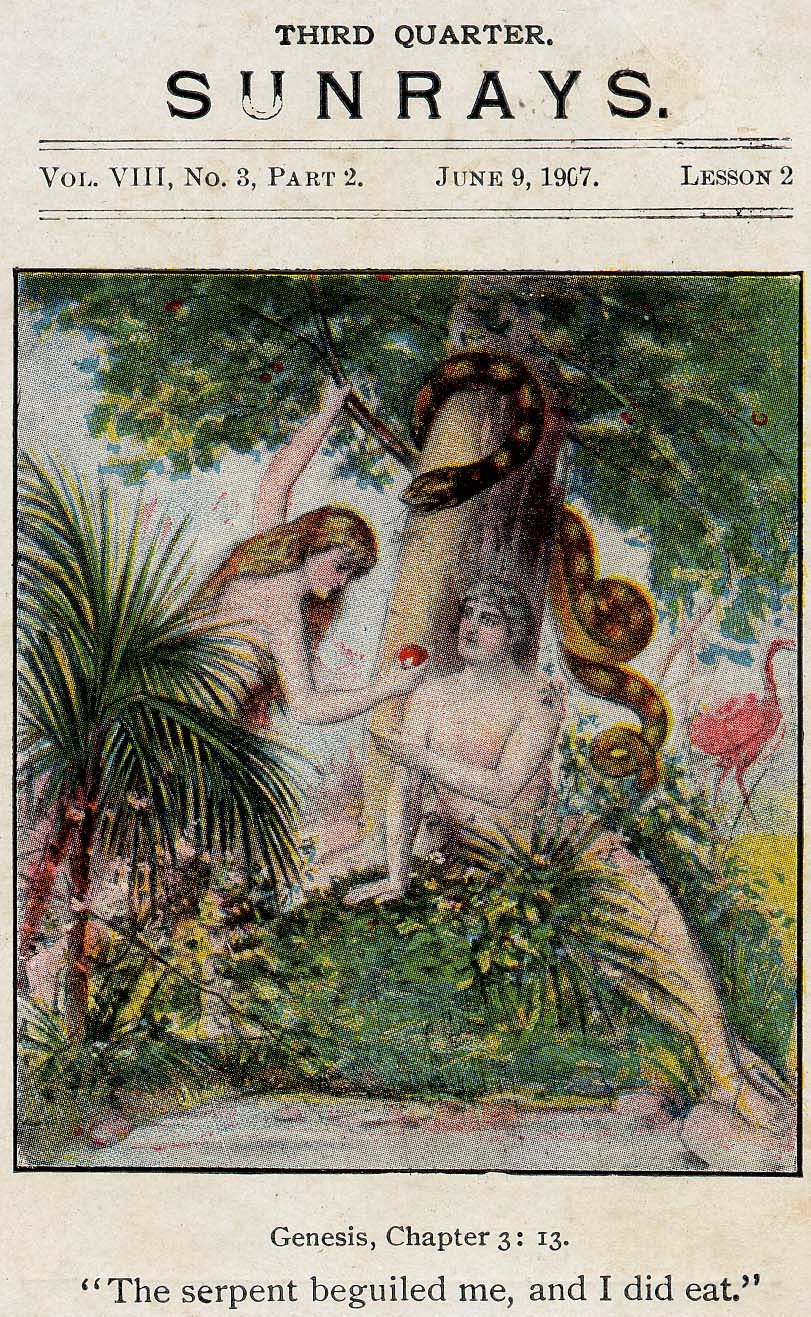


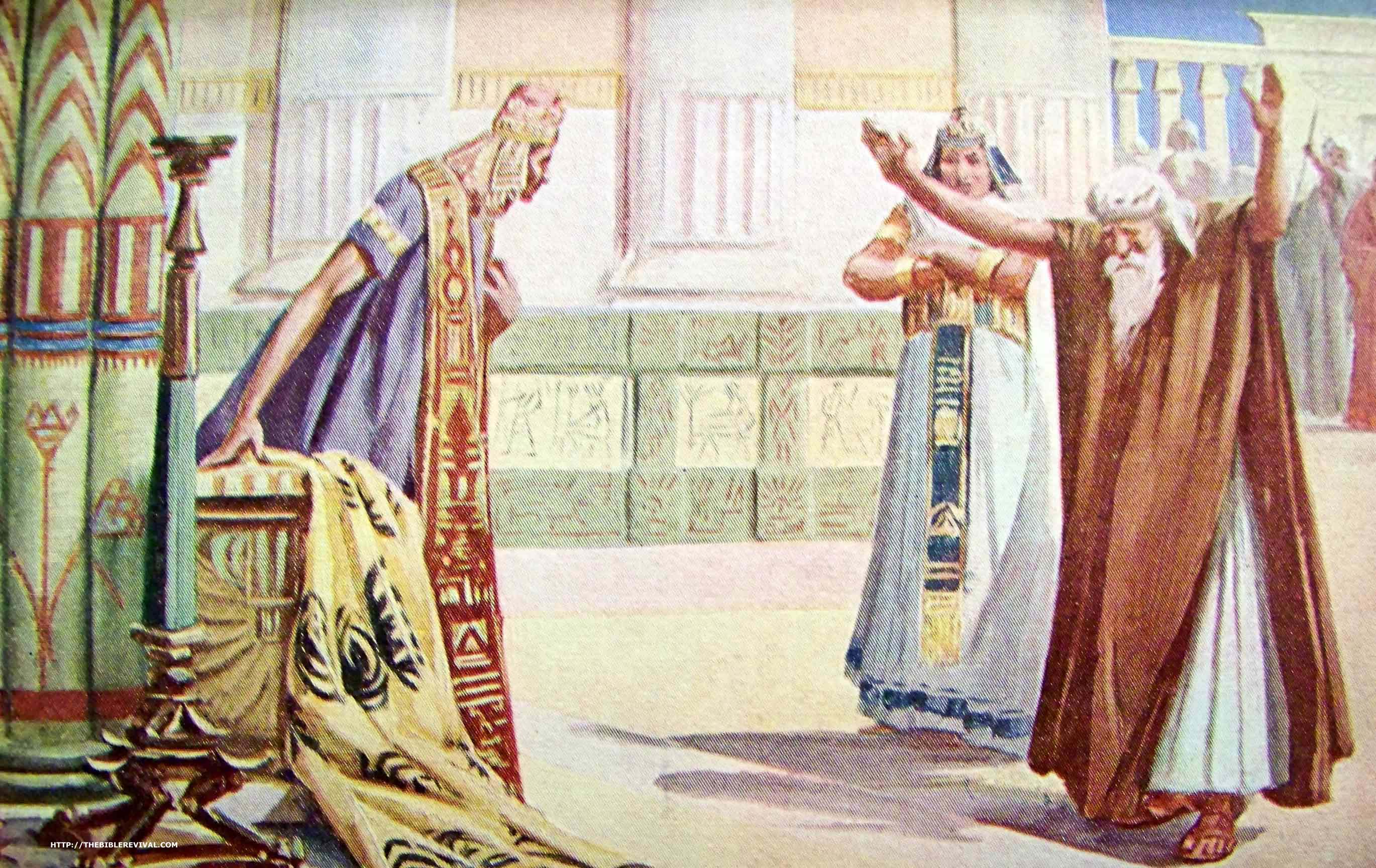
Hint: You can use Google image search (use "Safe search" to be sure to filter out explicit images) to great advantage - Click the link below and type in your book title and chapter, being sure to put them in quotation marks. Do this for Genesis 1, 2, 3, etc. You will retrieve an assortment of pictures in terms of quality but this should allow you to select suitable material for teaching, preaching or general illustration.
Note: This older work is a compilation of sermons, notes, illustrations from a variety of preachers and expositors.
Devotionals on Genesis 1-6
CONTENTS
NOTES
Modern commentary - published July, 2017.
- Preface to the Bible Teacher's Guide: Abraham
- 1. Understanding God’s Call (Genesis 12:1–9)
- 2. The Believers’ Response to Trials (Genesis 12:10–20)
- 3. Responding in Faith to Conflict (Genesis 13)
- 4. How to Rescue a Fallen Brother (Genesis 14)
- 5. How to Battle Fear, Doubt, and Discouragement (Genesis 15:1–6)
- 6. How to Strengthen Our Faith (Genesis 15:7–21)
- 7. How to Protect Our Family (Genesis 16)
- 8. How to Experience God’s Power in Our Lives (Genesis 17
- 9. Becoming a Friend of God (Genesis 18)
- 10. Characteristics of Worldly Believers—Friends of the World (Genesis 19)
- 11. Twelve Steps to Conquering Habitual Sins (Genesis 20)
- 12. Experiencing God’s Promises (Genesis 21)
- 13. How to Pass God’s Tests (Genesis 22)
- 14. How to Respond to Death in a God-honoring Way (Genesis 23, 25:1–10)
- 15. Finding a Godly Mate (Genesis 24)
- Appendix 1: Study Group Tips
- Appendix 2: Reflection Questions
- Appendix 3: Walking the Romans Road
Cyril Barber - Although dated archaeologically and historically, Bush more than makes up for these deficiencies with his enriching comments on the text, sidelights drawn from his thorough knowledge of the Arab culture, and devotional application.
- Genesis 1
- Genesis 2
- Genesis 3
- Genesis 4
- Genesis 5
- Genesis 6
- Genesis 7
- Genesis 8
- Genesis 9
- Genesis 10
- Genesis 11
- Genesis 12
- Genesis 13
- Genesis 14
- Genesis 15
- Genesis 16
- Genesis 17
- Genesis 18
- Genesis 19
- Genesis 20
- Genesis 21
- Genesis 22
- Genesis 23
- Genesis 24
- Genesis 25
- Genesis 26
- Genesis 27
- Genesis 28
- Genesis 29
- Genesis 30
- Genesis 31
- Genesis 32
- Genesis 33
- Genesis 34
- Genesis 35
- Genesis 36
- Genesis 37
- Genesis 38
- Genesis 39
- Genesis 40
- Genesis 41
- Genesis 42
- Genesis 43
- Genesis 44
- Genesis 45
- Genesis 46
- Genesis 47
- Genesis 48
- Genesis 49
- Genesis 50
My comments on Clarke's commentary - "Clarke (1760-1832) was Methodist, Wesleyan, Arminian, (e.g., Clarke "suggested that although God can know all future events, He chooses not to know some events beforehand" Baker Encyclopedia of the Bible, page 808). He did not always interpret Scripture literally and so was amillennial (to quote Clarke on 1000 years - "I am satisfied that this period should not be taken literally" [see comment on Rev 20:4] - he interpreted Revelation as a Historicist) which led him to interpret the church as fulfilling many OT promises to Israel. He was influential in development of doctrine of Entire Sanctification (or "Christian perfection"). Clarke did affirm the authority and sufficiency of Scripture, but held a belief of "plenary dynamic inspiration" (idea of every thought inspired), thus falling short of "plenary verbal inspiration" (every single word inspired) (Bib. Sacra: Vol 125, p 163, 1968). In summary, a useful, respected commentary but as with all extra-Biblical resources you are advised to "Be a Berean!" (Acts 17:11)
James Rosscup - This old, conservative Wesleyan Methodist work is good devotionally and aggressive for righteous living. Laypeople can find it still valuable today. It is Arminian in viewpoint and thus helpful, for example, in showing the reader how this approach deals with texts involving the eternal security question. The work contains much background material from many sources on all books of the Bible.
C H Spurgeon adds that "Adam Clarke is the great annotator of our Wesleyan friends; and they have no reason to be ashamed of him, for he takes rank among the chief of expositors. His mind was evidently fascinated by the singularities of learning, and hence his commentary is rather too much of an old curiosity shop, but it is filled with valuable rarities, such as none but a great man could have collected. Like Gill, he is one-sided, only in the opposite direction to our friend the Baptist. The use of the two authors may help to preserve the balance of your judgments. If you consider Clarke wanting in unction, do not read him for savor but for criticism, and then you will not be disappointed. The author thought that lengthy reflections were rather for the preacher than the commentator, and hence it was not a part of his plan to write such observations as those which endear Matthew Henry to the million. If you have a copy of Adam Clarke, and exercise discretion in reading it, you will derive immense advantage from it, for frequently by a sort of side-light he brings out the meaning of the text in an astonishingly novel manner. I do not wonder that Adam Clarke still stands, notwithstanding his peculiarities, a prince among commentators. I do not find him so helpful as Gill, but still, from his side of the question, with which I have personally no sympathy, he is an important writer, and deserves to be studied by every reader of the Scriptures. He very judiciously says of Dr. Gill, “He was a very learned and good man, but has often lost sight of his better judgment in spiritualizing the text;” this is the very verdict which we pass upon himself, only altering the last sentence a word or two; “He has often lost sight of his better judgment in following learned singularities;” the monkey, instead of the serpent, tempting Eve, is a notable instance." (Spurgeon, C. H. Lectures to my Students, Vol. 4: Commenting and Commentaries; Lectures Addressed to the students of the Pastors' College, Metropolitan Tabernacle)
Cyril Barber - First published in 1868. Candlish highlights the doctrinal issues as well as the biographical features contained in this portion of God's Word. In spite of its age, this remains one of the best works for pastors. Recommended.
James Rosscup -This was rated by Spurgeon in Commenting and Commentaries as “the (premier) work on Genesis”. There are 72 chapters in lecture form. Candlish believes in a young earth but alas, the universal fatherhood of God. His work is often helpful in spite of some peculiarities, but not nearly as beneficial as many works since. (Commentaries for Biblical Expositors: An Annotated Bibliography of Selected Works)
- Table of Contents - Volume 1 - 37 discourses
- Table of Contents - Volume 2 - 35 discourses
Excellent Resource. Virtually Verse by Verse
More than 900 pages of in depth preaching, functions almost like a commentary
- 1: In The Beginning: God (Genesis 1:1, Introduction)
- 2: God Created (Genesis 1:1-2)
- 3: The God Of Creation (Genesis 1:2-25)
- 4: Why God Created People (Genesis 1:26-31)
- 5: God’s Day Of Rest (Genesis 2:1-3)
- 6: Understanding Who We Are (Genesis 2:4-17)
- 7: God’s Design for Marriage (Genesis 2:18-25)
- 8: How Temptation Works (Genesis 3:1-7)
- 9: Where Are You? (Genesis 3:7-15)
- 10: The Curse and The Covering (Genesis 3:16-24)
- 11: Sin Crouching At The Door (Genesis 4:1-15)
- 12: Progress Without God (Genesis 4:16-26)
- 13: The Epitaph of Sin (Genesis 5:1-32)
- 14: Sin’s Full Course (Genesis 6:1-8)
- 15: Total Depravity (Genesis 6:5; 8:21)
- 16: Standing Alone (Genesis 6:9-22)
- 17: God’s Warnings (Genesis 7:1-24)
- 18: When You Feel Forgotten By God (Genesis 8:1-22)
- 19: The Sanctity of Human Life (Genesis 9:1-7)
- 20: Assurance From God (Genesis 9:8-17)
- 21: A Good Man’s Sin (Genesis 9:18-29)
- 22: The Roots of the Nations (Genesis 10:1-32)
- 23: Man Versus God: God Wins (Genesis 11:1-9)
- 24: The God of History and You (Genesis 11:10-32)
- 25: Great Privilege, Great Responsibility (Genesis 12:1-3)
- 26: Obedient Faith (Genesis 12:4-9)
- 27: Faithless Man, Faithful God (Genesis 12:10-13:4)
- 28: Choices, Consequences (Genesis 13:5-18)
- 29: Restoring A Fallen Brother (Genesis 14:1-24)
- 30: Making God’s Promises Yours (Genesis 15:1-6)
- 31: Justification by Faith Alone (Genesis 15:6; Romans 4:1-5)
- 32: Assurance (Genesis 15:7-21)
- 33: Why We Have Family Problems (Genesis 16:1-6)
- 34: The God Who Sees (Genesis 16:7-16)
- 35: Why We Do Not Baptize Infants (Genesis 17 and other Scriptures)
- 36: God’s Sovereignty, Our Responsibility (Genesis 17:1-27)
- 37: Friendship With God (Genesis 18:1-8)
- 38: Nothing Too Difficult For God (Genesis 18:9-15)
- 39: Prevailing With God (Genesis 18:16-33)
- 40: The Tragedy Of Worldly Believers (Genesis 19:1-29)
- 41: A Father Who Failed (Genesis 19:30-38)
- 42: Besetting Sins (Genesis 20:1-18)
- 43: The Joy and Pain of a Life of Faith (Genesis 21:1-21)
- 44: Faithful God of the Ordinary (Genesis 21:22-34)
- 45: Ultimate Surrender (Genesis 22:1-24)
- 46: The Lord Who Provides (Genesis 22)
- 47: How Believers Deal With Death (Genesis 23:1-20)
- 48: Knowing God’s Guidance—Especially in Choosing A Mate (Genesis 24:1-67)
- 49: God’s Purpose, God’s Choice (Genesis 25:1-26)
- 50: Trading Your Soul- For What? (Genesis 25:27 34; Heb. 12:16-17)
- 51: How God Uses Ordinary People (Genesis 26:1-35)
- 52: My Way Or God’s Way? (Genesis 27:1-46)
- 53: How God Begins With Us (Genesis 28:1-22)
- 54: God’s Boot Camp (Genesis 29:1-30)
- 55: A Family At War (Genesis 29:31-30:24)
- 56: How To Handle Prosperity (Genesis 30:25 31:16)
- 57: Between A Rock and A Hard Place (Genesis 31:17-55)
- 58: When Fear Grips You (Genesis 32:1-21)
- 59: Broken, But Blessed (Genesis 32:22-32)
- 60: Forward, Halt! (Genesis 33:1-20)
- 61: Fatal Attraction (Genesis 34:1-31)
- 62: Getting Out of a Spiritual Slump (Genesis 35:1-29)
- 63: A Successful Man Who Failed With God (Genesis 36:1-43)
- 64: If God is Sovereign, Why Am I in the Pits? (Genesis 37:1-36)
- 65: Conformity With Corruption (Genesis 38:1-30)
- 66: Moral Purity in a Polluted World (Genesis 39:1-20)
- 67: True Success (Genesis 39:1-23)
- 68: High Hopes, No Hope- But God (Genesis 40:1-23)
- 69: Coping With Success (Genesis 41:1-57)
- 70: When Your Conscience Says “Ow!” (Genesis 42:1-28)
- 71: When Everything Goes Against You (Genesis 42:29-43:14)
- 72: How Grace Leads To Repentance (Genesis 43:15-44:17)
- 73: Approaching God (Genesis 44:18-34)
- 74: The Key To Reconciliation (Genesis 45:1-15)
- 75: God’s Abundant Provision (Genesis 45:16-28)
- 76: Experiencing God’s Provision (Genesis 45:16-28)
- 77: Should I Move, Should I Stay? (Genesis 46:1-30)
- 78: The Prosperity That Counts (Genesis 46:31-47:31)
- 79: A Godly Heritage (Genesis 48:1-22)
- 80: Problem Passions (Genesis 49:1-7)
- 81: Ancient Prophecies And You (Genesis 49:8-21)
- 82: A Father’s Blessing (Genesis 49:22-28)
- 83: Grief And Hope (Genesis 49:29-50:14)
- 84: Forgiving One Another (Genesis 50:15-21)
- 85: A Mindset for Enduring Trials (Genesis 50:20)
- 86: Epitaph Of A Truly Successful Man (Genesis 50:22-26)
- 87: From The Garden To A Coffin (Genesis Recap)
James Rosscup writes that "This is a helpful old set of 1863 for laypeople and pastors to have because it usually comments at least to some degree on problems. Though terse, it provides something good on almost any passage, phrase by phrase and is to some degree critical in nature. It is evangelical....Especially in its multi-volume form this is one of the old evangelical works that offers fairly solid though brief help on many verses" (Commentaries for Biblical Expositors: An Annotated Bibliography of Selected Works)
C H Spurgeon writes "Of this I have a very high opinion. It is the joint work of Mr. Jamieson, A. R. Fausset, and Dr. David Brown. It is to some extent a compilation and condensation of other men’s thoughts, but it is sufficiently original to claim a place in every minister’s library; indeed it contains so great a variety of information that if a man had no other exposition he would find himself at no great loss if he possessed this and used it diligently" (Spurgeon, C. H. Lectures to my Students, Vol. 4: Commenting and Commentaries; Lectures Addressed to the students of the Pastors' College, Metropolitan Tabernacle)
- Genesis - Preface to Genesis: from Paradise to Patriarchs
- Genesis 1:1-2:3 - The Creation
- Genesis 1:1-2:3 - The Creation of the Heavens and the Earth
- Genesis 1:26-31; 2:4-25 - Meaning of Man: His Duty and His Delight
- Genesis 3:1-24 - Fall of Man
- Genesis 3:1-5:32 - The Fall of Man
- Genesis 4:1-26 - Fruits of the Fall
- Genesis 5:1-32 - Coming to Grips with Genealogies
- Genesis 5:28-10:32 - The Flood
- Genesis 6:1-8 - Sons of God and the Daughters of Men
- Genesis 6:9-8:22 - The Flood
- Genesis 8:20-9:17 - The Noahic Covenant—A New Beginning
- Genesis 9:18-10:32 - Nakedness of Noah and Cursing of Canaan
- Genesis 10:1-11:25 - The Confusion of Languages at Babel
- Genesis 11:1-9 - The Unity of Unbelief
- Genesis 11:26-17:27 - Abraham's Call and God's Covenant
- Genesis 11:31-19:9 The Call of Abram
- Genesis 12:10-13:41 When Faith Fails …
- Genesis 13:5-18 - Lot Looks Out For Number One
- Genesis 14:1-24 - The Rescue of Lot
- Genesis 15:1-21 - The Focal Point of Abram’s Faith
- Genesis 16:1-16 - When Women Wear the Pants
- Genesis 17:1-27 - Grasping the Great Truth of God
- Genesis 18:1-33 - Marks of Maturity)
- Genesis 18:1-26:35 - Abraham's Finest Hour
- Genesis 19:1-38 - From City Councilman to Caveman
- Genesis 20:1-18 - Don’t Ever Say Never
- Genesis 21:1-34 - What Happens When Christians Mess Up?
- Genesis 22:1-24 - Final Exams
- Genesis 23:1-20 - Dealing with Death
- Genesis 24:1-67 - How to Find a Godly Wife
- Genesis 25:1-34 - The Principle of Divine Election
- Genesis 26:1-35 - Isaac Walks in His Father’s Steps
- Genesis 27:1-46 - Working Like the Devil, Serving the Lord
- Genesis 27:1-35:29 - Jacob
- Genesis 28:1-22 - The Seeker Is Sought
- Genesis 29:1-30 - I Led Two Wives
- Genesis 29:31-30:24 - The Battle of the Brides
- Genesis 30:25-31:16 - Jacob Gets Laban’s Goat
- Genesis 31:17-55 - The Difference Between Legality and Morality
- Genesis 32:1-32 - How to Win With God and Men
- Genesis 32:22-30 The Invisibility of God ( Ex 24:9-11; 1 Ti 1:17)
- Genesis 33:1--34:31 - One Step Forward and Three Backward
- Genesis 35:1-29 - The Way Back
- Genesis 36:1-37:36 - Jacob, Joseph, Jealousy, and a Journey to Egypt
- Genesis 37:1-50:26 - Joseph
- Genesis 38:1-30 - The Skeleton in Judah’s Closet
- Genesis 39:1-23 - From the Penthouse to the Prison
- Genesis 40:1-23 - How to Get Out of the Pits
- Genesis 41:1-57 - From the Pit to the Palace
- Genesis 42:1-38 - The Proper Use of Power
- Genesis 43:1-34 - The Fears of Jacob and the Tears of Joseph
- Genesis 44:1-34 - The Final Test: Dothan Relived
- Genesis 45:1-28 - The Fundamentals of Forgiveness
- Genesis 46:1-47:12 - Life Begins at 130
- Genesis 47:13-31 - A Proper Perspective of Poverty and Prosperity
- Genesis 48:1-22 - The View From the Graveyard
- Genesis 49:1-28 - The Purpose of Prophecy
- Genesis 49:29-50:26 - The End of An Era
This is a different resource than Keil & Delitzsch below
Cyril Barber - Adopts a moderate approach to the critical theories of authorship. Provides an excellent treatment of the period from Abraham to Joseph. Deserving of careful reading.
James Rosscup writes that "The author holds to the Documentary Hypothesis but does not deny the uniqueness of Genesis or minimize the significance and authority of its message. He is careful in the Hebrew and deals with the problems, providing much to aid the expositor." (Commentaries for Biblical Expositors: An Annotated Bibliography of Selected Works)
- Introduction
- Genesis 1:1ff
- Genesis 1:3-5
- Genesis 1:6-8
- Genesis 1:9-13
- Genesis 1:14-19
- Genesis 1:20-23
- Genesis 1:24-31
- Genesis 1:9-13
- Genesis 2:1-3
- Genesis 2:4
- Genesis 2:5
- Genesis 2:6, 7
- Genesis 2:8
- Genesis 2:9
- Genesis 2:10
- Genesis 2:11, 12
- Genesis 2:13
- Genesis 2:14
- Genesis 2:15
- Genesis 2:16, 17
- Genesis 2:18
- Genesis 2:19, 20
- Genesis 2:21, 22
- Genesis 2:9
- Genesis 2:10
- Genesis 2:11, 12
- Genesis 2:23
- Genesis 2:24
- Genesis 3:1-5
- Genesis 3:6-15
- Genesis 3:16-24
- Genesis 4:1-7
Genesis 4:8-21 - Genesis 4:22-26
- Genesis 5
- Genesis 6:1-8
Genesis 6:1-12 Flood Legends - Genesis 6:13-22
Genesis 7 - Genesis 8
- Genesis 9
- Genesis 10:1-14
Genesis 10:15-31
Genesis 11 - Genesis 12
- Genesis 13
- Genesis 14
- Genesis 15
- Genesis 16
- Genesis 17
- Genesis 18
- Genesis 19
- Genesis 20
- Genesis 21
- Genesis 22
- Genesis 23
- Genesis 24
- Genesis 25:1-18
- Genesis 25:19-34
- Genesis 26
- Genesis 27
- Genesis 28
- Genesis 29
- Genesis 30
- Genesis 31
- Genesis 32
- Genesis 33
- Genesis 34
- Genesis 35
- Genesis 36
- Genesis 37
- Genesis 38
- Genesis 39
- Genesis 40
- Genesis 41
- Genesis 42
- Genesis 43
- Genesis 44
- Genesis 45
- Genesis 46
- Genesis 47
- Genesis 48
- Genesis 49
- Genesis 50
- Genesis 11:27-32 Fruitfulness Requires Separation
- Genesis 12:4-9 Separation Often Produces Conflict
- Genesis 12:7-9 A Tent and Altar Life
- Genesis 12:9-13 Altar Neglect Brings Failure
- Genesis 12:14-20 Friend of the World or of God?
- Genesis 13:1-4 Results of Backsliding (Backsliding)
- Genesis 13:5-13 Spirit-Controlled or Carnal?
- Genesis 14:10-16 Restoring a Brother
- Genesis 14:17-24 Refusing the World's Offers
- Genesis 15:1-6 The Believer's Reward
- Genesis 16:6-16 Results of the Lack of Faith
- Genesis 17:1-2 God's Perfect Timing
- Genesis 17 The Almighty God
- Genesis 17:3-8 Abraham's God Is Our God
- Genesis 17:9-21 (scroll down) Flesh and Spirit in Conflict
- Genesis 18:1-5 God Honors His Own
- Genesis 18:6-15 Nothing Is Impossible
- Genesis 18:16-21 A Friend of God
- Genesis 18:22-33 Intercessory Prayer
- Genesis 20:1-7 The Disobedient Servant
- Genesis 20:8-18 God of the Overcomer
- Genesis 21:1-7 God Loves Ordinary People
- Genesis 21:8 Going on to Maturity
- Genesis 21:9-21 Conflict is Inevitable
- Genesis 21:11 The Basis of Unity
- Genesis 21:12 Parting With the Desires of the Flesh
- Genesis 22:1-8 The Necessity of Testing
- Genesis 22:1-2 Testing Has a Purpose
- Genesis 22:3 The Response of Faith
- Genesis 22:4-5 Trusting in Spite of Circumstances
- Genesis 22:7-9 A Submissive Faith
- Genesis 22:9-12 Action Proves Faith
- Genesis 22:13-19 Passing the Test
- Genesis 24:63 God Honors Quiet Dedication
- Genesis 25:1-8 Our Highest Goal
- Genesis 25:21-26 Two Children Become Two Nations
- Genesis 25:27-34 Running Ahead of God
- Missing
- Genesis 25:34 Despising God's Provisions
- Genesis 26:1-6 Don't Rely on the Flesh
- Genesis 26:7-11 Like Father, Like Son
- Genesis 26:12-14 Backslidden but Blessed
- Genesis 26:14-16 Blessing and Presence
- Genesis 26:17-20 (scroll down) Heading Home
- Genesis 26:21-22 Not Insisting on Rights
- Genesis 26:23-24 Restored Fellowship
- Genesis 26:25 Three Absolutes
- Genesis 26:30-33 (scroll down) God Exalts the Totally Committed
- Genesis 27:1-17 Impatient to Wait on God
- Genesis 27:18-29 Deceived by a Kiss
- Genesis 27:30-37 The Effects of Selfishness
- Genesis 27:30-40 Bad Attitude Brings Spiritual Loss
- Genesis 27:41-46 Sowing and Reaping
- Genesis 28:1-5 Bringing Out the Best
- Genesis 28:10-17 God Knows Us Thoroughly
- Genesis 29:1-12 Nothing by Chance
- Genesis 29:13-15 God Teaches Us Through Others
- Genesis 29:16-28 The Cost of Refusing to Wait
- Genesis 30:25-33 God Forgives the One Who Repents
- Genesis 31:1-7 God Knows the Heart
- Genesis 31:43-49 A Covenant of Separation
- Genesis 32:1-8 At the End of Self
- Genesis 32:9-12 Praying With Proper Motives
- Genesis 32:13-21 God's Plan or Ours?
- Genesis 32:22-26 Alone with God
- Genesis 32:27-32 Is All on the Altar?
- Genesis 33:1-11 Fear Follows Great Experience
- Genesis 33:12-20 Too Timid to Testify
- Genesis 34:1-7 A Step at a Time
- Genesis 34:27-35:3 In Spite of Sin, Grace
- Genesis 35:4-12 Bethel at Last!
- Genesis 35:16-20 A Marriage Partner Dies
- Genesis 35:27-29 A Father Dies
- Genesis 35:28-29 Blessing of Difficulties
- Genesis 37:1-4 Influence During Formative Years
- Genesis 37:5-11 God's Mysterious Ways
- Genesis 37:18-24 Facing Death Prepares for Life
- Genesis 37:25-36 Faith for Life's Uncertainties
- Genesis 39:1-6 A Life of Faithfulness
- Genesis 39:7-13 Resisting Temptation
- Genesis 39:13-23 God Never Deserts His Own
- Genesis 40:1-8 Serving Willingly and Faithfully
- Genesis 40:9-15 God Knows Our Heartaches
- Genesis 40:16-23 Special Favors Forgotten (Training Through Chastening)
- Genesis 41:1-14 Failure of the World's Wisdom
- Genesis 41:25-36 Advice Without Self-Interest
- Genesis 41:37-45 The Test of Position and Prosperity
- Genesis 41:46-57 Forgetting Past Trials
- Genesis 42:1-17 Brothers Meet Again
- Genesis 42:18-28 No Grudges Held
- Genesis 42:29-38 Judging by the Circumstances
- Genesis 43:1-18 Guilt Produces Fear
- Genesis 43:1-10 Death to the Self-Life
- Genesis 43:19-34 A Brother Is Honored
- Genesis 44:1-16 No Excuses; Mercy Sought
- Genesis 44:17-34 A Right Heart Attitude
- Genesis 45:1-15 Not You . . . But God
- Genesis 45:16-28 A Father Hears Good News
- Genesis 46:1-34 A Family Reunion
- Genesis 47:1-31 God's Purpose Fulfilled
- Genesis 47:1-12 Testifying to a King
- Genesis 48:1-22 New Heirs Appointed (Fearing God)
- Genesis 49:28-33 A Believer Dies
- Genesis 50:1-17 Failing to Accept Forgiveness
- Genesis 50:18-26 Confidence in God's Word
Warren Wiersbe one of the more esteemed modern evangelical commentators writes: If you can locate the six-volume edition of the Expositor’s Bible, buy it immediately! It takes up less space than the original fifty-volume set, and not everything in the original set is worth owning.
Cyril J. Barber - This set, originally published in 1903, contains expositions by both conservative and liberal theologians. The most important works are by Dods (Genesis), Chadwick (Exodus and Mark), Kellogg (Leviticus), Blaikie (Joshua, I and II Samuel), Adeney (Ezra, Nehemiah and Esther), Maclaren (Psalms), Moule (Romans), Findlay (Galatians and Ephesians), Plummer (Pastoral Epistles and the Epistles of James and Jude), and Milligan (Revelation.)
- Israelology: Part 1 of 6 Introduction: Definition of Terms
- Israelology: Part 2 of 6 Israel Present (Note: Article begins on Page 2)
- Israelology: Part 3 of 6 Israel Present (Continued)
- Israelology: Part 4 of 6 - Israel Future (Part One)
- Israelology: Part 5 of 6 - Israel Future (Part Two)
- Israelology: Part 6 of 6 Other Relevant Topics - Illustrations of Israel (including marriage)
James Rosscup writes that "This dispensationally oriented work is not verse-by-verse, but deals with the exposition on a broader scale, treating blocks of thought within the chapters. Cf. also Arno C. Gaebelein, Gaebelein’s Concise Commentary on the Whole Bible (I Volume, Neptune, NJ: Loizeaux, 1985), the Annotated Bible revised. The author was a popular evangelical Bible teacher of the first part of the century, much like H. A. Ironside in his diligent but broad, practical expositions of Bible books. Gaebelein was premillennial and dispensational, and editor for many years of Our Hope Magazine." (Commentaries for Biblical Expositors: An Annotated Bibliography of Selected Works)
C H Spurgeon -- "Beyond all controversy, John Gill was one of the most able Hebraists of his day, and in other matters no mean proficient...His great work on the Holy Scriptures is greatly prized at the present day by the best authorities, which is conclusive evidence of its value, since the set of the current of theological thought is quite contrary to that of Dr. Gill. No one in these days is likely to be censured for his Arminianism, but most modern divines affect to sneer at anything a little too highly Calvinistic (see Calvinism): however, amid the decadence of his own rigid system, and the disrepute of even more moderate Calvinism, Gill’s laurels as an expositor are still green. His ultraism is discarded, but his learning is respected: the world and the church take leave to question his dogmatism, but they both bow before his erudition. Probably no man since Gill’s days has at all equaled him in the matter of Rabbinical learning. Say what you will about that lore, it has its value: of course, a man has to rake among perfect dunghills and dust-heaps, but there are a few jewels which the world could not afford to miss. Gill was a master cinder-sifter among the Targums, the Talmuds, the Mishnah, and the Gemara. Richly did he deserve the degree of which he said, “I never bought it, nor thought it, nor sought it.”
He was always at work; it is difficult to say when he slept, for he wrote 10,000 folio pages of theology. The portrait of him which belongs to this church, and hangs in my private vestry, and from which all the published portraits have been engraved, represents him after an interview with an Arminian gentleman, turning up his nose in a most expressive manner, as if he could not endure even the smell of free-will. In some such a vein he wrote his commentary. He hunts Arminianism throughout the whole of it. He is far from being so interesting and readable as Matthew Henry. He delivered his comments to his people from Sabbath to Sabbath, hence their peculiar mannerism. His frequent method of animadversion (a critical and usually censorious remark) is, “This text does not mean this,” nobody ever thought it did; “It does not mean that,” only two or three heretics ever imagined it did; and again it does not mean a third thing, or a fourth, or a fifth, or a sixth absurdity; but at last he thinks it does mean so-and-so, and tells you so in a methodical, sermon-like manner. This is an easy method, gentlemen, of filling up the time, if you are ever short of heads for a sermon. Show your people firstly, secondly, and thirdly, what the text does not mean, and then afterwards you can go back and show them what it does mean. It may be thought, however, that one such a teacher is enough, and that what was tolerated from a learned doctor would be scouted in a student fresh from college. For good, sound, massive, sober sense in commenting, who can excel Gill? Very seldom does he allow himself to be run away with by imagination, except now and then when he tries to open up a parable, and finds a meaning in every circumstance and minute detail; or when he falls upon a text which is not congenial with his creed, and hacks and hews terribly to bring the word of God into a more systematic shape. Gill is the Coryphaeus (the leader of the Greek chorus and thus the leader of any movement) of Hyper-Calvinism, but if his followers never went beyond their master, they would not go very far astray." (Spurgeon, C. H. Lectures to my Students, Vol. 4: Commenting and Commentaries; Lectures Addressed to the students of the Pastors' College, Metropolitan Tabernacle)
James Rosscup adds that "Gill (1697–1771), a pastor of England, wrote these which are two-column pages, ca. 900–1,000 pages per volume, Originally they were 9 volumes, folio. He also wrote Body of Divinity, 3 volumes, and several other volumes. His commentary is evangelical, wrestles with texts, is often wordy and not to the point but with worthy things for the patient who follow the ponderous detail and fish out slowly what his interpretation of a text is. He feels the thousand years in Revelation 20 cannot begin until after the conversion of the Jews and the bringing in of the fullness of the Gentiles and destruction of all anti-Christian powers (volume 6, p. 1063) but in an amillennial sense of new heavens and new earth coming right after Christ’s second advent (pp1064–65), and the literal thousand years of binding at the same time. He feels the group that gathers against the holy city at the end of the thousand years is the resurrected wicked dead from the four quarters of the earth (i.e. from all the earth, etc. (1067)." (Commentaries for Biblical Expositors: An Annotated Bibliography of Selected Works)
- Genesis 1:1-5 In The Beginning . . . God
- Genesis 1:26,27 In His Image
- Genesis 3 What a Mess
- Genesis 4:1-14 Tale of Two Brothers
- Genesis 6:5-20 Noah Found Grace
- Genesis 7, 8 In the Waiting Room
- Genesis 11:1-9 The Foolishness of Building Towers
- Genesis 12:1-6 Father Abraham
- Genesis 12:10-20 The Hero With Clay Feet
- Genesis 13:1-20 Making Wise Choices
- Genesis 14:17-24 Abraham Meets Melchizedek
- Genesis 15:1 God Alone
- Genesis 15:6 The Gospel - Plain and Simple
- Genesis 15:7-20 The Promise and the Firepot
- Genesis 16 Trying to Help God
- Genesis 18:1-15 The Laughter of Parenthood
- Genesis 18:16-33 Keys to Intercessory Prayer
- Genesis 19 The Truth We'd Rather Avoid
- Genesis 20 Embarrassing Reruns
- Genesis 21:1-7 Recipe for Joy
- Genesis 21:8-21 Necessary Losses
- Genesis 22:1-19 First Place
- Genesis 23 When You Lose Someone You Love
- Genesis 24 Finding God's Will for Your Life
- Genesis 25:1-11 Living In Between
- Genesis 25:12-34 Sibling Rivalry
- Genesis 26 Following in Your Father's Footsteps
- Genesis 27 The End Justifies . . . Nothing
- Genesis 28:10-22 Never Alone
- Genesis 29-30 Learning from the Past
- Genesis 30:25-31:55 Living With Integrity
- Genesis 32:1-22 Making Peace With Your Past
- Genesis 32:24-32 Wrestling With God
- Genesis 34 When God is Absent
- Genesis 35 How to Center Your Life
- Genesis 37 The Hated Brother
- Genesis 38 Judah's Foolishness
- Genesis 39 Overcoming Temptation
- Genesis 41:1-4 When Life Makes You Wonder
- Genesis 41:1-41 Remaining Faithful in the Good Times
- Genesis 41:33-57 Facing the Future Without Fear
- Genesis 42:1-38 The Way God Changes a Heart
- Genesis 42:25-38 Barriers to Grace
- Genesis 43:1-23 The Motivating Power of Guilt
- Genesis 43:23-34 The Treasures of Grace
- Genesis 44 The Change God is Looking For
- Genesis 45:1-15 Lessons in Forgiveness
- Genesis 45:21-28, 46:28-30 Surprise, Surprise, Surprise
- Genesis 46:1-7 When Life Sends You Mixed Signals
- Genesis 47:13-26 The Most Compelling Argument for the Gospel
- Genesis 48:1-20; 49:1-12 Blessings
- Genesis 50:15-21 The Invisible Hand of God's Providence
- Genesis; Principle #1; Gen 1:1-25; p. 5 Chosen in Christ: To have an abundant life now and eternally, we must receive the gift of life provided by the all-powerful God who created the universe. Video
- Genesis; Principle #2; Gen 1:26-2:7; p. 73 Body, Soul, and Spirit: Since we are eternal beings created by God to inhabit physical bodies, we are to offer our total beings to God in order to glorify Him Video
- Genesis; Principle #3; Gen 2:8-24; p. 7 Marital Union: To grow in openess and unity, we are to follow God's plan regarding a one man-one woman relationship within the bonds of marriage. Video
- Genesis; Principle #4; Gen 3:1-7; p. 7 Satan's Tactics: Since Satans goal is to deceive us, we should consistently focus on God's truthful message in His Word. Video
- Genesis; Principle #5; Gen 3:8-13; p. 8 Avoiding Rationalization: We should be on guard against our tendency to rationalize disobedience and shift blame Video
- Genesis; Principle #6; Gen 3:16; p. 9 Avoiding Marital Conflict: To avoid tensions in our marriages, we are to follow Christs example of love. Video
- Genesis; Principle #7; Gen 4:1-8; p. 9
- Sinful Anger: We must not allow the God-created emotion of anger become sinful Video
- Genesis; Principle #8; Gen. 4:17-19; p. 10 Moral Purity: To live in God's will, we must maintain the one-flesh relationship in marriage Video
- Genesis; Principle #9; Gen. 5:21-24; p. 11 Biblical Values: Even though many people around us violate biblical values, we are to walk with God Video
- Genesis; Principle #10; Gen. 6:1-11; p. 12 Holy Living: As the world becomes more and more decadent, we should continue to trust God to enable us to live righteous and Godly lives Video
- Genesis; Principle #11; Gen. 6:12-22; p. 13 Reflecting God's Compassion: We must be on guard against becoming uncompassionate when God allows people to live sinful lives and even prosper Video
- Genesis; Principle #12; Gen. 7:1-8:22; p. 14 Common Grace: We must understand that God's material blessings represent His common grace and mercy to all mankind
- Video
- Genesis; Principle #13; Gen. 9:1-28; p. 15 Renewing Our Minds: To walk with God daily, we are to renew our minds and be committed to doing His will Video
- Genesis; Principle #14; Gen. 11:1-9; p. 16 Overcoming Pride: We should avoid the sin of pride, which can lead us to build our own kingdom rather than the kingdom of God Video
- Genesis; Principle #15; Gen. 11:27-12:3; p. 17 God's Mercy: Since God reached out to us before we reached out to Him, we should always thank Him for saving us by His sovereign grace. Video
- Genesis; Principle #16; Gen. 12:4-10; p. 18 Seeking God's Wisdom: When we face difficult circumstances, we should always seek God's wisdom so that well continue to walk in His will Video
- Genesis; Principle #17; Gen. 12:11-15; p. 19 Overcoming Mistakes: We should do all we can to walk in God's will, even though we may have made wrong decisions in the past that have created our present crises. Video
- Genesis; Principle #18; Gen. 12:16-13:4; p. 19 Material Blessings: We should never conclude that wealth in itself is an indication of God's approval of our attitudes and behavior Video
- Genesis; Principle #19; Gen. 13:5-11; p. 20 Self-Evaluation: We must continually evaluate our motives and behavior in the light of God's directives in the Word of God. Video
- Genesis; Principle #20; Gen. 13:12-18; p. 20 Inappropriate Fellowship: To avoid losing our moral bearings, we must not have fellowship with unbelievers who are living immoral and evil lives Video
- Genesis; Principle #21; Gen. 14:1-15:1; p. 22 Growing in Faith: When we face periods of doubt and fear, we are to look to God to protect us and to meet our needs Video
- Genesis; Principle #22; Gen. 15:2-6; p. 22 Justified by Faith: No matter what our religious background, we must personalize our faith in God and in His Son, Jesus Christ Video
- Genesis; Principle #23; Gen. 16:1-2; p. 23 Cultural Influences: We should be cautious not to allow our pre-conversion, non-biblical values to cause us to make decisions that violate God's will Video
- Genesis; Principle #24; Gen. 16:3-5; p. 24
- Blaming Others: We must avoid blaming others for our own mistakes.
- Video
- Genesis; Principle #25; Gen. 16:15-17:2; p. 24 Growing Spiritually: We should use the negative results of personal mistakes as an opportunity to grow spiritually. Video
- Genesis; Principle #26; Gen. 17:15-18; p. 25 False Conclusions: We must be cautious not to interpret circumstances subjectively in order to support what have been personal mistakes. Video
- Genesis; Principle #27; Gen. 17:19-27; p. 26 Obedience to God's Command: Once we have put our faith in Jesus Christ, we should be obedient to God's command and identify ourselves as believers and members of God's family.
- Video
- Genesis; Principle #28; Gen. 18:1-15; p. 27 Trusting God: To help others overcome their skepticism and unbelief, we are first and foremost to trust God to intervene in their lives. Video
- Genesis; Principle #29; Gen. 20:1-18; p. 29 Spiritual Regression: Even though we are growing spiritually, we must be careful not to regress to old patterns of sinful behavior. Video
- Genesis; Principle #30; Gen. 21:1-10; p. 30 Sins Consequences: We should expect painful consequences when our sin impacts those closest to us. Video
- Genesis; Principle #31; Gen. 21:11-34; p. 31 Acting Responsibly: Regardless of the consequences of our sins, we are to confess those sins, accept God's forgiveness and move forward in our Christian lives. Video
- Genesis; Principle #32; Gen. 22:1-19; p. 32 Spiritual Testing: We should not be surprised when God allows unique tests to come into our lives to enable us to become more mature in our Christian experience. Video
- Genesis; Principle #33; Gen. 23:1-20; p. 33 Lifestyle Evangelism: We should live Godly lives before unbelievers in order to demonstrate that we are truly God's children. Video
- Genesis; Principle #34; Gen. 24:1-14; p. 33 Praying in God's Will: We are to pray consistently and specifically but always in harmony with God's revealed will in the Word of God. Video
- Genesis; Principle #35; Gen. 24:15-27; p. 34 Being Thankful: We are humbly to thank and praise God when He answers our prayers. Video
- Genesis; Principle #36; Gen. 24:28-25:26; p. 36 Modeling Christ: As husbands, we should be an example to our wives in living the Christian life.
- Video
- Genesis; Principle #37; Gen. 25:27-28; p. 37 Parental Favoritism: To be wise and mature parents, we must be on constant guard against Satans tactics. Video
- Genesis; Principle #38; Gen. 25:29-34; p. 37 Selfish Attitudes and Actions: We are never to take advantage of another persons weaknesses in order to achieve our own selfish goals. Video
- Genesis; Principle #39; Gen. 26:12-25; p. 38 Spiritual Insensitivity: We should continually develop our intimate relationship with God not allowing our hearts to grow cold and insensitive toward our heavenly Father, our families, and our fellow believers. Video
- Genesis; Principle #40; Gen. 26:26-35; p. 39 Worldly Desires: We are to pursue holiness, not allowing sinful desires to dominate and control our attitudes and actions. Video
- Genesis; Principle #41; Gen. 27:1-20; p. 40 Pure Motives: We are to faithfully imitate Christs love for us in order to avoid deceptive behavior in our relationships with one another. Video
- Genesis; Principle #42; Gen. 27:46-28:9; p. 41 Making Proper Decisions: We should first and foremost make decisions to please God, not to ingratiate ourselves with others for purely selfish reasons. Video
- Genesis; Principle #43; Gen. 28:10-17; p. 42 A Born-Again Experience: Even if we have been reared in a Christian family, we should make sure our relationship with God is personal. Video
- Genesis; Principle #44; Gen. 28:18-22; p. 43 Faith and Works: We are to test the reality of our relationship with God by the good works that result. Video
- Genesis; Principle #45; Gen. 29:1-20; p. 44 Carnal Behaviors: Even when we become true believers, we should be on guard against old patterns of sinful behavior that tend to persist.
- Video
- Genesis; Principle #46; Gen. 29:21-30; p. 44 Sin Patterns: When we sin against someone and do not seek forgiveness, we should not be surprised if someone sins against us in a similar fashion. Video
- Genesis; Principle #47; Gen. 29:31-30:24; p. 45 God's Moral Laws: We must obey God's moral laws if we are to avoid family dysfunction in marriage relationships. Video
- Genesis; Principle #48; Gen. 31:1-32; p. 47 Faith versus Fear: To experience God's power and protection, we should exercise faith, not fear and manipulation. Video
- Genesis; Principle #49; Gen. 32:1-20; p. 49 The Human and Divine: In times of difficulty, we should seek to blend proper precautions (human effort) with prayer (dependence on God). Video
- Genesis; Principle #50; Gen. 32:21-32; p. 49 God's Discipline: When we persistently violate God's will, we should anticipate our heavenly Fathers discipline.
- Video
- Genesis; Principle #51; Gen. 33:1-11; p. 50 Godly Fellowship: We are to have close fellowship with our brothers and sisters in Christ so that we can have intimate fellowship with God. Video
- Genesis; Principle #52; Gen. 33:12-17; p. 51 Honesty and Openness: After we have experienced restoration with those we hurt, we must continue to have open, honest relationships in order to avoid recurring problems. Video
- Genesis; Principle #53; Gen. 33:18-34:31; p. 52 Parental Protection: We are to do all we can to protect our children from worldly influences and at the same time, avoid overprotecting them. Video
- Genesis; Principle #54; Gen. 35:1-15; p. 53 Idolatrous Activities: Christian parents should avoid any kind of idolatrous activities. Video
- Genesis; Principle #55; Gen. 35:16-37:4; p. 55 Generational Mistakes: We should do all we can to avoid repeating the same mistakes our parents made with us. Video
- Genesis; Principle #56; Gen. 37:5-11; p. 55 Identity Crises: When were feeling rejection, we must be careful not to set ourselves up for more rejection by trying harder to prove ourselves. Video
- Genesis; Principle #57; Gen. 37:12-14; p. 56 The Subtlety of Denial: When we experience various cries, we should seek to face reality. Video
- Genesis; Principle #58; Gen. 37:15-23; p. 57 Subtle Pride: When we are highly favored and blessed by God and others, we should beware of subtle pride. Video
- Genesis; Principle #59; Gen. 37:24-36; p. 57 Jealousy and Anger: When we have feelings of jealousy, we should take steps to keep these emotions from leading to sinful anger. Video
- Genesis; Principle #60; Gen 38:1-30; p. 59 God's Sovereign Plan: We should keep our eyes on God's will for our lives when some Christians-even spiritual leaders-engage in sinful and scandalous actions. Video
- Genesis; Principle #61; Gen. 39:1-12; p. 59 Overcoming Temptation: To resist the temptation to sin, we must develop firm moral and ethical convictions based on a deep appreciation for God's love and grace in our lives. Video
- Genesis; Principle #62; Gen. 39:13-23; p. 60
- Persecution for Doing Right: When we are persecuted for refusing to violate God's moral laws, we should remember that the Lord will never forget our stand for righteousness. Video
- Genesis; Principle #63; Gen. 40:1-23; p. 61 Not Forgetting: When someone does something special for us, we should look for opportunities to return the favor. Video
- Genesis; Principle #64; Gen. 41:1-16; p. 62 Character Development: When we face difficult experiences, we should ask God to help us view these crises as opportunities to develop our Christian character. Video
- Genesis; Principle #65; Gen. 41:17-46; p. 63 Preparation for Greater Responsibility: We should view difficult experiences as opportunities to learn to be more effective in carrying out God's purposes in the world. Video
- Genesis; Principle #66; Gen. 41:50-52; p. 64 Psychological and Spiritual Healing: Because biological families are impacted by sin, we are to help create loving and supportive relationships with the body of Christ to bring emotional and spiritual healing. Video
- Genesis; Principle #67; Gen. 42:1-45:3; p. 67 God's Gift of Tears: When facing intensely emotional experiences, we should give ourselves permission to cry. Video
- Genesis; Principle #68; Gen. 45:4-15; p. 68 Forgiveness: When someone has wronged us, we are to forgive unconditionally even though that person may not admit it was wrong or even ask for forgiveness. Video
- Genesis; Principle #69; Gen. 45:16-47:27; p. 70 Doing Good for All: No matter our circumstances, we should live lives of integrity before all people. Video
- Genesis; Principle #70; Gen. 49:22-50:21; p. 73 Understanding God's Purpose: When we face difficult situations, we should ask God to help us see some divine meaning in the experiences. Video
NOTE: This site is conservative and answers the questions with Scripture with only a minimal component of "opinion."
- Book of Genesis - Bible Survey
- Does Genesis chapter 1 literally mean 24 hour days?
- Why is a day measured from evening to morning in Genesis 1?
- What is the Gap Theory? Did anything happen in between Genesis 1:1 and 1:2?
- What is the canopy theory?
- How could there be light on the first day of Creation if the sun was not created until the fourth day?
- Why are there two different Creation accounts in Genesis chapters 1-2?
- What happened on each of the days of Creation?
- Why does the Bible describe the moon as a light?
- Why did God rest on the seventh day of creation (Genesis 2:2)?
- Why did God make man out of the dust of the earth (Genesis 2:7)?
- What is the biblical Creation story?
- How do beliefs about creation impact the rest of theology?
- What is the breath of life?
- Were Adam and Eve saved? How many children did Adam and Eve have? When were Adam and Eve created?
- Who was Eve in the Bible?
- What does it mean that God gave humanity dominion over the animals?
- Why weren’t Adam and Eve created at the same time (Genesis 2)?
- Why did God use Adam's rib to create Eve?
- What does it mean that a wife is supposed to be a helpmeet / help meet?
- How was the woman a helper suitable for the man (Genesis 2:18)?
- What did God mean when He told Adam and Eve to be fruitful and multiply?
- Did God create other people in addition to Adam and Eve?
- Was Satan the serpent in Genesis chapter 3?
- Was Adam with Eve when she spoke to the serpent (Genesis 3:6)?
- What is the meaning of the tree of life?
- Was Adam and Eve's sin really about eating a piece of forbidden fruit?
- Did God literally and visibly walk in the garden (Genesis 3:8)?
- How is a woman’s desire for her husband a curse (Genesis 3:16)?
- Why didn’t Adam and Eve immediately die for their sin (Genesis 3)?
- Why did God punish women with pain in childbirth (Genesis 3:16)?
- Is it wrong to reduce birth pains by taking pain relievers?
- What is the Adamic covenant?
- What is the Protoevangelium?
- Did we all inherit sin from Adam and Eve?
- How did the Fall affect humanity?
- What is the location of the Garden of Eden?
- Why did God put the tree of knowledge of good and evil in the Garden of Eden?
- Why didn't Adam and Eve find it strange that a serpent was talking to them?
- How did the knowledge of good and evil make man like God (Genesis 3:22)?
- Why was it wrong for Adam and Eve to know good and evil (Genesis 3:22)?
- Why did God have the cherubim guard just the east side of Eden (Genesis 3:24)?
- Why did God accept Abel’s offering, but reject Cain’s offering? Why did Cain then kill Abel?
- Who was Cain's wife?
- Who was Cain afraid of after he killed Abel?
- What was the mark that God put on Cain (Genesis 4:15)?
- Why wasn't Cain’s punishment death (Genesis 4:14)?
- Am I my brother’s keeper?
- Why did people in Genesis live such long lives?
- Who was the oldest man in the Bible?
- Why did Lamech think Noah would bring comfort (Genesis 5:29)?
- Who are the sons of God and daughters of men in Genesis 6:1-4?
- Who / what were the Nephilim?
- What should we learn from the life of Noah?
- What was it like in the days of Noah?
- Why did God also destroy animals in the Flood (Genesis 6-8)?
- Were fish and sea creatures also destroyed during the Flood (Genesis 6-8)?
- Was Noah's flood global?
- Had it ever rained before the Flood in Noah's day?
- Did the Bible copy the Flood account from other myths and legends?
- How long did it take Noah to build the ark? How long was Noah on the ark?
- What is gopher wood?
- Why did Noah release a raven? Why did he later release a dove (Genesis 8)?
- How did Noah fit all the animals on the ark?
- What made some animals clean and others unclean (Genesis 7)?
- Would the discovery of Noah's Ark be important?
- What is the Noahic Covenant?
- Why did God prohibit eating meat with blood in it (Genesis 9:4)?
- Why did God mandate capital punishment for murder (Genesis 9:6)?
- Why did Noah get drunk after the flood?
- Why did Noah curse Ham / Canaan?
- Who were the sons of Noah, and what happened to them and their descendants?
- In what way was the earth divided in Peleg’s time?
- What happened at the Tower of Babel?
- What is the Table of Nations?
- Who were the Rephaim?
- Who was Melchizedek?
- Why was a burial place so important in the Bible?
- What should we learn from the life of Abraham?
- What was Abraham’s religion before God called him?
- Why was Abraham promised land that belonged to others (Genesis 12)?
- What is the story of Abraham and Lot?
- Why did God punish Pharaoh for Abram’s lie (Genesis 12:17)?
- What is the Abrahamic Covenant?
- What should we learn from the life of Sarah?
- What was a blood covenant (Genesis 15:9-21)?
- Why did God send the Israelites to Egypt for 400 years (Genesis 15:13)?
- What is the land that God promised to Israel?
- Why did Abraham bargain with God in regard to Sodom and Gomorrah (Genesis 18)?
- What is the significance of a city gate in the Bible?
- What was the sin of Sodom and Gomorrah?
- Why was Lot's wife turned into a pillar of salt?
- Why did Lot offer up his daughters to be gang raped? Why did God allow Lot's daughters to later have sex with their father?
- What should we learn from the life of Isaac?
- What was the significance of weaning a child in the Bible (Genesis 21:8)?
- What is the story of Sarah and Hagar?
- Why did Abraham banish Ishmael (Genesis 21:14)?
- Why did oaths involve putting a hand under someone's thigh (Genesis 24:9)?
- Why did God command Abraham to sacrifice Isaac?
- What should we learn from the life of Jacob?
- What was the story of Jacob and Esau?
- Why was a father's blessing so highly valued in the Old Testament?
- What is the difference between a blessing and a birthright (Genesis 25)?
- What is Jacob's Ladder?
- What is the story of Jacob, Leah, and Rachel?
- What was the purpose of a dowry (Genesis 31:15)?
- Why did people keep family idols in the Bible?
- What is the meaning of Jacob wrestling with God?
- What are the mandrakes mentioned in the Bible?
- What should we learn from the life of Joseph?
- Why did Jacob give Joseph a coat of many colors?
- What is the significance of a scarlet thread?
- What is the story of Joseph and his brothers?
- What is the story of Joseph and Potiphar?
- Who were the priests of On? Was Joseph wrong to marry the daughter of a pagan priest (Genesis 41)?
- Why did Pharaoh give Joseph so much power?
- What kind of divination did Joseph do in Genesis 44:5, 15?
- What are the twelve tribes of Israel?
- Were Jacob’s prophecies about his sons fulfilled?
- Who/what is the Lion of the tribe of Judah?
- What does it mean that the scepter will not depart from Judah (Genesis 49:10)?
Recommended
James Rosscup rates this as the #1 devotional commentary on Genesis. Rosscup writes "the notes by W. H. Griffith-Thomas...will be a warm devotional help...This work is good in tracing the argument and showing connections between chapters. It is usually quite good devotionally and gives suggestions for meditation at the ends of the chapters. Applications are often usable. It is an excellent book to put into the hands of a layman who is not ready to grapple with the minutia of exegesis, but who is serious about his Bible study. It is also good for the preacher and teacher. Since it is out of print, readers must search in other places for it."
- Introduction
- Genesis 1 The Creation
- Genesis 2 The Foundations of Human Life
- Genesis 3 The Fall
- Genesis 4 Cain and Abel
- Genesis 4:1-15 Human Progress
- Genesis 6:9-22 Before the Flood
- Genesis 7 At the Flood
- Genesis 8 After the Flood
- Genesis 9:1-17 The New Era
- Genesis 9:18-29 A Believer's Fall
- Genesis 10 A Wide Outlook
- Genesis 11:1-9 The Tower of Babel
- Genesis 11:10-12:9 The Call of Abraham
- Genesis 12:10-13:4 The Testing (If you are experiencing testing, read the Scriptures & the comment!)
- Genesis 13:5-18 The Separation
- Genesis 14:1-16 A New Emergency
- Genesis 14:17-24 The Test of Victory
- Genesis 15:1-6 The Great Encouragement
- Genesis 15:7-21 The Confirmation of Faith
- Genesis 16 A False Step
- Genesis 17 The Covenant Renewed
- Genesis 18:1-21 Fellowship with God
- Genesis 18:22-23-19:27-29 The Ministry of Intercession
- Genesis 19 The Story of Lot
- Genesis 20 The Old Sin Repeated
- Genesis 21:1-21 Joy and Sorrow
- Genesis 21:22-34 The Daily Round
- Genesis 22:1-19 The Supreme Crisis
- Genesis 23 Death in the Hoe
- Genesis 24:1-9-25:1-10 The Evening of Life
- Genesis 24:10-67 The Model Servant
- Genesis The Father of the Faithful - Abraham
- Genesis 25:11-28 The Birth of Jacob
- Genesis 25:29-34 The Birthright
- Genesis 26:1-33 Isaac
- Genesis 27:1-40 The Blessing
- Genesis 27:41-28:9 Interlude
- Genesis 28:10-22 Bethel
- Genesis 29:1-30 The New Life
- Genesis 29:31-30:43 In the Shadows
- Genesis 31:1-55 Turning Homewards
- Genesis 32:1-23 God's Host for Man's Help
- Genesis 32:24-32 Peniel: The Face of God
- Genesis 33:1-20 After Peniel
- Genesis 34:1-31 Results of Unfaithfulness
- Genesis 35:1-15 Bethel at Last
- Genesis 35:8, 16-29 The School of Sorrow
- Genesis 36:1-8 "A Profane Person"
- Genesis 37 Joseph's Early Life
- Genesis 38 A Family Shame
- Genesis 39 In Egypt
- Genesis 40 In Prison
- Genesis 41:1-40 Exaltation
- Genesis 41:41-52 The Prime Minister
- Genesis 42 The Awakening Conscience
- Genesis 43, 44 Divine Discipline
- Genesis 45 Reconciliation
- Genesis 46:1-30 Into Egypt
- Genesis 46:31-47:12 The New Home
- Genesis 47:13-26 A Wise Ruler
- Genesis 47:27-48:22 A Life's Sunset
- Genesis 49:1-27 Father and Sons
- Genesis 49:28-50:14 Light At Eventide
- Genesis 50:15-26 Joseph's Later Life
- Thou Worm Jacob
- A Fruitful Bough
- A Type of Christ
- Review
Conservative, Evangelical, Millennial
- Genesis 1
- Genesis 2
- Genesis 3
- Genesis 4
- Genesis 5
- Genesis 6
- Genesis 7
- Genesis 8
- Genesis 9
- Genesis 10
- Genesis 11
- Genesis 12
- Genesis 13
- Genesis 14
- Genesis 15
- Genesis 16
- Genesis 17
- Genesis 18
- Genesis 19
- Genesis 20
- Genesis 21
- Genesis 22
- Genesis 23
- Genesis 24
- Genesis 25
- Genesis 26
- Genesis 27
- Genesis 28
- Genesis 29
- Genesis 30
- Genesis 31
- Genesis 32
- Genesis 33
- Genesis 34
- Genesis 35
- Genesis 36
- Genesis 37
- Genesis 38
- Genesis 39
- Genesis 40
- Genesis 41
- Genesis 42
- Genesis 43
- Genesis 44
- Genesis 45
- Genesis 46
- Genesis 47
- Genesis 48
- Genesis 49
- Genesis 50
Hint: Words from the hymns make great additions to sermons
- General
- Genesis 1
- Genesis 1:26
- Genesis 1:26-27
- Genesis 1:28
- Genesis 2
- Genesis 2:18
- Genesis 2:24
- Genesis 3
- Genesis 3:5-6
- Genesis 3:7ff
- Genesis 4:15
- Genesis 5
- Genesis 12:5
- Genesis 13:13
- Genesis 13-20
- Genesis 15:5
- Genesis 18:14
- Genesis 19
- Genesis 19:26
- Genesis 22
- Genesis 22:8
- Genesis 22:9
- Genesis 22:14
- Genesis 22:17
- Genesis 41:51
- Genesis 43:33
- Genesis 49:10
- Genesis 1:1-2 The Creation of the World
- Genesis 1:3-5 The Light of the World
- Genesis 1:6-19 Creation Continued
- Genesis 1:20-23 Man and the Cultural Mandate
- Genesis 2:4-7 The Mystery of Man
- Genesis 2:8-17 Man in His Probation
- Genesis 2:18-25 The First Divine Institution
- Genesis 3:1-8 The Fall of Man
- Genesis 3:8-19 Sting of Death, Seed of Woman
- Genesis 3:20-24 Paradise Lost, but Regainable!
- Genesis 4:1-8 The Voice of God’s First Prophet
- Genesis 4:9-16 The Way of Cain
- Genesis 5:1-32 Grim Reaper and Rapture of Enoch
- Genesis 6:1-8 The Day of Noah
- Genesis 6:9-22 Noah and the Power of the Minority
- Genesis 7:1-24 Great Flood and the Saving Ark
- Genesis 8:1-22 Noah Saved, World Condemned
- Genesis 9:1-17 The Universal Covenant
- Genesis 9:18-29 Prophecy of Noah and Race Question
- Genesis 10:1-32 History of the Sons of Noah
- Genesis 11:1-9 Man’s Spirit and God’s Sovereignty
- Genesis 11:10- 12:5 Election, Calling and Perseverance
- Genesis 12:1-3 Abrahamic Fundamental Covenant
- Genesis 12:1-3 The First Great Pilgrim Father
- Genesis 12:4-9 The First Great Pilgrim Father
- Genesis 12:10-20 The Dance of Circumstances and Danger of Compromise
- Genesis 13:1-18 Lure of Invisible and Abram’s Choice
- Genesis 14:1-24 Uncompromising Faith
- Genesis 15:1-7 Abraham and Faith Justification
- Genesis 15:7-21 The Ratification of the Abrahamic Covenant
- Genesis 16:1-16 Ishmael
- Genesis 17:1-8 The Sealing of the Covenant
- Genesis 17:9-27 The Sign of the Abrahamic Covenant
- Genesis 18:1-33 Intimacies of the Divine Fellowship
- Genesis 19:1-38 Harvest of Sowing to the Flesh
- Genesis 20:1-18 Patriarch Practicing Deceit
- Genesis 21:1-34 The Promise Fulfilled
- Genesis 22:1-24 The Old Testament’s Greatest Scene
- Genesis 23:1-20 Power of the Resurrection
- Genesis 24:1-67 A Bride for Isaac
- Genesis 25:1-26 Last of Abraham, First of Jacob
- Genesis 25:27-34 Esau’s Profane Act
- Genesis 26:1-35 Isaac – Passive, Patient Patriarch
- Genesis 27:1-46 The Stolen Blessing
- Genesis 28:1-22 Jacob’s Ladder – Grace Unsought
- Genesis 29:1-35 The Deceiver Deceived
- Genesis 30:1-43 Jacob in the Crucible of Divine Discipline
- Genesis 31:1-55 Stirring up Jacob’s Nest
- Genesis 32:1-32 Peniel – Supplanter to Prevailer
- Genesis 33:1-20 God’s Fighter Retreating
- Genesis 34:1-31 Worldliness – It’s Character, Cure
- Genesis 35:1-29 Back to Bethel
- Genesis 36:1-43 Lessons From Esau Generations
- Genesis 37:1-36 Joseph – Beloved, Hated and Sold
- Genesis 38:1-30 Judah and Messianic Succession
- Genesis 39:1-23 Joseph – Tested and Triumphant
- Genesis 40:1-23 Providence in Pharoah’s Prison
- Genesis 41:1-57 From Prison to Prime Minister
- Genesis 42:1-38 Power of a Guilty Conscience
- Genesis 43:1-34 The Disciplines of Life
- Genesis 44:1 - 45:15 Consternation, Mediation, Reconciliation
- Genesis 45:16 - 46:34 Satisfied by the God of Isaac
- Genesis 47:1-31 The Grandeur of God’s Warrior
- Genesis 48:1-22 Jacob Blessing Joseph’s Sons
- Genesis 49:1-28 Jacob’s Last Words, part I
- Genesis 49:13-33 Jacob’s Last Words, part II
- Genesis 50:1-26 Joseph’s Last Words
January 2012 - These are well done in outline form and include added links from Gotquestions.org.
- The Bible: An Introduction
- In the Beginning God Genesis 1:1
- The Days of Creation Genesis 1:1-31
- A Day of Rest Genesis 2:1-3
- The Garden of Eden Genesis 2:4-17
- Adam's Rib Genesis 2:18-25
- The Invasion of Planet Earth Genesis 3:1-7
- The Blame Game Genesis 3:8-19
- Farewell to Paradise Genesis 3:20-24
- Cain and Abel Genesis 4:1-16
- Cain's Ungodly Line and Seth's Godly Line Genesis 4:16-5:20
- Enoch Walked With God Genesis 5:21-24
- The Days of Noah Genesis 6:1-8
- Noah's Ark: A Picture of Salvation Genesis 6:9–7:24
- But God Remembered Noah Genesis 8:1-22
- Living Under the Rainbow Genesis 9:1-17
- Noah's Sin and the Curse On Canaan Genesis 9:18-29
- The Three Sons of Noah and Our Family Tree Genesis 10:1-32
- The Tower of Babel: Why God Stopped the Building Program Genesis 10:8-10; 11:1-9
CLICK SERMONS ON GENESIS FOR THE FOLLOWING SERMONS
- A braham: Taking the Step of Faith - Genesis 11:27–12:9
- When Your Faith Goes South - Genesis 12:10-13:4
- Living With Life’s Choices - Genesis 13:1-18
- Magnanimous Abraham - Genesis 14:1-24
- Reaffirming the Promise - Genesis 15:1-6
- Abrahamic Covenant - Genesis 15:7-21
- The Mistake of Trying to Help God Out - Genesis 16:1-16
- The God of the Everlasting Covenant - Genesis 17:1-27
- When God Came to Dinner - Genesis 18:1-15
- Abraham : The Intercessor - Genesis 18:16-33
- Lot : The Shameful Christian - Genesis 19:1-38
- Revisiting Old Sins - Genesis 20:1-18
- A Time to Weep and A Time to Laugh - Genesis 21:1-21
- Abraham’s Defining Moment - Genesis 22:1-14
CLICK SERMONS ON GENESIS FOR THE FOLLOWING SERMONS
- The Death of a Princess - Genesis 23:1-20
- Finding a Bride for Isaac - Genesis 24:1-19, 22-28,57-67
- Abraham: Gathered To His People - Genesis 25:5-10
- The Birth of a Heel-Grabber - Genesis 25:19-26
- What Would You Give in Exchange For Your Soul? - Genesis 25:27-34
- Like Father Like Son - Genesis 26:1-33
- A Shady Way to Get Your Blessing - Genesis 27:1-46
- Jacob’s Ladder - Genesis 28:10-22
- The Deceiver Deceived - Genesis 19:1-30
- Birth Wars! - Genesis 29:31-30:24
- The Case of the Speckled Sheep - Genesis 30:25-43
- Jacob’s Separation From Laban - Genesis 31:1-55
- Jacob’s Preparation to Meet Esau - Genesis 32:1-23
- Wrestling With God - Genesis 32:22-32
- Healing the Hurts of the Past - Genesis 32-33
- Brutal Behavior - Genesis 34-36
- Joseph: Favored Son, Hated Brother - Genesis 37:1-11
- The Heartbreak of Shattered Dreams - Genesis 37:12-35
- The Ugliest Chapter in the Bible - Genesis 38
- The Lord was with Joseph - Genesis 37:36; 39:1-6
- Fatal Attraction: The Test of Purity - Genesis 39:7-23
- Godly Detours - Genesis 39:20-23; 40:1-15,23
- Joseph: Remembered and Promoted - Genesis 41:1-8, 14-16, 25-33, 39-41
- Resurrecting A Dead Conscience - Genesis 41:53-54,57; 42:1-8
- Judah Grows Up - Genesis 43:1-10
- Be Extra Nice to Folks - Genesis 43:11-14
- Swimming In A Sea of Emotion - Genesis 43:15-34
- Joseph’s Brothers’ Final Test - Genesis 44:1-34
- I Am Joseph - Genesis 45:1-15
- It Is Enough - Genesis 45:25-47:7
- Joseph and Crisis Management - Genesis 47:13-26
- Reflections of a Life - Genesis 48:1-22
- Confronting the Problems of Sin - Genesis 49:1-12
- God Meant It For Good! - Genesis 50:15-26
- See separate commentary by Franz Delitzsch above
James Rosscup writes that "This is the best older, overall treatment of a critical nature on the Old Testament Hebrew text verse by verse and is a good standard work to buy. The student can buy parts or the whole of this series. Sometimes it is evangelical, at other times liberal ideas enter." (Commentaries for Biblical Expositors: An Annotated Bibliography of Selected Works)
C H Spurgeon -- "A work for the learned. It has received the highest commendations from competent scholars. But it is somewhat dull and formal." (Spurgeon, C. H. Lectures to my Students, Vol. 4: Commenting and Commentaries; Lectures Addressed to the students of the Pastors' College, Metropolitan Tabernacle)
Cyril Barber - this work concentrates on the spiritual significance of the lives of those mentioned by Moses in his first book.
- See also Amazon book reviews
- Click for warnings about Typological Interpretation
- Andrew Jukes Biography
THE WORK AND REST OF GOD
Chapters 1, 2
I. The Work of God and all the topics below
II. The First Day
III. The Second Day
IV. The Third Day
V. The Fourth Day
VI. The Fifth Day
VII. The Sixth Day
VIII. The Seventh Day
PART 1
ADAM, OR HUMAN NATURE
Chapter 3
I. Adam, or Man and all topics below
II. Man's Way
III. The Fruit of Man's Way
IV. The Remedy for Man
PART 2
CAIN AND ABEL, OR THE CARNAL AND SPIRITUAL MIND
Chapters 4, 5
I. Cain and Abel, or the First and Second Birth
II. The Carnal and the Spiritual (re "carnal" see cautions on commentary notes of 1 Cor 3:1ff)
III. Their Lives
PART 3
NOAH, OR REGENERATION
Chapters 6 - 11
I. Noah on the Ground of the Old Man and topics below
II. Noah in the Waters
III. Noah on the Earth beyond the Flood
IV. Noah's Sons
V. Noah's Failure
PART 4
ABRAHAM, OR THE SPIRIT OF FAITH
Chapters 12 - 20
I. Abram's Separation from his Country and his Father's House and topics below
II. Abram's Separation from Lot
III. Abram's Conflicts to Deliver Lot
IV. Abram's Trials through the Word of God and Prayer
V. Abram's Efforts to be fruitful by Hagar
VI. The true Way for Abram to be fruitful
VII. The End of Lot
VIII. Abraham in the Philistines' Land
PART 5
ISAAC, OR THE SPIRIT OF SONSHIP
Chapters 21 - 26
I. The Birth of Isaac, and its Results and topics below
II. The Offering up of Isaac
III. Sarah's Death, and Isaac's Union with Rebekah
IV. Keturah, and Isaac at Lahai-roi
V. The Trials of Isaac respecting Seed
VI. Isaac's Two-fold Seed, the Elder and the Younger
VII. Isaac in the Philistines' Land
PART 6
JACOB, OR THE SPIRIT OF SERVICE
Chapters 27 - 36
I. Jacob's Carnal Means to gain God's Ends and topics below
II. The Motives to Service, and Encouragements by the Way
III. The Service for Wives and Flocks
IV. The Departure from Laban
V. The Journey to Canaan, and Change of Name
VI. The Sojourn in Succoth, and Dinah's Fall
VII. The Return to Bethel
VIII. The Seeds of Jacob and Esau
PART 7
JOSEPH, OR SUFFERING AND GLORY
Chapters 37 - 50
I. Joseph's Dreams, and Suffering from his Brethren and topics below
II. Judah's History
III. Joseph in Potiphar's House
IV. Joseph in Prison
V. Joseph exalted over all Egypt
Published in 1854
C H Spurgeon writes that this work is "not exactly a commentary, but what marvelous expositions you have there! You have reading more interesting than any novel that was ever written, and as instructive as the heaviest theology. The matter is quite attractive and fascinating, and yet so weighty, that the man who shall study those eight volumes thoroughly (Volume 1 = Genesis), will not fail to read his Bible intelligently and with growing interest." (Spurgeon, C. H. Lectures to my Students, Vol. 4: Commenting and Commentaries; Lectures Addressed to the students of the Pastors' College, Metropolitan Tabernacle)
- Genesis 1:1 God the Creator
- Genesis 1:2 The Chaos-Geological Discoveries
- Genesis 1:3 The First Light
- Genesis 1:6-8 The Firmament-Land and Water
- Genesis 1:16-18 The Great Lights
- Genesis 1:20 Creation of Fishes and Birds
- Genesis 1:24 Creation of Land Animals
- Genesis 1:26, 27 The Image of God
- Genesis 1:29, 30 The Food of Primeval Man
- Genesis 2:8 Adam in Eden
- Genesis 2:20 Adam Naming Cattle
- Genesis 2:21-24 Eve
- Genesis 3:1 The Serpent
- Western Traditions of the Serpent and the Fall
- Eastern Traditions of the Fall
- Man After the Fall
- Cain and Abel
- Early Population
- Genesis 4:3-7 The Offerings of Cain and Abel
- Genesis 4:8 The Death of Abel
- The Discovery of Fire
- Genesis 4:17 The First City
- Genesis 4:19-20 Lamech
- Genesis 4:20, 21 Jabal and Jubal
- Genesis 4:22 Tubal-Cain
- Arts Before the Flood
- Genesis 5:22 Enoch Walked With God - Interesting!
- Genesis 4:17,18, 5:5-32 Ante-diluvian Names
- Genesis 5 Longevity of the Ante-Diluvians
- Genesis 6:2 The Sons of God
- Genesis 6:14-16 The Ark
- Genesis 7 The Deluge
- Genesis 7:19 Extent of the Deluge
- Genesis 8:1 God Remembered Noah
- Traditions of the Deluge
- Monuments of the Deluge
- Genesis 8:4 Ararat
- Genesis 10 The Dispersion
- Genesis 11:27-29; 12:1-5 Abraham
- Genesis 12:10-20 Sarah in Egypt- Royal Rights over Women
- God's Purposes, and Man's Devices
- Genesis 12:16, 13:2 Patriarchal Wealth
- Genesis 13: The Tent
- Genesis 14 The First War
- Genesis 14 Kings and Kingdoms-Melchizedek
- Genesis 15 The Covenant
- Slaves
- Genesis 15:6 The Faith of Abraham
- Genesis 16 Hagar
- Genesis 18 Pastoral Hospitalities
- Genesis 17, 18 Lot in Sodom-Intercession
- Genesis 19:26 The Pillar of Salt
- Genesis 19 Dead Sea Difficulties
- Genesis 20:16 Sarah's Veil
- Genesis 21:19 God Opened Her Eyes
- Genesis 22 Heroic Faith
- Genesis 24 The Sepulchre
- Genesis 24:1-10 The Journey
- Genesis 24:11-17 A Marriage
- Genesis 25: The Birthright
- Genesis 25:8 Gathered to His People
- Genesis 27 The Blessing
- Genesis 28 Bethel
- Genesis 29 Haran
- Genesis 31 The Flock
- Genesis 31 The Departure
- Genesis 32 The First Prayer
- Genesis 35:18 Benoni
- Genesis 35 Movements
- Genesis 37:5-10 Dreams
- Genesis 39 Egyptian Slavery
- Genesis 39:1 Captain of the Guard
- Egyptian Crimes and Punishments
- Genesis 39:20 The Round-House
- Genesis 40:14 Remember Me When It Shall Be Well with Thee
- Genesis 40:1-13 The Butler's Dream
- Genesis 40:16-19 The Baker's Dream
- Genesis 40:20 The Birthday
- Genesis 41:1 The River Nile
- Genesis 41:1-30 The Royal Dream
- Genesis 41:14 Egyptian Cleanliness
- Genesis 41:51, 52 God in All
- Genesis 41:38-43 Joseph's Honors
- Genesis 41:34-36, 47-57, 47:13-26 The Corn Policy
- Genesis 43:16-34 The Entertainment
- Genesis 44 Divining Cups
- Genesis 50 Jacob's Obsequies
Published in 1854
C H Spurgeon writes that The Pictorial Bible is "A work of art as well as learning" adding that if one "cannot visit the Holy Land, it is well for you that there is a work like the Pictorial Bible, in which the notes of the most observant travelers are arranged under the texts which they illustrate. For the geography, zoology, botany, and manners and customs of Palestine, this will be your counselor and guide." (Spurgeon, C. H. Lectures to my Students, Vol. 4: Commenting and Commentaries; Lectures Addressed to the students of the Pastors' College, Metropolitan Tabernacle) This resource is in one sense somewhat antiquated, but in another sense is timeless with well numerous done illustrations that make the text spring off the page when you read words like "balm of Gilead (pix)". It's pages beckon the reader to tarry a moment and peruse the interesting comments on subjects that might otherwise be quite foreign to readers of a western culture and mindset.
- Woodcut Illustrations - Index
- Introduction to Genesis
- Genesis 1
- Genesis 2
- Genesis 3
- Genesis 4
- Genesis 5
- Genesis 6
- Genesis 7
- Genesis 8
- Genesis 9
- Genesis 10
- Genesis 11
- Genesis 12
- Genesis 13
- Genesis 14
- Genesis 15
- Genesis 16
- Genesis 17
- Genesis 18
- Genesis 19
- Genesis 20
- Genesis 21
- Genesis 22
- Genesis 23
- Genesis 24
- Genesis 25
- Genesis 26
- Genesis 27
- Genesis 28
- Genesis 29
- Genesis 30
- Genesis 31
- Genesis 32
- Genesis 33
- Genesis 34
- Genesis 35
- Genesis 36
- Genesis 37
- Genesis 38
- Genesis 39
- Genesis 40
- Genesis 41
- Genesis 42
- Genesis 43
- Genesis 44
- Genesis 45
- Genesis 46
- Genesis 47
- Genesis 48
- Genesis 49
- Genesis 50
Rosscup notes that "The treatments of books within this evangelical set vary in importance. Generally, one finds a wealth of detailed commentary, background, and some critical and exegetical notes. Often, however, there is much excess verbiage that does not help particularly. On the other hand, it usually has something to assist the expositor on problems and is a good general set for pastors and serious lay people though it is old." (Ibid)
James Rosscup notes that "In this very thorough, monumental work on Genesis, the author is conservative and uses the original Hebrew constantly. He considers carefully most major truths of the book and uses the grammatical-historical method. This is one of the most valuable works to have on Genesis. It came out originally in 1942." (Commentaries for Biblical Expositors: An Annotated Bibliography of Selected Works)
What the Bible teaches – Much detail, and loyal to the high view of Scripture. Some very good insights.
Rosscup rates Leupold's commentary as the fifth best detailed exegetical commentary of all time on the book of Genesis. Be aware that Leupold is amillennial.
- Introduction
- Index of Scripture References
- Index of Scripture Commentary
- Genesis 1
- Genesis 2
- Genesis 3
- Genesis 4
- Genesis 5
- Genesis 6
- Genesis 7
- Genesis 8
- Genesis 9
- Genesis 10
- Genesis 11
- Genesis 12
- Genesis 13
- Genesis 14
- Genesis 15
- Genesis 16
- Genesis 17
- Genesis 18
- Genesis 19
- Genesis 20
- Genesis 21
- Genesis 22
- Genesis 23
- Genesis 24
- Genesis 25
- Genesis 26
- Genesis 28
- Genesis 29
- Genesis 30
- Genesis 31
- Genesis 32
- Genesis 33
- Genesis 34
- Genesis 35
- Genesis 36
- Genesis 37
- Genesis 38
- Genesis 39
- Genesis 40
- Genesis 41
- Genesis 42
- Genesis 43
- Genesis 44
- Genesis 45
- Genesis 46
- Genesis 47
- Genesis 48
- Genesis 49
- Genesis 50
Conservative, Evangelical, Millennial. The first set of links include blogs and articles, some by other individuals at Grace to you.
- Genesis 1 The Fallacy of the “Framework Hypothesis”
- Genesis 1 Creation Series - A La Carte
- Genesis 1:1–31; Exodus 20:11 John MacArthur on the Importance of Genesis
- Genesis 1:1 Creation: Believe It or Not, Part 1
- Genesis 1:1 Creation: Believe It or Not, Part 2
- Genesis 1:1–5 The Gaping Holes in the Gap Theory
- Genesis 1:1–5 The Exegetical Errors of the Day-Age Theory
- Genesis 1:1–31; Romans 5:12–21 Creation: A Second-Class Doctrine?
- Genesis 1:1–31; Exodus 20:11 Changing the Rules
- Genesis 1:1; Romans 1:22 The Face of the Battle
- Genesis 1:1 A Stopping Point on the Dividing Line
- Genesis 1:1–31; Exodus 20:11 Creation: Believe It or Not
- Genesis 1:1–2:25 Enquiring Minds Want to Know
- Genesis 1:1–2:3 “Creation, Theology, and the End of the Universe”
- Genesis 1:1–31; Exodus 20:11 Creation: Believe It Or Not
- Genesis 1:1–31; Romans 5:18–19 Evangelical Syncretism: The Genesis Crisis
- Genesis 1:1–31; Exodus 20:11 Chance vs. God:The Battle of First Causes
- Genesis 1:1–31; Exodus 20:11 Monkeying with the Meaning
- Genesis 1: Fact or Framework?
- Genesis 1:1 DNA, Cactus, and Von Neumann Machines
- Genesis 1:1 God: Creator and Redeemer
- Genesis 1:1–3:22 How Important Is Genesis 1-3?
- Genesis 1:1–31; Exodus 20:11 Origins: A Watershed Issue
- Genesis 1:1–31 Genesis 1 and Biblical Authority
- Genesis 1:1–31 The Battle for the Beginning
- Genesis 1:1–31; Exodus 20:11 Evolution: Getting Rid of God
- Genesis 1:1–31; Exodus 20:8–11 Why Six Days?
- Genesis 1:1; John 1:3 Ex Nihilo Nihil Fit ("Out of Nothing, Nothing Comes")
- Genesis 1:1 A Rationale for Nihilism
- Genesis 1:1–31 Evolution and Ethics
- Genesis 1:1–31; Exodus 20:11 Evolution: Today’s Battleground
- Genesis 1:1–25; Genesis 2:18–24; Matthew 19:5 The Nucleus of Civilization
- Genesis 1:1–31; Exodus 20:11 Creationism
- Genesis 1:1–31 Evolution: Science or Faith?
- Genesis 1:1–31 Can You Study a Miracle?
- Genesis 1:2–5 Day One
- Genesis 1–3; Hebrews 11:3 The Creator’s Commentary on Genesis
- Genesis 1–3 Genesis and Naturalism: Cognitive Dissonance
- Genesis 1–3 The Final Word
- Genesis 1:11 John 15; Ro 8:9; 2 Cor 5:17; Where does the Bible teach that all believers will be spiritually fruitful? Does that mean there is no room for failure in the Christian life?
- Genesis 1–11 Indications of a Young Earth
- Genesis 1–11 The Earth’s Chronology
- Genesis 1:12–31 Understanding Biblical Creation
- Genesis 1:21 The Chicken or the Egg?
- Genesis 1:22; Song of Solomon 2:3–6 The Rape of Solomon's Song, Part 1
- Genesis 1:26–27 What does the Bible say about war? Is there ever a just reason for it?
- Genesis 1:26–27 God’s High Call for Women
- Genesis 1:27; 5:1–2 The Biblical Portrait of Women: Setting the Record Straight
- Genesis 1:26; Genesis 19:24 Our Triune God
- Genesis 1:26–27; Genesis 2:7 Theistic Evolution, Flying Frogs—What Do They Have in Common?
- Genesis 1:26–27; Genesis 2:7 Taking Genesis at Face Value
- Genesis 1:26–27 Does It Really Matter? Origins, the Family, and Morality
- Genesis 1:31; Genesis 3:14–24; Isaiah 45:6–7; Isaiah 46:9–10; Romans 8:28; 1 Corinthians 10:13; 1 Corinthians 14:33; James 1:13; 1 John 1:5 Is God Responsible for Evil?
- Genesis 2:18–25; 19:1–28; Leviticus 18:22; 20:13 God's Plan for the Gay Agenda
- Genesis 2:23; Genesis 3:20; Galatians 4:4 Part 1: Eve
- Genesis 2:24; Deuteronomy 22:6; Luke 1:38; Ephesians 5:22–33; 1 Peter 3:4 Marriage As It Was Meant to Be
- Genesis 3:1; John 18:38 Mo and PoMo, Part 2
- Genesis 3:1; John 18:38 The Rise of Extreme Tolerance
- Genesis 3:1; John 18:38 The Logic of Postmodernism
- Genesis 3:1–7 1 John 3:4; Romans 8:7; 1 Corinthians 16:22 What is the Essence of Sin?
- Genesis 3:1–7; Leviticus 19:32 The Trouble with Technology
- Genesis 3:1–5 Introducing the Emerging Church, Part 1
- Genesis 3:1–5 Introducing the Emerging Church, Part 2
- Genesis 3:1–5; Leviticus 18:22; Perspicuity of Scripture: The Emergent Approach
- Genesis 3:2; Nehemiah 8:8; The Clarity of Scripture, Part 3
- Genesis 3:5; Romans 1:21 Dan Brown and The Da Vinci Code
- Genesis 3:15; Isaiah 7:14; Matthew 1:22–23 The Virgin Birth and Prophecy
- Genesis 3:21; Matthew 9:5–6; Scripture, Tradition, and Rome, Part 6
- Genesis 6:5; Romans 8:20–23 Groaning Under the Curse
- Genesis 6:5; John 3:19–20; Romans 1:18–20; Romans 3:10–23 Evangelical Syncretism: Therapeutic Confusion
- Genesis 6:13–8:19 A Monument to Biblical Truth
- Genesis 7:11; 2 Peter 3:4–6 Uniformitarianism, Part 2
- Genesis 7:11–12; Psalm 147:8; 2 Corinthians 12:2 What is heaven?
- Genesis 7:17–24 The Facts About Fossils
- Genesis 9:6; Deuteronomy 6:5; Loving God’s Image in Our Neighbors
- Genesis 12:3; 1 Chronicles 16:23–24 Inward, Upward, or Outward?
- Genesis 13:12–13; 2 Peter 2:7–8 Raising Your Family in Sodom
- Genesis 22:13; Exodus 12:3–13 Deliverance Demands a Sacrifice
- Genesis 25:8;35:29; 49:29; Numbers 20:24; Judges 2:10 Will we recognize and be reunited with our loved ones in heaven?
- Genesis 31:46; Ezra 4:8–6:18; 7:12–26; Jeremiah 10:11; Daniel 2:4–7:28 Is my Bible really free from errors?
- Genesis 37:3; James 2:1–4 Jacob and Playing Favorites
- Genesis 39:6–12; Proverbs 6:27–35; Matthew 5:13–16; Sexual Sin and Sanctification
- Genesis 39:20; Genesis 50:19–21 Joseph: God's Sovereignty in Our Trials
- Genesis 39:23; Genesis 40:14–23 Joseph: The Precision of God's Sovereignty
- Genesis 50:20 Joseph: His Role in a Bigger Story
- Genesis 50:20 A Pastoral Response to the Newtown Massacre (Newtown Massacre)
Sermons Are Listed Below
- Genesis 1:1 The How, Why, and When of Creation -1
- Genesis 1:1 The How, Why, and When of Creation - 2
- Genesis 1:6-8 Creation Day 2
- Genesis 1:9-13 Creation Day 3
- Genesis 1:14-19 Creation Day 4
- Genesis 1:20-23 Creation Day 5
- Genesis 1:24-26 Creation Day 6 - 1
- Genesis 1:26-27 Creation Day 6 - 2
- Genesis 1:26-31 Creation Day 6 - 3
- Genesis 2:1-3 The 'Rest' of Creation
- Genesis 2:1-3 Understanding the Sabbath
- Genesis 2:4-7 The Creation of Man
- Genesis 2:8-17 Man in the Garden of God
- Genesis 2:18-25 The Creation of Woman
- Genesis 3:1-7 What is Sin?
- Genesis 3:1-7 The Breadth and Depth of Sin
- Genesis 3:1-7 The Origin of Evil
- Genesis 3:1-5 The Fall of Man - 1
- Genesis 3:6-7 The Fall of Man - 2
- Genesis 3:8-13 Confrontation in Eden
- Genesis 3:14–15 Hope Through the Curse
- Genesis 3:14-15 The Curse on the Serpent - 1
- Genesis 3:14-15 The Curse on the Serpent - 2
- Genesis 3:16 The Curse on the Woman - 1
- Genesis 3:16 The Curse on the Woman - 2
- Genesis 3:17-19 The Curse on the Man - 1
- Genesis 3:17-19 The Curse on the Man - 2
- Genesis 3:20-24 A Foreshadowing of Redemption
- Genesis 3:20-24 The First Sacrifice
- Genesis 3:20-21 The Promise of Redemption - 1
- Genesis 3:20-24 The Promise of Redemption - 2
- Genesis 4:1-5 Cain: Portrait of a Doomed Sinner - 1
- Genesis 4:6-16 Cain: Portrait of a Doomed Sinner - 2
- Genesis 4:17-22 The Origin of Society, Part 1
- Genesis 4:23-26 The Origin of Society, Part 2
- Genesis 5 The Generations of Adam
- Genesis 6:1-4 Demonic Invasion
- Genesis 6:5-12 The Destruction of Mankind, Part 1
- Genesis 6:5-12 The Destruction of Mankind, Part 2
- Genesis 6:13-22 Noah’s Ark of Faith
- Genesis 7:1-5 Judgment on the Horizon
- Genesis 7:6-16 The Flood of Judgment
- Genesis 7:17-8:5 The Power of Divine Judgment in the Global Flood
- Genesis 8:6-22 God’s Miraculous Restoration of Mankind
- Genesis 9:1-6 Life and Death in the New World
- Genesis 9:8-17 God's Rainbow Covenant
- Genesis 9:18-29 The Polarizing Effect of Canaan’s Curse
- Genesis 9:18-29 The Sin of Noah
- Genesis 10:1-32 History in the New World
- Genesis 11:1-9 Judgment of the Rebellion at Babel, Part 1
- Genesis 11:1-9 Judgment of the Rebellion at Babel, Part 2
- Genesis 11:10-32 Paganism and Promise
- Genesis 24 Marks of a Godly Servant
- Genesis 1
- Genesis 2
- Genesis 3
- Genesis 4
- Genesis 5
- Genesis 6
- Genesis 7
- Genesis 8
- Genesis 9
- Genesis 10
- Genesis 11
- Genesis 12
- Genesis 13
- Genesis 14
- Genesis 15
- Genesis 16
- Genesis 17
- Genesis 18
- Genesis 19
- Genesis 20
- Genesis 21
- Genesis 22
- Genesis 23
- Genesis 24
- Genesis 25
- Genesis 26
- Genesis 27
- Genesis 28
- Genesis 29
- Genesis 30
- Genesis 31
- Genesis 32
- Genesis 33
- Genesis 34
- Genesis 35
- Genesis 36
- Genesis 37
- Genesis 38
- Genesis 39
- Genesis 40
- Genesis 41
- Genesis 42
- Genesis 43
- Genesis 44
- Genesis 45
- Genesis 46
- Genesis 47
- Genesis 48
- Genesis 49
- Genesis 50
Mackintosh, a Plymouth Brethren, was a gifted teacher and writer. D L Moody said that "it was C. H. Mackintosh who had the greatest influence" upon his learning of the Word of God. One of his most respected works was Notes on the Pentateuch. Further biographical Note - Another format - Genesis 1-15 ; Genesis 16-50
James Rosscup has a relevant note on Mackintosh's work on the Pentateuch writing that "This is a one-volume edition of an old evangelical devotional work (Genesis to Deuteronomy, Notes on the Pentateuch). It has some value at times, especially for lay readers, yet is not to the point as much with pertinent material as W. H. Griffith-Thomas on the Pentateuch (also old) and John Sailhamer’s recent introductory survey." (Commentaries for Biblical Expositors: An Annotated Bibliography of Selected Works)
F. B. Meyer's 'Through the Bible' Commentary
DEVOTIONALS
Our Daily Homily = ODH
Our Daily Walk = ODW
Plus other devotional writings by F B Meyer related to Genesis
- Genesis 1:1 (ODW) In the Beginning God)
- Genesis 1:1 In the Beginning God
- Genesis 1:3 (ODW) Walking in the Light
- Genesis 1:5 (ODH)
- Genesis 1:5 (ODW) The Morning Cometh
- Genesis 2:15 (ODH)
- Genesis 2:1-3 The Rest of God
- Genesis 3:9 (ODH)
- Genesis 4:9 (ODH)
- Genesis 4:9 (ODW) My Brother!
- Genesis 5:24 (ODH)
- Genesis 6:9 (ODH)
- Genesis 7:9 (ODH)
- Genesis 8:1 (ODH)
- Genesis 8:1 (ODW) The Soul's Venture
- Genesis 9:13 (ODH)
- Genesis 10:5 (ODH)
- Genesis 11:7 (ODH)
- Genesis 12:1 (ODH)
- Genesis 12:1,2 (ODW) The Pilgrim of the Unseen
- Genesis 13:14 (ODH)
- Genesis 13:10,11 (ODW) The Supreme Choice
- Genesis 14:19 (ODH)
- Genesis 15:17 (ODH)
- Genesis 16:9 (ODH)
- Genesis 16:13 (ODW) God's Thought of Me
- Genesis 17:1 (ODH)
- Genesis 17:6 The Secret of Fruitfulness
- Genesis 18:23 (ODH)
- Genesis 18:14 (ODW) God's Resources
- Genesis 19:27 (ODH)
- Genesis 20:6 (ODH)
- Genesis 21:19 (ODH)
- Genesis 22 (ODH)
- Genesis 22:7 Where is the Lamb? Behold the Lamb
- Genesis 23:4 (ODH)
- Genesis 24:12 (ODH)
- Genesis 24:12-14 (ODW) The Providence of the Trifle
- Genesis 25:33 (ODH)
- Genesis 25 - Israel A Prince of God
- Genesis 26:22 (ODW) Digging Wells
- Genesis 27:34 (ODH)
- Genesis 28:12 (ODH)
- Genesis 28:12 (ODW) The Ladder to Heaven
- Genesis 29:20 (ODH)
- Genesis 30:27 (ODH)
- Genesis 31:24 (ODH)
- Genesis 32:25 (ODH)
- Genesis 32:1,24 (ODW) The Midnight Wrestle
- Genesis 32:28 (ODW) A New Name!
- Genesis 32:28 (ODW) God Wrestling with Man
- Genesis 33:14 (ODH)
- Genesis 34:30 (ODH)
- Genesis 35:1 (ODH)
- Genesis 35:1 - Arise and Go to Bethel
- Genesis 36:31 (ODH)
- Genesis 37:24 (ODH)
- Genesis 38:1 (ODH)
- Genesis 39:9 (ODH)
- Genesis 40:7 (ODH)
- Genesis 41:16 (ODH)
- Genesis 42:30 (ODH)
- Genesis 42:36 (ODW) Things For and Against
- Genesis 43:21 (ODH)
- Genesis 44:28 (ODH)
- Genesis 45 (ODH)
- Genesis 46:3 (ODH)
- Genesis 47:25 (ODH)
- Genesis 48:2 (ODH)
- Genesis 49:10 (ODH)
- Genesis 50:20 (ODH)
Abraham: The Obedience of Faith - click for all chapters below on one file
- THE HOLE OF THE PIT
- Genesis 12:1-2 THE DIVINE SUMMONS
- Hebrews 11:8 "HE OBEYED"
- Genesis 12:4-9 THE FIRST OF THE PILGRIM FATHERS
- Genesis 12:10 GONE DOWN INTO EGYPT
- Genesis 13:9 SEPARATED FROM LOT
- Genesis 13:9 THE TWO PATHS
- Genesis 14:9 REFRESHMENT BETWEEN THE BATTLES
- Genesis 14, Hebrews 7:1 MELCHIZEDEK
- Genesis 15, Romans 4:20 THE FIRMNESS OF ABRAHAM'S FAITH
- Genesis 15, Habakkuk 2:3, Lam 3:26, Ro 8:25 WATCHING WITH GOD
- Genesis 16:1 HAGAR, THE SLAVE GIRL
- Genesis 17:1 "BE THOU PERFECT!"
- Genesis 17:2 THE SIGN OF THE COVENANT
- Genesis 18:1 THE DIVINE GUEST
- Genesis 18:22-23 PLEADING FOR SODOM
- Genesis 19 ANGEL WORK IN A BAD TOWN
- Genesis 20:9 A BIT OF THE OLD NATURE
- Genesis 21:10 HAGAR AND ISHMAEL CAST OUT
- Genesis 21:33-34 A QUIET RESTING PLACE
- Genesis 22:2 THE GREATEST TRIAL OF ALL
- Genesis 23:4, 19 MACHPELAH, AND ITS FIRST TENANT
- Genesis 24:58 THE SOUL'S ANSWER TO THE DIVINE SUMMONS
- Genesis 25:8 GATHERED TO HIS PEOPLE
Israel: A Prince with God The Story of Jacob Retold
- Genesis 25 FIRST IMPRESSIONS
- Genesis 25 THE SALE OF THE BIRTHRIGHT
- Genesis 27 THE STOLEN BLESSING
- Genesis 28 THE ANGEL-LADDER
- Genesis 28 THE NOBLE RESOLVE
- Genesis 29 THE EDUCATION OF HOME
- Genesis 30 THE MID-PASSAGE OF LIFE
- Genesis 31 THE STIRRING-UP OF THE NEST
- Genesis 32 THE MIDNIGHT WRESTLE
- Genesis 33, 34 FAILURE
- Genesis 35 BACK TO BETHEL
- Genesis 35-42 THE SCHOOL OF SORROW
- Genesis 47 GLIMPSES OF THE ISRAEL-NATURE
- Genesis 49 REST, AND THE REST-GlVER
- Genesis 50 HOME: AT LAST!
- Psalm 46 THE GOD OF JACOB
Joseph: Beloved, Hated, Exalted
- Genesis 37 Early Days
- Genesis 37 The Pit
- Genesis 39 The House of Potiphar
- Genesis 39, Pr 4:23, 1Pe 1:5, 2Ti 1:12 The Secret of Purity
- Genesis 39, 40 Misunderstood and Imprisoned
- Genesis 41 The Steps of the Throne
- Genesis 42 Joseph's First Interview with His Brethren
- Genesis 43 Joseph's Second Interview with His Brethren
- Genesis 45 Joseph Making Himself Known
- Genesis 47 Joseph's Administration of Egypt
- Genesis 47:1-11 Joseph's Father
- Genesis 47:27-31 Joseph at the Death Bed of Jacob
- Genesis 49:22 The Secret of Fruitfulness
- Genesis 49:24 The Secret of Strength
- Genesis 49:25-26 The Secret of Blessedness
- Genesis 50:24-25 Joseph's Last Days and Death
James Rosscup writes that "This evangelical work is both homiletical and expository and is often very good homiletically but weaker otherwise. Helpful in discussing Bible characters, it is weak in prophecy at times because of allegorization. It is not really as valuable today as many other sets for the serious Bible student. The expositions are in the form of sermons.." (Commentaries for Biblical Expositors: An Annotated Bibliography of Selected Works)
Click on respective chapter in table below for the specific sermon
- Genesis 1:26-2:3 The Vision of Creation
- Genesis 3:1-15 How Sin Came In
- Genesis 3:24 Eden Lost and Restored
- Genesis 4:3-16 The Growth and Power of Sin
- Genesis 4:7 What Crouches at the Door
- Genesis 5:22; Genesis 17:1 With, Before, After
- Genesis 5:24 The Course and Crown of a Devout Life
- Genesis 6:9-22 The Saint Among Sinners
- Genesis 8:1-22 Clear Shining after Rain
- Genesis 9:8-17 The Sign for Man and the Remembrancer for God
- Genesis 12:1-9 An Example of Faith
- Genesis 12:5 Abram and the Life of Faith
- Genesis 12:6, 7 Coming In
- Genesis 12:6, 7 The Man of Faith
- Genesis 12:8 Life in Canaan
- Genesis 13:1-13 The Importance of a Choice
- Genesis 14:13 Abram the Hebrew
- Genesis 15:5-18 God’s Covenant with Abram
- Genesis 15:1 The Word that Scatters Fear
- Genesis 15:6 Faith and Righteousness
- Genesis 17:1-9 Waiting Faith Rewarded and Strengthened by New Revelations
- Genesis 17:18 A Petulant Wish
- Genesis 18:l6-33 Because of His Importunity
- Genesis 19:15-26 The Intercourse of God and His Friend The Swift Destroyer
- Genesis 22:1-14 Faith Tested and Crowned
- Genesis 22:14 The Crowning Test and Triumph of Faith: Jehovah-Jireh
- Genesis 24:27 Guidance in the Way
- Genesis 25:8 The Death of Abraham
- Genesis 25:27-34 A Bad Bargain
- Genesis 25:34 Pottage versus Birthright
- Genesis 26:12-25 The First Apostle of Peace at Any Price
- Genesis 28:10-22 The Heavenly Pathway and the Earthly Heart
- Genesis 32:1, 2 Mahanaim: the Two Camps
- Genesis 32:9-12 The Twofold Wrestle—God’s with Jacob and Jacob’s with God
- Genesis 35:1 A Forgotten Vow
- Genesis 37:1-11 The Trials and Visions of Devout Youth
- Genesis 37:23-36 Man’s Passions and God’s Purpose
- Genesis 40:1-15 Goodness in a Dungeon
- Genesis 41:38-48 Joseph, the Prime Minister
- Genesis 45:1-15 Recognition and Reconciliation
- Genesis 47:1-12 Joseph, the Pardoner and Preserver Growth by Transplanting
- Genesis 47:9; Genesis 48:15, 16 Two Retrospects of One Life
- Genesis 49:23, 24 The Hands of the Mighty God of Jacob
- Genesis 49:24 The Shepherd, the Stone of Israel
- Genesis 50:14-26 A Calm Evening, Promising a Bright Morning
- Genesis 50:25 Joseph’s Faith
- Genesis 50:26 A Coffin in Egypt
- Genesis - Color picture on one side and questions on the opposite side.
- Best Commentaries on Genesis - Tim Challies
- Top 5 Commentaries on the Book of Genesis by Keith Mathison
- Best Commentary on Genesis - Best Commentaries Reviews
All three of above agree on the top two commentaries...
- Genesis 1 - Hummel, Charles E. “Interpreting Genesis One,” Journal of the American Scientific Affiliation
- Genesis 1 Green, William. "Primeval Chronology" Bibliotheca Sacra 47 (1890) 285-303.
- Genesis 1 Wilcox, David L. "A Taxonomy of Creation," Journal of the American Scientific Affiliation 38.4 (Dec. 1986) 244-50.
- Genesis 1 Middleton, J. Richard. "The Liberating Image? Interpreting the Imago Dei in Context," Christian Scholars Review 24.1 (1994) 8-25.
- Genesis 1:1-2:4a - Sailhamer, John. "Exegetical Notes: Genesis 1:1-2:4a," Trinity Journal 5.1 (1984)
- Genesis 1:1-3 - Rooker, Mark F. "Genesis 1:1-3: Creation or Re-Creation? Pt 1 Bib Sac 149 (Part 2)
- Genesis 1 Rooker, Mark F. “Genesis 1:1-3: Creation or Re-creation,” Part 1,” Bibliotheca Sacra 149 (1992) 316-23.
- Genesis 1 Rooker, Mark F. “Genesis 1:1-3: Creation or Re-creation,” Part II,” Bibliotheca Sacra 149 (1992) 411-27.
- Genesis 1 Ouro, Roberto. “The Earth of Genesis 1:2: Abiotic or Chaotic: Part 1,” Andrews University Seminary Studies 36 (1998) 259-76.
- Genesis 1 Ouro, Roberto. “The Earth of Genesis 1:2: Abiotic or Chaotic: Part II,” Andrews University Seminary Studies 37 (1999) 39-54.
- Genesis 1 Ouro, Roberto. “The Earth of Genesis 1:2: Abiotic or Chaotic: Part III,” Andrews University Seminary Studies 38 (2000) 59-67.
- Genesis 1 Hasel, G. F. “The Significance of the Cosmology in Gen 1 in Relation to Ancient near Eastern Parallels,” Andrews University Seminary Studies 10 (1972) 1-20.
- Genesis 1 Hummel, Charles E. “Interpreting Genesis One,” Journal of the American Scientific Affiliation 38.3 (1986) 175-85.
- Genesis 1 Hyers, M. Conrad. “The Narrative Form of Genesis 1: Cosmongonic Yes: Scientific No,” Journal of the American Scientific Affiliation 36.4 (1984) 208-15.
- Genesis 1 Phillips, Perry G. "Are the Days of Genesis Longer than 24 Hours? The Bible Says, 'Yes!'" IBRI Research Report #40 (1991).
- Genesis 1 Phillips, Perry G. "The Thrice-Supported Big Bang," Perspectives in Science and Christian Faith 57.2 (June 2005) 82-96
- Genesis 1-2 Sailhamer, John. “Exegetical Notes: Genesis 1:1-2:4a,” Trinity Journal 5.1 (1984) 73-82.
- Genesis 1-2 Young, E. J. “The Days of Genesis,” Westminster Theological Journal 25 (1962-63) 1-34.
- Genesis 1-2 Young, E. J. "The Days of Genesis (Pt. 2)," Westminster Theological Journal 25 (1962-63) 143-71.
- Genesis 1-2 Phillips, Perry G. "Did Animals Die before the Fall?" Perspectives in Science and Christian Faith 58.2 (June 2006) 146-47.
- Genesis 1:7 - Seely, Paul H. "The Firmament and the Water Above" WTJ 5
- Genesis 1-3 Merrill, Eugene H. “Covenant and the Kingdom: Genesis 1-3 as Foundation for Biblical Theology,” Criswell Theological Review 1.2 (1987) 295-308.
- Genesis 1-3 - Davidson, Richard Theology of Sexuality in the Beginning Ge 1-2 & Genesis 3
- Genesis 1-3 - Merrill, Eugene H. "Covenant and the Kingdom: Genesis 1-3 as Foundation for Biblical Theology," Criswell Theological Review 1.2
- Genesis 1:27 - Feinberg, Charles Lee. "The Image of God," Bibliotheca Sacra 129
- Genesis 1:1-2:3, 4-25 - Futato, Mark D. “Because It Had Not Rained: A Study WTJ 60.1 - Part 1
- Genesis 1:1-2:3, 4-25 - Futato, Mark D. “Because It Had Not Rained: A Study WTJ 60.1 - Part 2
- Genesis 1 Seely, Paul H. “The Geographical Meaning of ‘Earth’ and ‘Seas’ in Genesis 1:10,” Westminster Theological Journal 59 (1997) 231-55.
- Genesis 1-3 Stitzinger, Michael F. "Genesis 1-3 and the Male/Female Role Relationship." Grace Theological Journal 2.1 (1981) 23-44.
- Genesis 1-3 Munday, John C. M. "Creature Mortality: From Creation Or the Fall?," Journal of the Evangelical Theological Society35.1 (March 1992) 51-68.
- Genesis 1 Waltke, Bruce K. "The Creation Account in Genesis 1.1-3: Part I: Introduction to Biblical Cosmogony" Bibliotheca Sacra 132 (Jan.-Mar. 1975) 25-36.
- Genesis 1 Waltke, Bruce K. “The Creation Account in Genesis 1.1-3: Part IV: The Theology of Genesis One,” Bibliotheca Sacra 132 (Jan.-Mar. 1975) 327-42.
- Genesis 1 Waltke, Bruce K. “The Creation Account in Gen 1:1-3. Part V: The Theology of Genesis 1,” Bibliotheca Sacra 133 (1976)
- Genesis 1 Craig, William L. "Philosophical and Scientific Pointers to Creatio ex Nihilo," Journal of the American Scientific Affiliation 32.1 (March, 1980) 5-13. (31 pages, Adv)
- Genesis 1 Dana, James D. “Creation, or Biblical Cosmogony in the Light of Modern Science,” Bibliotheca Sacra 42 (1885) 201-24.
- Genesis 1-2 Davidson, Richard M. “The Theology of Sexuality in the Beginning: Genesis 1-2,” Andrews University Seminary Studies 26.1 (1988)
- Genesis 2 Kline, Meredith G. “Because It Had Not Rained” Westminster Theological Journal 20 (1958) 146-57.
- Genesis 2 Ansell, Nicholas John. "The Call of Wisdom/The Voice of the Serpent: A Canonical Approach to the Tree of Knowledge," Christian Scholars Review 31.1 (2001) 31-57.
- Genesis 3 Busenitz, Irvin A. “Woman’s Desire for Man: Genesis 3:16 Reconsidered,” Grace Theological Journal 7.2 (1986) 203-12.
- Genesis 2 Collins, Jack. “Discourse Analysis and the Interpretation of Gen. 2:4-7,” Westminster Theological Journal 61 (1999) 149-79.
- Genesis 2 Seely, Paul H. “The Firmament and the Water Above," Westminster Theological Journal 63.1 (1991) 227-40.
- Genesis 3 Davidson, Richard M.. “The Theology of Sexuality in the Beginning: Genesis 1-2,” Andrews University Seminary Studies 26.1 (1988) 5-24.
- Genesis 2 Futato, Mark D. “Because It Had Not Rained: A Study of Gen. 2:5-7 with Implications for Gen. 2:4-25 and Gen 1:1-2:3,” Westminster Theological Journal 60.1 (1998) 1-21.
- Genesis 2 Watson, P. “The Tree of Life,” Restoration Quarterly 23 (1980)
- Genesis 2-3 Stefanovic, Zdravko. “The Great Reversal: Thematic Links between Genesis 2 and 3,” Andrews University Seminary Studies 32.1-2 (1994) 47-56.
- Genesis 3 Townsend, P. Wayne. “Eve’s Answer to the Serpent: An Alternative Paradigm for Sin and Some Implications for Theology,” Calvin Theological Journal 33 (1998) 399-420.
- Genesis 3 Woudstra, M. H. “Recent Translations of Genesis 3:15,” Calvin Theological Journal 6 (1971) 194-203.
- Genesis 3 Foh, Susan T. "What Is the Woman's Desire?" Westminster Theological Journal 37 (1974/75) 376-83.
- Genesis 3:15 Spencer, Dante - Protoevangelium of Genesis 3:15
- Genesis 3:15 The Skull Crushing Seed of the Woman: Inner-Biblical Interpretation of Genesis 3:15 James Hamilton
- Genesis 3:16 Busenitz, Irvin A. “Woman’s Desire for Man: Ge 3:16 Reconsidered Grace Theological Journal 7.2
- Genesis 3:16 - Foh, Susan T. "What is the Woman's Desire?" WTJ 37 (1974/75) 376-83.
- Genesis 4 Waltke, Bruce K. “Cain and His Offering,” Westminster Theological Journal 48 (1986) 363-72.
- Genesis 5 Cole, Timothy J. "Enoch, a Man Who Walked with God " Bibliotheca Sacra 148 (July-Sept. 1991) 288-97.
- Genesis 5,11 Hasel, G. F. “The Genealogies of Gen 5 and 11 and Their Alleged Babylonian Background,” Andrews University Seminary Studies 16 (1978) 361-74.
- Genesis 5:22 - Cole, Timothy J. "Enoch, a Man Who Walked with God" BibSac 148
- Genesis 6 Newman, Robert C. "The Ancient Exegesis Of Genesis 6:2, 4." Grace Theological Journal 5,1 (1984) 13-36.
- Genesis 6:2, 4 - Newman, Robert. "The Ancient Exegesis of Genesis 6:2, 4 Grace Theo J
- Genesis 9 Ross, Allen P. “Studies in the Book of Genesis. Part I: The Curse of Canaan,” Bibliotheca Sacra 137 (1980) 223-40.
- Genesis 9:25 - Ross, Allen P. "Studies in the Book of Genesis. Part 1: The Curse of Canaan. Bib Sac 137 (1980) 223-40.
- Genesis 10 - Ross, Allen P. “The Table of Nations in Genesis 10—Its Content: Part 3 Studies in the Book of Genesis,” Bib Sac 138 (1980) 22-34.
- Genesis 10 Ross, Allen P. “The Table of Nations in Genesis 10—Its Content: Part 3 Studies in the Book of Genesis,” Bibliotheca Sacra 138 (1980)
- Genesis 11 Estes, Daniel J. “Looking for Abraham’s City,” Bibliotheca Sacra 147 (1990) 399-413.
- Genesis 11 Seely, Paul H. "The Date of the Tower of Babel and Some Theological Implications," Westminster Theological Journal 63.1 (2001) 15-38.
- Genesis 11 Ross, Allen P. “The Dispersion of the Nations in Gen 11:1-9” Bibliotheca Sacra 138 (1981) 119-38.
- Genesis 11 - Seely, Paul H. “The Date f he Tower of Babel and Some Theo Implications,” WTJ
- Genesis 11:1-9 - Ross, Allen P. “The Dispersion of the Nations in Gen 11:1-9” Bib Sacra 138 (1981) 119-38.
- Genesis 12 Rotenberry, Paul. “Blessing in the Old Testament, a Study of Gen. 12:3,” Restoration Quarterly 2.1 (1958) 32-36.
- Genesis 12:3 - Rotenberry, Paul. "Blessing in the Old Testament, a Study of Gen. 12:3 Restoration Quarterly
- Genesis 12ff Wiseman, Donald J. "Abraham in History and Tradition: Part I" Bibliotheca Sacra 134 (April-June 1977) 123-30.
- Genesis 12ff Wiseman, Donald J. "Abraham in History and Tradition: Part II" Bibliotheca Sacra 135 (July-Sept. 1977) 228-37.
- Genesis 12, 15 Kaiser, W. C. “The Promised Land: A Biblical-Historical View,” Bibliotheca Sacra 138 (1981) 302-12.
- Genesis 17 Ronning, John. "The Naming Of Isaac: The Role Of The Wife/Sister Episodes in the Redaction of Genesis." Westminster Theological Journal 53 (1991) 1-27.
- Genesis 22 - Lawlor, John I. "The Test of Abraham Genesis 22:1-19" Grace Theo J 1.1
- Genesis 22 - Marrs, Rick R. "Sacrificing our Future (Genesis 22)," Restoration Quarterly
- Genesis 22 Bergen, Robert D. “The Role of Genesis 22:1-19 in the Abraham Cycle: A Computer-Assisted Textual Interpretation,” Criswell Theological Review 4.2 (1990) 313-26.
- Genesis 28 Ross, Allen P. “Jacob’s Vision: The Founding of Bethel,” Bibliotheca Sacra 142 (1985) 224-37.
- Genesis 28:19 - Ross, Allen P. "Jacob's Vision: The Founding of Bethel. Bib Sacra 142 (1985) 224-37.
- Genesis 29-30 Zimmerman, Charles L. “The Chronology and Birth of Jacob’s Children by Lean and her Handmaid,” Grace Journal 13.1 (Winter 1972)
- Genesis 32 - Ross, Allen P. "Jacob at the Jabbok, Israel at Peniel Bib Sacra 142 (1985) 338-54.
- Genesis 32 Ross, Allen P. “Jacob at the Jabook, Israel at Peniel,” Bibliotheca Sacra 142 (1985) 338-54.
- Genesis 32 Wessner, Mark D. “Toward a Literary Understanding of ‘Face to Face’ in Genesis 32:23-32,” Restoration Quarterly 42.3 (2000) 169-77. p. 1028
- Genesis 32 McKenzie, S. “’You Have Prevailed’: The Function of Jacob’s Encounter at Peniel in the Jacob Cycle,” Restoration Quarterly 23 (1980) 225-31.
- Genesis 22 Lawlor, John I. "The Test Of Abraham Genesis 22:1-19," Grace Theological Journal 1.1 (1980) 19-35.
- Genesis 22 Marrs, Rick R. “Sacrificing our Future (Genesis 22),” Restoration Quarterly 27.3 (1984) 129-42.
- Genesis 38 Warning, Wilfried. “Terminological Patterns and Genesis 38,” Andrews University Seminary Studies 38 (2000) 293-305.
- Genesis 38 - Mathewson, S. D. "An Exegetical Study of Gen 38," Bibliotheca Sacra 146
- Genesis 38 - Curtis, Edward M. "Genesis 38: Its Context(s) and Function," Criswell Theological Review 5.2 (1991) 247-57.
- Genesis 38 Curtis, Edward M. “Genesis 38: Its Context(s) and Function,” Criswell Theological Review 5.2 (1991) 247-57.
- Genesis 38 Mathewson, S. D. “An Exegetical Study of Gen. 38,” Bibliotheca Sacra 146 (1989) 373-92.
- Genesis 39-50 Ailing, Charles. "Joseph in Egypt: First of Six Parts" Bible and Spade 15.1 (2002) 21-23.
- Genesis 39-50________. "Joseph in Egypt: Second of Six Parts" Bible and Spade 15.2 (2002) 35-38.
- Genesis 39-50________. "Joseph in Egypt: Third of Six Parts" Bible and Spade 15.4 (2002) 99-101.
- Genesis 39-50________. "Joseph in Egypt: Fourth of Six Parts" Bible and Spade 16.1 (2003) 10-13.
- Genesis 39-50________. "Joseph in Egypt: Fifth of Six Parts" Bible and Spade 15.1 (2002) 21-23.
- Genesis 39-50________. "Joseph in Egypt: Sixth of Six Parts" Bible and Spade 16.3 (2003) 89-91.
- Genesis 46 McKenzie, J. L. “Jacob’s Blessing on Pharaoh: An Interpretation of Genesis 46:31-47:26,” Westminster Theological Journal 45 (1983) 386-99.
- Andreasen, N. E. “Adam and Adapa: Two Anthropological Characters,” Andrews University Seminary Studies 19 (1981) 179-94.
- Armerding, Carl E. "Biblical Perspectives on the Ecology Crisis," Journal of the American Scientific Affiliation 25.1 (March,p. 56 1973) 4-9.
- Battenfield, James R. "Atra-Hasis: A Survey" Grace Theological Journal 12.2 (Spring, 1971) 3-22. (Adv.)
- Bullmore, Michael A. "The Four Most Important Biblical Passages for a Christian Environmentalism" Trinity Journal 19 (1998) 139-162.
- Buswell, James O. “Is there an Alternative to Organic Evolution?” Gordon Review (1959) 2-13.
- DeVries, Ben. "Not One Sparrow Is Forgotten: A Biblical-Theological Foundation of Animal Welfare,"
- Dilling, David R. "The Atonement and Human Sacrifice." Grace Theological Journal 5 (1964) 24-41.
- Grounds, Vernon C. "God's Perspective on Man," Journal of the American Scientific Affiliation 28.4 (Dec. 1976) 145-51.
- Kline, Meredith G. “The Ha-BI-ru--Kin or Foe of Israel?,” Westminster Theological Journal 10 (1957) 46-70.
- Woudstra, M. H. “The Toledoth of the Book of Genesis and Their Redemptive-Historical Significance,” Calvin Theological Journal 5 (1970) 184-89.
- Snoeberger, Mark. "The Pre-Mosaic Tithe," Detroit Baptist Seminary Journal 5 (Fall 2000) 71-95.
- Yamauchi, Edwin M. "Ancient Ecologies and the Biblical Perspective," Journal of the American Scientific Affiliation 32.4 (Dec. 1980) 193-203. (39 pages, Adv)
- Young, David A. “Scripture in the Hands of Geologists,” Westminster Theological Journal 49.2 (1987) 257-304.
- Ailing, Charles. "Joseph in Egypt" Part 1, Part 2, Part 3, Part 4, Part 5, Part 6
- Interpretation of Genesis: Journal of Ev Theo Soc13.4, 1970 G Van Groningen
- Bullmore, Michael A. "The Four Most Important Biblical Passages For A Christian Environmentalism" Trinity Journal 19 (1998)
- Grounds, Vernon C. "God's Perspective on Man," Journal of the American Scientific Affiliation
- Kaiser, Walter "The Promised Land: A Biblical-Historical View," Bibliotheca Sacra 138 (1981) 302-12
- Kline, Meredith. “Because It Had not Rained,” Westminster Theological Journal 20
- Hasel, G. F. “The Significance of the Cosmology in Gen 1 in Relation to Ancient near Eastern Parallels,” Andrews University Seminary Studies
- Estes, Daniel J. "Looking for Abraham's City," Bibliotheca Sacra 147
- Dilling, David R. "The Atonement and Human Sacrifice," Grace Theological Journal 5
- Phillips, Perry G. "Did Animals Die before the Fall?" Perspectives in Science and Christian Faith
- Genesis and ancient Near Eastern stories of Creation and the Flood: an introduction
- How does the Qur’an compare to the Book of Genesis on the great events of history?
- Was there a “Big Bang”?
- How should Christians interpret Genesis 1-11?
- Are there contradictions between the first and second chapters of Genesis?
- Is the “Gap Theory” an acceptable way to harmonize the Bible and the geologic record? (gap theory)
- Where did Cain get his wife?
- Should Genesis be taken literally?
- Is the age of the Earth a “trivial” doctrinal point?
- Is there archaeological evidence of the Tower of Babel?
DAVID COOPER
- Genealogies of Genesis
- Genealogies: Age at Fatherhood and Death
- Chronology of Noah’s Time in Ark
- Generations of Genesis
- Garden of Eden
- Table of Nations
- Abram Travels to Canaan
- Jacob Returns to Canaan
- Egypt at the Time of Joseph
- HCSB Study Bible : Holman Christian Standard Bible - Well done, conservative notes. This resource can be borrowed.
- NET Study Bible- Excellent resource, includes NET Bible notes
- Click here for Pdf of 111 pages of NET Notes on entire book of Genesis
- Biblical Archaeology - Silencing the Critics - Pt 1 - short summary series
The archaeology of New Testament cities in western Asia Minor by Yamauchi, Edwin (borrow)
Archaeology and the Bible : an introductory study by Yamauchi, Edwin (borrow)
New Testament cities in western Asia Minor by Yamauchi, Edwin (borrow)
Persia and the Bible by Yamauchi, Edwin (borrow)
Rocks, relics, and Biblical reliability by Wilson, Clifford A (borrow)
Archaeology in Bible lands by Vos, Howard Frederic (borrow)
An introduction to Bible archaeology by Vos, Howard Frederic (borrow)
Beginnings in Bible archaeology by Vos, Howard Frederic (borrow)
Archaeology and Bible history by Free, Joseph and Vos, Howard Frederic (borrow)
Revelation and the Bible - 14 page article on page 301 by D. J. Wiseman, “Archeological Confirmations of the Old Testament” (borrow) - Biblical Archaeology - Silencing the Critics - Pt 3
- Biblical Archaeology - Silencing the Critics - Pt 4
- The Discovery of the Sin Cities of Sodom and Gomorrah Pt 1
- The Discovery of the Sin Cities of Sodom and Gomorrah Pt 2
- Click link for list of multiple devotionals on Genesis (they are of variable quality) - here are a couple of samples
- Archaeology & the Patriarchs - short paper with extensive bibliography
- Genesis 12 Abraham - Summary & Time Chart of Life of Abraham - Nice compilation
- Genesis 5:24 Getting Into God's Stride
- Genesis 9:13 The Bow in the Cloud
- Genesis 12:8 Worship
- Genesis 13:9 The Test of Self Interest
- Genesis 13:9 The Good or the Best?
- Genesis 15:12 Visions and Darkness
- Genesis 18:17 Friendship with God
- Genesis 22:15-19 The Eternal Goal
- Genesis 22:2 The Supreme Climb
- Genesis 22:2 The Supreme Climb - 2
- Genesis 22:9 Does My Sacrifice Live?
- Genesis 24:27 Discovering Divine Designs
- Genesis 41:40 The Temple Of The Holy Ghost
SKIP HEITZIG - Genesis Notes - Includes Mp3, outlines, transcripts
- Genesis: Real, Reliable, Historical
- Does Genesis Matter to the Gospel?
- Genesis and Climate Change
- Is Genesis 1–11 Actual History?
- Genesis Is History, Not Poetry: Exposing Hidden Assumptions about What Hebrew Poetry Is and Is Not
- The Draining Floodwaters: Geologic Evidence Reflects the Genesis Text
- The Flood of Noah and the Flood of Gilgamesh - Has a nice chart comparing 24 parameters - Interesting!
- Preaching Genesis
- Time and Creation
- Men and Dinosaurs Coexisted
- Dinosaurs and Dragon Legends
- Evolutionists Can't Fill the Hexapod Gap
- Archive of Back to Genesis Articles
- 1 THE EVOLUTION OF A CREATIONIST
- 2 ...AND THEN CAME ASSUMPTIONS
- 3 HAS GOD BEEN TOPPLED?
- 4 "MISSING LINKS" ARE MISSING
- 5 ORANGUTANS, MONKEYS AND MAN
- 6 THE TEN COMMANDMENTS AND THE DAYS OF THE CREATION WEEK
- 7 EARTH'S PRE-FLOOD WATER CANOPY
- 8 THE COLLAPSE OF THE WATER CANOPY
- 9 DO MUTATIONS PRODUCE NEW LIFE FORMS?
- 10 EARTH: YOUNG OR OLD -GIVE ME FACTS, NOT ASSUMPTIONS
- 11 Conclusion
- Genesis 11:31 The First Step
- Genesis 12:1-3 The Greatest Calling
- Genesis 12:5 Obey All the Way
- Genesis 12:8 Pledge Your Allegiance
- Genesis 12:12-13 The Wrong Kind of Help
- Genesis 13:1-2 Blessed Promises
- Genesis 13:5-7 Someone is Watching
- Genesis 13:8-9 I've Got Rights
- Genesis 13:14-15 A Place Called Home
- Genesis 14:14 The Lord's Army
- Genesis 14:22-23 Making It God's Way
- Genesis 15:1 Fear Not
- Genesis 15:2-3 I Wonder
- Genesis 15:13-14 We Win
- Genesis 15:15-16 The Patience of God
- Genesis 16:1-2 Running Ahead of God
- Genesis 16:5-6 Who's in Charge?
- Genesis 17:1 Complete in His Power
- Genesis 17:3-6 Get Off the Merry-go-Round -
- Genesis 17:17 A Rest for Your Faith
- Genesis 17:10 Instant Obedience
- Genesis 17:22-23 Angels Unaware
- Genesis 18:17-19 Intimate Fellowship
- Genesis 21:1-3 Joy to the World
- Genesis 21:9-11 Truth or Consequences
- Genesis 22:1-2 The Ultimate Sacrifice
- Genesis 22:7-8 Divine Provision
- Genesis 22:9-10 Making Sense
- Genesis 22:18 Make My Life a Blessing
- Genesis 22:12-13 Guarding the Golden Years
- Genesis 25:8,11 Pass It On
- Ebla and Biblical Historical Inerrancy - BSAC 140:560 (Oct 1983)
- Note: $50 annual or $5 monthly fee [click] required to view the entire article
- The Discovery of Cities of Sodom and Gomorrah Pt 1 Dr. Bryant G. Wood
- The Discovery of Cities of Sodom and Gomorrah Pt 2 Dr. Bryant G. Wood
- World of the Patriarchs
- Selected Neolithic and Chalcolithic Settlements
- The Table of Nations (1)
- The Table of Nations (2)
- Table of Nations
- Ancient Near East in the 3rd Millennium
- Generations of Genesis
- Chronology of Noah’s Time in Ark
- Ancient Near East in the Time of the Patriarchs
- The Land of Canaan from Abraham to Moses
- Palestine in the Middle Bronze Age
- Garden of Eden
- Abram Travels to Canaan
- The Migration of Abraham
- Mesopotamia: Homeland of Abraham
- Abraham in Canaan
- Abraham, Isaac, and Jacob
- Travels of Jacob
- Jacob Returns to Canaan
- The Journeys of Joseph
- Egypt at the Time of Joseph

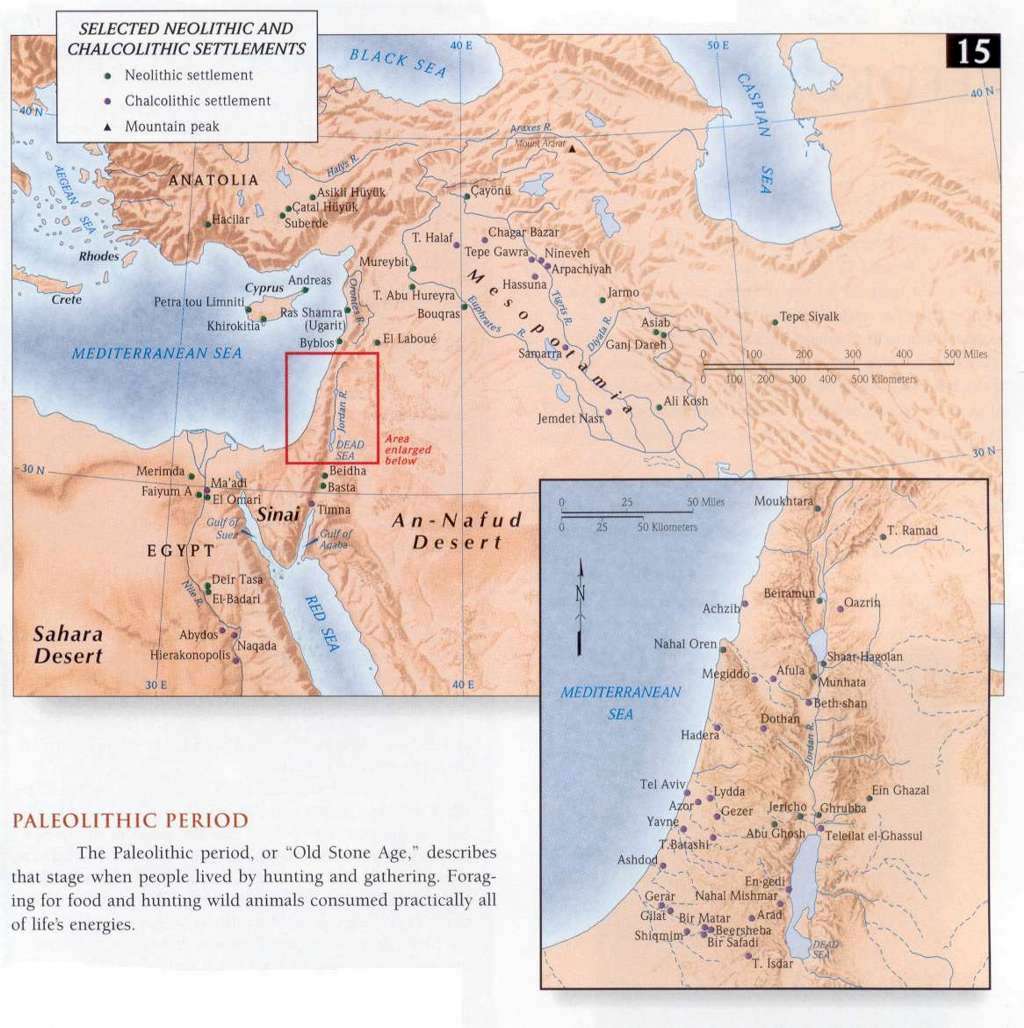
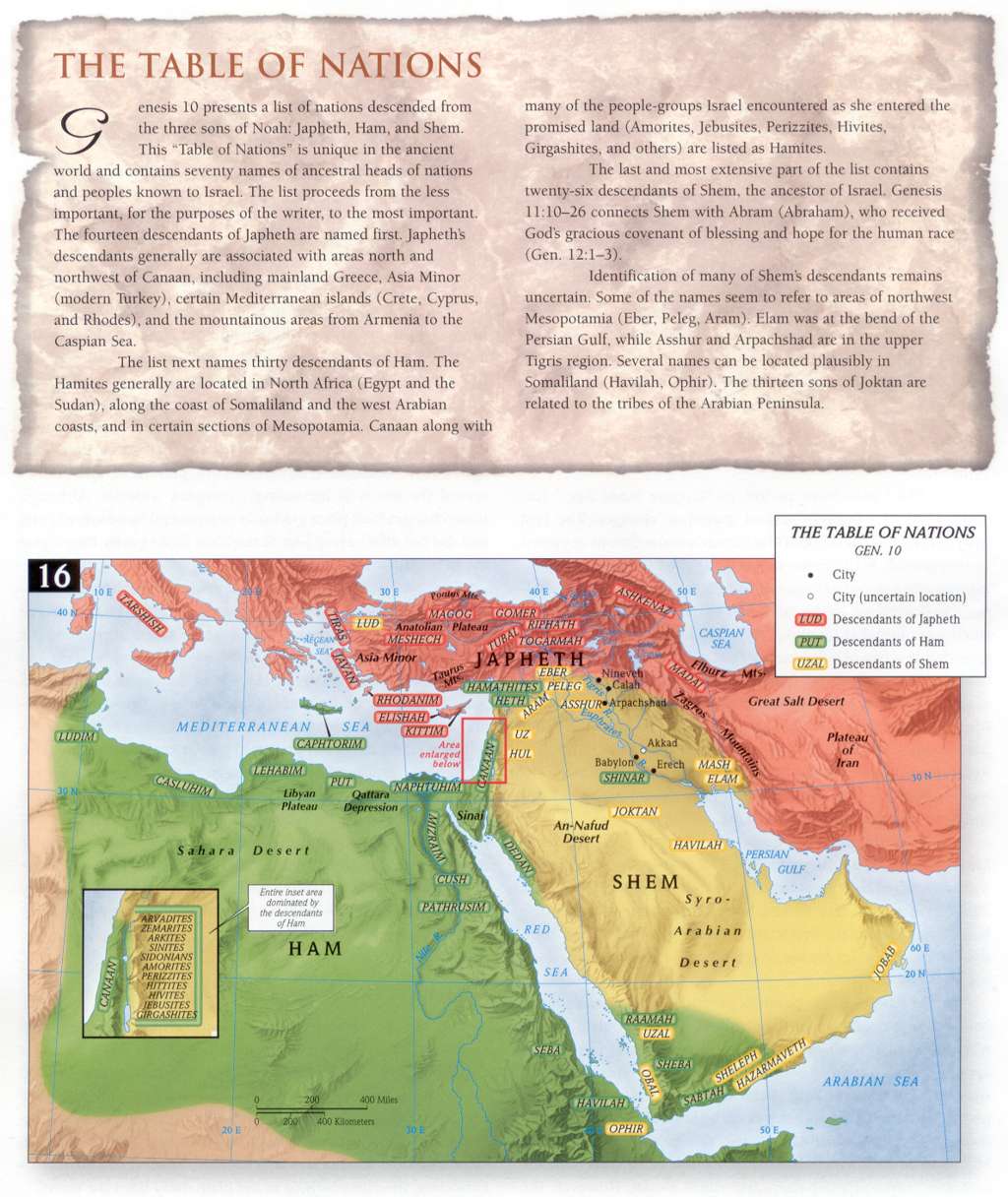
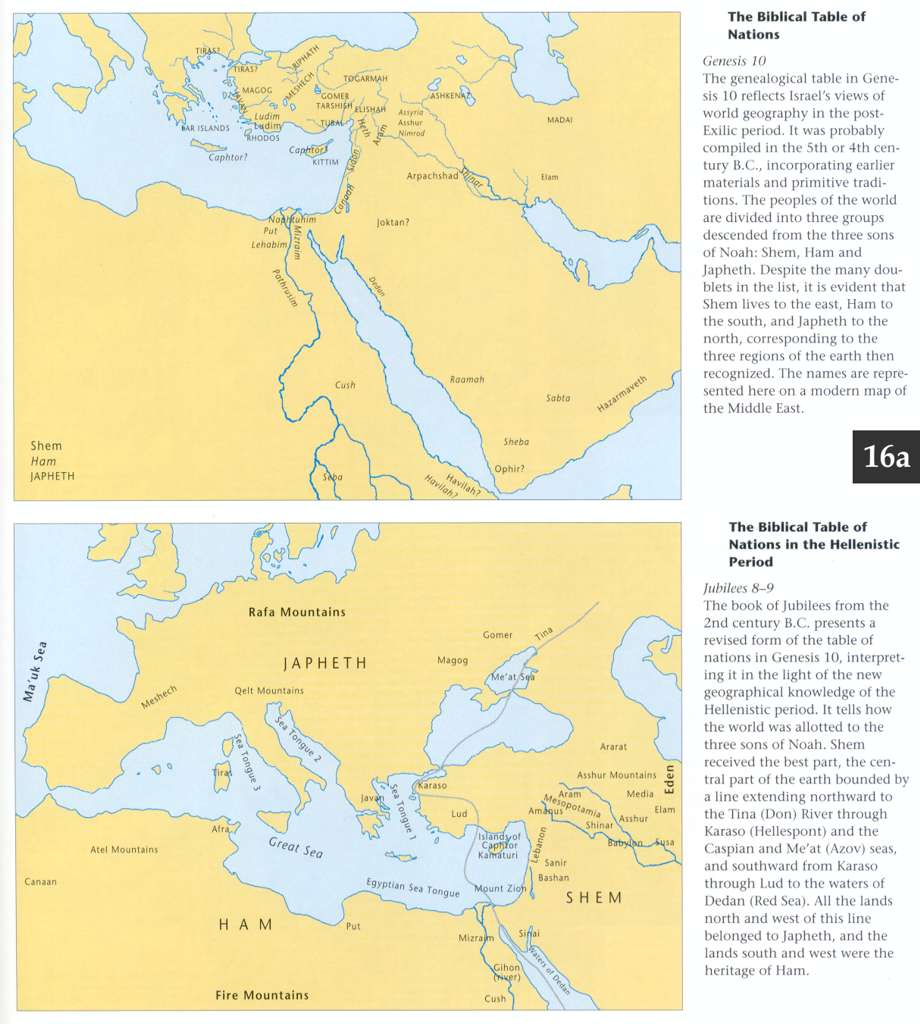
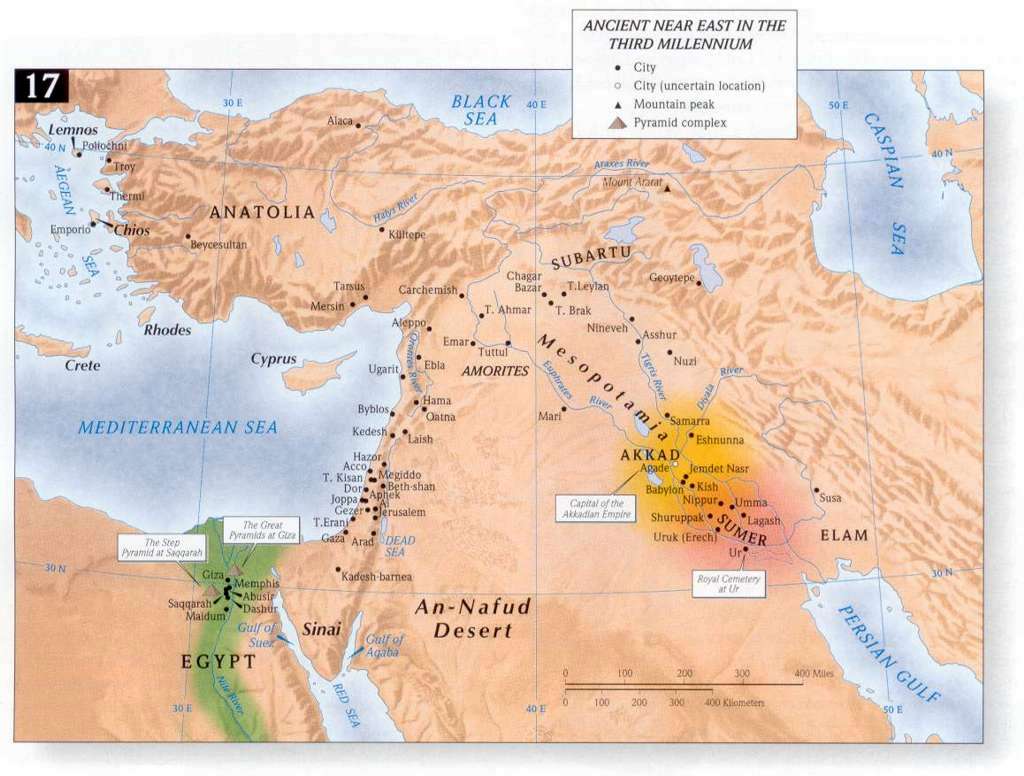
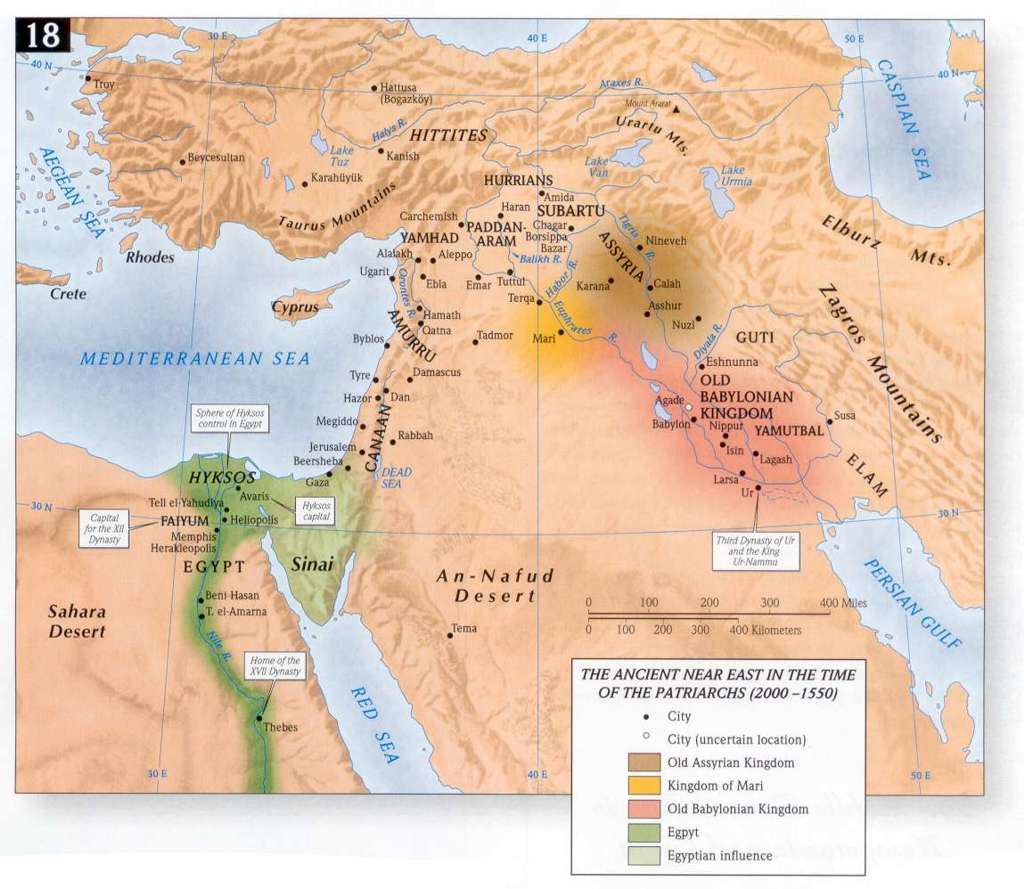
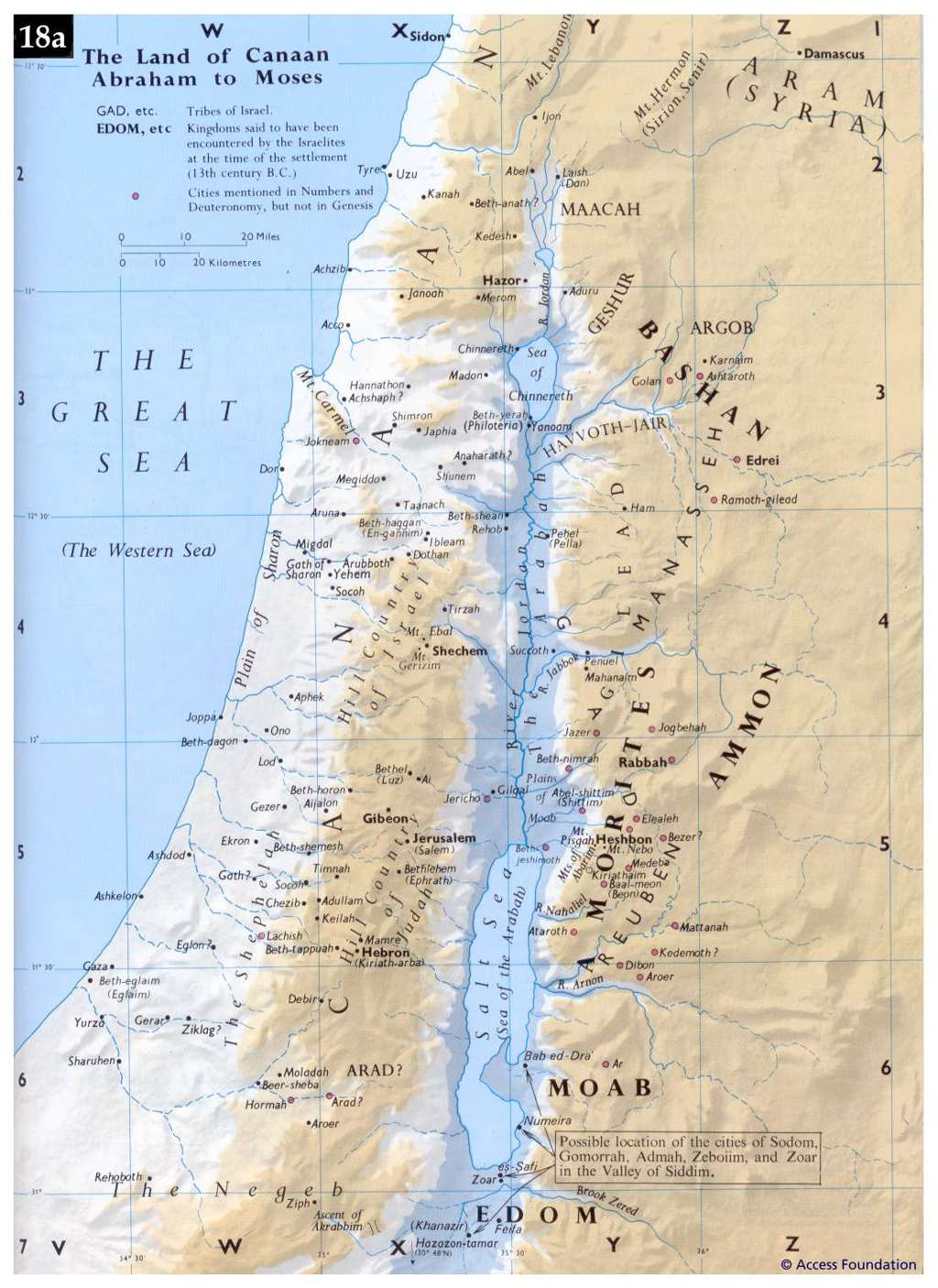
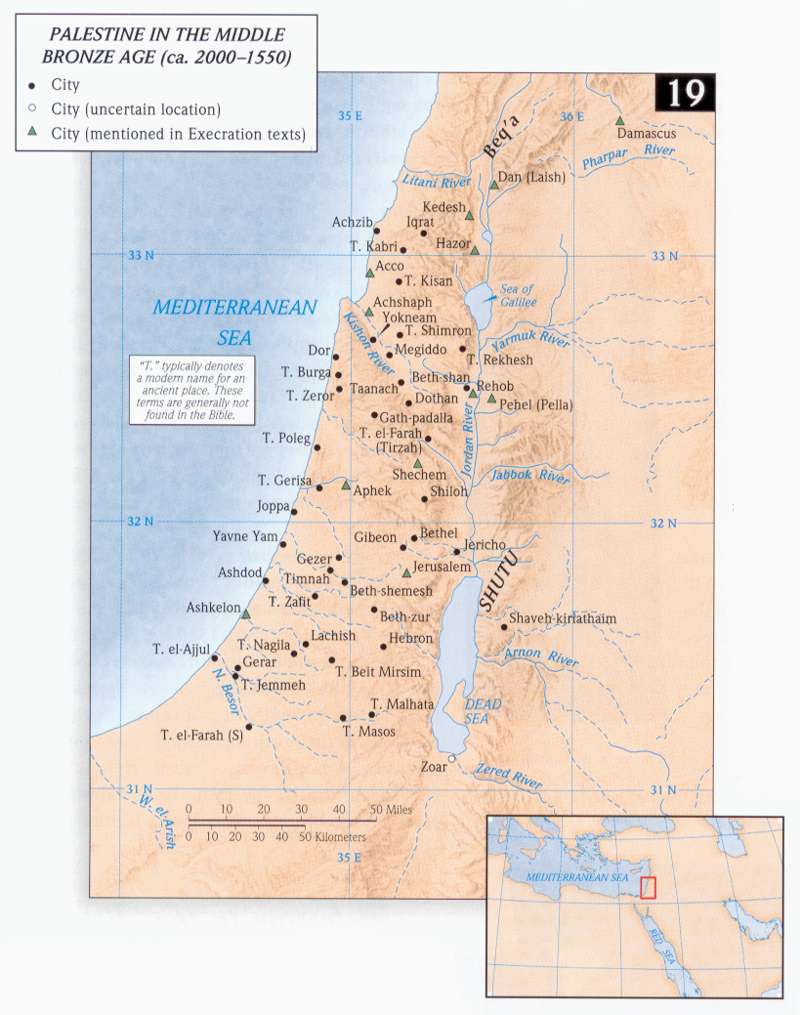

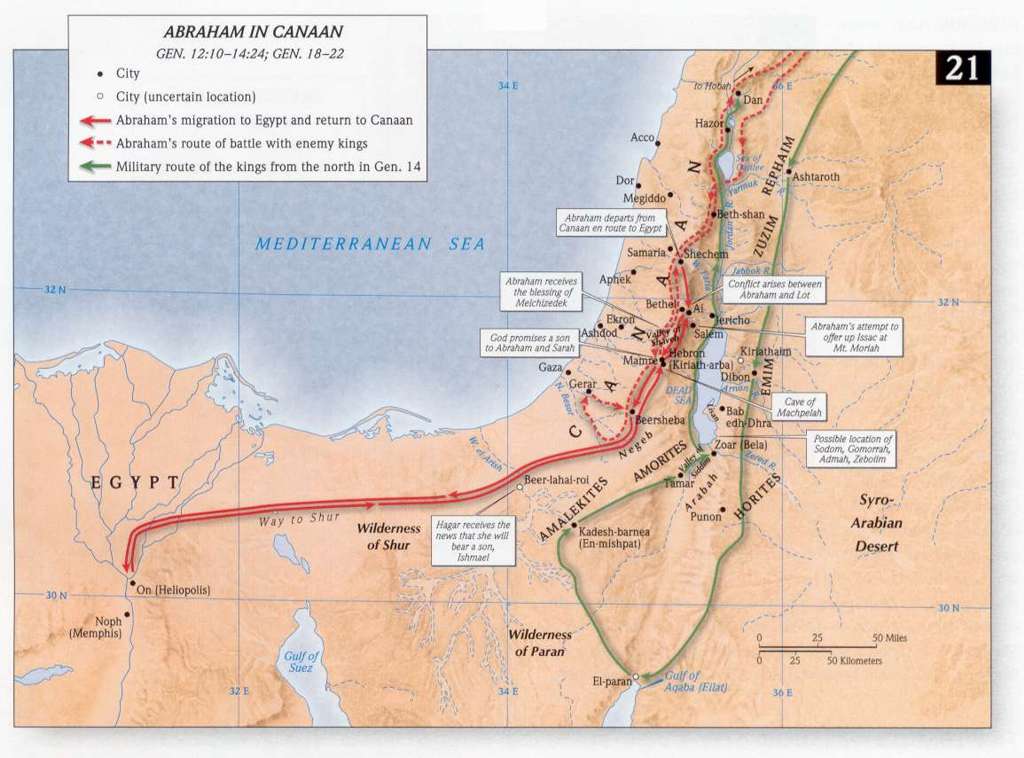
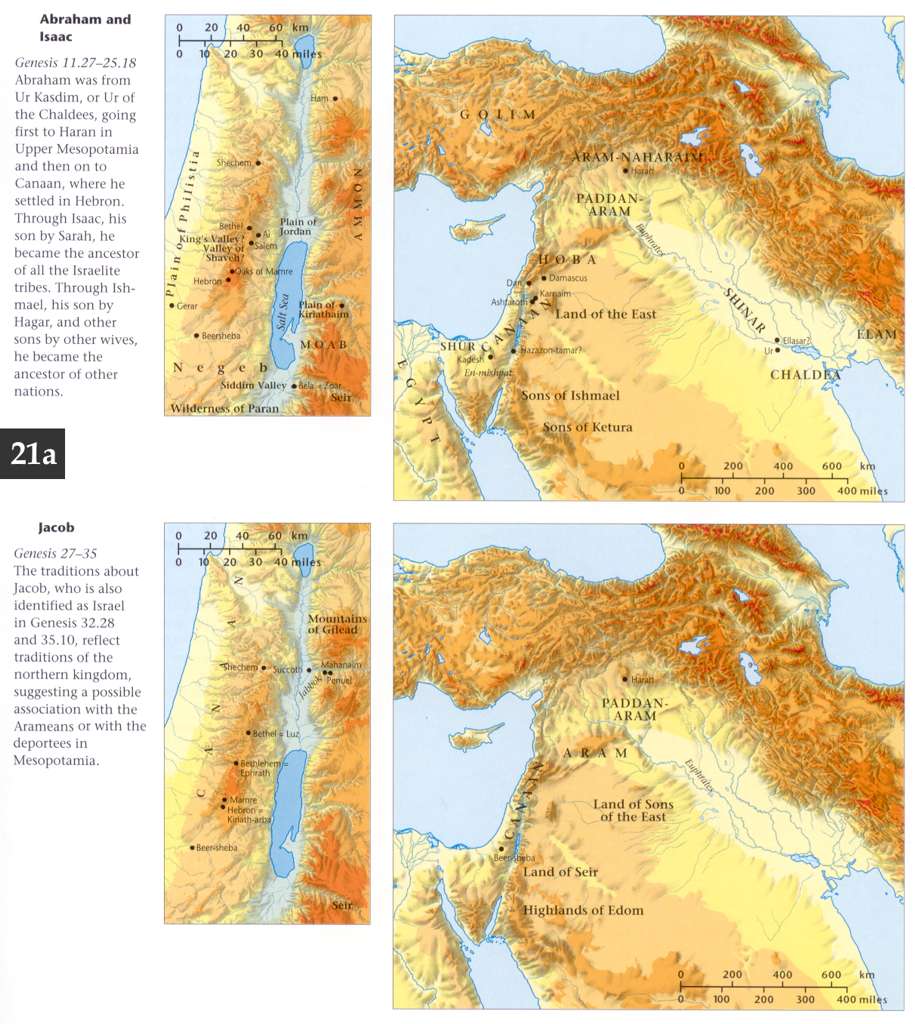
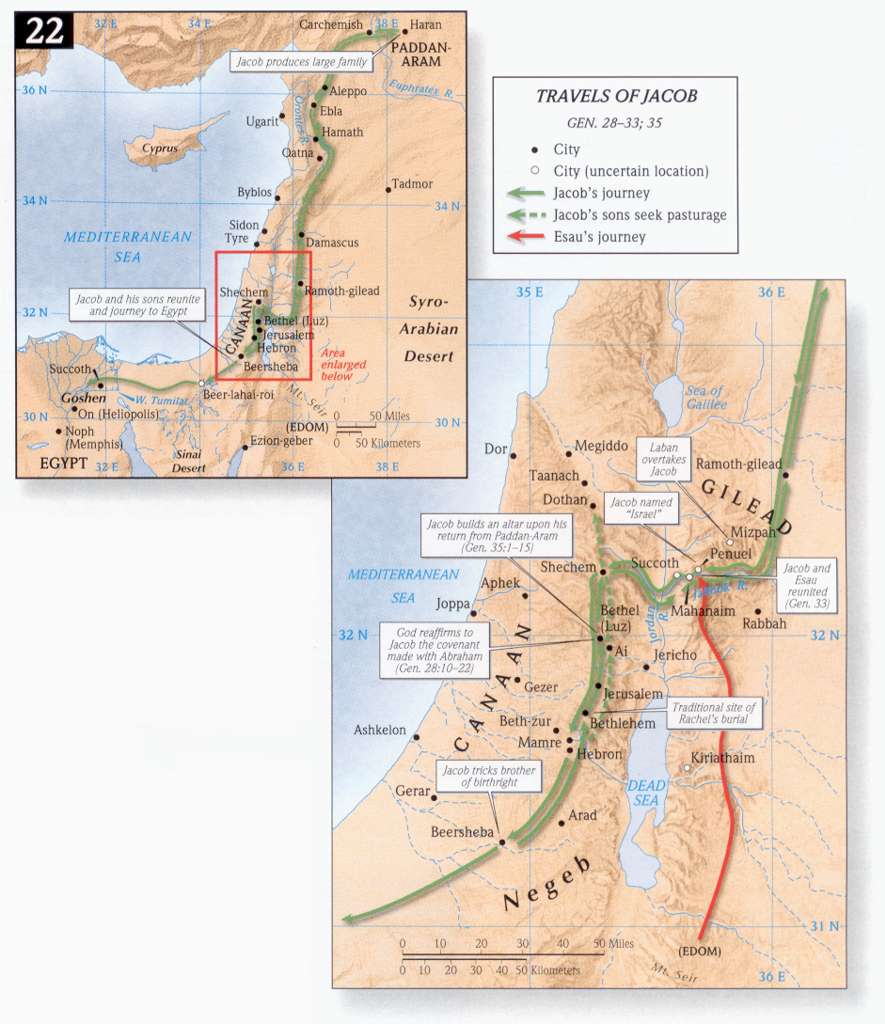
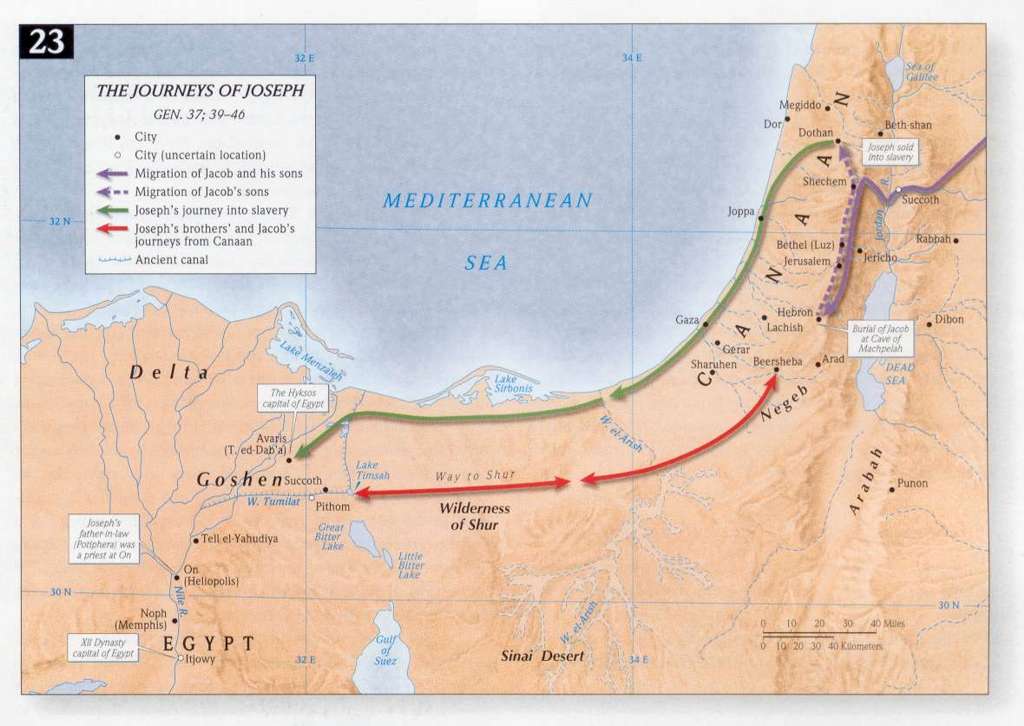
Many of these devotionals begin with excellent illustrations. Here is an example from Genesis 1:14-25 -
Carl Linné, better known as Carolus Linnaeus, loved botany and spent a great deal of his time in medical school studying it. In 1735, he published Systema Naturae,a system for classifying living things by using two Latin names--for example, humanity is “homo sapiens.” This work continues to influence modern botanists, especially in their naming methods and use of hierarchical classification. Linnaeus was motivated by a belief in the orderliness of God’s world. He believed that creation would be like a fingerprint, revealing key aspects of the character of the Creator. In making a classification system, he was only discovering an order that was already there.
- Genesis 2:7,15, 18-24; Genesis 1:27-28a How to Nurture a Family
- Genesis 2:18, 21-24 How to Nurture a Marriage
- Genesis 2:18,21-24 How to Build the Right Marriage
- Genesis 3:1-24 The Promise
- Genesis 4:1-9 Am I My Brother’s Keeper?
- Genesis 22:1-19 Where is The Lamb?
- Genesis 22:1-14; Hebrews 11: 17-19 Abraham - The Way of Faith
- Genesis 37:2-11 Joseph-The Adequacy of Faith
- Genesis 37:2-11 Joseph
- Genesis 1-3 Secular Work Is Full-time Service
- Genesis 1:1-2:3 In the Beginning Josh Black
- Genesis 2:4-2:25 God's Very Good Creation Josh Black
- Genesis 3:1-3:24 The Great Reversal Josh Black
- Genesis 4:1-4:26 Raising Cain Mike Andrus
- Genesis 5:1-6:8 Death and Depravity Josh Black
- Genesis 6:9-9:29 Re-commissioned Josh Black
- Genesis 10:1-11:9 God's Sovereignty and Human Diversity Curt Romig
- Genesis 11:10-12:9 The Call of Abram Matt Stanghelle
- Genesis 12:10-13:2 Out of Egypt Josh Black
- Genesis 13:3-13:18 The Test of Prosperity Mike Andrus
- Genesis 14:1-14:24 The God Who Gives Josh Black
- Genesis 15:1-15:21 Guaranteed Josh Black
- Genesis 16:1-16:16 The God Who Sees Josh Black
- Genesis 17:1-17:27 Marked Curt Romig
- Genesis 18:1-18:33 To Love Justice and Mercy Josh Black
- Genesis 19:1-19:38 Deliverance and Destruction Josh Black
- Genesis 20:1-20:18 Sovereign Grace Josh Black
- Genesis 21:1-21:21 Promises Kept Lucas McGarity
- Genesis 21:22-22:34 In God's Place Josh Black
- Genesis 22:1-22:19 The Lord Will Provide Josh Black
- Genesis 23:1-23:20 Sojourners and Strangers Josh Black
- Genesis 24:1-24:67 Faithfulness in the Ordinary Mike Andrus
- Genesis 25:1-25:34 Leaving a Legacy Josh Black
- Genesis 25:11-34 Jacob Have I Loved : Josh Black
- Genesis 26:1-26:33 The Promise to the Patriarchs: Josh Black
- Genesis 26:34-28:9 Isaac Blesses Jacob: Lucas McGarity
- Genesis 28:10-28:22 I Am With You: Josh Black
- Genesis 29:1-29:30 The Knots Tied Josh Black
- Genesis 29:31-30:24 The Birth of a Nation Josh Black
- Genesis 30:25-30:43 The Blessing of Jacob Jordan Krahn
- Genesis 31:1-31:55 Jacob's Exodus Josh Black
- Genesis 32:1-32:32 Between a Rock and a Hard Place Josh Black
- Genesis 33:1-33:20 The Difficult but Necessary Process of Reconciliation Mike Andrus
- Genesis 34:1-34:31 Sin, Consequences, Grace Jeremy Krause
- Genesis 35:1-35:29 Character Development Matt Stanghelle
- Genesis 37 When Parents Play Favorites
- Genesis 39-41 Joseph There is No Substitute for Integrity
- Genesis 39 When Temptation Comes in Like a Flood
- Genesis 40:1-23 When Your Friends Forget You
- Genesis 41:1-57 From Dreamer to Prime Minister
- Genesis 42-44 Time Alone Doesn't Heal a Guilty Conscience
- Genesis 45:1-15 Forgiving the Hard to Forgive
- Genesis 45:16-47:12 The Ultimate Family Reunion
- Genesis 47:13-26 How a Wise Leader Functions Under the Providence of God
- Genesis 48-50 Dying Well
Here is another source of Genesis sermons by Michael Andrus, et al
- Genesis 1-3 Michael Andrus
- Genesis 37 Michael Andrus
- Genesis 39 Michael Andrus
- Genesis 39, 41, 47 Michael Andrus
- Genesis 39-41 Michael Andrus
- Genesis 40 Dick High
- Genesis 41 Dick High
- Genesis 42-44 Michael Andrus
- Genesis 45 Michael Andrus
- Genesis 45:16-47:12 Michael Andrus
- Genesis 47:13-31 Michael Andrus
- Genesis 48-50 Michael Andrus
- Genesis Sermons - click here for links to following sermons (Samples - Ge 12 - Faith of Abram) (Ge 39 - Temptation of Joseph)
- 1st Introductory Sermon - "An Introduction to the Old Testament in Light of the New"
- 2nd Introductory Sermon - "The Book of Genesis in Context"
- Genesis 1:1 - "The Beginning"
- Genesis 1:2-13 - "The First Three Days"
- Genesis 1:14-31 - "Man, the Glory of Creation
- Genesis 2:1-3 - "The Glorious Rest"
- Genesis 2:4-17 - "God, the Provider and Ruler
- Genesis 2:18-25 - "The Perfect Marriage"
- Genesis 3:1-7 - "The First Judgment"
- Genesis 3:8-24 - "Curse and Exile"
- Genesis 4:1-16 - "Cain and Abel"
- Genesis 4:17-26 - "The City of Man and the Pilgrims of God"
- Genesis 5 - "The Children of Adam" (outline)
- Genesis 5 - "The Children of Adam" (written out)
- Genesis 6:1-8 - "The Progress of Evil and a Hopeful Remnant"
- Genesis 6:9-22 - "The Coming Judgment and the New Creation"
- Genesis 7 - "The Waters of Judgment
- Genesis 8:1-19 - "The New Creation"
- Genesis 8:20-22 - "Noah's Sacrifice"
- Genesis 9:1-7 (part 1) - "A Mixed Blessing"
- Genesis 9:1-7 (part 2) - "A Provisional Peace"
- Genesis 9:8-17 - "A Covenant of Common Grace"
- Genesis 9:18 - 29 - "Salvation to the Ends of the Earth"
- Genesis 10 - "The Seeds of History"
- Genesis 11:1-9 - "Babylon Is Fallen!"
- Genesis 11:10-26 - "Waiting for Jesus"
- Genesis 11:27-32 - "The Need for Christ"
- Genesis 12:1-9 - "The Faith of Abram" Faith of Abram
- Genesis 12:10-20 - "The Faithfulness of God"
- Genesis 13 - "The Promise Grows"
- Genesis 14 - "Abram's Victory"
- Genesis 15:1-6 - "Abram's Righteousness"
- Genesis 15:7-21 - "The Terms of the Covenant"
- Genesis 16 - "The Works of the Flesh"
- Genesis 17 - "The Sign of the Covenant"
- Genesis 18:1-15 - "The Birth Announcement"
- Genesis 18:16-33 - "Abraham the Mediator"
- Genesis 19:1-11 - "Not Even One"
- Genesis 19:12-29 - "Judgment Day"
- Genesis 19:30-38 - "Lot's Legacy"
- Genesis 20 (Abraham and Abimelech) - "Abraham the Sinner, Christ the Savior"
- Genesis 21:1-7 - "The Nativity of Isaac"
- Genesis 21:8-21 - "Cast Out the Bondwoman!"
- Genesis 21:22-34 - "Dwelling in the Promised Land"
- Genesis 22:1-19 - "The Sacrifice of the Promised Seed"
- Genesis 22:15-19 - "Abraham's Reward"
- Genesis 22:20-24 - "The Preparation of the Bride"
- Genesis 23 - "Possession in the Promised Land"
- REVIEW - Genesis 1 - 23 - "The Big Picture"
- Genesis 24 - "A Perfect Bride"
- Genesis 25:1-18 - "The Death of Abraham and the Blessing of Isaac"
- Genesis 25:19-28 - "Strength in Weakness"
- Genesis 25:29-34 - "Esau Sells His Soul"
- Genesis 26:1-11 - "The Sins and Blessings of the Father"
- Genesis 26:12-22 - "The Treachery of the World and the Faithfulness of God"
- Genesis 26:34 - 28:9 - "The Blessing of Jacob"
- Genesis 28:10-22 - "The Stairway to Heaven"
- Genesis 29:1-14 - "A Changed Man"
- Genesis 29:15-29 - "Jacob Deceived"
- Genesis 30:25-43 - "Jacob's Faith"
- Genesis 31:1-21 - "Jacob's Gospel"
- Genesis 31:22-42 (part 1) - "Jacob's Protector"
- Genesis 31:22-42 (part 2) - "Jacob's Justification"
- Genesis 31:43 - 32:2 - "The Two Worlds"
- Genesis 32: 3-32 - "Jacob's Blessing"
- Genesis 33 - "Jacob Returns the Blessing"
- Genesis 34 - "The Battle over Dinah"
- Genesis 35:1-8 - "Escape to Bethel"
- Genesis 35:9-15 - "The Blessing of Jacob"
- Genesis 35:16-20 - "The Road to Bethlehem"
- Genesis 35:21-29 - "Israel's Defeats and Christ's Perfections"
- Genesis 36:1 - 37:1 - "Esau's Greatness"
- Genesis 37:2-36 - "The Plan of God"
- Genesis 38 - "The Seed of Judah"
- Genesis 39 - "The Temptation of Joseph"
- Genesis 2:18-25 The Holy Institution of Marriage
- Genesis 2:18-25 The Holy Institution of Marriage (Part 2)
- Genesis 13:8-9 Conflict in the Midst of Blessings
- Genesis 19:15-17 In the World not of the World
- Genesis 24:15-21 A Portrait of Beauty
- Genesis 32:24-31 Wrestling with God
- Genesis 35:1-7 Going Back to Bethel
- Genesis Sermons - Genesis 1- 50 - 27 messages
- A Biblical View Of Human Life - Genesis 1:26-28
- A Biblical Examination Of Same-Sex Marriage - Genesis 2:18-25; Matthew 19:1-12
- The Family According To God's Pattern - Genesis 2:15-25
- A Firm Family Foundation - Genesis 2:18-25
- A Marriage Made In Paradise - Genesis 2:18-25
- The Lamb Is Promised - Genesis 3:1-21
- God's Grace In The Fall - Genesis 3:1-24
- The Way Of Cain - Genesis 4:1-13
- Are The Days Of Noah Here Again? - Genesis 4:16-26
- Lessons From An Ancient Graveyard - Genesis 5:1-5
- A Good Exit Strategy - Genesis 5:21-24
- The Achievements Of A Successful Father - Genesis 6:1-7
- The Gospel In The Ship - Genesis 6:12-22
- The Invitation To Committment - Genesis 7:1-16
- God Put A Rainbow In The Clouds For Me - Genesis 9:12-17
- The Call To A Life Of Faith - Genesis 11:27-12:3
- Abram's Commitment To A Life Of Faith - Genesis 12:4-9
- The Truth About The Path To Egypt - Genesis 12:10-20
- The Truth About The Road Back To Canaan - Genesis 13:1-4
- Abram's Trouble With Lot - Genesis 13:5-13
- God's Promise To Abram Renewed - Genesis 13:14-18
- Abram: A Man Of Integrity - Genesis 14:1-24
- Abram's Word From God - Genesis 15:1-6
- Moving Toward Maturity - Genesis 15:7-21
- The God Who Sees - Genesis 16:1-14
- That Trouble With Hagar - Genesis 16:1-16
- The God Of The Everlasting Covenant - Genesis 17:1-27
- The Three Sides Of A Man Named Abraham - Genesis 18:1-33
- The Privileges Of The Godly Man - Genesis 18:17-19
- God's Idea Of A Great Dad - Genesis 18:19
- Remembering Lot's Wife - Genesis 19:1-26; Luke 17:32
- Sin And The Saint Of God - Genesis 20:1-18
- What Aileth Thee? - Genesis 21:9-21
- The Case Of The Broken Hearted Mother - Genesis 21:9-21
- How To Enjoy The Rest Areas Of Life - Genesis 21:33-34
- Qualities Of Genuine Worship - Genesis 22:1-14
- The Lamb On Mount Moriah - Genesis 22:1-14
- On The Mountain Of Absolute Surrender - Genesis 22:1-14
- The Trial Of Faith - Genesis 22:1-14
- The Setting Of Biblical Worship - Genesis 22:1-18
- Standing Up From Before The Dead - Genesis 23:1-20
- Wilt Thou Go With This Man? - Genesis 24:51-67
- Abraham: Gathered To His People - Genesis 25:5-10
- The Realities Of A Pilgrim's Life - Genesis 26:12-25
- Gold From An Unlikely Mine - Genesis 30:22-24
- Just A Little Talk With Jesus - Genesis 32:22-32
- Getting Back To Bethel - Genesis 35:1-7
- A Rose Among The Thorns - Genesis 37:1-11
- God Has Something Special For You - Genesis 37:1-11
- The Heartbreak Of A Shattered Dream - Genesis 37:12-35
- The Lord Was With Joseph - Genesis 37:36; 39:1-6
- I Must Be Dreaming - Genesis 37:1-36
- The Man Who Kept His Character - Genesis 39:1-6
- Winning Your Battle With Temptation - Genesis 39:1-23
- The Power Of A Faithful Life - Genesis 39:7-23
- How To Thrive In The Prisons Of Life - Genesis 39:20-23
- The Prison Of His Promotions - Genesis 39:20-22; 41:14
- Forgotten But Not Forsaken - Genesis 40:1-41:1
- From The Prison To The Palace - Genesis 41:1-44
- Joseph's Gentile Bride - Genesis 41:45-57
- Joseph: The Savior Of The World - Genesis 41:41-54
- Resurrecting A Dead Conscience - Genesis 41:54-42:8
- Joseph: A Portrait Of The Glorified Christ - Genesis 41:39-57
- Judah Grows Up - Genesis 43:1-10
- Swimming In A Sea Of Emotion - Genesis 43:15-34
- Gifts Fit For A King - Genesis 43:11-14
- The Case Of The Missing Silver Cup - Genesis 44:1-34
- I Am Joseph - Genesis 45:1-5
- Lessons From The School Of Grace - Genesis 45:1-15
- It Is Enough - Genesis 45:25-46:7
- Joseph's Family Reunion - Genesis 46:28-47:12
- The Death Of A Pilgrim - Genesis 47:27-31
- Crisis Management - Genesis 47:13-26
- Reflections Of A Life - Genesis 48:1-22
- Confronting The Problem Of Sin - Genesis 49:1-12
- The Judgment Seat Of Jacob - Genesis 49:1-12
- God Meant it For Good - Genesis 50:15-26
- A Coffin In Egypt - Genesis 50:22-26
- Genesis Sermons
- Genesis 1
- Genesis 2
- Genesis 3
- Genesis 4
- Genesis 5
- Genesis 6
- Genesis 7
- Genesis 9
- Genesis 10-11
- Genesis 10
- Genesis 12
- Genesis 13
- Genesis 14
- Genesis 15
- Genesis 16
- Genesis 17
- Genesis 18
- Genesis 19
- Genesis 20
- Genesis 21
- Genesis 22
- Genesis 23
- Genesis 24
- Genesis 25
- Genesis 26
- Genesis 27
- Genesis 28
- Genesis 29
- Genesis 30
- Genesis 31
- Genesis 32
- Genesis 33
- Genesis 34
- Genesis 35
- Genesis 36-37
- Genesis 38
- Genesis 39
- Genesis 40:1 - 41:45
- Genesis 41:46-52
- Genesis 42
- Genesis 43:1 - 45:15
- Genesis 45:16 - 47:31
- Genesis 48
- Genesis 49
- Genesis 50
1996 Sermon Series
- The First Things : In the Beginning Genesis 1:1-2
- The First Things: In the Beginning God Genesis 1:1-2
- 175 and Counting: What's at Stake in the Beginning Genesis 1:1
- I Believe in God Maker of Heaven and Earth Genesis 1:1-23; John 1:1-3
- I Believe in GodMaker of Heaven and Earth (Continued) Genesis 1:1, John 1:1-3
- The First Things: The Days of Creation Genesis 1:3-31
- Men are from God and Women, Too Genesis 1:24-31, 2:20-25 Derek Thomas
- The First Things: The Creation Ordinances Genesis 1:24-31
- The First Things: The Sixth Day Genesis 1:24-31
- Thinking and Living Biblically in a Gender-neutral Society Genesis 1:26-27
- The First Things: The Creation Sabbath Genesis 2:1-3
- The First Things: The Covenant of Works Genesis 2:4-17
- Fit to be Tied Genesis 2:18-25
- The First Things: The Ordinance of Marriage Genesis 2:18-25
- Thinking and Living Biblically in a Gender-nuteral Society Genesis 2:18-25, Ephesians 5:22
- Christmas Viewed from Afar: Eden Genesis 3:1-24 Derek Thomas
- The Seed of the Woman Genesis 3:1-24 David Strain
- The Seed Genesis 3:1-19
- The Fall 1 Genesis 3:1-7
- Christmas Viewed from Afar - The Promised Seed Genesis 3:8-19 Derek Thomas
- The Promised Seed Genesis 3:8
- Nine Lessons and Carols - Christmas from Afar Genesis 3:8-19 Derek Thomas
- The Blessings of the Curses Genesis 3:14-24
- Reaping the Whirlwind Genesis 4:1-16
- The Beginnings of Culture Genesis 4:16-26
- The Godly Line Genesis 5:1-32
- A World of Corruption and God's Singular Grace Genesis 6:1-8
- Victory from Jaws of Defeat Genesis 6:9 Doug Kelley
- The Deluge Genesis 7:1-24
- Re-establishing the World Genesis 8:1-22
- The Sign in the Clouds Genesis 9:1-17
- The Cursing of Canaan Genesis 9:18-29
- The Line of the Sons of Noah Genesis 10:1-32
- Babel Genesis 11:1-9
- The Book of Shem Genesis 11:10-32
- The Call of God Genesis 12:1-9
- Famine in the Land Genesis 12:10-20
- A Parting of the Ways Genesis 13:1-18
- The Battle of the Kings Genesis 14:1-24
- The Cutting of the Covenant Genesis 15:1-21
- Faith Wavering Genesis 16:1-16
- Faith Assured Genesis 17:1-8
- The Sign of the Covenant Genesis 17:9-14
- The Laughter of Unbelief Genesis 17:15-27
- Promise and Intercession Genesis 18:1-33
- Disposable Pleasures or a Meaningful Pursuit Genesis 18:17-21, 19:15-38 Justin S. Pillsbury
- Judgment on Sodom Genesis 19:1-29
- The Disgrace of Lot Genesis 19:30-38
- Sarah Protected Genesis 20:1-18
- The Son of Promise Genesis 21:1-21
- The Covenant with Abimelech Genesis 21:22-34
- The Story of a Substitute Genesis 22:1-18
- The Lord Will Provide Genesis 22:1-24
- Nine Lessons and Carols - Christmas Assurance Genesis 22:15-18
- The Son of Promise Genesis 22:15 Derek Thomas
- The Covenant Assured Genesis 22:15-24
- Abraham the Stranger Genesis 23:1-20
- The Search for a Bride Genesis 24:1-27
- Finding the Right One: Streetwise Insights From a Patriarch Genesis 24:1-67
- A Wife for Isaac Genesis 24:28-67
- The Death of Abraham Genesis 25:1-11
- The Books of Ishmael and Isaac Genesis 25:12-34
- Heaven vs. Now Genesis 25:29-30 Tom Elkin
- Like Father Like Son Genesis 26:1-17
- A Promise and a Covenant Genesis 26:18-35
- A Blessing Stolen Genesis 27:1-29
- Abounding Grace to the Chief of Twisters Genesis 27:1-34
- The Blessing of Esau Genesis 27:30-46
- The Departure of Jacob Genesis 28:1-9
- The Dream of Bethel Genesis 28:10-22
- When Heaven Came Down Genesis 28:10-22
- Sacred Space Genesis 28:10-19 R. C. Sproul
- Love Story Genesis 29:1-20
- A Taste of His Own Medicine Genesis 29:21-35
- Is This Daytime TV or the Bible? Marrying the Right One! Genesis 29:31-30:24 Derek Thomas
- The Sons of Jacob Genesis 30:1-24
- The Prosperity of Jacob Genesis 30:25-43
- The Flight to Canaan Genesis 31:1-21
- Laban's Pursuit Genesis 31:22-42
- The Covenant at Mizpah Genesis 31:43-55
- The Fears of Jacob Genesis 32:1-23
- A Stormy Walk-Clinging to God Genesis 32:24-32
- The Meeting of the Brothers Genesis 33:1-20
- The Vengeance of the Sons of Jacob Genesis 34:1-31
- From Jacob to Israel Genesis 35:1-29
- The Book of Esau Genesis 36:1-43
- The Favorite Genesis 37:1-17
- The Lord Meant It for Good Genesis 37:18-36
- The Shame of Judah Genesis 38:1-30
- Success, Loyalty, and Betrayal Genesis 39:1-23
- Joseph Imprisoned Genesis 40:1-23
- Pharaoh's Dream Genesis 41:1-37
- A Ruler in Egypt Genesis 41:38-57
- Famine and Family Genesis 42:1-38
- The Brothers Return to Egypt Genesis 43:1-34
- A Cup in the Sack Genesis 44:1-34
- The Reunion Genesis 45:1-28
- Israel in Egypt Genesis 46:1-34
- The Land of Goshen Genesis 47:1-31
- The Prophecy of Israel Genesis 49:1-33
- Unshaken Under Trail Genesis 49:20-50:28
- The Deaths of Israel and Jacob Genesis 50:1-26
- 175 and Counting: God, Suffering and Evil Genesis 50:20
- The Mystery of Providence Genesis 50:20
- Genesis 1:2 The Deity and Person of the Holy Spirit
- Genesis 1:1 The Scarlet Thread Through the Bible (Part 1)
- Genesis 1:3-31 The Days of Creation
- Genesis 1:3-5 The Creation of Light
- Genesis 1:1-2 The Mystery of Omnipotence
- Genesis 1:1 Of Molecules and Moonspots
- Genesis 1:1 Seven Mightiest Miracles
- Genesis 1:14 God's Confirming Signs
- Genesis 1:9-10 The Waters of the Sea
- Genesis 1:26 The Dubious Defense of Darwinism
- Genesis 1:26 The Fading, Vanishing Case For Evolution
- Genesis 1:26 The Facts of Biology Scorn Evolution
- Genesis 1:24-25 We Visit the Museum
- Genesis 1:26 The Record of the Rocks
- Genesis 1:26 The Hoaxes of Anthropology
- Genesis 1:1-2 How God Made the World
- Genesis 1:1-2 How the World Was Made II
- Genesis 1:1-2 The Chaotic Earth
- Genesis 1:1 This Is Your Bible
- Genesis 1:9-13 The World of Geology
- Genesis 1:11-13 The World of Botany
- Genesis 1:14-19 The World of Astronomy
- Genesis 1:20-23 God Creates the Living Creature
- Genesis 1:24-25 The World of Zoology
- Genesis 1:26 The Marvelous Mystery of Man
- Genesis 1:1-2 The Beginning and the End of the World
- Genesis 1:26 A Seeing God or Blind Evolution
- Genesis 1:1 God: The First Universal Fact
- Genesis 1:14 Confirming Sign from Heaven
- Genesis 1:6-8 The Creation of the Firmament
- Genesis 1:2-10 Deep Waters Above and Below
- Genesis 1:2 The Deep Waters
- Genesis 1:14-19 The World of Astronomy
- Genesis 1:1 Beginning and End of the World
- Genesis 1:1 The First Fact: God
- Genesis 1:1 The Seven Mighty Miracles of All Time
- Genesis 1:26 The Facts of Embryology Repudiate Evolution
- Genesis 1:26 The Creation of Man: God or Gorilla
- Genesis 1-2: The Marvelous Mystery of Man
- Genesis 1-2: What is Man
- Genesis 1-3: Introduction and Bible Divisions
- Genesis 1-50: The Story of the Beginning
- Genesis 1:1 The Reality of God
- Genesis 2:21-25 Super Marrieds
- Genesis 2:18-25 The First Home
- Genesis 2:18-25 The Man and the Woman
- Genesis 2:16-17 The Beginning and the End of Death
- Genesis 2:21 The Bride of Christ
- Genesis 2:1-3 The Sabbath Day
- Genesis 2:18-25 The First Home
- Genesis 2-3 The Age of Innocence
- Genesis 3:9 The Beginning of Grace
- Genesis 3-5 The Eternal Conflict
- Genesis 3:14 The Beginning and the End of Satan
- Genesis 3:21 Theology of Atonement
- Genesis 3:7-11 Why Does God Hide Himself?
- Genesis 3: The Beginning and the End of Death
- Genesis 3:21-24 The Beginning and the End of Grace
- Genesis 3:16-19 The Beginning and the End of Sorrows
- Genesis 3:20 The Seed of the Woman
- Genesis 4:9 Am I My Brother's Keeper?
- Genesis 4:3-5 With Joy Abounding
- Genesis 4:1-12 I Have Trouble With My Children
- Genesis 6:14 Ark of Hope
- Genesis 6:1-14 The Judgment of the Flood
- Genesis 6-8 The Waters Cover the Earth
- Genesis 6:8-9 Noah: Preacher of Perseverance
- Genesis 6:1-7 The Children of Old Man Adam
- Genesis 6:1-11 The Children of Old Man Adam
- Genesis 7:4 Earth's Greatest Catastrophe
- Genesis 9:20-26 Noah: Drugs, Drunkenness, and Nakedness
- Genesis 9:11-17 The Seven Great Covenants of the Bible
- Genesis 9:12 The Covenants
- Genesis 9-12 The Post Diluvian
- Genesis 11:4 A Monument High As Heaven
- Genesis 11:31-33 Abraham of Ur of the Chaldees
- Genesis 12: Abraham: God's Pilgrim
- Genesis 12: Abraham: Citizen of Ur
- Genesis 12:3 Salute to America Rally
- Genesis 12: Mount Moriah: Mount of Sacrifice
- Genesis 13: Lot: Mayor of Sodom
- Genesis 14:8-20 Melchizedek: Type of Christ
- Genesis 14:18-20 Melchizedek
- Genesis 14:18-20 Melchizedek Receiving Tithes
- Genesis 15:1-18 The Smoking Furnace
- Genesis 15:11-17 The Covenant Confirmed to Abraham
- Genesis 16:10 Ishmael: Islam and the Oil Slick
- Genesis 16:10-12 The Death Struggle of Arab and Jew
- Genesis 16:10-12 Death Struggle of Arab and Jew
- Genesis 16-21: Hagar and Ishmael
- Genesis 18 : Hagar and Ishmael
- Genesis 18:9-15 Laughing at Angels
- Genesis 19:1-11 God and Homosexuality
- Genesis 19:1-11 Lot: Living With Homosexuals
- Genesis 21:6-8 Sarah:Laughing At Angels
- Genesis 22: The Offering Up of Isaac
- Genesis 22: Mt. Moriah: Mount of Sacrifice
- Genesis 22: Mt. Moriah: Mount of Sacrifice
- Genesis 22:1-19 The Sacrifice on Mt. Moriah
- Genesis 23: Tear-Stained Machpelah
- Genesis 24:1-67 Rebekah: What Can Happen on a Blind Date
- Genesis 24: Honoring God in the Home
- Genesis 24: A Bride For Christ
- Genesis 24: Honoring God in the Home
- Genesis 24: A Blind Date
- Genesis 24:58-67 I Want A Happy Marriage, What Shall I Do?
- Genesis 24:58-67 How to Have a Happy Home
- Genesis 24: The Bride of Christ
- Genesis 24: The Bride for Isaac
- Genesis 24-50: The Line of Redemption
- Genesis 25:26 Emblems of Jacob's Pilgrimage
- Genesis 25:21-28 Jacob Have I Loved
- Genesis 25:24-28 The Exceeding Bitter Cry
- Genesis 25:21-28 The Emblems of Jacob's Pilgrimage
- Genesis 25: Jacob Have I Loved
- Genesis 27:18-38 Who Kissed Me?
- Genesis 27:18-38 Who Kissed Me?
- Genesis 28:10-22 Practicing the Promises of God
- Genesis 28: The Angel Ladder
- Genesis 29:18 A Blessed Marriage
- Genesis 29:18 Jacob in the Land of the East
- Genesis 30:1 Praying with a Broken Heart
- Genesis 30:1 Give Me Children Or I Die
- Genesis 31:25-35 Can Your Gods Be Stolen?
- Genesis 31:30-35 Rachel: Can Your Gods Be Stolen?
- Genesis 32:24 The New Israel
- Genesis 32:24-32 The Face of God
- Genesis 32: The Old Jacob and the New Israel
- Genesis 32:24-32 Prevailing with God
- Genesis 32:23-32 Prevailing With God
- Genesis 32-33: Worry and Prayer
- Genesis 35 :1-15 On the Road to Bethel
- Genesis 35:16-35 The School of Sorrows
- Genesis 35-42: School of Sorrows
- Genesis 37: The Coat of Many Colors
- Genesis 37:3-20 The Coat of Many Colors
- Genesis 39-41: Remember Me?
- Genesis 40: Remember Me
- Genesis 42:1-38 Joseph Revealed to His Brethren
- Genesis 44:30-34 Joseph: Family Appeal Special
- Genesis 45:26 The Closing Years of Joseph
- Genesis 45-50: The Closing Years of Joseph
- Genesis 48:15-16 The Basic Purpose of the Bible
- Genesis 49:10 Until Shiloh Come
- Genesis 49:10 VBS-Who Is Jesus?
- Genesis 49: Until Shiloh Come
- Genesis 49:8-10 The Gathering of the Clan
- Genesis 49-50: The Gathering of the Clan
- Genesis 50:20 God Meant It for Good
- Genesis - Looking For Abraham's City (Bibliotheca Sacra, 1990)
- Genesis 1-11 Interpreting Genesis 1-11
FELLOWSHIP BIBLE CHURCH - Greenville
- Genesis Part 1 - Genesis 1-2 (195 pages)
- Genesis Part 2 - Genesis 3-11 (261 pages)
- Genesis Part 3 - Genesis 12-25 (267 pages)
BELOW ARE PODCASTS RELATED TO THE GENESIS MATERIAL LISTED ABOVE...
- https://www.fellowship-greenvi
lle.org/plumbline-podcast/ series/genesis-i - https://www.fellowship-greenvi
lle.org/plumbline-podcast/ series/genesis-iii - https://www.fellowship-greenvi
lle.org/plumbline-podcast/ series/genesis-iv - https://www.fellowship-greenvi
lle.org/plumbline-podcast/ series/genesis-v
JAMES GRAY
- Genesis 1-11 Outline Study with Suggestions for Sermons & Expositions
- Genesis 12:1-28:15 Outline Study with Suggestions for Sermons & Expositions
- Genesis 28-50 Outline Study with Suggestions for Sermons & Expositions
- Genesis 1 & 2 The Days of Creation
- Genesis 1 & 2 Adam and Eve
- Genesis 1:2 Holy Spirit in the Old Testament
- Genesis 1:20-26 Evolution or Creation?
- Genesis 1:26-27 Is Gender Negotiable?
- Genesis 3:6-13 Flimsy Excuses
- Genesis 3:17-19 Work: Sweet or Sweat?
- Genesis 3:20; 4:1 Eve: The Mother of All Living
- Genesis 4:1-7 Cain and Abel
- Genesis 4:1-11 Crawling Out of the Anger Hole
- Genesis 4:3-9 My Brother's Keeper?
- Genesis 5:21-24 Still Faithful?
- Genesis 6-9 Noah and the Flood
- Genesis 9:5-6 The Bible and the Death Penalty
- Genesis 11:47-12:4 Abraham and Faith
- Genesis 12:1-4 The Beginning of Faith
- Genesis 12:1-5 Walking By Faith
- Genesis 12:10-20 Ending Up In Egypt
- Genesis 13:5-18 Let's Compromise
- Genesis 15:1-6 Saving Faith
- Genesis 15:1-6 God's Credit Card
- Genesis 15:7-18 How Can I Know?
- Genesis 16:1-6 God's Way Or My Way?
- Genesis 16:1-6 Failed Families
- Genesis 17:1-8 Whose Land? Palestine issue
- Genesis 17:9-14 Cut My Heart Out
- Genesis 18:16-33 Divine Dickering
- Genesis 18:17-33 You Can Change God
- Genesis 19:1-13 Homosexuality
- Genesis 19:27-36 Whose Family Values?
- Genesis 22:1-3 God Told Me To
- Genesis 22:1-11 But Where Is The Lamb?
- Genesis 22:1-13 Giving Up For God
- Genesis 28:10-22 Perceiving His Presence
- Genesis 28:20-22 Promise God
- Genesis 32:24-31 From Deceiver to Believer
- Genesis 38:6-26 More Than a Dirty Story
- Genesis 38:6-26 Tamar: Exposing Hypocrisy
- Genesis Sermons - 126 studies Verse by Verse - Mp3 - well done
- An Overview of the Book of Genesis
- "Creative Genius" (Genesis 1:1-2)
- "The Glory Days" (Genesis 1:1-25)
- "The Crown and Climax of Creation" (Genesis 1:26-2:3)
- "Party in Paradise" (Genesis 2:4-25)
- "Paradise Lost" (Genesis 3:1-7)
- "Eat MY Dust!" (Genesis 3:8-24)
- "Raising Cain" (Genesis 4:1-26)
- "Man’s Family Tree" (Genesis 5:1-32)
- "Divine Intervention" (Genesis 6:1-8)
- "It’s Raining, It’s Pouring, and the Lord is NOT Snoring!" (Genesis 6:9-8:22)
- "A Fresh Start" (Genesis 9:1-17)
- "The Rest of the Story" (Genesis 9:18-29)
- "The Spread of the Nations" (Genesis 10:1-11:26)
- "The Great Adventure" (Genesis 11:27-12:9)
- "From Faith to Fear" (Genesis 12:10-13:4)
- "A Tale of Two Men" (Genesis 13:5-18)
- "The Original Braveheart" (Genesis 14:1-24)
- "Fear Factor" (Genesis 15:1-21)
- "Beware of Shortcuts" (Genesis 16:1-16)
- "Believe it or Not!" (Genesis 17:1-27)
- "A Divine Encounter" (Genesis 18:1-15)
- "If I was God…" (Genesis 18:16-33)
- "Sin and the City" (Genesis 19:1-38)
- "Been There, Done That!" (Genesis 20:1-18)
- "The Last Laugh" (Genesis 21:1-21)
- "Dealing with Conflict and Living to Tell About it" (Genesis 21:22-34)
- "Let Go!" (Genesis 22:1-24)
- "A Piece of the Promise" (Genesis 23:1-20)
- "The Fingerprints of God" (Genesis 24:1-67)
- "A Hairy Tale" (Genesis 36:1-37:1)
- "All’s Well that Ends Well" (Genesis 43-45)
- "Between a Rock and a Hard Place" (Genesis 31:1-55)
- "Born to be Wild" (Genesis 25:19-34)
- "Chips off the Old Block" (Genesis 34:1-31)
- "Death: A New Beginning" (Genesis 49:29-50:26)
- "Deathbed Adoptions" (Genesis 48:1-22)
- "Desperate Housewives" (Genesis 29:31-30:24)
- "Determining Your Destiny" (Genesis 49:1-28)
- "Extreme Home Break-Up" (Genesis 37:2-36)
- "From Famine to Feast" (Genesis 26:1-33)
- "From the Garden to the Grave" (Genesis 1-50)
- "God’s Career Path" (Genesis 39:1-23)
- "God’s Dirty Laundry" (Genesis 38:1-30)
- "One Big, Happy Family" (Genesis 46-47)
- "Passing the Promises" (Genesis 25:1-18)
- "Runaway Bribe" (Genesis 28:10-22)
- "The Way Back Home" (Genesis 35:1-29)
- "Time to Eat Crow" (Genesis 33:1-20)
- "Trick or Treat?" (Genesis 26:34-28:9)
- "Turning the Tables" (Genesis 30:25-43)
- "Unfinished Business" (Genesis 32:1-32)
- "What Goes Around Comes Around!" (Genesis 29:1-30)
- "When God Brings You to Your Knees" (Genesis 42:1-38)
- "You Can’t Keep a Good Man Down" (Genesis 40-41)
- Genesis - Book of Beginnings - index with links to all 55 sermons
- Is There a Man in the House- (Genesis 11-18) - 3 studies audio & transcript
- Is There a Man in the House- (Genesis 12-1)
- Is There a Man in the House- (Genesis 16-1-6)
- Return to God: Part One (Genesis 13:1-4)
- Return to God: Part Two (Genesis 13:5-18)
- Avoiding Sin (Genesis 12:10)
- Preventative Righteousness (Genesis 12:10, 13:5-13)
- Don't Waste Your Pain! (Genesis 14:1-24)
- The Choice (Genesis 14:17-20)
- Living by the Word in Our Families (Genesis 15:1-21)
- Keep the Covenant (Genesis 15:7-21) (See onsite article Covenant: As It Relates to Marriage)
- Genesis 1 God's Great Mystery Revealed
- Genesis 1 God Is and God Created
- Genesis 3 Paradise Lost
- Genesis 12 A Promise toward Paradise Regained
- Genesis 3 Paradise Lost
- Genesis 1:1-5 New Beginnings: A Graduate Recognition Sermon
- Genesis 1:26 Created in God's Image
- Genesis 1:26 Created to Relate
- Genesis 2:15-17 Created for Work - Genesis, Ecclesiastes, Colossians
- Genesis 2:1-3 Created for Rest - Genesis, Ecclesiastes, Hebrews
- Genesis 3:1-7 Created to Rule - Genesis, Revelation
- Genesis 1:26-28 God Is Good
- Genesis 1:27 Baptist Faith and Message Sermon: Mankind
- Genesis 3:1-6 God Speaks and We Fail to Trust Him
- Genesis 4:26 Calling on God's Name
- Genesis 11:4 Make a Name for Yourself
- Genesis 13:1-18 The Power of Contentment
- Genesis 22:1-14; 26:2-5 Life's Longest Journey
- Genesis 32 The Steps to Reconciliation
- Genesis 37:5-8, 26-28; 50:15-21 God Meant It for Good
- Genesis 37:1-4 Joseph: Walking with God in a Dysfunctional Family
The host site changed links so that virtually every sermon was a dead link. You could try this page which is a Google search for the sermons
- An Introduction to Genesis
- An Argument of the Book of Genesis
- Selected, Annotated Bibliography on the Book of Genesis
- Genesis MP3 Series -- Denton Bible Church Media - Excellent Exposition - This link a a little tricky as it is VERY SLOW! When you click "LOAD MORE SERMONS" be patient as it is very slow and eventually other messages will come up. Patience!!! It will be worth the wait!
- Sermon 1: The Universe: Its Form and Forces
- Sermon 2: The Waters Above
- Sermon 3: The Fullness Thereof
- Sermon 4: King of the Earth
- Sermon 5: The Sabbath Day
- Sermon 6: Genesis 2: The Willing Subject
- Sermon 7: No Longer Two
- Sermon 8: Paradise Lost
- Sermon 9: A Banquet of Consequences
- Sermon 10: Two Men, Two Paths
- Sermon 11: The Way of Cain
- Sermon 12: The First Hero
- Sermon 13: When God’s Voice is Silent
- Sermon 14: Noah: A Blueprint of a Faithful Man
- Sermon 15: The Flood of Noah
- Sermon 16: The Noahic Covenant
- Sermon 17: Curse and Disperse: The Table of Nations
- Sermon 18: The Heretic and the Whore
- Sermon 19: Abraham: The Pivot in the Unfolding Plan
- Sermon 20: The Abrahamic Covenant
- Sermon 21: The Progression of a Patriarch
- Sermon 22: Patriarchal Flop
- Sermon 23: The “Eyes” Have It
- Sermon 24: The Alters of Altars
- Sermon 25: Trials, the Forge of Greatness
- Sermon 26: Melchizedek: Type of a Forever Priest
- Sermon 27: “Footsteps”
- Sermon 28: “How to get to Heaven by The Father of the Faithful”
- Sermon 29: God’s Covenant People
- Sermon 30: The Perils of Patience
- Sermon 31: The Genesis of Jesus or the God Who Hears
- Sermon 32: El Shaddai
- Sermon 33: Covenant Children
- Sermon 34: It’s a Wonderful Life
- Sermon 35: Dare to Draw Nearer
- Sermon 36: “Fatal Attraction”
- Sermon 37: “Pilgrim’s Regress”
- Sermon 38: Isaac: Shadow of the Begotten
- Sermon 39: Patriarchs and Philistines
- Sermon 40: “Love Divine, All Loves Excelling”
- Sermon 41: “Death be not proud”
- Sermon 42: Made in Heaven
- Sermon 43: The Sovereignty of God-The first Fundamental
- Sermon 44: “Siren’s Song: The Tragedy of Esau”
- Sermon 45: Extraordinary Principles from an Ordinary Man
- Sermon 46: Responses to the Revealed Will
- Sermon 47: The Presence
- Sermon 48: Divine Discipline
- Sermon 49: Of Maids and Mandrakes
- Sermon 50: How to be a Believer in an Unbelieving World
- Sermon 51: The Divine Protection or “Kings X”
- Sermon 52: The Magnificent Defeat
- Sermon 53: The Restoration of a Backslider
- Sermon 54: “The road less traveled”
- Sermon 55: The Father’s Glorious Firstborn: Then and Now
- Sermon 56: The Black Sheep of the Chosen Line
- Sermon 57: Joseph, the Faithful
- Sermon 58: Clinging in the Dark
- Sermon 59: Beautiful Savior, Lord of All Nations
- Sermon 60: Hound of Heaven
- Sermon 61: Love Divine-All Love Excelling
- Sermon 62: Icebergs
- Sermon 63: Flourishing in Famine: Clean Living in a Dirty World
- Sermon 64: The People of God: A Family Portrait
- Sermon 65: A Joyful View of a Grim Subject
- Sermon 66: Providence: Beauty on the Black Keys
- Sermon 67: A Coffin in Egypt
- The Challenge Away From Home - Genesis J. Mike Minnix
- Setting The Scene - Genesis Denis Lyle
- There's A New Day Dawning! Genesis 1 :1-5 David E. Owen
- The Joy of Marriage Genesis 1:27 Calvin Wittman
- What The Bible Says About Marriage Genesis 2:18 David E. Owen
- How To Build The Right Marriage Genesis 2:18-24 Mark Adams
- God's Plan For Marriage Genesis 2:18-24 Mark Adams
- The Creation of the Home Genesis 2:18-25 J. Mike Minnix
- The Foundations of Marriage Genesis 2:18-25 Calvin Wittman
- Marriage and Mates Genesis 2:21-24 Ernest L. Easley
- Sex Ed 101 Genesis 2:24-25 James Merritt
- The Lethal Lies of Lucifer Genesis 3:1-19 Ron Hale
- Where Did Sin Come From? Genesis 3:1-8 Keith Fordham
- The Feet of God Genesis 3:8 J. Mike Minnix
- Don't Blame Society Genesis 3:9-13 Jack Auten
- Walking With God Genesis 5:19-24 Alan Stewart
- Walking With God (Outline) Genesis 5:24 Tom Hayes
- The Storm and a Story of a Saving Faith Genesis 6:1-22 David E. Owen
- Noah And The Flood Genesis 6 Roger D. Willmore
- The Faith of Noah Genesis 6:5-22 Mark Adams
- The Last Invitation Genesis 7:1-7 Johnny Hunt
- Better Than A Silver Lining Genesis 9:12-17 J. Mike Minnix
- Ruin or Revival Genesis 11:1-9 J. Mike Minnix
- Bible Character Series - Abraham Johnny L. Sanders
- Famine in the Land of Promise Genesis 12 Johnny L. Sanders
- Faith Enough to Follow Genesis 12:4 Donnie L. Martin
- Trusting God's Word Genesis 12:4-9 Jared Moore
- Sargent Abram Genesis 14 Terry Trivette
- Is It Vain To Serve The Lord? Genesis 15 J. Mike Minnix
- The First "Fear Not" Genesis 15:1 David E. Owen
- Hagar's Labor And Delivery Genesis 16 David E. Owen
- Looking in Three Directions Genesis 16:8 Paul E. Brown
- Dad's That Make A Difference (Outline) Genesis 18:16-19 Billy E. Dickerson, Jr.
- Man of Prayer Genesis 21 Johnny L. Sanders
- When The Bottle Is Empty Genesis 21:9-21 Sammy Burgess
- The Mastery of Stewardship Genesis 22:1-14 J. Mike Minnix
- The Concept of Worship - The First Worship Service Genesis 22:1-14 David E. Owen
- Something Is Missing Genesis 22:7 Alan Stewart
- The Death of a Princess Genesis 23 Terry Trivette
- Go Get The Bride Genesis 24 Sammy Burgess
- Don't Play Games With God Genesis 27:1-45 Terry Trivette
- From Obnoxious Kid to Loyal Slave Genesis 30 Johnny L. Sanders
- Lessons from a Limper (Outline) Genesis 32:22-32 hDonald Cantrell
- The Road to Renewal Genesis 35:1-15 David Cook
- Rising Above The Circumstances Genesis 37:1-11 Denis Lyle
- Dream Catchers Genesis 37:5 Alan Stewart
- How To Set Boundaries Genesis 39 James Merritt
- Yield Not To Temptatiojn Genesis 39:1-12 Denis Lyle
- The Muddle of Misfortune Genesis 39:1-20 Blake Carroll
- When Bad Things Happen To Good People Genesis 39:13-23 Denis Lyle
- The Advantage of Adversity Genesis 40:1-23 Denis Lyle
- From the Prison to the Palace Genesis 41 Denis Lyle
- Better Not Bitter Genesis 43 Denis Lyle
- Do Not Be Afraid! Genesis 46:1-3 J. Mike Minnix
- Jacob, Jacob! Genesis 46:2 Franklin L. Kirksey
- It Will Do When Your Are Dying Genesis 48 J. Mike Minnix
- The Great Switch Genesis 48:1-19 Donald Cantrell
- A Father's Blessing Genesis 48:15-16 Alan Stewart
- Death - The Door into Eternity Genesis 49:29-33 Donald Cantrell
- The Importance of Studying Genesis (doc, pdf)
- Outline of Genesis (doc, pdf)
- Genesis 5 and 11 Genealogies (Excel, pdf)
- Genesis 1:1-2:25. The Creation Account (doc, pdf)
- Genesis 3. The Fall (doc, pdf)
- Genesis 4. Cain and Able (doc, pdf)
- Genesis 5. Adam's Family (doc, pdf)
- Genesis 6. Leading up to the Flood (doc, pdf)
- Genesis 7, 8. The Flood (doc, pdf)
- Genesis 9 Dispensation of Government (doc, pdf)
- Genesis 10:1-11:9. Table of Nations and Tower of Babel (doc, pdf)
- Genesis 11:27-12:20. Abrahamic Covenant (doc, pdf)
- Genesis 13-15. History of Abraham Before Isaac (doc, pdf)
- Genesis 16:1-18:15. Ishmael and Isaac (doc, pdf)
- Genesis 18:16-19:38. Sodom and Gomorrah (doc, pdf)
- Genesis 20-22. Abraham and Isaac (doc, pdf)
- Genesis 23-24. Death of Sarah and Marriage of Isaac (doc, pdf)
- Genesis 25-27. Jacob and Esau (doc, pdf)
- Genesis 28-31. Jacob and Laban (doc, pdf)
- Genesis 32-36. Jacob Returns to the Land of His Fathers (doc, pdf)
- Genesis 37-41. Joseph (doc, pdf)
- Genesis 42-45. Joseph and His Brothers (doc, pdf)
- Genesis 46-50. Jacob and Joseph (doc, pdf)
- In the Beginning Genesis 1:1
- The Creation Genesis 1:1-2:3
- What is Man? Genesis 1:26-31
- The Rhythm of Life Genesis 2:1-3
- What the Bible is All About Genesis 2:4-17
- The Two Kinds of “Man” Genesis 2:18-24
- The Catastrophe of All Catastrophes Genesis 3:1-13
- What Went Wrong? Genesis 3:14-24
- Original Sin Genesis 4:1-26
- Like Father, Like Son Genesis 5:1-32
- The Heart of God Genesis 6:1-7
- The Antithesis Genesis 6:9-22
- The Flood Genesis 7:1-24
- God’s Memory and Ours Genesis 8:1-22
- Life Under the Rainbow Genesis 9:1-17
- The Mystery of Sin Genesis 9:18-29
- He’s Got the Whole World in His Hands Genesis 10:1-32
- The Futility of Human Life Genesis 11:1-9
- Your Story Has Already Been Written Genesis 11:10-32
- The Bible in Sum Genesis 12:1-9
- Simul Justus et Peccator Genesis 12:10-20
- The Choices We Make Genesis 13:1-18
- What Is Faith? Genesis 14:1-24
- God Is Our Reward Genesis 15:1-21
- In or Out Genesis 16:1-16
- A Biblical Watershed Genesis 17:1-14
- The Tyranny of the Ordinary Genesis 17:15-18:15
- An Astonishing Conversation Genesis 18:16-33
- Barely Saved Genesis 19:1-29
- The Downgrade Genesis 19:30-38
- O Felix Culpa Genesis 20:1-18
- Waiting for God Genesis 21:1-7
- Not Peace but a Sword Genesis 21:8-34
- What was God Thinking? Genesis 22:1-12
- The First Glimpse of the Cross Genesis 22:9-24
- A Grave for Sarah Genesis 23:1-20
- A Father’s Last Task Genesis 24:1-9
- A Powerful Prayer Genesis 24:10-28
- Coram Deo Genesis 24:29-67
- A Christian Life Genesis 25:1-11
- Isaac Gapped Genesis 25:12-28
- How Did This Happen? Genesis 25:19-34
- Covenantal Canoodling Genesis 26:1-11
- The Next in Line Genesis 26:12-35
- Christian Sins Genesis 27:1-40
- Four Universal Questions of Life - Part 2 - Where Did I Come From? Genesis 1:1
- Article V: Of Creation Genesis 1:1
- Creator God Genesis 1:1
- Third World Living Genesis 1:31
- Dealing With Our Feelings (Intro) Genesis 1:27
- Too Hard For The Lord Genesis 1:14-19
- Problems: Self-Image Genesis 1:27
- The Depravity of Man Genesis 1:26-27; 3:22-23; 5:3
- The Names of God - Jehovah Genesis 2:24
- Great Mothers of the Bible Genesis 3:20
- Noah Kept on Building Genesis 6:11-17
- God's Invitations Genesis 7:1
- Reasons for Thanks Genesis 8:20-22
- The Ministry of the Clouds Genesis 9:8-17
- The Faith of Abraham Part 2 Genesis 11:27-12:9
- Faith of Abraham - Part 2 Genesis 11:27-12:9
- Faith of Abraham - Part 3 Genesis 12:10
- Faith of Abraham - Part 4 Genesis 14:1-24
- Do Not Be Afraid Genesis 15:1
- The Names of God - Adonai Genesis 15:1-2
- Faith of Abraham - Part 5 Genesis 15:1-21
- Faith of Abraham - Part 6 Genesis 16:1-16
- Faith of Abraham - Part 7 Genesis 17:1-27
- Faith of Abraham - Part 8 Genesis 18:1-33
- God Can Do Anything Genesis 18:1-16
- Changing God Genesis 18:17-33
- Remember Lot's Wife Genesis 19:1-17
- Moving Day Genesis 19:15-16
- Faith of Abraham - Part 9 Genesis 19:1-38
- Faith of Abraham - Part 10 Genesis 20:1-18
- Faith of Abraham - Part 11 Genesis 21:1-13
- Faith of Abraham - Part 12 Genesis 21:1-13
- Faith of Abraham - Part 13 Genesis 21:22-34
- Faith of Abraham - Part 14 Genesis 22:1-24
- Overcoming Temptation Genesis 22:1
- A Godly Father Genesis 22:1-19
- Life of Abraham, Part 1 Genesis 21:22
- Life of Abraham, Part 2 Genesis 22:1-24
- The Names of God - Jehovah-jireh Genesis 22:14
- How to Deal With Temptation Genesis 22:1
- God's Provision for the Future Genesis 22:6-8
- Faith of Abraham - Part 15 Genesis 23:1-20
- Life of Abraham, Part 3 Genesis 23:1-20
- Faith of Abraham - Part 16 Genesis 25:1-11
- Life of Abraham, Part 4 Genesis 25:1-11
- Back to Bethel Genesis 35:1-7
- Forgotten Vows Genesis 35:1-7
- When You Don't Hear From God! Genesis 37:1-4
- The Life of Joseph Genesis 37:1-50:26
- Lessons from Joseph: Dark Threads Genesis 37
- Lessons from Joseph: Beware of Envy Genesis 37
- Joseph's Other Coat Genesis 39:1-12
- Will the Real Phony Stand Up? Genesis 42:1-11
- Lessons from the Life of Joseph: Doubting Forgiveness Genesis 45:1-15
- The Power of Forgiveness Genesis 50:14-21
- Lessons from Joseph: Dealing with Adversity Genesis 50:20
- Genesis 1:1 God Made It All
- Genesis 1:27 How to Prepare Kids for Marriage
- Genesis 2:18-24 Wedding Bells in Eden
- Genesis 2:24 How to Put Meaning in Your Marriage
- Genesis 2:24 The Key to a Magnificent Marriage
- Genesis 3 The Curse Of False Religion
- Genesis 3:1-45 Four Lies that Ruined the World
- Genesis 3:16 Embrace the Differences in Marriage
- Genesis 3:21 The Scarlet Thread Through the Bible
- Genesis 18:14 There Is Nothing Too Hard for God
- Genesis 28 Failure Is Not Final
- Genesis 32:24-29 The Blessing of Brokenness
- Genesis 39 The Ministry of the Holy Spirit (See Also)
MARK ROOKER
- In The Beginning Genesis 1:1-13
- Rest For All Seasons Genesis 2
- The Fall Genesis 3
- Noah, Last Days Believer Genesis 5:1-6:13
- The War of Abraham Genesis 14
- Don't Walk in The Flesh Genesis 16
- The Coming Judgment Genesis 19
- The Birth of Isaac Genesis 21
- From Mt. Moriah to Mt. Calvary Genesis 22
- The Death of Sarah Genesis 23
- A Wedding Portrait Genesis 24
- The Nearness of God Unrecognized Genesis 28:6-29:1
- Sweetening a Sour Relationship Genesis 33
- Joseph Looks A Lot Like Jesus Genesis 37
- More or Less Genesis 38
- Trials and Temptations Genesis 39:1-20
- Character Before Career Genesis 39:21-40:23
- The Making of A Hero Genesis 41
- Joseph Unrecognized Genesis 42
- The Final Exam Genesis 43-44
- The Reunion Part 1 Genesis 45
- The Reunion Part 2 Genesis 46:1-47:10
- Gathering Everything to The King Genesis 47:11-31
- Joseph a Fruitful Branch Genesis 48:1-49:32
- God Meant It for Good Genesis 49:33-50:26
- Genesis Commentary
- Sermon Notes for Genesis 1:1
- Sermon Notes for Genesis 1:1
- Sermon Notes for Genesis 1:1
- Sermon Notes for Genesis 1:3-5
- Sermon Notes for Genesis 1:26
- Sermon Notes for Genesis 1:26-28
- Sermon Notes for Genesis 1:27-31
- Sermon Notes for Genesis 2:15-17
- Sermon Notes for Genesis 3:1-7
- Sermon Notes for Genesis 3:7, 21
- Sermon Notes for Genesis 3:9
- Sermon Notes for Genesis 3:21
- Sermon Notes for Genesis 4:1-4
- Sermon Notes for Genesis 6:1
- Sermon Notes for Genesis 6:1-3
- Sermon Notes for Genesis 6:1-11
- Sermon Notes for Genesis 6:3
- Sermon Notes for Genesis 6:8
- Sermon Notes for Genesis 9:9-17
- Sermon Notes for Genesis 11:1-9
- Sermon Notes for Genesis 11:31; 12:5
- Sermon Notes for Genesis 13:14-18
- Sermon Notes for Genesis 15:1
- Sermon Notes for Genesis 15:1
- Sermon Notes for Genesis 15:1-6
- Sermon Notes for Genesis 18:20
- Sermon Notes for Genesis 19:22-24
- Sermon Notes for Genesis 19:26
- Sermon Notes for Genesis 22
- Sermon Notes for Genesis 22
- Sermon Notes Genesis 22:1
- Sermon Notes for Genesis 22:1
- Sermon Notes for Genesis 22:1-2
- Sermon Notes for Genesis 22:1,2
- Sermon Notes for Genesis 22:1, 2
- Sermon Notes for Genesis 22:2
- Sermon Notes for Genesis 22:1-14
- Sermon Notes for Genesis 22:16
- Sermon Notes for Genesis 24:63
- Sermon Notes for Genesis 27:34
- Sermon Notes for Genesis 28:10-16
- Sermon Notes for Genesis 28:16
- Sermon Notes for Genesis 28:16, 17
- Sermon Notes for Genesis 31:41
- Sermon Notes for Genesis 32:6-12
- Sermon Notes for Genesis 32:9-12
- Sermon Notes for Genesis 32:9-12
- Sermon Notes for Genesis 32:22-31
- Sermon Notes for Genesis 32:24-28
- Sermon Notes for Genesis 32:26-28
- Sermon Notes for Genesis 35:1
- Sermon Notes for Genesis 35:1
- Sermon Notes for Genesis 37:23-28
- Sermon Notes for Genesis 39:2
- Sermon Notes for Genesis 39:4
- Sermon Notes for Genesis 41:51
- Sermon Notes for Genesis 42:6
- Sermon Notes for Genesis 42:6
- Sermon Notes for Genesis 42:6
- Sermon Notes for Genesis 42:36
- Sermon Notes for Genesis 45:5-8
- Sermon Notes for Genesis 45:5-8
- Sermon Notes for Genesis 46:1-3
- Sermon Notes for Genesis 49:22
- Sermon Notes for Genesis 49:22-23
- Creation Genesis 1
- The Creator's Sabbath Genesis 2
- The Garden Of Eden Genesis 2:8-19
- The First Marriage Genesis 2:18, Genesis 2:21-25
- The Fall Of Man Genesis 3
- Cain And Abel Genesis 4:1-16
- Noah Saved From Wrath Genesis 6:7
- The Altar And The Bow Genesis 8:20-21; Genesis 9:12-16
- The Tower Of Babel Genesis 11:1-9
- The Call Of Abraham Genesis 12:1-4
- Abraham In Canaan Genesis 12:4-9
- Abraham In Egypt Genesis 20:10-18; Genesis 13:1-4
- Abraham The Separated One Genesis 13:5-18
- Abraham The Man Of Faith Genesis 14:18-24
- Abraham Encouraged Genesis 15:1-6
- Abraham Walking Before God Genesis 17:1-5
- Abraham Receiving And Serving Genesis 18:1-17
- The History Of Lot Genesis 19
- A Solemn Reflection Genesis 19:27-28
- Hagar The Helpless Genesis 21:14-19
- The Sacrifice Of Abraham Genesis 22:1-14
- The Bridal Search Genesis 24
- Rehoboth Victory Through Yielding Genesis 26:17-28
- Jacob's Vision Genesis 28:10-22
- The Mysterious Wrestler Genesis 32:24-31
- The Call To Bethel Genesis 35:1-7
- Joseph The Patient Sufferer Genesis 37
- Joseph The Exalted Heart Searcher Genesis 42 - 44
- Joseph The Revealed Kinsman Genesis 45
- Joseph The Ruling Prince Genesis 47
- Types Of Christians Genesis 49
- Genesis 1:1 Where it all began
- Genesis 1:2- 2:3 Creation
- Genesis 2:4-25 The formation of humanity
- Genesis 3:1-24 The hall of humanity
- Genesis 4:1-26 Failed Offering, Fratricide, and Revival of Fellowship
- Genesis 5:1-32 Adam’s Fallen Sinful Nature Family and Its Solution
- Genesis 6-7 Days of Noah and the flood
- Genesis 8-9 Then God remembered
- Genesis 10-11 People Roots and Religious Rebellion
- Genesis 11-12 The Call of Abraham – Man of Faith and Friend of God
- Genesis 13-14 Altered Abram and a Lot of Trouble
- Genesis 15 Abram’s Fear Defeating Righteous Faith
- Genesis 16 The Pain of Impatience and Submission of the Flesh
- Genesis 17 The way God works
- Genesis 18-19 The Walk of the LORD and Risk of the Wayward
- Genesis 20-22 The fear of man or the faith in the LORD
- Genesis 23 Mourning and money
- Genesis 24 “Being on the Way, the LORD led Me”
- Genesis 25 The election of God
- Genesis 26 What will you do in the time of testing?
- Genesis 27-28 How a family falls a part and how to fix it
- Genesis 29-31 The Consequences of a Conniving Life
- Genesis 32-35 The way to personal revival
- Genesis 37-39 Godly Joseph and worldly Judah
- Genesis 40-41 Patient Prison Preparation
- Genesis 42-46 The providential hand of God
- Genesis 47-50 The prophetic promise of God's provision
- Yes, My Lord— The Story of Abraham and Sarah
- Never Satisfied!— The Story of Jacob and Rachel
- Talk to Me— The Story of Isaac and Rebekah
- Samples of Devotionals - These are just from Genesis 1 - God’s Decree And Creation, In the Beginning, God, God the Holy Spirit, The Holy Spirit in the Old Testament, In the Beginning, The Trinity and Creation; God Creates the Universe; Our Purpose; Recalling Our Purpose; Recalling Our Purpose; Caring for Our House/ Creation Ordinances; And It Was So; And It Was So; Two Great Lights; The Days of Creation; Elohim; Elohim; In His Own Image; God’s Glory Through Man; The Nature of Man; Grace and Forgiveness; Grace and Forgiveness; Legal Force; The Purpose of Government; Have Dominion
- Genesis 1:1 Creation Ex Nihilo by Derek Thomas
- Genesis 1-2 Paradise Created by Guy Waters
- Genesis 24 Family Covenant by John Duncan
- Genesis 25 Wily Jacob by Derek Thomas
- Genesis 28 Snakes and Ladders by Derek Thomas
- Genesis 29:20 Worthy of Work by Tim Dick
- Genesis 30 God Remembers by Greg Barolet
- Genesis 33 Growing Up and Growing Down by Derek Thomas
- Genesis 35 A Face-to-Face Encounter by Chris Donato
- Genesis 37:31–33 Everything Is Against Me! by Derek Thomas
- Genesis 39:2-3, 21, 23 Finding God in the Dark by Derek Thomas
- Genesis 42:22 Do Not Sin Against the Child by Charles Spurgeon
- Genesis 46:2, 14; cf. Ge 42:24; 43:30 The Decree of God by Derek Thomas
- Genesis 1:1 True Story
- Genesis 1-11 - World Made- The Beginning
- Genesis 12-36 A Family Born- God's Heroes
- Genesis 37-50 Family Born- Evil Overcome
- Introduction
- The Creation
- Restoration
- Man - A Tri-Partite Being
- In Adam's Image
- Man's Help Meet
- The Beginning and Effect of Sin
- God's Grace and Mercy
- Effect of Sin On Woman
- Man's Original Sin Brings A Curse From God
- The Curse of God on the Serpent and on Satan
- Cain and Abel
- Godly and Ungodly Line
- The Devil's Second Interruption of God's Plan for A Godly Line
- The Flood
- The Bible Record of Noah and the Ark
- The Noahic or Everlasting Covenant
- God's Curse On Canaan, the Son of Ham
- God Confuses the Languages
- The Abrahamic Covenant
- Spiritual Principles of Truth...Abraham In Egypt
- Fellowship With God
- Lot's Choice
- Melchizedek
- Manifestations of God to Abram
- Abram's Fleshly Walk
- The Abrahamic Covenant
- Fellowship With God
- Downward Path of Lot
- A Bit of the Old Nature
- The Faithfulness of God
- God's Revelation of Himself to Abraham
- Mountain Peak of Genesis
- A Type Lesson On the Story of Calvary
- Death of Sarah
- A Bride for the Lord's Son
- Following Father's Pattern
- Election
- Lost Opportunities
- Jacob's Ladder
- Reap What We Sow
- Christ Wrestled Jacob
- Jacob's Fleshly Walk
- Joseph, A Type of Christ
- Joseph-The Servant and Prisoner
- Joseph's Triumph
- Joseph's Chastening of His Brothers
- Joseph's Chastening
- Trial of Our Faith
- Jacob's Passing
DAVID THOMPSON - transcripts - over 100 messages on Genesis
- Genesis 1:1-2
- Genesis 1:3-5
- Genesis 1:6-8
- Genesis 1:9-13
- Genesis 1:14-19
- Genesis 1:20-23
- Genesis 1:24-31
- Genesis 2:1-3
- Genesis 2:4-7
- Genesis 2:8-17
- Genesis 2:18-25
- Genesis 3:1-6
- Genesis 3:7-15
- Genesis 3:16-24
- Genesis 4:1-7
- Genesis 4:8-15
- Genesis 4:16-24
- Genesis 4:25-5:17
- Genesis 5:18-32
- Genesis 6:1-8
- Genesis 6:9-22
- Genesis 7:1-24
- Genesis 8:1-22
- Genesis 9:1-17
- Genesis 9:18-29
- Genesis 10:1-32
- Genesis 11:1-9
- Genesis 11:10-32
- Genesis 12:1-9
- Genesis 12:10-20
- Genesis 13:1-18
- Genesis 14:1-34
- Genesis 15:1-6
- Genesis 15:7-21
- Genesis 16:1-6
- Genesis 16:7-16
- Genesis 17:1-8
- Genesis 17:9-14
- Genesis 17:15-21
- Genesis 17:22-18:15
- Genesis 18:16-33
- Genesis 19:1-13
- Genesis 19:12-26
- Genesis 19:27-38
- Genesis 20:1-18
- Genesis 21:1-11
- Genesis 21:12-21
- Genesis 21:22-34
- Genesis 22:1-14
- Genesis 22:15-24
- Genesis 23:1-20
- Genesis 24:1-9
- Genesis 24:10-27
- Genesis 24:28-56
- Genesis 24:59-67
- Genesis 24:1-67
- Genesis 25:1-11
- Genesis 25:12-26
- Genesis 25:27-34
- Genesis 26:1-16
- Genesis 26:17-33
- Genesis 26:34-27:46
- Genesis 28:1-22
- Genesis 29:1-29
- Genesis 29:30–30:24
- Genesis 30:25-43
- Genesis 31:1-16
- Genesis 31:17-55
- Genesis 32:1-13a
- Genesis 32:13-32
- Genesis 33:1-20
- Genesis 34:1-31
- Genesis 35:1-9
- Genesis 35:9-15
- Genesis 35:16-28
- Genesis 36:1-37:1
- Genesis 37:2-11
- Genesis 37:12-36
- Genesis 38:1-30
- Genesis 39:1-6
- Genesis 39:6-20
- Genesis 39:21-40:23
- Genesis 41:1-40
- Genesis 41:41-57
- Genesis 42:1-38
- Genesis 43:1-34
- Genesis 44:1-34
- Genesis 45:1-15
- Genesis 45:16-28
- Genesis 46:1-30
- Genesis 46:31-47:12
- Genesis 47:13-26
- Genesis 47:27-31
- Genesis 48:1-14
- Genesis 48:15-22
- Genesis 49:1-4
- Genesis 49:5-7
- Genesis 49:8-12
- Genesis 49:13-28
- Genesis 49:29-33
- Genesis 50:1-4
- Genesis 50:15-21
- Genesis 50:22-26
GEOFF THOMAS - Sermons on Genesis
Genesis 2
- 2:1-3 The Day of Rest
- 2:4-7 The Creation of man
- 2:8-17 The Garden of Eden
- 2:18 Singleness
- 2:21-23 And God created Woman
- 2:24-25 They became one flesh
Genesis 3
- 3:1-7 The serpent appears
- 3:8-19 The aftermath of the fall
- 3:21-22 The guilty clothed
- 3:22-24 Man banished from God
Genesis 4
- 4:1-5 Worship, accepted, rejected
- 4:5-8 Sin gives birth to death
- 4:8-9 The first murder
- 4:10-16 The blood of Christ better
- 4:17-26 The Cainite Civilization
Genesis 5
Genesis 6
- 6:1-4 Sons of God and daughters of men
- 6:5-8 It grieved God that He had made man
- 6:8-10 Noah found grace in the eyes of the Lord
- 6:9-17 ‘The covenant with Noah’
- 6:9-16 ‘Make yourself an Ark’
- 6:17 Does God punish sin
Genesis 7
- 7:1-16 The Lord shut the door
- 7:17-23 The coming of the world wide flood
- 7:24-8:16 God remembered Noah
Genesis 8
Genesis 9
- 9:1-4 God blessed Noah
- 9:5-7 The implications of bearing the image of God
- 9:8-17 The covenant of God’s goodness
- 9:18-21 Noah and his fall
- 9:20-29 Father and Sons
Genesis 10
Genesis 11
- 11:27-12:1 Abraham: The Early Years
- 12:1-4 The Call of Abraham
- 12:4-9 Abraham's Faith Strengthened
- 12:10-20 Abraham's Faith Tested
- 13:1-18 Araham's Faith Confirmed
- 14:1-24 Abraham meets Melchizedek, King of Salem
- 15:1-6 Abram's Faith in the Lord Credited to him as Righteousness
- 15:7-21 God's Sovereign Covenant with Abraham
- 16:1-16 Abram and Sarai's Unbelief
- 15:16 Why God Spares the Wicked for a Time
- 17:1-8 God Renews His Covenant with Abraham
- 17:9-27 Keeping the Covenant
- 18:1 The Laugh of Faith
- 18:16-33 Abraham Intercedes for Sodom
- 19:1-11 The Beginning of the Judgement of Sodom
- 19:12-22 Divine Warnings of Judgement Day
- 19:24-29 Remember Lot's Wife
- 19:30-38 The Legacy of Lot
- 20:1&2 Deja Vu for Abraham the Sinner
- 21:1-7 The Long Awaited Birth of Isaac
- 21:8-13 The Conflict between the Heirs
- 21:14-21 God's Care for Ishmael and his Mother
- 21:22-34 Settling into the Promised Land
- 22:1-19 Faith's Supreme Test and Triumph
- 22:20-24 God's Providence in a Bride for Isaac
- 23:1-20 Abraham at Sarah's Death and Burial
- 24:1-4 Finding a Wife for Isaac
- 24:28-33 The Response of Rebekah – The Bride to be
- 24:58&59 "Will You Go With This Man?"
- 25:1-18 The Death of Abraham
- 25:19-24 Isaac and Rebekah become the Parents of Twins
- 25:24-28 Jacob and Esau are Born to Isaac and Grow Up
- 25:29-34 Esau Despised his Birthright
- 26:1-11 Famine Times and Testings
- 26:12-22 True Prosperity and its Consequences
- 26:23-33 God’s Favour can Appease a Man’s Enemies
- 26:34-35 Esau's Mixed Marriage
- 27:1-4 Jacob Gets Isaac's Blessing, Not Esau
- 27:46-28:9 Isaac is Forced To Do What is Right
- 28:10-22 When God Came Down
- 29:1-14 Jacob – The New Man
- 29:15-29 Jacob Deceived
- 29:31-35 The Long Road Looking to God
- 30:25-43 The Strange Prospering of Jacob
- 31:1-21 The Flight to Canaan
- 31:22-25 Jacob’s Sovereign Protector
- 31:30-42 Little Faith Revealed
- 31:43-32:2 The Covenant of Mizpah
- 32:2-23 Jacob’s Fears, Prayers and Plans
- 32:22-24 Jacob Encounters God
- 32:25&26 I Will Not Let You Go Unless You Bless Me
- 32:27-29 Tell Me Your Name
- 32:31&32 The Glorious Sight of God
- 33:1-20 Jacob Returns the Blessing at the Meeting of the Brothers
- 34:1-31 The Rape of Dinah and its Aftermath
- 35:1-5 From Jacob to Israel
- 36 1&2 What Esau Achieved
- 37:1-11 Favoured Joseph And His Dreams
- 37:12-36 Joseph Sold Into Slavery
- 38:1-5 Judah and Tamar
- 39:1-23 Joseph in Potiphar's House
- 40:1-5 Joseph the Faithful Interpreter of Dreams
- 41:1-7 Joseph Interprets Pharaoh's Dreams
- 42:1-9 Joseph's Brothers Arrive in Egypt, and Depart
- 43:1ff The Brothers Return Again to Egypt
- 44:1&2 The Last Great Test
- 45:1-15 Reconciliation and Reunion
- 45:16-46:34 Jacob Travels to Egypt to Reunion with his Son Joseph
- 47:1&2 Pharaoh Meets with Jacob and Egypt Meets with a Famine
- 48:1-4 Jacob Adopts and Blesses the Two Sons of Joseph
- 49:1-4 Jacob Blesses Reuben
- 49:5-7 Jacob Blesses Simeon and Levi
- 49:8-12 Jacob Blesses Judah
- 49:13 Jacob Blesses Zebulun
- 49:14&15 Jacob Blesses Issachar
- 49:16-18 Jacob Blesses Dan
- 49:19 Jacob Blesses Gad
- 49:20 Jacob Blesses Asher
- 49:21 Jacob Blesses Naphtali
- 49:22-26 Jacob Blesses Joseph
- 49:27&28 Jacob Blesses Benjamin
- 49:28-33 The Dying and the Burial of Jacob
- 50:15-21 You Intended for Evil What God Intended for Good
- 50:22-26 What Began in Paradise Ends in Egypt
STEPHEN J WELLUM
"The Book of Genesis and Part of the Book of Exodus is a thorough and excellent commentary on the first book of Moses, and the first twenty-five chapters of Exodus. A verse-by-verse examination of the Scripture, this volume by one of the 19th century’s best theologians is illuminating and comprehensive in its erudition of history, language, translation, and interpretation of Genesis and Exodus." (Logos.com)
- Genesis 1 Cambridge Bible for Schools and Colleges - click arrow to go to next chapter.
"This solid, fifty-chapter anthology of Cumming’s sermons on the book of Genesis provides an in-depth look into the first book of Moses, colored with Cumming’s astute commentary and perceptive insight." (Logos.com)
- Genesis Critically & Exegetically Expounded Volume 2 Genesis 1-11
- Genesis Critically & Exegetically Expounded Volume 2 Genesis 12-50
"Dillmann’s methodical approach to Genesis is outstanding in its textual precision, and includes Hebrew and Greek translations of key passages." (Logos.com)
- Genesis 1:1-4,26-31; 2:1-3 Why Am I Here?
- Genesis 1:26-28a; 2:7,15-22 "In the Presence of God”
- Affirm God's Good Plan Gen.1:1,26-28,31; 2:15-18,21-25
- Admit Your Sin Problem Gen. 3:1-13, 22-23
- Aspire To Walk With God Gen 6:9-18, 22
- Genesis 2:23-25 "I Take You”
- Genesis 3:1-8,15-19,22-24 What's the Big Problem?
- Genesis 9:5-6 What Is Human Life Worth?
- Genesis 11:1-9 What Hope for Society?
- Genesis 12:1-8; 13:5-9,14-16 Exploring New Direction
- Genesis 22:1-14,17-18 Exploring Devotion
- Genesis 26:1-3,6,12-22 Exploring Perseverance
- Genesis 32:3,6-12; 33:1-5,9-11 Exploring Humility
- Genesis 50:15-21 Be Reconciled
- God's Purposes Trump Human Pride Gen. 11:1-9, 27-32
- God Allows Us To Choose Genesis 12:1-9; 13:8-13
- God Wants Us To Value Everyone Gen 1:27; 9:26; Matt. 5:21-22; 22:36-40
- Do You Trust the Lord's Promises? Gen. 15:1-6; 16:1-3; 17:1-2, 17-19
- Do You Care About Others? Gen. 18:20-26; 19:12-16
- Do You Obey In Faith Gen. 22:1-6, 9-18
- Do You Seek The Lord's Guidance? Gen. 24:34-48
- Do You Help Or Exploit? Gen. 25:29-34; 27:6-8, 15-19, 34-36
- Responding To God With Faith Gen. 28:1-2, 10-22
- Learning About God's Faithfulness Gen. 29:16-27; 31:1-3, 38-42
- Growing Spiritually Through Crises Gen. 32:6-12, 24-31
- Celebrating Easter's Significance Jhn 20:1-8, 15-18; 1 Cor. 15:3-6, 20-22
- Renewing Commitment Gen. 34:30-31; 35:1-7, 9-12, 14-15
- When Others Hate You Gen. 37:2b-11, 17-20, 28
- When Tempted To Sin Gen. 39:1-4, 6b-15, 19-20
- When All Hope Seems Lost Gen. 39:21; 40:2-3, 5-15, 20-23
- When Presented With Challenging TasksGen. 41:1a, 12-13, 15-16, 28-30, 32-40
- Acknowledge Broken Relationships Gen, 42:6 -7, 9, 13-24a
- Work Toward Reconciliation Gen. 44:1-2, 32-34; 45:1-9, 14-15
- Make Major Life Adjustments Gen. 46:1-7, 28-30; 47:7-12
- Remain Faithful Gen. 48:3-6; 49:8-10; 50:15-21
Rosscup notes that "Driver was a careful scholar and aids the expositor in understanding the meanings of difficult phrases...(in his critique of Driver on Exodus Rosscup adds that he has) helpful comments on matters of historical background and word meanings. It helps on problems, though Driver was liberal." (Ibid)
Warren Wiersbe one of the more esteemed modern evangelical commentators writes: If you can locate the six-volume edition of the Expositor’s Bible, buy it immediately! It takes up less space than the original fifty-volume set, and not everything in the original set is worth owning.
Cyril J. Barber - This set, originally published in 1903, contains expositions by both conservative and liberal theologians. The most important works are by Dod (Genesis), Chadwick (Exodus and Mark), Kellogg (Leviticus), Blaikie (Joshua, I and II Samuel), Adeney (Ezra, Nehemiah and Esther), Maclaren (Psalms), Moule (Romans), Findlay (Galatians and Ephesians), Plummer (Pastoral Epistles and the Epistles of James and Jude), and Milligan (Revelation.)
- Genesis - Commentary on the Book of Genesis: (1861)
- "One of the best expositions of Genesis in our language, if not the very best." - The Journal of Sacred Literature
- Genesis 32:22-32 – Wrestling Jacob
- Genesis 37-50 The Life of Joseph - 73 pages - Well Done
MEREDITH KLINE - OT Scholar - several articles including a Genesis Commentary
- Genesis in The New Bible Commentary, 1970, pp. 79-114.
- Space and Time in the Genesis Cosmogony” Perspectives on Science and the Christian Faith 48: 1 (Mar. 1996): 2-15. Simply Brilliant! Presentation of Framework Interpretation and Two-Register Cosmology
- Genesis 15:6 - Abram’s Amen WTJ 31 (1968/69): 1-11 also here
- Because It Had Not Rained WTJ 20 (1957/58): 146-157.
- Genesis 6:1-4- Divine Kingship and Gen. 6:1-4” WTJ 24 (1961/62): 187-204.
- Is the History of the Old Testament Accurate? in Can I Trust My Bible? Important Questions Often Asked about the Bible, with Some Answers by Eight Evangelical Scholars. Chicago: Moody Press, 1963, pp. 135-151. (PDF)
- Genesis 17 - Oath and Ordeal Signs—I WTJ 27 (1964/65): 115-139. (PDF) “Oath and Ordeal Signs—II” WTJ 28 (1965/66): 1-37. (PDF)
- Genesis 1 - Creation in the Image of the Glory-Spirit” WTJ 39 (1976/77): 250-272.
- Genesis 1 - Investiture with the Image of God WTJ 40 (1977/78): 38-62.
- Genesis 3:8 - Primal Parousia WTJ 40 (1977/78): 245-280.
- Gospel until the Law: Rom 5:13-14 and the Old Covenant” JETS 34 (1991): 433-446. — Also (PDF)
These Pdf files are very in depth studies including several Bible translations, word studies and comments.
- Preface
- Light
- Adam
- The Heavenly Bridegroom
- The Seed of the Woman
- The Serpent's Head Bruised
- The Guilty Clothed
- The More Excellent Sacrifice
- The Consolation
- The Ark
- The Altar
- The Sweet Savor
- The Rainbow in the Clouds
- The Blessing
- Melchizedek
- The Shield
- The Exceeding Great Reward
- The Covenant
- Jehovah-Jireh
- The Ladder
- Peniel
- Numbered with the Transgressors
- The Storehouses Opened
- Shiloh
- Salvation
- Genesis - A Critical and Exegetical Commentary on the Book of Genesis, with a new translation (1867)
Rosscup comments on Murphy's style in his commentary on Exodus "This old evangelical work of 591 pp. has some value at times for pastors, but so many works are superior. Murphy gives only his own comments, and only now and then any special help. The old writing style slows reading and takes longer to get to a point. Comments often point in a good direction but brevity hampers." (Ibid)
- Introduction.
- 1. Creation and Restoration.
- 2. Christ in Genesis 1.
- 3. Two Trees.
- 4. The Fall.
- 5. The Fall, continued.
- 6. The Fall, concluded.
- 7. Cain and Abel.
- 8. Cain and Abel, continued.
- 9. Enoch.
- 10. Noah.
- 11. The Flood.
- 12. Noah a Type of Christ.
- 13. The Typology of the Ark.
- 14. God's Covenant with Noah.
- 15. Noah's Fall and Noah's Prophecy.
- 16. Nimrod and the Tower of Babel.
- 17. The Call of Abraham.
- 18. Abraham and Lot.
- 19. Abraham and Melchizedek.
- 20. Abraham's Vision.
- 21. Abraham and Hagar.
- 22. Abraham at Ninety and Nine.
- 23. Abraham at Gerar.
- 24. Abraham “the Father of us all.”
- 25. The Birth of Isaac.
- 26. The Offering Up of Isaac.
- 27. The Man Isaac.
- 28. Isaac Blessing His Sons.
- 29. The Man Jacob.
- 30. Jacob at Padan-Aram.
- 31. Jacob at Padan-Aram, continued.
- 32. Jacob's Departure from Haran.
- 33. Jacob at Mahanaim.
- 34. Jacob at Peniel.
- 35. Jacob Meeting Esau.
- 36. Jacob at Bethel Again.
- 37. The Sunset of Jacob's Life.
- 38. Jacob's Prophecy.
- 39. Jacob's Prophecy, continued.
- 40. Joseph As a Youth.
- 41. Joseph Betrayed by His Brethren.
- 42. Joseph in Egypt.
- 43. Joseph's Exaltation.
- 44. Joseph the Savior of the World.
- 45. Joseph and His Brethren, Dispensationally Considered.
- 46. Joseph and His Brethren, Evangelically Considered.
- Opening Statements on the Study of Genesis 1-11
- Introduction to Genesis
- Genesis 1:1-2:3 Commentary
- Genesis 2:4-25 Commentary
- Genesis 3:1-24 Commentary
- Genesis 4:1-26 Commentary
- Genesis 5 Commentary
- Genesis 6:1-22 Commentary
- Genesis 7 Commentary
- Genesis 8:1-22 Commentary
- Genesis 9:1-29 Commentary
- Genesis 10:1-32 Commentary
- Genesis 11:1-32 Commentary
- Introduction to Genesis 11:24-13:18
- Genesis 12 Commentary
- Genesis 13 Commentary
- Genesis 14 Commentary
- Genesis 15 Commentary
- Genesis 16 Commentary
- Genesis 17 Commentary
- Genesis 18 Commentary
- Genesis 19 Commentary
- Genesis 20 Commentary
- Genesis 21 Commentary
- Genesis 22 Commentary
- Genesis 23 Commentary
- Genesis 24 Commentary
- Genesis 25 Commentary
- Genesis 26 Commentary
- Genesis 27 Commentary
- Genesis 28 Commentary
- Genesis 29 Commentary
- Genesis 30 Commentary
- Genesis 31 Commentary
- Genesis 32 Commentary
- Genesis 33 Commentary
- Genesis 34 Commentary
- Genesis 35 Commentary
- Genesis 36 Commentary
- Genesis 37 Commentary
- Genesis 38 Commentary
- Genesis 39 Commentary
- Genesis 40 Commentary
- Genesis 41 Commentary
- Genesis 42 Commentary
- Genesis 43 Commentary
- Genesis 44 Commentary
- Genesis 45 Commentary
- Genesis 46 Commentary
- Genesis 47 Commentary
- Genesis 48 Commentary
- Genesis 49 Commentary
- Genesis 50 Commentary
- Appendix One: The Old Testament as History
- Appendix Two: Genre and Interpretation- Old Testament Narrative
- Appendix Three: Old Testament Historiography Compared with Contemporary Near Eastern Cultures
- Genesis 1:1 The Creation and the Creator
- Genesis 1:2-3 Let There Be Light
- Genesis 1:26-27 In the Image of God
- Genesis 1:26-28; 2:7 - Human Life is Sacred
- Genesis 22:1-14 God Will Provide the Offering
- Genesis 22:1-14 The Lamb God Has Provided
- Genesis 1: Elohim: Creator (Study of the Name of God)
HORATIUS BONAR
- Genesis 1:1, 26–31; 2:15–17; 3:1–7; 12:1–3 The Message of Genesis and the New Testament
- Genesis 1:1-2:3 In the Beginning God!
- Genesis 1:26-31 Made in God's Image
- Genesis 2:4-25 Can Eden Be Regained?
- Genesis 2:18-25 The Wonder of Marriage
- Genesis 2: Stand By Your Man" - Is Marriage Outdated?
- Genesis 3: The Serpent
- Genesis 2-3: The Presence Of God In The Garden
HENRY LAW
FRANCIS BOURDILLON
HORATIUS BONAR
GARDINER SPRING
- Genesis 6:2 Ungodly Alliance
- Genesis 6:3 The Spirit Striving in Vain
- Genesis 6:17 The Flood of Waters
EDWARD GRIFFIN
JARED WATERBURY
WILLIAM B STEVENS
- Genesis 9:18-27 - Pt 1: The Curse of Canaan BSac 137:547:223
- Genesis 10 - Pt 2: The Table of Nations in Genesis 10—Its Structure BSac 137:548:340
- Genesis 10 - Pt 3: The Table of Nations in Genesis 10—Its Content BSac 136:549:22
- Genesis 11:1-9 - Part 4: The Dispersion of the Nations in Genesis 11-1-9
- Studies in the Life of Jacob Part 1: Jacob’s Vision: The Founding of Bethel
- Studies in the Life of Jacob Part 2: Jacob at the Jabbok, Israel at Peniel
- An annual $50 fee (click here) is required to view the entire article but will give you access to literally thousands of conservative articles.
- Genesis 14: El Elyon: Most High God (Study of Names of God)
- Genesis 16: El Roi: The God Who Sees (Study of Names of God)
WILLIAM NICHOLSON
- Genesis 19: Sodom Similarities
- Genesis 22: What Is Our Fuel: Feeling Or Faith?
- Genesis 22: The Agonies Of Abraham
- Genesis 22: Jehovah Jireh - LORD Will Provide (Study of Names of God)
JOHN MACDUFF
- Genesis 22:15-19 The Eternal Goal
- Genesis 22:2 The Supreme Climb
- Genesis 22:2 The Supreme Climb - 2
- Genesis 22:9 Does My Sacrifice Live?
- Genesis 24:27 Discovering Divine Designs
- Genesis 32:22-32 Wrestling Jacob - 15 page discussion - Well Done
- Genesis 37-50 The Life of Joseph - 73pages - Well Done
- Genesis 32-50: The Life Journey Of Jacob
- Genesis 37-50: The Jeopardy Of Joseph Pt1
- Genesis 40-50: The Jeopardy Of Joseph Pt2
- Genesis 3 Commentary
- Genesis 12 Commentary
- Genesis 15 Commentary
- Genesis 49:1 and Genesis 49:10 Commentary
James Rosscup writes that "Morgan was an evangelical master at surveying a book and giving its message within a brief compass. He introduces each book with a chart giving an analysis and synthesis. Revell put it out in a one-volume form in 1959..., and it is adequate to have the one-volume work, since Morgan is broad in his treatment anyway." (Commentaries for Biblical Expositors: An Annotated Bibliography of Selected Works)
As an aside G Campbell Morgan would read the book from which he planned to preach as many as 40 times till its related parts became clear in sections and paragraphs! Little wonder he was able to honestly entitle his work "The Analyzed Bible"!
Pastor Morgan has frequent quotes and interesting illustrative stories.
- Genesis 1 In the Beginning God
- Genesis 1:26-27 Staying Straight in a Perverse World
- Genesis 1:26-27 God in Three Persons, Blessed Trinity
- Genesis 2 What's Wrong With Living Together?
- Genesis 2, 1 Cor 15 First Adam, Second Adam
- Genesis 2 A Bride for Her Husbands
- Genesis 3 The Serpent And The Savior
- Genesis 3:21 The Lamb Of God
- Genesis 6 Christ, the Ark
- Genesis 11 Towers, Terror and Triumph
- Genesis 11-19 Sin City
- Genesis 11-19 Grieve Over a Fallen Culture but Don't Yield to It
- Genesis 14 The Mysterious Melchizedek
- Genesis 15 Faith
- Genesis 18:1-5 Abraham's Visitors
- Genesis 22 Mount Moriah and the Master
- Genesis 22:1-5 Preview Of Christ
- Genesis 24 Things I’ve Been Thinking About - Camels
- Genesis 28:10-22 Jacob’s Ladder: Gate of Heaven
- Genesis 32 Wrestling Jacob
- Genesis 37, 39, 50 Adversity into Advantage
- Genesis 49 Till Shiloh Comes
Dr Morris is one of the most well known creationist of modern times and thus his study Bible notes are fairly detailed in the book of Genesis. Recommended to supplement your study of this foundational book of Truth regarding the beginnings of sin and of redemption for when sin abounded in Eden, grace abounded all the more! Hallelujah!
Cyril Barber on Morris' The Genesis Record : a Scientific and Devotional Commentary (It can be borrowed) - Valuable as corollary reading. Of great importance for the scientific data that has been included in the author's exposition. Should be consulted by all who wish to be well-informed on the issues alluded to by Moses.
- Genesis 1:1 God created
- Genesis 1:2 the earth was without form, and void was upon the face of the deep And the Spirit...moved
- Genesis 1:3 God said
- Genesis 1:4 darkness
- Genesis 1:5 Day evening and morning
- Genesis 1:6 firmament
- Genesis 1:7 above the firmament
- Genesis 1:9 dry land
- Genesis 1:10 Seas
- Genesis 1:11 bring forth grass seed
- Genesis 1:12 grass
- Genesis 1:14 lights signs seasons
- Genesis 1:16 the stars also
- Genesis 1:17 light upon the earth
- Genesis 1:20 open firmament
- Genesis 1:21 great whales living creature
- Genesis 1:24 earth bring forth it was so
- Genesis 1:25 after his kind
- Genesis 1:26 in our image likeness dominion
- Genesis 1:27 male and female
- Genesis 1:28 replenish have dominion
- Genesis 1:29 given you every herb all the earth be for meat
- Genesis 1:31 very good
- Genesis 2:1 finished
- Genesis 2:2 ended His work
- Genesis 2:3 sanctified it
- Genesis 2:4 generations in the day
- Genesis 2:5 before it grew rain upon the earth
- Genesis 2:6 mist
- Genesis 2:7 dust of the ground breath of life living soul
- Genesis 2:8 Eden
- Genesis 2:9 tree of life tree of knowledge
- Genesis 2:10 out of Eden four heads
- Genesis 2:12 is good bdellium
- Genesis 2:15 keep it
- Genesis 2:17 not eat of it die
- Genesis 2:18 meet for him
- Genesis 2:19 God formed the name thereof
- Genesis 2:20 not found
- Genesis 2:21 deep sleep ribs
- Genesis 2:22 made he a woman
- Genesis 2:24 one flesh
- Genesis 2:25 not ashamed
- Genesis 3:1 serpent subtil he said hath God said
- Genesis 3:3 touch it
- Genesis 3:4 the serpent
- Genesis 3:5 be as gods knowing good and evil
- Genesis 3:6 make one wise he did eata
- Genesis 3:7 naked fig leaves
- Genesis 3:8 walking in the garden
- Genesis 3:10 hid myself
- Genesis 3:11 Hast thou eaten
- Genesis 3:14 cursed above all cattle
- Genesis 3:15 enmity between thee her seed bruise thy headbruise his heel
- Genesis 3:16 multiply thy sorrow rule over thee
- Genesis 3:17 unto Adam cursed is the ground for thy sake
- Genesis 3:18 thistles
- Genesis 3:19 sweat of thy face dust thou art
- Genesis 3:20 Eve all living
- Genesis 3:21 coats of skin
- Genesis 3:22 as one of us tree of life live for ever
- Genesis 3:23 sent him forth
- Genesis 3:24 Cherubims
- Genesis 4:1 Cain
- Genesis 4:2 Abel tiller of the ground
- Genesis 4:3 process of time an offering
- Genesis 4:4 Abel
- Genesis 4:5 his countenance fell
- Genesis 4:6 Why art thou wroth
- Genesis 4:7 rule over him
- Genesis 4:8 talked with Abel
- Genesis 4:9 I know not
- Genesis 4:10 thy brother’s blood
- Genesis 4:11 cursed from the earth
- Genesis 4:12 vagabond
- Genesis 4:13 punishment
- Genesis 4:14 every one
- Genesis 4:15 mark
- Genesis 4:16 from the presence Nod
- Genesis 4:17 knew his wife Enoch city
- Genesis 4:18 Lamech
- Genesis 4:19 two wives Zillah
- Genesis 4:20 bare Jabal
- Genesis 4:22 brass and iron
- Genesis 4:23 speech
- Genesis 4:24 sevenfold seventy and sevenfold
- Genesis 4:25 Seth
- Genesis 4:26 Enos call upon the name the LORD
- Genesis 5:1 book generations made he him
- Genesis 5:2 their name Adam
- Genesis 5:3 hundred and thirty years begat a son
- Genesis 5:4 sons and daughters
- Genesis 5:6 begat Enos
- Genesis 5:8 nine hundred and twelve years
- Genesis 5:21 Methuselah
- Genesis 5:22 walked with God sons and daughters
- Genesis 5:24 Enoch walked was not God took him
- Genesis 5:25 Lamech
- Genesis 5:27 nine hundred sixty and nine
- Genesis 5:29 Noah hath cursed
- Genesis 5:30 begat sons
- Genesis 5:32 begat Shem Japheth
- Genesis 6:1 multiply
- Genesis 6:2 sons of God took them wives
- Genesis 6:3 My spirit hundred and twenty years
- Genesis 6:4 giants also after that daughters of men men of renown
- Genesis 6:5 only evil continually
- Genesis 6:6 his heart
- Genesis 6:7 repenteh me
- Genesis 6:8 found grace
- Genesis 6:9 generations of Noah perfect in his generations
- Genesis 6:11 filled with violence
- Genesis 6:12 all flesh
- Genesis 6:13 with the earth
- Genesis 6:14 pitch
- Genesis 6:15 three hundred cubits
- Genesis 6:16 window third stories
- Genesis 6:17 a flood every thing that is in the earth
- Genesis 6:19 two of every sort
- Genesis 6:21 all food
- Genesis 6:22 so did he
- Genesis 7:1 have I seen righteous
- Genesis 7:2 by sevens
- Genesis 7:3 keep seed alive
- Genesis 7:4 seven days forty days every living substance
- Genesis 7:11 seventeenth day fountains of the great deep
- Genesis 7:15 two of all flesh
- Genesis 7:17 bare up the ark
- Genesis 7:18 prevailed face of the waters
- Genesis 7:19 all the high hills
- Genesis 7:20 mountains
- Genesis 7:21 moved upon the earth
- Genesis 7:22 breath of life
- Genesis 7:23 every living substance
- Genesis 7:24 prevailed
- Genesis 8:1 a wind assuaged
- Genesis 8:3 continually
- Genesis 8:4 seventeenth day of the month mountains of Ararat
- Genesis 8:7 raven
- Genesis 8:10 other seven days
- Genesis 8:11 olive leaf
- Genesis 8:17 multiply upon the earth
- Genesis 8:19 out of the ark
- Genesis 8:20 offered burnt offerings
- Genesis 8:21 not again curse every living thing
- Genesis 8:22 remaineth shall not cease
- Genesis 9:1 replenish the earth
- Genesis 9:2 are they delivered
- Genesis 9:3 meat for you
- Genesis 9:4 the blood thereof
- Genesis 9:5 will I require
- Genesis 9:6 blood be shed
- Genesis 9:9 my covenant
- Genesis 9:13 my bow
- Genesis 9:16 everlasting covenant
- Genesis 9:18 Japheth
- Genesis 9:19 whole earth overspread
- Genesis 9:21 wine
- Genesis 9:24 done unto him
- Genesis 9:25 Cursed be Canaan servant of servants unto his brethren
- Genesis 9:26 Shem
- Genesis 9:27 enlarge Japheth tents of Shem
- Genesis 10:1 the generations Japheth after the flood
- Genesis 10:2 Gomer Magog Madai Javan Tubal MeshechTiras
- Genesis 10:3 Ashkenaz Riphath Togarmah
- Genesis 10:4 Elishah Tarshish Kittim Dodanim
- Genesis 10:5 after his tongue
- Genesis 10:6 Cush Mizraim Phut Canaan
- Genesis 10:7 Sabtecha Dedan
- Genesis 10:8 Cush Nimrod
- Genesis 10:9 mighty hunter
- Genesis 10:10 Accad
- Genesis 10:11 Asshur Nineveh Rehoboth
- Genesis 10:12 a great city
- Genesis 10:14 Caphtorim
- Genesis 10:15 Sidon Heth
- Genesis 10:17 Sinite
- Genesis 10:18 spread abroad
- Genesis 10:20 in their nations
- Genesis 10:21 Eber Japheth
- Genesis 10:22 Elam Asshur Lud Aram
- Genesis 10:23 Uz
- Genesis 10:25 Peleg the earth divided
- Genesis 10:29 sons of Joktan
- Genesis 10:31 after their nations
- Genesis 10:32 generations nations divided
- Genesis 11:1 one speech
- Genesis 11:2 from the east land of Shinar dwelt there
- Genesis 11:3 Go to for morter
- Genesis 11:4 a tower unto heaven scattered abroad
- Genesis 11:5 came down
- Genesis 11:6 one language nothing will be restrained
- Genesis 11:7 Go to confound their language
- Genesis 11:8 scattered them abroad they left off
- Genesis 11:9 Babel all the earth
- Genesis 11:10 generations of Shem hundred years old after the flood
- Genesis 11:13 four hundred and three years
- Genesis 11:14 Salah
- Genesis 11:16 begat Peleg
- Genesis 11:19 two hundred and nine years
- Genesis 11:26 begat Abram
- Genesis 11:27 generations of Terah Terah begat Abram Haran
- Genesis 11:28 Ur
- Genesis 11:29 took them wives
- Genesis 11:31 the land of Canaan
- Genesis 11:32 died in Haran
- Genesis 12:1 out of thy country
- Genesis 12:7 appeared
- Genesis 12:12 they will kill me
- Genesis 12:13 my sister
- Genesis 13:10 well watered
- Genesis 13:16 numbered
- Genesis 14:1 king of Shinar
- Genesis 14:2 king of Sodom
- Genesis 14:3 Siddim
- Genesis 14:5 Rephaims
- Genesis 14:6 Horites
- Genesis 14:7 Amalekites Amorites
- Genesis 14:9 and Arioch
- Genesis 14:10 slime pits
- Genesis 14:15 by night
- Genesis 14:18 Melchizedek
- Genesis 15:1 word of the LORD I am thy shield
- Genesis 15:3 mine heir
- Genesis 15:6 believed
- Genesis 15:10 in the midst
- Genesis 15:12 a deep sleep
- Genesis 15:13 four hundred years
- Genesis 15:16 fourth generation
- Genesis 15:18 covenant with Abram.
- Genesis 15:20 the Hittites
- Genesis 16:2 by her
- Genesis 16:6 as it pleaseth thee
- Genesis 16:12 wild man
- Genesis 17:1 Almighty God
- Genesis 17:2 my covenant
- Genesis 17:11 token
- Genesis 17:16 bless her
- Genesis 18:1 the LORD appeared
- Genesis 18:8 did eat
- Genesis 18:14 hard
- Genesis 18:19 command his children
- Genesis 18:20 very grievous
- Genesis 18:23 destroy the righteous
- Genesis 18:25 Judge of all the earth
- Genesis 19:1 in the gate
- Genesis 19:4 all the people
- Genesis 19:8 do ye to them
- Genesis 19:11 blindness
- Genesis 19:19 magnified thy mercy
- Genesis 19:22 escape thither
- Genesis 19:24 brimstone and fire
- Genesis 19:26 pillar of salt
- Genesis 19:30 dwelt in a cave
- Genesis 19:36 child by their father
- Genesis 20:1 Gerar
- Genesis 20:2 my sister Abimelech
- Genesis 20:7 a prophet
- Genesis 20:11 will slay me
- Genesis 20:12 my sister
- Genesis 21:1 as he has said
- Genesis 21:4 eight days old
- Genesis 21:7 his old age
- Genesis 21:11 very grievous
- Genesis 21:14 bottle of water
- Genesis 21:17 the lad angel of God.
- Genesis 21:31 Beer-sheba
- Genesis 21:33 everlasting God
- Genesis 21:34 many days
- Genesis 22:1 God did tempt
- Genesis 22:2 whom thou lovest offer him there
- Genesis 22:3 young men
- Genesis 22:4 the place third day
- Genesis 22:5 worship come again
- Genesis 22:8 a lamb
- Genesis 22:15 the angel of the LORD
- Genesis 22:17 as the sand thy seed
- Genesis 23:15 shekels of silver
- Genesis 23:17 Machpelah
- Genesis 23:19 Sarah his wife
- Genesis 23:20a possession sons of Heth
- Genesis 24:4 my country
- Genesis 24:7 his angel
- Genesis 24:9 under the thigh
- Genesis 24:12 I pray thee
- Genesis 24:22 golden earring
- Genesis 24:36 all that he hath
- Genesis 24:56 Hinder me not
- Genesis 24:58 Wilt thou go
- Genesis 24:67 he loved her
- Genesis 25:1 Keturah
- Genesis 25:2 Midian
- Genesis 25:3 Sheba
- Genesis 25:8 good old age to his people
- Genesis 25:9 Isaac and Ishmael
- Genesis 25:12 generations of Ishmael
- Genesis 25:19 generations of Isaac
- Genesis 25:20 Syrian
- Genesis 25:22 struggled together within her
- Genesis 25:23 serve the younger
- Genesis 25:25 Esau
- Genesis 25:26 Esau’s heel
- Genesis 25:27 cunning hunter plain man
- Genesis 25:28 saac loved Esau
- Genesis 25:29 sod pottage
- Genesis 25:31 birthright
- Genesis 25:32 at the point to die
- Genesis 25:33 sold his birthright
- Genesis 26:2 the LORD appeared
- Genesis 26:5 my laws
- Genesis 26:7 my sister
- Genesis 26:9 she is thy wife
- Genesis 26:12 hundredfold
- Genesis 26:25 builded an altar
- Genesis 26:31 betimes
- Genesis 26:35 grief of mind
- Genesis 27:5 Rebekah heard
- Genesis 27:9 meat for thy father
- Genesis 27:10 bless thee
- Genesis 27:12 deceiver
- Genesis 27:20 brought it to me
- Genesis 27:29 curseth thee blesseth thee
- Genesis 27:33 trembled very exceedingly he shall be blessed
- Genesis 27:39 fatness of the earth
- Genesis 27:40 have the dominion
- Genesis 28:1 blessed him daughters of Canaan
- Genesis 28:9 unto Ishmael Mahalath
- Genesis 28:12 reached to heaven
- Genesis 28:20 If God
- Genesis 28:22 the tenth
- Genesis 29:14 my bone and my flesh
- Genesis 29:23 brought her to him
- Genesis 29:27 her week
- Genesis 29:31 hated
- Genesis 29:35 I praise the LORD
- Genesis 30:3 go in unto her children by her
- Genesis 30:14 mandrakes
- Genesis 30:27 by experience
- Genesis 30:28 I will give it
- Genesis 30:32 speckled and spotted cattle
- Genesis 30:35 ringstraked
- Genesis 30:37 pilled white strakes
- Genesis 30:38 rods which he had pilled
- Genesis 30:39 conceived
- Genesis 31:10 saw in a dream
- Genesis 31:11 the angel of God
- Genesis 31:15 he hath sold us
- Genesis 31:23 pursued after him
- Genesis 31:32 thy gods
- Genesis 31:49 Mizpah
- Genesis 32:1 angels of God
- Genesis 32:2 Mahanaim
- Genesis 32:6 to meet thee
- Genesis 32:9 Jacob said, O God
- Genesis 32:18 a present
- Genesis 32:24 wrestled a man
- Genesis 32:28 Israel
- Genesis 32:32 the sinew which shrank
- Genesis 33:11 I have enough
- Genesis 33:16 Esau returned
- Genesis 33:20 El-elohe-Israel
- Genesis 34:1 Dinah
- Genesis 34:5 Jacob held his peace
- Genesis 34:19 more honourable
- Genesis 34:25 slew all the males
- Genesis 34:29 wives took they captive
- Genesis 35:1 go up to Bethel
- Genesis 35:2 the strange gods
- Genesis 35:8 Allon-bachuth
- Genesis 35:19 Ephrath, which is Beth-lehem
- Genesis 36:1 generations of Esau
- Genesis 36:3 sister of Nebajoth
- Genesis 36:15 dukes
- Genesis 36:20 sons of Seir
- Genesis 36:31 the land of Edom
- Genesis 37:1 Jacob dwelt in the land
- Genesis 37:2 generations of Jacob feeding the flock
- Genesis 37:10 he told it
- Genesis 37:28 Midianites twenty pieces of silver
- Genesis 37:35 the grave
- Genesis 37:36 Potiphar
- Genesis 38:6 Tamar
- Genesis 38:8 raise up seed to thy brother
- Genesis 38:18 What pledge signet
- Genesis 39:1 officer of Pharaoh
- Genesis 39:20 in the prison
- Genesis 40:1 butler...baker
- Genesis 40:8 interpretations belong to God
- Genesis 40:20 lifted up the head
- Genesis 41:1 by the river
- Genesis 41:5 rank
- Genesis 41:14 shaved himself
- Genesis 41:38 such a one
- Genesis 41:44 I am Pharaoh
- Genesis 41:45 Zaphnath-paaneah
- Genesis 41:51 Manasseh
- Genesis 41:54 the
- Genesis 42:1 look one upon another
- Genesis 42:6 bowed down themselves
- Genesis 42:7 saw his brethren
- Genesis 42:16 fetch your brother
- Genesis 42:21 verily guilty
- Genesis 42:23 an interpreter
- Genesis 42:24 Simeon
- Genesis 42:27 provender
- Genesis 42:37 slay my two sons
- Genesis 43:9 surety for him
- Genesis 43:26 bowed themselves
- Genesis 43:33 the men marvelled
- Genesis 44:5 he divineth
- Genesis 45:1 could not refrain himself known unto his brethren
- Genesis 45:8 but God
- Genesis 45:10 land of Goshen
- Genesis 46:4 upon thine eyes
- Genesis 46:5 from Beersheba
- Genesis 46:15 and his daughters
- Genesis 46:27 threescore and ten
- Genesis 47:9 an hundred and thirty years days of their pilgrimage
- Genesis 47:10 Jacob blessed Pharaoh
- Genesis 47:26 the fifth part
- Genesis 48:15 all my life long
- Genesis 48:16 The Angel which redeemed me
- Genesis 48:19 multitude of nations
- Genesis 48:22 one portion above thy brethrenAmorite
- Genesis 49:3 Reuben
- Genesis 49:7 divide them...and scatter
- Genesis 49:9 couched
- Genesis 49:10 not depart from Judah
- Genesis 49:13 at the haven
- Genesis 49:14 Issachar
- Genesis 49:18 thy salvation
- Genesis 49:19 Gad
- Genesis 49:20 Asher
- Genesis 49:21 Naphtali
- Genesis 49:26 everlasting hills head of Joseph
- Genesis 49:27 Benjamin ravin
- Genesis 50:2 embalm his father
- Genesis 50:26 an hundred and ten years oldcoffin in Egypt
OTHER ARTICLES
BY DR HENRY MORRIS
1. Authenticity of Biblical Text
2. Creation versus Evolution as Worldviews
3. The Logic of Biblical Creation
4. Outline of Earth History as Revealed in the Book of Genesis
5. Global Processes Indicating Recent Creation
6. The Universality of the Deluge
7. Bible-Believing Scientists of the Past
10. Chronology of the Patriarchs in Genesis
11. Quotations from or allusions to Genesis in the New Testament
12. “First Mentions” of Important Biblical Words in Genesis
13. Fulfillment of Biblical Prophecies
14. “I AM”—the Eternal Self-Existent God
16. The Resurrection of Christ
17. Prophecies Fulfilled at the First Coming of Christ
18. Creation and Consummation—The Book of Revelation
- Click here for Pdf of 111 pages of NET Notes on entire book of Genesis - functions as a technical commentary
NETBible notes are in the right panel. More technical comments but check it out as there are occasional "pearls"!
- Genesis 1
- Genesis 2
- Genesis 3
- Genesis 4
- Genesis 5
- Genesis 6
- Genesis 7
- Genesis 8
- Genesis 9
- Genesis 10
- Genesis 11
- Genesis 12
- Genesis 13
- Genesis 14
- Genesis 15
- Genesis 16
- Genesis 17
- Genesis 18
- Genesis 19
- Genesis 20
- Genesis 21
- Genesis 22
- Genesis 23
- Genesis 24
- Genesis 25
- Genesis 26
- Genesis 27
- Genesis 28
- Genesis 29
- Genesis 30
- Genesis 31
- Genesis 32
- Genesis 33
- Genesis 34
- Genesis 35
- Genesis 36
- Genesis 37
- Genesis 38
- Genesis 39
- Genesis 40
- Genesis 41
- Genesis 42
- Genesis 43
- Genesis 44
- Genesis 45
- Genesis 46
- Genesis 47
- Genesis 48
- Genesis 49
- Genesis 50
Excellent illustrations for sermons and teaching. Updated Jan 1, 2020
Related Resource:
- Genesis 1 Creator Praise
- Genesis 1 Our Creator
- Genesis 1:1 In The Beginning
- Genesis 1 In His Hands
- Genesis 1 Ten Words You'll Never Forget
- Genesis 1 From Nothing
- Genesis 1:2 Guiding Light
- Genesis 1:1-13 And It Was So
- Genesis 1:1-23 The Wright Stuff
- Genesis 1:10 Garbage Island
- Genesis 1:1–10 The Good Earth
- Genesis 1:1-13 And It Was So
- Genesis 1:21 Celebrating Creativity
- Genesis 1:24-31 Don't Make a Monkey of Yourself
- Genesis 1:20-25 A Walk With Whitaker
- Genesis 1:20-28 Garbage Island
- Genesis 1:24–31 Very Good!
- Genesis 1:26-31 The God Of Creation
- Genesis 1:26-31 The Goodness of Work
- Genesis 1:26-27 Learning From Erin
- Genesis 1:26-31 Whodunit?
- Genesis 1:26-31 Our Father’s World
- Genesis 1:26–31 Creation Care
- Genesis 1:20-27 Fashioned By God
- Genesis 1:27 In God's Image
- Genesis 1:27 Beautiful to God
- Genesis 1:26 The Fingerprint of God
- Genesis 1:26–27 Marvelously Unique
- Genesis 1:31 The Best Things in Life Really are Free
- Genesis 1:31 Creation Care
- Genesis 2 Are You Exhausted?
- Genesis 2 The Wrong Example
- Genesis 2 Dust Art
- Genesis 2 Nest In The Greatness
- Genesis 2:7,3:6 Adam, Eve, And Me
- Genesis 2 No Accident
- Genesis 2:1-7 God Works In Mud
- Genesis 2:1-7 What Does It Take?
- Genesis 2:1-7 Don't Waste Your Breath
- Genesis 2:4–8 Breath of Life
- Genesis 2:7-15 The Great Healer
- Genesis 2:18 Created for Relationship
- Genesis 2:18 The Bedrock For Wedlock
- Genesis 2:1-15 It Is Not Good
- Genesis 2:8-17 Eating As Worship
- Genesis 2:23 The Miracle of Marriage
- Genesis 2:24 A Sad Split
- Genesis 2:18-25 Marriage God's Way
- Genesis 2:18 It’s Not Good to Be Alone
- Genesis 3:1-6 My Sin
- Genesis 3:1-6 Too Strict
- Genesis 3:1–10 God Calling
- Genesis 3:1–13 God’s Care for Us
- Genesis 3:1-7 Did You Say No?
- Genesis 3 Will We Pass The Test?
- Genesis 3:1-6 Doubting God
- Genesis 3:1-13 The Chimp’s Birthday Card
- Genesis 3:1-7 God Is Good
- Genesis 3:17-24 The Forest And The Tree.
- Genesis 3:1-8 The Choice
- Genesis 3:1-6 Too Strict
- Genesis 3:5 Beware Of What You Want
- Genesis 3:6-13,22-24 The Big Stink
- Genesis 3:6-24 Nowhere to Hide
- Genesis 3:7-13 Hiding From God
- Genesis 3:8–17 Listening to God
- Genesis 3:9-19 You Can’t Say That!
- Genesis 3:9 Hide-and-Seek
- Genesis 3:15 The Great Crescendo
- Genesis 3:1-10 Where Are You
- Genesis 3:1–7 Watchful and Alert
- Genesis 3:1-8 Is He Good?
- Genesis 3:8 Eyes Tightly Shut
- Genesis 3:1 Drifting Away
- Genesis 4 A Lasting Legacy
- Genesis 4:1–12 Getting Away with It
- Genesis 4:1-16 Sin Crouches At The Door
- Genesis 4:1-7 A Worthy Offering
- Genesis 4:1-8 Resisting the Trap
- Genesis 4:8 Primitive Heart
- Genesis 5:18-22 Keeping Clean
- Genesis 5:18-22 A Commitment To Walk
- Genesis 5:21-32 Charlie's Walk On the Moon
- Genesis 5:21-6:9 Every Step Counts
- Genesis 5:22 Steady Or Erratic?
- Genesis 5:24 Walking With Him
- Genesis 5:24 Charlie’s Walk On The Moon
- Genesis 5:18-24 Walking With God
- Genesis 5:18-24 The Priority Of Prayer
- Genesis 5:18-24 Keeping Clean
- Genesis 6 One Window
- Genesis 6 Knowing God
- Genesis 6:6-7 Sorry About The Tears
- Genesis 6:16 One Window
- Genesis 6:9 Qualified in God's Eyes
- Genesis 6:11-22 The Upright Thumb
- Genesis 8 God Remembers
- Genesis 8:15-22 May Day
- Genesis 8:15–9:3 Harvest and Thanksgiving
- Genesis 9:1-17 Rainbows
- Genesis 11:1-9 The Babel Project
- Genesis 11:1–9 New Humanity
- Genesis 12 Called From
- Genesis 12 Blessed To Bless
- Genesis 12:1-3 Hadrian’s Wall
- Genesis 12:1–3 See Your City
- Genesis 12:1-5 Holy Fools
- Genesis 12:1-4 Marching Off The Map
- Genesis 12:1-4 The Leap
- Genesis 12:1-9 Shenandoah
- Genesis 12:1–9 Letting Go
- Genesis 12:1-8 Time For A Change
- Genesis 12:1-10; 13:1 Mysterious Detours
- Genesis 12:1–4; 17:1–2 God of the Ordinary
- Genesis 12:10-20 Learning From Mistakes
- Genesis 12:3 Drum roll, Please . . .
- Genesis 12:4–9 Living in Tents
- Genesis 13 A String Of Bad Choices
- Genesis 13 Letting God Choose
- Genesis 13:1–18 Grass or Grace
- Genesis 13:1–18 After You
- Genesis 14:1-24 We're Not Alone
- Genesis 14:17–24 Being a True Friend
- Genesis 15 You Can Depend On Him
- Genesis 15 Lightning And Thunder
- Genesis 15:6 Charlie's List
- Genesis 15:5-21 Promises Still Kept
- Genesis 15:4-6; 22:1-19 Promises And Commands
- Genesis 15:1-6 The Waiting
- Genesis 16 God Sees You
- Genesis 16:1-6; 21:8-13 The Blame Game
- Genesis 16:1–13 I See You
- Genesis 16:1–13 Naming God
- Genesis 16:7-13 El Roi
- Genesis 16:1-16 Helping God
- Genesis 17:15-22 Too Old?
- Genesis 17:4-7,15-19 "They”
- Genesis 18 Seeing God
- Genesis 18:1-15 Never Too Old
- Genesis 18:22-33 The Innocent Man
- Genesis 19 Alarmists
- Genesis 19:12-25 Rescuing the Reluctant
- Genesis 19:12-29 I'll Do It Later
- Genesis 20 Fear Factor
- Genesis 21:1-7 Promises, Promises
- Genesis 22 He Will Provide
- Genesis 22:1-22 What’s For Dinner?
- Genesis 22 Life At Its Best
- Genesis 22 The Lord Will Provide
- Genesis 22:8 He Will Provide
- Genesis 22:1-12 What’s For Dinner
- Genesis 22:1-14 A Test Of Faith
- Genesis 22:1-12 Eight Cows On The Altar
- Genesis 22:1-14 The Father's Love
- Genesis 22:1-14 Not Taken, But Given
- Genesis 22:1 Final Exam
- Genesis 22:1 What’s For Dinner-
- Genesis 24 Camel Journey
- Genesis 24 "Mower" Faith
- Genesis 24:61-67 Marriage Before Love
- Genesis 24:1-7 Recount If Necessary
- Genesis 24:12-21 Who Then Is Beautiful-
- Genesis 25:27-34 What's Worth Keeping
- Genesis 25:27-34 What's Worth Keeping?
- Genesis 26 The Old Wells
- Genesis 26:14-22 Living Peacefully
- Genesis 27 It's So Unfair!
- Genesis 27:6-23 Flawed
- Genesis 27:19-33 The Pretender
- Genesis 28:10-22 Aware Of His Presence
- Genesis 28:10–22 Blessing in the Mess
- Genesis 28:10-16 “I Did Not Know It”
- Genesis 28:10-22 Jesus Is Near
- Genesis 28:10–17 Alone in Space
- Genesis 28:10–17 Home for Christmas
- Genesis 28:15 Always With You
- Genesis 28:16 From A Distance
- Genesis 29:14-30 Beyond Disappointment
- Genesis 29 Life Beyond Compare
- Genesis 32 Wrestling With God
- Genesis 32 God’s Strong Hands
- Genesis 32:10 God's Mercies
- Genesis 32:3-12 Less Than The Least
- Genesis 32:22-32 Boxing or Wrestling
- Genesis 33:1-4 An Imaginary Threat
- Genesis 33:4 Untying the Rope
- Genesis 33:1–11 Brother to Brother
- Genesis 37:23-36 One Tough Command
- Genesis 39:1-9 A Sin By Any Other Name
- Genesis 39 But God...
- Genesis 39:19-23 Stranded
- Genesis 39:1-10 Redirected
- Genesis 39 Faithful in Captivity
- Genesis 39:1-12 The Tempted Brothers
- Genesis 39:1-12 When to Walk Away
- Genesis 39:7-23 When It All Goes Wrong
- Genesis 39:1-6,20-23 Whose Will
- Genesis 39:1-23 Rejected, But Loved
- Genesis 39:1-12 A Passion For Integrity
- Genesis 40:1-14, 23 Patience in Prison
- Genesis 40:1-14,23 The Gift Of Remembering
- Genesis 41:46-57 Wounded Oysters
- Genesis 42:25-38 A Wrong Conclusion
- Genesis 42 When Everything Goes Wrong
- Genesis 43 Who Is To Blame?
- Genesis 43-46 Down But Not Out
- Genesis 45:1-15 The Challenge Of Forgiveness
- Genesis 45:4-8 In Disguise
- Genesis 45:1–8 Dealing with Delay
- Genesis 45:1-15 The Memory Of Our Sins
- Genesis 45:1-15 The Memory Of Past Sins - 2
- Genesis 45:1–11 Could I Say That?
- Genesis 45:1-15 From Loss To Gain
- Genesis 45:1-15 Lifting A Burden
- Genesis 47:7-12 The Greatest of Godliness
- Genesis 48:8-16 Looking Back
- Genesis 48:8–16 A Shepherd for Life
- Genesis 49:28-50:3 Losing Dad
- Genesis 50:15–20 Room 5020
- Genesis 50:15-21 On Purpose
- Genesis 50:15-21 Tear Down The Wall
- Genesis 50:22-26 Between Past And Future
- Genesis 50:22–26 Life and Death
- Genesis 50:15-21 The Rules Of Disengagement
- Genesis 50:15-21 Defining Moment
- Genesis 50:20 When Things Don’t Go Well
- Genesis 50:15-26 Dealing With Difficulty
Click the respective chapters below for the sermons listed...
- Genesis 1 and Intro
- Genesis 1:26-31 The Making of Man
- Notes for Preachers
- Genesis 2:1-3 Adam, Eden and Eve
- Genesis 3:1-5 The Woman, The Serpent, and the Fall
- Genesis 3:17 The Ground
- Genesis 4:2 Early Family Life
- Genesis 4:1`3 Cain's Punishment
- Genesis 5:1 Nobodyism
- Genesis 6:13 Noah's Flood
- Genesis - Making, Destroying and Saving Man
- Genesis 9:13 The New Beginning
- Genesis 10:1-5 The Fountains of History
- Genesis 11 On the Building of Babel
- Genesis 12 Abram's Pilgrimage
- Genesis 12:1-20 The Same-Varied
- Genesis 13:1 Abram and Lot
- Genesis 14 Battle of the Kings
- Genesis 15:1 Abram's Vision
- Genesis 15, 16 Abram's Domestic Life
- Genesis 18 Abraham's Intercession
- Genesis 19:24, 25 The Destruction of Sodom
- Genesis 20 Abraham and Abimelech
- Genesis 21:14 Ishmael
- Genesis 22:2 The Offering of Isaac
- Genesis 23 The Burial of Sarah
- Genesis 24:66 Rebekah: Domestic Life
- Genesis 25:8 The Death of Abraham
- Genesis 26:17-33 The Wells of Isaac
- Genesis 26:34, 35 The Marriage of Esau
- Genesis 27 The Deception of Isaac
- Genesis 28:10-22 The Dream of Jacob
- Genesis 29-31 In the Service of Laban
- Genesis 37:19 Joseph's Dream
- Genesis 39 Joseph's Captivity
- Genesis 39 Joseph's Captivity
- Genesis 39:20 Joseph in Prison
- Genesis 41:1 Pharaoh's Dream
- Genesis 41:46 Joseph's Elevation
- Genesis 42:24 Joseph's Brethren Under Trial
- Genesis 44:1-5 Joseph's Revelation
- Genesis 47-49 The Last Days of Jacob
- Genesis 45:9-11 Joseph's Death
- Handfuls of Purpose for All Gleaners - Sermon Ideas
- Genesis The Panorama of Genesis
These studies were presented between Aug 2000 and June 2004 at Washtenaw Independent Bible Church, Ann Arbor, MI. The book is organized into eleven parts, a prolog and then ten parts introduced by the phrase, "These are the generations of X." In each case, "X" is something that has been introduced in the previous section. The heading thus has the sense, "I've told you about X. Now let me tell you how the subsequent history unfolded, based on what you know about X."
Source: CyberChapel
- Genesis 1:26-28 Male and Female He Created Them in the Image of God
- Genesis 2:18-25 Manhood and Womanhood Before Sin
- Genesis 2:18-25 Staying Married Is Not About Staying in Love, Part 1
- Genesis 2:18-25 Staying Married Is Not About Staying in Love, Part 2
- Genesis 3:1-13 Abortion and the Tree of the Knowledge of Good and Evil
- Genesis 3:1-5 The Fall of Satan and the Victory of Christ
- Genesis 3:16, 4:7 Manhood & Womanhood Conflict & Confusion After the Fall
- Genesis 2:18-25 Staying Married Is Not About Staying in Love, Part 1
- Genesis 2:18-25 Staying Married Is Not About Staying in Love, Part 2
- Genesis 8:20-9:17 God's Covenant with Noah
- Genesis 11:1-9 The Pride of Babel and the Praise of Christ
- Genesis 17:1-8 God's Covenant with Abraham
- Genesis 18:10-15 The Isaac Factor
- Genesis 18:14 Is Anything too Difficult for God?
- Genesis 24:1-9 He Will Send His Angel Before You
- Genesis 35:11 I Am God Almighty, Be Fruitful and Multiply
- Genesis 37:1-36 The Sale of Joseph and the Son of God
Excellent Exposition
- Genesis 1:1 A Place to Begin 1
- Genesis 1:1 “In the Beginning”: The Most Important Verse in the Bible
- Genesis 1:1 What About Creation & Evolution?
- Darwin’s Delusion- Why I Believe in Creation
- The Mysterious Doctrine of the Trinity - Article B- The True God
- Not by Chance- “Maker of Heaven and Earth”
- God in Three Persons- A Doctrine We Barely Understand
- Genesis 1:1-2:3 Fact or Fable in Genesis: Was the World Really Created in 6 Days?
- Genesis 1:26-28 Image is Everything: Highly Valued, Deeply Fallen, Greatly Loved
- Genesis 1:26-28 The Truth About Same-Sex Marriage
- Genesis 1-3 Men and Women in Biblical Perspective
- Related: Equal But Not Identical- Men And Women In The Local Church
- Genesis 2:4-17 Every Tree But One: Why Freedom Isn’t Free
- Genesis 2:18-25 Adam’s Rib: How God Arranged the First Marriage
- Genesis 2:18-25 What Makes a Marriage? Check Out the Divine Blueprint
- Related: Behind Closed Doors
- Genesis 2:18-25 Is Marriage Really Made in Heaven?
- Genesis 3:1-7 Snake Eyes: The Four Stages of Temptation
- Genesis 3:1-7 Snake Eyes
- Genesis 3:7-19 The Wages of Sin: Why Nothing Works Right
- Genesis 3:15 Christ B.C. Part I: Seed of the Woman
- Genesis 3:15 Seed of the Woman
- "One Little Word Shall Fell Him"- What the Cross Meant to Satan
- Genesis 3:15 Christmas in Eden
- Genesis 3 Equal but Not Identical: The Role of Men and Women In The Church
- Genesis 1-3 Men and Women in Biblical Perspective
- Genesis 3:20-24 Farewell to Paradise: Cast Out That We Might Someday Return
- Genesis 4:1-16 Murder One: Why Do We Hate Each Other?
- Genesis 4:17-26 City Life: Serving God in a Pagan World
- Genesis 4:26 Jabal and Jubal
- Genesis 5 From Adam to Noah: Lessons from a Genealogy
- Genesis 6:1-8 The Days of Noah: Why God Sent the Flood
- Genesis 6:9-22 Noah’s Ark: A Picture of Salvation
- Genesis 8:1 But God Remembered Noah: Hope for Those Who Feel Forgotten
- Genesis 9:1-17 Living Under the Rainbow: Judgment First, Then Mercy
- Genesis 9:18-29 The Curse on Canaan And the Problem of Racism
- Genesis 10 Many Nations Under God: A Biblical View of World History
- Genesis 11:1-9 The Tower That Fell: Why God Stopped the Building Program
- Genesis 11:10-32 Hope for Tomorrow: How God Keeps His Promises
- Genesis 12:1-9 The Incredible Adventure Begins
- Genesis 12:10-20 Famine in the Promised Land
- Genesis 13 Dancing With the Devil
- Genesis 14 Spiritual Warfare 101
- Genesis 15 How to Overcome Fear
- Genesis 16 Doing the Right Thing in the Wrong Way
- Related Resource: A Tale of Two Women- Are You a Child of Promise-
- Genesis 17 God of the Impossible
- Genesis 18:1-15 When God Comes to Dinner
- Genesis 18:16-33 Christian Boldness in an Age of Tolerance
- Genesis 18:16-33 A Few Good Men
- Genesis 19 From Sodom to Oak Park
- Genesis 20 Anatomy of a Backslider
- Genesis 21:1-21 God's Good vs. God's Best
- Genesis 21:22-34 How to Make Peace with Your Enemies
- Genesis 22 The Ultimate Test
- Related Resource: What Is Your Isaac
- Genesis 23 Death of a Princess
- Genesis 24 He's In Charge - So Relax!
- Genesis 25 Passing the Baton
- Genesis 25:19-26 Birth of a Heel-Grabber
- Genesis 25:17-34 A Tale of Two Brothers
- Genesis 27 Portrait of a Dysfunctional Family
- Genesis 28 Jacob's Ladder
- Genesis 29 Hard Times in Haran
- Genesis 31 God's Catfish
- Genesis 32:22-32 The Breaking Point
- Genesis 32-33 Healing the Hurts of the Past
- Genesis 34-37 The School of Suffering
- Genesis 39 Just Say "No" (SEE DISCUSSION OF THE FALLACY OF THE PHRASE "JUST SAY NO")
- Genesis 39 Faithful to the Tempted
- Genesis 39 From Temptation to Triumph
- Genesis 45 Overcoming Lingering Bitterness
- Genesis 48-50 How a Good Man Dies
- Genesis 49:10 From Jacob to Jesus
- Genesis 50:20 The Invisible Hand: Coming to Grips With God’s Providence (1)
- Genesis 50:20 The Invisible Hand: Coming to Grips With God’s Providence (2)
Hint: After opening a chapter you can scroll down the page for numerous HOMILIES related to that chapter.
- Gen 1–2
- Gen 1:1–2:3
- Gen 1:1
- Gen 1:2
- Gen 1:3–31
- Gen 1:3
- Gen 1:4
- Gen 1:5
- Gen 1:6–8
- Gen 1:6
- Gen 1:10
- Gen 1:11
- Gen 1:14
- Gen 1:16
- Gen 1:21
- Gen 1:22
- Gen 1:24
- Gen 1:26
- Gen 1:27
- Gen 1:28
- Gen 1:29
- Gen 2:1
- Gen 2:2
- Gen 2:3
- Gen 2:4–4:26
- Gen 2:4–3:24
- Gen 2:4
- Gen 2:5
- Gen 2:7
- Gen 2:8–17
- Gen 2:8–14
- Gen 2:8
- Gen 2:9
- Gen 2:10
- Gen 2:11–13
- Gen 2:11
- Gen 2:15
- Gen 2:16
- Gen 2:17
- Gen 2:18–25
- Gen 2:18
- Gen 2:19–20
- Gen 2:19
- Gen 2:20–25
- Gen 2:21
- Gen 2:23
- Gen 2:24
- Gen 2:25
- Gen 3
- Gen 3:1
- Gen 3:2–5
- Gen 3:5
- Gen 3:6
- Gen 3:7–11
- Gen 3:7
- Gen 3:8
- Gen 3:9
- Gen 3:10
- Gen 3:11
- Gen 3:12–13
- Gen 3:13
- Gen 3:14–20
- Gen 3:14–15
- Gen 3:14
- Gen 3:15
- Gen 3:16–19
- Gen 3:16
- Gen 3:17
- Gen 3:19
- Gen 3:20
- Gen 3:21
- Gen 3:22
- Gen 3:23
- Gen 3:24
- Gen 4
- Gen 4:1–16
- Gen 4:1
- Gen 4:2
- Gen 4:4–5
- Gen 4:4
- Gen 4:5
- Gen 4:6
- Gen 4:7
- Gen 4:8
- Gen 4:9
- Gen 4:10–14
- Gen 4:10
- Gen 4:11
- Gen 4:13
- Gen 4:14
- Gen 4:15
- Gen 4:17–24
- Gen 4:17–18
- Gen 4:17
- Gen 4:19–24
- Gen 4:19
- Gen 4:24
- Gen 4:25–26
- Gen 4:25
- Gen 4:26
- Gen 5:1–6:8
- Gen 5:1–3
- Gen 5:1
- Gen 5:2
- Gen 5:3–32
- Gen 5:5
- Gen 5:21–24
- Gen 5:22
- Gen 5:23
- Gen 5:24
- Gen 5:29
- Gen 5:32
- Gen 6:1–8
- Gen 6:2
- Gen 6:3
- Gen 6:4
- Gen 6:5
- Gen 6:6
- Gen 6:7
- Gen 6:8
- Gen 6:9–9:29
- Gen 6:9–22
- Gen 6:9
- Gen 6:13
- Gen 6:14
- Gen 6:15
- Gen 6:17
- Gen 6:18–21
- Gen 6:18
- Gen 6:20
- Gen 6:22
- Gen 7:1–10
- Gen 7:1
- Gen 7:2–3
- Gen 7:2
- Gen 7:4
- Gen 7:5
- Gen 7:6
- Gen 7:7
- Gen 7:9
- Gen 7:10
- Gen 7:11
- Gen 7:13–16
- Gen 7:13
- Gen 7:16
- Gen 7:17–24
- Gen 7:17
- Gen 7:18
- Gen 7:20
- Gen 7:21
- Gen 7:23
- Gen 8:1–12:9
- Gen 8:1
- Gen 8:4
- Gen 8:6
- Gen 8:16
- Gen 8:18
- Gen 8:20–9:17
- Gen 8:20
- Gen 8:21
- Gen 8:22
- Gen 9:1
- Gen 9:2
- Gen 9:3
- Gen 9:4
- Gen 9:5
- Gen 9:6
- Gen 9:9
- Gen 9:12
- Gen 9:15
- Gen 9:16
- Gen 9:18–29
- Gen 9:21
- Gen 9:22
- Gen 9:24–27
- Gen 9:25
- Gen 9:26
- Gen 9:27
- Gen 9:28–29
- Gen 10:1–11:9
- Gen 10
- Gen 10:1
- Gen 10:2
- Gen 10:3
- Gen 10:4
- Gen 10:5
- Gen 10:6–20
- Gen 10:6
- Gen 10:7
- Gen 10:8–12
- Gen 10:8
- Gen 10:10
- Gen 10:11
- Gen 10:12
- Gen 10:13
- Gen 10:14
- Gen 10:15–19
- Gen 10:15
- Gen 10:16
- Gen 10:17
- Gen 10:18
- Gen 10:19
- Gen 10:21–31
- Gen 10:21
- Gen 10:22
- Gen 10:23
- Gen 10:24–25
- Gen 10:24
- Gen 10:25
- Gen 10:29
- Gen 10:30
- Gen 11:1–9
- Gen 11:1
- Gen 11:4
- Gen 11:5
- Gen 11:6
- Gen 11:7
- Gen 11:8
- Gen 11:9
- Gen 11:10–26
- Gen 11:10
- Gen 11:12
- Gen 11:14
- Gen 11:16
- Gen 11:26
- Gen 11:27–32
- Gen 11:27
- Gen 11:28
- Gen 11:29
- Gen 11:30
- Gen 11:32
- Gen 12:1–22:19
- Gen 12:1–9
- Gen 12:1–3
- Gen 12:1
- Gen 12:2
- Gen 12:3
- Gen 12:4
- Gen 12:6
- Gen 12:7
- Gen 12:8
- Gen 12:9
- Gen 12:10–20
- Gen 12:12
- Gen 12:13
- Gen 12:15
- Gen 13
- Gen 13:2
- Gen 13:6
- Gen 13:8–17
- Gen 13:9
- Gen 13:10
- Gen 13:12
- Gen 13:14
- Gen 13:15
- Gen 13:16
- Gen 13:17
- Gen 13:18
- Gen 14
- Gen 14:1–2
- Gen 14:1
- Gen 14:4
- Gen 14:5
- Gen 14:6
- Gen 14:12
- Gen 14:13
- Gen 14:14
- Gen 14:18
- Gen 14:19
- Gen 14:20
- Gen 14:22
- Gen 14:23
- Gen 14:24
- Gen 15:1–19
- Gen 15:1
- Gen 15:2–3
- Gen 15:2
- Gen 15:3
- Gen 15:5
- Gen 15:6
- Gen 15:7
- Gen 15:8
- Gen 15:9
- Gen 15:11
- Gen 15:12–14
- Gen 15:13
- Gen 15:15
- Gen 15:16
- Gen 15:17
- Gen 15:18
- Gen 15:19–21
- Gen 16:1–15
- Gen 16:1
- Gen 16:2
- Gen 16:3
- Gen 16:4
- Gen 16:5
- Gen 16:6
- Gen 16:7
- Gen 16:8
- Gen 16:10
- Gen 16:12
- Gen 16:13
- Gen 16:14
- Gen 16:15
- Gen 17:1
- Gen 17:2
- Gen 17:5
- Gen 17:7
- Gen 17:8
- Gen 17:10
- Gen 17:11
- Gen 17:12
- Gen 17:13
- Gen 17:15
- Gen 17:16
- Gen 17:17
- Gen 17:20
- Gen 17:21
- Gen 17:23
- Gen 18:1
- Gen 18:2
- Gen 18:3
- Gen 18:9
- Gen 18:10
- Gen 18:11
- Gen 18:14
- Gen 18:15
- Gen 18:16–33
- Gen 18:17
- Gen 18:19
- Gen 18:20
- Gen 18:21
- Gen 18:23
- Gen 18:32
- Gen 19:1–29
- Gen 19:1–11
- Gen 19:1
- Gen 19:4
- Gen 19:7
- Gen 19:8
- Gen 19:10
- Gen 19:15
- Gen 19:16
- Gen 19:24
- Gen 19:26
- Gen 19:29
- Gen 19:30–38
- Gen 19:30
- Gen 19:31
- Gen 19:32
- Gen 19:37–38
- Gen 20
- Gen 20:1
- Gen 20:2
- Gen 20:3
- Gen 20:4
- Gen 20:5
- Gen 20:7
- Gen 20:9
- Gen 20:11
- Gen 20:12
- Gen 20:14–16
- Gen 20:16
- Gen 20:17
- Gen 21:1–7
- Gen 21:1
- Gen 21:2
- Gen 21:3
- Gen 21:4
- Gen 21:6
- Gen 21:8–11
- Gen 21:8
- Gen 21:9
- Gen 21:10
- Gen 21:11
- Gen 21:12
- Gen 21:13
- Gen 21:21
- Gen 21:22–34
- Gen 21:22
- Gen 21:23
- Gen 21:30
- Gen 21:31
- Gen 21:33
- Gen 21:34
- Gen 22:1–19
- Gen 22:1
- Gen 22:2
- Gen 22:3
- Gen 22:8
- Gen 22:11
- Gen 22:12
- Gen 22:13
- Gen 22:14
- Gen 22:16
- Gen 22:18
- Gen 22:20–25:11
- Gen 22:20–24
- Gen 22:23
- Gen 23:3–18
- Gen 23:4
- Gen 23:6
- Gen 23:10
- Gen 23:11
- Gen 23:15
- Gen 23:16
- Gen 23:19
- Gen 24:1–9
- Gen 24:2
- Gen 24:3
- Gen 24:6
- Gen 24:7
- Gen 24:12
- Gen 24:14
- Gen 24:15
- Gen 24:16
- Gen 24:27
- Gen 24:29
- Gen 24:33
- Gen 24:36
- Gen 24:50
- Gen 24:60
- Gen 24:64–65
- Gen 24:66
- Gen 24:67
- Gen 25:1–18
- Gen 25:1
- Gen 25:2–4
- Gen 25:5
- Gen 25:6
- Gen 25:8
- Gen 25:9
- Gen 25:12–18
- Gen 25:12
- Gen 25:13–15
- Gen 25:16
- Gen 25:18
- Gen 25:19–35:29
- Gen 25:19–26
- Gen 25:19
- Gen 25:20
- Gen 25:21
- Gen 25:23
- Gen 25:25
- Gen 25:26
- Gen 25:27–34
- Gen 25:27
- Gen 25:28
- Gen 25:30
- Gen 25:31
- Gen 25:34
- Gen 26:1–33
- Gen 26:2–6
- Gen 26:3
- Gen 26:4
- Gen 26:5
- Gen 26:6
- Gen 26:7–11
- Gen 26:7
- Gen 26:8
- Gen 26:9
- Gen 26:10
- Gen 26:12
- Gen 26:15
- Gen 26:16
- Gen 26:17–22
- Gen 26:21
- Gen 26:22
- Gen 26:23
- Gen 26:24
- Gen 26:25
- Gen 26:26
- Gen 26:28
- Gen 26:33
- Gen 26:34–27:46
- Gen 26:34–35
- Gen 26:34
- Gen 27:4
- Gen 27:5–17
- Gen 27:5
- Gen 27:7
- Gen 27:11–12
- Gen 27:15
- Gen 27:18–27
- Gen 27:20
- Gen 27:26
- Gen 27:28–29
- Gen 27:28
- Gen 27:29
- Gen 27:34
- Gen 27:36
- Gen 27:37
- Gen 27:39
- Gen 27:40
- Gen 27:45
- Gen 27:46
- Gen 28:1–2
- Gen 28:1
- Gen 28:2
- Gen 28:3
- Gen 28:4
- Gen 28:6–9
- Gen 28:10–22
- Gen 28:11
- Gen 28:12
- Gen 28:13
- Gen 28:14
- Gen 28:15
- Gen 28:17
- Gen 28:18
- Gen 28:20–22
- Gen 28:20
- Gen 28:22
- Gen 29:1–30
- Gen 29:2
- Gen 29:4
- Gen 29:10
- Gen 29:11
- Gen 29:16
- Gen 29:23
- Gen 29:25
- Gen 29:26
- Gen 29:27
- Gen 29:31–30:24
- Gen 29:31–35
- Gen 29:31
- Gen 29:35
- Gen 30:1
- Gen 30:2
- Gen 30:3
- Gen 30:14
- Gen 30:20
- Gen 30:21
- Gen 30:22
- Gen 30:25–43
- Gen 30:27
- Gen 30:28
- Gen 30:31–34
- Gen 30:35
- Gen 30:39
- Gen 30:43
- Gen 31
- Gen 31:3
- Gen 31:4
- Gen 31:5
- Gen 31:6
- Gen 31:7
- Gen 31:8
- Gen 31:9
- Gen 31:11
- Gen 31:14–16
- Gen 31:15
- Gen 31:18
- Gen 31:19
- Gen 31:23
- Gen 31:24
- Gen 31:27
- Gen 31:29
- Gen 31:34
- Gen 31:35
- Gen 31:39
- Gen 31:42
- Gen 31:43
- Gen 31:44
- Gen 31:50
- Gen 31:52
- Gen 31:53
- Gen 31:55
- Gen 32:1
- Gen 32:2
- Gen 32:3
- Gen 32:4–5
- Gen 32:6
- Gen 32:9
- Gen 32:10
- Gen 32:12
- Gen 32:13
- Gen 32:14–15
- Gen 32:20
- Gen 32:22–32
- Gen 32:24
- Gen 32:25
- Gen 32:27
- Gen 32:28
- Gen 32:29
- Gen 32:30
- Gen 32:32
- Gen 33:1
- Gen 33:3–4
- Gen 33:5
- Gen 33:10
- Gen 33:11
- Gen 33:14
- Gen 33:18–35:29
- Gen 33:20
- Gen 34
- Gen 34:2
- Gen 34:7
- Gen 34:9
- Gen 34:12
- Gen 34:13
- Gen 34:15
- Gen 34:20
- Gen 34:24
- Gen 34:25
- Gen 34:27
- Gen 34:30
- Gen 35
- Gen 35:1
- Gen 35:2
- Gen 35:4
- Gen 35:5
- Gen 35:7
- Gen 35:8
- Gen 35:9–15
- Gen 35:9
- Gen 35:11
- Gen 35:12
- Gen 35:13
- Gen 35:16–20
- Gen 35:17
- Gen 35:18
- Gen 35:22
- Gen 35:26
- Gen 35:27–29
- Gen 36:1
- Gen 36:2–8
- Gen 36:2
- Gen 36:6
- Gen 36:9–14
- Gen 36:15–19
- Gen 36:20–30
- Gen 36:31–39
- Gen 36:31
- Gen 37:2–50:26
- Gen 37:2
- Gen 37:3
- Gen 37:4
- Gen 37:5
- Gen 37:7
- Gen 37:8
- Gen 37:9
- Gen 37:10
- Gen 37:11
- Gen 37:15
- Gen 37:21
- Gen 37:25
- Gen 37:27
- Gen 37:28
- Gen 37:30
- Gen 37:31–33
- Gen 37:36
- Gen 38
- Gen 38:1
- Gen 38:2
- Gen 38:5
- Gen 38:8
- Gen 38:9
- Gen 38:11
- Gen 38:13
- Gen 38:14
- Gen 38:18
- Gen 38:21
- Gen 38:24
- Gen 38:26
- Gen 38:27–30
- Gen 38:29
- Gen 39
- Gen 39:1
- Gen 39:2
- Gen 39:5
- Gen 39:6
- Gen 39:9
- Gen 39:14
- Gen 39:19–20
- Gen 39:21
- Gen 40:3
- Gen 40:8
- Gen 40:13
- Gen 40:15
- Gen 40:16
- Gen 40:20
- Gen 40:22
- Gen 41
- Gen 41:1
- Gen 41:8
- Gen 41:12
- Gen 41:14
- Gen 41:16
- Gen 41:25
- Gen 41:32
- Gen 41:38
- Gen 41:39
- Gen 41:41–46
- Gen 41:41
- Gen 41:45
- Gen 41:46
- Gen 41:51–52
- Gen 41:57
- Gen 42
- Gen 42:1
- Gen 42:4
- Gen 42:6
- Gen 42:7
- Gen 42:8
- Gen 42:11
- Gen 42:12
- Gen 42:13
- Gen 42:15
- Gen 42:18–20
- Gen 42:18
- Gen 42:21
- Gen 42:24
- Gen 42:28
- Gen 42:34
- Gen 42:37
- Gen 43–45
- Gen 43
- Gen 43:3
- Gen 43:8
- Gen 43:11
- Gen 43:14
- Gen 43:26
- Gen 43:29
- Gen 43:32
- Gen 43:33
- Gen 43:34
- Gen 44:2
- Gen 44:5
- Gen 44:10
- Gen 44:13
- Gen 44:14
- Gen 44:15
- Gen 44:16
- Gen 44:17
- Gen 44:18
- Gen 44:33
- Gen 44:34
- Gen 45
- Gen 45:5–8
- Gen 45:5
- Gen 45:6
- Gen 45:7
- Gen 45:8
- Gen 45:10
- Gen 45:22
- Gen 45:24
- Gen 46–50
- Gen 46:1
- Gen 46:2
- Gen 46:3
- Gen 46:4
- Gen 46:8–27
- Gen 46:8
- Gen 46:10
- Gen 46:15
- Gen 46:26
- Gen 46:27
- Gen 46:28–47:31
- Gen 46:32
- Gen 46:34
- Gen 47:7–10
- Gen 47:9
- Gen 47:11
- Gen 47:13–26
- Gen 47:21
- Gen 47:27–31
- Gen 47:27
- Gen 47:29
- Gen 47:30
- Gen 47:31
- Gen 48:1
- Gen 48:3
- Gen 48:4
- Gen 48:5
- Gen 48:6
- Gen 48:7
- Gen 48:8
- Gen 48:9
- Gen 48:10
- Gen 48:11–16
- Gen 48:12
- Gen 48:14
- Gen 48:15
- Gen 48:16
- Gen 48:17–20
- Gen 48:20
- Gen 48:22
- Gen 49:1–28
- Gen 49:1
- Gen 49:3–7
- Gen 49:3
- Gen 49:4
- Gen 49:5
- Gen 49:7
- Gen 49:8
- Gen 49:9
- Gen 49:10
- Gen 49:11–12
- Gen 49:11
- Gen 49:13
- Gen 49:14
- Gen 49:15
- Gen 49:16
- Gen 49:17
- Gen 49:18
- Gen 49:19
- Gen 49:20
- Gen 49:21
- Gen 49:22
- Gen 49:24–25
- Gen 49:24
- Gen 49:25
- Gen 49:26
- Gen 49:27
- Gen 49:29–50:26
- Gen 49:29
- Gen 50:2
- Gen 50:4
- Gen 50:5
- Gen 50:9
- Gen 50:16
- Gen 50:19
- Gen 50:20
- Gen 50:23
- Gen 50:24
- Gen 50:25
Click here to access the 102 titles listed below - the Pdf has 1234 pages of sermons. Rogers is conservative, pithy and practical! He is one of the stellar expositors of the twentieth century. Highly recommended to aid your sermon and teaching preparation. Illustrations in green font.
- How to Have a True Foundation—Genesis 1:1
- The God of Creation—Genesis 1:1
- What a Mighty God We Serve—Genesis 1:1
- The World in a Week—Genesis 1:1–5
- Image or Imagination?—Genesis 1:24–27
- A Conquering Church—Genesis 1:26
- A Conquering Church—Genesis 1:26
- The Bible and Animal Rights—Genesis 1:26
- What’s Wrong with Animal Rights?—Genesis 1:26
- Harmony in the Home—Genesis 1:27
- Harmony in the Home, Part 1—Genesis 1:27; 2:18
- How to Prepare Kids for Marriage—Genesis 1:27; 2:18–24
- Millionaire Marriages—Genesis 2; 3
- The Rest of Your Life—Genesis 2:1–3
- The Anatomy of Salvation—Genesis 2:7
- How to Function with Unction—Genesis 2:7
- How to Function with Unction—Genesis 2:7
- A Tale of Two Trees—Genesis 2:15–17
- How to Put Meaning in Your Marriage—Genesis 2:18–24
- Millionaire Marriages—Genesis 2:18–25
- Wedding Bells in Eden—Genesis 2:18–25
- Celebrate the Difference—Genesis 2:19–25
- A Super Glue Marriage—Genesis 2:21–25
- Four Lies That Ruined the World—Genesis 3:1–5
- Four Lies that Ruined the Word—Genesis 3:1–5
- Overcoming Satanic Deception—Genesis 3:1–5
- Satan’s Four Spiritual Flaws—Genesis 3:1–5
- The Evolution of a Sin—Genesis 3:1–6
- Unmasking Satan’s Lies—Genesis 3:1–13
- The Guilty Pair—Genesis 3:7–15
- The Blood Atonement—Genesis 4:1–8
- The Rapture of the Church—Genesis 5:5–24
- Captain Noah and the Good Ship Grace—Genesis 6:1–8
- Unsinkable Saints—Genesis 6:5–16
- Noah’s Ark—Genesis 6:12–22
- The Coming Kingdom of Christ—Genesis 10–11
- The New Age Is Not New—Genesis 10–11
- The Rise and Fall of Babylon—Genesis 10–11
- Humanism: Tower of Blunders—Genesis 11:1–9
- How to Mend a Broken Faith—Genesis 12:1
- Dare to Be Great—Genesis 12:1–4
- When Your Faith Fails—Genesis 12:1–4
- What to Do When Faith Falters—Genesis 12:1–20
- What to Do When Your Faith Falters—Genesis 12:10–20
- The Sin of Sodom and the Spirit of the World—Genesis 13:1–11
- Your Friendly Enemy—Genesis 13:5–12
- Dangerous Decisions—Genesis 13:5–13
- The Foolish Father Who Failed His Family—Genesis 13:10–12; 19:7–26
- Is It Really Just a Small, Small World?—Genesis 13:12–13
- How You Can Get Victory—Genesis 14:11–16
- Faith Is the Victory—Genesis 14:11–24
- The Problem in the Middle East—Genesis 17:1–8
- The Promise that Changed the Word—Genesis 17:1–8
- How to Be Strong in Faith—Genesis 17:15–17
- Is Anything Too Hard for the Lord?—Genesis 18:13–14
- Is There Anything Too Hard for God?—Genesis 18:14
- Is There Anything Too Hard for the Lord?—Genesis 18:14
- The Most Important People on Earth—Genesis 18:16–22; 19:24–29
- The Sin of Sodom—Genesis 18:16–23
- An Old Testament Calvary—Genesis 22:1–2
- The Gospel According to Abraham—Genesis 22:1–2
- The Gospel According to Isaac—Genesis 22:1–13
- A Dress Rehearsal for Calvary—Genesis 22:1–14
- An Old Testament Portrait of Christ—Genesis 22:1–14
- The Testing of Your Faith—Genesis 22:1–14
- Faith: Look, Examine, Test—Genesis 22:1–18
- Till Death Do Us Part—Genesis 23:1–2
- A Bride For Isaac—Genesis 24
- Bringing Back the Bride—Genesis 24
- Success Is Not an Accident—Genesis 24
- The Bride of Christ—Genesis 24
- The Romance of Redemption—Genesis 24
- The Romance of Redemption—Genesis 24:1–4
- Super Success—Genesis 24:1–56
- Fine Principles of Prosperity—Genesis 24:56
- Victory over the Flesh—Genesis 25:19–24
- Failure Is Not Final—Genesis 28:10–22
- The Stairway to Heaven—Genesis 28:10–22
- A Battle You Cannot Afford to Win—Genesis 32
- God Is Not Finished with You—Genesis 32
- The Blessing of Brokenness—Genesis 32:1–28
- Back to Bethel—Genesis 35
- Investing for Life—Genesis 37
- Practicing the Presence of God—Genesis 37
- Joseph: A Type of Christ—Genesis 37; 41; 45
- The Gospel According to Joseph—Genesis 37; 41; 45
- How to Make Your Dreams Come True—Genesis 37:1–11
- Discover Your Destiny—Genesis 37:1–28; 39:1–23
- The Gospel According to Joseph—Genesis 37:2–4
- Learning to Practice God’s Presence—Genesis 39
- What to Do When Your Dreams Dissolve—Genesis 39; 40; 41:46, 51, 52
- Practicing the Presence of God When Nothing Seems to Make Sense—Genesis 39:20–23
- When Everything Goes Wrong—Genesis 39:21–23
- Keeping On—Genesis 45
- The Anatomy of Salvation—Genesis 45
- The Anatomy of Salvation—Genesis 45
- The Gospel According to Joseph, Part 2—Genesis 45
- The Gospel According to Joseph—Genesis 45:1–15
- Dying Grace—Genesis 47:28–29
- A Box of Bones—Genesis 50:22–26
- God’s Presence in the Hour of Death—Genesis 50:22–26
- Waiting for the Promise—Genesis 50:22–26
| How to Handle Criticism | Genesis 42:1-38, 43:1-34, 44:1-34, 45:1-28 |
| How to Handle Resentment | Genesis 42:1-38, 43:1-34, 44:1-34, 45:1-28 |
| A Man for the Hour | Genesis 12:1-20, 13:1-4 |
| How To Handle Strife | Genesis 13:5-7 |
| What Will Be, Will Be | Genesis 49:3-27 |
| Defilement that Delays | Genesis 33:1-20, 34:1-31, 35:1-15 |
| The Crisis that Cripples | Genesis 32:1-32 |
| To Bethel and Back | Genesis 28:1-22, 29:1-35, 30:1-43, 31:1-55, 35:1-3 |
| Birthrights and Rights | Genesis 26:1-35, 27:1-46, 28:1-5 |
| Jacob - His Birth and Birthright | Genesis 25:20-34 |
| Cain and Abel | Genesis 4:1-26 |
| The Foundations of the Home | Genesis 2:18-25 |
If you are not familiar with the great saint Charles Simeon see Dr John Piper's discussion of Simeon's life - you will want to read Simeon's sermons after meeting him! - click Brothers We Must Not Mind a Little Suffering (Mp3 even better)
Click the respective chapter below for the following sermons
- Genesis 1:26 Creation of Man
- Genesis 2:3 Appointment of the Sabbath
- Genesis 2:16,17 Covenant Made with Adam
- Genesis 3:4 The Serpent Beguiling Eye
- Genesis 3:6,7 The Fall of Man
- Genesis 3:11-13 Excuses Made by our First Parents After Their Fall
- Genesis 3:21-24 The Way of Salvation Illustrated to our First Parents
- Genesis 4:8-10 The Death of Abel
- Genesis 4:26 Institution of Public Worship
- Genesis 6:6,7 God's Determination to Destroy Man
- Genesis 7:1 Preservation of Noah
- Genesis 9:12-16 God's Covenant with Noah
- Genesis 11:4-8 Confusion of Tongues
- Genesis 12:1-4 Call of Abram
- Genesis 13:8-11 Separation of Abram and Lot
- Genesis 14:18-20 Melchizedec Blessing Abram
- Genesis 15:5,6 Abram Justified by Faith
- Genesis 15:8 Covenant Confirmed to Abram
- Genesis 16:13 The Omniscience of God
- Genesis 17:9,10 Circumcision of Abraham
- Genesis 18:13,1 4 Sarah Reproved for Her Unbelief
- Genesis 18:19 Abraham's Care of His Family
- Genesis 18:32 Abraham's Intercession for Sodom
- Genesis 19:17 Lot Delivered Out of Sodom
- Genesis 20:9 Abraham Reproved for Denying His Wife
- Genesis 21:9,10 Abraham Casting Out Hagar and Ishmael
- Genesis 22:14 Jehovah-Jireh, the LORD Will Provide
- Genesis 23:17, 18 Abraham Purchasing a Burying-Place in Canaan
- Genesis 24:2-4 Marriage of Isaac
- Genesis 25:23 Jacob Preferred Before Esau
- Genesis 27:35 Jacob Obtaining the Blessing
- Genesis 28:20-22 Jacob's Vow
- Genesis 28:16-19 Jacob's Pillar at Beth-El
- Genesis 32:26 Jacob Pleading With God
- Genesis 33:4 Reconciliation of Esau and Jacob
- Genesis 34:31 Slaughter of the Shechemites
- Genesis 37:4 Joseph Envied by His Brethren
- Genesis 40:23 Ingratitude of Pharaoh's Butler
- Genesis 41:41 Joseph's Advancement
- Genesis 42:21 The Power of Conscience
- Genesis 42:36 Jacob's Unbelieving Fears
- Genesis 45:8 God Viewed in Joseph's Advancement
- Genesis 45:27, 28 Jacob's Resolution to Visit Joseph in Egypt
- Genesis 47:7-10 Jacob's Interview with Pharaoh
- Genesis 48:15, 16 Jacob Blessing the Son's of Joseph
- Genesis 50:15-17 Joseph's Brethren Fulfilling the Prophecy Respecting Them
All his sermons & sermon notes on Genesis
- Genesis 1:1-5 Light, Natural and Spiritual
- Genesis 1:2 The Spirit's Work in the New Creation
- Genesis 1:4 The First Day of Creation
- Genesis 1:7 And It Was So
- Genesis 3:1 An Antidote to Satan’s Devices
- Genesis 3:8, 9 How God Comes to Man
- Genesis 3:9 God’s First Words to the First Sinner
- Genesis 3:14, 15 The Serpent’s Sentence
- Genesis 3:15 Christ the Conqueror of Satan
- Genesis 3:18 Thorns and Thistles
- Genesis 4:6,7 To Those Who Are Angry with Their Godly Friends
- Genesis 4:9 Am I My Brother's Keeper?
- Genesis 4:10 Am I Clear of His Blood?
- Genesis 4:10 (Heb 12:24) The Blood of Abel and the Blood of Jesus
- Genesis 5:21-24 Enoch
- Genesis 7:1 Noah's Eminence
- Genesis 7:1,7 A Family Sermon
- Genesis 7:15 The Parable of the Ark
- Genesis 7:16 Shut in or Shut Out
- Genesis 8:9 The Weary Dove's Return
- Genesis 8:21 Human Depravity and Divine Mercy
- Genesis 8:22 The Sermon of the Seasons
- Genesis 9:16 The Rainbow
- Genesis 11:31; 12:5 Abram's Call; or, Half-way and All the Way
- Genesis 12:2 Abraham's Double Blessing
- Genesis 12:5 Effectual Calling-Illustrated by the Call of Abraham
- Genesis 14:18-20 Jesus Meeting His Warriors
- Genesis 15:1 Abraham’s Great Reward
- Genesis 15:1, Exodus 33:14 Two Choice Assurances
- Genesis 15:6 Justification by Faith—Illustrated by Abram's Righteousness
- Genesis 15:11 Abram and the Ravenous Birds
- Genesis 15:11 Driving Away the Vultures from the Sacrifice
- Genesis 15:16 Filling Up the Measure of Iniquity
- Genesis 16:8-13 God's Overtaking Mercy
- Genesis 16:13 Omniscience
- Genesis 16:13,14 Hagar at the Fountain
- Genesis 17:1,2 Consecration to God—Illustrated by Abram's Circumcision
- Genesis 17:1,2 The Life, Walk, and Triumph of Faith
- Genesis 19:12 A Solemn Enquiry Concerning our Families
- Genesis 19:15 Hastening (Urging) Lot
- Genesis 19:15 Hastening (Urging) Lot - Notes
- Genesis 19:16 Lingerers Hastened
- Genesis 19:16 Dangerous Lingering
- Genesis 19:17, 19 The Ship on Fire—A Voice of Warning
- Genesis 19:17 Escape for Thy Life
- Genesis 19:20 Little Sins
- Genesis 19:23 The Flight to Zoar
- Genesis 19:27, 28 Smoke of Their Torments
- Genesis 21:16 Compassion for Souls
- Genesis 21:19 Eyes Opened
- Genesis 21:19 Eyes Opened
- Genesis 21:19 A Welcome Discovery
- Genesis 22:1 Abraham’s Trial—A Lesson for Believers
- Genesis 22:2 Mature Faith Illustrated by Abraham's Offering Up Isaac
- Genesis 22:8 A Type and Its Teaching
- Genesis 22:14 Jehovah-Jireh
- Genesis 24:5-8 No Compromise
- Genesis 24:49 An Urgent Request for an Immediate Answer
- Genesis 24:55 Delay is Dangerous
- Genesis 26:29 Thou Art Now the Blessed of the Lord
- Genesis 27:35 Household Sin and Sorrow
- Genesis 27:38 Warning and Encouragement
- Genesis 28:15, 31:3, 5; 48:21 Four Choice Sentences
- Genesis 28:16 Jacob's Waking Exclamation
- Genesis 31:3 Four Choice Sentences
- Genesis 31:13 The God of Bethel
- Genesis 32:1, 2, 2Sa 17:27-29 Mahanaim, or Hosts of Angels
- Genesis 32:9-12 Jacob’s Model Prayer
- Genesis 32:10 Humility, The Friend Of Prayer
- Genesis 32:11 Jacob’s Fear and Faith
- Genesis 32:12 The Master-Key, Opening The Gate Of Heaven
- Genesis 32:28 Power with God
- Genesis 32:28 Power with God - Notes
- Genesis 32:29 He Blessed Him There
- Genesis 32:29 He Blessed Him There - Notes
- Genesis 33:9-11 - I Have Enough
- Genesis 33:9-11 - I Have Enough - Notes
- Genesis 33:13 - Gently, Gently - Notes
- Genesis 35:1 Family Reformation or Jacob's Second Visit to Bethel
- Genesis 39:2 A Miniature Portrait of Joseph
- Genesis 41:9 Have You Forgotten Him
- Genesis 41:56 Joseph Opening the Storehouses - Notes
- Genesis 42:1-2 Corn in Egypt
- Genesis 42:1,2 A Discourse to the Despairing
- Genesis 42:6 Rough, But Friendly
- Genesis 42:21 A New Leaf for the New Year
- Genesis 42:22 Do No Sin Against the Child (840)
- Genesis 42:22 Do No Sin Against the Child (3237A - scroll down past first sermon)
- Genesis 42:36 All These Things: A Sermon with Three Texts
- Genesis 45:1-5 Jesus and His Brethren
- Genesis 45:5 Joseph and His Brethren
- Genesis 45:28 Jacob and Doubting Souls—A Parallel
- Genesis 46:1-4 The Unchanging God Cheering Jacob in His Change of Dwelling Place
- Genesis 48:15, 16 - A bit of History for Old and Young
- Genesis 49:4 Instability
- Genesis 49:8 Praise for Jesus
- Genesis 49:10 Shiloh
- Genesis 49:22 By the Fountain
- Genesis 49:23-24 Joseph Attacked by the Archers
- Genesis 49:25 A Boundless Benediction
- Genesis 49:8 Judah - Notes
- Genesis 49:33 Sermons from Saintly Deathbeds
ALL of the following are on one page - SCROLL DOWN PAGE FOR SPECIFIC DEVOTIONAL
- Genesis 1:4
- Genesis 1:4
- Genesis 1:4
- Genesis 1:5
- Genesis 1:5
- Genesis 3:8
- Genesis 3:15
- Genesis 4:2
- Genesis 7:6
- Genesis 8:9
- Genesis 8:9
- Genesis 8:11
- Genesis 9:14
- Genesis 9:14
- Genesis 9:15
- Genesis 13:14-15
- Genesis 17:7
- Genesis 21:6
- Genesis 24:63
- Genesis 25:11
- Genesis 28:13
- Genesis 28:15
- Genesis 29:26
- Genesis 32:12
- Genesis 32:12
- Genesis 35:18
- Genesis 39:12
- Genesis 41:4
- Genesis 42:2
- Genesis 42:8
- Genesis 46:3-4
- Genesis 48:21
- Genesis 49:19
- Genesis 49:24
- Genesis 50:24
- See Also Stedman's Commentary on Genesis
- Emphasis on Practical Application of Principles to Real Life
- Genesis 1:1 In the Beginning
- Genesis 1:2-5 Out of Darkness
- Genesis 1:6-8 The Invisible Kingdom
- Genesis 1:9-13 To Bring Forth Fruit
- Genesis 1:14-19 Signs and Seasons
- Genesis 1:10-23 The Heights and Depths of Life
- Genesis 1:24-26 Born to Reign
- Genesis 1:27-28 The Glory and the Misery of Man
- Genesis 1:29-31 Sex and Food
- Genesis 2:1-3 The Seventh Day
- Genesis 2:4-7 Was Adam for Real?
- Genesis 2:8-17 The Making of Man
- Genesis 2:18-25 The Making of Woman
- Genesis 3:1-5 The Enticement of Eve
- Genesis 3:6 The Heart of Temptation
- Genesis 3:7 The Package Deal
- Genesis 3:8-21 God at Work
- Genesis 3:14-15 The Devil's Burden
- Genesis 3:16 Love's Disciplines
- Genesis 3:20-24 Exit from Eden
- Genesis 4:1-8 Why Do Men Hate?
- Genesis 4:9-16 The Mark of Cain
- Genesis 4:17-26 Too Much Too Soon
- Genesis 5 Adam's Book
- Genesis 6:1-8 Signs of Collapse
- Genesis 6:9-22 The Way of Escape
- Genesis 7:1-24 The End of the Old
- Genesis 8:1-22 The New Beginning
- Genesis 9:1-17 Who Needs Government?
- Genesis 9:18-28 The Three Families of Man
- Genesis 10:1-32 God's Funnel
- Genesis 11:1-9 Controlling God
- Genesis 11:31-12:9 The Beginning of Faith
- Genesis 12:10-13:4 The High Cost of Letting Down
- Genesis 13:5-18 Letting God Choose
- Genesis 14:1-16 When you Need a Friend
- Genesis 14:17-24 The Peril of Victory
- Genesis 15:1-6 Faith Conquering Fear
- Genesis 15:7-21 The Furnace and the Lamp
- Genesis 16 It All Depends on Me
- Genesis 17 The Circumcised Life
- Genesis 18:1-15 When God Comes to Dinner
- Genesis 18:16-33 How Prayer Works
- Genesis 18:22-33 Prayer's Anchor
- Genesis 19 The Wasted Years
- Genesis 20 Old Natures Never Die
- Genesis 21:1-14 Ishmael Must God
- Genesis 21:14-34 This Thirsty World
- Genesis 22:1-19 Life's Hardest Trials
- Genesis 23 Till Death Do Us Part
- Genesis 24 Here Comes the Bride
- Genesis 25:1-8 The Abundant Entrance
- Genesis 32:9-32 Prayer's Essentials
Chapter 1
- The Beginning: Primeval Period - Genesis 1:1-11:9
- God: Creator Covenant King of the Universe - Genesis 1:1-2:3
- Creation Views?
- God Created: In the Beginning - Genesis 1:1
- God, the Creator of Heaven and Earth: What's the Relationship Between God and Creation?
- The Earth: Formless and Empty - Genesis 1:2
- God's Creation: A Divine Ordering - Genesis 1:3-31
- Creation: Yom 1 - Genesis 1:3-5
- Creation: Yom 2 - Genesis 1:6-8
- Creation: Yom 3 - Genesis 1:9-13
- Creation: Yom 4 - Genesis 1:14-19
- Creation: Yom 5 - Genesis 1:20-25
- Creation: Yom 6 - Genesis 1:26-31
- Human Beings in God's Image: Who Am I?
Chapter 2
- Creation: Yom 7 - Genesis 2:1-3
- Adam: Covenantal Vice-Regent of the Universe - Genesis 2:4-4:26
- Federal Headship: Adam's Representation - Genesis 2:4-25
- God's Creation: Heaven and Earth - Genesis 2:4
- God's Man: Adam - Genesis 2:5-7
- Mankind: His Probation - Genesis 2:8-17
- God's Sanctuary: The Garden - Genesis 2:8-14
- God's Blessings: Obedience and Covenant - Genesis 2:15-17
- God's Marriage: Adam and Eve - Genesis 2:18-25
Chapter 3
- Paradise Lost: The Fall - Genesis 3:1-24
- The Fall: Temptation of Mankind - Genesis 3:1-5
- The Fall: Violation of the Covenant - Genesis 3:6-7
- The Fall: Garden Confrontation - Genesis 3:8-13
- The Fall: Curses on the Serpent and Humankind - Genesis 3:14-19
- The Covenants of Works and Grace: What Is Covenant Theology?
- The Fall: Eve, the mother of all the living - Genesis 3:20
- Redemption: Graced Garments - Genesis 3:21
- The Fall: Expulsion from the Garden - Genesis 3:22-24
Chapter 4
- Cain and Abel: Conflict of the Seeds - Genesis 4:1-26
- Cain: Seed of the Serpent - Genesis 4:1-16
- Line of Cain: Line of the Serpent - Genesis 4:17-24
- Birth of Seth: Line of the Woman - Genesis 4:25-26
Chapter 5
- Adam: His Genealogy - Genesis 5:1-6:8
- Seth-Noah: The Covenantal Line Continues - Genesis 5:1-32
- Seth: The Covenantal Line Continues - Genesis 5:1-5
- Walking with God: The Covenantal Line Continues - Genesis 5:6-24
Chapter 6
- Total Depravity: Sin Before the Flood - Genesis 6:1-8
- Noah: The Flood - Genesis 6:9-9:29
- The Flood: Preparations - Genesis 6:9-7:10
- Preparations: Covenant Relationship - Genesis 6:9-22
- Preparations: Noah a Man that Walked with God - Genesis 6:9-12
- Preparations: The Ark - Genesis 6:13-17
- Preparations: The Covenant - Genesis 6:18-22
Chapter 7
- Preparations: God's Sovereignty and Preservation - Genesis 7:1-10
- The Flood: God's Salvation - Genesis 7:11-8:19
- God's Salvation: God Shut Them In - Genesis 7:11-16
- God's Salvation: Only the Remnant was Left - Genesis 7:17-24
Chapter 8
- God's Salvation: God Remembered - Genesis 8:1-19
- God's Covenant: Not to Destroy - Genesis 8:20-9:17
- God's Covenant: Noah built an Altar - Genesis 8:20-22
Chapter 9
Chapter 10
- Shem, Ham, and Japheth - Genesis 10:1-11:9
- Table of Nations - Genesis 10:1-32
- The Sons of Japheth - Genesis 10:1-5
- The Sons of Ham - Genesis 10:6-20
- The Sons of Shem - Genesis 10:21-32
Chapter 11
- Tower of Babel - Genesis 11:1-9
- Early Patriarchal History - Genesis 11:10-37:1
- Shem: The Covenantal Line Continues - Genesis 11:10-26
- Abram: The Covenantal Line Continues - Genesis 11:27-25:11
- Abram: His Gentile Genealogy - Genesis 11:27-32
Chapter 12
- Abram: His Call, Land, and Descendants - Genesis 12:1-22:19
- Abram: His Call - Genesis 12:1-3
- Abram: His Migration to the Promised Land - Genesis 12:4-9
- Abram: His Deliverance From Egypt - Genesis 12:10-20
Chapter 13
Chapter 14
- Lot: His First Rescue - Genesis 14:1-24
- Lot: His Lot Among the Four Kings - Genesis 14:1-12
- Abram: His Lot with the King of kings - Genesis 14:13-24
Chapter 15
- Covenant: Seed and Land - Genesis 15:1-21
- God's Promise of a Seed - Genesis 15:1-5
- Abram believed the LORD - Genesis 15:6
- God's Promise of Land - Genesis 15:7
- The Covenant Lord - Genesis 15:8-21
Chapter 16
- Covenant: The Rejection of Hagar and Ishmael - Genesis 16:1-16
- Sarai and Hagar - Genesis 16:1-6
- Hagar bore Ishmael - Genesis 16:7-16
Chapter 17
- Covenant Reaffirmation: Seed and Land (Gen. 17:1-27)
- I will confirm my covenant - Genesis 17:1-2
- As for me - Genesis 17:3-8
- As for you - Genesis 17:9-14
- As for Sarai - Genesis 17:15-16
- The Continuing Covenant in Isaac - Genesis 17:17-22
- Abraham's Covenant Loyalty - Genesis 17:23-27
Chapter 18
- Covenant: Sarah to Have a Son - Genesis 18:1-15
- A Banquet - Genesis 18:1-8
- An Announcement - Genesis 18:9-10
- A Laugh - Genesis 18:11-15
- Abraham, Lot, and Sodom - Genesis 18:16-19:38
- Events Leading up to Divine Judgment - Genesis 18:16-33
- Sodom: Abraham Informed - Genesis 18:16-21
- Sodom: Abraham Intercedes - Genesis 18:22-33
Chapter 19
- Lot: His Second Rescue - Genesis 19:1-29
- Sodom: The Sin of Homosexuality - Genesis 19:1-11
- Sodom: Its Destruction - Genesis 19:12-29
- Lot: His Daughters - Genesis 19:30-38
Chapter 20
- Abraham: His Intercession for Abimelech - Genesis 20:1-18
- Abraham: Another Foolish Sinful Act - Genesis 20:1-2
- God's Program: Abraham Can't Stop God's Promises - Genesis 20:3-7
- Abraham: Repentance, Faith, and Obedience - Genesis 20:8-18
Chapter 21
- Isaac: The Covenantal Line Continues - Genesis 21:1-21
- Isaac: An Arrival of Grace - Genesis 21:1-7
- Ishmael: A Departure from Grace - Genesis 21:8-21
- Abraham: His Treaty with Abimelech - Genesis 21:22-34
Chapter 22
- Abraham: His Test, Trust, and Triumph - Genesis 22:1-19
- Abraham: His Test - Genesis 22:1-2
- Abraham: His Trust - Genesis 22:3-10
- Abraham: His Triumph - Genesis 22:11-19
- Isaac: The Child of Promise - Genesis 22:20-25:11
- Rebekah: Her Family Background - Genesis 22:20-24
Chapter 23
Chapter 24
- Isaac: His Marriage to Rebekah - Genesis 24:1-67
- A Wife for Isaac: The Oath - Genesis 24:1-9
- A Wife for Isaac: The Providential Meeting - Genesis 24:10-27
- A Wife for Isaac: This is from the LORD - Genesis 24:28-51
- A Wife for Isaac: The Ordained Marriage - Genesis 24:52-67
- Chapter 25
- Isaac: The Sole Heir - Genesis 25:1-6
- Abraham: His Death- Genesis 25:7-11
- Ishmael: His Death and His Sons - Genesis 25:12-18
- Jacob: The Covenantal Line Continues - Genesis 25:19-35:29
- Jacob: In the Land - Genesis 25:19-27:40
- Jacob and Esau: Rivalry - Genesis 25:19-34
Chapter 26
- Isaac: Protection and Blessing - Genesis 26:1-35
- Isaac: His Deception of Abimelech - Genesis 26:1-11
- Isaac: Blessing in the Wilderness - Genesis 26:12-22
- Isaac: Validation of God's Promise and Protection - Genesis 26:23-33
- Esau: A Source of Grief - Genesis 26:34-35
Chapter 27
- Jacob: Recipient of Isaac's Blessing - Genesis 27:1-40
- Isaac: Blindness and Intended Blessing - Genesis 27:1-4
- Jacob: The Plan - Genesis 27:5-17
- Jacob: The Great Deception - Genesis 27:18-40
- Jacob: Outside the Land - Genesis 27:41-33:17
- Jacob: Flight From Esau - Genesis 27:41-28:9
Chapter 28
Chapter 29
- Jacob: Conflict With Laban - Genesis 29:1-30
- Jacob: Providentially Meets Rachel and Laban - Genesis 29:1-14
- Jacob: The Deceiver is Deceived - Genesis 29:15-30
- Jacob: Birth of Tribal Patriarchs - The Covenantal Line Continues - Genesis 29:31-30:24
- Jacob: Consummating the 12 Tribes, Part I - Genesis 29:31-35
Chapter 30
- Jacob: Consummating the 12 Tribes, Part II - Genesis 30:1-24
- Jacob: His Flight From Laban - Genesis 30:25-31:55
- Jacob: His Preparations - Genesis 30:25-43
Chapter 31
Chapter 32
- Jacob: Angels, Esau, and God - Genesis 32:1-32
- Jacob: And the Angels of God - Genesis 32:1-2
- Jacob: Preparations to Meet Esau - Genesis 32:3-32
- Jacob: A Mounting Fear - Genesis 32:3-21
- Jacob (Israel): Wrestling with God - Genesis 32:22-32
Chapter 33
Chapter 34
- Israel (Jacob): Back in the Land - Genesis 34:1-35:29
- Israel (Jacob): Crisis in Shechem - Genesis 34:1-31
- Israel (Jacob): His Daughter's Rape - Genesis 34:1-7
- Israels' (Jacobs') Sons: The Cut Off-Cut Down Plan - Genesis 34:8-25
- Israels' (Jacobs') Sons: Vengeance, not Faith - Genesis 34:26-31
Chapter 35
- Israel (Jacob): Assurance and Affirmation at Bethel - Genesis 35:1-15
- Israel (Jacob): Closing Travels and Events - Genesis 35:16-29
Chapter 36
Chapter 37
- Joseph: The Covenantal Line Continues - Genesis 37:2-50:26
- The Patriarchs: Part I - Separated and Disharmonious (Gen. 37:2-41:57)
- Joseph: God's Sovereign Dreams - Genesis 37:2-11
- Joseph: In Slavery - Genesis 37:12-36
Chapter 38
Chapter 39
Chapter 41
Chapter 42
- The Patriarchs: Part II - Together and Harmonious - Genesis 42:1-47:28
- Joseph: His Brother's First Test - Genesis 42:1-38
Chapter 43
Chapter 44
Chapter 45
Chapter 46
- The Patriarchs: Migration of the Chosen Family to Egypt - Genesis 46:1-30
- The Patriarchs: Preservation in Goshen - Genesis 46:31-47:28
Chapter 47
- The Patriarchs: Future in the Land - Genesis 47:29-50:26
- Israel (Jacob) and the Land - Genesis 47:29-50:14
- Israel (Jacob): His Burial Request - Genesis 47:29-31
Chapter 48
Chapter 49
Chapter 50
- Joseph: Forgiveness, Final Words, and Death - Genesis 50:15-26
- Joseph: Comfort and Reassurance of Absolute Forgiveness - Genesis 50:15-21
- Joseph: His Final Words and Death - Genesis 50:22-26
Spurgeon Comments: Trapp will be most valuable to men of discernment, to thoughtful men, to men who only want a start in a line of thought, and are then able to run alone. Trapp excels in witty stories on the one hand, and learned allusions on the other. You will not thoroughly enjoy him unless you can turn to the original, and yet a mere dunce at classics will prize him. His writings remind me of himself: he was a pastor, hence his holy practical remarks; he was the head of a public school, and everywhere we see his profound scholarship; he was for some time amid the guns and drums of a parliamentary garrison, and he gossips and tells queer anecdotes like a man used to a soldier's life; yet withal, he comments as if he had been nothing else but a commentator all his days. Some of his remarks are far fetched, and like the far fetched rarities of Solomon's Tarshish, there is much gold and silver, but there are also apes and peacocks. His criticisms would some of them be the cause of amusement in these days of greater scholarship; but for all that, he who shall excel Trapp had need rise very early in the morning. Trapp is my especial companion and treasure; I can read him when I am too weary for anything else. Trapp is salt, pepper, mustard, vinegar, and all the other condiments. Put him on the table when you study, and when you have your dish ready, use him by way of spicing the whole thing. Yes, gentlemen, read Trapp certainly, and if you catch the infection of his consecrated humour, so much the better for your hearers.
These cross references are generally much more complete than those in the margins of your routine Bible or study Bible. And remember that only a diamond can cut a diamond, so the best commentary on Scripture is Scripture! This resource is very useful to amplify your sermon on a given passage or chapter.
| Sermon | Scripture References | Speaker |
|---|---|---|
| Bones Of Promise | Genesis 50:22-26 | Grant, Scott |
| Joseph's Tears | Genesis 50:1-21 | Zeisler, Steve |
| Before Your Time Is Up | Genesis 49:1-32 | Grant, Scott |
| Surprise Blessing | Genesis 47:28-31, 48:1-22 | Taylor, Paul |
| Kingdom Economy | Genesis 47:1-31 | Taylor, Paul |
| The Good Life | Genesis 46:28-30, 47:1-12 | Grant, Scott |
| Moving the Family of God | Genesis 45:16-28, 46:1-27 | Taylor, Paul |
| What Kind of Family | Genesis 44:1-34, 45:1-15 | Taylor, Paul |
| Eulogy Virtues | Genesis 42:1-38 | Grant, Scott |
| The Things God Uses | Genesis 42:1-36 | Grant, Scott |
| The Vindication By God | Genesis 41:37-57 | Louie, Jeff |
| Coloring Inside the Lines | Genesis 41:1-36 | Taylor, Paul |
| Waiting In The Pit | Genesis 40:1-23 | Taylor, Paul |
| Get Back In The Story | Genesis 38:1-30 | Grant, Scott |
| The Worst Best Thing | Genesis 37:12-36 | Taylor, Paul |
| God's Work in the Mess | Genesis 37:1-11 | Taylor, Paul |
| Pushing Against a Rock | Genesis 31:1-55 | Grant, Scott |
| Jacob's Start-Up | Genesis 30:25-43 | Grant, Scott |
| Work and Rest for Life | Genesis 1:31, 2:1-3 | Gustafson, Corrie |
| Kingdom Power | Genesis 1:1-31, 3:1-24 | Taylor, Paul |
| Finding Fulfillment | Genesis 1:1-31, 2:1-25, 3:1-24 | Westman, Dan |
| Called to Life | Genesis 39:1-23, 40:1-23, 41:1-57 | Lopez, Paco |
| This Time Tomorrow | Genesis 2:1-25, 3:1-24 | Taylor, Paul |
| A Family Born: Evil Overcome | Genesis 37:1-36, 38:1-30, 39:1-23, 40:1-23, 41:1-57, 42:1-38, 43:1-34, 44:1-34, 45:1-28, 46:1-34, 47:1-31, 48:1-22, 49:1-33, 50:1-26 | Taylor, Paul |
| A Family Born: God's Heroes | Genesis 12:1-20, 13:1-18, 14:1-24, 15:1-21, 16:1-16, 17:1-27, 18:1-33, 19:1-38, 20:1-18, 21:1-34, 22:1-24, 23:1-20, 24:1-67, 25:1-34, 26:1-35, 27:1-46, 28:1-22, 29:1-35, 30:1-43, 31:1-55, 32:1-32, 33:1-20, 34:1-31, 35:1-29, 36:1-43 | Taylor, Paul |
| A World Made: The Beginning | Genesis 1:1-31, 2:1-25, 3:1-24, 4:1-26, 5:1-32, 6:1-22, 7:1-24, 8:1-22, 9:1-29, 10:1-32, 11:1-32 | Taylor, Paul |
| True Story | Genesis 1:1 | Taylor, Paul |
| Diversity: How Many Become One | Genesis 11:1-9 | Taylor, Paul |
| Yahweh Jireh, The LORD Provides | Genesis 22:1-14 | Herminghaus, Judy |
| The God Who Sees | Genesis 16:1-16, 21:1-34 | Herminghaus, Judy |
| The Journey Home | Genesis 35:16-29 | Grant, Scott |
| Course Correction | Genesis 35:1-15 | Grant, Scott |
| The Great Letdown | Genesis 34:1-31 | Grant, Scott |
| Embrace of Brothers | Genesis 33:1-20 | Grant, Scott |
| Wounded by Grace | Genesis 32:24-32 | Grant, Scott |
| False Face | Genesis 32:1-23 | Grant, Scott |
| Perspective on the Workplace | Genesis 31:22-55 | Grant, Scott |
| Worship in the Workplace | Genesis 30:15-43, 31:1-16 | Grant, Scott |
| The Mess of Marriage | Genesis 29:31-35, 30:1-24 | Grant, Scott |
| The Things We Do For Love | Genesis 29:15-30 | Grant, Scott |
| Boy Meets Girl | Genesis 29:1-14 | Grant, Scott |
| Heaven on the Edge of Nowhere | Genesis 28:10-22 | Grant, Scott |
| A Son Rejected | Genesis 27:30-46, 28:1-9 | Grant, Scott |
| A Son Unloved | Genesis 26:34-35, 27:1-29 | Grant, Scott |
| From Famine to Feast | Genesis 26:1-33 | Grant, Scott |
| A Long Way to Go | Genesis 25:19-34 | Grant, Scott |
| God's Heart For The World | Genesis 12:1-3, 22:15-19 | Hall, Danny |
| Forfeit Your Life to Save It | Genesis 19:17-38 | Zeisler, Steve |
| You Cannot Serve Two Masters | Genesis 19:1-16 | Zeisler, Steve |
| How to Set a Course in Life | Genesis 13:1-18 | Zeisler, Steve |
| The Nations of the Earth | Genesis 9:18-29, 10:1-32, 11:1-32 | Zeisler, Steve |
| God Remembered Noah | Genesis 8:1-22, 9:1-17 | Zeisler, Steve |
| Judgment and Rescue | Genesis 6:6-22, 7:1-24 | Zeisler, Steve |
| Only Evil all the Time | Genesis 5:1-32, 6:1-6 | Zeisler, Steve |
| City Life | Genesis 4:16-26 | Zeisler, Steve |
| Jealousy and Worship | Genesis 4:1-15 | Zeisler, Steve |
| Paradise Lost | Genesis 3:20-24 | Zeisler, Steve |
| Everything Got Broken | Genesis 3:16-19 | Zeisler, Steve |
| God Said, "Where Are You?" | Genesis 3:7-15 | Zeisler, Steve |
| Snake Eyes | Genesis 3:1-7 | Zeisler, Steve |
| What is Marriage? | Genesis 2:24-25 | Zeisler, Steve |
| God Fashioned a Woman | Genesis 2:18-25 | Zeisler, Steve |
| Earth's Dust, God's Breath | Genesis 2:4-20 | Zeisler, Steve |
| The Crown of Creation | Genesis 1:24-31, 2:1-3 | Zeisler, Steve |
| God Saw that it was Good | Genesis 1:3-23 | Zeisler, Steve |
| Overcoming Chaos | Genesis 1:1-3 | Zeisler, Steve |
| In The Beginning | Genesis 1:1 | Zeisler, Steve |
| How God Turns Evil Into Good | Genesis 50:1-26 | Ritchie, Ron |
| The Blessing | Genesis 48:1-22 | Ritchie, Ron |
| Life Is In The Son | Genesis 45:1-28, 46:1-7 | Ritchie, Ron |
| God Is Not Mocked | Genesis 42:1-38 | Ritchie, Ron |
| Steps Toward Spiritual Maturity | Genesis 40:1-23, 41:1-57 | Ritchie, Ron |
| The Lord Is With Us! | Genesis 39:1-23 | Ritchie, Ron |
| The Potter And The Clay | Genesis 37:1-36 | Ritchie, Ron |
| They Desire a Better Country | Genesis 49:28-33, 50:1-26 | Zeisler, Steve |
| The Family Album | Genesis 48:1-22, 49:1-27 | Zeisler, Steve |
| The Journey to Egypt | Genesis 46:8-34, 47:1-31 | Zeisler, Steve |
| Too Good to Be True | Genesis 45:16-28, 46:1-7 | Zeisler, Steve |
| Lessons in Brotherly Love | Genesis 42:1-38, 43:1-34, 44:1-34, 45:1-15 | Zeisler, Steve |
| From Prison to Prominence | Genesis 40:1-23, 41:1-57 | Zeisler, Steve |
| That Which You Do in Secret | Genesis 38:1-30, 39:1-23 | Zeisler, Steve |
| Beautiful Dreamer | Genesis 37:1-36 | Zeisler, Steve |
| Learning to Lead | Genesis 33:1-20, 34:1-31, 35:1-29, 36:1-43 | Zeisler, Steve |
| Freedom from Fear | Genesis 31:17-55, 32:1-32 | Zeisler, Steve |
| Learning the Hard Way | Genesis 28:10-22, 29:1-35, 30:1-43, 31:1-16 | Zeisler, Steve |
| Abraham's Son | Genesis 25:12-34, 26:1-35, 27:1-46, 28:1-9 | Zeisler, Steve |
| A Matter of Life and Death | Genesis 23:1-20, 24:1-67 | Zeisler, Steve |
| The Supreme Test | Genesis 22:1-24 | Zeisler, Steve |
| Truth and Consequences | Genesis 18:16-33, 19:1-38 | Zeisler, Steve |
| War and Worship | Genesis 14:1-24 | Zeisler, Steve |
| A Child Is Born, A Son Is Given | Genesis 20:1-18, 21:1-7 | Zeisler, Steve |
| D-Day | Genesis 11:26-32 | Zeisler, Steve |
| It Seemed Like a Good Idea at the Time | Genesis 16:1-16 | Zeisler, Steve |
| Life The Life-Giver | Genesis 25:1-11 | Zeisler, Steve |
| Life Without a Safety Net | Genesis 21:8-34 | Zeisler, Steve |
| O Holy Night | Genesis 15:1-21 | Zeisler, Steve |
| The Laughter Lesson | Genesis 17:1-27, 18:1-15 | Zeisler, Steve |
| The Man Who Never Returned | Genesis 12:1-20 | Zeisler, Steve |
| The Price is Wrong | Genesis 13:1-18 | Zeisler, Steve |
| Prayer's Essentials | Genesis 32:9-32 | Stedman, Ray |
| Prayer's Anchor | Genesis 18:22-33 | Stedman, Ray |
| The Beginning of Prayer | Genesis 3:8-13 | Stedman, Ray |
| The King of Peace | Genesis 14:17-24 | Stedman, Ray |
| How to Handle Criticism | Genesis 42:1-38, 43:1-34, 44:1-34, 45:1-28 | Roper, Dave |
| How to Handle Resentment | Genesis 42:1-38, 43:1-34, 44:1-34, 45:1-28 | Roper, Dave |
| A Man for the Hour | Genesis 12:1-20, 13:1-4 | Roper, Dave |
| How To Handle Strife | Genesis 13:5-7 | Roper, Dave |
| What Will Be, Will Be | Genesis 49:3-27 | Roper, Dave |
| Defilement that Delays | Genesis 33:1-20, 34:1-31, 35:1-15 | Roper, Dave |
| The Crisis that Cripples | Genesis 32:1-32 | Roper, Dave |
| To Bethel and Back | Genesis 28:1-22, 29:1-35, 30:1-43, 31:1-55, 35:1-3 | Roper, Dave |
| Birthrights and Rights | Genesis 26:1-35, 27:1-46, 28:1-5 | Roper, Dave |
| Jacob - His Birth and Birthright | Genesis 25:20-34 | Roper, Dave |
| Cain and Abel | Genesis 4:1-26 | Roper, Dave |
| What Price Abortion? | Genesis 9:6 | Stedman, Ray |
| The Foundations of the Home | Genesis 2:18-25 | Roper, Dave |
| Exit from Eden | Genesis 3:20-24 | Stedman, Ray |
| Love's Disciplines | Genesis 3:16-19 | Stedman, Ray |
| The Devil's Burden | Genesis 3:14-15 | Stedman, Ray |
| God at Work | Genesis 3:8-21 | Stedman, Ray |
| The Package Deal | Genesis 3:7-13 | Stedman, Ray |
| The Heart of Temptation | Genesis 3:6 | Stedman, Ray |
| The Enticement of Evil | Genesis 3:1-5 | Stedman, Ray |
| The Making of Woman | Genesis 2:18-25 | Stedman, Ray |
| The Making of Man | Genesis 2:4-17 | Stedman, Ray |
| Faith Conquering Fear | Genesis 15:1-6 | Stedman, Ray |
| Here Comes the Bride | Genesis 24:1-67 | Stedman, Ray |
| How Prayer Works | Genesis 18:16-33 | Stedman, Ray |
| Ishmael must Go! | Genesis 21:1-14 | Stedman, Ray |
| It all Depends on Me | Genesis 16:1-16 | Stedman, Ray |
| Letting God Choose | Genesis 13:5-18 | Stedman, Ray |
| Life's Hardest Trial | Genesis 22:1-19 | Stedman, Ray |
| Old Natures Never Die | Genesis 20:1-18 | Stedman, Ray |
| The Abundant Entrance | Genesis 25:1-8 | Stedman, Ray |
| The Beginning of Faith | Genesis 11:31-32, 12:1-9 | Stedman, Ray |
| The Circumcised Life | Genesis 17:1-27 | Stedman, Ray |
| The Furnace and the Lamp | Genesis 15:7-21 | Stedman, Ray |
| The High Cost of Letting Down | Genesis 12:10-20, 13:1-4 | Stedman, Ray |
| The Peril of Victory | Genesis 14:17-24 | Stedman, Ray |
| The Wasted Years | Genesis 19:1-38 | Stedman, Ray |
| This Thirsty World | Genesis 21:14-34 | Stedman, Ray |
| Till Death do us Part | Genesis 23:1-20 | Stedman, Ray |
| When God comes to Dinner | Genesis 18:1-15 | Stedman, Ray |
| When you Need a Friend | Genesis 14:1-16 | Stedman, Ray |
| Adam's Book | Genesis 5:1-27 | Stedman, Ray |
| Controlling God | Genesis 11:1-9 | Stedman, Ray |
| God's Funnel | Genesis 10:1-32 | Stedman, Ray |
| Signs of Collapse | Genesis 6:1-12 | Stedman, Ray |
| The End of the Old | Genesis 7:1-24 | Stedman, Ray |
| The Mark of Cain | Genesis 4:9-16 | Stedman, Ray |
| The New Beginning | Genesis 8:1-22 | Stedman, Ray |
| The Three Families of Man | Genesis 9:18-28 | Stedman, Ray |
| The Way of Escape | Genesis 6:9-22 | Stedman, Ray |
| Too Much, Too Soon | Genesis 4:17-26 | Stedman, Ray |
| Who needs Government? | Genesis 9:1-17 | Stedman, Ray |
| Why do men Hate? | Genesis 4:1-8 | Stedman, Ray |
| Was Adam for Real? | Genesis 2:4-7 | Stedman, Ray |
| The Seventh Day | Genesis 2:1-3 | Stedman, Ray |
| Sex and Food | Genesis 1:27, 1:29-31 | Stedman, Ray |
| The Glory and the Misery of Man | Genesis 1:26-28 | Stedman, Ray |
| Born to Reign | Genesis 1:24-26 | Stedman, Ray |
| The Heights and the Depths of Life | Genesis 1:20-23 | Stedman, Ray |
| Signs and Seasons | Genesis 1:14-19 | Stedman, Ray |
| To Bring Forth Fruit | Genesis 1:9-13 | Stedman, Ray |
| The Invisible Kingdom | Genesis 1:6-8 | Stedman, Ray |
| Out of Darkness | Genesis 1:1-5 | Stedman, Ray |
| In the Beginning | Genesis 1:1 | Stedman, Ray |
| What is Sex? | Genesis 2:18-25 | Stedman, Ray |
| Genesis: The Method of Faith | Genesis | Stedman, Ray |