Hebrews 10:1
Hebrews 10:2
Hebrews 10:3
Hebrews 10:4
Hebrews 10:5
Hebrews 10:6
Hebrews 10:7
Hebrews 10:8
Hebrews 10:9
Hebrews 10:10
Hebrews 10:11
Hebrews 10:12
Hebrews 10:13
Hebrews 10:14
Hebrews 10:15
Hebrews 10:16
Hebrews 10:17
Hebrews 10:18
Hebrews 10:19
Hebrews 10:20
Hebrews 10:21
Hebrews 10:22
Hebrews 10:23
Hebrews 10:24
Hebrews 10:25
Hebrews 10:26
Hebrews 10:27
Hebrews 10:28
Hebrews 10:29
Hebrews 10:30
Hebrews 10:31
Hebrews 10:32
Hebrews 10:33
Hebrews 10:34
Hebrews 10:35
Hebrews 10:36
Hebrews 10:37
Hebrews 10:38
Hebrews 10:39
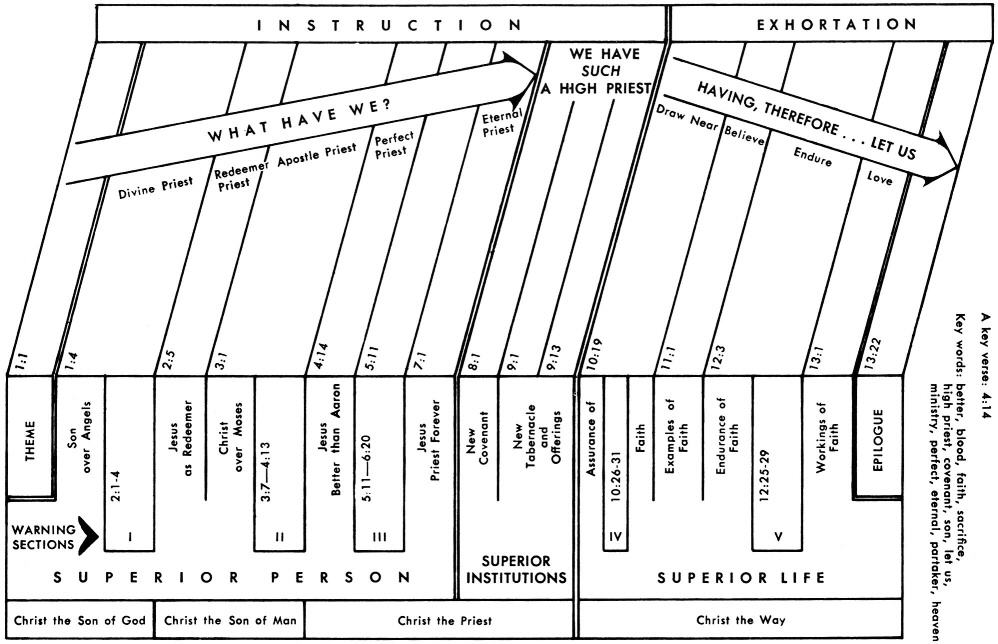
CONSIDER JESUS OUR GREAT HIGH PRIEST
Click chart to enlarge
Charts from Jensen's Survey of the NT - used by permission
Swindoll's Chart, Interesting Pictorial Chart of Hebrews, Another Chart
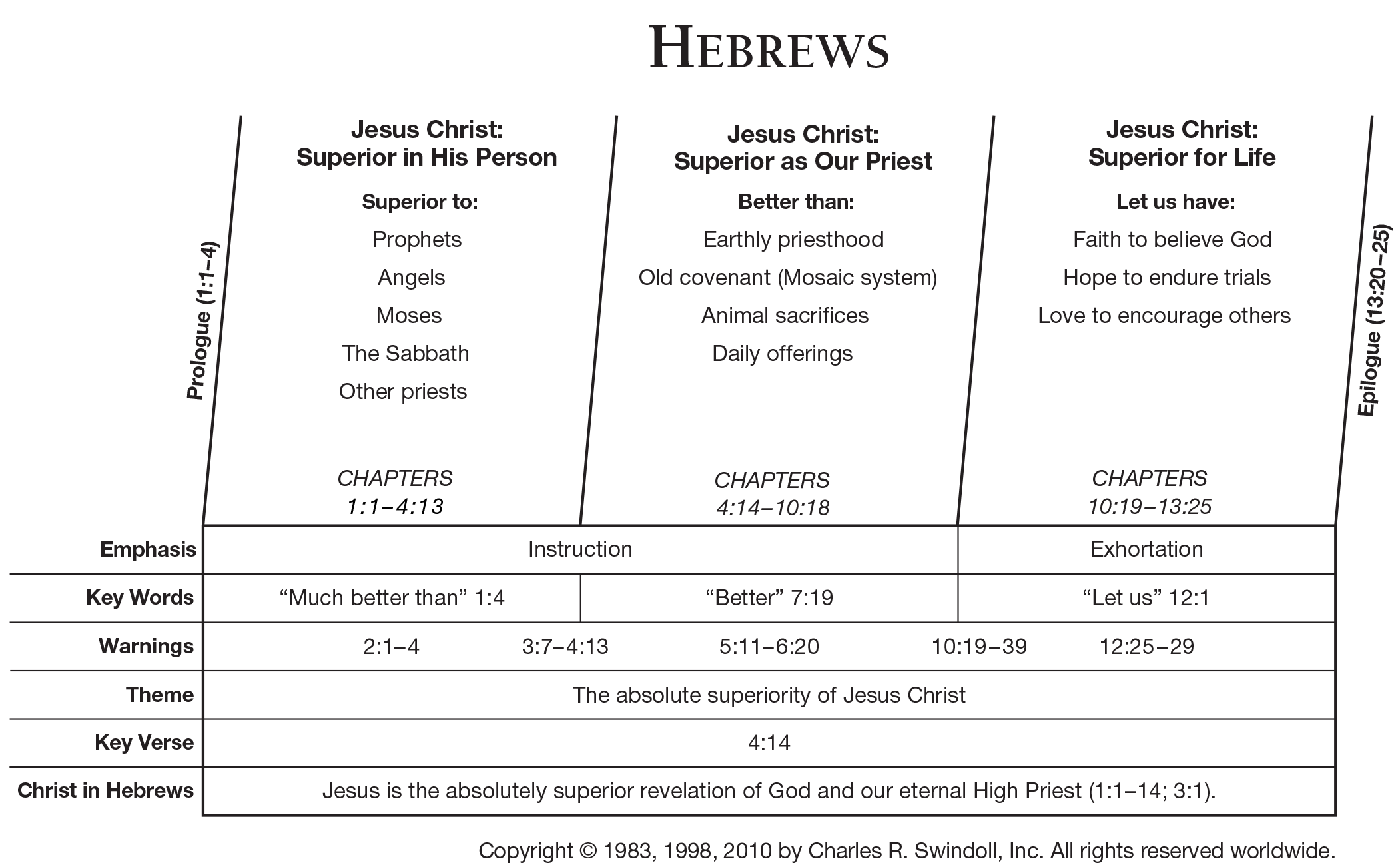

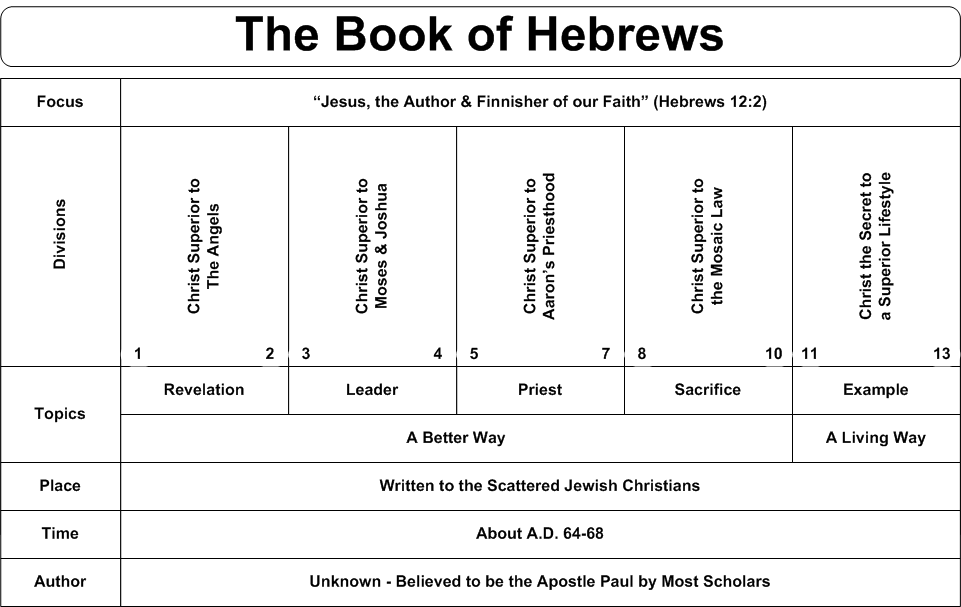
|
The Epistle |
||||
| INSTRUCTION Hebrews 1-10:18 |
EXHORTATION Hebrews 10:19-13:25 |
|||
| Superior Person of Christ Hebrews 1:1-4:13 |
Superior Priest in Christ Hebrews 4:14-10:18 |
Superior Life In Christ Hebrews 10:19-13:25 |
||
| BETTER THAN PERSON Hebrews 1:1-4:13 |
BETTER PRIESTHOOD Heb 4:14-7:28 |
BETTER COVENANT Heb 8:1-13 |
BETTER SACRIFICE Heb 9:1-10:18 |
BETTER LIFE |
| MAJESTY OF CHRIST |
MINISTRY OF CHRIST |
MINISTERS FOR CHRIST |
||
|
DOCTRINE |
DUTY |
|||
|
DATE WRITTEN: |
||||

See ESV Study Bible "Introduction to Hebrews"
(See also MacArthur's Introduction to Hebrews)
Borrow Ryrie Study Bible
Hebrews 10:34 For you showed sympathy to the prisoners and accepted joyfully the seizure of your property, knowing that you have for yourselves a better possession and a lasting one. (NASB: Lockman)
Greek: kai gar tois desmiois sunepathesate, (2PAAI) kai ten arpagen ton uparchonton (PAPNPG) umon meta charas prosedecasthe (2PAMI), ginoskontes (PAPMPN) echein (PAN) eautous kreittona uparcin kai menousan. (PAPFSA)
BGT καὶ γὰρ τοῖς δεσμίοις συνεπαθήσατε καὶ τὴν ἁρπαγὴν τῶν ὑπαρχόντων ὑμῶν μετὰ χαρᾶς προσεδέξασθε γινώσκοντες ἔχειν ἑαυτοὺς κρείττονα ὕπαρξιν καὶ μένουσαν.
Amplified: For you did sympathize and suffer along with those who were imprisoned, and you bore cheerfully the plundering of your belongings and the confiscation of your property, in the knowledge and consciousness that you yourselves had a better and lasting possession. (Amplified Bible - Lockman)
Barclay: For you gave your sympathy to those in prison; you accepted the pillaging of your goods with joy; for you knew that you yourselves hold a possession which is better and which lasts. (Westminster Press)
NLT: You suffered along with those who were thrown into jail. When all you owned was taken from you, you accepted it with joy. You knew you had better things waiting for you in eternity. (NLT - Tyndale House)
KJV For ye had compassion of me in my bonds, and took joyfully the spoiling of your goods, knowing in yourselves that ye have in heaven a better and an enduring substance.
NKJ for you had compassion on me in my chains, and joyfully accepted the plundering of your goods, knowing that you have a better and an enduring possession for yourselves in heaven.
NET For in fact you shared the sufferings of those in prison, and you accepted the confiscation of your belongings with joy, because you knew that you certainly had a better and lasting possession.
CSB For you sympathized with the prisoners and accepted with joy the confiscation of your possessions, knowing that you yourselves have a better and enduring possession.
ESV For you had compassion on those in prison, and you joyfully accepted the plundering of your property, since you knew that you yourselves had a better possession and an abiding one.
NIV Hebrews 10:34 You sympathized with those in prison and joyfully accepted the confiscation of your property, because you knew that you yourselves had better and lasting possessions.
Phillips: You sympathised with those who were put in prison and you were cheerful when your own goods were confiscated, for you knew that you had a much more solid and lasting treasure in Heaven. (Phillips: Touchstone)
Wuest: For you both sympathized with those in bonds and accepted with joy the plundering of your goods, knowing in yourselves that you have a better and an enduring possession.
Young's Literal: for also with my bonds ye sympathised, and the robbery of your goods with joy ye did receive, knowing that ye have in yourselves a better substance in the heavens, and an enduring one.
Paraphrase - For you entered into the sufferings of those in chains, feeling their pain as your own; and when your own property was plundered, you welcomed the loss with joy — because you kept on knowing that you already possess a far better and everlasting treasure in heaven.
- You showed sympathy - Acts 21:33; 28:20; Eph 3:1; 4:1; 6:20; Php 1:7; 2Ti 1:16; 2:9
- Accepted joyfully - Matthew 5:11,12; Acts 5:41; James 1:2
- Hebrews 10 Resources - Multiple Sermons and Commentaries
Related Passages:
Hebrews 13:3+ Remember the prisoners, as though in prison with them, and those who are ill-treated, since you yourselves also are in the body.
COMPASSION OF
CHRIST
This verse continues the description of the readers’ “former days” (Heb 10:32-33) when, after being “enlightened,” they endured great suffering. Earlier the writer had alluded to the sympathy (compassion) of Christ "For we do not have a high priest who cannot sympathize with (sumpatheo) our weaknesses, but One who has been tempted in all things as we are, yet without sin. (Heb 4:15+) So when we show sympathy to our fellow believers who are suffering, we are imitating our Lord and enabled to do so by the Spirit of Christ in us. It would not be natural to sympathize with the persecuted lest we too be fall into the same straits. So this must be supernatural sympathy. The believers of course had to personally make a choice to show sympathy but were enabled to do so by the indwelling Spirit giving them the desire and the power (Php 2:13NLT+). Webster says sympathy is "an affinity, association, or relationship between persons or things wherein whatever affects one similarly affects the other." The derivation of sympathy - Latin sympathia, from Greek sympatheia, from sympathēs having common feelings, sympathetic, from syn- + pathos feelings, emotion, experience
For (gar) is a term of explanation. What is he explaining? Wuest says "This verse explains the significance of the words of the previous verse, “you became sharers.” The sharing (koinonos) took the form of compassion. The latter word is the translation of sumpatheo, “to sympathize with, to feel for.” This sympathy went to the length of ministering to the saints (Heb 6:10+) as noted in the previous verse." (Hebrews Commentary online)
For you showed sympathy (sumpatheo - feel together with, shared sufferings, suffered along with) to the prisoners (desmios - those thrown in jail) and accepted (prosdechomai - "welcomed," received favorably and) joyfully (chara - with delight!) the seizure (harpage - confiscation, violent plundering) of your property (huparcho - possessions), knowing (ginosko - by experience) that you have (present tense - continually possess) for yourselves a better (kreitton) possession (huparchis) and a lasting (meno - present tense continually abiding) one - Showed sympathy means to have a feeling with, to sympathize with, and in so doing imitating their Savior Who sympathizes with us (Heb 4:15). The idea is they "suffered alongside,” not mere with pity but entering into another’s pain. In context this sympathy was not just "warm fuzzies" but was an attitude that led to action prompting them to visit their comrades in prison. Instead of avoiding them for safety, they visited, comforted, and ministered to them (cf. Mt 25:36; 2Ti 1:16). To understand the importance of this "sympathy" one needs to understand that the first century prisoner had no means of survival apart from the visits of friends who brought food, water and clothing. But as you might imagine, such visits placed the friends in some degree of danger. And yet the writer of Hebrews states that these saints visited willingly. It is interesting that historically, by the second century, Christians were known for their care for the imprisoned.
Accepted (prosdechomai - "welcomed," received favorably and) joyfully (chara - with delight!) the seizure (harpage - confiscation, plundering) of your property (huparcho - possessions) - These saints illustrate 2Co 6:10+ - "as sorrowful yet always rejoicing!" Their temporal possessions were plundered, but their eternal inheritance was untouchable for Peter declared that believers have "an inheritance which is imperishable and undefiled and will not fade away, reserved in heaven for you." (1Pe 1:4+). They were willing to lose all for His sake, echoing Paul’s words “I count all things to be loss… in view of the surpassing value of knowing Christ Jesus my Lord.” (Phil 3:8+) Their solidarity with prisoners was solidarity with Christ Himself (cf Mt 25:40+). By loving the suffering members of His body, they shared in His sufferings (Phil 3:10+). One could say that the faith of these early believers weighed eternity and found it infinitely more valuable than anything earth could seize (cf 2Co 4:17+).
“They could confiscate their goods,
but not their grace.”
– Charles Spurgeon
Their joy in face of loss of their possessions was clearly indicative of the fruit of saints filled with the Spirit (Eph 5:18+) like those early saints in the church at Thessalonica who "became imitators of (Paul, Silas, Timothy) and of the Lord, having received the word in much tribulation with the joy of the Holy Spirit, (1Th 1:6+) In Acts 5:41+ we see a similar response to suffering as "they (Peter and the apostles Acts 5:29) went on their way from the presence of the Council, rejoicing that they had been considered worthy to suffer shame for His name." To reiterate, these joy filled believers, were clearly Spirit filled believers (see "fruit of the Spirit is...joy" Gal 5:22+, cf 1Th 1:6+). In short, their joy was supernatural. They were not masochists (who derived a distorted sense of pleasure from physical suffering); they rejoiced because they were looking toward their eternal treasure in heaven, the ultimate treasure being Christ Himself "in Whom are hidden all the treasures of wisdom and knowledge." (Col 2:3+). This is the joy of faith — the joy that comes from knowing Christ is enough (Praise Him - Christ is Enough!) (cf "I am your exceeding great reward." Genesis 15:1) They lost what thieves could take, but they rejoiced in what no thief could ever touch! O, for grace to continually live with such a holy vertical vision mindset, with our eyes continually fixed on our greatest Treasure! (cf Col 3:1-2+)
Their sympathy with the imprisoned and their joyful acceptance of loss were two expressions of their walking by faith (2Co 5:7+), a faith which regarded ("saw") heavenly treasure as more real and permanent than any earthly possession. They were like those saints Paul described in (2Co 4:18+) writing that "while we look not at the things which are seen, but at the things which are not seen; for the things which are seen are temporal, but the things which are not seen are eternal."
Their hearts were anchored in heaven;
so when earth’s treasures were torn away,
their joy remained unbroken.
🙏 THOUGHT - Where is your treasure? What does this tell you about your heart? Note your heart follows and focuses on what is really of value to you--are your treasures on earth or in heaven. Jesus commanded us to store up treasure "Do not store up for yourselves treasures on earth, where moth and rust destroy, and where thieves break in and steal. 20 “But store up for yourselves treasures in heaven, where neither moth nor rust destroys, and where thieves do not break in or steal; 21 for where your treasure is, there your heart will be also." (Mt 6:19-21+, cf Phil 3:20-21+)
They became sharers of the suffering not through stoicism, but because they knew they had better possessions in heaven which could not be taken away. Vertical vision will (should) always transform horizontal living! The were living with a 2Co 4:18+ mindset, Paul describing "while we look not at the things which are seen, but at the things which are not seen; for the things which are seen are temporal, but the things which are not seen are eternal."
Matthew Henry - They were afflicted in the afflictions of their brethren: Partly while you became companions of those that were so used. The Christian spirit is a sympathizing spirit, not a selfish spirit, but a compassionate spirit; it makes every Christian's suffering our own, puts us upon pitying others, visiting them, helping them, and pleading for them. Christians are one body, are animated by one spirit, have embarked in one common cause and interest, and are the children of that God who is afflicted in all the afflictions of his people. If one member of the body suffers, all the rest suffer with it… We must thankfully acknowledge the compassions our Christian friends have shown for us under our afflictions.
In Matthew 25, in the context of His discussion of His return to earth and the establishment of His millennial kingdom, Jesus talks about His rewards to the "sheep" (as contrast to the goats) who cared for the "brothers of" Jesus, during the dangerous time that immediately preceded His return. Matthew records Jesus words to those on His right (the "sheep" - which I interpret as believing Gentiles who aid the Jews during the time of the Tribulation)…
35 'For I was hungry, and you gave Me something to eat; I was thirsty, and you gave Me drink; I was a stranger, and you invited Me in; 36 naked, and you clothed Me; I was sick, and you visited Me; I was in prison, and you came to Me.' 37 "Then the righteous will answer Him, saying, 'Lord, when did we see You hungry, and feed You, or thirsty, and give You drink? 38 'And when did we see You a stranger, and invite You in, or naked, and clothe You? 39 'And when did we see You sick, or in prison, and come to You?' 40 "And the King will answer and say to them, 'Truly I say to you, to the extent that you did it to one of these brothers of Mine, even the least of them, you did it to Me.' (Mt 25:35-40+) COMMENT - The Gentiles who by their aid to the persecuted Jews during the coming Great Tribulation will certainly place themselves at risk of death.
The prisoners - The writer probably refers to Christians who had been imprisoned for their faith or for practices related to it (cp Heb 13:23). These brethren who showed sympathy were not ashamed of the bonds of the imprisoned saints,
SUPERNATURAL JOY
ENERGIZED BY THE SPIRIT
Their joy had to be supernatural joy given by the Spirit (Gal 5:22+) because joy is hardly a "natural" reaction when one's property is seized! If follows that (1) these were genuine believers he is addressing and (2) they had come to understand the importance of obedience to the command to be continually filled with (controlled by, energized by) the Holy Spirit (Eph 5:18+)! They give us all a good model to emulate so that we too might show true joy even in the face of otherwise negative and/or adverse circumstances. When the lost world sees this type of visible reaction, they are made aware of the invisible God (read Mt 5:14-16+)>
NLT Study Bible note - At times, the Roman government evicted groups of people from their homes and forced them to leave a city (see Acts 18:2, 3+). (See NLT Parallel Study Bible - Page 2340)
Great parallel passages which serve as "commentaries" on this verse...
“Blessed (makarios - spiritually satisfied INDEPENDENT of the circumstances - this is a supernatural gift from God's Spirit!) are you when people insult you and persecute you, and falsely say all kinds of evil against you because of Me. 12 “Rejoice (chairo - present imperative) and be glad (agalliao in the present imperative and in the middle voice which speaks of personal involvement = jumping for joy!), for (term of explanation) your reward (misthos - related to misthapodosia in Heb 10:35+) in heaven is great (polus here = much in number!!!, in parallel passage Heb 10:35 great = megas = large in size!!!); for in the same way they persecuted the prophets who were before you. (Matthew 5:11,12+)
So (Acts 5:40 - "they flogged them [Peter et al] and ordered them not to speak in the name of Jesus") they went on their way from the presence of the Council (Jewish Sanhedrin), rejoicing (chairo in the present tense) that they had been considered worthy (kataxioo) to suffer shame for His name. (Acts 5:41+)
Consider (hegeomai in the aorist imperative - "Just Do It!" but don't try to obey this command in your natural strength but in the supernatural power provided by the Holy Spirit. And in the middle voice speaks of personal involvement) it all joy, my brethren, when you encounter various trials, (WHY CONSIDER TRIALS JOY?) knowing that the testing of your faith produces endurance (hupomone = SAME WORD IN Heb 10:36+). 4 And let endurance have its perfect result, so that you may be perfect and complete, lacking in nothing. (James 1:2-4+)
Spurgeon - The early Christians (ED: AND IN CONTEXT SPECIFICALLY THESE ARE JEWISH CHRISTIANS) had to suffer for their faith. They were exposed to great ridicule and enmity: they were, indeed, the byword, the laughingstock, and the derision of all mankind. Nor did it end in ridicule: they were deprived of their goods. Ruinous fines were exacted from them. They were driven from city to city (SEE CLAUDIUS' EXPULSION OF THE JEWS - WHICH AFFECTED AQUILA AND PRISCILLA - SEE Acts 18:2+), and not thought worthy to dwell among the sons of men. They were made a spectacle to all men (Heb 10:33 - "theater"), both in their lives and deaths. Very frequently they were not put to death as other condemned persons were, but their execution was attended with circumstances of cruelty and scorn, which made it still harder to bear: they were daubed with pitch and set up in the gardens of Nero to be burned alive to light that tyrant’s debaucheries (see picture), or taken to the Amphitheater, there to fight with beasts and to be torn in pieces. Everything that could be invented that was at once degrading and cruel their persecutors devised for them: malice exhausted its ingenuity upon believers in Christ.

Related Resources:
Don't miss the specific verb which the writer chose for "accepted" (prosdechomai) for this verb means in essence that these believers even "put out the welcome mat" (so to speak) for their persecutors! That is crazy! No, that is supernatural! Can you imagine the effect on the perpetrators of the crimes unjustly committed against the believers? I am willing to bet some were so transfixed by the visual testimonies of these followers of Jesus (Is your life "preaching the Gospel" to the lost around you?) and were later transformed by His Gospel and Spirit! Of course that is speculation, but God does at times redeem even the worst persecutors of the Church (compare the before Acts 26:9-11+ with the "after" in the case of man named Saul and later named Paul! See Acts 9:3-6+, cf Acts 9:1)
Vine adds that "For Israelites to treat the plundering of their property with joy was so contrary to natural inclinations that it was no small evidence of genuine faith, by which they counted it an honor and joy to suffer in the cause of Christ."
Wuest - These Jews accepted the unjust seizure of their goods with joy. That takes grace (Ed: That takes the "Spirit of grace!"). That which enabled them to do so with joy was the consciousness that they had possessions which could not be taken away. (Hebrews Commentary online)
Matthew Henry -they took their sufferings patiently, and not only so, but joyfully received it from God as a favor and honor conferred upon them that they should be thought worthy to suffer reproach for the name of Christ. God can strengthen his suffering people with all might in the inner man, to all patience and long-suffering, and that with joyfulness, Col. 1:11+.
Paul associates exulting (which means to be extremely joyful) with affliction which is motivated by knowledge of the positive effects of the affliction - "And not only this, but we also exult in our tribulations, knowing that tribulation brings about perseverance and perseverance, proven character; and proven character, hope (Ro 5:3+, Ro 5:4+) (For a similar dynamic see Jas 1:2+, Jas 1:3, 4+, 1Pe 1:6+, 1Pe 1:7+)
KJV Bible Commentary - Through all this they had endured with joy and with a knowledge that they possessed something far greater than that which they had lost. They had done it before; they must do it now. (KJV Bible Commentary)
“Joy in the midst of suffering, even persecution,
is the kind of Christianity we should all strive for.”
-- John Piper
This verse begs the question of how is such an attitude/action possible? The "secret" of this power/ability is not in the human reasoning (mind over matter or positive thinking for example) but is in the superhuman realm. Paul alluded to this supernatural enablement in his letter to the Philippians writing…
Not that I speak from want; for I have learned to be content in whatever circumstances I am. 12 I know how to get along with humble means, and I also know how to live in prosperity; in any and every circumstance I have learned the secret of being filled and going hungry, both of having abundance and suffering need. 13 I can do all things through Him Who strengthens me. (Php 4:11,12+, Php 4:13+)
These saints accepted the unjust seizure of their goods with joy which made possible by the Spirit (His "fruit" in believers) and grace (cp Gal 5:22+). When one truly comprehends that his or her "real" possessions are not temporal and earthly, but eternal and heavenly, it shows itself in one's willingness (even a passion) to part with the earthly, knowing that the heavenly is guaranteed. In fact, a good test of how fixed one is to this passing present world is what he or she is not willing to lose. (cp 2Cor 4:16,17,18)
This description of these Hebrew saints parallels the description of Habakkuk when he declared "Though the fig tree should not blossom, And there be no fruit on the vines, Though the yield of the olive should fail, And the fields produce no food, Though the flock should be cut off from the fold, And there be no cattle in the stalls, 18 Yet I will exult in the LORD, I will rejoice in the God of my salvation. 19 The Lord GOD is my strength, And He has made my feet like hinds' feet, And makes me walk on my high places. For the choir director, on my stringed instruments." (Hab 3:17,18, 19+).
🙏 THOUGHT - Suffering because we are Christians may tempt us to forsake our faith. Actively recalling God's past faithfulness to see us through difficult experiences (He 10:32) should give us courage to face present persecution. Christian endurance is never complete until our Master returns. We can trust Him. His eternal reward justifies any and all the suffering we must endure for our relatively short time on earth.
Showed sympathy (4834) (sumpatheo [English = sympathy] from sun = with, speaking of intimate relation + pascho = to suffer) means to be affected similarly, to sympathize with, to suffer with, to feel for, to be compassionate toward.
The only other use is Hebrews 4:15 For we do not have a high priest who cannot sympathize with our weaknesses, but One who has been tempted in all things as we are, yet without sin.
Prisoners (1198) (desmios from desméo = bind from desmos = bind, chain) is an adjective, primarily denoting binding, bound, then, as a noun, the person bound, a captive or prisoner, one who was a deprived of liberty and kept in prison or some other form of custody as a punishment for a crime, while awaiting trial, or for some other reason. Click description of ancient prisons. Note that Roman law used prison as detention until punishment rather than as punishment itself.
DESMIOS - 16V - Matt. 27:15; Matt. 27:16; Mk. 15:6; Acts 16:25; Acts 16:27; Acts 23:18; Acts 25:14; Acts 25:27; Acts 28:17; Eph. 3:1; Eph. 4:1; 2 Tim. 1:8; Phlm. 1:1; Phlm. 1:9; Heb. 10:34; Heb. 13:3
Hebrews 13:3 Remember the prisoners, as though in prison with them, and those who are ill-treated, since you yourselves also are in the body.
Accepted (4327)(prosdechomai from pros = in compound Greek words implies motion or direction toward + dechomai [see word study] = a deliberate and ready reception) means to accept favorably, to receive one into intercourse/companionship, to give access to oneself or receive to oneself. It is interesting to note that this verb prosdechomai is used frequently to describe the "welcoming mindset" of believers who were living in active expectation of the Messiah's appearing. ( Mk. 15:43; Lk. 2:25; Lk. 2:38 ("she" = Anna the prophetess); Lk. 12:36; Lk. 23:51; Acts 24:15; Titus 2:13; Jude 1:21).
Accepted means received kindly ~ even welcoming the seizure of their property! What a striking contrast to the natural human tendency which is to hold on as firmly as possible to what one possesses (which is really another way of saying that this person's possessions have ended up "possessing" them!)
PROSDECHOMAI - 15V - Mk. 15:43; Lk. 2:25; Lk. 2:38; Lk. 12:36; Lk. 15:2; Lk. 23:51; Acts 10:24; Acts 23:21; Acts 24:15; Rom. 16:2; Phil. 2:29; Tit. 2:13; Heb. 10:34; Heb. 11:35; Jude 1:21
Hebrews 11:35 Women received back their dead by resurrection; and others were tortured, not accepting their release, so that they might obtain a better resurrection;
Joyfully (5479) (chara from chairo = to rejoice) describes an attitude which is cheerful and glad. The world defines joy as the emotion evoked by well-being, success, or good fortune or by the prospect of possessing what one desires. The Bible defines joy as a gift of God, a fruit of His Spirit, which is independent of circumstances.
CHARA - 4 USES IN HEBREWS Heb. 10:34; Heb. 12:2; Heb. 12:11; Heb. 13:17
Hebrews 10:34 For you showed sympathy to the prisoners and accepted joyfully the seizure of your property, knowing that you have for yourselves a better possession and a lasting one.
Hebrews 12:2 fixing our eyes on Jesus, the author and perfecter of faith, who for the joy set before Him endured the cross, despising the shame, and has sat down at the right hand of the throne of God.
Hebrews 12:11 All discipline for the moment seems not to be joyful, but sorrowful; yet to those who have been trained by it, afterwards it yields the peaceful fruit of righteousness.
Hebrews 13:17 Obey your leaders and submit to them, for they keep watch over your souls as those who will give an account. Let them do this with joy and not with grief, for this would be unprofitable for you.
Seizure (724) (harpage from harpazo = to seize upon with force, also used for the "seizing" or rapture of the saints) gives us the picture of violent, unjust seizure of the property of these who were being persecuted.
Matthew 23:25 “Woe to you, scribes and Pharisees, hypocrites! For you clean the outside of the cup and of the dish, but inside they are full of robbery and self-indulgence.
Luke 11:39 But the Lord said to him, “Now you Pharisees clean the outside of the cup and of the platter; but inside of you, you are full of robbery and wickedness.
Hebrews 10:34 For you showed sympathy to the prisoners and accepted joyfully the seizure of your property, knowing that you have for yourselves a better possession and a lasting one.
Property (possessions)(5225) (huparcho = to exist) means to be, to live, to exist and in this context signifies those things of which a person has the use and disposal. This is the only use in Hebrews out of 31 uses.
Possessions (5223) huparxis (from (huparcho = to exist) is first of all that state or condition of existing or staying in existence, and thus means means subsistence, existence, property. It describes "what exists" and so what one has, referring to their property or possessions, that which belongs to someone — what one has or holds as his own. Huparxis embodies what is visible and temporary, the tangible goods of this world.
John Piper writes "and this chosen suffering was not a morose, gloomy, miserable duty that they did because Christians are supposed to. It says that they joyfully accepted the seizure of their property. It's as if you were to carry food and clothing to flood victims and then go home and find spray-painted all over your house, "Christians get out!" and your windows broken and all your cabinets and drawers rifled. And instead of being mainly angry and discouraged, you gathered around you some friends - your small group - and prayed and sang a song of joy in God that he had counted you worthy to suffer for the Name (Acts 5:41+).
That is evidently what they did, according to Heb 10:34. They joyfully accepted the confiscation of their property. But how did they become people like this? This is utterly against the way humans are by nature. We love safety and comfort and ease and fun and lots of possessions and money and free time to do what we want to do. And if we get that we rejoice, and if we don't, we complain. But here are people who rejoice when they lose possessions and share in sufferings. So somehow there is an indomitable joy, and this joy seems to be one of the keys to love and good works.
Then comes the all-important clause in He 10:34 to explain the source of this indomitable, love-producing joy:
"knowing that you have for yourselves
a better possession and an abiding one."
The key to indomitable joy that produces love and good works that share the loss of property others have experienced is
"knowing that you have for yourself
a better possession and an abiding one."
When you know that you have a better and a lasting persuasion, you are not paralyzed by loss. If that better possession is great enough, you will even be able to rejoice in loss.
What is this "better possession and abiding one"? Well, it's all the good news that we have been pondering for over a year in this letter. It's the triumph of Jesus over death (He 2:15), and the final rest for the saints in the age to come (He 4:9), and the subduing of all our enemies (He 10:13) and the perfect purification of our conscience (He 9:14), and the removal and forgetting of all our sins (He 8:12) - all of which is aimed at the ultimate and greatest reward of all, namely, that we shall be "near to God" (He 7:19, He 7:25) and know God (He 8:11) and that he will be our God (He 8:10) forever.
In other words, "the better possession and abiding one" is not a thing. It is a person and a great salvation. A great relationship of acceptance with God and fellowship with God and enjoyment of God forever. Notice the two adjectives: "better" and "abiding." It is better than anything this world can offer. And it last longer than anything this world can offer. This is exactly the same double perfection described in Psalm 16:11 -
"Thou wilt make known to me the path of life; in Thy presence is fullness [= "better possession"] of joy; in Thy right hand there are pleasures forever [= "abiding possession"]."
So Hebrews 10:34 is saying that the key to the indomitable joy that releases love and good works and that embraces suffering with those who suffer is knowing that you have this better and abiding possession.
"Knowing!"
Here's the key!
You must have this confidence. It's this deep confidence about your future that frees you from the fear and greed that kill love and make you into a cookie-cutter human who has to have security and safety and ease and comfort.
So where does that "knowing" come from? That confidence?
The answer to that is what this whole book is written to supply. Our confidence comes from Christ - what He did perfectly on the cross and at the resurrection, what He is doing now for us in heaven and what He will do for us at the second coming and to all eternity. Christ is the One Who destroyed the power of death (He 2:15). Christ is the High Priest who opens the way to the throne of grace (He 4:15, 16). Christ is the one who ever lives to make intercession for us (He 7:25). Christ is the one whose blood cleanses our consciences (He 9:14), and obtained an eternal redemption (He 9:12). Christ's death is the single sacrifice that perfects us for all time (He 10:14). Christ will make all his enemies a footstool for his feet (He 10:13). Christ will come again a second time to save all who are eagerly waiting for him. Christ is the mediator of a new and better covenant that insures the forgiveness of our sins, and the writing of the law on our hearts, and the presence of God in our midst forever and ever (He 8:6, 7, 8, 9, 10, 11).
All that we ever hope for is owing to Christ. We receive it not by earning it or meriting it, but by banking on it. If we love it above all that earth offers, it is ours. So when Heb 10:34 says that the key to indomitable joy in the face of suffering and earthly loss is "knowing that we have a better possession and an abiding one," it means that we know this because of Christ. Christ is the seal and the guarantee of our hope in all the promises of God. (Read the full sermon = The Present Power of a Future Possession)
Steven Cole adds a similar note that "The only way that they could joyfully accept the seizure of their property was, they knew that they had “a better possession and a lasting one.” They had “treasures in heaven, where neither moth nor rust destroys, and where thieves do not break in or steal” (Mt 6:20+).
They knew that Jesus had gone to prepare a place for them to dwell with Him forever and that He was coming again to take them to be with Him there (John 14:2, 3). So while, no doubt, it was hard to lose their earthly possessions, their focus had shifted from the temporal to the eternal.
In 1986, I was preaching through 1 Corinthians and came to 1 Co 15:19, where Paul caps his argument for the resurrection with these startling words: “If we have hoped in Christ in this life only, we are of all men most to be pitied.” That verse jarred me. I asked myself, “Can I really say that?” Being a Christian provides me with a good life. I have a wonderful wife and children. I get paid to study and teach God’s Word. I have brothers and sisters worldwide. I know that my sins are forgiven. And, heaven is thrown in as a bonus after this life is over! Such a deal!” But Paul says, “If there is no heaven, if this life is all there is, being a Christian is ludicrous!” Why suffer ridicule? Why give your money away? Why spend this short life serving the Lord? Why deny yourself the pleasures of sin? Why bother living for anyone other than yourself? Better to eat and drink today, for tomorrow you may die. But, a Christian knows that this life is not all there is. Christians have shifted their priorities and values from the temporal to the eternal. (Enduring Faith Hebrews 10:32-39)
KNOWING THAT YOU HAVE FOR YOURSELVES A BETTER POSSESSION AND AN LASTING (ABIDING) ONE: ginoskontes (PAPMPN) echein (PAN) heautous kreissona huparchin kai menousan (PAPFSA):
- A better possession - Mt 6:19-20; 19:21; Lk 10:42; 12:33; 2Co 5:1; Col 1:5; 3:2, 3, 4; 1Ti 6:19; 2Ti 4:8; 1Pe 1:4; 1Jn 3:2
- Hebrews 10 Resources - Multiple Sermons and Commentaries
Related Passages:
Luke 12:33-34+ “Sell your possessions and give to charity; make yourselves money belts which do not wear out, an unfailing treasure in heaven, where no thief comes near nor moth destroys. 34“For where your treasure is, there your heart will be also.
Romans 8:18+ For I consider that the sufferings of this present time are not worthy to be compared with the glory that is to be revealed to us.
KNOWLEDGE OF A BETTER POSSESSION:
KEY TO ENDURING SUFFERING
Knowing (ginosko - present tense) that you have (present tense - continually possess) for yourselves (reflexive pronoun stresses actual present personal ownership of) a better (kreitton) possession (huparxis - their real wealth) and a lasting (meno - present tense continually abiding) one - Their supernatural (paradoxical to the world) joy in the confiscation of their possessions was grounded on their knowledge (knowing), not their emotion. You can mark it down beloved - What you believe determines how you behave. And what you believe depends on what you know. The verb knowing marks the difference between despair and delight, for what they knew controlled how they felt. They did not rejoice because of the plundering itself but in spite of it—because they knew their treasure was untouched. True faith detaches from earth by being anchored in heaven, where "Jesus has entered as a forerunner" for them (Heb 6:20+) These believers knew that the "best was yet to come"! The truth transformed their outlook, turning lament over loss into joyful acceptance. How did they come to know this truth of a blessed future? The only source of such truth is the Word of God, so they had either read it themselves or they had been taught it by Word centered teachers and preachers. What they must have known was something like what Peter taught declaring believers have "inheritance which is imperishable and undefiled and will not fade away, reserved in heaven." (1Pe 1:4+, cf Heb 11:16+). Or as Paul taught describing "the hope laid up (apokeimai pictures a treasure securely stored away) for you in heaven." (Col 1:5+). In short, their (and our) inheritance is safely stored in heaven’s vault, beyond the reach of decay, defilement, or doubt. In Hebrews 9:15+ the author reminded his readers that "those who have been called may receive the promise of the eternal inheritance." And later he exhorted them to "hold fast the confession of our hope (absolute assurance that God will do good to us in the future) without wavering, for He who promised is faithful." (Heb 10:23+)
When you hold loosely the temporal things of earth,
you can hold tightly the eternal things of heaven.
🙏 THOUGHT - Does your congregation know this great truth? Is this truth repeatedly emphasized by your pastors and teachers which is needful because we are all prone to forget? It is noteworthy that roughly one in 20-30 NT passages speak directly or indirectly about our "blessed hope", the Second Coming of our Lord. It seems God desires to keep before our "mind's eye" the truth of a better possession (ultimately this is Christ Himself, our "Husband"! - cp Hebrews 10:37+) and a reward that endures long after the present heavens are "destroyed by burning, and the elements will melt with intense heat!" (2 Pe 3:12+).
The "Knowing" ginosko - present tense) referred to here is the knowledge that the saint is assured of an eternal reward and this assurance serves to encourage faithful endurance in the face of strong opposition and/or vigorous persecution. Personal suffering and public shame, sympathy with others who suffer, and loss of possessions are bearable when set against the prospect of the imperishable, undefiled heavenly possessions awaiting those who are faithful. They could accept the loss of earthly possessions because they had come to value spiritual possessions infinitely more. The ultimate heavenly "possession" of course is the person of the Lord God Himself. The writer will amply illustrate this important principle of faith with vignettes from the "men of old" in Hebrews 11.
He is no fool who gives what he cannot keep
to gain what he cannot lose.
-- Jim Elliot
These bold saints believed Jesus’ words, and their belief guided their behavior. In the Sermon on the Mount Jesus instructed His hearers…
Do not lay up (present imperative + negative = stop doing this!) for yourselves treasures upon earth, where moth and rust destroy, and where thieves break in and steal. But lay up (present imperative = command to make this your life goal! Be careful. Jesus is not speaking so much about our "things" in heaven as our heart now on earth!) for yourselves treasures in heaven, where neither moth nor rust destroys, and where thieves do not break in or steal; for where your treasure is, there will your heart be also. (Mt 6:19, 20, 21+).
As the writer of Hebrews says toward the end of this epistle, these saints knew that
here we do not have a lasting city, but we are seeking the city which is to come. (He 13:14+)
These saints had…
come to Mount Zion and to the city of the living God, the heavenly Jerusalem, and to myriads of angels, to the general assembly and church of the first-born who are enrolled in heaven, and to God, the Judge of all, and to the spirits of righteous men made perfect and to Jesus, the mediator of a new covenant, and to the sprinkled blood, which speaks better than the blood of Abel. (He 12:22, 23, 24+)
Jesus encouraged His little band with the words that no earthly power or authority could take away that which was most important (one's soul)…
Do not fear (present imperative + negative = stop doing this! See Need for the Holy Spirit to obey all the NT commands) those who kill the body, but are unable to kill the soul; but rather fear (present imperative = command to make this your lifestyle!) Him who is able to destroy both soul and body in hell.
The actions of these Hebrew Christians were the product of genuine faith, and he urged them to keep this confident faith in Heb 10:35,36, emphasizing that perseverance (endurance) is the proof of reality. Undoubtedly, the persecution and injustice these saints endured presented strong temptations to give up, to return to Judaism, and to forget about Jesus.
C H Spurgeon - Real Estate in Heaven - This is well. Our substance here is very unsubstantial; there is no substance in it. But God has given us a promise of real estate in the gloryland, and that promise comes to our hearts with such full assurance of its certainty that we know in ourselves that we have an enduring substance there. Yes, "we have" it even now. They say, "A bird in the hand is worth two in the bush," but we have our bird in the bush and in the hand, too. Heaven is even now our own. We have the title deed of it, we have the earnest of it, we have the firstfruits of it. We have heaven in price, in promise, and in principle; this we know not only by the hearing of the ear but "in ourselves." Should not the thought of the better substance on the other side of Jordan reconcile us to present losses? Our spending money we may lose, but our treasure is safe. We have lost the shadows, but the substance remains, for our Savior lives, and the place which He has prepared for us abides. There is a better land, a better substance, a better promise; and all this comes to us by a better covenant; wherefore, let us be in better spirits, and say unto the Lord, "Every day will I bless thee; and praise thy name for ever and ever." (Faith's Checkbook)
Spurgeon - One Palmer, of Reading, being condemned to die, in Queen Mary's time, was much persuaded to recant, and among other things a friend said to him, "Take pity on thy golden years and pleasant flowers of youth, before it be too late." His reply was as beautiful as it was conclusive: "Sir, I long for those springing flowers which shall never fade away." When he was in the midst of the flames he exhorted his companions to constancy, saying, "We shall not end our lives in the fire, but make a change for a better life; yea, for coals we shall receive pearls." Thus do we clearly see that, although " if in this life only we have hope in Christ, we are of all men most miserable," yet the prospect of a better and enduring substance enables us to meet all the trials and temptations of this present life with holy boldness and joy.
Spurgeon - My horse invariably comes home in less time than he makes the journey out. He pulls the carriage with a hearty goodwill when his face is towards home. Should not I also both suffer and labour the more joyously because my way lies towards heaven, and I am on pilgrimage to my Father's house, my soul's dear home and resting-place?
Spurgeon - “If I have but little in this world, let me remember that this is not my all. The true treasure is above the skies.”
Jamieson-Fausset-Brown: “The heavenly treasure is both better in quality and enduring in duration.”
Pulpit Commentary: “Temporal goods were snatched away, but they possessed a wealth which abides and cannot be plundered.”
Albert Barnes - Property here soon vanishes. Riches take to themselves wings and fly away (Pr 23:5), or at any rate all that we possess must soon be left (ED: YOU SEE NO "U-HAUL TRAILERS" FOLLOWING THE HEARSE TO THE GRAVE!). But in heaven all is permanent and secure. No calamity of war, pestilence, or famine; no change of times; no commercial embarrassment; no failure of a crop, or a bank; no fraud of sharpers and swindlers, and no act of a pick-pocket or highwayman can take it away; nor does death ever come there to remove the inhabitants of heaven from their “mansions.” With this hope, therefore, Christians may cheerfully see their earthly wealth vanish, for they can look forward to their enduring and their better inheritance.
Knowing (1097) (ginosko) means knowing by experience. In other words it means to know as a process arising from experience.
GINOSKO IN HEBREWS - Heb. 3:10; Heb. 8:11; Heb. 10:34; Heb. 13:23
Better (2909) (kreitton/kreisson) "pertains to being of high status, more prominent, higher in rank, preferable, better". (BDAG).
Kreitton - 12x in 11v - 1 Co. 7:9; 1 Co. 7:38; 1 Co. 11:17; Phil. 1:23; Heb. 1:4; Heb. 6:9; Heb. 7:7; Heb. 7:19; Heb. 7:22; Heb. 8:6; Heb. 9:23; Heb. 10:34; Heb. 11:16; Heb. 11:35; Heb. 11:40; Heb. 12:24; 1 Pet. 3:17; 2 Pet. 2:21
Hebrews 1:4 having become as much better than the angels, as He has inherited a more excellent name than they.
Hebrews 6:9 But, beloved, we are convinced of better things concerning you, and things that accompany salvation, though we are speaking in this way.
Hebrews 7:7 But without any dispute the lesser is blessed by the greater.
Hebrews 7:19 (for the Law made nothing perfect), and on the other hand there is a bringing in of a better hope, through which we draw near to God.
Hebrews 7:22 so much the more also Jesus has become the guarantee of a better covenant.
Hebrews 8:6 But now He has obtained a more excellent ministry, by as much as He is also the mediator of a better covenant, which has been enacted on better promises.
Hebrews 9:23 Therefore it was necessary for the copies of the things in the heavens to be cleansed with these, but the heavenly things themselves with better sacrifices than these.
Hebrews 10:34 For you showed sympathy to the prisoners and accepted joyfully the seizure of your property, knowing that you have for yourselves a better possession and a lasting one.
Hebrews 11:16 But as it is, they desire a better country, that is, a heavenly one. Therefore God is not ashamed to be called their God; for He has prepared a city for them.
Hebrews 11:35 Women received back their dead by resurrection; and others were tortured, not accepting their release, so that they might obtain a better resurrection;
Hebrews 11:40 because God had provided something better for us, so that apart from us they would not be made perfect.
Hebrews 12:24 and to Jesus, the mediator of a new covenant, and to the sprinkled blood, which speaks better than the blood of Abel.
Possession (5223)(huparxis from huparcho = to exist) in this context (and Acts 2:45) describes that which one has (property). Something one owns.
Lasting (abiding - present tense - continually) (3306) (meno) means remaining or staying. This possession has "staying power". It is notable that this verb meno is used 6x in Hebrews - He 7:3, He 7:24; He 10:34, He 12:27; He 13:1, He 13:14.
Hebrews 7:3 Without father, without mother, without genealogy, having neither beginning of days nor end of life, but made like the Son of God, he remains a priest perpetually.
Hebrews 7:24 but Jesus, on the other hand, because He continues forever, holds His priesthood permanently.
Hebrews 10:34 For you showed sympathy to the prisoners and accepted joyfully the seizure of your property, knowing that you have for yourselves a better possession and a lasting one.
Hebrews 12:27 This expression, “Yet once more,” denotes the removing of those things which can be shaken, as of created things, so that those things which cannot be shaken may remain.
Hebrews 13:1 Let love of the brethren continue.
Hebrews 13:14 For here we do not have a lasting city, but we are seeking the city which is to come.
Thomas Watson - They have lost their livings and promotions for conscience's sake—but as long as God lives their eternal reward is not lost, Hebrews 10:34. Bernard said, "I cannot be poor—so long as God is rich; for His riches are mine!" Whatever we lose for God, we shall find again in Him. In Mark 10:28 the disciples said, "We have left all and have followed You." Alas! What had they left? A few sorry boats and nets! What were these, compared to their reward? They parted with fleeting goods—for the unchangeable God! All losses are made up in Him! We may be losers for God—but we shall never be losers by Him.
During Emperor Decius’s persecution (A.D. 250), Christians’ homes and goods were often seized. Cyprian of Carthage wrote: “Many rejoice that they are spoiled of their goods, for they possess the heavenly treasure entire.” That joy amid plundering is the historic backdrop of Hebrews 10:34.
Pilgrim’s Progress – Christian Leaves His City - When “Christian” fled the City of Destruction, he left behind his home and possessions. But with eyes fixed on the Celestial City, he “ran crying, Life! life! eternal life!” — Bunyan, Pilgrim’s Progress, Part 1. His loss became gain because his treasure was lasting.
The Singing Prisoner: John Bunyan
When Bunyan was imprisoned for preaching the gospel (1660-1672), he lost income, family life, and his freedom. Yet he wrote:“I never had in all my life so great an inlet into the Word of God as now… I see myself engaged to thank God for this my imprisonment.”— Grace Abounding to the Chief of Sinners. Bunyan accepted joyfully the seizure of liberty and livelihood, because he saw the unseen riches of Christ (2 Cor 4:17-18).
Daily Light on the Daily Path - We look not to the things that are seen but to the things that are unseen. For the things that are seen are transient, but the things that are unseen are eternal.
For here we have no lasting city.—You knew that you yourselves had a better possession and an abiding one.
“Fear not, little flock, for it is your Father’s good pleasure to give you the Kingdom.”—Now for a little while, if necessary, you have been grieved by various trials.—“There the wicked cease from troubling, and there the weary are at rest.”
For while we are still in this tent, we groan, being burdened.—“He will wipe away every tear from their eyes, and death shall be no more, neither shall there be mourning, nor crying, nor pain anymore, for the former things have passed away.”
The sufferings of this present time are not worth comparing with the glory that is to be revealed to us.—For this light momentary affliction is preparing for us an eternal weight of glory beyond all comparison.
2 Cor. 4:18; Heb. 13:14; Heb. 10:34; Luke 12:32; 1 Pet. 1:6; Job 3:17; 2 Cor. 5:4; Rev. 21:4; Rom. 8:18; 2 Cor. 4:17
Billy Graham - A HOME AND A HOPE Unto the Hills: A Daily Devotional
You yourselves had [in heaven] a better and lasting possession. HEBREWS 10:34 AB
Thanks be to unto God, we believers in Christ have the assurance that we are going to a home where all is happiness, joy, and peace. This blessed hope fortifies us to bear our hardships. We will not insist on our wants here and fight over our rights, but we will be willing to suffer the loss of all things for the sake of those things which are yet to come. Earthly possessions will not vitally concern us. The quality here may be poor, but the Bible teaches that the quality there is perfect. The possessions here will pass away; the possessions there are enduring.
No one can have real peace who does not have the assurance of a permanent and happy home which will not be subject to earthly casualty.
Some time ago two old friends were dying. The one was rich, and the other poor. The rich man was outside of Christ, and he was talking to another of his friends. “When I die,” he said, “I shall have to leave my riches. When he dies, he will go to his riches.”
Thus in a word he summed up the two radically different principles which govern the world and the Christian.
Peace is not arbitrary. It must be based upon definite facts. God has all the facts on his side; the world does not. Therefore God, and not the world, can give people peace. It is honorable, right, and praiseworthy that our leaders should seek and promote national and world peace; but they must recognize its limitations without Christ, the Prince of Peace.
The Bible teaches that the world will never come to this place of tranquillity and permanent peace until Christ, the Prince of Peace, comes back to this earth. When He comes to reign and rule, man shall know war no more.
Our Father and our God, You are our only source of true peace. Without You I know that lasting peace is impossible. I long for that peace, Lord, and I pray that You will establish it eternally in my heart and my life through Jesus Christ, the One who died to bring us peace. Through Him I pray. Amen.
Billy Graham - A Home in Heaven Hope for Each Day Deluxe: Words of Wisdom and Faith (A ... - Page 330
You yourselves had [in heaven] a better and lasting possession. HEBREWS 10:34 AMP
Paul once wrote, “If only for this life we have hope in Christ, we are to be pitied more than all men” (1 Corinthians 15:19 NIV). If there is no life after death, no Heaven, no promise of a better world—then life in this world is empty, hopeless, without meaning or purpose.
But this life is not all! Ahead is Heaven, and someday “we shall always be with the Lord” (1 Thessalonians 4:17). Someday we will go to a home where all is happiness, joy, and peace. How barren our lives would be if we didn’t have this hope.
Knowing Heaven is real will make a difference in the way we live. For one thing, we won’t become attached to the things of this world. We will say with Paul, “I have learned in whatever state I am, to be content” (Philippians 4:11).
But Heaven should also give us a burden for those who do not have this hope. Every day you meet people who do not know Christ. Will you tell them?
J R Miller - A man's real "life" is what would be left of him—if everything he has were stripped off. His real 'worth' is his character, as it appears in God's sight. We will make a great mistake if our goal in life—is simply to gather more worldly trinkets than our neighbor!We will make a great mistake if our goal in life—is simply to gather more worldly trinkets than our neighbor!
James Smith - BETTER HEBREWS
This may be taken as the keynote of the Epistle. The Jewish Christians, to whom this Epistle was specifically addressed, owing to the taunts and jeers of their persecutors, were beginning to undervalue their Christian possessions. Therefore the writer rings the changes on the word “better,” conceding they had certain things under the Law, but under Grace far “better.”
1. Blessings (Heb 11:40).
2. Sacrifice (Heb 9:23).
3. Blood that Speaks of Better Things (Heb 12:24).
4. Hope (Heb 7:19).
5. Covenant (Heb 8:6; 7:22).
6. Promises (Heb 8:6).
7. Substance (Heb 10:34).
8. Country (Heb 11:16).
9. Resurrection (Heb 11:35).
Adrian Rogers - But listen to what the Bible says here in Hebrews 10:34: “Ye … took joyfully the spoiling of your goods.”Why? Because we have treasure laid up in heaven; we have a treasure that this world cannot spoil. And I want to tell you, ladies and gentlemen, that if you get your joy in anything else other than the Lord Jesus Christ, when something happens to that thing, your joy is going to go. But nothing is going to happen to Jesus, and the joy that you have is to be received from Christ—that His joy might be in you, and therefore, that your joy might remain.
Robert Farmer - In Hebrews 10:34, we read where believers joyfully accepted the seizure of all their possessions forthe cause of Christ. They knew this life was temporary. They knew this world was not their eternal home.They knew God would take care of them. What about us? Would we be so mature and wise? I can justimagine the uproar and the tsunami of political activism if the U.S. Government seized all the property ofChristians because of their profession of faith in Jesus. Rulers will persecute us. We need to understandthis reality. The more we focus on the Kingdom of God, the less interested we will be in the affairs of thislife. That we are persecuted is not the issue. That we are faithful to Christ is very much the issue.
Real Treasure - A life once spent, is irrevocable (Adoniram Judson)
Of how much real happiness we cheat our souls - by preferring a trifle to God! We have a general intention of living a consecrated life - but we intend to begin tomorrow or next year. For the present moment, we prefer living for our trinkets, and say, "A little more sleep, a little more slumber." Well, a little more sleep - and we shall sleep in the grave! A few more days - and our work will be done. And when it is once done, it is done to all eternity. A life once spent, is irrevocable. It will remain to be contemplated through eternity. If it is marked with sins - the marks will be indelible. If it has been a useless life - it can never be improved. Such it will stand forever and ever. The same may be said of each day. When it is once past, it is gone forever. All the marks which we put upon it - it will exhibit forever. It will always remain true - that such a day was spent in such a manner. Each day will not only be a witness of our conduct, but will affect our everlasting destiny. No day will lose its share of influence in determining where our place shall be in Heaven. How shall we then wish to see each day marked with usefulness! It will then be too late to mend its appearance. It is too late to mend the days that are past. The future is in our power. Let us, then, each morning, resolve to send the day into eternity in such a garb as we shall wish it to wear forever. And at night let us reflect that one more day is irrevocably gone, indelibly marked.
Where Is My Focus? Hebrews 10:34
Early in September 2011, a raging wildfire destroyed 600 homes in and around the city of Bastrop in central Texas. A few weeks later an article in the Austin American-Statesman newspaper carried this headline: “People who lost the most, focus on what wasn’t lost.” The article described the community’s outpouring of generosity and the realization of those who received help that neighbors, friends, and community were worth far more than anything they lost.
The writer of Hebrews reminded first-century followers of Jesus to recall how they had bravely endured persecution early in their life of faith. They stood their ground in the face of insults and oppression, standing side by side with other believers (Heb. 10:32-33). “You suffered along with those in prison and joyfully accepted the confiscation of your property, because you knew that you yourselves had better and lasting possessions” (v. 34). Their focus was not on what they had lost but on eternal things that could not be taken from them.
Jesus told His followers, “Where your treasure is, there your heart will be also” (Matt. 6:21). As we focus on the Lord and all that we have in Him, even our most precious possessions can be held lightly. By David C. McCasland (Our Daily Bread, Copyright RBC Ministries, Grand Rapids, MI. — Reprinted by permission. All rights reserved)
Lord, open our eyes to see You and to embrace what is most important each day. Where is your focus today?
R C Sproul - An Abiding Possession Hebrews 10:34
After embracing Christ with great joy, some in the original audience of the epistle to the Hebrews began to waver in their commitment to Christ. This wavering made it necessary for the author of Hebrews to give them strong warnings against turning away from Christ. He wanted them to persevere and avoid the strong judgment that comes to those who profess Christ and later fall away (Heb 6:4–8).
Many of these warnings to his audience come in the second half of chapter 10. However, while these warnings are necessary and must never be ignored, the author knew that with these warnings, encouragement was also needed. Warnings by themselves might paralyze an audience in fear, but coupled with true encouragement they will result in repentance and the perseverance of God’s elect.
These encouragements are possible for only two reasons. One is the confidence that the elect will persevere until the end and never lose their salvation. The other reason comes from the realization that perseverance is a process. As the lives of David and Peter show, true believers may sin heinously and yet be restored in faith. It is also true that all who confess Christ may doubt and sin and still be restored.
In today’s passage, the author reminds his readers of times past when they had compassion on those in prison and when they joyfully accepted the plundering of their property. This shows us that the audience had already experienced some of the persecutions that came from being a Christian. Some of them had been imprisoned, and those who were still free came to their aid. By helping imprisoned believers, they ran the risk of being persecuted as well.
In short, the author is showing them that in times past they gave evidence of their salvation by performing the love and good works that are required of all true believers (Heb 10:24). In light of this they must continue to do so. One sure sign of the work of Christ in our hearts is that we care for those who are in danger on account of their faith.
The audience could do these things when first converted because they knew of their abiding possession (Heb 10:34), that is, heaven. They began to waver only because they had forgotten their eternal treasure. They only became concerned for their physical safety when they took their eyes off the prize of their heavenly possession.
CORAM DEO Where do you fix your hope? Are your eyes on the perfection of heaven or have you become overly concerned with the things of this world? Look at your life—your goals, how you spend your money, your concerns, and so on. Take some steps to change whatever might need to be changed for the good of your eternal reward.
For further study: Dan. 3:8–30 • Matt. 6:19–21 • Luke 12:13–21 • Gal. 4:21–31
LEAVING THE TOYS BEHIND
References: Luke 12:13–34; Philippians 4:11–19; Hebrews 10:34; 1 John 3:17
There we were, in love and on the rim of the Grand Canyon on New Year’s Eve. As we watched the sun go down, we remembered the hotel was full and we needed a place to stay.
My husband had a brainstorm. "I’ll bet the ranger at the bottom of the canyon is lonely, especially tonight. Let’s call him and see how he would feel about having guests."
The ranger’s telephone number was in the book. We dialed, explained our situation, and offered to bring groceries down. Ranger Gary said he and his wife, Gina, would love company.
After an uneventful passage down the curving canyon, we arrived at the bottom. We were invited into the ranger’s large cabin and served a nice dinner. Then Gary and Gina showed us their "sports room." It was full of abandoned sports equipment—high-class hiking boots, expensive backpacks, fancy hats, and even fancier walking sticks that people had left behind.
"People can walk in easily enough with all of this stuff," Gary said. "They just can’t walk out."—Donna Schaper, All Is Calm (St. Mary’s Press, 1999)
We Look for Better Things
Remember—Christianity proposes not to extinguish our natural desires. It promises to bring the desires under just control and direct them to their true object. In the case of both riches and of honor, it maintains the consistency of its character. But Christianity commands us not to set our hearts on earthly treasures. It reminds us that "we have in heaven a better and more enduring substance" than this world can bestow (Hebrews 10:34).
See: 2 Peter 1:4; 1 John 2:17
Spurgeon - Heb. 10:34. Faith's Checkbook
THIS is well. Our substance here is very unsubstantial; there is no substance in it. But God has given us a promise of real estate in the glory-land, and that promise comes to our hearts with such full assurance of its certainty, that we know in ourselves that we have an enduring substance there. Yes, “we have” it even now. They say, “A bird in the hand is worth two in the bush”; but we have our bird in the bush and in the hand too. Heaven is even now our own. We have the title-deeds of it, we have the earnest of it, we have the first-fruits of it. We have heaven in price, in promise, and in principle: this we know not only by the hearing of the ear, but “in ourselves.”
Should not the thought of the better substance on the other side of Jordan reconcile us to present losses? Our spending-money we may lose, but our treasure is safe. We have lost the shadows, but the substance remains, for our Saviour lives, and the place which he has prepared for us abides. There is a better land, a better substance, a better promise; and all this comes to us by a better covenant; wherefore, let us be in better spirits, and say to the Lord, “Every day will I bless thee; and praise thy name for ever and ever.”
Hebrews 10:35 Therefore, do not throw away your confidence, which has a great reward. (NASB: Lockman)
Greek: me apobalete (2PAAS) oun ten parresian umon, etis echei (3SPAI) megalen misthapodosian,
BGT Μὴ ἀποβάλητε οὖν τὴν παρρησίαν ὑμῶν, ἥτις ἔχει μεγάλην μισθαποδοσίαν.
Amplified: Do not, therefore, fling away your fearless confidence, for it carries a great and glorious compensation of reward. (Amplified Bible - Lockman)
Barclay: Do not throw away your confidence, for it is a confidence that has a great reward. (Westminster Press)
NLT: Do not throw away this confident trust in the Lord, no matter what happens. Remember the great reward it brings you!. (NLT - Tyndale House)
KJV Cast not away therefore your confidence, which hath great recompence of reward.
NKJ Therefore do not cast away your confidence, which has great reward.
NET So do not throw away your confidence, because it has great reward.
CSB So don't throw away your confidence, which has a great reward.
ESV Therefore do not throw away your confidence, which has a great reward.
NIV So do not throw away your confidence; it will be richly rewarded.
Phillips: Don't throw away your trust now - it carries with it a rich reward in the world to come. (Phillips: Touchstone)
Wuest: Do not throw away therefore your confidence which is of such a nature that it has great recompense of reward,
Young's Literal: Ye may not cast away, then, your boldness, which hath great recompense of reward,
- Throw away - He 3:6,14; Heb 4:14
- Reward - He 11:26; Ps 19:11; Mt 5:12; 10:32,42; Lk 14:14; 1Co 15:58; Ga 6:8, 9, 10
- Hebrews 10 Resources - Multiple Sermons and Commentaries
Related Passages:
Deuteronomy 32:15+ “But Jeshurun (ISRAEL) grew fat and kicked– You are grown fat, thick, and sleek– Then he forsook God who made him, And scorned the Rock of his salvation.
Revelation 22:12+ “Behold, I am coming quickly, and My reward is with Me, to render to every man according to what he has done.
Genesis 15:1+ (THE GREATEST REWARD - GOD HIMSELF!) After these things the word of the LORD came to Abram in a vision, saying, “Do not fear, Abram, I am a shield to you; Your reward shall be very great.”
Hebrews 2:2+ (REWARD IN NEGATIVE SENSE) For if the word spoken through angels proved unalterable, and every transgression and disobedience received a just penalty (misthapodosia),
Hebrews 11:26+ (REWARD IN POSITIVE SENSE) considering the reproach of Christ greater riches than the treasures of Egypt; for he was looking to the reward. (misthapodosia),
BEWARE OF THROWING
IT ALL AWAY
Therefore (oun) see discussion of importance of observing terms of conclusion. Hebrews 10:35 stands as a pivotal exhortation after the remembrance of past endurance in Hebrews 10:32-34 which was the tangible evidence of their confidence. So now the writer moves from past recollection to present resolution. The therefore links the readers’ past faithfulness (confidence) under trial (Heb 10:32–34) with the call to persevere in the present and future (Heb 10:35–39). It gathers the lessons of their endurance and draws a practical inference: Since you have already suffered much for Christ and stood firm, do not now forfeit the very confidence that sustained you and you so wonderfully manifested. In view of what you have already endured for Christ’s sake — the public reproach, the loss of possessions, the fellowship with the persecuted — hold fast your confidence; don’t cast it away now when the finish line is near. In short, therefore reminds us that their past faithfulness is meant to fuel their present perseverance.
Do not throw away (apoballo) your confidence (parresia), which has (present tense - a reward they had even now, cf 1Ti 4:8+) a great (not little) reward (misthapodosia) - Do not throw away (active voice - make a volitional choice to cast it away) is a prohibition with a negative particle - don't do this! Don't throw away your confidence as if it were worthless, as one throws out rubbish of no use! Confidence speaks of the former confidence they had manifested and which he had just described in Hebrews 10:32-34. In context, these Jews were undergoing persecution, and like anyone, it would naturally be tempting to turn away from their identification with Messiah and go back to the familiar rituals of Judaism. To throw away their confidence would lose the ultimate reward of eternal life, for to throw away would be tantamount to failing to persevere to the end and such as action would show they were not truly of the house of God (Heb 3:6) or partakers of Christ (Heb 3:14) and thus not genuine believers but apostates. Their "reward" would be eternal punishment. Confidence (parresia) recalls their boldness and courage they manifested in face of sufferings and persecution. And do not forget that such boldness is not just stoically "keep a stiff upper lip" but describes a heart attitude enabled by the Spirit of grace Who Alone can give such supernatural boldness (Acts 4:31+).
Boldness in the face of opposition
is the real need.
-- John Phillips
The opposite of throwing away is holding fast and earlier the writer had given this parallel (positive) exhortation "Let us hold fast the confession of our hope without wavering, for He who promised is faithful." (Heb 10:23+, cf "hold fast" in Heb 4:14+)
William Kelly writes that "the great guard is against casting away their confidence or boldness of soul, the root within of outward suffering as of service. Patient endurance is needed as ever, of which the love of Christ is the spring, glory with Him the hope alone, the road, where the will of God is for us to do as it was done by Him perfectly. The recompense assured is inseparable from His advent; which here as elsewhere is kept immediately before the Christian.
Philip E Hughes comments that "After joyfully enduring severe afflictions and losses for Christ's sake, to throw away their confidence as though it were after all something worthless and dispensable would not make sense. Of all desertions apostasy is the most unreasonable, for it means turning one's back on Him Who has been professed before men as the sole Source and Ground of our confidence, and through Whose blood we have freedom of access, in full assurance of faith, into the eternal sanctuary of God's presence (Heb 10:19-25; cf. Heb 3:6; 4:16). Discouraged by the perils and hardships of the wilderness, the forefathers of those to whom our letter was sent were moved with a spirit of apostasy when they asked, "Would it not be better for us to go back to Egypt?" (Nu 14:3+). These Hebrew Christians of the first century were in danger of following this evil example (cf. Heb 3:12) by "forsaking the God who made them" and "scoffing at the Rock of their salvation" (Dt. 32:15). To do this would be evidence that they had indeed "thrown away their confidence" and returned to the deceptive and impermanent material things of the present world which previously they had professed to "throw away." It would be a tragic failure of "earnestness in realizing the full assurance of hope until the end" (He 6:11). (See A Commentary on the Epistle to the Hebrews - Page 431)
As alluded to above, the opposite idea (of throw away) is found in Hebrews 3:6+ "but Christ was faithful as a Son over His house–whose house we are, if we hold fast (katecho) our confidence (parrhesia) and the boast of our hope firm until the end." Their holding fast was NOT a condition of their salvation (being part of the His house), but was evidence that they were in fact part of His house. They became part of His house solely by grace through faith. Those Hebrews who had been attracted to His house, but had not genuinely placed their faith in Christ of course did not belong to His house.
A T Robertson - "The Jewish Christians (ED: AT LEAST THOSE WHO PROFESSED TO BE BELIEVERS) in question were in peril of a panic and of stampeding away from Christ. Recall katechōmen ("let us hold fast") in He 10:23+."
Peter T O'Brien - The boldness which the listeners displayed in those early days when subjected to the insults and persecutions they endured is what they need to demonstrate now, even though the trials which presently confront them are different and perhaps more subtle: do not throw away your confidence
Wuest - The writer exhorts the Jewish recipients of this letter not to throw away that cheerful courage, that boldness, that free and fearless confidence which they were displaying while they were enduring this persecution referred to in Heb 10:32–34. If they would persist in it, and go on to the act of faith in Messiah as High Priest, they would receive salvation. If they shrank away in fear and returned to the temple sacrifices, they would be committing apostasy, an act from which there would be no recovery, and because of which they would be doomed to everlasting banishment from the presence of God. (Hebrews Commentary)
John Owen on confidence - “It is that holy boldness of faith whereby we make open profession of Christ and adhere unto Him in all trials.” (Owen, Exposition of Hebrews, Vol. 7, p. 538)
The Jewish Christians were in peril of rejecting Christ because intense persecution undoubtedly created a strong temptation to reject their previous identification with Christ and return to Judaism (i.e., apostasy). Times of danger in spiritual warfare call for renewed confidence, for confidence in Christ anchors the soul such times. To throw such confidence away is to miss the reward that is just "around the corner" (cp Rev 22:12+). Patience is a moment-by-moment quality, one which grows with practice, and with reliance on the Spirit Who gives this aspect of His fruit (Ga 5:22+). As the writer has already said, it is “through faith and patience” that we inherit what has been promised (He 6:12+).
Confidence is what motivates appropriate action
in view of the times in which one lives.
Ray Stedman reminds us that most of the reades "had: (1) accepted insult and persecution to their own person, or supported others so treated; (2) visited and sustained those put in prison for their faith; and (3) actually felt joy over watching their property confiscated, since they took comfort in the fact that their true treasures were in heaven, not on earth. Such actions were the product of true faith, and he urges them to keep this confident faith in Heb 10:35–36, since perseverance is the proof of reality. The persecutions and injustices they endured presented strong temptations to give up, to accept the values of society around, and to forget what they had learned about the realities of life, death and eternity. Many are tempted today to throw away [their] confidence. Confidence is what motivates appropriate action in view of the times in which one lives. Carl Henry captures the possibilities of the hour in which we now live: “All the modern gods are sick and dying. The nations that long lusted after power are now terrified by it. Sex has played itself out for many who thought an infinity of it would be heaven on earth. The almighty dollar is falling like a burned-out star. It is a day made-to-order for sons of the prophets, for sons of the apostles, for Protestant Reformers, and for evangelical giants” (Christian Countermoves in a Decadent Culture - Page 107). Times of danger especially call for renewed confidence, for confidence in Christ anchors the soul in times of pressure. To throw it away through doubt or neglect is to miss the incredibly rich reward that is waiting just around the corner. The coming of Christ is what God has promised (Acts 3:19–20) and for which faith waits (1 Thess 1:10). You need to persevere, says the writer. (Encouragement to Persevere)
Throw away your confidence is tantamount to throwing away your reward! Paul and Jesus both allude to the future reward for present persecution…
For I consider that the sufferings of this present time are not worthy to be compared with the glory that is to be revealed to us. (Ro 8:18+)
(Jesus declared) Rejoice and be glad, for your reward in heaven is great; for in the same way they persecuted the prophets who were before you. (Matthew 5:12+)
(Jesus declared) “Therefore everyone who confesses Me before men, I will also confess him before My Father who is in heaven. (Matthew 10:32+)
THE "CARROT ON
THE STICK"
Which has (present tense - a reward they had even now, cf 1Ti 4:8+) a great (not little) reward (misthapodosia) - The writer does not just give a negative exhortation, but strengthens it with positive motivation, of a great reward, functioning like a proverbial carrot on a stick! In context there will be a payment of "wages" for trusting and obeying. In context of the next 2 verses (Heb 10:26, 37) of the Second Coming, this reward could refer to the Judgment Seat of Christ (2Co 5:10+). Of course, the greatest reward is consummation of our eternal life in Christ. It is more than compensation, but far better it is communion! John Owen says the reward is God Himself and eternal enjoyment of Him (cf Ps 16:11+).
The great reward is not gold but God,
Not possessions but His presence,
Not comfort now but communion forever.
The writer illustrates the principle in the life of Moses, for he endured reproaches, being motivated by the promise of reward (misthapodosia) (Hebrews 11:26+) Note the implied contrast by his use of the adjective great (megale) which serves to highlight the believers’ relatively small, temporal losses in Heb 10:34 with the greatness of the eternal reward, which serves to emphasize that what is lost on earth is nothing compared to what is on reserve in heaven! Does not this thought stir in your heart a desire to persevere to the end in anticipation of so great a reward?
The reward is great in its value,
sure in its foundation,
and eternal in its duration.
To paraphrase Spurgeon, to lose your confidence is to lose your crown. Your confidence is the target of all the devil’s arrows, so keep it safe, for it will yield a great reward. Persevering faith will not go unrewarded, but have its wages paid in glory!
Paul reminded Timothy of a reward for enduring to the end "If we endure, we will also reign with Him; If we deny Him, He also will deny us; (2Ti 2:12+)
🙏 THOUGHT - The next time we contemplate committing a sin, we need to recall that not only does it costs to disobey but on the positive side, it pays to obey and that both actions have both temporal and eternal consequences. One is reminded of Paul's charge to Timothy "But have nothing to do with worldly fables fit only for old women. On the other hand, discipline yourself for the purpose of godliness; for bodily discipline is only of little profit, but godliness is profitable for all things, since it holds promise for the present life and also for the life to come. It is a trustworthy statement deserving full acceptance. (1Ti 4:7-9+) Practically we must warn (and/or encourage) each other not to throw away our confidence, not to drift away, not to love the world, not to be deceived into thinking nothing is at stake, not to fear the terrible prospect of not cherishing the promises of God above the promises of sin. We need to encourage each other especially to focus on the preciousness of God's sure promises.
The writer exhorts the Jewish recipients of this letter not to throw away their courage, their boldness, their fearless confidence which they were displaying while they were enduring the persecution referred to in Heb 10:32, 33, 34+. If they would endure, and hold fast in faith in Jesus their High Priest, they would receive their reward. On the other hand, if they shrank away in fear and returned to the Jewish rituals and temple sacrifices, they would be guilty of apostasy, an act from which there was no remedy, no recovery, (Heb 2:2+, He 2:3+, He 6:6+, He 10:26+, He 10:39+) and because of which they would be doomed to everlasting banishment from the presence of God.
It is good for all God's saints to remember that not even the smallest act of service in behalf of the King and for the sake of His kingdom of God will go unrewarded (Mt 10:42; Mt 9:41).
Great reward - See this same phrase by David in Psalm 19 in his discussion of the inestimable value of the Scriptures "Moreover, by them (see Ps 19:9,10) Your servant is warned; In keeping them there is great reward. (Psalm 19:11)
Spurgeon comments: There is a wage, and a great one; though we earn no wages of debt, we win great wages of grace.
Saints may be losers for a time, but they shall be glorious gainers in the long run, and even now a quiet conscience is in itself no slender reward for obedience.
He who wears the herb called heart's ease in his bosom is truly blessed.
However, the main reward is yet to come, and the word here used hints as much, for it signifies the heel, as if the reward would come to us at the end of life when the work was done; -- not while the labour was in hand, but when it was gone and we could see the heel of it.
Oh the glory yet to be revealed! It is enough to make a man faint for joy at the prospect of it. Our light affliction, which is but for a moment (2Co 4:17, 18), is not worthy to be compared with the glory which shall be revealed in us (Ro 8:18+). Then shall we know the value of the Scriptures when we swim in that sea of unutterable delight to which their streams will bear us, if we commit ourselves to them.
This "keeping of them" implies great carefulness to know, to remember, and to observe; and the "reward" (literally "the end"), i.e., the recompense, is far beyond anticipation. W. Wilson.
Throw away (577) (apoballo from apo = away from + ballo = cast, throw) means literally to cast off or away, as of a garment (some very valuable to the ancients - Mk 10:50, the only other NT use of apoballo). Figuratively apoballo is used of losing or rejecting a quality or state, of throwing it away, of causing it to cease. In Heb 10:35 the idea is to do away, reject or discard their confidence or boldness. The idea is to reject something as undesirable. The opposite idea of throw away would be "hold fast."
Apoballo - 3x in the Septuagint - Deut 26:5; Prov 28:24; Isa 1:30
Confidence (3954) (parrhesia from pás = all + rhesis = act of speaking > "speaking all things") conveys the idea of freedom to say all. It is that attitude of openness that stems from freedom and lack of fear ("shaking" fear - godly, reverential fear is always appropriate). Greeks used parrhesia of those with the right to speak openly in the assembly. Confidence speaks boldness in speech or openness and right to speak frankly, without reservation. In context of Hebrews parrhesia refers to our privilege of entering into the Throne Room of Almighty God because the rent veil, Messiah's flesh (cp Heb 3:6, 4:16, 10:19, 35) Those who lose confidence in Christ and in His promises and return to rituals and ceremonies show that they were never born again. It is against such apostasy that the writer's warning is directed.
Parrhesia - 31x in 31v - Mark 8:32; John 7:4, 13, 26; 10:24; 11:14, 54; 16:25, 29; 18:20; Acts 2:29; 4:13, 29, 31; 28:31; 2 Cor 3:12; 7:4; Eph 3:12; 6:19; Phil 1:20; Col 2:15; 1 Tim 3:13; Philemon 1:8; Heb 3:6; 4:16; 10:19, 35; 1 John 2:28; 3:21; 4:17; 5:14
Hebrews 3:6 but Christ was faithful as a Son over His house–whose house we are, if we hold fast our confidence and the boast of our hope firm until the end.
Hebrews 4:16 Therefore let us draw near with confidence to the throne of grace, so that we may receive mercy and find grace to help in time of need.
Hebrews 10:19 Therefore, brethren, since we have confidence to enter the holy place by the blood of Jesus,
Hebrews 10:35 Therefore, do not throw away your confidence, which has a great reward.
Reward (or penalty) (3405) (misthapodosia from misthos = reward, wages, pay + apodidomi = render, give back) describes a recompense or retribution (the dispensing or receiving of reward or punishment). It always carries a sense of just recompense, whether of divine reward or retribution — God returning to each what is rightly due. The context determines whether it means a "reward" or "punishment", and in the present context clearly speaks of punishment.
The only other uses of misthapodosia are in Hebrews, Heb 2:2 using it in a recompense for evil and here in Heb 10:35 as recompense for faithfulness…
Hebrews 2:2+ For if the word spoken through angels proved unalterable, and every transgression and disobedience received a just penalty (
Hebrews 11:26+ (Moses) considering the reproach of Christ greater riches than the treasures of Egypt; for he was looking to the reward.
Related Resources:
- See The Judgment Seat of Christ - 2 Corinthians 5:10
- What is the Judgment Seat of Christ / Bema Seat of Christ?
- What does the Bible say about when God will judge us?
- What is the Great White Throne Judgment?
- What are all the different judgments in the Bible?
- What are the heavenly crowns that believers can receive in Heaven?
- What is the purpose of there being rewards in heaven?
John Phillips - One of Satan’s favorite tactics is to “wear out the saints of the Most High.” The antidote to this is patience. Think of John Bunyan’s long years in Bedford Jail. How productive they became! He might have spent the time pacing the floor, gazing stolidly into space, working himself into passions of rage or fits of despair. Instead, he took his pen and began to write:
As I walked through the wilderness of this world, I lighted on a certain place, where was a Den; and I laid me down in that place to sleep: and as I slept I dreamed a Dream. I dreamed, and behold I saw a man clothed with rags, standing in a certain place, with his face from his own house, a Book in his hand, and a great burden upon his back.
Thus his cell became “a den” from which he wrote one of the greatest classics of all times, The Pilgrim’s Progress, a book which, in former years, was a best seller second only to the Bible itself. (Borrow Exploring Hebrews page 136)
CHRISTIAN LIFE—a revolutionary life
Deuteronomy 28:2–13; Hebrews 10:35
God Gives Life, Not Tips
The San Diego police department established a We Tip anonymous witness program in September, 1984. By the fall of 1994 the program had helped solve 2,085 crimes in San Diego County. Rewards from $25 to $1,000 were paid to those who informed on drug dealers, homicide suspects, sex perverts, etc. Citizens who participated in the program never had to identify themselves. The tips resulted in the arrest of a thousand suspects and convictions in fifty-seven homicide cases. Through this program, the police department disbursed over $139,000 in rewards, with another $81,000 offered that has never been claimed.
God is not handing out $25 to $500 tips for information. He offers a revolutionary life that cannot be measured, evaluated, or understood just now. He offers a dream of one day being what we can only imagine now, of life at a level that is only a vision now. While our hopes remind us of what we would like to be, our victories remind us of what life sometimes can be—and our defeats remind us of what life often is. We desperately need God’s vision of what life can be in him!
A Time of Stillness Seeking His Face: A Daily Devotional - Page 6
SCRIPTURE READING: Hebrews 10:35–39
KEY VERSE: Hebrews 10:35 Do not cast away your confidence, which has great reward.
Are you going through a time of stillness in your spiritual walk with God? Perhaps you have witnessed others leaving for the mission field or college, and you feel left behind. Maybe God has answered a prayer in a friend’s life, and he has moved on to a promising new job or venture. Suddenly you are faced with a challenge. Looking at the situation from this perspective changes things completely.
Few of us would ever want to move ahead of God’s will. We know that when we wait for His answers, we receive the very best He has to offer. Time spent waiting before God is not stagnant. Though we may feel as though there is little spiritual growth involved, there is plenty. God uses quiet seasons in life to strip us of the very things we love the most—ourselves and our own desires. Both keep us from recognizing God’s goodness in all we know and experience.
You will never pass this way again. What you do today can never be repeated. You may say, “Thank goodness!” But ask yourself, Even in this time of waiting and wondering, have I truly allowed God to be glorified in me? Take advantage of this time that God has given you. Live in His peace, and remind all who meet you that He is ever faithful.
Dear Lord, help me to realize that You are at work always in my life, even in the quiet times when not much seems to be happening.
“Hold that fast which thou hast, that no man take thy crown.” (Rev. 3:11.)
“Cast not away therefore your confidence, which hath great recompense of reward.” (Heb. 10:35.)
How well I remember the moment
When Christ spoke sweet peace to my soul;
The day that I found full salvation.
From me ev’ry burden did roll:
If I should forget that glad moment,
Or cease to confess my dear Lord,
Let me then forget all my cunning,
My tongue fail to utter a word.
How well I remember the moment,
When all on His altar I laid;
The day that I brought back unto Him,
The life that His ransom had paid:
If I should forget that surrender.
Refusing His call to obey,
Let me my ingratitude ponder,
My crown then be taken away.
Saved eternally, and eternally safe is a true slogan for all who have ever known the experience of regeneration. Wherever grace operates, works are eliminated; where-ever works operate, grace is eliminated.
Salvation from sin’s penalty cannot be lost. A saved sinner cannot go to hell, because he has passed from death to life, and his life is eternal. However, there is much that a Christian may lose. He may lose his crown. He may lose his place of honor and service in the reign of Christ.
This is a solemn consideration.
Hold fast to that thou hast attained,
Nor let it slip;
Christ has a wondrous crown ordained,
For those who have the faith sustained,
So do not trip.
Salvation is made sure by grace,
It can’t be lost;
Yet, you can lose your victor’s race,
And you can lose your reigning place
With fearsome cost.
Devotions from the World of Sports - Page 13
So do not throw away your confidence; it will be richly rewarded. —HEBREWS 10:35
There is no more imposing pitcher in baseball than Randy Johnson of the Seattle Mariners. The tall left-hander’s blazing fastball makes the best hitters weak in the knees. But in 1997, Bobby Witt and the Texas Rangers neutralized the Big Unit with some power pitching and hitting of their own.
Johnson dominated the Texas batters. He struck out 14 before leaving the game in the seventh.
But in the fourth, Texas scratched out 2 runs on a walk and two doubles. Seattle matched the score with solo home runs by Paul Sorrento and Jay Buhner.
Lou Piniella inserted Bobby Ayala for Johnson. The reliever struck out the side in the top of the eighth.
The ninth, however, belonged to Texas. Damon Buford homered to lead off the inning, and Mark McLemore tripled. Ivan Rodriguez plated McLemore on a sacrifice fly.
John Wetteland shut the door on Seattle in the bottom of the ninth. The Mariners went down one, two, three, with Rob Ducey striking out to end the game.
Johnson, Ayala, Witt, Patterson, and Wetteland combined for 31 strikeouts. The total broke the record of 30 set by Seattle and Oakland in 1986.
The pitchers threw with confidence. Knowing they could do it led to a reward, the strikeout record.
Of course, there are some things we know are impossible, but can’t is a sad word. Lack of confidence leads to not trying. Not trying breeds failure, both in athletics and in life.
God provides the ultimate in confidence. Through Him, we have the promise of forgiveness for the wrongs we do and the good we avoid. Through Him, we have assurance of eternal life in heaven. In Christ, we find the strength to try without fear of failure.
Daily Light on the Daily Path - Now faith is the assurance of things hoped for, the conviction of things not seen.
If in Christ we have hope in this life only, we are of all people most to be pitied.
“What no eye has seen, nor ear heard, nor the heart of man imagined, what God has prepared for those who love him”—these things God has revealed to us through the Spirit.—When you . . . believed in him, [you] were sealed with the promised Holy Spirit, who is the guarantee of our inheritance until we acquire possession of it.
Jesus said to him, “Have you believed because you have seen me? Blessed are those who have not seen and yet have believed.”—Though you have not seen him, you love him. Though you do not now see him, you believe in him and rejoice with joy that is inexpressible and filled with glory, obtaining the outcome of your faith, the salvation of your souls.
We walk by faith, not by sight.—Therefore do not throw away your confidence, which has a great reward.
Heb. 11:1; 1 Cor. 15:19; 1 Cor. 2:9–10; Eph. 1:13–14; John 20:29; 1 Pet. 1:8–9; 2 Cor. 5:7; Heb. 10:35
Melancholy and Temptations
Cast not away therefore your confidence, which hath great recompense of reward.—Heb. 10:35.
Melancholy Christians are in danger of Satan’s temptations. Melancholy is defined to be a black humor seated chiefly in the brain. The devil works much with his temptations upon this humor. Melancholy clothes the mind in deep gloom, therefore unfits a Christian for the discharge of religious duties. Lute-strings will give no sound when wet; so a Christian is out of tune for spiritual exercise when the spirit is sad and depressed. Melancholy sides with Satan against God. Satan tells the saint God does not love him, and the saint believes him, and then casts away his confidence, “which has great recompense of reward.” Melancholy knocks off the chariot wheels of the soul, and the saint loses his energy and the spirit of perseverance; that is, to use a common saying, “he gives up.” Melancholy breeds discontent, and discontent leads to sin, and thence to self-murder. And one would think melancholy Christians tempt Satan to tempt them. God save us from melancholy 1 Give us happy and cheerful spirits, sanctioned by grace! The devil lies in ambush to do us mischief. He is not fully cast into prison, but is like a prisoner on bail. He is ever ready to take his prey. He walketh about; he is never at ease; he is a restless spirit. He is like a Roman captain Hannibal speaks of: whether he was the conqueror or the conquered, he never was quiet. He works with his temptations upon the unbelieving. He who doubts a Deity, or denies a hell, what sin will not such a man be drawn into! He is a metal that Satan can cast into any mold—dye him any color. An unbeliever like this will stick to any sin. Paul was afraid of none so much as them that did not believe; he prayed to be delivered from the unbelievers in Judea. Still, Satan is not quiet; by putting his own coloring upon the unbeliever, he goes about, not as a pilgrim, but as a spy. Satan follows with his temptations till the saint is about to set his foot upon the deathless shore of Canaan; even then the devil tells the dying child of grace that he is a hypocrite, and all his evidences, hitherto, of his acceptance with God were counterfeit. It is true Satan can not blot out the Christian’s evidence of the pardoning grace of God; but he can throw sand in the eyes of faith, so that we can not always see it. This Satan often does when the saint is ready to die. Like a coward, he strikes when the saint is down; while death is striking at the body, he is striking at the soul.
Daily Light on the Daily Path - “Hold fast what you have, so that no one may seize your crown.”
“If I only touch his garment, I will be made well.”—“Lord, if you will, you can make me clean.” “I will; be clean.”—“Faith like a grain of mustard seed.”
Therefore do not throw away your confidence, which has a great reward.—Work out your own salvation with fear and trembling, for it is God who works in you, both to will and to work for his good pleasure.
“First the blade, then the ear, then the full grain in the ear.”—“Let us know; let us press on to know the Lord.”—“The kingdom of heaven has suffered violence, and the violent take it by force.”—So run that you may obtain it.
I have fought the good fight, I have finished the race, I have kept the faith. Henceforth there is laid up for me the crown of righteousness, which the Lord, the righteous judge, will award to me on that Day.
Rev. 3:11; Matt. 9:21; Matt. 8:2–3; Matt. 17:20; Heb. 10:35; Phil. 2:12–13; Mark 4:28; Hos. 6:3; Matt. 11:12; 1 Cor. 9:24; 2 Tim. 4:7–8
John Bennett - Hebrews 10:35 GREAT RECOMPENSE OF REWARD
Call to mind the great afflictions you endured when you were first converted, the writer says, v. 32. Not only were they humiliated and made a public spectacle because of their Christian profession, but they also had fellowship with those who were similarly treated, v. 33. They were living out the truth of the body, ‘And whether one member suffer, all the members suffer with it’, 1 Cor. 12:26. The writer points out that this was something of which he had personal knowledge, for they had shown him sympathy whilst he was imprisoned, v. 34, even though this had involved them in material loss or the ‘plunder’ J. N. DARBY, of their goods. This, they had taken joyfully, as had the earlier disciples, ‘rejoicing that they were counted worthy to suffer shame for his name’, Acts 5:41.
Whilst the Lord was here, it was a serious thing to be associated with Him. The parents of the blind man were concerned lest they should offend the Pharisees. ‘We know that this is our son, and that he was born blind: But by what means he now seeth, we know not … for … if any man did confess that he was Christ, he should be put out of the synagogue’, John 9:20–22. But the blind man himself was ‘cast out’ for his testimony, v. 34. This meant not only excommunication from the synagogue but also that his fellows were not allowed to sell to him the necessities of life; a terrible punishment. But he received encouragement from the Lord Jesus, v. 35.
So these Christians are encouraged not to cast away the confidence and courage they had shown in earlier days. For there is something far greater awaiting them in heaven: a ‘great recompense of reward’. Every act of loyalty and devotion to Christ will be exactly recompenced. As God is absolutely just in His recompence of disobedience, Heb. 2:2, so He is with His rewards. In those early days, some of the readers of Hebrews may have been tempted to give the whole thing up, to go back and enjoy the benefits of being included in the synagogue. But this could not be, for it would mean a denial of all they had stood for up to that time. How good it is to know that God’s grace is sufficient through such trials.
C H Spurgeon - Hold fast your shield
‘Cast not away therefore your confidence, which hath great recompense of reward.’ Hebrews 10:35
Do not cast away your confidence, for it has ‘great recompense of reward’. There is a reward in it now, for it makes us happy. When we are sweetly confident in God and do not molest ourselves with doubts and fears, how happy we are! Who has not read Cowper’s beautiful description of the cottager with her pillow-lace and bobbins, who knew no more than ‘her Bible true, a truth the learned Frenchmen never knew’, who was just as happy as the days were long. We are never so happy as when, in childlike simplicity, we trust our God without a doubt. Do not cast away your confidence, since it yields you such pure delight. But it makes you so strong, too, strong both to bear and labour. When you are like a child in confidence before God, you can endure pain and reproach bravely. You can bear, like Atlas, a world upon your shoulders when you have God within you. If he be near, you laugh at difficulties and, as for impossibilities, there are no such things. Brethren, hold fast your confidence, because it ministers to your strength. And, moreover, it makes you victorious. Many a man has been won to Christ by the confidence of simple Christians. Our doubts and fears are mischievous; they are thistle seed and sow unbelief in others; but our childlike reliance upon God, our humble joy in our dear Father’s care, and our unmoved resolution through thick and thin to stick to our Master is likely to convert others, by God’s good Spirit, to the right way. ‘Cast not away therefore your confidence.’
God's Word for Today: A Daily Devotional for the Whole Year - Page 100
Cast not away therefore your boldness, which hath great recompense of reward.—HEBREWS 10:35
This is the word of the Lord to all His co-workers. And so are we all, if we are His.
He needs workers who have boldness. If any one should be bold, it should be the co-worker of the Lord.
He says to us now: Cast not away your boldness, even though you come upon difficulties and hindrances in the work.
The work of the Lord always receives its baptism of difficulty. But the Lord is in the midst of our difficulties and says: I shall supply all your needs.
You, dear parents, lose your boldness very easily in your homes and in the rearing of your children. You are often fearful lest your weaknesses and failures might become a hindrance to your children’s tender life in God.
But go to God with the things in which you have erred toward your children. As long as you walk in the light, God will make right again the wrong that you have done also toward them. He does wonders. Do not forget that.
And then you become fearful when you remember that your dear children must go out into a world that is both large and dangerous. Oh, how such thoughts can bring pain to the heart of a father and mother both by day and by night!
But cast not away your boldness! Remember that the salvation of God has been ordained precisely for those who live in this wicked and dangerous world.
Many parents see their children go out into worldliness, yea, into open sin. They pray, but see no fruit. And they ask: Will not God hear our prayers? But remember that none of you loves your children as exceedingly much as the Lord Himself loves them.
Continue to pray and to weep for your erring children. All people must be prayed into the kingdom of heaven. Some must also be wept in.
Devotions from the World of Sports - Page 27
So do not throw away your confidence; it will be richly rewarded. —HEBREWS 10:35
Few baseball pitchers threw harder than Nolan Ryan. Thousands of batters faced his heat and went down.
In 1983, the Houston Astros faced the Montreal Expos on the road. The team was struggling to climb from the National League West cellar. But on this Wednesday afternoon, baseball fans focused on the Astro pitcher.
Ryan entered the contest with 3,504 career strikeouts. Five more would move the Astro ace past Walter Johnson for the all-time lead.
The Express sat Tim Wallach and Tim Blackwell down on strikes in the second. Two innings later, the Texan hit one by Bryan Little for number 3.
In the eighth, Ryan struck out Blackwell again and tied Johnson’s record. Montreal inserted Brad Mills as a pinch hitter. Ryan had faced the left-handed hitter only once. But the fireballer threw two quick fastballs for strikes.
On a 1–2 count, Big Tex switched to a curveball. The breaking pitch completely fooled Mills as he took a called strike three. The all-time strikeout record belonged to Ryan.
Nolan Ryan was a great pitcher. But part of his success was throwing with confidence. He believed he could strike out anyone, and he often did. Just facing the Express made batters nervous, and they had a right to be.
The writer of the Book of Hebrews in the Bible cautions us about confidence. With belief in God and in ourselves and our abilities, we can achieve great things. Without it, our efforts often fall short. We fail, not because we can’t, but because we don’t think we can.
Think of something giving you trouble. It might be a sports skill. It could be learning something new. It might be getting up in front of a group to speak. Whatever it is, practice. Then, tell yourself over and over that you can do it. Ask God to give you confidence.
WARNING SIGNS OF DANGER NIV, Once-A-Day: Walk with Jesus: 365 Days in the New Testament
So do not throw away your confidence; it will be richly rewarded. HEBREWS 10:35
The altitude, unpredictable weather and rugged terrain all combine to make mountain climbing a harrowing adventure. If an unsuspecting, poorly equipped hiker gets caught by a sudden storm, he or she may be in serious danger.
In life, as in mountain climbing, signposts guide the inexperienced. And it’s often the hidden, unexpected dangers that pose the greatest threat to your soul’s survival. Charles Hodge points to the signs that warn you of spiritual danger.
WALK WITH CHARLES HODGE
“One great and fatal offense under the Old Testament was apostasy from the worship of Jehovah. This was punishable by death. It admitted of no repentance.
“The author strives to impress upon his readers that their danger was the same, their crime if they forsook Christ would be greater, and their punishment far more severe. It was greater, as much as Christ was greater than Moses, and his blood more sacred than that of bulls and goats.
“We still need this caution and exhortation. Our danger from within is an evil heart, not to be despised, not to be neglected, but strenuously watched. Our danger also comes from the influence of the world, its avocations, its amusements, its spirit, its opinions leading to indifference, tolerance of unbelief, and unfaithfulness.”
WALK CLOSER TO GOD
Affluence, deceptive teaching, improper thought life, worldly pleasures, immorality, just plain laziness—each of these can tempt you to “throw away your confidence” by chipping away at your faith. The pathway to destruction isn’t necessarily taken with giant steps. More often than not, it’s taken with little shuffles.
But God delights in those who diligently guard their faith, standing firmly in the confidence of his Word and pressing on toward the goal of Christlikeness—regardless of their earthly circumstances or tribulations.
C H Spurgeon - “Great reward.” The day will come when the King will review his troops as the squadrons come back from the battle. He will come down our ranks and look at every one of us. If we have been faithful in this evil day, it will repay us for anything we suffered if he shall say to us, “Well done!” The day will come when shame will be the promotion of fools, but the royal robe will be put on each person’s back who dared to be a fool for Christ. The scars of suffering saints will shine like diamonds, and they that were most abused will be the brightest of the shining ones.
Cast not away therefore your boldness, which hath great recompense of reward.—HEBREWS 10:35
Many of God’s children have cast away their boldness. Perhaps you are one of them?
You have only some fond memories of the days when holy boldness made your soul strong, enabling you to bear the burdens of life, the great as well as the small, not only calmly and with self-control, but with serenity of soul.
How did you lose your boldness?
It is written of Jehoshaphat: “His heart was lifted up in the ways of Jehovah.” In truth, only in the ways of the Lord can we keep our boldness.
But we stray from the ways of the Lord every day, more or less. How then can any of us keep our boldness?
Well, it is not sin that causes us to lose our boldness, but what we do after we have sinned. If we condone and cover up our sins, we lose our boldness. For then we have slipped into a secret covenant with sin. And dare not look God in the face.
There are many believers today whose eyes are cast down because they have compromised with their carnal desires and no longer oppose them in earnest. Others have yielded to vanity, comfort, or fear of others, or have begun to fashion themselves according to the world. Others have lost their boldness through love of mammon.
And when boldness goes out, worry and anxiety enter in.
You dare not look to the cross, because there your eye meets the Savior’s sad and searching glance. Then you try to console yourself and hope for the best. Especially do you hope that things will become better later.
You know, do you not, that it is only by a complete reconciliation that you can be saved?
Praying with Confidence - Charles Stanley Into His Presence: An In Touch Devotional - Page 138
SCRIPTURE READING: 1 John 5:13–15
KEY VERSE: Hebrews 10:35 Do not cast away your confidence, which has great reward.
Too often we approach prayer and worship like a child entering his first day of school—very tentatively. That certainly is not the concept of prayer and worship presented in the Scriptures. Like a proven champion, the believer should exude confidence in his rapport with God: “This is the confidence that we have in Him, that if we ask anything according to His will, He hears us” (1 John 5:14).
Perhaps one reason for your hesitancy is your uncertainty over what is God’s will in a given situation. You want God’s direction; you seek to obey Him. But how far should you go when you don’t have the path clearly marked? You may not always know God’s will in a particular circumstance, but you can still pray with confidence when you are willing to do the following:
• Let God have His way. You work and act in a specific manner, but You are ever ready to change course. God knows what is best for you, and you accept His plan, even if you disagree.
• Glorify Him more than obtain your answer. Your chief purpose is to honor God. Whatever route exalts Him—not just blesses you—is the path you seek to walk.
• Praise Him regardless of the outcome. You can confidently give thanks in all things, knowing that God is in control.
Dear Lord, search my heart and reveal my true motives. I want to glorify You more than just obtain answers to my problems
Payday Is on the Way! Hebrews 10:35 - Rick Renner
If you have ever invested time, money, energy, and commitment into God’s Kingdom that no one knew about except you and the Lord, it did not go unnoticed. The Lord saw it all. And according to Hebrews 10:35, He plans on reimbursing you in full!
The phrase “recompense of reward” is from the Greek word misthapodosia, and it carries the idea of being reimbursed for an expense that a person has paid out of his own pocket in order to get his job done. Here’s a situation that is an example of this definition: A company sends an employee on a business trip. Because the company gives the employee no credit card or cash for the journey, the employee uses his own credit cards and puts his own money on the table. He willingly uses his own resources, at least temporarily, to cover these costs and needs for the organization. (For more on the word misthapodosia, see February 10.)
Of course, it’s always nice when an employee can use a company credit card or corporate cash to handle these travel needs. But because neither cash nor a credit card was available at the time, the employee has no choice but to cover the cost himself and then expect the company to reimburse him later for these expenses. Once the trip is over, it’s time for him to tally up the total amount owed. Then he can be recompensed for what he willingly contributed at a difficult or inconvenient moment.
Now the Greek word misthapodosia—which essentially conveys the ideas described above—is brought into play in Hebrews 10:35, where the Bible declares: “Cast not away therefore your confidence, which hath great recompence of reward.”
The word “confidence” is the Greek word parresia, which refers to bold, frank, forthright speech. This bold kind of speech is often translated in the New Testament as the word “confidence.” Indeed, it does depict a confident kind of speaking—a daring to speak exactly what one believes or thinks with no hesitation or intimidation. Because this kind of speech is so bold, it frequently incites a volatile reaction.
An example of this can be found in First Thessalonians 2:2, where Paul writes, “But even after that we had suffered before, and were shamefully entreated, as ye know, at Philippi, we were bold in our God to speak unto you the gospel of God with much contention.” The phrase “bold in our God to speak” is from the word parresia. Paul inserts the words “in our God” to let us know he was so bold that only God could have enabled him to be that audacious. His preaching caused a great stir; therefore, the verse could be translated, “… we were emboldened in God to publicly speak the Gospel and to be very outspoken and forthright in the way we proclaimed it, even though we were thrown into a serious fight with opposing forces that were very hostile to what we were doing and saying.”
Similarly, the word “confidence” used in Hebrews 10:35 also refers to very bold, frank speech—communication that is so strong, listeners may perceive the speaker to be arrogant, haughty, or overconfident. So apparently the believers to whom Hebrews 10:35 was written were speaking something that was very bold and extraordinarily frank. What words were they speaking? They were speaking words of faith!
Apparently these Hebrew Christians had been speaking those words a long time—and they had been waiting and waiting for those faith-filled words to come to pass. After investing their lives, their time, their energy, and their faith into their walk with God, they wanted to see some action! Because their answers hadn’t come yet, they were tempted to throw it all away as though the manifestation was never going to come to pass. That’s why the verse screams at them, “Cast not away your confidence.…: God was saying to them, “Don’t throw away your bold confessions of faith!”
Why did they need to hang on and continue believing and speaking words of faith? The verse tells us why: because their confidence—their bold confessions of faith—had great recompense of reward. As discussed above, the word “recompense” is misthapodosia.
God wanted these Hebrew Christians to know:
“… I know what you’ve done to serve Me. I am aware of the time, energy, effort, work, and money you have spent to do the job I sent you to do. Go ahead and tally up what is owed you, and boldly declare that you will be reimbursed. I will see to it that you recoup everything you spent along the way. You’ll get everything that you’ve spent and that you’ve been declaring by faith!”
You may be tempted to feel like you’ve wasted years waiting for your calling or your dream to come to pass. The devil may try to beguile you into thinking your bold confessions of faith are mere fantasies that are never going to happen. But God’s Word promises He will reward you for all you’ve sacrificed and invested along the way. He has heard every faith declaration you have made, and He will reward you and reimburse you for all the time, energy, commitment, and money you’ve given over the years!
THE TEST OF FAITH
Read Hebrews 11:32-40; 12:1, 2
Cast not away, therefore, your confidence . . . . Hebrews 10:35
I read recently about a father and mother who lost three of their children in one week by diphtheria. Only the 3-year-old girl escaped. On Easter morning the father and mother, with the one surviving child, attended Sunday school. Since the father was the superintendent, he led the group in worship and read the Easter message from the Bible without a tear or even a break in his voice. Many were weeping, but the faces of the father and mother remained serene and calm. "How can they do it?" people asked as they left. A 15-year-old boy, walking home with his father said, "Dad, I guess the superintendent and his wife really believe all of it — Easter, you know!" "Of course," answered his father, "all Christians hold to that truth." "Not the way they believe it!" said the boy.
Yes, it's easy to talk about what we believe when all goes well. But the reality of faith is shown when we face an actual situation in which it is fully tested. It's how we react under the knife of trial that truly demonstrates the depth of our convictions. This is not to say that a true Christian does not weep at the loss of a loved one. There is pain involved in such separations. How-ever, with the knowledge that those who die in Christ go into His presence, and with the assurance that we shall be reunited at His coming, we "sorrow not, even as others who have no hope" (1 Thess. 4:13).
When everything goes wrong — Mother is ill, Jimmy breaks his arm, and Dad loses his job — that Christian who really takes God at His word can say, "Thank you, Lord," because he believes the Lord means it when He says, "All things work together for good to them that love God . . ." (Rom. 8:28). He can join with the prophet in declaring that "Although the fig tree shall not blossom, neither shall fruit be in the vines . . . yet I will rejoice in the Lord, I will joy in the God of my salvation" (Hab. 3:17, 18). (Reprinted by permission from Our Daily Bread Ministries. Please do not repost the full devotional without their permission.)
Keep up the song of faith,
And let your heart be strong,
For God delights when faith can praise
Though dark the night and long.
—Anon.
True faith is like a kite: a contrary wind raises it higher!
A Word For The Struggler
Read:Hebrews 10:32-39
Do not cast away your confidence, which has great reward. — Hebrews 10:35
There is an old adage that says, “Don’t bite off more than you can chew.” It’s wise not to take on more responsibilities than we can handle. At some time, however, we will likely feel overwhelmed by the size and difficulty of a task we have agreed to do.
This can happen even in our walk of faith in Christ when our commitment to God seems too much to bear. But the Lord has an encouraging word for us when our confidence wavers.
The writer of Hebrews urged his readers to recall the courage they demonstrated during the early days of their faith (Heb 10:32-33). Despite public insults and persecution, they aided believers in prison, and they joyfully accepted the confiscation of their own property (Heb 10:33-34). With that in mind, he says, “Therefore, do not cast away your confidence, which has great reward. For you have need of endurance, so that after you have done the will of God, you may receive the promise” (Heb 10:35-36).
Our confidence is not in ourselves but in Jesus and His promise to return at just the right time (Heb 10:37).
It is God’s power that enables us to continue in our journey of faith. Recalling the Lord’s faithfulness in days past stirs our confidence in Him today. — David McCasland (Reprinted by permission from Our Daily Bread Ministries. Please do not repost the full devotional without their permission.)
When life becomes a heavy load,
An upward climb, a winding road,
In daily tasks, Lord, let me see
That with me You will always be.
— D. DeHaan
Trusting God’s faithfulness stirs up our confidence.
Confidence and Care - Vance Havner
Casting all your care upon him; for he careth for you. 1 Peter 5:7.
Cast not away therefore your confidence, which hath great recompense of reward. Hebrews 10:35.
Alas, we reverse the process: we cast away our confidence and carry all our care! It is His desire that we roll all our burden on Him and be careful for nothing. But we are so cumbered with ourselves that our minds are never free to be occupied with Him. If we can let Him take care of our problems while we attend to His work, we shall find our hearts free from that friction that cuts down our service to such a bare minimum. We get so little done for Him, our production is so pitiful, because everything goes into "overhead" and oiling the machinery. Most of our time and energy go into carrying what God asked us to cast on Him. And our confidence, the one thing He said to keep, we cast away.
You keep your confidence: He'll keep your cares!
Spurgeon on not throwing away your confidence…
Those who are acquainted with the original will know that it is not very easy to explain this word in one English word. The nearest approach to it would be boldness — “Cast not away your boldness,” and it is frequently translated by that word. In the Acts, where we read, “When they saw the boldness of Peter and John,” it is the same word in the Greek as that which is here translated “confidence.” But it means something rather different from boldness, because we read of Christ, in the gospel by Mark, that he spoke openly, and there the word is precisely that which is here used, and translated “confidence.” And the apostle says, “We use great plainness of speech,” and there the word is the same also. It means that freedom, that peace, that at-home-ness, which makes a man feel bold, free, confident. We come back again to the word in the text — your confidence, your child-like plainness, freedom, quietude, peace of heart, rest, sense of security, and, therefore, courage. The apostle meant a great deal when he said, “Cast not away therefore your confidence.”
And the elements of it seem to me to be these.
First, confidence in the principles which you hast espoused. Some persons appear to think that a state of doubt is the very best which we can possibly reach. They are very wise and highly cultured individuals, and they imagine that by their advanced judgments nothing in the world can be regarded as assuredly true. Some of the broad church school would seem to believe that no doctrine in the Bible is worth dying for, or worth anybody’s losing over and above a halfpenny for. They do not feel sure of any doctrine: it may be true, and there is a good deal to be said for it, but then a good deal may be said on the other side, and you must hold your mind “receptive,” and be ready to accept “new truth.” Some Robinson or other said something about new truth, as if there ever could be such a thing, and, under cover of his probably misinterpreted speech, like chameleons, they are always taking their flue from the particular light that falls upon them. They have no light in themselves and no truth which they hold to be vital. Such people cannot understand this confidence, but the veriest babes in the family of faith know what it means. Here are certain things which God has taught me; I believe them and am sure about them.
“Dogmatical,” says one. Exactly so; call it what you like, but we are bold to confess that there remains no doubt to us after God has spoken. The question is solved by God’s word; the doubt is laid to sleep for ever by the witness of the Holy Spirit. Oh, to know the grand truths of the gospel, and to know them infallibly. For instance, the grand doctrine of the substitutionary sacrifice of the Son of God — to know it and hold it and say, “Let others question and quibble, but I must believe it; it is my only hope, it is all my salvation. I stake my soul upon it: if that be not true then am I lost.” And so with regard to all the other grand truths of revelation, the thing is to know them and grasp them firmly. There must be leverage if we would move men, and to have a leverage you must have a fixed point. There must be certain undoubted truths about which you can sing, “O God, my heart is fixed; my heart is fixed: I will sing and give praise “ — things which you perceive to be plainly taught in the Scriptures — things brought home by the power of the Holy Spirit.
This is the groundwork of true confidence; but to make it complete there must be an open avowal of our belief in our Lord Jesus. The apostle has said, “Hold fast the profession of your faith,” not merely your faith, but the profession of it. To hold a truth which I am ashamed to utter is to be false both to God and man. To have convictions which I stifle, and principles which I dare not avow, is to be unworthy of the Lord that bought me, and unworthy of the Spirit who has instructed me. God forbid that we should glory save in the cross of our Lord Jesus Christ, but God forbid that we should refuse to glory in that (Gal 6:14). Let us never cloak our faith in Jesus, whatever be the company, and, though we are not to cast pearls before swine, yet, if a time comes to exhibit pearls, let us not conceal them, even though swine should gaze upon them. We are not sent into the world comfortably to sneak through it into heaven, but we are sent, like a troop of soldiers, to fight our way, and to win a victory all along from the beginning of our pilgrimage even to the close of it. The colors are not to be covered up and kept by the color-sergeant in a tent somewhere in the rear, but they are to be unfurled to the breeze and borne in the van, and every believing soldier is to labor earnestly to bear them farther forward, and to smite the foe that dares to insult the standard of the Lord. “Cast not away your confidence;” that is, hold confidently the truths which God has taught you, and never blush or stammer, or show the slightest sign of hesitancy in avowing them.
To do all this you must know your own interest in those truths. A man will readily let go a truth which may condemn him. Who will die for a truth in which he has no share? The man who can live and die for Christ is the man who believes that Christ has lived and died for him. A doctrine — what is that? A mere statement written in a book. It stirs no man’s heart, and awakens no one’s enthusiasm; but a blessed truth which has been verified in one’s own experience, in which one feels that he has a share, nay, which is all his own — this is a thing for which a man may well be willing to be counted the offscouring of all things. Beloved Christian friends, do you know that you have passed from death unto life? If so, you do not doubt the doctrine of conversion. Do you know that you have been washed in the blood of Jesus? If so, you do not doubt the doctrine of atonement. Do you know that Christ has saved you, and that you are one with him? Then you do not doubt the doctrine of union to Christ. Do you know that he has preserved you to this day? Then you do not doubt his faithfulness: you have proof of it before your eyes. We must “eat this roll,” as Ezekiel did, before we can bear testimony to it. The truth must be the food of our spirits, the sustenance of our inward life, before we can have that confidence in it which the apostle bids us never to cast away.
These are the first points of confidence — a full conviction of the truth of the gospel, willingness to confess it, and a full assurance of our own interest in it.
But the word, as I have said, cannot have all its meaning brought out by this word boldness, it means beside, a full and firm reliance upon the faithfulness of God, so that we are free from all mistrusts, and fears, and simply rest in God.
It is a very sweet thing to allow that God is true, and to sing, with the psalmist of old, “His mercy endureth for ever.” “Why,” saith one, “that is a very simple fact, and I never doubted it.” Dear brethren, when the Holy Ghost taught the psalmist to make that psalm whose many verses conclude with “His mercy endureth for ever,” he knew very well that we do not so easily believe in the Lord’s enduring mercy as we think we do; and, therefore, he has given us line upon line, and precept upon precept. Do you not feel that you have a very great deal of faith in God when you have no afflictions? Do you not feel sure about your daily bread when you are in good work, or have an excellent pension, or a good sum of money in the bank? Such faith is very easy and very unreal: the publicans and sinners have that faith. But to trust in God when you see nothing but starvation before you, to believe when you cannot see, ah, this is another kind of faith, and the faith, and the only faith that is of the operation of the Spirit of God.
I wonder whether you could have believed in Jesus if, for having been here last night, you had been arrested at the foot of the steps of the Tabernacle, and taken off to Horsemonger-lane gaol, and there kept in prison in the dark, with only bread and water, for several months. Suppose you were occasionally stretched upon the rack, or beaten with rods. Would you feel in the loneliness of the prison, smarting under the Rounds you endured, quite sure that all things worked together for good — quite certain of that promise, “I will never leave thee, nor forsake thee”? If it was intimated to you that tomorrow morning you must go out to be burned to death in the great square of the city, or to be torn to pieces in the amphitheatre by wild beasts, would you be quite sure that the promise of God was faithful and true? Yet, beloved, that is the kind of faith we must have, for God deserves it, he cannot lie. He has promised that those who trust in him shall never be forsaken or confounded world without end. Now, to have the confidence of the text, we must subscribe in heart to a full surrender —
“Whatever happens, I believe in God. Come what may, I rest in his promise, and I leave my matters entirely in his hands, resting them with him as with a faithful Creator.”
Happy is the man who has this confidence, let him take care that he never casts it away.
Where that confidence really reigns in the soul, it takes the form of a sense of full acceptance before God. Let me illustrate that by the condition of a child. A child that lives in full confidence with its father is quite sure of its father’s love, it is also sure about its fathers wisdom, and, consequently, quite content with all its father’s dealings. This is confidence, and the sort of confidence which is meant in the text. That, at least, is part of what is meant — confidence towards God — confidence that all is well between my soul and God — that I can walk with him in the light as he is in the light — that the blood of Jesus Christ his Son cleanseth from all sin, and that, therefore, I have fellowship with him as a man has fellowship with his friend. We must have confidence so as to avail ourselves of perpetual access to God, so as to be able to speak with him at all times, not merely in the closet where we are accustomed to pray, but everywhere. True confidence makes the believer feel, “I am God’s child; I can speak with my Lord whenever I will, and I can hear his voice everywhere — hear it in nature as well as in the Bible. I dwell always in my Father’s own house at home, and I know that ’goodness and mercy shall follow me all the days of my life.’” Oh, what a sweet feeling that is, to know that you are ever near to God, that he is ever with you, and consequently you are always at home, and your Father is always accessible.
Upon this there follows that further confidence, of which John says, “This is the confidence that we have in him, that if we ask anything according to his will he heareth us,” — confidence that when we pray we shall be heard. Now, all Christians accept this as a matter of doctrine, but very few Christians really it. When you talk to them about God’s hearing prayer, they open their eyes at you. You tell them some cases in which he has answered you, and they look upon you as a wonder. Dear Mr. MŸller’s Orphanage at Bristol is thought to be a sort of miracle, and we ourselves in that and other cases are conscious of a feeling of astonishment when we hear of God’s answering prayer. It should not be so. If we have the confidence we ought to have in our heavenly Father we shall be astonished at his goodness, but we shall not be astonished at the fact that he keeps his promises, and answers his children’s prayers. I sometimes felt, when I was a child, astonished at my father’s goodness in giving me what I asked for; but not when he had previously promised it to me. A loving child asks with expectation. Probably if he had not the expectation he would scarcely ask; but he asks because he expects to receive. And, oh, what a sweet confidence that is — to know that God is your Father, that you are on happy terms with him through Jesus Christ, and that you may speak to him, and whatsoever you desire you may ask of him, pleading that promise.” Delight thyself also in the Lord and he will give thee the desires of thy heart.” Oh, blessed, blessed confidence! May we always enjoy it!
Over and above that, how delightful to feel that even what we do not pray for, by reason of ignorance or forgetfulness, our gracious God will bestow. “Your heavenly Father knoweth what ye have need of before ye ask him.” I would pray as if I had to remind the Lord of everything, and yet feel when I have done that he has never forgotten, nor could he fail to give anything that was good for me, for did he not say, “To good thing will I withhold from then that walk uprightly”? Beloved, this is the confidence that we have towards God, that he will bestow upon us all things necessary for this life and godliness, that he will not suffer us to be tempted above what we are able, and that when he sends a trial he will also make a way of escape. “Ah,” says one, “that is a happy way of living if we could only attain to it.” That is how you ought to live, dear brethren, and, if you ever do so live, then remember the text, “Cast not away therefore your confidence.” If you get it, hold it. If you have a childlike simplicity of confidence in God reckon it to be a priceless jewel, and watch it night and day. Let no one rob you of it, but labor with might and main, by his blessed Spirit, to abide in this confidence as long as you live.
You may add to all this the confidence that he is able to keep that which you have committed to him, for we have this confidence — that whether we sleep or wake we shall be together with him. “We are confident, I say, and willing rather to be absent from the body and present with the Lord;” for we are confident that though we shall drop this tabernacle, “we have a temple of God, a house not made with hands, eternal in the heavens.” With confidence we are looking forward to resurrection after death; looking forward to a grand reunion with the beloved ones that have gone before; looking forward to being satisfied when we awake in his likeness; looking forward to seeing the lying in his beauty in the land that is very far off. We are looking; forward to sit upon Christ’s throne, even as he overcame and has sat down with his Father upon his throne. We comfort one another with these words; yea, we joy and rejoice, and we reckon that the sufferings of this present time are not worthy to be compared with the glory that shall revealed in us. Oh, blessed confidence, the confidence that he will keep us while we are here, and will glorify us hereafter! As sure as Christ is glorified so must his people be. “If we suffer with him we shall reign with him.” This is the confidence we have in him. Cast not away your confidence.
II. Having thus labored, as best I could to show the confidence, let us now spend a few moments in considering now We May Cast It Away.
It strikes one, at once, on reading the passage — and the best expositors think so too — that there is here an allusion to the Greek soldier with his shield on his arm. When he went out to battle, wearing his shield, which covered him from head to foot, the rule was that he must either come back with his shield or be brought back upon it, but he must never cast it away. Among the Spartans there was a law that any soldier who cast away his shield must die: he was not fit to be a soldier. You remember how one of the old Scriptural songs speaks of the shield of the mighty which was vilely cast away; showing that in the old war times, the casting away of the shield was a disgrace. It was showing the white feather; it was giving up the conflict, and ceasing to hope for safety, much less victory. Our confidence is our shield, and we are not to cast it away, or suffer any to tear it from our arm, but hold it fast until the battle is fought and the victory is won for ever.
How can you cast
your confidence away?
(1) You can cast it away by changing it for self-confidence… (See full sermon for more explanation of each of the following points)
(2) Some, however, cast away their confidence by giving way to sin… My brothers and sisters, we cannot enjoy confidence towards God if we live in disobedience. Old Master Brooks says, “Assurance will make us leave off sinning, or sinning will make us leave off assurance;” and, depend upon it, it will. He who lives in the light of God’s countenance must mind what he is at. Kings’ favorites live under a jealous eye. More is expected from those who lean their heads upon Christ’s bosom than from any other of the disciples. You cannot grieve your heavenly Father and yet feel the same confidence towards him…
(3) There is another way of losing our confidence, and that is by getting into worldly company and mixing up with the gay and frivolous… A deadening influence will come over your intimate communion with God if you are on close terms with unbelievers. You cannot walk with God and his enemies. You cannot be in league with Christ and Belial at the same time, or sit at your Master’s table and expect him to smile upon you after you have partaken of the cup of devils. Do not lose your sweet confidence and holy boldness in God’s presence by associating with the world, but come ye out from among them and be ye separate…
(4) You can very easily lose your confidence by changing your aim in life. The Christian’s aim in life is to live for God’s glory. If he does so, no persecution can ever shake him. If his goods be spoiled he says, “If it glorifies God for me to lose my property I am no loser. I gave my goods to God years ago.” If he is put in prison, he says, “I have lost my liberty, but I am no loser; I gave up my liberty to God long ago.” If they tell him that he will die, he says, “Well, I am no loser, for I gave him my life long ago. I am altogether Christ’s.” While your object is God you will be bold as a lion, but a sordid motive is the mother of cowardice.
(5) Alas, dear friends, some unhappy professors have apparently cast away their confidence in utter unbelief. They set out with a great confidence of a certain sort. Like Pliable, from the City of Destruction, they were going to have the Celestial City, and enjoy it for ever; but they fell into the Slough of Despond, and they felt that their confidence could not be kept up, and so they got out of the slough on the side that was nearest their own house, and went back through sheer despair of better things. May God keep you from this!…
III. I will close by noticing
The Reasons Given In The Text
For Holding Fast Our Confidence.
(1) The first argument in the text is “therefore.” “Cast not away therefore your confidence.” What does this “therefore” mean? Why, it means this — because you have already endured so much. You were made a laughing-stock, and you suffered the loss of your goods, therefore, cast not away your confidence, for if you do you will have suffered for nothing…
(2) Here is the other argument — Do not cast away your confidence, for it has great recompense of reward. There is a reward in it now: for it makes us happy. When we are sweetly confident in God, and do not molest ourselves with doubts and fears, how happy we are!…
(3) But it makes you so strong, too — strong both to bear and labor. When you are like a child in confidence before God, you can endure pain and reproach right bravely…
(4) And, moreover, it makes you victorious. Many a man has been won to Christ by the confidence of simple Christians. Our doubts and fears are mischievous; they are thistle seed, they sow unbelief in others; but our childlike reliance upon God, our humble joy in our dear Father’s care, and our unmoved resolution through thick and thin to stick to our Master is likely to convert others, by God’s good Spirit, to the right way. Therefore, cast not away your confidence.
(5) And, best of all, there is a recompense of reward to come. The day will come when the King will review his troops as the squadrons come back from the battle. The day will come when he shall come down our ranks and look at every one of us; and, if we have been faithful in this evil day, O brethren, it will repay us for anything are suffered if he shall say to us, “Well done!” Oh, those two words! These were enough to make us eternally happy; but hear the rest — “Well done, good and faithful servant, enter thou into the joy of thy Lord.” Believe me, believe me, my hearers, kings and mighty men, who have rolled in riches, and yet were enemies to Christ, when they hear Christ say, “Well done!” to his poor people, will think themselves accursed that they were not martyrs, and that they did not lie in prison, or at least suffer reproach for Christ. The enemies of Christ laugh to-day, but they will laugh on the other side of their faces before long. Let them laugh, for we shall win. (See full sermon)
Andrew Murray - Hebrews 10:35-36…
WE know how often we have had the word boldness in our Epistle.
If we hold fast our boldness (Hebrews 3:6);
Let us draw near with boldness to the throne of grace (Hebrews 4:16);
Having boldness to enter into the Holiest through the blood of Jesus (Hebrews 10:19).
The boldness and confidence toward God is one of the strongest roots of the Christian life. Without it there is no strength to persevere, no power to draw nigh to the throne of grace in prayer, no liberty to enter into the full fellowship of God in the Holiest.
And so the Hebrews are urged not to cast away their boldness, because it has great recompense of reward. In the vigour mad joy of the Christian life, in the bright and joyous fellowship with God, in the courage for meeting the battle with the world and sin, the reward of boldness is great.
Cast not away your boldness.
When I have my hands filled, and something more tempting is offered, I may either directly cast away what I have, or, by trying to take the new object into hands already full, may gradually lose hold of what I first held fast.
Casting away our boldness always has its cause in something else that we allow to take its place in the heart.
It may be sin, whether only rising in the heart or breaking out into act, if it be not immediately confessed and cleansed away.
It may be something in itself lawful, but which is allowed too large a share in our interest or affections.
It may be something doubtful, so insignificant that it hardly appears worth considering, and yet which somehow robs us of perfect liberty in looking up into God's face.
It may be care or fear, it may be self-effort, or self-seeking, self-trust;
Anything that is not in the perfect will of God loosens our hold on the boldness before God, and, ere we know, we have cast it away: it is lost.
But we must not only know how we lose it; we want as much to know how to keep and increase it. The texts we quoted tell us.
Among the foundation truths we had it: We have a High Priest able to sympathise, let us come with boldness.
And in the fuller teaching it came again: Having boldness to enter through the blood, let us draw nigh.
The High Priest and the blood--these are the everlasting and unchanging ground of our confidence. It is as we consider Christ Jesus (cp He 3:1), and follow Him; as we grow in the knowledge and the faith of His blood (cp 2Pe 3:18), and enter through it into God's presence, that we shall hold fast our boldness with an ever firmer grasp. As with a true heart we draw nigh, and in the consciousness of our integrity, that in holiness and sincerity of God we are walking in the world, place ourselves in the light of God, we shall receive even in this life something of the great recompense of reward the boldness of faith ever brings.
Cast not away your boldness,
for ye have need of patience.
Your boldness you cannot dispense with for a single moment; to the end of life it is your only strength. Cast it not away; remember that without patience, in the persevering exercise and daily renewal of faith, you cannot inherit the promise (He 6:12). Between the faith that accepts a promise, and the experience that fully inherits or receives it, there often lie years of discipline and training needed to fit and perfect you for the inward possession of what God has to give.
Whether it be a promise to be realised in this world or the coming, you have need of patience. Therefore cast not away, never for a moment lose hold of, hold fast firm to the end, your boldness--ye have need of patience. In Hebrews 6:12 it was said: Be imitators of them who through faith and longsuffering inherited the promise.
This is one of the great practical lessons of the Epistle. Without perseverance, endurance, steadfastness, faith is vain; the only proof that it is a living, saving faith, is that it holds fast its boldness firm unto the end.
Ye have need of patience,
that, having done the will of God,
ye may receive the promise.
Doing the will is the way to receive the promise. Doing the will is to be the one thing that is to occupy us while we patiently wait. Between God's giving the promise to Abraham and his receiving its fulfilment there lay years of the obedience of faith. And each new act of obedience was crowned with new and larger blessing. Doing the will was the proof of his faith, the occupation of his patience, the way to his blessing.
It was even so with our blessed Lord. Between the promise given Him of the Father and His inheriting it in the resurrection and ascension there lay--what? His life of obedience: Lo, I am come to do Thy will, O God.
With every Christian who puts his trust in the living Christ, and enters the Holiest of All to live there, doing the will of God must be the link that unites the end to the beginning.
Between the faith that accepts the promise and the experience that fully inherits it, there may to us, too, be years of waiting and trial. These must be marked by the obedience of faith, by "patient continuance in well-doing," or we never can reach the promised end.
If we see to the doing of God's will,
He will see to our inheriting the promise.
The sure mark of true faith, the blessed exercise of life within the veil, the proof of the power of Christ, the obedient One within us, the blessedness of fellowship with God will all come with this--doing His will. To do the will of God is the only way to God and His presence.
Therefore, day by day, hour by hour, let this be our motto:
Patience, that having done the will,
ye may inherit the promise.
1. We have been so little accustomed in our Christian life to give the doing of God's will it's right place, and there is so much misconception about it as if it is not actually expected of us, that it will take time and trouble to get the heart under the complete mastery of the thought--I am every moment to be doing nothing but the will of God. Jesus Christ lived so.
He, our Leader, will teach it us. He, our life, will live it in us. He, our High Priest, will by His Spirit, in this new and living way, bring us in very deed nigh to God.
2. Boldness, courage, bravery, the chief of the manly virtues. Patience, one of the loveliest of the gentler sisterhood of passive graces. In each full Christian character the two must be combined. Cast not away your boldness, for--ye have need of patience. Boldness to undertake, patience to carry out the doing of God's will.
3. O believer, let the truth enter deep into thee--boldly, patiently doing the will is the way to inherit the promise.
Andrew Murray. The Holiest of All