Hebrews 11:1
Hebrews 11:2
Hebrews 11:3
Hebrews 11:4
Hebrews 11:5
Hebrews 11:6
Hebrews 11:7
Hebrews 11:8
Hebrews 11:9
Hebrews 11:10
Hebrews 11:11
Hebrews 11:12
Hebrews 11:13
Hebrews 11:14
Hebrews 11:15
Hebrews 11:16
Hebrews 11:17
Hebrews 11:18
Hebrews 11:19
Hebrews 11:20
Hebrews 11:21
Hebrews 11:22
Hebrews 11:23
Hebrews 11:24
Hebrews 11:25
Hebrews 11:26
Hebrews 11:27
Hebrews 11:28
Hebrews 11:29
Hebrews 11:30
Hebrews 11:31
Hebrews 11:32
Hebrews 11:33
Hebrews 11:34
Hebrews 11:35
Hebrews 11:36
Hebrews 11:37
Hebrews 11:38
Hebrews 11:39
Hebrews 11:40
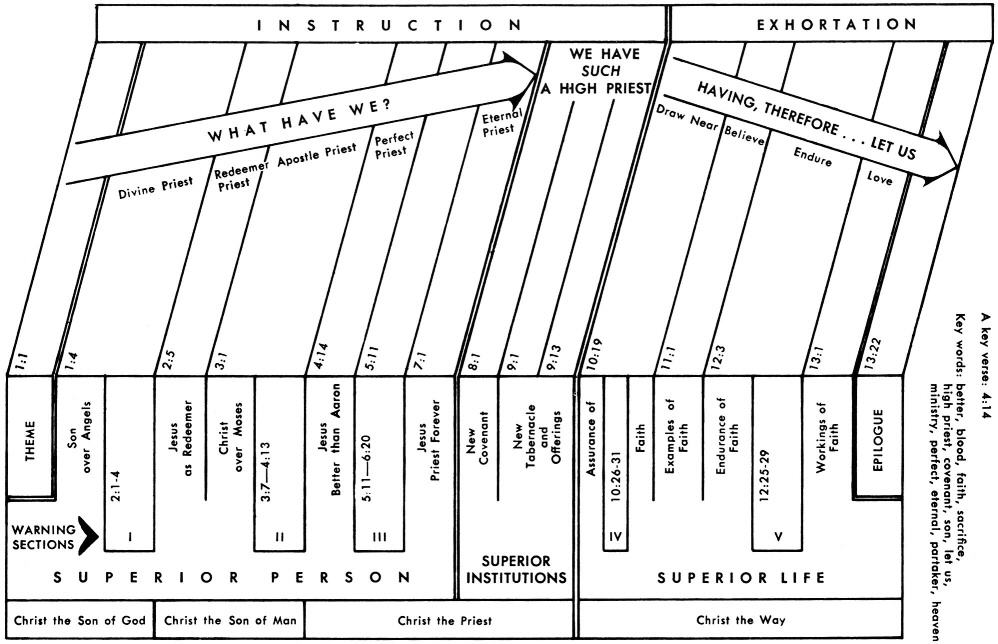
CONSIDER JESUS OUR GREAT HIGH PRIEST
Click chart to enlarge
Charts from Jensen's Survey of the NT - used by permission
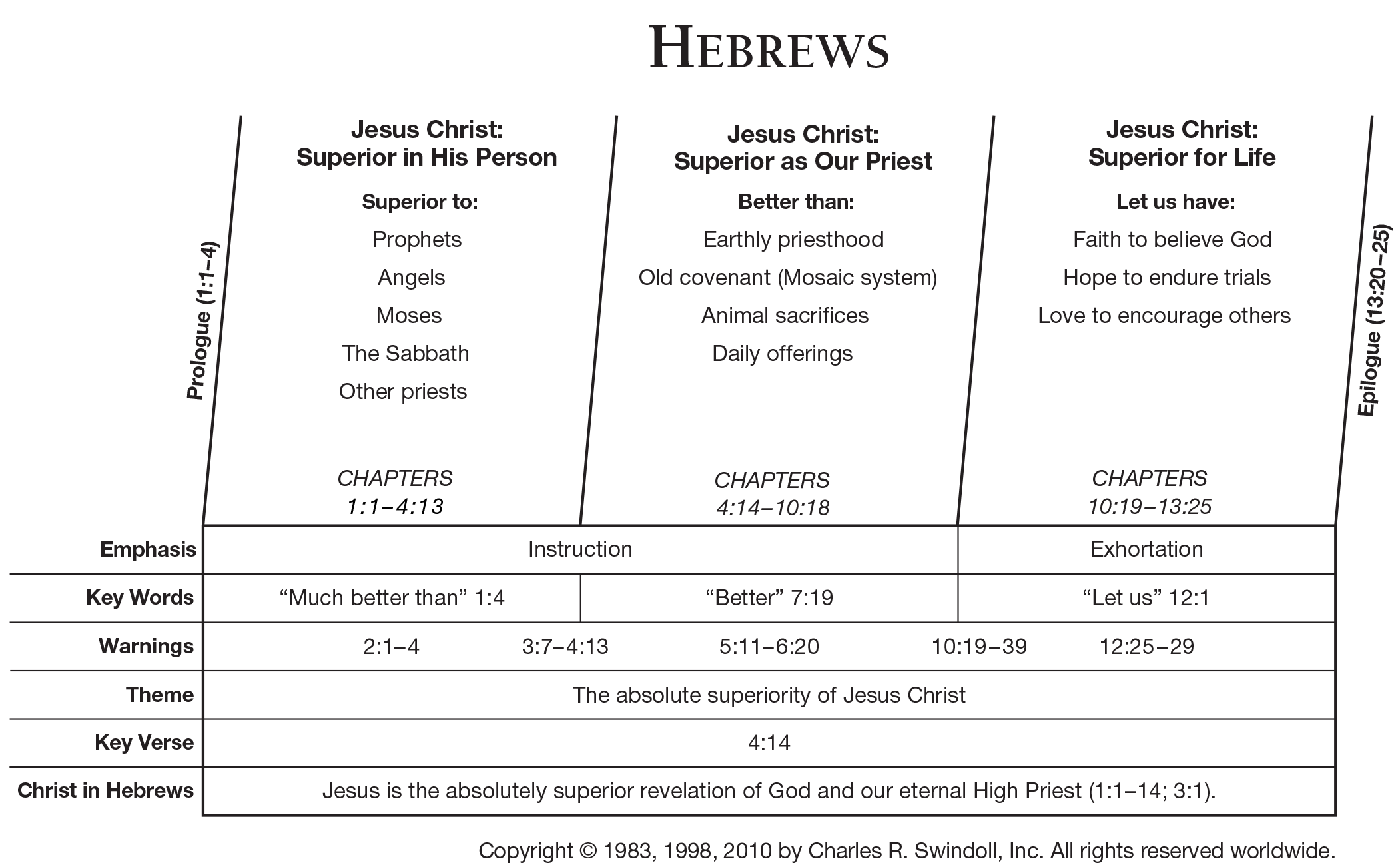
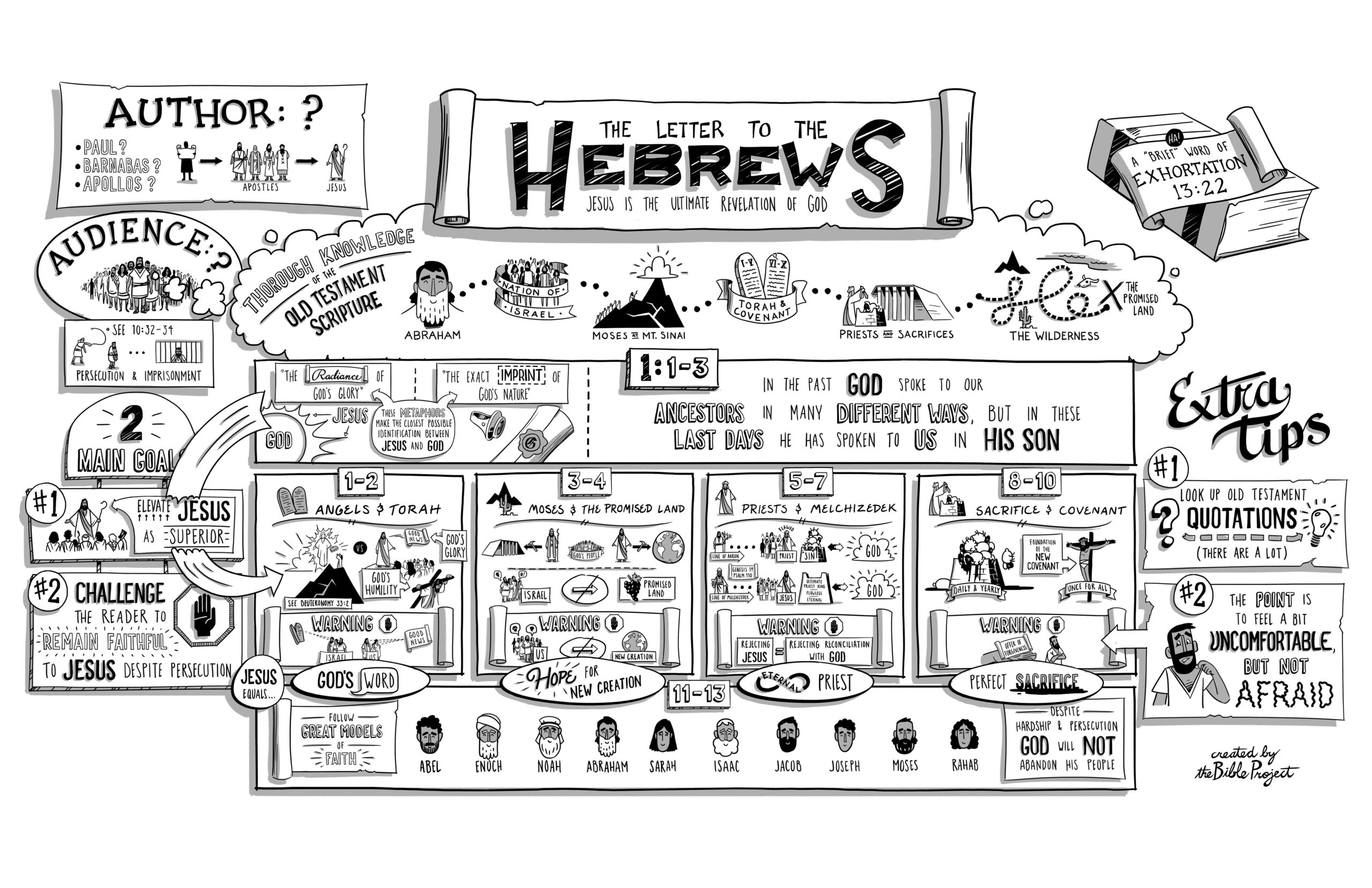
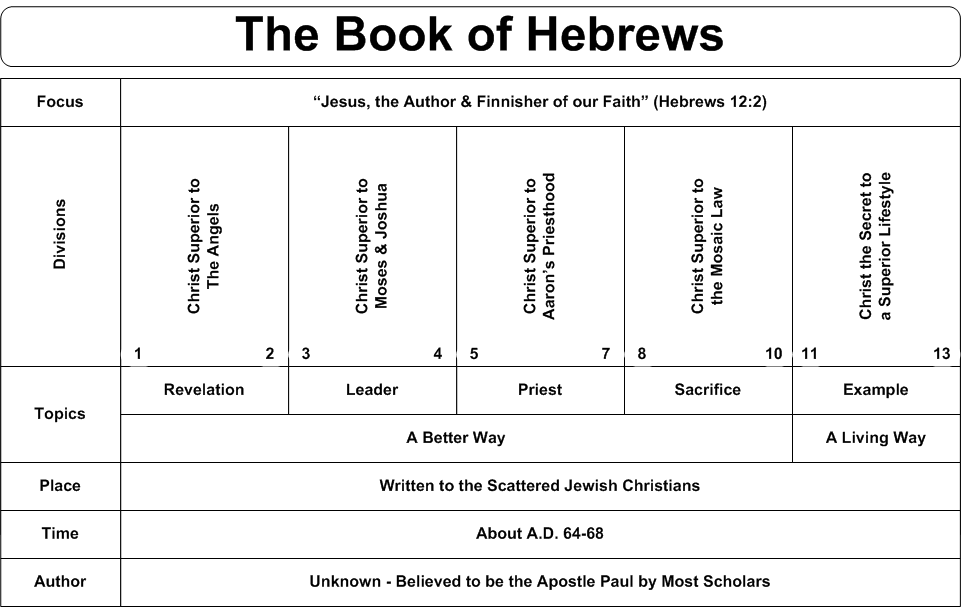
Swindoll's Chart, Interesting Pictorial Chart of Hebrews, Another Chart
|
The Epistle |
||||
| INSTRUCTION Hebrews 1-10:18 |
EXHORTATION Hebrews 10:19-13:25 |
|||
| Superior Person of Christ Hebrews 1:1-4:13 |
Superior Priest in Christ Hebrews 4:14-10:18 |
Superior Life In Christ Hebrews 10:19-13:25 |
||
| BETTER THAN PERSON Hebrews 1:1-4:13 |
BETTER PRIESTHOOD Heb 4:14-7:28 |
BETTER COVENANT Heb 8:1-13 |
BETTER SACRIFICE Heb 9:1-10:18 |
BETTER LIFE |
| MAJESTY OF CHRIST |
MINISTRY OF CHRIST |
MINISTERS FOR CHRIST |
||
|
DOCTRINE |
DUTY |
|||
|
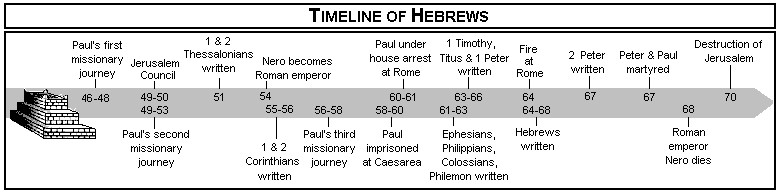
DATE WRITTEN: |
||||

See ESV Study Bible "Introduction to Hebrews"
(See also MacArthur's Introduction to Hebrews)
Borrow Ryrie Study Bible
Hebrews 11:32 And what more shall I say? For time will fail me if I tell of Gideon, Barak, Samson, Jephthah, of David and Samuel and the prophets, (NASB: Lockman)
Greek: Kai ti eti lego? (1SPAS) epileipsei (3SFAI) me gar diegoumenon (PMPMSA) o chronos peri Gedeon, Barak, Samyon, Iephthae, Dauid te kai Samouel kai ton propheton
Amplified: And what shall I say further? For time would fail me to tell of Gideon, Barak, Samson, Jephthah, of David and Samuel and the prophets, (Amplified Bible - Lockman)
KJV: And what shall I more say? for the time would fail me to tell of Gedeon, and of Barak, and of Samson, and of Jephthae; of David also, and Samuel, and of the prophets:
NLT: Well, how much more do I need to say? It would take too long to recount the stories of the faith of Gideon, Barak, Samson, Jephthah, David, Samuel, and all the prophets. (NLT - Tyndale House)
Phillips: And what other examples shall I give? There is simply not time to continue by telling the stories of Gideon, Barak, Samson and Jeptha; of David, Samuel and the prophets. (Phillips: Touchstone)
Wuest: And what shall I say yet? For the time will fail me telling of Gideon, Barak, Samson, Jepthae, and both David and Samuel and the prophets, (Eerdmans Publishing - used by permission)
Young's Literal: And what shall I yet say? for the time will fail me recounting about Gideon, Barak also, and Samson, and Jephthah, David also, and Samuel, and the prophets,
AND WHAT MORE SHALL I SAY? FOR TIME WILL FAIL ME IF I TELL OF GIDEON, BARAK, SAMSON, JEPHTHAH, OF DAVID AND SAMUEL AND THE PROPHETS: Kai ti eti lego; epileipsei me gar diegoumenon o chronos peri Gedeon, Barak, Sampson, Iephthae, Dauid te kai Samouel kai ton propheton:
- Ro 3:5; 4:1; 6:1; 7:7
- Jn 21:25
- 1 Sa 16:1,13; 17:1-18; Acts 2:29-31; 13:22-36
- 1 Sa 1:20; 2:11,18; 3:1-12; 28:3-25; Ps 99:6; Jer 15:1; Acts 3:24; Acts 13:20
- Mt 5:12; Lk 13:28; 16:31; Acts 10:43; Jas 5:10; 1Pe 1:10, 11, 12; 2Pe 1:21; 3:2
WHAT SHALL I SAY?
A FEW MORE FAITHFUL FOLLOWERS
Hughes comments that all of the preceding examples and those in these closing verses are consistent with Hebrews 11:1 noting that "faith is a dynamic certainty made up of two certitudes: a future certitude that makes one sure of the future as if it were present, and a visual certitude that brings the invisible within view. One hears God’s Word and so believes it that its future fulfillment becomes subjectively present and visible to the spiritual eye." (Hebrews: An Anchor for the Soul)
Time will fail me - Why? Because he had so many OT examples of faith that he could have given to encourage his Hebrew readers. In short he was running out of time, not examples of faithful men and women.
Gideon, Barak, Samson, Jephthah- These 4 names come from one of the darkest times of Israel's history, the days of the Judges, which is tragically summed up by the declaration in Judges 21:25.
Gideon by faith defeated the Midianite army with a small band of 300 men. (see Judges 6-8)
By faith Barak with the prodding of Deborah was used by God to defeat the Canaanites. (see Judges 4, 5)
Samson defeated the Philistines several times most notably in his last act of faith in which he himself was killed.
Jephthah defeated the Ammonites with God’s power (see Judges 11, 12)
Related Resources:
- Gideon = Jdg 6:1-8-see commentary
- Barak = Jdg 4:1-5 -see commentary
- Samson = Jdg 13:1-16-see commentary
- Jephthah = Jdg 11:1-40-see commentary; Jdg 12:1-7--see commentary
- Who was Gideon in the Bible? | GotQuestions.org
- What is the story of Deborah and Barak? | GotQuestions.org
- Who was Samson in the Bible? | GotQuestions.org
- What should we learn from the account of Samson and Delilah? | GotQuestions.org
- Who was Jephthah? | GotQuestions.org
- Did Jephthah sacrifice his daughter to the Lord? | GotQuestions.org
Spurgeon on Barak - Look at Barak; after he has once believed in the power of God, he marches to the fight and wins the victory, and is commemorated in soul-stirring words by the poetess, “Wake up, wake up, Deborah! Wake up, wake up, sing a song! Get up, Barak! Take captive your captives, O son of Abinoam” (Jdg 5:12). Mighty to conquer was the man who was timid to fight. When faith gave him courage, it made him triumph. Carry a vial of strong faith along with you, and a good dose of it will drive off fainting fits.
Spurgeon on Samson There are some names in this chapter that we should hardly have expected to see there, the characters mentioned having been so disfigured by serious faults, and flaws, and failings. But the distinguishing feature of faith was there in every instance, especially in the case of Samson. Perhaps there was no more childlike faith in any man than there was in him. Who but a man full of faith would have hurled himself upon a thousand men with no weapon in his hand but the jawbone of a donkey? There was a wondrous confidence in God in that weak, strong man, which, though it does not excuse his faults, yet nevertheless puts him in the ranks of the believers. Happy is the man or woman who believes in God.
William Newell - Right through this great eleventh of Hebrews these men and women of God act in reliance upon Him or His stated Word, wholly apart from their own feelings. Take Gideon (Heb 11:32): Go to the book of Judges and read his record: how he trembled and shrank at the thought of taking a step in leadership of God’s hosts. God met his trembling heart, of course, not only twice in the matter of fleece, but afterwards in the dream his servant was given to hear (Jdg 7:9–15-note). And that trembling heart became strong so that he was able to say to the people of Israel: “Jehovah HATH delivered into your hand the host of Midian.” This is Mark 11:24 again, “a conviction of things not seen.” (Hebrews 11 Commentary)
Steven Cole's sermon…
Faith’s Reward
Hebrews 11:32-40
In 1987, Marla and I went to the Far East, where I spoke to some people who were teaching English in China. We took a side trip to Macao, which had not yet gone back under Chinese rule, to visit some missionary friends. Through an interpreter, we chatted with two brave young Chinese women, who each week risked imprisonment or worse by traveling into China for ministry purposes.
I asked them if they had ever heard of a false teaching that has plagued American churches, called “the health and wealth” gospel. It is the teaching that it is God’s will for His children to be healed of every disease and to be rich. If you lack these things, it is because of your lack of faith. One of the women laughed softly when she heard this, shook her head and said, “No, I don’t think that Chinese Christians would believe that!” Chinese Christians know that following Jesus Christ is more likely the path to hardship and persecution than to health and wealth.
The current The Voice of the Martyrs magazine (Nov., 2004) has an article on a 34-year-old Chinese woman who was arrested in June for distributing Bibles and gospel tracts. The authorities kicked her, tore out some of her hair, and beat her to death. They reported that she died of a “sudden disease.” She joined the company of many of those chronicled in our text.
The author of Hebrews sounds like a preacher with his eye on the clock. He could say far more, if time allowed. But instead, he simply lists a few names without comment and then describes the experiences of others, without naming them. Some won great victories by faith. Others suffered horrible torture and death by faith. While all of them gained approval (or, testimony; our word martyr comes from the Greek word) by their faith, they did not receive the promise that we have received. The author is trying to steel his readers to be faithful to Christ in the face of looming persecution. His message is much needed because of the human tendency to use faith in Christ as the means to personal comfort and happiness. But when trials come, faith is abandoned. His message is that…
Faith trusts God in spite of results, looking to the final reward.
The text falls into three sections. In Heb 11 :32, 33, 34, 35a, he shows how sometimes God blesses those who trust Him with spectacular results. But without even catching his breath, in the middle of Heb 11:35 he shifts direction to show (Heb 11:35, 36, 37, 38) that sometimes God blesses those who trust Him with the grace to endure horrible persecution without wavering. He concludes (Heb 11:39, 40) by showing that God will bless all who trust Him with eternal rewards.
1. Sometimes God blesses those who trust Him with spectacular results (Hebrews 11:32, 33, 34, 35a).
Time would fail me if I went into detail on every person listed here, so I will summarize this section under two points:
A. Faith enables flawed people to accomplish great things for God.
The author (He 11:32 tells us that he was a man, since “me” is qualified by a masculine participle in Greek) lists four men from the period of the Judges, followed by David, Samuel, and the prophets. He does not list them in chronological order, in that Gideon followed Barak, Samson followed Jephthah, and David followed Samuel. No one knows why he chose this order; perhaps he was just rattling off the names spontaneously.
The interesting thing is that the first five men all had some serious shortcomings, but in spite of these flaws, God honored their faith.
Gideon at first was cowardly and had to be coaxed to do what God called him to do. After his amazing victory with 300 men over the Midianite army of 135,000, he made an ephod that lured Israel into idolatry (Judges 8:24, 25, 26, 27). Yet in spite of his failures, the author names him as a hero of faith.
Barak won a great victory for Israel over an army that had 900 chariots, but he only did it at the prodding of a woman, Deborah.
Samson routed the Philistines on numerous occasions, yet he was tripped up by his lust for foreign women.
Jephthah, the son of a harlot, was at first driven away by his half-brothers. But later, the elders of his home town pled with him to return and lead them in battle against the enemy. He won a victory, but then made a rash vow to sacrifice the first thing that came out of his house when he returned from battle. His only daughter came out to greet him, and he foolishly kept his stupid vow.
David was a man after God’s heart (Acts 13:22), who had great faith even as a teenager, when he defeated Goliath. But he later committed adultery and then murder to cover his tracks. Even Samuel, al-though a godly man himself, failed to raise his sons to follow the Lord (1Sa 8:1, 2, 3).
Samuel was regarded as the first of the prophets, and so the term covers everyone from his day down to Malachi.
As a whole, they boldly spoke God’s truth, and often suffered for it. But overall, put the men of Heb 11:32 into a scale and it tips towards those who had glaring flaws. But in spite of these flaws, God used them because they trusted Him in some challenging situations.
We would apply this improperly if we shrugged off our sins and shortcomings as no big deal. We should be confronting our sins, growing in holiness and maturity. But this list should encourage us with the fact that God uses imperfect people who trust in Him. While we should never justify our sins, we don’t have to wait until we are sinlessly perfect (which is never!) to serve the Lord.
This is one of the benefits of reading Christian biographies. If a biography is written well, it does not portray the person as if he or she walked on water. It lets you see the imperfections, immaturity, and blind spots of people who did great things for God because they trusted in Him.
William Carey, “the father of modern missions,” had an illiterate wife who defiantly refused to go to India with him. He was going to go without her, but his departure was delayed by some problems. He and his traveling companion returned to his house, where his companion laid a guilt trip on Carey’s wife. He warned her that if she didn’t accompany them, her family “would be dispersed and divided forever-she would repent it as long as she lived” (Mary Drewery, Wiliam Carey [Zondervan], p. 52). She fearfully went with them, only to be bitterly unhappy and finally to go insane in India. Carey himself was an overly indulgent father who did not correct his children (Ruth Tucker, From Jerusalem to Irian Jaya [Zondervan], p. 119). After seven years of labor in India, he could not claim a single Indian convert (ibid., p. 117). Yet God used William Carey in an extraordinary way in spite of his faults.(Faith's Reward Hebrews 11:32-40)
Hebrews 11:33 who by faith conquered kingdoms, performed acts of righteousness, obtained promises, shut the mouths of lions, (NASB: Lockman)
Greek: oi dia pisteos kategonisanto (3PAMI) basileias, eirgasanto (3PAMI) dikaiosunen, epetuchon (3PAAI) epaggelion, ephraxan (3PAAI) stomata leonton
Amplified: Who by [the help of] faith subdued kingdoms, administered justice, obtained promised blessings, closed the mouths of lions, (Amplified Bible - Lockman)
KJV: Who through faith subdued kingdoms, wrought righteousness, obtained promises, stopped the mouths of lions,
NLT: By faith these people overthrew kingdoms, ruled with justice, and received what God had promised them. They shut the mouths of lions, (NLT - Tyndale House)
Phillips: Through their faith these men conquered kingdoms, ruled in justice and proved the truth of God's promises. They shut the mouths of lions, (Phillips: Touchstone)
Wuest: who through faith overcame kingdoms, wrought righteousness, obtained promises, stopped the mouths of lions, (Eerdmans Publishing - used by permission)
Young's Literal: who through faith did subdue kingdoms, wrought righteousness, obtained promises, stopped mouths of lions,
WHO BY FAITH CONQUERED KINGDOMS, PERFORMED ACTS OF RIGHTEOUSNESS, OBTAINED PROMISES, SHUT THE MOUTHS OF LIONS:
- By faith - Joshua 6:1-13; 2Sa 5:4-25; 8:1-14; Ps 18:32, 33, 34; 44:2, 3, 4, 5, 6; 144:1,2,10
- Performed - He 11:4, 5, 6, 7, 8,17
- Obtained promises - He 6:12-15; 10:36; 2Sa 7:11, 12, 13, 14, 15, 16, 17; Gal 3:16
- Jdg 14:5,6; 1Sa 17:33, 34, 35, 36; Ps 91:13; Da 6:20, 21, 22, 23; 2Ti 4:17; 1Peter 5:8)
By faith (4102)(pistis) speaks of their trust or belief, their conviction that God is Ruler of all things. For more discussion on the meaning of faith see commentary on Hebrews 11:1-2.
Who by faith - The writer now presents a variety of manifestations of faith.
John Owen comments that "These instances are taken from things of all sorts to show that there is nothing of any kind whatever wherein we may be concerned but that faith will be useful and helpful."
A W Pink opens his comments on this verse with a discussion of faith - True faith performs a prominent part in all experimental godliness. Where there is a total absence of the grace of faith, a man is without God and without hope in this world; but where that spiritual principle exists, if only in the very small degree, there has taken place a wondrous and miraculous change. The one who is the subject of it may not, for a time, understand its nature; but instead, make the greatest mistakes about it; nevertheless, that change is no less than one passing from death unto life. “If ye have faith as a grain of mustard-seed” (Matthew 17:20): that little grain has a principle of life in it, and contains in embryo the future plant; so with the implanting of the principle of grace in the heart—it will yet develop into, or rather be consummated in, Glory… No matter what our lot may be—“pleasing or painful”; no matter what station we are called to fill—high or low; no matter how formidable or difficult the obstacles which confront us, “All things are possible to him that believeth” (Mark 9:23). (Exposition of Hebrews)
Spurgeon - All these were men of faith. Others mentioned in Scripture have done something, but God did not accept them. Men have humbled themselves, and yet God has not saved them. Ahab did, and yet his sins were never forgiven. Men have repented, and yet have not been saved, because theirs was the wrong repentance. Judas repented and went and hanged himself, and was not saved. Men have confessed their sins and have not been saved. Saul did it. He said to David, “I have sinned! Come back, David my son” (1Sa 26:21), and yet he went on as he did before. Multitudes have confessed the name of Christ, and have done many marvelous things, and yet they have never been pleasing to God, from this simple reason: they did not have faith. I take the meaning of (conquered kingdoms) to be not a laudation of the acts themselves so much as an honor put upon faith itself by the Holy Spirit. If you read of those who conquered kingdoms, that is not the point: others have conquered kingdoms, but it is “who through faith conquered kingdoms.” If you read of those who escaped the edge of the sword; many have done that, but none are recorded here but those “who by faith escaped the edge of the sword.” “Put to flight enemy battle lines”: many have done that by valor and strength, but to do it by faith—that is the thing. Many have endured flogging and bonds and imprisonment, and have wandered about destitute, afflicted, tormented, but such sufferings are nothing unless they are borne by faith.
Conquered kingdoms (2610) (katagonizomai from kata = against, + agonizomai = to contend for victory in the public games) means to struggle against and by implication to overcome or subdue. The idea is to fight or contend, to enter into a trial of strength, of courage on the field, to prevail in battle. Historical examples would include Joshua's leading Israel to conquer Canaan and David's rulership leading Israel to conquer the surrounding nations.
This was true of Gideon (Jdg 7:1-25) and David (2 Sa 8:1ff.).
A W Pink on performed acts of righteousness reminds us that - right actions must spring from right principles and must be performed with right ends, if they are to be acceptable to God. In other words, they must issue from a living faith and have in view the glory of God. (Exposition of Hebrews)
Spurgeon on performed acts of righteousness - Is that as great an exploit as subduing kingdoms? Yes, that it is. To have, by faith, preserved a holy character, in such a world of temptation as this, is a far grander achievement than to have conquered any number of kingdoms by force of arms.
This was true of Samuel did (1Sa 8:9, 12:3–23, 15:33) and David (2 Sa 8:15).
Charles Simeon comments on by faith…
How diversified its (faith's) operations—There is nothing to which it may not be applied, and nothing for which it will not equally avail. It will alike enable us,
1. To do any thing—by it has “righteousness been wrought,” in its utmost extent. Not only has political righteousness been given for the government of kingdoms, as to Asa, Hezekiah, and Josiah, but moral righteousness, in a degree never produced by any other principle under heaven. Where do we find such characters as those recorded in the Scriptures? Yet it was faith which made them what they were: and faith, in proportion as it exists in the soul, enables every child of God to resemble them. The weakest of the human race shall “out of weakness be made strong;” and prevail, not only over men, but over all the powers of darkness also, if only he rely on the promise of a faithful God. His faith, though it were only small as a grain of mustard-seed, would be abundantly sufficient for all the powers that the occasion called for.
2. To obtain any thing—By it “have promises been obtained;” even such as, according to human expectation, could never have been fulfilled. To Abraham and Sarah was the birth of a son delayed, till there remained not the smallest probability of its accomplishment, nor a possibility, according to the course of nature (cp Ge 18:14). And David’s establishment on the throne of Israel was as unlikely, according to man’s estimate of things, as any event that could be conceived. But never, in any single instance, did a promise, apprehended by faith, fail him who relied upon it (cp Josh 21:45, 23:14, Nu 23:19). Take, then, the promises of God (no matter how great they are, or how small); and only rely on them, and plead them before God in prayer; and sooner shall heaven and earth pass away, than you be disappointed of your hope. “Ye may ask what ye will,” provided only it be contained in a promise, and “it shall assuredly be done unto you.” (Jn 15:7KJV) (Hebrews 11:32-35 Power of Faith)
A W Pink on obtained promises… “Obtained promises,” or secured the blessings promised. God assured Joshua that he should conquer Canaan, Gideon that he should defeat the Midianites, David that he should be king over all Israel. But outwardly, tremendous difficulties stood in the way of the accomplishment of those things, yea, apparent impossibilities prevented them. Gideon was put upon a great improbability when he was commanded to take but three hundred men, fall upon and destroy an immense host. David and his little company seemed to be no match for the armed forces of Saul, and after his death, for years the throne seemed as far away as ever. But where there is a real trust in the living God the most formidable difficulties may be overcome.“Obtained promises.” Ah, it is one thing to hear and read about the wonderful things which the faith of others secures, but what about your own experience, dear reader? You may sincerely think that you believe in and are resting upon the sure promises of God, but are you obtaining a fulfillment of them in your own daily life? Are the blessings set forth in the promises actually in your possession? Are you securing the things promised? If not, is the reason to be found in your failure to heed what here precedes? Before “obtained promises” comes “subdued kingdoms” and then “wrought righteousness.” We must not expect to “obtain” the precious things set before us in the promises until we definitely and diligently set about the subjugation of the flesh, and walk according to the rules of God’s Word—regulating our conduct by its precepts and commands. (Exposition of Hebrews)
Spurgeon on obtained promises - THE promises of God are to the believer an inexhaustible mine of wealth. Happy is it for him if he knows how to search out their secret veins and enrich himself with their hidden treasures. They are to him an armory containing all manner of offensive and defensive weapons. Blessed is he who has learned to enter into the sacred arsenal, to put on the breastplate and the helmet, and to lay his hand to the spear and to the sword.
Obtained promises - As discussed earlier in this letter...
And we desire that each one of you show the same diligence so as to realize the full assurance of hope until the end, so that you will not be sluggish, but imitators of those who through faith and patience inherit the promises. 13 For when God made the promise to Abraham, since He could swear by no one greater, He swore by Himself, 14 saying, “I WILL SURELY BLESS YOU AND I WILL SURELY MULTIPLY YOU.” 15 And so, having patiently waited, he obtained the promise. (He 6:11-15-note)
Morris on obtained promises - Many of the elders won great victories, and received the fulfillment of many divine promises (e.g., Daniel), while others “received not the promises” (Hebrews 11:39) even though they also had great faith. Perhaps it takes even greater faith to stand true to God when the heavens seem silent to our prayers than when He is answering in great victories. (Defender's Study Bible)
Shut the mouths of lions - This is a clear reference to the prophet Daniel in the lion's den because of failing to obey a pagan order not to pray to God. This was true of Daniel (Dan. 6:22), Samson (Jdg. 14:6) and David (1 Sa 17:34–37)
Daniel records the story in chapter 6…
And when he (King Darius) had come near the den to Daniel, he cried out with a troubled voice. The king spoke and said to Daniel, "Daniel, servant of the living God, has your God, whom you constantly serve, been able to deliver you from the lions?" 21 Then Daniel spoke to the king, "O king, live forever! 22 "My God sent His angel and shut the lions' mouths, and they have not harmed me, inasmuch as I was found innocent before Him; and also toward you, O king, I have committed no crime." 23 Then the king was very pleased and gave orders for Daniel to be taken up out of the den. So Daniel was taken up out of the den, and no injury whatever was found on him, because he had trusted in his God. (Da 6:20, 21, 22, 23-see notes)
Spurgeon said "Remember Daniel in the lions’ den, and then ask yourself, “What is there that faith cannot do?”
How might this apply to believers today who are unlikely to be thrown into a literal lion's den? While a literal lion was Daniel's enemy, a figurative lion is our relentless ferocious foe, the Devil himself (and his minions) who ever seeks to "kill and destroy" our faith and our testimony for Jesus Christ. Peter writes that in order to "shut the mouth" of this roaring lion we must…
Be of sober spirit, be on the alert. (Both of these commands are aorist imperative = Do this now! Don't delay! Conveys a sense of urgency!) Your adversary, the devil (diabolos), prowls about like a roaring lion, (cp 2Ti 4:17, 18-note) seeking someone to devour. But resist (also aorist imperative) him, firm in your faith, knowing that the same experiences of suffering are being accomplished by your brethren who are in the world. (1Pe 5:8-note, 1Pe 5:9-note)
Related Resources:
- See Commentary on Joshua 14:6ff - Caleb Obtaining God's Promise
- See Commentary on Joshua 21:45 - Not one of the good promises which the LORD had made to the house of Israel failed; all came to pass.
Steven Cole adds that a Hebrews 11:1 quality of faith…
enables us to accomplish things that are explainable only by God’s power. By faith, the men listed and others who go unnamed,
“conquered kingdoms, performed acts of righteousness, obtained promises, shut the mouths of lions, quenched the power of fire, escaped the edge of the sword, from weakness were made strong, became mighty in war, put foreign armies to flight. Women received back their dead by resurrection…” (He 11:33, 34, 35a)
The only “routine” things on the list are “performed acts of righteousness” (NIV = “administered justice”) and “obtained promises” (depending on what those promises are). The rest of the list includes things that are quite impressive, if not totally miraculous.
But one thing on the list is common to everything accomplished by faith: “from weakness were made strong.” Faith requires recognizing our weakness, but at the same time, laying hold of God’s strength. As Jesus said (Jn 15:5), “… apart from Me you can do nothing.” The apostle Paul, who on the surface seems to be a competent, powerful man, confessed (2Co 3:5), “Not that we are adequate in ourselves to consider anything as coming from our-selves, but our adequacy is from God.” He further explained (2Cor. 4:7), “But we have this treasure in earthen vessels, so that the surpassing greatness of the power will be of God and not from ourselves.” That is why he taught that the Christian must walk by the Spirit, Who produces His fruit in our lives (Gal. 5:16, Gal 5:22, 23).
Every Christian who has accomplished great things for God has known this truth as the very foundation of what they did. Robert Morrison, a pioneer missionary to China (we saw his grave in Macao), was asked, “Do you really expect to make an impact on that great land?” He replied, “No sir, but I expect God to” (source unknown). George Muller’s biographer wrote of him, “Nothing is more marked in George Muller, to the very day of his death, than this, that he so looked to God and leaned on God that he felt him-self to be nothing, and God everything” (A. T. Pierson, George Muller of Bristol [Revell], p. 112). Hudson Taylor, the great missionary to inland China, said, “All God’s giants have been weak men who did great things for God because they reckoned on God being with them” (source unknown).
William Carey was a cobbler by trade. Most churchmen in his day believed that the Great Commission had been given only to the apostles, and thus they had no vision for “converting the heathen.” But Carey came to the revolutionary idea that foreign missions were the central responsibility of the church. He wrote a book promoting that thesis, and he spoke to a group of ministers, challenging them to the task of missions. In that talk, he made the now-famous statement, “Expect great things from God; attempt great things for God” (Tucker, p. 115).
The mission he established in India was plagued by huge problems, not the least of which was an associate who mismanaged mission funds and made many enemies because of unpaid debts. As mentioned, Carey had major family problems. Yet during his years in India, he translated the Bible into three languages, supervised and edited translations into 36 languages, produced a massive Bengali-English dictionary, pioneered social reform, planted churches, engaged in medical relief, founded the Agricultural and Horticultural Society of India, founded a college and other schools, and served as professor of Sanskrit, Bengali, and Marathi (J. D. Douglas, ed., The New International Dictionary of the Christian Church [Zondervan], p. 192)! He was a weak cobbler made strong through faith in a mighty God.
What are you trusting God for right now that is beyond your comfort zone or human ability? Are you praying for God to do anything that, if He did it, there could be no human explanation for it?
Faith always involves the risk of putting yourself into a situation where, if God does not come through, you will fail miserably. This is not to imply that we should be sloppy about preparation or planning. There is nothing spiritual about spontaneity. But it is to say that after all of our plans and preparation, we should be praying, “God, if You don’t work, this whole thing is going to be a colossal failure!” Like Peter stepping out of the boat onto the water, we should be very much aware that if He doesn’t hold us up, we’re going to drown! Pray with me that God would accomplish things through this church that can only be explained because He did it.
Before you launch out on something grandiose, like reaching the Arab world for Christ, start on the personal level. These heroes conquered kingdoms by faith-have you conquered your anger or lust by God’s power? These heroes “performed acts of righteousness,” or “administered justice” by faith. Have you applied your faith to your daily job or routine, so that you reflect God’s righteousness by your integrity and honesty? These heroes “obtained promises” by faith. Do you claim God’s promises for the problems that you face in your personal and family life?
So the first part of the list teaches us that sometimes God blesses those who trust Him with spectacular results. Even though they are flawed people, God uses those who trust Him to accomplish things that are explainable only by His power. (Faith's Reward (Hebrews 11:32-40)
F B Meyer THE ROLL OF FAITH
FAITH IS the link between our souls and God. It is the capacity of entering into fellowship with the Eternal Love and Power, so that we are able to do all things with the sense that it is not we who do them, but God in us and with us. Faith is the open door and window towards God. In faith our heart goes out towards God in clinging dependence, and God comes in to strengthen us with His Divine fullness.
In human life, when we trust a man, we draw from him all that he is able to supply; in the Divine life, faith draws upon the resources of God, so that they flow freely into our nature, and the results of our life-work are immensely increased. Faith is possible amid a great deal of ignorance. It is clear that Gideon, Barak, Samson, and Jephthah were ignorant of the truth which the Gospel has revealed, and yet we learn that their work was largely due to their faith. Dispensations come and go; the revelation of God grows from less to more; but the attitude of faith is always the same--in the simple woman that touched the hem of Christ's garment, as in St. John the beloved disciple, who had years of training in Christ's School.
Faith achieves very different results. In some, it produces the heroic strength that turns the battle from the gate; in some, the passive suffering that endures the long ordeal of pain. Here, it turns the edge of the sword; there, shuts the mouths of lions. We know how electric force may be applied to all the various machinery of human life. In one place used for the beaming light, in another to drive the motor car, or to flash the message of music and speech from one continent to another. So Faith is able to appropriate God's might for any purpose that lies within the compass of the life-task, whether active or passive. (See Heb. 11:32, 33, 34, 35, 36, 37, 38, 39.)
God bears a witness to all who trust Him. He never fails us in the hour of need. His response is the echo of our appeal. As soon as the uplifted arm of the tramcar touches the overhead wire, there is the spark, and the immediate entrance of electric power. So God answers faith.
PRAYER - O God, we are full of need, but we have learnt that Thou givest power to the faint and to those that have no right. Change our weakness into Thy strength; our ignorance into Thy wisdom; our changefulness into Thine everlasting constancy. AMEN. (F. B. Meyer. Our Daily Walk)
Hebrews 11:34 quenched the power of fire, escaped the edge of the sword, from weakness were made strong, became mighty in war, put foreign armies to flight. (NASB: Lockman)
Greek: esbesan (3PAAI) dunamin puros, ephugon (3PAAI) stomata machaires, edunamothesan (3PAPI) apo astheneias, egenethesan (3PAPI) ischuroi en polemo, parembolas eklinan (3PAAI) allotrion;
Amplified: Extinguished the power of raging fire, escaped the devourings of the sword, out of frailty and weakness won strength and became stalwart, even mighty and resistless in battle, routing alien hosts. (Amplified Bible - Lockman)
KJV: Quenched the violence of fire, escaped the edge of the sword, out of weakness were made strong, waxed valiant in fight, turned to flight the armies of the aliens.
NLT: quenched the flames of fire, and escaped death by the edge of the sword. Their weakness was turned to strength. They became strong in battle and put whole armies to flight. (NLT - Tyndale House)
Phillips: they quenched the furious blaze of fire, they escaped from death itself. From being weaklings they became strong men and mighty warriors; they routed whole armies of foreigners. (Phillips: Touchstone)
Wuest: quenched the power of fire, escaped the edge of the sword, from weakness were made strong, became mighty in war, turned to flight armies of aliens. (Eerdmans Publishing - used by permission)
Young's Literal: quenched the power of fire, escaped the mouth of the sword, were made powerful out of infirmities, became strong in battle, caused to give way camps of the aliens.
QUENCHED THE POWER OF FIRE: esbesan (3PAAI) dunamin puros:
- Ps 66:12; Isa 43:2; Da 3:19, 20, 21, 22, 13, 24, 25, 26, 27, 28; 1Pe 4:12
Quenched (4570)(sbennumi [word study]) means to quench, put out or extinguish referring to a light or a fire. Metaphorically, sbennumi speaks of ceasing, thwarting or blocking an activity.
Shadrach, Meshach and Abednego are the obvious examples of this manifestation of faith, Daniel recording…
Then Nebuchadnezzar was filled with wrath, and his facial expression was altered toward Shadrach, Meshach and Abed-nego. He answered by giving orders to heat the furnace seven times more than it was usually heated. 20 And he commanded certain valiant warriors who were in his army to tie up Shadrach, Meshach and Abed-nego, in order to cast them into the furnace of blazing fire. 21 Then these men were tied up in their trousers, their coats, their caps and their other clothes, and were cast into the midst of the furnace of blazing fire. (See notes on Daniel 3:19, 20, 21)
While the writer doubtless refers to quenching the power of literal fire, there is a metaphorical application to all believers, Paul exhorting us…
in addition to all, taking up the shield of faith with which you will be able to extinguish (quench) all the flaming missiles of the evil one. (Ep 6:16-note)
The psalmist records the faithfulness of God in the fire…
You made men ride over our heads; We went through fire and through water, Yet You brought us out into a place of abundance. (Ps 66:12)
Through Isaiah God promised…
When you pass through the waters, I will be with you; and through the rivers, they will not overflow you. When you walk through the fire, you will not be scorched, nor will the flame burn you. (Isaiah 43:2)
John Henry Jowett comments: WHEN Mrs. Booth, the mother of the Salvation Army, was dying, she quietly said, “The waters are rising but I am not sinking.” But then she had been saying that all through her life. Other floods besides the waters of death had gathered about her soul. Often had the floods been out and the roads were deep in affliction. But she had never sunk! The good Lord made her buoyant, and she rode upon the storm! This, then, is the promise of the Lord, not that the waters of trouble shall never gather about the believer, but that he shall never be overwhelmed. He shall “keep his head above them.” Yes, to him shall be given the grace of “aboveness.” He shall never be under, always above! It is the precious gift of spiritual buoyancy, sanctified good spirits, the power of the Christian hope. When we are in Christ Jesus circumstances shall never be our master. One is our Master, and “we are more than conquerors in Him that loved us, and washed us from our sins in His own blood.”
Oswald Chambers: The waters are real, and the fire is real, but (Isaiah) claims that the relationship to God holds.
Spurgeon: There are certain trials that would rapidly overwhelm our faith and consume us if we did not have a secret source of divine, omnipotent strength. If it were not true that the Lord sits enthroned at the flood and as King forever (Ps. 29:10), the rivers would long ago have overwhelmed us. If it were not that He makes the flaming fire His messenger and the burning heat His servant, we would be utterly consumed (Is. 43:2). You may expect that between here and heaven, if you have not met with it yet, you will have enough trouble to destroy you unless the Lord is your Helper. Most of us can sing with the psalmist, “If it had not been the Lord who was on our side … then the waters would have overwhelmed us, the stream would have gone over our soul” (Ps. 124:1, 4).
Believer, you will pass through the fire. But the Lord says that “when you walk through the fire, you shall not be burned, nor shall the flame scorch you” (Is. 43:2). This verse implies that your march through the flames will be quiet, calm, and safe. There is no need to increase your usual pace. If I had to go through literal fire, I would want to run and leap, but spiritually we are to walk through the fire.
There is a beautiful passage in the Psalter, “Yea, though I walk through the valley of the shadow of death, I will fear no evil” (Ps. 23:4). Walking is our pace, “whoever believes will not act hastily” (Is. 28:16) but will walk even through the fire.
What a blessing that “in all these things we are more than conquerors through Him who loved us. For I am persuaded that neither death nor life, nor angels nor principalities nor powers, nor things present nor things to come, nor height nor depth, nor any other created thing, shall be able to separate us from the love of God which is in Christ Jesus our Lord” (Rom. 8:37, 38, 39). Therefore, no trouble or trial can prevent our progress toward heaven. Through divine grace we will walk through the fire.
Jesus Christ is with you in every pang that rips your heart and in every pain that tears your body. Do you feel the sorrows of poverty? Jesus said, “Foxes have holes and birds of the air have nests, but the Son of Man has nowhere to lay His head” (Matt. 8:20). Are you sorrowing? “Jesus wept” at Lazarus’ tomb (John 11:35). Have you been slandered and hurt? He said, “Reproach has broken My heart, and I am full of heaviness” (Ps. 69:20). Have you been betrayed? Remember, He had a friend who sold Him for the price of a slave (Matt. 26:15). Every stormy sea that has tossed you has roared around His boat too. There is no adversity so dark, so deep, or so apparently pathless that you cannot discover the Crucified One’s footsteps when you kneel. In the fires, in the rivers, in the cold night, and under the burning sun He cries:
Fear not I am with you, O be not dismayed,
For I am your God, I will still give you aid:
I’ll strengthen you, help you, and cause you to stand,
Upheld by My gracious, omnipotent hand.When through the deep waters I call you to go,
The rivers of sorrow will not overflow,
For I will be with you, your trials to bless,
And sanctify to you your deepest distress.When through fiery trials your pathway shall lie,
My grace all-sufficient shall be your supply
The flames shall not hurt you, I only design
Your dross to consume and your gold to refine.
Oh, the wonderful security of the heaven-born and heaven-bound pilgrim! Floods cannot drown him, nor fires burn him. Thy presence, O Lord, is the protection of thy saints from the varied perils of the road. Behold, in faith I commit myself unto thee, and my spirit enters into rest. (Above from various of Spurgeon's works)
ESCAPED THE EDGE OF THE SWORD: ephugon (3PAAI) stomata machaires:
- 1Sa 20:1; 2Sa 21:16,17; 1Ki 19:3; 2Ki 6:16, 17, 18,32; Job 5:20; Ps 144:10; Jer 26:24
Escaped the edge of the sword - Not by one's cunning but by one's faith. The believer is immortal until God says it's time to come home! In the meantime we operate in the sphere of faith. For example - Jephthah (Judges 12:3); and so David escaped Saul's sword (1Sam 18:11; 1Sam 19:10, 12); Elijah (1Ki 19:1, &c. 2Ki 6:14).
Escaped (5343)(pheugo) means to flee away in the sense of to take to flight in order to seek safety.
David escaped the edge of the sword of Saul - "Then David fled from Naioth in Ramah, and came and said to Jonathan, "What have I done? What is my iniquity? And what is my sin before your father, that he is seeking my life?" (1Samuel 20:1)
And in another episode of David's life - Then Ishbi-benob, who was among the descendants of the giant, the weight of whose spear was three hundred shekels of bronze in weight, was girded with a new sword, and he intended to kill David. 17 But Abishai the son of Zeruiah helped him, and struck the Philistine and killed him. Then the men of David swore to him, saying, "You shall not go out again with us to battle, so that you do not extinguish the lamp of Israel." (2Samuel 21:16, 17)
FROM WEAKNESS WERE MADE STRONG: edunamothesan (3PAPI) apo astheneias:
- Jdg 7:19-25; 8:4-10; 15:14-20; 16:19-30; 2 Ki 20:7, 8, 9, 10, 11; Job 42:10; Ps 6:8; 2 Co 12:9-note; 2 Co 12:10-note
THE BEAUTIFUL PARADOX OF
GOD'S STRENGTH IN OUR WEAKNESS
Spurgeon - Do you notice how, every now and then, there is the mention of a feat that seems altogether beyond you, but then there follows one in which you can be a partaker with these heroes and heroines of faith? It may be that you have never “extinguished the effectiveness of fire,” yet, often enough, it has been true of you that, by faith, “out of weakness” you have been “made strong.” They were quite as weak as the weakest of us, but by their faith they laid hold of heavenly strength until they could do all things. There was nothing in the range of possibility, or, I might say, nothing within the lines of impossibility, that they could not have performed. They achieved everything that was necessary in the form of service, and they bore up gloriously under the most fearful pressure of suffering, simply and only by faith in God, who became their Helper. You and I may be very weak at this time, but we can be made strong out of just such weakness.
Hezekiah is a good example of this (2 Kings 20:5, 6;Isa 37:1-38:22) ( Who was Hezekiah in the Bible? | GotQuestions.org); Samson (Judges 16:28; Judges 15:19).
Weakness (769)(astheneia from a = without + sthénos = strength, bodily vigor) means literally without strength or bodily vigor = want of strength = lacking strength. Literally astheneia refers to bodily diseases or ailments (Lk 5:15, 13:11, 12, Jn 5:5, 11:4, 28:9). Another meaning of astheneia is incapacity to do or experience something, an inability to produce results, a state of weakness or limitation (1Co 15:43; 2Co 11:30; 12:5, 9, 10, 13:4; Ro 8:27; Heb 4:15; 5:2; 7:28; 11:34) Paul's use in 1Co 2:3 conveys the sense of weakness in terms of courage.
Richards - This group of words expresses powerlessness. The weak are without strength, incapacitated in some serious way. (Expository Dictionary)
Milton says of the martyrs, "They shook the powers of darkness with the irresistible power of weakness."
Made strong (1412) (dunamoo see also word study on related word endunamoo; words of the stem dunamai all have the basic sense of ability or capability) means to be enabled and speaks of an inherent power which gives one the ability to do something. This verb is in the passive voice which means that the strengthening comes from outside source (God) Note the principle clearly implied is that when we are weak (in our self, our strength, our puny efforts) then we are strong (in His endless source of strength), specifically in spiritual matters.
Weakness… made strong - The paradox of the Christian life, the truth which the natural man (who lacks a living, saving faith) cannot comprehend (1Cor 2:14), for such spiritual truth can only be comprehended and apprehended by faith in His Word of Truth. As Paul wrote…
And He (Jesus after Paul had entreated 3 times to take away his "thorn" - read context = 2Co 12:1, 2, 3, 4, 5, 6, 7, 8) has said to me, "My grace is sufficient for you, for power is perfected in weakness." Most gladly, therefore, I will rather boast about my weaknesses, that the power of Christ may dwell in me. Therefore I am well content with weaknesses, with insults, with distresses, with persecutions, with difficulties, for Christ's sake; for when I am weak, then I am strong. (2Co 12:9-note; 2Co 12:10-note)
Spurgeon in his sermon The Best Strengthening Medicine writes…
THOSE who out of weakness were made strong are written among the heroes of faith, and are by no means the least of them. Believers “quenched the violence of fire, escaped the edge of the sword, out of weakness were made strong.” Who shall tell which of the three grand deeds of faith is the greatest? Many of us may never have to brave the fiery stake, nor to bow our necks upon the block, to die as Paul did; but if we have grace enough to be out of weakness made strong, we shall not be left out of the roll of the nobles of faith, and God’s name shall not fail to be glorified in our persons.
Brethren, as believers in the Lord Jesus, we are called to two things, namely, to do and to suffer for his name’s sake. Certain saints are summoned to active marching duty, and others are ordered to keep watch on the walls. There are warriors on the field of conflict, and sentries in the box of patience.
Both in doing and in suffering, if we are earnest and observant, we soon discover our own weakness. “Weakness” is all we possess. “Weakness” meets us everywhere. If we have to work for the Lord, we are soon compelled to cry, “Who is sufficient for these things?” and if we are called to suffer for him, our weakness, in the case of most of us, is even greater: many who can labor without weariness cannot suffer without impatience. Men are seldom equally skilled in the use of the two hands of doing and bearing. Patience is a grace which is rarer and harder to come at than activity and zeal. It is one of the choicest fruits of the Spirit, and is seldom found on newly-planted trees. The fact soon comes home to us that we are weak where we most of all desire to be strong.
Our longing is to be able both to do and to suffer for our Lord, and to do this we must have strength from above, and that strength can only come to us through faith. I have read you this glorious eleventh of Hebrews, which describes the mighty men of faith, the men of renown. They accomplished all their feats by a power which was not in them by nature. They were not naturally strong either to do or to suffer. If they had been, they would not have required faith in God; but being men of like passions with ourselves, they needed to trust in the Lord, and they did so. They were quite as weak as the weakest of us; but by their faith they laid hold on heavenly strength until they could do all things. There was nothing in the range of possibility, or, I might say, nothing within the lines of impossibility, which they could not have performed. They achieved everything that was necessary in the form of service, and they bore up gloriously under the most fearful pressure of suffering, simply and only by faith in God, who became their Helper. You and I may be very weak at this time, but we can be made strong out of just such weakness. We need not wish to have any strength of our own, for by faith we can reach to any degree of power in the Lord. We can have all imaginable strength for the grandest achievements desirable, if we have faith in God. Upon this simple but most practical matter I am going to speak to you at this time. We all wish to be strong. Medicines, embrocations, foods, baths, and all sorts of inventions are advertised as means of increasing strength. We are all in heavenly things so weak, that the idea of being made strong should be very attractive to us. Let us learn, then, how others “out of weakness were made strong,” and let us follow on to enjoy their privilege by copying their conduct. Let me ask you to note, first, faith makes men strong for holy doing; and, secondly, faith makes men strong for patient suffering. We shall go over the ground which I marked out in my introduction…
Dear friend, would you like to do something great for God? Have you heard the motto of our early missionaries,
“Attempt great things for God”?
Does that thought burn within your heart? Do you long to be of some great use? “Oh, yes,” says one, “I would attempt great things for God, but I am terribly weak.” Make the attempt by faith in God, for it is written about people “who through faith subdued kingdoms, worked righteousness, obtained promises, stopped the mouths of lions, quenched the violence of fire, escaped the edge of the sword, out of weakness were made strong, became valiant in battle, turned to flight the armies of the aliens” (Heb. 11:33, 34). If you feel incapable, throw yourself on the infinite capacity of God. As long as you are willing to be used, as long as God has given you a concern and a labor of spirit for the souls of others, you need not fear. You may by faith get to work in all your feebleness, for “as your days so shall your strength be” (Dt 33:25). Has not the Lord said to you, “My grace is sufficient for you, for My strength is made perfect in weakness” (2Cor. 12:9-note)? Is not this word true? (Read the full sermon on Hebrews 11:34 - The Best Strengthening Medicine) (See Spurgeon's related sermon on Hebrews 11:34 God's Cure For Man's Weakness)
BECAME MIGHTY IN WAR: egenethesan (3PAPI) ischuroi en polemo:
On the victories of faith!
When faith takes to working,
how mightily she works.
Spurgeon
Spurgeon asks "Is this also a feat of faith? Yes; instead of showing their faith by putting their enemies to flight, they prove it by enduring all manner of tortures without shrinking." It is well to be humble; it is never well to be weakly fearful. Some are always afraid. They dare not try this, and dare not try that, and if they happen to be placed in office where they can influence others by their counsels, they are shockingly bad officers, because they are always keeping the church back from Victory by a fear of defeat.
Barak manifested this (Jdg. 4:14, 15)
Became - The divine passive - His power to His children. What "war" are you involved in? Don't ever lose sight of the truth that believers, children of light, are always in a spiritual war against the dark forces of the world, the flesh and the devil. In spiritual warfare ignorance is not bliss but disaster!
Mighty (2478)(ischuros from ischuo = to be able) is an adjective which means strong, powerful, mighty (usually referring to inherent physical strength), able, forcible. Strong, having moral power. Inherently strong. Ischuros denotes power or ability and places “stress on the actual power that one possesses rather than on the mere principle of power.
PUT FOREIGN ARMIES TO FLIGHT: parembolas eklinan (3PAAI) allotrion:
- 1Sa 14:13-15; 17:51,52; 2Sa 8:1-18; 2Chr 14:11-14; 16:1-9; 20:6-25; 2Chr 32:20-22
Spurgeon asks "Do you notice how, every now and then, there is the mention of a feat which seems altogether beyond you; but then there follows one, in which you can be a partaker with these heroes and heroines of faith? It may be that you have never “quenched the violence of fire;” yet, often enough, it has been true of you that, by faith, “out of weakness” you have been “made strong.”
Charles Simeon asks "Who would imagine that faith should ever possess such powers as are here ascribed to it? Who would suppose that by it men should “put to flight mighty armies,” and “subdue whole kingdoms?” Yet this has been done, and done by faith also: for all the kingdoms of Canaan were subdued by Joshua’s faith; as were the surrounding kingdoms of Moab, and Syria, and Edom, with many others, by the faith of David. And who would think that this principle should prevail to shut the mouths of lions; yes, and to quench the violence of fire, so that a furnace heated to the utmost extent of man’s ability, should not be able to singe a hair of a person’s head? Yet was the former of these done by the faith of Daniel; as was the latter, by the faith of his three companions, Shadrach, Meshech, and Abed-nego. Even to the raising of the dead has this availed: for, through the exercise of it, Elijah raised the son of the widow of Zarephath, and Elisha the son of the Shunamitish woman. Now of these things I say, they are utterly incredible: and, in declaring them, I seem to demand an assent that is perfectly unreasonable. For, how should it be that such a hidden principle of the mind should ever enable a man to work such miracles as these? Verily, the whole account seems to be nothing but “a cunningly-devised fable,” that yet can impose on none who give to it one moment’s consideration. But it is true, and the very truth of God. Nor will it appear incredible, if we duly consider the way in which it operates. It is God himself who engages to do the thing: and faith calls into action his Almighty arm (and with him all things are possible). So that, inasmuch as faith, insures his effectual aid, it may be truly said, that “all things are possible to him that believeth.” (Hebrews 11:32-35 Power of Faith)
J D Douglas - There is no reason why this may not refer to the heroic deeds of the Maccabees as they are recorded in the books that bear their name. (What happened in the Maccabean Revolt? | GotQuestions.org)