
"Jeremiah Lamenting the Destruction of Jerusalem"
(Rembrandt)
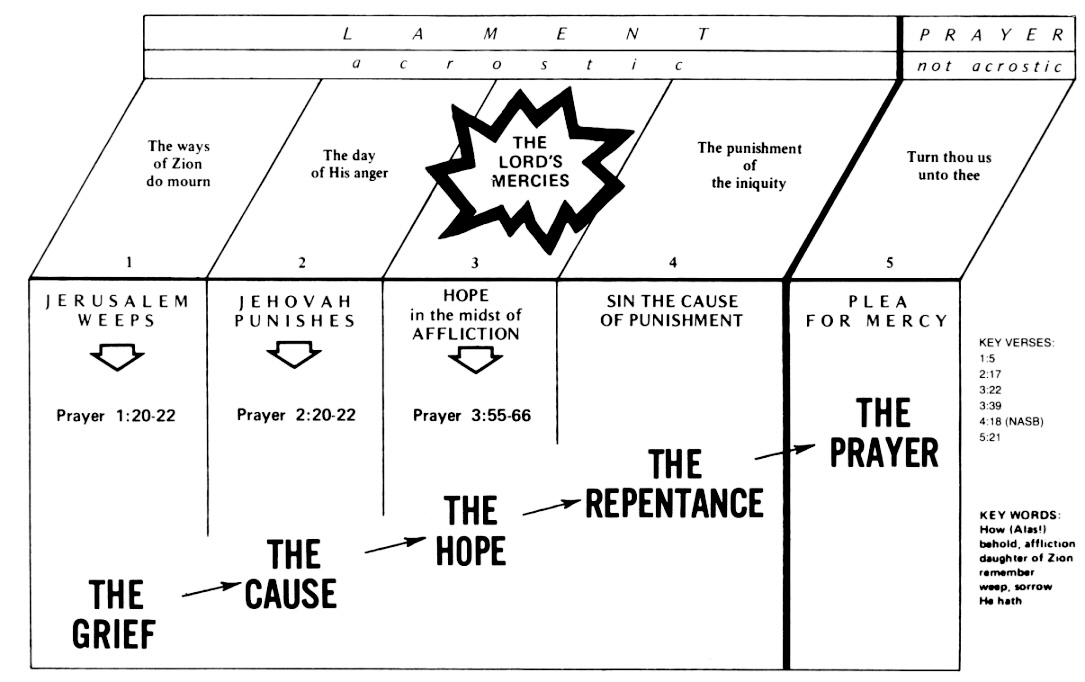
Click chart to enlarge
Charts from recommended resource Jensen's Survey of the OT - used by permission
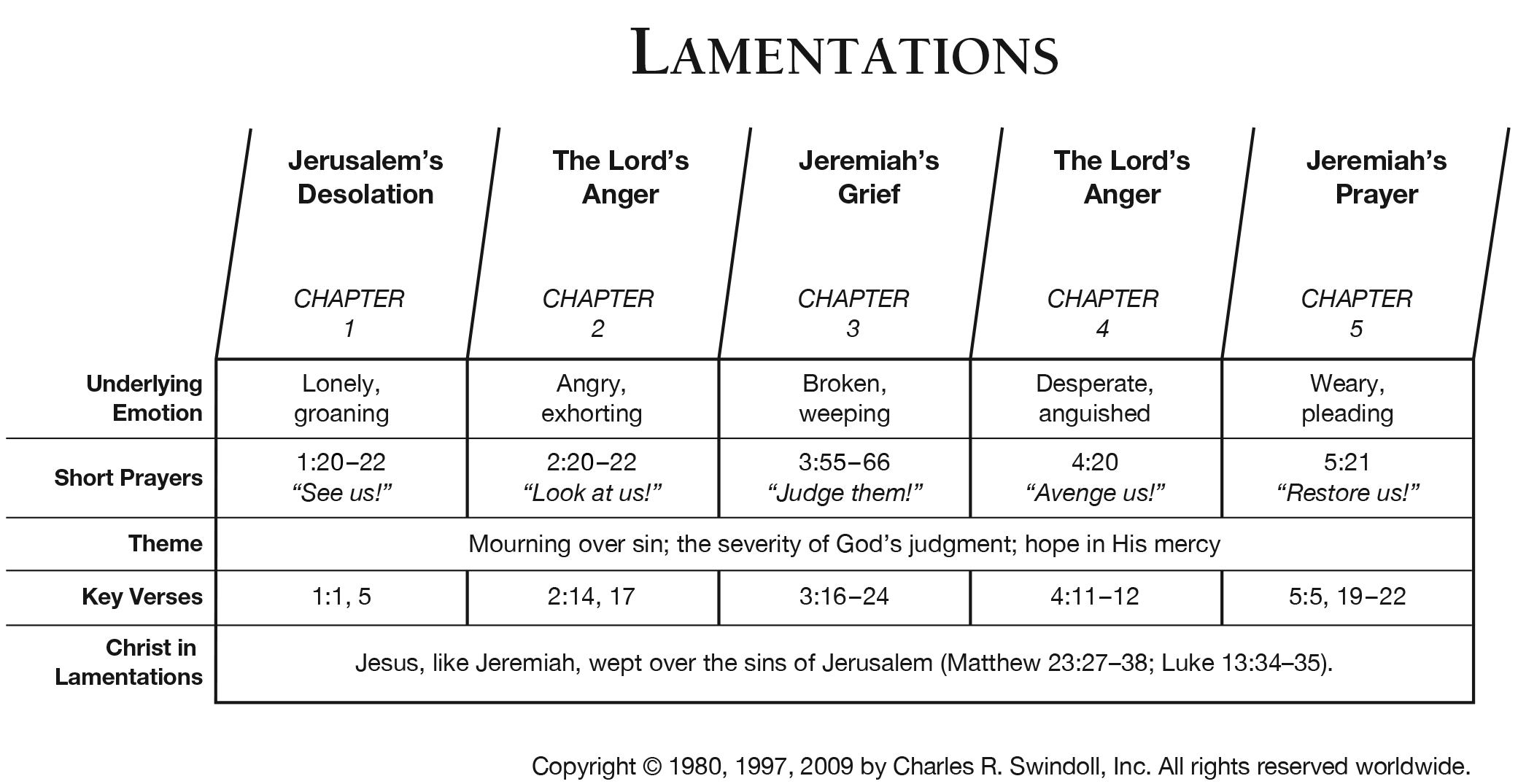
Lamentations Chart from Charles Swindoll
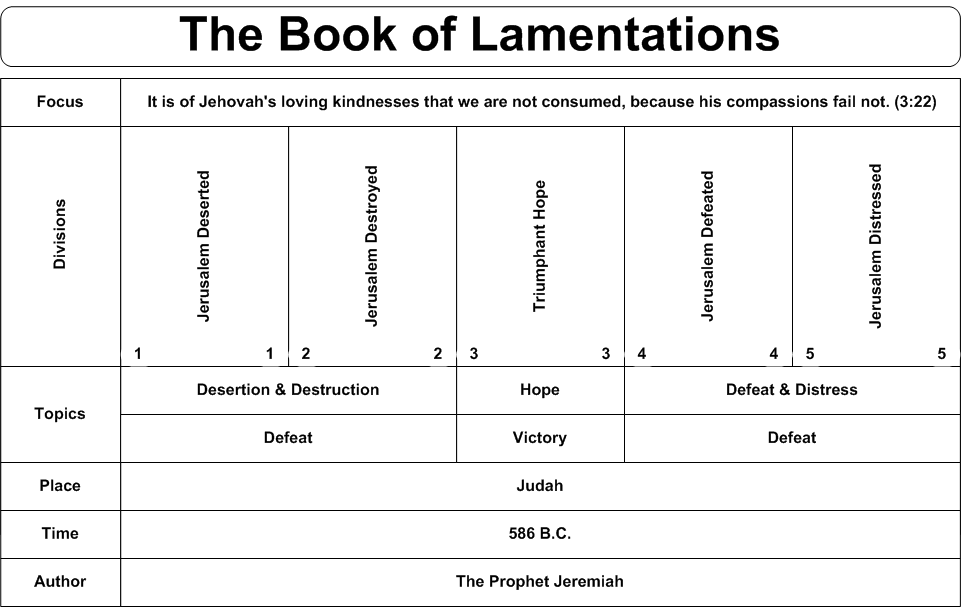
Another Lamentations Chart
Lamentations 5:21 is a great prayer to pray for America. Would you pause a moment and please intercede?
"Restore us to Thee, O LORD, that we may be restored.
Renew our days as of old." Amen
JEREMIAH - A BOOK OF WARNING
LAMENTATIONS - A BOOK OF MOURNING
HOPE AND HEALING IN THE AFTERMATH
OF REBELLION AGAINST THE MOST HIGH GOD
How do people survive when they have no hope? Where do they turn when there's nothing but misery all around them? In whom do you put your trust and hope? The only true hope Christians have is in the Lord. Study Lamentations and get a glimpse of the God whose compassions never fail.
What happens when a nation turns its back on God? When it acknowledges God but does not honor Him as God? When it twists, distorts, or even forbids the proclamation of the truths of His Word? Oh, how timely is this study of Lamentations. What lessons are there for you and your nation...and for us as individuals in dealing with the aftermath of rebellion? Of listening to false prophets? Of thinking that God will not hold us accountable for transgressing His Word and then discovering we were wrong? How do you live with yourself? With the consequences? Reconstruct the shambles of life and make it worth living again? Or can you? Yes, you can, because He’s a God of compassion. You just need to know how to tap into His mercies which are new every morning . . . and this you will learn in your study of Lamentations.
A lament is an expression of grief, of mourning, of sorrow. Surely we have each been there at one time or another. Some of us more than others. We feel as if life is one continual lament. You know the feeling, don’t you? The pain. The guilt for what we did, should have done, or didn’t do. The crippling sorrow. The sense often, of despair. And then to make matters worse, we think there is no sorrow like our sorrow—and a twinge of envy creeps into our hearts as we look at those who have what we’ve dreamed of and missed. (Kay Arthur)
Dear brethren beloved by God the Father (1Thes 1:4), whatever you are going through or will yet go through, may God's eternal truth in the book of Lamentations strengthen your heart and soul, so that you might be enabled by His Spirit to sing (the following words of the great hymn) with unfailing faith and with steadfast hope in Christ Jesus, the One Who is Faithful and True (Rev 19:11)...
GREAT IS THY FAITHFULNESS
By Thomas Chisholm
Great is Thy faithfulness, O God my Father;
There is no shadow of turning with Thee;
Thou changest not, Thy compassions, they fail not;
As Thou hast been, Thou forever will be.
REFRAIN
Great is Thy faithfulness!
Great is Thy faithfulness!
Morning by morning new mercies I see.
All I have needed Thy hand hath provided;
Great is Thy faithfulness, Lord, unto me!
Summer and winter and springtime and harvest,
Sun, moon and stars in their courses above
Join with all nature in manifold witness
To Thy great faithfulness, mercy and love.
REFRAIN
Pardon for sin and a peace that endureth
Thine own dear presence to cheer and to guide;
Strength for today and bright hope for tomorrow,
Blessings all mine, with ten thousand beside!
REFRAIN
Vocal by Fernando Ortega-variation tune
Vocal by Steve Green
Vocal by CeCe Winans
Vocal by Selah
Consider performing your own Inductive Bible study of the Book of Lamentations - Begin by downloading Lesson 1 on Lamentations from Precept Ministries - this will get you started and give you a good overview of the book (if you want to purchase the remaining lessons - Lamentations Workbook - 3 Lessons). Print the book of Lamentations (pages 27-35) double spaced with wide margins which facilitates marking the text and recording your observations (such as key words - see below). Follow the instructions in Lesson 1. As you read this poem-dirge observe carefully who is speaking: Jehovah , Jerusalem, Jeremiah. Notice that each chapter has 22 verses in it, except Lamentations 3 (66 verses). After you have charted out Lamentations, compare your observations with the table below. Remember that you have the same Teacher, the Holy Spirit, as those who make the tables and write the commentaries!
If you are unfamiliar with Inductive Bible Study below are some links (and a power point overview) explaining the main components. Let me encourage you to consider learning how to study the Bible for yourself - inductively - I can assure you that you will never be able to read the Bible the same and you will begin to experience the untold joys of self discovery as the Spirit illuminates truth to your heart and mind and soul and spirit!
- Context
- Key words
- Mark key words
- Interrogate with the 5W/H'S
- Term of conclusion
- Term of explanation
- Contrasts
- Expressions of time
- Terms of comparison simile metaphor
- Observe With a Purpose
- Keep Context King
- Read Literally
- Compare Scripture with Scripture
- Consult Conservative Commentaries
Here is a link to a Power Point Overview of Inductive Bible Study - Introduction to Inductive Bible Study using PowerPoint - Hint - View in "Slide Show" mode [see icons at bottom of the Power Point frame - click the one that says "Slide Show" - you can hit your "Escape" key at any time to revert back to the normal screen] - each mouse click will progressively give more information on each slide and make your viewing more "interactive".
|
LAMENTATIONS |
||||
| Lamentations 1 | Lamentations 2 | Lamentations 3 | Lamentations 4 | Lamentations 5 |
| LAMENT | PRAYER | |||
| Acrostics (See Note by Fisher) |
Not Acrostic |
|||
| The Grief |
The Cause |
The Hope |
The Repentance |
The Prayer |
| Mourning City |
Broken People |
Suffering Prophet |
Ruined Kingdom |
Penitential Nation |
| Jerusalem Weeps |
Jehovah Punishes |
Hope in Midst of Affliction |
Sin the Cause of Punishment |
Plea for Mercy |
| Jerusalem's Plight: Zion, the Widow (Lamentations 1:1-11) Zion's Confession (Lamentations 1:12-22) |
Jehovah's Anger The Anger Described (Lamentations 2:1-12) The City Exhorted (Lamentations 2:13-22) |
Jeremiah's Grief Affliction, Yet Hope (Lamentations 3:1-39) Plea: National, Personal (Lamentations 3:40-66) |
Jehovah's Anger Contrasts...And Why (Lamentations 4:1-11) Onlookers...Kings, Edom (Lamentations 4:12-22) |
Jerusalem's Prayer Plea: Zion is Stricken (Lamentations 5:1-18) Plea: Jehovah Can Restore (Lamentations 5:19-22) |
| Desolation of Jerusalem |
Destruction of Jerusalem |
Distraught Prophet |
Defeated People |
Prayerful People |
| Jerusalem - A Weeping Widow in sorrow | God's Burning Anger Against Sinful Israel | Jeremiah's Personal Lament; Closes with Hope for the Future | National Confession of Israel's Sin | Prayer in the Midst of Pain - Cry for Restoration |
| 3rd Person Plural "They" |
1st Person Singular "I" |
1st Person Plural "We" |
||
|
Each verse begins |
Each line begins |
Each verse begins |
No |
|
|
Writer Addresses Himself |
Writer Prays to God |
|||
|
Timeline of Jeremiah Not Available |
||||
|
Resources: Talk Thru the Bible, Jensen's Survey of the Old Testament, |
||||
|
Key Words in Lamentations:
|
||||
| Key Verses: Lamentations 1:5, 2:17, 3:22, 39, 4:18, 5:21 | ||||
| Introductions: | ||||
|
Outline of Lamentations I. The First Lament: Jerusalem’s Devastation (Lamentations 1:1–22)
II. The Second Lament: The Lord’s Anger Explained (Lamentations 2:1–22)
III. The Third Lament: Jeremiah’s Griefs Expressed (Lamentations 3:1–66)
IV. The Fourth Lament: God’s Wrath Detailed (Lamentations 4:1–22)
V. The Fifth Lament: The Remnant’s Prayers (Lamentations 5:1–22)
|
||||

Moorehead: The main characteristic of the book is indicated by its title, “Lamentations” (In Greek) Threnoi (threnos = song expressing grief for one who has died cp Mt 2:18), loud weepings, hot burning and choked with sobs, is the emphatic word the Septuagint uses. It is an elegy, a dirge, written over the desolation of Jerusalem by one whose love for it, guilty as he knew it to be, was like that of a father for a child, a wife for her husband. The prophet’s grief for the smitten city reminds one of David’s for Saul and Jonathan (2Sa 1:17-27), of Rachel’s for her dead children (Jer 31:15)... Jeremiah’s lamentation for favored, sinful and ruined Jerusalem is a cry of sorrow so touching as to move the stoutest heart, and must have been read with streaming eyes and quivering lips by many a Jew. In all literature there is nothing more pathetic than this mournful dirge. (Ref)
The Septuagint (Lxx) introduces Lamentations 1:1 with words not found in Massoretic Text: "And it came to pass, after Israel was taken captive, and Jerusalem made desolate, that Jeremiah sat weeping, and lamented with this lamentation over Jerusalem and said..."
William Orr: This book is mostly remarkable for the great variety of pathetic images it presents, expressing the deepest sorrow. On the other hand, it is rich in expressions of penitence and trust which are offered to GOD by the afflicted one. As Jeremiah, stunned and heartbroken, viewed the destruction of the city, he understood fully that the judgment had been overwhelmingly justified on God's part (Lamentations 3:22) but he pleaded for a return of God's mercy (Lamentations 3:32, 33). Lamentations is read in Jewish synagogues on the ninth day of the fourth month (July/Aug), which is the day of the destruction of the city of Jerusalem (Jer 52:6, 7). Following the captivity, Jerusalem was rebuilt and again became a great and powerful city. But the needed lesson was not learned, and in A.D. 70 it was again destroyed. Just as these words are not only Jeremiah's, but God's, so the grief is not only the prophet's, but God's grief. (Ref)
Myer Pearlman: The Lamentations are still read yearly to commemorate the burning of the Temple. Every Friday, Israelites, old and young, of both sexes, gather at the Wailing Place in Jerusalem, near the southeast corner of the old temple grounds, where an ancient wall 52 yards in length and 56 feet in height, is still revered as a memorial of the sanctuary of the race. Writes Dr. Geikie: "It is a touching sight to watch the line of Jews of many nations, in their black gabardines, as a sign of grief, lamenting aloud the ruin of that House whose very memory is still so dear to their race, and reciting the sad verses of Lamentations and suitable Psalms, amid tears, as they fervently kiss the stones." (Ref)
Dennis Fisher: Jeremiah organized the book around the 22 letters of the Hebrew alphabet, using a technique of alphabetic acrostics to aid the reader in memorizing the passages more easily. But using this technique also shows that he didn’t cut short his grieving process. He took deliberate and intentional time to reflect upon and even to write down his heartbreak. You might say he was learning to grieve from A to Z. (Grieving From A To Z Our Daily Bread)
|
COMPARISON OF "LAMENTATIONS" IN |
|||
|
2 Kings |
Jeremiah | Lamentations | |
|
The siege of Jerusalem |
2Kings 25:1-2 |
Jeremiah 39:1-3, 52:4-5 |
Lam 2:20-22, 3:5,7 |
|
Famine |
2Kings 25:3 | Jeremiah 37:21, 52:6 | Lam 1:11, 19, 2:11-12, 19-20, 4:4-5, 9-10, 5:9-10 |
|
Flight of army and king |
2Kings 25:4-7 | Jeremiah 39:4-7, 52:8-11 | Lam 1:3, 6, 2:2, 4:19-20 |
|
Burning of palace, temple, city |
2Kings 25:8-9 | Jeremiah 39:8, 52:13 | Lam 2:3-5, 4:11, 5:18 |
|
Breaching of city walls |
2Kings 25:10 | Jeremiah 33:4-5, 52:7 | Lam 2:7-9 |
|
Exile of people |
2Kings 25:11, 12 | Jeremiah 28:3-4, 39:9-10 | Lam 1:1, 4-5, 18, 2:9, 14, 3:2, 19, 4:22, 5:2 |
|
Temple Looted |
2Kings 25:13-15 | Jeremiah 51:51 | Lam 1:10, 2:6-7 |
|
Execution of leaders |
2Kings 25:18-21 | Jeremiah 39:6 | Lam 1:15, 2:2, 20 |
|
Vassal Status of Judah |
2Kings 25:22-25 | Jeremiah 40:9 | Lam 1:1, 5:8-9 |
|
Collapse of the expected foreign help |
2Kings 24:7 | Jeremiah 27:1-11, 37:5-10 | Lam 4:17, 5:6 |
Explanation - The following list includes not only commentaries but other Christian works by well known evangelical writers. Most of the resources below are newer works (written after 1970) which previously were available only for purchase in book form or in a Bible computer program. The resources are made freely available by archive.org but have several caveats - (1) they do not allow copy and paste, (2) they can only be checked out for one hour (but can be checked out immediately when your hour expires giving you time to read or take notes on a lengthy section) and (3) they require creating an account which allows you to check out the books free of charge. To set up an account click archive.org and then click the picture of the person in right upper corner and enter email and a password. That's all you have to do. Then you can read these more modern resources free of charge! I have read or used many of these resources but not all of them so ultimately you will need to be a Berean (Acts 17:11) as you use them. I have also selected works that are conservative and Biblically sound. If you find one that you think does not meet those criteria please send an email at https://www.preceptaustin.org/
COMMENTARIES
IN NO PARTICULAR ORDER
Bible Knowledge Commentary - Old Testament - 1608 pages. Dallas Theological Seminary Faculty- Charles Dyer authors “Lamentations
James Rosscup - This is a conservative, very able work that covers most bases quite well enough to be of real help to pastors, teachers and lay people. Dyer, in addition to good help verse by verse, has a whole page chart of “Parallels Between Lamentations and Deuteronomy,” and a knowledgeable introduction arguing the reasonableness of seeing Jeremiah as author.
J.Sidlow Baxter: Explore The Book - pdf Vol. 3 Job to Lamentations
Zondervan Illustrated Bible Backgrounds Commentary - Isaiah, Jeremiah, Lamentations, Ezekiel, Daniel
Jeremiah and Lamentations; an introduction and commentary by Harrison, R. K. (Roland Kenneth)
James Rosscup - This famous Old Testament scholar, a conservative, concludes that we have here the basic teachings of Jeremiah under several kings. Lamentations is done by an eye-witness of Jerusalem’s fall. In both books, Harrison offers a brief but well informed commentary that is usually quite helpful in getting at what the text means and not substituting redactional theory from another era
The communicator's commentary : Jeremiah, Lamentations By: Guest, John, 1936-
James Rosscup - Guest stimulates preachers by his clarity, directness about the meaning, provocative titles, and relevant applications. In much of the book his work is a catalyst for a sermon series, though he slights or obscures passages about a future for Israel (chapters 30–33 etc.)
Evangelical Commentary on the Bible - Judges by Andrew Boling (20 pages); editor Walter Elwell (1989) 1239 pages. User reviews.
Jeremiah, Lamentations By: Longman, Tremper, III
The book of Jeremiah and Lamentations, an exposition By: Erdman, Charles Rosenbury, 1866-1960
Cyril Barber - Serves to introduce laypeople to the theme and purpose of these books. Each is a fine example of practical exposition
Jeremiah By: Davidson, Robert, 1927-2012
Cyril Barber - Offers a human portrait of Jeremiah that readily reveals how he grappled with his emotions while endeavoring to reconcile God's acts with his own finitude. Presents the prophet as a man "of like passions," but also a man of courage, loyalty, and conviction. Insightful.
Jeremiah together with the Lamentations By: A.W. Streane
James Rosscup - This is one of the most painstaking and contributing among older commentaries. It offers comments on verses some works skip over, material on many of the problems, and good synopses too. It does not have refinements in chronology and material from recent discoveries such as one will find in Bright, Feinberg, Harrison, Laetsch, Holladay, Carroll, McKane, Thompson, etc. but certainly explains much of what a teacher or pastor needs.
Lamentations By: Provan, Iain W. (Iain William), 1957-
Cyril Barber - The book of Lamentations has shared the fate of the man who went down from Jerusalem to Jericho and was accosted by thieves. Left on the roadside to die, he was neglected by those who passed by. So it is that churchgoers are aware of a book called Lamentations, but they pay no attention to it and neglect its message. Provan introduces us to the structure, style, and contents of the five poems that make up this book. He places emphasis on the meaning of the text and leads his readers to a deeper and richer understanding of this OT book. His exegetical insights are valuable, and preachers will find much in these pages to slake the thirst of their flock.
James Rosscup - Provan was a lecturer in Hebrew and Old Testament studies at the University of Edinburgh. He appears to be liberal. His introduction is informative and up to date on views of authorship, date and place, but he himself is unable to arrive at a view except that the book was written between the sixth and second centuries B. C. (p. 19). He has much assisting information, yet wrongly does not believe a commentary should give the text’s meaning. This to many is being irresponsible. Why not let somebody else do the commentary then? Rather, he says, it should be “a catalyst for the reader’s own imaginative interaction with it” (29). So usually he does not state his own view, and seems unsure the book refers to the fall of Jerusalem or what is the setting (11, 29). Still, one can find much information on verses as to the text, meaning of words, etc. He is of the opinion that Lamentations 3:21–27 focuses on humble repentance and trust in God’s love, yet that Chapter 5 swings to an attitude opposed to this, reproaching God for unfairness (23). So, he feels that the theology of the book is left “ending in a question mark” (24). Many disagree with him here, as well.
Lamentations - Irving Jensen - Not a commentary but a study guide.
Lamentations By: Hillers, Delbert R., edt
James Rosscup - Hillers furnishes a lot of able assistance on details of the Hebrew text, word meaning, syntax, history, etc. He says he writes for the general reader and does not include much technical detail. He actually has much of this. He devotes pages xv–xlvii to introduction. His discussion of reasons for and against authorship by Jeremiah (xxi–xxii) is somewhat helpful but can leave some readers with the impression of subjectivity. His bibliography is made up of non-conservative sources and heavy on German writings. His only outline is a title to each chapter of Lamentations, though he also gives certain suggestions in his “comment” sections. The patient, advanced student, especially, can work with the Hebrew and sift out much from the “notes” methodically. “Comment” sections open things up to see a greater flow and connection; they point out form, analyze shifts in thought, and often look at views as on the issue of who the sufferer is in Chapter 3. It is, overall, a valuable work for serious students wishing such detail as the above.
Wiersbe's Expository Outlines on the Old Testament by Wiersbe, Warren W 113 ratings
"Even the most difficult Scriptures come alive as Warren Wiersbe leads you book-by-book through the Old Testament and helps you to see the "big picture" of God's revelation. In this unique volume, you will find: • Introductions and/or outlines for every Old Testament book • Practical expositions of strategic chapters • Special studies on key topics, relating the Old Testament to the New Testament • Easy-to-understand expositions that are practical, preachable, and teachable If you have used Dr. Wiersbe's popular BE series, you know how simple and practical his Bible studies are, with outlines that almost teach themselves. If not, you can now discover a wonderful new resource. This work is a unique commentary on every book of the Old Testament. It contains new material not to be found in the BE series.
With the Word - Devotional Commentary - Warren Wiersbe - 428 ratings
Wiersbe Commentary - Old Testament - His commentaries are always worth checking.
Lamentations : Bible study commentary By: Kent, Dan G
James Rosscup - Kent thinks someone during the time of Jeremiah wrote the book, but gives arguments for and against Jeremiah (pp. 14–15). His commentary is a good, brief survey, well-informed and organized. It ought to help pastors and lay readers who need a quick, dependable short commentary that handles some of the problems in a sketchy way and keeps to the flow as well.
STUDY BIBLES -
ONE VOLUME COMMENTARIES OF ENTIRE BIBLE
Note: The first 3 resources have no time restriction and allow copy and paste function:
(1) KJV Bible Commentary - Hindson, Edward E; Kroll, Woodrow Michael. Over 3000 pages of the entire OT/NT. Well done conservative commentary that interprets Scripture from a literal perspective. Pre-millennial. User reviews - it generally gets 4/5 stars from users. - 372 ratings
Very well done conservative commentary that interprets Scripture from a literal perspective user reviews
The King James Version Bible Commentary is a complete verse-by-verse commentary. It is comprehensive in scope, reliable in scholarship, and easy to use. Its authors are leading evangelical theologians who provide practical truths and biblical principles. Any Bible student will gain new insights through this one-volume commentary based on the timeless King James Version of the Bible.
(2) The King James Study Bible Second Edition 2240 pages (2013) (Thomas Nelson) General Editor - Edward Hindson with multiple contributing editors. . 3,194 ratings. Pre-millennial. See introduction on How to Use this Study Bible.
(3) NKJV Study Bible: New King James Version Study Bible (formerly "The Nelson Study Bible - NKJV") by Earl D Radmacher; Ronald Barclay Allen; Wayne H House. 2345 pages. (1997, 2007). Very helpful notes. Conservative. Pre-millennial. 917 ratings
HCSB Study Bible : Holman Christian Standard Bible - General Editor Jeremy Royal Howard (2010) 2360 pages. Conservative. Good notes. Include Holmans excellent maps. One hour limit
Life Application Study Bible: Old Testament and New Testament: New Living Translation. Has some very helpful notes especially with application of texts. 4,445 ratings. See also Life application New Testament commentary - Bruce Barton
The MacArthur Study Bible - John MacArthur. Brief but well done notes for conservative, literal perspective. 1,275 ratings
ESV Study Bible - Excellent resource but not always literal in eschatology and the nation of Israel 6,004 ratings
The David Jeremiah Study Bible - (2013) 2208 pages. 2,272 ratings Logos.com - "Drawing on more than 40 years of study, Dr. David Jeremiah has compiled a legacy resource that will make an eternal impact on generations to come. 8,000 study notes. Hundreds of enriching word studies"50+ Essentials of the Christian Faith" articles."
Wycliffe Bible Commentary - Charles Pfeiffer - 1560 pages (1962). 214 ratings Less detailed than the KJV Bible Commentary. Conservative. Notes are generally verse by verse but brief.
Rosscup - Conservative and premillennial scholars here have been experts in their fields. The work contains brief introductions and attempts to give a verse-by-verse exposition, though it does skip over some verses. The treatments vary with the authors, but as a whole it is a fine one-volume commentary for pastors and students to use or give to a layman. Outstanding sections include, for example: Whitcomb on Ezra-Nehemiah-Esther; Culver on Daniel; Ladd on Acts; Harrison on Galatians; Johnson on I Corinthians; and Ryrie on the Johannine Epistles.
Ryrie Study Bible Expanded Edition (1994) 2232 pages
The Defender's Study Bible : King James Version by Morris, Henry M. Excellent notes by well known creationist. 45 ratings
NLT Study Bible (Illustration Version)
Disciple's Study Bible: New international version 54 ratings Not that helpful for verse by verse study. Focuses on application of Christian doctrines. 10,000 annotations; doctrinal summaries, "Life Helps" section relate doctrine to everyday discipleship.
The Living Insights Study Bible : New International Version - Charles Swindoll. Notes are good but somewhat sparse and not verse by verse.
The Apologetics Study Bible Understand Why You Believe by Norman Geisler
NIV Archaeological Study Bible (2005) 2360 pages 950 ratings (See also Archaeology and the Bible - OT and NT)
New Bible Commentary - (1994) See user reviews
Compact Bible commentary by Radmacher, Earl D; Allen, Ronald Barclay; House, H Wayne, et al - 954 pages. 424 ratings Multiple contributors to the comments which are often verse by verse. The comments are brief but meaty and can really help your study through a given book. A sleeper in my opinion.
The Experiencing God Study Bible: the Bible for knowing and doing the will of God - Blackaby, Henry (1996) 1968 pages - CHECK THIS ONE! Each chapter begins with several questions under the title "PREPARE TO MEET GOD." Then you will interesting symbols before many of the passages. The chapter ends with a "DID YOU NOTICE?" question. This might make a "dry chapter" jump off the page! Read some of the 48 ratings
Encyclopedia of Bible difficulties by Archer, Gleason L - or here with no restrictions
Halley's Bible Handbook Henry H. Halley - (2000) 2720 pages (much larger than original edition in 1965 and no time limit on use). (Halley's Bible handbook : an abbreviated Bible commentary - one hour limit 1965 872 pages)
Rosscup - A much-used older evangelical handbook bringing together a brief commentary on Bible books, some key archaeological findings, historical background, maps, quotes, etc. It is helpful to a lay Bible teacher, Sunday School leader, or pastor looking for quick, pertinent information on a Bible book. This is the 72nd printing somewhat revised. Halley packed in much information. Unger’s is better overall, but that is not to say that Halley’s will not provide much help on basic information.
The Shaw Pocket Bible Handbook - Editor - Walter Elwell (1984) 408 pages.
"This hardback is small in size but packed full of content: Brief summaries of every book of the bible, cultural, archaeological and historical info, word definitions, pictures, maps and charts." Worth checking!
- Lamentations - 71 Page Commentary - Irving Jensen's Outline-Page 6 - Excerpts
THE HEAVY HAND OF THE LORD’S DISCIPLINE FOR SIN BRINGS CATASTROPHIC DEVASTATION AND INTENSE GRIEF BUT STILL A WINDOW FOR HOPE AND RESTORATIONChuck Smith: There is on the site of Golgotha a cave that is called Jeremiah's Grotto. This cave known as Jeremiah's Grotto comprises a part of the face of the skull; hence the name Golgotha. Because as you look at the cliff, with these caves that are there in the cliff, they take the appearance of a skull. One of these caves is called Jeremiah's Grotto. It is interesting that from those caves there on the site of Golgotha, you have a tremendous view of the city of Jerusalem, for Golgotha is actually the top of what was once Mount Moriah. And it looks down over the city of Jerusalem. Tradition declares that Jeremiah sat in this grotto when he wrote the book of Lamentations, and there he wept and cried over the desolation of the city of Jerusalem as he saw its ruins, as he saw the walls destroyed, as he saw the buildings leveled. And from this vantage, he wrote this book. In the Septuagint, which is a translation of the scriptures into Greek that was done by seventy Hebrew scholars about 200 B.C., they prefaced the book of Lamentations with these words, "And it came to pass, that after Israel had been carried away captive, and Jerusalem made desolate, Jeremiah sat weeping and lamented this lament over Jerusalem and said, 'How doth the city sit solitary.'" So, they have that as a prologue to the book of Lamentations, and it was picked up and put in the Vulgate.
C. S. Lewis: In his classic treatment of suffering, The Problem of Pain, C. S. Lewis wrote: God whispers to us in our pleasures, speaks in our conscience, but shouts in our pain: it is His megaphone to rouse a deaf world. Lewis argues, not only that it is possible to find God when life is hard, but also that it is in some sense easier than when life is good.
Stedman: The book of Lamentations is sandwiched between the books of Ezekiel and Jeremiah. This unusual book properly follows the book of Jeremiah the prophet and priest because it was written by him . It is the "Lamentations of Jeremiah" as he wept over the city of Jerusalem following its desolation and captivity by Nebuchadnezzar. In the Septuagint version of this -- the Greek translation of the Hebrew -- there is a brief notation to the effect that as Jeremiah went up on the hillside and sat overlooking the desolate city, he uttered these lamentations. As you read through this book, you will find many foreshadowings of our Lord weeping over the city of Jerusalem. In the Lord's last week, when he went up to the Mount of Olives and sat looking out over the city, he wept over it saying, "O, Jerusalem, Jerusalem, killing the prophets and stoning those who are sent to you! How often would I have gathered your children together as a hen gathers her brood under her wings, and you would not!" {Matt 23:37 RSV} The tears ran down his face as he looked out over the city that had rejected him; this people that did not know the hour of their visitation, and had turned their backs upon the one who was their Messiah and their deliverer. . . The book of Lamentations is also unusual in the way it is put together. There are twenty two letters in the Hebrew alphabet, which begins with "aleph," the equivalent of our "a," and ends with "tau" which is the equivalent of our "t." (The letter "z," by the way, comes around the middle of their alphabet.) In this book of Jeremiah's Lamentations, chapters one, two and four form an acrostic, each chapter consisting of twenty-two verses, and each verse beginning with one of each of the letters of the Hebrew alphabet, beginning with aleph and ending with tau. Chapter three is interesting in that it consists of sixty-six verses in triads, or triplets, in which every verse making up each triad begins with the same letter of the alphabet, so that there are twenty-two groups of three altogether, one for each letter of the alphabet. These chapters have been written very, very carefully, according to the rules of Hebrew poetry. Chapter five does not follow this acrostic plan, although it does have twenty-two verses. This is certainly an intriguing structure, but the real interest of this book is in its content. It is a study in sorrow, a hymn of heartbreak. This is the kind of book you might read when sorrow strikes your own heart, and sorrow comes to all of us at times. As Jeremiah was looking out over Jerusalem, he saw its desolation and he remembered the terrible, bloody battle in which Nebuchadnezzar had taken the city and sacked it, destroying the temple and killing the inhabitants.
I. LAMENT (Lam 1:1 – 4:22)
A. Jerusalem Weeps (Lam 1:1-22)
1. Fallen Jerusalem Described (Lam 1:1-11)
2. Fallen Jerusalem Laments (Lam 1:12-19)
3. Plea for Vindication (Lam 1:20-22)B. Jehovah Punishes (Lam 2:1-22)
1. Punishments Described (Lam 2:1-9)
2. The Consequences (Lam 2:10-12)
3. The Prophet’s Reflections, and Exhortations to Zion (Lam 2:13-19)
4. Zion’s Lament to God (Lam 2:20-22)C. Hope in the Midst of Affliction (Lam 3:1-66)
1. The Suffering Servant (Lam 3:1-18)
2. Hope in the Lord (Lam 3:19-42)
3. The Suffering Nation (Lam 3:43-54)
4. Prayer of Gratitude (Lam 3:55-66)D. Sin, the Cause of Punishment (Lam 4:1-22)
1. Horrors of the Siege (Lam 4:1-12)
2. Sin as the Cause (Lam 4:13-20)
3. A Ray of Hope (Lam 4:21-22)II. PRAYER (Lam 5:1-22)
A. “Look upon us” (Lam 5:1-10)
B. “Woe unto us” (Lam 5:11-18)
C. “Turn thou us” (Lam 5:19-22)
1. Ascription (Lam 5:19)
2. Question (Lam 5:20)
3. Petition (Lam 5:21)
4. Question (Lam 5:22)
- Baxter: This pathetic little five-fold poem, the Lamentations, has been called “an elegy written in a graveyard.” It is a memorial dirge written on the destruction and humiliation of Jerusalem by the Babylonians in 587 B.C. It is a cloudburst of grief, a river of tears, a sea of sobs.
I. Lament 1 – Jerusalem’s Flight
II. Lament 2 – Jehovah’s Anger
III. Lament 3 – Jeremiah-s Grief
IV. Lament 4 – Jehovah’s Anger
V. Lament 5 – Jerusalem’s Prayer
(Irving Jensen)God suffers with those whom He chastises. . . Affliction does its humbling work . . . It is of Jehovah’s mercies that we are not consumed . . . The sins of Christian believers bring grievous chastisings and chastenings upon them . . .
- Lamentations 1 The Funeral of a City
- Lamentations 2 Destruction and Disgrace
- Lamentations 3 Looking at Himself, Looking at the Lord, Looking to the People
- Lamentations 4 Zion, Before & After - Because of the Sins - A Prayer in Despair
Click the words and phrases (based on the KJV translation) below which represent links to the Defender's Study notes.
Lamentations 1
- Lamentations 1:1 How
- Lamentations 1:10 The adversary
- Lamentations 1:12 nothing to you
- Lamentations 1:22 all my transgressions my heart is faint
Lamentations 2
- Lamentations 2:8 destroy the wall
- Lamentations 2:9 the law is no more
- Lamentations 2:17 fulfilled his word.
- Lamentations 2:18 apple of thine eye
- Lamentations 2:20 women eat their fruit
Lamentations 3
- Lamentations 3:1 I am the man
- Lamentations 3:13 reins
- Lamentations 3:21 therefore I have hope
- Lamentations 3:22 compassions fail not
- Lamentations 3:23 great is thy faithfulness
- Lamentations 3:24 my soul will I hope
- Lamentations 3:26 salvation.
- Lamentations 3:30 smiteth
- Lamentations 3:33 doth not afflict willingly
- Lamentations 3:36 the Lord approveth not
- Lamentations 3:55 low dungeon
- Lamentations 3:66 Persecute and destroy them
Lamentations 4
- Lamentations 4:3 sea monsters
- Lamentations 4:7 Her Nazarites
- Lamentations 4:10 sodden their own children
- Lamentations 4:12 would not have believed the adversary and the enemy
- Lamentations 4:17 watched for a nation
- Lamentations 4:20 the anointed of the LORD
- Lamentations 4:21 land of Uz
Lamentations 5
- Lamentations 5:1 our reproach
- Lamentations 5:16 The crown is fallen
- Lamentations 5:19 remainest for ever
Note: This resource is useful to help you with topics covered by the passage you are studying. Click the verse for the topics (examples listed for Lam 1:1). Then you can either click the arrow to advance to the next verse or you can go to the top of the page in the dropdown window and select the specific verse or chapter you would like to study.
5487 queen
5743 widows
5899 lament
6702 peace, destruction
5354 invasions
- Lamentations 1 Commentary
- Lamentations 2 Commentary
- Lamentations 3 Commentary
- Lamentations 4 Commentary
- Lamentations 5 Commentary
This resource is actually named the Preacher's Homiletical Commentary and aptly so for it has both "germ thoughts" as well as "illustrations" on each of the verses, which are of potential aid to one who preaches through this too often neglected book.
- Lamentations 1 - Preacher's Complete Homiletical Commentary
- Lamentations 1 - The Miseries of Jerusalem
- Lamentations 1:1-2 Grief For a Ruined City
- Lamentations 1:1-2 Germ Notes and Illustrations
- Lamentations 1:3 The Judgment of Oppression
- Lamentations 1:3 Germ Notes and Illustrations
- Lamentations 1:4 Lamentation Over a Forsaken Sanctuary
- Lamentations 1:4 Germ Notes and Illustrations
- Lamentations 1:5-7 The Tantalizing Indifference...
- Lamentations 1:5-7 Germ Notes and Illustrations
- Lamentations 1:8-11 The Terrible Havoc of Sin
- Lamentations 1:8-11 Germ Notes and Illustrations
- Lamentations 1:12-17 A Distressed Nation
- Lamentations 1:12-17 Germ Notes and Illustrations
- Lamentations 1:18-22 The Bitter Fruits of Rebellion
- Lamentations 1:18-22 Germ Notes and Illustrations
- Lamentations 2 - Preacher's Complete Homiletical Commentary
- Lamentations 2 The Punishment of National Sin
- Lamentations 2:1-5 The Fierceness of the Divine Angers
- Lamentations 2:1-5 Germ Notes and Illustrations
- Lamentations 2:6-9 The Wreck of Religious Ordinances
- Lamentations 2:6-9 Germ Notes and Illustrations
- Lamentations 2:10 Voiceless Woe
- Lamentations 2:10 Illustrations
- Lamentations 2:11-12 The Utter Exhaustion of Grief
- Lamentations 2:11-12 Illustrations
- Lamentations 2:13 Inexpressible Ruin
- Lamentations 2:13 Illustrations
- Lamentations 2:14 False Prophets
- Lamentations 2:14 Illustrations
- Lamentations 2:15-17 The Heartless Triumph of the Scorn
- Lamentations 2:15-16 Germ Notes and Illustrations
- Lamentations 2:18-19 A Call to Prayer
- Lamentations 2:18-19 Germ Notes and Illustrations
- Lamentations 2:20-22 A Prayer for Divine Compassion
- Lamentations 2:20-22 Germ Notes and Illustrations
- Lamentations 3 - Preacher's Complete Homiletical Commentary
- Lamentations 3 An Ideal Representation of National Sorrow
- Lamentations 3:1-3 The Man of Affliction
- Lamentations 3:1-3 Germ Notes and Illustrations
- Lamentations 3:4-9 The Bewilderment of Grief
- Lamentations 3:4-9 Germ Notes and Illustrations
- Lamentations 3:10-13 Jehovah as a Foe
- Lamentations 3:10-13 Germ Notes and Illustrations
- Lamentations 3:14-17 Complex Phases of Distress
- Lamentations 3:14-15 Germ Notes and Illustrations
- Lamentations 3:18-21 The Dawn of Hope
- Lamentations 3:18-21 Germ Notes and Illustrations
- Lamentations 3:22-24 The Divine Faithfulness
- Lamentations 3:22-24 Germ Notes and Illustrations
- Lamentations 3:25-27 Three Grades of Goodness
- Lamentations 3:25-27 Germ Notes and Illustrations
- Lamentations 3:28-30 Resignation
- Lamentations 3:28-30 Germ Notes and Illustrations
- Lamentations 3:31-33 The Tenderness of God
- Lamentations 3:31-33 Germ Notes and Illustrations
- Lamentations 3:34-36 God and Human Wrong
- Lamentations 3:34-36 Germ Notes and Illustrations
- Lamentations 3:37-39 The Divine Rule Absolute and Universal
- Lamentations 3:37-39 Germ Notes and Illustrations
- Lamentations 3:40-42 Repentance
- Lamentations 3:40-42 Germ Notes and Illustrations
- Lamentations 3:43-47 The Tension of Prolonged Suffering
- Lamentations 3:43-46 The Tension of Prolonged Suffering
- Lamentations 3:43-46 Germ Notes and Illustrations
- Lamentations 3:48-51 A Sympathetic Nature
- Lamentations 3:48-51 Germ Notes and Illustrations
- Lamentations 3:52-58 A Faithful Prophet in Trouble
- Lamentations 3:52-58 Germ Notes and Illustrations
- Lamentations 3:59-66 A Confident Appeal to Divine Justice
- Lamentations 3:59-66 Germ Notes and Illustrations
- Lamentations 4 - Preacher's Complete Homiletical Commentary
- Lamentations 4 - Zion's Pitiful Estate
- Lamentations 4:1-2 Moral Degradation
- Lamentations 4:1-2 Germ Notes and Illustrations
- Lamentations 4:3-10 The Extremity of Suffering
- Lamentations 4:3-10 Germ Notes and Illustrations
- Lamentations 4:11-12 The Destruction of Zion
- Lamentations 4:11-12 Germ Notes and Illustrations
- Lamentations 4:13-16 Unfaithful Religious Leaders
- Lamentations 4:13-16 Germ Notes and Illustrations
- Lamentations 4:17-20 The Last Hours of a Doomed People
- Lamentations 4:17-20 Germ Notes and Illustrations
- Lamentations 4:21-22 The Fate of the Malevolent
- Lamentations 4:21-22 Germ Notes and Illustrations
- Lamentations 5 - Preacher's Complete Homiletical Commentary
- Lamentations 5 - Recapitulation of Zion's Calamities and Prayer
- Lamentations 5:1 A Piteous Appeal to Jehovah
- Lamentations 5:1 Germ Notes and Illustrations
- Lamentations 5:2-5 The Miseries of the Disinherited
- Lamentations 5:2-5 Germ Notes and Illustrations
- Lamentations 5:6-9 Humiliating Subjection
- Lamentations 5:6-9 Germ Notes and Illustrations
- Lamentations 5:10-13 The Galling Tyranny of Conquest
- Lamentations 5:10-13 Germ Notes and Illustrations
- Lamentations 5:14-15 Business and Recreation
- Lamentations 5:14-15 Germ Notes and Illustrations
- Lamentations 5:16 The Loss of Honor
- Lamentations 5:16 Germ Notes and Illustrations
- Lamentations 5:17-18 Religious Declension
- Lamentations 5:17-18 Germ Notes and Illustrations
- Lamentations 5:19-22 An Earnest Prayer for Restoration
- Lamentations 5:19-22 Germ Notes and Illustrations
Lamentations 1:12
- All Ye That Pass By
- Is It Nothing to Thee?
- Is It Nothing to You? (Clements)
- Is It Nothing to You? (Crosby)
- My Savior! I Behold Thy Life
Lamentations 2:19
Lamentations 3:22
- Every Morning Mercies New
- Father! To Thy Kind Love We Owe
- God of Our Life
- God Will Take Care of Me
- Great Is Thy Faithfulness
- Heav’nly Father, Thou Hast Brought Us
- Like Dews of the Morning
- New Every Morning Is the Love
- Rise Every Soul in Jesus’ Name
- Sovereign Protector I Have, A
- Sun Is on the Land and Sea, The
- Sweet Is the Breath of Morning Air
- Thy Goodness, Lord, Our Souls Confess
Lamentations 3:24
Lamentations 3:26
Lamentations 3:32
Lamentations 3:41
Lamentations 3:55
Lamentations 5:19
Lamentations 5:21
UNABRIDGED VERSION
James Rosscup writes "Keil, C. F. and Franz Delitzsch. Commentary on the Old Testament. 25 volumes. Grand Rapids: Eerdmans, 1950. This is the best older, overall treatment of a critical nature on the Old Testament Hebrew text verse by verse and is a good standard work to buy. The student can buy parts or the whole of this series. Sometimes it is evangelical, at other times liberal ideas enter." (Commentaries for Biblical Expositors: An Annotated Bibliography of Selected Works)
- Lamentations Of Jeremiah - Smith's Bible Dictionary
- Lamentations Of Jeremiah - Fausset's Bible Dictionary
- Lamentations, Book of - Easton's & Intl Std Bible Encyclopedia
- Lamentations of Jeremiah - American Tract Society Bible Dictionary
- Lamentations - Bridgeway Bible Dictionary
- Lamentations - Fausset's Bible Dictionary
- Lamentations - Kitto's Popular Cyclopedia of Biblical Literature
- Lamentations - The 1901 Jewish Encyclopedia
- Top 5 Commentaries on the Book of Lamentations by Keith Mathison
- Best Commentaries on Lamentations - Challies Dot Com
- Best commentaries lamentations
- Lamentations: The Fall of Jerusalem - 12 Page Chapter by Chapter - an excellent quick overview of the book of Lamentations
- The New Covenant in Jeremiah
- Lamentations. 1:1-22; Sinful Humanity: To be saved, we must acknowledge our separation from God and that we are hopeless without His help. Video
- Lamentations 2:1-22; God's Wrath: We are to be encouraged and comforted by God's promise that as believers we'll be protected from His wrath on earth and in eternity. Video
- Lamentations 3:1-33; God's Faithfulness: Because of our relationship with God through the Lord Jesus Christ, we are to be confident that we have an eternal inheritance guaranteed by the presence of the Holy Spirit in our lives. Video
- Lamentations 5:1-22; Praying for God's Help: When praying for help, we should acknowledge that God is eternal, sovereign, and awesome. Video
- Book of Lamentations - Bible Survey
- What are the Major Prophets and Minor Prophets?
- What should we learn from the life of Jeremiah?
- What is the Wailing Wall / Western Wall?
- What is the meaning of sackcloth and ashes?
- How can I learn to trust in the faithfulness of God?
- What is the Christian's hope?
- His mercies are new every morning
- What does the Bible say about compassion?
- What is Tisha B'Av?
Tisha B'Av is the final, climactic day of a 21-day period of increasing mourning called the Three Weeks. The Three Weeks is also called Bein HaMetzarim, or “between the straits,” because Lamentations 1:3 says, “Judah is gone into captivity because of affliction, and because of great servitude: she dwelleth among the heathen, she findeth no rest: all her persecutors overtook her between the straits” (KJV, emphasis added).
''The City of the Great King.''
'' 'How doth the city sit solitary, that was full of people! how is she a widow that was great among the nations! and princess among the provinces, how is it she became tributary!' So bursts forth the elaborate dirge of which the oldest Jewish tradition tells us that 'after the captivity of Israel and the desolation of Jerusalem, Jeremiah sat down and wept, and lamented his lamentation over Jerusalem.' In the face of a rocky hill, on the western side of the city, the local belief has placed 'the grotto of Jeremiah.' There in that fixed attitude of grief, which Michael Angelo has immortalized, the prophet may well be supposed to have mourned the fall of his country.'' [Stanley's Jewish Church.]
The desolation of the city by the Chaldean army is described by Jeremiah in his Book of Lamentations with all the vividness of an eye-witness.
Six hundred years have passed, and now from the opposite, or eastern, side of the city a procession of rejoicing children with a lowly King winds up the slopes of the Mount of Olives. A sudden bend in the road brings the city of Jerusalem full upon the view. The sight of that proud city in the morning sunlight, with the marble pinnacles and gilded roofs of the Temple, brought such a mighty rush of compassion to the soul of our Saviour, that He wept aloud. ''If thou hadst known, even thou, at least in this thy day, the things that belong unto thy peace!'' -- and there sorrow interrupted the sentence, and, when He found voice to continue, He could only add, ''but now they are hid from thine eyes. For the days shall come upon thee, that thine enemies shall cast a trench about thee. . . and they shall not leave one stone upon another; because thou knewest not the time of thy visitation.'' [Luke 19:41-44] [See Farrar's Life of Christ, vol. ii. p. 199.]
The weeping prophet was a type of the weeping Saviour. The one had foretold the destruction of the city by the Chaldeans, the other by the Romans.
Judgment for Sin.
Throughout the Book of Lamentations, Jeremiah points out plainly that the judgment that has come upon the city is on account of her sin. The Key-note of the book is Destruction. It contains five Laments corresponding with the five chapters. Each Lament is arranged in acrostic form, every verse beginning with one of the twenty-two letters of the Hebrew alphabet, except that in the fifth Lament, though it contains the right number of stanzas, the acrostic form disappears. Moreover, in the third or middle Lament-- the climax of the poem-- each initial letter is repeated three times.
Lament I. In the first part of this Lament, the prophet speaks, and describes the city as a woman bereft of her husband and children. In the second [part], Zion speaks and bewails her misery. She acknowledges that her punishment is from the Lord, and confesses ''The Lord is righteous; I have rebelled.''
Lament II. is spoken by the prophet. A remarkable description of the ruin of Jerusalem.
Lament III. The prophet speaks, but makes the miseries of the people his own. Out of the midst of the misery, he stays himself upon the Lord's faithfulness and His unfailing compassion, and asserts unhesitatingly that ''He doth not afflict willingly, nor grieve the children of men'' (Lam 3:33).
Lament IV. The prophet again describes the fearful judgments which have befallen Jerusalem.
Lament V. The Jewish people speak and make confession, and appeal to God for forgiveness and deliverance.
''No Rest.''
In chapter 1, we have the description of desolation. No rest; no pasture; no Comforter (v. 3,6,9). Such is the desolation of every soul that is without Christ.
Without Christ With Christ Lam 1:3. No Rest. Mt 11:28. I will give you rest. Lam 1:6. No Pasture Ps 23:2. Green pastures. Lam 1:9. No Comforter Jn 14:16. Another Comforter. Calvary.
Jeremiah weeping over the city reminds us of our Lord. There are several verses, moreover, which seem to be a foreshadowing of Calvary:
''Is it nothing to you, all ye that pass by? behold, and see if there be any sorrow like unto My sorrow'' (Lam 1:12).
''All that pass by clap their hands at thee; they hiss and wag their head'' (Lam 2:15,16; Mt 27:39).
''All thine enemies have opened their mouth against thee'' (Lam 2:16; Psa 22:13).
''He shutteth out my prayer'' (Lam 3:8; Mat 27:46).
''I was a derision to all my people, and their song every day'' (Lam 3:14; Psa 69:12).
''The wormwood and the gall'' (Lam 3:19; Ps 69:21).
''He giveth his cheek to him that smiteth him: he is filled with reproach'' (Lam 3:30; Isa 50:6; Ps 69:20).
In the verse ''For the sins of her prophets, and the iniquities of her priests, that have shed the blood of the just in the midst of her'' [Lam 4:13], we are reminded, first, of our Lord's own words: ''O Jerusalem, Jerusalem, thou that killest the prophets, and stonest them which are sent unto thee'' [Mt 23:37]; and secondly, of Peter's words of accusation to the people of Jerusalem: ''Ye denied the Holy One and the Just, and killed the Prince of Life'' [Acts 3:14,15].
[Even so, to those who repent and turn to Him, the Lord mercifully extends His salvation and the promise of future restoration. Lam 3:22-26; Acts 3:17-26]
- Study helps for Lessons 1-3
- Workbook - Lamentations Hope and Healing in the Aftermath of Rebellion Against God
- Lamentations, Theology of
Lamentations is a soliloquy. There is no word from God, although there are words about God. The structure of the book, apart from the final chapter, is a set of acrostics (not obvious in English translations). Its genre is lament. Several traditions, such as the sin-punishment nexus, inform the book. The setting is the historical crisis of a destroyed city, Jerusalem. The speaker is both a spectator and victim of the tragedy. A dominant personality within the monologue is God; human agents such as Babylon (unnamed) and Edom also come into view. The language is laced with metaphor. It is with an eye to the form, genre, traditions, situation, and characters that a theology of the book can best be laid bare.
The Pathos of Suffering . The perspective in the book is initially this-wordly. The tragedy of Jerusalem, now devastated by the Babylonians (587 b.c.), and of a people in exile, is faced head on (1:3; 2:8-9). The citizenry is humiliated and in desperate straits (1:1-21a; 5:1-18). The calamity and pathos of suffering is a central theme (3:1-20). Poetry, rather than prose, is the vehicle of pathos. The funeral dirges set the tone (chaps. 1,2, 4). Four of the five chapters are in acrostic form utilizing the Hebrew alphabet, perhaps as a way of reaching for a total expression of grief. The vocabulary and metaphors describing the suffering are graphic and earthy. The once proud city is now like a widow, a queen become a slave (1:1). Zion theology, which stressed the indestructability of the city and the temple (Psalm 48; 132:13; Jeremiah 7:4 ), has been shown to be bankrupt. The good life of joy, feasting, treasures, and prosperity is gone (1:7; 3:17). Once elegant and bedecked with finery, the leaders are now blacker than soot, with their skin shriveled (4:8; cf. 1:6). Women have been ravished (5:11). Children cry for food (2:12). There is no one to comfort Zion (1:17). The harsh reality is described, not denied. The grief is not muted or misrepresented even though it raises large questions about God. Grief, for therapeutic reasons, as for Job, must be brought to speech.
Out of such pain God is addressed on the understanding that he attends to suffering people. A first step, then, is to face him with the grief. The devastation of property, the stress of losing virtually everything, and the deep despondency are vividly pictured—so that God will take notice! Famine is the focus (2:20; 4:10), perhaps because of the tradition of God working his purposes through famine (Genesis 12:10; Ruth;Jeremiah 14 ). Arising out of the suffering is the cry for rehabilitation and restoration (5:21-22).
An Interventionist God . The series of poems represents description but also an analysis on which past tradition is brought to bear. That tradition includes a belief about the nexus between sin and suffering. Job, likely written earlier than Lamentations, makes clear that the theory that all suffering is inevitably the result of wrongdoing is reductionistic. Still, that sin results in punitive measures is an understanding dating from the transgression in Eden.
In Lamentations that connection between sin and suffering is at once made explicit: "The Lord has brought her grief because of her many sins" (1:5). Sin is a breach in the relationship. Israel, to resort to metaphor, has been under a heavy yoke, and so her strength has been sapped (1:14). God, so says the sufferer, has dragged him "from the path and mangled [him] and left [him] without help" (3:11). Israel explains her circumstances in light of the tradition: "We have sinned and rebelled we have suffered ruin and destruction" (3:42,47). Each of the five poems identifies sin as the reason for the disaster (1:8; 2:14; 3:42; 4:13; 5:7).
Her sin, while not to be excused, can be better understood in the light of another tradition: the ministry expected from prophets. Leaders are to blame (4:12-13). Israel's wound, now deep as the sea, came because the prophets failed to expose her sin and so failed to ward off her captivity (2:14). Back of this charge is the conviction that one of the functions of the prophets was to identify the shape of evil in the society (cf. Jeremiah 7:1-15 ). The reference in 2:14 to prophets whose oracles were false may well be to those who announced peace to a sinning people, and with whom Jeremiah so vigorously debated (23:16-18).
Another tradition transparent in Lamentations is that of God fighting against his people. Isaiah states succinctly: "So he [God] turned and became their enemy and he himself fought against them" (63:10; cf.Numbers 14:39-45 ). That statement, echoed in "The Lord is like an enemy" (2:5), now explains the tragedy of 587 b.c. but at another level. The devastation is ultimately attributed to God's action (3:38). "He [God] has laid waste his dwelling like a garden; he has destroyed his place of meeting" (2:6,17; cf. 1:12; 2:1; 3:1).
God is ruler (5:19). He is also Savior, and so the hope for redemption, grounded in God's faithfulness, remains alive. The imprecations against the enemies (1:21-22; 3:59-66; 4:21-22), and a litany of repentance (3:40-41) are two facets of that hope.
God: Righteous, Angry, Compassionate . The character of God is assumed to be both daunting and appealing. The righteousness of God is affirmed (1:18). Given the evil of his people, however, more is said in Lamentations about God's anger than about his righteousness. Wrath, idiomatically described as "hot of nose, " is expressive of God's righteousness. Each acrostic, but especially the second, includes mention of his anger (1:12; 2:1,2, 3,4, 21,22; 3:43; 4:11). God's anger, speaking metaphorically, is poured out like fire (2:4; cf. 4:11) with the result that the strongholds of Judah have been torn down (2:2), king and priest have been spurned (2:6), and young and old have been slain (2:21). Jeremiah and other prophets before him warned Israel of the severity of God's anger should it be unleashed (30:23-24; Amos 1:3-5,6 , 10,11 ).
No attempt is made to reconcile God's anger and God's compassion, but compassion is no less characteristic of God than is anger. The tradition of God as resolutely compassionate and gentle, yet just in retribution, persists. The main section of the third acrostic, roughly the central section of the book, describes God's faithfulness as great and resilient (3:23). The flood of emotion, building in the two previous acrostics, is reined in by sound theology. God's compassion and love do not fail (3:22,32). God is fundamentally unwilling to bring about grief (3:33). The belief in God as compassionate gives an intimation of hope to this suffering city, its inhabitants, and its exiles (3:21).
God: Experienced as Distant . The lament genreboth individual lament (chap. 3) and communal lament (chap. 5)colors the book. Central to the lament is the complaint, which can take various shapes (cf. Psalm 6,13 ). Basic to the complaint in Lamentations is God's perceived absence, inaccessibility, and even abandonment. Again, metaphors come into play. God has barred the petitioner's way as "with blocks of stone" (3:9). God has covered himself with a cloud so "no prayer can get through" (3:44).
Yet prayer continues. As Moses not only stated petitions but urged reasons for God to respond (Exodus 32:11-14 ), so here the poet "motivates" God by noting the taunt and mockery of the enemies (3:61-63). Another incentive is the sheer helplessness and distress of the victim (1:20; cf. Amos 7:2 ). Still another is God's former intervention: God was once near and reassuring (3:55-57). The complaint builds on the understanding that God is a God who, even if experienced as absent, is a God whose concern is for victims, and whose actions are initiated, as at the exodus, by cries for help. Hence the persistent cry, "Look, O Lord" (1:9,11; 3:63; 5:19-21). In the end God will hear.
Title - “Lamentations” was derived from a translation of the title as found in the Latin Vulgate (Vg.) translation of the Greek OT, the Septuagint (LXX), and conveys the idea of “loud cries.” The Hebrew exclamation ekah (“How,” which expresses “dismay”), used in Lam 1:1; 2:1, and Lam 4:1-2, gives the book its Hebrew title. However, the rabbis began early to call the book “loud cries” or “lamentations” (cf. Jer. 7:29). No other entire OT book contains only laments, as does this distressful dirge, marking the funeral of the once beautiful city of Jerusalem (cf. Lam 2:15). This book keeps alive the memory of that fall and teaches all believers how to deal with suffering.
- An Introduction to the Book of Lamentations
- An Argument of the Book of Lamentations
- Selected Bibliography of the Book of Lamentations
Here are some of Dr Rosscup's reviews on Lamentations from his excellent resource Commentaries For Biblical Expositors...
- Dyer, Charles. “Lamentations,” in The Bible Knowledge Commentary (Old Testament-)- - This is a conservative, very able work that covers most bases quite well enough to be of real help to pastors, teachers and lay people. Dyer, in addition to good help verse by verse, has a whole page chart of “Parallels Between Lamentations and Deuteronomy,” and a knowledgeable introduction arguing the reasonableness of seeing Jeremiah as author.
- Ellison, H. L. Lamentations,” in Expositor’s Bible Commentary. Volume 6, ed. Frank Gaebelein and R. P. Polcyn. Grand Rapids: Zondervan, 1986- Ellison provides a good, brief conservative introduction and terse commentary without an extensive bibliography (only ten sources, pp. 699–700). Still, he is quite capable and offers competent help on many of the most pertinent details so that the work is a worthy effort.
- Kaiser, Walter C. Jr. .A Biblical Approach to Personal Suffering [Lamentations]. Chicago: Moody, 1982 - This is a very good and helpful examination of the lessons learned from the text of Lamentations. It should be useful to a wide audience, in that Kaiser provides an introduction which analyzes the structure of the Hebrew text and finds a personal application from Jeremiah’s handling of his grief over the fate of Jerusalem. Kaiser’s chief goal in this study is the determination of a biblical guide for managing grief. He interacts with a broad array of literature and reflects a study of the Hebrew text, dealing with translation difficulties when relevant. Recommended.—Dan Phillips
- Kent, Dan G. .Lamentations (Bible Study Commentary). Grand Rapids: Zondervan, 1983 64 pp. Kent thinks someone during the time of Jeremiah wrote the book, but gives arguments for and against Jeremiah (pp. 14–15). His commentary is a good, brief survey, well-informed and organized. It ought to help pastors and lay readers who need a quick, dependable short commentary that handles some of the problems in a sketchy way and keeps to the flow as well
- Letters of Lament - Thoughts from Lamentations 3
- Letters of Lament - Thoughts from Lamentations 4
- Letters of Lament - Thoughts from Lamentations 5
Why is Lamentations so important? - Like the book of Job, Lamentations pictures a man of God puzzling over the results of evil and suffering in the world. However, while Job dealt with unexplained evil, Jeremiah lamented a tragedy entirely of Jerusalem’s making. The people of this once great city experienced the judgment of the holy God, and the results were devastating. But at the heart of this book, at the center of this lament over the effects of sin in the world, sit a few verses devoted to hope in the Lord (Lamentations 3:22–25). This statement of faith standing strong in the midst of the surrounding darkness shines as a beacon to all those suffering under the consequences of their own sin and disobedience.
What's the big idea? - As the verses of Lamentations accumulate, readers cannot help but wonder how many different ways Jeremiah could describe the desolation of the once proud city of Jerusalem. Children begged food from their mothers (Lamentations 2:12), young men and women were cut down by swords (Lamentations 2:21), and formerly compassionate mothers used their children for food (Lamentations 4:10). Even the city’s roads mourned over its condition (Lamentations 1:4)! Jeremiah could not help but acknowledge the abject state of this city, piled with rubble. The pain so evident in Jeremiah’s reaction to this devastation clearly communicates the significance of the terrible condition in Jerusalem. Speaking in the first person, Jeremiah pictured himself captured in a besieged city, without anyone to hear his prayers, and as a target for the arrows of the enemy (Lamentations 3:7–8, 12). Yet even in this seemingly hopeless situation, he somehow found hope in the Lord (Lamentations 3:21–24).
How do I apply this? - Lamentations reminds us of the importance not only of mourning over our sin but of asking the Lord for His forgiveness when we fail Him. Much of Jeremiah’s poetry concerns itself with the fallen bricks and cracking mortar of the overrun city. Do you see any of that destroyed city in your own life? Are you mourning over the sin that’s brought you to this point? Do you feel overrun by an alien power; are you in need of some hope from the Lord? Turn to Lamentations 3:17–26, where you’ll find someone aware of sin’s consequences and saddened by the results but who has placed his hope and his trust in the Lord.
The Old Testament Presents... Reflections of Christ
Book of Lamentations
Following the book of Jeremiah lies Lamentations, a poetic work by the ''weeping prophet,'' which is full of instruction but is seldom read or preached. It is intricately composed. The first two chapters have 22 verses each and are an acrostic; that is, starting with aleph, the first word of each verse begins with the subsequent letter of the Hebrew alphabet. The third chapter of Lamentations has 66 verses, and each three-verse segment begins with a successive letter of the Hebrew alphabet. The fourth chapter is arranged like the first two. Chapter 5 also has 22 verses, but is not in acrostic arrangement. The structure of Lamentations is so amazing that the critics have said that Jeremiah could not have been the author, for he didn't have the ability it took to write it. Perhaps he didn't have the ability, but they ignore divine inspiration.
Lamentations is an unveiling of the great loving heart of Jehovah for His people. He chastens them, yet He loves them. God's sorrow and love are demonstrated through the heart expressions of Jeremiah.
If we were to choose a biblical text that captures the theme of the book, it would be either Proverbs 13:15, ''...the way of transgressors is hard,'' or Romans 6:23, ''For the wages of sin is death.'' One writer has said, ''Sin and salvation, like mighty rivers, flow right through the Bible and have come down through the ages together. With the one, or the other, every man is being borne along. The one floats on to the dead sea of eternal darkness, the other carries all who rest on its bosom into the ocean of God's infinite light and love.'' It is the first river, sin, that is seen in all its horror in the book of Lamentations.
This is the prophecy of weeping, the book of tears. The mood is set early in the first chapter when Jeremiah says of Jerusalem, ''She weepeth bitterly in the night, and her tears are on her cheeks'' (v.2).
OUTLINE OF THE BOOK--
Tears for the City (Lam 1)
Tears for the Daughter of Zion (Lam 2)
Tears for the Man Who Has Seen Affliction (Lam 3)
Tears for the Precious Sons of Zion (Lam 4)
Tears for the Orphans and Fatherless (Lam 5)
PRACTICAL TEACHING--
Although the lamentations of Jeremiah are directed toward the people of Jerusalem, the great principles of the Bible, expressing both God's hatred for sin and His desire to see the sinner repent are also in view.
The word ''sin'' literally means, ''missing the mark.'' How graphically this is seen in the history of Israel, for no other nation has been so favored as that people! God delivered them by blood and by power from Egypt, brought them across the Red Sea on dry land, fed them for 40 years in the wilderness, and miraculously kept their clothes from wearing out and their sandals from becoming thin. With Joshua in command, they defeated the nations of Canaan. Their capital city, Jerusalem, was blessed by God. Their temple, and particularly the Holy of holies, became the dwelling place of God.
The glory of God filled the place. [However,] this is how Lamentations begins: ''How doth the city sit lonely, that was full of people; how is she become a widow! She that was great among the nations, a princess among the provinces; how is she become a vassal!'' (Lam 1:1). Why was this? The people had ''missed the mark.'' God had asked them to follow Him and to keep His statutes, so that other nations might have the knowledge of the one true God. But Israel had failed and now was suffering the fruit of her sin.
Sin and its results cannot be disassociated; labor that is rendered must receive proper payment. If something is earned, it is unjust to hold back the wages. The condemned sinner can never accuse God of injustice. In Lamentations 1:18 the principle is stated: ''The Lord is righteous; for I have rebelled against His commandment.''
This law is immutable; it will never be changed. Chapter 2 of Lamentations makes no mention of Nebuchadnezzar nor the armies of Babylon [that destroyed Jerusalem and carried its people away as captives]. Why? Because Israel realized that the law of God was at work. The New Testament states it this way: ''Whatever a man soweth, that shall he also reap'' (Galatians 6:7).
You will find it an interesting study to count the number of times the words ''He hath'' are used in chapter 2. God was executing His righteousness by paying the people of Israel the wages they had earned because of their sin.
Lamentations 3 presents another consequence of sin, the suffering of the innocent. Though the prophet delivered God's truth, he was hated, hunted and hounded. He suffered the most. The greater the innocence, the greater the suffering.
CHRIST IN LAMENTATIONS--
We can see a picture of the Lord Jesus in the suffering of Jeremiah, and the people who rejected and persecuted the prophet portray the religious leaders of Israel who rejected their Messiah. In your mind's eye, move some 600 years from Jeremiah's day into the future. If the feelings of Jeremiah, as expressed in chapter 3, are feelings common to every man, then what must have been the feelings of the Son of God! Read again Christ's words of lament for Jerusalem.
O Jerusalem, Jerusalem, thou that killest the prophets, and stonest them who are sent unto thee, how often would I have gathered thy children together, even as a hen gathereth her chickens under her wings, and ye would not! Behold, your house is left unto you desolate. For I say unto you, Ye shall not see me henceforth, till ye shall say, Blessed is He that cometh in the name of the Lord. (Mt 23:37-39)
The Lord Jesus expressed the intensity of His suffering in the words spoken in Gethsemane [Mt 26:36-45]. They serve to reinforce the fact that His holy nature must have recoiled at the thought of bearing the sins of the world, and of dying at the hands of God's chosen race.
As you observe the name ''Lord'' used in Lamentations, remember that this is the name ''Jehovah.'' This name designates the covenant-keeping God, the God of redemption, and therefore is a reflection of the Lord Jesus Christ.
THE CLOSING CHAPTER--
Chapter 5 of Lamentations is a prayer. It is a prayer of confession (Lam 5:1,7,16), and it is a prayer of hope (Lam 5:19). Note what that hope is founded upon: the eternal, never-changing God, the Redeemer. Then too, it is a prayer for future blessing (Lam 5:21).
We are reminded of that dark day pictured in John 6. Our Lord had begun to speak of His death and had indicated that the only approach to God the Father was through Him. At the mention of His impending death, the crowds that had followed Him for the loaves and the fish ''went back, and walked no more with Him'' (John 6:66). To the handful of disciples that remained, the Lord Jesus posed this searching question: ''Will ye also go away?'' (John 6:67). The response of Simon Peter was filled with the language of faith as he replied, ''Lord, to whom shall we go? Thou hast the words of eternal life. And we believe and are sure that Thou art the Christ, the Son of the living God'' (John 6:68,69).
In Jeremiah's day, the prospects were bleak for Jerusalem and the nation of Israel, and the prophet mourned the predicted judgment upon their sin. Even so, he knew that restoration, return, and blessing could be found only in Jehovah, the Redeemer. Likewise, the sinner, no matter how deeply he may have transgressed, how vile his past, how extensive his iniquity, can find cleansing, new life, and future hope in one person-- Jesus Christ. The Jehovah of the Old Testament is the Lord Jesus of the New. The tears of sorrow and suffering are wiped away by the One who cleanses and forgives all who come in faith to Him. [cp. Isaiah 53:4,5]
- Instructions: CLICK HERE - Look in the Address Bar for http://studylight.org/commentary/Lamentations/1-1.html. Type in the Psalm number and verse you are studying. For example, if you are studying Lam 3:23, type 3-23 in the address bar in place of 1-1 so that the address reads http://studylight.org/commentary/Lamentations/3-23.html. Now click ENTER to retrieve multiple resources that have specific comment on verse 23 of Lamentations 3
Here are representative Study Bible notes on Lamentations 1
Lamentations 1:1-7 In this section the poet uses the third person as he speaks on behalf of Jerusalem. It is her loneliness that strikes the poet as the losses mount up: loss of abundance (v. 1), loss of allies (v. 2), loss of a resting place (v. 3), loss of happiness (v. 4), loss of prestige (v. 5), loss of courage (v. 6), and loss of worship (v. 7; see W. Kaiser, Grief and Pain, pp. 47-48).
Lamentations 1:1 The poet begins with an ejaculatory word How—a word used in biblical texts for laments and funerals. It is much like the Jewish oiee Vaah! Three contrasts of status are listed. Jerusalem was once populous, great among the nations, the queen of the cities, but now she is solitary, a widow, and a tributary slave.
Lamentations 1:2 Not a single comforter among all the city's former suitors remains; they have all turned traitors and enemy oppressors.
Lamentations 1:3 The afflictions of war and famine, the heavy tribute paid to Pharaoh Neco and King Nebuchadnezzar, plus their bitter exile, meant Judah now had no place to rest. Pursuers had caught Judah in narrow places, and they had fallen as easy prey.
Lamentations 1:4 The tragedy that had overtaken the nation had now overtaken the center of their religious life— Zion. Gone were all the appointed festivals as everything was left deserted.
Lamentations 1:5 Now for the first time the name of the Lord (Yahweh) is introduced as the One who had made Judah suffer because of her many transgressions.
Lamentations 1:6 Like stags running away from hunters, leaving no one to defend the herd, so Judah's leaders had abandoned the nation (2Ki 24:1,12; Dan 1:2)—as did King Zedekiah when he fled for his life during the siege of Jerusalem (2Ki 25:4).
Lamentations 1:7 This verse summarizes the whole section with the name of Jerusalem appearing for the first time. The worst of it all was the laughing of the adversaries.
Lamentations 1:8-11 This section explores some of the sources of Judah's grief. Notable are its shame (v. 8), its defilement (v. 9), its desecration (v. 10), and famine (v. 11).
Lamentations 1:8 It was most humiliating to be stripped of all clothing. This act was usually reserved for the punishment of prostitutes (Ezek 16:35-39; 23:29) or for exiles being marched off into captivity.
1:9 Judah never considered her end, nor did she believe that God would fulfill His threats against His people (Dt 28:15-68). Thus, her downfall was astonishing to her.
Lamentations 1:10 Judah lost the most outstanding of all her glorious possessions—the temple of God. The sanctuary was off limits to Gentiles previously, but now the nations tramped through it with disregard.
Lamentations 1:11 In order to stay alive, the people bartered their precious belongings for food. Valuables such as jewels were exchanged for meager foodstuffs.
Lamentations 1:12-17 The second half of this first lament intensifies as the plan and purpose of God are unveiled.
Lamentations 1:12 A plea for pity goes out to the nations to see if there is any pain like Judah's. It is another Day of the Lord, this day of His burning anger.
Lamentations 1:13-15 Four strong metaphors depict the sufferings that Jerusalem endured: (1) fire from heaven, (2) a hunter's net for her feet, (3) an animal yoke on her neck, and (4) being trampled and crushed like grapes in a winepress. Each figure depicted the dies irae, the "day of wrath" belonging to the Lord. The fire from on high was nothing less than fire from God (Gen 19:24; Ps 11:6). So was the net from God, because it came as a check on one's lifestyle (Ps 94:13; Jer 50:24; Ezek 12:13; 17:20; 32:3; Hos 7:12). The yoke recalled Jeremiah's encounter with the false prophet Hananiah (Jer 28). Likewise, the winepress was a symbol of the final judgment (Isa 63:1-4; Jer 6:9; Joel 3:13; Rev 14:18-20; 19:13-15).
Lamentations 1:16 The heartbreak was wrenching to the core of Jeremiah's being, because the enemy had prevailed.
Lamentations 1:17 Once again, for the fourth time in this chapter, the mournful words fall: there is no one to comfort her.
Lamentations 1:18-22 After structuring his first poem around the first 17 letters of the Hebrew alphabet, describing all the while Israel's bitter response to her suffering, with the eighteenth letter Jeremiah begins a brief interlude in which Judah confesses that the Lord is in the right and asks Him to deal with them [Judah's enemies] as You have dealt with me.
Lamentations 1:18 Judah's confession begins with the Lord is just ; the people of Judah had rebelled against His command.
Lamentations 1:19 Judah's professed lovers ended up being her betrayers, and they themselves had perished in the city while searching for food.
Lamentations 1:20-21 Two requests are issued in these verses: (1) for the Lord to witness the enormous mental and emotional distress Judah was experiencing, and (2) for the Lord to pay back the jeering nations.
Lamentations 1:22 Jeremiah's request for the day of wrath to fall on the nations as it had fallen on Judah need not make us blush even though Jesus told us to "love our enemies" (Mt 5:44). The kind of love Jesus had in mind was required even of OT believers such as Jeremiah, but it does not conflict with what Jeremiah says here. There are two types of enemies. First, there are those who simply bear ill will toward us. These we must love, commending them to God in prayer. Second, some enemies do more than bear ill will toward us. They maliciously rage against us and our God, threatening our very lives. If they persist in this despite our sincere efforts to make peace, we are justified in turning them over to God for His sentencing and judgment (Ps 139:19).
Lamentations 1:1 - In this book there are five songs of sorrow. They were doubtless composed by Jeremiah after the fall of Jerusalem. In them the man is wonderfully revealed. That which he had foretold had come to pass. The city of the great King lay in hopeless ruins. The people of God were scattered far and wide. The outlook on circumstances was one of complete desolation. The prophet indulged in no exultation. He was consumed with sorrow for the condition of the city and the sorrows of the people. These five songs constitute the outpouring of his soul. In the first two, he contemplated the situation. In the third, the central one of the collection, he identified himself completely with the people. The last two are concerned with the desolation, and the consequent appeal to Jehovah. Three of these, the first, the second, and the fourth, that is those of contemplation, begin with the word "How." The word (in the Hebrew, Aichah) gives the title to the book in the Hebrew Bible. This is significant. "How" expresses the whole fact of which the song so begun, attempts a description. It is exclamatory, and suggests the impossibility of description. In this first song there are two movements: The first is the language of an onlooker (Lamentations 1:1-11); in the second the city personified, speaks herself of her desolation (Lamentations 1:12-22). In each, the cause of her sorrow is confessed (compare verses 8 and 18). When the prophet personified the city he began with an appeal: "Is it nothing to you, all ye that pass by?" He saw that the sorrows of the people of God had their message to all other peoples. This is the true meaning of this inquiry. When we use it of Christ, let us not forget this. The appeal is not one for pity, but rather that men should know the issue of sin.
- Lamentations 1:1-11 Letters of Lament-Thoughts from Lamentations 1
- Lamentations 1:12-22 Letters of Lament-Thoughts from Lamentations 1
- Lamentations 1-5 Study Notes - Excerpt on Lam 3:23
every morning – every morning you wake up, you have a fresh batch of God’s faithfulness waiting for you.
Illustration - Today is the first day of the rest of your life. In her book, Celebrate Joy!, Velma Seawell Daniels gives a striking new meaning to this familiar phrase. She tells of interviewing a man who had made a trip to Alaska to visit people who live above the Arctic Circle.
“Never ask an Eskimo how old he is,” the man said. “If you do, he will say, “I don’t know and I don’t care.” And he doesn’t. One of them told me that, and I pressed him a bit further. When I asked him the second time, he said, “Almost—that’s all.” That still wasn’t good enough for me, so I asked him “Almost what?” and he said, “Almost one day.”
Mrs. Daniels asked him if he could figure out what the Eskimo meant. He answered that he did but only after talking to another man who had lived in the Arctic Circle for about twenty years. “He was a newspaperman who had written a book about the Eskimos and their customs and beliefs. He said the Eskimos believe that when they go to sleep at night they die—that they are dead to the world. Then, when they wake up in the morning, they have been resurrected and are living a new life. Therefore, no Eskimo is more than one day old. So, that is what the Eskimo meant when he said he was ‘almost’ a day old. The day wasn’t over yet.”
“Life above the Arctic Circle is harsh and cruel, and mere survival becomes a major accomplishment,” he explained. “But, you never see an Eskimo who seems worried or anxious. They have learned to face one day at a time.”
And every morning you get up, you have an entire day of God’s faithfulness ahead of you.
Illustration - Don’t you kind of hate it when you’re watching a TV show and you are wondering how they’re going to wrap it all up in the last three minutes, only to face the words “To Be Continued…”? But for us, God’s “faithfulness” has those three words written all over it – “To Be Continued …” Every morning.
What’s new?
Faithfulness – ‘emuwnah – firmness, fidelity, steadfastness, steadiness. You can count on God to come through.
Illustration - In a recent interview with Today’s Christian Woman, author Gwen Shamblin told this story:
The girls at the horse barn next door are sweet, but they kept wanting our collies, Chaucer and Virginia, to come over. I told them, “I don’t know about letting them come across the fence ‘cause they might get confused. But as long as you don’t feed them, it’s fine.”
Soon I had no dogs. They were over at the barn every day, living the high life. I’d call them home, but they wouldn’t come. ... Eventually I realized the problem was that our dogs no longer knew who their master was. So a silent war was declared that day. I had to lift Chaucer and carry him home from the barn. We put our dogs on leashes. Then I fussed at Chaucer and Virginia when they were over there, and loved them when they were at home. Then we’d unleash them, test them, find them back over at the barn, and have to repeat the process. But finally we got their hearts back home. ...
Did I want those dogs because of their work? No! They bark at the wrong people. They bark at cars leaving, not coming. They slobber all over me and my company. They’re completely in the way. They steal the cat food. They’re trouble, but they’re still precious to me, and I adore them.
And that’s how God feels about us. We’re precious in his sight, and he pursues us. He’s faithful even when we’re not. -- Leadership, Vol. 19, no. 3.
Why every morning?
Illustration - One of Rabbi Ben Jochai’s scholars once asked him, “Why did not the Lord furnish enough manna to Israel for a year all at one time?” The teacher said, “I will answer you with a parable. Once there was a king who had a son to whom he gave a yearly allowance, paying him the entire sum on the fixed date. It soon happened that the day on which the allowance was due was the only day of the year when the father ever saw his son. So the king changed his plan and gave his son day by day that which was sufficient for the day; and then the son visited his father every morning. How he needed his father’s unbroken love, companionship, wisdom and giving! Thus God dealt with Israel and deals with us.”
- Lamentations 1:12 All Ye That Pass By
Lamentations i. 12.
1 ALL ye that pass by,
To Jesus draw nigh:
To you is it nothing that Jesus should die?
Your ransom and peace,
Your surety he is:
Come, see if there ever was sorrow like his.2 For what you have done
His blood must atone:
The Father hath punished for you his dear Son.
The Lord, in the day
Of his anger, did lay
Your sins on the Lamb, and he bore them away.3 He answered for all:
O come at his call,
And low at his cross with astonishment fall!
But lift up your eyes
At Jesus's cries:
Impassive, he suffers; immortal, he dies.4 He dies to atone
For sins not his own;
Your debt he hath paid, and your work he hath done.
Ye all may receive
The peace he did leave,
Who made intercession, "My Father, forgive!"5 For you and for me
He prayed on the tree:
The prayer is accepted, the sinner is free.
That sinner am I,
Who on Jesus rely,
And come for the pardon God cannot deny.6 My pardon I claim;
For a sinner I am,
A sinner believing in Jesus's name.
He purchased the grace
Which now I embrace:
O Father, thou know'st he hath died in my place.7 His death is my plea;
My Advocate see,
And hear the blood speak that hath answered for me.
My ransom he was
When he bled on the cross;
And by losing his life he hath carried my cause.
Lamentations 1:18
In these plaintive elegiacs, Jerusalem, by the mouth of the prophet, laments her fate. But the story of her desolation is mingled with confessions of her sin. She asks boldly if any sorrow could be compared to her sorrow, and then confesses that not one pang or stroke had been in excess of her sin. This is what sorrow does for us all. Sorrow has been fitly called the mother of all joy. She alone creates the darkness, in which we can distinguish the real meaning of God’s dealings, and understand the true nature of our wild wanderings. Her neutral tints subdue the soul’s pride, and turn it away from the glare of human ambition. Beneath her teaching we learn to view aright the evanescence of all things human, and to see that the eternal is alone real amid a world of illusions.
“Sweet sorrow, who the earth has ever trod,
Dreaded and shunned, till, by thy burning kiss,
The heart was fired and flamed serene to God;
O kind stern friend, we leave thee on Time’s shore,
The only friend of earth whom we shall see no more.”
Perhaps your sorrow will be allowed to press on you more and more sorely till you have been led to self-examination, confession of sin, and acknowledgment of the rightness of God’s dealings with you. There is an alloy of pride in your nature that must be destroyed. If the fire is not hot enough, its heat must be raised till it suffices. Accept the lesson of your present pain, and rebel no longer. The waves of unutterable grief may be breaking in succession against the beaten promontory of your faith, and will be followed by the great tenth wave of apparent desertion: but the return-tide of exultant joy is at hand.
- Defender's Study Bible - well done resource
Lamentations 2
Lamentations 2.1 - Again the song opens with this word "How." The prophet was still contemplating the tragic conditions of his city and his nation; and once again was so deeply impressed with what he saw that he commenced with this exclamatory How! What, then, were the things which he saw? First, that all the desolation upon which he looked was brought about by Jehovah; and secondly that this activity of Jehovah was made inevitable by the sins of His people. The judgment of Adonai, the Sovereign Lord, Who is also named as Jehovah in the course of the description, had fallen upon all material things, and had swept out the sacramental symbols of spiritual relationship. All this because the people had been seduced from their loyalty to Jehovah by the false prophets who had "seen false and foolish visions." At last the song became an appeal to the people in their affliction to come to penitence and contrition, and out of that to make their appeal to Jehovah on behalf of the next generation, that is, "for the life of thy young children." These opening words of the song are poetically suggestive. Neither Jehovah nor the daughter of Zion is conceived of as departed, or destroyed. She is covered in a cloud, and so cut off from the vision of Jehovah, that is, she cannot see Him. Clouds hide God from men; they never hide men from God. Here, then, is the thought. The loss of the vision is the judgment upon those who ceased looking to Jehovah. That condition continues even yet. The daughter of Zion is covered in the cloud. She does not see her God. But her God, watching over her, neither slumbers nor sleeps.
Lamentations 2:14
The prophet is addressing Jerusalem — ruined, desolate, and afflicted — the city waste; her children in Babylon. Of course the main question was as to their return from captivity, and deliverance from their yoke. The false prophets were perpetually seeing visions of deliverance that were never fulfilled. Now this kingdom would come to their rescue. But they were empty dreams. The captivity would never be turned, until the iniquity which had led to it had been discovered and put away. But the prophets had no desire or ability to do this. Now this is true of yourself as an individual and as a Christian worker. As an Individual: You are suffering in one way or another: in body, or relative, or circumstance. Your one thought is to obtain deliverance, and your mind is filled with vain dreams of how it is to come. It would be better far to ask God to discover to you any reason for the chastisement. If He says nothing, then believe that there is still some wise end in it for yourself or others. But He may indicate some reason for his strokes. As a Christian Worker: Your earnest endeavors have failed. You suppose that some new method will bring success. There may be some reason in yourself which will account for all. Ask God to discover it. When you see it in his light, you will be surprised that you never saw it before; and you will cease to wonder that those over whom you have longed have never yielded to the love of God. It is useless to have visions of a lovely and holy life, unless you are willing to have your iniquity discovered and destroyed. Oh for faithful prophet-voices to do their office for us!
Lamentations 3.1 - This is the central song of the five; and its dominant note is that of the prophet's complete identification with the people in the experiences of their sorrow; and his complete agreement with, and understanding of the purpose of God in all His dealings with His people. In these first words he strikes the keynote, and reveals this identification with the people in the experience of affliction. Presently he declared the goodness of God as he had seen it, and said that it was of Jehovah's lovingkindness that they had not been consumed. On the basis of this recognition he uttered his appeal to the people, including himself, as he said: people, us search and try our ways." Finally, he called to mind his own personal experience of how, when be had called to God out of the lowest dungeon, He had heard, responded, delivered; and upon that experience he based his certainty that God would ultimately overthrow those who were the instruments of the suffering of His people. As we have said, that which is most impressive in this song is the identification of the prophet with the people and with God. He recognized the necessity for the suffering, but he suffered with the sufferers. The real emphasis of these opening words would seem to be on the very first word, "I." This is the authentic note of the messenger of Jehovah. He it is who feels most poignantly the pain of those who through their own determined disobedience are punished. If that be so of the messenger of God, it is supremely so of God Himself. In that realm of thought we ultimately and inevitably reach the Cross.
- Lamentations 3:19-25 The Faithfulness and Goodness of God
- Lamentations 3:19-25 The Faithfulness and Goodness of God
- Lamentations 3:22-25 Our Faithful God - Excerpt
Our Faithful God - In the country of Armenia, in 1988, Samuel and Danielle sent their young son, Armand, off to school. Samuel squatted before his son and looked him in the eye. “Have a good day at school, and remember, no matter what, I’ll always be there for you.” They hugged and the boy ran off to school. Hours later, a powerful earthquake rocked the area. In the midst of the pandemonium, Samuel and Danielle tried to discover what happened to their son but they couldn’t get any information. The radio announced that there were thousands of casualties. Samuel then grabbed his coat and headed for the schoolyard. When he reached the area, what he saw brought tears to his eyes. Armand’s school was a pile of debris. Other parents were standing around crying. Samuel found the place where Armand’s classroom used to be and began pulling a broken beam off the pile of rubble. He then grabbed a rock and put it to the side, and then grabbed another one. One of the parents looking on asked, “What are you doing?” “Digging for my son,” Samuel answered. The man then said, “You’re just going to make things worse! The building is unstable,” and tried to pull Samuel away from his work. Samuel set his jaw and kept working. As time wore on, one by one, the other parents left. Then a firefighter tried to pull Samuel away from the rubble. Samuel looked at him and said, “Won’t you help me?” The firefighter left and Samuel kept digging. All through the night and into the next day, Samuel continued digging. Parents placed flowers and pictures of their children on the ruins. But, Samuel just kept working. He picked up a beam and pushed it out of the way when he heard a faint cry. “Help! Help!” Samuel listened but didn’t hear anything again. Then he heard a muffled voice, “Papa?” Samuel began to dig furiously. Finally he could see his son. “Come on out, son!” he said with relief. “No,” Armand said. “Let the other kids come out first because I know you’ll get me.” Child after child emerged until, finally, little Armand appeared. Samuel took him in his arms and Armand said, “I told the other kids not to worry because you told me that you’d always be there for me!” Fourteen children were saved that day because one father was faithful.
Friends, how much more faithful is our heavenly Father! Whether trapped by fallen debris or ensnared by life’s hardships and struggles, we are never cut off from God’s faithfulness. He is true to His character. He is reliable and trustworthy and can be counted on always. Here’s a simple definition: “God’s faithfulness means that everything He says and does is certain.” He is 100% reliable, 100% of the time. He does not fail, forget, falter, change, or disappoint. He says what He means and means what He says and therefore does everything He says He will do.
Key Passages on God’s Faithfulness - Let’s look at some of the key passages on God’s Faithfulness.....
- Lamentations 3:21-26 Five Reasons We Have a Good Hope
- Lamentations 3:21-26 The Hope of Eternal Life
- Lamentations 3:25 God is Good to Them that Seek Him
Lamentations 3:1-9 “He hath brought me into darkness, but not into light.”
MOVING TOWARDS DAYBREAK - BUT a man may be in darkness, and yet in motion toward the light. I was in the darkness of the subway, and it was close and oppressive, but I was moving toward the light and fragrance of the open country. I entered into a tunnel in the Black Country in England, but the motion was continued, and we emerged amid fields of loveliness. And therefore the great thing to remember is that God’s darknesses are not His goals; His tunnels are means to get somewhere else. Yes, His darknesses are appointed ways to His light. In God’s keeping we are always moving, and we are moving towards Emmanuel’s land, where the sun shines, and the birds sing night and day. There is no stagnancy for the God-directed soul. He is ever guiding us, sometimes with the delicacy of a glance, sometimes with the firmer ministry of a grip, and He moves with us always, even through “the valley of the shadow of death.” Therefore, be patient, my soul! The darkness is not thy bourn, the tunnel is not thy abiding home! He will bring thee out into a large place where thou shalt know “the liberty of the glory of the children of God.”
Excerpt: The Lord's people have many hard lessons which they have to learn in the 'school of Christ'. Each one has to carry a daily cross, and are burdened and pressed down under its weight....Hab 3:17, 18, 19.
SCRIPTURE: LAMENTATIONS 3:18–23
INTRODUCTION: For many people this has been a discouraging year. The writer of Lamentations reminds us of four wonderful truths that fill each day—and year—with hope.
1. Truth #1—Through the Lord’s Mercies. Also see 1 John 4:10. We cannot “out- love Him”, and we cannot do anything that will keep Him from loving us.
2. Truth #2—We are not Consumed. 1 John 4:10 goes on to say, “ . . . but He loved us and sent His Son as an atoning sacrifice for our sins.” When hopelessness comes, we need not be consumed by it. God’s Son forgives and heals.
3. Truth #3—His Compassions Fail Not. The word compassion means, “to have deep sympathy.” God is a Heavenly Father who wants our best, and every day He provides new hope and a fresh start.
4. Truth #4—Great Is Thy Faithfulness. Regardless of our emotional state, God is consistent and faithful.
CONCLUSION: Perhaps Lamentations 3:22–23 is the tonic you need for the beginning of a New Year.
Excerpt: In all states of dilemma or of difficulty, prayer is an available source. The ship of prayer may sail through all temptations, doubts and fears, straight up to the throne of God; and though she may be outward bound with only griefs, and groans, and sighs, she shall return freighted with a wealth of blessings!...
A child had a little garden in which she planted many flowers, but they never grew. She put them in, as she thought tenderly and carefully, but they would not live. She sowed seeds and they sprang up; but very soon they withered away. So she ran to her father's gardener, and when he came to look at it, he said, "I will make it a nice garden for you, that you may grow whatever you want." He fetched a pick, and when the little child saw the terrible pick, she was afraid for her little garden. The gardener struck his tool into the ground and began to make the earth heave and shake for his pickaxe had caught the edge of a huge stone which underlayed almost all the little plot of ground. All the little flowers were turned out of their places and the garden spoiled for a season so that the little maid wept much. He told her he would make it a fair garden yet, and so he did, for having removed that stone which
had prevented all the plants from striking root he soon filled the ground with flowers which lived and flourished. Just so, the Lord has come, and has turned up all the soil of your present comfort to get rid of some big stone that was at the bottom of all your spiritual prosperity, and would not let your soul flourish. Do not weep with the child, but be comforted by the blessed results and thank your Father’s tender hand!
Lamentations 3:22-33 - THE FRESH EYE - WE have not to live on yesterday’s manna; we can gather it fresh to-day. Compassion becomes stale when it becomes thoughtless. It is new thought that keeps our pity strong. If our perception of need can remain vivid, as vivid as though we had never seen it before, our sympathies will never fail. The fresh eye insures the sensitive heart. And our God’s compassions are so new because He never becomes accustomed to our need. He always sees it with an eye that is never dulled by the commonplace; He never becomes blind with much seeing! We can look at a thing so often that we cease to see it. God always sees a thing as though He were seeing it for the first time. “Thou, God, seest me,” and “His compassions fail not.” And if my compassions are to be like a river that never knows drought, I must cultivate a freshness of sight. The horrible can lose its horrors. The daily tragedy can become the daily commonplace. My neighbor’s needs can become as familiar as my furniture, and I may never see either the one or the other. And therefore must I ask the Lord for the daily gift of discerning eyes. “Lord, that I may receive my sight.” And with an always newly-awakened interest may I reveal “the compassions of the Lord!”
- Lamentations 3:22-23 The Freedom of Forgiveness - Part 2 (See also Part 1)
- Lamentations 3:22-23 What to Do When You Don’t Feel Thankful
Excerpt: The Christian is surrounded by mercy. When he looks back, he can say, "Surely goodness, and mercy have followed me all the days of my life" (Psalm 23:6). When he looks ahead, he remembers the words of Jude 21--"Looking for the mercy of our Lord Jesus Christ unto eternal life." As he begins each new day, he can say; "It is of the Lord's mercies that we are not consumed, because his compassions fail not. They are new every morning: great is thy faithfulness" (Lamentations 3:22-23).
- Lamentations 3:24 The Transcendent Excellency of a Believer's Portion Above All Earthly Portions - Part I
- Lamentations 3:24 The Transcendent Excellency of a Believer's Portion Above All Earthly Portions - Part II
- Read the Entire Book - Click here for Table of Contents
Excerpt: Well, gentlemen, remember this, there is no true happiness to be found in any earthly portions. Solomon, having made a critical inquiry after the excellency of all creature comforts, gives this in as the ultimate extraction from them all, "Vanity of vanities, all is vanity."... If you go to your bags, or heaps of gold and silver, they will tell you that happiness is not to be found in them. If you go to crowns and scepters, they will tell you that happiness is too precious and too glorious a gem to be found in them.
- See also Ark Quotes - Scroll down for 6 quotes related to Lamentations 3:24 - Here are some excerpts...
Now this God, who is such a universal good, and who has all excellencies dwelling in Himself, says to the believer, "I am yours, and all that I have is yours!"
Every believer has the whole God wholly; he has all of God for his portion. God is not a believer's portion in a limited sense, nor in a comparative sense—but in an absolute sense.
God Himself is theirs.
He is wholly theirs.
He is only theirs.
He is always theirs.
Our property reaches to all that God is, and to all that God has. He has all—who has the Possessor of all.
To be able to say, "God is mine!" is more than if I were able to say that ten thousand worlds, yes, and as many heavens, are mine!
Oh what a spring of joy and comfort should this be to all the saints!
"This God is our God forever and ever!" Ps. 48:14
Lazarus having God for his portion, when he died he went to heaven without a rag on his back, or a penny in his purse! Whereas Dives, who did not have God for his portion when he died—went tumbling down to hell in all his riches, bravery, and glory. Oh! it is infinitely better to go to heaven a beggar—than to go to hell an emperor!...
O Christians! God is an all-sufficient portion!
His power is all-sufficient to protect you;
His wisdom is all-sufficient to direct you;
His mercy is all-sufficient to pardon you;
His goodness is all-sufficient to provide for you;
His word is all-sufficient to support you and strengthen you;
His grace is all-sufficient to adorn you and enrich you;
His Spirit is all-sufficient to lead you and comfort you!
What more can you desire?...
God is a sufficient portion . . .
to secure your souls,
to supply all your needs,
to satisfy all your desires,
to answer all your expectations,
to suppress all your enemies,
to bring you to glory!
What more can you desire?
A Christian may be stripped of anything but his God; he may be stripped of his estate, his friends, his relations, his liberty, his life—but he can never be stripped of his God! As God is a portion that none can give to a Christian but
God himself; so God is a portion that none can take from a Christian but God himself! Therefore, as ever you would have a sure portion, an abiding portion, a lasting portion, yes, an everlasting portion, make sure of God for your portion!
Nothing can make that man miserable, who has God for his portion; nor can anything make that man happy, who lacks God for his portion.
The more rich—the more wretched;
the more great—the more graceless;
the more honorable—the more miserable
that man will be, who has not God for his portion.
- THE PSALM OF INHERITANCE - Lamentations 3:24 The LORD is my portion... ("I am your portion and your inheritance..." Nu 18:20) (From Our Daily Walk - May 18)
IT IS a wonderful thing when we can look upon God as being our portion, when we can lay our hand upon all His nature and say there is nothing in God which will not in some way contribute to my strength and joy. It makes one think of the early days of the settlement of emigrants in the Far West of Canada or Australia. The settler and his family would slowly travel forward, with their implements and seeds, till they reached the plot of ground allocated to them by the Government. At first the family would encamp on the edge of it, then they would prospect it, and go to and fro over its acres with a sense that it all belonged to them, though it needed to be brought under cultivation. In the first year, within the fence hastily constructed, the farmer and his sons would begin to cultivate some small portion of their newly-acquired territory. This would yield the first crops; next year they would press the fences farther out, until at the end of a term of years the whole would have been brought under cultivation. So it is with the mighty Nature of God. when first we are converted and led to know Him for ourselves, we can claim to apprehend but a small portion of the length and depth and breadth and height of His Love; but as the years go slowly on, amid the circumstances of trouble and temptation and the loss of earthly things, we are led to make more and more of God, until the immensity of our inheritance, which can never be fully explored or utilised, breaks upon our understanding. No wonder that the Psalmist breaks forth into thanksgiving in Psalm 16:6-7, and Psalm 9l. The devout soul rejoices in God as his great Inheritance. When He is always present to our mind, when we are constantly making use of Him, when we find ourselves naturally turning to Him through the hours of the day, then such quiet peace and rest settle down upon us that we cannot be moved by any anxiety of the present or future. Death itself will make no difference, except that the body which has obscured our vision will be left behind, and the emancipated soul will be able more fully to expatiate in its inheritance, which is incorruptible, undefiled, and unfading (1 Peter 1:4-5). PRAYER - We thank Thee, O Lord, that all things are ours in Christ, working for us, co-operating with us, and bearing us onward to that glorious destiny for which Thou art preparing us. AMEN.
- Lamentations 3:25 Wait! Your Wings Are Not Grown
BE patient till your wings are grown. I fear very much that you are too vehement and headlong in your wishes and attempts to fly. You see the beauty of spiritual light and good resolutions; you fancy that you have almost attained, and your ardor is redoubled; you rush forward, but in vain, for your Master has chained you to your perch, or else it is that your wings are not grown; and this constant excitement exhausts your strength. You must indeed strive to fly, but gently, without growing eager or restless. You resign yourself, but it is always with a BUT; you want this and that, and you struggle to get it. A simple wish is no hindrance to resignation; but a palpitating heart, a flapping of wings, an agitated will, and endless, quick, restless movements are unquestionably caused by deficient resignation. Do you know what you must do? You must be willing not to fly, since your wings are not yet grown. Do not be so eager with your vain desires, do not even be eager in avoiding eagerness; go on quietly in your path--it is a good path. ST. FRANCIS DE SALES
- Lamentations 3:24 Your Portion
- Lamentations 3:25 “How Good to Those Who Seek”
- Lamentations 3:27 The Best Burden for Young Shoulders
- Lamentations 3:27 - It is hard to cast off the devil’s yoke when we have worn it long upon our necks.
Lamentations 3:26 - The Lord does not bring his poor and needy children to a throne of grace, and send them away as soon as they have come. But his purpose is, to show them deeply what they are, to make them value his favors, to sink them lower and lower in self, that they may rise higher and higher in Christ, to "teach them to profit" (as the Scripture speaks), to write his laws upon their hearts in lines of the Spirit's drawing, in deep lines, "engraved with an iron pen and lead in the rock forever;" not characters traced out in the sand, to be washed out by the rising tide, or effaced by the wind, but in characters as permanent as the soul itself. The work of the Spirit in the hearts of the redeemed is radical work, work that goes to the very bottom; nothing flimsy, nothing superficial, nothing which can be effaced and obliterated springs from him, but that which shall have an abiding effect--that which shall last for eternity. The Lord is fitting his people for eternity, and therefore his work in them is thorough work; it goes right through them; it leaves nothing covered up and masked over, but turns all up from the very bottom, "discovering the foundation unto the neck" (Hab. 3:13), and doing in a man spiritually what the Lord threatened to do in Jerusalem literally, "I will wipe Jerusalem as a man wipes a dish, wiping it, and turning it upside down" (2 Kings 21:13). Therefore he does not answer the prayers of his children immediately when they come to his throne of mercy and grace, but rather he deepens those convictions that he has implanted; he makes the burdens heavier that he has put upon their back; he hides himself instead of discovering himself, and draws back further instead of coming nearer. Now this is intended to make them wait with greater earnestness, with more unreserved simplicity, with more absolute dependence upon him and him alone to communicate the blessing, with greater separation of heart from all the strength of the creature, with a firmer resolution in the soul to cast away all its own righteousness, and to hang solely and wholly upon the Spirit's teachings, and Jesus' sweet revelation of himself.
- Lamentations 3:32 Though He causes suffering...
- Lamentations 3:39 Why should any living man complain?
- Lamentations 3:32-33 Why Do Bad Things Happen? - recommended
- Lamentations 3:37 (Daniel 4:34-37) Our Sovereign God
Lamentations 3:33 - For He does not willingly (or as the Hebrew has it, 'from His heart') bring affliction or grief to the children of men."
Christians conclude that God's heart was not in their afflictions, though His hand was. He takes no delight to afflict His children; it goes against His heart. It is . . .
a grief to Him to be grievous to them,
a pain to Him to be punishing of them,
a sorrow to Him to be striking them.
- "Why does a living man complain?" Lamentations 3:39 You have no reason to complain, as long as you are out of hell. Do you murmur, because you are under pain and sickness? Nay, bless God, you are not there where the worm never dies! Do you grudge, that you are not in so good a condition in the world as some of your neighbors are? Be thankful, rather, that you are not in the condition of the damned! Is your money gone from you? Thank God that the fire of His wrath has not consumed you! Kiss the rod, O sinner! and acknowledge mercy!
Lamentations 3:39
He who has deserved a hanging has no reason to charge the judge with cruelty—if he escapes with a whipping! And we who have deserved a damning have no reason to charge God for being too severe—if we escape with a fatherly lashing!...
You have no reason to complain, as long as you are out of hell. Do you murmur, because you are under pain and sickness? Nay, bless God, you are not there where the worm never dies! Do you grudge, that you are not in so good a condition in the world as some of your neighbors are? Be thankful, rather, that you are not in the condition of the damned! Is your money gone from you? Thank God that the fire of His wrath has not consumed you! Kiss the rod, O sinner! and acknowledge mercy! (From Human Nature in Its Fourfold State)
Lamentations 3:39, 40
I believe in my conscience there are thousands of professors who have never known in the whole course of their religious profession what it is to have "examined and tested their ways;" to have been put into the balances and weighed in the scales of divine justice; or to have stood cast down and condemned in their own feelings before God as the heart-searching Jehovah. From such a trying test, from such an unerring touchstone they have ever shrunk. And why? Because they have an inward consciousness that their religion will not bear a strict and scrutinizing examination. Like the deceitful tradesman, who allures his customers into a dark corner of his shop, in order to elude detection when he spreads his flimsy, made-up goods before them, so those who have an inward consciousness that their religion is not of heavenly origin, shun the light. As the Lord says, "Every one that does evil hates the light, neither comes to the light, lest his deeds should be reproved; but he that does truth comes to the light, that his deeds may be made manifest that they are wrought in God." Now if you know nothing of having from time to time your ways searched and tested by God's word, or if you rise up with bitterness against an experimental, heart-searching ministry that would test them for you, it shows that there is some rotten spot in you--something that you dare not bring to the light. The candle of the Lord has not searched the hidden secrets of your heart; nor have you cried with David, "Search me, O God, and know my heart; try me, and know my thoughts. And see if there be any wicked way in me, and lead me in the way everlasting."
Lamentations 3:41 "Let us lift up our heart with our hands unto God in the Heavens."
The act of prayer teaches us our unworthiness—which is a very beneficial lesson for such proud beings as we are. If God gave us favors without constraining us to pray for them—we would never know how poor we are—
but a true prayer is . . .
an inventory of needs,
a catalog of necessities,
a revelation of hidden poverty.
While prayer is an application to divine wealth—it is also a confession of human emptiness. The most healthy state of a Christian—is to be always empty in SELF and constantly depending upon the Lord for supplies; to be always poor in SELF—and rich in Jesus; weak as water personally—but mighty through God to do great exploits. And hence prayer, while it adores God, it lays the creature where it should be—in the very dust!
Prayer is in itself, apart from the answer which it brings, a great benefit to the Christian. As the runner gains strength for the race by daily exercise, so for the great race of life, we acquire energy by the hallowed labor of prayer. Prayer plumes the wings of God's young eaglets—that they may learn to mount above the clouds. Prayer sends God's warriors forth to combat—with their sinews braced and their muscles firm. An earnest pleader comes out of his closet, even as the sun arises from the chambers of the east, rejoicing like a strong man to run his race.
Prayer is that uplifted hand of Moses—which routs the Amalekites more than the sword of Joshua. Prayer girds human weakness with divine strength, turns human folly into Heavenly wisdom, and gives the peace of God to troubled mortals. We have no idea what prayer can do!
We thank you, great God, for the mercy-seat, a choice proof of Your marvelous loving-kindness. Help us to use it aright throughout this day! (From Morning and Evening)
Lamentations 3:41
When the Lord lays judgment to the line, and righteousness to the plummet, when he makes the living man complain on account of deserved chastisement for his sins, and thus brings him to search and try his ways, he raises up an earnest cry in his soul. "Let us lift up our heart with our hands," and not the hands without the heart; not the mere bended knee; not the mere grave and solemn countenance, that easiest and most frequent cover of hypocrisy; not the mere form of prayer, that increasing idol of the day--but the lifting up of the heart with the hand. This is the only true prayer, when the heart is poured out before the throne of grace, the Spirit interceding for us and within us with groanings that cannot be uttered. "God is a Spirit; and they that worship him must worship him in spirit and in truth." The contrite heart and broken spirit, the inward panting of the soul after his manifested presence, the heaving sigh and penitential tear will be regarded by him, when he will turn away from mere lip-service and bodily exercise. But there is much also implied in the words, "God in the heavens." This expression represents him as seated far above all heavens, enthroned in light, majesty, and glory unspeakable; and yet sitting on his throne of mercy and grace to bless the soul that waits upon him, full of love and compassion for the poor and needy one that lifts up his heart together with the hand, that he may receive pardon and peace out of Jesus' fullness, and pants with unutterable longings that the Lord himself would graciously smile and beam love and favor into his soul. This lifting up of the heart--the only true and acceptable prayer--no man can create in himself. God, who works all things after the counsel of his own will, can alone work in us thus "to will and to do of his own good pleasure." Nature cannot, with all her efforts, and all her counterfeit imitations of vital godliness, accomplish this spiritual sacrifice. She may cut her flesh with lancets, and cry, "Baal, hear us," from morning until evening, but she cannot bring down the holy fire from heaven. She can lift the hand, but she cannot lift up the heart. Depend upon it that in this spiritual communion with the living God, out of the sight and out of the reach of the most refined hypocrite and self-deceiver, much of the power of vital godliness lies. This lifting up of the heart when no eye sees and no ear hears, in the daily and often hourly transactions of life, in the lonely chamber, and on the midnight bed, surrounded perhaps by the world, and yet in spirit separate from it, is a secret known only to the living family of God.
- Lamentations 3:56 Comfort for those Whose Prayers are Feeble
- Lamentations 3:57 A Wonder Explained by Greater Wonders
- Lamentations 3:58 God Pleading for Saints, and Saints Pleading for God
Lamentations 3:57
Jeremiah is referring to his own experiences of the dungeon, into which the malice of his foes had plunged him. As he reached its lowest depths, he began to call upon God, and continued to call. His reliance was on the name (i.e., the nature) of God. This is the most potent argument that any soul can employ. Not our faith, but his faithfulness: not our trust, but his trustworthiness. “Act worthily of that great name, which Thou hast taken for Thyself, O God, we beseech Thee.” No sooner was that appeal made than it was heard. “Thou heardest my voice.” Notice that the very breathing of the persecuted soul was heard by the Most High. A mother listens for the breathing of her babe in the dark. It will tell her so much. The soft, measured breath, or the laboring, gasping breath. God never hides his ear from our breathing; or from those inarticulate cries, which express, as words could not do, the deep anguish and yearning of the heart. If you cannot speak, cry, sob, or groan, then be still. God can interpret all. Then He draws nigh. Of course, He is ever nigh. “Nearer than breathing.” But He gives a sweet consciousness of his presence. The dark dungeon of bereavement, or sorrow, suddenly becomes luminous with the radiance of the Shekinah; the stillness is broken by the approaching footfall of the Almighty Friend, who is never so near as when lover and friend are unable to help. Oh, how tenderly He draws nigh! Solitude indeed hath charms, for it is our Savior’s opportunity; and the dungeon becomes desirable, for it is the ante-room to the presence-chamber of our King. Happy they who have learned to detect the secret of the Lord, and his whispered Fear not!
- Defender's Study Bible - well done resource
Lamentations 3
Lamentations 4.1 -Again this fourth song commences with the exclamatory "How!" The prophet had been meditating, considering, pondering. He was about to give expression to the things which had occupied his mind, and the first word of the message of interpretation is one which means that the facts defy expression—"How!" Yet here, in a sentence, the whole result is gathered up and uttered, before the detailed explanation. That one sentence tells the whole story. "The gold is become dim!" Those which follow express the same fact in slightly varying form. "The most pure gold is changed! The stones of the sanctuary are poured out at the top of every street!" Follow the prophet, and the next statement interprets the figure. "The precious sons of Zion, comparable to fine gold. How are they esteemed as earthen-pitchers, the work of the hands of the potter!" That is the appalling spectacle, compelling the introductory "How," and inspiring all that follows. This was the vision of a man who saw the facts in true perspective and proportion. The tragedy of Israel's breakdown and desolation was created by the glory of the Divine purpose for that nation among nations of men. "Gold," "the most pure gold," "fine gold;" these were the words and phrases fittingly expressing the glory of the Divine thought and purpose for that nation among the nations of men. But the gold had become dim; the most pure gold was changed, the fine gold had become common earth. This is the deepest note of calamity whenever the people of God break down in loyalty, and so are broken down in necessary judgment. The failure to fulfil an appointed function in the Divine economy, is a more terrible thing than personal shortcoming, and personal suffering.
Lamentations 4:20
The people tell the sad tale of the pursuit of their foes. Swifter than the eagles, they chased them on the mountains, and laid wait for them in the wilderness. Then they narrate how their king fell into the hands of them who sought his life. He was dear to them as the breath of their nostrils; his person was sacred as the anointed of the Lord; they had thought that even though they were carried into captivity they would find some alleviation to their hardships in dwelling under his protection; they said, “Under his shadow we shall live among the nations.” But even he was taken in their pits. What a likeness and a contrast to our blessed Lord? There is LIKENESS. He is as the breath of our life. As we inhale the air around us, so we expand our souls to drink in of his most blessed nature. We open our mouths, and inhale Him as our vital element; his Spirit for our spirit; his blood for our souls; his resurrection strength for our bodies. He is the Anointed of the Father, who anoints us. Because He is the Christ (Anointed), we are Christians (anointed ones). His shadow is a most grateful and wide-spreading one, beneath which we may dwell in safety. But how great the CONTRAST! Though He was once taken in the pit of Satanic malice and the shadow of death, yet now He liveth to be the shield and protector of his people wherever they are scattered among the nations. He that sitteth on the throne shall spread his tabernacle over them. They shall hunger and thirst no more, neither shall the sun strike them. However far our bodies are from one another, we all dwell beneath the shadow of the Lord, which is as a great rock in a weary land.
- Defender's Study Bible - well done resource
Lamentations 5
Lamentations 5.1 -Thus opens the last of the five songs, the final message of this great heroic messenger of Jehovah. The first movement of the song described anew the sorrows of the suffering people; the actual desolation in the midst of which Jeremiah lived; the afflictions of all classes of the community; the prevailing and abundant grief. His description prepared for, and led up to prayer. In that prayer the eternity of God, and the stability of His Throne were first confessed. Then, notice very carefully, that following what seems to be a protest against the long forsaking of His people by Jehovah, the central concluding petition of the prophet was not that God should turn unto His people, but rather that He would turn His people unto Him. The notes of this final song are full of value for us In days of darkness and discipline, in which many loyal souls, like Jeremiah himself, may be involved, it is ever given to them to speak of their sorrows before Jehovah; and that speaking may ever take the form of appeal to Jehovah to remember. It is not to be supposed that Jeremiah imagined that Jehovah could forget, but here was his last resort. He himself remembered all the afflictions of the people and of his own soul, in communion with God, and in this call to Jehovah to remember, he was realizing that communion, and finding reinforcement for his own soul in the process of trial. Thus, prayers which break down in intellectual logical consistency are oft times those which in experience bring us nearest God; and thus find surest answers in that they make it possible for Him to act with us and for us in ways not possible unless and until we have such communion.
Lamentations 5:21 .
Weary of chastening, and longing to have again all the blessed enjoyments and privileges of the past, the backslider desires to be right with God, as he used to be. But he is often met with great initial difficulties. He would pray, but cannot; he would feel broken and penitent, but his heart is as hard as the nether millstone; he would take the old pleasure in the service and worship of the Most High, but it evades his grasp. This perplexes and daunts him. What should be our attitude under such circumstances? There is nothing better than to adopt the cry of the prophet, and ask God to turn the soul, and renew its blessed and holy experiences. There will be no doubt of our being turned, if He turns us. It is not difficult to recover the attitude, emotions, and work of past days, when we have yielded ourselves absolutely to God, and have cast on Him the responsibility of making us all that He has taught us to desire. Let Him assign what standard He chooses, there will be no difficulty in our attaining it, if He fulfils in us all the good pleasure of his will, and the work of faith with power. The happy life is that which does not need to ask for the olden days to be renewed, because it is ever anticipating that it will be better further on, and that the dawn will grow into the perfect day; but where the past was better than the present is, let us ask that God would restore the years that the caterpillar and cankerworm have eaten. Just because God abides for ever, and his throne is from generation to generation, He is able to renew the soul with new pulses of energy and life. Each spring He makes the world as fair as on the morning of creation. “Renew our days as of old.”
Lamentations 5:21
If we do not wish to deceive ourselves, if God has made us honest, if he has planted his fear in our hearts, if he has begun and is carrying on a good work in us, there will be evidences of the existence of the life of God within. Life is the commencement of salvation as an inward reality; for whatever the eternal purposes of God are, or whatever standing the vessel of mercy has in Christ previous to effectual calling, there is no more movement in the soul Godwards until life is imparted, than there is natural life and motion in a breathless corpse that lies interred in the churchyard. But wherever divine life is implanted there will be certain fruits and feelings that spring out of this life. One fruit will be 'complaint', and this will arise sometimes from a feeling of the burden of sin, and at others from a sense of merited chastisement from God on account of it. But wherever this complaining is spiritual, there will be accompanying it "an accepting the punishment of our iniquity," and "a putting of our mouth in the dust." Thus where there is spiritual life there will be complaint, confession, and submission; the effect being meekness, brokenness, and humility. This breaks to pieces self-conceit and self-justification, and the result is a searching and trying our ways whether they are of God. The fruit of this search will be, for the most part, a solemn and painful conviction that the greater part have been in the flesh; or, at least, there will be many anxious suspicions which cannot be relieved except by an express testimony from the Lord himself. This produces a going out of soul unto him, the cry now being, "Let us turn again to the Lord;" and towards him the heart turns as to the only Source and Author of every good and perfect gift. As the quickened soul knows that he is a heart-searching God, this appeal will purge away much hypocrisy and insincerity, and deepen uprightness, sincerity, and godly integrity. And the blessed fruit and end of all this sifting work will be a coming down of gracious answers, divine testimonies, smiles of the Savior's loving countenance, soft whispers of God's eternal favor, and the blessed witness of the Spirit within.
- See also - devotional from January 25 - Lamentations 5:21
- See also - devotional from July 23 - Lamentations 5:21
- Lamentations 1 - Godly Grief and the Serious Disciple - 9 pages
- Lamentations 2 - Should You Take Suffering Personally? - 8 pages
- Lamentations 3 - Hope When Life Is Darkest - 6 pages
- Lamentations 4 - Putting a Name on the Pain - 8 pages
- Lamentations 4 - Help Us Remember - 7 pages
Note: This opens the Net Bible translation which in links to verses on almost every verse. The notes tend to be more technical but often give exceptional insights on a passage. This resource is definitely worth checking if you are performing an in depth study on a passage. The notes on Lamentation have as especially large number of detailed notes on the Hebrew words.
- Lamentations 1 Commentary - Excerpt...
Lam 1:2 - Heb “lovers.” The term “lovers” is a figurative expression (hypocatastasis), comparing Jerusalem’s false gods and foreign political alliances to sexually immoral lovers. Hosea uses similar imagery (Hos 2:5, 7, 10, 13). It may also function as a double entendre, first evoking a disconcerting picture of a funeral where the widow has no loved ones present to comfort her. God also does not appear to be present to comfort Jerusalem and will later be called her enemy. The imagery in Lamentations frequently capitalizes on changing the reader’s expectations midstream.Lam 1:3 - Heb “Judah.” The term “Judah” is a synecdoche of nation (= Judah) for the inhabitants of the nation (= people).....Heb “great servitude.” The noun עֲבֹדָה (’avodah, “servitude”) refers to the enforced labor and suffering inflicted upon conquered peoples who are subjugated into slavery (Exod 1:14; 2:23; 5:9, 11; 6:9; Deut 26:6; 1 Kgs 12:4; 1 Chr 26:30; 2 Chr 10:4; 12:8; Isa 14:3; Lam 1:3).
Lam 1:4 - The term אָבַּלּ (’aval, “mourn”) refers to the mourning rites for the dead or to those mourning the deceased (Gen 37:35; Job 29:25; Ps 35:14; Jer 16:7; Esth 6:12; Sir 7:34; 48:24). The prophets often use it figuratively to personify Jerusalem as a mourner, lamenting her deceased and exiled citizens (Isa 57:18; 61:2, 3) (BDB 5 s.v.; HALOT 7 s.v.)......Heb “groan” or “sigh.” The verb אָנַח (’anakh) is an expression of grief (Prov 29:2; Isa 24:7; Lam 1:4, 8; Ezek 9:4; 21:11). BDB 58 s.v. 1 suggests that it means “sigh” but HALOT 70–71 s.v. prefers “groan” here.
Lam 1:7 - As elsewhere in chap. 1, Jerusalem is personified as remembering the catastrophic days of 587 B.C. when Nebuchadnezzar destroyed the city and exiled its inhabitants. Like one of its dispossessed inhabitants, Jerusalem is pictured as becoming impoverished and homeless......Heb “and there was no helper for her.” This phrase is used idiomatically in OT to describe the plight of a city whose allies refuse to help ward off a powerful attacker. The nominal participle עוֹזֵר II (’oser) refers elsewhere to military warriors (1 Chr 12:1, 18, 22; 2 Chr 20:23; 26:7; 28:23; 26:15; Ps 28:7; 46:6; Ezek 12:14; 30:8; 32:21; Dan 11:34) and the related noun refers to military allies upon whom an attacked city calls for help (Lachish Letters 19:1).
Lam 1:9 - Heb “uncleanness.” The noun טֻמְאָה (tum’ah, “uncleanness”) refers in general to the state of ritual uncleanness and specifically to (1) sexual uncleanness (Num 5:19); (2) filthy mass (Ezek 24:11; 2 Chr 29:16); (3) ritual uncleanness (Lev 16:16, 19; Ezek 22:15; 24:13; 36:25, 29; 39:24; Zech 13:2); (4) menstrual uncleanness (Lev 15:25, 26, 30; 18:19; Ezek 36:17); (5) polluted meat (Judg 13:7, 14). Here, Jerusalem is personified as a woman whose menstrual uncleanness has soiled even her own clothes; this is a picture of the consequences of the sin of Jerusalem: uncleanness = her sin, and soiling her own clothes = consequences of sin. The poet may also be mixing metaphors allowing various images (of shame) to circulate in the hearer’s mind, including rape and public exposure. By not again mentioning sin directly (a topic relatively infrequent in this book), the poet lays a general acknowledgment of sin in 1:8 alongside an exceptionally vivid picture of the horrific circumstances which have come to be. It is no simplistic explanation that sin merits such inhumane treatment. Instead 1:9 insists that no matter the legal implications of being guilty, the Lord should be motivated to aid Jerusalem (and therefore her people) because her obscene reality is so revolting.
Lam 1:10 - This is a quotation from Deut 23:3, “No Ammonite or Moabite or any of his descendants may enter the assembly of the LORD, even down to the tenth generation.” Jeremiah applies this prohibition against Ammonites and Moabites to the Babylonians who ransacked and destroyed the temple in 587/586 B.C. This hermeneutical move may be explained on the basis of synecdoche of species (= Ammonites and Moabites) for general (= unconverted Gentiles as a whole). On a different note, the prohibition forbidding Ammonites and Moabites from entering the “assembly” (קָהָל, qahal, Deut 23:2–8) did not disallow Gentile proselytes from converting to Yahwism or from living within the community (= assembled body) of Israel. For example, Ruth the Moabitess abandoned the worship of Moabite gods and embraced Yahweh, then was welcomed into the community of Bethlehem in Judah (Ruth 1:15–22) and even incorporated into the lineage leading to King David (Ruth 4:18–22). This Deuteronomic law did not disallow such genuine conversions of repentant faith toward Yahweh, nor their incorporation into the life of the Israelite community. Nor did it discourage Gentiles from offering sacrifices to the LORD (Num 15:15–16). Rather, it prohibited Gentiles from entering into the tabernacle/temple (= place of assembly) of Israel. This is clear from the reaction of the post-exilic community when it realized that Deut 23:3–5 had been violated by Tobiah the Ammonite who had been given living quarters in the temple precincts (Neh 13:1–9). This is also reflected in the days of the Second Temple when Gentile proselytes were allowed to enter the “court of the Gentiles” in Herod’s temple, but were forbidden further access into the inner temple precincts.
- Lamentations 2 Commentary
Lam 2:3 - Heb “every horn of Israel.” The term “horn” (קֶרֶן, qeren) normally refers to the horn of a bull, one of the most powerful animals in ancient Israel. This term is often used figuratively as a symbol of strength, usually in reference to the military might of an army (Deut 33:17; 1 Sam 2:1, 10; 2 Sam 22:3; Ps 18:3; 75:11; 89:18, 25; 92:11; 112:9; 1 Chr 25:5; Jer 48:25; Lam 2:3, 17; Ezek 29:21) (BDB 901 s.v. 2), just as warriors are sometimes figuratively described as “bulls.” Cutting off the “horn” is a figurative expression for destroying warriors (Jer 48:25; Ps 75:10 [HT 11]).Lam 2:6 - Heb “The LORD has caused to be forgotten in Zion both appointed festival and Sabbath.” The verb שִׁכַּח (shikkakh, “to cause someone to forget”), Piel perfect 3rd person masculine singular from שָׁכַח (shakhakh, “to forget”) is used figuratively. When people forget “often the neglect of obligations is in view” (L. C. Allen, NIDOTTE 4:104). When people forget the things of God, they are in disobedience and often indicted for ignoring God or neglecting their duties to him (Deut 4:23, 31; 6:12; 8:11, 19; 26:13; 31:21; 32:18; Judg 3:7; 1 Sam 12:9; 2 Kgs 17:38; Is 49:14; 51:13; 65:11; Jer 18:15; Ezek 23:35; Hos 4:6). The irony is that the one to whom worship is due has made it so that people must neglect it. Most English versions render this in a metonymical sense: “the LORD has brought to an end in Zion appointed festival and sabbath” (RSV), “[he] did away with festivals and Sabbaths” (CEV), “he has put an end to holy days and Sabbaths” (TEV), “the LORD has ended … festival and sabbath” (NJPS), “the LORD has abolished … festivals and sabbath” (NRSV). Few English versions employ the gloss “remember”: “the LORD hath caused the solemn feasts and sabbaths to be forgotten” (KJV) and “the LORD has made Zion forget her appointed feasts and her sabbaths”(NIV).
Lam 2:8 Heb “he stretched out a measuring line.” In Hebrew, this idiom is used (1) literally: to describe a workman’s preparation of measuring and marking stones before cutting them for building (Job 38:5; Jer 31:39; Zech 1:16) and (2) figuratively: to describe the LORD’s planning and preparation to destroy a walled city, that is, to mark off for destruction (2 Kgs 21:13; Isa 34:11; Lam 2:8). It is not completely clear how a phrase from the vocabulary of building becomes a metaphor for destruction; however, it might picture a predetermined and carefully planned measure from which God will not deviate.
Lam 2:9 Heb “have sunk down.” This expression, “her gates have sunk down into the ground,” is a personification, picturing the city gates descending into the earth, as if going down into the grave or the netherworld. Most English versions render it literally (KJV, RSV, NRSV, NASB, NIV, NJPS); however, a few paraphrases have captured the equivalent sense quite well: “Zion’s gates have fallen facedown on the ground” (CEV) and “the gates are buried in rubble” (TEV).
Lam 2:15 - Heb “clap their hands at you.” Clapping hands at someone was an expression of malicious glee, derision and mockery (Num 24:10; Job 27:23; Lam 2:15).
Lam 2:20 - Integral to battered Jerusalem’s appeal, and part of the ancient Near Eastern lament genre, is the request for God to look at her pain. This should evoke pity regardless of the reason for punishment. The request is not for God to see merely that there are misfortunes, as one might note items on a checklist. The cognitive (facts) and affective (feelings) are not divided. The plea is for God to watch, think about, and be affected by these facts while listening to the petitioner’s perspective.
- Lamentations 3 Commentary
Lam 3:2 - The verb נָהַג (nahag) describes the process of directing (usually a group of) something along a route, hence commonly “to drive,” when describing flocks, caravans, or prisoners and spoils of war (1 Sam 23:5; 30:2). But with people it may also have a positive connotation “to shepherd” or “to guide” (Ps 48:14; 80:1). The line plays on this through the reversal of expectations. Rather than being safely shepherded by the Lord their king, he has driven them away into captivity.Lam 3:5 - The verb נָקַף (naqaf, “to surround”) refers to the military action of an army surrounding a besieged city by placing army encampments all around the city, to prevent anyone in the city from escaping (2 Kgs 6:14; 11:8; Ps 17:9; 88:18; Job 19:6).
Lam 3:7 - The verb גָּדַר (garad) has a two-fold range of meanings: (1) “to build up a wall” with stones, and (2) “to block a road” with a wall of stones. The imagery depicts the LORD building a wall to seal off personified Jerusalem with no way of escape out of the city, or the LORD blocking the road of escape. Siege imagery prevails in 3:4–6, but 3:7–9 pictures an unsuccessful escape that is thwarted due to blocked roads in 3:7 and 3:9.
Lam 3:13 - Heb “my kidneys.” In Hebrew anthropology, the kidneys are often portrayed as the most sensitive and vital part of man. Poetic texts sometimes portray a person fatally wounded, being shot by the LORD’s arrows in the kidneys (Job 16:13; here in Lam 3:13). The equivalent English idiomatic counterpart is the heart, which is employed in the present translation.
Lam 3:14 - Heb “all of the day.” The idiom כָּל־הַיּוֹם (kol-hayyom, “all day”) means “continually” (Gen 6:5; Deut 28:32; 33:12; Ps 25:5; 32:3; 35:28; 37:26; 38:7, 13; 42:4, 11; 44:9, 16, 23; 52:3; 56:2, 3, 6; 71:8, 15, 24; 72:15; 73:14; 74:22; 86:3; 88:18; 89:17; 102:9; 119:97; Prov 21:26; 23:17; Isa 28:24; 51:13; 52:5; 65:2, 5; Jer 20:7, 8; Lam 1:13; 3:3, 62; Hos 12:2).
Lam 3:27 - Jeremiah is referring to the painful humiliation of subjugation to the Babylonians, particularly to the exile of the populace of Jerusalem. The Babylonians and Assyrians frequently used the phrase “bear the yoke” as a metaphor: their subjects were made as subservient to them as yoked oxen were to their masters. Because the Babylonian exile would last for seventy years, only those who were in their youth when Jerusalem fell would have any hope of living until the return of the remnant. For the middle-aged and elderly, the yoke of exile would be insufferable; but those who bore this “yoke” in their youth would have hope.
- Lamentations 4 Commentary
- Lamentations 5 Commentary
CLICK FOR MULTIPLE DEVOTIONALS ON EACH CHAPTER
- Lamentations 1 Devotionals
- Lamentations 2 Devotionals
- Lamentations 3 Devotionals
- Lamentations 4 Devotionals
- Lamentations 5 Devotionals
- Lamentations 1:12-16, 3:19-23 Silhouette
- Lamentations 1:12-20 What Good is Affliction?
- Lamentations 2:13-19 You Have A Prayer
- Lamentations 3:1-6,22-26 God's Darkroom
- Lamentations 3:1-6,16-25 Heartbreak And Hope
- Lamentations 3:1-24 God is Faithful
- Lamentations 3:1-3, 25-33 -24 Play In Pain
- Lamentations 3:1-26 If God Seems Far Away
- Lamentations 3:1-26 A Weeping World
- Lamentations 3:13-26 Never Let Down
- Lamentations 3:13-26 Love We Can Trust
- Lamentations 3:16-33 Surprising Light
- Lamentations 3:19-26 Reason To Hope
- Lamentations 3:19-33 Hope To Continue On
- Lamentations 3:19-26 Source of Hope
- Lamentations 3:19-27 Coping with Change
- Lamentations 3:19-33 Reason For Hope
- Lamentations 3:19-33 Disaster Diaries
- Lamentations 3:22-23 Morning
- Lamentations 3:22-23 Father's Faithfulness
- Lamentations 3:19-41 Learning to Lament
- Lamentations 3:19-33 Hope In The Sad Times
- Lamentations 3:22 Losing a Friend
- Lamentations 3:22 Grace, Mercy and Peace
- Lamentations 3:22-23 Unfailing Mercy
- Lamentations 3:22-23 A God Of Absolutes
- Lamentations 3:22-33 A Second Chance
- Lamentations 3:22-33 Peaks and Valleys
- Lamentations 3:25-33 Grieving from A to Z
- Lamentations 3:31-39 What Good is Evil?
- Lamentations 3:25-42 Ain't It Awful!
- Lamentations 3:40 Garden Lesson
BELOW ARE TOPICS COVERED
- Lamentations 1:1 Handfuls of Purpose for All Gleaners
- Lamentations 1:2 Handfuls of Purpose for All Gleaners
- Lamentations 1:4 Handfuls of Purpose for All Gleaners
- Lamentations 1:8 Handfuls of Purpose for All Gleaners
- Lamentations 1:18,19 Handfuls of Purpose for All Gleaners
- Lamentations 2:1 Handfuls of Purpose for All Gleaners
- Lamentations 2:3 Handfuls of Purpose for All Gleaners
- Lamentations 2:6 Handfuls of Purpose for All Gleaners
- Lamentations 2:14 Handfuls of Purpose for All Gleaners
- Lamentations 2:15 Handfuls of Purpose for All Gleaners
- Lamentations 2:20 Children of a Span Long
- Lamentations 3:1 Handfuls of Purpose for All Gleaners
- Lamentations 3:16 Handfuls of Purpose for All Gleaners
- Lamentations 3:20-21 Handfuls of Purpose for All Gleaners
- Lamentations 3:22, 23 Profitable Discipline
- Lamentations 3:27 Handfuls of Purpose for All Gleaners
- Lamentations 3:37 Handfuls of Purpose for All Gleaners
- Lamentations 3:40-42 Handfuls of Purpose for All Gleaners
- Lamentations 3:48 Handfuls of Purpose for All Gleaners
- Lamentations 3:51 Handfuls of Purpose for All Gleaners
- Lamentations 3:55-56 Handfuls of Purpose for All Gleaners
- Lamentations 4:1 Dimming of the Gold
- Lamentations 4:12 The Incredible Things of Life
- Lamentations 5:21 Sin's Garden
- Lamentations 3:1-26 A Weeping World
- Lamentations 3:16-33 Surprising Light
- Lamentations 3:19-26 Reason To Hope
- Lamentations 3:19-26 Source of Hope
- Lamentations 3:19-27 Coping with Change
- Lamentations 3:22-23 Morning
- Lamentations 3:19-41 Learning to Lament
- Lamentations 3:19-33 Hope In The Sad Times
- Lamentations 3:22 Losing a Friend
- Lamentations 3:22-33 Peaks And Valleys
- Lamentations 3:31-39 What Good is Evil?
- Lamentations 3:40 Garden Lesson
- Lamentations 3:25-42 Ain't It Awful!
Lamentations 1 Exposition - SCROLL DOWN FOR HOMILIES BELOW
- Lamentations 1:1 The Solitary City
- Lamentations 1:1 Widowhood - The Emblem of Loneliness
- Lamentations 1:1,2 The Contrasts of Adversity
- Lamentations 1:2 Comfortless
- Lamentations 1:2 Nights of Weeping Explained
- Lamentations 1:4 The Abandoned Feasts
- Lamentations 1:4 The Decline of National Religion
- Lamentations 1:4 Zion Forsaken as a Religious Center
- Lamentations 1:6 The Beauty Departed from Zion
- Lamentations 1:7 Pleasant Things in the Days of Old
- Lamentations 1:7 Mournful Memories
- Lamentations 1:10 Spoliation and Profanation
- Lamentations 1:11 The Real Need of the Soul Made Manifest
- Lamentations 1:12 Sorrow Unequalled Yet Unheeded
- Lamentations 1:12 Unparalleled Woe
- Lamentations 1:12 The Observation of Suffering
- Lamentations 1:18 The Lord is Righteous
- Lamentations 1:18 The Righteousness of God Confessed
- Lamentations 1:18 The Acknowledgement that Suffering is Deserved
- Lamentations 1:20 The Cry of the Contrite
- Lamentations 1:21 A Wicked Gladness
Lamentations 2 Exposition- SCROLL DOWN FOR HOMILIES BELOW
- Lamentations 2:1 God Not Remembering His Footstool
- Lamentations 2:1 The Anger of the Lord
- Lamentations 2:1 The Manifestation of Jehovah's Wrath with Israel
- Lamentations 2:4-5 The Lord as an Enemy
- Lamentations 2:5 Jehovah Reckoned As An Enemy
- Lamentations 2:6-7 The Rejected Altar
- Lamentations 2:6-7 Retribution in Church and State
- Lamentations 2:9 No Vision
- Lamentations 2:9 Law and Prophecy Suspended
- Lamentations 2:9 The Prophetic Office Suspended
- Lamentations 2:10 The Silence of Elders
- Lamentations 2:12 The Suffering of the Children
- Lamentations 2:13 Commiseration
- Lamentations 2:14 The Vision of Falsehood and Folly
- Lamentations 2:14 The Share of the Prophets in Ruining Jerusalem
- Lamentations 2:15 The Glory and the Shame of Jerusalem
- Lamentations 2:16 The Triumph of the Foe
- Lamentations 2:17 Ruin From God
- Lamentations 2:18-19 The Entreaty of Anguish
- Lamentations 2:19 A Cry to God in the Night Watches
- Lamentations 2:20 Consideration Besought
- Lamentations 2:22 The Completeness of Jehovah's Visitation
- Lamentations 2:22 Sparing Compassion
- Lamentations 2:23 New Every Morning
Lamentations 3 Exposition- SCROLL DOWN FOR HOMILIES BELOW
- Lamentations 3:1 The Man that Has Seen Affliction
- Lamentations 3:1 Afflicted by God
- Lamentations 3:6 Dark Places
- Lamentations 3:7 Hedged About
- Lamentations 3:7-9 The Way of Life Hedged and Built Up
- Lamentations 3:8 Unheard Prayer
- Lamentations 3:17 Prosperity Forgotten
- Lamentations 3:18 Strength and Hope Perished
- Lamentations 3:18 The Sum of Terrible Experience
- Lamentations 3:19-21 God Taking Notice of Man's Affliction
- Lamentations 3:19-20 Remembering Affliction
- Lamentations 3:21 Hope Reviving
- Lamentations 3:21 How Hope Rises From the Depths of Despair
- Lamentations 3:22-23 The Unceasing Mercies of God
- Lamentations 3:22-23 The Unfailing Compassion of Jehovah
- Lamentations 3:24 Those Who Have Jehovah for Their Portion
- Lamentations 3:24 The Secret of Hope
- Lamentations 3:24 The Portion of the Godly
- Lamentations 3:25-26 God's Goodness to the Hopeful and the Patient
- Lamentations 3:25-26 Quiet Waiting
- Lamentations 3:25-26 Waiting for Salvation
- Lamentations 3:27 Youth
- Lamentations 3:27 The Discipline of Youth
- Lamentations 3:27 The Yoke in Youth
- Lamentations 3:30 The Cheek to the Smiter
- Lamentations 3:31-33 God's Good Purposes in Causing Pain
- Lamentations 3:31-33 Chastisement Only for a Season
- Lamentations 3:31-33 Divine Benignity
- Lamentations 3:38 How Evil and Good Both Proceed From God
- Lamentations 3:38 The Source of Evil and Good
- Lamentations 3:39 Why Murmur?
- Lamentations 3:40 Self-Examination
- Lamentations 3:40 Repentance
- Lamentations 3:40-42 Approaching God in Sincerity
- Lamentations 3:41 Sursum Corda
- Lamentations 3:44 God Covering Himself With a Cloud
- Lamentations 3:48-51 Sympathetic Sorrow
- Lamentations 3:49-50 Tears Which Only God Can Wipe Away
- Lamentations 3:51 The Eye and the Life
- Lamentations 3:55 Jeremiah Calling out of the Dungeon
- Lamentations 3:55-56 The Cry from the Dungeon
- Lamentations 3:57 Fear Not
- Lamentations 3:57-58 Prayer Heard and Answered
- Lamentations 3:59-63 The Lord's Knowledge of His People's Sufferings and Wrongs
- Lamentations 3:59-66 The Great Appeal
- Lamentations 3:60-66 Jeremiah and His Enemies
- Lamentations 3:63 The Music of the Wicked
- Lamentations 3:64 The Principle of Retribution
- Lamentations 3:64-66 Righteous Recompense
Lamentations 4 Exposition- SCROLL DOWN FOR HOMILIES BELOW
- Lamentations 4:1-2 Fine Gold Diamond
- Lamentations 4:1-2 Fallen Reputation
- Lamentations 4:1 The Gold Diamond
- Lamentations 4:2 Precious Sons, Fine Gold
- Lamentations 4:3-4 Natural Affection Gone
- Lamentations 4:3-5 The Horrors of Famine
- Lamentations 4:5 Social Revolution
- Lamentations 4:3-4 The Violation of Maternal Instincts
- Lamentations 4:5 Reverses of Fortune
- Lamentations 4:6 The Sin of Sodom
- Lamentations 4:9 Sword and Hunger
- Lamentations 4:12 A Seeming Impossibility Achieved
- Lamentations 4:12 The Impregnable Taken
- Lamentations 4:12 Incredible Calamities
- Lamentations 4:13 Shedding the Blood of the Just
- Lamentations 4:13-14 The Degradation of the Prophets and the Priests
- Lamentations 4:14 Blindness
- Lamentations 4:15 Contamination
- Lamentations 4:17 Vain Help and Hope
- Lamentations 4:18 The End is Come!
- Lamentations 4:20 A Disappointed Confidence and a Desecrated Sanctity
- Lamentations 4:22 The End of Punishment
Lamentations 5 Exposition- SCROLL DOWN FOR HOMILIES BELOW
- Lamentations 5:1 A Prayer of Distress
- Lamentations 5:1 The Lord's Remembrance Besought
- Lamentations 5:2 The Lost Inheritance
- Lamentations 5:2 The Fate of Inheritance and Houses
- Lamentations 5:3 Orphanage and Widowhood
- Lamentations 5:2 The Sin of the Fathers and the Suffering of the Children
- Lamentations 5:7 The Moral Continuity of Nations
- Lamentations 5:7 Children Suffering for the Sins of their Parents
- Lamentations 5:8 None to Deliver
- Lamentations 5:14 The Occupation of the Elders Gone
- Lamentations 5:15 The Cessation of Joy
- Lamentations 5:16 Disowned Children
- Lamentations 5:16-17 The Degradation of Sin
- Lamentations 5:17 The Faint Heart and the Dim Eyes
- Lamentations 5:19 Consolation in the Supremacy of God
- Lamentations 5:19-22 The Only Resource Acknowledged to be God
- Lamentations 5:20 Questioning God
- Lamentations 5:21 Renewal
- Lamentations 5:21 "Turn Us Again!"
- Lamentations 1
- Lamentations 1:1
- Lamentations 1:2
- Lamentations 1:3
- Lamentations 1:4
- Lamentations 1:5
- Lamentations 1:6
- Lamentations 1:7
- Lamentations 1:8
- Lamentations 1:9
- Lamentations 1:10
- Lamentations 1:11
- Lamentations 1:12
- Lamentations 1:13
- Lamentations 1:15
- Lamentations 1:16
- Lamentations 1:17
- Lamentations 1:18
- Lamentations 1:19
- Lamentations 1:21
- Lamentations 1:22
- Lamentations 2
- Lamentations 2:1
- Lamentations 2:2
- Lamentations 2:3
- Lamentations 2:4
- Lamentations 2:5
- Lamentations 2:6
- Lamentations 2:7
- Lamentations 2:8
- Lamentations 2:9
- Lamentations 2:10
- Lamentations 2:11
- Lamentations 2:11–12
- Lamentations 2:13
- Lamentations 2:14
- Lamentations 2:15
- Lamentations 2:16
- Lamentations 2:17
- Lamentations 2:18
- Lamentations 2:19
- Lamentations 2:20
- Lamentations 2:21
- Lamentations 2:22
- Lamentations 3
- Lamentations 3:1
- Lamentations 3:2
- Lamentations 3:4
- Lamentations 3:5
- Lamentations 3:6
- Lamentations 3:8
- Lamentations 3:10–12
- Lamentations 3:14
- Lamentations 3:17
- Lamentations 3:18
- Lamentations 3:20
- Lamentations 3:21
- Lamentations 3:22–24
- Lamentations 3:22–23
- Lamentations 3:22
- Lamentations 3:23
- Lamentations 3:24
- Lamentations 3:25
- Lamentations 3:27
- Lamentations 3:28–30
- Lamentations 3:30
- Lamentations 3:31–33
- Lamentations 3:34–36
- Lamentations 3:37–38
- Lamentations 3:39
- Lamentations 3:40–47
- Lamentations 3:40–42
- Lamentations 3:43–45
- Lamentations 3:48–66
- Lamentations 3:48
- Lamentations 3:49
- Lamentations 3:52
- Lamentations 3:53
- Lamentations 3:55
- Lamentations 3:56
- Lamentations 3:57
- Lamentations 3:58–66
- Lamentations 3:58–60
- Lamentations 3:64–66
- Lamentations 4
- Lamentations 4:1
- Lamentations 4:2
- Lamentations 4:3
- Lamentations 4:5
- Lamentations 4:6
- Lamentations 4:7
- Lamentations 4:8
- Lamentations 4:9
- Lamentations 4:10
- Lamentations 4:11
- Lamentations 4:12
- Lamentations 4:13
- Lamentations 4:14
- Lamentations 4:15
- Lamentations 4:17
- Lamentations 4:19
- Lamentations 4:20
- Lamentations 4:21–22
- Lamentations 5
- Lamentations 5:1
- Lamentations 5:2
- Lamentations 5:3
- Lamentations 5:4
- Lamentations 5:5
- Lamentations 5:6
- Lamentations 5:7
- Lamentations 5:8
- Lamentations 5:9
- Lamentations 5:11–13
- Lamentations 5:11
- Lamentations 5:12
- Lamentations 5:13
- Lamentations 5:14
- Lamentations 5:16
- Lamentations 5:18
- Lamentations 5:19
- Lamentations 5:20
- Lamentations 5:21
- Lamentations 5:22
These are older sermons.
| LAMENTATIONS 1 | ||
| Changes in the Outward Estate of the Church | J. Udall. | Lamentations 1:1 |
| Desolation | W. F. Adeney, M. A. | Lamentations 1:1 |
| Reverses of Fortune | J. Parker, D. D. | Lamentations 1:1 |
| Widowhood - the Emblem of Loneliness | D. Young | Lamentations 1:1 |
| The Contrasts of Adversity | J.R. Thomson | Lamentations 1:1, 2 |
Note - These sermons are from SERMONCENTRAL and are of variable quality so be a Berean (Acts 17:11) as of 10/30/16
- Lamentations 1 Sermons - 28
- Lamentations 2 Sermons - 15
- Lamentations 3 Sermons - 184
- Lamentations 4 Sermons - 8
- Lamentations 5 Sermons - 12
THE FOLLOWING ARE FROM SERMONAUDIO AND ARE PDF TRANSCRIPTS - as of 2/2/23
- Lamentations 1 Sermons - 16 (Audio)
- Lamentations 2 Sermons - 14 (Audio)
- Lamentations 3 Sermons - 99 (Audio)
- Lamentations 4 Sermons - 11 (Audio)
- Lamentations 5 Sermons - 11 (Audio)
- Lamentations 1:9 The Consequences of Not Remembering Our Latter End
- Lamentations 3:22, 23 The Views of a Saint in His Affliction
- Lamentations 3:25 The Goodness of God to Suppliants
- Lamentations 3:27-29 The Benefit of Early Afflictions
- Lamentations 3:31-33 Comfort for the Afflicted
- Lamentations 3:54-57 The Efficacy of Prayer
Spurgeon "We would call special attention to the volume of the Speaker's Commentary...by Payne Smith...deserves much praise" (Commenting and commentaries)
- Lamentations 1:12 Is It Nothing to You?
- Lamentations 1:12 Pleading with the Indifferent
- Lamentations 2:19: Watch-Night Service
- Lamentations 3:12, 13 Satan's Arrows and God's Watch-Night Service
- Lamentations 3:21 Memory—the Handmaid of Hope
- Lamentations 3:22, 23 The Novelties of Divine Mercy
- Lamentations 3:24 Choice Portions
- Lamentations 3:25 “How Good to Those Who Seek”
- Lamentations 3:27 The Best Burden for Young Shoulders
- Lamentations 3:28, 29 Solitude, Silence, Submission
- Lamentations 3:56 Comfort for those Whose Prayers are Feeble
- Lamentations 3:57 A Wonder Explained by Greater Wonders
- Lamentations 3:58 God Pleading for Saints, and Saints Pleading for God
- Lamentations 4:22 A Message from God for Thee
- Lamentations 1:12 “is it nothing to you!” - 2 devotionals
- Lamentations 2:19
- Lamentations 3:21 This I recall to my mind, therefore have I hope - 2 devotionals
- Lamentations 3:23
- Lamentations 3:24 The Lord is my portion, saith my soul - 3 devotionals
- Lamentations 3:27 Sufferers Make Strong Believers
- Lamentations 3:31 Loved unto the End
- Lamentations 3:32
- Lamentations 3:33
- Lamentations 3:40 Let us search and try our ways, and turn again to the Lord
- Lamentations 3:41 Let us lift up our heart with our hands unto God in the heavens
- Lamentations 3:57
- Lamentations 3:58 0 Lord, thou hast pleaded the causes of my soul - 2 devotionals
- Lamentations 4:22
Each sermon about 6 pages. If you want audio click here.
- Exposition of Lamentations - 01 Intro
- Exposition of Lamentations - 02 Lamentations 1:1-22
- Exposition of Lamentations - 03 Lamentations 2:1-22
- Exposition of Lamentations - 04 Lamentations 3:1-21
- Exposition of Lamentations - 05 Lamentations 3:22-39
- Exposition of Lamentations - 06 Lamentations 3:40-66
- Exposition of Lamentations - 07 Lamentations 4:1-22
- Exposition of Lamentations - 08 Lamentations 5:1-22
Outline & References
Lamentations 1
Lamentations 2
Lamentations 3
Lamentations 4
Lamentations 5
Click for page with several other Today in Word devotionals related to Lamentations
Lamentations 1:8-11
As I have observed, those who plow evil and those who sow trouble reap it. - Job 4:8
TODAY IN THE WORD
In his book, Down to Earth, John Lawrence writes, “Many believers are sowing wild oats during the week, then going to church on Sunday and praying for a crop failure.” A faulty view of grace leads some Christians to treat sin casually. While it’s certainly true that God forgives sins, He is not mocked, and the “laws of harvest” abide. This is the main theme of Lamentations: we can never disobey God without consequences.
Using the graphic imagery of a fallen woman, today’s passage vividly portrays the gross ways in which the nation--both men and women--had “sinned greatly." The defiling worship of foreign gods--especially Baal--involved sensuous and depraved practices, including child sacrifice. Archaeological evidence suggests that social disease was rampant in Jerusalem. Jerusalem had become unclean and filthy (Lamentations 1:9).
Public nakedness signaled disgrace and the nation’s exposed impurity repulsed those around her --even Jerusalem couldn’t bear to look at what she had become (v. Cool. The “future” that Jerusalem had failed to consider (v. 9) was now upon her. Yet in Lamentations 1:9 we find a small glimmer of hope--the chastised Jerusalem calls out to the Lord for the first time.
Unfortunately, the horrifying reality of pagan conquerors carrying off her treasures (a reference both to temple riches and to people) and entering the temple snapped the personified Jerusalem back to despair. Only Jews from the priestly tribe of Aaron were allowed to enter the temple--and only the high priest could enter the Holy of Holies. Foreigners were forbidden ever to enter the temple; thus, Jewish abhorrence at the sight of pagans in the Temple was intense.
In addition to being defiled, Jerusalem had become destitute. Any treasure not carried off was used for survival. The Anchor Bible poignantly captured this dire situation in its translation of Lamentations 1:11: “They gave their darlings for food.”
TODAY ALONG THE WAY
Jerusalem dismissed numerous prophets’ warnings, probably believing its transgressions weren’t all that bad. Similar thinking can lead us to ignore our own sin.
Lamentations 1:12-17
I, even I, am he who comforts you. - Isaiah 51:12
TODAY IN THE WORD
Half way through Handel’s oratorio Messiah is the short piece, “Behold, and see if there be any sorrow like unto His sorrow,” describing the suffering of our Lord Jesus Christ. This verse from today’s passage (Lamentations 1:12) originally expressed Jerusalem’s anguish following its ruin. It is not surprising, however, that Handel applied this verse to Christ. When Christ bore our sins on the cross, He bore the full brunt of sin’s shame, isolation, and scorn, although He was sinless (cf. Isa. 52:13–53:12).
As we have seen, however, Jerusalem was far from sinless. Today’s passage reveals another sad reality about sin: despite promises to the contrary, the path of sin leads to isolation (v. 16). So-called friends become foes (Lamentations 1:17) when deception underlies the friendship.
The passage opens with Jerusalem’s pathetic appeal to onlookers--perhaps even her enemies. The rhetorical question, “Is it nothing to you?” is really a plea to learn from Jerusalem. It’s as if the destroyed city were crying out: “Look at what happens when the Lord’s fierce anger is provoked! Learn from this calamity!”
Lamentations 1:13 through Lamentations 1:15 contain terrifying images of the fierce wrath of God’s righteous judgment. Fire often symbolizes God’s judgment--such as the burning sulfur rained down upon Sodom and Gomorrah for their unspeakable sin. Fire also figuratively portrayed the fever of sin that burned within the people. Similarly, the image of a net was used to describe Yahweh capturing His enemies. How terrifying it must have been for Jerusalem to realize that it had become the enemy of Yahweh!
In His judgment, God formed a yoke from Jerusalem’s sin. The yoke, a wooden frame for beasts of burden, represented the weighty accumulation of Jerusalem’s sin (Lamentations 1:14). The winepress of the Lord (Lamentations 1:15), used elsewhere to trample pagan nations, was now used to crush Jerusalem.
TODAY ALONG THE WAY
Although God’s justice demands judgment, His mercy provides comfort. As God’s children we can find much comfort from Him when we face temptation.
Lamentations 1:18-22
Blessed is he whose transgressions are forgiven, whose sins are covered. - Psalm 32:1
TODAY IN THE WORD
One of the most astounding consequences of the 1970s Watergate scandal was the conversion of Charles Colson. With events exploding around him, he surrendered his life to Jesus Christ and found “strength and serenity, a wonderful new assurance about life.” The way out of despair always begins by turning to the Lord.
Yesterday we saw Jerusalem begin to turn to the Lord in her distress and despair. Today we will hear her first clear admission of her sin and acknowledgment of God’s righteousness (Lamentations 1:18)--an essential first step toward restoration.
Prior to this, however, Jerusalem again implored onlookers to observe the high cost of sin: her young people were exiled (Lamentations 1:18) and her so-called allies betrayed her (Lamentations 1:19). Those that Judah had formerly trusted had betrayed the nation. As a result of Jerusalem’s rebellion, God destroyed the city. This devastation was so severe that even the religious leaders--who should have provided direction and comfort--perished.
With a tormented soul and a distressed heart, Jerusalem could no longer bear to keep away from the Lord (v. 20). A word play at the end of verse 20 only heightens the intensity of the situation. During the siege, those who left the city were killed by the enemy, but those who remained were exposed to pestilence. Metaphorically, this verse portrays a soul tormented by sin--external circumstances pierce, but internal anguish is a virtual death. Anyone who has been wracked by the guilt and remorse of sin understands this picture only too well.
TODAY ALONG THE WAY
The turning point for Jerusalem was to admit her sin and to turn to the Lord--just as it was for Charles Colson and is for every believer.
Lamentations 2:1-8; Jeremiah 7:1-15
The Lord disciplines those he loves, and he punishes everyone he accepts as a son. - Hebrews 12:6
TODAY IN THE WORD
In the nineteenth century it was said that the sun never set on the British Empire, so vast was its extent. Yet in 1899, a small band of determined Dutch settlers in South Africa defied the British in the Boer War and revealed the first crack in the seemingly invincible British Empire.
To Jerusalem’s inhabitants it was just as unthinkable that their city should ever fall as it was for British citizens that their empire would ever end. Jerusalem’s confidence was based on the Temple--surely God would never allow destruction to come upon His dwelling place!
Today’s passage from Jeremiah shows that this confidence was really deception. Real hope was found only in the Lord and was incompatible with detestable practices (Lamentations 2:5–10). Just as the Lord destroyed the altar at Shiloh, so too He would destroy Jerusalem for its sickening sin (Lamentations 2:12).
And destroy the Temple He did, as today’s passage from Lamentations reveals. The cloud of the Lord, formerly bestowing His protection, now revealed His terrifying anger in which He hurled Jerusalem from its exalted place (Lamentations 2:1) and rejected His dwelling place--His footstool (Ps. 132:7). In His fury, the Lord destroyed Judah’s fortresses and debased her leaders (Lamentations 2:2).
With relentless blows, the Lord cut off the strength, or horns, of the nation (v. 3). The right hand of blessing and victory now brought judgment; the comforting pillar of fire (Ex. 13:21-22) now consumed all in its path (Lamentations 2:3).
God had become the enemy of His people (Lamentations 2:5)! Provoked by their flagrant sin, His terrifying bow slew those in whom He delighted (v. 4). The seemingly indestructible Temple was leveled as easily as a garden shed (Lamentations 2:6). Without priests or a king, the appointed feasts and Sabbaths were no more (Lamentations 2:6). The triumphant shouts of the conquering enemy replaced shouts of praise to Yahweh (Lamentations 2:7).
TODAY ALONG THE WAY
Although today’s passage seems hopeless, God’s complete judgment is encouraging. Just as discipline communicates love to children, so too our Heavenly Father’s discipline reveals His care for us.
Today might be a good day for a spiritual inventory. Is your devotion heartfelt and honest?
Lamentations 2:9-12
As [Jesus] approached Jerusalem, he wept over
it and said, “If you, even you, had only known
on this day what would bring you peace . . .” - Luke 19:41–42
TODAY IN THE WORD
The twelfth-century abbot Bernard of Clairvaux beautifully captured the grieving heart of our Lord Jesus in his well-loved hymn, translated into English as follows: “O sacred Head now wounded, with grief and shame weighed down, Now scornfully surrounded with thorns Thy only crown . . .”
How God’s heart must have grieved when the destruction of His temple reached its horrifying crescendo, with the enemy’s shouts ringing through His house (Lamentations 2:7). Today’s passage confronts us with the silence of disbelief and death that followed. With the city gates and their strong crossbars gone, the city was defenseless (Lamentations 2:9). The king and princes likely refers to King Jehoiachin and his court, who were taken captive by Nebuchadnezzar in 597 b.c.
In ancient Israel, true prophets, in addition to receiving insights into the future, proclaimed God’s law and instructed the people in His ways. But when Jerusalem fell, the only “vision” received from the Lord was the outpouring of His righteous wrath.
No wonder the civic leaders “[sat] on the ground in silence” (Lamentations 2:10). Elders were men who exerted considerable influence on Jewish society by advising, settling disputes, and witnessing legal agreements. But they now sat stunned, putting dust on their heads as a sign of their mourning and wearing sackcloth to lament their calamity (v. 10). Jerusalem was without vision or leadership!
Recalling the horror of the city’s destruction struck Jeremiah to his very core--the expression “I am in torment within” (v. 11) could be translated “my intestines are fermenting.” The nightmare of children gasping for basic food and drink (Lamentations 2:12) was indelibly written on his heart.
TODAY ALONG THE WAY
Some have said that Jeremiah ministered more in tears than in proclamation. His example certainly challenges popular notions that crying--especially for men--shows weakness. Some Christians feel that tears indicate a lack of faith.
Lamentations 2:13-17
Where there is no revelation [vision], the people cast off restraint; but blessed is he who keeps the law. - Proverbs 29:18
TODAY IN THE WORD
Former U.S. Senate chaplain Peter Marshall once offered this prayer, “Give us clear vision that we may know where to stand and what to stand for, for unless we stand for something, we shall fall for anything.” This insight certainly explains the sad situation that anguished Jeremiah. Forsaking the clear vision of the Lord, the people had fallen into shameful immorality and idolatrous spirituality.
Today’s passage opens with several rhetorical questions intended to show Jerusalem that its depravity and resulting judgment were unprecedented in history and nature. Although Jeremiah did eventually offer great comfort (Lamentations. 3:22), it was important for the people to mourn their sin adequately and to feel its full, grievous effects.
God’s judgment of Jerusalem may seem harsh, but it must be set against His numerous gracious warnings. Judah had already witnessed divine judgment on sin when Israel was destroyed by the Assyrians in 722 B.C. Moreover, a series of true prophets, such as Isaiah and Micah, had passionately warned of sin’s inescapable consequences and pleaded with the people to repent.
That’s why Jeremiah squarely blamed the so-called prophets with their “false and worthless” visions (v. 14). Instead of confronting people with their covenantal responsibilities, these prophets preached blatant lies: “You will not see the sword or suffer famine. Indeed, [God] will give you lasting peace in this place” (Jer. 14:13). Like whitewash on a decaying building, these prophets covered up sin rather than exposed it (Lamentations. 2:14). And Jeremiah 5:31 says that the people loved these false prophesies! Certainly God was justified in His wrathful judgment.
Judah’s enemies were only too happy to taunt “the city that was called the perfection of beauty” when it finally received its “just desserts”--a day they had longed for (Lamentations 2:16). What these hissing enemies failed to recognize was that any sinful nation would eventually face divine justice.
TODAY ALONG THE WAY
Today’s passage shows the heartbreak of short-sighted rebellion. Hebrews 12:2–3 says, “Let us fix our eyes on Jesus, the author and perfecter of our
faith . . . Consider
him . . . so that you will not grow weary and lose sight.”
Lamentations 2:18-22
Godly sorrow brings repentance that leads to salvation and leaves no regret, but worldly sorrow brings death. - 2 Corinthians 7:10
TODAY IN THE WORD
Harriet Beecher Stowe, author of the classic antislavery novel, Uncle Tom’s Cabin,wrote, “Any mind that is capable of real sorrow is capable of good.” This echoes today’s verse. Real (or godly) sorrow prompts one to repentance. “Worldly” sorrow, on the other hand, seldom gets past the regret of “getting caught.”
Having realized the link between their sin and God’s judgment, Jerusalem was beginning to experience that godly sorrow that would lead to its healing and salvation. Sensing their brokenness, Jeremiah encouraged the people to cry out to God with unending tears (v. 18). The first step toward wholeness begins by pouring one’s heart out before the Lord.
Lamentations 2:18 echoes Amos 5:24: “But let justice roll on like a river, righteousness like a never-failing stream!” In a poignant reversal, sorrow for sin has turned the river of justice and the stream of righteousness into an unending flow of tears!
But this river was for healing. So the prophet intensified his appeal by urging repeated prayer throughout the long, dark night of their travail (v. 19). The unforgettable sight of starving children prompted Jeremiah to exhort the people to pray not only for themselves but also for those whom their sin had most impacted--their children (Lamentations 2:19).
The people’s prayer began well with an appeal to God’s mercy--“Look O Lord!” (Lamentations 2:20). Soon, however, their prayer seemed to degenerate into a series of accusations against the Lord God. It’s almost as if the people were saying, “Lord, don’t You remember who You are dealing with?” Or, “Can You really allow such horrific things--women eating their children or priests and prophets slain in Your house--to happen?” (Lamentations 2:20). This “prayer” ends by reminding God that none had been spared His wrathful slaughter (Lamentations 2:21, 22).
TODAY ALONG THE WAY
Jeremiah’s heart for children is felt throughout Lamentations, especially in his exhortation to pray for them in today’s passage. It’s sobering to consider how our actions impact our children or others’ children in our lives.
Lamentations 3:1-18
In my alarm I said, “I am cut off from your sight!” Yet you heard my cry for mercy when I called to you for help. - Psalm 31:22
TODAY IN THE WORD
Sometimes Christians are afraid to admit they get depressed. Emphasis on victorious Christian living makes it easy to feel unspiritual when we’re down. This is especially true if our depression is because of sin, although clearly that is not the cause of all depression. In today’s passage Jeremiah depicted the sadness of a life that is lived from within the cloud of sin.
In Lamentations 3 we hear the soul of the prophet. Yet the first person singular pronouns in this chapter enable all who have suffered because of sin to readily relate. Who has not felt driven into darkness when under the rod of God’s punishment? Using famine imagery, the prophet described the wasted, broken effects of sin; using military imagery, he portrayed God as the One who encircles with weapons of bitterness and hardship (Lamentations 3:1--5).
What a vivid description of the dark, inescapable prison that presses in on one in sin’s bondage! Emotional darkness feels like death, and chains weigh down. Even prayer feels shut out; the path seems blocked or tangled as a maze (vv. 6--10).
Not only does sin imprison, but a guilty conscience pictures God as though He were lying in wait, eager to pounce. This individual feels like “target practice” for His piercing arrows and like an object of ridicule for others (Lamentations 3:11--14).
Truly this experience tastes bitter! The idea of verse 16 is one of extreme humiliation, perhaps along the lines of “rubbing one’s face in the dirt.” Such circumstances make peace impossible and wipe out the memory of better times. In the saddest part of this chapter, the prophet’s soul cried out, “All hope is lost!” (Lamentations 3:15--18). Yet, as we will see tomorrow, a whisper of faith was about to appear.
TODAY ALONG THE WAY
Fortunately, Romans 6:23 adds, “But the gift of God is eternal life in Christ Jesus our Lord.”
Lamentations 3:18-23
Weeping may remain for a night, but rejoicing comes in the morning. - Psalm 30:5b
TODAY IN THE WORD
“Bud” had finally reached the end. Years of alcoholism and gambling had taken away his family, his health, and his dignity. As he sat in his bathtub with a gun held to his head, his only thought was that it would soon be over. He pulled the trigger. Incredibly, nothing happened. With disgust, he taunted himself that he could not even pull off his own death. For a long time he sat there, tormented by his many failures. Just when it seemed completely unbearable, a song slowly began to come to him. Very faintly he started singing, “Jesus loves me this I know . . .” He put down his gun and wept for a long time.
Somehow when we reach our lowest point--as Jeremiah had--our gracious Lord begins to whisper truth into our hearts. This whisper is found in the expression, “So I say” (Lamentations 3:18)--a literary technique of Hebrew poetry to announce the advent of something positive (cf. Psalm 31:22, yesterday’s verse).
This tiny flicker of hope was nearly snuffed out as the memory of affliction (v. 19) threatened a deeper bout of depression (v. 20). But just in time, this whisper of hope resurfaced (v. 21) and emerged as one of Scriptures most encouraging verses: the Lord’s compassions never fail (v. 22). The One who seemed so distant and wrathful is actually merciful and compassionate! The prophet exulted in the hope that anchored his soul (Heb. 6:19) and that could not disappoint (Rom. 5:5), a hope based on the unfailing love of God.
In his study on Lamentations, Chuck Swindoll lists three essential truths from this passage. First, God never stops loving us (Lamentations 3:2). Second, God’s concern for us will never stop; His multifold compassions never fail (Lamentations 3:22). Finally, His faithfulness never diminishes (Lamentations 3:23). We’ll return to these verses tomorrow.
TODAY ALONG THE WAY
It’s hard to read today’s verses and not start humming the hymn “Great Is Thy Faithfulness.” This wonderful expression of the truth of today’s passage has encouraged generations of believers.
Lamentations 3:19-24
His compassions never fail. They are new every morning; great is your faithfulness. - Lamentations 3:22-23
TODAY IN THE WORD
A recent newspaper article cited a study which showed that the amount of daylight in a classroom affects students' learning. Students in classrooms allowing the most daylight learned faster and scored higher on standardized tests than those in classrooms with the least amount of daylight. Other studies show that patients recover faster when their hospital rooms have windows, and even stores with skylights sell more merchandise than stores without them. The article concluded, 'Humans just have a predilection for daylight.'
There is something about a new morning that suggests hope and a fresh beginning. We weren't designed to live in constant darkness. One Bible commentator says that in the Scriptures, dawn was considered the time for God's deliverance. David wrote, 'Weeping may remain for a night, but rejoicing comes in the morning' (Ps. 30:5).
This is good news for us. It means that no matter what this month and the year ahead may bring, nothing can change the fact that as long as God is in charge, His sun will come up tomorrow.
Jeremiah knew something about the promise of hope that comes with each new morning. The irony is that one of the greatest and most often-repeated statements of hope in the Bible, 'Great is your faithfulness,' comes in the middle of a book whose name means to 'cry out loud.'
You may recall that Lamentations is a series of five poems written to mourn the destruction of Jerusalem and the temple by the Babylonians. True to His covenant word, God was judging His people for their sin, and Jeremiah was suffering along with everyone else.
Yet Jeremiah also realized that even God's severe judgment was a sign of His faithfulness, because God promised in the same covenant He would not abandon Israel forever. So Jeremiah reminded his fellow Jews, 'Even in judgment we have hope. God's loyal love means we will not be completely destroyed.' Every day the sun came up, the Jews could anticipate God's tender mercies.
Our circumstances are very different from Jeremiah's, but our need for God's daily compassion is the same. Let's thank Him that His mercies never fail.
TODAY ALONG THE WAY
Jeremiah said, 'The LORD is my portion' (Lamentations 3:24).
In the Bible a person's portion could refer to a piece of land, an inheritance, or necessities like daily food and clothing. Jeremiah was saying the Lord was more valuable to him than any of these things. Can you identify with this kind of devotion? It's a question worth thinking and praying about this weekend.
Lamentations 3:22–33
God Is Faithful: Constant and Never Changing
Because of the Lord’s great love we are not consumed. . . great is your faithfulness.
Thomas O. Chisholm was a simple man, born in a log cabin in 1866. He gained little education, money, or fame, but he wanted to serve God. One day, inspired by Lamentations 3:22–23, he wrote the words to the hymn “Great Is Thy Faithfulness.” He gave them to his friend William Runyan, who set the words to music. Little did Chisholm know that the hymn would one day be known around the globe. Runyan shared it with his friend Dr. Will Houghton, then president of Moody Bible Institute, who asked musician George Beverly Shea to sing it over the school’s radio station. With Billy Graham, Shea would use the hymn in their worldwide evangelistic campaigns.
Chisholm declared that God was faithful, even though his daily life was not always easy. The author of Lamentations recognizes that we may have times of trouble. But even when we are surrounded by affliction, we can still have hope. We can rest assured that though we may face troubling situations, God’s faithful love for us will not allow us to be “consumed” (v. 22).
This passage emphasizes daily living. We are reminded to focus on God’s faithfulness every day, each morning, to renew our hope and to encourage our souls. There is an emphasis on meditation, which means taking time to sit in silence and reflect on the character of God. By regular times of focusing on God, we will actively place our hope not on our earthly circumstance but on the unchanging, faithful character of the God we serve.
“The Lord is good to those whose hope is in him” (v. 25). We can depend on these character traits of God: His goodness, His care, His unfailing love, His compassion. Great is His faithfulness!
Apply the Word
If you aren’t familiar with the hymn, “Great Is Thy Faithfulness,” be sure to look up the lyrics in a hymn book or online. Sing the hymn or listen to a recording and reflect on this characteristic of the God we serve. Consider the ways God has shown His faithfulness to you and to the ones you love. We can be thankful that “there is no shadow of turning” with Him!
Lamentations 3:22-24
And now these three remain: faith, hope and love. But the greatest of these is love. - 1 Corinthians 13:13
TODAY IN THE WORD
Just about everyone will be talking about love today on Valentine’s Day! Cards will be exchanged, roses received, and chocolates consumed! With pink and red hearts everywhere, it’s hard to miss the “love” theme of this day. Yet the world often has no idea what real love is about.
It’s seems only fitting then that today’s verses are all about true love--God’s unfailing, compassionate love. As we saw yesterday, only God’s merciful love gives hope (Lamentations 3:21–22). The Hebrew word used for this love is hesed, one of the most important Old Testament words. This word describes the constant love that God shows to His people because of His covenantal relationship with them. Whether translated “lovingkindness,” “unfailing love,” “constant goodness,” or simply, “love,” this word always refers to God’s loyalty.
How comforting to know that God’s love is based upon His faithfulness and not ours. Our study thus far in Lamentations has shown quite clearly that neither the northern kingdom, Israel, nor the southern kingdom, Judah, remained faithful to the Lord. Whether through idolatry or immorality, God’s people had badly forsaken Him. God’s wrathful judgment for this infidelity was clearly stipulated in His Covenant. Thus, the terrible devastation of Jerusalem was to be expected. What was astounding, however, was the outpouring of God’s mercy!
What amazed Jeremiah looking out over destroyed Jerusalem--and what amazes us looking out over the failures of our lives--was that God’s compassion never fails. We can never reach the end of the Lord’s steadfast love; each day offers a new opportunity to experience His mercy. Because this mercy is rooted in His covenantal love, we can count on it . . . it’s as sure as the rising of the sun!
TODAY ALONG THE WAY
On this day focused on love, it’s good to remember that true love is all about God’s faithfulness!
Lamentations 3:25-33
Yet the Lord longs to be gracious to you; he rises to show you compassion. For the Lord is a God of justice. Blessed are all who wait for him! - Isaiah 30:18
TODAY IN THE WORD
Perhaps you were on a sports team as a teenager and remember long hours after school spent training and practicing. Sit-ups and extra laps never seemed fun, but the coach assured you that they would pay off. So you endured, resisting the temptation to complain and confident that the “gain” would outweigh the “pain.”
Although Jeremiah wasn’t in athletic training, today’s passage addresses the patience required of the soul undergoing God’s discipline. Leaving aside his own experiences for the moment, this passage records Jeremiah’s encouragement to those who are “trained” by waiting on the Lord (note the switch to the third person).
First of all, those who hope in the Lord can expect His goodness (Lamentations 3:25). Second, those who persevere quietly, accepting the Lord’s discipline without complaint and with humility (Lamentations 3:28–30), can expect salvation, or healing. Third, those who receive the Lord’s affliction can expect His compassion (Lamentations 3:32).
Verse 30 provides another clear picture of our Lord Jesus Christ, who endured insults and mistreatment (cf. Isa. 50:6) and encouraged his followers to do the same (Matt. 5:39). If the sinless One learned obedience from suffering (Heb. 5:8), how much more do we, who are sinful, need the discipline of suffering to learn obedience?
Spiritual discipline enables one to see the Lord’s character more clearly. It is not in the Lord’s nature to reject forever (v. 31), but to show compassion (Lamentations 3:32). Contrary to the hissing lies of the Evil One, the Lord takes no delight in bringing grief to His children (Lamentations 3:33). That’s because the Lord’s final goal is never suffering, but the redemptive purposes He accomplishes through suffering, even suffering resulting from our own sinful actions. Hebrews 12:10–11 says, “God disciplines us for our good, that we may share in his holiness. No discipline seems pleasant at the time, but painful. Later on, however, it produces a harvest of righteousness and peace for those who have been trained by it.”
TODAY ALONG THE WAY
Waiting on the Lord is difficult, especially in our fast-paced world! Here’s a way to keep focused on God while you wait on the Lord.
Lamentations 3:33-39
The Lord has established his throne in heaven, and his kingdom rules over all. - Psalm 103:19
TODAY IN THE WORD
When Queen Esther found out about the plot to kill her people, she knew that she had to seek the king’s help. If she hadn’t believed that the king had the authority to intervene, she never would have risked her life and approached him without an official summons. But she trusted God and bravely proceeded to the one human with the power to help.
The same is true in our lives: we rarely seek someone’s help without confidence in that person’s ability. Today’s passage concerns God’s nature and presents three essential truths about our Heavenly Father, one of which is His sovereignty.
The first truth is assumed throughout all of Lamentations: God is just. God takes no pleasure in our suffering, but His justice compels Him to punish our sin (Lamentations 3:33). To underscore God’s justice, Jeremiah listed three violations of human dignity that never go unnoticed by the Most High: mistreatment of prisoners (Lamentations 3:34); denial of basic human rights (Lamentations 3:35); and abrogation of justice (Lamentations 3:36).
But echoing faintly from verses 34 through 36 is the haunting question, “What if God isn’t really in control?” Verses 37 and 38 answer this terrifying thought by emphasizing a second essential truth about God: He is sovereign. Psalm 33:9 teaches that the Lord God sovereignly created: “For he spoke, and it came to be; he commanded, and it stood firm.” Verse 37 extends this idea and teaches that God sovereignly rules: nothing can happen without the Lord allowing it.
In light of God’s justice and sovereignty, the final question posed centers not on God’s character, but on the response of every living human being (Lamentations 3:39). This suggests a third aspect of the Lord’s nature: God is holy. Because sin is ultimately an affront to God’s holiness, His justice demands sin’s punishment and His sovereignty ensures that punishment. Yet it is also God’s holiness that desires that we be holy as He is holy (1 Peter 1:16).
TODAY ALONG THE WAY
“[God] makes the releasing of captives one of the most important aspects of [Christ’s] work,” wrote one commentator. This refers to release from sin’s bondage, but today’s passage also reminds us of God’s concern for prisoners behind physical bars.
Lamentations 3:40-47
Come, let us return to the Lord . . . he has injured us but he will bind up our wounds. - Hosea 6:1
TODAY IN THE WORD
For the past few days, we have been considering the nature of God--His justice, His sovereignty, and His holiness. If you’ve been following the pronouns in this chapter, you may recall a shift from the first person singular of Jeremiah himself (Lamentations 3:1–24) to the third person of his instruction on God’s character (Lamentations 3:25–39). Today’s passage shifts to the first person plural indicating the people’s response.
It’s not surprising that a prayer of confession is the soul’s response to God’s character. Isaiah responded similarly when he beheld the Lord’s holiness (Isa. 6). Today’s passage opens with a call to self-examination and repentance (Lamentations 3:40–41). A renewed vision of God revealed to the people that God had not left them but that they had left Him, and they needed to return to Him and respond with wholehearted prayer.
As with the prayer in chapter 2 (see Feb. 11), you may be surprised by today’s prayer (Lamentations 3:42–47). Keep in mind that the people had just begun to repent and that their perspective was still influenced by past sinful thinking. For one thing, they expected an immediate feeling of forgiveness and restoration the moment they confessed (Lamentations 3:42). Although the fact of forgiveness is true as soon as we confess our sins (1 John 1:9), the consequences of years of sinful living cannot be erased immediately. Restoration entails complete confession and patient acceptance of divine judgment.
Secondly, although they had begun to return to God, true intimacy with Him would take time. The staggering effects of God’s resounding judgment had deeply shaken the people, but they were not yet fully broken. And until the sin that had caused the Holy One to turn away had been fully confessed and renounced, the Lord God would continue to seem distant (Lamentations 3:43) and silent (Lamentations 3:44). Pending full acceptance of God’s righteous judgment, the people would continue to lament their debased state (Lamentations 3:45–47).
TODAY ALONG THE WAY
Twice this month, we have encouraged confession of sin. We hope that these times have yielded much fruit.
Lamentations 3:48-54
Surely he took up our infirmities and carried our sorrows. - Isaiah 53:4a
TODAY IN THE WORD
Imagine reading the following classified ad in a Christian magazine: Preacher wanted. Must have unquestioned integrity and exceptional personal strength. Required to proclaim God’s word unwaveringly to a rebellious, ungrateful congregation. Personal harm and imprisonment guaranteed. Success extremely unlikely. Deepened relationship with God only payment.
It’s hard to envision crowds rushing to respond to such an offer! Yet this “ad” only covers a small part of Jeremiah’s “job description.” Of all the Old Testament prophets, only Jeremiah lived his entire life without ever seeing any success in his ministry. To the very end, the people refused to listen to him. But to the very end, Jeremiah loved his people. Today’s passage reveals how deeply he identified with them and bore their pain.
Their prayer of lament (Lamentations 3:42–47) released torrents of grief in the prophet (Lamentations 3:48). Although Jeremiah knew that relief was in the sovereign Lord’s hands (Lamentations 3:49–50), the prophet could not help but be overwhelmed by the desperate plight of his people and wept deeply. (The “women” in verse 51 most likely refers to people in general.)
It’s hard not to think of our Lord Jesus Christ when we read this passage. Today’s verse is taken from an extended passage in Isaiah predicting the suffering and pain that our Lord would take upon Himself in His incarnation. Perhaps more than any other prophet, Jeremiah’s experience paralleled that of Christ.
Like Jesus, Jeremiah was badly mistreated by the very ones he loved so dearly. Just as hunted animals were driven into pits and stoned to death (Lamentations 3:52–53), so too Jeremiah’s enemies had tried to kill him by throwing him into a mud-filled cistern during the height of the city’s famine (see Jeremiah 38). Sadly, tradition tells us that Jeremiah was eventually stoned to death while exiled in Egypt.
TODAY ALONG THE WAY
Although Jeremiah did not commit the heinous sins for which his people were being punished, he completely identified himself with them. Few of us are called to such a national level of ministry, but each of us can seek a deepened burden for our community.
Lamentations 3:55-66
The Lord is near to all who call on him, to all who call on him in truth. - Psalm 145:18
TODAY IN THE WORD
Bill Carr served the Lord in Bulgaria while the Iron Curtain was still entrenched across Eastern Europe. He knew that this was enemy territory--most of the people had never heard the gospel and were very superstitious. One night he woke suddenly, gasping for breath. It was as if someone were standing on him. A sickening sense of evil filled the room. At last he was able to call out, “Jesus!”, and the evil presence fled. He spent the rest of the night praising Jesus for delivering him and anticipating the good work that He was launching and would finish.
Jeremiah also mourned the terrible suffering of his people and memories of his own life-threatening mistreatment. Like Bill Carr, he must have felt suffocated. But Jeremiah also called upon the Lord (Lamentations 3:55–57).
You may have noticed that these verses are all in the past tense. This suggests an important principle: confidence in prayer grows as we consider God’s previous faithfulness. As Jeremiah recalled times the Lord had mercifully rescued him, his faith was bolstered and he cried out once again to his Heavenly Father.
Not only is our Lord our Protector, He is also our Advocate (Lamentations 3:58–60). Sometimes it’s hard to resist that strong desire to help the Lord avenge the wrongs done to us! But this passage is clear that our Redeemer is well aware of our hurts and the vindictiveness of those who do us harm (Lamentations 3:60). He is the only One who can take up our case (Lamentations 3:58); only He is our redemption.
Christ is also the One to whom we can completely unload our burdens (Lamentations 3:61–63). As stinging taunts ring in our ears, Christ is the tenderhearted One who patiently listens. That’s because He has heard all this jeering and mockery before--when He hung on the cross. And it was there that He paid the price for all sin, including nasty jabs and hissing taunts.
TODAY ALONG THE WAY
God’s care for us is such that He declares, “Before they call I will answer; while they are still speaking I will hear” (Isa. 65:24).
Lamentations 4:1-10
. . . Choose for yourselves this day whom you will serve . . . - Joshua 24:15
TODAY IN THE WORD
In the 1940s a young man set out with a burning desire to share the gospel of Jesus Christ. Nearly six decades later, Billy Graham has become a household name. His worldwide ministry has ushered millions into the kingdom of God. Billy Graham is a wonderful example of a commitment to integrity that has been powerfully used by God.
How different were the inhabitants of Jerusalem! Years of sinful indulgence eroded their effectiveness to the point where they were like gold that had lost its luster, an expression to stress the depths to which Jerusalem had fallen. The precious people of Zion, once highly valued, had become like ordinary clay pots (Lamentations 4:2). Sin diminishes esteem!
Oscar Wilde once said, “To suffer for one’s own faults--ah!--there is the sting of life!” Jerusalem was suffering for its many faults, including its steadfast refusal to surrender to Babylon as God had urged through Jere-miah. Persistent sin had rendered the people utterly heartless (Lamentations 4:3). Nature’s worst nurturers--jackals and ostriches--were more caring than God’s people! Callused to God’s word and cruel to their offspring, they brought the horrendous eighteen-month siege on themselves.
With the siege came severe food and water shortages. Starving children begged vainly for food, but adults consumed whatever was available (Lamentations 4:4). Although innocent children were the first to suffer, eventually everyone suffered--the wealthy were reduced to scavenging through garbage heaps (Lamentations 4:5). Even Jerusalem’s leaders and rulers--whose appearance had been as fine as precious jewels (Lamentations 4:7)--had the same gaunt appearance as everyone else.
How sinful Jerusalem had become! Sodom, proverbial for wickedness, had been destroyed instantly (Lamentations 4:6), but Jerusalem’s punishment was long and harsh. Jerusalem’s sin was not worse, but because Judah had forsaken its covenant responsibilities, its level of accountability was higher.
TODAY ALONG THE WAY
People don’t just wake up one morning either shamefully embroiled in sin or tremendously effective in ministry. Moral direction in life is determined by thousands of seemingly insignificant choices made along the way.
Lamentations 4:11-16
Turn your ear to me, come quickly to my rescue; be my rock of refuge, a strong fortress to save me. - Psalm 31:2
TODAY IN THE WORD
The tragic events of December 7, 1941, destroyed many Americans’ belief that the United States was geographically protected from enemy attack. The surprise Japanese attack sank eighteen U.S. ships and inflicted nearly 3,700 casualties. This exposure of vulnerability propelled the United States into World War II.
A similar perception of invulnerability explains Jerusalem’s utter shock over its fall. Both verses 11 and 16 underscore the sad truth that when Jerusalem became the object of God’s wrath no earthly force could prevent its destruction. Verse 12 reflects Jerusalem’s arrogance that her supposed impregnability was evident to all.
We have seen all along that sin brought on the city’s ruin, but the sins of its religious leaders (Lamentations 4:13) were especially blameworthy. Lamentations 2 revealed the prophet’s passivity regarding the people’s sin; today’s passage shows that both the prophets and priests actively led the people into sin.
More than any other part of ancient Jewish society, these two groups were supposed to foster and preserve spiritual well-being. Prophets revealed insights into God’s word and interpreted His law. Priests offered sacrifices for sin. The high priest alone was allowed to enter the Holy of Holies on the annual Day of Atonement.
Yet deplorably the blood shed in the Temple was not for atonement but from murder--the murder of the righteous (Lamentations 4:13)! This refers either to the actual murder of individuals who resisted the false prophets or to the spiritual death of idolatry. Either way, the blame for Jerusalem's ruin fell squarely on the religious leadership.
TODAY ALONG THE WAY
James 3:1 states, “Not many of you should presume to be teachers, my brothers, because you know that we who teach will be judged more strictly.” This verse is a recognition of the tremendous influence spiritual leaders have on people.
Lamentations 4:17-20
I lift up my eyes to the hills--where does my help come from? My help comes from the Lord, the Maker of heaven and earth. - Psalm 121:1–2
TODAY IN THE WORD
The aggressive aims of Germany and Russia forced Poland--a country caught in between--to seek promises of help from Great Britain in the mid-1930s. In violation of an earlier signed pact, Hitler invaded Poland September 1, 1939. Seventeen days later Russia attacked from the east, at which point England was unable to protect the overrun Poland.
Just like Poland, Jerusalem also waited in vain for outside help (Lamentations 4:17). Today’s passage reflects on events just prior to Jerusalem’s fall. (Notice again Jeremiah’s identification with his people in his use of “we.”)
Agreements with Egypt had encouraged Jerusalem to expect assistance from that country when Nebuchadnezzar began his final march on Jerusalem. In the end, however, Egyptian help did not materialize, and Jerusalem bore the full brunt of Nebuchadnezzar’s attack. Another country, Edom, also refused to help Jerusalem.
After the city fell, foreign oppression hemmed its inhabitants in on all sides (Lamentations 4:18). Survivors of the attack who remained in the city had to sneak through back allies to avoid being stalked. Those who managed to escape were hunted in the harsh wilderness outside Jerusalem like wild animals (Lamentations 4:19).
Even the king, the “Lord’s anointed” (Lamentations 4:20), was not spared. Most likely this refers to King Zedekiah, who was captured and tortured by the Babylonians outside Jerusalem (see Jer. 52:7-11). The poetic expression, “our very life breath,” poignantly describes the king’s role as the nation’s protector. Like the priests and prophets, however, the final kings of Judah had badly forsaken their God-given responsibilities. As one commentator says, “Far from enabling the people to live safely among the nations, [the king] himself has been ensnared by them.”
TODAY ALONG THE WAY
You probably haven’t signed any protection treaties with foreign powers lately! Yet all of us are tempted at some point to look for help far and near, but not up.
Lamentations 4:21-22
For . . . sins of Edom . . . I will not turn back my wrath . . . because he pursued his brother with a sword, stifling all compassion. - Amos 1:11
TODAY IN THE WORD
For years it seemed like the Communists had gotten away with their deception. Official statistics boasted complete employment and high productivity. But beginning in 1989, the floodgates of freedom opened and country after country broke from oppressive regimes. Deceitful communist-era statistics and officially perpetrated crimes were exposed. Many people in Communist regimes could hardly believe that this day had finally come.
God’s justice is never mocked. Eventually--and not according to human timetables--God’s judgment falls upon those who commit flagrant evil (Lamentations 4:21). When Jeremiah considered neighboring Edom perversely delighting in Judah’s destruction, he chided it not to “rejoice and be glad,” knowing that no sin escapes punishment.
Edom, land of the descendants from Esau, was located in Uz, southeast of Jerusalem. Because of its relationship to Judah, Edom should have been an ally; but Psalm 137:7 records the bitter antagonism between the two countries: “Remember, O Lord, what the Edomites did on the day Jerusalem fell. 'Tear it down,’ they cried, 'tear it down to its foundations.’ ” Ancient documents also reveal that Nebuchadnezzar gave allotments of rural Judah to Edomites as a reward for neutrality.
Edom’s gloating would be short-lived--it too would drink the cup of God’s wrath and suffer humiliation (Lamentations 4:21–22). This cup anticipates the One who ultimately drank the cup of divine wrath--Jesus. He revealed that His willingness to do this inaugurated the promised new covenant (Luke 22:20). Yet drinking this cup was more terrifying than any judgment ever experienced in all of history, for this alone fulfilled God’s righteous judgment on sin. Only Jesus’ sacrificial submission to the Father (Luke 22:42) enabled Him to consume this awful cup when He poured out His blood on the cross.
TODAY ALONG THE WAY
Even the coldest, snowiest winter day can’t nullify the fact that, at some point, spring will come again! Right about now, you are probably ready for this--unless you are reading this in the southern hemisphere!
Lamentations 5:1-10
Have mercy on us, O Lord, have mercy on us, for we have endured much contempt. - Psalm 123:3
TODAY IN THE WORD
In Charles Dickens’s novel, A Tale of Two Cities, the arrogant Marquis de Saint Evrémonde killed a small peasant boy during a reckless carriage ride. This insensitive man did not know that his transgression would one day be repaid by his nephew, Charles Darnay. In the upheaval following the French Revolution, a poor shopkeeper related to the peasant boy gladly found herself in the position to condemn Darnay, though innocent, to the guillotine.
Today’s passage speaks of the sins of one generation falling upon the next, although as we have seen, Jerusalem brought misery upon itself. Chapter 5 describes daily life for the meager few left in Jerusalem after the exile. The mere fact that this chapter opens with an appeal to the Lord (Lamentations 5:1) highlights the important change in the people’s perspective--they now sought the Lord.
The worst hardship was the loss of their inheritance (Lamentations 5:2), which was promised to Abraham and secured by Joshua’s conquest of the Promised Land. But Israel’s inheritance went far beyond the physical land--it was an outward sign of God’s favor. To lose the land was, in some measure, to lose the Lord.
Bereft of protection, the people were as vulnerable as widows and orphans (Lamentations 5:3). The loss of their land also meant that staples of life, such as water and wood, once rightfully theirs now came at a bitter price (Lamentations 5:4). Finally, without their own land, rest was impossible (Lamentations 5:5).
Contributing to their grief were the unfaithful political activities of previous generations (Lamentations 5:6–7). Treaties with Assyria and Egypt had promised military protection and financial gain, but, in the end, such alliances proved ruinous.
TODAY ALONG THE WAY
The “generational” aspect of sin is difficult for many Christians to understand. Although we may think that our actions affect only us, it’s sobering to recognize that sin sets in motion unknown consequences.
Lamentations 5:11-18
The Lord is my strength and my song; he has become my salvation - Psalm 118:14
TODAY IN THE WORD
In his allegorical trilogy, The Singer, The Song,and The Finale,Calvin Miller portrays Jesus Christ as the divinely-sent Troubadour of the Ancient Star-Song that saves humans from the Canyon of the Damned. On the day that the Hater succeeded in having the Troubadour put to death, it seemed as if the song had been silenced. But in the end, the “song that can set Terra free” prevailed and began to be heard around the world.
It seems clear from the numerous musical instruments mentioned in the Old Testament that music was a key part of ancient Israel. That’s what makes today’s passage so moving; when Jerusalem fell, its joyful music stopped (Lamentations 5:14). The only “song” was the wail, “Woe to us, for we have sinned” (Lamentations 5:16).
And the only melody was the lament over the unspeakable horrors inflicted on its people, including the rape of its women (Lamentations 5:11) and the torture of its leaders (Lamentations 5:12). Young boys were forced to do the work of full-grown men (Lamentations 5:13). Indeed, the job of grinding grain was so hard that it was often relegated to animals or slaves.
You may recall that elders held important responsibilities, including settling legal disputes and giving advice. The city gate functioned like a town square, often brimming with young men playing instruments and old men talking (Lamentations 5:14). Festivals frequently filled the gates with joyous celebration. But after its fall, silence settled over Jerusalem. The crushed community could only despair, “Joy is gone” (Lamentations 5:15), bitterly aware of the effect of its sin (Lamentations 5:16).
Only the most hardened heart could fail to grow faint at the desolate state of Jerusalem! Unclean animals (Lamentations 5:18) prowled through the once glorious city, and its beleaguered survivors could hardly see through their copious tears (Lamentations 5:17).
TODAY ALONG THE WAY
Have you ever really pondered what it would be like without any music? Perhaps you are listening to music right now, or you are humming music from this morning’s church service or a song you heard earlier this week.
Lamentations 5:19-22
For the Lord will rebuild Zion and appear in his glory. He will respond to the prayer of the destitute; he will not despise their plea. - Psalm 102:16–17
TODAY IN THE WORD
Six-year-old Mark was sent to his room for talking back to his mother. The long minutes left alone to consider his wrongdoing seemed like an eternity--he was sure his mother had forgotten him. Standing silently outside his bedroom door, she could hear him crying. She entered the room and sat down, gently taking his hands in hers. With red eyes, little Mark blurted out, “Please, Mommy, don’t be mad at me anymore!”
Sometimes the Lord’s discipline can feel the same way. It certainly seemed to Jerusalem’s chastised inhabitants that the Lord had forgotten them (Lamentations 5:20) and would remain angry forever (Lamentations 5:22). It can be hard at times to admit wrestling with the same questions, because such honesty can be frightening.
Yet one of the most encouraging aspects of the Bible is its completely realistic portrayal of the human condition. Far from being irrelevant, the Bible illumines the human heart as no other book can.
Consider the vacillations in today’s passage! After a wonderful affirmation of God’s sovereignty (Lamentations 5:19), the cruelties of conquest and exile made the people doubt the Lord’s loyal love . . . the same loyal love praised in chapter 3! To their charge of forgetfulness, they added abandonment.
Yet the fear of being forsaken led to an amazing prayer for restoration (Lamentations 5:21). One scholar summarizes this prayer as follows: “The only hope for the people is that God Himself will enable them to do what they cannot do by themselves. . . .”
Surprisingly, however, the prayer--and the entire book--ends rather pessimistically (Lamentations 5:22). In fact, the Jewish liturgical custom was to repeat verse 21 after verse 22! When Jeremiah wrote Lamentations, however, the nation was still exiled and there were few glimmers of hope. Furthermore, Jeremiah had personally witnessed some of the worst atrocities of human history.
TODAY ALONG THE WAY
“The Bible is alive, it speaks to me; it has feet, it runs after me; it has hands, it lays hold of me.” Martin Luther clearly understood the Bible’s relevance! Today concludes our study in this powerful portion of God’s Word. (The next two days we will consider the restoration of Jerusalem.)
Sidlow Baxter
This pathetic little five-fold poem, the Lamentations, has been called “an elegy written in a graveyard.” It is a memorial dirge written on the destruction and humiliation of Jerusalem by the Babylonians in 587 B.C. It is a cloudburst of grief, a river of tears, a sea of sobs.
I. Lament 1 – Jerusalem’s Flight
II. Lament 2 – Jehovah’s Anger
III. Lament 3 – Jeremiah-s Grief
IV. Lament 4 – Jehovah’s Anger
V. Lament 5 – Jerusalem’s Prayer
God suffers with those whom He chastises. . . Affliction does its humbling work . . . It is of Jehovah’s mercies that we are not consumed . . . The sins of Christian believers bring grievous chastisings and chastenings upon them . (Exploring the Book)
Mark Dever – Justice Up Close – Overview of Lamentations
Cf. the Fall of Rome – What is safe if Rome perishes? Great turning point in history. Suffering and loss are often great turning points in history at large as well as in our own personal lives. No one likes suffering; we like prospering. Smaller griefs … vs. larger griefs … how have you coped.
10 Stages of Grief have been detailed: (Westburg)
1) state of shock
2) express emotion
3) feel depressed and lonely
4) May experience some physical symptoms
5) May become panicky
6) Feel a sense of guilt about the loss
7) Filled with anger and resentment
8) We resist returning
9) Gradually hope comes through
10) We struggle to affirm reality
Structure of Lamentations – series of 5 laments; acrostic form; Fall of Jerusalem to Nebuchadnezzar and the Babylonians was cataclysmic; Israelites had lost their capital city; their most defensible point; more devastating loss than we can begin to imagine; to lose the land was to lose the promise was to lose their special relationship with God.
Grotesque suffering of people; perplexing questions of people in despair; written not just as an expression of grief, but to help people cope with suffering and loss.
Understand God in the midst of your suffering - Suffering acts as a check on our hopes – refining them and even changing them. It either hardens us or makes us more pliable in God’s hands. How do you fare in times of
suffering?
5 Things we can learn when these calamities come:
1) God would lead the Israelites To confess their sins (Lamentations 1)
Desolation well captured at beginning of vs. 9 – Jerusalem had been shocked at her fall. Grim circumstances … what were they to do? Confess their sins. Their sins are the reason for their sufferings. What about us … how should we react? We must be patient and humble. Don’t become hardened and bitter. See your sin. Be humbled by God’s Word rather than by God’s Wrath. Don’t confess the sins of others, but your own sins.
2) God would lead these Israelites To recognize who their Judge was (Lamentations 2)
People sought messages of false hope that would soothe their suffering; all of this destructive work was God’s work; the Lord has fulfilled His Word; it would have been easy to blame others; 3) To consider their leaders (Chap. 4) leaders are condemned for having led the people in a bad way; cared for themselves more than their flocks
4) To Pray for their future (Lamentations 5) – this is a prayer to God that the prophet would lead the people in; a prayer for restoration; at least ask God for His help; for some understanding; for some light; while there is life and breath it is there for a reason; there is still hope; what reason was there for God to listen to them if they were being judged
5) To Hope in God (Lamentations 3) – most important chapter at the center of the book
Don’t look at your circumstances or yourself; look to God; He may dash some of your hopes, but will give you better ones; you will experience trials that are greater than your ability to figure out or come up with explanation for; know from God’s character that He can be trusted
Conclusion: What do you value more than God Himself
Walter Kaiser Jr., A Biblical Approach to Personal Suffering, quoted by McIntosh: No book of the Bible is more of an orphan book than Lamentations; rarely, if ever, have interpreters chosen to use this book for a Bible study, an expository series of messages, or as a Bible conference textual exposition. Our generation’s neglect of this volume has meant that our pastoral work, our caring ministry for believers, and our own ability to find direction in the midst of calamity, pain, and suffering have been seriously truncated and rendered partially or totally ineffective.
McIntosh: The reasons for the neglect of Lamentations are not too hard to discover. To begin with, it is a book of great sadness, and we don’t often like to be around sadness, either other people’s or our own. Then again, it is sorrow that seems unrelieved throughout the book. When you read Job, you see great sorrow, but in the end Job comes out, if not unscarred, at least largely restored and vindicated. Lamentations does not have a happy ending. Then again, where Job’s message is focused around an individual, and for that reason easy to identify with, Lamentations is a national book. It treats the suffering of a whole country and the reasons for it.
John Stevenson: Lamentations is not the most popular book in the Bible. We normally prefer books with happy endings. This isn’t one of them. It is a book about deep sorrow. There are five chapters to the book, just as there are five books to the Torah. Unlike most chapter divisions in our English Bible, these chapter divisions find their origin in the Hebrew text. They are evidenced by the fact that each chapter forms an acrostic.
AUTHORSHIP - The author of this book is not named. Jewish tradition has it that it was Jeremiah. There is no reason to doubt that this was the case. The author never says, "I told you so." One of the marks of a Christian is his compassion. The author of Lamentations demonstrates that kind of compassion. He is not gleeful of the destruction that comes on Jerusalem. If the author is Jeremiah, and I think that it is, he had every right to say, "I told you so." They ignored everything he told them and they treated him harshly. But instead, we see in this book that he has identified himself with the people of the Captivity. He does not look down his nose at them. Instead he associates himself with the sins of the people.
Let us examine and probe our ways and let us return to the LORD. We lift up our heart and hands Toward God in heaven; We have transgressed and rebelled, Thou hast not pardoned (Lamentations 3:40-42).
Jeremiah was a pastor with a pastor’s heart. Even though he was faithful and obedient, he associated himself with the people of God.
LESSONS FROM LAMENTATIONS
(1) God is Sovereign over the Events of Men. (Lamentations 3:37-38). The writer realizes that, even as bad things have taken place and they face great tragedy, God is still in control.
(2) Sin brings forth Tragic Consequences. (Lamentations 5:15-16). The writer recognizes that the reason for the sorrow and the heartache and the lament is because of sin. The lie of the devil echoes from Eden: "You shall surely not die. Sin will not bear fruit. It has no lasting consequences. It doesn't matter as long as it is between two consenting adults." (cp Ge 3:4) The writer recognizes that the reason for the sorrow and the heartache and the lament is because of sin. The lie of the devil echoes from Eden: "You shall surely not die. Sin will not bear fruit. It has no lasting consequences. It doesn't matter as long as it is between two consenting adults."
(3) There is Hope in the Darkness. (Lamentations 3:19-23). The writer of this book sees the most bitter afflictions, yet he is able to remember the compassion and the lovingkindness of God. This gives him HOPE. What is hope? It is faith in the future. It is faith that the God of the past will continue to be faithful in the future. (Lamentations notes)
Lamentations 5:19 The Lord is Always With Us - A strong sense of God’s abiding presence is a great comfort to the trusting Christian. We may be deserted by friends and relatives and lose all our earthly possessions, but the Lord is always with us to sustain, strengthen, and provide. The following poem by James Danson Smith underscores this wonderful reality:
When from my life the old-time joys have vanished—
Treasures, once mine, I may no longer claim,
This truth may feed my hungry heart, and famished—
Lord, THOU REMAINEST! Thou art still the same!
When streams have dried, those streams of glad refreshing—
Friendships so blest, so pure, so rich, so free;
When sun-kissed skies give place to clouds depressing—
Lord, THOU REMAINEST! Still my heart hath Thee.
When strength hath failed, and feet, newborn and weary,
On gladsome errands may no longer go,
Why should I sigh, or let the days be dreary'
Lord, THOU REMAINEST! Couldst Thou more bestow'
Thus through life’s days, whoe’er or what may fail me,
Friends, friendships, joys, in small or great degree,
Songs may be mine—no sadness need assail me,
Since THOU REMAINEST, and my heart hath Thee.
--James Danson Smith
Uncertainty of Life - Life is filled with uncertainty. Human relationships often do disappoint us. And tragedy can destroy in a moment all the material securities of life. But if we know Christ as our Savior, we can still say, “Lord, THOU REMAINEST.” Yes, He is always there! - R W DeHaan
Picture of a Prophet (excerpt) - Leonard Ravenhill
The prophet in his day is fully accepted of God and totally rejected by men. Years back, Dr. Gregory Mantle was right when he said, "No man can be fully accepted until he is totally rejected." The prophet of the Lord is aware of both these experiences. They are his "brand name."
The group, challenged by the prophet … is not likely to vote him "Man of the year" when he refers to them as habituates of the synagogue of Satan!
The prophet comes to set up that which is upset. His work is to call into line those who are out of line! He is unpopular because he opposes the popular in morality and spirituality. The prophet is God's detective seeking for a lost treasure. The degree of his effectiveness is determined by his measure of unpopularity. Compromise is not known to him.
He has no price tags.
He is totally "otherworldly."
He is unquestionably controversial and unpardonably hostile.
He marches to another drummer!
He breathes the rarefied air of inspiration.
He is a "seer" who comes to lead the blind.
He lives in the heights of God and comes into the valley with a "thus saith the Lord."
He shares some of the foreknowledge of God and so is aware of impending judgment.
He lives in "splendid isolation."
He is forthright and outright, but he claims no birthright.
His message is "repent, be reconciled to God or else...!"
His prophecies are parried.
His truth brings torment, but his voice is never void.
He is the villain of today and the hero of tomorrow.
He is excommunicated while alive and exalted when dead!
He is dishonored with epithets when breathing and honored with epitaphs when dead.
He is a schoolmaster to bring us to Christ, but few "make the grade" in his class.
He is friendless while living and famous when dead.
He is against the establishment in ministry; then he is established as a saint by posterity.
He eats daily the bread of affliction while he ministers,
but he feeds the Bread of Life to those who listen.
He walks before men for days but has walked before God for years.
He is a scourge to the nation before he is scourged by the nation.
He announces, pronounces, and denounces!
He has a heart like a volcano and his words are as fire.
He talks to men about God.
He carries the lamp of truth amongst heretics while he is lampooned by men.
He faces God before he faces men, but he is self-effacing.
He hides with God in the secret place, but he has nothing to hide in the marketplace.
He is naturally sensitive but supernaturally spiritual.
He has passion, purpose and pugnacity.
He is ordained of God but disdained by men.