1 Peter 2:2
1 Peter 2:3
1 Peter 2:4
1 Peter 2:5
1 Peter 2:6
1 Peter 2:7
1 Peter 2:8
1 Peter 2:9
1 Peter 2:10
1 Peter 2:11
1 Peter 2:12
1 Peter 2:13
1 Peter 2:14
1 Peter 2:15
1 Peter 2:16
1 Peter 2:17
1 Peter 2:18
1 Peter 2:19
1 Peter 2:20
1 Peter 2:21
1 Peter 2:22
1 Peter 2:23
1 Peter 2:24
1 Peter 2:25
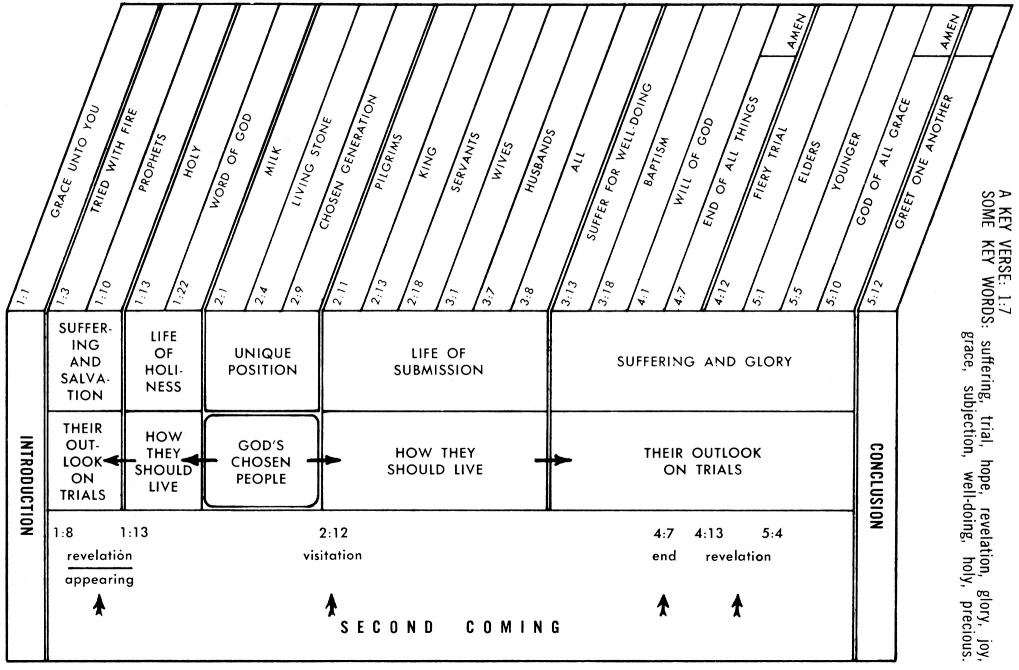
1 Peter: Trials, Holy Living & The Lord's Coming
Click chart to enlarge
Chart from Jensen's Survey of the NT - used by permission
See Another Chart from Charles Swindoll
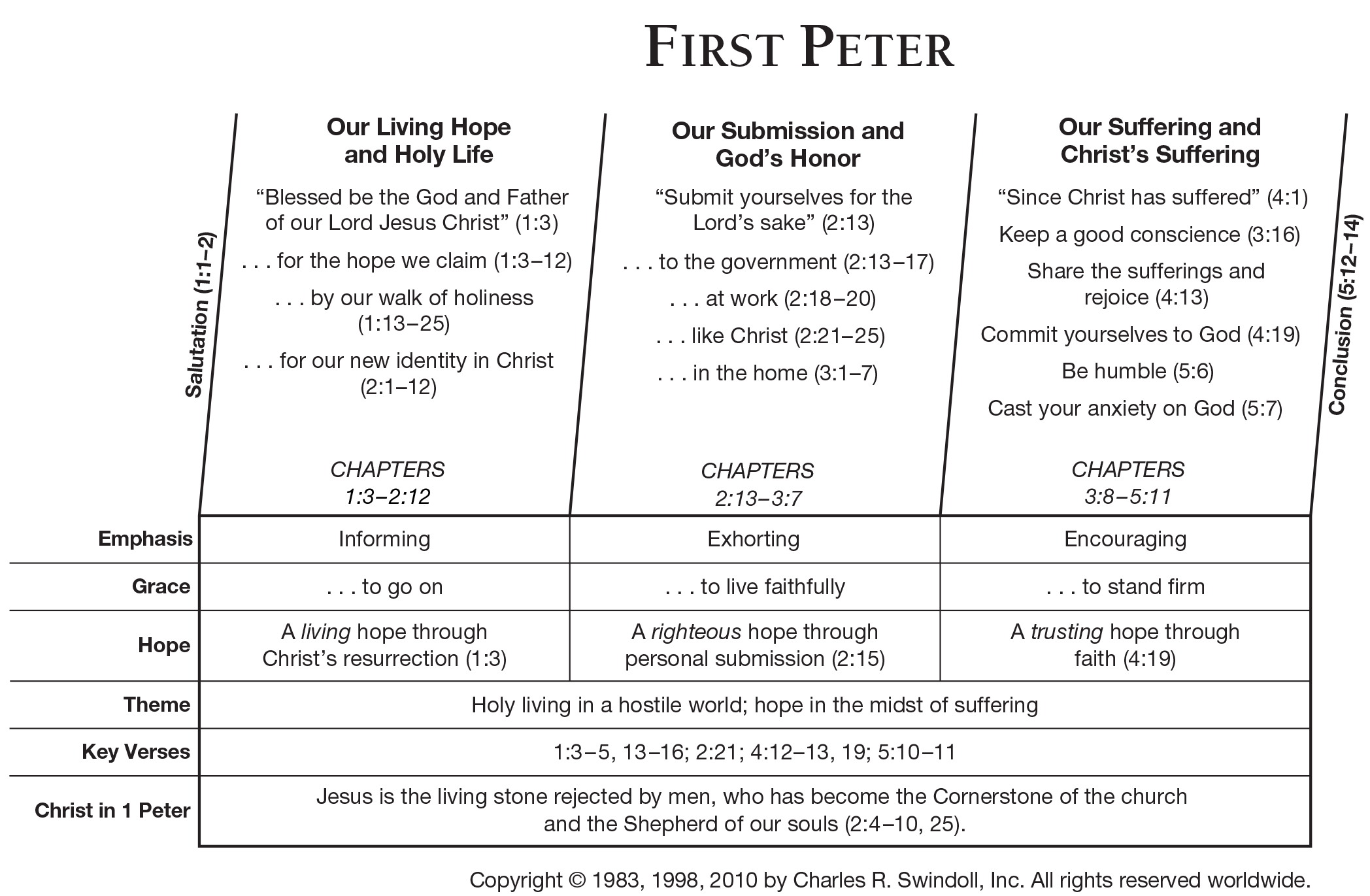
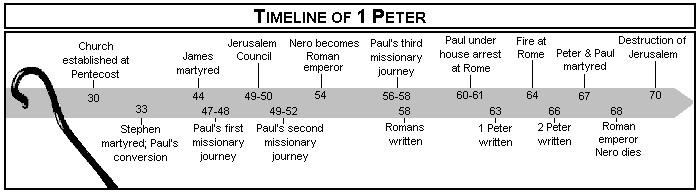
Source: Borrow Ryrie Study Bible
Click to enlarge
1Peter 2:11 Beloved, I urge you as aliens and strangers to abstain from fleshly lusts which wage war against the soul. (NASB: Lockman)
Greek: Agapetoi, parakalo (1SPAI) hos paroikous kai parepidemous apechesthai (PMN) ton sarkikon epithumion, aitines strateuontai (3PPMI) kata tes psuches;
Amplified: Beloved, I implore you as aliens and strangers and exiles [in this world] to abstain from the sensual urges (the evil desires, the passions of the flesh, your lower nature) that wage war against the soul. (Amplified Bible - Lockman)
BBE: My loved ones, I make this request with all my heart, that, as those for whom this world is a strange country, you will keep yourselves from the desires of the flesh which make war against the soul
KJV: Dearly beloved, I beseech you as strangers and pilgrims, abstain from fleshly lusts, which war against the soul;
Phillips: I beg you, as those whom I love, to live in this world as strangers and "temporary residents", to keep clear of the desires of your lower natures, for they are always at war with your souls (Phillips: Touchstone)
Wuest: Divinely loved ones [loved by God], I beg of you, please, as aliens and those who have settled down alongside of pagan [unsaved] people should, be constantly holding yourselves back from the passionate cravings which are fleshly by nature [fleshly in that they come from the totally depraved nature], cravings of such a nature that, like an army carrying on a military campaign, they are waging war, hurling themselves down upon your soul;
Young's Literal: Beloved, I call upon you, as strangers and sojourners, to keep from the fleshly desires, that war against the soul,
BELOVED I URGE YOU: Agapetoi parakalo (1SPAI):
- Romans 12:1; 2Corinthians 5:20; 6:1; Ephesians 4:1-note; Philemon 1:9,10
- 1 Peter 2 Resources - Multiple Sermons and Commentaries
THE PILGRIM LIFE
WE'RE JUST PASSING THROUGH!
The ESV Study Bible note on 1Peter 2:11-4:11 says believers are to be "Living as Aliens to Bring Glory to God in a Hostile World. Peter explains how believers should live as exiles amid a world that rejects their message. They bear witness to the gospel when they live in a way that pleases God....those who have trusted in Christ bear witness to the gospel by their conduct."
Pilgrim - one who journeys in foreign lands. "One who comes from a foreign country to dwell by the natives of a city or land, a stranger, sojourner. Since heaven is the home of the Christian, the NT speaks of Abraham and other believers as pilgrims while on earth (Heb 11:13; 1Pe 2:11; cf. Ge 23:4; Ps 39:12)." (Pfeiffer)
John Bunyan's "Apology for His Book" Pilgrim's Progress...
THE pilgrimage of life is a deeply-interesting subject, coextensive with human nature; every individual of our race is upon pilgrimage, from the cradle to the grave. It is the progress of the soul through time to enter upon a boundless eternity; beset on all sides, at every avenue, and at every moment, with spiritual foes of the deepest subtlety, journeying from the commencement to the close of the course through an enemy’s country, uncertain of the term of existence, certain only that it must terminate and usher us into an eternal state, either of exquisite happiness, or awful misery.
How natural that every man’s life
should be called by its proper name—
a pilgrimage.The patriarch felt this when he bowed before Pharaoh, and said,
‘The days of the years of my pilgrimage are an hundred and thirty years: few and evil have the days of the years of my life been, and have not attained unto the days of the years of the life of my fathers in the days of their pilgrimage.’ Ge. 47:9.
David sang the statutes of the Lord in the house of his pilgrimage. Ps. 119:54. And after the lapse of ages. when the Volume of Inspiration was about to close, the Holy Spirit continued the simile in the apostolic epistles, ‘and confessed that they were strangers and pilgrims on the earth.’ Heb. 11:13. As such we are exhorted,
‘I beseech you, as strangers and pilgrims, abstain from fleshly lusts.’ 1Pe 2:11.
‘See then that ye walk circumspectly.’ Ep 5:15.
‘So run, that ye may obtain.’ 1Co 9:24.
These are instructions that reach the heart of every Christian convert throughout the world: all are warned of the necessity of sobriety and vigilant watchfulness,
‘because your adversary, the devil, as a roaring lion, walketh about, seeking whom he may devour.’ 1 Pe. 5:8.
‘He shall cast some of you into prison, that ye may be tried; be thou faithful unto death, and I will give thee a crown of life.’ Rev 2:10.
RECOLLECTION...
TIME IS A PREPARATION FOR ETERNITYAll mankind are pilgrims; all are pressing through this world: the Christian willingly considers that his life is a journey, because he is seeking a better country; but the greater multitude are anxious to prevent the recollection, that time is a preparation for eternity, and, in consequence of this neglect, they shudder when approaching the brink of the grave, into which they are irresistibly plunged. Although perpetual examples warn them that suddenly, at a moment when they least expect the fatal catastrophe, it may befall them, still, as if infatuated, they make no inquiry of the Holy Oracles as to how they can escape the second death; but take the miserable counsel of some ‘worldlywise man,’ and seek a refuge in lies, which death will terribly sweep away; or they wholly neglect any preparation for so important and certain, if not sudden, an event. All are on the advance; time hurries on those whose pilgrimage is limited to the foul, but fascinating streets of the ‘city of destruction,’ to their eternal doom; while those whose anxious cries lead them to the Christian calling, press on in the narrow and difficult path that leads to the heavenly Jerusalem. (Pilgrim's Progress)
THOUGHT: Bunyan's sobering reminder begs the question of all genuine Christ followers - How would you characterize your life to date? That of a pilgrim or more like an "earth dweller" (cp 1Cor 15:19)? Are you "tethered" to this present passing evil world by possessions, people, plenty, etc? Or are you living life with a "future focus" (Titus 2:13-note), a sense that either your time could end today or our Lord could return today? (Mt 24:36, 16:27, 10:41, 42) The time is short and eternity is long. May God grant each of us His amazing, sufficient grace ministered by His Spirit of grace (Heb 10:29) to fight the good fight of faith, keeping sober in spirit, girding our mind for action (1Pe 1:13, 17) and redeeming every precious second He allots us (Eph 5:16, Ps 90:12 Da 12:3 Rev 22:12 - see Redeem the Time), doing so in such a way that brings us good (1Ti 4:8 Mt 6:20, 21) and God great glory in Christ (Mt 5:16). Amen. Dear reader if you are not a follower of Christ, may the Spirit of Christ use Bunyan's description of your desperate state (Jn 8:24, 3:18, 3:36, Rev 20:15) outside of the safety of the "Ark" of Christ, to stir your heart to seriously consider the claims of Christ, the One Who said "I am the way, the truth and the life and no one (absolutely no one) comes to the Father BUT THROUGH Me." (Jn 14:6). Believe on the Lord Jesus Christ and you will be saved today and forever.
Dwight Edwards introduces this section (1Peter 2:11-25) with these comments "One man has well said, "It is not enough for the gardener to love the flowers, he must also hate the weeds." This principle holds true not only in the lives of gardeners but also in the lives of Christians. We must learn not only to love the fragrant flowers of righteousness, but we must also learn to hate the wretched weeds of sin. For this reason God cries out through Amos, "Hate the evil, and love the good, and establish justice in the gate . . ." (Amos 5:15).
Kenneth Wuest's paraphrase of this verse is a virtual "mini-commentary" "Divinely loved ones [loved by God], I beg of you, please, as aliens and those who have settled down alongside of pagan [unsaved] people should, be constantly holding yourselves back from the passionate cravings which are fleshly by nature [fleshly in that they come from the totally depraved nature], cravings of such a nature that, like an army carrying on a military campaign, they are waging war, hurling themselves down upon your soul
Spurgeon...
Peter puts his hands together, and pleads with intense earnestness...For you belong not to the corruptible world, you are of an incorruptible race
If you are priests,-as you are if you are believers in the Lord Jesus Christ,-take care that you are clean before God. Let no impurity stain your body, for sin committed by the body grievously befouls the spirit, and defiles the heart: “Abstain from fleshly lusts, which war against the soul;”
Those fleshly lusts belong to this present evil world, but you do not belong to it; you are “strangers and pilgrims” here, therefore feel an absolute alienation towards such things, an utter abhorrence of them. Do not even think of them, much less practice them. “Abstain from fleshly lusts;” for, while they injure the body, that is not the worst thing that they do, for they “war against the soul.”
Fleshly lusts always hurt the soul. They do serious injury to the body, for they are contrary to the laws of health; but the main point for you to consider is that they “war against the soul.” No men or women can ever commit an act of uncleanness of the body without grievously injuring the soul. It leaves a weakness, a defilement, a wound, a scar upon the soul; so may God graciously keep us from it altogether! (1 Peter 2 Commentary)
D L Moody captured the essence of Peter's exhortation when he admitted "I have more trouble with D. L. Moody than with any man I know."
The man I see in the mirror each morning is my greatest impediment to holiness and godliness. Stop saying "The devil made me do it!"
Beloved (27) (agapetos from agape) means dear or very much loved (in context by God their Father!). It is a love called out of one’s heart by preciousness of the object loved. The "Beloved" are those to whom Christ has shown love.
As an aside, it is interesting to note how this "man's man", the crusty old fisherman, Peter, loves the tender word beloved, using it 8 times in both epistles (See all uses - 1 Peter, 2 Peter)
Here Peter uses beloved to remind his readers that God loves them, a truth which has a way of preparing his recipients for his exhortation. This is a good principle for all believers to follow. Before you exhort, begin (sincerely, from the heart) with "Beloved" which has a way of affirming that the one being addressed is beloved.
In the present context the idea of course is that the readers are beloved of God and because of this wonderful truth, they should feel a duty and a motivation (out of love with a desire to please the Father, to not disappoint Him or bring shame to His holy Name)
Leighton remarks that "What is known to stem from love cannot but readily be received and accepted. “Here is the advice of a friend, one who genuinely loves you and aims at nothing other than your good. It is because I love you that I urge you.”
Being the beloved of God should elicit an obedient response from your heart, motivated by love for God. Peter is saying "I urge you, I beg you in a passionate way" using parakaleo in much the same way as Paul does in Romans 12:1 after presenting the grand truths of the "Christian's constitution" writing...
I urge (parakaleo) you therefore (because of the liberating, life altering truth in Romans 1-11 and the fact that they have received such incredible mercies that He did not strike us when we sinned against Him before we became believers), brethren, by the mercies of God, to present your bodies a living and holy sacrifice, acceptable to God, which is your spiritual service of worship. (See note Romans 12:1)
Paul is exhorting the Roman Christians to pursue a holy walk worthy of the Gospel to which they had been called (cp Php 1:27, Eph 4:1) and which he so masterfully expounded in the preceding 11 chapters. So Peter gives an urgent passionate plea to people who are the beloved of God to reciprocate that love from a heart of obedience which begins with the believer making a volitional choice (even that "want to" or desire being enabled by the indwelling Spirit as shown in Php 2:13NLT-note)
John Piper explains the thrust of Peter's exhortation declaring that believers "must cultivate the mindset of exiles. What this does mainly is sober us up and wake us up so that we don't drift with the world and take for granted that the way the world thinks and acts is the best way. We don't assume that what is on TV is helpful to the soul; we don't assume that the priorities of advertisers is helpful to the soul; we don't assume that the strategies and values of business and industry are helpful to the soul. We don't assume that any of this glorifies God. We stop and we think and we consult the Wisdom of our own country, heaven, and we don't assume that the conventional wisdom of this age is God's wisdom. We get our bearings from God in his word. When you see yourself as an alien and an exile with your citizenship in heaven, and God as your only Sovereign, you stop drifting with the current of the day. You ponder what is good for the soul and what honors God in everything: food, cars, videos, bathing suits, birth control, driving speeds, bed times, financial savings, education for the children, unreached peoples, famine, refugee camps, sports, death, and everything else. Aliens get their cue from God and not the world." (The War Against the Soul and the Glory of God :: Desiring God) (Read &/or listen to Piper's related sermons on 1Thes 4:1, 2-4, 5-6, 7-8 This is the Will of God for You: That You Abstain from Sexual Immorality and Battling the Unbelief of Lust) (See other sermons by Piper on sexuality)
Learn to live
"in the future tense"
(cp Heb 11:8, 9, 10)
I would add enabled by the indwelling Spirit of holiness, may we learn to live with "vertical vision" (upward focus), not "horizontal vision" (earthly focus). (See discussion of "Vertical Vision")
Leighton remarks that "In this letter we find the apostle combining divine doctrine with most useful practical exhortations; see 1Pe 1:13, 22; 2:1. This occurs again in this verse. Ministers of the Gospel should base their teaching on this model. They should both teach and exhort. They should exhort people to holiness and the duties of a Christian life, as well as teach them the doctrines of the Christian faith. To hear about the mercies of God is very pleasing. But to have this followed by abstain from sinful desires is not so pleasant. But it must be like this. Those who want to share in God’s mercy and happiness must abstain from sinful desires.
Urge (3870) (parakaleo from para = beside + kaleo = to call) means literally to call to one's side and so refers to the act of calling someone to one’s side in order to give aid or help. Urging or exhorting implies an earnest and persuasive address aimed at encouraging the readers to face their trials and inner temptations. Always at the root of parakaleo is the idea of enabling a person to meet a difficult situation with confidence and gallantry.
Although the apostles frequently use this appeal (“I urge you" cp Ro 12:1-note), this is the only use in either of Peter's epistles.
Peter urges believers to be dedicated to relentless, even ruthless opposition (cf Jesus' strong words on adultery - Mt 5:27- note; Mt 5:28 - note, Mt 5:29 - note; Mt 5:30 - note) to the power of Sin in our lives which continually seeks to be Master over us (cp Ro 6:12, 14-note). Peter knows the pain that being a slave to Sin can bring and he is exhorting believers enabled by the supernatural power of the Spirit to put to death the deeds of the body (Ro 8:13 - see note; cp Col 3:5 - see note; Ro 6:12 see note; Ro 6:13 - see note; Ro 6:14 see note).
The present tense speaks of continuous activity. Peter knows the war is incessant whether you are 16 or 76 (!) and so he continues to come alongside to spur us on to fight the good fight of faith in this vitally important area (especially for men). Sometimes parakaleo means convey the idea of comfort and sometimes the idea of exhortation, the latter idea being the predominant sense in this context.
Hiebert feels that parakaleo implies
earnest and persuasive address aimed at encouraging and bracing the readers to face their trials." more than "the thought of comforting and consoling. (Hiebert, D. E. 1 Peter. Moody)
Present tense salvation (practical or progressive sanctification - see Three Tenses of Salvation) is a war we are in until the day we see Jesus face to face and the enemy does not just want to take us prisoner but to destroy us and in so doing to bring disgrace and dishonor to the holy Name of God. Make no mistake about this truth! But take courage because of 1 Peter 1:5 (note) and 1 Jn 5:18-note. God is in control but He is calling believers to be holy as He is holy and exhibit Spirit empowered Self Control (Gal 5:23 - note).
And so Peter exhorts us to discipline ourslves (cp 1Ti 4:7-8, 9-10, see notes). If I am to live godly in this increasing evil age (cp Titus 2:11-12, see notes), this quality of behavior does not begin on the outside, but on the inside. We can only work out what has been worked in on the inside (so to speak) which is what Paul teaches in the important passages in Philippians...
work out (present imperative = not a suggestion but an absolute continual necessity if we would win the battle with lust! See discussion of commands and our abject need for the Spirit) your salvation with fear and trembling, for (this is a crucial term of explanation for without it one could interpret [as some works oriented cults do] as a charge to "work for" our salvation) it is God Who is at work (energeo = present tense - continually - i.e., we are not in this battle alone! We have an "ever ready" Source of spiritual energy. Praise God! But we need to stay "plugged" in to the Source so to speak - How? By not grieving or quenching Him as with unconfessed sin!) in you, both to will (TO give us the "want to," for our old nature does not want to please God) and to work (energeo = present tense - continually) for His good pleasure (eudokía). (See notes as Php 2:12; 13) and notice how the New Living version translates Php 2:13NLT - that's what we need - supernatural desire and the power!)
It follows that living as an alien and stranger in the world with an evangelistic mission the goal of which is to silence the ungodly critics (1Pet 2:12 - note, Phil 2:15 - note) and to win the skeptical unbeliever begins with integrity of life and integrity of life begins with an "inside job".
Wiersbe writes that...
Peter reminded his readers that they were only "sojourners" on earth. Life was too short to waste in disobedience and sin (see 1Peter 4:1-6). It was when Lot stopped being a sojourner, and became a resident in Sodom, that he lost his consecration and his testimony. Everything he lived for went up in smoke! Keep reminding yourself that you are a "stranger and pilgrim" in this world (1 Peter 1:1; 2:11).
Comment: Yes Jesus commanded us to "Remember (present active imperative - this is something we are to daily make the choice of our will [active voice] to always remember and thereby let this truth influence our choices not to go back to Sodom whatever "Sodom" was in our "BC" life, our life before we met Jesus. cp similar exhortation by Paul in 1 Cor 10:6, 11) Lot's wife" (Lk 17:32) but it also behooves wise believers to...
Remember
Lot's life!
AS ALIENS: hos paroikous:
- 1 Peter 1:1-note, 1Pe 1:17-note; Genesis 23:4; 47:9; Leviticus 25:23; 1Chronicles 29:15; Psalms 39:12; 119:19,54; Hebrews 11:13-note
- Torrey's Topic Pilgrims & Strangers
- McClintock and Strong's Bible Encyclopedia Pilgrims and Strangers
- 1 Peter 2 Resources - Multiple Sermons and Commentaries
Aliens (3941) (paroikos from para = beside + oikos = dwelling, home) means literally to dwell near and thus to have a home alongside of. It refers to a person living in a foreign land alongside of people who are not of his kind or to a period spent in a foreign land without taking out or being granted rights of citizenship. In short, paroikos refers to dwelling at a place only for a short time. The idea is that of a sojourn which describes one's stay in a foreign place as a temporary resident. Today we say something like believers are "short timers", dwelling temporarily and not being tethered to this terra firma on which we currently reside. Remember what John said - "The world is passing away, and [also] its lusts; but the one who does the will of God lives forever." (1 John 2:17-note)
It is interesting that while believers are referred to as sojourners on earth, the opposite description is applied to unbelievers (especially in the Revelation) who are categorized as earth dwellers (See note on Earth Dwellers composed of two Greek words, a verb katoikeo which means to take up permanent abode and a noun ge which means earth)!
THOUGHT: Dear saint, would our choices this past week (month, year, etc) give evidence that we are living more like "short timers" or like "earth dwellers"?
David C. Egner asks "How do we cope with being pilgrims who are just passing through? By looking to Christ and following His example (See topic Walking Like Jesus Walked!). He was also unwanted in this world. When He left His home in heaven to enter our humanity, He became the ultimate pilgrim. One day He will welcome us home. The Christian life is a pilgrim journey, not a sightseeing tour.
Guide me, O Thou great Jehovah,
Pilgrim through this barren land;
I am weak, but Thou art mighty,
Hold me with Thy powerful hand.
—Williams
As believers we don't belong in the godless society we are residing in. We are holy ones (the meaning of saints) and this evil world is supposed to make us very uncomfortable! We are outsiders and as Paul explains "our citizenship is in heaven, from which also we eagerly wait for a Savior (this is "Vertical Vision!"), the Lord Jesus Christ Who will transform the body of our humble state into conformity with the body of His glory, by the exertion of the power that He has even to subject all things to Himself." (Php 3:20, 21+)
We are aliens and the following words should be our theme song...
This world is not my home,
I'm just a passin' through,
My treasures are laid up
somewhere beyond the blue.
Don’t drive your stakes too deep.
We’re moving in the morning!
Our status in this world is as those who do not belong which is why John writes...
Do not love the world, nor the things in the world. If anyone loves the world, the love of the Father is not in him. For all that is in the world, the lust of the flesh and the lust of the eyes and the boastful pride of life, is not from the Father, but is from the world. And the world is passing away, and also its lusts; but the one who does the will of God abides forever. (1 John 2:15, 16, 17-note)
Believers have the high and holy privilege of emancipated ones for as Paul writes God has...
He delivered us from the domain (the right and the might) of darkness (cp "dominion of Satan" Acts 26:18), and transferred us to the kingdom of His beloved Son (see note Colossians 1:13).
It is a privilege to be redeemed (1 Pe 1:18 see note; 1Pe 1:19 - see note). It is a privilege to be made a citizen of heaven (Phil 3:20 see note; Phil 3:21 see note). And here in verse 11, Peter says the responsibility and practice that comes with our privileged position is that we should shun the things of this present evil age, for as John says the whole world lies in the power of the evil one (Satan) (1 John 5:19-note)
Look at the Psalmist's prayer
I am a stranger in the earth; Do not hide Thy commandments from me. (Ps 119:19) (Spurgeon's note)
We are aliens in this world but not in the world to come in which we are even now fellow citizens. (Eph 2:19 -See note)
Paroikos is used to describe the patriarchs especially Abraham who went out not knowing where he was to go (see notes Hebrews 11:9, 11:13) as well as the children of Israel (Acts 7:6).
Peter's point is that as saints we are no longer "citizens of this present evil age but are destined for another world where we will live eternally as heavenly citizens, children in the family of God!"
Doctrine always precedes duty and this great truth should affect how we conduct ourselves in this evil "foreign" land. Heaven is our real home and we are merely temporary dwellers on earth. Furthermore, since we do not know at what time our Lord might return (or we might take our last breath), we should live in anticipation of His coming by holding lightly the things that are passing away and "clinging tightly" by faith to the future hope (certainty) of heaven (cp 1Pet 1:5 - note; 1Pet 1:13 - note). (See related study of Christ's Second Coming)
Numerous Scriptures allude to the fact that saints are aliens and strangers - consider taking a few moments and pondering these passages (Genesis 12:1; Acts 7:2-3; Luke 14:26,27,33, Lev 25:23, Hebrews 11:9,10,13 Genesis 23:4; 47:9; Lev 25:23; 1Chr 29:15, Ps 39:12; 119:19, 54)
Here are all 4 uses of paroikos in the NT...
Acts 7:6 "But God spoke to this effect, that his offspring would be aliens in a foreign land, and that they would be enslaved and mistreated for four hundred years.
Acts 7:29 "And at this remark Moses fled, and became an alien in the land of Midian, where he became the father of two sons.
Ephesians 2:19 (note) So then you are no longer strangers and aliens, but you are fellow citizens with the saints, and are of God's household,
1 Peter 2:11 (note) Beloved, I urge you as aliens and strangers to abstain from fleshly lusts, which wage war against the soul.
Paroikos is use 32 times in the
Gen. 15:13; 23:4; Exod. 2:22; 12:45; 18:3; Lev. 22:10; 25:6, 23, 35, 40, 45, 47; Num. 35:15; Deut. 14:21; 23:7; 2 Sam. 1:13; 1 Chr. 5:10; 29:15; Ps. 39:12; 105:12; 119:19; Jer. 14:8; 49:18; Zeph. 2:5
Our prayer should be that of the psalmist - "I am a stranger (paroikos) in the earth; Do not hide Your commandments from me." (Ps 119:19)
Aliens and strangers describe the Christian in his position in this world because he has died to this world, Paul testifying...
may it never be that I should boast, except in the cross of our Lord Jesus Christ, through which the world has been crucified to me, and I to the world. (Galatians 6:14)
The truth of our death with Christ to the power of sin, the control of Satan and the lure of this present evil age prompted Paul's great exhortation to the saints at Colossae...
If (Since) then you have been raised up with Christ, keep seeking the things above, where Christ is, seated at the right hand of God. Set your mind on the things above, not on the things that are on earth. For you have died and your life is hidden with Christ in God. (See notes Colossians 3:1; 3:2; 3:3). (this is "Vertical Vision!")
Remember beloved of God, you are not a citizen of earth trying to get to heaven but a citizen of heaven sojourning on earth. Never forget that...
This world is your passage,
not your portion!
AND STRANGERS: kai parepidemous:
- 1 Peter 2 Resources - Multiple Sermons and Commentaries
A pilgrim in a hurried world and flurried,
Where hearts are aching and where hopes are buried;
Where bowers of ease and pleasures are enticing,
Where heedless lives the good are sacrificing;
A world of turmoil and of strife and danger—
Yes, I'm a pilgrim here, and I'm a stranger.
—Wm. M. Runyon
Strangers (3927) (parepidemois from para = near by and here implies a transitory sense describing one who passes near but on to something beyond + epidemos = stranger, epidemos from epi = in or among + demos = a people) literally means a stranger alongside and so a stranger or sojourner. This person is not simply one who is passing through, but a foreigner who has settled down, however briefly, next to or among the native people. What a picture of the believer in the midst of a crooked and perverse generation!
Parepidemos describes one who makes a brief stay in a strange or foreign place, who sojourns (stays as a temporary resident) or who resides temporarily among a native people to whom he or she does not belong. The parepidemos did not expect to be regarded as a native of the place he resided. Beloved are you becoming too comfortable and too familiar with this evil world system which is "devolving" and corrupting almost daily before our very eyes (and ears)? Remember that you are an "alien".
Two cognate words (words related by derivation), parepidemeo and parepidemia, are used in inscriptions in connection with civil servants who distinguish themselves for exemplary conduct while on international duty.
Vincent writes that parepidemos refers to
Persons sojourning for a brief season in a foreign country. Though applied primarily to Hebrews scattered throughout the world (Ge 23:4; Ps 39:12 [see Spurgeon's comment] parepidemos is used in Greek of both these OT passages), it has here a wider, spiritual sense, contemplating Christians as having their citizenship in heaven. (Vincent, M. R. Word studies in the New Testament. Vol. 1, Page 3-628)
Parepidemos then means to settle down alongside of the pagans. Christians have always had to live among the pagans, among those whose habitual practices are dominated by the fallen desires of their flesh. We are living beside them, but we are not to live like them.
Wiersbe - Everybody has some metaphor to describe life—a battle, a race, a trap, a puzzle—and Jacob's metaphor was that of a pilgrimage. The patriarchs were pilgrims and strangers on the earth (Heb. 11:13-16), but so are all of God's people (1 Chron. 29:15; 1 Peter 1:1; 2:11). We agree with Abraham, Isaac, and Jacob that this world is not our home. Our time here is brief and temporary, and we're eagerly looking for our permanent home, the city of God in heaven. (Bible Exposition Commentary - Old Testament)
A W Tozer - If we are genuine, committed Christians, intent upon walking by faith with our Lord Jesus Christ, then we are continually confessing that we are pilgrims and that we are strangers! The Holy Spirit, who is the real author of this Letter to the Hebrews, uses the terms pilgrims and strangers to remind the early Christians that they were not yet at their final home. The message still reads the same today. Christian pilgrims are journeying by faith from an old city that is cursed and under threat of judgment to a blessed and celestial city where dwells Immanuel! (cf Hebrews 11:13, 14, 15, 16; 1Pe 2:11, 12; Revelation 21:2)
Pilgrims - As Christians, we need to think of ourselves as travelers who are just passing through this sinful world. We are not permanent residents, but pilgrims on a journey to a better land. Therefore, we need to “travel light,” not burdening ourselves with an undue attachment to the material things of life. The more we care for the luxuries and possessions of earth, the more difficult will be our journey to heaven. The story is told about some Christians who were traveling in the Middle East. They heard about a wise, devout, beloved, old believer, so they went out of their way to visit him. When they finally found him, they discovered that he was living in a simple hut. All he had inside was a rough cot, a chair, a table, and a battered stove for heating and cooking. The visitors were shocked to see how few possessions the man had, and one of them blurted out, “Well, where is your furniture?” The aged saint replied by gently asking, "Where is yours?” The visitor, sputtering a little, responded, “Why, at home, of course. I don’t carry it with me, I’m traveling.” “So am I,” the godly Christian replied. “So am I.” This man was practicing a basic principle of the Bible: Christians must center their affections on Christ, not on the temporal things of this earth. Material riches lose their value when compared to the riches of glory. To keep this world’s goods from becoming more important to us than obeying Christ, we need to ask ourselves, “Where is our furniture?” -D. C. Egner (Our Daily Bread, Copyright RBC Ministries, Grand Rapids, MI. Reprinted by permission. All rights reserved)
The Ultimate Pilgrim - During the Cold War, I directed several study tours of Europe. Our itinerary took us from Amsterdam to Berlin, which meant that we had to go through Communist East Germany. At the border we had to show our passports, have our luggage examined, and let the guards check the bus. We waited about 3 hours for clearance. “Remember,” one official told me, “there is no American Consulate in East Germany, so do not lose your passports or entry papers.”
Talk about feeling unwanted! The message was clear: We’ll gladly take your money but we don’t want you. We felt the animosity until we left.
As a Christian, I sometimes feel that way about this world—that I just don’t belong. The Scripture makes it clear that as believers in Christ we are “strangers and pilgrims on the earth” (Heb. 11:13). We are citizens of a far better land (v.16). As much as we may love our native country, we’ll never feel totally at home down here—and we shouldn’t.
How do we cope with being pilgrims who are just passing through? By looking to Christ and following His example. He was also unwanted in this world. When He left His home in heaven to enter our humanity, He became the ultimate pilgrim. One day He will welcome us home. David C. Egner
Guide me, O Thou great Jehovah,
Pilgrim through this barren land;
I am weak, but Thou art mighty,
Hold me with Thy powerful hand. —Williams
The Christian life is a pilgrim journey, not a sightseeing tour.
TO ABSTAIN: apechesthai (PMN):
- 1Peter 4:2 - note; Lk 21:34; Acts 15:20,29; Ro 8:13-note; Ro 13:13-note, Ro 13:14-note; 2Cor 7:1; Gal 5:16-21-notes; 2Ti 2:22-note ; 1Jn 2:15, 16, 17
- 1 Peter 2 Resources - Multiple Sermons and Commentaries
I beg you not to surrender to those desires that fight against you. (CEV)
be constantly holding yourselves back from the passionate cravings which are fleshly by nature [fleshly in that they come from the totally depraved nature] (Wuest)
CONTINUALLY CHOSE
TO REFRAIN
John MacArthur "cuts to the chase" asking "Do you want to put to death the lusts in your heart? Then stop entertaining them. Peter does not prescribe a program of therapy. He does not suggest that such sin be treated as an addiction. He simply says abstain. Quit doing it. You have no business indulging such thoughts. Put them away at once. You yourself must do this; it cannot be done for you. There is no point waiting for some heavenly power to erase this sin automatically from your life. You are to stop it, and stop it immediately. Martyn Lloyd-Jones said, "I do not know of a single scripture—and I speak advisedly—which tells me to take my sin, the particular thing that gets me down, to God in prayer and ask him to deliver me from it and then trust in faith that he will. Now that teaching is also often put like this: you must say to a man who is constantly defeated by a particular sin, “I think your only hope is to take it to Christ and Christ will take it from you.” But what does Scripture say in Ephesians 4:28 to the man who finds himself constantly guilty of stealing, to a man who sees something he likes and takes it? What am I to tell such a man? Am I to say, “Take that sin to Christ and ask him to deliver you?” No, what the apostle Paul tells him is this: “Let him that stole, steal no more.” Just that. Stop doing it. And if it is fornication or adultery or lustful thoughts, again: Stop doing it, says Paul. He does not say, “Go and pray to Christ to deliver you.” No. You stop doing that, he says, as becomes children of God." Here is perhaps the most straightforward, obvious means of mortifying our sin: stop doing it. Too many people think they must wait for an extraordinary experience, a miracle from heaven, a sign from the Lord, or whatever. They think some special divine intervention is necessary to free them from a sinful practice or pattern of thinking. No, that is precisely the error Romans 6 refutes. You are free from sin; now stop doing it. You are dead to sin; now put to death the sin that remains. How? “Abstain.” Reckon yourself dead to sin, and don’t do it anymore. “Resist the devil and he will flee from you” (Jas. 4:7). It is as simple as that. (Vanishing Conscience)
Comment - While I agree with Dr MacArthur, I might add one "caveat" to "stop doing it." My caveat would be that believers can now "stop doing it" because the power of sin has been broken. But the question is "Do we want to stop doing it?" Well, yes and no. "No," if we depend on our natural strength, because it does not want to stop. But "yes" if we learn to depend on our supernatural Source of strength Who lives in us and continually "energizes" the desire (the "want to") and the power to "Stop doing it." (Php 2:13NLT+) This is not a call to passivity as some falsely teach advocating us simply to "Let go, Let God." We are still responsible to work out our salvation in fear and trembling, but as believers we do so in continual dependence on the Holy Spirit's enablement (giving us the desire and the power). And so instead of "Let go, Let God," it is more biblical to say "Let God and let's go!" (So to speak). To say it another way, believers are 100% responsible and at the same time 100% dependent to "stop doing it." See related discussion "Paradoxical Principle of 100% Dependent and 100% Responsible" (100/100).
Abstain (568) (apechomai or apecho from apó = away from - the idea of putting some distance between, marker of dissociation, implying a rupture from a former association + écho = have) means to be away or be at a distance.
Peter calls for the believer to hold himself away from contact or influence of the strong desires that originate from our utterly depraved nature inherited from Adam and still latent even in those who have been born again.
The present tense is used here and calls for one to continually hold themselves (middle voice) away from "the reefs" of destructive lusts, no matter how hard the wind blows nor how high the waves rise...be like a ship holding off from the shore so as not to suffer shipwreck of your faith (cp 1Ti 1:!9). We have an anchor of our soul (Hebrews 6:19, 20 - note) both sure and steadfast...this hope will like an anchor help motivate us to live separated lives waiting anxiously for the appearing of the Captain of our souls Who will guide us safely home to heaven's shore. This is shouting ground and reason enough to keep on holding one's self from the powerful desires latent in this old hibernating Adamic bear (Ro 7:18 see note; Ro 7:21 - see note).
Wuest paraphrase says "be constantly holding yourselves back from the passionate cravings." Now pause for a moment and ponder that exhortation. How successful are you at holding yourself back when you rely on yourself (your old man, your lower nature, your fallen flesh)? Not very! Right? If you are being honest the answer is that flesh will not control flesh. Therefore we must daily seek to be filled with (controlled) by the Spirit of Jesus Christ (Eph 5:18+), Who Alone can supply supernatural power we need to hold ourselves away from whatever it is that is tempting to us. Note carefully that we don't just need "help" as if all we needed was a little push to get us started! We need to be "enabled" because as Jesus clearly taught apart from Him (and His indwelling Spirit) we can do absolutely nothing (nada, nein, nicht) in the supernatural realm (John 15:5, cp John 6:63, Gal 3:3)! The only way to obey Peter's exhortation is to relinquish reliance on self and rely wholly on the Holy Spirit. Be careful here, for this is not saying we are to "Let go and let God," because that is not a Scripturally sound statement. What we are to do is to "Let God and Let's go!" Do you see the difference? The first statement effectively "absolves" us of any personal responsibility, whereas the second statement clearly shows that there is a divine-human synergism, the Spirit supplying the power, while we make the choice of our will to take whatever action is necessary to obey this exhortation. This principle is vital to understand and to put into practice daily. Otherwise you will try to "abstain" in your own strength, and while you may experience of modicum of "apparent success," ultimately you will succumb to failure and that will lead to frustration in your walk with Jesus. The only way to walk with Jesus is to walk as He Himself walked as a Man and that was enabled by the Spirit (see Luke 4:1-2, 14, Mt 4:1, see especially Peter's "summary" of Jesus' life on earth in Acts 10:38).
See the related discussion of the critically important "Paradoxical Principle of 100% Dependent and 100% Responsible"!
Leighton writes that "Epictetus made a very wise summary of philosophy when he said, “Bear and forbear.” Stoic philosophy was summarized as: “to bear with the troubles and to abstain from the pleasures of life.” These are truly the two main duties that our apostle recommends to his Christian brothers in this letter.
Paul explains to the saints at Thessalonica that...
this is the will of God, your sanctification; that is, that you abstain (apechomai/apecho - present tense = continually, as your habitual practice) from sexual immorality (see note 1Thessalonians 4:3)
Paul later uses apecho commanding the Thessalonian saints to...
Abstain (present imperative - Continually hold themselves away from) from every form (even the appearance of) of evil (that which is actively harmful (poneros). (see note 1Thessalonians 5:22)
Remember evil surrounds us at every turn but God never commands believers to do that which He does not enable us to do.
Peter says in essence don't play with the strong desires of the flesh. They are like a German shepherd that everyone thought was the family pet until they gruesomely mauled the family's young child. Don't play with the strong inordinate desires of the fallen flesh that still smolder like embers waiting to be fanned into roaring flames!
Even King Solomon when he let his guard down and compromised his values, experienced what he so wisely warned against...
Can a man take fire in his bosom, and his clothes not be burned? (Pr 6:27) (What is the answer to this rhetorical question dear saint? Griffiths writes "It is utter folly for all that will commit adultery, for the result will be self-destruction, wounds and dishonor, disgrace, and the unappeased anger of the wronged parties.")
Be disciplined in an inward and private way if you expect to have an outward and public impact on the world in which you must live. To do that, Peter gives a "simple" instruction - Abstain from fleshly lusts - that sums it up. And it means exactly what it says -- stay away from, keep your distance from fleshly lusts, the desires of your fallen nature
Webster's definition of abstain is to refrain deliberately and often with an effort of self-denial from an action or practice. This is not a bad definition except that ''self-denial'' is the world's way. Believers possess the indwelling Spirit of holiness, Who can bear holy fruit which includes the fruit of the Spirit, self-control (Galatians 5:23 - see note;, cp Ro 8:13 see note). Nevertheless, we still have the responsibility to make decisions and take actions that cultivate and fertilize the growth of the wonderful fruit one branch of which is self-control (2Pet 1:6 - see note).
There is a very instructive use of apecho in the first verse of Job in the Greek translation (Septuagint - LXX) where we read that...
There was a man in the land of Uz, whose name was Job, and that man was blameless, upright, fearing God, and turning away (eschewed - KJV) (Hebrew = sur = turned aside, departed from; LXX = apecho in the present tense = continually, as his habitual practice, turning away) from evil. (Job 1:1)
Comment: Job was not perfect nor sinless, but his practice when confronted by temptation to think or do evil was to turn away from it. And prior to Pentecost believers did not have the indwelling Holy Spirit! So when we under the New Covenant fail to turn away from fleshly lusts what is our excuse as those who are privileged to possess the Holy Spirit?
Read Job 1:1 again. What was Job turning from? Why did he turn? What motivated him? (cp 1Pe 1:17-note) Ponder these thoughts and remember what God's assessment of Job was in Job 1:8...
And the LORD said to Satan, "Have you considered My servant Job? For there is no one like him on the earth, a blameless and upright man, fearing God and turning away from evil.
Good men avoid sin from the love of God and love of virtue which is pleasing to Him. Paul who was certainly a God fearing man wrote...
Therefore also we have as our ambition, whether at home or absent, to be pleasing to Him. (2Cor 5:9-note) (And what event motivated him - see 2Cor 5:10-note)
For am I now seeking the favor of men, or of God? Or am I striving to please men? If I were still trying to please men, I would not be a bond-servant of Christ. (Gal 1:10)
Wicked men avoid sin from a fear of punishment. Why do you avoid sin?
Called from above, and heavenly men by birth
(Who once were but the citizens of earth),
As pilgrims here, we seek a heav’nly home,
Our portion in the ages yet to come.
We are but strangers here, we do not crave
A home on earth, which gave Thee but a grave:
Thy cross has severed ties which bound us here,
Thyself our treasure in a brighter sphere.
—James G. Deck
Other NT passages convey a similar theme regarding the call to believer to live a life separated from the corruption of this present evil age...
Earlier Peter had charged these born again ones...
As obedient children, do not be conformed to the former lusts which were yours in your ignorance, but like the Holy One who called you, be holy (aorist imperative = Do this now. Don't delay!) yourselves also in all (How much?) your behavior (How is this possible? see Titus 2:14 - note); because it is written, "YOU SHALL BE HOLY, FOR I AM HOLY." (cp (Ex 6:7; Ex 19:6 Lev 11:44, 45, 19:2, 20:7,26, 21:8, Dt 7:6,14:2) And if you address as Father the One who impartially judges according to each man's work, conduct (aorist imperative = do this. Don't delay!) yourselves in fear (a healthy fear - a sense of reverential awe at God's holiness) during the time of your stay upon earth (See notes 1 Peter 1:14; 15; 16; 17)
Peter later instructed them...
to live the rest of the time in the flesh no longer for the lusts of men, but for the will of God. (see note 1 Peter 4:2)
Jesus warned His disciples to...
Be on guard (present imperative - Continually, as your habitual practice), that your hearts may not be weighted down with dissipation and drunkenness and the worries of life, and that day come on you suddenly like a trap for it will come upon all those who dwell on the face of all the earth. (Lk 21:34, 35)
The Jerusalem council wrote that the believing Gentiles were to
abstain (apechomai - present tense = make it their habitual practice, because the war against holiness is continual) from things contaminated by idols and from fornication (porneia) and from what is strangled and from blood....if you keep (apechomai - present tense = make it their habitual practice) yourselves free from such things, you will do well. Farewell. (Acts 15:20,29)
Paul said not only are believers to abstain from evil we are to...
by the Spirit (be) putting to death the deeds of the body (Ro 8:13 - note)
Paul reminded the saints at Rome "what time it was" writing that...
And this do, knowing the time (What time? Do you know what time it is on the "clock" called "eternity?" If you do you will be about your Father's business, redeeming the time [Eph 5;16-note]), that it is already the hour for you to awaken from sleep; for now salvation is nearer to us than when we believed (What's Paul's point? We are one day closer to seeing Jesus face to face! Are you living in light of that incomparable truth?). The night is almost gone (cp 1Jn 2:17-note), and the day is at hand. Let us therefore (term of conclusion) lay aside the deeds of darkness and put on the armor of light. Let us behave properly as in the day, not in carousing and drunkenness, not in sexual promiscuity and sensuality, not in strife and jealousy. But put on (aorist imperative = command to "Just do it!" - It's urgent! And remember, you are not alone but have another Helper", the Spirit of Christ, Who indwells you forever and Who is ever ready to enable you to fulfill the commands - you are 100% responsible but at the same time 100% dependent on His supernatural enablement - rely on Him, distrust self, especially "self reliance" which blunts grace and the Spirit's empowerment!) the Lord Jesus Christ (What does this mean? Among other things it means you live like Him, bringing forth His supernatural fruit, relying on the same Spirit on Whom He relied while He walked the earth - see Luke 4:1,2, 18 = Jesus relied on the Spirit and left us an incredible example to walk in His steps 1Pe 2:21-note, 1Jn 2:6), and make no provision (present imperative with negative = stop doing this or don't let it begin!) for the flesh in regard to its lusts (Beloved as long as you breath the flesh will have corrupt, evil, destructive desires and we must fight the good fight of faith until to our dying breath!). (see notes Romans 13:11; 13:12, 13; 14)
Writing to the saints in Corinth surrounded by a veritable "cesspool of moral pollution", Paul encouraged them...
Therefore, having these promises (see 2Cor 6:14, 15, 16, 17, 18 - God promises to dwell in us, walk among us, be our God, we His people, recipients of His welcome, experiencing Him as our Father and we as His children), beloved, let us cleanse ourselves from all defilement of flesh and spirit, perfecting (present tense = continually bringing about) holiness in the fear of God (cp Job 1:1, 1Pe 1:17-note). (2Cor 7:1-note)
In Paul's closing words to his young disciple Timothy he commanded him...
Now flee (present imperative - Continually, as your habitual practice. Practice the Joseph "two step" - Look to God first, then Leave for His glory and your good! Genesis 39:9, 11) from youthful lusts, and pursue (present imperative - Continually, as your habitual practice) righteousness, faith, love and peace, with those who call on the Lord from a pure heart. (see note 2 Timothy 2:22)
Illustrations - EAGLES are most at home when they're soaring in the air. You know why? Because that's what they were made for. You can never be fulfilled when you're attached to earth...IT IS impossible for a fish to be happy on land. A fish on land is struggling trying to make it. A fish on land is going to be squirming and flipping and twisting and jerking and jumping. It won't be able to relax because it is not where it was made to live. (Tony Evans' Book of Illustrations: Stories, Quotes, and Anecdotes).
Related Resources:
- Mortification of Sin in Believers (eBook) - updated to modern English (Epub, Mobi, Pdf formats) - John Owen - this book is an extended "exposition" of Romans 8:13.
- The Chief Design of My Life: Mortification and Universal Holiness - John Piper
- When the "Want To" and the "Ought To" Don't Match - John Piper
- Hope-Giving Promises for Triumph over Sin - John Piper
- Kill Sin with the Word of God - John Piper
- A Passion for Purity Vs Passive Prayers - John Piper
- How to Kill Sin, Part 1 - John Piper
- How to Kill Sin, Part 2 - John Piper
- How to Kill Sin, Part 3 - John Piper
- How Dead People do Battle with Sin - John Piper
- The War Within: Flesh Vs. Spirit - John Piper
- Why and How We Walk According to the Spirit - John Piper
- How the Spirit Does What the Law Could Not Do - John Piper
- How To Kill Sin in your Life - John MacArthur
- Mortification of Sin - 20 page paper - John MacArthur (Excellent summary of how to kill sin)
- How to Mortify Sin Sinclair Ferguson
- Preaching the Gospel to Yourself - Joe Thorn
- See in depth notes on Walking in the Spirit (Gal 5:16, 17, 18, 19, 20, 21, 22, 23, 24, 25, 26) Galatians 5:16; Galatians 5:17; Galatians 5:18; Galatians 5:19; Galatians 5:20; Galatians 5:21; Galatians 5:22; Galatians 5:23; Galatians 5:24; Galatians 5:25; Galatians 5:26
- Spirit filled: Being Filled With the Spirit: by Wayne Barber
- Spirit filled: Spirit Filled Families: by Wayne Barber
- See Exposition of Ephesians 5:18 - Be Filled With the Spirit
Greg Herrick
- 1. John Owen—His Life and Work
- 2. A Look at Romans 8:13
- 3. Even the “Best of Us” Are Called to Mortify Sin
- 4. The Life Giving Spirit Authors the Work of Mortification
- 5. Power in the Christian Life Depends on Mortification
- 6. To Mortify Sin—Negatively Considered
- 7. To Mortify Sin—Positively Considered
- 8. General Rule #1: A Man Must Be A Believer
- 9. General Rule #2: There Must Be Universal Sincerity of Obedience
- 10. Particular Direction #1: Consider Dangerous Symptoms Attending Sin
- 11. Particular Direction #2: Get A Clear Sense of the Guilt of Sin
- 12. Particular Direction #3-7: Guilt, Disposition, and Desire for Deliverance
- 13. Particular Direction #8: Meditate on God’s Greatness
- 14. Particular Direction #9: How to Have Peace
- 15. The Actual Practice of Mortification
FROM FLESHLY LUSTS: ton sarkikon epithumion aitines:
- Torrey's Topic Self denial
- Romans 8:13-note ; Gal 5:17-note
- 1 Peter 2 Resources - Multiple Sermons and Commentaries
THE SUBTLE SENSUAL SNARE
THAT COMES FROM WITHIN
Related Resources:
- The War Within: An Anatomy Of Lust (from article in Leadership Magazine, Fall, 1982 - Read this article if you want to feel a bit "uncomfortable"!
- See Discussion of Walking by the Spirit in Galatians 5:16
Fleshly (4559) (Sarkikos from sarx = flesh) refers to that which pertains to the flesh, in context the depraved nature inherited from Adam. It means having the nature of flesh, i.e., sensual, controlled by animal appetites (inherited from Adam), instead of by the Spirit of God.
Selwyn says in context sarkikos refers to "the impulses belonging to the selfish and lower side of human nature."
Lusts that enslave are lusts that will eventually destroy your life. There is no such thing as "compromising" with lust. Do not be deceived. You cannot partially abstain. Walter B. Knight illustrates the idea in his story of a missionary who was asked, "Have you gotten those terrible cannibals to a place yet where they do not eat each other?" "No, but we have succeeded in getting them to use knives and forks!" Point - We cannot compromise with lusts for they remain just that - strong desires which colloquially speaking will "eat your lunch!"
Spurgeon...
Fleshly lusts always hurt the soul. They do serious injury to the body, for they are contrary to the laws of health; but the main point for you to consider is that they "war against the soul." No men or women can ever commit an act of uncleanness of the body without grievously injuring the soul. It leaves a weakness, a defilement, a wound, a scar upon the soul; so may God graciously kept us from it altogether!
Those fleshly lusts belong to this present evil world, but you do not belong to it; you are "strangers and pilgrims" here, therefore feel an absolute alienation towards such things, an utter abhorrence of them. Do not even think of them, much less practice them. "Abstain from fleshly lusts;" for, while they injure the body, that is not the worst thing that they do, for they "war against the soul."
If you are priests,-as you are if you are believers in the Lord Jesus Christ,-take care that you are clean before God. Let no impurity stain your body, for sin committed by the body grievously befouls the spirit, and defiles the heart.
Lusts (1939) (epithumia from epi = at, toward {the preposition "epi-" in the compound is directive conveying the picture of "having one’s passion toward"} + thumos = passion. Root verb epithumeo = set heart upon) is a neutral term denoting the presence of strong desires or impulses, longings or passionate craving (whether it is good or evil is determined by the context) directed toward an object. (Click article in ISBE)
Most often epithumia in the NT describes strong desires which are perverted and unrestrained and which originate from our SIN (flesh) nature, which is corrupt and fallen. As F B Meyer put it "Lust is appetite run wild."
Hiebert has an interesting note that the "degeneration in the meaning of the term (epithumia from God given desires to perverted desires) is a revealing commentary on human nature. Left to himself, instead of gaining mastery over his base desires and steadfastly adhering to the good, the individual is characteristically overcome by his evil cravings, so that they become the dominating force of his life." (Hiebert, D. Edmond: 1 Peter. Moody)
W. E. Vine summarizes epithumia as follows:
epithumia denotes "strong desire" of any kind, the various kinds being frequently specified by some adjective (see below). The word is used of a good desire only in Lu 22:15; Phil 1:23 [note]; 1Thessalonians 2:17 [note]. Everywhere else it has a bad sense. In Ro 6:12 [note] the injunction against letting sin reign in our mortal body to obey the "lust" thereof, refers to those evil desires which are ready to express themselves in bodily activity. They are equally the "lusts" of the flesh, Ro 13:14 [note]; Gal 5:16 [note], Gal 5:24 [note]; Eph 2:3 [note]; 2Peter 2:18 [note]; 1Jn 2:16, a phrase which describes the emotions of the soul, the natural tendency towards things evil. Such "lusts" are not necessarily base and immoral, they may be refined in character, but are evil if inconsistent with the will of God.
Other descriptions besides those already mentioned are: "of the mind," Ephesians 2:3 [note]; "evil (desire)," Colossians 3:5 [note]; "the passion of," 1Thessalonians 4:5 [note], RV; "foolish and hurtful," 1Ti 6:9; "youthful," 2Timothy 2:22 [note]; "divers," 2Timothy 3:6 [note]; Titus 3:3 [note]; "their own," 2 Timothy 4:3 [note]; 2 Peter 3:3 [note]; Jude 1:16; "worldly," Titus 2:12 [note]; "his own," Jas 1:14 [note]; "your former," 1Peter 1:14 [note], RV; "fleshly," 1Peter 2:11 [note]; "of men," 1Peter 4:2 [note]; "of defilement," 2Peter 2:10 [note]; "of the eyes," 1Jn 2:16; of the world ("thereof"), 1Jn 2:17; "their own ungodly," Jude 1:18. In Revelation 18:14 [note] "(the fruits) which thy soul lusted after" is, lit., "of thy soul's lust." (Vine, W E: Vine's Complete Expository Dictionary of Old and New Testament Words. 1996. Nelson)
Sin within fallen man is often personified in Paul's writings and is portrayed as an organized power [think of SIN as an evil "king" for example] which ever seeks to rule our will and act out through the members of the body. Thus we see Paul explain that "Sin (the source of the desires)...produced in (him) coveting (epithumia) of every kind. (see note Romans 7:8)
Lusts occur in our mind and are not physical actions per se although they may (and frequently do) lead to physical actions. Thus James warns us of the evil character of "lusts" writing that "each one is tempted when he is carried away and enticed by his own lust. Then when lust has conceived, it gives birth to sin and when sin is accomplished, it brings forth death. (see notes James 1:14; James 1:15)
Lusts denote the varied cravings of fallen human nature pursued in the interest of self in self-sufficient independence of God. Oswald Chambers wrote that "Love can wait and worship endlessly; lust says, "I must have it at once.""
Matthew Henry was correct when he said that "Natural desires are at rest when that which is desired is obtained, but corrupt desires are insatiable. Nature is content with little, grace with less, but lust with nothing.
William Gurnall asked bluntly "What lust is so sweet or profitable that is worth burning in hell for?"
Thomas Fuller warns that "Our eyes, when gazing on sinful objects, are out of their calling and God's keeping. (Ed: Application: Ponder this principle the next time your eye begins to rove!)
In his sermon entitled Battling the Unbelief of Lust John Piper defines lust as
a sexual desire that dishonors its object and disregards God. It's the corruption of a good thing by the absence of honorable commitment and by the absence of a supreme regard for God. If your sexual desire is not guided by respect for the honor of others and regard for the holiness of God, it is lust."
As an aside if you are in the grips of "lusts", click here to see a list of sermons with John Piper's sobering words on a subject that is too easily avoided from the pulpit lest the "comfortable be afflicted"! See especially ANTHEM - Strategies for Fighting Lust
A Jewish proverb says "Lust is like rot in the bones." (And a Jewish man named David would agree! See Ps 32:3,4)
Oswald Chambers - Love can wait and worship endlessly; lust says, "I must have it at once."
Easton's Dictionary defines lust as "Sinful longing; the inward sin which leads to the falling away from God (Ro 1:21-note). "Lust, the origin of sin, has its place in the heart, not of necessity, but because it is the centre of all moral forces and impulses and of spiritual activity."
Warren Wiersbe writes that - these fundamental desires of life are the steam in the boiler that makes the machinery go. Turn off the steam and you have no power. Let the steam go its own way and you have destruction. The secret is in constant control. These desires must be our servants and not our masters; and this we can do through Jesus Christ. (Wiersbe, W: Bible Exposition Commentary. 1989. Victor)
Matthew Henry remarks that "Carnal people think they enjoy their pleasures; the Word (of God) calls it servitude and vassalage: they are very drudges (those who labor hard in servile employment) and bond slaves under them; so far are they from freedom and felicity (happiness, blissfulness, blessedness) in them that they are captivated by them, and serve them as taskmasters and tyrants. Observe further, It is the misery of the servants of sin that they have many masters, one lust hurrying them one way, and another; pride commands one thing, covetousness another, and often a contrary. What vile slaves are sinners, while they conceit themselves free! the lusts that tempt them promise them liberty, but in yielding they become the servants of corruption; for of whom a man is overcome of the same is he brought into bondage.
Believers are no longer "in the flesh" for that phrase describes the state which is characteristic of unbelievers (eg, see Ro 7:5-note). Those desires barked out by our unregenerate nature, under the control of our ''animal'' appetites (cp the fallen flesh). The implication of the necessity to be constantly holding oneself back from these fleshly lusts is that the fallen nature whose power over the believer was broken when he was saved (Ro 6:11-note, Ro 6:17-note, Ro 6:18-note) is still present in our mortal bodies continuing to bombard us with its sin-ward pull (cp the life long nature of this struggle - Galatians 5:17-note). "Prone to wander, Lord I feel it. Here's my heart, O take and seal it. Seal it for Thy courts above." (Come, Thou Fount of Every Blessing). We are told to hold ourselves back (Beware: Not in reliance on our natural power, but in submission to and dependence upon His Spirit [cp Ro 8:13-note, Gal 5:16-note] and His all sufficient grace [2Co 12:9-note, 1Co 15:10], in short, God's supernatural provision for a supernatural life!) from carrying those thoughts, words and deeds which worked their corrupting influence in our being (Read 2Pe 1:4 -note).
The things of the flesh belong to the world (kosmos [word study]) and God’s people are citizens of another country, heaven (ouranos).
John MacArthur writes "You see, because our souls are saved and because we've received a new heart and because we've been washed and because we've been regenerated, there is a newness in us but as we have noted in the past, it is incarcerated in our unredeemed human flesh. That's why we have a spiritual battle because the new man in us is battling the flesh. And the flesh is where lust comes from. And so we are called to, literally the Greek word is, "hold oneself away from fleshly lusts." Boy, that is tough. That is tough enough because the fleshly lusts are in us, it is especially tough in our society because we live in a pornographic society. And in a pornographic society our fleshly lusts are fed constantly by the visual images of pornography and the verbal expressions of pornography that are all around us all the time. And so for us this is a great challenge for the Holy Spirit in us to give us victory. (Godly Living)
What Sinks Ships? - Someone has pointed out that it isn't the ship in the water but water in the ship, which sinks ships. A ship can ride out the most severe storm so long as it isn't capsized or punctured so that water gets inside. There may be a great external threat, but if the water can be kept out, the ship will remain afloat. It's just so with the spiritual life of a Christian. We are in the world, but not of the world. All around us, and often very close to us, there are immoral and unspiritual elements which, if allowed to penetrate our defense, will surely "sink" us. Those elements must be kept out at all costs. We must be strong to keep the world out of our hearts and lives. John says, "Love not the world, neither the things that are in the world" (1John 2:15), and then identifies those things more closely as the "lust of the flesh, the lust of the eyes and the pride of life." The problem isn't the Christian in the world, it's the world in the Christian. Whatever takes our eyes off Christ, discourages us from serving Him in the church, or compromises our spirituality and morality in any way, can destroy us. "O soul be on thy guard; ten thousand foes arise." (Practical Bible Illustrations From Yesterday and Today)
Daily Light on the Daily Path - January 15 Morning -
My soul cleaves to the dust.
Revive me according to Thy word.
IF then you have been raised up with Christ, keep seeking the things above, where Christ is, seated at the right hand of God. Set your mind on the things above, not on the things that are on earth. For...your life is hidden with Christ in God -- Our citizenship is in heaven, from which also we eagerly wait for a Savior, the Lord Jesus Christ Who will transform the body of our humble state into conformity with the body of His glory, by the exertion of the power that He has even to subject all things to Himself. The flesh sets its desire against the Spirit and the Spirit against the flesh; for these are in opposition to one another, so that you may not do the things that you please. So then, brethren, we are under obligation, not to the flesh, to live according to the flesh-- for if you are living according to the flesh, you must die; but if by the Spirit you are putting to death the deeds of the body, you will live -- Beloved I urge you as aliens and strangers to abstain from fleshly lusts, which wage war against the soul. (Ps. 119.25. Col. 3.1, 2, 3.--Php 3.20, 21. Ga. 5.17.-- Ro. 8.12, 13.--1Pe 2.11)
John Piper
Desiring is what we are. We are desire factories. It’s part of being a human. Whether you go to heaven or to hell depends on whether the factory is producing desires that are in accord with Christ and his gospel, or desires that are in accord with the world and are anti-God.
Peter says, “abstain” — get away from, put to death, don’t make provision for. Those are all biblical phrases. Desires of the flesh, fleshly desires, “wage war against your soul” (1 Peter 2:11).
How do these desires kill the soul? How are they warring? If these desires are in you, they are killing the soul. They’re making war on your soul. If they succeed, they’re going to bring you to ruin forever. These desires keep you from seeing that. That’s how desires kill you. Desires kill you by making you blind to this light.
Peter uses the same language in 1 Peter 1:14, “Do not be conformed to the passions of your former ignorance.” Same word, “the desires of your former ignorance.” They are desires that are in sync with lies. Paul calls them “deceitful desires” in Ephesians 4:22. A deceitful desire is a desire that’s lying to you. What is it saying to you? It’s saying that if you steal, or if you look at pornography, or if you’re mean and get the last word today at work, you’d be happier. Life would be better. That’s a lie. All sin flows from deceitful desires. They lie to us.
How do these passions here make war on our soul? They lie, they keep us in the dark. They tell us things that put shades over our eyes. We cannot see light, we cannot see truth, we cannot see glory, we cannot see beauty. (Sin Deceives You to Destroy You - 1 Peter 2:11) (Bolding added)
WHICH WAGE WAR: strateuontai (3PPMI):
- Ro 7:23; 8:13; Gal 5:17,24; 1Ti 6:9,10; James 4:1
- Torrey's Topic Warfare of the Saints
- 1 Peter 2 Resources - Multiple Sermons and Commentaries
A CONTINUAL WAR
UNTIL WE ARE GLORIFIED!
This spiritual war is continual "for the flesh (continually) sets its desire (lust) against the Spirit, and the Spirit against the flesh; for these are in opposition to one another, so that you may not do the things that you please." (Galatians 5:17+)
Wage war (4754) (strateuomai from strategos = army, stratos = an encamped army) means literally to perform military service, serve as a soldier in the army, go to fight, carry on a military campaign, make a military expedition, lead soldiers to war or to battle.
Strateuomai is used figuratively in this verse (and James 4:1) of spiritual battle, thus meaning to carry on a campaign of spiritual warfare, in both the NT uses planned and orchestrated by the indwelling flesh, the evil disposition all mankind inherited from Adam and which is still "latent" even in believers.
Note the use of strateuomai in the present tense which indicates that the spiritual campaign spearheaded by fleshly lusts against our souls is a continual struggle we can expect to engage in until the day we see our Commander in Chief, the Lord Jesus Christ.
Vincent remarks that "The thought of wars and fightings is carried into the figurative description of the sensuality which arrays its forces and carries on its campaign in the members. The verb does not imply mere fighting, but all that is included in military service. A remarkable parallel occurs in Plato, “Phaedo,” 66: “For whence come wars and fightings and factions? Whence but from the body and the lusts of the body?”
Moulton and Milligan write that this verb "is common in the general sense “serve in the army,” “am a soldier” (whether on active service or not).
Strateuomai is used 8 times in the NT (See all the uses below) and is translated -- active service, 1; fight, 1; serves as a soldier, 1; soldier in active service, 1; soldiers, 1; wage war, 2; war, 1.
Strateuomai is used 3 times in the Septuagint (LXX) (Judges 19:8; 2Sam. 15:28; Isaiah 29:7)
Luke uses strateuomai with the literal meaning "And some soldiers (strateuomai) were questioning him, saying, "And what about us, what shall we do?" And he said to them, "Do not take money from anyone by force, or accuse anyone falsely, and be content with your wages." (Luke 3:14) (Vincent comments: Strictly, soldiers on service: hence the participle, serving as soldiers, instead of the more comprehensive term stratiotai, soldiers by profession. Some explain it of soldiers engaged in police inspection in connection with the customs, and hence naturally associated with the publicans.)
Paul uses strateuomai literally writing....
No soldier in active service entangles himself in the affairs of everyday life, so that he may please the one who enlisted him as a soldier (strateuomai) (See note 2 Timothy 2:4)
Who at any time serves as a soldier (strateuomai) at his own expense? Who plants a vineyard, and does not eat the fruit of it? Or who tends a flock and does not use the milk of the flock? (1Cor 9:7)
Strateuomai means to engage in a conflict as referring to spiritual battle in the following verses...
For though we walk in the flesh, we do not war (strateuomai) according to the flesh (2Cor 10:3)
This command I entrust to you, Timothy, my son, in accordance with the prophecies previously made concerning you, that by them you may fight (strateuomai) the good fight (1Ti 1:18)
James uses strateuomai in a similar manner as Peter asking "What is the source of quarrels and conflicts among you? Is not the source your pleasures that wage war (strateuomai) in your members? (James 4:1)
What a picture Peter paints in regard our old enemy, the indwelling flesh nature which is totally opposed to God and godliness. And so we see that believers are in a war until the day we go to glory.
The picture of strateuomai is not that of hand-to-hand fighting so much as it is of a planned expedition against a military objective. For example, recall Delilah’s persistent exploitation of Samson’s fleshly lusts which waged war against his soul and led to his capture by the Philistines.
We would also do well to consider the English words derived from strauteo, words such as strategy and stratagem (trick).
In Peter fleshly lusts are personified (portrayed as persons in the imagery, cf Genesis 4:7 where sin is pictured as a "wild animal crouching ready to pounce") as if they were an army of rebels or guerrillas who intend to capture and enslave and destroy the human soul. And the term implies not just antagonism, but a continual aggression that is malicious and ongoing and does not stop.
Fleshly lusts wage an incessant "search and destroy mission" against believers. The world allures us and the flesh is the beachhead by which its allurement takes place. And Peter simply says stay away from it. Don't pander your fleshly desires. They want to destroy you.
In the classic allegory "The Holy War" (read it) John Bunyan pictures a city and he calls the city Man's Soul because it represents the soul of man. And he pictures the city as surrounded by high walls. And the enemy wants to assault the soul of man but he has no way over the walls or through the walls. The only way the enemy can get to the soul is through the gate. The only way that the World or Satan can get to the otherwise impregnable soul of a believer is through the gate of fleshly lusts, the gate of fallen desire. Beloved, if you keep the gate closed, you cannot lose the war. You say, "How do you do that?" (Gal 5:16-note) It's all about living in the spiritual dimension. It's all about walking in the Spirit's power (Ro 8:13-note). The battle begins on the "inside" (Ro 13:12, 13, 14 - see notes 12, 13, 14). We wage war on the inside. And the weapons of our warfare are spiritual not fleshly (2Cor 10:3, 4, 5).
Barclay - The basic commandment in this passage is that the Christian should abstain from fleshly desires. It is of the greatest importance that we should see what Peter means by this. The phrases sins of the flesh and, fleshly, desires have become much narrowed in meaning in modern usage. For us they usually mean sexual sin; but in the New Testament they are much wider than that. Paul's list of the sins of the flesh in Galatians 5:19-21, includes "immorality, impurity, licentiousness, idolatry, sorcery, enmity, strife, jealousy, anger, selfishness, dissension, party spirit, envy, drunkenness, carousing, and the like." There are far more than bodily sins here. In the New Testament, flesh stands for far more than the physical nature of man. It stands for human nature apart from God; it means unredeemed human nature; it means life lived without the standards, the help, the grace and the influence of Christ. Fleshly desires and sins of the flesh, therefore, include not only the grosser sins but all that is characteristic of fallen human nature. From these sins and desires the Christian must abstain. As Peter sees it, there are two reasons for this abstinence. The Christian must abstain from these sins because he is a stranger and a pilgrim. The words are paroikos and parepidemos. They are quite common Greek words and they describe someone who is only temporarily resident in a place and whose home is somewhere else. They are used to describe the patriarchs in their wanderings, and especially Abraham who went out not knowing where he was to go and whose search was for the city whose maker and builder is God (Hebrews 11:9; Hebrews 11:13). They are used to describe the children of Israel when they were slaves and strangers in the land of Egypt before they entered into the Promised Land (Acts 7:6). These words give us two great truths about the Christian. (a) There is a real sense in which he is a stranger in the world; and because of that he cannot accept the world's laws and ways and standards. Others may accept them; but the Christian is a citizen of the Kingdom of God and it is by the laws of that Kingdom that he must direct his life. He must take his full share of responsibility for living upon earth, but his citizenship is in heaven and the laws of heaven are paramount for him. (b) The Christian is not a permanent resident upon earth; he is on the way to the country which is beyond. He must therefore, do nothing which would keep him from reaching his ultimate goal. He must never become so entangled in the world that he cannot escape from its grip; he must never so soil himself as to be unfit to enter the presence of the holy God to whom he is going. (The Daily Study Bible)
AGAINST THE SOUL: kata tes psuches:
- 1 Peter 2 Resources - Multiple Sermons and Commentaries
Against (2596) (kata) generally describes a downward movement and when used as a hostile sense as in this verse conveys the idea of "against".
Soul (5590) (psuche or psyche from psucho = to breathe, blow, English = psychology, "study of the soul") is the breath, then that which breathes, the individual, animated creature. However the discerning reader must understand that psuche is one of those Greek words that can have several meanings, the exact nuance being determined by the context. It follows that one cannot simply select of the three main meanings of psuche and insert it in a given passage for it may not be appropriate to the given context. The meaning of psuche is also contingent upon whether one is a dichotomist or trichotomist. Consult Greek lexicons for more lengthy definitions of psuche as this definition is only a brief overview. (Click an excellent article on Soul in the Evangelical Dictionary of Biblical Theology; see also ISBE article on Soul)
There are over 650 uses of psuche in the Septuagint (LXX) most for the Hebrew word nephesh. Here are links to some 101 uses in the NAS translated as everyone (1), heart (2), heartily (1), life (36), lives (7), mind (1), minds (1),person(1), persons(3), soul (33), souls(14), suspense (1), thing (1).
Matt 2:20; 6:25; 10:28, 39; 11:29; 12:18; 16:25f; 20:28; 22:37; 26:38; Mark 3:4; 8:35ff; 10:45; 12:30; 14:34; Luke 1:46; 2:35; 6:9; 9:24; 10:27; 12:19f, 22f; 14:26; 17:33; 21:19; John 10:11, 15, 17, 24; 12:25, 27; 13:37f; 15:13; Acts 2:27, 41, 43; 3:23; 4:32; 7:14; 14:2, 22; 15:24, 26; 20:10, 24; 27:10, 22, 37; Rom 2:9; 11:3; 13:1; 16:4; 1 Cor 15:45; 2 Cor 1:23; 12:15; Eph 6:6; Phil 1:27; 2:30; Col 3:23; 1 Thess 2:8; 5:23; Heb 4:12; 6:19; 10:38f; 12:3; 13:17; Jas 1:21; 5:20; 1 Pet 1:9, 22; 2:11, 25; 3:20; 4:19; 2 Pet 2:8, 14; 1 John 3:16; 3 John 1:2; Jude 1:15; Rev 6:9; 8:9; 12:11; 16:3; 18:13f; 20:4
BAGD's lexicon makes the point that "It is often impossible to draw hard and fast lines in the use of this multivalent word. Generally it is used in reference to dematerialized existence or being... Without psuche a being, whether human or animal, consists merely of flesh and bones and without functioning capability. Speculations and views respecting the fortunes of psuche and its relation to the body find varied expression in our literature. (Arndt, W., Danker, F. W., & Bauer, W. A Greek-English Lexicon of the New Testament and Other Early Christian Literature)
Lawrence Richards adds that as "`As with many biblical terms, the basic meaning of psyche is established by its OT counterpart, rather than by its meaning in Greek culture. "Soul" refers to personal life, the inner person. Of its over one hundred NT uses, psyche is rendered by the NIV as "soul(s)" only twenty-five times...While there is much overlap in the NT uses of psyche and pneuma (spirit), there seems to be some areas of distinction as well. Often the focus of contexts in which these terms appear overlaps. Thus, both are used in speaking of personal existence, of life after death, emotions, purpose, and the self. But psyche is also used of one's physical life and of spiritual growth, while pneuma is associated distinctively with breath, worship, understanding, one's attitude or disposition, and spiritual power (Richards, L O: Expository Dictionary of Bible Words: Regency)
(1) One meaning is reference to the principle of life generally, the vital force which animates the body which shows itself in breathing, the "life principle" (the breath of life) as found even with animals (cf Luke 12:20 "...this very night your soul is required of you...", Acts 3:23 "every soul that does not heed that prophet shall be utterly destroyed") . To the Greeks the psuche was the principle of physical life. Everything which had physical life had psuche. Everything which is alive has psuche; a dog, a cat, any animal has psuche, but it has not got pneuma or spirit. Psuche is that physical life which a man shares with every living thing; but pneuma or spirit is that which makes a man different from the rest of creation and kin to God.
(2) A second meaning refers to the earthly, natural life in contrast to supernatural existence (Mt 6:25 [note] "do not be anxious for your life...", Ro 11:3 [note] "...they are seeking my life..."). This refers to So that the word denotes “life in the distinctness of individual existence” (Cremer).
(3) A third meaning of psuche is in reference to the inner nonmaterial life of man for which the physical body serves as the dwelling place often with focus on various aspects of feeling, thinking, etc and thus can refer primarily to the mind, to the heart, to desire (Lu 10:27 "love the Lord...with all your soul", Mk 14:34 "My soul is deeply grieved...", Eph 6:6 "doing the will of God from the heart [psuche]", Heb 12:3 [note] "so that you may not grow weary and lose heart"). One might say this meaning refers to the inner self, the essence of life in terms of thinking, willing, and feeling. Here psuche describes the seat and center of the inner human life in its many and varied aspects.
It should be noted that there is an additional meaning of a derivative of psuche (psuchikos) which is used to described a "soulish" person, one who is still unregenerate and in Adam, and thus a person whose life is dominated by the unredeemed nature (1Cor 2:14, 15:44, 45, 46, James 3:15, Jude 1:19)
Wuest says psuche (corresponding to meaning #3 above) is "that part of man which wills, and thinks, and feels, or in other words, to the will power, the reason, and the emotions, to the personality with all his activities, hopes, and aspirations."
Vincent says "psuche denotes life in the distinctness of individual existence, ‘the centre of the personal being, the I of each individual.
Henry Alford writes that "The psuche is the centre of the personal being, the ‘I’ of each individual. It is in each man bound to the spirit, man’s higher part, and to the body, man’s lower part; drawn upwards by the one, downward by the other. He who gives himself up to the lower appetites, is sarkikos (fleshly): he who by communion of his pneuma (spirit) with God’s Spirit is employed in the higher aims of his being, is pneumatikos (spiritual). He who rests midway, thinking only of self and self’s interests, whether animal or intellectual, is the psuchikos (sensual), the selfish man, the man in whom the spirit is sunk and degraded into subordination to the subordinate psuche (soul).
Vincent offers the follows thoughts on psuche - The soul (psuche) is the principle of individuality, the seat of personal impressions. It has a side in contact with both the material and the spiritual element of humanity, and is thus the mediating organ between body and spirit. Its meaning, therefore, constantly rises above life or the living individual, and takes color from its relation to either the emotional or the spiritual side of life, from the fact of its being the seat of the feelings, desires, affections, aversions, and the bearer and manifester of the divine life-principle (pneuma). Consequently psuche is often used in our sense of heart (Lk 1:46; Lk 2:35; Jn 10:24; Acts 14:2); and the meanings of psuche, soul, and pneuma, spirit, occasionally approach each other very closely. Compare Jn 12:27 and Jn 9:33; Mt 11:29 and 1Co 16:18. Also both words in Lk 1:47. In this passage psuche, soul, expresses the soul regarded as a moral being designed for everlasting life. See Heb 6:19; Heb 10:39; Heb 13:17; 1Pe 2:11; 1Pe 4:19. John commonly uses the word to denote the principle of the natural life. See Jn 10:11, 15; Jn 13:37; Jn 15:13; 1Jn 3:16" (Vincent, M. R. Word studies in the New Testament. Vol. 2, Page 1-400).
John Piper writes The Battle: For Desires First, Then Behavior - Another thing to notice in this text is that the battle for the soul and the battle for the glory of God is fought first at the level of our desires and then at the level of our behavior -- first at the level of what we feel and then at the level of what we do. [1Pet 2:11] says that it is "fleshly lusts (or desires) that wage war against the soul". So Peter says abstain from them. Then in [1Pe 2:12] Peter says we should keep our "behavior" excellent so that people will see and give glory to God. So first he focuses on desires and then on behavior. This is the same pattern we saw in [1Pe 1:14-15]. "Don't conform to the desires of your former ignorance, but...be holy in all your conduct." Fight first at the level of desires and then at the level of conduct. The reason for this is that conduct is not excellent -- it is not beautiful; it is not going to point people to the glory of God -- if it does not flow from right desires. Jesus said, "Woe to you scribes and Pharisees! Hypocrites! For you cleanse the outside of the cup and the plate, but inside they are full of extortion and rapacity" (Mt 23:25). In other words, it doesn't do any good to try to shine up the conduct on the outside without changing the desires on the inside. There is a different sound to a barrel full of leaves and a barrel full of oil." (The War Against the Soul and the Glory of God )
In one of his books, Piper writes "Christianity is not a settle-in-and-live-at-peace-with-this-world-the-way-it-is kind of religion. When Jesus said, "the truth will set you free" (John 8:32), he didn't mean without a battle. He meant that truth would win the war of liberation in the soul. Christianity is war. It is a declaration of all-out combat against our own sinful impulses. The apostle Peter said, "Beloved, I urge you as sojourners and exiles to abstain from the passions of the flesh, which wage war against your soul" (1Pet. 2:11). To become a Christian is to wake up to the reality that our soul—the eternal joy of our soul—is at stake. Therefore, Christianity is mortal combat for true and lasting joy. (When I Don't Desire God: How to Fight for Joy)
Related Resources from John Piper:
- The War Within- Flesh Vs. Spirit - Desiring God
- How to Kill Sin, Part 1 - Desiring God
- How to Kill Sin, Part 2 - Desiring God
- How to Kill Sin, Part 3 - Desiring God
- What Does It Mean to ‘Kill Sin by the Spirit’- - Desiring God
- Rethinking the -Carnal Christian- - Desiring God
- How Dead People Do Battle with Sin - Desiring God
- How to Be Spiritually Minded - Desiring God
- Where Satan Will Attack You Today - Desiring God
- Can You Begin by the Spirit and Be Completed by the Flesh- - Desiring God
- Let Us Walk by the Spirit - Desiring God
- Strategies for Fighting Sexual Sin - Desiring God
- How to Deal with the Guilt of Sexual Failure for the Glory of Christ
- Free from Sin, Slaves of Righteousness, Part 2 - Desiring God
William Arnot (1808-1875 Scottish theologian) comments on 1Peter 2:11 "The Warfare" - HERE we suddenly step down again into the arena of practical duty,—the conflict which must be waged through life against multiform vice. But, Peter, you gave us an exhortation on that head a few lines further up. After the practical warning, “Laying aside all malice,” etc., you led us into the deep doctrines of the covenant, and made us almost forget that there is still a world and wickedness. Again you revert at a spring to the old subject, “Abstain from fleshly lusts.” Has the ardent apostle forgotten, and glided off the track? No; he knows where he is: he is about the Master’s business. “The Lord said unto Peter, I have prayed for thee.… When thou art converted, strengthen thy brethren.” He is in the act of obeying that injunction now. He knows by bitter experience, that after making a good confession, a man’s heart, if left to itself, will fall again into deep sin. “Thou art the Christ, the Son of the living God.” Blessed art thou, Simon Bar-jona; that is a grand and full confession. But Simon’s warfare is not yet accomplished. He thought it was; but he was mistaken. “Though all men forsake thee, yet will not I.” Hear him! He is hallooing before he is out of the wood. The next time you meet him, he is cursing and swearing: “I know not the man.” This time the apostle does not fall into the mistake of counting the battle won as soon as the soldier has got his armour on. He returns to the charge, on the assumption that the enemy is not dead yet. Another blow: “Dearly beloved, I beseech you as strangers and pilgrims, abstain from fleshly lusts, which war against the soul.”
His doctrinal discussions are always followed up by warnings and precepts for practice. Like other good soldiers, he takes advantage of everything that promises to further his object. Human affections are pressed into the service: “Dearly beloved.” The power of love is like the power of gravity. It surrounds the greatest, and yet grasps the least. It keeps a mountain steady on its base, and balances a dew-drop on a blade of grass. How often do human beings labour in the fires to accomplish their objects, and fail for want of this greatest ally! This is as if manufacturers should abandon steam, and revert to the strength of human arms. Love will do effective service at every turn, and on any material. Call love to your aid, and it would be hard to say what barrier you will not surmount.
“As strangers and pilgrims.” Another weight thrown in to increase the vantage on the side of right. In military monarchies it has always been the policy to employ the soldiers far from home. When the Austrian Empire was a conglomerate of many nationalities, German regiments were sent to campaign in Italy, and Italians served in Germany. When the men had not a home to care for, they were more completely at the disposal of their leaders. This is Peter’s idea here. Christians are not at home in the world. There is less to distract them (Ed: or at least this should be true!). They should be better soldiers of Jesus Christ (2Ti 2:3-4-note). The more loose their hearts are to the earth, the more firm will be the anchor of their souls on high. Conversely, the more they are attached to their home in heaven, the less will they be entangled with the wealth and the pleasures of the world (Mt 6:24-note, Col 3:1-2-note). The same contrast is exhibited by Paul when he brings the two classes together, in order to exhibit their opposite courses and ends. This class mind earthly things; that class, on the contrary, have their citizenship in heaven (Phil. 3:18–20-note).
These desires that belong to the flesh are adversaries of the soul. There is a difference between a war and a battle. It is not a random stroke; it is warfare on a plan. A battle may be won, and yet the victor be overcome ere the war be over. The first French emperor gained several great battles in the Russian campaign; but his army was not only vanquished, it was almost annihilated in the end. It is thus that certain appetites and passions, although once and again overcome by a resolute will, return to the charge, and watch their opportunity. It is not a battle, and done with it; the vanquished foe often enslaves his conqueror. A young man in modern society must do battle for his life with strong drink. He can taste it freely and stop in time. He despises the weak who seek safety in flight and abstinence. He knows what is good for him, and will not allow himself to be overcome. He obtains a good many victories, and counts himself invulnerable. But the wily foe persists. By little and little a diseased thirst is generated. The enemy now has an accomplice within the castle gates (Ed: our fallen flesh!); and in the end the strong man, like Samson with his eyes out, grinds darkling in his enslaver’s prison (Jdg 16:21ff-note).
For the Lord’s redeemed it is not a hardship but rather a privilege to be strangers and pilgrims. The last step of the pilgrimage is the entrance into home. If here we have no continuing city, all the more intently will we seek one to come. If this is not our rest because it is polluted, into the rest that remains for the people of God nothing shall enter that defiles. “Fear not, little flock; for it is your Father’s good pleasure to give you the kingdom.” (Lk 12:32) (The Lesser Parables of Our Lord and Lessons of Grace in the Language of Nature)
1Peter 2:12 Keep your behavior excellent among the Gentiles, so that in the thing in which they slander you as evildoers, they may because of your good deeds, as they observe them, glorify God in the day of visitation (NASB: Lockman)
Greek: ten anastrophen humon en tois ethnesin echontes (PAPMPN) kalen, hina en o katalalousin (3PPAI) humon os kakopoion, ek ton kalon ergon epopteuontes (PAPMPN) doxasosin (3PAAS) ton theon en hemera episkopes.
Amplified: Conduct yourselves properly (honorably, righteously) among the Gentiles, so that, although they may slander you as evildoers, [yet] they may by witnessing your good deeds [come to] glorify God in the day of inspection [when God shall look upon you wanderers as a pastor or shepherd looks over his flock]. (Amplified Bible - Lockman)
Phillips: Your conduct among the surrounding peoples in your different countries should always be good and right, so that although they may in the usual way slander you as evil-doers yet when disasters come, they may glorify God when they see how well you conduct yourselves. (Phillips: Touchstone)
Wuest: holding your manner of life among the unsaved steadily beautiful in its goodness, in order that in the thing in which they defame you as those who do evil [namely, your Christianity], because of your works beautiful in their goodness which they are constantly, carefully, and attentively watching, they may glorify God in the day of His overseeing care. (Eerdmans)
Young's Literal: having your behaviour among the nations right, that in that which they speak against you as evil-doers, of the good works having beheld, they may glorify God in a day of inspection.
KEEP YOUR BEHAVIOR EXCELLENT AMONG THE GENTILES: ten anastrophen humon en tois ethnesin echontes (PAPMPN) kalen:
- Behavior: Heb 3:2; Ps 37:14; 50:23; 2Co 1:12; Ep 2:3; 4:22; Phil 1:27; 1Ti 4:12; Heb 13:5; James 3:13; 2Pet 3:11
- Excellent: Ro 12:17; 13:13; 2Co 8:21; 13:7; Phil 4:8; 1Thes 4:12; 1Ti 2:2; Heb 13:18
- Gentiles: Ge 13:7,8; Phil 2:15,16
- 1 Peter 2 Resources - Multiple Sermons and Commentaries
Beloved, remember that the Christian is a citizen of eternity walking through time, so be careful how you walk, not as unwise but as wise citizens!
Spurgeon - You are not to be disturbers of the peace; you Christian people are to cultivate the spirit of conciliation wherever you dwell, submitting yourselves, “for the Lord’s sake,” even to come things which you do not like. (1 Peter 2 Commentary)
Keep (2192) (echo) is literally "hold". This meaning makes me think of the picture of "hold the line" (like soldiers do in warfare as the enemy attacks) regarding your behavior and don't cross over the line into the abominable attitudes and practices of the unregenerate, sinful world! The present tense calls for an attitude or habitual way of life - continually "holding" your outward behavior excellent.
THOUGHT: Beloved, don't try to do this naturally -- discard your self-reliance and rely on the indwelling Spirit to enable you to accomplish supernaturally what you cannot accomplish naturally! Are you daily being filled with the Spirit (Eph 5:18+), walking by the Spirit (Gal 5:16+)? This is the key to the victorious Christian life, a life which brings great glory to our Lord and King.
Here is an illustration of the inherent idea of the separation that Peter is calling for in believers - In the forests of northern Europe and Asia lives little animal called the ermine, known for his snow-white fur in winter. He instinctively protects his white coat against anything that would soil it. Fur hunters take advantage of this unusual trait of the ermine. They don’t set a snare to catch him, but instead they find his home, which is usually a cleft in a rock or a hollow in an old tree. They smear the entrance and interior with grime. Then the hunters set their dogs loose to find and chase the ermine. The frightened animal flees toward home but doesn’t enter because of the filth. Rather than soil his white coat, he is trapped by the dogs and captured while preserving his purity. For the ermine, purity is more precious than life. (Ed: O, that we all had the mindset of ermines in winter!) ( H G Bosch Our Daily Bread, Copyright RBC Ministries, Grand Rapids, MI. Reprinted by permission. All rights reserved)

Behavior (391) (anastrophe from aná = again, back + strépho = turn - idea is turning back in forth in a place equates with living there) means one's way of life or conduct, with apparent focus on overt daily behavior. It means a man’s whole conduct, not simply his talk.
Thayer adds that the root verb (anastrepho) means “to conduct or behave one’s self, to walk,” the latter meaning not referring here to the physical act of walking but to the act of determining our course of conduct and the carrying out of that determined course of action. Anastrophe means in biblical use has the moral and spiritual aspect of one’s manner of life is in view.
Vincent comments that "The process of development in the meaning of the word is interesting. 1. A turning upside down. 2. A turning about or wheeling. 3. Turning about in a place, going back and forth there about one’s business; and so, 4, one’s mode of life or conduct. (Word studies in the New Testament)
Excellent (2570) (kalos) conveys the basic meaning of good with emphasis on that which is beautiful, handsome, excellent, surpassing, precious, commendable, admirable. Inherently excellent or intrinsically good: providing some special or superior benefit. In classical Greek usage, kalos was originally as descriptive of outward form and so meant beautiful. It was also used to speak of usefulness, and so described a fair haven or a fair wind.
A similar word agathos is distinguished from kalos in that while agathos is inherently, morally, or practically good, kalos takes that a step further and adds the idea of aesthetically good, beautiful, fair and appealing to the eye. Thus kalos is used to describe a qualification of an elder as
one who manages his own household well (kalos not agathos)" (1Ti 3:4).
Agathos refers to intrinsic goodness, but in Romans 12:17 (note) Paul uses kalos to describe exterior goodness, or goodness that is seen on the exterior of a person, the outward expression of an inward goodness. Such exterior goodness (which is beautiful, fair, virtuous) is necessary because what we do as Christians is observed by those around us, and it is important that our conduct, which is open to “the eyes of everybody,” brings honor to our God and corresponds to our profession.
For example we encounter both kalos and agathos in 1Timothy 5:10...
(widows) having a reputation for good (kalos) works; and if she has brought up children, if she has shown hospitality to strangers, if she has washed the saints' feet, if she has assisted those in distress, and if she has devoted herself to every good (agathos) work.
Vine commenting on the use of both kalos and agathos in 1Timothy 5:10 writes that "Some would regard these adjectives as merely interchangeable in this connection. Kalos, however, directs attention to that which is fair, noble, honorable or beautiful, outwardly and visibly, agathos to that which, being good in character or constitution, is beneficial in effect. The distinctive meanings are well exemplified here: in the first case the word lays stress upon that which, being noble and honorable, bears a favorable report (not that it is not at the same time beneficial); in the second case the stress is on the beneficial character of the work. (Ibid)
Barclay writes that "Agathos simply describes a thing as good. Kalos means that a thing is not only good but looks good; it has a winsome attractiveness about it. Real Christianity is a lovely thing. There are so many people who are good but with their goodness possess a streak of unlovely hardness.... kalos means that in the goodness there is a quality of winsomeness which makes it lovely. When Jesus is described as the good shepherd, the word is kalos. In him there is more than efficiency and more than fidelity; there is loveliness... kalos describes a thing which is not only good but lovely. A thing might be agathos, and yet be hard, stern, austere, unattractive. But a thing which is kalos is winsome and lovely, with a certain bloom of charm upon it. (note on Mark 14:10) (The Daily Study Bible)
If you're going to try to witness to the unbelieving world then your behavior must be genuine, honest, excellent, lovely, winsome, gracious, fair to look at, noble, righteous (all of these adjectives are inherent in the meaning of the Greek word for "excellent" kalos). In other words, the related of a brand new quality of life, a transformed life empowered by the Spirit of Christ, must be visible to the unsaved world. Stated another way, Jesus did not call secret disciples.
Wiersbe writes "We are soldiers involved in a spiritual battle. There are sinful desires that war against us and want to defeat us (Gal 5:16-26). Our real battle is not with people around us, but with passions within us. (Wiersbe, W: Bible Exposition Commentary. 1989. Victor )
Among the Gentiles - believers are witnesses to the lost world that surrounds them. Gentile has nothing to do with race but in this context refers to unsaved people (1Cor 5:1; 12:2; 3Jn 1:7). These unsaved people are watching believers, speaking against us (see below), and looking for excuses to reject the Gospel. If we are going to witness to the lost people around us, we must live winsome, "beautiful" lives before them.
Barclay concludes that this "is timeless truth. Whether we like it or not, every Christian is an advertisement for Christianity; by his life he either commends it to others or makes them think less of it. The strongest missionary force in the world is a Christian life. In the early church this demonstration of the loveliness of the Christian life was supremely necessary, because of the slanders the heathen deliberately cast on the Christian Church. (Daily Study Bible)
Related Resources:
J R Miller Devotional on 1 Peter 2:12 - The assurance of the heavenly home awaiting us should make us want to live worthily in this world. There are things we should promptly put out of our lives if we are pilgrims on our way to our promised land. We should cleanse our lives of all hypocrisies, all that is not sincere and true. Envies are not fit feelings for a Christian to cherish on his way to heaven, for he cannot take them through the gate. "Evil speaking" is also set down among the things that we should put out of our lives. There is a good deal of evil speaking among people who want to pass as followers of Christ. One hears it in almost every circle - criticism of absent ones, uncharitable words about them, sometimes bits of gossip that are not beautiful. We ought to train ourselves to do here the things we shall continue to do when we get home. It is certain that there will be no evil speaking there. We would better let this kind of speech drop altogether out of our lives, and speak only words of love.
The first governor-general of Australia, Lord Hopetoun, inherited a brass-bound leather ledger that became one of his most cherished possessions. John Hope, one of his forebears, had owned it three centuries earlier and had used the ledger in his business in Edinburgh. When Lord Hopetoun received it, he noticed the prayer inscribed on the front page: "0 Lord, keep me and this book honest." John Hope knew that he needed God's help to maintain his integrity.
Honesty is essential for the Christian. Shading the truth, withholding the facts, juggling figures, or misrepresenting something are dishonest activities that displease God. For this reason, and to demonstrate the new nature that comes through salvation, Christians should strive to live uprightly before God and man. The use of our time on the job, for example, must be above reproach. We should give an honest day's work to our employer. To do less will destroy our verbal witness and brand us as dishonest.
Speaking of a mutual Christian friend, an acquaintance of mine said, "He's true blue, all wool, and a yard wide," indicating that our friend was genuine, truthful, and trustworthy.
We too must strive to be honest in motive as well as in action and acknowledge our need of the Lord's help to do so by praying, "Lord, keep me honest." —P. R. Van Gorder. (Our Daily Bread, Copyright RBC Ministries, Grand Rapids, MI. Reprinted by permission. All rights reserved)
Honesty is the first chapter of the book of wisdom.
SO THAT IN THE THING IN WHICH THEY SLANDER YOU AS EVILDOERS: hina en o katalalousin (3PPAI) humon os kakopoion :
- 1 Peter 3:1,16; 1Pe 4:14-15, 16; Mt 5:11; 10:25; Lk 6:22; Acts 24:5,6,13; 25:7
- Mt 5:16; Titus 2:7,8
- 1 Peter 2 Resources - Multiple Sermons and Commentaries
Spurgeon comments on slandering believers "Which they are sure to do. The better you are, the more will they censure you. This is the only homage that evil can pay to good, to fall foul of it, and misrepresent it: “ that whereas they speak against you as evildoers,” (1 Peter 2 Commentary)
So that (2443) (hina) expresses purpose. The purpose in context is that God would be glorified by the Gentiles when He returns (same phrase first time Lk 19:44).
See discussion of importance of observing terms of purpose or result - so that, in order that, that, as a result
Early Christians were falsely accused of rebellion against the government with such false accusations as: terrorism (burning Rome), atheism (no idols or emperor worship), cannibalism ( Lord’s Supper), immorality (love for one another), damaging trade and social progress, and leading slaves into insurrection. Cf. Acts 16:18ff; 19:19,24-25, 26, 27.
Slander (2635) (katalaleo from katá = against, down + laleo = to speak) (see study of related word katalalia) means to speak down or against and so to speak evil against. It means to traduce expose to shame or blame by means of falsehood or misrepresentation.
Katalaleo means to speak against a person and refers to the act of defaming or slandering another. It means to speak evil or malicious words intended to damage or destroy another person. The greatest slanderer of course is the Devil (false accuser, slanderer) also called Satan (means adversary), the one who continually opposes God’s people, slandering them and accusing them before God.
Slander is synonymous with calumny which refers to a misrepresentation intended to blacken another’s reputation or the act of uttering false charges or misrepresentations maliciously calculated to damage another’s reputation. (Merriam-Webster Collegiate Dictionary)
Pritchard writes that "slander translates a Greek word that literally means to “speak down” about someone. It includes gossip, tale bearing, backbiting, spreading rumors, passing along a bad report, taking cheap shots, using humor to lacerate others, disparaging comments, unkind words. You can slander someone with the raised eyebrow, the unfinished sentence, veiled accusations, twisting the truth to make another person look bad, using subtle nuance to give a negative cast, judging others unfairly, and putting others down to make yourself look good. Slander is usually the fruit of envy, and because it is almost always done behind the back of another person, it is the seedbed of hypocrisy.
Evildoers (2555) (kakopoios from kakós = evil, cp study on kakia + poiéo = to do or make) describes one who is pernicious, injurious, evil or behaving in a bad way. Kakopoios is a strong word expressing the idea of a very wicked person who should be punished. From the standpoint of the pagans in ancient times this term was one of abuse or contempt and they openly "threw" it at Christians. When the pagans called believers evildoers, they were abusing them verbally, showing their contempt. The pagan world commonly sought to abuse Christians verbally as those who were despised, distrusted and hated.
Paul warned that persecution and affliction would happen...
And after they had preached the gospel to that city and had made many disciples, they returned to Lystra and to Iconium and to Antioch, strengthening the souls of the disciples, encouraging them to continue in the faith, and saying, "Through many tribulations we must enter the kingdom of God." (Acts 14:21-22)
For to you it has been granted (charizomai from charis = grace - pictures suffering as "a gift of grace"!) for Christ's sake, not only to believe in Him, but also to suffer for His sake (see note Philippians 1:29)
And indeed, all who desire to live godly in Christ Jesus will be persecuted. (see note 2 Timothy 3:12)
And so it is virtually inevitable that believers will be criticized. At the time Peter wrote this Letter, writes Erdman that...
the Christians were being slandered as irreligious because of not worshiping the heathen gods, as morons and ascetics because of refraining from popular vices, as disloyal to the government because of claiming allegiance to a heavenly King. (Charles R. Erdman, The General Epistles, p. 66)
Peter's (and Paul's) point is that such unfair criticism is unavoidable, but under no circumstances should believers give the world a reason that justifies such reproach. Unfair slander is best refuted by an unbroken record of good deeds, for then the slanderers will be compelled to glorify God in the day of visitation (see below for alternative interpretation of day of visitation)
Guzik notes that "Christians were falsely accused of great crimes in the early church. Pagans said that at communion Christians ate the flesh and drank the blood of a baby in a cannibalistic ritual. They said that Christian “agape feasts” were wild orgies. They said that Christians were antisocial because they did not participate in society’s immoral entertainment. They said that Christians were atheists because they did not worship idols. But over time, it was clear that Christians were not immoral people - and it was shown by their lives. “The striking fact of history is that by their lives the Christians actually did defeat the slanders of the heathen. In the early part of the third century Celsus made the most famous and the most systematic attack of all upon the Christians in which he accused them of ignorance and foolishness and superstition and all kinds of things - but never of immorality.” (Barclay) (David Guzik. The Enduring Word Commentary Series)
THEY MAY BECAUSE OF YOUR GOOD DEEDS AS THEY OBSERVE THEM: ek ton kalon ergon epopteuontes (PAPMPN):
- Ep 2:10; Titus 3:8; James 2:18, Mt 5:16; Ro 15:6; 1Co 6:18, 19-20
- 1 Peter 2 Resources - Multiple Sermons and Commentaries
At that time when the Lord moves on the heart of the unsaved and enables them to discern the truth of sin and the gospel and opens their hearts, they'll remember the lives of faithful Christians. What a beautiful, marvelous thought. And that is exactly what God has called us to...to live that kind of life.
We are the Bibles the world is reading.
We are the truths the world is needing.
We are the sermons the world is heeding.
Good deeds - see study on Good Deeds - Good deeds do not save us but they do demonstrate that we have been regenerated. The good deeds are the fruit, while faith in Christ is the "root." And just as we were born again by grace through faith, we are to carry out "good deeds" by grace through faith. We began by the Spirit and we are to continue by the Spirit (see same idea in Gal 3:3+), and it is the indwelling Spirit Who enables us to accomplish good works (See Php 2:13NLT+, cf the pattern in Jesus life = Acts 10:38+). Paul taught this a parallel principle...
Ephesians 2:10+ For (PAUL EXPLAINS THE PRIVILEGE AND PURPOSE OF OUR SALVATION BY GRACE THROUGH FAITH - Eph 2:8-9+) we are His workmanship, created in Christ Jesus for good works, which God prepared beforehand (THESE GOOD WORKS WERE PREPARED BEFORE WE WERE BORN AGAIN!) so that we would walk (LIVE OUR LIFE) in them.
Good (2570) (kalos) implies much more than telling the truth and doing what is right. It carries with it the idea of beauty, comeliness, that which is admirable and honorable. To use a cliché of the '60s, we must be "beautiful people" in the best sense of the word.
We do not witness only with our lips; we must back up our "talk" with our "walk." (See Spurgeon's remark below). There should be nothing in our conduct that will give the unsaved "ammunition" to attack Christ and the Gospel. Our good works must back up our good words. Jesus gave us a similar command in Mt 5:16 (note), and the entire Bible echoes this truth.
The powerful impact Christians can make on the lost when they combine a godly life with a loving witness is well known to most believers. We all know of instances of some wonderful conversions simply because dedicated Christians let their lights shine in the darkness (cf Php 2:14-15+). On the other hand, we can recall with grief some lost persons who rejected the Word because of the inconsistent lives of those who "professed" to be believers in Jesus. David Roper has a pithy thought on good works...
For some folks, the word holiness conjures up images of stuffy prudes—people who are “good” in the worst sense of the word, with sullen and morose faces. They are full of self-righteousness and rigid duty, “on hold for the next life,” as a Washington Post writer put it. Most people long for truth and goodness. Yet that desire can be frustrated by what they see in some Christians, whom they perceive as self-righteous and judgmental. To unbelievers, such “virtue” is far less interesting than vice, with the result that they cling to their vices even though they may hate them. Joy Davidman, the wife of C. S. Lewis, said, “One sanctimonious hypocrite makes a hundred unbelievers.” Would that the world saw the real thing—that extraordinary quality of life of which Peter speaks—a life so winsome and attractive it will draw others to the Savior (1 Peter 2:12). “If only 10% of the world’s population had [holiness],” C. S. Lewis mused, “would not the whole world be converted and happy before year’s end?” We can have it! As we yield our lives to God’s Spirit within, we can live lives of uncommon beauty before a watching world. Israel’s poet assures us, “The Lord...will beautify the humble” (Ps. 149:4).
Beautiful faces are those that seem
With the very love of God to beam;
Beautiful forms are those that grace
With gentle service the lowliest place.
—Anon.Live so that others will want to know Jesus.
Peter encouraged his readers to bear witness to the lost, by word and deed, so that one day God might visit them and save them.
Observe (2029) (epopteuo from epoptes = eyewitness) means to observe something, implying both continuity (watch over a period of time) and intent (view carefully).
The present tense conveys the picture that the unbelievers are continually closely inspecting your life and your ''good deeds'' much like an overseer looks very carefully for ripe fruit.
Epopteuo was a technical word and in the Greco-Roman world described one who was admitted to the highest degree of initiation in the Eleusinian mysteries. In this verse it conveys the idea of personal witness; continually beholding with their own eyes. The pagans are watching you very closely. Walk in a manner worthy of the Lord (See Ephesians 4:1-note, Col 1:10-note; 1Thes 2:12-note)
Ruth Graham says that a saint is a person who makes it easy to believe in Jesus. Let us be beautiful saints for the glory of God our Father.
STRATEGICALLY PLACED
"SECRET AGENTS"
FOR CHRIST
Steven Cole gives the following illustration of the privilege of our "pilgrim life" in the midst of a pagan society - Cal Thomas, a committed Christian who is a syndicated newspaper columnist, wrote (“Tabletalk,” 8/91, p. 13),
I got a letter from an editor of a newspaper that recently started carrying my column. He said, “I’m so frustrated because I’m the only believer on the entire editorial staff.” I wrote back and said, “Let’s say that you weren’t on the newspaper staff but that you were a CIA plant in the politburo of the Soviet Union. Would you be complaining that you were the only one there? You would be rejoicing that your government had placed you in such a strategic position.” That is the attitude we ought to have. God has placed us in strategic positions no matter what our job is, whether we are employed or not. If we can catch that vision, if we can see ourselves as the spiritual equivalent of CIA plants and the world as the politburo, then I think we can get on fire for God and really do something significant.
Thus as pilgrims in enemy territory, we adopt a mindset as aliens; we fight a war against fleshly lusts; we maintain a lifestyle of good works, even when we are treated unfairly or wrongly by the lost.
GLORIFY GOD IN THE DAY OF VISITATION: doxasosin (3PAAS) ton theon en hemera episkopes:
- 1Pe 4:11; Ps 50:23; Ro 15:9; 1Co 14:25
- Visitation: Lk 1:68; 19:44; Act 15:14
- 1 Peter 2 Resources - Multiple Sermons and Commentaries
THE BELIEVER'S HIGHEST PURPOSE:
TO GLORIFY GOD
Peter's exhortation to the believers recalls the words of the Westminster Shorter Catechism...
Q. What is the chief end of man?
A. Man's chief end is to glorify God, and to enjoy him forever.
How can finite creatures glorify the infinite Creator? Peter has been teaching us that it is by our excellent behavior and our good deeds, both of which clearly point away from us and to God. Speaking from experience, I can attest that it is easy for believers to fall into the trap (of our sinful flesh which seeks "glory") to carry out "good deeds" but to do them in such a way that we receive the glory! That is not what Peter is speaking about in this section.
ILLUSTRATION - The urge to misbehave and the desire to be anonymous always visit me together. Like partners making a sales call, they do their best to convince me that I can afford to do something wrong because I won’t have to pay. Human nature tells us to use the cover of anonymity to avoid taking the blame for the bad things we do. God, however, tells us something else. He wants us to use anonymity to avoid taking credit for the good that we do (Matt. 6:4). Why is it that the urge to remain anonymous seldom accompanies my desire to do good! The Bible says we’re not to let one hand know the good that the other is doing (Mt 6:3-4). In other words, within the body of Christ our deeds of charity should be done without calling attention to ourselves. This does not mean, however, that God wants good deeds to remain hidden; it just means that they should be done in a way that makes a good name for God, not ourselves (Mt 5:16). When we volunteer our services or make donations to churches and organizations that do good work in the name of Jesus, we receive something much better than honor from our peers. We receive rewards from God, and God receives glory from others! (1 Peter 2:12). (ODB)
The verb glorify (1392) (doxazo) in this context means to give a proper opinion of God. Peter is saying our supernaturally enabled (Spirit initiated and empowered) excellent behavior can have an eternal impact! The world will see our ("supernatural") behavior and good deeds, but will know that it is not something we could have accomplished in our own natural strength! For example, someone offends you and instead of seeking to avenge the wrong, you forgive the wrong. This is not the way the lost world works, but it is the way Spirit filled (controlled, enabled) "aliens and strangers" work in the world! Our "other worldly" behavior in fact testifies to another world. Hopefully this will create a desire in the lost to ask us "to give an account for the hope that is in" us (1 Pe 3:15+), but even it does not, it will still bring glory to God when He returns.
God bless you and keep you and give you His love;
God prosper your labor with help from above.
Be His strength in your arm and His love in your soul,
His smile your reward and His glory your goal.
—Anon.
When we serve in Jesus’ Name and His Spirit's power,
He gets the glory.
(See Jn 15:26, 16:14)
Day of visitation - This was a common phrase in the OT and conveyed the sense of the visitation of God or the time when God visits. In the OT God visited man in a number of ways but basically for two reasons, either for blessing or judgment. In Isaiah 10:3 there is a visit of God for judgment (similar idea in Jer 27:22).
God also visited for blessing, for deliverance, for rescue, for salvation. For example, in the OT God visited His people to bring them out of Egyptian bondage (see Ex 13:19). Similarly, God visited His people to bring them out of Babylonian bondage. In 1 Samuel 2:1-10 God visited Hannah to rescue her from barrenness, and thus it was a visit for blessing.
In the present context day of visitation could mean that day when Christ returns and "that every tongue will confess that Jesus Christ is Lord, to the glory of God the Father." (Php 2:10+; Php 2:11+). With this interpretation of the day of visitation, the point is that when the unbelievers see Jesus in the future (and they will see Him - cf Rev 1:7+), they will be forced to acknowledge that the believers who they had slandered, had done good deeds that pointed to God. They will have to confess that the believers they maligned had functioned as true "lights" (Mt 5:16+) in that their visible excellent behavior and good deeds had given a proper opinion the invisible God. This does not mean these slanderers will be saved but that they will not be able to impugn God's character as other than righteous and good and holy.
Others think the visitation refers to the time when God visits lost sinners and saves them by His grace. When those who are "visited" do trust Christ, they will glorify God and give thanks because the aliens and strangers (i.e., believers) were faithful to witness to them even when they were mistreated.
I like MacDonald approach that interprets "A day of visitation is any time the Lord draws near, either in grace or in judgment. The expression is used in Luke 19:41-42, 43, 44 (JUDGMENT). Jesus wept over Jerusalem because it did not know the time of its visitation, that is, Jerusalem did not realize that the Messiah had come in love and mercy. Here it may mean: (1) The day when God’s grace will visit the critics and they are saved, or (2) the day of judgment when the unsaved will stand before God. (MacDonald, W & Farstad, A. Believer's Bible Commentary: Thomas Nelson )
The challenge for all who belong to Jesus is to so let our light shine (supernaturally) before men so that they see His good deeds in our lives and that those good deeds give a proper opinion of our heavenly Father! (Mt 5:16+) Do you see the pattern Peter is calling us to pursue? Our visible deeds should give evidence of our invisible God. Can others see Jesus in you? Are you surrendering daily to the Spirit of Jesus, allowing Him to live His life in and through you? This is often called the "Christ life" as summarized in Galatians 2:20+ where Paul testified "I have been crucified with Christ ("I DIED WHEN HE DIED"); and it is no longer I who live, but Christ lives in me; (BY HIS INDWELLING SPIRIT, THE SPIRIT OF CHRIST) and the life which I now live in the flesh I live by faith in the Son of God ("THE SAME FAITH BY WHICH I WAS SAVED"), Who loved me and gave Himself up for me."
ILLUSTRATION - The urge to misbehave and the desire to be anonymous always visit me together. Like partners making a sales call, they do their best to convince me that I can afford to do something wrong because I won’t have to pay. Human nature tells us to use the cover of anonymity to avoid taking the blame for the bad things we do. God, however, tells us something else. He wants us to use anonymity to avoid taking credit for the good that we do (Matt. 6:4). Why is it that the urge to remain anonymous seldom accompanies my desire to do good! The Bible says we’re not to let one hand know the good that the other is doing (Mt 6:3-4). In other words, within the body of Christ our deeds of charity should be done without calling attention to ourselves. This does not mean, however, that God wants good deeds to remain hidden; it just means that they should be done in a way that makes a good name for God, not ourselves (Mt 5:16). When we volunteer our services or make donations to churches and organizations that do good work in the name of Jesus, we receive something much better than honor from our peers. We receive rewards from God, and God receives glory from others! (1 Peter 2:12).
Using a different metaphor (fragrant aroma) Paul gave a similar description of believers living in the midst of a decaying society (THEIR MORAL DECAY CREATING A "STENCH") writing "But thanks be to God, Who always leads us in triumph in Christ, and manifests through us the sweet aroma of the knowledge of Him (CHRIST) in every place. For (NOW PAUL EXPLAINS THE IMPACT OF THIS AROMA) we are a fragrance of Christ to God among those who are being saved and among those who are perishing; to the one (THOSE PERISHING) an aroma from death to death, to the other (THOSE WHO ARE BEING SAVED) an aroma from life to life. And who is adequate for these things?" (2 Cor 2:14-16) And of course the answer is no believer is adequate in their natural strength! But as we learn to live the "Christ life," we discover that He is adequate to live His life through us, and as He does, His Spirit produces a "supernatural" aroma, which is has the same effect as Peter's excellent behavior and good deeds!
Charles Spurgeon echoes the words of Peter and Paul when he exhorts believers to "preach with your feet"
It is well to preach as I do, with my lips. But you can all preach with your feet and by your lives--and that is the most effective preaching! The preaching of holy lives (cf "excellent behavior" and "good deed") is living preaching! The most effective ministry from a pulpit is that which is supported by godliness from the pew! A holy life is a missionary enterprise. There are many more flies caught with honey than with vinegar. In the same way, there are many more sinners brought to Christ by joyful Christians than by doleful Christians! "Wives, in the same way be submissive to your husbands so that, if any of them do not believe the word, they may be won over without words by the behavior of their wives, when they see the purity and reverence of your lives." (1 Peter 3:1-2+) "In the same way, let your light shine before men, that they may see your good deeds and praise your Father in Heaven!" (Matthew 5:16+)
You are writing a Gospel, a chapter each day;
By things that you do; By things you say.
Others read that Gospel, whether faithless or true!
Say! What is the Gospel According To You?
-Leroy Brownlow
(Some say author was Paul Gilbert)
People are much more likely to listen to you carefully
if they see you living faithfully!
Vernon Grounds commenting on believer's "writing a Gospel" says "Sometimes, however, our writing is done with scratchy pens. Maybe it’s badly blurred and so illegible that God’s message can’t be deciphered. Hannah More, an outstanding witness for the gospel in 19th-century England, sometimes felt discouraged about the quality of her spiritual penmanship. Although she organized schools for the unevangelized poor and wrote many tracts and hymns, she had a low opinion of her effectiveness. This was her self-appraisal: “God is sometimes pleased to work with the most unworthy instruments—I suppose to take away every shadow of doubt that it is His own doing. It always gives me the idea of a great author writing with a very bad pen.” Yet we need not be discouraged. God, the great Author, is able to use even scratchy pens like you and me to communicate His message to people around us. Regardless of how we appraise our penmanship, let’s prayerfully keep on writing. We're not called to work for God, but to let God work through us. (Aka the "Christ life")
Visitation (1984) (episkope from epí = upon, intensifying already existing idea in verb + skopeo = regard, give attention to) describes the act of watching over with special reference to being present. Therefore it can mean inspection, superintendence, investigation, or visitation. Episkope is used by Jesus in Luke 19:44+ describing the destruction of the Temple in 70 AD declaring " they (ROMAN ARMIES LED BY GENERAL TITUS) will level you to the ground and your children within you, and they will not leave in you one stone upon another, because you did not recognize the time of your visitation.” The implication of Jesus' declaration is that they could have and should have recognized their visitation (by Himself, the God-Man, the long awaited Messiah prophesied over 300 times in the OT). Tragically, most of the Jews in first century Palestine refused to receive Jesus as their Messiah in His visitation. Jesus lamented over Jerusalem because it did not know the time of its visitation crying out "Jerusalem, Jerusalem, who kills the prophets and stones those who are sent to her! How often I wanted to gather your children together, the way a hen gathers her chicks under her wings, and you were unwilling." 23:37) Jerusalem (which stands for the Jewish nation in this context) did not realize that the Messiah had come to provide redemption from sin and not redemption from the Romans!
In Acts 1:20 episkope refers to a office or position of responsibility of caring for and protecting others. In the next paragraph episkope is used in a technical sense describing the position or function of an ecclesiastical leader.
In 1Timothy 3:1 it refers to those men who have oversight and supervision of the local church. Here episkope is emphasizes this leader’s management responsibilities and appears to be synonymous with elder (presbuteros; 1Ti 5:17; 1 Peter 5:1 [note])
Vine writes that episkope "primarily signifies a visiting, or visitation; then, oversight. In this respect the Scripture lays stress not upon the function, but upon the character of the service; not upon the position, but upon devotion to the work. (Vine, W. Collected writings of W. E. Vine. Nashville: Thomas Nelson )
Thayer writes that episkope "In biblical Greek...(is) that act by which God looks into and searches out the ways, deeds, character, of men, in order to adjudge them their lot accordingly, whether joyous or sad; inspection, investigation, visitation (Vulgate usually visitatio): so universally, en episkope, psuchon, when He shall search the souls of men, i.e., in the time of divine judgment,
Vincent - The radical idea of the word (episkope) is that of observing or inspecting. Hence episkopos, an overseer or bishop. Visiting grows naturally out of this, as visitare from visere, to look at attentively. See Introduction, on Peter’s emphasis upon sight; and compare behold, in this verse. The “day of visitation” is the day of looking upon.
There are 4 uses of episkope in...
Luke 19:44 and will level you to the ground and your children within you, and they will not leave in you one stone upon another, because you did not recognize the time of your visitation."
Acts 1:20 "For it is written in the book of Psalms, 'Let his homestead be made desolate, And let no man dwell in it'; and, 'His office let another man take.'
1 Timothy 3:1 It is a trustworthy statement: if any man aspires to the office of overseer, it is a fine work he desires to do.
1 Peter 2:12 Keep your behavior excellent among the Gentiles, so that in the thing in which they slander you as evildoers, they may on account of your good deeds, as they observe them, glorify God in the day of visitation.
There are 28 uses of episkope in the Septuagint (LXX) (Gen. 50:24f; Exod. 3:16; 13:19; 30:12; Lev. 19:20; Num. 4:16; 7:2; 14:29; 16:29; 26:22, 43; Job 6:14; 7:18; 10:12; 24:12; 29:4; 31:14; 34:9; Ps. 109:8; Prov. 29:13; Isaiah 10:3; 23:17; 24:22; 29:6; Jer. 6:15; 10:15; Ezek. 7:22) In the representative uses below note that Lxx uses episkope of a visit for good and sometimes a visit for judgment or punishment.
Genesis 50:24 And Joseph said to his brothers, "I am about to die, but God will surely take care of (KJV = visit; Lxx = episkope) you, and bring you up from this land to the land which He promised on oath to Abraham, to Isaac and to Jacob."
Exodus 3:16 "Go and gather the elders of Israel together, and say to them, 'The LORD, the God of your fathers, the God of Abraham, Isaac and Jacob, has appeared to me, saying, "I am indeed concerned about (Lxx = episkope) you and what has been done to you in Egypt.
KJV Exodus 13:19 And Moses took the bones of Joseph with him: for he had straitly sworn the children of Israel, saying, God will surely visit (Lxx = episkope; NAS = "take care of you") you; and ye shall carry up my bones away hence with you.
Psalm 109:8 Let his days be few; Let another take his office (Lxx = episkope)
KJV Isaiah 10:3 And what will ye do in the day of visitation (Hebrew = pequddah = oversight, visitation, punishment; Lxx = episkope; NAS = "day of punishment"), and in the desolation (devastation) which shall come from far? to whom will ye flee for help? and where will ye leave your glory?
TDNT explains that "In the Septuagint (LXX), however, it means b. “look,” “glance,” c. “care,” “protection,” d. “inquiry,” and e. “muster.” f. There is no equivalent for the verb “to miss,” passive “to be missing.” g. The true theological sense is when the term is used for “visitation.” More weakly it denotes judicial punishment in Lev. 19:20, but mostly it is used for divine visitation in judgment, as in Num. 16:29; Dt. 28:25. Disobedient nations will be visited by God (Jer. 6:15). Their idols will be broken on the day of visitation (Is. 10:3). Thunder and earthquake will accompany the final visitation (Is. 29:6). h. But the divine visitation may also be in mercy and grace, as in Gen. 50:24,25; Is. 23:16. The meaning “office” also occurs in a transition from more general “oversight” to official responsibility (Nu 4:16; Ps 109:8, where the Hebrew may mean “goods,” but the LXX, followed by Acts 1:20, has episkope in the sense of “office”).
MacArthur feels that "Peter was teaching that when the grace of God visits the heart of an unbeliever, he will respond with saving faith and glorify God because he remembers the testimony of believers he had observed. Those who don’t believe will experience the visitation of His wrath in the final judgment. (MacArthur, J.: The MacArthur Study Bible Nashville: Word )
The Parable Of The Sting (1 Peter 2:9-12) They may, by your good works which they observe, glorify God in the day of visitation. —1 Peter 2:12
I can still see Jay Elliott’s shocked face as I burst through his front door almost 50 years ago with a “gang” of bees swirling around me. As I raced out his back door, I realized the bees were gone. Well, sort of—I’d left them in Jay’s house! Moments later, he came racing out his back door—chased by the bees I had brought to him.
I had more than a dozen stings, with little effect. Jay had a different experience. Though he’d been stung only once or twice by “my” bees, his eyes and throat swelled up in a painful allergic reaction. My actions had caused a lot of pain for my friend.
That’s a picture of what’s true in our interpersonal relationships too. We hurt others when our actions aren’t Christlike. Even after an apology, the “sting” sticks.
People would be right to expect an absence of harshness and an air of patience from those who follow Christ. We forget sometimes that people struggling with faith, or life, or both, watch Christians with expectation. They hope to see less anger and more mercy, less judgment and more compassion, less criticism and more encouragement. Jesus and Peter told us to live good lives so God is given the glory (Matt. 5:16; 1 Peter 2:12). May our actions and reactions point those around us to our loving Father. By Randy Kilgore
We have found that it’s easy to hurt others
with our words or actions. Teach us, Father,
to pause and to think before we speak or act.
Fill us with kindness and care.
May others see less of me and more of Jesus.
(cf Jn 3:30+)
INSIGHT - Peter wrote to Christians who were going through fiery trials of intense persecution (1 Peter 1:6; 4:12). He encouraged these believers to persevere, to remain faithful, and to view these difficult times as opportunities to strengthen their faith and bear witness to Christ. In today’s passage, Peter reminded them of their special identity and spiritual status as God’s chosen people (1 Pe 2:9-10). “A chosen generation, a royal priesthood, a holy nation” are descriptions applied to the Jews in the Old Testament (Ex. 19:5-6; Isa. 43:20-21), but here Peter applies them to believers. He reminds them—and us—that we are chosen by God for the purpose of witnessing and testifying to God’s love (1 Pe 2:9-10).
Responding To Criticism (Read: 1 Peter 2:4-12) When they speak against you as evildoers, they may, by your good works which they observe, glorify God. —1 Peter 2:12
Abraham Lincoln knew what it meant to face criticism. He is quoted as saying, “If I were to try to read, much less answer, all the attacks made on me, this shop might as well be closed for any other business. I do the very best I know how—the very best I can; and I mean to keep doing so until the end. If the end brings me out all right, what’s said against me won’t amount to anything. If the end brings me out wrong, ten angels swearing I was right would make no difference.”
Lincoln, against huge opposition, went on to reunite the fractured United States, win the Civil War, and abolish slavery in the US. Had he allowed his critics to defeat him, Lincoln would not have accomplished what he did.
The apostle Peter understood the dangers of unfounded criticism. He wrote, “Having your conduct honorable among the Gentiles, that when they speak against you as evildoers, they may, by your good works which they observe, glorify God” (1 Peter 2:12).
Criticism can consume our lives to the point of emotional paralysis, or we can set our hearts to serve God faithfully undeterred by that criticism and put our God on display. When we do that, we won’t need to answer our critics with words—our lives will say all that is needed. By Bill Crowder (Our Daily Bread, Copyright RBC Ministries, Grand Rapids, MI. — Reprinted by permission. All rights reserved)
If we keep doing what is right—
And serving Christ each day,
We need not fear what others think
Nor what the critics say.
—D. De Haan
The most powerful testimony is a godly life.
Keeping Darkness At Bay (Read: Matthew 5:11-16) Let your light so shine before men, that they may see your good works and glorify your Father. —Matthew 5:16
In J. R. R. Tolkien’s book The Hobbit, the wizard Gandalf explains why he has selected a small hobbit like Bilbo to accompany the dwarfs to fight the enemy. He says, “Saruman believes it is only great power that can hold evil in check, but that is not what I have found. I found it is the small everyday deeds of ordinary folk that keep the darkness at bay. Small acts of kindness and love.”
That’s what Jesus teaches us as well. Warning us that we would live in dark times, He reminded us that because of Him we are “the light of the world” (Matt. 5:14) and that our good deeds would be the power against the darkness for the glory of God (v.16). And Peter, writing to believers in Christ who were facing severe persecution, told them to live so that those accusing them would “by [their] good works which they observe, glorify God” (1 Peter 2:12).
There is one force that the darkness cannot conquer—the force of loving acts of kindness done in Jesus’ name. It is God’s people who turn the other cheek, go the extra mile, and forgive and even love their enemies who oppose them who have the power to turn the tide against evil. So look for the privileged opportunity to perform acts of kindness today to bring the light of Christ to others. By Joe Stowell
Lord, teach me the folly of trying to repay evil for
evil. May I be so grateful to You for the loving acts
of kindness that You have shown me that I gladly
look to share good deeds with others as well!
Light up your world with an act of kindness.
INSIGHT -Taken from the Sermon on the Mount, today’s passage presents some of the behavioral expectations of the kingdom of God and stresses authenticity. Using the recognizable images of salt and light, Jesus tells His listeners that they cannot follow Him in secret. Salt must be salty and light must illuminate. However, we must be careful not to assume that it is goodness for goodness’ sake that is expected of God’s people. Good deeds are what bring God glory and reflect His character to the world (v.16). (Our Daily Bread, Copyright RBC Ministries, Grand Rapids, MI. — Reprinted by permission. All rights reserved)
Quiet Witness (Read: 1 Peter 2:11–21) Be careful to live properly among your unbelieving neighbors. 1 Peter 2:12 nlt
Amy lives in a closed country where it’s forbidden to preach the gospel. She’s a trained nurse who works in a big hospital, caring for newborn babies. She’s such a committed professional that her work stands out, and many women are curious about her. They are moved to ask her questions in private. It’s then that Amy shares about her Savior openly.
Because of her good work, some co-workers were envious and accused her of stealing some medicine. Her superiors didn’t believe them, and authorities eventually found the culprit. This episode led some of her fellow nurses to ask about her faith. Her example reminds me of what Peter says: “Dear friends . . . . Be careful to live properly among your unbelieving neighbors. Then even if they accuse you of doing wrong, they will see your honorable behavior, and they will give honor to God” (1 Peter 2:11–12 nlt).
Our everyday lives at home, in our work environment, or at school make an impact on others when we let God work in us. We’re surrounded by people who are watching the way we speak and behave. Let’s depend on God and have Him rule our actions and thoughts. Then we’ll influence those who don’t believe and this may lead some of them to turn in faith to Jesus. By Keila Ochoa
Father, help me to live in such a way that Your name will be honored wherever I go. Our lives speak louder than our words.
INSIGHT - Being misunderstood or falsely accused is inevitable in a broken world. But in those vulnerable moments, Peter argues, it’s especially crucial for believers to strive to follow Christs example of responding to suffering with love rather than lashing out (1 Peter 2:12, 21). “Submitting” to those with power (v. 13) doesn’t mean blind obedience, but rather letting go of our natural desire to control or overpower others. And as we fearlessly display Christ’s love and the ways of our Lord’s kingdom (vv. 13, 16), God may even use us to guide others to His love. - Monica Brands
A Better World - In one of my favorite Peanuts cartoons featuring Charlie Brown, the always confident Lucy declares, “How could the world be getting worse with me in it? Ever since I was born the world has shown a distinct improvement!” Of course, Lucy is displaying an unrealistic and elevated opinion of herself, but she makes an interesting point. What if we were to try to make the world a better place by displaying the love of Christ wherever God has placed us?
When Peter wrote to persecuted believers, he advised them to “[keep] your conduct honorable” (1 Peter 2:12) by doing good deeds that will ultimately bring glory to God. In other words, we can make our world a better place through our actions. Think of the difference that Christlike deeds of love, mercy, forgiveness, justice, and peace would make in our world. I’ve always thought that if we lived out this verse, people might say, “Our office is a better place because ______ works here.” Or, “Our neighborhood is a better neighborhood.” Or, “Our school is a better school.”
We can’t change the entire world singlehandedly, but by God’s grace we can let the difference Christ has made in us make a difference in the world around us. By Joe Stowell
Love is giving for the world’s needs,
Love is sharing as the Spirit leads,
Love is caring when the world cries,
Love is compassion with Christlike eyes.
—Brandt
Everyone can do something to make the world better—
we can let Christ shine through us.
INSIGHT - Peter wrote to encourage believers in Asia Minor (modern Turkey) who were being persecuted because they were Christians. Verses 11-12 contain the summary application of Peter’s exhortation: Christians are to live honorable and blameless lives and do good works before an unbelieving and hostile world so that those who don’t believe can be won to the Lord. Peter reminded them that they were chosen by God to be His people for this purpose of witnessing and testifying to God’s love (vv.9-10) and were to be ready to share the gospel when the opportunity presented itself (3:15-16). The apostle Paul also exhorted his readers to live godly lives (Rom. 13:12-13; Phil. 2:15; Col. 4:3-6; 1 Thess. 4:12; Titus 2:7-8; 3:8,14). (Our Daily Bread - Used by Permission)
Credibility (Read: 1 Peter 2:11-21) "[Have] your conduct honorable among the Gentiles, that . . . they may, by your good works which they observe, glorify God. —1 Peter 2:12
The recent global financial crisis caused people to pay closer attention to their credit report (ED: Date of devotional 1/13/2010). When credit was easy to get, some people became careless about how they used it. They didn’t bother to save for what they wanted; they just borrowed. Being in debt was no big deal. But in a crisis, that is no longer the case. Having good credit is suddenly very important.
After an advertisement for a credit repair service, a local newscaster said, “Credit repair isn’t something you can buy; it’s something you have to work for.”
The same principle applies to the credibility of our lives. We can’t buy it; it’s something we have to work for. We may be able to “borrow” credibility for a while by associating ourselves with credible people, but sooner or later we will need our own.
Credibility has to do with the ability to elicit belief. The reason it’s essential for Christians is that our lives affect God’s reputation (1 Peter 2:12). When we call ourselves by Christ’s name, His reputation is tied to ours. If people have reason not to believe us, they may not believe God.
The way to earn credibility is to live honorably. Then others will believe and glorify God.
For Further Study Look at these Scriptures about Christ’s life: Matthew 9:10-13; 20:28; Luke 6:12. How can you live the way He did?
If we take care of our character, our reputation will take care of itself.
By Julie Ackerman Link (Our Daily Bread, Copyright RBC Ministries, Grand Rapids, MI. — Reprinted by permission. All rights reserved)
Illustration - In the summer of 1805, a number of Indian chiefs and warriors met in council at Buffalo Creek, New York to hear a presentation of the Christian message by a Mr. Cram from the Boston Missionary Society. After the sermon, a response was given by Red Jacket, one of the leading chiefs. Among other things, the chief said: "Brother, you say that there is but one way to worship and serve the Great Spirit. If there is but one religion, why do you white people differ so much about it? Why not all agree, as you can all read the Book? "Brother, we are told that you have been preaching to the white people in this place. These people are our neighbors. We are acquainted with them. We will wait a little while and see what effect your preaching has upon them. If we find it does them good, makes them honest and less disposed to cheat Indians, we will then consider again of what you have said."
Setting The Example (Read: 1 Peter 2:9-17) Having your conduct honorable among the Gentiles, that . . . they may . . . glorify God. —1 Peter 2:12
If you were in a restaurant and the waiter accidentally undercharged you for your dinner, would you correct the error or pocket the difference?
If you found a wallet with $1,000 in it, would you contact the authorities so they could try to find the owner, or would you stop off at the bank for a quick deposit?
Money magazine has been asking those questions, and the answers aren’t good. Americans are becoming less honest. In 1987, Money’s survey found that 15 percent of respondents would not tell the waiter about the error. In 1994, they discovered that 24 percent would keep the secret and the money. In the first survey, 4 percent said they’d keep the wallet. Seven years later, the number had climbed to 25 percent.
It certainly looks as if honesty is becoming less and less popular. As Christians, we need to be committed to being honest. Whether we are filling out a tax form, completing a business expense account, or just relating something that happened to us, we need to tell the truth. Peter said our honorable conduct is one way to glorify God (1 Pet. 2:12). If honesty is indeed on the decline, that gives us a greater opportunity to set the example “for the Lord’s sake” (v.13) before a watching world.
The conduct of our daily life
Speaks more than pen or voice;
That's why to have integrity
Is such a crucial choice.
—Sper
Integrity is Christlike character in workclothes.
By Dave Branon (Our Daily Bread, Copyright RBC Ministries, Grand Rapids, MI. — Reprinted by permission. All rights reserved)
The Best Policy - A construction worker walked into a fast-food restaurant and ordered two dinners to go. When his number was called, he picked up the bag, paid the cashier, and left.
When he arrived at home, he discovered he had been given a sack containing the day’s receipts. He immediately returned the bag—just as the manager was reporting the loss to the police. The customer was honest enough to return the money, even though he probably could have gotten away with keeping it.
This incident involved a large sum of money, but we must be honest in little things as well. We sometimes wonder why Christians are not having a greater spiritual impact on our world. Could it be that many believers are cheating, lying, “fudging,” manipulating, and then rationalizing their actions? Too often dishonesty is the order of the day—even for Christians. No wonder unbelievers aren’t impressed!
More important still, honesty is what God demands and expects from us. The apostle Peter said that we are to have honorable conduct (1 Pet. 2:12). Then he wrote, “This is the will of God, that by doing good you may put to silence the ignorance of foolish men” (1Pe 2:15). Honesty is not only the best policy—it’s God’s policy. - Richard De Haan (Our Daily Bread, Copyright RBC Ministries, Grand Rapids, MI. — Reprinted by permission. All rights reserved)
Lord, may our words and deeds be true,
As people of the light,
And help us as we follow You
To always do what's right. —Sper
There are no degrees of honesty.
The Parable Of The Sting - I can still see Jay Elliott’s shocked face as I burst through his front door almost 50 years ago with a “gang” of bees swirling around me. As I raced out his back door, I realized the bees were gone. Well, sort of—I’d left them in Jay’s house! Moments later, he came racing out his back door—chased by the bees I had brought to him.
I had more than a dozen stings, with little effect. Jay had a different experience. Though he’d been stung only once or twice by “my” bees, his eyes and throat swelled up in a painful allergic reaction. My actions had caused a lot of pain for my friend.
That’s a picture of what’s true in our interpersonal relationships too. We hurt others when our actions aren’t Christlike. Even after an apology, the “sting” sticks.
People would be right to expect an absence of harshness and an air of patience from those who follow Christ. We forget sometimes that people struggling with faith, or life, or both, watch Christians with expectation. They hope to see less anger and more mercy, less judgment and more compassion, less criticism and more encouragement. Jesus and Peter told us to live good lives so God is given the glory (Matt. 5:16; 1 Peter 2:12). May our actions and reactions point those around us to our loving Father. - Randy Kilgore (Our Daily Bread, Copyright RBC Ministries, Grand Rapids, MI. — Reprinted by permission. All rights reserved)
We have found that it’s easy to hurt others
with our words or actions. Teach us, Father,
to pause and to think before we speak or act.
Fill us with kindness and care.
May others see less of me and more of Jesus.
The first governor-general of Australia, Lord Hopetoun, inherited a brass-bound leather ledger that became one of his most cherished possessions. John Hope, one of his forebears, had owned it three centuries earlier and had used the ledger in his business in Edinburgh. When Lord Hopetoun received it, he noticed the prayer inscribed on the front page: "0 Lord, keep me and this book honest." John Hope knew that he needed God's help to maintain his integrity.
Honesty is essential for the Christian. Shading the truth, withholding the facts, juggling figures, or misrepresenting something are dishonest activities that displease God. For this reason, and to demonstrate the new nature that comes through salvation, Christians should strive to live uprightly before God and man. The use of our time on the job, for example, must be above reproach. We should give an honest day's work to our employer. To do less will destroy our verbal witness and brand us as dishonest.
Speaking of a mutual Christian friend, an acquaintance of mine said, "He's true blue, all wool, and a yard wide," indicating that our friend was genuine, truthful, and trustworthy.
We too must strive to be honest in motive as well as in action and acknowledge our need of the Lord's help to do so by praying, "Lord, keep me honest." —P. R. Van Gorder (Our Daily Bread, Copyright RBC Ministries, Grand Rapids, MI. Reprinted by permission. All rights reserved)
Honesty is the first chapter of the book of wisdom
An office supervisor instructed her secretary to alter some questionable financial records. When the secretary refused, the supervisor asked, "Don't you ever lie?"
For many people, both public and private honesty is an obsolete virtue—a moral remnant of bygone days. Integrity is more complex than simply refusing to lie. Integrity means speaking out when remaining silent would convey the wrong impression, and it means doing what's best for others even if it causes us harm.
Sa'ad, a sensitive, hard-working man who lives in Zarayed, one of Cairo's garbage dumps, works long hours collecting trash. He is one of thousands of Egypt's garbage collectors who struggle to survive, but who seldom break out of their hopeless prison of poverty. Often he clears little more than fifty cents a day. One day Sa'ad found a gold watch valued at nearly two thousand dollars. He could have sold the watch and made a better life for himself and his family. He could have reasoned that he needed it more than the owner or that it was God's justice that allowed him to find the watch. But he didn't. He returned the watch to its owner. Sa'ad is a Christian and believes it's wrong to keep what doesn't belong to him.
If this kind of honesty is not evident in our lives, we need to reexamine ourselves. Jesus is the Truth. Truthfulness, therefore, must be the way of life for all who follow Him. —D. J. De Haan (Our Daily Bread, Copyright RBC Ministries, Grand Rapids, MI. Reprinted by permission. All rights reserved).
Some people are honest only because they have never had a good chance to steal anything.