1 Thes 1:2
1 Thes 1:3
1 Thes 1:4
1 Thes 1:5
1 Thes 1:6
1 Thes 1:7
1 Thes 1:8
1 Thes 1:9
1 Thes 1:10
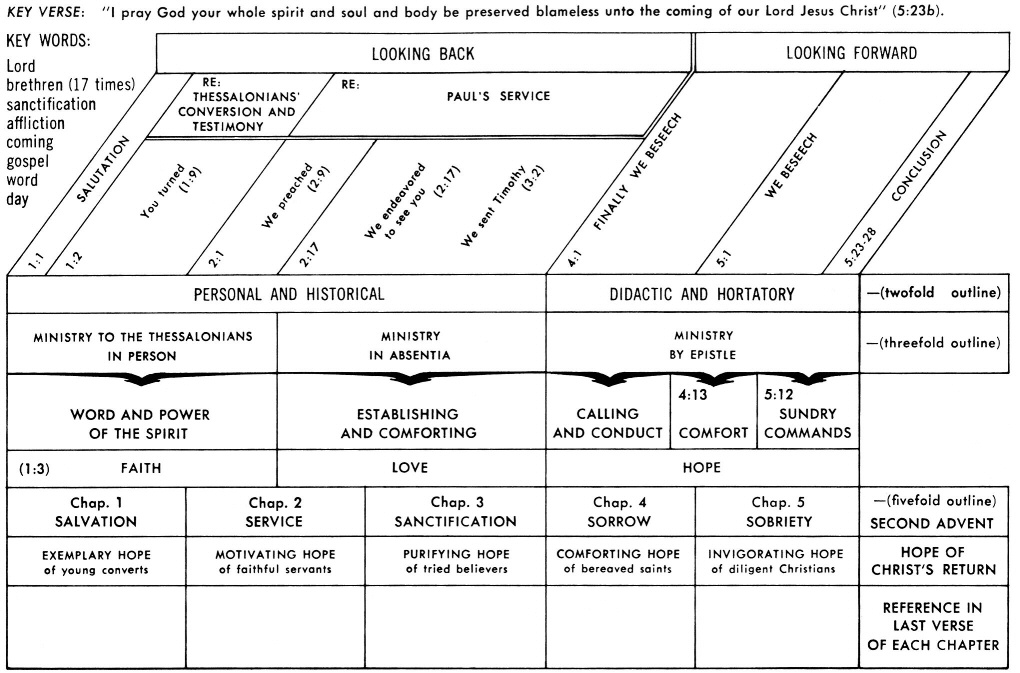
JESUS IS COMING AGAIN
Click chart to enlarge
Charts from Jensen's Survey of the NT - used by permission
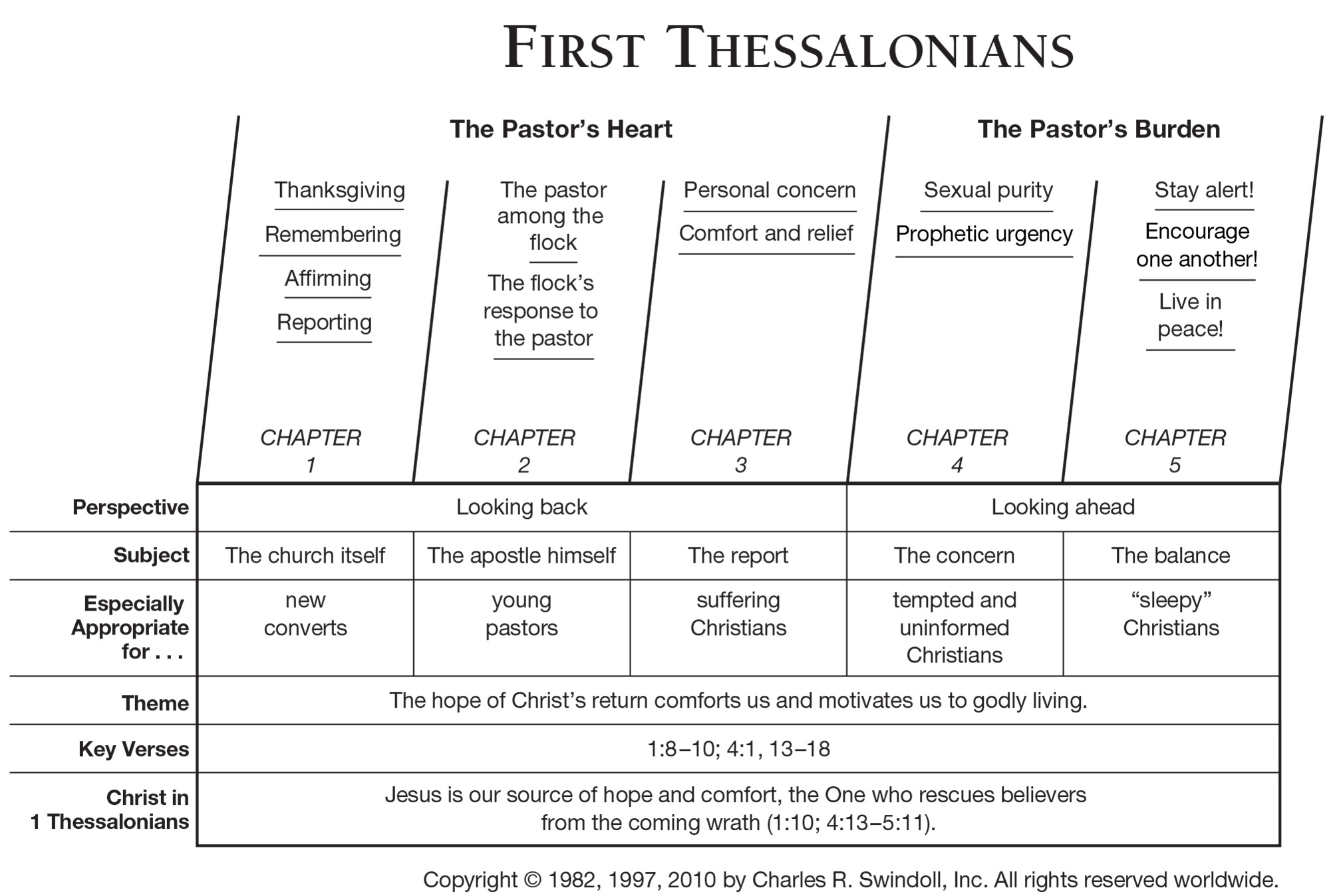
Chart by Charles Swindoll
|
1 Thessalonians |
||||||
| 1 Th 1:1-10 | 1 Th 2:1-20 | 1 Th 3:1-13 | 1 Th 4:1-18 | 1 Th 5:1-28 | ||
|
LOOKING BACK |
LOOKING FORWARD |
|||||
|
Personal Reflections |
Practical Instructions |
|||||
| Ministry In Person |
Ministry in Absentia (Thru Timothy) |
Ministry by Epistle |
||||
| Word and Power of the Spirit |
Establishing & Comforting |
Calling & Conduct | 1Th 4:13ff Comfort |
1Th 5:12ff Commands |
||
| 1 Salvation |
2 Service |
3 Sanctification |
4 Sorrow |
5 Sobriety |
||
| Paul Commends Spiritual Growth |
Paul Founds the Church |
Strengthening of the Church |
Directions for Spiritual Growth |
Holy Living in Light of Day of the Lord | ||
| Exemplary Hope of Young Converts | Motivating Hope of Faithful Servants |
Purifying Hope of Tried Believers | Comforting Hope of Bereaved Saints | Invigorating Hope of Diligent Christians | ||
|
Written from Corinth |
||||||
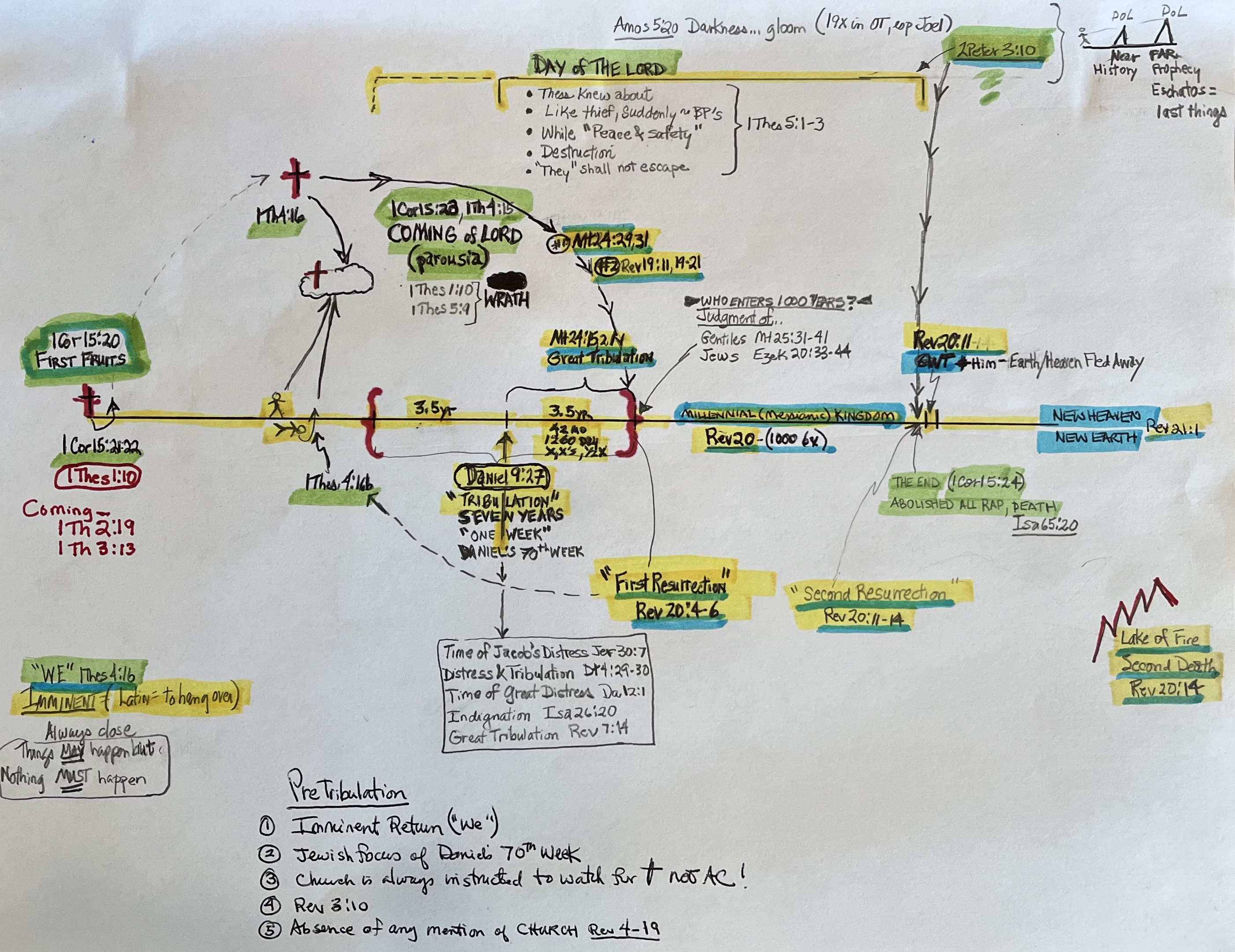
Here Is a Handwritten Timeline I Put Together in 2007 Studying 1 Thessalonians
1Thessalonians 1:10 and to wait (PAN) for His Son from heaven, Whom He raised (3SAAI) from the dead, that is Jesus, Who rescues (PMPMSA) us from the wrath to come (PMPFSG). (NASB: Lockman)
Greek: kai anamenein (PAN) ton huion autou ek ton ouranon, on egeiren (3SAAI) ek [ton] nekron, Iesoun ton rhuomenon (PMPMSA) hemas ek tes orges tes erchomenes. (PMPFSG)
Amplified: And [how you] look forward to and await the coming of His Son from heaven, Whom He raised from the dead—Jesus, Who personally rescues and delivers us out of and from the wrath [bringing punishment] which is coming [upon the impenitent] and draws us to Himself [investing us with all the privileges and rewards of the new life in Christ, the Messiah]. (Amplified Bible - Lockman)
NLT: And they speak of how you are looking forward to the coming of God’s Son from heaven—Jesus, whom God raised from the dead. He is the one who has rescued us from the terrors of the coming judgment (NLT - Tyndale House)
Phillips: and how your whole lives now look forward to the coming of his Son from heaven - the Son Jesus, whom God raised from the dead, and who personally delivered us from the judgment which hung over our heads. (Phillips: Touchstone)
Wuest: and to be expectantly waiting for His Son from heaven, whom He raised out from among the dead, Jesus, the One who delivers us from the wrath which is coming.
Young's Literal: and to wait for His Son from the heavens, Whom He did raise out of the dead -- Jesus, Who is rescuing us from the anger that is coming.
AND TO WAIT FOR HIS SON FROM HEAVEN: kai anamenein (PAN) ton huion autou ek ton ouranon:
And [how you] look forward to and await the coming of His Son from heaven (Amp)
and to be expectantly waiting for His Son from heaven (Wuest)
BGT 1 Thessalonians 1:10 καὶ ἀναμένειν τὸν υἱὸν αὐτοῦ ἐκ τῶν οὐρανῶν, ὃν ἤγειρεν ἐκ [τῶν] νεκρῶν, Ἰησοῦν τὸν ῥυόμενον ἡμᾶς ἐκ τῆς ὀργῆς τῆς ἐρχομένης.
KJV 1 Thessalonians 1:10 And to wait for his Son from heaven, whom he raised from the dead, even Jesus, which delivered us from the wrath to come.
NET 1 Thessalonians 1:10 and to wait for his Son from heaven, whom he raised from the dead, Jesus our deliverer from the coming wrath.
CSB 1 Thessalonians 1:10 and to wait for His Son from heaven, whom He raised from the dead-- Jesus, who rescues us from the coming wrath.
ESV 1 Thessalonians 1:10 and to wait for his Son from heaven, whom he raised from the dead, Jesus who delivers us from the wrath to come.
NIV 1 Thessalonians 1:10 and to wait for his Son from heaven, whom he raised from the dead--Jesus, who rescues us from the coming wrath.
NLT 1 Thessalonians 1:10 And they speak of how you are looking forward to the coming of God's Son from heaven-- Jesus, whom God raised from the dead. He is the one who has rescued us from the terrors of the coming judgment.
NRS 1 Thessalonians 1:10 and to wait for his Son from heaven, whom he raised from the dead-- Jesus, who rescues us from the wrath that is coming.
RSV 1 Thessalonians 1:10 and to wait for his Son from heaven, whom he raised from the dead, Jesus who delivers us from the wrath to come.
YLT 1 Thessalonians 1:10 and to wait for His Son from the heavens, whom He did raise out of the dead -- Jesus, who is rescuing us from the anger that is coming.
NKJ 1 Thessalonians 1:10 and to wait for His Son from heaven, whom He raised from the dead, even Jesus who delivers us from the wrath to come.
NJB 1 Thessalonians 1:10 and how you are now waiting for Jesus, his Son, whom he raised from the dead, to come from heaven. It is he who saves us from the Retribution which is coming.
NAB 1 Thessalonians 1:10 and to await his Son from heaven, whom he raised from (the) dead, Jesus, who delivers us from the coming wrath.
ASV 1 Thessalonians 1:10 and to wait for his Son from heaven, whom he raised from the dead, even Jesus, who delivereth us from the wrath to come.
MIT 1 Thessalonians 1:10 and to await his son from heaven, the one whom he raised from the dead—Jesus—who rescues us from future wrath.
DBY 1 Thessalonians 1:10 and to await his Son from the heavens, whom he raised from among the dead, Jesus, our deliverer from the coming wrath.
GWN 1 Thessalonians 1:10 and to wait for his Son to come from heaven. His Son is Jesus, whom he brought back to life. Jesus is the one who rescues us from God's coming anger.
BBE 1 Thessalonians 1:10 Waiting for his Son from heaven, who came back from the dead, even Jesus, our Saviour from the wrath to come.
- 1Th 4:16,17; Ge 49:18; Job 19:25, 26, 27; Isa 25:8,9; Lk 2:25; Acts 1:11; 3:21; Ro 2:7; Ro 8:23-25; 1Co 1:7; Php 3:20; 1Th 1:7; 2:7; 2Ti 4:10; Titus 2:13; Heb 9:28; 2Pe 3:12,14; Rev 1:7
- 1 Thessalonians 1 Resources - Multiple Sermons and Commentaries
- 1 Thessalonians 1:9-10 Rescued by the Risen Jesus - Steven Cole
- 1 Thessalonians 1:1-10 Celebrating a Consecrated Church, Pt. 1 - John MacArthur
- 1 Thessalonians 1:1-10 Celebrating a Consecrated Church, Pt. 2 - John MacArthur
- Play and worship the soon returning King of kings - I Will Wait for You - Shane and Shane
Related Passages:
Romans 8:23-25 And not only this, but also we ourselves, having the first fruits of the Spirit, even we ourselves groan within ourselves, waiting eagerly for our adoption as sons, the redemption of our body. 24 For in hope we have been saved, but hope that is seen is not hope; for who hopes for what he already sees? 25 But if we hope for what we do not see, with perseverance we wait eagerly for it.
1 Corinthians 1:7 so that you are not lacking in any gift, awaiting eagerly the revelation of our Lord Jesus Christ,
Philippians 3:20 For our citizenship is in heaven, from which also we eagerly wait (apekdechomai) for a Savior, the Lord Jesus Christ;
2 Timothy 4:8 in the future there is laid up for me the crown of righteousness, which the Lord, the righteous Judge, will award to me on that day; and not only to me, but also to all who have loved His appearing (epiphaneia).
Titus 2:13 looking (prosdechomai) for the blessed hope and the appearing (epiphaneia) of the glory of our great God and Savior, Christ Jesus,
Hebrews 9:28 so Christ also, having been offered once to bear the sins of many, will appear a second time for salvation without reference to sin, to those who eagerly await (apekdechomai) Him.
2 Peter 3:12; 14 looking for (prosdokao) and hastening the coming of the day of God, because of which the heavens will be destroyed by burning, and the elements will melt with intense heat! 14 Therefore, beloved, since you look for (prosdokao) these things, be diligent to be found by Him in peace, spotless and blameless,
Revelation 1:7 BEHOLD, HE IS COMING WITH THE CLOUDS, and every eye will see Him, even those who pierced Him; and all the tribes of the earth will mourn over Him. So it is to be. Amen.
Picture from Inscription of "Maranatha" in a medieval text.
Saints in the "dark ages" were waiting eagerly for the Light of the world!

EVER LOOKING FOR
OUR BLESSED HOPE
And to wait for His Son from Heaven - Continually manifesting a maranatha heart attitude that expectantly looks for the return of our King. And remember what/Who you are looking for will/should radically effect what/Who you are living for. Let it be so Lord for all who read these words. In Christ. Amen.
The fact that the saints are actively, eagerly awaiting the Second Coming is a reflection of their steadfastness of hope in (1Th 1:3)
Wait (362) (anameno from ana = upon, Vine says ana intensifies meaning of meno + meno = abide, remain) conveys the meaning of expectant waiting—sustained, patient, trusting waiting. It pictures an eager looking forward to the coming of one whose arrival was anticipated at any time, waiting for one whose coming is expected.
Gilbrant - In classical Greek anamenō means “waiting or staying in wait.” The word carries the sense of anticipation of an impending event. One such example is the use of anamenō in describing an army waiting for the enemy to attack. Anamenō is also used to mean delay or putting off.The Septuagint uses anamenō to translate qāwâh with the primary meaning of “waiting with expectancy”: a hired man is described as “waiting” for his wages (Job 7:2), Israel is said to “look” for justice (Isaiah 59:11), while Judah is said to be “hoping” for light (Jeremiah 13:16). In the last instance the “hope” referred to is an active waiting. (Complete Biblical Library Greek-English Dictionary)
In an extra-biblical writing (2Clement 19:4) anemeno is used figuratively of time in the phrase "a blessed time awaits (the devout)". In another use it describes debtors who are to pay up without "waiting for" the time allowed them. This verb is used in Modern Greek.
Anameno is used only here in NT and 4 times in LXX - Job 2:9, Job 7:2 = "as a hired man who eagerly waits for his wages", Isa 59:11 = "we hope [wait for] justice", Jer 13:16. (Complete Biblical Library)
KJV Bible Commentary writes that anemeno "means more than just wait; it emphasizes an expectant and active attempt to live for His glory in the meantime. It is an attitude of faith toward the complete fulfillment of the messianic promises of the Old Testament in the second coming of Christ. (Free online - Dobson, E G, Charles Feinberg, E Hindson, Woodrow Kroll, H L. Wilmington: KJV Bible Commentary: Nelson)
Vine writes that anameno "carries with it the suggestion of waiting with patience and confident expectancy. (Vine's Expository Dictionary of Old Testament and New Testament Words)
To wait for the Lord's return is a sure characteristic of a true believer (see Related Passages above). The present tense can be rendered "keep on waiting". Waiting for the return of their Lord and King was their lifestyle, the habit of their life, the truth that colored all their daily activities and afflictions.
To the first century believers the advent of Christ was not regarded as a distant possibility, but as an imminent probability! (See discussion on imminency)
Expectant looking
(for Jesus' return) is a good antidote for
Apathetic living.
THOUGHT - Who are you looking for today? Remember Jesus could come back today! Are you ready to meet Him in the clouds? (See the related study on "The Blessed Hope" where hope is God's absolute assurance to believers that He will show them future good)
Beloved do not be deceived like those who say…
Where is the promise of His coming? (2Pe 3:4)
What is your view of world history? Are you were living with the assured conviction that Jesus will return? The trustworthy promise after the Resurrection was…
Men of Galilee, why do you stand looking into the sky? This Jesus, Who has been taken up from you into heaven, will come in just the same way as you have watched Him go into heaven. (Acts 1:11) (Maranatha! Our Lord Come!)
His victory over death makes this promise completely credible. And this truth emphasizes why we must always speak of His resurrection when we proclaim the gospel. There is no good news without Jesus' resurrection!
See the same powerful, predominant NT theme of waiting and looking expectantly for the King, our Lord Jesus Christ, in these other word studies - apekdechomai and prosdechomai.
As F F Bruce writes…
To wait for him has ethical implications; those who wait are bound to live holy lives so as to be ready to meet him (1Th 3:13, 5:6, 7, 8, 23-see notes 1Th 3:13; 1Thess 5:6; 5:7; 5:8; 5:23, 1John 2:28, 3:2, 3). (Bruce, F. F. 1 and 2 Thessalonians. Word Biblical Commentary series. Waco: Word Books, 1982)
1 John 2:28 Now, little children, abide (present imperative - there is only ONE WAY you can obey this command - by continually depending on the Holy Spirit to obey) in Him, so that (TERM OF PURPOSE) when He appears, we may have confidence and not shrink away from Him in shame at His coming.
1 John 3:2-3 Beloved, now we are children of God (1Jn 3:1), and it has not appeared as yet what we will be. We know that when He appears, we will be like Him, because we will see Him just as He is. 3 And everyone who has this hope fixed on Him purifies himself, just as He is pure.
Note that in first and second Thessalonians each chapter (in both epistles) ends with a reference to the second coming of the Lord! We look back to His first coming, but among these early believers the great hope lay in His coming again. This should likewise be the mindset of modern believers! When was the last time you contemplated the return of the King? Know for certain, HE IS COMING AGAIN TO RIGHT ALL WRONGS!
The Second Coming of the Messiah was the ever-present hope of the early church, and that hope was a prominent theme in the Thessalonian epistles. The answer the Thessalonians gave to the threat of persecution and possibly even death was a firm belief in Jesus' resurrection. Jesus gave His unfailing Word that…
I am the resurrection and the life; he who believes in Me shall live even if he dies, and everyone who lives and believes in Me shall never die. Do you believe this? (John 11:25-26)
Because I live, you also will live (John 14:19)
The Thessalonians were confident of their victory over death.
Hiebert comments that "to wait for means "to await, expect, wait up for" and pictures them as people who were eagerly and expectantly looking forward to the coming of One Whose arrival was anticipated at any time; the present tense gives this as their continuing attitude. Clearly the Thessalonians viewed Christ's return not simply as the consummating event due to take place in the indefinite end time but as something to be actively expected in the near future: it is assumed rather than asserted in these early letters that Christians of that generation may hope to witness it. This picture of anticipation carries the further suggestion of being ready to receive the One whose coming was awaited. (Hiebert, D. Edmond: 1 & 2 Thessalonians) (Bolding added)
Waiting is a recurring theme (1Th 2:17, 19, 3:13, 4:15, 16, 17, 5:8, 23-see notes 1Th 2:17; 19; 3:13; 4:15; 16; 17; 5:8, 23). In fact this epistle is only 88 verses long but has at least 14 verses referring to Christ's Second coming. In his last recorded words Paul wrote young Timothy that
In the future there is laid up for me the crown of righteousness, which the Lord, the righteous Judge, will award to me on that day; and not only to me, but also to all who have loved His appearing. (2Ti 4:8)
Writing to Titus on the isle of Crete Paul reminds him that
the grace of God has appeared, bringing salvation to all men, instructing us to deny ungodliness and worldly desires and to live sensibly, righteously and godly in the present age, looking for the blessed hope and the appearing of the glory of our great God and Savior, Christ Jesus. (Titus 2:11-13)
Hiebert adds that
This anticipation of Christ's return characterized the Christian church from its very beginning. Acts makes it clear that it was an essential part of the preaching of the gospel. That Paul laid considerable emphasis upon this hope in his preaching at Thessalonica seems clear from the perverted charge against the Christians in Acts 17:7 when read in the light of the Thessalonian epistles. This eschatological hope is the keynote of these epistles. It had taken a firm hold on the Thessalonian believers. If their serving a living and true God distinguished them from the Gentiles, this expectant hope for Christ's return distinguished them from the Jews. (Hiebert, D. Edmond: 1 & 2 Thessalonians: BMH Book. 1996)
James Denney sounded an important note when he wrote that…
That attitude of expectation is the bloom, as it were, of the Christian character. Without it there is something lacking; the Christian who does not look upward and onward wants one mark of perfection.
Spurgeon once said "Remember Jesus till you feel that He is with you, till His joy gets into your soul, and your joy is full. Remember Him till you begin to forget yourself, your temptations, and your cares. Remember Him till you begin to think of the time when He will remember you and come in His glory for you. Remember Him till you begin to be like Him." (And all God's people cry "Amen!")
Much of modern Christendom has lost this expectant waiting for the return of Christ, much to its own impoverishment. This "blessed hope" is under attack today, even within ecclesiastical circles.
It would appear that the early Christians believed that Christ might come at any time, even in their days; the first advent, being so recent, excited within them the expectation of the immediateness of the second. Hence the doctrine of the second advent occupied a much more prominent place in the thoughts of the primitive Christians than it does in ours. It was to them a living power; believers then lived in constant expectation of the coming of the Lord; whereas the teaching of the present day has in a measure passed from it. Its uncertainty, instead of exciting us to holiness and watchfulness, is too often abused as an encouragement to sloth and security." (The Pulpit Commentary: New Testament; Old Testament; Ages Software or Logos)
Expectant LOOKING
Motivates
Enlightened LIVING
Many scriptures allude to the concept of expectant looking that motivates living in light of Messiah's imminent return (see discussion on imminency). Old Testament saints were living in the light of His first coming. We who are living at the end of this age are to be doing so in light of His triumphant return. Study the following passages if you need your passion for His appearance "stoked".
Ge 49:18 Job 14:14 Isa 8:17, 25:9, 26:8,9, 30:18, 33:2, 40:31 La 3:25,26 Ps 25:5, 40:1,3, 62:1,5, 6, 7 Ps 119:166, 176, 123:2 130:5 Mic 7:7 Ho 12:6 Mt 24:42, 43, 44, 45, 46, 47, 48, 49, 50, 51 Mk 15:43 Lk 2:25, 12:36, 23:51, 24:21, Acts 24:15 Ro 8:19, 23, 24, 25, Gal 5:5 Php 3:20 1Co 1:7 2Co 5:2 Titus 2:13 2Ti 4:8 Heb 9:28, 10:36, 37 1Pe 1:13 2Pe 3:12,13,14 1Jn 2:28, 3:3 Jude 1:21 Rev 22:12)
Henry writes that
this is one of the peculiarities of our holy religion, to wait for Christ's second coming, as those who believe He will come and hope He will come to our joy. The believers under the Old Testament waited for the coming of the Messiah, and believers now wait for His second coming; He is yet to come. And there is good reason to believe He will come, because God has raised Him from the dead, which is full assurance unto all men that He will come to judgment, Act 17:31. And there is good reason to hope and wait for His coming, because He has delivered us from the wrath to come. He came to purchase salvation, and will, when He comes again, bring salvation with Him, full and final deliverance from sin, and death, and hell, from that wrath which is yet to come upon unbelievers, and which, when it has once come, will be yet to come, because it is everlasting fire prepared for the devil and his angels, Mt 25:41.
The hope of the second coming of Christ was real and powerful with the Thessalonian believers who had made an ''about face'' from (dead) idols to serve a living an true God. In the NT, hope is always the expectation of something good. It is also something we must wait for. In the NT, unlike the OT, just what we hope for is carefully explained. The mystery that the OT does not solve is untangled in the NT, and we are told about the wonders God has in store for us.
Clarke comments on their (and our) hope:
To expect a future state of glory, and resurrection of the body, according to the Gospel doctrine, after the example of Jesus Christ, Who was raised from the dead, and ascended unto heaven, ever to appear in the presence of God for us.
Barnes rightly comments
that the return of the Son of God from heaven was an important point which had been insisted on when he was there, and that their conduct, as borne witness to by all, had shown with what power it had seized upon them, and what a practical influence it had exerted in their lives. They lived as if they were” waiting” for his return. They fully believed in it; they expected it. They were looking out for it, not knowing when it might occur, and as if it might occur at any moment. They were, therefore, dead to the world, and were animated with an earnest desire to do good. This is one of the instances which demonstrate that the doctrine that the Lord Jesus will return to our world, is fitted, when understood in the true sense revealed in the Scriptures, to exert a powerful influence on the souls of people. It is eminently adapted to comfort the hearts of true Christians in the sorrows, bereavements, and sicknesses of life.
The Preacher's Commentary sounds an important note writing that…
This doctrine of the second advent is sadly neglected in many churches today and even rejected in some. Unfortunately, in yet others it is majored upon in the form of predictions. The recovery of a dynamic view of the Second Coming of Christ must be a matter of high priority for us. The technical term for this is eschatology, from the Greek word, eschaton, meaning “last” or “last things.” What is at stake in eschatology is not how to predict the end of the world, but how to understand what history is all about.
The second advent of Christ means that history is moving to a particular conclusion. That conclusion centers in the coming of Christ the King to establish eternally the kingdom of God which began with His first advent. The kingdom will be complete when, and only when, He comes again.
The inclusion of the concept of deliverance from “the wrath to come” is troublesome to those who are uncomfortable with the idea of a God of wrath. Such an idea is offensive to those who want only to stress the love of God. But the wrath of God is too prevalent throughout the Bible to be dismissed. God’s wrath is not to be regarded as the anger and ire expressed in human temper tantrums. Rather, His wrath is the other side of His love. It is the necessary corollary of His love, reminding us that our choices do indeed have significant consequences. God’s love and wrath are best seen as two sides of the same coin. (Borrow The Preacher's Commentary)
His Son from heaven - this is the only description of Jesus as the Son of God in the letters to the Thessalonians.
Heaven is in the plural here so more literally reads "from the heavens" (See study on The Third Heaven)
Vincent commenting on from heaven writes…
Comp. 1Cor 15:47; 1Th. 4:16; 2Th 1:7. Paul uses the unclassical plural much oftener than the singular. Although the Hebrew equivalent has no singular, the singular is almost universal in LXX, the plural occurring mostly in the Psalms. Ouranos is from a Sanskrit word meaning to cover or encompass. The Hebrew shamayim (8064) signifies height, high district, the upper regions. Similarly we have in N. T. en hupsistois , in the highest (places), Matt. 21:9; Luke 2:14: en hupsielois in the high (places), He 1:3 (note). Paul’s usage is evidently coloured by the Rabbinical conception of a series of heavens: see 2Cor 12:2; Ep 4:10 (note). Some Jewish teachers held that there were seven heavens, others three. (See study on The Third Heaven) The idea of a series of heavens appears in patristic writings, in Thomas Aquinas’s doctrine of the celestial hierarchies, and in Dionysius the Areopagite. Through the scholastic theologians it passed into Dante’s Paradiso with its nine heavens. The words to await his Son from heaven strike the keynote of this Epistle. (1 Thessalonians 1 Commentary)
WHOM HE RAISED FROM THE DEAD, that is JESUS: on egeiren (3SAAI) ek (ton) nekron, Iesoun:
- Acts 2:24; 3:15; 4:10; 5:30,31;10:40,41;17:31; Ro 1:4; 4:25; 8:34; 1Co 15:4-21; Col 1:18; 1Pe 1:3,21; 3:18; Rev 1:18
- 1 Th 5:9; Mt 1:21; Ro 5:9,10; Gal 3:13; 1Pe 2:21
- 1 Thessalonians 1 Resources - Multiple Sermons and Commentaries
- 1 Thessalonians 1:9-10 Rescued by the Risen Jesus - Steven Cole
- 1 Thessalonians 1:1-10 Celebrating a Consecrated Church, Pt. 1 - John MacArthur
- 1 Thessalonians 1:1-10 Celebrating a Consecrated Church, Pt. 2 - John MacArthur
Related Passages:
1 Peter 1:3 Blessed be the God and Father of our Lord Jesus Christ, who according to His great mercy has caused us to be born again to a living hope through the resurrection of Jesus Christ from the dead,
OUR SURE HOPE
RESURRECTION OF CHRIST
Whom He raised from the dead - Who is Whom? In context it is God the Father. The resurrection was confirmation of the Father’s acceptance of the Son’s substitutionary death (cf. 1Cor 15:1, 2, 3, 4, 5, 6, 7-notes). It is worth noting that all three persons of the Trinity were active in Christ’s resurrection: the Father—Acts 2:24; 3:15; 4:10; 5:30; 10:40; 13:30, 33, 34, 37; 17:31; the Spirit—Ro 8:11 and the Son—John 2:19, 20, 22; 10:17,18.
Raised from the dead is the grand proof of His divine Sonship and thus Paul writes that Jesus
was established (openly designated, marked out, declared) with (literally "in") power (in a striking, triumphant and miraculous manner) as the Son of God by the resurrection from the dead according to the Spirit of holiness. (Ro 1:4)
The Resurrection was the guarantee of God’s power to carry out the rescue of those who are His and to judge those who are not, for as Luke recorded in Acts…
He has fixed a day in which He will judge the world in righteousness through a Man Whom He has appointed, having furnished proof to all men by raising Him from the dead. (Acts 17:31) (Note: The Scriptures generally attribute the resurrection of Jesus to the activity of the Father - Acts 2:24; 3:15; 4:10; 5:30,31; 10:40,41)
And so the certainty (cf 500 witnesses did not lie in 1Cor 15:6) of His resurrection past carries the promise of His future return! If the one promise was fulfilled literally, the other promise is just as certain. A further proof of the gospel’s veracity is its ability to inculcate faith in Jesus Christ, a faith that is so demonstrably total and real that it causes the believer to predicate his life on Jesus’ return.
Calvin writes that Paul "makes mention here of Christ’s resurrection, on which the hope of our resurrection is founded, for death everywhere besets us. Hence, unless we learn to look to Christ, our minds will give way at every turn. By the same consideration, he admonishes them that Christ is to be waited for from heaven, because we will find nothing in the world to bear us up, while there are innumerable trials to overwhelm us.
Warren Wiersbe emphasizes the point that "Every chapter in 1 Thessalonians ends with a reference to the return of Jesus Christ, and that truth is applied to daily living. An eager looking for His return is an evidence of salvation (1Thes 1:9, 10), a motivation for soul winning (1Thes 2:17, 18, 19, 20), and an encouragement for holy living (1Thes 3:11, 12, 13). This truth is a comfort in sorrow (1Thes 4:18) and a stimulus to have more confidence in the Lord (1Thes 5:23, 24). (Borrow With the Word)
Raised (1453) (egeiro) means to waken, rouse from sleep, from sitting or lying, from disease, from death, from inactivity, from ruins. It means to lift up, raise up, arise again, stand up. Metaphorically, egeiro is used in the NT to describe to awaken from sluggishness or lethargy (see note Romans 13:11). It also refers as in the present use to be awakened up from death and so to be raised from the dead. The Thessalonian's acceptance and belief in the resurrection as an act of God, gave them confidence in the certainty of Christ’s return in power.
Jesus (2424) (Iesous = Yeshu'a) means Joshua, Jehovah saves. The angel in Matthew 1:21 declared to Joseph "And she will bear a Son; and you shall call His name Jesus, for it is He Who will save His people from their sins." (Mt 1:21)
Commenting on this verse, C H Spurgeon wrote that "The angel spake to Joseph the name in a dream: that name so soft and sweet that it breaks no man’s rest, but rather yields a peace unrivalled, the peace of God. With such a dream Joseph’s sleep was more blessed than his waking. The name has evermore this power, for, to those who know it, it unveils a glory brighter than dreams have ever imagined. (The Metropolitan Tabernacle Pulpit)
Marvin Vincent looks at the Name, Iesous writing of the Old Testament foreshadowing of the glorious Name of Jesus…
The Greek form of a Hebrew name, which had been borne by two illustrious individuals in former periods of the Jewish history — Joshua, the successor of Moses, and Jeshua, the high-priest, who with Zerubbabel took so active a part in the re-establishment of the civil and religious polity of the Jews on their return from Babylon. Its original and full form is Jehoshua, becoming by contraction Joshua or Jeshua.
Joshua, the son of Nun, the successor of Moses, was originally named Hoshea (saving), which was altered by Moses into Jehoshua (Jehovah [our] Salvation) (Nu 13:16). The meaning of the name, therefore, finds expression in the title Saviour, applied to our Lord (Luke 1:47; 2:11; John 4:42).
Joshua, the son of Nun, is a type of Christ in his office of captain and deliverer of his people, in the military aspect of his saving work (Rev 19:11, 12, 13, 14, 15, 16). As God’s revelation to Moses was in the character of a law-giver, his revelation to Joshua was in that of the Lord of Hosts (Josh 5:13, 14). Under Joshua the enemies of Israel were conquered, and the people established in the Promised Land. So Jesus leads His people in the fight with sin and temptation. He is the leader of the faith which overcomes the world (He 12:2). Following him, we enter into rest.
The priestly office of Jesus is foreshadowed in the high-priest Jeshua, who appears in the vision of Zechariah (Zechariah 3:1, 2, 3, 4, 5ff; compare Ezra 2:2) in court before God, under accusation of Satan, and clad in filthy garments. Jeshua stands not only for himself, but as the representative of sinning and suffering Israel. Satan is defeated. The Lord rebukes him, and declares that he will redeem and restore this erring people; and in token thereof he commands that the accused priest be clad in clean robes and crowned with the priestly mitre.
Thus in this priestly Jeshua we have a type of our “Great High-Priest, touched with the feeling of our infirmities, and in all points tempted and tried like as we are;” confronting Satan in the wilderness; trying conclusions with him upon the victims of his malice — the sick, the sinful, and the demon-ridden. His royal robes are left behind. He counts not “equality with God a thing to be grasped at,” but “empties himself,” taking the “form of a servant,” humbling himself and becoming “obedient even unto death” (Php 2:5, 6,7-see notes Php 2:5-7). He assumes the stained garments of our humanity. He who “knew no sin” is “made to be sin on our behalf, that we might become the righteousness of God in him” (2Co 5:21). He is at once priest and victim. He pleads for sinful man before God’s throne. He will redeem him. He will rebuke the malice and cast down the power of Satan. He will behold him “as lightning fall from heaven” (Luke 10:18). He will raise and save and purify men of weak natures, rebellious wills, and furious passions — cowardly braggarts and deniers like Peter, persecutors like Saul of Tarsus, charred brands — and make them witnesses of his grace and preachers of his love and power. His kingdom shall be a kingdom of priests, and the song of his redeemed church shall be, “unto him that loveth us, and loosed us from our sins by his own blood, and made us to be a kingdom, to be priests unto his God and Father; to him be the glory and the dominion forever and ever. Amen” (Rev 1:5, 6).
It is no mere fancy which sees a suggestion and a foreshadowing of the prophetic work of Jesus in the economy of salvation, in a third name closely akin to the former. Hoshea, which we know in our English Bible as Hosea, was the original name of Joshua (cf Ro 9:25) and means saving. He is, in a peculiar sense, the prophet of grace and salvation, placing his hope in God’s personal coming as the refuge and strength of humanity; in the purification of human life by its contact with the divine. The great truth which he has to teach is the love of Jehovah to Israel as expressed in the relation of husband, an idea which pervades his prophecy, and which is generated by his own sad domestic experience. He foreshadows Jesus in his pointed warnings against sin, his repeated offers of divine mercy, and his patient, forbearing love, as manifested in his dealing with an unfaithful and dissolute wife, whose soul he succeeded in rescuing from sin and death (Hosea 1-3.). So long as he lived, he was one continual, living prophecy of the tenderness of God toward sinners; a picture of God’s love for us when alien from him, and with nothing in us to love. The faithfulness of the prophetic teacher thus blends in Hoses, as in our Lord, with the compassion and sympathy and sacrifice of the priest. (from Marvin Vincent's notes appended to Mt 1:21)
WHO DELIVERS US FROM THE WRATH TO COME: ton rhuomenon (PMPMSA) hemas ek tes orges tes erchomenes (PMPFSG):
- Mt 3:7; Lk 3:7; Heb 10:27) (Jn 3:36, Eph 2:3 Col 3:6
- 1 Thessalonians 1 Resources - Multiple Sermons and Commentaries
- 1 Thessalonians 1:9-10 Rescued by the Risen Jesus - Steven Cole
- 1 Thessalonians 1:1-10 Celebrating a Consecrated Church, Pt. 1 - John MacArthur
- 1 Thessalonians 1:1-10 Celebrating a Consecrated Church, Pt. 2 - John MacArthur
Who personally rescues and delivers us out of and from the wrath [bringing punishment] which is coming [upon the impenitent] and draws us to Himself investing us with all the privileges and rewards of the new life in Christ, the Messiah]. (Amp)
the One Who delivers us from the wrath which is coming (Wuest),
even Jesus, our Deliverer from God's coming anger (Weymouth)
It is he who saves us from the Retribution which is coming. (NJB)
OUR DELIVERER IS COMING TO
RESCUE US FROM THE COMING WRATH!
Who delivers (rescues) us from the wrath to come - God's wrath coming upon this sinful, God rejecting planet is as sure as the sun rising each day. But praise God, we who are His children will not have to experience His wrath because in Christ the Ark we are safe from the coming "flood!" While one could not use a single verse to support the doctrine of the pre-tribulation rapture, this verse certainly has a strong suggestion of that glorious future event (see several articles on rapture)
Delivers (4506) (rhuomai from rhúo = to draw, drag along the ground) (Click in depth study on rhuomai) means to draw or snatch to oneself (drawing us to Himself!) from danger, evil or an enemy. The thought of deliverance by power is apparently always associated with rhuomai.
Rhuomai emphasizes greatness of peril from which deliverance is given by a mighty act of power. The basic idea is that of rescuing from danger and was used of a soldier’s going to a wounded comrade on the battlefield and carrying him to safety (he runs to the cry of his comrade to rescue him from the hands of the enemy). Picture someone wading in a rushing river and suddenly they are caught in the current, powerless to save themselves. As they cry out someone hears and holds out a hand as they go rushing by. As they lie beside the river safe in the presence of the one who pulled them out, they still are in the presence of the dangerous rushing current… they can hear it… they can see it… but they've been delivered from danger.
Rhuomai is in the present tense indicating that is our Savior continually delivers us. The tense is not past, “Who delivered us,” namely, by his death (which He did do); nor future, “Who shall deliver us,” (which He will do), but present, “Who delivers us” which emphasizes that in one sense the deliverance is ongoing (we are daily delivered from the power of sin, the lure of the world and the temptation of the devil by our Strong Deliverer! Do you believe this? Better yet are you experiencing this daily deliverance? If not surrender your will to His and do it every morning! Aka Romans 12:1) — it commenced with His death, burial and resurrection, and will be consummated at His advent! The middle voice is reflexive ("He Himself rescues us") and emphasizes His personal involvement in the rescue. He initiates the and participates in the carrying out of the rescue.
Play these related songs:
A T Robertson emphasizes that "it is the historic, crucified, risen, and ascended Jesus Christ, God’s Son, Who delivers from the coming wrath. He is our Saviour ("for it is He who will save His people from their sins." Mt 1:21) true to his name Jesus. He is our Rescuer (Paul recording that in Romans 11:26 [see note] "and thus all Israel will be saved; just as it is written, "THE DELIVERER [rhuomai] WILL COME FROM ZION, HE WILL REMOVE UNGODLINESS FROM JACOB." [quoting from Isa 59:20) (A T Robertson's Notes) (Bolding and Scripture added)
From the wrath to come - Note the significant preposition from (1537) which means out of. Although believers fully recognize the seriousness of God's wrath against sin, they rest in the glorious truth of the gospel that Christ delivers His own from (ek) or out of the coming wrath. Milligan remarks that in either case (whether from or out of) the preposition ek emphasizes the completeness of the deliverance and adds that "He brings us altogether out of the reach of future judgment."
Indeed as D. Michael Martin has written "Believers live anticipating a coronation (2Ti 4:8) rather than a condemnation. (Martin, D. Michael. 1, 2 Thessalonians. The New American Commentary Series: Broadman & Holman Publishers)
Some commentators (MacArthur) favor the wrath to come as a reference to deliverance from eternal separation in the Lake of Fire, certainly a valid interpretation. However as discussed more below when verse 10 is read in context with other uses of wrath in this letter and Paul's second epistle to the Thessalonians, the wrath appears from context to be an allusion to the Day of the Lord (compare 1Th 5:2 with 1Th 5:9). In regard to the second Epistle it is notable that Paul states in the first epistle that Jesus would deliver them from the wrath to come. This might explain why the saints at Thessalonica were so shaken and disturbed in 2 Th 2:1,2 Paul writing
Now we request you, brethren, with regard to the coming of our Lord Jesus Christ, and our gathering together to Him, that you may not be quickly shaken from your composure or be disturbed either by a spirit or a message or a letter as if from us, to the effect that the day of the Lord has come." (Paul goes on to exhort them to) "Let no one in any way deceive you, for it (the Day of the Lord) will not come unless the apostasy comes first, and the man of lawlessness (the antichrist) is revealed, the son of destruction, who opposes and exalts himself above every so-called god or object of worship, so that he takes his seat in the temple of God, displaying himself as being God. (2Th 2:3-4)
Comment: When will the antichrist take his seat in the Holy of holies, the rebuilt Jewish Temple in Jerusalem? Comparing Scripture with Scripture the answer is at the midpoint of the last 7 years known as Daniel's Seventieth Week, this last three and one-half years being the time of Jacob's Distress, the Great Tribulation about which Jesus forewarned in Mt 24:15ff
Because of the tribulations the saints at Thessalonica were experiencing, some must have thought (and false teachers were encouraging this false doctrine) that they were experiencing the very event Paul had stated that they were going to be delivered from ("the wrath to come").
Constable has nice summary of the variation of interpretations on the wrath to come "For example, William Hendriksen, New Testament Commentary: Exposition of I and II Thessalonians, p. 57, an amillennialist, believed Paul was speaking generally. However, Leon Morris, The Epistles of Paul to the Thessalonians, pp. 40–41, and The First and Second Epistles to the Thessalonians, p. 64, also an amillennialist, wrote that Paul referred to a specific event, the judgment associated with the second coming of Christ. In the amillennial scheme of things this judgment will end the present age. Premillennialists also disagree with one another on this point. John F. Walvoord, The Thessalonian Epistles, p. 17, took Paul’s words as a general reference. However, D. Edmond Hiebert, The Thessalonian Epistles, p. 71, also a premillennialist, believed Paul had in mind the Tribulation, which for a pretribulationist is the next great outpouring of God’s wrath in history… (Constable goes on to add his interpretation, with which I agree, noting that) "If this was the only reference to “the wrath to come” in this epistle, we might conclude that Paul was probably referring to the outpouring of God’s wrath on unbelievers generally. There is no specific reference to a particular judgment here. However, later he spent considerable space writing about the outpouring of God’s wrath in the Tribulation (1Thes 4:13, 14, 15, 16, 17, 18; 5:1-11). Therefore it seems that this is the first reference to that outpouring of wrath in the epistle (cf. 1Thes 2:16; 5:9) (Expository Notes)
Arnold Fruchtenbaum - The wrath of God here [1Th. 1:10] is future, and hence, cannot refer to the general wrath of God against sin which is a present reality. This wrath is future. While Hell and the Lake of Fire are also future, they cannot be what this passage is referring to. By virtue of salvation, the believer is already redeemed from Hell...the wrath that the Church is being delivered from is the wrath of the Great Tribulation. He is coming for the specific purpose of delivering the Church from the wrath to come, namely, the Tribulation period. (Footsteps of Messiah)
The Nelson Study Bible has a nice compromise comment writing that there "This is a future deliverance, but this verse does not make clear whether Paul is referring to a specific time or to the outpouring of God’s wrath on unbelievers in a more general sense. Because Christ endured God’s wrath at Calvary, all who are in Christ will escape all aspects of God’s wrath (see 1Th 5:9). Thus, they have nothing to fear. (Online NKJV Study Bible: New King James Version Study Bible)
The wrath (3709) (orge from orgao = to teem, swell) is literally rendered "the unique and specific wrath which is coming". This is not a reference to hell but to a time of "hell on earth" so to speak, to "the specific" (definite article "the" precedes "orge" indicating it is not just wrath in general but is a specific wrath) coming period of wrath on earth, which almost certainly refers to the prophetically significant time period known as the Day of the Lord which would include the time period Jesus referred to as "The Great Tribulation" (Mt 24:21) that occurs in the last half of Daniel's Seventieth Week. (See also God's attribute of Wrath).
Orge refers to a swelling which eventually bursts and refers to deep seated wrath, which has become firmly established by long persistence. Orge is not a petulant, irrational burst of anger, such as we humans exhibit, but a holy, just revulsion against what is contrary to and opposes his holy nature and will. Orge is God's settled indignation and controlled passionate feeling against sin and the sinner. Think of God's orge as a tomato ripening, and as it grows and ripens it swells until it reaches such a point of tension that it begins to split. Orge is God's slow burning anger which refuses to be satisfied (except by the Cross- Ro 5:9, Ro 5:10) until it is justifiably poured out on deserving parties.
Coming (2064) (erchomai) is in the present tense which indicates that this wrath is an absolute certainty, a certain future event which is continually coming or continually on its way. It is a horrible time from which the afflicted saints at Thessalonica could also be assured of deliverance by their Lord. And so for believers, Jesus’ Second Coming is their great hope, but for others it will be their eternal loss. Believers will experience the persecution and pressure of Jews and pagans now, while their persecutors will be recompensed with wrath of God in time and eternity.
Koch writes that “The wrath of God is, in its deepest ground, love; love itself becomes a consuming fire to whatever is opposed to the nature of goodness”
Paul writes later in this same epistle that "God did not appoint us to wrath, but to obtain salvation through our Lord Jesus Christ" (1Th 5:9)
Pulpit Commentary writes that…
There is wrath coming in its awfulness; but there is a Deliverer — One who is delivering us now, who is daily delivering us from the power of sin, as we draw nearer and nearer to him; who will deliver us from the punishment of sin, if by the gracious help of the blessed Spirit we abide in him. And this Deliverer is Jesus. (The Pulpit Commentary: New Testament)
Jonathan Edwards (in his famous sermon "Sinners in the Hands of an Angry God") writes that
The wrath of God is like great waters that are dammed for the present; they increase more and more, and rise higher and higher, till an outlet is given; and the longer the stream is stopped, the more rapid and mighty is its course, when once it is let loose. It is true, that judgment against your evil works has not been executed hitherto; the floods of God’s vengeance have been withheld; but your guilt in the mean time is constantly increasing, and you are every day treasuring up more wrath; the waters are constantly rising, and waxing more and more mighty; and there is nothing but the mere pleasure of God, that holds the waters back, that are unwilling to be stopped, and press hard to go forward. If God should only withdraw his hand from the flood-gate, it would immediately fly open, and the fiery floods of the fierceness and wrath of God, would rush forth with inconceivable fury, and would come upon you with omnipotent power
God's wrath includes His present displeasure with evil as well as the ultimate confinement and defeat of all evil in the everlasting lake of fire (Mt 13:49, 50, Mt 8:12). Wrath is as much a part of the character of God as is love. A God who does not exercise wrath against injustice is an immoral God. A universe in which evil exists unchallenged and ultimately unvanquished is inconceivable and could not be ruled by a good God of holy love. Essential to a good God of love is His wrath against evil.
Hiebert adds that "The fact of God's wrath against sin is declared in both the Old and New Testaments. His wrath against sin arises out of the holiness of His nature. "Wrath is the holy revulsion of Gods being against that which is the contradiction of his holiness." Without the truth of divine wrath the universe would sink into moral chaos. In the words of Rienecker God would completely dissolve and deny himself as God if he would not prove himself as a "real and terrible wrath" against the sinning man. God cannot and will not favor sin. Therefore his wrath burns against everyone who opposes him. The wrath of God is not an illusion, but a reality… The manifestation of divine wrath is perfectly compatible with God's love. Anger had its proper place in the perfect human character of Christ (Mark 3:5)."' God must be angry with sin because of the destructive character of sin. His love will not allow Him to be tolerant toward the devastating effects of sin. Hughes aptly remarks, "For God to have permitted sin to flourish unchecked and unpunished, and passively to have watched the world degenerate into a dung heap of corruption and violence, would have been very far removed from an expression of love, apart from the fact that it would have argued the impotence of His purposes in creation and the incompetence of His hand to control the affairs of men, which would mean in turn that He was not God at all. (Hiebert, D. Edmond: 1 & 2 Thessalonians: BMH Book. 1996)
Arthur Pink writes in "The Attributes of God" that His wrath is "His eternal detestation of all unrighteousness. It is the displeasure and indignation of Divine equity against evil. It is the holiness of God stirred into activity against sin”
R C Trench writes that "Orge is an anger “which righteous men not merely may, but as they are righteous, must feel; nor can there be a surer and sadder token of an utterly prostrate moral condition than the not being able to be angry with sin—and sinners (Synonyms of the New Testament)
Marvin Vincent says describes orge a "God’s personal emotion with regard to sin. It represents God’s abhorrence and hatred of sin. The same authority notes that orge is not punishment of sin but God’s attitude towards it.
Christians are waiting for Jesus Christ, and He may return at any time. We are not waiting for any “signs” but for the Saviour. We are waiting for the redemption of the body (Ro 8:23, 24, 25) and "the hope of righteousness" (Gal 5:5). Because "our citizenship is in heaven" it follows that "we eagerly wait for a Savior, the Lord Jesus Christ Who will transform the body of our humble state into conformity with the body of His glory, by the exertion of the power that He has even to subject all things to Himself." (Php 3:20, 21), and "when He appears, we shall be like Him, because we shall see Him just as He is. And everyone who has this hope fixed on Him purifies himself, just as He is pure." (1Jn 3:1,2). He will take us to the home He has prepared (John 14:1-6), and He will reward us for the service we have given in His name "for we shall all stand before the judgment seat of God" (Ro 14:10, 11, 12 ).
In 1886, in his introduction to a sermon on Joel (Joel 2:32: One More Cast of the Great Net) C H Spurgeon near the end of his life mused about the brevity of life and certainty of seeing Jesus…
When I hear of first one and then another in strong health being suddenly taken away, I am made to know the uncertainty of life in my own case. It were wiser to trust a spider’s cobweb than the life of man. Brethren, we live on the brink of eternity, and had need behave ourselves as men who will soon face its realities. We may have to do so far sooner than we think.
MacDonald has nice summary of this last verse in chapter 1…
1. The Person—His Son
2. The Place—from heaven
3. The Pledge—whom He raised from the dead
4. The Precious Name—even Jesus
5. The Prospect—who delivers us from the wrath to come
(MacDonald, W., & Farstad, A. Believer's Bible Commentary : Old and New Testaments. Nashville: Thomas Nelson)
Warren Wiersbe sums up this chapter writing…
A local church that truly lives in the expectation of seeing Jesus Christ at any time will be a vibrant and victorious group of people. Expecting the Lord’s return is a great motivation for soul-winning (1Th 2:19,20) and Christian stability (1Th 3:11, 12, 13). It is a wonderful comfort in sorrow (1Th 4:13, 14, 15, 16, 17, 18-see notes 1Th 4:13; 14; 15; 16; 17; 18) and a great encouragement for godly living (1Th 5:23, 24). It is tragic when churches forget this wonderful doctrine. It is even more tragic when churches believe it and preach it—but do not practice it. (Ed note: And all God's people said "Amen" or "O my!") (See Bible Exposition Commentary - New Testament)
Thomas Brooks has some sobering thoughts on the eternal wrath to come…
A misery beyond all expression!
"Then He will say to those on His left—Depart from Me, you who are cursed, into the eternal fire prepared for the devil and his angels!" Mt 25:41
This solemn sentence breathes out nothing but fire and brimstone, terror and horror, dread and woe! The last words that Christ will ever speak to the ungodly, will be:
the most tormenting and dreadful,
the most stinging and wounding,
the most killing and damning!
Here is utter rejection: "Depart from Me—Pack! Begone! Get out of My sight! Let Me never more see your faces!"
"Depart from Me!" is the first and worst of that dreadful sentence which Christ shall pass upon the ungodly at last. Every syllable sounds horror and terror, grief and sorrow, dread and astonishment—to all whom it concerns. Certainly, the tears of hell are not sufficient to bewail the loss of heaven!
Here is imprecation: "You who are cursed!" "But Lord, if we must depart, let us depart blessed!" "No! Depart—you who are cursed!" You shall be …
cursed in your bodies,
and cursed in your souls,
and cursed by God,
and cursed by Christ,
and cursed by angels,
and cursed by saints,
and cursed by devils,
and cursed by your wicked companions!
Yes, you shall now curse your very selves, your very souls—that ever you have …
despised the gospel,
refused the offers of grace,
scorned Christ, and
neglected the means of your salvation!
O sinners, sinners—all your curses, all your maledictions shall at last recoil upon your own souls! Now you curse every person and thing which stand in the way of your lusts, and which cross your designs. But at last, all the curses of heaven and hell shall meet in their full power and force upon you! Surely that man is eternally cursed—who is cursed by Christ Himself!
"But, Lord, if we must depart, and depart cursed, oh let us go into some good place!" "No! Depart into the eternal fire!" Here is vengeance and continuance of it. You shall go into fire, into eternal fire! The eternity of hell—is the hell of hell. If all the fires that ever were in the world, were contracted into one fire—how terrible would it be! Yet such a fire would be but as 'painted fire' upon the wall—compared to the fire of hell. It is a very sad spectacle to behold a malefactor's body consumed little by little in a lingering fire. But ah, how sad, how dreadful, would it be to experience what it is to lie in unquenchable fire—not for a day, a month, or a year, or a hundred or a thousand years—but forever and ever!
"If it were," says Cyril, "but for a thousand years, I could bear it; but seeing it is for eternity—this frightens and horrifies me!"
"I am afraid of hell," says Isidore, "because the worm there never dies, and the fire never goes out!"
To be tormented without end—this is that which goes beyond all the bounds of desperation.
Grievous is the torment of the damned …
for the bitterness of the punishments;
but more grievous for the diversity of the punishments;
but most grievous for the eternity of the punishments!
To lie in everlasting torments,
to roar forever in anguish of heart,
to rage forever for madness of soul,
to weep, and grieve, and gnash the teeth forever
—is a misery beyond all expression!
Mark, everything that is conducible to the torments of the damned, is eternal:
God who damns them is eternal!
The fire which torments them is eternal!
The prison and chains which hold them are eternal!
The worm which gnaws them is eternal!
The sentence which is upon them, shall be eternal!
Fire is the most furious of all elements, and therefore the bodies of men cannot be more exquisitely tormented than with fire. The bodies which sinned on earth, shall be punished and tormented in hell. What can be more grievous and vexatious, more afflicting and tormenting to the bodies of men—than eternal fire? Oh, then, how will the bodies of men endure to dwell in unquenchable fire, to dwell in everlasting burnings! The brick-kilns of Egypt, the fiery furnace of Babylon, are but as a spark, compared to this tormenting hell, which has been prepared of old to punish the bodies of sinners with.
"The sinners in Zion are terrified; trembling grips the godless! Who of us can dwell with the consuming fire? Who of us can dwell with everlasting burning?" Is. 33:14
Wicked men, who are now the jolly fellows of the times, shall one day go from burning—to burning; from burning in sin—to burning in hell; from burning in flames of lusts —to burning in flames of torment; except there be found repentance on their side, and pardoning grace on God's side.
Surely, the serious thoughts of the agonies of hell while people live—is one blessed way to keep them from going into those torments after they die! Look! as there is nothing more grievous than hell—so there is nothing more profitable than the fear of hell.
"Jesus, who rescues us from the coming wrath!" 1Thessalonians 1:10
"For God did not appoint us to suffer wrath but to receive salvation through our Lord Jesus Christ." 1Thessalonians 5:9
A B Simpson feels that the doctrine of the Lord's return…
is presented as a means of conviction and motive to conversion. "You turned to God from idols to serve the living and true God; And to wait for his Son from heaven, whom he raised from the dead, even Jesus which delivered us from the wrath to come."(1Thes 1:9, 10).
It is evident from this passage that it was the truth of the Lord's coming that led the Thessalonians to turn from heathen idols to the Lord Jesus Christ. It is, therefore, a most appropriate message to preach to the unsaved and to proclaim to the heathen.
It was a similar message carried by Jonah to the people of Nineveh that brought them to repentance, and awakened profound and universal conviction throughout the empire of Assyria (cf Jonah 3:4, 5, 6, 7, 8, 9).
Our missionaries tell us that when they announce to the most wicked chiefs of pagan tribes that there is another Sovereign to whom they are accountable, and who is soon to appear to call them to account, there is an instinct in the human heart that seems to respond to such a message, and they are often led by it to deep conviction and awakening. Surely this is the meaning of "the gospel of the kingdom," which the Lord has commissioned us to give to the world as a witness before His coming. We are sent forth not merely as heralds to individual Christians, but as ambassadors to all nations, and we are to proclaim the King Who is coming to call them to judgment as well as to deal with every individual conscience and life (cf 2Ti 4:1).
May God give us wisdom as Christian workers and missionaries to understand and fill our great commission. If any reader of these lines is still unsaved, let us appeal to you by all the powers of the world to come to prepare for that great day! "Knowing therefore the terror of the Lord, we persuade men… be you reconciled to God." (2Co 5:11, 20) (A. B. Simpson. Christ in the Bible - Thessalonians)
For What We Are Watching
It is not for a sign we are watching…
For wonders above and below
The pouring out of vials of judgment,
The sounding of trumpets of woe;It is not for a day we are looking
Nor even the time yet to be
When the earth shall be filled with God's glory
As the waters cover the sea;It is not for a king we are longing
To make the world-kingdoms His own;
It is not for a judge who shall summon
The nations of earth to his throne.Not for these, though we know they are coming;
They are but adjuncts of Him,
Before whom all glory is clouded,
Besides whom all splendor grows dim.We wait for the Lord, our beloved,
Our Comforter, Master and Friend,
The substance of all that we hope for,
Beginning of faith and its end;We watch for our Savior and Bridegroom,
Who loved us and made us his own;
For Him we are looking and longing;
For Jesus and Jesus alone.
-- Annie Johnson Flint
C H Spurgeon discusses 1 Thessalonians 1:10 in the second half of his sermon…
II. I shall want you to be patient with me while I very briefly unfold the second half of this great roll. Here even to a greater degree we have mullum in parvo, much in little; A BODY OF DIVINITY packed away in a nutshell. "To wait for his Son from heaven, whom he raised from the dead, even Jesus, which delivered us from the wrath to come."
To begin my body of divinity, I see here, first, the Deity of Christ.
"To wait for his Son." "His Son." God has but one Son in the highest sense. The Lord Jesus Christ has given to all believers power to become the sons of God, but not in the sense in which he, and he alone, is the Son of God. "Unto which of the angels said he at any time, Thou art my Son, this day have I begotten thee?" "When he bringeth in the First-begotten into the world he saith, Let all the angels of God worship him." The Eternal Filiation is a mystery into which it is better for us never to pry. Believe it; but how it is, or how it could be, certainly it is not for you or for me to attempt to explain. There is one "Son of the Highest," who is "God, of the substance of the Father, begotten before all worlds," whom we with all our souls adore, and own to be most truly God; doing so especially every time in the benediction we associate him with the Father and with the Holy Spirit as the one God of blessing.
Side by side with this in this text of mine is his humanity.
"His son, whom he raised from the dead." It is for man to die. God absolutely considered dieth not; he therefore took upon himself our mortal frame, and was made in fashion as a man; then willingly for our sakes he underwent the pangs of death, and being crucified, was dead, and so was buried, even as the rest of the dead. He was truly man, "of a reasonable soul, and human flesh subsisting": of that we are confident. There has been no discussion upon that point in these modern times, but there was much questioning thereon in years long gone; for what is there so clear that men will not doubt it or mystify it? With us there is no question either as to his Deity, which fills us with reverence; or his manhood, which inspires us with joy. He is the Son of God and the Son of Mary. He, as God, is "immortal, invisible"; and yet for our sakes he was seen of men and angels, and in mortal agony yielded up the ghost. He suffered for our salvation, died upon the cross, and was buried in the tomb of Joseph of Arimathaea, being verily and truly man.
Notice a third doctrine which is here, and that is the unity of the Divine Person of our Lord; for while the apostle speaks of Christ as God's Son from heaven, and as one who had died, he adds, "even Jesus": that is to say, one known, undivided Person. Although he be God and man, yet he is not two, but one Christ. There is but one Person of our blessed and adorable Lord: "one altogether; not by confusion of substance, but by unity of Person." He is God, he is man; perfect God and perfect man; and, as such, Jesus Christ, the one Mediator between God and man. There have been mistakes about this also made in the church, though I trust not by any one of us here present. We worship the Lord Jesus Christ in the unity of his divine Person as the one Saviour of men.
Furthermore, in our text we perceive a doctrine about ourselves very plainly implied, namely, that men by nature are guilty, for otherwise they would not have needed Jesus, a Saviour.
They were lost, and so he who came from heaven to earth bore the name of Jesus, "for he shall save his people from their sins." It is clear, my brethren, that we were under the divine wrath, otherwise it could not be said, "He hath delivered us from the wrath to come." We who are now delivered were once "children of wrath, even as others." And when we are delivered it is a meet song to sing, "O Lord, I will praise thee: though thou wast angry with me, thine anger is turned away, and thou comfortedst me." We were guilty, else we had not needed a propitiation by the Saviour's death: we were lost, else we had not needed one who should seek and save that which is lost; and we were hopelessly lost, otherwise God himself would not have shared our nature to work the mighty work of our redemption. That truth is in the text, and a great deal more than I can mention just now.
But the next doctrine, which is one of the fundamentals of the gospel, is that the Lord Jesus Christ died for these fallen men.
He could not have been raised from the dead if he had not died. That death was painful, and ignominious; and it was also substitutionary: "for the transgression of my people was he stricken." In the death of Christ lay the essence of our redemption. I would not have you dissociate his life from his death, it comes into his death as an integral part of it; for as the moment we begin to live we, in a sense, begin to die, so the Man of Sorrows lived a dying life, which was all preparatory to his passion. He lived to die, panting for the baptism wherewith he was to be baptized, and reaching forward to it. But it was especially, though not only, by his death upon the cross that Jesus put away our sin. Without shedding of blood there is no remission of sin. Not even the tears of Christ, nor the labours of Christ could have redeemed us if he had not given himself for us an offering and a sacrifice. "Die he, or justice must," or man must die. It was his bowing the head and giving up of the ghost which finished the whole work. "It is finished" could not have been uttered except by a bleeding, dying Christ. His death is our life. Let us always dwell upon that central truth, and when we are preaching Christ risen, Christ reigning, or Christ coming, let us never so preach any of them as to overshadow Christ crucified. "We preach Christ crucified." Some have put up as their ensign, "We preach Christ glorified"; and we also preach the same; but yet to us it seems that the first and foremost view of Jesus by the sinner is as the Lamb of God which taketh away the sin of the world. Therefore do we preach first Christ crucified, while at the same time we do not forget that blessed hope of the child of God,—namely, Christ in glory soon to descend from heaven.
The next doctrine I see in my text is the acceptance of the death of Christ by the Father.
"Where is that?" say you. Look! "Whom he raised from the dead." Not only did Jesus rise from the dead, but the Father had a distinct hand therein. God as God gave the token of his acceptance of Christ's sacrifice by raising him from the dead. It is true, as we sometimes sing,
"If Jesus had not paid the debt,
He ne'er had been at freedom set."
The Surety would have been held in prison to this day if he had not discharged his suretyship engagements, and wiped out all the liabilities of his people Therefore it is written, "He was delivered for our offences, and was raised again for our justification." In his glorious uprising from the dead lies the assurance that we are accepted, accepted in the Beloved: the Beloved being himself certainly accepted because God brought him again from the dead.
Further on, we have another doctrine, among many more. We have here the doctrine of our Lord's resurrection, of which we spake when we mentioned the acceptance of his offering.
Christ is risen from the dead. I pray you, do not think of the Lord Jesus Christ as though he were now dead. It is well to dwell upon Gethsemane, Golgotha, and Gabbatha; but pray remember the empty tomb, Emmaus, Galilee, and Olivet. It is not well to think of Jesus as for ever on the cross or in the tomb. "He is not here, but he is risen." Ye may "come and see the place where the Lord lay," but he lies there no longer he hath burst the bands of death by which he could not be holden: for it was not possible that God's holy One could see corruption. The rising of Jesus from the dead is that fact of facts which establishes Christianity upon an historical basis, and at the same time guarantees to all believers their own resurrection from the dead. He is the firstfruits and we are the harvest.
Further, there is here the doctrine of his ascension:
"to wait for his Son from heaven." It is clear that Jesus is in heaven, or he could not come from it. He has gone before us as our Forerunner. He has gone to his rest and reward; a cloud received him out of sight; he has entered into his glory.
I doubt not our poet is right when he says of the angels—
"They brought his chariot from on high,
To bear him to his throne;
Clapped their triumphant wings and cried,
'The glorious work is done!'"
That ascension of his brought us the Holy Spirit. He "led captivity captive, and received gifts for men," and he gave the Holy Ghost as the largess of his joyous entry to his Father's courts, that man on earth might share in the joy of the Conqueror returning from the battle. "Lift up your heads, O ye gates; and be ye lift up, ye everlasting doors; and the King of glory shall come in," was the song of that bright day.
But the text tells us more: not only that he has gone into heaven, but that he remains there; for these Thessalonians were expecting him to come "from heaven," and therefore he was there. What is he doing? "I go to prepare a place for you." What is he doing? He is interceding with authority before the throne. What is he doing? He is from yonder hill-top looking upon his church, which is as a ship upon the sea .buffeted by many a storm. In the middle watch ye shall see him walking on the waters; for he perceives the straining of the oars, the leakage of the timbers, the rending of the sails, the dismay of the pilot, the trembling of the crew; and he will come unto us, and save us. He is sending heavenly succours to his weary ones; he is ruling all things for the salvation of his elect, and the accomplishment of his purposes. Glory be to his blessed name!
Jesus is in heaven with saving power, too, and that also is in the text: "His Son from heaven, even Jesus, which delivereth us from the wrath to come." I alter the translation, for it is a present participle in the case of each verb, and should run, "Even Jesus, delivering us from the wrath coming." He is at this moment delivering. "Wherefore also he is able to save them to the uttermost that come unto God by him, seeing he ever liveth to make intercession for them." He is away in heaven, but he is not divided from us; he is working here the better because he is there. He has not separated himself from the service and the conflict here below; but he has taken the post from which he can best observe and aid. Like some great commander who in the day of battle commands a view of the field, and continues watching, directing, and so winning the fight, so is Jesus in the best place for helping us. Jesus is the master of legions, bidding his angels fly hither and thither, where. their spiritual help is needed. My faith sees him securing victory in the midst of the earth. My God, my King, thou art working all things gloriously from thy vantage ground, and ere long the groans and strifes of battle shall end in Hallelujahs unto the Lord God Omnipotent! Christ's residence in the heavens is clearly in the text.
Here is conspicuously set forth the second coming, a subject which might well have occupied all our time,—" To wait for his Son from heaven." Every chapter of this epistle closes with the Second Advent. Do not deceive yourselves, oh ye ungodly men who think little of Jesus of Nazareth! The day will come when you will change your minds about him. As surely as he died, he lives, and as surely as he lives he will come to this earth again! With an innumerable company of angels, with blast of trumpet that shall strike dismay into the heart of all his enemies, Jesus comes! And when he cometh there shall be a time of judgment, and the rising again of the dead, and "Every eye shall see him, and they also which pierced him: and all the kindreds of the earth shall wail because of him." He may come tomorrow! We know not the times and the seasons; these things are in the Father's keeping; but that he comes is certain, and that he will come as a thief in the night to the ungodly is certain too. Lay no flattering unction to your souls as though when he was crucified there was an end of him; it is but the beginning of his dealings with you, though you reject him. "Kiss the Son, lest he be angry, and ye perish from the way, when his wrath is kindled but a little. Blessed are all they that put their trust in him."
A further doctrine in the text is that Christ is a deliverer—
"Jesus delivering us from the wrath coming,." What a blessed name is this! Deliverer! Press the cheering title to your breast. He delivereth by himself bearing the punishment of sin. He has delivered, he is delivering, he always will deliver them that put their trust in him.
But there was something to be delivered from, and that is, the coming wrath, which is mentioned here. "Oh," saith one, "that is a long, way off, that wrath to come!" If it were a long way off it were wise for you to prepare for it. He is unsafe who will be destroyed most certainly, however distant that destruction may be. A wise man should not be content with looking as an ox doth, as far as his eye can carry him, for there is so much beyond, as sure as that which is seen. But it is not far-off wrath which is here mentioned; the text saith, "who delivereth us from the wrath coming"; that is, the wrath which is now coming; for wrath is even now upon the unbelieving. As for those Jews who had rejected Christ. the apostle says of them in the sixteenth verse of the next chapter, "Forbidding us to speak to the Gentiles that they might be saved, to fill up their sins alway: for the wrath is come upon them to the uttermost." The siege of Jerusalem, and the blindness of Israel, are a terrible comment upon these words. "Indignation and wrath, tribulation and anguish, upon every soul of man that doeth evil, of the Jew first, and also of the Gentile." It is said of every one that believeth not in Christ Jesus, that "the wrath of God abideth on him." "God is angry with the wicked every day." This wrath abideth upon some of you. It is the joy of believers that they are delivered from this wrath which is daily coming upon unbelievers, and would come upon themselves if they had not been delivered from it by the atoning sacrifice.
There is evidently in the text the doctrine of a great division between men and men.
"He hath delivered us." All men have not faith, and therefore all men are not delivered from wrath. Today there is such a division; the "condemned-already" and the "justified" are living side by side; but ere long the separation shall be more apparent. While some will go away into everlasting punishment, the people of God will be found pardoned and absolved, and so will be glorified for ever.
Lastly, there is here the doctrine of assurance.
Some say, "How are you to know that you are saved?" It can be known; it ought to be known. "Surely," cries one, "it is presumption to say that you are sure." It is presumption to live without knowing that you are delivered from wrath. Here the apostle speaks of it as a thing well known, that "Jesus delivers us from the wrath coming." He does not say "if," or "perhaps," but he writes that it is so, and therefore he knew it, and we may know it. My brother, you may know that you are saved. "That would make me inexpressibly happy," cries one. Just so, and that is one of the reasons why we would have you know it this day. God saith, "He that believeth in him hath everlasting life," and therefore the believer may be sure that he has it. Our message is, "He that believeth and is baptized shall be saved; but he that believeth not shall be damned." God make you to escape that dreadful doom! May you be delivered from the wrath which is coming for Jesus' sake. Amen. (1Thessalonians 1:9-10: Experience & Body)
F B Meyer in Our Daily Homily has the following devotional thought on 1Thessalonians 1:10…
TO WAIT FOR HIS SON FROM HEAVEN. - OH blessed hope! Is it not wonderful that each of the chapters of this Epistle brims over with the glad anticipation of the Master's quick return!
We should never lose this spirit of eager longing and waiting. It hath the promise of the life that now is, as of that which is to come.
It lifts above the darkness of the present age;
links the present with the great future;
comforts us amid bereavement with the hope of speedy reunion;
quickens us to watchfulness and consecration by the thought of the shortening of our opportunities;
leads us to purify ourselves as He is pure, to gird our loins and trim our lamps.
Notice how closely the apostle combines the service of the living and true God, herein distinguishing Him from the dumb, dead stones of heathen idolatries, with this waiting for His Son from heaven.
It has been alleged that the hope of the Second Advent is a dreamy, mystical sentiment, which disqualifies one for the active fulfillment of the duties of life.
Nothing could be further from the truth. Those who cherish that anticipation, who awake in the morning, saying, "Perhaps it will be today"; who go to their sleep whispering to their hearts, "Perchance I shall be changed into His likeness in a moment as I sleep, and wake in my resurrection body" these are among the most devoted, strenuous, and successful workers of the Church. They are not recognized in the daily or religious Press; but God knows and honors them.
Oh, blessed Hope! With this elate,
Let not our hearts be desolate;
But strong in faith and patience, wait
Until He come.
Good News Or Bad? - A teacher tells her young students, "Class, I'm going down the hall to the school office for a few minutes. I don't expect to be away long. I'm sure there won't be any trouble. I'm trusting you to work on your assignments while I'm gone."
Fifteen minutes pass, then 20, then 40. Suddenly the teacher returns. Dennis has just thrown an eraser at Carol, who is doing her math. Steven is standing on the teacher's desk making faces. The students carrying out the teacher's instructions are delighted at the teacher's return, but Dennis and Steven wish she hadn't come back at all.
Jesus is coming back! That stands as both a warning and a promise throughout the New Testament, as in today's reading from Luke 12. It's good news or bad, depending on who hears it.
In church we sing songs like "Come, Thou Long-Expected Jesus." When we partake of the Lord's Supper, we "proclaim the Lord's death till He comes" (1Co 11:26). On Sunday morning, the second coming of Christ sounds like great news. But during the rest of the week, are we as ready for His return?
Jesus is coming back! It may be soon. It will be sudden. Is that good news or bad? It's up to you. —Haddon W. Robinson (Our Daily Bread, Copyright RBC Ministries, Grand Rapids, MI. Reprinted by permission. All rights reserved)
When Jesus comes to reward His servants,
Whether it be noon or night,
Faithful to Him will He find us watching,
With our lamps all trimmed and bright? —Crosby
Watch therefore,
for you do not know what hour your Lord is coming.
Matthew 24:42
Surprised To Be Here? - It was early February 2000. My wife and I had just flown into Palm Springs, California, for the funeral of a family member. At the airport, a couple we had never met asked us if we were associated with RBC Ministries. They had overheard my name at the car rental counter where they were standing. When the woman learned that I was with RBC, she said, "We are Christians too." Then she asked, "Are you surprised to still be here?"
"No, not really," I replied, wondering what was behind her question. But the reason soon became clear. She said that many people had expected Jesus to come on January 1, 2000, to take believers to heaven.
Ever since Jesus left this earth, people have tried to interpret history in the light of prophecy and predict the day of His return. After centuries of unsuccessful date-setting, many well-meaning believers have been surprised—and disillusioned—on the day after they were supposed to be gone.
When Jesus told His disciples about His second coming, He said that only God the Father knew the day and hour (Matthew 24:36). Jesus gave many details about the time, but one practical truth stands out: If we are faithfully serving Him, we'll be ready no matter when He comes. —Dennis J. De Haan (Our Daily Bread, Copyright RBC Ministries, Grand Rapids, MI. Reprinted by permission. All rights reserved)
O Lord, we do not need to know
Exactly when You will return;
So give us patience as we make
A godly life our main concern. —Sper
If Christ comes today, will you be ready to meet Him
I Will Come Back For You - In 1914 Ernest Shackleton led an expedition to sail to Antarctica, and then walk to the South Pole. The expedition went according to plan until ice trapped the ship and eventually crushed its hull. The men made their way by lifeboat to a small island. Promising to come back for them, Shackleton and a small rescue party set out across 800 miles of perilous seas to South Georgia Island.With only a sextant to guide them, they made it to the island. Shackleton then led his party over steep mountainous terrain to the whaling port on the other side. Once there, he acquired a ship to rescue his crew. Their leader had kept his word and returned for them. Not one man was left behind.
As Jesus was preparing to leave His disciples, He promised to return. He said, "If I go and prepare a place for you, I will come again and receive you to Myself; that where I am, there you may be also" (John 14:3). After enduring the horrors of the cross, Jesus rose from the dead to provide eternal life to all who believe in Him as their Savior. He indwells us today by the Holy Spirit, but one day He will return and gather us into His presence (1Thessalonians 4:15, 16, 17, 18). Jesus is true to His word.
If you are His, He will come back for you! —Dennis Fisher (Our Daily Bread, Copyright RBC Ministries, Grand Rapids, MI. Reprinted by permission. All rights reserved)
Lift up your heads, pilgrims aweary!
See day's approach now crimson the sky;
Night shadows flee, and your Beloved,
Awaited with longing, at last draweth nigh. —Camp
© Renewal 1941, Singspiration, Inc.
Christ's second coming is as certain as His first
It's For Sure - Before our second child was born, my wife and I attended a childbirth class offered by the hospital. During the course we watched a film designed to relieve the fears of expectant parents. All of us had questions like: When will the labor begin? Will there be plenty of time to get to the hospital? Will the delivery be hard? And what about our baby? Will it be a boy or a girl? Will it be large or small? Will it be healthy?
The narrator then summed it up like this: "Yes, there are so many questions left unanswered. But one thing is for sure: You will deliver. You will give birth!" The class laughed. One thing was certain—the baby would come.
The experience reminded me of the Lord's second coming. We have so many questions about it. What will it be like? Will it be a startling experience? Will we be happy when we see Jesus? Where will we be when it occurs? Will we be living, or will we be among those who are raised from the dead?
Yes, as we anticipate the birth of that new day, there are many unanswered questions. But one thing is for sure—He is coming! That is why we should prepare ourselves through faith, hope, and love (1Th 5:8). Then we will be ready for the blessed event. —Mart De Haan (Our Daily Bread, Copyright RBC Ministries, Grand Rapids, MI. Reprinted by permission. All rights reserved)
Marvelous message we bring,
Glorious carol we sing,
Wonderful word of the King:
Jesus is coming again! —Peterson
(c) 1957 Singspiration, Inc.
Jesus may come at any time, so we should be ready all the time.
1 Thessalonians 1:10 - Not My Hand - There are times when it's best to wait for God to act instead of trying to make things happen ourselves. It's a lesson we see clearly when David refused to take King Saul's life, even though the king was trying to kill him (1Sa 24). When Saul was alone and vulnerable in a cave, David's men told him this was a God-given opportunity to take the kingship that rightfully belonged to him (1Sa 24:4). But David refused, saying, "The Lord forbid that I should do this thing to my master, the Lord's anointed, to stretch out my hand against him" (1Sa 24:6).
After Saul left the cave, David called out to him, "Let the Lord judge between you and me, and let the Lord avenge me on you. But my hand shall not be against you" (1Sa 24:12). David knew that God had chosen him to become king. But he also knew that killing Saul was not the right way to make it happen. He would wait for God to remove Saul from the throne.
Is there an obstacle between you and something that is rightfully yours? You believe it's God's will, but the method of obtaining it and the timing don't seem right. Think long and pray hard before taking a bad path toward a good goal.
Waiting for God to act is the best opportunity for the right things to happen His way. —David C. McCasland (Our Daily Bread, Copyright RBC Ministries, Grand Rapids, MI. Reprinted by permission. All rights reserved)
O God, make me one of those rarest of souls
Who willingly wait for Thy time;
My impatient will must be lost in Thine own,
And Thy will forever be mine. —Bowser
God's timing is always right—wait patiently for Him.