1 Thes 1:2
1 Thes 1:3
1 Thes 1:4
1 Thes 1:5
1 Thes 1:6
1 Thes 1:7
1 Thes 1:8
1 Thes 1:9
1 Thes 1:10
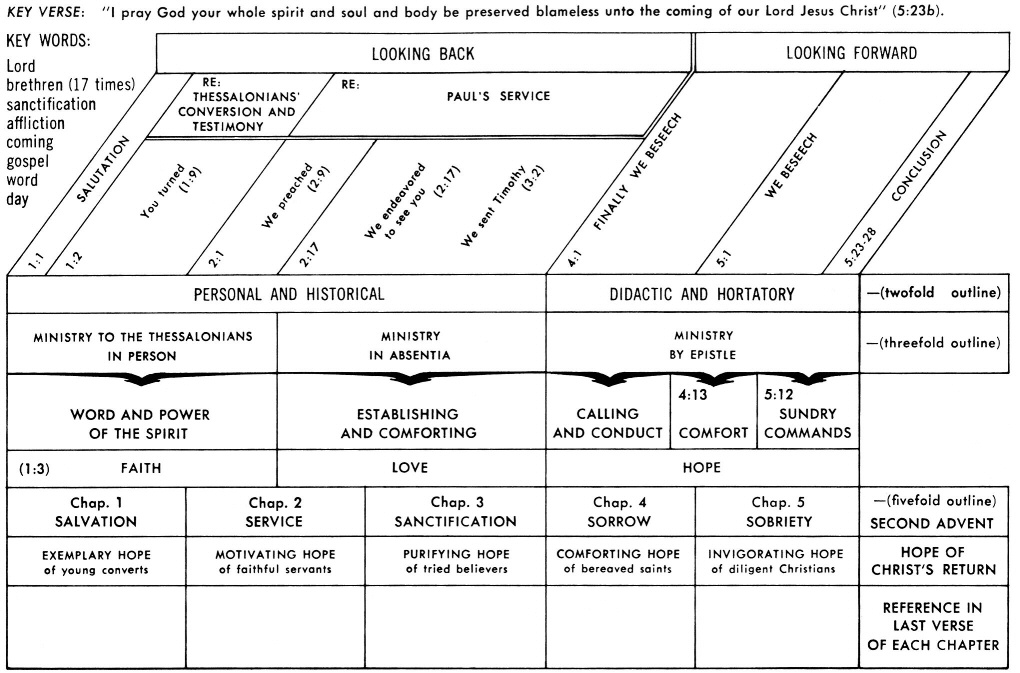
JESUS IS COMING AGAIN
Click chart to enlarge
Charts from Jensen's Survey of the NT - used by permission
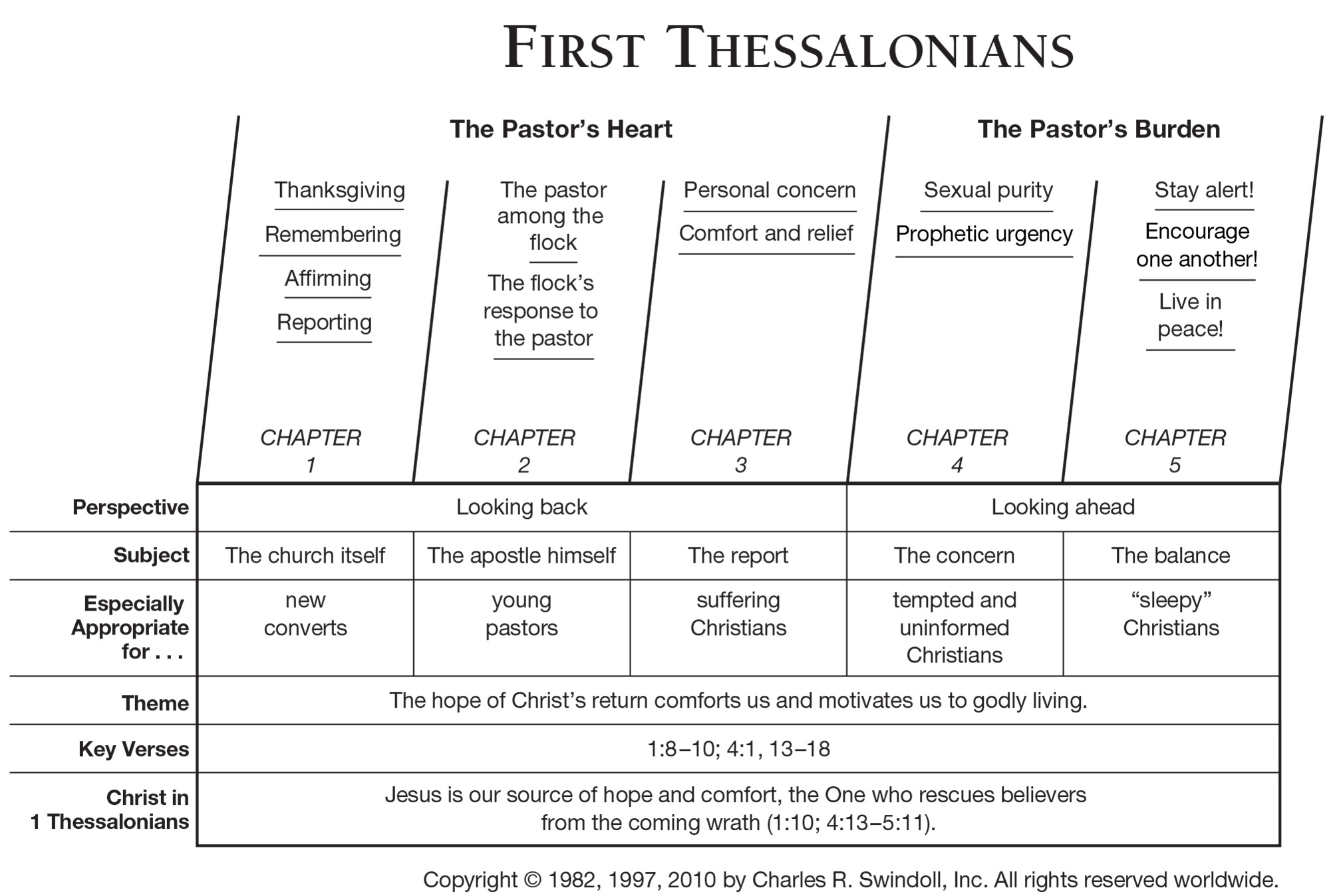
Chart by Charles Swindoll
|
1 Thessalonians |
||||||
| 1 Th 1:1-10 | 1 Th 2:1-20 | 1 Th 3:1-13 | 1 Th 4:1-18 | 1 Th 5:1-28 | ||
|
LOOKING BACK |
LOOKING FORWARD |
|||||
|
Personal Reflections |
Practical Instructions |
|||||
| Ministry In Person |
Ministry in Absentia (Thru Timothy) |
Ministry by Epistle |
||||
| Word and Power of the Spirit |
Establishing & Comforting |
Calling & Conduct | 1Th 4:13ff Comfort |
1Th 5:12ff Commands |
||
| 1 Salvation |
2 Service |
3 Sanctification |
4 Sorrow |
5 Sobriety |
||
| Paul Commends Spiritual Growth |
Paul Founds the Church |
Strengthening of the Church |
Directions for Spiritual Growth |
Holy Living in Light of Day of the Lord | ||
| Exemplary Hope of Young Converts | Motivating Hope of Faithful Servants |
Purifying Hope of Tried Believers | Comforting Hope of Bereaved Saints | Invigorating Hope of Diligent Christians | ||
|
Written from Corinth |
||||||
1 Thessalonians 1:8 For the word of the Lord has sounded forth (3SRPI) from you, not only in Macedonia and Achaia, but also in every place your faith toward God has gone forth (3SRAI), so that we have (PAN) no need to say (PAN) anything. (NASB: Lockman)
Greek: aph' humon gar exechetai (3SRPI) o logos tou kuriou ou monon en te Makedonia kai [en te] Achaia, all' en panti topo e pistis humon e pros ton theon exeleluthen (3SRAI), hoste me chreian echein (PAN) hemas lalein (PAN) ti
Amplified: For not only has the Word concerning and from the Lord resounded forth from you unmistakably in Macedonia and Achaia, but everywhere the report has gone forth of your faith in God [of your leaning of your whole personality on Him in complete trust and confidence in His power, wisdom, and goodness]. So we [find that we] never need to tell people anything [further about it]. (Amplified Bible - Lockman)
NLT: And now the word of the Lord is ringing out from you to people everywhere, even beyond Greece, for wherever we go we find people telling us about your faith in God. We don't need to tell them about it, (NLT - Tyndale House)
Phillips: You have become a sort of sounding-board from which the Word of the Lord has rung out, not only in Macedonia and Achaia but everywhere where the story of your faith in God has become known. We find we don't have to tell people about it. (Phillips: Touchstone)
Wuest: For from you there has been caused to sound forth in a loud, unmistakable proclamation the word of the Lord, the echo of which still rolls on with a great sound; not only in Macedonia and Achaia, but in every place your faith which is directed toward God has gone forth, so that we are not under any necessity to be saying a thing,
Young's Literal: for from you hath sounded forth the word of the Lord, not only in Macedonia and Achaia, but also in every place your faith toward God did go forth, so that we have no need to say anything,
FOR THE WORD OF THE LORD HAS SOUNDED FORTH FROM YOU NOT ONLY IN MACEDONIA AND ACHAIA: aph humon gar exechetai (3SRPI) o logos tou kuriou en te Makedonia kai (en te) Achaia:
- Is 2:3; 52:7; 66:19; Ro 10:14, 15, 16, 17, 18; 1Co 14:36; 2Th 3:1; Rev 14:6; 22:17
- 1 Thessalonians 1 Resources - Multiple Sermons and Commentaries
- 1 Thessalonians 1:9-10 Rescued by the Risen Jesus - Steven Cole
- 1 Thessalonians 1:1-10 Celebrating a Consecrated Church, Pt. 1 - John MacArthur
- 1 Thessalonians 1:1-10 Celebrating a Consecrated Church, Pt. 2 - John MacArthur
From you pealed forth the trumpet‑call of that message of our Lord; and not through Macedonia and Achaia only (Way)
For (1063) (gar) signifies an explanation (See discussion of value of observing and interrogating this term of explanation) of something previously stated. It is a good practice when you encounter a "for" at the beginning of a verse to ask "what is the author explaining?". What would Paul be explaining in present context? Clearly he is describing how the Thessalonians became "imitators" and "examples", the information that follows providing the details.
From you - These are the first words in the Greek sentence, which gives them an emphatic meaning.
As F F Bruce writes "Having received the gospel, the Thessalonian Christians had no thought of keeping it to themselves; by word and life they made it known to others. From the beginning they functioned as a missionary church."
What does the phrase "the Word of the Lord" (the Word of which the Lord is the Author) refer to in context? Clearly this is a reference to the Gospel. It can be understood both as that Word of which the Lord is the Author and as the Word with the Lord as the object (e.g., "the gospel of God" and the "gospel of Jesus Christ" are both the Word about God and about Jesus, Who are both the object or focus of the message). Remember that Thessalonica was on the Egnatian Way (Via Egnatia) which was
built beginning in 145 B.C. and at its greatest extent connected Byzantium with the Adriatic ports. This route was Rome's primary artery to the east and Philippi was an important outpost along the road. The Egnatian Way made it easier for Rome to move troops throughout the empire and it was the route that Paul traveled on from Neapolis to Philippi, Amphipolis, Apollonia and Thessalonica.
Thus Thessalonica was a great commercial and political center and as such would have functioned as a strategic point for disseminating the good news of salvation available to all who would believe.
The word of the Lord is a phrase found 243 times in the OT
Gen. 15:1, 4; Exod. 9:20f; Num. 3:16, 51; 15:31; 24:13; 36:5; Deut. 5:5; 34:5; Jos. 8:8, 27; 1 Sam. 3:1, 7, 21; 15:10, 23, 26; 2 Sam. 7:4; 12:9; 22:31; 24:11; 1 Ki. 2:27; 6:11; 12:24; 13:1f, 5, 9, 17f, 20f, 26, 32; 14:18; 15:29; 16:1, 7, 12, 34; 17:2, 5, 8, 16, 24; 18:1, 31; 19:9; 21:17, 28; 22:5, 19, 38; 2 Ki. 1:17; 3:12; 4:44; 7:1, 16; 9:26, 36; 10:10, 17; 14:25; 20:4, 16, 19; 23:16; 24:2; 1 Chr. 11:3, 10; 12:23; 15:15; 17:3; 22:8; 2 Chr. 11:2, 4; 12:7; 18:4, 18; 30:12; 34:21; 35:6; 36:21f; Ezr. 1:1; Ps. 18:30; 33:4, 6; 105:19; Isa. 1:10; 2:3; 28:13f; 38:4; 39:5, 8; 66:5; Jer. 1:2, 4, 11, 13; 2:1, 4, 31; 6:10; 7:2; 8:9; 9:20; 13:2f, 8; 14:1; 16:1; 17:15, 20; 18:5; 19:3; 20:8; 21:11; 22:2, 29; 23:17; 24:4; 25:3; 27:18; 28:12; 29:20, 30; 31:10; 32:6, 8, 26; 33:1, 19, 23; 34:4, 12; 35:12; 36:27; 37:6; 39:15; 42:7, 15; 43:8; 44:24, 26; 46:1; 47:1; 49:34; Ezek. 1:3; 3:16; 6:1, 3; 7:1; 11:14; 12:1, 8, 17, 21, 26; 13:1f; 14:2, 12; 15:1; 16:1, 35; 17:1, 11; 18:1; 20:2, 45, 47; 21:1, 8, 18; 22:1, 17, 23; 23:1; 24:1, 15, 20; 25:1, 3; 26:1; 27:1; 28:1, 11, 20; 29:1, 17; 30:1, 20; 31:1; 32:1, 17; 33:1, 23; 34:1, 7, 9; 35:1; 36:1, 4, 16; 37:4, 15; 38:1; Dan. 9:2; Hos. 1:1; 4:1; Joel 1:1; Amos 7:16; 8:12; Jon. 1:1; 3:1, 3; Mic. 1:1; 4:2; Zeph. 1:1; 2:5; Hag. 1:1, 3; 2:1, 10, 20; Zech. 1:1, 7; 4:6, 8; 6:9; 7:1, 4, 8; 8:1, 18; 9:1; 11:11; 12:1; Mal. 1:1)
This phrase is only 13 times in the NT in ESV (Acts 8:25; 11:16; 13:44, 48, 49; 15:35, 36; 16:32; 19:10, 20; 1Th 1:8; 2Th 3:1; 1Pe 1:25), and in the latter occurrences is not always a reference to the gospel as it is in the present passage. Paul uses the phrase with a similar meaning (equivalent to the gospel) in his second epistle writing to encourage the saints in Thessalonica to continue in prayers to God for them (Paul, Silvanus and Timothy)
that the word of the Lord will spread rapidly (keep speeding on and swiftly running its course toward the goal with all hindrances removed) and (continually being) be glorified, just as it did also with you (2Thes 3:1)
In other words, as the word of the Lord (the gospel) spread and produced changed lives, this word would give a proper opinion of itself and its intrinsic, supernatural power to save dead men from the "guttermost" to the "uttermost"
Sounded forth (1837) (execheo from ex = out + echo = hold; in Lxx only in Joel 3:14) means literally to sound out (the verb is found in ancient secular Greek manuscripts describing the sound of a trumpet or the sound of rolling thunder), reverberating (continuing as if in a series of echoes) or bouncing off objects (in this case the hearts and minds of lost men and women) like an echo. The picture is that of clearly audible, unmistakable proclamation.
The Thessalonians became a sounding-board from which the gospel echoed across their world. The idea is, that the gospel was proclaimed like the sonorous voice of a trumpet echoing from place to place. Thessalonica was a great model of a genuine missionary church! They were a reproducing church! Their gospel message was like ripples in a pool, spreading out in ever widening circles - Macedonia (home base, their "Jerusalem" cf Acts 1:8)… Achaia (their "Judea and Samaria")… every place (their "uttermost part of the earth")! What a pattern to emulate.
I really like how William MacDonald phrases it…
We are not intended to be termini of our blessings, but channels through which they can flow to others. God shines in our hearts so that the light might shine out to others (2 Cor. 4:6, JND translation). If we have really drunk the water of salvation, then rivers of living water will flow forth to those around us (John 7:37, 38). (MacDonald, W., & Farstad, A. Believer's Bible Commentary : Old and New Testaments. Nashville: Thomas Nelson)
Note that these saints at Thessalonica unlike the self-righteous Pharisees who "tooted their own horn", were trumpeting forth God's horn of Good News producing a clear, beautiful melody to those who had ears to hear!
Spurgeon - It is the vocation of faith to be a speaker. When the heart believes, the mouth follows suit and makes confession. Faith made Noah a preacher, and it caused it to be said of Abel, "He being dead yet speaketh" (see note Hebrews 11:4). A silent faith is a questionable grace. Faith first speaks to Christ and then for Christ. It hears his voice and then acts as an echo by repeating it.
Bible Knowledge Commentary has an interesting description of the Thessalonian saints noting that "Paul saw the Thessalonians as amplifiers or relay stations that not only received the gospel message but sent it farther on its way with increased power and scope. Paul’s preaching in Thessalonica had the effect of speaking into a public address microphone; his words were received and repeated by many different "speakers" in many remote places where his unaided voice could not have reached. (Walvoord, J. F., Zuck, R. B., & Dallas Theological Seminary. The Bible knowledge commentary).
A similar metaphor is found in God's command to the prophet Isaiah to
Cry loudly, do not hold back. Raise your voice like a trumpet, and declare to My people their transgression and to the house of Jacob their sins." (Isa 58:1)
John exiled to the isle of Patmos declares
I was in the Spirit on the Lord's day, and I heard behind me a loud voice like the sound of a trumpet. (see note Revelation 1:10)
The perfect tense indicates that their message began at a point in time in the past (their new birth) and continued effects were still reverberating. It had sounded, and still it sounds, reaching far and wide with its penetrating tones. It's sound in fact has reverberated down to our day in their written testimony in this divinely inspired epistle. Now that's reverberation! The perfect tense indicates the abiding effect of the blast; "the blast hangs on the air as the result of the trumpet having been blown." This is a good pattern for all believers to emulate being mindful that our Lord called us to be
the salt (permeating, preserving) of the earth… " and "the light of the world", letting our "light shine before men in such a way that they may see (our) good works, and glorify (our) Father Who is in heaven." (Mt 5:13, 14, 15, 16 -see notes on our call to be "salt and light" in Mt 5:13, 5:14-16)
The Thessalonian saints were not only "receivers" (the Word came to them, 1Th 1:5) but also were good "transmitters" as demonstrated in this verse. These ancient saints should challenge every modern believer and local church to be active, Spirit empowered receivers and transmitters of God’s Word!
The spread of the gospel from Thessalonica was the result of vital Christian living rather than aggressive missionary propaganda. Paul's picture is not that of an organized missionary campaign on the part of the Thessalonians aimed at spreading the gospel to the regions beyond. The amazing joy of the Thessalonian believers under affliction has amplified the message of the gospel, causing the reports to spread in all directions.
Warren Wiersbe has an powerful, convicting note writing that "election (see discussion of election in 1Pe 1:1) and evangelism go together. The person who says, "God will save those He wants to save and He doesn’t need my help!" understands neither election nor evangelism. In the Bible, election always involves responsibility. God chose Israel and made them an elect nation so that they might witness to the Gentiles. In the same way, God has chosen the church that we might be witnesses today. The fact that we are God’s elect people does not excuse us from the task of evangelism. On the contrary, the doctrine of election is one of the greatest encouragements to evangelism… The same God who ordains the end (the salvation of the lost) also ordains the means to the end (the preaching of the Gospel). There is no conflict between divine sovereignty and human responsibility, even though we cannot reconcile the two. We need more churches today where the people are enthusiastic to share the message of salvation with others. As I write this, 2.4 billion people in our world have no visible witness of the Gospel in their midst, or no church body. In spite of the outreach of radio, television, and the printing press, we are losing ground in the work of reaching the lost. Are you an enthusiastic Christian? Is your church enthusiastic about witnessing? (Wiersbe, W: Bible Exposition Commentary. 1989. Victor)
From you (aph humon) is the preposition apo meaning away from and clearly pictures the fact that they did not keep the good news to themselves but were fully obedient to the last words of Jesus' in Matthew (Mt 28:18, 19, 20) and Acts (Acts 1:8).
A T Robertson adds that from you pictures the Thessalonian saints
as a sounding board or radio transmitting station (to use a modern figure). It marks forcibly both the clear and the persuasive nature of the word of the Lord Is the word of the Lord
THOUGHT: Is the word sounding forth from you to the sphere of influence He has given you? Let these believers at Thessalonica challenge us all to let our "trumpet sound forth", echoing the good news of the resurrected Christ. We cannot imagine how far reaching the affects of such a "reverberating" witness might be to the glory of the Lord.
You are writing a Gospel,
A chapter each day,
By the deeds that you do
And the words that you say.
Men read what you write,
Whether faithful or true:
Just what is the Gospel
According to you?
Peters adds that "Paul was consumed by a burning zeal for a Christian universalism (Ed note: his desire that none perish but all come to repentance) which seemed strange to the Greek, arresting to the Roman, alarming to the Jew, and perplexing to some Christians. His highest praise goes to the churches whose "faith is spoken of throughout the whole world," and whose "faith to God-ward is spread abroad" (Ro 1:9; 1Th 1:8). (Peters, George W: The Primacy of Missions: Bibliotheca Sacra: Volume 119, Issue 476, page 341. Dallas TX: Dallas Theological Seminary) (Comment: Would he give you this same "high praise"?
BUT ALSO IN EVERY PLACE YOUR FAITH TOWARD GOD HAS GONE FORTH: all en panti topo e pistis humon e pros ton theon exeleluthen (3SRAI):
- Ro 1:8; 2Th 1:4; 3Jn 1:12) (Ex 18:9; 2Co 3:4
- 1 Thessalonians 1 Resources - Multiple Sermons and Commentaries
- 1 Thessalonians 1:9-10 Rescued by the Risen Jesus - Steven Cole
- 1 Thessalonians 1:1-10 Celebrating a Consecrated Church, Pt. 1 - John MacArthur
- 1 Thessalonians 1:1-10 Celebrating a Consecrated Church, Pt. 2 - John MacArthur
Literally "the faith of you that toward the God"
but in every place your faith which is directed toward God has gone forth (Wuest)
SOUNDING FORTH
OF FAITH
Your faith (4102) (pistis) (the faith of you) The repeated article ("the") in the original Greek makes it clear that their faith is now directed toward the true God and not toward the idols from which they had turned. The Thessalonian saints expressed their fidelity toward God, showing that they had a true belief in God and in the truth which He had revealed by their changed lives.
Toward (4314) is pros, the preposition of direction, indicating forward to, toward," or "facing," and indicates that their faith was directed toward and had as its object the God, the one true God whom they had come to know and serve, in contrast to their former idols. Their faith had experienced a change of direction, bringing them into a face‑to‑face relationship with the living God.
Gone forth (1831) (exerchomai) means literally to to go out with the use of the perfect tense (like "sounded forth" above) indicating that the "going forth" was a state of completion and was exerting a continuing effect. This pictures their faith like travelers having gone out in all directions.
SO THAT WE HAVE NO NEED TO SAY ANYTHING: hoste me chreian echein (PAN) hemas lalein (PAN) ti:
- 1 Thessalonians 1 Resources - Multiple Sermons and Commentaries
- 1 Thessalonians 1:9-10 Rescued by the Risen Jesus - Steven Cole
- 1 Thessalonians 1:1-10 Celebrating a Consecrated Church, Pt. 1 - John MacArthur
- 1 Thessalonians 1:1-10 Celebrating a Consecrated Church, Pt. 2 - John MacArthur
THEIR CHANGED LIFE WAS
THE MESSAGE OF THEIR "LIPS"
So that - Always pause and ponder these terms of purpose or result (so that, in order that, that, as a result).
Say (2980) anything in context refers to there being no need for Paul, Silvanus and Timothy to say anything about the radically changed lives of the Thessalonians because the change was so obvious to all in this region.
THOUGHT - Father, by Your Spirit make this to be true of all local bodies in the universal body of Christ! Amen
Lord, speak to me, that I may speak
In living echoes of thy tone;
As thou hast sought, so let me seek
Thy erring children lost and lone.
-Frances Ridley Havergal
The effect of changed lives shining forth in a pagan culture was also addressed in the letter to the saints at Philippi, Paul exhorting them to
Do (present imperative = command to habitually do) all things (how many things?) without grumbling (goggusmos) or disputing (dialogismos); that you may prove yourselves to be blameless and innocent, children of God above reproach in the midst of a crooked and perverse generation, among whom you appear as lights in the world, holding fast the word of life, so that in the day of Christ (Second Coming) I may have cause to glory because I did not run in vain nor toil in vain. (see notes Philippians 2:14-16)
Believers today have no less of a charge to let their lives shine forth (cp Mt 5:16).
THOUGHT - How's your light shining - dim & difficult to see or convicting & clear? If we would win some we must be winsome.
Moody said "It is a great deal better to live a holy life than to talk about it. We are told to let our light shine, and if it does we won't need to tell anybody it does. The light will be its own witness. Lighthouses don't ring bells and fire cannons to call attention to their shining--they just shine."
Holy lives are just as persuasive as holy words. A good fisherman keeps himself out of sight. Let each of us strive according to His power to be holy as He is holy and all the more as we see the day of Christ's return drawing nigh.
I have found John Henry Jowett's words too true in my life when my light was "dim" = If we do not catch men we are in danger of losing even the desire to catch them… The joy of catching a soul is unspeakable. When we have got one soul we become possessed by the passion for souls. Get one and you will want a crowd.
Spurgeon minced no words when he asked "Have you no wish for others to be saved? Then you are not saved yourself. Be sure of that… You do not love the Lord at all unless you love the souls of others… The soul-winner must first be a soul-lover… Winners of souls must first be weepers for souls.
To Tell the Truth - When you think of the term evangelism, what picture flashes onto the wall of your mind? A large stadium filled with people? A small booklet with a set of diagrams? A Christian wearing a pin with the symbol of a fish? A zealous believer playing intellectual chess with a pagan opponent? A salesman convincing a reluctant person to "try Jesus"?
Evangelism is a 10-letter dirty word to some of us. While we think it's a dandy idea for others, we're sure it isn't for us. We're not cut out to sell, nor shrewd enough to play intellectual games with non-Christians.
Evangelism, though, isn't about being a huckster who cons people into buying what they don't need. It has nothing to do with grabbing people by the lapels and shoving on them a faith that goes no deeper than the shirt pocket. What a grim indictment resides in the remark, "You could identify the people she had witnessed to by their haggard look."
Evangelism is simply sharing with others what we know about Jesus. "We do not preach ourselves, but Christ Jesus the Lord" (2Corinthians 4:5). No tricks. No deception. Speak the truth, the whole truth, nothing but the truth—in love. Then leave the results with God.—Haddon W. Robinson (Our Daily Bread, Copyright RBC Ministries, Grand Rapids, MI. Reprinted by permission. All rights reserved)
It's not our task to force God's truth
On those who may the truth detest,
But we are asked to share Christ's love
And let God's Spirit do the rest.
—D. De Haan
We who know the joy of salvation
should not keep it to ourselves.
LASTING IMPRESSIONS - When American financier John Pierpont Morgan died in 1913, his last will and testament revealed his genuine faith in Jesus Christ. He had prefaced his specific bequests with these significant words:
"I commit my soul into the hands of my Savior, in full confidence that having received it and washed it in His most precious blood He will present it faultless before the throne of my heavenly Father. And I entreat my children to maintain and defend, at all hazard, and at any cost of personal sacrifice, the blessed doctrine of the complete atonement for sin through the blood of Jesus Christ, once offered, and through that alone."
Those words must have left a lasting impression on his heirs. Yet as commendable as it is to leave such a clear witness to one's faith after we die, it is even more imperative to share our faith in Christ while we are still alive. The converts in Thessalonica responded to the witness of Paul, Silvanus, and Timothy by imitating their life and witness so that "the word of the Lord sounded forth" beyond Macedonia and Achaia (1Th. 1:6, 7, 8). Likewise, as we spread the gospel through our words and actions, we will leave lasting impressions on our world.- Vernon C. Grounds (Our Daily Bread, Copyright RBC Ministries, Grand Rapids, MI. Reprinted by permission. All rights reserved)
I love to tell the story,
For some have never heard
The message of salvation
From God's own holy Word.
- Hankey
Thought for the Day:
A life lived for God leaves a lasting legacy.
Dwight Moody regularly asked complete strangers about their spiritual life. One day he stopped a young man and asked, "Are you a Christian?"
"It is none of your business.
"Yes it is."
"Then you must be Dwight L. Moody.
What a splendid reputation to precede any Christian! What would others say of us if what we were best known for became public knowledge? If the letters of our life would form one word to describe us, what would it be? Better still, rather than describe ourselves, with what one word would others describe us? Evangelistic was the word that characterized Moody. What do we say, or do, that as quickly identifies us?
1 Thessalonians 1:9 For they themselves report (3PPAI) about us what kind of a reception we had (1PAAI) with you and how you turned (2PAAI) to God from idols to serve (PAN) a living (PAPMSD) and true God, (NASB: Lockman)
Greek: autoi gar peri hemon apaggellousin (3PPAI) opoian eisodon eschomen (1PAAI) pros humas, kai pos epestrepsate (2PAAI) pros ton Theon apo ton eidolon douleuein (PAN) theo zonti (PAPMSD) kai alethino
Amplified: For they themselves volunteer testimony concerning us, telling what an entrance we had among you, and how you turned to God from [your] idols to serve a God Who is alive and true and genuine, (Amplified Bible - Lockman)
GWT: They talk about how you welcomed us when we arrived. They even report how you turned away from false gods to serve the real, living God
ICB: People everywhere are telling about the good way you accepted us when we were there with you. They tell about how you stopped worshiping idols and changed to serving the living and true God. (ICB: Nelson)
NJB: other people tell us how we started the work among you, how you broke with the worship of false gods when you were converted to God and became servants of the living and true God;
NLT: for they themselves keep talking about the wonderful welcome you gave us and how you turned away from idols to serve the true and living God. (NLT - Tyndale House)
Phillips: They tell us the story of our coming to you: how you turned from idols to serve the true living God (Phillips: Touchstone)
Wuest: for they themselves keep on reporting concerning you what kind of an entrance we had as we came to you, and how you turned around to God from your idols for the purpose of serving a living and genuine God as His bondslaves
Young's Literal: for they themselves concerning us do declare what entrance we had unto you, and how ye did turn unto God from the idols, to serve a living and true God
FOR THEY THEMSELVES REPORT ABOUT US WHAT KIND OF A RECEPTION WE HAD WITH YOU: autoi gar peri hemon apaggellousin (3PPAI) opoian eisodon eschomen (1PAAI) pros humas:
- 1Th 1:5,6; 2:1,13
- 1 Thessalonians 1 Resources - Multiple Sermons and Commentaries
- 1 Thessalonians 1:9-10 Rescued by the Risen Jesus - Steven Cole
- 1 Thessalonians 1:1-10 Celebrating a Consecrated Church, Pt. 1 - John MacArthur
- 1 Thessalonians 1:1-10 Celebrating a Consecrated Church, Pt. 2 - John MacArthur
"People everywhere are telling about the way you accepted us when we were there with you" (NCV)
"For they themselves volunteer testimony concerning us, telling what an entrance we had among you" (Amp)
"for they themselves keep talking about the wonderful welcome you gave us" (NLT)
"They talk about how you welcomed us when we arrived" (GWT)
"Everyone is talking about how you welcomed us " (CEV),
"For when others speak of us they report the reception we had from you," (Weymouth)
"For people everywhere report how you welcomed us" (NET)
A POWERFUL
TESTIMONY
"They themselves" refers to the people of Macedonia and Achaia (and every place their faith had gone out) who had heard the news. The faith of the Thessalonians had become a topic of common knowledge.
Report (518) ("openly declare", "volunteer testimony", "give the news") (apaggello from apó = from + aggéllo = tell, declare) means to to provide otherwise unknown information by giving an account or report. Apaggello can also mean to make something known publicly and was used in secular Greek of a messenger bringing news. The present tense (continuous action) indicates that the reports were being received by the missionaries not as isolated instances but as repeated occurrences.
Reception (1529) (eisodos from eis = in + hodos = a way) is literally a way in or entering in and is used in the spatial sense to describe a way, entry (access), or approach to a place or building. As an action, eisodos can describe a coming in or entering. Eisodos also describes a reception given, an acceptance or a welcome extended to a person on the occasion of a visit.
Literal / physical entrance - Entry into a city, house, or region - Acts 13:24 — “After John had proclaimed before His coming (eísodos) a baptism of repentance…”
Arrival / coming of a person - A person’s arrival or entrance among others - 1 Thess 1:9 — “They themselves report what kind of entrance (eísodos) we had with you.”
Figurative / spiritual entrance - Entry into salvation, the kingdom, or eternal life - 2 Pet 1:11 — “For in this way the entrance (eísodos) into the eternal kingdom… will be abundantly supplied to you.”
EISODOS - 4X - coming, 1; enter, 1; entrance, 1; reception, 1 - Acts 13:24; 1Th. 1:9; 2:1; Heb. 10:19; 2Pet. 1:11
Theological nuances of eisodos -
- Entrance of the Gospel — In 1 Thessalonians 1:9 and 1Th 2:1, Paul uses eísodos metaphorically for the impact and acceptance of the gospel: “Our entrance (eísodos) among you was not in vain.”This describes not just physical arrival, but the spiritual opening God created for the message to enter hearts.
- Entrance into Eternal Life — 2 Peter 1:11 uses the term for the believer’s rich “entry” into Christ’s everlasting kingdom: “An abundant entrance will be supplied to you.” This portrays salvation’s completion — not barely entering heaven, but a triumphant welcome into the eternal realm.
- Christ’s Coming — In Acts 13:24, the word refers to Christ’s coming into His public ministry — His “entrance” into the world’s redemptive stage.
The word eísodos beautifully captures both the beginning of faith and the end of the journey. The gospel’s entrance into our hearts leads ultimately to our entrance into Christ’s eternal kingdom.
He who entered once into our hearts
will one day welcome us into His home.
Luke uses eisodos referring to Jesus' entrance into humanity as a man writing…
John had proclaimed before His coming (eisodos = Jesus "entrance" into public ministry = John had announced the coming of Messiah and called for repentance to prepare for His arrival) a baptism of repentance to all the people of Israel. (Acts 13:24) (The Septuagint (LXX) uses eisodos in Malachi 3:2 to describe His second coming writing "But who can endure the day of His coming? And who can stand when He appears? For He is like a refiner's fire and like fullers' soap.")
Paul uses eisodos in the next chapter writing…
For you yourselves know, brethren, that our coming to you was not in vain, (2 Thes 2:1)
The writer of Hebrews sums up his exhortation with the invitation…
Since therefore, brethren, we have confidence (boldness - because of the high-priestly ministry of Christ and His finished sacrifice which has made all believers priest with the right) to enter (eisodos) the holy place by the blood of Jesus, (Heb 10:19)
The final use of eisodos is in reference to our entrance into glory, Peter writing…
for in this way (being diligent to make certain about His calling and choosing you, practicing the things mentioned earlier in chapter 1) the entrance (eisodos) into the eternal kingdom of our Lord and Savior Jesus Christ will be abundantly supplied to you (there is safety in constant spiritual progress and the promise of a richly-provided entrance). (2Pe 2:11)
Hiebert writes that "This "entering in" was not restricted to the introduction or reception they received upon arrival, but it related to their whole approach to and dealings with the Thessalonians while with them. The correlative pronoun "what kind of" (hopoian) stresses the quality of the entrance. The missionaries gained "access not only to their friendship but to their hearts and consciences." (1 & 2 Thessalonians)
The phrase "with you" (pros = before and refers to a position near another location or object, often with the implication of facing toward) indicates Paul, et al, carried on their ministry to the Thessalonians face‑to‑face. They were open and above‑board in all their dealings with the new believers.
Clarke comments that this report shows the Thessalonians were walking "so conscientiously before God and man, that their friends could speak of them without a blush, and their adversaries could say nothing to their disgrace."
AND HOW YOU TURNED TO GOD FROM IDOLS: kai pos epestrepsate (2PAAI) pros ton theon apo ton eidolon:
- Isa 2:17, 18, 19, 20, 21; Jer 16:19; Zeph 2:11; Zec 8:20, 21, 22, 23; Mal 1:11; Acts 14:15; Acts 26:17,18; 1Co 12:2; Gal 4:8,9
- 1 Thessalonians 1 Resources - Multiple Sermons and Commentaries
- 1 Thessalonians 1:9-10 Rescued by the Risen Jesus - Steven Cole
- 1 Thessalonians 1:1-10 Celebrating a Consecrated Church, Pt. 1 - John MacArthur
- 1 Thessalonians 1:1-10 Celebrating a Consecrated Church, Pt. 2 - John MacArthur
New Jerusalem Bible paraphrases it "how you broke with the worship of false gods when you were converted to God."

REPENT AND BELIEVE
A PICTURE OF REPENTANCE:
A TURN FROM THE LIE TO THE TRUTH
The command "About Face" (see illustration below) is describes the act of pivoting 180 degrees, especially in a military formation (see diagram above). Another English definition says it is "a reversal of direction, of attitude, behavior, or point of view." This is a good picture of repentance that Jesus commands. Jesus continues the call to repentance made by John in Mark 1:4.
Turned from idols to the living and true God - It is interesting that in the OT one of the Hebrew words that conveys the abstract idea of idol is "awen" (Isa 66:3) which conveys the idea of emptiness, nothingness, as of breath or vapor! It is that which is vain or false (not true). In short, Paul's readers had repented, turning from belief in "nothing" to belief in the ultimate Truth (Jn 14:6)!
To God from idols - Note the order, as it is not "accidental". First = To God. Then = From idols. When our eyes of faith are opened to see the true and living God, the vain, dead so called gods are seen for the empty unsatisfying worthless created things they are.
THOUGHT Do you have any worthless idols you are hiding in your heart? If you do then turn to God and confess them one by one so that by His grace and power you are enabled to turn away from them (to repent)?
Repentance is to leave
The sins we loved before,
And show that we in earnest grieve,
By doing so no more.
You turned (1994) (epistrepho from epi = motion toward + strepho = turn) means to turn about, around or toward and then to convert, so that it frequently refers to a sinner’s conversion to God as in the current use. Epistrepho describes what is elsewhere termed repentance (see Mt 3:1,2; 4:17; Acts 2:38; 3:19; 5:31; 20:21).
See related study on metanoia = repentance.
Epistrepho - 36 uses in NT -Mt. 10:13; 12:44; 13:15; 24:18; Mk. 4:12; 5:30; 8:33; 13:16; Lk. 1:16f; 2:39; 8:55; 17:4, 31; 22:32; Jn. 21:20; Acts 3:19; 9:35, 40; 11:21; 14:15; 15:19, 36; 16:18; 26:18, 20; 28:27; 2 Co. 3:16; Gal. 4:9; 1Th. 1:9; Jas. 5:19f; 1 Pet. 2:25; 2 Pet. 2:22; Rev. 1:12 (There are more than 400 uses of epistrepho in the Septuagint!)
See Harry Ironside's book - in Except Ye Repent by Harry A. Ironside Pdf format From Ironside's introduction…Fully convinced in my own mind that the doctrine of repentance is the missing note in many otherwise orthodox and fundamentally sound circles today, I have penned this volume out of a full heart. I hope and pray that God will be pleased to use it to awaken many of His servants to the importance of seeking so to present His truth as to bring men to the only place where He can meet them in blessing. That place is the recognition of their own demerit and absolute unworthiness of His least mercies and a new conception of His saving power for all who come to Christ as lost sinners, resting alone upon His redemptive work for salvation, and depending upon the indwelling Holy Spirit to make them victorious over sin's power in daily life.
Epistrepho describes a definite turn to God in thinking and conduct and is used with this evangelical meaning most often in Acts (Click here for all uses in Acts).
Turned is aorist tense pointing to a definite crisis experience and indicative mood indicates that such a change had truly taken place. The active voice indicates that the conversion was the consequence of a deliberate choice on their part and was not an act forced upon them. Their turning was voluntary. It was evidence of their faith and love mentioned in (1Thessalonians 1:3 see notes)..
MacDonald rightly observes…that they turned to God from idols, not from idols to God. It wasn’t that they had become fed up with their idols and then decided to give God a chance. No, they turned to God and found Him so satisfying that they dropped their idols. Let us never lose the sense of thrill and awe that is implicit in this account. Two men go into a heathen city with the word of the Lord. They preach the gospel in the power of the Spirit. The miracle of regeneration takes place: men and women become so enraptured with the Savior that they abandon their idols. Next you have a local assembly of believers praising God, living lives of holiness, bravely enduring persecution, and winning others to Christ. Truly the Lord’s service is the prince of callings! (Believer's Bible Commentary)
Vine points out that "in no case is God, or Christ, or the Holy Spirit, said to turn, or convert, anyone. Conversion is always the voluntary act of the individual in response to the presentation of truth."
Charles Ryrie explains that "One dimension of their witness was in the quality of life that salvation produced in them. They had "turned to God from idols to serve the living and true God". Their testimony is likened to the ringing blast of a trumpet, the echo of which continues to be heard. That they had such a reputation despite persecution is a marvelous testimony of their "faith toward God." It is during times of difficulty that one's faith in the Lord is especially precious, sustaining, and essential. (Ryrie Study Bible)
From (575)(apo) is a preposition which means "from" or "away from," and often speaks of a break of a former relationship. Here apo clearly indicates that in turning to God they had turned their backs on those idols and had separated themselves from any further idol worship.
writes that based upon an analysis of the relevant Scriptures the following observations can be drawn regarding the idea of conversion…
1. Conversion in its concept and experience originates in God. It is neither a human invention nor the product of the human mind, will, or emotions. It originated in the mind and will of God. As in Genesis 1:1 so also here we write, "In the beginning God."
2. God Himself is the initiator of the conversion of man by: (a) commanding man to be converted; (b) calling man to return unto Him; (c) calling man to forsake sin; (d) upholding before man the promise of the forgiveness of sins, restoration and a life of rich blessings; and (e) warning man of judgment if he fails to heed God’s call and command.
In order to save the Biblical concept of conversion from all religious humanism, it is well to realize that the Word of God is not only self-authoritative, it is also dynamic, quickening, motivating, and causative. The command, call, promise, and warning of God carry in them the power of God to motivate and to enable man to respond positively to the Word of God. In faith man opens himself to the power of God in the Word and is thereby enabled to follow the command of God and to respond to the call for conversion (cf. Ps 19:7, 8; John 6:63; Hebrews 4:12 - note).
3. God Himself is operative in conversion and thus in the final end, the ultimate cause of man’s conversion rests in God and not in man himself. Without the gracious operation of the Holy Spirit spoken of at times as prevenient grace, known as the convicting (John 16:8), drawing (John 12:32), and illuminating ministry of the Holy Spirit, no man would ever turn to God and be converted (John 1:7-9).
4. Conversion as seen from the above data is a conscious, radical, principal turning of man with all his heart to God and from sin and ungodliness, a turning which affects the whole of man’s life in all its relationships.
5. There is a possibility of false "conversions," conversions which are merely psychological, an escape from judgments rather than sin, or half-heartedness, or to false gods. Thus they are inadequate either in the dynamic, motivation, or purpose. (Peters, George: The Meaning of Conversion: Bibliotheca Sacra: Volume 120, Issue, 479, 1963, page 240. Dallas TX: Dallas Theological Seminary)
Idols (1497) (eidolon from eídos = that which is seen, what is visible, figure, appearance) is primarily a phantom, form, image, shadow or likeness.
Friberg's summary of eidolon - strictly form, copy, figure; hence (1) an object resembling a person or animal and worshiped as a god idol, image (Rev 9.20); (2) idol, false god, with reference to demonic power involved in idol worship (1Cor 10.19)
BDAG summary of eidolon - 1. cultic image/representation of an alleged transcendent being, image, representation 2. through metonymy the image and the deity or divinity alleged to be represented are freq. associated in such manner that the image factor is less significant than the component of unreality or spuriousness of what is represented (cp. Is 44:6-20; 46:1-7) fabricated/imaged deity, idol
Liddell-Scott on eidolon - an image, a phantom, Hom., Hdt. phantoms of dead men, Od.; of any unsubstantial form, II. an image in the mind, idea, Xen.:-also a fancy, Plat. III. an image, likeness, Hdt. IV. an image, idol, NT.
TDNT on eidolon - 1. (Classic Greek) This means “picture,” “copy.” It can be used for images of gods, but is not the usual term for cultic images (or human statues). When used for images, the idea is that of a reflection of the deity. The term can also denote shades or apparitions (beings in the underworld are only copies of people). Another sense is the image evoked by an object (which may be illusory). 2. The LXX uses the term in a derogatory sense for images of the gods, or idols. In this regard it is referring polemically to the deities themselves, which are empty, and which thus express the unreality of pagan belief. The main point is not that another god is worshipped but that this is an unreal god. The Greeks do not follow this usage, so that the LXX here coins a new expression out of a familiar term.
Eidolon is found 11 times in the NAS and always translated idol (4) or idols (7).
Acts 7:41 "At that time they made a calf and brought a sacrifice to the idol, and were rejoicing in the works of their hands. (Read Ex 32:1-5 - Notice that Aaron was intimately involved in this horrible rebellion and yet in Leviticus he is called into the priesthood as a holy priest! While we never want to presume on God's mercy, we should never presume we have run too far from it! How great is the Father's love!)
Acts 15:20 but that we write to them that they abstain from things contaminated by idols and from fornication and from what is strangled and from blood.
Romans 2:22 You who say that one should not commit adultery, do you commit adultery? You who abhor idols, do you rob temples? (They were duplicitous!)
1 Corinthians 8:4 Therefore concerning the eating of things sacrificed to idols, we know that there is no such thing as an idol in the world, and that there is no God but one.
1 Corinthians 8:7 However not all men have this knowledge; but some, being accustomed to the idol until now, eat food as if it were sacrificed to an idol; and their conscience being weak is defiled.
1 Corinthians 10:19 What do I mean then? That a thing sacrificed to idols is anything, or that an idol is anything?
1 Corinthians 12:2 You know that when you were pagans, you were led astray to the mute idols, however you were led.
2 Corinthians 6:16 Or what agreement has the temple of God with idols? For we are the temple of the living God; just as God said, "I WILL DWELL IN THEM AND WALK AMONG THEM; AND I WILL BE THEIR GOD, AND THEY SHALL BE MY PEOPLE.
1 Thessalonians 1:9 For they themselves report about us what kind of a reception we had with you, and how you turned to God from idols to serve a living and true God,
1 John 5:21 Little children, guard yourselves from idols.
Revelation 9:20 The rest of mankind, who were not killed by these plagues, did not repent of the works of their hands, so as not to worship demons, and the idols of gold and of silver and of brass and of stone and of wood, which can neither see nor hear nor walk;
Eidolon - 70 times in the non-apocryphal Septuagint (Lxx)- Gen. 31:19, 34-35; Ex 20:4; Lev. 19:4; 26:30; Num. 25:2; 33:52; Deut. 5:8; 29:17; 32:21; 1 Sam. 31:9; 1 Ki. 11:2, 7f, 33; 2 Ki. 17:12; 21:11, 21; 23:24; 1Chr. 10:9; 16:26; 2Chr. 11:15; 14:5; 15:16; 17:3; 23:17; 24:18; 28:2; 33:22; 34:7; 35:19; Esther 4:17; Ps. 97:7; 115:4; 135:15; Isa. 1:29; 10:11; 27:9; 30:22; 37:19; 41:28; 48:5; 57:5; Jer. 9:14; 14:22; 16:19; Ezek. 6:4, 6, 13; 8:10; 16:16; 18:12; 23:39; 36:17, 25; 37:23; 44:12; Dan. 3:12, 18; 5:4, 23; 6:27; Hos. 4:17; 8:4; 13:2; 14:8; Mic. 1:7; Hab. 2:18; Zech. 13:2
Ex 20:4 “You shall not make for yourself an idol, or any likeness of what is in heaven above or on the earth beneath or in the water under the earth.
NIDNTT has an excellent explanation of the background on eidolon which is necessary to understand the Greek use of this that…
eidolon is used by Homer for the phantoms and shades in Hades (Il. 5, 451; Od. 4, 796). It can also mean any unsubstantial form, an image reflected in a mirror or water, an image or idea in the mind. Apart from Polybius 31, 3, 13-15, it was not generally used for the images of the gods in classic Greek). (Ed note: since the Greeks did not consider their gods to be idols, and they had no term for idolatry!)
Although eidolon is used to render some 15 Hebrew terms in the LXX, it refers without exception to the images of the heathen gods and the deities represented by them. They include gillulim (1544) idols (always in a disdainful sense, e.g. Lev 26:30; Deut. 29:17; Ezek. 6:4ff., 13; 36:17f., 25; 37:23); and teraphim (8655) idols (again used disdainfully, perhaps connected with the idea of perishing, Ge 31:19, 34ff). To express the image of God in man, even where the Hebrew word is also applied to an idol, the term eikon is used. This Hellenistic-Jewish usage reflects Jewish contempt for heathen polytheism.
The prohibition against serving other gods and the prohibition against making eidola are linked already in the Decalogue (Ex 20:3, 4, 5f.; Deut. 5:7, 6, 7f.). The depreciation of images based on this prohibition leaves its traces everywhere in the OT. This does not imply, however, that there is no reality behind the heathen idolatrous worship. Idols are bdelugmata (946), abominations (Ed note: the very Greek word used by Jesus to describe the Antichrist! Mt 24:15), behind which stand daimonia (Demon) (1142), demonic powers, with which one cannot come into contact without moving God to wrath (Deut. 32:16f., 21). In 2Chr 24:18 the worship of idols is equated with that of the Asherim, i.e. of the powers behind the idols.
Israel often succumbed to the temptation to open the doors to these powers, especially when the rise of the Assyrian and Babylonian empires gave the impression that their gods were more powerful than the God of Israel (Isa. 36:19, 20f.). Jer. 44:15, 16, 17, 18, 19 and Ezek 8:1, 2, 3, 4, 5, 6, 7, 8, 9, 10, 11, 12f give graphic and terrible pictures of how widely heathen idol worship had spread in Israel in their day. The prophetic message to Israel was that the misfortune which had overtaken the people was God’s punishment for falling away from Yahweh and compromising with the heathen cultus (Isa 10:11; Jer 9:13, 14, 15, 16; Ezek 8:17f.). The call to repentance combined a demand for right behaviour towards one’s neighbour (Amos 5:14f.; Hos 4:1, 2, 3f.; Isa 1:15, 16, 17f.) with the demand to turn away from false gods (Hos 14:9). The prophets never grew tired of stressing to the people how impotent and vain (mataios = empty) (3152) were the idols (Ezek 8:10; 1Chr. 16:26; 2 Chr. 25:15). For they are merely the creation of men’s hands which cannot hear or see, or do anything (Hos 8:4f.; 13:2; Je 14:22; Hab 2:18f.; cf. Ezek. 8:10; 2Chr. 11:15). The sharpest polemic against the cult images in an exilic setting occurs in Isa 40:18, 19, 20f.; 44:9-20; 46:1f. The making of the idols is described in language that renders them ludicrous; and the power of Yahweh who molds history is contrasted with them (Isa. 45-48). He will destroy the false gods (Jer 10:10, 11, 12, 13, 14, 15; Ezek 6:4, 5, 6f, 13; Mic 1:7), and men will throw away their idols on the day of God’s judgment (Isa 2:18, 19, 20f.). (Brown, Colin, Editor. New International Dictionary of NT Theology. 1986. Zondervan)
In summary, the spiritual significance of eidolon is primarily derived from the use of this word in the Septuagint (LXX) where (as discussed above in the NIDNTT) eidolon is considered a derogatory term for images of the gods or pagan deities. The Septuagint uses of eidolon emphasize the fact that idols are the products of fantasy and are manufactured by human hands (e.g. Isa 44:12, 13, 14, 15, 16, 17). The Old Testament writers considered that these so-called gods had no reality at all, but were simply pieces of wood or stone. They were not alternative gods, but rather unreal gods. The NT usage is based on the understanding of eidolon in the Septuagint.
Read Psalm 115:1-9 for a vivid description of what it is like to worship an idol.
Arthur Wallis an English evangelical writer said that "An idol may be defined as any person or thing that has usurped in the heart the place of preeminence that belongs to the Lord."
In Scripture eidolon is an image or representation whether corporeal or imaginary or some other thing which resembles a person, animal, false god, etc. and which is an object of worship. In Colossians 3 Paul broadened the meaning an idol using the combination word eidololatreia (eidolon + latreia = render religious service) writing…
Therefore consider the members of your earthly body as dead to immorality, impurity, passion, evil desire, and greed, which amounts to idolatry. (see notes Colossians 3:5)
When people engage in either greed (literally = "desire to have more"), they follow their desires rather than God’s desires, in essence worshiping themselves, which amounts idolatry. Greed then in this context is any materialistic desire including lust that disregards the rights of others. As one writer has phrased it greed is "the arrogant and ruthless assumption that all other persons and things exist for one’s own benefit."
Louw and Nida - The technical distinction between an image and an idol is that an image may merely represent a supernatural being, while an idol not only represents such a being but is believed to possess certain inherent supernatural powers. Images often become idols when they are assumed to possess such powers in and of themselves rather than being mere representations of some supernatural entity. If, for example, various images of a particular supernatural being are supposed to have different healing powers, then what began merely as images or representations of a supernatural power have become idols, in that the different images themselves have acquired special efficacy. (Louw, J. P., & Nida, E. A. Greek-English Lexicon of the New Testament: Based on Semantic Domains. United Bible societies)
Eidolon in a practical sense is anything, anyone, etc that takes priority over the True and Living God. Idols therefore are not just carved images but any objects which come between the soul and Christ, including things like money, pleasure, fame or material things. Many idolaters literally serve idols as in ancient Egypt where statues of gods were regularly and ritually clothed and fed!
In Lystra when the pagan Gentile idol worshipers began calling Barnabas, "Zeus" (the supreme Greek deity) and Paul "Hermes" (the messenger of the Greek gods), they countered by preaching the gospel and instructing them to
turn from (epistrepho) these vain things (futile or profitless things -- Scripture frequently refers to idols as vain things or vanity) to a living God, Who made the heaven and the earth and the sea, and all that is in them. (Acts 14:15)
Because idolatry was inseparably connected with all phases of pagan life, a conversion that led to the rejection and renunciation of idols was indeed a revolutionary experience. There seemed to be a solid basis for the Jewish opponents' charge that the missionaries were men who "turned the world upside down" (Acts 17:6).
The first NT use of eidolon is to describe Israel's sin at Mt Sinai…
And at that time they made a calf and brought a sacrifice to the idol, and were rejoicing in the works of their hands." (Acts 7:41)
In Jerusalem at a council of the Jewish believers James declared that…
we write to (the Gentiles turning to God) that they abstain from things contaminated by idols (eidolon) and from fornication and from what is strangled and from blood. (Acts 15:20) (It was not that these restrictions (any more than circumcision) were required for salvation, but rather for fellowship with the Jerusalem church and with Jewish Christians in general)
In Romans 2:22 (note) Paul addressed individuals (which in context appear to be Jews) as those "who abhor idols (eidolon)", the Jews having been taught, by the severe discipline of the 70 year Babylonian Captivity, to obey God’s decree against idolatry.
Writing to the Corinthians who lived a city alive (really "dead") with idol worship Paul explained…
Therefore concerning the eating of things sacrificed to idols (eidolon), we know that there is no such thing as an idol (eidolon) in the world, and that there is no God but one." (1Cor 8:4)
Later in the same letter Paul explained further about idols asking
"What do I mean then? That a thing sacrificed to idols (eidolon) is anything, or that an idol (eidolon) is anything? No, but I say that the things which the Gentiles sacrifice, they sacrifice to demons, and not to God; and I do not want you to become sharers in demons." (1Cor 10:19-20)
Paul was making the point that even though the physical images worshiped by idolaters are nothing but vanity, they do represent a dangerous reality. The idols and the things sacrificed to them have no spiritual nature or power in themselves (1Cor 8:4, 8), but they do represent demonic beings. In some mysterious way, idol worship is linked with demons and using the idols, the demons can exert control over the hearts and minds of those who worship them, thereby impressing them with the validity of their false religion, and binding them ever more securely in the spirit's grasp. We see this bondage to demonic spirits in many of the unreached people groups in the 10/40 window.
In 1Cor 12:2 Paul says that
when you were pagans, you were led astray to the dumb (speechless in contrast with the living God who does speak) idols, however you were led (Before conversion the Corinthians had been idolaters, enslaved by and living in fear of demonic spirits and being led about by them witnessing supernatural manifestations of the spirit world).
In his second letter to the Corinthians Paul emphasizes that as believers we are to live a separated life asking…
what agreement has the temple of God with idols? (Answer = nothing and he immediately explains why) For we are the temple of the living God; just as God said, "I WILL DWELL IN THEM AND WALK AMONG THEM; AND I WILL BE THEIR GOD, AND THEY SHALL BE MY PEOPLE. (2Cor 6:16)
John warns believers in his first epistle…
Little children, guard (aorist imperative = urgent, do this now, don't delay, take whatever steps necessary to fulfill) yourselves from idols. (1John 5:21)
Morris commenting on John's warning writes "Idols are either physical images or mental constructs with which men try to explain and control the forces and systems of nature without acknowledging the one true God as Creator and Sustainer of all things. Paganism, with its pantheism and polytheism, worshipping the various forces and systems of nature personified as Mother Earth with all her other personifications as various gods and goddesses, was rife in John's day and, through various forms of evolutionism, has always been arrayed in opposition to the true God of creation and redemption. This is more true today than ever before, and it is absolutely vital that true Christians should refrain from all forms of idolatry, whether rationalistic humanism, economic materialism, or New Age pantheism--all of which are founded on an evolutionary world view. (Defenders Study Bible Notes)
Marvin Vincent commenting on 1Corinthians 8:4 (see above) notes that "An idol is a nonentity. The emphasis is on the nothingness of the idol, hence the emphatic position of ouden = nothing. It is a mere stock or stone, having no real significance in heaven or on earth. One of the Old Testament names for heathen gods is elilim = nothings! Idol (eidolon) is primarily an image or likeness. In Greek writers it is sometimes used of the shades of the dead, or the fantasies of the mind. In the Old Testament, the number and variety of the words representing the objects of heathen worship, are a striking commentary upon the general prevalence of idolatry. Eidolon = image stands in the Septuagint for several of the different Hebrew terms for idols; as, elilim things of nought; gillulim things rolled about, as logs or masses of stone; chammanim sun-pillars, etc. Other words are also used to translate the same Hebrew terms, but in all cases the idea is that of the material object as shaped by mechanical processes, or as being in itself an object of terror, or a vain or abominable thing, a mere device of man. (Bolding added)
It is notable that there are no occurrences of eidolon in the Gospels, which suggests that at that time idolatry among the Jews was not a major problem. But as soon as the apostolic preaching moved into the pagan world of the Gentiles we see the use of eidolon revived. As noted here in first Thessalonians turning to the "living and true God" was impossible without a turning away from idols and pagan worship. Their retention was a sign of lack of repentance as demonstrated in the final NT use of eidolon in the Revelation, which contains several statements concerning those who are barred from heaven. High on the list are those who worship man-made idols, John recording that…
the rest of mankind, who were not killed by these plagues, did not repent of the works of their hands, so as not to worship demons, and the idols (eidolon) of gold and of silver and of brass and of stone and of wood, which can neither see nor hear nor walk and they did not repent of their murders nor of their sorceries nor of their immorality nor of their thefts. (Rev 9:20-21).
Ray Stedman - "Modern America is surely one of the most idolatrous countries the world has ever seen. We are surrounded with idol worship. I once heard of a Chinese man who visited here and was asked upon his return to China whether Americans worshipped idols. "Yes, they do," he reported. "They have three of them. In the winter they worship a fat man in a red suit. In the spring they worship a rabbit. And in the fall they sacrifice a turkey!"
Pulpit Commentary - "The Thessalonian Church was mainly Gentile; there were a few Jews among them, but the Jews as a body bitterly persecuted the infant Church. The gospel was glad tidings indeed to thoughtful Gentiles. The Jews had great and precious truths, though their teachers had well-nigh hidden them under a mass of traditions and idle forms. But what was there in the heathenism of the day on which a thinking man could rest his soul? There were temples everywhere, but what man who felt the yearnings of the human soul for righteousness and God could in his heart reverence the deities who were worshipped there?"
Martin Luther warned of the danger of idolatry writing "We easily fall into idolatry, for we are inclined to it by nature; and coming to us by inheritance, it seems pleasant."
J Vernon McGee gives an excellent summary of this section writing that…
when Paul arrived in Thessalonica, he preached Christ. When he preached Christ, they turned to God from idols. Notice that he doesn’t say they turned from idols to God. Someone will say, "You’re splitting hairs." I surely am. These are hairs that need to be split. We need to do some straight thinking about this. "How ye turned to God from idols." We hear today that repentance is essential to salvation. Repentance and believing are presented as two steps in a process. Actually, they are both wrapped up in the same package, and you have them both right here. When Paul preached Christ, they turned to God from idols. I want you to see something that is very important. When they turned to God, that is the work of faith; that is what faith did. The Lord Jesus said, "… This is the work of God, that ye believe on him whom he hath sent" (John 6:29, italics mine). These people turned to God from idols; they turned from idols, too. That’s right—and that is repentance. The repentance followed the turning to God. It didn’t precede it. When they turned to God, they automatically turned from idols.
Take your hand and hold it so the palm of your hand is facing toward you. Now turn your hand around. When you turned your hand around, the back side of your hand now faces you, and the palm of your hand automatically turned away from you. Just so, you cannot turn to Christ Jesus without turning from something, my friend. That turning from something is repentance. We need to hold up Jesus Christ as the Savior from sin. A man needs to know that he is a lost sinner. He can sit and weep about his sins until Judgment Day, and it won’t do him one bit of good. I know an alcoholic man who died an alcoholic. He could sit in my study and cry about the fact that he was an alcoholic and how terrible he was to be a drunkard. He could shed great tears and repent, but nothing changed because he never did turn to Christ!
My dad used to tell about a little boat that went up and down the Mississippi River. It had a little bitty boiler and a great big whistle. When that boat was carrying a load and was going upstream, it was in trouble when the whistle would blow, because the boat would begin to drift downstream. There are a lot of people who have a little boiler and a great big whistle. They can repent and shed tears all over the place, but that doesn’t do any good. It is only when a person turns to Christ that he will turn from something. He will turn from his sin. If a man doesn’t turn from his sin, it is because he hasn’t turned to Christ. (McGee, J V: Thru the Bible Commentary: Nashville: Thomas Nelson)
Related Resources:
- What is the definition of idolatry?
- 1 John 5:21 The Peril of Idolatry
- Why is idol worship such a powerful temptation?
- What is a graven image?
- What is the true meaning of the second commandment?
D L Moody rightly said "Man is born with his back toward God. When he truly repents, he turns right around and faces God. Repentance is a change of mind. . . . Repentance is the tear in the eye of faith."
Beware of procrastinating regarding repentance for as J C Ryle said "There is one case of death-bed repentance recorded—the penitent thief—that no one should despair; and only one, that no one should presume." Thomas Fuller adds "You cannot repent too soon, because you do not know how soon it may be too late."
A. W. Tozer wrote that "God will take nine steps toward us, but he will not take the tenth. He will incline us to repent, but he cannot do our repenting for us."
Robert Smith - True repentance has a double aspect; it looks upon things past with a weeping eye, and upon the future with a watchful eye.
Dietrich Bonhoeffer wrote that "Cheap grace is the deadly enemy of our church… Cheap grace is the preaching of forgiveness without requiring repentance."
George Whitefield - Our repentance needs to be repented of, and our tears washed in the blood of Christ.
J. Edwin Orr writes that "The word “repentance” or “repent” is used in the writings of Paul to the Romans, the Corinthians, and to Timothy, and by the writer to the Hebrews as well as by Peter. It occurs ten times in the Book of the Revelation of John. In all of the New Testament it appears more than fifty times. Hebrews lists it as an elementary doctrine of Christ, a foundation. How serious then is the condition of a professing church where repentance is missing from its elementary evangelism or church growth?
In his book I Surrender, Patrick Morley writes that the church’s integrity problem is in the misconception “that we can add Christ to our lives, but not subtract sin. It is a change in belief without a change in behavior.”
The subject of repentance is found in nearly every book of the Bible, just as sin is found in nearly every book of the Bible. And where there is sin, there must be either judgment or repentance and forgiveness. There is no third way.
Lowell Johnson - Repentance is not feeling sorry for your sins. Repentance is not turning over a new leaf. Repentance is a change of your mind about sin – your sin! It is a change of mind that leads to a change of your heart which leads to a change of your direction in life. You cannot turn TO the Lord Jesus unless you turn FROM your sin. Repentance is a radical turning from sin that would become manifest in the fruit of righteousness. (Sermon)
Vance Havner wrote that "It is a change of mind about sin and self and the Savior."
"This word (repent) was the message of the Baptist, of Jesus, of Peter, of Paul, this radical change of attitude and life." (Robertson)
Peter makes it clear that repentance is an integral aspect of salvation writing "The Lord is not slow about His promise, as some count slowness, but is patient toward you, not wishing for any to perish but for all to come to repentance." (2 Peter 3:9) Come to what? Salvation. In context of course God's desire is that none would perish but all come to salvation (cf 1 Ti 2:4). But here Peter substitutes "repentance." Peter's point is DO NOT leave repentance out of your message or it will not be a message of salvation!
“Therefore having overlooked the times of ignorance, God is now declaring to men that all people everywhere should repent, because He has fixed a day in which He will judge the world in righteousness through a Man whom He has appointed, having furnished proof to all men by raising Him from the dead.” (Acts 17:30-31)
Paul declared "I did not shrink from declaring to you anything that was profitable, and teaching you publicly and from house to house, solemnly testifying to both Jews and Greeks of repentance toward God and faith in our Lord Jesus Christ." (Acts 20:20-21)
By Their Fruits You Shall Know Them
The sure test of the quality of any supposed change of heart will be found in its permanent effects. ‘By their fruits you shall know them’ is as applicable to the right method of judging ourselves as of judging others. Whatever, therefore, may have been our inward experience, whatever joy or sorrow we may have felt, unless we bring forth fruits meet for repentance, our experience will profit us nothing. Repentance is incomplete unless it leads to confession and restitution in cases of injury; unless it causes us to forsake not merely outward sins, which others notice, but those which lie concealed in the heart; unless it makes us choose the service of God and live not for ourselves but for Him. There is no duty which is either more obvious in itself, or more frequently asserted in the Word of God, than that of repentance. - Charles Hodge
Related Resources
- Repentance and Conversion - Middletown Bible Church (see example below)
- Is Repentance Necessary for Salvation?
- Classic book by Dr H A Ironside - Except Ye Repent (88 page pdf)
- Great Articles on repentance primarily from Puritan writers
- Quotes on Repentance - Puritans
- What is repentance and is it necessary for salvation?
- What does the Bible say about repentance? What does it mean to repent?
- Is repentance a change of mind or a turning from sin?
- What does it mean that God is not willing for any to perish, but that all should come to repentance (2 Peter 3:9)? (See also commentary)
- What is cheap grace? (Excerpt - "The idea of carnal Christianity essentially teaches that as long as one makes a profession of faith in Christ, he or she is saved (Romans 10:9), even if there is no immediate obedience to the commands of Jesus and the apostles to live a life of holiness."
- What is free grace? What is Free Grace Theology? (Excerpt - Many Reformed theologians are appalled by the assertions of Free Grace theologians, accusing them of “easy believism” or even antinomianism.)
From Middletown Bible
The Greek word for REPENTANCE is METANOIA (met-an-oy-ah) which is made up of two parts:
1) META=CHANGE
2) NOIA=MIND
Thus REPENTANCE means "CHANGE THE MIND." This word is similar to another Greek word (which is also an English word). This is the word METAMORPHOSIS (Greek = metamorphoo). This word is also made up of two parts:
1) META=CHANGE
2) MORPHOSIS=FORM
Metamorphosis means a CHANGE OF FORM.

God has created an insect, the butterfly, that beautifully illustrates (pictures) the word "metamorphosis." The butterfly was once a worm-like CATERPILLAR (ED: A GOOD DESCRIPTION OF ALL US BEFORE WE WERE SAVED!). What a CHANGE has taken place! What a TRANSFORMATION! What went into the COCOON looks completely DIFFERENT from what came out!! So, METAMORPHOSIS involves the complete TRANSFORMATION of the body, and METANOIA involves the complete TRANSFORMATION of the MIND The way we THINK at the time we get saved and after we are saved should be COMPLETELY DIFFERENT than the way we used to THINK before we were saved !! (Repentance and Conversion)
Stool of Repentance (See Picture; See Wikipedia Description) was an elevated seat in a Scottish Church, on which persons were formerly compelled to sit as a punishment for having committed certain of the deadly sins.

ED: This seems a bit harsh and also strikes me as man originated, not Spirit initiated. I suppose one might not agree to take the stool of repentance unless the Spirit had granted repentance, but that is not an absolute certainty for some may have been coerced by others aware of their sin. This seems a far cry from James 5:16!
ILLUSTRATION - The "R" Word -Jimmy had trouble pronouncing the letter “R” so his teacher gave him a sentence to practice at home: “Robert gave Richard a rap in the rib for roasting the rabbit so rare.” Some days later the teacher asked him to say the sentence for her. Jimmy rattled it off like this: “Bob gave Dick a poke in the side for not cooking the bunny enough.” He had evaded the letter “R.” There are a lot of people today—including Christians—who go to great lengths to avoid the “R” word of “Repentance.”
True Repentance
Two kinds of repentance are possible in human experience. One is ‘the sorrow of the world,” a feeling induced by the fear of getting caught. Many people recognize the unpleasant consequences of their sin and are persuaded that they are guilty. This results in a superficial sorrow that may lead to a temporary reformation but not to a genuine turning to Christ for forgiveness. Godly sorrow, on the other hand, is accompanied by conviction of sin, the work of the Holy Spirit (see Acts 2:37). This stems from the realization of offending a holy God. It leads to genuine repentance.
An unknown author wrote, “There is a radical distinction between natural regret and God-given repentance. The flesh can feel remorse, acknowledge its evil deeds, and be ashamed of itself. However, this sort of disgust with past actions can be quickly shrugged off, and the individual can soon go back to his old wicked ways. None of the marks of true repentance described in 2 Corinthians 7:11 are found in his behavior. Out of a list of 10 men in the Bible who said, “I have sinned,” we believe only five actually repented. They were David (2 Sa 12:13), Nehemiah (Neh. 1:6), Job (Job 42:5,6), Micah (Micah 7:9), and the prodigal son (Luke 15:18).” - H.G.Bosch. (Our Daily Bread, Copyright RBC Ministries, Grand Rapids, MI. — Reprinted by permission. All rights reserved)
Wabush, a town in a remote portion of Labrador, Canada, was completely isolated for some time. But recently a road was cut through the wilderness to reach it. Wabush now has one road leading into it, and thus, only one road leading out. If someone would travel the unpaved road for six to eight hours to get into Wabush, there is only one way he or she could leave—-by turning around.
Each of us, by birth, arrives in a town called Sin. As in Wabush, there is only one way out—a road built by God himself. But in order to take that road, one must first turn around. That complete about face is what the Bible calls repentance, and without it, there’s no way out of town. - Brian Weatherdon
An illustration from the Speaker's Quote Book
A Sunday school teacher asked a class what the word “repentance” means.
A little boy put up his hand and said, “It is being sorry for your sins.”
A little girl also raised her hand and said, “It is being sorry enough to quit.”
A schoolgirl was saved and someone asked her, “What were you before?” She said, “A sinner.” Then she was asked, “What are you now?” She answered, “A sinner.” They asked, “What’s the difference?” She answered, “I was a sinner running after sin. But now I’m a sinner running from sin.” (Zuck, R. B.. The Speaker's Quote Book. Grand Rapids, MI: Kregel Publications)
It's never too soon to repent, but soon it may be too late.
Bill Elliff - Repentance
- The believer in Christ is a lifelong repenter. He begins with repentance, and ends with repentance.
- Repentance is a change of mind regarding sin and God--an inward turning from sin to God.
- Repentance is hating what you once loved, and loving what you once hated; exchanging irresistible sin for an irresistible Christ.
- The religious man often deceives himself in his repentance. The deceived repenter would be a worse sinner if he could, but society holds him back.
- He aspires to a 'Heaven' of light-hearted ease and recreation--and extended vacation; but a 'Heaven of holiness' would be Hell to such a man.
- Yet God is holy, and God is in Heaven. He cannot be blamed for sending the unholy man to Hell despite his most articulate profession.
ILLUSTRATION OF NEED FOR REPENTANCE - Those of us who grew up in the fifties are quite familiar with the name Mickey Cohen because he was the most flamboyant criminal of the day. Perhaps some have even heard of Cohen's becoming a "Christian." The story goes like this: At the height of his career, Cohen was persuaded to attend an evangelistic service at which he showed a surprising interest in Christianity. Hearing of this, and realizing what a great influence a converted Mickey Cohen could have for the Lord, some prominent Christian leaders began visiting him in an effort to convince him to accept Christ. Late one night, after repeatedly being encouraged to open the door of his life on the basis of Revelation 3:20 ("I stand at the door and knock. If anyone hears my voice and opens the door, I will go in and eat with him, and he with me"), Cohen prayed. Hopes ran high among his believing acquaintances. But with the passing of time no one could detect any change in Cohen's life. Finally they confronted him with the reality that being a Christian meant he would have to give up his friends and his profession. Cohen demurred. His logic? There are "Christian football players, Christian cowboys, Christian politicians; why not a Christian gangster?"
“The fact is,” said evangelist J Edwin Orr (one of the leaders who had spoken with Cohen) “repentance is the missing note in much modern evangelism.” The absurdity of what happened to Mickey Cohen dramatically underscores what is happening to untold numbers today. Though many ostensibly have "accepted Christ," they continue life as they always have. There is no repentance. They remain self-sufficient, even puffed up. Indeed, they are nowhere near the kingdom because they have not experienced the poverty of spirit that the first Beatitude insists is the initial ground of the kingdom of heaven. (Hughes, R. K. Sermon on the Mount) (Bolding added)
TO SERVE A LIVING AND TRUE GOD: douleuein (PAN) theo zonti (PAPMSD) kai alethino:
- Dt 5:26; 1Sa 17:26,36; Ps 42:2; 84:2; Isa 37:4,17; Jer 10:10; Da 6:26; Hos 1:10; Ro 9:26; 2Co 6:16,17; 1Ti 4:10; Heb 12:22; Rev 17:2) (See Torrey's topics Conversion; Idolatry; Repentance)
- 1 Thessalonians 1 Resources - Multiple Sermons and Commentaries
- 1 Thessalonians 1:9-10 Rescued by the Risen Jesus - Steven Cole
- 1 Thessalonians 1:1-10 Celebrating a Consecrated Church, Pt. 1 - John MacArthur
- 1 Thessalonians 1:1-10 Celebrating a Consecrated Church, Pt. 2 - John MacArthur
to serve a God Who is alive and true and genuine (Amp)
AUTHENTICITY OF THEIR REPENTANCE
IS PROVEN BY THEIR LIVES
To serve (1398) (douleuo from doulos = bondservant in turn from deo = to bind so one who is bound to another) means to be a slave to God and to act accordingly. The present infinitive denotes that it was a life of continual, complete, and wholehearted service to God. The Thessalonians had completely yielded their wills to continuously (present tense) carry out the will of their heavenly Master. A doulos conveys the idea of one closely bound with his master, belonging to him, obligated and desirous to do his will, in a permanent relation of servitude and having his will be altogether consumed by the will of the master. Doulos and douleuo emphasize that one is no longer their own but that they have been bought at great price and therefore willingly commit to serve their master whom they love and respect.
Someone has observed that men have free will and thus the freedom to choose who their master will be, but they do not have the freedom to choose no master. We will serve either "God or mammon" and Jesus made it abundantly clear that we can only serve one master…
No one can serve (present tense) two masters; for either he will hate the one and love the other, or he will hold to one and despise the other. You cannot serve (present tense -make this a habitual practice) God and mammon. (Mt 6:24)
Calvin - Only the man who has learned to put himself wholly in subjection to God is truly converted to Him.
Hiebert - To be the Lord's "bondsman" is perfectly consistent with true Christian liberty. Man's freedom consists in his liberty to choose his master, not to be without a master. As he voluntarily yields himself to Gods service, the believer finds the power and the desire to do what is right thereby experiencing true liberty. (Hiebert, D. Edmond: 1 & 2 Thessalonians)
Moulton and Milligan point out that the verb douleuo was apparently never used in a religious sense in pagan literature. Paul's beautiful picture of the Thessalonians serving a living and true God by a life of voluntary obedience to His will was quite beyond pagan conception.
Denney - No Greek or Roman could take in the idea of "serving" a God… There was no room for it in his religion; his conception of the gods did not admit of it. if life was to be a moral service rendered to God, it must be to a God quite different from any to whom he was introduced by his ancestral worship.,"
True (228) (alethinos from alethes = true, one who cannot lie) is an adjective which pertains to being in accordance with historical fact - genuine, real, true, valid, trustworthy (worthy of confidence, dependable).
Alethinos describes that which has not only the name and resemblance, but the real nature corresponding to the name, in every respect corresponding to the idea signified by the name -- thus genuine not spurious, fictitious, counterfeit, imaginary, simulated or pretended.
In describing God as "True God" Paul is saying that He is a genuine, truthful (and thus trustworthy) God, as opposed to the counterfeit gods of idolatry that have no objective existence nor divine truth. Paul is emphasizing the monotheistic character of the Deity the Thessalonians now served which sharply distinguished them from the pagan so-called gods.
True God - This phrase is also found in 2Chr. 15:3 (Lxx = alethinos); Jer 10:10; Jn. 17:3; 1Th 1:9; 1Jn. 5:20. Beloved, aren't we glad we worship and serve the One Who Alone can truly be called the "True God!" Praise Him today for revealing His truth to our blind, spiritually darkened hearts in Jesus Who is the Truth (Jn 14:6, cp 2Cor 4:6, Acts 26:18).
Summary of uses of alethinos (see full verses below) to help quickly discern what this adjective (alethinos) is modifying -
Alethinos - 28x/26v - sincere(1), true(26), true one(1). Lk. 16:11 = who will entrust the true riches; Jn. 1:9 = the true Light; Jn. 4:23 = the true worshipers; Jn. 4:37 = the saying is true; Jn. 6:32 = My Father who gives you the true bread out of heaven; Jn. 7:28 = He who sent Me is true; Jn. 8:16 = My judgment is true; Jn. 15:1 = “I am the true vine; Jn. 17:3 = You, the only true God,; Jn. 19:35 = his testimony is true; 1Th 1:9 = serve a living and true God; Heb. 8:2 = the true tabernacle; Heb. 9:24 = copy of the true one; Heb. 10:22; 1 Jn. 2:8 = which is true in Him; 1 Jn. 5:20 = so that we may know Him who is true; and we are in Him who is true, in His Son Jesus Christ. This is the true God and eternal life. ; Rev. 3:7 = He who is holy, who is true; Rev. 3:14 = The Amen, the faithful and true Witness; Rev. 6:10 = O Lord, holy and true; Rev. 15:3 = Righteous and true are Your ways; Rev. 16:7 = O Lord God, the Almighty, true and righteous; Rev. 19:2 = HIS JUDGMENTS ARE TRUE AND RIGHTEOUS; Rev. 19:9 = These are true words of God; Rev. 19:11 = called Faithful and True; Rev. 21:5 = these words are faithful and true.”; Rev. 22:6 = These words are faithful and true
John frequently combines alethinos and "faithful" (pistos) in the Revelation (Rev 3:14, Rev 19:11, Rev 21:5, Rev 22:6). There is one passage by Luke in which he uses both words but not in a coupled phrase as in the uses in the Revelation. What is the Spirit of Truth (!) saying to us in this last book of the Holy Bible? God is trustworthy and He corresponds in His essence to that which is real and genuine. Why do we so often not trust our God Who gives us such a soul encouraging description of Himself? Notice that when He returns to defeat the enemies of God in Revelation 19, the Lord Jesus Christ's actual name is "Faithful and Truth!" O how we need to allow these simple but profound words marinate our heart and our mind, so that we might remain "steadfast, immovable, always abounding in the work of the Lord" (1Cor 15:58) in these last tumultuous days preceding His imminent, return "with power and great glory." (Mt 24:30) Let it be so Lord. Amen.
Nuances of meaning of definition of alethinos (adapted from Thayer's Lexicon)…
1) that which has not only the name and resemblance, but the real nature corresponding to the name, in every respect corresponding to the idea signified by the name, real, true genuine (see use in Lxx of 2Chr 15:3) (Donaldson adds "particularly applied to express that which is all that it pretends to be, for instance, pure gold as opposed to adulterated metal"). For example, alethinos describes words that conform to the facts and thus are correct and dependable (Jn 19:35)
1a) Alethinos is opposite to what is fictitious, counterfeit, imaginary, simulated or pretended (e.g., idols in 1Th 1:9!)
1b) it contrasts realities with their semblances (e.g., the earthly versus the heavenly tabernacle, the latter being the "true tabernacle" Heb 8:2)
1c) opposite to what is imperfect, defective, frail, uncertain
2) True, veracious, sincere. (Describes one's heart Heb 10:22, cp Lxx use describing Isaiah's heart in Isa 38:3) The Septuagint often uses alethinos in this sense. This sense of alethinos is said to be equivalent to alethes (but see Vincent's comment below). How fitting that the last two uses of the word "true" refer to God's Word, both times as "faithful and true." (Rev 21:5, Rev 22:6)
Friberg on alethinos…
(1) Of words that conform to facts true, correct, dependable (Jn 19.35);
(2) Of what conforms to reality genuine, real, true (1Jn 2.8); substantially true thing, reality (Heb 9.24);
(3) Of persons characterized by integrity and trustworthiness true, dependable; substantially, as a person who is what he claims to be = (the) true one (Rev 3.7) (Friberg, T., Friberg, B., & Miller, N. F. Analytical Lexicon of the Greek New Testament. Baker Academic)
Vine summarizes alethinos…
denotes true in the sense of real, ideal, genuine; it is used
(a) of God, John 7:28 (cp. No. 1 Alethes in Jn 7:18, above); Jn 17:3; 1Th. 1:9; Rev. 6:10; these declare that God fulfils the meaning of His Name, He is “very God,” in distinction from all other gods, false gods (alēthēs, see John 3:33 in No. 1, signifies that He is veracious, true to His utterances, He cannot lie);
TDNT - As a divine attribute it has the sense of “reliable,” “righteous,” or “real” (cf. Ex. 34:6; Is. 65:16; 1 Th. 1:9; Jn. 7:28; 1 Jn. 5:20; Rev. 3:7; 6:10); in the NT it can be used of Christ as well as God.
(b) of Christ, John 1:9; 6:32; 15:1; 1 John 2:8; 5:20 (thrice); Rev. 3:7, 14; 19:11; His judgment, John 8:16 (in the best texts, instead of No. 1 - Alethes);
(c) God’s words, John 4:37; Rev. 19:9; 21:5; 22:6; the last three are equivalent to No. 1 (alethes);
(d) His ways, Rev. 15:3;
(e) His judgments, Rev. 16:7; 19:2; (with reference to God’s ways or judgments “valid” - TDNT)
(f) His riches, Luke 16:11;
(g) His worshippers, John 4:23;
(h) their hearts, Heb. 10:22;
(i) the witness of the Apostle John, John 19:35;
(j) the spiritual, antitypical Tabernacle, Heb. 8:2; 9:24, not that the wilderness Tabernacle was false, but that it was a weak and earthly copy of the Heavenly.
TDNT - In Hellenism it also takes on the sense of “real as eternal” or “real as mediated by revelation.” Thus in Heb. 8:2 the heavenly tabernacle is “true” in contrast to the earthly, and in Heb. 9:24 the human sanctuary is a copy of the true one, which is genuine as divine, and as thus containing truth and dispensing revelation. Similarly the true light of Jn. 1:9 is the light of life of Jn. 8:12, and the true bread from heaven is the bread of life (Jn. 6:32, 35, 48), while the true God of Jn. 7:28 is he who gives revelation, and Christ’s true judgment is not merely just or trustworthy but authentic and definitive. (Kittel, G., Friedrich, G., & Bromiley, G. W. Theological Dictionary of the New Testament. Eerdmans)
Note: “Alēthinos is related to alethes as form to contents or substances; alēthēs denotes the reality of the thing, alēthinos defines the relation of the conception to the thing to which it corresponds=genuine” (Cremer) (Vine's Expository Dictionary of New Testament Words- Topic: True, Truly, Truth)
NIDNTT notes that "alethinos frequently has the meaning in cl. Gk. of “real” or “genuine”, but it may also mean simply “truthful”. Xenophon speaks of securing a real army (strateumati alēthinōi), in the sense of an army worthy of the name (Anabasis 1, 9, 17). Plato speaks of having a real passion for genuine philosophy (alēthinēs philosophias alēthinos erōs) (Republic 499c). Philo has an interesting theological use in which he describes God as “the real one”, like a coin which is genuine rather than counterfeit, or an article which is not merely veneer (Congr., 159). (Brown, Colin, Editor. New International Dictionary of NT Theology. 1986. Zondervan )
Vincent comments on the related word alethinos versus alethes…
alethes, also rendered true, occurs at Ro 3:33; 5:31; 8:13, and elsewhere. The difference is that alethes signifies true, as contrasted with false; while alethinos signifies what is real, perfect, and substantial, as contrasted with what is fanciful, shadowy, counterfeit, or merely symbolic. Thus God is alethes (John 3:33) in that He cannot lie. He is alethinos (1Th 1:9), as distinguished from idols. In Heb 8:2, the heavenly tabernacle is called alethino, as distinguished from the Mosaic tabernacle, which was a figure of the heavenly reality (Heb 9:24). Thus the expression true light denotes the realization of the original divine idea of the Light — the archetypal Light, as contrasted with all imperfect manifestations: “the Light which fulfilled all that had been promised by the preparatory, partial, even fictitious lights which had existed in the world before.”
Comment: Bishop Trench also compares alethinos and alethes summarizing a lengthy discussion by concluding "we may affirm of the alethes, that he fulfils the promise of his lips, but the alethinos the wider promise of his name. Whatever that name imports, taken in its highest, deepest, widest sense, whatever according to that he ought to be, that he is to the full. This, let me further add, holds equally good of things as of persons; pistos and alethinos are therefore at Rev. 21:5 justly found together. (Read Trench's full discussion in Synonyms of the New Testament)
Alethinos - 28x in 26v in NAS - NAS renders alethinos as - sincere(1), true(26), true one(1).
Luke 16:11 "Therefore if you have not been faithful in the use of unrighteous wealth, who will entrust the true riches to you?
Comment: The genuine riches, those associated with real (and lasting) good, standing in opposition external riches the world futilely so desperately craves and seeks.
John 1:9 There was the true Light which, coming into the world, enlightens every man.
Comment: The opposite is not necessarily false, but imperfect, shadowy. Christ is the perfect light in whose radiance all other lights seem dim (Bernard; Morris). He is the true light, the genuine and ultimate self-disclosure of God to man
John 4:23 "But an hour is coming, and now is, when the true worshipers will worship the Father in spirit and truth; for such people the Father seeks to be His worshipers.
John 4:37 "For in this case the saying is true, 'One sows and another reaps.'
John 6:32 Jesus then said to them, "Truly, truly (Amen, Amen), I say to you, it is not Moses who has given you the bread out of heaven, but it is My Father who gives you the true bread out of heaven.
Comment: True Bread is a picturesque description of Jesus, Who Alone is able to nourish the soul unto everlasting life. Have you tasted and received the Bread of Life dear reader?
John 7:28 Then Jesus cried out in the temple, teaching and saying, "You both know Me and know where I am from; and I have not come of Myself, but He who sent Me is true, Whom you do not know.
Comment: "God is the ultimate reality" (Barrett)
John 8:16 "But even if I do judge, My judgment is true; for I am not alone in it, but I and the Father who sent Me.
Comment: Psalm 19:9 uses alethinos to describe the "judgments of Jehovah" as "true".
John 15:1 "I am the true vine, and My Father is the vinedresser.
John 17:3 "This is eternal life, that they may know You, the only true God, and Jesus Christ whom You have sent.
John 19:35 And he who has seen has testified (John had just witnessed Jesus' crucifixion and the soldier's spears piercing His side - Jn 19:34), and his testimony is true; and he knows that he is telling the truth, so that you also may believe.
Comment: This is John's own testimony ("he who has seen" = the apostle John), in which he emphatically asserts that he was recording what really happened. This emphasis on a true testimony was necessary both because of the vitally important nature of the Crucifixion and the importance of the truth that Jesus was in fact physically dead. John's emphasis on true testimony anticipated the false witnesses (these skeptical agnostics are still alive today presenting fallacious television "documentaries", writing fictional accounts as if they were true, etc) who would attempt to explain (away) Jesus' (true) resurrection as supposing that He merely swooned ("to sink into a fainting fit, in which there is a suspension of the apparent vital functions and mental powers") and had not actually died.
1 Thessalonians 1:9 For they themselves report about us what kind of a reception we had with you, and how you turned to God from idols to serve a living and true God,
Hebrews 8:2 a minister in the sanctuary and in the true tabernacle, which the Lord pitched, not man.
Hebrews 9:24 For Christ did not enter a holy place made with hands, a mere copy of the true one, but into heaven itself, now to appear in the presence of God for us;
Hebrews 10:22 let us draw near with a sincere heart in full assurance of faith, having our hearts sprinkled clean from an evil conscience and our bodies washed with pure water.
Comment: What an incredible "exhortative invitation" the writer gives this band of persecuted Hebrew Christ followers (and us today as well!) - Draw near! How this contrast with the words of the Law - "Stand back!" (Cp Ex 19:12-22, 23, 24, Heb 12:20, 21) referring to Mt Sinai from whence the Law was given)
1 John 2:8 On the other hand, I am writing a new commandment to you, which is true (alethes) in Him and in you, because the darkness is passing away and the true Light is already shining.
1 John 5:20 And we know that the Son of God has come, and has given us understanding so that we may know Him who is true; and we are in Him who is true, in His Son Jesus Christ. This is the true God and eternal life.
Comment: "True God" is also used in Jn 17:3. Did you observe what was associated with the "true God" in both of these Scriptures?
Revelation 3:7 "And to the angel of the church in Philadelphia write: He who is holy, who is true, who has the key of David, who opens and no one will shut, and who shuts and no one opens, says this:
Revelation 3:14 "To the angel of the church in Laodicea write: The Amen, the faithful and true Witness, the Beginning of the creation of God, says this:
Revelation 6:10 and they cried out with a loud voice, saying, "How long, O Lord, holy and true, will You refrain from judging and avenging our blood on those who dwell on the earth?"
Revelation 15:3 And they sang the song of Moses, the bond-servant of God, and the song of the Lamb, saying, "Great and marvelous are Your works, O Lord God, the Almighty; Righteous and true are Your ways, King of the nations!
Revelation 16:7 And I heard the altar saying, "Yes, O Lord God, the Almighty, true and righteous are Your judgments."
Revelation 19:2 BECAUSE HIS JUDGMENTS ARE TRUE AND RIGHTEOUS; for He has judged the great harlot who was corrupting the earth with her immorality, and HE HAS AVENGED THE BLOOD OF HIS BOND-SERVANTS ON HER."
Revelation 19:9 Then he said to me, "Write, 'Blessed are those who are invited to the marriage supper of the Lamb.'" And he said to me, "These are true words of God."
Revelation 19:11 And I saw heaven opened, and behold, a white horse, and He who sat on it is called Faithful and True, and in righteousness He judges and wages war.
Revelation 21:5 And He who sits on the throne said, "Behold, I am making all things new." And He said, "Write, for these words are faithful and true."
Revelation 22:6 And he said to me, "These words are faithful and true"; and the Lord, the God of the spirits of the prophets, sent His angel to show to His bond-servants the things which must soon take place.
Alethinos - 34 verses in the Non-apocryphal Septuagint (Lxx) - Ex 34:6; Num 14:18; Deut 25:15; 32:4; 2 Sam 7:28; 1Kgs 10:6; 17:24; 2Chr 9:5; 15:3; Job 1:1, 8; 2:3; 4:7, 12; 6:25; 8:6, 21; 17:8; 27:17; Ps 19:9; 86:15; Pr 12:19; Isa 25:1; 38:3; 57:18; 59:4; 65:2, 16; Jer 2:21; Dan 2:45; 4:37; 6:12; 10:1; Zech 8:3
THE ULTIMATE
"TRUE/FALSE" TEST!
Adam Clarke has an insightful contrast between the false and true noting that the phrase true God stands in direct "opposition to the whole system of idolatry, which was false in the objects of its adoration, false in its pretensions, false in its promises, and false in all its prospects.
Living (2198) (zao) means to have life and existence as opposed to death and nonexistence. Zao is in the present tense which is more literally translated "the continuously living God". He is a living God, having life and power in Himself as "the author and preserver of life unto others" and He stands in contrast to the dead idols that are impotent to help their worshipers.
Study the 28 occurrences of the phrase Living God in Scripture - Dt. 5:26; Jos. 3:10; 1Sam. 17:26, 36; 2Ki. 19:4, 16; Ps. 42:2; 84:2; Isa. 37:4, 17; Jer. 10:10; 23:36; Dan. 6:20, 26; Hos. 1:10; Matt. 16:16; 26:63; Acts 14:15; Rom. 9:26; 2 Co. 3:3; 6:16; 1 Tim. 3:15; 4:10; Heb. 3:12; 9:14; 10:31; 12:22; Rev. 7:2
The psalmist declares
My soul thirsts for God, for the living God. When shall I come and appear before God? (Ps 42:2) (Spurgeon's Commentary)
King Darius although a pagan, recognized
Daniel, (as the) servant of the living God... (Da 6:20).
After Daniel's miraculous deliverance from the lion's den King Darius declared
I make a decree that in all the dominion of my kingdom men are to fear and tremble before the God of Daniel; for He is the living God and enduring forever, and His kingdom is one which will not be destroyed, and His dominion will be forever (Da 6:26)
When others see you, do they see the "living God" in you? When Jesus asked His disciples
But who do you say that I am?" And Simon Peter answered and said, "Thou art the Christ, the Son of the living God. (Mt 16:15, 16)
And here in Paul's epistle, we see that the Thessalonians who had formerly served dead, lifeless, empty, vain, futile gods, who are no gods at all, now willingly submit to the only living God. Have you surrendered your will to the good and acceptable and perfect will of the ever living God?
God is called the living God thus standing in radical contrast to the dead, dumb, deaf, blind, lifeless idols. The psalmist declares that
The idols of the nations are but silver and gold, the work of man's hands. They have mouths, but they do not speak. They have eyes, but they do not see. They have ears, but they do not hear, Nor is there any breath at all in their mouths." (Ps 135:15, 16, 17 Spurgeon's comments on Ps 135:15; 16; 17] cf Isa 44:10, 11, 12, 13, 14, 15, 16, 17)
Writing to the Corinthians who were in an "idol infested" environment, Paul reminds them
that there is no such thing as an idol in the world, and that there is no God but one. For even if there are so-called gods whether in heaven or on earth, as indeed there are many gods and many lords, yet for us there is but one God, the Father, from Whom are all things, and we exist for Him; and one Lord, Jesus Christ, by Whom are all things, and we exist through Him. (1Cor 8:4, 5, 6)
Willard Aldrich has some interesting thoughts on this definitive turning to God and from idols writing that…
if God indeed has committed Himself to keep and perfect His own through faith then, as both condition and proof of a divine undertaking, human perseverance in faith and obedience should be expected. Where these are lacking, there is reason to believe the person is guilty of making an empty profession. Such in reality is the teaching of Luke 9:62+:
No man, having put his hand to the plough, and looking back, is fit for the kingdom of God.
The hand of discipleship is laid to the plough, but the backward look proves the profession to be empty and the heart unconverted. The man who puts his hand to the plough and keeps looking back shows he is not fit for the kingdom of God.
At the outset it should be borne in mind that one does not make himself fit for the kingdom of God by his own ploughing. Fitting us for heaven is a divine undertaking, but those thus fitted will manifest it, and those not fitted will evidence their unfitness also.
The ploughman who keeps looking back with lingering and longing, like Lot’s wife for Sodom and Gomorrah, proves that his heart has not been changed.
Some years ago a "poet" in the Portland, Oregon traffic department succeeded in posting the city with traffic safety signs exhorting the pedestrian to "Gaze Both Ways" before stepping off the curb. An editorial in the Oregonian pointed out that it was impossible to gaze both ways, at least both at once unless cross-eyed, because to gaze means to look earnestly and steadily. The gaze of the ploughman was back at the old life because his heart was there.
Unlike the Thessalonian believers who "turned to God from idols to serve the living and true God" (1Thess 1:9), the ploughman of empty profession had not really turned to God from his idols. In a number of places in the New Testament the Christian life is represented in terms of going on with Christ, and those looking back or turning back are those who have never been truly converted and saved (cf. John 6:66;2Pe 2:21; Php 3:13). (Aldrich, Willard: Perseverance: Bibliotheca Sacra: Volume 114, Issue 456, page 16. Dallas TX: Dallas Theological Seminary)
Genuine Faith - He said he had trusted Jesus as his Savior, but he was involved in an illicit affair. His buddies were men who bragged about getting away with dishonesty and immorality. I wanted to encourage him to live for Christ, so I met with him weekly. The man listened when I explained the Scriptures, and he seemed touched by my prayers for him. Yet he never expressed sorrow about his past. He continued to live as before and expressed no desire to change. He correctly understood that Jesus graciously accepts us just as we are, but he thought that living in obedience to Christ was optional. As far as I could tell, he never changed his attitude or behavior before he died unexpectedly.
In Ephesians 5, the apostle Paul referred to a false profession that minimized the importance of a changed life as "empty words" (Eph 5:5,6-see notes 5:5; 6). Something very significant happens to us and in us when we truly believe. We who were "once darkness" become "light in the Lord" (Ep 5:8). The result will be lives that are marked by "goodness, righteousness, and truth" (Ep 5:9).
If our faith is real, our goal will be to honor our Lord and not live like those who don't know Him. That's a sure sign of genuine faith. —Herbert Vander Lugt (Our Daily Bread - Copyright RBC Ministries, Grand Rapids, MI. Reprinted by permission. All rights reserved)
What is it to be born again,
Unless it's plain to see
A difference in the way I live—
A change inside of me?
—Sper
When Jesus comes into a life,
He changes everything
Lipstick on a Bulldog - "In a lot of organizations, change is like putting lipstick on a bulldog. There's a tremendous amount of effort involved, and most times all you get is some cosmetics—and an angry bulldog." So writes Dave Murphy of the San Francisco Chronicle.
Real change, whether in a business, church, family, or in ourselves, can be difficult and elusive. While we long for a deep and lasting transformation, we often get only a temporary cover-up that solves nothing and satisfies no one.
The word repent is used in the Bible to describe the beginning of genuine spiritual change. Language scholar W. E. Vine says that to repent means "to change one's mind or purpose." In the New Testament it always involves a change for the better as a person turns away from sin while turning toward God. Jesus began His public ministry with the call, "Repent, for the kingdom of heaven is at hand" (Matthew 4:17).
When we feel sorry for doing wrong or for getting caught, it may be nothing more than a spiritual cosmetic. But true repentance occurs deep in our hearts and results in a visible difference in our actions.
When we turn to Christ and yield ourselves to Him, He produces real change—not just a cover-up. — David C. McCasland (Click to go to the full devotional including a related picture and a link at the bottom of the page to one of their excellent devotional booklets. Reprinted by permission from Our Daily Bread Ministries. Please do not repost the full devotional without their permission.)
Don't hide your sin and cover up,
Pretending there is nothing wrong;
Instead, confess it and repent,
And God will fill your heart with song.
—Sper
Repentance is not just words but actions
Religion Or Relationship? - Two kinds of religion exist in our world: Religion A and Religion B. The first is "faith" in name only (2Ti 3:5). It's the outward practice of Christianity without genuine faith in the living Lord. Religion B, on the other hand, is a life-transforming, destiny-changing experience. It's a definite commitment to the crucified and risen Savior, which establishes an ongoing personal relationship between a forgiven sinner and a gracious God.
This difference explains why for many years British author C. S. Lewis had such great difficulty in becoming a Christian. Religion A had blinded him to Religion B. According to his brother Warren, his conversion was "no sudden plunge into a new life, but rather a slow, steady convalescence from a deep-seated spiritual illness--an illness that had its origins in our childhood, in the dry husks of religion offered by the semi-political churchgoing of Ulster, and the similar dull emptiness of compulsory church during our school days."
Are you bogged down in the empty ritual of Religion A? If so, you must receive Jesus as your Lord and Savior. Then make sure your relationship with Christ is growing deeper and more vital every day. —Vernon Grounds (Click to go to the full devotional including a related picture and a link at the bottom of the page to one of their excellent devotional booklets. Reprinted by permission from Our Daily Bread Ministries. Please do not repost the full devotional without their permission.)
You only are true life--
To know You is to live
The more abundant life
That earth can never give. --Clarkson
You can have tons of religion
without one ounce of salvation
- What it is -Isaiah 45:22; Matthew 6:19-21; Acts 14:15; 2 Corinthians 5:17; Colossians 3:2; 1 Thessalonians 1:9; Hebrews 12:1,2
- Commanded to all by God -Ezekiel 18:30-32; Acts 17:30
- Commanded by Christ -Revelation 2:5,16; 3:3
- Given by God -Acts 11:18; 2 Timothy 2:25
- Christ came to call sinners to -Matthew 9:13
- Christ exalted to give -Acts 5:31
- By the operation of the Holy Spirit -Zechariah 12:10
- Called repentance to life -Acts 11:18
- Called repentance to salvation -2 Corinthians 7:10
WE SHOULD BE LED TO, BY
- The long-suffering of God -Genesis 6:3; 1 Peter 3:20; 2 Peter 3:9
- The goodness of God -Romans 2:4
- The chastisements of God -1 Kings 8:47; Revelation 3:19
- Godly sorrow works -2 Corinthians 7:10
- Necessary to the pardon of sin -Acts 2:38; 3:19; 8:22
- Conviction of sin necessary to -1 Kings 8:38; Proverbs 28:13; Acts 2:37,38; 19:18
PREACHED
- By Christ -Matthew 4:17; Mark 1:15
- By John the Baptist Matthew 3:2
- By the Apostles -Mark 6:12; Acts 20:21
- In the name of Christ -Luke 24:47
- Not to be repented of -2 Corinthians 7:10
- The present time the season for -Psalms 95:7,8; Hebrews 3:7,8; Proverbs 27:1; Isaiah 55:6; 2 Corinthians 6:2; Hebrews 4:7
- There is joy in heaven over one sinner brought to Luke 15:7,10
- Ministers should rejoice over their people on their -2 Corinthians 7:9
- Should be evidenced by fruits -Isaiah 1:16,17; Daniel 4:27; Matthew 3:8; Acts 26:20
SHOULD BE ACCOMPANIED BY
- Humility -2 Chronicles 7:14; James 4:9,10
- Shame and confusion -Ezra 9:6-15; Jeremiah 31:19; Ezekiel 16:61,63; Daniel 9:7,8
- Self-abhorrence -Job 42:6
- Confession -Leviticus 26:40; Job 33:27
- Faith -Matthew 21:32; Mark 1:15; Acts 20:21
- Prayer -1 Kings 8:33; Acts 8:22
- Conversion -Acts 3:19; 26:20
- Turning from sin -2 Chronicles 6:26
- Turning from idolatry -Ezekiel 14:6; 1 Thessalonians 1:9
- Greater zeal in the path of duty 2 Corinthians 7:11
- Exhortations to Ezekiel 14:6; 18:30; Acts 2:38; 3:19
THE WICKED
- Averse to -Jeremiah 8:6; Matthew 21:32
- Not led to by the judgments of God Revelation 9:20,21; 16:9
- Not led to, by miraculous interference Luke 16:30,31
- Neglect the time given for -Revelation 2:21
- Condemned for neglecting -Matthew 11:20
- Danger of neglecting -Matthew 11:20-24; Luke 13:3,5; Revelation 2:22
- Neglect of, followed by swift judgment -Revelation 2:5,16
- Denied to apostates -Hebrews 6:4-6
- Illustrated -Luke 15:18-21; 18:13
- The Prodigal Son -Luke 15:17-19
- The Repentant Son -Matthew 21:29
- Paul Galatians 1:23
True-Exemplified
- Israelites -Judges 10:15,16
- David 2 Samuel 12:13
- Manasseh 2 Chronicles 33:12,13
- Job -Job 42:6
- Nineveh -Jonah 3:5-8; Matthew 12:41
- Peter -Matthew 26:75
- Zacchaeus Luke 19:8
- Thief on the Cross Luke 23:40,41
- Corinthians -2 Corinthians 7:9,10
False-Exemplified
- Saul -1 Samuel 15:24-30
- Ahab -1 Kings 21:27-29
- Judas -Matthew 27:3-5
By God -1 Kings 18:37; John 6:44; Acts 21:19
- By Christ -Acts 3:26; Romans 15:18
- By the power of the Holy Spirit -Proverbs 1:23
- Is of grace -Acts 11:21,23
- Follows repentance -Acts 3:19; 26:20
- Is the result of faith -Acts 11:21
THROUGH THE INSTRUMENTALITY OF
- The scriptures -Psalms 19:7
- Ministers -Acts 26:18; 1 Thessalonians 1:9
- Self-examination -Psalms 119:59; Lamentations 3:40
- Affliction -Psalms 78:34
OF SINNERS, A CAUSE OF JOY
- To God -Ezekiel 18:23; Luke 15:32
- To saints -Acts 15:3; Galatians 1:23,24
- Is necessary -Matthew 18:3
- Commanded -Job 36:10
- Exhortations to -Proverbs 1:23; Isaiah 31:6; 55:7; Jeremiah 3:7; Ezekiel 33:11
- Promises connected with -Nehemiah 1:9; Isaiah 1:27; Jeremiah 3:14; Ezekiel 18:27
- Pray for -Psalms 80:7; 85:4; Jeremiah 31:18; Lamentations 5:21
- Is accompanied by confession of sin, and prayer 1 Kings 8:35
- Danger of neglecting -Psalms 7:12; Jeremiah 44:5,11; Ezekiel 3:19
- Duty of leading sinners to -Psalms 51:13
- Encouragement for leading sinners to -Daniel 12:3; James 5:19,20
- Of Gentiles, predicted -Isaiah 2:2; 11:10; 60:5; 66:12
- Of Israel, predicted -Ezekiel 36:25-27
- Forbidden -Exodus 20:2,3; Deuteronomy 5:7
CONSISTS IN
- Bowing down to images -Exodus 20:5; Deuteronomy 5:9
- Worshipping images -Isaiah 44:17; Daniel 3:5,10,15
- Sacrificing to images -Psalms 106:38; Acts 7:41
- Worshipping other gods -Deuteronomy 30:17; Psalms 81:9
- Swearing by other gods -Exodus 23:13; Joshua 23:7
- Walking after other gods -Deuteronomy 8:19
- Speaking in the name of other gods -Deuteronomy 18:20
- Looking to other gods -Hosea 3:1
- Serving other gods -Deuteronomy 7:4; Jeremiah 5:19
- Fearing other gods -2 Kings 17:35
- Sacrificing to other gods -Exodus 22:20
- Worshipping the true God by an image, &c -Exodus 32:4-6; Psalms 106:19,20
- Worshipping angels -Colossians 2:18
- Worshipping the host of heaven -Deuteronomy 4:19; 17:3
- Worshipping demons -Matthew 4:9-10; Revelation 9:20
- Worshipping dead men -Psalms 106:28
- Setting up idols in the heart -Ezekiel 14:3,4
- Covetousness -Ephesians 5:5; Colossians 3:5
- Sensuality -Philippians 3:19
- Is changing the glory of God into an image -Romans 1:23; Acts 17:29
- Is changing the truth of God into a lie -Romans 1:25; Isaiah 44:20
- Is a work of the flesh -Galatians 5:19,20
- Incompatible with the service of God -Ge 35:2,3; Jos24:23; 1Sa 7:3; 1Ki 18:21; 2Co 6:15,16
DESCRIBED AS
- An abomination to God -Deuteronomy 7:25
- Hateful to God -Deuteronomy 16:22; Jeremiah 44:4
- Vain and foolish -Psalms 115:4-8; Isaiah 44:19; Jeremiah 10:3
- Bloody -Ezekiel 23:39
- Abominable -1 Peter 4:3
- Unprofitable -Judges 10:14; Isaiah 46:7
- Irrational -Acts 17:29; Romans 1:21-23
- Defiling -Ezekiel 20:7; 36:18
THEY WHO PRACTISE
- Forget God -Deuteronomy 8:19; Jeremiah 18:15
- Go astray from God -Ezekiel 44:10
- Pollute the name of God -Ezekiel 20:39
- Defile the sanctuary of God -Ezekiel 5:11
- Are estranged from God -Ezekiel 14:5
- Forsake God -2 Kings 22:17; Jeremiah 16:11
- Hate God -2 Chronicles 19:2,3
- Provoke God -Deuteronomy 31:20; Isaiah 65:3; Jeremiah 25:6
- Are vain in their imaginations Romans 1:21
- Are ignorant and foolish -Romans 1:21,22
- Inflame themselves -Isaiah 57:5
- Hold fast their deceit Jeremiah 8:5
- Carried away by it -1 Corinthians 12:2
- Go after it in heart -Ezekiel 20:16
- Are mad upon it -Jeremiah 50:38
- Boast of it -Psalms 97:7
- Have fellowship with devils Hosea 4:12
- Ask counsel of their idols -Hosea 4:12
- Look to idols for deliverance Isaiah 44:17; 45:20
- Swear by their idols -Amos 8:14
- Objects of, numerous -1 Corinthians 8:5
OBJECTS OF DESCRIBED AS
- Strange gods -Genesis 35:2,4; Joshua 24:20
- Other gods -Judges 2:12,17; 1 Kings 14:9
- New gods -Deuteronomy 32:17; Judges 5:8
- Gods that cannot save -Isaiah 45:20
- Gods that have not made the heavens -Jeremiah 10:11
- No gods -Jeremiah 5:7; Galatians 4:8
- Molten gods -Exodus 34:17; Leviticus 19:4
- Molten images -Deuteronomy 27:15; Habakkuk 2:18
- Graven images -Isaiah 45:20; Hosea 11:2
- Senseless idols -Deuteronomy 4:28; Psalms 115:5,7
- Dumb idols Habakkuk 2:18
- Dumb Stones -Habakkuk 2:19
- Stocks -Jeremiah 3:9; Hosea 4:12
- Abominations -Isaiah 44:19; Jeremiah 32:34
- Images of abomination -Ezekiel 7:20
- Idols of abomination -Ezekiel 16:36
- Stumbling blocks -Ezekiel 14:3
- Teachers of lies -Habakkuk 2:18
- Wind and confusion -Isaiah 41:29
- Nothing -Isaiah 41:24; 1 Corinthians 8:4
- Helpless Jeremiah 10:5
- Vanity -Jeremiah 18:15
- Vanities of the Gentiles -Jeremiah 14:22
- Making idols for the purpose of, described and ridiculed -Isaiah 44:10-20
- Obstinate sinners judicially given up to -Deuteronomy 4:28; 28:64; Hosea 4:17
- Warnings against -Deuteronomy 4:15-19
- Exhortations to turn from -Ezekiel 14:6; 20:7; Acts 14:15
- Renounced on conversion -1 Thessalonians 1:9
- Led to abominable sins -Romans 1:26-32; Acts 15:20
SAINTS SHOULD
- Keep from -Joshua 23:7; 1 John 5:21
- Flee from -1 Corinthians 10:14
- Not have anything connected with in their houses -Deuteronomy 7:26
- Not partake of any thing connected with -1 Corinthians 10:19,20
- Not have religious intercourse with those who practise -Jos 23:7; 1Co 5:11
- Not covenant with those who practise -Exodus 34:12,15; Deuteronomy 7:2
- Not intermarry with those who practise -Exodus 34:16; Deuteronomy 7:3
- Testify against -Acts 14:15; 19:26
- Refuse to engage in, though threatened with death- Daniel 3:18
- Saints preserved by God from -1 Kings 19:18; Romans 11:4
- Saints refuse to receive the worship of -Acts 10:25,26; 14:11-15
- Angels refuse to receive the worship of -Revelation 22:8,9
- Destruction of, promised -Ezekiel 36:25; Zechariah 13:2
- Everything connected with, should be destroyed -Ex 34:13; Dt 7:5; 2Sa 5:21; 2Ki 23:14
- Woe denounced against -Habakkuk 2:19
- Curse denounced against -Deuteronomy 27:15
PUNISHMENT OF
- Judicial death -Deuteronomy 17:2-5
- Dreadful judgments which end in death -Jeremiah 8:2; 16:1-11
- Banishment -Jeremiah 8:3; Hosea 8:5-8; Amos 5:26,27
- Exclusion from heaven -1 Corinthians 6:9,10; Ephesians 5:5; Re 22:15
- Eternal torments -Revelation 14:9-11; 21:8
Exemplified
- Israel -Exodus 32:1; 2 Kings 17:12
- Philistines -Judges 16:23
- Micah -Judges 17:4,5
- Jeroboam -1 Kings 12:28
- Maachah -1 Kings 15:13
- Ahab -1 Kings 16:31
- Jezebel -1 Kings 18:19
- Sennacherib -2 Kings 19:37
- Manasseh -2 Kings 21:4-7
- Amon -2 Kings 21:21
- Ahaz -2 Chronicles 28:3
- Judah -Jeremiah 11:13
- Nebuchadnezzar Daniel 3:1
- Belshazzar Daniel 5:23
- People of Lystra Acts 14:11,12
- Athenians Acts 17:16
- Ephesians Acts 19:28
- Zeal against-Exemplified
- Asa -1 Kings 15:12
- Josiah -2 Kings 23:5
- Jehoshaphat -2 Chronicles 17:6
- Israel -2 Chronicles 31:1
- Manasseh -2 Chronicles 33:15
- All forms of, forbidden by the law of Moses -Exodus 20:4,5
- All heathen nations given up to -Psalms 96:5; Romans 1:23,25; 1 Corinthians 12:2
- Led the heathen to think that their gods visited the earth in Bodily shapes -Acts 14:11
- Led the heathen to consider their gods to have but a local Influence -1Ki 20:23; 2Ki 17:26
OBJECTS OF
- The heavenly bodies -2Ki 23:5; Acts 7:42
- Angels -Colossians 2:18
- Departed spirits -1Samuel 28:14,15
- Earthly creatures -Romans 1:23
- Images Deuteronomy 29:17; Psalms 115:4; Isaiah 44:17
- Temples built for -Hosea 8:14
- Altars raised for -1 Kings 18:26; Hosea 8:11
- Accompanied by feasts -2 Kings 10:20; 1 Corinthians 10:27,28
OBJECTS OF, WORSHIPPED
- With sacrifices -Numbers 22:40; 2 Kings 10:24
- With libations -Isaiah 57:6; Jeremiah 19:13
- With incense -Jeremiah 48:35
- With prayer 1 Kings 18:26; Isaiah 44:17
- With singing and dancing -Exodus 32:18,19; 1 Kings 18:26; 1 Corinthians 10:7
- By bowing to them -1 Kings 19:18; 2 Kings 5:18
- By kissing them -1 Kings 19:18; Hosea 13:2
- By kissing the hand to them -Job 31:26,27
- By cutting the flesh -1 Kings 18:28
- By burning children Deuteronomy 12:31; 2 Chronicles 33:6; Jeremiah 19:4,5; Ezek 16:21
- In temples -2 Kings 5:18
- On high places Numbers 22:41; Jeremiah 2:20
- In groves -Exodus 34:13
- Under trees Isaiah 57:5; Jeremiah 2:20
- In private houses -Judges 17:4,5
- On the tops of houses -2 Kings 23:12; Zephaniah 1:5
- In secret places -Isaiah 57:8
- Rites of, obscene and impure -Ex 32:25; Nu 25:1-3; 2Ki 17:9; Isa 57:6,8,9; 1Peter 4:3
- Divination connected with -2 Chronicles 33:6
- Victims sacrificed in, often adorned with garlands -Acts 14:13
IDOLS, &c MENTIONED IN SCRIPTURE
- Adrammelech 2 Kings 17:31
- Anammelech -2 Kings 17:31
- Ashima 2 Kings 17:30
- Ashtoreth -Judges 2:13; 1 Kings 11:33
- Baal -Judges 2:11-13; 6:25
- Baal-berith Judges 8:33; 9:4,46
- Baal-peor -Numbers 25:1-3
- Baalzebub 2 Kings 1:2,16
- Baal-zephon Exodus 14:2
- Bel -Jeremiah 50:2; 51:44
- Chemosh -Numbers 21:29; 1 Kings 11:33
- Chiun -Amos 5:26
- Dagon Judges 16:23; 1 Samuel 5:1-3
- Diana Acts 19:24,27
- Huzzab Nahum 2:7
- Jupiter -Acts 14:12
- Mercury -Acts 14:12
- Molech or Milcom -Leviticus 18:21; 1 Kings 11:5,33
- Merodach -Jeremiah 50:2
- Nergal 2 Kings 17:30
- Nebo -Isaiah 46:1
- Nibhaz and Tartak -2 Kings 17:31
- Nisroch -2 Kings 19:37
- Queen of heaven -Jeremiah 44:17,25
- Remphan Acts 7:43
- Rimmon -2 Kings 5:18
- Succothbenoth 2 Kings 17:30
- Tammuz -Ezekiel 8:14
- Objects of, carried in procession -Isaiah 46:7; Amos 5:26; Acts 7:43
- Early notice of, amongst God’s professing people -Genesis 31:19,30; 35:1-4; Joshua 24:2
THE JEWS
- Practised, in Egypt -Joshua 24:14; Ezekiel 23:3,19
- Brought, out of Egypt with them -Ezekiel 23:8; Acts 7:39-41
- Forbidden to practise -Exodus 20:1-5; 23:24
- Often mixed up, with God’s worship -Exodus 32:1-5; 1 Kings 12:27,28
- Followed the Canaanites in Judges 2:11-13; 1 Chronicles 5:25
- Followed the Moabites in Numbers 25:1-3
- Followed the Assyrians in Ezekiel 16:28-30; 23:5-7
- Followed the Syrians in -Judges 10:6
- Adopted by Solomon -1 Kings 11:5-8
- Adopted by the wicked kings -1 Kings 21:26; 2 Kings 21:21; 2Chr 28:2-4; 33:3,7
- Example of the kings encouraged Israel in -1 Kings 12:30; 2 Kings 21:11; 2Chr 33:9
- Great prevalence of, in Israel -Isaiah 2:8; Jeremiah 2:28; Ezekiel 8:10
- A virtual forsaking of God -Jeremiah 2:9-13
- The good kings of Judah endeavored to destroy -2Chronicles 15:16; 34:7
- Captivity of Israel on account of 2 Kings 17:6-18
- Captivity of Judah on account of -2 Kings 17:19-23