1 Timothy 4:2
1 Timothy 4:3
1 Timothy 4:4
1 Timothy 4:5
1 Timothy 4:6
1 Timothy 4:7
1 Timothy 4:8
1 Timothy 4:9
1 Timothy 4:10
1 Timothy 4:11
1 Timothy 4:12
1 Timothy 4:13
1 Timothy 4:14
1 Timothy 4:15
1 Timothy 4:16
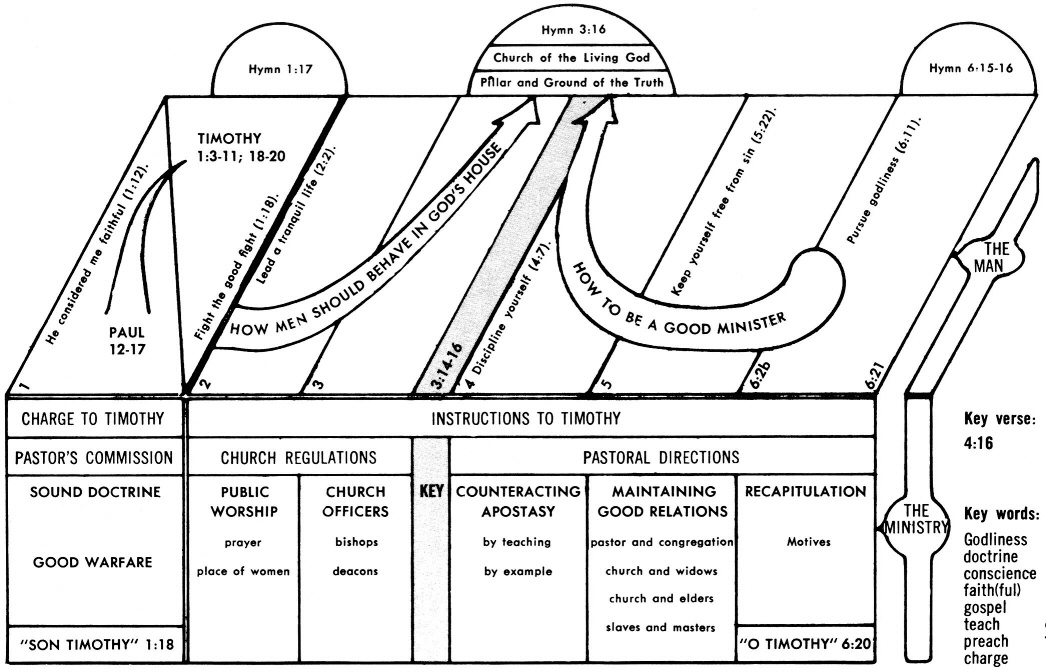
GODLINESS AND PASTORAL CARE
Click chart to enlarge
Charts from Jensen's Survey of the NT - used by permission
Another Overview Chart - 1 Timothy - Charles Swindoll
| THE PASTOR'S PRIMER: PAUL'S PRACTICAL PASTORAL INSTRUCTIONS REGARDING THE LOCAL CHURCH |
||||
| 1 Timothy 1 | 1 Timothy 2-3 | 1 Timothy 4 | 1 Timothy 5 | 1 Timothy 6 |
| TIMOTHY'S CHARGE… |
TIMOTHY'S INSTRUCTIONS… |
|||
| Concerning Sound Doctrine |
Concerning Prayer & Church |
Concerning Last Days Apostasy |
Concerning Widows & Elders |
Concerning Conflict & Contentment |
| Danger of False Doctrine |
Public Worship Church Officers |
Antidote for Apostasy |
Pastoral Duties Toward Others |
Instructions for the Man of God |
| Warning | Worship | Wisdom | Widows | Wealth |
| Written in Macedonia Circa 62-64AD |
||||
1 Timothy 4:7: But have nothing to do with worldly fables fit only for old women. On the other hand, discipline yourself for the purpose of godliness; (NASB: Lockman)
Greek: tous de bebelous kai graodeis muthous paraitou. (2SPMM) gumnaze (2SPAM) de seauton pros eusebeian;
Amplified: But refuse and avoid irreverent legends (profane and impure and godless fictions, mere grandmothers’ tales) and silly myths, and express your disapproval of them. Train yourself toward godliness (piety), [keeping yourself spiritually fit]. (Amplified Bible - Lockman)
NLT: Do not waste time arguing over godless ideas and old wives' tales. Spend your time and energy in training yourself for spiritual fitness. (NLT - Tyndale House)
Phillips: But steer clear of all these stupid Godless fictions. Take time and trouble to keep yourself spiritually fit. (Phillips: Touchstone)
TLB: "Spend your time and energy in the exercise of keeping spiritually fit. Bodily exercise is all right, but spiritual exercise is much more important and is a tonic for all you do. So exercise yourself spiritually and practice being a better Christian, because that will help you not only now in this life, but in the next life too."
Wuest: But unhallowed and old wives’ fictions be shunning. On the other hand, be exercising yourself with a view to piety toward God. (Eerdmans)
Young's Literal: and the profane and old women's fables reject thou, and exercise thyself unto piety
BUT HAVE NOTHING TO DO WITH WORLDLY FABLES FIT ONLY FOR OLD WOMEN: tous de bebelous kai graodeis muthous paraitou (2SPMM):
- 1Ti 1:4; 6:20; 2Ti 2:16,23; 4:4; Titus 1:14; 3:9
- 1 Timothy 4 Resources - Multiple Sermons and Commentaries
Words in red are imperatives = commands
John Butler outlines 1 Timothy 4:6-16 as follows…Walk of the Minister. The minister's behavior.
- Measuring his walk: his preaching and personal practices.
- Mandate for his walk: reject God dishonoring philosophies and practices.
- Maintenance of his walk: spiritual exercising.
- Model for his walk: Paul
- Manners in his walk: regarding study (read); regarding stewardship (do not neglect your gifts); and regarding steadfastness ("continue").
Warren Wiersbe outlines 1Timothy 4 as follows…
III. The Church and Its Minister (1Timothy 4)
A. A good minister (1Ti 4:1-6)
B. A godly minister (1Ti 4:7-12)
C. A growing minister (1Ti 4:13-16)
Dr Ryrie outlines 1Timothy 4 as follows…
Instruction Concerning Dangers (1Ti 4:1-16)
Description of the Dangers (1Ti 4:1-5)
Defenses Against the Dangers (1Ti 4:6-16)
D. Edmond Hiebert helps put this next section in context commenting that 1Timothy 4:6-16 deals with "The subjective fortification against error. Having set forth the fact of the coming apostasy, Paul tells Timothy how to fortify himself and the churches under his care against error. He is to find fortification through a faithful ministry (1Ti 4:6-11) and through becoming personal conduct (1Ti 4:12-16). (Hiebert, D. Edmond: First Timothy: Everyman's Bible Commentary. Moody. 1957) (Bolding added) (Click for Hiebert's entire outline of 1Timothy)
A C Gaebelein says that…
The rest of the chapter consists of exhortations in view of the threatening apostasy, how these evils may be combated and remedied. If Timothy put the saints of God in remembrance of these things, he would be a good minister (deacon) of Jesus Christ, and be continually nourished up in the words of faith and good doctrine. To remember the apostolic instructions and to maintain by them faith and good doctrine effectually counteracts error and the doctrines of demons. Then profane and old wives' fables must be avoided and refused, We have an all-sufficient revelation of God; speculative things of the human mind intruding into things unseen (Col. 2:18), following the theories, imaginations and traditions of men, only lead away from godliness, and lead from foolish questionings into that which is profane. (A believer has no business to investigate Spiritism, Theosophy, or occupy his mind with things not made known in the Word of God. We must avoid these things, refuse to have anything to do with them, else we step upon the territory of the enemy, and lay ourselves open to his attacks.)
The true exercise must be unto godliness, pious, consecrated living; and the true exercise is self-judgment, maintaining a good conscience and communion with God. Bodily exercise by erratic living, abstaining from meats and other things, profits but little. It is far different with true godliness. It is profitable for everything, both in this life and that to come. This is another faithful word and worthy of all acceptation (1Ti 1:15). And for this doctrine the apostle labored and suffered reproach; but he had faith in the living God, who as Saviour-God, by His power and providence, sustains all men. He is the preserver of all men, but especially of those who believe. As Creator He is the preserver and benefactor of all men; but for those who believe He is much more than that. In this God as Creator and Saviour, preserver and keeper, the believer trusts. "These things command and teach." It is another remedy against the seducing spirits and doctrines of demons. None should despise his youth. Timothy was very young when he joined Paul (Acts 16:1-3), and now after some eleven years he was still youthful, especially in comparison with Paul the aged. He urges him to be in his life and walk a model of the believers--in word, in conduct, in faith and in purity.
These are the evidences of true piety and holding sound doctrine. Then as to himself and his service, till Paul came, he was to give himself to reading, which of course must mean the Holy Scriptures, to exhortation and to teaching. He was not to neglect the gift that had been bestowed upon him. In his case this gift was a direct bestowal of prophecy, the voice of the Spirit making it known (as in Acts 13:1). The laying on of hands by the elders had not communicated the gift. It was the outward expression of fellowship with the gift imparted unto Timothy. This gift had to be used and developed like every other gift of the Spirit. A gift may be idle and neglected, but if rightly used it will grow and be used in blessing. To do all this and meditate in these things, be whole-hearted in them, progressing constantly in godliness, is a safeguard against all error. (1 Timothy - by A C Gaebelein)
Not surprisingly Paul gives Timothy several other instructions similar to 1Timothy 4:7 in both first and second Timothy…
1 Ti 1:4 (Do not) pay attention to myths and endless genealogies, which give rise to mere speculation rather than furthering the administration of God which is by faith. (1Ti 1:4)
1 Ti 6:20 O Timothy, guard (phulasso = aorist imperative = do this now! Do it effectively! It is urgent!) what has been entrusted to you, avoiding worldly and empty chatter and the opposing arguments of what is falsely called "knowledge" (1Ti 6:20)
Comment: The gospel and the way of truth has been committed to us in all its purity and saving power. We must guard it against all attempts to distort, dilute or deny it, for these would destroy it.
2 Ti 2:16 But avoid (make this your habit = present imperative) worldly and empty chatter, for it will lead to further ungodliness,
But (1161) (de) introduces a contrast, here between what Paul has just stated Timothy was being nourished by -- "the words of the faith and of the sound doctrine"-- and that which will fail to spiritually nourish him -- worldly fables. The priority must be on God's Word, not man's words. Paul cautions Timothy to keep focused on the Word, not on things that come from man (reject profane and old wives' fables); the greatest effort must be put into God's Word, not man's word.
“Healthy” doctrine will promote spiritual health, but foolish myths will produce spiritual sickness. As an aside it is worth noting in regard to spiritual nourishment is critical for every believer, especially those who minister as pastors. It is an absolute necessity for the pastor to take care to nourish his own soul on the truths which he is supplying to others. It is sad but true that it is quite possible for the pastor to become so busy finding food for his flock that he fails to nourish his own soul with the food he prepares! In such a setting, the personal spiritual discipline Paul calls for in 1Timothy 4:7 becomes difficult if not impossible.
FIRST:
THE NEGATIVE
Have nothing to do with (3868) (paraiteomai from pará = aside and in this word gives a nuance of aversion or repudiation + aitéo = ask, beg) is literally to ask along side. To seek to turn aside by asking. As in Mark 15:6, this verb can mean to beg or request (a prisoner to be freed on the occasion of the Passover). In Luke 14:18, it conveys the sense of to beg off or of wanting to be excused from a positive response, in this verse one excusing himself for not accepting a wedding invitation. Finally, in the pastoral epistles (1,2 Timothy, Titus - see below), the meaning is to decline, refuse, to refuse to pay attention to, to shun, to avoid, to reject.
In secular Greek a wrestler was declared the victor when his opponents declined to engage him upon seeing his unclothed physique.
Present imperative means to make it your habit to refuse "worldly fables" (this suggests that we will find them tempting to our fallen nature and must constantly choose [our choice but enabled by God's Spirit and grace] to seek to turn aside). With this command Paul reaffirms his rejection of myth and underscores his commitment to Christianity's sound doctrine (and sober living). See discussion of the Need for the Holy Spirit to obey NT commands (or "How to Keep All 1642 Commandments in the New Testament!")
In a parallel use in his second letter to Timothy Paul commanded his protégé to
2Ti 2:23 Refuse (paraiteomai = present imperative) foolish and ignorant speculations, knowing that they produce quarrels.
Comment: The Lord's bondservant must continually avoid getting enticed into ''which came first, the chicken or the egg'' type discussions, those things that are controversial and seriously disputed, and which have no certain basis in truth. In these situations we are to graciously "beg off" an invitation to "war over words" with others. Certainly we can discuss differences of opinions; but our discussions must not degenerate into heated debates over irrelevant issues.
Titus 3:10 Reject (paraiteomai = present imperative) a factious (one who will not submit to Word or godly leaders and is a law unto himself with no concern for spiritual truth or unity) man after a first and second warning,
Paraiteomai -12 times in NAS begged, 1; excused, 2; have nothing to do with, 1; make excuses, 1; refuse, 4; refused, 1; reject, 1; requested, 1. KJV (11) - avoid, 1; excuse, 2; intreat, 1; make excuse, 1; refuse, 5; reject, 1; NAS (12) -
Mark 15:6 ; Luke 14:18, 19 ; Acts 25:11 ; 1Tim 4:7; 5:11;2Timothy 2:23; Titus 3:10; Heb 12:19, 25 - twice)
Paraiteomai - 4 times in the Septuagint (LXX) (1Sa 20:6 - twice, 28; Esther 4:8; 7:7).
Paul's command to refuse fables, indicates that Timothy already has people coming to him with these fables
Worldly (952) (bebelos from basis = a stepping or walking from baíno = to go + belos = threshold, particularly of a temple) refers properly to one who either was or ought to have been debarred from going over the threshold or entrance of the temple. The picture is that which is trodden under foot and which thus describes that which is the antithesis of that which is holy or set apart. Bebelos thus describes that which is accessible to everyone and therefore devoid of real significance. Bebelos can thus describe that which is worldly as opposed to having an interest in transcendent (existing apart from and not subject to the limitations of the material universe) matters.
The meaning of this adjective is nicely conveyed by our English word profane which describes that which disregards what is to be kept sacred or holy. The English word "profane" is derived from the Latin profanus which means "outside the temple, not sacred" and in turn is derived from pro- ‘before’ + fanum = ‘temple’.
Here in 1Timothy 4:7, bebelos could be translated “unhallowed” or "godless" describing the fables which contradict the truth of Word of God.
Bebelos suggests that which is void of all connection with, or relation to, God. There is nothing sacred about these fables. By using bebelos Paul is not saying that the fables were blasphemous per se but that they did not possess the character of truth and sound doctrine.
The UBS Handbook series adds that bebelos is "a word that in its neutral sense means “accessible” but is used in Greek writings as the opposite of the word “holy,” hence “secular.” In the present context its primary meaning is “profane,” that is, devoid of anything sacred, so that it is not worth the attention of any godly or religious person. (Arichea, D. C., & Hatton, H.. A Handbook on Paul's Letters to Timothy and to Titus. New York: United Bible Societies )
Bebelos is used 5 times in the NAS - see below - and is translated: godless person, 1; profane, 1; worldly, 3. Bebelos is used 6 times in the Septuagint - LXX (Lev 10:10; 1Sa 21:4,5; Ezek 21:25; 22:26; 44:23)
Paul used bebelos in chapter 1 explaining to Timothy…
that law is not made for a righteous man, but for those who are lawless and rebellious, for the ungodly and sinners, for the unholy and profane, for those who kill their fathers or mothers, for murderers 10 and immoral men and homosexuals and kidnappers and liars and perjurers, and whatever else is contrary to sound teaching (1Timothy 1:9, 10)
Comment: Observe that bebelos is those whose lives are contrary to sound teaching.
Paul used bebelos again in chapter 6 in a warning…
1 Timothy 6:20 O Timothy, guard (aorist imperative = urgent! do this now!) what has been entrusted to you, avoiding worldly (bebelos) and empty chatter and the opposing arguments of what is falsely called "knowledge"
Comment: Again observe that bebelos describes talk that is contrary to true knowledge
Here are the only other NT uses of bebelos…
2 Ti 2:16 But avoid worldly (bebelos) and empty chatter, for it will lead to further ungodliness, (2Ti 2:16)
Comment: Once again observe that bebelos is chatter that is contrary to sound doctrine and thus leads not to godliness but to ungodliness
Hebrews 12:16 (note) that there be no immoral or godless (bebelos) person like Esau, who sold his own birthright for a single meal.
Vincent writes that "The verb bebeloo means "to profane, pollute", (Matt. 12:5; Acts 24:6, and often in LXX). Derived from belos = threshold (compare to baino = to go). Hence the primary sense is that which may be trodden. Compare to Latin profanus meaning before the temple or on the ground outside. What is permitted to be trodden by people at large is unhallowed, profane. Esau is called bebelos in Heb. 12:16, as one who did not regard his birthright as sacred, but as something to be sold in order to supply a common need. (Vincent's Word Studies)
Fables (3454) (muthos/mythos from mu- [my-] = to close, keep secret, be dumb <> muô = close [eyes, mouth] >> musterion = secret, a mystery; story, narrative, fable, fiction [Eng., myth, mythology]) (Click word study on muthos) refers to tales (a tale is a usually imaginative narrative of an event that often contains imagined or exaggerated elements) or fables (a fable can refer to a short fictitious story which teaches a moral lesson but in the NT "fable" is used only in a negative sense as something to be avoided because it is false and unreal) fabricated by the mind in contrast to reality. Muthos therefore refers to fictional tales in contrast to true accounts and represents manufactured stories that have no basis in fact. The Greek and Roman world abounded in stories about so-called "gods" which were nothing more than human speculations that in vain (and in error) tried to explain the world's origin and life's purpose and end!
The Scriptural uses of muthos focus chiefly on the contrast of God's Truth and the world's error/falsehood/lies. It follows that in the NT muthos always conveys an unfavorable or negative connotation. As noted in the passages above each of the NT uses of muthos describe something that is contrary to the truth, whether that truth be the doctrines relating to Christian behavior or the accounts of Christ’s life, death, and resurrection.
Paul used this word two other times…
1 Timothy 1:4 nor to pay attention to myths (muthos) and endless genealogies, which give rise to mere speculation rather than furthering the administration of God which is by faith.
Titus 1:14 not paying attention to Jewish myths (an amalgamation of pagan myths and Jewish extra-Biblical traditions, superimposed on the Old Testament Scriptures) and commandments of men who turn away from the truth. (Even some of the Jews had abandoned their sacred Scriptures and accepted man-made substitutes - see discussion) (see note Titus 1:14)
Peter in testifying to the authenticity of the events of Scripture (especially the transfiguration in context) wrote…
2 Peter 1:16 For we did not follow cleverly devised tales (muthos) when we made known to you the power and coming of our Lord Jesus Christ, but we were eyewitnesses of His majesty. (The gospel narratives are not fictional tales, but actual eyewitness reports. Peter testified that he and the other apostles, James and John, witnessed the transfiguration - see note)
Trench traces the evolution of muthos explaining that "logos and muthos began their journey together (but) they gradually parted company. The antagonism between these words grew stronger and stronger until they finally stood in open opposition (as here in 2Ti4:4). This is true of words as well as of people, when one come to belong to the kingdom of light and truth and the other to the kingdom of darkness and lies."
In light of Trench's comment on logos and muthos, it is notable that 1Timothy 4:9 emphasizes a "trustworthy statement" which is literally a trustworthy word (logos) which is a clear contrast with the (untrustworthy) worldly fables (muthos) in this verse!
Fit only for old women (1126) (graodes from graus = old woman + eidos = form, external appearance) is an adjective which means of or belonging to old women and which is used only here in 1Timothy 4:7. This adjective describes the fables, indicating that their futile, senseless nature.
Hiebert explains that this phrase indicates that the fables "are nothing but silly fictions, fit only for senile, childish old crones to chatter about. When people bring them to him he is to "refuse," "beg off" dealing with them. To discuss them seriously would be to give them a dignity which they do not deserve. The present tense indicates this as his constant reaction." (Hiebert, D. Edmond: First Timothy: Everyman's Bible Commentary. Moody. 1957)
Vine - The adjective graōdēs, “old wives,” signifying “old-womanish” (from graus, an old woman), is used here only in the Greek Bible. The article, which precedes the whole clause in the original, points to the silly stories and myths current at the time which gave rise to trivial teachings; such myths were common in Jewish lore. In the rabbinical schools, the history of the nation was surrounded by profitless legends. These are to be distinguished from the doctrines of demons (1Ti 4:1) which propagated Gnostic errors. (Vine, W. Collected writings of W. E. Vine. Nashville: Thomas Nelson)
MacArthur explains that "Women were not usually allowed the educational opportunity men had, so this phrase comes from such a situation. That epithet was commonly used in philosophical circles as a term of disdain for a viewpoint lacking credibility and thus appealing only to uneducated, unsophisticated, and perhaps senile matrons. No intelligent man would hear it at all. The Ephesians would have understood Paul’s use of the phrase. (MacArthur, John: 1Timothy Moody. 1995)
Some "worldly fables" -- There was a house in Rome that stationed a boy at the doorway of the mansion to caution visitors not to cross the threshold with their left foot, for fear that this would be an ill omen! And in Scotland in prior days it was the funeral custom not to carry out the casket of the deceased through the front door, but through an opening made in the side of the house which was subsequently sealed up after serving its purpose. The belief was that the person's "ghost" was prevented from re-entering the house because the only door that it knew was gone. And on and on such superstitious unhallowed beliefs go.
William MacDonald writes that "old wives' tales" "make us think of Christian Science, which was founded by a woman, seems to appeal especially to elderly women, and teaches fables instead of truth. (MacDonald, W., & Farstad, A. Believer's Bible Commentary: Old and New Testaments. Nashville: Thomas Nelson)
ON THE OTHER HAND, DISCIPLINE YOURSELF FOR THE PURPOSE OF GODLINESS : gumnaze (2SPAM) de seauton pros eusebeian:
- 1Ti 1:4; 6:20; 2Ti 2:16,23; 4:4; Titus 1:14; 3:9
- 1Ti 1:4; 2:10; 3:16; 6:11; Acts 24:16; 2Ti 3:12; Titus 2:12; Heb 5:14; 2Pe 1:5, 6, 7, 8
- 1 Timothy 4 Resources - Multiple Sermons and Commentaries
The NIV renders it "train yourself to be godly"
Note that the phrase "on the other hand" is not in the Greek but added by the translators to emphasize the striking contrast between the preceding negative commandment and the following positive commandment.
Expositor's Greek Testament remarks that "There is here an intentional paradox. Timothy is to meet the spurious asceticism of the heretics by exercising himself in the practical piety of the Christian life. The paradox is comparable to… ("make it your ambition to lead a quiet life")… of 1Th 4:11. The true Christian asceticism is not essentially somatike (bodily), although the body is the means by which the spiritual nature is affected and influenced. Although it brings the body into subjection (1Co 9:27), this is a means, not an end in itself. (The Expositor's Greek Testament)
GODLINESS CALLS
FOR A PERSONAL RESPONSE
For the purpose of godliness - Literally it reads "beneficial toward", "advantageous for". The preposition pros shows movement toward an object.
Yourself (4572) (seautou) from sé = thee + autos = self) is a reflexive pronoun. The idea of "reflexive" is that it expresses action directed or turned back on oneself. Clearly it is good to have godly mentors ("trainers" or "coaches" to keep the athletic metaphor), but ultimately each believer is responsible for his or her own individual spiritual training. No one can do it for us, which implies that each believer must be diligent and disciplined, not somnolent and sporadic!
Jay Adams asks what is the secret of godliness? In a word - discipline! He goes on to say…
The word discipline has disappeared from minds, mouths, and pulpits in our culture. Modern American society hardly knows what discipline means. Yet, apart from discipline, there is no other way to attain godliness; discipline is God’s path to godliness. The counselor, therefore, must learn how to help the counselee to discipline himself for the purpose of godliness. (Adams, J. E. The Christian Counselor's Manual)
Jerry Bridges emphasizes personal responsibility writing that…
Timothy was personally responsible for his progress in godliness. He was not to trust the Lord for that progress and then relax, though he certainly understood that any progress he made was only through divine enablement. He would have understood that he was to work out this particular aspect of his salvation in confidence that God was at work in him (Php 2:12, 13-see notes Php 2:12; 13). But he would get Paul’s message that he must work at this matter of godliness; he must pursue it. We Christians may be very disciplined and industrious in our business, our studies, our home, or even our ministry, but we tend to be lazy when it comes to exercise in our own spiritual lives. We would much rather pray, “Lord, make me godly,” and expect Him to “pour” some godliness into our souls in some mysterious way. God does in fact work in a mysterious way to make us godly, but He does not do this apart from the fulfillment of our own personal responsibility. (BORROW Bridges, J. The Practice of Godliness. Navpress. 1996 - this short but pithy book is highly recommended if you sincerely desire to discipline yourself for godliness!) (Practice of Godliness Mp3 - not free)
Vine explains that reflexive pronouns "In English end in “-self,” “-selves.” They are used when the object of a sentence or clause refers to the same person or thing as the subject." (Vine, W. Vine's You can learn New Testament Greek!: Course of self-help for the layman. Nashville: Thomas Nelson)
SECOND:
THE POSITIVE
As an aside Paul's call for a negative, then a positive, reminds one of the "put off's", that precede the "put on's" (cp Col 3:9 and Col 3:12, 13, 14, 1Pe 2:1 and 1Pe 2:2, Ro 13:12, Ro 13:13 and Ro 13:14, Ep 4:22 and Ep 4:24ff, Jas 1:21)
Discipline (1128) (Gumnazo [word study] from gumnós = naked, bare, unclad or minimally clothed and descriptive of the common practice of males in the Greco Roman "gymnasia" source of English "gymnasium", "gymnastics") (Click study on gumnazo) literally meant to exercise naked in the palaestra (a school in ancient Greece or Rome for sports).
Gumnazo - 4v - 1Ti 4:7; He 5:14; 12:11; 2Pe 2:14
As R Kent Hughes adds that…The rich etymology of discipline suggests a conscious divestment of all encumbrances, and then a determined investment of all of one's energies. Just as ancient athletes discarded everything and competed gumnos (naked), so must the disciplined Christian man divest himself of every association, habit, and tendency which impedes godliness (ED: compare Heb 12:1). Then, with this lean spiritual nakedness accomplished, he must invest all his energy and sweat in the pursuit of godliness. The lithe, sculpted figure of the classic Greek runner gives the idea. Stripped naked, he has put his perspiration into thousands of miles for the purpose of running well. Even so, the successful Christian life is always, without exception, a stripped-down, disciplined, sweaty affair. The understanding that vigorous spiritual discipline is essential to godliness accords with the universal understanding that discipline is necessary to accomplish anything in this life. (Borrow Disciplines of a Godly Man - Excellent read)
No discipline, no discipleship!
No sweat, no sainthood!
No perspiration, no inspiration!
No pain, no gain!
No manliness, no maturity!
Figuratively gumnazo means to exercise so as to discipline oneself (in the moral or ethical "gym" so to speak) or to exercise vigorously, in any way, either the body or the mind. It conveys the picture of the rigorous, persevering, painstaking, diligent, strenuous, self-sacrificing training an athlete undergoes for a perishable prize, and which the Christian "athlete" should be willing to undergo for an imperishable prize (1Cor 9:24, 25, 26, 27 see note), which in the present context is "godliness" a "prize" that is profitable for this life and the life to come!
In secular Greek gumnazo was used figuratively of training for or practicing an art or profession. It carried the sense not of merely transitory attention, but of consistent, long-term training that made all its activities habitual.
Just as our physical muscles grow stronger through exercise, so also the "muscle" of our will is strengthened by exercise (discipline) in doing right.
Paul gives Timothy (and all who seek to be "vessels of honor" like Timothy and Paul) a command in the present imperative which calls for this to be a Christian "soldier's" lifestyle. There is no time off, because our enemies -- the world, the flesh and the devil -- don't take time off. To let down one's guard, is to make one's self vulnerable to attack. To fail to continually train oneself spiritually is analogous to ceasing to pedal when riding a bicycle, such cessation resulting in a loss of stability and risks serious injury (in one's spiritual life and on the bicycle!)
George Clarke…
Train yourself vigorously and earnestly in personal holiness and practical piety. (1Timothy Commentary)
Yourself (seautou from se = thee + autos = self) is a reflexive pronoun in the genitive (possessive case) singular and means "of thyself, thine own self". This reflexive pronoun intensifies the necessity of the spiritual discipline Paul is calling for from his young disciple Timothy (presumably the pastor at the church at Ephesus- see Was Timothy a pastor or an evangelist?). How can Timothy lead others to godliness if he is not himself pursuing this lofty goal? Dear pastor (and may you honestly assess yourself), are you taking pains to "work out" your spiritual growth, or are you being "distracted (perispao in the imperfect tense [pictures this as occurring over and over] = being [passive voice] drawn or dragged around or in different ways at the same time, encumbered, drawn every which way by busyness that only yields barrenness!) with all (your) preparations… worried (merimnao [word study] = having anxiety, divided) and bothered (turbazo from turbe = a crowd, a tumult, figuratively = disturbed in mind - Note: Worry = inward anxiety, bothered = outward agitation!) about so many things" like Martha (Lk 10:41) or are you focusing on and consciously choosing the one thing necessary (Lk 10:42),emulating Mary "who moreover was listening (imperfect tense [pictures this as occurring over and over]) to the Lord's word (the Way, the Truth, the Life), seated at His feet"? (Lk 10:39).
Spiritual food ("nourished on the words of the faith and of the sound doctrine" 1Ti 4:6) and spiritual exercise (gumnazo) are an excellent combination to assure spiritual vitality! If believers would put as much energy and enthusiasm into spiritual exercise as they do athletics and body-building, is there any limit to how much stronger they and their churches would be?
Christians would do well to learn from Josephus' use of gumnazo (Josephus originally was written in Greek before translation into English) in his description of the mighty and feared Roman soldiers writing that…
"… their military exercises differ not at all from the real use of their arms, but every soldier is every day exercised (gumnazo), and that with great diligence, as if it were in time of war which is the reason why they bear the fatigue of battles so easily." (Josephus, F. The Works of Josephus. Wars 3.73)
To be sure believers as good soldiers of Christ Jesus are commanded not to neglect "basic training" or "daily maneuvers", but we are to carry out these endeavors fully cognizant of and relying upon the truth that we are to continually be strengthened "in the grace that is in Christ Jesus" (2Timothy 2:1) and not by fleshly self effort or by legalistic rule keeping. The point is that we don’t depend on our own strength, experience, or expertise. We depend on God’s Spirit and God's grace as we "discipline ourselves for the purpose of godliness".
The writer of Hebrews uses the verb gumnazo in calling saints to train themselves not for greed but for growth in discernment writing that
solid food is for the mature, who because of practice (in other words they make a habit of obeying the truth of righteousness and thus grow in the grace and knowledge of our Lord and Savior Jesus Christ) have their senses trained (gumnazo - perfect tense = having been trained at some point in time in the past and still maintaining their "spiritual fitness" - perfect tense speaks of the enduring effect of their training) to discern good and evil. (He 5:14)
Wuest renders this verse "But solid food belongs to those who are (spiritually) mature, to those who on account of long usage have their powers of perception exercised to the point where they are able to discriminate between both that which is good in character and that which is evil.
The vitality of your spiritual life depends on your "diet". Are you taking in solid food so that you will be able to recognize these false teachers and not "be carried away (like the clouds which are borne along by the wind in the use of this same verb [parastepho] in Jude 1:12) by varied and strange teachings" (see note Hebrews 13:9)?
Christian author Jerry Bridges rightly says that "It is impossible to practice godliness without a constant, consistent and balanced intake of the Word of God in our lives."
Donald Whitney wrote that…As we engage in the spiritual disciplines of the Christian life, the Holy Spirit molds us more into the character of the Master. Probably the most common reason for the lack of spiritual growth among Christians is inconsistency with the spiritual disciplines. We don't grow in grace if we fail to use the God-given means for growing in grace. It's a simple fact: Those who grow the most and the fastest are those who place themselves in the channels of grace such as the intake of God's Word, prayer, etc.
Paul had the correct balance between grace and disciplining himself for godliness writing
by the grace of God I am what I am, and His grace toward me did not prove vain; but I labored even more than all of them, yet not I, but the grace of God with me. (1Co 15:10)
For all intents and purposes, the many imperatives in 1Ti 4:12, 13, 14, 15, 16 supply the why’s and the wherefore’s of the exhortation to godliness.
R Kent Hughes writes that…discipline is the key to becoming proficient at anything, whether it be painting, music, writing, calculus, basketball, golf, chess or the sublimest of arts—fly fishing. Discipline is what separates the achievers from the also-rans. And this is doubly true in spiritual matters, because man’s sinful nature naturally gravitates to foot-dragging in things spiritual. This is why the Apostle Paul unabashedly admonished his young disciple, Timothy, to “train yourself to be godly” (1Ti 4:7). The very word “train” has the smell of a good workout. “Gymnasticize (exercise, work out, train) yourself for the purpose of godliness.” Spiritual sweat is a major component to leading a godly life. No man or woman has ever become godly without it. Moreover, discipline is not antithetical to grace. Paul, as the preeminent apostle of grace, wrote, “But by the grace of God I am what I am, and his grace to me was not without effect. No, I worked harder than all of them—yet not I, but the grace of God that was with me” (1Corinthians 15:10). (Disciplines of Grace).
GODLINESS
CALLS FOR COMMITMENT
In the ancient games, victory depended on the athlete’s commitment to rigorous training. Every runner entered strict training under the watchful eye of an official. Marathon runners were known to work out for years—lifting weights, running laps, regulating sleep, restricting their diet. Self-control means we must exercise mastery over our lives, foregoing some pleasures, pursuing other disciplines, all for the sake of winning. No athlete ever achieved the level of Olympic competition without a commitment to pay the price of rigorous, daily training. In the same way, no believer ever achieves genuine godliness without a commitment to pay the price of the daily spiritual training which God has designed for our growth in godliness. We must be committed to the basic spiritual disciplines of the Christian life (Bible Study, prayer, and meditation) in order for godliness to be cultivated and grow. Peter associates the call to commitment with spiritual growth (including growth in godliness) his second epistle writing…
Now for this very reason also (now that you know that have the spiritual resources - everything necessary for life and godliness, His precious and magnificent promises, a partaker of His divine nature, escape from the corruption of this world -- you are responsible to work out your own salvation), applying all diligence (making every effort with eagerness, earnestness, willingness, zeal), in your faith (note that faith is like the roots that sink into truths Peter has mentioned previously -- it is faith that shows itself to be real in obedience to these truths) supply moral excellence, and in your moral excellence, knowledge; 6 and in your knowledge, self-control, and in your self-control, perseverance, and in your perseverance, godliness; 7 and in your godliness, brotherly kindness, and in your brotherly kindness, love. 8 For if these qualities are yours and are increasing, they render you neither useless nor unfruitful in the true knowledge of our Lord Jesus Christ. 9 For he who lacks these qualities is blind or short-sighted, having forgotten his purification from his former sins. 10 Therefore, brethren, be all the more diligent to make certain about His calling and choosing you; for as long as you practice these things, you will never stumble; 11 for in this way the entrance into the eternal kingdom of our Lord and Savior Jesus Christ will be abundantly supplied to you. (2Pe 1:5, 6, 7, 8, 9, 10, 11-see notes 2Pe 1:5; 1:6; 1:7;1:8; 1:9; 10; 11)
Samson is an example of a believer who did not practice discipline (Jdg 13:1, 14:1, 15:1, 16:1ff- see notes Judges 13; 14; 15; 16) and the godliness that comes from such discipline. Instead of disciplining himself for godliness by keeping his body under control, Samson lived to please his flesh, and the consequences were tragic. Even more tragic, is that Samson's sad career has been duplicated by many Christians, including those in key leadership positions, all of whom are deceived, occasionally even defending their sins and lack of self-control as “enjoying freedom in Christ.” The tragedy is that their so-called “freedom” is really the worst kind of bondage. Freedom is not the right to do as you please, but the power to do as you should! There's a big difference - the first leads to increasing degrees of bondage to sin, the latter to increasing degrees of freedom from the power of sin.
A W Tozer…
It will require a determined heart and more than a little courage to wrench ourselves loose from the grip of our times and return to biblical ways. But it can be done. Every now and then in the past Christians have had to do it. History has recorded several large-scale returns led by such men as St. Francis, Martin Luther and George Fox. Unfortunately, there seems to be no Luther or Fox on the horizon at present. Whether or not another such return may be expected before the coming of Christ is a question upon which Christians are not fully agreed, but that is not of too great importance to us now.
What God in His sovereignty may yet do on a world-scale I do not claim to know. But what He will do for the plain man or woman who seeks His face I believe I do know and can tell others. Let any man turn to God in earnest, let him begin to exercise himself unto godliness, let him seek to develop his powers of spiritual receptivity by trust and obedience and humility, and the results will exceed anything he may have hoped in his leaner and weaker days.
War Cry magazine reminds us of an important principle -- A loose wire gives out no musical note; but fasten the ends, and the piano, the harp, or violin is born (Ed: Put some tension on it!). Free steam drives no machine, but hamper and confine it with piston and turbine and you have the great world of machinery made possible. The unhampered river drives no dynamos, but dam it up and we get power sufficient to light a great city. So our lives must be disciplined if we are to be of any real service in this world.
Godliness (2150) (eusebeia from eu = well + sebomai = reverence. Sebomai is in turn derived from "seb" which refers to sacred awe or reverence exhibited especially in actions. Eusebeia then literally means "well worship" and describes reverence or awe that is well directed.
Godliness comes from the old English word "Godlikeness" which means to have the character and attitude of God. It is manifest by devotion to God which results in a life that is pleasing to Him. And how does one maintain such a state of godliness? Such a life is impossible without a continual intake of the pure milk of the Word, and a consistent submission and obedience to that Word empowered by His Spirit.
Eusebeia - 15x in 15v in NAS - Study Paul's uses to glean his wisdom on what godliness looks like and how it is attained - Acts 3:12; 1Ti 2:2; 1Ti 3:16; 1 Ti 4:7, 8; 1 Ti 6:3, 5, 1 Ti 6:6, 1 Ti 6:11; 2 Ti 3:5; Titus 1:1; 2 Pe 1:3, 2 Pe 1:6, 7; 2 Pe 3:11 - For more of Paul's wisdom on godliness see also Noun - Theosebeia = godliness in 1Ti 2:9, 10, verb eusebeo 1Ti 5:4
Eusebeia is true religion that displays itself in reverence before what is majestic and divine in worship and is a life of active obedience which corresponds to that reverence. Eusebeia is a term used, not of God, but of men. Eusébeia is that piety which is characterized by a Godward attitude and does that which is well–pleasing to Him. Godliness manifests itself in a heart initiated preoccupation with holy and sacred realities. It is respect that is due to God, and is thus the highest of all virtues.
David Daniels writes "In 1Ti 4:7, 8, Paul commands his young disciple to discipline himself for the sake of godliness. Paul warns that many people get involved in activities ("godless myths and old wives' tales") that give the appearance of spiritual maturity but really have no eternal value. The only worthwhile goal, he writes, is godliness—a character conformed to God's character. But such conformity comes only through discipline. In this passage, the term to discipline or to train is the Greek word gymnazo, from which we get gymnasium and gymnastics. Literally, it means "to exercise naked." Unlike modern competitors who don protective padding and equipment, ancient athletes would strip away clothing and accessories that might prevent them from performing their best. The Christian also must habitually strip away anything that hinders the goal of godliness. (Discipleship Journal)
Godliness is NOT "letting go and letting God." There is no such thing as drifting into godliness. In fact the "stream of tendency" (our enemies - the world, the flesh, the devil) flows against us! It is vital to remember that growth in godliness calls for strenuous involvement on our part. Beloved, how are you doing in your growth in godliness? Are you making every effort, every day, to exercise self-discipline? Godliness is not talking godly but living godly. Godliness is a practical awareness of God in every aspect of life. Godliness reflects an attitude centered on living out one's life in God's presence with a desire motivated by love for Him and empowered by His grace and His Spirit to be pleasing to Him in all things. Godliness is that inner attitude of reverence which seeks to please God in every thought, word or deed. Godliness is living one's life with a "Coram Deo" mindset, ever as before the face of God. Godliness is a practical awareness of God in every area of life—a God-consciousness.
Ungodliness is living our life as if God does not exist. Godliness is seeing all of life through the lens of God as the focal point of my life.
Fairbairn writes that "practical piety or godliness requires when properly cultivated the full bent and strenuous application of the mind."
As someone has well said "The rich are not always godly, but the godly are always rich. (And we might add, not only in this present life but in the life to come and for ever!)
John Piper writes that "Godliness… means a love for the things of God and a walk in the ways of God." (Read the full sermon Liberating Promises)
George Meisinger writes that "Godliness is godly living, living according to the will of God. It is the kind of obedience that results from walking in the Spirit (Romans 8:4) (Meisinger, George: Chafer Theological Seminary Journal V1)
John Piper…
Godliness that overcomes the craving for material wealth produces great spiritual wealth…
Godliness is another way of describing holiness, sanctification, and Christlikeness. To put it in other terms, the purpose of the spiritual disciplines is intimacy with Christ and conformity (both internal and external) to Christ.
Practices. A spiritual discipline is something you do, not something you are. Disciplines should not be confused with graces, character qualities, or the fruit of the Spirit. Prayer, for example, is a spiritual discipline, while joy, strictly speaking, is not. As practices, the spiritual disciplines are first about doing, then about being. The spiritual disciplines are right doing that leads to right being. That is, the purpose of doing the practices known as spiritual disciplines is the state of being described in 1 Timothy 4:7 as “godliness.” Thus the discipline of prayer, rightly practiced, should result in godly joy. So while they should not be separated from each other, it is important to distinguish the practices known as the spiritual disciplines from the fruit that should result from them.
Biblical practices. We may not properly call just anything we do a spiritual discipline. Regardless of the benefit we may derive from a given activity, it is best to reserve the biblical term “discipline” for practices taught by precept or example in the Bible. Otherwise, anything and everything will eventually be called a spiritual discipline. Someone could claim that washing dishes—which, admittedly, ought to be done in the presence of and to the glory of God (1 Cor. 10:31)—is as spiritually beneficial to themselves as prayer is to others. But if we allow this, what basis for disagreement over what is and what isn’t a spiritual discipline will exist except personal experience and preference?… Only the spiritual disciplines found in Scripture are “inspired by God and profitable for teaching, for reproof, for correction, for training in righteousness; so that the man of God may be adequate, equipped for every good work” (2Ti 3:16–17). And “every good work” for which Scripture makes us “adequate” and “equipped” would certainly include “the purpose of godliness.”
Means to godliness, not ends. A person is not automatically godly just because he or she practices the spiritual disciplines. This was the error of the Pharisees, for although they prayed, memorized Scripture, fasted, and practiced other disciplines, Jesus pointed to them as the epitome of ungodliness. Godliness is the result of God’s Spirit changing us into Christlikeness through the means of the disciplines. Apart from faith and the right motives when practicing them, the disciplines can be dead works. The purpose for practicing the spiritual disciplines is not to see how many chapters of the Bible we can read or how long we can pray, nor is it found in anything else that can be counted or measured. We’re not necessarily more godly because we engage in these biblical practices. Instead, these biblical practices should be the means that result in true godliness—that is, intimacy with and conformity to Christ. (A God Entranced Vision of All Things)
Christ came into the world to open a new gymnasium for godliness. And he said in 1 Timothy 4:8, “Bodily exercise is of some value, but working out in the gymnasium of godliness holds promise for the present life and the life to come.” If it feels good to run ten miles and lose five pounds, it feels a hundred times as good to conquer Satan by the power of Christ and break free from some unloving bent in our personality. (Pamphlet - some quotes from following MONEY- CURRENCY FOR CHRISTIAN HEDONISM Christ Jesus Came into the World to Save Sinners)
J I Packer adds that "Godliness, to the Puritans, was essentially a matter of conscience, inasmuch as it consisted in a hearty, disciplined, ‘considerate’ (thoughtful) response to known evangelical truth, and centered upon the getting and keeping of a good conscience. (BORROW Packer, J. I.. A Quest for Godliness: The Puritan Vision of the Christian Life. 1994)
Charles Stanley writes that "Godly people order their lives around godly counsel. They seek friends with fellow believers, not with the lost. They get enjoyment, encouragement, and refreshment from the Word of God. Godly people will successfully stand the storms of life, are fruitful, and prosper in all they do. Godly people are contented. They are not anxious or fretting. A sweet quietness marks them. The beginning of being a godly person is receiving Jesus Christ as Savior. That’s the foundation to build on. (Stanley, C. F. In touch with God. Nashville: Thomas Nelson)
J.C. Ryle (1816-1900 - read a short biography), in the introduction to a book of biographical sketches of Christian leaders such as George Whitefield and John Wesley made the following statement --"They taught constantly the inseparable connection between true faith and personal holiness. They never allowed for a moment that any church membership or religious profession was the proof of a man’s being a true Christian if he lived an ungodly life. A true Christian, they maintained, must always be known by his fruits; and those fruits must be plainly manifest and unmistakable in all relations of life. “No fruits, no grace,” was the unvarying tenor of their preaching. (Christian Leaders of the Eighteenth Century. Edinburgh: Banner of Truth.) (Bolding added)
John MacArthur (1Timothy: Moody Press) writes that "There is no effective spiritual ministry apart from personal godliness, since ministry is the overflow of a godly life."
MacArthur quotes J. Oswald Sanders who wrote “Spiritual ends can be achieved only by spiritual men who employ spiritual methods”
R. C. Sproul in Pleasing God, warns about the tragic disassociation of sound doctrine and godly living, explaining that believers "must reject a false dichotomy between doctrine and life. We can have sound doctrine without a sanctified life. But it is extremely difficult to progress in sanctification without sound doctrine. Sound doctrine is not a sufficient condition to produce a sound life. It does not yield sanctification automatically. Sound doctrine is a necessary condition for sanctification. It is a vital prerequisite. It is like oxygen and fire. The mere presence of oxygen does not guarantee a fire, but you can’t have a fire without it." (Sproul, R C: Pleasing God. Tyndale House, 1988 ) (Bolding added)
Donald Whitney writes that "Godly people are disciplined people. It has always been so. Call to mind… heroes of church history… they were all disciplined people. In my own pastoral and personal Christian experience, I can’t say that I’ve ever known a man or woman who came to spiritual maturity except through discipline. Godliness comes through discipline." (Spiritual Disciplines for the Christian Life. page 15. NavPress, 1991 )
The godly man or woman lives above the petty things of life, the passions and pressures that control the lives of others. The godly individual seeks to do the will of God making the kind of decisions that are right and noble, not taking the "easy" path simply to avoid either pain or trial. That's Biblical godliness!
Paul did not take for granted the godliness of his spiritual son Timothy even though Timothy had been his companion for a number of years and had "followed (Paul's) teaching, conduct, purpose, faith, patience, love, perseverance, persecutions and sufferings..." (2Ti 3:10; 2Ti 3:11). Nevertheless, Paul still felt compelled to charge Timothy to "train himself to be godly.” It follows, that if Timothy needed this charge, then surely believers also need it today. Are we listening? When was the last time you heard a series on the pursuit and practice of godliness? Could our failure to discipline ourselves in this vital area explain at least to some degree our failure to be salty salt and clear, bright lights (Mt 5:13, 14, 15, 16-see notes Mt 5:13; 14; 16; 16) in a society that is growing darker and more ungodly by the day?
In summary, Biblical Godliness…
(1). Necessitates effort on our part (1Ti 4:7,8)
(2). Must be pursued (1Ti 6:11)
(3). Can be faked (2Ti 3:5)
John Angell James writes…there is a second passage well worthy the attention of all young converts, I mean where Paul exhorts Timothy thus, "Exercise yourself unto godliness." 1 Tim. 4:7. The word in the original is very strong, and might be rendered by a free translation, "practice gymnastic exercises in religion," like the ancient competitors in the Olympic games. We say also of soldiers in the early stage of their training, "they are practicing their exercise." They are being trained in what they do not previously know, and cannot perform without being taught; and to learn which, and do it well, requires a great deal of labor. So it is with the Christian, he must in all that concerns true godliness, learn his exercise, and be often thus engaged. True godliness, and progress in piety, cannot be acquired without great pains. As a man cannot be at once a good soldier, while he is a young recruit, and before he has been drilled upon the parade ground, so no one can be an eminent Christian as soon as he is converted, and before he has been at his drilling. Self-improvement in knowledge by the student, and in business by the tradesman, are the result of great painstaking. No one can expect advancement without labor. It is astonishing and sad, to see how little concern there is among many to improve themselves in true godliness. (John Angell James. Christian Progress)
William Kelly, Plymouth Brethren writer…From old-wives’ fables Timothy was to turn away. But, says Paul, “exercise thyself unto piety.” Service of Christ is admirable; yet there is no greater danger if piety be neglected personally. It is of prime moment that this be kept up in the soul, as otherwise the comfort and joy as well as the sorrows and dangers of His service are most absorbing…Piety (godliness) is spiritual exercise and demands as constant vigilance, as holy self-restraint, as complete subjection to the revealed will of God, even as training for the games called for habitual abstinence from every relaxing habit and for daily practice toward the end in view. How little the latter goal! How transcendent the former!
Related Resources:
- What does it mean that godliness with contentment is great gain (1 Timothy 6:6)?
- Is cleanliness next to godliness?
- What does it mean to have a form of godliness but deny its power in 2 Timothy 3:5?
- What does the Bible say about being a godly woman?
- Practical Godliness - A W Pink
- The Exercise and Profit of Godliness - J C Philpot
- The Godly Man's Picture (or book) - Thomas Watson
- The Great Gain of Godliness - Thomas Watson
- The Power of Godliness - James Smith - Excerpt: "Godliness has been represented as devotion. But devotion is but a part of godliness — and a very small part of it too. Godliness embraces God's work in the man, and the man's work for God. It is God-likeness. The godly man has the image of God impressed on his heart. He is new-created, that he may bear the likeness of Jesus. He is renewed in knowledge, after the image of him that created him. The moral perfections of God are stamped on his. Justice, truth, holiness, mercy, and love, are his characteristics: and in proportion to the depth and power of the work of the Holy Spirit in his heart — do these things appear in his life. To be perfectly like God, in his moral excellencies, is the abiding desire of his soul. For this he labors. For this he prays. At this he aims. And looking forward to his future destination, he says, "I shall be satisfied, when I awake with your likeness." He loves holiness above all things else, and so far as he is godly — he has no sympathy with sin. In Godliness there is power. Viewed as the work of the Holy Spirit in a man, (ED: DON'T MISS THIS - THE SPIRIT IS THE POWER FOR TRUE GODLINESS!) it is a powerful work."
- American Tract Society Godly
- Baker Evangelical Dictionary Godly, Godliness
- Charles Buck Dictionary Godliness
- Easton's Bible Dictionary Godliness
- Holman Bible Dictionary Godliness
- Hastings' Dictionary of the NT Godliness
- Morrish Bible Dictionary Godliness
- Vines' Expository Dictionary Godliness, Godly
- Watson's Theological Dictionary Godliness
- International Standard Bible Encyclopedia Godliness; Godly
- McClintock and Strong's Bible Encyclopedia Godliness
- The Jewish Encyclopedia Godliness
- King James Dictionary Godly Godliness
GODLINESS, n. from godly. Piety belief in God, and reverence for His character and laws. A religious life a careful observance of the laws of God and performance of religious duties (ENABLED BY THE HOLY SPIRIT), proceeding from love (Gal 5:22) and reverence for the divine character and commands. Christian obedience. Godliness is profitable unto all things. 1 Timothy 4:8 .
Keep the Goal in View - Bible scholar William Barclay (Ed note: see critique) tells of his walks through the meadow with his bull terrier Rusty. Whenever his dog came to a shallow creek, he jumped in and started removing stones, one by one, dropping them haphazardly on the shore. This pointless activity would go on for hours. Barclay says that Rusty's strange behavior reminds him of some self-proclaimed experts on the Bible. They expend enormous energy and countless hours trying to interpret obscure passages, but all their effort does nothing to edify themselves or others.
Through the years I have received long letters from people like that. Some show me how to know exactly who the Antichrist will be. Others claim to have found the key to certain Bible mysteries by studying the meaning of names in the lists of genealogies.
Apparently there were some teachers in Ephesus who were trying to impress the believers by weaving myths and fables into their interpretation of the Bible. But what they taught did nothing to promote godliness. It was therefore as pointless as Rusty's stone removal project.
Paul said to Timothy, "Exercise yourself toward godliness." That's the most important goal to keep in view as we study the Bible. —Herbert Vander Lugt (Our Daily Bread, Copyright RBC Ministries, Grand Rapids, MI. Reprinted by permission. All rights reserved)
Oh, grant us grace, Almighty Lord!
To read and mark Thy holy Word,
Its truths with meekness to receive,
And by its holy precepts live. —Boddome
Don't study the Bible to be able to quote it.
Study it to obey it.
(see Inductive Bible Study)
Godly Exercise - Fitness advocate Jhannie Tolbert says you don't need a treadmill or specialized equipment to get a great physical workout at home. Tolbert uses a toolbox for stepping exercises, lifts soup cans to work his shoulder muscles, and employs other common household items in his daily training. He says you can stay fit at home using a low-tech approach. Other trainers agree and encourage people to use jump ropes, chairs, brooms, and even bags of groceries in conditioning routines. They see exercise as a matter of will, not wealth.
The same principle holds true with spiritual fitness. While Bible dictionaries, commentaries, and other books are helpful, we can begin spiritual training with nothing more than the Bible and the guidance of the Holy Spirit. Paul urged his protégé Timothy: "Exercise yourself toward godliness. For bodily exercise profits a little, but godliness is profitable for all things, having promise of the life that now is and of that which is to come" (1Timothy 4:7,8).
It requires no money to study a Bible passage or memorize a verse. We don't need special equipment or materials to pray for a friend, give thanks to God, or sing His praise. We just need to begin where we are, with what we have, right now.—David C. McCasland (Our Daily Bread, Copyright RBC Ministries, Grand Rapids, MI. Reprinted by permission. All rights reserved)
Just as the body will grow strong
With exercise each day,
So too, we grow more like our Lord
By living life His way. —D. De Haan
Godly exercise is the key to godly character.
Waiting For The Weekend -"Good morning! Only 1 more day until Friday!" Our local traffic reporter counts down to the weekend for his morning radio audience. Many in his audience are likely thinking all week about hitting the bike trail, heading for the beach, or teeing off in the morning mist.
Paul told Timothy that physical exercise does profit us "a little" (1Ti 4:8). Regular exercise and recreation can help to restore our perspective, to tone up our muscles, and to recharge our batteries. But Paul said that "godliness is profitable for all things, having promise of the life that now is and of that which is to come" (1Ti 4:8).
The trouble is that many Christians today emphasize physical exercise almost to the exclusion of spiritual exercise. Paul also said, "Exercise yourself toward godliness" (1Ti 4:7). Regular spiritual exercise such as prayer, Bible study, walking in the Spirit, sharing Christ with others, serving others, and living a pure and holy life are "profitable" for both time and eternity.
Looking forward to the weekend is fine. And there's nothing wrong with biking, swimming, golfing, or other forms of recreation. But remember, the greatest profit comes from exercising "toward godliness." —D C Egner (Copyright. Used by permission of Our Daily Bread)
A healthy body, healthy mind,
Should be the Christian's goal;
But it is more important still
To exercise the soul. —Bosch
To keep spiritually fit, feed on God's Word and exercise your faith.
Training For Life - When Dean Karnazes completed the 26.2-mile New York Marathon in November 2006, it marked the end of an almost impossible feat of endurance. Karnazes had run 50 marathons in 50 states in 50 days. This exceptional athlete’s ultra-endurance feats include: running 350 continuous miles, mountain biking for 24 hours straight, and swimming across San Francisco Bay. That level of fitness requires relentless, dedicated training.
Spiritual fitness, Paul told Timothy, also takes much more than a relaxed approach to live a God-honoring life. In a culture marked by false teaching, along with extreme forms of self-indulgence and self-denial, Paul wrote:
Exercise [train] yourself toward godliness. For bodily exercise profits a little, but godliness is profitable for all things, having promise of the life that now is and of that which is to come (1Ti 4:7-8)
Our bodies and our minds are to be dedicated to God and prepared for His service (Ro 12:1-2). The goal is not spiritual muscle-flexing but godliness—a life that is pleasing to the Lord. Vigorous study of the Word, focused prayer, and bodily discipline are all part of the process.
How well we train greatly affects how well we run our race of life.— David C. McCasland (Our Daily Bread, Copyright RBC Ministries, Grand Rapids, MI. Reprinted by permission. All rights reserved)
Just as the body grows in strength
With exercise each day,
Our spirit grows in godliness
By living life God’s way. —D. De Haan
Godly exercise is the key to godly character.
Steven Cole asks…
What is discipline? What does it entail? I want to sketch what it is and is not. Then I’ll show how to implement it.
A. What discipline is and is not:
(1) Discipline is an ongoing process, not a quick fix. The verb is a present imperative, pointing to a process. This means that you can never say, “I’ve arrived!” It’s like staying in shape physically: You can do it for 25 years, but the day you quit you start getting flabby. You’ve got to keep at it. So, no matter where you’re at spiritually, 1Ti 4:7 applies to you. It’s a lifetime process.
(2) Discipline involves hard work. “We labor and strive.” (“Strive” is a better reading than the KJV’s “suffer reproach.”) It’s a word used of wrestlers in an athletic contest, giving every ounce of strength to defeat their opponent. This means that discipline doesn’t come naturally! It’s not something some people are just born with. It’s not a spiritual gift.
By definition, discipline means acting against your feelings because you have a higher goal. We’re being encouraged in our day to live by our feelings. If we violate our feelings, we might do some sort of psychological damage! But if you’re disciplined, even though you feel like that piece of chocolate cake, since your goal is to lose weight, you deny your feelings. Or, you feel like sacking in; but your goal is to be godly, so you roll out of bed, grab your Bible, and spend time with the Lord. It’s not easy and it doesn’t always feel good!
Discipline is something in which both God and you must be involved. “Self-control” is a fruit of the Spirit (Ga 5:23). That is, when the Spirit of God controls you, He gives you the ability to control yourself. Thus God does it, and yet Paul can tell Timothy, “Discipline yourself … ” You have a responsibility in the matter. It boils down to the question, “Are you willing to pay the price?” If athletes put themselves through years of hard work and training to get a silly gold medal, shouldn’t we be willing to pay the price to be godly?
(3) Discipline means discarding hindrances. Paul tells Timothy to “have nothing to do with worldly fables fit only for old women” (1Ti 4:7). Some translate it “old wives’ tales.” It refers to the stories an old woman might pass on to her grandchildren. Paul was ridiculing the “endless myths and genealogies” of the false teachers (1Ti 1:4). The Greek word for “discipline” is gymnazo, from which we get “gymnasium.” It came from a word meaning “naked,” because the Greek athletes would strip off their clothing so as not to be hindered from their purpose of winning their event. The point is, if we’re going to train ourselves for godliness, there are hindrances we have to strip off. We have to say no to things that hinder us from our purpose. Of course that includes all sin; but also it includes things that may be all right in and of themselves, but they don’t help you grow toward godliness (ED: cf Heb 12:1). It certainly means controlling the TV set!
(4) Discipline means keeping your eyes on the goal. The goal is fairly clear: “godliness” (in the Greek) has the nuance of “reverence for God.” So it points to a person who is growing in conformity to God in his character and daily life because he has fixed his hope on God (1Ti 4:10). He takes God seriously and recognizes the practical implications in terms of developing a godly thought life, godly speech, and godly actions. The way we move toward that goal (in the words of Heb. 12:2) is to keep our eyes fixed on Jesus so that we become more and more like Him, especially as we endure the trials God uses to make us more like Him.
(5) Discipline means managing your time in line with your goals. This point is not directly in the text, but it’s a logical necessity. An athlete works his schedule around his goal. He says no to many good activities so that he can say yes to his daily workout. As Annie Dillard has pointed out, “How we spend our days is, of course, how we spend our lives” (Reader’s Digest, [7/92], p. 137). And how we spend our minutes and hours is how we spend our days. The goal of godliness demands that you spend time each day alone with God in His Word and prayer. It’s not a question of having a schedule. You have one! We all have the same number of hours in our day. We all make time to do what we want to do. The question is, Is your schedule in line with your goal of becoming a godly person?
(6) Discipline is not opposed to the grace of God. Many people resist discipline by saying, “That’s legalistic!” It can become legalistic if your motive is wrong. But if your motive is to love and please the God who gave His Son for you, it’s not legalistic. Grace doesn’t mean sloppy living (1Co 15:10).
And discipline, though it sounds restrictive, is the only way to true freedom. Someone who has disciplined himself to play the piano or speak a foreign language is free to do things I am restricted from doing. As we saw last week, Paul talks about enjoying God and then moves on to talk about discipline. They go hand in hand. The disciplined Christian enjoys God in ways the undisciplined person can’t.
(7) Discipline is not driving yourself relentlessly. Some people get obsessed with discipline to the point that they can’t relax or enjoy time off. We need the balance of Scripture which teaches that God rested after His labor, and so should we. He made our bodies to require sleep. We’re not good stewards if we drive ourselves until we burn out, either physically or emotionally.
Often our problem is that we mess around when we’re supposed to be working, so we feel guilty when we try to relax. A disciplined Christian will work hard when he works and thankfully take time for rest and recreation when it’s needed. As far as the Lord’s work goes, it helps me to remember that God is the Savior of the world; I’m not. By His grace, I can labor and strive for His purpose, but I can also relax and not worry that somehow His purpose will flounder without me.
(8) Discipline is not being so rigid that you are insensitive to what God is doing. This point also comes from the balance of Scripture, not directly from our text. It’s good to be disciplined for the purpose of godliness, but the flesh can abuse that good goal by becoming so rigid that you miss what God is doing. For example, you’re having your devotional time and your toddler bounds into the room and says, “Daddy, look what I did!” You say, “Go away! Can’t you see that I’m reading the Bible!” You’re not being disciplined; you’re being rigid and insensitive to your child. Jesus always did the Father’s will, but He always had time for people who interrupted Him (Mark 5:21-43).
B. How we implement discipline:
(1) By being constantly nourished in the truths of the faith (1Ti 4:6). The verb is present tense; the meaning is, we must continually feed on God’s Word, or “sound doctrine.” As we saw last week, spiritual warfare involves your mind, and your mind affects your morals. So it’s crucial that you feed your mind on God’s Word through every means—by hearing it preached; by reading, studying, memorizing and meditating on it. God’s Word shows us what God is like and how He wants us to live. There is no such thing as godliness apart from constant nourishment from God’s Word of truth.
If you’re not a reader, learn! God saw fit to record His truth in written form. Almost anyone can learn to read. That may be a necessary step in disciplining yourself for godliness. Meanwhile, get the Bible on tape and listen to it daily. If you don’t have a regular time in the Word, set a realistic goal and stick with it. Start out with 25 minutes a day reading the Bible and 5-10 minutes in prayer. When you’re consistent, you can increase the time. But you need spiritual nourishment from the Word as much as you need to eat. Also, we implement spiritual discipline …
(2) By being obedient to the truths of the faith (1Ti 4:6). “… which you have been following … ” We aren’t supposed to learn God’s Word for the purpose of filling our heads. It is to change our lives. So we always should come to God’s Word with the prayer, “Lord, show me how this applies to me, and enable me to obey it!” It may be a wrong attitude or thought I need to change. Maybe my speech isn’t honoring to God. I may need to change my behavior. The Word often confronts my selfishness. Remember, the goal of the Christian life is not happiness and fulfillment. It is godliness and becoming a good servant of Christ Jesus (1Ti 4:6). But the beautiful irony is that as we pursue that goal, God blesses us with true joy and fulfillment, because godliness holds promise both for the present life and for the life to come (1Ti 4:8).
Conclusion
Marla and I both had an Italian sociology professor in college who used to say, “Class, whenever I feel like exercising, I go and lie down for two hours until the feeling goes away.” A lot of us can identify with that! Exercise is discipline and discipline is hard work, and who likes hard work?
And yet, like it or not, discipline is essential for godliness. And godliness is essential because eternity is certain. There are no shortcuts, no easy, effortless ways to godliness. But if you have fixed your hope on the living God who is the Savior, can you do anything less than discipline yourself for the purpose of godliness?
Discussion Questions
1. If you knew you had one year to live, how would your life be different? How about one week? Where’s the balance between an eternal perspective and long-range goals?
2. What are some “good” (not sinful) hindrances to discipline you struggle with?
3. How do we find the balance between being disciplined and being driven?
4. Jesus was disciplined, but never seemed to be in a hurry. How can we do likewise in our busy culture? (The Discipline That Matters 1 Timothy 4:6-10)
1Timothy 4:8 for bodily discipline is only of little profit, but godliness is profitable for all things, since it holds promise for the present life and also for the life to come. (NASB: Lockman)
Greek: e gar somatike gumnasia pros oligon estin (3SPAI) ophelimos, e de eusebeia pros panta ophelimos estin, (3SPAI) epaggelian echousa (PAPFSN) zoes tes nun kai tes mellouses. (PAPFSG)
Amplified: For physical training is of some value (useful for a little), but godliness (spiritual training) is useful and of value in everything and in every way, for it holds promise for the present life and also for the life which is to come. (Amplified Bible - Lockman)
KJV: For bodily exercise profiteth little: but godliness is profitable unto all things, having promise of the life that now is, and of that which is to come.
NLT: Physical exercise has some value, but spiritual exercise is much more important, for it promises a reward in both this life and the next. (NLT - Tyndale House)
Phillips: Bodily fitness has a certain value, but spiritual fitness is essential both for this present life and for the life to come. (Phillips: Touchstone)
Wuest: For the aforementioned bodily exercise is of some small profit, but the aforementioned piety toward God is profitable with respect to all things, holding a promise of this present life and of that about to come. (Eerdmans)
Young's Literal: for the bodily exercise is unto little profit, and the piety is to all things profitable, a promise having of the life that now is, and of that which is coming;
FOR BODILY DISCIPLINE IS ONLY OF LITTLE PROFIT : e gar somatike gumnasia pros oligon estin (3SPAI) ophelimos:
- 1 Samuel 15:22; Psalms 50:7, 8, 9, 10, 11,12, 13, 14, 15; Isaiah 1:11, 12, 13, 14, 15, 16; 58:3, 4, 5; Jeremiah 6:20; Amos 5:21, 22, 23, 24; 1 Corinthians 8:8; Colossians 2:21, 22, 23; Hebrews 13:9
- Hebrews 9:9,10
For (1063) (gar) is a conjunction which serves as a term of explanation and in this case introduces an explanation for the exhortation "discipline yourself for godliness".
Steven Cole explains that…
The King James Version of 1Ti 4:8KJV does not adequately communicate Paul’s thought. He is not despising bodily exercise. Rather, he is making a comparison between bodily exercise and spiritual exercise. It’s fine to discipline your physical body; it will help you for a few years. But it’s far better to discipline yourself spiritually, because it will put you in good stead not only in this life, but also in the life to come. We ought to work much harder at godliness than we do at our games!
The great evangelist, George Whitefield, once told of seeing some criminals riding in a cart on their way to the gallows. They were arguing like a bunch of kids going on a trip about who should sit on the right hand of the cart. Here were men condemned to die that very day, but their focus was on who got the best seat on the way to the execution!
But isn’t that exactly like everyone who is living for this life rather than for eternity? You see people in our beauty-obsessed culture who are health nuts. They eat all the proper foods. They take vitamins and minerals. They work out to keep in shape. But the fact is, they’re going to die. All their efforts may extend their lives a few years, if they don’t get cancer or die in a car crash or some other way. But they’re foolish because they’re living as if this life is all there is and as if they can extend their lives indefinitely. One of the reasons we’re so spiritually flabby is that we’re caught up with the temporal. We tend to think that we and others will live forever. But we won’t. The Puritan preacher, Richard Baxter, used to say, “I preach as though I might never preach again, and as a dying man to dying men.” The Bible is clear that as members of the fallen human race, we’re all in that cart, on the way to the gallows. We’d better be preparing for what lies beyond. Because eternity is a fact, we should discipline ourselves for the purpose of godliness. (Full sermon)
Bodily (4984) (somatikos from soma = body) means corporeal as opposed to noncorporeal. It refers to that which pertains to the body and thus to the physical.
Matthew Poole emphasizes that…
bodily discipline, lying in abstaining from certain meats, keeping set fasts, watchings, lying upon the ground, going barefoot, wearing sackcloth or haircloth, abstaining from wine or marriage, is of little advantage, the mind and soul of man is not bettered by them: the apostle doth not altogether despise these things, some of which may be useful (moderately used) to make us more fit for prayer, especially upon solemn occasions; but these are not things wherein religion is to be put, and alone they are of no avail.
“But godliness is profitable unto all things;” but godliness, which lieth in the true worship and service of God, out of a true principle of the fear of God and faith in him; or (more generally) holiness of life in obedience to God’s commandments, is of universal advantage; “having promise of the life that now is, and of that which is to come;” not from any meritoriousness in it (Ed: In other words we do not gain favor with God.), but from the free grace of God, which hath annexed to it not only the promises of health, peace, and prosperity, and all good things while we live here upon the earth, but also the promises of salvation and eternal happiness when this life shall be determined. (Matthew Poole's Commentary)
Discipline (1129) (gumnasia/gymnasia from gumnazo/gymnazo = exercise) is a noun referring properly to the exercise of the body in the palaestra. In context gumnasia could refer to training such as seen in asceticism. Gumnasia therefore could be interpreted as referring not just to simple physical exercise (one possible interpretation) but to the exercise of conscientiousness relative to the body as is characteristic of ascetics and consists in abstinence from matrimony and certain kinds of food. This latter meaning would certainly be compatible with Paul's description in 1Ti 4:3 of…
men who forbid marriage and advocate abstaining from foods, which God has created to be gratefully shared in by those who believe and know the truth. (Comment: One has to ask whether Paul would assign even a "little profit" to such fleshly activities! See Hiebert's note below.)
Hiebert comments that…
Two views are taken as to the meaning of "bodily exercise." Many take it to mean physical exercise, gymnastics, athletic training. On this view Paul uses it as an illustration from the physical realm to contrast the superiority of discipline in godliness. Others regard it as a reference to asceticism, the mortification of the body for religious purposes, as in the abstinence from marriage and meats. This view is more in harmony with the context where asceticism has been dealt with and its undue exaltation is deprecated.
While Paul eschewed (avoided habitually especially on moral or practical grounds) unreal and extreme forms of bodily discipline, he did not disapprove of it in every form. He acknowledged that it profited "for a little." Paul himself disciplined his body to keep it in subjection (cf 1Cor 9:24, 25, 26, 27-note) and was "in fastings often" (2Cor 11:27). Keeping the body with all of its desires and passions under discipline is worth something, is in fact a part of a true life of godliness. But it is only a small part, for true godliness has its seat in the spirit, not in bodily discipline. Godliness is not achieved through a rigorous mortification of the body in order to control the spirit, it is rather the spiritual in control of the body. (Hiebert, D. Edmond: First Timothy: Everyman's Bible Commentary. Moody. 1957)
Little (3641) (oligos) means puny in extent, degree, number, duration or value. The Greek phrase pros oligon could be translated "for a little time" or in other words "for this transient life". KJV translates it "profiteth little," which is probably a bit too negative. God has given us our bodies as a stewardship to care for, so some attention to exercise is certainly in order. In light of time and eternity, the believer's proper perspective is that physical exercises are of some value now, but spiritual exercises are far more valuable yielding benefits now and forever.
Paul is exhorting Timothy (and us) to avoid the American obsession with “body-sculpting” in the gymnasium in place of "heart molding" in the arena (agon) of real life. It is much easier to pick up a set of barbells than to lay down one's "rights" in order to follow Christ!
Guzik has some interesting thoughts writing that…
Bodily exercise profits a little - it has some value; or, the idea can be translated bodily exercise is good for a while, while exercising unto godliness is good for all eternity. Spiritual development and physical development share some similarities; with each, growth only comes with exertion and proper feeding. (1 Timothy 4)
Barth Campbell rightly notes that…
The difficulty in establishing a consistent and effective physical exercise program is well known. The effort required to block out time for exercise three or four times a week sometimes seems insurmountably difficult, and therefore many individuals remain sedentary and physically unfit. Yet the benefits of physical exercise are significant for those who persevere in their efforts to exercise and eat healthy foods. Paul maintained, however, that those who train themselves in godliness, that is, for the purpose of attaining that quality, will find far greater rewards.
Devotion to God and the development of Christlikeness have recompense for this life and the life to come. Great effort, however, is required. Like the athlete in training, the believer must discipline the body and its actions (by devotion to prayer and avoidance of sin) and habitually consume vital and wholesome “nutrients” (through study of the Word of God).
On this passage Stauffer perceptively remarks, “This is not contempt for the world. It is insight into the law of life that the better is the enemy of the best, so that even what is right and good may have to be renounced.” (Rhetorical Design in 1 Timothy 4)
Alva J. McClain adds that…
Toward this present life on earth, there have been two extreme attitudes: Some have wrongly regarded this life as the only thing worth-while, scoffing at the idea of anything higher and beyond. Thus, according to the consistent Marxians, there is no substance to the promise of “Pie in the sky, By and by.” Others, also wrongly, have scorned the present life as of small or no account, even arguing that salvation consists in getting loose from it altogether. On this philosophic road, at various stages, were the Hindu religionists, the monastics of the middle ages; even Plato, and a few theologians who should have known better. Over against these one-sided emphases, the Bible, with its unerring philosophic balance, recognizes certain genuine values in both the present life and that which is to come. Life on the present earthly stage is of course not the best; but it is “good” (Gen 1:31). The Bible writers are never hard put, as Plato was, to explain how the eternal world of spirit ever became entangled in the web of physical existence. (A Premillennial Philosophy of History)
Profit (5624) (ophelimos [word study] from ophelos = profit in turn from ophello = to heap up, accumulate or benefit) means useful, profitable, helpful, beneficial. It refers to that which yields advantageous returns or results.
Warren Wiersbe gives an important caveat that…
we must never think that the “body” and the “soul” can be separated when it comes to Christian living. What a believer does with his body is as much a part of the spiritual life as what he does in his devotional time or how he uses his talents or his money (e.g., 1Co 6:18, 19, 20, 2Co 5:15). The artificial division we make between “physical” and “spiritual” is not biblical. Presenting our bodies to the Lord is a part of our “spiritual worship” (Ro 12:1; Ro 12:2), and what we do with our bodies will have a direct bearing on how God will reward us one day…
Some believers today smile at the spiritual disciplines of the saints of past ages, and perhaps some of these disciplines were extreme. But there is no substitute for physical, mental, and spiritual discipline if you want to be a winning Christian. After all, Jesus calls us to a life of discipleship (Lk 14:25, 26, 27, 28, 29, 30, 31, 32, 33, 34, 35); and discipleship and discipline go together “Discipline is the soul of an army,” George Washington wrote to the Virginia regiments in 1759. “It makes small numbers formidable; procures success to the weak, and esteem to all.” (Wiersbe, W. W. Be What You Are : 12 intriguing pictures of the Christian from the New Testament. Page 129. Wheaton IL: Tyndale House)
OUR ALLOTTED TIME
IS SHORT
Why should we be about the business of disciplining ourselves for godliness?
Puritan writer Thomas Watson has this to say in answer…
Our time allotted to us is short. Job compares our life to a swift runner, Job 9:25, "My life passes more swiftly than a runner." The poets painted time with wings. If time flies—we had need run! The night of death hastens—and there is no running a race in the night!
This shows us that the business of true religion is no idle thing; we must put forth all our strength and vigor. Religion is a race; we must run and run. It is a hard thing to be a Christian. Alas, then, what shall we say to those who stand all the day idle? If we look at many professors—and we would think they had no race to run. They put their hand "in their bosom," Proverbs 19:24. Is that a fit posture for him who is to run to it? If salvation would drop as "a ripe fig into the mouth of the eater," Nahum 3:12, men would like it well; but they are loathe to set upon running a race. Never think to be favored upon such easy terms.
The life of a Christian is not like a nobleman's life. The nobleman has his rents brought in by his steward, whether he wakes or sleeps. Do not think that salvation will be brought to you—when you are stretching yourselves on your beds of ivory. If you would have the prize—run the race. The passenger in the ship, whether he sits on the deck or lies on the couch, is brought safely to shore; but there is no getting to the heavenly port without towing hard. "Zaccheus ran to see Jesus," Luke 19:4. If we would have a sight of God in glory, we must run this race. We cannot have the world without labor, and would we have heaven without labor?
If the life of Christianity is a race, this may justify the godly in the haste which they make to heaven. Psalm 119:60, "I made haste and delayed not to keep your commandments."
Carnal spirits say, "What need do you have to make such haste? Why are you so strict and precise? Why do you run so fast? Fair and softly—a more easy pace will serve."
Oh—but a Christian may reply, "Religion is a race. I cannot run too fast, nor hard enough!" If any had asked Paul why he ran so fast and pressed forward to the mark, he would have answered that he was in a race.
Here is that which may justify the saints of God in their zeal and activity for heaven: they are racers, and a race cannot be run too fast. The blind world is ready to judge all zeal as madness; but have we not cause to run with all speed—when it is a matter of life and death? If we do not run—and run hard—we shall never obtain the prize. If a man were to run for a wager of three or four million, would he not run with all celerity and swiftness? 1 Samuel 21:8, "The kings business requires haste!"
If any should say to us, "Why so fast? Why so much praying and weeping?" we may say as David, "The king's business requires haste! God has given me a race to run, and I must not linger or loiter!" The haste which Abigal made to the king, 1 Samuel 25:34, prevented her death and the massacre of Nabal's family. Our haste in the heavenly race will prevent damnation. This may plead for a Christian in his eager pursuit after holiness against all the calumnies and censures of the wicked.
Teach me, my God and King,
In all things Thee to see,
And what I do in anything,
To do it as for Thee.All may of Thee partake:
Nothing can be so mean
Which with this motive, “For Thy sake,”
Will not grow bright and clean.This is the famous stone
That turneth all to gold;
For that which God doth touch and own
Cannot for less be told.
George Herbert (1633)
BUT GODLINESS IS PROFITABLE FOR ALL THINGS: e de eusebeia pros panta ophelimos estin, (3SPAI) :
- 1Ti 6:6; Job 22:2; Titus 3:8
An anonymous medieval poet wrote this pithy ditty…
Man:
Fear God,
And be merry.
And give not for this world
A cherry
Related Resources on Godliness…
- Spurgeon - 1 Ti 4:8,9 The Profit of Godliness in this Life
- Spurgeon - 1 Ti 4:8 The Profit of Godliness in the Life to Come
- Spurgeon - 1 Ti 3:16 The Great Mystery of Godliness - Pdf
- Spurgeon - 2 Ti 3:5 The Form of Godliness without the Power
- Spurgeon - Ps 32:6 Prayer, The Proof of Godliness
- The Godly Mans Picture - Thomas Watson
But - Introduces the striking contrast between the value of discipline of our physical bodies and our spiritual lives.
Godliness (2150) (eusebeia [word study] from eu = well + sebomai = reverence. Sebomai is in turn derived from "seb" which refers to sacred awe or reverence exhibited especially in actions) literally means "well worship" and describes awesome respect accorded to God.
Paul warned Timothy that
If anyone advocates a different doctrine, and does not agree with sound (healthy, wholesome, giving spiritual health) words, those of our Lord Jesus Christ, and with the doctrine conforming to godliness (eusébeia)."(1Ti 6:3)
Any doctrine that does not encourage, promote and in the end result in godly behavior is not based on Scripture. Conversely, a godly life is a good indicator one is being fed healthy, wholesome doctrine. What accelerates and excites the beat of your heart (your "control center") beloved? Is it racing after godliness or worldliness? (see Mt 6:24)
In his second epistle to Timothy Paul warns his young disciple of the subtle, seductive danger of fake eusébeia, for certain men (and they are always in our midst) were
holding to (present tense = as their lifestyle or habitual practice) a form (morphosis = outward appearance) of godliness (which is really godlessness! It is rank hypocrisy, cp Jesus scathing denunciation of the hypocritical Pharisees - read all of Mt 23:1ff but especially Mt 23:25, 26, 27, 28), although they have denied (perfect tense = denied at some point in time and still deny ~ speaks of the permanence of their denial) (denial = a conscious, purposeful action of one's will to say "no" to) its power (dunamis = inherent power = a godly life has inherent power like "dynamite"!); and avoid (present imperative = command to continually turn away from) such men as these (cp the effect of leaven - 1Co 5:6, 7, 8, Ga 5:9 and 1Co 15:33). (2Ti 3:5)
Weymouth renders 2Ti 3:5…
"They will keep up a make-believe of piety and yet exclude its power.”
Phillips offers this pithy rendering…
They will maintain a façade of ‘religion’ but their conduct will deny its validity.
These men, like the pious, religious Pharisees, have an external appearance suggesting godliness but lacked the "real thing". They may have made a profession that they believe in Christ, but by their ungodly behavior, they show that they do not possess "the mystery of godliness" and thus are living a lie. They have no holy fruit in their life to testify to the fact that the Holy Spirit (holy begets holy) dwells in their earthly "tabernacles". They may have been reformed, but never regenerated. (cp Jn 3:3, Titus 3:5, 6) They may profess but do not possess Christ (cp Titus 1:16). They want to be religious and to have their sins at the same time, a dichotomy genuine God glorifying godliness will not allow.
Paul warns Timothy of purveyors of unsound (false) doctrine…
men of depraved mind and deprived of the truth, who suppose that godliness is a means of gain. But godliness actually is a means of great gain, when accompanied by contentment. (1Ti 6:5, 6)
Simply stated these pseudo-saints peddled their phony professions of piety for personal profit. Times haven't changed much have they?
Contentment (841) (autarkeia from autarkes from auto = the same, himself + arkeo = to suffice or be sufficient, to be contented or satisfied) actually means an inner sufficiency that keeps one at peace in spite of outward circumstances. Paul using the related word (autarkes) declared
Not that I speak from want; for I have learned to be content (autarkes) in whatever circumstances I am. (Php 4:11)
This inner satisfaction (contentment) is a "fruit" of godliness in the heart, not wealth in the hand. Dependence on material things will never bring genuine inner peace.
As MacDonald says
to have real godliness and at the same time to be satisfied with one’s personal circumstances is more than money can buy. (MacDonald, W., & Farstad, A. Believer's Bible Commentary: Old and New Testaments. Nashville: Thomas Nelson)
In Paul's last mention of godliness in first Timothy, he charges his young protégée to
flee (present imperative = make it your habit to continually seek safety in flight) from these things (such as "love of money"), you man of God and pursue ("run swiftly in order to catch", move rapidly and decisively toward the objective) (present imperative = continually press on decisively toward) righteousness (what is right before God and man), godliness (eusébeia), faith, love, perseverance and gentleness. (1Ti 6:11)
Comment: Note the good, godly pattern, to flee and pursue. And then continually pursue so you will continually flee! How? By the Spirit and by His grace through faith not by legalistic constraints be they subtle or overt!
From this verse again (as alluded to earlier) it becomes quite clear that godliness is not achieved automatically but involves fleeing from evil and toward good. Discipline and diligence are to be the man of God's life long twin watchwords if he desires to possess the lofty, long lived prize of godliness.
Lest one overemphasizes the human effort and responsibility called for in the pursuit and growth in godliness, believers must continually be aware that we as mere humans cannot train ourselves to be godly without the teaching and training ministry of the Holy Spirit Who dwells in us. Since the Spirit is holy, He will continually hold us to the highest standard of spiritual excellence as He teaches, rebukes, corrects, and trains us. And since He teaches and trains us through God's word of truth, we must consistently expose ("marinate", saturate) ourselves to the word of God if we are to grow in godliness. In his introduction to Titus, Paul makes this association clear writing that "the knowledge of the truth… leads to a godly life" (Titus 1:1NIV) In other words, believers cannot grow in godliness without the knowledge of the truth, truth which is found only in the Bible. And remember that Paul is not referring to just "head" knowledge which puffs up with pride and arrogance (cp 1Co 8:1, Is 5:1, 47:10), but is referring to spiritual knowledge taught by the Holy Spirit (growth "in the grace and knowledge of our Lord and Savior Jesus Christ" - 2Pe 3:18-note) and obeyed from the heart without hesitation, protestation or excuse, that too even motivated by the Spirit (cp Php 2:13NLT)!
In the last NT mention of godliness in the NT Peter teaches that this attribute is the heart and soul of Christian character writing that
Since all these things are to be destroyed in this way (heavens passing away, earth burned up), what sort of people ought you to be in holy conduct and godliness looking for (in other words "godliness" fosters a Godward mindset and outlook or "uplook") and hastening the coming of the day of God, on account of which the heavens will be destroyed by burning, and the elements will melt with intense heat! (2Pe 3:11, 12-notes)
Profitable (5624) (ophelimos [word study] from ophelos = profit in turn from ophello = to heap up, accumulate or benefit) means useful, helpful, beneficial. In most of western society, when we hear the word "profit", we think of a good financial return, as on an investment or a stock, especially an excess of returns over expenditure. As used by Paul the reference the spiritual "return" in excess or our expenditure or cost to discipline ourselves, as directed by the Word and empowered by the Spirit.
All things (3956) (pas) means every without exception, which includes one's entire well-being, physical and spiritual as well as temporal and eternal. This promise (recalling that God stands behind the promise) should serve to motivate us to press on when we don't feel like disciplining ourselves for godliness.
J Vernon McGee - Those who argue that a Christian can fall into sin and can always come back to God on easy terms, are right. But, my friend, a godly life pays off not only down here, it will pay off in eternity. The Prodigal Son lost a great deal by going to the far country, and any Christian who lives a careless life rather than a godly life will find that even in eternity he will pay for it. Are you as anxious about godliness as you are about physical exercise, about athletic events? The physical ends at the end of this life, but godliness is carried over into the next. (McGee, J V: Thru the Bible Commentary: Nashville: Thomas Nelson)
William MacDonald - As far as this life is concerned, godliness yields the greatest joy, and as far as the life which is to come is concerned, it holds promise of bright reward and of capacity to enjoy the glories of that scene. (MacDonald, W., & Farstad, A. Believer's Bible Commentary: Old and New Testaments. Nashville: Thomas Nelson)
Warren Wiersbe - Phillips Brooks said, “The great purpose of life—the shaping of character by truth.” Godly character and conduct are far more important than golf trophies or home-run records, though it is possible for a person to have both. Paul challenged Timothy to be as devoted to godliness as an athlete is to his sport. We are living and laboring for eternity. (Wiersbe, W: Bible Exposition Commentary. 1989. Victor)
SINCE IT HOLDS PROMISE FOR THE PRESENT LIFE AND ALSO FOR THE LIFE TO COME : epaggelian echousa (PAPFSN) zoes tes nun kai tes mellouses. (PAPFSG):
- Dt 28:1-14; Job 5:19, 20, 21, 22, 23, 24, 25, 26; Psalms 37:3,4,16, 17, 18, 19, 29; Ps 84:11; Ps 91:10, 11, 12, 13, 14, 15, 16; Ps 112:1, 2, 3; Ps 128:1, 2, 3, 4, 5, 6; Ps 145:19; Pr 3:16, 17, 18; Eccl 8:12; Is 3:10; 32:17,18; Is 33:16; 65:13,14; Mt 5:3, 4, 5, 6, 7, 8, 9, 10, 11, 12; 6:33; Mt 19:29; Mk 10:19,20; Lk 12:31; Lk 12:32; Ro 8:28; 1Co 3:22; 2Pe 1:3,4; 1Jn 2:25; Rev 3:12,21)
“Having promise of life, that which now is, and that which is to come.”
Holds - Is in the present tense indicating the promise continues to be good, year in and year out.
Promise (1860) (epaggelia/epangelia from epí = intensifier or meaning upon + aggéllo = tell, declare) is a declaration to do something with the implication of an obligation to carry out what is stated. With the exception of the use in Acts 23:21, the reference is always to God's promises.
Present (3568) (nun) is a temporal marker designating a point of time, not past or future, but right now. Literally it is the "now" life.
Life (2222) (zoe [word study]) describes the state of one who is possessed of vitality or is animate. In the Greek writings of Homer zoe meant ‘living’ referring to ‘substance or property’, without which there would not be life. After Homer it means existence as opposed to death. Note that zoe refers to the higher principle of life in contrast to the Greek word bios which refers to the means of life or to that which sustains and supports life here.
Godliness assures one of real life both here and hereafter.
Jamieson says zoe in this context refers to "Life in its truest and best sense now and hereafter (2Ti 1:1). Length of life now so far as it is really good for the believer; life in its truest enjoyments and employments now, and life blessed and eternal hereafter (Mt 6:33; Mk 10:29, 30)."
The supreme advantage of godliness is that it has attached to it the "promise for… life" on this present earthly existence and in our coming eternal existence.
Disciplining oneself for godliness is indeed worthy of all our effort for…
by taking care of today we provide for tomorrow—or at least prepare for it. The call of Scripture is “Today, if you will hear his voice, Do not harden your hearts as when they provoked Me, As in the day of trial in the wilderness.” (He 3:7, 8) The children of Israel miserably failed and wandered about in the wilderness for forty years because they failed to daily take care of their hearts so that they could keep their eyes on the Lord and trust in Him. The trials they faced were opportunities for growth and the glory of God, but because they failed to daily discipline their lives for godliness, they spent their lives going in circles in the wilderness (cf. 1Ti 4:7b). (J. Hampton Keathley, III - The Seven Laws of the Harvest - Recommended Reading!) (Bolding added)
War Cry magazine reminds us of an important principle
A loose wire give out no musical note; but fasten the ends, and the piano, the harp, or violin is born. Free steam drives no machine, but hamper and confine it with piston and turbine and you have the great world of machinery made possible. The unhampered river drives no dynamos, but dam it up and we get power sufficient to light a great city. So our lives must be disciplined if we are to be of any real service in this world.
We cannot control the length of our life,
but we can control its width and depth.
We cannot control the contour of our countenance,
but we can control its expression.
We cannot control the other person’s annoying habits,
but we can do something about our own.
We cannot control the distance our head is above the ground,
but we can control the height of the contents we feed into it.
God help us do something about what we can control
and leave all else in the hands of God!
(John Lawrence - Life’s Choices, Multnomah Press)
Amen!
The Scriptures are replete with the benefits of godliness…
Psalm 37:3-4, 16-19, 29
Trust in the LORD, and do good;
Dwell in the land and cultivate faithfulness.
Delight yourself in the LORD;
And He will give you the desires of your heart…
Better is the little of the righteous
Than the abundance of many wicked.
For the arms of the wicked will be broken;
But the LORD sustains the righteous.
The LORD knows the days of the blameless
And their inheritance will be forever.
They will not be ashamed in the time of evil
And in the days of famine they will have abundance…
The righteous will inherit the land
And dwell in it forever.
Psalm 84:11
For the LORD God is a sun and shield;
The LORD gives grace and glory;
No good thing does He withhold
From those who walk uprightly.
Proverbs 3:7-8
Do not be wise in your own eyes.
Fear the LORD and turn away from evil.
It will be healing to your body
And refreshment to your bones.
Psalm 128:1 (A Song of Ascents.)
How blessed is everyone who fears the LORD,
Who walks in His ways.
Psalm 145:19
He will fulfill the desire of those who fear Him;
He will also hear their cry and will save them.
Isaiah 3:10
Say to the righteous that it will go well with them,
For they will eat the fruit of their actions.
Isaiah 32:17
And the work of righteousness will be peace,
And the service of righteousness, quietness and confidence forever.
Hiebert explains the significance of this promise of life noting that…
Here is no guarantee for the worldly prosperity of the godly. But it does make for "a true well-being in this life and obtains life's real good, since it places man in right relations to God and the world, and fits him for the true enjoyment of all earthly good" (Harvey). It also insures the highest well-being in the life to come. "The pursuit of piety is not hampered by the interposition of death. This great change only bestows upon it its ultimate and perfect reward" (Lilley). (Ibid)
W E Vine explains that godliness "has promise of this life because it brings the highest present happiness; the one who exercises himself in godliness enjoys communion with God, and goes from strength to strength. He learns to know his God, and this knowledge brings to him the divine power which has granted him “all things that pertain to life and godliness” (2 Peter 1:3). His life becomes filled with Christ and, Christ is magnified in his body. That is how godliness is profitable in this life. For this very reason it is also profitable for the life that is to come. For the believer who so lives here will have the greater capacity to serve the Lord in His eternal kingdom hereafter (Ed note: not all commentaries agree with this statement, although it certainly is a possibility that cannot be excluded). If we only realized this more we should devote ourselves more strenuously to be godly now, making it our highest aim, our great ambition, to be well pleasing to Him. Could we but actually see what is wrapped up in those words “having promise of that [life] which is to come,” we should certainly keep before us the prize of our calling in Christ, and determinedly abandon everything that is inconsistent with His will." ( Collected writings of W. E. Vine)
To come (3195) (mello) means to take place at a future point of time, or a time yet in the future or yet to come.
Although Paul is clearly contrasting spiritual “exercise” with the bodily exercise, he does not condemn physical exercise but only emphasizes that spiritual discipline pays dividends in this life and in the life to come. In essence Paul was saying something like…
"Timothy, there’s nothing wrong with going to the gymnasium in Ephesus (they had an incredible gymnasium - see picture) and working out every day. But please put as much discipline into your spiritual life as you do your physical life. It will produce more lasting good.”
Jesus said, "Truly I say to you, there is no one who has left house or brothers or sisters or mother or father or children or farms, for My sake and for the gospel's sake, 30 but that he shall receive a hundred times as much now in the present age, houses and brothers and sisters and mothers and children and farms, along with persecutions; and in the age to come, eternal life. (Mark 10:29-30 )
Marvin Reid comments…
Just how godliness entails the promise of life is not exactly clear. The statement may mean that the Spirit-lead motivation which leads one to pursue godliness results in experiencing life as God intends, both for the present and the future. Theologically, the expression reflects the eschatological orientation of Christian experience by drawing a distinction between the present and the future. In the earliest Christian communities, some stress existed over the question of Christ's return. The Pastoral Epistles reveal that the church at Ephesus approached a critical juncture with the escalation of theological heresy and libertinism. 1 Tim. 4:7 offers an encouragement for godliness to Timothy as a pastoral leader in this historical context. (An Exegesis of I Timothy 4:6–16)
Wise Buy - I read with interest the newspaper ad about a thermostat that automatically adjusts the temperature of a house to the appropriate level, day or night. If what the ad claims is true, the thermostat will pay for itself in energy savings within 1 year. When I multiply that savings by the projected life of the unit, it is obviously to my advantage to buy it. Yet interestingly enough, I find that I'm hesitant to spend the money today to purchase the unit. But why, if it is such a value?
This question has a spiritual counterpart. I find that at times I can be slow to expend the faith needed to make wise long-range spiritual investments. Even though I know God stands behind every claim He makes, my reluctance to trust Him reveals how self-centered I can be.
Because even believers in Christ can become spiritually shortsighted and unwilling to pay the price of commitment to the Lord, Paul reminded Timothy to make every effort to be an example to the believers "in word, in conduct, in love, in spirit, in faith, in purity" (1Ti 4:12). That requires effort and discipline, but the apostle was convinced that anyone who chooses to invest in godliness will find that his decision more than pays for itself both in this life and in the life to come (1Ti 4:8). — Mart De Haan
What holds me back? Some earthly tie? A thirst for gain?
A strange entanglement with life? A pleasure vain?
Dear Lord, I cast it all aside so willingly;
The path of true discipleship I'll walk with Thee. —Adams
Following Jesus costs more than anything —
except not following Him.
In Our Daily Walk, F B Meyer writes the following devotional on 1 Timothy 4:7-8 entitled "Spiritual Gymnastics"…
THE RELATION of the body to religion has always engaged the attention of thoughtful religious men. Human opinion has oscillated between two extremes. On the one hand, some have considered that the body was the seat of sin, and have set themselves to degrade and debase it with every indignity and torture. This conception has influenced devoutly-intentioned people in the East, and also in Western monasticism. But sin must be dealt with in the heart and soul, where it has its inception and spring. It is easy to macerate the body, whilst the pride of self-mortification is undetected. If we deal with bad thought and evil suggestion, we shall not have so much trouble with the body, which is only the dial-plate, registering the workings within. The other extreme was represented in the Greek religion. The temples that stand in ruins: the superb works of art which have survived the wreck of centuries; its poetry and literature, sustain and illustrate the supreme devotion of the Greek mind to beauty. The Christian position differs from both. To us the body is the temple, the instrument, the weapon of the soul. The Holy Spirit quickens our mortal body by His indwelling, and in the faces and lives of holy men and women we may trace the growing results of the inward power and beauty of pure and undefiled religion. It is good to care for the body, but only as we should care for a complex and fine piece of machinery which is to serve us. There are gifts in us, which we must not neglect, or it will go hard with us when we meet our Master, who entrusted them to our stewardship. Probably the trials and temptations of life are intended to give us that inward training which shall bring our spiritual muscles into play. In each of us there is much unused force; many moral and spiritual faculties, which would never be used, if it were not for the wrestling which we are compelled to take up with principalities and powers, with difficulty and sorrow. The Apostle bids us take heed to ourselves, and to live in the atmosphere of uplifting thought and of self-denying ministry (1Ti4:13, 14, 15).
PRAYER - Mould us, O God, into forms of beauty and usefulness by the wheel of Thy providence, and by the touch of Thy hand. Fulfil Thine ideal, and conform us to the image of Thy Son. AMEN.
What does it mean to discipline ourselves? How does one do this? Here is an answer from the Biblical Illustrator…
I. THE NATURE OF THE DUTY WHICH THE TEXT RECOMMENDS.
1. This duty includes a strict and impartial inquiry into our own hearts, as to what may be therein likely to prevent our advancement in godliness.
2. This duty requires an habitual attention to the duties of the closet.
3. This duty involves the exercise of much holy watchfulness and care in the ordinary pursuits of business, so that they may not be permitted to take away the heart.
4. This duty will call for occasional communion with our Christian friends.
5. This duty requires an earnest solicitude for the right improvement of our respective trials.
6. This duty demands of us a careful avoidance of such companions, conversation, and pursuits, as we have found in time past to be injurious to the advancement of personal piety.
II. THE MOTIVES WHICH SHOULD INDUCE US TO THE PERFORMANCE OF THIS DUTY.
1. We shall do well to remember that no great advancement will be made in godliness without this exercise.
2. Let us seriously consider that our progress in true godliness will make ample amends for whatever difficulties we may have to encounter in its attainment.
3. There is much reason to believe that this exercise unto godliness will never be sincerely made in vain.
4. It is of importance to consider that unless we exercise ourselves unto godliness, so far from making further advances in the Divine life, we shall go backward, not forward.
5. It is worthy of our serious regard, that so far as we feel an unwillingness to exercise ourselves unto godliness, we give affecting proof of the want of a principle of godliness in our hearts. (Essex Congregational Remembrancer.)
Bishop Stevens writes on "The law of spiritual growth"
The man who is content to pass along with an aimless existence; or, only seeking daily supplies for daily needs, never looking hopefully into the future, and never seeking to excel; does injustice to his higher nature, and grovels on a plane but little elevated above the demands of animal existence. No aim can so call out all the powers of the human mind, and soul, as the aim after God-likeness. For what is godliness? Is it not God-likeness? a seeking to be like God? Yet the question at once arises, How can man be like God? God is infinite, man is finite. Yet with all this disparity, the Bible exhorts us to set the Lord always before us, and to grow up into His likeness. What may be termed the physical attributes of God, those which pertain to Him as Maker of all things, Ruler over suns and systems, the Upholder of the universe; these man can neither comprehend nor copy, they are beyond his reach. It is God’s moral qualities that we are to copy and emulate. All of God’s moral attributes are comprised in His holiness. For holiness is moral perfection. As applied to God, it means that wholeness and completeness of the Divine nature, from which nothing can be taken, to which nothing can be added. It includes, therefore, truth, love, mercy, goodness, and the like; because the absence of either would mar the wholeness and completeness of the Divine character. The presence of every virtue is needed to make complete the full circle of holiness, and they are all found in perfect fulness in God. The man, then, who sets before him. self the aim to be God-like, places above him the grandest aim that a created mind can reach after. Godliness, then, as spoken of in the text, is only another name for holiness in action, i.e., practical piety. But you may say this holiness or godliness is not attainable.
It is not to the full extent of the original which you are told to copy, because there are two elements in God’s holiness which can never exist in man so long as he tabernacles in the flesh — the complete absence of sin, and the presence in full perfection of every virtue. The result of this godliness will show itself in a variety of ways. It will give a man the victory over himself. The cultivation of this holiness will enable a man to overcome the world. This godliness, so grand in itself, and in its results, can be secured only by exercising ourselves to attain it. It does not come of itself, nor by retired meditation, nor by earnest prayer, nor by diligent reading of God’s Word. All these things are aids and adjuncts, but none of them, nor all combined, will give us godliness. It is the result of moral principles put into active exercise; and demands the full bent, and strenuous exertion of the mind. There is much meaning in the original word which the apostle here uses, and which is translated “exercise.” The literal rendering is — Be gymnasts in godliness. The idea, then, of the apostle is, that in order to attain unto godliness, we must be moral gymnasts, willing to use as severe discipline; to undergo as painful privations; to bear as torturing an exercise of flesh and blood; as the gymnast did, who trained himself to win the wreath of ivy at the Isthmian festival, or the garland of wild olives which crowned the conqueror at Olympia. And why should we not: The aims are infinitely higher, and the rewards are infinitely greater. The arena in which we are to perform this exercise is in the Church of God. Thus true religion is a very personal and practical thing. Personal; because it is thyself that is to do the exercise; it is an individual act, and no amount of exercise done by those around you in the same family, the same Church, can avail to your benefit. It is thyself that must be the moral gymnast in this spiritual conflict. And it is practical; because the things in which we are to exercise ourselves unto godliness are all around our daily life. And to this repressive work, which demands constant exercise, there is to be added an aggressive work; a watching of opportunities for good, a going out into the field of active Christian exertion. Moral powers, like the muscles of the body, are developed by exercise. The unused arm shrivels up; the unused hand loses its cunning; the unused brain loses its force. Our moral character is a thing of growth, and of slow growth; first the blade, then the ear, after that the full corn in the ear. Character is principle put into practice and developed under trial. (Bishop Stevens.)
Dr. Beattie on The advantages of practical religion:
1. “Godliness is profitable,” as it tends greatly to alleviate the sorrows of life.
2. Godliness is profitable because it imparts sweetness to the enjoyments and an additional relish to the pleasures of life. It is a libel on piety, to represent it as something gloomy and morose.
3. “Godliness,” because it confers upon its possessors pleasures peculiarly its own, “is profitable.”
4. Godliness is profitable, as it disarms death of its terrors and the grave of its gloom.
5. “Godliness is profitable,” for it prepares its possessor for eternal glory.
C H Spurgeon on The profit of godliness in this life: (full sermon Profit of Godliness in this Life)
With regard to this life, let it be remarked that the religion of our Lord Jesus Christ neither undervalues nor overvalues this present life. It does not sneer at this life as though it were nothing; on the contrary, it ennobles it, and shows the relation which it has to the higher and eternal life.
There are many who undervalue this life; let me mention some of them to you. Those undervalue it who sacrifice it to indulge their passions or to gratify their appetites. Too many for the sake of momentary gratifications have shortened their lives, and rendered their latter end bitterly painful to themselves.
Some evidently undervalue their lives, because they make them wretched through envy. Others are richer than they are, and they think it a miserable thing to be alive at all while others possess more of this world’s goods than they. Oh poison not life by envy of others, for if you do so you miserably undervalue it! The slaves of avarice undervalue their lives, for they do not care to make life happy, but pinch themselves in order to accumulate wealth. The miser who starves himself in order that he may fill his bags may well be reasons with in this way: “Is not the life more than the meat, and the body than raiment? So also do they undervalue it who in foolhardiness are ready to throw it away on the slightest pretext. He that for his country’s sake, or for the love of his fellow-creatures, risks life and loses it, truly deserves to be called a hero; but he who, to provoke laughter and to win the applause of fools, will venture limb and life without need is but a fool himself, and deserves no praise whatever.
Yet there can be such a thing as overvaluing this life, and multitudes have fallen into that error. Those overvalue it who prefer it to eternal life. Why, it is but as a drop compared with the ocean, if you measure time with eternity. They overvalue this life who consider it to be a better thing than Divine love, for the love of God is better than life. Some would give anything for their lives, but they would give nothing for God’s love. It appears from the text that godliness influences this present life, puts it in its true position, and becomes profitable to it.
I. First, let me observe that GODLINESS CHANGES THE TENURE OF THE LIFE THAT NOW IS.
It hath “the promise of the life that now is.” I want you to mark the word — “it hath the promise of the life that now is.” An ungodly man lives, but; how?
He lives in a very different respect from a godly man. Sit down in the cell of Newgate with a man condemned to die. That man lives, but he is reckoned dead in law. He has been condemned. If he is now enjoying a reprieve, yet he holds his life at another’s pleasure, and soon he must surrender it to the demands of justice. I, sitting by the side of him, breathing the same air, and enjoying what in many respects is only the selfsame life, yet live in a totally different sense. I have not forfeited my life to the law, I enjoy it, as far as the law is concerned, as my own proper right: the law protects my life, though it destroys his life.
The ungodly man is condemned already, condemned to die, for the wages of sin is death; and his whole life here is nothing but a reprieve granted by the longsuffering of God.
But a Christian man is pardoned and absolved; he owes not his life now to penal justice; when death comes to him it will not be at all in the sense of an infliction of a punishment; it will not be death, it will be the transfer of his spirit to a better state, the slumbering of his body for a little while in its proper couch to be awakened in a nobler likeness by the trump of the archangel.
Now, is not life itself changed when held on so different a tenure?
“Godliness hath the promise of the life that now is.”
That word changes the tenure of our present life in this respect, that it removes in a sense the uncertainty of it. God hath given to none of you unconverted ones any promise of the life that now is. You are like squatters on a common, who pitch their tents, and by the sufferance of the lord of the manor may remain there for awhile, but at a moment’s notice you must up tents and away.
But the Christian hath the promise of the life that now is; that is to say, he has the freehold of it; it is life given to him of God, and he really enjoys it, and has an absolute certainty about it; in fact, the life that now is has become to the Christian a foretaste of the life to come.
The tenure is very different between the uncertainty of the ungodly who has no rights and no legal titles, and the blessed certainty of the child of God who lives by promise.
Let me add that this word seems to me to sweeten the whole of human life to the man that hath it.
Godliness hath the promise of life that now is; that is to say, everything that comes to a godly man comes to him by promise, whereas if the ungodly man hath any blessing apparent, it does not come by promise, it comes overshadowed by a terrible guilt which curses his very blessings, and makes the responsibilities of his wealth and of his health and position redound to his own destruction, working as a savour of death unto death through his wilful disobedience. There is a vast difference between having the life that now is and having the promise of the life that now is — having God’s promise about it to make it all gracious, to make it all certain, and to make it all blessed as a token of love from God.
II. THE BENEFIT WHICH GODLINESS BESTOWS IN THIS LIFE.
Perhaps the fulness of the text is the fact that the highest blessedness of life, is secured to us by godliness. Under ordinary circumstances it is true that godliness wears a propitious ( favorably disposed) face both towards health and wealth and name, and he who has respect to these things shall not find himself, as a rule, injured in the pursuit of them by his godliness; but still I disdain altogether the idea that all these three things together, are or even make up a part of the promise of the life that now is. I believe some persons have the life that now is in its fulness, and the promise of it in its richest fulfilment, who have neither wealth, health, nor fame; for being blessed with the suffering Master’s smile and presence, they are happier far than those who roll in wealth, who luxuriate in fame, and have all the rich blessings which health includes.
Let me now show you what I think is the promise of the life that now is.
I believe it to be an inward happiness, which is altogether independent of outward circumstances, which is something richer than wealth, fairer than health, and more substantial than fame. This secret of the Lord, this deep delight, this calm repose, godliness always brings in proportion as it reigns in the heart.
Let us try and show that this is even so.
A godly man, is one who is at one with his Maker.
1. It must always be right with the creature when it is at one with the Creator.
But when godliness puts our will into conformity with the Divine will, the more fully it does so, the more certainly it secures to us happiness even in the life that now is. I am not happy necessarily because I am in health, but I am happy if I am content to be out of health when God wills it. I am not happy because I am wealthy, but I am happy if it pleases me to be poor because it pleases God I should be.
2. The Christian man starting in life as such is best accoutred (outfitted, furnished) for this life.
He is like a vessel fittingly stored for all the storms and contrary currents that may await it. The Christian is like a soldier, who must fain go to battle, but he is protected by the best armour that can be procured.
3. With a Christian all things that happen to him work for good.
Is not this a rich part of the promise of the life that now is? What if the waves roar against him, they speed his bark towards the haven?
4. The Christian enjoys his God under all circumstances.
That, again, is the promise of the life that now is.
5. I am sure you will agree with me that the genuine possessor of godliness has the promise of the life that now is in his freedom from many of those cares and fears which rob life of all its lustre.
The man without godliness is weighted with the care of every day, and of all the days that are to come, the dread remembrance of the past, and the terror of the future as well.
6. And as he is thus free from care, so is he free from the fear of men.
7. Moreover, the fear of death has gone from the Christian.
This with many deprives the life that now is of everything that is happy and consoling.
Another application of the text is this. There is a bearing of it upon the sinner. It is quite certain, O ungodly man, that the promise of the life that now is belongs only to those who are godly. Are you content to miss the cream of this life? I pray you, if you will not think of the life to come, at least think of this. (C. H. Spurgeon.)
C H Spurgeon on The profit of godliness in the life to come (Full sermon Profit of Godliness in Life to Come):
There is another life beyond this fleeting existence. This fact was dimly guessed by heathens. What was thus surmised by the great thinkers of antiquity, has been brought to light in the gospel of Jesus Christ.
I. GODLINESS CONCERNING THE LIFE TO COME POSSESSES A PROMISE UNIQUE AND UNRIVALLED.
1. I say a unique promise, for, observe, infidelity makes no promise of a life to come. It is the express business of infidelity to deny that there is such a life, and to blot out all the comfort which can be promised concerning it. Man is like a prisoner shut up in his cell, a cell all dark and cheerless save that there is a window through which he can gaze upon a glorious landscape.
2. No system based upon human merit ever gives its votaries (devoted admirers) a promise of the life to come, which they can really grasp and be assured of. No self righteous man will venture to speak of the assurance of faith; in fact, he denounces it as presumption.
Godliness hath a monopoly of heavenly promise as to the blessed future. There is nothing else beneath high heaven to which any such promise has ever been given by God, or of which any such promise can be supposed.
Look at vice, for instance, with its pretended pleasures — what does it offer you?
And it is equally certain that no promise of the life that is to come is given to wealth. Nay, ye may grasp the Indies if ye will; ye may seek to compass within your estates all the lands that ye can see far and wide, but ye shall be none the nearer to heaven when ye have reached the climax of your avarice.
There is no promise of the life that is to come in the pursuits of usury and covetousness.
Nor is there any such promise to personal accomplishments and beauty. How many live for that poor bodily form of theirs which so soon must moulder (slowly decay) back to the dust!
Nor even to higher accomplishments than these is there given any promise of the life to come. For instance, the attainment of learning, or the possession of that which often stands men in as good stead as learning, namely, cleverness, brings therewith no promise of future bliss.
“Godliness hath the promise of the life that now is, and of that which is to come,” but to nothing else anywhere, search for it high or low, on earth or sea, to nothing else is the promise given save to godliness alone.
II. I pass on to notice, in the second place, that THE PROMISE GIVEN TO GODLINESS IS AS COMPREHENSIVE AS IT IS UNIQUE.
In the moment of death the Christian will begin to enjoy this eternal life in the form of wonderful felicity in the company of Christ, in the presence of God, in the society of disembodied spirits and holy angels.
III. I have shown you that the promise appended to godliness is unique and comprehensive, and now observe that IT IS SURE.
“Godliness hath promise”; that is to say, it hath God’s promise. Now, God’s promise is firmer than the hills. He is God, and cannot lie. He will never retract the promise, nor will He leave it unfulfilled. He was too wise to give a rash promise: he is too powerful to be unable to fulfil it.
IV. This promise IS A PRESENT PROMISE.
You should notice the participle, “having promise.” It does not say that godliness after awhile will get the promise, but godliness has promise now at this very moment. When we get a man’s promise in whom we trust, we feel quite easy about the matter under concern. A note of hand from many a firm in the city of London would pass current for gold any day in the week; and surely when God gives the promise, it is safe and right for us to accept it as if it were the fulfilment itself, for it is quite as sure.
You cannot enjoy heaven, for you are not there, but you can enjoy the promise of it. Many a dear child, if it has a promise of a treat in a week’s time, will go skipping among its little companions as merry as a lark about it. When the crusaders first came in sight of Jerusalem, though they had a hard battle before them ere they could win it, yet they fell down in ecstasy at the sight of the holy city. When the brave soldiers, of whom Xenophon tells us, came at last in sight of the sea, from which they had been so long separated, they cried out, “Thallasse! Thallasse!” — “The sea! the sea!” and we, though death appears between us and the better land, can yet look beyond it.
V. This promise which is appended to godliness is A VERY NEEDFUL ONE.
It is a very needful one, for ah! if I have no promise of the life that is to come, where am I? and where shall I be?
Oh! how much I want the promise of the life to come, for if I have not that I have a curse for the life to come. (C. H. Spurgeon.)