1 John 1:2
1 John 1:3
1 John 1:4
1 John 1:5
1 John 1:6
1 John 1:7
1 John 1:8
1 John 1:9
1 John 1:10
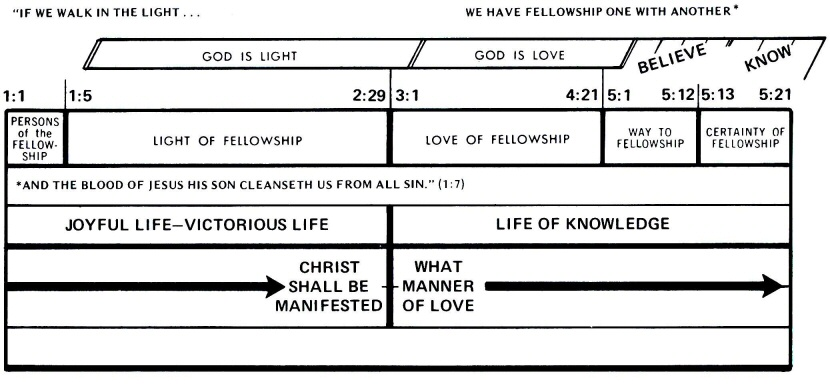
FELLOWSHIP WITH GOD AND HIS CHILDREN
Click chart to enlarge
Charts from Jensen's Survey of the NT - used by permission
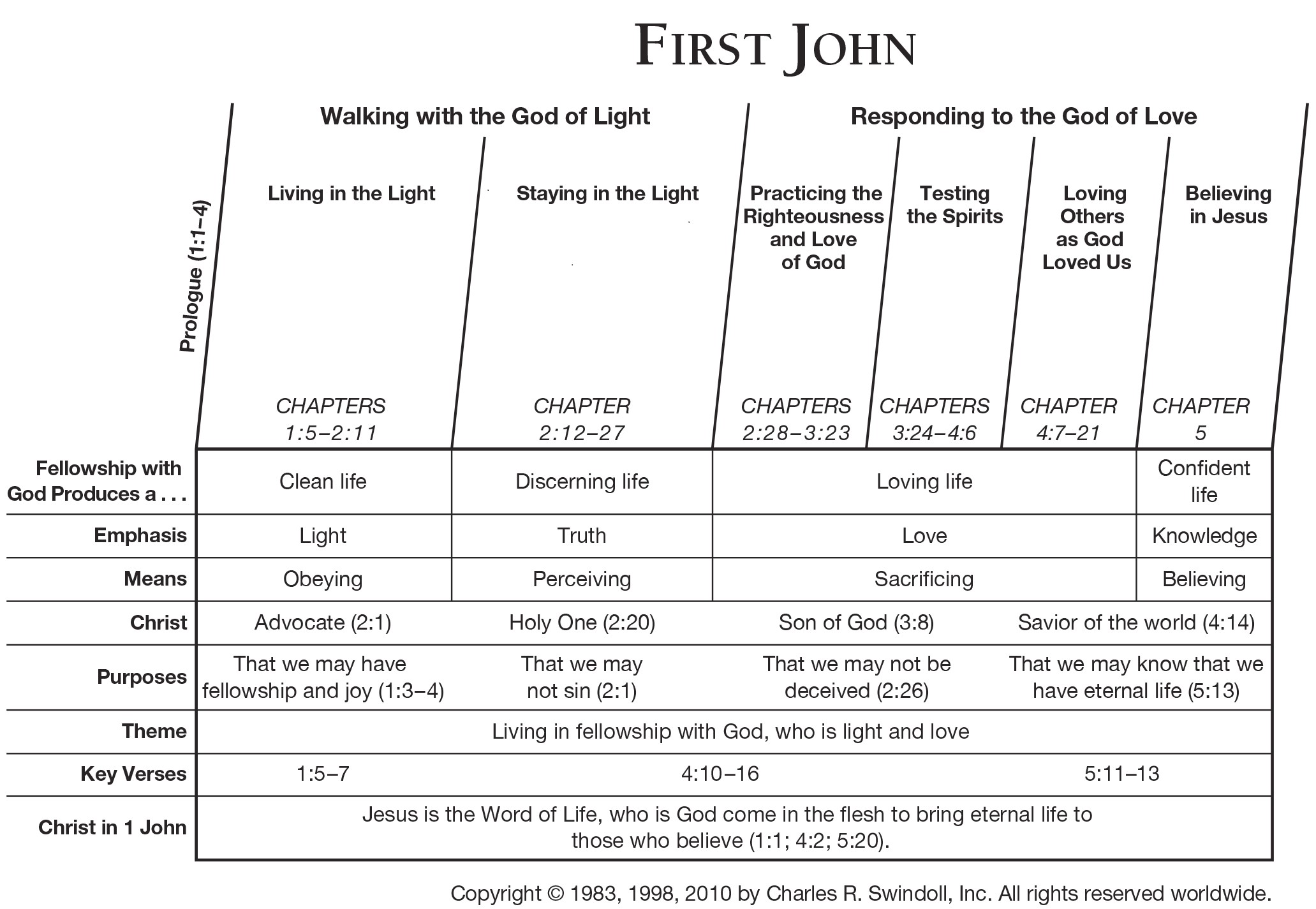
Another Overview Chart - 1 John - Charles Swindoll
| BASIS OF FELLOWSHIP | BEHAVIOR OF FELLOWSHIP | ||||
| Conditions of Fellowship |
Cautions of Fellowship |
Fellowship Characteristics |
Fellowship Consequences |
||
| Meaning of Fellowship 1 Jn 1:1-2:27 |
Manifestations of Fellowship 1 Jn 2:28-5:21 |
||||
| Abiding in God's Light |
Abiding in God's Love |
||||
| Written in Ephesus | |||||
| circa 90 AD | |||||
| From Talk Thru the Bible | |||||
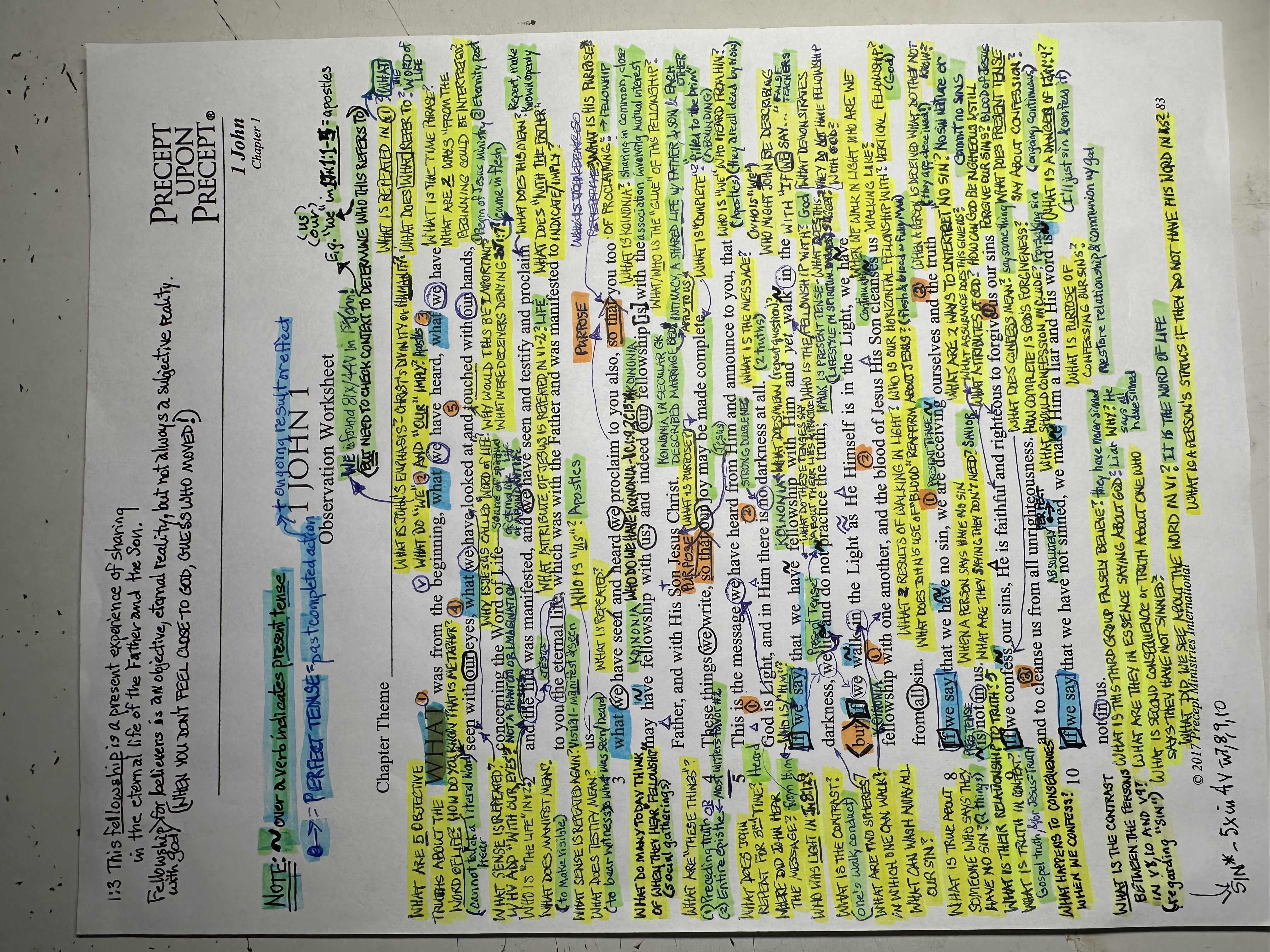
What is this? On the photograph of the Observation Worksheet for this chapter you will find handwritten 5W/H questions (Who? What? Where? When? Why? How?) on each verse to help you either personally study or lead a discussion on this chapter. The questions are generally very simple and are stated in such a way as to stimulate you to observe the text to discern the answer. As a reminder, given the truth that your ultimate Teacher is the Holy Spirit, begin your time with God with prayer such as Psalm 119:12+ "Blessed are You, O LORD; Teach me Your statutes." (you can vary it with similar prayers - Ps 119:18, 26, 33, 64, 66, 68, 108, 124, 135, 171, etc) The questions are generally highlighted in yellow and the answers in green. Some questions have no answers and are left to your observations and the illuminating/teaching ministry of the Holy Spirit. Some qualifying thoughts - (1) Use "As is" - these are handwritten and will include mistakes I made, etc. (2) They may not be the best question for a given verse and my guess is that on some verses you will think of a far superior 5W/H question and/or many other questions.
Dr Howard Hendricks once gave an assignment to his seminary students to list as many observations as they could from Acts 1:8. He said "So far they’ve come up with more than 600 different ones! Imagine what fun you could have with 600 observations on this passage. Would you like to see Scripture with eyes like that?" (P. 63 Living by the Book - borrow) With practice you can! And needless to say, you will likely make many more observations and related questions than I recorded on the pages below and in fact I pray that the Spirit would indeed lead you to discover a veritable treasure chest of observations and questions! In Jesus' Name. Amen
Why am I doing this? Mortimer Adler among others helped me develop a questioning mindset as I read, seeking to read actively rather than passively. Over the years I have discovered that as I have practiced reading with a 5W/H questioning mindset, it has yielded more accurate interpretation and the good fruit of meditation. In other words, consciously interacting with the inspired Holy Word of God and the illuminating Holy Spirit has honed my ability to meditate on the Scripture, and my prayer is that this tool will have the same impact in your spiritual life. The benefits of meditation are literally priceless in regard to their value in this life and in the life to come (cf discipline yourself for godliness in 1Ti 4:8+.) For some of the benefits - see Joshua 1:8+ and Psalm 1:2-3+. It will take diligence and mental effort to develop an "inductive" (especially an "observational"), interrogative mindset as you read God's Word, but it bears repeating that the benefits in this life and the rewards in the next will make it more than worth the effort you invest! Dear Christian reader let me encourage you to strongly consider learning the skills of inductive Bible study and spending the rest of your life practicing them on the Scriptures and living them out in your daily walk with Christ.
Although Mortimer Adler's advice is from a secular perspective, his words are worth pondering...
Strictly, all reading is active. What we call passive is simply less active. Reading is better or worse according as it is more or less active. And one reader is better than another in proportion as he is capable of a greater range of activity in reading. (Adler's classic book How to Read a Book is free online)
John Piper adds that "Insight or understanding is the product of intensive, headache-producing meditation on two or three verses and how they fit together. This kind of reflection and rumination is provoked by asking questions of the text. And you cannot do it if you hurry. Therefore, we must resist the deceptive urge to carve notches in our bibliographic gun. Take two hours to ask ten questions of Galatians 2:20+ and you will gain one hundred times the insight you would have attained by reading thirty pages of the New Testament or any other book. Slow down. Query. Ponder. Chew.... (John Dewey rightly said) "People only truly think when they are confronted with a problem. Without some kind of dilemma to stimulate thought, behavior becomes habitual rather than thoughtful.”
“Asking questions is the key to understanding.”
--Jonathan Edwards
That said, below are the 5W/H questions for each verse in this chapter (click page to enlarge). This is not neatly typed but is handwritten and was used for leading a class discussion on this chapter, so you are welcome to use it in this "as is" condition...
1 John 1:6 If we say that we have fellowship with Him and yet walk in the darkness, we lie and do not practice the truth (NASB: Lockman)
Greek: Ean eipomen (1PAAS) oti koinonian echomen (1PPAI) met' autou kai en to skotei peripatomen, (1PPAS) pseudometha (1PPM/PI) kai ou poioumen (1PPAI) ten aletheian;
Amplified: [So] if we say we are partakers together and enjoy fellowship with Him when we live and move and are walking about in darkness, we are [both] speaking falsely and do not live and practice the Truth [which the Gospel presents]. (Amplified Bible - Lockman)
ESV: If we say we have fellowship with him while we walk in darkness, we lie and do not practice the truth. (ESVBible.org)
KJV: If we say that we have fellowship with him, and walk in darkness, we lie, and do not the truth:
NLT: So we are lying if we say we have fellowship with God but go on living in spiritual darkness; we are not practicing the truth. (NLT - Tyndale House)
Phillips: Consequently, if we were to say that we enjoyed fellowship with him and still went on living in darkness, we should be both telling and living a lie. (Phillips: Touchstone)
Wuest: If we say that things in common we are having with Him, and thus fellowship, and in the sphere of the aforementioned darkness are habitually ordering our behavior, we are lying, and we are not doing the truth.
Young's Literal: if we may say -- 'we have fellowship with Him,' and in the darkness may walk -- we lie, and do not the truth
- If: 1Jn 1:8,10 2:4 4:20 Mt 7:22 Jas 2:14,16,18 Rev 3:17,18
- fellowship: 1Jn 1:3 Ps 5:4-6 94:20 2Co 6:14-16
- walk: 1Jn 2:9-11 Ps 82:5 Pr 2:13 4:18,19 Jn 3:19,20 11:10 12:35,46
- 1 John 1 Resources
Related Passages:
1 John 2:9-11+ The one who says he is in the Light and yet hates his brother is in the darkness until now. 10 The one who loves his brother abides in the Light and there is no cause for stumbling in him. 11 But the one who hates his brother is in the darkness and walks in the darkness, and does not know where he is going because the darkness has blinded his eyes.
A WATERSHED
PASSAGE
If we say (aorist) that we have (present - continually possess) fellowship (koinonia) with Him and yet (contrast their walk with their talk) walk (peripateo - present tense - as our habit, our lifestyle) in the (spiritual) darkness (skotos), we lie (pseudomai - present tense - as our habit) and do (ou = absolutely do) not practice (poieo - present tense) the truth (aletheia) - John is saying that their talk is not backed up by their walk. This passage will be dissected phrase by phrase in the comments below, including numerous related quotes.
The interpretation of 1 John 1:6 marks a "watershed" (Webster = "a crucial dividing point, line, or factor") among commentators and commentaries. One group feels that what John is saying does not relate to tests of one's salvation but relates to "tests" of fellowship in the sense of one's daily communion with God. In other words, this group says that John is not describing criteria by which one can discriminate between professors of Christ and possessors of Christ, those who really do know Him and are truly born again and thus can be assured of their salvation (1Jn 5:13).
The second interpretative position is that John is describing the difference in behavior of those who claim to be Christians (what they say) and those who are genuine followers of Christ (how they live). The reader should understand that these notes favor the latter interpretation as the most accurate. However, keep in mind that while Scripture can have only one true interpretation, it can have many valid applications and that is the approach taken by these notes.
Gary Derickson aptly summarizes the interpretative position held by the majority of scholars…
According to this view John's purpose in writing the epistle was to encourage his readers, who were understood to be believers, to assure themselves of their salvation by verifying the validity of their profession through tests of spiritual life. These tests include doctrinal agreement with the apostles' teaching and submission to their standard of conduct, namely, loving the brethren and living righteously. Eternal life, understood as a soteriological (salvation) term, is the subject of the epistle, with Christian certainty (assurance of salvation) serving as the dominant theme throughout the work. Salvation is the subject of the epistle's prologue in its focus on the "Word of Life" and the apostolic proclamation of "eternal life" (1Jn 1:1-2). With eternal life as its central subject, the epistle develops three tests by which members of the believing community can recognize that they do indeed possess that life.
These three tests of the Christian life are belief (truth), righteousness (obedience), and love. These indicate whether a person has eternal life, and is therefore in communion with God, or does not and is merely professing faith. Passing these tests produces assurance of salvation, since there is a correlation between possession of life and production of fruit as evidence of eternal life. John's purpose was not to cause his readers to doubt their salvation, but to find assurance in it. Fruit can be used either to reveal the absence of eternal life in an individual or to assure him of the presence of that life. (Reference)
In summary, these notes are written with a prayerful attitude and dependence on the Holy Spirit that the Word of Truth in First John might be rightly divided and accurately interpreted (2Ti 2:15+). The reader is strongly encouraged to assume a "Berean-like" mindset, and to read John's inspired epistle with great eagerness, continually observing the Scriptures daily "to see whether the things" written in these notes are indeed an accurate reflection of John's original intent! (See Acts 17:11+)
|
TWO INTERPRETATIVE VIEWS |
|
| TESTS OF SALVATION |
TESTS OF FELLOWSHIP |
| Are you truly… Regenerated, born again, justified? |
Are you being progressively sanctified? |
| JUSTIFICATION | SANCTIFICATION |
|
The writers in this group believe John's purpose is summarized in 1 John 5:13 = He desires for his readers to have assurance of their salvation by comparing what they say with how they actually live. |
The writers in this group believe John's purpose is summarized in 1 John 1:3 = He desires that his readers to have ongoing, intimate communion with God and one another. |
G Campbell Morgan, the respected expositor of yesteryear made the following astute observation regarding John's Gospel and his first epistle…
A comparison of John 20:31 and 1 John 5:13 will show the Gospel and the epistle to be complementary. The Gospel was written that men might have life, the epistle that believers might know they had life. In the former we have Divine life as revealed in Christ; in the latter the same life as realized in the Christian. The Gospel declares the way of life through the incarnate Son; the epistle unfolds the nature of of that life as possessed by the children of God. (This is quoted by J. Sidlow Baxter in Explore the Book scroll to page 311)
THE IMPORTANCE OF OBSERVING THE TEXT
REPEATEDLY IN ORDER TO UNDERSTAND THE CONTEXT
Remember that in order to most accurately interpret any portion of Scripture, one needs to repeatedly read (prayerfully and carefully with meticulous observation) the surrounding text in order to assure that the context (and the author's flow of thought) is clearly grasped. Otherwise, one is in danger of interpreting the passage erroneously. Those writers who favor John's purpose is to give the believing readers a series of tests by which they can evaluate their fellowship invoke 1 John 1:3 to support that premise. Those who favor John's purpose is to give several tests of one's salvation refer to his purpose statement in 1 John 5:13. Let's look at a some of the verses in this letter. As you read these passages, ask God's Spirit to help you determine, does what this passage is describing relate to a sense of communion with God or to an assurance of salvation…
The one who says, "I have come to know Him," and does not keep His commandments, is a liar, and the truth is not in him (1Jn 2:3+)
The one who says he is in the light and yet hates his brother is in the darkness until now. (1Jn 2:9+)
If someone says, "I love God," and hates his brother, he is a liar; for the one who does not love his brother whom he has seen, cannot love God whom he has not seen. (1Jn 4:20+)
Do you notice a pattern? John repeatedly associates what one says with what one does or how one behaves. As discussed more fully below, John links one's profession with his or her practice. John certainly seems to want to make sure we are who we say we are, as determined by how we live. Now, does that sound like John wants his readers to be sure of their fellowship (1Jn 1:3) or their salvation (1Jn 5:13)? How do you know what a person really believes? James would say the way to know is by their "works." (Jas 2:14-26+) John the Baptist and Jesus would say the way to know is by their "fruits." (Mt 3:8+) So if one's "works" or "fruit" include not keeping God's commandments and hating one's brother, does that sound like a believer who is just "out of fellowship" with God or does it sound like one who professes to believe but has no evidence of the new birth that would give him an assurance of eternal life?
A SUGGESTION
Before you read more of these notes, let me strongly suggest that you read through the relatively short letter of First John several times. This exercise of repeated, purposeful, prayerful observation with the enablement of Your Teacher, the Holy Spirit will give you a good sense of John's flow of thought and his purpose for writing this great letter.
To help you accomplish this objective I would suggest downloading the free Overview Lesson on First John which is lesson 1 of the 7 week Precept study (note that this is not the original course published in 1980 which had 11 lessons but is the new course published in 2017 which unfortunately is considerably abbreviated).
The Overview Lesson (in the original course) will guide you through the book 3 times, each time observing the text with a different objective - e.g., one of the suggested exercises you will instruct you mark the key words (and don't forget the frequent contrasts - light/dark, love/hate, etc.) The Overview Lesson (this link is to the original 1980 course) includes a printable copy of the entire epistle of First John (NAS95), double spaced and with wide margins. I would encourage you to print out a copy and use it as your "worksheet" for observing, marking and making notes of your observations in the margins. After you have performed your own inductive study of First John, you can will be better prepared to read these commentary notes or other commentaries (or sermons) and you will be able discern whether comment represent an accurate interpretation of John's letter and especially his overall purpose for writing.
As alluded to earlier a minority of commentaries such as those by David Guzik feel that John's subject is "fellowship, not salvation." Guzik goes on to state that "The Christian who temporarily walks in darkness is still saved, but not in fellowship with God." (Bolding mine for emphasis) While I have great respect for Guzik's comments (and quote him frequently), his statement "temporarily walks" cannot be substantiated from the verb tense John uses for "walk". To the contrary, John's use of the present tense pictures this walk as one's continual pattern of behavior and not just a "temporary slip" (which occurs in every believer's life).As John Stott says "The present tense in the Greek verb implied habit, continuity, unbroken sequence." (Borrow The Epistles of John : an introduction and commentary). In fact Guzik himself goes on to make another comment (with which I completely agree) on 1 John 1:6 observing that "a walk (present tense) in darkness (indicates) a pattern of living. This does not speak of an occasional lapse, but of a lifestyle of darkness." (Bolding mine) Webster says that the word "pattern" is a "a reliable sample of traits, acts, tendencies, or other observable characteristics of a person"! Beloved, how can a person exhibiting a "pattern of living", of continually walking in darkness, be considered to be a child of the light (Eph 5:8+ where "walk" is in the present tense! Cp Jn 12:36+)? How can one who continually behaves in a sinful, ungodly manner expect to have the assurance of salvation which John desires for his readers in 1 John 5:13+? To reiterate, in this example from David Guzik, he seems to contradict himself, on one hand stating that the one who walks in darkness speaks of "a lifestyle of darkness." On the other hand in the same section, he states "The issue here is fellowship, not salvation. The Christian who temporarily walks in darkness is still saved, but not in fellowship with God." (Bolding added) How can one exhibit a "lifestyle of darkness" and at the same time be one who "temporarily walks in darkness?" I'll leave that question for you to answer as his commentary on 1Jn 1:6 seems to be saying two things. Perhaps I am misreading or misunderstanding his comments!
As we will discuss in more detail below, an important observation to make is that John repeatedly and purposefully associates what one says with how one lives. John wants his readers to know who they really are in the spiritual realm (either in Christ or still in Adam - 1Cor 15:22), by how they conduct themselves in the physical realm.
Sam Storms (1 John Sermon Comments) comments on the interpretative approach of writers such as Guzik (see above)
According to one perspective on this passage, the contrasts here are between two types of Christians: those who are "in" fellowship with God and those who are "out" of fellowship with Him. Thus, John is instructing the believer not to hide his/her sins (1Jn 1:6) or deny them (1Jn 1:8,10), but to expose oneself to the light (1Jn 1:7) and to confess one's sins (1Jn 1:9). Thus with one's sins confessed and forgiven, one maintains temporal fellowship with God. My understanding, however, is that John is making his initial application of the Moral Test. He first describes characteristics of the false teachers in order to expose them as unbelievers and then describes the genuine believer in order to confirm his faith and assure him of eternal life…
The basis of the moral test is the character of God himself: "God is light and in Him there is no darkness at all" (1Jn 1:5+). Marshall points out that John
is fond of emphasizing his propositions by a restatement of them in negative form, and so he at once adds, 'in him there is no darkness at all' (I. Howard Marshall, Borrow The Epistles of John The New International Commentary on the NT: Eerdmans, 1978).
What does it mean to say that "God is light"? See Ps 27:1; 36:9; Isa 49:6. It may refer to His ineffable radiance and splendor or His self-revelation of truth or His holiness and righteousness or perhaps all combined! Given the context of the argument in 1 John, the emphasis would be on His absolute and unwavering truthfulness in both word and deed as well as His transcendent holiness and immeasurable purity. (ED: Bolding mine) Says Stott:
The miserable errors of the heretics were due to their ignorance of God's ethical self-revelation as Light… And if God is also light in the sense of possessing an absolute moral perfection, their claim to know Him and have fellowship with Him despite their indifference to morality is seen to be sheer nonsense, as the author goes on to demonstrate. (John R. W. Stott: The Letters of John: Eerdmans, 1964 - BORROW) (ED: Bolding added)
Smalley concurs "The statement 'God is light' carries with it an inevitable moral challenge: 'his followers must walk in the light'" (BORROW Word Biblical Commentary)
John Piper adds that "When you walk in darkness, you are controlled by the desires for the soft, warm underbellies of prestige and power and two-second pleasures (see Jas 4:14). This is the very opposite of what it means to have fellowship with God. Fellowship with God means that you see things the way He sees them and have the same desires He has. If we are controlled by desires for the world instead of desires for God, it doesn't matter whether we say we have fellowship with God or not; we don't have it. Instead we walk in darkness. (1 John 1:5-10: Let Us Walk in the Light of God)
The IVP Bible Commentary puts it like this - Light and darkness are opposites, and repel each other. One cannot have fellowship with God with one foot in darkness and one in light, since God is light; in Him there is no darkness at all. Darkness and light are two opposing forces, each making their competing claims upon us." (See 1-3 John - Page 44)
As we study 1 John 1:6-10, seeking to rightly divide the Word of Truth, we do well to keep in mind John's foundational truths in 1 John 1:1-5, especially the truth that "God is light, in Him there is no darkness at all!"
Daniel Wallace comments that "After establishing Who God is, John turns to us and how we relate to God. John will not permit us to rationalize about our sin. To be in God's light means to be exposed to the truth about Himself and ourselves. Yet, there is a pernicious problem we face. In 1 John 1:6-10, John mimics three errant views that his opponents held and then shows how they miss the mark. All have to do with the depravity of men; all have to do with hiding from the light. (Honest to God! Or, God is not a Pit Stop 1 John 1:5-10)
First let us recall the context that John has just presented the truth that Jesus is the "Word of Life", the "Eternal Life" and that "God is light." John adds that "In Him there is no darkness at all." In other words John is stating as strongly as he can, the contrast between God ("Light") and darkness. Note that John does not speak about the origin of the darkness. That is not his point. His main thrust is to emphasize that living in the darkness is absolutely incompatible with fellowship with God. John is using light and darkness primarily in the ethical sense. In other words, he is saying that "God is good and evil can have no place beside Him." (Howard Marshall)
Remember why John is writing…
These things I have written to you who believe in the name of the Son of God, in order that you may know that you have eternal life (1Jn 5:13)
To whom is John writing? Clearly this letter is addressed to believers, not to unbelievers (cp the "identity" of those addressed in 1Jn 2:1, 2:12, 13, 14).
What is John's main purpose for writing? This verse is a clear statement of his purpose. John wants his believing readers to be sure of their salvation (Compare 1Jn 2:3ff, 21).
In a day when up to 85% of Americans claim to be Christians and up to 45% profess that they are "born again" (Barna Survey, 2006), one can see how the truth of this John's ancient epistle is very timely and applicable to our present age!
THE TRUTH ABOUT…
SAYING ONE THING & DOING ANOTHER
If we say - This is the first of six clauses introduced by “if” in 1Jn 1:5-1Jn 2:6 - 1 John 1:6, 7, 8, 9, 10, 2:1, 3.
| SUMMARY OF JOHN'S "IF" STATEMENTS |
||
| NEGATIVE (False) |
POSITIVE (True) |
|
|
1 |
1Jn 1:6+ If we say that we have fellowship with Him and yet walk in the darkness |
1Jn 1:7+ but if we walk in the light as He Himself is in the light |
|
2 |
1Jn 1:8+ If we say that we have no sin |
1Jn 1:9+ If we confess our sins |
|
3 |
1Jn 1:10+ If we say that we have not sinned |
1Jn 2:1+ And if anyone sins |
|
There are other "if" statements but these constitute the first and major group. |
||
Note the 3 false claims (professions) that…
(1) 1Jn 1:6+ - They had an intimacy (fellowship) with God (regardless of their behavior)
(2) 1Jn 1:8+ - They had no stain of sin or no sin nature (some interpret "no sin" in 1Jn 1:8 as saying they commit no sins)
(3) 1Jn 1:10+ - They had done no wrong
Note: Only 1 John 1:6+ will be discussed on this page. Notice however that the negative and positive points in essence deal with some aspect of sin (even though #1 does not use the specific word, walking in darkness is tantamount to sin.)
F F Bruce makes other interesting observation that "'If we say'—these false claims each being followed by an appropriate antidote."
If (ean) is a preposition which serves to identify what is referred to in Greek as a third class conditional clause. It means "(If)… and it may be true or may not be true." There is a supposition (something that is supposed) where the reality of the issue is uncertain. A conditional clause in Greek is formed by combining a preposition with a certain verb mood. In this case ean is combined with the subjunctive mood which is the mood of probability (the verb "we say" is in the subjunctive mood) which implies uncertainty. In the context of this letter, it is reasonable to consider that there were false teachers among the believers who were making these claims.
I Howard Marshall adds that "It is probable that these claims were real statements made by people in the church to which John was writing, and that they reflect the outlook of the people who were causing trouble in the church." (See The Epistles of John - Page 110)
In 1 John 1:6, the "we" are those who were claiming that it is possible to have continual fellowship with God and continually live in the darkness of sin (see Walk in Darkness)! This is quite a bold (brash) claim in light of (pun intended) the fact that God is light and in Him there is absolutely no darkness at all!
We say (epo) is the first person plural which indicates that John is including himself in this suppositional statement. Some take this as evidence that what follows could not possibly apply to the distinction of believers versus unbelievers, given that clearly John is a believer. There is however another way to explain John's use of "we" which is very compatible with the context.
Alfred Plummer writes that "With great gentleness (John) puts the case hypothetically, and with great delicacy he includes himself in the hypothesis. This ‘if we’ continues in almost every verse until 1Jn 2:3, after which it is changed into the equivalent ‘he that’, (NAS has "the one" or "he who") which continues down to 1Jn 2:11; after that neither form is used. (ED: That's not exactly true - see "if someone says" in 1Jn 4:20, cf also 1Jn 5:9, 14, 15). (Cambridge Bible for Schools and Colleges comments on verse 6)
Henry Alford explains that "The first person plural ("we") gives to the sayings a more general form, precluding any from escaping from the inference: at the same time that by including himself in the hypothesis, the Apostle descends to the level of his readers, thus giving to his exhortations the “come,” and not “go,” whichever (always) wins men’s hearts the most. (1 John 1 Commentary) (Bolding added for emphasis)
Sam Storms addresses the "we" question…
In 1Jn 1:1-1Jn 1:5 John uses "we" 13x (ED: 8X/5V in NAS95). In 1Jn 1:6-10 "we" is used 12x. The "we" of vv. 1-5 refers to the apostles (1Jn 1:1). But whom does the "we" of vv. 6-10 include? Some say the apostles, as in vv. 1-5. It would seem, however, that a shift has occurred as John begins his application of the tests of authentic Christianity. I take the "we" in vv. 6-10 to be what is known as the preacher's "we". Stott explains:
The author does clearly identify himself with his readers in many parts of the Epistle, as a preacher does with his congregation in a sermon… In these (and other) 'we' sentences the author is neither speaking editorially nor associating himself with the other apostles but identifying himself with the whole Christian community, or at least with his readers. (Borrow Stott's The Epistles of John : an introduction and commentary)
I.e., John is simply stating general principles which are applicable to all men equally. This kind of "preacher's we" is often heard in the pulpit. E.g., "If we reject the claims of Christ we will be eternally lost, but if we trust Christ as our Savior we will be eternally saved." The "we" really means anyone, but in order to associate with his readers he uses "we". Cf. also 1Jn 2:9-11,22 ("the one who") and 1Jn 2:23,29; 3:3,4 ("everyone who"). (1 John Sermon Comments)
In support of the interpretation that "we" in 1Jn 1:6-10 as a reference to men in general ("applicable to all men equally") notice that John switches from we to other ways of identifying those who make false claims. In other words, John gives us a number of descriptions of men who say one thing and do another. In fact "we say" occurs only in 1Jn 1:6, 8, 10. John then changes to "one who says" (1Jn 2:4, 6, 9) and to "If someone says" in 1Jn 4:20. (ED: BE AWARE THAT THESE DESIGNATIONS WILL VARY BETWEEN TRANSLATIONS - THUS IN THE POPULAR ESV 1Jn 2:4ESV, 1Jn 2:6ESV, 1Jn 2:9ESV SUBSTITUTES "WHOEVER" FOR "ONE WHO SAYS") Observe that in each of these instances John makes a "positive" statement regarding the faith followed by a negative behavior which in effect "contradicts" this person's positive claim. John repeatedly describes those who say one thing and do another (See the following table).
I like how Dr S Lewis Johnson (past professor of OT Theology at Dallas Theological Seminary) explained the problem John is exposing…
One of the commentators has said, "What we have here is the lie of the lip" and we also have the lie of the life characteristic of us as human beings who are sinners… We are responsible not simply to think right, but to do what is right. In other words, the truth is not simply what we think with the intellect, but it is that which is conformable to God's nature and will and is inclusive of the kind of life that we live. (First John Sermons) (Bolding and italics added for emphasis)
|
JOHN'S COMPARISON OF |
||
|
THE |
WHAT ONE SAYS |
WHAT ONE DOES |
|
1 John 1:6 |
"We have fellowship |
Walk |
|
1 John 2:4 |
"I know |
Does not keep |
|
1 John 2:6 |
"I abide |
Must walk |
|
1 John 2:9 |
"I am |
Hates |
|
1 John 4:20 |
"I love God" |
Hates |
Does not John's pattern of comparing words and deeds remind us of James' comments on Faith and Deeds or Works? (Obviously this question is rhetorical! See James 2:14-26+) Or what about John the Baptist's association of repentance and fruit (See Mt 3:8+, Lk 3:8+)? Or what of our Lord Jesus' emphasis on the importance of fruit in the assessment of one's words? (See Mt 7:17, 18, 19, 20+, Mt 7:21+, Mt 7:22, 23+, Luke 8:15+). And do we dare not hear and heed the solemn warning of Jesus in His conclusion of the most famous and most important sermon (Sermon on the Mount) ever preached?…
Not everyone who SAYS (present tense) to Me, 'Lord, Lord,' will enter the kingdom of heaven (Jesus' metaphor for salvation); but he who DOES (present tense = speaks of general direction of one's life not perfection!) the will of My Father who is in heaven. 22 Many (not few but tragically many!) will SAY to Me on that day, 'Lord, Lord, did we not prophesy in Your name, and in Your name cast out demons, and in Your name perform many miracles?' 23 And then I will declare to them, 'I never knew (ginosko) you; DEPART (aorist imperative - Do this now! Leave immediately!) FROM ME, YOU WHO PRACTICE (ergazomai - present tense = as your lifestyle - cp "walk [present tense] in the darkness" 1Jn 1:6) LAWLESSNESS (cf 1Jn 3:4+).' (Mt 7:21+, Mt 7:22, 23+)
Comment: Did you observe our Lord's emphasis on what one says versus what one does (practice)? Note that these individual souls will call Jesus Lord and yet they will act like the devil (cp 1Jn 3:8, 10+!), continually practicing lawlessness which John says is sin! (Mt 7:23b+, cp 1Jn 3:4+) Did you observe how Jesus will not dispute their "profession" of works (prophesy, cast out demons, perform many miracles)? Does this not suggest these "works" are actual works these professors will carry out? (We know Judas had power to cast out demons! Mk 6:7, 13+, Lk 9:1-2, 6+) Why will Jesus command these professors of great "religious works" to depart from His presence? Notice how Jesus uses the verb "knew" (ginosko), which John repeatedly uses in his letter also in the context of salvation (Study John's uses of ginosko in 1Jn 2:3, 4, 5, 13, 14, 29, 1Jn 3:1, 3:6, 19, 24, 4:2, 4:6, 7, 8, 13, 16, 5:2, 20) (As as aside John uses ginosko over 50x in his Gospel! E.g., see John 17:3+)
J E McDermond writes that rather that "if we say" "a better translation here would be when (or whenever) we say. This translation suggests, as many commentators recognize, that a group is actually claiming to be in fellowship with God even while their lives point to a different reality. Clearly John writes these opening words because some influential person or group is claiming to be a model of how to relate to God, and yet the reality of their lifestyle leads the believing observer to draw the opposite conclusion. (McDermond, J. E.: 1 John--Commentaries: Believers Church Bible Commentary) (Bolding added for emphasis)
D A Carson on fellowship (at 25' in his audio tape on 1Jn 1:1-2:2 - worth listening to - 1:02 hours) - We witnesses who first came into contact with the living God by the Word made flesh, we have fellowship with Him and we proclaim this message to you so that you may have fellowship with us. The idea is if we are in fellowship with the apostles who are in fellowship with God then we are in fellowship with God. The apostles clearly see themselves as a critical link here....What is at stake in other words is the knowledge of God by the God Man, by His Son Jesus Christ. We proclaim these truths...so that men and women may know God. We have fellowship with Him. We are in league with Him. We have come to share His values, His way of looking at things, His goals. We have come to grasp His truth. We have touched the manifestation of His Son. We are in fellowship with Him. And if you are in fellowship with us, you too are in this same fellowship of God and His people.
W Hall Harris…"The phrase practicing the truth means living out the truth in a lifestyle obedient to God. The most important parallel is John 3:20, 21, where we are told “Everyone who does [= practices] evil hates the light and does not come to the light…but the one who practices the truth comes to the light, so that it may be plainly evident that his deeds have been done in God.” The problem with the opponents lies not with their boast that they have fellowship with God, but with their contradictory behavior—they continue walking in the darkness." (Exegetical Commentary on 1 John 1:5-2:2)
Bob Utley - The heretics claimed that fellowship was based on knowledge only (ED: Gnosticism ~ gnosis = knowledge). This was an aspect of Greek philosophy from Plato. However, John asserts that Christians must live Christ-like lives (cf. 1Jn 1:7; Lev. 19:2; 20:7; Mt 5:48).
McDermond adds that "The first portion of 1Jn 1:6 highlights this inconsistency. The claim is that some see themselves in fellowship with God. In just the previous verse (1Jn 1:5) the point is made that God is light, meaning authentic and good, and there is no darkness in him. Therefore one may (or might) assume that those people claiming fellowship are authentic and good as well. But as the author reflects on their lives, he concludes differently. They are walking in darkness. (1 John--Commentaries: Believers Church Bible Commentary) (Bolding added for emphasis)
J Sidlow Baxter (Explore the Book page 310ff) comments that First John is…
- an epistle of guiding tests, we would urge that its several chain-themes be carefully traced and studied
- the seven distinguishing traits of the born again (1Jn 2:29; 3:9; 4:7; 5:1 (twice), 1Jn 5:4,18);
- the seven reasons why the epistle was written (1Jn 1:3,4; 2:1,13-17,21-24,26; 1Jn 5:13);
- the seven tests of Christian genuineness (1Jn 1:6,8,10; 2:4,6,9; 1Jn 4:20).
Perhaps it may be useful to set out the last mentioned a little more fully. Seven times there is an "If we say," or "He that saith"; and each time it marks a test by which falsity is exposed. They are seven tests of honesty and reality. They search us. They penetrate like a white flame. They expose hypocrisy. Here they are:
1Jn 1:6 = False fellowship.
1Jn 1:8 = False sanctity.
1Jn 1:10 = False righteousness.
1Jn 2:4 = False allegiance.
1Jn 2:6 = False behavior.
1Jn 2:9 = False spirituality.
1Jn 4:20 = False love to God.
Fellowship (2842) (koinonia from koinos = that which is in common, belonging to several or of which several are partakers) describes the experience of having something in common and/or of sharing things in common with others. It describes a close association involving mutual interests and sharing or to have communion (Which Webster defines communion as "intimate fellowship") It denotes the active, joint participation, cooperation and/or sharing in a common interest or activity.
John's intended meaning of fellowship in this context is one of several keys which will guide our interpretation of not just this section of the letter and for that matter the entire letter. Fellowship in 1 John 1:6 could refer either to the initial salvation experience or to the subsequent sharing of common interests that follows regeneration (the time referred to as sanctification). The question is whether there are any NT examples of koinonia which refer specifically to the initial salvation experience? Let's observe Paul's statement in First Corinthians…
God is faithful, through Whom you were called into fellowship with His Son, Jesus Christ our Lord. (1Cor 1:9+, cf 2Co 13:14+)
Comment: This passage clearly refers to the initial salvation experience of the Corinthians. Calling is an integral component of our salvation experience. When we entered the New Covenant by grace through faith, we entered into a union, a oneness, a common (koinonia - from koinos = that which is in common) life with Christ, Who in fact is now the believer's life (Col 3:4) through His indwelling, ongoing ministry of the Holy Spirit (Ro 8:9). This initial "communion" experience with God results in a new spiritual position, "positional" fellowship if you will. In our unregenerate state, we were in Adam, but at regeneration God's Spirit placed us in Christ, into our new position of union with Him. Positional fellowship is of course followed by experiential (relational) fellowship on a day to day basis (aka progressive sanctification), but there has to be that initial moment of supernatural "communion" ("fellowship") at the time of conversion. Almost every commentary agrees that koinonia in 1Corinthians 1:9 refers to the the sharing in common that occurs when one is born again.
Bob Utley on "koinonia" in 1Cor 1:9 adds that: God has called us to be in union with His Son both positionally and relationally… Believer's lifestyles after they meet Christ are evidence of their salvation.
The United Bible Society Handbook: Perhaps the most important word in this verse is the one that RSV and TEV translate fellowship. REB replaces this noun by a verb having the same meaning: “to share in the life of his Son.” “Share in,” of course, simply means “participate in.” The text implies that the fellowship into which God calls Christians is the fellowship or communion that he himself has with his Son. So the word that translators use here should not refer specifically to the kind of fellowship that Christians have with one another in the church. (Ellingworth, Paul; et al; A Handbook on Paul's First Letter to the Corinthians)
Gordon Fee: The reference is to what took place at their conversion. The calling to Christ is a calling to be in fellowship with Christ through the Spirit (cf. 2Cor. 13:14; Phil. 2:1). Thus in all likelihood this language is to be understood not only positionally, but also relationally. Believers are not only in Christ, and as such freed from the guilt of their sins, but are also in fellowship with Christ, and as such are privileged to commune with Him through the Spirit. (See The First Epistle to the Corinthians - Page 45) (Bolding added)
In summary, clearly koinonia is used elsewhere in the NT in the context of initial salvation (regeneration, justification, being born again). It follows that John's use of koinonia in 1 John 1:3 and 1 John 1:6 could refer to initial salvation. Stated another way, one cannot exclude that John is referring to the initial salvation experience.
Fellowship is a specifically Christian word and denotes
that common participation in the grace of God,
the salvation of Christ and the indwelling Spirit
which is the spiritual birthright of all Christian believers
-- John Stott
So what does it mean to be in fellowship with God? Salvation is the prerequisite, the fellowship wrought by salvation. We are in the family of God. But once we are in the family of God, enabled by the Spirit, we should seek to walk like children of God (Eph 5:1+), children of light (Eph 5:8+), so that we might experience continual, intimate communion with our Father. Our "objective" fellowship is forever and immutable because it is in Christ. Our "subjective" fellowship on the other hand is changeable. It is not changeable on God's side for He is unchangeable. But when we sin, we experience what amounts to a "short circuiting" of our intimacy and communion with God (cf David in Ps 32:3-4+). We must confess our sins to be brought back into experiential (subjective) fellowship (positionally or objectively we will forever be in fellowship because we are in Christ forever). John desires that his readers be absolutely sure of their objective fellowship, the fellowship of salvation, for without that fellowship, there can be no daily communion with God.
Their profession that they had fellowship with God was another lie,
for God can have no fellowship with falsehood.
Spurgeon comments on fellowship with God noting that "There were certain in John’s day who said, “We have fellowship with God.” How they had come by it they did not explain. Perhaps they claimed to have reached it by philosophical speculation, by exact reasoning, or by long-continued meditation. Whatever the road, they said that they had reached the City of God and were in communion with the Great Being. John saw that they walked in darkness, rejecting the Light of Divine Revelation from above and the pure Light of the Holy Spirit within. He also saw that they, themselves, were not true, and that their lives were not pure and, therefore, he warned them that they were speaking and acting a lie. Their life was a lie, for they were not walking in the truth. And their profession that they had fellowship with God was another lie, for God can have no fellowship with falsehood. “God is Light, and in Him is no darkness at all” and, therefore, He cannot hold any communion with darkness. John draws the lines very tightly and judges with unflinching fidelity—he is not inclined to the boasted charity of latitudinarianism, but he curtly dismisses false claims with that plain word, “lie.” The disciple whom Jesus loved spoke like the Son of Thunder that he was when he had to deal with shams. It is the part of true love to be honest and to expose that which would be injurious to those it loves. He who will gloss over a falsehood loves but in word, only. Learn, then, that if men boast of fellowship with God and do not receive the Revelation of His Word, they lie, and know not the Truth of God. (The Child of Light Walking in the Light)
J Sidlow Baxter adds that "We cannot strictly call (1Jn 1:3) the "key" to the epistle, or say that "fellowship" is John's uppermost subject (seeing that after 1Jn 1:7 the word does not once occur again); yet who can help but realize that the underlying purpose all through is that by avoiding the false and abiding in the truth we should know the pure joy of an unclouded fellowship with God?" (Explore the Book page 319)
Adam Clarke commenting on 1 John 1:6 makes the point that "Having fellowship, koinonia, communion, with God, necessarily implies a partaking of the Divine nature (Ed: In short, one needs to experience regeneration, the new birth).
Marvin Vincent writes that "The true life in man, which comes through the acceptance of Jesus as the Son of God, consists in fellowship with God and with man. (Vincent - Word Studies)
Tyndale Bible Dictionary succinctly defines fellowship as "Communion with God, which results in common participation with other believers in the Spirit of God and God’s blessings. (Tyndale Bible Dictionary)
With Him - with God. The unique fellowship between Father and Son is eternal, was manifested in time through the incarnation of Jesus, was introduced to the apostles, and then introduced to every believer via reception of the Spirit of Christ at the new birth when we were "called into fellowship with His Son, Jesus Christ our Lord." (1Co 1:9+, cp , 2Cor 13:14+; Phil 2:1+, Ro 8:9+).
As John Stott explains the believer's fellowship with God is "that common participation in the grace of God, the salvation of Christ and the indwelling Holy Spirit which is the spiritual birthright of all Christian believers. It is their common possession of life -- one with God the Father, Son, and Holy Spirit, which makes them one." (Borrow Stott's The Epistles of John : an introduction and commentary)
Sam Storms has an addendum in one of his messages on First John that specifically addresses the interpretation of fellowship…
The point at issue is whether or not the Bible (specifically 1 John) uses the word "fellowship" (koinonia) to describe a temporal relationship between God and the Christian, a relationship both breakable (by sin) and restorable (by confession); a relationship based upon but distinct from and more than salvation. The issue is not whether the concept proposed by (Zane) Hodges is biblical. That a believer can and does sin is a biblical fact (1 John 2:1). That a believer can and does hide and repress his sin is also substantiated by Scripture. (Pr 28:13, Ps 32:3-4)
That such a refusal to acknowledge one's sin can and does disrupt one's daily walk and spiritual relationship with the Lord is also both a fact of Scripture and experience (1Co 11:29-32; 1Co 3:1-4; Jn 13:10; Heb 12:5-8; Ps 32:3-4; etc.). The debate is over the terms used to describe this concept. That is to say, does the NT word for fellowship specify "temporal" fellowship or "eternal" fellowship? I believe the latter is true. This has profound implications for the interpretation of 1 John. If by "fellowship" the biblical authors (including John) meant "eternal" salvation, then John's first epistle was not written to describe and promote "temporal" fellowship between God and believer. What evidence is there for concluding that John did not write this epistle with the notion of "temporal" fellowship in view?
First, consider the usage of the word koinonia in the NT. Excluding the four times it is used in 1 John, the word "fellowship" is found 14x in the NT, 12 of which are in Paul's writings. The word means "association with and/or participation in" someone and/or something. Beyond that the context must decide its nuance. Six times it is used in an abstract sense of the believer's common association with other believers in a specified activity or sphere (1 Cor. 10:16,17; 2 Cor. 8:4; Phil. 1:5; 3:10; Philemon 6).
Two times it is used of the brotherly unity within the Christian community (Acts 2:42; Gal. 2:9; the two uses in 1 John [1:3a,7] which speak of Christian/Christian relationship would probably fit here), and three times in the developed sense of a gift or contribution (Rom. 15:26; 2 Cor. 9:13; Heb. 13:16).
The other three usages are of the believer's relationship to the Godhead (1Cor. 1:9; 2Cor. 13:14; Phil 2:1). Fellowship in 1Cor 1:9 clearly speaks of the believer's eternal association with Christ through God's gracious and effectual call. 2Cor 13:14 and Phil 2:1 speak of the believer and his/her "fellowship" of/with the Holy Spirit.
What, then, of the word "fellowship" as it describes the relationship between God and believer in 1 John 1:3b and 1John 6a? I believe that in light of 1Cor 1:9 and what we will discover upon studying 1 John as a whole that "fellowship" in this latter epistle is synonymous with "salvation".
Stott writes: "The purpose of the proclamation of the gospel is, therefore, not salvation but fellowship. Yet, properly understood, this is the meaning of salvation in its widest embrace, including reconciliation to God in Christ … , holiness of life … , and incorporation in the Church … This fellowship is the meaning of eternal life … As the Son, Who is that eternal life, was (eternally) with the Father, so He purposes that we should have fellowship with them and with each other… 'Fellowship' is a specifically Christian word and denotes that common participation in the grace of God, the salvation of Christ and the indwelling Spirit which is the spiritual birthright of all Christian believers" (63).
What we will see from our study of 1John 1:6-10 is that the contrast is not between two types of believers, those "in" as opposed to those "out" of fellowship, but between Christians who are "in", or rather "have", fellowship with God and non-Christians who are not and do not.
Second, contrary to what Hodges suggests, 1Jn 1:3 does not say that the letter was written in order that these believers might have fellowship with God and His Son Jesus Christ. Note carefully:
The purpose of announcing the message of eternal life was so that the readers might have fellowship with John. Brotherly fellowship could be entered into after salvation and subsequently broken and restored (cf. Gal. 2:9). The influence of the false teachers had fractured John's relationship with the church(es) to which he writes and he pens this letter to restore it. Having said this, John then adds that the apostles' fellowship is with God. He does not say, as Hodges supposes, that the readers have fellowship first with the apostles and, as a result, with the Father and Son. The Greek construction (kai de) means "but also" or "what is more," making the clause an additional disjunctive thought rather than a subordinate idea of result. John's emphasis appears to be that the apostles' fellowship, in emphatic contrast to the false teachers' fellowship (note the "our"), is with the Father and Son. In other words, John is not writing with a two-fold purpose in mind (namely, to promote fellowship with the apostles and with the Father and Son, as if a believer might not possess the latter). John's stated purpose in 1:3 is simply that the readers might have fellowship with him. The purpose is extended somewhat in v. 4 to include the fulfilling of the apostle's joy.
Third, to understand the God/Christian fellowship of 1John 1:3-10 as a temporal, breakable relationship demands that we understand the contrasts in the rest of the book to be about Christians who are "in" and Christians who are "out" of fellowship with God. However, closer study will reveal that the contrasts are in fact between Christians and non-Christians. (Scroll Down for "A Response to Zane Hodges' View of the Purpose of 1 John")
THE TRUTH ABOUT
WALKING IN DARKNESS
If we say… if we walk - Once again observe the clear juxtaposition by John of what we say with what we actually do! In this context John is saying that some were in effect saying that sin does not matter as demonstrated by their lifestyle. John may be addressing the incipient Gnostic heresy which said that since the body was evil one could live anyway they wished and it would not affect the destiny of their spirit which was pure.
And yet walk in the darkness - Wuest says "This person is said to be walking in the darkness which is not in God, namely, sin." Wuest's paraphrases this passages as "and in the sphere of the aforementioned darkness are habitually ordering our behavior" (The New Testament: An Expanded Translation)
Marshall says that there is one sense "in which all Christians live in the darkness. They live in this world which is opposed to God (see 1Jn 2:15–17) and characterized by darkness. But the situation of the Christian is like that of a person walking on a dark stage in the circle of light cast by a spotlight which is focused on him; he moves slowly forward so that he can walk in its light without fear of stumbling and losing his way. (See The Epistles of John - Page 110)
We walk (4043)(peripateo from peri = about, around + pateo = walk, tread) means literally to walk around, to go here and there in walking, to tread all around. The 39 uses in the Gospels refer to literal walking. Seven of the 8 uses in Acts are also in the literal sense (except Acts 21:21). When we come to the epistles of Paul peripateo is used only in the metaphorical sense referring to the conduct of one's life, the ordering of one's behavior. John also frequently uses peripateo in the figurative sense referring to one's ordinary course of life (See 1Jn 2:6, 11; 2 John 4, 6; 3 John 3, 4; Rev 21:24-note; John 8:12).
Utley explains that "walk" "is a biblical metaphor expressing a moral lifestyle (cf. Eph 4:1-note, Eph 4:17-note; Eph 5:2-note, Eph 5:15-note). God is light with no darkness. His children should be like Him (cf. Mt 5:48-note).
Alford observes that the verb peripateo "often in the NT (speaks) of the whole being and moving and turning in the world." (1 John 1 Commentary)
It is important to note that the verb peripateo is in the present tense which means that those who make a claim or profession of having fellowship with God, at the same time are choosing to continually, habitually live in the darkness!
Robert Lightner agrees with this interpretation writing that "verb translated "walk" (1Jn 1:6) is in the present tenseand the subjunctive mood in Greek. The reference therefore seems to be to continuous, habitual sinning. Sin is the habit of the person's life....The entire lifestyle and behavior of this person is lived in the realm of darkness." (Twenty-First Century Commentary)
THOUGHT - Beloved, how could this description of a professed believer possibly describe one who has truly been born again and has the Holy Spirit living in their body, urging and enabling holy behavior? That's a rhetorical but serious question because of the serious implications of such a lifestyle. Such a person is on a fast track to eternal punishment in hell!
Alfred Plummer comments that the meaning of walk in the present tense "expresses not merely action, but habitual action. A life in moral darkness can no more have communion with God, than a life in a coal-pit can have communion with the sun. For ‘what communion hath light with darkness?’ (2Cor. 6:4). Light can be shut out, but it cannot be shut in. Some Gnostics taught, not merely that to the illuminated (Ed: intellectually enlightened) all conduct was alike, but that to reach the highest form of illumination (Ed: "enlightenment") men must experience every kind of action, however abominable, in order to work themselves free from the powers that rule the world. (1 John 1 Commentary)(Bolding added)
Colin Kruse notes that "What it actually means to 'walk in the light' and to 'walk in the darkness' is not explained in this letter. Probably the best explanation of what it means is to be found in the Fourth Gospel (Read John 3:19, 20, 21) This suggests that 'walking in the light' involves a willingness to be open towards God and his revelation in Christ, while 'walking in the darkness' involves a refusal to do this (See The Letters of John - Page 63)
(Kruse quotes Charles Baylis who concludes that 'walking "in the light" means receiving God's revelation of Himself through His Son, and receiving eternal life and forgiveness of sins', while 'walking "in the darkness" is walking in death, rejecting that revelation'. Baylis adds "walking in darkness means abiding “in death” and not having eternal life abiding in one. The one who walks “in the darkness” is one who has rejected the revelation of God in Jesus Christ, eternal life (the light)." See The Meaning of Walking “in the Darkness” 1 John 1:6) -- By Charles P. Baylis Bibliotheca Sacra 149:594, April 1992) (See Walking in Darkness)
As John Stott says "The present tense in the Greek verb implied habit, continuity, unbroken sequence." (Borrow The Epistles of John : an introduction and commentary)
McDermond adds that 'Here walk is in the present subjunctive in the phrase ''while we are walking,'' suggesting that this possible condition is a continuous or habitual pattern of behavior, and that such people are repeatedly and consistently choosing darkness over the light of God’s revelation in Jesus Christ (see 1Jn 1:1–4). (Ibid)
John Butler - One of the heresies of that day was the idea that you could live in sin and at the same time be in fellowship with God. For “fellowship” to occur one must have things in common with the one with whom he wants to fellowship. Therefore a person cannot live willfully in sin and have things in common with God Who is holy. Those who claim to have fellowship with God and who live unholy lives are fakers. They are not real believers. (Analytical Bible Expositor: 1, 2, 3 John & Jude) (Bold added)
William MacDonald minces no words declaring that "A man who says he has fellowship with Him and habitually walks in darkness was never saved at all." (Borrow Believer's Bible Commentary)
Martyn Lloyd-Jones describes walking in darkness - walking in darkness (means) living in the realm of darkness, being controlled by the ideas of the world and of sin, belonging to a kingdom, the kingdom of darkness, the kingdom of Satan, the kingdom of this world, the kingdom that is rebellious against the kingdom of God. In other words, the people who walk in darkness are not those who, as it were, are constantly committing some foul sin. They may be highly respectable — indeed, they may be very moral — but they are walking in darkness because they are outside the light of the Gospel of our Lord and Saviour Jesus Christ; it is a realm to which people belong; it is an outlook upon life in general. (Fellowship with God) (Bolding mine).
W E Vine - The conditions thus laid down serve to distinguish actual possession from mere profession. There is an intimation of what the apostle develops more fully in the body of the epistle, namely, the distinguishing mark which differentiates the children of God from the children of the devil (see 3:10). In this passage the distinction is between walking in darkness and walking in the light. The former is the condition of the unregenerate, the latter of those who are related to Him who is light (1Jn 1:5). To walk in the light we must be partakers of His nature. The word rendered “walk” suggests the habitual or constant course of life.
John Ritchie - If a person's normal habitual way of walking is contrary to the light, if it is evident that his manner of life is not in keeping with the character of God, John declares that he lies and does not the truth. His profession is false; he lies. He does not do the truth, for his walk is contrary to the truth. John does not say he is a backslider, or a disobedient child. His habitual walking in darkness proves he is a false professor. He has never been born of God—solemn and searching truth. (What the Bible Teaches)
Burdick asserts "Fellowship with Him, that is, claiming saving relationship with God, professing to know Him personally, the person who is in fellowship with God will display the characteristics of God. Such a person must walk in the light. If, however, he is walking habitually in darkness there is no basis for his claim".
Matthew Henry - For the conviction of such professors as have no true fellowship with God: If we say we have fellowship with him, and walk in darkness, we lie, and do not the truth. It is known that to walk, in scripture account, is to order and frame the course and actions of the moral life, that is, of the life so far as it is capable of subjection to the divine law. To walk in darkness is to live and act according to such ignorance, error, and erroneous practice, as are contrary to the fundamental dictates of our holy religion. Now there may be those who may pretend to great attainments and enjoyments in religion; they may profess to have communion with God; and yet their lives may be irreligious, immoral, and impure. To such the apostle would not fear to give the lie: They lie, and do not the truth. They belie God; for he holds no heavenly fellowship or intercourse with unholy souls. What communion hath light with darkness? They belie themselves, or lie concerning themselves; for they have no such communications from God nor accesses to him. There is no truth in their profession nor in their practice, or their practice gives their profession and pretences the lie, and demonstrates the folly and falsehood of them. (1 John 1 Commentary) (Bold added)
Jack Arnold - John is talking about habitually walking in darkness with no desire to please the Lord in the daily life. If a man says is a profession that one believes in Christ and is participating in the life of Christ. But a person’s verbal profession must be matched with the conduct of his life. These antinomian Gnostics believed that a person may be living in sin and compromising with it, and at the same time have fellowship with God. These mere professors wanted fellowship on easy terms but they made a gap between (1). belief and practice, (2). theology and morals, (3). religion and ethics and (4). words and action. They didn’t practice what they preached! They said, “It doesn’t make much difference how one lives as long as he believes.” This is pure nonsense! “We lie and do not live by the truth:” -- Those who claim to be Christians but live habitually a life in darkness, lie, in that their own lives prove them a liar. Also they do not obey the truth of Christ as laid down in the Word of God. (The Threat of Sin to Fellowship) (Bold added)
Bryn MacPhail - Here we learn a vital truth--fellowship with God changes us. While it is true that Christ meets you where you are, He does not leave you where you are. Fellowship with God implies that we no longer "walk in the darkness". Fellowship with God implies that we are now "walking in the Light"--that is, we are walking according to the will of Christ. Does this mean that as a Christian we will no longer sin? No! In fact, John, perhaps fearing that we might conclude this, writes, "If we say that we have no sin, we are deceiving ourselves and the truth is not in us." Walking in the Light does not mean we are free from sin. Rather, walking in the Light means that our fundamental direction has changed. Conversely, if our fundamental direction in life does not change, there is reason to doubt that we have fellowship with God. (ED: See 1Co 1:9 "called into fellowship with His Son" - a believer can never lose his fellowship because he is in Christ. ) (Bold added)
Practice reveals profession...Talk is cheap.
The gospel, though, is not about talk but about walk.
Phil Newton - Practice reveals profession The most common faulty conclusion is to assume relationship to God. It happens when people are around Christians, the church, Christian music, and Christian discussions but have not come to repentance and faith in Christ. It’s all about talk but nothing about walk. “If we say that we have fellowship with Him and yet walk in the darkness, we lie and do not practice the truth.” It’s the kind of Christianity that one can claim and basically forget until there’s an emergency or a box has to be checked at the hospital before surgery that your religion is “Christian.” But the problem is that of saying one thing—“we have fellowship with God”—and living contrary to that profession—“yet walk in the darkness.” Talk is cheap. The gospel, though, is not about talk but about walk. Life in Christ is about practicing the truth. The word that John uses, “practice,” is literally, doing the truth. The gospel brings us into relationship with Jesus Christ, and that begins the walk in the light. John is declaring that the gospel truly believed is to be lived. To “walk in the darkness” is to conduct your life without regard to the holiness of God and the necessity of the death of Christ at the cross, or with the consciousness that Jesus came to free us from slavery to sin (Rom 6:17–18). That doesn’t mean that we never falter along the journey or fall into some sinful patterns. But if we can continue walking in darkness (present continuous action) without regard to living in holy relationship to Christ, then John concludes, “we lie and do not practice the truth.” Our walk reveals a false profession of Christ. (The Way to Fellowship 1 John 1:5–10) (Bold added)
Their life was a lie, for they were not walking in the truth,
and their profession that they had fellowship with God was another lie,
for God can have no fellowship with falsehood.
C H Spurgeon - THE apostle warns us against saying more than we have made our own by experience. He hints at the solemn difference between empty profession and gracious reality. To have fellowship with God is a great matter, but merely to say that we have fellowship with Him is a totally different thing. John warns us that if we say that which our characters do not support, we lie. He leaves it just so, without a word of softening or excuse. Between saying and being, between saying and doing, there may be all the difference in the world. There is a tendency among men, if there is a good experience, to say that they possess it; if there is a high privilege of grace, to say that they are enjoying it. What a folly is this! It is akin to madness. To unsound minds a precious original suggests a desire to fashion an imitation. To the untruthful mind the genuine is an invitation to be the counterfeit. Let us be upon our guard that we do not flatter ourselves into saying more than is true. Let us not stretch our arm beyond our sleeve, nor boast beyond our line. Every profession will be tried with fire; let us, therefore, see to it that we put in no claim which will not endure the severest test. There were certain in John’s day who said, “We have fellowship with God.” How they had come by it they did not explain; perhaps they claimed to have reached it by philosophical speculation, by exact reasoning, or by long-continued meditation. Whatever the road, they said that they had reached the city of God, and were in communion with the Great Being. John saw that they walked in darkness, rejecting the light of divine revelation from above and the pure light of the Holy Spirit within; he also saw that they themselves were not true, and that their lives were not pure, and therefore he warned them that they were speaking and acting a lie. Their life was a lie, for they were not walking in the truth, and their profession that they had fellowship with God was another lie, for God can have no fellowship with falsehood. “God is light, and in Him is no darkness at all,” and therefore, He cannot hold any communion with darkness. John draws the lines very tightly, and judges with unflinching fidelity; he is not inclined to the boasted charity of latitudinarianism, but he curtly dismisses false claims with that plain word “lie.” The disciple whom Jesus loved spoke like the Son of Thunder that he was, when he had to deal with shams. It is the part of true love to be honest and to expose that which would be injurious to those it loves. He who will gloss over a falsehood loves but in word only. Learn, then, that if men boast of fellowship with God, and do not receive the revelation of His word, they lie, and know not the truth. (The Child of Light Walking in the Light)
R C H Lenski is equally clear: "To think that we can remain in darkness, and yet be in fellowship with God in Whom there is no darkness whatever, is the height of delusion, the saddest contradiction ... 'What communion hath light with darkness?' (2 Cor 6:14; John 3:19-21). None who are in the darkness, who only lie by claiming fellowship with God, are in fellowship with us, they are without". (Borrow the interpretation of the epistles of st. peter, st. john) (Bold added)
Monty Mills comments that "The purpose of this section (1Jn 1:5-7) is to stress that the change in the believer’s lifestyle is a proof of the fact that he has indeed been cleansed from sin by the blood of Jesus Christ and that therefore he has fellowship with God. (Letters from John : a Study Guide to I, II and III John; 3E Ministries. 1997)
If we claim to have fellowship with him and yet
our life is characterized by and sold out to the darkness, then we are liars
Steve Zeisler - In verse 6 the first thing we should note is that John is describing what he calls a walk. "If we claim to have fellowship with him yet walk in the darkness, we lie...." John isn't saying here that if we occasionally commit a dark deed or think a dark thought, we fall into this category. All of us have sins we fall into daily that we recognize and confess. What he is talking about is a pattern or way of life. If we claim to have fellowship with him and yet our life is characterized by and sold out to the darkness, then we are liars. (Bold added)
Another sermon by Zeisler - 1 John 1:5-10 Walking in the Light - Before we consider what it means to walk in the darkness, let me clarify what it does not mean. First of all, it has nothing to do with shallow issues of personal taste or appearance. God is not ultimately concerned with our haircuts or style of dress or speech habits. Walking in the darkness is a matter of sinful lifestyle. It is about the profound things that make us really human or not, like God or not. John is also not talking about the struggles and failures of life. People who acknowledge their brokenness, who agree with God that sin is sin and repent of it when they fail, are not walking in the darkness. What John means by walking in the darkness is claiming the right to act in complete defiance of God....Jesus’ command to love our neighbors does not admit any exceptions, but it is hard not to act on long-standing prejudices. If you realize your sin and ask the Lord for help, if you fail sometimes but genuinely want the Lord to change your heart, you are not walking in the darkness. However, if you reserve the right to hate those whom God has told you to love, if you assert that he has no right to change you, then you most certainly are walking in darkness. If we claim to be in fellowship but reserve the right to rebel, we are lying and are not, in fact, in fellowship with him.
John Cereghin - If God is Light to the exclusion of all darkness, then fellowship with darkness excludes fellowship with him. Here is a hindrance to fellowship: walking in darkness. This is not the darkness of gloom or depression but the darkness of sin. Say what you want, but if you are walking in spiritual darkness, you do not have fellowship with the Father and you are not saved. A Christian will not walk in sin, error, apostasy, carnality. This is one of the identifying characteristics of a Christian. If a man professes to be a Christian yet still lives as a sinner or is in gross, unchristian error, then that man is not a Christian, despite any profession he may make. This is the error of antinomianism, which teaches that a Christian is not under the authority of the law and that he may live as he pleases. His relationship to God or his spirituality does not depend upon his relationship to the law. You can live like the devil and still be in fellowship with God! These sinners are rebels against the law of God and deeply resent anyone, even God, trying to tell them how to live or what they cannot do. John makes it clear- you cannot walk in darkness and expect to have fellowship with the Father. You must get out of the darkness and into the light....If one is living a lie through a low-level Christian life, then he does not know God, even if he is baptizing 5000 people a year and even if his church is “growing”. We cannot gauge a man’s spirituality or relationship with God by external means. A man may have a huge church with lots of activity and be seriously out of fellowship with God. A man may pastor just a handful of people and yet be walking in the Light. (1 John Commentary - 208 pages) (Bold added)
Believer's Study Bible - (1 John 1:6-2:2) Building on the affirmation that "God is light" (v. 5), 1Jn 1:6-2:2 develops the ethical implications of authentic Christianity. This section contains six statements beginning with "if" (ean, Gk.)-three negative and three positive. The negative assertions are inconsistent with Christian ethics. Most likely, these avowals were made by the false teachers who were harassing the church. At the heart of these claims is the belief that "sin has no effect on me." Ultimately, these inaccurate declarations reveal the true nature of the heretics' inward character. Each of these statements is refuted by a positive claim. The positive affirmations depict the life-style of a genuine believer. (The Believer's Study Bible)
Jim Bomkamp lists the following indicators or marks of a genuine believer from John's first chapter…
1. Walks in the light - 1Jn 1:6
2. Has fellowship with other Christians who walk in the light - 1Jn 1:7
3. Believes he has a sin nature - 1Jn 1:8
4. Occasionally sins - 1Jn 1:10
Listen to Dr. John Piper's concluding remarks from his sermon on 1John 1:5-10…
Some people think that the only way to make the Gospel really good news is to deny that changes are necessary in our lives. They say that takes away the possibility of assurance of salvation. They say the way we live after putting our faith in Christ has nothing to do with our salvation. I answer that a powerless Gospel is not good news. A Gospel that only wins lip service is not different than all the other philosophies of the world. Such a Gospel produces a Christianity that is a game of words. It encourages lukewarm church-goers that they are safe from God's wrath because of some inherited mental assent to the love of God. Such a Gospel accounts for how 40 million people can claim to be born again in America at the same time that our moral condition is an all time low of corruption inside and outside the church.
The message of 1 John—that walking in the light is not optional, but necessary for salvation—is good news because it creates the moral atmosphere of urgency in which serious business is done with God.
It gives the flavor of eternity to all we say and do. It militates against religious gamesmanship. It honors the purpose of God in Christ to destroy the works of the devil. It takes seriously the necessity of glorifying God in our bodies.
It leads people to real faith instead of encouraging them to be content with a lip service that cannot change and cannot save.
But in the end it simply is not up to us to decide whether the Gospel is the kind of good news we would like it to be. Ours is simply to listen and submit to the Word of God. And the Word of God says that "if we walk in the light as he is in the light … the blood of Jesus his Son cleanses us from all sin." If we walk in darkness, we cut ourselves off from the cleansing effects of Christ's blood. And if we cut ourselves off from Christ's blood, where will hope be found! (Bolding added for emphasis). (let-us-walk-in-the-light-of-god)
The venerable expositor Charles Simeon commenting on 1Jn 1:6 says that…
Many will pretend to have communion (fellowship) with God, while they are ignorant of the salvation revealed in the Gospel, and living in the habitual indulgence of sin. But, while they thus “walk in darkness,” what “fellowship can they have with God?” What access can they have to Him, when they do not so much as know the way of “access to Him through the rent veil of the Redeemer’s flesh?” and what regard can they feel in their hearts towards Him, while they are under the allowed dominion of worldly and carnal lusts? Their profession is a system of falsehood and hypocrisy: “they lie, and do not the truth:” they may work up themselves to ecstasies if they will; but they neither have, nor can have, any fellowship with God; for how “shall the throne of iniquity (or one in whom sin reigns) have fellowship with Him?” (Ps 94:20) “What fellowship hath righteousness with unrighteousness? and what communion hath light with darkness?” (2Cor 6:14)…
From this most instructive subject we may learn
The connection between faith and works—One man hopes to be saved by his works, while he disregards faith in Christ: another hopes that his faith will save him, though it never produce good works. But both of these deceive their own souls: for no man can do such works as the Gospel requires, unless he embrace the truths which it reveals: and, if he could do them, they would be utterly insufficient to justify him before God. On the other hand, “the faith that is without works, is dead:” and as it differs not from the faith of devils, so will it bring us no better portion than theirs. Knowledge is necessary to produce holiness; and holiness is necessary to evince that our knowledge is truly spiritual and saving. It is not by separating them from each other, but by uniting them together, that we are to “walk in the light as God is in the light.”
The connection between duty and happiness—The greater part of the world expect happiness in the ways of sin: but God has warned us that there is “no peace to the wicked.” There is no real happiness but in fellowship with God: and there is no fellowship with him, without a conformity to him. If then we would be happy in this world, we should be religious: we should study to know and do the will of God. Then we should be happy in sickness as well as in health, and in the prospect of death no less than in the midst of earthly enjoyments.
The connection between grace and glory—The saints in glory are called “saints in light;” (Col 1:12-note) and in order to partake of their inheritance, we must be “made meet for it.” An unregenerate sinner would not be happy, even if he were in heaven. There is a total difference of character between them that are saved and them that perish: those who are saved, love God, and delight in Him, and make it the labor of their souls to glorify Him: whereas they who perish, would, if they were able, pluck Him from His throne: it would be glad tidings to them if they were informed that He exists no longer. Such precisely is the difference between saints and sinners in this world; the one find all their happiness in serving God; the other say in their hearts, “We wish there were no God.” Neither the one nor the other indeed attain the same degree of holiness or wickedness in this world that they will in the next: but in all other respects their characters will continue the same that they are in this life. If ever then we would have fellowship with God in heaven, we must begin it here: and, if ever we would dwell with Him in the regions of everlasting light, we must now be “brought out of darkness into the marvelous light" of His Gospel (1Pe 2:9-note) and “walk henceforth as children of the light and of the day.” (Eph 5:8-note) (1John 1:5-7 The Importance of Being Conformed to God's Image - 1832-63) (Bolding added for emphasis)
David Legge explains the truth of 1 John 1:6 theologically and practically…
Theologically what John was trying to bring to their attention was this: that if they walk in darkness, and claim to have light from God, they are potentially opening themselves up to fellowship with others outside the grounds of the Gospel. That's exactly what was happening. They were following a false Christ, they were imbibing the Greek philosophy of the day that was fashionable intellectually and socially. What Paul said to the Corinthians could be said to some of these Ephesians: 'What fellowship hath light with darkness, and Belial with the Living God? What fellowship hath Christ with temple idols?'. My friend, here is a lesson for us today theologically: the only grounds on which we can have fellowship with another man or woman in humanity, as brothers and sisters in Christ, is on the foundation of the Gospel. If they deny the fundamentals of the Gospel, they cannot be considered authentically Christian, and they're not proclaiming or declaring the Gospel according to Christ, and we cannot have fellowship with them. Theologically they had to learn that in Ephesus, we need to learn it today. other side of the coin regarding that truth is that in the one regard we must always fellowship on the grounds of the Gospel. We must never add to it anything else other than the gospel. What was happening here in Ephesus was there was an elitism - it could have been charismatic in the sense that these false teachers were coming along and saying they had a personal privileged knowledge of God greater than the rest. They were making the other believers second-class citizens. They were believing themselves to be above those Christians, that those Christians were not worthy of their fellowship, so they split off in schism…
Secondly this has a practical implication… it was practically seen and evidenced in John's day and in ours. Here is the first way it was seen: people were living in sin and claiming that they had the life of God. (They were) Living practically in a lifestyle of habitual sin, yet claiming that they were in fellowship with God. This has been given a theological name: antinomianism. Now don't switch off when you hear these big names… What you have in antinomianism is 'anti-lawism', Christians - so-called - who were saying, 'We can trust Christ and have the life of God, be in fellowship with the brethren and in fellowship with the Father through Christ, yet live a life that is against the law of God, and even in contradiction of it'. That's what was written of in Romans 6 when Paul asked the rhetorical question, hypothetically: 'Should we continue in sin that grace may abound?' (Ro 6:1). Of course he said: 'God forbid' - but what was coming into vogue here was dualism of the Gnostics… they were saying that everything spiritual is pure, and everything physical is evil - therefore they believed that the body would be burned up in the judgment, and it didn't matter what you did with the body as long as you had eternal life in your soul…
I shared this with you a number of Sunday nights ago, the story of J. P. Mehaffey who was a famous scholar and man of the world from Trinity College in Dublin. When he was asked if he was a Christian, he answered: 'Yes, but not offensively so'. What he meant by that statement was, he didn't let his "Christianity" interfere with his social life. That is exactly what John is preaching against:
You cannot claim to have the life of God
and walk in darkness,
and live habitually in sin.
Indeed, many cults fall into this trap because of their fundamental error. In the 1960s, during the sexual revolution, there was a group called the 'Children of God' cult, and they actually taught that people could be won for Christ through sinful means. You may find that staggering, but that is exactly what happened in John the apostle's day - so much so that they declared that there could be a 'hooker' who was a Christian… and win men for Jesus! That was almost 40 years ago, and there's a mentality about today that is quite similar. American gangster Mickey Cohen reputedly converted to Christ, and then later declared that he wanted to be a 'Christian gangster'… there was this idea that you could live the life of God, yet live a life of sin - and it is impossible. In fact, what John is saying is: if you claim that, the life of God is not in you!… what we're talking about here is not just falling into sin now and again - we all do that, and we all try with the Spirit's help not to - but what John's talking about is a lifestyle of habitual sin that marks you out as an habitual sinner, addicted to sin. If you live in sin, you cannot claim the life of God in your soul - that's the Gospel, and we need to herald it out today, because there's an easy-believism that says: 'Come as you are'. That's the Gospel alright, but it lacks repentance (Ed: See the Gospel Jesus proclaimed - Mk 1:15) - to come as you are, but be willing to give up your sin, and Christ will enable you to give up your sin (Ed: Note Paul's clear contrast in Ro 8:13-note). In fact, people are coming to Christ with the one hand, and keeping their sin with the other - and that's not salvation! I hope you haven't believed that one. (The Gospel According To Christ)
W Hall Harris comments on...
The significance of the present tense of peripatōmen (“keep on walking”) in 1Jn 1:6. The context of this statement in 1Jn 1:6 indicates clearly that the progressive (sometimes called continuative, or durative) use of the present tense, one of its most common uses, must be in view here. The relationship of (peripatōmen) (WALKING) to (eipōmen) (SAYING) is of particular importance for understanding the problem expressed in 1Jn 1:6. We have already noted above that the first (kai, “and yet”) in 1 John 1:6 has adversative force. If someone should say (eipōmen) that he has fellowship with God, and yet continues walking (peripatōmen) in the darkness, then it follows (as expressed in the apodosis of the conditional sentence) that such a person is lying and not practicing the truth. The author almost certainly has the claims of the opponents in view here.
The background of the light/darkness motif introduced in 1Jn 1:6. The author’s problem with the claim of the opponents lies not with the boast that they have fellowship with God, but with their contradictory behavior: they continue walking “in the darkness” at the same time they are making the claim to have fellowship with God. To the author this proves conclusively that they are lying, as the author points out in the apodosis (1:6b). The contrast with light occurs because the opponents claim to have fellowship with God, who has been characterized as “light” in 1John 1:5.
The light/darkness motif in Johannine theology. In the Old Testament God is compared with light on several occasions (e.g., Ps 27:1; 36:9). The contrast between light and darkness is also a major theme in the Dead Sea Scrolls (1QS 1:9–10). The light/darkness motif occurs in a number of places in the New Testament (cf., for example, Eph 5:6–8), but it is especially evident in the Johannine literature. It is an important theme of the prologue to the Gospel of John, especially 1:5. One of the most important sections of the Gospel, containing the key to a number of themes within it, is John 3:16–21. In John 3:19 we are told that people “loved the darkness rather than the light, because their deeds were evil.” The author goes on to state in John 3:20 that “everyone who practices evil hates the light” and refuses to come to it, because of fear that his evil deeds will be exposed for what they are. Finally in John 3:21 the one who “practices the truth” (same phrase as 1 John 1:6) comes to the light.
The picture painted by John 3:16–21 is one where one’s affinity for ‘light’ and ‘darkness’ serves to reveal one’s inner nature. One is forced to a decision to ally oneself with one side or the other. A response is evoked; one cannot just remain neutral. Either one comes to the light, and it becomes evident that one belongs there, or one hates the light and shrinks back into the darkness to hide from it.
The imagery of response used in John 3:16–21 applies to an individual’s response to Jesus himself, Who is identified as “the true Light” in John 1:4 and Who identifies Himself as “the Light of the world” in John 8:12.
The significance of the light/darkness motif in 1 John 1:6. Because of the central role this theme plays in the Gospel of John, it is almost certainly behind the introduction of the motif in 1 John 1:6. The opponents, who profess that they have “come to the light” (using the language of John 3) have not in reality done so, and for the author of 1 John their deeds prove it, because they are continuing to “walk in darkness.” Rather, their way of life (“walking”) demonstrates that they are lying in their claim to have fellowship with God who is light. (1 John 1:5-22: Exegetical Commentary) (Bold added)
In the darkness - Notice John says "in" not "according to". The idea is "in the sphere of" darkness (see locative of sphere). Even as a fish is in the atmosphere of water, this person is in the sphere of or the "environment" of the darkness, spiritual darkness.
Wuest explains in the darkness noting first that "The case of the noun is locative of sphere. He walks, that is, orders his behavior, conducts himself (peripateō) in the sphere of the darkness of sin. His actions and words are ensphered by sin (LOCATIVE OF SPHERE). Nothing of God’s righteousness or goodness ever enters that circle of sin which surrounds this person. The individual making this claim of fellowship with God while at the same time ordering his behavior within the sphere of sin, is an unsaved person. John says that in making that claim, he is lying, and he is not doing the truth. (See study of meaning and significance of locative of sphere)
Plummer - ‘In darkness’ should probably be in the darkness: in 1Jn 1:6, 7, as in 1Jn 2:8, 9, 11, both light and darkness have the article in the Greek, which is not merely generic but emphatic; that which is light indeed is opposed to that which is darkness indeed. In 2Cor 6:14, ‘What communion hath light with darkness?’, neither word has the article. (1 John 1 Commentary)
Darkness (4655) (skotos from skia = shadow thrown by an object. Skia it can assume the meaning of skotos and indicate the sphere of darkness) is literally that sphere in which light is absent. As most of know all too well by personal experience, the absence of light leaves room for evil and sin. In this sense darkness may be described as evil. Skotos can refer to literal darkness as occurred on the day of Jesus' crucifixion (Mt 27:45) or darkness as opposed to light in the creation (2Cor 4:6). Skotos is used as another name for the place of punishment, eternal misery and eternal separation from God. (Eerdmans Publishing - used by permission)
Skotos is used by John here in 1John 1:6 (and 1Jn 2:8, 9, 11) with the figurative meaning of spiritual or moral darkness (including a lack of understanding) as in the following examples
"(Jesus declared) And this is the judgment, that the light is come into the world, and men loved the darkness rather than the light; for their deeds were evil. (John 3:19)
"(the gospel would) open their eyes so that they may turn from darkness to light and from the dominion of Satan to God, in order that they may receive forgiveness of sins and an inheritance among those who have been sanctified by faith in Me.' (Acts 26:18)
If we say that we have fellowship with Him and yet walk in the darkness, we lie and do not practice the truth (truth is not only something we should believe and teach but also something we should practice, otherwise our life is a "lie") (1John 1:6)
And do not participate in the unfruitful deeds of darkness, but instead even expose them; (Ephesians 5:11-note)
For He (the Father) delivered us from the domain of darkness, and transferred us to the kingdom of His beloved Son, (Col 1:13-note)
Comment: We have been set free from the right and the might (domain) of darkness, here darkness personified as a place that exerts absolute power over those it imprisons! Why would we want to walk back into that dark place of spiritual bondage?
The night is almost gone, and the day is at hand. Let us therefore lay aside the deeds of darkness and put on the armor of light. (Ro 13:12-note)
C H Spurgeon comments "Mark here, this does not mean walking in the darkness of sorrow, for there are many of God’s people that walk in the darkness of doubts and fears, and yet they have fellowship with God; nay, they sometimes have fellowship with Christ all the better for the darkness of the path along which they walk, but the darkness here meant is the darkness of sin, the darkness of untruthfulness. If I walk in a lie, or walk in sin, and then profess to have fellowship with God, I have lied, and do not the truth.
The Full Life Study Bible comments "To “walk in the darkness” means to live outside of God’s truth and a personal relationship with him. It means to reject God’s standards and pursue one’s own direction toward selfish and immoral pleasure. People who live this way do not “have fellowship with him,” and are “not born of God” (cf. 1John 3:7-9; Jn 3:19; 2Co 6:14). Their actions show that they do not have a saving relationship with God. But those who have accepted God’s forgiveness and the opportunity to have true companionship with Christ experience his favor, help and strength to live in spiritual purity and to do what is right by God’s standard (1Jn 1:7; 2:4; 3:10).
Sam Storms notes that John's phrase "walk in the darkness" gives us "the first hints of Johannine dualism (an ethical, not metaphysical dualism): truth vs. falsehood, good vs. evil, joy vs. sorrow, safety vs. peril, life vs. death, love vs. hate, children of God vs. children of the Devil, of God vs. not of God, not of the world vs. of the world, knowledge vs. ignorance, etc The tests which follow fall into two categories: First, the lifestyle test, i.e., how one lives; the overall characteristic tendencies of an individual's practice. This is found in 1John 1:6-7. Second, is the hamartiological (hamartiology = study of the doctrine of sin) test, i.e., how one understands and responds to the nature and reality of sin. This is found in 1Jn 1:8-10. (John first deals with) exposure of the unbeliever in 1John 1:6.
John's phrase, "if we say" (1John 1:6,8,10) points to his concern with how our conduct corresponds to our claim. One need not conclude that the false teachers actually made these exact claims, but they are no doubt an accurate representation of their point of view. The point is: a person's verbal profession is only as good as the practice of his/her life.
The meaning of "fellowship with Him" will depend on whether one takes this as synonymous with salvation or as a reference to experiential harmony with God. I take it to be the former, and thus a claim to have experienced genuine conversion. Cf. 1John 2:4,9.
To "walk in the darkness" may not seem so bad until one realizes that "God is light" (1Jn 1:6a)! "To walk" (peripateo) is metaphorical = "to live" (see Jn 8:12; Ro 6:4-note; Gal. 5:16-note; Eph. 5:1-note). The present tense of the verb stresses the habitual nature of living. To walk in darkness is not merely to commit an act of sin but refers to a lifestyle characterized by darkness, i.e., that which is the moral antithesis of God. "Darkness" is obviously the opposite of "light" (i.e., truth and holiness), hence error and unrighteousness. Cf. 1John 2:9, 10, 11; 3:10. I conclude that to be "in darkness" = to be "not of God," i.e., lost. See Jn 11:9,10; 12:35,36,46; Eph 5:8-note, Ep 5:9-note; 1Th 5:5-note; 1Pt. 2:9-note; Acts 26:18.
John's point is that the person who claims to be in fellowship with God (i.e., be saved) yet consistently and characteristically walks in darkness is a liar. What do they lie about?… their claim to be Christians!
"We are right," says Stott, "to be suspicious of those who claim a mystical intimacy with God and yet 'walk in the darkness' of error and sin, paying no regard to the self-revelation of an all-holy God. Since God is light, such claims are ludicrous. Religion without morality is an illusion" (Borrow Stott's The Epistles of John : an introduction and commentary).
What does this tell us about our tendency to naively believe everyone's "verbal profession" of faith in God/Jesus?
Observe John's reference to "doing" the truth. The truth of Christianity is not simply something to be believed. It is not merely a matter of theological reflection or intellectual persuasion. It is, rather, a comprehensive embrace by both our minds and in our lives of all that God has revealed (1 John Sermon Comments) (Bolding added for emphasis).
Comment: George Barna has reported that as many of 45% of Americans claim to be "born again." (March 27, 2006) And yet according to Michael Horton in those same surveys they find that those who make this claim are "as likely to embrace lifestyles every bit as hedonistic, materialistic, self-centered, and sexually immoral as the world in general” (Michael Horton - Modern Reformation. May-June, 1993) (E.g., Born Again Christians Just As Likely to Divorce As Are Non-Christians) (Changes in Worldview Among Christians).
Wayne Barber relates walking (present tense) in the darkness to the truth about believers taught in 2Corinthians 5:17 "Whenever there is a clear conflict between an individual’s “talk” and his “walk,” it is always his walk and not his talk that reveals what he really is."Therefore if any man is in Christ, he is a new creature; the old things passed away; behold, new things have come. (note) The word new is the same word used for New Covenant, New Testament and (in Greek) is the word kainos which means absolutely, qualitatively brand new, never seen before. What did you use to do? You lived in darkness. You hid your sin under darkness. That is the judgment that has come into the world (John 3:19). What happened when light came into your life?… The light exposed you and you saw yourself as a sinner. You came out of the darkness. Ephesians says you were once darkness, now you have been made light (Eph 5:8-note). How can a person who has been made light go back and live habitually in darkness? John is saying you can’t do that. "Well," you might say, "if that is the case, there are a lot of people who have joined the church who aren’t saved." That is what I am saying. (Ed: In other words, there are people in churches around the world who are professing Christ but whose practice demonstrates no evidence of a Christ like walk. This is a frightening thought!)
He who lives in sin and looks for happiness hereafter
is like him who sows cockle and thinks to fill his barn with wheat or barley.
- John Bunyan
Steven Cole applies the truths in this section reminding us that "we need to apply this personally. If as a way of life, I am not allowing God’s Word to confront my sinful thoughts, attitudes, motives, words, and deeds, I am walking in darkness. If I dodge my sin by blaming others or making up excuses for why I sin, I am walking in darkness. And for John, to walk in darkness is not describing a “carnal” Christian. It is describing an unbeliever, no matter how much he may claim to have fellowship with God." (How to Have Fellowship With God 1 John 1:5-10)
Before you became a Christian you chased it (sin).
After you become a Christian it chases you.
Wayne Barber - Do you want to know what a Christian is? I am going to call them forth and put them on the witness stand and it won’t be by what they say, it will definitely be by how they live. Look at 1Jn 1:6. In verses 1Jn 1:6-10 he has three false statements, then he has the truth that contrasts that and he shows you the evidence that will prove you to be guilty if you claim to be a child of God. False statement number one is found in 1Jn 1:6: "If we say that we have fellowship with Him and yet walk in the darkness, we lie and do not practice the truth; but if we walk in the light as He Himself is in the light, we have fellowship with one another, and the blood of Jesus His Son cleanses us from all sin." Since there is no darkness in Him and we profess to have fellowship with Him, attached to Him, in Him and He in us as John says in his gospel, you can immediately begin to see where he is headed. You can’t tolerate sin in any way in a habitual way and claim to know Jesus Christ as your Lord and Savior. Oh yes, you will still deal with sin. Before you became a Christian you chased it. After you become a Christian it chases you. You will still sin. That is what 1Jn 2:1-2 is all about. However, when you find a Christian living in darkness (present tense), hiding under darkness, seeking to think nobody knows what he is doing and if he lives habitually that way, John has something to say about him. False doctrine has that unethical connection with sin. Truth has nothing to do with sin, nothing. Light has nothing to do with sin. First of all he says, "If we say." The little word "if" is a suppositional conjunction. There are different words for "if." There is ea, and there is ean. Ean is used here. Ean means "suppose." It is almost like saying, "If Superman walked in the back door, let’s just suppose, okay." What John is saying is, "In the future let’s just suppose that some of you in the congregation I am writing to would say that you have fellowship with Him and yet there is something about your lifestyle that doesn’t back it up."
Here we have the word "fellowship" again. What does this mean? There are two groups of thinking here. I will give you both of them and let you decide for yourself. On one side the word "fellowship" does not mean relationship. It’s like when I forgot and left the bait in my Daddy’s car on a hot day in August. We had fished all night for catfish. I forgot and left it in the car all day. He came home from work that afternoon, got off the bus and could smell it from the corner. I had a relationship with my Father, but the fellowship was deeply strained! As a matter of fact, when we sold that car it still smelled like that bait.
Some people say the word "fellowship" is a different word than the word "relationship. They say John is simply trying to say you can’t walk in intimacy with God if you are consistently tolerating sin in your life. That is what some say. But others say, "Now wait a minute, fellowship here is like in verse 3. It says it you want fellowship with us, you are first of all going to have to find it with the Father. Our fellowship is with the Father and the Son. What he is saying is, ‘We have intimacy with the Father through His Son and until you come to know Him through His Son, you can’t have intimacy with us.’" So it is a matter of relationship even though it is the word "fellowship." They say the word "fellowship" means relationship in the sense of, do you know Him at all?
I personally am going to have to side with the second. I believe what he is doing is drawing a contrast. I don’t think he is talking right here to the fact that believers can go off and live consistently in sin and then claim to have a relationship, just no fellowship at the time. Now certainly my fellowship is strained when sin gets into my life. But we are talking about habitual, present tense, lifestyle of sin. That would agree with chapter 3 which says a man who claims to know Christ cannot sin. But he says it in the present tense, he cannot habitually sin. So you really have to make up your mind. I am not going to force my opinion on you, but you can go two different ways. I think truth has its beauty on both sides of it if you will look at it. As a Christian, if I do sin my fellowship is ruined. But I can’t consistently habitually live in sin. That is the thing I want you to see. I think he talks of fellowship here as a relationship with the Father because it would line up with the context.
2 Corinthians 5:17+ says,"Therefore if any man is in Christ, he is a new creature; the old things passed away; behold, new things have come. The word new is the same word used for New Covenant, New Testament and (in Greek) is the word kainos which means absolutely, qualitatively brand new, never seen before. What did you use to do? You lived in darkness. You hid your sin under darkness. That is the judgment that has come into the world (John 3:19). What happened when light came into your life?… The light exposed you and you saw yourself as a sinner. You came out of the darkness. Ephesians says you were once darkness, now you have been made light (Eph 5:8+). How can a person who has been made light go back and live habitually in darkness? John is saying you can’t do that. "Well," you might say, "if that is the case, there are a lot of people who have joined the church who aren’t saved." That is what I am saying. (Ed: In other words, there are people in churches around the world who are professing Christ but whose practice demonstrates no evidence of a Christ like walk. This is a frightening thought!) Yes, salvation is by grace, but you’ve got to understand grace. You’ve got to make up your own mind. You say, "Well, there are two sides to argument." There really are. You can find both sides of it. But I think when you stay in the book of 1 John all the way through you are going to see he is drawing a contrast between those who know Christ and those who don’t know Christ. That is the whole reason for writing, remember. 1Jn 5:13 says,"These things I have written… that you may know that you have eternal life." (from Evidence of Christianity)
QUESTION - What does it mean to walk in darkness (1 John 1:6)?
ANSWER - The idea of walking in darkness is mentioned in several parts of Scripture, including 1 John 1:6, “If we claim to have fellowship with him and yet walk in the darkness, we lie and do not live out the truth.” This verse serves as a warning and challenge to everyone who claims to have a relationship with God. Christianity goes beyond words and is revealed through our actions.
To walk in darkness denotes a sinful lifestyle, persistently engaging in actions that God hates. The term walk is often used as a metaphor for daily living. So, John is addressing those who profess to be followers of Christ but carry on with ungodly living. Elsewhere, Scripture lists behaviors commonly associated with living in darkness, such as “sexual immorality, impurity, sensuality, idolatry, sorcery, enmity, strife, jealousy, fits of anger, rivalries, dissensions, divisions, envy, drunkenness, orgies, and things like these” (Galatians 5:20–21). Living in darkness revolves around self-centeredness, satisfying personal desires (Ephesians 2:3; Romans 1:24–25). This raises the question: Are we seeking to please God or only ourselves?
It is expected that those who reject God would live for themselves and walk in darkness. But it is also possible to identify with Christ yet live in a self-serving manner. This was the temptation that led Eve and Adam astray. The serpent invited them to turn from God and pursue self-rule, saying, “You will be like God, knowing good and evil” (Genesis 3:5). Throughout history, humanity has since desired to be like God, establishing their own notions of reality and morality. The problem is, in our fallen state, we view as good what God calls evil and then denigrate what He calls good.
What about adherents of other theistic religions who also acknowledge a transcendent Being: are they living in darkness? Do they not know God? The issue with other religions is is two-fold: 1) their denial of the universal human condition—moral imperfection and an inability to meet God’s standard—and 2) their rejection of Christ. True religion stems from approaching God through Christ, acknowledging that only He is righteous and only He can bridge the gap between God and man (1 Timothy 2:5). When we believe we can attain righteousness through our efforts, we either become self-righteous or despondent; either way, further sinful behavior results.
The opposite of walking in darkness is living in the light, starting when we turn to the Light of the world. Through Christ’s redemptive work and the Holy Spirit’s regeneration, we move from the kingdom of darkness to that of light (Colossians 1:13–14; see also Acts 26:17–18; 1 Peter 2:9). Because we are in the light, we should “walk as children of light” (Ephesians 5:8). Our manner of life should reflect our claim to know God; otherwise, we rightly appear as dishonest. “We lie,” as 1 John 1:6 says. “You are all children of the light and children of the day. We do not belong to the night or to the darkness” (1 Thessalonians 5:5).
Critics often point to the contrast between belief and behavior in many Christians as an argument against the gospel. While this accusation can be biased, we cannot ignore that, when we associate with Jesus, even outsiders expect to see changes. Numerous people come to Christ due to the godly lifestyle of a Christian friend or family member. Are we genuinely living out the truth of the gospel in our homes, workplaces, neighborhoods, and churches? Or do we still walk in darkness?
QUESTION - What does it mean that believers do not continue to sin?
ANSWER - In his first epistle, the apostle John deals with the assurance of our salvation: “I write these things to you who believe in the name of the Son of God so that you may know that you have eternal life” (1 John 5:13). Since he wants his readers to “know” they have eternal life, John provides a test of faith that we can use to examine whether or not we are truly saved.
In 1 John are various descriptions of the genuine believer. If a person knows Christ and is growing in grace, he or she will be generally marked by the following traits:
1. The believer enjoys fellowship with Christ and His redeemed people (1 John 1:3).
2. The believer walks in the light, not in the darkness (1 John 1:6–7).
3. The believer admits and confesses his sin (1 John 1:8-9).
4. The believer obeys God’s Word (1 John 2:3–5).
5. The believer loves God rather than the world (1 John 2:15).
6. The believer’s life is characterized by “doing what is right” (1 John 2:29).
7. The believer seeks to maintain a pure life (1 John 3:3).
8. The believer sees a decreasing pattern of sin in his life (1 John 3:5–6; 5:18).
9. The believer demonstrates love for other Christians (1 John 3:14).
10. The believer “walks the walk,” versus just “talking the talk” (1 John 3:18–19).
11. The believer maintains a clear conscience (1 John 3:21).
12. The believer experiences victory in his Christian walk (1 John 5:4).
Number 8 in the list above is that the believer will evince a decreasing pattern of sin in his or her life. Here is what John says:
“No one who lives in [Christ] keeps on sinning. No one who continues to sin has either seen him or known him” (1 John 3:6) and “We know that anyone born of God does not continue to sin; the One who was born of God keeps them safe, and the evil one cannot harm them” (1 John 5:18)
Some misinterpret these verses to mean that Christians can attain sinless perfection. After all, John says that “no one who lives in Him sins” (1 John 3:6, NASB) and that “no one who is born of God sins” (5:18, NASB). Based on those verses, they reason, sin must be a thing of the past. If you commit a sin, that’s proof that you are not saved, because Christians are sinless. But that is not what John is teaching.
We know that, when John writes that believers do not continue to sin, he is not referring to sinless perfection because of what he writes elsewhere in the same epistle. To believers John says, “If we claim to be without sin, we deceive ourselves and the truth is not in us” (1 John 1:8). So, we are all sinners, and we continue to struggle with sin even after we are saved. We will never know a total absence of sin until we are with the Lord in glory: “When Christ appears, we shall be like him” (1 John 3:2).
If John is not referring to sinless perfection, what does he mean that believers do not continue to sin? Very simply, he means that believers will not continue practicing sin as a way of life. There will be a difference between the old life without Christ and the new life in Christ. The thief who was characterized by his theft is a thief no more; he has a different way of life. The adulterer who was characterized by his immorality is an adulterer no more; his behavior patterns have changed. The child of God who was a former thief may still struggle with covetousness, but he no longer lives according to the pattern of stealing. The child of God who was a former adulterer may still struggle with lust, but he has broken free from the old life of immorality. “All who have this hope in [Christ] purify themselves, just as he is pure” (1 John 3:3).
The Amplified Bible brings out John’s meaning clearly:
“No one who abides in Him [who remains united in fellowship with Him—deliberately, knowingly, and habitually] practices sin. No one who habitually sins has seen Him or known Him” (1 John 3:6AMP)
and
“We know [with confidence] that anyone born of God does not habitually sin; but He (Jesus) who was born of God [carefully] keeps and protects him, and the evil one does not touch him” (1 John 5:18AMP)
The word habitually is key.
A believer will struggle with sin and sometimes give in,
but giving in to sin is no longer normative.
The word habitually is key. A believer will struggle with sin and sometimes give in, but giving in to sin is no longer normative. As we grow in grace and in the knowledge of the Lord (see 2 Peter 3:18), we are being sanctified. As we are led by the Spirit, we will walk more and more in obedience to the Word of God.
If a person claims to be a Christian but lives in defiance of God’s Word, then that person is showing the world he or she is unsaved. No one who continues to live in willful sin knows God. Because continual sin is incompatible with new life in Christ, living in unrepentant homosexuality, idolatry, or falsehood is proof that no regenerative work of the Spirit has yet taken place in the heart, regardless of anyone’s claims to the contrary.
John gives us the reason why believers do not continue to sin: “No one who is born of God will continue to sin, because God’s seed remains in them; they cannot go on sinning, because they have been born of God” (1 John 3:9). A genuine Christian will not “deliberately, knowingly, and habitually” sin. It’s just not in their “spiritual DNA.”
Related Resources:
- What does it mean that he who hates his brother walks in darkness (1 John 2:11)?
- What does it mean to walk with God?
WE LIE AND DO NOT PRACTICE THE TRUTH: pseudometha (1PPM/PI) kai ou poioumen (1PPAI) ten aletheian:
- we lie: 1Jn 1:10 4:20 Jn 8:44,45 1Ti 4:2
- do not: Jn 3:21
- 1 John 1 Resources
LIAR, LIAR
PANTS ON FIRE!
We lie (pseudomai - present tense - continually) and (ou - absolutely) do not practice (poieo - present tense - continually) the truth - Have you ever heard the child's taunt of "Liar, Liar, pants on fire?" That's a great (sad) description of the lives of these individuals who are claiming to be believers, but living like unbelievers! And unless they come to their senses, more than their pants will be on fire when they pass from this short temporal life to their eternal destination!
Compare these other passages in First John that deal with lying…
The one who says (WHAT THEY SAY), "I have come to know Him," and (WHAT THEY DO) does not keep (present tense) His commandments, (WHO THEY REALLY ARE) is (present tense) a liar, and the truth is (present tense) not (ouk = absolutely not) in him (1Jn 2:4)
Comment: How is John determining whether what they say (or claim - "I am a believer") is authentic? Does this sound like John is describing a genuine believer? How does "does not keep (present tense) His commandments" parallel "walk (present tense) in darkness?" Does this help you understand what John means when he says "we lie" (present tense) here in 1Jn 1:6? Who is the one who continually lives as a liar - is he a genuine believer or an unsaved professor?
I have not written to you because you do not know the truth, but because you do know it, and because no lie is of the truth. (1Jn 2:21)
And as for you, the anointing which you received from Him abides in you, and you have no need for anyone to teach you; but as His anointing teaches you about all things, and is true and is not a lie, and just as it has taught you, you abide in Him. (1Jn 2:27)
Although the word "lie" is not used, the principle practiced is the same in this passage…
Beloved, do not believe every spirit, but test the spirits to see whether they are from God; because many false prophets have gone out into the world. (1Jn 4:1)
Now, as you compare Scripture with Scripture, do these passages that speak of lying help you interpret John's statement "we lie and do not practice the truth"? Notice the repeated contrast between truth and lie.
We lie (5574)(pseudomai from pseudo = to cheat, defraud, falsify) means to communicate what is false, with the evident purpose of misleading. In the context of this verse, the one we are misleading is ourselves! Self deception! The Greek term and the English equivalent ‘to lie’ involve more than simply telling what is not true, for this could occur without an intent to deceive or mislead. It means means to tell a falsehood, attempt to deceive by lying, to speak falsely or deceitfully. In the present context John is saying in essence that we lie by our actions. And thus we might say one thing with our lips but another with our life! Pseúdomai therefore involves not only the communication of a falsehood but also the intent to deceive (cp our intrinsic ability to even deceive ourselves - Jer 17:9 cp Heb 3:12, 13-note)
Plummer on "we lie, and do not the truth" - Antithetic parallelism, as in v. 5. The negative statement here carries us further than the positive one: it includes conduct as well as speech. See on John 3:21, where ‘doing the truth’ is opposed to ‘practising evil’. It is also the opposite of ‘doing a lie’ (Rev. 21:27, 22:15). (1 John 1 Commentary)
Colin Kruse comments that those who habitually walk in the darkness "are guilty of lying about their relationship with God. According to the message heard from Christ, God is light, there is no fellowship between light and darkness, and therefore their claim to have fellowship with God (while walking in darkness) is false. (See Pillar Commentary - The Letters of John)
Comment: And as we have seen in 1Cor 1:9 fellowship with God is initiated by His calling us into salvation and that fellowship is maintained by the Holy Spirit (2Cor 13:14, Php 2:1).
We lie and do not practice the truth - The Pulpit Commentary has "we are false both in word and deed." As noted elsewhere both verbs (lie and practice) are in the present tense which can be paraphrased…"We habitually lie and continually do not practice the truth."
It seems inconceivable to me that some commentators consider this individual to be a genuine Christian and explain that he or she is simply not in fellowship with God (see Guzik below). Sure, all genuine believers lie occasionally, BUT genuine Christians do not lie as their general lifestyle. All Christians fail to practice the truth, BUT genuine Christians do not fail to practice the truth as their habitual practice!
THE TRUTH
ABOUT LYING
It also seems that John considers the habitual practice of lying a very serious matter which should cause the practitioner to do some deep soul searching including meditating on John's passages that describe the eternal destiny of habitual liars.
In the near context in chapter 2 John makes another strong statement writing that…
The one who says, "I have come to know (ginosko in the perfect tense = They claim to have come to know Jesus at some point in time in the past and they still know Him) Him," and does not keep (present tense - as their general practice - not perfection but general direction) His commandments, is (present tense) a liar (peustes), and the truth is (present tense) not (the Greek indicates absolute negation) in him (1Jn 2:4)
Question: Beloved, does this sound like the description of a believer who is simply not experiencing fellowship with Jesus? Or is this the description of someone who claims to know Jesus but does not really know Him? Sure they may know about Jesus (that would apply to most people in America), but they don't really know Him intimately. They know about Jesus like someone knows about Abraham Lincoln but does not really know him by personal acquaintance. And beloved, one's soul will not be saved by just knowing about Christ. The only saving knowledge is to know Him by trusting in Him as Lord and Savior (Ro 10:9, 10+, compare the dreadful fate of those who think they know Him in Mt 7:21+, Mt 7:22, 23+. Note that Jesus also uses the same verb [ginosko] in 1Jn 2:4 for "know" - know by experience! Can you imagine the horror of those who claimed to "know" Jesus in their life, only to hear His solemn words "I never [ever] knew [ginosko] you depart from me, you who practice [present tense = habitually practice] lawlessness.")
Notice once again that John associates what this person says with what he actually does. John seems intent on getting across the point that you can say you are a Christian "until you're blue in the face" (to use an old expression which emphasizes one's persistence in making this claim), but unless there is evidence in your life by what you do or how you behave (in this case keep the the Lord's commandments - not perfection, but direction!), then John says you are a liar! That is strong language. If John walked up to someone and told them they were a liar, that would (or at least should) be cause for serious concern, especially in light of what John teaches about all liars who practice lying in the Revelation of Jesus Christ (see below).
Later in chapter 2 John asks…
Who is the liar but the one who denies (present tense) that Jesus is the Christ (Messiah)? This is the antichrist, the one who denies the Father and the Son. (1 John 2:22)
Comment: Anyone who denies that Jesus is the promised Messiah is an antichrist, one who opposes Christ!
In chapter 4 John again addresses the issue of lying stating plainly that…
If someone says, "I love (present tense - continually love) God," and hates (present tense - continually hates) his brother, he is (present tense) a liar; for the one who does not love (present tense) his brother whom he has seen, cannot (absolutely cannot) love God Whom he has not seen. (1John 4:20)
Comment: Once again note John's pattern of comparing what one says with what one does as their general practice, their general lifestyle. Read that verse again -- does that sound like a believer?
The Apostle John links lying and practicing twice in the Revelation in his description of the moral characteristics of those who will not be allowed into heaven! Perhaps this John wanted to make sure the readers of his epistle were not deceived by their lifestyle of lying and not practicing the truth (1Jn 1:6b)!
(John speaking of heaven) and nothing unclean and no one who practices (poieo in the present tense) abomination and lying (pseudos = noun), shall ever come into it, but only those whose names are written in the Lamb’s Book of Life.. (Rev 21:27+)
(John repeats practicing lying!) Outside are the dogs and the sorcerers and the immoral persons and the murderers and the idolaters, and everyone who loves (present tense) and practices (poieo in the present tense) lying (pseudos = noun). (Rev 22:15+)
Comment: In Revelation John clearly states that all who continually, habitually, as their general bent of life, as their lifestyle, as the general direction of their life PRACTICE LYING will die an eternal death! First John describes those who walk in the darkness as those in whom lying is their lifestyle! Remember that Scripture is the best commentary on Scripture! Not to mention that these Scriptures are all penned by the same author!
What is your conclusion?
Is John describing believers in 1 John 1:6?
John also mentions lying again in Revelation 21 linking it with the liar's eternal destiny…
But for the cowardly and unbelieving and abominable and murderers and immoral persons and sorcerers and idolaters and all liars (pseudes = adjective)( their part will be in the lake that burns with fire and brimstone, which is the second death.” (Rev 21:8-note)
Tony Garland comments: Jesus told the Pharisees, “You are of your father the devil, and the desires of your father you want to do… there is no truth in him. When he speaks a lie, he speaks from his own resources, for he is a liar and the father of lies” (John 8:44). The coming of the lawless one, the Antichrist, was with all power, signs and lying wonders (2Th 2:9). Those who continue to lie will ultimately fall prey themselves to lies: they will not come to the truth! (Read 2Th. 2:11, 12). Eventually, their own conscience becomes seared (1Ti. 4:2). All who reject salvation are ultimately liars: “Who is a liar but he who denies that Jesus is the Christ?” (1Jn 2:22). The truth of God has been made known to men through general revelation, but men actively (active voice = and continually = present tense) suppress the truth (lie) in unrighteousness. Knowing the truth, they promote false ideas such as God doesn’t exist or that His existence cannot be known (Ro 1:18-note).
In summary, these passages from the pen of John strongly support the premise that lying is a very serious, "life or death" issue that clearly can impact one's eternal destiny! Thus when John says that when we walk in the darkness as our lifestyle, we are in effect practicing lying, that should be a cause of serious concern and deep soul searching. In my opinion, that hardly sounds like the description of a genuine believer! Sure all believers are guilty from time to time of "little white lies" (a misnomer, because all sin is triple A rated [Sin = AAA = Absolute Abhorrent Abomination] in the presence of the "God [Who] is light" and in Whom there is no darkness at all). Genuine believers do not continually lie as their lifestyle.
THE TRUTH ABOUT
NOT PRACTICING THE TRUTH
Do not practice the truth - "Not" is the Greek word "ou" which signifies absolute negation. John is saying that when one walks habitually in darkness, they absolutely do not practice the truth. There is no middle ground. You either do or you don't practice the truth. Don't be deceived! Yes, all believers have times when they do not do the truth, but that is not their habitual practice or lifestyle. Believers are new creatures in Christ (2Cor 5:17+), and have been transferred out of the kingdom of darkness into the kingdom of light and now have a new desires and a new power (indwelling Spirit) to carry out those desires. Believers don't do the truth perfectly, but they do practice the truth as the general direction of their life (toward heaven, not hell!) As I like to say, we are speaking of direction, not perfection. If someone's life is continually in the darkness, then how can they possibly claim to have fellowship with "God (Who) is light" (1Jn 1:5)? (See discussion of Guzik's interpretation below) Such a claim is preposterous, and anyone who believes that they can live like the devil and be assured of living eternally with Jesus is simply deceiving themselves. They have bought into the very lie that John is addressing in this epistle, the lie that says you can live any way you want to live and still think you are an authentic, born again, regenerate person, who has Christ in them, who has His Holy Spirit indwelling them (cp 2Cor 13:14, Php 2:1), and yet who continually lives an unholy life. John wants to counter this dangerous deception, which is why he is writing these statements about those who say one thing and do another (cf 1 John 5:13).
Using a basic rule of good hermeneutics that Scripture is the best commentary on Scripture, it is notable that the only other use of the phrase "practice truth" is by the apostle John in his Gospel in a passage which is clearly in the context of salvation (See Jesus' teaching on belief and salvation in John 3:16, 17, 18, 19+). John records the words of our Lord Jesus Christ…
For everyone who does (prasso in present tense = continually practices) evil hates (present tense) the Light, and does not come to the Light for fear that his deeds will be exposed. But he who practices (poieo in present tense = continually does) the truth comes (present tense) to the Light, so that (hina - purpose clause) his deeds may be manifested (made visible) as having been wrought in God. (John 3:20-21+)
Comment: One who habitually (the text does not say "perfectly") or generally practices the truth is regenerate (born again), their deeds clearly manifesting (revealing for all to see) what they are in their heart (cp Ezekiel 36:36, 37+). 1 John 1:6 states that a person who habitually walks in the darkness also does not practice truth as their lifestyle. Comparing this person with John's definition of a believer using almost identical wording, it is very reasonable to interpret those who "do not practice the truth" as unregenerate individuals.
Harris agrees commenting: The phrase practicing the truth means living out the truth in a lifestyle obedient to God. The most important parallel is John 3:20, 21, where we are told “Everyone who does [= practices] evil hates the light and does not come to the light…but the one who practices the truth comes to the light, so that it may be plainly evident that his deeds have been done in God.” The problem with the opponents lies not with their boast that they have fellowship with God, but with their contradictory behavior—they continue walking in the darkness. (1 John 1:5-22: Exegetical Commentary) (Note what Harris just said -- these individuals say that they are in fellowship with God, but their walk does not corroborate their talk! See related discussion of Guzik's interpretation in the next paragraph.
Practice (4160) (poieo) means to do or to accomplish and is in the present tense in this passage, indicating that this failure to practice truth is one's lifestyle or continual practice. "The present-tense verb declares a persistent failure to give expression to the truth in daily life." (Hiebert) In short, John is saying it does not matter what you say you believe, but what you show you believe by what you do, by how you live. If you say you believe and your live matches your lips then that is clearly a strong indication that your belief is genuine. John desires that his readers have assurance of their salvation (1John 5:13). On the other hand he wants to make sure that anyone who calls themselves a Christian and lives like the devil (a liar from the beginning) is not deceived into thinking they are just out of fellowship. John clearly believers habitual liars are not just out of fellowship, but out of the presence of the God of light for all eternity! Serious consequences call for strong language, and John is up to the task.
Note that John is not saying that if you are not sinless, you are not a Christian. He makes that point very clear in 1 John 1:8. But the point and proof of the Gospel is that while Christians are not sinless, they do "sin less" and if they do not practice this truth, they have reason to question whether they have truly been born again. Do not be deceived.
Brooke says it this way - “Speaking” the truth is only one part of “doing” the truth, and not the most important. To “do the truth” is to give expression to the highest of which he is capable in every sphere of his being. It relates to action, and conduct and feeling, as well as to word and thought. (A Critical and Exegetical Commentary on the Johannine Epistles)
The truth - The definitive article identifies this as not just truth in general but in context is "the specific truth" about how a believer should walk. Truth is like a beacon of light which shines on our lies and exposes the darkness of our souls. Vine adds:
The truth is not merely a creed. It is always that which has a bearing upon the life. The truth is doctrine “according to God” that is, it is consistent with His character. Right action is an expression of the truth, and those who walk according to the truth thereby express the character of God. Hence the contrast in the next verse (1Jn 1:7).
Truth (225)(aletheia from a = indicates following word has the opposite meaning ~ without + lanthano = to be hidden or concealed, to escape notice, cp our English "latent" from Latin = to lie hidden) has the literal sense of that which contains nothing hidden, that which is not concealed. Aletheia is that which that is seen or expressed as it really is.
The basic understanding of aletheia is that it is the manifestation of a hidden reality. For example, when you are a witness in a trial, the court attendant says "Raise your right hand. Do you swear that you will tell the truth and nothing but the truth so help you God?" And you say, "I do" and you sit down. The question the court attendant is asking is "Are you willing to come into this courtroom and manifest something that is hidden to us that only you know so that you will bear evidence to that?" Therefore when you speak the truth, you are manifesting a "hidden reality". Does that make sense? A parallel example in Scripture is the case of the woman in the crowd who had touched Jesus (Read context = Mk 5:24-25, 26-27, 28-29, 30, 31-32), but when she became "aware of what had happened to her, came and fell down before Him, and told Him the whole truth " (Mk 5:33) and nothing but the truth. She did not lie. She spoke no falsehoods.
Truth then is the correspondence between a reality and a declaration which professes to set forth or describe the reality. To say it another way, words spoken or written are true when they correspond with objective reality. Persons and things are true when they correspond with their profession (which we describe with words like integrity, sincerity, non-hypocritical, etc). In other words, "what you see is what you get".
To profess one thing and live in contradiction to it
is to lie and not practice the truth
John MacArthur on 1Jn 1:6 - The first category of false professors consists of those who ignored their sin as if it were not a reality to them. They claimed to have fellowship with God ("if we say that we have fellowship with Him"), to share common aspects of life with Him, that is, eternal life (cf. John 17:3). However, that claim is meaningless if one continues to walk in the darkness. Walk refers to manner of life or conduct (Ro 8:4; cf. Ro 13:13; Eph. 4:1; Col. 1:10; see also Dt. 10:12–13; Ps. 119:1; Mic. 6:8), and it is there that genuine salvation is manifest, not in a mere profession that one possesses eternal life. To profess one thing and live in contradiction to it is to lie and not practice the truth.....no one who claims to be a Christian and yet lives in darkness (meaning that they continually practice evil deeds) is actually saved (1 John 3:4, 9; cf. Mt. 7:17–18; Mt 13:38; John 8:42–44). (See 1-3 John - Volume 5 - Page 28) (Bolding added)
Simon Kistemaker - The sinner who refuses to set his life in harmony with God’s will cannot claim to have fellowship with God. Perhaps some of the people who opposed the Christian faith near the end of the first century and who were known as Gnostics were saying, “We have fellowship with God.” Yet these people continued to walk in darkness, that is, they were taking intense satisfaction in a life of sinful pleasures. They separated word from deed. They professed to live for God, but their deeds proved to be incompatible with their confession. They lived the lie.
I Howard Marshall says that "Such persons were deceiving themselves. They claimed to have fellowship with God, but because of the incompatibility between the character of God as light and their own character as men living in the dark they were self-deceived. They were deceived in thinking that they could have fellowship with God while they practiced sin, and they were deceived in thinking that the experience which they thought was fellowship with God was really fellowship with him. This last point is implied in the writer’s comment that they do not put the truth into practice.5 We have seen already in 2 John that the truth is the ultimate reality of God revealed in Jesus and in the Christian message, and that this reality is moral in quality. To practice the truth means to live according to the way revealed by God and so as those who belong to the divine sphere. John says that those who practice sin demonstrate that they do not belong to God; in other words, they do not have fellowship with God.(See The Epistles of John - Page 110)
Peter Barnes writes that "John is saying that because God is holy, his people must be committed to holy living. A person who claims to know God but who walks in darkness is lying and not carrying out the truth. He may believe in Jesus as Lord, he may preach and prophesy in his name, he may perform miracles and cast out demons—but if he practises lawlessness he is damned as one whom Christ never knew (Matt. 7:21–23). If we are not slaves of righteousness, we are slaves of sin (Ro 6:15–18). Without holiness (or sanctification), no one will see the Lord (Heb. 12:14). The evangelist may tell the unholy believer that he is safe, but Christ says that he is not (In Mt 7:21-23). (Knowing Where We Stand: The Message of John’s Epistles-Welwyn Commentary Series)
Bruce Barton commenting on 1Jn 1:6 says that "Here John was confronting the first of three claims (see also 1:8 and 1:10) of the false teachers: that people can have fellowship with God and still walk in sin. False teachers who thought that the physical body was evil or worthless taught one of two approaches to behavior: either they insisted on denying bodily desires through rigid discipline, or they approved of gratifying every physical lust because the body was going to be destroyed anyway. Here John was stating that no one can claim to be a Christian and still live in evil and immorality. The false teachers claimed to be living in God, but they failed to reflect God’s moral purity. Those who claim to know God must also be living in the light, for darkness and light are incompatible. People cannot live both in the darkness of sin and in the light of fellowship with God, in whom is “no darkness at all” (1:5). John often used “darkness” to refer to sin (1:5, 6; 2:8, 9, 11). Thus, one cannot live a sinful life and simultaneously claim to be a Christian. (See 1, 2, & 3 John - Page 21)
Paul Apple summarizes John's teaching (and his warning) in this verse - Walking in Darkness Invalidates Any Assurance of Fellowship - Remember the false teaching of the Gnostics who believed in dualism = separation of body and spirit; they were teaching that spiritual communion with God is independent of physical morality = your walk says nothing about your relationship with God. 1. Failure to Be Real -- Hypocrisy (or Self-Deceit) = "If we say that we have fellowship with Him and yet walk in the darkness" This would be walking in a sphere where the light of God is inoperative. 2. Failure to Be True a. In Word = "we lie" b. In Deed = "and do not practice the truth" - cf practical emphasis of Book of James. If we verbalize that we are sharing in God's life but our lifestyle is characterized by the world's attitude of indifference to moral principles, then we are not what we profess to be and are not living according to the Word: no conviction of sin is present / no fear of God, no God-oriented desire to obey and please God, no orientation of life around Biblical absolutes. If we are living a lie, what type of assurance of salvation should we have? (1 John Devotional Commentary)
Alan Carr on 1Jn 1:6-7 THE BIRTHMARKS OF THE TRUE BELIEVER - These verses tell us that those who are saved have a desire to "walk in the light". Jesus is the Light, John 8:12. Therefore, those who are saved will want to seek fellowship with Jesus. In other words, when they are converted, their whole life will change. This is a theme that runs through the whole book of First John. He tells us that the second birthmark of the true believer is a spiritual change in their lives. Let's follow this thread through First John and see if we possess this mark of the new birth.) 1 John 1:6-7 - There will be a desire for fellowship with the things of light. The person who is truly saved by grace will gravitate toward those things that have to do with the Lord. Things like the Bible, prayer, the church, the fellowship of the saints, etc, will all be precious and special to the person who has been saved. If you find that you are drawn toward things pertaining to darkness, you might need to check up on where you stand with Jesus.
Darkness has no existence by itself, being definable simply as an absence of light. It is a physical and spiritual reality as well as an apt symbol for some of the profoundest human experiences. With approximately two hundred references, darkness is a major actor in the biblical drama. The book of Job, a vision of calamity and despair, is a small anthology of descriptions of darkness, with three dozen instances. Darkness stands out from virtually all other literary images, which are finally ambivalent (having both good and bad manifestations), because it is uniformly negative in its import. The best way to organize the biblical imagery of darkness is first to note what it represents in itself and then to observe what God does in regard to it.
The Cosmic Conflict.
The primeval mind envisions life and even the cosmos as a conflict between light and darkness, viewed as combatants struggling for control of the world (see COSMOLOGY). The first biblical references to darkness hint at such a picture. We read that “the earth was a formless void and darkness covered the face of the deep” (Gen 1:2 NRSV). God’s first creative act is to produce light and separate it from darkness, with overtones of light’s conquering darkness (Gen 1:4–5). It took God to set a “boundary between light and darkness” (Job 26:10). The cosmos is kept intact only by the governing power of God, and one way in which the prophets envision a coming apocalyptic judgment is to picture it as a return to the primeval chaos in which the earth is “waste and void” and the heavens have “no light” (Jer 4:23; cf. Is 5:30).
Throughout the Bible, darkness is an implied contrast to light, regardless of whether the darkness is physical or symbolic. In fact, sixty verses present light and darkness as a contrasting pair, and being brought out of darkness into light is a major biblical image of redemption.
Physical Darkness.
Darkness as a physical feature of daily living accounts for a large cluster of biblical passages. At the neutral end of the spectrum, nightly darkness simply signals the end of the working day for humans and the active time for nocturnal animals (Ps 104:20). The palpable quality of darkness in a pre-electrical era is suggested by the way in which the writer to Hebrews lists darkness in a catalog of things “that can be touched” (Heb 12:18). The connotations of this palpable nightly darkness are usually sinister. Darkness is variously associated with groping to find one’s way (Job 5:14; 15:25), inability to progress down a pathway (Job 19:8), a house being broken into (Job 24:16), undesignated *“terrors” (Job 24:17; cf. Gen 15:12), a place “where evildoers may hide themselves” (Job 34:22), the wicked shooting at the innocent from ambush (Ps 11:2), “the haunts of violence” (Ps 74:20), stumbling (Prov 4:19) and gloom (Is 58:10; Joel 2:22). The cloak of darkness makes it the natural time for adulterous adventure: it is “in the twilight, in the evening, at the time of night and darkness” that the “young man without sense” commits adultery with the wily seductress (Prov 7:7, 9 NRSV).
In short, darkness keeps some very bad company, made all the more devious by virtue of the concealment of evil activity from ordinary view. Paul provides an apt summary of this side of darkness when he commands Christians to “take no part in the unfruitful works of darkness, but instead expose them. For it is shameful even to mention what such people do secretly” (Eph 5:11–12).
Figurative Meanings.
Based on its physical properties, darkness becomes a rich source of metaphor for spiritual realities. If light symbolizes understanding, darkness represents ignorance (Ps 82:5), folly (Eccles 2:13–14), a silencing of prophetic revelation (Mic 3:6), the state of the human mind unilluminated by God’s revelation (2 Pet 1:19), falsehood (1 Jn 1:6) and the loss of walking in God’s truth “because the darkness has brought on blindness” (1 Jn 2:11 NRSV). If light symbolizes good, darkness is the corresponding image for evil people “who forsake the paths of uprightness to walk in the ways of darkness” (Prov 2:13 NRSV; cf. Prov 4:19). In Jesus’ mysterious picture of the eye as “the lamp of the body,” physical blindness becomes a metaphor for the lost state (Mt 6:22–23; Lk 11:34–36).
On the logic of night bringing the day’s activity to its cessation, darkness becomes an image for death or the grave (Job 10:21–22; Ps 88:12). Darkness is the leading image in Job’s poem cursing the day of his birth and expressing his wish for death (Job 3). The cessation that darkness brings to human activity makes it the natural associate of the prison and dungeon (Ps 107:10, 14; Is 42:7; 49:9). Even if a literal prison is not in view, the paralysis that darkness brings to human activity makes it seem prisonlike, and eight biblical verses give us a picture of “sitting” in darkness.
Light is the generic biblical image for divine favor and human prosperity, and darkness is accordingly the absence of these (Ps 88:6). Thus Job pictures his erstwhile prosperity as a time when God’s lamp shone over his head and “by his light I walked through darkness,” this being the time “when I was in my prime, when the friendship of God was upon my tent” (Job 29:3–4 NRSV). Correspondingly, the fall of the wicked from prosperity is pictured as a time when “the light is dark in their tent” and when the wicked “are thrust from light into darkness” (Job 18:6, 18 NRSV). Similarly when the psalmist prays for misfortune to befall his enemies, he asks that “their way be dark and slippery” (Ps 35:6 NRSV). Amos declares the sobering message that the complacent people who speak glibly of the coming day of the Lord will find that “it is darkness, not light” (Amos 5:18, 20 NRSV).
Darkness as a Spiritual Force.
The power of darkness in the NT is so vivid that it is more than a symbol, becoming nothing less than a spiritual reality. Jesus himself spoke of “the power of darkness” (Lk 22:53), and Paul spoke of how Christians do not battle against physical enemies but against “the cosmic powers of this present darkness, against the spiritual forces of evil in the heavenly places” (Eph 6:12 NRSV). The context into which darkness is here placed is the cosmic spiritual battle between good and evil, God and Satan. “What partnership is there between righteousness and lawlessness?” Paul asks. “Or what fellowship is there between light and darkness? What agreement does Christ have with Beliar?” (2 Cor 6:14–15 NRSV). The world itself is divided into “children of light” and children “of the night or of darkness” (1 Thess 5:5). The ultimate power of darkness was manifested with the temporary triumph of evil as Christ hung dying on the cross-a triumph of evil that took the form of a three-hour darkness that left people awestruck (Mt 27:45; Mk 15:33; Lk 23:44).
Summary.
Considered in itself darkness it thus a strongly negative image in human experience. It is physically oppressive; it is the natural environment for a host of evil happenings; and it is associated with death, imprisonment and ultimate evil. Darkness is in principle associated with evil, opposed to God’s purposes of order and goodness in the universe and in human society. The question then becomes what God does with regard to darkness, and whether, in fact, he is lord over it.
God’s Power Over Darkness.
It is important to dissociate the biblical imagery of darkness and light from any conception of dualism, as in the religion of Zoroaster. Darkness in the Bible is not equal in power to light. The occasional impression that it is equal is a result of the realism of the Bible about the power of evil in the world. However darkness exists only within God’s control. God knows “the place of darkness,” even though people do not (Job 38:19). He also “knows what is in the darkness” (Dan 2:22). People who think that the Lord does not see what they do in the dark are mistaken (Ezek 8:12); indeed, “there is no gloom or deep darkness where evildoers may hide themselves” (Job 34:22). The speaker in Psalm 139 admits defeat in his imaginary escape from God into darkness with the acknowledgement that “even the darkness is not dark to you [i.e., God]; the night is as bright as the day, for darkness is as light to you” (Ps 139:12 NRSV). In fact God is even pictured as the creator of darkness: “I form light and create darkness” (Is 45:7 NRSV).
God’s power over darkness is evident in the fact that he uses it to achieve his purposes. He uses darkness to cover himself from human view, for example. In OT theophanies the concealing or covering quality of darkness makes it part of the means of God’s appearance. When God performs the ritual of “cutting the covenant” with Abraham, for example, “when the sun had gone down and it was dark, a smoking fire pot and a flaming torch” (images of God’s appearance) passes between the divided carcasses (Gen 15:17 NRSV). In other words God himself is cloaked from human view by the veil of darkness. When God appears on Mt. Sinai, he is shrouded in awe-inspiring darkness (Ex 20:21; Deut 4:11; 5:22–23). When he appears as a storm God, darkness is prominent in the appearance (2 Sam 22:10, 12; Ps 18:9, 11; 97:2). God is even said to “dwell in thick darkness” (1 Kings 8:12; 2 Chron 6:1), a transcendent spiritual being veiled from human view. On the premise that a mortal cannot see God and live (Ex 33:20), God’s veiling of himself in darkness is an act of mercy toward the human race.
God also uses darkness to bring judgment upon evildoers. At the time of the exodus, the ninth plague was a three-day darkness so intense that the darkness could be “felt” (Ex 10:21–23). When the Egyptians pursued the fleeing Israelites, God not only drowned the Egyptians but also used darkness to barricade them from the Israelites (Josh 24:7). In the apocalyptic vision of coming judgment, God is portrayed as sending darkness on the earth as a form of punishment (Is 13:10; 60:2; Ezek 32:7–8; Joel 2:2, 31; Amos 8:9; Zeph 1:15; Rev 16:10). When God predicts that he will “execute acts of judgment,” the imagery is that of the day being dark (Ezek 30:18–19) and of his pursuing “his enemies into darkness” (Nahum 1:8). Darkness even becomes a designation for hell itself (Mt 8:12; 22:13; 25:30; 2 Pet 2:4, 17; Jude 6, 13). In each of these passages, God is emphatically the one who sends disobedient creatures into the darkness of hell.
Deliverance From Darkness.
The greatest of God’s acts in regard to darkness, though, is his spiritual rescue of people from darkness through the work of Christ. God himself “is light and in him there is no darkness at all” (1 Jn 1:5). Christ is a light that “shines in the darkness, and the darkness did not overcome it” (Jn 1:5). Whoever follows Jesus “will never walk in darkness but will have the light of life” (Jn 8:12). Jesus came “as light into the world,” so that everyone who believes in him “should not remain in the darkness” (Jn 12:46). In a similar vein Paul writes that believers in Christ once “were darkness, but now in the Lord you are light” (Eph 5:8 NRSV).
Whether as a symbol or as a spiritual principle, darkness is the thing from which God in Christ delivers people. It thus figures in some of the great images of redemption that we find in the Bible. With the coming of Jesus “the people who sat in darkness have seen a great light, and for those who sat in the region and shadow of death light has dawned” (Mt 4:16 NRSV; cf. Lk 1:70). To escape the lost state requires nothing less than a divine rescue mission: Christ “has rescued us from the power of darkness and transferred us into the kingdom of his beloved Son” (Col 1:13 NRSV). Those who believe in Christ as savior are “a chosen race, a royal priesthood, a holy nation, God’s own people, … called out of darkness into his marvelous light” (1 Pet 2:9 NRSV). For people who are God’s children, “the darkness is passing away and the true light is already shining” (1 Jn 2:8 NRSV).
See also BLACK; BLINDNESS; CHAOS; LAMP; LIGHT; NIGHT.
BIBLIOGRAPHY. E. R. Achtemeier, “Jesus Christ, the Light of the World, Interpretation: The Biblical Understanding of Light and Darkness,” Interpretation 17 (1962) 439–49.
Source: Dictionary of Biblical Imagery online
Vance Havner - "We Have Fellowship" Precious indeed is the fellowship of those whose citizenship is in heaven.
- We have fellowship with the Saviour: "God is faithful by whom ye were called unto the fellowship (koinonia) of his Son Jesus Christ" (1Co 1:9).
- We have the fellowship (koinonia) of the Spirit (Php 2:1, 2Co 13:14).
- There is the fellowship of His sufferings (Phil. 3:10).
- We enjoy the fellowship (koinonia) of the Saints (1 John 1:7; Acts 2:42).
- There is the fellowship (koinonia) of service: "the fellowship of ministering to the saints" (2 Cor. 8:4).
But there is also a fellowship of Satan:
- "Have no fellowship with (sugkoinoneo) the unfruitful works of darkness, but rather reprove them" (Eph. 5:11).
- "If we say we have fellowship (koinonia) with him, and walk in darkness, we lie and do not the truth" (1 John 1:6).
- "What fellowship (koinonia) hath righteousness with unrighteousness?" (2 Cor. 6:14).
We cannot have a heavenly fellowship if we allow a hindering fellowship. "Little children, keep yourselves from idols" (1 John 5:21).
Charles Haddon Spurgeon on fellowship in 1John…
When we were united by faith to Christ, we were brought into such complete fellowship with Him, that we were made one with Him, and His interests and ours became mutual and identical. (Ed comment: Notice that Spurgeon associates faith in Christ which brings us into oneness as synonymous with fellowship with Christ. There must be this initial experience of fellowship, but this leads to an ongoing daily, sharing of His love, His desires, His sufferings, His joys.)
We have fellowship with Christ in His love. What He loves we love. He loves the saints-so do we. He loves sinners-so do we. He loves the poor perishing race of man, and pants to see earth's deserts transformed into the garden of the Lord-so do we.
We have fellowship with Him in His desires. He desires the glory of God-we also labor for the same. He desires that the saints may be with Him where He is-we desire to be with Him there too. He desires to drive out sin-behold we fight under His banner. He desires that his Father's Name may be loved and adored by all His creatures-we pray daily, "Let thy kingdom come. Thy will be done on earth, even as it is in heaven."
We have fellowship with Christ in His sufferings. We are not nailed to the cross, nor do we die a cruel death, but when He is reproached, we are reproached; and a very sweet thing it is to be blamed for His sake, to be despised for following the Master, to have the world against us. The disciple should not be above his Lord. In our measure we commune with him in His labors, ministering to men by the Word of Truth and by deeds of love. Our meat and our drink, like His, is to do the will of Him Who hath sent us and to finish His work.
We have also fellowship with Christ in His joys. We are happy in His happiness, we rejoice in His exaltation. Have you ever tasted that joy, believer? There is no purer or more thrilling delight to be known this side heaven than that of having Christ's joy fulfilled in us, that our joy may be full.
His glory awaits us to complete our fellowship, for His Church shall sit with Him upon His throne, as His well-beloved bride and queen.
John MacArthur - CHILDREN OF DARKNESS (Borrow Strength for today)
“If we say that we have fellowship with Him and yet walk in the darkness, we lie and do not practice the truth.” 1 John 1:6
Those who deny the reality of their sin
affirm the unreality of their salvation.
Ours is a society that rejects the concept of individual responsibility. People blame society, their parents, their genes—anything but their own actions and choices—for their problems. The biblical teaching that all people are responsible for breaking God’s holy law is scoffed at as primitive, unsophisticated, and harmful to a healthy self–esteem.
Even some who claim to be Christians refuse to acknowledge their sin. They say, “I make mistakes. But I’m a good person. Surely God won’t reject me!” Such people are tragically deceived and will miss out on salvation; those who don’t see themselves as lost will not seek God’s gracious salvation. In the words of the Lord Jesus Christ, “It is not those who are healthy who need a physician, but those who are sick; I did not come to call the righteous, but sinners” (Mark 2:17).
The apostle John gives three characteristics of those who deny their sin.
First, they walk in darkness (1 John 1:6). That reveals that they are not saved, since only those who “walk in the light” are cleansed from their sins by the blood of Christ (1 John 1:7).
Second, they are self–deceived (1 John 1:8). The Bible makes it unmistakably clear that all people are sinners (2 Chron. 6:36; Rom. 3:23); there are no exceptions (Rom. 3:12).
Third, they defame God, making Him out to be a liar (1 John 1:10) by denying what His Word affirms—that they are sinners. That is a serious, blasphemous accusation to make against the God who cannot lie (Titus 1:2), whose word is truth (John 17:17).
In Luke 18, Jesus described two men praying in the temple. One, a proud, self–righteous Pharisee, denied his sin. The other, a despised tax–gatherer, cried out, “God, be merciful to me, the sinner!” Which of the two do you identify with?
Suggestions for Prayer: Thank God, “who has called you out of darkness into His marvelous light” (1 Peter 2:9).
For Further Study: Read the following passages: John 8:12; Acts 26:18; Ephesians 5:1–2, 8; Colossians 1:12–13; 1 Thessalonians 5:4–5. Is it possible for a Christian to habitually walk in darkness (lead a life of continuous, unrepentant sin)? Explain.
John MacArthur - CHILDREN OF DARKNESS (Borrow Strength for today)
“If we say that we have fellowship with Him and yet walk in the darkness, we lie and do not practice the truth.”1 Jn 1:6
Those who deny the reality of their sin
affirm the unreality of their salvation.
Ours is a society that rejects the concept of individual responsibility. People blame society, their parents, their genes—anything but their own actions and choices—for their problems. The biblical teaching that all people are responsible for breaking God’s holy law is scoffed at as primitive, unsophisticated, and harmful to a healthy self–esteem.
Even some who claim to be Christians refuse to acknowledge their sin. They say, “I make mistakes. But I’m a good person. Surely God won’t reject me!” Such people are tragically deceived and will miss out on salvation; those who don’t see themselves as lost will not seek God’s gracious salvation. In the words of the Lord Jesus Christ, “It is not those who are healthy who need a physician, but those who are sick; I did not come to call the righteous, but sinners” (Mark 2:17).
The apostle John gives three characteristics of those who deny their sin.
First, they walk in darkness (1 John 1:6). That reveals that they are not saved, since only those who “walk in the light” are cleansed from their sins by the blood of Christ (1 John 1:7).
Second, they are self–deceived (1 John 1:8). The Bible makes it unmistakably clear that all people are sinners (2 Chron. 6:36; Rom. 3:23); there are no exceptions (Rom. 3:12).
Third, they defame God, making Him out to be a liar (1 John 1:10) by denying what His Word affirms—that they are sinners. That is a serious, blasphemous accusation to make against the God who cannot lie (Titus 1:2), whose word is truth (John 17:17).
In Luke 18, Jesus described two men praying in the temple. One, a proud, self–righteous Pharisee, denied his sin. The other, a despised tax–gatherer, cried out, “God, be merciful to me, the sinner!” Which of the two do you identify with?
Suggestions for Prayer: Thank God, “who has called you out of darkness into His marvelous light” (1 Peter 2:9).
For Further Study: Read the following passages: John 8:12; Acts 26:18; Ephesians 5:1–2, 8; Colossians 1:12–13; 1 Thessalonians 5:4–5. Is it possible for a Christian to habitually walk in darkness (lead a life of continuous, unrepentant sin)? Explain.
F B Meyer - 1 John 1:6, 7 Our Daily Homily F B Meyer
If we say, . . . but if we walk. - 1 John 1:6-7
In three marked passages, the beloved apostle guards against what men are apt to say, and indicates to them what it would be better for them to substitute in thought and speech.
Men are apt to say that they have fellowship with Christ and yet continue to walk in darkness. - It arises sometimes from their desire to stand well with their fellows, or because they do not realize how much darkness is still in their lives. But whichever be the cause, they lie and do not the truth. It is better far to walk quietly in the light, so far as we have it; and thus we shall secure His blessed fellowship, and His blood will be continually cleansing us from sin, removing. all hindrance on Christ's side to the free communication of His choicest gifts.
Again, men are apt to say that they have no sin (1Jn 1:8). - It is a profound mistake on their part, arising from defective ideas of what sin is, or from self-ignorance. If they realized what God's standard of holiness and sinlessness is; if they understood that sin consists in coming short of His glory as much as in distinct violation of His will; if they knew that there may be sin in motive as much as in act, and even in want of love-they would not speak thus. As it is, they deceive themselves, though no one else. It is better to confess our sins and seek cleansing, even for those of ignorance, in the precious blood of Jesus.
Again, men, are apt to say that they have not sinned. - Though they have fallen below their own standard, they do not like to admit it, and cling tenaciously to their position of having got beyond the range of sinning. Much better to admit it, and obtain forgiveness through the one Advocate with the Father, Jesus Christ the Righteous
1 John 1:5-9 Transformation – Jim Wilson
Scientists claim they have a new state of matter by creating a form of aluminum that is transparent to extreme ultraviolet radiation. The study detailed in the journal, Nature Physics, sound like something from science fiction lore. To create the new state of matter, a short pulse of high intensity laser light “knocked out” a core electron from every aluminum atom in a sample without destroying the metal’s crystalline structure.
Professor Justin Wark of Oxford University’s Department of Physics says the new form of transparent aluminum only existed for a short time, but could lead to new insight into the nature of matter, and harnessing the power of nuclear fusion. Wark said, “What is particularly remarkable about our experiment is that we have turned ordinary aluminum into this exotic new material in a single step by using this very powerful laser For a brief period, the sample looks and behaves in every way like a new form of matter.” Wark added, “What we created is a completely new state of matter nobody has seen before. …it’s almost as surprising as finding that you can turn lead into gold with light.”
Scientists Claim New State of Matter Created,http:www.livescience.comtechnology090728-new-state-matter.html, July 28, 2009, Illustration by Jim L. Wilson and Jim Sandell
Exposure to the Light transforms lives too!
We have an Advocate with the Father, Jesus Christ the righteous. — 1 John 2:1
Today's Scripture : 1 John 1:1-10
A man rebuked me for admitting that I still sin and often need forgiveness. He quoted verses 6 and 9 of 1 John 3 and said that a Christian does not sin, implying that I was not a Christian. I assured him that I don’t want to sin, but that I can’t say I’m Christlike in everything I think, say, and do. I suggested that the verses in 1 John 3 refer to a sinful lifestyle, and I pointed him to other verses in 1 John which teach that Christians still need forgiveness (1:8-10; 2:1).
Becoming like Christ is a lifelong process. Only in heaven will we be without sin. I believe that’s why John warned us to beware of three lies about sin: First, saying “we have fellowship with [Christ]” while we “walk in darkness” (1 Jn. 1:6). Second, saying “we have no sin” (v.8). And third, saying “we have not sinned” (v.10). Following each lie he gave us the truth. First, if we walk in the light, Jesus’ blood cleanses us from all sin (v.7). Second, if we confess our sins, He forgives and cleanses us (v.9). And third, if we sin, Jesus speaks in our defense before the Father (2:1).
In our struggle with temptation and sin, let’s pray as David did, “Who can understand his errors? Cleanse me from secret faults. Keep back Your servant also from presumptuous sins” (Ps. 19:12-13). By: Dennis J. DeHaan (Reprinted by permission from Our Daily Bread Ministries. Please do not repost the full devotional without their permission.)
Please help me, Lord, in all I do
To act and think with motives true;
And by Your love reveal to me
Those sins that only You can see.
—DJD
Christians are not sinless, but they should sin less.
Celebrate the Man - A survey of visitors at Walt Disney World in Orlando, Florida, revealed that many of the park’s guests under the age of 15 didn’t know that Walt Disney was a real person. They thought that “Disney” was just a company name. When corporate officials planned the celebrations commemorating the 100th anniversary of Walt Disney’s birth, they made a special effort to highlight the life and impact of the real man.
With Christmas still a few weeks away, it’s not too early to ponder how we can celebrate the Savior’s birth in a way that helps others know that Jesus lived on this earth as a real man. What can we do to communicate that a baby born in Bethlehem was the one and only Son of God who gave His life to save us from sin?
The apostle John, a companion of Jesus, taught that to live as a forgiven, transformed person is the best testimony we can give that Jesus was truly the Son of God, a real person. He wrote, “If we walk in the light as He is in the light, we have fellowship with one another, and the blood of Jesus Christ His Son cleanses us from all sin” (1Jn 1:7). And “He who loves his brother abides in the light” (1Jn 2:10).
More than the gifts we give, it is how we live that will point to the reality of Christ this Christmas. — by David C. McCasland (Our Daily Bread, Copyright RBC Ministries, Grand Rapids, MI. Reprinted by permission. All rights reserved)
Putting It Into Practice
What does it mean to "walk in the light"?
Review these verses for insight: Ephesians 5:8-10;
Colossians 3:12-15; James 3:17; 1 Peter 1:15-16.
Does your life shed light
or cast shadows?