1 John 2:2
1 John 2:3
1 John 2:4
1 John 2:5
1 John 2:6
1 John 2:7
1 John 2:8
1 John 2:9
1 John 2:10
1 John 2:11
1 John 2:12
1 John 2:13
1 John 2:14
1 John 2:15
1 John 2:16
1 John 2:17
1 John 2:18
1 John 2:19
1 John 2:20
1 John 2:21
1 John 2:22
1 John 2:23
1 John 2:24
1 John 2:25
1 John 2:26
1 John 2:27
1 John 2:28
1 John 2:29
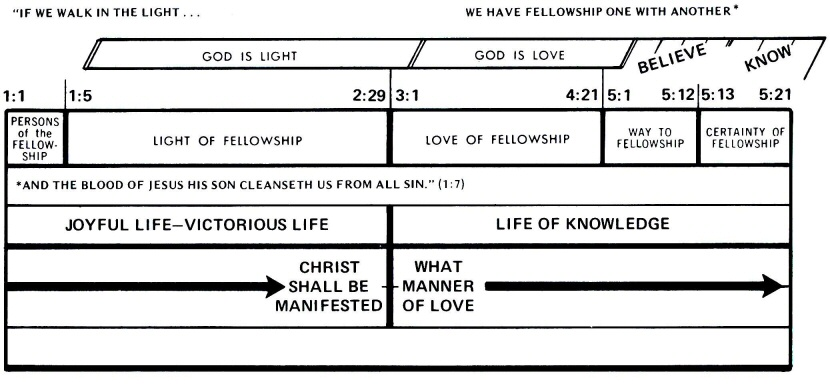
FELLOWSHIP WITH GOD AND HIS CHILDREN
Click chart to enlarge
Charts from Jensen's Survey of the NT - used by permission
Another Overview Chart - 1 John - Charles Swindoll
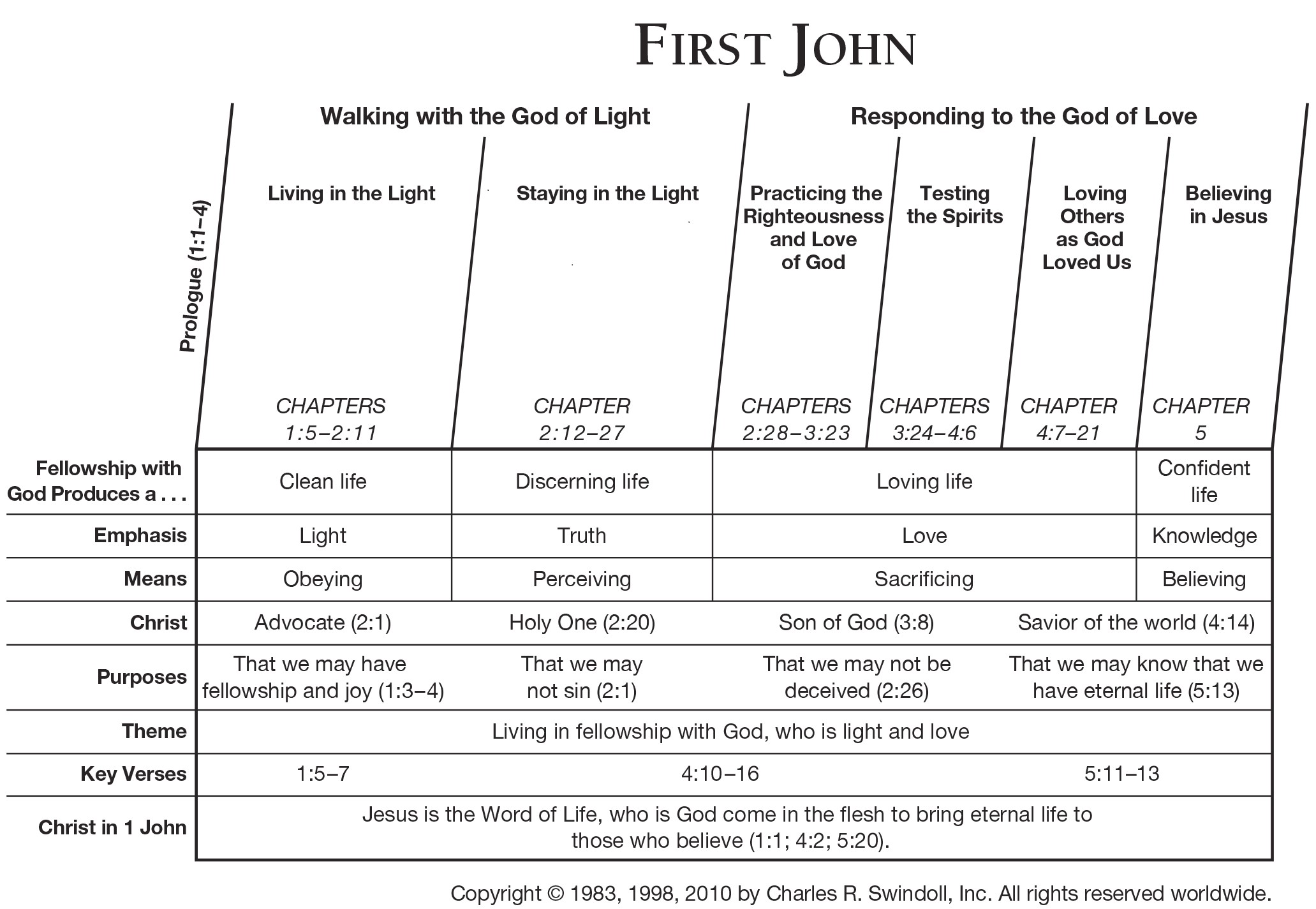
| BASIS OF FELLOWSHIP | BEHAVIOR OF FELLOWSHIP | ||||
| Conditions of Fellowship |
Cautions of Fellowship |
Fellowship Characteristics |
Fellowship Consequences |
||
| Meaning of Fellowship 1 Jn 1:1-2:27 |
Manifestations of Fellowship 1 Jn 2:28-5:21 |
||||
| Abiding in God's Light |
Abiding in God's Love |
||||
| Written in Ephesus | |||||
| circa 90 AD | |||||
| From Talk Thru the Bible | |||||
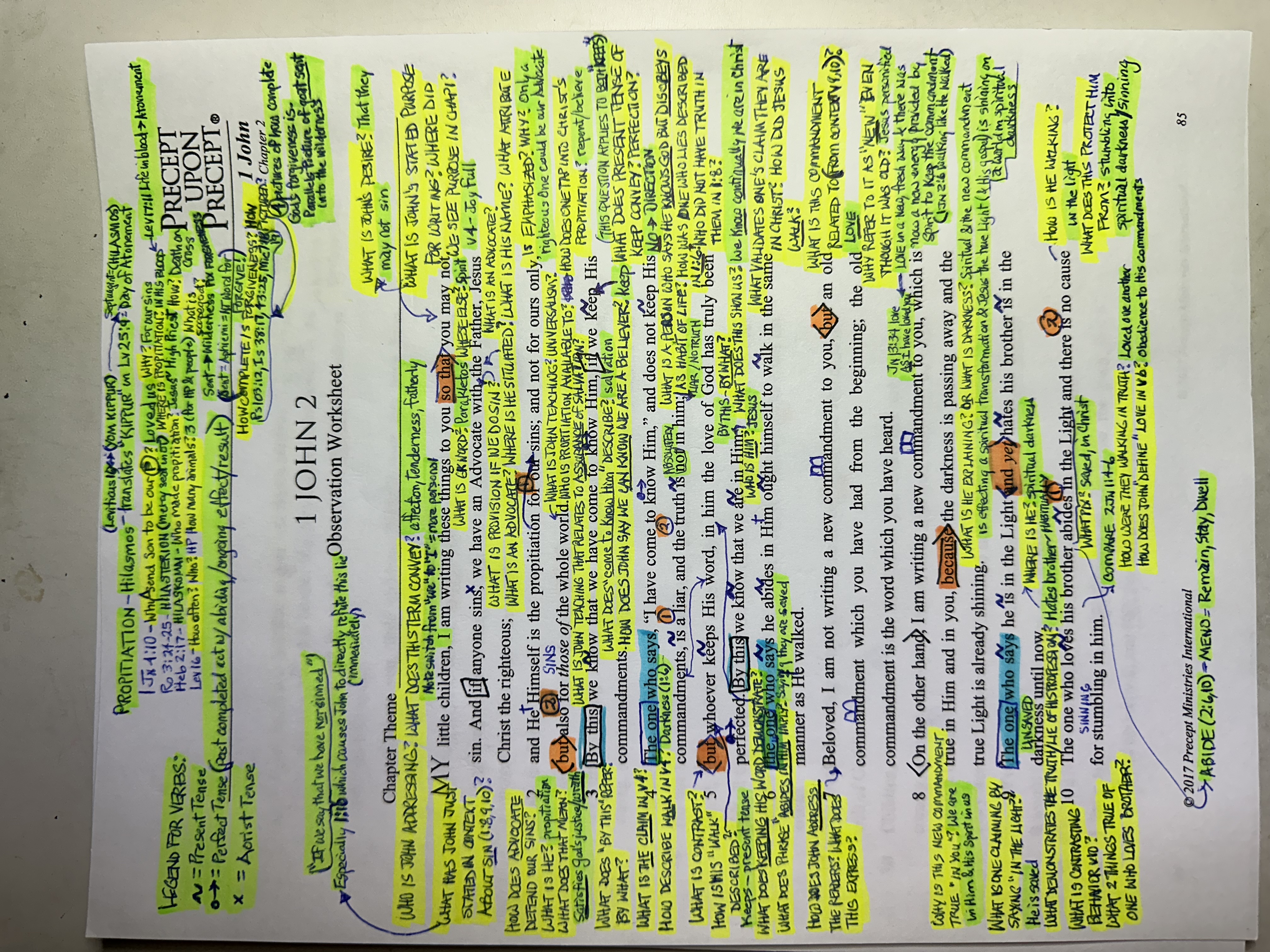
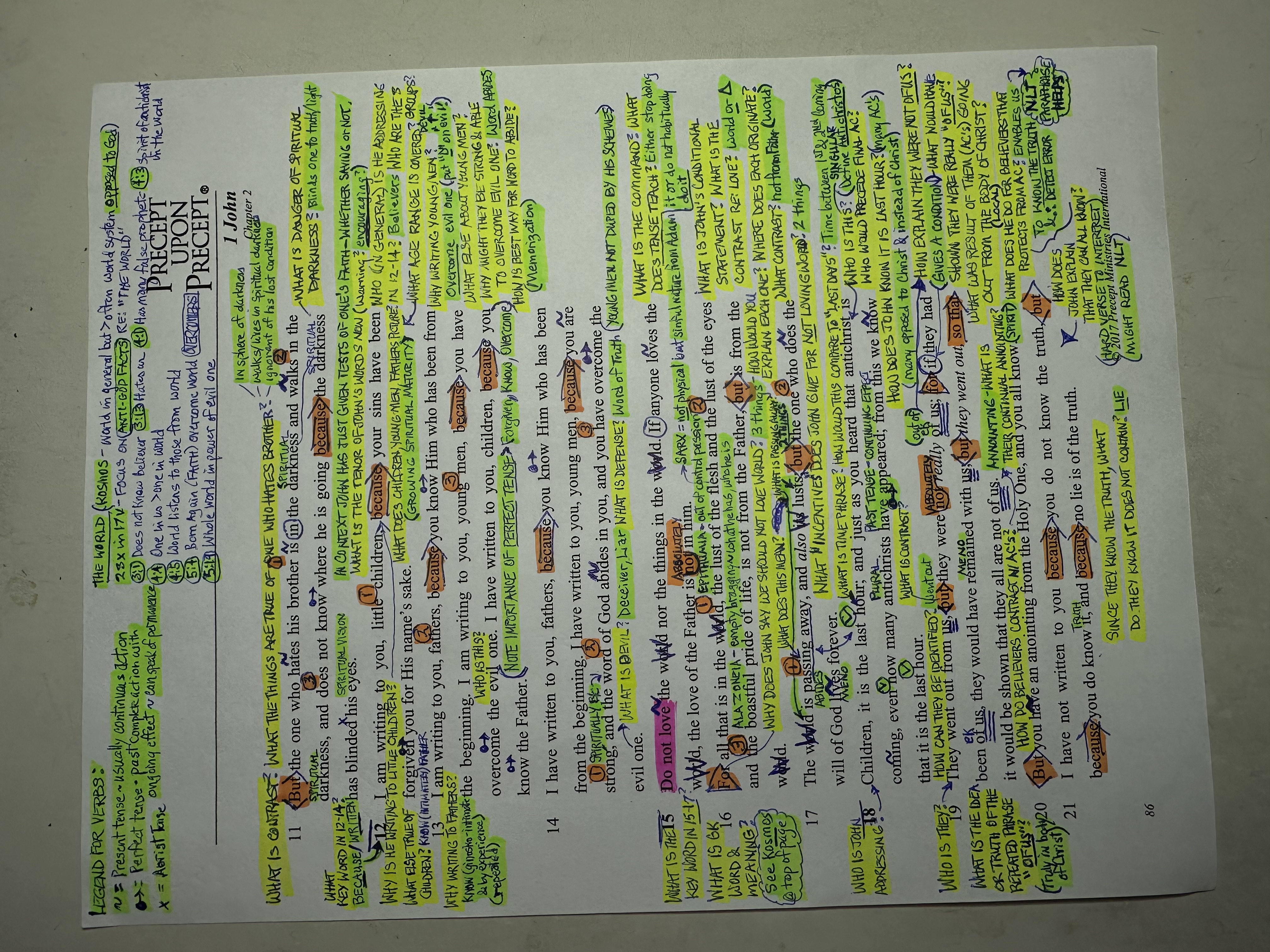
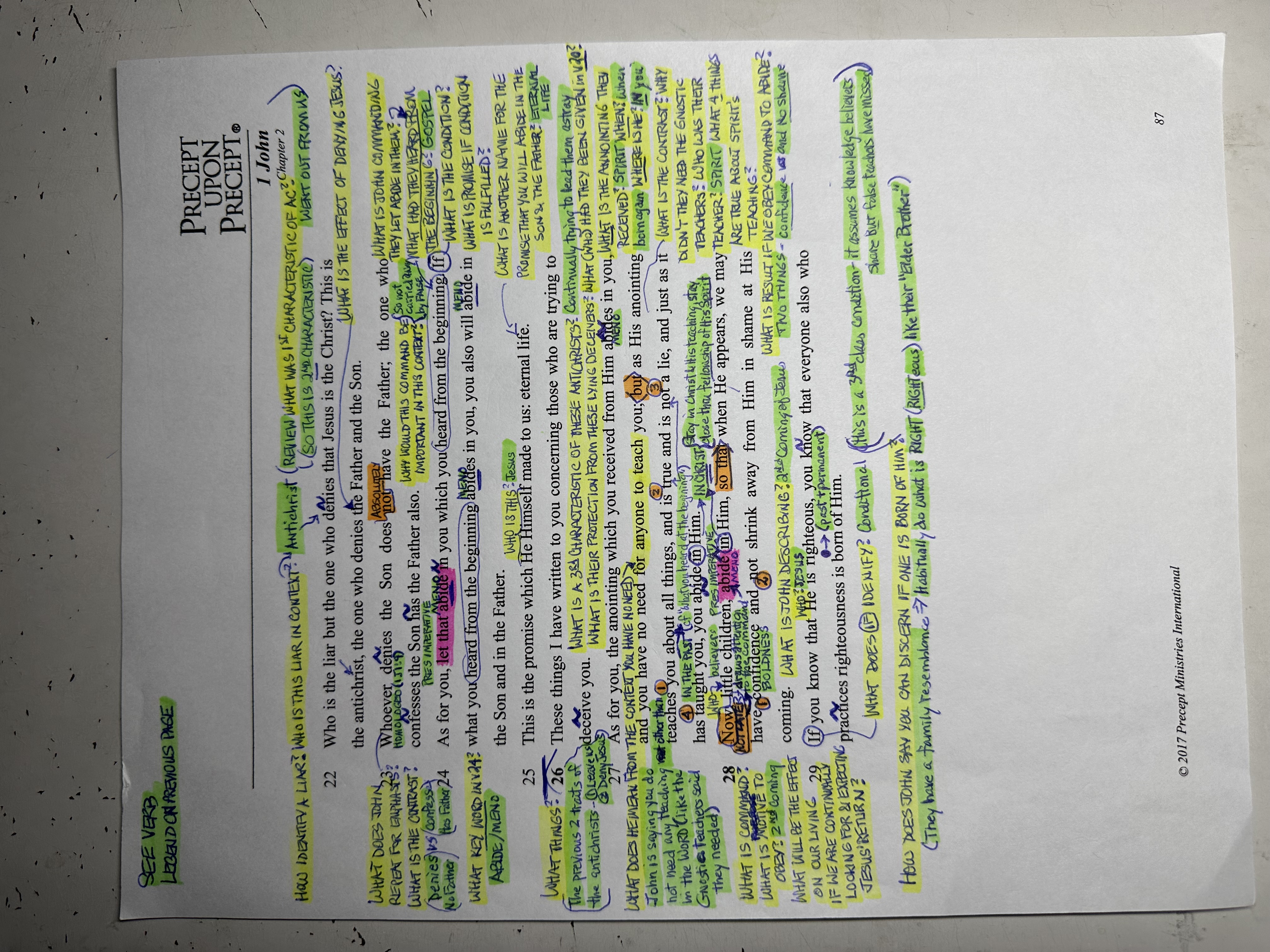
What is this? On the photograph of the Observation Worksheet for this chapter you will find handwritten 5W/H questions (Who? What? Where? When? Why? How?) on each verse to help you either personally study or lead a discussion on this chapter. The questions are generally very simple and are stated in such a way as to stimulate you to observe the text to discern the answer. As a reminder, given the truth that your ultimate Teacher is the Holy Spirit, begin your time with God with prayer such as Psalm 119:12 "Blessed are You, O LORD; Teach me Your statutes." (you can vary it with similar prayers - Ps 119:18, 26, 33, 64, 66, 68, 108, 124, 135, 171, etc) The questions are generally highlighted in yellow and the answers in green. Some questions have no answers and are left to your observations and the illuminating/teaching ministry of the Holy Spirit. Some qualifying thoughts - (1) Use "As is" - these are handwritten and will include mistakes I made, etc. (2) They may not be the best question for a given verse and my guess is that on some verses you will think of a far superior 5W/H question and/or many other questions.
Dr Howard Hendricks once gave an assignment to his seminary students to list as many observations as they could from Acts 1:8. He said "So far they’ve come up with more than 600 different ones! Imagine what fun you could have with 600 observations on this passage. Would you like to see Scripture with eyes like that?" (P. 63 Living by the Book - borrow) With practice you can! And needless to say, you will likely make many more observations and related questions than I recorded on the pages below and in fact I pray that the Spirit would indeed lead you to discover a veritable treasure chest of observations and questions! In Jesus' Name. Amen
Why am I doing this? Mortimer Adler among others helped me develop a questioning mindset as I read, seeking to read actively rather than passively. Over the years I have discovered that as I have practiced reading with a 5W/H questioning mindset, it has yielded more accurate interpretation and the good fruit of meditation. In other words, consciously interacting with the inspired Holy Word of God and the illuminating Holy Spirit has honed my ability to meditate on the Scripture, and my prayer is that this tool will have the same impact in your spiritual life. The benefits of meditation are literally priceless in regard to their value in this life and in the life to come (cf discipline yourself for godliness in 1Ti 4:8.) For some of the benefits - see Joshua 1:8 and Psalm 1:2-3. It will take diligence and mental effort to develop an "inductive" (especially an "observational"), interrogative mindset as you read God's Word, but it bears repeating that the benefits in this life and the rewards in the next will make it more than worth the effort you invest! Dear Christian reader let me encourage you to strongly consider learning the skills of inductive Bible study and spending the rest of your life practicing them on the Scriptures and living them out in your daily walk with Christ.
Although Mortimer Adler's advice is from a secular perspective, his words are worth pondering...
Strictly, all reading is active. What we call passive is simply less active. Reading is better or worse according as it is more or less active. And one reader is better than another in proportion as he is capable of a greater range of activity in reading. (Adler's classic book How to Read a Book is free online)
John Piper adds that "Insight or understanding is the product of intensive, headache-producing meditation on two or three verses and how they fit together. This kind of reflection and rumination is provoked by asking questions of the text. And you cannot do it if you hurry. Therefore, we must resist the deceptive urge to carve notches in our bibliographic gun. Take two hours to ask ten questions of Galatians 2:20 and you will gain one hundred times the insight you would have attained by reading thirty pages of the New Testament or any other book. Slow down. Query. Ponder. Chew.... (John Dewey rightly said) "People only truly think when they are confronted with a problem. Without some kind of dilemma to stimulate thought, behavior becomes habitual rather than thoughtful.”
“Asking questions is the key to understanding.”
--Jonathan Edwards
That said, below are the 5W/H questions for each verse in this chapter (click page to enlarge). This is not neatly typed but is handwritten and was used for leading a class discussion on this chapter, so you are welcome to use it in this "as is" condition...
 |
 |
 |
1 John 2:17 The world is passing away, and also its lusts; but the one who does the will of God lives forever. (NASB: Lockman)
Greek: kai o kosmos paragetai (3SPPI) kai e epithumia autou, o de poion (PAPMSN) to thelema tou theou menei (3SPAI) eis ton aiona.
Amplified: And the world passes away and disappears, and with it the forbidden cravings (the passionate desires, the lust) of it; but he who does the will of God and carries out His purposes in his life abides (remains) forever. (Amplified Bible - Lockman)
ASV: And the world passeth away, and the lust thereof: but he that doeth the will of God abideth for ever.
BBE: And the world and its desires is coming to an end: but he who does God's pleasure is living for ever.
GWT: the world and its evil desires are passing away. But the person who does what God wants lives forever. (GWT)
ICB: The world is passing away. And everything that people want in the world is passing away. But the person who does what God wants lives forever. (ICB: Nelson)
ISV: And the world and its desires are fading away, but the person who does God's will remains forever.
KJV: And the world passeth away, and the lust thereof: but he that doeth the will of God abideth for ever.
Macent: and the world is passing away, with all its vices: but he that obeys the divine will, shall enjoy a life of immortality.
NAB: Yet the world and its enticement are passing away. But whoever does the will of God remains forever.
NCV: The world and everything that people want in it are passing away, but the person who does what God wants lives forever. (NCV)
NJB: And the world, with all its disordered desires, is passing away. But whoever does the will of God remains for ever
NLT: And this world is fading away, along with everything that people crave. But anyone who does what pleases God will live forever (NLT - Tyndale House)
Phillips: The world and all its passionate desires will one day disappear. But the man who is following God's will is part of the permanent and cannot die. (Phillips: Touchstone)
TEV: The world and everything in it that people desire is passing away; but those who do the will of God live forever.
Wuest: And the world is being caused to pass away, and its passionate desire. But the one who keeps on habitually doing the will of God abides forever.
Young's Literal: And the world, with its cravings, is passing away, but he who does God's will continues for ever.
The world is passing away, and also its lusts: kai o kosmos paragetai (3SPPI) kai e epithumia autou:
- Ps 39:6; Ps 73:18-20; Ps 90:9; Ps 102:26; Isaiah 40:6-8; Matthew 24:35; 1 Corinthians 7:31; James 1:10-11; James 4:14; 1Peter 1:24
- 1 John 2 Resources - Multiple Sermons and Commentaries
Related Passages:
1 John 2:8 On the other hand, I am writing a new commandment to you, which is true in Him and in you, because the darkness is passing away (parago - present tense - in process of disappearing) and the true Light (OF JESUS CHRIST) is already shining.
1 Corinthians 7:31 and those who use the world, as though they did not make full use of it; for the form of this world is passing away (parago - present tense - in process of disintegration).”
Psalms 39:6 “Surely every man walks about as a phantom; Surely they make an uproar for nothing; He amasses riches and does not know who will gather them.
Psalm 73:18-20 Surely You set them in slippery places; You cast them down to destruction. 19 How they are destroyed in a moment! They are utterly swept away by sudden terrors! 20 Like a dream when one awakes, O Lord, when aroused, You will despise their form.
James 1:10-11 and the rich man is to glory in his humiliation, because like flowering grass he will pass away. 11 For the sun rises with a scorching wind and withers the grass; and its flower falls off and the beauty of its appearance is destroyed; so too the rich man in the midst of his pursuits will fade away.
James 4:14 Yet you do not know what your life will be like tomorrow. You are just a vapor that appears for a little while and then vanishes away.
2 Corinthians 4:18 while we look not at the things which are seen, but at the things which are not seen; for the things which are seen are temporal, but the things which are not seen are eternal.
A GREAT REASON TO
NOT LOVE THE WORLD
The world (kosmos) is passing away (parago) and also its lusts (epithumia) - It is not that it merely may pass or will pass, it is passing away right now before our eyes. John shows why it is utterly foolish to desire the world and it is because it is passing away. Passing away (parago) is in the present tense depicting the world as in the process of passing out of existence. Beloved, the world system is not evolving, but is actively devolving. It will grow worse and worse, darker and darker over time. So do not be surprised by the rise of evil and the calling of evil good and good evil. In 2024 we are in a present evil age (Gal 1:4). In light of this clear truth, we need to realize that when we love anything more than the true and living God revealed in the Bible, we are worshiping something that will not last. And it will not be able to help us when our plans shatter, our health fails, or death beckons. Only the true and living God can help then. Beloved, time is passing -- have you chosen the eternal love of the Father and not the passing, empty love of the world?
John MacArthur comments that this passage highlights the radical contrast - "The principle of spiritual death that permeates the world is the exact opposite of the principle of spiritual life, which operates in God’s kingdom. Thus, the living dead (Eph 2:1) in the world are destined for eternal death in hell, but Christians are destined for eternal life in heaven (Matt. 13:37–50; 25:31–46; cf. Matt. 5:12a; Luke 10:20; Heb. 12:22–23; 1 Peter 1:3–5)." (See 1-3 John MacArthur New Testament Commentary - Page 90)
Daniel Akin -The heart of John’s argument is now given. This final verse of the section “contrasts the outcomes of these two loves, two lives, and two orientations toward Life.” (Culpepper) When compared with a life lived in the will of God, the things this life has to offer are really empty imitations of God’s best. The things of the world seem to be of great value, but they are worthless when compared to the eternal blessings that come from doing the will of God. (See 1,2,3 John: An Exegetical and Theological Exposition)
John Stott - The same choice between God and the world, or more particularly between the lust of the world and the will of God, still confronts Christians. We shall more readily obey the command ‘do not love the world’ if we remember that while the world and its desires are transient, God’s will and those who do it are alike eternal (cf. 2 Cor. 4:18). (Borrow The Letters of John)
Colin Kruse on passing away - "All that is antithetical to God and his grace is passing away; it is doomed. There is no future in worldliness." (See The Letters of John - Page 96)
I love William MacDonald's "investment" advice - When a bank is breaking, smart people do not deposit in it. When the foundation is tottering, intelligent builders do not proceed. Concentrating on this world is like rearranging the deck chairs on the Titanic. So wise people do not live for a world that is passing away. (Borrow Believer's Bible Commentary)
John is contrasting two ways of life:
a life lived for eternity and a life lived for time.
A worldly person lives for the pleasures of the flesh,
but a dedicated Christian lives for the joys of the Spirit.
Warren Wiersbe adds this good advice - Spiritual Christians keep themselves “loosely attached” to this world because they live for something far better. They are “strangers and pilgrims on the earth” (Heb. 11:13). “For here have we no continuing city, but we seek one to come” (Heb. 13:14). In Bible times, many believers lived in tents because God did not want them to settle down and feel at home in this world. John is contrasting two ways of life: a life lived for eternity and a life lived for time. A worldly person lives for the pleasures of the flesh, but a dedicated Christian lives for the joys of the Spirit. A worldly believer lives for what he can see, the lust of the eyes; but a spiritual believer lives for the unseen realities of God (2 Cor. 4:8–18). A worldly minded person lives for the pride of life, the vainglory that appeals to men; but a Christian who does the will of God lives for God’s approval. And he “abideth forever.” (Bible Exposition Commentary)
Jesus presented the proper perspective for the love for this present passing away world over the love for the future world without end asking…
For what will a man be profited, if he gains the whole world, and forfeits his soul? Or what will a man give in exchange for his soul? (Matthew 16:26) (Talk about the ultimate "Profit and Loss" Statement!)
Adam Clarke writes that the world is passing away speaks of "All these things continually fading and perishing; and the very state in which they are possessed is changing perpetually, and the earth and its works will be shortly burnt up.
Worldliness is the love for passing things.
The human heart can never find satisfaction with things.
-- William MacDonald
World (2889) (kosmos related to verb kosmeo = to order or adorn, to put in order [Mt 25:7 = "trimmed"], to adorn literally [1Ti 2:9], to adorn figuratively [Titus 2:9]) means essentially something that is well-arranged, that which has order or something arranged harmoniously and has various meanings which are dependent on the context. In 1 John 2:15-17, world is used 6 times and every use conveys the moral/ethical meaning, referring to the "ordered" system of which Satan is the head (1Jn 5:19), the fallen angels are his demonic emissaries and the unsaved men and women tragically are his "subjects".
Wuest adds that in addition to spiritual forces and unsaved of the human race, the ethical aspect of kosmos also includes "those purposes, pursuits, pleasures, practices, and places where God is not wanted. Much in this world-system is religious, cultured, refined, and intellectual. But it is anti-God and anti-Christ."
Vincent notes that the ethical meaning of kosmos refers to "The sum-total of human life in the ordered world, considered apart from, alienated from, and hostile to God, and of the earthly things which seduce from God (Jn 7:7; 15:18; 17:9, 14; 1Cor. 1:20, 21; 2Cor. 7:10; Jas 4:4).
Bishop Trench defines the ethical kosmos as
"All that floating mass of thoughts, opinions, maxims, speculations, hopes, impulses, aims, aspirations, at any time current in the world, which it may be impossible to seize and accurately define, but which constitutes a most real and effective power, being the moral, or immoral atmosphere which at every moment of our lives we inhale, again inevitably to exhale."
Related Resources:
- An Out-of-this-World Experience A Look at Kosmos in the Johannine Literature
- 6 page article on Kosmos in New International Dictionary of NT Theology
Steven Cole - In 1989, Tom Sine wrote some insightful words that apply just as much now, as then (Christianity Today [3/17/89], p. 52): Whatever commands our time, energy, and resources commands us. And if we are honest, we will admit that our lives really aren’t that different from those of our secular counterparts. I suspect that one of the reasons we are so ineffective in evangelism is that we are so much like the people around us that we have very little to which we can call them. We hang around church buildings a little more. We abstain from a few things. But we simply aren’t that different. We don’t even do hedonism as well as the folks around us … but we keep on trying. As a result of this unfortunate accommodation, Christianity is reduced to little more than a spiritual crutch to help us through the minefields of the upwardly mobile life. God is there to help us get our promotions, our house in the suburbs, and our bills paid. Somehow God has become a co-conspirator in our agendas instead of our becoming a co-conspirator in His. Something is seriously amiss. (Choose Your Love: the World or the Father? 1 John 2:15-17)
Spurgeon - This world is fading away! Hate the world, value its treasure at a cheap price, estimate its gems as nothing but fakes, and its strength as nothing but dreams. Do not think that you will lose any pleasure, but rather remember the saying of that early Church leader Chrysostom … "Despise riches, and you will be rich; despise glory, and you will be glorious; despise injuries, and you will be a conqueror; despise rest, and you will gain rest; despise the earth, and you will gain heaven!" (Spurgeon Collection)
J C Ryle - The possession of the whole world, and all that it contains — will never make a person happy. Its pleasures are false and deceptive! Its riches, rank, and honors, have no power to satisfy the heart! So long as we have not got them — they glitter, sparkle, and seem desirable. The moment we have them — we find that they are empty bubbles, and cannot make us feel content. And, worst of all, when we possess this world's good things to the utmost bound of our desire — we cannot keep them! Death comes in and separates us from all our property forever! Naked we came upon earth, and naked we go forth — and of all our possessions, we can carry nothing with us. Such is the world, which occupies the whole attention of thousands! Such is the world, for the sake of which millions are every year destroying their souls! (We find that they are empty bubbles!)
Passing away (3855) (parago from para = beside, by + ago = lead) means literally to pass alongside or to pass by. Thayer writes that parago has two senses in the NT (1). transitive, (cf. para = beside); a. to lead past, lead by. b. to lead aside, mislead; to lead away. c. to lead to; to lead forth, bring forward. (2). intransitive, a. to pass by, go past (Mt 20:30, Mk 2:14, 15:21, Mk 1:16) b. to depart, go away: (Jn 8:59) Metaphorically, to pass away, disappear: (1Co 7:31, Ps 144:5, in the passive voice with this same sense 1Jn 2:8, 17)
Thus in the present context parago means essentially to go out of existence or cease to exist. John used parago with this same sense earlier in this letter writing "On the other hand, I am writing a new commandment to you, which is true in Him and in you, because the darkness is passing away, and the true light is already shining." (1Jn 2:8)
Parago - 10 uses in the NT…
Matthew 9:9 And as Jesus passed on from there, He saw a man, called Matthew, sitting in the tax office; and He said to him, "Follow Me!" And he rose, and followed Him.
Matthew 9:27 And as Jesus passed on from there, two blind men followed Him, crying out, and saying, "Have mercy on us, Son of David!"
NET Bible note: Have mercy on us is a request for healing. It is not owed to the men. They simply ask for God's kind grace. There was a tradition in Judaism that the Son of David (Solomon) had great powers of healing (Josephus, Ant. 8.2.5 [8.42–49]). (NET Bible)
Matthew 20:30 And behold, two blind men sitting by the road, hearing that Jesus was passing by, cried out, saying, "Lord, have mercy on us, Son of David!"
Mark 1:16 And as He was going along by the Sea of Galilee, He saw Simon and Andrew, the brother of Simon, casting a net in the sea; for they were fishermen.
NET Bible note: This is a parenthetical comment by the author.
Mark 2:14 And as He passed by, He saw Levi the son of Alphaeus sitting in the tax office, and He said to him, "Follow Me!" And he rose and followed Him.
NET Bible note: The tax booth was a booth located on the edge of a city or town to collect taxes for trade. There was a tax booth in Capernaum, which was on the trade route from Damascus to Galilee and the Mediterranean. The “taxes” were collected on produce and goods brought into the area for sale, and were a sort of “sales tax” paid by the seller but obviously passed on to the purchaser in the form of increased prices (L&N 57.183). It was here that Jesus met Levi (also named Matthew [see Matt 9:9]) who was ultimately employed by the Romans, though perhaps more directly responsible to Herod Antipas. It was his job to collect taxes for Rome and he was thus despised by Jews who undoubtedly regarded him as a traitor. (NET Bible)
Mark 15:21 And they pressed into service (conscripted) a passer-by coming from the country, Simon of Cyrene (the father of Alexander and Rufus), to bear His cross.
NET Bible note: Jesus was beaten severely with a whip before this (the prelude to crucifixion, known to the Romans as verberatio, mentioned in Mt 27:26, Mk 15:15, Jn 19:1), so he would have been weak from trauma and loss of blood. Apparently He was unable to bear the cross Himself, so Simon was conscripted to help (in all probability this was only the crossbeam, called in Latin the patibulum, since the upright beam usually remained in the ground at the place of execution). Cyrene was located in North Africa where Tripoli is today. Nothing more is known about this Simon. (NET Bible)
John 9:1 And as He passed by, He saw a man blind from birth.
NET Bible note: Since there is no break with John 8, Jesus is presumably still in Jerusalem, and presumably not still in the temple area. The events of John 9 fall somewhere between the feast of Tabernacles (John 7:2) and the feast of the Dedication (John 10:22). But in the author’s narrative the connection exists - the incident recorded in chap. 9 (along with the ensuing debates with the Pharisees) serves as a real-life illustration of the claim Jesus made in 8:12, I am the light of the world. This is in fact the probable theological motivation behind the juxtaposition of these two incidents in the narrative. The second serves as an illustration of the first, and as a concrete example of the victory of light over darkness. One other thing which should be pointed out about the miracle recorded in John 9 is its messianic significance. In the OT it is God himself who is associated with the giving of sight to the blind (Ex4:11, Ps 146:8). In a number of passages in Isa 29:18, 35:5, 42:7 it is considered to be a messianic activity. (NET Bible)
1 Corinthians 7:31 and those who use the world, as though they did not make full use of it; for the form of this world is passing away.
1 John 2:8 On the other hand, I am writing a new commandment to you, which is true in Him (Jesus Christ) and in you, because the darkness is passing away, and the true light is already shining.
NET Bible note: The reference to the darkness…passing away and the true light…already shining is an allusion to John 1:5, 1:9, and 8:12. Because the author sees the victory of light over darkness as something already begun, he is writing Jesus’ commandment to love one another to the readers as a reminder to (1) hold fast to what they have already heard (see 1Jn 2:7) and (2) not be influenced by the teaching of the opponents. (NET Bible)
1 John 2:17 And the world is passing away, and also its lusts; but the one who does the will of God abides forever.
Parago - 9 times in the non-apocryphal Septuagint (LXX) - 1Sa 16:9, 10; 20:36; 2Sa 15:18; Ezra 9:2; Neh 2:7; Ps 129:8; 144:4; Eccl 11:10. There is one use of parago that is similar to John's use in 1Jn 2:17…
Psalm 144:4 Man is like a mere breath. His days are like a passing (Lxx = parago) shadow. (NET Bible note: Hebrew = "his days [are] like a shadow that passes away," that is, like a late afternoon shadow made by the descending sun that will soon be swallowed up by complete darkness. Cp Ps 102:11-Spurgeon's note)
Spurgeon comments: He is nothing, he pretends to be something, he is soon gone, he ends in nothing as to this life; yet there is a light somewhere.
Adam is like to Abel (Hebrew means a breath, vanity, vapor, transitoriness, fading away, withering). He is like that which is nothing at all. He is actually vain, and he resembles that unsubstantial empty thing which is nothing but a blown up nothing, -- a puff, a bubble. Yet he is not vanity, but only like it. He is not so substantial as that unreal thing; he is only the likeness of it. Lord, what is a man? (Ps 8:4-Spurgeon's note) It is wonderful that God should think of such a pretentious insignificance.
He is so short lived that he scarcely attains to years, but exists by the day, like the ephemera (Spurgeon undoubtedly is referring to the Day-fly, a fly that lives one day only, but the word is applied also to insects that are very short-lived, whether they live several days or an hour only. The ultimate picture is something of no lasting significance), whose birth and death are both seen by the self same sun. His life is only like to a shadow, which is in itself a vague resemblance, an absence of something rather than in itself an existence. Observe that human life is not only as a shade, but as a shade which is about to depart. It is a mere mirage, the image of a thing which is not, a phantasm which melts back into nothing. How is it that the Eternal should make so much of mortal man, who begins to die as soon as he begins to live?
The connection of the two verses before us with the rest of the psalm is not far to seek: David trusts in God and finds him everything; he looks to man and sees him to be nothing; and then he wonders how it is that the great Lord can condescend to take notice of such a piece of folly and deceit as man.
Bellarmine -- The shadows of the mountains are constantly shifting their position during the day, and ultimately disappear altogether on the approach of night: so is it with man who is every day advancing to the moment of his final departure from this world.
George Swinnock -- As he that goes to a fair, with a purse full of money, is devising and debating with himself how to lay it out -- possibly thinking that such and such commodities will be most profitable, and bring him in the greatest gain -- when on a sudden a cut purse comes and eases him both of his money and care how to dispose of it.
Surely you might have taken notice how some of thy neighbors or countrymen, when they have been busy in their contrivances, and big with many plots and projects how to raise their estate and names and families, were arrested by death in a moment, returned to their earth, and in that day all their gaiety, their great thoughts perished, and came to nothing.
The heathen historian could not but observe how Alexander the Great, when he had to carry on his great designs, summoned a parliament before him of the whole world, he was himself summoned by death to appear in the other world.
The Dutch, therefore, very wittily to express the world's vanity, picture at Amsterdam a man with a full blown bladder on his shoulders, and another standing by pricking the bladder with a pin, with this motto, quam subito, How soon is all blown down!
Joseph Caryl -- When Cain was born, there was much ado about his birth; "I have gotten a man child from God", saith his mother: she looked upon him as a great possession, and therefore called his name Cain, which signifies "a possession." But the second man that was born unto the world bare the title of the world, "vanity"; his name was Abel, that is, "vanity." A premonition was given in the name of the second man what would or should be the condition of all men. In Psalms 144:4 there is an allusion unto those two names. We translate it, "Man is like to vanity"; the Hebrew is, "Adam is as Abel"; Adam, you know, was the name of the first man, the name of Abel's father; but as Adam was the proper name of the first, so it is an appellative, or common to all men: now Adam, that is, man of all men, are Abel, vain, and walking in a vain show.
Thomas Raffles (1788-1863) -- With what idle dreams, what foolish plans, what vain pursuits, are men for the most part occupied! They undertake dangerous expeditions and difficult enterprises in foreign countries, and they acquire fame; but what is it? -- Vanity! They pursue deep and abstruse speculations, and give themselves to that "much study which is a weariness to the flesh", and they attain to literary renown, and survive in their writings; but what is it? -- Vanity! They rise up early, and sit up late, and eat the bread of anxiety and care, and thus they amass wealth; but what is it? -- Vanity! They frame and execute plans and schemes of ambition -- they are loaded with honours and adorned with titles -- they afford employment for the herald, and form a subject for the historian; but what is it? -- Vanity!
In fact, all occupations and pursuits are worthy of no other epithet, if they are not preceded by, and connected with, a deep and paramount regard to the salvation of the soul, the honour of God, and the interests of eternity … Oh, then, what phantoms, what airy nothings are those things that wholly absorb the powers and occupy the days of the great mass of mankind around us! Their most substantial good perishes in the using, and their most enduring realities are but "the fashion of this world that passeth away."
Warren Wiersbe - What are we that God should pay any attention to us? Are we smart? I don't think so. Are we strong? Some animals are much stronger than we are. Are we righteous? No, we have sinned against God. Are we faithful? Too often we disobey Him. From the human point of view, there is no reason why God should pay any attention to us. "Man is like a breath; his days are like a passing shadow" (Psalm 144:4). Compared to eternity, our lives are just a puff of smoke. They appear, and then they are gone. David’s position and reputation did not go to his head, for he asked, “Who am I that God should do this for me?” The statements in Ps 144:3,4 remind us of Ps 8:4, and this is a reminder that we need, especially when we think we can handle life without trusting God. The Hebrew word translated “breath” is habel, the name of one of Adam’s sons (Abel), and the word translated “vanity” thirty-eight times in Ecclesiastes. (See also Ps 39:4, 5, 6, 13; Ps 62:9; Ps 78:33; Ps 94:11.) The “shadow” image is found in Ps 102:11, 109:23, Job 8:9 and Job 14:2, and Ecclesiastes 6:12 and Eccl 8:13. How helpless we are without the Lord! (Bible Exposition Commentary ) (Bolding and color added)
The brevity of our earthly life…
A profitable subject for meditation.
A rebuke to those who provide for this life alone.
A trumpet call to prepare for eternity.
An incentive to the Christian to make the best of this life for the glory of God. --J.F.
Spurgeon on Passing away - It is only a puff, a phantom, a bubble, a mirage which will melt away as you try to approach it; there is nothing substantial in it. Does the will of God abides for ever. Not, “he that doeth some great thing to be seen of men, “ not, “ he that builds a row of almshouses, or leaves a great mass of money to charity when he dies, because he could not possibly carry it away with him, “not, “he that sounds a trumpet before him to let everybody know what a good man he is;” not, “he that must needs outdistance everybody else;” but, “he that doeth the will of God abideth for ever.” Obedience to the will of God is the pathway to perpetual honour and everlasting joy. (Spurgeon on 1 John-Pt2)
A T Robertson = There is consolation in this view of the transitoriness of the conflict with the world. Even the lust which belongs to the world passes also. The one who keeps on doing ([poiōn] present active participle of [poieō]) the will of God “abides for ever” ([menei eis ton aiōna]) “amid the flux of transitory things” (D. Smith). (Word Pictures in the New Testament)
Kenneth Wuest - The verb (parago) is in the passive voice. The world is being caused to pass by. That is, God is causing the world to come to its end. It is being caused to pass by in a vain (futile) show, this parade of the world. But, John says, “The one who keeps on habitually doing the will of God abides forever.” (see amplification of this idea below) (Eerdmans Publishing - used by permission) (Bolding and italics added)
Adam Clarke writes that also its lusts includes "their vain pursuits, and delusive pleasures, are passing away in their successive generations, and their very memory perishes."
Lust (1939) (epithumia from epi = at, toward {the preposition "epi-" in the compound is directive conveying the picture of "having one’s passion toward"} + thumos = passion. Related verb epithumeo = set heart upon) is a neutral term denoting the presence of strong desires or impulses, longings or passionate cravings (good or evil as determined by the context) directed toward an object. The three uses of epithumia in 1John 2:16, 17 obviously refer to those strong inner longings for that which is evil, those passionate cravings one has for the things which are forbidden by the word of God. These evil desires, impulses and passions are constantly arising from the evil nature, the flesh, (cp Jas 1:14) even as smoke rises from a chimney because there is a fire in fireplace. The evil flesh nature (the "fire in the fireplace") is not eradicated even in believers although it's power over the believer is broken (Ro 6:6), and the believer no longer is obligated to obey the evil lusts. The wise believer would do well to remember that the lusts of the flesh are constantly attempting to control the believer's heart and mind, as it did before salvation wrought its work in his being. John gives us the great "prophetic promise" that these lusts are passing away some day in the future.
W. E. Vine comments that epithumia - describes the inner motions of the soul, the natural tendency of men in their fallen estate toward things evil and toward things forbidden. (Vine, W E: Vine's Complete Expository Dictionary of Old and New Testament Words. 1996. Nelson)
I Howard Marshall sums up the tragedy of loving this present world rather than the world to come - Many people are tempted to live for the moment, to conform to the way of life of a material world, and either to question the temporary character of material life or to hope that there will be no judgment. It is a natural tendency to make oneself comfortable here in the present real world rather than to deny oneself here in hope of a better life hereafter. But John’s reply would be that the judgment is taking place already; even now the world is in process of dissolution; men are blind if they do not realize what is going on before their very eyes (cf. Lk. 12:54–56). For John it is indeed already “the last hour” (1Jn 2:18). (Borrow The Epistles of John)
Simon Kistemaker adds "Man needs to look at the fleeting existence of worldly people, pleasures, and desires. If he places his interest in that which is here today and gone tomorrow, he reaps a harvest of instability, stumbles in the darkness of sin and, because he has cast his lot with the world, faces a similar end. “For this world in its present form is passing away” (1 Cor. 7:31)." (Exposition of James, Epistles of John)
But the one who does the will of God lives forever: o de poion (PAPMSN) to thelema tou theou menei (3SPAI) eis ton aiona:
- Ps 143:10; Matthew 7:21; Mt 21:31; Mark 3:35; John 7:17; Romans 12:2; Colossians 1:9; 4:12; 1Thes 4:3; 1Thes 5:18; Hebrews 10:36; 1 Peter 4:2
- Lives - Psalms 125:1,2; Proverbs 10:25; John 4:14; 6:58; 10:28, 29, 30; 1Peter 1:5,25
- 1 John 2 Resources - Multiple Sermons and Commentaries

1 John 2:17b Inscribed on D L Moody's Gravestone
But - Introduces a marked contrast. Contrast words like but usually indicate a "change in direction" and in this case John presents even a change in destiny, in this case eternal life (which by "default" contrasts with eternal death).
Colin Kruse - There will come a time when the world which is passing away will have passed away, but those who do the will of God will not have passed away with it, for they will remain forever. (See The Letters of John - Page 96)
Victory is assured,
resistance is required.
-- Culpepper
The one who does (poieo in present tense) the will (thelema) of God lives (meno) forever - The verb does (poieo) is in the present tense which indicates this individual as a habit of their life pursues the will of God (most clearly revealed in the Word of God). What is the promise? They will live forever. They have eternal life and the assurance of that gift. While they are not perfect practitioners of the Word and will of God, John's point is that the general direction of their life is "heavenward" (in context as determined by what/Who they love - cp 1Jn 2:15).
Note carefully that one's obedience to the will of God does not earn or merit salvation/eternal life (which is a gift by God's grace [Ro 3:24] not a result of our works [cp Ro 3:20 where justified = declared righteous = saved], cf Eph 2:8-9), but does serve to prove (and give personal assurance) that one has truly been born again (from above, Jn 3:3). Their ability to do (obey) the will of God is not because of their natural ability, but because the Spirit (the indwelling Spirit, Ro 8:9) gives them a supernatural desire and power (Php 2:13NLT) to habitually pursue and practice God's will until the end of their life (cp Heb 3:6, Heb 3:14, cp 1Co 15:2 - their perseverance is evidence that they have been born again and have the Spirit for without Him they could not persevere to the end).
The apostle James declares that eternal life is promised to these who are doers of the Word and not merely hearers only, for the latter group (in context those who habitually love the world and do not love God) delude themselves (Jas 1:22, 23, 24, contrast Jas 1:25). These professors falsely reason that because they have heard the word about Jesus, they are safe from the coming wrath of God (2Th 1:8,9). They are deceived and will be among those to whom Jesus declares…
'I never (oudepote Greek literally = never at any time = so He is not saying they were saved and lost their salvation - the fact is that they were never, ever saved!) knew (ginosko - knew you intimately and personally) you; DEPART (an aorist imperative command - "Do it now!") FROM ME, YOU WHO PRACTICE (present tense - habitually, as your lifestyle - the antithesis of the one who [habitually] does the will of God) LAWLESSNESS (I.e., they practice sin for 1Jn 3:4+ says Sin = Lawlessness). '(Mt 7:23)
See discussion of The Will Of God and How can I know God's will for my life?
Colin Kruse on does the will of God - It is the opposite to all that is involved in loving the world. It means avoiding the ‘lust of the eyes’ and ‘pride in possessions’. Looking beyond the immediate context, doing the will of God in 1 John involves believing in his Son and loving fellow believers (1Jn 3:23). (See The Letters of John - Page 97)
Warren Wiersbe - Long after this world system, with its vaunted culture, its proud philosophies, its egocentric intellectualism, and its godless materialism, has been forgotten, and long after this planet has been replaced by the new heavens and the new earth, God’s faithful servants will remain—sharing the glory of God for all eternity. And this prospect is not limited to Moody, Spurgeon, Luther, or Wesley and their likes—it is open to each and every humble believer. If you are trusting Christ, it is for you. (Bible Exposition Commentary)
Lives (abides) (3306) (meno) means remains, stays or abides and in this context refers to one who continually remains in a certain realm, specifically the realm of "life" (as contrasted with eternal death, also known as the second death - see Rev 20:11-15; see also Tony Garland's discussion of Births, Deaths, and Resurrections) Note that the verb meno is in the present tense which speaks of the doers of the will of God continually remaining in the realm of life, a point emphasized by the following word, forever (eis ton aiona)!
The NET Bible translates meno as "remain" that…because the context contrasts the transience of the world and its desires with the permanence of the person who does God's will.
Colin Kruse on lives (remains) forever - Probably the best explanation of what it means to ‘remain forever’ is to be found in the teaching of Jesus in the Fourth Gospel. Again and again Jesus stresses that those who believe in him (sometimes expressed in terms of eating the bread he gives, or keeping his word, or hearing his voice) shall never perish but shall live and remain forever (John 6:51, 58; 8:51; 10:28; 11:26). (See The Letters of John - Page 97)
Forever is the Greek phrase "eis ton aiona" which literally reads "unto the age." Aion usually refers to some aspect of time past, present or future. This same Greek phrase, eis ton aiona, occurs 27 times in the NT and is usually translated forever -Mt. 21:19; Mk. 3:29; 11:14; Lk 1:55; Jn. 4:14; 6:51, 58; 8:35, 51, 52; 10:28; 11:26; 12:34; 13:8; Jn 14:16; 1Co. 8:13; 2Co 9:9; Heb 1:8; 5:6; 6:20; Heb 7:17, 21, 24, 28; 1Pe 1:25; 1Jn 2:17; 2Jn 1:2.
Adam Clarke writes that also its lusts includes "their vain pursuits, and delusive pleasures, are passing away in their successive generations, and their very memory perishes; but he that doeth the will of God—that seeks the pleasure, profit, and honor that comes from above, shall abide for ever, always happy through time and eternity, because God, the unchangeable source of felicity, is his portion.
H A Ironside writes the following comment regarding the one who does the will of God…
In obedience to His will there is lasting joy, there is endless gladness. In the light of that, who would not say,
Take the world, but give me Jesus,
All earth's joys are but in name,
But His love abideth ever,
Through eternal years the same.
Have you made your choice?
You made your choice once when you turned from sin to Christ.
Have you made the other choice?
Have you turned from the world to Christ?
There is many a one who has trusted Jesus as his Saviour from judgment, who has never learned to know Him as the rejected One with whom he is called to walk in hallowed fellowship.
No one can ever put this world beneath his feet until he has found a better world above. When your heart is taken up with that world, it is an easy thing to heed the exhortation, "Love not the world, neither the things that are in the world." (1 John 2 Commentary) (Bolding and color added)
George Sweeting - A few years ago when I was in Northfield, Massachusetts, to conduct evangelistic services, I visited "Roundtop" where D. L. Moody is buried. As I knelt in prayer, I recalled vividly Mr. Moody's eloquent words:
"Someday you will read in the papers that D. L. Moody is dead. Don't you believe a word of it. At that moment I shall have gone up higher; that is all; out of this old clay tenement, into a house that is immortal—a body that death cannot touch, that sin cannot taint; a body fashioned like unto His glorious body. I was born of the flesh in 1837. I was born of the Spirit in 1856. That which is born of the flesh may die. That which is born of the Spirit will live forever."
Mr. Moody was right. And I expect to meet him one day in a glorified body that will never die.
Gary Derickson applies John's command "Do not love the world" - Some Christians have mistakenly thought that discarding their material possessions is the answer. For example, Francis of Assisi, upon hearing the reading of Matt 10:7–19, believed he was being personally called to a life of poverty. He discarded his material possessions and began an evangelistic ministry that drew a following of other monks and eventually developed into an order in the Catholic Church.600 Giving all to the poor and living in poverty is not what John had in mind. Poor people can be possessed by their possessions. Wealthy people can have great possessions but not overvalue them because their hearts were in heaven, not bound to earth. They loved God more than anything they possessed.
How do we gain a proper perspective on the passing world? Begin by reading and heeding Ecclesiastes. In it we are reminded about the transitoriness of life and the meaninglessness of things and accomplishments. We are also reminded that God intends that we enjoy this life, while remembering we will give an account to Him in the end.
Only with an eternal perspective will the temporal
find its proper place in our values.
So how do you love God more than the world? First, pause regularly to remind yourself that God does not play second fiddle to anyone or anything. Second, take time regularly to think about the transitoriness of the world and its possessions. Everything on this earth wears out. It is a reminder to us that the world is indeed passing away. Ask yourself whether you are being a steward of God’s resources or a consumer of the earth. Only with an eternal perspective will the temporal find its proper place in our values. (1, 2 & 3 John: Evangelical Exegetical Commentary)
How do we maintain our love for the Father?
To obey the Father with our eyes on eternity is to maintain our love for Him (1Jn 2:17).
To obey the Father is to maintain your love for Him. The opposite of loving the world is not only loving the Father, but also obeying Him—“doing the will of God.”
“The will of God” here does not refer to following His direction in your life. It refers to obeying His commandments as revealed in His Word. As Jesus said,
“If you love Me, you will keep My commandments” (John 14:15).
“If you keep My commandments, you will abide in My love; just as I have kept My Father’s commandments and abide in His love” (John 15:10).
A key reason to obey God’s commandments is the transitory nature of this world and its lusts, as contrasted with the eternal promise of heaven:
“The world is passing away, and also its lusts; but the one who does the will of God abides [lit.] forever” (1Jn 2:17; the original NASB correctly translates “abides,” not “lives”).
If you love the world or the things in the world, you will lose them all at death. All that the worldly person lives for is gone in an instant and means nothing in light of eternity. Even if you have attained your worldly desires, what good are they at death? But, if you do God’s will, you will abide with Him in heaven throughout all eternity!
Conclusion
In 1989, Tom Sine wrote some insightful words that apply just as much now, as then (Christianity Today [3/17/89], p. 52):
Whatever commands our time, energy, and resources commands us. And if we are honest, we will admit that our lives really aren’t that different from those of our secular counterparts. I suspect that one of the reasons we are so ineffective in evangelism is that we are so much like the people around us that we have very little to which we can call them. We hang around church buildings a little more. We abstain from a few things. But we simply aren’t that different. We don’t even do hedonism as well as the folks around us … but we keep on trying.
As a result of this unfortunate accommodation, Christianity is reduced to little more than a spiritual crutch to help us through the minefields of the upwardly mobile life. God is there to help us get our promotions, our house in the suburbs, and our bills paid. Somehow God has become a co-conspirator in our agendas instead of our becoming a co-conspirator in His. Something is seriously amiss.
Here are a few questions to ask yourself, to evaluate whether you love the world or the Father (adapted from A. W. Pink, Exposition of 1 John [Associated Authors and Publishers], p. 126):
· Which do you seek with more fervor: the wealth and honors of the world, or the riches of grace and the approval of God?
· Which have the greater attraction: the pleasures of the world, which are only for a season, or those pleasures at God’s right hand, which are for eternity?
· Wherein lies your confidence: in the money you have in your bank account or investments, or in the living and faithful God, who has promised to supply all your needs?
· Which causes the deeper sorrow: a temporal loss, or a break in your fellowship with God?
· Upon which do you get more joy: spending money for personal comforts and luxuries, or spending money to further the gospel?
· What most dominates your mind: thoughts and schemes after worldly advancements, or resolutions and efforts to grow in grace and in the knowledge of the Lord?
Some of you need to make the basic choice: Will you love the Father, or will you love the world? Most of us have made that choice, but we need to maintain it. Do not yield to the temptations of the world, but do the will of God. You will abide forever!
Application Questions
1. Why does John not give us the option, which seems possible, to be partially committed both to God and to the world?
2. Does “not loving the world” mean that it is wrong for a Christian to seek to succeed in business or a career? Why/why not?
3. How can we who live in affluence know when enough is enough? How do we choose a permissible level of luxury?
4. Why are asceticism and isolationism not the ways to godliness? What are the dangers of these approaches? (Choose Your Love: the World or the Father?)
As God knows everything and plans everything His will is absolutely and impregnably safe. It is so safe that the Infallible Book declares, "He that doeth the will of God abideth forever" (I John 2:17).
1 John 2:17 The year was 1872. The setting was a barn where a small congregation had gathered for a gospel service. A soft-spoken preacher by the name of Henry Varley was concluding a message on 1 John 2:17. Lifting his eyes to the nearby haymow where an interested young man was seated, he said with emphasis, "The world has yet to see what God can do with, for, in, and through one man who is fully consecrated to Him!" The intent listener was strangely stirred and convicted by those challenging words. "Varley means any man," he said to himself. "He is not saying he has to be educated or brilliant or anything else—just a person who is willing to be used! Well, by the Holy Spirit in me, I will be that man!" Within a few years the whole world was feeling the impact of the life of that earnest young fellow who had surrendered himself to the will of God that day while seated in a haymow. He was Dwight L. Moody.
Robert Neighbour - The Glory of This Cosmos Passeth Away
"The fashion of this cosmos passeth away" (I Cor. 7:31).
1. The glory of the cosmos preceding the flood was overwhelmed by the wrath of God. Where is the glory of the tower which men built, and said as they built, "Let us make us a name"? Their tower was cast down by the hand of God, it passed away.
Where is the glory of the Babylon over which Nebuchadnezzar exulted? Its king was dethroned, and its glory was undone — it passed away.
Where is the glory of the Roman Empire and of the kingdoms which the devil showed to Christ — it passed away.
But what of the glory of this present cosmos, a glory that outreaches anything the world has ever known? God says, it passeth away (see I John 2:17).
2. The collapse of. this cosmos. It is most illuminating to open the Book of Revelation and to study the catastrophic collapse of this present civilization, and to consider the judgments of God upon this cosmos. It is not surprising that the cosmos hates the Book that foretells its coming woes.
In the first four seals and four trumpets, we have the beginning of sorrows; as we pass into the later seals and trumpets, we have the judgments of God intensified; finally, when we come to the vials, we have the wrath completed. All of these present the judgments of God upon this cosmos.
In chapter 18 we see Babylon in its unspeakable glory, as it represents an unparalleled commercialism and an unrivaled wealth. The chapter describes how all is utterly consumed — in one brief hour it passes away. By land and by sea those who dealt with Babylon and were made rich thereby are crying out in despair,
3. Let those who are building treasures upon earth and who are living for the things that perish take warning. The god of this cosmos is still showing forth the glories of his regime. At the same time, he is blinding the eyes of the unbelieving to that greater and more abiding glory of Christ, which is yet to come.
When a sinner understands the collapse of the present cosmos, and catches the vision of the enduring glory of the coming cosmos, he is ready to repudiate the things which perish and will be shaken, for the things which remain and which can never be shaken.
The Things that are Important are Eternal
"The world and its desires pass away, but the man who does the will of God lives forever."—1 John 2:17
In the city of Milan, Italy, there stands a beautiful Gothic cathedral made of white Candoglia marble. It is the symbol of Milan. The construction of this cathedral began in 1386 and was not completed until 1887, over five hundred years later. It is extraordinarily beautiful with over thirty-four hundred statues and many stained-glass windows representing biblical passages.
There are three huge gates that lead into the cathedral from the city. Over one gate is a beautiful flower bouquet. Under it is the inscription, "The things that please are temporary." Over the second gate is a cross with the words, "The things that disturb are temporary." Over the central gate are the words, "The things that are important are eternal."
God, God's Word, and God's people—These are important, These are eternal. Today take a look at your calendar and your checkbook. Where are you investing your life? In prayer ask Jesus Christ to show you how to invest in what is eternal.
"There is one fact that we may oppose to all the wit and argument of infidelity, namely, that no man ever repented of being a Christian on his deathbed."—H. More
From Generation to Generation: Devotional Thoughts Drawn
Warren Wiersbe - 1 John 2:17 AVOIDING OBLIVION
Every great nation in history has become decadent and has finally been conquered by another nation. There is no reason why we should suppose that our nation will be an exception. Some nineteen world civilizations, in the past, have slipped into oblivion. There is no reason why we should think that our present civilization will endure forever. "Change and decay in all around I see," wrote Henry F. Lyte (1793-1847), and if our civilization is not eroded by change and decay it will certainly be swept away and replaced by a new order of things at the coming of Christ, which could happen at any time.
Slowly but inevitably, and perhaps sooner than even Christians think, the world is passing away; but the man who does God's will abides forever. Long after this world system, with its vaunted culture, its proud philosophies, its egocentric intellectualism, and its godless materialism, has been forgotten, and long after this planet has been replaced by the new heavens and the new earth, God's faithful servants will remain—sharing the glory of God for all eternity.
And this prospect is not limited to Moody, Spurgeon, Luther, or Wesley and their likes—it is open to each and every humble believer. If you are trusting Christ, it is for you.
Applying God's Truth:
1. How do you think your nation will be different fifty years from now? (Consider potential geographic changes, economic considerations, spiritual condition, and so forth.)
2. Considering that the world system is eventually going to slip into oblivion, what things are you regularly involved in that may prove to be counterproductive or a waste of time?
3. If you're expecting to "share the glory of God for all eternity," what things are you doing now to prepare for such an encounter? (Be Real (1 John): Turning from Hypocrisy to Truth - Page 79)
John Bennett - 1 John 2:17 THE LIFE THAT LASTS
In 1Jn 2:16-18 of this chapter, the apostle John explains three convincing reasons for not loving the world. He means by the word ‘world’ all that humanity has arranged, cosmos, in seeking satisfaction apart from the Lord. It is a religious, political, cultural and economic system that seeks to fill the vacuum in the human heart that only God can fill.
First, we should reject the world’s embrace because it is a desperately poor alternative to the love of the Father. And, says John, you cannot have both: ‘If any man love the world, the love of the Father is not in him’, v. 15. You cannot have the Father who loves His Son and the world that has never repented of murdering Him!
Second, loving the world is a rejection of the Father’s provision. Everything the world seductively uses to capture its prey—‘the lust of the flesh, and the lust of the eyes, and the pride of life,’—is not ‘of the Father’, v. 16. A hunger for the world’s thrills, trinkets and applause betrays dissatisfaction with the One that God believes should satisfy us. After all, Christ is enough to satisfy God’s infinite heart!
Third, loving the world is a tacit rejection of the Father’s will. The course of this present age is downward and away from God and His purposes for us. Its fads and fashions are designed to keep people dissatisfied, constantly coming back for the latest model. Not so the will of God. His desires for humanity have not changed. Holy living, intimate fellowship, heartfelt worship, happy service, and shared glory never go out of style as far as He is concerned. And when all that man has built and boasted in is vapourized into nothing, when every earthly dream and desire leaves the heart as empty as it ever was, when every sinful passion and lust has dragged the unrepentant soul into the blackness of darkness, where will the people of God be?
Mary of Bethany turned from the world to find her satisfaction in Christ. He promised that the good part she had chosen would never be taken from her. She is still there, at His feet, because the one who does the will of God ‘abideth for ever’, v. 17. (Day By Day)
Bill Bright - Do the Will of God
“And this world is fading away, and these evil, forbidden things will go with it, but whoever keeps doing the will of God will live forever.” 1 JOHN 2:17
There are few questions more frequently asked of me than this, “How can I know God’s will for my life?” or “How can I know what God wants me to do in this particular situations?”
“When I was crossing the Irish Channel one starless night,” said F. B. Meyer, a saint of yesteryear, “I stood on the deck by the captain and asked him, ‘How do you know Holyhead Harbor on so dark a night as this?’
“‘You see those three lights?’ he asked. ‘All of them must line up together as one, and when we see them so united, we know the exact position of the harbor’s mouth.’
“When we want to know God’s will, there are three things which always concur: the inward impulse, the Word of God and the trend of circumstances—God in the heart and God in circumstances, indicating His will. Never start until these three things agree.”
If we are to keep doing the will of God, as this verse in 1 John suggests, it is of course imperative that we know how to determine the will of God. F. B. Meyer’s words of wisdom, based on years of experience, are a good starting point.
The average person lives his life, dies and vanishes from the world scene, soon to be forgotten. But the influence of all who do God’s will lives on forever. Therefore, every individual should frequently and carefully evaluate how he invests his time, talents and treasure to be sure he truly is living not for worldly values but for the cause of Jesus Christ.
“Only one life, ‘twill soon be past; only what’s done for Christ will last.”
A LIFE BRIEF AND FOCUSED Robert Murray M’Cheyne
The world and its desires pass away, but the man who does the will of God lives forever. 1 JOHN 2:17
1843: “Live near to God and all things will appear little to you in comparison with eternal realities.” So said Robert Murray M’Cheyne, who did live near to God, although only for thirty years in this world. For one who lived such a short time, he made an indelible impression.
Born in Scotland in 1813, M’Cheyne (whose name is pronounced like McCheyne, and sometimes is spelled that way) was a highly intelligent child who taught himself the Greek alphabet when he was only four. He had a phenomenal memory and could quote long passages from Scripture.
After graduating from the University of Edinburgh at age twenty-two, he was ordained in the Church of Scotland, the state church, which had far too many spiritually indifferent pastors. M’Cheyne was not that kind of pastor. He visited his parishioners, prepared his sermons faithfully, prayed, meditated, and studied the Bible. His sermons blended intellectual solidness with an emotional appeal to turn to God. A contemporary said that M’Cheyne preached “with eternity stamped on his brow.” In his six years as a pastor, his church in Dundee, Scotland, grew to over a thousand members, which for the time was enormous. Today he is probably best remembered for his plan for reading through the entire Bible in a year.
In 1839, M’Cheyne took a sabbatical from his church and traveled to the Holy Land, hoping in the future to be active in missions to the Jews. He prayed for his church while away, and when he returned found his prayers answered with the church even more lively than before.
Like many pastors of his day, M’Cheyne wrote hymns, and appropriately one of them is “When This Passing World Is Done.” He was a vigorous force for good during his brief life, and he never forgot that this world was a preparation for the next.
Prayer: Father, put us to work for you, use us up in your service, and never let us forget our destination. Amen. (Christian History Devotional)
F B Meyer - 1 John 2:17—The world passeth away, and the lust thereof
The world stands for the entire system of human interests by which we are surrounded. It does not refer to what God made by his creative fiat and moulding hands, but to the shows, fashions, and pursuits of men. It is used here in the sense in which the devil took Jesus into an exceeding high mountain, and showed Him all the kingdoms of the world and the glory of them, and said, “It hath been delivered unto me, and to whomsoever I will, I give it.”
The word used of its evanescence is a remarkably interesting one. It is that employed of the rapid change in some scenic display or performance. A moment ago the stage was full of life and colour; but it is suddenly deserted, and the actors and actresses have put off their splendid dresses, and are habited in mean and common attire. Or we might compare the passing away of the world to the dying colour of the sunset. The tempter offers us some bait, some outward object which appeals to the eye of the body or the mind, and we reach out towards it; but as we gasp it, it is gone. We have caught at a soap bubble, have journeyed after a mirage, have hunted the will-o’-the-wisp. So unsubstantial and fleeting are the things with which the men of this world try to appease their immortal appetite.
But it is to be noticed that the desire for these things is even more evanescent than the things themselves. The apostle says that the lust thereof passeth away. The power of enjoyment dies away. The eye is sated with spectacles; the mind with constant change.
How great the contrast!—“He that doeth the will of God abideth forever.”
Charles Swindoll - 1 John 2:17
Nothing makes us more uncertain and insecure than not being sure we are in the will of God. And nothing is more encouraging than knowing for sure that we are. Then, no matter what the circumstances, no matter what happens, we can stand fast. We can be out of a job but know that we are in the will of God. We can face a threatening situation but know that we are in the will of God. We can have the odds stacked against us but know that we are in the will of God. Nothing intimidates those who know that what they believe is based on what God has said.
Adrian Rogers - THE WILL OF GOD
The world with its lust is passing away, but the one who does God’s will remains forever. 1 John 2:17
Let me give you three principles about the will of God:
1) The will of God is for your welfare. It is not something you have to do; it is something you get to do.
2) The will of God will never take you where the power of God and the grace of God cannot enable and keep you.
3) God will not force His will on you. You are free to choose. But you are not free to choose the consequences of your choice.
How is it that we strive so hard to build our nest here? Mary Winslow
"Those who use the things of the world--as if not engrossed in them. For this world in its present form is passing away!" 1 Corinthians 7:31
"The world and its desires pass away--but the man who does the will of God lives forever!" 1 John 2:17
Oh, how uncertain are all events in this changing world! We are here for a little while, and then pass away--the believer to his happy, happy home in Heaven, prepared for him by infinite and eternal love!
How is it that we strive so hard to build our nest here--and cling so fondly and with such tenacity to the creature?
Did we fully believe all that Christ says to us--then how more willing would we be to depart and be with Him!
O eternity! With all your solemn realities--how is it that we frail creatures of a clay think so little of you! A few more struggles and you and I, dear friend, will be there!
How soon, how very soon, we shall be fitted for the companionship of Jesus Himself, and shall be with Him, beholding Him in all His unveiled loveliness, and bathing in the ocean of His love!
Does not the thought often gladden your heart, while it dissolves in sweet contrition, that ever it should have sinned against One who so loved us as to lay down His precious life for us?
What a bauble! - John Angell James
"The unsearchable riches of Christ!" Ephes. 3:8
How poor and trifling are all those objects which so much engross the time and attention of the great bulk of mankind!
What a bauble is wealth, compared with the unsearchable riches of Christ!
How insignificant is the honor which comes from man, compared with the honor which comes from God!
And how contemptible the pleasures of sin, which are but for a season—those short-lived enjoyments for which men barter their souls and eternal salvation!
"The world and everything in it that people desire is passing away; but those who do the will of God live forever." (1 John 2:17)
288 opinions about the way to happiness Thomas Watson
"The world passes away!" (1 John 2:17). Worldly delights are winged. They may be compared to a flock of birds in the garden—which stay a little while—but when you come near to them—they take their flight and are gone! Just so, "riches make themselves wings; they fly away like an eagle toward heaven!" They are like a meteor which blazes—but soon burns out. They are like a castle made of snow—lying under the fiery beams of the sun. Worldly comforts are like tennis balls—which are bandied up and down from one to another. They are like a bouquet of flowers—which withers while you are smelling it. They are like ice—which melts away while it is in your hand.
Those things which do more vex than comfort—cannot make a man truly happy. As riches are compared to wind—to show their vanity; so they are compared to thorns—to show their vexation. Thorns are not more apt to tear our garments—than riches to tear our hearts! They are thorns in the gathering—and they prick with anxious care. They pierce the head with care of getting, so they wound the heart with fear of losing. Happiness is not to be fetched out of the earth! Worldly comforts cannot make you happy. You might live rich—and die cursed! You might treasure up an estate—and God might treasure up wrath!
Convictions and Teachings George Muller
Dear reader, does your soul long to be rich towards God, to lay up treasures in Heaven? The world passes away and the lust thereof (1 John 2:17)! Yet a little while, and our stewardship will be taken from us. At present we have the opportunity of serving the Lord with our time, our talents, our bodily strength, our gifts, and also with our property; but shortly this opportunity may cease. Oh, how shortly it may cease! Before ever this is read by anyone, I may have died; and the very next day after you have read this, dear reader, you may have died! And therefore while we have the opportunity let us serve the Lord.
James Smith - The world and all its desires pass away." 1 John 2:17
The world is like a pageant, which, while we look at it — passes on and is gone! Let us therefore daily set our hearts on things beyond it, even on those things which are eternal.
Lord, from this world call off my love.
Set my affections right;
Bid me aspire to joys above,
And walk no more by sight!
Vanity of vanities, all is vanity! Thomas Brooks
Sorrow attends worldly joy,
danger attends worldly safety,
loss attends worldly labors,
tears attend worldly purposes.
As to these things . . .
men's hopes are vain,
their sorrow is certain,
and their joy is artificial.
The apostle calls this world a sea of glass — a sea for the trouble of it, and glass for the brittleness and bitterness of it.
Saving faith makes a man see . . .
the prickles that are in every rose,
the thorns that are in every crown,
the poison that is in the golden cup,
the spot that is in the shining pearl.
And thus a Christian counts and calls all these things, as indeed they are, "Vanity of vanities, all is vanity!" Ecclesiastes 1:2
"The world is passing away, along with its desires; but the one who does the will of God lives forever!" 1 John 2:17
Excerpt from The Christian Soldier, or Heaven Taken by Storm by Thomas Watson, 1669
1. The world is DECEITFUL. Our Savior calls it, "The deceitfulness of riches," Matt. 13:22. The world promises happiness—but give less. It promises us Rachel—but gives us bleary-eyed Leah. The world promises to satisfy our desires—but only increases them. The world gives poisoned pills—but wraps them in sugar!
2. The world is POLLUTING. "Religion that God our Father accepts as pure and faultless is this: . . . to keep oneself from being polluted by the world." James 1:27 As if the apostle would intimate that the world is good for nothing but to pollute. It first pollutes men's consciences, and then their names. It is called filthy lucre, Titus 1:7. because it makes men so filthy. They will damn themselves to get the world. Ahab would have Naboth's vineyard, though he swam to it in blood.
3. The world is PERISHING. "The world and its desires pass away." 1 John 2:17. The world is like a flower which withers while we are smelling it!
The world and its desires pass away, but whoever does the will of God lives forever. 1 John 2:17
Today's Scripture & Insight : Psalm 103:13–22
When I was in high school I played on the varsity tennis team. I spent many hours of my teenage years trying to improve my skills on four concrete courts located just two blocks from my home.
The last time I visited that city, one of the first things I did was drive to the tennis courts, hoping to watch others play and reminisce for a moment. But the old courts, so familiar to my memory, were nowhere to be seen. In their place was a vacant field, inhabited only by an occasional weed waving silently in the breeze.
That afternoon remains in my mind as a stark reminder of the brevity of life. One of the places where I expended some of my best youthful strength no longer existed! Reflecting on that experience later brought me to this truth, expressed by an aging King David: “The life of mortals is like grass, they flourish like a flower of the field; the wind blows over it and it is gone, and its place remembers it no more. But from everlasting to everlasting the Lord’s love is with those who fear him” (Psalm 103:15–17).
We grow older and the world around us may change, but God’s love doesn’t. He can always be trusted to take care of those who turn to Him. James Banks (Reprinted by permission from Our Daily Bread Ministries. Please do not repost the full devotional without their permission.)
Faithful Father, thank You for Your love that never changes! Help me to love You by serving You faithfully today.
In our changing world, we can always depend on our unchanging God.
HEAVENLY PEOPLE:
Read LUKE 24:44-53, 1Jn 2:15-17. If then you were raised with Christ, seek (present imperative = passionately and persistently as one's lifestyle, for earth is not our home beloved!) those things which are above (Colossians 3:1).
Christians are a "heavenly" people. That's what Paul meant when he told the Ephesians that God has "raised us up together, and made us sit together in the heavenly places in Christ Jesus" (Eph 2:6). We live on earth, but "our citizenship is in heaven" (Phil 3:20). We should therefore "seek those things which are above," and store up treasures in heaven.
We see a graphic difference between an earthly minded person and a heavenly minded person when we look at two Middle Eastern tombs. The first is the burial place of King Tut in Egypt. Inside, precious metal and blue porcelain cover the walls. The mummy of the king is en-closed in a beautifully inscribed, gold-covered sarcophagus. Although King Tut apparently believed in an afterlife, he thought of it in terms of this world's possessions, which he wanted to take with him.
The other tomb, in Palestine, is a simple rock-hewn cave believed by many to be Jesus' burial site. Inside, there is no gold, no earthly treasure, and no body. Jesus had no reason to store up this world's treasures. His goal was to fulfill all righteousness by doing His Father's will. His was a spiritual kingdom of truth and love.
The treasures we store up on earth will all stay behind when this life ends. But the treasures we store up in heaven we'll have for eternity. When we seek to be Christlike in thought, word, and deed, we will live like "heavenly" people. —P. R. Van Gorder (Our Daily Bread, Copyright RBC Ministries, Grand Rapids, MI. Reprinted by permission. All rights reserved)
Wise are those who gear their goals
to heavenly gains.
WHERE IS YOUR HAPPINESS? IN THINGS OR GOD?
Although the fig tree shall not blossom … yet I will rejoice in the Lord (Habakkuk 3:17-18).
Those who center their lives on spiritual values rather than material things are best equipped to endure the adversities of life and to profit from them. In fact, they can even rejoice in them.
In 450 Stories for Life, Gust Anderson tells about visiting a church in a farming community of eastern Alberta, Canada, where there had been eight years of drought. The farmers were deep in debt, and their economic situation looked hopeless. In spite of their poverty, how-ever, many of them continued to meet together to worship and praise God. Anderson was especially impressed by the testimony of one of these farmers. Dressed in overalls and an old coat—the best clothes he had—the man stood up and quoted Habakkuk 3:17,18.
Although the fig tree shall not blossom, neither shall fruit be in the vines; the labor of the olive shall fail, and the fields shall yield no meat; the flock shall be cut off from the fold, and there shall be no herd in the stalls; yet I will rejoice in the Lord, I will joy in the God of my salvation.
Anderson thought, that dear saint has found the secret of real joy.
It isn't wrong to find pleasure in the good things money can buy, but we should never rely on them for happiness. If our fulfillment depends on material possessions, we are crushed when we lose them. But if our joy is found in the Lord, nothing can disrupt it, not even economic distress. Those who know and trust the Lord can rejoice—even in poverty. —R. W. De Haan (Our Daily Bread, Copyright RBC Ministries, Grand Rapids, MI. Reprinted by permission. All rights reserved)
Happiness depends on happenings;
Joy depends on Jesus!
The world and its desires pass away, but whoever does the will of God lives forever. 1 John 2:17
Today's Scripture & Insight : Psalm 103:13–22
When I was in high school I played on the varsity tennis team. I spent many hours of my teenage years trying to improve my skills on four concrete courts located just two blocks from my home.
The last time I visited that city, one of the first things I did was drive to the tennis courts, hoping to watch others play and reminisce for a moment. But the old courts, so familiar to my memory, were nowhere to be seen. In their place was a vacant field, inhabited only by an occasional weed waving silently in the breeze.
That afternoon remains in my mind as a stark reminder of the brevity of life. One of the places where I expended some of my best youthful strength no longer existed! Reflecting on that experience later brought me to this truth, expressed by an aging King David: “The life of mortals is like grass, they flourish like a flower of the field; the wind blows over it and it is gone, and its place remembers it no more. But from everlasting to everlasting the Lord’s love is with those who fear him” (Psalm 103:15–17).
We grow older and the world around us may change, but God’s love doesn’t. He can always be trusted to take care of those who turn to Him. By: James Banks (Reprinted by permission from Our Daily Bread Ministries. Please do not repost the full devotional without their permission.)
Faithful Father, thank You for Your love that never changes! Help me to love You by serving You faithfully today.
In our changing world, we can always depend on our unchanging God.
CASTLES OF SAND -
the world passeth away but he that doeth the will of God abideth forever. 1 John 2:17
Walking along the shores of the Gulf of Mexico early one morning, I came upon quite an elaborate castle of sand. Evidently some youngster the day before had spent hours scooping out the "moats," heaping up the mounds of earth, forming the castle walls, and placing many beautiful shells on them as an added embellishment. How proud he must have been of his work. I can just imagine hearing him call out, "Mommy, Daddy, look at what I made!" and then how his face must have beamed as he received their enthusiastic praise.
As I came along at sunrise, however, the tide was coming in, and with it the continual action of the breakers. They seemed to move in a little closer with each succeeding crash. As I stopped to examine this child's castle of sand, a huge wave broke at my feet, disintegrating a portion of it. Then came another wave, and yet another, adding to its ruin. Returning some time later I found the castle was completely destroyed. It made me think of the "castles of sand" which men and women erect in real life. They spend not just a few hours, but precious years toiling and laboring, thinking they are really accomplishing some-thing. But then comes the night, and after the "builders" them-selves are gone, the tides of time swirl in and soon their cherished "castles" disappear, and they and their works are both forgotten.
There is only one way to build a life that counts, and a "work" that endures. It is to found it upon the Rock, Christ Jesus, and to do so with eternity's values in view. To rear and educate your children to succeed in this life is fine, but what are you doing to help them prepare for that which is to come? To be successful in business and receive the plaudits of men may give temporary pleasure and satisfaction, but what are you doing for eternity? What are you building: a "castle of sand," or a work that abides? It was Daniel who said, "… they that turn many to righteousness, [shall shine] as the stars forever and ever" (Da 12:3).
To wealth and fame I would not climb,
But I would know God's peace sublime;
And everywhere, and all the time,
I want my life to tell for Jesus!
— Mrs. F. Breck
Only one life, 'twill soon be past,
only what's done for Christ will last!
(Ed: And only what's done IN Christ will last - cp Jn 15:5, 16)
Anxiety about temporal things does not befit us now.
The world is to us like an inn, where we lodge tonight—but shall leave it tomorrow!
-- James Smith
J C Ryle asks…
What shall I say of the things of this world, which people appear to think so valuable—money, houses, land, clothes, fine food and drink, learning, honors, titles, pleasures, amusements, and the like? I say that they are all really worthless!
What I mean is this, that if you suppose they are in themselves able to make you really happy—you are woefully deceived! If any person could have just as much as he wished of every earthly good thing—he would still find in a very short time that he was not one whit happier than before!
I dare say you think I am mistaken—but let me tell you that many a rich man has tried the experiment, and can bear witness that the case is so! Many a one could tell you that he seeks out everything which money can purchase, he passes his life in a constant round of amusement and excitement, going from one pleasure to another. And yet he must confess that happiness and peace of mind have been like a shadow—always before his eyes but never within his grasp!
I say that all the things of the world are perishable! Surely, dear friends, this cannot require any evidence. You must have seen with your own eyes that none of the things I have mentioned are sure, lasting, permanent, incorruptible, and to be depended on!
Money and property may be lost! Health may fail! Friends may be deceitful! And unless we can make a covenant with death and hell, we ourselves may suddenly be cut off in the midst of our days—and hurried to our final judgment!
"Why waste your money on what really isn't food? Why work hard for something that doesn't satisfy?" Isaiah 55:2 (J. C. Ryle, "Profit and Loss")
J C Philpot paints a picture of "passing away"…
How really empty and worthless are all human cares and anxieties, as well as all human hopes and pleasures—when viewed in the light of a vast and endless eternity!
In twenty years, today's price of oil will probably mean little to you. But it will matter much whether your soul is in heaven or hell.
When the cold winds are whistling over your grave, or the warm sun resting on it—what will it matter whether sheep sold badly or well at the market?
Could we realize eternal things more, we would be less anxious about temporal things. It is only our unbelief and carnality which fetter us down to the poor things of time and sense. (Letters)
Ryle alludes to the world which is passing away writing that…
Man, who is born of a woman, is of few days, and full of trouble. He comes forth like a flower, and is cut down. He also flees like a shadow, and doesn't continue." (14:1, 2). There is hope of a tree, if is be cut down, that it will sprout again—but "man dies and wastes away, yes, man gives up the Spirit, and where is he?" Such is the world! "The world and its evil desires are passing away! But the person who does God's will lives forever!" 1 John 2:17 (PROFIT AND LOSS)
J R Miller - "The man who does the will of God lives forever." 1 John 2:17
God's will is always the best; it is always divine love. A stricken wife, standing beside the coffin of her husband, said to a friend: "There lies my husband, my only earthly support, my most faithful human friend, one who has never once failed me; but I must not forget that there lies also the will of God, and that that will is perfect love." By faith she saw good and the blessing, in what appeared to her, to be the wreck of all her happiness. But truly the good and the blessing are in every dark providence which comes into the life of God's child. Our Father never means us harm in anything he does or permits. His word is, "I know the thoughts that I think toward you . . . thoughts of peace."
They are like the soap-bubbles which little children blow! George Everard, "Up High!" 1884
"The world is passing away along with its desires, but whoever does the will of God abides forever!" 1 John 2:17
There is nothing in the world in which we can glory. Its possessions, its pleasures, its pomp and show, its praise and flattery - what are they? They are like the soap-bubbles which little children blow, glittering for a moment with blue and golden rays, and then bursting, and they are gone!
"Thus I considered all my activities which my hands had done and the labor which I had exerted, and behold all was vanity and striving after wind and there was no profit under the sun!" Ecclesiastes 2:11
J C Philpot discusses the fugitive, transitory things of this world which is passing away…
There is a reality in true religion, and indeed, rightly viewed, a reality in nothing else. For every other thing passes away like a dream of the night, and comes to an end like a tale that is told. Now you cannot say of a thing that passes away and comes to an end that it is real. It may have the appearance of reality—when in fact it is but a shadow. Money, jewels, pictures, books, furniture, securities—are transitory. Money may be spent, jewels be lost, books be burnt, furniture decay, pictures vanish by time and age, securities be stolen. Nothing is real but that which has an abiding substance. Health decays, strength diminishes, beauty flees the cheek, sight and hearing grow dim, the mind itself gets feeble, riches make to themselves wings and flee away, children die, friends depart, old age creeps on—and life itself comes to a close.
These fugitive, transitory things are then mere shadows. There is no substance, no enduring substance in them. They are for time, and are useful for a time. Like our daily food and clothing, house and home—they support and solace us in our journey through life. But there they stop—when life ends they end with it. But real religion—and by this I understand the work of God upon the soul—abides in death and after death, goes with us through the dark valley, and lands us safe in a blessed eternity. It is, therefore, the only thing in this world of which we can say that it is real! (RICHES OF PHILPOT)
Philpot - Compared with spiritual and eternal blessings, we see how vain and empty are all earthly things.
What vain toys!
What idle dreams!
What passing shadows!
We wonder at the folly of men in hunting after such vain shows--and spending time, health, money, and life itself, in a pursuit of nothing but misery and destruction!
We care little for the opinion of men as to what is good or great--but much for what God has stamped His own approval upon, such as …
- a tender conscience,
- a broken heart,
- a contrite spirit,
- a humble mind,
- a separation from the world,
- a submission to His holy will,
- a meek endurance of the cross,
- a conformity to Christ's suffering image,
- and a living to God's glory. (Ref)
C H Spurgeon exhorts us to…
Hate the world, value its treasure at a cheap price, estimate its gems as nothing but fakes, and its strength as nothing but dreams. Do not think that you will lose any pleasure, but rather remember the saying of that early Church leader Chrysostom…
- Despise riches, and you will be rich;
- despise glory, and you will be glorious;
- despise injuries, and you will be a conqueror;
- despise rest, and you will gain rest;
- despise the earth, and you will gain heaven! (Ref)
Related Resources:
J C Ryle reminds us in view of (2Co 4:18, 1Co 7:31, 1Jn 2:17) that…
We live in a world where all things are temporary and passing away. We are all "going, going, going," whether high or low, rich or poor, old or young. We are all going—and shall soon be gone! What is our life? It is a vapor! (Jas 4:14, Jas 1:10, Job 7:6,7 9:25,26; 14:1,2 Ps 39:5, Ps 89:47, Ps 90:5, 6, 7; Isa 38:12; 1Pe 1:24) So soon passes it away, and we are gone!
Humbling and painful as these truths may sound, it is good for us to realize them and lay them to heart. The houses we live in, the homes we love, the riches we accumulate, the professions we follow, the plans we form, the relations we enter into, they are only for a time. The things you live for now are all temporary and passing away. The pleasures, the amusements, the recreations, the merry-makings, the profits, the earthly callings, which now absorb all your heart, and drink up all your mind, will soon be over. They are poor ephemeral things which cannot last.
Oh, do not love them not too much!
Do not grasp them too tightly!
Do not make them your idols!
You cannot keep them, and you must leave them!
William Tiptaft (1803-1864) rightly asks…
What is this world, and all things in it, if a man does not have God for his friend? All things around us remind us that we are nothing better than grass, and are like a fleeting shadow. And if we are void of saving grace, awful is our state, whether we feel it so or not. But we find that the Lord must make us view things in their true colors. And if He favors us with a few breathings after the 'heavenly manna', it will stop us from so earnestly seeking that 'bread which perishes'.
The world is a great enemy! It contains so many snares and baits so suitable to our carnal appetite! We are surrounded with everything that is trying to fasten our hearts to earthly things. And if we were to have no crosses, and no enjoyment and comfort in spiritual things, we would be endeavoring, still more than we are, to find our happiness in earthly things.
Matthew Meade (The Almost Christian) observes…
What pains do children take to scrape and roll the snow together to make a snowman. But soon after it is done, the heat of the sun dissolves it, and it comes to nothing. The greatest treasures of worldly people are but snowmen! When death and judgment come, they melt away, and come to nothing! (See Also John Wesley's sermon The Almost Christian)
Richard Baxter has the following word regarding the "World" in his chapter entitled The Suburbs of Heaven-
If there is such a wonderful rest remaining for us, why don't we think about it more? Has the eternal God provided us such a hope, and promised to take us up to dwell with Himself; and is it not worth thinking about? Do we believe this, and yet forget it and neglect it? Why does God condemn earthly-mindedness and command, "Set your affection on things above"? (Col. 3:2). If God says, "Love not the world, neither the things that are in the world" (1 John 2:15), why then do we make earth our principal concern? Where is the Christian whose concentration is really on his rest? What is the matter—are we so full of joy that we need no more? I urge you, reader, to bend your soul to study eternity. Busy it about the life to come. Make such meditation your habit. Bathe your soul in heaven's delights; and if your backward soul begins to drag its feet and your thoughts wander, call them back. Hold them to their work. Don't put up with their laziness. When you have, in obedience to God, tried this work, and kept a guard on your thoughts until they are accustomed to obey; then you will find yourself in the suburbs of heaven. Then the life of Christianity will be a life of joy. (From the 191 page book The Saints Everlasting Rest)
Farrar - See all things, not in the blinding and deceitful glare of the world’s noon, but as they will seem when the shadows of life are closing in. At evening the sun seems to loom large on the horizon, while the landscape gradually fades from view; and then the sunset reveals the infinitude of space crowded with unnumbered worlds, and the firmament glows with living sapphires. Even so, let the presence of God loom large upon the narrow horizon of your life, and the firmament of your souls glow with the living sapphires of holy thoughts. Ah! try now to look at the world and its allurements as they will seem in the last hour; to look at unlawful pleasure as it shall then seem, not only a disappointing, but a depraving and an envenomed thing; to look at the small aims of ambition as they shall seem when they have dwindled into their true paltriness.
Spurgeon - In the age succeeding the flood, they piled old Babel’s tower, and said, “This shall last forever.” But God confounded their language: they finished it not. Old Pharaoh and the Egyptian monarchs heaped up their Pyramids, and they said, “They shall stand forever”: and so, indeed, they do stand; but the time is approaching when age shall devour even these. The most stable things have been evanescent as shadows and the bubbles of an hour, speedily destroyed at God’s bidding. Where is Nineveh? and where is Babylon? Where the cities of Persia? Where are the high places of Edom? Where are Moab and the princes of Ammon? Where are the temples of the heroes of Greece? Where the millions that passed from the gates of Thebes? Where are the hosts of Xerxes? or where the vast armies of the Roman emperors? Have they not passed away? And though in their pride they said, “This monarchy is an everlasting one, this queen of the seven hills shall be called the eternal city,” its pride is dimmed; and she who sat alone, and said, “I shall be no widow, but a queen forever,”—she hath fallen, hath fallen; and in a little while she shall sink like a millstone in the flood, her name being a curse and a byword, and her site the habitation of dragons and of owls. Man calls his works eternal; God calls them fleeting; man conceives that they are built of rock; God says, “Nay, sand; or, worse than that, they are air.” Man says he erects them for eternity; God blows but for a moment, and where are they? Like baseless fabrics of a vision, they are passed and gone forever.
ILLUSTRATION - In an address to the Wisconsin State Agriculture Society in 1859, Abraham Lincoln illustrated the profound and tempering effect that change can have on us. He told of an Eastern monarch who gave his counselors an assignment to come up with a truth that would apply to all times and situations. After careful consideration, they returned with this sentence: “And this too shall pass away.” Said Lincoln, “How chastening in the hour of pride! How consoling in the hour of affliction.” Centuries before, John made the same point—that the world passes away, but he who does the will of God abides forever (1 John 2:17).1580
Paulding - I saw a temple reared by the hands of man, standing with its high pinnacle in the distant plain. The streams beat about it, the God of Nature hurled His thunder-bolts against it; yet it stood as firm as adamant. Revelry was in the hall; the gay, the happy, the young, the beautiful, were there. I returned, and, lo! the temple was no more. Its high walls lay in scattered ruin; moss and grass grew rankly there; and, at the midnight hour, the owl’s long cry added to the solitude. The young and gay who had revelled there had passed away. I saw a child rejoicing in his youth, the idol of his mother, and the pride of his father. I returned, and that child had become old. Trembling with the weight of years, he stood, the last of his generation, a stranger amidst all the desolation around him. I saw an old oak standing in all its pride upon the mountain: the birds were carolling in its boughs. I returned, and saw the oak was leafless and sapless: the winds were playing at their pastime through the branches. “Who is the destroyer?” said I to my guardian angel. “It is Time,” said he. “When the morning-stars sang together for joy over the new-made world, he commenced his course, and when he has destroyed all that is beautiful on the earth, plucked the sun in his sphere, veiled the moon in blood; yea, when he shall have rolled the heavens and the earth away as a scroll, then shall an angel from the throne of God come forth, and, with one foot upon the land, lift up his hand toward heaven, and swear by heaven’s Eternal, time was, but time shall be no more.”
Illustration of 1Jn 2:15-17 - Today in the Word - When rescuers were finally able to pull a middle-aged man from the wreckage of a horrible car accident, he was taken to a nearby hospital. But it soon became apparent that he would die. As the chaplain comforted him, the man, who was a Christian, exclaimed, “As I look squarely at eternity, I realize now just how much I wasted my life on things that don’t matter.”
What a sad revelation! Today’s passage offers a strong challenge to those who “waste their lives on things that don’t matter.” John opens this passage with uncompromising words: “Do not love the world or anything in the world.” At first glance, verse 15 may seem at odds with John 3:16: “For God so loved the world that he gave his one and only Son.” Most likely, John is using the word world differently in these two texts. In John 3:16, world refers to the lost people of the world, whereas in 1 John 2:15, world refers to an entire system of beliefs and values–what we might call a “worldview.” This worldview is completely opposed to God and His ways.
To clarify what he means, John lists three elements of this worldview in verse 16. First, he warns against “cravings.” These are misplaced appetites for some of our most powerful drives such as for food, for intimacy, and for recognition.
Next, John talks about the “lust of the eyes.” This includes both what we can see and what we can imagine. This can best be summarized as our tendency to look at the external qualities without really inquiring about what’s inside. For example, many people are tempted by the pursuit of wealth because of all they imagine it will enable them to possess.
Finally, John addresses pride, or that self-sufficiency that attempts to manufacture what God has promised–or what He has forbidden–rather than humbly allowing Him to give what we need.
TODAY ALONG THE WAY- Today’s passage doesn’t condemn everything material as evil. Instead, it focuses on the affection that we have for the “stuff” around us. In others words, it’s not so much about what kind of car we drive, but rather the reasons we might have for wanting it or the intensity of our desire for it. What John is saying, however, is that we can’t ever let these things distract us from the eternal: God Himself. All these things will eventually be gone, but God is everlasting. That’s a reminder we all need to hear again.
This is not mine to keep! Charles Spurgeon
"This world is fading away, along with everything that people crave. But anyone who does what pleases God, will live forever!" 1 John 2:17
"Do not store up for yourselves treasures on earth, where moth and rust destroy, and where thieves break in and steal. But store up for yourselves treasures in heaven, where moth and rust do not destroy, and where thieves do not break in and steal. For where your treasure is, there your heart will be also." Matthew 6:19-21
Christian! If you have anything that you prize very highly, hold it very loosely-for you may easily lose it.
Hold everything earthly with a loose hand, but grasp eternal things with a deathlike grip.
Of everything on earth, it is wise for us to say, "This is not mine to keep!" It is essential to realize that this it is true, for everything here is temporary.
Mind what you are doing-you prosperous people, you who have nice homes, you who are hoarding up money. There is nothing permanent for you here on earth. Your home is in Heaven-your home is not here. If you find your treasure here-your heart will be here also.
You must keep all earthly treasures out of your heart.
Let Christ be your treasure, and let Him have your heart!
Jonathan Edwards - 1 John 2:17 - These things, the best and most durable of them, are like bubbles on the face of the water; they vanish in a moment, Hos 10:7. But the foundation of the Christian’s peace is everlasting; it is what no time, no change, can destroy. It will remain when the body dies; it will remain when the mountains depart and the hills shall be removed and when the heavens shall be rolled together as a scroll. The fountain of his comfort shall never be diminished, and the stream shall never be dried. His comfort and joy is a living spring in the soul, a well of water springing up to everlasting life."
John Angell James - The Christian's hope is good COMPARATIVELY. "And this world is fading away, along with everything it craves. But if you do the will of God, you will live forever." 1 John 2:17. How insignificant, trivial, and paltry, are the objects of worldly desire and expectation! What are wealth, rank, fame, pleasure—compared with the glory, honor, immortality, and eternal life, which the believer looks for beyond the grave? They are all of the earth earthly—this is heavenly; they are human—this divine; they are transient—this everlasting; they are unsatisfying, leaving the soul a void unfilled—this replenishing its vast capacity; they are fleeting, shadowy, and precarious—this absolutely certain; they are the toys of children, compared with the occupations of a Newton, when handling his telescope, surveying the heavens, ascertaining and contemplating the stars, with his bosom swelling with the hope of discoveries that will instruct the world and immortalize himself; they leave the poor, craving soul, exclaiming, "Who will show us any good?"—this compels him, with rapture, to exclaim, "I have found it! I have found it!" (From a Christian's Hope)
What trash does it appear! Mary Winslow
"The world and its desires pass away, but the man who does the will of God lives forever!" 1 John 2:17
What a brittle thing is all the glory, wealth, and honor of this vain world! How empty, and what trash does it appear! And yet men sell their souls to grasp it, and at last pass away from it and find it all a phantom. How unceasing is Satan in forever bringing it before our eyes, in some form or other! What is all the pomp and wealth and rank of this poor fleeting world, in contrast with the glory that shall soon be revealed in all those who love His appearing?
"The spirit of the world is eating out the very heart and life of true godliness!"
George Everard
"Refined worldliness is the present snare of the Church of God!"
Horatius Bonar
"You adulterous people, don't you know that friendship with the world is hatred toward God? Anyone who chooses to be a friend of the world becomes an enemy of God!" James 4:4
The World is Passing Away! Horatius Bonar
"This world in its present form is passing away!" 1 Corinthians 7:31
"The world is passing away, and also its lusts; but the one who does the will of God lives forever!" 1 John 2:17
The things that are seen are temporal. Ours is a dying world, and here we have no continuing city. But a few years — it may be less — and all things here are changed. But a few years — it may be less — and the Lord shall have come, and the last trumpet shall have sounded, and the great sentence shall have been pronounced upon each of the sons of men.
There is a world that which does not pass away. It is fair and glorious. It is called "the inheritance in light." It is bright with the love of God, and with the joy of Heaven. "The Lamb is the light thereof." Its gates are of pearl — they are always open. And as we tell men of this wondrous city, we invite them to enter in.
The Book of Revelation tells us the story of earth's vanity: "Then a mighty angel picked up a boulder the size of a large millstone and threw it into the sea, and said: "With such violence the great city of Babylon will be thrown down, never to be found again. The music of harpists and musicians, flute players and trumpeters, will never be heard in you again. No workman of any trade will ever be found in you again. The sound of a millstone will never be heard in you again." (18:21-22).
Such is the day that is coming on the world, and such is the doom overhanging earth — a doom dimly foreshadowed by the sad commercial disasters that have often sent sorrow into so many hearts, and desolation into so many homes.
An old minister — now two hundred years ago — lay dying. His fourscore years were well-near completed. He had been tossed on many a wave, from England to America, from America to England, again from England to America. At Boston he lay dying, full of faith and love. The evening before his death, as he lay all but speechless, his daughter asked him how it was with him. He lifted up his dying hands, and with his dying lips simply said, "Vanishing things, vanishing things!" We repeat his solemn words, and, pointing to the world, with all the vanities on which vain man sets his heart, say, "Vanishing things!"
"The world is passing away!" This is our message.
The world is passing away — like a dream of the night. We lie down to rest; we fall asleep; we dream; we awake at morn — and lo, all is fled, which in our dream seemed so stable and so pleasant! So hastens the world away. O child of mortality, have you no brighter world beyond?
The world is passing away — like the mist of the morning. The night brings down the mists upon the hills — the vapor covers the valleys; the sun rises, all has passed away — hill and valley are clear. So the world passes away, and is seen no more. O man, will you embrace a world like this? Will you lie down upon a mist, and say: This is my home?
The world is passing away — like a shadow. There is nothing more unreal than a shadow. It has no substance, no being. It is dark, it is a figure, it has motion, that is all! Such is the world. O man will you chase a shadow? What will a shadow do for you?
The world is passing away — like a wave of the sea. It rises, falls, and is seen no more. Such is the history of a wave. Such is the story of the world. O man will you make a wave your portion? Have you no better pillow on which to lay your wearied head than this? A poor world this for human heart to love, for an immortal soul to be filled with!
The world is passing away — like a rainbow. The sun throws its colors on a cloud, and for a few minutes all is brilliant. But the cloud shifts, and the brilliance is all gone. Such is the world.
With all its beauty and brightness;
with all its honors and pleasures;
with all its mirth and madness;
with all its pomp and luxury;
with all its revelry and riot;
with all its hopes and flatteries;
with all its love and laughter;
with all its songs and splendor;
with all its gems and gold
— it vanishes away!
And the cloud that knew the rainbow knows it no more. O man, is a passing world like this, all that you have for an inheritance?
The world is passing away — like a flower. Beautiful, very beautiful; fragrant, very fragrant, are the summer flowers. But they wither away. So fades the world from before our eyes. While we are looking at it, and admiring it — behold, it is gone! No trace is left of all its loveliness but a little dust! O man, can you feed on flowers? Can you dote on that which is but for an hour? You were made for eternity — and only that which is eternal can be your portion or your resting place. The things that perish with the using only mock your longings. They cannot fill you — and even if they filled, they cannot abide. Mortality is written on all things here — immortality belongs only to the world to come — to that new heavens and new earth wherein dwells righteousness.
The world is passing away — like a ship at sea. With all its sails set, and a fresh breeze blowing, the vessel comes into sight, passes before our eye in the distance, and then disappears. So comes, so goes, so vanishes away this present world, with all that it contains. A few hours within sight, then gone! The wide sea o'er which it sailed, is as calm or as stormy as before; no trace anywhere of all the life or motion or beauty which was passing over it! O man, is that vanishing world your only dwelling-place? Are all your treasures, your hopes, your joys laid up there? Where will all these be when you go down to the tomb? Or where will you be when these things leave you, and you are stripped of all the inheritance which you are ever to have for eternity? It is a poor heritage at the best, and its short duration makes it poorer still. Oh, choose the better part, which shall not be taken from you!
The world is passing away — like a tent in the desert. Those who have traveled over the Arabian sands know what this means. At sunset a little speck of white seems to rise out of the barren waste. It is a traveler's tent. At sunrise it disappears. Both it and its inhabitant are gone. The wilderness is as lonely as before. Such is the world. Today it shows itself — tomorrow it disappears. O man, is that your stay and your home? Will you say of it, "This is my rest!" There is an everlasting rest, remaining for the people of God.
The world is passing away — this is the message from Heaven. "All men are like grass, and all their glory is like the flowers of the field. The grass withers and the flowers fall, because the breath of the LORD blows on them. Surely the people are grass!" Isaiah 40:6-7
The world is passing away — but God ever lives. He is from everlasting to everlasting; the King eternal and immortal.
The world is passing away — but man is immortal. Eternity lies before each son of Adam as the duration of his lifetime. In light — or in darkness, forever! In joy — or in sorrow, forever!
The world is passing away — what then? This is the question that so deeply concerns man. If the world is to vanish away, and man is to live forever — then of what importance is it to know where and what we are to be forever! A celebrated physician, trying to cheer a desponding patient, said to him, "Treat life as a plaything." It was wretched counsel. For life is no plaything, and time is no child's toy, to be flung away. Life here is the beginning of the life which has no end; and time is but the gateway of eternity.
What then? You must, O man, make sure of a home in that world into which you are so soon to pass. You must not pass out of this earthly tent without making sure of the city which has foundations, whose builder and maker is God. When you have done this, you can lie down upon your deathbed in peace.
One who had lived a worldly life at last lay down to die; and when about to pass away he uttered these terrible words, "I am dying, and I don't know where I am going!"
Another in similar circumstances cried out, "I am within an hour of eternity, and all is dark!"
O man of earth, it is time to awake!
"How can I make sure?" you ask. God has long since answered that question, and His answer is recorded for all ages: "Believe on the Lord Jesus Christ, and you shall be saved." "Believe on the Lord Jesus Christ! I have never done anything else," you say. If that is really true, then, as the Lord lives, you are a saved man. But is it really so? Has your life been the life of a saved man? No, truly. It has been a life wholly given to vanity. Then as the Lord God of Israel lives, and as your soul lives — you have not truly believed, and you are not yet saved.
"Have I then no work to work in this great matter of my pardon?" None! What work can you work? What work of your can buy forgiveness, or make you fit for the Divine favor? What work has God bidden you work in order to obtain salvation? None! His Word is very plain, and easy to be understood: "To him who does not work, but believes on Him who justifies the ungodly, his faith is counted for righteousness" (Rom 4:5) There is but one work by which a man can be saved. That work is not yours, but the work of the Son of God. That work is finished — neither to be taken from nor added to — perfect through all ages — and presented by Himself to you, that you may avail yourself of it and be saved.
"And is that work available for me just as I am?" It is! God has brought it to your door; and your only way of honoring it is by accepting it for yourself, and taking it as the one basis of your eternal hope. We honor the Father when we consent to be saved entirely by the finished work of His Son. We honor the Son when we consent to take His one finished work in the room of all our works. We honor the Holy Spirit, whose office is to glorify Christ, when we hear what He says to us concerning that work finished "once for all" upon the cross. Forgiveness is through Christ Jesus, who is Son of God as well as Son of man! This is our message.
Forgiveness through the one work of sin-bearing which He accomplished for sinners upon earth. Forgiveness to the worst and wickedest, to the farthest off from God whom this earth contains. Forgiveness of the largest, fullest, completest kind; without stint, or exception, or condition, or the possibility of revocation! Forgiveness free and undeserved — as free as the love of God, as free as the gift of His beloved Son. Forgiveness ungrudged and unrestrained — whole-hearted and joyful — as the forgiveness of the father falling on the neck of the prodigal! Forgiveness simply in believing; for, "by Him, all who believe are justified from all things."
Could salvation be made more free? Could forgiveness be brought nearer? Could God in any way more fully show His earnest desire that you should not be lost, but saved — that you should not die, but live? In the cross there is salvation — nowhere else. No failure of this world's hopes can quench the hope which it reveals. It shines brightest in the evil day. In the day of darkening prospects, of thickening sorrows, of heavy burdens, of pressing cares — when friends depart, when riches fly away, when disease oppresses us, when poverty knocks at our door — then the cross shines out, and tells us of a light beyond this world's darkness, the Light of Him who is the light of the world.
1 John 5:13 THESE THINGS I have written to you who believe in the name of the Son of God, so that you may know that you have eternal life.
THESE THINGS: This phrase has reference to all that John has written in his letter. (The MacArthur Bible Commentary)
TRUE CHRISTIAN
I. DOCTRINAL TESTS
1. Scriptural views of SIN
Confesses sin.
1 John 1:9 If we confess our sins, He is faithful and just and will forgive us our sins and purify us from all unrighteousness.
2. Scriptural views of JESUS
Believes Jesus is man.
1 John 4:2 This is how you can recognize the Spirit of God: Every spirit that acknowledges that Jesus Christ has come in the flesh is from God
Believes Jesus is God.
1 John 4:15 If anyone acknowledges that Jesus is the Son of God, God lives in him and he in God.
Believes Jesus is the Messiah.
1 John 5:1 Everyone who believes that Jesus is the Christ is born of God
II. ETHICAL/MORAL TESTS
1. Obeys God
Obeys/Keeps God's commands.
1 John 2:3 By this we know that we have come to know Him, if we keep His commandments.
1 John 3:24 The one who keeps His commandments abides in Him, and He in him.
Does God's will.
1 John 2:17 the one who does the will of God lives forever.
2. Lives a righteous life (a life of holiness)
Walks in the light.
1 John 1:7 but if we walk in the Light as He Himself is in the Light, we have fellowship with one another, and the blood of Jesus His Son cleanses us from all sin.
Walks as Jesus did.
1 John 2:6 Whoever claims to live in Him must walk as Jesus did.
Practices righteousness.
1 John 2:29 If you know that He is righteous, you know that everyone also who practices righteousness is born of Him.
1 John 3:7 Little children, make sure no one deceives you; the one who practices righteousness is righteous, just as He is righteous
Purifies himself.
1 John 3:3 And every one who has this hope fixed on Him purifies himself, just as He is pure.
Does not practice sin.
1 John 3:9 No one who is born of God practices sin, because His seed abides in him
1 John 5:18 We know that anyone born of God does not continue to sin
3. Loves the brethren
Loves the brethren.
1 John 2:10 The one who loves his brother abides in the Light
1 John 3:14 We know that we have passed out of death into life, because we love the brethren. He who does not love abides in death.
1 John 4:7 Beloved, let us love one another, for love is from God; and everyone who loves is born of God and knows God.
1 John 4:12 if we love one another, God abides in us
Meets his brother's needs.
1 John 3:17 But whoever has the world's goods, and sees his brother in need and closes his heart against him, how does the love of God abide in him?
Loves with actions and truth.
1 John 3:18 Dear children, let us not love with words or tongue but with actions and in truth.
4. Does not love the world
Does not love the world.
1 John 2:15 Do not love the world nor the things in the world. If anyone loves the world, the love of the Father is not in him.
Overcomes the world.
1 John 5:4 every one born of God overcomes the world. This is the victory that has overcome the world, even our faith.
5. Perseveres
Remains with us.
1 John 2:19 They went out from us, but they did not really belong to us. For if they had belonged to us, they would have remained with us; but their going showed that none of them belonged to us.
Overcomes false teachers/teaching.
1 John 4:4 You, dear children, are from God and have overcome them, because the one who is in you is greater than the one who is in the world.
Listens to God's people.
1 John 4:6 We are from God, and whoever knows God listens to us; but whoever is not from God does not listen to us. This is how we recognize the Spirit of truth and the spirit of falsehood.
6. Has the Holy Spirit
1 John 2:20 But you have an anointing from the Holy One, and all of you know the truth.
1 John 3:24 And this is how we know that He lives in us: We know it by the Spirit He gave us.
1 John 3:24 And this is how we know that He lives in us: We know it by the Spirit He gave us.
FALSE CHRISTIAN/PROFESSOR
I. DOCTRINAL TESTS
1. Unscriptural views of SIN
Claims to be without sin.
1 John 1:8 If we say that we have no sin, we are deceiving ourselves and the truth is not in us.
1 John 1:10 If we say that we have not sinned, we make Him a liar and His word is not in us.
2. Unscriptural views of JESUS
Denies that Jesus is the Messiah.
1 John 2:22 Who is the liar but the one who denies that Jesus is the Christ?
Denies Jesus.
1 John 2:23 Whoever denies the Son does not have the Father; the one who confesses the Son has the Father also.
Does not believe testimony about Jesus.
1 John 4:3 every spirit that does not confess Jesus is not from God
1 John 5:10 Anyone who believes in the Son of God has this testimony in his heart. Anyone who does not believe God has made him out to be a liar, because he has not believed the testimony God has given about his Son.
II. ETHICAL/MORAL TESTS
1. Does not obey God
Does not do what Jesus commands.
1 John 2:4 The man who says, "I know him," but does not do what He commands is a liar, and the truth is not in him.
2. Lives a sinful life.
Walks in the darkness.
1 John 1:6 If we say that we have fellowship with Him and yet walk in the darkness, we lie and do not practice the truth
Practices sin.
1 John 3:6 No one who lives in him keeps on sinning. No one who continues to sin has either seen Him or known Him.
1 John 3:8 the one who practices sin is of the devil
Does not practice righteousness.
1 John 3:10 By this the children of God and the children of the devil are obvious: anyone who does not practice righteousness is not of God, nor the one who does not love his brother.
3. Does not love the brethren
Hates the brethren.
1 John 2:9 The one who says he is in the Light and yet hates his brother is in the darkness until now.
1 John 2:11 But the one who hates his brother is in the darkness and walks in the darkness
1 John 3:15 Everyone who hates his brother is a murderer; and you know that no murderer has eternal life abiding in him.
1 John 4:20 If anyone says, "I love God," yet hates his brother, he is a liar. For anyone who does not love his brother, whom he has seen, cannot love God, whom he has not seen.
Does not love the brethren.
1 John 3:10 By this the children of God and the children of the devil are obvious: anyone who does not practice righteousness is not of God, nor the one who does not love his brother.
1 John 3:14 We know that we have passed out of death into life, because we love the brethren. He who does not love abides in death.
1 John 4:8 Whoever does not love does not know God, because God is love.
Shows no mercy to needy brethren.
1 John 3:17 If anyone has material possessions and sees his brother in need but has no pity on him, how can the love of God be in him?
4. Loves the world
Loves the world.
1 John 2:15 Do not love the world or anything in the world. If anyone loves the world, the love of the Father is not in him.
Has worldly values.
1 John 4:5 They are from the world and therefore speak from the viewpoint of the world, and the world listens to them.
5. Does not persevere
Abandons the brethren.
1 John 2:19 They went out from us, but they did not really belong to us. For if they had belonged to us, they would have remained with us; but their going showed that none of them belonged to us.
Does not listen to God's people.
1 John 4:6 We are from God, and whoever knows God listens to us; but whoever is not from God does not listen to us.
6. Does not have the Holy Spirit
1 John 2:20 But you have an anointing from the Holy One, and all of you know the truth.
1 John 3:24 And this is how we know that He lives in us: We know it by the Spirit He gave us.
1 John 3:24 And this is how we know that He lives in us: We know it by the Spirit He gave us.
A W Pink - The World Doomed
1 John 2:17 "And the world passes away, and the lust thereof: but he who does the will of God abides forever."
"Love not the world" (1 John 2:15): either its policies or its pleasures, its maxims or its methods, its trends or its ends. Refuse all intimacy with its subjects. That prohibition is enforced, first, by the solemn consideration, "If any man love the world, the love of the Father is not in him." The great Searcher of hearts cannot be deceived: if I am living for the enjoyment of the world and seeking to win its favor, then I am waging warfare against Heaven, bidding open defiance to the Lord of hosts (Jam 4:4). Anyone who makes the world his portion or supreme good is dead in sin. It is impossible to keep God's commandments and to be on good terms with His open enemies.
"For all that is in the world, the lust of the flesh, and the lust of the eyes, and the pride of life" (1 John 2:16). This is the second reason why we are not to love the world: because the principles, which operate therein, and the food which it provides for them to feed upon, are essentially evil. We are forbidden to set our affection upon things, which gratify the carnal nature, which pander to a disordered imagination, and which minister unto pride. The world supplies an elaborate menu for its subjects. There are stalls and shows in Vanity Fair designed by its prince to appeal unto all tastes and temperaments.
It should be pointed out that those three propensities of fallen human nature have had a corporate embodiment in that monstrous system which God has suffered for so long to devour both the souls and bodies of millions of mankind. We refer to "the mother of harlots," which for the last thousand years has had the effrontery to term herself "The Holy Catholic Church" and "The Bride of Christ." If there has been any religious organization outstandingly characterized by these three evils, it is undoubtedly the Papacy. What but "the lust of the flesh," in its grossest form, has marked her gluttonous prelates, the "indulgences" which they sell to their poor dupes, and the moral filth which has obtained in her convents and monasteries—as converted nuns and monks have frequently testified? What are her imposing cathedrals, her elaborate ritual, her gorgeous vestments and her spectacular processions but so many alluring appeals to the "lust of the eyes"? And what are the flattering titles assumed by her dignitaries, the Pope's usurpation of the alone prerogatives of Christ, and his claim to rule over kings, but clear evidences of "the pride of life"? And the worldlier other allegedly "Christian" denominations become, and the closer they draw to Rome, the more conspicuous are the same elements and features in them.
In glorious contrast with what has been before us above, let the child of God ponder and feast upon the blessed ways of Immanuel, and bow in admiration and adoration before Him who differed as much from them as does the light from darkness. When about to descend to this earth, He "made himself of no reputation, and took upon him the form of a servant" (Phi 2:7). He was born not in a palace, but in a cattle shed. During the years that He remained in this scene, He disdained its pomp, and sought not His happiness in it. Yet the unworldliness of Christ was not that of the hermit, but of One whose ministry was upon the stage of public action, among all classes of people. When He selected the twelve apostles, who were to be His most intimate companions, and later His ambassadors, He chose not the mighty, the noble, or the wise of this world, but humble fishermen and a despised tax-gatherer. So far was He from seeking the limelight that, after He had healed the sick, again and again He bade one and another, "See you tell no man" (Mat 8:4; 9:30; 12:16). When His brethren after the flesh said, "If you do these things, show yourself to the world," He refused their request, and later went up to the feast at Jerusalem "not openly, but as it were in secret" (John 7:4, 10)—unannounced, unobtrusively.
After the Lord Jesus Christ had performed many mighty works, and the same had been noised abroad, Simon and his fellows said unto Him, "All men seek for you," but He replied, "Let us go into the next towns" (Mar 1:37-38): rather than receive the plaudits of the crowd, He moved on. Instead of courting popularity, He ever shunned it. Said He, "I receive not honor from men" (John 5:41). In Mark 7:17, we are told, "And when he was entered into the house from the people" (and cf. 3:19; 9:28, 33)—He went about doing His Father's business quietly and unostentatiously. Upon His transfiguration, He charged those who beheld it, "Tell the vision to no man, until the Son of man be risen again from the dead" (Mat 17:9). When it became necessary to make a public presentation of His royal claims, He entered Jerusalem not in a chariot, but seated upon an ass—the King of meekness. He averred, "the prince of this world comes, and has nothing in me" (John 14:30). There was no lust of the flesh, no lust of the eyes, no pride of life working within the Lord Jesus; and therefore naught to which the corrupt things of the world could appeal. Not only so, but positively there was everything in Him to repel them, for He was "the Holy One," against whom all the shafts of the devil were aimed in vain.
Having explained at some length what is signified by the three evils announced in verse 16, let us return to the apostle's principal designs in our passage, which were to warn the Lord's people, and to expose graceless professors, for in neither the Old Testament nor the New does God own anyone as a lover of Him save he who keeps His commandments and walks in separation from the world. The Church and the world are sharply distinguished entities, their members two opposing companies. Therefore does God say to the former, "Walk not as other Gentiles walk, in the vanity of their mind" (Eph 4:17): instead, they are required to keep themselves "unspotted from the world" (Jam 1:27), "hating even the garment spotted by the flesh" (Jude 23), witnessing against the world (Heb 11:7). The world makes its appeals to all of the bodily senses, but its main object is to capture the heart, for until that citadel be won all its arts and devices have failed; but the moment the heart is taken, man becomes the world's captive, even though (to borrow the language of another) "he be bound in the silken fetters of love." Hence the supreme importance of our complying with the precept, "Keep your heart with all diligence" (Pro 4:23), for it is the throne where either Christ or Satan rules.
Solomon tells us that "a threefold cord is not quickly broken" (Ecc 4:12), nevertheless the grace of God can and does effectually deliver from the love of pleasure, riches, honors, as appears with more or less clearness among the regenerate. A striking case in point is that of Moses, for we read of his "choosing rather to suffer affliction with the people of God, than to enjoy the pleasures of sin [the lust of the flesh] for a season; esteeming the reproach of Christ greater riches than the treasures of Egypt [the lust of the eyes]...By faith he forsook Egypt," abandoning his position there as "the son of Pharaoh's daughter," thereby disdaining the pride of life (Heb 11:24-27). Note well, my reader, the repeated "by faith" in those verses, for only so far as that grace be healthy and active will the saint be impervious to both the delights and the terrors of the world: "this is the victory that overcomes the world, even our faith" (1 John 5:4). Faith occupies the soul with invisible and eternal realities, and as we are engaged with them the things of time and sense lose their hold upon the heart. A sight of "the King in His beauty" and a sense of His dying love are the surest means of breaking their power.
"I thirst, but not as once I did,
The vain delights of earth to share:
Your wounds, Emmanuel, all forbid
That I should seek my pleasures there."
As the Christian desires to ascertain whether or not he is growing in grace, let him frequently measure himself by this standard: Am I becoming less worldly? He may be innocent of all forms of intemperance and of a spirit of covetousness, he may not envy the prosperity of the wicked or join with them in their vanities, but is he indifferent to their opinion, caring not whether they smile or frown upon him? Is the reader afraid of being called "peculiar" because he ignores its fashions and defies its conventions? Nothing is more pitiful than to see a citizen of Heaven in bondage to the whims of Satan's children: certain it is that if his daily life does not offend them, he is not being faithful to his Master. We shall become less worldly only as our love for God in Christ increases and becomes more vigorous, and therefore, as it is more important to act grace than to be assured that we have it, we should set ourselves with all our might to strengthen our love to the Lord, and then shall we know that we love Him. The example which Christ has left us should make it easier to deny ungodly and worldly lusts. How fully did He manifest His contempt of the world and all the glory thereof! Let us not affect a greater eminence in it than He had. If He was "a Man of sorrows" in this scene, does it become any follower of His to be addicted to its pleasures? If they called Him "Beelzebub" should we compromise in order to escape "bearing His reproach"?
"Is not of the Father, but is of the world." This is the third dissuasive against setting our affections thereon. Observe, first, that the apostle did not say "is not of God," but "is not of the Father," just as in the foregoing verse he had said, "If any man love the world, the love of the Father is not in him." As the devil is opposed to Christ, the flesh hostile to the Spirit, so the world is antagonistic to the Father and hates His children (3:13). "All that is in the world...is not of the Father." The things of the world are termed "the lust of the flesh, and the lust of the eyes, and the pride of life" because they are the objects of them: just as the "doctrine of Christ" (2Jo 9) is called "the faith" (Gal 1:23; Jude 3), because it is the object of faith. Those three principles are the springs of action in its citizens; all that takes place in this mundane sphere (as considered apart from the Church and the operations of the Spirit) issues from them: every motive-power at work within the ungodly may be traced thereto. In its turn, the world caters fully for and to them. For the first there are carnal delights to entice the soul from the strictness and severity of the Christian profession. For the second there are all kinds of material profits and illicit gains to allure. For the third there are preferments and applause, which the natural man is so fond of. Those sensible objects to which the old nature is so inclined are ever present, seeking to divert the heart from God and heavenly-mindedness.
"All that is in the world...is not of the Father." They are not of His creation, for at the beginning He pronounced all things, including our first parents, "very good." No, as Christ declared of the field wherein tares were sown after He had sown it with wheat, "an enemy has done this." The idolatrous desire after its objects attached not nor pertained to them originally, but resulted from the fall. Nor are they of His infusion: "Let no man say when he is tempted, I am tempted of God: for God cannot be tempted with evil, neither tempts he any man: but every man is tempted, when he is drawn away [from the path of rectitude] of his own lusts" (Jam 1:13-14). All such evil lusting is the outcome of indwelling sin. Nor are they of His preceptive will. He has not provided them for any such purposes, nor prescribed them to be so misused. And certainly such perversity of them is not of His approbation. No, rather are they "of the world" as it "lies in the wicked one" (5:19), which does not, in either its prince or its subjects, respect God's laws, acknowledge His claims, or seek to glorify Him. Such unlawful cravings are the effects of man's apostasy and subjection to Satan, who now makes whatever is in the world to be his baits to seduce men into further sin. Thus, loyalty to God and regard for the welfare of our souls require that such a world be renounced by us, and every inordinate longing after it mortified.
"And the world passes away, and the lust thereof" (verse 17). Here is still another reason why God's people are not to love the world, an argument drawn from the vain and vanishing state of mundane things and man's enjoyment of them. Those words may be understood two ways: relatively and absolutely, in regard both to ourselves and itself. In themselves, and in the pleasure which the ungodly derive from them, the things of the world are only transitory and can afford no lasting satisfaction. "The fashion of this world passes away" (1 Corinthians 7:31). There is a "fashion" or outward form, which in its incidentals alters in each age and generation, after which its deluded votaries order their lives, being carried along hither and thither by the ebb and flow of its tides. Its customs and habits, its styles and modes, its pleasures and amusements, are ever varying. Yet it is by this very means that the multitudes are more and more deceived. The objects they sought so eagerly yesterday fulfilled not their expectations, so with equal earnestness they pursue the same or other objects today, assured that the attaining of them will rejoice them; only to find them broken cisterns which hold no water.
"And the world passes away." It is but an amusing pageant: its alluring shows and sights are like a revolving stage, with its scenes changing rapidly, one set of actors soon following another. How frequently do houses and estates change hands. How many a monarchy has been overturned in this century, how many a kingdom had its boundaries altered, how many of its proud cities reduced to rubble. How frequently do riches take to themselves wings and fly away. "Change and decay in all around I see." Its beauty is only transient, vanishing almost as soon as it appears. Its "fashion" is but an appearance, for there is nothing substantial in it. Its pleasures soon pall: the laughter of fools is compared to "the crackling of thorns under a pot" (Ecc 7:6)—a momentary blaze which disappears in smoke. Its honors are evanescent and disappointing. Its smiles are artificial and fickle. "And the lust thereof" Calvin pointed out that "lust" is here used metonymically, as signifying the objects coveted, or the things which captivate the desires of men; the things they deem most precious are but a shadowy phantom, which fails them in the hour of need. The carnal joys of the wicked are like the present sufferings of the saints—relatively "but for a moment," but instead of working for them "a far more exceeding eternal weight of glory" they issue in everlasting shame and woe.
"The world passes away" also has reference to its citizens, for "all flesh is as grass, and all the glory of man as the flower of grass" (1 Peter 1:24). All mankind is in a perishing condition, hastening to the grave. The tombstones in our cemeteries bear solemn witness to the brevity of life: far more die in infancy and childhood than in old age. No class is exempt, the wealthy equally with the poor being often cut off in the prime of life. "For the sun is no sooner risen with a burning heat, but it withers the grass...so also shall the rich man fade away in his ways" (Jam 1:11). The uncertainty and transiency of mortal life is something which worldlings desire to forget, and therefore do they "put far away the evil day" (Amos 6:3), death being feared by them because it will summon them into the presence of their righteous Judge. The shortness and instability of life are set forth in the Scriptures by many comparisons: the wind (Job 7:7), a leaf before the wind (Job 13:25), a shadow (Job 14:2), the flower of the field (Isa 40:6), "vapor, that appears for a little time, and then vanishes away" (Jam 4:14), so unsubstantial and unreal, so impermanent and soon over, is human life, and all the prosperity, magnificence and enjoyment that may have attended it.
"But he who does the will of God abides forever." It is not, as might be expected from verse 15, "he who loves God," but the fruit and proof thereof which is here named, for obedience to God is love in action. Nor is it simply "he who knows and [theoretically] approves the divine will," but rather the one who actually performs it. This is the grand design and end of God's work of grace in the soul: to make its subject the doer of His Word. The saint is here viewed not as an object of God's everlasting love, nor as one for whom Christ purchased redemption, but rather as one who has been transformed by the renewing of his mind and made an obedient child. This is very searching. As Peter declared, "God is no respecter of persons: but in every nation he who fears him, and works righteousness, is accepted with him," (Act 10:35-36). And as his Master taught, "For whoever shall do the will of my Father which is in Heaven, the same is my brother" (Mat 12:50); "blessed are they that hear the word of God, and keep it" (Luke 11:28); "they that have done good, unto the resurrection of life" (John 5:29). "Blessed are they that do his commandments, that they may have right to the tree of life" (Rev 22:14). Such passages as those are almost universally ignored by Antinomians, who are forever crying up grace at the expense of holiness.
"He who does the will of God": not grudgingly but heartily; not bits of it, but the whole. Such is the character and conduct of Wisdom's children—the very opposite of the worldling's. They willingly submit to God's authority, seek to please Him in their daily lives, walk in the Law of the Lord. Not flawlessly so, but evangelically, sincerely, so that of his deviations therefrom the believer can honestly say, "That which I do I allow not" (Rom 7:15), condemning himself for, mourning over and penitently confessing the same. There is no such thing as sinless perfection in this life, either in being entirely rid of love for the things of the world or in doing the will of God. But "he who does the will of God" is characteristic of a Christian. And such a one "abides forever," which imports far more than personal continuance (for such will be the case with all the unregenerate), namely in the favor of God and shall be eternally blessed. He shall abide forever in the possession of that substantial good which he has been enabled to make choice of. Such a one is the heir of eternal life, a member of that kingdom which cannot be shaken. Durable riches are his, a crown of glory awaits him, fullness of joy and pleasures for evermore at God's right hand.