1 John 3:2
1 John 3:3
1 John 3:4
1 John 3:5
1 John 3:6
1 John 3:7
1 John 3:8
1 John 3:9
1 John 3:10
1 John 3:11
1 John 3:12
1 John 3:13
1 John 3:14
1 John 3:15
1 John 3:16
1 John 3:17
1 John 3:18
1 John 3:19
1 John 3:20
1 John 3:21
1 John 3:22
1 John 3:23
1 John 3:24
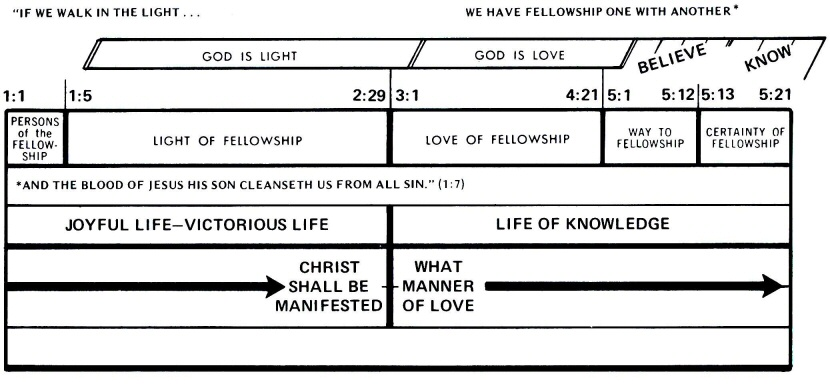
FELLOWSHIP WITH GOD AND HIS CHILDREN
Click chart to enlarge
Charts from Jensen's Survey of the NT - used by permission
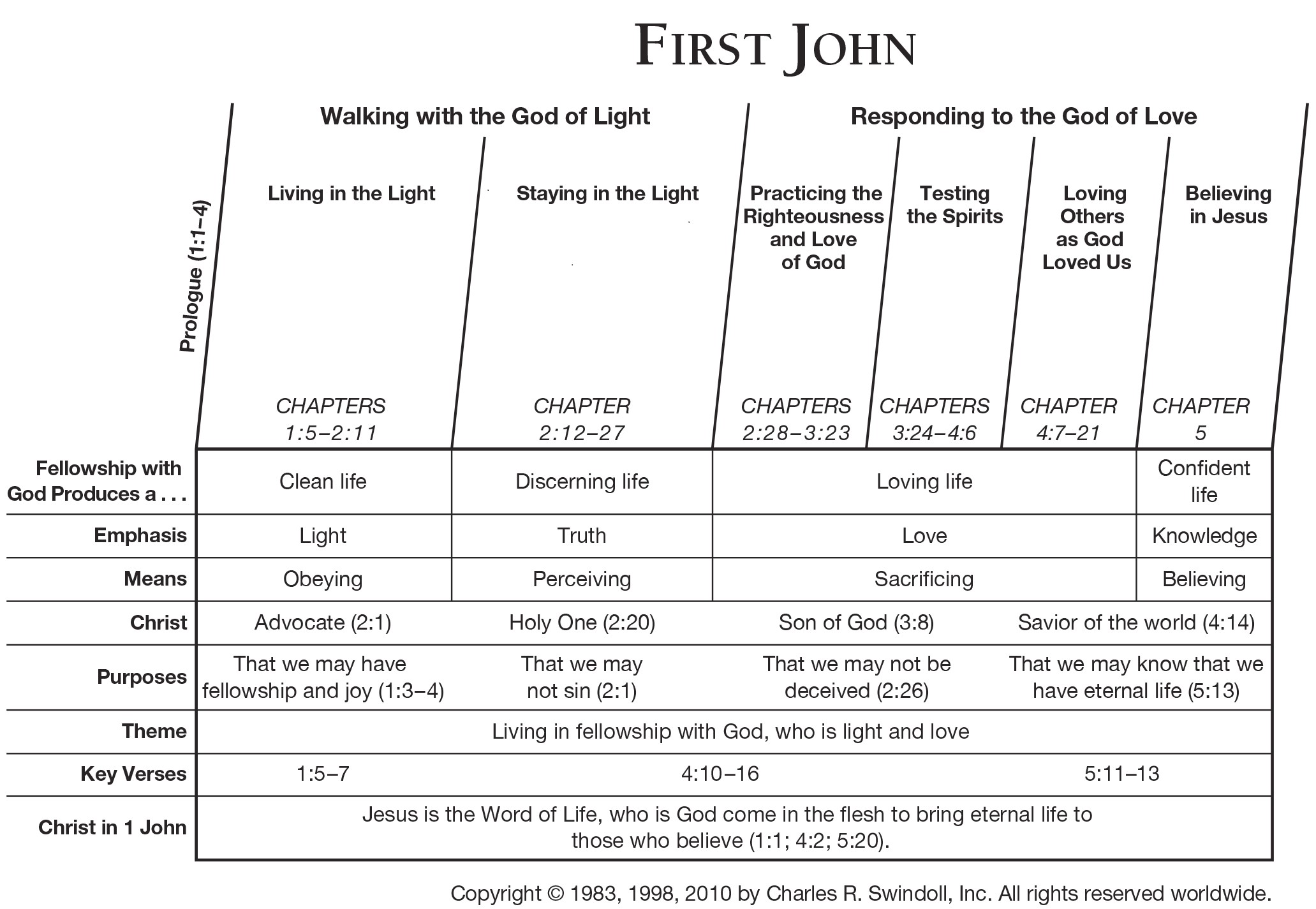
Another Overview Chart - 1 John - Charles Swindoll
| BASIS OF FELLOWSHIP | BEHAVIOR OF FELLOWSHIP | ||||
| Conditions of Fellowship |
Cautions of Fellowship |
Fellowship Characteristics |
Fellowship Consequences |
||
| Meaning of Fellowship 1 Jn 1:1-2:27 |
Manifestations of Fellowship 1 Jn 2:28-5:21 |
||||
| Abiding in God's Light |
Abiding in God's Love |
||||
| Written in Ephesus | |||||
| circa 90 AD | |||||
| From Talk Thru the Bible | |||||
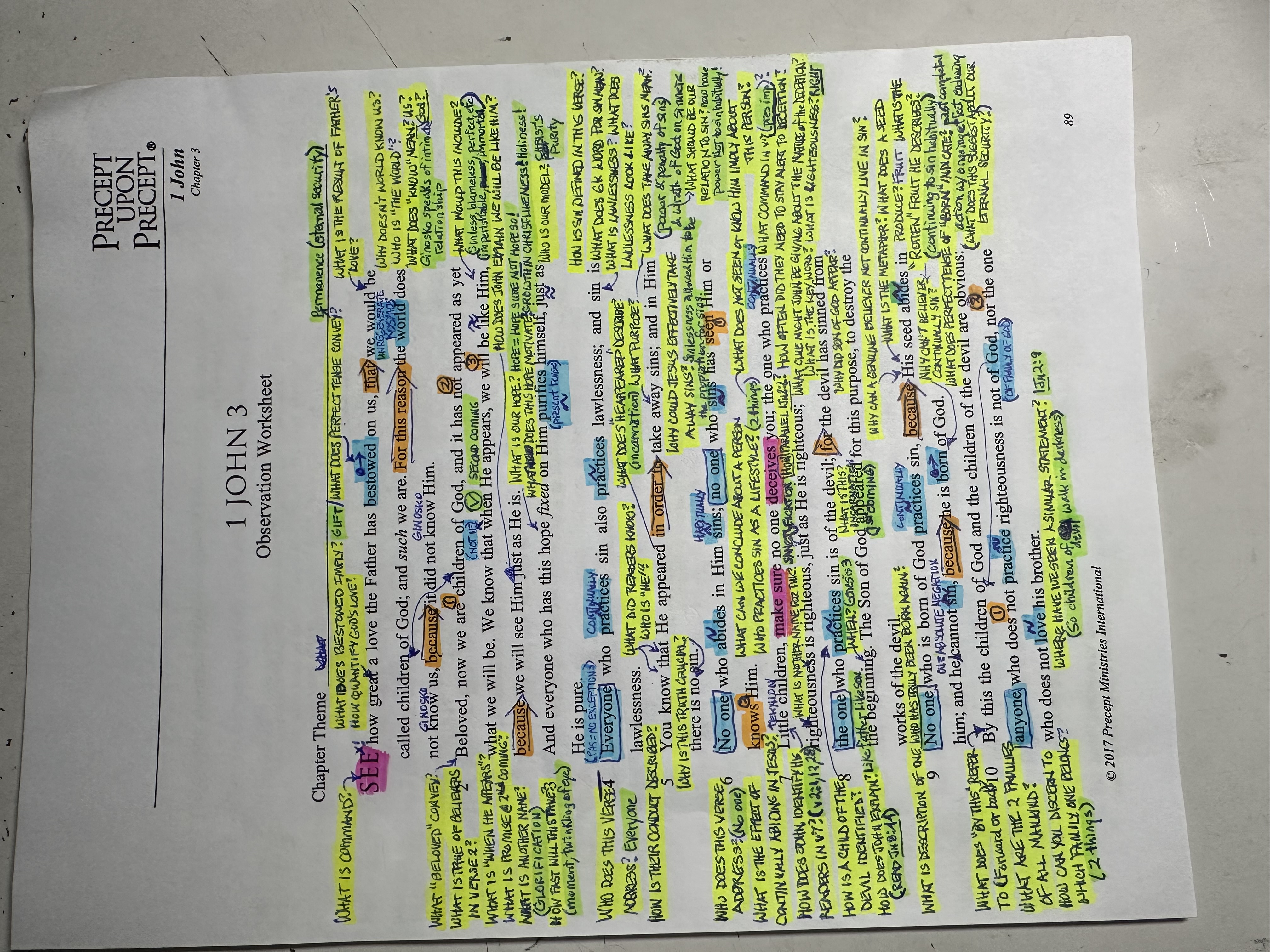
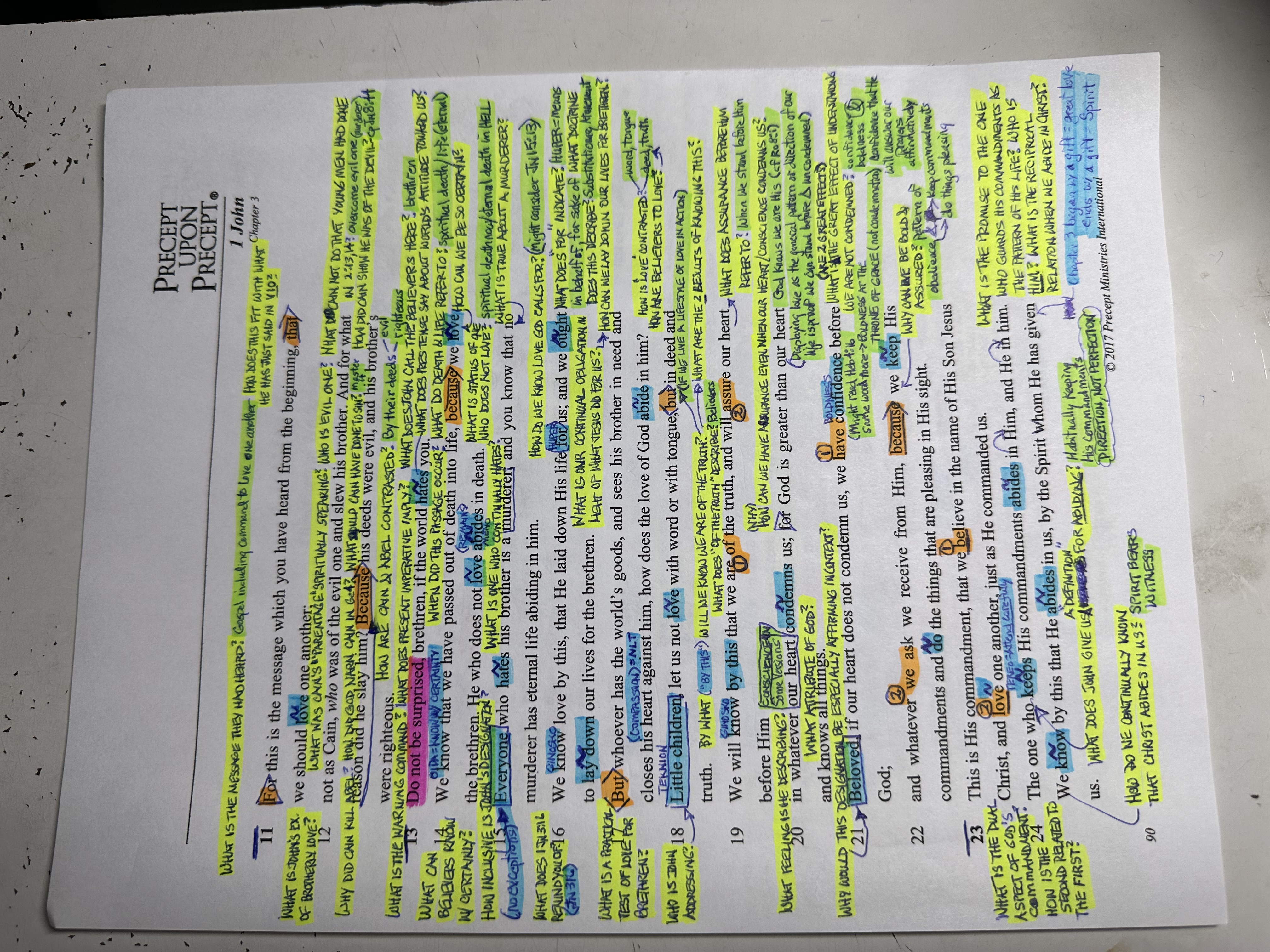
What is this? On the photograph of the Observation Worksheet for this chapter you will find handwritten 5W/H questions (Who? What? Where? When? Why? How?) on each verse to help you either personally study or lead a discussion on this chapter. The questions are generally very simple and are stated in such a way as to stimulate you to observe the text to discern the answer. As a reminder, given the truth that your ultimate Teacher is the Holy Spirit, begin your time with God with prayer such as Psalm 119:12+ "Blessed are You, O LORD; Teach me Your statutes." (you can vary it with similar prayers - Ps 119:18, 26, 33, 64, 66, 68, 108, 124, 135, 171, etc) The questions are generally highlighted in yellow and the answers in green. Some questions have no answers and are left to your observations and the illuminating/teaching ministry of the Holy Spirit. Some qualifying thoughts - (1) Use "As is" - these are handwritten and will include mistakes I made, etc. (2) They may not be the best question for a given verse and my guess is that on some verses you will think of a far superior 5W/H question and/or many other questions.
Dr Howard Hendricks once gave an assignment to his seminary students to list as many observations as they could from Acts 1:8. He said "So far they’ve come up with more than 600 different ones! Imagine what fun you could have with 600 observations on this passage. Would you like to see Scripture with eyes like that?" (P. 63 Living by the Book - borrow) With practice you can! And needless to say, you will likely make many more observations and related questions than I recorded on the pages below and in fact I pray that the Spirit would indeed lead you to discover a veritable treasure chest of observations and questions! In Jesus' Name. Amen
Why am I doing this? Mortimer Adler among others helped me develop a questioning mindset as I read, seeking to read actively rather than passively. Over the years I have discovered that as I have practiced reading with a 5W/H questioning mindset, it has yielded more accurate interpretation and the good fruit of meditation. In other words, consciously interacting with the inspired Holy Word of God and the illuminating Holy Spirit has honed my ability to meditate on the Scripture, and my prayer is that this tool will have the same impact in your spiritual life. The benefits of meditation are literally priceless in regard to their value in this life and in the life to come (cf discipline yourself for godliness in 1Ti 4:8+.) For some of the benefits - see Joshua 1:8+ and Psalm 1:2-3+. It will take diligence and mental effort to develop an "inductive" (especially an "observational"), interrogative mindset as you read God's Word, but it bears repeating that the benefits in this life and the rewards in the next will make it more than worth the effort you invest! Dear Christian reader let me encourage you to strongly consider learning the skills of inductive Bible study and spending the rest of your life practicing them on the Scriptures and living them out in your daily walk with Christ.
Although Mortimer Adler's advice is from a secular perspective, his words are worth pondering...
Strictly, all reading is active. What we call passive is simply less active. Reading is better or worse according as it is more or less active. And one reader is better than another in proportion as he is capable of a greater range of activity in reading. (Adler's classic book How to Read a Book is free online)
John Piper adds that "Insight or understanding is the product of intensive, headache-producing meditation on two or three verses and how they fit together. This kind of reflection and rumination is provoked by asking questions of the text. And you cannot do it if you hurry. Therefore, we must resist the deceptive urge to carve notches in our bibliographic gun. Take two hours to ask ten questions of Galatians 2:20+ and you will gain one hundred times the insight you would have attained by reading thirty pages of the New Testament or any other book. Slow down. Query. Ponder. Chew.... (John Dewey rightly said) "People only truly think when they are confronted with a problem. Without some kind of dilemma to stimulate thought, behavior becomes habitual rather than thoughtful.”
“Asking questions is the key to understanding.”
--Jonathan Edwards
That said, below are the 5W/H questions for each verse in this chapter (click page to enlarge). This is not neatly typed but is handwritten and was used for leading a class discussion on this chapter, so you are welcome to use it in this "as is" condition...
 |
 |
1 John 3:1 See how great a love the Father has bestowed on us, that we would be called children of God; and such we are. For this reason the world does not know us, because it did not know Him. (NASB: Lockman):
idete (2PAAM) potapen agapen dedoken (3SRAI) hemin o pater hina tekna theou klethomen; (1PAPS) kai esmen. (1PPAI) dia touto o kosmos ou ginoskei (3SPAI) hemas hoti ouk egno (3SAAI) auton.
Amplified: SEE WHAT [an incredible] quality of love the Father has given (shown, bestowed on) us, that we should [be permitted to] be named and called and counted the children of God! And so we are! The reason that the world does not know (recognize, acknowledge) us is that it does not know (recognize, acknowledge) Him. (Amplified Bible - Lockman)
ASV: Behold what manner of love the Father hath bestowed upon us, that we should be called children of God; and such we are. For this cause the world knoweth us not, because it knew him not.
BBE: See what great love the Father has given us in naming us the children of God; and such we are. For this reason the world does not see who we are, because it did not see who he was.
CEV: Think how much the Father loves us. He loves us so much that he lets us be called his children, as we truly are. But since the people of this world did not know who Christ is, they don't know who we are. (CEV)
GWT: Consider this: The Father has given us his love. He loves us so much that we are actually called God's dear children. And that's what we are. For this reason the world doesn't recognize us, and it didn't recognize him either. (GWT)
ICB: The Father has loved us so much! He loved us so much that we are called children of God. And we really are his children. But the people in the world do not understand that we are God's children, because they have not known him. (ICB: Nelson)
ISV: See what kind of love the Father has given us in letting us be called God's children! Yet that is what we are. For this reason the world doesn't recognize us, because it didn't recognized him either.
KJV: Behold, what manner of love the Father hath bestowed upon us, that we should be called the sons of God: therefore the world knoweth us not, because it knew him not.
Macent: Consider what proof the father has given us of his love, in allowing us to be called the sons of God: therefore the world does not know us, because it knew him not.
MLB (Berkley): SEE WHAT a wealth of love the Father has lavished on us, that we should be called the children of God. And we are. For this reason the world does not know us, because it did not know Him.
Moffatt: Think what a love the Father has for us, in letting us be called 'children of God!' That is what we are. The world does not recognize us? That is simply because it did not recognize him.
Montgomery: Behold what manner of love the Father has given us in allowing us to be called "Children of God!" And that is what we are. For this reason the world does not recognize us, because it did not know him.
NCV: The Father has loved us so much that we are called children of God. And we really are his children. The reason the people in the world do not know us is that they have not known him. (NCV)
NET: (See what sort of love the Father has given to us: that we should be called God's children--and indeed we are! For this reason the world does not know us: because it did not know him. (NET Bible)
NIV: (NOTE THE NIV FAILS TO STRESS THE SIGNIFICANCE BY NOT TRANSLATING "SEE" OR "BEHOLD") How great is the love the Father has lavished on us, that we should be called children of God! And that is what we are! The reason the world does not know us is that it did not know him. (NIV - IBS)
NJB: You must see what great love the Father has lavished on us by letting us be called God's children— which is what we are! The reason why the world does not acknowledge us is that it did not acknowledge him. (NJB)
NLT: See how very much our Father loves us, for he calls us his children, and that is what we are! But the people who belong to this world don’t recognize that we are God’s children because they don’t know him. (NLT - Tyndale House)
Phillips: Consider the incredible love that the Father has shown us in allowing us to be called "children of God" - and that is not just what we are called, but what we are. Our heredity on the Godward side is no mere figure of speech - which explains why the world will no more recognize us than it recognized Christ. (Phillips: Touchstone)
TEV: See how much the Father has loved us! His love is so great that we are called God's children—and so, in fact, we are. This is why the world does not know us: it has not known God.
TLB: See how very much our heavenly Father loves us, for he allows us to be called his children—think of it—and we really are! But since most people don’t know God, naturally they don’t understand that we are his children.
Weymouth: See what marvelous love the Father has bestowed upon us—that we should be called God's children: and that is what we are. For this reason the world does not recognize us—because it has not known Him.
Wuest: Behold what exotic love the Father has permanently bestowed upon us, to the end that we may be named children of God. And we are. On this account the world does not have an experiential knowledge of us, because it has not come into an experiential knowledge of Him.
Young's Literal: See ye what love the Father hath given to us, that children of God we may be called; because of this the world doth not know us, because it did not know Him;
See how great a love the Father has bestowed on us, that we would be called children of God; and such we are: idete (2PAAM) potapen agapen dedoken (3SRAI) hemin o pater hina tekna theou klethomen (1PAPS) kai esmen (1PPAI):
- 1Jn 4:9,10; 2 Sa 7:19; Ps 31:19; 36:7, 8, 9; 89:1,2; John 3:16; Romans 5:8; 8:32; Ephesians 2:4,5; 3:18,19
- Children - Jer 3:19; Hos 1:10; Jn 1:12; Ro 8:14, 15, 16, 17,21; 9:25,26; 2Cor 6:18; Galatians 3:26,29; 4:5,6; Rev 21:7
- 1 John 3 Resources - Multiple Sermons and Commentaries
1Jn 3:1: WHAT WE ARE
1Jn 3:2: WHAT WE SHALL BE
1Jn 3:3: WHAT WE SHOULD BE
1 John 3:1-3 would make a pithy and powerful sermon series which could be titled as above (credit to Dr Warren Wiersbe)
As David Allen says "Every christian should always live in three arenas: 1) what we are, 2) what we shall be, and 3) what we should be. What we are is God’s children (1Jn 3:1); what we shall be is conformed to the image of Christ when we get to Heaven (1Jn 3:2); what we should be on the basis of these two are people who live pure lives (1Jn 3:3). (See 1–3 John: Fellowship in God's Family)
Click to listen to the timeless, raspy voiced exposition of 1Jn 3:1 by Dr J Vernon McGee
Behold what manner of love
The Father has given unto us,
Behold what manner of love
The Father has given unto us,
That we should be called the sons of God,
That we should be called the sons of God.
Keep the context in mind, remembering that John has just written these words…
If you know that He is righteous, you know that everyone also who practices (present tense = their lifestyle, it does not mean "perfection" but "direction" of their life - toward heaven rather than toward hell!) righteousness is born (perfect tense = speaks of permanence, eternal security!) of Him. (1Jn 2:29+)
In light of this truth about their new birth, John is prompted to explain that the basis for this new birth is the Father’s great love by which He has made sinners His children. This truth distinguishes believers from unregenerate men and women of this fallen world and this distinction has significant spiritual consequences which he will explain.
As William MacDonald puts it "The thought of being born of God (1Jn 2:29) arrests John with wonder (Ed: Beloved, when was the last time thoughts of your own "new birth" "arrested" you with wonder? This should be our continual mindset!), and he calls on his readers to take a look at the wonderful love that brought us into the family of God. Love could have saved us without making us children of God. But the manner of God’s love is shown in that he brought us into His family as children. (Borrow Believer's Bible Commentary)
Hiebert entitles this next section "The dynamic reality of the new life (1Jn 3:1-2). Having become members of God's family through the new birth, believers find that their new life has deep present as well as future significance (Ed: Perhaps you are in a state of despair - you need to read that previous sentence again!). John calls upon his readers to contemplate the amazing reality of present membership in God's family (1Jn 3:1a), reminds them that this explains the reaction of the world toward them (1Jn 3:1b), and stresses that this new life as God's children has present and future implications (1Jn 3:2). (1 John 2:29-3:12) (Bolding added)
LOVE:
BEHOLD IT!
MEDITATE ON IT!
See (eido - aorist imperative) how great (potapos) a love (agape) the Father (pater) has bestowed (perfect tense - speaks of permanence of this love; NIV = "has lavished on us") on us, that (hina - term of purpose - purpose of this gift of His love) we would be called (kaleo) children (teknon - "born ones") of God; and such we are. For this reason (term of conclusion = therefore - because we are children of God) the world (kosmos) does (absolutely) not know (ginosko - intimately) us (as new creations in Christ), because (term of explanation - explains why world does not know us) it (absolutely) did not know (ginosko = intimate, experiential knowledge, they had no personal relationship with) Him - See (eido - aorist imperative) calls for his readers to "listen up!" Not just love but great love! John wants the children of God to take a supernatural (Spirit enabled) glimpse into the Father's supernatural love for us. The idea is something like this "Can you believe the kind of love the Father has given to us?"
An unbeliever who sins is a creature sinning against his Creator.
A Christian who sins is a child sinning against his Father.
The unbeliever sins against law; the believer sins against love.
--Warren Wiersbe
THOUGHT - Beloved, have you ever asked Him to illumine this great truth in your mind and heart? What will happen to our thoughts, words and deeds when He answers affirmatively? (cp 1Jn 5:14,15+) Will not we "fall on our face" at having been shown to be unworthy benefactors of His ineffable, infinite, invaluable, never failing love? Will not this sense of His love poured out in our heart by His Spirit motivate us to live for Him rather than for ourselves?(See a related truth The Expulsive Power of a New Affection!) (Newsboys - Amazing Love) (Chris Tomlin - Amazing Love)
Do you believe that?
Do you each day realize that you’re a child of the heavenly King?
-- Jerry Bridges
And Can It Be That I Should Gain
Charles Wesley
And can it be that I should gain
An interest in the Savior’s blood?
Died He for me, who caused His pain—
For me, who Him to death pursued?
Amazing love! How can it be,
That Thou, my God, shouldst die for me?
Amazing love! How can it be,
That Thou, my God, shouldst die for me?
This love God has not only ‘shown’ us, but actually lavished on us.
For children of God is no mere title; it is a fact.
-- John Stott
In the following passage, note that one "result" of Paul's great prayer for the saints at Ephesus is a knowledge of the love of Christ which "surpasses knowledge" (talk about mystical and supernatural!)…
For this reason (Why? see Ep 3:13), I bow my knees before the Father, from whom every family in heaven and on earth derives its name, that He would grant you, according to (not a portion of but proportionate to) the riches of His glory, to be strengthened with power through His Spirit in the inner man; so that Christ may dwell in your hearts through faith; and that you, being rooted and grounded in love, (What does God's love do for us here? Or how "foundational" is His love?) may be able to comprehend with all the saints what is the breadth and length and height and depth, and to know the love of Christ (cp 2Co 5:14) which surpasses knowledge, (And what is the purpose of this "surpassing knowledge" of Christ's love? Paul explains… ) that you may be filled up to all the fulness of God. (Can we be confident that God will answer this incredibly rich prayer? How does Paul address that question?) Now to Him who is able to do exceeding abundantly beyond all that we ask or think, according to the power that works within us, to Him be the glory in the church and in Christ Jesus to all generations forever and ever. Amen. (Eph 3:14-21+)
And again notice what Paul prays for the saints at the church at Philippi…
And this I pray, that your love may abound still more and more in real knowledge (i.e., based on truth like 1Jn 3:1, et al) and all discernment, so that you may approve the things that are excellent, in order to be sincere and blameless until the day of Christ (Php 1:9, 10, 11+ cp 1Jn 3:2+, 1Jn 3:3+)
THOUGHT - Notice how a discerning, knowledge of God's love is the wellspring from which flows an obedient, holy life, even until the day we see our Lord face to face!); having been filled with the fruit of righteousness which comes through Jesus Christ, to the glory and praise of God. (Php 1:9, 10, 11+) (Are we beginning to see Paul's emphasis on the importance of a saint's deep understanding of God's love?)
FIRST LOVE:
REMEMBER IT!
See the fearful exhortation of our Lord Jesus Christ to the church at Ephesus wherein He emphasizes the importance of believers continually recalling to their mind the love of God and conducting themselves in concord with this love (cp 2Co 5:14+)…
To the angel of the church in Ephesus write: The One who holds the seven stars in His right hand, the One who walks among the seven golden lampstands, says this: I know your deeds and your toil and perseverance, and that you cannot endure evil men, and you put to the test those who call themselves apostles, and they are not, and you found them to be false; and you have perseverance and have endured for My name's sake, and have not grown weary. But (Introduces a radical change of direction in His exhortation!) I have this against you, that you have left (left, not lost!) your first love. Remember (present imperative = command from our Lord to keep on remembering - we are all prone to forget, with the result that our heart and our love grows cold toward our Bridegroom Jesus and we begin to wonder and to wander! Ready recall reaps righteous "running" - cp He 12:1+) therefore from where you have fallen, and repent (aorist imperative = command from the Captain of the hosts [Jos 5:14,15+] demanding our urgent, immediate attention and obedience! Don't procrastinate! Don't delay! Delay is disobedience!) and do (aorist imperative = see previous note) the deeds you did at first (When He poured His love into your heart [Ro 5:5+, cp 1Jn 4:10] and you first fell in love with Jesus); or else I am coming to you, and will remove your lampstand out of its place-- unless you repent. Yet this you do have, that you hate the deeds of the Nicolaitans, which I also hate. He who has an ear, let him hear what the Spirit says to the churches. To him who overcomes, I will grant to eat of the tree of life, which is in the Paradise of God. (Rev 2:1-7+)
Comment (Tony Garland's comments below on Rev 2:4+ are worth pondering):
The disturbing reality is that it is possible to think one is actively “serving God,” but without a true relationship with Him (Ed: Reference is to Jesus' words in Mt 7:21, 22, 23+). Even in the case where we begin following after Him, time and circumstances often turn our hearts aside. (Ed: "Amen" or "Oh my!")
When Solomon grew old…
Our priority must ever be relationship over service (works). This is the essential message of the incident involving Mary and her sister Martha related by Luke. Martha‘s priority was serving whereas
Mary… sat at Jesus’ feet and heard His word (Lk 10:39+).
Martha was so focused on serving that she missed a golden opportunity to listen to her Lord. Jesus summarized the actions of the two sisters:
Martha, Martha, you are worried (merimnao [word study] from merizo = to divide - picture of a "divided" mind!) and troubled (turbazo = noise, uproar, disturbance - English "turbid"!) about many things. But one thing is needed (chreia [word study]), and Mary has chosen that good part, which will not be taken away from her” (Lk 10:41, 42+).
Time spent sitting at the Master’s feet will never be taken away from us. Although some fret that such time reduces our ability to serve, the result is actually the opposite. Our devotion, motivation, and understanding of God are deepened causing an increase in the fruit of God’s ministry through us.
Our ministry and service must be grounded in and out of our love for Him (Heb 6:10+, He 6:11, 12+).
We are “priests to His God,” our primary focus is God-ward, only then man-ward. Instead of waning, our love for Him is to be continually increasing (Php 1:9+).
The Ephesian church had lost its focus. They had taken their eyes off of Jesus (cp He 12:2+) and were now focusing on their works done for His name. This is the essence of idolatry.
The condition of the Ephesian church at the time of John appears considerably different to that when Paul wrote his epistle. “See the Ephesians’ first love, Eph 1:15+. This epistle (Revelation) was written under Domitian, when thirty years had elapsed since Paul had written his Epistle to them.”
Lesson? Application? Beware of the deceptive delusion of doing rather than being. The first command was, is and always will be "You shall love the LORD your God with all your heart, and with all your soul and with all your mind and with all your strength" (Mk 12:30+)
See (3708) (idete - verb = horao) means to discern clearly (physical or mental), and does not call for the reader to merely "see", but also to have an actual perception of the object. When horao is used of seeing God it also conveys the idea of knowing Him (i.e., horao is rendered "see" or "seen" and is coupled with knowing in the following = Jn 1:18; 14:7, 9; 1Jn 3:6; 4:20; 3Jn 1:11) and knowing His character as in the present context where believers are charged to "see and behold and know" His great attribute of amazing, "other worldly" love (see short summary of God's attribute of Love). See is in the aorist imperative which is a command calling for the reader to give immediate, effective, even urgent attention. Here's the idea…Stop everything else! Look at this! Think about it! Ponder its significance! See is in the plural which calls for all of his readers to take a "heart moving look at the the amazing love which gave them membership in God's family" (Hiebert) Click Alexander Maclaren's practical application of John's charge to "See"!
Wuest adds that "Behold (KJV) is plural here, literally, “behold ye.” The usual form is singular. John is calling upon all the saints to wonder at the particular (Ed: distinctive, noteworthy, remarkable, singular, uncommon, unique, special, exceptional, "peculiar" [in a good sense of course]) kind of love God has bestowed upon them. (Eerdmans Publishing - used by permission)
THOUGHT- By way of application, let me "put in a plug" for the spiritual discipline of Biblical Meditation (see also Meditate - but don't just read about it -- delight to do it that you might be like a tree firmly planted by streams of water (Ps 1:2+, Ps 1:3+) and that you might be careful to do according to all that is written in God's Word (~God's will), for then you will make your way prosperous, and then you will have success. (Joshua 1:8+)
David Jackman rightly says of the command to See that "The force is that we need to take time to contemplate this love and allow its reality to sink down into the depths of our being. (Amen!) (BORROW The Message of John's Letters page 80) (Related Resources: Meditate; Primer on Biblical Meditation)
Spurgeon on see (behold) - ‘There,’ he says, ‘you poor people that love me you sick people, you unknown, obscure people, without any talent, I have published it before heaven and earth, and made the angels know it, that you are my children, and I am not ashamed of you. I glory in the fact that I have taken you for my sons and daughters.’ ” (“And We Are”: A Jewel from the Revised Version)
Spurgeon - Who calls the saints the sons of God? The Father himself does so. He speaks unto them as unto children. He deals with them as with sons. He is pleased in infinite love to bid them say, ‘Our Father’, and he answers to them by calling them children and heirs. He acknowledges their sonship and pities them ‘as a father pitieth his children’. He has called them sons, saying, ‘I will be a Father unto you, and ye shall be my sons and daughters, saith the Lord Almighty.’ Oh what a blessing it is to have God calling you his child, the great Almighty and Infinite One looking upon you with a Father’s love and saying, ‘Thou art my son’! He speaks the truth; we may believe it and be sure: he knows his own children and gives the name of sons to none whom he will in the end disown. He calls us his children ‘and we are’. Who has called us the sons of God? Jesus himself, ‘the firstborn among many brethren’, has called us so. Did he not speak of ‘my Father, and your Father’? What did he mean when he was ‘not ashamed to call’ us ‘brethren’? Everywhere our dear Lord and Master speaks of us as belonging to the one family of which he is the Head. By sweetly taking us into union with himself Jesus practically calls us Sons of God ‘and we are’. The Holy Spirit also dwells in all the heirs of heaven and thereby calls them sons of God. He bears ‘witness with our spirit, that we are the children of God’; and it is he who is given to us to be ‘the Spirit of adoption, whereby we cry, Abba, Father.’ That ‘Abba, Father’ of ours is prompted by the Spirit of grace, who would never prompt a stranger and an alien to claim kinship with the Lord. Oh no! The witness of the Holy Spirit is the witness of truth. A filial spirit implanted by the Spirit of God cannot deceive us. Thus Father, Son and Holy Spirit call us the children of God ‘and we are’. (“And We Are”: A Jewel from the Revised Version)
Steven Cole makes the point that it is sad but true of our human nature that "Some things grow commonplace over time. We’ve heard about them and known them for years. Maybe at first, when it was new, an idea or experience affected us. But over the years, the effect grows weaker and weaker, until finally it’s just a far-distant memory. But the Father’s great love for us is the kind of experience that should grow stronger and stronger over the years, until it totally dominates every aspect of our lives. It should consume our thoughts and control our behavior (cp 2Co 5:14). It should motivate us to serve God and to live holy lives. It should give us comfort in all our trials. It should fill us with the eager hope of being with Him in heaven. It should fill us with awe and worship, that He, the holy sovereign of the universe, would set His love on a sinful, self-willed rebel like me! “Amazing love, how can it be, that Thou, my God, should die for me!” Don’t let yourself ever hear of the Father’s great love and think, “Ho hum!” It ought always to amaze you. (The Father's Great Love) (Bolding and color added)
Spurgeon in expositional notes (See 1 John 3 Exposition) comments on 1 John 3 that it....
is a chapter in every word and a sermon in every letter. How it opens with a "Behold!" because it is such a striking portion of sacred Scripture, that the Holy Ghost would have us pay particular attention to it. "Behold!" says He,
"read other Scriptures if you like, with a glance, but stop here. I have put up a way-mark to tell you there is something eminently worthy of attention buried beneath these words."
"Behold, what manner of love the Father hath bestowed on us." Consider who we were, and who we are now; ay, and what we feel ourselves to be even when divine grace is powerful in us. And yet, beloved, we are called "the sons (children) of God." It is said that when one of the learned heathens was translating this, he stopped and said,
No; it cannot be; let it be written 'Subjects,' not 'Sons,' for it is impossible we should be called 'the sons of God.'
What a high relationship is that of a son to his father! What privileges a son has from his father! What liberties a son may take with his father! and oh! what obedience the son owes to his father, and what love the father feels towards the son! But all that, and more than that, we now have through Christ. "Behold!" ye angels! stop, ye seraphs! here is a thing more wonderful than heaven with its walls of jasper. Behold, universe! open thine eyes, O world. "Behold, what manner of love the Father hath bestowed upon us, that we should be called the sons of God; therefore the world knoweth us not, because it knew him not." Well, we are content to go with Him in his humiliation, for we are to be exalted with him.
"Beloved, now are we the sons (children) of God." That is easy to read; but it is not so easy to feel.
"Now are we the sons (children) of God."
How is it with your heart this morning? Are you in the lowest depths of sorrow and suffering? "Now are you a son of God." Does corruption rise within your spirit, and grace seem like a poor spark trampled under foot? "Beloved, now are you a son of God." Does your faith almost fail you? and are your graces like a candle well nigh blown out by the wind! Fear not, beloved; it is not your graces, it is not your frames, it is not your feelings, on which you are to live: you must live simply by naked faith on Christ.
Beloved, now are we the sons (children) of God."
With all these things against us, with the foot of the devil on our neck, and the sword in his hand ready to slay us—beloved now in the very depths of our sorrow, wherever we may be—now, as much in the valley as on the mountain, as much in the dungeon as in the palace, as much when broken on the wheel of suffering as when exalted on the wings of triumph—"beloved, now are we the sons of God."
"Ah!" but you say, "see how I am arrayed! my graces are not bright; my righteousness does not shine with apparent glory." But read the next: "It doth not yet appear what we shall be; but we know that when he shall appear, we shall be like him." We are not so much like him now, but we have some more refining process to undergo, and death itself, that best of all friends, is yet to wash us clean. "We know that when he shall appear, we shall be like him; for we shall see him as he is."
AN ASTONISHING
LOVE!
See (eido - aorist imperative - plural "All of you behold") how great (potapos) a love (agape) the Father (pater) has bestowed (perfect tense - speaks of permanence of this love; NIV = "has lavished on us") on us, that (hina - term of purpose - purpose of this gift of His love) we would be called (kaleo) children (teknon - "born ones") of God; and such we are. For this reason (term of conclusion = therefore - because we are children of God) he world (kosmos) does (absolutely) not know (ginosko - intimately) us (as new creations in Christ), because (term of explanation - explains why world does not know us) it (absolutely) did not know (ginosko - intimate, personal relation with) Him - Daniel Akin on this great love says "The love of the Father is out of this world and it is a love that will never be taken away. It is an amazing love that awes and astonishes and it has given for us to enjoy forever and ever and ever." It is a Jeremiah 31:3+ everlasting kind of love, a Hebrews 13:5+ kind of love, one that will absolutely never desert us or forsake us!
Behold, what wondrous grace
The Father hath bestowed
On sinners of a mortal race
To call them sons of God.
Nor doth it yet appear
How great we must be made;
But when we see our Saviour here,
We shall be like our Head.
Isaac Watts, 1674–1748
Daniel Akin goes on the explain that "This Father’s love is a forever love and its results are 2-fold: we are now called the children of God and this is who we are! Called His children → I bear His name. Are His children → I have His nature. Once I was a slave to sin but now I am a child of God. What an incredible truth to grasp and meditate on. What a beautiful balance this brings to my self awareness. There is no place for either an inferiority or superiority complex. I am who I am by gracious adoption and regeneration. That fosters humility. I am who I am as God’s child. That fosters security and certainty....In almost a passing comment John says this world doesn’t understand this incredible relationship. That should not really surprise us.
"Behold, what foreign-kind of love"
is literally what John writes.
-- Warren Wiersbe
How great (4217) (potapos possibly from pote = interrogative adverb [when?] + pou = where?) is firstly an interrogative adjective which means "of what sort or what kind?" (speaking of quality). When potapos is used (as in the present passage) in an exclamation, the context conveys the sense of admiration = "how great!"; "how wonderful!", "how glorious!" (cp Mk 13:1) John Stott says potapos always implies astonishment. Vine says it means "primarily, “from what country,” then, “of what sort”. Steven Cole - It’s as if John thinks about the Father’s great love and says, “Where does this come from? It must be from heaven, because there’s nothing like it in this world!” (The Father's Great Love)
Potapos - 7x in 6v - Matt 8:27; Mark 13:1; Luke 1:29; 7:39; 2 Pet 3:11; 1 John 3:1. NAS = how great(1), what kind of(2), what sort of(1), what sort of person(1), what wonderful (2). Potapos is not found in the non-apocryphal Septuagint.
Wuest… comments on how great (KJV renders it "what manner of") - “What manner of” is potapēn, “from what country, race or tribe?” The word speaks of something foreign. The translation could read, “Behold, what foreign kind of love the Father has bestowed upon us.” The love of God is foreign to the human race. It is not found naturally in humanity. When it exists there, it is in a saved individual, and by reason of the ministry of the Holy Spirit. Smith suggests, “from what far realm? What unearthly love,… how other-worldly.” (Eerdmans Publishing - used by permission)
Hiebert notes that potapos "implies a reaction of astonishment, and usually of admiration, upon viewing some person or thing. The expression conveys both a qualitative and quantitative force, "what glorious, measureless love!" This love, originating with God, ever seeks the true welfare of those being loved; it is amazing in-deed when we remember the personal destitution of those He loves. God's is a love that works visible, transforming results in the lives of its recipients.(1 John 2:29-3:12)
The Father’s love is so unearthly, so foreign to this world,
that [John] wonders from what country it may come.
-- John StottTHOUGHT - Given that this Greek word (potapos) depicts a sense of awe, amazement and admiration, does this truth that you are actually a children of the eternal God and He is truly your Father "sink in" and grip your heart and stir a desire to obey Him that you might please Him? Challenge: Spend a morning meditating on the wonder of God as your Father and you as His child and see if that does not impact the rest of your day!
Love (26) (agape) is unconditional, sacrificial love and Biblically refers to a love that God is (1Jn 4:8,16), that God demonstrates (Ro 5:8+, Jn 3:16, 1Jn 4:9) and that God enables in His children (see note on fruit of the Spirit - Gal 5:22+). It is a love that only has its origin in the Father. Agape may involve emotion, but it must always involve action. Agape is unrestricted, unrestrained, and unconditional. Agape love is the virtue that surpasses all others and in fact is the prerequisite for all the others. Jesus when asked "Teacher, which is the great commandment in the Law?” replied ”‘You shall love the Lord your God with all your heart, and with all your soul, and with all your mind.’ “This is the great and foremost commandment." (Mt 22:36, 37, 38+)
Love is the family resemblance
the world should see in followers of Christ.
D Edmond Hiebert states: “This love, originating with God, ever seeks the true welfare of those being loved; it is amazing indeed when we remember the personal destitution of those He loves. God’s is a love that works visible, transforming results in the lives of its recipients.” (1 John 2:29-3:12)
God sets His mind and will on seeking man’s highest good.
This is what is amazing about God’s love
Donald Burdick adds: “God loves the sinner, not because He is drawn to him by his lovableness, but because, in spite of man’s unloveliness, God sets His mind and will on seeking man’s highest good. This is what is amazing about God’s love.” (Borrow The letters of John the Apostle : an in-depth commentary page 230)
John explains love in this letter noting that "by this (by what? read on) the love of God was manifested (phaneroo = made visible) in us, that God has sent His only begotten Son (Jesus is the exact representation of God's nature [Heb 1:3+] and He as the very personification of divine love shows us the Father's love) into the world so that we might live through Him (He is our life - Col 3:3+? Who is living your life today beloved?) The only way to live an "other worldly", supernatural, Christian life is to surrender your rights each day and allow Him to live through you! cp Ro 12:1+). In this is love, not that we loved God, but that He loved us (Note that agape love is not manifest by gushy feelings, but an "action" verb, which gives without expectation of return or even of reception!) and sent His Son to be the propitiation (fully satisfactory sacrifice - the justice of the Father has been satisfied by the perfect sinless sacrifice of the Lamb of God, Jn 1:29, 36) for our sins. (1Jn 4:9, 10+)
Steven Cole offers the following practical applications of this section…
The Father’s great love should instruct us about our relationships with one another. This is the apostle Paul’s thought in Ephesians 5:1, 2 (notes),
Therefore be (present imperative = command for this to be our lifestyle, our general pattern - our direction not perfection) imitators of God, as beloved children; and walk in love, just as Christ also loved you and gave Himself up for us, an offering and a sacrifice to God as a fragrant aroma.
Imitate God by walking in love, with Christ’s sacrifice on the cross as your great example! If you need more specifics about what walking in love really looks like, go to Paul’s great chapter on love (1Cor 13:4-8a - see notes 1Co 13:4 v5-6 v7-8). He writes,
Love is patient, love is kind and is not jealous; love does not brag and is not arrogant, does not act unbecomingly; it does not seek its own, is not provoked, does not take into account a wrong suffered, does not rejoice in unrighteousness, but rejoices with the truth; bears all things, believes all things, hopes all things, endures all things. Love never fails (Ed: Notice that love is defined by verbs not adjectives!)….
Can you substitute your name in place of “love”? (“Steve is patient,” etc.) Those qualities should increasingly describe your relationships with others, beginning with those that you live with.
We’re all prone to excuse our lack of love by blaming those that we are supposed to love. We say, “I am usually a very loving person, but if you knew how unloving my husband is, you’d understand why I treat him as I do.” Or, “I work long hours to provide for my wife, but all she does is gripe and criticize me. Sure, I’m mean and angry sometimes, but who wouldn’t be?”
But such excuses don’t hold up because such unloving behavior does not in any way resemble God’s great love for you. Where would you be if God made up excuses for why He should withhold His love from you? He doesn’t need to make up excuses—He has legitimate reasons why you do not deserve His love! He would have been completely justified to leave you in your sins, with no remedy. But, instead, He so loved you that He sent His only begotten Son to bear the penalty that you justly deserved. Now He says, “Imitate My love by loving those who are insensitive, mean, and unloving toward you.”
John’s words here also apply to how we as earthly fathers relate to our children. All of biblical parenting can be summed up in one sentence: Love your children as the heavenly Father loves you. Such love involves proper correction and discipline, of course. But, I think that most Christian parents fall short primarily in the realm of love, not discipline. God lavished His love and grace on us in Jesus Christ. As Christian parents—especially as fathers—we need to lavish grace and love on our children. It will motivate them to follow Christ far more than strict rules ever will. I’m not saying that there is no need for rules. I am saying that if your children feel your love for them, the need for rules is greatly diminished. So John shows us that the Father’s great love should both amaze and instruct us. Stop and behold it often! (Bolding and Links added) (The Father's Great Love)
Alexander Maclaren has these devotional thoughts on the love that is bestowed…
We are called upon to come with our little vessels to measure the contents of the great ocean, to plumb with our short lines the infinite abyss, and not only to estimate the quantity but the quality of that love, which, in both respects, surpasses all our means of comparison and conception. Properly speaking, we can do neither the one nor the other, for we have no line long enough to sound its depths, and no experience which will give us a standard with which to compare its quality. But all that we can do, John would have us do—that is, look and ever look at the working of that love till we form some not wholly inadequate idea of it.
We can no more ‘behold what manner of love the Father has bestowed on us’ than we can look with undimmed eyes right into the middle of the sun. But we can in some measure imagine the tremendous and beneficent forces that ride forth horsed on his beams to distances which the imagination faints in trying to grasp, and reach their journey’s end unwearied and ready for their task as when it began. Here are we, ninety odd millions of miles from the centre of the system, yet warmed by its heat, lighted by its beams, and touched for good by its power in a thousand ways. All that has been going on for no one knows how many aeons. How mighty the Power which produces these effects!
In like manner, who can gaze into the fiery depths of that infinite Godhead, into the ardours of that immeasurable, incomparable, inconceivable love? But we can look at and measure its activities. We can see what it does, and so can, in some degree, understand it, and feel that after all we have a measure for the Immeasurable, a comparison for the Incomparable, and can thus ‘behold what manner of love the Father hath bestowed on us.’
So we have to turn to the work of Christ, and especially to His death, if we would estimate the love of God. According to John’s constant teaching, that is the great proof that God loves us. The most wonderful revelation to every heart of man of the depths of that Divine heart lies in the gift of Jesus Christ.
The Apostle bids me ‘behold what manner of love.’ I turn to the Cross, and I see there a love which shrinks from no sacrifice, but gives ‘Him up to death for us all.’ I turn to the Cross, and I see there a love which is evoked by no lovableness on my part, but comes from the depth of His own Infinite Being, who loves because He must, and who must because He is God. I turn to the Cross, and I see there manifested a love which sighs for recognition, which desires nothing of me but the repayment of my poor affection, and longs to see its own likeness in me. And I see there a love that will not be put away by sinfulness, and shortcomings, and evil, but pours its treasures on the unworthy, like sunshine on a dunghill. So, streaming through the darkness of eclipse, and speaking to me even in the awful silence in which the Son of Man died there for sin, I ‘behold,’ and I hear, the ‘manner of love that the Father hath bestowed upon us,’ stronger than death and sin, armed with all power, gentler than the fall of the dew, boundless and endless, in its measure measureless, in its quality transcendent—the love of God to me in Jesus Christ my Saviour.
In like manner we have to think,, if we would estimate the ‘manner of this love,’ that through and in the great sacrifice of Jesus Christ there comes to us the gift of a divine life like His own. Perhaps it may be too great a refinement of interpretation; but it certainly does seem to me that that expression ‘to bestow His love upon’ us, is not altogether the same as ‘to love us,’ but that there is a greater depth in it. There may be some idea of that love itself being as it were infused into us, and not merely of its consequences or tokens being given to us; as Paul speaks of ‘the love of God shed abroad in our hearts’ by the spirit which is given to us. At all events this communication of divine life, which is at bottom divine love—for God’s life is God’s love—is His great gift to men.
Be that as it may, these two are the great tokens, conequences, and measures of God’s love to us—the gift of Christ, and that which is the sequel and outcome thereof, the gift of the Spirit which is breathed into Christian spirits. These two gifts, which are one gift, embrace all that the world needs. Christ for us and Christ in us must both be taken into account if you would estimate the manner of the love that God has bestowed upon us.
We may gain another measure of the greatness of this love if we put an emphasis—which I dare say the writer did not intend—on one word of this text, and think of the love given to ‘us,’ such creatures as we are. Out of the depths we cry to Him. Not only by the voice of our supplications, but even when we raise no call of entreaty, our misery pleads with His merciful heart, and from the heights there comes upon our wretchedness and sin the rush of this great love, like a cataract, which sweeps away all our sins, and floods us with its own blessedness and joy. The more we know ourselves, the more wonderingly and thankfully shall we bow down our hearts before Him, as we measure His mercy by our unworthiness.
From all His works the same summons echoes. They all call us to see mirrored in them His loving care. But the Cross of Christ and the gift of a Divine Spirit cry aloud to every ear in tones of more beseeching entreaty and of more imperative command to ‘behold what manner of love the Father hath bestowed upon us.’ (The Love That Calls Us Sons )
BESTOWAL OF THE
FATHER'S LOVE
The Father (pater) - John's use of Father rather than God emphasizes the familial relationship believers have with Him. This description is at the end of the Greek phrase which gives emphasis to God as a Giver Who is also a Father. This emphasizes the intimate relation He has with His sons and daughters, a relationship which is so profound and deep and undeserved that it simply causes one to fall down and worship! In 2 Corinthians 6:18+ Paul writes of all believers “And I will be a father to you, and you shall be sons and daughters to Me,” Says the Lord Almighty." (See Abba, the name of God = "Dear Father" or Abba, Father - Much Shorter Summary Page).
THOUGHT - This truth of God as our Father is very meaningful to me as my real father left my mother when I was 1 year old and my step father abused me for over 10 years. So for the first 39 years of my life I had no concept of a father or even an understanding that a father could love me. That changed when I met Jesus at age 40 and He introduced me to His Father, my Father in heaven and I have never been the same since (See My Testimony to God's Grace). Perhaps you have been abused or abandoned by a father or a father figure. If you know Jesus as your Savior, you have God as your perfect loving Father forever and ever. Amen.
Bestowed (NIV "has lavished on us") (1325) (didomi) means to give, to bestow, to confer, to make a present of, to put something into another's possession. Didomi also conveys the added sense that the granting is based on a decision of the will of the Giver (in this case our Father) and not on any merit of the recipient (saved sinners). This love is a gift and which cannot be earned or purchased (it is priceless)! Beloved, don't fall into the trap even after salvation of trying to earn the Father's love! You can't do it! God bestows it upon those who do not deserve it (which sounds a lot like grace!) The 1828 Noah Webster's Dictionary has an excellent definition of give as "to pass or transfer the title or property of a thing to another person without an equivalent or compensation". What a great description of the Father's gracious love. And notice that this love is not bestowed on you but us reflecting John's humility ("the disciple whom Jesus loved" - Jn 21:20+) to include himself among the recipients of this amazing divine love.
It is a gift from God the Father that cannot be earned or bought;
it is given freely and cannot be withdrawn.
-- Daniel Akin
Paul describes us in Romans 5 as those who were helpless, ungodly (Ro 5:6+), sinners (Ro 5:8+), and enemies (of God - Ro 5:10+), toward whom He choose to demonstrate "His own love" (Ro 5:8+) and within whose hearts His love was "poured out… through the Holy Spirit who was given to us." (Ro 5:5+)
And this great love is not just for time but for eternity as indicated by bestowed in the perfect tense, which signifies past completed action with ongoing effect/result! It speaks of permanence of this bestowal. It speaks of assurance and eternal security for God is not a man that He should lie. His love lavished upon saved sinners (cf Eph 1:8+) will endure throughout the ages.
God has placed His love upon the saints in the sense
that they have become the permanent objects of His love.
Wuest agrees that bestowed in "The perfect tense is used here to indicate that the gift becomes a permanent possession of the recipient. God has placed His love upon the saints in the sense that they have become the permanent objects of His love. One of the results of this love in action is that we are called sons of God. Smith says: “The purpose of this amazing gift; a wise, holy love, concerned for our highest good, ‘not simply that we may be saved from suffering and loss, but in order that we may be styled children of God.’ And we have not only the name but the character: ‘so we are.’ (Eerdmans Publishing - used by permission)
What is it that makes us slow
to believe the love of God?
David Guzik says "Bestowed on us speaks many things. First, it speaks of the measure of God’s love to us; it could more literally be translated lavished on us. Secondly, it speaks of the manner of God’s giving of love; bestowed has the idea of a one-sided giving, instead of a return for something earned. What is it that makes us slow to believe the love of God? Sometimes it is pride, which demands to prove itself worthy of the love of God before it will receive it. Sometimes it is unbelief, which cannot trust the love of God when it sees the hurt and pain of life. And sometimes it just takes time for a person to come to a fuller understanding of the greatness of God’s love....There is a sense in which this is a totally “unnecessary” blessing that God gives in the course of salvation, and a demonstration of His true and deep love for us. We can picture someone helping or saving someone, but not going so far as to make them a part of the family – but this is what God has done for us. In this, we gain something in Jesus Christ greater than Adam ever possessed. We never once read of Adam being called one of the children of God in the sense John means here. He was never adopted as a son of God in the way believers are. We err when we think of redemption as merely a restoration of what was lost with Adam; we are granted more in Jesus than Adam ever had.. If we are truly children of God, then it should show in our likeness to our Father and in our love for our “siblings.”
Alexander Maclaren has an interesting thought on that writing that "The text is, I suppose, generally understood as if it pointed to the fact that we are called the sons of God as the great exemplification of the wonderfulness of His love. That is a perfectly possible view of the connection and meaning of the text. But if we are to translate with perfect accuracy we must render, not ‘that we should be called,’ but ‘in order that we should be called the sons of God.’ The meaning then is that the love bestowed is the means by which the design that we should be called His sons is accomplished. What John calls us to contemplate with wonder and gratitude is not only the fact of this marvellous love, but also the glorious end to which it has been given to us and works. There seems no reason for slurring over this meaning in favour of the more vague ‘that’ of our version. God gives His great and wonderful love in Jesus Christ, and all the gifts and powers which live in Him like fragrance in the rose. All this lavish bestowal of love, unspeakable as it is, may be regarded as having one great end, which God deems worthy of even such expenditure, namely, that men should become, in the deepest sense, His children. It is not so much to the contemplation of our blessedness in being sons, as to the devout gaze on the love which, by its wonderful process, has made it possible for us to be sons, that we are summoned here. (The Love That Calls Us Sons )
The words express a fact, a reality of relationship.
We are members of a family; we are “God-children —a divine progeny.”
-- Daniel Akin
Called (2564) (kaleo) means to speak to another in order to bring them nearer, either physically or in a personal relationship, clearly the latter in this context. Undeserving sinners are called out of the morass of the miserable multitude and made sons and daughters of the Most High God (see El Elyon: Most High God - Sovereign Over All). As believers, we have been invited into His "palace" and given entree (freedom of entry or access) into the King's chamber (cp Ro 5:1+, Ro 5:2+, cp bold access into the Holy of holies, Heb 4:16+). Called children of God is more than a mere title, but is now the very essence of who we are in this godless world! Is this truth not beyond our finite comprehension beloved?
CHILDREN
OF GOD
Warren Wiersbe rightly reminds us that children of God "is not simply a high-sounding name that we bear; it is a reality! We are God’s children! We do not expect the world to understand this thrilling relationship, because it does not even understand God. Only a person who knows God through Christ can fully appreciate what it means to be called a child of God. (Bible Exposition Commentary)
I am Your child, Father—a child of the King.
Help me realize it and act like who I really am in You.
-- Charles Stanley
David Guzik comments that "As God looked down on lost humanity, He might have merely had a charitable compassion, a pity on our plight, both in this life and in eternity. With a mere pity, He might have set forth a plan of salvation where man could be saved from hell. But God went far beyond that, to call us the children of God."
Children (5043) (teknon [4x 1Jn = 1Jn 3:1, 2, 10; 5:2] from tikto = to bring forth or bear children ) literally refers to those who are "born ones" and in the plural (tekna) refers to descendants, posterity or children, those viewed in relation to their parents or family. Here teknon is used figuratively to refer to those who have by grace through faith been born (by the Spirit - Jn 3:5, 6, 7, 8, Ep 2:8, 9+) spiritually (Jn 1:12). How can we be certain we are children of the Living God? (See 1Jn 2:29, 3:7, 9, 10, 5:2, et al - (present tense = as one's general lifestyle!) The Holy Spirit bears testimony to our human spirit that we are children of God, and our Spirit-energized spirit thus joins the Holy Spirit in a joint-testimony to that fact (Ro 8:16, 17+) Note that children (teknon) occurs while the related word "little children" (teknion) occurs in 1Jn 2:1, 2:12, 2:28, 3:7, 4:4, 5:21.
What really makes us children of God
is that God has put His own life into us.
John explains how this supernatural adoption into God's family has miraculously transpired writing that…
as many as received Him, to them He gave the right to become children of God, even to those who believe in His name, who were born not of blood, nor of the will of the flesh, nor of the will of man, but of God (It was God's plan for our life from the beginning - let us gratefully worship Him Ro 11:36+). (Jn 1:12, 13)
If you know that He is righteous, you know that everyone also who practices (present tense = as one's general lifestyle!) righteousness is born of Him. (1Jn 2:29)
TEKNON USES BY JOHN - Jn. 1:12; Jn. 8:39; Jn. 11:52; 1 Jn. 3:1; 1 Jn. 3:2; 1 Jn. 3:10; 1 Jn. 5:2; 2 Jn. 1:1; 2 Jn. 1:4; 2 Jn. 1:13; 3 Jn. 1:4; Rev. 2:23; Rev. 12:4; Rev. 12:5
And such we are - Note that this phrase does not appear in the KJV (Textus Receptus) but is considered authentic by the modern critical manuscripts and this is found in most of the modern translations.
Hiebert comments that "These words, "and such are we" (kai esmen, "and we are"), emphatically declare that we are not merely God's children in name but in reality. They express a ringing note of assurance, encouraging and strengthening the readers. Lias notes that "the words `children of God' were no mere title, but the expression of a fact, a fact which was to colour all their thoughts and actions, to banish superstitious fear, and to fill them with a thought of ever-present love, which should sustain them in all the trials and distresses of the world." (1 John 2:29-3:12)
Alexander Maclaren comments on and such we are noting that "these words come with a very great weight of manuscript authority, and of internal evidence. They are parenthetical, a kind of rapid ‘aside’ of the writer’s, expressing his joyful confidence that he and his brethren are sons of God, not only in name, but in reality. They are the voice of personal assurance, the voice of the spirit ‘by which we cry Abba, Father,’ (Gal 4:6, Ro 8:15+) breaking in for a moment on the flow of the sentence, like an irrepressible, glad answer to the Father’s call. With these explanations let us look at the words. (The Love That Calls Us Sons)
Steven Cole comments that "John adds, “and such we are” (the KJV and New KJV omit these words, but there is solid manuscript support for them). The idea is that we not only have the name or title, “children of God,” but that that title reflects our true condition. Through His power, God causes us to be born again through His Holy Spirit (see John 3:1-8; Jas 1:18+; ; 1Pet. 1:3+; 1John 2:29; 3:9, 10; 5:1, 18). He imparts new life to us, so that we are raised from spiritual death to spiritual life. We actually become partakers of the divine nature (2Pe 1:4+), although we never become “gods” in any sense. But, we share His very life. (The Father's Great Love)
ILLUSTRATION - A group of teenagers were enjoying a party, and someone suggested that they go to a certain restaurant for a good time.
"I'd rather you took me home," Jan said to her date. "My parents don't approve of that place."
"Afraid your father will hurt you?" one of the girls asked sarcastically.
"No," Jan replied, "I'm not afraid my father will hurt me, but I am afraid I might hurt him."
She understood the principle that a true child of God, who has experienced the love of God, has no desire to sin against that love. (Bible Exposition Commentary)
David Allen (SEE 1–3 John: Fellowship in God's Family) - ILLUSTRATION - E. V. Hill, the great African-American preacher, once hired a young girl to be his secretary. He did not know who she was other than her name. One day one of his friends came by and said, “Do you know who your secretary is?” Hill responded, “Of course. That’s Natalie Cole.” He said, “But do you know who Natalie Cole is?” Hill said, “Of course. She’s a very nice young lady who works very well, and I pay her $2 an hour.” The friend said, “That’s Nat King Cole’s daughter.” Hill was stunned. He asked Natalie to come into his office and asked her if she was indeed Nat King Cole’s daughter. “Yes,” she said. “Why didn’t you tell me?” asked Hill. She said, “I didn’t know it was required. I just wanted a job. My daddy left me something, but I haven’t come into it yet. It won’t be mine until I am twenty-one.”12 That is the way it is with all of us who are Christians. We are children of King Jesus, but we have not yet come into our full inheritance. It is ours now, but we don’t come into it until we get to Heaven! To the world we Christians are an odd lot of people from many different walks of life. Our earthly vocations may be humble, but we are children of the King! Harriett Buell wrote the words for “I’m A Child of the King” as she walked home from church one Sunday:
My Father is rich in houses and lands;
He holdeth the wealth of the world in His hands!
Of rubies and diamonds, of silver and gold,
His coffers are full—He has riches untold.
My Father’s own Son, the Savior of men,
Once wandered o’er earth as the poorest of them;
But now He is reigning forever on high,
And will give me a home in heav’n by and by.
I once was an outcast stranger on earth,
A sinner by choice and an alien by birth;
But I’ve been adopted; my name’s written down—
An heir to a mansion, a robe, and a crown.
A tent or a cottage, why should I care?
They’re building a palace for me over there!
Though exiled from home, yet still I may sing:
All glory to God, I’m a child of the King.
Chorus:
I’m a child of the King, a child of the King!
With Jesus my Savior, I’m a child of the King!
C H Spurgeon (Morning and Evening) exhorts us to…
Consider who we were, and what we feel ourselves to be even now when corruption is powerful in us (Like the hymn "prone to wander, Lord I feel it… "), and you will wonder at our adoption (ED: Amen to that!). Yet we are called "the sons of God." (Ro 8:14+, Ro 8:19+, Gal 3:26+). What a high relationship is that of a son, and what privileges it brings! What care and tenderness the son expects from his father, and what love the father feels towards the son! But all that, and more than that, we now have through Christ. As for the temporary drawback of suffering with the elder brother, this we accept as an honour:
"Therefore the world knoweth us not, because it knew him not."
We are content to be unknown with Him in His humiliation, for we are to be exalted with Him.
"Beloved, now are we the sons of God."
That is easy to read, but it is not so easy to feel. How is it with your heart this morning? Are you in the lowest depths of sorrow? Does corruption rise within your spirit, and grace seem like a poor spark trampled under foot? Does your faith almost fail you? Fear not, it is neither your graces nor feelings on which you are to live: you must live simply by faith on Christ. With all these things against us, now-in the very depths of our sorrow, wherever we may be-now, as much in the valley as on the mountain,
"Beloved, now are we the sons of God."
"Ah, but," you say, "see how I am arrayed! my graces are not bright; my righteousness does not shine with apparent glory. " But read the next: "It doth not yet appear what we shall be: but we know that, when he shall appear, we shall be like him. " The Holy Spirit shall purify our minds, and divine power shall refine our bodies, then shall we see Him as He is.
1 John 3:1a Octavius Winslow (Daily Walking with God - SEPTEMBER 13)
IT is not strange that the fact of his adoption should meet with much misgiving in the Christian's mind, seeing that it is a truth so spiritual, flows from a source so concealed, and has its seat in the profound recesses of the soul. The very stupendousness of the relationship staggers our belief. To be fully assured of our divine adoption demands other than the testimony either of our own feelings, or the opinion of men. Our feelings—sometimes excited and visionary—may mislead; the opinion of others—often fond and partial—may deceive us. The grand, the divine, and only safe testimony is "the Spirit itself bears witness with our spirit." (Ro 8:16+)
There exists a strong combination of evil, tending to shake the Christian's confidence in the belief of his sonship.
SATAN
Satan is ever on the watch to insinuate the doubt. He tried the experiment with our Lord: "If You be the Son of God." In no instance would it appear that he actually denied the truth of Christ's Divine Sonship; the utmost that his temerity permitted was the suggestion to the mind of a doubt; leaving it there to its own working. Our blessed Lord thus assailed, it is no marvel that His disciples should be exposed to a like assault.
THE WORLD
The world, too, presumes to call it in question. "The world knows us not, because it knew Him not." Ignorant of the Divine Original, how can it recognize the Divine lineaments in the faint and imperfect copy? It has no vocabulary by which it can decipher the "new name written in the white stone." (Re 2:17) The sons of God are in the midst of a crooked and perverse nation (Php 2:15), illumining it with their light, and preserving it by their grace, yet disguised from its knowledge, and hidden from its view.
SELF
But the strongest doubts touching the validity of his adoption are those engender in the believer's own mind. Oh! there is much there to generate and foster the painful misgiving. We have said that the very greatness of the favor, the stupendousness of the relationship, startles the mind, and staggers our faith. "What! to be a child of God! God my Father! can I be the subject of a change so great, of a relationship so exalted? Who am I, O Lord God, and what is my house, that You should exalt me to be a King's son? (cp 2Sa 9:1-13, 8, 11 - see Mephibosheth and also see discussion of Mephibosheth in connection with Covenant: Withholding Nothing from God) Is this the manner of men, O Lord God?" And then, there crowd upon the believer's mind thoughts of his own sinfulness and unworthiness of so distinguished a blessing. "Can it be? with such a depravity of heart, such carnality of mind, such rebellion of will, such a propensity to evil each moment, and in everything such backslidings and flaws, does there yet exist within me a nature that links me with the Divine? It seems impossible!" And when to all this are added the varied dispensations of his Heavenly Father, often wearing a rough garb, assuming an aspect somber, threatening, and crushing, oh, it is no marvel that, staggered by a discipline so severe, the fact of God's love to him, and of his close and tender relation to God, should sometimes be a matter of painful doubt; that thus he should reason—"If His child, reposing in His heart, and sealed upon His arm, why is it thus? Would He not have spared me this heavy stroke? Would not this cup have passed my lips? Would He have asked me to slay my Isaac, to resign my Benjamin? All these things are against me." And thus are the children of God constantly tempted to question the fact of their adoption. (Octavius Winslow. Daily Walking with God)
On the chapel wall at Eagle Village, a residential treatment center for boys near Hersey, Michigan, hang the portraits of two twelve-year-old boys—Rick and Rosy. The pictures bring to mind a tragedy that happened several years ago. Boys from Eagle Village were on a canoe expedition on Lake Superior when they pulled ashore to make camp. Rosy spotted something floating in the water, so he pushed off in a canoe to retrieve it. Strong winds quickly blew him offshore. The staff recognized his peril and started off in two canoes to rescue him. When Rick saw that his best friend was in danger, he insisted on going along. The wind tossed all three canoes until finally they capsized. The staff members all made it to shore. But Rick and Rosy were both lost in the depths of Lake Superior. A plaque between the pictures is inscribed: Rick, who loved enough to give his life for another. Rosy, who was loved enough to have another pay that price.
This story calls to mind "what manner of love the Father has be-stowed on us." (1Jn 3:1) He loved us enough to give His Son to die as payment for our sin. And we were loved enough that He would willingly make that sacrifice. Our salvation is the best demonstration of the power of love. —D. C. Egner
Warren Wiersbe - The United States Treasury Department has a special group of men whose job it is to track down counterfeiters. Naturally, these men need to know a counterfeit bill when they see it. How do they learn to identify fake bills? Oddly enough, they are not trained by spending hours examining counterfeit money. Rather, they study the real thing. They become so familiar with authentic bills that they can spot a counterfeit by looking at it or, often, simply by feeling it. This is the approach in 1 John 3, which warns us that in today's world there are counterfeit Christians—"children of the devil" (1 John 3:10). But instead of listing the evil characteristics of Satan's children, the Scripture gives us a clear description of God's children. The contrast between the two is obvious. The key verse of this chapter is 1 John 3:10: a true child of God practices righteousness and loves other Christians despite differences. (Bible Exposition Commentary)
MOTIVATING LOVE - (From The Father's Great Love - Steven Cole) Love is one of the greatest motivators in the world. When someone loves you, it gives you hope and strength. When you feel unloved or rejected by someone you love, it can be devastating. George Matheson was a 19th century Scottish pastor. He was born with an eye defect that left him totally blind by age 18. Shortly after this, his fiancée left him, deciding she would not be content to be married to a blind preacher. Years later, at age 40, Matheson was alone on the night of his sister’s wedding. Something happened, perhaps the memory of being rejected by his own fiancée years before, that caused him severe mental suffering. Suddenly, the words of a hymn came to him as if dictated by some inward voice. The whole thing was done in five minutes and he never had to edit or correct it
O Love that wilt not let me go,
I rest my weary soul in thee;
I give thee back the life I owe,
That in thine ocean depths its flow
May richer, fuller be.O light that followest all my way,
I yield my flickering torch to thee;
My heart restores its borrowed ray,
That in thy sunshine’s blaze its day
May brighter, fairer be.O Joy that seekest me through pain,
I cannot close my heart to thee;
I trace the rainbow through the rain,
And feel the promise is not vain,
That morn shall tearless be.O Cross that liftest up my head,
I dare not ask to fly from thee;
I lay in dust life’s glory dead,
And from the ground there blossoms red
Life that shall endless be.
In his blindness and loneliness, perhaps feeling forsaken by the love of a woman, Matheson sought and found comfort in the unchanging love of God. Here are Matheson's own words…
My hymn was composed in the manse of Innelan [Argyleshire, Scotland] on the evening of the 6th of June, 1882, when I was 40 years of age. I was alone in the manse at that time. It was the night of my sister’s marriage, and the rest of the family were staying overnight in Glasgow. Something happened to me, which was known only to myself, and which caused me the most severe mental suffering. The hymn was the fruit of that suffering. It was the quickest bit of work I ever did in my life. I had the impression of having it dictated to me by some inward voice rather than of working it out myself. I am quite sure that the whole work was completed in five minutes, and equally sure that it never received at my hands any retouching or correction. I have no natural gift of rhythm. All the other verses I have ever written are manufactured articles; this came like a dayspring from on high. (from Kenneth Osbeck, BORROW Amazing Grace).
Alexander Maclaren has the following practical application from 1John 3:1…
We Have Here, Finally, The Loving And Devout Gaze Upon This Wonderful Love.
‘Behold,’ (See!) at the beginning of my text, is not the mere exclamation which you often find both in the Old and in the New Testaments, which is simply intended to emphasize the importance of what follows, but it is a distinct command to do the thing, to look, and ever to look, and to look again, and live in the habitual and devout contemplation of that infinite and wondrous love of God. (See also Biblical Meditation)
I have but two remarks to make about that, and the one is this, that such a habit of devout and thankful meditation upon the love of God, as manifested in the sacrifice of Jesus Christ, and the consequent gift of the Divine Spirit, joined with the humble, thankful conviction that I am a child of God thereby, lies at the foundation of all vigorous and happy Christian life.
How can a thing which you do not touch with your hands and see with your eyes produce any effect upon you, unless you think about it?
How can a religion which can only influence through thought and emotion do anything in you, or for you, unless you occupy your thoughts and your feelings with it?
It is sheer nonsense to suppose it possible. Things which do not appeal to sense are real to us, and indeed we may say, are at all for us, only as we think about them. If you had a dear friend in Australia, and never thought about him, he would even cease to be dear, and it would be all one to you as if he were dead. If he were really dear to you, you would think about him.
We may say (though, of course, there are other ways of looking at the matter) that, in a very intelligible sense, the degree in which we think about Christ, and in Him behold the love of God, is a fairly accurate measure of our Christianity.
Now will you apply that sharp test to yesterday, and the day before, and the day before that, and decide how much of your life was pagan, and how much of it was Christian?
You will never make anything of your professed Christianity, you will never get a drop of happiness or any kind of good out of it; it will neither be a strength nor a joy nor a defence to you unless you make it your habitual occupation to ‘behold the manner of love’; and look and look and look until it warms and fills your heart.
The second remark is that we cannot keep that great sight before the eye of our minds without effort. You will have very resolutely to look away from something else if, amid all the dazzling trinkets of earth, you are to see the far-off lustre of that heavenly love.
Just as timorous people in a thunderstorm will light a candle that they may not see the lightning, so many Christians have their hearts filled with the twinkling light of some miserable tapers of earthly care and pursuits, which, though they be dim and smoky, are bright enough to make it hard to see the silent depths of Heaven, though it blaze with a myriad stars.
If you hold a sixpence close enough up to the pupil of your eye, it will keep you from seeing the sun. And if you hold the world close to mind and heart, as many of you do, you will only see, round the rim of it, the least tiny ring of the overlapping love of God. What the world lets you see you will see, and the world will take care that it will let you see very little —not enough to do you any good, not enough to deliver you from its chains.
Wrench yourselves away, my brethren, from the absorbing contemplation of Birmingham jewellery and paste, and look at the true riches. If you have ever had some glimpses of that wondrous love, and have ever been drawn by it to cry, ‘Abba, Father,’ do not let the trifles which belong not to your true inheritance fill your thoughts, but renew the vision, and by determined turning away of your eyes from beholding vanity, look off from the things that are seen, that you may gaze upon the things that are not seen (2Co 4:18+), and chiefest among them, upon the love of God in Christ Jesus our Lord.
If you have never looked on that love, I beseech you now to turn aside and see this great sight. Do not let that brightness burn unnoticed while your eyes are fixed on the ground, like the gaze of men absorbed in gold digging, while a glorious sunshine is flushing the eastern sky. Look to the unspeakable, incomparable, immeasurable love of God, in giving up His Son to death for us all. Look and be saved. Look and live. ‘Behold what manner of love the Father hath bestowed on you,’ and, beholding, you will become the sons and daughters of the Lord God Almighty.
QUESTION - Are we all God's children, or only Christians? from Gotquestions
ANSWER - The Bible is clear that all people are God’s creation (Colossians 1:16), and that God loves the entire world (John 3:16), but only those who are born again are children of God (John 1:12; John 11:52; Romans 8:16; 1 John 3:1-10).
In Scripture, the lost are never referred to as God’s children. Ephesians 2:3 tells us that before we were saved we were “by nature objects of wrath” (Ephesians 2:1-3). Romans 9:8 says that “it is not the natural children who are God’s children, but it is the children of the promise who are regarded as Abraham’s offspring.” Instead of being born as God’s children, we are born in sin, which separates us from God and aligns us with Satan as God’s enemy (James 4:4; 1 John 3:8). Jesus said, “If God were your Father, you would love me, for I came from God and now am here. I have not come on my own; but he sent me” (John 8:42). Then a few verses later in John 8:44, Jesus told the Pharisees that they “belong to your father, the devil, and you want to carry out your father’s desire.” The fact that those who are not saved are not children of God is also seen in 1 John 3:10: “This is how we know who the children of God are and who the children of the devil are: Anyone who does not do what is right is not a child of God; nor is anyone who does not love his brother.”
We become God’s children when we are saved because we are adopted into God’s family through our relationship with Jesus Christ (Galatians 4:5-6; Ephesians 1:5). This can be clearly seen in verses like Romans 8:14-17: “…because those who are led by the Spirit of God are sons of God. For you did not receive a spirit that makes you a slave again to fear, but you received the Spirit of sonship. And by him we cry, ‘Abba, Father.’ The Spirit himself testifies with our spirit that we are God’s children. Now if we are children, then we are heirs—heirs of God and co-heirs with Christ, if indeed we share in his sufferings in order that we may also share in his glory.” Those who are saved are children “of God through faith in Christ Jesus” (Galatians 3:26) because God has “predestined us to be adopted as his sons through Jesus Christ, in accordance with his pleasure and will” (Ephesians 1:5).
QUESTION - What does it mean to be a part of the family of God? from Gotquestions
ANSWER - The Bible teaches that Jesus Christ and the Father are One (John 1:1-4), and that He is also the only begotten Son of God (Hebrews 1:1-4). This familial term indicates God regards Jesus as a family member. Born-again believers are told that we, too, are members of this family (Romans 9:8; 1 John 3:1-2). How do we become a part of this family of God? When we hear the gospel, confess our sins, and place our faith and trust in Jesus Christ, we are at that moment born into God’s kingdom as His children and become heirs with Him for eternity (Romans 8:14-17).
While Jesus Christ is referred to as the only begotten Son of God, believers are referred to as children born into God’s family who need to grow and mature in our faith (Ephesians 4:11-16), and as sons and heirs adopted into His family (Galatians 4:4-7). God’s infinite grace and mercy are revealed in Ephesians 1:5-6, which says He redeems sinners, whom He has “adopted as his sons through Jesus Christ, in accordance with his pleasure and will—to the praise of his glorious grace, which he has freely given us in the One he loves.”
As children of God, what do we inherit? Nothing less than the kingdom of God (Matthew 25:34; 1 Thessalonians 2:12; Hebrews 12:28)! Ephesians 1:3 tells us that believers are blessed with every spiritual blessing in the heavenly places in Christ. These spiritual blessings are infinite, eternal, and reside in Christ, and by God’s grace we are given these blessings as His children. As earthly children we eventually inherit what our parents leave behind for us after their death. But in God’s case believers are already reaping the rewards of our inheritance by having peace with Him through the sacrifice of His Son on the cross. Other rewards of our inheritance include the gift of the indwelling of the Holy Spirit at the moment we believe in Christ (Ephesians 1:13-14), which empowers us to live for Him in the present, and the knowledge that our salvation is secure for eternity (Hebrews 7:24-25).
Being a part of the family of God is the greatest blessing bestowed upon believers and one that should drive us to our knees in humble adoration. We can never do anything to deserve it for it is His gift of love, mercy, and grace to us, yet, we are called to become sons and daughters of the Living God (Romans 9:25-26). May we all respond in faith to His invitation!
QUESTION: What does it mean that we are children of God (1 John 3:1)?
ANSWER - It is God’s great love that takes the initiative to make us the children of God. This extravagant outpouring of our heavenly Father’s love made the apostle John marvel: “See what great love the Father has lavished on us, that we should be called children of God! And that is what we are!” (1 John 3:1).
Being children of God means we have been born into God’s family. We become God’s children through faith in Jesus Christ, which results in spiritual rebirth: “But to all who believed him and accepted him, he gave the right to become children of God. They are reborn—not with a physical birth resulting from human passion or plan, but a birth that comes from God” (John 1:12–13, NLT; see also Galatians 3:26; 1 John 5:1).
Jesus taught that only the children of God experience new birth and the opportunity to see the kingdom of God (John 3:3). When we hear the gospel message, repent and confess our sins, and believe in Jesus Christ as Lord and Savior, at that moment we are born into God’s family. We become a child of God and co-heir with Christ of everything in God’s kingdom for all eternity (Ephesians 1:13–14; Romans 8:14–17). All that God has given to His Son in the kingdom belongs to us as His children, as well.
Presently, we have only limited knowledge of what it means to be children of God: “We are already God’s children, but he has not yet shown us what we will be like when Christ appears. But we do know that we will be like him, for we will see him as he really is. And all who have this eager expectation will keep themselves pure, just as he is pure” (1 John 3:2–3, NLT). When we see Jesus face to face, our understanding of what it means to be children of God will be expanded (2 Corinthians 3:18). Yet, John explained, even a partial grasp of our status as children of God will make us want to live pure and holy lives.
John continued with a challenging teaching about sin, concluding with these statements: “Those who have been born into God’s family do not make a practice of sinning, because God’s life is in them. So they can’t keep on sinning, because they are children of God. So now we can tell who are children of God and who are children of the devil. Anyone who does not live righteously and does not love other believers does not belong to God” (1 John 3:9–10, NLT).
As children of God, we have a new nature “created to be like God in true righteousness and holiness” (Ephesians 4:24). Contemplating who we are as the children of God will cause us to think seriously about how we live and whom we serve. Will we pursue a life of holiness and obedience to God and His Word, or will we take on a lackadaisical attitude toward sin? Will we serve our heavenly Father or our sinful nature, “which is being corrupted by its deceitful desires” (verse 22)?
Children of the devil (see John 8:44) make a practice of sinning, but Jesus came to destroy the works of the devil in the lives of God’s children (1 John 3:8). As the children of God, we are new creations in Christ (2 Corinthians 5:17), led by the Holy Spirit: “For all who are led by the Spirit of God are children of God” (Romans 8:14, NLT). Although at times we still sin, a child of God has “an advocate who pleads our case before the Father. He is Jesus Christ, the one who is truly righteous” (1 John 2:1, NLT). Jesus Christ paid the penalty for our sins and restored us to a right relationship with God (2 Corinthians 5:21). We prove ourselves to be children of God by living to please and obey our heavenly Father (practicing righteousness) and by loving our brothers and sisters in the family of God (1 John 3:10).
Salvation in Christ is pictured not only as a rebirth but also as an adoption: “God decided in advance to adopt us into his own family by bringing us to himself through Jesus Christ. This is what he wanted to do, and it gave him great pleasure. So we praise God for the glorious grace he has poured out on us who belong to his dear Son” (Ephesians 1:5–6, NLT; cf. Romans 8:15; Galatians 4:5).
It’s difficult to fully comprehend the love of our heavenly Father—a love that delights in transforming rebellious, undeserving sinners into the children of God. At times, like John, we can only marvel at being adopted into God’s family. Our security in God’s household does not depend on our behavior or performance. We owe our position as His sons and daughters all to our Father’s gracious love that purchased our salvation through the blood of Jesus Christ.
Our identity as children of God is hidden in Jesus Christ (Colossians 3:3; Galatians 3:26). We are no longer orphans or slaves, but sons and daughters (Galatians 4:4–7). We have a good father who loves us and will care for us and supply our needs for all eternity. Our purpose now, as the children of God, is to develop into our full stature and unique potential by becoming like Jesus: “For God knew his people in advance, and he chose them to become like his Son, so that his Son would be the firstborn among many brothers and sisters” (Romans 8:29NLT).
ILLUSTRATION - The Glory Christian (sent to me from Arpu a follower of Christ in India) -
A poor, ignorant, illiterate Hindu, who could neither read nor write heard of Christ as a Saviour. For long had he been searching for God: now he had found Him (cf Lk 19:10+). He begged for more teaching, so they began reading to him the Gospel of John. When the 12th verse (Jn 1:12+) was read, the Hindu manifested the greatest excitement.
“Stop!” he cried. “If a man believes on Jesus Christ as his Saviour does he become a son of God?”
“That is just what the verse teaches,” they replied.
“But I believe on him: Am I indeed a son of God?” said he.
“Yes— that is so.”
“Well, that is the most wonderful and glorious news I have ever heard! Read no more. I cannot stay. Truly I must get back to my people and proclaim this amazing fact.”
With his face radiant with the new found joy he hurried away (Gal 5:22+). Many scores of miles had to be traversed before he could reach home. But all along his way people turned to wonder at his joyous look. And to all who accosted him he cried, “I am a son of God!”
“Well, you look it” many replied.
“Tell us—how can we become sons of God?” And he told the story of the Saviour. His village was at length reached, and they welcomed him back.
“I am a son of God!” he exclaimed.
“We know something has happened,” was the answer. “Your face is radiant and your every gesture tells of joy of heart! Tell us how may we become sons of God?”
I am told that this poor illiterate man won the whole village for Christ, and many hundreds from the surrounding country, because he knew he was a son of God. Others saw the glory given him and desired to have it too. (Written by An Unknown Christian)
A GOOD FATHER - Where do kids get the stuff they come up with? One evening as I was getting 8-year-old Steven settled in for the night, he looked at me and said, "You're my second favorite dad." Whoa, I thought. Am I missing something here? But then Steve quickly filled me in. "First, God. He's my number one Father. Then you."
I'm glad Steven is able to transfer his feelings of love for his earthly father to his heavenly Father. But some people have a tough time accepting that "other Father." All they know of a father on earth is desertion, abuse, neglect, hatred, and pain. To those who have seen nothing but bad from an earthly dad, turning their life over to another Father—even one who is God—is not easy But it is not impossible.
If you struggle with loving the One who is our heavenly Father, remember that He is the ultimate Dad because He epitomizes love, grace, mercy, and compassion. J. D. Branon A good father reflects the love of the heavenly Father. (Reprinted by permission from Our Daily Bread Ministries. Please do not repost the full devotional without their permission.)
Play Chris Tomlin's Good, Good Father
Related Passages:
John 16:2-3+ “They will make you outcasts from the synagogue, but an hour is coming for everyone who kills you to think that he is offering service to God. And these things (What things?) they will do, because they have (ou = absolutely) not known (ginosko - intimately, personally) the Father, or Me.
1 John 3:13,14+ Do not be surprised, (present imperative = command to either stop this or forbids the continuance of an action already going on) brethren, if the world (kosmos - anti-God world) hates (present tense - continually) you. We know (eido/oida in perfect tense - speaks of permanence of this knowledge) that we have passed (metabaino in perfect tense = permanent passage) out of death into life, because we love (present tense) the brethren (EVIDENCE ONE HAS PASSED INTO ETERNAL LIFE). He who does not love (present tense) abides (present tense) in death.
John 15:18, 19+ If the world (kosmos) hates you (present tense = this is the continual attitude/action of those in spiritual darkness and under the power of Satan [1Jn 5:19+] toward those who manifest the life and light of Christ, cp 2Ti 3:12+, Php 1:29+, Mt 5:10, 11, 12+), you know (ginosko) that it has hated Me (Why? Jn 7:7+) before it hated you. If you were of the world (kosmos) , the world would (kosmos) love its own; but because you are not of the world (kosmos) , but I chose you out of the world (kosmos), therefore the world(kosmos) hates (present tense) you.
THE REASON THE WORLD
DOES NOT KNOW US
For this reason the world does (absolutely) not know (ginosko - intimately) us, because (term of explanation - why world does not know us) it (absolutely) did not know (ginosko - intimate, personal relation with) Him - The fact that we are children of God and as family members of this divine family are called to be imitators of Christ and to manifest His light and life to "a crooked and perverse generation" (Php 2:15+). And as we do that is the very reason they do not know us. The idea then is that the world absolutely does not know we are children of God.
THOUGHT: Are you surprised (like I am) when someone finds out you are a believer and their entire affect and relationship with you changes from that day forward? If you have walked with Jesus for a few years, you have undoubtedly experienced this subtle but surprisingly painful form of "hatred", but John says don't marvel when this occurs. Stand fast in grace and in faith based on the Truth, for our redemption is drawing nigh, beloved!
Not (3756) (ou) is the stronger word for negation and here signifies the unredeemed of humanity absolutely don't know us because they absolutely don't know Jesus. Sure, many in America and in the world have heard the Name of Jesus (Acts 4:12) and all mankind one day will hear His Name (Php 2:9, 10, 11+). The problem is knowing about Jesus is not the same as knowing Him personally by faith. The truth is that they have no intimate knowledge of Him or personal relationship with Him by grace through faith (cf Eph 2:8, 9+). And furthermore because of their unregenerate heart they even use the Name of Jesus as profanity because He is the Light that exposes their sin (Jn 3:19, 20+)
One distinguishing mark of God’s children is that they know Him for in His priestly prayer Jesus prayed
This is eternal life, that they may know You, the only true God, and Jesus Christ whom You have sent. (John 17:3+, see believers and unbelievers contrasted - 1Jn 3:10 = note all mankind belong to one of these groups!)
There is built-in friction between those
who know and serve Christ and those who do not.
--ESV Study Bible
Know (1097) (ginosko) means to know by experience and thus speaks of knowledge that goes beyond the mere facts. By extension, the term frequently was used of a special relationship between the person who knows and the object of the knowledge. It was often used of the intimate relationship between husband and wife and between God and His people, an intimacy that believers cannot experience with unbelievers because sadly they hate Jesus and they hate us.
The fact that the world hates us and rejects us in a sense
is evidence that we are not children of the world but to children of God.
Glenn Barker - "The author wants his readers to know that approval by the world is to be feared, not desired. To be hated by the world may be unpleasant, but ultimately it should reassure the members of the community of faith that they are loved by God, which is far more important than the world's hatred." (See The Expositor's Bible Commentary - Abridged Edition)
I Howard Marshall has a similar thought writing that "the world hates the children of God (1Jn 3:13), just as it hated Jesus (Jn. 15:18f+), since they do not belong to the world. This very fact is a further proof that the readers are children of God: the way in which the world does not recognize them as being on its side is proof that they belong to God." (Borrow The Epistles of John page 170)
Paul adds that another reason the world does not really know who we are in Christ (see in Christ) is because in this present evil age (Gal 1:4+) our "life is hidden (perfect tense = emphasizes the believer's permanent condition - another truth affirming the doctrine of eternal security - genuine salvation cannot be lost!) with Christ in God" (Col 3:3+)
The mystery of the new birth is foolishness to the proud heart (1Cor 2:14), which considers the children of God at the very least as "deluded" and even a bit "off" mentally! Even Nicodemus, "the teacher of Israel", did not initially grasp the profound truth of the new birth in his nighttime encounter with the Master Teacher, Jesus (Jn 3:1-12+)
The child of God is unknown by the world
because they have different fathers (i.e., God and Satan).
-- Daniel Akin
It (the anti-God world) did not know (ginosko) Him - Notice the aorist tense which defines this as a historical fact - the world failed to understand Jesus' Mission. In short, they had no personal relation with the Messiah Christ Jesus, which is tantamount to the fact that they were not born again, not regenerated by the Holy Spirit and were still dead in their trespasses and sins (Eph 2:1+). In one of the most frightening (my opinion) statements Jesus ever made He spoke these "frightening" words (especially if they are the last words a person will ever hear from Jesus!) to those who did not know Him…
"Not everyone who says to Me, 'Lord, Lord,' will enter the kingdom of heaven (I.e., they are unsaved); but he who does (present tense = their lifestyle, it does not mean "perfection" but "direction" of one's life - toward heaven rather than toward hell! Note carefully - Their "works" do not save them but only serve as a clear demonstration that their faith is genuine - see exposition of Jas 2:14-26 [notes] for much more detail on this critically important topic) the will of My Father who is in heaven. Many (How does He quantify? Contrast the numerical evaluation in Mt 7:14+) will say to Me on that day, 'Lord, Lord, did we not prophesy in Your name, and in Your name cast out demons, and in Your name perform many miracles?' (Notice He does not dispute their claim. Implication? They carried out these "deeds"!) "And then I will declare to them, 'I never knew you; DEPART (present imperative) FROM ME, YOU WHO PRACTICE (present tense = their lifestyle, their continual attitude/action) LAWLESSNESS (anomia = sin in 1Jn 3:4).' (Mt 7:21+, Mt 7:22, 23+)
Wuest adds that "From their experience with us, the people of the world, while recognizing us as Christians, children of God, do not come to an understanding and appreciation of the nature of person we are, since unsaved people never have had a saving relationship with and knowledge of God. Intimate understanding and knowledge of another person is based upon fellowship (koinonia) with him. Since the people of the world have nothing in common with the children of God, they have no fellowship with them (cf 2Co 6:14-18+), and therefore have no intelligent appreciation and understanding of them. The foreign kind of love produced in us by the Holy Spirit (cp Ro 5:5+, Gal 5:22+) constitutes us a foreign kind of person to the people of this world, and since they do not understand foreigners, people of a different race from themselves, they simply do not understand Christians. Children of God could just as well have come to earth from a strange planet so far as the people of the world are concerned. They are strangers to them (ED: AND WE ARE ALIENS IN THIS WORLD - Php 3:20,21+, 1Pe 1:1, 1Pe 2:11+). (Eerdmans Publishing - used by permission)
Through Isaiah God foretold of Christ's rejection by mankind…
For He grew up before Him like a tender shoot, and like a root out of parched ground; He has no stately form or majesty that we should look upon Him, nor appearance that we should be attracted to Him. He was despised and forsaken of men, a man of sorrows, and acquainted with grief; and like one from whom men hide their face, He was despised, and we did not esteem Him. (Isaiah 53:2,3+)
Stephen shortly before being stoned by his Jewish audience, preached these "politically incorrect", "user unfriendly" words…
You men who are stiff-necked and uncircumcised in heart and ears are always resisting the Holy Spirit (ED: Clearly the implication is that the Spirit was "trying" to get their attention, so they are without excuse!); you are doing just as your fathers did. Which one of the prophets did your fathers not persecute? And they killed those who had previously announced the coming of the Righteous One (the Messiah, Zech 9:9NIV), whose betrayers and murderers you have now become (Acts 7:51, 52+)
In John's introductory background on Jesus, he explains that…
He (Jesus) was in the world (His First Coming), and the world was made through Him, and the world did not know Him. He came to His own (Israel, the Jews), and those who were His own did not receive (aorist tense = decisive act) Him. (Jn 1:10, 11)
The failure of the world to know God is one of the basic themes of the Gospel of John (Jn 5:37; 7:28; 16:3). Those who belong to the world live in darkness. They cannot come to the light but must inevitably hate it (Jn 3:19, 20).
Glenn Barker concludes his comments with a pithy application "The author wants his readers to know that approval by the world is to be feared, not desired. To be hated by the world may be unpleasant, but ultimately it should reassure the members of the community of faith that they are loved by God, which is far more important than the world's hatred." (SEE The Expositor's Bible Commentary - Abridged Edition:)
Steven Cole sums up 1Jn 3:1 with the following exposition…
Because of this divide, if you know God’s love in Jesus Christ, you are an alien in this evil world that has rejected Christ. You should feel like an alien when you are in the company of the world, or when you encounter the world’s godless entertainment. You should not expect to be popular in the world’s eyes. You should not seek to gain the world’s approval; to the contrary, you should fear it (Luke 6:27). When you go into the world, you should not go to join them in their dissipation (1Pe 4:3, 4). Rather, go as Jesus did, to seek and to save the lost. He attended the gatherings of sinners, but not to join them in their frivolous revelry. He went as the Great Physician, to heal their terminally ill souls (Luke 5:29, 30, 31, 32).
Can you honestly say, “The world does not know me”?
Can you truly say, “I am a stranger to this world”?
If you cannot answer those questions affirmatively, you’d better examine how well you know and experience the Father’s great love. If you know His love and you are His child, you will be distinguished from this evil world that rejects His love. As the hymn writer put it,
Turn your eyes upon Jesus,
Look full in His wonderful face;
And the things of earth will grow strangely dim,
In the light of His glory and grace
(Helen Lemmel, Turn Your Eyes upon Jesus).
Conclusion - Several years ago, John MacArthur had the opportunity to spend several days traveling with the well-known gospel musicians, Bill and Gloria Gaither. At one point, he asked Bill what, in his estimation, were the greatest Christian lyrics ever written, aside from the inspired Psalms. Without hesitation, Gaither began quoting the words from F. M. Lehman’s “The Love of God”:
The love of God is greater far
Than tongue or pen can ever tell;
It goes beyond the highest star,
And reaches to the lowest hell;
The guilty pair, bowed down with care,
God gave His Son to win;
His erring child He reconciled,
And pardoned from his sin.
Refrain
O love of God, how rich and pure!
How measureless and strong!
It shall forevermore endure
The saints’ and angels’ song.
When years of time shall pass away,
And earthly thrones and kingdoms fall,
When men, who here refuse to pray,
On rocks and hills and mountains call,
God’s love so sure, shall still endure,
All measureless and strong;
Redeeming grace to Adam’s race—
The saints’ and angels’ song.
Refrain
Could we with ink the ocean fill,
And were the skies of parchment made,
Were every stalk on earth a quill,
And every man a scribe by trade,
To write the love of God above,
Would drain the ocean dry.
Nor could the scroll contain the whole,
Though stretched from sky to sky.
Refrain
Gaither said that no lyrics in all hymnody surpass the third stanza of that song (MacArthur, The Love of God, pp. xi, xii). That third stanza, by the way, was part of an ancient lengthy poem composed in Arabic in 1096 by a Jewish songwriter, Rabbi Mayer, in Germany. The lines were found in revised form on the walls of a patient’s room in an insane asylum after his death. The author of the hymn heard these words cited at a camp meeting, where he wrote them down. God later gave him the words for the first two stanzas and the chorus, which his daughter put to music (Osbeck, Amazing Grace, p. 47).
If you know God through faith in Jesus Christ, pause often to revel in the Father’s great love that made you His child. If you do not know God, His great love calls you even now to the cross, where Jesus Christ shed His blood to pay the penalty for all that will believe in Him. (The Father's Great Love)
Truly Amazing
By Anne Cetas
Read: Romans 5:6-11
Behold what manner of love the Father has bestowed on us, that we should be called children of God! —1 John 3:1
I read these words on a young woman’s personal Web site:
“I just want to be loved—and he has to be amazing!”
Isn’t that what we all want—to be loved, to feel cared for by someone? And so much the better if he or she is amazing!
The one who fits that description most fully is Jesus Christ. In a display of unprecedented love, He left His Father in heaven and came to earth as the baby we celebrate at Christmas (Luke 2). Then, after living a perfect life, He gave His life as an offering to God on the cross in our behalf (John 19:17-30). He took our place because we needed to be rescued from our sin and its death penalty. “While we were still sinners, Christ died for us” (Rom. 5:8). Then 3 days later, the Father raised Jesus to life again (Matt. 28:1-8).
When we repent and receive Jesus’ gift of amazing love, He becomes our Savior (John 1:12; Rom. 5:9), Lord (John 13:14), Teacher (Matt. 23:8), and Friend (John 15:14). “Behold what manner of love the Father has bestowed on us, that we should be called children of God!” (1 John 3:1).
Looking for someone to love you? Jesus loves us so much more than anyone else possibly could. And He is truly amazing! (Reprinted by permission from Our Daily Bread Ministries. Please do not repost the full devotional without their permission.)
Amazing thought! that God in flesh
Would take my place and bear my sin;
That I, a guilty, death-doomed soul,
Eternal life might win!
—Anon.
The wonder of it all—just to think that Jesus loves me.
THE MATCHLESS LOVE OF GOD 1 John 3:1
- God’s Love Is Capable of Looking Beyond Our Faults
- God’s Love Was Expressed while We Were Yet Sinners
- God’s Love Bestows a Rich Heritage on Us
Vance Havner - Known and Unknown
- The world knoweth us not, because it knew him not. I John 3:1.
- I never knew you. Matthew 7:23.
This world knew not our Lord. "There standeth one among you whom ye know not." So said John the Baptist. "If thou hadst known... If thou knewest... If ye had known"—so runs Jesus' constant refrain while He was among us.
Because the world knew Him not it knows us not. "Marvel not, my brethren, if the world hate you" (I Jn. 3:13). It not only does not know us, it hates us. "I have given them thy word; and the world hath hated them" (Jn. 17:14). We cannot love the Word and be loved by the world.
But what matters the hatred of this world if He knows and loves us? Most fearful of all pronouncements ever to fall on human ears is that word to those who profess to know Him but whose works deny Him: "I never knew you."
"The Lord knoweth them that are his" (II Tim. 2:19). This world makes much of "knowing the right people." What matters is to know God.
Vance Havner - Marvel Not...if the World Hate You
The world cannot hate you; but me it hateth, because I testify of it, that the works thereof are evil. (John 7:7).
If ye were of the world, the world would love his own: but because ye are not of the world, but I have chosen you out of the world, therefore, the world hateth you (John 15:19).
1. The world cannot hate you, said Jesus to His unconverted brethren. They were of the world and the world loves its own.
2. Me it hateth, said our Lord of Himself. Why does it hate Him? "Because I testify of it that the works thereof are evil." Light has come into the world and men love darkness rather than light because their deeds are evil. This world resents the Light that shows it up.
3. The world hateth you, said our Lord to His disciples. Why? "Because ye are not of the world, but I have chosen you out of the world." As we testify of the world that its deeds are evil and as we let our light shine and expose the unfruitful works of darkness, we share the hatred this age feels toward our Lord.
The world knoweth us not, because it knew him not (1 John 3:1).
Hymns Related to 1 John 3:1
- Behold the Amazing Gift of Love
- Behold, What Love!
- Behold What Wondrous Grace
- Behold, What Wondrous Love and Grace
- Blessed Are the Sons of God
- Children of the Heavenly Father
- Come, Let Us a Sing of a Wonderful Love
- Father, Loving Father
- I Belong to the King
- It’s Just Like His Great Love
- Love of God (Lyon), The
- O Father, We Would Thank Thee
- Our Father’s Love
- Wonderful Message
- Wonderful Story of Lov
The Power of Love
"How great is the love the Father has lavished on us, that we should be called children of God And that is what we are! The reason the world does not know us is that it did not know him."—1 John 3:1
In 1876, Annie Sullivan's mother died and her father abandoned her. She was eight years old, slightly blind in one eye, and very introverted. She was placed in the Massachusetts State Infirmary in Tewksbury near Boston. But she was unresponsive to help and isolated in the basement where the truly troubled were confined.
Then a new staff member came to the asylum—Maggie Carroll. She was a Christian and took it upon herself to show Annie God's love. Maggie would talk to Annie, read her stories, and talk about God. She spent her lunch hour with Annie and prayed for her. But she saw no change in the girl's behavior. One day Maggie brought a plate of brownies to Annie and to her delight when she returned a brownie was gone.
Eventually Maggie broke through. At age fourteen Annie entered Boston's Perkins Institute for the Blind. She could not read or write when she entered Perkins, but Ann Sullivan went on to become one of the greatest teachers of all time. For it was Ann Sullivan who taught Helen Keller—another little blind girl labeled hopeless. Helen Keller became great because of Ann Sullivan. Ann Sullivan accomplished great things because of Maggie Carroll who was not afraid to share God's love.
Has God's love changed your life? Today, ask Christ how you can love others that they may be born again as a child of God.
"We are apt to forget that children watch examples better than they listen to preaching."—Roy L. Smith From Generation to Generation: Devotional Thoughts
1 JOHN 4:7-11
Behold what manner of love the Father has bestowed on us! (1 John 3:1).
On the chapel wall at Eagle Village, a residential treatment center for boys near Hersey, Michigan, hang the portraits of two twelve-year-old boys—Rick and Rosy. The pictures bring to mind a tragedy that happened several years ago. Boys from Eagle Village were on a canoe expedition on Lake Superior when they pulled ashore to make camp. Rosy spotted something floating in the water, so he pushed off in a canoe to retrieve it. Strong winds quickly blew him offshore. The staff recognized his peril and started off in two canoes to rescue him. When Rick saw that his best friend was in danger, he insisted on going along. The wind tossed all three canoes until finally they capsized. The staff members all made it to shore. But Rick and Rosy were both lost in the depths of Lake Superior. A plaque between the pictures is inscribed: Rick, who loved enough to give his life for another. Rosy, who was loved enough to have another pay that price.
This story calls to mind "what manner of love the Father has bestowed on us." He loved us enough to give His Son to die as payment for our sin. And we were loved enough that He would willingly make that sacrifice. Our salvation is the best demonstration of the power of love. —D.C.Egner (Reprinted by permission from Our Daily Bread Ministries. Please do not repost the full devotional without their permission.)
The true measure of God's love is
that He loves without measure.
Vance Havner - A New Race
Matthew 8:23-27
THREE times the phrase "What manner of...?" (See potapos) is used in the New Testament, with meanings very precious to us. In Matthew 8:23-27 our Lord, asleep in a boat and awakened by His disciples when a storm arose, rebuked the waves and then His disciples for their lack of faith. They marveled, saying, "What manner of man is this, that even the winds and the sea obey him!"
Indeed, a new kind of man came to earth in Jesus Christ! None other has ever lived and spoken and died and risen like Him. A new race began with Jesus Christ. He was Son of Man and Son of God, the Word made flesh, Emmanuel. The old race was a failure, and so God chose Israel as the channel for a new Adam. The first Adam was innocent; the new Adam was perfect, sinless. The world has marveled through the ages concerning Christ, "What manner of man is this?" But the world has not seen that He is the Adam of a new race—not merely a teacher, a prophet, but a new man, a God-man. In this light, it is no wonder that He was virgin-born. How could it have been otherwise? The very facts demand it!
But had Christ stood alone, and had there been no way that we could enter into this truth, it would not help us at all to contemplate Him. So the word goes on to say: "Behold, what manner of love the Father hath bestowed upon us, that we should be called the sons of God" (1 John 3:1). Thank God, I may be a member of this new race! That is the meaning of the new birth. Christ is not an isolated phenomenon in the course of history. He was the "firstborn among many brethren" (Rom. 8:29). I may be a brother with Him in the new race, born from above through faith in Him. I cannot take out naturalization papers and get into it. Nicodemus was a religious man, but even he must be born again. The reason why we have so much trouble with some church members is because they never have become members of God's family. They still belong to their father the devil, and the desires of their father they will do, so they are a problem when they get into a church. You can know what to do with your own family members, but when a neighbor's boy or girl comes over you may find yourself at a loss regarding him or her.
When I trust Christ as Savior I enter a new race with God my Father and Jesus my elder brother, and I am saved that I might be conformed to the image of God's Son. So it is logical to consider another occurrence of the phrase with which we started: "Seeing then that all these things shall be dissolved, what manner of persons ought ye to be in all holy conversation and godliness?" (2 Pet. 3:11). That reminds us of the last part of 1 John 3:1: "Therefore the world knoweth us not, because it knew Him not." Does the world know you? Too many professing Christians are better known to the world than to the church. Arguing about gambling, dancing, etc., often proceeds on a mistaken basis. There is just one thing that forever settles such things: they simply don't belong to the family of God. Born-again Christians do not practice sin because "His seed remaineth" in us, and we cannot sin because we are born of God (1 John 3:9). I believe in this kind of family pride!
But the reason here given is that we are in the last days and should behave accordingly. We do not belong to the world. May we live in keeping with our new family name
Robert Neighbour - The Fact of Sonship Stated
"Behold, what manner of love the Father hath bestowed upon us, that we should be called the children of God" (I John 3:1).
This is the starting point — children of God. We have a right to look into the face of God and say, "Abba, Father."
The story is told of how an Eastern King was riding in state, through crowded throngs of onlookers. Policemen were keeping back the multitudes. Suddenly a little boy ducked his head and tried to dart past one of these guards. "Back, back," cried the officer, "do you not know that yonder is our King?" The boy answered, "He may be your King, but he is my father." Then he cried, "Father, father, make this man let me come through."
And God is our Father. When we pray we have a right to say: "Our Father." We have the right of approach as children. Others may find the way to His holy presence blocked, but we have "access unto the Father."
Children! Wonderful word. Stop and consider all that it means. Not children, theoretically, but actually "children of God."
James Smith - THE RESTORATION
Here again, as in chapter 30, God's promise to deliver consists of seven "I wills."
I. I will gather them out—Separation (Eph. 2:3-5).
II. I will bring them in—Safety (John 10:27).
III. I will be their God—Assurance (1 John 3:1).
IV. I will give them one heart—Unity (John 17:20, 21).
V. I will make a covenant with them—Satisfaction (2 Cor. 6:17, 18).
VI. I will put My fear in their hearts—Worship (Acts 9:31).
VII. I will rejoice over them—Praise (Phil. 3:1).
Kenneth Osbeck - borrow Amazing Grace page 68
IT’S JUST LIKE HIS GREAT LOVE
Edna R. Worrell, 19th century
How great is the love the Father has lavished on us, that we should be called children of God! And that is what we are! (1 John 3:1)
The greatest demonstration of love is God’s gift of Jesus Christ to a lost world. It is impossible to comprehend fully this divine love; it can only be learned experientially. As we grow in our love relationship with the Lord, we begin to realize in part the magnitude of His love. This love is unconditional—He loves us regardless of our failures or successes. This love is impartial—it includes everyone. This love is infinite and eternal—simply because God Himself is love! And this love is personal—He loves each of us as if we were the only one in His world to love.
Discouragement is common to each of us, especially in our moments of self-pity or as we are made aware of our shortcomings. In times like these, introspection—continually looking within—only makes us more miserable. Rather, we need to look up. We need to focus on Christ and His great love for us, to remember that we are “children of God,” and to rely on His promise that our eternal destiny is heaven. Such a reflection will assuredly change any gloom to song and restore once more a walk of sweet fellowship with our Lord. Then we will have the joy of knowing that Jesus will keep us from day to day because of His great love.
A Friend I have, called Jesus, whose love is strong and true, and never fails how e’er ’tis tried, no matter what I do; I’ve sinned against this love of His, but when I knelt to pray, confessing all my guilt to Him, the sin-clouds rolled away.
Sometimes the clouds of trouble bedim the sky above. I cannot see my Savior’s face; I doubt His wondrous love; but He, from heaven’s mercy seat, beholding my despair, in pity bursts the clouds between and shows me He is there.
When sorrow’s clouds o’ertake me and break upon my head, when life seems worse than useless and I were better dead, I take my grief to Jesus then, nor do I go in vain, in pity bursts the clouds between and shows me He is there.
Oh, I could sing forever of Jesus’ love divine, of all His care and tenderness for this poor life of mine; His love is in and over all, and wind and waves obey when Jesus whispers “Peace, be still!” and rolls the clouds away.
Chorus: It’s just like Jesus to roll the clouds away; it’s just like Jesus to keep me day by day. It’s just like Jesus all along the way; it’s just like His great love.
For Today: Luke 19:10; Ephesians 3:18, 19; 1 John 3:16; 4:9, 10
Determine to live joyfully as one who knows what it means to be loved and forgiven by God’s great love. Carry this musical truth with you—
David Jeremiah - FAMILY OF GOD
1 JOHN 3:1 Behold what manner of love the Father has bestowed on us, that we should be called children of God!
Perhaps you’ve been exposed to the idea of the “Fatherhood of God and the brotherhood of man.” This idea suggests that God is the Father of us all, and we are all brothers regardless of who or where we are in life. In reality, there are two families in this world. There is the family of God, and there is the family of the devil. Until you are spiritually born again, you are not part of God’s personal family—you cannot call him “Father.” There are many people who have gone all of their lives without knowing God personally. They have prayed the Lord’s Prayer, but to no avail, because you cannot pray “My Father” if He isn’t really your Father. The way He be-comes your Father is by your putting your trust in the gift He provided of His Son, Jesus Christ. When you accept Christ as Lord and Savior of your life, you become a child of God—you are born into His family, and He becomes your Father. (Borrow Sanctuary : finding moments of refuge in the presence of God page 8)
Bill Hybels - Children of God
How great is the love the Father has lavished on us, that we should be called children of God! And that is what we are!… Everyone who has this hope in him purifies himself, just as he is pure. 1 JOHN 3:1, 3
Adoration purifies the one who is praying. When we have spent a few minutes praising God for who he is, our spirit is softened and our agenda changes. Those burning issues we were dying to bring to God’s attention may seem less crucial. Our sense of desperation subsides as we focus on God’s greatness, and we can truly say, “I am enjoying you, God; it is well with my soul.” Adoration purges our spirit and prepares us to listen to God.
God is worthy of adoration. It should be hard to get past the “Our Father” in our prayer without falling back in awe at that incredible miracle. A God who is omnipotent, omniscient and omnipresent and yet who loves us, watches over us, gives us good gifts—this is amazing! Our heavenly Father is worthy of our worship, and so at the beginning of our time with him, let’s offer him praise.
PRAY: Spend some time adoring God, not to get anything from him, but simply because he is worthy of it. Notice how focusing on God’s greatness puts your own demands into proper perspective.
A W Tozer - The World Wants a Religious Touch in Its Schemes
Behold what manner of love the Father hath bestowed on us… therefore the world knoweth us not, because it knew him not. 1 John 3:1
Every once in a while some churchman in an acute attack of conscience does penance in public for Christianity’s “failure” to furnish bold leadership for the world in this time of crisis.
Well, I am all for repentance if it is genuine, and I think the Church has failed, not by neglecting to provide leadership but by living too much like the world!
That, however, is not what the muddled churchman means when he bares his soul in public. Rather, he erroneously assumes that the Church of God has been left on earth to minister good hope and cheer to the world in such quantities that it can ignore God, reject Christ, glorify fallen human flesh and pursue its selfish ends in peace.
The Church has received no such commission from her Lord. Further, the world has never shown much disposition to listen to the Church when she speaks in her true prophetic voice. The attitude of the world toward the true child of God is precisely the same as that of the citizens of Vanity Fair toward Christian and his companion: “Therefore they took them and beat them, and besmeared them with dirt, and put them into the cage, that they might be made a spectacle to all men.”
Christian’s duty was not to “provide leadership” for Vanity Fair but to keep clean from its pollution and get out of it as fast as possible. He that hath ears to hear, let him hear!
Billy Graham - Children of God Hope for Each Day Morning and Evening Devotions - Page 83
Behold what manner of love the Father has bestowed on us, that we should be called children of God! 1 JOHN 3:1
When we commit our lives to Jesus as our Savior and Lord, we become His sons and daughters. Because God is responsible for our welfare, we are told to cast all our cares and anxieties upon Him (1 Peter 5:7). Because we are depending on God, Jesus said, “Let not your heart be troubled” (John 14:1).
Children are not shy about asking for things. They would not be normal if they didn’t boldly make their desires known. God is keenly aware that we are dependent on Him for life’s necessities, so we can freely ask Him for those things. God loves us, He knows our needs, and He wants to grant them to us. The Bible says, “No good thing will He withhold from those who walk uprightly” (Psalm 84:11).
But as God’s children we are not meant just to sit back and selfishly enjoy our privileges. Instead, God wants us to serve Him and to help others.
Are you trusting your Heavenly Father to provide for you? Are you boldly asking Him for what you need?
Billy Graham - The Summit of Love Hope for Each Day Signature Edition: Words of Wisdom and Faith
How great is the love the Father has lavished on us, that we should be called children of God! 1 JOHN 3:1 NIV
Mary and Joseph deeply loved the Child God gave them, even becoming refugees to spare His life when King Herod tried to kill Him (Matthew 2:13–15).
But their love was almost nothing compared to God’s infinite love for His Son. The Bible declares, “The Father loves the Son, and has given all things into His hand” (John 3:35). Can you even begin to imagine the Father’s emotions that first Christmas as His dearly loved Son left Heaven for Earth, knowing Jesus would one day go to the cross, “despised and rejected by men, a Man of sorrows and acquainted with grief” (Isaiah 53:3)?
We rightly focus on God’s love for us. But don’t lose sight of what it cost the Father to send His beloved Son into the world. Why did He do it? Because “God so loved the world that He gave His only begotten Son, that whoever believes in Him should not perish but have everlasting life” (John 3:16).
God loves the Son
—and He loves you as well.
We Are Royalty - Jack Hayford
Behold what manner of love the Father has bestowed on us, that we should be called children of God! 1 John 3:1
Our culture tells us that there is no one so special that he cannot be replaced. But God created each of us unique, and we are so loved, that the King of kings has chosen to adopt us and to call us His own children. That makes us royalty!
Royalty in our world enjoys incredible wealth, mingles with the “jet set,” and has worldwide fame. But they also face their inability to change the world situation and have to deal with scandal, gossip, and lack of privacy. They cannot call their lives their own.
And neither can we. Scripture says that we were bought with a price (1 Cor. 7:23) and that now we belong to Father God. We are part of a more worthy royal line: The Father has made us His noble and virtuous children (Ps. 45:13). We follow the law of another kingdom (James 2:8). We are now fulfilling a new call on our lives (1 Pet. 2:9).
Let us conduct ourselves today as befits a child of the King.
Max Lucado - 1 JOHN 3:1
Let me tell you who you are. In fact, let me proclaim who you are.
You are an heir of God and a co-heir with Christ (Rom. 8:17).
You are eternal, like an angel (Luke 20:36).
You have a crown that will last forever (1 Cor. 9:25).
You are a holy priest (1 Pet. 2:5), a treasured possession (Exod. 19:5).…
But more than any of the above—more significant than any title or position—is the simple fact that you are God’s child.…
“We really are his children.”
As a result, if something is important to you, it’s important to God.
Ken Hemphill - WE ARE We Are - Page 81
Called God’s Children
1 John 3:1 Look at how great a love the Father has given us, that we should be called God’s children. And we are!
I am the proud father of three grown daughters, who are the delight of my life. I derive incredible joy from sharing in their accomplishments, and I count it a privilege whenever they call on me to help or just to listen. Their phone calls make my day! I can hardly wait to hear from them.
If I take such delight in my children, I can only imagine the joy God’s children bring to him! This is made especially intriguing when we consider the Greek construction in this verse from 1 John, where the words “Father” and “us” are placed in such a manner as to underline the black-and-white contrast between our unworthiness and God’s great love.
Truly, he has lavished an incomprehensible love toward us, transforming us from people deserving to be held at a distance into children loved enough to be gathered close and accepted. We could paraphrase verse 1: “To us poor sinners, the Father has lavishly bestowed the priceless right to be his children.” I find it beyond belief that I can call the sovereign God of the universe my Father.
There is more good news, though, about being children of God. Some day “we will be like Him” (v. 2). We will never be deified, of course, but we are even now being transformed into his image. When we were saved, God began working in our lives to conform us to the image of his Son. Thus our future manifestation into his likeness is based on our present process of purification (v. 3). We are children of God, and we shall be like our Father.
A few years ago I was preaching in my home state of North Carolina. At the end of the message, an elderly pastor sought me out to tell me that he had been a close friend of my father. He then paid me one of the finest compliments I have ever received:
“While listening to you tonight,” he said, “I was reminded of your father.
Your voice and your message put me in mind of him.”
How good to be called the children of God!
ILLUSTRATION OF 1 JOHN 2:28-3:1 - TODAY IN THE WORD - For years Sergei wanted to be a part of a family. At age ten, he had never known family life. He had orphanage friends, but it wasn’t the same. With each birthday, his dream faded, but it never completely died. Then at age eleven it finally happened: an American couple adopted him as their son and brought him to the United States. Within a year, his self-confidence grew alongside his laughter and smile.
Deep down, all of us share this same desire for belonging, a desire that can only ultimately be fulfilled as a child of God. Perhaps the greatest privilege we have as children of God is the confidence to stand before Him. The shame to which John refers (1Jn 2:28) most likely has to do with the shame of those who have denied Christ. Remember John’s encouragement about forgiveness and purification through the blood of Christ (1Jn 1::9). It’s precisely because of this that these believers can stand confidently before the Father–a confidence that nonbelievers can never have.
Yet along with privilege comes responsibility: believers are to do what is right (1Jn 2:29). Recall that 1 John 2:3 says that doing His commands confirms that we know Him. In the same way, doing what’s right doesn’t make someone a child of God; rather, doing what’s right confirms that a person has truly been born again. Both these privileges and responsibilities cause John to marvel at God’s love for His children (1Jn 3:1).
It may be easier for us to understand what it means to be a child of God by considering newborn babies. Just as a baby does not bring about its own birth, so too becoming a child of God is not something that we could bring about on our own.
TODAY ALONG THE WAY - Consider parallels between physical and spiritual birth. We’ve listed a few in today’s study, but you’ll no doubt come up with several more. For example, just as we are born into a certain physical family, so too we are forever born again into the family of God. Just as physical families have certain family resemblances, so too members of God’s family resemble each other to the extent that they resemble their Father. What are some other ways in which physical birth and childhood illustrate being a child of God? (Today in the Word)
See what great love the Father has lavished on us, that we should be called children of God! 1 John 3:1
Today's Scripture & Insight :1 John 2:28–3:10
As my friend reviewed the pictures I took of her, she pointed out the physical characteristics she saw as imperfections. I asked her to look closer. “I see a beautiful and beloved daughter of the Almighty King of Kings,” I said. “I see a compassionate lover of God and others, whose genuine kindness, generosity, and faithfulness have made a difference in so many lives.” When I noticed the tears brimming her eyes, I said, “I think you need a tiara!” Later that afternoon, we picked out the perfect crown for my friend so she would never forget her true identity.
When we come to know Jesus personally, He crowns us with love and calls us His children (1 John 3:1). He gives us the power to persevere in faith so that “we may be confident and unashamed before him at his coming” (1Jn 2:28). Though He accepts us as we are, His love purifies us and transforms us into His likeness (3:2–3). He helps us recognize our need for Him and repent as we rejoice in the power to turn away from sin (vv. 7–9). We can live in faithful obedience and love (v. 10), with His truth hidden in our hearts and His Spirit present in our lives.
My friend didn’t really need a tiara or any other trinket that day. But we both needed the reminder of our worth as God’s beloved children. By: Xochitl Dixon (Reprinted by permission from Our Daily Bread Ministries. Please do not repost the full devotional without their permission.)
What personal faults and past failings have you allowed to determine your identity? How can knowing you’re loved, chosen, and crowned as God’s child help you live in righteousness and love?
Loving God, thank You for reminding me that who I am is based on whose I am—Yours, simply Yours.
D A Carson - Borrow For the Love of God
HOW GREAT IS THE LOVE the Father has lavished on us, that we should be called children of God! And that is what we are!” (1 John 3:1). All of us at one time belonged to the world; to use the language of Paul, we were all “by nature objects of wrath” (Eph. 2:3). The love of the Father that has accomplished the transformation is lavish precisely because it is undeserved. Moreover:
(1) “And that is what we are!” This emphatic exclamation was probably called forth in the first instance because those who had left the church (1Jn 2:19) were adept at manipulating the believers. They insisted that they alone had an inside track with God, that they alone really understood the true knowledge (gnosis), that they alone enjoyed the true anointing. This had the effect of undermining the believers. John insists that his readers have received the real anointing (1Jn 2:27), that their right conduct demonstrates that they have been born of God (1Jn 2:29), that they have had the love of God lavished on them and thus become children of God—“And that is what we are!” The same point must be made for the sake of believers in every generation who feel threatened by the extravagant but misguided claims of the “super-spiritual” crowd who exercise their pitiful manipulation by a kind of spiritual one-upmanship. “We are the children of God,” Christians quietly affirm—and that is enough. If others do not recognize the fact, it may only attest that they themselves do not know God (1Jn 3:1b).
(2) Although we are now already the children of God, “what we will be has not yet been made known” (1Jn 3:2). On the one hand, we must not denigrate or minimize all that we have received: “now we are children of God.” On the other, we await the consummation and our own ultimate transformation (1Jn 3:2).
(3) In fact, every child of God who lives with this prospect ahead, “who has this hope in him [which probably means ‘in Christ’ or ‘in God,’ specifying the object of the hope, rather than ‘in himself,’ merely specifying the one who entertains the hope] purifies himself, just as he is pure” (1Jn 3:3). The Christian looks to what he or she will become in the consummation and is already interested in becoming like that. We receive the Father’s love; we know that one day we shall be pure; so already we strive to become pure now. That is in perfect conformity with the way chapter 2 ends: “If you know that he is righteous, you know that everyone who does what is right has been born of him” (1Jn 2:29).
How great is the love the Father has lavished on us, that we should be called the children of God! - 1 John 3:1
TODAY IN THE WORD
A popular children’s hymn goes as follows: “Jesus loves the little children/ All the children of the world. Red and yellow, black and white/ They are precious in His sight!” Contrast this with William Penn’s observation, “Men are generally more careful of their horses and dogs than of their children.”
Unfortunately, the disciples tended to resemble Penn’s remark! In Jesus’ day, children weren’t considered citizens, although it’s likely they were well-loved in many families. In religious matters, most people didn’t think children were capable of independent thinking. These attitudes help explain why the disciples rebuked those who brought their children to Jesus (Mt 19:13).
Yet this account helps us understand some of Jesus’ attitudes toward prayer and how He modeled it for His disciples. The passage doesn’t give direct teaching on prayer, nor does it record a specific prayer uttered by Jesus. Instead, it shows us that all human beings, especially those who might be overlooked, are invited to pray.
Although laying on hands was a known practice for blessing, Mark adds the tender comment that Jesus “took the children in his arms” (Mark 10:16). This action shows us at least two things about how Jesus prayed for people. First, Jesus’ prayer was personal. He didn’t stand far off and offer some blanket blessing for a large group. We get the impression that He took each child in His arms and prayed a special blessing for that child. Second, Jesus touched people as He prayed for them. Earlier in Matthew, we learn that Jesus touched a man with leprosy as He healed him (Matt. 8:3).
TODAY ALONG THE WAY
Although there are certainly times when touching another person isn’t appropriate, in our culture we’re generally too hesitant to touch others. But touch can be a powerful blessing, especially with prayer. Consider what it would mean to gently place your hand on the shoulder of a grieving brother or sister as you pray for them. Or the comfort your Bible study or Sunday school class could give when you lay hands on an individual who needs prayer. What a simple way that we can follow the example of Jesus.
Henry Mahan - 1 John 3:1 - The amazing, eternal, infinite love which God has bestowed on us, making us sons of God, is a privilege that exceeds all others. How can we then serve self and sin in the face of such love and grace?
Jerry Bridges - WE REALLY ARE HIS CHILDREN Holiness Day by Day: Transformational Thoughts
Behold what manner of love the Father has bestowed on us, that we should be called children of God!1 JOHN 3:1, NKJV
When used as an imperative verb, behold carries the strong idea of imploring someone’s attention. This is how John used it in 1 John 3:1. He was saying, “Stop! Think of this! Consider this astonishing fact: God loves us so much that we’re called His children!”
Think of it: If you’ve trusted in Christ as Savior, you’re God’s child, a son or daughter of the Creator, Sustainer, and Ruler of the universe—though our circumstances, or even our behavior, can often obscure that fact.
After John’s exclamation about this, he added, “And so we are” (3:1). It’s as if he was saying, “It’s really true! We really are His children!” Why does John get so excited about a truth we often take for granted?
This truth is amazing, first of all, because of who we once were. Consider the fact that every sin you’ve committed was an act of rebellion against the sovereign authority of God, or, as someone has said, an act of cosmic treason. But instead of the death we deserve as punishment for such treason, we’re made sons and daughters of the very King we’ve rebelled against! Instead of death, we get eternal life. Instead of wrath, we receive favor. Instead of eternal ruin, we’re made heirs of God and coheirs with Christ. And all of this becomes ours without our doing a single thing to earn the King’s favor or any attempt on our part to make restitution! His Son has done it all for us.
Do you believe that?
Do you each day realize that you’re a child of the heavenly King?
Henry Mahan - 1 John 2:29-3:6
This passage has a twofold theme. Believers will live holy lives and they will love one another. Faith is always connected with a righteous life (James 2:20) and a spirit of love for all men, especially all believers (1 John 4:7). Several arguments or reasons are presented for godly living on the part of believers.
1 John 2:29. The first argument for holiness of life is that if you know that Christ our Lord is absolutely righteous (obedient to the Father’s will in his thoughts, actions and words), you know that those who are begotten of him (in like manner) will seek to be like him in righteousness and obedience to the Father’s will. To be born of God is to have the nature of God, the grace of God and the presence of Christ formed in us, causing us to love and desire the will and ways of God.
1 John 3:1. The second argument for holiness of life is the love of God which has been bestowed upon us. ‘Behold’ — take notice with wonder and astonishment, what matchless, amazing and wonderful love the Father has given freely and graciously to us! The more abundantly God’s goodness has been manifested to us, the greater are our obligations to him (Rom. 12:1). ‘That we should be called sons of God.’ This is a privilege and blessing that exceeds all others. Children of wrath are now children of love; rebels and traitors are now sons; enemies are now heirs of God and joint-heirs with Christ. How can we serve self and sin when we are recipients of such love and grace?
Martin Manser - The Father’s generous love
How great is the love the Father has lavished on us, that we should be called children of God! And that is what we are! (1 John 3:1)
One of the thoughts that keeps Martin going through the later months of the year is Christmas. He likes to look ahead and to imagine the Christmas table laid in all its glory; the goodies spread out; the excitement and anticipation of enjoying family company mounting; minor differences set aside. All we need to do is eat!
This is how it is with us as Christians. Our generous God calls us to his table where he lavishes his love on us. He is so incredibly kind that he even calls us his sons and daughters! And that is what we are right at this moment, whether you’re reading this in bed, on a bus, in a plane, or on Mars (for technology advances so quickly these days!). Whether you feel you’re a child of God or not is irrelevant. After all, do you always feel your particular nationality or your marital status? Of course not. But that is what you are. And likewise, being a child of God is what you are if you have put your trust in Christ.
The Bible says that ‘God has poured out his love into our hearts by the Holy Spirit, whom he has given us’ (Romans 5:5). So stop a while, and enjoy his love and his gift of the Holy Spirit. Trust him afresh. Allow him to touch you generously at your point of need.
But, marvellous as all that is, it’s not the whole story. For look at the verse at the end of today’s reading. When Christ returns and is revealed in all his glory, we will see him—completely, directly, and perfectly clearly!—and not only will we see him, we will be changed to become like him—‘in a flash, in the twinkling of an eye’ (1 Corinthians 15:52)—when he takes our mortal bodies and transforms them into glorious bodies like his own. What a thought to encourage us today!
Dear friends, now we are children of God, and what we will be has not yet been made known. But we know that when he appears, we shall be like him, for we shall see him as he is. (1 John 3:2)
Daily Light on the Daily Path -
You were called into the fellowship of his Son.
He received honor and glory from God the Father, and the voice was borne to him by the Majestic Glory, “This is my beloved Son, with whom I am well pleased.”—See what kind of love the Father has given to us, that we should be called children of God.
Therefore be imitators of God, as beloved children.—If children, then heirs—heirs of God and fellow heirs with Christ.
He is the radiance of the glory of God and the exact imprint of his nature.—“Let your light shine before others, so that they may see your good works and give glory to your Father who is in heaven.”
Jesus, the founder and perfecter of our faith, who for the joy that was set before him endured the cross, despising the shame.—“These things I speak in the world, that they may have my joy fulfilled in themselves.”—As we share abundantly in Christ’s sufferings, so through Christ we share abundantly in comfort too.
1 Cor. 1:9; 2 Pet. 1:17; 1 John 3:1; Eph. 5:1; Rom. 8:17; Heb. 1:3; Matt. 5:16; Heb. 12:2; John 17:13; 2 Cor. 1:5
D A Carson - “HOW GREAT IS THE LOVE the Father has lavished on us, that we should be called children of God! And that is what we are!” (1 John 3:1). All of us at one time belonged to the world; to use the language of Paul, we were all “by nature objects of wrath” (Eph. 2:3). The love of the Father that has accomplished the transformation is lavish precisely because it is undeserved. Moreover:
(1) “And that is what we are!” This emphatic exclamation was probably called forth in the first instance because those who had left the church (2:19) were adept at manipulating the believers. They insisted that they alone had an inside track with God, that they alone really understood the true knowledge (gnosis), that they alone enjoyed the true anointing. This had the effect of undermining the believers. John insists that his readers have received the real anointing (2:27), that their right conduct demonstrates that they have been born of God (2:29), that they have had the love of God lavished on them and thus become children of God—“And that is what we are!” The same point must be made for the sake of believers in every generation who feel threatened by the extravagant but misguided claims of the “super-spiritual” crowd who exercise their pitiful manipulation by a kind of spiritual one-upmanship. “We are the children of God,” Christians quietly affirm—and that is enough. If others do not recognize the fact, it may only attest that they themselves do not know God (3:1b).
(2) Although we are now already the children of God, “what we will be has not yet been made known” (3:2). On the one hand, we must not denigrate or minimize all that we have received: “now we are children of God.” On the other, we await the consummation and our own ultimate transformation (3:2).
(3) In fact, every child of God who lives with this prospect ahead, “who has this hope in him [which probably means ‘in Christ’ or ‘in God,’ specifying the object of the hope, rather than ‘in himself,’ merely specifying the one who entertains the hope] purifies himself, just as he is pure” (3:3). The Christian looks to what he or she will become in the consummation and is already interested in becoming like that. We receive the Father’s love; we know that one day we shall be pure; so already we strive to become pure now. That is in perfect conformity with the way chapter 2 ends: “If you know that he is righteous, you know that everyone who does what is right has been born of him” (2:29). For the Love of God (Vol. 1, Trade Paperback): A Daily ... - Page 4
Martyn Lloyd-Jones - CHILDREN OF GOD 1 JOHN 3:1
How have we become children of God? John answers in this way: “Behold, what manner of love the Father hath bestowed upon us.” This is a very interesting way of putting it. John does not merely say that God has shown His love to us, nor that He has revealed it or manifested it or indicated it. He does not merely say that God loves us, though He does love us and He has shown and displayed His love to us. “Yes,” says John, “but He has gone further—He has bestowed His love upon us.” Now that means there is a sense in which God has put His love into us, implanted Himself if you like, infused or injected His love within us, and we must emphasize that because what really matters is the word that, which should be translated “in order that.” “Behold, what manner of love the Father hath bestowed upon us, in order that we may become, be made, the children of God”; that is what John actually says.
In other words, what really makes us children of God is that God has put His own life into us. God’s nature is love, and He has put His nature into us so that we have the love of God. We cannot be children of God if we are not like God; the child is like the parent, the offspring proclaims the parentage, and God in that way makes us His children. He puts His own nature into us, and we become His children, and that nature that is in God is in us, and it is acting and manifesting and expressing itself. Paul says that “the love of God . . . is shed abroad in our hearts by the Holy Ghost” (Romans 5:5).
What really makes us children of God
is that God has put His own life into us.
Greg Laurie - FATHERLY LOVE
Behold what manner of love the Father has bestowed on us, that we should be called children of God! (1 John 3:1)
What do you think God’s love is? Do you envision a permissive love that allows you to do whatever you want? That doesn’t describe the love of God. You see, God loves you enough to put restrictions in your life. He loves you enough to say, “Do this. It will help you. And don’t do this. It’s bad for you.”
Suppose a child asks his mother, “Mommy, can I play in the street?” Of course she would say, “No, you may not. I love you and don’t want you to be in a place where you would be endangered. One day, you will realize that I did this not from a lack of love, but because I do love you.”
It’s the same with us. When God says no to us, it’s not because He doesn’t love us. It’s just the opposite.
In the Garden of Eden, God told Adam, “‘Of every tree of the garden you may freely eat; but of the tree of the knowledge of good and evil you shall not eat, for in the day that you eat of it you shall surely die’” (Genesis 2:16-17). So the devil tempted Eve: “Has God indeed said, ‘You shall not eat of every tree of the garden’?” (Genesis 3:1). Essentially he was saying, “If God really loved you, then He would let you do whatever you want.” The truth was that because God loved Adam and Eve, He didn’t want them to fall into sin. Yet they disobeyed God and that’s exactly what happened.
Those limits that you find in the pages of the Bible are there for your own good. God has put a fence around you, so to speak. But it’s not to keep you confined—it’s to keep you safe from the many dangers in this world—and in the invisible spiritual world that surrounds us.
Daily Light on the Daily Path -
God chose what is low and despised in the world.
“Are not all these who are speaking Galileans?”
[Jesus] saw two brothers . . . casting a net into the sea, for they were fishermen. And he said to them, “Follow me.”—Now when they saw the boldness of Peter and John, and perceived that they were uneducated, common men, they were astonished. And they recognized that they had been with Jesus.
My speech and my message were not in plausible words of wisdom, but in demonstration of the Spirit and of power, so that your faith might not rest in the wisdom of men but in the power of God.
“You did not choose me, but I chose you and appointed you that you should go and bear fruit. . . . Whoever abides in me and I in him, he it is that bears much fruit, for apart from me you can do nothing.”—But we have this treasure in jars of clay, to show that the surpassing power belongs to God.
1 Cor. 1:28; Acts 2:7; Matt. 4:18–19; Acts 4:13; 1 Cor. 2:4–5; John 15:16, 5; 2 Cor. 4:7
Billy Graham - LOVE AND PEANUT BUTTER Unto the Hills: A Daily Devotional - Page 49
Behold, what manner of love the Father hath bestowed upon us, that we should be called the sons of God. 1 JOHN 3:1
The word love is used to mean many different things. We say that we “love” the house that we have just bought or that we “love” a particular vacation spot or that we “love” a peanut butter and jelly sandwich. We also “love” a certain television program, and we “love” our husband or wife. It is to be hoped that we don’t love our spouse the same way we love a peanut butter and jelly sandwich!
A friend once observed, “Love talked about is easily ignored, but love demonstrated is irresistible.” God demonstrated His love toward us “in that, while we were yet sinners, Christ died for us” (Romans 5:8). Now, that is real love.
If God had only talked about how much He loved us and never proved it by sending Christ to meet our greatest need—the forgiveness of sin and the healing of the breach between God and man when sin entered the world—He would have been a very cruel God. But He did more than talk. He demonstrated His love for us by sending the most precious offering He could make: His sinless Son, who became sin on our behalf that we might be delivered from sin and have a home in heaven.
God’s love is eternal. It outlasts everything we have ever loved, including a peanut butter and jelly sandwich! It is in experiencing God’s love for us that we are able to love others, including those who might be unlovable to us.
Our Father and our God, I am overwhelmed by the incredible love You have shown to me through Jesus. I am humbled by Your great mercy. Help me, Lord, to show selfless love to others—my family, my friends, the church, and even my enemies. I love You, Father, more than life because of Christ. Amen.
J C Philpot - Those poor stupid people!
"The world doesn't know us." 1 John 3:1
Both the openly profane world, and the professing world, are grossly ignorant of the children of God. Their real character and condition—state and standing—joys and sorrows—mercies and miseries—trials and deliverances—hopes and fears—afflictions and consolations—are entirely hidden from their eyes. The world knows nothing of the motives and feelings which guide and actuate the children of God. It views them as a set of gloomy, morose, melancholy beings, whose tempers are soured by false and exaggerated views of religion—who have pored over the thoughts of hell and heaven until some have frightened themselves into despair, and others have puffed up their vain minds with an imaginary conceit of their being especial favorites of the Almighty. "They are really," it says, "no better than other folks, if not worse. But they have such contracted minds—are so obstinate and bigoted with their poor, narrow, prejudiced views—that wherever they come they bring disturbance and confusion."
But why this harsh judgment? Because the world knows nothing of the spiritual feelings which actuate the child of grace, making him act so differently from the world which thus condemns him. It cannot understand our sight and sense of the exceeding sinfulness of sin—and that is the reason why we will not run riot with them in the same course of ungodliness. It does not know with what a solemn weight eternal things rest upon our minds—and that that is the cause why we cannot join with them in pursuing so eagerly the things of the world, and living for time as they do—instead of living for eternity. Being unable to enter into the spiritual motives and gracious feelings which actuate a living soul, and the movements of divine life continually stirring in a Christian bosom, they naturally judge us from their own point of view, and condemn what they cannot understand.
You may place a horse and a man upon the same breathtaking hill—while the man would be looking at the woods and fields and streams, the horse would be feeding upon the grass at his feet. The horse, if it could reason, would say—"What a fool my master is! How he is staring and gaping about! Why does he not sit down and open his basket of provisions, and feed as I do? I know he has it with him, for I carried it."
So the worldling says—"Those poor stupid people, how they are spending their time in going to chapel, and reading the Bible in their gloomy, melancholy way. Religion is all very well—and we ought all to be religious before we die—but they make so much of it. Why don't they enjoy more of life? Why don't they amuse themselves more with its innocent, harmless pleasures—be more gay, cheerful, and sociable, and take more interest in those things which so interest us?" The reason why the world thus wonders at us is because it knows us not, and therefore cannot understand that we have sublimer feelings—nobler pleasures—and more substantial delights—than ever entered the soul of a worldling!
Christian! the more you are conformed to the image of Christ—the more separated you are from the world, the less will it understand you. If we kept closer to the Lord and walked more in holy obedience to the precepts of the gospel, we would be more misunderstood than even we now are! It is our worldly conformity that makes the world understand many of our movements and actions so well. But if our movements were more according to the mind of Christ—if we walked more as the Lord walked when here below—we would leave the world in greater ignorance of us than we leave it now—for the hidden springs of our life would be more out of its sight, our testimony against it more decided, and our separation from it more complete.
Moravian Daily Texts - See what love the Father has given us, that we should be called children of God; and that is what we are. 1 John 3:1
Spirit of God, burst forth in flame,
searing our conscience, staking your claim.
Burn up the clutter, brand us apart;
warm ev’ry recess of my cold heart.
Fill us with Spirit, fill us with joy!
Your life to inherit, your gifts to employ;
your love to embody, great God within,
Spirit of Christ, let that new life begin.
Beloved God, we are grateful for your covenant of love and trust with you. May we feel empowered to extend that covenant to others. Amen.
James Smith - How great is the love the Father has lavished on us — that we should be called children of God! And that is what we are!" 1 John 3:1
Those whom Jesus loves, being chosen of God to holiness here on earth, and happiness in eternity — are predestined to the adoption of His children — to the praise of the glory of His grace. They are predestined to be conformed to the image of His Son — they are to . . .
partake of His nature,
receive of His spirit,
wear His image, and
be associated with Him in honor and glory forever!
Jesus calls them, His brethren — heirs of God, and joint-heirs with Himself! Being related to Him, they . . .
have a saving interest in Him,
are loved by Him,
are in union with Him, and
shall never be separated from Him!
O wondrous mercy! That God should condescend to make up a family of such vile, polluted, and wretched beings as we are!
O wondrous mercy! That He should write our names in His book of life, give us the gift of the Holy Spirit, privilege us to claim relationship at His throne, and associate us with Jesus as fellow-heirs!
O wondrous mercy! That all this should have been fixed upon and settled — before the world began, and all for the praise of His glorious grace!
GOOD FOR LOVING
Craig Massey, in an article in Moody Monthly, told about being in a restaurant when a young boy spilled his milk. The boy's angry father yelled, "What are you good for?" The boy put his head down and softly said, "Nothing."
Years later Massey was disgusted with his own son for a minor infraction, and he asked the same question. His son gave the same reply, "Nothing." Immediately Massey regretted the question, calling it "the cruelest question a father can ask." But as he thought about it, he realized that the question was all right but the answer was wrong.
A few days later when his son committed another minor offense, he asked, "What are you good for?" But before his son could reply, he hugged him and kissed him and said, "I'll tell you what you're good for. You're good for loving!" Before long, when-ever he asked the question, his son would say, "I'm good for loving.
Every child in this world is good for loving and, like adults, they need it most when they make mistakes. —D C Egner (Our Daily Bread, Copyright RBC Ministries, Grand Rapids, MI. — Reprinted by permission. All rights reserved)
1 John 3:1 J. C. Philpot (PEARLS) writing on "The world knows us not."
Both the openly profane world, and the professing world, are grossly ignorant of the children of God. Their …
real character and condition,
state and standing,
joys and sorrows,
mercies and miseries,
trials and deliverances,
hopes and fears,
afflictions and consolations,
are entirely hidden from their eyes.
The world knows nothing of the motives and feelings which guide and actuate the children of God. It views them as a set of gloomy, morose, melancholy beings, whose tempers are soured by false and exaggerated views of religion—who have pored over the thoughts of hell and heaven until some have frightened themselves into despair, and others have puffed up their vain minds with an imaginary conceit of their being especial favorites of the Almighty. "They are really," it says, "no better than other folks, if so good. But they have such contracted minds—are so obstinate and bigoted with their poor, narrow, prejudiced views—that wherever they come they bring disturbance and confusion."
But why this harsh judgment? Because the world knows nothing of the spiritual feelings which actuate the child of grace, making him act so differently from the world which thus condemns him.
It cannot understand our sight and sense of the exceeding sinfulness of sin—and that is the reason why we will not run riot with them in the same course of ungodliness.
It does not know with what a solemn weight eternal things rest upon our minds—and that that is the cause why we cannot join with them in pursuing so eagerly the things of the world (1Jn 2:15, 16, 17- see notes 1Jn 2:15 2:16 2:17, Jas 4:4+), and living for time as they do—instead of living for eternity (Php 3:20, 21+).
Being unable to enter into the spiritual motives and gracious feelings which actuate a living soul, and the movements of divine life continually stirring in a Christian breast, they naturally judge us from their own point of view, and condemn what they cannot understand.
You may place a horse and a man upon the same hill—while the man would be looking at the woods and fields and streams—the horse would be feeding upon the grass at his feet. The horse, if it could reason, would say, "What a fool my master is! How he is staring and gaping about! Why does he not sit down and open his basket of provisions—for I know he has it with him, for I carried it—and feed as I do?"
So the worldling says, "Those poor stupid people, how they are spending their time in going to chapel, and reading the Bible in their gloomy, melancholy way. Religion is all very well—and we ought all to be religious before we die—but they make so much of it. Why don't they enjoy more of life? Why don't they amuse themselves more with its innocent, harmless pleasures—be more gay, cheerful, and sociable, and take more interest in those things which so interest us?"
The reason why the world thus wonders at us is because it knows us not, and therefore cannot understand that we have … sublimer feelings, nobler pleasures, and more substantial delights, than ever entered the soul of a worldling!
Christian! the more you are conformed to the image of Christ—the more separated you are from the world, the less will it understand you. If we kept closer to the Lord and walked more in holy obedience to the precepts of the gospel, we would be more misunderstood than even we now are! It is our worldly conformity that makes the world understand many of our movements and actions so well.
But if our movements were more according to the mind of Christ—if we walked more as the Lord walked when here below—we would leave the world in greater ignorance of us than we leave it now—for the hidden springs of our life would be more out of its sight, our testimony against it more decided, and our separation from it more complete.
John MacDuff in his book The Thoughts of God writes about this great, precious, exotic love of God for the unlovely in a chapter entitled "Paternal Pity"…
"How precious also are Your thoughts unto me, O God!"
The Lord is like a father to his children, tender and compassionate to those who fear Him. For He understands how weak we are; He knows we are only dust. Psalm 103:13, 14
What feelings on earth are to be compared, in depth and intensity, to those that link a parent to his offspring? Has some member of his family been unjustly wronged? Many a man would willingly himself submit to unmerited injury and ridicule—bear in silence the tongue of calumny and slander—receive in silence the arrows of unkindness, who could not rest thus unmoved under the affront or stigma attempted to be fastened on his child.
Or does the parent see his child in suffering? He could himself bear pain with comparative composure; but when he sees slow, torturing disease ploughing its furrows on the young cheek, and dimming the luster of the young eye, the iron enters into his soul; he would gladly even risk his own life were that of his loved one endangered. Many a father has stood by an early grave, and said, through anguished tears, "I wish I could have died rather than you!"
Behold, in the loving, pitying thoughts and tender pitying deeds of the earthly parent, a picture and symbol, O believer, of God's thoughts and God's love to you. No, more—He identifies Himself with the sufferings and wrongs of His children. Injure them, and you injure Him. He that touches them touches the apple of His eye. He says, as David said to Abiathar, "Abide with me, for he that seeks your life, seeks my life—but with me you shall be in safeguard."
When and where does this pitying love of God begin? "And when he was yet a great way off, his father saw him!" God's thoughts of pity were upon us when we had not thought of pity on ourselves. And at this hour, too, is He pitying us—in our weakness, our sorrows, our temptations, our difficulties, our perplexities. Many an earthly father can make only a little allowance for the weakness and feebleness of his offspring. Not so our heavenly Father. "He remembers that we are but dust." When Job was greatly perplexed and downcast by the bitter reflections of his adversaries, this was his comfort—"But He knows the way that I take."
See how these same thoughts of pitying love, like the ivy clasping the battered ruin, cling even round His wayward, backsliding children—"Is not Israel still My son, My darling child? I had to punish him, but I still love him. I long for him and surely will have mercy on him." Oh, blessed assurance, this great Being loves me, pities me—pities me and loves me even in the midst of my truant forgetfulness, ungrateful wandering—and continues to call me His "darling child." I have in Him a love in which fatherhood, brotherhood, sisterhood, are all combined!
Arise, go to your Father! He is waiting and willing to welcome you to His embrace. He asks elsewhere, in a passage which touchingly describes His thoughts (His loving, paternal thoughts) at work—"How shall I put you among the children?" The gospel plan of salvation has answered that question—solved that Divine problem of parental love. Jesus has opened a way of access to the heavenly household—and made us heirs to all these precious thoughts of a Father's heart. Seated under Calvary's cross, we can exclaim in grateful transport—
"How great is the love the Father has lavished on us, that we should be called children of God! And that is what we are!" 1 John 3:1 (Paternal Pity)
Behold what manner of love the Father hath bestowed upon us, that we should be called children of God: and such we are.—1 John 3:1.
1. ST. JOHN writes this Epistle on the highest peak of the sunlit summits of God’s new revelation in Jesus Christ. The Epistle is full of brightness. Every sentence tingles, and pulses, and throbs with the joy of the daylight, and flashes back the glory in streaming brightness to heaven. “A new commandment write I unto you,” so the music flows on, “because the darkness is passing away, and the true light already shineth.” How John basks and revels in the sunlight! Light streams everywhere around him. “God is light.” “The light is shining.” “We walk in the light, even as he is in the light.” What has happened? The Dayspring has appeared from on high. The Sun of Righteousness has risen upon the world with healing in His beams. And then John sees the eternal light mirror itself on the clouded sky of this world in an arch of holy beauty, and his music grows soft and sweet as he sings, “God is love. Behold what manner of love the Father hath bestowed upon us, that we should be called children of God.”1
¶ The Missionary Ziegenbalg tells us that in translating this text with the aid of a Hindu youth, the youth rendered it “that we should be allowed to kiss His feet.” When asked why he thus diverged from the text he said, “ ‘Children of God!’ that is too much—too high!” Such shrinking was excusable in heathen converts, to whom these truths came in a burst of light too dazzling for their weak eyes. It is not excusable in us. In us it involves nothing less than a denial of the faith which is the sole source of that holiness without which no man shall see the Lord.2
2. The Apostle uses the word “children,” not “sons” as in the Authorized Version. He would call attention, not as St. Paul, who uses “sons,” to the adoptive act, but to the antecedent, eternal, natural relation. God has freely given us His love, in order that our title may be children of God—and, in the true reading, he adds, “and such we are.” Children we now are, in recognized name, in real fact; what we shall be hereafter we know not; but that shall be manifested in due time; and when it is manifested, then, beloved, we shall be like Him, for we shall see Him as He is. When we wake up after His likeness, we shall be satisfied with it. The image which we now bear shall become the perfect semblance. We shall be like clouds, cradled near the sun, dyed, bathed, transfused with its glowing beams; their lurid menace softened, their darkness palpitating with reflected splendour—their very substance transformed from gloom to whiteness, from whiteness to crimson, from crimson to gold, from gold to sunbeams—changed into the same image, from glory to glory.
Oh! how shall I, whose native sphere
Is dark, whose mind is dim,
Before the Ineffable appear,
And on my naked spirit bear
That uncreated beam?
There is a way for man to rise
To that sublime abode:
An offering and a sacrifice,
A Holy Spirit’s energies,
An Advocate with God.
These, these prepare us for the sight
Of Holiness above;
The sons of ignorance and night
May dwell in the Eternal Light!
Through the Eternal Love.
I THE WONDER OF THE FATHER’S LOVE
1. God’s love is original and spontaneous. Love is that mysterious power by which we live in the lives of others, and are thus moved to benevolent and even self-sacrificing action on their behalf. Such love is, after all, one of the most universal things in humanity. But always natural human love is a flame that must be kindled and fed by some quality in its object. It finds its stimulus in physical instinct, in gratitude, in admiration, in mutual congeniality and liking. Always it is, in the first place, a passive emotion, determined and drawn forth by an external attraction. But the love of God is an ever-springing fountain. Its fires are self-kindled. It is love that shines forth in its purest splendour upon the unattractive, the unworthy, the repellent. Herein is love, in its purest essence and highest potency, not in our love to God, but in this, that God loved us. Hence follows the apparently paradoxical consequence, upon which the Epistle lays a unique emphasis, that our love to God is not even the most godlike manifestation of love in us. It is gratitude for His benefits, adoration of His perfections, our response to God’s love to us, but not its closest reproduction in kind. In this respect, indeed, God’s love to man and man’s love to God form the opposite poles, as it were, of the universe of love, the one self-created and owing nothing to its object, the other entirely dependent upon and owing everything to the infinite perfection of its object; the one the overarching sky, the other merely its reflection on the still surface of the lake. And it is, as the Epistle insists, not in our love to God, but in our Christian love to our fellow-men, that the Divine love is reproduced, with a relative perfection, in us.
¶ In my old parish there was a little loch in the midst of the forest, and I was fond of visiting it. Its chief attraction for me was the multitude of wild birds which peopled its banks and islets; and once I observed a novelty. I had been accustomed to see there all manner of familiar water-fowl—coot, ducks, swans; but that evening I noticed others such as I had never seen before—birds of brilliant plumage, crimson, blue, and glossy green. And I recognized them as strangers from another clime than ours, from some far-off land where the air is warmer and the sun shines brighter and paints everything in gaudier hues. I said: “These are no natives: they are foreign birds”; and I learned by and by that they had been imported from Africa.
And this is precisely the thought in the Apostle’s mind. “That love,” he says, “the love of God in Christ Jesus our Lord, is a love which never sprang from earth’s cold soil. It is from some far-off region; it is from Heaven itself. Behold what unearthly love the Father hath bestowed upon us!”1
2. In the Apostle’s eulogy of love we find his memories of Jesus crystallized. To St. John the love of God was something more than wonderful. He was now a hoary-headed saint. He had laid his head in his youth on Jesus’ bosom, and was beginning to realize the love of God in Christ even then. Even then, as he looked up into those human eyes, the reality of God’s love had flowed into his consciousness. But there was more to be known than he knew at the supper table. As he stood by the cross, it may be that in those moments, when faith triumphed, the love of God became still more a reality. As he gathered with that little chosen band round the Person of the risen Lord, and saw that Face radiant with resurrection glory, the love of God was already a stronger power within his being. As the mighty Spirit at Pentecost came down and shook the house, and filled their hearts, and as he himself, as one of the first missionaries, went forth to tell the glad tidings of great joy, the love of God had already begun to be a stronger power within him still. Now, his head is hoary, the winter of age has gathered round him, life is fast receding, the world is disappearing, and eternity is drawing near. But it would seem that in each fresh step of his human career he had attained a fresh revelation of this Divine object, and now, in his last days, he calls upon all the world to gaze upon it, as if it were the most attractive of all spectacles. “Behold,” he says, as though he would fain draw aside the curtain of unbelief, and reveal to man that which man most requires to know,—“Behold what manner of love the Father hath bestowed upon us.”
¶ The phrase which the Apostle employs is remarkable—“love the Father hath given to us.” Not the love the Father hath felt, or manifested toward us, but the love He hath given to us. It reminds us of another remarkable passage in the Gospel of this same Apostle. “God so loved the world that he gave—He gave—his only begotten Son.” As John began writing this sentence, “Behold what manner of love,” it would seem that the love gathered shape and form before his mind, embodied itself in the form of the incarnate Son. It refused to remain an abstract conception, a mere principle. It took shape, it became the incarnate love,—God’s unspeakable gift to man. And so John finished his sentence thus, “the Father hath given to us.” And then there was another thought that would suggest the word “give.” There was another way in which the Divine love was embodied before the eye of John. John saw that love embodied in the distinction, the honour, the glory conferred on those that believe in Jesus Christ. He saw the Divine love in the love-gift, the glorious bounty of God towards those who believe in Jesus Christ. And so John declares that the believer’s title to power and honour is God’s love-gift, the gift of His free love. You cannot go behind that love for an explanation. It is the gift of God’s free elective love.1
3. The love of God finds its type and shadow in the love of parents for their children. There is no love that we understand so well as a parent’s love. It is the first love we know, and every day of our early years gave us fresh and sweet illustrations of it. There is no love so pure, so disinterested, so unselfish. The affections of friendship and wedded life are strong, tender, passionate, and fervent, but in them there is always a more or less selfish joy. We get as much as we give. The parent’s love for a little child looks for no return. It is unlimited, uncalculating grace. It is given freely before there can be the least thought or ability to reciprocate it. It is given to helplessness, feebleness, ignorance, incapacity. It is an immense delight in that which has nothing to commend itself. It is an unbounded joy in that which by ordinary reason should evoke only pity. It is a holy sentiment which sets at nought literal fact and common sense. There is no logic in it. It has no apparent cause. It is inexplicable. It is one of the great mysteries of life. We should not believe it possible if we had never seen it; yet it is everywhere, and it is everywhere a symbol of the Divine, a proof of the Divine. The love of the Almighty for us is wonderful. It is well-nigh incredible. But there it is! “Behold what manner of love the Father hath bestowed upon us, that we should be called children of God.”
¶ I have a formidable book in my library which contains an elaborate treatise on Divine love. It is wonderfully clever. It soars through all the heights of metaphysics, and dives through all the deeps of mysticism; but though you are pursuing Divine love all the way you seem to lose it more and more in thick clouds of words, and at last give it up in despair. It is a wonderful relief then to come upon such words as these (you have not to wear the brain to tatters in comprehending them): “Behold what manner of love the Father hath bestowed upon us, that we should be called children of God.” God’s greatness we cannot grasp, God’s wisdom is unsearchable, but God’s love is something that any heart can hold and any mind picture. It is higher than the heavens and deeper than all seas, yet it is so homely and so human and so near that to realize it you have but to take some dear child of your own upon your knees, and express in tender kisses what you are to that child and what the child is to you.1
II THE DESIGN OF THE FATHER’S LOVE
1. God bestows His love in order that He may call us children. The Scriptures seem to run on two lines in their teaching about the Divine Fatherhood. In the Epistles it is always the followers of Christ who are called sons of God—sons and daughters of the Almighty—they only. But in the wider language of the Master the Fatherhood of God is as universal as humanity; every man, woman, and child received from those sacred lips his title-deed to a Divine sonship; every human mouth was commissioned to say “Our Father.” The larger thought and the narrower thought are equally beautiful and equally true. We are all His children by right; there is something of His image in all. There are possibilities of large Divine growth in all, and there is a place for all in His almighty heart of love. But only they who know it and rejoice in it are children in actuality and possession. Only those to whom it is an inspiration, an incentive to obedience, a source of immeasurable hope, a furnace kindling love, are sons indeed. The rest are children in possibility, but outcasts in fact. They have a great inheritance, but they are ignorant of it or despise it. They walk through life as orphans, though a Father’s love is ever stooping at their feet. It is only as we believe it that the wealth and dignity of it become ours. “Behold what manner of love the Father hath bestowed upon us, that we should be called children of God.”
2. The purpose of the Father’s love is not only to call us children but to make us morally and spiritually true children, to bring us into right relations with Himself. We might have been told that He is our Father by creation, and that He hates nothing that He has made; that He is “the Father of our spirits” especially, and would place a merciful limit to His contendings with us, lest the spirit should fail before Him. But we require something more than this. We desire a Father to look to, and love, and trust; a Father to run to in danger, and take counsel with in doubt, to listen to us when no other friend will, and to help us when no other friend can. We cannot bear to think that God should be indifferent to us, as if we were “the seed of the stranger”; but would fain feel that He loves us, as being His own children by adoption and grace. And, in Christ Jesus, we may feel this. We were made children by Him who taught us to call God Father. “Ye are all the children of God by faith in Christ Jesus.” Our spiritual pedigree is traced easily. Faith makes us Christ’s; being Christ’s, we are made sons; being sons, we become heirs of God, and joint-heirs with Christ.
¶ The words of the Apostle mean much more than that God is the Father of all men. Creation does not amount to parentage. All force and meaning would disappear from our text if we were to suppose that the power, the right, to become children of God, which is men’s as the result of believing in Christ’s name, was simply a re-statement of the doctrine of creation. We may use the fact that God has created us as the basis of our hope that men may become His children, but that does not identify creation with fatherhood. St. Paul said to the men of Athens, “In him we live, and move, and have our being; as certain also of your own poets have said, For we are also his offspring.” But these statements are immeasurably below the truth. Paul held, in common with John and Peter, that believers in Christ are the children of the heavenly Father.1
¶ There is a Fatherhood of God, what the theologians call His creative Fatherhood, which includes all the race. There is still a higher, His redemptive Fatherhood, which includes all who come back home to the Father through Jesus. Man became a prodigal. He left his Father. He still remains a son creatively, but has cut himself off from the Father by sin. When he returns he becomes a son in a new higher sense also, a redeemed son. The Holy Spirit puts the child spirit into his heart, and he instinctively calls God Father again.1
¶ I know of no satisfactory account of the Divine Fatherhood. Dr. Candlish wrote a book on the subject which I read thirty years ago or more; it did not satisfy me at the time, but I think there were some good things in it. I have often preached about it and have a theory; but I do not remember that there is anything to indicate my position in what I have published. The main points seem to me to be these:—
(1) Our ideal relation to God is that of sons; this comes from our creation in Christ.
(2) Sonship involves community of life—life derived from life. But the life of God has essentially an ethical quality; it is a holy life.
(3) Ethical quality cannot be simply given; it must be freely appropriated. We were created to be sons; but to be sons really and in fact we must freely receive and realize in character the holiness of God.
(4) There is a potency of sonship in every man, and ideally every man is a son; but it is only as a man becomes like God that he actually becomes a son. This, in the case of all who know Christ, is effected initially by receiving Christ; when He is freely accepted as the Root and Lord of life the principle of sonship is in us.
This approaches the Divine Fatherhood from the human side; but I think that it is in this way that we can best approach it.2
¶ Some time ago a woman died in an institution on Blackwell’s Island, who was found, afterwards, to have been a descendant of an English earl. Her birthright entitled her to a high position, but she had led a dissipated life and died a pauper’s death. With a name and a nature which unite us to God, shall we live like homeless waifs and die like paupers?3
3. In calling us children, God confers a new status, a high privilege, upon us. His desire is not merely to bring us into a true spiritual relation and condition, but to give us new rank, dignity and honour. It is the rank given by God to the children of the new kingdom, and this kingdom was inaugurated by the coming of Jesus Christ. From that there follow two or three important facts. The first is that the saints of the old dispensation did not obtain this honour, this rank did not belong to them under the old era. This is a new title, a new dignity. They were servants, not children. Our Saviour marked the transition when He said to His disciples: “Henceforth I call you not servants, but friends.” A closer relationship had begun. A new honour had been achieved. This is one of those things that the Old Testament saints did not receive, so that “they without us should not be made perfect.” The Scriptures also intimate that this rank, this status, is different from, and in some sense higher than, the status of the angels themselves. The relation of Jesus Christ to man is unique. “He laid hold not of angels, but of the seed of Abraham.” When He became manifested, He became manifested as the Son of man. And so man has entered into a unique relationship to Jesus Christ, and through Him to God, a relation closer, more intimate, higher, than the relations sustained to God and His Son even by the angelic hosts themselves. Now it necessarily follows from this that the unbeliever has neither part nor lot in such a title, such a distinction, such an honour as is here involved.
¶ Corregio stood before a grand painting, enraptured; and as he gazed, grasping the sublime conception, amazed at the wondrous execution and colouring of the picture, he exclaimed, “Thank God! I, too, am a painter.” So, when a Christian looks steadily at what it is to be children of our Father, with sublime thrills of joy he can say, “Thank God! I, too, am a child of the Lord God Almighty.”1
4. Christ’s Sonship is the true type of ours. No doubt the only-begotten Son occupies a unique place. He is by nature what we become by grace. But on that account we can look up to Him, and see in Him our true ideal. Not once does He call any one father but God, while He hardly ever calls God by any other name. Nothing is more impressive than the filial consciousness of Christ. It sounds so natural on His lips. Even as a boy, the very first words of His that have come vibrating down to us through the ages have this filial ring in them: “How is it that ye sought me? wist ye not that I must be in my Father’s house?” Men noticed that He was eaten up with zeal for His Father’s house. It was His meat and drink to do His Father’s will. Every now and again we overhear an interchange of confidences and mutual understandings with His Father. Now it is a remark in a prayer, an aside: “I know that thou hearest me always”; or an “Even so, Father, for so it seemed good in thy sight.” Thus we might go on quoting word after word till the very cross is reached and He breathes His latest breath, “Father, into thy hands I commend my spirit.” What does it all say but this? The true filial spirit is one in which there is perfect understanding with God, from which all misgiving as to God’s will and purpose is banished. For Him misgiving never existed. For us it was there begotten of our own misjudgment of God through listening to the lies of the tempter. But it has disappeared when we become sons with the assurance of His forgiveness and good will guaranteed by the Cross of Christ. Now the attitude of the soul to God should be that of unfaltering trust, and constant anxiety to perceive and anticipate God’s will, gladly to accept it, and delightedly to fulfil it. It should be the reproduction of the example set in Jesus Christ, for, as Sabatier truly says, “Men are Christian exactly in proportion as the filial piety of Jesus is reproduced in them.”
¶ All that we see in the Divine manhood of Jesus—such evident facts as the sense of the Father’s affection, the constancy of fellowship with Him, the knowledge of Him which comes in spontaneous movements of the heart, and shows itself in simple loyalty and unerring reading of His will—is the revelation of what is meant when we too are called children of God. We are very far from the realization of this; we are only little children, very imperfectly acquainted as yet either with Him or with the possibilities of our own sonship; children learning very slowly, and with much waywardness and indifference, what are our privileges and His claims. But we are children of God, as the cry, Abba, Father! bears witness. We make the child’s appeal to His tenderness; we feel the child’s shame when we wrong His confidence. In our penitence we say, “I will arise and go to my Father”; our submission is the utterance, “Father, thy will be done.” And our final hope is no other than conformity to the image of Christ: “It doth not yet appear what we shall be: but we know that, when he shall appear, we shall be like him.” Christ will be the first-born among many brethren.1
¶ For what good doth it to the Soul to know the Way to God, if it will not walk therein, but go on in a contrary Path? What good will it do the Soul to comfort itself with the Filiation of Christ, with His Passion and Death, and so flatter itself with the Hopes of getting the Patrimony thereby, if it will not enter into the Filial Birth, that it may be a true child, born out of the Spirit of Christ, out of His Suffering, Death, and Resurrection? Surely the Tickling and Flattering itself with Christ’s Merits without the true innate Childship, is Falsehood and a Lie, whosoever he be that teacheth it.1
¶ Knowing as I do what the revelation of God means to me, knowing what God’s Fatherhood and the presence of God’s Spirit is to my own life, my whole heart goes out with infinite pity towards those whose lives are unblessed by what is to me the very pole-star of my existence. I cannot bear to think of some stumbling blindfold through the pitfalls of life while my hand is clasped by a never-failing Guide; or of others who look forward to the end of their earthly life with dread and trembling while I see only the outspread arms of the everlasting Father and the welcome of a life-long Friend.2
III THE RECOGNITION OF THE FATHER’S LOVE
1. “Such we are.” The Apostle was not afraid to say “I know that I am a child of God.” There are many very good people, whose tremulous, timorous lips have never ventured to say “I know.” They will say, “Well, I hope,” or sometimes, as if that were not uncertain enough, they will put in an adverb or two, and say “I humbly hope that I am.” It is a far robuster kind of Christianity, a far truer one, and a humbler one, too, that throws all considerations of our own character and merits, and all the rest of that rubbish, clean behind us, and when God says “My son!” says “My Father”; and when God calls us His children, leaps up and gladly answers, “And we are!”
¶ Luther started from the necessity of a “comfortable assurance.” Unconscious justification was not enough; a man must know whether he was being saved. And this assurance grace brought him, when it awakened his heart to faith; for anyone could tell whether he had faith or not.3
O heart! be thou patient!
Though here I am stationed
A season in durance,
The chain of the world I will cheerfully wear;
For, spanning my soul like a rainbow, I bear
With the yoke of my lowly
Condition, a holy
Assurance.1
2. How are we to awaken to our sense of sonship? “As many as received him, to them gave he power (the right) to become children of God, even to them that believe on his name.” None of us know Christ until He reveals Himself to us in our association with Him; and as we commune with Him, and learn of Him, He becomes more and more to us. Accept Christ for what you feel He can be to you. Admit Him to your friendship; He will admit you to His.
¶ That day, if I had dared, I should not have set foot inside the chapel. I was out of humour, and certainly not the least inclined to endure the tedium of a sermon. To my great surprise M. Jaquet did not preach one, but began to read us a little tract. It was a sermon, but of a new kind: Wheat or Chaff, by Ryle [afterwards the well-known Bishop of Liverpool].
The title in itself struck me. “Wheat or chaff”—what does that mean? And at every fresh heading this question re-echoed more and more solemnly. I wanted to stop my ears, to go to sleep, to think about something else. In vain! When the reading was over and the question had sounded out for the last time, “Wheat or chaff, which art thou?” it seemed to me that a vast silence fell and the whole world waited for my answer. It was an awful moment. And this moment, a veritable hell, seemed to last for ever. At last a hymn came to the rescue of my misery. “Good,” I said to myself, “that’s over at last.” But the arrow of the Lord had entered into my soul. Oh, how miserable I was! I ate nothing, could not sleep, and had no more mind to my studies. I was in despair. The more I struggled the more the darkness thickened. I sought light and comfort in the pages of God’s Word. I found none. I saw and heard nothing but the thunders of Sinai. “Your sins: how can God ever forgive them? Your repentance and tears! You do not feel the burden of your sins: you are not struck down like St. Paul or like the Philippian jailer. Hypocrisy, hypocrisy!” insinuated the voice which pursued me. I had come to the end of all strength and courage. I saw myself, I felt myself lost—yes, lost, without the slightest ray of hope. My difficulty was, I wished I knew what it could be to believe. At last I understood that it was to accept salvation on God’s conditions; that is to say, without any conditions whatever. I can truly say the scales fell from my eyes. And what scales! I could say, “Once I was blind, and now I see.”
Never shall I forget the day, nay, the moment, when this ray of light flashed into the night of my anguish. “Believe,” then, means to accept, and accept unreservedly. “As many as received him, to them gave he power—the right—to become the sons of God, even to as many as believed on his name.” It is plain, it is plain, it is positive. “O my God,” I cried, in the depth of my heart, “I believe.” … A peace, a joy unknown before, flooded my heart. I could have sung aloud with joy.1