1 Peter 5:2
1 Peter 5:3
1 Peter 5:4
1 Peter 5:5
1 Peter 5:6
1 Peter 5:7
1 Peter 5:8
1 Peter 5:9
1 Peter 5:10
1 Peter 5:11
1 Peter 5:12
1 Peter 5:13
1 Peter 5: 14
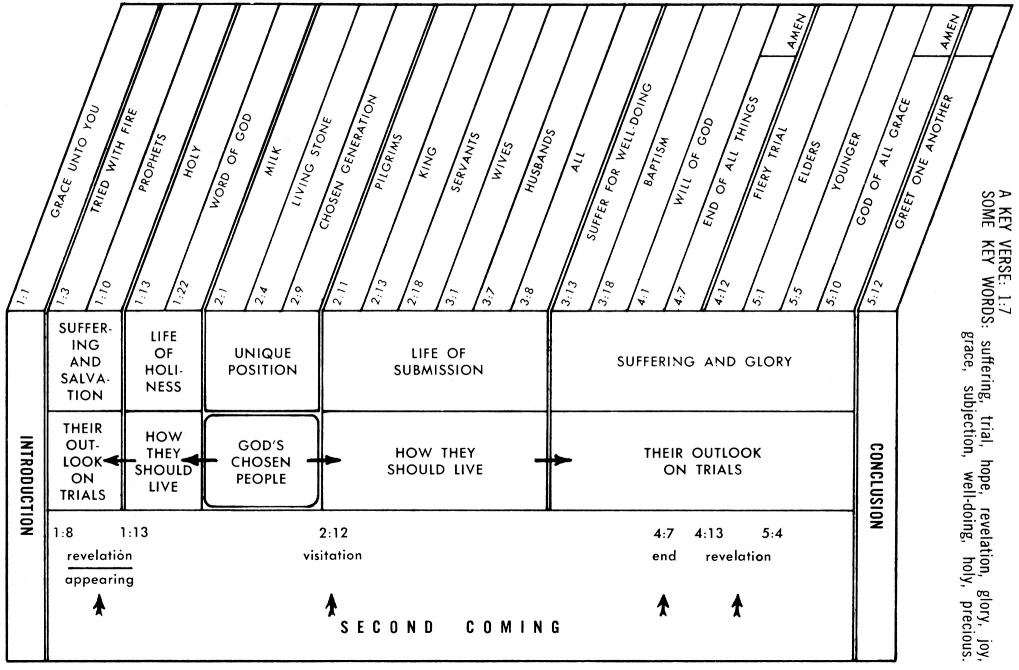
1 Peter: Trials, Holy Living & The Lord's Coming
Click chart to enlarge
Chart from Jensen's Survey of the NT - used by permission
See Another Chart from Charles Swindoll
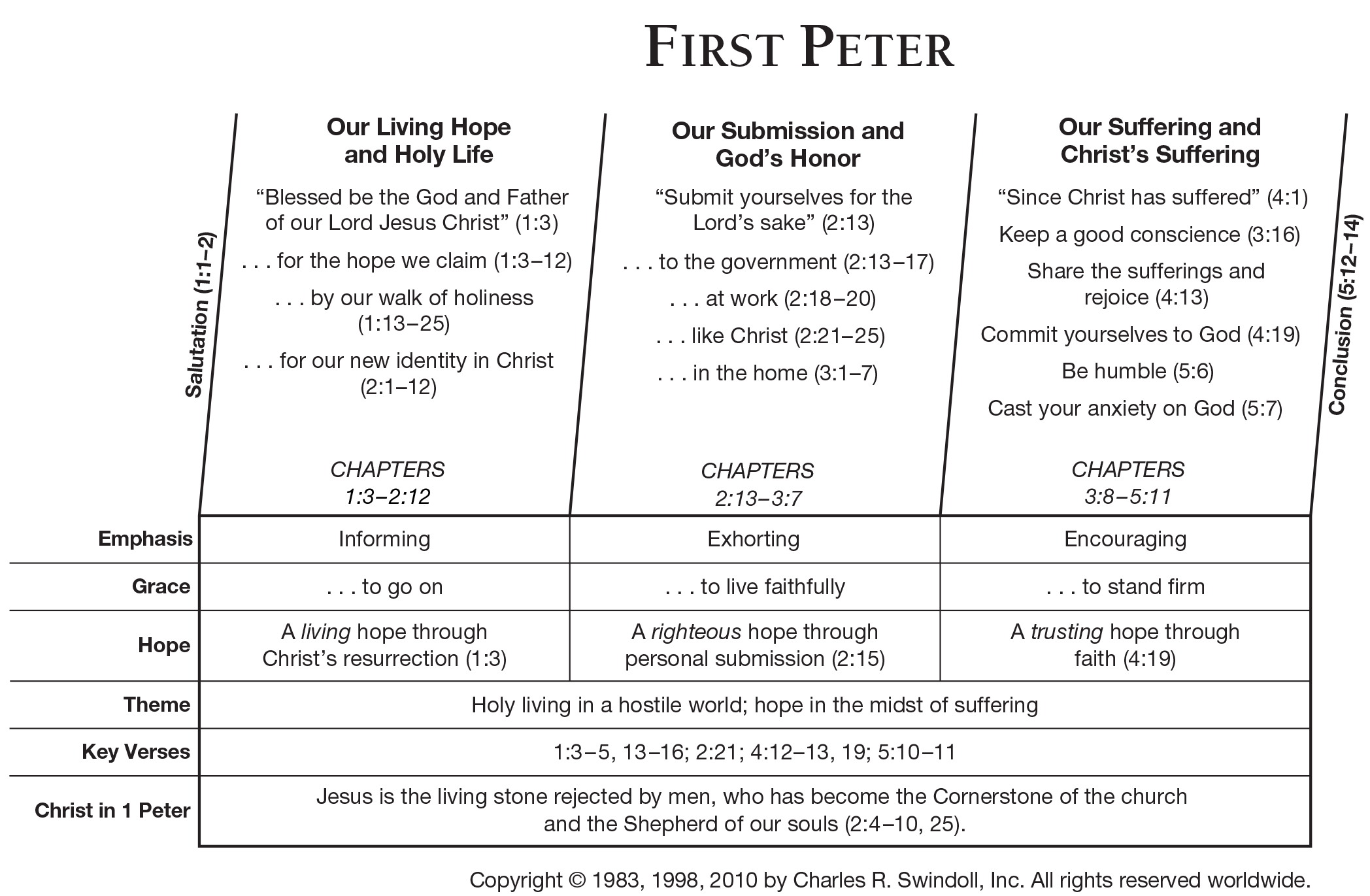
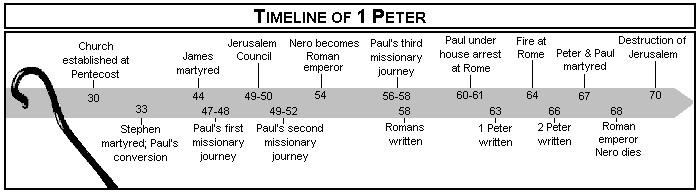
Source: Borrow Ryrie Study Bible
Click to enlarge
| Salvation of the Believer 1 Pe 1:1-2:12 |
Submission of the Believer 1 Pe 2:13-3:12 |
Suffering of the Believer 1 Pe 3:13-5:14 |
||||||||
| Salvation 1Pe 1:1-1:12 |
Sanctification 1Pe 1:13-2:12 |
Submit to Government 1Pe 2:13-17 |
Submit in Business 1Pe 2:18-25 |
Submit in Marriage 1Pe 3:1-8 |
Submit in all of life 1Pe 3:9-12 |
Conduct in Suffering 1Pe 3:13-17 |
Christ's Example of Suffering 1Pe 3:18-4:6 |
Commands in Suffering 1Pe 4:7-19 |
Minister in Suffering 1Pe 5:1-14 |
|
| Belief of Christians | Behavior of Christians | Buffeting of Christians | ||||||||
| Holiness | Harmony | Humility | ||||||||
|
Adapted from Bruce Wilkinson and Kenneth Boa's Talk Thru the Bible (borrow) |
||||||||||
1 Peter 5:1 Therefore, I exhort the elders among you, as your fellow elder and witness of the sufferings of Christ, and a partaker also of the glory that is to be revealed (NASB: Lockman)
Greek: Presbuterous oun en humin parakalo (1SPAI) o sumpresbuteros kai martus ton tou Christou pathematon, o kai tes mellouses (PAPFSG) apokaluptesthai (PPN) doxes koinonos
Amplified: I WARN and counsel the elders among you (the pastors and spiritual guides of the church) as a fellow elder and as an eyewitness [called to testify] of the sufferings of Christ, as well as a sharer in the glory (the honor and splendor) that is to be revealed (disclosed, unfolded): (Amplified Bible - Lockman)
KJV: The elders which are among you I exhort, who am also an elder, and a witness of the sufferings of Christ, and also a partaker of the glory that shall be revealed:
NLT: And now, a word to you who are elders in the churches. I, too, am an elder and a witness to the sufferings of Christ. And I, too, will share his glory and his honor when he returns. As a fellow elder, this is my appeal to you: (NLT - Tyndale House)
Phillips: Now may I who am myself an elder say a word to you my fellow-elders? I speak as one who actually saw Christ suffer, and as one who will share with you the glories that are to be unfolded to us. (New Testament in Modern English)
Wuest: Elders therefore who are among you, I exhort, I who am your fellow elder, and one who saw the sufferings of the Christ and who has been retained as a witness to bear testimony concerning them, who also am a fellow partaker of the glory which is about to be unveiled
Young's Literal: Elders who are among you, I exhort, who am a fellow-elder, and a witness of the sufferings of the Christ, and of the glory about to be revealed a partaker,
THEREFORE: oun:
- 1 Peter 5 Resources - Multiple Sermons and Commentaries
Neither NIV or KJV translates "therefore" (3767) (oun) which in fact links this section with the preceding. Because of suffering and persecution, the need of mature leadership was important for the spiritual health of the local churches.
Therefore - This term of conclusion always calls for a pause to ponder the passage - What is the conclusion? What is it based upon?, etc? In the light of this suffering in the church and in the light of the judgment of God that is purifying the church before it punishes the world -- in the light of that, here's how to shepherd the suffering flock. Keeping this in mind -- that this is a short course in elder-shepherding for a suffering church -- will help us get the gist of what follows.
This same point regarding the importance of elders can be deduced from the context of (Acts 14:22,23) where elders were appointed in all the churches in Asia Minor in view of the historical context of the truth about PERSECUTION (cp Acts 14:22: "Through many tribulations we must [verb indicates a necessity not an option!] enter the kingdom of God", not a popular message then or today, but a very necessary part of the whole purpose (Acts 20:27) of God. God dictates a certain "order" for Christ's Body that she might survive and thrive in the midst of a sea of disorder and persecution.
Times of persecution demand that God’s people have adequate spiritual leadership. If judgment is to begin at God’s house (1Peter 4:17 ), then that house had better be in order, or it will fall apart! This explains why Peter wrote this special message to the leaders of the church, to encourage them to do their work faithfully. Leaders who run away in times of difficulty are only proving that they are hirelings and not true shepherds (John 10:12, 13, 14). Peter was concerned that the leadership in the local churches be at its best. When the fiery trial would come, the believers in the assemblies would look to their elders for encouragement and direction.
I EXHORT THE ELDERS AMONG YOU: Presbuterous oun en humin parakalo (1SPAI):
- Acts 11:30; 14:23; 15:4,6,22,23; 20:17,28; Acts 21:18; 1Ti 5:1,19; Titus 1:5
- 1 Peter 5 Resources - Multiple Sermons and Commentaries
The context establishes that “elders” is used in an official sense, but from verse 5 it is clear that the term retains something of its original sense of age, “one older than another” (Luke 15:25). The term does not imply “advanced age but merely establishes seniority.
I exhort (3870) (warn, counsel, beseech, encourage) not “I command,” marks Peter’s attitude in addressing these leaders. He does not stress his own authority but rather appeals to their own sense of what is right. He avoids any implication of the imposition of a higher authority but uses instead the method of spiritual persuasion.
Elders (4245) (presbuteros comparative of présbus = an old man) (Click in depth study of presbuteros) referred to men who were older or more senior with no negative connotations but rather a sense of venerability. Presbuteros is transliterated into English as “presbyter” (a leader in one of the Jewish communities--especially a member of the Sanhedrin--or of the early Christian churches) and from which the word “priest” (from Late Latin presbyter) was derived.
The secular practice was for older men with seniority to serve as ambassadors to other states and as advisors within the Greek political community or in the management of public affairs. So these were men of "ripe age" and experience to whom was committed the direction and government of individual churches.
It should be emphasized that in the context of its Biblical use the concept of elder had less to do with age per se than with the quality of one's spiritual character (reputation is what others think about you but character is what those most intimately associated know is really true about you) and possession of the ability to teach. Simply being older, including even being older in the faith, does not by itself qualify a man for leadership in the church.
Presbuteros on rare occasion is used to refer to one who is simply older than another (albeit not necessarily advanced in years) as in the story of the prodigal son where Luke records "Now his older (presbuteros) son was in the field, and when he came and approached the house, he heard music and dancing." (Lk 15:25 cf Septuagint use in Job 1:13). In Hebrews presbuteros is used to refer to those men and women in the Old Testament who were genuine believers, the writer recording that "For by it (faith) the men of old (presbuteros) gained approval." (see Hebrews 11:2)
Presbuteros is used some 145 times in the Septuagint (Greek translation of the Hebrew) usually to translate the Hebrew word "zaqen" (thought to be derived from "beard" or "chin") and used to refer to advanced age (as in Ge 18:11 "Now Abraham and Sarah were old [Hebrew = zaqen, Gk = presbuteros], advanced in age. Sarah was past childbearing."), experience, and authority, as well as specific leadership roles. Refer to the article in Holman's Dictionary (Easton; ISBE-NT ISBE-OT) for more in depth discussion of "elders", as used in the Old and New Testaments.
In general, depending on the context, the NT uses presbuteros to refer to several distinct groups:
(1) older persons advanced in years
Do not sharply rebuke an older man, but rather appeal to him as a father, to the younger men as brothers" 1Ti 5:1, cf Acts 2:17);
(2) Jewish elders - this is the primary idea in the 44 uses of presbuteros in the Gospels and Acts where it usually refer to the Jewish leaders who were opposed to Jesus.
“The Son of Man must suffer many things, and be rejected by the elders (presbuteros) and chief priests and scribes, and be killed, and be raised up on the third day.” (Lk 9:22).
These elders in the Jewish community were usually associated with the scribes and Pharisees and at the time of Jesus the elders seem to refer especially to those who were members of the Sanhedrin ("council" in most translations, highest ruling body and court of justice among Jews headed by high priest, composed of 71 men including "elders", and scribes most of whom were Pharisees and granted some authority over religious and judicial matters), the gospel writer Mark recording that
"they led Jesus away to the high priest; and all the chief priests and the elders (presbuteros) and the scribes gathered together." (Mk 14:53).
Note that Acts also uses presbuteros to describe the spiritually mature leaders of the young, growing church of Jesus Christ (click discussion of these "elders");
(3) The 24 elders of Revelation
"And around the throne were twenty-four thrones; and upon the thrones I saw twenty-four elders (presbuteros) sitting, clothed in white garments, and golden crowns on their heads." Rev 4:4 - notes
(4) Spiritually mature leaders of the church, as used here in Titus. Presbuteros meaning church elders is discussed initially in Acts, refined in the "pastoral epistles" (especially 1Timothy and Titus), and briefly mentioned in James and 1 Peter.
In first Timothy Paul says
"Let the elders (presbuteros) who rule well be considered worthy of double honor, especially those who work hard at preaching and teaching… Do not receive an accusation against an elder (presbuteros) except on the basis of two or three witnesses." (1 Ti 5:17,19)
Remember that 1Peter (see note 1 Peter 1:1) was written to numerous believers spread over a huge area, and probably including dozens to hundreds of churches. Peter, without hesitation, addresses the elders in these churches who were leaders. Leadership covers the first four verses. 1Peter 5:5-11 take up "follower-ship." The spiritual health of a local church depends on the authenticity and authority of leadership in that church. When a church has no leadership and is in a state of anarchy, that church is trouble. It will eventually stop winning and discipling people for Christ
AS YOUR FELLOW ELDER: o sumpresbuteros:
- Philemon 1:9; 2 Jn 1:1; 3 Jn 1:1
- 1 Peter 5 Resources - Multiple Sermons and Commentaries
Fellow-elder (4850) (sumpresbuteros) occurs only here in the NT and places Peter on a level with the elders he is addressing. This observation suggests that Peter is not speaking down to the other elders as a superior addressing his inferiors. Peter was fulfilling the commission given to him by the risen Lord to shepherd His flock.
In John 21 we read that
"when they had finished breakfast, Jesus said to Simon Peter, "Simon, son of John, do you love (agapao - love unconditionally, sacrificially) Me more than these?" He said to Him, "Yes, Lord; You know that I love You." He said to him, "Tend (feed, pasture, fodder, graze - bosko) My lambs." He said to him again a second time, "Simon, son of John, do you love (agapao - love unconditionally, sacrificially) Me?" He said to Him, "Yes, Lord; You know that I love You." He said to him, "Shepherd (tend, take care of a group of sheep, overseeing, protecting, leading, guiding, feeding - poimaino) My sheep." He said to him the third time, "Simon, son of John, do you love (phileo - be a friend to, have affection for) Me?" Peter was grieved because He said to him the third time, "Do you love Me?" And he said to Him, "Lord, You know all things; You know that I love You." Jesus said to him, "Tend (feed, pasture, fodder, graze - bosko) My sheep." (Jn 21:15-17).
AND WITNESS OF THE SUFFERINGS OF CHRIST: kai martus ton tou Christou pathematon:
- 1Peter 1:12; Lk 24:48; Jn 15:26,27; Acts 1:8,22; 2:32; 3:15; 5:30, 31, 32; Acts 10:39, 40, 41
- 1 Peter 5 Resources - Multiple Sermons and Commentaries
Witness (3144)(martus/martys gives us English "martyr) is one who has information or knowledge of something and hence can bring to light or confirm something, in this cast that Christ suffered. Here we see Peter fulfilling His Lord's commission to His disciples that they would
"receive power when the Holy Spirit has come upon you; and you shall be My witnesses both in Jerusalem, and in all Judea and Samaria, and even to the remotest part of the earth." (Acts 1:8,22)
Peter's letter was going "even to the remotest part of the earth".
Martus does not denote a spectator but one who testifies to something. The thought of the Messiah suffering was at one time very distasteful to Peter (Mt 16:22), but he has himself seen those sufferings and it is now his task to bear witness to their reality and significance. He has done so repeatedly in this epistle (see notes 1 Peter 1:11 ; 2:21 ;3:18 ; 4 :1, 4:13).
Vincent has this note on martus…
The word is used in the New Testament to denote (a) a spectator or eye-witness (Acts 10:39; 6:13). (b) One who testifies to what he has seen (Acts 1:8; 5:32). (c) In the forensic sense, a witness in court (Matt. 26:65; Mark 14:63). (d) One who vindicates his testimony by suffering: a martyr (Acts 22:20; Heb 12:1; Rev 2:13; 17:6). The first three meanings run into each other.
The eye-witness, as a spectator, is always such with a view to giving testimony. Hence this expression of Peter cannot be limited to the mere fact of his having seen what he preached; especially since, when he wishes to emphasize this fact, he employs another word, epoptes (from epi = upon, over + optanomai = see, perceive is literally an "over seer" and then a spectator or eye witness of anything. It refers to those who have first-hand acquaintance with something ) (Peter 1:16). Therefore he speaks of himself as a witness, especially in the sense of being called to testify of what he has seen. (1Peter 5: Greek Word Studies)
Sufferings (3804) (pathema from pascho = suffer where the suffix –ma indicates the result of a certain action, in this case the result of suffering or that which is suffered) describes what happens to a person (in the want of suffering, misfortune, calamity, affliction) and which must be endured. As indicated by the "-ma" ending pathema is talking about the actual suffering itself (not suffering in general) - it refers to the very pain that we are experiencing right now - those very things that we can "see, touch & feel" - those things that are causing us anguish and emotional trauma. It is that which is suffered or endured. Pathema is always plural (except Heb 2:9) and has 2 general meanings. The less common meaning in some contexts (not here in 1Peter 5:1) is “passions” or “impulses” (Romans 7:5) referring to strong inward emotions or strong physical desires especially of a sexual nature.
AND A PARTAKER ALSO OF THE GLORY THAT IS TO BE REVEALED: o kai tes mellouses (to be about to) (PAPFSG) apokaluptesthai (PPN) doxes koinonos:
- 1Pe 5:4; 1:3-5; Ps 73:24,25; 2Co 5:1,8; Php 1:19,21, 22, 23; 2Ti 4:8; 1Jn 3:2; Rev 1:9
- 1 Peter 5 Resources - Multiple Sermons and Commentaries
Partaker (2844) (koinonos from koinos = common, shared by all) (Click for an in depth study of related word koinonia) is one who participates with another in an enterprise or matter of joint concern. It is one who fellowships and shares something in common with another. He or she takes part in something with someone else.
A partaker is one who participates with another in an enterprise. Here in the context of 1Peter 5:1 believers are partakers in the most glorious "enterprise" ever to transpire… "the glory that is to be revealed". "Of the about-to-be-revealed glory" (literal Greek order) points to a glory whose unveiling is eagerly anticipated. Note that suffering and glory are never far apart in Peter’s mind.
Koinonos in the Septuagint (LXX) is translated a companion, one that is closely connected with something similar as for example a person with whom one spends time or travels.
Koinonos is used 5 times in the Septuagint (LXX) (2 Kings 17:11, Esther 8:12, and the other 3 uses below)
Proverbs 28:24 He who robs his father or his mother, And says, "It is not a transgression," Is the companion of a man who destroys.
Isaiah 1:23 Your rulers are rebels, and companions of thieves; Everyone loves a bribe, And chases after rewards. They do not defend the orphan, Nor does the widow's plea come before them.
Malachi 2:14 "Yet you say, 'For what reason?' Because the LORD has been a witness between you and the wife of your youth, against whom you have dealt treacherously, though she is your companion and your wife by covenant.
Koinonos is found 10 times in the NT…
Matthew 23:30 and say, 'If we had been living in the days of our fathers, we would not have been partners with them in shedding the blood of the prophets.'
Luke 5:10 and so also James and John, sons of Zebedee, who were partners with Simon. And Jesus said to Simon, "Do not fear, from now on you will be catching men."
1 Corinthians 10:18 Look at the nation Israel; are not those who eat the sacrifices sharers in the altar… 20 No, but I say that the things which the Gentiles sacrifice, they sacrifice to demons, and not to God; and I do not want you to become sharers in demons.
2 Corinthians 1:7 and our hope for you is firmly grounded, knowing that as you are sharers of our sufferings, so also you are sharers of our comfort.
2 Corinthians 8:23 As for Titus, he is my partner and fellow worker among you; as for our brethren, they are messengers of the churches, a glory to Christ.
Philemon 1:17 If then you regard me a partner, accept him as you would me.
Hebrews 10:33 (note) partly, by being made a public spectacle through reproaches and tribulations, and partly by becoming sharers with those who were so treated.
1 Peter 5:1 (note) Therefore, I exhort the elders among you, as your fellow elder and witness of the sufferings of Christ, and a partaker also of the glory that is to be revealed,
2 Peter 1:4 (note) For by these He has granted to us His precious and magnificent promises, in order that by them you might become partakers of the divine nature, having escaped the corruption that is in the world by lust.
Glory (1391) (doxa) has the basic idea of manifestation so that the glory of God is the manifestation of His Being, His character and His acts. He is glorified when He is allowed to be seen as He really is. To be where God is will be glory. To be what God intended will be glory. To do what God purposed will be glory.
Revealed (601) (apokalupto from apó = from + kalúpto = cover, conceal) (used 3x in 1 Peter) (Click study of related word apokalupsis) means literally to remove the veil or covering exposing to open view what was before hidden. To cause something to be fully known
Peter had a glimpse of that glory at the Transfiguration, writing that
"we did not follow cleverly devised tales when we made known to you the power and coming of our Lord Jesus Christ, but we were eyewitnesses of His majesty. For when He received honor and glory from God the Father, such an utterance as this was made to Him by the Majestic Glory, "This is My beloved Son with whom I am well-pleased"-- and we ourselves heard this utterance made from heaven when we were with Him on the holy mountain." (see note 2 Peter 1:16-18)
At that time however Peter did not himself participate in the glory.
Paul wrote to the Roman saints about our "future glory" declaring that since believers are
"children, heirs also, heirs of God and fellow heirs with Christ, if indeed we suffer with Him in order that we may also be glorified with Him. For I consider that the sufferings of this present time are not worthy to be compared with the glory that is to be revealed to us." (Ro 8:17, cp Ro 8:18, 19, 20, 21, 22, 23, 24, 25, 26, 27 see notes Ro8:17, 8:18-27)
Peter assured the saints that their future glory was safe,
"protected by the power of God through faith for a salvation ready to be revealed in the last time." (see note 1Peter 1:5) awaiting its full glorious manifestation "to be brought to (all saints) at the revelation of Jesus Christ." (see note 1 Peter 1:13)
Paul reiterated this sure hope reminding the Colossian saints that
"you have died and your life is hidden with Christ in God. When Christ, who is our life, is revealed, then you also will be revealed with Him in glory." (see note Colossians 3:3-4)
Elder/shepherds might shrink back from this position not only because they are they vulnerable to man's normal antagonisms, but they are also vulnerable to God's judgment in a peculiar way. You recall that 1Peter 4:17 (note) says God's judgment had begun with the house of God. Compare the solemn warning to elders convey by Eze9 which is a description God's judgment on his rebellious people. He not only began at the house of God; he began with the elders. Ezekiel 9:4, 5, 6 So they started with the elders who were before the temple. (cf 1Peter 4:17 note, 1Co 11:28, 29, 30, 31, 32)
In other words, it has been God's way bring judgment on his own people beginning with the house of God (1Peter 4:17 note) and in the house of God beginning with the elder-shepherds. So it's not surprising that the elders in the churches of Pontus, Galatia, Cappadocia, Asia and Bithynia might have been reluctant to exercise oversight. So Peter says exercise your oversight "not under compulsion, but voluntarily."
1 Peter 5:2 shepherd the flock of God among you, exercising oversight not under compulsion, but voluntarily, according to the will of God; and not for sordid gain, but with eagerness; (NASB: Lockman)
Greek: poimanate (2SAAM ) to en humin poimnion tou theou ,episkopountes (PAPMPN) me anagkastos alla ekousios kata theon, mede aischrokerdos alla prothumos
Amplified: Amplified: Tend (nurture, guard, guide, and fold) the flock of God that is [your responsibility], not by coercion or constraint, but willingly; not dishonorably motivated by the advantages and profits [belonging to the office], but eagerly and cheerfully;
KJV: Feed the flock of God which is among you, taking the oversight thereof, not by constraint, but willingly; not for filthy lucre, but of a ready mind;
NLT: Care for the flock of God entrusted to you. Watch over it willingly, not grudgingly—not for what you will get out of it, but because you are eager to serve God.
Phillips: I urge you then to see that your "flock of God" is properly fed and cared for. Accept the responsibility of looking after them willingly and not because you feel you can't get out of it, doing your work not for what you can make, but because you are really concerned for their well-being. (New Testament in Modern English)
Wuest: shepherd the flock of God which is among you, doing so not by reason of constraint put upon you, but willingly according to God; not in fondness for dishonest gain but freely
Young's Literal: feed the flock of God that is among you, overseeing not constrainedly, but willingly, neither for filthy lucre, but of a ready mind,
SHEPHERD: poimanate (2SAAM):
- Song 1:8; Is 40:11; Ezek 34:2,3,23; Mic 5:4; 7:14; Jn 21:15, 16, 17; Acts 20:28
- 1 Peter 5 Resources - Multiple Sermons and Commentaries
Shepherd (4165) (poimaino from poimen = shepherd) was one who tended flocks like a shepherd and who carried out oversight, protecting, leading, encouraging, discipling, guarding, guiding and feeding ("feed and lead"). Here Peter applies this agricultural term metaphorically to church leaders who were to exercise administrative and protective activity over the community of believers. English dictionaries say that "to shepherd" means to guide, direct or guard in the manner of a shepherd. Shepherd is in the aorist imperative a command calling for effective action - do this now. Do it effectively. Don't delay. It can even convey a sense of urgency.
In short, the shepherd's role concerning the flock is to…
Graze, Guide and Guard
Poimaino is used 11 times in the NAS ( Matt. 2:6; Lk. 17:7; Jn. 21:16; Acts 20:28; 1 Co. 9:7; 1 Pet. 5:2; Jude 1:12; Rev. 2:27; 7:17; 12:5; 19:15) and is translated: caring, 1; rule, 3; shepherd, 5; tending sheep, 1; tends, 1.
There are 49 uses in the Septuagint - Gen. 30:31, 36; 37:2, 13; Exod. 2:16; 3:1; 1 Sam. 16:11; 17:34; 25:16; 2 Sam. 5:2; 7:7; 1 Chr. 11:2; 17:6; Ps. 2:9; 23:1; 28:9; 37:3; 48:14; 49:14; 78:71f; 80:1; Prov. 9:12; 22:11; 28:7; 29:3; Song 1:7, 8; 2:16; 6:2, 3, Is 40:11; 61:5; Jer. 3:15; 6:3, 18; 22:22; 23:2, 4; Ezek. 34:10, 23; Hos. 13:5; Mic. 5:4, 6; 7:14; Zech. 11:4, 7, 9, 17
Larry Richards writes that…
The verb poimaino means "to act as a shepherd," "to feed and care for the flock." In the Judaism of the first century, the occupation of a shepherd was considered demeaning, and shepherds were generally despised. However, the NT itself reflects the attitude of the OT, and the metaphor continues to be used to represent God's love for his people. (Richards, L O: Expository Dictionary of Bible Words: Regency)
In the Near East the citizens in a country were referred to as “herd” and the king as “shepherd,” and the OT and NT pick up this imagery. Because shepherds were the sole source of provision, protection, and control for sheep, in ancient Near Eastern usage “shepherd” came to be a term descriptive of political leaders. The law codes of Lipit-ishtar and Hammurabi each refer to the ruler as the divinely appointed shepherd of his people.
Jesus is the ultimate example of a "Good Shepherd" Who leads the sheep and protects the sheep (Jn 10:1, 2, 3, 4, 5, 6, 7, 8, 9, 10, 11, 12, 13) even to being willing to lay down His life. Jesus' willingness to die for His flock contrasts with hirelings who don't care for the sheep and will depart when the wolves come, leaving the sheep to be ravaged and destroyed. Jesus passes the responsibility of shepherding the flock to Peter (see John 21:15-17 = "Shepherd My sheep") and Peter passes on this same command to the leaders in each church.
In the first use of poimaino Matthew records the Messianic prophecy from Micah 5:2 writing…
'AND YOU, BETHLEHEM, LAND OF JUDAH, ARE BY NO MEANS LEAST AMONG THE LEADERS OF JUDAH; FOR OUT OF YOU SHALL COME FORTH A RULER, WHO WILL SHEPHERD MY PEOPLE ISRAEL.' (Matthew 2:6)
John MacArthur commenting on the combination of "Ruler" and "shepherd" in Matthew 2:6 writes that this
combination of a Ruler who will shepherd (poimaino) shows that the shepherding function is more than tender care. It is sovereign dominance. Nowhere is that made more clear than by the use of the verb poimaino in Revelation 2:27; Rev 12:5; Rev 19:15. In each of those verses the verb is justifiably translated “rule”-and “with a rod of iron” at that. Its appearance in Revelation 7:17, as well as its use in John 21:16; Acts 20:28; and 1 Peter 5:2, could warrant a similar rendering. (MacArthur, J: Matthew 1-7 MacArthur New Testament Commentary Chicago: Moody Press)
In John 21, Jesus instructed Peter using poimaino in the second of 3 commands (which seem similar in the English translation = "tend… shepherd… tend")…
So when they had finished breakfast, Jesus said to Simon Peter, "Simon, son of John, do you love Me more than these?" He said to Him, "Yes, Lord; You know that I love You." He said^ to him, "Tend (bosko - 1006 = pasture, graze = present imperative) My lambs." He said to him again a second time, "Simon, son of John, do you love Me?" He said^ to Him, "Yes, Lord; You know that I love You." He said to him, "Shepherd (KJV = "feed", poimaino - present imperative) My sheep." He said^ to him the third time, "Simon, son of John, do you love Me?" Peter was grieved because He said to him the third time, "Do you love Me?" And he said to Him, "Lord, You know all things; You know that I love You." Jesus said to him, "Tend (bosko - 1006 = pasture, graze = present imperative) My sheep. (John 21:15-17)
Peter by writing this letter is fulfilling Christ's command to Shepherd or Feed His sheep. Note what happens when there are no "true" shepherds feeding the flock.
And seeing the multitudes, (Jesus, the Shepherd and Guardian of our souls, see 1Pe 2:25) felt compassion for them, because they were distressed and downcast like sheep without a shepherd. (Mt 9:36)
Jude uses poimaino in his description of the men who had crept in unnoticed and were turning the grace of God into licentiousness writing that…
These are in your love-feasts craggy rocks; feasting together with you, without fear shepherding (poimaino, "shepherds who feed only themselves", NIV) themselves (furthering their own schemes and lusts instead of tending the flock of God) (YLT, "shepherds who feed only themselves", NIV)
In Ezekiel 34 Jehovah condemns the self-centered shepherds who were leading the sheep (Israel) only for self-gain (cf "filthy lucre" below) and who were failing to graze, guide and guard the flock, Ezekiel recording that…
"Those who are sickly you have not strengthened, the diseased you have not healed, the broken you have not bound up, the scattered you have not brought back, nor have you sought for the lost; but with force and with severity you have dominated them. And they were scattered for lack of a shepherd, and they became food for every beast of the field and were scattered. My flock wandered through all the mountains and on every high hill, and My flock was scattered over all the surface of the earth; and there was no one to search or seek for them." (Ezekiel 34:4-6).
Marvin Vincent has a lengthy note on poimaino writing that…
The word involves the whole office of the shepherd — guiding, guarding, folding, as well as feeding. Hence appropriate and often applied to the guides and guardians of others. Homer calls kings “the shepherds of the people.” To David the people said, “The Lord said to thee, Thou shalt feed (as a shepherd) my people Israel” (2Sa 5:2; compare Ps. 78:70, 71, 72). God is often called a shepherd (Ge 48:15; Ps. 23:1; 77:20; 80:1; Is. 40:11; Ezek. 34:11–31). Jesus calls himself the good shepherd (John 10:11).
Peter, who is bidden by Jesus to shepherd his sheep (John 21:16, poimaine, Rev., tend), calls him the Shepherd of Souls (1Peter 2:25), and the Chief Shepherd (1 Peter 5:4); and in the Epistle to the Hebrews (Hebrews 13:20), he is styled the great Shepherd of the sheep. In Revelation 2:27 (see note), rule is literally to shepherd (Revelation 19:15); but Christ will shepherd his enemies, not with the pastoral crook, but with a sceptre of iron.
Finally, Jesus will perpetuate this name and office in heaven among his redeemed ones, for “the Lamb, which is in the midst of the throne, shall be their shepherd (Revelation 7:17). In this verse the word governor is in harmony with the idea of shepherding, since the word hegoumenos originally means one who goes before, or leads the way, and suggests Christ’s words about the good shepherd in John 10:3, 4: “He calleth his own sheep by name, and leadeth them out… He goeth before them, and the sheep follow him.” (1Peter 5: Greek Word Studies)
THE FLOCK OF GOD AMONG YOU: to en humin poimnion tou theou :
- Is 63:11; Jer 13:17,20; Ezek 34:31; Zech 11:17; Lk 12:32; 1Co 9:7
- Ps 78:71,72; Acts 20:26,27
- 1 Peter 5 Resources - Multiple Sermons and Commentaries
A FLOCK OF
"SHEEP"
Flock (4168) (poimnion from poimen = shepherd) was literally a flock of sheep but in the NT is applied only figuratively to spiritual sheep that make the community of Jesus' disciples, citizens of the Kingdom of Heaven.
The TDNT explains that
The term poímnē or poímnion is used for flocks or herds of sheep or cattle numbering from 20 to over 500. A mixed herd is in view in Mt. 25:32; such herds are common in ancient Palestine. The sheep and goats pasture together but are separated at night because goats are more susceptible to cold. On summer nights several shepherds come together with their flocks and watch over them in open fields. For better protection the flock might be kept in a walled court with the door closed and the shepherds on guard. (Kittel, G., Friedrich, G., & Bromiley, G. W. Theological Dictionary of the New Testament. Eerdmans)
Poimnion is used only 5 times in the NT (twice by Peter, 1Peter 5:2-3), the other 3 uses shown below…
“Do not be afraid, little flock, for your Father has chosen gladly to give you the kingdom. (Luke 12:32) (What kingdom? See related discussions on [1] Kingdom of heaven [2] Kingdom of Heaven; [3] Click here to study over 100 uses of the "Kingdom" most of which refer to the Kingdom of Heaven/God)
(Paul's farewell address to the Ephesian elders) “Be on guard (see discussion of same verb in similar context in Matthew 7:15 note) for yourselves and for all the flock (poimnion), among which the Holy Spirit (Who?) has made you overseers (see episkopos), to shepherd (poimaino - see discussion above) the church of God which He purchased with His own blood. “I know that after my departure savage wolves will come in among you, not sparing (see pheidomai) the flock (poimnion) (Acts 20:28, 29)
The comparison of God's people to a flock of sheep and the Lord to a Shepherd is prominent in Scripture and it is very instructive (eg, see Ps 23:1, 2, 3, 4, 5; 100:1, 2, 3, 4, 5; Is 40:11; Lk 15:4-6; Jn 10:1,2, 3, 4, 5, 6, 7, 8, 9, 10, 11, 12, 13; Acts 20:28; Heb 13:20, 21; 1Pe 2:25; Rev 7:17). We were once stray sheep, wandering toward ruin; but the Good Shepherd found us and restored us to the fold.
Warren Wiersbe has an excellent amplification of the picture of God's children pictured as sheep…
Sheep are clean animals, unlike dogs and pigs (2Pe 2:20, 21,2Pe 2:22).
Sheep tend to flock together, and God’s people need to be together. (Heb 10:24-25)
Sheep are notoriously ignorant and prone to wander away if they do not follow the shepherd.
Sheep are defenseless, for the most part, and need their shepherd to protect them (Ps 23:4).
Sheep are very useful animals. Jewish shepherds tended their sheep, not for the meat (which would have been costly) but for the wool, milk, and lambs. God’s people should be useful to Him and certainly ought to “reproduce” themselves by bringing others to Christ. (Mt 28:18-20)
Sheep were used for the sacrifices, and we ought to be “living sacrifices,” doing the will of God (Ro 12:1, Ro 12:2). (Wiersbe, W: Bible Exposition Commentary - New Testament. 1989. Victor)
EXERCISING OVERSIGHT: (episkopountes) (PAPMPN):
- 1 Peter 5 Resources - Multiple Sermons and Commentaries
Exercising oversight (1983) (episkopeo from epí = upon or intensifying already existing idea in verb + skopeo = regard, give attention to, look at, contemplate) means literally to look upon, and thus to observe, to examine the state of affairs of something, to look after or to oversee. In the NT, episkopeo is used only in Hebrews 12:15 and 1 Peter 5:2, the latter used to describe the work of shepherding the flock. It expresses careful regard of those in position of responsibility.
The writer of Hebrews exhorts his readers to be
exercising oversight (episkopeo) [over yourselves] lest anyone be falling away from the grace of God, lest any root of bitterness springing up be troubling you, and through this the many be defiled (Hebrews 12:15) (Eerdmans)
Episkopeo describes one who is literally a "watchman" "upon" (prefix "epi-" = upon) the sheep. This verb is in the present tense which pictures these men as constantly, diligently, actively and responsibly overseeing the care of the sheep in their flock. They are constantly examining them for "spiritual parasites" and are ever on the lookout for the ravenous wolves in sheep's clothing (see discussion on Matthew 7:15). Oversight is not the only duty of shepherding, but it is the one Peter mentions here in the situation of suffering.
Episkopeo is made up of two words in Greek just like it is in English - "over" and "sight". Elder-shepherds exercise oversight. They are "overseers". They look out over the flock. God holds them accountable for seeing the big picture and acting for the good of the whole flock.
Vine writes that “exercising” is the right rendering; the word does not imply the entrance upon such responsibility, but the fulfilment of it. It is not a matter of assuming a position, but of the discharge of the duties.
An overseer (1985) (episkopos from epi = over or upon + skopos = goal or end one has in view = English "scope" as in microscope or telescope) is literally one who looks over closely or intently, who views carefully. One who superintends, exercises oversight or watches over others, thus an "overseer" (one looking over another). The Latin equivalent is super-visus, someone who “looks over” things, a manager. From super-visus comes the English supervisor.
Episkopos properly means an inspector, overseer, or guardian, and was given to the ministers of the gospel because they exercised this care over the churches or were appointed to oversee their interests. In the NT the overseers had the responsibility of oversight of the body of Christ, serving as the guardians who were to watch over God's "flock" and lead the sheep by their godly example. It is important to note that Paul here uses the term in the plural and that elsewhere this term is used interchangeably with "elder" (presbuteros). God’s people are like sheep (see Jehovah Roi for discussion of sheep) and in need of shepherds to watch over them, protect them, and lead them. Pray for your spiritual leaders that they might more and more be what God wants them to be.
Episkopos was originally a secular title, designating commissioners appointed to regulate a newly-acquired territory or a colony. It was also applied to magistrates who regulated the sale of provisions under the Romans. In the Septuagint (Greek translation of the Hebrew OT) episkopos signifies "inspectors, superintendents, taskmasters," (2Ki 11:19; 2Chr 34:12,17) or "captains, presidents," (Neh 11:9,14,22). In the ancient Greek culture episkopos was often used to describe pagan gods, who supposedly watched over worshipers and over their nations. (See Ref article ISBE)
NOT (forced into) UNDER COMPULSION: me anagkastos :
- Is 6:8; 1Co 9:16,17
- 1 Peter 5 Resources - Multiple Sermons and Commentaries
Under compulsion (317) (anagkastos from anagke = necessity) is an adverb that describes the state of being checked, restricted, or compelled to avoid or perform some action (so not voluntary). By force or constraint. Unwillingly. Out of obligation.
This is the only use of this adverb in Scripture (no uses in Lxx).
In other words the shepherd does it not because he is constrained or forced to do it. He should not occupy the office as a reluctant draftee, doing an irksome task because he feels he cannot escape it. Such a feeling may arise out of “a false sense of unworthiness, a reluctance for responsibility, or a desire to do no more than was morally required in the office.” Such feelings are unworthy of one called to sacred service.
BUT VOLUNTARILY ACCORDING TO GOD: alla hekousios kata theon:
- 1 Peter 5 Resources - Multiple Sermons and Commentaries
Voluntarily (1596) (hekousios from hekoúsios = voluntary) is an adverb meaning willingly, of one's own accord or free will, spontaneously. means willing to do something without being forced or pressured.
In the only other NT use in Heb 10:26 hekousios means deliberately or intentionally,
Heb 10:26 For if we go on sinning willfully after receiving the knowledge of the truth, there no longer remains a sacrifice for sins
Thayer: To sin willfully is tacitly opposed to sins committed inconsiderately, and from ignorance or from weakness
Hekousios - 2x in the Septuagint - Ex 36:2 (context = working for the Lord), Ps 53:8 (context = giving to the Lord), both should be willingly.
Exodus 36:2 Then Moses called Bezalel and Oholiab and every skillful person in whom the LORD had put skill, everyone whose heart stirred him (Lxx - hekousios = willingly), to come to the work to perform it.
Psalm 54:6 Willingly (Lxx - hekousios = willingly), I (David) will sacrifice to You; I will give thanks to Your name, O LORD, for it is good.
A shepherd's motive must be willingness, not a sense of external compulsion: not because you must, but because you are willing. (1Ti 3:1 oregomai pictures a strong desire to be an elder. How sad when a man is coerced or cajoled into eldership!) The responsibilities of the office of shepherd are great and they "will give an account." (Heb 13:17). Clearly, no one should be forced into this position. God will work in men's lives and make them willing to do His will so those who shepherd should be according to God (probably according to His will would be an accurate translation - NET has "under God's direction"; ESV = "as God would have you", NIV = "as God wants you to be") that is, “just as God shepherds His flock.”
Cranfield remarks that the meaning is best illustrated
in the whole-heartedness of the Chief Shepherd Himself, Who could say, ‘My food is to do the will of Him that sent me, and to accomplish His work. (Jn 4:34 cp Jn 17:4 - Note "Whose" work it is! A good reminder lest we become too "possessive" of our position!)
Dr. George W. Truett was pastor of First Baptist Church in Dallas, Texas for nearly fifty years. Often he was asked to accept other positions, and he refused, saying, “I have sought and found a pastor’s heart.” When a man has a pastor’s heart, he loves the sheep and serves them because he wants to, not because he has to.
AND NOT FOR SORDID GAIN: mede aischrokerdos:
- Is 56:11; Jer 6:13; 8:10; Micah 3:11; Mal 1:10; Acts 20:33,34; 2Co 12:14,15; 1 i 3:3,8; Titus 1:7,11; 2Peter 2:3; Revelation 18:12,13
- 1 Peter 5 Resources - Multiple Sermons and Commentaries
Sordid gain (KJV - filthy lucre) (147) (aischraischrokerdos from aischros = indecent, dishonorable + kerdos = gain) means a fondness for dishonest gain. It is gain procured in a base and avaricious manner and which would produce shame if uncovered. This does not refer exclusively to material gain such as the demand of a salary which gives the impression that an elder serves primarily from his desire for selfish purposes rather than his desire to be of service. It may also refer to gaining popularity by adulterating the gospel to attract more people to the congregation, and showing special favors and consideration to the rich and the influential in order to gain personal advantage and profit.
The KJV renders aischrokerdos with the graphic phrase "filthy lucre" where "Lucre" is from a Latin word meaning "gain," and only becomes filthy when it corrupts the sincerity of Christian ministry. The pastor is not to commercialize his ministry.
Vincent writes that…
For filthy lucre From aischros, disgraceful, and kerdos, gain. Only here in New Testament. The word filthy is intended to convey the idea which lies in aischros, base or dishonorable; becoming such if it is made the motive of the minister’s service. Compare 2Cor 12:14. (Greek Word Studies)
The shepherd must serve the Lord with a willing heart because he loves Christ and the flock, and not simply because he has a job to do. He must never serve for “sordid gain”, whether it be money, prestige, power, or promotion.
False teachers are usually motivated by greed and desire for money, and use their power and position to rob people of their own wealth. A desire for filthy lucre must never be a motive for Shepherds. (cf. 1Ti 3:3; 6:9, 10, 11; 2Ti 2:4; Titus1:7; 2Pe 2:3; also Je 6:13; 8:10; Mic 3:11; Mal 1:10).
This does not prohibit the elder from receiving a fair return for honest toil. Peter, like Paul, accepted the ordinance of Christ that “the laborer is worthy of his wages” (Lk 10:7; 1Ti 5:18). But Peter is warning against taking up the work because of a desire for material gain, “it being a shameful thing for a shepherd to feed the sheep out of love to the fleece.”
To enter the ministry simply because it offers a respectable and intellectually stimulating way of gaining a livelihood is to prostitute that sacred work. This warning also includes the temptation to use the work of the ministry to gain personal popularity or social influence. When a love for gain reigns, the shepherds are prone to become mere hirelings, feeding themselves at the expense of the flock.
BUT WITH EARGERNESS: alla prothumos:
- Acts 21:13; Ro 1:15; Titus 2:14; 3:1
- 1 Peter 5 Resources - Multiple Sermons and Commentaries
Eagerness (4290) (prothumos from pró = forward + thumos = mind, temperament, passion) means predisposed, ready, willing, eager (moved by a strong and urgent desire or interest; implies ardor and enthusiasm), prompt. It means inclined or favorably disposed in mind.
Shepherds who serve with false motives care only for themselves and devour the flock (Ezekiel 34:2,3). True shepherds are characterized by being ready and willing and favorably inclined to accept the responsibility. Prothumos is extremely strong and expresses enthusiasm and devoted zeal to the task assigned.
The Shepherd must be eager to work (a ready mind), not listless or lazy.
It is the same word Paul used in Ro1:15 (note)—“I am so eager to preach the Gospel” (NIV). It means a willingness to serve because of a readiness and an eagerness within the heart. This is the difference between a true shepherd and a hireling: a hireling works because he is paid for it, but a shepherd works because he loves the sheep and has a heart devoted to them.
Read Acts 20:17-27, Acts 20:28-38 (See Acts 20:17-27 Commentary; Acts 20:28-38 Commentary) for a description of the heart and ministry of a true shepherd.
1 Peter 5:3 nor yet as lording it over those allotted to your charge, but proving to be examples to the flock. (NASB: Lockman)
Greek: med' os katakurieuontes (PAPMPN) ton kleron alla tupoi ginomenoi (PMPMPN) tou poimniou
Amplified:Not domineering [as arrogant, dictatorial, and overbearing persons] over those in your charge, but being examples (patterns and models of Christian living) to the flock (the congregation). (Amplified Bible - Lockman)
KJV: Neither as being lords over God's heritage, but being ensamples to the flock.
NLT: Don't lord it over the people assigned to your care, but lead them by your good example. (NLT - Tyndale House)
Phillips: You should aim not at being "little tin gods" but as examples of Christian living in the eyes of the flock committed to your charge. (New Testament in Modern English)
Wuest: nor yet as lording it in a high-handed manner over the portions of the flock assigned to you, but as becoming patterns for the flock.
Young's Literal: neither as exercising lordship over the heritages, but patterns becoming of the flock,
NOR YET AS LORDING IT OVER: med os katakurieuontes (PAPMPN):
- Ezek 34:4; Mt 20:25,26; 23:8, 9, 10; Mark 10:42, 43, 44, 45; Lk 22:24, 25, 26, 27; 1Co 3:5,9; 2Co 1:24; 4:5; 3Jn 1:9,10
- 1Pe 2:9; Dt 32:9; Ps 33:12; 74:2; Mic 7:14; Acts 20:28
- 1 Peter 5 Resources - Multiple Sermons and Commentaries
Phillips paraphrase is boldly pithy…
You should aim not at being "little tin gods" (NT in Modern English)
The Amplified version also gives a clear picture of the attitude that is not to be manifest by God's shepherds over their sheep…
Not domineering [as arrogant, dictatorial, and overbearing persons] over those in your charge (Amplified Bible - Lockman)
Lording (2634) (katakurieuo from katá =an intensifier or down + kurieúo = have dominion over) means to have dominion "down" on others and includes the idea of domineering as in the rule of a strong person over one who is weak. It means to exercise dominion over, bring under one's power, bring into subjection, to become master, gain dominion over or to subdue.
The preposition kata (“down”) indicates intensity and depicts a heavy-handed use of authority for personal aggrandizement, manifesting itself in the desire to dominate and accompanied by a haughty demand for compliance. It speaks of a high-handed autocratic rule over the flock, something forbidden of true shepherds. This cautionary note however does not do away with God-ordained, properly exercised authority which is to be administered in the local church by the pastor and the elders. Other Greek verbs are used for the exercise of legitimate authority (see proistemi [4291] = stand before in rank, have charge over in 1Thes 5:12, 1Ti 5:17, poimaino in 1Peter 5:2)
The idea of exerting lordship over others combines elements of power and authority, the root word kurios being derived in turn from a root meaning “to swell,” “to be strong,” so that kurios means “having power,” “empowered,” “authorized,” “valid.” The power denoted is a power of control rather than physical strength.
TDNT writes that…
Although the force of the katá is mostly lost in ordinary usage, it conveys the sense of rule to one’s own advantage in Mk 10:42 (Gentile rulers), Acts 19:16 (the evil spirit), and 1 Pet. 5:2-3 (the admonition to the elders). (Kittel, G., Friedrich, G., & Bromiley, G. W. Theological Dictionary of the New Testament. Eerdmans)
The present tense describes this behavior as a habitual practice.
Katakurieuo occurs 4 times in the NAS (Matthew; Mark; Acts; 1 Peter) and is translated in NAS as lord it over, 2; lording it over, 1; subdued, 1 and in the KJV as be lord over, 1; exercise dominion over, 1; exercise lordship over, 1; overcome, 1.
In this context, “lording it over” means to dominate someone or some situation and implies leadership by manipulation and intimidation. If you've been a Christian for some time, you most likely have witnessed this attitude from time to time.
The Septuagint (LXX) uses katakurieuo in describing God's lordship in exercising complete dominion writing…
May He also rule (katakurieuo) from sea to sea, and from the River to the ends of the earth. (Psalm 72:8)
In Genesis 1 the Septuagint (LXX) uses katakurieuo of God's decree to man to exercise appropriate lordship…
And God blessed them; and God said to them, "Be fruitful and multiply, and fill the earth, and subdue (katakurieuo) it; and rule over (archo) the fish of the sea and over the birds of the sky, and over every living thing that moves on the earth. (Genesis 1:28, cf similar use in Genesis 9:1)
In the LXX of Psalm 119 the writer personifies "iniquity" as a harsh lord writing…
Establish my footsteps in Thy word, and do not let any iniquity have dominion (katakurieuo) over me. (Psalm 119:133, similar use of katakurieuo in Ps 19:13) (This is a great prayer, especially as a prayer to follow up praying Ps 119:38)
Katakurieuo is used in a good sense in Jeremiah, where Jehovah declares to rebellious Israel…
'Return, O faithless sons,' declares the LORD; 'For I am a master (katakurieuo) to you, And I will take you one from a city and two from a family, and I will bring you to Zion.' (Jer 3:14)
Ezekiel indicted the false shepherds who were "fleecing the sheep" and out only for self-gain writing that
“with force and with severity you have dominated them (the sheep - Israel).” (Ezekiel 34:4, 5).
Lording it over others is the third major temptation for a pastor, the first being laziness (1Peter 5:2) and the second being dishonest finances (1Peter 5:2). All are to be assiduously avoided by shepherds and elders!
MacDonald rightly comments that…
Many of the abuses in Christendom would be eliminated by simply obeying the three instructions in verses 2, 3. The first would abolish all reluctance. The second would spell the end of commercialism. The third would be the death of officialism in the church. (MacDonald, W., & Farstad, A. Believer's Bible Commentary : Old and New Testaments. Nashville: Thomas Nelson)
Jesus directly condemned such abuse of authority among His followers (Mt 20:25, 26, 27; Mk 10:42, 43, 44). The tragic impact of such an attitude is illustrated by the account of Diotrephes in 3 Jn 9,10. All genuine rule in the church is in no sense a lordship but an administration of Christ’s lordship by His willing servants. Shepherds and elders should be examples, not dictators. They should be walking out in front of the flock, not driving them from behind. They should not treat the flock as if it belonged to them. This strikes at the very heart of authoritarianism!
THOSE ALLOTTED TO YOUR CHARGE: ton kleron:
- 1 Peter 5 Resources - Multiple Sermons and Commentaries
Allotted to (your) charge (2819) (kleros from kláo = to break) was first a specially marked small object, pebble or a piece of wood used in casting lots as in Acts 1:17, 26. The object was thrown down in order to aid the making decisions a practice based on pagan views of chance (Greeks and Romans), or in the case of believers using the lot and interpreting the result as guided by God (see Acts 1:26 in choosing Judas' replacement).
Kleros is used 11 times in the NAS (Matt. 27:35; Mk. 15:24; Lk. 23:34; Jn. 19:24; Acts 1:17, 26; 8:21; 26:18; Col. 1:12; 1 Pet. 5:3) and is translated: allotted to your charge, 1; inheritance, 2; lot, 1; lots, 5; portion, 1; share, 1.
Kleros - 115x in the Septuagint - Gen. 48:6; 49:14; Exod. 6:8; Lev. 16:8ff; Num. 16:14; 18:21, 24, 26; 26:55f, 62; 27:7; 32:19; 33:53f; 34:13ff; 35:2; 36:2f, 9; Deut. 2:5, 9, 19; 3:18; 4:21; 5:31; 9:29; 10:9; 11:31; 12:1, 12; 14:27, 29; 15:4; 17:14; 18:1f; 19:10, 14; 21:23; 24:4; 25:15, 19; 26:1; 29:8; Jos. 12:7; 13:6; 14:2f, 9, 13f; 17:4, 6, 14, 17; 18:6, 8, 10f; 19:1f, 9f, 17, 24, 32, 40, 49, 51; 21:4, 10; 23:4; 24:30; Jdg. 1:3; 20:9; 1 Chr. 6:54, 61, 63, 65; 24:5, 7, 31; 25:8f; 26:13f; Neh. 10:34; 11:1; Esther 3:7; 4:17; 9:24, 26; 10:3; Ps. 22:18; 68:13; 125:3; Prov. 1:14; 18:18; Is. 34:17; 57:6; Jer. 12:13; 13:25; Ezek. 24:6; 47:22; 48:29; Dan. 12:13; Hos. 5:7; Joel 3:3; Obad. 1:11; Jon. 1:7; Mic. 2:5; Nah. 3:10
Kleros also was used to refer to the allotted portion or inheritance , specifically one's possession or what is possessed (Acts 8:21, 26:18, 20:32, Colossians 1:12)
BAGD adds that kleros can refer to something that inevitably happens and so is one's lot or destiny, as used especially of martyrs ("fulfill one's own destiny").
Evidence suggests that the Greek method of casting lots was followed by the Romans. The lots of several parties were properly marked or distinguished and put into a vessel which was violently shaken by one who turned his face away. The lot which first fell upon the ground indicated the man chosen or preferred for the occasion. The Romans attributed divine choice to this method.
Here in 1Peter 5:3, kleros is in the plural and as Vincent notes below, seems to refer to distinct congregations of Christians which fell to the lot, as it were, of different pastors. BAGD agrees writing that here kleros seems
seem to denote the ‘flock’ as a whole, i.e. the various parts of the people of God which have been assigned as ‘portions’ to individual elders or shepherds (of the various portions that combine to form a whole (Arndt, W., Danker, F. W., & Bauer, W. A Greek-English Lexicon of the New Testament and Other Early Christian Literature)
TDNT writes that…
The basic sense of kleros is “lot” (in drawing lots), then “portion,” and finally “inheritance”… A first meaning in the NT is “lot,” as in Mk. 15:24 (with emphasis on the humiliation of Christ) and Acts 1:26 (with emphasis on seeking the will of God). The main sense, however, is “allotted portion.” Thus Judas has a share in the apostles’ ministry in Acts 1:17. Simon Magus has no share in God’s word or gift in Acts 8:21, and there is reference to an eschatological portion in Acts 26:18; Col. 1:12. Ignatius expands on this sense in Ephesians 11.2 etc. and Polycarp in Polycarp 12.2. In 1 Pet. 5:2, 3 what is meant is not the elders’ personal possessions, and certainly not offerings on their behalf, but the portions assigned to them (i.e., to their charge). (Kittel, G., Friedrich, G., & Bromiley, G. W. Theological Dictionary of the New Testament. Eerdmans) (Bolding added)
Vincent comments that "lot" (KJV, heritage) is
Plural. Kleros means lot. From the kindred adjective klerikos comes the English cleric, contracted into clerk, which in ecclesiastical writings originally signified a minister; either as being chosen by lot like Matthias, or as being the lot or inheritance of God. Hence Wycliffe translates the passage, “neither as having lordship in the clergie.” As in the Middle Ages the clergy were almost the only persons who could write, the word clerk came to have one of its common modern meanings. The word here, though its interpretation is somewhat disputed, seems to refer to the several congregations — the lots or charges assigned to the elders. (Greek Word Studies)
BUT PROVING TO BE EXAMPLES TO THE FLOCK: alla tupoi ginomenoi (PMPMPN) tou poimniou:
- 1Co 11:11; Php 3:17; 4:9; 1Th 1:5,6; 2 Th3:9; 1Ti 4:12; Titus 2:7
- 1 Peter 5 Resources - Multiple Sermons and Commentaries
But - term of contrast - This conjunction should always cause us to pause and ponder ask what (why?, etc) is being contrasted?
As discussed in more detail below in the word study on tupos, shepherds and elders are to serve as models for "the sheep" to follow. They were not to drive God’s people, but to lead them by their example of mature Christian character. Sheep aren't driven. They are led (cp Jn 10:3, Ps 23:2). So as spiritual shepherds, they must lead as examples, not drive as dictators! And they can only lead as examples as they themselves follow Christ.
Athanasius spoke of Christ's example noting that…
"He became what we are that He might make us what He is."
William Arnot expanded on this statement writing that
"The gentleness of Christ is the comeliest ornament that a Christian can wear."
Henry Drummond wrote
"To become Christlike is the only thing in the whole world worth caring for, the thing before which every ambition of man is folly and all lower achievement vain."
D. W. Lambert adds that…
"The Christian goal is not the outward and literal imitation of Jesus, but the living out of the Christ life implanted within by the Holy Spirit."
Be examples - The verb "be" is in the present tense picturing this exemplary living as one's everyday practice, something only possible by surrendering and yielding to the enabling power of the Holy Spirit! And Who is our example? Peter has already explained that "Christ also suffered for you, leaving you an example for you to follow in His steps" (1Pe 2:21)
Examples (5179) (tupos from túpto = strike, smite with repeated strokes) literally refers to a visible mark or impression made by a stroke or blow from an instrument or object. What is left after the stroke or blow is called a print, a figure or an impression. For example, the most famous reference to a literal mark (tupos) is when Thomas doubted Jesus' resurrection from the dead declaring "Unless I shall see in His hands the imprint (tupos) of the nails" (John 20:25). (See also ISBE Article)
Stated another way tupos properly means a "model" or "pattern" or "mold" into which clay or wax was pressed (or molds into which molten metal for castings was poured), that it might take the figure or exact shape of the mold. Our English word "type" is similar and originally referred to an impression made by a die as that which is struck.
Tupos also came to be used figuratively of a pattern, mold, model, or copy of the original of something, whether a physical object, such as a statute, or a principle or virtue. Thus in a technical sense tupos is the pattern in conformity to which a thing must be made. In an ethical sense, tupos is a dissuasive (tending to dissuade) example, a pattern of warning or an example to be imitated, this last meaning being seen in Paul's charge to Timothy to…
Let no one look down on your youthfulness, but rather in speech, conduct, love, faith and purity, show yourself an example (tupos - a pattern they believers are to emulate) of those who believe. (1 Ti 4:12).
Similarly Titus was "to be an example [tupos] of good deeds" [Titus was to live so that his life would be cast like a “spiritual die” that would impress itself on others - all believers should strive to be "spiritual dies" to those around them, but this applies especially to leaders] see note Titus 2:7; Paul's exhortation "Brethren join in following my example", see note Philippians 3:17, the Thessalonian saints became "an example to all the believers in Macedonia and Achaia" see note 1Thessalonians 1:7 cf 2Thes 3:9.
Tupos-14x in the NAS (16x in KJV) - Jn. 20:25; Acts 7:43, 44; 23:25; Ro 5:14; 6:17; 1 Co. 10:6; Phil. 3:17; 1 Thess. 1:7; 2 Thess. 3:9; 1 Tim. 4:12; Tit. 2:7; Heb. 8:5; 1 Pet. 5:3)
NAS translation: example, 3; examples, 2; form, 2; images, 1; imprint, 1; model, 1; pattern, 3; type, 1.
There are 2 uses in the Septuagint - Ex. 25:40; Amos 5:26
Type (tupos) is used to denote a resemblance between something present and something future. For example, in Romans 5:14 (see note), tupos prefigures a future person in this case Adam being called a type of Jesus Christ, each of the two having exercised a preeminent influence upon the human race (the former destructive, the latter, saving) Adam’s act had universal impact and was a "type" of Christ’s act, which also has universal impact. The point of similarity between Adam and Christ is that what each did affected many others. Each communicated what belonged to him to those he represented.
Wuest commenting the derivative word, hupotuposis (5296) (click in depth study) on 2Timothy 1:13 (see note) writes that "The noun tupos means “a blow”; it was used of the beat of horses’ hoofs; it meant the impression left by a seal, the effect of a blow or pressure, an engraved mark, a pattern, a model. The word thus speaks of a pattern by which one can maintain the sameness of a thing. Paul exhorts Timothy to hold fast the pattern of the sound words committed to him ("retain the standard [hupotuposis] of sound words"). That is, he is to hold to the doctrinal phraseology he received from the great apostle. Particular words are to be retained and used so that the doctrinal statements of the truth may remain accurate and a norm for future teachers and preachers. This is vitally connected with the doctrine of verbal inspiration which holds that the Bible writers wrote down in God-chosen words, the truth given by revelation. (Wuest, K. S. Wuest's Word Studies from the Greek New Testament: Studies in the Vocabulary of the Greek New
Tupos was used to identify a model to which we should not be conformed. For example, the children of Israel behavior in the OT are a type which is a warning for believers today, because we will be conformed to them if we do not exercise caution. Our doom will correspond to theirs. Therefore, they stand as stern warnings to us. Paul records this tupos warning…
Now these things happened as examples (tupos) for us, that we should not crave evil things, as they also craved. 11 Now these things happened to them as an example (tupos), and they were written for our instruction, upon whom the ends of the ages have come. (1 Co 10:6,11)
In Acts 7 Luke records back to back uses of tupos which present a striking contrast, one of a gross idol and the other of the glorious tabernacle…
YOU ALSO TOOK ALONG THE TABERNACLE OF MOLOCH AND THE STAR OF THE GOD ROMPHA (also called Remphan), THE IMAGES (tupos) WHICH YOU MADE TO WORSHIP THEM. I ALSO WILL REMOVE YOU BEYOND BABYLON.' 44 "Our fathers had the tabernacle of testimony in the wilderness, just as He who spoke to Moses directed him to make it according to the pattern (cf similar use of tupos in Hebrews 8:5) which he had seen. (Acts 7:43-44)
William Barclay has an explanation of type and antitype writing that…
There is tupos, type, which means a seal, and there is antitupos, antitype, which means the impression of the seal. Clearly, between the seal and its impression there is the closest possible correspondence. So there are people and events and customs in the Old Testament which are types, and which find their antitypes in the New Testament. The Old Testament event or person is like the seal; the New Testament event or person is like the impression; the two answer to each other. We might put it that the Old Testament event symbolically represents and foreshadows the New Testament event. The science of finding types and antitypes in the Old and the New Testaments is very highly developed (Ed note: Due caution however is advised in practicing this so-called "science"). But to take very simple and obvious examples, the Passover Lamb and the scape-goat, who bore the sins of the people, are types of Jesus; and the work of the High Priest in making sacrifice for the sins of the people is a type of His saving work. (Barclay, W: The letters of James and Peter. The Daily Study Bible Series, Rev. ed. Philadelphia: The Westminster Press)
A type is different than a symbol. A symbol was an equivalent, a visible sign of what is invisible, e.g., the tares in the parable of the wheat and the tares (Mt 13:24, 25, 26, 27, 28, 29, 30, 36, 37, 38, 39, 40, 41, 42, 43) are a symbol of the activity of the devil and his agents in one's spiritual life. A symbol is an outward manifestation of something inward, an emblem of what is higher.
Vincent notes that…
Peter uses three different terms for a pattern or model: hupogrammos [5261] a writing-copy (see note 1 Peter 2:21); hupodeigma [5262] for which classical writers prefer paradeigma an architect’s plan or a sculptor’s or painter’s model (2Peter 2:6); tupos (1Peter 3:21), of which our word type is nearly a transcript. The word primarily means the impression left by a stroke (tupto, to strike). Thus John 20:25, “the print of the nails.” Used of the stamp on coin; the impression of any engraving or hewn work of art; a monument or statue; the figures of the tabernacle of Moloch and of the star Remphan (Acts 7:43). Generally, an image or form, always with a statement of the object; and hence the kindred meaning of a pattern or model. See Acts 23:25; Ro 5:14; Phil 3:17; Heb 8:5. (Vincent commenting on Form of doctrine (tupon didaches) in Ro 6:17 [note] or form of teaching. The Pauline type of teaching as contrasted with the Judaistic forms of Christianity. Compare my gospel, Ro 2:16 [note]; Ro 16:25 [note]. Others explain Paul's meaning as the ideal or pattern presented by the gospel. Form of teaching, however, seems to point to a special and precisely defined type of Christian instruction. (Greek Word Studies)
Flock (4168) (poimnion [word study] from poimen = shepherd) refers to a literal flock, especially of sheep, but in the NT, is used only figuratively Jesus comforting the sheep saying…
"Do not be afraid, little flock, for your Father has chosen gladly to give you the kingdom. (Lu 12:32)
Paul warned the Ephesian elders of the dangers to the flock commanding them to…
"Be on guard for yourselves and for all the flock, among which the Holy Spirit has made you overseers, to shepherd the church of God which He purchased with His own blood. 29 "I know that after my departure savage wolves will come in among you, not sparing the flock; 30 and from among your own selves men will arise, speaking perverse things, to draw away the disciples after them. (Acts 20:28-30)
Poimnion - 5 times in the NAS (Lk. 12:32; Acts 20:28, 29; 1 Pet. 5:2, 3) and always translated "flock", both of Peter's uses referring to a "flock" of believers as one would find in a local body.
We lead by serving, and we serve by suffering.
This is the way Jesus did it,
And this is the only way that truly glorifies Him.
All in vain is splendid preaching,
And the noble things we say;
All our talk is wasted teaching
If we do not lead the way.
---Anon.