1 Thes 4:2
1 Thes 4:3
1 Thes 4:4
1 Thes 4:5
1 Thes 4:6
1 Thes 4:7
1 Thes 4:8
1 Thes 4:9
1 Thes 4:10
1 Thes 4:11
1 Thes 4:12
1 Thes 4:13
1 Thes 4:14
1 Thes 4:15
1 Thes 4:16
1 Thes 4:17
1 Thes 4:18
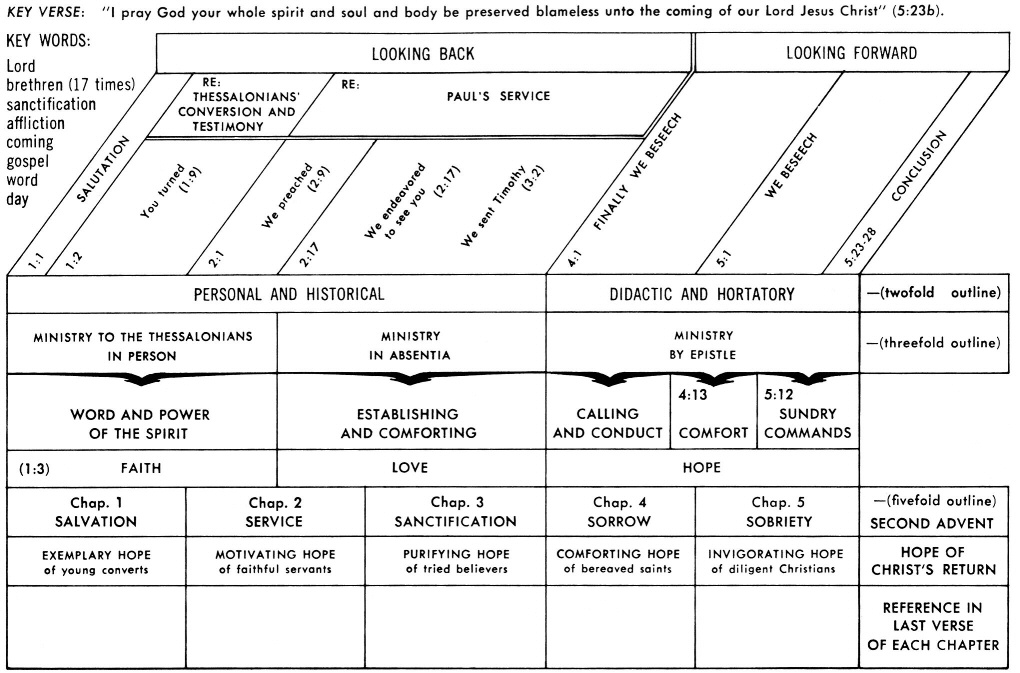
JESUS IS COMING AGAIN
Click chart to enlarge
Charts from Jensen's Survey of the NT - used by permission
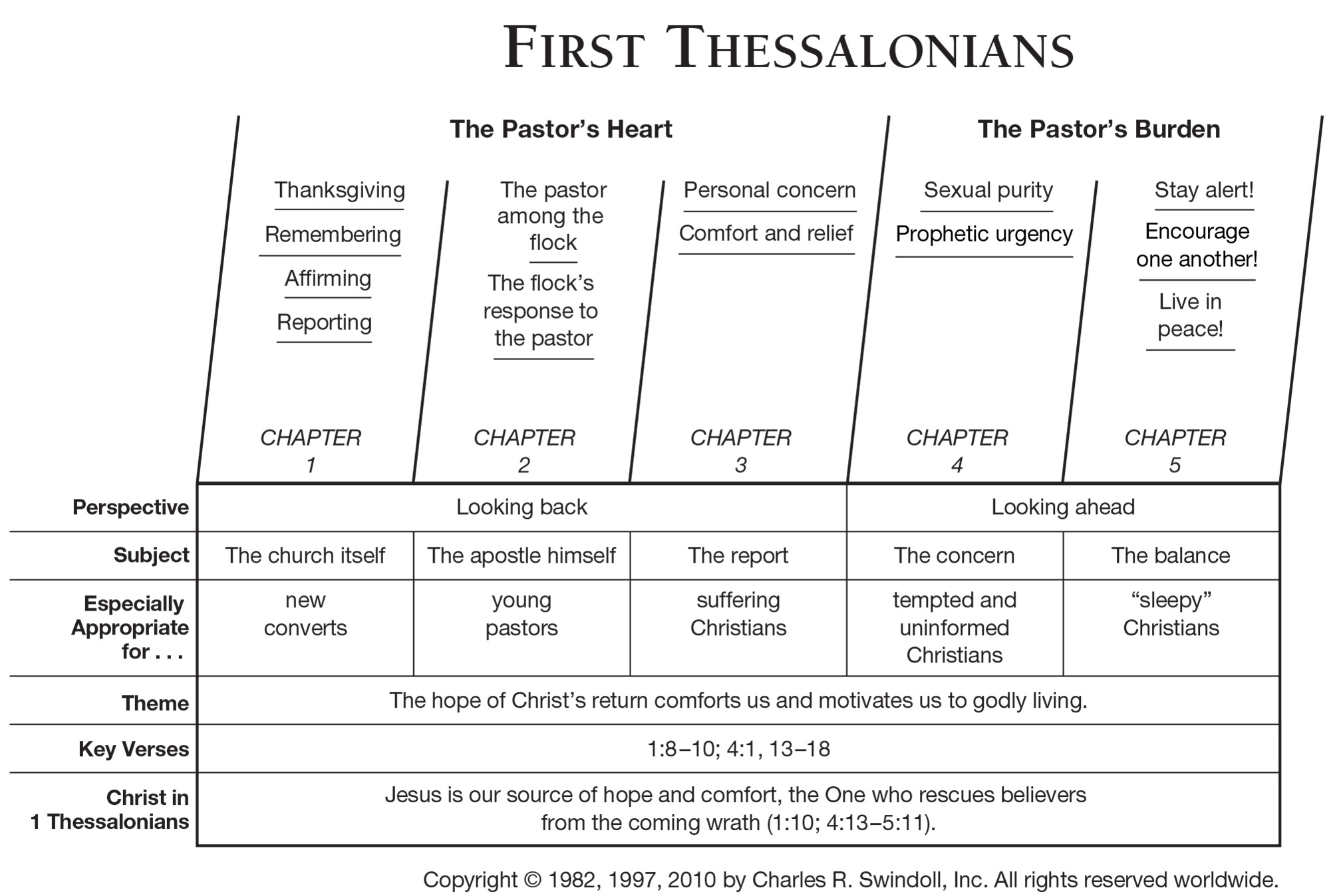
Chart by Charles Swindoll
|
1 Thessalonians |
||||||
| 1 Th 1:1-10 | 1 Th 2:1-20 | 1 Th 3:1-13 | 1 Th 4:1-18 | 1 Th 5:1-28 | ||
|
LOOKING BACK |
LOOKING FORWARD |
|||||
|
Personal Reflections |
Practical Instructions |
|||||
| Ministry In Person |
Ministry in Absentia (Thru Timothy) |
Ministry by Epistle |
||||
| Word and Power of the Spirit |
Establishing & Comforting |
Calling & Conduct | 1Th 4:13ff Comfort |
1Th 5:12ff Commands |
||
| 1 Salvation |
2 Service |
3 Sanctification |
4 Sorrow |
5 Sobriety |
||
| Paul Commends Spiritual Growth |
Paul Founds the Church |
Strengthening of the Church |
Directions for Spiritual Growth |
Holy Living in Light of Day of the Lord | ||
| Exemplary Hope of Young Converts | Motivating Hope of Faithful Servants |
Purifying Hope of Tried Believers | Comforting Hope of Bereaved Saints | Invigorating Hope of Diligent Christians | ||
|
Written from Corinth |
||||||
1 Thessalonians 4:15 For this we say to you by the word of the Lord, that we who are alive and remain until the coming of the Lord, will not precede those who have fallen asleep. (NASB: Lockman)
Greek: Touto gar umin legomen (1PPAI) en logo kuriou, oti emeis oi zontes (PAPMPN) oi perileipomenoi (PPPMPN) eis ten parousian tou kuriou ou me phthasomen (1PAAS) tous koimethentas; (APPMPA)
Amplified: For this we declare to you by the Lord’s [own] word, that we who are alive and remain until the coming of the Lord shall in no way precede [into His presence] or have any advantage at all over those who have previously fallen asleep [in Him in death]. (Amplified Bible - Lockman)
Barclay: For we tell you this, not by our own authority but by the word of the Lord, that we who are alive, who survive until the coming of the Lord, will certainly not take precedence over those who have fallen asleep. (Westminster Press)
Milligan: Regarding this, we say, we are confident, for we have it on the direct authority of the Lord Himself that we who are surviving when the Lord comes will not in any way anticipate those who have fallen asleep. (St. Paul's Epistles to the Thessalonians. 1908)
NLT: I can tell you this directly from the Lord: We who are still living when the Lord returns will not rise to meet him ahead of those who are in their graves. (NLT - Tyndale House)
Phillips: Here we have a definite message from the Lord. It is that those who are still living when he comes will not in any way precede those who have previously fallen asleep. (Phillips: Touchstone)
TLB: I can tell you this directly from the Lord: that we who are still living when the Lord returns will not rise to meet him ahead of those who are in their graves.
Weymouth: For this we declare to you on the Lord’s own authority—that we who are alive and continue on earth until the Coming of the Lord, shall certainly not forestall those who shall have previously passed away.
Wuest: For this we are saying to you by the Lord's word, that as for us who are living and are left behind until the coming of the Lord, we shall by no means precede those who fell asleep, (Eerdmans)
Young's Literal: for this to you we say in the word of the Lord, that we who are living -- who do remain over to the presence of the Lord -- may not precede those asleep,
FOR THIS WE SAY TO YOU BY THE WORD OF THE LORD THAT WE WHO ARE ALIVE AND REMAIN UNTIL THE COMING OF THE LORD: Touto gar humin legomen (PAI): Touto gar humin legomen (1PPAI) en logo kuriou, hoti hemeis oi zontes (PAPMPN) oi perileipomenoi (PPPMPN) eis ten parousian tou kuriou:
- 1Kings 13:1,9,17,18,22; 20:35; 22:14) (1Corinthians 15:51, 52, 53; 2Corinthians 4:14)
This I say to you by the Word of the Lord - With the phrase "by (literally in) the Word of the Lord" Paul introduces not only a new subject but also new revelation he had received from the Lord. This is not Paul's idea but comes from and with the authority of the Lord Who gives us one of the most detailed accounts of His return for His Bride, the Church. The Lord is the Source of this truth. The Word of the Lord is a Word of promise. Believe it and be blessed.
The pronoun this introduces all that follows the word that in this verse.
To you - A special message to his readers from their Lord. Moffatt thus renders it…
For we tell you, as the Lord has told us.
Stedman adds that…
I take those words to mean that this is something he had not taught them when he was in Thessalonica. He had taught them about Jesus' death and resurrection and how that would affect them, but he did not give them details of time and circumstance of his coming again. Now the apostle is revealing further truth.
We who are alive - Clearly indicates Paul was living in the light of the imminent return of His Lord. How do we reach this conclusion? The use of the plural pronoun we indicates that Paul himself expected to be alive at the parousia. It supports the teaching that the apostle Paul believed that the Rapture was imminent (the condition of being about to occur) and implies that no preceding signs or events had to occur prior to the Bridegroom's return for His Bride, the Church.
James alluded to the imminency of the Lord's return writing…
Do not complain, brethren, against one another, that you yourselves may not be judged; behold, the Judge is standing right at the door. (James 5:9) (Comment: Many Scripture passages depict the return of Christ as an imminent event - Mt 24:42, 43, 44, 45, 46, 47, 48; Mark 13:33, 34, 35, 36, 37; Luke 12:35, 36, 37, 38, 39, 40; Romans 13:12 (note); 1Cor 7:29; Philippians 3:20 [note]; Php 3:21 [note]; Php 4:5 [note]; 1Th 1:10 [note]; Titus 2:13 [note]; He 9:28 [note]; 1Pe 4:7 [note]; 1Jn 2:18; Jude 1:21; Re 3:11 [note]; Re 22:7 [note], Re 22:10 [note], Re 22:20 [note])
A practical application of the doctrine of imminency (click here for more detail) is that one cannot know the day or hour of our Lord's return and therefore one must strive to always be ready to meet Him in the air. It is interesting that even those who do not accept this doctrine, acknowledge it as one held by many Christians over the past two millennia. For example the amillennialist Adam Clarke (see critique) in his notes on Revelation 20:2 writes…
It has long been the idle expectation of many persons that the millennium, in their sense, was at hand; and its commencement has been expected in every century since the Christian era… (Clarke then goes on to add in a declaration that speaks for itself)… Yet there is no doubt that the earth is in a state of progressive moral improvement; and that the light of true religion is shining more copiously everywhere, and will shine more and more to the perfect day. (Ref)
Hiebert defends the premise that Paul believed in the imminent return of Christ beginning with his rebuttal of Calvin's attempt to explain away this idea…
Calvin ingeniously explains that although Paul knew by "a special revelation that Christ would come at a somewhat later date," he yet here speaks as though he would be among the living "to arouse the Thessalonians to wait for it, and to keep all the godly in suspense." But Paul's indication that he was looking for the Lords return was no pious pretense perpetrated for the good of the church. He sincerely lived and labored in the anticipation of the day, but he did not know when it would come.
The time of the return remains unrevealed (cf. Matt. 24:36; Acts 1:7).
"The last day is hidden, that every day may be regarded" (Augustine).
It cannot be demonstrated from his letters that later on Paul gave up this hope and expected death instead. As he grew older he well realized that the chances of his survival were diminishing, but that did not eliminate the hope.
In 2 Corinthians, written some five years later, Paul deals with his personal attitude to the alternatives of death and the coming of the Lord (2 Cor. 5:1-10). In it he again uses "we." In 2 Cor 5:2-4 he expresses his yearning for that which cannot take place until the Lord's return; in 2 Cor 5:6 he asserts that he is of good courage in the face of death, and in 2 Cor 5:8 he reasserts that he "would prefer to be away from the body and at home with the Lord."
Clearly he still yearns for the parousia, which is certain to come, but is unafraid of death, which may come first.
In the epistle to the Philippians, written perhaps some five years later still, he describes his own attitude toward death in language akin to that in 2 Corinthians and indicates that death for him is no remote possibility (Php 1:21, 22, 23, 23-see notes Ph 1:21; 22; 23; 24). Yet in 1Thes 3:20 he uses "we," and "our" in 1Th 3:13-note, to describe the characteristic attitude of believers toward the coming of Christ.
Even in the pastoral epistles, written last of all, Paul uses "we" in connection with the hope of the second advent. In Titus 2:11, 12, 13 (notes Titus 2:11; 12; 13) Paul speaks of the grace of God instructing us to live godly lives "while we wait for the blessed hope."
Even in 2 Timothy, where he uses language that can only mean that he was anticipating a speedy execution, he still speaks of the reward awaiting those who love His appearing (2Ti 4:8-note).
Clearly Paul shared that attitude of expectancy that should characterize each generation of believers. He did not know that he would be alive until the parousia, neither could he affirm that he would not be. (Hiebert, D. Edmond: 1 & 2 Thessalonians: BMH Book. 1996)
And so we see that a number of Scriptures (there is some duplication of the following references with the references in the previous note) support the fact that Paul had a fervent hope and expectation that he might be among those who were alive at the Parousia of His Lord…
For example, in Romans 13 Paul wrote
Do this, knowing the time, that it is already the hour for you to awaken from sleep; for now salvation ("future tense salvation" - glorification - see Three Tenses of Salvation) is nearer to us than when we believed. The night [of man’s sin and Satan’s rule] is almost gone, and the day [of Christ’s return] is near. (Ro 13:11, 12-See notes Ro 13:11; 12)
In his first letter to the Corinthians Paul includes himself among those who might still be alive at the Rapture writing
Behold, I tell you a mystery; we will not all sleep, but we will all be changed, in a moment, in the twinkling of an eye, at the last trumpet; for the trumpet will sound, and the dead will be raised imperishable, and we will be changed (1Co 15:51,52).
As Paul concluded First Corinthians he wrote
If anyone does not love the Lord, he is to be accursed. Maranatha” (1Co 16:22)
Maranatha is Aramaic (maran_atha) meaning “Oh Lord, come!” ("Our Lord come", "Come, O Lord") and expresses Paul’s hope that the Lord would return soon.
The apostle wrote to Titus that he was
looking for (prosdechomai in the present tense = means as the habit of one's life, continually waiting even with a sense of expectancy) the blessed hope and the appearing (cf, the parousia) of the glory of our great God and Savior , Christ Jesus (Titus 2:13-note)
THOUGHT - Dear believer in Christ, does you day to day conduct indicate that you are living as if you might see your Bridegroom today? Do your choices reflect an upward look or are you "tethered" to this present world which is passing away? Beloved, don't waste your life. (see Piper's msg - Don't Waste Your Life even better in the Mp3 Audio) What you are looking for will determine what you are living for. Look for Christ and live accordingly. Let our Lord's words motivate you to strive to maintain a future focus…
Behold, I am coming quickly and My reward is with Me to render to every man according to what he has done. (Re 22:12-note)
Alive (2198) (zao) is refers to those who are still physically living on earth when the Lord returns.
Remain (4035) (perileipo from perí = intensifies meaning of the verb + leípo = to leave, lack) means to leave over, to leave all around, (pass.) survive. In Classic Greek the passive voice referred to those who survived and therefore remained or were left behind, the title of a famous novel series! Unlike the book and movie "Left Behind" (which describes unbelievers who "miss" the Rapture), here Paul uses the idea of left behind to describe the ones who will "remain over," or "survive" unto the parousia (cf. 1Th 2:19-note). This is the generation of Christians who will be alive at that time and who will never experience physical death.
The coming (3952) (parousia) is a combination of two Greek words para = with, alongside + ousia = being (ousia is the participial form of the verb eimi = to be) which together literally mean to be alongside.
Most lexicons state that parousia is derived from pareimi (from para = near, with + eimi = to be) which means to be present, to be nearby, to have come.
Parousia literally means a being beside or a presence. The word denotes both an arrival and a consequent presence with.
Parousia conveys the thought of an arrival (advent or coming) of a person to a place plus the idea of their presence at that place until a certain event transpires. The word parousia has no English equivalent and therefore is often transliterated in writings.
John MacArthur writes that…
Parousia refers to more than just coming; it includes the idea of “presence.” Perhaps the best English translation would be “arrival.” The church’s great hope is the arrival of Jesus Christ when He comes to bless His people with His presence. That glorious truth appears in more than 500 verses throughout the Bible. (Macarthur J. James. Moody or Logos) (Bolding added)
Parousia is used 24 times in the NT (and none in the non-apocryphal Septuagint) (Mt 24:3, 27, 37, 39; 1Co 15:23; 16:17; 2Co. 7:6, 7; 10:10; Phil. 1:26; 2:12; 1Th 2:19; 3:13; 4:15; 5:23; 2Th 2:1, 8, 9; Jas 5:7, 8; 2Pe 1:16; 3:4, 12; 1 Jn. 2:28) and is translated coming 22 times and presence twice.
In an ancient Greek letter a lady speaks of the necessity of her parousia in a place in order to attend to matters relating to her property there. Moulton and Milligan have these secular quotes…
the repair of what has been swept away by the river requires my presence
“we await your presence,” (a man to his “brothers)
it is no use if a person comes too late for what required his presence
In another secular Greek writing we find parousia used to refer to the coming of a king or other noted official (see note below). In the visit of the ruler was accompanied by magnificent ceremonies, delicacies to eat, gifts of money, street improvements, new buildings, addressing of complaints and requests! Sounds like the coming of the King to take His throne in the 1000 year Millennial or Messianic Kingdom!
Moulton and Milligan add that…
What, however, more especially concerns us in connexion with the NT usage of parousia is the quasi-technical force of the word from Ptolemaic times onwards to denote the “visit” of a King, Emperor, or other person in authority, the official character of the “visit” being further emphasized by the taxes or payments that were exacted to make preparations for it. Thus in P Petr II. 39(e)18 (iii/b.c.) mention is made of contributions for a “crown” (stephanou) to be presented to the King on his “arrival” (parousias), and in a letter of b.c. 264 or 227, P Grenf II. 14(b)2, a certain Appenneus writes that he has prepared “for the visit of Chrysippus” (the dioecetes) by laying in a number of birds for his consumption. Other examples from the papyri are P Par 26i. 18 (b.c. 163–2) (= Selections, p. 15), where the Serapeum Twins lay their grievances before King Ptolemy Philometor and Queen Cleopatra on the occasion of their royal visits to Memphi… “the 80 artabae of wheat for the supplies imposed in connexion with the King’s visit” (Edd.).
SHALL NOT PRECEDE THOSE WHO HAVE FALLEN ASLEEP: ou me phthasomen (1PAAS) tous koimethentas; (APPMPA):
- Job 41:11; Psalms 88:13; 119:147,148; Matthew 17:25)
Not (ou me) is actually a double negative, so that Paul is saying in essence that there is absolutely no way those who are alive will precede those who have died. The revelation that the living believers will not have any advantage over the dead believers at the return of Christ provides the truth that should make any further feeling of grieving for dead believers wholly unjustified. Paul is teaching that both classes of believers at the Lord's return will share the same destiny at the same time.
Precede (5348)(phthano) means go before in time, to be beforehand or go prior to. The idea is to antedate another, which is primary meaning in this verse. Phthano in other contexts means to reach, to attain or to arrive at, as one would arrive at a state or a goal (Ro 9:31-note, Php 3:16-note).
The living believers shall not come into the blessings associated with the return of Christ any sooner than the dead in Christ. In other words there is absolutely no way the living will "get a head start" on those believers who have already died.
Phthano is used 7 times in the NT…
Matthew 12:28 "But if I cast out demons by the Spirit of God, then the kingdom of God has come upon you.
Luke 11:20 "But if I cast out demons by the finger of God, then the kingdom of God has come upon you.
Romans 9:31 (note) but Israel, pursuing a law of righteousness, did not arrive at that law.
2 Corinthians 10:14 For we are not overextending ourselves, as if we did not reach to you, for we were the first to come even as far as you in the gospel of Christ;
Philippians 3:16 (note) however, let us keep living by that same standard to which we have attained.
1 Thessalonians 2:16 (note) hindering us from speaking to the Gentiles that they might be saved; with the result that they always fill up the measure of their sins. But wrath has come upon them to the utmost.
1 Thessalonians 4:15 (note) For this we say to you by the word of the Lord, that we who are alive, and remain until the coming of the Lord, shall not precede those who have fallen asleep.
Who have fallen asleep - More literally those who have been falling asleep, which refers to believers who had already died.
Fallen asleep (2837) (koimao related to keímai = to lie outstretched, to lie down) describes the state believers who have died prior to the Lord's return.
1 Thessalonians 4:16 For the Lord Himself will descend from heaven with a shout, with the voice of the archangel and with the trumpet of God, and the dead in Christ will rise first. (NASB: Lockman)
Greek: hoti autos o kurios en keleusmati, en phone archaggelou kai en salpiggi theou, katabesetai (3SFMI) ap' ouranou, kai oi nekroi en Christo anastesontai (3PFMI) proton
Amplified: For the Lord Himself will descend from heaven with a loud cry of summons, with the shout of an archangel, and with the blast of the trumpet of God. And those who have departed this life in Christ will rise first. (Amplified Bible - Lockman)
Barclay: For the Lord himself will descend from heaven, with a shout of command, with the voice of an archangel and with the trumpet of God; and the dead who are in Christ will rise first, (Westminster Press)
Milligan: What will happen will rather be this. The Lord Himself will descend from heaven with a shout of command, with the voice of an archangel, and with the trumpet-call of God. Then those who died in Christ, and in consequence are still living in Him, shall rise first. (St. Paul's Epistles to the Thessalonians. 1908)
NLT: For the Lord himself will come down from heaven with a commanding shout, with the call of the archangel, and with the trumpet call of God. First, all the Christians who have died will rise from their graves. (NLT - Tyndale House)
Phillips: One word of command, one shout from the archangel, one blast from the trumpet of God and the Lord himself will come down from Heaven! (Phillips: Touchstone)
Weymouth: For the Lord Himself will come down from Heaven with a loud word of command, and with an archangel’s voice and the trumpet of God, and the dead in Christ will rise first.
Wuest: because the Lord himself with a cry of command, with an archangel's voice, and with a call of a trumpet sounded at God's command, shall descend from heaven, and the dead in Christ shall be raised first, (Eerdmans)
Young's Literal: because the Lord himself, in a shout, in the voice of a chief-messenger, and in the trump of God, shall come down from heaven, and the dead in Christ shall rise first,
FOR THE LORD HIMSELF WILL DESCEND FROM HEAVEN: hoti autos o kurios… katabesetai (3SFMI) ap' ouranou:
- Isaiah 25:8,9; Matthew 16:27; 24:30,31; 25:31; 26:64; Acts 1:11; 2Thessalonians 1:7; 2Peter 3:10; Revelation 1:7
- Numbers 23:21; Psalms 47:1,5; Zechariah 4:7; 9:9)
For the Lord Himself - He will send not emissaries, envoys, or angels but will come Himself as the Bridegroom for His Bride.
Descend (2597) (katabaino from katá = down + baíno = to walk, to go or to come) means to come or go down and so to descend from a higher to a lower place. It means to move downward. Figuratively it can mean to be brought down (Mt 11:23, Lk 10:15). In this verse it describes descent from heaven.
Katabaino describes God descending to afford aid to the oppressed in Acts…
I have certainly seen the oppression of My people in Egypt, and have heard their groans, and I have come down to deliver them; come now, and I will send you to Egypt.' (Acts 7:34 from Ex. 3:8)
Heaven (3772) (ouranos) describes literally the expanse of space that seems to be over the earth like a dome. In the NT heaven and earth comprise all of creation, though the two are distinctive (Mt 6:9-note). God spoke both into existence and heaven is His realm. In Hebrew thought heaven was Jehovah's dwelling place and is the believer's true and eternal home. (see more detailed discussion)
WITH A SHOUT: en keleusmati:
At the outset it should be noted that some insist on 3 distinct sounds, some distinguish 2 distinct sounds and still others favor one great signal from heaven. These notes will not try to separate between these 3 possibilities.
Hiebert notes that there are "Three prepositional phrases, standing before the verb in the original (Ed note: the verb katabaino or descend follows the 3 phrase below in the original Greek), describe the accompanying circumstances at the Lord's descent, "with a loud command, with the voice of the archangel, and with the trumpet call of God." "With" in each phrase represents the preposition en, "in, in connection with," denoting the attendant circumstance. (Ibid)
Vance Havner once said…
I’m not looking for signs. I’m listening for a sound.
Let us all be found living and listening for His return…
Amen. Come, Lord Jesus! (Re 22:20-note)
Shout (2752) (keleusma from keleúo = to command or order from kello = to urge on) (Only used here in the NT) refers to a shout of command or an order.
Keleusma was used in classic Greek to describe a shout implying authority and urgency. The idea is of a loud, authoritative cry, often uttered in the thick of great excitement.
Hiebert comments that keleusma…
implies authority and urgency. It was variously used of a general shouting orders to his troops, a driver shouting to excite his horses to greater speed, a hunter encouraging his hounds to the pursuit of the prey, or a captain of rowers exciting them to more vigorous rowing. The shout is left undefined, no definitive genitive being added. Nothing is said as to who gives the shout, or to whom it is directed. (Ibid)
Thayer adds that keleusma was used of
a stimulating cry, either that by which animals are roused and urged on by man, as horses by charioteers, hounds by hunters, etc., or that by which a signal is given to men, e. g. to rowers by the master of a ship (Lucian), to soldiers by a commander (Thucydides)
TDNT adds that…
With a basic sense of “what is impelled,” keleusma has such meanings as “command,” “summons,” “cry of encouragement,” and “cry.” In ordinary speech it tends to be replaced by keleusis, which becomes a technical term for a government decree. (Kittel, G., Friedrich, G., & Bromiley, G. W. Theological Dictionary of the New Testament. Eerdmans)
The historian Herodotus records a usage of keleusma to describe a signal for engagement in battle.
Keleusma was used in the Roman army at the sound of the third trumpet a herald, standing at the right of the commander, called out times to ask if the soldiers were ready for war. The troops shouted loud out lustily "We are ready!"
Keleusma is used one time in the Septuagint (LXX)…
The locusts have no king, yet all of them go out in ranks (Septuagint reads "march orderly at one command {keleusma}." ) (Proverbs 30:27)
WITH THE VOICE OF… ARCHANGEL: en phone archaggelou:
- Jude 1:9
Voice (5456)(phone from pháo = to shine from the idea of disclosure) is literally a sound or tone made or given forth. Plutarch calls it "that which brings light upon that which is thought of in the mind."
Archangel (743) (archaggelos from árchon = chief + ággelos = angel, envoy, messenger, one who is sent) refers to the first or highest angel, the archangel, leader of the angels. In the celestial hierarchy, an archangel would describe a spiritual being in rank above an angel.
In the celestial hierarchy, an archangel would describe a spiritual being in rank above an angel. Several New Testament passages imply a distinct hierarchy in the spirit world (Ep 1:21-note; Ep 6:12-note; Col 2:10-note; 1Pe 3:22-note)
The only other use of archaggelos is in Jude (not in the LXX) who records that…
But Michael the archangel, when he disputed with the devil and argued about the body of Moses, did not dare pronounce against him a railing judgment, but said, "The Lord rebuke you. (Jude 1:9)
In the book of Daniel, Michael is mentioned 3 times…
But the prince of the kingdom of Persia was withstanding me for twenty-one days; then behold, Michael, one of the chief princes, came to help me, for I had been left there with the kings of Persia. (Da 10:13)
However, I will tell you what is inscribed in the writing of truth. Yet there is no one who stands firmly with me against these forces except Michael your prince. (Da 10:21)
Now at that time Michael, the great prince who stands guard over the sons of your people, will arise. And there will be a time of distress (corresponds to time of Jacob's trouble in Jer 30:7 and the Great Tribulation in Mt 24:21) the such as never occurred since there was a nation until that time; and at that time your people, everyone who is found written in the book, will be rescued. (Da 12:1)
The term archangel denotes a definite rank by virtue of which one is qualified for special work and service.
Vincent comments that
archangels appear in the apocryphal (Ed note: the Hebrew Old Testament canon recognized by Palestinian Jews [Tanak] did not include the fourteen books of the Apocrypha. Since the Hebrew Bible was preferred by the Reformers during the Protestant Reformation in their struggle against the Catholic Church, whose Bible contained the Apocrypha, translators of Protestant Bibles excluded the Apocrypha.) literature. In the Book of Enoch (see on Jude 1:14) four are named, Michael, Uriel, Raphael, and Gabriel. Michael is set over the tree which, at the time of the great judgment, will be given over to the righteous and humble, and from the fruit of which life will be given to the elect. In Tob. 12:15, Raphael appears as one of the seven holy angels. Comp. Apoc. 8:2. (Vincent, M. R. Word Studies in the New Testament. Volume 4:42)
AND THE TRUMPET OF GOD: kai en salpiggi theou:
- Ex 19:16; 20:18; Isaiah 27:13; Zechariah 9:14; 1Corinthians 15:52; Revelation 1:10; 8:13
Trumpet (4536)(salpigx/salpinx from salos = vibration, billow or salpizo = to sound a trumpet) is a wind instrument like a bugle that was often used for signaling, especially in connection with war.
TDNT notes that salpigx (or salpinx)
denotes a wind instrument, made of bronze or iron with a mouthpiece of horn, and broadening out to a megaphone, i.e., a “trumpet.” The word may also denote the sound made by the instrument, its signal or playing. Other uses are for thunder as a heavenly trumpet sound or for a human speaker as a trumpet. (Kittel, G., Friedrich, G., & Bromiley, G. W. Theological Dictionary of the New Testament. Eerdmans)
There are 11 uses of salpigx in the NT…
Matthew 24:31 "And He will send forth His angels with a great trumpet and they will gather together His elect from the four winds, from one end of the sky to the other. (Comment: This time period is at the end of the Great Tribulation, punctuated by Christ's triumphant return, the harvesting of believers and then the separation of the sheep and goats, Mt 25:31)
1 Corinthians 14:8 For if the bugle produces an indistinct sound, who will prepare himself for battle?
1 Corinthians 15:52 in a moment, in the twinkling of an eye, at the last trumpet; for the trumpet will sound, and the dead will be raised imperishable, and we shall be changed.
1 Thessalonians 4:16 (note) For the Lord Himself will descend from heaven with a shout, with the voice of the archangel, and with the trumpet of God; and the dead in Christ shall rise first.
Hebrews 12:19 (note) and to the blast of a trumpet and the sound of words which sound was such that those who heard begged that no further word should be spoken to them.
Revelation 1:10 (note) I was in the Spirit on the Lord's day, and I heard behind me a loud voice like the sound of a trumpet,
Revelation 4:1 (note) After these things I looked, and behold, a door standing open in heaven, and the first voice which I had heard, like the sound of a trumpet speaking with me, said, "Come up here, and I will show you what must take place after these things."
Revelation 8:2 (note) And I saw the seven angels who stand before God; and seven trumpets were given to them… 8:6 And the seven angels who had the seven trumpets prepared themselves to sound them… 8:13 And I looked, and I heard an eagle flying in midheaven, saying with a loud voice, "Woe, woe, woe, to those who dwell on the earth, because of the remaining blasts of the trumpet of the three angels who are about to sound!"
Revelation 9:14 (note) one saying to the sixth angel who had the trumpet, "Release the four angels who are bound at the great river Euphrates."
There are 72 uses of salpigx in the Septuagint (LXX) (Ex 19:13, 16, 19; 20:18; Lev. 23:24; 25:9; Num. 10:2, 8ff; 31:6; Jos. 6:5, 8, 13, 20; 1 Sam. 13:3; 2 Sam. 2:28; 6:15; 2 Ki. 11:14; 12:13; 1 Chr. 13:8; 15:24, 28; 16:6, 42; 2 Chr. 5:12f; 7:6; 13:12, 14; 15:14; 20:28; 23:13; 29:26ff; Ezra. 3:10; Neh. 8:15; 12:35, 41; Job 39:24f; Ps. 47:5; 81:3; 98:6; 150:3; Isa. 18:3; 27:13; 58:1; Jer. 4:5, 19, 21; 6:1, 17; 42:14; 51:27; Ezek. 7:14; 33:3ff; Dan. 3:5, 7, 10, 15; Hos. 5:8; Joel 2:1, 15; Amos 2:2; 3:6; Zeph. 1:16; Zech. 9:14)
Exodus 19:16 So it came about on the third day, when it was morning, that there were thunder and lightning flashes and a thick cloud upon the mountain and a very loud trumpet (Hebrew = shophar = ram's horn {7782} ; Lxx = salpigx) sound, so that all the people who were in the camp trembled.
Numbers 10:2 "Make yourself two trumpets (Lxx = salpigx) of silver, of hammered work you shall make them; and you shall use them for summoning the congregation and for having the camps set out.
Numbers 10:9 "And when you go to war in your land against the adversary who attacks you, then you shall sound an alarm with the trumpets, (Lxx = salpigx) that you may be remembered before the LORD your God, and be saved from your enemies.
Joshua 6:20+So the people shouted, and priests blew the trumpets; and it came about, when the people heard the sound of the trumpet (Hebrew = shophar = ram's horn {7782} ; Lxx = salpigx), that the people shouted with a great shout and the wall fell down flat, so that the people went up into the city, every man straight ahead, and they took the city.
1 Samuel 13:3 And Jonathan smote the garrison of the Philistines that was in Geba, and the Philistines heard of it. Then Saul blew the trumpet (Hebrew = shophar = ram's horn {7782}; Lxx = salpigx) throughout the land, saying, "Let the Hebrews hear."
2 Samuel 6:15 So David and all the house of Israel were bringing up the ark of the LORD with shouting and the sound of the trumpet (Hebrew = shophar = ram's horn {7782}; Lxx = salpigx).
Psalm 47:5 God has ascended with a shout, The LORD, with the sound of a trumpet (Hebrew = shophar = ram's horn {7782}; Lxx = salpigx).
Psalm 81:3 Blow the trumpet (Hebrew = shophar = ram's horn {7782}; Lxx = salpigx) at the new moon, At the full moon, on our feast day.
Isaiah 27:13 It will come about also in that day that a great trumpet (Hebrew = shophar = ram's horn {7782}; Lxx = salpigx) will be blown; and those who were perishing in the land of Assyria and who were scattered in the land of Egypt will come and worship the LORD in the holy mountain at Jerusalem.
Joel 2:1 Blow a trumpet (Hebrew = shophar = ram's horn {7782}; Lxx = salpigx) in Zion, And sound an alarm on My holy mountain! Let all the inhabitants of the land tremble, For the day of the LORD is coming; Surely it is near,
Joel 2:15 Blow a trumpet (Hebrew = shophar = ram's horn {7782}; Lxx = salpigx) in Zion, Consecrate a fast, proclaim a solemn assembly,
From these Old Testament uses Jewish people were familiar with trumpets or shophars which were used to declare war, to announce festivals and seasons, to gather the people, to announce the giving of the Law
In the Roman Empire, trumpets were used to announce the arrival of a great person.
Although the word trumpet does not appear in Revelation 11:15, the seventh angel sounds the seventh trumpet, John recording…
And the seventh angel sounded; and there arose loud voices in heaven, saying, "The kingdom of the world has become the kingdom of our Lord, and of His Christ; and He will reign forever and ever." (Re 11:5-note)
Comment: Using a literal interpretation of the Revelation a careful analysis of the timing of events identifies the seventh and "last" trumpet at the midpoint of the seven year period marking the onset of the 3.5 year Great Tribulation.
The question one might then ask is whether this "last" trumpet could be identical to the "last trumpet" in 1Corinthians 15:52?
in a moment, in the twinkling of an eye, at the last trumpet; for the trumpet will sound, and the dead will be raised imperishable, and we shall be changed.
From the passages in 1 Thessalonians 4:13-18 it is clear that the rapture or "catching up" of the Church is also associated with a trumpet.
In light of the repetition of the word trumpet, it is not surprising that some commentators associate the trumpets in 1Thessalonians 4:16 with the "last trumpet" in 1Corinthtians 15:52 and the seventh angel sounding the "last" of the seven trumpet judgments in Re 11:15 (note) which marks the beginning of the Great Tribulation. the last 3.5 years of the 7 year period usually referred to as the Tribulation. They reason that based on these associations, the "timing" of the Rapture corresponds to the seventh angel sounding the last trumpet and thereby arrive at a so-called "Mid-Tribulation" Rapture position.
There is however a significant problem with that interpretation in that the trumpet in Revelation 11:15 is not actually the last trumpet in the end times eschatological events. In fact at the end of the Seven Year Tribulation there is another trumpet associated with the triumphant return of Christ, Matthew recording our Lord's words…
And He will send forth His angels with a great trumpet and they will gather together His elect from the four winds, from one end of the sky to the other. (Matthew 24:31)
Furthermore, while the trumpets in 1Thessalonians 4:16 and 1Corinthian 15:52 deal respectively with the Rapture of believers and their resurrection change, the seven trumpets of Revelation deal with God's judgment on unbelievers. In short, the last trumpet that is associated with the rapture of the Church is not equated with the seventh trumpet of Re 11:15-note.
John MacArthur explains the trumpet puzzle in his excellent study of the Revelation…
The seventh trumpet covers an extended period of time, thus distinguishing it from the instantaneous (“in a moment, in the twinkling of an eye” event of the “last trumpet.” Instead of calling for the moment of the Rapture of the church, as the “last trumpet” does, the seventh trumpet calls for prolonged waves of judgment on the ungodly. It does not parallel the trumpet of 1Corinthians 15:52, but does parallel the trumpet of Joel 2:1, 2: “Blow a trumpet in Zion, and sound an alarm on My holy mountain! Let all the inhabitants of the land tremble, for the day of the Lord is coming; surely it is near, a day of darkness and gloom, a day of clouds and thick darkness.” (John MacArthur, Revelation 1-11 : The MacArthur New Testament Commentary Chicago, IL: Moody Press, 1999.)
Hiebert adds a similar thought concerning the trumpet noting that…
It is clearly parallel to the last trumpet in 1 Corinthians 15:52 because both passages relate to the rapture of the church. That this trumpet should be equated with the "seventh trumpet" in Revelation 11:15 is highly improbable." The subjects are different: here it is the church; there a wicked world. The results are different: here it is the glorious catching up of the church to be with the Lord; there it is further judgment upon a godless world. Here "the last trumpet signals the close of the life of the church on earth; there the "seventh" trumpet marks a climax in a progressive series of apocalyptic judgments upon the living on earth.
Others would equate this trumpet in 1Thessalonians 4:16 with that in Matthew 24:31; but this too seems improbable.' There is a similarity between the two, since in both the blowing of the trumpet is associated with a gathering of the Lord's people; but there are marked differences. The subjects are different: here the reference is to the church; there the Olivet discourse portrays Jewish believers during the Great Tribulation. The circumstances are different: here the trumpet is connected with the raising of the believing dead; there no mention is made of a resurrection, but it is connected with a regathering of the elect who have been scattered over the earth. The result is different: here the blowing of the trumpet results in the uniting of the raised dead with the living as one body to be caught up to meet the Lord in the air; there the elect are the living believers who are regathered from all parts of the earth at the command of their Lord, who has returned to earth in open glory (Ibid)
AND THE DEAD IN CHRIST WILL RISE FIRST: kai oi nekroi en Christo anastesontai (FMI) proton:

- 1Corinthians 15:23,51,52; Revelation 20:5,6)
The dead in Christ - This phrase equates with Paul's earlier description of those who have fallen asleep (1Th 4:14-note). Notice the important phrase in Christ (see discussions of in Christ and in Christ Jesus) indicating that although they are physically dead, they are still in spiritual union with Him. Death cannot sever a believer from Him.
Hiebert notes that…
Those now in heaven in a disembodied state (2 Cor. 5:8-9) Christ will bring with Him (1Thes 4:14) to receive their resurrection bodies. The raising of their bodies will take place "first," the first act in the drama to take place at the parousia. (Ibid)
Dead (3498)(nekros from nékus = a corpse or dead body; English - necropsy, necrophobia, etc) means dead as in one who has taken their last breath. In the present context of dead in Christ this is clearly a reference to the spiritually alive believers who have fallen asleep in Jesus.
Will rise (450) (anistemi from ana = up, again, back + histemi = stand) is used some 123 times in the NT and literally means to stand up or make to stand up as describing a change in physical position (rising from sleep, Mk 1:35)
Figuratively, anistemi speaks of rising up against others (of high priest filled with jealousy rising up to lay hands on the apostles, Acts 5:17; "Theudas rose up" {a seditious leader}, Acts 5:36; of false teachers who would "from your own selves… will arise speaking perverse things", Acts 20:30). In another figurative use anistemi means rising to a position of preeminence ("The Lord shall raise up for you a prophet" Acts 3:22 - admittedly this verse could have a double meaning - raising to preeminence and raising up physically from the dead).
Clearly in the present context, Paul uses anistemi to refer to the rising up or resurrection from the dead (as also in the following passages which specifically use anistemi to refer to Jesus' resurrection - Mt 17:9, 20:19; Mk 8:31; 9:9,10, 31; 10:34; Lk 18:33; 24:7, 46; Jn 20:9; Acts 2:24, 32; 10:41; 13:34; 17:3, 31). Anistemi is used of the resurrection of believers in (John 6:39,40, 44, 54; 11:23, 24; 1Th 4:16) and the resurrection of unbelievers (Mt 12:41).
First (4413)(protos from superlative of pros = before) refers first in time, place, order, importance. The idea of first in this context is that the dead believers (those who have fallen asleep in Christ and are now returning with Him in a "disembodied" state) will be resurrected before the living are caught up or raptured. The survivors or those that remain will have to wait a moment as it were (more like a "twinkling of the eye"!). The upshot is that the saints who have died will not be at any disadvantage when the Lord returns and will not miss out on one of the more spectacular events in all of human history!
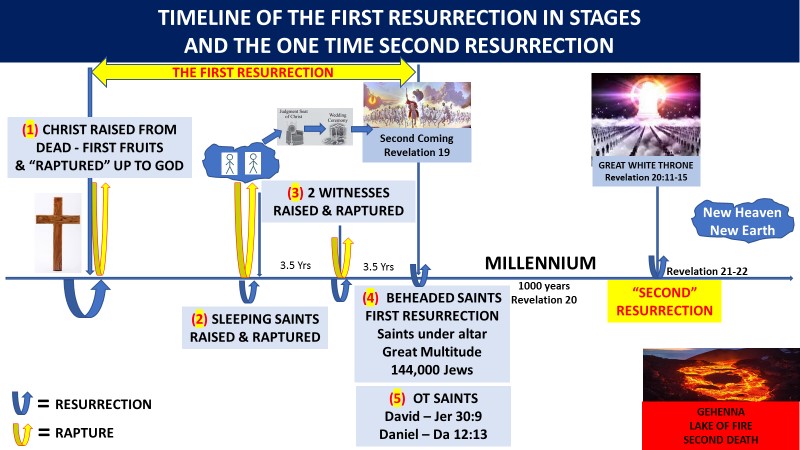
| Order | Which | Timing | Who | Description | Scriptures |
| 1 | First | The Third Day | Jesus Christ | The resurrection of the Lord Jesus Christ, the “firstfruits of those who have fallen asleep.” | Mt. 28:1-7 Mk 16:1-11 Lk 24:1-12 Jn 20:1-18 1Cor. 15:20 |
| 2 | First | Shortly after Christ’s Resurrection | A Few Old Testament Saints | At the earthquake attending the crucifixion, graves were opened. Shortly after the resurrection of Christ, these saints were raised.6 | Mt 27:50-53 |
| 3 | First | Before the Tribulation | Church | The resurrection of Church-age believers at the Rapture. | John 14:3 1Th 4:13-18 1Co 15:50-53 |
| 4 | First | Middle of the Tribulation | Two Witnesses | God’s two witnesses will be raised after being killed by The Beast. | Rev 11:11-12 |
| 5 | First | After Jacob’s Trouble (After the Great Tribulation) |
OT Saints | Old Testament saints will be resurrected to enter the Millennial Kingdom | Da 12:1-2, 13 Jer 30:9 Isa 26:19 Eze 37:13-14 |
| 6 | First | Beginning of Millennial Kingdom | Tribulation Martyrs | The Tribulation martyrs will be resurrected so that they can rule and reign with Christ. | Revelation 20:4; 20:5; 20:6 |
| 7 | Second | End of Millennial Kingdom | Unbelieving Dead (not found recorded in the Book of Life) |
End of the millennial reign of Christ, the final resurrection will consist of all unbelieving wicked dead who will be found guilty at the Great White Throne Judgment and cast into the Lake of Fire | Revelation 20:11; 20:12; 20:13; 20:14 20:15 |
Modified from Tony Garland's The Testimony of Jesus
See related topic The Two Resurrections
The Bridegroom will return soon for His Bride, the Church. With that truth in mind it is interesting to compare Scriptures with the customs associated with marriage in Jesus' day…

(1). The father chose the bride for his son
He (God the Father) chose us in Him (Christ) before the foundation of the world (eternity past), that we should be holy and blameless before Him in love (Ep 1:4-note)
(2). A binding wedding agreement, the betrothal, was made before the marriage was consummated. Paul writes the Scriptural parallel…
I am jealous for you with a godly jealousy; for I betrothed you to one husband, that to Christ I might present you as a pure virgin. But I am afraid, lest as the serpent deceived Eve by his craftiness, your minds should be led astray from the simplicity and purity of devotion to Christ. For if one comes and preaches another Jesus whom we have not preached, or you receive a different spirit which you have not received, or a different gospel which you have not accepted, you bear this beautifully. (2Cor 11:2,3,4).
To break that covenant, a bill of divorcement was required (see Covenant and Marriage). If impurity (any unfaithfulness was considered adultery) was found in the bride, then the bride could be put to death (cf Joseph's desire to put the betrothed, pregnant Mary away secretly, Mt 1:18, 19, 20)
(3). At the appointed time for the marriage, the ceremonies began with the wedding procession, which usually took place near midnight (cf "an hour that you do not expect" Luke 12:40). (1Th 4:13, 14, 15, 16, 17, 18-see notes 1Th 4:13; 14 15 16 17 18 ).
(4).The bridegroom and his friends went to the bride's home to get her and her attendants and take them to his home. (Mt 25:1, 2, 3, 4, 5, 6, 7, 8, 9, 10, 11, 12, 13). The bride was taken to the father's home, led to a canopy and beside her husband spoke the wedding vows.
(Jesus said) if I go and prepare a place for you, I will come again, and receive you to Myself; that where I am, there you may be also. (John 14:3)(cf Re 19:7-note; Re 19:8-note).
(6). Following these events, the marriage supper (see Mt 22:1-14) usually took place at the home of the groom and lasted from 3-7 days, the last day being the most elaborate. The marriage supper was the ''bringing home'' of an already accredited bride to her covenanted husband, and to this celebration guests were invited.
And he said to me, "Write, 'Blessed are those who are invited to the marriage supper of the Lamb.'" And he said to me, "These are true words of God." (Re 19:9-note).
Abraham, Isaac and Jacob are among the guests at the supper…
Now when Jesus heard this, He marveled, and said to those who were following, "Truly I say to you, I have not found such great faith with anyone in Israel. "And I say to you, that many shall come from east and west, and recline at the table with Abraham, and Isaac, and Jacob, in the kingdom of heaven but the sons of the kingdom shall be cast out into the outer darkness; in that place there shall be weeping and gnashing of teeth. (Mt 8:10,11,12).
Probably all the believers who survive the Great Tribulation and therefore enter the 1000 year reign Millennial Reign of Christ will also be guests at the marriage supper (see also Millennial Reign of the Saints).