2 Timothy 2:2
2 Timothy 2:3
2 Timothy 2:4
2 Timothy 2:5
2 Timothy 2:6
2 Timothy 2:7
2 Timothy 2:8
2 Timothy 2:9
2 Timothy 2:10
2 Timothy 2:11
2 Timothy 2:12
2 Timothy 2:13
2 Timothy 2:14
2 Timothy 2:15
2 Timothy 2:16
2 Timothy 2:17
2 Timothy 2:18
2 Timothy 2:19
2 Timothy 2:20
2 Timothy 2:21
2 Timothy 2:22
2 Timothy 2:23
2 Timothy 2:24
2 Timothy 2:25
2 Timothy 2:26
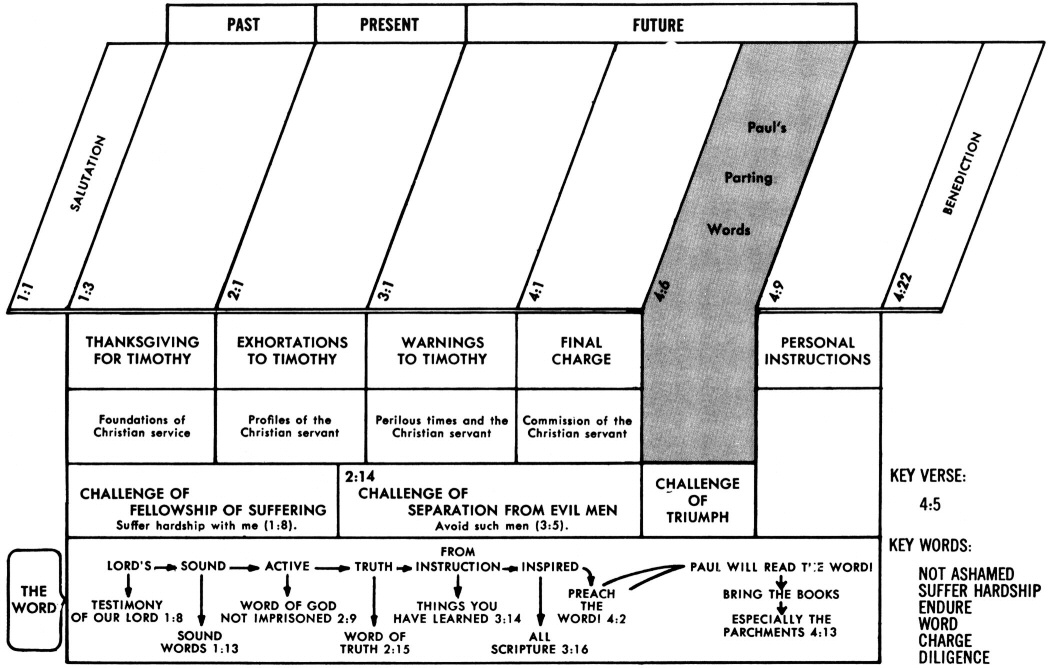
ENDURANCE AND SEPARATION IN THE MINISTRY
Click chart to enlarge
Charts from Jensen's Survey of the NT - used by permission
Second Timothy - Swindoll
| 2 TIMOTHY | |||
| 2 Timothy 1:1-18 | 2 Timothy 2:1-26 | 2 Timothy 3:1-17 | 2 Timothy 4:1-22 |
| Retain the Standard |
Rightly Divide the Word |
Difficult Times Will Come |
Preach the Word |
| PAST | PRESENT | FUTURE | |
| Foundation of Christian Service |
Pictures of Christian Servant |
Dangerous Times for Christian Servant |
Commission of Christian Servant |
| Unashamed as a Witness: Guard the Gospel |
Unashamed as a Workman: Suffer for the Gospel |
Adequate as a Workman: Continue in the Gospel |
Awarded as a Workman: Preach the Gospel |
| Power of the Gospel |
Perseverance of the Gospel Message | Protection of the Gospel |
Proclamation of the Gospel |
| Reminder | Requirements | Resistance | Requests |
| Encouragement in Ministry |
Examples in Ministry |
Exhortations in Ministry |
Exhortations to Fulfill Ministry |
| Commendation & Charge |
Commission to Fulfill |
Conflict to Face |
Course to Finish |
|
Compiled from Jensen's Survey of the NT and Wilkinson's Talk Thru the Bible |
|||
2 Timothy 2:14 Remind (2SPAM) them of these things, and solemnly charge (PMPMSN) them in the presence of God not to wrangle (PAN) about words, which is useless * and leads to the ruin (overturn) of the hearers (PAPMPG) . (NASB: Lockman)
Greek: Tauta hupomimneske, (2SPAM) diamarturomenos (PMPMSN) enopion tou theou me logomachein, (PAN) ep' ouden chresimon, epi katastrophe ton akouonton. (PAPMPG)
GWT: Remind believers about these things, and warn them in the sight of God not to quarrel over words. Quarreling doesn't do any good but only destroys those who are listening. (GWT)
KJV: Of these things put them in remembrance, charging them before the Lord that they strive not about words to no profit, but to the subverting of the hearers.
NLT: Remind everyone of these things, and command them in God's name to stop fighting over words. Such arguments are useless, and they can ruin those who hear them. (NLT - Tyndale House)
Phillips: Remind your people of things like this, and tell them as before God not to fight wordy battles which help no one and may undermine the faith of those who hear them. (Phillips: Touchstone)
Wuest: These things constantly be reminding them, charging them in the presence of God not to be continually wrangling about empty and trifling matters, which results in not even one useful thing, since it ruins those who hear.
Young's Literal: These things remind them of, testifying fully before the Lord -- not to strive about words to nothing profitable, but to the subversion of those hearing
REMIND (continually) THEM OF THESE THINGS: Tauta hupomimneske (2SPAM):
- 2Ti 1:6-note; 2Pe1:13-note, Titus 3:1-note
- 2 Timothy 2 Resources - Multiple Sermons and Commentaries
A COMMAND TO
REMIND
Vine summarizes this last section of chapter 2 noting that Paul "now gives directions how to deal with the unprofitable disputes which were common amongst professed teachers in the assembly, and the evil effects of such conditions in leading to false doctrines. The servant of God is enjoined to keep himself free both from such useless questionings and from the strife and error which they produce, and, keeping himself from lusts, to behave in a Christ-like manner toward all and so to act that those who have fallen into error may be recovered from the devil’s snare. (Vine, W E. Collected writings of W. E. Vine. Nashville: Thomas Nelson)
Remind (5279) (hupomimnesko from hupó = under + mimnesko = to remind) means to put in mind of or cause to remember or to bring an image or idea from the past into the mind. The implication is that "these things" were known but that without an active effort can be forgotten.
Remind is present imperative which is a command (See related resources below) for Timothy to constantly remind them of gravity of the "trustworthy statement" which Paul had just recorded. The present tense here indicates the need of constant reminder of the truths which had just been stated. The best preventative for error is truth remembered. Truth forgotten has no restraining effect against proliferation of truth perverted. Earlier Paul had reminded (corresponding verb anamimnesko) Timothy to kindle afresh the gift of God which was in him. (2Ti 1:6-note) Here the reminder is to use the gift that he had been reminded of.
Related Resources:
- See discussion of the Need for the Holy Spirit to obey NT commands or "How to Keep All 1642 Commandments in the New Testament!"
- Filled with His Spirit/Richly Indwelt with His Word - Chart Comparing
Peter also emphasized the importance of remembering truth when confronting false teachers and their doctrines of deceit, writing that he would
always be ready to remind (his readers) of these things, even though (they) already know them and have been established in the truth which is present with (them) and...to stir (them) up by way of reminder." (2Pe 1:12, 13-note)
In fact Peter's purpose for writing his second epistle was to stir
up (his reader's) sincere mind by way of reminder that (they) should remember the words spoken beforehand by the holy prophets and the commandment of the Lord and Savior spoken by (their) apostles." (2Pe 3:1, 2-note).
Milne remarks that "No small part of the public teacher’s work is that of reminding people what they may have already known but have forgotten through ageing, spiritual immaturity or backsliding (2Pe 1:12, 13, 14, 15). If it is human to err, it is also human to forget. Repetition is an essential part of sound teaching method. ‘These things’ refers to the spiritual assurances and warnings enshrined in the lines of the trustworthy saying (2Ti 2:11, 12, 13).(Milne, D. J. Focus on the Bible: 1 Timothy, 2 Timothy and Titus)
Who is "them" that Paul is addressing? It could be those who are denying the faith but this is unlikely. It is more probable that Paul’s purpose was to motivate and encourage Timothy to keep a firm grasp on the truth himself and to pass it on to "faithful men" (and practically to all believers) (2Ti 2:2-note). It is only with a thorough knowledge of God’s truth that falsehood and deceit can be recognized, resisted, and opposed.
These things - (Remember to enhance your time with God in His Word, always interrogate the text - In this case the natural question is "What things?" - this little "maneuver" serves to actively engage you with the author, to cause you to rely on your Teacher the Holy Spirit, to slow you down so you don't "speed read" the Word of Truth, and finally to cause you to meditate on the passage, the benefits of which are simply inestimable! cp Josh 1:8-note,, Ps 1:2-note, Ps 1:3-note,) Now back to "these things" which certainly might include all that Paul said thus far in this letter, but the immediate immediate context is the trustworthy statement. (2Ti 2:11f--note)
Guzik has a good word on this section writing that "The church is constantly tempted to get its focus off of the message that really matters, and is tempted to become an entertainment center, a social service agency, a mutual admiration society, or any number of other things. But this temptation must be resisted, and the church should constantly remember these things. What things? The things of 2 Timothy 2:8: Remember that Jesus Christ, of the seed of David, was raised from the dead according to my gospel. The things of 2 Timothy 2:11-13: For if we died with Him, we shall also live with Him. If we deny Him, He will also deny us. If we are faithless, He remains faithful, He cannot deny Himself.
AND SOLEMNLY CHARGE THEM IN THE PRESENCE OF GOD: diamarturomenos (PMPMSN) enopion tou theou:
- 2Ti 4:1; Ep 4:17; 1Th 4:1; 2Th 3:6; 1Ti 5:21; 6:13
- 2 Timothy 2 Resources - Multiple Sermons and Commentaries
A SOLEMN
CHARGE
Solemnly charge (1263)(diamarturomai from diá = an intensifier or through + martúromai = witness, bear witness) means to "testify through and through", to make a solemn declaration about the truth of something, to testify of or to bear witness to (and originally meant to do so under oath). It means to make serious declaration on basis of presumed personal knowledge. To admonish or instruct with regard to some future action with implication of personal knowledge or experience. Pagan Greeks used diamarturomai to call the gods and men to witness. It was used in such an expression as, “I adjure thee.”
The present tense indicates that Timothy is to continually warn earnestly about the danger of wrangling over words. Why solemnly? Because the charge we have is about eternal life and eternal death and we must plead with men to examine Truth instead of wrangling over words.
Diamarturomai - 15xin 15v in NAS - NAS = solemnly to testify(1), solemnly charge(3), solemnly testified(2), solemnly testifies(1), solemnly testifying(3), solemnly warned(1), solemnly witnessed(1), testified(1), testify solemnly(1), warn(1).
Luke 16:28+ for I have five brothers-- in order that he may warn them, so that they will not also come to this place of torment.'
Acts 2:40+ And with many other words he solemnly testified and kept on exhorting them, saying, "Be saved from this perverse generation!"
Acts 8:25+ So, when they had solemnly testified and spoken the word of the Lord, they started back to Jerusalem, and were preaching the gospel to many villages of the Samaritans.
Acts 10:42+ "And He ordered us to preach to the people, and solemnly to testify that this is the One who has been appointed by God as Judge of the living and the dead.
Acts 18:5+ But when Silas and Timothy came down from Macedonia, Paul began devoting himself completely to the word, solemnly testifying to the Jews that Jesus was the Christ.
Acts 20:21+ solemnly testifying to both Jews and Greeks of repentance toward God and faith in our Lord Jesus Christ.
Acts 20:23+ except that the Holy Spirit solemnly testifies to me in every city, saying that bonds and afflictions await me.
Acts 20:24+ "But I do not consider my life of any account as dear to myself, so that I may finish my course and the ministry which I received from the Lord Jesus, to testify solemnly of the gospel of the grace of God.
Acts 23:11+ But on the night immediately following, the Lord stood at his side and said, "Take courage; for as you have solemnly witnessed to My cause at Jerusalem, so you must witness at Rome also."
Acts 28:23+ When they had set a day for Paul, they came to him at his lodging in large numbers; and he was explaining to them by solemnly testifying about the kingdom of God and trying to persuade them concerning Jesus, from both the Law of Moses and from the Prophets, from morning until evening.
1 Thessalonians 4:6+ and that no man transgress and defraud his brother in the matter because the Lord is the avenger in all these things, just as we also told you before and solemnly warned you.
1 Timothy 5:21 I solemnly charge you in the presence of God and of Christ Jesus and of His chosen angels, to maintain these principles without bias, doing nothing in a spirit of partiality.
2 Timothy 2:14 Remind them of these things, and solemnly charge them in the presence of God not to wrangle about words, which is useless and leads to the ruin of the hearers.
2 Timothy 4:1+ I solemnly charge you in the presence of God and of Christ Jesus, who is to judge the living and the dead, and by His appearing and His kingdom:
Hebrews 2:6+ But one has testified somewhere, saying, "WHAT IS MAN, THAT YOU REMEMBER HIM? OR THE SON OF MAN, THAT YOU ARE CONCERNED ABOUT HIM?
Diamarturomai - 25x in the non-apocryphal Septuagint (LXX) - Ex 18:20; 19:10, 21; 21:29; Deut 4:26; 8:19; 30:19; 31:28; 32:46; 1 Sam 8:9; 2 Kgs 17:13, 15; 2 Chr 24:19; Neh 9:26, 34; 13:21; Ps 50:7; 81:8; Jer 6:10; 32:10, 44; Ezek 16:2; 20:4; Zech 3:6; Mal 2:14
CORAM
DEO
In the presence of (1799) (enopion from en = in + ops = face, eye, countenance) means in the face of (God), in the presence (sight) of (God), before or in front of. It means to be opposite any one (God in this case) and towards which another turns his eyes.
Presence of God (9x in 8v in NAS) - Ps 68:8-note Eccl 5:2 Lk 1:19 1Ti 5:21 1Ti 6:13 2Ti 2:14-note 2Ti 4:1-note Heb 9:24-note
Before God pictures God as being the Witness to testify that the declaration has been made. He knows that the hearers have heard and know what was said, so now the onus is upon them to follow through in reverence to the Lord. The picture is summarized in the Latin phrase "Coram Deo" (before the face of God). It is worth noting that Paul used enopion 10 times (1Ti 2:3; 5:4, 20, 21; 6:12, 13; 2Ti 2:14; 4:1 - most referring to in the presence or sight of God!) in his two pastoral epistles to Timothy!
Enopion speaks of a consciousness of God's presence (2Chr 16:9, cf Pr 5:21, 15:3, Job 34:21, 22) which would add even more "weight" to the importance of Paul's solemn warning.
THOUGHT - Beloved bondservant of the Most High God, do you conduct your life (really His life - 1Cor 6:20-note) and ministry (all believers are priests [1Pe 2:9-note] and all have divine works that have been prepared for them [Ep 2:10-note]!) with a realization that it is ever in the presence of the Lord? If not, what needs to change? We will all one day stand before those piercing perfectly discerning eyes (Re 1:14-note, 1Co 3:13!!!) to be recompensed for every deed in this life, whether it was good or useless. And then even the motives of our heart (1Co 4:5, Pr 16:2) will be judged. Dare we pray Ps 139:23-note, Ps 139:24-note (or better yet, dare we not pray that pray!)?
Timothy is to give utmost attention to this warning because there is ever a danger of false teaching, and Paul wants to make sure that Timothy and those he admonished were consciously and continually aware of and motivated by an awareness that all they did, they did in the presence of God. Being especially aware of God’s presence adds a measure of healthy, reverential fear of the Lord (2 Chr 19:7, 9; Job 28:28; Ps 19:9; 34:11; 111:10; Prov 1:7, 29; 2:5; 8:13; 9:10; 10:27; 14:26f; 15:16, 33; 16:6; 19:23; 22:4; 23:17; Isa 11:2f; 33:6; Acts 9:31; 2 Cor 5:11) and increases one's desire and determination to serve Him faithfully motivated by a desire to be pleasing to Him (2Co 5:9).
Guy King...
A right atmosphere is to be created. "before the Lord," that is, as in His sight, as in His presence.
Speaking as in His sight. What a difference that makes - there will be a loving care for our hearers, a straight faithfulness with them. Dr. Plummer says, "One is inclined to think that if ministers always remembered that they were speaking in the sight of GOD, they would sometimes find other things to say, and other ways of saying them." You may, on an occasion, have been speaking about some man, his words and views and actions, talking in a somewhat free and unrestrained fashion, when all of a sudden the man himself entered the room. That completely changed the whole atmosphere, he now could hear all you said - you were more careful to measure and moderate your words. Oh, that we preachers, when speaking of Him, and of His things, would recollect that He has come into the room, the church, indeed that He was there first (cf. "There am I . . .", Matthew 18:20), and that we were speaking "before the Lord".
Listening as in His sight. What a difference this makes in the manner of our reception of the message. Personal preferences will not operate so forcefully, and we shall find His word coming from even the preacher whom we dislike or despise. We shall listen the more attentively, with something of the purpose of the old prophet, "I will . . . see what He will say unto me, and what I shall answer," Habakkuk 2:1. We shall be alert to catch, through the human voice, the tones of the Divine voice (Ed: Beloved, this is a good word!). Yes, if instruction is to be given, it is well, to begin with, to get the atmosphere right - that GOD may grant Utterance to the speaker, and Understanding to the hearer. (2 Timothy 2:14-19 Three Words)
Steven Cole ILLUSTRATION -
A young man once studied violin under a world-renowned master. When his first big recital came, the crowd cheered after each number, but the young performer seemed dissatisfied. Even after the final number, despite the applause, the musician seemed unhappy. As he took his bows, he was watching an elderly man in the balcony. Finally, the elderly one smiled and nodded in approval. Immediately, the young man beamed with joy. He was not looking for the approval of the crowd. He was waiting for the approval of his master. Christians should be living for God’s approval. We will be approved unto Him as we use the Bible to grow in godliness. Are you growing as a craftsman who uses God’s Word of truth accurately and skillfully to grow in godliness? The misuse of the Bible will lead you to ruin. The proper use will lead you to godliness.
NOT TO WRANGLE ABOUT WORDS: me logomachein (PAN):
- 2Ti 2:16,23; Ro 14:1; 1Ti 1:4;1Ti 1:6, 6:4; 6:5 Titus 3:9, 10, 11
- 2 Timothy 2 Resources - Multiple Sermons and Commentaries
"not to fight wordy battles" (Phillips)
"avoid petty controversy over words" (Amplified)
WATCH OUT FOR
WORD WARS!
Wrangle about words (3054) (logomacheo from lógos = word + machomai = strive, contend, fight, quarrel, dispute) literally pictures a "war over words" or word battles.
Paul says warn them not to continually (present tense) dispute the meaning or use of words.
As becomes clear in the following verses, Paul was not speaking about immature wrangling over secondary matters, disruptive as that can be. Paul was warning about those deceivers who might use human wisdom and reason to undermine God’s Word. We know also from the "rotten fruit" (useless, ruin) of these "word wars" that these are not simply minor disagreements.
In his first epistle Paul warned Timothy about those who would advocate "a different doctrine and does not agree with sound words, those of our Lord Jesus Christ, and with the doctrine conforming to godliness" (1 Ti 6:3) explaining that such a man "is conceited (tuphoo - speaks metaphorically of a beclouded and stupid state of mind as the result of pride - perfect tense speaks of their settled state of pride) and understands nothing (epistamai unable to do any concentrated or reflective thinking); but he has a morbid (noseo - literally to be sick, figuratively of any ailment of the mind = have a morbid craving for, overly desire) interest in controversial questions (zetesis processes of inquiry” = idle speculations) and disputes about words (logomachia = “a war of words”), (WHAT IS THE ROTTEN FRUIT OF CONCENTRATION ON THE CONTROVERSIAL?) out of which arise envy, strife, abusive language, evil suspicions..." (1 Ti 6:4)
Their "disease" involves a preoccupation with useless questions and fighting over words. As Milne has noted "Words become an end in themselves, and they alienate parties. Technicalities get in the way of truth, and core issues like righteousness, self–control and the judgment to come are never addressed. These controversies are full of heat but no light, and lead to schism in the church and spiritual catastrophe (literally) for those who allow themselves to be sucked into them. (Milne, D. J.: Focus on the Bible: 1 Timothy, 2 Timothy and Titus)
As John MacArthur notes "False teachers do little more than quibble over terminology. They indulge in pseudo-intellectual theorizing rather than in productive study of and submission to God’s Word." (MacArthur, J. 1 Timothy. Chicago: Moody Press)
Ray Stedman notes that "word battles" are a common trap in many modern day churches explaining that...
"The words in question, of course, represented doctrinal viewpoints. The church has often struggled with trying to define doctrine in words. The words themselves are all right, but what is wrong is the battles that are waged over the words.
One of the outstanding examples in church history in this regard occurred during the days of the Reformation. Toward the end of his life, Martin Luther became engaged in a controversy with the Swiss Christians over the meaning of the Lord's words, "This is my body," when Jesus instituted the Lord's Supper. Those words became the subject of a great controversy that split the force of the Reformation. Under Martin Luther's teaching, the Lutherans maintained that those words were to be taken literally (that the bread really becomes, or is, the body of Christ), while the Swiss Christians maintained that the words were a figurative expression (that the words meant, "this represents my body"). Both sides argued at great length, and the Reformation was almost brought to a halt by the controversy. In an attempt to heal the dispute, Count von Zwingli, the leader of the Swiss group, brought a delegation to Germany to meet with Martin Luther. When Luther entered the room where the meeting was to take place, he strode over to the large table, and, taking a piece of chalk, he wrote across the length of the table the Latin words, Hoc est corpus meum ("This is my body"). That was his stand. Whenever the other side tried to enter into discussion, Luther would refuse and again quote the words, Hoc est corpus meum. The controversy was not settled, and the Reformation was severely limited as a result." As a boy, I remember being involved in a congregational debate over whether immersion or sprinkling was the proper mode of baptism. Sometimes churches split over eschatology -- is the rapture of the church going to be post-tribulation or pre-tribulation? Entire churches have split over such word battles." (2 Timothy 2:14-19: Avoiding Congregational Gangrene)
Guy King on "words...useless"...
They can be of enormous importance, as we have already indicated. Often they are of nothing less than eternal significance. Take Luke 1:47, "My spirit hath rejoiced in God my Saviour" - who can estimate the importance of that little word "my"? Take Gal 3:16, "He saith not, And to seeds, as of many; but, as of one, And to thy seed, which is Christ" - everything hangs upon the one word; indeed, the one letter.
Take Mt 22:43, 44, "How then doth David in spirit call Him Lord, saying, The Lord saith unto my Lord"? - the whole argument turns on, the validity of the argument depends on, that one word.
Or let me take you to your Early Church History. Some of you will remember the Battle of the Word at Nicea, in A.D. 325: how that, as against the word of Arius for the nature of the Second Person of the Godhead, the word which means "of like substance," Athanasius brilliantly argued for the word that indicates, "of one substance". Fortunately, that great young scholar saw the vital issue that was at stake; the heretical Arius was defeated, and the word is in our Nicene Creed to this day - to being of One Substance with the Father." All that fuss over a word - in fact, one tiny letter, the Greek "iota" our "i," which is the only difference between the two words. Yet how much was involved. However, the contrary may also be said of words...
They can be of trifling worth - "to no profit" (useless). Alas, so much time, and heat, and energy, and temper have been wasted on "word-fighting", when the controversy has been unneedful and not called for. People have fought, and fought, over a word expressive of little else than their own personal opinion or preference. It is a little difficult to decide whether the apostle is thinking here merely of a word, or of an argument.
Dr. Moffatt is not the kind of man to disparage, or to discourage, the exercise of mental gymnastics, the battle of wits; but he sees in this passage the thought of the futility of most of that habit. Some of us lesser mortals are inclined to wonder whether, in spiritual things, argument ever does any good at all. One further thing about such words,
They can be tragically perilous - "to the subverting of the hearers". All this heat about matters of doubtful importance can have a very serious effect on those" outside the fight, those who are looking on, bewildered, disillusioned; so often they have been undermined, overthrown, and have let go their faith. The word translated "subverting" is the one from which our word "catastrophe" comes; and, in the light of this verse, one is constrained to acknowledge that while, in some circumstances, controversy is necessary, and even a plain duty, yet in many cases, and for many people, uncalled - for controversy is very near to catastrophe.
If we find ourselves involved in controversy, let us make quite sure that it really is a necessity for Truth's sake, and not for personal reasons, and, having decided that, then let our words be as "before the Lord".
Let me repeat that controversy may become incumbent upon us; but unless it be that, let us eschew it, lest it prove the perilous word, that leads to a soul's undoing. Above all, let us beware of the company of the man who really cares little about the right or the wrong of his word, so long as he wins his argument. (2 Timothy 2:14-19 Three Words)
WHICH IS USELESS: ep ouden chresimon:
- 1Sa 12:21; Jer 2:8; 2:11 7:8; 16:19; 23:32; Hab 2:18; Mt 16:26; 1Ti 4:8; Heb 13:9
- 2 Timothy 2 Resources - Multiple Sermons and Commentaries
NON-PROFIT
MINISTRY!
Useless is literally "of no profit" or "which is profitable for nothing". This is a Greek phrase composed of absolute negative (oudeis 3762) and (chresimos), the negative particle "reversing" the meaning of chresimos (5539) (chresimos from chráomai = furnish what is needed; in turn from chrao = to lend, furnish as a loan; only used in 2Ti 2:14) which pertains to that which has value and is useful, profitable, beneficial and advantageous. So these "word wars" have absolutely no use, profit, benefit or advantage and instead of building up, they tear down the body.
As Guzik reminds us "The stakes are high: If we take the focus off the message of God, and put the focus on human opinions and endless debates, it will result in the ruin of the hearers. The Bible says, faith comes by hearing, and hearing by the word of God (Romans 10:17). But if people aren’t hearing the word of God, then ruin comes by hearing the opinions and speculations and entertainment of man!. (2 Timothy 2)
Word wars never lead to moral and spiritual edification but always produce the opposite effect of subverting those who are listening. The body of Christ must stand for the truth, but it must not become a debating society. It is easy to become distracted by negotiable issues and take our focus off our central purpose which is to preach the Word of Truth and make faithful disciples who are trained to in turn make other disciple makers. John Calvin put it this way...
“Let us notice first that teaching is rightly condemned on the sole ground that it does no good. God’s purpose is not to pander to our inquisitiveness but to give us profitable instruction. Away with all speculations that produce no edification!” (Amen!)
Pastor Steven Cole...
While we chuckle, it’s no laughing matter when people really use the Bible improperly. In 2Timothy 2:14, Paul tells Timothy to solemnly charge those under his pastoral ministry “in the presence of God” that if they misuse the Bible, it will lead to ruin. We get our word “catastrophe” from the Greek word for “ruin.” Paul means, ultimate spiritual ruin! He names Hymenaeus and Philetus, who had gone astray from the truth, upsetting the faith of some with their misuse of the Bible! Paul is saying that…
To use the Bible for knowledge without obedience is to use it improperly (2Ti 2:14).
Wrangling about words (2Ti 2:14) was a notorious characteristic of the false teachers in Ephesus (1 Tim. 1:6; 2:8; 6:3, 4, 5, 20, 21). They liked to display their “knowledge” on peripheral matters that did not lead to godliness, but only to pride over “being right.” Paul said (1Ti 1:5), “But the goal of our instruction is love from a pure heart and a good conscience and a sincere faith.”
Any time you use the Bible to grow in knowledge apart from godliness, you’re heading for spiritual trouble. One of the most common sins Satan uses to trip us up is spiritual pride-puffing us up with supposed knowledge (1Co 8:1). To know God truly in His holiness and majesty will humble us. When you study the Bible, always ask, “What does this teach me about God and about myself? How should I apply this to my life?”
We need to be careful not to misinterpret what Paul is saying here. We would be wrong to conclude that “wrangling about words” means that the precise words of Scripture do not matter. In Gal 3:16 Paul builds an argument over the fact that the promise given to Abraham uses “seed” (singular) rather than “seeds” (plural). Jesus argued for the resurrection based on the pre-sent rather than past tense of the Hebrew verb in Exodus 3:6 (Mt. 22:32). He taught that the smallest letter of the law would not pass away without being fulfilled (Mt. 5:17). It is important to study the precise words of Scripture and to understand the nuance of the original languages so that we interpret it properly.
Also, Paul is not saying that growing in spiritual knowledge through Scripture is unimportant. He often mentions the need to grow in spiritual knowledge and understanding (Eph. 1:17, 18, 19; Phil 1:9, 10; Col. 1:9, 10). As we’ll see in a moment, accuracy in handling God’s truth is crucial. So Paul is not discouraging careful Bible study. Truth matters greatly and error always causes harm.
Rather, Paul is here combating those who like to get into intellectual banter over obscure points of doctrine, but who are not seeking to grow in obedience to God. These scholars like to prove their superior intelligence by winning theological debates. But the point of Scriptural knowledge is not to fill our heads but to change our lives. To use the Bible for knowledge without application is to misuse it. (2 Timothy 2:14-19 Using the Word Properly)
Stedman illustrates this point noting that "As the Battle of Trafalgar was about to begin, Admiral Nelson came across two officers of his own flagship who were arguing hotly and about to take sword to each other. Nelson stepped between them and said, "Stop." Then, pointing to the French fleet, he said, "There is the enemy." Christians need to remember that. We are not to be engaged in debates that get so intense and so hot that we forget what the Lord has sent us to do. Quarreling over words does no good, so Timothy was to plead earnestly with them to avoid such disputes. I have been present at several church quarrels, and it is very evident that it is true that no further light is ever shed when a controversy gets heated. Nobody is bringing out truth; they are simply hammering away at each other with the Bible. Division, not unity, comes out of that. No witness before the world is increased because of church squabbles, but quite the opposite. (2 Timothy 2:14-19)
Wuest paraphrases "useless" as that which "results in not even one useful thing, since it ruins those who hear."
THOUGHT - In all our ministry the question should always be “Will my words profit the body of Christ?” Do they edify or "nullify" (make of no value)?
AND LEADS TO THE RUIN OF THE HEARERS: epi katastrophe ton akouonton (PAPMPG):
- Jer 23:36; Acts 13:10; 15:24; Gal1:7; Titu3:11
- 2 Timothy 2 Resources - Multiple Sermons and Commentaries
SPIRITUAL
CATASTROPHE
And leads to the ruin of the hearers - Sound doctrine leads to righteousness, unsound doctrine (including useless words) leads to spiritual ruin! Be quick to hear, slow to speak and slow to anger!
Ruin (2692) (katastrophe from kata = down to a lower place + strepho = to turn; English - catastrophe) means to turn upside down which describes a condition of total destruction and ruin with the implication that nothing is in its customary place or position. Destruction. Overthrow as of a city (2Pe 2:6 as in Ge 19:29) Figuratively as in this verse katastrophe describes the corrupting of persons and thus their (spiritual) ruin, their perversion, which is the exact antithesis of edification
Catastrophe in English = the final event of the dramatic action especially of a tragedy; a momentous tragic event ranging from extreme misfortune to utter overthrow or ruin; a violent usually destructive natural event. It also means the change which produces the final event of a dramatic piece or the unfolding and winding up of the plot, clearing up difficulties, and closing the play. Thus the ancients divided a play into the protasis, epitasis, catastasis, and catastrophy. The destruction of Sodom and Gomorrah was the "winding up of the plot, the closing of the drama" so to speak!
In context Paul describes the state of those who are continually (present tense) being intellectually upset to the point of spiritual ruin. Continual word battles with others are not the way to share the truth of the gospel and in fact result in catastrophe which Webster defines as a "momentous tragic event ranging from extreme misfortune to utter overthrow or ruin". In spiritual matters especially, we are to be continually on guard not to engage in arguments or controversies, fighting battles with our words. It may "make us feel good" the the end does not justify the means!
John MacArthur comments that word battles put "an obstacle in the way of unbelievers, who may be turned away from the true way of salvation. It also does harm to believers, by causing confusion, doubt, discouragement and disobedience. (MacArthur, J. 2 Timothy. Chicago: Moody Press)
Peter is the only other NT author to use this Greek word katastrophe writing that God "condemned the cities of Sodom and Gomorrah to destruction (katastrophe) by reducing them to ashes, having made them an example to those who would live ungodly thereafter." (2 Peter 2:6-note)
Katastrophe -10x in the Septuagint (LXX) - Gen 19:29; 2 Chr 22:7; Job 8:19; 15:21; 21:17; 27:7; Pr 1:18, 27; Da 7:28; Hos 8:7.
Genesis 19:29 Thus it came about, when God destroyed the cities of the valley, that God remembered Abraham, and sent Lot out of the midst of the overthrow (Lxx = katastrophe), when He overthrew (Lxx = katastrepho = overturn as a table, to cause to be in total disarray, to destroy, ruin) the cities in which Lot lived.
2 Chronicles 22:7 Now the destruction (Lxx = katastrophe) of Ahaziah was from God, in that he went to Joram. For when he came, he went out with Jehoram against Jehu the son of Nimshi, whom the LORD had anointed to cut off the house of Ahab.
Hosea 8:7YLT For wind they sow, and a hurricane (Lxx = katastrophe) they reap, Stalk it hath none -- a shoot not yielding grain, If so be it yield -- strangers do swallow it up.
Hearers (191) (akouo) means to hear with attention, to hear with the ear of the mind or to hear effectually so as to perform or grant what is spoken. Word wars can have a catastrophic effect on the faith of hearers, tearing them down instead of building up them up. Instead of enrichment, they bring disaster. Many a religious debate has been a real catastrophe, as church history amply confirms. Ray Stedman gives such an example of the type of "catastrophe" that can result from word battles...
Church quarrels can lead to catastrophic events. Some years ago I read about a church that got into a major quarrel over whether to have a Christmas tree in the church building. One faction contended that Christmas trees were of pagan origin, so to have one in the church would be to yield to a pagan practice. The other group thought that having one was merely a pleasant custom which they had grown up with since childhood, and there was nothing wrong with the practice. That side got a tree, decorated it and set it up in the church basement. When the other faction arrived, they grabbed the tree, lights and all, and dragged it out into the parking lot. The other faction then took the tree and dragged it back into the church. A big fight resulted, right outside the church doors, and somebody had to call the police! The police came, and locked the doors, and all this was spread in the paper the next day. (2 Timothy 2:14-19)
As Hiebert astutely notes "Such debates increase rather than remove doubts and stir up the bitterest passions."
Word wars subvert (overthrow or overturn from the foundation) and overturn the listener. On the other hand, instead of tearing down, the opposite effect is seen with the "word of His grace, which is able to build up (edify the hearer) and to give (them) the inheritance among all those who are sanctified." (Acts 20:32-note).
So what is the antidote to wrangling over words? The next verse,"accurately handling the word of truth." 2 Timothy 2:15.
| WHY SHOULD WE AVOID FALSE TEACHING? 2 Timothy 2 |
|
| 2Ti 2:14 | Ruins the hearers |
| 2Ti 2:16 | Leads to further ungodliness |
| 2Ti 2:17 | Spreads like gangrene |
| 2Ti 2:18 | Upsets the faith of some |
| 2Ti 2:23 | Produces quarrels |
John MacArthur writes: One of the most popular and seductive false teachings is the promotion of high self esteem as a Christian virtue, when, in reality, it is the very foundation of sin. Such destructive notions are inevitable when Christians listen to the world above the Word, and are more persuaded by men’s wisdom than by God’s. Far too few leaders in the church today can say honestly with Paul that their “exhortation does not come from error or impurity or by way of deceit” (1Th 2:3). As Christians become less and less familiar with Scripture and sound doctrine on a firsthand, regular basis, they become easy prey for jargon that sounds Christian but strongly mitigates against God’s truth. Such unbiblical and arbitrary ideas as being “slain in the Spirit” and “binding Satan” frequently replace or are valued above the clear teaching of and submission to Scripture. (MacArthur, J. 2 Timothy. Chicago: Moody Press)