2 Timothy 2:2
2 Timothy 2:3
2 Timothy 2:4
2 Timothy 2:5
2 Timothy 2:6
2 Timothy 2:7
2 Timothy 2:8
2 Timothy 2:9
2 Timothy 2:10
2 Timothy 2:11
2 Timothy 2:12
2 Timothy 2:13
2 Timothy 2:14
2 Timothy 2:15
2 Timothy 2:16
2 Timothy 2:17
2 Timothy 2:18
2 Timothy 2:19
2 Timothy 2:20
2 Timothy 2:21
2 Timothy 2:22
2 Timothy 2:23
2 Timothy 2:24
2 Timothy 2:25
2 Timothy 2:26
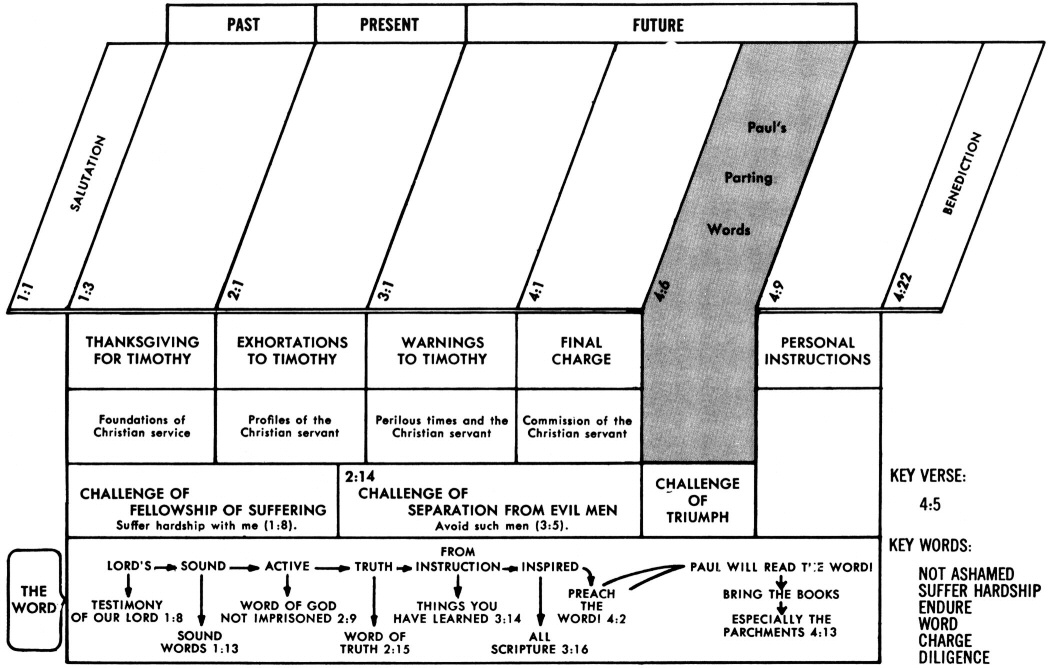
ENDURANCE AND SEPARATION IN THE MINISTRY
Click chart to enlarge
Charts from Jensen's Survey of the NT - used by permission
Second Timothy - Swindoll
| 2 TIMOTHY | |||
| 2 Timothy 1:1-18 | 2 Timothy 2:1-26 | 2 Timothy 3:1-17 | 2 Timothy 4:1-22 |
| Retain the Standard |
Rightly Divide the Word |
Difficult Times Will Come |
Preach the Word |
| PAST | PRESENT | FUTURE | |
| Foundation of Christian Service |
Pictures of Christian Servant |
Dangerous Times for Christian Servant |
Commission of Christian Servant |
| Unashamed as a Witness: Guard the Gospel |
Unashamed as a Workman: Suffer for the Gospel |
Adequate as a Workman: Continue in the Gospel |
Awarded as a Workman: Preach the Gospel |
| Power of the Gospel |
Perseverance of the Gospel Message | Protection of the Gospel |
Proclamation of the Gospel |
| Reminder | Requirements | Resistance | Requests |
| Encouragement in Ministry |
Examples in Ministry |
Exhortations in Ministry |
Exhortations to Fulfill Ministry |
| Commendation & Charge |
Commission to Fulfill |
Conflict to Face |
Course to Finish |
|
Compiled from Jensen's Survey of the NT and Wilkinson's Talk Thru the Bible |
|||
2Timothy 2:7 Consider (2SPAM) what I say (1SPAI) , for the Lord (Master) will give (3SFAI) you understanding in everything. (NASB: Lockman)
Greek: noei (2SPAM) ho lego; (1SPAI) dosei (3SFAI) gar soi o kurios sunesin en pasin.
Amplified: Think over these things I am saying [understand them and grasp their application], for the Lord will grant you full insight and understanding in everything. (Amplified Bible - Lockman)
KJV: Consider what I say; and the Lord give thee understanding in all things.
NLT: Think about what I am saying. The Lord will give you understanding in all these things. (NLT - Tyndale House)
NIV: Reflect on what I am saying, for the Lord will give you insight into all this. (NIV - IBS)
NJB: Think over what I have said, and the Lord will give you full understanding.
Phillips: Consider these three illustrations of mine and the Lord will help you to understand all that I mean. (Phillips: Touchstone)
Weymouth: Mark well what I am saying: the Lord will give you discernment in everything.
Wuest: Be grasping the meaning of that which I am saying, for the Lord will give you understanding in all things
Young's Literal: be considering what things I say, for the Lord give to thee understanding in all things.
CONSIDER WHAT I SAY: noei (2SPAM) ho lego (1SPAI):
Be grasping the meaning of that which I am saying (Wuest)
Reflect on what I am saying (NIV)
Think over these three illustrations (TLB)
Think over these things I am saying [understand them and grasp their application] (Amp)
- Dt 4:39; Dt 32:29; Ps 64:9; Pr 24:32; Isa 1:3; 5:12; Lk 9:44; Php 4:8; 1Ti 4:15; Heb 3:1; 7:4; 12:3; 13:7
- 2 Timothy 2 Resources - Multiple Sermons and Commentaries
Related Passages:
Proverbs 24:32 (NOTE THE 4 VERBS) When I saw, I reflected upon it; I looked, and received instruction.
Isaiah 1:3+ (FAILURE TO UNDERSTAND) “An ox knows its owner, And a donkey its master’s manger, But Israel does not know, My people do not understand.”
Isaiah 5:12+ (FAILURE TO CONSIDER!) Their banquets are accompanied by lyre and harp, by tambourine and flute, and by wine; But they do not pay attention to the deeds of the LORD, Nor do they consider the work of His hands.
Philippians 4:8+ Finally, brethren, whatever is true, whatever is honorable, whatever is right, whatever is pure, whatever is lovely, whatever is of good repute, if there is any excellence and if anything worthy of praise, dwell (present imperative see our need to depend on the Holy Spirit to obey) on these things.
1 Timothy 4:15 Take pains (KJV = meditate)(present imperative see our need to depend on the Holy Spirit to obey) with these things; be absorbed in them, so that your progress will be evident to all.
TAKING INTO CONSIDERATION
PAUL'S LAST WORDS
Taking into consideration means to pay attention to, think about, or focus on a particular detail when making a decision about something. The way to "tap" into God's promise of understanding is to first give consideration to what He says through Paul.
Consider (noeo) what I say - Paul is commanding Timothy regarding these last words he is penning to grasp the meaning, to put them in his mind, to fix him mind upon, to think about carefully, to give careful examination with a view to discerning and arriving at a judgment or conclusion. The idea is to ponder or examine attentively or deliberately. Consider is present tense (calling for continuous action, make it your lifestyle), active voice (subject carries out the action by choice of their will - you have to do this - a volitional choice - God won't force you, but He will enable you giving you the desire but you still have to follow through - see Php 2:13NLT+) and imperative mood which indicates this is a command and not merely advice or a suggestion! It is imperative that Timothy keep considering carefully, pondering and mulling over all that Paul had just said. By way of application, it is imperative that all believers seriously consider what Paul has written in verses 1-6 - We need to make this our continual practice or our lifestyle. The only way to do this is to depend on the Holy Spirit to obey.
THOUGHT - Continually considering God's truth is another way of describing meditating on God's Word, a practice that always bears fruit...
This book of the law shall not depart from your mouth, but you shall meditate on it day and night, so that you may be careful to do according to all that is written in it; for then you will make your way prosperous, and then you will have success. (Joshua 1:8-note)
Psalm 1:1 How blessed is the man who does not walk in the counsel of the wicked, Nor stand in the path of sinners, Nor sit in the seat of scoffers! 2 But his delight is in the law of the LORD, and in His law he meditates day and night. 3 And he will be like a tree firmly planted by streams of water, Which yields its fruit in its season, And its leaf does not wither; And in whatever he does, he prospers. (See notes Psalm 1:1; 1:2; 1:3)
Spurgeon - Some people like to read so many chapters every day. I would not dissuade them from the practice, but I would rather my soul soak in half a dozen verses all day than I would, as it were, rinse my hand in several chapters
Consider (3539) (noeo from nous = mind, the seat of moral reflection) has the basic meaning of direct one's mind to something and thus means more than just take a glance at. It means to perceive with the mind, to apprehend, to ponder (= weigh in one's mind, think especially quietly, soberly and deeply). It means to consider well, to reflect on with insight, or to think over a matter carefully. The idea is to grasp or comprehend something on the basis of careful thought.
Note Paul's use of noeo in the first letter to Timothy - "Wanting to be teachers of the Law, even though they do not understand either what they are saying or the matters about which they make confident assertions." (1Ti 1:7)
The NIV translates it reflect which suggests unhurried consideration of something recalled to the mind, and gives one the picture of meditating on these truths. Note well the order -- We are to do our part and can be assured the Lord will do His part (last part of this verse) and give you insight.
Moulton and Milligan has an interesting note on the secular use of noeo - The phrase "noon [noeo] and phronon" (Ed: loosely translated "I am keeping watch over my mind") is common in wills of both the Ptolemaic and the Roman periods...the testator thus certifying himself as “being sane and in his right mind”.
Wuest writes that noeo "means “to perceive with the reflective intelligence.” It is distinguished from the mere physical act of seeing. It is the perception of the mind consequent upon seeing. In the New Testament it is never used of mere physical sight. (Wuest's Word Studies)
Vincent adds that noeo "signifies to perceive with the nous or reflective intelligence. In Classical Greek of seeing with the eyes, sometimes with ophthalmois expressed; but as early as Homer it is distinguished from the mere physical act of vision, as perception of the mind consequent upon seeing. Thus the phrase "and seeing him he perceived" (Il. xi. 599). In NT never of the mere physical act. Here is meant the inward perception and apprehension of the visible (Ed note: i.e., what transpires in the mind after one sees what he sees). (Greek Word Studies)
Vine writes that "the verb noeo means to exercise the mind by way of discernment, enabling us to enter into the circumstances of what is mentioned. (Collected writings of W. E. Vine. Nashville: Thomas Nelson)
TDNT writes that noeo means "“to direct one's mind to.” At first it is used in the broad sense “to perceive,” but later it means only “to perceive mentally” and then “to think,” “to understand,” “to intend,” and “to know” as a function of the mind (nous). In the LXX the organ of noein is often the heart (kardia), but the sphere of noein is always mental. In the NT the verb has such senses as “to note,” “to grasp,” “to recognize,” “to understand,” and “to imagine.” (Borrow Kittel's Theological Dictionary of the New Testament : abridged in one volume TDNT)
Paul is commanding Timothy to not just look at what he had written but perceive (derived from Latin percipere = seize entirely in turn from per- = thoroughly + capere = to grasp) what I have said by reflecting on it and giving it consideration so that you will gain insight (insight provided by God Himself Who will give understanding).
Since several thought had been compressed into three metaphors without any lengthy exposition furnished Timothy is told to put his mind on that which Paul has just said. Reading it is not enough! Ponder it. Chew on it. Digest it. And be assured that when you do, the Lord Himself will make this mental activity fruitful ("will give you understanding").
Noeo - 14 times in the NT - Matt 15:17; 16:9, 11; 24:15; Mark 7:18; 8:17; 13:14; John 12:40; Rom 1:20; Eph 3:4, 20; 1 Tim 1:7; 2 Tim 2:7; Heb 11:3. NAS translation =: consider, 1; perceive, 1; see, 1; think, 1; understand, 9; understood, 1.
Matthew 15:17 "Do you not understand that everything that goes into the mouth passes into the stomach, and is eliminated?
Matthew 16:9 "Do you not yet understand or remember the five loaves of the five thousand, and how many baskets you took up?
Matthew 16:11 "How is it that you do not understand that I did not speak to you concerning bread? But beware of the leaven of the Pharisees and Sadducees."
Matthew 24:15 "Therefore when you see the abomination of desolation which was spoken of through Daniel the prophet, standing in the holy place (let the reader understand),
Mark 7:18 And He said to them, "Are you so lacking in understanding also? Do you not understand that whatever goes into the man from outside cannot defile him;
Mark 8:17 And Jesus, aware of this, said to them, "Why do you discuss the fact that you have no bread? Do you not yet see or understand? Do you have a hardened heart?
Mark 13:14 "But when you see the abomination of desolation standing where it should not be (let the reader understand), then let those who are in Judea flee to the mountains.
John 12:40 "He has blinded their eyes, and He hardened their heart; lest they see with their eyes, and perceive with their heart, and be converted, and I heal them."
Romans 1:20 (note) For since the creation of the world His invisible attributes, His eternal power and divine nature, have been clearly seen, being understood through what has been made, so that they are without excuse.
Ephesians 3:4 (note) And by referring to this, when you read you can understand my insight into the mystery of Christ,
Ephesians 3:20 (note) Now to Him who is able to do exceeding abundantly beyond all that we ask or think, according to the power that works within us, (Comment: In this use the idea is to form an idea about something, think, imagine)
1 Timothy 1:7 wanting to be teachers of the Law, even though they do not understand either what they are saying or the matters about which they make confident assertions.
2 Timothy 2:7 (note) Consider what I say, for the Lord will give you understanding in everything.
Hebrews 11:3 (note) By faith we understand that the worlds were prepared by the word of God, so that what is seen was not made out of things which are visible.
Noeo - 31 times in the Septuagint, LXX, (1Sa 4:20; 2 Sam 12:19; 20:15; Job 33:3, 23; Pr 1:2-3, 6; 8:5; 16:23; 19:25; 20:24; 23:1; 28:5; 29:19; 30:18; Isa 32:6; 44:18; 47:7; Jer 2:10; 10:21; 20:11; 23:20). Note the concentration of uses in Proverbs.
It is interesting that the first three NT uses of noeo were by Jesus questioning His disciples ability to understand what He was saying. For example He said
"How is it that you do not understand (noeo) that I did not speak to you concerning bread? But beware of the leaven of the Pharisees and Sadducees. Then they understood (suniemi = put the pieces together as used in last part of this verse) that He did not say to beware of the leaven of bread, but of the teaching of the Pharisees and Sadducees." (Mt 16:11, 12)
Jesus' rhetorical questions were meant to rebuke the disciples for not perceiving the true significance of the miracle. But beloved, are we not so often like them, slow to understand the things of the supernatural Word, the things unseen, the things eternal (2Cor 4:18-note)!
D A Carson makes an excellent point regarding the relationship between understanding spiritual truths and faith writing that "The miracles Jesus performs, unlike the signs the Pharisees demand, do not compel faith; but those with faith will perceive their significance.”
So just as Jesus used "leaven of bread" to illustrate the effects of the "teaching" of the Pharisees, so too Paul used three well known professions to give Timothy insight into how he should fight the good fight.
Barnes commenting on consider says that "The sense is “Think of the condition of the soldier, and the principles on which he is enlisted; think of the aspirant for the crown in the Grecian games; think of the farmer, patiently toiling in the prospect of the distant harvest; and then go to your work with a similar spirit.” These things are worth attention." As the Lord gives you insight and helps you understand the illustrations, apply them to your ministry situation.
Say (lego) is in the present tense meaning “what I am saying”. In context Paul is referring to the six previous verses, particularly the three illustrations that have been given.
Wuest quotes Expositor's - ‘Grasp the meaning’ of these three similes...If you have not sufficient wisdom to follow my argument, ‘ask of God who giveth to all men liberally’ (Jas 1:15).” Paul had used the illustration of a soldier. Timothy was to live a rugged, strenuous Christian life in which hardships as the result of serving the Lord Jesus were an expected thing. He used the simile of a Greek athlete. Timothy should live a life of rigid separation, not merely with respect to evil things, but also with regard to things which, good in themselves, would unfit him for the highest type of Christian service. Paul now uses the metaphor of a tiller of the soil. Timothy is reminded that the Christian worker who labors with wearisome effort in the Lord’s service, has the right to derive his financial support from it, so that he might be able to give all of his time and strength to his work. (Wuest's Word Studies from the Greek New Testament)
John Piper has a chapter entitled "Brothers, Let us Query the Text" which relates to seriously, intentionally, diligently considering what God's Word says
IF THE BIBLE is coherent, then understanding the Bible means grasping how things fit together. Becoming a Biblical theologian, which every pastor should be, means seeing more and more pieces fit together into a glorious mosaic of the divine design (Ed: As an interesting aside, putting together the pieces is the essence of the meaning of the Greek word for understanding = sunesis). And doing exegesis (Ed: derived from Greek word meaning "to guide", "to bring out" or "to lead out" and so means to arrive at an explanation or critical analysis and interpretation of a Biblical text) means querying the text about how its many propositions cohere in the author’s mind, and through that, in God’s mind. If we are going to feed our people (Ed: cp Jesus' charge Jn 21:15KJV Jn 21:16KJV Jn 21:17KJV), we must ever advance in our grasp of Biblical truth. We must be like Jonathan Edwards who resolved in his college days, and kept the resolution all his life,
Resolved: To study the Scriptures so steadily, constantly, and frequently, as that I may find, and plainly perceive, myself to grow in the knowledge of the same.
Growing, advancing, increasing—that is the goal. And to advance we must be troubled by Biblical affirmations....
“People only truly think when they are confronted with a problem,” said John Dewey. “Without some kind of dilemma to stimulate thought, behavior becomes habitual rather than thoughtful.”
He was right. And that is why we will never think hard about Biblical truth until we are troubled by our faltering efforts to grasp its complexity.
We must form the habit of being systematically disturbed by things that at first glance don’t make sense. Or to put it a different way, we must relentlessly query the text. One of the greatest honors I received while teaching Biblical studies at Bethel College in St. Paul, Minnesota, was when the teaching assistants in the Bible department gave me a T-shirt which had the initials of Jonathan Edwards on the front and on the back the words: “Asking questions is the key to understanding.” (Brothers, Let Us Query the Text )
Here is a related discussion by Dr Piper from his article Brothers, Let Us Query the Text
But there are several strong forces which oppose our relentless and systematic interrogating of biblical texts.
there is no positive correlation at all between
quantity of pages read and quality of insight gainedOne is that it consumes a great deal of time and energy on one small portion of Scripture. We have been schooled (quite erroneously) that there is a direct correlation between reading a lot and gaining insight. But in fact there is no positive correlation at all between quantity of pages read and quality of insight gained. Just the reverse. Except for a few geniuses, insight diminishes as we try to read more and more.
Insight or understanding is the product of intensive, headache-producing meditation on two or three verses and how they fit together. This kind of reflection and rumination is provoked by asking questions of the text. And you cannot do it if you hurry. Therefore, we must resist the deceptive urge to carve notches in our bibliographic gun.
Take two hours to ask ten questions of Galatians 2:20+ and you will gain one hundred times the insight you would have attained by reading thirty pages of the New Testament or any other book. Slow down. Query. Ponder. Chew.
Another reason it is hard to spend hours probing for the roots of coherence is that it is fundamentally unfashionable today to systematize and seek for harmony and unity. This noble quest has fallen on hard times because so much artificial harmony has been discovered by impatient and nervous Bible defenders. But if God’s mind is truly coherent and not confused, then exegesis must aim to see the coherence of biblical revelation and the profound unity of divine truth. Unless we are to dabble forever on the surface of things (content to turn up “tensions” and “difficulties”), then we must resist the atomistic (and basically anti-intellectual) fashions in the contemporary theological establishment. There is far too much debunking of past failures and far too little construction going on.
A third force that opposes the effort to ask the Bible questions is this: Asking questions is the same as posing problems, and we have been discouraged all our lives from finding problems in God’s Holy Book.
Rightfully Respecting God’s Word
It is impossible to respect the Bible too highly, but it is very possible to respect it wrongly. If we do not ask seriously how differing texts fit together, then we are either superhuman (and glance all truth at a glance) or indifferent (and don’t care about seeing more truth). But I don’t see how anyone who is indifferent or superhuman can have a proper respect for the Bible. Therefore, reverence for God’s word demands that we ask questions and pose problems and that we believe there are answers and solutions which will reward our labor with treasures new and old (Matthew 13:52).
We must train our people that it is not irreverent to see difficulties in the biblical text and to think hard about how they can be resolved.
I do not accuse my 6-year-old son, Benjamin, of irreverence when he cannot make sense out of a Bible verse and asks me about it. He is just learning to read. But have our abilities to read been perfected? Can any of us at one reading grasp the logic of a paragraph, and see how every part relates to all the others and how they all fit together to make a unified point? How much less the thought of an entire epistle, the New Testament, the Bible! If we care about truth, we must relentlessly query the text and form the habit of being bothered by things we read.
Reading for Reverence
This is just the opposite of irreverence. It is what we do if we crave the mind of Christ. Nothing sends us deeper into the counsels of God than seeing apparent theological discrepancies in the Bible and pondering them day and night until they fit into an emerging system of unified truth.
For example, a year ago, I struggled for days with how Paul could say on the one hand, “Do not be anxious about anything” (Philippians 4:6), but on the other hand say (with apparent impunity) that his “anxiety for all the churches” was a daily pressure on him (2 Corinthians 11:28). How could he say, “Rejoice always” (1 Thessalonians 5:16), and “Weep with those who weep” (Romans 12:15)? How could he say to give thanks “always and for everything” (Ephesians 5:20), and then admit, “I have great sorrow and unceasing anguish in my heart” (Romans 9:2)?
More recently I have asked, What does it mean that Jesus said in Matthew 5:39 to turn the other cheek when struck, but also said in Matthew 10:23, “When they persecute you in one town, flee”? When do you flee, and when do you endure hardship and turn the other cheek? I have also been pondering in what sense it is true that God is “slow to anger” (Exodus 34:6), and in what sense “his wrath is quickly kindled” (Psalm 2:12).
There are hundreds and hundreds of such seeming discrepancies in the Holy Scriptures, and we dishonor the text not to see them and think them through. God is not a God of confusion. His tongue is not forked. There are profound and wonderful resolutions to all problems. He has called us to an eternity of discovery so that every morning for ages to come we might break forth in new songs of praise.
In 2 Timothy 2:7, Paul gave us a command and a promise. He commanded, “Think over what I say.” And he promised, “the Lord will give you understanding in everything.”
How do the command and promise fit together? The little “for” (gar - see terms of explanation) gives the answer.
Think because God will reward you with understanding.
The promise is not made to all. It is made to those who think. And we do not think until we are confronted with a problem. Therefore, brothers, let us query the text.
FOR THE LORD WILL GIVE YOU UNDERSTANDING IN EVERYTHING: dosei (3SFAI) gar soi ho kurios sunesin en pasin:
- Ge 41:38-39 Ex 36:1-2 Nu 27:16-17 1Ch 22:12; 29:19; 2Ch 1:8-12; Ps 119:73; Ps 119:125,144,Ps 143:8,9; Pr 2:3, 4; 2:5,6 Is 28:26; Da 1:17; Lk 21:15; 24:45; Jn 14:26; Jn 16:13; Acts 7:10; 1Cor 12:8; Eph 1:17-18 Col 1:9; Jas 1:5; 3:15; 3:17 1Jn 5:20
- 2 Timothy 2 Resources - Multiple Sermons and Commentaries
Related Passages:
Psalms 119:73 Yodh. Your hands made me and fashioned me; Give me understanding, that I may learn Your commandments.
Psalm 119:125 I am Your servant; give me understanding, That I may know Your testimonies.
Psalm 119:130 The unfolding of Your words gives light; It gives understanding to the simple.
Psalm 119:144 Your testimonies are righteous forever; Give me understanding that I may live.
Psalm 143:8 Let me hear Your lovingkindness in the morning; For I trust in You; Teach me the way in which I should walk; For to You I lift up my soul.
Daniel 1:17 As for these four youths, God gave them knowledge and intelligence in every branch of literature and wisdom; Daniel even understood all kinds of visions and dreams..... 20 As for every matter of wisdom and understanding about which the king consulted them, he found them ten times better than all the magicians and conjurers who were in all his realm.
Daniel 2:21 “It is He who changes the times and the epochs; He removes kings and establishes kings; He gives wisdom to wise men And knowledge to men of understanding.
Luke 24:45+ Then He opened their minds to understand the Scriptures,
John 14:26 “But the Helper, the Holy Spirit, whom the Father will send in My name, He will teach you all things, and bring to your remembrance all that I said to you.
John 16:13 “But when He, the Spirit of truth, comes, He will guide you into all the truth; for He will not speak on His own initiative, but whatever He hears, He will speak; and He will disclose to you what is to come.
Ephesians 1:16-19+ (I) do not cease giving thanks for you, while making mention of you in my prayers; 17 that the God of our Lord Jesus Christ, the Father of glory, may give to you a spirit of wisdom and of revelation in the knowledge of Him. 18 I pray that the eyes of your heart may be enlightened, so that you will know what is the hope of His calling, what are the riches of the glory of His inheritance in the saints, 19 and what is the surpassing greatness of His power toward us who believe. These are in accordance with the working of the strength of His might
GOD'S PROMISE TO
GRANT UNDERSTANDING
Other translations - the Lord will give you insight into all this (NIV), and may the Lord help you to understand how they apply to you (TLB), Think over these things I am saying [understand them and grasp their application], for the Lord will grant you full insight and understanding in everything (Amp), Put your mind on what I say, for the Lord will give you understanding in all matters.
For (gar) is a strategic term of explanation and explains why we should make it our habitual practice to consider what God says in His Word. We are to be motivated by His promise to give us understanding.
The Lord will give you understanding (sunesis) in everything - This is a clear promise for the reader who obeys the command to consider what God says! Unless the Lord gives the understanding of spiritual truth, we cannot understand anything in His special revelation. Thank You Lord for the gift of our Teacher (and Illuminator), the Holy Spirit (1Jn 2:20+, 1Jn 2:27+), the Spirit of Jesus Christ! Amen. (See Illumination of the Bible) Pray also Colossians 1:9-10+ (cf James 1:5+) "that you may be filled with the knowledge of His will in all spiritual wisdom and understanding (sunesis) so that you will walk in a manner worthy of the Lord, to please Him in all respects, bearing fruit in every good work and increasing in the knowledge of God."
Marshall - The gar (for) clause implies that the thinking will be fruitful because the Lord will give understanding (sunesis). That understanding is a divine gift is frequently stated (1Kgs 3:9; Da 2:21; Col 1:9; Jas 1:5). (Ed: And does not this make sense? The supernatural word of God cannot be understood with the natural mind - cp 1Cor 2:14+ . When we read the Scriptures we need to renounce self-reliance and rely on the illuminating ministry of the Spirit of Truth - cp 1Jn 2:20+, 1Jn 2:27+, Jn 14:17, 15:26, 16:13) (The Pastoral Epistles (International Critical Commentary)
Eugene Minor asks "What relationship is indicated by gar (for) ‘because’? It indicates the grounds for the preceding exhortation [Gordon Fee, J N D Kelly, Lenski, Huther, Hendricksen]: consider what I say because the Lord will enable you to understand it. This implies a condition [Ralph Earle - Expositor's Bible Commentary, Expositor's Greek, Thomas Guthrie]: ‘consider what I say, because if you do, the Lord will enable you to understand’." I favor the latter interpretation.
For the Lord will give you understanding (cp Lk 24:45+, Ps 119:130+) - Observe that this divine promise of understanding is based on the condition that one ponders (in contrast to "speed reading" the Word -- you are not doing yourself any "favors" by reading through the Bible in a year unless you are making time to humbly let that rich Word course through and transform you! Ro 12:2+, Eph 4:23+) the truths in 2Ti 2:2-6. And remember that 2Ti 2:1+ explains how (continually strengthened [being enabled] by the transforming grace in Christ Jesus, made manifest and effective now by His Spirit Who indwells every believer forever!) one can even be enabled to function as a God glorifying, Christ exalting, Spirit led teacher, soldier, athlete or farmer (all metaphorically speaking except for "teacher").
In other words, Paul is giving Timothy (and us) somewhat of a "conditional promise" - Timothy is to consider (man's responsibility, albeit even this is enabled by the Spirit - see Phil 2:13NLT+ where He gives us the "desire" or "want to" and the "power"!) and the Lord will graciously give us understanding (God's part). This truth flies in the face of the common false teaching of "let go and let God". As I like to say, it is more accurately stated "Let God, let's go!" His sovereignty interacts with my responsibility.
Ralph Earle - Paul winds up this section by saying, “Reflect on what I am saying.” If Timothy does this, he will understand what it is all about. (See The Expositor's Bible Commentary)
Mere reading is not enough. What has been written must be pondered.
What has been spoken must be digested
Hendriksen and Kistemaker agree writing that "Mere reading is not enough. What has been written must be pondered. What has been spoken must be digested (cf. Mt. 11:29; 13:51; 15:17; 16:9, 11; 1 Cor. 10:15; and especially Rev. 10:9, 10). Timothy need not fear that such mental activity will be fruitless. Has not the Lord given his definite promise? See Luke 19:26; John 14:26; 16:13. Surely in all matters with respect to which Timothy is in need of understanding (sunesis, comprehension, insight), it will be given to him if (Ed: The "if" speaks of the prerequisite condition that) he will but apply himself. Let Timothy then compare a scripture with scripture. Let him pray for wisdom (James 1:5). Let him reflect on his own past experience and the experience of other children of God. Let him listen to what these others have to say. By such means as these the Holy Spirit will give him all the guidance he will need in the performance of his task. He will be able to apply to himself and his office the rich meaning of the threefold figure (2Ti 2:3-6), and he will derive from it the comfort which it affords. (Exposition of the Pastoral Epistles)
For all spiritual things our thinking abilities, however keen and sharp, are not sufficient.
The Lord must control, guide, enlighten our “understanding.”
Lenski - For all spiritual things our thinking abilities, however keen and sharp, are not sufficient. The Lord must control, guide, enlighten our “understanding.” He is ever willing to give us “understanding” if we only let him give it, recognize his gift, and prize it. The Lord so gives by means of the very Word itself and never apart from that Word which is a lamp and a light, the source of all true enlightenment. “Search the Scriptures,” and the Lord will give thee understanding; it does not come to one through the air. Ora et labora. The Lord, however, uses also his gracious providence in manifold ways. Experience helps to make many a passage clear. Teachers and fellow workers are placed into our path to help us. The Lord lets us find the book we need for this or for that purpose. He quickens our faculties, our memory. Sometimes we must wait, but δώσει (will give) stands: “he will give.” (See Interpretation of St Paul's Epistles to Timothy,)
Make the effort to reflect,
for if thou do, the Lord will give thee the discernment which thou needest.’
-- Phillip Schaff's paraphrse
In other words, even Christ followers would not be able to understand the supernatural Word without the Spirit's supernatural enablement, His dunamis, His enabling power! The Spirit of Truth (Jn 14:17, 15:26, 16:13) takes the Word of Truth (2Ti 2:15-note; James 1:18-note, 2Cor 6:7, Ps 119:43-note, Col 1:5-note where "Word of Truth" is synonymous with "The Gospel"! We are not just saved in the past by the Gospel, but are saved/sanctified daily by that same Gospel and in the same manner, by faith, renouncing self-effort, self-reliance and resting/relying on God's Word and His Spirit to enable us to obey that Word) and daily (if we go to His Word daily [Mt 4:4, Lk 4:4] - you do don't you?) opens our "minds to understand (suniemi) the Scriptures" just as Jesus did for His first disciples (Lk 24:45)..
but just as it is written, "THINGS WHICH EYE HAS NOT SEEN AND EAR HAS NOT HEARD, AND which HAVE NOT ENTERED THE HEART OF MAN, ALL THAT GOD HAS PREPARED FOR THOSE WHO LOVE HIM." (Ed: Yes, this could be applied to our glorious future, our Blessed Hope, but it also applies to our blessed now which is the interpretation favored by some. But it can surely still be applied to our future.) For to us God revealed (apokalupto = the Holy Spirit "takes the lid" off of the supernatural Word so that we might see the Truth therein! Hallelujah!) them through the Spirit; for the Spirit searches all things, even the depths of God. Now we have received, not the spirit of the world, but the Spirit Who is from God, that we might know the things freely given to us by God (Ed: Especially His Word of grace" Acts 20:32), which things we also speak, not in words taught by human wisdom, but in those taught by the Spirit, combining spiritual thoughts with spiritual words. (1Cor 2:9-13+).
John Piper commenting on 2Ti 2:7 observes that "So many people swerve off the road to one side of this verse or the other. Some stress, “Think over what I say.” They emphasize the indispensable role of reason and thinking. And they often minimize the decisive supernatural role of God in making the mind able to see and embrace the truth. Others stress the second half of the verse: “for the Lord will give you understanding in everything.” They emphasize the futility of reason without God’s illumining work. But Paul will not be divided that way. And this book (Thinking. Loving. Doing) is a plea to you that you not force that division either. We hope you will embrace both human thinking and divine illumination. For Paul, it was not either-or but both-and. “Think over what I say, for the Lord will give you understanding in everything.” And notice the little word “for.” (Ed: for = a term of explanation) This means that the promise of God to give us understanding is the ground of our thinking, not the substitute for it. Paul does not say, “God gives you understanding, so don’t waste your time thinking over what I say.” Nor does he say, “Think hard over what I say because it all depends on you, and God does not illumine the mind.” No. He emphatically makes God’s gift of illumination the ground of our effort to understand. There is no reason to believe that a person who thinks without prayerful trust in God’s gift of understanding will get it. And there is no reason to believe that a person who waits for God’s gift of understanding without thinking about his Word will get it either. Both-and. Not either-or." (Thinking. Loving. Doing - John Piper and David Mathis)
MacDonald - But there is more in these three illustrations of Christian service than appears on the surface. Timothy is exhorted to consider them and to meditate on them. As he does so, Paul prays (Ed: MacDonald's interpretation is based on the KJV rendering but most modern version see it as result of Timothy pondering rather than of Paul praying) that the Lord will give him understanding in all things. He will realize that the Christian ministry resembles warfare, athletics, and farming. Each of these occupations has its own responsibilities, and each brings its own reward. (See full context Believer's Bible Commentary)
Fee - Thus everything is from the Lord, both the strengthening to stand in his grace (2Ti 2:1) and the ability to understand the need to share in suffering. (1 and 2 Timothy, Titus Understanding the Bible Commentary)
John Calvin - We taught in vain, if the Lord does not open our understandings (and) the commandments would be given in vain, if He did not impart strength to perform.
John Phillips - The word consider means "to perceive with the mind." Paul was challenging Timothy to think about the illustrations in 2:1-6, ponder them, and work out in his mind all of their implications. Paul's prayer was that the Lord would help Timothy to do that. (See context Exploring the Pastoral Epistles: An Expository Commentary)
John Piper on our part an God's part - In 2 Timothy 2:7 (author's translation), Paul tells Timothy how to read his letter: "Think over what I say, for the Lord will give you understanding in everything." Yes, the Lord "gives" understanding. But not without thinking. Don't replace thinking with praying. Think and pray. Read and study and ransack and think. But all is in vain without prayer. Both-and, not either-or. So we have seen again and again: Prayer is indispensable if we would see the glory of God in the Word of God. But we have also seen that reading and studying and ransacking and thinking the Word is also necessary. God has ordained that the eye-opening work of his Spirit always be combined with the mind-informing work of his Word. His aim is that we see the glory of God and that we reflect the glory of God. And so he opens our eyes when we are looking at the glory of God in the Word. So...Read! Study! Ransack! Think!—and pray, "Open my eyes that I may see wonderful things in your Law" (Psalm 119:18). (The Godward Life - Part 2)
Understanding (4907) (sunesis from sun = together + hiemi = send) literally describes a sending together as of two rivers converging into union as one tributary. As an intellectual faculty sunesis describes the putting together of the pieces so to speak so that there is comprehension and perception. It is the ability to understand facts and concepts, especially to see the mutual relationships between the various "parts" to the "whole".
A T Robertson comments on understanding writing that it means “Comprehension” (from suniemi = to send together, to grasp). Col 1:9-note; Col 2:2-note. This is a blessed promise that calls for application. (2 Timothy 2)
Sunesis also describes the ability to assess any situation and decide what practical course of action is necessary within it. If Timothy would reflect on Paul's teachings in the previous verses, Christ would assemble the truths together for him and deepen the meaning.
D Edmond Hiebert comments that "It is not that Timothy cannot grasp the meaning of the figures (of speech), but there is so much involved in them that he must be applying his mind to them to apprehend their full application. And Timothy need not fear that the mental activity demanded will be ineffectual. He is given the assurance that "the Lord shall give thee understanding in all things." (The reading in the King James Version, making it a prayer, is based on a reading less well attested.) He need not depend upon his own imperfect, erring mental faculties; for the needed enlightenment he is directed to the Lord. (Quoting Moule) "Timothy was referred for insight and exposition not to the Church, not to the Apostle, or to the Apostles, but to the divine Master Himself, present, attentive, cognizant of Timothy's individual difficulties and mental needs (Moule). The apprehension of spiritual truth is not primarily a matter of mental acumen but of spiritual teachableness. (See full context Second Timothy- Everyman's Bible Commentary).
MacArthur applies Paul's command to all believers "Think over and carefully ponder what Paul has said. Look at your life and ask yourself if you are a faithful, trustworthy, spiritually mature believer? Are you devoting yourself to guarding and teaching God’s Word? Do you deny yourself and count your life as nothing in order to faithfully serve the Lord? Do you put some distance between yourself and the routine business of the world? Do you continually prepare yourself to serve your Master? Do you understand self-denial and self-sacrifice? Are you willing to pay the price that He demands?” “If you can answer yes to those questions,” we are promised, the Lord will give you understanding in everything. You will be led with wisdom and insight through the challenges to victory. (See context 2 Timothy MacArthur New Testament Commentary)
W E Vine - Consider what I say; for the Lord shall give thee understanding in all things.—note that this is a promise (Ed: Some do not read it this way or interpret it this way), according to the best manuscripts, and the promise is given as a reason for the careful attention to the exhortations, though possibly the charge is connected also with what follows. If the full meaning of a Scripture is not at once evident, we may trust the Lord to give us understanding concerning it. To this end we must apply ourselves attentively to what is written. It is a sound principle that what is not clear in any Scripture is to be understood in the light of Scriptures that are clear. (Collected Writings of W.E. Vine)
Gregg Herrick - The key to transformation is meditation which means prolonged reflection on a passage(s) or truth in order to penetrate its meaning, relating it to other doctrines and life, and hearing God’s voice in it. Meditation is the bridge to meaningful obedience. Paul told Timothy to think seriously about what he [Paul] said and that the Lord would give him insight into it (2Ti 2:7). Unfortunately, just about everything in our driven society mitigates against investing time in prayerful meditation. Nevertheless, God commanded Joshua to meditate on his word so that he could obey it and enjoy the blessing of success (Joshua 1:8). (See context of How to Study the Bible cf Principles for Bible Study: Four Key Components)
John Piper - Think Deeply and Clearly -A Meditation on 2 Timothy 2:7
January 22, 1990 | by John Piper | Scripture: 2 Timothy 2:7 | Topic: Life of the Mind
2 Timothy 2:7 Think over what I say, for the Lord will grant you understanding in everything.
Timothy: Wait a minute, Paul. You tell me to think, but isn’t the organ of our thinking fallen and unreliable?
Paul: Yes, your mind is fallen and fallible. Yes, it is prone to self-justifying errors. But Christ is in the business of “renewing the mind” (Romans 12:2; Ephesians 4:23). Do you think there is some unfallen part of you that you could substitute for your mind? We are fallen and depraved in every part. You can’t retreat from thinking into some other safe, untainted faculty of knowing. Take note, Timothy: even in raising the objection against thinking you are thinking! You can’t escape the necessity of thinking. God’s call is to do it well.
Timothy: But, Paul, I don’t want to become a cold, impersonal intellectual.
Paul: There is danger on both sides, Timothy. There is cold knowledge, and there is a red hot zeal that “is not according to knowledge” (Romans 10:2). But thinking does not have to cool your zeal. In fact, in my life the vigorous exercise of my mind in spiritual things causes me to boil inside, not to freeze. You are right not to want to become “impersonal.” That happens when thinking is emphasized to the exclusion of feeling about people; and reason is exalted above love. But note this, Timothy: the abandonment of thinking is the destruction of persons. Yes, there is more to personal relationships than thinking, but they are less human without it. God honored his image in us when he said, “Come, let us reason together” (Isaiah 1:18). Should we do less?
Timothy: But, Paul, shouldn’t I just take you at your word, and not ask so many questions? You’re an apostle, and speak for God.
Paul: Take what, Timothy?
Timothy: Your words, what you say in your letters.
Paul: Do you mean the black marks on the parchment?
Timothy: No. What they stand for. You know. What they mean.
Paul: How do you know what I mean, Timothy?
Timothy: I read what you write.
Paul: You mean you pass your eyes over the black marks on the parchment?
Timothy: No, I . . . I think about it. I ask how the words and sentences fit together. I look for what it means.
Paul: That’s right, Timothy. Thinking and asking questions is the only way you will ever understand what I want to communicate in my letters. And either you do it poorly, or you do it well. So “do not be a child in your thinking: be a babe in evil, but in thinking be mature” (1 Corinthians 14:20). As the Master said, “wise as serpents and innocent as doves” (Matthew 10:16).
Timothy: But, Paul, won’t I become arrogant and boastful if by using my mind I discover things on my own?
Paul: Timothy, you never have and never will discover anything “on your own.” And you would know this if you had thought more deeply about what I said. What I said was: “Think over what I say, for the Lord will grant you understanding in everything.” The Lord, Timothy, the Lord! “From him, through him, and to him are all things. To him be the glory!” (Romans 11:36) He is the ground and goal of all thought. So think, Timothy. Gird up your mind and think!
Praying Psalm 119:66 with you,
Pastor John
John Piper - 2 Timothy 2:7 - Back to School: A Biblical Perspective
September 9, 1992 | by John Piper | Topic: Education
Reading, writing and ‘rithmatic have to do with thinking.
Reading well does not mean moving the eyes quickly over letters on a page. It means grasping facts and ideas accurately, assessing their truth and beauty correctly, and making use of them to lead a good life.
Arithmetic at the simplest levels means stocking the mind with tools for thought (the tables of addition, subtraction, multiplication and division). At more advanced levels math is the exercise of logic for building things and living wisely: which is the better buy, three 8 ounce boxes at $1.00 each or two 12 ounce boxes at $1.40 each?
Writing is what you learn so that you can preserve for yourself and communicate to others what you are thinking.
This business of education is God’s business. He gave us the minds that think. He created the world we think about. He wrote the book of nature. He made the rules of logic. He is the standard of true and false, good and bad, beautiful and ugly. To ignore him is to be profoundly uneducated. Meditate (and help the children meditate) on the following biblical truths.
We are commanded to love the Lord with our minds.
Matthew 22:37 – And [Jesus] said to him, ‘You shall love the Lord your God with all your heart, and with all your soul, and with all your mind.’
Without God as the highest value of education all thinking becomes futile and dark and sordid.
Romans 1:20-21,28 – Although they knew God they did not honor him as God or give thanks to him, but they became futile in their thinking and their senseless minds were darkened . . . Since they did not see fit to acknowledge God, God gave them up to a base mind and to improper conduct.
We are commanded to be mature in our thinking.
1 Corinthians 14:20 – Brethren, do not be children in your thinking; be babes in evil, but in thinking be mature.
The failure to love truth will lead to destruction.
2 Thessalonians 2:10 – They refused to love the truth and so be saved.
Wise people seek to grow in knowledge.
Proverbs 15:14 – The mind of him who has understanding seeks knowledge, but the mouths of fools feed on folly.
Proverbs 18:15 – An intelligent mind acquires knowledge, and the ear of the wise seeks knowledge.
Proverbs 22:17 – Incline your ear, and hear the words of the wise, and apply your mind to my knowledge. (cf. Proverbs 2:1-6; 23:12)
Thinking does not replace God, and God does not replace thinking.
2 Timothy 2:7 – Think over what I say, for the Lord will grant you understanding in everything.
Thinking with you for the glory of God,
Pastor John
As I prepared for this message today, I thought I’d begin with a story about dads, and so I put that word into the computer and did a search to see if I could find anything interesting. The word I typed into Google was DADS. The top item—the very first one—that popped up on the computer was the website for the Department of Aging and Disability Services for the state ofTexas: DADS—the Department of Aging and Disability. Well, sometimes when I look in the mirror, I think that’s appropriate. Someone said to me recently that a dad is only as happy as his least happy child, and there’s some truth to that. But in parenting as well as in living, the greatest secret I know is that we keep going back to the Word of God again and again.
And when it comes to Father’s Day, there’s no better book in the Bible than 2 Timothy. Notice how this book begins in chapter 1, verse 1: Paul, an apostle of Christ Jesus by the will of God, according to the promise of life that is in Christ Jesus, to Timothy, my dear son.
Timothy was Paul’s son—not literally, but in the faith, in the Gospel, in the mind. And the most important thing to remember about 2 Timothy is that it gives us the last will and testament of the apostle Paul. He was only days or weeks away from his execution. He was chained, probably in the Mamertine Prison in Rome (picture of one of the dungeons - talk about claustrophobia!), located on the northeastern slope of the Capitoline Hill of Rome. And the backdrop of this entire letter is one of persecution and impending martyrdom. Those were days of extreme danger when Christians were being rounded up and imprisoned and executed. It seems apparent that Paul was concerned about Timothy’s courage and stamina. Paul himself was about to exit from the scene, and Timothy was about to become a targeted leader of the church. And the apostle Paul was concerned that his son in the faith might falter in the face of adversity. So he wrote this final letter to inspire and instruct Timothy to keep the faith in perilous times. That’s the theme of 2 Timothy.

Today we’re coming to chapter 2, which has 26 verses in it. That’s a little long for a Sunday morning reading, so I’m going to deal with the first portion of the chapter this morning and tonight we’ll look at the last part of this chapter. For today’s message, let’s read 2 Timothy 2:1-7.
You then, my son, be strong in the grace that is in Christ Jesus. And the things you have heard me say in the presence of many witnesses entrust to reliable men who will also be qualified to teach others. Endure hardship with us like a good soldier of Christ Jesus. No one serving as a soldier gets involved in civilian affairs—he wants to please his commanding officer. Similarly, if anyone competes as an athlete, he does not receive the victor’s crown unless he competes according to the rules. The hardworking farmer should be the first to receive a share of the crops. Reflect on what I am saying, for the Lord will give you insight into all this.
Notice that Paul began by addressing Timothy as his son: You, then, my son…. Then he gave Timothy some fatherly advice. He gives him five rules for life. They are so simple that Timothy could have written them out on little card and kept them in his billfold, always there to remind him how to live in perilous times. I want to give them to you today with this same attitude. You could jot these down on a little card, put them in your billfold, or write them on the flyleaf of your Bible—and they provide a great recipe for the abundant life, even in perilous times.
Be Strong
You then, my son, be strong in the grace that is in Christ Jesus.
This is a truly great verse, because it presupposes that as we go through life we’re going to face a lot of situations that we can’t handle in our own strength. You know, all of us have different levels of physical strength. Some of you work out at the health club, or you press weights, or have a running schedule; and you’re very strong. Others here today are weaker and frailer, perhaps because of illness or age or disability.
Well, I think the same is true for us psychologically. Some of us are strong-willed and courageous and there’s not much in life that really gets us down. But others of us falter in times of trouble and just inwardly collapse. That’s why in a crisis, one person keeps his head and another person falls apart. But whatever our physical and psychological makeup, the Bible commands us to be strong. Do you realize that the phrase BE STRONG is found 36 times in the Bible? The first time is when Moses is passing the torch to Joshua. He tells him:
• Be strong and courageous. Do not be afraid or terrified because of them, for the Lord your God goes with you; He will never leave you or forsake you—Deuteronomy 31:6
A little later, after Moses died, the Lord spoke to Joshua directly, repeating the message:
• Be strong and courageous, because you will lead these people to inherit the land I swore to their forefathers to give them. Be strong and very courageous—Joshua 1:6-7
A little later, Joshua repeats that commandment to all of Israel:
• Joshua said to them, “Do not be afraid; do not be discouraged. Be strong and courageous”—Joshua 10:25
Similarly, when David was old and near death, he called his son Solomon to him and gave him the same advice:
• David also said to Solomon his son, “Be strong and courageous, and do the work. Do not be afraid or discouraged, for the Lord God, my God, is with you. He will not fail you or forsake you until all the work for the service of thetemple of God is finished—1 Chronicles 28:20
There are many of the Psalms that talk about tapping into God’s strength. One of the best is Psalm 27. It begins with the words: “The Lord is my light and my salvation—whom shall I fear? The Lord is the stronghold of my life—of whom shall I be afraid?” And Psalm 27 ends with the words:
• Wait for the Lord; be strong and take heart and wait for the Lord—Psalm 27:14
The apostle Paul, in his writings, frequently admonished his readers to be strong:
• Be on your guard; stand firm in the faith; be men of courage; be strong—1 Corinthians 16:13
• Finally, be strong in the Lord and in His mighty power. Put on the full armor of God so that you can take your stand against the devil’s schemes—Ephesians 6:10
• You then, my son, be strong in the grace that is in Christ Jesus.
The Bible doesn’t tell us to be strong in the strength of our own personalities. It doesn’t tell us to be strong out of sheer will-power. It doesn’t tell us to be strong by pretending everything is ruby-red and rosy. It tells us to be strong in the grace that is in our Lord Jesus Christ. We can be strong in His promises. We can be strong because of His presence within us. We can be strong because we have recourse to prayer. We can be strong because His perfect love casts out fear and because of the privilege of casting all our cares on Him. We can be strong in life because we have resources from another world.
Some years ago, there was a Presbyterian pastor in New York City. His name was Maltbie Babcock, and he was a remarkable man—a superb athlete, a first-rate intellect, and a gifted speaker. For a number of years he pastored a church in Baltimore, but during that pastorate he had experienced what was called at the time a mental breakdown and had spent some time recovering in a sanitarium. Later he was called to a very prestigious pulpit in Manhattan, the Brick Presbyterian Church. He had been in his pastorate in New York for about a year and a half when he and his wife took a trip to the Holy Land. This was in the days when going to the Holy Land was a very long and difficult task, but he left in good spirits with a group of fifty-five other clergymen. They had a wonderful time and were on their way home when they stopped in Naples, Italy, and there a strange illness swept through the group. It was later supposed they had contracted a dangerous germ from a drinking well somewhere in the Holy Land. Thirty-five of the preachers were stricken with fever. Babcock was only 43 years old, but this Mediterranean Fever sent him into a delirium and somehow or another he grabbed a bottle filled with a poisonous substance and drank it. The headlines the next day in the New York Times reported that Dr. Babcock had committed suicide, but that wasn’t exactly true.
Well, the rest of the story is that some time later, his widow collected his writings—including poems he had written—and published them. One became a hymn, which is one of my favorite: “This is My Father’s World.” But another of his poems is based on the very subject of this verse. The title is “Be strong.”
Be strong!
We are not here to play, to dream, to drift;
We have hard work to do and loads to lift;
Shun not the struggle, face it, ’tis God’s gift.
Be strong, be strong, be strong!
Be strong!Say not the days are evil—who’s to blame?
And fold the hands and acquiesce—O shame!
Stand up, speak out, and bravely, in God’s Name.
Be strong, be strong, be strong!
Be strong!It matters not how deep entrenched the wrong,
How hard the battle goes, the day, how long;
Faint not, fight on! Tomorrow comes the song.
Be strong, be strong, be strong!
That’s what Paul was telling Timothy, and that’s the Lord’s word to us as well.
Teach Others
Second, we’re to teach others. Verse 2 is one of the best verses on discipleship in the whole Bible: And the things you have heard me say in the presence of many witnesses entrust to reliable men who will also be qualified to teach others.
Notice there are four generations here. Paul didn’t just say, “See how many decisions you can get for Christ.” He said:
• Consider me the first generation. God saved me and gave me a world-changing message.
• Consider yourself the second generation. You heard me talk about the Lord and it has impacted your own life.
• Third, entrust this message to reliable men and women. Disciple them. Teach them to obey all things he has given us.
• And then have them teach a fourth generation.
The things you have heard me say in the presence of many witnesses entrust to reliable men who will be qualified to teach others also.
And in the process, there is a multiplying effect. It’s just like in your family tree. I had a woman tell me recently, “I have four children, fifteen grandchildren, and thirty-two great-grandchildren.”
Oh, that something similar might be said of all of us in a spiritual sense. We’re links in the chain, we’re the spiritual connection between generations past and future, we’re ambassadors for Christ, and I believe there is someone somewhere whom you can influence for Christ in a way that will have ramifications for generations still to come. We must be strong and teach others.
Endure Hardship
Third, the Bible says endure hardship. 2Ti 2:3 says: Endure hardship with us like a good soldier of Christ Jesus. No one serving as a soldier gets involved in civilian affairs—he wants to please his commanding officer.
The book of 2 Timothy was written in about the year A.D. 67. The first documented case of state-sponsored imperial persecution of Christians in the Roman Empire took place during the reign of Emperor Nero, which lasted from AD 64 to AD 68. It started when Nero blamed Christians for the great fire that destroyed much of Rome. According to the historian Tacitus, Christians were rounded up and tortured. They were covered with the skins of beasts and torn apart by ferocious dogs. They were dipped in tar and set on fire to illumine Nero’s gardens.
You know, for years I’ve read and studied Christian history, and I have read the accounts of many, many believers throughout the centuries of the church. I’m amazed at how they have suffered for the sake of Christ. Several years ago, I read the accounts of the Scottish Worthies, as they were called, who were tracked down like dogs, tied to posts in the city centers, and burned alive at the stake. I’ve been to Edinburgh and visited the graveyard where large pits were dug as mass graves and the bodies of Christians were tossed in like animal carcasses.
One of the most gripping little books along these lines—and somehow millions of copies of it are in circulation, and I’m sure some of you have read it—is entitled Tortured for Christ, by Richard Wurmbrand. As a young man, he was an atheist and attracted toward Communism in Romania during the years before World War II. He and his wife were both converted to Christ through the witness of a simple Romanian carpenter, and after the War, he worked to spread the message of Christ throughout communistRussia and Romania. He was arrested and tortured, and in his books he describes many things that were done to Christians.
He said that one day in the prison cell, a brother was preaching to the other prisoners. Suddenly the guards burst in and interrupted him in the middle of a sentence. They dragged him down the hallway to the beating room where they gave him a very long and brutal beating. Then they dragged him back to the cell and tossed him in—bloody and bruised. Slowly he picked up his battered body, stood up as best he could, painfully straightened his clothing, and said, “Now, brethren, where did I leave off when I was interrupted?” And he continued his sermon.
We’re used to a nice air-conditioned, comfortable, non-threatening and non-threatened Christianity. But this world is not our home; we’re just a passing through. And we need to be strong, teach others, and endure hardship as a good soldier of Jesus Christ.
Stay Disciplined
And that brings us to the fourth instruction: Stay Disciplined. We’re not only compared to soldiers, but to athletes. 2Ti 2:5 says: Similarly, if anyone competes as an athlete, he does not receive the victor’s crown unless he competes according to the rules.
When our American athletes arrive in Beijing in August, they’re going to have to compete according to the rulebook adopted by the International Olympic Committee. What if one of our swimmers said, “I’m going to write my own rules for this event”? Or what if one of our runners said, “I’m going to do this the way I want to do it—forget the rules”?
Well, there were Olympic Games and other international athletic competitions in the days of the Apostle Paul, too, and he may well have attended them. He uses sports analogies freely. And they had rule books in his day, too. And Paul said, “Just as athletes have a rule book they follow, so do Christians.” You can’t write your own rules of the Christian life and have your own little version of Christianity. We are people of the Book. We read it, we study it, and we obey it.
In fact, later in this very chapter, we read: Do your best to present yourself to God as one approved, a workman who does not need to be ashamed and who correctly handles the word of truth.
And in chapter 3, he says: But as for you, continue in what you have learned and have become convinced of, because you know those from whom you learned it, and how from infancy you have known the Holy Scriptures, which are able to make you wise for salvation through faith in Christ Jesus. All Scripture is God-breathed and is useful for teaching, for rebuking, correcting, and training in righteousness.
In chapter 4, he wrote: Preach the Word; be prepared in season and out of season; correct, rebuke, and encourage—with great patience and careful instruction. For the time will come when men will not put up with sound doctrine.
To follow Christ means that we maintain the discipline of an athlete to the rule book, and our rule book is a book that’s full of promises, commands, truths, insights, encouragements, and prayers—the book that we call the Holy Bible.
Work Hard
Finally, one of the most important little instructions for productive life is to work hard. 2Ti 2:6 says: The hardworking farmer should be the first to receive a share of the crops.
We are soldiers who must endure hardship, we are athletes who must know the rulebook, and we are farmers who are expected to work hard, assured of the coming harvest.
On this Father’s Day, I can’t help thinking about my own dad. He was a vocational agricultural teacher at Unaka High School for over 30 years, and he owned and operated an apple orchard on the state line, and he and my mom also had a big garden every year. I remember how hard they worked, and also how much fun it was when the harvest came. We had big sacks that we wore, and we’d climb the ladder, pick every apple we could reach, drop it into the sack, and then when the sack was full and it was pulling down on your neck, we’d climb down the ladder and unsnap the bottom of our picking sacks, and let the apples roll into the bushel boxes, careful not to bruise the apples. The tractor would come by, pulling a trailer and the workers would hoist the bushels onto the trailer, and back at the packing house the apples would be poured onto a conveyer belt, sorted, and inspected. Then they would be packaged and shipped out to markets and stores all over our area.
It was a lot of work, but it was all worth it at the harvest. And that’s the way I feel about church work, too, and about the work of the kingdom. We’ll work till Jesus comes, then we’ll be carried home.
So here’s my fatherly advice on this Father’s Day. It’s not really mine. It was written by a father to his son 2000 years ago, and truth be told, it’s the Heavenly Father’s advice to His children today:
• Be strong
• Teach others
• Endure hardship
• Stay disciplined
• And Work hard for Christ and His Kingdom