

2 CORINTHIANS - PAUL'S MINISTRY IN THE LIGHT OF THE INDESCRIBABLE GIFT
Click chart to enlarge
Charts from Jensen's Survey of the NT - used by permission
Another Chart from Charles Swindoll
A Third Chart
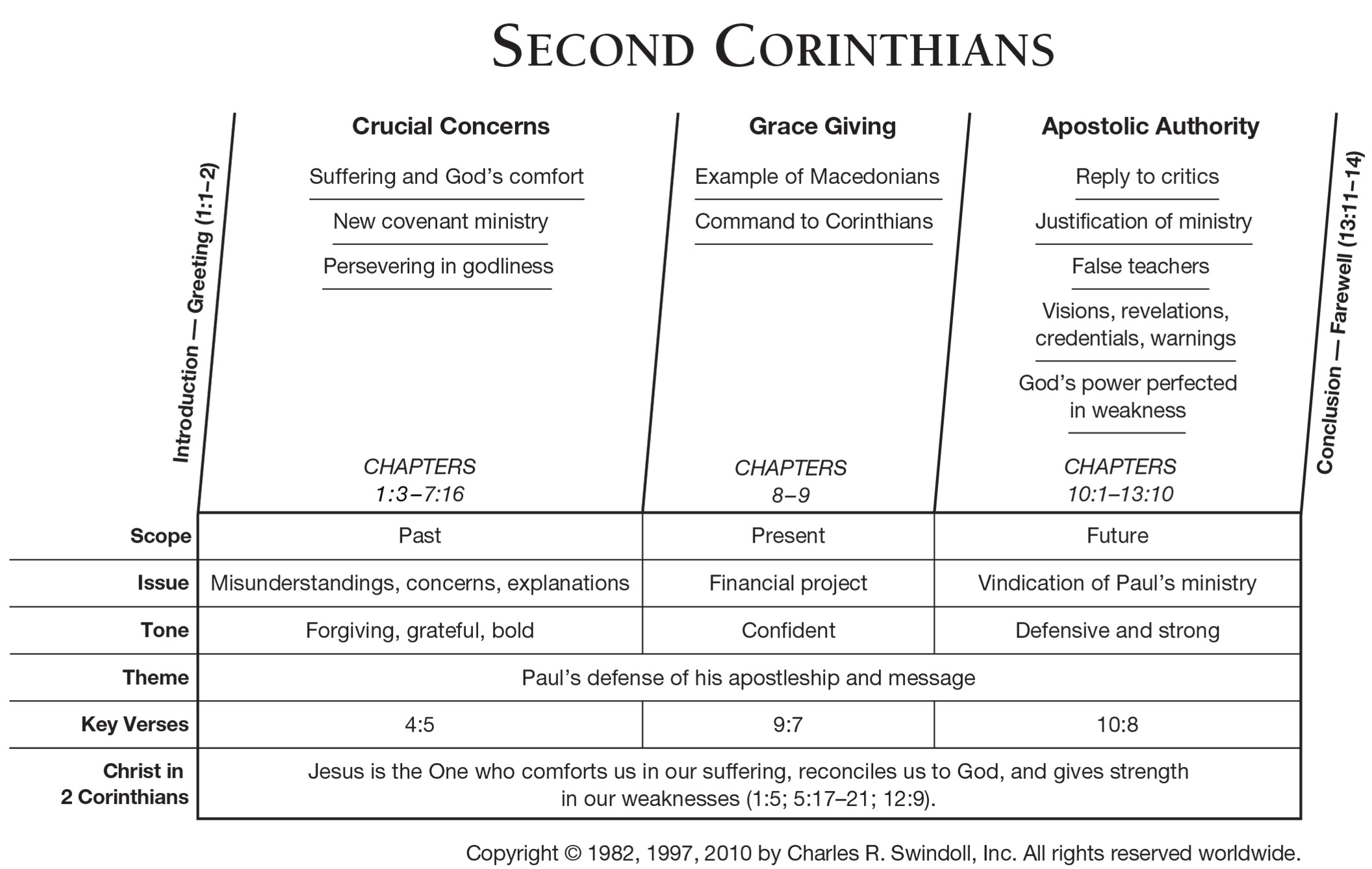
| Overview of Second Corinthians |
||
| 2Co 1:1-7:16 Character of Paul |
2Co 8:1-9:15 Collection for the Saints |
2Co 10:1-12:21 Credentials of Paul |
| Testimonial & Didactic | Practical | Apologetic |
| Past: Misunderstanding & Explanation |
Present: Practical Project |
Future: Anxieties |
| Apostle's Conciliation, Ministry & Exhortations | Apostle's Solicitation for Judean Saints | Apostle's Vindication of Himself |
| Forgiveness, Reconciliation Gratitude |
Confidence | Vindication |
|
Ephesus to Macedonia: |
Macedonia: Preparation for Visit to Corinth |
To Corinth: |
|
2Co 1:1-7:16 |
2Co 8:1-9:15 |
2Co 10:1-12:21 |
|
2Corinthians written ~ 56-57AD - see Chronological Table of Paul's Life and Ministry |
||
|
Adapted & modified from Jensen's Survey of the New Testament (Highly Recommended Resource) & Wilkinson's Talk Thru the Bible |
||
INTRODUCTIONS TO SECOND CORINTHIANS:
- IRVING JENSEN - Introduction and study tips - excellent preliminary resource - scroll to page 1877 (Notes on both 1-2 Cor begin on p 1829)
- JOHN MACARTHUR 2 Corinthians Introduction - same as in the Study Bible
- JAMES VAN DINE 2 Corinthians - Author, Purpose, Outline, Argument
- CHARLES SWINDOLL - 2 Corinthians Overview
- MARK SEIFRID - The Message of Second Corinthians: 2 Corinthians as the Legitimation of the Apostle
- J VERNON MCGEE - 2 Corinthians Introduction
- DAN WALLACE - 2 Corinthians: Introduction, Argument, and Outline
- DAVID MALICK - An Introduction To Second Corinthians
2 Corinthians 10:3 For though we walk in the flesh, we do not war according to the flesh, (NASB: Lockman)
Greek: en sarki gar peripatountes (PAPMPN) ou kata sarka strateuometha (1PPMI)
Amplified: For though we walk (live) in the flesh, we are not carrying on our warfare according to the flesh and using mere human weapons. (Amplified Bible - Lockman)
Barclay: It is true that we live in a human body, but for all that we do not carry on our campaign with human motives and resources (Westminster Press)
Berkley: For while we spend our life in a body of flesh, we do not war with carnal weapons.
ESV: For though we walk in the flesh, we are not waging war according to the flesh. (ESV)
ICB: We do live in the world. But we do not fight in the same way that the world fights. (ICB: Nelson)
KJV: For though we walk in the flesh, we do not war after the flesh:
Moffatt: I do live in the flesh, but I do not make war as the flesh does;
Montgomery: Though I do walk on the low level of the flesh, I do not make war as the flesh does;
NET: For though we live as human beings, we do not wage war according to human standards; (NET Bible)
NIV: For though we live in the world, we do not wage war as the world does. (NIV - IBS)
NJB: For although we are human, it is not by human methods that we do battle. (NJB)
NLT: We are human, but we don't wage war with human plans and methods. (NLT - Tyndale House)
NRSV: Indeed, we live as human beings, but we do not wage war according to human standards;
Phillips: The truth is that, although of course we lead normal human lives, the battle we are fighting is on the spiritual level. (Phillips: Touchstone)
TLB: It is true that I am an ordinary, weak human being, but I don't use human plans and methods to win my battles.
Weymouth: For, though we are still living in the world, it is no worldly warfare that we are waging.
Wuest: For, though we are ordering our behavior in the sphere, of human experience, not in accordance with mere human considerations are we waging warfare, (Eerdmans Publishing - used by permission)
Young's Literal: for walking in the flesh, not according to the flesh do we war,
FOR THOUGH WE WALK IN THE FLESH: en sarki gar peripatountes (PAPMPN):
- 2Cor 4:7, 16, 5:1; Gal 2:20; 1Pe 4:1,2)
- 2 Corinthians 10 Commentary - Verse by Verse comments on the entire chapter
- 2 Corinthians 10 Resources - Multiple Sermons and Commentaries
WALKING AND
WARRING
In this section Paul uses several terms drawn from the realm of military and warfare. Remember Paul was familiar with the Roman soldiers (eg, Acts 22:24, 25, 26, 23:10, 24:23, 27:1, 28:16) and thus Paul knew the Roman army well and knew how to accurately use a military metaphor. We do well as to believers to remember that just as accurate knowledge is crucial to survival in real warfare, a similar mindset is just as important in the unseen warfare of the spiritual realm, where lives (souls) hang in the balance not just for time (this mortal life) but for eternity ("immortality" in heaven or hell)!
In 2Corinthians 10 Paul changes the subject rather abruptly and begins to write some of the strongest language found in either of his letters to the Corinthians (See Rob Morgan's message which describes this context in more detail - 2Corinthians 10:5 Every Thought Captive). And although there are sharp words in this section, we note that they are addressed, not at the church as a whole but against a special group of false teachers. And thus this section is vitally important to the modern church, for we too have many false teachers. Some of these false teachers are very overt in the error they propound and thus are easy to recognize but others are not. We do well to remember that every congregation has at least a few members who have been (or are being) influenced by false teaching and false teachers. But whether they are overt or subtle, each of these false teachers have in common the fact that our Adversary the devil is using them as his nefarious tool in an attempt to derail that local body of believers and steal their joy and the freedom available in Christ. These evil masqueraders seek to undermine the power of the gospel with their unsound doctrines of demons. It is these (and similar anti-God) thoughts that Paul says believers are to wage war against.
In this section Paul gives some practical instruction on how believers can win the spiritual battle in our thought life. Don't think that you cannot win these battles because you can if you use God's provision of divinely powerful weapons.
2Corinthians 10:3,4,5 is in the context (see importance of context in accurate interpretation) of Paul's defense of his ministry against the enemies of the gospel. In regard to application this passage teaches a powerful principle that is relevant to every believer's spiritual life (especially if it is to be a "victorious" life in Christ), for all believers are actively engaged in a spiritual war whether they know it or not. The important point that Paul is teaching in this section is that one can control the thoughts that come into our mind. We do not have to be helpless victims of thoughts, words, speculations, fiery missiles, human reasoning, vain imaginings, etc that assault our mind. What Paul teaches is the Biblical way of dealing with these thoughts, be they fiery missiles of accusation or temptation or whatever their genesis (pathogenesis).
Ryrie has this note on the context of chapters 10-13 - In spite of Paul’s general satisfaction with the Corinthian church, there were still some there who challenged his apostolic authority and followed certain leaders whom Paul calls “false apostles” (1Co 11:13). These leaders were apparently Jewish Christians (1Co 11:22) who claimed higher authority than Paul’s (1Co 10:7) and who lorded over the church.
In these passages we learn that...
(1) The battle is spiritual, not physical
(2) The battlefield is our mind and our thought life.
(3) The battle ultimately is over truth, the truth of God versus "truth" as man interprets and propounds it.
Commenting on the for at the beginning of this passage, Charles Hodge writes that it indicates that "This verse is linked either with the middle clause of the previous verse (“I am determined to be bold toward the opponents of the truth, for though I live in the world, I do not wage war as the world does”), or, as is often the case in Paul’s letters, the for refers to a thought that is omitted: “Some think that I live as the world does—that is not true—for though I live in the world, I do not wage war as the world does.” The latter seems the more natural and forcible. Paul did indeed live in the world; he was a man, and a mere man, not only having a body, but being subject to all the infirmities of human nature. But he did not wage war as the world does. What was human and worldly neither determined his conduct, nor was the ground of his confidence. (2 Corinthians 10 Commentary)
We walk in the flesh - Walk refers to how one orders his or her steps, and is a metaphor for how we live or conduct our life. Flesh in this context refers to physical flesh ("flesh and blood"), but even in this same sentence, the meaning of the second use of flesh shifts to that of the evil nature that indwells all men, that ungodly nature J I Packer picturesquely refers to as "anti-God energy". In believers, like all mankind, are flesh and blood, but unlike all the rest of mankind, are not to engage in spiritual war in a natural but in a supernatural way!
Ray Stedman wisely reminds us that...
God has issued to each of us a bugle call to intelligent combat (cp our transfer from the power of Satan to God - Col 1:12, 13-note, Col 1:14-note, Acts 26:18, 2Ti 2:3,4-note, cp Heb 2:14,15-note). It is a call to us to be men and women of God, to fight the good fight (1Ti 1:18, 6:12, 1Ti 4:7-note), to stand fast in the faith, to be strong in the Lord in the midst of the battle, in the midst of this dark and evil world (cp Ro 13:11-note, Ro 13:12-note, Ro 13, 14-note, 1Jn 5:19 [cp Lk 4:5, 6, 7], Ep 2:2-note, Ep 2:3-note).
Those who ignore this call and the battle that rages around them (and "in" them 1Pe 2:11-note, James 1:13,14,15-note, Gal 5:17-note) are doomed to be casualties. We cannot remain neutral. We must choose sides. We must align ourselves with the forces of God, the forces of good. We must answer the bugle call, we must put on our armor and stand our ground or the battle will roll over us and in our defenseless, bewildered state, the forces of evil will trample us into the dust of the battlefield.
So we must learn to recognize how the dark systems of the devil work. But more than that, we must learn the processes of overcoming the systems of the devil not by flesh and blood, not by joining committees, not by political action, not by taking up clubs or assault weapons and attacking a human enemy. No, Paul says the weapons of our warfare are not flesh and blood weapons, not physical weapons, not political weapons. Rather, our weapons are mighty, through God, unto the pulling down of strongholds and bringing into captivity every thought to the obedience of Christ (2Co 10:3, 4, 5). That is the path to victory! (See 2Cor 10:3-5 Exposition)
Joseph Parker (in his sermon on 2 Corinthians 10:4 Weapons of Warfare)...The last idea that occurs to some professing Christians is that Christianity or that Christian life is a warfare. It has been noticed by observing and discerning persons that almost as soon as a man joins the Church he settles down into indifference or personal and selfish enjoyment,—as if a man should enlist into the army, and then go home and sit down all the rest of his days on the sunny side of his house and in the favourite spot in his garden. What kind of enlistment is that? Do you call that a soldierly spirit and a soldierly service? Whenever the idea of soldierliness took hold of Paul's imagination he elaborated the figure with marvellous energy....In addition to this the next mistake that is made is that persons who enter the Christian service imagine that all the fighting is to be done outside. You cannot fight outside until you have fought inside. The first man you have to kill is yourself....Are we at war? If the Church is not at war, it is unfaithful to Christ...
Related Resources:
VERSE BY VERSE EXPOSITION ON EPHESIANS 6:10-18...
- Ephesians 6:10
- Ephesians 6:11
- Ephesians 6:12
- Ephesians 6:13
- Ephesians 6:14
- Ephesians 6:15
- Ephesians 6:16
- Ephesians 6:17
- Ephesians 6:18
EPHESIANS 6:10-18 BY WAYNE BARBER
- Ephesians 6:10: Spiritual Warfare, Pt 1
- Ephesians 6:11: Spiritual Warfare, Pt 2
- Ephesians 6:14: Spiritual Warfare, Pt 3
- Ephesians 6:15,16 Spiritual Warfare, Pt 4
- Ephesians 6:17: Spiritual Warfare, Pt 5
- Ephesians 6:12,13 Spiritual Warfare, Pt 6
- Ephesians 6:18: Spiritual Warfare, Pt 7
VERSE BY VERSE EXPOSITION ON THE FALLEN FLESH
VERSE BY VERSE EXPOSITION ON RESISTING THE ROARING LION
VERSE BY VERSE EXPOSITION ON THE BATTLE IN OUR MIND
MISCELLANEOUS
- Cyberhymnal Hymns on Topic of Spiritual Warfare (scroll down)
- 2 Chronicles 20:1-25 Ambushing Satan with Song - John Piper
THE METAPHOR OF THE CHRISTIAN SOLDIER
- Soldier Illustrations
- Exposition of 2 Timothy 2:3-4
- Three Kinds of Soldiers - Ten Principles of Warfare
- Roman Soldier by Edward Gibbon (Decline & Fall of Roman Empire)
- The Roman Soldier - Description from Jewish Historian Josephus
- A Few Soldier Stories and Sermons
THE AMALEKITES: A PICTURE OF PERSISTENT SPIRITUAL WARFARE
WE DO NOT WAR ACCORDING TO THE FLESH: ou kata sarka strateuometha (1PPMI):
- 2 Cor 10:4; Ro 8:13; 1Ti 1:18; 2 Ti 2:3,4; 4:7; Heb 12:1
- 1 Co 1:17, 18, 19, 20, 21, 22, 23, 24, 25; 2:1, 2, 3, 4
- 2 Corinthians 10 Commentary - Verse by Verse comments on the entire chapter
- 2 Corinthians 10 Resources - Multiple Sermons and Commentaries
We do not war - Notice the word "not" (ou) which in Greek is the strongest way one can negate what follows in the sentence. In this case Paul is saying we absolutely do not wage war according to the flesh. In context Paul is speaking of waging war against lies, half truths and overt error and against all that is opposed to the Gospel.
According to the flesh - As noted above, here the context dictates that flesh refers to the evil disposition is intended (see note). In other words, believers are not to fight this spiritual struggle in dependence upon "anti-God energy". They are not to fight in the spiritual realm with fleshly weapons, guided by the commonly accepted principles of unregenerate men, who act solely under the influence of their old nature (See Sin as the unbeliever's "Master"). This is absolutely not the way to wage spiritual war. Instead believers are to be filled, controlled, guided and governed by the Spirit (Ep 5:18-note), in continual reliance upon His enablement (Ga 5:16-note, Ga 5:17-note).
Calvin speaking of the servants of Christ rightly reminds us that...
They bear about an incomparable treasure in clay jars (cp 2Cor 4:7). Therefore, although they are compassed with infirmities, nevertheless the spiritual power of God is resplendent in them.
Spurgeon comments on the weapons as not fleshly but mighty in God...
"The weapons of our warfare are not carnal"; yet the spiritual weapons which can be wielded by the Christian minister, and indeed by every Christian man, are not to be despised, for while not fleshly, they are mighty through God. God is in them; God is with those who use them. The sword of the Spirit, which is the word of God, the arrows of truth which pierce the consciences of men, the weapon of all prayer, the influence of the Holy Ghost-that divine power-such weapons as these are by God's power made mighty to the overthrow of spiritual principalities and powers. Truth and holiness are the appointed engines for the pulling down of the castles of evil. Blessed is he who in every conflict for God takes heed to use none other weapons than those which the Lord hath hung up in the tower of David, builded for an armoury, wherein do hang a thousand bucklers, all shields of mighty men (mentioned in his sermon on Mt 10:16). Those only can fight the Lord's battles successfully who come to him to be armed for the fight, and reject all fleshly force. The spiritual shall be victorious, but others must fail. (From 2Corinthians 10:5 Forts Demolished and Prisoners Taken) (See related resource - The Greatest Fight in the World)
David Guzik (ref) has some excellent comments on this section writing that...
The carnal (Ed: Pertaining to flesh; fleshly; sensual; opposed to spiritual; describes that which is like the natural, unregenerate state) weapons Paul refuses were not material weapons like swords and spears. The carnal weapons he renounced were the manipulative and deceitful ways his opponents used. Paul would not defend his apostolic credentials with the carnal weapons others might use.
In Ephesians 6 (see notes Eph 6:10ff), Paul lists the kind of spiritual weapons he did use: the belt of truth (Ep 6:14), the breastplate of righteousness (Ep 6:14), the shoes of the gospel (Ep 6:15), the shield of faith (Ep 6:16), the helmet of salvation (Ep 6:17), and the sword of the Spirit (Ep 6:17). To rely on these weapons took faith in God instead of carnal methods. But truly, these weapons are mighty in God for pulling down strongholds!
The Corinthian Christians tended to rely on and admire carnal weapons for the Christian battle.
- Instead of the belt of truth, they fought with manipulation.
- Instead of the breastplate of righteousness, they fought with the image of success.
- Instead of the shoes of the gospel, they fought with smooth words.
- Instead of the shield of faith, they fought with the perception of power.
- Instead of the helmet of salvation, they fought with lording over authority.
- Instead of the sword of the Spirit, they fought with human schemes and programs.
Jesus relied on spiritual weapons when He fought for our salvation. Philippians 2:6,7-note, Php 2:8-note describes this:
who, being in the form of God, did not consider it robbery to be equal with God, but made Himself of no reputation, taking the form of a bondservant, and coming in the likeness of men. And being found in appearance as a man, He humbled Himself and became obedient to the point of death, even the death of the cross.
This kind of victory through humble obedience (cp 1Sa 15:22, 23, Lk 1:52, 18:14, 14:11, James 4:6-note, 1Pe 5:5-note, 2Co 12:9-note,2Co 12:10-note) offended the Corinthian Christians because it seemed so "weak."
The carnal, human way is to overpower and dominate and manipulate and out-maneuver.
The spiritual, Jesus-way is to humble yourself, die to yourself (Mark 8:34, "daily" Lk 9:23), and let God show His resurrection power (Php 3:10-note) through you.
Our spiritual weapons are scorned by the world, but feared by demonic powers. When we fight with truth, righteousness, evangelism, faith, salvation, the Word of God, and prayer, no principality or power can stand against us.
"As the spittle that comes out of a man's mouth slayeth serpents, so doth that which proceedeth out of the mouths of God's faithful ministers quell and kill evil imaginations, carnal reasonings, which are the legion of domestic devils, that hold near intelligence with the old serpent." (Guzik comments -- "A wonderful observation by John Trapp; if I only knew what he meant!"). (Reference)
Ed comment: In an attempt to explain Trapp's remark I search the web and here is a related entry - "I certify that I have many times killed serpents by moistening in a slight degree, with my spittle, a stick or a stone, and giving them a slight blow on the middle of the body, scarcely sufficient to produce a small contusion. January 19, 1757. Figuier, Surgeon.” The above surgeon having given me this certificate, two witnesses, who had seen him kill serpents in this manner, attested what they had beheld. Notwithstanding, I wished to behold the thing myself; for I confess that, in various parts of these queries, I have taken St. Thomas of Didymus for my patron saint, who always insisted on an examination with his own hands. For eighteen hundred years this opinion has been perpetuated among the people, and it might possibly be even eighteen thousand years old, if Genesis had not supplied us with the precise date of our enmity to this reptile. It may be asserted that if Eve had spit on the serpent when he took his place at her ear, a world of evil would have been spared human nature.
Lucretius, in his fourth book, alludes to this manner of killing serpents as very well known: Spit on a serpent, and his vigor flies, He straight devours himself, and quickly dies. (Further comment: I would not recommend this method if confronted by a venomous reptile, spiritually speaking or real. In the former I would suggest James 4:7-note, 1Pe 5:9-note. In the latter I would suggest your legs and feet be quickly mobilized) (Reference)
James Parker III notes that...
One of the first battles of the Civil War happened near Washington, D. C., on a Sunday afternoon. The two armies lined up for battle, and people came out from downtown Washington, D. C., and set up picnic baskets. It was like a Sunday afternoon soccer match, like a baseball game. They came with their picnic baskets to watch this little battle. And very quickly they realized that it wasn’t just a little Sunday afternoon scrimmage, a little skirmish; it was a major war, a battle to the death where thousands, and scores and scores of thousands of people would give their lives.
Now we have to understand that’s the nature of the battle we’re involved in; we often think that we’re involved in a little Sunday afternoon scrimmage. We live our lives and act our lives and carry on our lives; we prepare our lives as if that’s what we’re facing. But what we have to realize is, this is a battle to the death, and it’s either us or them in this spiritual warfare. But we don’t carry it on the way the world does...
And so we are indeed arrayed against fortresses, Paul is saying. Prov. 21:22 says, “A wise man scales the strong dries and brings down the stronghold in which the ungodly trust.” The ungodly trust in these strongholds, and the godly man, the wise man, scales those cities and brings down those strongholds that the ungodly are trusting in. So we have divine power to demolish strongholds. (Faith and Mission 14:2 Spring 1997)
Alan Redpath former pastor at Moody Bible Church, Chicago, writes (ref) that...
Paul's concern for the church at Corinth (as it would indeed be for us) is simply that the imagination of the mind, the process of thinking, the way of reasoning, the method of logic, the understanding of things which a man adopted in his unconverted days, become projected into the fellowship of the church, and the church begins to fail in its spiritual battle because it adopts carnal procedures.
The process of victory which our Lord taught His disciples was this: that if you cease to resist in the realm of carnality, then you are resisting automatically in the realm that is spiritual, and in this way you overcome the enemy. Resist, counterattack, deal with the situation upon the same level that the world deals with it, and you are defeated. But refuse to follow that principle of life; take up rather the principle of the cross (1Co 1:18) and by non-combat in carnal levels you are combating the enemy in spiritual levels and therefore you will overcome (Jn 16:33, 1Jn 5:4, 5).
To illustrate this, turn to Simon Peter and the incident in which the Lord Jesus began to show to him is principle of the Cross (Mt 16:21, 22, 23). Christ spoke to him about the cross, about the blood, about the way of sacrifice and death. He had spoken earlier about the corn of wheat falling into the ground and dying and if it die, it brings forth much fruit, but if it did not die it would abide alone (Jn 12:24); and Peter's answer was, "Not so, Lord, not that way, not the way of the cross and death!" (cp Mt 16:22)
Christ's reply was shattering: " Get thee behind me, Satan: thou art an offence unto me: for thou savourest not the things that be of God, but those that be of men." (Mt 16:23, cp Mt 16:24)
But Peter did not learn his lesson. In the Garden of Gethsemane up goes his sword, out goes his arm, and off goes the man's ear (Jn 18:10, Mt 26:51, 52, 53, 54, Mark 14:47 cp Lk 22:33, 49, 50, 51!). He is still resisting the principle of the cross, still following the procedure of carnality, and taking the line of resistance instead of the line of meekness and submission (Php 2:3, 4, 5, 6, 7, 8, 9). He did not learn his lesson until after Pentecost (and it took him some time then, cp Acts 2:15, 36, 37, 38, 39, 40, 41), but this is the lesson which the Lord Jesus sought to teach him, and the very lesson which Paul is bringing to bear upon the church at Corinth.
You find this principle today in the church in terms of the theological outlook upon the Bible, though I have no wish to get involved in a controversial issue. The difference between what we call today the fundamentalist or the conservative evangelical and all others in their approach to the Book is that we as conservative evangelicals submit ourselves to the criticism of the Word of God, whereas all others submit to their own criticism. This is the basic difference of approach to the whole subject of theology, so much so that, in some circles it is said that if you are orthodox you are out-of-date; you are an obscurantist, and it is an impossible position to hold in the light of modern theology and modern science.
These are some of the high things that Paul said exalt themselves against the knowledge of God, and because the evangelical conservative holds to a position in which he submits all his criticisms and life to the authority of Scripture, and refuses to move from that position, while he is only too glad to discuss and consider all enlightenment upon the Book, he is therefore called out-of-date.
Now this I believe is the form of carnality in the church which stems from corruption of the mind not necessarily moral corruption, but the mind which insists in submitting the Word of God to its own criticism and only accepting that which the human intellect can understand and believe. This corruption of mind leads to carnality in the church and to captivity of spirit, for by that means there is that which exalts itself against the knowledge of God. That, in the theological area, is exactly the modern counterpart of our verse.
I wish to come much closer home than that, as I bring this right down to where we live.
The Principle of Carnality
versus
The Principle of SpiritualityWhat is the nature of this conflict? It is the battle which goes on in the personal life of every one of us in ordinary, everyday, down-to-earth, practical living—the battle to forsake the principle of carnality and to accept the principle of spirituality. It is the battle to take the line of refusing to resist along the human level, and by so doing, resisting in terms of spiritual warfare, and therefore overcoming. This is something which works itself out in terms of our relationships with one another, as well as in terms of our relationship with God.
If, therefore, it is true that the weapons of our warfare are not carnal, if God in calling us to be His followers and to live the Christian life here and now on exactly the same principle as that which was followed by His disciples—in other words, the line of non-resistance, of meekness and crucifixion and death, the line of submission one to another in the fear of God—what then are the weapons a Christian must use, and how does he use them?
I remind you of words which Paul wrote in his letter to the church at Ephesus. We must arm ourselves, because in paraphrase he says,
the weapons of our warfare, though they are not carnal, are mighty through God to the pulling down of strongholds.
In other words, there is a way of life, there is an armor, there are weapons which the Christian church (and by that I mean any group of Christians) can use today in ordinary everyday life which will be so invincible that, to quote the words of our Lord Jesus, " . . . the gates of hell shall not prevail against them." (Mt 16:18)
If this is true, then it behooves us surely to give very prayerful attention to this fact, because the fact of the matter is that apart from a mighty awakening and revival in the church, we are fighting a losing battle because we are resisting on carnal levels. This is not something you settle at denominational headquarters or in the high courts of the ecclesiastical world. It is something you begin to settle here and now that causes the tide of Holy Spirit power and life to flow once again through the church, which has been blocked because we as individual believers have rejected God's principles.
What then are the weapons which are mighty through God?
take unto you the whole armour of God, that ye may be able to withstand in the evil day, and having done all, to stand...your loins girt about with truth, and having on the breastplate of righteousness;...your feet shod with the preparation of the gospel of peace;...taking the shield of faith,...And take the helmet of salvation, and the sword of the Spirit, which is the word of God: Praying always with all prayer and supplication in the Spirit, ...for all saints" (Ephesians 6:13, 14, 15,16,17, 18-note)
Here is the Christian armor. Now will you please notice this : it is not armor to protect the body, for it is not designed to keep the Christian from physical harm, but it is armor designed to protect him against all spiritual attack. It is not something with which he clothes his body, but something with which he clothes his soul. It is hidden from the outward scrutiny of others, but its existence in the realm of a man's soul will be revealed in his daily life. That is why Paul says "though we walk in the flesh, we do not war after the flesh . . ." (2Cor 10:3). Yet our whole activity and our actions in the flesh, in the body, in daily conduct, are governed by this inward clothing, the armor of the spirit.
Let a man neglect putting on this armor and he will soon reveal carnality to everybody else in his conduct and behavior. But let him go into the robing room each day with God in the name of the Lord Jesus, and let him there in prayer put on the whole armor of God —truth, righteousness, faith, peace, the helmet of salvation, the Word of God as the sword of the Spirit, and the armor of all-prayer, clothing that the world cannot see—and it will soon be evident to all by his daily conduct in his daily life that he has clothed himself with the whole armor of God (cp Ro 13:11, 12, 13, 14-notes). The absence of a time he takes to clothe himself with the armor of God is revealed in his approach to the Bible, in his criticism of everything, in his refusal of every authority, in his hesitancy to accept the Word of truth, and in his carnality of daily behavior. Here, then, is the answer to the area within the church where the greatest battles are to be fought, in the weapons of our warfare that are not carnal, but mighty through God to the pulling down of strongholds.
The Mind...
The Thought LifeYou may ask, how do they work? They work in the realm of the mind. How is the victory won? It is won in the realm of the thought-life. Does this mean merely asking God to do something while we do nothing at all ourselves? No, indeed. What then is the secret of it? Jesus said, "As a man thinketh in his heart, so is he," and it is our leisure thoughts, our meditative life, that decides our conduct.
Alas, how much time we give to the life as it appears before men, and how little do we give to the life that appears before God! Yet it is that life that shines through everything, it is that life which is lived with the Lord Himself and which is clothed with heavenly armor that reveals itself in spirituality. It is that life, when it is lacking, that displays itself in carnality (cp John 6:63). The world, you see, sees the expression on a man's face, hears the tone of his voice, studies his actions whether they are selfish or unselfish, and by these he is judged inevitably and rightly. In spite of all his efforts to hold it all in check, he is conveying transparently to other people that his Christianity is all in the shop-window, and he is painfully lacking in being clothed with the armor of God in the soul.
To be specific, it works something like this. Somebody says an unkind word about you, or you are accused falsely of something you have not done, or somebody is spiteful in his comments and critical in his attitude. You begin to think about it, you repeat it to yourself over and over again with increased indignation, and because it begins to fill your mind, you tell your friends (with additions of course) until at last, by frequent repetition, you have been insulted twenty times instead of one. You have determined to counterattack, to retaliate, to answer back, to vindicate yourself, and to prove that they are wrong and you are right. This is the carnality in the life which has happened because of corruption in the mind, because in the thought-life you have been defeated before you have to counterattack.
The Law of Exclusion
What then is the answer? As a Christian engaged in this conflict, knowing that the weapons of our warfare are not carnal but mighty through God to the pulling down of strongholds, there is the law of exclusion. How does it operate? When the thought comes and the person is reported to have said what he has said, and the unkindness has been passed over to us, and the criticism has been made, whereas carnality would say, "Counterattack!" spirituality has the mind which was in Christ Jesus (1Cor 2:16) and humbles itself and recognizes that nothing that any person could ever say about any of us is really one hundredth part as bad as the truth if he only knew it. Therefore, we have no reason to counterattack, but one good reason to submit and to forget. That is the law of exclusion.
The Law of Attention
But there is the law of attention
"whatsoever things," says Paul, writing to the church at Philippi, "are true, whatsoever things are honest, whatsoever things are just, whatsoever things are pure, whatsoever things are lovely, whatsoever things are of good report; if there be any virtue, and if there be any praise, think on these things." (Php 4:8-note)
When carnality arises in our hearts, causing us to answer back, to retaliate, and to fail to follow the principle of discipleship laid down by the Master, then at that moment we must think on these things, and answer the enemy by saying, "I'm sorry, my house is full, I have no room for you and I have no time to listen to you." That is the law of attention.
I quote some lovely words from that wonderful book, The Imitation of Christ by Thomas a Kempis:
Many thoughts have risen up against me, and great terrors which afflict my soul. How shall I pass through them without hurt? How shall I break them in pieces before me? I will go before Thee, 0 Lord, and I will bring low the proud boasters of the earth and I will open the gates of the prison and reveal to Thee the hidden secret. Do, Lord, as thou saidst and let all wicked thoughts flee from before Thy face. This is my hope and only consolation—to put my trust in Thee, to call on Thee from my inmost heart, and to wait patiently for Thy help and for thy strength."
Yes, truly, the weapons of our warfare are not carnal, but they are mighty through God to the pulling down of strongholds; and they cast down imaginations and every high thing that exalts itself against the knowledge of God and bring into captivity every thought into the obedience of Christ. That is the principle upon which the church was founded; that is the principle that was followed by the Master when He stepped from the throne to the manger and from the manger to the cross. That is the obedience He expects from each of His followers. But let us confess with shame, today in the realm of the intellect, the mind, the thought-life, the church—that is, you and I as believers in Christ—has followed the carnal method, and therefore she has divested herself of spiritual power.
God grant that you and I everyday may go into our personal robing room alone with Him, and put on all the armor of God which is mighty to the pulling down of strongholds of the enemy.
Apart from a mighty awakening and revival in the church, we are fighting a losing battle because we are resisting on carnal levels. This is not something you settle a denominational headquarters or in the high courts of the ecclesiastical world. It is something you begin to settle here and now that causes the tide of the Holy Spirit power and life to flow once again in the church, which has been blocked because we as individual believers have rejected God's principles. (Redpath, Alan: Blessings out of Buffetings. Studies in Second Corinthians. 1984. Revell).
- Is not after the flesh -2 Corinthians 10:3
- Is a good warfare -1 Timothy 1:18,19
- Called the good fight of faith -1 Timothy 6:12
IS AGAINST
- The devil -Ge 3:15; 2Co 2:11; Ep 6:12; James 4:7; 1Pe 5:8; Re 12:17
- The flesh -Ro 7:23; 1Co 9:25, 26, 27; 2Co 12:7; Ga 5:17; 1Pe 2:11
- Enemies -Ps 38:19; 56:2; 59:3
- The world -Jn 16:33; 1Jn 5:4,5
- Death -1Co 15:26; Heb 2:14,15
- Often arises from the opposition of friends or relatives -Mic 7:6; Mt 10:35,36
TO BE CARRIED ON
- Under Christ, as our captain -Hebrews 2:10
- Under the Lord’s banner -Psalms 60:4
- With faith -1 Timothy 1:18,19
- With a good conscience -1 Timothy 1:18,19
- With steadfastness in the faith -1Co 16:13; 1Pe 5:9; Heb10:23
- With earnestness -Jude 1:3
- With watchfulness -1 Cor 16:13; 1 Peter 5:8
- With sobriety -1 Thessalonians 5:6; 1 Peter 5:8
- With endurance or hardness -2 Timothy 2:3,10
- With self-denial -1 Corinthians 9:25, 26, 27
- With confidence in God -Psalms 27:1, 2, 3
- With prayer -Psalms 35:1-3; Ephesians 6:18
- Without earthly entanglements -2 Timothy 2:4
- Mere professors do not maintain -Jeremiah 9:3
SAINTS
- Are all engaged in -Philippians 1:30
- Must stand firm in -Ephesians 6:13,14
- Exhorted to diligence -1 Timothy 6:12; Jude 1:3
- Encouraged in -Isaiah 41:11,12; 51:12; Micah 7:8; 1 John 4:4
- Helped by God in -Psalms 118:13; Isaiah 41:13,14
- Protected by God in -Psalms 140:7
- Comforted by God in 2 Corinthians 7:5,6
- Strengthened by God in Psalms 20:2; 27:14; Isaiah 41:10
- Strengthened by Christ in -2 Corinthians 12:9; 2 Timothy 4:17
- Delivered by Christ in -2 Timothy 4:18
- Thank God for victory in Romans 7:25; 1 Corinthians 15:57
ARMOUR FOR
- Girdle of truth -Ephesians 6:14
- Breastplate of righteousness -Ephesians 6:14
- Preparation of the gospel -Ephesians 6:15
- Shield of faith -Ephesians 6:16
- Helmet of salvation -Ephesians 6:17; 1 Thessalonians 5:8
- Sword of the Spirit -Ephesians 6:17
- Called armour of God Ephesians 6:11
- Called armour of righteousness -2 Corinthians 6:7
- Called armour of light -Romans 13:12
- Not carnal -2 Corinthians 10:4
- Mighty through God -2 Corinthians 10:4,5
- The whole, is required -Ephesians 6:13
- Must be put on -Romans 13:12; Ephesians 6:11
- To be on right hand and left -2 Corinthians 6:7
VICTORY IN, IS
- From God -1 Corinthians 15:57; 2 Corinthians 2:14
- Through Christ -Ro 7:25; 1Co 15:27; 2Co 12:9; Re 12:11
- By faith -Hebrews 11:33-37; 1 John 5:4,5
- Over the devil -Romans 16:20; 1 John 2:14
- Over the flesh -Romans 7:24,25; Galatians 5:24
- Over the world -1 John 5:4,5
- Over all that exalts itself -2 Corinthians 10:5
- Over death and the grave -Is 25:8; 26:19; Ho 13:14; 1Co 15:54,55
- Triumphant -Romans 8:37; 2 Corinthians 10:5
THEY WHO OVERCOME IN, SHALL
- Eat of the hidden manna -Revelation 2:17
- Eat of the tree of life -Revelation 2:7
- Be clothed in white raiment -Revelation 3:5
- Be pillars in the temple of God Revelation 3:12
- Sit with Christ in his throne -Revelation 3:21
- Have a white stone, and, in it a new name written -Re 2:17
- Have power over the nations -Revelation 2:26
- Have the name of God written upon them by Christ -Re 3:12
- Have God as their God -Revelation 21:7
- Have the morning-star Revelation 2:28
- Inherit all things -Revelation 21:7
- Be confessed by Christ before God the Father -Re 3:5
- Be sons of God -Revelation 21:7
- Not be hurt by the second death -Revelation 2:11
- Not have their names blotted out of the book of life -Re 3:5
- Illustrated -Isaiah 9:5; Zechariah 10:5
2 Corinthians 10:4 for the weapons of our warfare are not of the flesh, but divinely powerful for the destruction of fortresses. (NASB: Lockman)
Greek: ta gar hopla tes strateias hemon ou sarkika alla dunata to theo pros kathairesin ochuromaton (Note: some translation place the following phrase in verse 4 - kathairountes (PAPMPN) logismous)
Amplified: For the weapons of our warfare are not physical [weapons of flesh and blood], but they are mighty before God for the overthrow and destruction of strongholds, (Amplified Bible - Lockman)
Barclay: (for the weapons of our campaign are not merely human weapons, but God has made them powerful to destroy fortresses). (Westminster Press)
Berkley: for the weapons of our warfare are not physical, but they are powerful with God’s help for the tearing down of fortresses,
ESV: For the weapons of our warfare are not of the flesh but have divine power to destroy strongholds. (ESV)
ICB: We fight with weapons that are different from those the world uses. Our weapons have power from God. These weapons can destroy the enemy's strong places. We destroy men's arguments. (ICB: Nelson) {Note: Places kathairountes logismous in v4 rather than v5}
KJV: (For the weapons of our warfare are not carnal, but mighty through God to the pulling down of strong holds;)
Moffatt: the weapons of my warfare are not weapons of the flesh, but divinely strong to demolish fortresses—
Montgomery: for the weapons of my warfare are not weapons of the flesh, but mighty for God, in pulling down all fortresses.
NET: for the weapons of our warfare are not human weapons, but are made powerful by God for tearing down strongholds. We tear down arguments (NET Bible) {Note: Places kathairountes logismous in v4 rather than v5}
NIV: The weapons we fight with are not the weapons of the world. On the contrary, they have divine power to demolish strongholds. (NIV - IBS)
NJB: The weapons with which we do battle are not those of human nature, but they have the power, in God's cause, to demolish fortresses. It is ideas that we demolish, (NJB) {Note: Places kathairountes logismous in v4 rather than v5}
NLT: We use God's mighty weapons, not mere worldly weapons, to knock down the Devil's strongholds. (NLT - Tyndale House)
NRSV: for the weapons of our warfare are not merely human, but they have divine power to destroy strongholds. We destroy arguments {Note: Places kathairountes logismous in v4 rather than v5}
Phillips: The very weapons we use are not those of human warfare but powerful in God's warfare for the destruction of the enemy's strongholds. (Phillips: Touchstone)
TLB: I use God's mighty weapons, not those made by men, to knock down the devil's strongholds.
Weymouth: The weapons with which we fight are not human weapons, but are mighty for God in overthrowing strong fortresses.
Wuest: for the weapons of our warfare are not human but mighty in God's sight, resulting in the demolition of fortresses, (Eerdmans Publishing - used by permission)
Young's Literal: for the weapons of our warfare are not fleshly, but powerful to God for bringing down of strongholds,
FOR THE WEAPONS OF OUR WARFARE ARE NOT OF THE FLESH: ta gar hopla tes strateias hemon ou sarkika:
- Weapons - 2Cor 6:7; Romans 6:13; Romans 13:12; Ephesians 6:13, 14, 15, 16, 17, 18; 1Thes 5:8) (1Ti 1:18; 2Ti 2:3, 4, 4:7
- 2 Corinthians 10 Commentary - Verse by Verse comments on the entire chapter
- 2 Corinthians 10 Resources - Multiple Sermons and Commentaries
For (gar) introduces Paul's explanation of why we are not to fight spiritual battles with "fleshly" weapons. In short, he says believers need no longer resort to the their old ways (before we were believers the only set of "weapons" we "owned" were those "passed down" from Adam, weapons that were corrupted by the fallen, evil flesh nature that "infected" Adam when he sinned, Ro 5:12-note)
As an aside, remember that anytime you observe a sentence begin with "for", pause ("Selah"!) and ponder what it's there for -- many, if not most, times the writer is explaining something he has stated in the preceding context. Pausing and pondering forces you to "slow down" (it is best to not read the Bible in "speed reading" mode!) and allow the Spirit, Your personal Tutor, to illuminate the passage. What you are doing in essence is meditating (Related resources - Meditate; Primer on Biblical Meditation) -- see the advantages that accrue from meditating on Scripture - Josh 1:8- note, Ps 1:2,3-note) on the Scripture and as begin to practice this discipline (and it does take practice - after 18 years, I still have to tell myself to "slow down" and "enjoy the scenery" of God's Word).
Ray Stedman asks...
What can Christians use to counteract the cults around us? How do we respond when we see a loved one, or a whole community of believers, threatened by error, by a false idea which may take over a church, a community, or even a whole nation? Perhaps we are being faced with a powerful threat from the homosexual community to impose, by law, an unrighteous life style upon our young people in schools and in public institutions. Christians are rightly asking, "How can we oppose this? What weapons can we employ?"
In the broader context outside the church we are also harassed and bombarded daily. For example, sexual themes in the media imply that any form of sexuality is acceptable. We are constantly assaulted by crude and offensive slogans on bumpers, billboards and television commercials. Drug pushers do their best to hook our young people on narcotics. Pornographers push their wares at us at every newsstand. Teachers openly espouse Marxism and revolution in our classrooms. Inflation depletes the value of our dollar every day, while politicians continue mouthing empty words and doing nothing about it. Do you ever feel, as I do sometimes, a great sense of frustration, an increasing sense of desperation at being so helpless? I am sure you do. How do we stem this downward slide into national disaster? (Reference)
Not of the flesh - Again "not" is the absolute negation. Our new set of weapons with which we are to wage spiritual warfare is absolutely not those related to our fallen, evil nature (flesh). In his famous affirmation of the Christ life, Paul declared that "the life I now live in the (physical) flesh I live by faith in the Son of God" (Gal 2:20-notes), and it is only by surrendering (by faith = trusting, cp Col 2:6-note, 2Co 5:7) to Him that believers can lay hold of our "divinely powerful" weapons.
A famous cartoon character of yesteryear named Pogo aptly described the flesh this way..."We have met the enemy and he is us!"
Stedman defines flesh as "inherited selfishness, that self-centeredness of life which all of us have without exception, impelling us to pursue our own interests at the expense of everybody else's." (Reference).
Tasker writes that...Carnal weapons, that is fleshly weapons, walking according to the flesh, such as human cleverness or ingenuity, organizing ability, eloquent diatribe, powerful propaganda, or reliance on charm or forcefulness, a personality, are all in themselves quite unavailing in the ceaseless task of pulling down strongholds in which evil is entrenched.
Peter (1Pe 4:2 - note, cp 1Pe 4:1-note) speaks of believers living "the rest of the time in the flesh no longer for human passions but for the will of God", in this case His will being that we fight the good fight of faith with the weapons He provides in Christ and not with those we inherited by virtue of having been born in Adam (cp 1Co 15:22).
Earlier in this epistle to the Corinthians Paul described the physical flesh in metaphorical terms (metaphor) explaining that believers...
have this treasure (in context most likely a reference to the glorious gospel of Jesus Christ - cp 2Ti 1:14-note) in earthen vessels (NIV = "jars of clay" - a great picture of the frailty of our physical human bodies), that the surpassing greatness of the power may be of God and not from ourselves (2Cor 4:7+)
Hodge writes that...In the war in which Paul was engaged (Ed: and which should be true of us), his confidence was not in himself, not in human reason, not in the power of argument or eloquence, not in the resources of cunning or manipulation, but simply and only in the supernatural power of God. “We do not wage war in the way the world does, for our weapons are not worldly.” That is, our weapons are not such as human nature provides and that therefore in their own nature are human. Weapons, of course, means all the means that the apostle used in the defense and propagation of the truth. (2 Corinthians 10 Commentary)
Mal Couch...Ellicott points out that the words in 2 Corinthians are of the struggle of a faithful soldier. “We are not carrying on our campaign in the physical. We are attacking the strong defenses of the powers of evil.” Until victory, we war with the Word of God as our weapon. We know the final outcome. And we wait for His shout from heaven! Until then we witness, exhort the believer, love the Lord, and teach His Word! (Conservative Theological Journal Volume 5:252)
BUT DIVINELY POWERFUL FOR THE DESTRUCTION OF FORTRESSES: alla dunata to theo pros kathairesin ochuromaton:
- Powerful - 2Co 3:5; 4:7; 13:3,4; Jdg 7:13, 14, 15, 16, 17, 18, 19, 20, 21, 22, 23; 15:14, 15, 16; 1Sa 17:45, 46, 47, 48, 49, 50; Ps 110:2; Is 41:14, 15, 16; Zech 4:6,7; Acts 7:22; 1Co 1:18, 19, 20, 21, 22, 23, 24; 2:5; 2Co 13:3; Heb 11:32,33
- Divinely - Josh 6:20; Is 30:25; Je 1:10; Heb 11:30)
- 2 Corinthians 10 Commentary - Verse by Verse comments on the entire chapter
- 2 Corinthians 10 Resources - Multiple Sermons and Commentaries
Joshua obeyed the Lord and instructed Israel to destroy Jericho's fortress God's way (cp divinely powerful weapons) and after seven marches around the city (can you just imagine the confused looks on those in the fortress!)...
So the people shouted, and priests blew the trumpets; and it came about, when the people heard the sound of the trumpet, that the people shouted with a great shout and the wall fell down flat, so that the people went up into the city, every man straight ahead, and they took the city. (Joshua 6:20, cp Joshua 6:1-8ff)
And recall Gideon (Judges 6-7) who was called (Jdg 6:6, 11-16ff-notes) to go against the marauding Midianites with "divinely powerful" weapons...
1 Then Jerubbaal (that is, Gideon) and all the people who were with him, rose early and camped beside the spring of Harod; and the camp of Midian was on the north side of them by the hill of Moreh in the valley. 2 And the LORD said to Gideon, "The people who are with you are too many for Me to give Midian into their hands, lest Israel become boastful, saying, 'My own power has delivered me.' 3 "Now therefore come, proclaim in the hearing of the people, saying, 'Whoever is afraid and trembling, let him return and depart from Mount Gilead.'" So 22,000 people returned, but 10,000 remained.
4 Then the LORD said to Gideon, "The people are still too many; bring them down to the water and I will test them for you there. Therefore it shall be that he of whom I say to you, 'This one shall go with you,' he shall go with you; but everyone of whom I say to you, 'This one shall not go with you,' he shall not go." 5 So he brought the people down to the water. And the LORD said to Gideon, "You shall separate everyone who laps the water with his tongue, as a dog laps, as well as everyone who kneels to drink." 6 Now the number of those who lapped, putting their hand to their mouth, was 300 men; but all the rest of the people kneeled to drink water.
7 And the LORD said to Gideon, "I will deliver you with the 300 men who lapped and will give the Midianites into your hands; so let all the other people go, each man to his home." 8 So the 300 men took the people's provisions and their trumpets into their hands. And Gideon sent all the other men of Israel, each to his tent, but retained the 300 men; and the camp of Midian was below him in the valley.
9 Now the same night it came about that the LORD said to him, "Arise, go down against the camp, for I have given it into your hands. (See notes Judges 7:1ff)
Human resources can never defeat our very real spiritual enemies (the world, the flesh, the devil). Only divinely powerful weapons can achieve victory in this war and thus it behooves believers to understand the resources we have in Christ (see in Christ and in Christ Jesus) that ensure spiritual victory. Remember that God has blessed us with all spiritual blessings in the heavenly places in Christ (Ep 1:3-note) and Christ's divine power has granted to us everything necessary for life and godliness through a true knowledge of Him (which is why it is so vital to meditate on the Truth about Jesus in the Word). (2Pe 1:3-note)
Divinely powerful - More literally the Greek (dunata to theo) reads "powerful to God" or "mighty of God". The literal rendering is difficult to understand and the Wuest amplification helps us understand Paul's intent describing these weapons as "mighty in God's sight".(Wuest Word Studies - Eerdman Publishing Company Volume 1, Volume 2, Volume 3 - used by permission)
Powerful (mighty, strong) (1415) (dunatos from dunamai = referring to power one has by virtue of inherent ability and resources; see study of dunamis) means powerful, able, strong.
Dunatos (an attribute of God Himself, Ro 9:22-note, even a name of God - Lk 1:49) describes the character of the weapons available to all believer's -- our weapons have sufficient and necessary power, means, skill, and resources to accomplish the objective of tearing down strongholds.
When believers are "weak" in their strength (in context don't rely on their fleshly methods), then they are dunatos or strong ("then I am strong" or dunatos - 2Co 12:10-note) in the Spirit of Christ and His sufficient grace.
Ray Stedman explains our divinely powerful weapons noting that there is nothing "more valuable than that we understand the Scriptures, refresh our minds with them all the time, for in this constant bombardment with illusion and error it is easy to drift back into thinking as the world around us thinks. Unless our minds are renewed by the Spirit (cp Ro 12:2-note, 2Co 4:16, Ep 4:23-note; Col 3:10-note), refreshed by the truth about life and what it is we really are up against, we will find ourselves acting just like everybody else. So the first and greatest weapon is "the truth as it is in Jesus." (Ep 4:21-note; cp Jn 1:17, 14:6, 2Co 1:20, 2Co 11:10) When we read the gospels (Ro 1:16, 17-note) we see that Jesus is a Man Who understands life. He does not act like anybody else because He really sees what is happening. He ignores much of the visible symptoms and strikes right at the heart of problems to the direct cause of events. If we are going to follow Him we will not adopt fleshly weapons and fall heir to fatal approaches to problems. We will begin to see things differently. (Reference)
Phil Newton calls our attention to...
What these weapons are not - The wrong weapons bring failure. When Hitler invaded Poland in 1938 with his Wehrmacht and their steel-armored tanks, they were met by the only existing horse cavalry in Europe. The Polish army stood bravely before the tanks but was no match for them. Germany soon conquered. They chose the wrong weapons for fighting their battle. Certainly, the weapons we utilize are not the same that the world uses against the gospel and God's people: "the lie in place of the truth, darkness instead of light, grief rather than joy, and death as a substitute for life" [Kistemaker, 335]. Few with any common sense, much less spiritual sense, would consider such substitutes for spiritual weapons. But the area that can trip us is using weapons that feel comfortable to the flesh, not because they are sinful of themselves, but because they are inappropriate for the spiritual battles that we face. Tasker identifies several of these inappropriate weapons: "human cleverness or ingenuity, organizing ability, eloquent diatribe, powerful propaganda, or reliance on charm or forcefulness of personality" [TNTC: 2 Corinthians, 134]....
When we are tempted by the world to adopt the world's methods and ways to conquer its strongholds, we must vigorously resist. "Not only do such weapons fail to make an impression on the strongholds of Satan," wrote Philip Hughes, "but a secularized Church is a Church which, having adopted the standards of the world, has ceased to fight and is herself overshadowed by the powers of darkness" [350]...
Let's face it: the Christian's weapons are thought powerless and silly by the world. What are they? Romans 13:12-note warns of the creeping nature of sin that darkens the life. "Therefore let us lay aside the deeds of darkness [through mortification; repentance] and put on the armor of light." Holy lives must characterize us to combat deeds of darkness. 2Cor 6:6, 7 amplifies this same truth, telling us that it is time to take up purity, knowledge, patience, kindness, genuine love, the word of truth, the power of God, "the weapons of righteousness for the right hand and the left," and all "in the Holy Spirit." Here the focus of the Christian's weaponry is upon godly attitude and behavior, gracious treatment of others, knowledge of God's truth, and the powerful weapon of Holy Spirit generated righteousness. These characteristics evident among many in Britain during the first Great Awakening, and not shrewd political maneuvering, brought down the evil British slave trade. Similarly, the same godly living during that era shut down much of the ungodliness in the American colonies. (Sermons from the Second Epistle to the Corinthians) (Bolding added)
Morris writes about divinely powerful weapons noting..."Paul enumerates them in Ephesians 6:13, 14, 15, 16, 17, 18, as “the whole armour of God,” namely truth, righteousness, peace, faith, salvation, the Word of God, and prayer. All too often, Christians and their churches try to do God’s work in ways that appeal to the flesh—great organizations, Christian entertainment, human wisdom and philosophy, beautiful facilities, glamorous advertising, and the like. These are “carnal” weapons, not the weapons provided by the Lord, and those who use them are in danger of eventual spiritual defeat, even if outward appearances seem impressive. (Morris, Henry: Defenders Study Bible. World Publishing)
Illustration of divinely powerful weapons - The story of Aleksandr Solzhenitsyn's conversion to Christ in a Siberian prison camp is a remarkable testimony to the truth of today's text. Solzhenitsyn was being examined one day by a fellow prisoner, a Jewish physician who had been won to Christ by the example of another prisoner. Noticing the misery in Solzhenitsyn's eyes, the doctor told him his story, including his faith in Christ. Solzhenitsyn came to faith through the doctor's testimony and survived to tell the world about the power of the spirit over human evil. What an incredible example of waging war by the weapons of the Holy Spirit! When His people call on Him, no prison or army can lock out the Word and the power of God....Paul is saying that although we live in human bodies, we don't wage war according to human standards. Our weapons are those of the Spirit, so they have His power behind them. These are the only weapons great enough to bring down ""strongholds." What is a stronghold? Moody Press author Jim Logan, in his book Reclaiming Surrendered Ground, explains that strongholds are the fortresses Satan builds in our lives when we give him a foothold, a piece of ground on which to build. How does Satan gain a foothold in our hearts and minds? We give him ground when we sin and refuse to forsake our sin or when we believe his lies. Satan is a master builder. He doesn't need much ground on which to erect his strongholds. And once they are in place, they give the enemy a ""headquarters"" from which to carry on his activities. (Moody Bible Institute's "Today in the Word")
Another Illustration of
Divinely Powerful Weapons
The famous story of David and Goliath in 1Samuel 17 (see 1Sa 17:23, 24, 25,26, 27, 28, 29, 30, 31, 32, 33, 34, 35, 36, 37, 38, 39, 40, 41, 42, 43, 44, 45, 46, 47, 48, 49, 50, 51, 52, 53) gives us a perfect illustration of fighting spiritual battles according to the flesh (see Saul's attempt to put his armor on David 1Sa 17:38, 39) rather in reliance on our divinely powerful weapons (see David's reliance on the Lord's enablement in 1Sa 17:37, 40, 45, 46, 47). When faced with insurmountable odds David chose to rely on the Lord declaring to Goliath...
You come to me with a sword, a spear, and a javelin, but I come to you in the name of the LORD of hosts, the God of the armies of Israel, whom you have taunted. This day the LORD will deliver you up into my hands, and I will strike you down and remove your head from you. And I will give the dead bodies of the army of the Philistines this day to the birds of the sky and the wild beasts of the earth, that all the earth may know that there is a God in Israel, and that all this assembly may know that the LORD does not deliver by sword or by spear; for the battle is the LORD's and He will give you into our hands. (1Sa 17:45, 46, 47)
Comment: As an aside note that David as a young man defeated a physical giant, but as a grown King, he fell prey to the inner enemy, the lust of the flesh - 2Sa 11:1, 2, 3, 4, 5. We as men must continually acknowledge [1] we are in a daily, moment by moment, war for our souls [1Pe 2:11-note] as long as we dwell in this physical flesh [2] our enemies, the flesh and the devil are invisible, [3] the flesh dwells within the "citadel" [our physical flesh, our mortal bodies] and through the vehicle of lust is waiting constantly to leap upon us and defeat us with temptation that leads to sin and death [James 1:13, 14, 15 - notes]. What was the difference in David's victory over the giant Goliath and his defeat by the enemy lust of the flesh? Probably many reasons could be cited, but one for certain is his failure to recognize the invisible enemy and to rely on the eternal truth that "the battle is the LORD's and He will give [the enemy] into our hand" [1Sa 17:47]. We are to wage war with divinely powerful weapons [2Co 10:4], not by our might nor by our power, but by God's Spirit [Zech 4:6, cp Gal 5:16-note]. Keep in mind that this is truth which David knew by experience! David had taken captive the fiery missiles [Ep 6:16-note] of fear when faced with a physical giant, but failed to take captive the thoughts [2Co 10:5] set in motion by the image of a beautiful woman in his defeat by the lust of the flesh. May we learn from the man after God's own heart [Acts 13:22] and may we never forget Paul's warning in 1Cor 10:12! Dear Father give us Thy amazing, enabling grace to so live, for the sake of the glory of Thy mighty Name, Jehovah of the Armies. Amen
Destruction of fortresses - Clearly fortresses is figurative language for thoughts or thinking patterns, which are like strongholds, citadels or castles that have high walls that guard these thoughts or thinking patterns so that they might remain safe, secure and easily defended.
Newton asks "And what are these "fortresses" or strongholds? "They are the systems, schemes, structures, and strategies that Satan designs to frustrate and obstruct the progress of Christ's gospel," according to Simon Kistemaker [335]. "They are calculated to pervert the true gospel of divine grace," writes Tasker, "and replace it by another form of teaching which brings the souls of men into bondage, or to destroy Paul's apostolic status in the eyes of his converts and thus hinder the further discharge of his commission" [230]. Some have elaborate design; others are simple in their obstruction to the gospel. Yet all must be engaged for the sake of the gospel. (Sermons from the Second Epistle to the Corinthians) (Bolding added)
MacArthur comments that Paul "is describing a battle against evil ideas—thoughts, arguments, fortresses made of satanic lies. People are basically victims of the ideas, trapped and imprisoned by false doctrines and evil systems of thought. The point of the warfare is to liberate people from those fortresses. (MacArthur, J. The Truth War : Fighting for Certainty in an Age of Deception. 2007. Thomas Nelson)
Destruction (2506) (kathairesis from kathaireo = to take down) means literally a taking down, and so a demolition or destruction results. Obviously Paul uses kathairesis figuratively here to describe the tearing down of knowledge especially that which is anti-God or counter to what is presented by His Word of Truth.
Here are the 3 other uses of kathairesis in Scripture...
Exodus 23:24 "You shall not worship their gods, nor serve them, nor do according to their deeds; but you shall utterly overthrow them, and break their sacred pillars in pieces. -- Describes the demolition of pagan gods and their worship.
2Corinthians 10:8 For even if I should boast somewhat further about our authority, which the Lord gave for building you up and not for destroying you, I shall not be put to shame,
2Corinthians 13:10 For this reason I am writing these things while absent, in order that when present I may not use severity, in accordance with the authority which the Lord gave me, for building up and not for tearing down.
Fortresses (3794) (ochuroma akin to ochuroo = to make firm) was used in secular Greek to describe a strong military installation, a bastion, or a fortified place
Vine says fortresses speaks "of those things in which mere human confidence is imposed." (Vine's Expository Dictionary of New Testament)
Ochuroma is used only here in the NT but is found 32 times in the Septuagint many of these speaking of literal fortresses or strongholds -
Ge 39:20; 40:14; 41:14; Josh 19:29; (Jehovah is my Rock and my fortress =) 2 Sa 22:2; 2Ki. 8:12; Job 19:6; Ps. 89:40; (the way of Jehovah is a stronghold to the blameless =) Pr 10:29; 12:11, 12; 21:22; 30:28; Is 22:10; 23:14; 24:22; 34:13; Je 48:7, 18, 41; 49:22; Lam 2:2, 5; Da 11:39, 43; Amos 5:9; Mic 5:11; Nah 3:12, 14; Hab 1:10; Zech 9:3, 12.
The use of ochuroma in Proverbs 21:22 somewhat parallels Paul's use...
A wise man scales the city of the mighty, and brings down the stronghold (ochuroma) in which they trust.
The Concise Oxford English Dictionary has one entry that states a fortress is "a person or thing not susceptible to outside influence." However, Paul is saying that strongholds that might seem impenetrable by humanistic or fleshly reasoning, can potentially be demolished by divinely powerful weapons.
Hodge in explaining fortresses (strongholds) writes that "The opponents of the Gospel felt that they were so entrenched, so protected by the fortresses that they occupied, that they despised the ministers of Christ and derided their efforts. In what follows, the apostle tells us what these strongholds were. (2 Corinthians 10 Commentary)
Tony Evans explains that "Paul says our spiritual weapons can destroy Satan’s fortresses. Weapons such as prayer, reading the Word, obedience, meditation on Scripture, fasting, and service can blow up the devil’s strongholds. And that’s what we must do. These fortresses don’t need to be remodeled. God doesn’t tell us to capture them, change the locks, and use them for Him. Satan’s fortresses must be torn down. (Evans, A. T. 1998. The Battle is the Lord's : Waging Victorious Spiritual Warfare. Chicago, Ill.: Moody Press)
David Guzik writes on fortresses or strongholds explaining that...
Strongholds (fortresses) in this context are wrong thoughts and perceptions, contradicting the true knowledge of God and the nature of God. These strongholds are expressed in arguments and every high thing that exalts itself against the knowledge of God.
This reliance on carnal methods, and the habit of carnal thinking, is a true stronghold. It stubbornly sets down deep roots in the heart and mind, and colors all of our actions and thinking. It is hard to let go of the thinking that values the things and ways of this world, but God's power really can break down these strongholds...
Praise God, strongholds can be pulled down! Clarke recounts with wonder one stronghold pulled down in history:
In like manner the doctrines of the reformation, mighty through God, pulled down or demolished and brought into captivity, the whole papal system; and instead of obedience to the pope, the pretended vicar of God upon the earth, obedience to Christ, as the sole almighty Head of the Church, was established, particularly in Great Britain, where it continues to prevail. Hallelujah! The Lord God Omnipotent reigneth!
Arguments and every high thing that exalts itself against the knowledge of God: Carnal, worldly ways of thinking and doing are arguments against the mind and methods of God. They want to debate God, saying they have a better way. They exalt themselves against the knowledge of God. They think of themselves as smarter, more sophisticated, more effective, more powerful than God's ways. Carnal, worldly minds think they know more than God does!
We must remind ourselves that Paul is speaking to carnal, worldly thinking among Christians. He isn't talking about the world here, but the Corinthian Christians. They were the ones with the strongholds in their minds and hearts. They made the arguments against God's mind and methods. They held on to every high thing that exalts itself against the knowledge of God. We miss it entirely if we think the love of manipulation, the image of success, smooth words, the perception of power, lording over authority, and human schemes and programs are just problems with the world. Paul was dealing with this heart and mind in the church.
For nothing is more opposed to the spiritual wisdom of God than the wisdom of the flesh, and nothing more opposed to His grace than man's natural ability. (John Calvin)(Commentary Notes)
The Angel of the LORD seeking to encourage the governor Zerubbabel to proceed with the building of Lord's Temple (referring to The Second Temple for the first Temple or Solomon's Temple had been destroyed in 586BC) in the face of strong opposition describes one of the greatest of our "divinely powerful" weapons, the Holy Spirit Himself...
(The Angel of the LORD speaking declared) This is the word of the LORD to Zerubbabel saying, 'Not by might nor by power, but by My Spirit,' says the LORD of hosts (see study of this name - Jehovah Sabaoth). 'What are you, O great mountain? (figuratively in context speaks of obstacles/opposition - see Ezra 4:1,2, 3, 4, 5, 24) Before Zerubbabel you will become a plain (again figurative language emphasizing that this obstacle is a small thing for the Lord); and he will bring forth the top stone with shouts of "Grace, grace to it! (In other words as the last stone was set in place, the people would overflow with joyful praise for the provision of grace heaped upon grace! When the work is done through human might or power we can take credit for it, but when the work is done by the continual supply of the Spirit, then it is all to the glory of God's grace.) (Zech 4:6,7, cp 2Cor 12:9,10)
In the context of spiritual warfare this timeless truth in Zechariah 4:6,7 should should encourage believers of all ages to rely not upon "weapons...of the flesh" nor upon human stratagems, but to rely solely upon the Spirit of Christ, Who indwells and empowers believers to come against and destroy fortresses of thought which stand against God's Word of Truth. And remember beloved that our weaknesses are no hindrance nor are our so called strengths an aid to God in spiritual warfare.
I like what C H Spurgeon said...
Unless the Spirit of God be upon us, we have no might from within and no means from without to rely upon. Wait upon the Lord, beloved, and seek strength from Him alone. There cannot come out of you what has not been put into you. You must receive and then give out... Oh! May God send us poverty; may God send us lack of means, and take away our power of speech if it must be, and help us only to stammer, if we may only thus get the blessing. Oh! I rave to be useful to souls, and all the rest may go where it will.
(Spurgeon in a related note which the "successful" churches in America need to hear says) "O churches! take heed lest ye trust in yourselves; take heed lest ye say, 'We are a respectable body,' 'We are a mighty number,' 'We are a potent people;' take heed lest ye begin to glory in your own strength; for when that is done, 'Ichabod' (1Sa 4:21) shall be written on your walls and your glory shall depart from you. Remember, that He who was with us when we were but few, must be with us now we are many, or else we must fail; and He who strengthened us when we were but as 'little in Israel,' must be with us, now that we are like 'the thousands of Manasseh,' or else it is all over with us and our day is past."
Phil Newton sees a parallel description of our divinely powerful weapons in Paul's description of the Christian's armor in Eph 6:10-20 writing that...
Evangelism, carrying the gospel to others, is another part of the armor: "and having shod your feet with the preparation of the gospel of peace." Here is the reality that the gospel in its proclamation, as well as its meditation, is the Christian's mighty weapon. Many a citadel of prideful reasoning has crashed to the ground before the power of the gospel wielded by a single believer proclaiming its truth in the Spirit's power. Many of our battles revolve around issues of eternity, sin, judgment, forgiveness, and relationship with God. The world tips its hat toward many different gods and denies any type of eternal punishment. Yet so many people are trapped in patterns of sin; families broken apart by sinful practices; corruption dragging others down a spiraling hole of destruction.
How can these be delivered? It's not going to happen by mere reasoning power. Reasoning with those enslaved to sinful habits is like talking to a brick wall. A much greater strength is needed to break the shackles of sin. The gospel falls with mighty force upon the strongholds of man's sinfulness, crushing their defenses, breaking their enslavement by the liberating power of Christ's death and resurrection, and bringing light into the darkness of imprisoned hearts.
It is interesting that Paul calls for the gospel of peace to "shod your feet." Martyn Lloyd-Jones points out how this emphasizes the mobility of the gospel, the ability of the believer to move into any situation with the gospel of Christ with its mighty power to deliver and set free the captives. It suggests "firmness, confidence, a sense of assurance" regarding the gospel. It refers to the believer's resoluteness to stand firmly in the faith, and to move quickly into action with the gospel. We see this in Martin Luther as he stood before the Diet of Worms and a whole conclave of enemies of the gospel arrayed against him. Yet he stood upon the truth of the gospel, not giving in. "Here I stand; I can do no other," he declared. That too must be our position. Luther was standing upon the gospel of grace through Christ alone. His firm stand with feet well shod with the gospel of peace, broke the stronghold of Romanism, tore down longstanding citadels that had stood with puffed up arrogance against the simple gospel of grace. Like Luther, we must learn to move quickly with the gospel and stand upon it firmly [The Christian Soldier, 270-295].
Next, Paul calls for the Christian to utilize faith in Christ and gospel truth: "in addition to all, taking up the shield of faith with which you will be able to extinguish all the flaming arrows of the evil one." A shield was used to deflect the blows of an enemy sword or spear or arrow. Paul's implication is that the adversary of the gospel assaults us with intent to do harm. He attacks us with condemnation. He hurls flaming arrows of guilt, doubt, and despair. He assaults us by dredging up sins of the past or tempting us to nurse wounds from others. These attacks come from outside the Christian and not within. They do not originate in the believer but are flaming arrows sent to drive "us down into the depths of despair and utter hopelessness about ourselves," as Lloyd-Jones points out [301]. So in our weaponry, God has given to us "the shield of faith with which [we] will be able to quench all the flaming arrows of the evil one." Flaming arrows of doubt, evil imaginations, ungodly phrases or scenes, evil desires and passions, sudden fiery trials, darts of fear and other arrows may be flying our way. So how do we use the "shield of faith" as a defense? I quote Lloyd-Jones who states it so clearly.
Faith here means the ability to apply quickly what we believe so as to repel everything the devil does or attempts to do to us. Faith is not merely an intellectual belief or theory. Of course, faith includes what you believe, but faith never stops at mere intellectual assent and belief. Faith is always practical. Faith always applies the truth... So I define faith in 'the shield of faith' as meaning the quick application of what we believe as an answer to everything that the devil hurls at us [305].
Keep in mind that the shield of faith is not faith in faith or faith in yourself. It is faith that is focused upon Jesus Christ and what He has done for us through His death and resurrection. It focuses upon the promises and provisions that are ours in the gospel.
"And take the helmet of salvation," Paul tells us. The helmet covers the mind. Here is where we learn to focus upon the truths of the gospel, the verities of what Christ has done for us so that we do not fall prey to condemnation or legalism or self-confidence. We can often fall prey to the hopelessness of evil in the world or hopelessness spurred on by some debilitating illness or some circumstance in our environment. But as Christians, we live in hope as we put our confidence in Jesus Christ. Paul reminded Timothy when assuaged by the enemy with a sense of hopelessness and despair,
"For God has not given us a spirit of timidity, but of power and love and discipline" (or sound mind, 2Ti 1:7).
The Apostle further explains what he means by "the helmet of salvation" in Ephesians 6:17 with a parallel text in 1 Thessalonians 5:8.
"But since we are of the day, let us be sober, having put on the breastplate of faith and love, and as a helmet, the hope of salvation."
Hope does not disappoint, Paul told the Romans (Ro 5:5), because hope is expectation, anticipation of what God in Christ has already done for you and provided for you. One of the chief things that set the Christian apart from the world is hope (Ed: In the Bible "hope" is the absolute assurance of future good). By this I do not mean someone that has been infused with the power of positive thinking or who just tries to think positively about everything in the world. Hope implies expectation: the Christian expects all of Christ's promises to be fulfilled; he expects Christ to return; he expects Christ to reign until all His enemies are under His feet; he expects to spend eternity with Christ. He lives in anticipation of all God's promises being "Yea and Amen!" (2Co 1:20)
"The sword of the Spirit, which is the word of God," completes the believer's armor. We have 66 books combined in one Bible that gives us a powerful weapon to use against the enemy and his strongholds. But we must not try to "use" the Bible for our own selfish purposes. Some twist and manipulate Bible passages to convince others to yield to their demands or to give them monetary gifts, etc. No, the sword of the Spirit cannot be rightly wielded apart from the Spirit's power. The Holy Spirit honors right interpretation of His Word alone. Lloyd-Jones warns,
"The moment you separate the Spirit and the Word you are in trouble" [328].
As John Calvin commented,
"Whoever, therefore, is unarmed with the influence of the Holy Spirit, however he may boast that he is a minister of Christ, will nevertheless, not prove himself to be such" [Calvin's Commentaries, XX, 322].
The Spirit breaches the strongest citadels of the mind with the truth of God's Word. In the darkest recesses of the heart, the Spirit brings the Light of the gospel. (Sermons from the Second Epistle to the Corinthians) (Bolding added)
Martin Luther described our divinely powerful weapons this way...
A mighty fortress is our God, a bulwark never failing;
Our Helper He amid the flood of mortal ills prevailing
For still our ancient foe doth seek to work us woe;
His craft & power are great, & armed with cruel hate,
On earth is not his equal.
Did we in our own strength confide, our striving would be losing;
Were not the right Man on our side, the Man of God’s own choosing:
Dost ask who that may be? Christ Jesus, it is He;
Lord Sabaoth, His Name, from age to age the same,
And He must win the battle.
Torrey's Topic -
The Power of the Holy Spirit
- Is the power of God -Matthew 12:28; Luke 11:20
- Christ commenced his ministry in -Luke 4:14
- Christ wrought his miracles by -Matthew 12:28
EXHIBITED IN
- Creation -Genesis 1:2; Job 26:13; Psalms 104:30
- The conception of Christ -Luke 1:35
- Raising Christ from the dead -1 Peter 3:18
- Giving spiritual life -Ezekiel 37:11-14; Romans 8:11
- Working miracles -Romans 15:19
- Making the Gospel efficacious -1 Corinthians 2:4; 1 Thessalonians 1:5
- Overcoming all difficulties -Zechariah 4:6,7
- Promised by the Father -Luke 24:49
- Promised by Christ -Acts 1:8
SAINTS
- Upheld by -Psalms 51:12
- Strengthened by -Ephesians 3:16
- Enable to speak the truth boldly by - Micah 3:8; Acts 6:5,10; 2 Timothy 1:7,8
- Helped in prayer by -Romans 8:26
- Abound in hope by -Romans 15:13
- Qualifies ministers -Luke 24:49; Acts 1:8
- God’s word the instrument of -Ephesians 6:17
Use Your Weapons - Above all, [take] the shield of faith with which you will be able to quench all the fiery darts of the wicked one. -Ephesians 6:16
While visiting a museum, I was intrigued by a small inscription describing a class of Roman gladiators-the Retiarii-who fought using only a net and a trident. Of all the fearsome and lethal weapons available to those warriors, who often battled to the death, these men were given two items-a piece of webbing and a three-pronged spear. When they entered the arena, their survival depended on how well they used their weapons.
In the spiritual battle we face as Christians, God has chosen our weapons: "Though we walk in the flesh, we do not war according to the flesh. For the weapons of our warfare are not carnal but mighty in God for pulling down strongholds" (2Corinthians 10:3, 4).
It's worth pausing to look at ourselves in the mirror of Ephesians 6:10-18 to see if we are properly equipped with "the whole armor of God." From the helmet of salvation to the shoes of the gospel of peace, we are to be protected and armed for a conflict that depends not on human strength but on the power of God.
When we realize the nature of that warfare and the forces against us, it's foolish to enter the fray with anything except our God-given weapons. — David C. McCasland
Does all the world seem against you
And you're in the battle alone?
It's often when you are most helpless
That God's mighty power is known. -Anon.
Those who wait on the Lord shall renew their strength. -Isaiah 40:31
2 Corinthians 10:5 We are destroying speculations and every lofty thing raised up against the knowledge of God, and we are taking every thought captive to the obedience of Christ, (NASB: Lockman)
Greek: kathairountes (PAPMPN) logismous kai pan hupsoma epairomenon (PPPNSA) kata tes gnoseos tou theou, kai aichmalotizontes (PAPMPN) pan noema eis ten hupakoen tou Christou
Amplified: [Inasmuch as we] refute arguments and theories and reasonings and every proud and lofty thing that sets itself up against the [true] knowledge of God; and we lead every thought and purpose away captive into the obedience of Christ (the Messiah, the Anointed One), (Amplified Bible - Lockman)
Barclay: Our campaign is such that we can destroy plausible fallacies and all lofty-mindedness which raises itself up against the knowledge that God has given, such that we capture every intention and bring it into obedience to Christ, (Westminster Press)
Berkley: inasmuch as we tear down reasonings and every proud barrier that is raised up against the knowledge of God and lead every thought into subjection to Christ.
ESV: We destroy arguments and every lofty opinion raised against the knowledge of God, and take every thought captive to obey Christ, (ESV)
ICB: And we destroy every proud thing that raises itself against the knowledge of God. We capture every thought and make it give up and obey Christ. (ICB: Nelson)
KJV: Casting down imaginations, and every high thing that exalteth itself against the knowledge of God, and bringing into captivity every thought to the obedience of Christ;
Moffatt: I demolish theories and any rampart thrown up to resist the knowledge of God, I take every project prisoner to make it obey Christ,
Montgomery: For I pull down imaginations and every crag that lifts itself against the knowledge of God. And I carry every thought away into captivity and subjection to Christ;
NET: and every arrogant obstacle that is raised up against the knowledge of God, and we take every thought captive to make it obey Christ. (NET Bible)
NIV: We demolish arguments and every pretension that sets itself up against the knowledge of God, and we take captive every thought to make it obedient to Christ. (NIV - IBS)
NJB: every presumptuous notion that is set up against the knowledge of God, and we bring every thought into captivity and obedience to Christ; (NJB)
NLT: With these weapons we break down every proud argument that keeps people from knowing God. With these weapons we conquer their rebellious ideas, and we teach them to obey Christ. (NLT - Tyndale House)
NRSV: and every proud obstacle raised up against the knowledge of God, and we take every thought captive to obey Christ.
Phillips: Our battle is to bring down every deceptive fantasy and every imposing defence that men erect against the true knowledge of God. We even fight to capture every thought until it acknowledges the authority of Christ. (Phillips: Touchstone)
TLB: These weapons can break down every proud argument against God and every wall that can be built to keep men from finding him. With these weapons I can capture rebels and bring them back to God and change them into men whose hearts' desire is obedience to Christ.
Weymouth: For we overthrow arrogant 'reckonings,' and every stronghold that towers high in defiance of the knowledge of God, and we carry off every thought as if into slavery—into subjection to Christ;
Wuest: demolishing reasonings and every haughty mental elevation which lifts itself up against the experiential knowledge of God, and leading captive every thought into the obedience to the Christ, (Eerdmans Publishing - used by permission)
Young's Literal: reasonings bringing down, and every high thing lifted up against the knowledge of God, and bringing into captivity every thought to the obedience of the Christ,
WE ARE DESTROYING SPECULATIONS AND EVERY LOFTY THING RAISED UP AGAINST THE KNOWLEDGE OF GOD: kathairountes (PAPMPN) logismous kai pan hupsoma epairomenon (PPPNSA) kata tes gnoseos tou theou:
- Destroying - Lk 1:51; Acts 4:25,26; ; 1Co 1:19,27, 28, 29; 3:19;
- Speculations - Ex 5:2; 9:16,17; 2Ki 19:22,28; Job 5:13, 40:11,12; 42:6; Ps 10:4; 18:27; Is 2:11,12,17; 60:14; Ezek 17:24; Da 4:37; 5:23, 24, 25, 26, 27, 28, 29, 30; Acts 9:4, 5, 6; Ro 1:21, 1Co 3:20, Php 3:4, 5, 6, 7, 8, 9; 2Th 2:4,8
- 2 Corinthians 10 Commentary - Verse by Verse comments on the entire chapter
- 2 Corinthians 10 Resources - Multiple Sermons and Commentaries
Henry Morris writes that "Judicious use of our spiritual weapons—especially the one offensive weapon, “the sword of the Spirit, which is the word of God” (Eph 6:17)—will result in opening the blinded “minds” (note 2Co 4:4) of those who have rejected God and His Word, and capturing them for Christ. Thus, we are not to use such carnal weapons as bullets—or even ballots—in our battle for the human mind, but the mighty spiritual weapons in “the whole armour of God” (Ep 6:11). (Morris, Henry: Defenders Study Bible. World Publishing)
Tony Evans emphasizes that the...
The reason so many Christians are losing the (spiritual) battle is that they are trying to beat the devil using the world’s weapons. They are looking to the secular world to help them with their spiritual need. If your problem, your struggle, your need is induced and orchestrated by your spiritual enemy, your flesh can’t win the fight.
Unless you choose a spiritual response, all the time, effort, and resources you spend trying to fix the problem will ultimately be a waste of time, a Band-Aid on the situation.
Paul says our methods are not of the flesh because our enemy is not of the flesh. Some of us have been wrestling with things day in and day out for years. Those are battles, no matter what other name we may give to them. And if God speaks to it, it is a spiritual battle. And if your battle is a spiritual battle, it needs a spiritual cure. You don’t fight cancer with skin lotion. You don’t fight a brain tumor by taking two aspirin and lying down. Those kinds of problems demand another kind of help. So do spiritual problems...
Satan targets his attacks on our minds. We know that because Paul talks about “speculations,” “the knowledge of God,” and “taking every thought captive” (2Co 10:5)
Where do speculations come from? The mind. Where is knowledge rooted? In the mind. Where do thoughts come from? The mind. It is all in the mind. So the Christian who wants to trade his or her spiritual POW status for freedom must learn to think differently.
When Satan attacks a Christian’s mind, he starts building what Paul calls “fortresses” (“strongholds,” niv and kjv). The devil builds a place from which he can operate, and he means for that fortress to be permanent. He plans to take up residency there.
Satan makes himself at home, in other words, and he gets a grip on the mind until people begin thinking there is no way to overcome this problem, no way to save this marriage, no way to unify this church, no way to make a difference in our world.
Whenever you hear a Christian saying, “No way, it can’t be done. I’ve tried everything, and it just doesn’t work,” you’re looking at somebody who has allowed Satan to build a fortress in the mind. However that fortress got there, it was constructed by the Evil One.
A fortress or stronghold is a mind-set that holds you hostage. It makes you believe that you are hopelessly locked in a situation, that you are powerless to change. That’s when you hear people saying, “I can’t, I can’t, I can’t.”
The only reason you say, “I can’t,” when God says, “You can” is that Satan has made himself at home in your head. In computer terms, he has you operating by the old information that was on the hard drive of your mind before you became a Christian.
See, the Bible says before we were saved, we were operating by a godless way of thinking, a thought system that was vain and empty. Satan controlled the keyboard that entered data into our minds and put it on the screen of our lives to be lived out.
But when we came to Jesus Christ, He gave us a new drive in our minds with new data to control the way we live. Every believer has this new data, but many of us are still living by the old data that will not be erased completely until we get to heaven. Even though we are on our way to heaven, we are still being programmed by the enemy in some areas.
That’s why Paul had to write this passage in 2 Corinthians. He wanted to help believers who had become trapped into thinking the enemy’s way—which all of us have done at one time or another. (The Battle is the Lord's : Waging Victorious Spiritual Warfare)
Destroying (2507) (kathaireo from kata = down + haireo = to take for oneself) means to cause something or someone to be lowered. To take or bring down (Of our Lord Jesus from the Cross - Mark 15:36, 46, Lk 23:53, Acts 13:29; of buildings - Lk12:18) or to bring something down from one point to another. Figuratively kathaireo speaks of bringing down rulers (Lk 1:52 - overthrowing them, taking away their power) or destroying evil nations (Acts 13:19), evil idols (Acts 19:27) or evil thoughts (2Co 10:4). TDNT writes that kathaireo has "four main senses a. “to take down,” b. “to tear down,” c. “to destroy,” and d. “to dethrone.” The LXX uses it in all these senses for various Hebrew equivalents, e.g., taking down the brazen sea, tearing down houses etc., destroying cities, and dethroning rulers.
The participle "destroying" is present tense which speaks of continuous activity.
There are only 9 uses of kathaireo in Scripture, all in the NT...
Mark 15:36 And someone ran and filled a sponge with sour wine, put it on a reed, and gave Him a drink, saying, "Let us see whether Elijah will come to take Him down."
Mark 15:46 And Joseph bought a linen cloth, took Him down, wrapped Him in the linen cloth, and laid Him in a tomb which had been hewn out in the rock; and he rolled a stone against the entrance of the tomb.
Luke 1:52 "He has brought down rulers from their thrones, And has exalted those who were humble.
Luke 12:18 "And he said, 'This is what I will do: I will tear down my barns and build larger ones, and there I will store all my grain and my goods.
Luke 23:53 And he took it down and wrapped it in a linen cloth, and laid Him in a tomb cut into the rock, where no one had ever lain.
Acts 13:19 "And when He had destroyed seven nations in the land of Canaan, He distributed their land as an inheritance-- all of which took about four hundred and fifty years.
Acts 13:29 "And when they had carried out all that was written concerning Him, they took Him down from the cross and laid Him in a tomb.
Acts 19:27 "And not only is there danger that this trade of ours fall into disrepute, but also that the temple of the great goddess Artemis be regarded as worthless and that she whom all of Asia and the world worship should even be dethroned from her magnificence."
2 Corinthians 10:4 for the weapons of our warfare are not of the flesh, but divinely powerful for the destruction of fortresses.
Speculations (3053) (logismos from logizomai = process of careful study or reasoning and arriving at a conclusion) represents the product of cognition and thus means consideration, reasonings, reflections, calculations. The Greeks used logismos to describe the consideration and thought which preceded and determined one's conduct. In the present context logismos speaks of reasonings (sophistries) that are contrary to or hostile to the truth of God.
Logismos is used 2 times in the NT here and Romans 2:15 "(For when Gentiles who do not have the Law do instinctively the things of the Law, these, not having the Law, are a law to themselves,) 15 in that they show the work of the Law written in their hearts, their conscience bearing witness, and their thoughts (logismos) alternately accusing or else defending them -- Note: here the logismos or thoughts are personified as both a prosecution attorney and a defense attorney!
Logismos - 25x in the Septuagint (LXX) - Esther 1:1; Ps. 33:10, 11; Pr 6:18; 12:5; 15:22, 26; 19:21; Eccl. 7:27, 29; 9:10; Is 66:18; Je 11:19; 18:11, 18; 29:11; 49:20, 30; 50:45; 51:29; Ezek 38:10; Da 11:24, 25; Mic. 4:12; Nah 1:11.
Webster's 1828 Dictionary (resource) says speculation is a mental view of any thing in its various aspects and relations; contemplation; intellectual examination. It is a train of thoughts formed by meditation (Ex: From him Socrates derived the principles of morality and most part of his natural speculations.) Mental scheme; theory; views of a subject not verified by fact or practice. This globe, which was formerly round only in speculation, has been circumnavigated. The application of steam to navigation is no longer a matter of mere speculation. (Ex: Speculations which originate in guilt, must end in ruin. -- R. Hall).
Morris has this note regarding speculations - The spiritual panoply of weapons ordained by God may not appear impressive outwardly to a humanistically oriented society, but it is only these that can pull down the strong holds of Satan in this world, casting down the humanistic “reasonings” (literal meaning of “imaginations”) of the leaders of this world’s educational and political systems. Otherwise the enemy will “spoil” us—that is, defeat us and despoil us of the carnal weapons we have tried to use (Col 2:8-note). (Morris, Henry: Defenders Study Bible. World Publishing)
In short, speculations as used in this verse refer to suppositions, theories, or opinions arrived at through speculating or conjecturing without knowing the complete facts or having firm evidence, especially the firm footing of being Scripturally sound.
Phil Newton notes that speculations refers...
to the calculating, reasoning, and reflecting thoughts of the mind at enmity with God. We get our English term, logical, from this same Greek root word. Man uses his logic against God's truth. The gospel remains a mystery to him, even foolishness that demands his opposition, or so he thinks. So he calculates the ways that he can dismantle this teaching about God as sovereign Lord, man as a hopeless sinner, and Jesus Christ as the only Savior of men. He tries to throw off any considerations of personal sin and responsibility by blaming others for his own sin problems. He boasts of his own entitlement and rights to every benefit in life. He blames the government or the schools or the churches or the workplace or even his own family for his problems. He's not to blame - everyone else is - even God! 'And besides, this God cannot be all that He proposes to be since everyone knows that He had nothing to do with creation. The world came about due to a gaseous explosion billions of years ago. Man evolved over time, as did everything else. One God had nothing to do with it. Men have been culturally acclimated to having gods in their lives. But it is sheer scientific ignorance to believe in an eternally existent God who created the world and who continues to govern it and who dares to call for my repentance, faith, and absolute allegiance!' He reasons and reflects to his own satisfaction that this God that Christians talk about is really only superstitious nonsense.
Or such speculations may run another course - a seemingly Christian one. Here a person adopts a general framework of Christianity. He calls himself a Christian though he sees no need for a personal Savior or need for repentance or even the admission of his own sinfulness. He's a Christian. He was born into a Christian family and a Christian land. He was even baptized as a Christian; so he is a Christian regardless of what all of the 'Holy Joe Christians' say. He does not need to believe in the Bible's inerrancy. Why, it is just an old book that everyone knows is full of errors and myths and mere traditions that have been handed down for centuries. He knows that Christ died only to be an example of self-sacrifice and service to others; no atonement was needed, no propitiatory sacrifice was necessary. How dare someone not call him a Christian just because he does not agree with the so-called evangelical teaching of the gospel!
How are these kinds of speculations destroyed or torn down?
Paul tells us that we do not do it with human weapons or with the strength of the flesh or with the power of our own mental reasonings. These are spiritual strongholds and only spiritual means can tear them down. "Hence it is that the Christian warfare is aimed at the casting down of reasonings," wrote Philip Hughes, "which are the strongholds whereby the unbelieving mind seeks to fortify itself against the truths of human depravity and divine grace, and at the casting down also of every proud bulwark raised high against the knowledge of God." He goes on to explain, "This metaphor emphasizes the defiant and mutinous nature of sin: sinful man does not wish to know God; he wishes himself to be the self-sufficient center of his universe" [352]. Modern men have erected their own Tower of Babel by which they seek to usurp God's rule over their lives [Bruce 230]. So that calls for the right weapons of holy lives, God's truth, faith's promises, and God-dependent prayer, wielded in the power of the Holy Spirit. (Sermons from the Second Epistle to the Corinthians) (Bolding added)
Recall that in the context every lofty thing was directed against the gospel, Jamieson writing that...
Such were the high towers of Judaic self-righteousness, philosophic speculations, and rhetorical sophistries, the "knowledge" so much prized by many (opposed to "the knowledge of God"), which endangered a section of the Corinthian Church. (2 Corinthians 10)
Lofty thing (5313) (hupsoma from hupsoo = to elevate, lift up, raise high) literally meant height, high place, something elevated. Hupsoma ("the exaltation") was a term in Greek which referred to the sphere above the earth. It is used of “a height,” as a mountain or anything definitely termed a “height". Thayer says hupsoma referred to an elevated structure, a barrier, a rampart, or a bulwark. Chrysostom says it meant something like "towering fortress". The figurative meaning of hupsoma in the present passage is that of an arrogant or proud obstacle which pictures these thoughts as "high towers". In the Septuagint it conveyed the idea of arrogance. Zodhiates says hupsoma is used here... Figuratively of a proud adversary, a lofty tower or fortress built up proudly by the enemy (Complete Word Study Dictionary: New Testament)
There are only 3 uses of hupsoma in Scripture...
Job 24:24 (LXX) "They are exalted a little while, then they are gone; Moreover, they are brought low and like everything gathered up; Even like the heads of grain they are cut off.
Romans 8:39 (note) nor height, nor depth, nor any other created thing, shall be able to separate us from the love of God, which is in Christ Jesus our Lord. (Comment: No dimensions of any kind can separate us from the love of God.)
2Corinthians 10:5 We are destroying speculations and every lofty thing raised up against the knowledge of God, and we are taking every thought captive to the obedience of Christ,
TDNT says that here in 2Cor 10:5 hupsoma is used by Paul to present "the image of a “fortress with high towers” for the attitude which proudly resists the true knowledge of God but which the apostle overcomes with the gospel.
Raised up (1869) (epairo from epi = upon + airo = to lift up) means literally to lift up, to raise or to elevate (as in 1Ti 2:8, Acts 27:40). In the present passage, epairo is used in the passive voice and means to offer resistance to, to be in opposition to or to rise up against -- the knowledge of God.
James Butler describes some lofty thoughts raised up against the knowledge of God...The atheist Robert Ingersol in his lectures used to demand that God prove His existence by striking Ingersol dead in a stated five minute period at the close of an Ingersol lecture. When the five minutes were over, Ingersol claimed that his still being alive proved God did not exist. But God did not have to prove His existence on Ingersol's terms, for adequate proof already existed concerning God's existence. Ingersol simply would not believe the proof already given. The call for more proof only reflected unbelief. Plenty of proof is already available. "He showed himself alive after his passion [crucifixion] by many infallible proofs" (Acts 1:3). "God commendeth [proved, exhibited, demonstrated] his love toward us, in that, while we were sinners, Christ died for us" (Romans 5:8). Mankind does not need more proof; he simply needs more faith. (Studies of the Savior)
Jamieson comments on against the knowledge of God that...True knowledge makes men humble. Where there is exaltation of self, there knowledge of God is wanting [Bengel]. Arrange the words following thus: "Bringing every thought (that is, intent of the mind or will) into captivity to the obedience of Christ," that is, to obey Christ. The three steps of the apostle's spiritual warfare are: (1) It demolishes what is opposed to Christ; (2) It leads captive; (3) It brings into obedience to Christ (Ro 1:5; Ro 16:26). The "reasonings" ("imaginations") are utterly "cast down." The "mental intents" ("thoughts") are taken willing captives, and tender the voluntary obedience of faith to Christ the Conqueror. (2Corinthians 10)
Phil Newton comments on...
Lofty banners of human pride resisting knowledge of God, 2Cor 10:5 -- Ancient military forces raised their banners to identify themselves when in battle. Their standards or banners were intended to intimidate their enemies when at the front lines of war. Ancient kingdoms also built thick, high walls and proud battlements as defense against their enemies. An ancient citadel could intimidate an attacking army due to its seemingly impenetrable walls. And so that tradition continues, but in this case it is the banner of human intellect and the citadels of human knowledge raised in proud defiance against the knowledge of God. "We are destroying... every lofty thing raised up against the knowledge of God." Here are "the opinions or convictions of those who set themselves and the deductions of their reasons against the truth of God," as Charles Hodge expressed it [in Tasker 134]. Calvin points out that "every lofty thing" "denotes any kind of glory and power in this world." And then he encourages the Christian soldier, "There is no reason, therefore, why a servant of Christ should dread anything, however formidable, that may stand up in opposition to his doctrine. Let him, in spite of it, persevere, and he will scatter to the winds every machination of whatever sort" [Calvin's Commentaries, XX, 323].
These lofty thoughts of human pride must be cast down for the knowledge of the gospel to be received. Otherwise, man will continually find fault with the gospel or try to twist it and manipulate to fit into his own defiant lifestyle. "For nothing is more opposed to the spiritual wisdom of God than the wisdom of the flesh; nothing is more at variance with the grace of God than man's natural ability, and so as to other things. Hence the only foundation of Christ's kingdom is the abasement of men" [Calvin 323]. That's why the preaching, teaching, and instruction of God's Word regarding God's nature, the person and work of Christ, the nature of man as a sinner, the necessity of the cross and resurrection of Christ, and the gospel demand of repentance and faith must be set forth in the Spirit's power. All that have come to Christ have had their defiant banners and walls of human pride torn down by the message of the gospel. We've been humbled by the realities of God revealed in His Word.
So, in spiritual warfare, we are dealing quite often with firmly held beliefs that are clearly grounded upon human pride and not the truth of God's Word. We can try our best to reason our way through such mindsets but only through spiritual weapons, those that are "divinely powerful for the destruction of fortresses" will we know success. Consider that to wield such weapons we must humble ourselves to live in dependence upon the Lord. That's why prayer is called for as we recognize our own helplessness to change human hearts and the great power of God to conquer and subdue even the most stubborn sinner. It is much easier to satisfy ourselves by using some of the common manipulative techniques that many practice in the name of Christian evangelism. We may go through the motions of evangelizing, talk someone into praying a prayer or signing on the dotted line, and then beam with pride that we have led someone to Jesus. All the while that person remains defiant to humbling himself before an omnipotent God that he has offended and trusting in the crucified and resurrected God-man, Jesus Christ, who alone can bring him to God. (Sermons from the Second Epistle to the Corinthians) (Bolding added)
Charles Simeon observes that Paul's
text speaks of “imaginations and of high things which exalt themselves,” not merely against the authority, but “even against the knowledge, of God.” We must therefore mark the rebellion of men as it shows itself in their “thoughts” which serve as “strong-holds” in which they are entrenched and fortified, and by means of which they exclude God from their hearts.
They fortify themselves then,
1. By proud thoughts—
[It is scarcely credible that such an insect as man should exalt himself with such impious presumption in the presence of his God. If we assert the authority of God, and vindicate his claim to their hearts, they reply, like Pharaoh, “Who is the Lord that I should obey his voice? I know not the Lord; neither will I obey his voice.” (Ex 5:2. See also Ps 12:4; Je 44:16)]
2. By unbelieving thoughts—
[We declare what will certainly be the issue of the contest; and that, if they will not bow to the sceptre of his grace, they shall be broken in pieces with a rod of iron (Ps 2:9): and that, if they will not have Christ to reign over them, he will call forth his executioners to slay them before him (Luke 19:27). But not one word of this will they believe. They deny that God will ever execute his threatenings, or that they have any thing to fear at his hands. (Ps 94:7 with Mal 2:17)]
3. By worldly thoughts—
[When we summon them to surrender themselves up to God, they tell us, that at some more convenient season they may listen to us; but at present they are so occupied with the cares or pleasures of life, that they cannot find leisure for such concerns as these. To all our pressing invitations, they either answer, more civilly, “I pray thee have me excused,” or, more rudely, “I cannot come.” (Luke 14:18, 19, 20)]
4. By self-righteous thoughts—
[When they are driven, as it were, from their out-posts, they raise interior fortifications with great zeal and industry: they encompass themselves with “works of righteousness,” and there insist upon stipulations and agreements with God. They will pay him such a tribute; they will perform such services; they will surrender up a portion of their hearts, provided their old friends and allies may be permitted to continue unmolested in the remainder. The terms of the Gospel are too humiliating for them: and rather than they will come like Ben-hadad, trusting solely on the mercy of the king of Israel (2Ki 20:31, 32), they will die in the breach, and be buried in the ruins of their citadel.]
5. By desponding thoughts—
[God’s entrance into the heart is not unfrequently obstructed by these, as much as by any other thoughts whatever. And it is surprising to see with what obstinacy they are defended. Sinners will even bring Scripture itself to support them against God, and to justify their rejection of his proffered mercy. They are as studious to persuade themselves that “there is no hope” for them, as once they were to assure themselves that there was no ground for fear. (Ezek 37:11. Jer 2:25)]
But impregnable as these “strong-holds” appear, God can “cast them down.”
II. The means by which God overcomes them—
God in this warfare does not make use of “carnal weapons”—
[The sword of the civil magistrate is not wanted in it. It may indeed be properly used to suppress any evils which injure society, and to protect the godly in the free enjoyment of religious liberty (Ro 13:3, 4): but it must not be put forth to propagate the truth (Zech. 4:6). Let Mahometans bathe their swords in blood, and Papists kindle their fires, to make proselytes to their religion; but God abhors such measures; and has declared, that “they who take the sword shall perish with the sword.” (Mt 26:52)
Neither are his servants to call in artifice (Stratagem; an artful or ingenious device, in abad sense, it corresponds with trick, or fraud) to their aid. They are indeed, in some sense, to “become all things to all men, that by all means they may save some (1Cor. 9:22):” but they are not to make any sinful compliances: they are to stand upon their own ground: they must “have their conversation in the world, not with fleshly wisdom, but with simplicity and godly sincerity;” (2Cor. 1:12) they must not attempt to exercise craft, or to “catch men by guile;” (2Cor 12:16) but, “renouncing the hidden things of dishonesty, they must commend themselves to every man’s conscience in the sight of God.” (2Cor 4:2)
Nor is oratory of any use in this warfare. St. Paul was qualified beyond most to fight with this weapon, if he had judged it expedient: but he laid it aside as an incumbrance: he knew that, instead of advancing the interests of his Lord, it would “render the cross of Christ of none effect:” (1Co 1:17) and therefore he determined to “preach not with the enticing words of man’s wisdom,” (1Co 2:4) or “in the words which man’s wisdom teacheth, but in those only which the Holy Ghost teacheth.” (1Co 2:13)]
That which he renders effectual, is the simple preaching of the Gospel—
[The law is usually that which first shakes the foundations of the citadel, and batters down the fortifications with which it was encompassed: yea, the Gospel itself also is at first alarming, because it proposes a remedy to persons perishing in their sins, and consequently apprises them of their danger, which they were not before aware of. But when it has convinced them of their guilt and misery, then it speaks peace unto their souls; and sweetly constrains them to yield up themselves unreservedly to God, as their reconciled God and Saviour (2Co 5:14, 15) — — —
Not that it has this power in itself: it is in itself as weak as was the sound of rams’ horns which cast down the walls of Jericho: (Josh. 6:20) but it is “mighty through God;” and, when accompanied by the operations of his Spirit, it compels the stoutest rebel to deliver up the keys of his citadel, and surrender at discretion.] (2 Corinthians 10:3-5 Efficacy of the Gospel)
Knowledge (1108) (gnosis from ginosko = to know especially by experience) is the comprehension or intellectual grasp of something and speaks of information acquired through experience or education. It can describe experiential knowledge rather than a mere passing acquaintance. On the other hand gnosis can reflect only intellectual comprehension without affecting one's character.
Gnosis was a favorite word of the Gnostics, the most formidable enemy of the Church of the second century. The Gnostics claimed a superior knowledge peculiar to an intellectual caste and specifically they claimed a superior, private knowledge over and above that of the Bible. Certainly the Gnostics were arrogantly opposed to the knowledge of God, and sadly modern day counterparts have subtlety infiltrated the church of Jesus Christ.
Vincent writes that Gnosticism "took its name from gnosis knowledge, since it claimed for a select few the possession of a superior acquaintance with truth. Its tendencies were thus exclusive and aristocratic. The Gnostics denied the direct creation of the world by God, because God would thus be shown to be the creator of evil. God’s creative energy was thwarted by the world of matter, which is essentially evil, in eternal antagonism to God, and with which God could not come into direct contact without tainting His nature. Hence creation became possible only through a series of emanations from God, each successive emanation being less divine, until the point was reached where contact with matter became possible. These emanations were called aeons, spirits, or angels; and to these worship was rendered with an affectation of humility in approaching the lower grades of divinity, instead of venturing into the immediate presence of the Supreme. The evil of matter was to be escaped either by rigid abstinence from the world of sense, or by independence of it. The system therefore tended to the opposite extremes of asceticism and licentiousness." (From Vincent's Introduction to the letter to the Colossians)
How do we discern these "anti-God" thoughts (speculations, lofty things)? Of course the best way is be surrendered to and controlled by the Holy Spirit and taking the Bible from Genesis to Revelation, comparing the "invading thoughts" with the Word of Truth. This underscores how important it is for believers to be Word saturated, continually "marinating" their minds and hearts with sound (healthy) doctrine found only in the Word of Truth and Life. Since most of us have not memorized Genesis-Revelation, an excellent "abbreviated" filter that can facilitate recognition of these "anti-God" thoughts is the spiritual "grid" of Philippians 4:8...
Finally, brethren, whatever is true, whatever is honorable, whatever is right, whatever is pure, whatever is lovely, whatever is of good repute, if there is any excellence and if anything worthy of praise, let your mind dwell on these things. (see note)
If the thought that is seeking entry into your mind fulfills one or more of these "criteria", then it is allowed "to pass go", but if not it is captured and taken to Christ.
Hodge has a lengthy note explaining that lofty thing raised up against the knowledge of God is...
a metaphor for thoughts, not people. It is everything that the pride of human reason exalts against the knowledge of God—that is, God’s revelation of himself in the Gospel (1Cor 3:18, 19, 20). The conflict that Paul refers to here is that between truth and error, between the wisdom of God and the wisdom of the world. When the Gospel was first proclaimed, it found itself in conflict with all the forms of religion and philosophy then prevailing among mankind. To the wise of this world the Gospel appeared as foolishness. It was, however, the wisdom and power of God. The conflict then begun has continued ever since and is now as deadly as at any former period. Scientists and philosophers are as confident in their conclusions and as much disposed as ever to exalt themselves or their opinions against the knowledge of God. There is no doubt as to the ultimate outcome of this contest. It is a contest between God and man, in which, of course, God must prevail.
The instructive lesson that the apostle wants to teach here is that the advocates of the Gospel must not conduct this warfare with worldly weapons. They must not rely on their own resources and attempt to overcome their enemies by argument. They must not become philosophers and turn the Gospel into a philosophy. This would be to make it a human conflict on both sides. It would be human reason against human reason, the intellect of one person against another. Paul told the Corinthians in his first letter that he did not appear among them as a philosopher but as a witness; he came not with words of worldly wisdom; he did not rely for success on his powers of argument or of persuasion, but on the demonstration of the Spirit. The faith that he labored to secure was not to be based on human wisdom, but on God’s power; not on arguments addressed to the understanding, but on the testimony of God. That testimony reveals the truth to the mind and conscience as self-evident; and therefore it cannot be resisted.
A rationalistic Christian, a philosophizing theologian, therefore lays aside the divine for the human, God’s wisdom for human wisdom, the infinite and infallible for the finite and fallible. The success of the Gospel depends on its being presented not as our word but as God’s Word; not as something to be proved, but as something to be believed. It was on this principle that Paul acted, and hence he was not at all intimidated by the number, the authority, the ability, or the learning of his opponents. He was confident that he could cast down all the proud pretensions because he relied not on himself but on God whose messenger he was. (2 Corinthians 10 Commentary)
AND WE ARE TAKING EVERY THOUGHT CAPTIVE TO THE OBEDIENCE OF CHRIST: kai aichmalotizontes (PAPMPN) pan noema eis ten hupakoen tou Christou:
- Mt 11:29,30; Ro 7:23
- Every thought - Ge 8:21; Deut 15:9; Ps 139:2; Pr 15:26; 24:9; Is 55:7; 59:7; Je 4:14; Mt 15:19; Heb 4:12
- Obedience-Ps 18:44; 110:2,3; Ro 1:5; 16:26; Heb 5:9; 1Pe 1:2,14,15,22
- 2 Corinthians 10 Commentary - Verse by Verse comments on the entire chapter
- 2 Corinthians 10 Resources - Multiple Sermons and Commentaries
TAKING CONTROL OF
YOUR THOUGHT LIFE
The charge for God's children to take control of their thought life permeates both testaments. We need to hear and heed the warnings for if not we will...
Sow a thought, reap an action.
Sow an action, reap a habit.
Sow a habit, reap a character.
Sow a character, reap a destiny.
Moses in the context of instructions on debt cancellation, warns Israel to guard their thought life in this area, commanding them...
Beware (imperative), lest there is a base thought (Lxx translates it as a hidden or "secret thought" - but not to God!) in your heart, saying, 'The seventh year, the year of remission, is near,' and your eye is hostile toward your poor brother, and you give him nothing (Note: Thought precedes Action. Bad thoughts lead to bad actions!); then he may cry to the LORD against you, and it will be a sin in you. (Deut 15:9)
In Jeremiah, Jehovah says...
Wash your heart from evil, O Jerusalem, that you may be saved. How long will your wicked thoughts lodge (figuratively - literally this verb pictured "spending the night". Paul says kick these rascals out, giving them over to Christ!) within you? (Jeremiah 4:14)
The writer of Hebrews reminds us that the Word of Truth is a "scalpel" which the Great Physician uses to probe and explore deep within our soul and spirit, exposing, analyzing and judging our "thought life"...
For the word of God is living and active and sharper than any two-edged sword, and piercing as far as the division of soul and spirit, of both joints and marrow, and able to judge ("critique", analyzing not just the facts but even the motives of) the thoughts (reflections, considerations, imaginations) and intentions (in relation to behavior speaks of our resolutions - which represent a mental conception following consideration or deliberation) of the heart. (Heb 4:12-note)
In Romans 13, Paul, in light of the urgency of the times (the night or darkness of this present evil age is almost at its terminus, Ro 13:11, 12, 13), charges believers to...
put on (aorist imperative) the Lord Jesus Christ, and make (present imperative = with a negative as in this case, the idea is "Stop making provision") no provision (Literally = a thought before = thoughtful planning to meet a need, plan a way to provide) for the flesh in regard to its lusts. (Ro 13:14-note) (It is easier to resist the first evil desire than to satisfy all the ones that follow!)
Paul gives three successive commands to the believers at Thessalonica that relates to this important topic of taking every thought captive...
(Do not quench the Spirit) But examine (present imperative = testing is not an isolated action, but is our settled rule and continuing practice. Be alert!) everything carefully; hold fast (present imperative = keep holding firmly) to that which is good; abstain (apechomai in the present imperative = command to be continually "put some space" between yourself and) from every form (eidos = literally that which is seen or visible = external appearance, shape, structure. Men if you are disciplining themselves for godliness [1Ti 4:7, 8, 9, 10, 11, 12-note], ponder Job 31:1 and Ps 101:3-note!) of evil. (1Th 5:21, 22- see notes)
Two good tests to apply to thoughts...
(1). Will it make you or others stumble? (Mark 9:42, 43, 45, 47; Lk 17:2)
(2) Will I be ashamed if Jesus should return? (1 Jn 2:28-note, 1 Jn 3:2-note, 1Jn 3:3-note, 1 Jn 3:21-note; 1 Jn 4:17-note)
Ray Stedman writes that in this section Paul...
points out a final "wall" against good. It is the very personal matter of thoughts which come into our own minds and hearts, the imaginings of our minds. These refer to fantasies which we indulge in, endless day dreams of power and accomplishment, lusting by which we attempt to satisfy inward sexual desires by feeding upon pornography, mentally, if not openly. You will never win the battle against sin as long as you allow yourself to indulge in these kinds of fantasies. That is why the apostle, with all realism, faces us with the fact that we must bring these things captive unto Christ and no longer permit them to engage our minds and hearts. They, too, can be conquered by truth, by love, by faith, by righteousness, by prayer and service, the weapons of our warfare. Now once these imaginings are conquered, once we really face up to them and no longer permit them to govern our lives, because of the truth that God has shown us, then we must be quick and alert to deal with the return of any of them. (Reference)
Taking...captive (163) (aichmalotizo from aichme = a spear + halotós = to be taken or conquered) was a military term which mean to take captive as a prisoner or be led away captive (eg Lk 21:24). Paul uses this verb figuratively to describe the power of indwelling Sin to take one captive or make them a prisoner in a spiritual sense (Ro 7:23-note). This verb is used by Paul in 2Ti 3:6 (note) to refer to subjecting or captivating "weak women" by teaching unsound doctrine (error).
Kittel has the following note on this word group...1. Proper Use. The “prisoner of war” is a miserable person in special need of divine aid (cf. Lk. 21:24). The exile gave the term a religious reference (cf. Ps 126:1). The messenger of Is. 61:1 proclaims freedom to captives, and Jesus accepts this as a messianic task (Lk. 4:18). Visiting prisoners is a loving duty (Mt. 25:36ff.), and working and praying for release is enjoined (cf. Philemon 1: 22). God himself grants liberation in Acts 5:19. 2. Figurative Use. Imprisonment may be used to denote subjection to error (2Ti 3:6-note) or sin (Rom. 7:23), but also to Christ (Ep 4:8-note; 2Co 10:5). Paul calls his helpers “fellow-prisoners,” probably not in a literal sense but in the sense of being similarly subject to Christ (cf. “fellow-servants,” Col 1:7-note; Col 4:7-note). (Theological Dictionary of the New Testament. Eerdmans)
Aichmalotizo - 4x in 4v...NAS = captivate(1), led captive(1), making...a prisoner(1), taking...captive(1).
Luke 21:24 and they will fall by the edge of the sword, and will be led captive into all the nations (Fulfilled in 70AD with Roman invasion of Jerusalem and destruction of the Temple); and Jerusalem will be trampled under foot by the Gentiles until the times of the Gentiles are fulfilled (Most conservative scholars feel that these "times" began in 606BC coinciding with the first invasion of Jerusalem by Nebuchadnezzar king of Babylon, will continue to and through the Great Tribulation as described in Rev 11:2-note and will come to an end when the Stone of Da 2:34, 35-note returns and crushes all the Gentile kingdoms [cp Re 19:11ff-note].
Romans 7:23-note but I see a different law in the members of my body, waging war against the law of my mind and making me a prisoner of the law of sin which is in my members.
2 Corinthians 10:5 We are destroying speculations and every lofty thing raised up against the knowledge of God, and we are taking every thought captive to the obedience of Christ,
2 Timothy 3:6-note For among them are those who enter into households and captivate weak women weighed down with sins, led on by various impulses,
Aichmalotizo - 9x in the non-apocryphal Septuagint - Jdg 5:12; 1Kgs 8:46; 2Kgs 24:14; 2Chr 28:8, 17; 30:9; Ps 71:1; 106:46; Lam 1:1
1Kings 8:46 "When they sin against You (for there is no man who does not sin) and You are angry with them and deliver them to an enemy, so that they take them away captive to the land of the enemy, far off or near
2Chronicles 28:8 The sons of Israel carried away captive of their brethren 200,000 women, sons and daughters; and they took also a great deal of spoil from them, and brought the spoil to Samaria.
In this verse the figurative meaning of aichmalotizo is to subjugate, bring under control or take control of ALL thoughts that are in our mind (cp "fiery missiles of the evil one" Eph 6:16-note) subjecting them to Christ. In context the thoughts we are to bring to Christ are all "anti-God" thoughts.
The present tense calls for this activity to be our habitual practice, because we live in an "anti-God" world, ruled by an evil Adversary, and are constantly being bombarded with fiery missiles of "propaganda" in the form of temptations, lies, half-truths, etc. Spiritual warriors get no furloughs in this life. Beloved, don't let your mind go "A.W.O.L." (Absent With Out Leave)!
Character is shaped by what the mind takes in and/or what you refuse to "toss out".
Thought (3540) (noema from noeo = perceive in turn from noús = mind) is literally the result of the activity of the "nous" or mind, that part of man which thinks. Noema means that which is thought (a thought), perceived with the mind (a mental perception), understood, pondered, or considered. A thought is that which one has in mind as product of an intellectual process. Thought is either the act or operation of the mind, when attending to a particular subject or thing, or it is the idea consequent on that operation.
Noema - 6x in 6v - 2Cor 2:11; 3:14; 4:4; 10:5; 11:3; Phil 4:7. NAS = minds(4), schemes(1), thought(1). Note especially 2Co 2:11 where noema describes the "schemes" of the devil. Webster says a scheme is a project; a contrivance; a plan of something to be done; a design. Scheme is a method devised for making or doing something or achieving an end and stresses the calculation of the end in view which in the devil's case describes his (or his minion's) plan which is motivated by craftiness and self-interest. Beware! Take up the shield of faith to deflect demonic "fiery missiles" (Ep 6:16-note).
BDAG divides noema into two main categories...
1. That which one has in mind as product of intellectual process = thought, design, purpose, intention.
2. The faculty of processing thought = the mind or the understanding (Arndt, W., Danker, F. W., & Bauer, W. A Greek-English Lexicon of the New Testament and Other Early Christian Literature)
Paul uses noema with a negative connotation in his description of our Adversary writing that...
"in order that no advantage be taken of us by Satan; for we are not ignorant of his schemes (his devices or designs = noema)." (2Corinthians 2:11)
You may be experiencing little or big troubling (accusing, doubting, lustful, tempting, etc) thoughts at this very moment. We cannot prevent the "fiery missiles" from being shot at our mind. The question then is...
Enabled by God's Spirit and divinely powerful weapons, what do you choose to do when the thoughts attack the citadel of your mind tempting you to sin against God and rob you of your joy in and fellowship with God?
Next time trouble knocks, let thankful praying and God centered thinking (cf Php 4:8 note) answer the door. In time, as this discipline becomes a habit, you will begin to progressively experience God's presence, peace and power in a new and exciting way.
Phil Newton... explains bringing minds in obedience to Christ...
The Christian goal must never be to simply win an argument with someone that speaks contrary to the gospel. That's where pride can step into the picture with even some of our finest explanations of Christian truth. We can forget momentarily of seeing someone brought to Christ and instead, relish in conquering a person with our superior grasp of the facts. But Paul helps us at this point. Not only are we engaged in destroying the reasonings and pride of man against the knowledge of God, but also "we are taking every thought captive to the obedience of Christ." Both in our own minds or thinking, and in those who are opponents to the gospel, we bring the very designs and purposes of the mind into an obedient relationship to Jesus Christ through the weapons of God. Philip Hughes helps us to see this more clearly.
Not only are strongholds and high towers cast down, but prisoners are taken captive in the Christian warfare. These prisoners are the thoughts-the cogitations and intentions-of man's mind, and they are led captive, every one of them, into the obedience of Christ. In this way the genuine Christian position is established. The rebellion of the human heart is quelled, the truth of God prevails, and the divine sovereignty is acknowledged. The capture, moreover, proves to be a radical liberation, for only in unconditional surrender to God, his Creator, Redeemer, and Judge, is man's freedom to be found [353].
Our goal in the battles we face is to see minds, thought processes, and life purposes obediently submitted to Jesus Christ as Lord. Even some of the Corinthian Christians had gotten sidetracked in their thoughts and knowledge. Paul especially desired to see their thoughts taken captive to the obedience of Christ. That is the battle that we face each week as we gather to teach a Sunday School class or work with a class of young people or preach God's Word. Some have worldviews that have been deeply affected by the world - they are being held captive and may not even realize it. So as we labor together, we must do so in the power of the Holy Spirit with much dependence upon the Lord through prayer. We must apply the Word of God with precision and expect the Spirit to work. We cannot grow discouraged in such a battle. It does require perseverance, as Calvin pointed out. But the fruit of this kind of warfare is sweet and precious, as minds once held in bondage to the world's way of thinking are now liberated to follow after Christ. (Sermons from the Second Epistle to the Corinthians) (Bolding added)
John MacArthur explains that taking every thought captive means that...
You must rid your mind of everything that violates God’s truth and will. By cultivating an intimate love relationship with Christ, you will desire what He desires; then whatever you ask, you will receive. The psalmist said, “Delight yourself also in the Lord, and He shall give you the desires of your heart” (Ps 37:4). When you delight completely in the Lord, His desires become your own. And they will never go unfulfilled. (MacArthur, J. Welcome to the Family : What to expect now that you're a Christian)
Oswald Chambers writes that...
The proper perspective of a servant of God must not simply be as near to the highest as he can get, but it must be the highest. Be careful that you vigorously maintain God’s perspective, and remember that it must be done every day, little by little. Don’t think on a finite level. No outside power can touch the proper perspective.
The proper perspective to maintain is that we are here for only one purpose— to be captives marching in the procession of Christ’s triumphs. We are not on display in God’s showcase— we are here to exhibit only one thing— the "captivity [of our lives] to the obedience of Christ" (2Corinthians 10:5). How small all the other perspectives are!...
Your mind is the greatest gift God has given you and it ought to be devoted entirely to Him. You should seek to be "bringing every thought into captivity to the obedience of Christ . . ." (2 Corinthians 10:5).(Is Your Mind Stayed on God)...
God will not bring our "arguments . . . and every thought into captivity to the obedience of Christ" (2Corinthians 10:5)— we have to do it. Don’t say, "Oh, Lord, I suffer from wandering thoughts." Don’t suffer from wandering thoughts. Stop listening to the tyranny of your individual natural life and win freedom into the spiritual life. (Winning into Freedom)
Obedience (5218) (hupakoe from hupó = under + akoúo = hear) (Click study of related verb hupakouo) literally means "hearing under", that is, listening from a subordinate position in which compliance with what is said is expected and intended.
Hupakoe - 15x in 14v - Ro 1:5; 5:19; 6:16; 15:18; 16:19, 26; 2Co 7:15; 10:5, 6; Philemon 1:21; Heb 5:8; 1Pe 1:2, 14, 22
Hupakoe speaks of the one hearing as being under the authority of some one else. Thus, hupakoe comes to mean compliance (disposition to yield to another) with the demands or requests of someone over us. Obedience is submission or hearkening to a command. Obedience is the carrying out the word and will of another person, especially the will of God.
Illustration - A missionary translator was endeavoring to find a word for “obedience” in the native language. This was a virtue seldom practiced among the people into whose language he wanted to translate the New Testament. As he returned home from the village one day, he whistled for his dog and it came running at full speed. An old man, seeing this, said, admiringly in the native tongue, “Your dog is all ear.” Immediately the missionary knew he had his word for obedience. (Encyclopedia of 7700 Illustrations by Paul Lee Tan)
Hupakoe conveys the picture of one listening and following instructions. Submitting to that which is heard involves a change of attitude, forsaking the tendency of the fallen nature to rebel against Divine instructions and commands and seeking God's will, not self will. Someone has said that a "proof" that we are of the elect is not an empty prating about how secure we are once we believed, but rather how sensitive we are to the principle and practice of obedience to Jesus.
To the obedience of Christ - This literally reads “into the obedience of Christ.” The UBS Handbook says that "In this context the idea is that people will come to obey Christ in the way that they think... One may say something like “the thoughts of people are like enemies that we capture. We take every one of them prisoner and make them obey Christ.""
Hodge notes that "In keeping with the metaphor, obedience to Christ is conceived as a place or fortress into which the captive is led. We must renounce dependence on our own understanding and submit implicitly, as obedient children, to the teaching of Christ. Anyone who wants to be wise must become a fool (1 Corinthians 3:18). (2 Corinthians 10 Commentary)
John MacArthur writes that "There aren’t any fleshly techniques or words that can win a spiritual war. We must depend on spiritual weaponry and a spiritual battle plan. Our sufficiency in Christ includes weapons that are divinely powerful, that can destroy the fortresses of the spirit world and all its lofty thoughts that are raised up against the knowledge of God. What are those weapons? They are not mystical phrases or verbal formulas. They are not the power to scold or command demons. There’s nothing secret or mysterious about these weapons. They are not tricky or complicated. What are they? Ephesians 6:13, 14, 15, 16, 17, 18 is perhaps the most familiar text on the Christian’s spiritual weaponry...observe carefully the nature of this arsenal. The pieces of armor are all spiritual commodities: truth, righteousness, faith, the gospel, God’s Word, and prayer. They are not cryptic formulas, but the simple assets every believer inherits in Christ. How can we use those weapons? Technique is not the issue; personal character is. Look once again at 1Timothy 1:18, 19... That sheds some light on how we are to fight the devil. Rather than chasing demons around, trying to figure out their names and shooing them away, Paul told Timothy to focus on keeping the faith (sound doctrine) and a clear conscience (righteous living so the conscience cannot accuse). Again, in 2Ti 2:3, 4, (describes) another very crucial principle for success in the war against the powers of darkness: disentangle yourself from worldly things, and commit yourself to doing the will of the Commander. Do you see what Scripture is saying? If we do not use the truth, live the truth, believe the truth—if we do not have clear consciences that come from holy living, and if we are not disentangled from the world, doing the will of God—it doesn’t matter what we say to the powers of darkness. Winning against Satan is not a question of claiming some kind of imagined authority over him; we simply need to pursue righteousness, avoid sin, and stand firm in the truth. Satan cannot defeat any believer who lives that way. Conversely, weak doctrine and sinful living will make a person vulnerable no matter what verbiage he may spit into the air thinking Satan is listening. (MacArthur, J. Our Sufficiency in Christ)
David Guzik comments that taking every thought captive to the obedience of Christ practically means...
To battle against the carnal way of thinking and doing, our thoughts must be brought captive and made obedient to Jesus. Whenever we begin to think in the carnal way, we must stop our thoughts (Ed: enabled by the indwelling Spirit, alert to falsehood, error and lies because we have a clear knowledge of the Word of Truth), take dominion over them in Jesus, and not be conformed to this world, but be transformed by the renewing of your mind (Romans 12:2).
Paul's first application (Ed: in the context of these verses) is towards the carnal, worldly thinking of the Corinthian Christians that made them despise Paul and his "weakness," doubting his apostolic credentials. But Paul's principle has a much broader application (see topic Application).
We are not helpless victims
or recipients of our thoughts.We can choose to stop our thoughts, and bring every thought into captivity to the obedience of Christ. Thoughts of lust, thoughts of anger, thoughts of fear, thoughts of greed, bitter thoughts, evil thoughts -- they are part of every thought that may be... must be brought into captivity to the obedience of Christ.
Someone might object: "I don't want my thoughts to be captive to anyone. I don't want my thoughts to be captive to Jesus. I want my thoughts to be free." This is wrong on at least two points. First, you belong to someone no matter what; ultimately, we either serve Jesus or Satan. Second, if you are a Christian, you are a purchased possession of Jesus Christ. You belong to Him. (see 1Co 6:19-note, 1Co 6:20-note) (2 Corinthians 10)
Rob Morgan gives us some practical application of 2Corinthians 10:5...
As I said earlier, all the temptations we face come to us via our thoughts. We think about lying before we do it. We think about adultery before we do it. We think about secret sins and lustful behavior before we commit it. We think covetous thoughts before we make that unwise purchase. We think those angry thoughts before we say those angry words.
There is a wonderful story in a book entitled The Autobiography of Martin Luther King, Jr., which was based on Dr. King’s speeches and writings. On one occasion he told of growing up in Atlanta, Georgia:
I remember another experience I used to have in Atlanta. I went to high school on the other side of town—to the Booker T. Washington High School. I had to get the bus in what was known as the Fourth Ward and ride over to the West Side. In those days, rigid patterns of segregation existed on the buses, so that Negroes had to sit in the backs of buses. Whites were seated in the front, and often if whites didn’t get on the buses, those seats were still reserved for whites only, so Negroes had to stand over empty seats. I would end up having to go to the back of that bus with my body, but every time I got on that bus I left my mind up on the front seat. And I said to myself, "One of these days, I’m going to put my body up there where my mind is. (Clayborne Carson, ed., The Autobiography of Martin Luther King, Jr. (New York: Warner Books, Inc., 1998), p. 9.)
And he did. Our bodies and our lives always end up where our minds are. A few months ago I delivered a Sunday morning message about the perils of pornography, and it’s very easy to have a pornographic brain. Or it’s easy to have a brain that thinks depressed thoughts all the time. It’s easy to have a greedy, materialistic mind. All our temptations and sins come to us via our brains.
So how do we take every thought and make them captive to Christ? I have four important prescriptions.
Starve
First, you have to starve your mind. The temptations and sins inside your brain thrive on what you feed them, and if you cut off their food supply, they’ll begin to gradually wither up. I know a man who, when he checks into the hotel on business trips, asks that they disconnect the television because he doesn’t want to be tempted. A lot of the trouble you’re having with your thought life would clear up if you’d stop feeding your sin with salacious materials.
Feed
Second, feed your mind. Find Bible verses to memorize and start pushing out the wrong thoughts with the right ones. Choose some verses having to do with the mind and with the thoughts, and commit them to memory.
Isaiah 26:3, 4 says, “Thou wilt keep him in perfect peace whose mind is stayed on Thee.”
Romans 12:1, 2, which I’ve already referred to, tells us to yield our bodies as living sacrifices and to be transformed by the renewing of our minds.
Philippians 2:5 says, “Let this mind be in you which was also in Christ Jesus.”
Romans 8 says, “Those who live according to the sinful nature have their minds set on what that nature desires; but those who live in accordance with the Spirit have their minds set on what the Spirit desires. The mind of sinful man is death, but the mind controlled by the Spirit is life and peace.”
There’s tremendous power in memorizing these verses and meditating on them; and whenever tempting thoughts float through your brain, train yourself to refuse them by quoting Scripture to them. That’s the way Jesus defeated Satan in Matthew 4, and you can do the same. Starve the bad thoughts and feed the good ones.
The biography of Geoffery Bull, the British missionary to Tibet who was captured and imprisoned by Chinese Communists, tells of how his captors took Bull’s possessions from him, threw him in a series of prisons, robbed him of his Bible, made him suffer terribly at their hands for three years. In addition to extreme temperatures and miserable physical conditions, coupled with bodily abuse and near starvation, Bull was subjected to such mental and psychological torture that he feared he would go insane.
He had no Bible now, but he had studied the Bible all his life. So he began to systematically go over the Scriptures in his mind. He found it took him about six months to go all the way through the Bible mentally. He started at Genesis, and recalled each incident and story as best he could, first concentrating on the content and then musing on certain points, seeking light in prayer. He continued through the Old Testament, reconstructing the books and chapters as best he could, then into the New Testament and on to Revelation. Then he started over again. He later wrote, “The strength received through this meditation was, I believe, a vital factor in bringing me through, kept by the faith to the very end.” (Geoffrey T. Bull, When Iron Gates Yield (Chicago: Moody Press, n.d.), passim.)
So many people have IPod’s now, and I want to encourage you to find biblical lectures and sermons and download them. Instead of listening to some of the music or talk radio that usually blares from the car radio, listen to scripture and sermons and Bible lectures. (Check out the podcasts on our www.donelson.org website.) Feed your mind.
Take Control
Third, take control of this area of your life. I had a letter recently from a man in Illinois who told me that after he got out of the service he spent a great deal of his time driving tour buses for various groups. As a result, he said, he was often on the road driving through the night. Everyone else was asleep, and he couldn’t listen to the radio and he had no one to talk to; and he was tempted during his long hours at the wheel to fantasize and think lustful thoughts. But, he said, I developed a plan. It had three parts. For the first third of my time, I forced my mind to meditate on Scripture passages that I had read or learned or studied or memorized. The middle portion of the time was spent in prayer and I took my time in bringing to the Lord every item of praise and prayer that I had on my heart. The last third of the time was in quietly singing to myself the great hymns of the faith. I found that when I followed this pattern, the devil never had a chance with my thoughts.
Report In
It’s important for most of us to report in, to have someone with him we can be honest about areas in which we need accountability. I’ve spoken about that recently, and I think most of us realize that this is often a very helpful tool.
We live in a twisted world of temptation; and Christians are being bombarded from every direction. The Lord Jesus wants control of our minds. He wants us to be pure of mind. He wants us to be renewed in our minds. He wants every thought captive to Him. Starve, feed, take control, and report in. Keep a healthy, positive, clean mind.
And let this mind be in you which was also in Christ Jesus, for Thou wilt keep him in perfect peace whose mind is stayed on Thee. (See his excellent message 2Corinthians 10:5 Every Thought Captive)
F B Meyer writes about bringing every thought captive - THE apostle is planning a campaign; his words glow with the fire of military enthusiasm: but, as one has eloquently said, the weapons of his warfare are not carnal; the standard under which he fights is a more sacred sign than that of Caesar; the territory he invades is more difficult of conquest than any which kept the conquerors of the world at bay. He sees rising before him the loftly fortresses of hostile error; they must be reduced or razed. Every mountain fastness to which the enemy can retreat must be scaled and destroyed; and every thought of the soul, which is hostile to the authority of the Divine Truth, must become a prisoner in the camp of Christ.
Be sure to distinguish between the proper use of the intellect by the man who recognizes its necessary limitations and uses it in the humble and reverent inquiry after truth, and that undue exaltation of the intellect, which sets itself on high as the ultimate judge of truth, or which roams wildly, unheeding the Divine control. There are vain thoughts, sensual thoughts, cynical and self-reliant thoughts, skeptical thoughts, proud thoughts, wandering and wayward thoughts; but the apostle says that, however strongly they fortify themselves against Christ, they should and must be brought into captivity. Paul once thought he ought to do many things contrary to Jesus, but became His humble disciple.
The intellect has its province, but faith has hers; and while the intellect tends to exalt man, faith humbles him and leads him captive in the chains of love. We must come with absolute obedience to Christ, that every vail may be torn away, and whatever blurs the clear surface of the mirroring intellect may be removed. (F. B. Meyer. Our Daily Homily)
Diadochos, a fifth-century writer included in The Philokalia, writes that
those pursuing the spiritual way must always keep the mind free from agitation in order that the intellect, as it discriminates among the thoughts that pass through the mind, may store in the treasuries of its memory those thoughts which are good and have been sent by God, while casting out those which are evil and come from the devil
Taking Music "Captive" - Music can clearly impact our minds and therefore must be included among those thoughts we take "captive...to the obedience of Christ" (2 Cor. 10:5). What should be our "filter"? Ultimately the music should inspire a greater love for God and appreciation for what He has done and if it fails to do so take it "captive". When you hear a song, ask yourself if the lyrics fulfill the criteria in Phil. 4:8. This will cause you to reject many songs because their lyrics are untrue, dishonorable, impure, etc. Second, how does the thoughts generated by the music affect your mind and heart? Some music for example may stimulate the memory of an unhealthy past experience and thus must be taken captive.
Timothy Warner - Satan is also called "the accuser of our brothers" (Rev 12:10). He accuses us to God and he accuses us to ourselves. God convicts us of sin by showing us how to deal with it through the Cross. Satan accuses us to discourage us and make us want to give up. He will sometimes put an evil thought in our minds and then say, "And you say you are a Christian—look what you're thinking!" I've talked with ministers and missionaries who've struggled with this. It's one of the reasons Paul tells us to "take captive every thought to make it obedient to Christ" (2Cor. 10:5). (Discipleship Journal)
C H Spurgeon - Faith's Checkbook - "For the LORD your God is He that goeth with you, to fight for you against your enemies, to save you" (Deuteronomy 20:4).
We have no enemies but the enemies of God. Our fights are not against men but against spiritual wickednesses. We war with the devil and the blasphemy and error and despair which he brings into the field of battle. We fight with all the armies of sin -- impurity, drunkenness, oppression, infidelity, and ungodliness. With these we contend earnestly, but not with sword or spear; the weapons of our warfare are not carnal. Jehovah, our God, abhors everything which is evil, and, therefore, He goeth with us to fight for us in this crusade. He will save us, and He will give us grace to war a good warfare and win the victory. We may depend upon it that if we are on God's side God is on our side. With such an august ally the conflict is never in the least degree doubtful. It is not that truth is mighty and must prevail but that might lies with the Father who is almighty, with Jesus who has all power in heaven and in earth, and with the Holy Spirit who worketh His will among men. Soldiers of Christ, gird on your armor. Strike home in the name of the God of holiness, and by faith grasp His salvation. Let not this day pass without striking a blow for Jesus and holiness.
Ruth Myers - The spiritual battlefield is within us, in our minds and hearts. Years ago, a friend shared with us an approach that helps win inner battles, whether they come as subtle temptations or traumatic struggles. He based his plan on 2Cor 10:3, 4, 5, where Paul speaks of "taking every thought captive to the obedience of Christ."
You can remember this plan through an acrostic, ACT. ACT gives you an on-the-spot way to take up your shield of faith and your mighty sword—your main weapons when you're in the thick of the battle. Here's the approach in a nutshell:
Acknowledge what you are thinking that gives Satan an advantage, that fits in with his purposes; acknowledge also the feelings that come with these thoughts. To cast something down, we must first acknowledge it's there. Confess sin if you have welcomed and fed these thoughts. As time permits, pour out your heart to the Lord, letting Him in on what you feel (Psalm 62:8).
Choose against these false, negative, or impure thoughts. And choose not to drain your inner strength by nurturing the disruptive feelings that accompany these thoughts. Make this a decisive choice. Shout it to yourself if necessary: "This is not the way I'm going to think."
Think the truth, with thanksgiving. This brings your thoughts under Christ's authority. Have in mind ahead of time a specific truth, a specific Scripture, that will work for each battle that is common in your life. If the false or troubling thought has played over and over in your mind, like a broken record, you may need to create a new thought pattern by thinking the truth over and over. Truth is a powerful sword, a light that dispels darkness. Thanksgiving and praise help release the power of truth within you and devastate the enemy's purposes. (Discipleship Journal)
David Terry (Discipleship Journal) - Sinful thoughts are a cancer, and if not operated upon they will spread. We can't allow the thoughts of sin to exist and grow. Evil thoughts are evil works in embryo form, and they must be eradicated. But what about evil thoughts that seem to recur regardless of what we do? What are we to do with these sinful thoughts that repeatedly molest us?
When indwelling sin has been entrenched by repetition over a long period of time, it takes the power of God's promises to win victory over them. Attack a sinful thought with a contrasting promise. If you place Phil. 4:13-"I can do everything through him who gives me strength" alongside the thought I can't do anything right, you will defuse the power of the negative thought. Instead of being impotent and depressed, you will barely lose stride in your service of the King. So cover an evil thought with a promise from God, then pray that whenever the sinful thought comes to your mind the promise will come also, thus diffusing the power of the thought. Temptations do recur. But good habits are as hard to break as bad habits. God's word punishes thoughts by exposing them, starving them, and choking them with truth.
George Sanchez - As a counselor I have had people tell me about struggles they're having in their minds with temptations and lusts and so on, and they say, "I just can't do anything about it." Now I could answer that I understand, it's not as bad as it seems, and so forth. But I can't say that because the Bible says we can do something about it. No one forces us to think these things. We think about them because we choose to. It is our responsibility to make these thoughts captive to the obedience of Christ. God's Spirit and his word will help us do it.
In exercising this responsibility I must first be willing to change. Knowing that my mind is the control center of who I am, I must guard it. When I get up in the morning, what am I thinking? What controls my thoughts during the day? Am I thinking the way God wants me to?
Theodore Epp - How to Mind Your Mind View - 2 Corinthians 10:1-6
We must depend on the Spirit's power to control our thoughts. Here is what the Scriptures have to say on that point: "The weapons of our warfare are not carnal, but mighty through God [the indwelling Holy Spirit].... bringing into captivity every thought to the obedience of Christ" (2Co 10:4,5).
Only the Spirit of God can make this possible in our lives, and He does it only when we are under His complete control.
When an evil thought comes to our mind, what are we to do? We should turn it over to the Spirit and ask Him to take charge. I have personally done this for years. It is the only method that works for me.
I cannot help it when a thought comes, whether it is good or bad. I do not, however, have to dwell on that thought. So the moment a wrong thought comes, I ask the Holy Spirit to take over, for that is His responsibility.
When I give Him control, He gives me victory. I have experienced this thousands of times.
Thoughts that come to our mind can also be the Holy Spirit's reminder to pray. In 1Th 5:17-note we are told to pray without ceasing. Can we possibly do that? Only by letting the Holy Spirit control us.
As He dwells in us and we continue to give Him control so that no sin hinders His working in our hearts, He reminds us of the things He wants us to pray about.
"And be renewed in the spirit of your mind" (Ep 4:23-note).
C H Spurgeon prays...
Great Captain of salvation, thou canst achieve the victory. We have compassed this Jericho these many days, but still the walls fall not. Up, thou mighty man of war, for thou art such, and come thou to the battle and then the battlements of sin will fall. "The Lord is a man of war: Jehovah is his name." (Ex 15:3) Awake, awake, put on strength, O arm of the Lord; awake as in the ancient days, in the generations of old. Art thou not it that hath cut Rahab and wounded the dragon? (Is 51:9) Because of truth and righteousness, ride forth in thy majesty. (Ps 45:4) For peace on earth and glory to God in the highest, come forth in the glory of thy might with the everlasting gospel, "Casting down imaginations, and every high thing that exalteth itself against the knowledge of God, and bringing into captivity every thought to the obedience of Christ."
One successful minister opens every service with an exercise based on Paul's words in 2Co 10:5: "Bringing into captivity every thought to the obedience of Christ." He urges his congregation to offer this prayer, in part:
"My dear Lord, I submit my thought processes to the control of Your Holy Spirit. Free me from the monopoly of unimportant thought. Rescue me from the blinding whirl of anxious thoughts. Slow me in pursuits that are my own; quicken me in pursuits that are of Your choosing. Wind me down, quiet me, warm me, speak to me, teach me. Amen." (from Encyclopedia of 15,000 Illustrations)
D. G. Kehl addressing the challenge of sexual purity (including in our thought life) in an impure world says...
We do not fall in a moment; the predisposition to yield to sin has been forming, building, germinating—but not necessarily consciously so (cp Heb 3:13). Sin has both a cumulative and a domino effect. Satan plants subtle stimuli, often subliminal ones (cp Ep 6:16); he influences an attitude; he wins a "minor" victory (e.g., Ep 4:26, 27)—always in preparation for the "big" fall, the iron-bound habit.
A W Tozer (from Tozer on the Holy Spirit) - Anyone who wishes to check on his true spiritual condition may do so by noting what his voluntary thoughts have been over the last hours or days. What has he thought about when free to think of what he pleased? Toward what has his inner heart turned when it was free to turn where it would?
When the bird of thought was let go did it fly out like the raven to settle upon floating carcasses or did it like the dove circle and return again to the ark of God? Such a test is easy to run, and if we are honest with ourselves we can discover not only what we are but what we are going to become. We'll soon be the sum of our voluntary thoughts. BAM046-047
The best way to control our thoughts is to offer the mind to God in complete surrender. The Holy Spirit will accept it and take control of it immediately. Then it will be relatively easy to think on spiritual things, especially if we train our thoughts by long periods of daily prayer. Long practice in the art of mental prayer (that is, talking to God inwardly as we work or travel) will help to form the habit of holy thought. BAM044, 046-047
It is possible to have our whole life so possessed by the Holy Spirit that our very thoughts and intuitions will come to us in quietness and simplicity, with the consciousness that they have been touched by His thoughts and illumined by His light, that we are walking continually with our Father, and receiving constantly the testimony that we please God. CTBC, Vol. 2/093
Randy Alcorn - What we permit to reach our mind through our senses will greatly influence our thought life, whether we want it to or not. Every immoral image carelessly taken in, every thought not under control, programs the mind for immorality.
As a Christian, I must examine myself. Is my mind an open manhole into which anything can fall? Is it a drain that indiscriminately sucks in everything? An "open mind" can be a virtue—but a mind open to whatever a godless world has to dump into it is not a mind under the lordship of Christ.
But isn't it inevitable that our senses will be exposed to some ungodly input? Yes. Does this automatically produce ungodly minds? Not necessarily.
It is possible to establish a grid, a filter composed of strong biblical convictions and Christ-centered thoughts (1Co 2:16, cp Pr 4:23, 22:5, 28:26). Such a filter can allow us to examine carefully, sort out, and deal with ungodly input (1Th 5:21, 22- see notes)
We may not be able to prevent rust and foreign particles in our water pipes, but by installing a filter we can still have fresh water. Likewise, a filter of Christian purity can protect us from the immoral stimuli that bombard us. In Martin Luther's terms, "You can't keep the birds from flying over your head, but you can keep them from making a nest in your hair." (Discipleship Journal)
THOUGHT CONTROL- Philippians 4:8 (see note) - When a preacher visited a young couple, the wife said to him, "We're new Christians, and although I'm saved I've lived a worldly life - swearing, partying, and all those things. The past keeps coming back to haunt me. It's destroying my peace of mind."
The pastor replied, "When something like that comes to mind, analyze it and recognize its evil source. Then, with God's help, reject it and put it out of your life. Finally, replace it by saturating your mind with His truth."
She took his advice and learned to control her thoughts. A few months later she testified. "I'm not being defeated by my past anymore."
What we think about is important, for our words and actions reflect our personal musings and meditations. The Scripture says, "For out of the abundance of the heart the mouth speaks" (Mt 12:34). An evil idea once fixed in the mind may surface without warning. If we allow ungodly thoughts to dominate our minds, our character will become warped.
When sinful ideas pop into your head, refuse to concentrate on them. Quote a Scripture verse, sing a hymn, or pray. With God's help, you will gradually bring "every thought into captivity to the obedience of Christ" (2Cor 10:5). - Henry G. Bosch (Our Daily Bread, Copyright RBC Ministries, Grand Rapids, MI. Reprinted by permission. All rights reserved)
Search me, O God, my heart discern;
Try me, my inmost thoughts to learn.
Help me to keep from sin, I pray,
Guarding my mind throughout this day. -Anon.
(cp Ps 139:23,24)
In public, guard your tongue;
In private, your thoughts!
Virus - Some days my computer helps me fly like an eagle. Other times, it bogs me down like a hippopotamus. On “eagle days” I’m grateful for my computer. But there are those “hippo days” when I rue the day I bought one.
Recently I’ve had to contend with a virus that invaded my computer. What bothers me most is that viruses are created maliciously. Bright people who live with a darkness in their lives want to make other people miserable. What’s worse, I permitted the virus to enter my machine by opening what I thought was an innocent e-mail.
Sin resembles a computer virus. Satan wants to destroy Christians by infecting their minds. But the apostle Paul urged the believers at Corinth to bring “every thought into captivity to the obedience of Christ” (2Cor 10:5).
Just as we let a virus into our computers, we also let darkness into our lives when we open ourselves unthinkingly to the godless messages that permeate our culture. We let down our guard and hardly notice the sin that infects our minds.
But by confessing our sin, reading God’s Word, and praying, we build a firewall, or barrier, to safeguard our minds. With the help of the Spirit, we’ll keep our minds from becoming unwitting hosts for unwanted guests. — Haddon W. Robinson (Our Daily Bread, Copyright RBC Ministries, Grand Rapids, MI. Reprinted by permission. All rights reserved)
Heavenly Father, I’m often careless with what I allow to enter my mind. By Your Spirit, please help me to guard my mind today. By Your grace, keep me from situations that wage war on my thought life. Amen.
Guard your thoughts as you would your wallet.