Judges 21:2
Judges 21:3
Judges 21:4
Judges 21:5
Judges 21:6
Judges 21:7
Judges 21:8
Judges 21:9
Judges 21:10
Judges 21:11
Judges 21:12
Judges 21:13
Judges 21:14
Judges 21:15
Judges 21:16
Judges 21:17
Judges 21:18
Judges 21:19
Judges 21:20
Judges 21:21
Judges 21:22
Judges 21:23
Judges 21:24
Judges 21:25
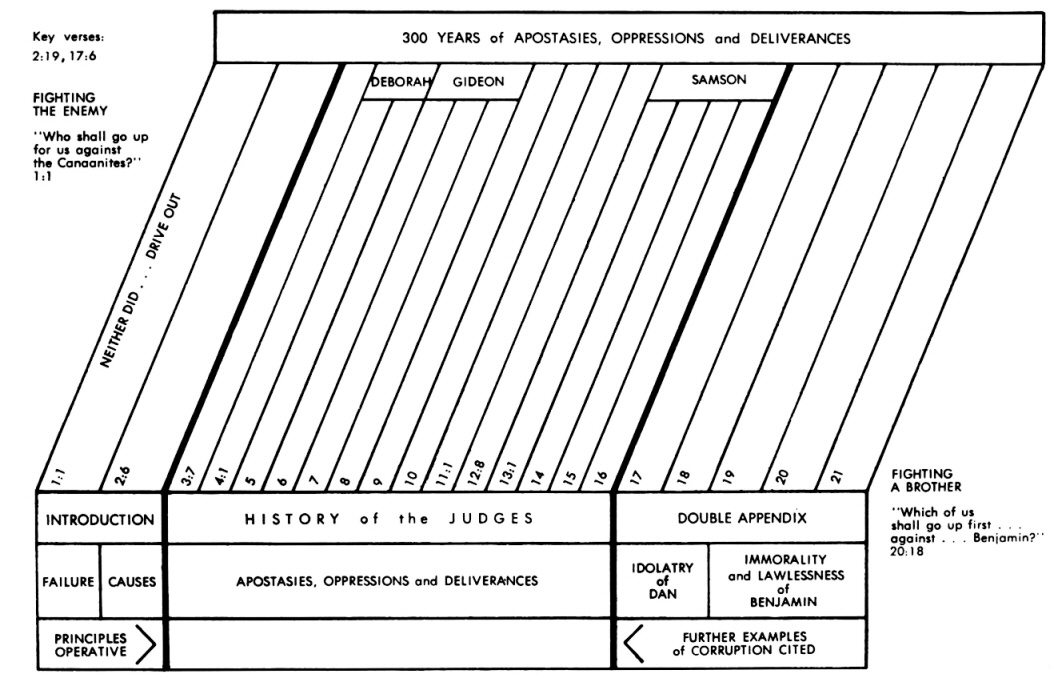
Chart from recommended resource Jensen's Survey of the OT - used by permission
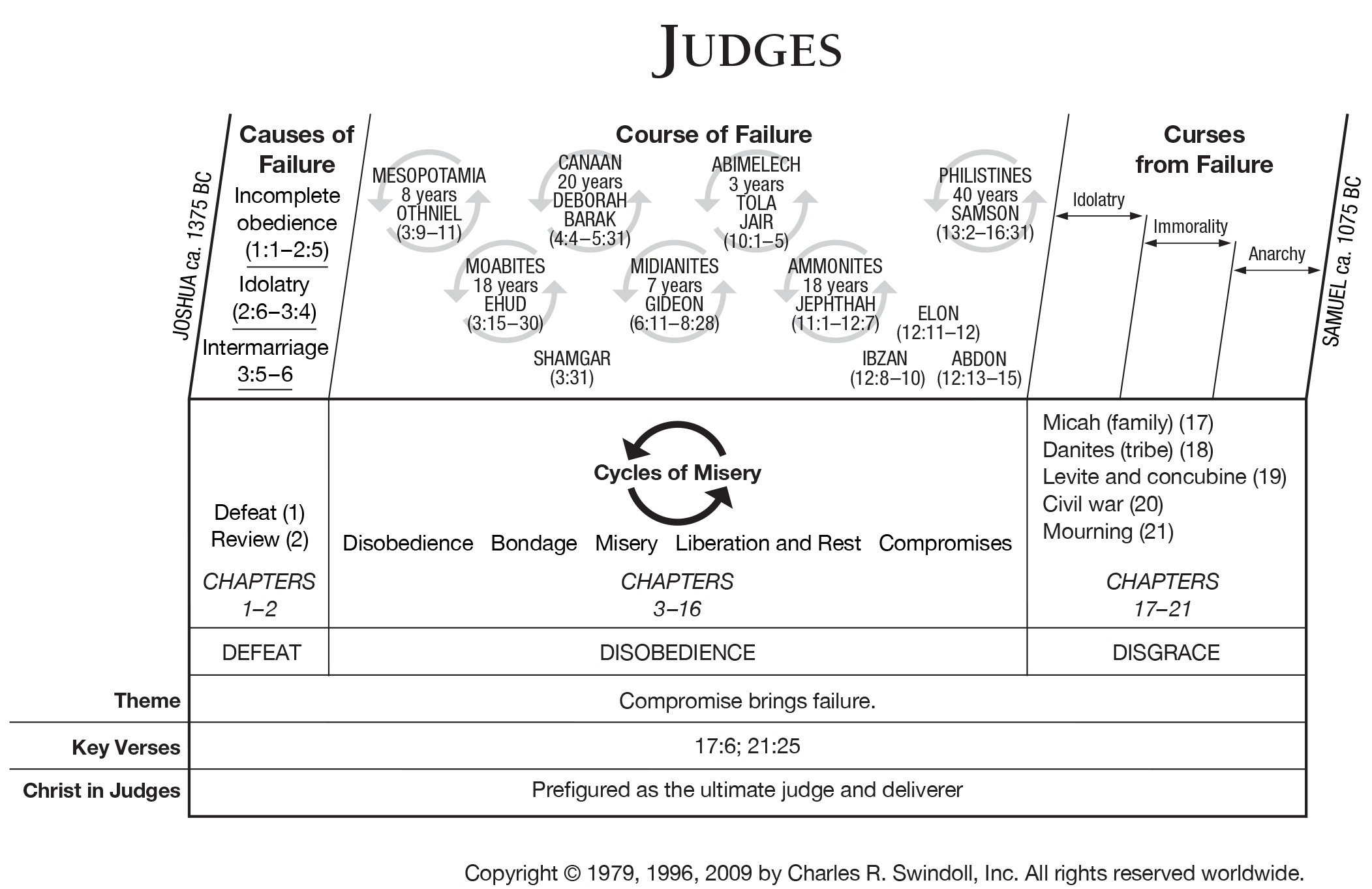
Chart on Judges - Charles Swindoll
|
RECYCLING SIN |
|||||
| Jdg 1:1-3:6 | Jdg 3:7-16:31 | Jdg 17:1-21:25 | |||
| Introduction | History of the Judges | Appendix | |||
| Causes of the Cycles THE REASON |
Curse of the Cycles THE RECORD |
Conditions in the Cycles THE RESULTS |
|||
| Failure to Complete Conquest Jdg 1:1-36 God's Judgment for Failure Jdg 2:1-3:6 |
Curse of the Cycles |
Conditions in the Cycles |
|||
| Living with Canaanites |
War with the Canaanites |
Living Like the Canaanites |
|||
| Religious Laxity |
Political Uncertainty |
Moral Anarchy |
|||
| About 350 Years of Israel's History - Almost 25%! From Compromise to Confusion! |
|||||

Another Timeline of Israel's History
Click to Enlarge
from Jensen's Survey of the OT
Click to Enlarge
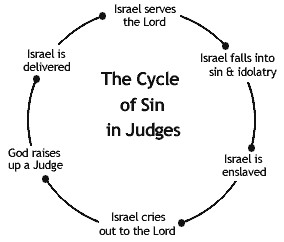
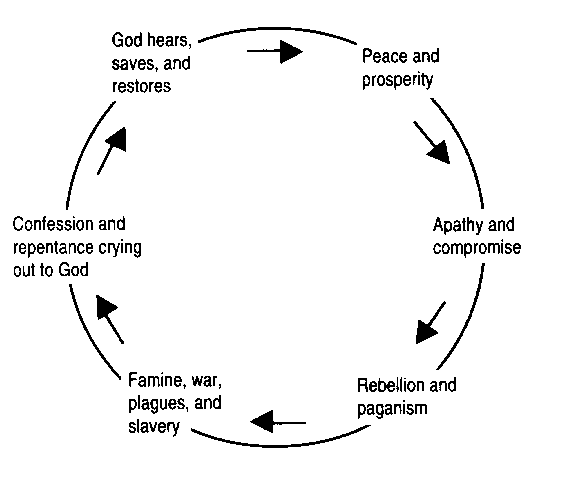
Other ways to describe Israel's cycle…
- Rest > Rebellion > Retribution > Repentance (?) > Restoration
- Sin > Suffering/Servitude > Supplication > Salvation
- Apathy > Apostasy > Affliction > Answered Prayer
- Disobedience > Desperation > Deliverance
- Disobedience > Bondage >Misery > Liberation and Rest > Compromises
|
ANARCHY WITHOUT A KING |
|||
|
Micah and the Danite Migration |
Gibeah’s Deed and Their Punishment |
||
|
Religious Deterioration |
Moral Deterioration |
||
|
Beginning |
“In those days there was no king in Israel. Everyone did what was right in his own eyes” (Jdg 17:6+). |
“In those days, when there was no king in Israel...” (Jdg 19:1+). |
Beginning |
|
Ending |
“In those days there was no king in Israel” (Jdg 18:1+) |
“In those days there was no king in Israel. Everyone did what was right in his own eyes” (Jdg 21:25+). |
Ending |
Judges 21:1 Now the men of Israel had sworn in Mizpah, saying, "None of us shall give his daughter to Benjamin in marriage."
- had sworn - Jdg 20:1,8,10 Jer 4:2
- There - Jdg 21:5 11:30,31 1Sa 14:24,28,29 Ec 5:2 Mk 6:23 Ac 23:12 Ro 10:2
- his daughter - Ex 34:12-16 De 7:2,3
- Judges 21 Resources - Multiple Sermons and Commentaries
Central Location of Mizpah
N of Jerusalem, S of Bethel
(Click to enlarge)
Gary Inrig - All of a sudden, the people woke up to the consequences of their blood lust. They were about to wipe out one of their tribes and leave a permanent gap in the nation. (Borrow Hearts of Iron, Feet of Clay)
This is an amazing irony that Israel had failed to utterly destroy the pagans (Jdg 1:1-36) but they almost succeed in utterly destroying their brothers because of the foolish vow they had made. In their perverted thinking they vowed not to have a daughter marry a Benjaminite, thus treating him like a Canaanite with which they were forbidden to intermarry! This is fruit basket turnover. Wrong is now right and right is wrong. How could they have regressed so far so fast after Joshua and the elders died? Remember these events although placed in Judges at the "end" of the book, in fact probably occurred at the very beginning of the 300-350 years of apostasy!
Constable - The anarchy of God’s people complicated the problems that her apostasy had initiated. The moral degeneracy of chapter 19 proceeded from political disorganization in chapter 20 to social disintegration in chapter 21. (Judges: Such Great Salvation)
Dale Ralph Davis on Judges 21 - “Interpreting biblical narrative can be like trying to figure out someone who has a dry sense of humor. The person may give no visible indication that he intends humor, so that you have to divine it as best you can. Judges 21 is noncommittal like that. The writer reports but hardly critiques, so that we are left asking how we are to take the story.”
Now the men of Israel had sworn (shaba) in Mizpah, saying, "None of us shall give his daughter to Benjamin in marriage - The men presumably refers to all the men of Israel (Jdg 20:1, 8 = "all") who had entered into this vow, but this was not wise! (Note distinguish this oath form the "great oath" in Jdg 21:5+) This vow probably taken in the name of the Lord, was not an ordinary vow but invoked a curse on oneself if the vow was broken. Once again a hasty vow leads to trouble. In his zeal to assure victory, Jephthah vowed to offer a human sacrifice to the Lord (Jdg. 11:30). In the same way, the Israelites' hasty vow here leads to atrocities being committed against Israelite women on a mass scale. Just as Jephthah's daughter's dance of celebration was turned into tragedy and mourning (Jdg 11:34), so the Shilonite girls' dancing (in Jdg 11:20) was interrupted as they were abducted from their families (Jdg 11:23). This theme of the hasty, foolish oath reappears in 1Sa 14:24-45, where Saul's vow jeopardizes the life of his heroic son Jonathan.
The Bible emphasizes the importance of keeping one's vow. A vow unfulfilled is worse than a vow never made. While vows do not appear often in the New Testament, Paul made one that involved shaving his head (Acts 18:18). The apostle Paul came from the tribe of Benjamin. No doubt he was grateful for those four hundred women from Jabesh Gilead (Jdg 21:12) and the two hundred women who were kidnapped at Shiloh, for they kept the tribe alive.
THOUGHT - There is a lesson for all of us. While we may not make an official vow before God, how often in the heat of the moment have we been tempted to say (or actually do say) something that we will later regret? Been there, done that! In that moment we would do well to cry out to God and ask Him to "Set a guard, O LORD, over my mouth; Keep watch over the door of my lips." (Ps 141:3)
Guzik - Considering their anger against Benjamin, this probably seemed like the right thing to do. But this foolish oath had unforeseen consequences. Justice not only brings punishment to evildoers, but it also guards against punishment that is too harsh. (Enduring Word Commentary Series)
David Jackman - The society of the end of Judges is uncomfortably akin to that of this twilight era of our Western world. The advertising media tempt us to even greater and easier credit facilities until couples end up hopelessly in debt and under strain. The interest rates suddenly rise and whole family units break up under the pressure. The successful young professional is assumed to belong to the company, body and soul, to ditch his private morality in the interests of corporate success, to work all hours to the neglect of his wife and children, with the result that the marriage breaks up, the family disintegrates, and he burns out. Illustrations abound throughout our increasingly godless society, and we do our young people no service if we do not expose the roots of the problem and nerve them to live lives that are distinctively different in an increasingly alien society. Pietistic withdrawal and superspiritual platitudes will not do! If ever things are going to change it will be through those who know that there is a King, the Lord Jesus Christ. Like salt and light, they need to penetrate the godless, hopeless world, as they get stuck into its problems, at every level of society. We can see it in the classic issues such as abortion and euthanasia; but we are often like Israel, failing to see how compromised we are in the ordinary, everyday issues. And that is where it matters most! Perhaps more than any others we Western Christians need to learn the meaning of Christ’s warning: “No servant can serve two masters … You cannot serve God and mammon” (Luke 16:13, emphasis added). (See context in The Preacher's Commentary,)
Sworn (take an oath)(07650) shaba from sheba = seven) to swear, to take an oath, to make or swear an oath, swearing to someone, thus putting oneself under obligation to someone. "In general, shābaʿ is employed in mainly these contexts: covenant making, where the parties involved made vows, oaths or promises to one another (Deut. 4:31; 1 Sa 20:42); oath taking, which was a serious transaction in Israel and involved a person's taking upon himself (and possibly others) a curse if that person did not carry out his oath faithfully; vow making, which was solemn and not to be broken (cf. Nu 30:2)." (CBL)
VOW [ISBE] - vou (nedher; euche; 'iccar, found only in Nu 30:6,8,10 and translated horismos, by the Septuagint: A vow could be positive (nedher) and included all promises to perform certain things for, or bring certain offerings to, God, in return for certain benefits which were hoped for at His hand (Gen 28:20-22, Jacob; Lev 27:2,8; Nu 30; Jdg 11:30, Jephthah; 1 Sam 1:11, Hannah; 2 Sam 15:8, Absalom; Jon 1:16, vows of heathen); or negative ('iccar), and included promises by which a person bound himself or herself to abstain from certain things (Nu 30:3). Nowhere in the Old Testament do we find the making of vows regarded as a religious duty (Dt 23:22), but the fulfilling of a vow was considered as a sacred and binding duty (Dt 23:21-23; Jdg 11:35; Eccl 5:4; compare Ps 22:25; 66:13; 76:11; 116:18). A vow was as binding as an oath (see OATH) and therefore to be kept to the letter; and it was not to be lightly made (Prov 20:25). A father could veto a daughter's vow, and a husband a wife's. If a husband did not veto a wife's vow, and then caused her to break it, the sin was his and not hers (Nu 30, passim). It seems that vows were considered binding only when actually uttered (Dt 23:23). Persons, including one's self, animals, land and other possessions, could be vowed, but all these could be redeemed with money (see JEPHTHAH), which money was to be estimated by the priest, except in the case of a clean animal. In the case of land, houses and unclean animals a fifth part of the estimated value was to be added to make up the redemption money. In the case of land the sum was greater or smaller as the coming year of Jubilee was far off or near (Lev 27, passim). Nothing which was by nature holy could be made the object of a vow, e.g. firstlings, tithes, etc. (Lev 27:26,28,30); and, on the other hand, an abomination, e.g. the hire of a prostitute, could not be made the object of a vow (Dt 23:18). In Mal 1:14 the offering of what was of less value than what had been vowed is vigorously condemned.
In the New Testament Jesus refers to vows only to condemn the abuse of them (Mt 15:4-6; Mk 7:10-13; compare Talmud, Nedharim, and see CORBAN). In Acts 18:18 (compare Acts 21:23,24) Paul desires to show his Jewish brethren that he is willing to keep the forms of Jewish piety so long as they do not clash with his Christian conscience (compare 1 Cor 9:21). For the vow of the Nazirite, see NAZIRITE. Paul Levertoff
A C Gaebelein Summary…CHAPTER 21 The Repentance About Benjamin
1. Sorrow of the people and Jabesh-Gilead smitten (Jdg 21:1-15)
2. The restoration of Benjamin (Jdg 21:16-25)
A tribe of the nation was almost entirely exterminated. Then the oath they had made not to give their daughters to wife to the Benjamites left assured the complete extinction of the tribe. The dreadful work they had done dawned suddenly upon them and weeping before Jehovah they said, "Why is this come to pass in Israel that there should be today one tribe lacking in Israel ?" The answer surely was, it came to pass on account of their departure from God and their sins. Thus people ask when they behold the scenes of bloodshed and war, as we see in our times, why is this? and are even ready to blame God, instead of thinking of sin and its curse. Then once more they acted themselves and committed another deed of violence. Jabesh-Gilead is destroyed; only four hundred virgins are saved. These were given to the Benjamites. But what hypocrisy they showed in having a feast of Jehovah and commanding the Benjamites to steal the daughters of Shiloh ! Failure and decline is written in this book. God's faithfulness towards His people whom He loves is not less prominent.
"This is Israel , the people of God: infirm and wavering where good is to be accomplished; quick and decisive where patience and forbearance would become them; tolerant of what is only of themselves; scrupulously keeping an insane oath, yet managing to evade it by a jesuitry that deceives no one. Such is the people of God, and such is Christendom today; and such it has been. Let us search our hearts as we read the record,--not given as a record without purpose in it. How solemn is the repetition at the end of what has been the text of these closing chapters: 'In those days there was no king in Israel : every man did what was right in his own eyes'" (Numerical Bible).
Judges 21:2 So the people came to Bethel and sat there before God until evening, and lifted up their voices and wept bitterly.
- came to Bethel- Jdg 21:12 Jdg 20:18,23,26 Jos 18:1
- lifted - Jdg 2:4 Ge 27:38 1Sa 30:4
- Judges 21 Resources - Multiple Sermons and Commentaries
Related Passages:
Judges 20:18 Now the sons of Israel arose, went up to Bethel, and inquired of God and said, “Who shall go up first for us to battle against the sons of Benjamin?” Then the LORD said, “Judah shall go up first.”
Judges 20:23 The sons of Israel went up and wept before the LORD until evening, and inquired of the LORD, saying, “Shall we again draw near for battle against the sons of my brother Benjamin?” And the LORD said, “Go up against him.”
Judges 20:26 Then all the sons of Israel and all the people went up and came to Bethel and wept; thus they remained there before the LORD and fasted that day until evening. And they offered burnt offerings and peace offerings before the LORD.
A BROKEN
NATION
So the people came to Bethel: The first trip to Bethel in Judges 20 was about going to war against Benjamin and now they gather to lament what they have done to Benjamin! The two oaths sworn at Mizpah (Jdg 21:1, 5, cp Jdg 20:8) were intended to stop the evil committed by the Benjamites from contaminating the whole nation and to ensure full participation by the other tribes in the punitive action that was required. But the excessive slaughter of Jdg 20:48 had now produced an unexpected result of making the tribe of Benjamin an "endangered species" so to speak.
And sat there before God until evening, and lifted up their voices and wept bitterly - Once more they find themselves weeping as a result of hasty action carried out apart from seeking God's will (ALWAYS A RECIPE FOR DISASTER!) Earlier the Israelites wept because they were defeated by the Benjamites (Jdg 20:23, 26+). Now they have defeated Benjamin and they weep because they have nearly annihilated one of the tribes. Israel grieved because it appeared that their foolish oath would result in Benjamin disappearance.
Judges 21:3 And they said, "Why, O LORD, God of Israel, has this come about in Israel, so that one tribe should be missing today in Israel?"
- Why, O LORD: De 29:24 Jos 7:7-9 Ps 74:1 80:12 Pr 19:3 Isa 63:17 Jer 12:1
- Judges 21 Resources - Multiple Sermons and Commentaries
Joshua 7:7-9+ Joshua said, “Alas, O Lord GOD, why did You ever bring this people over the Jordan, only to deliver us into the hand of the Amorites, to destroy us? If only we had been willing to dwell beyond the Jordan! 8 “O Lord, what can I say since Israel has turned their back before their enemies? 9 “For the Canaanites and all the inhabitants of the land will hear of it, and they will surround us and cut off our name from the earth. And what will You do for Your great name?”
Judges 6:13+ Then Gideon said to him, “O my lord, if the LORD is with us, why then has all this happened to us? And where are all His miracles which our fathers told us about, saying, ‘Did not the LORD bring us up from Egypt?’ But now the LORD has abandoned us and given us into the hand of Midian.”
WHY GOD?
And they said, "Why, O LORD, God of Israel, has this come about in Israel, so that one tribe should be missing today in Israel - They sound a lot like Joshua (see above) after the horrible defeat at Ai. As with Gideon (see above), no answer was given. Yet the book’s larger context gives the clear answer that Israel had sinned and continued to sin in horrible ways. The more immediate answer is because you sons of Israel overreacted and went too far in extracting punishment from Benjamin.
THOUGHT- There is a powerful lesson in this debacle for all of God's people...
Uninstructed zeal, even in the cause of righteousness,
often goes beyond its proper limits, and does harm rather than good.
-- G Campbell Morgan
Gary Inrig remarks that "Typically, somehow God is portrayed as being to blame for their dilemma: “O Lord, the God of Israel, why has this happened to Israel? Why should one tribe be missing from Israel today?” It was rather late to be turning to God, and this was hardly a prayer of repentance. The implication is that the Lord should have prevented this state of affairs. It is typical of sinful humans to insist on having things their own way and then to blame God when they don’t like the results. (Borrow Hearts of Iron, Feet of Clay)
Guzik - They cried out to God, almost as if it was His responsibility that the tribe of Benjamin was on the edge of extinction. The question, "Why has this come to pass?" was easily answered: Because of the excessive vengeance of the tribes of Israel against the tribe of Benjamin. (Ibid)
So that one tribe should be missing today in Israel - Notice their focus -- There is here no mourning for sin, no humbling because of national transgression, no return to the LORD. Accordingly no word from the LORD comes to them. They act wholly in self-will (v10). Contrast the prayer of Daniel at the end of the 70 years of exile in Babylon - read Da 9:3-13.
Keil and Delitzsch - Then they uttered this lamentation: “Why, O Lord God of Israel, is this come to pass in Israel, that a tribe is missing to-day from Israel?” This lamentation involved the wish that God might show them the way to avert the threatened destruction of the missing tribe, and build up the six hundred who remained. To give a practical expression to this wish, they built an altar the next morning, and offered burnt-offerings and supplicatory offerings upon it (see at Jdg. 20:26), knowing as they did that their proposal would not succeed without reconciliation to the Lord, and a return to the fellowship of His grace. There is something apparently strange in the erection of an altar at Bethel, since sacrifices had already been offered there during the war itself (Jdg. 20:26), and this could not have taken place without an altar. Why it was erected again, or another one built, is a question which cannot be answered with any certainty. It is possible, however, that the first was not large enough for the number of sacrifices that had to be offered now. (Judges 21 Commentary)
G Campbell Morgan - This is a very sad chapter, and gives us the last of the illustrations of the conditions obtaining when there was no king in Israel. As we have seen, more than once the writer drew attention to the fact, and so traced the lawlessness to the lack of authority. The truth is that Israel had lost its living relation to its one and only King. Uninstructed zeal, even in the cause of righteousness, often goes beyond its proper limits, and does harm rather than good. The terrible slaughter of the men of Benjamin continued until not more than six hundred of the tribe were left. Then another of those sudden revulsions which characterize the action of inflamed peoples occurred. Israel is seen suddenly filled with pity for the tribe so nearly exterminated. They realized that the unity and completeness of the family of Jacob was threatened by their action. The sad part of the story is that, to remedy the threatened evil, they resorted to means which were utterly unrighteous. Wives were provided for the men of Benjamin by further unholy slaughter at Jabesh-Gilead, and by the vilest iniquity at Shiloh. It is impossible to read these last five chapters without realizing how perilous is the condition of any people who act without some clearly defined principle. Passion moves to high purpose only as it is governed by principle. If it lacks that, at one moment it will march in heroic determination to establish high ideals, and purity of life; and almost immediately, by some change of mood, will act in brutality and all manner of evil. Humanity without its one King, is cursed by lawlessness. (Borrow Life applications from every chapter of the Bible).
TODAY IN THE WORD
“O Lord, the God of Israel,” they cried, “why has this happened to Israel?” - Judges 21:3
In his short story, “The Sobbin' Women,” Stephen Vincent Benet tells the story of women taken to the Oregon Territory in 1850 to be wives for the frontier men. His story inspired the 1954 musical Seven Brides for Seven Brothers and was based on the mythic account of the abduction of the Sabine women by the early Romans.
The problem of finding suitable wives wasn't isolated to Romans or American pioneers. After the sin of Gibeah and civil war, the men of Benjamin found themselves in this predicament as well. The rest of Israel had sworn not to give their daughters to marry anyone from Benjamin (Jdg 21:1; cf. Deut. 7:1-3). But they weren't happy with the result: with no wives, the tribe of Benjamin would soon die out. The Twelve Tribes of Israel would be forever reduced.
In order to have the right perspective on events in this chapter, we must read the last verse, an echo of the theme of these last chapters in the book: “In those days Israel had no king; everyone did as he saw fit” (Jdg 21:25). The writer is recounting this story as yet another example of the chaos and confusion that pervaded Israel during this leadership vacuum.
Not everything that Israel did is necessarily wrong; the writer doesn't say that. Based on the sin and the approval of sin demonstrated by Benjamin, they deserved the harsh oath taken against them. And Israel's compassion for one of their own—a tribe of God's own people—is understandable. But sin often creates messy situations. Israel could only keep the oath if they allowed Benjamin to abduct the girls of Shiloh, for then their fathers hadn't really given them away to marry (Jdg 21:22).
Miraculously, we still see God's grace. He allowed Benjamin to survive, instead of being destroyed like Sodom. Indeed, despite their sin, rebellion, idolatry, chaos, and ethical lapses, He had allowed Israel to survive. As we shall see in the next few days, He was working out His plan of salvation even in the darkest days.
TODAY ALONG THE WAY - At some point in our spiritual lives, we will go through dark times. If you haven't yet encountered a challenging period—whether a battle with sin or a struggle with difficult circumstances—prepare yourself through the disciplines of prayer and Bible study. If you are in the middle of dark days, lean on the Lord and pray that He will show you His light. And if you have come through darkness, praise the Lord and encourage others by sharing your story of His grace.
Judges 21:4 And it came about the next day that the people arose early and built an altar there, and offered burnt offerings and peace offerings.
- arose early: Ps 78:34,35 Ho 5:15
- an altar - Jdg 6:26 Ex 20:24-25 2Sa 24:18,25 1Ki 8:64 Heb 13:10
- Judges 21 Resources - Multiple Sermons and Commentaries
Related Passages:
Judges 6:26 and build an altar to the LORD your God on the top of this stronghold in an orderly manner, and take a second bull and offer a burnt offering with the wood of the Asherah which you shall cut down.”
Judges 13:20 For it came about when the flame went up from the altar toward heaven, that the angel of the LORD ascended in the flame of the altar. When Manoah and his wife saw this, they fell on their faces to the ground.
Exodus 20:24-25 ‘You shall make an altar of earth for Me, and you shall sacrifice on it your burnt offerings and your peace offerings, your sheep and your oxen; in every place where I cause My name to be remembered, I will come to you and bless you. 25 ‘If you make an altar of stone for Me, you shall not build it of cut stones, for if you wield your tool on it, you will profane it.
AN ALTAR AND
OFFERINGS
And it came about the next day that the people arose early and built an altar (mizbeah) there, and offered burnt offerings and peace offerings - The altar was built, not at Bethel, where an altar already stood (Jdg 20:26), but the next day, back at Mizpah, their base camp (Jdg 20:1). This story suggests that this was not a regular place of worship or else an altar would have already been in place. Ad hoc altars of this kind were sometimes built in times of national peril or rejoicing, especially before or after a battle (cf. Ex 20:24,25; 1Sa 14:35).
Every human heart has an invisible altar
where the war between the flesh and the spirit rages.
-- GotQuestions.org
Altar (04196) mizbeah from zabach = to slaughter for sacrifice or for food) is a masculine noun that is frequent in the OT (338x) and describes the place of sacrifice where offerings were made to a deity. The first use in Ge 8:20 describes the altar built by Noah as his first act after he survived the flood. Abraham is associated with an altar in Ge 12:7,8; 13:4, 18; Ge 22:9. Not surprisingly the majority of OT occurrences are in Leviticus (88x in 72v and Exodus is not far behind - 61x in 53v). The first offering by Cain and Abel does not mention a specific altar (Ge 4:3). The Septuagint (Lxx) often translates mizbeach with the word thusiasterion ("a place of sacrifice") which is derived from thusia meaning that which is offered as the sacrifice. See also dictionary articles.
Mizbeah in Judges - Jdg. 2:2; Jdg. 6:24; Jdg. 6:25; Jdg. 6:26; Jdg. 6:28; Jdg. 6:30; Jdg. 6:31; Jdg. 6:32; Jdg. 13:20; Jdg. 21:4
QUESTION - What is an altar?
ANSWER - An altar is any structure upon which offerings such as sacrifices are made for religious purposes. It was usually a raised platform with a flat surface. There are over four hundred references to altars in the Bible. The word altar is first used in Genesis 8:20 when Noah built an altar to the Lord after leaving the ark. However, the idea was present as early as Genesis 4:3–4 when Cain and Abel brought their sacrifices to the Lord. They most likely presented their offerings on some type of altar, even though the word altar is not used in that passage.
An altar always represented a place of consecration. Before God gave His Law to Moses, men made altars wherever they were out of whatever material was available. An altar was often built to commemorate an encounter with God that had a profound impact upon someone. Abram (Genesis 12:7), Isaac (Genesis 26:24–25), Jacob (Genesis 35:3), David (1 Chronicles 21:26), and Gideon (Judges 6:24) all built altars and worshiped after having a unique encounter with God. An altar usually represented a person’s desire to consecrate himself fully to the Lord. God had worked in a person’s life in such a way that the person desired to create something tangible to memorialize it.
During times of Israel’s rebellion and idolatry, the Lord’s altars fell into disrepair. The prophet Elijah, confronting the prophets of Baal on Mt. Carmel, “repaired the altar of the Lord, which had been torn down” (1 Kings 18:30). Elijah’s restoration of the altar was significant, given the rampant paganism of his day. Also, in spite of the fact that he was living in a divided kingdom, the prophet symbolized the unity of God’s people in his construction: “Elijah took twelve stones, one for each of the tribes descended from Jacob, to whom the word of the Lord had come, saying, ‘Your name shall be Israel.’ With the stones he built an altar in the name of the Lord” (1 Kings 18:31–32). It was on this rebuilt altar that God rained down fire and put the Baal-worshipers to shame (verses 38–39).'
Sometimes God Himself commanded that an altar be built after He had delivered someone in a miraculous way (Deuteronomy 27:4–7; Exodus 30:1). Such an altar would be a memorial to help future generations remember the mighty works of the Lord. Because atonement is God’s work, the Law specified that an altar made of stones must be made with natural, uncut stones, “for you will defile it if you use a tool on it” (Exodus 20:25).
When God gave instructions for the tabernacle, He also gave detailed instructions for the kind of altar the courtyard should contain (Exodus 27:1–8). On this altar, the people made sacrifices that God accepted as atonement for their sin. It was to have four horn-like projections, one at each corner. It had to be large enough to hold sacrifices of bulls, sheep, and goats. For the temple that Solomon built, the altar was made of pure gold (1 Kings 7:48).
In the broadest sense, an altar is merely a designated place where a person consecrates himself to someone or something. Many church buildings have “altars” for prayer, communion, weddings, and other sacred purposes. Some Christians create their own “altars” for personal worship as visible reminders of Romans 12:1, which says to “present yourself as a living sacrifice.”
Every human heart has an invisible altar where the war between the flesh and the spirit rages. When we surrender areas of our lives to the control of the Holy Spirit, we are in effect laying that area on the altar before God. It can help to visualize Abraham’s altar where he offered his son Isaac to the Lord (Genesis 22:9). We can ask the Lord what areas of our lives He is requiring that we offer to Him. We can symbolically lay that on the altar and let go. We don’t need a flat-topped surface; we can surrender our lives to God on the altar of our hearts at any time.GotQuestions.org
Judges 21:5 Then the sons of Israel said, "Who is there among all the tribes of Israel who did not come up in the assembly to the LORD?" For they had taken a great oath concerning him who did not come up to the LORD at Mizpah, saying, "He shall surely be put to death."
- oath - Jdg 21:1,18 Jdg 5:23 Lev 27:28,29 1Sa 11:7 Jer 48:10
- Judges 21 Resources - Multiple Sermons and Commentaries
Related Passage:
Judges 5:23+ ‘Curse Meroz,’ said the angel of the LORD, ‘Utterly curse its inhabitants; Because they did not come to the help of the LORD, To the help of the LORD against the warriors.’
OATH TO KILL THOSE
WHO DID NOT FIGHT
Then the sons of Israel said, "Who is there among all the tribes of Israel who did not come up in the assembly to the LORD?" For they had taken a great oath (shebuah from sheba - seven) - This oath is distinct from the oath not to give the Benjaminites their daughters. It is called a great oath, literally the "great" or "big" one and is the only time in the OT that great (gadol) modifies "oath." Israel begins to make the first attempt to deal with the problem of their vow to not give daughters to Benjamin.
Concerning him who did not come up to the LORD at Mizpah, saying, "He shall surely be put to death - The tribes had a mutual responsibility in times of military action (Jdg 5:13-18). Those who failed to participate were often singled out and sometimes punished (Jdg 5:15-17, 23+). This second oath resulted in a call for the death of Jabesh-Gilead who did not participate in the battle (cf Nu 32:20-33)
Lange's Commentary - Israel here also again clearly shows in its history, what every man may observe in his own experience: that repentance and vows, with reference to past precipitate sin, have scarcely been expressed, before the same thing is done again, and frequently with the same blind zeal which was just before lamented. At that time, when indignation at the outrage in Gibeah filled all hearts, an oath was also taken that every city in Israel that did not send its messengers to the national assembly, consequently took no part in the general proceeding against Benjamin, which was the cause of God, should be devoted to destruction. Such a city was considered to make itself, to a certain extent, an ally of Benjamin, and to be not sufficiently disturbed by the outrageous misdeed, to give assurance that it did not half approve of it. Amid the terrible events of the war, it had been neglected to ascertain whether all cities had sent messengers; it is only now, when the question how to help Benjamin up again without violating the oath, is considered, that the absence of messengers from Jabesh-Gilead is brought to light. And what is it proposed to do? To deal with that city as they have just lamented to have dealt with Benjamin. In order to restore broken Benjamin, another and in any view far less guilty city is now to be crushed. The reconciliation of breaches made by wrath is to be made by means of wrath. The people lament that they have sworn an untimely oath, and instead of penitently seeking to be absolved from it before God, undertake to make it good by executing another, equally hard and severe, and that after “Jehovah” has smitten the rebellious (Jdg 20:35), and peace has been restored. Jabesh-Gilead was a valiant city, full of men of courage, as all Gileadites were… Israel sends 12,000 valiant warriors against Jabesh-Gilead—a duly proportioned number, if 40,000 proceeded against Benjamin. The commander of these troops is instructed to destroy everything in Jabesh, except the virgin women, who are to be brought away, in order to be given to Benjamin. It may be assumed, however, that these instructions are to be so taken as that the army was to compel Jabesh to deliver up its virgin daughters as an expiation for its guilt, under threat of being proceeded with, in case of refusal, according to its proper deserts. For it is not stated that the destruction was carried out; and, on the other hand, under Saul, Jabesh is again, to all appearances, the chief city of Gilead. (Judges 21 Lange Commentary)
Oath (07621) (shebuah from sheba - seven) "a sacred promise attesting to what one has done or will do. It is a solemn usually formal calling upon God or a god to witness to the truth of what one says or to witness that one sincerely intends to do what one says. God swore an oath to Abraham, Isaac, and Jacob that He would fulfill His covenant with them (Gen. 26:3; Deut. 7:8; 1 Chr. 16:16). An oath could also be sworn by a person to declare innocence (Ex. 22:11[10]; Num. 5:21); to proclaim friendship (2 Sam. 21:7); to affirm a promise (Lev. 5:4; 1 Ki. 2:43); to ratify a peace treaty (Josh. 9:20); to pledge loyalty to God (2 Chr. 15:15); or to another person (Neh. 6:18). An oath was considered to be an unbreakable contract; however, in two instances, the Bible presents well-defined possibilities in which an oath could be nullified and the obligated party could be acquitted. Abraham provided for his servant to be released from his obligation to find a bride for Isaac if the woman refused to follow (Gen. 24:8); and the spies provided for their own release from their oath to Rahab if she did not display the scarlet cord and stay in her house or if she revealed the intentions of the Israelites (Josh. 2:17, 20)." (Complete Word Study Dictionary) "Abraham sealing an oath (shābaʿ, q.v.) by Abimelech that a well of water is his, Abraham's, by forcing upon Abimelech seven lambs (Genesis 21:28, 30). So too in Genesis 29:18 it is precisely seven years that Jacob must serve Laban for Rachel and for Leah. These instances seem to be examples of an ancient traditional respect for the number seven, the original basis of which is a matter of conjecture and debate." (See TWOT online)
Shebuah - 29v in the OT - curse(1), oath(25), oaths(1), perjury*(1), swear(1), sworn(1). Gen 24:8; 26:3; Exod 22:11; Lev 5:4; Num 5:21; 30:2, 10, 13; Deut 7:8; Josh 2:17, 20; 9:20; Judg 21:5; 1 Sam 14:26; 2 Sam 21:7; 1 Kgs 2:43; 1 Chr 16:16; 2 Chr 15:15; Neh 6:18; 10:29; Ps 105:9; Eccl 8:2; 9:2; Isa 65:15; Jer 11:5; Ezek 21:23; Dan 9:11; Hab 3:9; Zech 8:17.
Judges 21:6 And the sons of Israel were sorry for their brother Benjamin and said, "One tribe is cut off from Israel today.
- were sorry for: Jdg 21:15 11:35 20:23 2Sa 2:26 Ho 11:8 Lu 19:41,42
- Judges 21 Resources - Multiple Sermons and Commentaries
Related Passages:
Genesis 42:38 But Jacob said, “My son (BENJAMIN) shall not go down with you; for his brother is dead, and he alone is left. If harm should befall him on the journey you are taking, then you will bring my gray hair down to Sheol in sorrow.”
SORROW OVER
BENJAMIN
And the sons of Israel were sorry (naham/nacham; Lxx - parakaleo) for their brother Benjamin and said, "One tribe is cut off (gada; Lxx = aphaireo - remove) from Israel today - Were sorry is the first word in the Hebrew text. The KJV renders it "repented" while Jdg 21:6NET more accurately (in my opinion) renders it "regretted." ESV has "had compassion." In Ge 42:38 the very prospect of losing Benjamin had brought deep grief to Jacob. It is interesting that the same verb for "cut off" (gada') is in God's command to "hew down" the Asherim (Dt 7:5, 2Chr 14:3) and "cut down the engraved images" (Dt 12:3). Israel "cut off" the wrong thing! O yes, they did cut down some of the idol sites, but they they failed to completely cut them off and the result was the inevitable leaven of idolatry spread throughout the nation.
Sorry is a great word in Judges 2:18+ where we read "When the LORD raised up judges for them, the LORD was with the judge and delivered them from the hand of their enemies all the days of the judge; for the LORD was moved to pity (naham/nacham) by their groaning because of those who oppressed and afflicted them."
Were sorry (05162) naham/nacham is a verb which means to be sorry, to pity, to console oneself, regret, comfort, be comforted, to get revenge for oneself (Ge 27:42, Ezek 5:13). The verb always means to console or comfort. According to the TWOT nacham reflects the idea of "breathing deeply" and hence refers to the physical display of one's feelings, such as sorrow, or in this case compassion or comfort. The Lord was sorry that He had made people (Ge 6:6). The Lord led Israel in a direction to avoid war when they left Egypt, lest "people might change their minds when they see war, and return to Egypt.” Vine adds that "Scholars assert several views in trying to ascertain the meaning of nāḥam by connecting the word to a change of the heart or disposition, a change of mind, a change of purpose, or an emphasis upon the change of one's conduct"
Uses of nacham in Judges - Jdg. 2:18; Jdg. 21:6; Jdg. 21:15
The Septuagint renders nacham in Judges 21:6 with the Greek verb parakaleo (para = beside + kaleo = call) which has the basic picture of calling someone to oneself, to call to one's side, to encourage, to instill someone with courage or cheer and so to comfort (used this way in Mt 5:4+, cp Lk 16:25).
Cut off (01438)(gada) means to hew, cut down, destroy, cut in pieces. Cutting off a hand or arm in the sense of cutting one's family line or one's strength (1Sa 2:31; Lam 2:3). Cutting down of pagan idols or objects of worship called Asherim (Deut. 7:5; Ezek. 6:6). Cutting down the morning star, Lucifer (Isa 14:12). Figuratively of the cutting off or shattering of two staffs representing Israel or Judah (Zech. 11:10, 14)
Gilbrant - Sometimes this word is used in contexts describing the actions of the Jewish nation with regard to asherim and heathen idolatry. When this is the case, reference to the command of Israel to destroy such objects of worship. Israel is commanded to "cut down" the asherim (Deut. 7:5); or to "cut down" the idols of the conquered foreign nations (Deut. 12:3). In this same way, gādhaʿ refers to the actual cutting off of the horns belonging to Israel's altar of worship (Amos 3:14); how with holy vehemence Israel "cut down" (2 Chr. 31:1) the asherah poles. This term also refers to how both Asa (2 Chr. 14:3) and Josiah "cut to pieces" the idols, asherah poles and incense altars (2 Chr. 34:4, 7); and prophetically how the idols of Israel would "be broken down" (Ezek. 6:6, NIV). Gādhaʿ is a favorite word of the prophets. It is used figuratively or metaphorically in most prophetic contexts. God promises to "cut short" the strength of Eli's lineage (1 Sam. 2:31). Jeremiah uses the word figuratively in his prophecies to describe how the horn, i.e. the rulership, of Moab will be "cut off" (Jer. 48:25; consider also the literal use in 48:37). There are other figurative uses such as: the "broken" and shattered hammer of all the earth, the kingdom of Babylon (Jer. 50:23; compare also a similar use in Isa. 14:12); and to lament how the horns, i.e. the rulers of Israel were eventually "cut off" by Babylon (Lam. 2:3). Ungodly governments, will be "felled" like lofty trees (Isa. 10:33). The leader of Eliakim's household, a "peg driven into the firm place," will be "sheared off" (Isa. 22:25); and God promises to "break down" the iron gates before King Cyrus (Isa. 45:2). For a literal use of in a prophetic context, see Zech. 11:10, 14. (Complete Biblical Library)
Gada (Gadha) - 22x in 22v - break(1), break off(1), chopped down(2), cut in pieces(1), cut it in pieces(1), cut of asunder(1), cut down(7), cut off(6), cut through(1), hew down(1). Deut. 7:5; Deut. 12:3; Jdg. 21:6; 1 Sam. 2:31; 2 Chr. 14:3; 2 Chr. 31:1; 2 Chr. 34:4; 2 Chr. 34:7; Ps. 75:10; Ps. 107:16; Isa. 9:10; Isa. 10:33; Isa. 14:12; Isa. 22:25; Isa. 45:2; Jer. 48:25; Jer. 50:23; Lam. 2:3; Ezek. 6:6; Amos 3:14; Zech. 11:10; Zech. 11:14
Judges 21:7 "What shall we do for wives for those who are left, since we have sworn by the LORD not to give them any of our daughters in marriage?"
- sworn: Jdg 21:1,18 1Sa 14:28,29,45
- Judges 21 Resources - Multiple Sermons and Commentaries
A PREGNANT
QUESTION
What shall we do for wives for those who are left, since we have sworn by the LORD not to give them any of our daughters in marriage: - This title above is a bit of a (bad) pun - there would be no pregnancies in the tribe of Benjamin because of the foolish vow Israel had taken. Israel was now reaping the rotten fruit of doing what is right in your own eyes, the fruit of a heart that has wandered from the LORD. They seem to have remembered some of the words of Moses and understood it was contrary to the Mosaic Law for the 600 Benjamites to marry non-Israelites (Ex 34:16; Dt 7:3).
What shall we do? Not what would God be gracious to lead us to do? What shall WE DO, since the results of our wisdom has been so wonderful! Men are truly deceived when even in their extremis, they refuse to go humbly and in brokenness and repentance to the Fountain of Living Waters and instead choose to hew for themselves broken cisterns that can hold no water (Jer 2:13).
THOUGHT - Let us all be warned. Run to His Word. Seek His face in prayer. Confess sin. Repent. Why? For "He has told you, O man, what is good; And what does the LORD require of you But to do justice, to love kindness, And to walk humbly with your God?" (Micah 6:8+)
F B Meyer Judges 21:7 We have sworn by the Lord. Our Daily Homily
Amid the gross evils of this time, the people of Israel were very tenacious of their vows, which had been ratified in the presence of God, and under the solemn sanctions of the Tabernacle. Because they had sworn not to give their daughters in marriage to Benjamin, they had to devise an expedient to obtain wives for the six hundred who had escaped massacre, that the tribe should not become extinct.
The same spirit was manifested by Jephthah, when he said, “I have opened my mouth to the Lord; I cannot go back.” No doubt there was the implied conviction that God would avenge the violation of an oath solemnly taken in his name.
What new emphasis is added by this conception to the words of the Epistle to the Hebrews: “God, willing to show unto the heirs of promise the immutability of his counsel, confirmed it by an oath.” Since He could swear by no greater, He swore by Himself, that He would bless and multiply Abraham and his seed. If then you are of the faith of faithful Abraham, you have the right to claim the fulfillment of God’s promise in this double aspect: He will bless and multiply. And it is impossible for Him to alter or fail in the word He hath spoken.
The Psalmist said that God’s statutes, i.e., the things which He established, were his songs. Surely we have every reason to sing, who know that the covenant of God’s love is as steadfast as his throne. Let us turn his statutes into songs. He has given us exceeding great and precious promises; and we can rejoice that “All the promises of God in Him are yea, and in Him Amen, unto the glory of God by us.” “The word of the Lord endureth for ever.” (Judges 21:7)
Judges 21:8 And they said, "What one is there of the tribes of Israel who did not come up to the LORD at Mizpah?" And behold, no one had come to the camp from Jabesh-gilead to the assembly.
- 1Sa 11:1-3 31:11-13 2Sa 2:5,6
- Judges 21 Resources - Multiple Sermons and Commentaries
HUMAN REASONING
BEGINS TO "KICK IN"
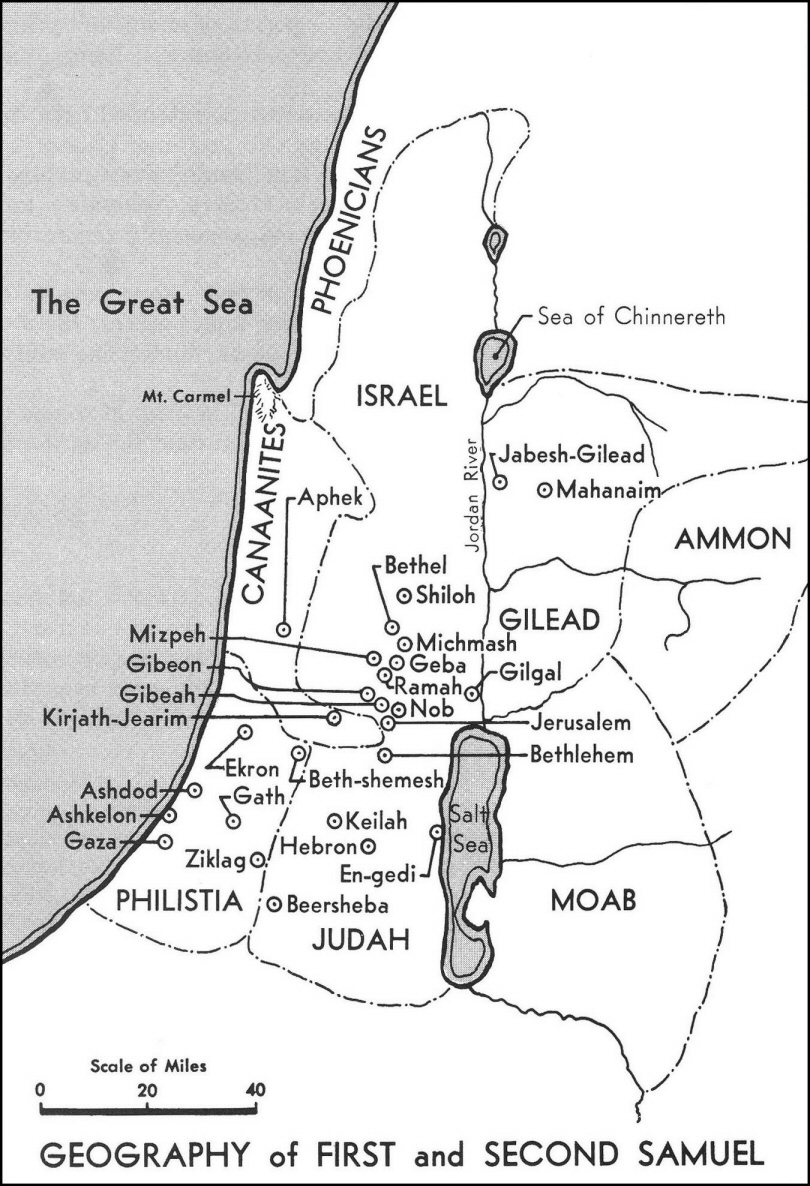
And they said, "What one is there of the tribes of Israel who did not come up to the LORD at Mizpah?" - Instead of seeking a solution from God, the sons of Israel resort to their own human reasoning (We never do that do we?) even though they had made an altar apparently at Mizpah. Mizpah (map) was located about 22 miles S of the Sea of Galilee, 9 miles SE from Beth Shan and 2 miles from the Jordan, while Jabesh-Gilead was on the E side of Jordan (see map).
And behold (hinneh) no one had come to the camp from Jabesh-gilead to the assembly - The absence of representatives from Jabesh Gilead was conspicuous, since men had come from other parts of Gilead (east of Jordan) (Jdg 20:1) Jabesh Gilead had sent no troops (Jdg 20:1) and thus all its inhabitants were destroyed except 400 virgins, who were given to the Benjamite men who remained (Jdg 21:12). The tragedy of their reasoning right in their own eyes is that they were more zealous and faithful to their man-made vows then they were to their covenant keeping God! How much we all are like them. Men are commonly more zealous to support their own authority than God’s.
Behold (02009) hinneh is an interjection meaning behold, look, now; if. "It is used often and expresses strong feelings, surprise, hope, expectation, certainty, thus giving vividness depending on its surrounding context." (Baker) Hinneh generally directs our mind to the text, imploring the reader to give it special attention. In short, the Spirit is trying to arrest our attention! And so hinneh is used as an exclamation of vivid immediacy (e.g., read Ge 6:13)! Hinneh is a marker used to enliven a narrative, to express a change a scene, to emphasize an idea, to call attention to a detail or an important fact or action that follows (Isa 65:17, Ge 17:20, 41:17). The first use of hinneh in Ge 1:29 and second in Ge 1:31 - "And God saw all that He had made, and behold, it was very good. And there was evening and there was morning, the sixth day."
Spurgeon reminds us that "Behold is a word of wonder; it is intended to excite admiration. Wherever you see it hung out in Scripture, it is like an ancient sign-board, signifying that there are rich wares within, or like the hands which solid readers have observed in the margin of the older Puritanic books, drawing attention to something particularly worthy of observation." I would add, behold is like a divine highlighter, a divine underlining of an especially striking or important text. It says in effect "Listen up, all ye who would be wise in the ways of Jehovah!"
Hinneh in Judges - Jdg. 1:2; Jdg. 3:24; Jdg. 3:25; Jdg. 4:22; Jdg. 6:15; Jdg. 6:28; Jdg. 6:37; Jdg. 7:13; Jdg. 7:17; Jdg. 8:15; Jdg. 9:31; Jdg. 9:33; Jdg. 9:36; Jdg. 9:37; Jdg. 11:34; Jdg. 13:3; Jdg. 13:5; Jdg. 13:7; Jdg. 13:10; Jdg. 14:5; Jdg. 14:8; Jdg. 14:16; Jdg. 16:10; Jdg. 17:2; Jdg. 18:9; Jdg. 18:12; Jdg. 19:9; Jdg. 19:16; Jdg. 19:22; Jdg. 19:24; Jdg. 19:27; Jdg. 20:7; Jdg. 20:40; Jdg. 21:8; Jdg. 21:9; Jdg. 21:19; Jdg. 21:21
JABESH-GILEAD [ISBE] - ja'-besh-gil'-e-ad (yabhesh gil`adh; or simply yabhish, "dry"): A city East of the Jordan, in the deliverance of which from Nahash the Ammonite Saul's military prowess was first displayed (1 Sam 11:1 ff). At an earlier time the inhabitants failed to share with their brethren in taking vengeance upon Benjamin. This laxity was terribly punished, only 400 virgins being spared alive, who afterward became wives to the Benjamites (Jdg 21). The gratitude of the inhabitants to Saul was affectingly proved after the disaster to that monarch on Gilboa (1 Sam 31). David, hearing of their deed, sent an approving message, and sought to win their loyalty to himself (2 Sam 2:4 ff). Robinson (Biblical Researches, III, 39) thought it might be represented by ed-Deir, about 6 miles from Pella (Fachil), on the southern bank of Wady Yabis. The distance from Pella agrees with the statement of Eusebius, Onomasticon (s.v.). Others (Oliphant, Land of Gilead, 277 f; Merrill, East of Jordan, 430, etc.) would identify it with the ruins of Meriamin, about 3 miles Southeast of Pella, on the North of Wady Yabis. The site remains in doubt; but the ancient name still lingers in that of the valley, the stream from which enters the Jordan fully 9 miles Southeast of Beisan. W. Ewing
Jabesh-Gilead [EBD] a town on the east of Jordan, on the top of one of the green hills of Gilead, within the limits of the half tribe of Manasseh, and in full view of Beth-shan. It is first mentioned in connection with the vengeance taken on its inhabitants because they had refused to come up to Mizpeh to take part with Israel against the tribe of Benjamin (Judg. 21:8-14). After the battles at Gibeah, that tribe was almost extinguished, only six hundred men remaining. An expedition went against Jabesh-Gilead, the whole of whose inhabitants were put to the sword, except four hundred maidens, whom they brought as prisoners and sent to "proclaim peace" to the Benjamites who had fled to the crag Rimmon. These captives were given to them as wives, that the tribe might be saved from extinction (Judg. 21).
This city was afterwards taken by Nahash, king of the Ammonites, but was delivered by Saul, the newly-elected king of Israel. In gratitude for this deliverance, forty years after this, the men of Jabesh-Gilead took down the bodies of Saul and of his three sons from the walls of Beth-shan, and after burning them, buried the bones under a tree near the city (1 Sam. 31:11-13). David thanked them for this act of piety (2 Sam. 2:4-6), and afterwards transferred the remains to the royal sepulchre (21:14). It is identified with the ruins of ed-Deir, about 6 miles south of Pella, on the north of the Wady Yabis.
Judges 21:9 For when the people were numbered, behold, not one of the inhabitants of Jabesh-gilead was there.
- Judges 21 Resources - Multiple Sermons and Commentaries
NONE FROM JABESH-GILEAD
IN THE MUSTER
For when the people were numbered, behold (hinneh), not one of the inhabitants of Jabesh-gilead was there - The people were numbered as when one musters the troops. Jabesh was the only town in Israel which had not taken part in the exterminating warfare against the tribe of Benjamin.
Daniel Block - So now the question for the Israelites became, Did any tribe or clan (Jdg 21:5) fail to attend the gathering at Mizpah? When they review the roll of those who had appeared “before the Lord” and placed themselves under obligation to the great oath, by a perverse stroke of luck they are relieved to discover one such clan. For whatever reason, the people of Jabesh-Gilead were not represented at the assembly. Consequently they are not bound by the oath to give their daughters to the Benjamites. This is the first mention of Jabesh-Gilead in the Old Testament. Although the name, which means “well-drained soil of Gilead,” is preserved in modern Wadi el-Yabis, one of the main east-west tributaries of the Jordan cutting through the hills of Gilead, the precise location of the town along this wadi is uncertain. The most likely candidate is Tell Maqlub seven miles east of the Jordan and thirteen miles southeast of Beth-Shan. According to 1Sam 11:1–11, some time later Saul is said to have rescued the town from the oppression of the Ammonites, for which they remained grateful until Saul's death. Being a descendant of one of the six hundred Benjamites, Saul's interest in Jabesh-Gilead was based upon his sense of kinship with the people of this region. When Saul died, David recognized their kindness to him and tried to persuade them to switch allegiance to him (2Sa 2:4, 5, 6, 7). The narrator does not disclose the reason the men of Jabesh-Gilead did not appear in Mizpah (whether ignorance, neglect, or defiance), but the account elicits sympathy for this city. Suddenly, from out of nowhere, their own fellow Israelites will storm the town, slaughtering men, women, and children. Unlike the Benjamites in 21:12, 13, they appear not to have been afforded an opportunity to give an account for their absence. (Borrow Judges, Ruth. Vol. 6: New American Commentary)
Rod Mattoon notes that "The Gileadites were the descendants of Manasseh who was the grandson of Rachel. The Benjamites had a blood tie with them because Benjamin was the son of Rachel. The closeness between them is seen later in the Scriptures. In 1Sa 11:1, the Ammorites threaten Jabesh-Gilead. They in turn appeal to Saul, a Benjamite, for aid and deliverance. We also find in 1 Samuel 31 that the men of Jabesh-Gilead recovered the bodies of Saul and his sons from the walls of Beth-shan and buried their bodies at Jabesh-Gilead. The closeness of these two groups may have been one reason why they wouldn't join the army at Mizpeh that was opposing the Benjamites. If they knew about the oath of death, then Jabesh-Gilead knew what was at stake when they remained at home. Their destruction would be their own fault. Desertion had serious consequences… death. Refusal to come to battle was looked upon as having no concern or anger toward the crimes committed and no concern for protecting the nation from God's judgment. Another possible reason why Jabesh-Gilead did not come to arms is they may have never heard the summons to war because they are on the fringe of the territory. (Treasures from the Scriptures)
Matthew Henry…There was a piece of necessary justice to be done upon the city of Jabesh-Gilead, which belonged to the tribe of Gad, on the other side Jordan. It was found upon looking over the muster-roll (which was taken, Jdg 20:2) that none appeared from that city upon the general summons (Jdg 21:8,9), and it was then resolved, before it appeared who were absent, that whatever city of Israel should be guilty of such a contempt of the public authority and interest that city should be an anathema; Jabesh-Gilead lies under that severe sentence, which might by no means be dispensed with. Those that had spared the Canaanites in many places, who were devoted to destruction by the divine command, could not find in their hearts to spare their brethren that were devoted by their own curse. Why did they not now send men to root the Jebusites out of Jerusalem, to avoid whom the poor Levite had been forced to go to Gibeah? Jdg 19:11,12. Men are commonly more zealous to support their own authority than God's. A detachment is therefore sent of 12,000 men, to execute the sentence upon Jabesh-Gilead. Having found that when the whole body of the army went against Gibeah the people were thought too many for God to deliver them into their hands, on this expedition they sent but a few, v. 10. Their commission is to put all to the sword, men, women, and children (Jdg 21:11), according to that law (Leviticus 27:29), Whatsoever is devoted of men, by those that have power to do it, shall surely be put to death.
Keil and Delitzsch Commentary - In order, however, to confirm the correctness of this answer, which might possibly have been founded upon a superficial and erroneous observation, the whole of the (assembled) people were mustered, and not one of the inhabitants of Jabesh was found there (in the national assembly at Bethel). The situation of Jabesh in Gilead has not yet been ascertained. This town was closely besieged by the Ammonite Nahash, and was relieved by Saul (1 Sam. 11:1ff.), on which account the inhabitants afterwards showed themselves grateful to Saul (1 Sam. 31:8ff.). Josephus calls Jabesh the metropolis of Gilead (Ant. vi. 5, 1). According to the Onom. (s. v. Jabis), it was six Roman miles from Pella, upon the top of a mountain towards Gerasa. Robinson (Bibl. Res. p. 320) supposes it to be the ruins of ed Deir in the Wady Jabes. (Judges 21 Commentary)
Judges 21:10 And the congregation sent 12,000 of the valiant warriors there, and commanded them, saying, "Go and strike the inhabitants of Jabesh-gilead with the edge of the sword, with the women and the little ones.
- Jdg 21:5; 5:23; Deut 13:15; Joshua 7:24; 1Sa 11:7; 15:3
- Judges 21 Resources - Multiple Sermons and Commentaries
ISRAEL'S SINFUL SEVERE
TREATMENT OF JABESH-GILEAD
And the congregation sent 12,000 of the valiant warriors there, and commanded them, saying, "Go and strike the inhabitants of Jabesh-gilead with the edge of the sword, with the women and the little ones Israel's treatment of Jabesh Gilead appears excessively severe and was the rotten fruit of self-will and desire for vengeance (they had suffered 2 defeats and lost over 40,000 men). This whole episode is full of rashness and confusion, as one would expect when people do what is right in their own eyes! (Jdg 21:25).
Men are commonly more zealous to support their own authority than God's.
-- Matthew Henry
Guzik - Here again Israel did something that seemed right at the time, but was actually a horror. They decided to slaughter a whole city of Israel, a city that refused to join with Israel in the fight against Benjamin. This is doing one bad thing to make up for another. Israel instead should have repented of their foolish oath made at Mizpah, and they should have agreed to give their daughters as wives to the men of the tribe of Benjamin, renouncing the foolish vow of Judges 21:1.
Gary Inrig - Rather than admit they had made a sinful and willful vow, they hit an ingenious, but extremely cruel, solution. First, they discovered that the remote northern area of Jabesh-Gilead had not been represented at the muster at Mizpah. They did not seek to find out why. Arguing that this meant that the citizens of Jabesh-Gilead fell under the vow of death to all who did not join against Gibeah, they sent an army of twelve thousand to kill everyone in the region—everyone, that is, except unmarried girls. They would solve the problem of having killed nearly an entire tribe of their fellow Israelites by killing more Israelites! That perverted logic provided them with four hundred wives for the Benjamites. Once again, women were treated like commodities to solve the problems created by men. (Borrow Hearts of Iron, Feet of Clay)
Treasury of Scripture Knowledge - As they had sworn to destroy those who would not assist in the war (Jdg 21:5) they determined to destroy the men of Jabesh, and to leave none except the virgins; and to give these to the 600 Benjamites who had escaped to the rock of Rimmon. The whole account is dreadful. The crime of the men of Gibeah was of the deepest dye; the punishment involving both the guilty and innocent, was extended to the most criminal excess, and their mode of remedying the evil they had occasioned was equally abominable.
Arthur Cundall - The action [against Jabesh-gilead] appears cruel in the extreme to the modern reader, but the virtual sacredness of the bond linking the several tribes into the amphictyony must be appreciated, and the sin of Jabesh-gilead seen in its light." (Borrow Judges & Ruth: Tyndale Old Testament Commentary)
Keil and Delitzsch - To punish this unlawful conduct, the congregation sent 12,000 brave fighting men against Jabesh, with orders to smite the inhabitants of the town with the edge of the sword, together with their wives, and children, but also with the more precise instructions (v. 11), “to ban all the men, and women who had known the lying with man” (i.e., to slay them as exposed to death, which implied, on the other hand, that virgins who had not lain with any man should be spared). The fighting men found 400 such virgins in Jabesh, and brought them to the camp at Shiloh in the land of Canaan. אֹותָם (Jdg 21: 12) refers to the virgins, the masculine being used as the more common genus in the place of the feminine. Shiloh, with the additional clause “in the land of Canaan,” which was occasioned by the antithesis Jabesh in Gilead, as in Josh. 21:2; 22:9, was the usual meeting-place of the congregation, on account of its being the seat of the tabernacle. The representatives of the congregation had moved thither, after the deliberations concerning Jabesh, which were still connected with the war against Benjamin, were concluded. (Judges 21 Commentary)
Judges 21:11 "And this is the thing that you shall do: you shall utterly destroy every man and every woman who has lain with a man."
- every man: Nu 31:17,18 De 2:34
- Judges 21 Resources - Multiple Sermons and Commentaries
ISRAEL UTTER DESTROYS
ITS OWN BRETHREN
And this is the thing that you shall do: you shall utterly destroy (charam) every man and every woman who has lain with a man - The phrase utterly destroy is found 14 times in the Book of Joshua in regard to the conquest of the Canaanites and signifies something "under the ban" or totally given to destruction as a sign that it is totally devoted to God. All of those uses of utterly destroy (charam) were directed to a pagan idol worshipping people, and not to one of the 12 tribes of Israel! Indeed, there is no hint whatsoever that God supported the bloodbath that took place at Jabesh Gilead. Sadly, once again we see the sons of Israel were doing what was right in their own eyes, even though it was wrong in God's eyes! Even though delinquency on some occasions was not punished during the days of the Judges (Jdg 5:15-17), the sons of Israel reasoned that the horrible nature of the crime coupled with Benjamin's refusal to turn over the criminals, caused Israel to take an oath that those who did not come to fight "shall surely be put to death.” (Jdg 21:5) Note the phrase every woman who has lain with a man implies they are not to destroy the virgins (as we see in the next verse). So much for utterly destroy because they had to harvest some virgins to reverse the horrible effects of their over zealous revenge against Benjamin.
Utterly destroy (destroy completely, devote)(02763) charam to destroy, to doom, to devote. This word is most commonly associated with the Israelites destroying the Canaanites upon their entry into the Promised Land (Deut. 7:2; Josh. 11:20). Surrendering something irrevocably to God = devoting to service of God, excluding it from use or abuse of man &/or putting it under a ban for utter destruction. [Dt 7:2, 20:17 - see note below] Usually haram meant a ban for utter destruction, compulsory dedication of thing impeding or resisting God's work which is considered to be accursed before God. Thus the basic idea = setting something aside strictly for God's use. Whatever was set aside was considered most holy by God & could not be sold or redeemed by any substitutionary measure. Once invoked it was absolutely compulsory.
Here is the utter destruction Israel should have done...
Deuteronomy 7:2+ and when the LORD your God delivers them before you and you defeat them, then you shall utterly destroy them. You shall make no covenant with them and show no favor to them.
Deuteronomy 13:15+ you shall surely strike the inhabitants of that city with the edge of the sword, utterly destroying it and all that is in it and its cattle with the edge of the sword.
Utterly destroy - 47x in the OT - annihilate(1), covet(1), destroy them utterly(1), destroy utterly(1), destroyed them utterly(1), destroying(1), destroying them completely(2), destruction(2), devote(2), forfeited(1), set apart(1), sets apart(1), utterly destroy(11), utterly destroyed(22), utterly destroying(3). Exod. 22:20; Lev. 27:28; Lev. 27:29; Num. 21:2; Num. 21:3; Deut. 2:34; Deut. 3:6; Deut. 7:2; Deut. 13:15; Deut. 20:17; Jos. 2:10; Jos. 6:18; Jos. 6:21; Jos. 8:26; Jos. 10:1; Jos. 10:28; Jos. 10:35; Jos. 10:37; Jos. 10:39; Jos. 10:40; Jos. 11:11; Jos. 11:12; Jos. 11:20; Jos. 11:21; Jdg. 1:17; Jdg. 21:11; 1 Sam. 15:3; 1 Sam. 15:8; 1 Sam. 15:9; 1 Sam. 15:15; 1 Sam. 15:18; 1 Sam. 15:20; 1 Ki. 9:21; 2 Ki. 19:11; 1 Chr. 4:41; 2 Chr. 20:23; 2 Chr. 32:14; Ezr. 10:8; Isa. 11:15; Isa. 34:2; Isa. 37:11; Jer. 25:9; Jer. 50:21; Jer. 50:26; Jer. 51:3; Dan. 11:44; Mic. 4:13
Judges 21:12 And they found among the inhabitants of Jabesh-gilead 400 young virgins who had not known a man by lying with him; and they brought them to the camp at Shiloh, which is in the land of Canaan.
- virgins: Jdg 20:18,23 Jos 18:1 Ps 78:60 Jer 7:12
- Judges 21 Resources - Multiple Sermons and Commentaries
JABESH-GILEAD
VIRGINS SPARED
And they found among the inhabitants of Jabesh-gilead 400 young virgins (bethulah) who had not known a man by lying with him; and they brought them to the camp at Shiloh (map), which is in the land of Canaan - A solution is found for providing the Benjamites with wives. When Moses sent the same number of men to avenge the Lord on Midian, the same orders were given as here, that all married women should be slain with their husbands, as one with them, but that the virgins should be saved alive (Nu 31:17, 18). Apparently the sons of Israel considered that precedent as sufficient to support the distinction made between a wife and a virgin in Jabesh-Gilead. They further reasoned that they were keeping their vow because the Jabesh-Gilead fathers were not present when the sons of Israel made the vow not to marry Benjamites.
The fact that the sons of Israel gleaned only 400 virgins for 600 men would certainly suggest that their action was not in the will of the Lord, even though He allowed it.
Shiloh (map), which figures prominently in this chapter (cf. Jdg 21:19-21), was the place where the tabernacle was located (cf. Jdg 18:31) and was about 9 miles north of Bethel and the rock of Rimmon where the 600 sons of Benjamin had taken refuge. Shiloh afforded a temporary refuge where the captive girls could mourn the loss of their loved ones. This entire story is permeated with human tragedy on many fronts! But that is what happen when you do what is right in your own eyes!
Virgins (01330) bethulah is a feminine noun meaning virgin, a mature young woman that has never had sexual intercourse, and under the authority and protection of the father (translated as such 49x and once as maiden in the NAS). Judges 21:12 describes "400 young virgins who had not known a man by lying with him." So while the meaning of bethulah is unquestionably a virgin, that is not always the case for in Joel 1:8 we read "Wail like a virgin girded with sackcloth for the bridegroom of her youth," which suggests the bethulah is mourning for her husband. Bethulah also refers to cities or countries that are personified as females (Isa. 37:22; 47:1; Jer. 18:13; 31:4, 21; Amos 5:2). Swanson adds that bethulah also means "young women, i.e., a class of young female, though the class may be virgins, the focus is on the youth group (Dt 32:25; Ps 148:12; Jer 31:13; Am 8:13)." Swanson adds that a third meaning of bethulah is "dear one, one cared for, loved one, formally, virgin daughter, a young woman who is loved by the father, with the associated meaning of being pure, innocent, and under the protection and care of the father (2Ki 19:21; Isa 23:12; 37:22, 22; 47:1, 1; Jer 46:11; La 1:15; 2:10, 13)."
SHILOH [ISBE] - (The most usual form is shiloh, but it appears 8 times as shilo, and 3 times as Shilow; Selo, Selom): A town in the lot of Ephraim where Israel assembled under Joshua at the close of the war of conquest (Josh 18:1). Here territory was allotted to the seven tribes who had not yet received their portions. A commission was sent out to "describe the land into seven portions"; this having been done, the inheritances were assigned by lot. Here also were assigned to the Levites their cities in the territories of the various tribes (Joshua 18 through 21). From Shiloh Reuben and Gad departed for their homes East of the Jordan; and here the tribes gathered for war against these two, having misunderstood their building of the great altar in the Jordan valley (Joshua 22). From Jdg 18:31 we learn that in the period of the Judges the house of God was in Shiloh; but when the sanctuary was moved thither from Gilgal there is no indication. The maids of Shiloh were captured by the Benjamites on the occasion of a feast, while dancing in the vineyards; this having been planned by the other tribes to provide the Benjamites with wives without involving themselves in responsibility (21:21 ff). While the house of the Lord remained here it was a place of pilgrimage (1 Sam 1:3). To Shiloh Samuel was brought and consecrated to God's service (1 Sam 1:24). The sanctuary was presided over by Eli and his wicked sons; and through Samuel the doom of their house was announced. The capture of the ark by the Philistines, the fall of Hophni and Phinehas, and the death of the aged priest and his daughter-in-law followed with startling rapidity (1 Sam 3; 4). The sanctuary in Shiloh is called a "temple" (1 Sam 1:9; 3:3) with doorpost and doors (1 Sam 1:9; 3:15). It was therefore a more durable structure than the old tent. See TABERNACLE; TEMPLE. It would appear to have been destroyed, probably by the Philistines; and we find the priests of Eli's house at Nob, where they were massacred at Saul's order (1 Sam 22:11 ff). The disaster that befell Shiloh, while we have no record of its actual occurrence, made a deep impression on the popular mind, so that the prophets could use it as an effective illustration (Ps 78:60; Jer 7:12:14; 26:6). Here the blind old prophet Ahijah was appealed to in vain by Jeroboam's wife on behalf of her son (1 Ki 14:2,4), and it was still occupied in Jeremiah's time (Jer 41:5).
The position of Shiloh is indicated in Jdg 21:19, as "on the north of Beth-el, on the east side of the highway that goeth up from Beth-el to Shechem, and on the south of Lebonah." This is very explicit, and points definitely to Seilun, a ruined site on a hill at the Northeast of a little plain, about 9 miles North of Beitin (Bethel), and 3 miles Southeast of Khan el-Lubban (Lebonah), to the East of the highway to Shechem (Nablus). The path to Seilun leaves the main road at Sinjil, going eastward to Turmus `Aya, then northward across the plain. A deep valley runs to the North of the site, cutting it off from the adjoining hills, in the sides of which are rock-hewn tombs. A good spring rises higher up the valley. There are now no vineyards in the district; but indications of their ancient culture are found in the terraced slopes around.
The ruins on the hill are of comparatively modern buildings. At the foot of the hill is a mosque which is going quickly to ruin. A little distance to the Southeast is a building which seems to have been a synagogue. It is called by the natives Jami` el-`Arba`in, "mosque of the Forty." There are many cisterns.
Just over the crest of the hill to the North, on a terrace, there is cut in the rock a rough quadrangle 400 ft. by 80 ft. in dimensions. This may have been the site of "the house of the Lord" which was in Shiloh. W. Ewing
Judges 21:13 Then the whole congregation sent word and spoke to the sons of Benjamin who were at the rock of Rimmon, and proclaimed peace to them.
- Rimmon: Jdg 20:47 Jos 15:32
- proclaimed peace De 20:10 Isa 57:19 Lu 10:5 Eph 2:17
- Judges 21 Resources - Multiple Sermons and Commentaries
PEACE TREATY WITH
REMNANT AT RIMMON
Then the whole congregation sent word and spoke to the sons of Benjamin who were at the rock of Rimmon, and proclaimed peace to them - Literally = "called peace to them." (cf Dt 20:10) uses same idiom.
Judges 21:14 And Benjamin returned at that time, and they gave them the women whom they had kept alive from the women of Jabesh-gilead; yet they were not enough for them.
- Jdg 21:12 Jdg 20:47 1Co 7:2
- Judges 21 Resources - Multiple Sermons and Commentaries
BENJAMINITES RETURN
FROM RIMMON
And Benjamin returned at that time, and they gave them the women whom they had kept alive from the women of Jabesh-gilead; yet they were not enough for them - One is a bit surprised that the Benjaminite remnant was so trusting of the other 11 tribes. The offer of women clearly sweetened the deal!
Judges 21:15 And the people were sorry for Benjamin because the LORD had made a breach in the tribes of Israel.
- were sorry: Jdg 21:6,17
- a breach: 1Ch 13:11 15:13 Isa 30:13 58:12
- Judges 21 Resources - Multiple Sermons and Commentaries
And the people were sorry (naham/nacham; Lxx - parakaleo) for Benjamin because the LORD had made a breach (perets) in the tribes of Israel - Were sorry (NET = regretted, ESV = had compassion) refers in the present context to the emotional pain caused by the Lord's judgment. In Genesis 6 God was sorry that he had created man. In 1 Samuel 15 He regrets that he had made Saul king. In both cases this regret prompts God to seek to reverse His prior actions by eliminating the source of his regret. Jdg. 21:15 differs in that the Israelites are pained over a prior action, but it is God's, not their own. Nevertheless, this passage is similar to the others in that the Israelites seek to ameliorate the situation by undoing the effect of this prior action. LORD had made a breach (perets) figuratively refers to God's judgment upon the Benjaminites accomplished through battle (Jdg. 20:35). Benjamin's near extinction left a gaping hole in the Israelite tribal structure, much like a breach in a wall. God permitted the breach but clearly He did not want extinction of Benjamin. This would have been the perfect time for the sons of Israel to humble themselves and seek the LORD's solution to the problem they had created. The "solution" that seemed right in their eyes only netted 400 virgins! Their solution would not achieve the needed 600 virgins so they would have to resort to "Plan B" which seemed right in their own eyes!
THOUGHT - What is very confusing to me is that Israel actually built an altar (Jdg 21:4) on which they made offerings, but the text is silent on why they did not seek God's counsel, e.g., through Phinehas (Jdg 20:28+). This is further testimony to the root problem - there was no King in Israel. While there were times they called out to Him, those were only during times of severe, often lengthy oppression. Are we not often like Israel when faced with a dilemma that seems to have no easy human solution?
NET NOTE - Heb "had made a gaping hole in." The narrator uses imagery that compares Israel to a wall that has been breached.
Breach (06556)(perets from parats = to break through) means a gap, a break, a bursting forth, a breach. Literally refers to a breach in a wall (1Ki 11:27; Isaiah 58:12; Amos 9:11; Neh. 6:1) or breaking of a dike (2Sa 5:20; 1Chr 13:11) Figuratively refers to a man who would stand in the gap or breach (Ezek 13:4, Ezek 22:30, Ps 106:23) or an outburst of the Lord's anger (2Sa 6:8).
Gilbrant - The Hebrew noun perets means "breach" or "gap," and it is a derivative of the verbal root pārats (HED #6805), which is defined as "to breach" or "to break out." Most commonly, a breach in a wall is indicated, specifically in the wall surrounding Jerusalem (1 Ki. 11:27; Neh. 6:1; Ps. 144:14; Isa. 58:12; Amos 9:11). Perez was one of the twin sons (along with Zerah) born of the unwitting incestuous union of Tamar and her father-in-law Judah (Gen. 38). Perez was the father of Hezron and Hamul (Gen. 46:12; Num. 26:21; 1 Chr. 2:4f) and the ancestor of the Perezites (Num. 26:20). Perez's name means "a bursting forth" or "a breach" and refers to the abnormally violent birth of Perez and his brother Zerah by their mother Tamar. One twin stuck his hand out of the womb first and the midwife tied a scarlet cord around his wrist in order to identify him (Gen. 38:28). But he withdrew his hand and the other twin came out first, causing the midwife to exclaim, "How have you broken forth?" (v. 29); thus, the name Perez. The clan of Perez delighted in its numerous and prosperous descendants illustrated by the blessing the women of Bethlehem bestowed upon Boaz and Ruth by stating, "Let your house be like the house of Pharez, whom Tamar bare unto Judah, of the seed which the Lord shall give you of this young woman" (Ruth 4:12). The descendants of Perez enjoyed prominence among the other clans of Judah and maintained important positions within the community. For example, Jashobeam, son of Zabdiel and descendant of Perez, was one of David's twelve military generals who served one month each year (1 Chr. 27:2f). Following the exile, some of the Perezites lived in Jerusalem (1 Chr. 9:4), including 468 "able men" and Zerubbabel, son of Shealtiel, who was commissioned by Haggai and Zechariah to rebuild the Temple. The ancestral lines of David (Ruth 4:18-22) and Jesus (Matt. 1:13; Luke 3:33) are both traced back through Perez. (Complete Biblical Library)
Perets - 19x in 18v - breach(10), breaches(3), breakthrough(2), gap(1), mishap(1), outburst*(2). Gen. 38:29; Jdg. 21:15; 2 Sam. 5:20; 2 Sam. 6:8; 1 Ki. 11:27; 1 Chr. 13:11; 1 Chr. 14:11; Neh. 6:1; Job 16:14; Job 30:14; Ps. 106:23; Ps. 144:14; Isa. 30:13; Isa. 58:12; Ezek. 13:5; Ezek. 22:30; Amos 4:3; Amos 9:11
Judges 21:16 Then the elders of the congregation said, "What shall we do for wives for those who are left, since the women are destroyed out of Benjamin?"
MORE HUMAN
REASONING
Then the elders of the congregation said, "What shall we do for wives for those who are left, since the women are destroyed out of Benjamin?" - This is amazing. They still have not ask God. They are saying what shall WE DO, not what would or could God do!
Judges 21:17 And they said, "There must be an inheritance for the survivors of Benjamin, that a tribe may not be blotted out from Israel.
- inheritance: Nu 26:55 Nu 36:7
- Judges 21 Resources - Multiple Sermons and Commentaries
THE WIFE OATH DILEMMA
CONTINUES
And they said, "There must be an inheritance for the survivors of Benjamin, that a tribe may not be blotted out from Israel - Where this strong national loyalty/drive came from is not clear, but ultimately one has to believe Yahweh placed this on their hearts. His glory is at stake if one of the 12 tribes did not survive.
Judges 21:18 "But we cannot give them wives of our daughters." For the sons of Israel had sworn, saying, "Cursed is he who gives a wife to Benjamin."
- Judges 21 Resources - Multiple Sermons and Commentaries
Related Passages:
Judges 11:35 (JEPHTHAH'S FOOLISH VOW) When he saw her, he tore his clothes and said, “Alas, my daughter! You have brought me very low, and you are among those who trouble me; for I have given my word to the LORD, and I cannot take it back.”
Judges 21:1 Now the men of Israel had sworn in Mizpah, saying, “None of us shall give his daughter to Benjamin in marriage.”
Judges 21:7 “What shall we do for wives for those who are left, since we have sworn by the LORD not to give them any of our daughters in marriage?”
REPEAT OF THEIR
RIDICULOUS VOW
But we cannot give them wives of our daughters." For the sons of Israel had sworn, saying, "Cursed is he who gives a wife to Benjamin - For the 3rd time (see above) reference is made to the oath that forbade the giving of daughters to Benjamin. In the absence of wives, the breach seemed irreparable. Rather than go through the "charade" in the next few verses, it would have been better for Israel to have confessed their sin of making a foolish oath, and done what was right instead of trying to make two wrongs equal a right. The less consideration is used before the making of a vow, the more, commonly, there is need of afterwards for the keeping of it.
Judges 21:19 So they said, "Behold, there is a feast of the LORD from year to year in Shiloh, which is on the north side of Bethel, on the east side of the highway that goes up from Bethel to Shechem, and on the south side of Lebonah."
- feast: Ex 23:14-16 Lev 23:2,4,6,10,34 Nu 10:10 28:16,26 29:12 De 16:1,10,13 Ps 81:3 Joh 5:1 7:2
- Judges 21 Resources - Multiple Sermons and Commentaries
SECOND SOLUTION RELATED
TO THE ANNUAL FEAST
Their dilemma was how could the sons of Israel provide 200 more wives without breaking their oath to give wives to the Benjaminites. It almost sounds like a riddle, but sadly was true to life riddle!
So they said, "Behold (hinneh), there is a feast of the LORD from year to year in Shiloh, which is on the north side of Bethel, on the east side of the highway that goes up from Bethel to Shechem, and on the south side of Lebonah Not sure which feast but likely Tabernacles as vineyards (Jdg 21:20) are mentioned and the grape harvest comes in August and September. One of the purposes of the fall Tabernacles Feast was to rejoice over the summer fruit that had been gathered. Samuel's parents traveled annually to Shiloh to worship the Lord (1Sa 1:3). Others believe the Passover is intended, for the dancing could imitate the celebrating of Miriam and the women of Israel after the Exodus (cf. Ex 15:20, 21). One other consideration is that this was a feast Israel had devised (they watched the Canaanites celebrate with feasts). One cannot be dogmatic.
Three times a year every Israelite male was required to appear before the Lord at the central sanctuary (Ex 23:14-19; 34:23)
Three times in a year all your males shall appear before the LORD your God in the place which He chooses, at the Feast of Unleavened Bread and at the Feast of Weeks and at the Feast of Booths (Tabernacles) and they shall not appear before the LORD empty-handed. Every man shall give as he is able, according to the blessing of the LORD your God which He has given you. (Dt 16:16,.17).
Keil and Delitzsch - And the elders lent them a helping hand by offering them this advice, that at the next yearly festival at Shiloh, at which the daughters of Shiloh carried on dances in the open air (outside the town), they should seize upon wives for themselves from among these daughters, and promising them that when the thing was accomplished they would adjust it peaceably (Jdg 21:19–22). The “feast of Jehovah,” which the Israelites kept from year to year, was one of the three great annual festivals, probably one which lasted seven days, either the passover or the feast of tabernacles,—most likely the former, as the dances of the daughters of Shiloh were apparently an imitation of the dances of the Israelitish women at the Red Sea under the superintendence of Miriam (Ex. 15:20). The minute description of the situation of Shiloh, viz., “to the north of Bethel, on the east of the road which rises from Bethel to Shechem, and on the south of Lebonah”), serves to throw light upon the scene which follows, i.e., to show how the situation of Shiloh was peculiarly fitted for the carrying out of the advice given to the Benjaminites; since, as soon as they had issued from their hiding-places in the vineyards at Shiloh, and seized upon the dancing virgins, they could easily escape into their own land by the neighbouring high-road which led from Bethel to Shechem, without being arrested by the citizens of Shiloh. (Judges 21 Commentary)
Judges 21:20 And they commanded the sons of Benjamin, saying, "Go and lie in wait in the vineyards,
- Judges 21 Resources - Multiple Sermons and Commentaries
AMBUSHED BENJAMINITES
SET AMBUSH TO KIDNAP WIVES
And they commanded the sons of Benjamin, saying, "Go and lie in wait in the vineyards - Ironically, the men of Benjamin were told to set an ambush for the girls, the same technique used by the sons of Israel against the Benjamites at Gibeah (Jdg 20:37+). The strategy worked, and each man obtained his wife.
What's wrong with their human plan, especially if it "worked"? Is there not some bizarre/tragic irony here? The reason the sons of Israel are in this quagmire is because of a Levite's concubine, a woman who was forcibly taken by other men who were Benjaminites. And now they devise a plan to encourage these same Benjaminites (can we even exclude a few surviving "worthless fellows" in this 600?) to kidnap women who would then in effect be raped! This is utter nonsense, but is exactly what happens when a people have gone off the rail and begin to do what they think is right in their sinful eyes!
Judges 21:21 and watch; and behold, if the daughters of Shiloh come out to take part in the dances, then you shall come out of the vineyards and each of you shall catch his wife from the daughters of Shiloh, and go to the land of Benjamin.
- dances: Jdg 11:34 Ex 15:20 1Sa 18:6 2Sa 6:14,21 Ps 149:3 150:4 Ec 3:4 Jer 31:13 Mt 10:17 Lu 17:25
- Judges 21 Resources - Multiple Sermons and Commentaries
"SAVE THE LAST
DANCE FOR ME"
And watch; and behold (hinneh), if the daughters of Shiloh come out to take part in the dances, then you shall come out of the vineyards and each of you shall catch his wife from the daughters of Shiloh, and go to the land of Benjamin - This is an interesting conditional clause ("if...then").
Judges 21:22 "And it shall come about, when their fathers or their brothers come to complain to us, that we shall say to them, 'Give them to us voluntarily, because we did not take for each man of Benjamin a wife in battle, nor did you give them to them, else you would now be guilty.'"
- Give them to us voluntarily - Philemon 1:9-12
- each man: Jdg 21:14 Ge 1:27 7:13 Mk 10:6-8 1Co 7:2
- nor did you give them to them: Jdg 21:1,7,18 Pr 20:25
- Judges 21 Resources - Multiple Sermons and Commentaries
RATIONALE FOR
KIDNAPPING
The sons of Israel knew that there would be complaints from these virgins fathers and brothers, so they had to devise a reasonable explanation that would seem right in everyone's eyes!
And it shall come about, when their fathers or their brothers come to complain to us, that we shall say to them, 'Give them to us voluntarily, because we did not take for each man of Benjamin a wife in battle, nor did you give them to them, else you would now be guilty It was customary for the brothers of a girl who had been abducted to demand satisfaction (see Ge 34:7-31; 2Sa 13:20-38). It was therefore important that the elders anticipate this response and be prepared to get cooperation from the girls' families. Also the fact that the Benjamites stole the maidens (the parents did not give them away) absolved the parents from the curse against giving their daughters to Benjamin if they broke the oath! While their arguments may have been less than convincing (as a father of 2 daughters, I would have hardly been consoled!), but the leaders of Israel prevented the relatives from retaliating against the Benjamites (cf. Jdg 18:22-26).
David Jackman - The casuistry of the argument in verse 22 is truly appalling. When the people of Shiloh complained of the abduction of their daughters, they were to be informed that this kept their oath intact. Nothing could have been further from the truth. In fact, it was a backdoor way of giving their daughters to the Benjamites, by setting up the whole charade and assuring the men of Benjamin that no action would be taken against them. This was to answer injustice with injustice. The point being made, that must be applied to our contemporary situation, is that once God, whose righteous character is the only source and guarantee of truth and justice, is neglected, then such fine-sounding moral concepts are inevitably reduced to hollow verbiage. In the words of Jean-Paul Sartre, “Finite man is meaningless without an infinite reference point.” The existentialist philosophy and the history of nations in the twenty-first century surely confirms this age-old message of the Book of Judges. Even the most advanced technological societies are covered with only the thinnest veneer of civilization when once the Christian foundations are eroded away (ED: AS HAS HAPPENED IN AMERICA 2022!). As the Duke of Wellington once remarked, the problem is that if you educate devils all you get is clever devils. (See context in The Preacher's Commentary)
Judges 21:23 And the sons of Benjamin did so, and took wives according to their number from those who danced, whom they carried away. And they went and returned to their inheritance, and rebuilt the cities and lived in them.
- Rebuilt Jdg 20:48
- Judges 21 Resources - Multiple Sermons and Commentaries
SEIZURE OF WIVES
SATISFIES DEFICIT
And the sons of Benjamin did so, and took wives according to their number from those who danced, whom they carried away. And they went and returned to their inheritance, and rebuilt the cities and lived in them. How different is this act [which the sons of Israel gave approval to] from the men of Gibeah taking the concubine and raping her? To be sure they are not identical but there is a touch of bitter irony in this unusual ending to this horrid saga in Israel.
Matthew Henry writes that "The virgins of Jabesh-Gilead were taken out of the midst of blood and slaughter, but these of Shiloh out of the midst of mirth and joy; the former had reason to be thankful that they had their lives for a prey, and the latter, it is to be hoped, had no cause to complain, after a while, when they found themselves matched, not to men of broken and desperate fortunes, as they seemed to be, who were lately fetched out of a cave, but to men of the best and largest estates in the nation, as they must needs be when the lot of the whole tribe of Benjamin, which consisted of 45,600 men (Nu 26:41), came to be divided again among 600, who had all by survivorship. And soon after from among them sprang Ehud, who was famous in his generation, the second judge of Israel, Jdg 3:15.
Daniel Block has an apt comment for this less than satisfying ending to Judges - “Through Moses Yahweh had warned that if the Israelites stoop to behaving like Canaanites, then they can expect the same fate (Deut 8:19–20). The narrator never declares so outrightly, but the present account, coming as it does at the end of the book affirms the total Canaanization of the tribe of Benjamin and the Israelites’ falsely based sympathy for their brothers.” (Borrow Judges, Ruth. Vol. 6: New American Commentary)
Gary Inrig has an "editorial" comment - The mind reels. What about these poor women? Who do these people think they are fooling? Did they imagine that such a concern for legality that totally missed issues of justice, fairness, mercy, and love would be acceptable to a holy God and cause them to escape His righteous wrath? A recent Oscar-winning film advertised its delights in the following way: “Moviegoers: If violence, madness, rape, larceny, and bloodshed appeal to you, then see the best.” Millions did. Nothing could more eloquently illustrate the deep sickness of our society. It is disgusting that Israel practiced such perversions. It is infinitely worse that we in our culture not only practice them, we celebrate them in movies and flock to see them for pleasure! We are entertained by immorality and titillated by godlessness. Gibeah has nothing on the Western world! Judges 19–21 gives us one of the ugliest stories in the Bible. The key to it is that, at every stage, people were acting on the basis of what was right in their own eyes. As far as the men of Gibeah were concerned, rape was all right. To the farmer and the Levite in the house, homosexual rape was unthinkable, but the sacrifice of blameless women to protect themselves was completely justified. The men of Benjamin thought it was right to overlook sin and to defend evil men. To Israel, revenge and retaliation could be justified, and to solve their problems about marriage for the Benjamites, the massacre of innocent people and the kidnapping of young girls could be condoned. The moral elevator is in freefall! (Borrow Hearts of Iron, Feet of Clay )
Judges 21:24 And the sons of Israel departed from there at that time, every man to his tribe and family, and each one of them went out from there to his inheritance.
- Judges 21 Resources - Multiple Sermons and Commentaries
PROBLEMS SOLVED:
LET'S ALL GO HOME!
And the sons of Israel departed from there at that time, every man to his tribe and family, and each one of them went out from there to his inheritance: The Hebrew words here are the same as those found at the end of the Book of Joshua (Josh 24:28). However, the book’s final comment (Jdg 21:25) indicates that times were far worse than they had been in Joshua’s day.
In is fascinating that Judges ends with the words each one of them went out from there to his inheritance, words that are almost identical to those at the end of Joshua "Then Joshua dismissed the people, each to his inheritance." (Josh. 24:28) What a difference a generation makes (cf Jdg 2:10-11+), for now the inheritance had been corrupted by Israel's apostasy.
Dale Ralph Davis makes the cogent point that "the Book of Judges ends with a miracle. How after chapters 19–21, indeed, after chapters 1–21, can you account for the fact that there is still an Israel? It can only be because Yahweh wished to dwell in the midst of his people in spite of its sin. It can only be because Yahweh’s grace is far more tenacious than his people’s depravity and insists on still holding them fast even in their sinfulness and their stupidity. Nor is he finished raising up saviors for them (Acts 13:23)! (Judges: Such Great Salvation)
Gary Inrig has a poignant summary of Judges that speaks loudly to our days which are beginning more and more to resemble the book of Judges. The first part is a study of the Organic Nature of Sin and the second part is Principles to Ponder. This summary is also available his online book Hearts of Iron, Feet of Clay. Note you have to sign in to check it out for an hour but there is no cost involved.
There is an important truth about sin in this story. In our naiveté, we tend to think of sins as isolated acts, individual events that have no relationship to one another. However, the Bible views sin organically. There is a vast cause and effect link that, if it is not dealt with, leads a whole society into moral collapse. No sin was ever committed that affected one person alone. There is no such thing as victimless sin. Any sin sends ripples into all of society.
There is an old story of a ship that was traveling across the Mediterranean, and one of the passengers cut a hole through the side of the ship. The sailors came to him and demanded to know what he was doing. “What difference does it make to you?” he asked. “The hole’s under my own bunk.”
But they were still two hundred short. Once again they blamed the Lord for the situation: “the Lord had made a gap in the tribes of Israel” (v. 15). The solution was no less clever and no less perverted. This time they decided the answer was to be found in the legal technicalities of the vow. No one was to give daughters to Benjamin. But what if the Benjamites kidnapped wives for themselves? That would mean the terms of the vows were met. The legalistic maneuvering is disgusting as those involved play word games and create loopholes without concern for justice or the lives of the women involved.
If you understand the absurdity of the passenger in that story, you have gained an important insight into the biblical view of the effects of sin. People go around shouting, “Do your own thing!” and demanding the freedom to do what they please, when they please, where they please. Then we wonder why the boat is filling up with water and we are beginning to go under. We do not live to ourselves, and we do not sin to ourselves.
The interrelatedness of sin is vividly illustrated here. Where did Israel go wrong? Where did the problem begin? The answer is not immediately apparent, but notice Judges 20:27–28. It describes spiritual sin. “In those days the ark of the covenant of God was there [at Bethel], with Phinehas son of Eleazar, the son of Aaron, ministering before it.” The importance of this observation is that we know from passages in Joshua, Judges, and 1 Samuel that the tabernacle was in Shiloh. The ark of the covenant belonged in the Holy of Holies of the tabernacle in Shiloh. The ark was intensely holy, and no one except the high priest was to view it once a year. But the holiness of God had been so cheapened that the high priest had allowed it to be taken out of the tabernacle and transported to Bethel, in direct disobedience to God. What makes this doubly sad is that the priest was Phinehas, a man who once stood powerfully for God (see Numbers 25).
That is the root of all sin—a weak conception of the holiness of God.
That is where Israel went astray.
That leads directly to sexual sin—the adultery of the concubine and the homosexuality and rape in Gibeah. At first, it seems that sexual sin is the most private of sins. Over and over we hear it said, “It is no one’s business what two consenting adults do. It affects no one but themselves.” That is, of course, not true. Not only are other people almost always involved, our sexuality is one of the most determinative things about us. When we violate God’s intentions for our bodies, our perspective on life is coarsened. Sexual sin produces a cheapened view of the value of people and life. Sexual immorality brutalizes and dehumanizes us. It touches our “self” more deeply than any other sin. (1Co 6:18)
It is worth noting that at the heart of Gibeah’s sin was homosexuality, albeit in a very perverted form. It was the desire of the men of the city for the Levite, not his concubine, which triggered the devastation. Paul indicates in Romans 1 that widespread acceptance of homosexuality is evidence that a people have rejected the truth of God, and, in turn, have been given up by Him to “dishonorable passion.” Sodom and Gibeah are symbols of this, and it is a frightening commentary on our own society that something the Bible calls unnatural and shameful (Romans 1:26–27) has become increasingly defended and even promoted as an “alternative lifestyle.”
Related to sexual sin, intriguingly, there is often another step downward—a cheapened view of life and a loss of human dignity and worth. It is expressed in the rape at Gibeah, the desecration of a woman’s body, the slaughter of Benjamin, the massacre at Jabesh-Gilead, and the kidnapping at Shiloh.
There are many other sins, but I wonder if you notice the downward flow. (1) We lose our sense of the holiness and greatness of God, and soon we find ourselves engaged in sexual sin, the sin Paul says is against our own body. (2) Then we lose our self-worth, and we are plunged into the lowest level, (3) where we view people as things and treat them as commodities. Sin devastates our spirit in our relationship to God, distorts our soul—our sense of self—and reduces us to little more than animals, living as mere bodies, with our humanity almost erased. That is the process of Judges 19–21, and it is the process of the twenty-first century.
I want to draw some important principles out of all this. Ugly as Judges 19–21 is, it is a passage uncomfortably close to what is going on all around us. In fact, it reads like the plot of a modern movie. Therefore, we need to learn five important lessons from God’s Word to enable us to survive morally and spiritually in a society without standards.
1. The basis of moral behavior is of critical importance. Why you do what you do is almost as important as what you actually do. That point may not be immediately apparent, so let me try to clarify it. For years, many people said that premarital sex was wrong because of the possibility of conceiving a child out of wedlock, because of sexually transmitted diseases, or because of social stigma. But then more effective forms of birth control lessened the fear of conception, new medicines provided solutions for disease (this proved very temporary, as new STDs evolved), and society’s moral standards changed dramatically, providing a new acceptance of casual sexual relationships. If the only reasons for sexual purity were based on fear of negative consequences, these changes made sexual experimentation and indulgence entirely appropriate. But not in God’s eyes.
The point is this: If your moral behavior is not grounded on the absolutes of God’s Word, you will end up doing what is right in your own eyes. You may get your ethical guidelines from a theory of pragmatism, nominalism, utilitarianism, or situationism. Your ethics may be based on your parents’ teachings or peer pressure or religious tradition. It may be based on the lifestyle of rock musicians or Hollywood stars. Whatever it is, if it is not based on God’s Word, it is empty.
The great question is, “Why is something right or wrong, moral or immoral?” The way you answer that question will determine a great deal about your future behavior, and, for a believer, there can be no answer that does not begin with God’s Word.
2. Ethical relativism is degrading and dehumanizing. It does not take a genius to recognize that we are terribly confused as a society, ethically and morally. We have lost any basis of judging right and wrong. The current motivation is, “Do your own thing,” and in modern music, on television, and in movies and literature, there is a concerted effort to prove that the old standards and values no longer have any meaning.
I cannot help but think of 2 Peter 2:19 when I hear all this talk about personal freedom and doing your own thing. Speaking about the people who preach this philosophy, Peter says, “They promise them freedom, while they themselves are slaves of depravity—for a man is a slave to whatever has mastered him.” There is a tragically long trail of broken lives and shattered dreams in the wake of our moral anarchy, and it is those who shout “freedom” loudest who are the most enslaved. Because a person believes something to be right does not make it right, and, if Judges 19–21 tells us anything, it tells us that moral anarchy breeds disaster. “Sexual liberation” turns out to be a new form of sexual bondage, a moral cancer that spreads rapidly and destroys painfully.
3. Theology and morality cannot be separated. The only certain basis for morality is the character and Word of God. Right and wrong are not what people think they are, but what God says they are. Quite frankly, I do not care what all the psychologists, sociologists, pornographic publishers, Hollywood producers, and rock musicians in the world say about right and wrong. One million words from them do not carry the authority of one word from God. Humans can no more decide what is moral than they can decide whether the earth will rotate on its axis. A holy and righteous God determines those issues. To go back to our opening illustration, the passengers of a 747 unanimously voting that it is safe to take off does not make it safe if the control tower says that it is not. All the pilots in the cockpit of that Dutch 747 believed they were doing the right thing. All were wrong.
There are three facts that ought to guide every Christian through the moral fog.
- Our God is a holy God who has absolute standards of right and wrong. He is also our Father, who loves His children and wants the very best for us.
- God has revealed Himself in the Lord Jesus. Apart from Him, we cannot know eternal life or life now. He is the Way, the Truth, and the Life, and nothing makes sense apart from Him.
- God has spoken in His Word. Scripture is absolutely and unconditionally reliable, and, as we order our lives by it, we will be completely equipped for every good work.
Apart from those three facts, there is no morality.
4. The alternative to the moral fog is not legalism or asceticism, but a personal dynamic faith in Jesus Christ. Many Christians have given people the impression that the Christian faith is a pleasure-denying, life-negating, joyless, legalistic kind of life. The truth is exactly the opposite. To live in the will of God is both life affirming and joy producing. No one ever accused Jesus of being a monastic recluse or an ascetic. The path upon which He leads us through life is not only safe, it is good. To follow His values is to find life.
5. We must not only know God’s answers, we must internalize His values. The only safe procedure in our time is to make the values of God so much a part of us that we instinctively turn to them when moral visibility is suddenly obliterated. One of the most important ways to do that is by the community in which we live. We learn from what we see in the lives of other believers, and the moral quality of the people we allow to have the most influence upon us is extremely important. If we are constantly bombarded by false values, it is hard to be unaffected. That is why we need fellowship with other Christians whom we can observe and with whom we can honestly discuss our moral struggles.
We need to be piloted only by the Word of God
as we come to know it more deeply.
Reality is life as God sees it, and, as we read His Word,
He dispels the fog from the moral horizon.
We need constantly to go beyond instruction to application. Our children need more than right answers. They need healthy examples and right attitudes, and they must internalize truth by applying it to their lives. They must see those values in us. It is valuable to ask them not only, “What did you learn in Sunday school today?” but also “What difference should that make this week?” I need to ask myself that question as well.
Not “Everyone did what was right in his own eyes,” but
“Everyone did what was right in our God’s eyes.”
We are living in the middle of a thick moral fog. Millions around us are committed to doing what is right in their own eyes. That is the path of personal and social disaster. God has called us to listen to His direction. The path to safety is the converse of Judges 21:25. Not “Everyone did what was right in his own eyes,” but “Everyone did what was right in our God’s eyes.” As we read in Hebrews 12:1, 2: “Having laid aside every weight and the sin which so easily entangles us, let us run with endurance the race that is set before us, looking away from all else unto Jesus, the Leader and Completer of faith” (own translation). The sin that trips us up is the sin of unbelief, and the danger that we constantly face is a lack of endurance and commitment. Endurance is difficult in a time such as ours, especially if we fix our eyes on our circumstances or ourselves. So the gaze of our hearts must be on Jesus. I am inspired and encouraged when I study the lives of significant Christians, although I am usually disappointed as well. But when I look away to Jesus, I am not only inspired, I am empowered and enabled. That is the only way to run! God has called us to listen to His direction.
And so we reach the end of the book of Judges. Not, however, the end of the period of the Judges. In the book of Ruth we have another window into this period, a window that shows us a small group of people living faithfully and responsibly, despite the chaos that surrounds them. The early chapters of 1 Samuel introduce us to the last of the judges, Samuel. He towers above all the other judges in the godliness and consistency of his life and was used by God to bring significant spiritual renewal to his nation. He was also the man charged by the Lord with the responsibility to anoint Israel’s first two kings, Saul and David, and those two introduce a very different stage of Israel’s history, the period of the monarchy.
There is a 3,000-year gulf between the times of the Judges and our times. Modern technology makes that gulf look even larger, and we cannot help but wonder what, if anything, we can learn that would be relevant to our lives from a time so long ago and far away. Yet, as we have looked more closely, the gulf begins to shrink. The Israelites of Judges did not face temptations delivered by the Internet and digital technology. But as their society turned its back on the living God and allowed itself to be overrun by the timeless evils of moral relativism, sexual libertinism, and religious syncretism and pluralism, loyal followers of the Lord found themselves locked in a deadly conflict to maintain and represent their deepest values and spiritual convictions.
If “Everyone did as he or she saw fit” is a slogan that captures the prevailing lifestyle of the period of the judges, it is just as apt as a description of ours. Ours is a society in which individualism has been enthroned as the supreme good, and the widespread response to authority of all kinds is “resist rules.” Ours is an ethic of self-fulfillment and self-gratification. The only authoritative moral voice is the one that speaks from within, and it should be followed wherever it takes us. And all around us, just as in the book of Judges, we see vivid examples of both the seductive appeal and the inevitable disaster of such a lifestyle.
We could write Paul’s words over the book:
“Now these things occurred as examples to keep us from setting our hearts on evil things as they did. Do not be idolaters, as some of them were . . . We should not commit sexual immorality, as some of them did . . . We should not test the Lord, as some of them did . . . And do not grumble, as some of them did . . . These things happened to them as examples and were written down as warnings for us, on whom the fulfillment of the ages has come” (1 Corinthians 10:6–11+).
Judges comes to us as a solemn warning of the seriousness of sin. No matter how great our past accomplishments for the Lord, we can fall into great sin if we take our eyes off Him. (ED: DEAR PASTOR, TEACHER, ET AL - READ THAT AGAIN. SOAK IT IN! BELIEVE IT! THEN READ 1Corinthians 9:24-27+ OR EVEN BETTER MEMORIZE IT!) All believers have feet of clay, and when they try to stand on their own in a society without standards, they will quickly crumble into failure. That is the lesson of Gideon, Jephthah, and Samson. “So, if you think you are standing firm, be careful that you don’t fall” (1 Corinthians 10:12+)!
But the book of Judges is also “written to teach us, so that through endurance and the encouragement of the Scriptures we might have hope” (Romans 15:4+). If Judges tells of strong men made weak by self-confidence, it also eloquently describes weak men and women made strong through faith in God and by His work in their lives. Judges is the great Old Testament book on the Holy Spirit, and it describes the transforming work of the Spirit in making His people adequate servants of the Old Covenant. There is hope in seeing how the Lord gave weak men and women hearts of iron, and it is reinforced by the glorious truth that the Holy Spirit works in the life of the humblest believer today in a way far surpassing anything Old Covenant believers knew. We serve a crucified, risen Savior. We live by the power of His indwelling Spirit. We hold in our hands the complete, inerrant Word of God. Our resources in Christ far outstrip anything the judges knew, and our potential for spiritual victory is far greater than theirs. But, at heart, the issue remains the same. There can be no victory apart from a dynamic, obedient fellowship with the Lord Jesus. A distinctive positive life in a difficult secular age is not the product of proper techniques but of a daily walk of faith.
The apostle Paul was a man whose spiritual achievements and experiences set him apart from most believers. But because the Lord was aware of the danger of self-exaltation and self-confidence, He gave him a physical disability, that he might learn this truth of the spiritual life: “When I am weak, then I am strong” (2 Corinthians 12:10). God’s strength does not remove human weakness; it transforms it, so that people with fearful hearts and feet of clay become people with hearts of iron to serve their God. That alone is the pathway to a spiritually powerful life in a secular and seductive age.
The great missionary Hudson Taylor explained that living a victorious life of faith and obedience results from an unswerving trust in God. His words echo the lessons the Holy Spirit teaches us from the book of Judges:
Want of trust is at the root of almost all our sins and our weaknesses; and how shall we escape it but by looking to Him and observing His faithfulness? The man who holds God’s faithfulness will not be foolhardy or reckless, but he will be ready for every emergency. The man who holds God’s faithfulness will dare to obey Him, however impolitic it may appear. Abraham held God’s faithfulness and offered up Isaac, “accounting that God was able to raise him . . . from the dead.” Moses held God’s faithfulness and led the millions of Israel into the waste, howling wilderness. “And what shall I more say? for the time would fail me to tell” of those who, holding God’s faithfulness, had faith, and by it “subdued kingdoms, wrought righteousness, obtained promises . . . out of weakness were made strong, waxed valiant in fight, turned to flight the armies of the aliens.” Satan, too, has his creed: Doubt God’s faithfulness. “Hath God said? Are you not mistaken as to His commands? He could not really mean just that. You take an extreme view, give too literal a meaning to the words.” How constantly, and alas, how successfully are such arguments used to prevent wholehearted trust in God, wholehearted consecration to God! How many estimate difficulties in the light of their own resources, and thus attempt little and often fail in the little they attempt! All God’s giants have been weak men, who did great things for God because they reckoned on His being with them.39 (Biography of James Hudson Taylor - 1965, pages 348-349) (ED: While not the same Biography of Hudson Taylor, this one is definitely worth borrowing to read - Hudson Taylor by Taylor, James Hudson, 1832-1905)
Judges 21:25 In those days there was no king in Israel; everyone did what was right in his own eyes
Greek Septuagint (LXX): en tais hemerais ekeinais ouk (absolute negation - absolutely no king of any king, divine or human) en basileus en Israel aner hekastos (each one individually) to euthes (Not found in NT = righteous) en ophthalmois (another translation = enopion = in the face of, in front of) autou epoiei (3SIAI = imperfect tense depicts action occurring over and over!)
- No king Jdg 17:6; 18:1; 19:1
- Right: Jdg 18:7 Dt 12:8 Ps 12:4 Pr 3:5 14:12 Eccl 11:9 Mic 2:1,2
- Judges 21 Resources - Multiple Sermons and Commentaries
Related Passage:
1 Samuel 8:7 The LORD said to Samuel, “Listen to the voice of the people in regard to all that they say to you, for they have not rejected you, but they have rejected Me from being king over them.
NO KING = PROBLEMS
KNOW KING = NO PROBLEMS
In those days there was no king in Israel Everyone did what was right in his own eyes: If these last chapters teach us anything, they teach that there is no sin committed which affects only one person alone. There is no such thing as victimless sin. Any sin sends ripples into all of society. Do we not see this principle rippling across (and ripping apart) the moral fabric of America! Revival in the Body of Christ is the last bastion of hope for our country. Pray for revival in the true Church.
John Witmer - When the individual’s conscience has authority over law, then government by law is jeopardized. At that point a nation is logically only one step removed from the condition of Israel when “every man did that which was right in his own eyes” (Jdg. 17:6; 25:25). Sooner or later anarchy rules. (The Man with Two Countries - Bib Sac 133:532 Oct 1976)
Ryken writes that "the people, living in a pluralistic society, turn to their own ways and in turn lose a vision of God. The book of Judges describes what happens to a society that loses sight of God and finds meaning solely within the individual. The image of the cycle in the end collapses tragically into a downward spiral. The narrative of Judges becomes an image of decline through its use of plot, characterization and imagery. All the other major images in Judges underscore the reason and result of a leaderless society that loses its sight of God. (See context in Dictionary of Biblical Imagery)
Henry Morris - This tragic indictment, first made in Jdg 17:6+, is repeated in this final verse of the book. In between these accusations (Judges 17-21) is found the most appalling description of moral and spiritual chaos that one can encounter anywhere. Yet these people were the chosen people of God, and were no more than one generation away from Joshua and "the elders that outlived Joshua, who had seen all the great works of the LORD, that He did for Israel" (Jdg 2:7+). Their fathers had served the Lord during that period, but then "there arose another generation after them" who "did evil in the sight of the LORD, and served Baalim" (Jdg 2:10,11+). It is highly probable that it was during this generation that the tragic events of Judges 17--21 took place (see notes on Jdg 18:1+ and Jdg 20:28+). When the younger generation forsakes the faith of their fathers and begins to compromise with the pantheistic cultures of their ungodly neighbors, it may not be long before they descend into utter wickedness (Ro 1:21-32+). Almost the same thing is happening to the current generation in America and other Christian nations today. (Defenders Study Bible)
This tragic indictment, first made in Jdg 17:6+, is repeated in this final verse of the book… so Judges does not seem to end like a fairy tale where "they all lived happily ever after." But in God's wonderful merciful providence there is a "Now" in Ru1:1+ which shines forth as a bright flame of hope in the midst of a crooked & perverse generation who did not know God nor know His power (Jdg 2:10+ contrast w the previous generation Jdg 2:7+).
Moses warned the people before they entered the Promised Land "You shall not do at all what we are doing here today, every man doing whatever is right in his own eyes (Dt 12:8+)
Solomon addressed this same problem writing…
Behold, I have found only this, that God made men upright, but they have sought out many devices. (Eccl 7:29).
Every man's way (journey, path, direction, course of life, moral character) is right (upright, just, correct, pleasing, fitting, proper, righteous) in his own eyes, BUT (Beloved, our flesh coerces, cajoles, constrains and compels us to "forget" this vital, important "BUT" [contrast]. Oh, how we need to continually maintain a healthy "fear of the LORD" in our mind's eye, cp 1Pe 1:17+, Pr 8:13, Pr 16:6, Pr 28:14, 2Co 7:1+) the LORD weighs the hearts. (Pr 21:2)
Comment: SELF DECEPTION of SELF RIGHTEOUSNESS … AN AMAZING UNIVERSAL ("every man") HUMAN TRAIT that rationalizes our sins and overt transgressions against the Holy One. There is an amazing ability within us all to explain away that in ourselves which we would severely censure in others (Pr 16:2, Pr 22:6, cp Mt 7:1-4+). A man will never believe his real character until the divine mirror is held before him (Ro 7:9+). Pilate considered himself "innocent" of the guilt of putting Jesus to death merely by washing his hands (!!!) (Mt 27:24), and the Jews considered themselves absolved from their part by refusing to enter the judgment hall and by eating the Passover (Jn 18:28). However, one's righteousness is determined by how he stands in the sight of God, who weighs the "heart" and not actions (cf. 1Sa 16:7).
Even imprisoned criminals are commonly found still to be justifying and blaming others for the sinful deeds which caused their problems because of the human heart which "is more deceitful than all else and is desperately sick" (Jer 17:9). It takes God Himself, the Holy Spirit, to bring true conviction and repentance to the heart of a sinner (Jn 16:7-11). Self righteousness is a sin common to man. There is an amazing ability within all of us to explain away that in ourselves which we would severely censure in others (Pr 16:2, Pr 22:6, Ro 2:1-3+).
They thought that what they were doing was "right" (cp Isa 5:20,21+). What was "righteous" in his own eyes sounds like "values clarification" or "situation ethics" of the late 20th Century -- taking prayer and Bible out of the schools left a void and "no King" (in a manner of speaking). Result? Everyone began to do his own thing. Nike's commercial sadly sums up this pathetic plight of America "Just do it" (And in late 2009 we see the leading sports face for Nike, Tiger Woods, sadly lived up to this slogan! This would be funny if it were not so tragic and true!) or the beer commercial "You just go around once so grab for all the gusto you can!" Spiritually speaking, we are living today in the Book of Judges; for there is no king in Israel, and there will not be until Jesus returns. Like Israel in the past, many of God’s people today are living in unbelief and disobedience and are not enjoying the blessings of God.
Warren Wiersbe sees the book of Judges from an interesting prophetic perspective "Judges is the book of “no king,” 1 Samuel is the book of “man’s king” (Saul), and 2 Samuel is the book of “God’s king” (David). The world today is living in the Book of Judges because there is no king in Israel. When presented with their rightful King, the Jews said, “We have no king but Caesar.” (Jn 19:15) Next on the agenda is the appearance of “man’s king” (Antichrist) who will usher in world control and chaos. Then “God’s King” will appear, defeat His enemies, and establish His righteous kingdom. Note that the Book of Ruth takes place during the period of the Judges (Ruth 1:1-note) and that it is a love story and a harvest story. God’s people are living in the Book of Ruth, sharing in the harvest and waiting for the wedding (Ed: And for the day when all the kingdoms of earth will be given over to the King of kings - Rev 11:15-note)…Moses warned that Israel would one day want a king like the other nations and forget that they were a unique nation, unlike the Gentiles (Deut. 4:5, 6, 7, 8; 14:2; 17:14, 15, 16, 17, 18, 19, 20; Ex 19:4, 5). What other nation had the Creator, the Lord of heaven and earth, as their King? (See context in The Bible Exposition Commentary) (Bolding added)
A C Gaebelein - A king was needed to remedy these sad internal conditions, this departure from God and strife of one against the other. This is an evident link with and preparation for the history which follows. Even so in this age of evil, darkness and cunning lawlessness; what the world needs is a king, the King of righteousness and peace. When He comes, order will be brought out of chaos, all strife and war, all bloodshed and lawlessness will cease. (Judges 21 Commentary)
A W Pink - Following the deaths of Moses and Joshua, Israel grievously departed from the Lord: cast off His law, worshipped the idols of the heathen, and “every man did that which was right in his own eyes” (Jdg 21:25); darkness covered the earth, and gross darkness the people. Yet even in those days God left not Himself without witness: inexpressibly blessed is it to behold the faith of individuals shining in the midst of a failed testimony; that here and there was a lamp maintained, illuminating the surrounding darkness (See He 11:32+). (Hebrews 11)
Block writes that "No book in the Old Testament offers the modern church as telling a mirror as this book. From the jealousies of the Ephraimites to the religious pragmatism of the Danites, from the paganism of Gideon to the self-centeredness of Samson, and from the unmanliness of Barak to the violence against women by the men of Gibeah, all of the marks of Canaanite degeneracy are evident in the church and its leaders today. This book is a wake-up call for a church moribund in its own selfish pursuits. Instead of heeding the call of truly godly leaders and letting Jesus Christ be Lord of the church, everywhere congregations and their leaders do what is right in their own eyes.” (Borrow Judges, Ruth. Vol. 6: New American Commentary)
ILLUSTRATION OF Judges 21:25 - (AKA Murray-Hill riot) October 7, 1969 the Montreal, Canada police force went on strike. Because of what resulted, the day has been called Black Tuesday. A burglar and a policeman were slain. Forty-nine persons were wounded or injured in rioting. Nine bank holdups were committed (almost a tenth of the total number of holdups that occurred the previous year) along with 17 robberies at gunpoint. Usually disciplined, peaceful citizens joined the riffraff and went wild, smashing some 1,000 plate glass windows in a stretch of 21 business blocks in the heart of the city, hauling away stereo units, radios, TVs and wearing apparel. While looters stripped windows of valuable merchandise, professional burglars entered stores by doors and made off with truckloads of goods. A smartly dressed man scampered down a street with a fur coat over each arm. With no police around to reign in crime, anarchy reigned! (A modern day picture of the book of Judges!)
Related Resources:
The book of Judges is vitally important for our post-Christian culture and the relatively somnolent American Church to consider and comprehend for it stands as a vivid, albeit tragic testimony to the fact that most of the nation of Israel continually went astray in their hearts (not all Israel for God always had a believing remnant). In other words their general "direction" (their walk, their conduct) was toward disobedience, not obedience to God's will and way! Centuries later the writer of Hebrews documented Israel's rebellious heart even from the very beginning. In Hebrews 3:10+ we see that the first generation of Israel, despite experiencing the miraculous Divine deliverances through the Passover Lamb (a foreshadowing of Christ, cp Ex 12:3-14+, Jn 1:29+, 1Co 5:7, 8+, 1Pe 1:18, 19+, Lk 22:20+, Re 5:6+) and the Red Sea, nevertheless continually went astray in their hearts and did not know God's ways. While the Passover and the Red Sea are clearly beautiful OT pictures of salvation, they were still but shadows of genuine salvation. Salvation then as now is critically dependent upon one exercising his or her personal faith in the Good News (Gospel) of the Messiah (Study the following passages - Jn 1:11-13+, Jn 6:29, Jn 9:35-38, Jn 12:36, 44, Jn 14:1, Acts 4:12+, Acts 16:31+, Ro 10:9, 10+, 1Ti 1:16+, 1Pe 1:8,9+, 1Jn 3:23, 24+, 1Jn 5:13+, Jesus' own testimony Mk 1:15+). This belief or faith (See studies of pistis = faith and pisteuo = believe) is not merely intellectual assent, but is "directional", in that it puts a new desire in one's heart (2Co 5:17+, Ezek 36:26, 27+, Php 2:12+, Php 2:13+) to walk generally (not perfectly) in the direction of God's will and way (holiness, godliness, righteousness, etc). In other words while salvation was then and is now and forever entered into ONLY by personal faith, that faith is demonstrated to be real, genuine, saving faith by one's subsequent walk of obedience. To reiterate, obedience does not save a person, but it does show that one's faith is genuine.
Related Resources:
Guzik - This kind of moral, political, social, and spiritual chaos could only reign were there was no recognized king over Israel - and where people had forgotten about God as their King. The only standard left was the standard of "if it feels good, do it" - much like America at the close of the twentieth century
Judges closes with the reflection by the author on the absence of strong leadership and the lack of spiritual discernment (Heb5:14) that had led to the near total disintegration of Israel’s uniqueness as a nation. The tragic comment of the inspired historian who wrote the book of Judges notes that a nation unified under Moses, and miraculously victorious under Joshua, had now fallen into sin, defeat, and disunity. Thus, the book of Judges gives us a picture of the tragic results of sinful compromise with an ungodly world. Fortunately, the appendix of the book of Ruth indicates that God was still at work among His people, even during this dark hour. A ray of hope was about to dawn through which God’s Man, the Son of Man, would come to rule His people.
THE BIBLE contains the mind of God, the state of man, the way of salvation, the doom of sinners, and the happiness of believers. Its doctrines are holy, its precepts are binding, its stories are true, and its decisions are immutable. Read it to be wise, believe it to be safe, and practice it to be holy. It contains light to direct you, food to support you, and comfort to cheer you.
It is the traveler's map, the pilgrim's staff, the pilot's compass, the soldier's sword, and the Christian's charter. Here Paradise is restored, Heaven opened, and the gates of hell disclosed.
CHRIST is its grand subject, our good the design, and the glory of God its end.
It should fill the memory, rule the heart, and guide the feet. Read it slowly, frequently, and prayerfully. It is a mine of wealth, a paradise of glory, and a river of pleasure. It involves the highest responsibility, will reward the greatest labor, and will condemn all who trifle with its sacred contents.
Here in this 21ST century the heads of state would do well to study the Book of Judges. Back in 1928, when the depression first began, a brief editorial appeared in the staid Wall Street Journal, which went something like this:
What America needs today is not Government controls, industrial expansion, or a bumper corn crop; America needs to return to the day when grandpa took the team out of the field in the early afternoon on Wednesday in order to hitch them to the old spring wagon into which grandma put all of the children after she washed their faces shining clean; and they drove off to prayer meeting in the little white church at the crossroads underneath the oak trees, where everyone believed the Bible, trusted Christ, and loved one another.
Thomas Brooks writes that…
There are four times wherein a hypocrite may express a great readiness and forwardness to religious duties:
(1.) First, When he is under terrors and distress of conscience. Oh, now for a little ease, a little rest, a little quiet, a little comfort—what won't the hypocrite do! etc.
(2.) Secondly, When he is under sore and heavy afflictions. Hosea 5:15, "In their affliction they will seek me early." Isaiah 26:16, "Lord, they came to you in their distress; when you disciplined them." Psalm 78:34, "When he slew them—then they sought him." It is a reproach to some: No plague—no prayer; no punishment—no prayer, etc. So Pharaoh and Ahab, etc.
(3.) Thirdly, When religion is in fashion, when it is a credit to be a professor, and when profession is the highway to profit and preferment. In the warm summer of prosperity, when there is no hazard, no danger, no loss to be a Christian, who then so forward in religious duties as the hypocrite? But when the sun of persecution is up—then he falls away, Mat. 13:5-6.
(4.) Fourthly, When others' presence, counsel, and examples have an influence upon them. Oh, now they keep religious duties! Joash did that which was right in the sight of the Lord—all the days of Jehoiada the priest. But when Jehoiada was dead, Joash serves groves and idols, and turns a deaf ear to those prophets who testified against him, and gives Zechariah his passport out of the world for speaking against his evil manners, and the wicked courses of his princes and people, 2Chr. 24:2, 17-23.
While the good judges lived, the Israelites kept close to the service of God: Judges 2:7, "And the people served the Lord throughout the lifetime of Joshua and the leaders who outlived him—those who had seen all the great things the Lord had done for Israel." But when the good judges were dead, the Israelites did what was right in their own eyes: every man's lust was his law, Judges 17:6, and Judges 21:25.
While Moses was present, there was no talking of a golden calf—but no sooner was his back turned, that the Israelites make a golden calf, and worship it when it was finished! Ex 32:1-9, etc. (A Cabinet of Choice Jewels)
Gary Inrig gives us an illustration of the danger of a "Judges 21:25 approach" to life writing about a terrible airline accident that occurred in the Canary Islands in April of 1977.
At the small airport at Tenerife (Read Wikipedia description including a simulated picture of the two airliners just before collision) two 747's collided killing hundreds: The airport was crowded because the main airport at Las Palmas had been closed due to a bombing. As a result, the 747's had to taxi on the runway rather than on the taxiway. It was a foggy day, and the two pilots could not see one another, but, for some inexplicable reason, the Dutch pilot began his takeoff without clearance from the control tower. Obviously, he thought he was doing the right thing (cp Jdg 21:25), but he was not. The other plane was in the way, and he was unable to avoid it. As a result, 575 people died (Ed: 583 in the Wikipedia article).
Every pilot is taught one very basic lesson at the beginning of his training. In an air traffic control zone you do not do what seems best in your eyes. You do what the control tower tells you to do. That is always true, but it is especially true when the visibility is bad. The reason is of course very simple. The controller knows things that you do not know. He has better information and a better perspective to guide a pilot safely to his destination. To act on your own causes disasters. This principle of aviation is also an important principle of life. We live at a time when a thick moral fog has settled upon our society. The old moral landmarks have been obliterated, and no one seems to know the difference between right and wrong. Ethically and morally, the visibility is nil, and people are groping for anything that will help them find their directions. It is very tempting at such a time to fly by the seat of your pants, living by your own standards, doing whatever is right in your own eyes. This epitomizes the book of Judges and especially the last 2 chapters. The other alternative is to be guided by Someone Who can see what we cannot see and who knows what we do not know. The great promise of God's Word is that if we commit ourselves to doing what is right in God's eyes, we will be directed safely through the moral fog. The Lord is not a controller Who makes mistakes. He is the omniscient, loving Father Who wants only the best for His children. (Borrow Hearts of Iron, Feet of Clay)
Jdg 21:25 The Owner's Manual
Read: Psalm 119:1-8 | Bible in a Year: Jeremiah 51-52; Hebrews 9
Oh, that my ways were directed to keep Your statutes! —Psalm 119:5
The Bible is much like the owner’s manual of a car. If the driver doesn’t service his automobile according to the instructions in the little book in the glove compartment, he’s going to run into trouble. But if he carefully follows that guide, he should enjoy many trouble-free miles.
J. I. Packer changes the analogy but makes the same point. In his book Knowing Man, he says, “Keep the law, and in thus serving God you find freedom and delight, because human nature is programmed for fulfillment through obedience.”
We don’t know what circumstances motivated the author of Psalm 119. No doubt he was keenly aware of the consequences of disobedience, but I believe he saw the positive side as well. He knew that the statutes and precepts of God held the key to a full and happy life.
We are living in a time when people everywhere are doing what is right in their own eyes (Jdg 21:25). Life has become cheapened, debased, and joyless. What’s needed is a return to the moral standards of Scripture.
If we want our life to run well, even through stormy situations and rough circumstances, we must take the time to study the “Owner’s Manual.” (Our Daily Bread, Copyright RBC Ministries, Grand Rapids, MI. — Reprinted by permission. All rights reserved)
Blessed book, God's Living Book,
Through its pages help me look;
May I behold from day to day
New light to guide me in the way.
—McClelland
Your life will run smoother if you go by "The Book."
Free To Do What's Right
Read: Judges 2:11-23
In those days there was no king in Israel; everyone did what was right in his own eyes. —Judges 17:6
What confusion! I had never seen anything like it. On the road from the Leonardo da Vinci Airport to downtown Rome was an intersection where cars had converged from every direction. Each driver was inching his way forward. Horns were blaring. Passions were flaring. No stoplights or traffic cops were there to bring order to this chaos of cars. But there was one positive note: No one was breaking the law—there was no law!
Back in the days before Israel had a king, a similar situation prevailed. Although they had God’s law, people ignored it and did what was right in their own eyes (Jud. 17:6). What a bitter price they paid for such freedom! The book of Judges tells of their disobedience, which resulted in oppression by pagan neighbors.
Still today, many people, and even some professing Christians, ignore God’s clear revelation of Himself in His Word. They think they are free to form their own ideas of what God is like and what He expects. Strongly influenced by a godless culture, they live at the center of their own little world and walk in their own ways. That creates moral and spiritual confusion.
We must take God’s Word seriously if we are to show our world that Christ gives us freedom to do what’s right. By Dennis J. DeHaan (Our Daily Bread, Copyright RBC Ministries, Grand Rapids, MI. — Reprinted by permission. All rights reserved)
Christ came to give us liberty
By dying in our place;
Now with new freedom we are bound
To share His love and grace.
—DJD
Freedom doesn't give us the right to do what we please, but to do what pleases God.
Which Wisdom?
Read: James 3:13-18 | Bible in a Year: Isaiah 59-61; 2 Thessalonians 3
The wisdom that is from above is first pure, then peaceable, gentle, willing to yield. —James 3:17
Is it wise to be bitterly envious of other people’s possessions, talents, or good looks? Is it wise to be selfishly ambitious—and then brag about what your ambition brings you?
A passage in the Bible actually seems to call such attitudes wise. James used the word wisdom to describe “bitter envy and self-seeking” (3:14-15). That’s surprising, because we normally equate wisdom with something good. But James used the word in a specific context. The source of this wisdom, he pointed out, is evil. It doesn’t come “from above, but is earthly, sensual, demonic.” It is the wisdom that leads to immoral decisions about how life should be lived.
This kind of “wisdom” is all around us. Bitter envy and selfish ambition threaten many of our institutions and destroy relationships. Society pays the price for this twisted thinking at all levels, for it always leads to “confusion and every evil thing” (v.16).
The prophet Isaiah said, “Woe to those who are wise in their own eyes” (Isa. 5:21). As believers in Christ, we must pursue a higher wisdom—the wisdom that comes from God. It is pure, peaceable, and gentle. It is merciful and without hypocrisy (Jas. 3:17). Ask God for that kind of wisdom. Is there any doubt which wisdom is better? By Dave Branon (Our Daily Bread, Copyright RBC Ministries, Grand Rapids, MI. — Reprinted by permission. All rights reserved)
The wisdom from above flies in the face
Of what the world holds in death's embrace;
Willing to yield, yet resolutely pure
And peaceable, God's wisdom will endure.
—Gustafson
There is a way that seems right to a man, but its end is the way of death. —Proverbs 16:25
The restoration of Israel had as a result the absolute refusal of any connection with the evil. "Now the men of Israel had sworn in Mizpeh, saying there shall not any of us give his daughter unto Benjamin to wife" (Jdg 21:1). Let us remember that, in a day of ruin, when souls, under the action of grace, recover their first love for the Lord, they never become more tolerant of evil.
The closer our communion is with God the more does it separate us from evil, but the affections of the saints' hearts towards their brethren are not blunted by this separation, as we see here. For the third time the people went up to the house of God, for this place having been found again, became indispensable to them. Defeat first drove them on that road, victory led them on to it again. "And they abode there till even before God."
On the previous visit, "they wept and sat there before Jehovah;" on this occasion, the first thing was to abide there. "When thou saidst, seek ye my face; my heart said unto thee, Thy face Jehovah will I seek" (Ps. 27:8). It is our happiness, amid the evil and the sorrow of the present day, to seek the face of the Lord and abide till even before Him. Tears then flowed and such tears!" They lifted up their voices and wept sore." For the first time feeling all the bitterness they said: "O Jehovah, God of Israel, why is it come to pass in Israel, that there should be to‑day one tribe lacking in Israel?" They did not say: The evil is put away, we are at length in quietness and tranquillity. The bitterness was in proportion to their recovery of their affections for Jehovah and for their brethren. The breach had been made, one tribe was wanting; it was like the body suffering from the loss of a limb. Israel's God had been dishonoured, the God before whose eyes, in His tabernacle, was the golden table with the twelve loaves of shew bread thereon. Israel no longer thought of their own dishonour as they had before their humiliation, for the tears of bitterness were shed before Jehovah; and it was when the unity seemed hopelessly lost, that its realization was made good in the hearts of the people, which, in the eyes of Jehovah was more true unity than the semblance of it by the people in a state of declension in the beginningof Judges 20.
The earliest rays of the morning found Israel at work building an altar. The people might say, with the Psalmist: "Early will I seek Thee." Humiliation and ruin did not hinder worship. What grace that there remained an altar to Jehovah amid such a state of things! Three things preceded this worship and led up to it - resolute separation from all evil, getting back into the presence of God, the ruin deeply felt and acknowledged. It was there that they offered burnt offerings and peace offerings; then that the heart entered into what the sacrifice of Christ was for God, and the portion God has given us with Him in it.
All these blessings recovered in the path of humiliation, were the starting point for the judgment of Jabesh‑Gilead. The inhabitants of that place had not come up to Jehovah to Mizpeh. That was indifference to the judgment of the evil by which God had been dishonoured in Israel's midst, and it was at the same time contempt for the unity of the people established by God, and which had been confirmed in such a striking way by the attitude of the eleven humbled tribes. The people of Jabesh‑Gilead had doubtless said, that it was no concern of theirs. How frequently do we hear such expressions in our days! Their state was even worse than that of the evil‑doer. For such a refusal, there was no mercy; but before, the execution of the judgment, Israel delighted to contemplate mercy. "And the children of Israel repented them for Benjamin their brother, and said, there is one tribe cut off from Israel this day.
How shall we do for wives for them that remain, seeing that we have sworn by Jehovah that we will not give them of our daughters to wives?" (Jdg 21:6, 7) Moreover, the judgment was but the exercise of this mercy, for the cutting off of Jabesh‑Gilead was with a view to the restoration of Benjamin. Such was the way that Israel came out of that long and painful conflict. Happy indeed are they who learn from such circumstances, and know how to combine perfect hatred of evil, with unmingled love for their brethren. The four hundred young virgins of Jabesh‑Gilead were given for wives to the poor remnant of Benjamin.
But that did not suffice; the wound must be completely bound up. Love was ingenious in finding the remedy and suggested to Israel a way of helping their brethren without disowning their obligations toward God, or lowering the standard of separation from evil. Israel allowed themselves to be plundered at Shiloh (Jdg 21:17, 18, 19, 20, 21), as it were under the eyes of Jehovah. Exchanging the victor's place for that of the vanquished, they permitted their brother, so sorely tried by the discipline, to have the last word.
"And it shall be," they said, "when their fathers or their brethren come unto us to complain, that we will say unto them, Be favourable unto them for our sakes, because we reserved not to each man his wife in the war" (Jdg 21:22). Israel did not say: They reserved not, but "we reserved not." What delicacy and tenderness did those words evince, and how different from those recorded in Jdg 20:12. "What wickedness is this that is done among you?" Israel no longer separated their cause from that of their brethren and the unity of the people, formed by God Himself, recovered its due place of importance in the eyes of the faithful in those sorrowful days of declension.
God grant that such may be the case with us, my brethren! If men, if Christians even, lightly esteem the divine unity of the church, or, when forced to avow that it is outwardly gone, seek to substitute for it a miserable daubing with untempered mortar and content themselves with an appearance of unity which does not deceive even those upholding it; if, in a word, men form alliances between their various sects, proving the very ruin they seek to justify; - let us turn away from such things, humbling ourselves on account of the ruin of the church (looked at on the side of human responsibility) without conforming to it; boldly proclaiming that "there is one body and one Spirit," "endeavouring to keep the unity of the Spirit in the bond of peace" (Ep 4:3, 4-note), refusing all fellowship with the moral and religious evil of the day, "and above all these things putting on love, which is the bond of perfectness" (Col. 3:14-note).
Such is the instruction contained in the book of Judges, which closes with the solemn repetition of that which characterized the evil days. "In those days there was no king in Israel, every man did that which was right in his own eyes" (Jdg 21:25). God did not change that deplorable state of things; He simply states the fact; but He led His own away from the confused light of conscience, which while it judged never guided them; and brought them back to the pure light of His own infallible word which was able to conduct them, to build them up, and to give them an inheritance among all them which are sanctified (cf. Acts 20:32).
"To the law and to the testimony,"
this is our safeguard in a day of ruin! (Isaiah 8:20).
L M Grant…God had not told Israel to totally destroy Benjamin, including women and children, but Israel had done this except for the 600 men hiding in the Rock Rimmon. Now they realize that a tribe of Israel is on the verge of extinction. Why did they not think of this before? But they had virtually decreed that Benjamin should be extinct by the fact that they swore an oath to the effect that no woman of Israel must be given as a wife to a Benjamite (Jdg 21:1).
Now Israel comes together at Mizpah in bitter weeping to inquire of God why a thing like this had occurred that there should be one tribe missing In Israel (Jdg 21:1, 2). But God was not to be blamed for this. They were to blame. They were to blame for their cruelty in exceeding the punishment of Benjamin beyond what was right, and now also to blame for the oath that they would not allow a woman of Israel to marry a Benjamite. It was they who put themselves in this sad predicament.
The next morning the people built an altar and offered burnt offerings and peace offerings, perhaps remembering that when they offered these two kinds of offerings before, that this had resulted in their victory over Benjamin. But they did not enquire of God as to what to do. Instead they relied on their own religious reasoning. For they had made another unscriptural vow that any Israelites who did not come to help in the judgment of Benjamin were to be put to death. Deuteronomy 20:8 tells us that when Israel went to battle, those who were fearful and faint hearted were to be excused from warfare. If so, how could Israel demand death for those who did not come out to fight? But they evidently thought this a very religious thing to do.
Israel inquired as to others of the nation who did not come to the battle, and found that no one from Jabesh Gilead had responded (Jdg 21:5, 6, 7, 8). And again the people were guilty of heartless cruelty against their own brethren. 12,000 men were sent to Jabesh Gilead with instructions to utterly destroy every male and all women and children except those women who were virgins (Jdg 21:10, 11). Did they consider the women and children as wicked people because the men did not go out to fight?
They brought back as captives 400 virgins from Jabesh Gilead (Jdg 21:12). Then they became guilty of breaking the oath they had made to the effect that no Israelite women could be given to the Benjamites. For they sent to the 600 men of Benjamin at the Rock Rimmon, announcing peace to them (v. Jdg 21:13), and gave them the 400 virgins of Israel they had captured from Jabesh Gilead! (Jdg 21:14). Thus, though they had made a very religious, binding oath, they found means of rationalizing their way around the oath to ease their consciences. They added to this heartless cruelty against Jabesh Gilead the dishonesty of hypocritical deceit in breaking their oath.
But 400 women were not enough for the 600 men. The people felt sorry for Benjamin's predicament and rightly wanted to see Benjamin restored as a tribe (Jdg 21:15). But instead of seeking God's guidance as to this, they again resorted to their own reasoning. The elders consulted together, reminding themselves that they had sworn an oath against giving any woman of Israel to the Benjamites. But they had just given 400 of Israel's women to Benjamin!-- though they had killed their parents to do so.
Could they not have done anything different than they did? Yes, they could, and ought to have confessed before God and the people that their oath was totally wrong. Only their own pride stood in the way, just as was true in King Herod's oath to the daughter of Herodias, whom he promised to give her whatever she asked and she asked for the head of John the Baptist (Mt.14:7, 8, 9). Herod's pride concerning his oath did not permit him to confess the oath was wrong. So the elders of Israel, to save face, resorted again to a hypocritical action. How sad it is that we may easily resort to subterfuge to save our outward reputation!
There was only one way in which the elders of Israel could honorably escape from the snare into which their own folly had brought them. This was simply to acknowledge before God that the vow they had made to not allow any woman of Israel to marry a Benjamite was foolish and wrong, and therefore to seek the Lord's gracious release from the vow. But to them this was out of the question. They said very piously that they could not break their vow (though they had already hypocritically broken it); but it occurred to them that they might be able to furnish the Benjamites with wives in another way than by actually presenting the wives to Benjamin. Since there a yearly feast to the Lord in Shiloh (v. 19), they told the men of Benjamin to hide in the vineyards near the place of the feast; then when the young virgins of Shiloh came out to perform their dances, to run out and catch wives for themselves and return quickly to their own land (Jdg 21:21).
Of course, even suggesting such a thing was breaking the oath they had made Israel to swear. Why had they made such an oath? Was it not because they considered the young virgins would be contaminated if they were given to Benjamites? But by having the Benjamites hide and then catch wives for themselves, they were outwardly putting the blame on the Benjamites for stealing the women, while the blame was plainly theirs for suggesting it. Their oath forbad the Benjamites from having wives from Israel, but they themselves encouraged the Benjamites to come and steal women as wives.
But more than this, the elders told the men of Benjamin that if the fathers or brothers of these young virgins came to complain to the elders, the elders would persuade them to be lenient toward Benjamin because Israel had not left wives for them in the war, and that it was not as though they were breaking their oath since the Benjamites had captured the women (Jdg 21:22). The elders did not even consider that it was they themselves who had deceitfully broken the oath!
Certainly God does not approve of such hypocrisy, yet by this means Benjamin was able to revive as a tribe and rebuild their cities (Jdg 21:23). However, the population of the tribe was greatly reduced, due to both their own foolish defense of men guilty of gross evil and to the heartless excess of judgment against them on the part of Israel. How solemn a warning to us is all this. On the one hand it warns us against daring protect evil when it is present, and on the other hand going to unnecessary lengths to punish evil. It appears that after a man had been put away from the Corinthian assembly for morally sinful practice (1Co 5:1ff), the Corinthians were not properly concerned as to his restoration, so that Paul had to tell them, "This punishment which was inflicted by the majority, is sufficient for such a man, so that, on the contrary, you ought rather to forgive and comfort him, lest perhaps such a one be swallowed up with too much sorrow" (2Co 2:6). Thus we see that in the Church of God too there is danger of such things, just as in Israel.
The Book of Judges ends with the same words given in Chapter 17:6, where the introduction of idolatry is reported in the case of Micah. Because there was no king in Israel, Micah considered he could do what was right in his own eyes. There was no authority to challenge him for insulting God by idolatry. Worse than this, the worship of idols was introduced into the whole tribe of Dan (Jdg. 18:30, 31), with no challenge whatever from the other tribes. Similarly, in the case of moral wickedness and the unscriptural way in which it was handled, Jdg 21:25 makes the significant comment, "In those day there was no king in Israel; everyone did what was right in his own eyes."
Would Israel's problems be solved if they had a king? Israel thought so when they demanded of Samuel that they should have a king, like all the nations (1Sa 8:4, 5). Samuel protested since he told them God was their king, but they were insistent, so God allowed them to have a king -- a man who was head and shoulders taller than other men in Israel, but he failed miserably and the whole history of Israel in the time of the kings proved this hope to be futile. Some kings were relatively good, others were very bad and involved Israel in sin and idolatry. Some were strong enough to rescue the two tribes (Judah and Benjamin) from excesses of idolatry and restore some worship of God, but eventually all collapsed, both among the ten tribes and the two tribes, and Israel has been without a king since then. Only when the Lord Jesus, the King of kings and Lord of lords, takes His place in sovereign authority will Israel find a settled, lasting peace.
For believers today, though having no earthly king, we are infinitely blessed by having the Spirit of God dwelling in the Church, the body of Christ, providing guidance, strength and blessing for all His own. Our true authority comes from heaven, where the Lord Jesus is seated at the right hand of God, and those who are willingly submissive to the authority of the Lord Jesus do not need any authority of men on earth by which to be guided. Not that we are to do what is right in our own eyes, but by grace we are enabled to do what is right in the eyes of the Lord.
Charles Simeon's Sermon on Judges 21:25Jdg. 21:25. In those days there was no king in Israel: every man did that which was right in his own eyes.
SUCH is the depravity of human nature, that man is always prone to depart from God; and departures once begun, extend rapidly through individuals, communities, and kingdoms: the departure of a few righteous persons, like the removal of a dam, soon opens a way for iniquity to inundate a whole country. During the life of Joshua and his co-adjutors in the government, the Israelites retained a good measure of piety: but no sooner were they called to their eternal rest, than impiety began to deluge the land. The transactions recorded respecting the Danites in the 17th and 18th chapters, and of the Benjamites in the three last chapters, though placed after the history of the Judges, all took place whilst Phinehas, the son of Eleazar, was high-priest; and consequently, very soon after the death of Joshua, and before any Judge in Israel had been raised up: and it is repeatedly noticed in all those chapters, that these overflowings of ungodliness were occasioned by the want of those salutary restraints, which a wise and righteous governor would have imposed upon the people. This is particularly specified in our text; from whence we are very forcibly led to shew,
I. The obligations we owe to Civil Government—
Where there is no government, all manner of iniquities will prevail—
[This is most remarkably illustrated in the history before us. The idolatry of the Danites is ascribed to that. The ease with which the inhabitants of Laish fell a prey to a small handful of invaders, was owing to the dissoluteness of its inhabitants, and a total want of magistrates to enforce some salutary laws. The whole account also of the Levite and his concubine, as connected with the horrid wickedness of the Benjamites, and the extensive miseries consequent upon it, are all referred to the same cause, a want of a civil governor, who should exercise a watchful care over the people, and impose such restraints as should keep them within the bounds of decency and order. To appreciate these evils aright, the three last chapters should be attentively perused: the unheard-of wickedness of the Benjamites; the determination of the whole tribe of Benjamin to protect the offenders; the civil war arising from it; the repeated defeats of the tribe of Judah; the ultimate destruction of the whole tribe of Benjamin, men, women, and children, with the exception of six hundred men who had fled from the field of battle; the demolition of all their cities; the destruction also of the whole population of Jabesh Gilead, except four hundred virgins, who were preserved in order to prevent the utter extinction of the tribe of Benjamin; these and other miseries all arose out of this single circumstance, a want of a regular government sufficiently strong to prevent or punish the violations of the laws.
There is one circumstance in this history which seems unaccountable; namely, That when the eleven tribes were united against Benjamin solely for the purpose of demanding justice against the perpetrators of that enormous wickedness, and when Judah led the battle by divine appointment, no less than forty thousand of that tribe should be slain by Benjamin in two battles, whilst the impious Benjamites suffered no loss at all. But God intended by this to punish the supineness of all the tribes, who had neglected to espouse his cause against the idolatrous Danites. They had united as one man, when the interests of society demanded their interposition; but they had taken no steps to vindicate God’s honour against the introduction of idolatry, though God had expressly required in his law their most determined interference in his behalf. On this account God first made use of the Benjamites to punish them, and then delivered the Benjamites into their hands, that justice should be executed on them also.
But whatever was God’s design in these desolating judgments, they must still be all referred to that cause which we have already noticed.
If any further illustration of the point be wanted, we need only behold the evils which are perpetrated even in the best regulated governments, in defiance of the laws; and then we shall see what evils would obtain, if all the restraints of law and justice were withdrawn — — —]
But a vigilant and energetic magistracy stems the torrent of iniquity—
[Where a good government is, there are known and established laws, to which the highest, as well as the lowest in the state, are amenable. Our persons, our property, yea even our reputation, are secured from injury; or, if any injure them, the law affords us suitable redress. If any sons of Belial will break through the restraints which the law has imposed upon them, no sooner are they convicted of the crime, than they pay the penalty with the loss of their liberties or lives. Hence every man feels himself secure: the weak fears not the invasion of his rights any more than the strong; but all sit under their own vine and fig-tree, none making them afraid.
This security we are apt to overlook: but we can never in reality be too thankful for it. If we were to estimate our state according to truth, we should all consider ourselves like Daniel in the lions’ den: the lions have not lost their nature; but they feel a restraint, which, though invisible, operates for our preservation: if that were once withdrawn, we should then, like Daniel’s persecutors, soon become a prey to the violent and oppressive.]
But the subject may justly lead us also to consider,
II. The obligations we owe to the Gospel of Christ—
The restraints of Civil Government are external only, and have respect chiefly to the welfare of society: they cannot reach to the thoughts or dispositions of the heart. Hence
Ungodly men do precisely what they please—
[They keep within the regulations of human laws, so far at least as to avoid a criminal prosecution; but they will indulge their lusts in ways which come not within the cognizance of the civil magistrate, and will live altogether “without God in the world.” All indeed do not run to the same excess of riot; but all will equally “do what is right in their own eyes.” All mark out a line for themselves: some give themselves a greater latitude; and some are circumscribed within narrower bounds; but all lay down to themselves certain rules, to which they annex the idea of propriety: and if a minister of the Most High God stand forth to testify against their ways as evil, they will find an host to vindicate their cause, and to inflict the deadliest wounds also on those who dare to assault them in the name of God. The language of their hearts is, “Who is Lord over us?” In vain do we endeavour to convince them of their errors; they are determined to think themselves right: to be “right in their own eyes” is with them a perfect vindication of their conduct: they will not come “to the word and the testimony” of Scripture; that is a test to which they will not submit: and, if only they are free from gross and open sin, they despise the sword of the Spirit, and defy the sharpest arrows that are taken from his quiver.
What we here speak is as applicable to the most righteous among them, as to the most unrighteous. Solomon tells us that “there is a generation that is pure in their own eyes, who are not washed from their filthiness.” Their standard of duty, be it what it may, is of their own making: and they follow the laws of God no further than will consist with the regulations which they have formed for themselves — — —]
But the Gospel produces in them a most blessed change—
[This establishes a King in Israel: it represents the Lord Jesus Christ as the Redeemer and the Lord of all; and erects his throne in the hearts of men — — — The Gospel rectifies the views also, of all that receive it. His law, and not our own vain conceits, becomes now the rule of judgment: the smallest deviation from that, whether by excess or defect, is regarded as evil, and nothing is approved any further than it agrees with that perfect standard — — — We may also add, It regulates the conduct. Those who receive the Gospel aright, instantly give themselves up to the Lord Jesus Christ, accounting his service to be perfect freedom, and desiring to live no longer to themselves, but “unto Him that died for them and rose again.” — — — Of course, we must not be understood to say that these effects are produced equally in all, or in any to their full extent. Men are still corrupt creatures, even the best of men; and consequently they will, like brands out of a fire, still bear the mark of the fire, though the flame be extinguished: but still they differ as widely from the unconverted world, as those who live under a well-regulated government do from the most licentious savages: they are thankful for the restraints under which they live; and are ready to die in defence of that King whom they venerate, and that law which they account it their highest privilege to obey. In civilized society, men are happy in being secured from external violence; but, under the Gospel, they are happy in being secured from the assaults of Satan, and from the corruptions of their own hearts.]
From this subject we would take occasion to recommend,
1. A self-diffident spirit—
[By nothing are the delusions of men more strengthened than by a confidence in their own wisdom and judgment. No reasons will weigh in opposition to the conceits of self-opinionated men; nor will an appeal to the Scriptures themselves be allowed to be of any force. Hence men perish in their errors, till it becomes too late to rectify them. How happy would it be if men would distrust their own judgment; and if, when they see how thousands of their neighbours err, they would admit the possibility of error in themselves I God has given us an unerring standard of truth: to that let us refer all our pre-conceived opinions; and remember, that, “if we walk not according to that rule, there is no light in us.”]
2. A cautious judgment—
[Persons are apt to form their judgment on very inadequate grounds. Any one who should have seen the two defeats of Judah, would be ready to conclude, that the cause for which victory had decided, was the right: but we are not to judge from events: righteousness is not always triumphant in this world: it may be oppressed; and the supporters of it may be trodden under foot: but there is a time when God will vindicate his own cause, and evince the equity of all his dispensations. The unalterable word of God must be our only rule of judgment in every thing: if we suffer in following that, let us not doubt the goodness of our cause, but betake ourselves to fasting and prayer, and, above all, to that great Sacrifice which was once offered for sin. Then, though suffering, we shall reap good to our souls; and, though vanquished now, we shall surely triumph at last.]
3. An unreserved submission to the King of Israel—
[This is true happiness: this once attained, no enemy can hurt us, no occurrence can disturb our peace. “I will keep him in perfect peace whose mind is stayed on me, because he trusteth in me.” O that we were all brought to surrender up ourselves unfeignedly to him! Whether we will submit to him or not, “God has set him as his King upon his holy hill of Zion;” and “He will reign, till all his enemies be put under his feet.” “Kiss the Son then, lest he be angry, and ye perish from the way:” and “let every imagination that is contrary to his will be cast down, and every thought be brought into captivity to the obedience of Christ.”]
F B Meyer It is gratifying to find that after the stormy outburst of the previous chapter, there came a return of tender feeling, like rain after claps of thunder. Human tears, as they well forth for others, evidence underlying fountains in the strongest natures, and the existence of those tender feelings of compassion without which the race could not exist.
Judges 21:1-7 Israel's lamentation for Benjamin. -- Those that act in haste repent at leisure. Already there were symptoms that a sweeter and purer spirit was about to rise up in Israel. This yearning after a lost tribe (Judges 21:6) indicated that a flame of love was beginning to burn amid the steam and smoke of the newly-kindled fire; and if only there be love there is a point of contact at which God can reveal Himself to men, for he who loves his brother will presently come on to know God who is Love, and the tears shed over Benjamin are similar in nature to those shed on the Mount of Olives, when He beheld the city and wept over it.
Judges 21:9-14 The sack of Jabesh-Gilead. -- It would have been better to turn their attention to the Canaanites still in the land (Judges 19:11-12). But we are all more disposed to criticize our brethren, than to join forces with them against a common foe.
Judges 21:15-23 The scheme at the dances at Shiloh. -- What an indescribable admixture there is here of a recognized religious worship, and its desecration, keeping avow in outward form, while violating its tenor and spirit.
We cannot admire the method adopted by Israel to preserve Benjamin from extinction. As in so many other cases, a vow made rashly in a moment of excitement would have been better honored in the breach than in the observance. One star at least shone in the black night; truth began to be revered, and they would not go back from their solemn pledge and vow. The morals of the people were evidently lamentably low, but the whole of their course of action is probably to be explained by the fact that they looked upon this war as having been an act of righteousness.
There was an air of satisfaction in the return of the people to their homes (Judges 21:24). But we need to correct our self-estimate by the balances of eternity. As, in those days there could not be settled prosperity or peace till the true King came, so it is now in the kingdom of our hearts. (F. B. Meyer. CHOICE NOTES ON JOSHUA THROUGH 2 KINGS)