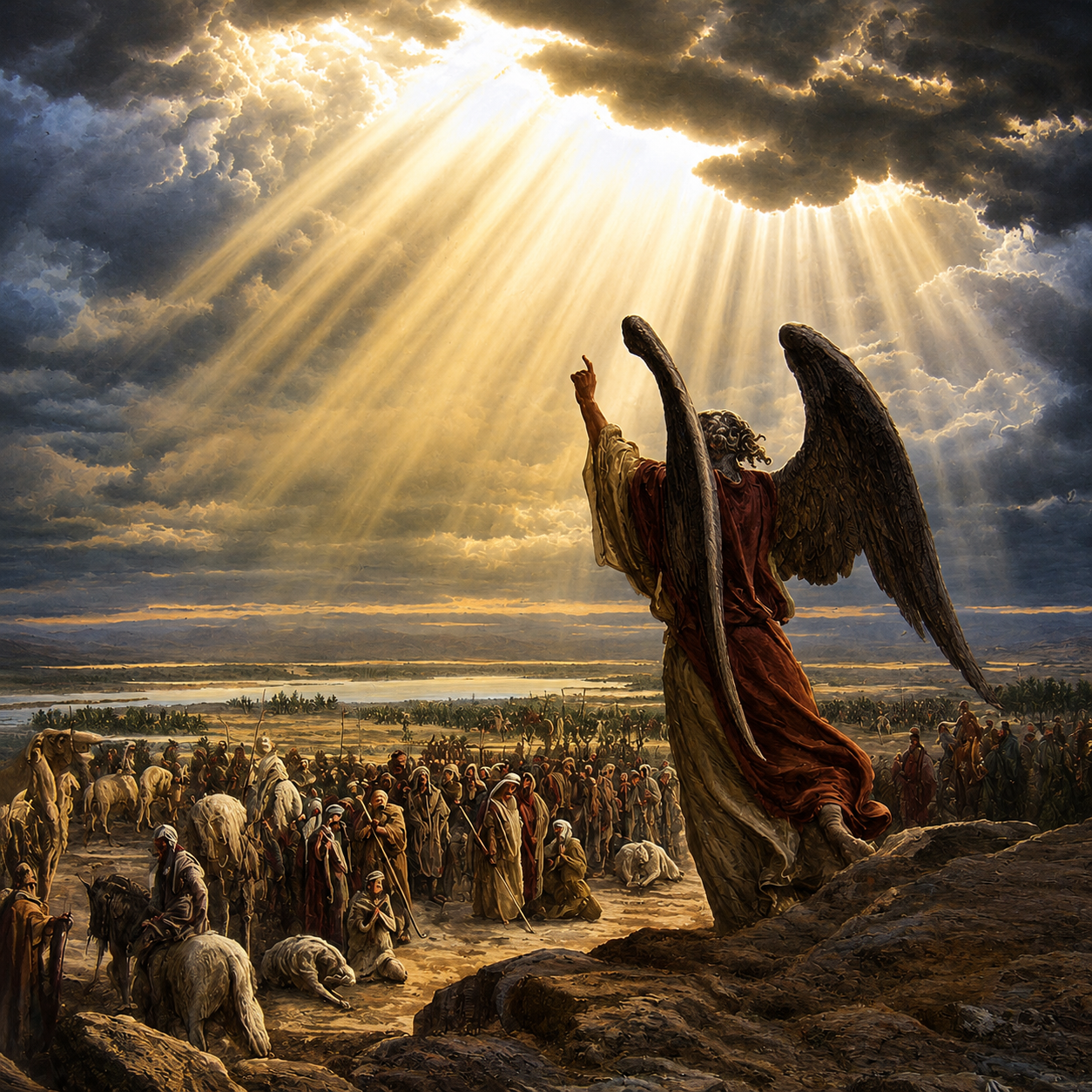
Angel of the LORD
Gustave Dore Woodcut
CAVEAT -The picture above is a colorized version of Gustave Doré's woodcut. While it is certainly a striking depiction, one must question whether it accurately represents the pre-incarnate Christ. It is difficult to imagine Christ appearing with the wings commonly associated with angels in religious art. In fact, Scripture never describes the Angel of the LORD as having wings. Remember that the Hebrew malak simply means “messenger” and does not necessarily describe a created angelic being. Always be cautious about getting your theology from artistic depictions of Biblical events. Let Scripture interpret the picture, rather than allowing the picture to interpret Scripture! Biblical art may stimulate our imagination, but only Biblical truth should shape our theology!
Although not all scholars agree, the following brief Scriptural survey would support the premise that the Angel of the LORD is (1) supernatural, (2) is God (3) and is not a created angel. The determination of which member of the Trinity the Angel represents is less clear but most conservative, evangelical sources interpret the Angel of the LORD as the the second member of the Trinity, representing a pre-incarnate manifestation of the Lord Jesus Christ.
Angel in both Hebrew (malak) and Greek (aggelos or angelos) means a messenger and Jesus as the Word of God (Jn 1:1; Re 19:13) is the ultimate Messenger sent from the Father with a message of the good news of God's covenant love for sinful mankind...
Therefore, holy brethren, partakers of a heavenly calling, consider Jesus, the Apostle (apostéllo = send from apo = from + stello = send) and High Priest of our confession. (He 3:1) (An apostle is defined as one sent out on a mission or orders or commission and with the authority of the one who sent him)
Related Resource:
- See excellent article by C. Goodspeed - The Angel of Jehovah Bibliotheca Sacra 36 No. 144 (1879): 593-615
In Malachi Jehovah Sabaoth, the LORD of hosts promised...
Behold, I am going to send My messenger (Hebrew = malak = one sent on business or diplomacy by another; LXX = aggelos/angelos one sent to tell or bring a message, to announce or proclaim = transliterated "angel" and in context referring to John the Baptist, as affirmed by Jesus Himself in Lk 7:27) and he (John the Baptist) will clear the way before Me (the LORD of hosts) and the Lord (Hebrew = adon, LXX = referring in context to the Messiah), Whom you seek, will suddenly (Hebrew = pitom = unexpectedly, surprisingly, all of a sudden - somewhat an ironic word here because the Jews should have known the day of His visitation according to Lk 19:44), which they could have known by studying Da 9:24, 25, 26, 27 {see notes Da 9:24; 25; 26; 9:27}) come to His temple and the MESSENGER OF THE COVENANT, (Malak = "Angel"; and thus the "Angel of the Covenant") in Whom you delight, behold, He is coming," says the LORD of hosts. (Malachi 3:1-see commentary)
John F. Walvoord, highly respected for his exposition of the prophetic sections of the Scriptures and former president of Dallas Theological Seminary, lists four arguments supporting the conclusion that the appearances of the Angel of Jehovah represent "Christophanies" or visible appearances of our Lord Jesus Christ prior to His incarnation
(1) The Second Person is the Visible God of the New Testament.
(2) The Angel of Jehovah of the Old Testament no longer appears after the incarnation of Christ. (Ed note: but see comments below)
(3) Both the Angel of Jehovah and Christ are sent by the Father.
(4) The Angel of Jehovah could not be either the Father or the Holy Spirit for the Father and the Spirit are invisible to man.
Dr. Walvoord concludes that
there is not a single valid reason to deny that the Angel of Jehovah is the Second Person, every known fact pointing to His identification as the Christ of the New Testament. (See Dr Walvoord's article Part 2: The Preincarnate Son of God from his Series in Christology)
I strongly encourage you to perform your own Inductive Study of the passages that follow, reading and observing them in context, interrogating the passages (and especially the occurrences of the phrase "Angel of the LORD") with the 5W's & H questions so that you might arrive at an accurate interpretation. Then you will also be better able to assess the accuracy of these notes on the Angel of the LORD. As you go through the references, note that the Angel often manifests Himself that He might address specific needs or accomplish special tasks. In so doing you will appreciate that this topic is not only theologically intriguing but is also imminently practical in our everyday life.
This is Only a sampling of the 60+ OT allusions - see complete list
Michael Rydelnik - Throughout the OT, the Son of God appears (usually in the form of a man) in various situations that are not connected to his future role as Christ. These pre-incarnational appearances of the Son, otherwise termed “theophanies” (meaning “appearances of God”), or more precisely “Christophanies” (i.e., “appearances of the Christ”), are of great significance. That the many appearances of God throughout the OT are indeed always appearances of the Son is made clear by John’s pointed statement at the beginning of his gospel (Jn 1:18), that “no one has seen God at any time; the only begotten God who is in the bosom of the Father, He has explained Him.” John’s point is that the triune God is made known to man—whether in the past, present, or future—always and only by the manifestation of the Son. (The Moody Bible Commentary)
The first encounter with the Angel of the LORD is found in Ge 16:6, 7, 8, 9, 0, 11, 12, 13, 14, 15, 16 (click to read the Scripture in context remembering that context is "king" in interpretation) where we learn that this Angel is God and that He appears at a time of great distress to fulfill the need (cp Php 4:11, 12, 13-notes).
In Genesis 16:10, the Angel of the LORD promised to multiply Hagar's descendents, which is something that only God could promise and fulfill (cf similar promise given to Abram in Gen 13:16 Ge 15:5).
Genesis 16:10 Moreover, the Angel of the LORD said to her, "I will greatly multiply your descendants so that they will be too many to count."
When the Angel appeared to Hagar, she acknowledged that she was in the presence of God, referring to the Angel of the LORD as El Roi, (el = God; ) the-God-Who-Sees (cf Ge 15:3, omniscience).
Genesis 16:11 The ANGEL of the LORD said to her further, "Behold, you are with child, and you will bear a son; and you shall call his name Ishmael, because the LORD has given heed to your affliction.... 13 Then she called the Name of the LORD Who spoke to her "You are a God Who sees" (El Roi) for she said, "Have I even remained alive here after seeing Him?"
The Angel of the LORD appeared a second time to Hagar ("stranger") after being expelled for a second (and final) time by Abraham at a time of severe distress and great need (in the wilderness and out of water). Moses records
Genesis 21:17 God heard the lad crying (Ishmael = "God hears") and the ANGEL OF GOD called to Hagar from heaven and said to her, "What is the matter with you, Hagar? DO NOT FEAR, for God has heard the voice of the lad where he is. (Related Resource: Fear, How to Handle It)
Note the fascinating play on Ishmael's name, "God will hear" and twice in this verse this fact is stated "God heard" and "God has heard".
David Guzik explains that "As Hagar escaped this difficult situation the Angel of the Lord (here, the pre-incarnate presence of Jesus) met her by a spring of water in the wilderness. We can assume that this was God, in the Person of Jesus Christ, appearing to Abraham before His incarnation and birth at Bethlehem. We assume this because of God the Father it says, "No one has seen God at any time. The only begotten Son, who is in the bosom of the Father, He has declared Him" (John 1:18), and no man has ever seen God in the Person of the Father (1Timothy 6:16). Therefore, if God appeared to someone in human appearance in the Old Testament (and no one has seen God the Father) it makes sense the appearance is of the eternal Son, the Second Person of the Trinity, before His incarnation in Bethlehem. (David Guzik. The Enduring Word Commentary Series)
John MacArthur comments on the Angel of the LORD noting that "This special individual spoke as though He were distinct from Yahweh, yet also spoke in the first person as though He were indeed to be identified as Yahweh Himself, with Hagar recognizing that in seeing this Angel, she had seen God (v. 13). Others had the same experience and came to the same conclusion (cf. Ge 22:11-8; Ge 31:11, 12, 13; Ex 3:2-5; Nu 22:22-35; Jdg 6:11-23+; Jdg 13:2-5; 1Ki 19:5, 6, 7). The Angel of the Lord, who does not appear after the birth of Christ, is often identified as the pre-incarnate Christ (Ed note: NT verses with phrase "angel of the Lord" appear but none are equated with Divinity as is the Angel in this OT passage and those surveyed below). (MacArthur, J.: The MacArthur Study Bible Nashville: Word)
Warren Wiersbe - This is the first appearance in Scripture of the Angel of the Lord, who is generally identified as our Lord Jesus Christ. In Genesis 16:10, the angel promised to do what only God can do; and in Genesis 16:13, Hagar called the angel “God.” These pre-Incarnation visits of Jesus Christ to the earth were to meet special needs and to accomplish special tasks. The fact that the Son of God took on a temporary body, left heaven, and came down to help a rejected servant-girl surely reveals His grace and love. His servants Abraham and Sarah had sinned against the Lord and against Hagar, but the Lord did not desert them. (Wiersbe, W. W. Be Obedient. Wheaton, Ill.: Victor Books)
John Gill - This is the first time that mention is made of an angel in Scripture, but is not to be understood of a created angel, but of a divine Person, as appears from Genesis 16:10 ("I will greatly multiply your descendants so that they shall be too many to count" = essentially the same covenant promise Jehovah gave to Abraham in Genesis 22:17), the uncreated angel, the Logos or Son of God, called the Angel of God's presence, and the Angel of the covenant, Isa 63:9, Mal 3:1; who often appeared in an human form before his incarnation, being sent by his divine Father on one account or another; and hence called an angel, a messenger, or one sent, as in the fulness of time he was sent in human nature to be the Redeemer of his people; though many of the Jewish writers take this angel to be a man sent of God. Gersom {n} says he was one of the prophets that lived in those times, and observes, that some of their Rabbins say {o} he was Shem, the son of Noah; and Maimonides {p} suggests, that this angel was but a mere man, by comparing this passage with that in Ge 37:15, "a certain man found him", &c. but the context most clearly confutes this notion, and proves him to be the almighty and omniscient God; since he promises to do what none but the omnipotent Being could do, and declares such things as none but the omniscient God could know: and when it is said he "found Hagar", it is not to be understood as if it was a chance matter, or the fruit and effect of search and inquiry, or as if he had not seen her before; but rather it shows that his eye was upon her, and he had a concern for her, and at a proper time and place appeared to her at once, and unawares, and unthought of by her. And the place where he found her was (Gill, J. Exposition of the Entire Bible)
Wenham in his commentary note on Genesis 16:7 writes that "The Angel of the Lord is mentioned 58 times in the OT, “the angel of God” 11 times. Angels of the Lord appear either singly as here or in groups. When first seen, they are usually taken to be men, but by the end of the encounter one of them is realized to be God (Genesis18:2, 22; Jdg 6:11, 12, 13, 14, 15, 16, 17, 18, 19, 20, 21, 22; 13:3-22). When, as here, the text simply speaks of a single Angel of the Lord, this must be understood as God himself appearing in human form, a nearly always to bring good news or salvation. The Angel of the Lord appears frequently in Genesis and in the Book of Judges but rarely in the literature dealing with later periods. The exact relationship between the Angel and God himself has been the subject of much inconclusive discussion. The (Early Church) Fathers identified him with the Logos. ...Within Genesis, the angel of the Lord tends to appear at moments of dire personal crisis (cf. Ge 21:17; 22:11, 15). (Wenham, G. J. Vol. 2: Word Biblical Commentary : Genesis 16-50. Word Biblical Commentary. Dallas: Word)
Speaking to Abraham on Mt Moriah, the Angel unequivocally identifies Himself as the LORD (YHWH or Jehovah - see study Jehovah = Jesus).
Genesis 22:10-16 (Abraham in obedience to the LORD's command had taken Isaac, his only son, whom he loved to the land of Moriah to offer him as a burnt offering on Mt Moriah, the site of Solomon's Temple and the same area where the Lamb of God was crucified. In an incredible act of faith Abraham obeyed...) And Abraham stretched out his hand, and took the knife to slay his son. But the Angel of the LORD called to him from heaven, and said, “Abraham, Abraham!” And he said, “Here I am.” And he said, “Do not stretch out your hand against the lad, and do nothing to him; for now I know that you fear God, since you have not withheld your son, your only son, from Me. Then Abraham raised his eyes and looked, and behold, behind him a ram caught in the thicket by his horns; and Abraham went and took the ram, and offered him up for a burnt offering in the place of his son. And Abraham called the name of that place The Lord Will Provide (see study of Jehovah Jireh), as it is said to this day, “In the mount of the Lord it will be provided. Then the Angel of the LORD called to Abraham a second time from heaven and said "By Myself I have sworn, declares the LORD, because you have done this thing & have not withheld your son, your only son"
In the following two stories in Jacob's life compare the God of Bethel with the Angel of God.
John Gill writes that the Angel in Genesis 22 is "Not a created angel, but the eternal one, the Son of God, Who perhaps appeared in an human form, and spoke with an articulate voice, as He frequently did; for that this was a divine Person is clear from his swearing by Himself, and renewing the promise unto Abraham (Ge 22:17,18 "indeed I will greatly bless you, and I will greatly multiply your seed as the stars of the heavens, and as the sand which is on the seashore; and your seed shall possess the gate of their enemies.18 And in your seed all the nations of the earth shall be blessed, because you have obeyed My voice.") , (Gill, J. Exposition of the Entire Bible)
Genesis 28:12-22 And he had a dream, and behold, a ladder was set on the earth with its top reaching to heaven; and behold, the angels of God were ascending and descending on it.13 And behold, the LORD stood above it and said, "I am the LORD, the God of your father Abraham and the God of Isaac; the land on which you lie, I will give it to you and to your descendants. (reaffirming the Abrahamic Covenant) 14 "Your descendants shall also be like the dust of the earth, and you shall spread out to the west and to the east and to the north and to the south; and in you and in your descendants shall all the families of the earth be blessed.15 "And behold, I am with you, and will keep you wherever you go, and will bring you back to this land; for I will not leave you until I have done what I have promised you."
16 Then Jacob awoke from his sleep and said, "Surely the LORD is in this place, and I did not know it."17 And he was afraid and said, "How awesome is this place! This is none other than the house of God, and this is the gate of heaven."
18 So Jacob rose early in the morning, and took the stone that he had put under his head and set it up as a pillar, and poured oil on its top. 19 And he called the name of that place Bethel; (means "the house of God") however, previously the name of the city had been Luz. 20 Then Jacob made a vow, saying, "If God will be with me and will keep me on this journey that I take, and will give me food to eat and garments to wear, 21 and I return to my father's house in safety, then the LORD will be my God. 22 "And this stone, which I have set up as a pillar, will be God's house; and of all that Thou dost give me I will surely give a tenth to Thee."
Genesis 31:11-13 Then the Angel of God said to me in the dream, 'Jacob,' and I said, 'Here I am.' He said, 'Lift up now your eyes and see that all the male goats which are mating are striped, speckled, and mottled; for I have seen all that Laban has been doing to you. 'I am the God of Bethel, where you anointed a pillar, where you made a vow to Me; now arise, leave this land, and return to the land of your birth.'
In Genesis 31, the Angel of God calls Himself the God of Bethel which would imply that they are one and the same Person. The Angel of God is the same as the Angel of the LORD and clearly identified Himself as the LORD, pointing back as He did so to the earlier critical encounter with God in Jacob’s life (Genesis 28:12, 13, 14, 15, 16, 17, 18, 19, 20, 21, 22).
Jacob before he dies, in giving a blessing to Joseph, uses the names “God” and “the Angel” interchangeably. In addition he identifies the "Angel" as the One Who has redeemed him from all evil, a transaction that would not be plausible for a created angel.
Genesis 48:15 He blessed Joseph, and said, "The God before Whom my fathers Abraham and Isaac walked. The God Who has been my shepherd (Hebrew verb means to care for, protect, graze and to feed flocks) all my life to this day. 16 (Jacob continues describing "God") The Angel Who has redeemed (Goel [word study] Hebrew = ga'al which is a verb meaning to redeem, the first use in the OT. Ga'al {Goel} means to act as one's kinsman-redeemer, to be a savior. The LXX translates ga'al with the Greek verb rhuomai - see word study; see also use of rhuomai to describe deliverance by Jesus in study on 1Th 1:10); me from all evil. Bless the lads and may my name live on in them, and the names of my fathers Abraham and Isaac and may they grow into a multitude in the midst of the earth. (Comment: Ro 11:26-See notes on Ro 11:26 for more on rhuomai describing Israel's Deliverer.)
The Amplified Version renders Genesis 48:16 as follows...
The redeeming** Angel [that is, the Angel the Redeemer—not a created being but the Lord Himself] Who has redeemed me continually from every evil, bless the lads! And let my name be perpetuated in them [may they be worthy of having their names coupled with mine], and the names of my fathers Abraham and Isaac; and let them become a multitude in the midst of the earth." (Comment: **Footnote in Amplified = "The “Angel of the Lord” is here identified as Christ Himself.")
In his commentary Adam Clarke writes that in this verse
we have full proof that this was no created angel, but the Messenger of the Divine Council, the Lord Jesus Christ. Who then was the angel that redeemed Jacob, and Whom he invoked to bless Ephraim and Manasseh? Is it not Jesus? He alone can be called Goel (Hebrew word for "redeemed" is ga'al =Goel [word study]), the redeeming Kinsman; for He alone took part of our flesh and blood that the right of redemption might be His; and that the forfeited possession of the favour and image of God might be redeemed, brought back, and restored to all those who believe in His name. To have invoked any other angel or messenger in such a business would have been impiety. Angels bless not; to God Alone this prerogative belongs. With what confidence may a truly religious father use these words in behalf of his children: "Jesus, the Christ, Who hath redeemed me, bless the lads, redeem them also, and save them unto eternal life!" (Clarke, A.. Clarke's Commentary: Genesis)
John MacArthur echoes Clarke's comments noting that
This is the first mention of God as Redeemer, Deliverer, or Savior. (The MacArthur Study Bible. Nashville: Word Pub)
Henry Morris comments on Genesis 48:16 adding that...
the word “redeem” (Hebrew goel) is used here for the first time in the Bible, and it is significant that it occurs as a description of the work of the great Angel of Jehovah, none other than the preincarnate Christ. The God of his fathers had surely provided for Jacob and protected him marvelously through the years, just as He had promised when He first spoke to him (Genesis 28:15); and Jacob knew he could call on Him in faith to bless his sons, specifically those two on whose heads his hands rested, in the same ways. He then prayed especially that God would let “my name be named on them” that is, Jacob’s character, for which his name stood and also let them “grow into a multitude” in the midst of the land. (Henry Morris. Genesis Record)
At the burning bush, it was the “Angel of the Lord” Who appeared and Who called to him from the midst of the bush, Moses “hid his face, for he was afraid to look upon God”.
Exodus 3:2, 3, 4, 5, 6 And the Angel of the LORD appeared to him in a blazing fire from the midst of a bush; and he looked, and behold, the bush was burning with fire, yet the bush was not consumed...4 When the LORD saw that he turned aside to look, God called to him from the midst of the bush & said, "Moses, Moses !" And he said, "Here I am." 5 Then He (the Angel of the LORD) said, "Do not come near here; remove your sandals from your feet, for the place on which you are standing is holy ground. 6 He said also, "I Am the God of your father, the God of Abraham, the God of Isaac, and the God of Jacob." (an allusion to God's covenant first with Abram and passed on to and through Isaac and Jacob - see Abrahamic Covenant) Then Moses hid his face, for he was afraid to look at God (the Angel of the LORD)
MacArthur comments that the Angel of the LORD is literally...
“messenger of Yahweh” who, in context, turns out to be the Lord Himself talking to Moses (cf. Acts 7:30 Stephen's Sermon comments this OT event). (MacArthur, J.: The MacArthur Study Bible Nashville: Word)
The LORD Who went before Israel in a pillar of cloud (Click here for note on the Shekinah glory cloud of the LORD) was none other than the Angel of God
Ex 13:21 The LORD was going before them in a pillar of cloud by day to lead them on the way, and in a pillar of fire by night to give them light, that they might travel by day and by night.
Ex 14:19 The Angel of God, Who had been going before the camp of Israel, moved and went behind them; and the pillar of cloud moved from before them and stood behind them. (Ex 14:19-see note)
So comparing Scripture with Scripture (the best commentary on Scripture is Scripture), we can interpret the Angel of God is "the LORD".
In the introductory section of Judges we meet the Angel of the Lord in chapter 2
Now the angel of the LORD came up from Gilgal to Bochim. And he said, "I brought you up out of Egypt and led you into the land which I have sworn to your fathers; and I said, 'I will never break My covenant with you, 2 and as for you, you shall make no covenant with the inhabitants of this land; you shall tear down their altars.' But you have not obeyed Me; what is this you have done? (Jdg 2:1,2-notes)
Clearly a literal interpretation of this passage identifies the Angel of Jehovah with the One Who made a covenant with Israel. A created angel is never recorded as cutting a covenant, leaving no doubt that this Angel is no ordinary created angel but is the Lord Himself.
Warren Wiersbe - In the Old Testament, the “angel of the Lord” is generally interpreted to be the Lord Himself, who occasionally came to earth (a theophany) to deliver an important message. It was probably the Lord Jesus Christ, the second Person of the Godhead, in a temporary pre-incarnation appearance. (See Ge 16:9; 22:11; 48:16; Ex 3:2; Jdg 6:11, 13:3; 2Ki 19:35.) The fact that God Himself came to give the message shows how serious things had become in Israel. (Wiersbe, W. W. Be Available. An Old testament Study. Wheaton, IL: Victor Books)
The New Bible Commentary writes that "The angel of the Lord is ‘the Lord’ himself in the form of an angel (Carson, D. A. New Bible Commentary : 21st Century Edition. Inter-Varsity Press)
Moore - The Messenger of Yahweh not a prophet, but, as always in Judges, Yahweh Himself as He appears to men in human form or otherwise sensibly manifests His presence; (Moore, G. F. A Critical and Exegetical Commentary on Judges. New York: C. Scribner's sons. 1910)
Even older commentators like John Wesley acknowledge the fact that this Angel was God, Wesley writing that "Christ the Angel of the covenant, often called the Angel of the Lord, to Whom the conduct of Israel out of Egypt into Canaan, is frequently ascribed. He alone could speak the following words in His own name and person; whereas created angels and prophets universally usher in their message with, Thus saith the Lord, or some equivalent expression. And this angel having assumed the shape of a man, it is not strange that He imitates the motion of a man, and comes as it were from Gilgal to the place where now they were: by which motion He signified, that He was the Person that brought them to Gilgal, the first place where they rested in Canaan, and there protected them so long, and from thence went with them to battle, and gave them success. (Wesley, J. Wesley's Notes: Judges).
John Gill writes the following note regarding the Angel of the LORD - "The Targum calls him a prophet and the Jewish commentators in general interpret it of Phinehas and that a man is meant is given into by others, because he is said to come from a certain place in Canaan, and not from heaven, and spoke in a public congregation, and is not said to disappear; but neither a man nor a created angel is meant, or otherwise he would have spoken in the name of the Lord, and have said, "thus saith the Lord", and not in his own name; ascribing to himself the bringing of the children of Israel out of Egypt, and swearing to them, and making a covenant with them, and threatening what he would do to them because of their sin; wherefore the uncreated Angel, the Angel of the covenant, is meant, who brought Israel out of Egypt, was with them in the wilderness, and introduced them into the land of Canaan, and appeared to Joshua as the Captain of the Lord's host at or near Gilgal, Joshua 5:13 (Gill, J. Exposition of the Entire Bible)
Matthew Henry comments "This extraordinary messenger was sent to command, if possible, the greater regard to the message, and to affect the minds of a people whom nothing seemed to affect but what was sensible. The learned bishop Patrick is clearly of opinion that this was not a created angel, but the Angel of the covenant, the same that appeared to Joshua as Captain of the hosts of the Lord, who was God himself. Christ himself, says Dr. Lightfoot; who but God and Christ could say, I made you to go up out of Egypt? Joshua had lately admonished them to take heed of entangling themselves with the Canaanites, but they regarded not the words of a dying man; the same warning therefore is here brought them by the living God himself, the Son of God appearing as an angel. If they slight his servants, surely they will reverence his Son...It was the great Angel of the covenant, the Word, the Son of God, who spake with Divine authority as Jehovah, and now called them to account for their disobedience. God sets forth what he had done for Israel, and what he had promised.
Keil and Delitzsch write that "The “angel of Jehovah” is not a prophet, or some other earthly messenger of Jehovah, either Phinehas or Joshua, as the Targums, the Rabbins, Bertheau, and others assume, but the angel of the Lord who is of one essence with God. In the simple historical narrative a prophet is never called Maleach (malak) Jehovah. The prophets are always called either נָבִיא or אִישׁ נָבִיא, as in Judges 6:8, or else “man of God,” as in 1Ki 12:22; 13:1, etc.; and Hag. 1:13 and Mal. 3:1 cannot be adduced as proofs to the contrary, because in both these passages the purely appellative meaning of the word Maleach (malak) is established beyond all question by the context itself. Moreover, no prophet ever identifies himself so entirely with God as the angel of Jehovah does here. The prophets always distinguish between themselves and Jehovah, by introducing their words with the declaration “thus saith Jehovah,” as the prophet mentioned in Judges 6:8 is said to have done. (Keil, C. F., & Delitzsch, F. Commentary on the Old Testament. Peabody, MA: Hendrickson)
In the book of Judges, Gideon became fearful that he would die because he had seen the Angel of the LORD, Whom he equated with the Lord God (see Ex 33:20).
When Gideon saw that he was the Angel of the LORD, he said, "Alas, O Lord GOD ! For now I have seen the Angel of the LORD face to face." 23 The LORD said to him, "Peace to you, do not fear (see How to Handle Fear) you shall not die." 24 Then Gideon built an altar there to the LORD and named it The LORD is Peace (which means Jehovah Shalom). To this day it is still in Ophrah of the Abiezrites. (Jdg 6:22, 23,24-see notes Jdg 6:22-24)
So here we observe the Angel of the LORD speaking Peace and being memorialized with an altar named the LORD is peace.
John MacArthur adds that "In the realization of the presence of God, the sensitive sinner is conscious of great guilt. Fire from God further filled Gideon with awe and even the fear of death. When he saw the Lord, he knew the Lord had also seen him in his fallenness. Thus he feared the death that sinners should die before Holy God. But God graciously promised life." (MacArthur, J.: The MacArthur Study Bible Nashville: Word)
John Gill "This was not the prophet before mentioned, as Ben Gersom thinks, but an Angel of God, as expressed, and not a created one, but the Angel of Jehovah's presence, the Word and Son of God, and Who is expressly called Jehovah Himself (Gill, J. Exposition of the Entire Bible)
Warren Wiersbe - "For a man with a worried heart, The-Lord-Is-Peace was just what he needed. You can enjoy God’s peace today as you fight the battle (Php 4:6, 7, 8, 9, 10-see notes on Php 4:6-7 4:8-10). (With the Word: Chapter-by-Chapter Bible Handbook)
But the ANGEL of the LORD said to him, "Why do you ask my Name seeing it is Wonderful (Hebrew = piliy or pilay = incomprehensible, fantastic, beyond understanding, marvelous, only used one other time Ps 139:6; LXX = thaumastos = that which causes or is worthy of amazement and wonder used in LXX in Ex 15:11 as to describe God and His work)?" (Jdg 13:18-see note Jdg 13:18)
Manoah and his wife fell on their faces—an act that would have been improper if the Angel were less than God (cf John's prostration before angels - Re 19:10, 22:8, 9-see notes Revelation 19:10 22:8; 22:9). They felt they would die for in seeing the Angel they had "seen God." (see Ex 33:20).
For it came about when the flame went up from the altar toward heaven, that the ANGEL of the LORD ascended in the flame of the altar. When Manoah and his wife saw this, they fell on their faces to the ground. 21 Now the ANGEL of the LORD did not appear to Manoah or his wife again. Then Manoah knew that he was the ANGEL of the LORD. 22 So Manoah said to his wife, "We will surely die, for we have seen God. (Jdg 13:20, 21, 22-see notes Jdg 13:20-22)
Again in the spiritually dark days of the book of Judges ("In those days there was no king in Israel; everyone did what was right in his own eyes." see Jdg 21:25- notes) we encounter a glorious appearance of the Angel of the Lord who announced Samson's birth to his father, Manoah, and referred to Himself as Wonderful (in Hebrew thought the name often reveals the nature), which is one of the names of God (Isaiah 9:6, although here "wonderful" is not the same Hebrew word) (See God's Attribute Incomprehensible)
Psalm 34:7 is one of three mentions of angel of the LORD in the Psalms (Ps34:7; 35:5; 35:6). This verse pictures a battlefield scene, in which the angel of the Lord makes his camp around the faithful and delivers them. The word deliver means to snatch or tear away, to rescue. Let the truth that special providence watches over the chosen cheer and comfort you. God not only rescued David from his enemies but also from his “fears, “from being “ashamed,” and from “troubles” (read all of Psalm 34) Is He not able to deliver you also beloved? And so David records...
The angel of the LORD encamps (Hebrew = pitch a tent, set up camp) around (LXX = forms a circle around = on all sides) those who fear (live with a sense of reverential awe of, LXX = has this verb in present tense = speaks of a lifestyle or habitual practice) Him, and rescues (Hebrew = halas = draws out, deliver from danger; LXX = rhuomai - see word study = draw or snatch to oneself, invariably from danger, evil or an enemy) them. (Psalm 34:7)
C H Spurgeon comments that the angel of the Lord in Psalm 34:7 is the
covenant angel, the Lord Jesus, at the head of all the bands of heaven, surrounds with his army the dwellings of the saints. Encampeth round about them that fear him. On every side the watch is kept by warriors of sleepless eyes, and the Captain of the host is one whose prowess none can resist. And delivereth them. We little know how many providential deliverances we owe to those unseen hands which are charged to bear us up lest we dash our foot against a stone. (Spurgeon The Treasury of David)
In Surgeon's devotional, Faith's Checkbook, he writes on (Psalm 34:7) that
We cannot see the angels, but it is enough that they can see us. There is one great Angel of the Covenant Whom, not having seen, we love; and His eye is always upon us both day and night. He has a host of holy ones under Him, and He causes these to be watchers over His saints and to guard them from all ill. If devils do us mischief, shining ones do us service. Note that the Lord of angels does not come and go, and pay us transient visits, but He and His armies encamp around us. The headquarters of the army of salvation are where those live whose trust is in the living God. This camp surrounds the faithful, so that they cannot be attacked from any quarter unless the adversary can break through the entrenchments of the Lord of angels. We have a fixed protection, a permanent watch. Sentineled by the messengers of God, we shall not be surprised by sudden assaults, nor swallowed up by overwhelming forces. Deliverance is promised in this verse, deliverance by the great Captain of our salvation (allusion to another Theophany, probably a Christophany, to Joshua before the battle of Jericho in Joshua 5:14, 15 slowly wiggle pointer over link to keep open). That deliverance we shall obtain again and again until our warfare is accomplished and we exchange the field of conflict for the home of rest.
John Gill, although agreeing with Spurgeon, et al, does offer an alternative possible interpretation of this Psalm. Although the context (especially the immediate surrounding verses) as well as the use of the word "rescue", tends to support that this "angel" is the LORD, is would be difficult to be too dogmatic in stating that the "angel" is the Lord Jesus Christ. Gill writes...
By whom may be meant, either the uncreated Angel, the Lord Jesus Christ, the Angel of God's presence, and of the covenant, the Captain of salvation, the Leader and Commander of the people; and whose salvation is as walls and bulwarks about them, or as an army surrounding them; or a created angel may be intended, even a single one, which is sufficient to guard a multitude of saints, since one could destroy at once such a vast number of enemies, as in 2Ki 19:35 (although I believe this passage in 2Kings is more likely the LORD than a created angel) or one may be put for more, since they are an innumerable company that are on the side of the Lord's people, and to whom they are joined; and these may be said to encamp about them, because they are an host or army; and are the guardians of the saints, that stand up for them and protect them, as well as minister to them.
The Angel of His presence is a synonym of the Angel of the Lord, Isaiah recording that...
In all their affliction He was afflicted, and the Angel of His presence saved them; In His love and in His mercy He redeemed them; And He lifted them and carried them all the days of old. (Isaiah 63:9)
The Hebrew word for presence is literally face, which pictures the entire Person. This same Hebrew word is used in a parallel passage, Exodus 33:14, 15, in which the LORD encourage Moses promising him that "
My presence shall go with you, and I will give you rest." to which Moses responds [as should we all] "If Thy presence does not go with us, do not lead us up from here."
Morris commenting on Isaiah 63:9 writes that "Christ, in a pre-incarnate theophany, was suffering with, and for, His people even prior to His incarnation. (Morris, Henry)
MacDonald writes that in Isaiah 63:9 - The Angel is the Messenger of His Presence, that is, the Messiah, (Who) saved them. (Believer's Bible Commentary)
J Vernon McGee commenting on Isaiah 63:9 writes "How tender are these words. I believe that the angel of the Lord is none other than the pre-incarnate Christ. We are told that in His love and pity He redeemed and carried them. He entered into the sufferings of His people." (Thru the Bible commentary)
Guzik - angel of His presence refers to the presence and work of Jesus among ancient Israel, especially among those delivered from Egypt.
Bultema - “The angel of His presence is the Messiah...Calvin sees in this angel merely a serving angel. But of this Angel it is said that He by His love and pity saved Israel; this can hardly be said of a created angel. It is the Christ who is meant here.”
Motyer - “Angel of his presence: literally ‘of his face’. We recognize people by face; ‘face’ is the Lord’s very one presence (Psalm 139:7), among them in the person of his angel - that unique ‘Angel of the Lord’ (as in Genesis 16:7ff; 21:17; 22:11, 15; Exodus 3:2; 14:19; 23:20-23; Malachi 3:1) who speaks as the Lord and is yet distinct from him.”
Ian Paisley - The Angel of the Covenant and the Angel of His Presence are wondrous titles of our wonderful Lord. Angel means messenger—the Messenger of God's presence is Himself. He came to where we were and saved us. How stupendous Christ's compassion! (A Text A Day)
The Angel of His Presence
Doth lead God's children on,
Till, through His loving guidance,
We stand before His throne.
God not impassive - In all their affliction He was afflicted
Just as a man may feel pain, whilst in his own person he is raised above it, so God feels pain without His blessedness suffering hurt; and so He felt His people’s suffering; it did not remain unreflected in His own life; it moved Him inwardly. (F. Delitzsch, D. D.)
“The Angel of His presence”
1. The “Presence” (lit. “Face”) of Jehovah is used elsewhere of His self-manifestation. The fundamental passage is Ex 33:14-15. But compare also De 4:37; Lam 4:16.
2. An “angel of the Presence,” on the other hand, is a figure elsewhere unknown to the Old Testament: the phrase would seem to be “a confusion of two forms of expression, incident to a midway stage of revelation” (Cheyne).
3. The “Face” of Jehovah, however, is not (as the LXX inferred) just the same as Jehovah Himself in person. It is rather a name for His highest sensible manifestation, and hardly differs from what is in other places called the Mal’ak Yahveh (Angel of Jehovah). This is shown by the comparison Ex 33:14 f with Ex 23:20-23. The verse, therefore, means that it was no ordinary angelic messenger, but the supreme embodiment of Jehovah’s presence that accompanied Israel in the early days. (Prof. J. Skinner, D. D.)
The Angel in whom Jehovah was seen; who was Jehovah Himself in manifestation. (A. B. Davidson, D. D.)
Not some one of the “ministering spirits,” nor some one of the angel-princes standing in God’s immediate presence (archangels), but the one whom God makes the medium of His presence in the world for affecting the revelation of Himself in sacred history. (F. Delitzsch, D. D.)
The Angel of His presence
The great majority of men dread affliction more than they dread sin. And yet the two things are related--sometimes as cause and effect and sometimes by more distant connections.
I. AFFLICTIONS MAY BE DIVIDED INTO THREE CLASSES--the physical, the mental, and the emotional. Not that we can ever totally separate these three, but for purposes of consideration it may be practicable to do so.
1. It is very hard to resist a plea from physical disability. It is well that it should be so, for callous indifference to the causes of sorrow and pain found in the lives of others is surely a most unpromising state. Anything which will draw us out of ourselves, and keep us from being self-contained, must surely be, in some sort, a servant of God. Our Lord recognized the physical afflictions of men and entered sympathetically into them.
2. But physical afflictions, though more impressive, are oftentimes more endurable than mental afflictions. Indeed, when we come to the last analysis of the case, we find that the mental region is the region where pain reports itself. If we could totally separate the physical and mental, and keep the mind clear and calm while the body suffered its pains and penalties, affliction would be a very different matter from what it now is. Only that then physical affliction would lose its meaning and purpose, for everything physical is for the sake of the mental. But there are mental sufferings which do not report themselves in physical manifestations. The mind is often so tried with doubt and debate--so cast down by its own inability and decrepitude--that it is in a constant state of unrest, and no report thereof is made in the physical frame--no report anyway of such a nature that all can read it.
3. But back of the intellectual department of the mind is that other profounder realm covered by the word “emotional.” This emotional region is the strangest and strongest of all. It is the realm of love, of joy, of peace--or of hatred, joylessness, discord. Without our emotions we should be not men and women, but stones, or at best animals. Our emotions gather around persons, places, objects, and these become to us of such transcendent worth that all the world seems poor in comparison with them.
II. When we think of these things, HOW WONDROUS, HOW TERRIBLE DOES THIS NATURE OF OURS SEEM! We become afraid of ourselves. To be owners of ourselves seems too great a responsibility. Does it not seem to us that the Creator, in giving us this nature, has taken upon Himself a responsibility so great and so fearful that none but Himself could bear it? We ask ourselves, in amazement, what must His own nature be?
III. Is not this the revelation made by the prophet, that WE ARE NOT ALONE IN OUR AFFLICTIONS.
IV. As it was with the Israelites, so is it with all the Spiritual Israel; for they and we are not unlike.
“In all their affliction He was afflicted.
” He! Who? The Deliverer.
The One who identified Himself with them.
And His nature has not changed.
We assume that Deity cannot suffer, but we do not know it.
We suppose that Deity means perfection--impassive perfection. But is impassivity perfection? May there not be suffering which has in it more of perfection than imperfection, suffering which does not arise from sin, or from weakness, or from anything outside perfection
V. Anyway, Jesus Christ has come between us and naked, unknowable Deity; He has united in some way the human and the Divine. And He is, in some mysterious manner, identified with us; and in all our afflictions He is afflicted, and inside all the affliction is “the Angel of His presence” to save us. I can’t tell you what this Angel of the presence means. But cherish faith in these unseen forces and powers--ay, in unseen personal ministries. (R. Thomas, D. D.)
God's Presence in the Minefield - I think about a man I met in Croatia named Bosada. He was a man whose Serbian neighbor gave him the keys of the house one day and said, "Would you look after my house for me and my pigs and my cattle and sheep?"
Bosada said, "Surely, you're my neighbor. You're my friend. Our families have lived together here for 500 years." What he didn't know was that every Serb in that Croatian village was doing the same thing. They had been told by the army to get out; the army was coming to blast them to kingdom come the next day.
What happened? The tanks came in and blasted all the houses, leaving just shells. Only two houses out of 39 were left standing: half of his house and a house across the street (which was then used as a prison to torture people).
Then a peace accord was signed—an uneasy peace. When the United Nations came, this little enclave with Serb houses sitting up on the hillside began to be repopulated by Croatians headed by Bosada. Bosada is a Christian and was acting pastor of the local church. He said, "We must show the way. We must go back and rebuild the church." And so, he did. He took his 17-year-old daughter with him.
Even though the UN was there, the soldiers came out of the forest and took him and his daughter up among the trees. They took his 17-year-old daughter away and raped and tortured her. They took a bayonet and thrust it through him seven times, but he just wouldn't die.
"Well, old man," they said. "We're fed up beating you. I think what we'll do is let your own people kill you." So they brought the daughter back and said, "Now off you go home through the mine field. If you make it, your own militia people will kill you at the other end because it's after curfew." Bosada told us how he took his daughter's hand and they set off through the mine field.
While he was being tortured, he had said to his torturers, "You can kill our bodies, but you cannot kill our souls. This is the wrong thing you're doing. I will go to heaven, but where will you go? I know that my Redeemer lives. Why don't you turn to my Redeemer?"
God delivered him that night; the angel of his presence saved them. As the prophet Isaiah says, "In all their distress, he too was distressed, and the angel of his presence saved them" (Isaiah 63:9). For Bosada, God saved them out of it in this life. God could have saved them out of it into the next life, where he will take us in his arms, and all tears will be wiped away, and all hurts healed. —Jill Briscoe, "In the Father's Arms," Preaching Today, Tape No. 141.
Hosea describes the patriarch Jacob (jaqob = "wrestler") who is held out by the prophet as an example of an Israelite who won victories through turning to God. Again we find the Angel clearly identified as God...
In the womb he took his brother by the heel, and in his maturity he contended (Hebrew = sarah = to persist, to exert oneself, to persevere) with God 4 Yes, he wrestled (Hebrew = sarah) with the Angel and prevailed. He wept and sought His favor. He found Him at Bethel and there He spoke with us, 5 Even the LORD, the God of hosts, the LORD is His name. (Hos 12:3, 4, 5)
Jameison comments that this is...
the uncreated Angel of the Covenant, as God the Son appears in the Old Testament (Ref)
Guzik observes that the fact that Jacob...
struggled with God reinforces a point already made clear in Genesis 32:24-30: Jacob wrestled with the LORD God, Who appeared in human form as a Man. Since this was a unique messenger from heaven, He is also appropriately described as an Angel of the LORD. (Ref)
In Hard Sayings of the Bible we read this comment...
It thus appears that the "man" or "angel" with whom Jacob wrestled was Jesus himself, in a temporary incarnate form prior to his permanent enfleshment when he would come to earth as a human baby. This is consistent with other places in the Old Testament where the "angel of the Lord" can be identified as the second person of the Trinity.
Matthew Poole writes that the...
The angel called God (in) Hosea 12:3, and, Hosea 12:5, is Jehovah, Lord of hosts. He was no created angel, but the uncreated Angel Christ, the Messiah, eternal God by nature and essence, angel by office and voluntary undertaking. (Bolding added)
MacDonald believes that "The angel of the Lord, that is, the Lord Jesus Christ Himself, serves as an encircling garrison for those who fear Him, delivering them from dangers seen and unseen. No sheep of His can ever perish (John 10:28). (MacDonald, W & Farstad, A. Believer's Bible Commentary: Thomas Nelson)
John MacArthur comments that the angel of the LORD is "A special manifestation of Yahweh Himself at strategic historical junctures. A strong case can be made that these were pre-incarnate appearances of the Lord Jesus Christ. (MacArthur, J.: The MacArthur Study Bible Nashville: Word)
J Vernon McGee writes "I am not going to go into any detail about this subject, but I believe the Angel of the Lord is the preincarnate Christ. You do not find the Angel of the Lord in the New Testament because the Lord is no longer an angel, but a Man. When He appeared in the Old Testament as an angel, He was none other than the Lord Jesus Christ. (McGee, J V: Thru the Bible Commentary: Thomas Nelson)
Understanding Christian Theology (Swindoll and Zuck) - The Identification of the Angel of God
Who is this angel who is called God and who ministered to people by giving them directions and giving prophecies that were later fulfilled? No other angel was capable of making predictions.
Two views regarding this angel’s identification have been set forth. Some say the angel of the Lord is another creature-angel with special credentials, a special place among the holy angels, and a special relationship to God. The other view identifies the angel of the Lord as the preincarnate Christ. In other words, He is the second person of the Godhead, the eternal Son of God, appearing before He was born to Mary. David wrote that the Angel of the Lord troubles those who dishonor God (Ps. 35:5–6).
The evidence seems to support overwhelmingly the latter view—the Angel of the Lord was none other than the preincarnate Son of God. If this can be established, it means that centuries before Jesus was born in Bethlehem, He walked on earth, manifesting Himself as a ministering angel. True, the New Testament nowhere states that Jesus of Nazareth was the Angel of the Lord of Old Testament times. Yet many things point to that conclusion.
Christ is the eternal Son of God. Christ has existed eternally as the Son of God. Though no specific verse states this truth precisely that way, the evidence pointing in that direction is overwhelming. Whenever the title is used of Him, it speaks of His divine essence. His fierce critics, the Jewish religious leaders, did not fail to make the connection between His repeated claims that God is His Father and His claim for deity, that He is equal with God the Father (John 5:18; 10:30–48; 20:28–31).
When the title “Son of God” is used of Christ, it has nothing to do with His birth to Mary. As the Son of God, He was not born; He was given. That is precisely what the prophet Isaiah said of Him. “For a child will be born to us, a son will be given to us” (Is. 9:6, italics added). The term “Son of God” refers to Christ’s eternal relationship to the Father. He was born as a child (Greek, teknon, “child,” means one born of parents), to Mary. But the Greek word huios (“son”) refers to an heir destined to receive an inheritance.
At the time of creation the Son of God already existed. In fact, He had a vital part in it (Col. 1:16–17; Heb. 1:2).
Christ, the Son of God, is described as being in the Father’s bosom (John 1:18; 1 John 1:1–3). Thus the Son of God is as eternal as God the Father. Also the fact that God the Father sent the Son into the world (Is. 9:6; John 3:16; 10:21; Rom. 8:32; Gal. 4:4; 1 John 4:10, 14) points to Jesus’ preexistence.
The terms firstborn and only begotten describe Christ’s eternal relationship to the Father. “Firstborn” speaks of Christ’s priority, preeminence, dignity, rank, and position as the Son of God, and “only begotten” describes Christ’s uniqueness. He is the only-one-of-a-kind Son of God.
John F. Walvoord gives an excellent summary of the biblical teaching on Christ’s eternal sonship. “The scriptural view of the Sonship of Christ as recognized in many of the great creeds of the church is that Christ was always the Son of God by eternal generation and that He took upon Himself humanity through generation of the Holy Spirit; the human birth was not in order to become a Son of God but because He was the Son of God.”
Therefore, since He existed from eternity, it should be no surprise that Christ appeared in the Old Testament.
The Angel of the Lord is called God. In his first recorded appearance on earth the angel of the Lord is identified as God. After He spoke to Hagar, Abraham’s runaway slave girl, He is identified as God (Gen. 16:13). The same was true later when Abraham was about to kill his son in obedience to God (22:15–16). Also Jacob used “God” and “the angel” interchangeably (48:15–16). Sometimes the words “the angel of God” are used instead of “the angel of the LORD” (Gen. 21:17; 31:11; Ex. 14:19; Judg. 13:9). Both of these are names for God and thus ascribe deity to the angel. (“The angel of God” should not be confused with “an angel of God,” which could refer to any unnamed angel.)
The Angel of the Lord is distinct from Yahweh. The prophet Zechariah received a number of visions from God. In one of them the Angel of the Lord actually addressed the Lord (Zech. 1:12–13). The two therefore could not be the same person since they spoke to each other. Yet this would indicate that the Angel of the Lord is a member of the Trinity. The same prophet also wrote that the Angel of the Lord and the Lord differ (3:1–2). Though both are fully divine, the two are not the same person.
The Angel of the Lord is Christ, the second person of the Trinity. The evidence presented this far shows that “the Angel of the Lord” is Christ. We saw that Christ has existed in eternity past as the Son of God. Then it was established that the Angel of the Lord is called Lord and God. Also this angel is distinct from Yahweh, the first person of the Trinity.
Besides these observations, four lines of evidence show that the Angel of the Lord is the second person of the Trinity in His preincarnate state. First, the visible member of the Godhead in the New Testament is Christ, the Son of God. Second, the Angel of the Lord does not appear after the incarnation of Christ. Third, the ministries of Christ and the Angel of the Lord match. Both were sent by God the Father to minister on earth for Him. Fourth, the Angel of the Lord could not be the first person of the Trinity because no one can look on God and live. Yet Christ was certainly visible while here on earth. The Father is also the One who sent the Son. The third person of the Trinity, the Holy Spirit, was not visible either. True, He did appear at Christ’s baptism as a dove (ED: MORE ACCURATELY "LIKE A DOVE" Mt 3:16KJV), but the dove, not the Holy Spirit, was seen.
Also the ministries of Christ while on earth and the ministries of the Angel of the Lord parallel each other. Dickason lists several parallel ministries. Both Christ and the Angel of the Lord were engaged in revelation, commission, deliverance, protection, intercession, advocacy, confirmation of God’s covenant, comfort, and judgment.
We may therefore conclude that Christ, the Son of the Living God, was the Angel of the Lord of Old Testament times. His appearances are called theophanies, appearances of God, or more accurately Christophanies, appearances of Christ.
Here is an excerpt from a "secular" source Wikipedia...
Angel of Yahweh The word Angel found numerous times in the scriptures of the bible refers to a heavenly entity who delivers a message from God to humans on Earth, in other words a messenger of God. There is a difference between an angel and the Angel of the Lord, The Angel of the Lord is the only angel appearing continually throughout the old testament referring to himself as the Lord and God in the first person, while the other angels mentioned in the scripture reference to the Lord God as a hallowed third person always humbling themselves and not accepting any type of glory.
Examples of use of the Hebrew term מַלְאַךְ יְהוָה are found in the following verses, here given in the King James Version translation:
- Genesis 16:7–14. The angel of the Lord appears to Hagar. The angel speaks as God himself in the first person, and in verse 13 Hagar identifies "the LORD that spake unto her" as "Thou God seest me".
- Genesis 22:11–15. The angel of the Lord appears to Abraham and refers to himself as God in the first person.
- Exodus 3:2–4. The angel of the Lord appears to Moses in a flame in verse 2, and God speaks to Moses from the flame in verse 4, both instances referring to himself in the first person.
- Numbers 22:22–38. The angel of the Lord meets the prophet Balaam on the road. In verse 38, Balaam identifies the angel who spoke to him as delivering the word of God.
- Judges 2:1–3. An angel of the Lord appears to Israel.
- Judges 6:11–23. An angel of the Lord appears to Gideon, and in verse 22 Gideon fears for his life because he has seen an angel of the Lord face to face.
- Judges 13:3–22. The angel of the Lord appears to Manoah and his wife and, in verse 16, tells them to offer to the LORD if they are to make an offering ("And the angel of the LORD said unto Manoah [...] if thou wilt offer a burnt offering, thou must offer it unto the LORD. For Manoah knew not that he was an angel of the LORD."). Later Manoah thought he and his wife will die for they "have seen God"
- Zechariah 1:12. The angel of the Lord pleads with the Lord to have mercy on Jerusalem and the cities of Judah.
- Zechariah 3:4. The angel of the Lord takes away the sin of the high priest Joshua.
Note that Dr McGee's comment above is not completely accurate for the phrase angel of the Lord does in fact appear 12 times in the NT. However careful attention to the context of each of these passages, reveals that unlike the same phrase in the OT, none of these NT passages directly or indirectly indicate any of these angels are God, but only the messengers of God. In each of the passages below, the angel is clearly a created holy being, and there is no support that they refer to the Person of Jesus Christ.
Mat 1:20 But when he had considered this, behold, an angel of the Lord appeared to him in a dream, saying, "Joseph, son of David, do not be afraid to take Mary as your wife; for that which has been conceived in her is of the Holy Spirit.
Mat 1:24 And Joseph arose from his sleep, and did as the angel of the Lord commanded him, and took her as his wife,
Mat 2:13 Now when they had departed, behold, an angel of the Lord appeared to Joseph in a dream, saying, "Arise and take the Child and His mother, and flee to Egypt, and remain there until I tell you; for Herod is going to search for the Child to destroy Him."
Mat 2:19 But when Herod was dead, behold, an angel of the Lord appeared in a dream to Joseph in Egypt, saying,
Mat 28:2 And behold, a severe earthquake had occurred, for an angel of the Lord descended from heaven and came and rolled away the stone and sat upon it.
Luke 1:11 And an angel of the Lord appeared to him, standing to the right of the altar of incense.
Luke 2:9 And an angel of the Lord suddenly stood before them, and the glory of the Lord shone around them; and they were terribly frightened.
John 5:4 for an angel of the Lord went down at certain seasons into the pool, and stirred up the water; whoever then first, after the stirring up of the water, stepped in was made well from whatever disease with which he was afflicted.>
Acts 5:19 But an angel of the Lord during the night opened the gates of the prison, and taking them out he said,
Acts 8:26 But an angel of the Lord spoke to Philip saying, "Arise and go south to the road that descends from Jerusalem to Gaza." (This is a desert road.)
Acts 12:7 And behold, an angel of the Lord suddenly appeared, and a light shone in the cell; and he struck Peter's side and roused him, saying, "Get up quickly." And his chains fell off his hands.
Acts 12:23 And immediately an angel of the Lord struck him because he did not give God the glory, and he was eaten by worms and died.
As discussed above, although the phrase Angel of the Lord is present 12 times in the NT, none of those instances can be identified as a God. The only NT reference to the Angel of God which can be unequivocally identified as Divine is a historical reference in Stephen's Sermon in Acts 7:30-38
And after forty years had passed, AN ANGEL APPEARED TO HIM (Moses) IN THE WILDERNESS OF MOUNT Sinai, IN THE FLAME OF A BURNING THORN BUSH. 31 "And when Moses saw it, he began to marvel at the sight; and as he approached to look more closely, there came the voice of the Lord: 32 'I AM THE GOD OF YOUR FATHERS, THE GOD OF ABRAHAM AND ISAAC AND JACOB.' And Moses shook with fear and would not venture to look. 33 "BUT THE LORD SAID TO HIM, 'TAKE OFF THE SANDALS FROM YOUR FEET, FOR THE PLACE ON WHICH YOU ARE STANDING IS HOLY GROUND. 34 'I HAVE CERTAINLY SEEN THE OPPRESSION OF MY PEOPLE IN EGYPT, AND HAVE HEARD THEIR GROANS, AND I HAVE COME DOWN TO DELIVER THEM; COME NOW, AND I WILL SEND YOU TO EGYPT.' 35 "This Moses whom they disowned, saying, 'WHO MADE YOU A RULER AND A JUDGE?' is the one whom God sent to be both a ruler and a deliverer with the help of the Angel who appeared to him in the thorn bush. 36 "This man led them out, performing wonders and signs in the land of Egypt and in the Red Sea and in the wilderness for forty years. 37 "This is the Moses who said to the sons of Israel, 'GOD SHALL RAISE UP FOR YOU A PROPHET LIKE ME FROM YOUR BRETHREN.' 38 "This is the one who was in the congregation (ekklesia = in context the literal meaning applies = "called out ones") in the wilderness together with the Angel who was speaking to him on Mt Sinai (see cross reference below - Scripture is always the best commentary on Scripture click here for discussion of this principle), and Who was with our fathers (Who was "with our fathers"?); and he received living oracles to pass on to you." (Acts 7:30-38)
All 62 OT SCRIPTURES
If you are still uncertain about Who the Angel of the LORD represents I would strongly encourage you to perform an Inductive Study and make careful observations on each of the Scriptural uses listed below which will enable you to arrive at an accurate interpretation. Remember that for the most accurate interpretation of any isolated passage of Scripture, you should always read the passage in context ("Enjoy!").
- Genesis 16:7, 9, 10, 11,21:17, 22:11,15,31:11
- Exodus 3:2, 14:19
- Numbers 22:22, 23, 24, 25, 26, 27, 22:31, 32, 34, 35
- Judges 2:1,4; 5:23; 6:11,12, 20-22; 13:3,6,9,13,15, 16, 17, 18, 20, 21
- 1Samuel 29:9
- 2Samuel 14:17; 14:20; 19:27; 24:16,
- 1Kings 19:7;
- 2Kings 1:3; 1:15; 19:35;
- 1Chronicles 21:12; 21:15, 16; 21:18; 21:30
- Psalms 34:7; 35:5; 35:6
- Isaiah 37:36
- Zechariah 1:11, 12; 3:1, 5, 6;12:8
- Series in Christology Part 1- The Preincarnate Son of God
- Series in Christology Part 2- The Preincarnate Son of God
- Series in Christology Part 3- The Preincarnate Son of God
- Series in Christology Part 4- The Preincarnate Son of God
Dr John Walvoord The Angel of Jehovah from his book in Jesus Christ Our Lord
Who Is the Angel of the Lord? (Jdg 6:22-23) - Hard Sayings of the Bible
Angel of the LORD - Loren Jacobs at I Dolphin
Study on the "Angel of the LORD" by John Baze - unfortunately this journal now requires a $50 annual fee - that's the bad news but the good news is that the annual fee gives you access to literally 1000's of other theological journal articles from multiple conservative seminaries - click for more info
Angel of the Lord in the Pentateuch - E W Hengstenberg
Genesis 16:7-13 The Angel of the LORD
Don Stewart -- Who Is the Angel of the Lord in the Old Testament?
Study the Scriptural links - Over 100 glorious Names of our Lord Jesus Christ...
Dictionary Articles, etc
Angel of the LORD - Baker's Evangelical Dictionary of Biblical Theology (See also Theophany)
Angel of the Lord - American Tract Society Bible Dictionary
Angel of the Lord (Yahweh) - Hastings' Dictionary of the Bible
Angel of the Lord - Smith's Bible Dictionary
The Angel of the Lord - Watson's Biblical & Theological Dictionary
Angel of the lord - Girdlestone's Synonyms of the Old Testament
See discussion of The Angel of the LORD in RBC Booklet
The Angel of the Lord in the Old Testament –Part 1
The Angel of the Lord in the Old Testament –Part II
1) PROPHETIC PROMISES of PERSONAL BLESSING
Hagar (Ge 16:6-16) and Manoah’s wife (each a son) (Jdg 13:1-25)
Abraham and his descendants (greatly multiplied) (Ge 22:1-24)
2) PERSONAL ASSISTANCE
Elijah (food) (1Kings 19:1-21)
Abraham (sacrificial ram) (Ge 22:1-24).
3) NATIONAL/CITY ASSISTANCE
Jerusalem and Israel (protection) (Zech 12:8)
Protection from Pharaoh's pursuing chariots ("Angel of God") (Ex 14:19, 20)
4) PERSONAL JUDGMENT
Balaam (wrong motive) (Nu 22:1-41 especially verses 22ff)
Ahaziah (seeking false gods) (2Ki 1:2, 3)
David (disobedience) (2Sa 24:16, 17 cf 1Chr 21:12,15,16 Ps 35:5,6)
2) PERSONAL ASSISTANCE
Elijah (food) (1Kings 19:1-21)
Abraham (sacrificial ram) (Ge 22:1-24).
3) NATIONAL/CITY ASSISTANCE
Jerusalem and Israel (protection) (Zech 12:8)
Protection from Pharaoh's pursuing chariots ("Angel of God") (Ex 14:19,20)
4) PERSONAL JUDGMENT
Balaam (wrong motive) (Nu 22:1-41 especially verses 22ff)
Ahaziah (seeking false gods) (2Ki 1:2,3)
David (disobedience) (2Sa 24:16, 17 cf 1Chr 21:12,15,16 Ps 35:5, 6)
5) NATIONAL/REGIONAL JUDGMENT
Israel (disobedience) (Jdg 2:1-23)
Assyrians (attacked Jerusalem) (2Ki 19:1-37 especially 2Ki 19:35, 36, 37ff)
Meroz (curse) (Jdg 5:23).
6) PERSONAL PROTECTION
For those who fear (reverential awe not shaking fear) the LORD (Ps 34:7) (see Spurgeon's note on this psalm)
7) PERSONAL COMMISSION
Moses (deliver Israel from Egypt) (Ex 3:1-22)
Gideon (deliver Israel from Midianites) (Jdg 6:1-40)
Samson (deliver Israel from Philistines) (Jdg 13:1-25)
- John Walvoord in Jesus Christ Our Lord
One of the significant and important titles is that given Him in the Old Testament when He appeared as the Angel of Jehovah. As one of the principal theophanies, it is important for many reasons, confirming the preexistence of Christ, and revealing the ministry of God to men in the Old Testament period. It is the teaching of Scripture that the Angel of Jehovah is specifically the second Person of the Trinity. At least three lines of evidence substantiate this claim:
1. Christ as the Angel of Jehovah is identified as Jehovah in numerous Old Testament passages. When the Angel of Jehovah spoke to Hagar (Gen. 16:7–13, ASV), He was identified as Jehovah (v. 13, ASV). The account of the sacrifice of Isaac (Gen. 22:15–18, ASV) affords the same identification. In some instances the expression “Angel of God” is used as a synonym for Jehovah. The Hebrew for God in these instances is Elohim. In either case the deity of the Angel is confirmed by many passages (“angel of God,” Gen. 31:11–13; “God … the Angel,” 48:15–16; cf. 45:5; “angel of Jehovah,” “God” and “Jehovah” used interchangeably, Exodus 3:1 ff., ASV; cf. Acts 7:30–35; “Jehovah,” Exodus 13:21, ASV; “angel of God,” Exodus 14:19; both “angel of Jehovah,” and “angel of God,” Judges 6:11–23, ASV; both “angel of God” and “angel of Jehovah,” Judges 13:9–20, ASV).
2. The Angel of Jehovah is also revealed to be a distinct Person from Jehovah, that is, a Person of the Trinity. In Genesis 24:7 (ASV), for instance, Jehovah is described as sending “his angel.”
The servant of Abraham testifies to the reality of this in Genesis 24:40 (ASV). Moses speaks of Jehovah sending an angel to lead Israel (Num. 20:16, ASV). An instance which is clear is that found in Zechariah 1:12–13 (ASV) , where the Angel of Jehovah addressed Jehovah: “Then the angel of Jehovah answered and said, O Jehovah of hosts, how long wilt thou not have mercy on Jerusalem and on the cities of Judah, against which thou hast had indignation these threescore and ten years? And Jehovah answered the angel that talked with me with good words, even comfortable words.” Many other similar passages occur (Exodus 23:20; 32:34; 1 Chron. 21:15–18; Isa. 63:9; Dan. 3:25–28). Still other passages affirm the deity of the Angel of Jehovah without trinitarian personal distinctions (Judges 2:1–5; 2 Kings 19:35).
3. The Angel of Jehovah is the second Person of the Trinity. Having determined the deity of the Angel of Jehovah and that He is a Person of the Trinity, it remains to demonstrate that He is the second Person. That is, in fact, the only solution of an otherwise confused picture. How can a Person be God and at the same time address God? The answer lies in the personal distinctions of the Trinity. There are at least four lines of evidence which identify the Angel of Jehovah as the second Person:
a. The second Person is the visible God of the New Testament. Neither the Father nor the Spirit is characteristically revealed in bodily and visible form. While the Father’s voice is heard from heaven, and the Holy Spirit is seen descending in the form of a dove, Christ, the second Person, is the full manifestation of God in visible form. It is logical that the same Person of the Trinity should appear in bodily form in both Testaments.
b. Confirming this induction is the fact that the Angel of Jehovah of the Old Testament no longer appears after the incarnation. References to angels in the New Testament seem to refer to either angelic or human messengers. It is a natural inference that the Angel of Jehovah is now the incarnate Christ.
c. The similarity of function between the Angel of Jehovah and Christ can be observed in the fact that Both are sent by the Father. In the Old Testament, the Angel of Jehovah is sent by Jehovah to reveal truth, to lead Israel and to defend and judge them. In the New Testament, Christ is sent by God the Father to reveal God in the flesh, to reveal truth and to become the Saviour. It is characteristic for the Father to send and the Son to be the sent One. These facts again point to the identification of the Angel of Jehovah with Christ.
d. By the process of elimination, it can be demonstrated that the Angel of Jehovah could not be either the first Person or the third Person. According to John 1:18 (RSV) : “No one has ever seen God; the only Son, who is in the bosom of the Father, he has made him known.” This passage seems to imply that only Christ could be visible to man and that the first Person and the third Person did not reveal Themselves in visible fashion. As the Angel of Jehovah is the sent One, He could not be the Father for the Father is the Sender. As the Angel of Jehovah characteristically appears in bodily, usually human form, He could not be the Holy Spirit who does not appear bodily, except in the rare instance of appearing in the form of a dove at the baptism of Christ. It may, therefore, be concluded that the Angel of Jehovah is the second Person of the Trinity. The other theophanies of the Old Testament tend to confirm this judgment.
In the New Testament many of the Old Testament titles are confirmed and enriched such as the word Jesus embodying the entire anticipation of Christ as the Saviour in the Old Testament, the word Christ including all the Messianic prophecies of the Old Testament, the word Logos referring to Christ as the revelation or declaration of God, the word Lord (Greek, kyrios) with its Old Testament counterpart (Hebrew, Adonai) and the term Son of Man. The titles of Christ in both the Old and New Testament are another line of evidence in support of His deity and in confirmation of His attributes.
Theophany is from theos (God) and phaino (to appear) and describes an appearance of God in some form, such as the Angel of the LORD.
John Walvoord writes that
While fewer in number, other forms of theophany are afforded in the Old Testament.
In Genesis 18:1-35, Jehovah appears in the form of a man, accompanied by two other men who were probably angels. In view of the revelation afforded in other theophanies, there can be little doubt that this theophany is also an appearance of Christ.
Jacob’s experience of wrestling with God (Gen 32:24, 25, 26, 27, 28, 29, 30, 31, 32) is identified in Hosea 12:4 as the time when Jacob “had power over the angel, and prevailed.” (Ed: click discussion)
The appearance of God to the elders of Israel is probably another theophany of Christ (Ex 24:9, 10, 11).
The cloud of the Lord, the glory of the Lord (Ex 40:38) and the cloudy pillar (Ex 33:9, 10, 11, 12, 13, 14, 15, 16, 17, 18, 19, 20, 21, 22, 23) are all to be taken as appearances of Christ in the Old Testament, even though in somewhat different character than a formal theophany like the Angel of Jehovah. (Ed: See related discussions Shekinah glory cloud and Glory of the LORD: Past, Present, Future)
It is safe to assume that every visible manifestation of God in bodily form in the Old Testament is to be identified with the Lord Jesus Christ. The prince of the host of Jehovah (Josh 5:13, 14, 15), the appearance of the likeness of the glory of Jehovah of Ezekiel (Ezek 1:1-28-see notes), and other similar appearances are easiest explained as theophanies of Christ...
The number of theophanies which are without question furnish one of the major forms of Old Testament revelation of God. Their identification with the Son of God refutes at once the Arian heresy that Christ was a created being and the Socinian and Unitarian perversions of the Person of Christ. For anyone who will accept the Scriptures in their plain intent, there is a clear portrayal of Christ in these Old Testament theophanies. (From Christology—Part 4: The Preincarnate Son of God)
Walvoord adds that "The testimony of the early (Church) Fathers on the theophanies of Christ in the Old Testament is full and conclusive."
Throughout the Old Testament, but in the patriarchal narratives especially, God reveals Himself through “the Angel of Yahweh.” However, if these narratives are looked at more closely, it becomes pretty clear that this “Angel of Yahweh” is Yahweh Himself, or, we may say, is the Lord who reveals the Godhead.
In Genesis 16, for example, the Angel of Yahweh finds Hagar in the wilderness and instructs her on what to do and promises her a future through Ishmael. The Angel is the subject in verses 7, 9, 10, and 11. Of course, what the Angel of the Yahweh says is the word of Yahweh. But Hagar’s response is that here she has seen the Living God who sees her. There is no indication in this chapter that says He appeared to Hagar, but she obviously saw something that inspired her to name Him and the place.
In Genesis 18 Yahweh did appear to Abraham to announce the future birth of Isaac. This chapter does not say it is the Angel of Yahweh, just Yahweh. But the appearance begins with the visitation of three men, who, for all practical purposes, seem to Abraham to be ordinary people who come and eat in his tent. But it was Yahweh in a human form. The men then got up to go to Sodom, and Yahweh stopped to inform Abraham of what was to happen. In Genesis 19, then, two angels arrive at Sodom. One explanation is that the three were Yahweh and two angels in human form, and only the angels went down to the city of Sodom.
In Exodus 3:2 we read that the Angel of Yahweh appeared to Moses in the burning bush; but in verse 4 this Angel is called both Yahweh and God. In the passage He revealed Himself to Moses as “I AM,” whom we have already identified as Christ.
In the story of Balaam it is the Angel of Yahweh who gets in front of Balaam and his donkey and prevents his easy passage. The donkey saw the Angel, but Balaam did not at first. Then his eyes were open and he saw the Angel of Yahweh with sword drawn. So he bowed and acknowledged his sin.
In Judges 6:11 the Angel of Yahweh appeared to Gideon to commission him for the task of delivering Israel. In the conversation with Gideon we find it is the Angel of the Yahweh who speaks in verse 12, then Yahweh himself who speaks in verse 14 saying He was sending Gideon, as well as in verses 16 and 18. Then in verse 20 it is the Angel of God. When Gideon placed the offering on the rock, it was the Angel of Yahweh who touched it with his rod and ignited it. The text then says that the Angel of Yahweh then disappeared. At this Gideon realized who this Visitor was, for he was afraid and said, “Ah, Lord Yahweh! I have seen the Angel of Yahweh face to face” (v. 22). But Yahweh said to him, “Peace, do not be afraid, you are not going to die.” Gideon then built an altar to Yahweh and called it “Yahweh is peace.” It is clear that the Angel of Yahweh and Yahweh are used interchangeably in the passage, that the Angel says things that Yahweh would say, and that Gideon worshiped Him as Yahweh. His worship was approved by Yahweh who granted him his peace.
The same phenomenon occurred in Judges 13 when the Angel of Yahweh appeared to the parents of Samson. According to the woman the Visitor looked awesome, like an angel of God. At the end of this exchange between the Angel and Manoah and his wife, the Angel ascended in the flame of the offering. And the man said, “We are doomed to die. We have seen God” (v. 22).
The Angel of Yahweh appears a good bit in the narratives of Elijah, such as in 1 Kings 19 and 2 Kings 1.
It seems pretty clear in these and other passages that the title “the Angel of Yahweh” refers to “Yahweh” Himself, and so it is a description of an incarnation of the Lord, for He appeared in human form to many people. The Bible does not clarify who this Yahweh is who appears as the “Angel” (or messenger), but every indication is that it would be the second person of the trinity, the divine Son. What commends this interpretation is 1) the appearances of the Angel of Yahweh parallel appearances of Yahweh which later Scriptures indicate would be Christ, 2) and this fits theology because it is the property of the Son to be the one who reveals the Godhead on earth, the Father never having taken on human form to walk among men, and the Spirit never having the property of corporeality, and 3) the phenomenon of the visitation of this Angel of Yahweh ceases when the incarnation occurs, indicating that there would no longer be a need for a “pre-incarnate” appearance now that the LORD took on mortal flesh to reveal the Godhead fully
Justin Martyr declared
Our Christ conversed with Moses out of the bush, in the appearance of fire. And Moses received great strength from Christ, who spake to him in the appearance of fire.
Irenaeus wrote
The Scripture is full of the Son of God’s appearing: sometimes to talk and eat with Abraham, at other times to instruct Noah about the measures of the ark; at another time to seek Adam; at another time to bring down judgment upon Sodom; then again, to direct Jacob in the way; and again, to converse with Moses out of the bush.
Tertullian stated,
It was the Son who judged men from the beginning, destroying that lofty tower, and confounding their languages, punishing the whole world with a flood of waters, and raining fire and brimstone upon Sodom and Gomorrah, the Lord pouring it down from the Lord: for he always descended to hold converse with men, from Adam even to the patriarchs and prophets, in visions, in dreams, in mirrors, in dark sentences, always preparing his way from the beginning: neither was it possible, that God who conversed with men upon earth, could be any other than that Word which was to be made flesh.
Clemens Alexandrinus, Origen, Theophilus of Antioch, the synod of Antioch, Cyprian, Hilary, St. Basil, and others are also reported as holding the same viewpoint regarding the reality of the theophanies of Christ in the Old Testament (Series in Christology Part 4- The Preincarnate Son of God)
From a chapter in his book Gleanings from the Book of Life which is entitled "Angel of the LORD."
"The Angel of the Lord appeared to him…And Moses hid his face; for he was afraid to look upon God."—Ex. 3:2-6
An avenue of sacred story leads to this wondrous scene. The prelude is awakening which introduces the grand subject. In the foreground Moses is seen. Forty years had run their course since he fled from the court of the Egyptian king. His burning zeal and patriotic spirit had flared too high. The fears of a suspicious monarch had been roused, and the safety of the reputed grandson necessitated flight. His refuge was the land of Midian. Here he long dwelt in peace, as a shepherd among shepherds. His calm employ would give abundant leisure for communion with heaven. Reflection would review past days. Thus profitable training schooled him for his destined course.
God frequently ordains that early obscurity should lead to most distinguished work. Dark hours precede the break of day. Joseph rises from prison to sit beside the king. From the sheepfolds David is called to occupy the throne.
The set time has now arrived. The deliverance may no longer tarry. The discipline has ended, and the prime instrument is prepared.
Moses, now seeking refreshment for his flock, leads them to Horeb, the mount of God. As he journeyed, his eye is attracted to a bush. Great indeed is his amazement as he surveys this sight! It was bright with fire; but though it blazed, it still retained its substance. Each branch, each fiber, was wrapped in flame; but the flame was harmless to destroy. Each leaf was clasped in the fangs of a devouring element, but still each leaf remained as if untouched. The fiery fury seemed to be in sport. The bush defied the attack. It stood uninjured, as if incapable of losing verdure.
The gazing shepherd would indeed be rapt in wonder. But amazement deepened into awe, when in the bush he saw the form of "the Angel of the Lord." A voice too addressed him, "Moses, Moses." He replied, "Here am I. And the Angel said, Do not come any closer: take off your sandals, for the place where you are standing is holy ground." (Ex 3:5)
What constitutes the sanctity? Why is the rash approach of mortal foot forbidden? Surely one more than man must now be revealed! Present Deity must hallow the spot. It was so. The voice continued: "I am the God of your father, the God of Abraham, the God of Isaac, and the God of Jacob. And Moses hid his face; for he was afraid to look upon God." (Ex 3:6)
We here learn that Jesus is "the Angel of the Lord." The voice announced, "I am God," and the appearance exhibited a human form. Who can be both God and man but Jesus? The Father never appeared as man. The Holy Spirit never thus condescended. But the blessed Jesus, anticipating the time when earth should claim Him as its child, not infrequently assumed our form. Therefore, without hesitation, we receive "the Angel of the Lord" as Jesus the incarnate God.
Here let a pause be conceded, which without digression asks, What brings Jesus to the burning bush? What feelings actuate His heart? The reply lingers not. We hear the voice: "I have surely seen the affliction of My people, who are in Egypt, and have heard their cry by reason of their taskmasters; for I know their sorrows; and I have come down to deliver them out of the hand of the Egyptians." (Ex 3:7, 8) Exquisite tenderness melts in these words. Assurance of compassion is most sweetly stated. Let no believer faint in the hour of trial. His feet may travel in affliction's road. He may be called to lie on the hard couch of sorrow. Troubles may roll over him as wave upon wave. But the eye of love ever watches him, the heart of love ever throbs sympathetically for him, the ear of love ever listens to his cry, the hand of love will in due season be outstretched to help him. The patient sufferer will sing with David, "He brought me forth also into a large place; He delivered me, because He delighted in me." (Ps 18:19) Thus comfort to the sorrowing is an early lesson from the "Angel of the Lord" appearing in the burning bush.
It is, too, scarcely a digression to note, that this appearance was deeply engraved on the patriarch's mind. His course throughout the wilderness was not external ease. Hard were his toils, and grievous his afflictions. But in his trials thought would fly back and take solace from this scene. The recollection of his Lord's appearance would check desponding fears. Strength would revive, refreshed by these sweet memories. Thus it is wise to erect Ebenezers in the course of Christian pilgrimage.
The closing scene shows this appearance to have been a life-long comfort. Forty years again rolled on, and the man of God reached the conclusion of his earthly career. Before his lips are silenced, a legacy of precious gifts, brilliant with prophetic luster, is invoked. The treasures of earth are ransacked to find suitable gifts for the tribe of Joseph. But the crown of desired mercy is, "the good will of Him who dwelt in the bush." (Dt. 33:16) Thus, when ready to depart, Moses remembers "the Angel of the Lord," and he recalls Him as the source of blessings to the sons of men. Here let the ready prayer ascend, Good Lord! give us grace ever to bask under the sunshine of Your good will; Your favor is life; Your smile is deliverance from all woe!
The vestibule is now passed, and we are prepared to seek general instruction from this title.
I. It is obvious that the name mainly denotes that Jesus is the channel of communication between heaven and earth.
There was a time, but it was very brief, when communion with God was free. In Eden's happy hours charming communion was maintained. A loving child drew near, a loving Father given a welcome. No barrier intervened; no separating obstacle presented checks; access was unimpeded. The garden was the open door of heaven.
But sin comes, and instantly a breach is made. Illimitable distance now parts God and man. Can that distance be removed, and converse be again established? "The Angel of the Lord" appears, and in His mission there is full reply.
Restoration to this blessed communion springs directly from His wondrous person. Jesus, as both God and man, brings heaven to earth, and raises earth to heaven. Thus the mountains upon mountains of obstacles are swept away, and intervening seas are annihilated. Thus a ladder is constructed, resting on earth, and soaring above the skies.
Let each aspect of our Lord's person now be pondered in confirmation of this truth. It cannot be kept too constantly before the mind, that He is very God—co-equal with the Father—His partner in majesty, in dignity, in power, in glory, in all preeminence. For a moment imagine Jesus displaced from the throne of Deity. The whole fabric of salvation crumbles into dust. No expiation can made, no sin pardoned, no soul saved. But on all His acts on earth the impress of Deity is inscribed. His footprints are Deity. The echo of His voice is Deity. The whole gospel-story resounds, "Behold your God!" Of all the truths of revelation, none more brightly shines than that "the Angel of the Lord" is Himself God over all, blessed forevermore. What God is, He is. What God knows, He knows. What God wills, He wills.
If He were only God, the separating distance would still check communion. But all praise to His unbounded love, in the plenitude of overflowing grace He becomes an inhabitant of earth! Without ceasing to be God forever, with no diminishing of essential Deity, He enters the family of man. Without the capability of sin, He is as truly man as any woman-born can be. "As the children were partakers of flesh and blood, He also Himself likewise took part of the same." (He 2:14) He humbles Himself to be "the first-born among many brethren." (Ro 8:29) As God, He is one with God; as man, He is one with man. On each His hand is placed. In Him as a center they can meet. The link is perfect, an unobstructed way unites our earth to heaven.
II. But as "the Angel of the Lord," He especially reveals God to the sons of men.
He visits earth, not only that He may live our life and die our death, and suffer our sufferings, and pay our every debt, and bear our every curse, and make atonement for our every sin, and redeem us from all iniquity, and work out for us a heaven-deserving robe. This is indeed His glorious work, as the Savior of His people from their sins. But He came, moreover, on a sweet embassy—to open out the Father's heart, to tell us the Father's will, to shine before us as the express image of His Father's person.
Let a kindred title here give light. Jesus is announced as "the Messenger of the Covenant." Almost the concluding words of prophecy in the ancient Church proclaim,
"Behold, I will send My Messenger, and He shall prepare the way before Me: and the Lord, whom you seek, shall suddenly come to His temple, even the Messenger of the Covenant, whom you delight in: behold, He shall come, says the Lord of hosts." (Mal. 3:1)
It is faith's privilege to know, that before time was, an everlasting Covenant secures salvation. In all its terms Christ has essential part. He stipulates to God for man. He speaks to man for God.
But not only is He its Surety, He is also its Messenger—its Angel. He reveals its mysteries, and opens out its wonders, and invites to the contemplation of its grace. Let no doubts here intervene. Let all mists of hesitating ignorance disappear. Hear the grand word, "God, who at sundry times and in diverse manners spoke in time past to the fathers by the prophets, has in these last days spoken to us by His Son." (He 1:1, 2) Through Him, the Eternal Word, the counsels and purposes of heaven are announced. We are invited to draw near and give heed. "This is My beloved Son, in whom I am well pleased; hear Him." (Mt 17:5) We are called to receive the message, "Ho, everyone who thirsts, come to the waters, and he who has no money: come, buy and eat; yes, come, buy wine and milk without money and without price. Why do you spend money for that which is not bread? and your labor for that which satisfies not? Listen diligently unto Me, and eat that which is good, and let your soul delight itself in fatness." (Is 55:1, 2)
Sweet promises, also, cheer obedient hearers. "Take My yoke upon you, and learn of Me; for I am meek and lowly in heart: and you shall find rest unto your souls." (Mt. 11:29) And again, "Behold, I stand at the door, and knock: if any man hear my voice, and open the door, I will come in to him, and will sup with him, and he with Me." (Re 3:20) Rich is the heritage of the listening Mary. She sat at the feet of Jesus to hear His voice, and received the full assurance, "She has chosen that good part, which shall not be taken away from her." (Lk 10:42)
Is not the same access open to us now? May we not at all times and in all places cry, "Speak, Lord, for Your servant hears?" "In Him are hidden all the treasures of wisdom and knowledge." (Col 2:3) And the gates of this storehouse are never closed. He has come, a light into the world, that those who follow Him should not walk in darkness, but should have the light of life. Never is the Sun of Righteousness eclipsed. It is faith's chosen pleasure-ground to come apart from lesser luminaries, and to revel in the rays of this unclouded sun, and to rise above schools of nature, science, philosophy, and to drink lessons from celestial springs of truth. Are our souls athirst for God, for the living God, eager to know Him as He really is? In this ardent desire we may fly to "the Angel of the Lord." He replies, "Look unto Me." "He who has seen Me, has seen the Father." (John 14:9) He is the light of life, and on this brightness we may gaze. "God, who commanded the light to shine out of darkness, has shined in our hearts, to give the light of the knowledge of the glory of God in the face of Jesus Christ." (2Co 4:6)
Here we may study, written as with a sunbeam, all the Divine attributes. If we seek such discoveries from this world's school, how blighting is our disappointment! If we ask, "What are the feelings of God's heart?" The world presents a fearful roll, written within and without, with "lamentations, and mourning, and woe." (Ezek. 2:10) Misery stalks up and down the earth, wretchedness sits beside each hearth, tears are ever flowing, sighs are ever heaving, pain is a constant visitant, apprehensions are ever banishing repose, earthquakes and storms and floods and famine, and wars and rumors of wars, move on with desolating speed. These dark spots affright, and we ask, Can these be offshoots of benevolence?
"The Angel of the Lord" appears, and all is bright. He gloriously shows that "God is love." The proof is His own mission. "Herein is love, not that we loved God, but that He loved us, and sent His Son to be the atoning sacrifice for our sins." (1John 4:10) "God so loved the world, that He gave His only-begotten Son, that whoever believes in Him should not perish, but have everlasting life." (John 3:16) "The Angel of the Lord" exhibits Himself as sent by the Father, to rescue immortal souls from misery, to crown them with eternal bliss, to wash out in His blood their every sin, to robe them with unfading righteousness, to fill them with all the fullness of God, to make them sharers of all the glory of heaven forever. Thus He illustrates the glorious truth, "God is love."
Similarly He commends every attribute. All are conspicuously glorified in Him. Justice is honored; all that is asked is fully given; not one debt remains uncancelled. Much is demanded. Jesus paid all. Truth sits triumphant on its highest throne, not one word from its lips fails, not one promise is unfulfilled, not one threat is put aside. It is declared that without holiness no man can see the Lord; that none but the sanctified can sit down at the marriage-supper of the Lamb. "The Angel of the Lord" assures us, that for all this blessedness there is full provision, that a new creation shall be established in the hearts of the redeemed, that "old things shall pass away, that all things shall become new." Thus "the Angel of the Lord" is the channel of communication between heaven and earth, and gives full manifestation of the Father's essence.
Angel of the Lord! Who will not adore You as the way to heaven, and the source of all saving light! We beseech You to enlighten us more and more, to sanctify us daily by Your truth; "Your word is truth;" to fulfill in us Your blessed declaration, "O righteous Father, the world has not known You: but I have known You, and these have known that You have sent Me. And I have declared to them Your name, and will declare it; that the love with which You have loved Me may be in them, and I in them." (Jn 17:25, 26) When other teachers would perplex, mislead, beguile; shine forth in all the luster of heaven's own light! From our inmost souls we profess, Angel of the Lord! "we know that You are a Teacher sent from God"—to none other will we go; "You have the words of eternal life."
BY PROF. C. GOODSPEED, WOODSTOCK, ONTARIO, CANADA
Any one who believes in the existence of a Supreme Being, and who regards the human race as sprung from those who were his direct creation, need not hesitate to accept as literal the statement that God walked in Eden with our first parents, and manifested to them his visible presence. We can scarcely conceive, otherwise, how they could have gained an adequate idea of his existence and attributes—such an idea as would have elicited from them the acts and feelings which he desired.
It is true that we are left greatly in ignorance as to the mental endowments of Adam and Eve; but all the knowledge we have seems to be against the conclusion that they were able to grasp directly the indefinite idea of God as a spiritual being. Ever since the Jewish worship was established there have been provisions apparently designed to overcome this difficulty. In both the Tabernacle and the Temple was the awful Shechinah or Divine Presence hovering over the mercy-seat, and giving vividness and power to the idea of a personal God; and even now, under that more spiritual dispensation for which the mind of the race has been in training during ages of a more material form of worship,—even now, with all their cultivated powers of abstraction, men are able to have but dim and vague ideas of divine attributes inhering in a spiritual essence; and it is only as they behold God reflected in his incarnate Son that they can rise to this highest of human conceptions, and feel their hearts and lives under the full pressure and power of a clear apprehension of the attributes of the great spiritual Supreme. But if, when men were more able to apprehend God in his true spiritual nature, there have been provisions to obviate the lesser inability which still remains, are we not permitted—nay, required—to conclude that more manifest provisions existed at first to meet the demands of greater infirmity? If God’s presence was revealed to the Israelites in the mysterious cloud hovering over the mercy-seat, how much more evidently might we expect him to manifest himself to our first parents as they stood wonderingly in Eden, filled with eager questionings of how they came to exist, and looked around for an object upon which to expend the emotions of reverence and worship which were welling up in their souls. It seems natural—at once in harmony with the divine nature and the divine condescension—that God should have impressed the fact of his own being and nature upon the race at first, by speaking to them through a form which his wisdom found most suitable.
Neither can we understand how men could have been trained to confide in truth communicated by direct mental and spiritual impressions, had not God prepared the way by a personal revelation of himself as the source of these impressions, and then gradually advanced from personal and visible converse through the mediate agency of angels to the immediate inflashing of divine communications into the souls of men. Perhaps these considerations may at least suffice to remove a priori objections urged against the probability of direct manifestation of the divine presence to men—objections which some suppose so insuperable as to require us to reject the plainest meaning of passages which mention such manifestations, and to accept the most far-fetched explanation which favors a different interpretation. If these considerations suffice for this purpose, then we can take the most obvious explanations of such passages as the true. Hence when we read that God walked in the garden, and Adam and Eve hid themselves from the presence of the Lord, we must believe that God was visible to them in some form—that they saw him when he sentenced them for their sin. Whether God usually appeared to men when it is recorded that the Lord spoke to men we do not know; but the fact that no other manner of communication is mentioned than the personal seems to favor this conclusion. When, however, we read that the Lord appeared unto Abram on the plain of Moreh (Gen. 12:7), and again, that the Lord appeared unto him when he was ninety years old (Gen. 17:1), we can scarcely conceive that anything else is meant than that God had direct communication with Abram in some visible form.
Thus far nothing farther can be determined than that God appeared in some form. From this time forward, if he revealed himself at all to other than spiritual senses, it must have been as the angel of Jehovah, unless the record of some of his visible revelations of himself is omitted.
This fact itself furnishes an argument for the conclusion that the angel of Jehovah was a divine person; for if God has appeared to men up to this time it is probable that he did so afterward, inasmuch as there appears no reason why his direct communications should then cease. If they were continued, they must have occurred in the person of the angel of Jehovah. Let us see how far the records of the appearing of the angel of Jehovah favor this conclusion that he was divine.
He is first mentioned as appearing to Hagar (Gen. 16:7–14). He promises her a numerous progeny in his own name, without a hint that he used a delegated authority. The writer of Genesis declares that it was Jehovah who spake to her, and she herself called him אַתָּה אֵל רָאִי, Thou Lord seest me.
We next read that the Lord appeared to Abram under the oak at Mamre (Gen. 18:1 sq.). The chief of the three men who come to his tent and partake of his hospitality says to him, “I will certainly return unto thee according to the time of life, and Sarah shall have a son.” When Sarah laughed at this promise, it is said that Jehovah asked: “Wherefore did Sarah laugh?” and continued the conversation. He who is here called Jehovah, who promises on his own authority, and who understands the secrets of the heart, is evidently the chief of the three men mentioned as beginning the conversation. Further, as the three depart, one who is twice called Jehovah reveals to Abram the awful fate hovering over Sodom, and Abram intercedes with him for the wicked city. The conclusion that he was one of the three who first appeared to Abram is strengthened by the fact that but two of them went down to Sodom. The third, who is called Jehovah, tarried with Abram. As the other two are called angels, we are justified in the conclusion that the third is he who is elsewhere called the angel of Jehovah.
The next mention of the angel of Jehovah is when he arrested the hand of Abraham as it was stretched out to sacrifice Isaac (Gen. 22:11 sq.). Abraham was about to present his son as a burnt-offering to Jehovah; yet the angel of Jehovah claims the offering as intended for himself, thus identifying himself with Jehovah; and Abraham called the place Jehovah Jireh, “Jehovah will provide or see.”
The angel of Elohim, or God, appears to Jacob in a dream (Gen. 31:11 sq.), and designates himself the God, the El of Bethel, the Being to whom Jacob had made a vow. Now this vow was made to Jehovah (Gen. 28:20–22). Hence the angel of Elohim is also identified with Jehovah. As Jacob proceeds on his journey, the night before his meeting with Esau, the angels or host of Elohim meet him (Gen. 32:1). One wrestles with him, and Jacob calls the name of the place Penuel; because, said he, “I have seen Elohim face to face” (Gen. 32:30). “That this was the chief of the host of angels he had seen the evening before, or the angel of Jehovah, appears from Hosea 12:4 sq., where it is said that “Jacob had power with the angel and prevailed; he wept and made supplication unto him; he found him in Bethel, and there he spake with us, even Jehovah Elohim of hosts.” Jacob, in his benediction upon the sons of Joseph, calls upon “God who fed him, the angel which redeemed him from all evil” to “bless the lads” (Gen. 48:15, 16). This angel who is here called God was, no doubt, the angel of Jehovah who had before appeared to him at the ford Jabbock, and delivered him from Esau.
The angel of Jehovah appeared to Moses in a flame of fire out of the midst of a bush (Ex. 3:2 sq.). It is said that when Jehovah saw that Moses turned aside to see this great sight God (Elohim) called to him out of the bush. Who could the angel of Jehovah in the bush be but the Jehovah, the Elohim, who called to Moses out of the bush? This angel of Jehovah, who is called Jehovah and Elohim, commanded him to put off shoes from his feet, because the very ground was holy because of his own nearness. He calls himself the God of his fathers, and Moses hid his face because he was afraid to look upon God. He promises to accompany Moses, and declares his name to be אֶֽהְיֶה אֲשֶׁר אֶֽהְיֶה, “I am that I am”—a name which should be his memorial to all generations. He directed Moses to say to the Israelites that יְהוֹה אֱלֹהִים had appeared to him. Who could this Lord God be but the angel of Jehovah who appeared to him out of the flame? This must be so, unless both the angel of Jehovah and Jehovah Elohim, as distinct persons, appeared to him at the same time in the same flaming bush.
The angel of God was in the pillar of the cloud and fire which accompanied the Israelites (Ex. 14:19), and it is said that Jehovah looked through this pillar of fire, and troubled the hosts of the Egyptians in the Red Sea (Ex. 14:24). The angel of God and Jehovah are both in the cloud, or the latter is the designation of the former. When Moses was on the mount Jehovah promised to send an angel before the people, of whom they were bidden beware and obey his voice, for he would not forgive their transgression, and this was because Jehovah’s “name was in him” (Ex. 23:20, 21), viz. in him were the divine attributes, and hence he must be obeyed, hence he had the prerogative to pardon or punish. Jehovah calls him my messenger or angel (vs. 23), thus identifying him with the angel of Jehovah. We read afterward that Jehovah refused to go up in the midst of the Israelites, but at the intercession of Moses promised that his presence should continue with them—his presence, evidently that of the promised angel of Jehovah, who abode in the pillar of cloud and fire, and spake to Moses from thence as Jehovah (Ex. 33:14).
The angel of Jehovah met Balaam as he went to curse Israel, and said: “The word that I speak unto thee that shalt thou speak” (Num. 22:35). When Balaam had come to Balak it is said that Elohim met him, and Jehovah put the word into Balaam’s mouth (Num. 23:5). The angel of Jehovah promised to speak to Balaam; he who does meet him and speak to him is Jehovah Elohim.
A man with a drawn sword in his hand appears to Joshua before Jericho (Joshua 3:13–15). He describes himself as the prince of the host of Jehovah. Joshua is commanded to put off the shoe from his foot, for the place where he stood was holy, just as Moses was commanded thus to do by the angel of Jehovah in the burning bush. There can be but little doubt that this prince of the host of Jehovah is the angel of Jehovah. It is worthy of notice that Joshua fell on his face and worshipped him. The word שָׁחָה, translated “worship,” means in the Hithpael to prostrate one’s self in respect, or to render religious worship. It cannot here have the former meaning, for he fell on his face before he rendered the homage expressed by this verb. Therefore he must have rendered to the angel such homage as is due to Jehovah, and the man or angel did not refuse, but accepted it as his right.
The angel of Jehovah appeared to the Israelites at Bochim (Judges 2:1). He claims that it was he who caused them to go forth from Egypt, who sware to bring them into the land of Canaan, and asserts that the covenant made with them was his covenant. But it was Jehovah who thus sware to them, and it was Jehovah’s covenant which was made with them.
The angel of Jehovah, or, as it is in our translation, an angel of Jehovah, appears to Gideon (Judges 6:11 sq.). He is called Jehovah twice in the account which follows. As the fire rose from the rock and consumed the sacrifice, and the angel vanished, it is said that Gideon perceived that he was the angel of Jehovah, and said: “Alas, O Lord God, for because I have seen the angel of Jehovah face to face.” It nowhere appears that such fear as Gideon manifested was shown in view of meeting any common angel, or any being not divine. Gideon feared, probably, because of what Jehovah had said to Moses, “Thou canst not see my face; for there shall no man see me and live.” This angel appeared to Manoah and his wife (Judges 13:3 sq.). His countenance was very terrible. He called his name Wonderful. When they recognized him as the angel of Jehovah they feared, as did Gideon, and probably for the same reason, and said, “We shall surely die, for we have seen Elohim.” This same angel appears in two of Zechariah’s visions. Joshua the high-priest and Satan are arraigned before him (Zech. 3:1 sq.). Referring to the angel of Jehovah, it is said, “And Jehovah said unto Satan, Jehovah rebuke thee, Satan.” The same prophet declares also that “the house of David shall be as God; as the angel of Jehovah” (Zech. 12:8), thus, if not identifying Elohim and Malak Yehovah, at least, asserting their equality.
The angel of Jehovah is mentioned in the Old Testament in a few other passages, which do not determine anything respecting his nature. It was he who cursed Meroz (Judges 5:23), who plagued Israel for David’s sin (2 Sam. 24:16), who slew the host of Sennacherib (2 Kings 19:35); and it was he, probably, who slew the first-born of Egypt. The Psalmist also refers to him three times: “The angel of Jehovah encampeth around about them that fear him, and delivereth them” (Ps. 34:7), where no ordinary angel is referred to; “Let the angel of Jehovah chase them”; and “Let the angel of Jehovah persecute them” (Ps. 35:5, 6).
From this examination of all the passages in the Old Testament in which the expressions “angel of Jehovah” and “angel of God” occur, the following general statements are derived in proof of the position that these words designated a divine person.
I. He frequently applies to himself the name Elohim and Jehovah, and declares that the name “I am that I am” was to be his name to all generations.
II. Whenever he speaks to men he speaks with absolute and independent authority, assuming to himself prerogatives inconsistent with the pretensions of any other than a divine person.
III. He exacts from men divine honor, worship, and sacrifice.
IV. Scripture writers designate him by the divine names Elohim and Jehovah.
These proofs of the divinity of the angel of Jehovah would seem to be sufficient. But an explanation has been framed to obviate the necessity of such a conclusion. It is urged that the angel of Jehovah was merely an ordinary angel, but that he represents himself, and is represented and treated, as Jehovah himself, because he appears in the name and as the representative of Jehovah.
In support of this view it is urged that the expression מַלְאַךְ יְהוֹה is indefinite, and should be rendered “an angel of Jehovah,” and not “the angel of Jehovah.”
מַלְאַךְ יְהוֹה, as far as its form is concerned, may sometimes be indefinite, although this cannot be proved, and is doubted by high authority; but it is certainly definite in many cases of its use. According to a general rule of almost all languages, the second mention of an object or person in the same connection makes the object or person definite, and the definite article is required when it can be used. The expression מַלְאַךְ יְהוֹה is frequently repeated in the closest connection, and is hence definite, although the article is not used to express this definiteness, probably because יְהוֹה, to which the article should be appended according to Hebrew usage, is incapable of receiving it. If מַלְאַךְ יְהוֹה is definite without the article in some places, proof cannot be adduced that it is not thus definite in all places where it occurs without the article. It may not be; but if it be said that the expression is capable of receiving the article, then it is evidently definite in all cases of its use; for we cannot conceive that the sacred writers would have failed to denote the different usage of definite and indefinite were it possible. Hence, as there is no difference in form, we conclude, on this supposition, that they are always alike in respect of definiteness. But the expression is often definite by position; hence it is always definite in use; and the explanation is that the expression מַלְאַךְ יְהוֹה is sufficiently definite in itself, without the article.
But while the grammatical form and position of מַלְאַךָ יְהוֹה would incline us to believe that the expression is definite, and refers to one particular angel, the character ascribed to him makes this still more evident, if not undoubted.
There is a broad distinction between the angel of Jehovah and the other angels, which cannot be explained upon the hypothesis that the former had a higher official position as the messenger of God than the latter. Other angels appear as the messengers of God to reveal his present and future will; but they never call themselves Jehovah Elohim; they never assume to themselves the memorial name “I am that I am.” They do not claim divine prerogatives, and, above all, divine worship. They are not named Jehovah by Scripture writers. In the account of the appearance of the three men or angels to Abram on the eve of the destruction of Sodom and Gomorrah, there appears a broad distinction between the one who is addressed as Jehovah and the others. Yet they were upon the same mission. The angel Gabriel who appeared to Daniel—this angel who was included by the Jews among the archangels, with some show of evidence—was sent to make Daniel understand (Dan. 8:16). He was caused to fly swiftly with the decree which had been sent forth (Dan. 9:21). He was sent, but was withstood one and twenty days by the prince of Persia. How different from the declarations of the angel of Jehovah and what is said of him! Yet Gabriel was an angel, probably a very high angel. He was Jehovah’s messenger. Both from the grandeur of the events he predicted, and the relation in which he stood to God and Daniel, he had as much right to speak authoritatively, and personate Jehovah, as had the angel of Jehovah, were this latter a created angel like himself. As the representation of the two is so different, and as this difference cannot be explained because of what was external to each, we must conclude that it was due to an internal difference, a distinction of nature.
In Zechariah, also, an angel talked with the prophet. It was he who made known to the prophet the divine will as to the present and future. He was doing the very same work as the angel of Jehovah when he assumed to himself divine prerogatives and personated God. Yet he speaks in the name of Jehovah. But the angel of Jehovah, although not seemingly so directly the messenger of God, is called Jehovah by the same prophet. It appears from this, also, that the angel of Jehovah was not Jehovah from what he did as Jehovah’s representative. He must have been thus named, then, from what he was, and must have been a definite being, distinct from the other angels.
Again, in Revelation, an angel is sent as God’s messenger to John. He is acting in the same capacity as the angel of Jehovah. Yet the former would not permit worship (Rev. 19:10), while the latter required it in several instances. Here, as in the other cases, a difference of nature must be the ground of the different action, since there was no difference in office. Besides, Gideon and Manoah, when they recognized the angel which appeared to them as the angel of Jehovah, thought they must die. No such fear was expressed by any at seeing an ordinary angel. Indeed, there is every reason to believe that Gideon and Manoah from the first recognized him who spake to them as an angel. As they only feared when they knew it was the angel of Jehovah, they evidently considered him distinct from common angels, and superior to them. We conclude, then, that the expression מַלְאַךְ יְהוֹה always denoted the same Being—a Being distinct in nature from all created angels; and the hypothesis that it denotes any angel through whom God chose to communicate falls to the ground.
But those who do not regard the מַלְאַךְ יְהוֹה as a divine person, not only seek to substantiate their view by denying that he was always the same person, distinct from the other angels, they attempt to show also that all the scriptural representations of the angel of Jehovah are insufficient to prove him a divine person, even though his distinct personality be admitted. As Kurtz states it, “All these facts [respecting the angel of Jehovah] are accounted for by the lively consciousness that Jehovah personally appears and speaks through his angel.” Or as Delitzsch explains, “In and through the angel it is indeed not Deity exclusively who appears, but it approximates this result as the angel wholly and passively surrenders himself an instrument to divine activity, and transmits the rays of divine glory unbroken and undarkened.” We do not see what is gained by the adoption of this view, at least by a Trinitarian, while it lies open to peculiar objections. It is surely as easy to suppose that God assumed an independent form as to conceive that he took possession of a living being, and destroyed his personality and consciousness while he spake through him.
Besides, if this view be true, why did Jehovah not then possess other angels through whom he spake, which we have already seen he did not do. It is doubtful, also, whether it is any more consistent with any of the facts of the appearance of the מַלאַךְ יְהוֹה.
It is objected against the idea that the angel of Jehovah was essentially Jehovah that if this were so he would not be called מַלְאַךְ יְהו֖ה, messenger of Jehovah, but Jehovah only.
Apart from the sufficient reply that one person of the Trinity, as officially subordinate to the other, might be thus designated without impropriety, it may be responded that if Jehovah really acts through the angel,—the angel being altogether passive, his personality being supplanted by the divine,—then it is just as much and altogether Jehovah who acts and speaks as though he appeared in a body which never was the habitation of a finite personality. Hence there lies against this view the same objection which holds against the other in respect of the designation “angel of Jehovah.”
It is also urged against the idea that the angel of Jehovah is essentially Jehovah that he speaks of Jehovah sometimes in the third person, e.g. he says to Abraham: “I know that thou fearest God, seeing that thou hast not withheld thy son, thine only son, from me” (Gen. 22:12). It is said, if Jehovah and the angel were essentially one, the latter would always refer to Jehovah in the first person, and never in the third. But is this difficulty removed by assuming that Jehovah took possession of a finite angel so as to speak through him in his own personality? It is the old story of avoiding Scylla to fall into Charybdis. This last assumption requires that Jehovah should speak in his own personality in one sentence, and that the angel should speak in his own personality in the next,—nay, that one sentence which Jehovah begins to utter as Jehovah should be caught up and finished by the angel as the angel speaking for Jehovah. Again, the angel of Jehovah appeared in a material form on several occasions, at least. It seems to be the teaching of Scripture that angels are spirits, and have no material bodies. Hence the hypothesis which we are opposing requires that Jehovah take possession, so to speak, of a created angel, and this angel, thus possessed, take on him a body. How much more simple, how much less difficult, the supposition that one of the divine Trinity took on him this form directly.
So we seem to be shut in to one of two conclusions respecting the angel of Jehovah. Either he was a created angel, speaking for Jehovah as his representative and as personating him,—a view already referred to,—or he was a divine person, speaking and acting in his own right.
In support of the first view, it is urged that prophets sometimes utter the divine decrees in the first person, without prefacing them with a “Thus saith the Lord.” The following are the chief instances. Moses says: “And I have led you forty years in the wilderness; your clothes are not waxen old upon you, and thy shoe is not waxen old upon thy foot, that ye might know that I am Jehovah your God” (Deut. 29:2–5). Again, he says: “If ye shall hearken diligently unto my commandments, … to love the Lord your God to serve him, … then I will give you the rain, … and I will send grass” (Deut. 11:14, 15). Once more, Moses says to Joshua: “Be strong and of a good courage; for thou shalt bring the children of Israel into the land which I swore unto them, and I will be with thee” (Deut. 31:23). These are the chief passages, as far as I know, in which a prophet ever uses the first person in delivering God’s message. We reply, however, that the cases are not similar. In the case of Moses, who used the first person most frequently, and thus affords the strongest support for the view we are opposing, he only uses this form of expression three times in many hundreds of messages which he had delivered from God. The people had grown accustomed to receive God’s messages from his lips. He had, in each case, just before ascribed his words to Jehovah. What if he did fail to supply the words “saith Jehovah” in this one sentence? The people could not fail to supply them themselves, and attribute this part of the message to Jehovah, as all the other parts and other similar messages had been expressly declared to be his. But in the case of the מַלְאַךְ יְהוֹה how different. He always speaks as Jehovah. He always acts as Jehovah. There is nothing to prevent his hearers from supposing him to speak his own words, and believe him a divine person, but everything to induce this belief; and if language can make anything plain, they did regard him as a divine person communicating his own message.
Again, no possible utterance could have induced the Israelites to believe Moses a divine person. They knew of his birth, his history, his sin, his exclusion from Canaan on account of it, his approaching death. He himself was the meekest man upon earth, and all the prophets must have been oppressed with their own immeasurable littleness and nothingness as they stood in such close relations to the great God. They would, we presume, be the last men to make such an appearance before the people as would confound themselves as God’s representatives with him whom they represented. But everything in the case of the מַלְאַךְ יְהוֹה, if he were merely the messenger of God, would tend to lead the people into this very error. He comes and goes mysteriously. He appears in a flame of fire. He dwells in the awful pillar of cloud and fire. He descends upon Sinai amid smoke and thundering and the quaking earth. He smites, and the first-born of Egypt die; thousands of Israelites are slain; and the proud army of Sennacherib is annihilated. In the case of Moses and the other prophets any claim to divine attributes would have been dashed by the circumstances of their lives with which all are familiar. In the case of the angel of Jehovah, all that men knew of him—of his manifestations and acts and circumstances—were in harmony with divine pretensions, and corroborated his own declaration to that effect.
Once more, the angel of Jehovah not only permitted religious homage, but claimed and demanded it. He required sacrifice from Abraham (Gen. 22:12) and Gideon (Judges 6:19, 22), and worship from Moses (Ex. 3:5) and Joshua. But can we conceive that any prophet would make such a demand as a representative of Jehovah. Paul shrank from religious worship (Acts 14:15) with horror; and could any inspired man do less.
Finally, Scripture writers and those to whom the מַלְאַךְ יְהוֹה appeared call him Jehovah. Can we conceive of any prophet being thus denominated?
But says Mr. Noyes: “It is not unnatural that still stronger language should be used in reference to angels, who are represented as existing merely to be ministering spirits around God’s throne than in reference to mortal men.”
Two remarks may suffice as an answer to this. Other angels, who deliver as important divine messages as many of those announced by the angel of Jehovah, never personate Jehovah, never assume his name, never are addressed by it, as the angel of Jehovah always is. As already noticed, this difference can be explained only on the ground of a difference in nature. Again, other angels, under precisely similar circumstances with the angel of Jehovah, refuse worship when it is offered, on the ground that they are fellow-servants and brethren. The angel of Jehovah claims this very worship when it is not proffered. Hence he cannot be a fellow-servant like the other angels. But if not a fellow-servant, can he be less than divine? for are not all creatures servants? Hence, as the “still stronger language” which Mr. Noyes thinks used in reference to the angel of Jehovah merely because he is an angel, is not used respecting the other angels, his remark cannot hold.
Before concluding the examination of Old Testament evidence on this part of our subject, one general remark is in place. We cannot conceive how the idea that the מַלְאַךְ יְהוֹה was a created angel can be in keeping with the character and prerogatives of God. If he was a creature, how do worship and religious service paid to him consist with the command, “Thou shalt worship the Lord thy God, and him only shalt thou serve,” and the declaration, “My glory will I not give to another.” But idolatry was the great sin to which the Israelites were most liable. If the מַלְאַךְ יְהוֹה was a creature, as he was sent by Jehovah to personate himself, to speak words, to do deeds, and to be surrounded by circumstances most in keeping with a divine nature, then Jehovah himself tempted the people to the sin he most abhorred. That the people were thus tempted, if the angel of Jehovah was a creature, is proved by the fact that the Jews continued to regard him as divine and to be worshipped. But such worship did not trench upon the prerogatives of Jehovah; for it was not rebuked, but encouraged. Hence from these considerations also, as well as many others already noticed, we are forced to conclude that the מַלְאַךְ יְהוֹה was divine.
This much for the Old Testament evidence upon the point. It is asserted, however, by Kurtz, the learned author of The History of the Old Covenant, and concurred in by others, that even though this conclusion be deemed necessary from a study of the Old Testament, the teaching of the New will compel us to adopt the view that the angel of Jehovah was a created angel.
The “ἄγγελος κυρίου in the New Testament,” it is urged, is identical with the מַלאַךְ יְהוֹה of the Old. But the ἄγγελος κυρίου of the New Testament is evidently a created angel. Therefore the מַלְאַךְ יְהוֹה of the Old must be a created angel likewise.
The reasoning upon which the major premises of this argument is based seems insufficient. The mere fact that the New Testament writers use the Septuagint translation of מַלאַךְ יְהוֹ֖ה to designate an angel does not necessarily prove that this angel is the מַלְאַךְ יְהוֹ֖ה of the Old; although, we admit, it furnishes a presumption in favor of this view. This presumption, however, is outweighed, we conceive, by the following consideration. In two of the six times in which the ἄγγελος κυρίου is separately referred to in the New Testament he is expressly declared to be the angel Gabriel (Luke 1:19, 26; compare Luke 1:11). Now this angel is frequently referred to in Daniel, but is never termed מַלְאַךְ יְהוֹה. On the contrary, as already shown, he is widely distinguished from the latter in all that is peculiar to him. Indeed, many of those who hold the view we have taken, and many who oppose it, identify the מַלְאַךְ יְהוֹה with Michael, from whom Gabriel is plainly distinguished in Daniel. If, then, in two instances in the New Testament the term ἄγγελος κυρίου is applied to another than the מַלְאַךְ יְהוֹה of the Old, the ἄγγελος κυρίου does not always refer to this being. If it does not always refer to him it never does, unless it is a fixed designation for no separate angel. But, as already shown, מַלְאַךְ יְהוֹה is a fixed designation of a single being. Hence, in either case, the use of ἄγγελος κυρίου in the New Testament and מַלְאַךְ יְהוֹה in the Old must be widely different.
As an instance of the consistency of the opponents of the view we advocate, Kurtz thinks that a candid consideration of Old Testament evidence would require us to conclude that the מַלְאַךְ יְהוֹ֖ה is a divine person. The use of ἄγγελος κυρίου, however, is his chief reason for a different conclusion. In short, he supposes ἄγγελος κυρίου is identical with מַלְאַךְ יְהוֹ֖ה. The being designated by the latter, however, is Michael. It seems strange that a man of his caution should overlook the fact that the former is identified, where he is identified, with Gabriel, from whom he himself admits Michael to be distinguished.
Again, the only place in the New Testament where the angel of Jehovah is certainly referred to is Acts 7:3. There, according to the best manuscripts, he is not termed ἄγγελος κυρίου, but simply ἄγγελος. Would this have been so had ἄγγελος κυρίου been the New Testament designation of the Old Testament angel of Jehovah? Neither can it be said that Stephen in calling him simply ἄγγελος shows his disbelief in the idea that he was a divine person. Stephen says that an angel appeared to Moses in a flame of fire in a bush. As he drew near to behold it, “the voice of the Lord came to him, saying,” etc. Is it not evident that the voice of the Lord to Stephen’s mind came from the angel? for otherwise why should the angel appear or be mentioned?
Finally, the מַלאַךְ יְהוֹה is distinguished from all other angels in the Old Testament, and assumes divine prerogatives and names, and has them applied to him. The ἄγγελος κυρίου is not distinguished in any way from the other angels in the New.
These considerations seem to suffice abundantly to destroy the identity of the מַלְאַךְ יְהוֹה and the ἄγγελος κυρίου. If so, the argument from the nature of the latter to that of the former is altogether irrelevant.
The other argument from the New Testament against the divinity of the angel of Jehovah is as follows: It was the angel of Jehovah who delivered the law to Moses on Sinai. In the New Testament the law is said to have been given by “disposition of angels” (Acts 7:53), to have been “ordained by (through) angels” (Gal. 3:19), to have been “spoken by (through) angels” (Heb. 2:2) in distinction from a direct communication from God. Hence the angel of Jehovah is distinguished from God, and is not divine.
But this argument proves too much. It assumes that the law was given by the angel of Jehovah, a single angel, a distinct being. The New Testament, however, declares that the law was spoken by angels—many were employed in ordaining it. How can these two assertions be reconciled? Only, we conceive, in one of two ways. Either the מַלְאַךְ יְהוֹה transmitted the law to Moses immediately, through the agency of these angels; in which case there is nothing opposed to his divinity, but everything to favor this idea, since he would seem thus to be identified with Jehovah, who is described in Exodus as giving the law; or the view must be adopted that the word spoken by the angels was not the law, and that their disposition—their ordination of the law—did not refer to its viva voce communication to Moses; in which case these passages have no bearing upon the question as to the nature of the angel of Jehovah.
Hence we conclude that the argument against the divinity of the angel of Jehovah drawn from the New Testament references to the giving of the law is doubly unsound, as was that from the identity of the מַלְאַךְ יְהוֹה of the Old and the ἄγγελος κυρίου of the New. Hence the original evidence for his divinity drawn from the Old Testament remains intact, and that seemed to be amply sufficient.
Our second question for discussion now arises. If the angel of Jehovah was a divine person, was he identical with Jehovah in personality, as well as in nature. We think not, from the following reasons:
1. The title “angel of Jehovah” itself would be inconsistent with this supposition. If the expression angel or messenger of Jehovah mean anything, it must establish a distinction between Jehovah and this angel—the one being the sender and the other the sent. Neither can the force of this remark be taken away by assuming that the words “angel” and “Jehovah” are in apposition; for, while this assumption is thought inadmissible by the best scholars, the designation of the term “angel” or “messenger” to Jehovah when delivering his own independent will would be a use of language either meaningless or misleading.
2. What we thus infer from the title “angel of Jehovah” is confirmed by independent Scripture evidence. Jehovah sends the angel of Jehovah to go before the Israelites. If this angel were the same person as Jehovah, this would be equivalent to saying that Jehovah sent himself. In Zech. 1:12, also, we read: “Then the angel of Jehovah answered and said, O Lord of hosts,” etc. Unless the angel of Jehovah is a different person from Jehovah, Jehovah here invokes himself. This is sufficient to overthrow the idea that the angel of Jehovah is altogether identical with Jehovah. This brings us to the last part of our task. If the angel of Jehovah was a divine person, and yet distinguished from Jehovah, who was he?
In the light of the New Testament we know that Jehovah refers to the Father. The angel of Jehovah, then, must have been one of the other persons of the Trinity—either the Son or the Spirit. An a priori consideration would at once lead us to conclude that he must have been the Son.
The Spirit in the New Testament never appeared in human form and spoke to men. As there is a progress in the manner of revealing truth, as well as in the truth itself, we should expect this more intimate relation of the Spirit to men existing in New Testament times, if at all. Hence the idea that the angel of Jehovah was the Spirit, as it would reverse in this case the progress which is made in every other, cannot be held unless there be express teaching to this effect. But such teaching is not to be found.
Again, our Lord, when on earth, promised to send the Spirit when he himself departed to the Father. Whatever more this may signify, it must mean at least that the Spirit would be more intimately related to God’s people in the future than in the past. But if the angel of Jehovah was the Spirit, the Spirit had already been more closely associated with the church than he has ever been since. The more prominent and active part, also, which the Son takes in the redemption of the race, forbids the supposition that he took no direct part in the history of the Jews, while the Spirit, to whom there is scarcely an independent reference in the Old Testament, was directly active in so many instances as the angel of Jehovah. But there is direct evidence that the angel of Jehovah was the Son, the eternal Logos.
We will premise one remark. It would only be in harmony with God’s general method to foreshadow the incarnation of the Son in the New Testament by just such a manifestation of him in the Old Testament as his identification with the angel of Jehovah would furnish.
1. The Son is the Revealer. For this he became incarnate; for this he lived; for this he died, as well as to atone for sin. From his office in the New Testament we can infer that this was his office in the Old. But this inference is confirmed by direct teaching. According to the apostle John, our Lord existed before he appeared on the earth as the Logos or Word. If this appellative is used because it is descriptive of our Lord’s chief work in his pre-existent state,—and we can conceive of no other reason for its use,—it must have been our Lord’s distinguishing function, prior to his appearing among men as the son of Mary, to make the logos or word of God known. This was the chief function of the angel of Jehovah. As the angel of Jehovah was a divine person, and identical with the Logos in office, was he not identical with him also in personality.
2. Some significance may exist in the following facts. As the מַלאַךְ יְהוֹה was God’s angel or messenger, the one sent by him, so is Christ called the apostle (Heb. 3:1), the one sent forth; and he himself, as well as Scripture writers, speaks of his being sent of God. As the מַלְאַךְ יְהוֹה is called the angel “of his face” (Isa. 63:9), Christ is called an “image of the invisible God,” “the express image of his person.” The מַלְאַךְ יְהוֹה calls his own name “Wonderful”; Isaiah declares that the Messiah shall bear this name.
3. It is significant, also, that the angel of Jehovah does not appear in the New Testament, at least as he was described in the Old. If Christ was the angel of Jehovah under the old dispensation, the non-appearance of this angel in the New is but what we would expect, since he had taken permanently another form, and had received another name. But if Christ be not the מַלְאַךְ יְהוֹה, then we have no explanation of the strange fact that the grandest person of the Old Testament, the one who had the most to do with God’s people, drops out of sight to be seen no more.
These considerations, together with the fact that Christ’s work included that of the angel of Jehovah, furnish strong evidence that Christ and this angel were the same person.
But finally, and chiefly, the New Testament writers seem to identify the angel of Jehovah and our Lord. In Malachi 3:1 we read: “Behold I will send my messenger, and he shall prepare the way before me; and Jehovah whom ye seek shall suddenly come to his temple, even the messenger [angel] of the covenant whom ye delight in.” This messenger who was to prepare the way before the messenger of the covenant is referred to in Malachi 4:5, 6: “Behold I will send you Elijah the prophet before the great and dreadful day of the Lord”; and is declared by the angel who appeared to Zacharias, as well as by Christ himself, to be John the Baptist. In Malachi he is to prepare the way before the angel of the covenant; in the New Testament he prepares the way before Christ. Hence Christ and the angel of the covenant are the same person. But the angel of the covenant was evidently the angel of Jehovah. The covenant spoken of was the old; for there is no mention of the new, and those to whom the prophecy was addressed would understand it, under the circumstances, of the old. The only being who could be called pre-eminently the angel or messenger of this covenant was the מַלְאַךְ יְהוֹה.
In 1 Cor. 10:4 we read: “And they all drank of the spiritual rock which accompanied them, and the rock was Christ.” Stripping this passage of its figurative language,—adopted, it is supposed, in view of a current Jewish tradition,—it asserts, at least, that Christ accompanied the Israelites and supplied their needs. But if Christ accompanied and supplied the Israelites, it must have been as the angel of Jehovah; for no other whom we could possibly conceive to be Christ thus accompanied and supplied them. Indeed, no one bore these relations to them but the angel of Jehovah, who was sent by Jehovah for that very purpose. The apostle exhorts the Corinthians: “Neither let us tempt Christ [or the Lord, as the weight of manuscript-authority seems to require], as some of them also tempted, and were destroyed of serpents” (1 Cor. 10:9).
We believe that we cannot understand “God” after the clause “as some of them also tempted.” Unless the apostle had intended his readers to understand the same divine person would be tempted in each case, he would have written, “Let us not tempt the Lord as some of them also tempted God.” What makes it more probable that Paul intended his readers to believe that the Israelites tempted Christ or the Lord, in the verse before us, is the fact that he had just stated that Christ accompanied them and supplied their wants. He would naturally speak of their tempting the divine person who went with them.
But if the Israelites did tempt Christ in the wilderness, they must have tempted him and been destroyed by him as the angel of Jehovah. This conclusion is rendered almost, if not quite, certain by the fact that the angel of Jehovah was to accompany them to mete out justice as well as aid. For God bade the Israelites “beware of him,” as he would not “pardon their transgressions.”
Thus we find that the argument from ablation, the indirect inferential argument, and the direct teaching of the New Testament all unite to support the conclusion that the angel of Jehovah of the Old Testament and the Christ of the New are the same person. The proof seems various and ample. We do not deem ourselves rash in believing that the proposition with which we began can be satisfactorily established—the proposition, namely, that the angel of Jehovah was a divine person, that he was distinct from Jehovah, that he was Christ. In contemplating the conclusion to which we have been led by our examination of this question, the conviction is freshly forced upon us that the more we study the inspired pages the broader and deeper will the foundations of the great truths of Christianity be found to be laid, and the more self-consistent will the sum of Scripture teaching appear.
If the conclusions which we have reached be correct, then the glorious mystery of God made manifest in the flesh does not burst upon us all at once, but after ages of foregleaming; then the divinity of our Lord as taught in the New Testament does not startle us with its suddenness, for we see it clearly revealed from the earliest times; then the Sun of the new dispensation does not arise upon us without any dawn, like an eastern day, but it is the glory of the old dispensation becoming the still greater glory of the new; then Christ, the chief actor in the redemption completed in the New Testament, does not spring forth from the silence of eternal obscurity, but comes from being the grandest character of the Old to be the still grander character of the New Testament; then the two dispensations are not separated by an impassable chasm, because Christ, who is seen to be the centre and bond of each, becomes thus the centre and bond of both. Yes, if our conclusion is correct, and Christ and the angel of Jehovah are one,—then, we repeat, the incarnation of Deity, the pre-existence of our Lord, the divinity of Christ, and the doctrine of the Trinity—carrying with them, as they do, the whole superstructure of apostolic instruction—are not exclusively of New Testament growth, but strike their roots down through all inspired teaching to the beginning of the world, thus binding all revelation together in a complete unity, in a progressive and harmonious whole.