Colossians 1:2
Colossians 1:3
Colossians 1:4
Colossians 1:5
Colossians 1:6
Colossians 1:7
Colossians 1:8
Colossians 1:9
Colossians 1:10
Colossians 1:11
Colossians 1:12
Colossians 1:13
Colossians 1:14
Colossians 1:15
Colossians 1:16
Colossians 1:17
Colossians 1:18
Colossians 1:19
Colossians 1:20
Colossians 1:21
Colossians 1:22
Colossians 1:23
Colossians 1:24
Colossians 1:25
Colossians 1:26
Colossians 1:27
Colossians 1:28
Colossians 1:29
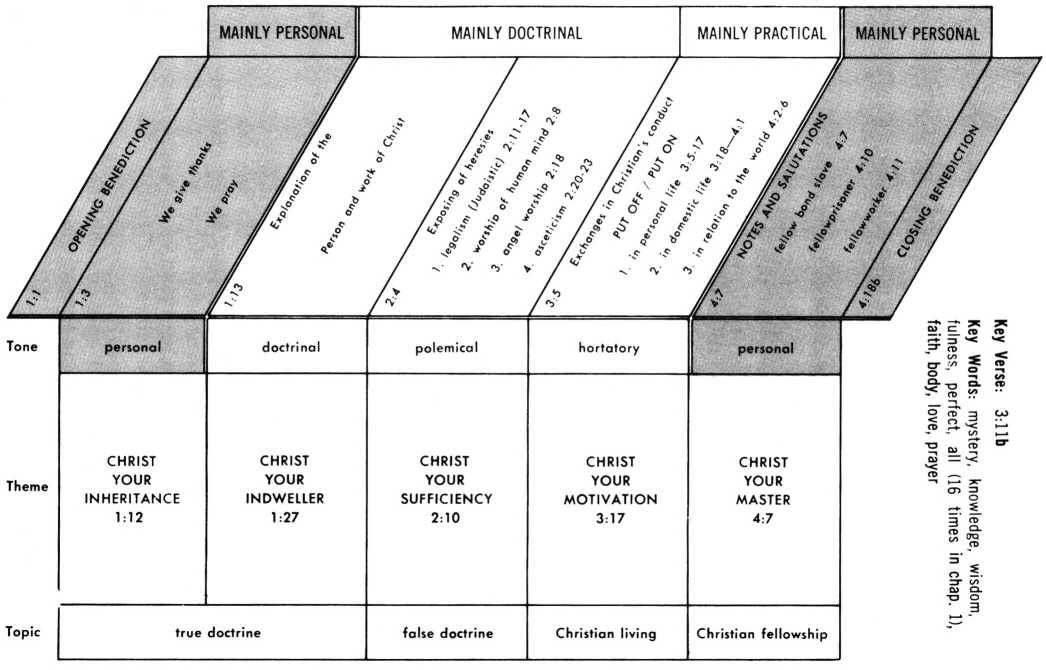
CHRIST IS ALL IN ALL
Click chart to enlarge
Charts from Jensen's Survey of the NT - used by permission
Colossians Overview - Click Chart on right side
| Christ Preeminent in All Things Supreme Lord - Sufficient Savior |
|||
| Colossians 1 | Colossians 2 | Colossians 3 | Colossians 4 |
| Supremacy of Christ |
Submission to Christ |
||
| Doctrinal and Corrective |
Practical and Reassuring |
||
| What Christ Did For Us |
What Christ Does Through Us |
||
| Christ Our Lord |
Christ Our Life |
Christ our Love |
|
| Christ the Head of the Body |
Christ the Lord of the Universe |
Christ the Head of the Home |
|
| Instruction | Warnings | Exhortations | Reminders |
| Reconciliation | Creation | Submission | Conversation |
| His Person and Word |
His Peace and Presence |
||
Colossians 1:26 that is, the mystery which has been hidden (RPPNSA) from the past ages and generations, but has now been manifested (3SAPI) to His saints, (NASB: Lockman)
Greek: to musterion to apokekrummenon (RPPNSA) apo ton aionon kai apo ton geneon nun de ephanerothe (3SAPI) tois hagiois autou,
Amplified: The mystery of which was hidden for ages and generations [from angels and men], but is now revealed to His holy people (the saints) (Amplified Bible - Lockman)
ICB: This teaching is the secret truth that was hidden since the beginning of time. It was hidden from everyone, but now it is made known to God's holy people. (ICB: Nelson)
Montgomery: that secret truth, which, although hidden from ages and generations of old, has now been made manifest to his saints.
NLT: This message was kept secret for centuries and generations past, but now it has been revealed to his own holy people.
Phillips: that sacred mystery which up to now has been hidden in every age and every generation, but which is now as clear as daylight to those who love God. (Phillips: Touchstone)
Wuest: the mystery which has been kept hidden from the ages and from the generations, but now was made known to His saints, (Wuest Word Studies - Eerdman Publishing Company Volume 1, Volume 2, Volume 3 - used by permission)
Young's Literal: the secret that hath been hid from the ages and from the generations, but now was manifested to his saints,
THAT IS THE MYSTERY: to mustêrion:
- Col 2:2, 3, Ro 11:25, 2Th 2:7, Eph 3:3, 4, 5, 6, 1Co 15:51
- Colossians 1 Resources - Multiple Sermons and Commentaries
That is - Not in the original Greek. Added by translators.
Peake - How great the honour conferred on Paul is, appears from the fact that he is entrusted with the duty of declaring the long concealed secret which is the distinguishing mark of his Gospel. (Colossians 1 Expositor's Greek Testament)
Guzik on the mystery - The wonder and glory of the abiding, indwelling Jesus was not clearly revealed in the Old Testament - especially that He would abide in the Gentiles. Therefore, this aspect of the work of Jesus in His people was a mystery that wasn’t revealed until the time of Jesus and the apostles. This means that God is revealed to us in Jesus. Classic theologians use the Latin term Deus absconditus to refer to the “hidden God,” the God than cannot be clearly seen or known. The Latin theological term Deus revelatus refers to the “revealed God.” (Ed: It is interesting that this term was used in ancient Greek and Roman drama) a god introduced into a play to resolve the plot, exactly what Jesus did!) In Jesus, the Deus absconditus has become the Deus revelatus. (Colossians 1 - David Guzik Commentary on the Bible)
Mystery (3466) (musterion from mustes = one initiated [as into the Greco-Roman "mystery" religions] from mueo = to close or shut) in the NT is a truth never previously known, and a truth which human intellect could never discover, but one which has now been made known by divine revelation.
Peake - A mystery is a truth which man cannot know by his natural powers, so that if it is known it must be revealed. (Ibid)
Musterion - 28x in 28v - Matt 13:11; Mark 4:11; Luke 8:10; Ro 11:25; 16:25; 1Cor 2:1, 7; 4:1; 13:2; 14:2; 15:51; Eph 1:9; 3:3f, 9; 5:32; 6:19; Col 1:26, 27; 2:2; 4:3; 2Th 2:7; 1Ti 3:9, 16; Rev 1:20; 10:7; 17:5, 7
Musterion in Septuagint (LXX) - only in Daniel - Dan 2:18-19, 27-30, 47; 4:9
In Paul's day musterion was a technical term utilized by the "mystery religions" which referred to a secrets concealed by strange customs and ceremonies and confided only to those initiated into the "mystery cult". Musterion embraced ideas such as "a secret rite," "secret teaching," and "a divine mystery which is beyond human comprehension." The "mystery-religions" (See Barclay's lengthy comment below on Jesus' use of musterion in Mt 13:11) had their secrets and signs just as seen in modern secret societies. Those initiated into these pagan cults, knew these secret signs. In summary, a mystery in the context of the Greek Mystery Religions was a secret rite which was administered to the person being initiated.
Hastings writes that in stark contrast to the pagan mystery religions, what Paul "calls a mystery is always, indeed, a truth known only to the initiated, but the initiated for St. Paul are the whole body of believers in Jesus....The particular mystery which the Apostle here stands amazed at is the introduction of the Gentiles to equal privileges under the Gospel with the Jews; and, in particular, to this privilege—that Christ should make glory sure to them by dwelling in them." (Colossians 1:27 Christ in You the Hope of Glory)
Mystery in modern usage is similar to this ancient use for it usually means a secret for which no answer can be found (cf "mystery novel"). In contrast to this contemporary use of "mystery", Scripture uses musterion to indicate truth which was previously unknown but which now has been made known through revelation mediated by God.
Dr Handley Moule - A mystery is a truth undiscoverable, except by revelation. Never necessarily, as our popular use of the word may suggest, a thing unintelligible or perplexing in itself. In Scripture a mystery may be a fact which, when revealed, we cannot understand in detail, though we can know it and act upon it. A mystery is a thing only to be known when revealed.
Musterion in the Bible means those truths which are part of God's plan and can only be understood as He reveals them by His Spirit through His Word. As discussed further below, musterion refers to truth previously hidden, which when revealed, is understood by the believer. Stated another way musterion is "a secret purpose of God which when uncovered is understood by the Spirit-taught believer." It refers to a truth which without special revelation would have been unknown and thus is commonly used with words denoting revelation or knowledge (e.g., "to know the mysteries", (Mt 13:11), "revelation of the mystery", (Ro 16:25) , "made known...the mystery", Ep 3:3)
Vincent defines musterion as that "which was kept hidden from the world until revealed at the appointed time, and which is a secret to ordinary eyes, but is made known by divine revelation. (1 Timothy 3 - Vincent's Word Studies). "In the Septuagint only in Daniel. See Daniel 2:18, Daniel 2:19, Daniel 2:27, Daniel 2:28, Daniel 2:30, of the king's secret. It occurs frequently in the apocryphal books, mostly of secrets of state, or plans kept by a king in his own mind. This meaning illustrates the use of the word in passages like Matthew 13:11, “mysteries of the kingdom of heaven” - secret purposes or counsels which God intends to carry into effect in His kingdom....In Justin Martyr (second century) it is commonly used in connection with symbol (sumbolon), type (tupos), parable (parabole) and so is evidently closely related in meaning to these words. Compare Revelation 1:20; Revelation 17:7, This meaning may possibly throw light on Ephesians 5:32." (Romans 11:25 - Vincent's Word Studies) "A mystery does not lie in the obscurity of a thing, but in its secrecy. It is not in the thing, but envelops it. Applied to a truth, it signifies a truth once hidden but now revealed or to be revealed; a truth which without special revelation would be unknown. It is almost universally found in connection with words signifying publication or revelation. See on Matthew 13:11. The mystery of lawlessness is the mass of lawlessness yet hidden, but which is to reveal itself in the person and power of Antichrist." (2 Thessalonians 2:7 - Vincent's Word Studies) "The kindred word memuemai (root verb = mueo, perfect tense speaks of permanent effect) = "I have been initiated" ("I have learned the secret") occurs Phil 4:12, in the sense drawn from the technical use of the term, denoting the induction into pagan mysteries (Ed: Albeit Paul's use in Philippians obviously does not relate to pagan mysteries!). Ignatius addresses the Ephesians as “fellow-initiates (summustai), or students of the mysteries, with Paul” (Ephesians, 12). In the New Testament the word (musterion) implies something which, while it may be obscure in its nature, or kept hidden in the past, is now revealed. Hence used very commonly with words denoting revelation or knowledge. So, “to know the mysteries,” Mt 13:11; “revelation of the mystery,” Ro 16:25; made known, Eph 3:3, etc. In Colossians and Ephesians it is used, with a single exception, of the admission of the Gentiles to Gospel privileges. Compare Ro 16:25, Ro 16:26. (Colossians 1:27 - Vincent's Word Studies)
MacArthur adds that "musterion does not carry the connotation that word has in modern English, as used, for example, of a mystery novel. In the New Testament it refers to something hidden in former times but now made known. Specifically, it refers to a part of God’s truth that was not revealed, or was only partially revealed, in the Old Testament. (MacArthur, J: Romans 9-16. Chicago: Moody Press)
McGee - A mystery is something which had not been revealed in the Old Testament but is now revealed in the New Testament. It is something which you cannot learn by the eye-gate or the ear-gate. Nor has it entered into the heart of man—that is, it is not something man would have thought of. It is a fact which must be revealed by God. (Thru the Bible Commentary)
Unger - The NT use of the term mystery has reference to some operation or plan of God hitherto unrevealed. It does not carry the idea of a secret to be withheld, but of one to be published...The term mystery, moreover, comprehends not only a previously hidden truth, presently divulged, but one that contains a supernatural element that still remains in spite of the revelation (The New Unger's Bible Dictionary)
BDAG explains that musterion is "the unmanifested or private counsel of God, (God’s) secret, the secret thoughts, plans, and dispensations of God which are hidden from human reason, as well as from all other comprehension below the divine level, and await either fulfillment or revelation to those for whom they are intended
Musterion - The 27 NT uses are recorded below.
Matthew 13:11 (Jesus responds to the disciples' request to explain the parables) And He answered and said to them, "To you it has been granted to know the mysteries of the kingdom of heaven, but to them it has not been granted.
Comment: Who can understand the mysteries? Clearly only those who have been "initiated" into Christ by the New Birth. To them it is granted (as a divine gift) from God.
Vincent has a helpful note - In this sense Christ uses parables symbolically to expound the mysteries of the kingdom of God; as utterances which conceal from one class what they reveal to another (Matthew 13:11-17), and in which familiar facts of the earthly life are used figuratively to expound truths of the higher life. The un-spiritual do not link these facts of the natural life with those of the supernatural, which are not discerned by them (1Corinthians 2:14), and therefore they need an interpreter of the relation between the two....A mystery does not denote an unknowable thing, but one which is withdrawn from knowledge or manifestation, and which cannot be known without special manifestation of it. Hence appropriate to the things of the kingdom of heaven, which could be known only by revelation." (Matthew 13 - Vincent's Word Studies)
Barclay - The Greek word in Matthew 13:11, which I have translated secrets (as the Revised Standard Version also does), is musterion. This means literally mysteries which is, in fact, how the King James Version renders it. In New Testament times this word mystery was used in a special and a technical way. To us a mystery means simply something dark and difficult and impossible to understand, something mysterious. But in New Testament times it was the technical name for something which was unintelligible to the outsider but crystal clear to the man who had been initiated. In the time of Jesus in both Greece and Rome the most intense and real religion was found in what were known as the Mystery Religions. These religions had all a common character. They were in essence passion plays in which was told in drama the story of some god or goddess who had lived and suffered and died and who had risen again to blessedness. The initiate was given a long course of instruction in which the inner meaning of the drama was explained to him; that course of instruction extended over months and even years. Before he was allowed finally to see the drama he had to undergo a period of fasting and abstinence. Everything was done to work him up to a state of emotion and of expectation. He was then taken to see the play; the atmosphere was carefully constructed; there was cunning lighting; there were incenses and perfumes; there was sensuous music; there was in many cases a noble liturgy. The drama was then played out; and it was intended to produce in the worshipper a complete identification with the god whose story was told on the stage. The worshipper was intended literally to share in the divinity's life and sufferings and death and resurrection, and therefore shared in his immortality. The cry of the worshipper in the end was: "I am Thou, and Thou art I."
We take an actual example. One of the most famous of all the mysteries was the mystery of Isis. Osiris was a wise and good king. Seth, his wicked brother, hated him, and with seventy-two conspirators persuaded him to come to a banquet. There he persuaded him to enter a cunningly wrought coffin which exactly fitted him. When Osiris was in the coffin, the lid was snapped down and the coffin was flung into the Nile. After long and weary search, Isis, the faithful wife of Osiris, found the coffin and brought it home in mourning. But when she was absent from home, the wicked Seth came again, stole the body of Osiris, cut it into fourteen pieces, and scattered it throughout all Egypt. Once again Isis set out on her weary and sorrowful quest. After long search she found all the pieces; by a wondrous power the pieces were fitted together and Osiris rose from the dead; and he became for ever afterwards the immortal king of the living and the dead. It is easy to see how moving a story that could be made to one who had undergone a long instruction, to one who saw it in the most carefully calculated setting. There is the story of the good king; there is the attack of sin; there is the sorrowing search of love; there is the triumphant finding of love; there is the raising to a life which has conquered death. It was with that experience that the worshipper was meant to identify himself, and he was supposed to emerge from it, in the famous phrase of the Mystery Religions, "reborn for eternity". (Ed: What a Tragic Deception!)
That is a mystery; something meaningless to the outsider, but supremely precious to the initiate. In point of fact the Lord's Supper is like that. To one who has never seen such a thing before, it will look like a company of men eating little pieces of bread and drinking little sips of wine, and it might even appear ridiculous. But to the man who knows what he is doing, to the man initiated into its meaning, it is the most precious and the most moving act of worship in the Church.
So Jesus says to his disciples: "Outsiders cannot understand what I say; but you know Me; you are My disciples; you can understand." Christianity can be understood only from the inside. It is only after personal encounter with Jesus Christ that a man can understand. To criticize from outside is to criticize in ignorance. It is only the man who is prepared to become a disciple who can enter into the most precious things of the Christian faith (Matthew 13 - William Barclay's Daily Study Bible)
Mark 4:11 (Jesus responds to the disciples' request to explain the parables) And He was saying to them, "To you has been given the mystery of the kingdom of God; but those who are outside get everything in parables,
Barclay - When the New Testament talks of the mystery of the Kingdom, it does not mean that the Kingdom is remote and abstruse and hard to understand; but it does mean that it is quite unintelligible to the man who has not given his heart to Jesus, and that only the man who has taken Jesus as Master and Lord can understand what the Kingdom of God means. (Mark 4 - William Barclay's Daily Study Bible)
Luke 8:10 (Jesus responds to the disciples' request to explain the parables) And He said, "To you it has been granted to know the mysteries of the kingdom of God, but to the rest it is in parables, in order that seeing they may not see, and hearing they may not understand.
Romans 11:25 (note) For I do not want you, brethren, to be uninformed of this mystery, (the temporary, partial hardening of Israel's heart) lest you be wise in your own estimation, that a partial hardening has happened to Israel until the fulness of the Gentiles has come in
Romans 16:25 (note) Now to Him who is able to establish you according to my gospel and the preaching of Jesus Christ, according to the revelation of the mystery (the truth that believing Jews and believing Gentiles are made fellow heirs, fellow members of the Body of Christ, and fellow partakers of His promise in Christ by the gospel) which has been kept secret for long ages past,
Vincent on mystery in this verse - The divine plan of redemption. The particular mystery of the conversion of the Gentiles, which is emphasized in Ephesians 3:3-9; Colossians 1:26, is included, but the reference is not to be limited to this. (Romans 16 - Vincent's Word Studies)
1 Corinthians 2:7 but we speak God's wisdom in a mystery, the hidden wisdom, which God predestined before the ages to our glory;
Comment: Here musterion refers to the truth God established before time and revealed in the gospel.
1 Corinthians 4:1 Let a man regard us in this manner, as servants of Christ, and stewards (a servant who cares for the property of another) of the mysteries of God.
Comment: In this context musterion is used in its broadest sense as God’s full revealed truth in the NT which Paul had to oversee and dispense as God’s steward. All believers are in a very real sense "stewards" of God's mysteries, and we are responsible for handling these mysteries with reverence and integrity; e.g., see Col 4:3-note.
1 Corinthians 13:2 And if I have the gift of prophecy, and know all mysteries and all knowledge; and if I have all faith, so as to remove mountains, but do not have love, I am nothing.
1 Corinthians 14:2 For one who speaks in a tongue does not speak to men, but to God; for no one understands, but in his spirit he speaks mysteries.
Comment: In this context musterion refers to "mysteries" that were totally unlike the ones mentioned in the most of the other uses of Scripture. The "spirit" by which they spoke was not the Holy Spirit but their own human spirit or even worse, a demonic spirit! The the mysteries they spoke were like those associated with the "mystery religions" which only the initiated few were privileged to know and understand.
1 Corinthians 15:51 Behold, I tell you a mystery; we shall not all sleep, but we shall all be changed
Comment: Here the mystery is the rapture of the church, a truth never revealed in the Old Testament.
Ephesians 1:9 (note) He made known to us the mystery of His will, according to His kind intention which He purposed in Him
Ephesians 3:3 (note) that by revelation there was made known to me the mystery, as I wrote before in brief.
Comment: Mystery = Jews and Gentiles in one body, the church.
Ephesians 3:4 (note) And by referring to this, when you read you can understand my insight into the mystery of Christ,
Comment: Mystery = Jews and Gentiles in one body, the church.
Ephesians 3:9 (note) and to bring to light what is the administration of the mystery which for ages has been hidden in God, who created all things;
Comment: Mystery = Jews and Gentiles in one body, the church.
Ephesians 5:32 (note) This mystery is great; but I am speaking with reference to Christ and the church.
Comment: The mystery is that God has called out a people to become the Body and Bride of His Son and the marriage relationship is optimally to portray a beautiful picture of the relation between Christ and His Bride, the church.
Ephesians 6:19 (note) and pray on my behalf, that utterance may be given to me in the opening of my mouth, to make known with boldness the mystery of the gospel,
Colossians 1:26 (note) that is, the mystery which has been hidden from the past ages and generations; but has now been manifested to His saints (observe how this "mystery" is now revealed in the next verse), 1:27 (note) to whom God willed to make known what is the riches of the glory of this mystery among the Gentiles, which is Christ in you, the hope of glory.
Comment: The mystery now revealed is that the living Christ indwells believers.
Colossians 2:2 (note) that their hearts may be encouraged, having been knit together in love, and attaining to all the wealth that comes from the full assurance of understanding, resulting in a true knowledge of God's mystery, that is, Christ Himself
Comment: Here the mystery revealed appears to be a reference to the Church as the spiritual body of Christ on earth and He as its Head in heaven.
Colossians 4:3 (note) praying at the same time for us as well, that God may open up to us a door for the word, so that we may speak forth the mystery of Christ (referring to the gospel), for which I have also been imprisoned;
2 Thessalonians 2:7 For the mystery of lawlessness is already at work; only he who now restrains will do so until he is taken out of the way.
Comment by John MacArthur: This is the spirit of lawlessness already prevalent in society [cf. 1 John 3:4; 5:17], but still a mystery in that it is not fully revealed as it will be in the one who so blatantly opposes God that he blasphemously assumes the place of God on earth which God has reserved for Jesus Christ. The spirit of such a man is already in operation [cf. 1 John 2:18; 4:3], but the man who fully embodies that spirit has not come. (MacArthur, J.: The MacArthur Study Bible Nashville: Word )
1 Timothy 3:9 but holding to the mystery of the faith with a clear conscience.
Comment: Here the "mystery" is "the faith" which is not the act of believing but the content of what is believed. In other words, many of the doctrines of Christianity were kept secret throughout the OT period but were then revealed by the apostles and prophets of the NT, especially in the gospel.
1 Timothy 3:16 And by common confession great is the mystery of godliness: He who was revealed in the flesh, Was vindicated in the Spirit, Beheld by angels, Proclaimed among the nations, Believed on in the world, Taken up in glory.
Comment: The mystery here is of the previously unknown truth concerning the Person and work of the Lord Jesus, truths of salvation and righteousness in Him, which produce godliness in believers.
Revelation 1:20 (note) "As for the mystery of the seven stars which you saw in My right hand, and the seven golden lampstands: the seven stars are the angels of the seven churches, and the seven lampstands are the seven churches.
Comment: Here the glorified Christ clearly states the meaning of this "mystery". Barclay - " The Greek, musterion, does not mean a mystery in our sense of the term. It means something which is meaningless to the outsider but meaningful to the initiate who possesses the key. So here the Risen Christ goes on to give the inner meaning of the seven stars and the seven lamp stands." (Revelation 1 - William Barclay's Daily Study Bible)
Revelation 10:7 (note) but in the days of the voice of the seventh angel, when he is about to sound, then the mystery of God is finished, as He preached to His servants the prophets.
Revelation 17:5 (note) and upon her forehead a name was written, a mystery, "BABYLON THE GREAT, THE MOTHER OF HARLOTS AND OF THE ABOMINATIONS OF THE EARTH."
Revelation 17:7 (note) And the angel said to me, "Why do you wonder? I shall tell you the mystery of the woman and of the beast that carries her, which has the seven heads and the ten horns.
Barclay adds that musterion "means something whose meaning is hidden from those who have not been initiated, but crystal clear to those who have. It would describe a ceremony carried out in some society whose meaning was quite clear to the members of the society, but unintelligible to the outsider...in other words "In Greek a musterion is not necessarily something abstruse; it is something quite unintelligible to the uninitiated but crystal clear to the initiated." (1 Corinthians 2 - William Barclay's Daily Study Bible)
In contrast to this use, the NT use of musterion refers to a previously hidden truth now divinely revealed. The secret counsels of God which remain hidden from the ungodly (to them they are a true "mystery" as the word is commonly used in English) but when these truths are revealed to the godly, they are understood by them. The mystery is not in the fact that the truths are difficult to interpret, but that they are impossible to interpret until their meaning is revealed at which time the truth becomes plain.
Jesus explained to His disciples that they had been initiated into these secret things declaring "To you has been given the mystery of the kingdom of God; but those who are outside get everything in parables, in order that while seeing, they may see and not perceive; and while hearing, they may hear and not understand lest they return and be forgiven." (Mk 4:11-12)
When Jesus talks of the mystery of the Kingdom, it does not mean that the Kingdom is remote and hard to understand, but it does mean that this truth is quite unintelligible to the man or woman who has not believed in the Lord Jesus Christ.
Criswell - The "mystery", which has been hidden in the heart of God through all the ages of time and from all generations of men but is now revealed to His apostles, is the church age (cf. Eph 3:3, note). That is, between the suffering of Christ on the cross and the setting up of the kingdom of Christ on earth, there is to be the dispensation of grace when both Jew and Gentile will make up the household of faith, the church (ekklesia, Gk.). A mystery, in NT terminology, refers to a truth long hidden but eventually revealed to man by God at the appointed time. Most of the 27 occurrences of the word in the NT refer to some aspect of the plan of salvation: e.g., the kingdom of God (Mt. 13:11; Mark 4:11; Luke 8:10), the hardening of Israel and the admission of the Gentiles (Ro 11:25), the equality of Gentiles with Jews (Ep 3:3, 4, 5, 6), the gospel (Eph 6:19; 1Co 2:7; 4:1; Col 4:3) and its reception (Ep 1:9; Ro 16:25; Col 1:26, 27), the sweep of God's redemption (Ep 1:9; 3:9), the resurrection (1Co 15:51), the central doctrines of the faith (1Ti 3:9, 16), and Christ Himself (Col 2:2). The term is also used of marriage as a symbol of Christ and the church (Ep 5:32), of prophetic secrets (1Co 13:2; 14:2), of the "man of sin" (2Th 2:3), and of intended symbols (Rev 1:20; Rev 10:7; Rev 17:5, Rev 17:7).
Musterion has its roots in the Old Testament and is found frequently in the second chapter of Daniel in the Greek translation (Septuagint) while the Hebrew equivalent occurs in the Dead Sea Scrolls. Gnostic teachers talked much of mysteries so Paul takes their "special" word and presents his special message regarding the Gentiles. Most people think of mystery as something eerie and unknown but this was not the way Paul uses the word (which he uses some 20x in the NT).
As used by Paul musterion denotes, not something "mysterious" but that which, being beyond unassisted natural apprehension, can be made known only by divine revelation, and to those who are illumined by the Spirit.
Mysteries in the Scripture fall into two categories. Some have already been revealed, and among these are the incarnation of Christ and the salvation of sinners. Others are yet to be seen, such as the general resurrection, the coming Antichrist, and the evil of the last day. It is comforting to realize that all the mysteries which bear on our salvation are already revealed to readers of Scripture.
Musterion is a divine secret or truth which is unknowable apart from divine revelation and which has now been revealed in Christ and the surrounding context stresses the fact that the mystery was hidden from pre-cross times, but now has been manifested to the saints of the church age.
Summary of NT Mysteries
- The Mystery of the Incarnate God Colossians 2:2-3, 9
- The Mystery of Iniquity 2 Th 2:7
- The Mystery of the Rapture 1 Cor 15:51,52
- The Mystery of Babylon Rev 17:5, 7
- The Mystery of the Church Eph 1:9, 10; 3:3, 4, 5, 6,9; 6:19
- The Mystery of the Bride Eph 5:23-32
- The Mystery of Israel's Unbelief Ro 11:25 (note)
So here we see a clear contrast between the ordinary use of mystery implying knowledge withheld, but in Scripture indicating truth revealed. The terms often found associated with mystery are “made known,” “manifested,” “revealed,” “preached,” “understand,” “dispensation.”
In the present passage it is used of the union of redeemed men with God in Christ, forming the church which is Christ’s body, similar to the meaning in Eph 5:32 (note) . In Ephesians the prominent thought is the union of the saints in Christ (Eph 3:2, 3, 4, 5, 6-see notes Ep 3:2; 3:3; 3:4; 3:5; 3:6) while in Colossians the thought is the indwelling of Christ in the saints. And yet in both epistles the figure is that of the body of which Christ is the Head.
So here Paul revealed a "sacred secret", previously unknown "which is Christ in you, the hope of glory." Paul wanted the Gentiles to know that they too could have Christ in them. He teaches the parallel thought in (Ep 2:11ff- notes). This is the great mystery, the greatest truth taught in the Bible, and yet it is the most seriously missing element in many churches today. Most Christians in our churches understand and believe that Christ died for their sins but most fail to go beyond this basic truth. Relatively few go on to grasp the fact that Jesus died for them that He might live in and through them, the so called "exchanged life" or "Christ life". Many fall sadly short of grasping that it is Christ's life in them that provides the power to live the Christian life, bring about real change in one's behavior and lifestyle and provide the ability to resist temptation. It is not enough to know that Christ died in order that we might go to heaven. We are also to know, understand, and practice Christ "Who is our life" living in us now! (Col 3:4) Have you begun to discover this "mystery"? To attempt to obey the many commands in Colossians 3 and Col 4 without an understanding and appropriation of one's Power Source can lead to frustration and failure in the Christian life, which God desires for you to live abundantly.
Charles Wesley (1707-88) wrote of Biblical mystery in hymn form:
And Can It Be That I Should Gain?
'Tis mystery all! The immortal dies!
Who can explore His strange design?
In vain the firstborn seraph tries
To sound the depths of love divine!
'Tis mercy all! Let earth adore,
Let angel minds inquire no more.
WHICH HAS BEEN HIDDEN FROM THE PAST AGES AND GENERATIONS: to apokekrummenon (RPPNSA) apo ton aionon kai apo ton geneon:
- Colossians 1 Resources - Multiple Sermons and Commentaries
Which - What is which? The mystery, hidden in the past but now revealed in Christ.
Has been hidden (613) (apokrupto from apo = from or away + krupto = hide, conceal by covering) means to be hide away from the common gaze and thus to keep as a secret. This Greek word gives us the English word apocrypha. Apokrupto is used by Paul here in a figurative sense to describe knowledge that cannot be known except through divine revelation. It was used in secular Greek writings of a "hidden trade (craft or skill)". Paul uses the perfect tense which emphasizes the longevity of the hiding of the mystery. It had been hidden in the past and remained hidden. Paul was now unveiling that which had been for so long hidden from man's understanding. Apokrupto - 4x in 4v - Luke 10:21; 1 Cor 2:7; Eph 3:9; Col 1:26
God called the nation of Israel to be His holy priesthood, giving them His Law and a glorious promised land filled with "milk and honey". He promised them a King who would one day establish a glorious kingdom and fulfill the many promises made to Abraham and David. The OT prophets wrote about the Messiah Who would suffer, and the Messiah Who would reign.
Peter writes that "As to this salvation, the prophets who prophesied of the grace that would come to you made careful search and inquiry, seeking to know what person or time the Spirit of Christ within them was indicating as He predicted the sufferings of Christ and the glories to follow." (1Pe 1:11, 12).
In other words, even the divinely appointed and inspired Old Testament prophets did not understand that the Messiah first had to suffer before He could enter into glory (Lk 24:13-27). Jesus Christ came to earth, was rejected by His people (Jn 1:11), and was crucified (Mk 15:12, 13, 14, 15, 20, Lk 23:20, 21, Jn 19:6, 14, 15 - They rejected their King!) . He arose from the dead (Mt 28:6, 7, Mk 9:9,10, 10:34, Mt 12:40, Mk 16:6, 7, Lk 24:4, 5, 6, 7) and returned to heaven (Acts 1:9, 10, 11). Did Christ's ascension mean that God’s promised kingdom for Israel was now abandoned? Not at all. What it did signify however was that now God had initiated a new program, which heretofore was a mystery!
BUT NOW HAS BEEN MANIFESTED TO HIS SAINTS: nun de ephanerothe (3SAPI) tois hagiois autou:
- 1Cor 2:7, 8, 9, 10, 11, 12, 13, 14, 15 16 Ps 25:14 Mt 13:11 Lk 8:10 2Ti 1:10
- Colossians 1 Resources - Multiple Sermons and Commentaries
But now - Both a term of contrast and an expression of time (now)! In past hidden, but now made visible!
Moule - “When the fulness of the time was come,” Galatians 4:4. Cp. Ephesians 3:5; Ephesians 3:9-10. (Colossians 1 Cambridge Bible for Schools and Colleges)
Manifested (5319) (phaneroo) means to be (note the use of passive voice = action or effect comes from an external source) revealed in its true character, making visible that which was previously hidden or unknown.
Imagine! Christ the Creator and Sustainer of everything, dwelling in your body His Temple! (See Our Body, His Temple) Dr. Robert Munger's great little booklet, "My Heart, Christ's Home," is a magnificent development of this statement. It is the mystery hidden from the foundation of the world, but now made known to His saints. In the Old Testament, those who feared God, knew the Messiah was coming, but they did not know that the Messiah would indwell the very physical bodies of His people and that those bodies would be the temple of the living God because it was not yet manifested. In addition the OT Jews may have understood the Messiah's relationship to Israel, but they did understood the relationship of the indwelling Messiah to the Gentiles, specifically the mystery of the church.
Saints (40) (hagios) are the set apart ones (set apart by God and for God). They are holy ones. Click for in depth word study of hagios.
John MacArthur writes that saints "are rich, because as the church, Christ is in us (Ed: In 1Cor 3:16 "you" is plural indicating the "church," but in 1Cor 6:19-20 "you" is singular which speaks of His presence in individual believers.) And this is the subject of the ministry. Our message is to tell people that the living God wants to come and dwell in their life. That's a fantastic reality, isn't it? A thrilling concept....The mystery is that Jew and Gentile are made fellow heirs to receive and possess God within them (Eph 2:19-20). That's our message! This is the subject of the ministry. Our message to the world is not to try to live a better life. We're not forcing imposed rituals or a self-styled alteration of life. We're not saying, "Please could you make your New Year's resolution every month?" That's not the message. The message is this: "God wants to come and live in you."
God took sinners, "washed" them in the blood of the Lamb (cp Isa 1:18) and set them apart for something brand new and useful for a different purpose (cp 2Ti 2:21-22). Have you ever thought about the fact that before Christ your life was futile (cp 1Pe 1:18) but that now in Christ as a saint you have the privilege of living a life filled with purpose and potential (cp Isa 43:7)? You can live this life today. Don't go through the rest of your life without being all you can be for the glory of God. Prepare yourself for eternity in His presence by fulfilling your purpose in His plan in this present age.
Dearly beloved, you possess a high privilege for as the Psalmist writes "The secret (speaks of intimacy and fellowship) of the LORD is for those who fear Him, and He will make them know His covenant. (Ps 25:14 see Spurgeon's note)
Are you living in a manner
befitting your holy calling?
Colossians 1:27 to whom God willed (3SAAI) to make known (AAN) what is the riches of the glory of this mystery among the Gentiles which is (3SPAI) Christ in you, the hope of glory. (See also Chart on "Blessed Hope") (NASB: Lockman)
Greek: hois ethelesen (3SAAI) ho Theos gnorisai (AAN) ti to ploutos tes doxes tou musteriou toutou en tois ethnesin, ho estin (3SPAI) Christos en humin, he elpis te doxes;
Amplified: To whom God was pleased to make known how great for the Gentiles are the riches of the glory of this mystery, which is Christ within and among you, the Hope of [realizing the] glory. (Amplified Bible - Lockman)
GNB: God's plan is to make known his secret to his people, this rich and glorious secret which he has for all peoples. And the secret is that Christ is in you, which means that you will share in the glory of God.
Montgomery: To them God willed to make known among the Gentiles how glorious are the riches of that secret truth, which is "Christ in you, the hope of glory.
NLT: For it has pleased God to tell his people that the riches and glory of Christ are for you Gentiles, too. For this is the secret: Christ lives in you, and this is your assurance that you will share in his glory.
Phillips: They are those to whom God has planned to give a vision of the full wonder and splendour of his secret plan for the sons of men. And the secret is simply this: Christ in you! Yes, Christ in you bringing with him the hope of all glorious things to come. (Phillips: Touchstone)
Wuest: to whom God desired to make known in an experiential way what is the wealth of the glory of this mystery among the Gentiles, which is Christ in you, the hope of the glory (Wuest Word Studies - Eerdman Publishing Company Volume 1, Volume 2, Volume 3 - used by permission)
Young's Literal: to whom God did will to make known what is the riches of the glory of this secret among the nations--which is Christ in you, the hope of the glory,
TO WHOM GOD WILLED TO MAKE KNOWN: hois êthelêsen (AAI) ho theos gnôrisai (AAN):
- Mt 13:11
- Watch a Video "Advertisement" for Colossians 1:27- Interesting!
- Colossians 1 Resources - Multiple Sermons and Commentaries
GOD'S GOOD, ACCEPTABLE
AND PERFECT WILL
To whom God willed to make known - The whom is His saints dear reader. I pray you are a disciple/follower of Christ, a true saint (not an "ain't!"). If you are this truth is a cause to pause and praise our Father for His amazing grace to save wretches like us! And given that God willed it, nothing could have prevented it from taking place, not even our stubborn, rebellious hearts! As Jesus speaks to each of us as His disciples "To you it has been granted (A GIFT OF GRACE) to know the mysteries (TO KNOW WHAT IS UNKNOWN TO THE UNSAVED, WHO ARE SPIRITUALLY BLIND) of the kingdom of heaven, but to them it has not been granted (THIS SHOULD PROMPT A "WHY ME LORD?" BUT I AM NOT SURE THAT WE WILL EVER KNOW COMPLETELY HIS ANSWER. PERHAPS IN ETERNITY FUTURE WE WILL KNOW FULLY - 1Cor 13:12." (Mt 13:11)
Willed (2309) (thelo) describes a desire that comes from one's emotion and results in an active decision of one's will. Thelo is "very personal" because it reflects one's inner preference. As someone has said thelo is the term used of God extending His "best offers."
In this context (used of God's will) thelo conveys the spontaneous grace of God in making known this great truth. Lightfoot says “It was God’s grace, it was no merit of their own.” God willed this change from hidden mystery to majestic manifestation. Thelo in this verse has the force of resolved, or willed and, thus, stresses God’s purpose in this revelation, as well as His initiative in it. The saints were helpless to discover the secret; He opened their hearts to see it. "God was pleased" (Amplified) or "God desired" (Wuest) to make this truth known. God made it known because of His grace and not because of any merit of their own.
Paul's point is that men did not discover this mystery, but it was revealed by the will and act of God. What a great, giving God we worship!
Pulpit Commentary notes that "Willed stands emphatically first in the Greek. The revelation was so momentous in its issue, so signal in its method, and so contrary to human foresight and prejudice, that it proceeded evidently from” the will of God...The Ephesian letter delights to dwell on God’s will as the cause of the whole counsel and work of salvation. (Colossians 1 - The Pulpit Commentaries)
To reiterate, the phrase to whom God willed to make known clearly indicates that these mysteries are not discovered by the genius of man, but are revealed by the will and act of God. It is God’s purpose that His people know this truth.
To make known (1107) (gnorizo from ginosko which means acquire information by whatever means but often with the implication of personal involvement or experience) means to cause information to be known by communicating things heretofore unknown. Wuest translates gnorizo as "to make known in an experiential way". The implication is that this truth is not just for our intellect, but is meant to affect our heart!
A T Robertson - This is the crowning wonder to Paul that God had included the Gentiles in his redemptive grace, “the riches of the glory of this mystery” and that Paul himself has been made the minister of this grace among the Gentiles (Eph 3:1-2). He feels the high honor keenly and meets the responsibility humbly" (Colossians 1 - Robertson's Word Pictures of the New Testament)
WHAT IS THE RICHES OF THE GLORY OF THIS MYSTERY AMONG THE GENTILES: to ploutos tês doxês tou mustêriou toutou en tois ethnesin:
- Col 2:3 Ro 9:23 Ro 11:33 Eph 1:7,17,18 3:8, 9, 10,16) (Is 42:6; 45:22; 49:6; 52:10; 60:1, 2, 3; Ps 22:27; 65:5
- Colossians 1 Resources - Multiple Sermons and Commentaries
Related Passages:
Colossians 2:3 in Whom (CHRIST) are hidden all the treasures of wisdom and knowledge.
Romans 9:23 And He did so to make known the riches of His glory upon vessels of mercy, which He prepared beforehand for glory,
Romans 11:33 Oh, the depth of the riches both of the wisdom and knowledge of God! How unsearchable are His judgments and unfathomable His ways!
Ephesians 1:7 In Him we have redemption through His blood, the forgiveness of our trespasses, according to the riches of His grace
Ephesians 1:17-18 that the God of our Lord Jesus Christ, the Father of glory, may give to you a spirit of wisdom and of revelation in the knowledge of Him. 18 I pray that the eyes of your heart may be enlightened, so that you will know what is the hope of His calling, what are the riches of the glory of His inheritance in the saints, (DO YOU KNOW YOUR "RICHES"? IF NOT PRAY THIS PRAY THIS PRAYER AND WAIT EXPECTANTLY.)
MYSTERIOUS
RICHES
Vincent - The mystery of the admission of the Gentiles to the Gospel covenant (cp to whom it was initially promised = Jer 31:31-34), now revealed through Paul’s preaching, was divinely rich and glorious. This glory is the manifestation of the kingdom of Christ among the Gentiles as their inheritance (Col 1:12; cp Ro 8:18, 21; 2Cor. 4:17). The richness exhibited itself in the free dispensation of the Gospel to the Gentile as well as to the Jew. It was not limited by national lines. Compare “the same Lord is rich unto all,” Ro 10:12; and beggarly elements, Gal. 4:9. (Colossians 1 - Vincent's Word Studies)
MacDonald - F. B. Meyer exclaims: “That He should dwell in the heart of a child of Abraham was deemed a marvelous act of condescension, but that He should find a home in the heart of a Gentile was incredible.” And yet that is exactly what was involved in the mystery—“that the Gentiles should be fellow heirs, of the same body, and partakers of His promise in Christ through the gospel” (Eph. 3:6). (Borrow Believer's Bible Commentary)
Riches (4149) (ploutos [word study] from pletho = to fill) properly denotes abundance, plentitude, and literally is used to refer to material wealth or prosperity (abundance of earthly, temporal goods) which is the meaning in the parable of the seed and the soils (Mt 13:22, Mk 4:19, Lk 8:14 = Material riches are deceitful and choke out reception of the Word of God. Be careful all you wealthy readers! Contrast spiritual riches - Ep 3:8) Indeed, think of the people who know whose whole lives glow with the glory of God for they are rich in spiritual possessions, albeit often poor in material possessions!
Ploutos describes superfluity, that which abounds or that which exceeds a man’s present desires; and hence, the word in the New Testament is used to denote abundance; or what is very great and valuable. To emphasize the importance of the truth of "Christ in you", Paul does not merely say “this mystery” or even just “the glory of this mystery,” but the riches of the glory of this mystery. Paul heaps words upon words in order to impress his readers with the fact that this is a glorious truth that deserves their closest attention. These "riches" make the possessors "rich". How about you, beloved? Are you living like a spiritual pauper or like a possessor of all the riches of the glory of Christ? (Click to study more on your riches in Christ) In Christ "are hidden all the treasures of wisdom and knowledge." (Col 2:3)
In his letter to the Ephesians Paul says that "To me, the very least of all saints, this grace was given, to preach to the Gentiles the unfathomable riches of Christ (Eph 3;8)
My only song and story
Is—Jesus died for me;
My only hope of glory,
The Cross of Calvary
Lightfoot - Here too was its (the gospel's) wealth; for it overflowed all barriers of caste or race. Judaism was ‘beggarly’in comparison, since its treasures sufficed only for a few.
John Eadie - The apostle now illustrates the character of the disclosure...“what is the wealth of the glory” of this mystery.... Both terms, ploutos and doxa, are favorites of the apostle, and are employed to represent what is bright, substantial, and permanent. That mystery is enveloped in glory, and that glory has at once a solid basis and an unfading lustre. It is no halo which glimmers and disappears—no gilding which is easily effaced; but it is rich, having the weight, value, and brilliancy of gold....And that such wealth of glory may be appreciated, the apostle adds, in explanation— “Which is Christ in you, the hope of glory.” (A Commentary on the Greek Text of the Epistle of Paul to the Colossians)
Marvin Vincent - The mystery of the admission of the Gentiles to the gospel covenant, now revealed through Paul's preaching, was divinely rich and glorious. This glory is the manifestation of the kingdom of Christ among the Gentiles as their inheritance...The richness exhibited itself in the free dispensation of the Gospel to the Gentile as well as to the Jew. It was not limited by national lines. (Colossians 1 - Vincent's Word Studies)
Among the Gentiles The OT predicted that Gentiles would partake of salvation, Isaiah recording for example God's declaration "Turn (command) to Me, and be saved, all the ends of the earth (which would include Gentiles), for (term of explanation) I am God, and there is no other. (Isa 45:22)
David records that "All the ends of the earth will remember and turn to the Lord and all the families of the nations will worship before Thee. (Psalm 22:27 - Spurgeon's comments)
And again the psalmist records that "The Lord has made known His salvation. He has revealed His righteousness in the sight of the nations. He has remembered His lovingkindness and His faithfulness to the house of Israel. All the ends of the earth have seen the salvation of our God. (Psalms 98:2-3 see Spurgeon's comments Verse 2; Verse 3)
On the other hand, the Old Testament did not reveal that the Messiah would actually live in each member of the redeemed church which would be composed primarily of Gentiles. Paul has just revealed that mystery!
WHICH IS CHRIST IN YOU THE HOPE OF GLORY: Christos en humin he elpis te doxes:
- Col 3:3. Jn 6:56. Jn 14:17, 20, 23, Jn 17:22, 23, 26. Ro 8:10. 1Co 3:16, 12:13, 2Co 6:16, Gal 2:20, Gal 4:19. Ep 3:17. 1Jn 4:4
- Colossians 1 Resources - Multiple Sermons and Commentaries
Related Passages:
Colossians 3:3-4 For you have died and your life is hidden with Christ in God. When Christ, who is our life, is revealed, then you also will be revealed with Him in glory.
John 6:56 “He who eats My flesh and drinks My blood abides in Me, and I in him.
John 14:17; 20; 23 that is the Spirit of truth, whom the world cannot receive, because it does not see Him or know Him, but you know Him because He abides with you and will be in you.....20 “In that day you will know that I am in My Father, and you in Me, and I in you.....23 Jesus answered and said to him, “If anyone loves Me, he will keep My word; and My Father will love him, and We will come to him and make Our abode with him.
Romans 8:10 If (NOT "IFFY" BUT SINCE) Christ is in you, though the body is dead because of sin, yet the spirit is alive because of righteousness.
Galatians 2:20 “I have been crucified with Christ; and it is no longer I who live, but Christ lives in me; and the life which I now live in the flesh I live by faith in the Son of God, who loved me and gave Himself up for me.
A CHRISTIAN:
A CHRIST IN!
Take the word Christian and move the "a" to the front and what do you have? "A Christ in!"
Christ in you - The you Paul is addressing is primarily the Gentile believers at Colossae.
Stephen Olford tells the story of "Captain Reginald Wallis, whose evangelistic crusades and convention ministry blessed thousands of young and old on both sides of the Atlantic, used to define the word “Christian” as follows: He would say, “Spell out the word C-H-R-I-S-T-I-A-N. Then take the letter ‘A’ from the end of the word and put it at the beginning. Now what do you read?” The answer, of course, was —“A CHRIST IN.” With great earnestness he would then add: “A Christian is a man or woman who has Christ living in him or her.” (Institutes of Biblical Preaching. Memphis: Olford Ministries International)
C H Spurgeon introduces his sermon on the phrase "Christ in you, the hope of glory" with this "outline" (let them prompt you to read his entire message) - "The essence of it is “Christ”; the sweetness of it is “Christ in you”; and the outlook of it is “the hope of glory.” The words read like a whole body of divinity condensed into a line,—“Christ in you, the hope of glory.” (Colossians 1:27 Christ in You)
F F Bruce - "Christ is in you,” he assures his Colossian readers; “Christ is in you (even in you Gentiles) as the hope of glory”; the fact that here and now, as members of His body, you have His life within you, affords you a firm hope that you will share in that fulness of glory which is yet to be displayed, on the day of “the revealing of the sons of God.” Christ Himself is the centre and circumference of this mystery; by His death and exaltation He has brought it to accomplishment, and those who are united to Him are inevitably involved in its accomplishment—in measure now, and in perfection hereafter. (Borrow The Epistles to the Ephesians and the Colossians. The New International Commentary)
Jesus became Immanuel, God with us, that He might forever be God in us. Hallelujah!
According to the Greek expert A T Robertson, the preposition in (Greek = en) conveys the idea of "in" not "among" adding that "It is the personal experience and presence of Christ in the individual life of all believers that Paul has in mind, the indwelling Christ in the heart...(Christ) constitutes also the hope of glory for He is the Shekinah (the cloud of glory that followed Israel in the wilderness and hovered over the Tabernacle and the Holy of holies in the Temple) of God. Christ is our hope now (1Ti 1:1) and the consummation will come (Ro 8:18).
"CHRISTO-CENTRIC"
MEN AND WOMEN
G Campbell Morgan - "Christ in you." It is significant that at this point the Apostle uses the title rather than the name of our Lord. This indicates the inclusion of the Person and His work. There is no one perfectly sure of Jesus Christ in history unless he is sure of Him in experience. No one can have a final demonstration of truth concerning the nature of Christ or His work save as he can say, I know Christ because He is in me. It may be said that this is mystical, and cannot be explained to the scientific age in which we live. That is perfectly true. That is what the Apostle says. It is a mystery; this presence in the individual life of Christ Himself in all the marvelous glory of His Person as Very God and Very Man. Human sympathy, human love, human purity, and human power, all surcharged with those infinite resources of God, which made Him as man perfect Victor, are present in all in whom He is formed, eventually and through processes, to make them equally victorious with Himself. It is a mystery, but if it be a mystery that cannot be explained to the scientific age it is a fact known in the lives of countless multitudes. Christ in me—and I need hardly apologize for testimony at this point, for speaking rather as a witness than an advocate—Christ in me is the most certain thing in all my personal experience. He is present in my inner life, so that I have not to ascend to heaven to find Him or descend into the depths to bring Him up. Neither have I to go on long pilgrimages to reach Him. Amid the hurry and rush of the day, the Christ is within. He was not always there. He came by the act of the Spirit when I fulfilled the conditions of the Word, but His advent was positive, and His presence is as real as, and more real to me than, the advent long ago in the Judean country far away. The historic is proved by the experimental. As I have already said, the use of the title suggests not merely the presence of the Person in the life, it suggests also the work of Christ in you. He was at once Prophet, Priest, and King. "Christ in you," the one Prophet and Teacher by whom the whole life is to be governed and ordered, whose philosophy is the only philosophy, whose teaching is the only teaching which the soul trusts. "Christ in you," also as Priest, the one perfect Saviour, operating in the inner shrine of the indivudual life on the altar, and by the way of sacrifice, so that through the intermediation, not of Christ far off, but in me, I have personal and immediate access to the Presence of God, which is both within and encompassing me. Then "Christ in you" also as King, ruling all the life, not by the law of carnal ordinances, written on tables of stone, but by the perpetual inspiration of His indwelling presence. This is the essential, personal, individual miracle of Christianity. Christ within, the Prophet, teaching so that I need no man to teach me. Christ within, the Priest, so that I need no other priest and need take no pilgrimage to find a shrine of worship. It is in my own life, for He is there. Christ within, as King, so that I bow the knee to no scepter and no throne, except to such as He authorizes. "Christ in you." That is the great miracle, the great mystery, the individual fact on which all the other facts of Christianity are based, and through which the other forces of Christianity become operative in the history of man. Christ in me—the Christ light—so that I see with His eyes. Christ in me—the Christ aspiration—so that I desire with His desire. Christ in me—the Christ impulse—so that I am driven as He was driven. Christ in me—the Christ consciousness—so that the world's sin burdens me in the same fashion as it burdened Him, and the world's agony hurts me as the world's agony hurt Him. What is a Christian man? A "Christo-centric" man is a man in whom Christ is enthroned at the center of personality, not as a sentiment, but as a Person; not as an ideal without, but as a dynamic at work within. What is the issue as to the Christ and as to myself? As to the Christ, He gains in every soul He indwells an inheritance. As to the indwelt soul, that soul gains in the Christ an inheritance. If that statement seems to be almost unbelievable it is but the teaching of the Word, and the experience of the soul answers it and seals it true. Is Christ formed in you? Hear me, for I speak with great reverence, and yet with all boldness—that Christ is richer for having you. That is the individual application of the magnificent argument of the Ephesian epistle in which Paul tells us plainly that God gains an inheritance in the saints. But what does Christ gain in you? He gains an instrument through which He can flash His light upon some other dark soul. He gains a medium through which He is able to touch with healing other wounded spirits. He gains a channel through which He is able to move out in the grace of healing to other wounded hearts. He gains whatever He comes to possess. By His advent nineteen hundred years ago He came to claim the wide world, and He will never cease to work until He has absolutely won it and subdued it. There may be other methods ahead. There may be other dispensations. But, believe me, He will not fail or be discouraged until He hath set His judgment in the earth, and answered the waiting isles with His own law. But if I am to be—oh, matchless miracle of grace—the means and medium of manifestation what do I gain? I gain all His resources, for I have fellowship with Him in all the larger purposes of His life. (G. Campbell Morgan - Christ In You, The Hope Of Glory)
John Eadie - “Which is Christ in you, the hope of glory.” The one idea is at the same time involved in the other; the glory is not an abstraction, for it resides in the mystery, and the mystery cannot appear in nakedness, for it always exhibits this pure and imperishable luster. The antecedent is rather the complex idea of the entire clause—not Christ in Himself, but in His novel and gracious relation to the Gentile world, as a developed and illustrious mystery. The term Christ is not to be explained away, as if it merely meant the doctrine of Christ, as is proved by the subsequent clause—“whom we preach.” The words en humin are rendered by many “among you,” that is, in the midst of you, as in the preceding clause and in the margin of our English Bibles. But the meaning “in you” is virtually implied; for Christ, as the hope of glory, was not contemplated merely, but possessed. He was not merely before them to be beheld, but in them to be felt....This frequent allusion to the Redeemer by name—to His power and work, as the Divine source of blessing, seems to have had a reference to the views of some among the Colossians, who would have had a church without a Christ and salvation without a Saviour. The clause the hope of glory, elpis tes doxes, is in apposition with Christos....The “glory” is the future blessedness of believers, as in Ro 2:7, 10, 8:18; 1Co 2:7; 2Co 4:17; 1Th 2:12; Heb 2:10; Ro 5:2. The noun elpis is not hope as an emotion, but the foundation of it, as in 1Ti 1:1, and it is followed by the genitive of the thing hoped for, or the object of hope. ... The life of glory rests on Christ as its author and basis—such is the blessed statement of the apostle. Let us pause for a moment over this glory, and its connection with Christ, and then we shall be able to know with the saints—“what are the riches of the glory of this mystery among the Gentiles.” The glory of Christians is yet to come, but it is certain. What they so earnestly pray for, and so heartily long and labor for, shall be revealed over and beyond their anticipations. Deliverance from all evil is followed by introduction into all good. What is partially and progressively enjoyed in time, is fully and for ever possessed in heaven. The spirit in its present feebleness would bow and faint beneath the pressure of it, nay, it might die in delirious agony; but then it shall have power and stateliness not only to bear, but to enjoy the “far more exceeding and eternal weight of glory.” (2Co 4:17) Now, no man can see Him and live—our frail humanity would be consumed by the terrible vision; but the saint is prepared to gaze with unmingled rapture on His majesty, and to live, walk, and be happy in its luster. The mind shall be filled with light from the face of God, and the heart shall pulsate with love in eternal and undivided empire. The image of God, in all its loveliness and brilliance, shall be restored to every heart, and that heart shall enjoy uninterrupted fellowship with Him who sits upon the throne. Nothing can happen to mar or modify this communion; for though an angel were to pass between him and the throne, he could cast no shadow upon the rapt and adoring saint. Every man shall be as perfect as Christ—in soul, body, and spirit, and beyond the possibility of forfeit or relapse (1Jn 3:2, 1Jn 3:3). The burden of sin is removed, and to the sense of oppression there shall succeed the consciousness of spiritual buoyancy and elevation; the taint of depravity is wiped away, and the joy of salvation shall mingle its aromatic fragrance with the “new wine” in the kingdom of our Father. The body, too, shall be raised an ethereal vehicle, no longer the prey of disease, languor, and death, but clothed in immortal youth and vigor, and so assimilated to the blessed spirit within it, as neither to cramp its movements nor confine its energies. No pain there—no throbbing brow there—no tear on the cheek there—no sepulcher there—no symbol of mourning there—no spectacle like the apparition of Rachel weeping for her children—or like the widow of Nain following the bier of a lost and loved one. “Death is swallowed up of life” (1Co 15:54, 55, 56, 57, 58)—the graves have been opened—they that dwell in the dust have awakened to endless minstrelsy. Nor do they dwell in a paradise restored amidst the lovely bowers, shady groves, and exuberant fruits of a second Eden. Such glory is too bright for earth, and is therefore to be enjoyed in a scene which shall be in harmony with it. Now, Christ is the hope of this glory. Glory had been forfeited, but Jesus interposed for its restoration. When the Saviour is received by faith, the hope of glory springs up in the bosom—a hope as strange aforetime to it as the pine and the box-tree in the desert. Christians are by nature sinners doomed to die, yet, through Christ, they exult in the promise of life. Though, in their physical frame, they are of the earth earthy, their treasure is in heaven (Mt 6:20, 21). They can look on the Divine Judge, who must, but for Christ, have condemned them, and call him, in Jesus, their Father-God; and they can gaze on the home of angels, so far above them, and say of it, in confidence—that, too, is our home. The basis of this life is Jesus. If it be asked, why have his sins not borne down the evil-doer, and crushed him beneath the intolerable load? why has the lightning slumbered beneath the throne, and not swiftly descended on his head? why are the angry passions within him hushed, and his gloomy thoughts dissipated? whence such a change in relation and character?—the problem is solved by the statement—“Christ within you.” This hope rests on His objective work—for “it was Christ that died.” Who shall reverse the sentence of our justification, or pronounce it inconsistent with sovereign equity? And who shall condemn us? Shall sin raise its head?—He has made an end of it. Shall Satan accuse?—he has been cast out. Shall conscience alarm?—it has been purged from dead works. Or shall death frown horribly on us?—even it has been abolished. The basis of this hope of glory is also the subjective work of Christ—by His Spirit within the saint. Not only has he the title to heaven, but he gets maturity for it. The process of sanctification begets at once the idea and the hope of perfection. If one sees the block of marble assuming gradually, under the chisel, the semblance of humanity, he infers at once what form of sculpture the artist intends. So, if there be felt within us the transforming influence of the Holy Ghost, bringing out the Divine image with more and more fulness and distinctness, can we doubt the ultimate result? Ro 15:13. Such consciousness inspires vivid expectation. In short, in whatever aspect the saints view their hope, they see it in connection with Christ. If they look behind them, the earliest dawning of it sprang from faith in His cross; if they look around them, it is sustained by the promises of Him who sealed these pledges in His blood; if they look forward and upward, it is strengthened by the nearing proximity of realization in Him who is “in the midst of the throne.” (Re 5:6KJV ) What a blessed change to the Gentile world! They had been described as once “without Christ,” (Ep 2:12) but now Christ was in them; once they had no hope, but now, they had in them Him who was the hope of glory. No wonder that the apostle rejoiced in suffering for the Gentile churches, and thanked God for that arrangement which enabled him to carry out the gospel to its widest susceptibility of application, and thus develop a doctrine which had been concealed for ages. Is his language too gorgeous, when, surveying the wondrous process and the stupendous results, he speaks of the “riches of the glory of this mystery among the Gentiles—Christ in you, the hope of glory”? And that glory is not to be under eclipse—that Saviour is not to be selfishly concealed. No; the apostle adds, as characteristic of his grand commission and daily labor (we proclaim Him -- Col 1:28) (Colossians 1 - Eadie's Commentary on Colossians)
F. B. Meyer exclaims: "That He should dwell in the heart of a child of Abraham was deemed a marvelous act of condescension, but that He should find a home in the heart of a Gentile was incredible.
Bride of the Lamb, awake, awake!
Why sleep for sorrow now?
The hope of glory, Christ, is thine,
A child of glory thou.
Play hymn
To paraphrase Dr Ray Stedman, Christians who have discovered the truth of "Christ in you", not merely in an intellectual sense, but in a practical sense that affects their living day by day are seldom bored. To them, everything is exciting. Even difficulties and trials are regarded as adventures and they look forward to how the Lord will work them out. They may feel a sense of risk, perhaps even danger, but they also have a sense of excitement and anticipation as they look for God to act.
Here is Stedman's original statement (in his comments on ""growing in the knowledge of God" in Paul's prayer in Colossians 1:10) - "Now I want to call attention to what I am going to say next so that you will not miss it: knowing God is the most exciting thing that can ever happen to you! Knowing God is the secret of excitement and vitality in a life. People who know God are never bored for the opposite of knowing God is boredom. If you are bored, as a Christian, it is because you do not adequately know your God. In His presence it is impossible to think of anything else. He is an exciting, captivating Being, filled with fresh ideas, concepts and possibilities of which you never could have dreamed. To know God means that you are always turned on about everything because you see God everywhere: in nature, in people you meet, in trials, hardships and challenges, everywhere. That is why people who know God are always exciting to be with. They lift your spirits when you meet them. Faces light up as they enter a room: They know God, and the excitement of that captivates and changes them. That is what Paul says will happen as we "grow in the knowledge of God" and put into practice these three goals in our lives. This is what Jesus means when he says to the woman at the well, "I will put in you a well of water, springing up unto eternal life." It is always there: that refreshing quality of knowing God." (The Great Mystery)
Stedman goes on to comment on Christ in you declaring "There is the great mystery. It is the greatest truth taught in the Bible, and yet it is the most seriously missing element in many churches today. Most Christians in our churches understand that Christ died for the forgiveness of their sins---they believed that and came to Christ because of that---but that is where most of them stop. Relatively few, it seems, ever go on to grasp the fact that Jesus died for them that he might live in them. It is his life in them that is the source of power, change and deliverance, and the ability to resist temptation. That is how loneliness is met and Companionship provided. It is not enough to know that Christ died in order that we might go to heaven. We are also to know, understand, and practice Christ actually living in us now! That is surely the most astounding truth in the Bible....Our long-time friend, Major W. Ian Thomas used to put it very succinctly. He is a former British Army officer, and has made it his lifelong ministry to travel all over the world and teach this wonderful truth of "Christ in you, the hope of glory." He puts it this way: "He had to be what he was, in order to do what he did!" We have been seeing that in Colossians. Jesus had to be both God and man in order to die in our place, be raised again, ascend into the heavens, and send the Holy Spirit, and thus come into our life. Second, He had to do what He did, in order that we might have what He is. We could never have this new power, this new source of energy, this new comfort and strength in our life, if Jesus had not done what he did. It is on the basis of his death and resurrection that we have what He is. Third,...we must have what he is, in order to be what he was.
That is what this great text is saying. God wants to present us "holy, without blemish, and free from accusation," (Col 1:22) just as his Son was. We are being conformed to the image of his Son. He is "bringing many sons to glory." (Heb 2:10) We must have what He is in order to be what He was. That is why it is important to understand this great mystery, "Christ in you, the hope of glory." The world knows nothing of this mystery. You will never find it mentioned by the media, except by Christians. You will never learn about it in the great universities of the world. In all secular wisdom and knowledge there is no recognition of this incomparable source of change in a human life. It is found only in the Gospel of Jesus Christ. That is why this message is such a powerful, world transforming, revolutionary statement, and why we ought to give ourselves to understanding it more than any other thing in life.
Let me summarize this passage, in closing. The apostle points out three stages of change. First, the new birth begins a process which is intended to perfect us, spirit, soul and body. To advance that process requires pain and commitment on the part of others on our behalf; and when we come to Christ we are to undertake that same pain and commitment on behalf of others. Finally, all progress occurs only by coming to understand and to practice the mystery of "Christ in you, the hope of glory." That is how to stop the terrible downward slide of any human life! (The Great Mystery)
Dr. Dick Halverson, former chaplain of the U. S. Senate once asked
"Where are you going to go tomorrow morning? Christ is there in your body (Colossians 1:27). Christ is there as much as He is in his own body. He is literally present where you are tomorrow morning, and Tuesday, Wednesday, Thursday, etc. We preachers have been communicating for years the idea that the only time anything is done for Christ is when we do something consciously spiritual. As though one can turn Christ on and off in the body. He said you are the salt of the earth (Mt 5:13). He didn't say you may be or you ought to be, he said you ARE the salt of the earth. He said you are the light of the world. He didn't say you may be or you ought to be, he said you ARE the light of the world (Mt 5:14). You are the light of the world-I didn't say that. Jesus said it. Now salt is no good when it's not salty, and light is no good when it's covered. And just as he was in the Garden of Eden, Satan is busy all the time, every moment of every hour in history trying to get you and me to think that we can substitute something we do for the light and the salt of Jesus Christ. And Jesus said if the salt has lost its saltiness, what is it good for? It's good for nothing. There's no program, no plan, no method that can be conceived by the mind of man which will compensate for salt that is not salty. We go around with our little programs, when all the time God dwells in our body and says, 'Just cut out your programs and let Me live My life in you and through you.' He just says: Believe this. How infinitesimally insignificant what we do or say our witness is, compared to the presence of Christ in our bodies wherever we are.
Phillips Brooks - Religion is not the simple fire-escape that you build in anticipation of a possible danger, upon the outside of your dwelling, and leave there until danger comes. You go to it some morning when a fire breaks out in your house, and the poor old thing that you built up there, and thought that you could use some day, is so rusty and broken, and the weather has so beaten upon it and the sun so turned its hinges, that it will not work. That is the condition of a man who has built himself what seems a creed of faith, a trust in God in anticipation of the day when danger is to overtake him, and has said to himself, I am safe, for I will take refuge in it then. But religion is the house in which we live, it is the table at which we sit, it is the fireside at which we draw near, the room that arches its graceful and familiar presence over us; it is the bed on which we lie and think of the past, and anticipate the future, and gather our refreshment.
F B Meyer - Our Daily Homily - The only son of a widow runs off to sea when quite a lad. She must needs work for her living, and takes lodgers in her little home. After years have passed, a bronzed and bearded sailor comes to her door for accommodation, which she gladly affords at an agreed price. She has no idea who has come to dwell beneath her roof - it is a secret, a mystery.
By and by, one day as they are sitting at the midday meal, a remark, a gesture, startles her; she looks hard into the stranger's face, recognizes him, and, with a cry, rushes into his arms and weeps out on his bosom her joy: "My son, my son, what deceived my old eyes, that I didn't know thee!" That is the glory of the mystery, which breaks in smiles and kisses.
Then he says, "Mother, how hard life has gone with you; your hands are hard with toil. But see, I have plenty of money, and you shall go shares in all. I will take a nice little home, and you shall live there, to keep it as long as you live, and never have to do a stroke of hard toil." That is the riches of the glory of the mystery.
So at your conversion Jesus came into your heart to abide. Too long He has been unrecognized; but of late you have been made aware of the nature and worth of your Heavenly Friend. The mystery has broken in light. Henceforth, realize that all His riches are yours, to be shared and enjoyed; that all your needs may be fully met, even to the abundance of His unsearchable riches; and that there may be an end forever to all the weary sense of inability and incompetence to meet the inevitable demands of daily living. Christ is in you; let His life within reach out its hands to the life of glory above.
Daniel Whittle wrote this hymn "Christ Liveth in Me"
Once far from God and dead in sin,
no light my heart could see;
but in God’s Word the light I found.
Now Christ liveth in me.
As lives the flower within the seed,
as in the cone the tree;
so, praise the God of truth and grace;
His Spirit dwelleth in me.
With longing all my heart is filled,
that like Him I may be,
as on the wond’rous thought I dwell
that Christ dwelleth in me.
Refrain:
Christ liveth in me.
O what a salvation this,
that Christ liveth in me!
THE HOPE OF GLORY: hê elpis tês doxês:
- Ro 5:2, Ro 8:11; Ep 1:13, 14; 1Pet 1:3,
- See Chart on Blessed Hope
- Colossians 1 Resources - Multiple Sermons and Commentaries
Related Passages:
Romans 5:1-2 Therefore, having been justified by faith, we have peace with God through our Lord Jesus Christ, through whom also we have obtained our introduction by faith (JUSTIFICATION) into this grace in which we stand (SANCTIFICATION); and we exult in hope of the glory of God (GLORIFICATION).
OUR HOPE SURE OF
FUTURE GLORY
Vincent on the hope of glory - The Gentiles, in receiving the manifestation of Christ, did not realize all its glory. The full glory of the inheritance was a hope, to be realized when Christ should appear “the second time unto salvation” (Hebrews 9:28). Compare 1 Timothy 1:1. Glory refers to the glory of the mystery; hence the glory, but with more emphasis upon the idea of the same glory consummated at Christ's coming - the glory which shall be revealed. See Romans 8:18; 2 Corinthians 4:17; 1 Peter 1:7 (Colossians 1 - Vincent's Word Studies)
Spurgeon on glory - "Think of it. Glory for us poor creatures! Glory for you, sister; glory for me! It seems a strange thing that a sinner should ever have anything to do with glory when he deserves nothing but shame. We are neither kings nor princes, what have we to do with glory? Yet glory is to be our dwelling, glory our light, glory our crown, glory our song. The Lord will not be content to give us less than glory. Grace is very sweet: might we not be content to swim for ever in a sea of grace? But no, our Lord “will give grace and glory.” “All needful grace will God bestow, And crown that grace with glory too.” We shall have glorified bodies, glorious companions, a glorious reward, and glorious rest."....Why, look ye, sirs, Christ in you is glory. Did we not show that just now? “Lift up your heads, O ye gates, and be ye lifted up, ye everlasting doors, that the King of glory may come in!” You have heaven in having Christ, for Christ is the biggest part of heaven. Is not Christ the soul of heaven, and having Him you have glory? What is more, having gotten Christ, Christ’s glory and your glory are wrapped up together. If Christ were to lose you, it would be a great loss to you, but a greater loss to Him. If I can perish with Christ in me, I shall certainly be a fearful loser, but so will He, for where is His honor, where His glory if a believer perishes? His glory is gone if one soul that trusts in Him is ever cast away. Wherefore comfort yourselves with this word, Christ in you means you in glory, as sure as God lives. There is no question about that. Go your ways and rejoice in Christ Jesus, and let men see Who it is that lives in you. Let Jesus speak through your mouth, and weep through your eyes, and smile through your face: let Him work with your hands and walk with your feet, and be tender with your heart. Let Him seek sinners through you; let Him comfort saints through you; until the day break and the shadows flee away. (Amen!) (Colossians 1:27 Christ in You)
MacDonald - The indwelling Christ is the believers’ hope of glory. We have no other title to heaven than the Savior Himself. The fact that He indwells us makes heaven as sure as if we were already there. (Ibid)
Melick on hope of glory - The expression means that Christ was their hope of receiving and participating in glory. Because of what he did—his death and resurrection—the Gentiles could expect to share in glory. (Philippians, Colossians, Philemon; The New American Commentary).
Hope (1680)(elpis) expectation or confidence. The desire of some good with the expectation of obtaining it. Heb 6:11 "defines" Biblical hope as "full assurance." Beloved, are you downcast today. You have a sure hope, and the opposite of hope is despair. Ask the Spirit to open your mind to understand this great truth which is the divine antidote for despair.
Glory (1391)(doxa from dokeo = to think) in simple terms means to give a proper opinion or estimate of something and thus the glory of God expresses all that He is in His Being and in His nature, character, power and acts. He is glorified when He is allowed to be seen as He really is. To be where God is will be glory. To be what God intended will be glory. To do what God purposed will be glory.
What is "hope"? In the Scripture it is absolute certainty of future good. Now what does it mean practically to exercise "hope"? Does it not speak of one's thought life, especially as it looks to the future? Webster says the verb hope means to cherish a desire with expectation of obtaining it. Now stop for a moment and think about this...what would happen to my present daily outlook if I truly began to meditate on the phrase "Christ in me, the hope of glory?" It's great to memorize this verse, but it's even better to meditate on it, mulling it over and over in your mind on a regular basis, asking God by His Spirit to reveal the truth found in these seven words? Would this not (potentially) be a life transforming, mind renewing experience? Although I am taking it out of context, the following verse from Malachi teaches us a principle which surely applies to mediation on Col 1:27 -- "Test Me now in this," says the LORD of hosts, "if I will not open for you the windows of heaven, and pour out for you a blessing until it overflows." (Mal 3:10-note)
As God reveals the truth of "Christ in you, the hope of glory", then obey what He commands, for Jesus said "He who has My commandments and keeps them, he it is who loves Me; and he who loves Me shall be loved by My Father, and I will love him, and will disclose (Gk = emphanizo = exhibit in person, make apparent) Myself to him." (Jn 14:21) The Amplified says "I will let Myself be clearly seen by him and make Myself real to him." All that the Christian needs—strength, wisdom, guidance, necessities—are fully supplied by the indwelling resurrected Christ who said, “All power is given unto Me in heaven and in earth.”
Vine adds a sweet note - "It is not the mere hope of future blessedness, but the very presence of Christ Himself which is to be the essential fact of the future glory. We look forward to possess Him in our glorified state far more fully than we can now." (Collected Writings)
See More in Depth Study on Hope...
- The Blessed Hope: Part 1
- The Blessed Hope: Definition
- The Blessed Hope: Source of
- The Blessed Hope: Part 2
- The Blessed Hope: Stabilizing Effect
- The Blessed Hope: Sanctifying Effect
- Other resources on the Blessed Hope
The Coming of Christ into a human body (especially one who is a redeemed sinner!) is one of the great miracles of the universe. This is why the Bible speaks of it as a conversion or a new birth or a transformation. The believer is “in Christ” (2Cor 5:17; Eph 1:4; See discussion of the phrase in Christ) and Christ is in them (cf. Ro 8:10; 2Cor 13:5) and because of Christ, believers can look forward (with blazing hope) to sharing His glory. Later in this letter Paul reminds the saints at Colossae that "when Christ, Who is our life, is revealed, then you also will be revealed with Him in glory."
Writing about this "hope" to the Roman saints Paul declared that through Christ "we have obtained our introduction by faith into this grace in which we stand and we exult (boast) in hope of the glory of God." (Ro 5:2) Hope is the absolute assurance of future good, and so here at least in part is looking forward to that day when all believers will be glorified, freed from the presence and pleasure of sin and in the presence of the Glory of Israel Himself, our Lord Jesus Christ.
Elisabeth Elliot once said that "Christ in you, the hope of glory”—I don’t know of any more incredible truth in the Bible than that one." It is a present reality, a pledge of an eternal recompense and a great incentive to diligent service.
Hope, as an anchor so steadfast,
Rends the dark veil for the soul,
Whither the Master has entered,
Robbing the grave of its goal.
Come then, O come, glad fruition,
Come to my sad weary heart;
Come, O Thou blest hope of glory,
Never, O never depart.
We have hope for the future because of what Christ has done in the past and is doing in the present. The only hope of this poor dark world in time or in eternity is Jesus Christ, and the only method which God has devised for reaching men and women is through you and me. Once Christ becomes an indwelling reality He uses our bodies and lives as the vehicles for the expression of His life and glory. There is a sense in which He has no eyes but our eyes to look through, no lips but our lips to speak through, no hands but our hands to work through, no feet but our feet to walk through, no hearts but our hearts to love through.
MacDonald explains "the hope of glory" this way - "We have no other title to heaven than the Savior Himself. The fact that He indwells us makes heaven as sure as if we were already there." (Borrow Believer's Bible Commentary)
Wuest - "Our hope is that ‘the body of our humiliation will be conformed to the body of His glory’ (Php 3:20, 21-see notes Php 3:20; 21). Our hope is that we shall be like Him (1John 3:2)...The Christian life is not primarily a system of ethics to be obeyed, for which obedience there is supplied both the desire and power. It is a Person living His life in and through another person, “Christ in you, the hope of glory” (Wuest Word Studies - Eerdman Publishing Company Volume 1, Volume 2, Volume 3 - used by permission)
Pulpit Commentary - "This glory is that which the Christian will wear in his perfected, heavenly state (Col 3:4; 1 Cor 15:43; Ro 8:18) when he will fully reflect the glory he now beholds in God through Christ (“the glory of this mystery”)...The rights of the Gentile believer in Christ are therefore complete (Ep 3:6). Possessing him now in his heart, he anticipates all that he will bestow in heaven." (Colossians 1 - The Pulpit Commentaries)
Miles Stanford - "At the same time He abides in us here below, by the Spirit. “Abide in Me, and I in you.” “Christ in you, the hope of glory” (Jn 15:4; Col 1:27). Reciprocal union, the ultimate oneness! And it is the ministry of the indwelling Spirit of Christ to make these priceless positional possessions progressively practical in our present pilgrimage...You, the new-creation “me,” are indwelt by Christ. It is not Christ living instead of you, but rather He is the Source of your new life as a recreated person - the eternal, chosen and elect entity....‘Christ in you’ is in truth your very life, displacing the old life of nature and continually ‘making to die’ its inclinations and habits...“God has but one way of revealing Himself, it is ‘Christ in you.’ He has no other way of showing Himself to men except as Christ lives in us; not by the Shekinah glory in the temple built with hands of men, but in lives redeemed and freed and cleansed as they walk about in this dark world with Christ living in them.” (Borrow The complete green letters)
C H Spurgeon - "Each separate individual must have Christ revealed to him and in him by the work of the Holy Ghost, or else he will remain in darkness even in the midst of gospel day. Blessed and happy are they to whom the Lord has laid open the divine secret which prophets and kings could not discover, which even angels desired to look into...Think of it. Glory for us poor creatures! Glory for you, sister; glory for me! It seems a strange thing that a sinner should ever have anything to do with glory when he deserves nothing but shame. We are neither kings nor princes, what have we to do with glory? Yet glory is to be our dwelling, glory our light, glory our crown, glory our song. The Lord will not be content to give us less than glory. Grace is very sweet might we not be content to swim for ever in a sea of grace? But no, our Lord “will give grace and glory.” “All needful grace will God bestow, And crown that grace with glory too.” We shall have glorified bodies, glorious companions, a glorious reward, and glorious rest" (Read entire sermon "Christ in You")
S. Lewis Johnson comments that Gentiles "have the hope now and shall soon have the glory. As Eadie says, “What a blessed change to the Gentile world! They had been described as once ‘without Christ,’ but now Christ was in them; once they had no hope, but now, they had in them Him who was the hope of glory.” It is no wonder at all that Paul rejoiced in his sufferings for the Colossians. After years of alienation from the commonwealth of Israel and the covenants of promise, without hope, without Christ, and without God in the world, now the apostle was able to present to them, the Messiah for their very own. Paul would have understood in the deepest way John Wesley’s terse and appealing description of his evangelistic ministry in the Journal, “I came into the town and offered them Christ.” (Bibliotheca Sacra: Page 235, 1996, Dallas Theological Seminary)
Rejoice in joys to come,
The hope of glory near;
He’ll soon return to take thee home,
No cause for thee to fear!
--Author unknown
Dr John Walvoord - "The importance of the indwelling presence of Christ has been generally overlooked in theology, but it should be reinstated as a vital Christian truth. It is the proper ground for a victorious Christian experience and is the proper link between the historic Christ of the past and the Christ who is seated on the throne of God in the present and the future. A Christian should enter by faith into the full reality of the fact that Christ is within him and is present to provide not only eternal life, but also strength and the hope of glory. (The Present Work of Christ — Part VIII- The Present Work of Christ on Earth)
Imagine what this message meant to the Gentiles. They were no longer excluded from the glory and the riches of God’s grace! During the Old Testament period, a Gentile had to become a Jewish proselyte in order to share in the blessings of Israel. But in the new covenant, Jews and Gentiles alike are saved by faith in Jesus Christ (Ro 10:12, 13-notes). The Old Testament predicted the coming of the Messiah. But the idea that He would actually live in His redeemed church, made up mostly of Gentiles, was not revealed. The New Testament is clear that Christ, by the Holy Spirit, takes up permanent residence in all believers (cf. Ro 8:9; 1Co 6:19, 20; Eph 2:2 [note]).
Marvin Vincent - "The Gentiles, in receiving the manifestation of Christ, did not realize all its glory. The full glory of the inheritance was a hope, to be realized when Christ should appear “the second time unto salvation” (He 9:8). In (1Ti 1:1) Paul writes that "Christ Jesus...is our hope"
Spurgeon comments that Christ "is now the substance of our spiritual life. It is by His life that we live; He is in us, the hope of glory, the spring of our actions, the central thought which moves every other thought."
We who have grown up in Christian surroundings have a tendency to take all of this for granted. But think of the excitement this message must have generated in a church composed of new believers who had no background in the church. Once they were outside the covenants of God, but now they were members of His family. Once they were living in spiritual ignorance and death, but now they were alive and sharing in the riches of God’s wisdom in Christ. Once they had no hope, but now they had a glorious hope because Christ now lived within! It would be good for us today to recapture some of that “first love” excitement.
Christ living in you. This is the supreme declaration of the Christian church. You have never preached the Gospel until you have told men that not only will their sins be forgiven when they come to Christ, but that He, Himself, will live within them -- to do through them everything they are expected to do. He died for us, so that He might live in us. This is the full glory of the Christian Gospel.
Christianity is nothing less than the outliving of the indwelling Christ. People want to see Christianity in action, and this can only happen when Christ lives in us, by the power of His indwelling Spirit. Only then will His creative and redemptive glory be seen in a life style that is authentic and convincing. This grand truth begs the question -
THOUGHT - Are you trying to live the "C-H-R-I-S-T-I-A-N" life in your own natural "power" and find yourself continually failing, falling and frustrated? Little wonder, dear child of the King, blessed with every spiritual blessing in the heavenly places in Christ (Eph 1:3)! Yes, your spiritual supplies are found "in Christ" but the precious and magnificent mystery is that He is found "in us!" And His Spirit also indwells in us to enable us to do what we cannot do on our own - live a supernatural life! Notice, I did not say "to help us" because "help" implies we just need a little "push" to live out this supernatural life. That genre of thinking is wrong and sets us up for sure failure and frustration. We need the Spirit's power, not to help us but to enable us! We need to humbly, honestly admit we can't control our tongue or where our eyes look or what our attitude is when another saint receives accolades! Those moments are God's provision of an opportunity to jettison self-reliance and throw ourselves upon the supernatural power and sufficiency of the Spirit. Is this a bit "mysterious?" It is to me, but it is God's way to the abundant life in Christ. So the next time you are tempted to sin with your tongue or your eyes or your heart attitude, pause, take a deep "spiritual breath," pray and ask God for His enablement to do what you heretofore could never accomplish in your own power. (Read an incredible illustration of Corrie Ten Boom putting this into practice!) You may still experience times of failure, but if God's Word is true (and it is!), then as you continue to admit your inadequacy and trust in the Spirit's sufficiency, you will find yourself growing in grace and the knowledge of our Lord and Savior Jesus Christ (aka progressive sanctification). You will be living out the indwelling life of Christ, totally dependent on His life for your supernatural life (Col 3:4a). The end result is that you begin to live a life of praise and thankfulness for His provision of everything necessary for life and godliness. In short you begin to experience the reality of the Spirit filled life or "Victorious" Christian life. Others will see. The Father will receive the glory (Mt 5:16) and that is our purpose for living beloved!
John MacArthur adds that "When Christ comes to live in a believer, His presence is the anchor of the promise of heaven—the guarantee of future bliss eternally (cf 2Co 5:1–5; Eph 1:13-14-notes; 14). In the reality that Christ is living in the Christian is the experience of new life and hope of eternal glory."
Robert Morgan tells this story related to Colossians 1:27 - Question in the Night - No one who hears Stephen Olford’s commanding voice can forget it. It seems to flash through the air as he preaches, with a British clip and a heavenly power that drives its message into listening ears. His expositional sermons ring with alliteration that makes each memorable. Olford grew up in Africa where his parents were missionaries. On his seventh birthday, after the cakes and presents had been enjoyed, his mother, Bessie Santmire Olford, led family devotions. She read from John 14, emphasizing verse 3, the Lord’s promise to return and receive His people to Himself. Pausing, she looked at Stephen and asked, “Stephen, when the Lord Jesus comes back, will you be ready to meet Him?” The question was left unanswered. Stephen looked down, fidgeting with his hands and wishing he could be anywhere else at that moment. But that evening the question played on the boy’s mind. His sleep was restless, and he tossed and turned in the African night. Suddenly the matter seemed to assume urgent proportions, and he called out in the darkness, “Mother!” Bessie rushed in, expecting to find a hyena or other wild animal outside his window. She sat on the bed and held him, his little body trembling. No, it wasn’t a wild animal. His fitful thoughts had imagined Jesus coming again, only to leave him behind. Bessie lit the lamp and opened her Bible to Colossians 1:27: “Christ in you, the hope of glory.” “If you want to be sure of going to heaven, Stephen, you must have Christ in you, in your heart. Do you want to invite Jesus into your heart?” Stephen nodded, and the two knelt by his bed to make the transaction. “Before, my pillow seemed stuffed with bricks,” Olford recalled, “but now a wonderful peace came into my heart. Mother was the undergirding of that conversion. In those early formative years, it was her training, her teaching, her example and counseling that drew me to the Lord.” (From This Verse: 365 Scriptures that changed the world)
G Campbell Morgan - Now let us turn to the experience resulting, "the hope of glory." The word "glory" here refers to the great consummation in which God's purposes are to be perfectly fulfilled; in which Christ, seeing the travail of His soul, is to be satisfied; in which the Church, with one voice of perfect song, will say, "Thou, O Christ, art all I want"; and in which the whole creation, which is still waiting in its groaning for the manifestation of the sons of God, will find its groaning cease, and join the chorus of praise to Him who sits upon the throne. God's glory consists in the realization of the purpose of His love in all that His hands have made. Christ in you is the hope of this glory. What is hope? I often wish we bore in mind more carefully the real significance of the good old Anglo-Saxon word "hope." It does not mean foundationless expectation, but rather confidence in something yet to be, with an accompanying endeavor to reach it. Christ in you is the hope of glory. Christ in you creates the consciousness of the better thing to be. Christ in you drives you with perpetual passion towards its realization. Christ in you is the one unanswerable evidence of the ultimate victory. He is always singing the song of the future. He is also always energizing the effort of the present. Is there anything we need more today than to hear the anthem of the indwelling Christ telling us of the victory that is yet to be? It is a wonderful thing how in the history of the race, whenever men have really climbed the mountain heights and looked out, they have sung. Great dirges have been uttered, but always in the valleys, and they have their place. But all the seers, the prophets, and the psalmists in all human history and literature, when they have climbed have begun to sing. The dream of the golden age is part of humanity's inheritance from God, and, notwithstanding the fact of man's sin, has never been utterly obliterated. It has been caricatured, and men have drawn us the most curious pictures of the age to be, from Moore's Utopia to Bellamy's Looking Back. Yet underneath the mistaken interpretation is the passion for something better and the belief in its possibility. If Jesus Christ had not come into the world all these songs would have ceased long ago. They had well-nigh ceased when He came. The Hebrew nation had produced no prophet for four hundred years. They had been years of hopeless despair in Judaism, and the great thinkers and the great hopers of the world had lost hope. The Greek teachers had said, and it was their final word, We can only ask questions; we wait for another to answer them. So said Plato, and so said Socrates. But Jesus came to little Bethlehem, and angels brought the music again that men had lost, and it has continued through the centuries, permeating the literature of all civilized people. Men are singing of "a good time coming," of which they would not have dreamed if our Christ had not come to start them singing again. He has started the music, and all the world hears it, and yet it never becomes perfectly articulate, perfectly harmonious, until He sings it in the individual life. Thank God for the company in whose lives Christ is singing the anthem of His coming victory. We are in the midst of the smoke and din of battle. There are days when we sit and fold our hands and say, "Where is the promise of His coming?" No Christian man has ever wailed that out but that presently there came singing back through his soul the answer of the Christ. When I face human agony, and am appalled by the suffering of humanity, the Christ in me says, "I know all the pain better than thou. I have trodden the via dolorosa alone, and as out of My cross and suffering there sprang the light and glory of the first resurrection morning, so through the suffering and sorrow of humanity at last I will lead them into the light." Then I go back and pick up my piece of work again. Christ in me is the hope of glory; the anthem of the ultimate in my soul is perpetually the inspiration of the present.
But "Christ in you, the hope of glory" means a great deal more than that He sings an anthem of the future. That would be a poor thing by comparison. That in some senses is what other men did in other ages of the world's history. But the great value of my text is that Christ is in me as hope; not merely in the sense of expectation, but in the sense of endeavor, Christ energizes the present. He who gives us a vision of the ultimate as He sings the anthem of it in our heart is present to deal with all the forces which oppose. When I say to men, "God loves you," I say it, first of all, because He sings it in my heart, but I say it knowing that when I say it He will clothe my poor word with the power of God, and men will know it is true because He says it through me. If there be a larger outlook and application than this, and surely there is—if the hope of glory means that at last the wrongs will be righted, and the tyrannies broken, the despotisms spoiled, and humanity delivered, then remember that Christ in me means power in me to help to bring it to pass. I am renegade if I sit still and listen to His singing and do not co-operate in His effort.
The song of the coming victory is the call to present battle, but it is, moreover, power for the fray, ability to accomplish. So the real optimist is the man in whom Christ is singing and Christ is driving. He is not a superficial optimist. He does not shut his eyes to evil and say there is none, but he looks through it. Take up your letter to the Romans, and there is not a more optimistic book in the whole Bible. Its grand song is "rejoicing in hope of the glory." The man who wrote Romans was not a man who shut his eyes to existing evils and said things were better and there was nothing to trouble about. If you want to know what evil is at its worst read the first chapter. The Christian man is the man in whom Christ dwells, and who, therefore, has Christ's vision; and Christ was the Man who said to His own generation, "Ye are an evil generation," and yet who died to master the evil and redeem the generations and set up the city of God. So if the great untold mystery of God in Christ has become the personal mystery of Christ in me, then what? Then I see with His eyes all the evil, and evil is never so devilish to the conscience as when eyes anointed with Christ's life look out on it. But that is not the ultimate thing. What is the ultimate thing? It is that He who came to destroy the works of the devil will destroy them in me. He who came to destroy them throughout all the round world until His kingdom is established cannot fail. His victory is assured. The song of it is in our hearts. God help us to answer the call of the song and hasten the triumph. (G. Campbell Morgan - Christ In You, The Hope Of Glory)
The Dictionary of Paul and His Letters has this comment on "Future Glory" writing that
Christ, indwelling the church, is “the hope of glory” (Col 1:27). The glorification of believers awaits its full realization at his return; “when Christ, our life, is manifested, then you also will be manifested with him in glory” (Col 3:4). Then Christ, “the first fruits” of the resurrection-harvest (1Cor 15:20, 23), will transform the present, humble body of the believer to be “in conformity with the body of his glory” (Php 3:20); “raised in glory,” with a “spiritual body” like his (1Cor 15:43, 44), believers, outwardly and bodily now, “will bear the image of the heavenly [Christ]” (1Cor 15:49). This final, open revelation of “the freedom of the glory of the children of God” (Ro 8:21), will be cosmic in scope, including as well the freedom of the entire, non-image-bearing creation, its release from futility and corruption (Ro 8:19, 20, 21-see notes Ro 8:19; 20; 21)... If Christians hold on to this hope in the midst of suffering, their hope will grow and they will not be put to shame. The reality of Christian hope is based on two things: the reality of God’s victory over evil in the death and resurrection of Christ, and the gift of the Holy Spirit. Hope is the source of present strength for believers because it is grounded in what God has done in Christ, is experienced in the power of the Spirit and moves toward the glory that is to be revealed. (Dictionary of Paul and His letters: pages 350, 416, 1993, InterVarsity Press)
THE WONDERFUL
PEACE OF KNOWING
"CHRIST IN YOU THE HOPE OF GLORY"
No one who hears Stephen Olford’s commanding voice can forget it. It seems to flash through the air as he preaches, with a British clip and a heavenly power that drives its message into listening ears. His expositional sermons ring with alliteration that makes each memorable.
Olford grew up in Africa where his parents were missionaries. On his seventh birthday, after the cakes and presents had been enjoyed, his mother, Bessie Santmire Olford, led family devotions. She read from John 14, emphasizing verse 3, the Lord’s promise to return and receive His people to Himself. Pausing, she looked at Stephen and asked, “Stephen, when the Lord Jesus comes back, will you be ready to meet Him?”
The question was left unanswered. Stephen looked down, fidgeting with his hands and wishing he could be anywhere else at that moment. But that evening the question played on the boy’s mind. His sleep was restless, and he tossed and turned in the African night. Suddenly the matter seemed to assume urgent proportions, and he called out in the darkness, “Mother!”
Bessie rushed in, expecting to find a hyena or other wild animal outside his window. She sat on the bed and held him, his little body trembling. No, it wasn’t a wild animal. His fitful thoughts had imagined Jesus coming again, only to leave him behind. Bessie lit the lamp and opened her Bible to Colossians 1:27: “Christ in you, the hope of glory.”
“If you want to be sure of going to heaven, Stephen, you must have Christ in you, in your heart. Do you want to invite Jesus into your heart?” Stephen nodded, and the two knelt by his bed to make the transaction.
“Before, my pillow seemed stuffed with bricks,” Olford recalled, “but now a wonderful peace came into my heart. Mother was the under girding of that conversion. In those early formative years, it was her training, her teaching, her example and counseling that drew me to the Lord.” (From This Verse 365 Scriptures That Changed the World)
Heaven is not as much about a place as about the Person Who lives in us now.
Christ’s life, character, virtues, values, thoughts, attitudes, and deeds present in an individual is clear evidence that he is headed toward glory (heaven). Does the world see Christ in you the hope of glory? If not why not?
Tell It Out With Gladness
by Fanny Crosby
Are you walking in the light,
Tell it out with gladness;
Is your hope of glory bright,
Tell it out with gladness;
Have you perfect peace within,
Are you trying still to win
Constant victory over sin,
Tell it out with gladness.
Here in Colossians Paul tells the believers what is theirs IN CHRIST. In Ep 1:18 (note) wrote "I pray that the eyes of your heart may be enlightened, so that you may know what is the hope of His calling, what are the riches of the glory of His inheritance in the saints." Clearly Paul prayed that God would shine the light upon this truth in their hearts. It is fine to know this truth intellectually as head knowledge but it must trickle down into our hearts to truly affect our everyday life. And prayer is a key aspect of taking the truth from one's head to one's heart. My prayer for you as you read these notes is for this Spirit given enlightenment. Please pray the same for me. The principle is that we should pray for the promises of God to be realized in our hearts for only the Spirit can reveal spiritual truth.
Dictionary of Biblical Imagery page 1366 - HOPE
Although the word hope appears more than 150 times in English translations, the imagery surrounding it is less plentiful. Even as an abstraction, however, hope has some of the vigor of an image when it appears in the evocative triad of faith, hope and love (1 Cor 13:13) and as the climactic item in a catalog of the virtues produced by suffering (Rom 5:4–5). The essential quality of hope is that it is oriented to something in the future that one expects but does not yet possess (Rom 8:24–25).
The abstraction begins to assume some of the concreteness of an image when we observe the prepositions with which hope is linked in the Bible. We read that people hope in God or Christ (a dozen references), God’s steadfast love (Ps 33:18; 147:11), God’s word (Ps 119:81, 114, 147; 130:5) and the promise of God (Acts 26:6). Biblical writers set their hope on God (Jer 14:22; 1 Tim 5:5), Christ (Eph 1:12) and “the grace that Jesus Christ will bring you when he is revealed” (1 Pet 1:13 NRSV). They hope for God’s salvation (Ps 119:166) and a future restoration from exile (Jer 31:17). We also read about the hope of God (Jer 17:13), the resurrection of the dead (Acts 23:6), sharing the glory of God (Rom 5:2), glory (Col 1:27), salvation (1 Thess 5:8) and eternal life (Tit 1:2).
We can note additionally the qualities that are associated with hope. Hope is variously something for which one waits eagerly (Gal 5:5) or patiently (Is 8:17), something that is unshaken (2 Cor 1:7) and steadfast (1 Thess 1:3). Hope is something that is “set” on its object (1 Tim 4:10; 5:5; 6:17) and that is itself “set before” the believer as an encouragement (Heb 6:18). The coordinates of hope are joy (Rom 5:2), faith (Heb 11:1), perseverance (Rom 5:3–5) and endurance (1 Thess 1:3).
We come, finally, to the indisputable images for hope in the Bible. Hope is a door (Hos 2:15), “an anchor for the soul, firm and secure” (Heb 6:19 NIV) and a helmet (1 Thess 5:8; see ARMOR). Hope is “stored up for you in heaven” (Col 1:5 RSV). It is something inside a believer (1 Pet 3:15 RSV) and something into which one is born (1 Pet 1:3). Those who hope for the messianic age are “prisoners of hope” (Zech 9:12 RSV). There is a sense too in which many of the Bible’s apocalyptic visions of the future are images of hope for the believer-something tangible toward which believers look as an eventual reality and around which they orient their present lives.
The HOPE Believers Possess
Because of Christ's 2nd coming
- Living hope 1Pet 1:3
- Blessed hope Titus 2:13
- Joyful hope 1Th 2:19
- Comforting hope 1Th 4:13-18
- Hope of glory Col 1:27
- Anchoring hope Heb 6:19
- Purifying hope 1Jn 3:2, 3