Colossians 2:2
Colossians 2:3
Colossians 2:4
Colossians 2:5
Colossians 2:6
Colossians 2:7
Colossians 2:8
Colossians 2:9
Colossians 2:10
Colossians 2:11
Colossians 2:12
Colossians 2:13
Colossians 2:14
Colossians 2:15
Colossians 2:16
Colossians 2:17
Colossians 2:18
Colossians 2:19
Colossians 2:20
Colossians 2:21
Colossians 2:22
Colossians 2:23
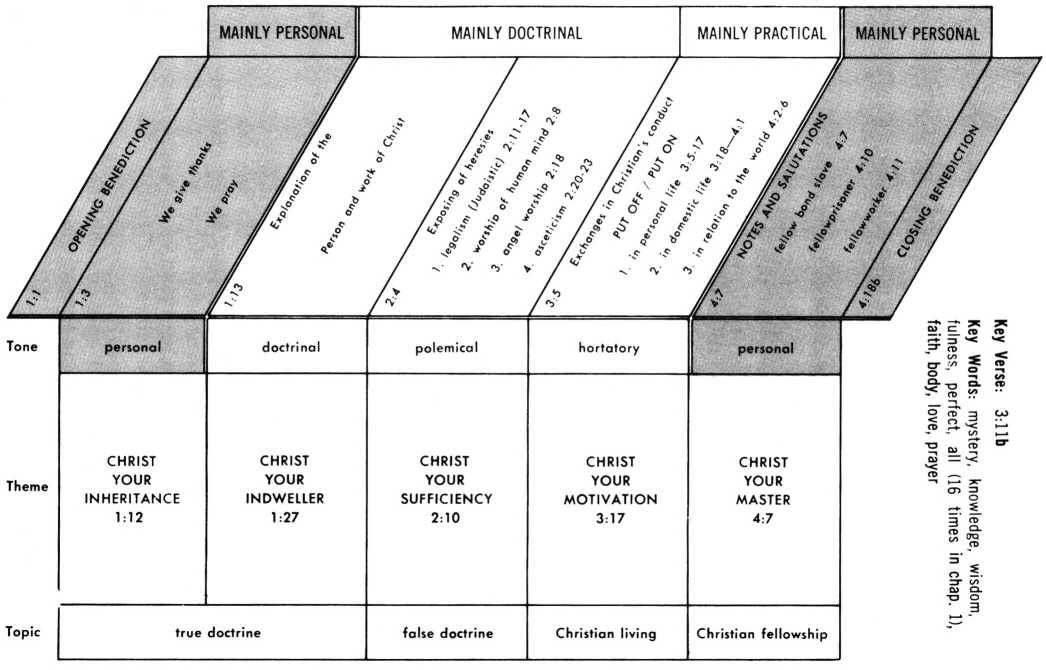
CHRIST IS ALL IN ALL
Click chart to enlarge
Charts from Jensen's Survey of the NT - used by permission
Colossians Overview - Click Chart on right side
| Christ Preeminent in All Things Supreme Lord - Sufficient Savior |
|||
| Colossians 1 | Colossians 2 | Colossians 3 | Colossians 4 |
| Supremacy of Christ |
Submission to Christ |
||
| Doctrinal and Corrective |
Practical and Reassuring |
||
| What Christ Did For Us |
What Christ Does Through Us |
||
| Christ Our Lord |
Christ Our Life |
Christ our Love |
|
| Christ the Head of the Body |
Christ the Lord of the Universe |
Christ the Head of the Home |
|
| Instruction | Warnings | Exhortations | Reminders |
| Reconciliation | Creation | Submission | Conversation |
| His Person and Word |
His Peace and Presence |
||
Colossians 2:8 See (PAM) to it that no one takes you captive (PAP) through philosophy and empty deception, according to the tradition of men according to the elementary principles of the world, rather than * according to Christ (NASB: Lockman)
Greek: blepete (2PPAM) me tis humas estai (3SFMI) o sulagogon (PAPMSN) dia tes philosophias kai kenes apates kata ten paradosin ton anthopon, kata ta stoicheia tou kosmou kai ou kata Christon;
Amplified: See to it that no one carries you off as spoil or makes you yourselves captive by his so-called philosophy and intellectualism and vain deceit (idle fancies and plain nonsense), following human tradition (men’s ideas of the material rather than the spiritual world), just crude notions following the rudimentary and elemental teachings of the universe and disregarding [the teachings of] Christ (the Messiah)." (Amplified Bible - Lockman)
Barclay: "Beware lest there will be anyone who will carry you off as his spoil, by insisting on the necessity of a so-called philosophy, which is, in fact, an empty delusion, a philosophy which has been handed down by human tradition, and which is concerned with the elements of this world, and not with Christ" (Colossians 2 Commentary)
CEV: "Don’t let anyone fool you by using senseless arguments. These arguments may sound wise, but they are only human teachings. They come from the powers of this world and not from Christ." (CEV)
GWT: "Be careful not to let anyone rob you of this faith through a shallow and misleading philosophy. Such a person follows human traditions and the world’s way of doing things rather than following Christ." (GWT)
KJV: "Beware lest any man spoil you through philosophy and vain deceit, after the tradition of men, after the rudimentsc of the world, and not after Christ."
Lightfoot: "Be on your guard; do not suffer yourselves to fall prey to certain people who would lead you captive by a hollow and deceitful system, which they call philosophy. They substitute the traditions of men for the truth of God. They enforce an elementary discipline of mundane ordinances fit only for children. Theirs is not the gospel of Christ.
NIV: " See to it that no one takes you captive through hollow and deceptive philosophy, which depends on human tradition and the basic principles of this world rather than on Christ." (NIV - IBS)
NKJV: "Beware lest anyone cheat you through philosophy and empty deceit, according to the tradition of men, according to the basic principles of the world, and not according to Christ."
NLT: "Don’t let anyone lead you astray with empty philosophy and high-sounding nonsense that come from human thinking and from the evil powers of this world, and not from Christ. (NLT - Tyndale House)
Phillips: "Be careful that nobody spoils your faith through intellectualism or high-sounding nonsense. Such stuff is at best founded on men's ideas of the nature of the world and disregards Christ!" (Phillips: Touchstone)
TEV: "See to it, then, that no one enslaves you by means of the worthless deceit of human wisdom, which comes from the teachings handed down by human beings and from the ruling spirits of the universe, and not from Christ"
TLB: "Don’t let others spoil your faith and joy with their philosophies, their wrong and shallow answers built on men’s thoughts and ideas, instead of on what Christ has said"
Wuest: "Be ever on your guard lest there shall be someone who leads you astray through his philosophy, even futile deceit, which is according to the tradition of men, according to the rudimentary teachings of the world, and not according to Christ"
Young's Literal: See that no one shall be carrying you away as spoil through the philosophy and vain deceit, according to the deliverance of men, according to the rudiments of the world, and not according to Christ,
SEE TO IT: blepete (2PPAM):
- Colossians 4:17, Deut 6:12, Gal 5:1,Mk 4:24, Mk 12:38,Mk 13:9, 13:33, Mt 7:15, Mt 16:6, Mt 24:4, Acts 20:29, 30, 31,Eph 5:15, Phil 3:2,Heb 3:12, 2Pet 3:1, 2Jn 8
- Colossians 2 Resources - Multiple Sermons and Commentaries
- Colossians 2:8-10: Philosophy or Christ - John MacArthur
- Colossians 2:8-23 The Sufficiency of Christ - John MacArthur
- Colossians 2:8-23 The Sufficiency of Christ Alone - John MacArthur
- Colossians 2:10-15: Complete in Christ - John MacArthur
Be ever on your guard (Wuest)
See to it (991)(blepo) means to watch, to see but in context of the spiritual dangers conveys the idea of more than just to see but to "Look out!" "Beware!" "Watch out!" "Take heed!" "Take note!" "Be aware of!".
The present tense (habitual, lifestyle), imperative mood (a command not a suggestion!) calls for this discerning attitude to be the habit of every saint in the Colossian church (verb is plural) and not just the elders. The active voice means that the subject must initiate this action as a choice of his or her will, but our old man does not want to make this choice! It is only by the continual energizing of the Spirit in us that we have the desire and power to please God (Php 2:13NLT). To reiterate, there is only ONE WAY to keep this or any other command continually and it is not by relying on self but by learning to continually rely on the Holy Spirit's power to enable you to do supernaturally what you cannot accomplish naturally! If you have experienced frustration and repeated failure your attempts to obey any ofGod's over 1600 NT commands, then this truth is for you! It is the Spirit Who sets you free to obey God's Word. This begs several questions:- Are you continually being filled with the Holy Spirit? Eph 5:18) Are you continually walking by the Spirit? (Gal 5:16) Are you grieving (Eph 4:30) or quenching (1 Th 5:19) the Holy Spirit by harboring unconfessed sin which in effect "short circuits" the Spirit's power? If so, then confess your sins (1 John 1:9) and walk in the light (1 John 1:7), flled with and empowered by the Spirit of Christ! This is the way to experience the abundant life of victory in Christ! See discussion of commands and need for the Spirit
Being continually watchful for false teaching does not come naturally. Paul is not encouraging a "critical spirit" but a "discerning spirit" and there is a crucial difference between the two. The former can destroy, while the latter serves to defend the local body of Christ. Next time you make a comment under your breath during the congregational meeting (or out loud afterwards!) ask yourself whether the comment is critical or discerning. Remember Jesus' warning
that every careless (argos = pertaining to not working = idle, inactive, ineffective, producing no good effect) word that men shall speak, they shall render account for it in the day of judgment." (Mt 12:36)
On the other hand
Let no unwholesome (sapros = rotten, putrefying, corrupt, disgusting) word proceed from your mouth, but only such a word as is good for edification (oikodome = literally building of a house, the process of building) according to the need of the moment, that it may give grace to those who hear." (see note Ephesians 4:29)
Paul continues the military imagery with his warning that they
Beware lest any man carry you off as a captive” (literal translation)
The false teachers did not go out and win the lost, no more than the cultists do today. They “kidnapped” converts from churches! A sad commentary on American Christianity is the fact that most of the people who are now members of cults were at one time associated with a Christian church! If you don't stand for the Truth, you're vulnerable to fall for any lie!
Blepo - 132x in 116v - be on guard(1), behold(1), beware(5), careful(1), careful*(1), consider(1),facing(1), keep on seeing(2), look(7), looking(5), looks(1), partial(2), saw(12), see(54), seeing(8), seen(8), sees(8),sight(2), take care(5), take heed(5), watch(1).
Matt. 5:28; 6:4, 6, 18; 7:3; 11:4; 12:22; 13:13f, 16f; 14:30; 15:31; 18:10; 22:16; 24:2, 4; Mk. 4:12, 24; 5:31; 8:15, 18, 23f; 12:14, 38; 13:2, 5, 9, 23, 33; Lk. 6:41f; 7:21, 44; 8:10, 16, 18; 9:62; 10:23f; 11:33; 21:8, 30; 24:12; Jn. 1:29; 5:19; 9:7, 15, 19, 21, 25, 39, 41; 11:9; 13:22; 20:1, 5; 21:9, 20; Acts 1:9; 2:33; 3:4; 4:14; 8:6; 9:8f; 12:9; 13:11, 40; 27:12; 28:26; Rom. 7:23; 8:24f; 11:8, 10; 1 Co. 1:26; 3:10; 8:9; 10:12, 18; 13:12; 16:10; 2 Co. 4:18; 7:8; 10:7; 12:6; Gal. 5:15; Eph. 5:15; Phil. 3:2; Col. 2:5, 8; 4:17; Heb. 2:9; 3:12, 19; 10:25; 11:1, 3, 7; 12:25; Jas. 2:22; 2 Jn. 1:8; Rev. 1:11f; 3:18; 5:3f; 9:20; 11:9; 16:15; 17:8; 18:9, 18; 22:8
So Paul gives a serious warning for continual vigilance, for you to keep your "spiritual radar" continually on high alert (a jet liner crashed in June, 2002 over Germany killing 100's because a radar tower was not properly monitoring the air traffic). Paul is saying we need to keep our "spiritual antennae" in the "receiving mode" with the filter of discernment turned "on" so that we can filter out the wisdom of man (recognizing it as such because we know the Truth). An unguarded mind, even of a believer, is subject to deceit, misunderstanding, and confusion, which inevitably results in false doctrine and false (sinful) living. The undiscerning saint is analogous to an "innocent", defenseless child, and the result is they are "tossed here and there by waves and carried about by every wind of doctrine, by the trickery of men, by craftiness in deceitful scheming" (see note Ephesians 4:14)
Test every high-sounding religious system by constantly asking,
Does it give Christ the place of preeminence?” and if so
"Is it the real Jesus and not "another Jesus" (2Cor 11:4)
Using the name of "Jesus" or "Christ" does not automatically stamp a ministry, man or practice as "sound doctrine". Jesus warned us that we must
be shrewd as serpents and innocent as doves" (Mt 10:16)
Paul added that we must be wise in what is good and innocent in what is evil. (Ro 16:19-note), remembering that from the very beginning "the serpent was more crafty than any beast of the field" (Gen 3:1, 2, 3, 4, 5,6, 7).
Examine everything carefully; hold fast to that which is good; abstain from every form of evil." (see notes 1Thes 5:21; 22)
When we hear a "new teaching" or of an author everyone is "praising", we need to have the mindset of the church at Berea "examining (present tense = continually) the Scriptures daily to see whether these things (eg today "these things" might be "new teaching" "new authors" "new practices") were so." (Acts 17:11)
Almost every religious system today gives Christ an eminent place, but only Biblical Christianity gives Him the preeminent place. Everything you read, hear, see, think, believe needs to be sifted thru this grid
Is it according to Christ, Who He is, What He has done, What He will do?"
This is the preventative to keep one from being led astray. Dr. Wayne Barber has stated that 5 of the 10 men instrumental in his early walk of faith have strayed from the truth in their preaching and no longer are emphasizing the centrality amd completeness of Christ in their message! If any of us think that we stand we must "take heed" (same verb as Col2:8) lest we too fall prey to empty philosophies of the world (1Co 10:12).
Paul insists on the need of vigilance. History teaches us the poignant lesson that again and again a seemingly invincible military fortress was stormed because its defenders thought that it was impregnable & thus became complacent in guarding the gates and walls.
In Re 3:3 (note) the risen Christ warns the Church of Sardis to be on the watch. The historical background for Christ's warning is fascinating. The Acropolis of Sardis was built on a 1500' jutting spur of rock that was smugly felt by its citizens to be impregnable. When Cyrus was besieging it, he offered a special reward to any who could find a way in. A certain enemy soldier named Hyeroeades was watching one day and saw a soldier in the Sardian garrison accidentally drop his helmet over the battlements. He saw him climb down after it and took note of his "secret" path. That night he led a band up the cliffs by that very path and when they reached the top they found it quite unguarded; so they entered in and captured the citadel, which had been considered impregnable. Cyrus, king of the Medo-Persians, captured Sardis by scaling the secret path. Once conquered, the city fell into a downward spiral from which they never recovered. The spiritual life is a chancy business if we do not watch over our hearts with all diligence (Pr 4:23 See Torrey's Topic "Diligence")
Believers must
Be of sober spirit, be on the alert (be clear headed, keep watch, be well balanced, temperate, sober of mind, be vigilant and cautious at all times, stay awake, be vigilant). (1Pe 5:8)
Comment: Both verbs are aorist imperative = do this now! Don't delay! It calls for urgent, immediate, unhesitating obedience.
Both of these verbs are in the aorist imperative, signifying an urgent command calling for immediate action in view of the looming danger. What danger? Peter goes on to explain that
Your adversary (literally one against you in a lawsuit), the devil, prowls around (present tense = continually) like (simile) a roaring (howling of a fierce hungry) lion, seeking someone to (seize upon) devour (swallow down). But resist (anthistemi = withstand, aorist imperative) him, firm (steadfast, solid like a foundation, firmly fixed, holding your position, a military metaphor) in your faith… " (1Pe 5:9)
THAT NO ONE TAKES YOU CAPTIVE: me tis humas estai (3SFMI) o sulagôgôn (PAPMSN):
- Acts 20;2829, 30, 32 Heb13:9
- Topic "False Doctrine"
- Colossians 2 Resources - Multiple Sermons and Commentaries
- Colossians 2:8-10: Philosophy or Christ - John MacArthur
- Colossians 2:8-23 The Sufficiency of Christ - John MacArthur
- Colossians 2:8-23 The Sufficiency of Christ Alone - John MacArthur
- Colossians 2:10-15: Complete in Christ - John MacArthur
Paul's use here of the indicative mood in the verb (estai) points to a real, not hypothetical danger.
Lightfoot adds that "The form of the sentence is a measure of the imminence of the peril.
Takes captive (4812) (sulagogeo from sulao = strip off the arms of a slain enemy, rob, plunder + ago = carry away) literally means to carry away prey and then to lead away as booty, slaves or captives. Col 2:8 is the only Biblical use. To take over complete control of a person as one would a captive. The image in context is of carrying someone away from the truth into the bondage of error, which is the opposite of what Jesus stated truth would accomplish (Jn 8:31).
"Figuratively of victimizing or brainwashing someone with religious error or false teaching" (Friberg)
"To lead away from the truth and subject to one’s sway" (Thayer)
Sulagogeo could be used of a slave-dealer carrying away the people of a conquered nation into slavery. To Paul it was a tragic thought that the Colossians who had been liberated would contemplate submitting themselves to a new and disastrous slavery.
Sulagogeo is a figurative description of the destructive effects of the false teachers who sought to rob believers at Colossae of the riches available in Christ. Don't let anyone (the pronoun is singular -- suggesting there may have been some particularly influential or charismatic individual Paul had in mind) kidnap you and carry you off!
KJV has interesting twist: Beware lest any man spoil you - Webster defines the noun form of "spoil" as "plunder taken from an enemy in war or a victim in robbery… the act of damaging… something taken from another by force or craft"
Now put this definition into the context of Colossians 2:3 (note) where Paul reminds the saints that in Christ "are hidden all the treasures of wisdom and knowledge.
Is some seductive teaching or mystical practice beginning to plunder "the treasure" you possess in Christ? Paul says "keep your eyes open" to this ever present danger. The best defense is a good offense so
Let the word of Christ richly dwell (make itself at home in your heart and mind, present imperative ~ command to make this practice or the habit of your life and not an afterthought) within you with all wisdom teaching & admonishing one another" (see note Colossians 3:16)
When you kidnap someone, you take them from living free to a state of being enslaved, and thus the picture Paul is painting is that of taking over complete control of a person by taking control of their mind. Spiritual warfare is not a struggle against power but is a struggle to maintain Truth. The battle is always over Truth & the battlefield is the mind. Our focus is to be on the resurrected, ascended, glorified Lord Jesus Christ and on His resurrection power in each individual life. False teachers seek to carry us away from the freedom (Jas 1:25, Jn 8:31-36) we have in Christ and to ENSLAVE us in their false doctrine. Thus you can see why Paul was so burdened and struggling so intensely to proclaim Christ (Col 1:28, Col 1:29). Promising freedom these false teachers are themselves enslaved according to (2Pe 2:19).
How many instances of this kind of kidnapping have we seen, or how many failures of faith on the part of young people going to college to study? Young people who have been raised in Christian homes, but who have been exposed to the wily, subtle teachings of human wisdom, have turned away from the things of Christ, often into wild, riotous living. Why? Because no one warned them, or else they did not heed the warning to avoid being made a prey of human knowledge.
THROUGH PHILOSOPHY : dia tês philosophias:
- Acts 17:18,32; Ro 1:21,22; 1Cor 1:19, 20, 21, 22, 23; 3:18,19; 15:35,36; 2Cor 10:5; 1Ti 6:20; 2Ti 2:17,18; 3:13
- Colossians 2 Resources - Multiple Sermons and Commentaries
- Colossians 2:8-10: Philosophy or Christ - John MacArthur
- Colossians 2:8-23 The Sufficiency of Christ - John MacArthur
- Colossians 2:8-23 The Sufficiency of Christ Alone - John MacArthur
- Colossians 2:10-15: Complete in Christ - John MacArthur
Spurgeon writes…
“Beware of those who pretend that they are going to enrich you, but whose real object is to plunder you. They say that they will give you advanced thought, deeper ideas, a system more congruous with the age
Plenty of people would spoil you in this way, by teaching you their profound thoughts, their grand inventions, their bright ideas. Beware of all of them.
You will philosophize men into hell, but never into heaven.
The history of that human ignorance which calls itself “philosophy” is absolutely identical with the history of fools, except where it diverges into madness.
Modern philosophers will accept anything except the bleeding Substitute for guilty man.
This is the cardinal virtue of philosophers; they extinguish one another. Their fine-spun theories do not often survive the generation that admires them. A fresh race starts fresh theories of unbelief, which live their day, like ephemera, and then expire.
Take a maxim of Socrates or of Plato, and enquire whether a nation or a tribe has ever been transformed by it from barbarism to culture. A maxim of a philosopher may have measurably influenced a man in some right direction; but who has ever heard of a man’s whole character being transformed by any observation of Confucius or Socrates? I confess I never have. Human teachings are barren.
Philosophy (5385) (philosophia from philos = friend/lover + sophia = wisdom) is literally a love of wisdom and came to mean tenets of heathen Gentile philosophers. "Human understanding or wisdom and, by implication, in contrast with divinely revealed knowledge." (Louw-Nida). The only other uses are in the Apocryphal book of 4 Maccabees - 4 Macc 1:1; 5:11, 22; 7:9, 21.
On the Areopagus at Athens Paul encountered members of the two leading philosophies of his day, Epicureanism and Stoicism (Acts 17:18ff.).
See more detailed Bible Dictionary definitions - Philosophy
BDAG says philosophia is used here "in a pejorative sense (negative connotation), with kenos apate, of erroneous teaching."
Thayer may be a bit speculative in his definition of philosophia…
Once in the N. T. of the theology, or rather theosophy, of certain Jewish-Christian ascetics, which busied itself with refined and speculative inquiries into the nature and classes of angels, into the ritual of the Mosaic law and the regulations of Jewish tradition respecting practical life
Daniel Hill (with Daniel J. Treier) writes that…
Philosophy, which etymology suggests to be “the love of wisdom,” is perhaps best thought of as the study of abstract and ultimate questions and their answers. What is meant by “abstract and ultimate”? To be philosophical, questions and their answers must be abstract, rather than particular questions of empirical matters of fact: philosophy does not ask what causes the rain to fall, but what causation is. (Dictionary for theological interpretation of the Bible)
The Gnostics were fond of philosophia. The modern definition of the word must not be read into its use in the Bible. Philosophy, as the study of reality, knowledge, and values, is a profitable and biblically supported endeavor. However, this is not the meaning of the word in Scripture. There it carries a negative connotation and refers to quasi–religious doctrines and speculations (e.g., Gnosticism) all of which are irreconcilable with the Christian faith.
As John Blanchard so correctly phrased it "Philosophy is the search for truth. In Jesus, the search ends."
G Campbell Morgan - Philosophy has been a quest, and never a conquest.
Billy Graham adds that "Any philosophy which deals only with the here and now is not adequate for man."
Hugh Silvester - Philosophy has shown itself over and over again to be full of arguments but lacking in conclusions”
D. Martyn Lloyd-Jones may have said it best "If a philosophy of life cannot help me to die, then in a sense it cannot help me to live." And in context the "Colossian philosophy" wrought spiritual slavery, not life and freedom.
A W Tozer wrote that…
Philosophy and science have not always been friendly towards the idea of God, the reason being that they are dedicated to the task of accounting for things and are impatient with anything that refuses to give an account of itself.
J. I. Packer - No philosophy that will not teach us how to master death is worth twopence to us.
“Philosophers are people who talk about something they don’t understand and make you think it’s your fault!” Another person quipped that a philosopher was like "A blind man in a dark room looking for a black hat which is not there." Someone else said that "Philosophy is saying what everybody knows in language that no one can understand." A more dignified definition of philosophy is man’s attempt to befuddle himself scientifically!
John Calvin wrote that…
The exhortations of the philosophers are cold and lifeless, if compared with the convictions, affections and boundless energy of the real believers… (and added that) The sublimest virtue according to philosophy is to live the life of nature, but Scripture points us to the perfect Christ as our example.
George Barlow…
Any philosophy, though championed by the most brilliant intellects, that tends to lure the soul from Christ, that puts anything in the place of him, or depreciates in any way our estimate of his glorious character, is false and full of peril.
Philosophia is found in the ancient writings from Epistle of Aristeas, II B.C…
The king said that this man had answered well, and asked another What is philosophy? And he explained, ‘To deliberate well in reference to any question that emerges and never to be carried away by impulses, but to ponder over the injuries that result from the passions, and to act rightly as the circumstances demand, practising moderation. But we must pray to God to instil into our mind a regard for these things.’ (Pseudepigrapha of the Old Testament)
Plato uses philosophia…
Theodorus - Well, Socrates, we have plenty of leisure, have we not?
Socrates - Apparently we have. And that makes me think, my friend, as I have often done before, how natural it is that those who have spent a long time in the study of philosophy appear ridiculous when they enter the courts of law as speakers. (Plato in Twelve Volumes, Vol. 12 translated by Harold N. Fowler)
Josephus uses philosophia in his writings…
Now, both these methods of knowledge I may very properly pretend to in the composition of both my works; for, as I said, I have translated the Antiquities out of our sacred books; which I easily could do, since I was a priest by my birth, and have studied that philosophy which is contained in those writings (Against Apion 1.54)
However if by philosophy we mean the search for clarity and understanding regarding the whole of reality, then the Christian must in a sense philosophize. He must think clearly, and he must strive for a self-consistent view of life. In his quest, however, he must always submit to the guidance, limitation, and criticism of the light of divine revelation. On the other hand, if by philosophy we mean human speculation regarding man’s basic questions without due respect for the revelation of God, then the Christian, no doubt, will accord this philosophy a greatly diminished relevance to his life and calling.
S Lewis Johnson has an interesting discussion of philosophy writing that
To Shakespeare’s question, “Hast any philosophy in thee, Shepherd?” many a Christian would reply firmly, even indignantly, in the negative. Would not Paul’s statement in the second chapter of Colossians lend support, too? His words are, “Beware lest any man spoil you through philosophy and vain deceit, after the tradition of men, after the rudiments of the world, and not after Christ”. And who has not heard the definition, “Philosophers are people who talk about something they don’t understand and make you think it’s your fault!” Or, the more dignified one, “Philosophy is man’s attempt to befuddle himself scientifically!” Much depends upon our semantics at this point. If by philosophy we mean the search for clarity and understanding regarding the whole of reality, then the Christian must in a sense philosophize. He must think clearly, and he must strive for a self-consistent view of life. In his quest, however, he must always submit to the guidance, limitation, and criticism of the light of divine revelation. On the other hand, if by philosophy we mean human speculation regarding man’s basic questions without due respect for the revelation of God, then the Christian, no doubt, will accord this philosophy a greatly diminished relevance to his life and calling. The philosophy to which Paul refers in Colossians 2:8 was, we have seen in preceding studies, most likely a form of gnostic Judaism, inadequately influenced by the revelation of God in Christ. To its “enticing words” (Colossians 2:4) of intellectual exclusivism the Colossians were in danger of falling prey. It is for this reason that Paul utters his disapproval of philosophy. I seriously question the view that Paul, as Tertullian after him, is to be understood as condemning all study of philosophy. Great sections of Paul’s own writings would be difficult to comprehend if we possessed no knowledge of contemporary philosophies (cf. 1Cor 15:1–58). No, the apostle does not condemn philosophy in toto, nor should any Christian, but he does say to that which is not in harmony with divine revelation, “There are more things in heaven and earth, Horatio, Than are dreamt of in your philosophy.” (Shakespeare, Hamlet, I, 5)." (Bibliotheca Sacra: Dallas Theological Seminary. page 309, 1962)
Thielicke has said,
Whenever God the Creator is deposed as the absolute and sovereign Lord of the world and our life, the 'gods' take over.
Despite the prominence of philosophy in Greco-Roman world, this is the only mention of philosophy in the Bible, and here God warns against it. Similarly, the only mention of philosophers (Acts 17:18) describes the two major philosophical schools of thought, both of which opposed Paul as he preached Christ. Paul may have been thinking mainly of the Epicureans and Stoics when he wrote this warning, but his divinely guided pen simply said to beware of all philosophy. The love of human wisdom characterizes every system of philosophy; they all follow the tradition of men and the elements of the world. Instead, men should love Christ, Who has made true wisdom unto us (1Cor 1:30) and in whom are stored all the treasures of true wisdom and true knowledge (Col 2:3). As Paul had already written, Christ had created and was sustaining everything (Col 1:16, 17-see notes Col 1:16; 17). Any philosophy centered on men or so-called gods, rather than in the true God of creation, is bound to be false and harmful.
A close parallel to this warning in Colossians is found in Paul's warning in
O Timothy, guard (aorist imperative = do this & do it now. Conveys sense of urgency) what has been entrusted to you, avoiding worldly and empty chatter and the opposing arguments of what is falsely called "knowledge" which some have professed and thus gone astray from the faith. Grace be with you." (1Ti 6:20, 21)
J Vernon McGee comments that
If you were to follow the history of philosophy beginning with Plato, including many of the church fathers, and coming down to more recent times (including Kant, Locke, and Bultmann, who seems to be the craze with some theologians right now), you would find that none of them have a high view of the inspiration of the Word of God. They are looking for answers to the problems of life, but they will not be found in philosophy. A true philosopher is a seeker after truth, but truth is not found in human wisdom. Christ is the answer, the answer to philosophy. Paul wrote, “But of him are ye in Christ Jesus, who of God is made unto us wisdom …” (1Cor 1:30). But false philosophy is like a blind man looking in a dark room for a black cat that isn’t there—there is no hope for its search for truth. Paul warns the Colossians to beware of this. (McGee, J V: Thru the Bible Commentary: Thomas Nelson)
Harry Ironside, the respected pastor of Moody Memorial Church in Chicago writes that…
Scripture nowhere condemns the acquisition of knowledge. It is the wisdom of this world, not its knowledge, that is foolishness with God. Philosophy is but worldly wisdom. It is the effort of the human mind to solve the mystery of the universe. It is not an exact science, for the philosophers have never been able to come to any satisfactory conclusion as to either the "why" or the "wherefore" of things… From Plato to Kant, and from Kant to the last of the moderns, one system has overturned another, so that the history of philosophy is a story of contradictory, discarded hypotheses. This is not to say that the philosophers were or are dishonest men, but it is to say that many of them have failed to avail themselves of that which would unravel every knot and solve every problem, namely, the revelation of God in Christ as given in the Holy Scriptures. Plato yearned for a divine Word--"logos"--which would come with authority and make everything plain. That Word is Christ of Whom John writes, "In the beginning was the Word, and the Word was with God, and the Word was God." (Jn 1:1) And again, "The Word became flesh, and tabernacled among us, and we beheld His glory the glory as of the only begotten of the Father, full of grace and truth." (Jn 1:14) The Word is no longer hidden. We do not need to search for it. "The word is nigh thee, even in thy mouth, and in thy heart: that if thou shalt confess with thy mouth the Lord Jesus, and shalt believe in thine heart that God hath raised Him from the dead, thou shalt be saved." (Ro 10:8, 9-notes)
It is said that there is a tombstone from ancient Rome that has inscribed on it the following:
I was not and I became;
I was and am no more.
This much is true;
Whoever says other, lies;
For I shall not be,
And thou who livest, drink, play, come.
Although we are separated from the one buried under that inscription by many centuries, that is the philosophy of our generation. But the Christian message is that there is more than this life. Life does not end at death, and so it has a purpose greater than enjoyment and pleasure. (From Michael Green - Illustrations for Biblical Preaching: Over 1500 sermon illustrations arranged by topic and indexed exhaustively)
OR EMPTY DECEPTION: kai kenês apatês:
- Ro 16:17 Ep 5:6
- Colossians 2 Resources - Multiple Sermons and Commentaries
- Colossians 2:8-10: Philosophy or Christ - John MacArthur
- Colossians 2:8-23 The Sufficiency of Christ - John MacArthur
- Colossians 2:8-23 The Sufficiency of Christ Alone - John MacArthur
- Colossians 2:10-15: Complete in Christ - John MacArthur
hollow and deceptive philosophy (NIV )
high-sounding nonsense. (Phillips)
a theosophy which is specious make-believe (Moffatt)
The fact that the two nouns, "philosophy" and "deceit" are the objects of the one preposition dia ("through") and the lack of the article with "empty deception" indicate that the "empty" and "deception" both describe the character of the philosophy. This verse could then be read "Beware lest any man lead you away captive through the philosophy which is empty and deceptive.
Noted Christian apologist Ron Rhodes explains why Christians should not discount "all philosophy"
any Christians today seem to misunderstand the apostle Paul’s warning in Colossians 2:8: “See to it that no one takes you captive by philosophy and empty deceit, according to human tradition.” The truth is, the Bible—interpreted rightly—is no more against philosophy than it is against religion. The Bible is against vain philosophy. Likewise, the Bible is not opposed to religion per se, but only against vain religion (James 1:26-27). In Colossians 2:8, Paul is not speaking about philosophy in general, but about a particular philosophy that was apparently influencing the church at Colossae, which is usually understood as an early form of Gnosticism. This is indicated by Paul’s use of a definite article (in the original Greek), which should be translated “the philosophy” or “this philosophy.” So Paul was referring to this particular Gnostic-like philosophy that had invaded the church in Colossae—a philosophy that involved legalism, mysticism, and asceticism (all of which are antithetical to Christianity)—and not to all philosophy. God places no premium on ignorance or shallow thinking (see Matthew 22:37 (Ed: Mark 12:30 adds "all your strength"); Acts 17:17,28,34; Philippians 1:16; Titus 1:12; 1 Peter 3:15). An awareness of the various philosophical disciplines can equip Christians to argue against anti-Christian philosophies (Acts 17:22-31) and use philosophical tools in proving the truth of Christianity… We shouldn’t be reluctant to study philosophy, for it can help us refute error and defend the truth of Christianity. (5-minute apologetics for today: 365 quick answers to key questions, Harvest House)
Empty (2756) (kenos) means empty, vain, fruitless, without usefulness or success, false, fallacious. Kenos is that in which there is nothing of truth or reality. Kenos describes not only that which will not succeed but also that which has no purpose! The best antidote for the poison of empty deception is the whole council of God. In preparation for entering the Promised Land (with warfare both real and spiritual) Moses spoke these wise words to the children of Israel
IT (referring to the Word of God, click link to read in context) is not an idle (Septuagint translates Hebrew with Greek word kenos!) word for you; indeed IT (the Word) is your life. And by this word you shall prolong your days in the land, which you are about to cross the Jordan to possess." (Deut 32:47)
Don't miss what Moses said "IT IS NOT AN IDLE WORD… IT IS YOUR LIFE." Do you believe that? Does your time in His holy Word show that you really believe it? Eating His Word will counter the contamination of empty words.
Kenos - 18x in 16v - Mk. 12:3; Lk. 1:53; 20:10f; Acts 4:25; 1 Co. 15:10, 14, 58; 2 Co. 6:1; Gal. 2:2; Eph. 5:6; Phil. 2:16; Col. 2:8; 1 Thess. 2:1; 3:5; Jas. 2:20 and is rendered in NAS as empty(2), empty-handed(4), foolish(1), futile things(1), vain(10).
Deception (539) (apate from apatao = cheat, delude, deceive, beguile) describes that which gives a false impression, whether by appearance, statement or influence. It speaks of ethical enticement. It is spoken of anything which is seducing (a leading astray by persuasion or false promises) Apate describes that which causes someone to have misleading or erroneous views concerning the truth.
Apate - 7x in NT - Matt. 13:22; Mk. 4:19; Eph. 4:22; Col. 2:8; 2 Thess. 2:10; Heb. 3:13; 2 Pet. 2:13 and is rendered by NAS as deceit(1), deceitfulness(3), deception(2), deceptions(1).
Enticement (Concise Oxford English Dictionary says it derives from O French enticier, prob. from a base meaning ‘set on fire’) - is that which to attracts and leads astray artfully or adroitly or by arousing hope or desire.
Deception - is that which deliberately causes (someone) to believe something that is not true.
(1) is one of the inherent dangers of wealth (Mt 13:22 Mk 4:19),
(2) characterizes the sinful lusts inherent in our old flesh nature inherited from Adam (Ep 4:22),
(3) is a general characteristic of sin (He 3:13), and
(4) is a trait commonly associated with false teachers (2Pe 2:19)
Webster's defines deceive as
cause to accept as true or valid what is false or invalid" and which "leads astray or frustrates usually by underhandedness & implies imposing a false idea or belief that causes ignorance, bewilderment, or helplessness
Don't be deceived by these subtle "half truths" which promise freedom but ultimately reap corruption, defeat and bondage. These "deadly viruses of deceit" are rampant in both mainline and evangelical churches in America. We must be diligent to continue
holding fast (present tense = continually) to the head" (Col 2:19-note), "holding fast to Him; for this is (our) life and the length of (our) days" (Dt 30:20), "holding fast (present tense = continually) the faithful word… so that (we) will be able both to exhort in sound (hugiaino - healthy and wholesome, referring to that which protects and preserves life) doctrine and to refute (scrutinize or examine carefully, bring to light, expose) those who contradict (speak against truth)" (Titus 1:9-note) and finally "holding fast (present tense = continually) the word of life, so that in the day of Christ I will have reason to glory because I did not run in vain nor toil in vain." (see note Philippians 2:16)
Gnosticism (from Greek gnosis = knowledge) separated matter from thought concluding that matter was evil. The deadly heresy Gnostics propounded was that the possession of knowledge was the only requirement for salvation, which also explains why Gnostics did not want to attribute humanity to Jesus Christ. Since they considered material things evil, another "-ism" resulted called Docetism which taught that Christ's body only appeared material, but in reality it was only spiritual.
This belief led to another "-ism" Anomianism which in essence promoted a profligate, immoral lifestyle. They reasoned that since the spirit was separate from the physical body, one had no responsibility for the actions done in the physical body. Given their belief in Docetism, Gnostics ignored or diminished the significance of the historic facts of death, burial and resurrection of Jesus Christ, teaching that these events were not real but simply appeared to be real. Gnostics generally held the view that all the secrets of God were in the mind, or appearing in an immaterial identity. The result was a complete denial of sexual and other bodily appetites which led to either asceticism or uncontrolled indulgence, depending on which camp they were in. Paul is teaching that sanctification of believers is not through asceticism or by self effort to control one's passions but by setting one's mind on the things above, remembering that Christ was now one's life (and His Spirit the power) to put mortify the flesh and put off the old and put on the new.
ACCORDING TO THE TRADITION OF MEN : kata ten paradosin ton anthropon:
- Colossians 2:22; Mt 15:2, 3, 4, 5, 6, 7, 8, 9; Gal 1:14;,Mk 7:5,8, 9, 1Pe 1:18, 2Th 2:15, 3:6, 1Co 11:2
- Colossians 2 Resources - Multiple Sermons and Commentaries
- Colossians 2:8-10: Philosophy or Christ - John MacArthur
- Colossians 2:8-23 The Sufficiency of Christ - John MacArthur
- Colossians 2:8-23 The Sufficiency of Christ Alone - John MacArthur
- Colossians 2:10-15: Complete in Christ - John MacArthur
- Colossians 2 Traditions of Men - John MacArthur
Spurgeon writes…
What do you want with their traditions? Christ has revealed his truth to you. What do you want with the world’s rudiments? You have gone beyond such elementary, useless knowledge as that, for you have got the truth itself.”
Cleave to Christ, beloved. Go no further than he leads you; and turn not away from him either to the right hand or to the left. In him are contained all the riches of grace, and all the treasures of knowledge. If you would become truly wise, seek to know more of the wisdom of God in Christ Jesus.
Tradition (3862)(paradosis from paradidomi means to surrender, yield up, entrust, deliver up) pictures a giving over or a passing on. Paul illustrates the meaning in his word to the Corinthians, writing
I delivered (paradidomi) to you as of first importance what I also received, that Christ died for our sins according to the Scriptures" (1Cor 15:3)
Paradosis - 13x in NT - Matt. 15:2f, 6; Mk. 7:3, 5, 8f, 13; 1 Co. 11:2; Gal. 1:14; Col. 2:8; 2 Thess. 2:15; 3:6
Just because people have believed something and handed it down through the years does not make it true. The question as good Bereans (see note Acts 17:11) we must always ask is it "according to the Scriptures"?
Those who are led away by traditions of men go along a path marked out by no higher authority than that of men, from whom it has been handed down. Although these persuasive arguers set forth their teaching as Tradition Paul rejects any suggestion of divine origin teaching in fact that they were human fabrication (“according to human tradition”) as opposed to "according to the Scriptures" and "according to Christ".
Lightfoot comments that
The false teaching is described, first, in terms of its source—human tradition, and, second, in terms of its content—principles of this world.
Tradition usually serves merely to perpetuate error. In our own day, a common argument for evolution is the false assertion that it is “what scientists have always believed.” If a new Christian from a distant mission field were to visit many of our churches, he would probably be astounded at the ideas and practices we have that cannot be supported by God’s Word. And tragically, man-made traditions are often given more importance than the God-breathed doctrine of Scripture! While it is not wrong to have church traditions that remind us of our godly heritage, we must be careful not to make these traditions are tested by the plumb line of God's Word.
As Paul uses this term, the traditions of the Jews and Gentiles represent little more than ignorance and falsehood handed down from generation to generation. For "good traditions" see the following Scriptures (1Cor 11:2, 2Th 2:15, 2Th 3:6) which is the only source of truth. Why follow empty philosophy when we have all fullness in Christ? This is like turning away from the satisfying river to drink at the dirty cisterns of the world (Jer 2:13).
J Vernon McGee comments on the "tradition of men" writing that
You may remember that the Lord Jesus condemned the religious rulers in His day because they taught the tradition of men rather than the Word of God. Very frankly, this is one of the reasons I have turned to the teaching of the total Word of God. It is so easy to lift out some peculiar interpretation of some particular passage and then ride that like a hobby horse. I believe in prophecy, but there is more in the Word of God than just prophecy. Some preachers dwell on the Christian life. That certainly is in the Bible, but there is more than just that. This is why I think it is so important for us to study the total Word of God. (McGee, J V: Thru the Bible Commentary: Thomas Nelson)
Josephus explains the expression “the traditions of the elders” or of the Pharisees. The words of the elders were considered more desirable than the words of the prophets! A conspicuous example of tradition is found in the Talmud which consists almost entirely of assertions of celebrated Jewish teachers; the greater part having no ground whatever except the teacher’s authority. Now that's deception also! And tradition will take your mind captive & make you resistant to the cutting Truth of Jesus which comes head on against traditions which are self-satisfying, productive of a self-righteousness, but which fail miserably to bring man closer to true fellowship w/ God.
ACCORDING TO THE ELEMENTARY PRINCIPLES OF THE WORLD: kata ta stoicheia tou kosmou:
- 1Co1:18, 19, 20, 21, Gal 4:3, 1Ti 4:1
- Colossians 2 Resources - Multiple Sermons and Commentaries
- Colossians 2:8-10: Philosophy or Christ - John MacArthur
- Colossians 2:8-23 The Sufficiency of Christ - John MacArthur
- Colossians 2:8-23 The Sufficiency of Christ Alone - John MacArthur
- Colossians 2:10-15: Complete in Christ - John MacArthur
Elementary (4747) (stoicheion from stoicheo = march in rank from stoíchos = row) describes something orderly in arrangement as for example one of a row and hence a component or element. In most of its uses, it denotes an elementary or fundamental principle in a subject or discipline. It refers to the first principles of something.
Stoicheion (“elements”) refers to the basic building blocks of matter, such as atomic and subatomic particles.
Stoicheion - 7x in NT - Gal. 4:3, 9; Col. 2:8, 20; Heb. 5:12; 2 Pet. 3:10, 12 and is rendered in the NAS as elemental things(2), elementary principles(2), elementary principles*(m)(1), elements(2).
A stoicheion was originally a line of things as for example a line of soldiers, but came to refer to the ABC's, and then to any elementary knowledge. Stoicheion also refers to any first thing from which the others belonging to some series or composite whole take their rise.
Among the ancient Greek philosophers, stoicheion designated the four basic and essential elements of which the universe consisted, namely, earth, water, air, and fire.
Vine adds "the word stoicheion, lit., one of a row or series, is here used of the elementary principles of religion, as in Col 2:20 (note), Jewish in Gal 4:3, 9, Acts 15:10 or Gentile as well, as here… The "world" here stands for all that is apart from" God. Vincent relates these "elementary principles" to "Ceremonialism — meats, drinks, washings, Essenic asceticism, pagan symbolic mysteries and initiatory rites — all belonged to a rudimentary moral stage."
In Gal 4:3 we learn that this rudimentary teaching brings men under bondage. Similarly, they who seek to lead captive the Colossian Christians would lead them along a path marked out by the traditions of men and by the rudimentary teaching of the material world.
Wiersbe has an interesting note
The Greek word translated “rudiments” ("elementary principles") … basically means “one of a row or series.” It had several meanings attached to it:
(1) the elementary sounds or letters, the ABCs;
(2) the basic elements of the universe, as in 2Pe 3:10, 12-see notes2Pe 3:10; 12;
(3) the basic elements of knowledge, the ABCs of some system, as in He 5:12 (note). But in ancient Greece, this word also meant “the elemental spirits of the universe, the angels that influenced the heavenly bodies.” It was one of the words in the vocabulary of the religious astrology of that day. (Wiersbe, W: Bible Exposition Commentary. 1989. Victo)
Barclay writes that stoicheia means "literally things which are set out in a row. It is, for instance, the word for a file of soldiers. But one of its commonest meanings is the letters of the alphabet, no doubt because they form a series which can be set out in a row. Because stoicheia can mean the letters of the alphabet, it can also very commonly mean elementary instruction in any subject. We still speak of learning the A B C of a subject, when we mean taking the first steps in it. It is possible that this is the meaning here. Stoicheia has a second meaning. It means the elemental spirits of the world, and especially the spirits of the stars and planets. There are still people today who take astrology seriously. They wear signs of the zodiac charms and read newspaper columns which tell what is forecast for them in the stars. But it is almost impossible for us to realize how dominated the ancient world was by the idea of the influence of the elemental spirits and the stars. Astrology was then, as someone has said, the queen of the sciences. Even men so great as Julius Caesar and Augustus, so cynical as Tiberius, so level-headed as Vespasian would take no step without consulting the stars. Alexander the Great believed implicitly in the influence of the stars. Men and women believed that their whole lives were fixed by them. If a man was born under a fortunate star all was well; if he was born under an unlucky star, he could not look for happiness; if any undertaking was to have a chance of success, the stars must be observed. Men were the slaves of the stars. There was one possibility of escape. If men knew the right pass-words and the right formulae, they might escape from this fatalistic influence of the stars; and a great part of the secret teaching of Gnosticism and of kindred faiths and philosophies was knowledge which claimed to give the devotee escape from the power of the stars; and in all probability that was what the false teachers of Colossae were offering. They were saying, “Jesus Christ is all very well, he can do much for you; but he cannot enable you to escape from your subjection to the stars. We alone have the secret knowledge which can enable you to do that.” Paul, sufficiently the child of his age to believe in these elemental spirits, answers: “You need nothing but Christ to overcome any power in the universe; for in him is nothing less than the fullness of God and he is the head of every power and authority, for he created them. (Colossians 2 Commentary)
RATHER THAN ACCORDING TO CHRIST: kai ou kata Christon:
- Eph 4:20
- Colossians 2 Resources - Multiple Sermons and Commentaries
- Colossians 2:8-10: Philosophy or Christ - John MacArthur
- Colossians 2:8-23 The Sufficiency of Christ - John MacArthur
- Colossians 2:8-23 The Sufficiency of Christ Alone - John MacArthur
- Colossians 2:10-15: Complete in Christ - John MacArthur
Christ, the living person Himself, is both the substance and the end or aim of true preaching and teaching. That is the test of all. Pass every teaching thru this grid (especially "deeper truth", "new teaching", "new practices" or "new techniques"). Everything that you read, hear, think, believe, see on TV, papers, movies, internet, needs to be sifted through the grid of the question -- is it according to Christ? Who He is. What He has done. Who you are in your identification with Him. Whose you now are. Learn to sift all your mental input through the grid of is it "according to Christ" and you will not be deluded, led astray or taken captive by wrong doctrine or wrong thinking!
Christ is the yardstick by which to measure philosophy and all human knowledge. The Gnostics were measuring Christ (!) by their philosophy as liberal theologians ("The Jesus Seminar", Wellhausen's "higher" criticism) do in our day. Paul says that men such as these
knew God (but) they did not honor Him as God, or give thanks; but they became futile in their speculations, and their foolish heart was darkened. Professing to be wise, they became fools." (see notes Romans 1:21; 1:22)
These foolish "wise" men have it backwards, for Christ Alone is the measure for all human knowledge (Col 2:3) since he is the Creator and the Sustainer of the universe. Christ is the standard by which all doctrine is to be measured, and any system must be rejected if it fails to conform to the revelation God has given us in Christ, the Living Word and the Truth.
DON'T BE FOOLED - People don't like to be fooled, but it happens so often that it might seem as if they do. Far too many people fall for crooked schemes that cost them money, endanger their health, or waste their time. It happens to elderly people when they trust the friendly, persuasive person who comes to the door selling a too-good-to-be-true product. It happens when a shyster tells a couple that he's from the bank, and they need to withdraw money and give it to him to fix a bank error. It happens when a person with health problems buys hundreds of dollars' worth of bogus medicine. It can happen to us too—in spiritual matters. We can be fooled by deceitful presentations that make guarantees far beyond what God has clearly promised. But this isn't anything new. Paul warned about this kind of deception in Colossians 2:8.
So, how do you protect yourself from those who make religious claims that God's Word does not support? By being "rooted and built up in [Christ Jesus] and established in the faith, as you have been taught" (Col 2:7).
Whether listening to a salesperson or to a preacher, be discerning. Don't be fooled. —J D Branon (Our Daily Bread, Copyright RBC Ministries, Grand Rapids, MI. Reprinted by permission. All rights reserved)
Christ is all we need, His truth complete—
The world will try to add, subtract, distort;
Cling to what you know, and trust God's Word,
Don't let yourself believe a false report. —Carbaugh
Feeding on God's truth will keep you from swallowing a lie.
KILLED BY IMPROVEMENTS - "I wonder what the apostle Paul would say if he were to visit our churches today. What a beehive of activity! Committees, programs, entertainment without end. But worship is often downplayed, services are cut back, prayer meetings are eliminated. Some call these improvements, but are they really changes for the better? There's a story about a woman who became seriously ill and was taken to the hospital. In the evening her husband asked how she was doing, and he was told that she was improving. For several days her doctor gave the same report. Then one day she unexpectedly died. When the man saw the doctor, he asked, "Well, what did she die of-- improvements?" I know of a church that died of "improvements." The first was to hire a minister with unbiblical ideas. Then the prayer meeting was changed into a literary debating society. Finally, the minister stopped praying from the pulpit. The church is now dead. (similarly the only remnant of the church at Colossae is a plaque with the name "Epaphras"!) I suggest that someone put a tombstone in front of it with these words: "Died of Improvements." There's always room for the right kind of improvements in our churches. But let's make sure they are guided by the life-changing principles of God's Word, not the deadening philosophies of this world. -- M R De Haan (Our Daily Bread, Copyright RBC Ministries, Grand Rapids, MI. Reprinted by permission. All rights reserved)
God put the church in the world;
Satan tries to put the world in the church.
Colossians 2:9 For in Him all the fullness of Deity dwells (PAI) in bodily form (NASB: Lockman)
Greek: hoti en auto katoikei (3SPAI) pan to pleroma ten theotetos somatikos,
Barclay: for in him there dwells the fullness of the divine nature (Colossians 2 Commentary)
Phillips: Yet it is in him that God gives a full and complete expression of himself (within the physical limits that he set himself in Christ). (Phillips: Touchstone)
Wuest: because in Him there is continuously and permanently at home all the fullness of absolute deity in bodily fashion
Young's Literal: because in him doth tabernacle all the fulness of the Godhead bodily,
FOR IN HIM ALL THE FULLNESS OF DEITY (continually) DWELLS IN BODILY FORM: hoti en autôi katoikei (3SPAI) pân to plêrôma tês theotêtos sômatikôs:
- Colossians 2 Resources - Multiple Sermons and Commentaries
- Colossians 2:8-10: Philosophy or Christ - John MacArthur
- Colossians 2:8-23 The Sufficiency of Christ - John MacArthur
- Colossians 2:8-23 The Sufficiency of Christ Alone - John MacArthur
- Colossians 2:10-15: Complete in Christ - John MacArthur
For (hoti) means because. The Colossians were to be on guard for any philosophical "pretenders."
Robertson explains that in context Paul is giving the reason for the "preceding claim for Christ as the measure of human knowledge."
The phrase In Him (see notes on in Christ and in Christ Jesus) is appropriately placed at the beginning of the sentence. In Jesus is all the sufficiency we need in time and eternity. Don't be deluded. Don't let some slick "scholar" take your mind captive with some "new" teaching or some "deeper" truth. Stick with this truth Paul teaches and you will not go wrong!
Spurgeon writes…
In Christ, we enter into the fullness and completeness of life both materially and spiritually.
Everything, then, must be in Christ if all the fullness of the Godhead dwells in him. Why do you want to go anywhere else for wisdom? What can you find by going elsewhere? “For in him dwelleth all the fullness of the Godhead bodily.
You have everything in Christ that you ought to want; you are fully furnished, completely supplied and equipped for all future service. You need not go to Christ for the supply of some of your needs, and then go elsewhere for the supply of other needs; but, “ye are complete in him.”
Harry Ironside said "Christ is a substitute for everything, but nothing is a substitute for Christ."
J Vernon McGee adds that Paul's teaching in this verse "is a clear-cut statement of the deity of Christ. It could not be stated any stronger than it is here. In Him dwells all the fullness of the Godhead—not just 99.44 percent but 100 percent. (McGee, J V: Thru the Bible Commentary: Thomas Nelson)
Vincent writes that this verse emphasizes "the great and central doctrine that was to be maintained about Christ, that all the fulness of the Godhead dwelt in him. Every system which denied this was a denial of the doctrine which they had been taught; and against every thing that would go to undermine this; they were especially to be on their guard. Almost all heresy has been begun by some form of the denial of the great central truth of the incarnation of the Son of God.
Fullness (4138) (pleroma from pleroo = make full, fill, fill up) means full measure with emphasis upon completeness. Pleroma is the very word Gnosticism used for the entire host of intermediary beings between God and man. The incarnate Lord, crucified, risen, and ascended is the only Mediator between God and men (1Ti 2:5).
Pleroma - 17v in NT - Matt. 9:16; Mk. 2:21; 6:43; 8:20; Jn. 1:16; Rom. 11:12, 25; 13:10; 15:29; 1 Co. 10:26; Gal. 4:4; Eph. 1:10, 23; 3:19; 4:13; Col. 1:19; 2:9 and is translated in NAS as all it contains(1), fulfillment(2), full(2), fulness(10), patch(2).
It was the Son of God who
emptied Himself, taking the form of a bond-servant, and being made in the likeness of men. (see note Philippians 2:7)
John adds that
of His fullness (pleroma) we have all received, and grace upon grace. (John 1:16)
Paul here disposes of the Docetic theory that Jesus had no human body and the Cerinthian separation between the man Jesus and the Christ. He asserts plainly the deity and the humanity of Jesus Christ in corporeal form.
Of deity (2320) (theotes; See ISBE note below) means the Godhead, essentially, perfectly, the very personality of God and properly denotes the divine nature, including all attributes and perfections. Theotes is found only here in Scripture.
See also the commentary associated with tó theíon in Acts 17:29, the the commentary associated with tó theíon in 2 Pe 1:3,4; the commentary associated with theiótēs in Ro. 1:20; and the commentary associated with theótēs in Col. 2:9);
Vincent adds on theotes that "Paul is speaking of the essential and personal deity as belonging to Christ. So Bengel: “Not the divine attributes, but the divine nature.”
William Evans on theotes in Col 2:9 - Not merely the divine perfections and attributes of Deity, but (theotes) the very essence and nature of the Godhead. He was not merely God-like; He was GOD.
ISBE (Revised) entry under "Deity" - DEITY [Gk. tó theíon] (Acts 17:29); AV GODHEAD; [theiótēs] (Rom. 1:20); AV GODHEAD; [theótēs] (Col. 2:9); AV, NEB GODHEAD. These three closely related Greek terms are descriptive of the basic nature of God. They seem to vary but slightly in connotation.
A. Tó Theíon. Tó theíon (theios) “the divine thing,” is derived from the adjective theíos, meaning “pertaining to God,” “divine” (2 Pet. 1:3f). It signifies “God” in an impersonal sense. In Acts 17:29, in Paul’s speech to Greek intellectuals on Mars Hill, the term tó theíon draws attention to the qualitative aspect of God. Paul demonstrates the Greeks’ shallow conception of God, seeking to heighten their receptivity to the revealed truth of the gospel of Christ. The term tó theíon was common in their discussions, being used to designate the deity apart from any reference to a particular god. Paul focuses attention upon that quality of “the divine” which distinguishes God from all else. English terms based on the word “divine,” however, are used too commonly and are therefore inadequate to set forth the connotation of tó theíon (see II. A, B below). The idea is more adequately represented by “the Deity,” so that an appropriate translation of Acts 17:29 might be: “It is inconceivable that ‘the Deity’ can be appropriately represented by the artistic talents of men working with mere earthly elements.”
B. Theiótēs The term theiotes is an abstract noun closely related to tó theíon, derived from the same adjective, theíos. It is commonly understood as a summary term for the attributes of deity. However, the term merely “defines” with regard to essence, signifying “the quality of the divine,” that character which makes God God, and sets Him apart as worthy of worship. The Greeks used the term of their deities. Later it was applied to men by the Roman imperial cult as a term for the divinity of imperial majesty. It is rarely used in later Jewish works and occurs in biblical literature only in Wisd. 18:9 and Ro 1:20. The term is not as impersonal as tó theíon, but its abstractness does not lend a readily discernible distinction. Its meaning is approximated by “deity,” perhaps “divineness.”
In Ro. 1:20 theiótēs is used of that nature of the Creator discernible to the mind by observation of the existing worlds. Verse 19 states, “For what can be known about God is plain to them, because he has shown it to them.” Verse 20 affirms that man’s mind is able to form a concept of the invisible nature of God by visual perception of the universe. The discernible features of His transcendent being (“his invisible nature”) are specifically His “eternal power” and “deity.” The universe displays the eternal power it took to bring the universe into existence; in addition it displays the divine character of the one who created it, i.e., His deity. Specific attributes are not in view in the term theiótēs, simply His quality of “Godness,” which depicts Him as worthy of worship. But men suppressed this truth in unrighteousness (v 18), and are without excuse, subject to the wrath of God revealed from heaven (v 20). They did not acknowledge “his deity” as it is discernible in the things He has created.
C. Theótēs - Theotes is a kindred term (to theiotes), but is distinctive in that it is derived from the word “God” (theós). On this basis it is the most personal of the three terms (to theion - Acts 17:29, theiotes - Ro 1:20, theotes - Col 2:9), and is nearly a name. Whereas tó theíon marks “the quality of deity,” and theiótēs connotes “that which makes God God,” theótēs signifies “the being of God.” Theótēs apparently denotes the utmost idea of God. On heathen lips it could do no more than designate their highest concept of God, “The Supreme Being.” In Col. 2:9 Paul uses theótēs in declaring that “the whole fulness of deity dwells bodily” in Christ. Although it conveys the idea of a “being,” the use of “Divine Being” here would impersonalize the total expression, “the whole fulness of the Divine Being.” The term “deity,” or even “the Deity,” is likewise impersonal; furthermore, the connotation “being” is lacking. A term that better preserves the personal and qualitative aspect of theótēs is “godhead” (see III below). The total expression “the whole fulness of the Godhead,” then, signifies the sum of all that enters into the conception of “Godhead,” God in nature, character, and being. All this dwells in Christ “bodily,” i.e., in such a manner as to be shown in a bodily organism. Cf. Jn. 14:9, where Philip’s request that Jesus show them the Father was met by the Lord’s response, “He who has seen me has seen the Father.”
II. English Terms
In English the words most representative of these three Greek terms are “deity,” “divinity,” and “godhead.”
A. Deity “Deity” means “divine character” or “nature” and is used of false gods as well as of the persons of the trinity. “Deity” is qualitative in its import. The expression “the deity of Christ” is much stronger than “the divinity of Christ,” probably because “divinity” is commonly applied to men and things. When used with the article, the resultant term “the Deity” becomes a designation of God the Supreme Being, although it can also be used of specific lesser deities. Hence, the term “deity,” when used with the article, is qualitative and somewhat personal in connotation.
B. Divinity The term “divinity” is much like “deity” in that it refers to divine character or nature. But although it is used in connection with the persons of the trinity, it lacks the force of “deity.” These Latin derivatives bring into English the basic distinction created by the Latin fathers. Before the controversy about the deity of Christ, Latin had only the general term divinitas. The Latin fathers coined the term deitas as a distinctive rendering of the Gk. theótēs, and employed it to express the “deity” of the persons of the trinity. They, as well as the Greek fathers, needed unique terms to combat the attempt to ascribe to the Son and the Spirit a reduced “divinity.” This distinctiveness is largely preserved in English, although there is a tendency for “divinity” and “deity” to merge in meaning.
C. Godhead The English term “godhead” was originally a synonym for “Godhead,” a word that has all but passed out of use. As manhood is that quality which makes a man a man, so godhead is that which makes God God. This significance, however, is not readily discernible in the term today. It is presently a somewhat neutral term for the essential being of God as unique. By prefixing the article, the term becomes an abstract way of saying “God.” In fact, the article prefixed to any of these terms, “the Deity,” “the Divinity,” or “the Godhead,” draws attention to the constitutive qualities that make God the kind of being we call “God.” In strength of affirmation, or personalizing force, “godhead” seems most substantial, with “deity” nearly as strong and “divinity” weakest in this regard. All are abstract terms, nearly synonymous in meaning, yet the context will often decide the choice of one word over another.
III. Summary
Since the context of Col. 2:9 deals with the person of Christ, Paul apparently chose a term distinctive in that respect, theótēs. The contexts of Acts 17:29 and Rom. 1:20 emphasize the character rather than the person of God. The terms used are impersonal in connotation. Because of these differences in context and word derivation it is preferable to use distinctive English terms. “Deity” seems appropriate for the concept of tó theíon in Acts 17:29 and for theiótēs in Rom. 1:20, but inadequate for theótēs in Col. 2:9. “Godhead” more adequately portrays the truth that all that constitutes God in person, character and being dwells in Christ the Son. Speaking of God in respect to His “Godness” the term “deity” is sufficient, but in reference to His person and/or being a designation with the word “god” seems preferable. (G. E. Montgomery)
Theotes refers to the essence and nature of the Godhead, not merely the divine perfections and attributes of Divinity (which is a different Greek word (theiotes). Christ, as Man, was not merely God-like, but was in the fullest sense, God.
Vine on Ro 1:20 - Theiotēs, used here only in the New Testament, is associated in meaning with theotēs, Godhead, which is used only in Colossians 2:9. There is, however, a certain distinction in meaning and accordingly the former is here translated “divinity” and the latter “godhead.” The difference in the words is appropriate to the respective passages. Here Paul is speaking of the revelation which God has given in nature of His divine attributes. Man can thereby know certain facts about Him, such as His divinity, but cannot know God personally. Such knowledge can come only through the Son of God (cp. John 17:25 with John 1:18). In Colossians 2:9 Paul is speaking of the absolute Godhead of Christ, the fullness of which dwells in Him, and not of an external revelation of His divine attributes. Hence the suitability of theotēs, deity, in that verse.
Vine on Theotes in Col 2:9 - The Godhead (theotēs) signifies the nature and attributes of deity, not merely divinity. In the Son there dwells all the fullness of absolute Godhood, essentially, perfectly, the very personality of God. The word is thus to be distinguished from theiotēs in Romans 1:20, where the apostle is declaring what may be known of Him from creation, the traces of Himself to be discovered in nature, not the personal God Himself. He can be known only by the revelation of Himself in His Son, who has made this possible because of His Incarnation. That is what is conveyed by the term “bodily,” a bodily manifestation, which still exists and ever will.
Earle - The Greek word is theotes (only here in NT). It comes from theos, "God." The preferable translation is "deity" (RSV, NASB, NIV). That is a simpler and more commonly used term today than "Godhead." It means the essence of the divine nature.
Ralph Earle - Comparison of theiotes and theotes - theiotes, found only in Ro 1:20 in the NT. It is similar to theotes, which also occurs only once in the NT, in Col. 2:9. Both are translated "Godhead" in the KJV. Is there any real difference in meaning between the two words? Many deny it. The RSV translates both "deity," thus agreeing with the KJV. TDNT makes no distinction. But the ASV has "divinity" in Rom. 1:20 and "Godhead" in Col. 2:9. This distinction is supported by Vincent. He writes on the passage here in Romans: "Better, divinity. Godhead expresses deity (theotes). Theiotes is godhood, not godhead. It signifies the sum-total of the divine attributes" (3:16).
A high authority in the field is Archbishop Trench, who wrote the definitive work Synonyms of the New Testament. He insists on a distinction between the two terms under discussion. Speaking of theiotes in Ro. 1:20 he says:
Yet it is not the personal God whom any man may learn to know by these aids: He can be known only by the revelation of Himself in his Son; but only his divine attributes, his majesty and glory. . . . It is not to be doubted that St. Paul uses this vaguer, more abstract, and less personal word, just because he would affirm that men may know God's power and majesty . . . from his works; but would not imply that they may know Himself from these, or from anything short of the revelation of his Eternal Word" (p. 8).
Cremer supports this distinction. He writes: "Theiotes is to be distinguished from theotes thus, theotes = that which God is, theiotes = that which is of God" (p. 281).
For purposes of exact theological accuracy it would appear that these two terms should be kept distinct. Men see the attributes of God in His creation. But they can see His person only in His Son, Jesus Christ our Lord.
Sanday and Headlam are in general agreement with this. They write: "Theotes = Divine Personality, theiotes = Divine nature and properties" (p. 43).
Dwells (2730) (katoikeo from kata = intensifying preposition which shows permanence + oikeo =occupy a house) means literally to settle down (be at home, dwell) in a place so to take up permanent abode or residence.
Katoikeo is in the present tense signifying that Jesus has always been and will always be God and will never cease to be God. The Gnostics were saying Jesus was not fully God and fully man. The fulness of the God-head was in Christ before the Incarnation for John writes that "In the beginning was the Word, and the Word was with God, and the Word was God" (John 1:1) and Paul reiterates "He existed in the form of God" (see note Philippians 2:6)
Katoikeo - 44x in 40v - dwell(17), dwelling(1), dwells(3), dwells within(1), live(7), lived(7), living(4),resided(1), residents(1), settled(2).
Matt. 2:23; 4:13; 12:45; 23:21; Lk. 11:26; 13:4; Acts 1:19f; 2:5, 9, 14; 4:16; 7:2, 4, 48; 9:22, 32, 35; 11:29; 13:27; 17:24, 26; 19:10, 17; 22:12; Eph. 3:17; Col. 1:19; 2:9; Heb. 11:9; 2 Pet. 3:13; Rev. 2:13; 3:10; 6:10; 8:13; 11:10; 13:8, 12, 14; 17:2, 8
Colossians 2:9 is a text that should be addressed with Jehovah’s Witnesses for it clearly emphasizes that Jesus Christ is God. The Watchtower’s New World Translation attempts to water down the message of this verse by rendering it
because it is in him that all the fullness of the divine quality dwells bodily
But the Watchtower reference edition footnote and their interlinear edition both admit that the Greek word translated as “divine quality” is literally "godship.”
In his devotional Morning and Evening Spurgeon writes that…
All the attributes of Christ, as God and man, are at our disposal. All the fulness of the Godhead, whatever that marvellous term may comprehend, is ours to make us complete. He cannot endow us with the attributes of Deity; but he has done all that can be done, for he has made even his divine power and Godhead subservient to our salvation. His omnipotence, omniscience, omnipresence, immutability and infallibility, are all combined for our defence. Arise, believer, and behold the Lord Jesus yoking the whole of his divine Godhead to the chariot of salvation! How vast his grace, how firm his faithfulness, how unswerving his immutability, how infinite his power, how limitless his knowledge! All these are by the Lord Jesus made the pillars of the temple of salvation; and all, without diminution of their infinity, are covenanted to us as our perpetual inheritance. The fathomless love of the Saviour's heart is every drop of it ours; every sinew in the arm of might, every jewel in the crown of majesty, the immensity of divine knowledge, and the sternness of divine justice, all are ours, and shall be employed for us. The whole of Christ, in his adorable character as the Son of God, is by himself made over to us most richly to enjoy. His wisdom is our direction, his knowledge our instruction, his power our protection, his justice our surety, his love our comfort, his mercy our solace, and his immutability our trust. He makes no reserve, but opens the recesses of the Mount of God and bids us dig in its mines for the hidden treasures. "All, all, all are yours," saith he, "be ye satisfied with favour and full of the goodness of the Lord." Oh! how sweet thus to behold Jesus, and to call upon him with the certain confidence that in seeking the interposition of his love or power, we are but asking for that which he has already faithfully promised. (Morning and Evening)
WITHIN REACH - A little girl once said to her mother, "Mama, I like you better than God."
"Oh, you must not say that!" replied the mother.
"Yes, but really, Mama, I do like you better than God."
Shocked, her mother inquired, "Dear, what makes you say that?"
The child answered simply, "Because I can hug you!"
That little girl expressed the universal desire of man to have contact with God in a personal, tangible way. A spirit without a
body is difficult for us to conceive, but a real "flesh andbones" man is a concrete reality we can understand. In the incar-
nation, therefore, Jesus brought God within embracing distance.
Someone has said, "The kindest thing God ever did was to become a Man!" It is indeed a thrilling truth. Because of the incarnation, we can now have a much clearer understanding of God, and we can experience a warm, personal contact with Him through the person of His Son. No wonder the apostle John declared, "We beheld His glory, the glory as of the only begotten of the Father, full of grace and truth" (John 1:14).
Have you embraced Christ as your Savior? --Herbert Vander Lugt (Our Daily Bread, Copyright RBC Ministries, Grand Rapids, MI. Reprinted by permission. All rights reserved)
Veiled in flesh the Godhead see;
Hail the incarnate Deity,
Pleased as man with men to dwell,
Jesus, our Emmanuel. --Wesley
Christ's birth brought the infinite God within reach of finite man.
Octavius Winslow's Devotional - What a glorious declaration is this! How should our hearts leap for joy and our souls thrill with gladness at its very sound! All the "fullness of the Godhead bodily," all the fullness of the Church graciously, all the fullness of the sinner savingly, all the fullness of the Christian sanctifyingly-in a word, all that a poor, fallen, tried son of Adam needs, until he reaches heaven itself, where this fullness has come, is, by God's eternal love and wisdom, treasured up in the "second Adam, the Lord from heaven." God, the "Fountain of life," light, and grace, has ordained that the Lord Jesus Christ, his own beloved Son, should be the one source of supply from where all the salvation of the sinner, all the sanctity of the saint, and all the grace and truth of the Church, collectively and individually, should be derived-"of whose fullness all we have received, and grace for grace."
How precious ought Jesus to be to us, who has condescended to pour this heavenly treasure into our hearts, and to undertake its constant supply! In what way can we best prove our sense of His goodness? But by drawing largely from this fullness, and by glorifying Him in what we receive. Our resources are inexhaustible, because they are infinite. Nor can we come too frequently, nor draw too largely. Spring up, O well of grace and love, into our hearts! Oh, for more depth of indwelling grace! Oh, for more fervor of holy love! Oh, for richer supplies from the fullness of Christ! Oh, for a gracious revival in our souls! "Come down," blessed Jesus, "as rain upon the mown grass!" Breathe, O south wind of the Spirit, upon the garden of our souls, that the spices may flow out! Truly the well is deep, from where we have this living water; but faith can reach it, and in proportion to the strength of our faith, and the directness and simplicity with which it deals with Christ, will be the plenitude of our supply. "Drink, yes, drink abundantly, O beloved," is our Lord's gracious invitation to His Church.
Colossians 2:10 And in Him you have been (PAI) made complete (RPP) and He is (PAI) the head over all rule and authority (NASB: Lockman)
Greek: kai este (PPAI ) en auto pepleromenoi, (RPPMPN) os estin (3SPAI) e kephale pasen arche kai exousias,
Amplified: and you are in Him, made full and having come to fullness of life [in Christ you too are filled with the Godhead--Father, Son and Holy Spirit--and reach full spiritual stature]" (Amplified Bible - Lockman)
Barclay: and you have found this fullness in him who is the head of every power and authority. (Colossians 2 Commentary)
Phillips: Moreover, your own completeness is only realised in Him, who is the authority over all authorities, and the supreme power over all powers.
Wuest: And you are in Him, having been completely filled full with the present result that you are in a state of fullness, in Him who is the Head of every principality and authority
Young's Literal: and ye are in him made full, who is the head of all principality and authority,
IN HIM YOU HAVE BEEN MADE COMPLETE: kai este (2PPAI) en auto pepleromenoi (RPPMPN):
- Jn 1:16, 1Cor 1:30, Ep 1:23, 3:19, 4:13
- Colossians 2 Resources - Multiple Sermons and Commentaries
- Colossians 2:8-10: Philosophy or Christ - John MacArthur
- Colossians 2:8-23 The Sufficiency of Christ - John MacArthur
- Colossians 2:8-23 The Sufficiency of Christ Alone - John MacArthur
- Colossians 2:10-15: Complete in Christ - John MacArthur
so you have everything when you have Christ, and you are filled with God through your union with Christ." (TLB)
you have been given full life in union with him" (GNB)
Moreover, your own completeness is only realised in Him (Phillips)
And you are in Him, having been completely filled full with the present result that you are in a state of fullness" (Wuest)
You are ready for the voyage of life in Him" (McGee)
In Him (see related phrases in Christ and in Christ Jesus) is first in the Greek sentence for emphasis, this important phrase denoting the believer's vital union with the Christ our life. Because of our union with Christ every spiritual need is fully met. Possessing Him, we possess all we need for life and godliness. The Colossians needed to understand their position and their possessions in Christ so that they would be able to resist the persuasive arguments of empty philosophy, Mosaic ritual, and worship of angels. The Colossians needed to rest in the truth that all they needed was found in Jesus Christ, a truth brought out in Wesley's great hymn…
JESUS, LOVER OF MY SOUL
by Charles Wesley
Click to play hymn
Hide me O my Savior,
Hide, till the storm of life is past…
Other refuge have I none,
Hangs my helpless soul on Thee…
Thou, O Christ, art all I want,
More than all in Thee I find…
Plenteous grace with Thee is found,
Grace to cover all my sin…
Thou of life the Fountain art,
Freely let me take of Thee…
Spring Thou up within my heart,
Rise to all eternity
W H G Thomas writes that Paul's use of the phrase in Him…
very plainly shows that the source of all spiritual power lies in the union of the soul with Christ. But not only so--we are circumcised, and buried, and raised, and made alive with Him (see notes Colossians 2:11; 12; 13), suggesting a spiritual fellowship. All this is associated with a definite confidence in God as the object of our trust and as the source of all spiritual blessing. Scripture is very emphatic in regard to the way in which faith links us to God as the means of obtaining grace and power.
Thus at every point Christ and the believer are identified. When our Lord was circumcised, we were circumcised with Him; when our Lord died, we died in Him; when He was buried, we were buried; when He rose, we were raised; and when He was quickened, we were quickened. To these great truths we may add that when He ascended, we ascended; and, as in one of the parallel passages in Ephesians 2 (see notes Ephesians 2:4; 2:5; 2:6), now that He is at God's right hand we are seated with Him in heavenly places. In this spiritual unity will be found the only guarantee of faithful adherence to what is true and of fearless abhorrence of what is false. This emphasis on the spiritual life as distinct from mere knowledge and even philosophy (see note Colossians 2:8) will be found as potent today as ever. When faced with ideas which under specious guises of one sort or another tend to lead us astray, it is not too much to urge that a careful attention to a passage like this one will do more than anything else to protect against them. Thus, old errors, which continue to appear in new forms, may be met and vanquished just as in St. Paul's day. Yes, union with Christ affects both thought, the full exercise of mental powers, and action, the translation of thought into redeemed, victorious living.
Have been made complete (4137) (pleroo from pleres = full) means to be completely filled with one of the implications being that one is to be totally controlled by that which fills them. Paul's main thrust here however is that believers have come to completion, a state of having no deficiency. To be sure we are all "works in progress" but Paul's point is that in contrast to empty philosophy, believers are filled with the One in Whom are all the treasures of wisdom and knowledge! Do we really believe this? Why then do we run hither and yon looking for "deeper truth"?
Pleroo - 86v in the NT - accomplish(1), accomplished(1), amply supplied(1), approaching(1), complete(1),completed(3), completing(1), elapsed(1), fill(3), filled(16), fills(1), finished(1), fulfill(5), fulfilled(35), fully carry out(3), fully come(1), fully preached(1), increasing(1), made complete(2), made full(5), make complete(1), make full(1), passed(2), supply(1).
Matt. 1:22; 2:15, 17, 23; 3:15; 4:14; 5:17; 8:17; 12:17; 13:35, 48; 21:4; 23:32; 26:54, 56; 27:9; Mk. 1:15; 14:49; Lk. 1:20; 2:40; 3:5; 4:21; 7:1; 9:31; 21:24; 22:16; 24:44; Jn. 3:29; 7:8; 12:3, 38; 13:18; 15:11, 25; 16:6, 24; 17:12f; 18:9, 32; 19:24, 36; Acts 1:16; 2:2, 28; 3:18; 5:3, 28; 7:23, 30; 9:23; 12:25; 13:25, 27, 52; 14:26; 19:21; 24:27; Rom. 1:29; 8:4; 13:8; 15:13f, 19; 2 Co. 7:4; 10:6; Gal. 5:14; Eph. 1:23; 3:19; 4:10; 5:18; Phil. 1:11; 2:2; 4:18f; Col. 1:9, 25; 2:10; 4:17; 2 Thess. 1:11; 2 Tim. 1:4; Jas. 2:23; 1 Jn. 1:4; 2 Jn. 1:12; Rev. 3:2; 6:11
Complete is the same in the Greek as fulfilled and so God's purpose in creating each man and woman is fulfilled when he or she is truly "in Christ".
MacArthur explains further that "As a result of the Fall, man is in a sad state of incompleteness. He is spiritually incomplete because He is totally out of fellowship with God. He is morally incomplete because he lives outside of God’s will. He is mentally incomplete because he does not know ultimate truth. At salvation, believers become “partakers of the divine nature” (2Pe 1:4) and are made complete. Believers are spiritually complete because they have fellowship with God. They are morally complete in that they recognize the authority of God’s will. They are mentally complete because they know the truth about ultimate reality. (MacArthur, J. Colossians. Chicago: Moody Press) (Bolding added)
Pleroo is in the perfect tense which indicates a past completed action with present ongoing effect or result and so the verse can be more literally translated "you are in Him, having been filled full, with the present result that you are in a state of fulness.” In other words, the results of our having been filled are eternal.
Vincent says
Not, ye are made full in Him, but ye are in Him, made full. In Him dwells the fullness; being in Him, ye are filled.
Wuest adds the warning that believers "must be careful to note that the fulness of God communicated to the saints does not consist of the divine essence which is alone possessed by Deity, but of such qualities as holiness, righteousness, and the like, as in Ep 3:19."
Paul is not teaching that believers have been made "little Christ's", a not uncommon new age "theosophy which is specious make - believe" (Moffatt).
Believers are not filled with the fullness of Godhood for Christ alone has that; but, being filled “in Him”, they have in Him all that they need or can have.
Paul prays for the saints at Ephesus "to know the love of Christ which surpasses knowledge, that you may be filled up (pleroo) to all the fulness (pleroma) of God." (see note Ephesians 3:19)
As we learn in Colossians 2:10, positionally believers are complete in Christ, but practically we enjoy only the grace that we apprehend by faith. To make this more practical remember that whatever fills us will control us and if we choose not to be filled with the fullness of God (especially manifest as control by His Spirit), then we have by default, chosen to be filled with self. Paul is praying for the former condition to prevail in their everyday walk and for them to daily surrender their will to His perfect will and control. Paul desires that the saints find the satisfaction of every spiritual want in Christ Alone and not elsewhere. Christ is all believers will ever need and He Alone meets our every need. Let us "drink" only from Christ and not be led astray from "the fountain of living waters, to hew for (ourselves) cisterns, broken cisterns that can hold no water." (Jeremiah 2:13)
Spurgeon writes…
You are like vessels filled up to the brim. You are like warriors thoroughly furnished, fully armed for the fight: “Ye are complete in him.”
The Jew boasts that he is a circumcised man, but you have spiritually all that circumcision meant literally. Even though you have not the wounded your flesh, you have more than that, for you have the death of the flesh and your very flesh has been buried with Christ. All that circumcision can possibly mean you have in Christ.
All that the Jew ever had you have in Christ, only you have the real purification of which his rite was but a symbol.
Anything good that there was in Judaism, you have secured to you in Christ. Whatever there was of blessing and privilege in the covenant mark in the flesh of those whom God made to be his people in the olden time, you have handed on to you by the death of Christ.
Calvin adds that "Ye are made full does not mean that the perfection of Christ is transfused into us, but that there are in Him resources from which we may be filled, that nothing be wanting in us
J Vernon McGee sums this section up by reminding us that "You “are complete in him.” “Complete” is a nautical term, and it could be translated in this very vivid way: You are ready for the voyage of life in Him. Isn’t that a wonderful way of saying it? You are ready for the voyage of life in Christ, and whatever you need for the voyage of life you will find in Him. This is where we say that Christ is the answer. What is your question? What is it you need today? Are you carried away by human philosophy? Then turn to Christ. Are you carried away by enticing words? Are you carried away by the systems and traditions of men? Turn to Christ. (McGee, J V: Thru the Bible Commentary: Thomas Nelson)
AND HE IS (continually) THE HEAD OVER ALL RULE AND AUTHORITY: os estin (3SPAI) hê kaphalê pases arches kai exousias:
- Colossians 2 Resources - Multiple Sermons and Commentaries
- Colossians 2:8-10: Philosophy or Christ - John MacArthur
- Colossians 2:8-23 The Sufficiency of Christ - John MacArthur
- Colossians 2:8-23 The Sufficiency of Christ Alone - John MacArthur
- Colossians 2:10-15: Complete in Christ - John MacArthur
And He is the Head of all rule and authority [of every angelic principality and power] (Amp)
Who is the authority over all authorities, and the supreme power over all powers" (Phillips)
Is (estin) is present tense indicating Christ's continual headship and the indicative mood emphasizing that this is an actual reality.
Head (2776) (kephale) refers to the head and in this context emphasizes Christ authority, the One over all.
Kephale - 75x in 67v - chief(3), hair(1), head(50), heads(19), very(2).
Matt. 5:36; 6:17; 8:20; 10:30; 14:8, 11; 21:42; 26:7; 27:29f, 37, 39; Mk. 6:24f, 27f; 12:10; 14:3; 15:19, 29; Lk. 7:38, 46; 9:58; 12:7; 20:17; 21:18, 28; Jn. 13:9; 19:2, 30; 20:7, 12; Acts 4:11; 18:6, 18; 21:24; 27:34; Rom. 12:20; 1 Co. 11:3ff, 7, 10; 12:21; Eph. 1:22; 4:15; 5:23; Col. 1:18; 2:10, 19; 1 Pet. 2:7; Rev. 1:14; 4:4; 9:7, 17, 19; 10:1; 12:1, 3; 13:1, 3; 14:14; 17:3, 7, 9; 18:19; 19:12
Lightfoot adds that the image of Christ's headship "expresses much more than the idea of sovereignty; the head is also the center of vital force, the source of all energy and life.
Robertson writes that "Christ… is first in time and in rank. All rule and authority comes after Christ whether angels, aeons (Greek word for a long period of time or age), kings, what not.
Paul had earlier taught that "by Him all things were created, both in the heavens and on earth, visible and invisible, whether thrones or dominions or rulers or authorities—all things have been created by Him and for Him." (see note Colossians 1:16)
Christ "is also head of the body, the church; and He is the beginning, the firstborn from the dead, so that He Himself will come to have first place in everything (pas). (see note Colossians 1:18)
All (3956) (pas) means all without exception. Paul emphasizes that the One in Whom the saints themselves are complete is above all and is not subservient to any angelic or human hierarchy. This truth should give the Colossians confidence to boldly resist any assaults on the Person and Position of the Messiah. All they need they have in Christ in Whom they are complete.
Eadie adds that "there is no exception; the entire hierarchy, even its mightiest and noblest chieftains and dignities, own submission to Christ, and form a portion of His spiritual dominions. (Colossians 2 Commentary)
Rule (746)(arche from archo to rule or govern) and authority (exousia = the right and the might) in context appear to be referring to angelic hierarchies.
When God raised Christ
from the dead, and seated Him at His right hand in the heavenly places, far above all rule and authority and power and dominion, and every name that is named, not only in this age, but also in the one to come." (see notes Ephesians 1:20; 1:21)
Authority (1849) (exousia is derived from éxesti = it is permitted, it is lawful meaning liberty of action. Exousía in short refers to delegated authority and combines the idea of the "right and the might", these attributes having been granted to someone. Exousía means the power to do something and was a technical term used in the law courts, of a legal right.
Vine explains that exousía evolved
from the meaning of "leave or permission" or "liberty of doing as one pleases" and passed to that of "the ability or strength with which one is endued," then to that of the "power of authority," the right to exercise power or "the power of rule or government," the power of one whose will and commands must be obeyed by others. (Vine, W E: Vine's Complete Expository Dictionary of Old and New Testament Words. 1996. Nelson)
Vincent adds that "Authority or right is the dominant meaning in the New Testament. (Word studies in the New Testament. Vol. 1, Page 3-171)
To the Philippians Paul wrote of the risen Christ that
God highly exalted Him, and bestowed on Him the name which is above every name" (see note Philippians 2:9)
The parallel truth is reiterated by the writer of Hebrews who describes Christ as
having become as much better than the angels, as He has inherited a more excellent name than they." (see note Hebrews 1:4)
Peter adds that Christ
is at the right hand of God, having gone into heaven, after angels and authorities and powers had been subjected to Him." (see note 1 Peter 3:22)
Vine - The false teachers taught that angelic beings were mediators, a teaching that was, and is, derogatory to the honor which alone belongs to the one mediator, Christ Jesus. Moreover it detracts from the blessedness of realizing that from Christ as our fullness we have everything sufficient for all our needs. (Vine, W. Collected writings of W. E. Vine. Nashville: Thomas Nelson)
MacDonald - The Gnostics were greatly taken up with the subject of angels… But Christ is head over all the angelic beings, and it would be ridiculous to be occupied with angels when we can have the Creator of angels as the object of our affections and enjoy communion with Him. (MacDonald, W & Farstad, A. Believer's Bible Commentary: Thomas Nelson)
SINGLE SATISFACTION - A friend of mine, Elizabeth-Ann, is in her sixties, single, and radiantly contented. "But how is that possible?" she is often asked. To answer this question she wrote a book titled Complete As One, which is based on Colossians 2:10. She recalls being challenged years ago by a comment about a friend: "You know what I appreciate about June? She's so satisfied with Christ."
That phrase, "satisfied with Christ," left a profound impact on Elizabeth-Ann. She was 21 at the time and had been converted 3 years earlier. Her friends were getting engaged and married, and she was happy for them. But she was hearing comments like, "Have you seen how radiant Mary is?" and "I've never seen John so happy." This set her to thinking: These friends are Christians. Certainly it is appropriate for them to radiate happiness, but why do they have to get a partner before they experience the joy and fulfillment Christians should have? So she began praying, "Lord, I don't want to marry until I have learned to be satisfied with You."
Even though Elizabeth-Ann is still single, she believes that God has answered her prayer. She is rooted and built up in Christ. And that's the key to completeness--whether married or single. --J E Yoder (Our Daily Bread, Copyright RBC Ministries, Grand Rapids, MI. Reprinted by permission. All rights reserved)
The world is filled with so much good
That brings us joy and pleasure,
But Christ can fill our lives with joy
Above all earthly treasure. --Sper
For lasting satisfaction, put God's will first.
IT COMES WITH THE TICKET - Author Peter Kreeft tells the story of a poor European family who saved for years to buy tickets to sail to America. Once at sea, they carefully rationed the cheese and bread they had brought for the journey.
After 3 days, the boy complained to his father, "I hate cheese sandwiches. If I don't eat anything else before we get to America, I'm going to die." Giving the boy his last nickel, the father told him to go to the ship's galley and buy an ice-cream cone.
When the boy returned a long time later with a wide smile, his worried dad asked, "Where were you?"
"In the galley, eating three ice-cream cones and a steak dinner!"
"All that for a nickel?"
"Oh, no, the food is free," the boy replied. "It comes with the ticket."
The apostle Paul warned his readers about false teachers who were offering them "bread and cheese" instead of "steak." They were in danger of forgetting Christ's sufficiency and relying on their own self-effort (2:8, 20-23). We who have trusted Christ for salvation have been assured not only of safe passage to heaven but also of everything we need to live for Him here and now (Col. 1:13-14; 2:6-15).
Christ has all we need. It comes with the "ticket."-- Dennis J. De Haan (Our Daily Bread, Copyright RBC Ministries, Grand Rapids, MI. Reprinted by permission. All rights reserved)
God freely gives His grace to all
Who on His Word rely,
For they have learned the secret of
His infinite supply.-- D J De Haan
Live the Christian life the same way you began it -- by trusting Christ.