Colossians 4:2
Colossians 4:3
Colossians 4:4
Colossians 4:5
Colossians 4:6
Colossians 4:7
Colossians 4:8
Colossians 4:9
Colossians 4:10
Colossians 4:11
Colossians 4:12
Colossians 4:13
Colossians 4:14
Colossians 4:15
Colossians 4:16
Colossians 4:17
Colossians 4:18

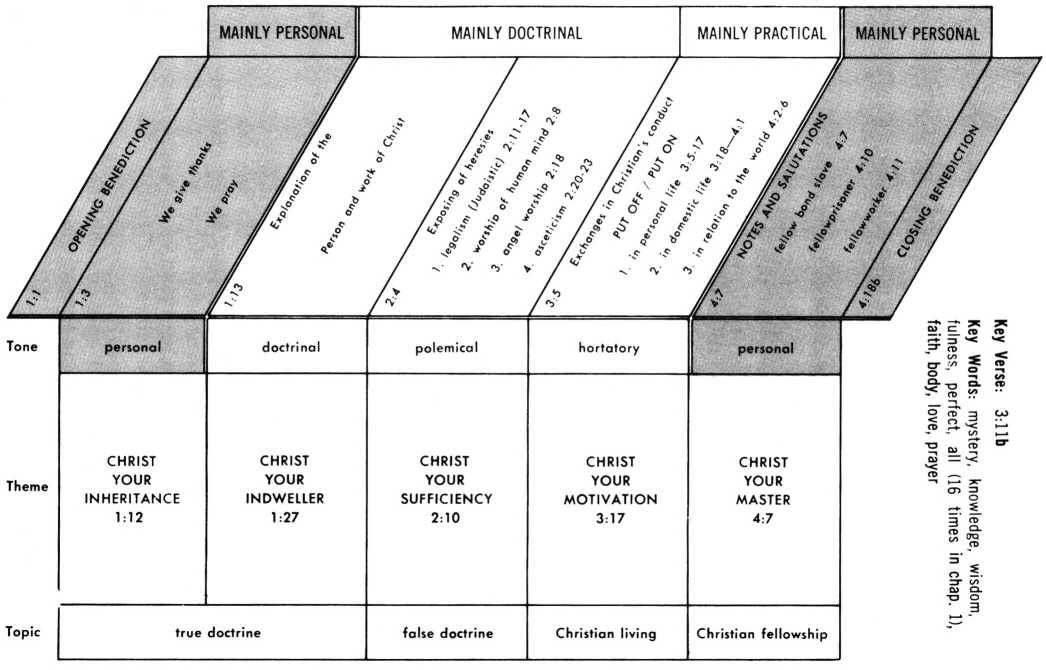
CHRIST IS ALL IN ALL
Click chart to enlarge
Charts from Jensen's Survey of the NT - used by permission
Colossians Overview - Click Chart on right side
| Christ Preeminent in All Things Supreme Lord - Sufficient Savior |
|||
| Colossians 1 | Colossians 2 | Colossians 3 | Colossians 4 |
| Supremacy of Christ |
Submission to Christ |
||
| Doctrinal and Corrective |
Practical and Reassuring |
||
| What Christ Did For Us |
What Christ Does Through Us |
||
| Christ Our Lord |
Christ Our Life |
Christ our Love |
|
| Christ the Head of the Body |
Christ the Lord of the Universe |
Christ the Head of the Home |
|
| Instruction | Warnings | Exhortations | Reminders |
| Reconciliation | Creation | Submission | Conversation |
| His Person and Word |
His Peace and Presence |
||
Colossians 4:12 Epaphras, who is one of your number, a bondslave of Jesus Christ, sends you his greetings, always laboring earnestly for you in his prayers, that you may stand perfect and fully assured in all the will of God. (NASB: Lockman)
Greek: aspazetai (3SPMI) humas Epaphras o ex humon, doulos Christou [Iesou], pantote agonizomenos (PMPMSN) huper humon en tais proseuchais, hina stathete (2PAPS) teleioi kai peplerophoremenoi (RPPMPN) en panti thelemati tou theou
Amplified: Epaphras, who is one of yourselves, a servant of Christ Jesus, sends you greetings. [He is] always striving for you earnestly in his prayers, [pleading] that you may [as persons of ripe character and clear conviction] stand firm and mature [in spiritual growth], convinced and fully assured in everything willed by God. (Amplified Bible - Lockman)
NIV: Epaphras, who is one of you and a servant of Christ Jesus, sends greetings. He is always wrestling in prayer for you, that you may stand firm in all the will of God, mature and fully assured. (NIV - IBS)
Phillips: Epaphras, another member of your Church, and a real servant of Christ, sends his greeting. He works hard for you even here, for he prays constantly and earnestly for you, that you may become mature Christians, and may fulfil God's will for you. (Phillips: Touchstone)
Wuest: There greets you Epaphras, the one who is one of your number, a bondslave of Christ Jesus, always contending on your behalf in his prayers, to the effect that you may stand fast, spiritually mature ones, and those who have been brought to the place of full assurance in everything willed by God
Young's Literal: Salute you doth Epaphras, who is of you, a servant of Christ, always striving for you in the prayers, that ye may stand perfect and made full in all the will of God
EPAPHRAS WHO IS ONE OF YOUR NUMBER: Epaphrâs ho ex humôn:
- Col 1:7; Philemon 1:23
- Colossians 4 Resources - Multiple Sermons and Commentaries
ONE FROM THE CONGREGATION
AT COLOSSAE
One of your number (literally "out of you" or "from you", no specific word for "number") is the same description Paul attached to the returned runaway slave Onesimus. Truly Paul is exemplifying for us that Christ is all and in all! No distinctions.
Look at Paul's adjectives to describe this Man of God
Epaphras, our beloved fellow bond-servant, who is a faithful servant of Christ on our behalf (see note Col 1:7)
D. Edmond Hiebert has an excellent character study on Epaphras a man of prayer…
Epaphras holds the unique distinction among all the friends and coworkers of Paul of being the only one whom Paul explicitly commended for his intensive prayer ministry… Epaphras is apparently a shortened form of the common name Epaphroditus, which means “handsome” or “charming.”… From Colossians 1:7(note) it is clear that the gospel was first brought to Colossae by Epaphras: “even as ye learned of Epaphras.”… It is noteworthy that in all three places where his name occurs it appears in direct connection with that of Christ. In Col 1:7 he is commended as “a faithful minister of Christ,” while in Col 4:12 he is termed “a servant of Christ Jesus.” The designations are high tribute to Epaphras. Paul several times uses the latter designation of himself. It is once used of Timothy in conjunction with the apostle’s name (Php 1:1-note). Epaphras is the only other individual to whom the title is applied. It points to Epaphras’ exceptional service in the cause of Christ.
The word rendered “servant” (doulos) is the ordinary Greek term for a slave. But in such connections the emphasis is not on the compulsory service of the slave, but rather on the intimate relationship of the servant with his master. Hendriksen (Hendriksen, W., & Kistemaker, S. J. NT Commentary Set. Baker Book) thus summarizes the rich implications of this designation: "A servant of Jesus Christ is one who has been bought with a price and is therefore owned by his Master, on whom he is completely dependent, to whom he owes undivided allegiance and to whom he ministers with gladness of heart, in newness of spirit, and in the enjoyment of perfect freedom, receiving from him a glorious reward." The term proclaims the servant’s unconditional surrender of himself to do his Lord’s bidding. Such a one has learned to say,
Oh, teach my will, my selfish will,
To be completely Thine.
Oh, may I yield my all to Thee;
It is no longer mine.
Oh, may my will, my stubborn will,
Submissive be to Thine;
The inward man obey with joy
The law of love divine.
No one who has not yet come to the place of full yieldedness of himself to his Lord will ever know the joy of fruitful service and effective intercession such as Epaphras knew. The yielded will lies at the basis of the God-used life…
The very fact that Epaphras was praying for his flock while absent from them was indication of his spiritual character. His prayer concern for them was an indication of the high level of his own inner experience. “Certainly, as water never rises above its level, so our service in its quality, reality, vitality and energy will never be higher than the genuineness of our fellowship with God.” (W. H. Griffith Thomas, Christ Pre-Eminent: Studies in the Epistle to the Colossians. Chicago: Bible Institute Colportage Association, 1923, p. 118) Epaphras was quite unable to write the letter to the Colossians refuting the heretical teaching which was disturbing them but he could faithfully pray for their preservation and spiritual maturity. Paul gratefully recorded that Epaphras was engaged in such a prayer ministry for the readers. The example of Epaphras is a challenge to Christians today to engage in this important ministry. Griffith Thomas has well expressed the significance of prayer There are many things outside the power of ordinary Christian people, and great position, wide influence, outstanding ability may be lacking to almost all of us, but the humblest and least significant Christian can pray, and as “prayer moves the Hand that moves the world,” perhaps the greatest power we can exert is that which comes through prayer… " (W. H. Griffith Thomas, Christ Pre-Eminent: Studies in the Epistle to the Colossians. Chicago: Bible Institute Colportage Association, 1923, p. 119)
The apostle described the praying of Epaphras in the following significant words: “always striving for you in his prayers.” This brief statement is richly instructive.
Constant. Paul bore witness that Epaphras was “always striving” for the Colossian Christians. It was not an occasional, listless prayer on their behalf, but a constant burden of intercession. Regularly and repeatedly he bore them up before the throne of grace. His deep concern for them made him obedient to the words of the Lord that “men ought always to pray and not to faint” (Luke 18:1).
Definite. Paul assured the Colossians that Epaphras was always praying “for you.” Their spiritual welfare was his predominant concern and he kept them prominent in his prayers. His was not that indefinite kind of praying which would be hard pressed to tell for whom the petition was intended. He was aware of the danger that threatened them and he prayed accordingly. His specific petitions revealed that Epaphras had the heart of a true shepherd of God’s flock.
A story is told about an old pastor who every Saturday afternoon could be seen leaving his study and entering the church building by the back door, and about sundown he would be seen going home. Someone’s curiosity was aroused enough to follow one day and watch through a window. It was in the days when the family pew was an institution of the church. The old pastor was seen to kneel at each pew and pray for every member of the family that was to occupy it on the Lord’s day. He called each member by name as he poured out his heart to God for his flock. His was a ministry of power and his people reflected the grace of God on them. Blessed is that church which has such a praying shepherd.
Intense. Significantly Paul described the praying of Epaphras for his people as “striving” for them. The verb indicates that it was a strenuous and costly activity. The term comes from the athletic arena and pictures the intense effort and energy of the athlete in contending for a prize, like a wrestler grappling in all earnestness with his opponent. It is the verbal form of the noun agony which Luke employed to describe Christ’s praying in Gethsemane (Luke 22:44) (See painting of Christ's agonia at Gethsemane and modern day Gethsemane). The term clearly portrays the difficulty of effective intercessory prayer. “True prayer,” says MacLaren, “is the intensest energy of the spirit pleading for blessing with a great striving of faithful desire.” (Alexander MacLaren, “The Epistles of St. Paul to the Colossians and Philemon,” in An Exposition of the Bible, ed. Marcus Dods et al., 6 vols. (Hartford, CT: S. S. Scranton Co., 1903), 6:286)


An illustration of such intense, working prayer is seen in the prophet Daniel, as recorded in the ninth chapter of his book. For three weeks Daniel afflicted himself and wrestled in prayer against the forces of spiritual wickedness until their powers were broken and the answer came. The prayers of Daniel, as undoubtedly also those of Epaphras, were a definite means of advancing the cause of God.
Aim of His Praying. The words, “that ye may stand perfect and fully assured in all the will of God,” indicate not the contents of his prayers but rather his pastoral desire for the Colossians. Epaphras knew the result he expected from his prayers. He had grasped the reality of ministering to his people through his prayers for them. Forbes Robinson, of Cambridge, England, remarked that instead of calling on a man or inviting an individual to call on him, he found it more profitable to spend half an hour in concentrated prayer for him. He knew the reality of working by prayer.
Desire for stability. In praying for the Colossian Christians, Epaphras was well aware of the possible disastrous results if they were lured away by the heretical teaching at work in the Lycus Valley. But he was not merely concerned about their preservation from error. His deeper concern was for the positive, balanced development of their Christian character. Spiritual maturity would enable them to stand firm. The aorist passive form of the verb “may stand” suggests their need of empowerment from without which would enable them to stand. Stability, suggested in the words “be made to stand,” results through the Holy Spirit. In the face of multiplying heresies, whether subtle or blatant, it is imperative that believers become firmly rooted and grounded in the truth. The need today is for men like Epaphras whose persevering prayers are focused on troubled believers that they may become firmly established in faith and in God-pleasing conduct.
Manifestation of stability. Epaphras prayed that the stability desired for his people might manifest itself in their lives in Christian maturity and assurance: “that ye may stand perfect and fully assured.” The word translated “perfect” does not imply sinlessness but rather means spiritual maturity. Epaphras desired that the Colossians become full-grown as contrasted to spiritual babes. The believer becomes “perfect” or complete as he attains to the divine goal for his life. Such maturity of character comes only through abiding union with Christ.
Epaphras further desired that the Colossian believers might stand “fully assured in all the will of God.” The tense of the verbal form (a perfect participle) indicates his desire that this may be their abiding condition. The new teaching was harassing their souls and confusing their minds. The concern of Epaphras was that they might be freed from all doubts and uncertainty. The soul that is torn by doubts and uncertainty as to what God’s will requires cannot stand firm under testing and trial. Maclaren well says, “To be free from misery of intellectual doubts and practical uncertainties, to walk in the sunshine—is the purest joy.” (ibid page 287) Epaphras desired that their stability would manifest itself “in all the will of God.” The exact connection of this phrase is not certain. Some would connect it directly with the word “stand,” while others hold that it should be connected with “perfect and fully assured” or with “fully assured” alone. It seems best to view it as modifying the entire purpose clause. It thus indicates the governing consideration in the manifestation of their stability. Lightfoot translated the phrase in this way: “in everything willed by God.” The desire of Epaphras was that under every circumstance they would make God’s will the object of their attentive consideration and implicit obedience. “All” or “everything” points to the varied circumstances into which the believer is permitted to come and in which he desires to adhere to the divine will. Amid all circumstances they are to have an understanding of God’s will “which not only penetrates the mind but also fills the heart with satisfying conviction.” (Hendriksen, Exposition of Colossians and Philemon, p. 191)…
Epaphras stands as a challenging example of the ministry of intercession. May the Lord raise up many who follow in his train! Someone has pointed out that he had never known of a church dedicated to “Saint Epaphras.” Is not that fact a sad commentary on the truth that only too few Christians have adequately realized the tremendous importance of the ministry of intercession and consequently have failed to appreciate and follow his example? “Epaphras grasped, what many of us are slow to realize, that the tactics of the Christian battle are born of the strategy of prayer.” (from Harrington C. Lees, St. Paul’s Friends (London: Religious Tract Society, 1918), p. 157) If churches in the present day are to be victorious, they must find their power on their knees. In a vision a certain man of prayer saw an army coming from a great center of light, bringing light with it wherever it moved. It was arrayed against dense darkness, but as the army advanced the darkness gave way before it. Insignificant in size compared with the force against which it turned, it conquered wherever it moved. “Invincible” seemed written all over this little host. As the enraptured man looked again, he saw that the army was advancing on its knees. (excerpts from article by D. Edmond Hiebert Bibliotheca Sacra, Volume 136, page 53, 1979)(Bolding added)
A BONDSLAVE OF JESUS CHRIST SENDS YOU HIS GREETINGS: aspazetai (3SPMI) humas… doulos Christou (Iesou):
- John 12:26; Galatians 1:10; James 1:1; 2 Peter 1:1
- Colossians 4 Resources - Multiple Sermons and Commentaries
A SLAVE OF SAVIOR
NOT OF SELF
Bondslave (1401) (doulos) (Click word study of doulos, or click here) is one who surrendered wholly to another’s will and thus devoted to another to the disregard of his own interest. A doulos was an individual bound to another in servitude and conveys the idea of the slave's close, binding ties with his master, belonging to him, obligated to and desiring to do his will and in a permanent relation of servitude. In sum, the will of the doulos is consumed in the will of the master. Click the convicting poem He Had No Rights written by Mabel Williamson a missionary to China.
In the Greek culture doulos usually referred to the involuntary, permanent service of a slave, but the use in the epistles of Paul and Peter elevates the meaning of doulos to the Hebrew sense which describes a servant who willingly commits himself to serve a master he loves and respects (cp Ex 21:5, 6 Dt 15:12-16 discussed below). By Roman times, slavery was so extensive that in the early Christian period one out of every two people was a slave! From at least 3000BC captives in war were the primary source of slaves.
Doulos speaks of submission to one's master The doulos had no life of his own, no will of his own, no purpose of his own and no plan of his own. All was subject to his master. The bondservant's every thought, breath, and effort was subject to the will of his master. In sum, the picture of a bondservant is one who is absolutely surrendered and totally devoted to his master. What a picture of Paul and Timothy's relation to their Lord! What an example for all believers of every age to emulate!
This word provides an incredible word picture of those who bound to their Lord Jesus Christ, Who had bought them with a price to be His own possession (cf 1Cor 6:20, Acts 20:28, Gal 3:13, see note Hebrews 9:12, see note 1 Peter 1:18, Rev 5:9, see note Titus 2:14, see note 1 Peter 2:9).
Epaphras had chosen to remain a slave, as shown by his complete and willing obedience to his Master, having no life of his own, no rights of his own, no will of his own, no purpose other than His Master's, having willingly submitted every every thought, every breath, and every effort to Jesus Christ, even as Jesus submitted wholly to His Father testifying
"Truly, truly, I say to you, the Son can do nothing of Himself, unless it is something He sees the Father doing; for whatever the Father does, these things the Son also does in like manner." (John 5:19)
Epaphras was a man who was not at his own disposal, but was His master’s purchased property. Bought to serve His master’s needs, to be at His beck and call every moment, the slave’s sole business is to do as he is told. Christian service therefore means, first and foremost, living out a slave relationship to one’s Savior (Gal 3:28 1Cor 6:19,20). What work does Christ set his servants to do? The way that they serve him, he tells them, is by becoming the slaves of their fellow-servants and being willing to do literally anything, however costly, irksome, or undignified, in order to help them. This is what love means, as he himself showed at the Last supper when he played the slave’s part and washed the disciples’ feet. When the New Testament speaks of ministering to the saints, it means not primarily preaching to them but devoting time, trouble, and substance to giving them all the practical help possible. The essence of Christian service is loyalty to the king expressing itself in care for his servants (Gal 3:28 Mt 25:31-46). Only the Holy Spirit can create in us the kind of love toward our Savior that will overflow in imaginative sympathy and practical helpfulness towards his people. Unless the spirit is training us in love, we are not fit persons to go to college or a training class to learn the know-how or particular branches of Christian work. Gifted leaders who are self-centered and loveless are a blight to the church rather than a blessing.
Greetings (782) (aspazomai from a + spao = draw out as a sword, pull, breathe) means to enfold in the arms, salute, welcome, embrace. It is spoken of those who meet or separate. Aspazomai is constantly used in the papyri for conveying the greetings at the end of a letter.
ALWAYS LABORING EARNESTLY FOR (on behalf of you) YOU IN HIS PRAYERS: pantote agonizomenos (PMPMSN) huper humon en tais proseuchais:
- Col 4:2; Lu 22:44; Gal 4:19; Heb 5:7; Jas 5:16) (Col 2:1-23
- Colossians 4 Resources - Multiple Sermons and Commentaries
PRAYING WITHOUT
CEASING
Always is likely hyperbole, but certainly conveys the idea that whenever he thought about them, he lifted them up in prayer. In other words, he "kept the receiver off the hook" (so the line to the Throne Room was always open), and in essence was praying without ceasing (1 Th 5:17). .
Always (3842) (pantote from pás = all + tóte = then) means at all times or always. Compare the frequency of Epaphras' praying to Paul's command to the saints in Thessalonica to "pray without ceasing" (1Thess 5:17-note). Epaphras is a perfect example of one who has devoted himself to prayer (Col 4:2-note) and stood ever ready to pray as the need arose. And remember that praying in one of our "weapons" in spiritual warfare (our "wartime walkie-talkie) - "With all prayer and petition pray at all times in the Spirit, and with this in view, be on the alert with all perseverance and petition for all the saints." (Eph 6:18-note)
Observe his pattern of prayer: He prays constantly, fervently, personally, and specifically. A good pattern to emulate!
Guzik observes that "Epaphras prayed well because he cared well. If he lagged in zeal, he certainly would have lagged in prayer." (Colossians 4 )
He is always wrestling in prayer for you (NIV) - Paul does not mean that he was fighting with God to get what he desired. It does mean that his (and our) praying is not to be a casual experience that has no heart or earnestness. The idea is that we should put as much effort into our praying as a wrestler in his wrestling match. Prayer is hard work! Supplication is not a matter of carnal energy but of spiritual intensity. Note he is not implying that our prayers are more effective if we exert fleshly energy. What this refers to is a spiritual striving in which God’s power is at work in one's life. True prayer is directed to the Father (Mt 6:9-note), through the Son (in His name, John 14:13-14), in the power of the Holy Spirit (Jude 1:20-note, Ro 8:26-27-note).
Warren Wiersbe comments on Epaphras prayer life - What a prayer warrior he was! He did not simply “say prayers”; “he labored [agonized] in prayer.” It is the same word that is used for the struggles of athletes in contests. If Christians prayed as hard as they played, they would see more of God’s blessings. (Wiersbe, W. W. Wiersbe's Expository Outlines on the New Testament. Wheaton, Ill.: Victor Books)
Paul used a combination of the same verb agonizomai in his request of the saints at Rome…
Now I urge you, brethren, by our Lord Jesus Christ and by the love of the Spirit, to strive together (sunagonizomai - prefix sun = speaks of intimacy in contrast to the other Greek preposition for "with" = meta which speaks of nearness without the idea of intimacy. Sun conveys the idea that one is so mixed in with others that he cannot get apart from them) with me in your prayers to God for me that I may be delivered from those who are disobedient in Judea, and that my service for Jerusalem may prove acceptable to the saints so that I may come to you in joy by the will of God and find refreshing rest in your company. (Ro 15:30-32-note)
Laboring (75) (agonizomai from agon = conflict or the place of assembly for the athletic contests and then a reference to the contests which were held there) means to exert oneself, to fight, to labor fervently, to strive (devote serious effort or energy = implies great exertion against great difficulty and suggests persistent effort), to struggle, to contend with an adversary - all of these actions picturing an intense struggle for victory. When we read that the gloves of the Greek boxer were fur lined on the inside, but made on the outside of ox-hide with lead and iron sewed into it, and that the loser in a wrestling match had his eyes gouged out, we come to some appreciation of what a Greek athletic contest consisted of and of the effort such a contest would motivate! Now transpose this picture to prayer and the effort require in praying for others!
Agonizomai was a familiar term in writings of both military and athletic endeavors and was used to emphasize the concentration, discipline, conviction, and effort needed to win in both arenas. It pictures a runner straining every nerve to the uttermost towards the goal and was used in secular Greek meaning to contend for the prize on the stage, both of the poet, etc., and of the actor. It was also used in reference to literal fighting with weapons.
This word group (agon) is the source of our English word agonize which means to experience pain so extreme as to cause writhing or contortions of the body. To agonize also means to strain, to toil, to suffer extreme pain of body or mind or to suffer violent anguish.
As we study this verb agonizomai, we begin to get a picture of how Epaphras prayed! Clearly his praying represented a tireless labor with struggles against all manner of setbacks and opposition.
THOUGHT - How would Paul characterize your intercessory prayers on behalf of our brethren in Christ?
Agonizomai is the verbal form of the noun agony which Luke employed to describe Christ's praying in Gethsemane (Lk 22:44 = "And being in agony He was praying very fervently; and His sweat became like drops of blood, falling down upon the ground.). The term clearly portrays the difficulty of effective intercessory prayer.
Alexander Maclaren - "True prayer is the intensest energy of the spirit pleading for blessing with a great striving of faithful desire."
Praying is an importunate (persistent or demanding) struggle as demonstrated here in verse 12. We may not fully understand the why of importunity, but it is clearly a Biblical prayer principle.
P. T. Forsyth appropriately comments "Lose the importunity of prayer, reduce it to soliloquy (act of speaking alone or to oneself), or even to colloquy (gathering for discussion of theological questions), with God, lose the real conflict of will and will, lose the habit of wrestling and the hope of prevailing with God, make it mere walking with God in friendly talk; and, precious as it is, yet you tend to lose the reality of prayer at last. In principle you make it mere conversation instead of the soul’s great action. You lose the food of character, the renewal of will. You may have beautiful prayers—but as ineffectual as beauty so often is, and as fleeting."
An illustration of such intense, working prayer is seen in the prophet Daniel, as recorded in the 10th chapter of his book. For 3 weeks Daniel afflicted himself and wrestled in prayer against the forces of spiritual wickedness until their powers were broken and the answer came (Da 10:2-3-note). The prayers of Daniel, as undoubtedly also those of Epaphras, were a definite means of advancing the cause of God.
Prayer is clearly a battle… against unseen forces. And so it is imperative that we do not walk (pray) according to the flesh but utilize the divinely powerful weapons God has provided and with all prayer and petition pray at all times in the Spirit, always on alert with all perseverance and petition for all the saints. This quality (and quantity) of prayer on one hand involves intense fervent labor on our part and on the other clearly depends on the Holy Spirit for guidance and empowerment. (See Topic - Prayer)
S Lewis Johnson comments on the agonizing aspect of Epaphras' prayer noting first that
Lightfoot rendered it (agonizomai) by “wrestling.” There are several things suggested by the word.
First, Epaphras is the nearest example of the Pauline exhortation in verse two, “continue in prayer.” (Col 4:2-note) The present tenses in both verses are instructive parallels, too.
Second, Epaphras is a man after Paul’s own make-up, for it is the apostle who uses the same word and noun to describe his own ministry for the Gentiles and for the Colossians (cf. Col 1:29-note, “striving”; Col 2:1-note, “conflict”). Here is genuine “apostolic succession!”
Third, Epaphras and Paul, too, are simply following in the footsteps of the Lord (cp 1Cor 11:1, 1John 2:6-note, 1Pe 2:21-note). Luke, in describing the Gethsemane experience of the Lord, pictures Him as “being in an agony” (cf. Lk 22:44). The word is the noun agōnia (Ed: Root = agon). The root is used only by Paul and Luke in the New Testament, and the two men are together here (Ed: Correction - John 18:36 uses agonizomai for "fighting" and agon by the writer of Hebrews 12:1-note for "race"). Is it possible that they saw a resemblance between the agony of Gethsemane’s great Figure and the wrestling of His servant? (See painting of Christ's agonia at Gethsemane and modern day Gethsemane) At any rate, one can hardly doubt that this struggle in prayer is one of the great needs of the Christian church today.
Amid all its organizing there ought to be more agonizing!
I will never forget the fervent exhortation given New College students in Edinburgh by Professor James S. Stewart a few years ago:
One may have read all of Bultmann, but apart from a disciplined devotional life, that is worth absolutely nothing. In fact, that cannot be emphasized too strongly. All the Ph.D.’s will not help a bit. If we do not see in New College that this is more important than good marks and a good degree, we have learned nothing.
The purpose of the evangelist’s prayer which watered the seed he had sown himself is that the Colossians may stand “perfect and complete in all the will of God.” The meaning of the perfect participle peplērophorēmenoi (AV, “complete”) is disputed. The word may mean to fulfill (cf. Luke 1:1; 2Ti 4:5-note), to persuade fully, convince (cf. Ro 4:21-note; Ro 14:5-note), and to fill (cf. Ro 15:13-note). The use of convinced makes excellent sense. Epaphras’ concern was that the Colossians have a firm persuasion concerning the truth in the face of the doctrinal and practical errors fostered by the gnostic Judaizers as described in the earlier part of the letter.
For you (huper) means on behalf of or as your substitute (cp "standing in the gap!" cp Ezek 22:30) and clearly indicating this is intercessory prayer by Epaphras on behalf of the saints at Colossae and the latter part of this verse indicates the specific things he is interceding for them.
Prayers (4335) (proseuche from pros = toward or immediately before + euchomai = to pray or vow) is the more general word for prayer and is used only of prayer to God. The prefix "pros" would convey the sense of being immediately before God and hence has an element of adoration, devotion, and worship.
Proseuche is the more general word for prayer and is used only of prayer to God. The prefix "pros" would convey the sense of being immediately before Him and hence the ideas of adoration, devotion, and worship. The basic idea is to bring something, and in prayer this pertains to bringing up prayer requests. In early Greek culture an offering was brought with a prayer that it be accepted. Later the idea was changed slightly, so that the thing brought to God was a prayer. In later Greek, prayers appealed to God for His presence.
Lawrence Richards writes that proseuche (and the verb form Proseuchomai) - "In classical Greek was the technical term for calling on a deity. The NT transforms the classical stiffness into the warmth of genuine conversation. Such entreaty in the NT is addressed to God or Jesus and typically is both personal and specific." (Richards, L O: Expository Dictionary of Bible Words: Regency)
F B Meyer writes that…
It has been pointed out that there are three New Testament words for prayer to which we do well to take heed.
Be sober unto prayer (1Pe 4:7-note). Do not be drunk with worldly vanity, business, or gaiety; but bring a humble, penitent, clear, and sound mind.
Be at leisure when you pray (1Co 7:5). The word means that prayer is not to be hurried; that nothing should interfere with its leisurely enjoyment.
Labor at prayer (Col 4:12, cp Col 1:29-note). As a man labors at his daily work, or strives on the battlefield, or agonizes to preserve a beloved friend from danger. It was thus that Jesus labored in the Garden of Gethsemane (Lk 22:44, 45, 46 Ed: How like the disciples are so many of us!). And it was thus that these faithful souls must have prayed. (Our Daily Homily)
F B Meyer adds this note from Our Daily Homily regarding Epaphras writing that…
Colossians 4:12, 13 is a very beautiful epitaph on a good man's life. He had come from Colossae with tidings for the apostle; but amid all the crowding interests of his visit to Rome his heart was with his friends, and he sought to help them, as we may all help dear ones far away.
He strove for them in prayer. It was no runaway knock that he gave; no light breathing of desire; no formal mention of their names (Ed: How convicted are you? Are you as convicted as I am by the all too frequent superficiality and formality of so many of your prayers? The thought that came to me is "Do my prayers cost me anything?". By that I mean "Is there any agonizing?" Oh my!): but it seemed as though he were a wrestler, whose muscles stood out like whipcord as he agonized for the prize.
He labored. We shall never know, till we stand in the clear light of heaven, how much has been wrought in the world by prayer (Ed: Let us ponder what we just read dearly beloved. May He give us strength to redeem the time, continually maintaining a prayerful attitude. Amen). Here, at least, there is mention of a man's labors. Probably the work on the results of which we are wont to pride ourselves is due less to us than we suppose, and more to unrecognized fellow laborers (Ed: What a pregnant thought for us to ponder!).
There is a pretty legend which tells of the dream of a great preacher who was marvelously used of God, and inclined to magnify himself and his gifts; but who was instructed by an angel of God that his success was entirely attributable to a poor widow, who sat regularly in the free seats at the foot of his pulpit, and who never ceased to pray for him. May the writer ask of any who receive benefit from these words to labor and strive for him in prayer to God (Ed: And the writer and collator of this website echoes Meyer's plea for powerful prayer for the production of a site that greatly edifies the saints and continually brings glory to God… in the vein of Ps 115:1).
Let us be careful to mingle much intercession with all our prayers, especially on the behalf of missionaries and lonely workers in foreign lands, that they may realize that we are actually working and laboring beside them, though many thousands of miles intervene.
J Oswald Sanders wrote that…
Both our Lord and Paul made it clear that prayer is no mere pleasant, dreamy reverie.
“All vital praying makes a drain on a man’s vitality,” wrote J. H. Jowett. “True intercession is a sacrifice, a bleeding sacrifice.” Jesus performed many mighty works without outward sign of strain, but of His praying it is recorded that “he…offered up prayers and supplications with strong crying and tears” (see note Hebrews 5:7).
“Epaphras is always wrestling for you in his prayers,” wrote Paul to the Colossian Christians (Colossians 4:12). How pale a reflection of Epaphras’ intercessions are our languid prayers. The word “wrestling” is that from which our word “agony” is derived. It is used of a man toiling at his work until utterly weary (see note Colossians 1:29), or competing in the arena for the coveted laurel wreath (I Cor. 9:25). It describes the soldier battling for his life (1 Ti 6:12), or a man struggling to deliver his friend from danger (John 18:36). It pictures the agony of earnestness of a man to save his own soul (Luke 13:24). But its supreme significance appears in the tragedy of Gethsemane. “Being in an agony he prayed more earnestly” (Luke 22:44), an agony induced by His identification with and grief over the sins of a lost world. Prayer is evidently a strenuous spiritual exercise which demands the utmost mental discipline and concentration. Was it because of this fact that our Lord sometimes linked prayer with fasting?
True intercession is costly. Jesus first gave Himself and then made intercession for His murderers. He could do no more for them. Are we asking of God something we ourselves could supply? Can it be true intercession until we are empty-handed? True intercession demands the sacrifice and dedication of all; it cannot be costless and crossless. (J. Oswald Sanders, Cultivation of Christian Character, Moody Press, Chicago; 1965)
Leonard Ravenhill, a revival author and preacher made a statement that we all do well to read slowly and introspectively specifically as we examine the nature of our prayer life…
"The self-sufficient do not pray, the self-satisfied will not pray, the self-righteous cannot pray. No man is greater than his prayer life." (Are you convicted? I hope so! I certainly am!)
Bishop J C Ryle - It would be well for us all, if we examined ourselves more frequently as to our habits about private prayer. What time do we give to it in the twenty-four hours of the day? What progress can we mark, one year with another, in the fervency, fullness, and earnestness of our prayers? What do we know by experience, of "laboring fervently in prayer?" (Col. 4:12.) These are humbling inquiries, but they are useful for our souls. There are few things, it may be feared, in which Christians come so far short of Christ's example, as they do in the matter of prayer. Our Master's strong crying and tears--His continuing all night in prayer to God--His frequent withdrawal to private places, to hold close communion with the Father, are things more talked of and admired than imitated. We live in an age of hurry, bustle, and so-called activity. Men are tempted continually to cut short their private devotions, and abridge their prayers. When this is the case, we need not wonder that the Church of Christ does little in proportion to its machinery. The Church must learn to copy its Head more closely. Its members must be more in their closets. "We have little," because little is asked. (James 4:2.) (Mark 6 Commentary - J. C. Ryle's Expository Thoughts on the Gospels) (Bolding added)
Robert Murray McCheyne (1813-43) saw God move in revival power at Dundee, Scotland. A great part of this revival was prayer, about which McCheyne said: "What a man is on his knees before God, that he is--and nothing more."
Puritan John Bunyan (1628-88), said that "Prayer is a shield to the soul, a sacrifice to God, and a scourge to Satan."
Hosea Ballou (1771-1852), an American preacher, concluded that "Between the humble and the contrite heart and the majesty of heaven there are no barriers; the only password is prayer."
Related Resources:
- Spurgeon's Gems on Prayer
- Colossians 1:9 Commentary
- Colossians 4:12 Commentary
- Devotional on Prayer
- Guide to Praying for Missionaries
- Pithy Prayer Phrases
- Prayer - Greek Words for Prayer
- Prayer Devotionals and Illustrations
- Prayer Hymns and Poems
- Prayer Quotes
- Prayer Quotes, Devotionals and Illustrations
- Praying for People from Every Tribe, Tongue, People and Nation
- Praying His Word
- Praying in the Spirit
Prayer by Harry Ironside - Prayer, is first of all, communion with God. Our blessed Lord Himself, in the days of His flesh, is seen again and again leaving the company of His disciples and going out into some desert place on a mountain side, or into a garden, that His spirit might be refreshed as He bowed in prayer alone with the Father. From such seasons of fellowship He returned to do His mightiest works and to bear witness to the truth. And in this He is our great Exemplar. We need to pray as much as we need to breathe. Our souls will languish without it, and our testimony will be utterly fruitless if we neglect it.
We are told to continue in prayer. This does not mean that we are to be constantly teasing God in order that we may obtain what we might think would add most to our happiness or be best for us, but we are to abide in a sense of His presence and of our dependence upon His bounty. We are to learn to talk to Him and to quietly wait before Him, too, in order that we may hear His voice as He speaks to us. We are bidden to bring everything to Him in prayer, assured that if we ask anything according to His will He heareth us. But because we are so ignorant and so shortsighted we need ever to remember that we are to leave the final disposal of things with Him who makes no mistakes. Without anxiety as to anything, we may bring everything to Him in prayer and supplication with thanksgiving, making known our requests in childlike simplicity; then, leaving all in His hands, we go forth in fullest confidence as our hearts say "Thy will be done," knowing that He will do for us exceeding abundantly above all that we ask or think.
THAT YOU MAY STAND PERFECT: hina stathête (2PAAS) teleioi:
- Ro 15:14
- Colossians 4 Resources - Multiple Sermons and Commentaries
TAKING A
STAND
That (hina) - Always take a moment to pause and ponder (learn to query or interrogate the text, e.g., what is the purpose?, etc) this strategic term of purpose or result - (other terms of purpose include - so that, in order that, as a result) as you will often gain insights into the meaning of the passage you are studying.
Perfect (5046) (teleios from telos = an end, a purpose, an aim, a goal) means complete, mature, fully developed, full grown, brought to its end, finished, wanting nothing necessary to completeness, in good working order.
Notice the uses below in the Septuagint (Lxx) where teleios is used several times to describe a heart that is wholly devoted (Heb = shalem). This begs the question beloved "Is my heart teleios? Would God describe me as wholly devoted to Him? Or have become like Solomon, who began "wholly devoted" but ended his race not "wholly devoted?" In 1 Chronicles 25:8 teleios describes a teacher.
Teleios signifies consummate soundness, includes the idea of being whole. Interestingly the Gnostics used teleios of the one fully initiated into their mysteries and that may have been why Paul used teleios in this epistle.
Friberg summary - complete, perfect; (1) with its chief component as totality, as opposed to partial or limited; (a) of things in full measure, undivided, complete, entire (Ro 12.2); substantivally to. teleion = the finish, completeness (1Co 13.10); comparative teleioteros, tera on = more complete or perfect (Heb 9.11); (b) of persons complete, perfect (Mt 5.48; 19.21); (2) with its chief component being full development as opposed to immaturity; (a) of persons full grown, mature (1Co 14.20); substantivally oi` teleioi = adults, mature persons; used of spiritually mature persons (1Co 2.6); (b) of things fully developed, complete (Jas 1.4; 1Jn 4.18); (3) with its chief component being full preparation or readiness = complete, perfect (Col 1.28; Jas 3.2). In all its meanings teleios carries the component of a purpose that has been achieved. (So think of that in the context of Epaphras' prayer - he is praying with the end desire that each believer grow into and attain the purpose for which he was created and then redeemed! My how we need to pray more fervently for one another, specifically praying for spiritual maturity to be attained, the very purpose for which Paul labored, striving according to God's power [Spirit] Who mightily worked within him! Col 1:29 where Col 1:28 uses teleios to describe Paul's goal for those he was discipling - spiritual maturity!)
Teleios is used 19x in 17v. NAS = complete, 2; mature, 4; more perfect, 1; perfect, 12. The KJV has one use translated "of full age".
Matthew 5:48-note "Therefore you are to be perfect, as your heavenly Father is perfect.
Matthew 19:21 Jesus said to him, "If you wish to be complete, go and sell your possessions and give to the poor, and you will have treasure in heaven; and come, follow Me."
Romans 12:2 And do not be conformed to this world, but be transformed by the renewing of your mind, so that you may prove what the will of God is, that which is good and acceptable and perfect.
1 Corinthians 2:6 Yet we do speak wisdom among those who are mature; a wisdom, however, not of this age nor of the rulers of this age, who are passing away;
1 Corinthians 13:10 but when the perfect comes, the partial will be done away.
1 Corinthians 14:20 Brethren, do not be children in your thinking; yet in evil be infants, but in your thinking be mature.
Ephesians 4:13-note until we all attain to the unity of the faith, and of the knowledge of the Son of God, to a mature man, to the measure of the stature which belongs to the fullness of Christ.
Philippians 3:15-note Let us therefore, as many as are perfect, have this attitude; and if in anything you have a different attitude, God will reveal that also to you;
Colossians 1:28-note We proclaim Him, admonishing every man and teaching every man with all wisdom, so that we may present every man complete (spiritually mature) in Christ.
Colossians 4:12 Epaphras, who is one of your number, a bondslave of Jesus Christ, sends you his greetings, always laboring earnestly for you in his prayers, that you may stand perfect and fully assured in all the will of God.
Hebrews 5:14-note But solid food is for the mature, who because of practice have their senses trained to discern good and evil.
Hebrews 9:11-note But when Christ appeared as a high priest of the good things to come, He entered through the greater and more perfect tabernacle, not made with hands, that is to say, not of this creation;
THREE TIMES IN JAMES CHAPTER ONE!
James 1:4-note And let endurance have its perfect result, so that you may be perfect and complete, lacking in nothing.
17-note Every good thing given and every perfect gift is from above, coming down from the Father of lights, with whom there is no variation or shifting shadow.
25-note But one who looks intently at the perfect law, the law of liberty, and abides by it, not having become a forgetful hearer but an effectual doer, this man will be blessed in what he does.
James 3:2 For we all stumble in many ways. If anyone does not stumble in what he says, he is a perfect man, able to bridle the whole body as well.
1 John 4:18 There is no fear in love; but perfect love casts out fear, because fear involves punishment, and the one who fears is not perfected in love.
Teleios - 15v in the Septuagint (Lxx) -
Genesis 6:9 These are the records of the generations of Noah. Noah was a righteous man, blameless (Heb = tamim; Lxx = teleios) in his time; Noah walked with God.
Exodus 12:5 'Your lamb shall be an unblemished (Heb = tamim; Lxx = teleios) male a year old; you may take it from the sheep or from the goats.
Deuteronomy 18:13 "You shall be blameless (Heb = tamim; Lxx = teleios) before the LORD your God.
Judges 20:26 Then all the sons of Israel and all the people went up and came to Bethel and wept; thus they remained there before the LORD and fasted that day until evening. And they offered burnt offerings and peace offerings (Heb =selem/shelem; Lxx = teleios) before the LORD.
Judges 21:4 It came about the next day that the people arose early and built an altar there and offered burnt offerings and peace offerings (Heb =selem/shelem; Lxx = teleios).
2 Samuel 22:26 "With the kind You show Yourself kind, With the blameless (Heb = tamim; Lxx = teleios) You show Yourself blameless;
1 Kings 8:61 "Let your heart therefore be wholly devoted (Heb = shalem; Lxx = teleios) to the LORD our God, to walk in His statutes and to keep His commandments, as at this day."
1 Kings 11:4 For when Solomon was old, his wives turned his heart away after other gods; and his heart was not wholly devoted (Heb = shalem; Lxx = teleios) to the LORD his God, as the heart of David his father had been.
1 Kings 15:3 He walked in all the sins of his father which he had committed before him; and his heart was not wholly devoted (Heb = shalem; Lxx = teleios) to the LORD his God, like the heart of his father David.
14 But the high places were not taken away; nevertheless the heart of Asa was wholly devoted(Heb = shalem; Lxx = teleios) to the LORD all his days.
1 Chronicles 25:8 They cast lots for their duties, all alike, the small as well as the great, the teacher as well as the pupil.
1 Chronicles 28:9 "As for you, my son Solomon, know the God of your father, and serve Him with a whole (Heb = shalem; Lxx = teleios) heart and a willing mind; for the LORD searches all hearts, and understands every intent of the thoughts. If you seek Him, He will let you find Him; but if you forsake Him, He will reject you forever.
Ezra 2:63 The governor said to them that they should not eat from the most holy things until a priest stood up with Urim and Thummim (Lxx = teleios).
Psalm 139:22 I hate them with the utmost (Heb = taklith = completeness; Lxx = teleios) hatred; They have become my enemies.
Song of Solomon 5:2 "I was asleep but my heart was awake. A voice! My beloved was knocking: 'Open to me, my sister, my darling, My dove, my perfect (Heb = tam = complete; Lxx = teleios) one! For my head is drenched with dew, My locks with the damp of the night.'
Song of Solomon 6:9 But my dove, my perfect (Heb = tam = complete; Lxx = teleios) one, is unique: She is her mother's only daughter; She is the pure child of the one who bore her. The maidens saw her and called her blessed, The queens and the concubines also, and they praised her, saying,
Jeremiah 13:19 The cities of the Negev have been locked up, And there is no one to open them; All Judah has been carried into exile, Wholly carried into exile (Lxx ~ "a complete removal").
Earlier Paul after declaring the glorious truth to the Colossians that Christ was now in them (Col 1:27) and that He Alone was their Hope (absolute assurance of future good) of glory went on to emphasize that because of this great truth (for it to become the disciples experiential realization so to speak)…
"we proclaim Him, admonishing every man and teaching every man with all wisdom, that we may present every man complete (teleios) in Christ. And for this purpose also I labor (to the point of literal exhaustion!), striving (agonizomai - same verb describing Epaphras' "laboring earnestly" in prayer for the same goal = that the Colossian saints would be complete in Christ) according to His power (which undoubtedly is how Epaphras also was enabled to prayer with such passion and power - and it is the only way we can pray this way - the Spirit working in us and through us - giving us the desire and the power), which mightily works within me." (Col 1:28-29-note)
As discussed more fully below, teleios does not connote moral or spiritual perfection or sinlessness, but rather refers to that which is fully developed, spiritually mature.
Teleios has at least three shades of meaning:
(1) Teleios speaks of totality, as opposed to partial or limited and when used of things means in full measure, undivided, complete or entire (as in Romans 12:2 [note] referring to "the will of God" which is "good and acceptable and perfect"). When referring to persons the idea is that of complete or perfect ("Therefore you are to be perfect (teleios), as your heavenly Father is perfect (teleios)." Matthew 5:48 [note]- see more discussion below) Teleios describes a victim which is fit for a sacrifice to God as without blemish.
(2) Teleios also speaks of that which is fully development as opposed to that which is immature. And so it describes persons who are full grown or mature (especially referring to spiritual maturity). In Greek teleios was applied to physical growth and so a man who has reached his full-grown stature is teleios in contradistinction to a half-grown lad. A student who has reached a mature knowledge of his subject is teleios as opposed to a learner who is just beginning, and who as yet has no grasp of things. For example Pythagoras divided his students into the learners, and the mature. (teleios). Philo divided his students into three classes—those just beginning (archomenoi), those making progress (prokoptontes), and those beginning to reach maturity (teleios).
Teleios does not imply complete knowledge but a certain spiritual maturity in the faith. That is Epaphras' desire for the saints at Colossae.
(3) Teleios can refer to that which is in a state of full preparation or readiness
In all the above variations of meaning the underlying idea is that a purpose has been achieved or that a thing or person has reached its intended goal or end. The basic meaning of teleios in the New Testament is always that the thing or person so described fully carries out the purpose for which designed. And so when Greek speaks of "perfect" (teleios) it is in fact such if it perfectly carries out the purpose for which it was designed.
Richards explains teleios (and related words in this group such as teleioo, teleiotes) writing that the emphasis is on "wholeness and completeness. In the biological sense they mean "mature," or "full grown": the person, animal, or plant achieved the potential inherent in its nature. The perfect is the thing or person that is complete, in which nothing that belongs to its essence has been left out. It is perfect because every potential it possesses has been realized." (Ibid)
Wayne Detzler writes that the root meaning of teleios is…
"fulfilled purpose," which is seen in the English word "teleology" (the belief that any process is shaped by purpose). The "teleological" argument of the existence of God says that the purposeful arrangement of the universe demonstrates the existence of God. Later on this word assumed another meaning, that of perfection. When something fulfills its purpose, it is supposedly perfect. Aristotle emphasized the aspect of ethical perfection, doing that which is right. For him self-actualization was most important. A person should realize that which is right for himself, and this is perfection. In other words, perfection is not conforming to an external standard, be it God's or man's. In this sense Aristotle stood out in bold contrast with biblical ethics, which stress conformity to God's standard. Later, under the influence of Plato, perfection meant conformity to accepted virtues in Greek culture. When one exemplified these virtues in every way, he was perfect.
In its various forms teleios occurs about 100 times in the Greek New Testament. In each case it means "perfection," "completion," or "wholeness." For instance, in some cases it speaks of ethical perfection, behavior which is complete or whole. An example of this ethical perfection is found in James, when he asserted that endurance in the Christian life helps make one perfect (James 1:4). Let it be added that this does not teach sinless perfection. The Bible repeatedly emphasizes that no one is sinless, but every Christian should sin less every day. James illustrated this teaching by reference to obeying God's Law (James 1:25). Specifically, he saw the tongue as the main battleground in achieving spiritual perfection or wholeness (James 3:2, 6-12). James knew that true perfection is found in God alone (James 1:17).
In John's epistles there is likewise an emphasis on perfection. Here the sole source of perfection is God. Only God can give perfect love, which takes away fear (1 John 4:18). No perfection exists apart from Him.
In Paul's writings there is also reference to this ethical perfection. To Timothy Paul wrote that the young man should perfect or fulfill his ministry as an evangelist (see note 2 Timothy 4:5). No one is a perfect minister, but every Christian should fulfill his ministry. Paul wrote to the Colossians, urging them to teach young Christians and thus bring them to completion or maturity in the faith (see note Colossians 1:28). This perfection was seen in their conformity to the will of God (4:12).
Christians gain insight into the way of God as they grow in grace. This produces spiritual wisdom and maturity (1 Cor. 2:6). In fact, Paul pressured the Corinthian Christians to grow into spiritual maturity (1Cor 14:20).
To the Ephesians Paul wrote that they should mature in the knowledge of God, and that this would bring them into the image of Christ (see note Ephesians 4:13). This goal of maturity motivated all Paul's missionary work. (Ed note: and also the prayers of Epaphras for the Colossian saints)
Besides the perfection of ethics and the perfection of character, the Scriptures also speak of perfection of doctrine. When a person professes faith in Christ, he has a basic, elementary understanding of Christian truth. He knows how to be saved, and that is about all. In time that Christian should grow on to maturity and develop a hunger for progressively deeper truth. This is what the writer of the Book of Hebrews calls perfection or maturity (see notes Hebrews 5:13; 5:14, Hebrews 6:1).
Perfection in the New Testament is not a flawless imitation of God. Rather it its a growth into maturity which is discernible as one makes progress in the faith. Absolute perfection and completeness is found in God alone, and we shall experience it only when we are with Him." (Detzler, Wayne: New Testament Words in Today's Language)
Barclay explaining Jesus' instruction in Mt 5:48 (note) that we are to be perfect (teleios) writes that…
the Greek idea of perfection is functional. A thing is perfect if it fully realizes the purpose for which it was planned, and designed, and made. In point of fact, that meaning is involved in the derivation of the word. Teleios is the adjective formed from the noun telos. Telos means an end, a purpose, an aim, a goal. A thing is teleios, if it realizes the purpose for which it was planned; a man is perfect if he realizes the purpose for which he was created and sent into the world. Let us take a very simple analogy. Suppose in my house there is a screw loose, and I want to tighten and adjust this screw. I go out to the iron-monger and I buy a screw-driver. I find that the screw-driver exactly fits the grip of my hand; it is neither too large nor too small, too rough nor too smooth. I lay the screw-driver on the slot of the screw, and I find that it exactly fits. I then turn the screw and the screw is fixed. In the Greek sense, and especially in the New Testament sense, that screw-driver is teleios, because it exactly fulfilled the purpose for which I desired and bought it. So, then, a man will be teleios if he fulfills the purpose for which he was created. For what purpose was man created? The Bible leaves us in no doubt as to that. In the old creation story we find God saying. “Let us make man in our image after our likeness” (Genesis 1:26). Man was created to be like God. The characteristic of God is this universal benevolence, this unconquerable goodwill, this constant seeking of the highest good of every man. The great characteristic of God is love to saint and to sinner alike. No matter what men do to him, God seeks nothing but their highest good.." ( Daily Study Bible Series)
John MacArthur commenting on "perfect" (teleios) in Matthew 5:48 (note) writes that…
"Teleios (perfect) basically means to reach an intended end or a completion and is often translated “mature” (1Cor 2:6; 14:20; Ephesians 4:13 [note]; etc.). But the meaning here is obviously that of perfection, because the heavenly Father is the standard. The “sons of [the] Father” (see note Matthew 5:45) are to be perfect, as [their] heavenly Father is perfect. That perfection is absolute perfection." That perfection is also utterly impossible in man’s own power. To those who wonder how Jesus can demand the impossible, He later says, “With men this is impossible, but with God all things are possible” (Matthew 19:26). That which God demands, He provides the power to accomplish. Man’s own righteousness is possible, but is so imperfect that it is worthless; God’s righteousness is impossible for the very reason that it is perfect. But the impossible righteousness becomes possible for those who trust in Jesus Christ, because He gives them His righteousness. That is precisely our Lord’s point in all these illustrations and in the whole sermon --- to lead His audience to an overpowering sense of spiritual bankruptcy, to a “beatitude attitude” that shows them their need of a Savior, an Enabler who Alone can empower them to meet God’s standard of perfection." (MacArthur, J: Matthew 1-7 Chicago: Moody Press)
Richards in his discussion of "maturity" writes that…
"The Greek words translated "maturity" are teleios (used 19 times in the NT) or teleiotes (used twice in the NT). The root expresses an important Greek concept: that of end or goal. The thought is that a mature individual has reached the goal of the process of growth as a person. The NT gives us insight into the process by which a Christian becomes mature. Maturity should come as a natural process of our being among a group of believers who are functioning properly ("until we come to such unity in our faith and knowledge of God's Son that we will be mature and full grown [teleios] in the Lord, measuring up to the full stature of Christ." NLT, see note Ephesians 4:13), as we face trials and persevere ("And let endurance have its perfect [teleios] result, that you may be perfect [teleios] and complete, lacking in nothing." James 1:4. Ed note: James is referring to spiritual maturity fulfilled in Christlikeness, which is the goal of endurance and perseverance in trials!), and through the constant exercise of our faculties by applying God's Word to guide our daily choices ("But solid food is for the mature [teleios] , who because of practice have their senses trained to discern good and evil." Heb 5:14).
Why is maturity important? Because those who are mature Christians are able to grasp and apply spiritual truths ("Yet we do speak wisdom among those who are mature [teleios]; a wisdom, however, not of this age, nor of the rulers of this age, who are passing away" 1Cor 2:6), establish right priorities in life ("Let us therefore, as many as are perfect [teleios], have this attitude; and if in anything you have a different attitude, God will reveal that also to you" see note Philippians 3:15), and stand confident and firm in the will of God (Col 4:12)." (Richards, L O: Expository Dictionary of Bible Words: Regency)
In summary, teleios when used of a believer as in the present context describes one who has attained moral maturity, wanting in nothing, having reached the goal, purpose or end for which he was created and which he had before the fall. Epaphras is agonizing for the Colossian believers that they might reach the goal experientially, that they were in fact positionally (they were "complete in Christ" needed not to get more of Him for Him to "get more of them" so to speak!). God’s expectation of us is to be completely blameless!
Epaphras prayer that they stand perfect (teleios) touches on one of the key issues at Colossae. As we have seen some saints were being encouraged by aberrant teaching to seek maturity or perfection through philosophy, ascetic practices, visionary experiences and special revelations, rather than through Christ.
Regarding Christian perfection, Tom Skinner, famous black evangelist, explained that…
"If you check out the life of Jesus you will discover what made Him perfect. He did not attain a state of perfection by carrying around in His pocket a list of rules and regulations, or by seeking to conform to the cultural mores of His time. He was perfect because He never made a move without His Father."
John H. Jowett said “Praying that costs nothing accomplishes nothing.”
Warren Wiersbe - E. M. Bounds was a prayer-warrior of the last generation. He would often rise early in the morning and pray for many hours before he began the work of the day. His many books on prayer testify to the fact that Bounds, like Epaphras, knew how to agonize in prayer before God. (If you have never read Power in Prayer [Baker] by E. M. Bounds, by all means do so.)" (Wiersbe, W: Bible Exposition Commentary. 1989. Victor)
The famous Puritan writer, Richard Baxter (1615-91) wrote a fine forecast of heaven entitle "The Saints' Everlasting Rest" (1650) and in it he addressed the issue of perfection writing that "This life was not intended to be the place of our perfection, but the preparation for it."
AND FULLY ASSURED: kai peplerophoremenoi (RPPMPN)
- Colossians 4 Resources - Multiple Sermons and Commentaries
Fully assured (4135) (plerophoreo) means to bear or bring to the full, to carry through to the end, to make full, to persuade, fully convince. Lightfoot translates it as “fully persuaded.” The NLT renders it "fully confident of the whole will of God." Note the use of the perfect tense which conveys the idea of lasting assurance or permanence of the assurance.
Epaphras’ concern was that the Colossians have a firm persuasion concerning the truth in the face of the doctrinal and practical errors fostered by those who promulgated "philosophy and empty deception, according to the tradition of men, according to the elementary principles of the world rather than according to Christ." (See note Col 2:8)
IN ALL THE WILL OF GOD: en panti thelemati tou Theou:
- Colossians 4 Resources - Multiple Sermons and Commentaries
Wuest translates this last section = "those who have been brought to the place of full assurance in everything willed by God".
But what does this mean practically? Why was this one of Epaphras' goals in prayer for the Colossian saints?
Warren Wiersbe gives an excellent answer writing that…
“Full assurance in the will of God” is a tremendous blessing! It is not necessary for the believer to drift in life. He can know God’s will and enjoy it. As he learns God’s will and lives it, he matures in the faith and experiences God’s fullness." (Wiersbe, W: Bible Exposition Commentary. 1989. Victor)
If Satan can make you ignorant of God’s will, he will rob you of all the glorious blessings God has planned for your life. You will make bad decisions, get involved in sinful activities, and build the wrong kind of life. And, sad to say, you will influence others to go wrong! In my ministry of the Word in many places, I have seen the tragic consequences of lives out of the will of God. (Wiersbe, W. W. The Strategy of Satan: How to Detect and Defeat Him. Wheaton, Ill.: Tyndale House Publishers)
Here is Andrew Bonar's Sermon entitled "Epaphras"…
'Always labouring fervently for you in prayers, that ye may stand perfect and complete in all the will of God' Col. 4:12.
Epaphras was a citizen of Colosse. Hence his deep interest in the Colossians. The Lord does not ask His people to give up their patriotism when they turn to Him. Epaphras had a particular desire that the Colossians should be blessed, because he was one of them.
From the words in Col 1:7 (note) it would appear that Epaphras was their minister, one for whom Paul had great love. He calls him his 'dear fellow-servant.' From Philemon we find that he was a prisoner at this time along with Paul in Rome. Paul speaks of him as a 'servant of Christ.' If you know the meaning of the words you know what an honour they imply, and at the same time great responsibility.
Let us dwell on this remarkable feature of Epaphras' character, his prayerfulness. He was a prisoner in Rome. Many of God's saints have done their best work in prison. Epaphras wrote nothing; it is not said that he had any visions in that prison; but his work was prayer, 'labouring fervently.' And notice it is in the plural, 'in prayers,' and 'always.'
1. Epaphras' labours in prayer. - Being a servant of Christ, he was one who was very much with Christ.
He went to Him to get commissions, and then returned to tell Him how he had executed them. He was not like Paul who wrote letters never-to-be-forgotten, but he had another talent, that of prayer, and he turned it to good account. He was just as useful, perhaps, in his own place as Paul. He 'laboured fervently' in prayers. The words are like those used about Christ in Gethsemane (See painting of Christ's agonia at Gethsemane and modern day Gethsemane) : 'being in an agony, He prayed more earnestly.'
He agonised in prayer. His were Gethsemane prayers. He made his prison-cell fragrant with the sweet incense of prayer. Is he not a man to be envied? He is certainly a man to be imitated. He did this 'always.' Every day he was to be found praying for his beloved people at Colosse. He had great faith in prayer. He knew the fulness of Christ's heart as well as the abundance of the treasure laid up in Him, so he was not afraid to ask much. He knew there was great danger of his people standing still, and not growing in grace.
Real prayer, earnest prayer, is hard work.
There are so many interruptions ; so many excuses for not persevering suggest themselves to the mind. A believing man is more ready at work than at prayer. Satan has a special ill-will at praying people. Some one has said that Satan's orders are, 'fight not with small or great, but only with the praying people.' If we are to persevere in prayer, it must be prayer in the Spirit, with the atmosphere of the Spirit all around us. Epaphras would never say his prison was a tiresome place. He would say he had plenty of work to do there. Be like him, labouring for God in prayer. If you can't work, if you can't speak, you can pray. But work hard at it like Epaphras, and you will be an immense benefactor to others.
'Of all thy gifts we ask but one,
Give us the constant power to pray.
Indulge us, Lord, in this request,
Thou canst not then deny the rest.'
Lengthen your brief prayers. Take more time, and in this way bring down showers upon your own soul, and upon all around you.
2. The main theme of Epaphras' request. - We would have thought it would be for a revival, for the conversion of many souls at Colosse. No, it was for believers he prayed with most intense earnestness, and always, day after day. This was an indirect way of reaching the unsaved, for if believers get more of God's grace, they will go forth to others. It is more difficult to find Epaphrases than to find workers. The coldness and inconsistencies of believers are an immense hindrance to the conversion of souls. On the other hand, if believers are full of the Spirit, full of love to souls, the world sees they have got something that earth cannot give, and when they show by their joy in Christ that they are satisfied, the world would like to get at their secret. There are far more people made to think by seeing the joy of believers, and their satisfaction in Christ, than by any word they speak. Epaphras would ask all this for the Colossians, 'that they might be perfect and complete in all the will of God,' - in all that God wanted them to do, that the seal of the Spirit might be very distinct and legible in them. There was once a great deal of murmuring among the Gentile converts in Jerusalem. God showed them how to remedy the evil, and the murmuring was stopped (Acts 6:1-7); and we read that 'the Word of God increased, the number of the disciples multiplied, and a great company of the priests were obedient to the faith.' That was one result of doing the will of God. After Paul's conversion there was a lull in persecution, and 'walking in the fear of God, and in the comfort of the Holy Ghost, the churches were multiplied.' Besides this result to the unsaved, it is so glorifying to God when believers are lively and vigorous.
Seek to labour fervently in this work of prayer. I have met with many who have come to tell me they were going to give up part of their work because they had not time for it, but I never remember in the course of my ministry meeting with any one who wanted to give up some part of his work because he was going to take the time for prayer. If any one did do this, the part of work he had left would soon be filled up.
If you are not 'always labouring fervently in prayers' you will be dwarfed Christians.
Would you not, for your own sake, be 'perfect and complete in all the will of God'?
><> ><> ><>
Beautiful Epitaph by F. B. Meyer - This is a very beautiful epitaph on a good man’s life. Amid all the crowding interests of Epaphras’ visit to Rome, his heart was with his friends. He strove for them in prayer. It was no passing thought that he voiced; no light breathing of desire; no formal mention of their names. It seemed as though he were a wrestler, whose muscles strained as he agonized for the prize. He labored. We shall never know, till we stand in the clear light of haven, how much has been wrought in the world by prayer. Here, at least, there is mention of a man’s labors. Probably the work on the results of which we are inclined to pride ourselves is due less to us than we suppose, and more to unrecognized fellow laborers. Let us be careful to mingle much intercession with all our prayers, especially on behalf of Christian workers, that they may realize we are actually working and laboring beside them.
><> ><> ><>
Note that Epaphras is also described in the next verse. Click Colossians 4:13.