Colossians 4:2
Colossians 4:3
Colossians 4:4
Colossians 4:5
Colossians 4:6
Colossians 4:7
Colossians 4:8
Colossians 4:9
Colossians 4:10
Colossians 4:11
Colossians 4:12
Colossians 4:13
Colossians 4:14
Colossians 4:15
Colossians 4:16
Colossians 4:17
Colossians 4:18

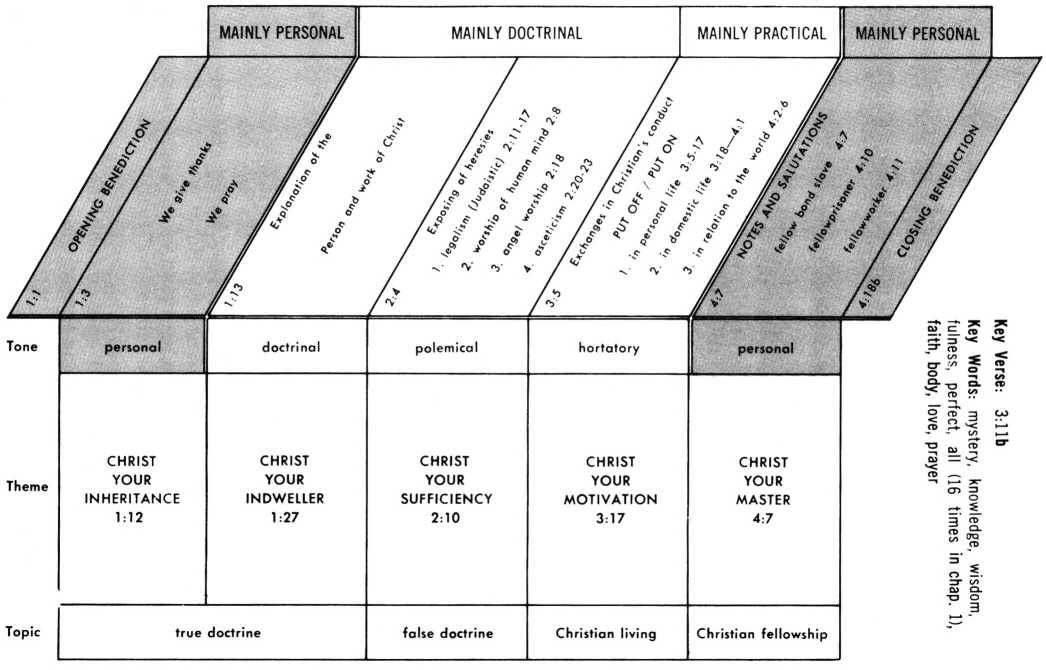
CHRIST IS ALL IN ALL
Click chart to enlarge
Charts from Jensen's Survey of the NT - used by permission
Colossians Overview - Click Chart on right side
| Christ Preeminent in All Things Supreme Lord - Sufficient Savior |
|||
| Colossians 1 | Colossians 2 | Colossians 3 | Colossians 4 |
| Supremacy of Christ |
Submission to Christ |
||
| Doctrinal and Corrective |
Practical and Reassuring |
||
| What Christ Did For Us |
What Christ Does Through Us |
||
| Christ Our Lord |
Christ Our Life |
Christ our Love |
|
| Christ the Head of the Body |
Christ the Lord of the Universe |
Christ the Head of the Home |
|
| Instruction | Warnings | Exhortations | Reminders |
| Reconciliation | Creation | Submission | Conversation |
| His Person and Word |
His Peace and Presence |
||
Colossians 4:13 For I testify for him that he has a deep concern for you and for those who are in Laodicea and Hierapolis. (NASB: Lockman)
Greek: marturo (1SPAI) gar auto oti echei (3SPAI) polun ponon uper umon kai ton en Laodikeia kai ton en Ierapolei.
Amplified: For I bear him testimony that he has labored hard in your behalf and for [the believers] in Laodicea and those in Hierapolis. (Amplified Bible - Lockman)
Phillips: From my own observation I can tell you that he has a real passion for your welfare, and for that of the churches of Laodicea and Hierapolis. (Phillips: Touchstone)
Wuest: for I bear witness to him that he has much toil on your behalf and on behalf of those in Laodicea, and those in Hierapolis
Young's Literal: for I do testify to him, that he hath much zeal for you, and those in Laodicea, and those in Hierapolis.
FOR I BEAR HIM WITNESS THAT HE HAS A DEEP CONCERN FOR YOU AND FOR THOSE WHO ARE IN LAODICEA AND HIERAPOLIS: marturo (1SPAI) gar auto hoti echei (3SPAI) polun ponon huper humon kai ton en Laodikeia kai ton en Ierapolei:
- Ro 10:2; 2Co 8:3
- Colossians 4 Resources - Multiple Sermons and Commentaries
DOES YOUR PRAYER LIFE
GIVE A GOOD TESTIMONY?
For (gar) - Term of explanation. What is Paul explaining? Check the context. What was Epaphras doing in Col 4:12? What motivates fervent prayer? ("deep concern"). I like Phillips' paraphrase "From my own observation I can tell you that he has a real passion for your welfare."
I bear him witness - Paul testifies in the present tense = continually! He continually witnessed Epaphras continually agonizing in prayer!
Bear...witness (testify) (3140)(martureo from mártus = witness = one who has information or knowledge of something and can bring to light or confirm something. English = martyr) in its most basic sense refers to a legal witness. Thus the verb martureo means to be a witness, to testify, to give evidence, to give testimony, to bear record, to affirm that one has seen or heard or experienced something. The words testified related to fact, not opinion, as in a courtroom setting.
Warren Wiersbe comments on Epaphras' prayer life writing: I am impressed with the fact that Epaphras prayed for believers in three different cities. We are fortunate today if church members pray for their own pastor and church, let alone believers in other places! Perhaps one reason that revival tarries is because we do not pray fervently for one another. (Exposition Commentary. 1989. Victor)
What was causing Epaphras to have pain in his heart for Laodicea? Did he see the beginning of their going astray? Not that they are in GROSS SIN-- that is not what makes God want to vomit. It's COMPLACENCY that makes God want to vomit. What about you and I? Are we COMPLACENT about our Christianity? We make think that we are all right because we are not living in gross sin, but instead are living a respectable life, among the pillars of the community… you walk through the streets and everyone in Laodicea likes you and THAT IS THE PROBLEM. Jesus has warned us to beware when all men speak well of you!
This church appears to be complacent - COMPLACENCY IN CHRISTIANITY IS DEADLY. Apathetic about their relationship with Jesus Christ. You also see a church that apparently is COMPROMISED (as the subsequent disapperance of the church suggests) -- they have a religion but not a relationship. They know about Jesus, but they do not really "know" Him (cf Mt 7:23)! They have slipped down the slope, name "compromise." Jesus is outside. He wants to come in and dine with them, to fellowship with them (Rev 3:20).
Laodicea and Hierapolis - click this map for the geographic relationships of Laodicea (means "justice of the people" - description), Hierapolis (means "holy city" - see description) and Colossae (means "punishment" - see description).
Colossians 4:14 Luke, the beloved physician, sends you his greetings, and also Demas. (NASB: Lockman)
Greek: aspazetai (3SPMI) umas Loukas o iatros o agapetos kai Demas
Phillips: Luke, our beloved doctor and Demas send their best wishes. (Phillips: Touchstone)
Wuest: There greets you Luke, the physician, the beloved one, and Demas.
Young's Literal: Salute you doth Lukas, the beloved physician, and Demas;
LUKE, THE BELOVED PHYSICIAN, SENDS YOU HIS GREETINGS: aspazetai (3SPMI) humas Loukas o iatros o agapetos:
- 2 Timothy 4:11 Philemon 1:24
- Colossians 4 Resources - Multiple Sermons and Commentaries
THE BELOVED
PHYSICIAN
What a wonderful moniker, an admirable "nickname."
From this verse that we know that Luke, Paul's companion on his voyage to Rome (Acts 21:2) was a physician.
Luke was Paul’s personal physician, as well as his close friend. He was a Gentile believer (see Colossians 4:11 where Paul says that Aristarchus… Mark… Jesus who is called Justus are the only Jews who are his fellow workers - implying Luke is not a Jew, for he is certainly a fellow worker with Paul) who traveled frequently with Paul on his missionary voyages. It may, in fact, have been Paul’s recurring illnesses on the first missionary journey that prompted him to take Luke along on the second. Like Paul, he was an educated, cultured man, as evidenced by the literary quality of his Greek in his gospel and the book of Acts. His conversations with Paul were undoubtedly stimulating.
Luke is mentioned by name only two other times in the New Testament. All three times his name appears, it does so in Paul’s writings from prison
Only Luke is with me. Pick up Mark and bring him with you, for he is useful to me for service. (see note 2 Timothy 4:11)
Epaphras, my fellow prisoner in Christ Jesus, greets you, 24 as do Mark, Aristarchus, Demas, Luke, my fellow workers. (Phile 1:23, 24)
After joining Paul on his second missionary journey, he was with him for most of the remainder of Paul’s life.
Nothing definite is known about Luke’s background. According to the church Fathers Eusebius and Jerome, he was born in Syrian Antioch. Some have speculated that he was Titus’s brother, that he knew Paul when Paul was a student at Tarsus, and that he was a freed slave from the household of Theophilus (Mentioned in the prologue to Acts). Those speculations, however, cannot be proved.
Luke was the prototype of the medical missionary. Not everyone in the Lord’s service has to have a seminary degree. God’s work needs specialists too. Luke surrendered his special talent to God, giving up what might have been a lucrative private practice. In return, God gave him the privilege of writing a sizable portion of the New Testament, and of being the beloved companion of the apostle Paul.
Beloved (27)(agapetos from agapao = to love, agape = unconditional love borne by Spirit - Gal 5:22-note) means beloved, dear, very much loved. Agapetos describes the love of another, this love being called out of the "giver's" heart by preciousness of the recipient of the love (the "beloved'). Agapetos is used only of Christians as united (by covenant, the New Covenant) with God and/or with each other in love.
Agapetos describes "one who is in a very special relationship with another" (BDAG) and in secular Greek is used mostly of a child, especially an only child to whom all the love of his parents is given (cf use by the Father describing His only Son and Abraham describing his "only son" in Ge 22:2). BDAG adds that agapetos " pertains to one who is dearly loved, dear, beloved, prized, valued (papyri, LXX; pseudepigraphia) indicating a close relationship, especially that between parent and child."
Beloved is a term of endearment and is someone that you love, and someone you are deeply devoted to. In the context of the New Testament agape love speaks of God’s divine and infinite love, a love that seeks the ultimate spiritual welfare of the one loved. Agapetos could be translated “divinely loved ones.”
Sends...greetings (782)(aspazomai from a + spao = draw out as a sword, pull, breathe) means to enfold in arms, to welcome, to embrace. To salute one (not in a military sense), greet, bid, wish well to. In classical literature aspazomai can also be used of physical expressions of welcome, such as “embrace” and “kiss.”
All 59 uses of aspazomai in 48 verses - acclaim(1), give...your greeting(1), greet(41), greeted(3), greeting(1), greets(5), paid their respects to(1), sends...greetings(4), taken...leave(1), welcomed(1).
Matt. 5:47; Matt. 10:12; Mk. 9:15; Mk. 15:18; Lk. 1:40; Lk. 10:4; Acts 18:22; Acts 20:1; Acts 21:7; Acts 21:19; Acts 25:13; Rom. 16:3; Rom. 16:5; Rom. 16:6; Rom. 16:7; Rom. 16:8; Rom. 16:9; Rom. 16:10; Rom. 16:11; Rom. 16:12; Rom. 16:13; Rom. 16:14; Rom. 16:15; Rom. 16:16; Rom. 16:21; Rom. 16:22; Rom. 16:23; 1 Co. 16:19; 1 Co. 16:20; 2 Co. 13:12; 2 Co. 13:13; Phil. 4:21; Phil. 4:22; Col. 4:10; Col. 4:12; Col. 4:14; Col. 4:15; 1 Thess. 5:26; 2 Tim. 4:19; 2 Tim. 4:21; Tit. 3:15; Phlm. 1:23; Heb. 11:13; Heb. 13:24; 1 Pet. 5:13; 1 Pet. 5:14; 2 Jn. 1:13; 3 Jn. 1:15
Below is a discussion on Luke from D Edmond Hiebert, one of the most meticulous writers I have encountered in the last 35 years, so I tend to "listen up" when he says something. Here he speaks of Luke's ethnicity with well-founded argumentation. Hiebert writes...
It is commonly held that Luke was a Gentile.
Colossians 4:10 Aristarchus, my fellow prisoner, sends you his greetings; and also Barnabas’s cousin Mark (about whom you received instructions; if he comes to you, welcome him); 11 and also Jesus who is called Justus; these are the only fellow workers for the kingdom of God who are from the circumcision, and they have proved to be an encouragement to me. 12 Epaphras, who is one of your number, a bondslave of Jesus Christ, sends you his greetings, always laboring earnestly for you in his prayers, that you may stand perfect and fully assured in all the will of God. 13 For I testify for him that he has a deep concern for you and for those who are in Laodicea and Hierapolis. 14 Luke, the beloved physician, sends you his greetings, and also Demas. 15 Greet the brethren who are in Laodicea and also Nympha and the church that is in her house. (Col 4:10-14)
(1) This seems to be a necessary conclusion (THAT LUKE WAS A GENTILE) based on Paul's reference to him in Colossians 4:14. In Col 4:10-14 six persons send greetings, and they are named in two groups. The three men named in verses 10-11 are identified as "of the circumcision" with the appreciative comment, "These only are my fellow workers unto the kingdom of God." Paul next mentions three other companions, Epaphras, Luke, and Demas. Certainly Epaphras, a native of Colossae (Col 4:12), was a Gentile. If Luke were Jewish, Paul would not have failed to name him in the former group, since the appreciative comment concerning his Jewish co-workers would in that case be a direct slap at Luke as one who had brought no cheer to Paul's heart. But any such suggestion is inconsistent with Paul's warm personal commendation of Luke as "the beloved physician." Luke, most naturally, did not belong to those "of the circumcision." If this conclusion is correct, then Luke was the only non-Jewish contributor to the New Testament.
(2) Luke's non-Jewish background seems to reveal itself in Acts 1:19. In referring to Akeldama, "the field of blood," he slips in the words "in their language" (the language of the Jews).
Acts 1:19 - And it became known to all who were living in Jerusalem; so that in their own language that field was called Hakeldama, that is, Field of Blood.)
(3) Grosheide holds that Luke's describing the inhabitants of Malta (Melita) as "barbarians" (Ac 28:2, 4) indicates that he was a Gentile. He asserts, "At the time no Jew would employ this word for these people who were Phoenicians, and thus related to the Jews."
(4) Luke's feeling for the sea, which is evident from his graphic descriptions of sea voyages, especially in Acts 27, points to his non-Jewish origin; Jews, at least during the Roman period, did not find the sea congenial.
(5) Harrison points to Luke's obvious fondness for city centers "since this was the geographical unit of significance among the Greeks but not among the Hebrews." In view of the evidence, we conclude that Luke was a Gentile rather than a Hellenistic Jew.
Luke apparently was a native Greek. Rackham holds that his Greek origin is reflected "by his ready pen, his versatility, and not least by his interest in the sea."
It is not certain whether he was a free Hellene or a Greek slave set free by his master. The latter is quite probable, since in wealthy Roman families the part of the family doctor was often committed to a trusted slave or freedman. If Luke was a freedman it is likely that he was set free with Roman citizenship. (An Introduction to the New Testament - Vol 1-3).
Related Resources:
AND ALSO DEMAS: kai Dema:
- 2Ti 4:10; Phile 1:24
- Colossians 4 Resources - Multiple Sermons and Commentaries
THE ENIGMATIC
DEMAS
In Paul's final letter, 2 Timothy (See note on 2Ti 4:10) we read that Demas had forsaken Paul and fled to Thessalonica, having loved the things of this present world more than the things of Christ. Since Colossians and Philemon were written during the same time period (see chronological chart below), Demas’ backsliding must have been rapid. What a tragedy!
Was Demas genuinely saved? In the final analysis that is God's business. In the meantime it is worth noting that as Billy Graham has said,
No man can be said to be truly converted to Christ who has not bent his will to Christ. He may give intellectual assent to the claims of Christ and may have had emotional religious experiences; however, he is not truly converted until he has surrendered his will to Christ as Lord, Savior, and Master.
THOUGHT - Putting the question of Demas' salvation aside, is your salvation secure because it was genuine repentance and belief and not a "mind game"? Not just intellectual gymnastics but internal transformation? Not just knowledge in the head but a change in the heart, a genuine regeneration which is evidenced by a supernatural desire and general predilection (not perfection) for the things of God… His presence in quietness and prayer, His word in times of study, memorization and meditation, His sure hope of heaven, His saints in fellowship, His conviction and discipline when we sin, etc.?
| SCRIPTURAL CITATION |
APPROXIMATE DATE |
SCRIPTURE QUOTATION |
| Philemon 1:24 |
AD 60-62 | … Mark, Aristarchus, Demas, Luke, my fellow workers |
| Colossians 4:14 |
AD 60-62 | Luke, the beloved physician, sends you his greetings, and also Demas |
| 2 Timothy 4:10 |
AD 67 | Demas, having loved this present world, has deserted me and gone to Thessalonica |
Demas goes from "fellow worker" to simply "Demas" to lover of "this present world"! The first two mentions were during Paul's first imprisonment and the last here in Timothy during his second imprisonment in Rome.
The lure of the world became irresistible to Demas, and he abandoned both Paul and the ministry. We see here the basic principle taught by our Lord Jesus during His earthly ministry that
No one (absolutely no one) can serve (present tense = as a lifestyle) two masters (kurios = absolute ownership and control); for either he will hate the one and love the other, or he will hold to one and despise the other. You cannot (present tense = as a lifestyle) serve God and mammon (wealth, possessions). (see note Matthew 6:24)
Jesus had His Judas, and Paul had his Demas. Anyone who has been in the ministry long enough has shared in that heartbreaking experience. Isn't it interesting and somewhat comforting to note that even the two greatest leaders the world has ever known had those who failed them. In a similar manner, anyone who has been a Christian long enough has known the heartache and sense of loss when some mentor or leader who for whatever reason chooses to abandon the faith and fall in love with the world.
If believers today would read John Bunyan’s Pilgrim’s Progress, they’d meet Mr. Hold-the-World, Mr. Save-All, and Mr. Money-Love and would see what Bunyan thought about Demas, the one-time associate of Paul who fell in love with “this present world”.
Every saint, be he pastor or pew member, needs to remember this passage, so he is aware of the potential for those who, while ostensibly steadfast and faithful, choose to forsake in the hour of need. If this has happened to you, beloved, remember that Jesus is able to sympathize, for in His hour of greatest need His disciples all left Him and fled. (Mark 14:50) Therefore…
"since He Himself was tempted (and tested) in that which He has suffered, He is (continually ready and) able to come to the aid (upon hearing the cry for help - see in depth discussion of boetheo) of those who are (continually being) tempted (and tested)." (see note Hebrews 2:18)
Gotquestions - Who was Demas in the Bible?
Answer: Demas had at one time been one of Paul’s “fellow workers” in the gospel ministry along with Mark, Luke, and others (Philemon 1:24). During Paul’s first imprisonment in Rome, Demas was also in Rome (Colossians 4:14). There is also biblical evidence that Demas was with Paul during Paul’s second imprisonment in Rome, at least for a while. Then something happened. Demas forsook Paul, abandoned the ministry, and left town. Paul wrote about the sad situation: “Demas, because he loved this world, has deserted me and has gone to Thessalonica” (2 Timothy 4:10). The Greek verb used in the original implies that Demas had not merely left Paul but had left him “in the lurch”; that is, Demas had abandoned Paul in a time of need. The apostle was in prison, facing a death sentence, and that’s when Demas chose to set sail. Undoubtedly, Paul was deeply let down by Demas. It’s never easy to see a friend and associate in whom you’ve placed your trust forsake you in the midst of hardship. The separation caused by Demas’ desertion of Paul was not merely spatial but spiritual. Demas left Rome because he fell in love with the world. In other words, Demas chose the corrupt value system of the unsaved world over what heaven values. As the NLT translates it, Demas “loves the things of this life” (2 Timothy 4:10). We don’t know the details of Demas’ situation, but it is evident that Demas decided that what Satan has to offer in this life is better than what God has to offer in the next.
Much can be said in support of the view that Demas, in love with the present world, was never a born-again believer in Jesus Christ. Paul makes a sharp contrast in 2 Timothy 4:8 and 10. In verse 8, Paul speaks of those who love the Lord: “There is laid up for me the crown of righteousness, which the Lord, the righteous judge, will award . . . to all who have loved his appearing” (ESV). Demas, in contrast to those who love Jesus’ return, loved the present world (verse 10). First John 2:15 is clear about the spiritual state of those who love the world: “Do not love the world or anything in the world. If anyone loves the world, love for the Father is not in them.” Nowhere in the Bible do we read of the restoration of Demas. The tragedy of Demas is still being lived out today by those who choose the temporary benefits of this world over the eternal riches of heaven.
Today there are still those who seem to receive the Word but then “the worries of this life and the deceitfulness of wealth choke the word, making it unfruitful” (Matthew 13:22). Past service is no guarantee of future faithfulness; we must depend on the Lord, our Strength (Psalm 28:8). We must be born again (John 3:3); otherwise, we have no foundation of faith. “They went out from us, but they did not really belong to us. For if they had belonged to us, they would have remained with us; but their going showed that none of them belonged to us” (1 John 2:19; cf. Matthew 7:22–23).
Related Resources:
Colossians 4:15 Greet the brethren who are in Laodicea and also Nympha and the church that is in her house.
Greek: Aspasasthe (2PAMM) tous en Laodikeia adelphous kai Numphan kai ten kat' oikon autes ekklesian.
Amplified: Give my greetings to the brethren at Laodicea, and to Nympha and the assembly (the church) which meets in her house.
Phillips: My own greetings to the Christians in Laodicea, and to Nymphas and the congregation who meet in her house.
Wuest: Greet the brethren in Laodicea, and Nymphas, and the [local] assembly [which meets] in her home.
Young's Literal: salute ye those in Laodicea -- brethren, and Nymphas, and the assembly in his house
GREET THE BRETHREN WHO ARE IN LAODICEA AND ALSO NYMPHA AND THE CHURCH THAT IS IN HER HOUSE:
- Colossians 4 Resources - Multiple Sermons and Commentaries
CLOSING
GREETINGS
Greet (782) (aspazomai from a + spao = draw out as a sword, pull, breathe) (aorist imperative) means to enfold in arms, welcome, embrace. It is spoken of those who meet or separate. This is one final expression of Paul's paternal love. Aspazomai is constantly used in the papyri for conveying the greetings at the end of a letter.
The brethren - This term is often used today amongst believers, but probably most often in a more formal manner and not with the deeper sense that this term carried in the early church, for in those days a mutual care for members of the Family was noteworthy and was obvious to those outside of Christ. "See how these Christians love one another" was the observation of many of the on lookers. The same description is sometimes used about those in church today, but sadly is more often spoken with a sarcastic, skeptical twist than with a sense of awe.
In Laodicea - click this map for the geographic relationships of Laodicea (means "justice of the people" - description), Hierapolis (means "holy city" - see description) and Colossae (means "punishment" - see description).
The brethren who are in Laodicea - Brethren in this context indicates fellow believers who composed the church in Laodicea. This church received a stern warning from our Lord some 30 years later in the book of Revelation. What happened to them in such a short time period? Were some of the original "church members" still alive or had a completely new generation been born who lacked the fervor of the parent church? In the next verse Paul instructs them to have Colossians read to them which surely was done and yet from what Jesus says below strongly suggests they do not heed the Word they heard, at least in a lasting way.
Jesus gives His assessment of the church at Laodicea declaring…
And to the angel of the church in Laodicea write: The Amen, the faithful and true Witness, the Beginning of the creation of God, says this: (Note on Rev 3:14)
15 'I know your deeds, that you are neither cold nor hot; I would that you were cold or hot. (Note on Rev 3:15)
16 'So because you are lukewarm, and neither hot nor cold, I will spit you out of My mouth. (Note on Rev 3:16)
17 'Because you say, "I am rich, and have become wealthy, and have need of nothing," and you do not know that you are wretched and miserable and poor and blind and naked, (Note on Rev 3:17)
18 I advise you to buy from Me gold refined by fire, that you may become rich, and white garments, that you may clothe yourself, and that the shame of your nakedness may not be revealed; and eye salve to anoint your eyes, that you may see. (Note on Rev 3:18)
19 'Those whom I love, I reprove and discipline; be zealous therefore, and repent. (Note on Rev 3:19)
20 'Behold, I stand at the door and knock; if anyone hears My voice and opens the door, I will come in to him, and will dine with him, and he with Me. (Note on Rev 3:20)
21 'He who overcomes, I will grant to him to sit down with Me on My throne, as I also overcame and sat down with My Father on His throne. (Note on Rev 3:21)
22 'He who has an ear, let him hear what the Spirit says to the churches.'" (Note on Rev 3:22)
Guy King makes a practical and pithy comment on the church at Laodicea…
This (church) became, of course, as it grew, and developed, more organised; but, alas, not necessarily more healthy. We have only to recall the condition of the very church of the Laodiceans, that we have been thinking of, to see how gravely deterioration can set in, and deficiency become apparent. The sad record is in Revelation 3:14-22.
- There was no spirit of enthusiasm - "neither cold, nor hot": tepid!
- There was no sense of need - "I have need of nothing"; blatant self-sufficiency.
- There were many who had no spiritual relationship to CHRIST - "if any man… open the door, I will come in"; they had entered in the door of the visible church, but kept closed the door to the church's Lord.
What a state of church life is here revealed. It only serves to emphasize how watchful our church, and its members, should be, lest "the cares of this world, and the deceitfulness of riches, and the lusts of other things entering in, choke the word, and it becometh unfruitful," Mark 4:19. (Colossians 4:15-18 His Kind Regard)
The church that is in her house - The churches met in homes, and believers would frequently itinerate from home to home. They fellowshipped together around the Word of God. They fellowshipped together in the breaking of bread in memory of our Lord’s death and resurrection (for the early church's plan for "church growth" see Acts 2:42-47 noting especially how the church was growing day by day!). The program of teaching the Word and evangelism was carried out from these little centers.
Whether or not the early Christians built actual church buildings in which to meet, we do not know. There is no mention of such in the New Testament. Probably in most cases, they met in individual homes, as many churches do today, especially in countries where organized Christian worship is forbidden.
With all of the stress in the modern church on large and luxurious buildings, it is refreshing to be reminded that, for many years, the Christian church met and grew in the homes of believers
Greet the church that is in their house (Prisca and Aquila). Greet Epaenetus, my beloved, who is the first convert to Christ from Asia. (See note Romans 16:5)
The churches of Asia greet you. Aquila and Prisca greet you heartily in the Lord, with the church that is in their house. (1 Cor 16:19)
(Paul) to Apphia our sister, and to Archippus our fellow soldier, and to the church in your house (Philemon's house) (Phile 1:2).
MacDonald comments that "most of us will readily agree that the power of God in a local church is far more important than an elaborate building or fine furnishings. Power is not dependent upon the latter; luxurious church buildings often serve as a hindrance to power. (MacDonald, W & Farstad, A. Believer's Bible Commentary: Thomas Nelson)
Lightfoot reminds us that "There is no clear example of a separate building set apart for Christian worship within the limits of the Roman empire before the third century, though apartments in private houses might be specially devoted to this purpose.
Pentecost (in comments on his exposition of Philemon) writes that "Home Bible classes are as important a ministry as any church can carry on. Many unsaved persons have an aversion to church. But if invited to a home to study the Bible, many are willing to come. The opportunity to reach the unsaved with the gospel in a home is perhaps greater where the Word of God can be taught, than any formal service. Many have not begun to tap the blessings that could be realized if God would lay it upon their hearts to gather together a few of our neighbors, or friends, or business associates, and provide them with a simple teaching of the Word of God, so that they are presented with the truth of the Word of Jesus Christ. The vast majority of those who have come to know Christ as Saviour in this writer’s recent ministry have come through the home Bible classes. As the apostle is writing to Philemon, Apphia, and Archippus, he is bringing the concept of a small nucleus of believers who are concerned with others who did not know Christ. Even though Archippus had not been “called into the ministry,” and had not been “ordained,” a ministry of teaching the Word was entrusted to him, and so Paul exhorted him to a faithfulness in the ministry that was his. (J. Dwight Pentecost. Paul the Prisoner: Part I: An Exposition of Philemon Bibliotheca Sacra. Volume 129. Issue 514. Page 141. 1972)
Colossians 4:16 When this letter is read among you, have it also read in the church of the Laodiceans; and you, for your part read my letter that is coming from Laodicea
Greek: kai otan anagnosthe (3SAPS) par' umin e epistole, poiesate (2PAAM) ina kai en te Laodikeon ekklesia| anagnosthe, (3SAPS) kai ten ek Laodikeias ina kai umeis anagnote. (2PAAS)
Amplified: And when this epistle has been read before you, [see] that it is read also in the assembly (the church) of the Laodiceans, and also [see] that you yourselves in turn read the [letter that comes to you] from Laodicea.
Phillips: When you have had this letter read in your church, see that the Laodiceans have it read in their church too; and see that you read the letter I have written to them.
Wuest: And when this letter is read in your presence, see to it that also it is read in the assembly of the Laodiceans, and the letter from Laodicea, see to it that you also read it.
Young's Literal: and when the epistle may be read with you, cause that also in the assembly of the Laodiceans it may be read, and the epistle from Laodicea that ye also may read
AND WHEN THIS LETTER IS READ AMONG YOU, HAVE IT ALSO READ IN THE CHURCH OF THE LAODICEANS AND YOU, FOR YOUR PART READ MY LETTER THAT IS COMING FROM LAODICEA: kai hotan anagnosthe (3SAPS) par' humin e epistole, poiesate (2PAAM) hina kai en te Laodikeon ekklesia anagnosthe, (3SAPS) kai ten ek Laodikeias hina kai humeis anagnote. (2PAAS):
- 1 Thes 5:27
- Colossians 4 Resources - Multiple Sermons and Commentaries
COLOSSIANS: A
CIRCULAR LETTER
When this letter is read - Guzik comments that "When Paul and other apostles wrote letters to churches, they simply read them publicly. It was a way for the apostle to teach that church even when he could not personally be there. It was the general practice to distribute all apostolic letters among the churches, especially those close to each other. This helps us to understand how and why the letters would have been copied almost immediately, and how slight mistakes in copying the manuscripts could come in at an early date. Apparently, Paul wrote a letter to the Laodiceans that we do not have. We should not assume from this that our treasure of inspiration in incomplete. The Holy Spirit has chosen to preserve those letters that are inspired for the church in a universal sense. Paul was not inspired in this way every time he set pen to paper.
Read (314) (anaginosko from aná = emphatic, again + ginosko = know <> know again) literally to know again or to recognize again. It came to mean to distinguish between, to know accurately and then to read.
In the NT anaginosko is only used with the meaning of to read (albeit once in a figurative sense of men "reading" the lives of the Corinthian saints as one would an actual written letter), especially referring to reading aloud and to public reading. In Acts 8:28, 30, 32 we see the Ethiopian eunuch is reading in private (until encountered by Phillip!).
Surely one cannot miss the point that the pure milk of God's Word is to have a vital and central role in the corporate worship of the church at Colossae.
Anaginosko is found in the papyri in the reading aloud of a petition or of the reading aloud of a will. In another use anaginosko refers to copies of an edict set up in public places "in full view of those who wish to read (anaginosko)."
The church of the Laodiceans - see relation to Hierapolis and Colossae on this Map
Read my letter that is coming from Laodicea - We do not know what Letter Paul refers to in this instruction. Some believe that this was the letter to the Ephesians but that notion is largely speculation.
Vincent comments that Paul refers to "the letter left at Laodicaea, and to be obtained by you from the church there. This letter cannot be positively identified. The composition known as the Epistle to the Laodiceans is a late and clumsy forgery, existing only in Latin mss., and made up chiefly of disconnected passages from Philippians, with a few from other epistles.
Colossians 4:17 Say to Archippus, "Take heed to the ministry which you have received in the Lord, that you may fulfill it."
Greek: kai eipate (2PAAM) Archippo, Blepe (2SPAM) ten diakonian en parelabes (2SAAI) en kurio, hina auten plerois. (2SPAS)
Amplified: And say to Archippus, See that you discharge carefully [the duties of] the ministry and fulfill the stewardship which you have received in the Lord.
Phillips: A brief message to Archippus: God ordained you to your work - see that you don't fail him!
Wuest: And say to Archippus, Be ever keeping a watchful eye upon the ministry which you received in the Lord, that you discharge it fully.
Young's Literal: and say to Archippus, 'See to the ministration that thou didst receive in the Lord, that thou mayest fulfil it.'
AND SAY TO ARCHIPPUS TAKE HEED TO THE MINISTRY WHICH YOU RECEIVED IN THE LORD: kai eipate (2PAAM) Archippo blepe (PAM) ten diakonian hos parelabes [2AAI] en Kuriôi:
- Archippus - Philemon 1:2
- Take heed - Lev 10:3; Nu 18:5; 2Chr 29:11; Ezek 44:23,24; Acts 20:28; 1Ti 4:16; 1Ti 6:11, 12, 13, 14,20; 2Ti 4:1, 1, 2, 3, 5
- The ministry - Acts 1:17; 14:23; 1Cor 4:1,2; Ep 4:11; 1Ti 4:6,14; 2Ti 1:6; 2:2
- Colossians 4 Resources - Multiple Sermons and Commentaries
GOD'S GIFT OF
MINISTRY
Say (3004) (lego) has the basic sense of “to gather with the twofold nuance of repetition and separation. Note that Paul like a military commander issues an order (aorist imperative) to be carried out without delay, even implying a sense of urgency.
TDNT summarizes the etymology of lego…
The meaning “to gather” is often present, as is the middle “to assemble.”
c. “To count” is a derived sense as the mental gathering of similar things.
d. Along similar lines we find “to enumerate,” “to draw up,” “to enter on a list.”
e. From enumeration we move on to narration, which then yields the sense “to say,” with such various nuances as “to speak,” “to mean,” and in compounds “to contradict,” “to foretell,” “to proclaim.”
Archippus (archippos) is a name which most resources record as meaning "master of the horse"
Archippus is described by Paul as our fellow soldier (Phile 1:2) which suggests that he was willing to suffer hardship (this was the lot of soldiers in Paul's day) and was actively engaged in Christian work, not allowing himself to be entangled in the affairs of everyday life (see notes on Paul's comparison of a Christian disciple with the metaphor of a soldier - 2 Timothy 2:3; 2:4).
Related resources -
- Three Kinds of Soldiers - Ten Principles of Warfare;
- Roman Soldier by Edward Gibbon (from Decline & Fall of Roman Empire;
- The Roman Soldier - Description from Jewish Historian Josephus;
- A Few Soldier Stories and Sermons
Take heed (991) (blepo) can denote simple voluntary observation and so mean to look at, behold. Many NT uses convey the sense of becoming aware of or taking notice of something, of perceiving or discerning or understanding.
Blepo in this passage is in in the present imperative = calls for this to be one's habitual practice which in turn necessitates continual dependence on the Holy Spirit). Paul as his fellow soldier and his "commanding general" is issuing an order for Archippus to "Continually keep your eyes open, stay aware, be discerning, understand your ministry".
Note that "May fulfill" is in the subjunctive mood which expresses the possibility it may not be fulfilled and implies that the successful fulfilling is dependent upon some condition being met, that condition in context being to continually "Take heed!"
THOUGHT - Beloved what ministry has God assigned to you for our short sojourn on earth? (cf 1 Pe 1:17+) Are you fulfilling it? Will you be able to say "I have fought the good fight, I have finished the course, I have kept the faith" (2 Ti 4:7+)? "We shall have all eternity in which to celebrate our victories, but only one short hour before the sunset in which to win them." (R Moffatt)
Adoniram Judson a famous missionary to Burma wrote that "A life once spent is irrevocable. It will remain to be contemplated through eternity… the same may be said of each day. When it is once past, it is gone forever. All the marks which we put upon it, it will exhibit forever… each day will not only be a witness of our conduct, but will affect our everlasting destiny… How shall we then wish to see each day marked with usefulness! It is too late to mend the days that are past. The future is in our power. Let us, then, each morning, (enabled by God's Spirit) resolve to send the day into eternity in such a garb as we shall wish it to wear forever. And at night let us reflect that one more day is irrevocably gone, indelibly (forever) marked."
This word blepo in secular Greek was used of bringing a ship to land. Think of your life as a "ship of faith" moving through the fog, avoiding the dangerous reefs by keeping your focus on the Lighthouse on the shore.
Spiritual gifts are a stewardship for which believers are accountable to God. Peter indicated that believers are to use gifts “as good stewards of the manifold grace of God” (see note 1 Peter 4:10). Not to exercise gifts properly is to fail one’s stewardship. This fact surely must have motivated Paul’s exhortation to Archippus.
Guzik rightly concludes that in this passage Paul offers "a good word to every one of us. But it is touching to think that this man Archippus must have been at a point of special need, because he needed this word of encouragement from Paul. It also shows Paul’s tender concern for this individual. (Colossians 4 )
Ministry (1248) (diakonia) (Click word study of diakonia)
Paul reminded Archippus that his ministry was a gift from God, and that he was a steward of God who would one day have to give an account of his work. Since the Lord gave him his ministry, the Lord could also help him carry it out in the right way. Ministry is not something we do for God; it is something God does in and through us. The NT introduces a radically new attitude toward ministry. Diakonia is not the activity of a lesser to a greater, but is the lifestyle of a follower of the Lord Jesus
Paul uses same word group diakonia that he used to describe the faithful minister Tychicus (see note Colossians 4:7). So this list of people starts with an example of a faithful man & ends with a charge to a man to be faithful. Indeed this is the charge Paul would give to us all as he ends this epistle.
Received (3880) (paralambano from para = beside + lambano = appropriate, receive) means to receive from another, to receive alongside or to take to oneself (into close association). To receive something transmitted, as spiritual instruction or truth (see 1Cor 11:23, Gal 1:9) or a ministry here in Colossians 4:17. The aorist tense looks back to the point in time when the Archippus heard the call to ministry.
Received from the Lord - Paul uses this same idea describing his reception of the gospel message from the Lord
For I delivered to you as of first importance what I also received, that Christ died for our sins according to the Scriptures (see note 1Corinthians 15:3)
Moule contends, that in the Lord suggests an official ministry, such as elder or deacon, but any spiritual ministry, whether official or not, may be described as received in the Lord.
Note that ministry is something we seek per se, but something God gives (received in the Lord). Inherent in the verb received is also the idea of accepting what one has been allotted in ministry. There is also the idea of taking this ministry to oneself, giving the picture that one should wholeheartedly embrace the good thing bestowed which has come down from above (James 1:15). Ministry is Christ in us the hope of glory flowing through us touching those He puts us into contact with for the expansion of His Kingdom and His glory, not for our reputation or our glory. Our job is to fulfill our divine assignment and bring great glory to the Father (see note Matthew 5:16)
What ministry has Your Lord assigned to you, beloved?
Will you be a faithful steward and hear "Well, done"?
Don't procrastinate in fulfilling your ministry in His power and for His glory. There are many works that men do to please or impress others, but supernatural ministry is Christ in you, His Spirit enabling the work, and the Father receiving all the glory. (see note Matthew 5:16) How wonderful would it be to be able to say…
And they were glorifying God because of me. (Gal 1:24)
We are standing on the edge of eternity. The King will soon return to reward His faithful stewards and servants. Redeem the time. Store up for yourself treasure in heaven (see note Mt 6:20).
THAT YOU MAY FULFILL IT: hina auten plerois (2SPAS):
- 2Timothy 4:5-note
- Colossians 4 Resources - Multiple Sermons and Commentaries
FULFILLING GOD'S
PLAN FOR OUR LIFE
That (2443) (hina) introduces a purpose clause and in this case explains that the purpose of telling Archippus to take heed was that he might fulfill God's ministry through him.
Fulfill (4137) (pleroo) means to make full, to fill up, to fill to the brim, to cause to abound. In this verse pleroo means to fulfill the duties and demands that had been entrusted to him -- to carry them out, to perform them fully, to accomplish them.
Fulfill in this context conveys the idea that God had a definite purpose (ministry) for His servant Archippus to accomplish or "fill to the brim". Remember that your Father also has a definite purpose for your new life in Christ, as Paul explained in Ephesians writing that…
we are (see who "we are" - notes Ephesians 2:8; 2:9) His workmanship (see poiema = His "masterpiece", His "poem"), created in Christ Jesus (see in Christ & in Christ Jesus) for good works (see study of Good Deeds), which God prepared beforehand, that we should walk (peripateo) in them. (see note Ephesians 2:10)
He works in us and through us to complete those good works that He has prepared for us. Fulfill also parallels the theme of Colossians—the fullness of Jesus Christ available to each believer. We are now able to fulfill our ministries because we have been filled full of Christ Jesus.
In his last known letter Paul exhorts his young disciple Timothy to
be sober in all things, endure hardship, do the work of an evangelist, fulfill your ministry. (Red = commands; see note 2 Timothy 4:5)
Remember that Christ is example (of ministry) and we are to follow in His steps (see note 1 Peter 2:21) Jesus' ministry was solely that which the Father had given Him, for as Jesus Himself explained
Truly, truly, I say to you, the Son can do nothing (how much?) of Himself, unless (what is the condition?) it is something He sees the Father doing; for whatever the Father does, these things the Son also does in like manner. (John 5:19)
And so we note that when His disciples returned from the city (after going to procure food) they began
requesting Him, saying, "Rabbi, eat." But He said to them, "I have food to eat that you do not know about." The disciples therefore were saying to one another, "No one brought Him anything to eat, did he?" Jesus said to them, "My food is to do the will of Him Who sent Me, and to accomplish (completely finish, bring to a full end thus reaching the intended goal and finishing) His work. (John 4:30-34)
Did Jesus fulfill His ministry, bringing His work to completion? In John just before He is crucified, Jesus prays to His Father and declares
I glorified Thee on the earth, having accomplished the work which Thou hast given Me to do. (John 17:4)
Then dear disciple, go and do likewise, fulfilling whatever ministry the Father has given you to do, that by it He might be greatly glorified.
Note that it is not so much my work for Him but His work through me. Do you see the difference? (in terms of initiation, source, purpose, effect, etc).
Be encouraged dear saint. Don't let anyone try to demean your work in the Lord, no matter how menial it may appear to you in this presence age, for in eternity future it will receive an entirely different evaluation! Every believer possesses a God-given ministry (in the Lord) and so each of us can say as did Paul that we possess a "ministry which I received from the Lord Jesus." (Acts 20:24+) Even better hopefully when we come to end of life's short race and are standing on the edge of eternity we will be able to affirm Paul's full declaration in Acts 20:24
I do not consider my life of any account as dear to myself, so that I may finish my course and the ministry which I received from the Lord Jesus, to testify solemnly of the gospel of the grace of God.
Ministry is both from the Father and for the Father's glory. Our motive should be to serve Him and seek to please Him in all things because we love Him Who first loved us. Suffering becomes an authenticating mark of a true minister of Christ (cf 2Cor 11:23-28), for the servant is not greater than the Lord. In His ministry on earth, Jesus knew suffering, opposition, and humiliation and His disciples are not to expect a "free pass" or exemption.
God-given ministry requires faithfulness, such as Tychicus modeled ("Tychicus, the beloved brother and faithful minister in the Lord," see note Ephesians 6:21). This quality, which is required before the Lord entrusts a person with a significant responsibility.
Paul writes "I thank Christ Jesus our Lord, who has strengthened me, because He considered me faithful, putting me into service even though I was formerly a blasphemer and a persecutor and a violent aggressor. And yet I was shown mercy, because I acted ignorantly in unbelief and the grace of our Lord was more than abundant, with the faith and love which are found in Christ Jesus." (1Ti 1:12-14).
Faithfulness to the Father's ministry is seen particularly by obedience to the truth of God, for as Paul wrote to Timothy
In pointing out these things to the brethren, you will be a good servant of Christ Jesus, constantly nourished on the words of the faith and of the sound doctrine which you have been following. (1Ti 4:6)
Ministry requires loyalty to the Lord Jesus in whatever sphere He assigns, and a recognition that He alone is the Source of strength and enablement for service. Graciously He sets forth the pattern of service and also strengthens those He calls.
Guy King comments that the Archippus' ministry…
was not following upon his own initiative. GOD gave it to him, GOD sent him forth to do it. What strength that imparts to a man's call and commission, since if He sends, He must be held responsible for supplies. "Come now, therefore, and I will send thee" Exodus 3:1O - and to the reluctant Moses He gives the twofold assurance, "I will be with thee," Exodus 3:12; "I will be with thy mouth," Exodus 4:12. Again, "Go in this thy might … have not I sent thee?" Judges 6:14 (see note) - and the hesitant Gideon goes forth in reliance upon GOD's provision. He Who bids you onward go, will not fail the way to show." "In the Lord." We must first be "in" Him before we can work "for" Him. Every real Christian is, by His mercy, in Him, as we have reminded each other in an earlier study. Are we then working for Him, in our several ministries, as instanced above?
Paul has another proposition, which he uses to enhearten the worker: the word "with" - "we are laborers together with God" 1 Corinthians 3:9. What a difference the little word makes. How much better a gardener works when his master works with him. Let the servant of CHRIST covet to have the Master working alongside, providing incentive, encouragement, and wherewithal. (Colossians 4:15-18 His Kind Regard)
Colossians 4:18 I, Paul, write this greeting with my own hand. Remember my imprisonment. Grace be with you.
Greek: O aspasmos te eme cheiri Paulou. mnemoneuete (2PPAM) mou ton desmon. e charis meth' umon.
Amplified: I, Paul, [add this final] greeting, writing with my own hand. Remember I am still in prison and in chains. May grace (God’s unmerited favor and blessing) be with you! Amen (so be it).
Phillips: My personal greeting to you written by myself. Don't forget I'm in prison. Grace be with you.
Wuest: The greeting by my hand, the hand of Paul. Be remembering my bonds. The grace be with you.
Young's Literal: The salutation by the hand of me, Paul; remember my bonds; the grace is with you. Amen.
I PAUL WRITE THIS GREETING WITH MY OWN HAND: O aspasmos te eme cheiri Paulou:
- 1Cor 16:21; 2 Th 3:17
- Colossians 4 Resources - Multiple Sermons and Commentaries
Paul customarily used an amanuensis (Recording secretary) when writing his letters, but frequently added a greeting with his own hand (cf. (1Co 16:21; 2Th 3:17 Philemon 1:19). It probably was not easy to sign one's name with a chain around one's wrist!
REMEMBER MY IMPRISONMENT: mnemoneuete (2PPAM) mou ton desmon:
- 2Ti 1:8; Heb 13:3
- Colossians 4 Resources - Multiple Sermons and Commentaries
Bearing in mind (3421) (mnemoneuo from mimnésko = recall to one's mind) means to keep in mind, exercise memory, call something to mind or recollect. The present imperative is a command for them to continually remember his imprisonment. The meaning is not that this memory was to occupy their minds to the exclusion of everything else but rather that their remembrance of his imprisonment would constantly recur. How could they do this practically speaking? Or asked another way, what should their remembrance of his chains stimulate? Surely, the most obvious answer is that when they thought about him, they should or would intercede on his behalf. What better way is there to remember the afflictions of fellow saints then to recall and take that recollection to the Lord in prayer! Can you imagine the "reward" that awaits those who had the privilege to pray for this mighty saint and thus co-labor with him fields that were white unto harvest? Seen in such a light, we understand that Paul's command to remember was in a sense an invitation to co-labor with him and to one day future share in the bountiful reward!
Imprisonment (1199) (desmon from déo = to bind) refers to a bond or band and then to a chain or shackle (of a prisoner). Paul was chained to a Roman guard during his imprisonment he at which time wrote epistles to the Ephesians, Colossians, Philippians, Timothy, Titus and Philemon - the "prison epistles".
In Ephesians Paul had stated that he was "an ambassador in chains". A T Robertson remarks that
"the chain clanked afresh as Paul took the pen to sing the salutation. He was not likely to forget it himself."
Expositors Greek Testament says
As he writes, his chain, fastened on his left hand, would impress itself on his notice. Hence the touching request, ‘Remember my bonds,’ which may bear the special sense, ‘remember in your prayers.’ (Nicoll, W Robertson, Editor: Expositors Greek Testament: 5 Volumes. Out of print. Search Google)
Henry Alford adds that…
These words extend further than to mere pecuniary support, or even mere prayers: they were ever to keep before them the fact that one who so deeply cared for them, and loved them, and to whom their perils of false doctrine occasioned such anxiety, was a prisoner in chains: and that remembrance was to work and produce its various fruits—of prayer for him, of affectionate remembrance of his wants, of deep regard for his words.
Guzik observes that …
There is much emotion, sorrow, and strength in this simple phrase. Paul not only knew the confinement and loneliness of the prisoner; he also had the uncertainty of not knowing if his case before Caesar’s court would end with his execution. (Colossians 4 )
The writer of Hebrews echoes Paul's desire writing…
Remember (present imperative) the prisoners, as though in prison with them, and those who are ill-treated, since you yourselves also are in the body. (See note Hebrews 13:3)
Remember is in the present imperative calling for this to be a habitual remembrance, not just for a moment in time.
Writing to Timothy Paul told his young protégée…
Therefore (because God has not given us a spirit of timidity, but of power and love and discipline) do not be ashamed of the testimony of our Lord, or of me His prisoner; but join with me in suffering for the gospel according to the power of God (See note 2 Timothy 1:8)
GRACE BE WITH YOU: he charis meth' humon:
- Romans 16:20,24; 2Corinthians 13:14; 1Timothy 6:21; 2Timothy 4:22; Hebrews 13:25
- Colossians 4 Resources - Multiple Sermons and Commentaries
Grace (5485) (charis) (Click word study of charis) most likely refers to sanctifying grace, that transforming power which alone makes it possible to carry out Paul's instructions and commands in this epistle. God's undeserved favor, manifest in the saint's being enabled to work out his or her salvation in fear and trembling.
Guzik observes that …
Paul’s conclusion is the only one possible for the apostle of grace, confronting a heresy emphasizing elaborate hidden mysteries and righteousness through works. We can only go forward safely in the Christian life if grace is with us. (Colossians 4 )
And so we take our leave of Colossians with its exalted theme: the pre-eminence of Christ and His sufficiency for every believer. Beginning with grace, it appropriately concludes on the note of grace.
Marvelous, infinite, matchless grace,
Freely bestowed on all who believe.
Guy King has these closing comments on Colossians…
One word remains, to round off his Kind Regards - a word that, as a matter of fact holds the secret spring of all hope of Full Salvation - Grace be with you.
Almost all of Paul's letters begin and end with it - Romans Just ends with it. Is Hebrews by him? Anyhow, It bears his ending, this "Grace". GOD's grace, which signifies His attitude, and His aid, is a constant wonder and theme of the apostle. Both aspects of it are vividly presented in this -
"By the grace of God I am what I am; and His grace which was bestowed upon me was not in vain, but I laboured more abundantly than they all. Yet not I, but the grace of God which was with me," 1 Corinthians 15:10
We find that Peter joins Paul in magnifying the grace of GOD. There is an interesting Greek word, poikilos, which occurs several times in the New Testament, and which Peter uses twice, both in his First Epistle, and which is translated "manifold":
(a) "Ye are in heaviness, through manifold temptations," (see note 1 Peter 1:6).
(b) "Good stewards of the manifold grace of GOD," (see note 1 Peter 4:10)
Put those two things together.
On the one hand, let the five digits, all so different in character, from the thumb to the little finger, stand for the manifold trials and testings of life. On the other hand, let the five digits stand for the manifold grace. Now put the right hand over the left, and observe how the fingers of the grace hand exactly correspond to those of the temptations hand. Only an illustration; but an illustration of a beautiful fact - that whatever may be the need, there is at hand just the very grace to meet it.
So these two grand apostles, so deeply acquainted with the hazards of life, join together in bearing testimony, out of their own wide and deep experience, to the all-sufficiency of this boon of GOD, available for all emergencies. As GOD Himself said to Paul, at a time when he was in distress, on account of his "thorn in the flesh" -
"My grace is sufficient for thee," 2 Corinthians 12:9.
Our Epistle suggests many situations in which that provision for our "manifold" needs may be tested. Take out one or two, at random. To make progress in the Christian life. "As ye have therefore received Christ Jesus the Lord, so walk ye in Him," (see note Colossians 2:6).
We all recognise that this is essential to the healthiness, and happiness, and, indeed, the helpfulness of the Christian life. Probably, we shall all, whether in greater or less degree, desire to grow. Our problem is not What, but How? The answer is, Grace: GOD's supply for man's situation - by faith and obedience, keep clear and clean the pipeline, that the oil of grace may flow into our need uninterruptedly.
"Grow in grace," (see note 2 Peter 3:18). To stand up successfully to false teachings. "Beware lest any man spoil you … Let no man beguile you," (see notes Colossians 2:8; 2:18)
Just as in our day, so in Paul's day, "the faith which was once delivered unto the saints," Jude 1:3, was constantly assailed with intellectual problems, as well as moral perils. We shall not be afraid to think out our theological, and spiritual, position, but we shall be assiduously on our guard against the "vain" vapourings of untruth. in other words, we shall be wise to seek the grace of diligence in the study of the Word -
"Study to shew thyself approved unto GOD, a workman that needeth not to be ashamed, rightly dividing the Word of truth," (see note 2 Timothy 2:15)
Through the Word of Holy Scripture, the HOLY SPIRIT will "guide you into all truth," John 16:13.
So shall there be given to us the Grace of Smell.
Does that phrase surprise you? But remember that when Paul is illustrating the various gifts of the Body of CHRIST'S Church, he indicates the necessity of this function of spiritual quality - "where were the smelling?" 1 Corinthians 12:17.
In view of the prevalence of false teaching, it is a good thing to have what a friend of mine calls "a spiritual sense of smell" - to be so instructed in the Word as to be able, almost instinctively, to detect the false. We dealt with this in our third Study.
Do you know that bit in Isaiah 11:3, "And shall make him of quick understanding"? in the margin of that verse it says that the Hebrew word translated understanding means scent, or smell, so that the One referred to shall be made by the Spirit a Person of keen scent, quickly discerning between the false and the true. This, too, is a gift of Grace.
To be the best in all home relationships. "Wives, husbands; children, fathers; servants, masters," (see notes Colossians 3:18 thru 4:1)
Happy the household where there is mutual understanding and co-operation - each for all, all for each.
"Whether one member suffer, all the members suffer with it; or one member be honoured, all the members rejoice with it," 1 Corinthians 12:26.
Because the rest of the family know us so well, and because we are there often off our guard, home is often the hardest place in which to witness, and shine, for our Lord. But here again grace comes to our assistance - GOD's aid for the godly. Is it fair to say that the Saviour spent thirty years in the home training for three years in the ministry? Was it not the observation and experience of His way in the home that enabled Mary to say with such confidence to others in their problem, "Whatever He saith unto you, do it," John 2:5.
Yes, home is a great testing place, and a fine training ground - to pass the test, and to profit from the training calls for the daily Grace of GOD.
To give Him the first place in everything. "That in all things He might have the preeminence," (see note Colossians 1:18). What a picture and promise of the life of Full Salvation. With Him in the first place, all else will fall into its right place.
In the far-off days, when the ladies wore long gloves on going to a party, a small girl was struggling with the inscrutable problem of where to put the unending series of buttons, when her mother explained, "It's really simple. Get the top one in the top button-hole, and all the others will follow right, to the last one". That truly is the case in the spiritual life: give Him the first place, and all will follow right. But, of course, the trouble is that wretched thing Self. How subtly it enters even into our spiritual service: why are we so busy in the work? Is it with a single eye to GOD's glory, or does there enter into it any vestige of unworthy motive, any seeking after our own glory? Let us constantly beware even "the little foxes that spoil the vines, for our vines have tender grapes," Song of Solomon 2:15.
Self-control is of great importance, if He is to have the pre-eminence; but even this control is a gift of Grace, for we are not left to exercise it by our strong will and determination, for "the fruit of the Spirit is … self-control," (see note Galatians 5:23), margin. It is He, not we, to do it, if only we will look to Him for it. So it shall be "Not I, but Christ," (see note Galatians 2:20), which is the very essence of Grace's accomplishment in us of Full Salvation..
To continue true, without backsliding. Our eyes stray back to the group photograph, to the figure of Demas. And as we contemplate his sad decline, we recall the words of the famous old preacher, John Bradford, as he watched a poor prisoner handcuffed to a policeman,
"There goes John Bradford, but for the grace of GOD".
He will, if we will. Thus we have all the power of GOD Himself to keep us on the road. (Colossians 4:15-18 His Kind Regard)
Let Philip Doddridge close our meditation -
'Twas grace that wrote my name
In life's eternal book;
'Twas grace that gave me to the Lamb,
Who all my sorrows took.Grace taught my wandering feet
To tread the heavenly road;
And new supplies each hour I meet
While pressing on to GOD.Grace taught my soul to pray,
And made my eyes o'erflow;
'Tis grace has kept me to this day,
And will not let me go.Grace all the work shall crown
Through everlasting days;
It lays in heaven the topmost stone,
And well deserves the praise.Oh, let that grace inspire
My soul with strength divine!
May all my powers to Thee aspire
And all my days be Thine.