|
COVENANT: |
|||||||||||||||||||||
|
ABRAHAMIC |
|||||||||||||||||||||
| ORIGIN OF THE MOSAIC COVENANT |
SHADOWS OF MESSIAH IN TABERNACLE |
||||||||||||||||||||
|
Have you ever wondered why God gave the Law which no one could keep perfectly and by which no man could become righteous and how it related to the Abrahamic and New Covenants? This study will begin to unfold these distinctions. Genesis 12:1, 2, 3+ Who was included in the covenant? What did God command and promise Abram at age 75 in Haran? (Ge 12:1, 2, 3+)?
What did God promise Abram Would give the land to his seed (singular noun in the original Hebrew, not "seeds") The promises were spoke to Abram's seed - Who is his seed Christ After Lot ha d separated, how long did God promise He would give the land to Abram - Ge 13:15+? Forever What promise did God reaffirm to Abram regarding his descendants? Ge 13:16? Abram's seed What additional insights are given in Ge 15:1, 2, 3, 4, 5+? In this section God restates and clarifies His promises to Abram.. Offspring would come forth from his own body -- Abram's seed would be as the stars (in number) What was Abram’s Abram believed in Jehovah and He reckoned it to him as righteousness (Note: Abram's "salvation" occurred 14 years prior to his circumcision [Ge 17:24+] - The point is that circumcision was never meant to save anyone! This is a great Scriptural point to remind your Jewish friends that no man is saved by works [keeping mitzvah] of any kind be it circumcision, etc) Note: From other Scriptures we know that Jehovah = Jesus [see notes]) What did A bram actually believe according to Pau l? Gal 3:8+ (see comment), Gal 3:16+ God preached the gospel in Ge 12:3+ ("in you all the families of the earth shall be blessed"; Ge 22:18+ adds the phrase "in your Seed" = masculine, singular ~ Christ) and in Ge 15:6+ Abraham believed the gospel Gal 3:16+ teaches us that Abraham believed the promise of the seed = coming Messiah (Seed = Christ; cp 2Co 1:20+ where "in Him" = in Christ) What conditions involved in this covenant? None, unconditional, for God walked through the pieces of cut flesh alone Fulfillment of the promises depended solely on God's faithfulness What additional prophetic promises did God make in Ge 15:13, 14, 15, 16+? Descendants will be strangers in a land that is not theirs (Ge 15:13+) Enslaved and oppressed 400 yr (Ge 15:13+) Will come out with many possessions (Ex 3:21, 22+) for God will judge the nation that they serve (Ge 15:14+) Will return in the 4th generation (one generation at that time ~100 yr) (Ge 15:16+)
What new information did God reveal to Abram at age 99 in Ge 17:5, 6+? Name changed to Lord told him that he would be the father of a multitude of nations, and kings would come from him What new truth did I will be God to you and your seed The land as an everlasting possession What did God reveal My covenant I will establish with
What do we learn about the lineage of the Abrahamic Covenant in Ge 25:23, 33,34? Before Isaac's twin sons Esau and Jacob were born the Lord told Rebekah, Isaac's wife and their mother, that there were two nations in her womb and the older (Esau) would serve the younger (Jacob). Esau, the natural heir as the firstborn, sold his birthright to his younger brother, Jacob When the LORD appeared to Isaac what did He state concerning the heir of the Abrahamic covenant in Ge 26:3,4 & Ge 26:24? The promises first given to Abraham were passed down to Isaac (the land, multiplied descendants as the stars) (Ge 26:3,4) I am with you. I will bless you, and multiply your descendants for the sake of my servant Abraham (Ge 26:24) With whom was the covenant next confirmed -- Genesis 28:14,15? Jacob SEED shall also be like DUST of the earth In your SEED shall ALL THE FAMILIES OF THE EARTH BE BLESSED (cf Ge 12:3+) What is the implication when God calls Himself "the God of your father Abraham and the God of Isaac"? He is making reference to His covenant with Abraham What happened Jacob wrestled with God and submitted His name was changed From Jacob, where was the To the 12 sons of Israel who would be head of 12 tribes which in turn would comprise the nation of Israel
What in essence God's promises
In short, we note that Abraham received the "Gospel" and believed in the promise of the Seed looking forward toward the Cross of Christ. |
Where is Israel and his 12 sons at the end of Genesis? In Egypt to escape the famine Why was Joseph in Egypt? Joseph had devised a plan of deliverance of Egypt from the famine What transpired when a new pharaoh who did not know Joseph (Ex 1:8-11+)? A new king arose over Egypt who did not know Joseph and because of his fear of the Israelites appointed taskmasters over them to afflict them with hard labor - these conditions lasted 400 years (Ge 15:13+) What did the children of Israel do & how did God respond in Ex 2:23, 24, 25+? They sighed (groaned, mourned) and cried out (Hebrew = cry for help in time of distress) to God Who heard their groaning and remembered His covenant with Abraham, Isaac and Jacob What promise to Abraham did God remember (cf Ge 15:13, 14, 15, 16+)? Jehovah would judge the Egyptians who had afflicted Israel for 400 years and bring them back to Canaan in the 4th generation What does this He is a covenant keeping God Who actions are based on covenant What did God explain to Moses about His name in (Ex 6:2,3+)? The Lord stated that He had appeared to Abraham, Isaac, and Jacob as God Almighty, EL Shaddai, but had not made Himself known to them as Jehovah (Click study of Jehovah) How would God make Himself known to the sons of Israel? (Ex 6:6, 7, 8+) God would reveal Himself through His redemption and deliverance of the sons of Israel from Egyptian bondage. Here God is clearly associating His Name Jehovah with His covenant promises to Abraham. Thus Jehovah is His precious Name that links Him irrevocably through the Abrahamic covenant with Israel. It is the Name so sacred to the Jews that they will not pronounce it in the Synagogue, instead substituting "Adonai" (Master) or simply saying "the Name".
Now we will look specifically at the Old Covenant In the third month after the LORD had brought the sons of Israel out of Egypt, they came to the wilderness of Sinai. Where are the
Who did God make this covenant with in Ex 19:3, 4+? What was Moses' function? Moses acted as the "mediator" ("go between") between Jehovah and the sons of Israel The covenant was instituted with the house of Jacob = sons of Israel = nation of Israel How do you know this covenant is not an extension of the Abrahamic Covenant from Ex 19:5, 6+?
The Old Covenant is conditional = if they obey then they could enjoy the promises was unconditional. When did God initiate this covenant? When Israel had been delivered from bondage in Egypt What does God promise to Israel if they obey? Ex 19:5, 6+?
What was Israel's response to God? What is Moses' role? Ex 19:8+ Moses = the mediator What was Jehovah's command to the children regarding their relationship to the Canaanites? (Ex 23:32, 33+) Make no covenant with them or their gods (if they served their gods it would be a snare) How is the Old Covenant ratified in Ex 24:3, 4, 5, 6, 7, 8+?
What did God write the 10 commandments on? Exodus 24:12+ tablets of stone What was the appearance A consuming fire What happened when the sons of Israel perceived that Moses had delayed returning from Mt Sinai? (Ex 32:1, 2, 3, 4, 5, 6+) The children of Israel made a golden calf and began to worship it What did Moses do with the Tablets of Stone when he returned from Mt Sinai and discovered the idolatry? (Ex 32:19, 20+) Moses broke the tablets What did Moses do in (Ex 34:1,2+)? Exodus 34 returns to the mountain so God could write His laws upon tables of stone How would you summarize the interaction of the sons of Israel with the Old Covenant? They broke the Old Covenant The Old Covenant centered around the Tabernacle=the tabernacle was an integral part of the Old Covenant. |
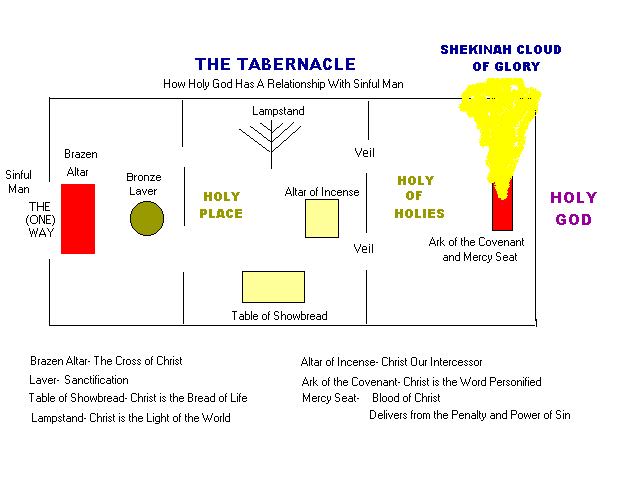
Refer to Tabernacle Diagram What does Paul say about Shadows in Col 2:16-17+? What instructions does God give that he is to give to the sons of Israel? (Ex 25:2, 8, 9+)
What was the purpose of the Tabernacle, in the old covenant? (Ex 25:22+) A place of where God would meet with man (Moses in context) What were the main divisions? What took place in the outer courtyard? Who entered the Holy place? how often? Who entered the Holy of holies? Let's look at how the tabernacle is a picture or shadow of Jesus Christ How many ways were there into the Tabernacle, the Holy place and the Holy of holies? Only entrance How does this truth foreshadow Jesus declared "I am the way, the truth, the life and no one comes to the Father but through Me. "I am the door; if anyone enters through me, he shall be saved, and shall go in and out, and find pasture. What is the first article of furniture? The place where SACRIFICE of the lamb (or other animal) took place in order to bring about reconciliation for sin and facilitate consecration How does this picture Jesus is the sacrificial Lamb of God Who takes away the sin of the world It speaks of the reconciliation one can have through the blood of the eternal covenant in Jesus Christ (see the discussion below re "Mercy Seat") Just as the priests could not come before the LORD without a sacrifice, we too must receive by faith the once for all sacrifice of Jesus Christ. What is the next article in the outer courtyard?
How are we made Jesus is the Word and we are cleansed through Him Cleansed through the washing of the water with the Word What was on the right (north) side of the Holy place? (Ex 25:23, 24, 25, 26, 27, 28, 29, 30+)
By what metaphor did Jesus describe Himself in (Jn 6:48, 51+)? The Bread of life - Living Bread
What article set opposite (south) the Table of Showbread? How did it foreshadow the description of Jesus in (Jn 1:4+, Jn 8:12/john-8-commentary#8:12)? Seven branched candlestick Jesus is the Light of the world
What is the article of furniture in front of the Veil (see explanatory note below)? Altar of Incense was to burn perpetually and symbolized prayer In the true Tabernacle in Heaven, Jesus ever lives to continually (present tense) make intercession
What sepa rated the Holy place from the Holy of holies? What is the NT parallel with Jesus in (Heb 10:19, 20, 21,22+, Mt 27:50,51+)? Jesus is the rent veil, His torn flesh giving us access to God so that now believers may boldly approach the Throne of Grace (Heb 4:16-note)
What was in the Holy of holies? "Mercy" covered the Old Covenant of the law!
What transpired at the mercy seat?
What transpired at the mercy seat?
What does the Mercy Seat foreshadow according to (Ro 3:25+)? The Mercy Seat was a picture of the propitiation of God's anger. Jesus took the punishment for our sins and in so doing satisfied (propitiated) God's anger against sinners who place their faith in Him. Believers are in essence "covered by the blood of Christ" and can now meet with God at His Throne any time, any day in contrast to the Jewish high priest who could only go into God's presence once per year on the Day of Atonement Given that the Mercy Seat was where God met man and over which the Shekinah Glory Cloud dwelt, how was this picture a shadow of Jesus? (see John 1:14+) John beheld Jesus' glory, the Word made flesh as He "tabernacled" among men
Who did the high priest meet at the Mercy Seat? (see Jn 8:58+, Jn 10:30+) Jehovah Who was also Jesus because He was the "I Am" and He and His Father are One.
REVIEW Abrahamic = promise of the Seed = the coming Messiah, the land, the nation (Israel), unconditional, forever Old = conditional, tabernacle place where God dwelt, picture of Jesus Where is the promise of the new covenant in the Old Testament? God promised the New Covenant in Jeremiah' What happened to the old covenant when the new covenant was inaugurated by Jesus? Old became obsolete |
|||||||||||||||||||
|
THE THREE COVENANTS |
|
|
ABRAHAMIC COVENANT |
PROMISE of Jesus Christ |
|
OLD COVENANT |
PICTURE of Jesus Christ |
|
NEW COVENANT |
PERSON of Jesus Christ |
|
SHADOWS OF MESSIAH |
|
|
|
The Abrahamic God made a covenant with Abraham promising him primarily two things: a seed and a land. The Abrahamic Covenant was also ratified with Isaac, Jacob (name changed to Israel), and his sons who comprised the nation of Israel. The Old Covenant 430 (400) years later, God made a covenant of Law with the nation of Israel. Moses was the mediator of that covenant. God spoke to Moses. Moses spoke to the people. The Old Covenant, or the Law, centered around the tabernacle and the related ceremonies and sacrifices. The earthly tabernacle was built under Moses' direction after the pattern of God's heavenly tabernacle. Therefore, the tabernacle served as an integral part of the Old Covenant. What the earthly tabernacle was to the Old Covenant, the true tabernacle in heaven is to the New Covenant (Hebrews 8:5-see note) The New Covenant Through Jeremiah, the prophet, God promised the New Covenant in Jer 31:31, 32, 33, 34, Although not using the term "New Covenant", the following passages are clearly allusions in the Old Testament to the New Covenant = Is 59:20, 21; Jer. 32:37, 38, 39, 40; Zech 9:11 Ezek. 16:60, 61, 62, 63; 34:25, 26, 27, 28, 29, 30, 31, 37:21, 22, 23, 24, 25, 26, 27, 28) Here are New Testament passages relating to the New Covenant = Mt 26:26, 27, 28, 29, Lk 22:18, 29, 30. cp Is 25:6, Mt 8:11, Lk 22:19, 20, Mark 14:24, 25, 26, Heb 13:20, Ezek 11:19,20; 18:31; 36:26,27) Jesus was the mediator of the New Covenant, a better covenant than the Law. When the New Covenant was inaugurated by Jesus Christ, the Old Covenant became obsolete. Heb 8:6 (see note) But now He (Who is "He"? Jesus our High Priest) has obtained a more excellent ministry (far superior to the ministry of those who serve under the old laws), by as much as (to the degree that) He is also the mediator of a better covenant, which has been enacted on better promises. Heb 8:7 For if that first covenant had been faultless (The “fault” or limitation in the first covenant was not in its inherent righteousness, but in its design from God himself. It was never intended to be his final revelation or provision for mankind; it was provisional, always pointing toward the fulfillment to come in Christ), there would have been no occasion sought for a second. (See complete discussion in Hebrews 8:1; 2; 3; 4; 5; 6; 7; 8; 9; 10; 11; 12; 13 see notes on He 8:1; 2; 3; 4; 5; 6; 7; 8; 9; 10; 11; 12; 13) The covenant is “better” because it is absolute not conditional, spiritual not carnal, universal not local, eternal not temporal, individual not national, internal not external. (Griffith Thomas) First, there is a comparison. Christ’s ministry is as superior to the ministry of the Aaronic priests as the covenant He meditates is superior to the old one. Second, a reason is given: the covenant is better because it is enacted on better promises. Christ’s ministry is infinitely better. He offered Himself, not an animal. He presented the value of His own blood, not the blood of bulls and goats. He put away sins, not merely covered them. He gave believers a perfect conscience, not an annual reminder of sins. He opened the way for us to enter into the presence of God, not to stand outside at a distance. It is a better covenant because it is founded on better promises. The covenant of law promised blessing for obedience but threatened death for disobedience. It required righteousness but did not give the ability to produce it. The New Covenant is an unconditional covenant of grace which is entered into by faith. The New Covenant imputes righteousness (1Cor 1:30, 2Cor 5:21) where there is none. The New Covenant teaches men to live righteously (Titus 2:11, 12), empowers them to do so (1Cor 15:10, 2Cor 12:9, 10), and rewards them when they do (2Cor 5:9,10, 1Cor 3:10, 11, 12, 13, 14, 15, Col 3:23, 24, 25, Eph 6:7, 8, Rev 22:12). |
|
EXPLANATORY NOTES |
|
William MacDonald on Gal 3:8..
John MacArthur on Gal 3:8...
So what you really have in this section (Gal 3:6, 7, 8, 9, 10, 11, 12, 13, 14,15, 16+) is a theology of the Old Testament. If you want to know how people were saved in the Old Testament, just read through here and you'll find out. It's the same way they are saved at any time: by faith in God's revelation. You say, "Did they have to believe in everything? Did they have to believe in the death of Christ, the resurrection of Christ and the Second Coming?" Of course not. They had to believe as much as God had revealed. At any point in time, a man was required to believe all God had said. If a man was living in the time of Adam, God hadn't said that much. He had to believe all that God had revealed (cp see Cain's faith in Heb 11:4-note). If the man was living later on, in the time of Moses, God began to reveal more and man had to believe all that God had revealed. For the man who lives post-New Testament, he has to believe all God revealed, up through the fullness of salvation as seen in Jesus Christ.... Gal 3:8. "And the Scripture," and here, he gets into the heavy part of his argument and starts quoting Scripture. "The Scripture, foreseeing that God would justify the Gentiles by faith, preached before the Gospel unto Abraham, saying, 'In thee shall all nations be blessed.'" Hang onto this, because we have to kind of untangle this verse to get into the logic of Paul. Here is his direct answer. Notice the word 'Gospel.' It means 'good news.' What is the good news that God wants to give us? Salvation by faith. Did He give that to Abraham? He certainly did. "He preached before the good news that salvation comes by faith unto Abraham." But he preached also that God would justify the Gentiles by faith, that all the nations down through the ages would be justified by faith, as well as the Jews. Sure, he didn't just say, "Your seed will be blessed." He said, "In thee will all the nations of the Earth be blessed." So at the very time when Abraham was given the promise, God told Abraham that Gentile nations would be saved by faith. Listen, the proof in that verse is simply this: "In thee shall all nations be blessed." That means that nations (Gentiles) will be blessed through the seed of Abraham. They don't have to become Jews. The Scripture doesn't say, "All the nations will become what you are." No, all the nations will be blessed through the seed (the Messiah) that comes. (Blessed or Cursed) (Bolding added) (In another sermon Dr MacArthur says) So Paul says, "Even the Old Testament predicted this, that all nations as nations, Gentiles as Gentiles, would be able to be blessed in Abraham through faith. The key words are there in the middle of the verse: through faith. So God is going to justify the Gentiles not by circumcision but through faith. That's what God meant when He said to Abraham, "Through you will all nations be blessed." What does it mean, "In you will all nations be blessed?" Well, it was simply this. That through the loins of Abraham came whom? Messiah. So it was in Messiah that all were blessed. Take that far enough back, and it was the seed of Abraham that became the One who blessed all. He said, "In you, in your seed, in your loins is that which will come and be a blessing to all." So in the very calling of Abraham, in the end of Gal 3:8, was the promise that Gentiles could be saved as Gentiles. They didn't have to become Jews. They didn't have to get circumcised and keep all the ceremony and the law. So Paul says, "Abraham was justified by faith. Anyone else who believes like Abraham did is the spiritual child of Abraham." God, from the very start, told Abraham that the Gentiles would be saved through faith. There was coming one from his loins who would be the one to bless all nations as nations. That assumed that they wouldn't become Jews. If 'all nations' were being blessed, they would have to be other than Jews. Otherwise, it would say, "In you shall everyone be blessed who becomes a Jew." No. "In you will all nations be blessed." So Paul proves his point. (Salvation Is by Faith Alone) (Bolding added) George asks...
|
Related Resources: from Dr S Lewis Johnson
- Covenant in the Old Testament
- Covenant in the New Testament
- Titus 1:1-4; Ro 9:1-15 Covenants - Everlasting & Historical
- Genesis 2:8-17 The Edenic Covenant
- Genesis 6:18, 9:8-17 The Noahic Covenant
- Isaiah 42 The Servant of Jehovah - Covenant of the People & Light of the Gentiles
Abrahamic Covenant
- Genesis 12:1-3, 15:7-21 The Abrahamic Covenant - Pt 1
- Romans 11:1-10 The Abrahamic Covenant - Pt 2
- Romans 11:11-27 The Abrahamic Covenant - Pt 3
- Genesis 9:1-17 The Universal Covenant
- Genesis 12:1-3 Abrahamic: Fundamental Covenant
- Genesis 15:7-21 Ratification of Abrahamic Covenant
- Genesis 17:9-27 Sign of the Abrahamic Covenant
- Genesis 17:1-8 The Sealing of the Covenant
Mosaic Covenant
Palestinian Covenant
Davidic Covenant
New Covenant