
EPHESIANS - CHRIST AND THE CHURCH
Click chart to enlarge
Charts from Jensen's Survey of the NT - used by permission
| SYMMETRY OF EPHESIANS |
|
| EPHESIANS 1-3 | EPHESIANS 4-6 |
|
The Root |
The Fruit |
|
Spiritual Wealth |
Spiritual Walk |
|
Christian Privilege |
Christian Conduct |
|
The Position |
The Practice |
|
God Sees |
World Sees |
|
Privilege |
Practice |
|
Doctrine |
Duty |
|
Doctrinal |
Practical |
|
Revelation |
Responsibility |
|
Christian |
Christian |
|
Belief |
Behavior |
|
Privileges |
Responsibilities |
|
Our Heritage |
Our Life |
|
Know your |
Live by faith in the light of your |
|
The Finished Work |
The Faithful Walk |
|
Work |
Work |
|
We |
Christ |
|
Word |
Walk |
|
Heavenly |
Earthly |
|
Who You Are |
Whose You Are |
|
Identity |
Responsibility |
|
Theology |
Ethics |
Ryrie Study Bible - NAS
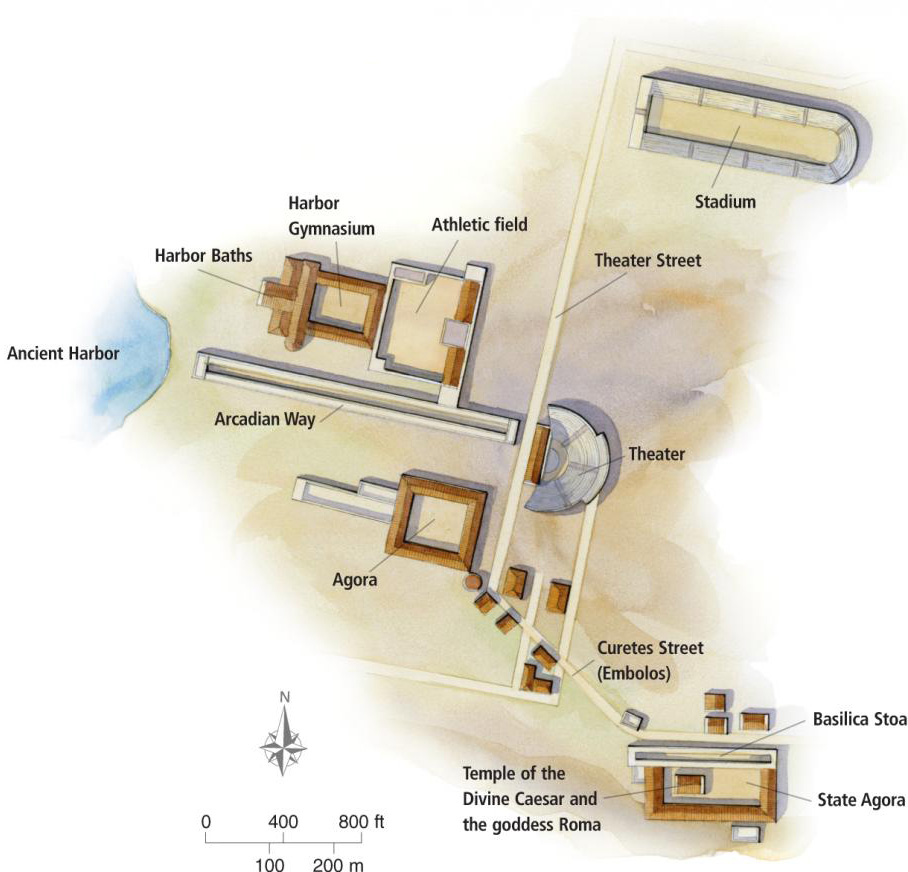
Ephesus in the Time of Paul (c. A.D. 60)
(Click to Enlarge)
INDEX TO STUDY QUESTIONS ON EPHESIANS
- Ephesians Study Questions Lesson 1 - Covers Introduction - Author & Recipients
- Ephesians Study Questions Lesson 2 - Covers Ephesians 1:1-14
- Ephesians Study Questions Lesson 3 - Covers Ephesians 1:15-2:10
- Ephesians Study Questions Lesson 4 - Covers Ephesians 2:11-22
- Ephesians Study Questions Lesson 5 - Covers Ephesians 3:1-21
- Ephesians Study Questions Lesson 6 - Covers Ephesians 4:1-6
- Ephesians Study Questions Lesson 7 - Covers Ephesians 4:7-16
Related Resources:
- Excellent 25 minute youtube video on ruins and history of Ephesus narrated by Dr Joseph Stowell
- Good overview summary - MacArthur's Introduction
- Note: These Study Notes roughly correspond with the 10 Lessons of the Precept Upon Precept study of the Book of Ephesians (ESV format, NASB format). They are not meant to replace your personal study of the Word, which is the most important thing you can do if you want to get the Word of Ephesians in your heart. (Lesson 1 Pdf ESV, Lesson 1 Pdf NASB)
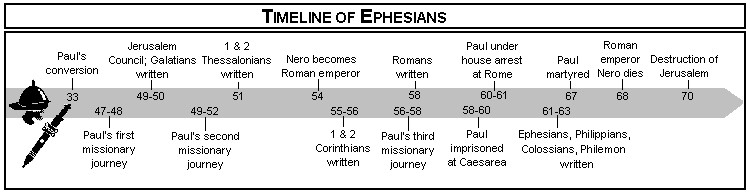
TIMELINE - DATES ARE APPROXIMATIONS
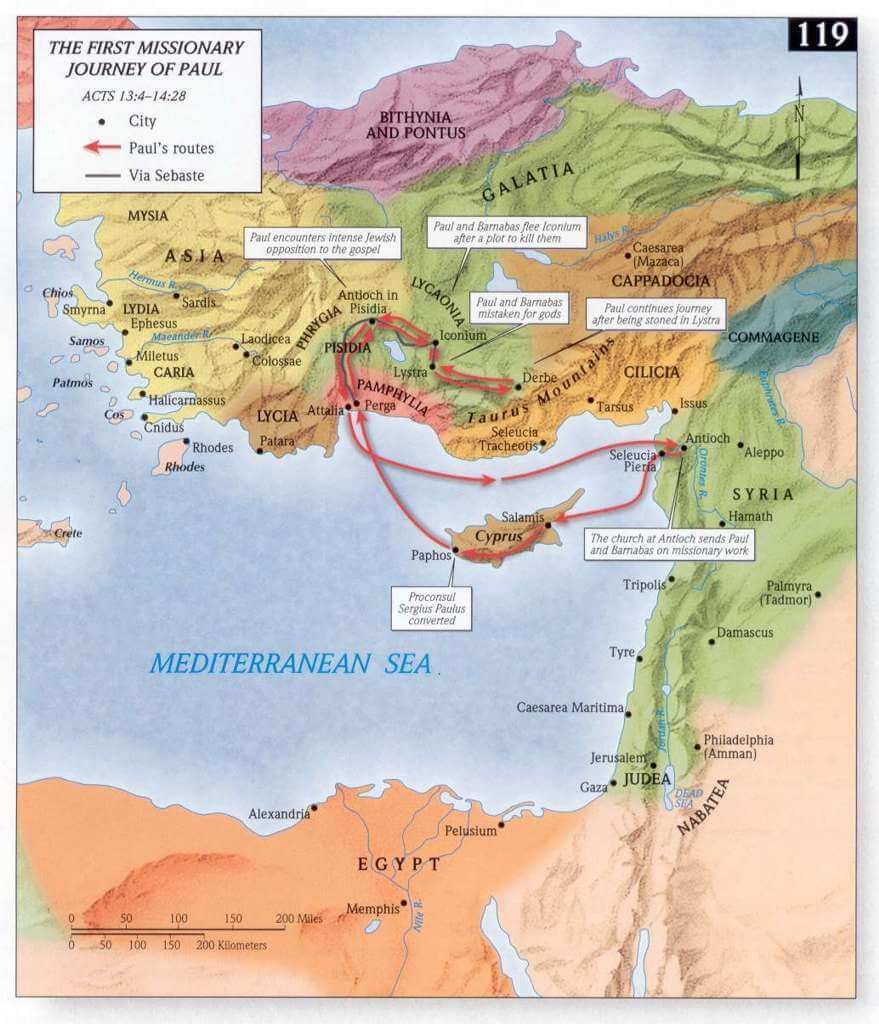
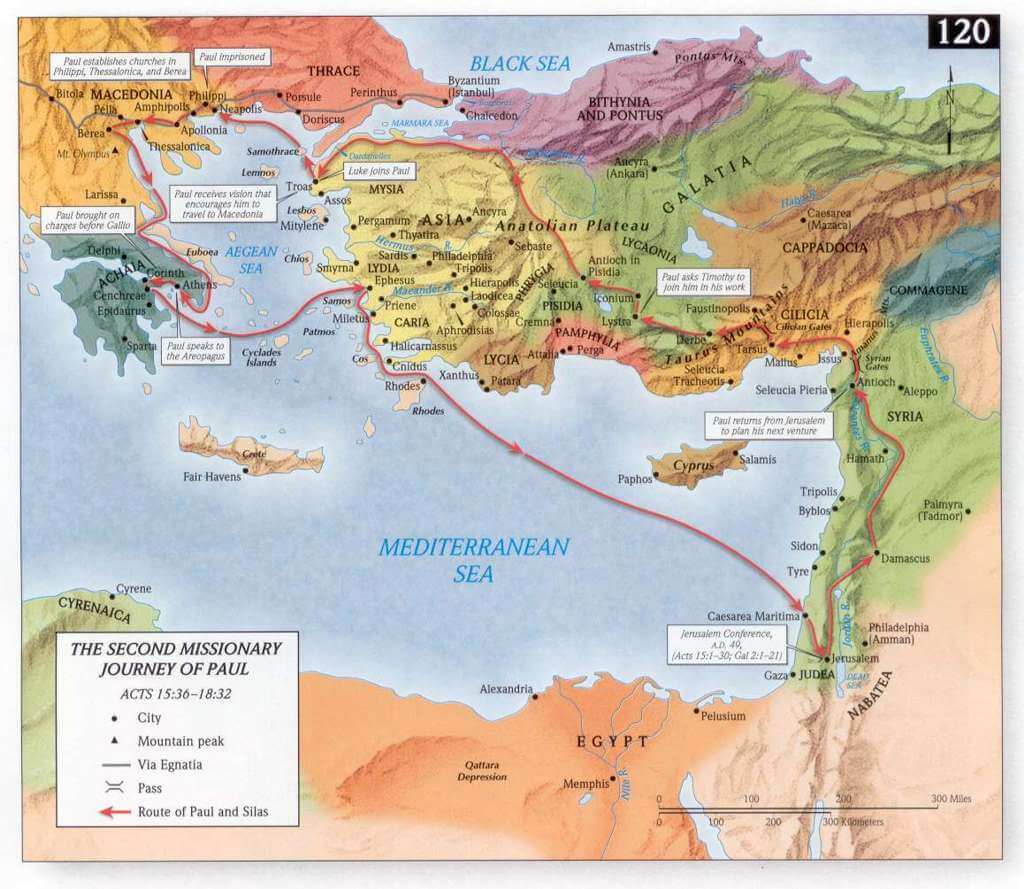
THE THREE MISSIONARY JOURNEYS OF PAUL
- 47-48 AD - Paul's 1st Missionary Journey (Acts 13:4) Click for map
- 49-51 AD - Paul's 2nd Missionary Journey synopsis (Acts 15:35) Click for map
- 52-56 AD - Paul's 3rd Missionary Journey (Acts 18:23-21:17) Click for map
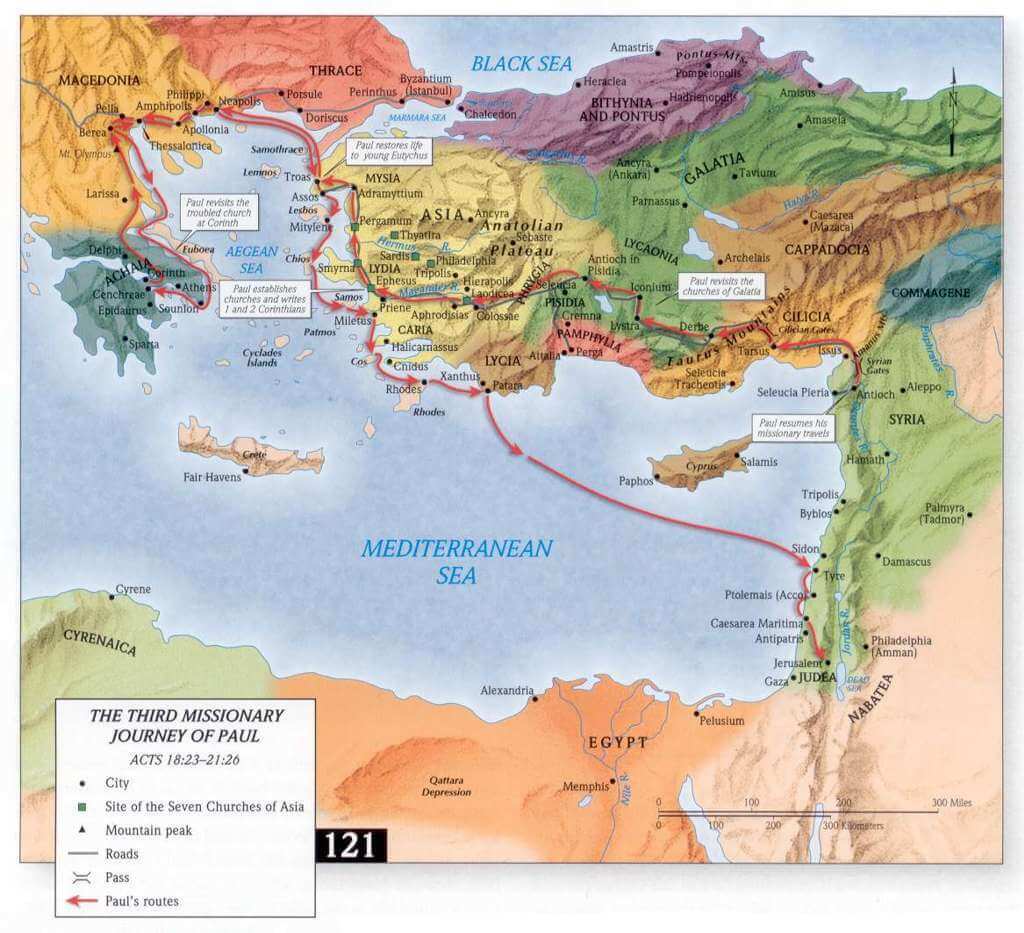
PAUL'S INTERACTIONS WITH EPHESUS - THERE ARE 3 AND ONE "ABORTED" ATTEMPT
- 49-51 AD Acts 16:6-10 - Having been forbidden by the Holy Spirit to speak the Word in Asia (Where Ephesus was located)
- 49-52 AD Acts 18:18-21 - First visit to Ephesus - Reasoned in synagogue - Asked him to stay - Did not (Lord's will)
- 52-56 AD Acts 19 How Long? Acts 19:10 compare Acts 20:31
- 58 AD Acts 20:17-31 Meets with Ephesian elders
- 61 AD Paul's first imprisonment in Rome - House arrest - Acts 28:16 - wrote Ephesians
- 90 AD The Revelation written Rev 2:1-7
It follows that this is a relatively young church.
Had Paul ever been to Ephesus?
Clearly the answer is yes - Acts 19:1-7. (Paul was actually there in Acts 18:19 telling them he would return if God willed it.)
Acts 18:18-21+
18 And Paul, having remained many days longer, took leave of the brethren and put out to sea for Syria, and with him were Priscilla and Aquila. In Cenchrea he had his hair cut, for he was keeping a vow.
19 And they came to Ephesus, and he left them there. Now he himself entered the synagogue and reasoned with the Jews.
20 And when they asked him to stay for a longer time, he did not consent,
21 but taking leave of them and saying, "I will return to you again if God wills," he set sail from Ephesus.
Ephesus the capital of proconsular Asia was one of the largest cities in the Roman Empire, some estimates placing the population as high as one-half million in the latter part of the first century AD. It had a huge library, a harbor that made it an active seaport (one of 3 major cities in the Roman Empire), a huge amphitheater (capable of seating 25,000), and the temple of Artemis (Diana - see picture) which attracted visitors from all over the Roman empire (as one of the seven wonders of the world and the center of worship of the idolatrous goddess, Artemis). Apparently by the time of Paul the harbor had been rendered virtually unusable as a result of accumulation of silt from the Cayster River, increasing the importance of the Temple of Artemis that attracted pilgrims from all over the empire.

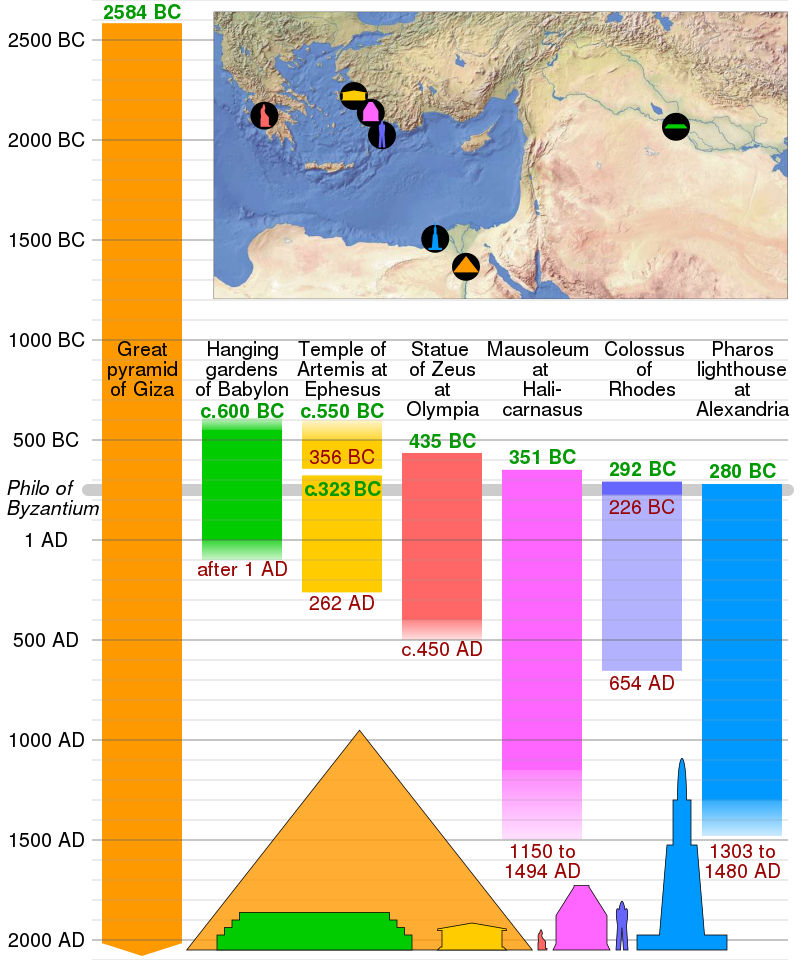
Timeline & Location of the Seven Wonders
Click to Enlarge
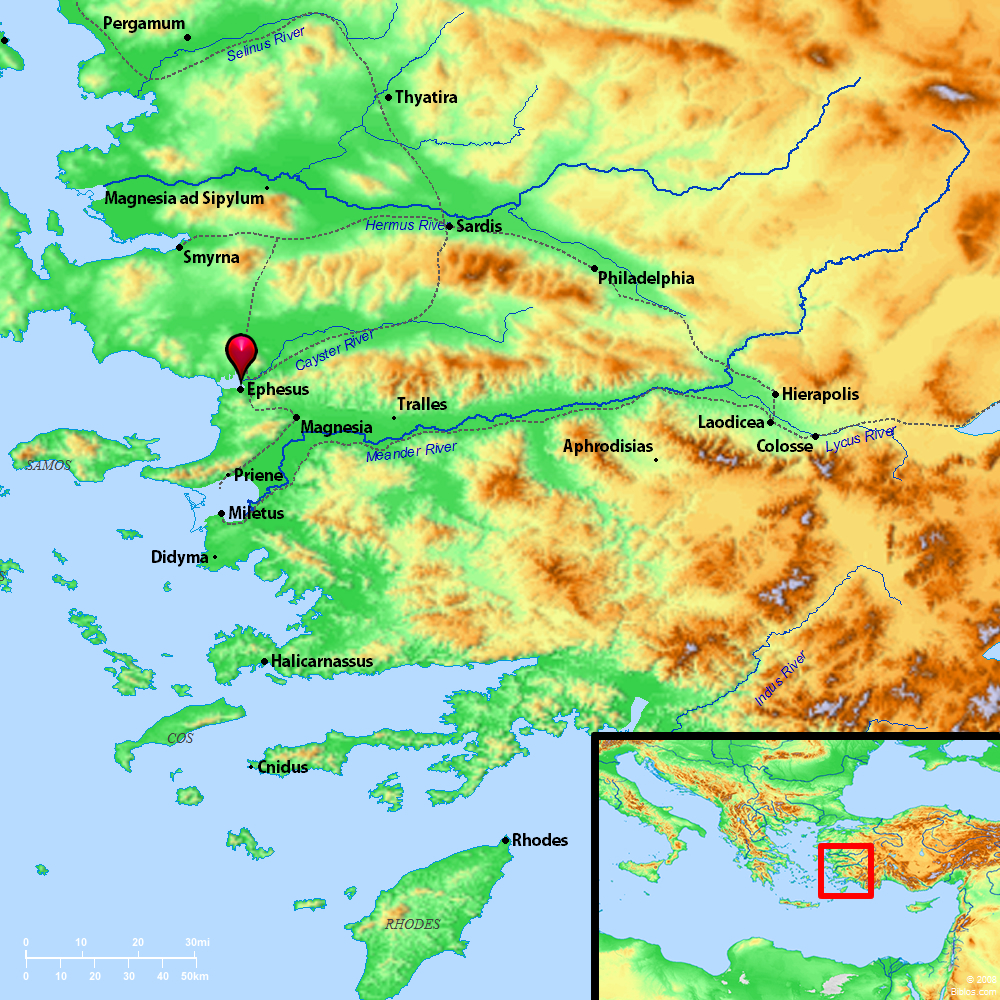
Ephesus on Cayster River in Asia Minor
Click to Enlarge
Ephesus in the Time of Paul (c. A.D. 60)
(Click to Enlarge)
Acts 19:8-10+
Acts 19:8 And he entered the synagogue (buildings other than the central Jewish temple where the Jews congregated for worship) and continued speaking out boldly (imperfect tense - emphasizes the continual nature of his proclamation without fear of rejection or hostility) for three months (one of his longest periods in any synagogue), reasoning (dialegomai {Eng = "dialogue"} always in sense of mutual discussion, speaking back and forth - i.e., Paul did not merely lecture, but again was responding to their questions and challenges = he spoke to their mind) and persuading (present tense - continually trying to convince them by arguments to believe = he spoke to their wills) them about the kingdom of God (a spiritual aspect, in believers in whom Christ is the King and a future eternal aspect - always refers to God's reign over His created and redeemed world and its believing inhabitants).
9 But when some were becoming hardened (skleruno - figuratively hardening of one's heart = stubborn, imperfect tense pictures the process of gradual hardening over 3 months. cf Hebrews 3:13, 15, 17) and disobedient (refusal to be persuaded), speaking evil of the Way before the multitude, he withdrew from them and took away the disciples, reasoning daily (cf Eph 5:16) in the school of Tyrannus (famous lecture hall normally used by secular educators - one of the ancient copies of Acts!)
10 And this took place for two years, so that all who lived in Asia heard the word of the Lord, both Jews and Greeks
Comment: Paul had disciples that he was undoubtedly sending out to teach others also - cf 2 Timothy 2:2+. Note that Paul says elsewhere as Paul addressed the Ephesian elders in Acts 20:31+ he warned "Therefore be on the alert, remembering that night and day for a period of three years I did not cease to admonish each one with tears.").
Acts 19:8-10 What was Paul's experience in Ephesus? Where was the first place he went?
Jewish synagogue (he always went to the Jew first and also to the Greeks)
For example, in Romans 1:16 Paul wrote "For I am not ashamed of the gospel, for it is the power of God for salvation to everyone who believes, to the Jew first and also to the Greek." (Romans 1:16+)
Acts 19:10 How long did he remain there? see Acts 19:10 (2 yr) compare Acts 20:31 (3yr)
3 months in the synagogue (2-3 in Ephesus) - the three-month hearing the Jews allowed Paul was one of the longest teaching opportunities he had in any synagogue.
Acts 19:8 What was he doing there?
Speaking boldly, reasoning, persuading
Boldness = fruit of Spirit filled
Acts 9:27-28, see Acts 9:17 cf Acts 4:31,13
Acts 19:8-9 NOTE THE CONTRAST WORD "BUT" - WHAT IS CONTRASTED? What is the progression?
Jews became hardened > disobedient > began to speak evil (enmity, hostility)
THOUGHT - Have you ever experienced this reaction?
How did Paul respond to the opposition?
Withdrew to school of Tyrannus
THOUGHT - How do you respond to opposition? Do you "throw in the towel"? Or move on to other territory?
Acts 19:10 How long was Paul in Ephesus?
Reasoned daily concerning the Word of the Lord.
2 years (actually 3 years from Acts 20:31+)
Ephesus was his longest stay in any of Paul's missionary journeys.
Acts 19:10 APPLICATION QUESTION - What was the effect of one man zealous for God's Word?
All in Asia heard the Word of the Lord
Both Jew and Greek (Gentile)
Acts 19:11-20 +
11 And God was performing extraordinary miracles (literally, "miracles not of the ordinary kind") by the hands of Paul,
12 so that handkerchiefs (a face-cloth used for wiping perspiration) or aprons (work aprons used in his trade of tent making) were even carried from his body (idea that healing power could be magically transmitted was prevalent in ancient world) to the sick, and the diseases left them and the evil spirits went out
Comment: miraculous confirmation of Paul's message as authentic apostolic preaching - especially in absence of a written NT by which one could assess someone's teaching.
13 But (note the strong contrast) also some of the Jewish exorcists, who went from place to place, attempted to name over those who had the evil spirits the name of the Lord Jesus, saying, "I adjure you by Jesus whom Paul preaches." (use of magical names in incantations to exorcise evil spirits was common in the ancient world)
14 And seven sons of one Sceva (Who were the seven sons of Sceva?)., a Jewish chief priest, were doing this. (Satan's counterfeit versus God truth!)
15 And the evil spirit answered and said to them, "I recognize Jesus, and I know about Paul, but who are you?"
Comment: F B Meyer wrote "When the sons of Sceva started on the demon, he turned on them, and said, “You little dwarfs, you lilliputians, who are you? I know Paul! I don’t know you, I have never heard about you before; your name has never been talked about down in Hell. No one knows you, nor about you outside of this little bit of a place called Ephesus.” Yes, and there is the question that was put to me today: “Does anyone know of me down in Hell?” Do the devils know about us? Are they scared about us? Are they frightened by us? Or do they turn upon us? When we preach on Sunday, or when we visit in the streets, or take our Sunday School Class, the devil says, “I don’t know you, you are not worth my powder and shot; you can go on doing your work. I am not going to upset Hell to stop you.”
16 And the man, in whom was the evil spirit, leaped on them and subdued all of them and overpowered them, so that they fled out of that house naked and wounded.
17 And this became known to all, both Jews and Greeks, who lived in Ephesus; and fear fell upon them all and the name (encompassing all that is true about Him) of the Lord Jesus was being magnified.
18 Many also of those who had believed kept coming, confessing and disclosing their practices. (secret magic spells, which were generally believed to be rendered useless if they were divulged)
Comment - What was the evidence that their belief in Jesus was genuine?
19 And many of those who practiced magic brought their books together and began burning them in the sight of all; and they counted up the price of them and found it fifty thousand pieces of silver.
Comment: the phrase ‘Ephesian writings’ was common in antiquity for documents containing spells and magical formulae. William Barclay adds a pithy comment that "It is all too true that too many of us hate our sins but cannot leave them. Even when we do seek to leave them there is the lingering and the backward look. There are times in life when treatment must be surgical, when only the clean and final break will suffice.”
20 So the word of the Lord was growing mightily and prevailing.
Comment - What was the word of the Lord? Gospel What do we learn about the power of the Word?
Acts 19:11-16 - What was the religious climate like in Ephesus?
v12 Demonic Activity - Healing and Evil spirits coming out of men as result of handkerchiefs touched by Paul!
v13-16 Interest in Exorcism - Jewish exorcists attempt to counterfeit these miracles failed
Widespread Practice of Magic
(Note: Had this exorcism succeeded, it would have discredited the name of Jesus Christ and the ministry of the church in Ephesus)
Comment: Gaebelein writes that…
"The use of magical names in incantations to exorcise evil spirits was common in the ancient world, and it seems to have been especially prominent at Ephesus. In addition, Jewish practitioners of magic were highly esteemed in antiquity, for they were believed to have command of particularly effective spells. The great reluctance of the Jews to pronounce the divine name was known among the ancients and often misinterpreted according to magical principles. Moreover, those connected with the Jewish priesthood would have enjoyed great prestige in magical circles since they were the most likely ones to know the true pronunciation of the Ineffable Name and therefore most able to release its power. (cf. Bruce M. Metzger, "St. Paul and the Magicians," Princeton Seminary Bulletin , 38 [1944], 27-30). Some Jewish exorcists, on coming into contact with Paul and his preaching about Jesus, attempted to make magical use of this new name they had heard." (Gaebelein, F, Editor: Expositor's Bible Commentary)
Acts 19:17 What resulted from the Seven Sons of Sceva being beaten by a demon possessed man?
Fear fell upon all = Both Jew and Greek
Name of the Lord Jesus was magnified (instead of being disgraced and used as a "lucky charm")
Acts 19:18 How were new converts responding? What's a "theological" description of their action?
Coming, Confessing, Disclosing Practices
Magic practitioners were burning their books (50K in silver = 50K day's wages for average laborer - an incredible amount in that day = indicates how many were practicing magic in Ephesus = several million dollars worth of wages in present earning power)
Repentance - manifesting the fruit of a changed mind - turning from their sins
Comment: Gaebelein writes that…
"News of what happened spread quickly throughout Ephesus. All who heard were overcome by reverential fear (phobos) and held the name of Jesus in high honor. Negatively, they learned not to misuse the name of Jesus or treat it lightly, for it is a powerful name. Positively, many Christians renounced their secret acts of magic and several magicians were converted. Openly demonstrating the change in their lives, they brought their magical scrolls together and burned them in the presence of the gathered congregation (enopion panton or "publicly") (Ed note: literally "in the eyes of all"). (Gaebelein, F, Editor: Expositor's Bible Commentary)
Acts 19:20 What were the results of these miraculous/supernatural events?
Word of the Lord grew mightily and was prevailing
SUMMARY - How would you sum up the spiritual battlefront in Ephesus? Do you see any relationship with the letter to the Ephesians?
Evil spirits on one hand
The Word of the Lord on the other ("spiritual warfare")
The satanic forces and magic practices were in a very real sense arrayed as an evil spiritual force against the Word of the Lord and yet could not overpower the truth - note the "list" of items alluding to spiritual warfare in Ephesus...
- Paul's bold preaching,
- confirming miracles,
- defeat of exorcists,
- resultant fear
- respect for the name of Jesus,
- the convert's public repudiation of magic demonstrated the transforming power of the Word of God,
Acts 19:21-20:2 + (Read and discuss at least Acts 19:21-29)
21 Now after these things were finished, Paul purposed in the spirit to go to Jerusalem after he had passed through Macedonia and Achaia, saying, "After I have been there, I must also see Rome."
22 And having sent into Macedonia two of those who ministered to him, Timothy and Erastus, he himself stayed in Asia for a while (cf First Corinthians written from Ephesus during this time period "But I shall remain in Ephesus until Pentecost for a wide door for effective service has opened to me, and there are many adversaries."1Cor 16:8-9 ).
23 And about that time there arose no small disturbance concerning the Way.
24 For a certain man named Demetrius, a silversmith, who made silver shrines of Artemis (also known as Diana, a many-breasted fertility goddess), was bringing no little business to the craftsmen;
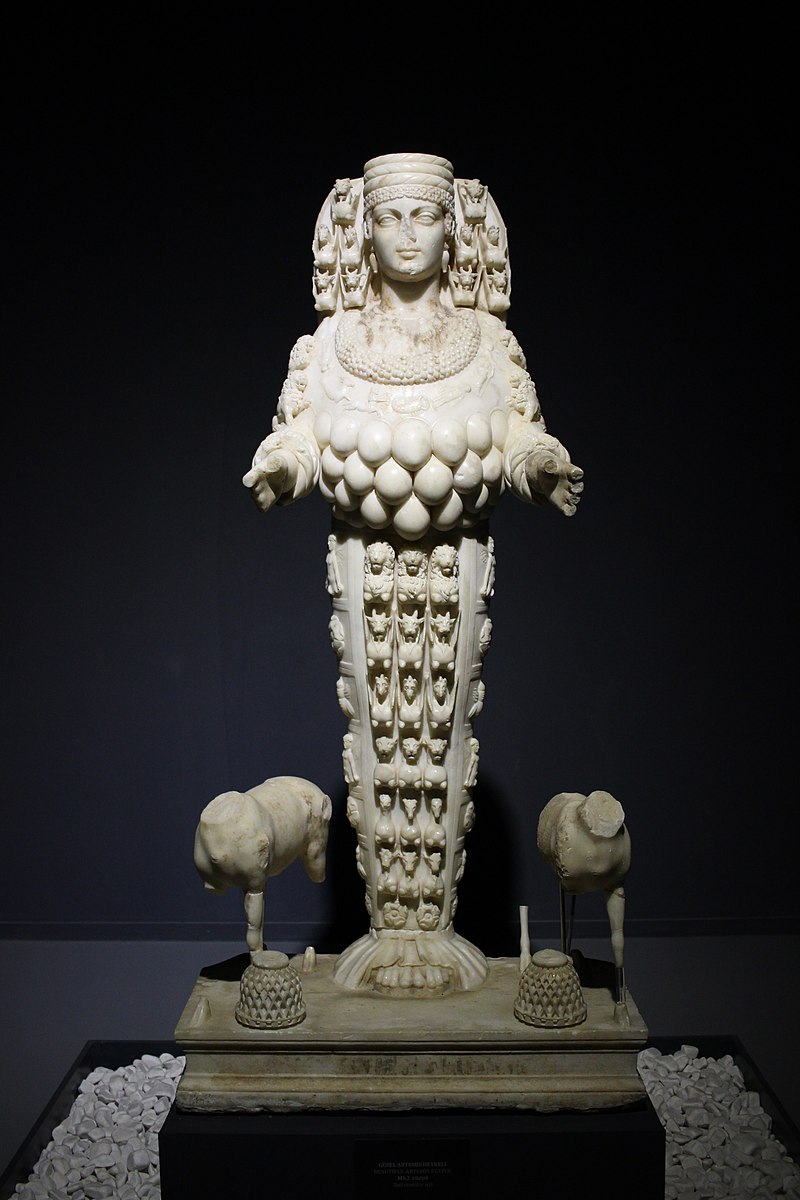
Horrid Many Breasted Statue of Artemis
25 these he gathered together with the workmen of similar trades, and said, "Men, you know that our prosperity depends upon this business.
Comment: The Temple of Artemis was one of the Seven Wonders of the Ancient World, and was a magnificent structure with 127 columns 60 feet high standing on an area 425 ft long and 220 ft wide - 1.5x size of football field - and according to some sources taking 200 years to complete. The Temple stood about a mile northeast of the city and served as in effect the "first national bank of Asia", as a place of worship and as a center for the practice of cultic immorality, being served by hundreds of the priestesses of Artemis, whose "service" was as temple prostitutes in the name of "worship"! The temple could accommodate 50,000 people and was probably the largest Greek temple ever constructed, being about 4 times the size of the famous Greek Parthenon. Pilgrims flocked to the city from all over Asia and surrounding areas, especially during the annual festival to Artemis held each spring. Clearly, the trade generated by this influx of pilgrims was essential to the viability of the economy.
26 "And you see and hear that not only in Ephesus, but in almost all of Asia, this Paul has persuaded and turned away a considerable number of people, saying that gods made with hands are no gods at all.
Comment: Paul is the example of influence one man can have on an entire city and even a whole region -- all related to his devotion to his Lord and to the Word of the Lord
27 "And not only is there danger that this trade of ours fall into disrepute (Note that this is his first and undoubtedly his main concern - lost revenue), but also that the temple of the great goddess Artemis be regarded as worthless and that she whom all of Asia and the world worship should even be dethroned from her magnificence."
Comment - One of the Seven Wonders of the Ancient World, took over 200 years to build, reputed to be the largest building in the ancient world - see model of the temple. See Who is the Artemis?)

28 And when they heard this and were filled with rage, they began crying out, saying, "Great is Artemis of the Ephesians!"
29 And the city was filled with the confusion, and they rushed with one accord into the theater, dragging along Gaius and Aristarchus, Paul's traveling companions from Macedonia.
Comment: The theater held some 25,000 and its ruins are well preserved - town meetings were usually held in the theaters)
______________________________________
30 And when Paul wanted to go into the assembly, the disciples would not let him.
31 And also some of the Asiarchs (officers elected by the cities who at their own expense furnished festivals in honor of the gods) who were friends of his sent to him and repeatedly urged him not to venture into the theater.
32 So then, some were shouting one thing and some another, for the assembly (Greek = ekklesia = called out company of people - "church" 9x in Ephesians) was in confusion, and the majority did not know for what cause they had come together.
33 And some of the crowd concluded it was Alexander, since the Jews had put him forward; and having motioned with his hand, Alexander was intending to make a defense to the assembly (ekklesia).
34 But when they recognized that he was a Jew, a single outcry arose from them all as they shouted for about two hours, "Great is Artemis of the Ephesians!"
35 And after quieting the multitude, the town clerk (equivalent of the mayor of a modern city) said, "Men of Ephesus, what man is there after all who does not know that the city of the Ephesians is guardian of the temple of the great Artemis, and of the image which fell down from heaven?
36 "Since then these are undeniable facts, you ought to keep calm and to do nothing rash.
Comment: He was wrong! The idol was vanity and no god at all. Today the great Temple of Artemis is in virtual complete ruin except for one column still standing.
37 "For you have brought these men here who are neither robbers of temples nor blasphemers of our goddess.
38 "So then, if Demetrius and the craftsmen who are with him have a complaint against any man, the courts are in session and proconsuls are available; let them bring charges against one another.
39 "But if you want anything beyond this, it shall be settled in the lawful assembly.
40 "For indeed we are in danger of being accused of a riot in connection with today's affair, since there is no real cause for it; and in this connection we shall be unable to account for this disorderly gathering."
41 And after saying this he dismissed the assembly.
20:1 And after the uproar had ceased, Paul sent for the disciples and when he had exhorted them and taken his leave of them, he departed to go to Macedonia.
2 And when he had gone through those districts and had given them much exhortation, he came to Greece.
Acts 19:23 + What is the main event Luke describes?
"No small disturbance" over “the Way”
What was the problem and ultimately who is behind it?
Goddess Artemis silver shrine sales were being threatened
Demonic forces (Eph 6:12) Evil forces stirred up human agents to oppose the Way and the Word
Why?
Paul had persuaded them and considerable numbers had turned away from idolatry
In short, lives were being transformed as the word of God was prevailing and making a real difference in the Ephesian society, but not without opposition (it never does).
THOUGHT - Have you been experiencing opposition as you seek to carry out the Lord's will in your life, your family, your job? Indeed all those who desire to live godly in Christ Jesus will be persecuted. (2Ti 3:12+)
Acts 19:26 + What were they turning away from?
"Gods made without hands" = no gods at all
Note - Verb "turned away" (methistemi) is same verb Paul uses in Col 1:13 "For He rescued us from the domain of darkness, and transferred (methistemi) us to the kingdom of His beloved Son,
Acts 19:27 + What was the Demetrius' great fear?
- Trade would be in disrepute = decreasing revenues, failed business venture
- Temple of Artemis would be regarded as worthless
- Artemis would be dethroned of her magnificence
"By the time of Paul, Ephesus' position as a center of trade was lost because the harbor became unnavigable. From that point on the worship of Artemis became the city's means of economic survival. The tourist and pilgrim trade associated with Artemis made many people in Ephesus wealthy. Silversmiths made their living selling images of this goddess and her temple. Innkeepers and restaurant owners grew rich from the large influx of worshipers who traveled great distances to see the temple of Artemis, one of the seven wonders of the world. The temple treasury even served as a bank, loaning large sums of money to many, including kings. And since Artemis was the patroness of sex, prostitutes sold their bodies without condemnation in the two-story brothel on Marble Street." (Adapted from the introductory comments to Ephesians in the International Inductive Study Bible/New American Standard Bible)
What was the reaction when Alexander (a Jew) began to speak?
Crowd lost control and shouted for 2 hours "Great is Artemis" - this event highlights the "tension" that existed in the ancient world between Jews and Greeks (Gentiles), a "tension" (enmity, hostility) that Paul deals with in believing Jews and Gentiles in the book of Ephesians (cf Eph 2:15, 16).
How was it resolved?
Mob dispersed from the theater without harming the believers when convinced by the town clerk the Jews had done nothing wrong and the city was in danger of being accused of a riot (which might threaten loss of privileges Rome accorded to the city of Ephesus).
As you study Ephesians keep this historical context in mind, specifically recalling that the original recipients of this letter were transferred from the kingdom of darkness to light and from lifeless idols to the living God. As you study Ephesians watch for Paul's exhortations and instructions to the Gentile believers that have their basis in this historical and cultural context.
EPHESUS…
Paul lived and taught the Word of the Lord in Ephesus for 2 years (actually 3 years according to Paul's statement in Acts 20:31).
All in Asia heard the Word of the Lord
|
Ephesus was a city characterized by… |
|
|
Overt demonic activity |
Overpowered |
|
Practice |
Converts transformed |
|
Major center |
The Word exposed |
|
Spiritual Dynamic: |
|
READ Ephesians 1:1
Ephesians 1:1 Who are the recipients in general terms? Where are they? (Did you see their two "addresses"?)
Saints ( hagios - set apart from the world and unto God for His use)
At Ephesus - some modern manuscripts delete this "address" which is support for this being a circular letter and might have gone to the 7 churches in Asia
Ray Stedman - The letter is commonly called "The Epistle to the Ephesians," but, as a footnote in the Revised Standard Version points out, this is not found in many of the ancient manuscripts. Most have just a blank for the address of these saints. Many scholars, therefore, feel that this is a circular letter which was written to many churches, probably those in the region of Ephesus. Some think it may have been addressed to the very churches to which Jesus had John address the letters in the book of Revelation, beginning with Ephesus and ending with Laodicea. (God at Work)
Faithful in Christ Jesus (they were saints who were truly acting saintly!)
Note: They had two "addresses" an earthly one, in Ephesus, and a heavenly one, in Christ Jesus. In Christ or In Him occurs 19x in Ephesians and 17 of those are the first 3 chapters - doctrine (our wealth).
READ Ephesians 1:13-15
Ephesians 1:13 How had the Ephesians become saints?
1) Listened to the message of truth = Gospel of salvation
2) Believed (cf Ro 10:17 "So faith comes from hearing and hearing by the word of Christ)
3) Sealed in Him (Christ) with the Holy Spirit of promise
Note: As background remember that Paul had taught in Ephesus about 3-5 years earlier (this is an approximation). The point is that the Ephesian believers were generally "young" in the faith. And yet did Paul consider this profoundly doctrinal treatise to be "too deep" for them? Who should be studying Ephesians in the modern church?)
As as aside Dr John MacArthur credits the book of Ephesians which he preached at the beginning of his ministry as the pivotal teaching God used to grow the saints into a Biblically sound church. He writes "Those months that we spent studying Ephesians eight years ago – seven or eight years ago – were the months that formed the character of Grace Church in terms of its present dimensions of ministry." (Introduction to Ephesians)
Pastor Ray Stedman - I hope that, as we begin this doctrinal portion of Ephesians, your heart will be anticipating tremendous truth. I would like to urge you to read this letter through once a week during the time that we are engaged in studying these first three chapters. Read it through in various versions, and in different ways. Read it through at one sitting the first week, and then the next week take a chapter a day. Other weeks read it in some of the paraphrases. Let this truth come to you afresh in new and different language. I can guarantee that if you will do this faithfully until we finish our study you will never be the same person again. This truth has the power to change you, and it will! I think that, of all Paul's letters, the letter to the Romans and this one to Ephesians have affected me most profoundly. Both are attempts at a systematic and rather exhaustive setting forth of the whole Christian view of life and of the world.
Remember what we learned in ACTS 19 - How did they demonstrate the reality of their conversion? burned magic books (ceased practicing magic = their works demonstrated the faith was genuine. Faith alone saves, but the faith that truly saves is never alone.
Ephesians 1:15 What do we learn about the saints in Ephesus?
Paul "having heard" - Where is Paul (we'll discuss later - he is in Rome, in prison) -
- Paul implies others had told him -
- This indicates they were "living epistles" - their transformed lives were evident to others.
(But how could Paul have known since he was in prison? Acts 28:30 says Paul was "welcoming all who came to him" so undoubtedly he had heard good reports.)
What had Paul heard about the saints at Ephesus?
1) Their faith in the Lord Jesus
2) Their love for all the saints
It is interesting that some 30-35 years later John wrote Jesus' scathing rebuke directed at the church at Ephesus "I have this against you, that you have left your first love"! Rev 2:4+
SUMMARIZE WHAT LEARNED SO FAR ABOUT THE RECIPIENTS:
- Where - at Ephesus (physical address); in Christ Jesus (spiritual address)
- Who - saints
- What - faithful (Why?) IN Christ Jesus
READ Ephesians 2:1-3
Ephesians 2:1-2 What does Paul remind the readers they were prior to listening to and believing the Gospel?
Dead in trespasses and sins ("were dead" = past tense)
How did they walk ( walk = live, conduct themselves in everyday life)?
Formerly walked according to…
- World - course of this world (the way the lost world thinks and does things)
- Devil - according to the prince of the power of the air
- Flesh - Eph 2:3 ("we") lusts of the flesh
Note these are every believers 3 inveterate mortal enemies - the world, the flesh and the devil
Read Ephesians 2:4-8
Ephesians 2:4-5, 8 What occurred in the lives of these spiritually dead men and women that resulted in them becoming saints who were faithful?
- God's rich mercy, great love and amazing grace -- by grace (twice for emphasis) you have been saved
- Through faith
- Not of works
READ Ephesians 2:11-18
Ephesians 2:11-12 How does Paul specifically identify his readers? What was their spiritual status when they were dead in their trespasses and sins?
They were Gentiles ~ "uncircumcision" ("Therefore remember that formerly you, the Gentiles in the flesh, who are called “Uncircumcision”")
Formerly…(note this is a great place to practice marking a list on your observation worksheet)
- GENTILES
- "UNCIRCUMCISION"
- Separate from Christ
- Excluded from the commonwealth (CITIZENSHIP) of Israel
- Strangers to the covenants of promise
- Having no hope (OUR HOPE = HOPE SURE, NOT HOPE SO -- THEY HAD NO HOPE SURE!)
- Without God in the world
Ephesians 2:13 What kind of wording is "but now?" Contrast - so what is Paul contrasting.
- Formerly far off <BUT NOW> brought near
- HOW? Brought near by the blood of Christ (the Cross)
Ephesians 2:14-16 What is the key phrase? Clue what does Paul state 3 times about Gentile and Jewish believers?
- In each verse he mentions ONE: Spiritual Math - 1 + 1 = 1
- Eph 2:14 Who made both groups into ONE WHAT WAS THE RESULT? broke down the barrier of the dividing wall,
- Eph 2:15 by abolishing in His flesh the enmity, which is the Law of commandments contained in ordinances, so that in Himself He might make the two into ONE new man, thus establishing peace,
- Eph 2:16 and might reconcile them both in ONE body to God through the cross, by it having put to death the enmity.
(METAPHOR OF A BODY = CHURCH = NOT AN ORGANIZATION BUT AN ORGANISM - Eph 1:22-23)
Ephesians 2:17 What did the preaching of Christ accomplish for those "far away" (Gentiles) and those who "were near" (Jews)?
- What were they (Gentiles) "far away" from?
- Peace (with God)
- WHAT OTHER KEY WORD DO YOU SEE? - PEACE KEY WORD - 4X in vv 14-17
READ EPHESIANS 2:19-22
Ephesians 2:19-22 What do you learn about the Gentile believers?
- (ABSOLUTELY) No longer strangers and aliens
(But) (Note strong "term of contrast" and also another good place to mark a list on your Observation Worksheet).
- Fellow citizens with the saints
- Of God's household -
- Dwelling of God - Eph 2:22
READ Ephesians 4:1 and Ephesians 4:17
Ephesians 4:1,17 What is Paul's charge to the Gentiles? (Might consider first word - "therefore" - term of conclusion - based on all the great doctrine in 1-3 "therefore" Paul concludes in 4-6 describing how they should walk).
CHAPTER 4-6 PAUL EXHORTS - TELLS THEM WHAT TO DO BASED ON WHO THEY ARE IN CHAPTERS 1-3.
(No exhortations or commands in first 3 chapters).
- POSITIVE - Eph 4:1 Walk in a manner worthy of your calling (Be sure everyone understands "walk" as Paul's description of one's daily conduct).
- NEGATIVE - Eph 4:17 - Don't walk like the (unbelieving) Gentiles
READ EPHESIANS 5:1-4
Ephesians 5:1-4 How does Paul qualify or describe the walk he is calling for in the Gentiles?
- POSITIVE - Walk in love (Walk like Jesus!)
- NEGATIVE - Not in immorality, impurity, or greed
READ EPHESIANS 5:8
Ephesians 5:8 What does Paul remind them they once were by way of contrast with the phrase BUT NOW?
- Formerly darkness - Did you notice it did not say they were IN darkness but were darkness! Spiritual darkness = remind them of what they were before "dead in trespasses and sins")
- (Now) Light in the Lord
- Walk as children of light (shining forth, exposing the deeds of darkness).
Extra credit - Why do you think Paul several times in this letter reminds them of who they were in the past before they believed?
SUMMARIZE WHAT WE KNOW ABOUT THE RECIPIENTS: (IT WOULD ALSO BE FAIR TO USE WHAT WE LEARNED ABOUT THEM FROM ACTS)
Ephesians 1:1, 3:1 Who wrote this letter? How do you know?
- 1:1 Paul
- 3:1 "I, Paul" (Where is he when he writes? cf Eph 4:1, 6:20 - What can we learn about "prison-like" circumstances?
How does he describe himself?
- Apostle of Christ Jesus
- (How?) By the will of God
Who is he an apostle to (who is he sent to)?
Saints at Ephesus (to the Gentiles)
Ephesians 3:1, 4:1, 6:20 What was his current condition? Is he a prisoner of Rome? Of whom?
- Prisoner - Prisons can be great "pulpits"!
- prisoner of Christ Jesus
- the prisoner of the Lord
- I am an ambassador in chains
| COMPARISON OF PAUL'S TWO ROMAN IMPRISONMENTS |
|
| FIRST IMPRISONMENT | SECOND IMPRISONMENT |
|
~60 AD - |
~67 AD |
|
Accused by Jews of heresy and sedition |
Persecuted by Rome and arrested as criminal against the Empire |
|
60-63 AD |
64-68 AD |
|
House arrest 2 years |
Poor prison conditions - dark, cold dungeon (Maritime) |
|
Many friends visited |
Virtually solitary (Luke visited) |
|
Many opportunities for Gospel witness |
Restricted opportunities for Gospel witness |
|
Paul optimistic of release (Php 1:24-26), |
Anticipated execution (2Ti 4:6). |
Acts 28:11-31: What do we learn about Paul's status that parallels Ephesians?
He is in prison in Rome -- Acts 28:16-20
Acts 28:20 “But when the Jews objected, I was forced to appeal to Caesar, not that I had any accusation against my nation. 20 For this reason, therefore, I requested to see you and to speak with you, for I am wearing this chain for the sake of the hope of Israel.”
What does Paul say in Acts 28:20 that parallels Ephesians?
- Acts 28:20 wearing this chain for the sake of the hope of Israel.
- Eph 6:20 I am an ambassador in chains
Note: In Eph 6:20 Paul also mentions "chains" which could allude to the custom of the Romans, who according to secular writers (Josephus, Seneca, Athenaeus), would confine prisoners not only by shutting them in prison, but also by chaining their right arm to the left arm of the soldier guarding them. Can you imagine being a pagan chained for a 8 or 12 hour shift to the the apostle Paul?
How does Luke describe Paul's conditions? Acts 28:30-31
By himself with a Roman soldier (Acts 28:16) - "When we entered Rome, Paul was allowed to stay by himself, with the soldier who was guarding him."
- Free to preach the Kingdom of God - which he did to the Jews
- Stayed in his own rented quarters
- Welcomed all who would come
- Preached openly, unhindered for 2 full years
What was the result of Paul's prison "sermon series" to the Jews? What was the source of his teaching material?
Some were persuaded but others would not believe
Acts 28:23-24 When they had set a day for Paul, they came to him at his lodging in large numbers; and he was explaining to them by solemnly testifying about the kingdom of God and trying to persuade them concerning Jesus, from both the Law of Moses and from the Prophets (Old Testament), from morning until evening. 24Some were being persuaded by the things spoken, but others would not believe.
When they did not believe Paul told them the salvation would be sent to the Gentiles who would listen.
Acts 28:28 “Therefore let it be known to you that this salvation of God has been sent to the Gentiles; they will also listen.”
READ EPHESIANS 3:2-9
Ephesians 3:2 What had God given Paul?
- A stewardship of God's grace for the Gentiles
Ephesians 3:3 What did he remind them about?
- He had written before in brief - we do not know to when or exactly what he refers here.
Ephesians 3:4 What was Paul's desire for the Gentile believers?
- To understand his insight into the mystery of Christ (to understand what he understood about this truth)
Ephesians 3:6 What was the mystery he wanted them to understand?
- That the Gentile believers are fellow heirs and fellow members of the body (the church)
- Note: "Mystery" is not that which is mysterious but in the NT represents a truth previously hidden and thus not but now revealed by God
Ephesians 3:8 How does Paul describe himself?
- The very least of all the saints (Remember Paul had seen the glorified Christ and was never the same!)
Ephesians 3:8-9 What was Paul given the privilege to preach to the Gentiles?
- The unfathomable riches of Christ
- To bring to light the administration of the mystery
I read in a commentary that we don't see any of the personal concern by Paul in this letter -- is that true? What do you observe in Eph 3:13, 6:21-22?
- Ephesians 3:13 Did not want them to lose heart at his tribulations - it was for them and their glory
- Ephesians 6:21-22 Sent Tychicus to let them know of his circumstances so their heart would be comforted
What else do we see Paul doing in this letter that reflects his concern for the Gentile believers? P-R-A-Y-I-N-G!
- He does not cease to pray for them in Eph 1:16-18 and Eph 3:14-21
- Would it encourage you to know the apostle Paul was praying for you?
- Do you let others know you are praying for them?
Ephesians 6:19 What do we learn about Paul from this verse?
He asked for prayer to be able to proclaim the mystery of the gospel with boldness (even in prison -- does this make you think of his exhortation in Ephesians 5:16?) He was aware of his own weakness and inability, knowing that he stood in need of divine enablement at all times.
- Do you ask others to pray for you without hesitation?
- Or does pride and a sense of self-sufficiency keep you from asking others for prayer?
- What would you have ask the saints in Ephesus to pray for? … for release from prison? … or for release of the gospel message?
Why did Paul write this letter to the Gentile believers (purpose of the letter)? What truth did he want them to understand?
He wanted them to understand the mystery that had been revealed that believing Jews and Gentiles are both part of one body, the church, in a real sense now representing Christ's spiritual, earthly body and to walk accordingly in unity, love and power to the praise of the glory of His grace!
Ephesians 1:1-2 Introduction of Author and Recipients
Ephesians 1:3-14 Every Spiritual Blessing in Christ
Ephesians 1:15-23 Prayer for Enlightenment and Power
Chapter 1 Theme: Spiritual Blessings in Christ
Ephesians 2: Were Dead in Sin, Now Alive and in One Body in Christ
Chapter 2 Theme: Gentiles and Jews One in Christ
Ephesians 3:1-13: Mystery of the Church Made Known
Ephesians 3:14-21: Paul's Prayer for Inner Power and Love
Chapter 3 Theme: Mystery of Gentiles as Fellow Members of the Church
Ephesians 4:1-6: Walk in Unity of the Body
Ephesians 4:7-16: Gifts for Equipping of the Body
Ephesians 4:17-24: Don't Walk Like the Gentiles (Like you used to walk)
Ephesians 4:25-32 How to Not Walk Like Gentiles
Chapter 4 Theme: Walk Worthy of Your Calling Not Like the Gentiles
Ephesians 5:1-21: Walk in Love, Light, Wisdom and the Spirit
Ephesians 5:22-33: Walk as Submitting Wives and Loving Husbands
Chapter 5 Theme: Walk in Love and the Spirit
Ephesians 6:1-9: Walk Worthy in the Family and at Work
Ephesians 6:10-17: Be Strong in the Lord and Stand Firm in His Truth
Ephesians 6:18-20: All Prayer at All Times for All the Saints
Ephesians 6:21-24: Comforting News and God's Grace to Make It
Chapter 6 Theme: Stand in the Lord's Strength and Pray in the Spirit
EPHESIANS
Segment Divisions
| EPHESIANS 1-3 | EPHESIANS 4-6 |
| SPIRITUAL WEALTH | SPIRITUAL WALK |
| PRIVILEGE | PRACTICE |
| BELIEF | BEHAVIOR |
| DOCTRINE | DUTY |
| DOCTRINAL | PRACTICAL |
| CHRISTIAN BLESSINGS | CHRISTIAN BEHAVIOR |
| OUR POSITION IN CHRIST | CHRIST'S PERSON LIVING IN US |
| OUR HERITAGE IN CHRIST | OUR LIFE IN CHRIST |
| WORK OF CHRIST | WALK OF THE CHRISTIAN |
| HEAVENLY STANDING | EARTHLY WALK |
| PRIVILEGES OF THE SAINT | RESPONSIBILITIES OF THE SAINT |
| POSITION OF THE CHRISTIAN | PRACTICE OF THE CHRISTIAN |
| THEOLOGICAL | PRACTICAL |
|
Other possible segment divisions:
|
|
|
From your overview of Ephesians, |
|