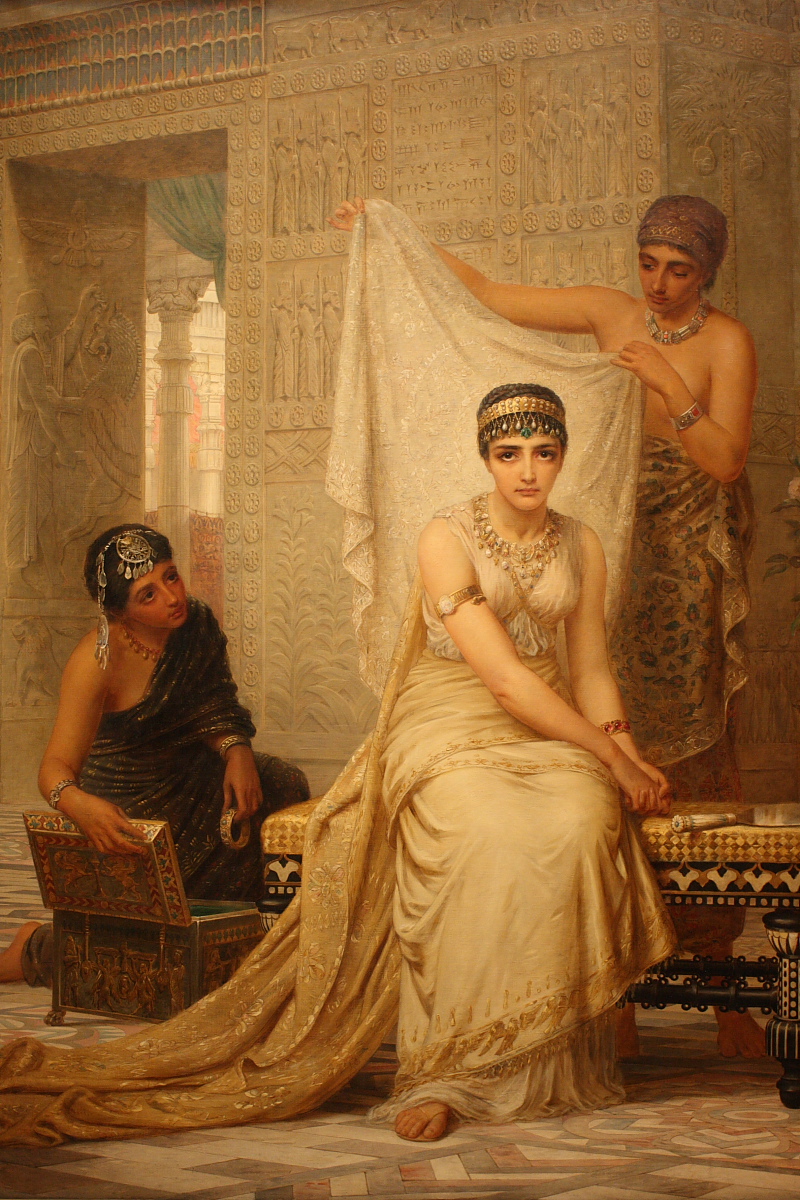
Queen Esther (1879) by Edwin Long
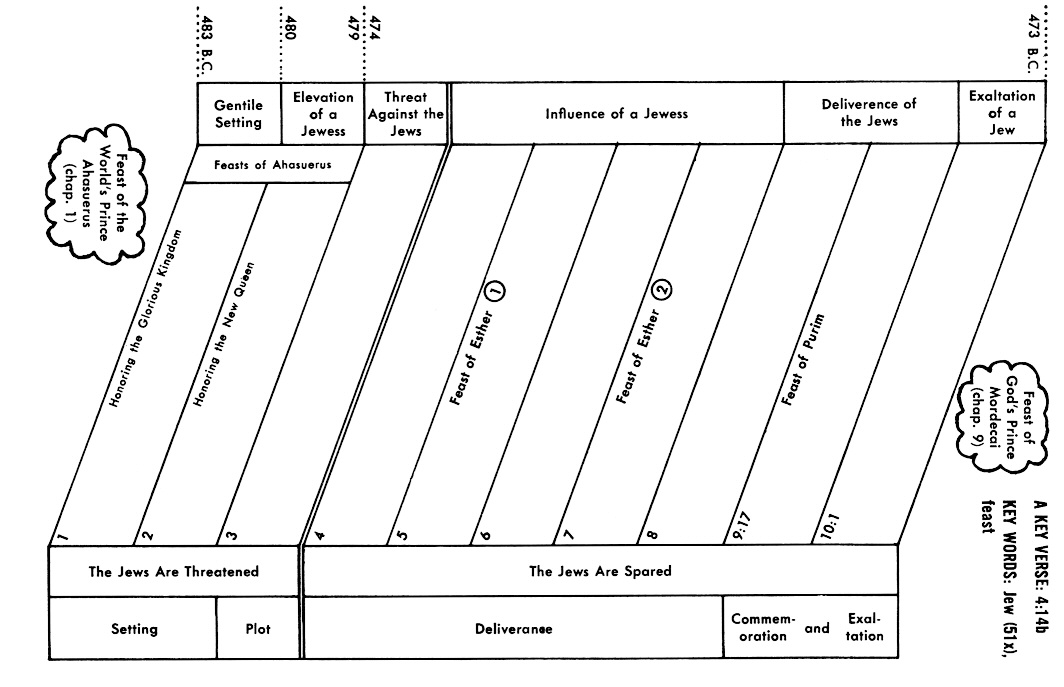

Click to Enlarge Timeline
Jensen's Survey of the OT - used by permission
Swindoll's Intro and Overview Chart
Van Dine's Analysis of Esther
MacArthur's Intro to Esther
| CHRONOLOGICAL RELATIONSHIP OF EZRA-NEHEMIAH-ESTHER |
||||
| 538-515 BC | 483-473 BC | 457 BC |
13 Year Gap |
444-425 BC |
| Ezra 1-6 | Book of Esther | Ezra 7-10 | Book of Nehemiah | |
| First Return of Jews from Babylonian Exile |
58 Year Gap |
Second Return of Jews from Babylonian Exile |
Third Return of Jews from Babylonian Exile |
|
| ESTHER: THE PROVIDENCE OF GOD |
|||||||||
| Esther 1 Es 1:1-22 |
Esther 2 Es 2:1-23 |
Esther 3 Es 3:1-15 |
Esther 4 Es 4:1-17 |
Esther 5 Es 5:1-14 |
Esther 6 Es 6:1-14 |
Esther 7 Es 7:1-10 |
Esther 8 Es 8:1-17 |
Esther 9 Es 9:1-32 |
Esther 10 Es 10:1-3 |
| Esther's Exaltation |
Haman's Cunning Plot |
Haman's Humiliation |
Mordecai's Exaltation |
||||||
| Feast of Ashasuerus |
Fast of Mordecai |
Feast of Esther |
Feast of Purim |
||||||
| Exaltation | Persecution | Preservations | Commenoration | ||||||
| Jewish Existence Threatened |
Jews Spared |
||||||||
| Gentile Setting | Jewess Elevated | Threat to Jews | Influence of a Jewess |
Deliverance of Jews |
A Jew Exalted | ||||
| Feast of Ahasuerus |
Feast of Esther and Purim |
||||||||
| Location of Events: Persian |
|||||||||
| 10 Years (483-473BC) Timeline of Ezra-Nehemiah-Esther-See page 38 Timeline of Esther related to Ezra & Nehemiah - Parallel lines for Medo-Persian Kings & Daniel, Zechariah, Haggai and Malachi - see page 15 Here is a very nice timeline of Esther (see also) |
|||||||||
| Modified from Jensen's excellent work "Jensen's Survey of the Old Testament" | |||||||||
|
Key Passages: Esther 4:14, 16, Esther 8:17, Esther 9:26, 31 Key Words: See list under "Precept Ministries Inductive Study on Esther" The Book of Esther is unusual - God's Name is not mentioned once, yet God's "Hand" is clearly present and active throughout the book, to the extent that many see the book of Esther as a veritable "treatise" on the doctrine of Divine Providence (see separate study) |
|||||||||
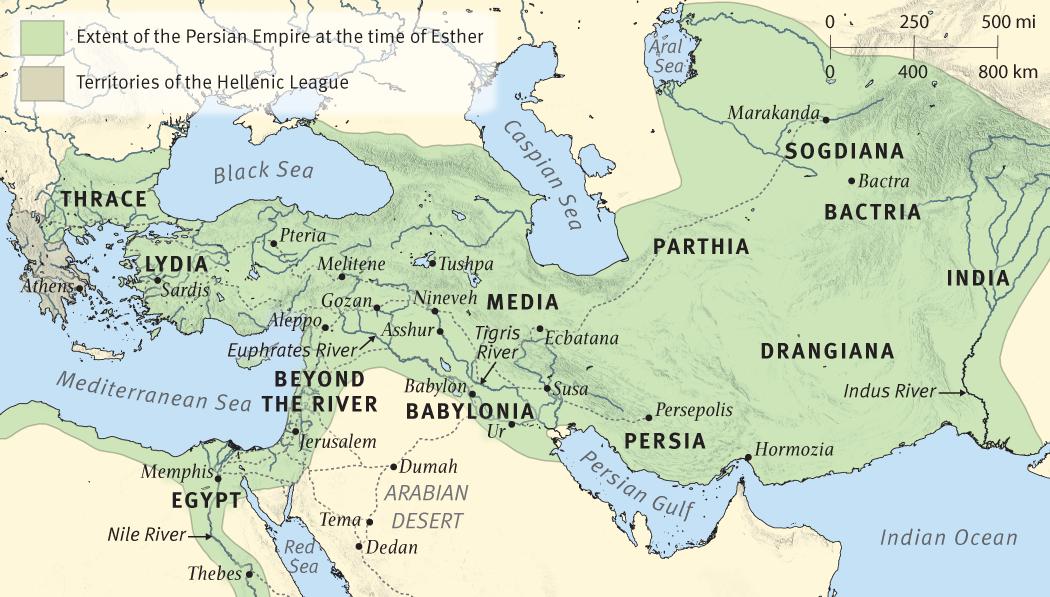
The Persian Empire at the Time of Esther c. 479 B.C.
ESV Global Study Bible
Long before Esther’s time, the people of Israel and Judah (later called Jews) had been dispersed throughout the Near East by the Assyrians and the Babylonians. Eventually the Persians absorbed nearly all of these lands into their empire, which reached its greatest extent during the time of Esther. Thus Haman’s plot to exterminate all Jews throughout the Persian Empire would have annihilated virtually all of the Jewish people, and Esther’s daring actions saved the whole nation from complete destruction. (ESV.org)
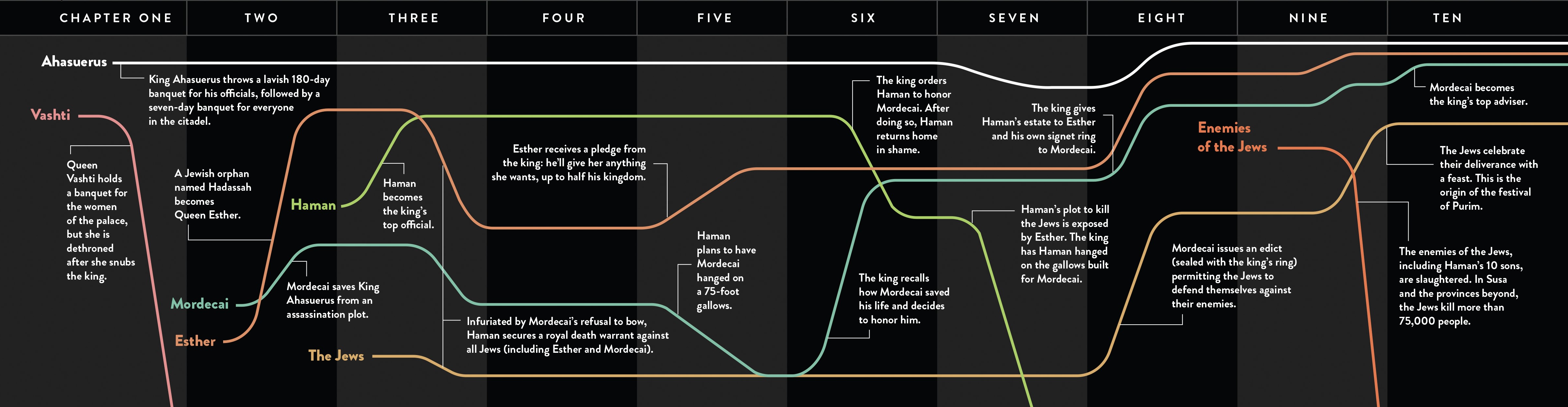
"UPS AND DOWNS OF ESTHER'S MAJOR CHARACTERS"
Source: Bible Study Magazine - Volume 11, Issue 2, Jan/Feb, 2019
CLICK TO ENLARGE
|
PARTIES IN ESTHER |
|
| Esther 1:3 Esther 1:5 |
Two Parties -Host- Ahasuerus, first for official, |
| Esther 1:9 | Host-Queen Vashti for palace women |
| Esther 2:18 | Honor of Esther as new queen |
| Esther 3:15 | After Haman receives permission to destroy Jews |
| Esther 5:4-8 Esther 7:2-6 |
Host-Esther For Ahasuerus and Haman |
| Esther 8:17 | Celebration of Second Edict allowing Jews to fight |
| Esther 9:17 Esther 9:18-19 |
Two parties - Celebration of Jewish Deliverance |
| CHRONOLOGY OF ESTHER Events occur over 10 year period |
|||||
|
Ref |
Event |
Month |
Day |
Year of Reign |
Year |
|
Est 1:3 |
Ahasuerus holds his banquets |
|
|
3 |
483 |
|
Est 2:16 |
Esther goes to Ahasuerus |
10 |
|
7 |
479 |
|
Est 3:7 |
Haman casts his lots |
1 |
|
12 |
474 |
|
Est 3:12 |
Haman issues his decree |
1 |
13 |
13 |
474 |
|
Est 3:13 |
Date planned for annihilation of the Jews |
12 |
13 |
13 |
473 |
|
Est 8:9 |
Mordecai issues his decree |
3 |
23 |
13 |
473 |
|
Est 8:12, 9:1 |
Day upon which Jews could defend themselves from attack |
12 |
13 |
13 |
473 |
|
Est 9:6-10, 20-22 |
Ten sons of Haman executed; Feast of Purim celebrated |
12 |
14, 15 |
13 |
473 |
|
Source: ESV.org |
|||||
Christ in the Historical Books - Esther --
The Book of Esther is designed to show God's providential care of His people. Though the name of God is not mentioned, the hand of God, ruling and over-ruling the events for the preservation of His people, can be seen throughout.
[Footnote: Dr. Bullinger points out that some Hebrew scholars have found the name ''Jehovah'' four times repeated in acrostic form in the Book of Esther.]
In the Talmud, the question is asked: ''Where do we get Esther from the Law?'' The answer is Deuteronomy 31:18, ''And I will surely hide My face, or presence.'' God was hiding His face from His people on account of their sins; they had deliberately chosen to continue in the land of their captivity among the heathen, instead of availing themselves of the opportunity of returning to Jerusalem with Zerubbabel. The events in this book occur during the sixty years between the return of that first remnant and of the second under Ezra.
Prayer.
Though there is also no actual mention of prayer to God, it is distinctly implied in the mourning and fasting among the Jews when they heard the royal decree for their destruction (4:1-3); and again, when Esther ordered a three days' fast among her people before she ventured to go before the king (4:16). The Feast of Purim, instituted by Esther and Mordecai, witnesses still, not only to the truth of the narrative, but to a nation's gratitude and a memorial throughout all generations of their deliverance. ''Their fastings and their cry'' are also mentioned, and to whom could they cry but unto God? (9:17-32).
The Golden Sceptre. [Esther 4:11; 5:1-3]
The king holding out the golden sceptre has been an encouragement to many a saint of God in bringing their petitions to the King of kings. (Play song Matt Foreman)
Thou art coming to a King;
Large petitions with thee bring;
For His grace and power are such,
None can ever ask too much.
We need never fear that our King will refuse us an audience, or that we shall incur His anger by drawing nigh; but there are seasons when He seems in a special manner to hold out the golden sceptre, and to give us more abundant access to Him in prayer.
Satan.
Behind the personal enmity of Haman [ch. 3] was the deeper malignity of Satan, seeking to make void the promises of God through the destruction of the whole Jewish race; for Xerxes was king over all the Jews in Palestine as well as over those in Persia and Babylon. Satan knew that the great Deliverer who was to arise of the House of David was to destroy his power, and we may trace his hand behind such events of history as Saul throwing his javelin at the youthful David [1Sam 18:9-11; 19:9,10], and Queen Athaliah's attempt to destroy all the seed royal [2Kin 11:1-3]. But God turned aside the blow in the one case, and nourished the infant Joash in the Temple courts in the other. The same enmity of the devil prompted Herod to slay the babes of Bethlehem, but God delivered His Son by sending Him into Egypt [Mat 2]. The great enemy succeeded in bruising His heel when he gathered together Herod and Pontius Pilate, with the Gentiles and the people of Israel, against the Holy Child Jesus; but God raised Him from the dead.
Historic Accuracy.
There is hardly a book in the Bible, upon the trustworthiness of which there has been made so determined an attack, as the Book of Esther. [ie., The trustworthiness of the Book of Esther has been attacked by determined critics.] But the writings of Herodotus and the discoveries at Xerxe's palace of Shushan by the Frenchman Dieulafoy, together bring out the truthfulness of every detail of the story.
[Footnote: ''M. Dieulafoy has set up the bithan (apadana, the great banqueting-hall or throne-room) in the museum of the Louvre, where one can now see the remains of the marble pavement, of the hall of the feast.'' (New Biblical Guide, vol 7, p. 359, Rev. John Urquhart) ]
The relative position of the different parts of the palace and gardens fit in exactly with the account in this book. The vain and capricious character of Ahasuerus-- the Xerxes of history-- his extravagant feast, the Persian names of the courtiers, the golden couches, the sceptre, the seal, the scribes, the posts, are all matters of history, if space permitted to examine them in detail. In the account of the king's feast (ch. 1:6), the hangings of the court are described as ''white, green, and blue.'' The word translated ''green'' is really an old Persian word meaning ''fine cotton.'' So it should read ''hangings of fine purple and white cotton.'' These, Xenophon tells us, were the royal colors of Persia. The pillars of marble have been found in the court of the garden, and it is clear that the pavement was a mosaic, as described in v.6.
Salvation.
There have been various attempts to trace elaborate types in the Book of Esther, but the simple fact stands out that here was one who was willing to lay down her life for her people. It is here that we find Christ in the Book of Esther. A picture of Him who was not only willing, but who actually did lay down His life for us, and through whose intercession salvation is assured to us.
Opportunity.
But the great practical lesson for us, in this book, is the all-importance of using God-given opportunities. The power of life and death lies in these opportunities both to ourselves and to others. Mordecai was so sure of God's working that he sent Esther this message: ''If thou altogether holdest thy peace at this time, then shall there enlargement and deliverance arise to the Jews from another place; but thou and thy father's house shall be destroyed: and who knoweth whether thou are come to the kingdom for such a time as this?'' (4:14). We may be tempted to think that our opportunities are so insignificant, our circle of influence so small, that they are of little importance; if we were a great queen, like Esther, it would be a different matter. But ''who knoweth whether thou art come to the kingdom for such a time as this?'' Thou, whoever thou art, and whatever thy circumstances, thou art called to ''reign in life by One, Jesus Christ'' [Rom 5:17]. See to it that thou dost not miss thy opportunity. God has a purpose for each one of our lives. He has placed us where He can best use us for His glory. If we fail just there, it may be that He will work out His purpose in some other way; but we shall suffer untold loss. Like Esther, we must be ready to take our life in our hand and risk everything in His service.
OT Reflections of Christ - Contents
ESTHER
The book of Esther is one of the most beautiful stories in all literature. Even though the name of God is not mentioned in it, no book of the Bible teaches His providence more forcefully. The book covers a period of about 12 years, falling somewhere between the events recorded in the sixth and seventh chapters of Ezra. The setting is the court of Xerxes, the king of Persia. The Bible refers to him as Ahasuerus. [The name Ahasuerus is also applied to an earlier king in Ezra 4:6.] At this period in history, a great number of Jews were still living in Persia.
OUTLINE OF THE BOOK--
Haman's Ascendancy (Esther 1-5)
Haman was the enemy of the Jews and sought their extinction.
Mordecai's Ascendancy (6-10)
Mordecai was concerned for the welfare of his people, the Jews.
The record of Luke 24, particularly the journey of the risen Christ with the two disciples to Emmaus, states that ''beginning at Moses and all the prophets, He expounded unto them, in all the scriptures, the things concerning Himself'' (Luke 24:27). Where in the book of Esther, this book without the mention of God's name, do we find teachings about Christ?
I recommend that you read again the entire book to refresh your mind about the historical account. Before we consider where Christ is found in the book of Esther, we will consider some practical matters.
THE PROVIDENCE OF GOD--
An unseen hand is at work behind all human affairs. Who shapes the destinies of nations-- politicians? Never! As a lad, I was fascinated by the operation of a certain machine in the Union Station in Pittsburgh. As we waited for an arriving train, we would stand at the desk in the ticket office and watch a machine with an electric pen attached. A roll of paper was located beneath that pen, and periodically it would begin to write. Some miles distant, somewhere up the line of the Pennsylvania Railroad, a station- master or yard-master would be writing down the position of trains and their time of arrival on a similar scroll. The corresponding electric pen in the station would move in the exact handwriting of the originator. I was always amazed at that apparatus.
Similarly, the providential hand of an Almighty God is behind the destiny of nations. James Russell Lowell wrote,
''Truth forever on the scaffold,
Wrong forever on the throne;
But that scaffold sways the future,
And behind the dim unknown
Standeth God amid the shadows,
Keeping watch upon His own.''
All things move by the knowledge of Almighty God, and according to His ordained plan and purpose. The book of Esther is a confirmation of Psalm 11:4, ''The Lord is in His holy temple, the Lord's throne is in heaven; His eyes behold, His eyelids test the children of men.'' Woven into God's plans are the most minute details of human history. This is illustrated in the turn of events of the story of Esther. The rejection of a Gentile queen, the choice of Esther, and the finding of the records led finally to the exaltation of Mordecai and the sparing of the Jewish race.
Providence is not blind fate. The word ''providence'' means, ''foresight coupled with activity.'' God alone is able to act on the basis of foreknowledge. The book of Esther sets forth two great doctrines: man's free will, and God's absolute sovereignty. Both are at work here. Haman made his plans and Mordecai was busy with his political maneuvering, yet all was done within the boundaries of God's direction.
THE FATE OF THE WICKED--
Another very practical lesson to be gained from the book of Esther is that the prosperity of the wicked is unsafe and unsatisfying, and that it ends in adversity. The experience of the psalmist is recorded as follows: ''For I was envious of the foolish, when I saw the prosperity of the wicked'' (Psalm 73:3). But then he continued in verses 16 and 17, ''When I thought to know this, it was too painful for me, until I went into the sanctuary of God; then I understood their end.''
We often see the adversity of the good alongside the prosperity of the wicked. We would tend to ask why, but the book of Esther shows us clearly that the trial of faith results in final victory for the righteous.
The book of Esther presents us with a picture of God's current relationship with the Jews. The Jewish people, as a whole, have been out of their land for 1900 years. During this time, they have been under many Gentile rulers. Satan repeatedly has had a ''Haman'' planning their destruction. But all along, God has been in the shadows watching over His covenant people Israel. Even though, in their present unbelief, they may refuse to recognize His hand, He continues His watchful care over His ancient people.
THE MESSIANIC PLAN--
Haman, the Jew-hater from the cursed seed of Amalek [cp. Esther 3:1; 1Sam 15:2,3,7,8], is a picture of the wicked one who will arise in the end-time of this age and seek the extermination of Israel. The ''man of sin [will] be revealed, the son of perdition, who opposeth and exalteth himself above all that is called God, or that is worshiped, so that he, as God, sitteth in the temple of God, showing himself that he is God'' (2Thessalonians 2:3,4). Just as Haman's end came by decree of the king, so Antichrist, the man of sin, will be destroyed by God's King, the Lord Jesus Christ. Haman was hanged on the gallows; the man of sin will be cast into the lake of fire. [2The 2:8; Rev 19:11-20]
It appears to me that Esther foreshadows that faithful Jewish remnant in the days of the tribulation. Notice an expression that appears in chapter 5, verse 1, ''Now it came to pass on the third day...'' How beautifully this ties in with the prophecy of Hosea, ''After two days will He revive us; in the third day He will raise us up, and we shall live in His sight'' (Hos 6:2). This speaks of the national resurrection of the remnant of Israel in the last days. Esther's Jewish name was Hadassah, meaning ''myrtle.'' Afterward, it was changed to Esther, meaning ''a star.'' This signifies what will happen to that nation in the future. God will take the remnant of believing Israel out of great suffering and trial and bring the nation to the place of exaltation.
Mordecai stands out as a figure of the Lord Jesus.
He was a despised Jew for whom the scaffold was built. The same scaffold proved to be the undoing of his enemy, and Mordecai was exalted to the throne. How forcefully this speaks of Him who is greater than Mordecai, and who will bring peace to His earthly people and the nations of the world.
Mordecai was the revealer of secrets. In Christ are hidden all the secrets of wisdom and knowledge, and He ''of God is made unto us wisdom, and righteousness, and sanctification, and redemption'' (1Cor 1:30).
Mordecai was elevated to the throne. He delivered Israel and was next in authority to the king. By the wonder-working providence and grace of Jehovah, salvation was interposed on behalf of the nation and the world.
Yes, the story of Christ is foreshadowed once again in the Old Testament in the account of Esther.
- Author- Bruce Hurt
- Completed July, 2012
- See Commentary on Esther 4:14)
ESTHER 1
Esther 1:2 Commentary
Esther 1:3 Commentary
Esther 1:4 Commentary
Esther 1:5 Commentary
Esther 1:6 Commentary
Esther 1:7 Commentary
Esther 1:8 Commentary
Esther 1:9 Commentary
Esther 1:10 Commentary
Esther 1:11 Commentary
Esther 1:12 Commentary
Esther 1:13 Commentary
Esther 1:14 Commentary
Esther 1:15 Commentary
Esther 1:16 Commentary
Esther 1:17 Commentary
Esther 1:18 Commentary
Esther 1:19 Commentary
Esther 1:20 Commentary
Esther 1:21 Commentary
Esther 1:22 Commentary
ESTHER 2
Esther 2:2 Commentary
Esther 2:3 Commentary
Esther 2:4 Commentary
Esther 2:5 Commentary
Esther 2:6 Commentary
Esther 2:7 Commentary
Esther 2:8 Commentary
Esther 2:9 Commentary
Esther 2:10 Commentary
Esther 2:11 Commentary
Esther 2:12 Commentary
Esther 2:13 Commentary
Esther 2:14 Commentary
Esther 2:15 Commentary
Esther 2:16 Commentary
Esther 2:17 Commentary
Esther 2:18 Commentary
Esther 2:19 Commentary
Esther 2:20 Commentary
Esther 2:21 Commentary
Esther 2:22 Commentary
Esther 2:22 Commentary
ESTHER 3
Esther 3:2 Commentary
Esther 3:3 Commentary
Esther 3:4 Commentary
Esther 3:5 Commentary
Esther 3:6 Commentary
Esther 3:7 Commentary
Esther 3:8 Commentary
Esther 3:9 Commentary
Esther 3:10 Commentary
Esther 3:11 Commentary
Esther 3:12 Commentary
Esther 3:13 Commentary
Esther 3:14 Commentary
Esther 3:15 Commentary
ESTHER 4
Esther 4:2 Commentary
Esther 4:3 Commentary
Esther 4:4 Commentary
Esther 4:5 Commentary
Esther 4:6 Commentary
Esther 4:7 Commentary
Esther 4:8 Commentary
Esther 4:9 Commentary
Esther 4:10 Commentary
Esther 4:11 Commentary
Esther 4:12 Commentary
Esther 4:13 Commentary
Esther 4:14 Commentary
Esther 4:15 Commentary
Esther 4:16 Commentary
Esther 4:17 Commentary
ESTHER 5
Esther 5:2 Commentary
Esther 5:3 Commentary
Esther 5:4 Commentary
Esther 5:5 Commentary
Esther 5:6 Commentary
Esther 5:7 Commentary
Esther 5:8 Commentary
Esther 5:9 Commentary
Esther 5:10 Commentary
Esther 5:11 Commentary
Esther 5:12 Commentary
Esther 5:13 Commentary
Esther 5:14 Commentary
ESTHER 6
Esther 6:2 Commentary
Esther 6:3 Commentary
Esther 6:4 Commentary
Esther 6:5 Commentary
Esther 6:6 Commentary
Esther 6:7 Commentary
Esther 6:8 Commentary
Esther 6:9 Commentary
Esther 6:10 Commentary
Esther 6:11 Commentary
Esther 6:12 Commentary
Esther 6:13 Commentary
Esther 6:14 Commentary
ESTHER 7
Esther 7:2 Commentary
Esther 7:3 Commentary
Esther 7:4 Commentary
Esther 7:5 Commentary
Esther 7:6 Commentary
Esther 7:7 Commentary
Esther 7:8 Commentary
Esther 7:9 Commentary
Esther 7:10 Commentary
ESTHER 8
Esther 8:2 Commentary
Esther 8:3 Commentary
Esther 8:4 Commentary
Esther 8:5 Commentary
Esther 8:6 Commentary
Esther 8:7 Commentary
Esther 8:8 Commentary
Esther 8:9 Commentary
Esther 8:10 Commentary
Esther 8:11 Commentary
Esther 8:12 Commentary
Esther 8:13 Commentary
Esther 8:14 Commentary
Esther 8:15 Commentary
Esther 8:16 Commentary
Esther 8:17 Commentary
ESTHER 9
Esther 9:2 Commentary
Esther 9:3 Commentary
Esther 9:4 Commentary
Esther 9:5 Commentary
Esther 9:6 Commentary
Esther 9:7 Commentary
Esther 9:8 Commentary
Esther 9:9 Commentary
Esther 9:10 Commentary
Esther 9:11 Commentary
Esther 9:12 Commentary
Esther 9:13 Commentary
Esther 9:14 Commentary
Esther 9:15 Commentary
Esther 9:16 Commentary
Esther 9:17 Commentary
Esther 9:18 Commentary
Esther 9:19 Commentary
Esther 9:20 Commentary
Esther 9:21 Commentary
Esther 9:22 Commentary
Esther 9:23 Commentary
Esther 9:24 Commentary
Esther 9:25 Commentary
Esther 9:26 Commentary
Esther 9:27 Commentary
Esther 9:28 Commentary
Esther 9:29 Commentary
Esther 9:30 Commentary
Esther 9:31 Commentary
Esther 9:32 Commentary
ESTHER 10
Explanation - Most of the resources below are newer commentaries (written after 1970) and other Bible resources which previously were available only for purchase in book form or in a Bible computer program. The resources are made freely available by archive.org but have several caveats - (1) they do not allow copy and paste, (2) they can only be checked out for one hour (but can be checked out immediately when your hour expires giving you time to read or take notes on a lengthy section) and (3) they require creating an account which allows you to check out the books free of charge. To set up an account click archive.org and then click the picture of the person in right upper corner and enter email and a password. That's all you have to do. Then you can read these more modern resources free of charge! I have read or used many of these resources but not all of them so ultimately you will need to be a Berean (Acts 17:11+) as you use them. I have also selected works that are conservative and Biblically sound. If you find one that you think does not meet those criteria please send an email at https://www.preceptaustin.org/
NOTE - As these resources have become more popular over the last year, many times you will click on a book and it will say "UNAVAILABLE" which means that someone else has it checked out. And if they keep re-checking it out after their allotted hour, it may remain unavailable for a long time. There are a couple of "Work arounds" I have used in those cases. (1) If I know the exact quote I am want to read in context, I do a search on that specific book on archive.org taking care to put a portion of the quote in quotation marks. That will usually allow you to read that page plus one other page. (2) I will search on a word that I know will be on almost every page of the book. E.g., take the commentary by John Stott on The Epistles of John. Let's say it was unavailable. Then I do a search on the word "John" and retrieved over 500 hits which allows me access to most of the book. This does not always work and you make need to experiment. Otherwise you have to wait until the book becomes available.
EXPOSITOR'S BIBLE COMMENTARY - Volume 4 - 1-2 Kings, 1-2 Chronicles, Ezra, Nehemiah, Esther, Job - 1092 pages (1976)
If you are eager to get a complete commentary set, I think the Expositor’s Bible Commentary is probably the best of the bunch for your money. —Paul Westervelt, Discipleship Journal
The single work that I recommend to cover the whole Bible is The Expositor’s Bible Commentary. —Emmaus Journal, Emmaus Bible College
Bible Knowledge Commentary - section on Esther by Dr John Martin (if it is unavailable type "esther" in search and it will allow you to see 2 pages and you can work through the comments).
Bible Exposition Commentary - Old Testament - Dr Warren Wiersbe
Be committed : doing God's will whatever the cost (Ruth, Esther) by Wiersbe, Warren (1993)
The Book of Esther : its practical lessons and dramatic scenes by Raleigh, Alexander
Cyril Barber - A refreshing study based on a literal interpretation of the text. Each character is analyzed with "insight approaching genius," to quote one reviewer, and the practical application of Scripture to life is accomplished with rare skill.
Ruth and Esther : stories of God's grace by Kroll, Woodrow (2009) 106 pages
Ruth, Esther by Frederic Bush in Volume 9 of Word Biblical Commentary (1996)
Ruth & Esther : women of faith, bravery and hope by MacArthur, John,
The MacArthur Bible Handbook, The Old Testament Esther on page 136
Esther, the romance of providence by McGee, J. Vernon
Ezra, Nehemiah, Esther by Larson, Knute. This is the Holman Old Testament Commentary - well done series
Ezra, Nehemiah, Esther : a self-study guide by Jensen, Irving
Old Testament characters : Bible study guide - see page 66 for Esther "From Captive to Queen: An Adoption Story." - Charles Swindoll
Ezra, Nehemiah and Esther by McConville, J. G
KJV Bible Commentary - Hindson, Edward E; Kroll, Woodrow Michael. Over 3000 pages of the entire OT/NT - no restriction on length of time one can use it. No copy and paste. Well done conservative commentary that interprets Scripture from a literal perspective. Generally gets 4/5 stars from users. - NOTE: NO RESTRICTIONS ON THIS RESOURCE.
Very well done conservative commentary that interprets Scripture from a literal perspective (pre-millennial) user reviews
The King James Version Bible Commentary is a complete verse-by-verse commentary. It is comprehensive in scope, reliable in scholarship, and easy to use. Its authors are leading evangelical theologians who provide practical truths and biblical principles. Any Bible student will gain new insights through this one-volume commentary based on the timeless King James Version of the Bible.
NKJV Study Bible: New King James Version Study Bible by Radmacher, Earl D; Allen, Ronald Barclay; House, H. Wayne; Very helpful notes. Conservative. NOTE: NO RESTRICTIONS ON THIS RESOURCE.
The Reformation Heritage KJV Study Bible NOTE: NO RESTRICTIONS ON THIS RESOURCE.
The New King James Version Study Bible (2014) Full color edition NOTE: NO RESTRICTIONS ON THIS RESOURCE.
The NKJV Chronological Study Bible NOTE: NO RESTRICTIONS ON THIS RESOURCE.
New Bible Commentary - Barry G Webb authored Judges. (1994) See user reviews
The essential study Bible : everything you need
Matthew Henry study Bible : King James Version
Wycliffe Bible Commentary - Charles Pfeiffer - 1560 pages (1962). 214 ratings Less detailed than the KJV Bible Commentary.
Rosscup - Conservative and premillennial scholars here have been experts in their fields. The work contains brief introductions and attempts to give a verse-by-verse exposition, though it does skip over some verses. The treatments vary with the authors, but as a whole it is a fine one-volume commentary for pastors and students to use or give to a layman. Outstanding sections include, for example: Whitcomb on Ezra-Nehemiah-Esther; Culver on Daniel; Ladd on Acts; Harrison on Galatians; Johnson on I Corinthians; and Ryrie on the Johannine Epistles.
Believer's Bible Commentary by MacDonald, William (1995) 2480 pages
Dr. John MacArthur, Jr. - "Concise yet comprehensive - the most complete single-volume commentary I have seen."
Warren Wiersbe - "For the student who is serious about seeing Christ in the Word."
The Defender's Study Bible : King James Version by Morris, Henry M. Excellent notes for well known creationist. 45 ratings
Compact Bible commentary by Radmacher, Earl D; Allen, Ronald Barclay; House, H Wayne, et al - 954 pages. 424 ratings Multiple contributors to the comments which are often verse by verse. The comments are brief but meaty and can really help your study through a given book. A sleeper in my opinion.
The MacArthur study Bible - John MacArthur. Brief but well done notes 1,275 ratings
The David Jeremiah study bible - (2013) 2208 pages. 2,272 ratings Logos.com - "Drawing on more than 40 years of study, Dr. David Jeremiah has compiled a legacy resource that will make an eternal impact on generations to come. 8,000 study notes. Hundreds of enriching word studies"50+ Essentials of the Christian Faith" articles."
ESV study Bible - Excellent resource but not always literal in eschatology and the nation of Israel 6,004 ratings
HCSB Study Bible - conservative notes. General Editor Jeremy Royal Howard (2010) 2360 pages. Conservative. Good notes. Include Holmans excellent maps. One hour limit
The Holman Illustrated Study Bible
Life Application Study Bible: Old Testament and New Testament: New Living Translation. Has some very helpful notes especially with application of texts.
The full life study Bible : King James Version
NIV archaeological study Bible (2005) 2360 pages
The NIV study Bible by Barker, Kenneth L; Burdick, Donald W (1995) 2250 pages. Note this is the first edition. This resource has been fully revised in 2020.
NIV Study Bible - (2011) 2570 pages - Use this one if available as it has more notes than edition below. This resource has been fully revised in 2020.
The Experiencing God Study Bible : the Bible for knowing and doing the will of God - Blackaby, Henry (1996) 1968 pages - CHECK THIS ONE! Each chapter begins with several questions under the title "PREPARE TO MEET GOD." Then you will interesting symbols before many of the passages. The chapter ends with a "DID YOU NOTICE?" question. This might make a "dry chapter" jump off the page! Read some of the 48 ratings
The Ryrie study Bible - Charles Ryrie (1978) 2142 pages. Conservative. 216 ratings
NIV cultural backgrounds study Bible. bringing to life the ancient world of scripture Keener, Craig and Walton, John. Editors (2017)
Evangelical Commentary on the Bible - Editor Walter Elwell (1989) 1239 pages.
Unger's Commentary on the Old Testament (Volume 2 - Isaiah - Malachi) by Unger, Merrill Frederick, 1909- (1981) 972 pages.
With the Word - Devotional Commentary - Warren Wiersbe - Chapter by chapter - helpful for big picture.
Wiersbe's expository outlines on the Old Testament by Wiersbe, Warren W 113 ratings
"Even the most difficult Scriptures come alive as Warren Wiersbe leads you book-by-book through the Old Testament and helps you to see the "big picture" of God's revelation. In this unique volume, you will find: • Introductions and/or outlines for every Old Testament book • Practical expositions of strategic chapters • Special studies on key topics, relating the Old Testament to the New Testament • Easy-to-understand expositions that are practical, preachable, and teachable If you have used Dr. Wiersbe's popular BE series, you know how simple and practical his Bible studies are, with outlines that almost teach themselves. If not, you can now discover a wonderful new resource. This work is a unique commentary on every book of the Old Testament. It contains new material not to be found in the BE series.
The Shaw pocket Bible handbook - Editor - Walter Elwell (1984) 408 pages.
"This hardback is small in size but packed full of content: Brief summaries of every book of the bible, cultural, archaeological and historical info, word definitions, pictures, maps and charts." Worth checking!
Eerdmans' family encyclopedia of the Bible (1978) 344 pages
Eerdmans' handbook to the Bible (1983) 688 pages
Tyndale handbook of Bible charts & maps by Wilson, Neil
Bible handbook and A-Z bible encyclopedia
International children's Bible field guide : answering kids' questions from Genesis to Revelation by Richards, Larry
The illustrated guide to Bible customs & curiosities by Knight, George W. (George William),
Today's handbook of Bible times & customs by Coleman, William L
Zondervan illustrated Bible backgrounds commentary - New Testament - 552 pages. (2002) See user reviews.
The new Unger's Bible dictionary by Unger, Merrill Frederick, 1909-
Survey of the Bible : introductory insights, background studies, book-by- book survey by Unger, Merrill Frederick
The parallel New Testament and Unger's Bible handbook : produced for Moody monthly by Unger, Merrill (1975) 744 pages 4 ratings
The Hodder Bible handbook by Unger, Merrill
Nelson's expository dictionary of the Old Testament by Unger, Merrill
IVP Background Commentary - OT - John Walton - no restrictions
Kregel Bible handbook : a full-color guide to every book of the Bible by Kerr, William 3 ratings
The new encyclopedia of Christian quotations by Water, Mark
Zondervan handbook to the Bible
Zondervan Atlas of The Bible By: Umair Mirza
J.Sidlow Baxter: Explore The Book - pdf Vol. 2 Judges to Esther
Jensen's Survey of Bible (online) by Jensen, Irving 140 ratings (NT) 133 ratings (OT) This is a classic and in conjunction with the following three resources should give you an excellent background to the Bible book you are studying. Jensen has some of the best Book charts available and includes "key words." He also gives you some guidelines as to how to begin your inductive study of each book.
Dictionary of Biblical Imagery - free for use online with no restrictions (i.e., you do not need to borrow this book). Editors Leland Ryken, J C Wilhoit, Tremper Longman III - This is a potential treasure chest to aid your preaching and teaching as it analyzes the meaning of a host of Biblical figures of speech. Clue - use the "One-page view" which then allows you to copy and paste text. One downside is there is no index, so you need to search 3291 pages for entries which are alphabetical.
Dictionary of deities and demons in the Bible (DDD) - 950 pages (1995) Read some of the 65 ratings (4.8/5 Stars). A definitive in depth resource on this subject. Very expensive to purchase.
Unger's bible handbook : a best-selling guide to understanding the bible by Unger, Merrill F
Halley's Bible Handbook Henry H. Halley - (2000) 2720 pages (much larger than original edition in 1965 and no time limit on use). (Halley's Bible handbook : an abbreviated Bible commentary - one hour limit 1965 872 pages)
Rosscup - A much-used older evangelical handbook bringing together a brief commentary on Bible books, some key archaeological findings, historical background, maps, quotes, etc. It is helpful to a lay Bible teacher, Sunday School leader, or pastor looking for quick, pertinent information on a Bible book. This is the 72nd printing somewhat revised. Halley packed in much information. Unger’s is better overall, but that is not to say that Halley’s will not provide much help on basic information.
Theological Wordbook of the Old Testament by Harris, R. Laird - (5/5 Stars) One of the best OT lexicons for studying Hebrew words.
Here is a link to TWOT which has no time limit on use and does allow copy and paste. Can be downloaded as PDF.
Hebrew honey : a simple and deep word study of the Old Testament by Novak, Alfons, (332 pages) Indexed by English words. No Strong's numbers to help you determine if you are researching the correct Hebrew word. Here is a "work around" - go to page 289 and see if there is an annotation of the Scripture you are studying. E.g., say you want to see if there is anything for "heart" in Ezek 11:19. In the Scripture list find an entry for Ezek 11:19 with the English word "Heart." Now go look up "Heart" (on page 123). It does take some effort, but you might glean an insight not described in other Hebrew lexicons.
Vine's Expository Dictionary of Old Testament and New Testament Words - pdf. The old standby. You can also borrow Vine's complete expository dictionary of Old and New Testament words
Nelson's Expository Dictionary of the Old Testament by Unger, Merrill. Indexed by English word and then any related Hebrew nouns or verbs. Definitions are solid and geared to the lay person.
Expository Dictionary of Bible Words by Richards, Larry, It is does not go into great depth on the Greek or Hebrew words but does have some excellent insights.
So That's What it Means (Theological Wordbook) - Formerly titled "Theological Wordbook" edited by Charles Swindoll. It is now under this new title So That's What it Means and can be borrowed - it is more like a dictionary than a lexicon but the comments are superb! The contributors include Donald Campbell, Wendell Johnston, John Witmer, John Walvoord
Synonyms of the Old Testament-Robert Girdlestone
The Apologetics Study Bible Understand Why You Believe - Comments from over 90 leading apologists, including: Ted Cabal, Lee Strobel, Chuck Colson, Norm Geisler, Josh McDowell, Albert Mohler, J.P. Moreland, see reviews. Here is a review from The Christian Reviewer.
Baker Encyclopedia of Christian Apologetics by Geisler, Norman
Cyril Barber - This is a goldmine of valuable information! Well-indexed. Covers everything from “Absolute Truth” to “Zen Buddhism.” Extensive articles on such topics as “Agnosticism,” “Annihilationism,” “Bible, Alleged Errors in,” “Gnosticism,” “Miracles in the Bible,” “New Testament Manuscripts,” and “Objections to Resurrection,” “Big Bang Theory,” “Edward John Carnell,” “Christ, Death of,” are only a few of the insightful essays in this masterful work. Each article has been written in an understandable way, and a 28 page bibliography forms a valuable source for further research. An excellent resource.
Evidence That Demands A Verdict - Josh McDowell
The New Evidence that Demands a Verdict - Josh McDowell
More Than A Carpenter - A modern classic by Josh McDowell - Great resource for those who are skeptical that Jesus is fully God, fully Man.
Encyclopedia of Bible difficulties by Archer, Gleason L - or here with no restrictions
Hard Sayings of the Bible - Walter Kaiser
When Critics Ask - Norman Geisler
Wayne Grudem's Systematic Theology -
- Systematic Theology
- Systematic Theology
- An updated version
- Audio lectures by Dr. Grudem covering the content of his Systematic Theology
Today's Handbook of Bible Times & Customs by Coleman, William L
Nelson's New Illustrated Bible Manners & Customs : How the People of the Bible Really Lived by Vos, Howard Frederic
Manners & Customs of the Bible (The New Manners and Customs) Freeman, James M., 1827-1900 Published 1998
The New Manners and Customs of Bible Times: Gower, Ralph, 1933- Published 1987
Manners and Customs of Bible lands By: Wight, Fred Published 1983
Manners and Customs in the Bible By: Matthews, Victor Harold Published 1991
Handbook of life in Bible times By: Thompson, J. A. (John Arthur), 1913-2002 Published 1986
Illustrated dictionary of Bible manners and customs By: Deursen, A. van (Arie), 1891-1963 Published 1982
The Illustrated Guide to Bible Customs & Curiosities by Knight, George W.
Orientalisms in Bible lands, giving light from customs, habits, manners, imagery, thought and life in the East for Bible students By: Rice, Edwin Wilbur, 1831-1929 Published 1910
Bible manners and customs By: Mackie, G. M. 1854-1922 Published 1898
Teach it to your children : how kids lived in Bible days By: Vamosh, Miriam Feinberg, author
Everyday life in Bible times : work, worship, and war By: Embry, Margaret Published 1994
Everyday living : Bible life and times : fascinating, everyday customs and traditions from the people of the Bible Published 2006
The Land and the Book; or, Biblical illustrations drawn from the manners and customs, the scenes and scenery, of the Holy land By: Thomson, William M. (William McClure), 1806-1894 Published 1880
Eastern manners illustrative of the Old Testament history By: Jamieson, Robert, 1802-1880 Published 1838
Scripture manners and customs : being an account of the domestic habits, arts, etc., of Eastern nations mentioned in Holy Scripture Published 1895
Key words (note) in Esther: Which of these "keys" is the major "key word" (Clue: occurs 51x)
Anger/angry - Esther 1:12, 18, 2:1, 2:21, 5:9, 7:7, 7:10
Banquet/feast - Esther 1:3, 1:5, 1:9, 2:18, 5:4, 5:5, 5:6, 5:8, 5:12, 5:14, 6:14, 7:2, 8:17, 9:17, 9:18, 9:19,9:22
Jew/Jews - Esther 2:5; 3:4, 6, 10, 13; 4:3, 7, 13, 14, 16; 5:13; 6:10, 13; 8:1, 3, 5, 7,8,9, 11, 13, 16,17; 9:1, 2, 3, 5, 6, 10, 12, 13, 15, 16, 18, 19, 20, 22, 23, 24, 25, 27, 28, 29, 30, 31 10:3;
Edict/decree - Esther 1:19, 1:20, 2:1, 2:8, 3:9, 3:14, 3:15, 4:3, 4:8, 8:8, 8:13, 8:14, 8:17, 9:1, 9:13, 9:14
Fast - Esther 4:3, 16, 9:31
Destroy/destruction - Esther 3:6, 3:9, 3:13, 4:7, 4:8, 7:4 8:5 8:6 8:11 9:5 9:6 9:12 9:24
Day, Month, Year - Esther 1:3 2:16 3:7 1:1 1:2 1:4 1:5 1:10 1:18 2:11 2:12 2:16 2:21 3:7 3:12 3:13 3:14 4:11 4:16 5:1 5:4 5:9 7:2 8:1 8:9 8:12 8:13 9:1 9:11 9:15 9:17 9:18 9:19 9:21 9:22 9:26 9:27 9:28 9:31 (See Jewish Calendar)
Pur/Purim - See discussion of pur/Purim - Esther 3:7 9:24 9:26 See also - Purim - Wikipedia and Judaism 101 Purim with interesting discussion of Esther from a Jewish perspective. In short, the Feast of Purim is an annual reminder of God’s faithfulness on behalf of His people.
- Purim - The 1901 Jewish Encyclopedia
- Purim - 1911 Encyclopedia Britannica
- Purim - Hastings' Dictionary of the Bible
- American Tract Society Purim
- Easton's Bible Dictionary Pur, Purim
- Fausset Bible Dictionary Purim
- Holman Bible Dictionary Purim
- Hastings' Dictionary of the Bible Purim
- Hastings' Dictionary of the NT Purim
- Hawker's Poor Man's Dictionary Purim
- 1911 Encyclopedia Britannica Purim
- Kitto Biblical Cyclopedia Purim
- McClintock and Strong's Bible Encyclopedia Purim
- The Jewish Encyclopedia Purim
Ahasuerus (note) - The Persian King - the same as Xerxes = name used in the NIV
Mordecai (note) - His name means - Little man; bitter bruising; bitterly reduced. Bitterness of my oppression. "A picture of the humanity of Jesus while acting as our kinsman Redeemer (Esther 2:4-7; 10:1-3)" (The Exhaustive Dictionary of Bible Names. Smith & Cornwall)
- American Tract Society Mordecai
- Bridgeway Bible Dictionary Mordecai
- Easton's Bible Dictionary Mordecai
- Fausset Bible Dictionary Mordecai
- Holman Bible Dictionary Mordecai
- Hitchcock Bible Names Mordecai
- Hastings' Dictionary of the Bible Mordecai
- Morrish Bible Dictionary Mordecai
- Hawker's Poor Man's Dictionary Mordecai
- People's Dictionary of the Bible Mordecai
- Watson's Theological Dictionary Mordecai
- International Standard Bible Encyclopedia Mordecai
- Kitto Biblical Cyclopedia Mordecai
- 1901 Jewish Encyclopedia Mordecai
Haman (note) - His name means Alone; solitary. Well disposed. A rioter. The rager; their tumult. (Smith & Cornwall)
- American Tract Society Haman
- Easton's Bible Dictionary Haman
- Fausset Bible Dictionary Haman
- Holman Bible Dictionary Haman
- Hitchcock Bible Names Haman
- Hastings' Dictionary of the Bible Haman
- Morrish Bible Dictionary Haman
- People's Dictionary of the Bible Haman
- Watson's Theological Dictionary Haman
- International Standard Bible Encyclopedia Haman
- Kitto Biblical Cyclopedia Haman
- McClintock and Strong's Bible Encyclopedia Haman
- The Nuttall Encyclopedia Haman
- The Jewish Encyclopedia Haman the Agagite
Esther (note) and Ruth (see resources) are the only books of the Bible centered around a woman. Esther is unique in that it is the only book of Scripture that does not mention God, although clearly God's providential hand of protection of His people pervades the pages. Esther’s Hebrew name was Hadassah, “myrtle” (Es 2:7), but her Persian name Ester was derived from the Persian word for “star” (stara). The Greek title for this book is Esther (Latin = Hester). Note that the dramatic events of the book of Esther take place between the events of Ezra 6 and Ezra 7, between the first return led by Zerubbabel and the second return led by Ezra.
Esther Kim, a "real life Esther" is the author of the fascinating book entitled "If I Perish" (Amazon - 4.5/5 Stars - Read some of the Reader Reviews) based on the famous verse Esther 4:16. (Borrow the book - If I Perish or listen to it on Audiobook.)
- Esther Intro God’s Perfect Work, through Imperfect People
- Esther 001 Operation Camouflage
- Esther 2 Orphan to 1st Lady
- Esther 3 Another Link in the Chain
- Esther 4 Right Place, Right Time
- Esther 5 Eaten alive by 1 Termite
- Esther 6 Peripety
- Esther 7 Poetic Justice
- Esther 9,10 Tables Turned, Tables Spread, Table Manners
(1760-1832) Clarke was Methodist, Wesleyan, Arminian, (e.g., Clarke "suggested that although God can know all future events, he chooses not to know some events beforehand" Baker Encyclopedia of the Bible, page 808). He did not always interpret Scripture literally and so was amillennial (he interpreted Revelation as a Historicist) which led him to interpret the church as fulfilling many OT promises to Israel. Influential in development of doctrine of entire sanctification. Affirmed the authority and sufficiency of Scripture, but held a belief of "plenary dynamic inspiration" (idea of every thought inspired), thus falling short of "plenary verbal inspiration" (every single word inspired) (Bib. Sacra: Vol 125, p 163, 1968). In summary, a useful, respected commentary but as with all these resources you are advised to "Be a Berean!"
Warren W. Wiersbe - If you can locate the six-volume edition of the Expositor’s Bible, buy it immediately! It takes up less space than the original fifty-volume set, and not everything in the original set is worth owning. Samuel H. Kellogg on Leviticus is a classic; so is Alexander Maclaren on the Psalms and on Colossians. (A Basic Library for Bible Students)
Cyril J. Barber - This set, originally published in 1903, contains expositions by both conservative and liberal theologians. The most important works are by Dod (Genesis), Chadwick (Exodus and Mark), Kellogg (Leviticus), Blaikie (Joshua, I and II Samuel), Adeney (Ezra, Nehemiah and Esther), Maclaren (Psalms), Moule (Romans), Findlay (Galatians and Ephesians), Plummer (Pastoral Epistles and the Epistles of James and Jude), and Milligan (Revelation.) (The Minister’s Library)
Esther Takes place over ~ 483-473BC (Takes place between Ezra 6 and Ezra 7)
- Timeline of Division of the Kingdom to close of OT History
- Timeline from the Creation to the Fourth Century A.D.
- Timeline from 499-450BC (Esther written about 465BC)
- Map of Susa/Shushan (See also Susa - Dictionary article)
- Map of Susa/Shushan
- Kings & Events of Babylonian, Persian, Greek Dynasties
- Brief History of Powers of Mesopotamia from 13554BC - Ge 10 to 165BC Seleucid/Ptolemies
- Chart of entire OT on One Page
- Timeline of the Post-Exilic Period
The Babylonian Exile
- Judah during the Exile — The Kingdom of Judah — Exile; Palestine in the Post-Exilic Period — Jewish Exiles in Babylon — Jewish Refugees in Egypt
The Persian Period
- World Powers of the 6th century BCE — The Conquests of Cyrus the Great — The Persian Empire — The Return of the Jewish Exiles to Judah — Judah in the 5th century BCE — Palestine after the Exile
The Hellenistic Period
- Alexander the Great's Empire — The Division of Alexander's Empire ca. 275 BCE — Palestine under the Ptolemies — The Seleucid Empire and Antiochus III — Campaigns of Antiochus IV against Egypt — The Maccabees in 168 BCE — Selected Events in the Maccabean Revolt — Jewish Expansion under the Hasmonean Dynasty — Pompey's Campaign against Jerusalem
Search for any Scripture reference on Bible.org...
For best results, be as specific as possible.
The old functionality to search by book. still exists. Just type in the book only (like: John or Gen. standard abbreviations are accepted) and you will get the same functionality as the old site.
You can also search by chapter like: John 1 or Gen. 2
You can also search by simple or complex references like: James 1:2 or Hebrews 1:1-3,6; 5:4
Click for introduction not found in notes below
- Esther 1-10 The Gambler's Fading Goal
- Esther 1-10 Esther: The Orphan Queen
- Esther 1-10 The Book of Esther
- Esther 1-10 The Feast of Purim
- Introduction -
- Esther 1:1-12 - page 9
- Esther 1:13-22 - page 29
- Esther 2:1-4 - page 48
- Esther 2:5-20 - page 68
- Esther 2:21-23; 3:1-5 - page 89
- Esther 3:6-11 - page 108
- Esther 3:12-15; 4:1-9 - page 128
- Esther 4:10-17 - page 149
- Esther 5:1-8 - page 171
- Esther 5:9-14 - page 192
- Esther 6:1-14 - page 213
- Esther 7:1-10 - page 236
- Esther 8:1-14 - page 257
- Esther 8:15-17; 9:1-19 - page 278
- Esther 9:20-32; 10:1-3 - page 299
- Esther 1 Expositor's Dictionary of Texts
- Esther 3 Expositor's Dictionary of Texts
- Esther 4 Expositor's Dictionary of Texts
- Esther 5 Expositor's Dictionary of Texts
Rosscup - Though Ironside does not get into the detail of the text, he does give a practical exposition on a wider scale in popular fashion. He shows how the message is alive, and at times helps with good illustrations. (Commentaries for Biblical Expositors)
- Esther 3:1-11 The Net Spread
- Esther 4:10-17, 5:1-3 Esther's Venture
- Esther 4:14 Mordecai and Esther
- Esther 8:3-8, 15-17 The Net Broken
| Introduction | Esther 1 | Esther 2 | Esther 3 |
| Esther 4 | Esther 5 | Esther 6 | Esther 7 |
| Esther 8 | Esther 9 | Esther 10 |
The Theological Journal Library on galaxie.com
An annual $50 or monthly $5 subscription (click here) is required to view the entire article but will give you access to literally thousands of conservative articles. Click the following links to search by topic, author, or bible reference.
Examples of articles that mention Esther...
- Location Of Esther’s Palace Confirmed
- An Investigation of Esther As An Episode of Covenant History in a Foreign Court
- Shadow and Fulfillment in the Book of Esther
- Historicity, Genre, and Narrative Design in the Book of Esther
- Literary Conventions in the Book of Esther
- Plot Structure in the Book of Esther
- The Book Of Esther And The Palace Of Ahasuerus
Articles on Esther that are free online...
- Karen Jobes - "For Such a Time as This”: A Defining Moment in Christian Ministry
- William Shea - Esther and History - 16 page article
- Edwin M. Yamauchi: The Archaeological Background of Esther
- George Little - Addition To The Sum Of Revelation, Found In The Book Of Esther
- Iain Duguid - But Did They Live Happily Ever After? The Eschatology of the Book of Esther
- Bergey, Ronald Bergey - Post-Exilic Hebrew Linguistic Developments In Esther: A Diachronic Approach
- Steven Mathewson - Guidelines for Understanding and Proclaiming Old Testament Narratives
- Best Commentaries on Esther - Tim Challies
- Top 5 Commentaries on the Book of Esther by Keith Mathison
- Best Commentary on Esther - Best Commentaries Reviews
- Number 1 Rated Commentary - Esther (The NIV Application Commentary)- Karen H. Jobes
- Number 1 Rated Commentary - Esther- An Introduction and Commentary (Tyndale Old Testament Commentaries)- Joyce G. Baldwin
Rosscup is a bit less enamored with Karen Jobes' commentary writing "Jobes will not be clear to some in her view that a biblical book can have legitimate errors in historical matters for the sake of poetic license, without distorting the truth (34). She does not give evidence here to make her point clear or show that it is valid in Esther. She says that Vashti, Ahasuerus [Xerxes], Esther and Haman may not be the actual names of the people to whom the events happened (36–37) (Ed comment: The name Esther is used 45x in 37v in this book and to posit that this may not be her name seems a bit presumptive) . The authoress’ explanation of verses in Esther offer studied help, and each section ends with worthwhile comments on ways main lessons are relevant today." (Commentaries for Biblical Expositors)
Rosscup on Baldwin - A frequent, respected contributor to this series (Tyndale), she presents careful research on setting, text, exegesis and related matters such as customs, with good notes. The work is evangelical, but some will think it strange that Baldwin says some details “continue to seem improbable” (p. 24). (Ibid)
Rosscup on John Whitcomb's Esther and the Destiny of Israel (revised edition - new title from 1979 edition) - "Whitcomb has written this fine 128-pp. paperback for the Everyman’s Bible Commentary. He includes a helpful bibliography along with charts and time-line illustrations. The chronology of Esther is dealt with in detail. The author uses nine chapters to discuss ten chapters of Esther. He uses a verse by verse format. Whitcomb’s introductory remarks are very good but regrettably brief. Throughout the volume he counters two major detractors to the historicity and canonicity of Esther (Patton, ICC, 1908; Moore, Anchor Bible, 1977). Whitcomb dates Esther prior to the palace destruction at Susa in 435 B. C. He, like others, hypothesizes that perhaps a Diasporan Jew authored this work. His comments on the difference between canonicity and theological understanding are worthy of note. Whitcomb’s approach to historicity itself makes valuable reading. The author equates Ahasuerus (486–465 B. C.) with Xerxes aka. Khshayarsha. Whitcomb’s work here is especially valuable for its concern for the interplay between secular and sacred history. Conclusion: Outstanding approach and treatment.—Jan Sattem (Ibid)
- Esther - 25 pages - A Practical Study of Esther
- Click for 6 Audios that track with the 6 lessons
Esther Teacher Notes (Studies 1-6) - these notes average about 40 pages each
Esther Lecture Notes (Studies 1-6) - the lecture notes are over 100 pages on each study
Esther Charts - Don's Handwritten notes on the text
JIM BOMKAMP - Click for links to studies below
- "Esther 1: Introduction To The Book Of Esther / Queen Vashti Is Dethroned And Divorced"
- Esther 2-3 "King Xerxes' Attendants Convince Him To Search For A New Queen, And Esther Is Chosen As A Contestant"
- Esther 4-5 "Mordecai Convinces Esther To Intercede For The Jews Before The King"
- Esther 6-7 "The King's Sleepless Night Leads To Exaltation Of Mordecai / After Dinner Esther Is Granted Her Request And Haman Is Hanged"
- Esther 8-10 "Mordecai Is Promoted And Esther Gains The King's Permission And The Jews Destroy All Of Their Enemies"
- American Tract Society Esther
- Bridgeway Bible Dictionary Esther
- Easton's Bible Dictionary Esther
- Fausset Bible Dictionary Esther
- Holman Bible Dictionary Esther
- Hitchcock Bible Names Esther
- Hastings' Dictionary of the Bible Esther
- Morrish Bible Dictionary Esther
- Hawker's Poor Man's Dictionary Esther
- Whyte's Bible Characters Esther
- Watson's Theological Dictionary Esther
- American Tract Society Esther, the Book of
- Easton's Bible Dictionary Esther, Book of
- Fausset Bible Dictionary Esther, the Book of
- Hastings' Dictionary of the Bible Esther, Book of
- 1911 Encyclopedia Britannica Esther
- International Standard Bible Encyclopedia Esther
- Kitto Biblical Cyclopedia Esther Esther book of
- McClintock and Strong's Bible Encyclopedia Esther
FAITHWAY BAPTIST
- Introduction to Esther Discover the Basics of the Book of Esther
- Overview
- Relevance
- Author & Date
- Genre & Setting
- Themes & Background
- Outline
- Teaching & Preaching
- Recommended Resources
Related Articles from Gospel Coalition
- Stephen Witmer – How to Read Esther
- Bethany Jenkins – Esther and the Silent Sovereignty of God
- Bethany Jenkins – For Such a Time as This
- Esther 1:1-7 God's Invisible Hand
- Esther 1:10-20 It's Hard To Be a Woman
- Esther 7:3-10 It's Payback Time!
- Esther 9:20-23,28 The Wildest Party
INSIGHT FOR LIVING - Charles Swindoll
- Esther: A Woman of Strength and Dignity - Quotable - This is an excellent 99 page study on Esther. If you are teaching (or even preaching) through Esther, this resource could potentially be very helpful. It has many questions with helpful commentary notes interspersed between the questions. Recommended Resource.
- Esther Sermons - Only in Mp3 but recommended because as a Jewish believer in Messiah, Pastor Kreloff brings an interesting perspective. Click link above for sermons below...
- Esther 1:1-2:8 The Promotion Of Esther
- Esther 2:19-3:6 The Plot Of Haman (Part 1)
- Esther 3:7-15 The Plot Of Haman (Part 1)
- Esther 4:1-5:14 The Preservation Of Israel (Part 1)
- Esther 6:1-7:10 The Preservation Of Israel (Part 2)
- Esther 8 The Preservation Of Israel (Part 3)
- Esther 9-10 e Preservation Of Israel (Part 4)
Outline of the Book of Esther
I. Esther Replaces Vashti (Esther 1:1–2:18)
A. Vashti’s Insubordination (Esther 1:1–22)
B. Esther’s Coronation (Esther 2:1–18)
II. Mordecai Overcomes Haman (Esther 2:19–7:10)
A. Mordecai’s Loyalty (Esther 2:19–23)
B. Haman’s Promotion and Decree (Esther 3:1–15)
C. Esther’s Intervention (Esther 4:1–5:14)
D. Mordecai’s Recognition (Esther 6:1–13)
E. Haman’s Fall (Esther 6:14–7:10)
III. Israel Survives Haman’s Genocide Attempt (Esther 8:1–10:3)
A. Esther and Mordecai’s Advocacy (Esther 8:1–17)
B. The Jews’ Victory (Esther 9:1–19)
C. Purim’s Beginning (Esther 9:20–23)
D. Mordecai’s Fame (Esther 10:1–3)
Excerpt - Historical and Theological Themes - All 167 verses of Esther have ultimately been accepted as canonical, although the absence of God’s name anywhere has caused some to unnecessarily doubt its authenticity. The Greek Septuagint (LXX) added an extra 107 apocryphal verses which supposedly compensated for this lack. Along with Song of Solomon, Ruth, Ecclesiastes, and Lamentations, Esther stands with the OT books of the Megilloth, or “5 scrolls.” Rabbis read these books in the synagogue on 5 special occasions during the year—Esther being read at Purim (cf. Esther 9:20–32).
The historical genesis for the drama played out between Mordecai (a Benjamite descendant of Saul—Esther 2:5) and Haman (an Agagite—Esther 3:1, 10; 8:3, 5; 9:24) goes back almost 1,000 years when the Jews exited from Egypt (ca. 1445 B.C.) and were attacked by the Amalekites (Ex. 17:8–16), whose lineage began with Amalek, son of Esau (Gen. 36:12). God pronounced His curse on the Amalekites, which resulted in their total elimination as a people (Ex. 17:14; Deut. 25:17–19). Although Saul (ca. 1030 B.C.) received orders to kill all the Amalekites, including their king Agag (1 Sam. 15:2, 3), he disobeyed (1 Sam. 15:7–9) and incurred God’s displeasure (1 Sam. 15:11, 26; 28:18). Samuel finally hacked Agag into pieces (1 Sam. 15:32, 33). Because of his lineage from Agag, Haman carried deep hostility toward the Jews.
The time of Esther arrived 550 years after the death of Agag, but in spite of such passage of time, neither Haman the Agagite nor Mordecai the Benjamite had forgotten the tribal feud that still smoldered in their souls. This explains why Mordecai refused to bow down to Haman (Esther 3:2, 3) and why Haman so viciously attempted to exterminate the Jewish race (Esther 3:5, 6, 13). As expected, God’s prophecy to extinguish the Amalekites (Ex. 17:14; Deut. 25:17–19) and God’s promise to preserve the Jews (Gen. 17:1–8) prevailed.
Because of God’s faithfulness to save His people, the festival of Purim (named after the Akkadian word for “lot”—Esther 3:7; 9:26), an annual, two day holiday of feasting, rejoicing, sending food to one another, and giving gifts to the poor (Esther 9:21, 22), was decreed to be celebrated in every generation, by every family, in every province and city (Esther 9:27, 28). Esther later added a new feature of fasting with lamentation (Esther 9:31). Purim is not biblically mentioned again, although it has been celebrated throughout the centuries in Israel. Esther could be compared to a chess game. God and Satan (as invisible players) moved real kings, queens, and nobles. When Satan put Haman into place, it was as if he announced “Check.” God then positioned Esther and Mordecai in order to put Satan into “Checkmate!” Ever since the fall of man (Gen. 3:1–19), Satan has attempted to spiritually sever God’s relationship with His human creation and disrupt God’s covenant promises with Israel. For example, Christ’s line through the tribe of Judah had been murderously reduced to Joash alone, who was rescued and preserved (2 Chr. 22:10–12). Later, Herod slaughtered the infants of Bethlehem, thinking Christ was among them (Matt. 2:16). Satan tempted Christ to denounce God and worship him (Matt. 4:9). Peter, at Satan’s insistence, tried to block Christ’s journey to Calvary (Matt. 16:22). Finally, Satan entered into Judas who then betrayed Christ to the Jews and Romans (Luke 22:3–6). While God was not mentioned in Esther, He was everywhere apparent as the One who opposed and foiled Satan’s diabolical schemes by providential intervention.
In Esther, all of God’s unconditional covenant promises to Abraham (Gen. 17:1–8) and to David (2 Sam. 7:8–16) were jeopardized. However, God’s love for Israel is nowhere more apparent than in this dramatic rescue of His people from pending elimination. “Behold, He who keeps Israel shall neither slumber nor sleep” (Ps. 121:4).
- An Introduction to the Book of Esther
- Selected Bibliography of the Book of Esther
- Argument of the Book of Esther
- Esther Mp3 Series -- links to 56 mp3's Esther 1-10
- John Piper's poem - Esther - 66 page book in poetry form
PURE FLIX -
- Book of Esther - Mp3 - 66 minutes
- Esther 1:1
- Esther 1:2
- Esther 1:3
- Esther 1:4–7
- Esther 1:9
- Esther 1:12
- Esther 1:13–14
- Esther 1:19
- Esther 1:21–22
- Esther 2:1
- Esther 2:5
- Esther 2:7
- Esther 2:9
- Esther 2:12
- Esther 2:18
- Esther 2:19
- Esther 2:23
- Esther 3:1
- Esther 3:2
- Esther 3:7
- Esther 3:9
- Esther 3:10
- Esther 3:12–14
- Esther 3:13
- Esther 4:1–3
- Esther 4:4
- Esther 4:5
- Esther 4:8
- Esther 4:12–14
- Esther 4:16
- Esther 5:1–2
- Esther 5:3
- Esther 6:6–9
- Esther 6:13
- Esther 6:14
- Esther 7:3
- Esther 7:4
- Esther 7:8
- Esther 8:1
- Esther 8:7–8
- Esther 8:9–14
- Esther 8:17
- Esther 9:1
- Esther 9:2
- Esther 9:5
- Esther 9:12–15
- Esther 9:14
- Esther 9:16–17
- Esther 9:16
- Esther 9:19
- Esther 9:20–32
- Esther 9:20
- Esther 9:24–25
- Esther 9:29–32
- Esther 10
- Esther 10:3
- For Such A Time - 35' Mp3
- Children's Bible Story on Queen Esther
There was a great stir in the palace of Shushan, the beautiful palace which King Darius, the friend and master of Daniel, had built. King Darius was dead now, and Ahasuerus sat upon the throne of Babylon; and he had just chosen for his queen, Esther, the Jewish maiden, one who belonged to that race of people who had been carried away captive from Jerusalem.
It was little wonder that Ahasuerus had chosen her as his queen, for there was no other maiden in all the land as beautiful as she was; and he was one of those selfish, greedy kings who want everything that pleases their eyes. And Esther's beauty pleased Ahasuerus more than all the riches and treasures he possessed. He did not know she was a Jewess—it would not have troubled him if he had known; but Mordecai, her kinsman, had bade her keep that a secret.
It was Mordecai who had brought up the little orphan Jewish girl, and she obeyed him as if he were her father. His heart was filled with joy to think that Esther had been chosen to be queen, for he hoped that some day she might be able to help her poor people, and speak a good word for them to the king.
But before that time came he and Esther between them were able to do the king himself a great service, and this was how it happened. Mordecai, who held an important post in the court, spent a good deal of his time in what was called the king's gate, a beautiful hall outside the palace, where men waited to have an audience with the king.
It was while waiting there one day that he discovered that a plot was on foot to kill the king, and he immediately sent secretly and told Esther. She, of course, took the news to the king; and it was all so quickly done that the plotters were seized at once and put to death, and the king's life was saved. No one thought of rewarding Mordecai, and it was all soon forgotten. But the account was written down in the king's book just as it happened.
Soon after this trouble began to gather round Mordecai. The king had put a man called Haman at the head of all the princes of the palace, to be obeyed as if he were the king himself. All the servants and officers of the court bowed before him as he swept proudly through the waiting throng at the king's gate-all except one old man, the Jew Mordecai.
It was not pride which made Mordecai refuse to bow his head to Haman. It was quite a different reason. To bow to a heathen ruler was considered just the same as bowing to the god whom he represented; and Mordecai, who loved and obeyed the true God, would do no reverence to any other. He knew it was dangerous to refuse; but, like Daniel, he was not afraid to show that he served God. People whispered as they watched him, and the whispers grew louder and louder, until they reached the ears of Haman and made him furiously angry.
Day by day the same thing happened, and as Haman saw that upright figure and unbowed head, he hated Mordecai more and more. What was the use of all his state and power as long as that unbending figure stood in his way?
So Haman thought, and he planned a terrible vengeance. The punishment should fall not only on Mordecai, but upon all his people too. The Jews in every part of the country should be swept out of existence. It would be necessary, of course, to work with great cunning; but, after all, the selfish king was easily managed.
"These strange people, the Jews, who are scattered about all your kingdom, are always giving trouble," he said to Ahasuerus one day. "They have different laws, and refuse to keep the king's law. If it please the king, let it be written that they may be destroyed."
Then he went on to offer to pay a large sum of money if he were allowed to carry out the plan. But the king needed no bribe—he was more than willing to grant such a request; and he at once gave his signet ring to Haman, that he might seal the letters that ordered all Jews to be killed.
With a joyful heart Haman set to work at once to write out the letters and fix the day of the massacre, and messengers were sent out to carry the orders into every land.
It was a terrible vengeance, and Mordecai was troubled beyond words. There was but one thing to do: Esther must be told, and she must try to save her people. She must not think of herself. God had given her power, and the time had come when she must use it for His people.
It was no easy thing for Esther to do. No one dared to go in and speak. to the king without special permission. Any one who went uninvited might be put to death. It was only if the king should hold out his golden scepter in token of forgiveness that the intruder would be allowed to live.
But Esther took her courage in both hands. She dressed herself in all her most beautiful, queenly robes and then entered into the royal hall, where the king sat upon his golden throne.
The king looked up with an angry frown to see who it was who dared to come into his presence uninvited; but as soon as his eye fell upon his queen, standing there in all her beauty, with her head humbly bent, his anger died away, and he held out to her his golden scepter.
No wonder that the king's heart softened as he looked at Esther. She was always beautiful, but today there was something almost dazzling about her loveliness, the beauty of her soul shining through the earthly beauty; and as she came forward to touch the scepter held out towards her, the king was ready to do anything that she asked.
"What will you, Queen Esther?" he said, "and what is your request? It shall be even given you to the half of the kingdom."
But Esther did not tell him at once what she wanted. Perhaps she thought it wiser to wait. Instead, she only asked that the king and Haman should come to a feast she had prepared for them.
The feast put the king in a better temper than ever, and again he asked her what it was that she wanted. But once more Esther hesitated, and merely asked that he would be her guest again next day.
Meanwhile Haman's heart overflowed with joy and pride, because he had been chosen to sit at the queen's table, and because soon all the hated Jews would be killed, and Mordecai would stand no longer in his path. He could scarcely wait for the day of the massacre to dawn, and he began to make ready a great gallows on which Mordecai should be hanged.
But that very night it so happened that the king was wakeful; and as he could not sleep he ordered that his books should be brought, and the records read aloud to him. And what should be read to him but the story of how Mordecai the Jew had saved the king's life!
The king was quite interested as he listened. "What honor and dignity has been done to Mordecai for this?" he asked.
"There is nothing done for him," answered the servants.
"That must be put right at once," said the king; and he immediately sent for Haman, and asked him, "What shall be done unto the man whom the king delights to honor?"
Now Haman, of course, thought he must be the man whom the king meant, so he suggested the most splendid honors he could think of. The man should be dressed in the king's own royal robes, he said, and ride upon the king's horse, and the most noble of all the princes should bring him on horseback through the streets of the city.
This answer pleased the king. "Make haste," he said, "and take the apparel and the horse, as you have said, and do even so to Mordecai the Jew: let nothing fail of all that you have spoken."
It was a bitter moment for proud Haman, and there was no escape from the bitterness. The king must be obeyed. Only when it was all done, and he had been obliged to act as the servant of the man he hated, he hid himself in his house and gave vent to his furious anger. But even then he was obliged to quickly hide his feelings, for the king's servants came to tell him that Esther's feast was ready, and he must come at once.
And now the time had come for Esther to risk all. And when the king asked her again to tell him her request, she went and knelt at his feet, and begged for her own life, and for the life of her people.
"Who is he, and where is he, who has dared to threaten your life?" thundered the king.
Then Esther rose up and pointed to the terrified Haman, who stood trembling before them. Well might he tremble, for the king's wrath was a terrible thing to see; and the order was given that they should hang Haman on the gallows he had prepared for Mordecai.
It was impossible to change the wicked order that Haman had written, for it was sealed with the king's signet. But yet there was another way of granting the queen's request, and the king sent out other letters, ordering that all the Jews should be allowed to arm and defend themselves. And so Queen Esther's people were saved. She had willingly risked her own life, and now she had her reward, for there was joy and gladness among all the Jews. Mordecai was given a post of great honor, and was dressed in royal robes of blue and white, covering a garment of fine linen and purple, and he had, too, a golden crown; while Esther, the queen, had all that she could desire, and never forgot to thank God that He had used her to save His people.
Excerpt - What's the big idea? While the primary purpose of the book of Esther was to relate the dramatic origins of the feast of Purim, a greater theme shines through the story. The sovereignty and faithfulness of God permeate each scene. Nothing is truly coincidental, the book of Esther says to us. God’s sovereignty is best summarized in Mordecai’s exhortation to Esther: “And who knows whether you have not attained royalty for such a time as this?” (Esther 4:14).
When events seemed out of control to Esther and Mordecai, when the king dictated ruin for their people, when evil was poised to triumph . . . God was at work. He worked through their dark days (Esther was taken to the harem [Esther 2:1–16]), their faithful obedience (Esther risked her life before the king [Esther 5:1–3]), and their victories (Esther revealed Haman’s plot and the Jews’ destruction of their enemies [7–9]). This message is clear: God is sovereign even when life doesn’t make sense.
God is also the great Promise Keeper. Mordecai said to Esther: “If you remain silent at this time, relief and deliverance will arise for the Jews from another place and you and your father’s house will perish” (Esther 4:14). Mordecai’s words reflected his faith that God would honor His eternal covenant with Abraham and David.
How do I apply this? - Life can be hard. Difficult times happen, and pain cannot be avoided. When life doesn’t make sense, do you turn to God or away from Him? Let the book of Esther encourage you that God is always present. Jesus called us “friends” ( John 15:15), and the Spirit is our “Helper” (Jn 14:26). Trust and obey, as Esther did. And watch God silently weave all events for His glory . . . and for our good.
- If I Perish I Perish-01 Ministry From Esther - 87 minutes
- If I Perish I Perish-02 Ministry From Esther - 42 minutes
- If I Perish I Perish-03 Ministry From Esther - 42 minutes
- BORROW 132 PAGE BOOK - IF I PERISH, I PERISH
ESTHER AHN KIM - TESTIMONY - IF I PERISH
- If I Perish (Another possible source)
- Google books has first 10 chapters
- Article on her life
- Noel Piper - Faithful Women and their Extraordinary God
- Esther 1:1-2 The Providence of God in the land of Persia
- Esther 2:1-3 Sex and Marriage in Persia
- Esther 2:21-3:2 The Humbling of the People of God
- Esther 4:12-14 The Deliverance of God’s People
- Esther 7:1-14 The Tables are Turned
- Esther 4 - For Such A Time As This
-
Esther 4 The Saving of a Nation J. Mike Minnix
- Esther 4:14 The Star of Persia
- Esther - No Time Like The Right Time
- Holy Women Franklin L. Kirksey (scroll down)
- Chapter 8 - Esther 1-2
- Chapter 9 - Esther 3
- Chapter 10 - Esther 4 - 5
- Chapter 11 - Esther 6 - 7
- Chapter 12 - Esther 8-10
- Chapter 13 - Conclusion
- Esther Commentary - scroll down to page 273 for 133 page commentary on Esther - includes maps - Be a Berean: Church of Christ perspective
- Esther in "A Commentary on the Holy Bible" - brief comments
This 71 page modern (2011) commentary is highly recommended and begins with a discussion of the Doctrine of God's Providence followed by practical application. Then the author gives you a chapter by chapter (often verse by verse) exposition. Highly recommended! (For verse by verse analysis see my work here)
| Introduction | Chapter 1 | Chapter 2 | Chapter 3 |
| Chapter 4 | Chapter 5 | Chapter 6 | Chapter 7 |
| Chapter 8 | Chapter 9 | Chapter 10 |
- Lectures on the Book of Esther: (1838)
- Esther 1:1-9
- Esther 1:10-22
- Esther 2:5-11, 15-20
- Esther 2:21-23, 3:1-6
- Esther 3:6-15
- Esther 4:1-12
- Esther 4:13-17
- Esther 4:15-17; 5:1-8
- Esther 5:9-14
- Esther 6:1-11
- Esther 6:12-14
- Esther 7:1-6
- Esther 7:7-10
- Esther 8:1-5
- Esther 8:7-17
- Esther 9:1-16
- Esther 9:17-32
- Esther 10
- Esther - Lessons from Union Bible College - go to Page 303 - brief but interesting
- Commentary on Ezra, Nehemiah and Esther - Scroll down to page 135 for 50+ page well done commentary
- Esther 1:5 The Court of the House - Handbook of Bible Manners & Customs
- Esther 1:6 Curtains/Couches - Handbook of Bible Manners & Customs
- Esther 1:8 Drinking Customs - Handbook of Bible Manners & Customs
- Esther 1:9 Feasts for the Women - Handbook of Bible Manners & Customs
- Esther 1:10 Chamberlains - Handbook of Bible Manners & Customs
- Esther 1-2: Witnesses for God In Dark and Evil Times
- Table of Contents of Witnesses for God In Dark and Evil Times
SERMONS BY VERSE
- Esther 1-2: Witnesses for God In Dark and Evil Times
Table of Contents of Witnesses for God In Dark and Evil Times
- Esther 2:13 The Royal Harem - Handbook of Bible Manners & Customs
- Esther 2:16 Tebeth- Handbook of Bible Manners & Customs
- Esther 2:17 The Persian Queen - Handbook of Bible Manners & Customs
- Esther 3: Witnesses for God In Dark and Evil Times
- Table of Contents of Witnesses for God In Dark and Evil Times
- Esther 4 Marching Off the Map
- Esther 4:12-16 Overcoming Fear of the Future
- Esther 4:14 For Such A Time As This
- Esther 7:7 Sign of Royal Displeasure - Handbook of Bible Manners & Customs
- Esther 7:8 The Face Covered - Handbook of Bible Manners & Customs
- The Temple--It's Ministry and Services - Chapter 17 - scroll down for Feast of Purim
- Table of Contents of The Temple--Its Ministry and Services
- Esther 8-10: Witnesses for God In Dark and Evil Times
- Table of Contents of Witnesses for God In Dark and Evil Times
- Click for Excellent Overview of Esther
- See also - G Campbell Morgan's Esther in the Analyzed Bible
Through he had no formal training for the ministry, G. Campbell's devotion to studying of the Bible made him one of the leading Bible teachers in his day. His reputation as preacher and Bible expositor grew throughout England and spread to the United States. This commentary is the culmination of his study of God's Word.
THE MESSAGE OF ESTHER
A. THE PERMANENT VALUE
GOD acting in Providence.
I. The Method
i. Hidden but Active.
a. Ruling to Issues (Esther 10:3.)
b. Using the Trivialities.
1. Before the Peril.
2. In the midst of the Peril.
ii. Inclusive. An all-pervading Atmosphere.
a. The Individuals.
b. The Events.
II. The Principles
i. Perfect Knowledge.
ii. Undeviating Righteousness.
iii. Absolute Power.
III. The Issues
i. To those recognizing. Confidence and Courage.
ii. To those in Rebellion, Panic and Punishment.
B. THE LIVING MESSAGE
I. The Truth
i. GOD is.
ii. GOD acts in Providence.
iii. GOD is touching Life at every Point.
II. The Application
i. Reckon with Him.
ii. Trust Him.
iii. Act with Him.
Morgan - "There are peculiarities in this story which have raised doubts as to whether it ought to have any place in the canon of Scripture. (1) the name of GOD is never mentioned. (2) there is found no reference to the Hebrew religion. (3) the temple never appears. (4) no ceremonial of the Hebrew worship is referred to. (5) no requirement of the law is named from beginning to end." (Click full message)
Comment: More Technical notes but you will often discover some very helpful insights. The links below open to the NET Bible which is synchronized with the NET Notes, Constable's Commentary and relevant articles (click the tab labeled "Articles") on the Bible.org website. Very helpful!
Entire Book with Notes on Pdf - 12 pages
RBC Ministries Updated November 30, 2018
- Esther 1:1, 12-18 Behind the Throne
- Esther 1:1-5, 9-12 Respect
- Esther 1:1-9 No Bad News
- Esther 3:1-7 Danger
- Esther 3:1-11, 7:1-10 Poetic Justice
- Esther 4:10-17 The Price of Freedom
- Esther 4:10-13 The Adventure
- Esther 4 following devotionals
- Esther 4:10-17 The Price of Freedom
- Esther 4 Your Place In Time
- Esther 4:10-17 For Such A Time As This
- Esther 4:13-17 The Adventure
- Esther 4:13-17 The Greatest Honor
- Esther 4:13-17 Strong Convictions
- Esther 4:14 Timing is Everything
- Esther 4:14 Timing Is Everything
- Esther 8:1-17 What Is My Purpose?
- Esther 9:20-28
Rosscup: Though old, this still is a rich larder of information on details of word meaning, exegesis, history, etc. It is liberal in perspective but contributes much help if gleaned wisely. (Commentaries for Biblical Expositors)
Scroll down for the following titles...
- Esther 1 Main Homiletics of the Whole Chapter
- Esther 1:2 Time's Doings with Human Greatness
- Esther 1:1-2 Suggestive Comments
- Esther 1:3-5 Contrast Between the Human and the Divine
- Esther 1:3-5 A Feast for all the People
- Esther 1:3-5 Suggestive Comments
- Esther 1:4,6 Self Glorification
- Esther 1:4,6 Suggestive Comments
- Esther 1:7-8 Unwise Liberality, but Wise Regulation
- Esther 1:7-8 Suggestive Comments
- Esther 1:9 Vashti the Persian Monarch's Queen
- Esther 1:9 Suggestive Comments
- Esther 1:10, 14 A Catalogue of Names
- Esther 1:13-14 Suggestive Comments
- Esther 1:10-12 False Merriment and its Result
- Esther 1:10-12 Suggestive Comments
- Esther 1:10-12 Vashti's Dilemma
- Esther 1:10-12 Suggestive Comments
- Esther 1:13-14 Seven Wise Men
- Esther 1:13-14 Suggestive Comments
- Esther 1:15 A King in Consultation
- Esther 1:15 Suggestive Comments
- Esther 1:16-20 Courtiers Forsake a Failing Cause
- Esther 1:16-20 The Folly of Trusting in Man
- Esther 1:16-20 Suggestive Comments
- Esther 1:21-22 Vashti is Stripped of Queenly Externals
- Esther 1:21-22 Suggestive Comments
- Esther 1 - Illustrations
Scroll down for the following titles...
- Esther 2:1 Regrets-Natural, Useless and Wholesome
- Esther 2:1 Suggestive Comments
- Esther 2:2-4 The Servility of the King's Servants
- Esther 2:2-4 Suggestive Comments
- Esther 2:5-7 A Truly Royal Character
- Esther 2:5-7 Suggestive Comments
- Esther 2:8-10 Esther's Hopeful Beginning
- Esther 2:8-10 Suggestive Comments
- Esther 2 - Illustrations
- Esther 2:11 Mordecai's Loving Solicitude
- Esther 2:11 Suggestive Comments
- Esther 2:12-14 The Vanity of Earthly Hopes
- Esther 2:12-14 Suggestive Comments
- Esther 2:15, 20 Esther's Elevation
- Esther 2:15 Suggestive Comments
- Esther 2:21, 23 The Plotters and the Counterplotter
- Esther 2:21, 23 Suggestive Comments
- Esther 2 - Illustrations
Scroll down for the following titles...
- Esther 3:1,6 The Prosperous Wicked Man
- Esther 3:1,6 Suggestive Comments
- Esther 3:7 The Blind Method of Revenge
- Esther 3:7 Suggestive Comments
- Esther 3:8-11 A False Aspect of the Truth
- Esther 3:8-11 Haman's Murderous Proposal
- Esther 3:8-11 Suggestive Comments
- Esther 3:12-14 Fruitless Preparations
- Esther 3:12-14 Suggestive Comments
- Esther 3:15 The irregularities of Human Conditions
- Esther 3:15 Suggestive Comments
- Esther 3 - Illustrations
Scroll down for the following titles...
- Esther 4:1-4 Great Sorrow
- Esther 4:1-4 Suggestive Comments
- Esther 4:4 The Action of Sympathy Rejected
- Esther 4:4 Suggestive Comments
- Esther 4:5-6 A Ministerial Appointment
- Esther 4:5-6 Suggestive Comments
- Esther 4:6-9 A Strange Meeting
- Esther 4:6-9 Suggestive Comments
- Esther 4:10-12 Prudential Considerations
- Esther 4:10-12 Suggestive Comments
- Esther 4:13-14 A Human Voice Speaks Divine Lessons for Human Lives
- Esther 4:14 God's Purpose and Man's Opportunity
- Esther 4:13-14 Suggestive Comments
- Esther 4:15-16 A Woman's Heroism
- Esther 4:15-16 Suggestive Comments
- Esther 4:17 A Good Man's Characteristics
- Esther 4:17 Suggestive Comments
- Esther 4 - Illustrations
Scroll down for the following titles...
- Esther 5:1-2 The Royalty of Faith
- Esther 5:1-2 Suggestive Comments
- Esther 5:3-5 A Large Offer and Some of Its Consequences
- Esther 5:3-5 Suggestive Comments
- Esther 5:6-8 Directions for Prayer
- Esther 5:6-8 Suggestive Comments
- Esther 5:9-10 The Superficial Man
- Esther 5:9-10 Suggestive Comments
- Esther 5:11, 13 The Discontented Man as a Reckoner
- Esther 5:11-13 Suggestive Comments
- Esther 5:14 The Speech of a Foolish Wife
- Esther 5:14 Suggestive Comments
- Esther 5 - Illustrations
Scroll down for the following titles...
- Esther 6:1 A Humiliated King
- Esther 6:1 Suggestive Comments
- Esther 6:2-3 A King's Sorrow for an Unrewarded Subject
- Esther 6:2-3 Suggestive Comments
- Esther 6:4-5 The King's Inquiry and Concession
- Esther 6:4-5 Suggestive Comments
- Esther 6:6, 11 Self-Flattery Leading to Self-Humiliation
- Esther 6:6,11 Suggestive Comments
- Esther 6:12-14 A Small Man in Adversity
- Esther 6:12-14 Suggestive Comments
- Esther 6 - Illustrations
Scroll down for the following titles...
- Esther 7:1-4 A Strange Banquet
- Esther 7:1-4 Suggestive Comments
- Esther 7:5-6 The Doings of a Wicked Heart
- Esther 7:5-6 Suggestive Comments
- Esther 7:7,10 The Fear, the Folly, and the Doom of the Evil-Doer
- Esther 7:7-10 Suggestive Comments
- Esther 7 - Illustrations
Scroll down for the following titles...
- Esther 8:1-2 Sudden but Wise Changes
- Esther 8:1-2 Suggestive Comments
- Esther 8:3-4 Sin Survives the Sinner
- Esther 8:3-4 Suggestive Comments
- Esther 8:5-6 The Pleading of a Great Passion
- Esther 8:5-6 Suggestive Comments
- Esther 8:7-8 A Monarch's Imbecility
- Esther 8:7-8 Suggestive Comments
- Esther 8:9-22 Evil Counteracted
- Esther 8:9-14 Suggestive Comments
- Esther 8:15-17 Days of Rejoicing
- Esther 8:15-17 Suggestive Comments
- Esther 8 - Illustrations
Scroll down for the following titles...
- Esther 9:1 Hope and Foreboding
- Esther 9:1 Suggestive Comments
- Esther 9:2-3 Self-Help Brings Help
- Esther 9:2-3 Suggestive Comments
- Esther 9:4 The Greatness of Goodness
- Esther 9:4 Suggestive Comments
- Esther 9:5-11 The Fate of Evil-Doers
- Esther 9:5-11 Suggestive Comments
- Esther 9:12-16 The Rigor of Justice
- Esther 9:12-16 Suggestive Comments
- Esther 9:17-28 A National Memorial
- Esther 9:17-28 Suggestive Comments
- Esther 9:29-32 Important Letters
- Esther 9:29-32 Suggestive Comments
- Esther 10 - Illustrations
Scroll down for the following titles...
- Esther 10:1,3 A Good Government
- Esther 10:1-2 Suggestive Comments
- Esther 10 - Illustrations
PDF transcripts - variable quality. Be a Berean.
- Esther 1 Sermons
- Esther 2 Sermons
- Esther 3 Sermons
- Esther 4 Sermons
- Esther 5 Sermons
- Esther 6 Sermons
- Esther 7 Sermons
- Esther 8 Sermons
- Esther 9 Sermons
- Esther 10 Sermons
Click Arrow to go to next verse
Through the Bible Series
- Overview of Esther- A Queen Under Control
- Esther 1, 2 - A Pair of Queens
- Esther 3 The Struggle for Power
- Esther 4 Good Grief
- Esther 5 Soul and Spirit
- Esther 6 The Price of Survival
- Esther 7 Haman's Last Supper
- Esther 8 The Law of the Spirit
- Esther 9:1-16 The Sweet Taste of Victory
- Esther 9:17-10:3 A Day to Remember
- Esther 4:13,14- Esther's Exaltation
- Esther 9:1- Providence - As Seen in the Book of Esther
- Esther Defeats Her Enemies
- Esther 1:1-8
- Esther 1:9-15
- Esther 1:16-22
- Esther 2:1-4
- Esther 2:5-7
- Esther 2:7-11
- Esther 2:12-13
- Esther 2:15-18
- Esther 2:19-23
- Esther 3:1-6
- Esther 3:7-14
- Esther 3:15
- Esther 4:1-8
- Esther 4:1-17
- Esther 4:9-14
- Esther 4:14
- Esther 4:15-17
- Esther 5:1-8
- Esther 5:9-10
- Esther 5:11-17
- Esther 6:1-6
- Esther 6:6-11
- Esther 6:12-14
- Esther 7:1-8
- Esther 7:1-10
- Esther 7:8-9
- Esther 8:1-2
- Esther 8:3-14
- Esther 8:15-17
- Esther 9:1-16
- Esther 9:17-23
- Esther 9:24-32
- Esther 10:1-3