
Michelangelo's Ezekiel on the Sistine Chapel
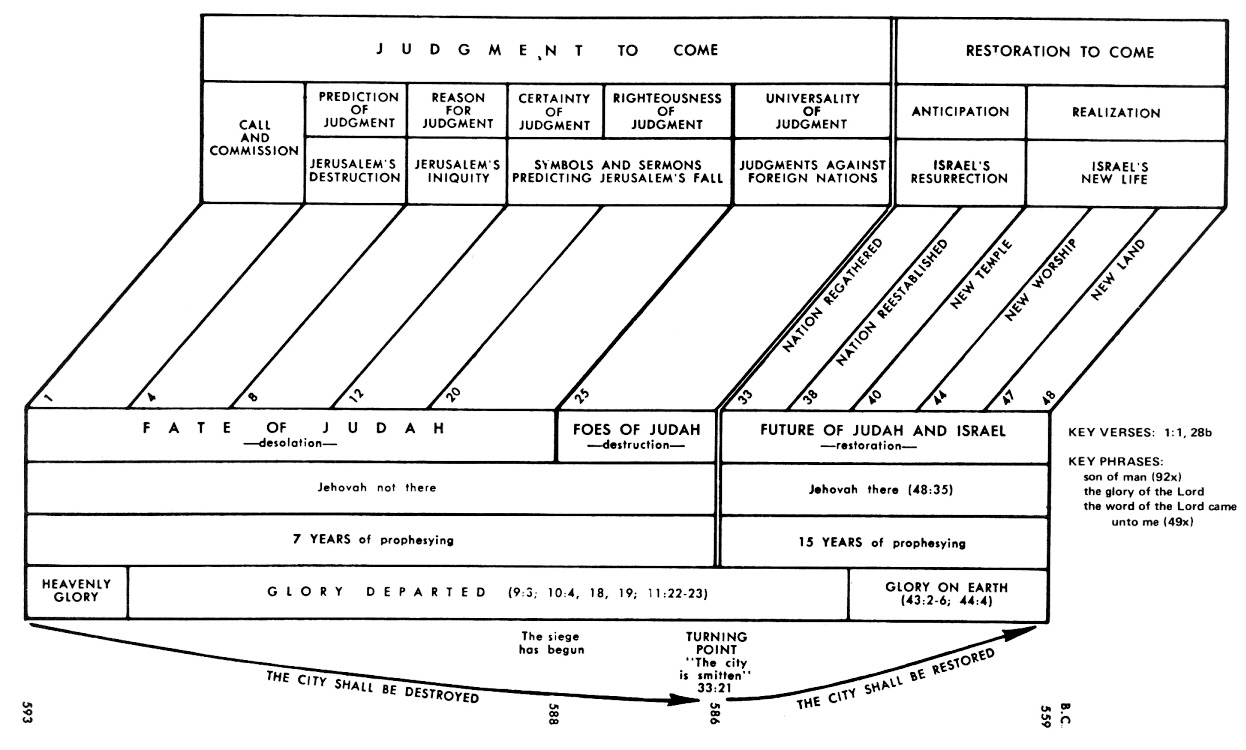
Click chart to enlarge
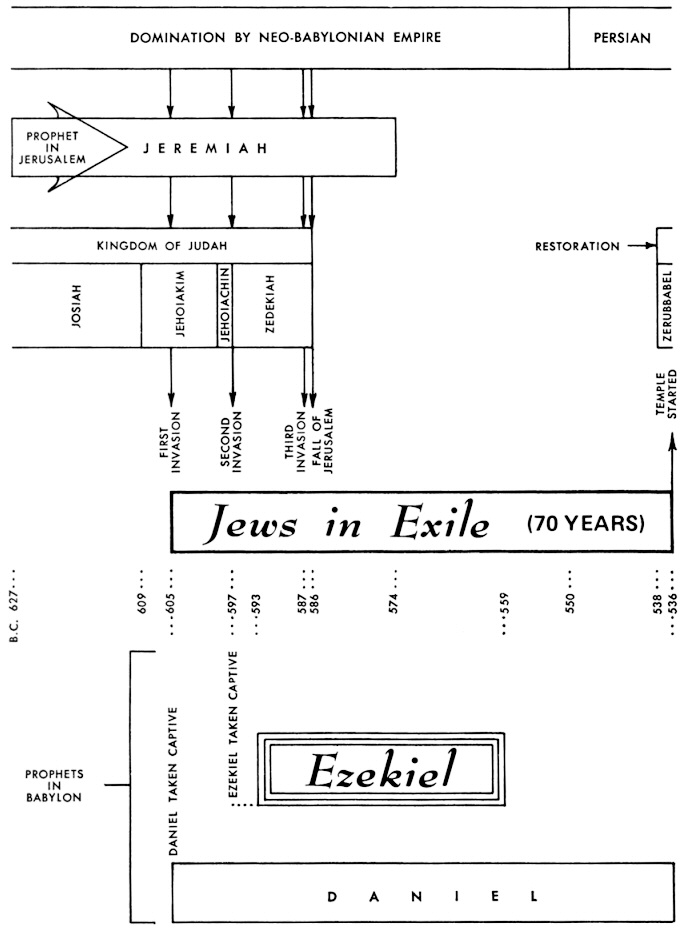
Click chart to enlarge
Chart from recommended resource Jensen's Survey of the OT - used by permission
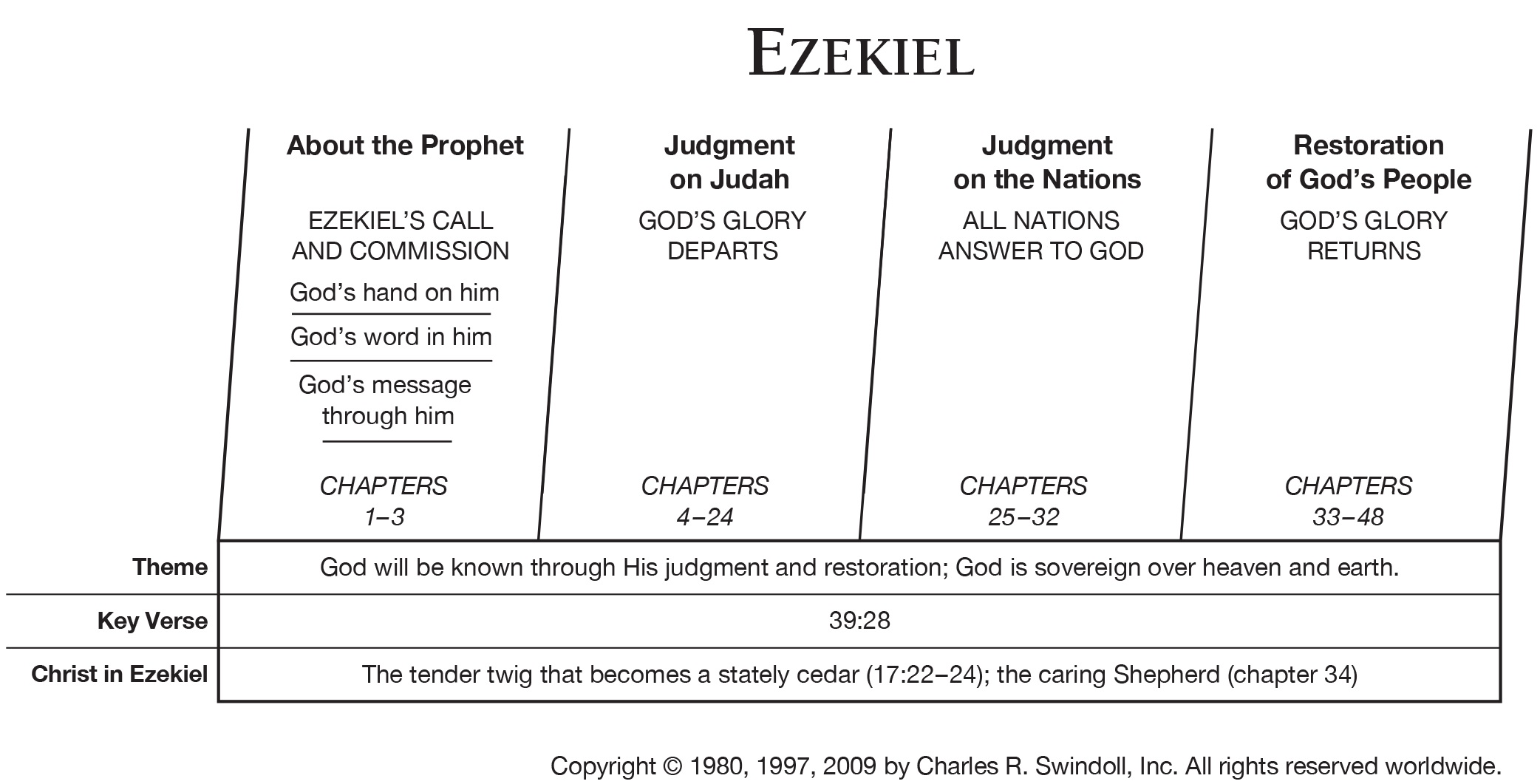
Click Chart from Charles Swindoll
|
PROPHECY OF |
PROPHECY OF |
|||
| FATE OF JUDAH Before the Siege |
FOES OF JUDAH During the Siege |
FUTURE OF JUDAH After the Siege |
||
|
593-588 BC |
587-586 |
586-571 |
||
|
7 YEARS |
15 YEARS |
|||
| Ezekiel 1:1-3:27 Ezekiel Sees the Glory & Receives the Call |
Ezekiel 4:1-24:27 Judgments Against Judah |
Ezekiel 25:1-32:32 Judgments Against the Gloating Nations |
Ezekiel 33:1-39:29 Restoration of Israel to the LORD |
Ezekiel 40:1-48:35 Visions of the Temple Jehovah Shammah |
Outline of the Book of Ezekiel from Dr John MacArthur - The book can be largely divided into sections about condemnation/retribution and then consolation/restoration. A more detailed look divides the book into 4 sections. First, are prophecies on the ruin of Jerusalem (Ezekiel 1:1–24:27). Second, are prophecies of retribution on nearby nations (Ezekiel 25:1–32:32), with a glimpse at God’s future restoration of Israel (Ezekiel 28:25,26). Thirdly, there is a transition chapter (Ezekiel 33:1-33) which gives instruction concerning a last call for Israel to repent. Finally, the fourth division includes rich expectations involving God’s future restoration of Israel (Ezekiel 34:1–48:35). (Reference)
I. Prophecies of Jerusalem’s Ruin (Ezekiel 1:1–24:27)
A. Preparation and Commission of Ezekiel (Ezekiel 1:1–3:27)
1. Divine appearance to Ezekiel (Ezekiel 1:1–28)|
2. Divine assignment to Ezekiel (Ezekiel 2:1–3:27)
B. Proclamation of Jerusalem’s Condemnation (Ezekiel 4:1–24:27)
1. Signs of coming judgment (Ezekiel 4:1–5:4)
2. Messages concerning judgment (Ezekiel 5:5–7:27)
3. Visions concerning abomination in the city and temple (Ezekiel 8:1–11:25)
4. Explanations of judgment (Ezekiel 12:1–24:27)
II. Prophecies of Retribution to the Nations (Ezekiel 25:1–32:32)
A. Ammon (Ezekiel 25:1–7)
B. Moab (Ezekiel 25:8–11)
C. Edom (Ezekiel 25:12–14)
D. Philistia (Ezekiel 25:15–17)
E. Tyre (Ezekiel 26:1–28:19)
F. Sidon (Ezekiel 28:20–24)
Excursus: The Restoration of Israel (Ezekiel 28:25, 26)
G. Egypt (Ezekiel 29:1–32:32)
III. Provision for Israel’s Repentance (Ezekiel 33:1–33)
IV. Prophecies of Israel’s Restoration (Ezekiel 34:1–48:35)
A. Regathering of Israel to the Land (Ezekiel 34:1–37:28)
1. Promise of a True Shepherd (Ezekiel 34:1–31)
2. Punishment of the nations (Ezekiel 35:1–36:7)
3. Purposes of restoration (Ezekiel 36:8–38)
4. Pictures of restoration—dry bones and two sticks (Ezekiel 37:1–28)
B. Removal of Israel’s Enemies from the Land (Ezekiel 38:1–39:29)
1. Invasion of Gog to plunder Israel (Ezekiel 38:1–16)
2. Intervention of God to protect Israel (Ezekiel 38:17–39:29)
C. Reinstatement of True Worship in Israel (Ezekiel 40:1–46:24)
1. New temple (Ezekiel 40:1–43:12)
2. New worship (Ezekiel 43:13–46:24)
D. Redistribution of the Land in Israel (Ezekiel 47:1–48:35)
1. Position of the river (Ezekiel 47:1–12)
2. Portions for the tribes (Ezekiel 47:13–48:35)
Ezekiel 7:1 Moreover, the word of the LORD came to me saying,
GWT: The LORD spoke his word to me. He said,
WBC: I received the following communication from Yahweh:
Young's Literal: And there is a word of Jehovah unto me, saying, 'And thou, son of man, Thus said the Lord Jehovah to the ground of Israel:
Ryrie outline of Ezekiel 6:1-7:27 Prophecies Through Sermons
- Ezekiel 6:1-14 The cause of coming judgment Idolatry
- Ezekiel 7:1-27 The character of coming judgment Severe
MOREOVER, THE WORD OF THE LORD CAME TO ME SAYING: This phrase ("word of the LORD came") occurs 49x in Ezekiel (click here) This chapter is filled with repetition of short staccato like phrases emphasizing that the time of destruction is imminent. As you read chapter 7, put yourself in the audience of exiles that is undoubtedly hearing this intense "sermon". Put yourself in Ezekiel's place realizing that God had already told him that they would not listen to him because they would not listen to God. Make a list of synonyms describing on one hand the "time" of the coming destruction and another list summarizing the character of the judgments (what's affected, how broad, how do the people react, what segments of society are affected, how is judgment meted out, why is judgment coming, what is God's attitude and why, what name of God is revealed, what won't be able to deliver in the day of judgment, what happens to the "leaders", what is said about the Holy Temple, etc)
Ezekiel 7:2 "And you, son of man, thus says the Lord GOD to the land of Israel, 'An end! The end is coming on the four corners of the land.
GWT: "Son of man, this is what the Almighty LORD says to <the people in> the land of Israel: The end is coming! The end is coming to the four corners of the earth.
WBC: “Furthermore, you human one —here is a message from the Lordb Yahweh to the country of Israel. An end is coming, the end is coming upon the four corners of the earth.
Young's Literal: An end, come hath the end on the four corners of the land.
AND YOU, SON OF MAN, THUS SAYS THE LORD GOD TO THE LAND OF ISRAEL: (Ezek 12:22; 21:2; 40:2) "this is what the Sovereign LORD says to Israel" (NLT) "God, the Master, has this Message for the land of Israel: Endtime." (Message)
"Son of man" ("Son of dust", "mortal man", "human")
AN END THE END IS COMING ON THE FOUR CORNERS OF THE LAND: (Deut 32:20; Jer5:31; 51:13; La4:18) "The end is here! Wherever you look--east, west, north, or south--your land is finished" (NLT), "The end of business as usual for everyone.It’s all over. The end is upon you" (Message)
Concerning "the four corners of the land" Matthew Henry writes "The ruin, as it shall be final, so it shall be total; no part of the land shall escape; no, not that which lies most remote. Such will the destruction of the world be; all these things shall be dissolved. Such will the destruction of sinners be; none can avoid it. Oh that the wickedness of the wicked might come to an end, before it bring them to an end!"
Regarding "the end" The Evangelical Commentary has an interesting note explaining that "The Hebrew word for “end” (used twice in v 2, once in v3, twice in v6) is related to ripe summer fruit that is ready to be harvested (Amos8:1-3). Harvesting means cutting down and clearing the fields. That is what the Lord is about to do, but it will not be a thanksgiving harvest." (Elwell, W. A. Vol. 3: Evangelical commentary on the Bible. Grand Rapids, Mich.: Baker Book House.)
"An end, the end is coming" leaves no doubt as to the imminence and urgency of Ezekiel's proclamation. The Hebrew verb "coming" is in the perfect tense expressing Ezekiel's certainty that what he was predicting would come to pass. Ezekiel repeats this message in several ways in this chapter using short pithy phrases, because of the hearer's unwillingness to believe that Jerusalem would truly fall to foreign invaders.
Matthew Henry notes that "When the town is on fire men do not seek for fine words and quaint expressions in which to give an account of it, but cry about the streets, with a loud and lamentable voice, "Fire! fire!’’ So the prophet here proclaims, An end! an end! it has come, it has come; behold, it has come. He that hath ears to hear let him hear."
In Deuteronomy Moses lamented "If only they were wise and would understand this and discern what their end will be!" (Deut 32:29) And yet sinful foolish Judah had flattered herself with false hopes that she should shortly see an end of her troubles, but God says it will not be an end of her troubles but trouble in the end and trouble such as she had never before seen!
Ezekiel knowing that this is indeed "the end" of this chapter of Judah's story, cries out to God "Alas, Lord GOD! Wilt Thou bring the remnant of Israel to a complete end?" (Ezek 11:13) The answer of course is the doctrine of the preserved, albeit small, spiritual remnant.
God gave Noah, a preacher of righteousness, a similar message of warning before judgment fell declaring "to Noah, "The end of all flesh has come before Me; for the earth is filled with violence because of them; and behold, I am about to destroy them with the earth." (Ge6:13)
To Amos God said "What do you see, Amos?" And I said, "A basket of summer fruit." Then the LORD said to me, "The end has come for My people Israel. I will spare them no longer." (Amos 8:2)
Why would Ezekiel repetitively issue similar warnings regarding "the end"? Ezekiel's contemporary, Jeremiah, informs us that there were false "prophets… telling them, 'You will not see the sword nor will you have famine, but I will give you lasting peace in this place." (Jer14:13) And again in Jeremiah God says these false prophets "keep saying to those who despise Me… You will have peace"'; and as for everyone who walks in the stubbornness of his own heart, they say, 'Calamity will not come upon you." (Jer 23:17) In Micah (who prophesied to Israel and to Judah in 750-686BC, more than 100 years prior to Ezekiel) we read of the same wicked behavior and false prophecies for the "leaders pronounce judgment for a bribe. Her priests instruct for a price and her prophets divine for money. Yet they lean on the LORD saying, "Is not the LORD in our midst? Calamity will not come upon us." (Mic 3:11)
ILLUSTRATION - THIS REALLY IS "THE END" A man who lived on Long Island was able one day to satisfy a lifelong ambition by purchasing for himself a very fine barometer. When the instrument arrived at his home, he as extremely disappointed to find that the indicating needle appeared to be stuck, pointing to the sector marked ‘HURRICANE.’ After shaking the barometer very vigorously several times, its new owner sat down and wrote a scorching letter to the store from which he had purchased the instrument. The following morning on the way to his office in New York, he mailed the letter. That evening he returned to Long Island to find not only the barometer missing, but his house also. The barometer’s needle had been right—there was a hurricane!”
Ezekiel's audience and those remaining in Jerusalem after the second Babylonian invasion in 597BC, were both like the man on Long Island, and they too failed to heed Ezekiel's "Barometric Reading" which seemed to be stuck on "THE END"!
In Lamentations we also find that although Jerusalem's "uncleanness was in her skirts, she did not consider her future; Therefore she has fallen astonishingly"' (La1:9) In other words, Jerusalem was so oblivious to her sin that when the end came it was shocking. Read the same verse in the NLT version "She defiled herself with immorality with no thought of the punishment that would follow. Now she lies in the gutter with no one to lift her out. "LORD, see my deep misery," she cries. "The enemy has triumphed." This end for Jerusalem was long in coming, but now has come. Though the ruin of sinners comes slowly, it comes surely. Faithless Jerusalem pictures the foolishness, faithlessness and fate of so many, past, present and future, who pay little heed to the warning inherent in the truth that "the wages of sin is death, but the free gift of God is eternal life in Christ Jesus our Lord." (Ro 6:23)
The plethora of false prophets and prophecies in Ezekiel's day reminds one of the days in which we live, for Peter warns us to "Know this first of all, that in the last days mockers will come with their mocking, following after their own lusts, and saying, "Where is the promise of His coming? (Which will bring about the end of this present evil age and inaugurate the glorious Millennial Messianic age) For ever since the fathers fell asleep, all continues just as it was from the beginning of creation." For when they maintain this, it escapes their notice that by the word of God the heavens existed long ago and the earth was formed out of water and by water, through which the world at that time was destroyed, being flooded with water." (2Pet3:3-6)
Peter, John and James seated on the Mt of Olives overlooking Jerusalem and the Temple, asked Jesus "when will these things be, and what will be the sign of Your coming, and of the end of the age?" (Mt24:3 cf 24:6 24:13 24:14) They were referring to the age preceding the one thousand year age (often referred to as "the millennium") or the Messianic age, when the promises to Israel through Abraham would be fulfilled at the return of Christ at the end of the "great tribulation," also known as the time of Jacob's distress. Jesus did not answer them directly but did warn them not to be misled and He affirmed Daniel's prophecy predicting the coming of the antichrist explaining that "when you see the ABOMINATION OF DESOLATION which was spoken of through Daniel the prophet, standing in the holy place( let the reader understand)… then there will be a great tribulation, such as has not occurred since the beginning of the world until now, nor ever shall." (Mt24:15 24:21) This event marks the beginning of the end of this age.
How can believer's today apply these truths about "the end" in its various contexts? Peter answers this by recording that "The end of all things is at hand; therefore, be of sound judgment and sober spirit for the purpose of prayer." (1 Pe4:7)
There will be no place to run, no place not ruined when God executes His righteous judgment. "There is no creature hidden (nothing in creation can hide) from His sight, but all things are open and laid bare (naked and exposed) to the eyes of Him with Whom we have to do (must give an account) (Heb4:13). Where will you hide when "the seven last plagues… bring God's wrath to completion." (Rev15:1) The only place to "hide" then and forever is in "the Rock of our salvation" (Ps 95:1), which is the "the righteousness of God through faith in Jesus Christ" (Ro3:22) "and to wait for His Son from heaven, Whom He raised from the dead, that is Jesus, Who delivers (rescues) us from the wrath to come." (1Thes1:10)
Matthew Henry implores all saints -- "Oh that we could all see that end of time and days very near, and the end of our own time and days much nearer, that we may secure a happy lot at the end of the days!" even as was spoken to Daniel "as for you, go your way to the end; then you will enter into rest and rise again for your allotted portion at the end of the age." (Dan 12:13) We like Daniel can enter Christ's rest when we fall asleep and arise in resurrection at the end of this present age to enjoy our inheritance—millennial blessings with our Messiah and fellowship forever with faithful saints like Daniel and Ezekiel.
Wiersbe - Repayment (Ezekiel 7:1–27). Four times God says, “I will repay” (Ezekiel 7:3–4, 8–9; See also Gal. 6:6–8). All the things Judah trusted will not help them, not money (Ezekiel 7:19), idols (Ezekiel 7:20–22), or their leaders (Ezekiel 7:23–27). It was the end: “The end has come!” (Ezekiel 7:2, 3, 6); “Then they shall know that I am the LORD” (Ezekiel 7:27). (Borrow copy of With the Word)
Ezekiel 7:3 'Now the end is upon you, and I will send My anger against you; I will judge you according to your ways and bring all your abominations upon you.
Brenton: Now the end is come to thee, and I will send judgment upon thee: and I will take vengeance on thy ways, and will recompense all thine abominations upon thee. (English translation of the Greek Septuagint)
GWT: Now the end is coming for you. I will send my anger against you. I will judge you for the way you have lived, and I will punish you for all the detestable things that you have done.
NIV: The end is now upon you and I will unleash my anger against you. I will judge you according to your conduct and repay you for all your detestable practices.
WBC: Now the end looms over you and I will unleash my anger upon you, passing judgment on you as your ways warrant and repaying you for all your shocking deeds.
Young's Literal: Now is the end unto thee, And I have sent Mine anger upon thee, And judged thee according to thy ways, And set against thee all thine abominations.
NOW THE END IS UPON YOU AND I WILL SEND MY ANGER (aph) AGAINST YOU: (Ezek 5:13; 6:3 6:7 6:12 6:13) "No hope remains, for I will unleash my anger against you" (NLT)
"I will send" paints the picture of God's arrows of judgment released from His bow drawn back in righteous anger. They're on the way. There is no recalling them now. The missiles of destruction have been launched against you oh Judah.
Anger (aph) which means nose and then refers to anger. We have all seen someone so internally seething with anger that their respiratory rate accelerates with flaring of their nostrils as a reflection of their passionate feeling. It's never happened to you has it? Of course not! Although "the anger of man does not achieve the righteousness of God" (Js 1:20) the anger of God does accomplish His righteous end against Judah and Jerusalem.
I WILL JUDGE YOU ACCORDING TO YOUR WAYS AND BRING ALL YOUR ABOMINATIONS (toebah) UPON YOU. (Ezek 7:8 27; 11:10; 11:11 16:38; 18:30; 33:20; 34:20-22; 36:19; Rev20:12 20:13)
"I will hold you accountable for all your abominable practices" (NET)
"I will call you to account for all your disgusting behavior" (NLT)
"will bring upon you retribution for all your abominations" (Amp),
"I will send punishment on you for all your disgusting acts" (BBE)
Bring all your abominations (toebah) upon you God's justice brings just retribution and recompense. Centuries later Paul warned the Galatian church (and all people both believers and non-believers alike) "Do not be deceived (literally "stop being deceived, deluded, misled or led astray"), God is not mocked (One to Whom we can turn our nose up to, to be sneered at, scorned, derided, insulted or disdained); for whatever a man sows, this (emphatic = this very thing and not something different!) he will also reap. For the one who sows to his own flesh (lower nature, sensuality, indulgence of fleshly appetites & passions) shall from the flesh reap corruption (physical/moral decay, rottenness, depravity, putrescence = change from sound to putrid, dissolving state - nature writes in one's body the penalty of sin), but the one who sows to the Spirit shall from the Spirit reap eternal life." (Gal 6:6-7). In other words, Judah's own vile standard would be used to condemn her. Four times in the NKJV and NIV in chapter 7 God says, “I will repay” (7:3–4, 8–9). All the things Judah trusted in to help them would not bring relief in God's day of judgment - not money (7:19), not idols (7:20–22), nor prophets, priests or princes (7:23–27). Are you harboring any unconfessed, secret sin that you have been deceived into believing you are "getting away with"? Please, I beg of you. Bring it to the light once and for all. Experience God's cleansing from all unrighteousness. Do not wait until it is too late to get right with God! Judah is living historical proof that payment for all sin debt will eventually come due in God's economy and in His perfect timing.
"Abominations (toebah) (5x Ezek 7:3, 4, 8, 9, 20) (Click additional note) refers to that which is detestable, abhorrent, loathsome, disgusting, detestable thing or act. The idea of abomination derives from the specific demands God’s holiness makes upon His people. Since there is only one true living God, an invisible spiritual being without bodily parts, all forms of idolatry and all ceremonies and objects connected with idolatry are abhorrent to God. In sum this term refers to anything that offends the spiritual, religious, or moral senses and causes extreme disgust, hatred, or loathing. Most of the Hebrew words translated “abomination” have the meaning of “impure,” “filthy,” and “unclean”—that which is foul-smelling and objectionable to a holy God. The Greek Septuagint picks up on this latter thought, translating the Hebrew word (tow'ebah) with the Greek noun bdelugma, which has an interesting derivation from bdelusso (in turn from bdeo = to stink) which means to emit a foul odor or turn away because of loathing or disgust. In sum an abomination to God is something disgusting which arouses His wrath because of its totally defiling, polluting and loathsome nature. Bdelugma is the same word Jesus used to describe the coming antichrist as the "abomination (bdelugma) of desolation" (Mt 24:15). The revolting practices of Judah were a stench in the nostrils of the holy God! Lest we be too critical and too pious as we see Judah's rottenness, we all need to stop and ask if we are guilty of any idolatry which "stinketh" before the LORD God? Let us boldly petition God for 5 things as did David, "Search (all in red are commands) me, O God, and know my heart (my mind). Try me and know my anxious thoughts and see if there be any hurtful way in me (GWT "See whether I am on an evil path", NLT "Point out anything in me that offends You"), and lead me in the everlasting way." (Ps 139:23-24) (Note on these "commands" - these "commands" are better understood as urgent, reverent pleas, passionate petitions! These are the cries of faithful dependence, not of pride or entitlement. As Martin Luther said “Prayer is not overcoming God’s reluctance; it is laying hold of His willingness.”
Among the objects described as “abominations” were the carved images of pagan gods ("The graven images of their gods you are to burn with fire; you shall not covet the silver or the gold that is on them, nor take it for yourselves, lest you be snared by it, for it is an abomination to the LORD your God. And you shall not bring an abomination into your house, and like it come under the ban; you shall utterly detest it and you shall utterly abhor it, for it is something banned." Deut 7:25,26), the sacrifice to the LORD God of "an ox or a sheep which has a blemish or any defect, for that is a detestable thing (abomination) to Jehovah" (Deut 17:1), the practice of idolatry ("If there is found in your midst, in any of your towns, which the LORD your God is giving you, a man or a woman who does what is evil in the sight of the LORD your God, by transgressing His covenant, and has gone and served other gods and worshiped them, or the sun or the moon or any of the heavenly host, which I have not commanded, and if it is told you and you have heard of it, then you shall inquire thoroughly. And behold, if it is true and the thing certain that this detestable thing (abomination) has been done in Israel, then you shall bring out that man or that woman who has done this evil deed, to your gates, that is, the man or the woman, and you shall stone them to death." Deut 17:2-5), and the fashioning of a “carved or molded image” of a false god ("Cursed is the man who makes an idol or a molten image, an abomination to the LORD, the work of the hands of the craftsman, and sets it up in secret." Deut 27:15;cf Is44:19). God's command to Israel was “You shall not behave thus toward the Lord your God, for every abominable act which the Lord hates they have done for their gods; for they even burn their sons and daughters in the fire to their gods." (Deut 12:31)
Ezekiel was likely born during the reign of godly King Josiah who was smitten by the words of the re-discovered book of the Law that had been lost in the house of God (read this incredible story in 2 Ki22-23 and note what the kings of Israel and Judah should have been doing "all the days of his life" in Deut 17:18 19) and as a result tore his robes and then tore down and smashed the idolatrous "altars… which the kings of Judah had made… and the high places which were before (on the east of) Jerusalem, which were on the right of the mount of destruction (the Mount of "Corruption" which was most likely the Mount of Olives) which Solomon the king of Israel had built for Ashtoreth the abomination of the Sidonians (in this litany of loathsome names, note that the word abomination is used for the actual idol), and for Chemosh the abomination of Moab, and for Milcom the abomination of the sons of Ammon, the king defiled. And he broke in pieces the sacred pillars and cut down the Asherim and filled their places with human bones (to defile these sites). Furthermore, the altar that was at Bethel and the high place which Jeroboam the son of Nebat, who made Israel sin (ungodly leaders incite ungodliness in their people), had made, even that altar and the high place he broke down. Then he demolished its stones, ground them to dust, and burned the Asherah. (2 Ki23:13)
Related Resource:
Anger (nose, nostril, wrath) (0639) aph from anaph = to breathe hard, to be angry) is a masculine noun meaning nose, nostril, snout (pigs - Pr 11:22), face (2Sa 25:23) and anger. Both senses are found in Proverbs 30:22 - "For the churning of milk produces butter, and pressing the nose (aph) brings forth blood; so the churning of anger (aph) produces strife." In the first use God "breathed into (man's) nostrils the breath of life." (Ge 2:7) Aph sometimes refers to the entire e whole face (Ge 3:19), especially in the expression, to bow one’s face to the ground (Ge 19:1; 1Sa 24:8). To have length of nose is to be slow to wrath (Pr 14:29, 16:32). To have shortness of nose is to be quick tempered (Pr. 14:17; Jer. 15:14, 15). Aph is used in a phrase (goba aph) which means pride, arrogance, formally, high of nose, an improper haughtiness and self-confidence (Ps 10:4). Often speaks of divine anger or wrath (Ps 2:5, 2:12, 6:1, 30:5, 74:1, 77:9, 78:21) and thankfully is "Slow to anger." (Ps 103:8; 145:8, both Lxx = makrothumos = long-suffering)
Aph in Ezekiel - Ezek. 5:13; Ezek. 5:15; Ezek. 7:3; Ezek. 7:8; Ezek. 8:17; Ezek. 13:13; Ezek. 16:12; Ezek. 20:8; Ezek. 20:21; Ezek. 22:20; Ezek. 23:25; Ezek. 25:14; Ezek. 35:11; Ezek. 38:18; Ezek. 43:8
Abominations (detestable, loathsome) (08441) toebah refers to an abominable custom or thing. Abomination. Loathsome. Detestable thing. Something or someone who is loathsome and abhorrent. Sometimes toebah is used as a synonym for idol, a repulsive thing, a worship object, with a focus that it is an item to be rejected (Dt 32:16; 2Ch 34:33; Isa 44:19, Jer 16:18; Eze 5:9; 7:20; 11:18, 21; 16:36). Toebah is even used for a specific pagan deity, as in 2Ki 23:13 where Milcom is called "the abomination of the Ammonites." And even prayer is an abomination when offered by one who refuses to obey God's Word (Pr 28:9).
Ronald Youngblood - As with the verb, so also with the noun (toebah) the abomination may be of a physical, ritual or ethical nature and may be abhorred by God or man. Sharing a meal with a Hebrew was ritually offensive to an Egyptian (Gen 43:32), as was offering certain kinds of sacrifices (Ex 8:22). homosexuality and other perversions are repugnant to God and fall under his judgment (Lev 18:22–30; 20:13). Idolatry (Deut 7:25), human sacrifice (Deut 12:31), eating ritually unclean animals (Deut 14:3–8), sacrificing defective animals (Deut 17:1), conducting one’s business dishonestly (Deut 25:13–16), practicing ritual prostitution (I Kgs 14:23f.), and similar acts of disobedience (for seven more abominations, see the list in Pr 6:16–19) were sure to bring God’s wrath on those who perpetrated them. Twelve times the book of Proverbs uses the phrase, “is an abomination to the Lord.” In Ps 88, a prayer for help written by a man close to death, the physically repulsive appearance of a tô˓ēbâ is stressed; the man’s former friends avoid him because they consider him to be a thing of horror (Ps 88:8). (Theological Wordbook of the Old Testament)
Toebah in Ezekiel - Ezek. 5:9; Ezek. 5:11; Ezek. 6:9; Ezek. 6:11; Ezek. 7:3; Ezek. 7:4; Ezek. 7:8; Ezek. 7:9; Ezek. 7:20; Ezek. 8:6; Ezek. 8:9; Ezek. 8:13; Ezek. 8:15; Ezek. 8:17; Ezek. 9:4; Ezek. 11:18; Ezek. 11:21; Ezek. 12:16; Ezek. 14:6; Ezek. 16:2; Ezek. 16:22; Ezek. 16:36; Ezek. 16:43; Ezek. 16:47; Ezek. 16:50; Ezek. 16:51; Ezek. 16:58; Ezek. 18:12; Ezek. 18:13; Ezek. 18:24; Ezek. 20:4; Ezek. 22:2; Ezek. 22:11; Ezek. 23:36; Ezek. 33:26; Ezek. 33:29; Ezek. 36:31; Ezek. 43:8; Ezek. 44:6; Ezek. 44:7; Ezek. 44:13
Ezekiel 7:4 'For My eye will have no pity on you, nor will I spare you, but I will bring your ways upon you, and your abominations will be among you; then you will know that I am the LORD!'
GWT: I will not have compassion for you or feel sorry for you. I will pay you back for the way you have lived and for the detestable things you have done. Then you will know that I am the LORD.
WBC: No pitying glance will I give nor any show of compassion, but I will repay you for your ways, and your shocking deeds will haunt you,and then you will all realize that I am Yahweh.
Young's Literal: And no pity on thee hath Mine eye, nor do I spare, For thy ways against thee I do set, And thine abominations are in thy midst, And ye have known that I am Jehovah.
FOR MY EYE WILL HAVE NO PITY ON YOU, NOR WILL I SPARE YOU: (Ezek 7:9; 8:18; 9:10; 24:14; Zec11:6)
"I will turn my eyes away and show no pity." (NLT)
God had given a similar declaration earlier in the form of an oath stating that "as I live… surely, because you have defiled My sanctuary with all your detestable idols and with all your abominations, therefore I will also withdraw, and My eye shall have no pity and I will not spare." (Ezek5:11) For a dramatic illustration of "no pity" read (Jer 14)
"Pity" (chus) means to show mercy, have compassion, with a focus on sparing or delivering one from a great punishment… something God would now not do for Judah and Jerusalem. Chus It refers to the feeling which goes out toward one who is in trouble. Ezekiel uses chus more than any other OT book. In chapter 8 God says "I indeed will deal in wrath. My eye will have no pity nor will spare; and though they cry in My ears with a loud voice, yet will not listen to them." (Ezek 8:18) Clearly God is serious about the sin in Judah and Jerusalem and yet we read that after Israel had rebelled against Him in the wilderness, He considered annihilating them and "Yet My eye spared them rather than destroying them, and did not cause their annihilation in the wilderness." (Eze 20:17) God's wrath simmers slowly but surely until finally He has "no pity" of Israel or Judah, but must destroy them.
In Jeremiah God says "I will dash them against each other, both the fathers and the sons together," declares the LORD. "I will not show pity nor be sorry nor have compassion that I should not destroy them (I will not let my pity or mercy or compassion keep me from destroying them = NLT)."' (Jer13:14)
BUT I WILL BRING YOUR WAYS UPON YOU AND YOUR ABOMINATIONS WILL BE AMONG YOU: (Ezek 23:31; Jer16:18; 25:14; Ho9:7; 12:2)
"repaying you in full for all your evil." (NLT),
God elaborates later explaining "but as for those whose hearts go after their detestable things and abominations, I shall bring their conduct down on their heads," declares the Lord GOD." (Ezek 11:21, cf Ezek 16:43) In chapter 23 God tells adulterous Israel "I shall make lewdness cease from the land, that all women may be admonished and not commit lewdness as you have done. And your lewdness will be requited (to make a suitable return for, to make retaliation) upon you, and you will bear the penalty of worshiping your idols; thus you will know that I am the Lord GOD." (23:49)
The writer of Hebrews reminds us of that God has declared that "VENGEANCE IS MINE, I WILL REPAY." And again, "THE LORD WILL JUDGE HIS PEOPLE." It is a terrifying thing to fall into the hands of the living God." (Heb10:30 31) God is long-suffering, and patient, and loving, and infinitely gracious. Peter explains that in regard to judgment that seems to be delayed, "The Lord is not slow about His promise, as some count slowness, but is patient toward you, not wishing for any to perish but for all to come to repentance." (2Pet3:9). But for the one who turns his back on God’s grace, whether in the Old Testament or the New Testament, there is nothing left that God can offer or do for him. Only judgment remains. And thus we see God's longsuffering finally run out in 2 Chronicles where "all the officials of the priests and the people were very unfaithful following all the abominations of the nations; and they defiled the house of the LORD which He had sanctified in Jerusalem. And the LORD, the God of their fathers, sent word to them again and again by His messengers, because He had compassion on His people and on His dwelling place; but they continually mocked the messengers of God, despised His words and scoffed at His prophets, until the wrath of the LORD arose against His people, until there was no remedy. (medicine that was curative, no healing, no soothing remedy)" (2Chr36:14-16)
THEN YOU WILL KNOW THAT I AM THE LORD: "Then you will know that I am the Lord!" (NLT)
"Will know that I am the LORD" occurs three times in this chapter (v4, 9, 27). Ezekiel makes frequent use of this “recognition formula”. They would not know Him as their Savior so now they would know Him as their Judge.
Ezekiel 7:5 "Thus says the Lord GOD, 'A disaster, unique disaster, behold it is coming!
GWT: "This is what the Almighty LORD says: One disaster after another is coming.
WBC: “Here is a message from the Lord Yahweh. Calamity aftera calamity, here it comes.
Young's Literal: Thus said the Lord Jehovah: Evil, a single evil, lo, it hath come.
THUS SAYS THE LORD GOD, 'A DISASTER, UNIQUE DISASTER, BEHOLD IT IS COMING: (Nah1:9)
"An unheard-of disaster is coming" (NIV),
This is what the Sovereign Lord says: With one blow after another I will bring total disaster!." (NLT)
An evil, an only evil, behold, is come" (Webster)
An evil, even one evil; see, it is coming" (BBE)
Evil, a single evil, lo, it hath come." (YLT)
Unique (singular, unheard of) disaster" where "unique" is the Hebrew word echad which means one, i.e. a cardinal number in contrast to more than one. Echad can mean only, i.e. one of a unique class or kind, and thus a distinctive disaster in the present context. It can also mean one time, once, i.e. a single occurrence and in some contexts to the exclusion of all other occurrences (but not so in regard to the destruction of Jerusalem which which be devastated again in 70AD by the Romans and in the "great tribulation" by the antichrist).
How "unique"? In first Kings God says "Behold, I am bringing such calamity on Jerusalem and Judah, that whoever hears of it, both his ears shall tingle. And I will stretch over Jerusalem the line of Samaria and the plummet of the house of Ahab, and I will wipe Jerusalem as one wipes a dish, wiping it and turning it upside down." (2 Ki21:12 13)
Daniel adds that God "has confirmed His words which He had spoken against us and against our rulers who ruled us, to bring on us great calamity; for under the whole heaven there has not been done anything like what was done to Jerusalem." (Da9:12)
Jehovah had earlier announced through Ezekiel that "because of all your abominations, I will do among you what I have not done, and the like of which I will never do again." (Ezek 5:9)
Why else would this disaster by so unique? In Amos God reminds the Jews of their unique position deserving of a unique punishment, declaring "You only have I chosen among all the families of the earth. Therefore, I will punish you for all your iniquities." (Am3:2)
Another commentary feels that it was "unique" because it was a reference to the destruction of the temple, which the Jews thought to be inviolable.
The most "unique" punishment of God's chosen people awaits one final future fulfillment described by Jesus as "a great tribulation, such as has not occurred since the beginning of the world until now, nor ever shall." (Mt24:21)
Ezekiel 7:6 'An end is coming; the end has come! It has awakened against you; behold, it has come!
GWT: The end is coming. The end is coming. It is stirring itself up against you. It is coming!
WBC: An end is coming; the end is coming upon you. Here comes,
Young's Literal: An end hath come, come hath the end, It hath waked for thee, lo, it hath come.
AN END IS COMING; THE END HAS COME! IT HAS AWAKENED AGAINST YOU; BEHOLD, IT HAS COME: (Je44:27) (10; 21:25; 39:8)
Ezekiel over and over asserts that the end is coming, much like a meteorologist who knew the a deadly hurricane was tracking toward a populated area and had the potential to be deadly. And yet Ezekiel's warnings largely went unheeded.
God warned the ungodly world through Noah that the end was coming but they did not heed to His warning and thus God "did not spare the ancient world, but preserved Noah, a preacher of righteousness, with seven others, when He brought a flood upon the world of the ungodly." (2 Pe2:5) So too here in Ezekiel warning of the judgment that is so certain, that speaks of it in the past tense ("has come") as if it was already an accomplished fact, for on God's timetable it had! God speaks and whatever He says is already accomplished, whether it be in the past, present or distant future. Why then is it we have such difficulty as sons of men in trusting Him in the temporal events of our life?
"Awakened" is the Hebrew word meaning to awaken from sleep or stupor. The day of wrath awakened will not bring a glancing blow or a temporary setback, but comes with all the finality found in the word "end" like a sleeping giant now stirred into action or like a predatory animal, ready to stalk its prey.
Ezekiel 7:7 'Your doom has come to you, O inhabitant of the land. The time has come, the day is near --tumult rather than joyful shouting on the mountains.
Young's Literal: Come hath the morning unto thee, O inhabitant of the land! Come hath the time, near is a day of trouble, And not the shouting of mountains.
GWT: Destruction is coming to you, inhabitants of the land. The time is coming. The day is near. There will be confusion. There will be no joy in the mountains.
WBC: comes doom upon you, residents of the land. The time is coming, the day is near—tumult, not harvest, shoutsc in the mountains.
YOUR DOOM HAS COME TO YOU, O INHABITANT OF THE LAND. THE TIME HAS COME, THE DAY IS NEAR (Isa17:14; Am4:13) (12; 12:23-25,28; Isa13:22; 1 Pe4:17) (Isa22:5)
"The time has come" This phrase reminds one of the imminent judgment of Sodom and Gomorrah: "when morning dawned, the angels urged Lot, saying, "Up, take your wife and your two daughters, who are here, lest you be swept away in the punishment of the city. But he hesitated. So the men seized his hand and the hand of his wife and the hands of his two daughters, for the compassion of the LORD was upon him; and they brought him out, and put him outside the city." (Ge19:15 16) "Then the LORD rained on Sodom and Gomorrah brimstone and fire from the LORD out of heaven" (Ge19:24) Even righteous Lot failed to heed the warning of imminent doom and had God not spared him as a remnant, he too would have died. In Ezekiel 9 we see that before God sends the final doom, He sends angels to "Go through the midst of the city, even through the midst of Jerusalem, and put a mark on the foreheads of the men who sigh and groan over all the abominations which are being committed in its midst." (Ezek 9:4)
"The day is near" describes the destruction of Jerusalem. But as is often true in the prophetic utterances, there is both a near and a future fulfillment. This day of wrath as described in the following verses, prefigures a future day, often referred to as the Day of the LORD (Click here for more detailed discussion)
The prophet Zephaniah (prophesied in 625BC to the southern kingdom Judah during the reign of godly king Josiah) uses wording similar to that in Ezekiel writing "Near is the great day of the LORD, near and coming very quickly; Listen, the day of the LORD! In it the warrior cries out bitterly. A day of wrath is that day, a day of trouble and distress, a day of destruction and desolation, a day of darkness and gloom, a day of clouds and thick darkness, a day of trumpet and battle cry, against the fortified cities and the high corner towers." (Zeph1:14-16) In the historical context Zephaniah's prophecy was first fulfilled by the invasion of Babylon and yet a final fuller fulfillment awaits the future "time of Jacob's distress" in the Day of the Lord, a time so severe that Jeremiah says there would be "none like it." (Jer 30:7)
TUMULT RATHER THAN JOYFUL SHOUTING ON THE MOUNTAINS.
ILLUSTRATION - THE DREADFUL COST OF IGNORING THE WATCHMAN'S WARNINGS In 1969, in Pass Christian, Mississippi, a group of people were preparing to have a “ hurricane party ” in the face of a storm named Camille. Were they ignorant of the dangers? Could they have been overconfident? Did they let their egos and pride influence their decision? We ’ll never know. What we do know is that the wind was howling outside the posh Richelieu Apartments when Police Chief Jerry Peralta pulled up sometime after dark. Facing the Beach less than 250 feet from the surf, the apartments were directly in the line of danger. A man with a drink in his hand came out to the second-floor balcony and waved. Peralta yelled up, “ You all need to clear out of here as quickly as you can. The storm ’s getting worse. ” But as other joined the man on the balcony, they just laughed at Peralta ’s order to leave. “ This is my land, ” one of them yelled back. “ If you want me off, you ’ll have to arrest me. ” Peralta didn ’t arrest anyone, but he wasn ’t able to persuade them to leave either. He wrote down the names of the next of kin of the twenty or so people who gathered there to party through the storm. They laughed as he took their names. They had been warned, but they had no intention of leaving. It was 10:15 p.m. when the front wall of the storm came ashore. Scientists clocked Camille ’s wind speed at more than 205 miles-per-hour, the strongest on record. Raindrops hit with the force of bullets, and waves off the Gulf Coast crested between twenty-two and twenty-eight feet high. News reports later showed that the worst damage came at the little settlement of motels, go-go bars, and gambling houses known as Pass Christian, Mississippi, where some twenty people were killed at a hurricane party in the Richelieu Apartments. Nothing was left of that three-story structure but the foundation; the only survivor was a five-year-old boy found clinging to a mattress the following day.
Ezekiel 7:8 'Now I will shortly pour out My wrath on you and spend My anger against you; judge you according to your ways and bring on you all your abominations.
Young's Literal: Now, shortly I pour out My fury on thee, And have completed Mine anger against thee, And judged thee according to thy ways, And set against thee all thine abominations.
GWT: Soon I will pour out my fury on you and unleash my anger on you. I will judge you for the way you have lived, and I will punish you for all the detestable things that you have done.
WBC: Soon now I will drench you with my wrath and exhaust my anger upon you, passing judgment on you as your ways warrant and repaying you for all your shocking deeds.
NOW I WILL SHORTLY POUR OUT MY WRATH ON YOU AND SPEND MY ANGER AGAINST YOU: (Ps79:6; Isa42:25; La2:4; Ho5:10; Rev14:10; 16:2-21)(Ezek 6:12)
"Pour out" (shaphak) is a major verb in Ezekiel. Most of the 32 uses of shaphak in Ezekiel describe pouring out of God's wrath but shaphak is also used in Ezekiel to describe Judah "pouring out" lewdness (Eze 16:36), harlotries (Eze 16:15), and especially blood (e.g., Eze 16:38). How fitting then that God would recompense the poured out wickedness by pouring out His wrath and thus judging Judah according to her ways.
Ezekiel's contemporary writes "Therefore thus says the Lord GOD, "Behold, My anger and My wrath will be poured out on this place, on man and on beast and on the trees of the field and on the fruit of the ground; and it will burn and not be quenched." (Jer7:20)
After the fall of Jerusalem in 586BC, Jeremiah records this "post-mortem" writing that "Jehovah has accomplished His wrath. He has poured out His fierce anger; and He has kindled a fire in Zion which has consumed its foundations." (La4:11)
Daniel refers to the completion of the destruction of Judah and Jerusalem as "the curse" which "has been pour out on us". (Da9:11) Daniel also prophesies that there will be a future destruction "one that is decreed" which will be "poured out on the one who makes desolate" (this latter referring to the antichrist -- see related discussion below) (Da9:27)."
Think about what this verb is picturing. It is as if God has a cauldron that contains His wrath and over years of rebellion by Israel and Judah, this container keeps filling up, until finally it is filled to the brim with His wrath which He will shortly dispense on His "own possession" (KJV "peculiar treasure", NIV "treasured possession") (Ex19:5)! What a sobering, tragic picture! You can "be sure that your sin will find you out"! (Nu32:23) Although this warning was issued specifically to the tribes of Reuben, Gad and half the tribe of Manasseh, exhorting them to fulfill their commitment to participate with the other tribes in the campaign in Canaan, it expresses a universal principle that no sin against God or His Word will remain secret and unpunished. Beloved, is there any sin you need to confess to Him and for which you need to seek His gracious gift of repentance? "He who conceals his transgressions will not prosper, but he who confesses and forsakes them will find compassion." (Pr 28:13) J Vernon McGee adds that "This is a great proverb. It seems a common practice today for Christians to try to cover their sins. You will find in the average church that there is a Band-Aid of silence wrapped over the cancer of sin. People don’t like to talk about it; in fact, they don’t admit its existence. They like to think they are very good." And so did Judah and Jerusalem!
This same picture (wrath poured out) will unfold in God's final outpouring of wrath in the Revelation, the 7 last "plagues" of the "wrath of God" equating with the "seven bowls". John writes that he heard "a loud voice from the temple, saying to the seven angels, "Go and pour out the seven bowls of the wrath of God into the earth" (Rev 16:1), these 7 bowls of judgment being "the last, because in them the wrath of God is finished." (Rev 15:1) This future, final outpouring of His wrath as described in detail in the Revelation of Jesus Christ will be poured out on the antichrist who had persecuted the Jews during "the great tribulation".
The thought of God's wrath being poured out is too awesome and awful to even imagine. While most of Ezekiel's audience would not listen to his warnings because they would not listen to God, there were those who when confronted with this incredible picture of God's wrath being poured out, would respond with rending of their heart and not just their clothes. And so see godly King Josiah, after the discovery of the book of the Law, say to his aides "Go, inquire of the LORD for me and for those who are left (he is referring to the godly remnant whose heart remained tender and not hardened toward the LORD - click for discussion of remnant) in Israel and in Judah, concerning the words of the book which has been found; for great is the wrath of the LORD which is poured out on us because our fathers have not observed the word of the LORD, to do according to all that is written in this book." (2 Chr34:21) It was King Josiah's recognition and acknowledgement of the impending wrath of God which awoke in him a desire for personal and national revival! Although some experienced revival (Ezekiel was likely born during this time period), most returned to their rebellious ways after Josiah's death.
The question the prophet Nahum posed applies to every person ever born -- "Who can stand before His indignation? Who can endure the burning of His anger? His wrath is poured out like fire, and the rocks are broken up by Him." (Nah1:6) The answer is that only those whose "life is hidden with Christ in God" (Col 3:3) are safe from the wrath to come, for Jesus promised that "no one shall snatch them out of My hand." (John 10:28) "He who believes in the Son has eternal life; but he who does not obey the Son shall not see life, but the wrath of God abides on him." (John 3:36) Watchman, go and proclaim these sobering truths while there is still the light of day, for the night cometh when no man can work. For Jerusalem that day would shortly come to pass.
JUDGE YOU ACCORDING TO YOUR WAYS AND BRING ON YOU ALL YOUR ABOMINATIONS:
Ezekiel 7:9 'My eye will show no pity nor will I spare. I will repay you according to your ways, while your abominations are in your midst; then you will know that I, the LORD, do the smiting.
Young's Literal: And not pity doth Mine eye, nor do I spare, According to thy ways unto thee I give, And thine abominations are in thy midst, And ye have known that I am Jehovah the smiter.
GWT: I will not have compassion or feel sorry. I will pay you back for the way you have lived and for the detestable things that you are still doing. Then you will know that I am the LORD and that I am the one attacking <you>.
WBC: No pitying glance will I give nor any show of compassion, but I will repay you for your ways, and your shocking deeds will haunt you, and you will all realize that I am Yahweh, the one who struck the blow.
MY EYE WILL SHOW NO PITY NOR WILL I SPARE I WILL REPAY YOU ACCORDING TO YOUR WAYS WHILE YOUR ABOMINATIONS ARE IN YOUR MIDST:
"I will repay according to your ways" In other words "Do not be deceived, God is not mocked; for whatever a man sows, this he will also reap." (Gal6:7) At the Great White Throne judgment where all unbelievers will stand, John records that "they were judged, every one of them according to their deeds" (Rev20:13)
Those who made light of mercy when it was offered them shall now receive judgment without mercy.
THEN YOU WILL KNOW THAT I, THE LORD DO THE SMITING (nāḵāh) (Mic 6:9) Tragedy and Judgment often rekindle an interest in God and spiritual things. Witness for example the tragedy of the airliner that had a defect in the wall which led to a hole being ripped in the side in midair. Several of the quotes in the magazine article were statements like "Oh, God save me!", "God help us!" The tragedy is that these types of reactions usually surface only after the judgment has befallen a nation or an individual.
"LORD… smiting (nāḵāh)" is in a sense another name of God, much like Jehovah jireh, the LORD Who provides. Here the name is "Jehovah Nakah" or as Young's Bible literally translates it "I, Jehovah the Smiter".
THOUGHT - Praise God for the other glorious names which balance this frightful (but righteous) name of Jehovah. Do you know Him as Jehovah Nakah or Jehovah-tsidkenu “The Lord Our Righteousness”, the Messiah, Who "surely our griefs He Himself bore and our sorrows He carried, yet we ourselves esteemed Him stricken, smitten (nakah) of (by) God, and afflicted" (Isa53:4), "having become a curse for us" (Gal3:13), "having been offered once to bear the sins of many" (Heb 9:28) "in His body on the cross, that we might die to sin and live to righteousness; for by His wounds you were healed." (1Pet 2:24).
Isaiah records the sad results of the smiting writing that "the people (Israel) do not turn back to Him Who struck them, nor do they seek the LORD of hosts." (Isa9:13)
Smiting (struck)(05221) nāḵāh A verb meaning to beat, to strike, to wound. The meaning of the vb. ranges from hitting to killing. ni. be hit, be struck down; pu. be battered, ruined, destroyed; hi. strike, hit, beat, strike dead, wound, batter, destroy; ho. be struck down (dead), be taken, be hit (#5782); nom. מַכָּה (makkâ), blow, stroke, wound, plague, defeat There are many instances of striking physically (Ex. 21:15, 19; Job 16:10; Ps. 3:7[8]; Song 5:7). Of Yahweh smiting the firstborn (Nu 3:13, 8:17), His own people (Nu 11:33). Of Moses striking the rock twice resulting in his not being allowed to enter the Promised Land (Nu 20:11) Frequently, nākhāh is related to the Israelite conquest of Canaan. God used disease to smite the inhabitants of Canaan (Num. 14:12). This word is also used in a different sense, as when the men of Sodom and Gomorrah were stricken blind by the two angels (Gen. 19:11); when a priest stuck a fork into the kettle (1 Sam. 2:14); when people clapped their hands (2 Kgs. 11:12); or when people verbally abused Jeremiah (Jer. 18:18). God struck the Egyptians with plagues (Ex. 3:20); and struck people down in judgment (Isa. 5:25).
Nakah in Ezekiel - Ezek. 5:2; Ezek. 6:11; Ezek. 7:9; Ezek. 9:5; Ezek. 9:7; Ezek. 9:8; Ezek. 21:14; Ezek. 21:17; Ezek. 22:13; Ezek. 32:15; Ezek. 33:21; Ezek. 39:3; Ezek. 40:1;
Ezekiel 7:10 'Behold, the day! Behold, it is coming! Your doom has gone forth; the rod has budded, arrogance has blossomed.
Young's Literal: Lo, the day, lo, it hath come, Gone forth hath the morning, Blossomed hath the rod, flourished the pride.
GWT: "The day is near! It is coming! Destruction is coming! Wrongdoing has blossomed. Arrogance has flourished.
WBC: “Here is the day, here it has come —doom has appeared. Injustice has burst into blossom, insolence into bud …
BEHOLD, THE DAY! BEHOLD, IT IS COMING YOUR DOOM HAS GONE FORTH (1 Th 5:3) (19:14; 21:10,13; Nu17:8; Isa10:5)
"The day of judgment is here; your destruction awaits! The people's wickedness and pride have reached a climax" (NLT)
THE ROD HAS BUDDED, ARROGANCE HAS BLOSSOMED: (Pr14:3; 16:18; Isa28:1; Da4:37; Ja4:6)
"The day of judgment is here; your destruction awaits! The people's wickedness and pride have reached a climax" (NLT)
The Evangelical Commentary adds that "The botanical metaphors of verse 10 are appropriate. But what is growing is not wheat but arrogance and violence (v11). The phrase the rod has budded recalls Aaron’s rod (Nu 17:1-13), but the similarity between the two stops at vocabulary. In Numbers it is of God; in Ezekiel it is of sin."
Ezekiel 7:11 'Violence has grown into a rod of wickedness. None of them shall remain, none of their people, none of their wealth, nor anything eminent among them.
Young's Literal: The violence hath risen to a rod of wickedness, There is none of them, nor of their multitude, Nor of their noise, nor is there wailing for them.
GWT: Violence has grown into a weapon for punishing wickedness. None of the people will be left. None of that crowd, none of their wealth, and nothing of value will be left.
VIOLENCE HAS GROWN INTO A ROD OF WICKEDNESS: (Ezek 7:23; Isa9:4; 14:29; 59:6-8; Am3:10; 6:3; Mic2:2; 3:3; Mic6:12; Ja2:13) "Their violence will fall back on them as punishment for their wickedness." (NLT)
In a parallel passage Isaiah says that "the vineyard of the LORD of hosts is the house of Israel, and the men of Judah His delightful plant. Thus He looked for justice, but behold, bloodshed; for righteousness, but behold, a cry of distress." (Isa5:7)
Jeremiah declares that "as a well keeps its waters fresh, so (Jerusalem) keeps fresh her wickedness. Violence and destruction are heard in her. Sickness and wounds are ever before Me." (Jer 6:7)
NONE OF THEM SHALL REMAIN, NONE OF THEIR PEOPLE, NONE OF THEIR WEALTH, NOR ANYTHING EMINENT AMONG THEM: (2;16 5:4 5:11; 6:11; Zeph1:18) (24:16-24; Ps78:64; Je16:5 16:6; 22:18; 25:33) "None of these proud and wicked people will survive. All their wealth will be swept away" (NLT)
Ezekiel 7:12 'The time has come, the day has arrived. Let not the buyer rejoice nor the seller mourn; for wrath is against all their multitude.
Young's Literal: Come hath the time, arrived hath the day, The buyer doth not rejoice, And the seller doth not become a mourner, For wrath is unto all its multitude.
GWT: The time is coming. The day is near. Buyers will not rejoice, and sellers will not mourn, because <my> fury will be against the whole crowd.
WBC: The time has come, the day has arrived. Let the buyer not be glad
nor the seller be sorry. THE TIME HAS COME, THE DAY HAS ARRIVED: (1Co7:29-31; Ja5:8 5:9)
Ezekiel emphasizes that the judgment is imminent, permanent, fixed, and irreversible.
LET NOT THE BUYER REJOICE NOR THE SELLER MOURN; FOR WRATH IS AGAINST ALL THEIR MULTITUDE: (Isa24:1 24:2; Jer32:7,8,24,25) (Isa5:13 5:14) "The bottom has dropped out of buying and selling. It will never be the same again" (Message)
Because all business transaction will cease, people will no longer rejoice over getting a bargain or regret selling at a loss.
Ezekiel 7:13 'Indeed, the seller will not regain what he sold as long as they both live ,; for the vision regarding all their multitude will not be averted, nor will any of them maintain his life by his iniquity.
Young's Literal: For the seller to the sold thing turneth not, And yet among the living is their life, For the vision is unto all its multitude, It doth not turn back, And none by his iniquity doth strengthen his life.
GWT: Sellers will not live long enough to buy back what they have sold. The visions against that crowd will not change. Because of their sins, none of the people will live.
WBC: For the buyer will not come back to what has been sold, and both, because of the iniquity each has done, will fail to hold on to their lives.
INDEED, THE SELLER WILL NOT REGAIN WHAT HE SOLD AS LONG AS THEY BOTH LIVE: (Ecc 8:8; Lv25:24-28,31)
This verse indicates that there will be no year of “jubilee” when all property was to revert to the original owner as was to happen ever 50 years for Leviticus declared that "You shall thus consecrate the fiftieth year and proclaim a release through the land to all its inhabitants. It shall be a jubilee for you, and each of you shall return to his own property, and each of you shall return to his family." (Lv25:10) This transaction would not transpire because God wrath is complete and final on the land.
FOR THE VISION REGARDING ALL THEIR MULTITUDE WILL NOT BE AVERTED, NOR WILL ANY OF THEM MAINTAIN HIS LIFE BY HIS INIQUITY: (Ezek 13:22; 33:26 33:27; Job 15:25; Ps52:7)
"Material things will be of no value in a time of divine judgment. Unbridled materialism and secularism that divorces God from human society tends only to intensify judgment." (Cooper, L. E.Vol. 17: Ezekiel. The New American Commentary. Nashville: Broadman & Holman Publishers)
The vision of judgment was certain! There would now be no repeal! No one would be able to continue to live in his iniquity, for all wickedness would be judged.