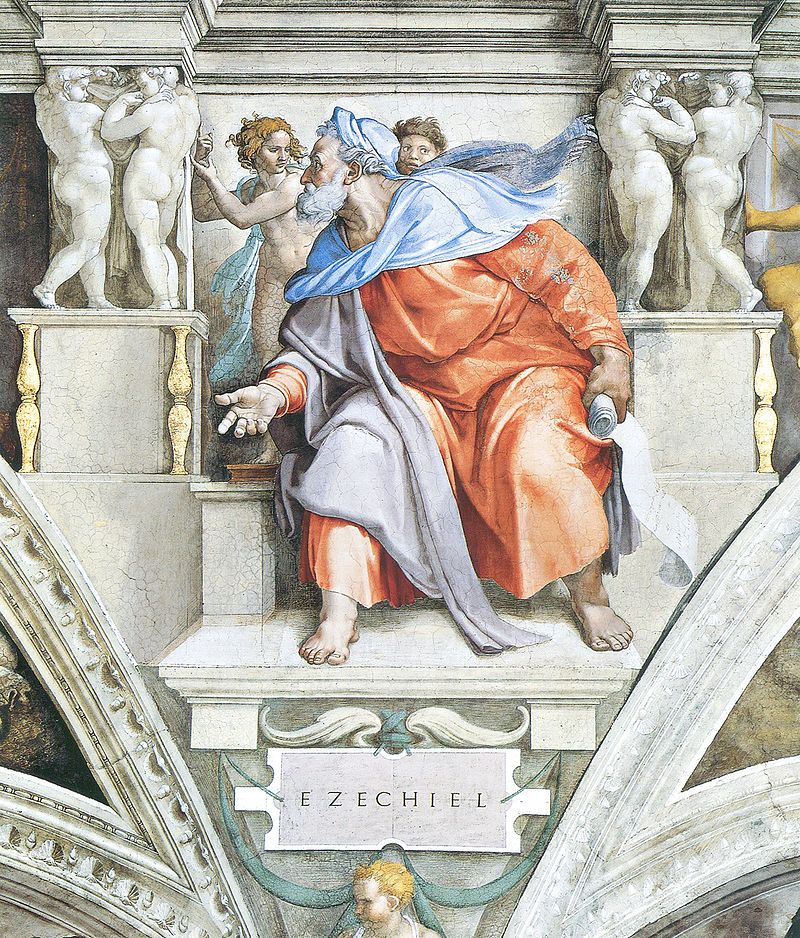
Michelangelo's Ezekiel on the Sistine Chapel
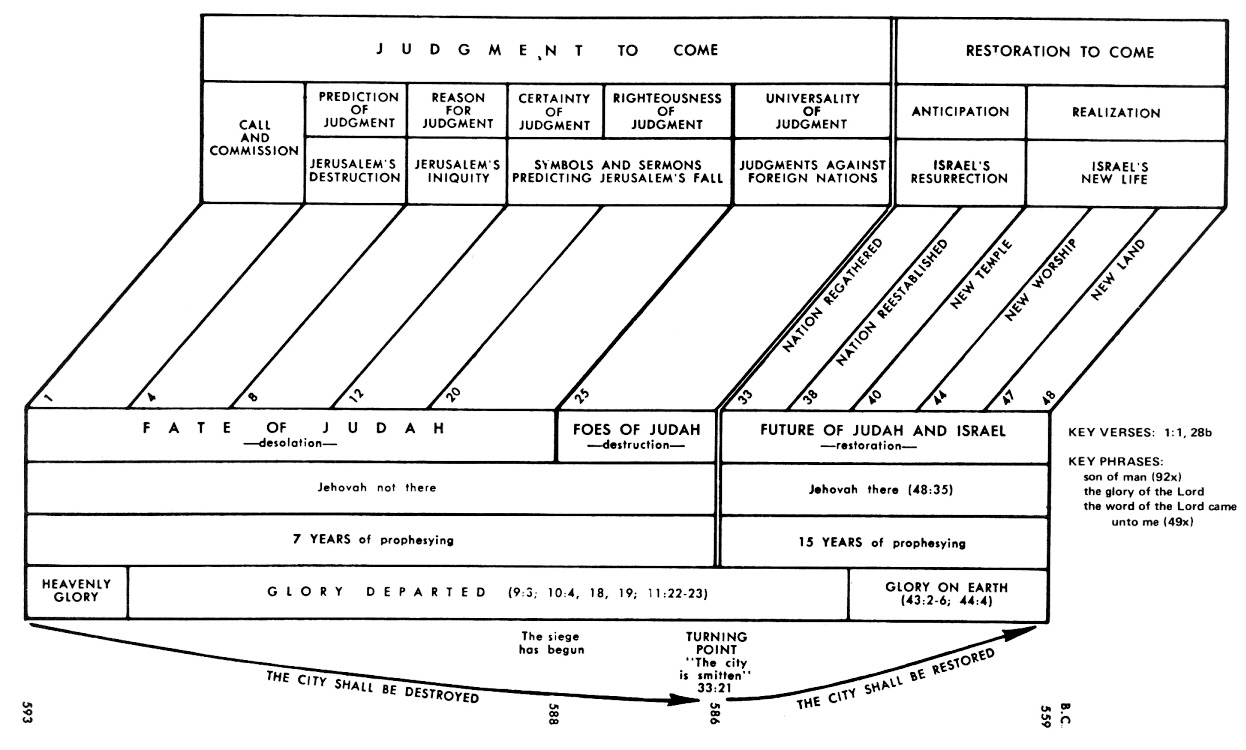
Click chart to enlarge
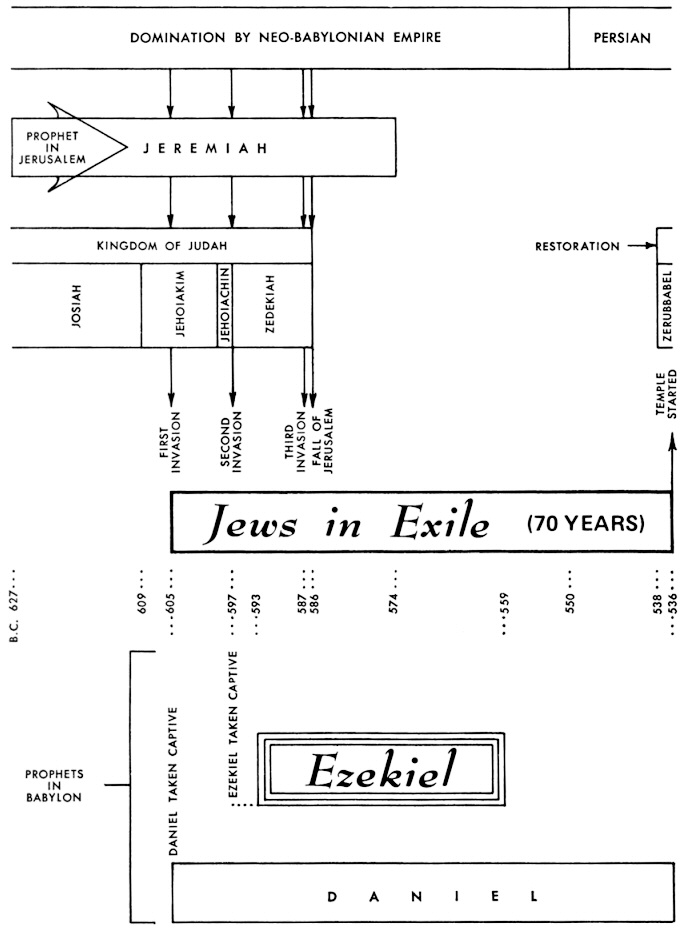
Click chart to enlarge
Chart from recommended resource Jensen's Survey of the OT - used by permission
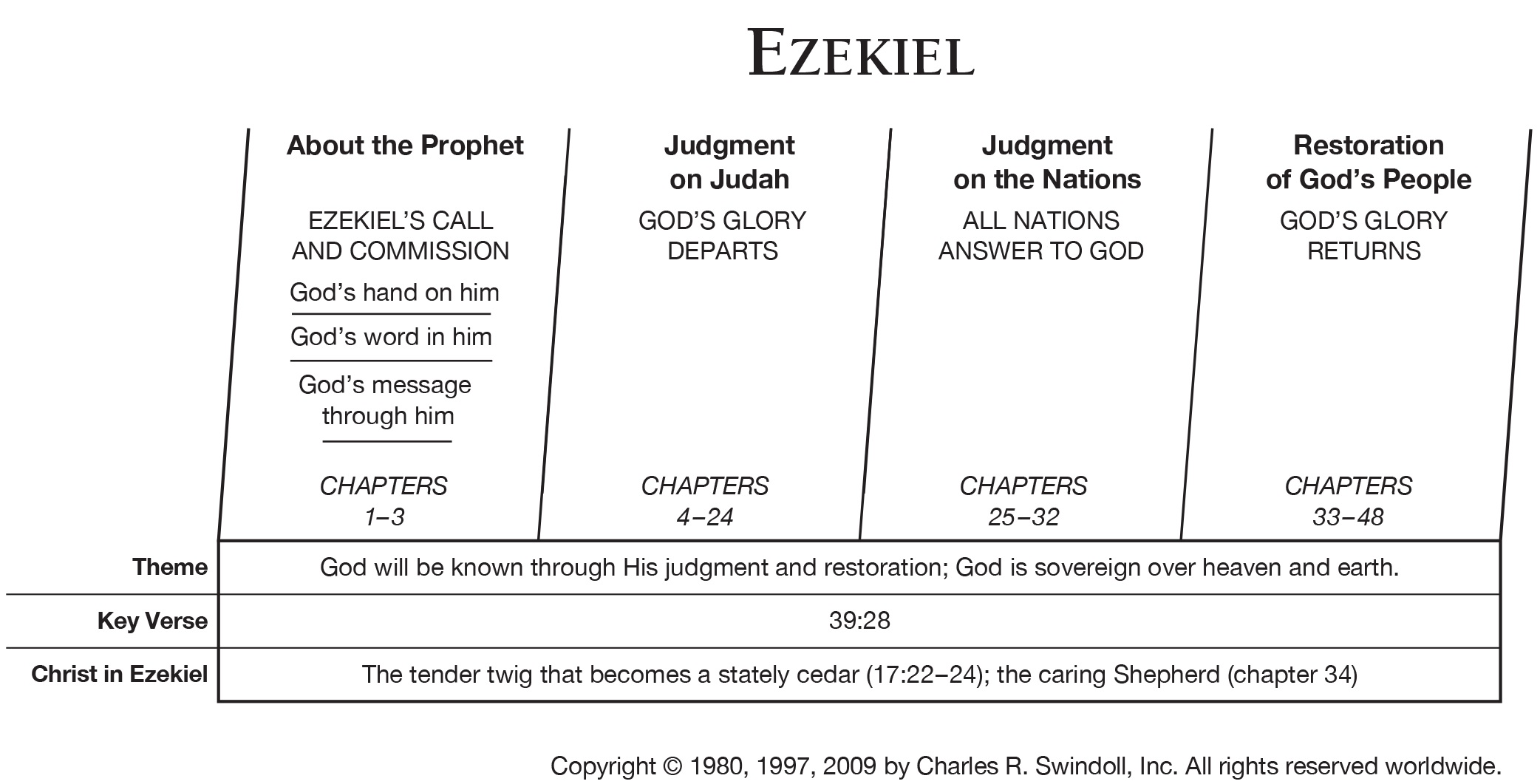
Click Chart from Charles Swindoll
|
PROPHECY OF |
PROPHECY OF |
|||
| FATE OF JUDAH Before the Siege |
FOES OF JUDAH During the Siege |
FUTURE OF JUDAH After the Siege |
||
|
593-588 BC |
587-586 |
586-571 |
||
|
7 YEARS |
15 YEARS |
|||
| Ezekiel 1:1-3:27 Ezekiel Sees the Glory & Receives the Call |
Ezekiel 4:1-24:27 Judgments Against Judah |
Ezekiel 25:1-32:32 Judgments Against the Gloating Nations |
Ezekiel 33:1-39:29 Restoration of Israel to the LORD |
Ezekiel 40:1-48:35 Visions of the Temple Jehovah Shammah |
Outline of the Book of Ezekiel from Dr John MacArthur - The book can be largely divided into sections about condemnation/retribution and then consolation/restoration. A more detailed look divides the book into 4 sections. First, are prophecies on the ruin of Jerusalem (Ezekiel 1:1–24:27). Second, are prophecies of retribution on nearby nations (Ezekiel 25:1–32:32), with a glimpse at God’s future restoration of Israel (Ezekiel 28:25,26). Thirdly, there is a transition chapter (Ezekiel 33:1-33) which gives instruction concerning a last call for Israel to repent. Finally, the fourth division includes rich expectations involving God’s future restoration of Israel (Ezekiel 34:1–48:35). (Reference)
I. Prophecies of Jerusalem’s Ruin (Ezekiel 1:1–24:27)
A. Preparation and Commission of Ezekiel (Ezekiel 1:1–3:27)
1. Divine appearance to Ezekiel (Ezekiel 1:1–28)|
2. Divine assignment to Ezekiel (Ezekiel 2:1–3:27)
B. Proclamation of Jerusalem’s Condemnation (Ezekiel 4:1–24:27)
1. Signs of coming judgment (Ezekiel 4:1–5:4)
2. Messages concerning judgment (Ezekiel 5:5–7:27)
3. Visions concerning abomination in the city and temple (Ezekiel 8:1–11:25)
4. Explanations of judgment (Ezekiel 12:1–24:27)
II. Prophecies of Retribution to the Nations (Ezekiel 25:1–32:32)
A. Ammon (Ezekiel 25:1–7)
B. Moab (Ezekiel 25:8–11)
C. Edom (Ezekiel 25:12–14)
D. Philistia (Ezekiel 25:15–17)
E. Tyre (Ezekiel 26:1–28:19)
F. Sidon (Ezekiel 28:20–24)
Excursus: The Restoration of Israel (Ezekiel 28:25, 26)
G. Egypt (Ezekiel 29:1–32:32)
III. Provision for Israel’s Repentance (Ezekiel 33:1–33)
IV. Prophecies of Israel’s Restoration (Ezekiel 34:1–48:35)
A. Regathering of Israel to the Land (Ezekiel 34:1–37:28)
1. Promise of a True Shepherd (Ezekiel 34:1–31)
2. Punishment of the nations (Ezekiel 35:1–36:7)
3. Purposes of restoration (Ezekiel 36:8–38)
4. Pictures of restoration—dry bones and two sticks (Ezekiel 37:1–28)
B. Removal of Israel’s Enemies from the Land (Ezekiel 38:1–39:29)
1. Invasion of Gog to plunder Israel (Ezekiel 38:1–16)
2. Intervention of God to protect Israel (Ezekiel 38:17–39:29)
C. Reinstatement of True Worship in Israel (Ezekiel 40:1–46:24)
1. New temple (Ezekiel 40:1–43:12)
2. New worship (Ezekiel 43:13–46:24)
D. Redistribution of the Land in Israel (Ezekiel 47:1–48:35)
1. Position of the river (Ezekiel 47:1–12)
2. Portions for the tribes (Ezekiel 47:13–48:35)
Ezekiel 8:10 So I entered and looked, and behold, every form of creeping things and beasts and detestable things, with all the idols of the house of Israel, were carved on the wall all around.
Young's Literal: And I go in, and look, and lo, every form of creeping thing, and detestable beast—and all the Idols of the house of Israel—graved on the wall, all round about
GWT: So I went in and looked. I saw that the walls were covered with drawings of every kind of crawling creature, every kind of disgusting animal, and all the idols in the nation of Israel.
WBC: I went through, and there before my eyes was every kind of horrible object of worship and all the idols of the community of Israel, engraved all over the wall.
NLT: So I went in and saw the walls engraved with all kinds of snakes, lizards, and hideous creatures. I also saw the various idols worshiped by the people of Israel.
Message: I entered and looked. I couldn’t believe my eyes: Painted all over the walls were pictures of reptiles and animals and monsters—the whole pantheon of Egyptian gods and goddesses—being worshiped by Israel.
SO I ENTERED AND LOOKED, AND BEHOLD, EVERY FORM OF CREEPING THINGS AND BEASTS AND DETESTABLE THINGS, WITH ALL THE IDOLS OF THE HOUSE OF ISRAEL, WERE CARVED ON THE WALL ALL AROUND:
- Ex 20:4; Lev11:10, 11, 12,29, 30, 31,42, 43, 44; Dt 4:18; 14:3,7,8; Isa 57:6, 7, 8, 9, 10; Jer 2:26,27; 3:9; 16:18; Ro1:23)
Related Resource: Greek Word Studies on…
- Idols (1497) eidolon
- Idolatry (1495) eidololatreia
- Idolater (1496) eidololatres
Every form of creeping things… detestable things with all the idols The second commandment clearly stated
"You shall not make for yourself an idol, or any likeness of what is in heaven above or on the earth beneath or in the water under the earth" (Ex 20:4)
Related Resource: Idolatry and Immorality - the relationship and the antidote
In Deuteronomy again they were told not to make an image which had "the likeness of anything that creeps on the ground, the likeness of any fish that is in the water below the earth." (Dt 4:18)
In Leviticus God had commanded Israel
Do not render yourselves detestable through any of the swarming things that swarm; and you shall not make yourselves unclean with them so that you become unclean. For I am the LORD your God. Consecrate yourselves therefore, and be holy; for I am holy. And you shall not make yourselves unclean with any of the swarming things that swarm on the earth." (Lev 11:43, 44-note)
God has always desired a holy, set apart people, useful to Him for every good work. Israel situated in the center of the pagan nations had become so defiled that she was now deemed worthless for any good work. All believers need to remember Paul's warning when tempted to point fingers at Israel and say "How could they do such a thing?" -- Paul warned
"Therefore let him who thinks he stands take heed lest he fall." (1Cor 10:12)
"On the wall around" The nature of this abominable "spiritual graffiti" is not further identified. What is important is that God saw it and it was disgusting to Him. "Detestable" (Hebrew = sheqets) is translated in the Septuagint by the Greek word "bdelugma" which refers to something which causes revulsion or extreme disgust (loathsome). Jesus used bdelugma to characterize the antichrist as the "abomination (bdelugma) of desolation" (Mt 24:15) The etymology of this noun is graphically instructive for it is derived from bdelusso which means to emit a foul odor or turn away thru loathing or disgust, abhor. Bdelusso in turn is derived from bdeo meaning to stink. The practices of these 70 elders was essentially a "stench in the nostrils" of God!
Ezekiel 8:11 Standing in front of them were seventy elders of the house of Israel, with Jaazaniah the son of Shaphan standing among (in the midst or middle, in the center) them, each man with his censer in his hand and the fragrance of the cloud of incense rising.
GWT: In front of these drawings stood 70 of Israel's leaders. Jaazaniah, son of Shaphan, was standing with the leaders. Each of them was holding an incense burner in his hand, and a cloud of incense went up.
NLT: Seventy leaders of Israel were standing there with Jaazaniah son of Shaphan in the middle. Each of them held an incense burner, so there was a thick cloud of incense above their heads.
Message: In the middle of the room were seventy of the leaders of Israel, with Jaazaniah son of Shaphan standing in the middle. Each held his censer with the incense rising in a fragrant cloud.
Young's Literal: and seventy men of the elders of the house of Israel—and Jaazaniah son of Shaphan standing in their midst—are standing before them, and each his censer in his hand, and the abundance of the cloud of perfume is going up.
WBC: Seventy of the elders of the community of Israel were standing in front of the engravings—among them was standing Jaazaniah son of Shaphan —each holding a censer in his hand, and incense fumesb were wafting up.
AND STANDING IN FRONT OF THEM WERE SEVENTY ELDERS OF THE HOUSE OF ISRAEL
- Ex 24:1,9; Nu 11:16,25; Jer 5:5; 19:1; Daniel 9:8
What a sad contrast of these seventy (ungodly) elders who represented Israel with the seventy (godly) elders described in (Ex 24:1, 9) who ate the covenant meal before God inaugurating the covenant relationship.
Moses records that God spoke to him saying "Come up to the LORD, you and Aaron, Nadab and Abihu and seventy of the elders of Israel, and you shall worship at a distance… Then Moses went up with Aaron, Nadab and Abihu, and seventy of the elders of Israel."
WITH JAAZANIAH THE SON OF SHAPHAN STANDING AMONG THEM
- 2Ki 22:3,8,12,14; 25:22; 2Chr 34:20; Jer 26:24; 29:3; 36:10
"Jaazaniah" was the "black sheep" of Shaphan's four sons (he may have ha7d more). How did the others "turn out"? Should Jaazaniah have known better? What had his father found in 2Ki 22?
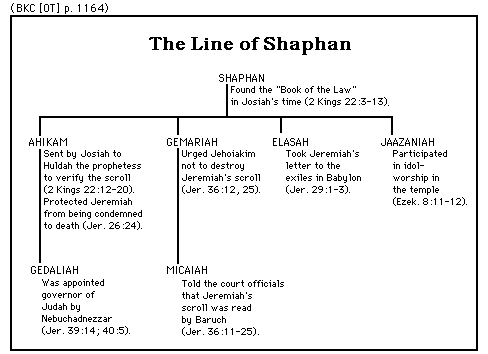
Source: The Bible knowledge commentary, Vol 1, Page 1164
EACH MAN WITH HIS CENSER IN HIS HAND, AND THE FRAGRANCE OF THE CLOUD OF INCENSE RISING.
- Nu 16:17,35; 2 Chr 26:16,19; Jer 7:9
- Torrey's Topic "Incense"
The cloud of incense played a prominent role in screening the high priest on the Day of Atonement (Lev 16:13) Moses recording that the High Priest "shall put the incense on the fire before the LORD, that the cloud of incense may cover the mercy seat that is on the ark of the testimony, lest he die." Here it has become part of a detestable pagan ritual! When one gets away from the Truth, it is incredible how far he will go.
Nelson's Illustrated Bible Dictionary has a nice summary on "Incense" which it defines as
a sweet-smelling substance that was burned as an offering to God on the altar in the tabernacle and the temple. The purpose of this incense offering was to honor God. Incense symbolized and expressed the prayers of the Hebrew people, which were considered a pleasant aroma offered to God. The incense used in Israelite worship was of a specific composition, considered very sacred. The four substances from which it was made were stacte, onycha, galbanum, and pure frankincense (Ex 30:34, 35). Some of this was to be ground into powder and placed in front of the Testimony in the tabernacle of meeting (Ex 30:36). The use of any other composition of incense or of this particular compound for any other purpose was regarded as sin; this incense alone was to be considered holy (Ex 30:36-38). According to the law, only the priests descended from Aaron could offer incense (Lev 2:2). The priest offered holy incense morning and evening on the altar of incense in front of the veil in the Holy Place in the tabernacle or temple.
This incense formula specified for use in public ritual was not to be allowed for private use (Ex 30:37, 38). Apparently some wealthy individuals were tempted to make their own private supply for personal use.Incense is also mentioned in connection with certain pagan worship practices of the Israelites. The worship of Baal, the queen of heaven, and other foreign gods by means of incense was condemned in the Old Testament (1Ki11:8 records that wise King Solomon built high places "for all his foreign wives, who burned incense and sacrificed to their gods"). The Lord warned that he would destroy the pagan incense altars (Lev 26:30; 2Chr. 30:14). The burning of incense at the pagan shrines on “high places” and to other gods was strongly denounced ("Because they have forsaken Me and have burned incense to other gods that they might provoke Me to anger with all the work of their hands, therefore My wrath burns against this place, and it shall not be quenched." 2Ki22:17; 2Ch34:25). The use of incense appeared widespread in connection with Israelite lapses into pagan worship (Jer11:12, 17; 48:35). Another misuse of incense is mentioned in 2Chr26:16, 17, 18, 19, 20, 21. This passage describes how King Uzziah was afflicted by the Lord, who caused leprosy to break out on his forehead because he had attempted to burn incense in the temple. This duty was reserved for the priestly descendants of Aaron. The New Testament church did not adopt the use of incense in worship. In fact, the use of it was considered a work of paganism and was banned by the first Christian emperors. However, later in church history incense was again widely used. In a figurative use of the word, the psalmist requested that his prayer might be brought before the Lord as incense (Ps 141:2)" (Youngblood, R. F., Bruce, F. F., Harrison, R. K., & Thomas Nelson Publishers. Nelson's New Illustrated Bible Dictionary)

This ungodly incense burner, decorated with sacred serpents,
was discovered in the excavation of the Canaanite temple at Beth Shan
Ezekiel 8:12 Then He said to me, "Son of man, do you see what the elders of the house of Israel are committing in the dark, each man in the room of his carved images? For they say, 'The LORD does not see us; the LORD has forsaken the land.' "
Young's Literal: And He saith unto me, ‘Hast thou seen, son of man, that which elders of the house of Israel are doing in darkness, each in the inner chambers of his imagery, for they are saying, Jehovah is not seeing us, Jehovah hath forsaken the land?’
GWT: God asked me, "Son of man, do you see what the leaders of the nation of Israel are doing in secret? Each of them is in the room where his god is, and each one of them is thinking, 'The LORD doesn't see me. The LORD has abandoned this land.'"
WBC: Then he told me, “Just look, human one, at what the elders of the community of Israel are doing in the dark, each at the recess of his image! They justify it with the sentiments that Yahweh cannot see, Yahweh has left the country.”
NLT: Then the LORD said to me, "Son of man, have you seen what the leaders of Israel are doing with their idols in dark rooms? They are saying, 'The LORD doesn't see us; he has deserted our land!'"
Message: He said, “Son of man, do you see what the elders are doing here in the dark, each one before his favorite god-picture? They tell themselves, ‘God doesn’t see us. God has forsaken the country.’ ”
THEN HE SAID TO ME, "SON OF MAN, DO YOU SEE WHAT THE ELDERS OF THE HOUSE OF ISRAEL ARE COMMITTING IN THE DARK, EACH MAN IN THE ROOM OF HIS CARVED IMAGES?
- Ezek 8:6,15,17) (Ezek 8:11; 14:1; 20:1; Ephesians 5:12
- Ezek 8:7,8; Job 24:13, 14, 15, 16, 17; John 3:19,20
Each man in the room of his carved images suggest that each elder had his own "favorite god" (Do we have a "pet" sin?)
FOR THEY SAY, 'THE LORD DOES NOT SEE US; THE LORD HAS FORSAKEN THE LAND:
- Ezek 9:9; Job 22:12,13; Psalms 73:11; 94:7, 8, 9, 10; Isaiah 29:15
What they were really saying in their darkened hearts was that God couldn't see what they were doing in the secret places (even the secret places of their hearts). They were seeking to elders rationalize and justify their sin. When you forget God is omniscient and holy, it becomes "easy" to rationalize your sin. The elders felt that what they did in their darkened chambers would escape God’s notice. They even went so far to say He had abandoned them. Why would they do that? The most obvious reason is because there had already been 2 successful Babylonian invasion of Jerusalem. Their feeling that God had forsaken them reminds one of the saying "When you don't feel close to God, guess who moved!"
Ezekiel 8:13 And He said to me, "Yet you will see still greater abominations which they are committing
Young's Literal: And He saith unto me, ‘Again thou dost turn, thou dost see great abominations that they are doing.’
GWT: Then he said to me, "You will see even more disgusting things that they are doing."
WBC: He also told me, “You have yet to observe rites even more shocking, in which people are engaging.”
NLT: Then he added, "Come, and I will show you greater sins than these!"
Message: Then he said, “You’re going to see worse yet.”
AND HE SAID TO ME, "YET YOU WILL SEE STILL GREATER ABOMINATIONS WHICH THEY ARE COMMITTING:
- Ezek 8:6,15; Jer 9:3, 2Ti 3:13
Ezekiel 8:14 Then He brought me to the entrance of the gate of the LORD'S house which was toward the north; and behold, women were sitting there weeping for Tammuz.
Young's Literal: And He bringeth me in unto the opening of the gate of the house of Jehovah that is at the north, and lo, there the women are sitting weeping for Tammuz.
GWT: He brought me to the entrance of the north gate of the Lord's temple. Women were sitting there and crying for the god Tammuz.
WBC: Then he brought me to the entrance of the north gateway leading to Yahweh’s temple, where I found women sitting, bewailing Tammuz.
NLT: He brought me to the north gate of the Lord's Temple, and some women were sitting there, weeping for the god Tammuz.
Message: He took me to the entrance at the north gate of the Temple of God. I saw women sitting there, weeping for Tammuz, the Babylonian fertility god.
THEN HE BROUGHT ME TO THE ENTRANCE OF THE GATE OF THE LORD'S HOUSE WHICH WAS TOWARD THE NORTH; AND BEHOLD, WOMEN WERE SITTING THERE WEEPING FOR TAMMUZ.:
- Ezek 44:4; 46:9
Ezekiel's reference to "Tammuz" is not to be confused with the calendar designation of the fourth Hebrew month. In the post-exilic Hebrew calendar, "Tammuz" corresponds to June-July. Before the Babylonian Exile, individual months in the Hebrew calendar were usually designated by numbers (although some of the months did have names) and that after the Exile the months received specific names, the first month for example being Nisan (March/April) and the fourth month being Tammuz. Ezekiel's reference is not to the month Tammuz but to a so-called god referred to in Babylonian mythology as "Tammuz", dying and being reborn year after year, a picture representing the yearly cycle of the seasons and the crops.
Henry Morris - Even Jewish women were participating in the phallic cult of Tammuz, a Babylonian nature god who supposedly died and rose again every year, corresponding to the emergence of spring out of winter.
Criswell - "Tammuz," the Babylonian god of nature, was depicted as dying in the scorching heat of summer and lying dormant through the cold winter months. In late fall, festivals of mourning were held, and in the spring a celebration of resurrection was held as the nature-god came back to life. Ezekiel saw the Israelite women joining in the rites of mourning for Tammuz. This was more evidence of the extent of the spiritual decay. In the Oriental culture the women were the most conservative, and usually the last to abandon their former loyalties.
- Wikipedia on Tammuz
Entries below from Unger's Bible Dictionary and John Macarthur's Commentary on First Corinthians provide additional details regarding Tammuz, but keep in mind that most of the information is from extra-biblical sources, so it must be read with appropriate discretion.
Unger's entry records that
Tammuz was known by the Babylonians as Dumuzi, god of pasture and flocks, of subterranean water, and of vegetation. He was the husband-brother of Ishtar (Asherah, fertility goddess). Tammuz supposedly died every autumn when he departed to the underworld; from there he was recovered by the disconsolate Ishtar. His reappearance marked the bursting forth of life in the springtime. The fourth Babylonian month, July, was named in honor of Tammuz, which name was applied in later pos-biblical times by Jews to their fourth month, June-July. Tammuz is equated with the Greek Adonis and the Egyptian Osiris. Allusions to the worship of Tammuz cults seem to be referred to in Jer. 22:18 and Amos 8:10. The worship of this god was widespread throughout the Fertile Crescent from Babylonia-Assyria to Palestine-Syria. The rites of Tammuz included a divine marriage of the king annually to the fertility goddess in the person of a temple priestess. Tammuz worship was especially notorious at Byblos (biblical Gebal) on the Mediterranean." (New Unger's Bible Dictionary. Chicago: Moody Press)
"In its organized form false religion began with the tower of Babel, from which Babylon derives its name. Cain was the first false worshiper, and many individuals after him followed his example. But organized pagan religion began with the descendants of Ham, one of Noah’s three sons, who decided to erect a great monument that would “reach into heaven” and make themselves a great name (Ge10:9, 10, 11:4). Under the leadership of the proud and apostate Nimrod they planned to storm heaven and unify their power and prestige in a great worldwide system of worship. That was man’s first counterfeit religion, from which every other false religion in one way or another has sprung.
God’s judgment frustrated their primary purpose of making a grand demonstration of humanistic unity. By confusing “their language, that they may not understand one another’s speech,” and scattering “them abroad from there over the face of the whole earth” (Gen. 11:7, 8) the Lord halted the building of the tower and fractured their solidarity. But those people took with them the seeds of that false, idolatrous religion, seeds that they and their descendants have been planting throughout the world ever since. The ideas and forms were altered, adapted, and sometimes made more sophisticated, but the basic system remained, and remains, unchanged. That is why Babel, or Babylon, is called “the mother of harlots and of the abominations of the earth” (Rev 17:5). She was the progenitor of all false religions.
From various ancient sources, it seems that Nimrod’s wife, Semiramis (the First), apparently was high priestess of the Babel religion and the founder of all mystery religions. After the tower was destroyed and the multiplicity of languages developed, she was worshiped as a goddess under many different names. She became Ishtar of Syria, Astarte of Phoenicia, Isis of Egypt, Aphrodite of Greece, and Venus of Rome—in each case the deity of sexual love and fertility. Her son Tammuz, also came to be deified under various names and was the consort of Ishtar and god of the underworld.
According to the cult of Ishtar, Tammuz was conceived by a sunbeam, a counterfeit version of Jesus’ virgin birth. Tammuz corresponded to Baal in Phoenicia, Osiris in Egypt, Eros in Greece, and Cupid in Rome. In every case, the worship of those gods and goddesses was associated with sexual immorality. The celebration of Lent has no basis in Scripture, but rather developed from the pagan celebration of Semiramis' mourning for forty days over the death of Tammuz (cf.Ezek. 8:14) before his alleged resurrection—another of Satan’s mythical counterfeits."
Easton's Bible Dictionary adds that "In the Chaldean calendar there was a month set apart in honour of this god, the month of June to July, the beginning of the summer solstice. At this festival, which lasted six days, the worshippers, with loud lamentations, bewailed the funeral of the god… "
Ezekiel 8:15 He said to me, "Do you see this, son of man? Yet you will see still greater abominations than these."
Young's Literal: And He saith unto me, ‘Hast thou seen, son of man? again thou dost turn, thou dost see greater abominations than these.’
GWT: He asked me, "Son of man, do you see this? You will see even more disgusting things than these."
WBC:Just look at that!” he told me. “But you have yet to observe rites even more shocking than seen hitherto.
NLT: Have you seen this?" he asked. "But I will show you even greater sins than these!"
Message: He said, “Have you gotten an eyeful, son of man? You’re going to see worse yet.”
AND HE SAID TO ME, "DO YOU SEE THIS, SON OF MAN? YET YOU WILL SEE STILL GREATER ABOMINATIONS THAN THESE:
- Ezek 8:6,12; 2 Timothy 3:13
Ezekiel 8:16 Then He brought me into the inner court of the LORD'S house. And behold, at the entrance to the temple of the LORD, between the porch and the altar, were about twenty-five * men with their backs to the temple of the LORD and their faces toward the east; and they were prostrating themselves eastward toward the sun.
Young's Literal: And He bringeth me in unto the inner court of the house of Jehovah, and lo, at the opening of the temple of Jehovah, between the porch and the altar, about twenty-five men, their backs toward the temple of Jehovah, and their faces eastward, and they are bowing themselves eastward to the sun.
GWT: Then he brought me into the inner courtyard of the Lord's temple. There at the entrance to the Lord's temple, between the entrance and the altar, were about 25 men who had their backs turned to the Lord's temple. They were facing east and worshiping the rising sun.
WBC: He brought me into the inner court of Yahweh’s temple, and by the entrance to the nave, between the porch and the altar, I found about twenty-five men with their backs to Yahweh’s nave and their faces turned to the east, kowtowing in worship to the sun.
NLT: Then he brought me into the inner courtyard of the Lord's Temple. At the entrance, between the foyer and the bronze altar, about twenty-five men were standing with their backs to the Lord's Temple. They were facing eastward, worshiping the sun!
Message: Finally, he took me to the inside court of the Temple of God. There between the porch and the altar were about twenty-five men. Their backs were to God’s Temple. They were facing east, bowing in worship to the sun.
THEN HE BROUGHT ME INTO THE INNER COURT OF THE LORD'S HOUSE
- Ezek 10:3; 40:28; 43:5; 45:19
He - The Spirit is in control
AND BEHOLD, AT THE ENTRANCE TO THE TEMPLE OF THE LORD, BETWEEN THE PORCH AND THE ALTAR WERE ABOUT TWENTY-FIVE MEN WITH THEIR BACKS TO THE TEMPLE OF THE LORD AND THEIR FACES TOWARD THE EAST
- 2 Ki 16:14; 2 Chr 7:7; Joel 2:17
- Ezek 23:35; 1 Ki 8:29; 2 Chr 29:6; Jer 2:27; 32:33
they adored towards the rising of the sun" (DRA)
they were bowing down to the sun in the east" (NIV)
they were worshiping the sun toward the east" (NKJV),
they were bowing low to the sun in the east" (Tanakh)
their faces toward the east; they were bowing down to the sun" (NAB)
In Jeremiah God describes the leaders which would doubtless include the "25" writing that As the thief is shamed when he is discovered, so the house of Israel is shamed. They, their kings, their princes, and their priests, and their prophets, who say to a tree, 'You are my father,' and to a stone, 'You gave me birth.' For they have turned their back to Me, and not their face; but in the time of their trouble they will say, 'Arise and save us" (Jer 2:26-27) but in verse (below) God says He "will not listen to them."
AND THEY WERE PROSTRATING THEMSELVES EASTWARD TOWARD THE SUN:
- ; Dt 17:3; 2 Ki 23:5,11; Job 31:26, 27, 28; Jer 44:17; Acts 7:42,43
Moses had clearly warned Israel about this very sin of worshiping the creation rather than the Creator before they entered the promised land and this truth was supposed to have been passed down from one generation to another (Dt 4:9-10-note). Clearly it got "jumbled" in transmission (or was never transmitted).
Dt 4:19-note “And beware not to lift up your eyes to heaven and see the sun and the moon and the stars, all the host of heaven, and be drawn away (Lxx translates with planao = misled, caused to wander, cause to be deceived - passive voice = this deception comes from outside the subject - probably the lust of the flesh, the lust of the eyes- 1 Jn 2:16-note), and worship (shachah - same verb used here in Ezek 8:16) them and serve them, those which the LORD your God has allotted to all the peoples under the whole heaven.
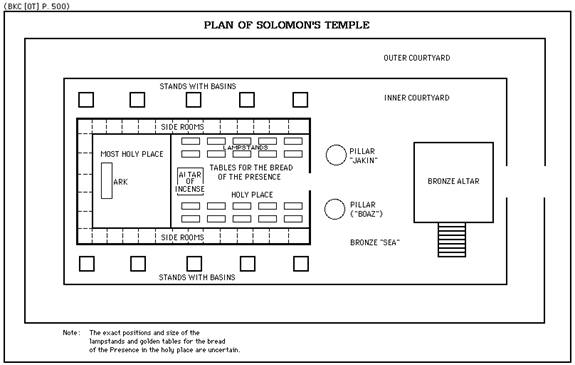
For orientation see schematic below of Solomon's Temple from The Bible knowledge commentary, Vol 1, Page 500
Prostrating themselves eastward toward the sun Look at the diagram below, noting that the Temple faced toward the East (and the Eastern Gate). The "porch" would be somewhere between the two "pillars" in the diagram. Now picture these men bowing down to worship, their faces toward the created Sun and their backs against the Most Holy Place, the Ark of the Covenant and the Creator of all things! God said this was the "greatest abomination" of the four abominations listed in this chapter. It is difficult for me to imagine how they could have become so calloused, so deceived, so depraved… and yet the lesson for all of us is that exposure to great Biblical teaching, wonderful worship, etc, is no guarantee that we will "be holy as He is holy." As I write these notes I'm looking at huge waves crashing against the beach and am reminded of the story of that illustrates how easy it is to drift away. A woman was bathing in the Gulf of Mexico. She was enjoying the comfort of relaxing on an inflated cushion that kept her afloat. When she realized that she had been swept about a half mile out from the beach, she began to scream, but no one heard her. A coast guard craft found her five miles from the place where she first entered the water. She did not see her danger until she was beyond her own strength and ability. Unfortunately when Israel cried out with a loud voice, God refused to listen.
This action by the elders expressed gross contempt for the God of Israel and implied that they had disowned Him and directly violated God’s command in (Deut. 4:19) to "beware, lest you lift up your eyes to heaven and see the sun and the moon and the stars, all the host of heaven, and be drawn away and worship (Hebrew - shachah, translated by Gk proskuneo - see note below) them and serve them, those which the LORD your God has allotted to all the peoples under the whole heaven."
Joel records what actions should have been transpiring in this exact location, writing "Let the priests, the Lord’s ministers,weep between the porch and the altar (the same 2 Hebrew words are used in both descriptions, so this is the same location where the 25 elders were committing gross idolatrous worship) and let them say, “Spare Thy people, O Lord, and do not make Thine inheritance a reproach, a byword among the nations. Why should they among the peoples say, ‘Where is their God?’” (Joel 2:17) This is the location where Zechariah was murdered (Matt 23:35).
Prostrating is the Hebrew verb (shachah- bow down reflexively to royalty) is translated in the Septuagint (LXX) with the Greek verb proskuneo [see word study] , (pros = toward + kuneo = kiss, adore) literally means to kiss toward someone, throw a kiss in token of respect or homage and so to prostrate oneself in homage. The verb is in the present tense indicating continuous action and thus this was their habitual practice. The the ancient Oriental (especially Persian), the mode of salutation between persons of equal ranks was to kiss each other on the lips when the difference of rank was slight, but when one was much inferior, he fell upon his knees touched his forehead to the ground or prostrated himself, throwing kisses at the same time toward the superior. It is this latter mode of salutation that Greek writers express with the verb proskuneo. The Septuagint translation of Gen 19:1 uses proskuneo when "two angels came to Sodom in the evening as Lot was sitting in the gate of Sodom. When Lot saw them, he rose to meet them and bowed down with his face to the ground."
|
NORTH |
EAST |
|
|
Toward Mt of Olives
|

Ezekiel 8:17 He said to me, "Do you see this, son of man? Is it too light a thing for the house of Judah to commit the abominations which they have committed here, that they have filled the land with violence and provoked Me repeatedly? For behold, they are putting the twig to their nose.
Young's Literal: And He saith unto me, ‘Hast thou seen, son of man? hath it been a light thing to the house of Judah to do the abomination that they have done here, that they have filled the land with violence, and turn back to provoke Me to anger? and lo, they are putting forth the branch unto their nose!
GWT: He asked me, "Son of man, do you see this? Isn't it bad enough that the people of Judah have done these disgusting things that you have seen here? Yet, they also fill the land with violence and continue to provoke me even more. Look how they insult me in the worst possible way.
WBC: “Just look at that, human one!” he told me. “It was evidently not enough for the Judean community, after engaging in such shocking rites as they have already engaged in here, to fill the country with violence. Now they have gone further in provoking me to anger: here they are putting branches to their noses.
NLT: "Have you seen this, son of man?" he asked. "Is it nothing to the people of Judah that they commit these terrible sins, leading the whole nation into violence, thumbing their noses at me, and rousing my fury against them?
Message: He said, “Have you seen enough, son of man? Isn’t it bad enough that Judah engages in these outrageous obscenities? They fill the country with violence and now provoke me even further with their obscene gestures.
AND HE SAID TO ME, "DO YOU SEE THIS, SON OF MAN? IS IT TOO LIGHT A THING FOR THE HOUSE OF JUDAH TO COMMIT THE ABOMINATIONS WHICH THEY HAVE COMMITTED HERE, THAT THEY HAVE FILLED THE LAND WITH VIOLENCE AND PROVOKED ME REPEATEDLY?
- Ezek 7:23; 9:9; 11:6; Genesis 6:13; 2Kings 21:16; 24:4; Jeremiah 6:7; 19:4; 20:8; Amos 3:10; 6:3; Micah 2:2; 6:12; Zephaniah 1:9
False worship among God’s people is an abomination to God!
Abominations (detestable, loathsome) (08441)(toebah) refers to an abominable custom or thing. Abomination. Loathsome. Detestable thing. Something or someone who is loathsome and abhorrent.
Baker notes that toebah "is primarily understood in the context of the Law. It identifies unclean food (Dt. 14:3); the activity of the idolater (Isa. 41:24); the practice of child sacrifice (Dt. 12:31); intermarriage by the Israelites (Mal. 2:11); the religious activities of the wicked (Pr 21:27); and homosexual behavior (Lev. 18:22). In a broader sense, the word is used to identify anything offensive (Pr 8:7)." (The Complete Word Study Dictionary: OT)
It is notable that of the 112 OT verses that use toebach over 1/3 (41 verses) are found in Ezekiel! Note 5 uses in Ezekiel 8, an "abomination" filled chapter in the eyes of God!
Ezek. 5:9; Ezek. 5:11; Ezek. 6:9; Ezek. 6:11; Ezek. 7:3; Ezek. 7:4; Ezek. 7:8; Ezek. 7:9; Ezek. 7:20; Ezek. 8:6; Ezek. 8:9; Ezek. 8:13; Ezek. 8:15; Ezek. 8:17; Ezek. 9:4; Ezek. 11:18; Ezek. 11:21; Ezek. 12:16; Ezek. 14:6; Ezek. 16:2; Ezek. 16:22; Ezek. 16:36; Ezek. 16:43; Ezek. 16:47; Ezek. 16:50; Ezek. 16:51; Ezek. 16:58; Ezek. 18:12; Ezek. 18:13; Ezek. 18:24; Ezek. 20:4; Ezek. 22:2; Ezek. 22:11; Ezek. 23:36; Ezek. 33:26; Ezek. 33:29; Ezek. 36:31; Ezek. 43:8; Ezek. 44:6; Ezek. 44:7; Ezek. 44:13;
This same word is used earlier in Ezekiel
Ezekiel 8:6-note Then He said to me, "Son of man (addressing Ezekiel), raise your eyes, now, toward the north." So I raised my eyes toward the north, and behold, to the north of the altar gate was this idol of jealousy at the entrance. 6 And He said to me, "Son of man, do you see what they are doing, the great abominations (toebah) which the house of Israel are committing here, that I should be far from My sanctuary? But yet you will see still greater abominations."
FOR BEHOLD, THEY ARE PUTTING THE TWIG TO THEIR NOSE:
Behold (02009)(hinneh) is an interjection meaning behold, look, now; if. "It is used often and expresses strong feelings, surprise, hope, expectation, certainty, thus giving vividness depending on its surrounding context." (Baker) Hinneh generally directs our mind to the text, imploring the reader to give it special attention. In short, the Spirit is trying to arrest our attention!
The Septuagint translates the unusual phrase putting the twig to their nose with the verb mukterizo (in present tense = their habitual practice) which means strictly speaking to turn up one's nose at something or someone and hence to mock, sneer at or treat with contempt.
NET Note - It is not clear what the practice of "holding a branch to the nose" indicates. A possible parallel is the Syrian relief of a king holding a flower to his nose as he worships the stars (ANEP 281).
Unger on they are putting the twig to their nose - Ezek. 8:17 appears to be a proverbial expression variously interpreted. Some understand it as the barsom, which the Pharisees while praying held in front of the mouth as a magical mode of driving demons away. Two other explanations may be given—that it is a proverbial expression, “to apply the twig to anger,” in the sense of adding fuel to the fire. The second, that of Hitzig, “They apply the sickle to their nose,” i.e., by seeking to injure me they injure themselves (Keil, Com., ad loc.).
King James Bible Commentary - The exact meaning of put the branch to their nose is not clear, but the context associates it with defiance. Any statement beyond this appears to be mere speculation, but it should be noted that historically their nose is traditionally held to be a scribal correction for my nose. This would be an attempt on the part of the scribe, or scribes, to avoid such a crude reference to God. “Early Jewish commentators translated branch as ‘stench.’ The result, ‘they put forth a stench before my nose’ … falling more appropriately in the category of obscenity rather than of Tammuz-worship” (Taylor, p. 100). To say that anything stinks in God’s nostrils is not a pretty phrase to employ, but it should be remembered that the forms of idolatry were not pretty either.
Tom Constable's Notes on the Bible - The Lord explained that not only had the Judahites committed all these abominations but they had also filled the land with violence and provoked Him repeatedly. Putting a twig to the nose was evidently part of the ritual practice of sun worship. Another interpretation views this expression as describing some gross insult against God, something like creating a stench in God's nose. Perhaps both meanings are correct.
Ezekiel 8:18 "Therefore, I indeed will deal in wrath. My eye will have no pity nor will I spare; and though they cry in My ears with a loud voice, yet I will not listen to them."
Young's Literal: And I also deal in fury, Mine eye doth not pity, nor do I spare, and they have cried in Mine ears—a loud voice—and I do not hear them.’
GWT: So I will take action because I'm angry, and I won't have compassion for them or feel sorry for them. Even if they shout in my ears, I won't listen to them."
WBC: My reaction will be one of wrath. I will give no look of pity and show no compassion. However loudly they cry out for me to hear, I will not listen to them.”
NLT: Therefore, I will deal with them in fury. I will neither pity nor spare them. And though they scream for mercy, I will not listen."
Message: That’s it. They have an angry God on their hands! From now on, no mercy. They can shout all they want, but I’m not listening.”
THEREFORE, I INDEED SHALL DEAL IN WRATH. MY EYE WILL HAVE NO PITY NOR SHALL I SPARE
- Ezek 5:11, 12, 13; 7:4, 5, 6, 7, 8, 9; 9:5,10; 16:42; 24:13; Nahum 1:2)
Therefore I will act in furious anger, my eye will not pity them nor will I spare them" (NET)
The Hebrew verb translated "deal" (NET = "I will act") reflecting what God will do to Judah is the same Hebrew verb translated "commit" describing the abominations Judah had committed in (Ezek 8:6, 9, 12, 13, 17)
AND THOUGH THEY CRY IN MY EARS WITH A LOUD VOICE, YET I SHALL NOT LISTEN TO THEM:
- Judges 10:13,14; Proverbs 1:28; Isaiah 1:15; 59:2; Jeremiah 11:11; 14:12; Micah 3:4; Zechariah 7:13; Luke 13:25)
God says in essence that if His people chose to ignore Him, that He would "ignore" their cries in the day of distress. The Message is about as direct as a translation can get paraphrasing it bluntly as "That's it. They have an angry God on their hands! From now on, no mercy. They can shout all they want, but I’m not listening.”
"Yet I will not listen to them" was explained by God earlier when He told Ezekiel that the sons of Israel were a rebellious house, stubborn and obstinate and unwilling to listen to God. (cf Ezek 3:7)
Solomon gives an excellent "commentary" to help understand why God would not listen to them when destruction began to rain down on Jerusalem, writing of the naive, fools and scoffers that
"because I called, and you refused; I stretched out my hand, and no one paid attention and you neglected all my counsel, and did not want my reproof I will even laugh at your calamity; I will mock when your dread comes, when your dread comes like a storm, and your calamity comes on like a whirlwind, when distress and anguish come on you. Then they will call on me, but I will not answer; they will seek me diligently, but they shall not find me because they hated knowledge, and did not choose the fear of the LORD. They would not accept my counsel, they spurned all my reproof. So they shall eat of the fruit of their own way, And be satiated with their own devices. For the waywardness of the naive shall kill them, and the complacency of fools shall destroy them. But he who listens to me shall live securely, And shall be at ease from the dread of evil." (Pr 1:24-33)