Galatians 2:2
Galatians 2:3
Galatians 2:4
Galatians 2:5
Galatians 2:6
Galatians 2:7
Galatians 2:8
Galatians 2:9
Galatians 2:10
Galatians 2:11
Galatians 2:12
Galatians 2:13
Galatians 2:14
Galatians 2:15
Galatians 2:16
Galatians 2:17
Galatians 2:18
Galatians 2:19
Galatians 2:20
Galatians 2:21
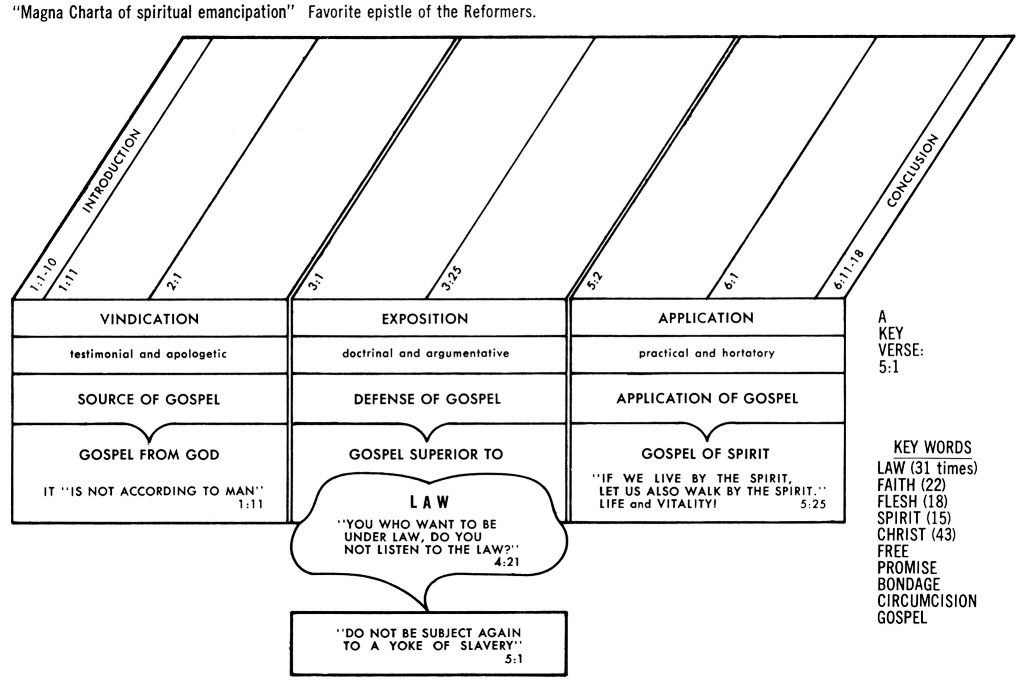
Magna Carta of Spiritual Emancipation
Click chart to enlarge
Charts from Jensen's Survey of the NT - used by permission
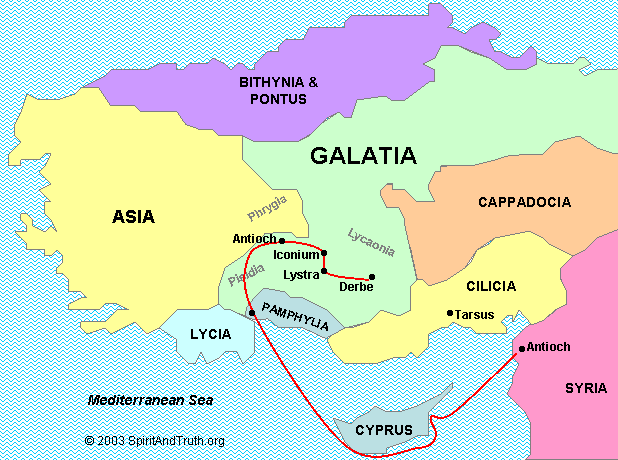
Click to Enlarge
See Also:
Paul's First Missionary Journey
Paul's Second Missionary Journey
Paul's Third Missionary Journey
Maps from Holman Bible Atlas (digital book; Hardcover/Paperback version) copyright © 1998 B&H Publishing Group, used by permission, all rights reserved.
This is one of the best resources for Bible maps as the maps also include helpful short descriptions of the events portrayed on the maps.
| SUMMARY CHART: EPISTLE TO THE GALATIANS |
|||||||
| Gospel of Grace Defended |
Gospel of Grace Explained |
Gospel of Grace Applied |
|||||
| Defense of the Gospel Gal 1:1-2:21 |
Freedom from Legalism Gal 3:1-4:31 |
Freedom to Love and to Serve Gal 5:1-6:18 |
|||||
| Labor | Liberty | Life | |||||
| Authority Not Opinion |
Freedom Not Bondage |
Spirit Not Flesh |
|||||
| Personal Autobiography |
Doctrinal Accuracy |
Practical Application |
|||||
| Paul the Apostle (Gal 1:1-24) |
Paul's Authority (Gal 2:1-21) |
Justified by Faith not Works (Gal 3:1-9) |
Justified by Faith not the Law (Gal 3:10-4:20) |
Grace and Law Cannot Co-Exist (Gal 4:21-31) |
Position and Practice of Liberty (Gal 5:1-15) |
Power of Liberty
(Gal 5:16-26) |
Performance in Liberty
(Gal 6:1-18) |
| Vindication | Exposition | Application | |||||
| Testimonial and Apologetic |
Doctrinal and Argumentative |
Practical and Hortatory |
|||||
| Biographical Explanation |
Doctrinal Exposition |
Practical Exhortation |
|||||
| Authentication of Liberty |
Argumentation for Liberty |
Application of Liberty |
|||||
|
Style or Tone: Vigorous, blunt, aggressive, direct, corrective, urgent, brief, righteous anger, strong words |
|||||||
|
Theme: Justification by Faith and not by Works of the Law |
|||||||
|
Author: Paul in large letters (Gal 6:11) |
|||||||
|
Recipients: Churches in Galatia (Gal 1:2) (Most likely the Southern Region) |
|||||||
|
Christ in Galatians: Jesus is the Source and Power for the believer's New Life. (Gal 2:20, 5:16) |
|||||||
Galatians 2:20 "I have been crucified with Christ; and it is no longer l who live, but Christ lives in me and [the life] which I now live in the flesh I live by faith in the Son of God, who loved me and gave Himself up for me. (NASB: Lockman)
Greek: Christo sunestauromai (1SRPI) zo (1SPAI) de ouketi ego, ze (3SPAI) de en emoi Christos; o de nun zo (1SPAI) en sarki, en pistei zo (1SPAI) te tou huiou tou theou tou agapesantos (AAPMSG) me kai paradontos (AAPMSG) heauton huper emou.
Amplified: I have been crucified with Christ [in Him I have shared His crucifixion]; it is no longer I who live, but Christ (the Messiah) lives in me; and the life I now live in the body I live by faith in (by adherence to and reliance on and complete trust in) the Son of God, Who loved me and gave Himself up for me. (Amplified Bible - Lockman)
Barclay: I have been crucified with Christ. True, I am alive; but it is no longer I who live but Christ who lives in me. The life that I am now living, although it is still in the flesh, is a life which is lived in faith in the Son of God, who loved me and gave himself for me. (Westminster Press)
KJV: I am crucified with Christ: nevertheless I live; yet not I, but Christ liveth in me: and the life which I now live in the flesh I live by the faith of the Son of God, who loved me, and gave himself for me.
NLT: I myself no longer live, but Christ lives in me. So I live my life in this earthly body by trusting in the Son of God, who loved me and gave himself for me. (NLT - Tyndale House) (Note: "I have been crucified with Christ" is found in 2:19 (see explanation below)
Phillips: As far as the Law is concerned I may consider that I died on the cross with Christ. And my present life is not that of the old "I", but the living Christ within me. The bodily life I now live, I live believing in the Son of God, who loved me and sacrificed himself for me (Phillips: Touchstone)
Wuest: With Christ I have been crucified, and it is no longer I who live, but there lives in me Christ. And that life which now I live in the sphere of the flesh, by faith I live it, which faith is in the Son of God who loved me and gave himself on my behalf. (Eerdmans Publishing - used by permission)
Young's Literal: with Christ I have been crucified, and live no more do I, and Christ doth live in me; and that which I now live in the flesh -- in the faith I live of the Son of God, who did love me and did give himself for me;
I HAVE BEEN CRUCIFIED WITH CHRIST: Christo sunestauromai (1SRPI) :
- Gal 5:24; Gal 6:14; Ro 6:4, 6; Ro 8:3-4; Col 2:11-14
- Click here for numerous Devotionals and Illustrations related to Galatians 2:20
- Galatians 2 Resources - Multiple sermons and commentaries
Related Passages:
Galatians 5:24 (NOTE CO-CRUCIFIXION TAKES CARE OF ONE ENEMY - THE FLESH) Now those who belong to Christ Jesus have crucified the flesh with its passions and desires.
Galatians 6:14 (NOTE CO-CRUCIFIXION TAKES CARE OF ANOTHER ENEMY - THE WORLD) But may it never be that I would boast, except in the cross of our Lord Jesus Christ, through which the world has been crucified to me, and I to the world.
Romans 6:4 Therefore we have been buried with Him through baptism into death, so that as Christ was raised from the dead through the glory of the Father, so we too might walk in newness of life (AKA, "RESURRECTION LIFE"!)
Romans 6:6 knowing this, that our old self (MAN) was crucified with Him, in order that (PURPOSE CLAUSE) our body of sin might be done away with, so that (ANOTHER PURPOSE CLAUSE) we would no longer be slaves to sin;
Romans 8:3-4 For what the Law could not do, weak as it was through the flesh, God did: sending His own Son in the likeness of sinful flesh and as an offering for sin, He condemned sin in the flesh, 4 so that the requirement of the Law might be fulfilled in us, who do not walk according to the flesh but according to the Spirit.
Colossians 2:11-14 and in Him you were also circumcised with a circumcision made without hands, in the removal of the body of the flesh by the circumcision of Christ; 12 having been buried with Him in baptism, in which you were also raised up with Him through faith in the working of God, who raised Him from the dead. 13 When you were dead in your transgressions and the uncircumcision of your flesh, He made you alive together with Him, having forgiven us all our transgressions, 14 having canceled out the certificate of debt consisting of decrees against us, which was hostile to us; and He has taken it out of the way, having nailed it to the cross.
THE CONTEXT FOR
"THE EXCHANGED LIFE"
Why does Paul make this great affirmation at this point in his argument in Galatians 2? As he explains in the preceding context "it was because of the false brethren who had sneaked in to spy out our liberty which we have in Christ Jesus, in order to bring us into bondage." (Galatians 2:4) Paul goes on to add that Cephas (Peter), Barnabas and other leading Jews had become hypocritical in calling for saved Gentiles to live like Jews in so doing "were not straightforward about the truth of the gospel." (Gal 2:14) Paul refutes this crucial error by reviewing that a man is justified or declared righteous before God by faith in Jesus Christ and not by keeping the Law…
We are Jews by nature and not sinners from among the Gentiles. (Paul acknowledges that he and the others were indeed Jewish). Nevertheless (now he interjects a contrast and speaks of how one is declared righteous before God independent of whether he is a Jew or Gentile) knowing that a man is not justified (declared righteous) by the works of the Law but (strong contrast!) through faith in Christ Jesus, even we have believed in Christ Jesus, so that we may be justified by faith in Christ and not by the works of the Law (Paul repeats this truth because it is absolutely foundational to genuine salvation); since by the works of the Law no flesh will be justified. But if (as was the case = "Christian Jews, in seeking to be justified in Christ, were shown to be sinners just like and in the same class as the Gentiles" Wuest), while seeking to be justified in Christ, we ourselves have also been found sinners, is Christ then a minister of sin ("Paul repudiates the false assumption of the Judaizers who charged that Christ is the promoter and encourager of sin in that He causes the Jew to abandon the law as a justifying agency, and in doing so, puts himself on the common plane of a Gentile whom he calls a sinner and a dog. The Judaizers argued that in view of the fact that violation of the law is sin, therefore, abandonment of the law in an effort to be justified in Christ is also Sin. Thus Christ is the Promoter of sin." - Wuest)? May it never be! ("Away with the thought.”) For if I rebuild what I have once destroyed ("The false system of salvation through legalism (see note on 1:13), done away with by the preaching of salvation by grace alone through faith alone." - MacArthur), I prove myself to be a transgressor. For through the Law I died to the Law, so that I might live to God ("When a person is convicted of a capital crime and executed, the law has no further claim on him. So it is with the Christian who has died in Christ (who paid the penalty for his sins in full) and rises to new life in Him—justice has been satisfied and he is forever free from any further penalty." - MacArthur). (Galatians 2:16-19)
Henry Morris in his comments on Galatians 2:20 rightly says that "Here is the great secret of a Christ-honoring Christian life. As Paul wrote to the Romans, "Reckon ye also yourselves to be dead indeed unto sin, but alive unto God through Jesus Christ, our Lord" (Romans 6:11). Christ lives in us by His Spirit (John 14:16,17,23). Since He is continually present in and with the believer, He knows all we say and do, hears our prayers and guides our steps as we follow His will.
John Brown introduces Galatians 2:20 commenting that Paul has just stated "I am completely delivered from the law. The law has no more to do with me, and I have no more to do with it in the matter of justification. And this freedom from law is at once necessary and effectual to my living a truly holy life--a life devoted to God." What follows is explanatory of this thought, which was every present in the apostle's mind -- "I consider myself as identified with the Lord Jesus Christ. I am crucified with with Christ. I view myself as so connected with Christ, as that when He was crucified, I was, as it were, crucified… I am redeemed from the law and its curse, he having become a curse for me. Nevertheless I live. Christ died, and in Him I died. Christ revived and in Him I revived. I am a dead man with regard to the law, but I am a living man in regard to Christ… The life I have now, is not the life of a man under the law, but the life of a man delivered from the law; having died and risen again with Christ Jesus, Christ's righteousness justifies me, Christ's Spirit animates me. My relations to God are his relations. The influences under which I live are the influences under which He lives. Christ's views are my views; Christ's feelings my feelings. He is the soul of my soul, the life of my life. My state, my sentiments, my feelings, my conduct, are all Christian… I live by faith… The belief of the truth is the regulating principle of my conduct. It is as it were the soul of the new creature. I no longer think or feel or act like a Jew--like a man born merely after the flesh. All my opinions, sentiments, habits, are subject to the truth about Him "Who loved me and gave Himself for me" and I live devoted to him who died devoted for me." (An Exposition of the Epistle of Paul to the Galatians)
Steve Lewis sums up this section noting that "The effect of being justified by faith alone (Gal 2:16) is to make a person dead to the law. Since he is now truly alive, he can really live for God! Justification by faith also brings the indwelling ministry of the Holy Spirit (Ed: The Spirit of Jesus = Acts 16:7, The Spirit of Christ = Ro 8:9, The Spirit of His Son = Gal 4:6, The Paraclete, our Enabler, our source of spiritual power for a supernatural life = Jn 14:16, 17, Lk 24:49) into the life of the believer. The impact of teaching the necessity of obeying the Jewish Law was to destroy the doctrine of the Gospel and to make the death of Christ useless! (Galatians 2:11-21 Notes)
Oswald Chambers - Galatians 2:20 is foundation truth and experimental truth in one—These words mean the breaking of my independence and surrendering to the supremacy of the Lord Jesus. No one can do this for me, I must do it myself. There is no possibility of debate when once I am there. It is not that we have to do work for God, we have to be so loyal to Jesus Christ that He does His work through us. We learn His truth by obeying it. (He shall glorify me : Talks on the Holy Spirit and other themes)
Hymns Associated with Galatians 2:20
- CHRIST LIVETH IN ME
- I AM COMING TO THE CROSS
- IS IT FOR ME?
- NOT I, BUT CHRIST
- O BLESSÈD LORD, WHAT HAST THOU DONE!
- O JESUS CHRIST, GROW THOU IN ME
- WAS IT FOR ME
- WAS IT FOR ME
- WITHIN MY HEART, O LORD, FULFILL
Rob Morgan introduces his sermon on this verse with these comments…
If you could have one verse of Scripture engraved onto your tombstone, what would it be? Or if you could have one verse and only one scripted and framed to hang in your living room or kitchen, which verse would you choose? Or, to put it a little differently, if someone were to write a biography of your life and put one verse on the title page, what verse would best summarize your aspirations and experiences as a Christian?
I'd like to suggest that out of the 31,102 verses in the Bible, you'd have a hard time coming up with a better choice than the verse I'd like to use as a text today--Galatians 2:20. It says:
I am crucified with Christ: nevertheless I live; yet not I, but Christ liveth in me: and the life which I now live in the flesh I live by the faith of the Son of God, who loved me, and gave himself for me (KJV).
This is a verse I memorized during my college days; I've been mulling over it for twenty-five years, but I have yet to plumb its depths. In simplest fashion, it seems to present three configurations to the Christian life. (He goes on to discuss this verse in three categories "The Relinquished Life", "The Exchanged Life" and "The Trusting Life" - To read his full exposition click This Is The Life).
This is undoubtedly one of Paul's most profound statements so the reader is well advised to approach its study with an attitude of prayer and dependence on the teaching of the Spirit…
Lord please "Open (our) eyes, that I may behold Wonderful things from Thy law." Amen. (Psalm 119:18) (See Spurgeon's comments)
Most writers feel that Galatians was Paul’s earliest letter, written to the churches of South Galatia around AD 49-50.
Keep the context in mind (you might go back and read the entire book if you have time) as you study and meditate on this great verse. Specifically remember that Paul has been addressing an audience who has been seeking to be justified through the works of the Law. This group, who many think were the so-called "Judaizers", were promoting righteousness through a slavish adherence to the Law’s demands. Paul is saying that attainment of righteousness in this manner (by human effort) is impossible and cannot happen. In fact he is saying that it need not happen, writing that
"through the Law I died to the Law, that I might live to God." (Galatians 2:19)
In other words, what he is leading up to with this declaration is that when Jesus died, I died. He is saying that the Law has no more claim on me, nor do I have make futile attempts to keep the Law for the purpose of justification. Why do I need to labor endlessly trying to satisfy the Law’s demands when I satisfied them in Christ when I died with Him?’ This is the context in which Paul makes one of the most profound statements in all of Scripture.
The Phillips paraphrase emphasizes this context rendering it…
As far as the Law is concerned I may consider that I died on the cross with Christ. And my present life is not that of the old "I", but the living Christ within me. The bodily life I now live, I live believing in the Son of God, who loved me and sacrificed himself for me (Phillips: Touchstone) (Bolding added)
Spurgeon explains that Paul as…
the apostle of the Gentiles delighted to think that as one of Christ’s chosen people, he died upon the tree in Christ. He did more than believe this doctrinally, however, he accepted it confidently, resting his hope upon it. He believed that by virtue of Jesus Christ’s death, he had himself paid the law its due, satisfied divine justice, and found reconciliation with God. Beloved, what a blessed thing it is when the soul can, as it were, stretch itself upon the cross of Christ, and feel
“I am dead; the law has killed me, cursed me, slain me, and I am therefore free from its power, because in my Surety I have borne the curse, and in the person of my Substitute the whole that the law could do, by way of condemnation, has been executed upon me, for I am crucified with Christ” [Metropolitan Tabernacle Pulpit, vol. XIII, 642].
Expositor's Bible Commentary introduces Galatians 2:15-21 commenting that…
The verses that conclude this chapter contain capsule statements of some of the most significant truths of Christianity. In particular, Paul clearly states the doctrine of justification by grace through faith and defends it over against the traditional objection that justification by faith leads to lawlessness. The words "justify" and "justification" occur in these verses for the first time--the verb, three times in v.16 and once in v.17; the noun, in v.21 -- as Paul now begins to develop the message that is central to the letter, to his gospel, and indeed to Christianity generally… (Paul emphasizes in Gal 2:20 that) He has died to law so that he might live for God, but this is true only because he has been joined to the Lord Jesus Christ by God the Father. (Expositor's Bible Commentary)
Note that in the Greek sentence, with Christ is placed first, this order throwing special emphasis on Christo. In other words Paul's personal union with Christ became from that time the focal point of His life, entailing a fellowship with Christ's crucifixion, a very real, albeit spiritual crucifixion of Paul's heart and will. In fact to be technically accurate, it should be noted that the original Greek manuscripts (both the Nestle-Aland = NASB and the Textus Receptus = KJV) the sentence begins in Galatians 2:19 with the phrase "with Christ I have been crucified" present at the end of that verse. This explains why some versions such as the NLT seem have "deleted" the phrase "I have been crucified with Christ". (see NLT above)
"I" (1473) (ego) is the first person singular pronoun. This personal pronoun when used with a verb (as in this verse) intensifies and emphasizes the subject of that verb. Paul is clearly conveying the truth that this work of crucifixion with Christ is personal, for the Apostle changed from his use of the first person plural to multiple uses of the first person singular, “I” and “me.”
Crucified with Christ - This describes a our spiritual death with Christ some 2000 years ago, a very real supernatural, albeit somewhat "mystical" event that occurred in the past in the eyes of God. The "I" that begins this verse is the old self (= the old man), the evil "I" who was crucified and therefore no longer has a valid claim on our life, for we are no longer in Adam but in Christ. This is now our position before God and it should be reflected in our daily practice. When we became a believer by grace through faith there was a decisive death to the old (unbelieving, rebellious) self. Now in newness of life we are to work out our salvation (Php 2:12, 13-see notes 2:12; 13) moment by moment by faith in Christ Who loved us and gave Himself for us.
S Lewis Johnson writes that Paul's phrase crucified with Christ "cannot refer to a physical death with Christ… It, therefore, refers to a spiritual death by identification with Him. He is Paul's (and our) representative, who has borne the penalty of God's Law in our place. In this death with Him, then, we and Paul are freed from the reign of the Law (cf. Mt 27:51; Ro 7:1, 2, 3, 4, 5, 6-see notes ). The perfect tense, which includes an emphasis upon the abiding results of an action, stresses the fact that His death and our death with Him have abiding results. (Read his full message on Galatians 2:15-21)
Wil Pounds writes that Galatians 2:20 reads literally "With Christ I have been co-crucified." When I believed on Christ I was so united with Christ, so linked with Him, that I am now so much a part of Him that His crucifixion positionally becomes my crucifixion. A part of me died at the cross. My old carnal nature was slain at the cross. Yet, I don't live in that death. The life I now live, I live in resurrection power. Christ's resurrection has become my resurrection. The life I now live, I live in faith in the Son of God who gave Himself for me.
John Eadie writes (Dr. Ralph Martin says of Eadie… "Everything that John Eadie wrote is pure gold. He was simply the best exegete of his generation. His commentaries on Paul's epistles are valued highly by careful expositors.")
“I have been crucified with Christ.” Wondrous words! I am so identified with Him, that His death is my death. When He was crucified, I was crucified with Him. I am so much one with Him under law and in suffering and death, that when He died to the law I died to the law. Through this union with Him I satisfied the law, yielded to it the obedience which it claimed, suffered its curse, died to it, and am therefore now released from it—from its accusations and its penalty, and from its claim on me to obey it as the means of winning eternal life. By means of law He died; it took Him and wrought its will on Him. As our Representative in whom we were chosen and in whom we suffered, He yielded Himself to the law, which seized Him and nailed Him to the cross. When that law seized Him, it seized at the same time all His in Him, and through the law they suffered and died to it. Thus it is that by the law taking action upon them as sinners they died to the law. This is the view generally of Meyer, Ellicott, Alford, and Gwynne. At the same time, the passage is not parallel to the latter portion of the seventh chapter of Romans; for there the apostle shows the powerlessness of the law to sanctify as well as to justify. Yet the law is not in itself to blame, for it is “holy, and just, and good;” and it has its own functions—to reveal sin in the conscience, to irritate it into activity, and to show its true nature as being “exceeding sinful.” When sin revives, the sinner dies—not the death referred to in the passage before us, but spiritual death and misery. And now certainly, if the law, avenging itself on our guilt, has in this way wrought our release from itself—has set us for ever free from its yoke, and we have died to it and have done with it; then he who would re-enact legalism and bring men under it, proves himself its transgressor, nay, opposes its deepest principles and its most gracious design. But release from law is not lawlessness. We die to sin as well as to the law which is “the strength of sin,”—and “Christ died unto sin once.” But death to the law is followed by life to God as its grand purpose—“that I might live to God,” even as Christ “liveth unto God.” Life in a high spiritual form succeeds that death to the law—life originated and fostered by the Spirit of God—the life of faith—the true life of the soul or Christ living in it…
To live to one's self is to make self the one study—to bend all thoughts, acts, and purposes on self as the sole end; so that the inquiry, how shall this or that tell upon self either immediately or more remotely, deepens into a species of unconscious instinct. To live to God is to be in Him—in union with Him, and to feel the assimilating influence of this divine fellowship—to give Him the first place in the soul, and to put all its powers at His sovereign disposal—to consult Him in everything, and to be ever guided by His counsel—to do His will, because it is His will, at all times—to regard every step in its bearing on His claims and service, and to further His glory as the one grand end of our lives. Such is the ideal in its holy and blessed fulness. Alas, how seldom can it be realized! Such a life must be preceded by this death to the law through the law, for the legal spirit is one of bondage, failure, and unhappiness,— works done in obedience to law to ward off its penalty, with the consciousness that all the while the perfect fulfilment of the law is impossible,—God being viewed as the lawgiver and judge in their sterner aspects, and not in His grace, so as to win our confidence and our unreserved consecration. The clause is connected with the one before it, and not with the following one—“I have been crucified with Christ.” The meaning of the words has been already considered—the wondrous identity of the saint with his Saviour. See under Phil 3:9, 10, 11. Compare Ro 6:4, 8; Ro 8:17; Ep 2:5; Col. 2:12, 20; 2Ti 2:11. (Commentary on Galatians)
Crucified with (4957) (sustauroo from sun = together with, speaks of an intimate union + stauróo = to crucify from stauros = cross) means to crucify, affix or nail to a cross with another. Only the worst criminals suffered crucifixion in Paul’s day. This same verb was used of the 2 thieves who were "crucified with" Christ although only one was "vicariously" or "spiritually" crucified with Him, specifically the one who "was saying (imperfect tense = over and over again) Jesus, remember me when You come in Your kingdom! (Luke 23:42)
As alluded to above, the preposition sun (see discussion) speaks of a believer's union or identification with Christ (see "Union With Christ"). The use of the perfect tense is very instructive, signifying that the believer has been crucified with Christ at a specific point in time in the past and that the effects of this this crucifixion persist or continue into the present. Stated another way, the perfect tense speaks of a past completed action having present finished results.
AN INSEPARABLE, ETERNAL,
TRANSCENDENT SPIRITUAL UNION
To digress for a moment on the concept of a union keep in mind that this word “union” is defined as two or more people or things joined together as one. For example, marriage is a union of one man, with his unique personality, and one woman, with her distinct personality, joined together with one another. The husband and wife maintain their unique personalities, but now there is a mysterious new relationship designed by God in which the two "become one flesh" (Ep 5:31). So here in Galatians 2:20 Paul is describing the nature of our union with Christ in which our Lord obviously remains Christ and the believer retains his or her personality and physical nature. And yet, when Paul says we have been "crucified with Christ", he is saying that a mysterious union has taken place, one that we cannot completely comprehend in this life, a union in which Jesus Christ is now living in and through the believer. This mystical union does not mean that I no longer have any responsibilities in the Christian life. Paul is saying, ‘Yes, I still live, but there is something so different about life, for Christ now lives in me. It is not me, alone, facing the demands of life. It is not me, alone, trying to work out my salvation, living out the demands of the gospel. It is Christ in me, living in me, living through me His glorious life".
Martin Luther described this union writing "thou art so entirely joined unto Christ, that He and thou art made as it were one person: so that thou mayest boldly say, I am now one with Christ, that is to say, Christ’s righteousness, victory, and life are mine." (Commentary on Romans)
John Calvin explains that "The word death is always hateful to man’s mind. Having said that we are nailed to the cross along with Christ, he adds that this makes us alive. At the same time he explains what he meant by ‘living to God’. He does not live by his own life but is animated by the secret power of Christ, so that Christ may be said to live and grow in him… For, as the soul quickens the body, so Christ imparts life to His members (Galatians 2)
Phil Newton adds that because of our crucifixion with Christ…
All of life is lived with the strength and presence of Jesus Christ united with us. We are to live with this consciousness of Jesus Christ in us! Those who were trying to justify themselves through the Law were working and scratching to meet the demands of that impossible task-master. So Paul contrasts that scene with the reality of the believer. By faith, in union with Jesus Christ, we have died to the Law and all its demands; and Jesus Christ, our Righteous Lord, is now living His life through us. That is a radical life. That is real Christianity. (The Sweet Fruit of Justification)
Bruce - “The perfect tense…emphasizes that participation in the crucified Christ has become the believer’s settled way of life.” (Epistle to the Galatians)
In other words, Paul is saying that he was identified with Christ at the Cross in the past and the spiritual benefits of that identification are a present reality in his life (and also the life of all the redeemed). In the context (too often this famous verse is quoted out of context) of his discussion (Gal 2:19 "For through the Law I died to the Law, that I might live to God." - - Paul had based his hope for righteousness on strict observance of the Law but Christ paid the penalty for sin that the law demanded) about his death to the Law, he is explaining that this transpired when he died with Christ Who died under its penalty as the sinless sacrificial "Lamb". In this eternal transaction, the demands of the Law were satisfied and therefore no longer had a hold on Paul. As discussed more below, crucifixion with Christ also means death to self. When Paul died with Christ, Saul the self-righteous, self-centered Pharisee (the "I" of Gal 2:19) died and so did all that he had "accomplished" up to that time (see Phil 3:7 "But whatever things were gain to me, those things I have counted as loss for the sake of Christ." cf Php 3:3, 4, 5, 6, 7, 8, 9-see notes on 3:3; 3:4-6; 3:7-8; 3:9) All he had accomplished was in a sense buried with Saul along with his old life in Adam. And best of all, the power of Sin over Saul (in Adam) was broken and no longer had any right to dominate the new Paul (in Christ).
Note crucified with is passive voice which indicates action produced upon one from an outside agent.
The 4 other NT uses of sustauroo are recorded below for study (note the first 3 uses are literal and the last metaphorical)…
(Mt 27:44) And the robbers also who had been crucified with Him were casting the same insult at Him.
(Mk 15:32) "Let this Christ, the King of Israel, now come down from the cross, so that we may see and believe!" And those who were crucified with Him were casting the same insult at Him.
(Jn 19:32) The soldiers therefore came, and broke the legs of the first man, and of the other man who was crucified with Him;
(Romans 6:6) knowing this, that our old self (old man) was crucified with (aorist tense = past completed action) Him, that our body of Sin might be done away with (aorist tense = past completed action), that we should no longer be slaves (present tense = continually) to sin; (see note Romans 6:6)
Comment: Note how God deals with the old self - He does not change it or transform it. What He did was crucify him with Christ. God condemned the old self and poured out His wrath on our Sinless Substitute, Who in turn poured out His blood and gave up His life on our behalf on the Cross. Note the that "was crucified" means "It was done! It was finished!" We do not need to crucify the old self! As Dr Walvoord discusses below, crucifixion is not something that we do, but is something that Christ has accomplished for us! "Crucified" is not a command to obey but a fact to be believed! The old self has been decisively dealt with on the Cross! Those who try to conquer the old self in their own strength will only experience futility and will never win the battle! Christ has won the battle for us. Our role now is to yield our will to His Spirit and moment by moment walk out in faith from the victory Christ has already achieved for us at Calvary. A life filled with resurrection power comes only out of death. In view of the principle that resurrection can only come after death, as believers we must continually reckon ourselves as dead to sin (Ro 6:11) with Christ in order to experience His victorious life and His resurrection power, walking by faith and not by sight. Resurrection comes only out of death.)
To fully understand Paul's teaching in this great verse, one must understand the meaning of our union with Christ as Paul expounded in Romans 6:1-10 (consider memorizing this passage that you might to able to call it to mind - then the word which you have treasured in your heart will keep you from sin, cf Psalm 119:9, 10, 11. Take some time to meditate on each verse before you read the notes).
1 What shall we say then? Are we to continue in sin that grace might increase? (see note Romans 6:1)
2 May it never be! How shall we who died to sin still live in it? (see note Romans 6:2)
3 Or do you not know that all of us who have been baptized into Christ Jesus have been baptized into His death? (see notes Romans 6:3 - this describes our identification with Christ)
4 Therefore we have been buried with Him through baptism into death, in order that as Christ was raised from the dead through the glory of the Father, so we too might walk in newness of life. (see notes Romans 6:4)
5 For if we have become united with Him in the likeness of His death, certainly we shall be also in the likeness of His resurrection, (see notes Romans 6:5 - this describes our union with Christ)
6 knowing this, that our old self was crucified with Him, that our body of sin might be done away with, that we should no longer be slaves to sin; (see notes Romans 6:6 - this describes our death with Christ and our liberation from the domination of indwelling sin)
7 for he who has died is freed from sin. (see notes Romans 6:7)
8 Now if we have died with Christ, we believe that we shall also live with Him, (see notes Romans 6:8)
9 knowing that Christ, having been raised from the dead, is never to die again; death no longer is master over Him. (see notes Romans 6:9)
10 For the death that He died, He died to sin, once for all; but the life that He lives, He lives to God. (see notes Romans 6:10)
11 Even so consider (present imperative) yourselves to be dead to sin, but alive to God in Christ Jesus. (see notes Romans 6:11 - Paul commands us to continually take all of the truths he has stated in the preceding 10 verves and put them in the "calculator" of our mind. Think about them frequently so that we continually come the conclusion that we "been crucified with Christ and it is no longer we who live but Christ Who lives in us" -- then let that truth daily affect the way we live, the choices we make, the shows we watch, the things we buy, the way we respond to pressure and disappointment, etc)
Thomas Constable explains it this way…
When a person trusts Christ, God identifies him or her with Christ not only in the present and future but also in the past. The believer did what Christ did. When Christ died, I died. When Christ arose from the grave, I arose to newness of life. My old self-centered life died when I died with Christ. His Spirit-directed life began in me when I arose with Christ. Therefore in this sense the Christian’s life is really the life of Christ. (Tom Constable's Expository Notes on the Bible)
M R DeHaan explains that Paul is saying…
I died in the person of the Lord Jesus Christ, through faith I was identified with Him, so that God imputes (Ed: puts on my "spiritual account") to me everything that happened to the Saviour in Whom I have put my trust; and since He met all the demands of the law, paid the penalty and died under its curse, I (because I was represented in Christ through grace) suffered the same penalty and God today considers me as though I actually, personally, hung on the Cross myself, and met the full penalty of the law, which is eternal death. That is Paul’s testimony, and every believer who is in Christ can truly say, I too am crucified with Christ, nevertheless I live. (De Haan, M. R. Studies in Galatians: Kregel Publications)
Alexander Maclaren writes that…
We have a bundle of paradoxes in this Galatians 2:20. First, ‘I am crucified with Christ, nevertheless I live.’ The Christian life is a dying life. If we are in any real sense joined to Christ, the power of His death makes us dead to self and sin and the world. In that region, as in the physical, death is the gate of life; and, inasmuch as what we die to in Christ is itself only a living death, we live because we die, and in proportion as we die. The next paradox is, ‘Yet not I, but Christ liveth in me.’ The Christian life is a life in which an indwelling Christ casts out, and therefore quickens, self (Ed note: the new self). We gain ourselves when we lose ourselves. His abiding in us does not destroy but heightens our individuality. We then most truly live when we can say, ‘Not I, but Christ liveth in me’; the soul of my soul and the self of myself. And the last paradox is that of my text, ‘The life which I live in the flesh, I live in’ (not ‘by’) ‘the faith of the Son of God.’ The true Christian life moves in two spheres at once. Externally and superficially it is ‘in the flesh,’ (Ed note: referring to in the physical aspect of flesh, not the evil flesh) really it is ‘in faith.’ It belongs not to the material nor is dependent upon the physical body in which we are housed. We are strangers here, and the true region and atmosphere of the Christian life is that invisible sphere of faith. (Read his full message Galatians 2:20 From Centre to Circumference)
J Vernon McGee notes that in this verse Paul…
states a fact which is true of every believer. We are not to seek to be crucified with Christ… There are many people today who talk about wanting to live the “crucified” life. That is not what Paul is talking about in this verse. We are not to seek to be crucified with Christ. We have already been crucified with Him. The principle of living is not by the Law which has slain us because it found us guilty. Now we are to live by faith. Faith in what? Faith in the Son of God. You see, friend, the death of Christ upon the cross was not only penal (that is, paying the penalty for our sins), but it was substitutionary also. He was not only the sacrifice for sin; He was the substitute for all who believe. Paul declares, therefore, that under the Law he was tried, found guilty, was condemned, and in the person of his Substitute he was slain. When did that take place? It took place when Christ was crucified. Paul was crucified with Christ. But “nevertheless I live.” How do I live? In Christ. He is alive today at God’s right hand. We are told that we have been put in Christ. You cannot improve on that. That ought to get rid of the foolish notion that we can crucify ourselves… There are many ways to end your life, but you cannot crucify yourself. When you nail one hand to the cross, who is going to nail your other hand to the cross? You cannot do it yourself. You must understand what Paul is talking about when he says, “I am crucified with Christ.” Paul was crucified with Christ when Christ died. Christ died a substitutionary death. He died for Paul. He died for you. He died for me. (McGee, J V: Thru the Bible Commentary: Thomas Nelson)
Galatians 2:20 therefore is Paul's testimony that he was now free from the demands of the Law, a truth beautifully brought out by the old hymn below (take a moment and sing the words as an offering of praise to our Father in Heaven)…
Free from the Law
By Philip P Bliss (bio)
Free from the law, O happy condition,
Jesus has bled and there is remission,
Cursed by the law and bruised by the fall,
Grace hath redeemed us once for all.Now we are free, there’s no condemnation,
Jesus provides a perfect salvation.
“Come unto Me,” O hear His sweet call,
Come, and He saves us once for all.“Children of God,” O glorious calling,
Surely His grace will keep us from falling;
Passing from death to life at His call;
Blessèd salvation once for all.Refrain:
Once for all, O sinner, receive it,
Once for all, O brother, believe it;
Cling to the cross, the burden will fall,
Christ hath redeemed us once for all. (Play)
Here's the story behind this hymn - Just before Christmas, 1871, Mrs. Bliss asked a friend, What shall I get for my husband as a Christmas present? And, at the suggestion of this friend, purchased and presented him with the bound volume of a monthly English periodical called Things New and Old. Many things in these books of interpretation of Scripture and illustrations of Gospel truth were blessed to him, and from the reading of something in one of these books…suggested this glorious Gospel song. Whittle, p. 132
Paul refers to the concept of crucifixion later in Galatians writing…
Galatians 5:24 (note) Now those who belong to Christ Jesus have crucified the flesh with its passions and desires.
Comment: In this verse Paul describes a definite event in the past which every believer has experienced. Paul said we, not God, have crucified the flesh. We have crucified the flesh in the sense that when we trusted Christ God broke the domination of our sinful nature (flesh). While we still have a sinful human nature, it does not control us as it did before we trusted in Christ. Note that Paul is not saying self-crucifixion or self-mortification is something believers should practice. At the time of our crucifixion with Christ, God brought about a separation from the dominion of our sinful nature inherited from Adam -- flesh -- by virtue of our unbreakable union and eternal identification with Christ Jesus in His substitutionary, sacrificial death. As Donald Campbell observes in the The Bible Knowledge Commentary the truth of co-crucifixion with Christ "does not mean that [our] sin nature is then eradicated or even rendered inactive but that it has been judged, a fact believers should reckon to be true (cf. Ro 6:11, 12- see note on v11; v12). So victory over the sinful nature’s passions and desires has been provided by Christ in His death. Faith must continually lay hold of this truth or a believer will be tempted to try to secure victory by self-effort."
Galatians 6:14 But may it never be that I should boast, except in the cross of our Lord Jesus Christ, through which the world has been crucified (perfect tense = stands crucified, speaking of the permanence of the state) to me, and I to the world.
Comment: Remember that in Paul's day the Cross was a symbol of shame and yet here he takes pride in that which the world loathes. In fact the word "crux" [cross] was unmentionable in polite Romans society! When Paul was crucified with Christ, he said in a manner of speaking "Goodbye" to the world. Thereafter he looked at the world as if it were on a cross [the cross conveying the idea of death] because of the fact that he had experienced the Cross of Christ when he was saved. The world lost its allure for him. Why? Because he had found the One Who Alone completely satisfies the soul's longings. The world to Paul became spiritually dead, and he became dead to the world. All the things in this passing life which appeal to the “natural” man lost their attraction for Paul. The Cross became the great dividing line between the world and Paul as well it should in the experience of every child of God.
John MacArthur explains the believer's death with Christ as it relates to the Law writing that…
If a man is convicted of a capital crime and is put to death, the law obviously has no more claim on him. He has paid his debt to society. Therefore, even if he were to rise from the dead, he would still be guiltless before the law, which would have no claim on his new life. So it is with the believer who dies in Christ to rise in new life. He is free forever from any claim of the law on him. He paid the law’s demand when he died in Christ. His physical death is no punishment, only a release to glory provided in his union with Christ. Legalism’s most destructive effect is that it cancels the effect of the cross… The old man, the old sell is dead, crucified with Christ, and the new man lives (see notes Colossians 3:9; 3:10) (MacArthur, J. Galatians. Chicago: Moody Press)
J I Packer writes that this verse…
brings together both aspects of the Christian’s identification with Christ; acceptance of Christ’s cross as both the end of the old life and the pattern of the new one. (Packer, J I: Your Father Loves You. Harold Shaw Pub. 1986)
Our Daily Bread has a devotional adapted from Ethel Barrett's work "It Only Hurts When I Laugh"…
In her book It Only Hurts When I Laugh, Ethel Barrett tells how four outstanding servants of God died to self and sin.
George Mueller, when questioned about his spiritual power, responded simply, “One day George Mueller died.”
D. L. Moody was visiting New York City when he consciously died to his own ambitions.
And evangelist Christmas Evans, putting down on paper his surrender to Christ, began it by writing: “I give my soul and body to Jesus.” It was, in a very real sense, a death to self.
John Gregory Mantle wrote, “There is a great difference between realizing, ‘On that Cross He was crucified for me,’ and ‘On that Cross I am crucified with Him.’ The one aspect brings us deliverance from sin’s condemnation, the other from sin’s power.”
Recognizing that we “have been crucified with Christ” (Gal. 2:20), we should, as Paul admonished in Romans 6:11 (see note), consider ourselves “to be dead indeed to sin.” We still have sinful tendencies within, but having died to them, sin no longer has dominion over us. We die to our selfish desires and pursuits. But believers must also think of themselves as “alive to God in Christ Jesus our Lord” (Romans 6:11). We should do those things that please Him. Victorious Christians are those who have died—to live! - R W De Haan (Our Daily Bread, Copyright RBC Ministries, Grand Rapids, MI. Reprinted by permission. All rights reserved) (Bolding added)
AND IT IS NO LONGER I WHO LIVE BUT CHRIST WHO LIVES IN ME: zo (1SPAI) de ouketi ego, ze (3SPAI) de en emoi Christos :
- Ro 6:8, 13, 8:2-See notes 6:8; 13; 8:2; Ep 2:4, Ep 2:5; Col 2:13; Col 3:3, 4-notes
- Jn 14:19,20; 17:21; 2Cor 4:10,11; 13:3,5; Eph 3:17; Col 1:27;1Th 5:10; 1Pe 4:2; Re 3:20
The "I" (ego) here is the old nature inherited from Adam (flesh). Under the old covenant of the Law, the “I” was prominent, it was that “I” of Paul that lived and strived to to keep the Law. But by depending on the Law Paul was placing emphasis on his own power and ability to do what the Law required, a goal which fallen flesh can never fulfill.
Eadie comments that…
This ego is my old self—what lived in legalism prior to my being crucified with Christ; it lives no longer. The principle of the old life in legalism has passed away, and a new life is implanted within me. Or, When I speak of my living, “I do not mean myself or my natural being;” for a change as complete is spoken of as if it had sundered his identity. The explanation of the paradox is—this new life was not himself or his own, but it was Christ living in him. His life to God was no natural principle— no vital element self originated or self-developed within him;—it sprang out of that previous death with His Lord in whom also he had risen again; nay, Christ had not only claimed him as His purchase and taken possession of him, but had also entered into him,—had not only kindled life within him, but was that Life Himself. When the old prophet wrought a miracle in restoring the dead child by stretching himself upon it so exactly that corresponding organs were brought into contact, the youth was resuscitated as if from the magnetic influences of the riper and stronger life, but the connection then terminated. Christ, on the other hand, not only gives the life, but He is the life—not as mere source, or as the communicator of vitalizing influence, but He lives Himself as the life of His people; for he adds—but Christ Who lives in me... Living is the emphatic theme of both clauses; the contrast is between ego and Christos in relation to this life; the one clause does not contradict or subvert the other, but the last brings out a new aspect under which this life is contemplated. The utterance is not, as might be expected, I live in Christ; but, “Christ liveth in me."… But Christ-life in us is a blessed fact, realized by profound consciousness; and the personality is not merged, it is rather elevated and more fully individualized by being seized and filled with a higher vitality, as the following clauses describe. (Commentary on Galatians)
Literally this clause is quite expressive…
"and live no longer I, but liveth in me Christ"

Remove the Pentium processor from your computer and what's left? A useless contraption fit for the junkyard! What happens to the Christian if you remove "Christ" (i.e., you try to live the Christian life and perform Christian work without Christ living and working out His life through you)? You have 3 letters left, from which you can compose the acronym…
I
Accomplish
Nothing
(cf Jn 15:5, Phil 2:12, 2:13)
‘On Christ, the solid Rock, I stand;Therefore ‘it is Christ Who now lives in me’. It is from Him that I receive all my strength. In Him I trust completely. On His righteousness, imputed to me, I base my hope for eternity.
All other ground is sinking sand.
(play hymn)
Phil Newton encourages us writing that…
When you find that you are having difficulty pressing on in the Christian walk, then pause to reflect upon the personal nature of this truth. God Himself came from Heaven, took on humanity, endured the opposition of men, and ultimately, bore His own wrath for you personally. When you came to faith in Christ, you did not come as part of the mass of humanity, but personally, individually. You cannot ride the group’s train to Heaven, but you come singularly to Jesus Christ by faith. (Galatians 2:20-21 The Sweet Fruit of Justification)
No longer (3765) (ouketi from ouk = absolutely not + eti = yet, still) is an adverb which negates an extension of time beyond a certain point and thus means no more, no longer or no further. Paul is not saying that like some of the mystics erroneously teach that the believer's personality is so merged with that of Christ's that in reality only one personality can be said to exist, namely, that of Christ. The next verse corrects such a false impression ("which I now live") and it is still Paul, the individual, who lives.
By way of practical application, Paul's strong negation indicates that his new life with Christ is no longer, like his former life, dependent upon the struggling efforts of a mere man seeking to draw near to holy God on the basis of his own works of righteousness. Christ Himself is the Source, as the vine is the source of life to the branches. Are you still struggling to draw near to God based on what you do (or don't do) for Him dear believer? Ask the Spirit of the Living God to lead you into the "rest" that is found in the glorious truth of your very real and very personal union with the Resurrected Lord Jesus Christ Who Himself invites you to…
"Come to Me, all who are weary and heavy-laden, and I will give you rest. "Take My yoke upon you, and learn from Me, for I am gentle and humble in heart; and YOU SHALL FIND REST FOR YOUR SOULS. "For My yoke is easy, and My load is light." (Mt 11:28-30)
S Lewis Johnson explains the "I" here writing that "in this case the person in view is the person as dominated by the evil principle of sin, or the flesh -- . This last sense is the meaning here, in the clause, "and it is no longer I who live." This is the "I" as under the domination of the sin principle. The apostle hastens to add, "but Christ lives in me"… It is in the same person, who formerly was dominated by the sin principle, that Christ lives by the Spirit, but the person has undergone a radical change of direction and domination (cf. 2Cor. 5:17), with new motivation and new desires now implanted by the Spirit through regeneration. The whole tenor of the life has been transformed. The present tense in the verb "lives" stresses that He will never leave us. (Read his full message on Galatians 2:15-21) (Bolding added)
No longer
SELF CENTERED
But now
CHRIST CENTERED!
A genuine Christian is a person who is able to say what Paul said in Galatians 2:20. Paul had a living, personal relationship with the Son of God! Do you have such a relationship? Can others see Christ living in and through your life?
Christ Who lives… Now only what Christ does in us and through us merits God's approval (See Mt 3:22-23 for Who pleased God! This very One now indwells us and by His Spirit enables us to live life in a way that pleases our Father!). This is one of the most difficult truths to learn in the Christian life because our culture has so ingrained in us that we have to work for the favor of others. If we work hard enough, we might gain their approval! And yet when it comes to pleasing God, we could never "do" or "work" enough to please Him. Paul learned the secret that only God's Son living and working through us via His Spirit could please the Father (See Jn 15:5 where "nothing" includes "nothing" that pleases God!). What God does desire and what is a manifestation of true faith is our (Spirit of grace [Heb 10:29] enabled) obedience, for "to obey is better than sacrifice" (1Sa 15:22). But even our obedience ultimately is initiated and empowered by the indwelling Spirit of Christ (Ezekiel 36:27). In is sad that undoubtedly much "Christian work" that has been done in the name of Jesus is going to burn because it has been carried out not by Christ Who lives in us but in the power and motives of the flesh.
Christ now lives in us as the Spirit of Christ overcoming our remaining bent to sinning, this work of the Spirit being referred to theologically as sanctification.
Christ is also stated as indwell believers in other NT passages…
John 14:23 "Jesus answered and said to him, "If anyone loves Me, he will keep My word; and My Father will love him, and We will come to him, and make Our abode with him."
Ro 8:10 And if (= since) Christ is in you, though the body is dead because of sin, yet the spirit is alive because of righteousness.
Col. 1:27 to (God's saints) God willed to make known what is the riches of the glory of this mystery among the Gentiles, which is Christ in you, the hope of glory.
The indwelling of Christ is often associated with the ministry of the Holy Spirit
(As believers we now) are not in the flesh but in the Spirit, if (since) indeed the Spirit of God dwells in you. But if anyone does not have the Spirit of Christ, he does not belong to Him… 11 But if the Spirit of Him who raised Jesus from the dead dwells in you, He who raised Christ Jesus from the dead will also give life to your mortal bodies through His Spirit who indwells you. (see notes Romans 8:9, 8:11)
1Cor. 3:16 Do you not know that you are a temple of God, and that the Spirit of God dwells in you?
1Cor 6:19 Or do you not know that your body is a temple of the Holy Spirit who is in you, whom you have from God, and that you are not your own?
2Ti 1:14 Guard, through the Holy Spirit who dwells in us, the treasure which has been entrusted to you.
THE NEW PRINCIPLE:
THE HOLY SPIRIT MANIFESTING
THE LIFE OF THE LORD JESUS
Wuest comments that…
It is no longer a self-centered life that he lives, but a Christ-centered one. His new life is a Person, the Lord Jesus living in Paul. And through the ministry of the Holy Spirit the Lord Jesus is manifest in his life. The new life is no longer, like the former one, dependent upon the ineffectual efforts of a man attempting to draw near to God in his own righteousness. The new life is a Person within a person, living out His life in that person. Instead of attempting to live his life in obedience to a set of rules in the form of the legal enactments of the Mosaic law, Paul now yields to the indwelling Holy Spirit and cooperates with Him in the production of a life pleasing to God, energized by the divine life resident in him through the regenerating (Ed: And I would add sanctifying) work of the Spirit. Instead of a sinner with a totally depraved nature attempting to find acceptance with God by attempted obedience to a set of outward laws, it is now the saint living his life on a new principle, that of the indwelling Holy Spirit manifesting forth the Lord Jesus. That is what Paul means when he says: And the life which I now live in the flesh, I live by the faith of the Son of God, Who loved me and gave Himself for me. (Wuest's Word Studies from the Greek New Testament)
TRUE CHRISTIAN
RIGHTEOUSNESS
Martin Luther who was well versed in trying to live a righteous life in his own power wisely wrote this warning…
Paul explains what constitutes true Christian righteousness. True Christian righteousness is the righteousness of Christ Who lives in us. We must look away from our own person. Christ and my conscience must become one, so that I can see nothing else but Christ crucified and raised from the dead for me. If I keep on looking at myself, I am gone. If we lose sight of Christ and begin to consider our past, we simply go to pieces. We must turn our eyes to the brazen serpent (Nu 21:4-7, 8, 9 > applied by Jesus to Himself = Jn 3:14-15), Christ crucified, and believe with all our heart that He is our righteousness and our life (Col 3:4, Jn 6:56, 20:31). For Christ, on Whom our eyes are fixed (Heb 12:1-2, Col 3:1-2, Titus 2:13, 1Pe 1:13), in Whom we live (See related topic: in Christ), Who lives in us (Col 1:27, Jn 14:20, 15:4, 17:23, Ro 8:9, 2Cor 13:5), is Lord over Law, sin, death, and all evil.
Jerry Bridges has an illustration of no longer I but Christ…
Before battery-powered watches were invented, wristwatches had to be wound every day. A watch’s stem was used not only to adjust the hands but also to wind up the mainspring. The gradual unwinding of the mainspring throughout the day drove the mechanism of the watch to keep time. The Gospel of justification by faith in Christ is the mainspring of the Christian life. And like the mainspring in old watches, it must be wound every day. Because we have a natural tendency to look within ourselves for the basis of God’s approval or disapproval (Ed: Beloved, does this not hit a nerve so to speak - it certainly does in life, even after 25 years of walking clothed with His righteousness!), we must make a conscious daily effort (Ed: But even this God pleasing "effort" I would submit is initiated and enabled by the Spirit [see Php 2:13, Heb 13:20-21] Who indwells us [1Cor 3:16, 6:19], whose goal is ever to glorify Christ [Jn 16:14] - so He will continually be drawing our hearts and minds back to the "Source" of righteousness - Jer 23:5, 1Cor 1:30, 2Cor 5:21, Ro 3:21-25, Php 3:7-9) to look outside ourselves to the righteousness of Christ, then to stand in the present reality of our justification. Only then will we experience the stability that the first bookend is meant to provide…
Paul’s resting in Christ’s righteousness rather than his own did not cause him to slack off in his pursuit of Christlikeness. Rather, it motivated him to press on and strain forward (Php 3:12-14). Now his zeal was motivated not by a desire to earn God’s favor but by love and gratitude for the righteousness of Christ that was his by faith. This is the motivating power of the Gospel…
The Christian life may now be more of a duty than a joyous response to the gospel. Consequently we may not experience the motivating power of the Gospel.
That’s why we need to intentionally bathe
our minds and hearts in the Gospel every day.
Remember, we need the Gospel not only as a door into an initial saving relationship with Christ, but also as the first bookend to keep our daily lives from becoming a performance treadmill. As we rely on Christ’s righteousness in this manner, far from leading to a license to sin, it actually motivates us to deal with the sin we see in our lives by presenting our bodies as living sacrifices to God. (The Bookends of the Christian Life - This book is highly recommended - But don't "speed read" it! In this book Bridges goes on to explain two other Gospel enemies besides [1] self-righteousness -- [2] Persistent guilt and [3] Self-reliance and then discusses in very practical manner the second bookend of the spiritual life = The Power of the Holy Spirit.)
Puritan John Owen adds that…
When we have our quiet times for the day, or when we have given a tithe, we are confident of God’s love toward us. But when our days become crowded and personal devotions end up neglected, we start to avoid God, sensing that we are under His wrath and anger. We imagine that God is waiting for us to get ourselves together (Ed: As if we could!!!) before we again enter His presence. Such thinking betrays our failure to grasp the security of our union (Ed: Oneness, Identification, Covenant) [with Christ] and the depth of God’s love and consequently disrupts our communion with Him.
Making God’s love contingent on our action
is a sad but common misunderstanding in the church.
Remember, a believer’s union is never in jeopardy. For God’s love is an eternal love that had no beginning, that shall have no ending; that cannot be heightened by any act of ours; that cannot be lessened by anything in us. While our sense of communion with God may fluctuate, His love does not grow and diminish. The wrath of God against the sin of saints was completely exhausted on the Cross. (John Owen - Communion with the Triune God ed. Kelly Kapic and Justin Taylor)
Alexander Maclaren concludes his sermon on Galatians 2:20 writing…
We sometimes used to see men starting an engine by manual force; and what toil it was to get the great cranks to turn, and the pistons to rise! So we set ourselves to try and move our lives into holiness and beauty and nobleness, and it is dispiriting work. There is a far better, surer way than that: let the steam in, and that will do it. That is to say--
Let the Christ in His dying power and
the living energy of His indwelling Spirit
(Ed: See Ro 8:9, Php 2:13 where to "work" = Greek verb "energeo" in present tense = the Spirit continually energizes the "Christ life" in us. Corollary? We must learn to jettison any hint of or hope in self-reliance and cast ourselves wholly on the Holy Spirit's energy to enable our supernatural life! Are you trying to live the abundant life in your own power? If so, little wonder that you are frustrated, disappointed, etc! Let the Spirit of Christ live through you and experience life on the "higher plane" of Galatians 2:20!) occupy the heart, and activity becomes blessedness, and work is rest, and service is freedom and dominion.
The life that I live in the flesh is poor, limited, tortured with anxiety, weighed upon by sore distress, becomes dark and gray and dreary often as we travel nearer the end, and is always full of miseries and of pains. But if within that life in the flesh there be a life in faith, which is the life of Christ Himself brought to us through our faith, that life will be triumphant, quiet, patient, aspiring, noble, hopeful, gentle, strong, Godlike, being the life of Christ Himself within us. (Compare Gal 3:2,3)
So, dear friends, test your faith by these two tests, what it grasps and what it does. If it grasps a whole Christ, in all the glory of His nature and the blessedness of His work, it is genuine; and it proves its genuineness if, and only if, it works in you by love; animating all your action, bringing you ever into the conscious presence of that dear Lord, and making Him pattern, law, motive, goal, companion and reward. ‘To me to live is Christ.’
If so, then we live indeed; but to live in the flesh is to die; and the death that we die when we live in Christ is the gate and the beginning of the only real life of the soul. (Galatians 2:20 From Centre to Circumference - Recommended Read)
Hudson Taylor said that Galatians 2:20 taught what he referred to as "The Exchanged Life" (Consider investing a few hours and read his short but powerful story of the exchanged life in Hudson Taylor's Spiritual Secret) . Taylor understood that none of us can live the Christian life in our own strength or resist temptation by our own will power. He came to realize that only Christ can successfully live the victorious Christian life for it is, after all, His resurrection life which reflects His victory over the power of sin and death. Hudson Taylor understood that when one comes to Christ in surrender, Christ begins living His life through us. On one level Christ lives His life through the yielded believer, producing the Fruit of the Spirit (Gal. 5:22, 23 "the fruit of the Spirit is love, joy, peace, patience, kindness, goodness, faithfulness, gentleness, self-control… "), this "fruit" being essentially the character of Christ Himself! The other arm of "the exchanged life" is Christ working His works through us (see also study on Good Works). Paul reiterates this same truth of Christ working through the yielded saint in many other verses, of which the following are examples…
For I will not presume to speak of anything except what Christ has accomplished through me, resulting in the obedience of the Gentiles by word and deed… (see note Romans 15:18)
Therefore, we are ambassadors for Christ, as though God were entreating through us; we beg you on behalf of Christ, be reconciled to God. (2Cor 5:20)
But the Lord stood with me, and strengthened me, in order that through me the proclamation might be fully accomplished, and that all the Gentiles might hear; and I was delivered out of the lion's mouth. (see note 2 Timothy 4:17)
Donald Campbell explains that…
death with Christ ended Paul’s enthronement of self; he yielded the throne of his life to Another, to Christ (Ed: Cp the "presentation" in Ro 12:1). But it was not in his own strength that Paul was able to live the Christian life; the living Christ Himself took up His abode in Paul’s heart: Christ lives in me. Yet Christ does not operate automatically in a believer’s life; it is a matter of living the new life by faith in the Son of God. It is then faith and not works or legal obedience that releases divine power to live a Christian life. This faith, stated Paul, builds on (Ed: And has its foundation upon) the sacrifice of Christ Who loved us and gave Himself for us. In essence Paul affirmed, “If He loved me enough to give Himself for me, then He loves me enough to live out His life in me.” (Walvoord, J. F., Zuck, R. B., et al: The Bible Knowledge Commentary. 1985. Victor).
Preacher's Commentary writes that…
Lloyd Ogilvie, who has a powerful personality and an eloquent presence, tells about being in Scotland as a theological student. One day he was confronted by Thomas Torrence, the noted theologian. Torrence said to him, “Ogilvie, you’ve got to die.” Lloyd was startled until he realized it is only in the surrender of death to self (Ed: Cp Mk 8:34, 35) that we can give our spirits to God. Then the darkness vanishes, and His face shines upon us (Ed: And the power of His Spirit has full sway in our hearts!). (Briscoe, D. S., & Ogilvie, L. J. The Preacher's Commentary Series, New Testament. 2003; Thomas Nelson)
Wesley wrote that "Christ lives in me" and as such…
Is a fountain of life in my inmost soul, from which all my tempers, words, and actions flow. (Wesley, J. Wesley's Notes)
Puritan Thomas Watson observes that…
Christ is the PRINCIPLE of my life. I fetch my spiritual life from Christ, as the branch fetches its sap from the root. "Christ lives in me." Gal 2:20. Jesus Christ (Ed: Via His indwelling Spirit - Ro 8:9) sends forth life… into me, to quicken me to every holy action. Thus, for to me to live is Christ (Php 1:21): Christ is the principle of my life; from His fullness I live—as the branch lives from the root (cp Jn 15:5). (Read Watson's treatise on - The Death of the Righteous)
The KJV Bible Commentary writes that Christ lives in me pictures
the union of the vine and the branches. A Christian is one in whom Christ lives. Christ is our life (Col 1:27; Col 3:4). The old self-righteous, self-centered Saul died, and the new Christ-centered Paul lives. Paul’s new life is really Christ living His life in and through Paul. It is not a matter of imitation, but of realization. (Ed: I would add, not a matter of self reliance but of Spirit dependence, not a matter of works but of faith!) A Christian is not an unregenerate, religious sinner trying to attain salvation by works, but a regenerated saint manifesting the life of Christ through the presence and power of the indwelling Holy Spirit (Ed: The Spirit of Christ in fact is our only Source of power for a truly supernatural life! See related study: The Holy Spirit). (Dobson, E G, Charles Feinberg, E Hindson, Woodrow Kroll, H L. Wilmington: KJV Bible Commentary: Nelson)
David Jeremiah has this note on surrender as it relates to Galatians 2:20 writing that…
As we share in Christ’s victory, we share in His crucifixion. As we become Christians, we are crucified with Him (Ro 6:6; Galatians 2:20). That means all the self-defeating parts of us—the rebelliousness, the strife, the resentment, the selfishness, the slavery to our lusts—all these things are nailed to the cross with Christ. It is the sum of those evils, what we call the old self, that is crucified. Then as surely as Christ rose in perfect form on the third day, we rise again to walk in newness of life (Ro 6:4), in passion, and in the spirit of champions. If only we could remember! If only we could surround ourselves with monuments and memorials—the Statue of True Liberty; the Tomb of the Unknown Sinner—to keep ourselves from forgetting, even for an instant, that we need no longer struggle with a defeated enemy. This is why we must build into our life the systems and monuments for remembering… We know something in us forgets and tries to wander back out into the darkness—back out into defeat. We want to live in victory like the champions God has made us. So daily we come before God, affirm that those sinful parts of us have been nailed to the cross, and make ourselves living sacrifices once again (Ro 12:1). The ultimate sacrifice was made at Calvary, but there is also daily sacrifice on our part because our memory is so poor. (Jeremiah, D. Life Wide Open : Unleashing the Power of a Passionate Life. Nashville: Integrity Publishers)
Comment: Not only is that surrender a daily but even a moment by moment need all during the day as trials and temptations assail our mind trying to coerce us back into the "ruts of ruin" that we once tread when we lived in Adam!
One of the early church fathers Ambrosiaster wrote…
One who is fixed to the cross of Christ is one who, in imitation of His footsteps (Ed note: and by incarnation of His life), is not ensnared by any worldly desire. Living to God, he appears dead to the world. (Ancient Christian Commentary on Scripture NT. Downers Grove, Ill.: InterVarsity Press)
Sing out the truth in the following hymn and live out your life strengthened by the grace of Christ Who now lives in you…
Christ Liveth in Me
Daniel W. WhittleOnce far from God and dead in sin,
No light my heart could see;
But in God’s Word the light I found,
Now Christ liveth in me.
As rays of light from yonder sun,
The flowers of earth set free,
So life and light and love came forth
From Christ living in me.
As lives the flower within the seed,
As in the cone the tree,
So, praise the God of truth and grace,
His Spirit dwelleth in me.
(Ed: How does Christ now live in me?)With longing all my heart is filled,
That like Him I may be,
As on the wondrous thought I dwell
That Christ liveth in me.
Refrain
Christ liveth in me,
Christ liveth in me,
Oh! what a salvation this,
That Christ liveth in me.
(play hymn)
><> ><> ><>
Our Daily Bread has the following illustration of Paul's teaching in the life of Augustine writing…
The story is told that when Augustine was still without God and without hope, the Holy Spirit convicted him on the basis of Paul’s words in Romans 13:14 (see note), “But put ye on the Lord Jesus Christ, and make not provision for the flesh, to fulfill its lusts.” Augustine acknowledged his sinfulness, accepted Jesus as his Savior, and became a different person. His entire outlook on life began to change because of his new nature.
One day he had to attend to some business in his old haunts in Rome. As he walked along, a former companion saw him and began calling, “Augustine, Augustine, it is I!” He took one look at the poor, disreputable woman whose company he had formerly enjoyed, and he shuddered. Reminding himself of his new position in Christ, he quickly turned and ran from her, shouting, “It’s not I! It’s not I!” Augustine had found the secret of Paul’s words: “I live; yet not I, but Christ liveth in me” (Gal. 2:20).
Satan would like to defeat us by telling us that we are no different than we were before we were saved. But God says that “if any man be in Christ, he is a new creation; old things are passed away; behold, all things are become new.” And I’d rather believe Him, wouldn't you? - H G Bosch (Our Daily Bread, Copyright RBC Ministries, Grand Rapids, MI. Reprinted by permission. All rights reserved)
AND THE LIFE WHICH I NOW LIVE IN THE FLESH: o de nun zo (1SPAI) en sarki :
- 2Cor 4:11; 2Co 10:3; 1Pe 4:1,2) (Gal 2:16; 3:11; Jn 6:57; Ro 1:17; Ro 5:2; 2Cor 1:24; 5:7,15; Php 4:13; 1Th 5:10; 1Pe 1:8;1Pe 4:2
Note that the "I" described here is not the same "I" who was crucified with Christ. That old "I", the rebellious, unbelieving self died with Christ on Calvary. In other words, the "I" who lives is the new "I" of faith. The new creation lives (cf 2Cor 5:17). The believer lives. The old self died on the cross with Jesus. And remember this new "I" lives by faith.
Hendricksen comments on this personal aspect ("I")…
Note the constant use of the pronoun I. In Gal 2:19, 20, 21 it is twice spelled out fully as a separate pronoun (first at the beginning of verse 19: “For I—ego—through law died to law,” and then in verse 20, at the end of the clause which AV renders literally, “nevertheless I live; yet not I—ego—”). In addition “I” occurs no less than seven times as part of a verbal form. Finally, there are the three occurrences of this same pronoun in a case other than nominative, translated me in each instance (verse 20). That makes no less than twelve “I’s” in all in just three verses! It shows that salvation is, indeed, a very personal affair: each individual must make his own decision, and each believer experiences his own fellowship with Christ, relying upon Him with all the confidence of his own heart. Then also this faith is personal as to its object: Christ, not something pertaining to Christ but Christ Himself. When Paul, who had been a bitter persecutor, reflects on the manner in which his Lord and Savior had taken pity on him, unworthy one, he, perhaps in order to emphasize the greatness of Christ’s condescending love, reminds us of the fact that the One Who so loved him was no less than "the Son of God," hence, Himself God! (Hendriksen, W., & Kistemaker, S. J. New Testament Commentary Set, 12 Volumes. Grand Rapids: Baker Book House) (Bolding added)
Phil Newton adds that "The word “now” (3568) gives emphasis to the reality of the believer’s present condition. He is not dealing in strange mysteries for a few select saints. He is talking about the spiritual condition of all believers. As we come to understand more of the work of Christ on our behalf, more of what took place in justification, we will find ourselves living in greater dependence upon Jesus Christ in daily life. How are you living “now”? We are not in any respect bordering upon “New Age” thinking of god-consciousness or being a god. Paul says, ‘No, I’m still living in this body. I am flesh and blood. But I am not living in this body the same way I used to live’. That is because of the reality that the old Paul was crucified with Christ. The old Paul with his animosity and hatred, with his pride and covetous spirit, met the judgment of God at the cross. There is a new resident in his life: Jesus Christ. “Christ lives in me!” I remember reading someone’s definition of a Christian a number of years ago, as ‘a Christian is a person in whom Jesus Christ lives’. That is the essence of Paul’s explanation of a Christian in 2Corinthians 13:5, “Test yourselves to see if you are in the faith; examine yourselves! Or do you not recognize this about yourselves, that Jesus Christ is in you--unless indeed you fail the test?” I often ask those professing faith in Christ, ‘Do you know that Jesus Christ lives in you?’ How do you know this? In short, the reality of His life will keep showing up in your thoughts, your desires, your longings, your obedience, your tongue. Everything that Jesus Christ touches is affected in some way. Yes, we do grow in this--that is our sanctification--but the reality that He is in me, affecting all of my life, is the reality of a child of God. (The Sweet Fruit of Justification)
The believer’s past participation “with Christ” in His crucifixion is the basis for his present life of faith “in Christ.”
Christ did not die for us that we might go on living our life as we choose. He died for us so that He might be able to live His life in us.
In this verse Paul uses "flesh" to refer to one's ordinary bodily existence which is not in itself evil.
John Eadie - The idea of Chrysostom, followed by Ellicott, comes nearer to our mind, that nun characterizes simply his life as a present one, life in the flesh… The words en sarki would be all but superfluous if a contrast with his former unbelieving state were intended, for he lived en sarki then as now… The en sarki , in this body of flesh, is not carnaliter or kata; sarka (according to flesh); there is no ethical implication in the term; it merely describes the external character of his present life. My present life—so true, so blessed, and so characterized by me—is a life in the flesh. Granted that it is still a life in the flesh, yet it is in its highest aspect a life of faith… “I live indeed in the flesh, but not through the flesh, or according to the flesh” (Luther), for the believer's life externally resembles that of the world around him. (Commentary on Galatians)
Flesh (4561) (sarx) has a range of meanings (some Greek lexicons have up to 11 different meanings!) each of which is determined by examining the surrounding context. The meanings of flesh vary on one hand from the physical substance of which human beings are composed to on the other hand a description of man's evil nature orientated toward self, prone to sin, opposed to God and which pursues its own ends in self-sufficient, independence from God.
Not surprisingly, Paul's phrase "in the flesh" might be confusing if one does not understand which "flesh" Paul intends. Examination of the context shows that Paul uses "flesh" in Galatians 2:20 to refer to the physical part of man which includes the idea of the entire person. In contrast, in Gal 5:16-note Paul uses "flesh" to describe fallen mankind's evil nature which is hostile toward God (see discussion) (See chart contrasting in the flesh vs in the Spirit). Note that although one often hears Christians describing other believers as "in the flesh" (according toward the evil nature), in the strictest sense believers are no longer "in the flesh" in the sense that they are continually dominated by the old flesh nature when they were in Adam. More correctly stated a believers are "in Christ" and may act "fleshly", in a manner similar to those persons who are still unregenerate and truly "in the flesh". Paul says that this new life must be lived in the flesh, but not by the flesh (the evil disposition).
Jerry Bridges cautions us not to think that the life that we now live in the flesh by faith suggests that no effort toward holiness is necessary on the believer's part. He explains that…
In fact, sometimes we have even suggested that any effort on our part is “of the flesh.” The words of J. C. Ryle, Bishop of Liverpool from 1880 to 1900, are instructive to us on this point:
“Is it wise to proclaim in so bald, naked, and unqualified a way as many do, that the holiness of converted people is by faith only, and not at all by personal exertion? Is it according to the proportion of God’s Word? I doubt it. That faith in Christ is the root of all holiness… no well-instructed Christian will ever think of denying. But surely the Scriptures teach us that in following holiness the true Christian needs personal exertion and work as well as faith.”
We must face the fact that we have a personal responsibility for our walk of holiness. One Sunday our pastor in his sermon said words to this effect: “You can put away that habit that has mastered you if you truly desire to do so.” Because he was referring to a particular habit which was no problem to me, I quickly agreed with him in my mind. But then the Holy Spirit said to me, “And you can put away the sinful habits that plague you if you will accept your personal responsibility for them.” Acknowledging that I did have this responsibility turned out to be a milestone for me in my own pursuit of holiness. (Bridges, J. The Pursuit of Holiness)
John Walvoord has an interesting comment on "death to self" noting that…
One of the contemporary erroneous concepts of holiness is the theory that it is possible for a Christian to die completely to self (Ed note: place the emphasis on the adverb "completely") Exhortations are sometimes made to the Christian to crucify himself. The figure is not only unscriptural, but physically impossible as crucifixion must always be administered by another. The error has arisen through an incorrect understanding of the tense of the verb in passages such as Romans 6:6 (note). The verb is not in the present tense but correctly translated the passage reads, “Knowing this, that our old man was crucified with him.” The same is true with Galatians 2:20 where the perfect tense is used, signifying that we not only are crucified with Christ already, but also that we have been crucified with Him ever since Christ died upon the cross. The exhortation is to the point of recognizing this fact. It is impossible for a Christian by act of his will to die to self, but he can by the grace of God reckon himself dead to the sin nature which is still very much alive. By this he is disclaiming the right of the sin nature to rule over him in view of the power of God released through the death of Christ upon the cross. Christians who have foolishly concluded that they have actually died to self are soon disillusioned as they find that the old nature is still very much alive, and apart from the power and grace of God would again assert itself. The Christian life as a whole is so constituted that not only our salvation is completely dependent upon God and His grace, but also our daily victory is moment-by-moment possible only as the reservoirs of divine power are released in the life of the Christian. This is what is meant by walking by the Spirit, letting the Spirit empower and direct and control. (Ed: See study of Galatians 5:16 one of the most important passages in the Bible in regard to growing in grace or progressive sanctification) (Spiritual Power Today-Read the entire excellent article) (Bolding and links added)
Oh, to be saved from myself, dear Lord,
Oh, to be lost in Thee;
Oh, that it may be no more I,
But Christ that lives in me.
—C. H. Forrest
I LIVE BY FAITH (not sight, not by works) IN THE SON OF GOD WHO LOVED ME AND GAVE HIMSELF UP FOR ME: en pistei zo (1SPAI) te tou huiou tou theou tou agapesantos (AAPMSG) me kai paradontos (AAPMSG) heauton huper emou:
- Jn 1:49; 3:16,35; 6:69; 9:35, 36, 37, 38; Acts 8:37; 9:20; 1Th 1:10; 1Jn 1:7; 1 Jn 4:9,10,14; 5:10, 11, 12, 13,20
- Gal 1:4; Mt 20:28; John 10:11; 15:13; Ro 8:37; Ep 5:2; Ep 5:25; Titus 2:14; Rev 1:5)
By faith is literally in faith - in the sphere of faith.We live physically in the sphere (atmosphere) of oxygen. We live spiritually in the sphere of faith.
John Eadie adds "Faith was the element in which he lived; his life was not only originated instrumentally by it, but it was also sustained in faith. (Commentary on Galatians)
Son of God is one of the titles which the early Christians used to refer to Jesus Christ.
On this phrase Eadie comments that…
The article, as inserted at this point, gives it special prominence or moment—“in faith, and that of the Son of God.” The genitive is that of object—faith resting on Christ, as in Ga 2:16. And the name is chosen with fitting solemnity. It is as the Son of God that He has and gives life. Jn 5:25, 26. Divine personality and equality with the Father are implied in the Blessed Name. Both names are specified by the article. See under Ep 1:3. That faith rested on no creature, but on God's own Son—so like Him as to be His “express image,” and so loved by Him as to be in His bosom. (Commentary on Galatians)
Bruce notes that…
Son describes the close bond of love between God and Jesus and thus emphasizes the greatness of the sacrifice… The Son of God title has for him [Paul] the function of describing the greatness of the saving act of God who offered up the One closest to Him’ (Bruce, F F: The Epistle to the Galatians: A Commentary on the Greek text. Eerdmans)
Paul sees the love and sacrifice of the Son of God as a very personal divine transaction performed on his behalf ("Who loved ME and gave Himself up for ME")! Have you ever pondered the Cross from this very personal perspective? It behooves us to do so frequently beloved…
The Son of God Who loved ______.
Dear believer, put your name in the blank space and think deeply about Christ's very personal and very real love and sacrifice for YOU! His love and His sacrifice on the Cross was for YOU as though you had been the sole object of His affections and actions! This was Paul's belief and it radically transformed his entire life! Finally Paul could accomplish what he had so long been striving for -- he could now live for God because Christ lived in him.
Vine adds that "The singular pronoun ("ME") here is in keeping with the rest of the section, but there is no other instance of its use in this connection in New Testament. In His love for the church, Ephesians 5:25 (see note), Christ does not lose sight of the individual believer. Each member of His body is the direct object of His love, and it is as true that He died for each as it is that He died for all. Hence the individual believer appropriates to himself that which is the possession of all. (Collected writings of W. E. Vine)
Live (2198) (zao related to noun zoe = life) (zao is clearly a "key word" in this passage occurring 4 times) means to live a natural physical life (as opposed to death) and as used many times in the NT, zao refers the conduct of one's life or how one behaves. Zao also means to live in the sense of enjoying a true, full life as God meant it to be enjoyed and lived, such a life only possible "by faith in the Son" and enablement by the Spirit of Christ.
I live is in the present tense which means continuous and as such is a reminder to us all of the critical need for an ongoing faith in Christ. Such faith is kept strong by being in the "word of Christ" and "activated" by unhesitating obedience to the still small voice of the Spirit Who controls (fills) surrendered saints. If our faith (and our obedience) falters, so, too, does our progress in holiness (present tense salvation - [see note] = progressive sanctification).
John MacArthur comments this verse teaches that "The true Christian life is not so much a believer’s living for Christ as Christ’s living through the believer. Because in Christ “all the fulness of Deity dwell-s in bodily form” (Col 2:9), the fulness of God also dwell-s in every believer, as “partakers of the divine nature” (2Pe 1:4). I do not have such a divine life and the magnanimous privilege of being indwelt with the living, powerful Son of God because of anything I have done or merited, but only because He loved me, and delivered Himself up for me. (MacArthur, J. Galatians. Chicago: Moody Press)
In one sense believers are to live as imitators of Christ (cf 1Cor 4:16, 11:1, Eph 5:1,2, Php 3:17) but Galatians 2:20 teaches us that this new life is more than imitation -- it is "incarnation"! "Christ lives in me". It is this living and loving union with Christ that enables me to moment by moment overcome the world, the flesh and the devil and to accomplish God’s good and perfect will in my life.
Hendricksen writes that this "bond between Paul and his Lord is a very close one, for it is the bond of faith. Humble trust in Christ is the channel through which Paul receives the strength he needs to meet every challenge (Php 4:13). By means of this unshakable confidence in his Redeemer he surrenders all to him and expects all from him. (Hendriksen, W., & Kistemaker, S. J. New Testament Commentary )
The Christian life is a life of faith from start to finish. We begin in faith; we continue in faith; and thank God, we finish in faith! Paul emphasizes that…
As you therefore have received Christ Jesus the Lord, so walk in Him, having been firmly rooted and now being built up in Him and established in your faith, just as you were instructed, and overflowing with gratitude. (see notes Colossians 2:6; 2:7).
Phil Newton adds that…
The Apostle makes use of the present tense to emphasize this truth. ‘The life which I am now presently and continually living in the flesh (human body) I am continually living by faith in the Son of God, who loved me and delivered Himself up in a propitiating death for me’. Timothy George is right in remarking,
“Not only are we justified by faith, but we also live by faith. This means that saving faith cannot be reduced to a one-time decision or event in the past; it is a living, dynamic reality permeating every aspect of the believer’s life. As Calvin put it nicely, “It is faith alone that justifies, but the faith that justifies is not alone”” (New American Commentary)
Here is where we see the practical, functioning reality of Christian living. We are to live daily in dependence upon Jesus Christ as those who are in union with Him. Paul states two aspects of faith’s focus in order for us to flesh-out this practice of faith. First, we are to live in dependence upon the mighty Son of God who loved us. His love is an everlasting love. His love is unconditional. His love was before the foundation of the world. His love ushered forth in electing grace by which He chose us for Himself before the foundation of the world (Eph 1:3, 4-see notes).
My Christian friend, you are never to live with the idea of trying to achieve Christ’s love or even to keep His love, as though He was a fickle friend. Live with the consciousness of His constant love. Rest in that love. Face all of life with that wonderful reality, that though the world oppose you, though Satan assault you, though all forsake you, the love of Jesus Christ was proved for you when He died in your place and took the wrath of God on your behalf.
Second, my faith in Christ is to be focused upon Jesus Christ being delivered up personally for me. The term, “delivered Himself up for me,” points to the cross and all the suffering our Lord experienced for our justification. Paul’s confidence was not in his work of personal righteousness. It was not found in his degree of yieldedness. It was not in his labors on behalf of God’s kingdom. It was a faith that continually focused upon the sacrificial, atoning, propitiatory death of Jesus Christ by which he was justified. This is why he later wrote, “But may it never be that I should boast, except in the cross of our Lord Jesus Christ, through which the world has been crucified to me, and I to the world” (Gal 6:14).
The Apostle’s ability to live unto God came through a faith that gave him confidence in Christ’s unfailing love and the sufficiency of Christ’s atoning, justifying work. He did not run to find some new experience or new gimmick for living as a Christian. He saw that the work of Christ and the love of Christ was personal, his very own. With that confidence, he lived as a Christian. Perhaps we spend too much time trying to find some new experience or angle on the Christian life, when we ought to go back to the cross, to see the love of Christ for us and to see the sufficiency of the death of Christ in our stead. That is the foundation of holy living, so that by faith we daily rest in Jesus Christ and Him crucified. (The Sweet Fruit of Justification)
Faith (4102) (pistis) is synonymous with trust or belief and is the conviction of the truth of anything, but in Scripture usually speaks of belief respecting man's relationship to God and divine things, generally with the included idea of trust and holy fervor born of faith and joined with it.
In the present context our new life is lived by faith in the Son of God, that is, by counting upon the One Who lives within. We place our trust in God and His Son's trustworthiness or faithfulness to fulfill what He has promised.
Biblical faith is not a passive reception of God’s mercy but rather an active entrusting of oneself to the bountiful mercy of a gracious God. Faith involves a personal decision and a commitment. Jesus provided one of the best illustrations of this trust when He declared that…
“Whosoever does not receive the kingdom of God as a little child will by no means enter it” (Mark 10:15).
A child trusts themselves to their parents, putting themselves without worry or concern, into their parent's care. This is what our Father desires in His children. We now live a life of faith - saved by faith, live by faith, walk by faith. In short, is what it means to walk by the Spirit.
Faith means reliance or dependence and so we now live by continual dependence on Christ, yielding to Him, allowing Him to live His life in and through us. Christ is now our life. It is no longer a matter of us keeping the Law or a set of rules. Our new life is not lived by striving, but by trusting and obeying, not out of fear but out of love and a desire to be pleasing to Him.
The new life in Christ is lived on the principle of faith in Christ rather than on trust in the Law or a set of rules or guidelines. Such a faith builds on the fact of Christ's tender personal love for us on whose behalf He died. Not to trust Christ in this way would frustrate (nullify) the grace of God as Paul says in the next verse…
I do not nullify (declare invalid, treat as meaningless, set aside) the grace of God (by wanting to retain the Law and striving to keep it); for if righteousness comes through the Law, then Christ died needlessly. (Galatians 2:21)
"SAVING FAITH"
Wayne Grudem adds a note on the faith that saves writing that…
Saving faith is trust in Jesus Christ as a living person for forgiveness of sins and for eternal life with God. This definition emphasizes that saving faith is not just a belief in facts but personal trust in Jesus to save me… Because saving faith in Scripture involves this personal trust, the word “trust” is a better word to use in contemporary culture than the word “faith” or “belief.” The reason is that we can “believe” something to be true with no personal commitment or dependence involved in it. (Grudem, W. A. Systematic Theology: An Introduction to Biblical Doctrine Zondervan) (Bolding added)
Comment: Once saved we are to continually live our lives with this same personal commitment and dependence on the ability of the Spirit of Christ to daily deliver and empower us
The exchanged life is a life of faith. Christ in us is limited only by the measure of our availability to all that He makes available to us. The exchanged life is also a Spirit-controlled life. When we are filled with and controlled by the Holy Spirit, we are allowing the Holy Spirit to occupy the whole of our personality with the all sufficiency of Christ. When we are under the influence of the Holy Spirit, we draw upon the unlimited resources of Christ. The resurrection life of Jesus is imparted to the true believer by the presence of the Spirit. That is what it means to live the Spirit-filled life.
Whenever I try, I fail
Whenever I trust, He succeeds
Many Christians are like the story (probably not true but made up for purposes of illustration) of the man who bought a new car, which came fully equipped with a powerful engine under the hood. This man had never owned a car and was ignorant of the power the engine possessed. As a result he spent the rest of his life pushing the car around! Every time he would get into the car someone would have to guide the steering wheel, and someone else would have to start pushing it! He needed someone to explain that all he had to do was put the keys in the ignition and turn on the engine. Then he would experience the power the car possessed. Every Christian has a powerful engine under the hood, nothing less than the resurrection life of Christ is made available through the person of God the Holy Spirit Who lives within these mortal bodies. We need to stop pushing! Beloved we need to switch on the power! We need to expose every temptation, every opportunity, every hill of circumstance, every threatening situation to the divine energy of Christ in you. This is the essence of the exchanged life Paul describes in Galatians 2:20.
FIRST ADAM PUT TO DEATH
SECOND ADAM GIVES POWER TO LIVE
In his commentary on Galatians Noel Due explains that…
Paul died with Christ on the cross… In a forensic act the ‘old man’, the first Adam, was put to death. Now, in like manner, he lives by the power of the second Adam, Jesus Christ, who dwells in him. It is a matter of faith, not works (cp Gal 3:2, 3). Life in the flesh (in the present body under the conditions of this current evil age [Ed: Our physical flesh, not the fallen flesh nature inherited from Adam]) is by faith in the all-sufficiency of Christ’s death and current reign. Our life is now ‘in Christ’, not ‘in Adam’ (1Cor 15:22), but this is known only by faith. If we were to judge ourselves according the flesh we would not consider ourselves to be new creations in Christ at all, but our estimation of ourselves is not what matters. God’s estimate of us in Christ is the only relevant thing in the matter of justification (cf. Eph. 2:6; 2:19; Phil. 3:20; Col. 3:1–4; etc.). The One who lives in Paul ‘gave himself for me’ (see also Ro 4:25; 8:32; Eph 5:25). Christ’s action in giving Himself for Paul was totally unconditioned by Paul’s righteousness. Indeed, the opposite is the case for Christ gave Himself for Paul and all sinners while we were ‘ungodly’ ‘sinners’ and ‘enemies’ (Rom. 5:1–10). The free giving of Christ for sinners is the motive for true obedience. Faith apprehends His self-giving as being ‘for me’. It is not simply assent that He died on the cross, or even that He rose from the tomb. Assent to the facts of the gospel story becomes faith when we take to heart that it was all done ‘for me’. This is our greatest comfort in all afflictions, accusations and temptations. (Galatians Commentary-Noel Due)
Christ's self-less love and willing sacrifice for us should motivate every believer to live for Him, no longer motivated by the external, accusing Law, but by the internal heart seeking to please Him Who bought us with the price of His precious blood. He loved us on Calvary and He loves us today and forever. We need to take A W Tozer's words to heart when he said that…
“The man on the cross is facing in only one direction. He is not going back, and he has no further plans of his own.”
Theodore Epp notes that every believer's…
new life is life "in Christ." The word "in" does not in this connection speak of location, such as "in an automobile," but carries the idea of union. On the resurrection side of this experience we have His life. He has come to live in us. It is this that marks the real difference between the old life prior to our salvation and the new life now that we are saved. It is necessary before the believer can enjoy victory in Christ for the power of the old life to be broken. This is accomplished through union with Christ in His crucifixion. This is not an experience that we must struggle to enter into now. It was accomplished for us in the past.
Loved (25) (agapao related to noun agape - see word study) means to love unconditionally and sacrificially reflecting the love that God Himself is. Agapao does not describes an emotional love but represents the act of one's will which desires and seeks another's highest good. Agapao describes love which is still given if it's not received or returned! It is God's love which is the motive behind His saving grace. The consummation of His love is seen at Calvary where He demonstrated His own love for us, despite the fact that we were sinners, hostile toward God and at enmity with Him! His love for us showed itself in action, His willingness to give Himself up for us. That same quality of love is now possible for every believer because the very Essence of that love now lives in the believer's heart. How is your love toward others lately? Sacrificial or selfish? When we fail to love like Christ, we have no excuse for the Power to live righteously now resides in every believer.
For (5228) (huper) has a number of meanings in the NT but as used in Galatians 2:20 huper means in behalf of, for the sake of, in the place of or instead of or. Thus in this verse (and a number of other NT passages - Ro 5:6; 2Cor 5:15, 20,21 Gal 3:13 Philemon 1:13) huper describes the substitutionary aspect of Lord’s death.
Eadie comments…
The participles (loved and gave up = both participles in the Greek), emphatic in position, are aorists, referring the facts to the indefinite past; and they show how well warranted that faith was, by the relation which the Son of God bore to him, for He loved him with a love which none but He can feel—a love like Himself, and by the gift which He gave for him, and which none but He could give—Himself, the fruit of His love. Me, though repeated,—for it is still the same ego —has not a position of special prominence. But it shows the depth and individualizing nature of his faith; he particularizes himself: No matter who else were loved, He loved me; no matter for whom other He gave Himself, He gave Himself for me. Is it any wonder, then, that my life even now is a life of faith in Him, and no longer one in legal bondage? Paul had been many years in Christ ere he used this language of assurance. That assurance was unchanging.
If the Son of God loved him, and so loved him that He gave Himself to death for him, and if his faith had been resting on that love crowned in His sacrifice, how could he think of disowning this divine Redeemer, slighting His love and disparaging His self-gift, by relapsing into legal observances and rebuilding what He had been so strenuously throwing down? His confidence in the Son of God, and the near and tender relation of the Son of God to him, made such retrogression impossible; for these elements of life were weightier than all arguments—were the soul of his experience, and identified with himself. He must deny himself and forget all his previous history, before he could turn his back on that cross where the Son of God proved the intensity and self-denying nature of His love for him in that atonement which needs neither repetition nor supplement. “Wilt thou bring thy cowl, thy shaven crown, thy chastity, thy obedience, thy poverty, thy works, thy merits? What shall those do?” (Luther.) To be faithless is to be lifeless, without union with Him who has life and imparts it. Faith rests on His ability and will as a divine Redeemer—“the Son of God;” feels its warrant and welcome—“He loved me;” and revels in the adapted and numerous blessings provided—“He gave Himself for me.” These blessings are all summed up in “life,” as awaking it, fostering it, and crowning it, so that its receptive faculties are developed, and it pulsates healthfully and freshly in sympathetic unison with its blessed Source. Faith brings the soul into close and tender union with Him “who is our life,” keeps it in this fellowship, and creates within it a growing likeness to Him in the hope that it shall be with Him for ever. Faith gives Him a continuous influence over the conscience, writes His law on “the fleshly tables of the heart,” and enables the believer to realize His presence as his joy and power. In short, the new existence which springs from co-crucifixion with Christ, “lives, and moves, and has its being” in this faith of the Son of God. (Commentary on Galatians)
Gave up (3860) (paradidomi from para = alongside, beside + didomi = give) means to give alongside. The basic idea is to give over from one's hand to someone or something with particular reference to a right or an authority. This concept is illustrated in the devil's attempt to tempt our Lord…
And the devil said to Him, "I will give You all this domain and its glory; for it has been handed over to (paradidomi) me, and I give it to whomever I wish. (Luke 4:6)
In the ancient world paradidomi was used as a technical term of police and courts = ‘hand over into the custody of’. The idea is to give over into one’s power or use and involves either the handing over of a presumably guilty person for punishment by authorities or the handing over of an individual to an enemy who will presumably take undue advantage of the victim, as was the case in the arrest and trials that followed our Lord's being giving over.
In Galatians 2:20 paradidomi is in the aorist tense which Vine states…
is in the point tense (Ed: "aorist") because it refers to the “one act of righteousness,” Romans 5:18 (see note), in which the eternal love of God found its highest expression, and by which the salvation of believers was secured… Complete comprehension of “the mystery of God, even Christ” lies beyond the capacity of the human mind. The more closely it is considered the greater grows the wonder of its unfathomable depths. Not only was God in Christ during His life on earth, John 14:10 , God was in Christ in His reconciling death, 2 Corinthians 5:19 . This ground is holy, yet is it to be approached, albeit with “reverence and awe,” for all that God has been pleased to reveal is proper subject for the worshipful consideration of His children. Two cautions are needful here, however. We may not go beyond what is written, and we may not expect to eliminate mystery from the Divine sacrifice or to reconcile all that is revealed concerning it; the human point of view is far too low, the human outlook far too limited, to admit of that. (Collected writings of W. E. Vine)
In the introductory verses to this letter to the Galatians, Paul explained that Jesus
"gave (didomi = active voice = of His own volition) Himself for (huper = on behalf of = speaks of His substitutionary death for) our sins, that He might deliver us out of this present evil age, according to the will of our God and Father" (Galatians 1:4)
Later Paul taught that…
Christ redeemed us from the curse of the Law, having become a curse for us-- for it is written, "CURSED IS EVERYONE WHO HANGS ON A TREE"-- in order that in Christ Jesus the blessing of Abraham might come to the Gentiles, so that we might receive the promise of the Spirit through faith. (Gal 3:13,14)
Comment: Note He was not "accursed" but became a curse in the same sense that "He was made to be sin" in 2Cor 5:21. He voluntarily submitted himself to the curse of the law that that curse might be removed from us.
Preacher's Commentary illustrates Christ giving Himself up fro us with the following story…
Following the success of the communist revolution in China in 1948, two young men were given the job of destroying Christian chapels. One evening at dusk, after they had devastated a small chapel, they decided to sleep in it that night. As they were lying on the floor there, one of them saw a crucifix so high on the wall they had not been able to reach it. He looked at it steadily for a while, then said to his companion, “Do you see the picture of God nailed to that stick of wood?” “Yes,” the other responded, “but what of it?” The first answered, “You know, I never saw a God who suffered before.” This is something new—a Savior who voluntarily suffers. (Briscoe, D. S., & Ogilvie, L. J. The Preacher's Commentary Series, New Testament)
Jesus explained His purpose to the disciples declaring that…
"the Son of Man did not come to be served, but to serve, and to give His life a ransom for many." (Mt 20:28)
In John Jesus declared…
"I am the good shepherd; the good shepherd lays down His life for the sheep… For this reason the Father loves Me, because I lay down My life that I may take it again. No one has taken it away from Me, but I lay it down on My own initiative. I have authority to lay it down, and I have authority to take it up again. This commandment I received from My Father." (John 10:11, 17,18)
The awesome truth about Jesus' life for our life cannot be repeated enough, as Paul emphasized in many of his letters…
He who was delivered up (paradidomi) because of our transgressions, and was raised because of our justification. (Ro 4:25)
"Walk in love, just as Christ also loved you, and gave Himself up (paradidomi) for us, an offering and a sacrifice to God as a fragrant aroma. (Eph 5:2)
Husbands, love (command to make this our lifestyle, our daily practice, only possible as we yield to the Spirit's enabling power!) our wives, just as Christ also loved the church and gave Himself up (paradidomi) for her (Eph 5:25)
(Jesus) gave Himself as a ransom for all, the testimony borne at the proper time. (1Ti 2:6)
(Jesus) gave Himself for us, that He might redeem us from every lawless deed and purify for Himself a people for His own possession, zealous for good deeds. (Titus 2:14)
Although Paul clearly states that Jesus of His own volition gave Himself over into the hands of evil men, many of the other uses of paradidomi in the gospels describe the giving over of our Lord Jesus Christ into the hand's and the authority of His various and manifold adversaries… and so we read that Jesus was given over…
By Judas - And Judas Iscariot, who was one of the twelve, went off to the chief priests, in order to betray (paradidomi - to hand Him over to them) Him to them. (Mark 14:10) (Compare: Simon the Zealot, and Judas Iscariot, the one who betrayed [paradidomi] Him. - Mt 10:4)
By the Sanhedrin to Pilate - And early in the morning the chief priests with the elders and scribes, and the whole Council, immediately held a consultation; and binding Jesus, they led Him away, and delivered Him up (paradidomi) to Pilate (Mark 15:1)
By Pilate to the people's will - And he released the man they were asking for who had been thrown into prison for insurrection and murder, but he delivered (paradidomi) Jesus to their will. (Luke 23:25)
By Pilate to the soldiers for execution - And wishing to satisfy the multitude, Pilate released Barabbas for them, and after having Jesus scourged, he delivered (paradidomi) Him to be crucified. (Mk 15:15)
John Piper explains that one reason Jesus came to die was to enable us to live by faith in Him…
There is an explicit paradox in this verse. “I have been crucified,” but “I now live.” But you might say, “That’s not paradoxical, it’s just sequential. First I died with Christ; then I was raised with him and now live.” True. But what about these even more paradoxical words: “It is no longer I who live,” yet “I now live”? Do I live or don’t I?
Paradoxes are not contradictions. They just sound that way. What Paul means is that there was an “I” who died, and there is a different “I” who lives. That’s what it means to become a Christian. An old self dies. A new self is “created” or “raised.” “If anyone is in Christ, he is a new creation” (2 Corinthians 5:17). “When we were dead in our trespasses, [God] made us alive together with Christ … and raised us up with him” (Ephesians 2:5–6).
The aim of the death of Christ was to take our “old self” with him into the grave and put an end to it. “We know that our old self was crucified with him in order that the body of sin might be brought to nothing” (Romans 6:6). If we trust Christ, we are united to him, and God counts our old self as dying with Christ. The purpose was the raising of a new self.
So who is the new self? What’s different about these two selves? Am I still me? The verse at the beginning of this chapter describes the new self in two ways: One way is almost unimaginable; the other is plain. First, it says that the new self is Christ living in me: “It is no longer I who live, but Christ who lives in me.” I take this to mean that the new self is defined by Christ’s presence and help at all times. He is always imparting life to me. He is always strengthening me for what he calls me to do. That’s why the Bible says, “I can do all things through him who strengthens me” (Philippians 4:13). “I toil … with all his energy that he powerfully works within me” (Colossians 1:29). So when all is said and done the new self says, “I will not venture to speak of anything except what Christ has accomplished through me” (Romans 15:18).
That’s the first way Galatians 2:20 speaks of the new self:
a Christ-inhabited,
Christ-sustained,
Christ-strengthened me.
That’s what Christ died to bring about. That’s what a Christian is. The other way it speaks of the new self is this: It lives by trusting Christ moment by moment. “The life I now live in the flesh I live by faith in the Son of God, who loved me and gave himself for me.”
Without this second description of the new self, we might wonder what our part is in experiencing Christ’s daily help. Now we have the answer: faith. From the divine side, Christ is living in us and enabling us to live the way he teaches us to live. It’s his work. But from our side, it’s experienced by trusting him moment by moment to be with us and to help us. The proof that he will be with us and will help us do this is the fact that he suffered and died to make it happen. (Free Chapter 34 in the Booklet Fifty Reasons Why Jesus Came to Die - Desiring God)
S Lewis Johnson speaking of living our lives now based on faith in the Son of God asks…
But do we have good reasons to rest in Him? The final words of Galatians 2:20 supply ample grounds. Our faith is in the Son of God, "who loved me and gave himself for me." Cf. Gal 1:4. All of the essentials of the atonement are found here. His redemptive work is grounded in the love that expressed itself in the cross, the word "loved" being an aorist in tense and referring to the event of the cross as the issue of eternal, electing love (cf. Eph 1:3-6; 2:4, etc.). The verb, "gave," means to hand over, to deliver over (cf. Ro 4:25; Ro 8:32; Ep 5:2). It in this context suggests these important things:
(1) First, His death was voluntary. He gave Himself.
(2) Second, His death was a penal sacrifice, for He had to deliver Himself over to the cross. The aorist of the participle again points to the cross as the event at which the delivering took place. And it was a delivering of Himself over to the divine penalty for sin. He, thus, was a sacrifice.
(3) Third, His death was substitutionary. It was "for me," Paul says, a personal reference that is expanded to all the elect in other places in his writings (cf. note Ephesians 5:2; Gal. 1:4). The use of the first person here "indicates the deep personal feeling with which the apostle writes," Burton believes.
Incidentally, it is never said in the New Testament that Christ loves the world. He loved the church, and He loves me; the special relation that He bears to His own is the New Testament stress (cf. Rev 1:5).
The apostle has set forth for us the secret of true life. It is found in the voluntary, penal substitutionary sacrifice of the Son of God who, uniting us with Himself, has died our death under judgment and has raised us up with Him in His resurrection to enjoy forever His life beyond the sphere of the Mosaic Law. It is no longer the hopeless struggle to keep the Law, but it is now the confident trust in the Lawgiver Himself, who lives His life out within me and through me. Can we not count on Him who loved me in all my sin and iniquity and, in spite of that, gave Himself for me? Cf. Ro 5:9, 10; Ro 8:32. (Read his full message on Galatians 2:15-21)
When James Calvert (see biography) went as a missionary to the cannibals of the Fiji Islands, the captain of the ship sought to turn him back, crying out “You will lose your life and the lives of those with you if you go among such savages” Calvert only replied, “We died before we came here.” In short, James Calvert had appropriated and had put into practice the truth of Galatians 2:20 and had identified with the Cross of Christ. He had relinquished his life, having died to James Calvert, to the world, to the flesh, and to the devil.
Spurgeon exhorts all believers - My brethren, let me say, be like Christ at all times. Imitate him in "public." Most of us live in some sort of public capacity—many of us are called to work before our fellow-men every day. We are watched; our words are caught; our lives are examined—taken to pieces. The eagle-eyed, argus-eyed world observes everything we do, and sharp critics are upon us. Let us live the life of Christ in public. Let us take care that we exhibit our Master, and not ourselves—so that we can say, "It is no longer I that live, but Christ that lives in me."
BATTERIES FOR THE "CHRIST LIFE"!
The Believer's "Battery" (from Today in the Word) - A strip of zinc and a strip of copper are suspended in a salt solution. Although the zinc and copper atoms are losing and gaining electrons, both strips maintain an equilibrium. Then the two are connected with an electrical conductor. Electrons are forced through it from the zinc strip to the copper strip. As long as the conductor is present, a chemical reaction keeps the electrons flowing. Sound impressive? That describes one of the most common power sources in the world--an ordinary battery.
Paul might have asked in today's reading: What are the ""batteries"" for Christian living? Is there power in keeping a set of rules? Or does it flow from our being crucified with Christ?
Galatians 2:20 makes it abundantly clear that Christianity is not a matter of legalism--of carefully checking off a list of dos and don'ts. (cf Galatians 2:19) Neither is it a human effort to bring off a superior kind of morality, but Divine Life surging through the individual.
This reliance on God as our "power source" follows from Galatians 2:19. Paul died to the law because he had been crucified with Christ; he lived to God because Christ lived in Him.
"I live." But in a sense it is not "I" who live, not "I" in my own strength who achieves. Instead, "Christ lives in me." Incredible! What a powerful cure for discouragement, frustration and weakness! And what a warning against returning to law (Galatians 4:9).
Instead, says Paul, I live the Christian life by faith. At the end of the verse comes a final reminder that the sacrifice of Christ is ultimately responsible for all that Christians are and all the blessings we enjoy.
As you may have already discovered, we at Today in the Word recommend Scripture memorization as an excellent spiritual discipline (Psalm 119:11). If you haven't already memorized Galatians 2:20, these classic words would make an outstanding recharge for your "spiritual batteries." (See Related Topics: Memorizing His Word , Memory Verses by Topic)
Warren Wiersbe in his devotional entitled "Life of Faith" writes that…
First steps of faith are not always giant steps, which explains why Abraham did not fully obey God. Instead of leaving his family, as he was commanded, Abraham took his father and his nephew Lot with him when he left Ur; and then he stayed at Haran until his father died.
Whatever you bring with you from the old life into the new is likely to create problems. Terah, Abraham’s father, kept Abraham from fully obeying the Lord; and Lot created serious problems for Abraham until they finally had to agree to part. Abraham and Sarah brought a sinful agreement with them from Ur (Gen. 20:13), and it got them into trouble twice (Genesis 12:1-20; 20:1-18).
The life of faith demands total separation from what is evil and total devotion to what is holy (2Cor 6:14, 15, 16, 17, 18, 2Cor 7:1). As you study the life of Abraham, you discover that he was often tempted to compromise; and occasionally he yielded. God tests us in order to build our faith and bring out the best in us, but the devil tempts us in order to destroy our faith and bring out the worst in us.
When you walk by faith, you lean on God alone: His Word, His character, His will, and His power. You don’t isolate yourself from your family and friends, but you no longer consider them your first love or your first obligation (Luke 14:25, 26, 27). Your love for God is so strong that it makes family love look like hatred in comparison! God calls us “alone” (Isa. 51:1, 2), and we must not compromise. (from Wiersbe's excellent devotional Through the Year)
The following devotional entitled Pattern and Power from Our Daily Bread illustrates how we are now to live in the flesh because Christ lives in us…
The great pianist Paderewski (1860-1941) was in London for a concert. Joseph Parker, a pastor who was quite an accomplished musician himself, attended the performance. The minister was so moved by what he heard that he did a strange thing when he returned home. Standing by his piano, Parker called to his wife, "Bring me an ax! Today I heard great music for the first time. By comparison, what I can do amounts to nothing at all. I feel like chopping my piano to pieces."
Parker did not follow through, of course, but he realized that he could never be a Paderewski by simply following his example. He would need Paderewski's hands—yes, the very soul of the great musician.
As followers of Christ, we know that we can never live up to the "performance" of the Lord Jesus, our Great Example. We might even feel like giving up in despair. But because Christ lives in us, we have what we need to keep growing toward spiritual maturity and Christlikeness.
The apostle Paul wrote, "Christ lives in me; and the life which I now live in the flesh I live by faith in the Son of God, who loved me and gave Himself for me" (Gal. 2:20). Yes, Christ is our pattern, but thank God, He is more. He is also our power. —R W De Haan (Our Daily Bread, Copyright RBC Ministries, Grand Rapids, MI. Reprinted by permission. All rights reserved)
O to be like Thee, blessed Redeemer!
This is my constant longing and prayer;
Gladly I'll forfeit all of earth's treasures,
Jesus, Thy perfect likeness to wear. —Chisholm
God's enablements always accompany God's requirements.
In his letter to Christians in Galatia, Paul tried to get them to understand the inner conflict that all who belong to Christ will experience. This battle is between "the flesh" (our sinful human nature) and the Holy Spirit who lives within us (Galatians 5:17).
Because our self-centered nature wants its own way, it fights the rule of Christ within us. So we often end up doing our will rather than God's (Gal 5:17).
Once I prayed in desperation, "Lord, please show me how to overcome!" God directed me to Paul's words in Galatians 5:16 (note)—"Walk in the Spirit." I kept reading, and came to recognize my own "works of the flesh"—my envy, anger, hatred, and selfish ambitions (Galatians 5:19, 20, 21-notes).
I asked God for forgiveness, and I came to understand that I have been crucified with Christ (Galatians 2:20). The power of my sinful flesh has been broken (Gal 5:24; Romans 6:6, 7). I've gradually learned to bring this "death" into effect by allowing my flesh no more rights than a corpse! So I resolve daily to recognize and obey Christ's will alone. I sometimes fail, but repentance puts me back in step with the Holy Spirit.
We face this conflict every day, but the Spirit can overcome our sinful desires and win the battle. Which side is winning in your life? —Joanie Yoder (Our Daily Bread, Copyright RBC Ministries, Grand Rapids, MI. Reprinted by permission. All rights reserved)
Lord, grant me strength from day to day—
How prone I am to go astray!
The passions of my flesh are strong;
Be Thou, my God, a shield from wrong. —D. De HaanGod will give us the victory,
but we must be willing to fight.
To produce victory we are…
100 percent responsible and
100 percent dependent
on the Spirit of God!
Mysterious? Yes indeed!
Changing Your World - A young woman lived in a home where she was very unhappy. She often complained to her friends and told them how difficult it was for her to stay there. She blamed her parents and the other members of her family for her discontent and threatened to move out as soon as she could afford to be on her own.
One day, though, her face was graced with a happy smile. Gone was her usual glum expression. Her eyes were sparkling. There was a spring in her step.
When a friend noticed the difference, she exclaimed, "Things must have improved at home. I'm so glad!" "No," the young woman responded, "I'm the one who's different!"
That young woman's outlook was brighter and her relationships with others were transformed. It wasn't because her circumstances had improved, but because she had experienced a change in her heart.
When we are confronted with irritating situations and we begin to feel sorry for ourselves, we should ask these questions: Is the trouble really with others? Or could it be me? As we ask the Lord to fill us with His perfect love, it's amazing how life begins to look better. Letting God change us is the best way to change our world. —R W De Haan (Our Daily Bread, Copyright RBC Ministries, Grand Rapids, MI. Reprinted by permission. All rights reserved)
Lord, take my life and make it wholly Thine;
Fill my poor heart with Thy great love divine.
Take all my will, my passion, self, and pride;
I now surrender, Lord—in me abide. —Orr
When you stop changing, you stop growing.
Spurgeon discusses the practical precepts found in this last section of Galatians 2:20 writing that…
It has sometimes been objected to the preaching of the gospel, that we exhort men to live for another sphere, and do not teach them to live well in the present life. Nothing can be more untrue than this: I venture to say that more practical moral teaching is given by ministers of the gospel than by all the philosophers, lecturers, and moralists put together (eg, see Titus 2:11, Titus 2:12). While we count ourselves to be ordained to speak of something higher than mere morals, we nevertheless, nay, and for that very reason, inculcate the purest code of duty, and lay down the soundest rules of conduct. It would be a great pity, dear brethren, if in the process of being qualified for the next life we became disqualified for this; but it is not so. It would be a very strange thing if, in order to be fit for the company of angels, we should grow unfit to associate with men; but it is not so. It would be a singular circumstance if those who speak of heaven had nothing to say concerning the way thither; but it is not so. The calumny is almost too stale to need a new denial.
My brethren, true religion has as much to do with this world as with the world to come; it is always urging us onward to the higher and better life; but it does so by processes and precepts which fit us worthily to spend our days. while here below. Godliness prepares us for the life which follows the laying down of this mortal flesh; but as Paul tells us in the text, it moulds the life which we now live in the flesh.
Faith is a principle for present use; see how it has triumphed in ordinary life according to the record of the eleventh chapter of the Epistle to the Hebrews. Godliness with contentment is great gain: it hath the promise of the life that now is, as well as of that which is to come. The sphere of faith is earth and heaven, time and eternity; the sweep of its circle takes in the whole of our being-spirit, soul, and body; it comprehends the past and the future, and it certainly does not omit the present. With the things that now are the faith of Christians has to do; and it is concerning the life that we now live in the flesh that I shall now speak, trying, by the help of God’s Spirit, to show the influence which faith has upon it.
Spurgeon discusses the practical importance of the phrase "the Son of God Who loved me" noting that…
The distinguishing mark of a Christian is his confidence in the love of Christ and the yielding of his affections to Christ in return. First, faith sets her seal upon the man by enabling the soul to say with the apostle, “[Christ] loved me, and gave himself for me” (Gal 2:20). Then love gives the countersign and stamps upon the heart gratitude and love to Jesus in return. “We love him, because he first loved us” (1John 4:19). In those grand old ages, which are the heroic period of the Christian religion, this double mark was clearly to be seen in all believers in Jesus. They were men who knew the love of Christ and rested upon it as a man leans upon a staff whose trustiness he has tried. (Spurgeon, C. H. Daily Help)
Does He Care - If you are ever tempted to write yourself off as insignificant among the billions of people on earth, consider this: You are a one-of-a-kind creation of God (Psalm 139:13, 14). That's true even of identical twins. There never has been and never will be another person exactly like you.
Even more important, God values you (Matthew 6:26, 27, 28, 29, 30-see notes) and has gone to great lengths to show His love. The Bible says that His Son Jesus loves you so much that He gave His life for you (Galatians 2:20).
If you were to ask a loving mother of a large family which child she would be willing to give up, I'm sure she would think your question was absurd. Susannah Wesley, for example, had 19 sons and daughters. Among them were John and Charles, who spearheaded the evangelical revival in 18th-century England. Yet if you were to read the letters she wrote to each of her children, you would marvel at her concern for their unique personalities and problems. It was as if each child was her one and only offspring.
That's a picture of how much God cares about you. If you are ever tempted to wonder if He knows you exist or cares what happens to you, remember what Jesus did for you on the cross. That's how much He loves you.—Vernon C Grounds (Our Daily Bread, Copyright RBC Ministries, Grand Rapids, MI. Reprinted by permission. All rights reserved)
Not the nails, but His wondrous love for me,
Kept my Lord on the cross of Calvary;
Oh, what power could hold Him there—
All my sin and shame to bear! —Keller
God loves you as much as if you were His only child.
The Cross Spells F.I.N.I.S." - To participate in the life of Christ, we must first be identified with Him in His death. "For if we have been planted together in the likeness of his death, we shall be also in the likeness of his resurrection" (Ro 6:5). Those of us who now have eternal life have died in the person of our sinless Substitute, Jesus Christ, just as surely as if we had consciously been present at Calvary. While in principle our crucifixion is thus an accomplished fact, in daily practice it should constantly mean "death" to the self-life!
A young man approached an older Christian with this question:
“What does it mean as far as this life is concerned to be ‘crucified with Christ’?”
The believer replied,
“It means three things:
(1) a man on a cross is facing in only one direction;
(2) he is not going back; and
(3) he has no further plans of his own.”
Commenting on this, T. S. Randall wrote,
“Too many Christians are trying to face in two directions at the same time. They are divided in heart. They want Heaven, but they also love the world. They are like Lot’s wife: running one way, but facing another. Remember, a crucified man is not coming back. The cross spells finis for him; he is not going to return to his old life. Also, a crucified man has no plans of this own. He is through with the vainglory of this life. Its chains are broken and its charms are gone.”
In the light of these truths, would you say you are acting like a “crucified” Christian? - H G Bosch (Our Daily Bread, Copyright RBC Ministries, Grand Rapids, MI. Reprinted by permission. All rights reserved)
If I would crucify the flesh, that Christ in me might reign,
I must not spare my shrinking flesh, the crucifixion pain;
'Tis either Christ or selfish I — what shall the answer be?
Let self be crucified that Christ, alone, might live in me!—Reich
When men come to die with Christ on the cross, He comes to live in them by His Spirit!—Macgregor
Galatians 2:20 A Practical Paraphrase all believers can apply to their life (from Joe Ranney at BacktotheBible)
"My pocketbook has been crucified with Christ and I no longer exclusively spend on my selfish wants, because Christ lives in me. The spending life I now live is by faith and obedience to the Great Commission's call and can be successfully achieved because He loved me and gave Himself for me."
Spurgeon writing on "I am crucified with Christ" declares that…
The Lord Jesus Christ acted in what he did as a great public representative person, and his dying upon the cross was the virtual dying of all his people. Then all his saints rendered unto justice what was due, and made an expiation to divine vengeance for all their sins. The apostle of the Gentiles delighted to think that as one of Christ's chosen people, he died upon the cross in Christ. He did more than believe this doctrinally, he accepted it confidently, resting his hope upon it. He believed that by virtue of Christ's death, he had satisfied divine justice, and found reconciliation with God. Beloved, what a blessed thing it is when the soul can, as it were, stretch itself upon the cross of Christ, and feel, "I am dead; the law has slain me, and I am therefore free from its power, because in my Surety I have borne the curse, and in the person of my Substitute the whole that the law could do, by way of condemnation, has been executed upon me, for I am crucified with Christ. " But Paul meant even more than this. He not only believed in Christ's death, and trusted in it, but he actually felt its power in himself in causing the crucifixion of his old corrupt nature. When he saw the pleasures of sin, he said, "I cannot enjoy these: I am dead to them." Such is the experience of every true Christian. Having received Christ, he is to this world as one who is utterly dead. Yet, while conscious of death to the world, he can, at the same time, exclaim with the apostle, "Nevertheless I live." He is fully alive unto God. The Christian's life is a matchless riddle. No worldling can comprehend it; even the believer himself cannot understand it. Dead, yet alive! crucified with Christ, and yet at the same time risen with Christ in newness of life! Union with the suffering, bleeding Saviour, and death to the world and sin, are soul-cheering things. O for more enjoyment of them! (Morning and Evening, Dec 14)
Spurgeon writing on "The life which I now live in the flesh, I live by the faith of the Son of God" declares that…
When the Lord in mercy passed by and saw us in our blood, he first of all said, "Live"; and this he did first, because life is one of the absolutely essential things in spiritual matters, and until it be bestowed we are incapable of partaking in the things of the kingdom. Now the life which grace confers upon the saints at the moment of their quickening is none other than the life of Christ, which, like the sap from the stem, runs into us, the branches, and establishes a living connection between our souls and Jesus. Faith is the grace which perceives this union, having proceeded from it as its firstfruit. It is the neck which joins the body of the Church to its all-glorious Head.
"Oh Faith! thou bond of union with the Lord,
Is not this office thine? and thy fit name,
In the economy of gospel types,
And symbols apposite-the Church's neck;
Identifying her in will and work
With him ascended?"
Faith lays hold upon the Lord Jesus with a firm and determined grasp. She knows his excellence and worth, and no temptation can induce her to repose her trust elsewhere; and Christ Jesus is so delighted with this heavenly grace, that he never ceases to strengthen and sustain her by the loving embrace and all-sufficient support of his eternal arms. Here, then, is established a living, sensible, and delightful union which casts forth streams of love, confidence, sympathy, complacency, and joy, whereof both the bride and bridegroom love to drink. When the soul can evidently perceive this oneness between itself and Christ, the pulse may be felt as beating for both, and the one blood as flowing through the veins of each. Then is the heart as near heaven as it can be on earth, and is prepared for the enjoyment of the most sublime and spiritual kind of fellowship. (Morning and Evening, Dec 28)
Pastor Ray Pritchard tells a somewhat humorous story related to Galatians 2:20…
In the Minneapolis Star-Tribune (1/17/98) Judy Zmerold writes:
Three-year-old Katie was taken to her pediatrician during a recent bout with the flu. As the doctor examined her ears, he asked, “Will I find Big Bird in here?”
Apprehensively, Katie replied, “No.”
Then, before examining her throat, he asked, “Will I find the Cookie Monster in here?”
Again, “No.”
Finally, listening to her heart, he asked, “Will I find Barney in here?”
With innocent conviction, she looked him directly in the eye and said, “No, Jesus is in my heart. Barney is on my underwear.”
Let me put the matter this way: It doesn’t matter who is on your underwear so long as Jesus is in your heart. A Christian is a person in whom Christ now lives. If we opened your heart today, would we find Jesus Christ there? (How God Saves Sinners)
After hearing the Christian quote Galatians 2:20 and give a testimony of his salvation, the unbeliever remarked sarcastically, “I can’t figure you out. First you said Christ lives in you, and then just a few minutes later you contradicted yourself by saying that you are in Him. How can that be?” The believer walked to the fireplace and picked up the poker. Then he said, “I’m going to put this in the fire until it turns red in the heat.” In a short time the tip of the shaft of the iron began to glow. Pointing to it, the aged saint continued, “You see, my friend, now the fire is in the poker and the poker is also in the fire! In the same way, I am in Christ—and He is in me!”
Our Co-Pilot? Read: Galatians 2:11-21
I have been crucified with Christ; it is no longer I who live, but Christ lives in me. —Galatians 2:20
The bumper sticker “Jesus is my co-pilot” may be a well-intentioned sentiment, but it has always troubled me. Whenever I’m in the driver’s seat of my life, the destination is nowhere good. Jesus is not meant to be just a spiritual “co-pilot” giving directions every now and then. He is always meant to be in the driver’s seat. Period!
We often say that Jesus died for us, which of course is true. But there’s more to it than that. Because Jesus died on the cross, something inside of us died—the power of sin. It’s what Paul meant when he said, “I have been crucified with Christ; it is no longer I who live, but Christ lives in me” (Gal. 2:20). We were essentially co-crucified with Him. With Jesus in the driver’s seat, the old destinations are off-limits. No more turning down the streets of self-centeredness, greed, or lust. No more off-road ventures into the swamp of pride or the ditch of bitterness. We were crucified with Him and He is at the wheel now! He died so that He alone can drive and define us.
So, if you’ve died and Christ lives in you, He’s not your co-pilot. Your joy is to let Him drive and define your life. There may be a few bumps in the road, but you can count on it—He’ll take you somewhere good. By Joe Stowell
Lord, I thank You for salvation,
For Your mercy, full and free;
Take my all in consecration,
Glorify Yourself in me. —Codner
Still at the wheel of your life? It’s time to let Jesus drive.
Christ Living In Us Read: Galatians 2:15-21
I have finished the race, I have kept the faith. Finally, there is laid up for me the crown of righteousness. —2 Timothy 4:7-8
The Ironman Triathlon consists of a 2.4-mile swim, a 112-mile bike ride, and a 26.2-mile run. It is not an easy feat for anyone to accomplish. But Dick Hoyt participated in the race and completed it with his physically disabled son Rick. When Dick swam, he pulled Rick in a small boat. When Dick cycled, Rick was in a seat-pod on the bike. When Dick ran, he pushed Rick along in a wheelchair. Rick was dependent on his dad in order to finish the race. He couldn’t do it without him.
We see a parallel between their story and our own Christian life. Just as Rick was dependent on his dad, we are dependent on Christ to complete our Christian race.
As we strive to live a God-pleasing life, we realize that in spite of our best intentions and determination, we often stumble and fall short. By our strength alone, it is impossible. Oh, how we need the Lord’s help! And it has been provided. Paul declares it with these insightful words, “It is no longer I who live, but Christ lives in me; and the life which I now live in the flesh I live by faith in the Son of God” (Gal. 2:20). By Albert Lee
We cannot finish the Christian race on our own. We have to do so by depending on Jesus living in us.
With longing all my heart is filled That like Him I may be, As on the wondrous thought I dwell, That Christ liveth in me. —Whittle
Faith connects our weakness to God’s strength.
Vance Havner once said that "The first discovery a Christian needs to make is that he cannot of himself live the Christian life. "Christ liveth in me… " (Gal. 2:20). It has been said that living the Christian life is not so much our responsibility but our response to His ability. Paul did not say, "To me to live is Christ first… " It was Christ‑period! Christ was first, last, and everything between. Christ is not a way to live, He is our life!
He Was Dead But Now Lives - Many years ago I (Dr De Haan) was scheduled to speak at a Bible conference in Pennsylvania. A few days before it was to begin, a member of the conference committee telephoned my office. Someone in Pennsylvania had received a newspaper clipping from a Michigan paper reporting my death. The news had spread all over the area, and the conference representative wanted to verify the report so he could get another speaker in my place. The reason for all the confusion was the death of someone else with the same last name. Some people had jumped to the conclusion that the report was about me.
When I arrived at the conference, I found a very curious crowd assembled. I chose Revelation 1:18 for my text and said, “The reports you heard about my death were true. I did die, but I am now here, risen from the dead, and alive forevermore.” While Revelation 1:18 applies first of all to the death and resurrection of Jesus, it reminds me of what has happened to every member of the body of Christ. We were spiritually dead in sins (Eph. 2:1), but we were also spiritually raised (Eph 2:5). Every Christian can say, “I have been crucified with Christ; it is no longer I who live, but Christ lives in me” (Gal. 2:20).
Is this your testimony too? —M. R. De Haan, M.D. (founder of RBC Ministries)
James Smith - "NOT I, BUT CHRIST." Galatians 2:20.
I. Think of those Two Personalities. "I," "Christ." There is a mystery in each of them. The mystery of evil is connected with the first, and the mystery of godliness with the second. Each is the medium through which another great Personality works. "The prince of the power of the air; the Spirit that now worketh in the children of disobedience" (Eph. 2:2) operates in and through the one, while the Almighty Father of all manifests Himself through the other. The one is the instrument of Satan, the other is the servant of God. This unregenerate "I," in his ignorance, selfishness, pride, and unbelief, is a fit subject for the prince of darkness. The Heaven-anointed Christ, in his unselfish devotion to the will of God, is perfectly fitted for the accomplishment of His purposes.
II. Think of their Relationship One to the Other. What is there in common between this "I" and the "Christ?" between the servant of Satan and the servant of God? What communion hath light with darkness? What fellowship hath righteousness with unrighteousness? What concord hath Christ with Belial? What part hath he that believeth with an infidel? (2 Cor. 6:14-16). Each is animated and controlled by a different and opposing spirit. The principles of the flesh and of the Spirit are contrary, the one to the other. That which is born of the flesh is flesh, and belongs to the kingdom of this world; that which is born of the Spirit is spirit, and belongs to the Kingdom of God. Corruption cannot inherit incorruption (1 Cor. 16:20). Self is carnal, Christ is spiritual. "To be carnally minded is death; to be spiritually minded is life and peace" (Rom. 8:6). This I, the natural man, receiveth not the things of the Spirit of God, and so can have no fellowship with Christ. It is not subject to the law of God, neither indeed can be.
III. Think of the Meaning of this New Relationship. "Not I, but Christ." These words imply a putting off of the old man, and a putting on of Christ. The sinful, self-seeking "I" has surrendered and given place to the life and rule of the Holy One. It used to be, "I, not Christ," but now it is, "Not I, but Christ."
1. In the matter of SALVATION. The works of the law and of the flesh have given place to faith in the Lord Jesus Christ. The sandy foundation has been exchanged for the infallible Rock. His own righteousness has been cast aside for the righteousness of God. It is also, "Not I, but Christ."
2. In the matter of SANCTIFICATION. "Christ liveth in me." The usurper within has been dethroned, and the Lord of life and glory has been crowned. Holiness has come, not by working, but by admitting the Holy One and giving Him His true place in the heart as Lord. The old "I" has been crucified with Christ, and a new Spirit-formed "I" has come into being which delights to say, "Not I, but Christ."
3. In the matter of SERVICE. "To me to live is Christ." "Whose I am, and whom I serve." He seeks now not his own will but the will of Him who saved him and sent him. "If I yet pleased myself I would not be the servant of Christ." "I can do all things through Christ which strengtheneth me" (Phil. 4:13). "If any man be in Christ he is a new creation.
Galatians 2:20 Henry Blackaby - Experiencing God Day by Day - An Exchanged Life
. . . and I no longer live, but Christ lives in me. The life I now live in the flesh, I live by faith in the Son of God, who loved me and gave Himself for me.—Galatians 2:20
The Christian life is an exchanged life. Jesus' life for your life. When Christ takes control, your life takes on dimensions you would never have known apart from Him. When you are weak, then Christ demonstrates His strength in your life (2 Cor. 12:9–10). When you face situations that are beyond your comprehension, you have only to ask, and the infinite wisdom of God is available to you (James 1:5). When you are faced with humanly impossible situations, God does the impossible (Luke 18:27). When you encounter people whom you find difficult to love, God expresses His unconditional love through you (1 John 4:7). When you are at a loss as to what you should pray for someone, the Spirit will guide you in your prayer life (Rom. 8:16). When Christ takes up residence in the life of a believer, “all the fullness of God” is available to that person (Eph. 3:19). It is marvelously freeing to know that God controls your life and knows what it can become. Rather than constantly worrying about what you will face, your great challenge is to continually release every area of your life to God's control. The temptation will be to try to do by yourself what only God can do. Our assignment is to “abide in the vine” and to allow God to do in and through us what only He can do (John 15:5). Only God can be God. Allow Him to live out His divine life through you. He is the only One who can.
THE WELL-SPENT LIFE
I live; yet not I, but Christ liveth in me . . and gave himself for me. Galatians 2:20
A messenger came to the home of a minister of the Gospel with a request that he visit a sick lady. He said she desired to see him because she had almost reached the end of her journey. Then he added, "She is very happy in the review of a well-spent life." Of course, this caused the minister great concern, as he thought that no doubt here was a soul about to enter eternity with nothing better to rest on than the memory of her own good deeds. Arriving at the house, he questioned the dying one, "Did I understand correctly that you are very happy just reviewing a well-spent life?" She gave him a searching, yet contented glance, as she replied with a smile, "Indeed I am, but it is not MY well-spent life; it is the well-spent life of the Lord Jesus to which I had reference!" To his joy the minister found that she was resting fully upon the all-sufficient work of the Savior, and was conscious of her identification with Him. She knew that God had reckoned her as one with the Lord Jesus in His death, burial, and resurrection, and that any goodness she had manifested in her life was the result of her union with the Living Christ.
This is the secret of the Christian experience and its undying vitality — the Lord Jesus Himself. Faced with the impossibility of performing in a way that would be acceptable to God, we must receive Him who is the Life. Having delivered us from spiritual death, He now dwells within us in the person of His Holy Spirit, giving us the continuing and "more abundant" life that He alone can provide.
As rays of light from yonder sun,
The flowers of earth set free,
So life and light and love come forth
From Christ living in me. —Whittle
Christianity is not a cloak PUT ON, but a life PUT IN!
Vance Havner - By His Spirit - We cannot of ourselves produce any of the experiences of the Christian life.
We cannot regenerate ourselves, for we are born again not of the will of the flesh but of God (John 1:13).
We cannot confess Jesus as Lord but by the Holy Spirit (1 Cor. 12:3).
We cannot understand the Bible but by the Holy Spirit (John 14:26; 1 John 2:27).
We cannot live the Christian life—Christ lives in us (Phil 1:21; Gal. 2:20).
The natural man cannot receive the things of the Spirit of God (1 Cor. 2:14).
We can consent and cooperate, but this is a supernatural work of God from start to finish. - Vance Havner Sermon Sparklers
Vance Havner - MAKE YOURSELF AT HOME
- Abide with us.... Luke 24:29.
- Christ liveth in me.... Galatians 2:20.
- I... will sup with him.... Revelation 3:20.
Sometimes when we are told in the house of a friend, "Make yourself at home," they are ill at ease and so are we and nobody is "at home." Is Jesus "at home" in your heart or are there doors locked against Him? Is He a welcome guest in your home, indeed the Host at the head of the table? Does He feel "at home" in some of our churches? He was outside the door of lukewarm Laodicea. Blessed is that heart, that home, that church, where the Saviour is not an occasional visitor for special occasions, but a welcome resident who is also President, where it truly can be said, "Jesus lives here"! - All the Days
Vance Havner - EN-CHRISTED
Christ liveth in me.... Galatians 2:20.
Strictly speaking, there is only one Christian life and that is Christ Himself, but He lives it again and again in all who receive Him. The Christian is en-Christed and what possibilities that suggests! We all have received His fullness—His wisdom, His health, His love, His power—all of these are released in us according to His Word, His will, our need, and our faith. We are still personalities, not robots, and, to the extent that we trust and obey, we may have all we need to do His will as long as He wants us to do it. Some want more than is His will and many live with far less than they might have. Make it your prayer and pursuit that Christ may live in you to the fullest extent of His purpose for you.- All the Days
Vance Havner - THE MIRACLE LIFE
Christ liveth in me.... Galatians 2:20.
The Christian life is not merely a way of life, but Christ Himself living again in all who trust and obey Him. This life is miraculous in origin for it is the gift of God. It is miraculous in operation by the grace of God. It is miraculous in objective, the glory of God. There is so little of the miraculous in the Church today because most of her members are not living miracle lives. We have mostly an Old Adam Improvement Society of merely religious natural men who have never had the initial miracle of the second birth. We have developed a facsimile of the Christian experience without either the origin, operation, or objective of the original and the genuine. If we are what we have always been, we are not Christians. A Christian is a new creation.- All the Days
Vance Havner - WHAT TO DO WITH YOURSELF
I am crucified with Christ.... Galatians 2:20.
The emphasis today is on self-improvement, self-realization, self-satisfaction. All sorts of courses and recipes and secrets abound on self-fulfillment. Even Christianity has become just a better way to have a good time. The Bible does not teach self-development but rather death to self. The Church is not an Old Adam Improvement Society. The only thing we should do with self is consent to its crucifixion and cooperate with God in the process. We do not crucify ourselves, it is the work of the Holy Spirit. We do not become robots. Paul said, "Nevertheless I live... yet not I...." Christ lives in us and, as we allow Him to be Himself in us, there is less of us and more of Him. We are dead and our life is hid with Christ in God.- All the Days
Vance Havner - BE THYSELF IN ME
Christ liveth in me.... Galatians 2:20.
The Christ-indwelt believer may well pray, "Lord Jesus, be Thyself in me, release Thy powers in my life as much as possible." He has no limitations, but we have. Our bodies and minds are restricted and we see through a glass as in a riddle. We want His fullness to the full extent of our capacity. Later, when we have new faculties in another world, we can know and enjoy His presence and power without limit, but we earthbound creatures understand only in part. How much and how fully Christ can be Himself in us at present is an interesting subject. Certain it is that we could know Him better now than we do. How much divine power is possible for these minds and bodies is not measurable except to say as much as we need for our good and His glory. But we are generally far short of the possibilities and subsist on crackers and cheese with tickets to the banquets of His grace. Pray that He may be to you all He can under present conditions! - All the Days
Vance Havner - Dead and Alive Gal 2:20
Many years ago I heard a missionary relate an incident that has lingered with me to this day. He told of an African native, a Christian who had a bad temper that often got him into trouble. One day the African heard that the Christian is crucified with Christ. He resolved to make it more real by burning the mark of a cross in the palm of his right hand with a hot iron. He explained it later: "When I get angry and clench my fist, I feel the scar of that cross, and it tells me that I am crucified with my Saviour and dead to sin."
A crude way to do it but would that we might remind ourselves as effectively of Galatians 2:20! I remember hearing a beloved minister speak of his conversion, his call and crucifixion. He was sure of the first two, he said, but concerned about the third. He meant that while he accepted the fact of his identification with Christ in death and resurrection, he was not satisfied with the outworking of it in his own experience.
Many of us could join him there. We understand something of the fact that Paul declared: "I am crucified with Christ...." We do not crucify ourselves. A man may shoot himself, drown himself, poison himself but he cannot crucify himself. As with all the great experiences of the Christian life, it is the work of the Holy Spirit with our consent and cooperation. The Christian life is not a do-it-yourself job. We cannot regenerate ourselves or confess Christ as Lord or understand the Bible but by the Holy Spirit. The outworking of our crucifixion is by the "reckon," "yield" and "obey" of Romans Six.
Baptism sets forth this glorious truth, but how many church members even suspect the meaning of it? To many it is only a rite by which they "join church." Thousands have never been Scripturally baptized, they just got wet in a church baptistry. Many have never been born again, and multitudes have no concept of what it means to be buried with Christ and raised to walk in newness of life.
Some see only part of it. Two girls who had recently become Christians received an invitation to a dance. They wanted to be Scriptural in their refusal so, having learned something of our death to sin, replied, "We're dead and can't come!" But we are not only dead unto sin, we are alive unto God. We are meant to be more than holy corpses. Some Christians impress us with their deadness but give no sign of life.
For the Christian it is not a matter of "Dead Or Alive"; he is both dead and alive. He has died with his Saviour to sin and this world, and he has risen with Him to live, by His resurrection power, here on earth the first chapter of an endless life. Our Lord spent only a few hours on the cross but he lives forevermore. Let us not major in dying but in living, for He came that we might have life and that we might have it more abundantly. - It is Toward Evening
Vance Havner - Proper Identification
Christ liveth in me. Galatians 2:20.
We are always intrigued and haunted by the simplicity of first-century Christianity. What would happen if a man started out today to be just a Christian? The idea has inspired books like In His Steps. Well, if a man started out to be "just a Christian" he would probably gather a band of "just Christians" around him, and soon there would be another denomination! Through the centuries believers hungry to recapture the simplicity of the early faith have started out to be just friends or disciples or brethren or some other group. But one always has to watch, lest devotion to a group or movement supersede devotion to Christ Himself. In every Christian Christ lives again. Every true believer is a return to first-century Christianity. The problem is how to maintain the simplicity of being just a Christian, an en-Christed one amid the complexity of the modern religious set-up. What ought to be most evident in us is that Christ lives in us. If our church or group is more evident than our identification with Christ it is too evident. We are here to advertise Him, not "it" or "us" or "them." - Day by Day
Vance Havner - Begin Today!
"The life which I now live in the flesh I live by the faith of the Son of God." Gal. 2:20
If we must wait until we understand doctrine and have a systematic knowledge of the Bible we may never begin the adventure of faith. One of the strange turns of providence is that he frequently raises up some young and untaught herald and makes the theologians sit at his feet. Moody invaded England and Scotland and learned divines were taught of him. It is all that flesh may not be tempted to glory before him who raises up things which are not to bring to nought things that are. You can live as truly by faith today as ever you will later. You can be filled with the Spirit today as truly as anyone else. More light and experience may come but now is the time to walk by faith and you need feel no inferiority complex in the presence of theologians or let the experienced despise your youth. It is all of God and none of them has anything he did not receive. Pay them all due deference but do not postpone the life abundant until you know more or read more or experience more. Live abundantly today!
I have a life with Christ to live,
But, ere I live it, must I wait
Till learning can clear answer give
To this and that book's date?"
No! Now is the accepted time! Live today! - Consider Jesus
Vance Havner - The Invincible Affirmation
"... Christ liveth in me." Gal. 2:20
There is absolutely no way of conquering a man who believes that Christ lives in him and lives accordingly. If Christ has been received by faith, if the life has been committed utterly to him, if he is allowed to fill the person's life with his own, there is nothing that can stand against such a character, even as nothing could stand against Christ in the days of his flesh. Such a man is unconquerable because there is no way of getting at him. He isn't living by his own spirit and what can be done with a dead man? Christ is living in his stead and what can be done with Christ? He who lives by this invincible affirmation is hidden with Christ in God and is untouchable. Take his money but his treasures are laid up in heaven. Take his health but while the outer man decays, the inner man is renewed day by day. Revile his name but he lives by the name of another. You may even kill him but "to die is gain"! What can anything or anybody do with a man like that? "Tribulation, distress, persecution, famine, nakedness, peril, sword—a formidable combination but they are helpless here! We do not merely conquer, "in all these things we are more than conquerors through him that loved us" (Rom. 8:37). Why? Because with Christ God hath freely given us all things. Having "all things" in Christ makes us superior to all things. - Consider Jesus
Vance Havner - "Not I, But Christ"
"Yet not I, but Christ liveth in me." Gal. 2:20
Is it not more often "not Christ but I"? Have you ever come to where you threw down before the Lord all that you are and have and said, "There, Lord, I have failed. Only you can live the Christian life: begin now your life in me; think your thoughts, make your plans, will your will, work your work, have your way." Then, did you dare to believe that he had begun it, did you begin right there to expect him to live in you? Suppose I try to run a store. I know nothing about it, I get the books mixed up, I do not know how to buy or sell, things are in a dreadful mess. I turn the whole business over to another to own and manage and I become only a clerk in the same store I used to run. Mind you, I am as busy as ever but I have changed my responsibility. The care, the upkeep, the management, all that now is the owner's concern; my part is just to be a faithful clerk. This Christ life is simply turning the little shop of life, so woefully perplexing, over to another. Christ becomes owner, manager, overseer; his is the responsibility, the upkeep. Your part is to be a faithful clerk, steward of the grace of God. You are to trust the management to him and obey orders: take off the shelves anything displeasing, add anything he commands. But he is also your elder brother and his love takes out all the worry, fever, and tension. And one day, if you have been faithful over a few things, he will give you a heavenly shop in the city of the King! - Consider Jesus
Adrian Rogers - Galatians 2:20
If you want to cross a bridge and you don't know whether it will hold you up, you might be afraid and tremble and try to make yourself believe. You might screw up your own courage and hope you have what it takes to cross it. But what if that bridge before you was made of concrete and steel, with semitrucks going over it every day? When you see that kind of bridge and understand what it can sustain, it's easy for you to cross it. When you see who God is, rather than putting your faith in positive feelings, you just put your faith in God, and your faith will grow.
James Smith - Handfuls of Purpose
OUR FELLOWSHIP IS WITH HIS SON. 1 John 1:3.
1. With His death, Gal. 2:20.
2. With His life, Gal. 2:20; Col. 3:1-3.
3. With His nature, 2 Peter 1:4.
4. With His Name, Eph. 3:14, 15.
5. With His service, John 17:18.
6. With His sufferings, 1 Peter 4:13.
7. With His glory, Rom. 8:17; John 17:24; Rev. 20:4.
James Smith - Handfuls of Purpose
WONDERS OF GRACE. Galatians 2:20.
There are seven spiritual wonders in this marvellous text.
1. That the Son of God should love a persecutor like Saul. "Who loved me."
2. That the Son of God should be crucified. "Crucified with Christ."
3. That Christ should give Himself for sinners. "Who gave Himself for me."
4. That a man should be crucified in the Christ. "I am crucified with Christ."
5. That a crucified man should still be alive. "Nevertheless I live."
6. That Christ, who was crucified, should be found living in a crucified man. "Yet not I, but Christ liveth in me."
7. That a man can live this new life by faith on the Son of God. "The life which I now live in the flesh I live by the faith of the Son of God."
James Smith - Handfuls of Purpose
THE GOSPEL IN BRIEF. Gal. 2:20.
This verse has been called "The Gospel in Brief." Bengel affirmed it to be "The summit and marrow of Christianity." The Christian life is:
I. A Dying Life—"I am crucified"—dying daily.
II. A Living Life—"I live."
III. A Dual Life—"I—Christ."
IV. A Faith Life—"By the Faith."
James Smith - Handfuls of Purpose
"YET NOT I."
In the New Testament Paul several times makes use of a corrective—"I, yet not I." Why? Was it a new Christian form of speaking he had not yet got into the habit of using? Hardly. Was it not rather a reminder to himself and others of the great change that had taken place; or better, a declaration that the "I" always remains, only by conversion with a wonderful plus—Christ. In Spiritism there is the extinction of personality—never in Christianity. Though Christ and I are separate personalities, by grace we become one, yet retaining our separate identity. The "I, yet not I":
I. Of Living, Gal. 2:20
II. Of Service, 1 Cor. 15:10
III. Of Offence, Mark 14:29
IV. Of Speaking, 1 Cor. 7:10
V. Of Glorying, 2 Cor. 12:5
Peter Kennedy - You Died with Christ
"I have been crucified with Christ and I no longer live, but Christ lives in me. The life I live in the body, I live by faith in the Son of God, who loved me and gave himself for me."—Galatians 2:20
Robert Greene (R. G.) Lee was born in 1886 on a South Carolina farm to poor but religious parents. He sensed God's call to be a preacher early in his life and in spite of many obstacles heeded the call. He was ordained at his boyhood church in 1910 and went on to receive his Ph.D. in International Law in 1919.
Dr. Lee became a legend during sixty-plus years of ministry. He preached more than eight thousand sermons, including 1,275 presentations of his historic message, "Payday Someday." During his pastorate at Bellevue Baptist Church in Memphis from 1927-1960 over twenty-four thousand people joined the church. He authored more than fifty books of sermons and served several terms as president of both the Tennessee and Southern Baptist Conventions. Lee died at the age of ninety-two.
Once during a trip to Israel Dr. Lee visited the site where many believe Jesus Christ was crucified. He told his Arab guide that he wanted to walk to the top of the hill but the guide tried to discourage him. The preacher was determined to climb the hill so the guide accompanied him. When they reached the crest Dr. Lee removed his hat and bowed his head, deeply moved. The guide asked him, "Sir, have you been here before?" Dr. Lee replied, "Yes! Two thousand years ago."
Christ lives His life in us today because we died and rose with Him two thousand years ago. Today thank Jesus that His death gave you new life.
"And can it be that I should gain an interest in the Savior's blood! Died He for me who caused His pain? For me who Him to death pursued? Amazing love! How can it be that Thou, my God, should'st die for me?"—Charles Wesley - From Generation to Generation
Like The Master
It is no longer I who live, but Christ lives in me. —Galatians 2:20
A young boy knocked at the studio door of an Italian artist who had died. When it was opened, he explained, “Please, madam, will you give me the master’s brush?”
The boy, who had a passionate longing to be an artist, wished for the great master’s touch. The woman placed the brush in the boy’s hand and invited him to try.
He made a supreme effort but soon found he could paint no better with that brush than with his own. The woman then said, “Remember, you cannot paint like the great master unless you have his spirit.”
So too, people who have never been born again are doomed to disappointment and failure when they attempt to live in a way that pleases God. Without the indwelling Holy Spirit, they cannot do it.
Perhaps you have experienced the new birth and you have Christ’s Spirit living within you, yet you feel so powerless. The reason may be that though you have all of His Spirit, His Spirit does not have all of you. All your ambitions and desires must be submitted to His control.
The greatness of the power and effectiveness of your service for Christ is in exact proportion to the measure of your surrender to Christ. By Henry G. Bosch
Oh, to be saved from myself, dear Lord!
Oh, to be lost in Thee!
Oh, that it might be no more I,
But Christ who lives in me!
—Whiddington
Christ is seen most clearly when we remain in the background.
The Friend Of The Lonely -I live by faith in the Son of God, who loved me and gave Himself for me. --Galatians 2:20
Engraved on a tombstone were words that touched the heart of author Max Lucado. The epitaph did not give the dates of her birth or death. It included only her name, the names of her two husbands, and this melancholy mini-biography:
Sleeps, but rests not.
Loved, but was loved not.
Tried to please, but pleased not.
Died as she lived--alone.
Those words can be applied to the lives of unhappy multitudes of people who feel lonely and unloved. They may try to reach out and make friends, but their best efforts often prove futile.
The gospel has a message for any of us who, like that woman, feel we belong to that frustrated legion of the lonely and unloved. It's the good news about the Friend who cared enough to die as our substitute on the cross. It's about the Friend who loves each of us with a love that can never be alienated, who sticks closer than a brother, and who understands us completely.
That Friend is Jesus Christ. When in faith we reach out and grasp His outstretched, nail-pierced hand, we are gripped by the love that will never let us go.
Have you asked Jesus to be your Friend? --V C Grounds (Our Daily Bread, Copyright RBC Ministries, Grand Rapids, MI. Reprinted by permission. All rights reserved)
No one ever cared for me like Jesus,
There's no other friend so kind as He;
No one else could take the sin and darkness from me,
Oh, how much He cared for me. --WeigleThough human friendships may sometimes fail,
Christ's friendship will always prevail.
Changing Your World- A young boy knocked at the studio door of an Italian artist who had died. When it was opened, he explained, "Please, madam, will you give me the master's brush?"
The boy, who had a passionate longing to be an artist, wished for the great master's touch. The woman placed the brush in the boy's hand and invited him to try.
He made a supreme effort but soon found he could paint no better with that brush than with his own. The woman then said, "Remember, you cannot paint like the great master unless you have his spirit."
So too, people who have never been born again are doomed to disappointment and failure when they attempt to live in a way that pleases God. Without the indwelling Holy Spirit, they cannot do it.
Perhaps you have experienced the new birth and you have Christ's Spirit living within you, yet you feel so powerless. The reason may be that though you have all of His Spirit, His Spirit does not have all of you. All your ambitions and desires must be submitted to His control.
The greatness of the power and effectiveness of your service for Christ is in exact proportion to the measure of your surrender to Christ. --Henry G. Bosch (Our Daily Bread, Copyright RBC Ministries, Grand Rapids, MI. Reprinted by permission. All rights reserved)
Oh, to be saved from myself, dear Lord!
Oh, to be lost in Thee!
Oh, that it might be no more I,
But Christ who lives in me! --Whiddington
Christ is seen most clearly when we remain in the background.
Robert Morgan in his devotional "Real Stories for the Soul" writes…
Galatians 2:20 tells us the Christian lives a relinquished life: I have been crucified with Christ. What does that mean? Among other things it means that followers of Christ have once upon a time come to the old rugged cross and have gazed upon the dying form of one who suffered there. We see His hands nailed fast to the wood. We see the spike in His ankles. We see the blood flowing in streaks down His body, and, deeply moved, we turn aside from the kind of life we once lived to take our stand beneath the cross of Jesus. We die to our old selves, we die to our sin, we die to the world, the flesh, and the devil, and we identify with the cross of Christ…
Dietrich Bonhoeffer, the German Christian who died in Nazi hands, once said,
“When God calls a man, he bids him come and die.”
Someone once asked the German Christian George Müeller, the secret of his victorious Christian life. He replied:
There came a day when George Müeller died, utterly died! No longer did his own desires, preferences, and tastes come first. He knew that from then on Christ must be all in all.
My pastor during my college years in Columbia, South Carolina, was Dr. H. Edwin Young, who taught me much about preaching and pastoring. One day in his office he asked me if I knew the secret of Christian victory. He said,
“You have to put 220 volts to yourself every day—Galatians 2:20. I have been crucified with Christ.”
Someone once saw this sign in the window of a dry-cleaning and dying business:
We dye to live, we live to dye;
the more we dye, the more we live;
and the more we live, the more we dye.
That’s the slogan for the Christian. (Real Stories for the Soul)
F B Meyer in a devotional entitled "Christian Living" wrote…
THE HEART of true religion is to believe that Christ is literally within us. We must not simply look to Him as our Mediator, Advocate, and Example, but as being possessed by Him. He is our Life, the living Fountain rising up in the well of our personality. The Apostle Paul was never weary of re-affirming this great fact of his experience, and it would be well if each of us could say every day, before starting forth on our daily duty: "Christ is in me; let me make room for Him to dwell."
We must say No to self, that the life of Christ may become manifest in and through us, and our standing become a reality in daily experience and conduct. When evil suggestions come to us, we must remember that we have entered a world where such things have no place. We are no longer in the realm of the god of this world, but have passed into the realm of the Risen Christ. Let those who are tempted believe this, and assert it in the face of the tempter, counting upon the Holy Spirit to make their reckoning a living experience.
In Eph 6:13, 14, 15, 16, 17 (notes) is described the armour of the Christian soul; in Col 3:12, 13, 14 (notes) the habit or dress which he wears beneath his coat of mail. We must be careful to be properly dressed each day. If we lose our temper over trifles, or yield to uncharitable speech, it shows that we have omitted to put on the girdle of love; if we yield to pride, avarice, envy and jealousy, we must not simply endeavour to put off these evils, but take from the wardrobe the opposite graces. It is not enough to avoid doing wrong. Our Master demands that we should always do and be what is right. When we fail in some sudden demand, it is because we have omitted to put on some trait of Christ, which was intended to be the complement of our need. Let us therefore day by day say: "Lord Jesus, wrap Thyself around me, that I may go forth, adequately attired to meet life's demands." In Christ for standing; Christ in us, for life; we with him, for safety.
PRAYER - Set my heart on fire with the love of Thee, and then to do Thy will, and to obey Thy commandments, will not be grievous to me. For to him that loveth, nothing is difficult, nothing is impossible; because love is stronger than death. AMEN. (F B Meyer. Our Daily Walk)
J R Miller devotional…
The true Christian life is a re-incarnation of Christ. That is the way Paul puts it in the closing verses of our chapter. He had been crucified with Christ. Yet he was not dead. Rather, he was dead, and another lived in his place. "It is no longer I that live, but Christ liveth in me."
The man who lived in this house by the side of the road died recently and his house was left empty. But it did not long remain empty. Immediately another man moved in, a man with different tastes and habitudes. Everything is changed in and about the place. Roughness, bitterness, and selfishness have given way to refinement, sweetness, and love.
Within the house are peace, song, and affection. Outside, sweet flowers pour their fragrance on the air. This is a wonderful picture of what takes place when a bad man becomes a Christian.
The new life is Christ living in the man, and where Christ lives all is beauty and blessing. The old wilderness becomes a rose garden. Sin gives way to holiness.
In Our Daily Homily, F B Meyer wrote…
Clearly Paul intends us to understand that the life of which he was the center had been nailed to the Savior’s cross, and that Christ’s life had been substituted for it. Some have spoken of this real life of Christ in the soul as being mystical and untrue; but there can be no kind of doubt that it is the constant affirmation of the New Testament.
Death, the gate of life. — It is obviously so in nature. Once each year nature lies down in its grave, sleeps in unbroken repose, and steps forth again with the glory of a freshly-renewed beauty. Often the overclouding of one faculty has been the signal of the quickening of all the rest. The blind Milton becomes the author of the “Paradise Lost.” Death of a twin-soul will often give to the survivor a new impulse toward a spiritual and transfigured affection. We cannot be possessed by the self-life and the Christ-life at the same moment. And wherever, by God’s grace, we erect the cross and assign our own life to its nails, the Spirit of Christ will breathe life and power (Click qualifying remarks by John Walvoord above)
In the flesh, but not after the flesh. — We live our life in the flesh, as aforetime, doing the duties of our ordinary existence with careful precision; but we are no longer controlled by the selfish principle which too long dominated us. The attraction of earth is overborne by the mighty drawing of the eternal and unseen. The rush of the whirlpool is unable to prevail over the throb of the steam-propeller within.
Not I. — Yet loved and ransomed by the Son of God, each of us is distinct to his loving eye. He does not bulk us all together as a mass, but singles each out for the gift of Himself, his prayers, his blood, his ceaseless thought. (Meyer, F. B. Our Daily Homily)
James Angell James ("The True Christian 1846)
"The life I live in the body, I live by faith in the Son of God, who loved me and gave Himself for me." Gal. 2:20
To live and walk by faith, is to come daily to Jesus in the exercise of fresh dependence, fresh expectations, and fresh devotedness.
To live and walk by faith, is to see more of His glory and grace continually, and to rejoice greater in His unsearchable riches, and inexhaustible fullness.
To live and walk by faith, is in all our conflicts, sins, fears, weaknesses, and woes—to resort afresh to Jesus, with a full persuasion that we are welcome, and thus ever to derive strength and courage from Him.
Oswald Chambers' devotional "Invasion. The Sinner Made Saint. God in Man" (Galatians 2:20)
Galatians 2:20 is the scriptural expression of identification with Jesus Christ in such a way that the whole life is changed. Paul says that his destiny is no longer self-realization, but Christ-identity, “I live; yet not I, but Christ liveth in me.”
The revelation of identification means that we are one with God in His Son, not by obedience, obedience is nothing more than the human approach to this mightiest of revelations. We enter into identification by the door of obedience and faith, but the oneness is a revelation. When we do touch God we lose all consciousness of being in conscious touch with Him, we are so absorbed with His peace and power that language cannot convey the assurance of the oneness. The experience of sanctification is simply the entrance into this relationship.
The Self-realization of Jesus Christ—an entrancing subject to every Christian—is our Redemption; and the way in which we are to be identified experimentally with Jesus Christ is revealed in His Self-realization. “Partakers of Christ’s sufferings”; “as He is, so are we in this world”; “… and fill up that which is behind of the afflictions of Christ.”
The one absorbing passion
of the life is for Him.
“Oh, but I don’t feel worthy.” Of course you are not worthy! Not all your praying or obedience can ever make you worthy. Leave yourself absolutely in His hands, and see that you plunge yourself deep down in faith on the revelation that you are made one with God through the Redemption of Jesus Christ. (Approved unto God)
Oswald Chambers asks…
Christ or “I”? I mean the religious “I,” the spiritual “I,” the pride of spiritual possession. Have we learned the glorious, unmistakable privilege of being crucified with Christ until all that is left is Christ’s flesh and Christ’s blood in our flesh and in our blood where once the world, the flesh and the devil had their way? These are tremendous things to say in the light of the way the modern mind looks at things, but not too tremendous in the light of the Gospel. (Ibid)
ILLUSTRATIONS OF BIBLE TRUTH by Harry A. Ironside - STANDING WHERE THE FIRE HAS BEEN
"Who loved me and gave himself for me" (Gal 2:20)
One of the first Gospel illustrations that ever made a real impression upon my young heart was a simple story which I heard a preacher tell when I was less than nine years old.
It was of pioneers who were making their way across one of the central states to a distant place that had been opened up for homesteading. They traveled in covered wagons drawn by oxen, and progress was necessarily slow. One day they were horrified to note a long line of smoke in the west, stretching for miles across the prairie, and soon it was evident that the dried grass was burning fiercely and coming toward them rapidly. They had crossed a river the day before but it would be impossible to go back to that before the flames would be upon them. One man only seemed to have understanding as to what should be done. He gave the command to set fire to the grass behind them. Then when a space was burned over, the whole company moved back upon it.
As the flames roared on toward them from the west, a little girl cried out in terror, "Are you sure we shall not all be burned up?" The leader replied, "My child, the flames cannot reach us here, for we are standing where the fire has been!"
What a picture of the believer, who is safe in CHRIST!
"On Him ALMIGHTY vengeance fell,
Which would have sunk a world to hell.
He bore it for a chosen race,
And thus becomes our Hiding Place."
The fires of GOD's judgment burned themselves out on Him,
and all who are in CHRIST are safe forever,
for they are now standing where the fire has been.
ILLUSTRATIONS OF BIBLE TRUTH by Harry A. Ironside - LIVING THE CHRIST LIFE - "Yet not I, but Christ liveth in me" (Gal. 2:20).
I was holding a series of evangelistic meetings in a church in Virginia. One evening, a visiting minister was asked to open with prayer. He said, "LORD, grant Thy blessing as the Word is preached tonight. May it be the means of causing people to fall in love with the CHRIST life, that they may begin to live the CHRIST life." I felt like saying, "Brother, sit down; don't insult GOD like that." But I felt I had to be courteous and I knew that my turn would come when I could set forth the precious truth as to GOD's way of salvation.
The Gospel is not asking men to try to live the CHRIST life. If our salvation depended upon our doing that, apart from a second birth, we would all be just as good as checked through to hell. It is impossible for an unregenerate man to live the CHRIST life, no matter how much he may admire it as seen in JESUS, as it would be for one who had no sense of tune or of rhythm to live the Paderewski life or the life of any great musician. One may enjoy music and admire musical ability who could never play or sing himself. It takes the soul of a musician to enable one to live a musician's life, just as it takes the eye and hand of an artist to be a painter or a sculptor.
When born from above, CHRIST dwells in our hearts by faith and as He lives out His life in us we are enabled to walk as He walked. There is no other way whereby we may live the CHRIST life.
(Beloved what do you need to do to allow Him to live through you today? Is it a special or secret sin you cling to or that clings to you? Is it fear of surrendering your will to His perfect will? Are you afraid He will make you someone you don't want to be? Are you afraid of what others will think about you if He were to live His life through you? Are you too tethered to the world to let go of all that possesses you so that God Himself might possess you as wholly His?)
Octavius Winslow (CHRIST, The Nature and Source of Spiritual Life)…
"I am crucified with Christ: nevertheless I live; yet not I, but Christ lives in me." -Gal. 2:20.
In a treatise designed to illustrate the moral phenomena of Spiritual Life- the lights and shadows which pencil its chequered history, it is essential that, in the outset, we scripturally and distinctly define its nature and indicate its source. On this vital subject it must not be concealed that opinions are extant which, when measured by the standard of God's Word, by which alone all theological teachings must be tested- will be found diametrically antagonistic to its teaching, and fatally perilous to those who receive them. In the creed to which we have referred, the idea is advanced- imported, doubtless, from the German school of thought, and endorsed with the name of one of its most learned divines- that Christianity is life derived from the sinless nature of Christ, as the 'ideal of humanity' and communicated solely by the authority and agency of the Church.
A more unscriptural and subtle theory- one more destructive of the true idea of spiritual life, and fatal to the eternal interests of those who adopt it, could not possibly be conceived. A spiritual and thoughtful mind will at one glance detect its fallacy and danger. The fact appears on the surface that it involves, as it is intended that it should involve, a total denial of the Deity and Atonement of Christ; while it equally includes a daring negation of the Office and Power of the Holy Spirit as the Divine Communicator of spiritual life, by whom alone the soul, "dead in trespasses and in sins," becomes truly and emphatically a "living soul."
It is a solemn enquiry how far the conception and reception of this heretical theory comprehends a real belief in the Bible as true, and in the religion of Christ as divine. If this be the accepted idea of spiritual life, and nothing more, it is difficult charitably to believe that those who hold it are really and experimentally, partakers of this divine blessing- are, in reality, "quickened with Christ."
Intellectually and theoretically they may accept the Bible to a certain degree as true; guarding their unbelief by the admission that, if not wholly inspired, there is at least inspiration in it; and that thus, par excellence, it is the most wonderful volume existent, as a book of history and philosophy, of poetry and ethics! As a Book of history and philosophy, of poetry and ethics, it is the most wonderful volume existent; but is it nothing more? Alas! what multitudes there are the fruitful offspring of this age of broad theory and speculative thought who thus accept the Bible as a text-book only without the slightest knowledge or profound conviction of its being wholly and only the Word of God: whose great revealed truth is, "Christ our life."
Enamored by the casket, they see not the Divine jewel it contains; admiring the frame, they are oblivious of the marvellous Picture it encases; fascinated, as we have remarked, with the Bible as a book profoundly philosophical, sublimely poetical, and divinely ethical; they are spiritually and wilfully blind to HIM to whom the Scriptures testify as the "light and the life of men;" who has emphatically declared- "I am the Way, the Truth, and the LIFE."
It is with SPIRITUAL LIFE, then, that we are now concerned. It will be acknowledged that life in its every form is a marvellous and a beauteous thing. There is, in reality, no place where life is not; there never was a time when life was not; and there never will be a period when life will cease to be. But, passing by all other forms of existence, our thoughts are now concentrated upon the divinest, most sublime, and holiest of all life- the life of God in the soul of man.
It is to this life the Apostle refers in the remarkable words which we now attempt to expound: "I am crucified with Christ: nevertheless I live; yet not I, but Christ lives in me: and the life which I now live in the flesh I live by the faith of the Son of God, who loved me, and gave Himself for me." An important truth meets us in the outset- the believer's crucifixion with Christ. "I am crucified with Christ." The crucifixion of Christ had a twofold object- His personal crucifixion for sin, and our spiritual crucifixion to sin. It is in this latter sense we are to interpret the language of the Apostle.
Doubtless, the death of Christ, as a substitutionary offering for their sins, constituted the death of the power and dominion of sin in the regenerate. There could not possibly have been the breaking the scepter, and the overthrow of the despotism of sin in the soul, had not Christ "condemned sin in the flesh" when, impaled upon the cross, He exclaimed, "It is finished!" Crucified for them, all believers clearly recognize the truth that, through the sacrifice of Christ, they are delivered from the penal consequences of sin, and are, consequently, fully and forever saved. Resting simply by faith in Christ, they reach the happy experience of peace with God through Him who "made peace by the blood of His cross," and thus can joyfully exclaim, "In whom we have redemption through His blood, the forgiveness of sins, according to the riches of His grace."
Oh what a vital and blessed truth is this! It is the brightest light in the picture of the Christian's spiritual life. Indeed, there had been no light but for this, the source from where all other gleams of brightness flow. Every spring of blessing, every rill of joy, every ray of hope which composes the Christian life, has its primal cause in the cross of Christ. The Fountain that was there- opened the satisfaction that was there offered- the victory that was there achieved; laid the basis of that stupendous superstructure of salvation which but awaits the crowning of the edifice- to wit, "the redemption of the body," and its reunion with the redeemed soul, at the "glorious appearing of the great God our Savior."
But, not the least result of Christ's crucifixion for sin is the believer's crucifixion to sin- in other words, the gradual, and, when death releases him, the entire overthrow of sin's power and dominion in the regenerate soul. Christ crucified for us, is not the same thing as our being crucified with Christ. The one aspect of the cross puts away what we have done (our sins) - the other puts away what we are. The one is the crucifixion of sin- the other, the crucifixion of self; the one is the death of what I was- the other, the death of what I am.
By the substitutionary death of Christ, in virtue of our mystical union with Him, we died to the law, as a means of justification- "Through the law, I am dead to the law, that I might live unto God;" and we also died to sin as an accusing and condemning element- "God sending His own Son in the likeness of sinful flesh, condemned sin in the flesh."
Oh how faintly we apprehend this vital and glorious truth of SUBSTITUTION! It is the very soul and marrow of the gospel. All that Christ did was in the name, and on the account of, His Church; and in virtue of its oneness with Him, its Head, believers are mystically crucified with Christ, and are buried with Christ, and are risen with Christ, and are ascended with Christ, and are seated with Christ at the right hand of the Father in the heavenlies. We have nothing, then, to do with the putting away of sins which eighteen hundred years ago were arraigned and tried, sentenced and condemned, by our Substitute and Surety on the cross. What we have now to do with sin is its daily mortification and crucifixion in the body, that we should live no longer unto sin, or to ourselves, but as believers in Christ, to God, even "as those that are alive from the dead."
This introduces the second clause of the passage- the spiritual life of the believer, "Nevertheless I live." The Christian's is a paradoxical life; and no feature so strikingly and truly proves the dual, or the twofold, nature of the regenerate, as this. He is composed of opposites as wide apart as the poles asunder. No marvel that he is a wonder to others, and a yet greater wonder to himself! "I am," says David, "a wonder unto many." When he is weak, then is he strong; and when he dies, dies by the lingering death of a moral crucifixion- then, and only then, can he exclaim, "I live!"
It is an impressive declaration- not less true than solemn- which we pronounce in the exquisitely beautiful burial service, "In the midst of life we are in death." But Christianity reverses this sad sentiment, and in exultant language affirms of the believer in Jesus- "In the midst of death we are in life." In words more inspired and apostolic- "I am crucified with Christ: nevertheless I live." Such may be the declaration of every believer in Christ "I live."
He is the subject of new and spiritual life- not born with him naturally, nor communicated to him humanly, but is the result of a new birth, and is imparted by the Holy Spirit. "Born, not of blood, nor of the will of the flesh, nor of the will of man, but of God. "
The condition, of which this new life is the reverse, is one of the most difficult truths to bring home to the moral conscience of the unregenerate mind. And why? Simply because he is spiritually dead. No reasoning, no persuasion, no appeal will convince a corpse that it is a corpse. Neither can you convince an unregenerate soul, spiritually lifeless, "dead in trespasses and sins" that, before it becomes an heir of glory, it must become a subject of grace. We have to deal with death in the mind, death in the affections, death in the will, in a word, with death in the whole being. The moral sentence under which the whole human race rests is the original one pronounced upon our first parent- "In the day that you eat thereof you shall surely die." In the Hebrew, "in dying, you shall die the death."
Addressing the converted Ephesians, the Apostle, describing their present renewed state, forcibly reminds them of their former condition "You has He quickened, who were dead in trespasses and sins." This is no figure of speech, no hyperbole, but the announcement of an indisputable and most awful fact. Oh, it is a solemn reflection how far you may go in a Christian profession, in pious duties, and in religious forms; how orthodox may be your creed, and punctilious your ritual, and yet all the while remain in the rigor of spiritual death. To you may be addressed the solemn reproach of the Church in Sardis- "I know your works, that you have a name that you live, and are dead."
But every true believer is a quickened soul, and with the Apostle, in the words under consideration, can exclaim, "I live!" He is in possession of another, a new and spiritual life; and to some of the features of this spiritual life let us now proceed to address ourselves. The first one we mention is, the moral death which it involves. It is a life unto death, and yet a life unto life! -the germ and first-fruits of the life that is eternal. It would seem to be a life engrafted upon death. Thus the Apostle expresses it: "You are dead and your life is hid with Christ in God." "I through the law am dead to the law, that I might live unto God." "I am crucified with Christ; nevertheless I live." In what sense are we to understand this apparently contradictory language of the Apostle?
Clearly the moral death to which he refers, as a consequence of spiritual life, is the believer's death to the law as a covenant of works, as an instrument of life, and as a condemning power; his death also to sin as no longer ruling and reigning, though still dwelling and conflicting, in the living soul. This spiritual life, too, involves death to the slavery of the flesh, to the power of the world, and to the supremacy of Satan. In all this, beloved, you are dead, if the life of God pulsates in your quickened soul. The spiritual death that once held you as its victim has no more dominion over you. You are "through the law dead to the law, that you might live unto God." And a new and divine nature having been imparted, "sin shall no more have dominion over you;" for "you are dead, and your life is hid with Christ in God."
Another feature of this life is, its divine nature and supernatural origin. It is above Nature (supernatural). 'Human nature' may counterfeit, but cannot imitate it. That there may be counterfeits of spiritual life, God's word makes it evident. Simon Magus believed, and yet was "in the gall of bitterness, and the bond of iniquity." Judas repented, yet "went out and hanged himself." Herod sent for John and heard the word from his lips gladly, but was eaten by worms. Oh, yes! Nature can go far in its forgeries of God's superscription, its counterfeits of the Spirit's work, and yet be Nature still.
'Human nature' prompts not the anxious question, "What must I do to be saved?" 'Human nature' inspires not the penitential prayer, "God be merciful to me a sinner!" 'Human nature' wrings not the agonizing cry, "O wretched man that I am! who shall deliver me from the body of this death?" 'Human nature' awakens not the sweet confession, "Lord, you know that I love you!" 'Human nature' can go so far, but no farther.
Convinced of its impotence and defeat, it retires baffled and discomfited from the vain attempt successfully to imitate God's own work of grace in the soul of man; and so it becomes an unwitting and unwilling witness to the truth, that there is a genuine supernatural life in the regenerate, which no spurious, galvanized religion can counterfeit- of which God the Father is the Source, God the Son the Author, and God the Holy Spirit the Conveyancer; and of which all spiritually-quickened believers are, through sovereign grace, the happy subjects.
How solemn is the personal question which this statement forces upon the thoughtful mind- "Am I truly born again? is my religion a reality? is the spiritual life I profess the divine breathing of God in my soul? O you 'Second Adam!' you who are a 'quickening Spirit!' decide this solemn question, and cause me to know that, 'I live; yet not I, but Christ lives in me! Lord, when you come in your glory, shall I be found but as 'reprobate silver;' grasping the burnished lamp of an empty profession, destitute of converting grace in my soul, having a name to live while yet dead? Search me, O Lord, and try me heart; examine me, and root out all that is false and spurious and dead, and make me a true temple of God through the Spirit!"
This conducts us to a most vital and important view of spiritual life- the indwelling of Christ in the soul. "Christ dwells in me." The spiritual life is Christ. It is not the believer that lives, but Christ living in the believer- "Christ, who is our life." "I have come that you might have life." "Christ in you the hope of glory." "I in them, and You in Me." Such are the terms which set forth this stupendous truth- the indwelling of Him who is essential life, in the quickened soul of the regenerate.
What a vivifying, sanctifying truth is this! Did we but live in the constant realization of an indwelling Savior, a reigning Sovereign, a loving Friend, what manner of people would we be in all holy conversation and godliness! How slow would we be to grieve the Holy Spirit of God, by whom Christ dwells in us, ever remembering that our bodies are the temples of God through the Spirit.
The indwelling of Christ in the regenerate soul is not less comforting than sanctifying. He dwells in the believer. It is His permanent residence, never to forsake it. He dwells there to watch His own vineyard night and day, lest any hurt it; to upbuild His kingdom in the soul; to subjugate to the scepter of His grace its corruptions and infirmities, the affections of the heart, the faculties of the mind, and the passions of the soul; in a word, Jesus dwells in the renewed heart as its consolation and hope; stopping the proud waves of sorrow which else might overwhelm it; illumining and gladdening it with the joys, the hopes, the sunlight of heaven.
Thus, it is a mutual indwelling of Christ and the believer. The believer dwells in Christ, his life hid with Christ in God; and by His Spirit, Christ dwells in the believer, his fount of consolation and his hope of glory. Blessed Jesus! make my body Your residence, my heart Your throne, my whole being Your sacred temple!
As myrrh new bleeding from the tree,
Such is a dying Christ to me;
And while He makes my soul His guest,
My bosom, Lord, shall be your rest.
Another and most instructive characteristic of this spiritual life is, the crucifixion of self in us which it involves. This is, perhaps, one of the strongest and most convincing evidences of its reality and growth. "I live; yet not I." Here was an entire abnegation of self in the Apostle, and this grace constitutes the first round in the believer's ascent in this divine life. Self is the first citadel of the soul against which grace directs its battery. Until this is successfully besieged, there is no taking of "the town of Mansoul." Self-righteousness, self-trust, self-glorifying, must yield to the humbling, emptying power of the Spirit. Self must be mortally wounded before Christ lives in us. The two sovereigns cannot reign at the same time and upon the same throne. Self-righteousness, self-glorifying, self-seeking, must fall when Christ enters triumphantly to set up His kingdom, to erect His throne, and to subjugate all the powers and faculties of the soul to His own holy and gracious supremacy.
"I live; yet not I, but Christ lives in me." And so should every believer respond! "I live to God- I labor for man- I win souls to Christ- I give my wealth- I devote my time- I consecrate my gifts- I mortify the flesh- I vanquish Satan- I overcome the world yet, not I, but Christ that lives in me! Though I be nothing in myself, yet, Christ in me, and Christ with me, and Christ strengthening me, I can do all things."
Oh what vigilance it demands, lest this wretched self in us obtain a partial, or even a momentary, ascendancy! The two principles- self and grace- are in deadly antagonism the one to the other in the regenerate. In proportion as Christ lives in us, self dies. It is recorded that, "there was long war between the house of Saul and the house of David: but David waxed stronger and stronger, and the house of Saul waxed weaker and weaker."
And thus it is with the principle of self and the principle of grace in the believer; in other words, the old and the new nature in the regenerate. Between these two kingdoms- "the house of Saul" representing the old nature, "the house of David" the new nature- there is a perpetual and long war; but, as Christ increases in us, as we grow in a knowledge of Christ, and are more filled with Christ, and more closely assimilated to Christ- the new man will grow stronger and stronger, and the old man will grow weaker and weaker, until it dies.
And the instant that the work of sanctification is complete- for it is a progressive work, and is destined to completion- that instant the believer will hear the Lord's words- "Come up hither," and he will ascend to that pure and blissful world of which it is said, "And there shall in no way enter into it anything that defiles, neither whatever works abomination;" for all are washed in the blood and are robed with the righteousness of the Lamb. Oh blissful life! Oh glorious hope! The thought that I shall before long be freed from all sin, and be emancipated from the body of death, thrills soul with "a joy unspeakable and full of glory."
That very thrill convinces me that I am the subject of a life that is eternal, that I possess a nature containing the germ of perfect holiness, and that before long, beneath a warmer sun and a brighter sky, the germ will reach its full perfection, and I shall be- not what I now am, a sickly, drooping plant of righteousness- but a full-blown, perfect flower of holiness, blooming in deathless beauty in the Paradise of Heaven!
Such is that spiritual life the variations of which these pages propose to delineate. Oh seek to know it more and more in its reality, power, and growth! It is, "Christ in you the hope of glory." And since there are fluctuations in the spiritual as in the natural life of the soul- its ebb and flow, its lights and shadows- let this truth be uppermost in your mind, that through whatever phases and variations your spiritual life may pass, He who is your life, in whom it is safely and eternally lodged, knows not the shadow of a change: "Jesus Christ the Same Yesterday, Today, and Forever." (From his book THE LIGHTS AND SHADOWS OF SPIRITUAL LIFE)