Hebrews 10:1
Hebrews 10:2
Hebrews 10:3
Hebrews 10:4
Hebrews 10:5
Hebrews 10:6
Hebrews 10:7
Hebrews 10:8
Hebrews 10:9
Hebrews 10:10
Hebrews 10:11
Hebrews 10:12
Hebrews 10:13
Hebrews 10:14
Hebrews 10:15
Hebrews 10:16
Hebrews 10:17
Hebrews 10:18
Hebrews 10:19
Hebrews 10:20
Hebrews 10:21
Hebrews 10:22
Hebrews 10:23
Hebrews 10:24
Hebrews 10:25
Hebrews 10:26
Hebrews 10:27
Hebrews 10:28
Hebrews 10:29
Hebrews 10:30
Hebrews 10:31
Hebrews 10:32
Hebrews 10:33
Hebrews 10:34
Hebrews 10:35
Hebrews 10:36
Hebrews 10:37
Hebrews 10:38
Hebrews 10:39
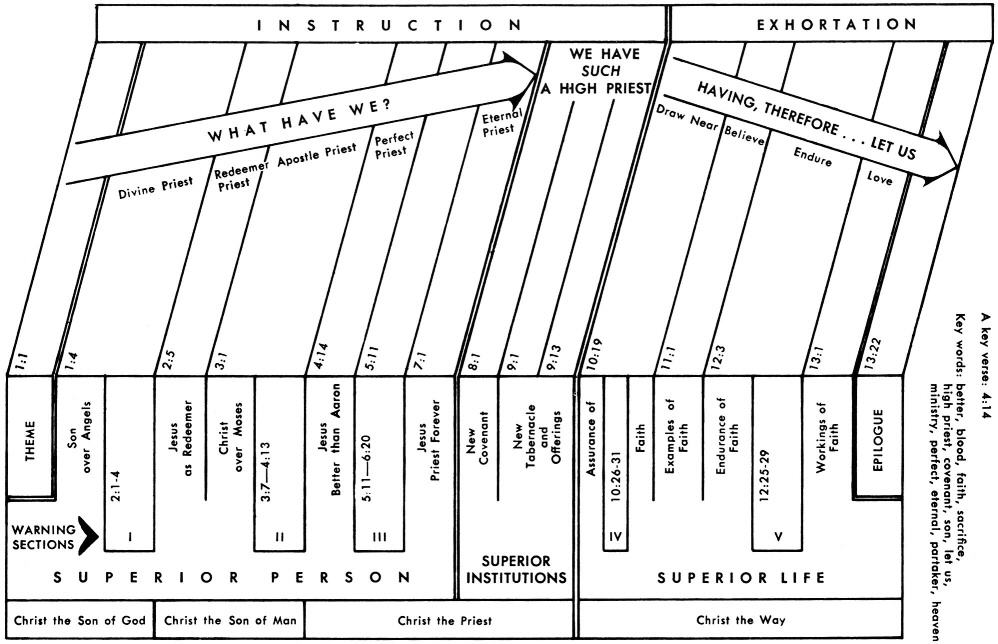
CONSIDER JESUS OUR GREAT HIGH PRIEST
Click chart to enlarge
Charts from Jensen's Survey of the NT - used by permission
Swindoll's Chart, Interesting Pictorial Chart of Hebrews, Another Chart
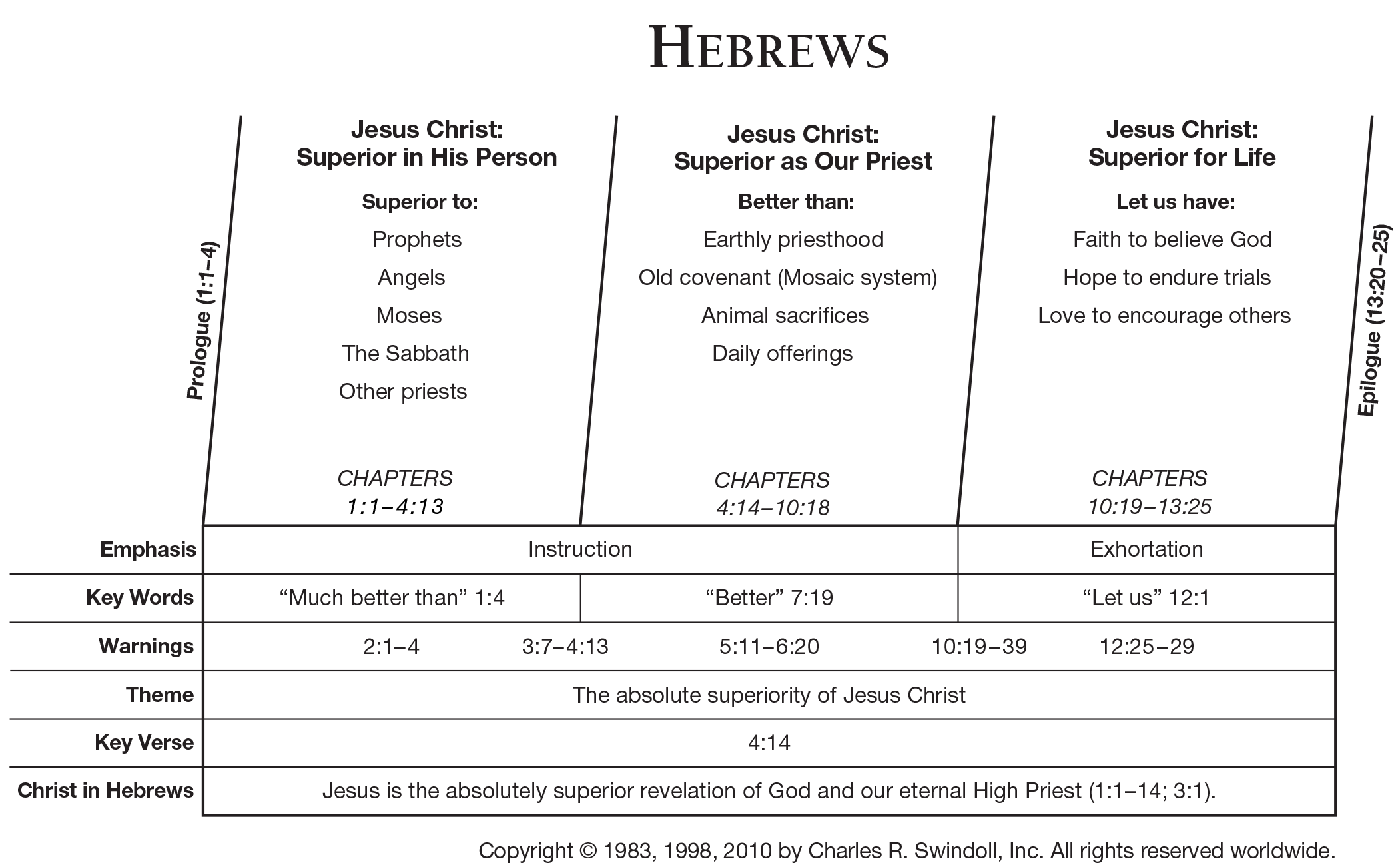

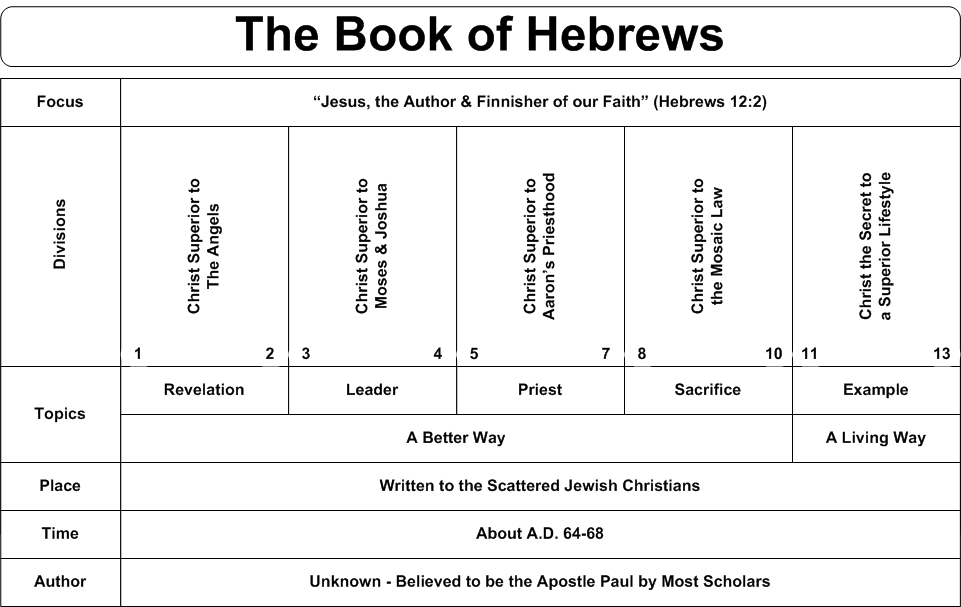
|
The Epistle |
||||
| INSTRUCTION Hebrews 1-10:18 |
EXHORTATION Hebrews 10:19-13:25 |
|||
| Superior Person of Christ Hebrews 1:1-4:13 |
Superior Priest in Christ Hebrews 4:14-10:18 |
Superior Life In Christ Hebrews 10:19-13:25 |
||
| BETTER THAN PERSON Hebrews 1:1-4:13 |
BETTER PRIESTHOOD Heb 4:14-7:28 |
BETTER COVENANT Heb 8:1-13 |
BETTER SACRIFICE Heb 9:1-10:18 |
BETTER LIFE |
| MAJESTY OF CHRIST |
MINISTRY OF CHRIST |
MINISTERS FOR CHRIST |
||
|
DOCTRINE |
DUTY |
|||
|
DATE WRITTEN: |
||||

See ESV Study Bible "Introduction to Hebrews"
(See also MacArthur's Introduction to Hebrews)
Borrow Ryrie Study Bible
|
THE FIVE WARNING PASSAGES |
| Heb 2:1-4+ |
| Heb 3:7-4:13+ |
| Heb 5:11-6:12+ |
| Heb 10:19-39+ |
| Heb 12:14-29+ |
Hebrews 10:24 and let us consider how to stimulate one another to love and good deeds, (NASB: Lockman)
Greek: kai katanoomen (1PPAS) allelous eis parocusmon agapes kai kalon ergon
BGT καὶ κατανοῶμεν ἀλλήλους εἰς παροξυσμὸν ἀγάπης καὶ καλῶν ἔργων,
Amplified: And let us consider and give attentive, continuous care to watching over one another, studying how we may stir up (stimulate and incite) to love and helpful deeds and noble activities, (Amplified Bible - Lockman)
My Amplified Paraphrase: And let us consider—carefully think about, attentively look at, fix our minds upon—how to stimulate one another, how to provoke, stir up, and spur fellow believers to love (self-sacrificing, Christlike devotion) and to good deeds (Spirit-empowered acts of obedience, service, mercy, and righteousness).
Barclay: and let us put our minds to the task of spurring each other on in love and fine deeds. (Westminster Press)
NLT: Think of ways to encourage one another to outbursts of love and good deeds. (NLT - Tyndale House)
KJV And let us consider one another to provoke unto love and to good works:
NKJ And let us consider one another in order to stir up love and good works,
NET And let us take thought of how to spur one another on to love and good works,
CSB And let us be concerned about one another in order to promote love and good works,
ESV And let us consider how to stir up one another to love and good works,
NIV And let us consider how we may spur one another on toward love and good deeds.
Phillips: and let us think of one another and how we can encourage each other to love and do good deeds. (Phillips: Touchstone)
Wuest: And let us constantly be giving careful attention to one another for the purpose of stimulating one another to divine and self-sacrificial love and good works,
Young's Literal: and may we consider one another to provoke to love and to good works,
- Consider - Heb 13:3; Ps 41:1; Pr 29:7; Acts 11:29; Ro 12:15; 15:1,2; 1Cor 8:12,13; 9:22; 1 Cor 10:33; Gal 6:1; Col 3:16; 1 Th 5:11; 2 Th 3:9
- Stimulate - Ro 11:4; 2 Cor 8:8; 9:2
- Love - He 6:10,11; 13:1; Gal 5:6,13,22; Php 1:9, 10, 11; 1Th 1:3; 3:12,13; 1Ti 6:18; Titus 2:4; 3:8; 1Jn 3:18
- Five Warning Passages in Hebrews - Heb 2:1-4+ Heb 3:7-4:13+ Heb 5:11-6:12+ Heb 10:19-39+ Heb 12:14-29+
- Hebrews Resources - Multiple Sermons and Commentaries
- Hebrews 10:19-39 The Danger of Defection - John MacArthur (excellent sermon including several illustrations)
Related Passages:
Hebrews 3:1+Therefore, holy brethren, partakers of a heavenly calling, consider (katanoeo - observe attentively - aorist imperative see our need to depend on the Holy Spirit to obey) Jesus, the Apostle and High Priest of our confession;
STIMULATING ONE
ANOTHER
The progression of this passage moves from access to God (v.19–22) to assurance of hope (v.23) to attention to others (v.24). The believer’s vertical relationship with God must express itself horizontally toward the body of Christ. Having entered God’s presence by the blood of Christ and anchored our hope in His faithfulness, we are now called to turn outward — to consider one another. Genuine faith does not isolate; it stimulates. True assurance always leads to active love.
And let us consider (katanoeo - observe attentively, fix our mind) how to stimulate (paroxusmos - provoke, stir, incite) one another (allelon) to love (agape) and good (kalos) deeds (ergon) - Let us is a hortatory subjunctive which is used 13 times in Hebrews. Consider (katanoeo) literally means “to think down on” and so to look closely and carefully. The present tense calls for sustained attention, not casual notice. So it is interesting that the writer uses this relatively uncommon verb twice in this letter, the first time to consider Jesus (Heb 3:1+) and now consider Jesus' followers! Vertical focus on Jesus should motivate and stimulate horizontal care for His sheep! The church is to be a workshop of encouragement, not a waiting room of spectators. Consider (katanoeo) calls believers to intentional, others-focused reflection. It means to study your fellow believers carefully—their needs, strengths, and struggles—so you can lovingly provoke them to spiritual action. Consider calls for paying attention and carefully looking for sheep who need encouragement, comfort, or correction and even implies effort and creativity. It calls for us to brainstorm ways to provoke one another toward love and service. The idea of consider is not passive, detached watching but purposeful attentiveness that leads to action. Consider is the opposite of indifference but purposeful seeking that leads to serving others in the body of Christ.
Simply stated consider (katanoeo) means to look long enough to love well. It is seeing with the mind and the heart— thinking about others until you are moved to help them.
Consider (katanoeo) in the present tense calls for continuous consideration of how to stir other believers - not to stir them in the sense of causing trouble, but stirring them up in the sense of motivating them to live on earth as citizens of heaven who are anticipating a better hope to be fully realized when "the day" draws nigh. The exhortation is to take careful note of each other’s spiritual welfare, for we are in fact in a very real sense "our brother's keeper" in the flock of God.
Steven Cole says consider means "To give thought to it means that you have to take your focus off of yourself and think about others. “What does this other person need to help him [or her] grow in love and good deeds?”"
Wuest says consider "Consider speaks of attentive, continuous care (Ed: present tense). The exhortation is to take careful note of each other’s spiritual welfare. The purpose of this attentive, continuous care is to provoke each other to the exercise of love and good works. (Hebrews Commentary)
Jamieson adds that the idea of consider is "with the mind attentively fixed on “one another", contemplating with continual consideration the characters and wants of our brethren, so as to render mutual help and counsel."
Marcus Dods writes that the author is here saying..."let us consider one another, taking into account and weighing our neighbor's circumstances and especially his risks, but this with a view not to exasperating criticism, but "with a view (eis) to incite them to love and good work," acknowledging honest endeavor and making allowance for imperfection. (Expositor's Greek Testament)
This is the second use of katanoeo in this epistle, the first use being in Hebrews 3 where he commands the readers "Therefore (based on what he has just written - Heb 2:18), holy brethren, partakers of a heavenly calling, consider (aorist imperative - do this now, do it effectively, it conveys a sense of urgency and do in in dependence on the Spirit) Jesus, the Apostle and High Priest of our confession. (Heb 3:1+)
How to stimulate (paroxusmos) in the only other NT use has a negative meaning ("sharp disagreement" Acts 15:39+), but it is beautifully redeemed into a positive sense in this passage. The idea is to stir up, incite, or rouse brethren toward godly passion. You might say we are called to be "holy agitators" lovingly provoking one another toward spiritual fervor. Paroxusmos is not mild encouragement but is a strong stirring, an intentional nudge that jolts believers from complacency into active love and service. The Spirit takes a word that usually describes irritation and sanctifies it — turning irritation into inspiration. What once divided Paul and Barnabas (Acts 15:39+) now describes what unites believers in love! We are not to irritate one another to anger but inspire one another to self-sacrificial love (agape), energized by the Spirit to love like God loves, giving without expecting a "return on our (love) investment." The only way to express this quality of love is by being filled with the Spirit (Eph 5:18+), walking by the Spirit (Gal 5:16+) and thereby enabled to bear the fruit of the Spirit (Gal 5:22+). And we should be motivated to love like this by Paul's words teaching that "Love does no wrong to a neighbor; therefore love is the fulfillment of the law." (Ro 13:10+) One another (allelon) captures the very heart of the Christian community, standing in sharp contrast to the self-reliant, "lone ranger" approach to faith.
Look long, look well, with love’s intent,
On hearts that grace has heaven-sent;
Consider, pray, and kindly move—
To stir the flame of holy love.
Paroxusmos implies that spiritual stagnation is natural unless we deliberately challenge one another. Just as iron sharpens iron (Prov 27:17), so believers sharpen one another’s love and zeal. Fellowship is not just comfort but includes constructive discomfort that drives us toward Christlikeness. Love needs stirring, and good deeds need sparking and that is the ministry of paroxusmos. True fellowship does more than comfort the weary—it awakens the weary to courage. Paroxusmos is grace with an edge: love that stirs, truth that spurs, faith that fires others forward. Paroxusmos is grace with a spark, fellowship with fire, and love that refuses to let another grow cold.
Paroxusmos means to poke the embers
of another’s faith until love burns bright again.
Hebrews 10:24-25 provides a
strong antidote against apostasy.
Matthew Henry aptly observes that in this passage, the writer presents "the means prescribed for preventing our apostasy, and promoting our fidelity and perseverance." In short, Hebrews 10:24-25 provides a strong antidote against apostasy. Let us ever seek to be stimulators and encouragers, not irritators and fault finders for as George Adams reminds us "Encouragement is oxygen to the soul."
Barton writes that "Christians need to spur or stimulate each other in two areas: (1) Love: not an emotion but a choice to act regardless of our feelings. We are to act lovingly toward other believers. (2) Good deeds: works done for the good of others, and which attract others to Christ (See Hebrews - Page 163)
How to stimulate (paroxusmos - provoke, stir, incite) one another (see discussion of allelon) to love (agape) and good (kalos) deeds (ergon) - He gives two goals of provocation, the first being love, remembering that provocation is not to pursue argument but produce affection. We are to “sharpen” each other toward love that love which is self-giving, sacrificial devotion that mirrors God’s heart (John 13:34,35+). This quality of God-like love is the root of all Christian behavior. The other goal is Good Deeds (kalōn ergōn), literally “beautiful works” but works that are not only useful, but morally excellent and spiritually attractive and supernaturally such deeds flow from love as fruit from the root. Our goal is not to irritate, but to inspire one another to visible, tangible acts of kindness, mercy, and service.
🙏 THOUGHT - What kind of deeds are you doing, good deeds or God deeds? I like to call true "good deeds" "God deeds" knocking out an extra "o" to remind us that only "abiding in the Vine deeds" (Jn 15:5+), those God has Himself "pre-prepared" for us in Christ (Eph 2:10+) have eternal value. All others are merely "wood, hay, and stubble." (1Co 3:12KJV+) destined to burn away at the Judgment Seat! In other words, when our deeds are self initiated and self "propelled," and not Spirit initiated and empowered, then they are deeds that Jesus will judge "bad" at the Bema Seat (2Co 5:10+), where "bad" (phaulos) means worthless and of no eternal value, for they are works that do not glorify God but glorify self! How would you evaluate your "good deeds?"
A good example is often better
than a very proper precept.
Grant Osborne - “Love and good works” are two sides of the same coin. Love is the supercharged feeling of selfless caring and giving that molds us into the body of Christ, and good works are the visible sign of that love in the church. This is the polar opposite of the way society works in our secular world. There the mood is that of entitlement and self-gratification, of taking rather than giving. In Christ, the other is placed first. Rather than “What can you do for me?” it is, “What can I do for you?” (See Hebrews Verse by Verse - Page xcii)
Ray Stedman on love and good deeds - The supportive love of Christians for one another is a powerful factor in maintaining spiritual vigor. It needs to be awakened in both ourselves and others. That does not envision finger-shaking and lecturing, but encouraging words and good example. (Let Us Go On!)
Leon Morris on stimulate...love - This is a most important Christian obligation, and believers are to help one another attain it. It is interesting that this kind of love is thus a product of community activity, for it is a virtue that requires others for its exercise. One may practice faith or hope alone, but not love. (See The Expositor's Bible Commentary - Abridged Edition)
Warren Wiersbe - It is interesting to note that the emphasis here is not on what a believer gets from the assembly, but rather on what he can contribute to the assembly. Faithfulness in church attendance encourages others and provokes them to love and good works (Bible Exposition Commentary)
Steven Cole on stimulate one another - The context where this provoking to love and good deeds takes place is when we assemble together. Some had dropped out of the church. Perhaps they had their feelings hurt by other believers, and now they claimed that they could worship God better alone. Almost invariably, when people drop out of church, their focus is on themselves, not on God and others. Instead of thinking, “How can I be used of God to spur others on in love?” they think, “My needs aren’t being met. That church is unfriendly and unloving!” You can practice faith and hope when you’re alone, but you can’t encourage others to love and good deeds when you’re alone! You have to gather with the saints to do it!
Spurgeon expounds on stimulate one another to love and good deeds: "I do not know how we can do that better than by being very loving and very full of good works ourselves, for then will others be likely to say, “If these people are helped by God’s grace to love like this, and to labor like this, why should not we do the same” A good example is often better than a very proper precept."
In Hebrews 6:9-10+ the writer reminds his readers of their good example of stimulation - "But, beloved, we are convinced of better things concerning you, and things that accompany salvation, though we are speaking in this way. For God is not unjust so as to forget your work and the love which you have shown toward His name, in having ministered and in still ministering to the saints."
Matthew Poole has an interesting comment on paroxusmos explaining that it "is a word borrowed from physicians, who use it to set out the violent incursion of a fever, when the fit is so strong as to make the body tremble and bed shake with the horror and rigour of it. In this place it is used to set out the vehemency (speaks of intense emotion, feeling or conviction) of affection to which the sacrifice of Christ obliges Christians, as those who had their whole persons acted by love to each other, with all vehemency, to the highest and fullest pitch of it; as who should exceed in benevolence, beneficence, and complacency in each other, such as is conscientious, pure, and extensive to the very end, see notes Heb 13:1+; Ro 12:9+, Ro 12:20+; 1Th 4:9+; 1Pe 1:22+; and manifesting itself in good works to them, especially merciful ones, pitying, counselling, succouring, supplying, and comforting them, Jas 2:13, 15, 16 1 John 3:14, 16-18 and this freely, cheerfully, and constantly, see Eph 2:10+; Eph 4:32+; 1 Ti 6:18. (Matthew Poole's Commentary)
Spurgeon - The Greek is, to stir each other up to a paroxysm of love. There is no fear that we shall ever go too far in our love to God; though it should cast us into a state of blessed excitement, yet would it be healthy for us so to live and so to work. I am afraid there are some who consider one another to provoke in quite a different spirit from this,-who watch to find out a tender spot where a wound will be most felt. They observe the weakness of a brother’s constitution, and then play upon it, or make jests about it. All this is evil, so let us avoid it; let us all seek out the good points of our brethren, and consider them, that we may afterwards be the means of guiding them to those peculiar good works for which they are best adapted
In this section we see the writer's masterful use of the familiar triad of faith, hope and love. In Hebrews 10:22 we see faith's exhortation "let us draw near," in Hebrews 10:23 we see are told "let us hold fast" to hope and in Hebrews 10:24 we are exhorted to "let us consider one another." He progresses from faith drawing us to God to hope that anchors us in God and finally love that sends us out to others. In short, the writer moves from vertical access to horizontal action, so that those who have been brought near should now bring others along. The able Lutheran commentator Lenski summarizes the three let us exhortations writing that "The first ("let us draw near" - Heb 10:22+) admonition deals with the heart, the second with the mouth ("let us hold fast the confession" - Heb 10:23+), the third with conduct (Hebrews 10:24). The first with God, the second with the world, the third with the church."
Draw near in Faith
Hold fast in Hope
Stimulate to Love
The Jewish readers were in great need of encouragement to move forward in the grace found in the New Covenant and (at least some) were having a hard time breaking with the Old Covenant, with the Temple and the sacrifices. They were continuing to hold on to legalism, ritual and ceremony, all of which represented the outward manifestation of their prior practices in Judaism. Old habits die hard, don't they? (Rhetorical).
Brian Bell - LET US CONSIDER (24,25) A. Consider what?…One another. Each other. The body of Christ. 1. Consider - To direct one’s whole mind to an object. To immerse oneself in it. To apprehend it in its whole compass. [(Borrow TDNT)] a) Not shake your finger at a brother or sister in the Lord. Not lecture a brother or sister in the Lord. Instead, using encouraging words & being a good example. C. Stir up - Spur on. Urge. Sharpen. To incite, or stimulate. Provoke. Be a positive irritant. ILLUSTRATION - That’s how oysters are made, right? It grows a pearl, from an irritant. A piece of sand usually. The oyster supplies a nacre & surrounds it. Making something beautiful out of the very object that irritated it. The writer says we need to do the same. b) Be that piece of sand in their life...allowing the Holy Spirit to provide the nacre of love, by the accretion of gradual beautiful layers to their lives. "If your struggling in sin, I'm here to help you. If your defending your sin, I'm here to challenge you. If your setting up camp in your sin, I'm here to discipline you." (Larry Osborne) So be a positive irritant toward corporate worship & encouragement.
John Piper has an interesting comment on this section writing that stimulating one another......is the focus for your life. Here is what you aim at from morning till night as a Christian. Notice carefully: it is not what you might expect. It is not: consider how to love each other and do good deeds. That would be Biblical and right. But it’s different: “Consider how to stimulate each other to love and good deeds.” Focus on helping others become loving people. Aim at stirring up others to do good deeds. And of course the implication would also be that if others need help and stirring, we do too, and so we would be aiming at what sorts of ways we can think and feel and talk and act that will stir each other up to love and to do good deeds. The aim of our lives is not just loving and doing good deeds, but helping to stir up others to love and to good deeds. (See the full text of Consider Each Other How to Stir Up Love)
John Phillips gives an illustration of stimulate one another - I was brought up in Britain where most of the houses were not centrally heated; instead, each room had its own small fireplace. I well remember the good fire that was always kept burning in the fireplace of the living room whenever the weather was inclement and cold. The coals would be heaped up, and the flames would roar up the chimney. Occasionally we would take an iron poker and stir up the coals so that the air could circulate and the fire stay alive and hot. Once in a while a coal would fall down and roll off to one side. When it first fell it would be bright red and glowing with the fire. But after a short while—a very short while—the isolated coal would lose some of its luster. The glow would fade, and it would look dull and listless. Soon it became black with just a wisp or two of smoke ascending from it as evidence of its former heat, until presently it was cold enough to be picked up by hand.That is the picture the writer has in mind. We are to exhort one another, stir one another up, keep the fires of the Spirit burning brightly. We need to be kept close together so that Christian warmth can be communicated back and forth from one member of the fellowship to another. And what a tragedy it is when we begin to stop attending the gatherings of those of like precious faith. We soon begin to lose our fervor. We grow, imperceptibly but surely, colder toward the things of God until, at last, for all the evidence there is of life, we are no different from the worldly, unsaved people around us. (Borrow Exploring Hebrews page 130)
One another (see discussion of allelon) - Note that he does not say “Meet together so the pastor can stir you up to love and good works, and encourage you.” One another (allelon) means that every believer can and should encourage, exhort, admonish and even rebuke other believers to press on for the prize of the upward call of God in Christ Jesus (Php 3:14+), to fight the good fight of faith (1Ti 6:12+) and to run the race with endurance (Heb 12:1+). And to reiterate, the verb katanoeo does not imply we are to give this activity an occasional thought but that we are to continually be putting our mind to this task (of stimulating one another), observing and considering carefully and attentively how we can carry out this exhortation toward other believers. We need to think carefully and not casually about how to stimulate one another. The end of this present evil age is at hand and we are to redeem the time for the days until the end are evil (Eph 5:16+). In the meantime we are to think of ways to stimulate our brethren to love and good deeds.
🙏 THOUGHT - What can I do today to stimulate a brother or sister in Christ to Christ-like loving deeds...a text, a loving touch (a hand on the shoulder), an email, a hand-written note, an invitation for coffee, a zoom call, etc?
Solomon alludes to this idea of the "one another-ness" our writer is calling his readers to pursue "Two are better than one, because they have a good reward for their toil. For if they fall, one will lift up his fellow; but woe to him who is alone when he falls and has not another to lift him up. (Ecclesiastes 4:9, 10+)
There is nothing more unchristian
than a solitary Christian.
-- John Wesley
In the next verse the writer says we are to do these things "all the more and as you see the day drawing near." In other words this stirring one another up to love and good deeds ought to be motivated by a sense of our Lord's imminent return. Each day closer to His glorious Second Coming should serve to motivate us to pour ourselves into acts of love toward one another.
🙏 THOUGHT - Paul emphasized the principle that good deeds flow from "ready" vessels, writing that if a man cleanses himself from these things (Amplified - "from what is ignoble and unclean, who separates himself from contact with contaminating and corrupting influences"), he will be a vessel (instrument) for honor, sanctified, useful (beneficial for honorable and noble purposes) to the Master, prepared (ready, ripe, primed) for every good work (ergon agathon)." (2Ti 2:21+) In other words, you get up, go to work, and immediately God gives you an opportunity to perform a good work. Are you ready? Every morning is a new day of opportunity and we need to arise and "present (our) bodies a living and holy sacrifice, acceptable to God" (Ro 12:1+), redeem (buy up) "the time (opportunities), because the days are evil" (Eph 5:16+), disciplining ourselves for godliness which is "profitable for all things, since it holds promise for the present life and also for the life to come." (1Ti 4:7-8+) Don't let the opportunities slip by. Be "confessed up", "repented up" and "filled up" with the Holy Spirit and you will be ready to recognize the opportunities God graciously gives. And remember that although we are to be seen doing good works, we must not do good works in order to be seen!
SOME MORE ON
GOOD DEEDS
This section is a short excursus on the relationship of good works to salvation.
Gotquestions writes "Good works do not save us (Ephesians 2:8–9+); however, faith without works is dead faith (James 2:26+). God saved us not just to rescue us from the consequence of our sin but also to reflect His character and goodness to the world. As the Holy Spirit produces fruit in our lives (Galatians 5:22–23+), we will act in ways that reflect God’s character. Instead of living according to our old selfish and sinful ways, we will seek to do good works that please God. We will exhort others to do the same. Fellowshipping with other Christians gives us the opportunity to put those good works into practice and surrounds us with examples of how to “stir up one another to love and good works” (Hebrews 10:24ESV).
Peter explained the vital importance of good deeds in a godless society exhorting us to "(Present tense - continually) Keep (our) behavior excellent among the Gentiles, so that in the thing in which they slander (us) as evildoers, they may because of (our) good deeds, as they observe (epoteuo - behold with their own eyes like a spectator or overseer) them, glorify (doxazo) God in the day of visitation." (1Pe 2:12+, similar idea in Mt 5:16+) Here is Peter's "takeaway" -- Your good works will validate your good words (works are the "fruit" but words are like "leaves") which is in stark contrast to the false teachers who "profess to know God, but by their deeds they (present tense - continually) deny Him, being detestable (bdekluktos - root word = "to stink"!) and disobedient (apeithes) and worthless (adokimos) for any good deed” (Titus 1:16+). Good deeds are not the root of salvation, but they are the fruit of genuine salvation (cf Mt 3:8+, (Eph 2:8–9+ precedes and leads to Eph 2:10+). The lives of believers should continually demonstrate the reality of the spiritual regeneration and supernatural transformation they have received by grace through faith in Jesus Christ. Believers who have been redeemed...from every lawless deed and are now possessions of Christ, are to be zealous (zelotes - "zealots," afire, fervent, eager, enthusiastic) for good deeds. (Titus 2:14+)
C H Spurgeon wrote the following regarding works and our Salvation. - William Wickham being appointed by King Edward to build a stately church, wrote in the windows, "This work made William Wickham." When charged by the king for assuming the honour of that work to himself as the author, whereas he was only the overseer, he answered that he meant not that he made the work, but that the work made him, having before been very poor, and then in great credit. Lord, when we read in thy Word that we must work out our own salvation, thy meaning is not that our salvation (Php 2:12+) should be the effect of our work, but our work should be the effect of our salvation— Feathers for Arrows (Eph 2:10+)
No amount of good deeds can make us good persons.
We must be good before we can do good.
-- Chester A. Pennington
Note that the phrase is good deeds which differs from your deeds. Let me explain. Paul is calling for good (agathos = good in nature and beneficial in its effect) deeds, and the only truly "good" deeds are those borne by believers who, like "branches," are abiding in Christ the Vine. Such deeds reflect Christ’s life flowing through us, initiated and empowered by His Spirit, and ultimately bringing glory to the Father (Mt 5:16+).Paul echoes this truth in Philippians 2:13+: “For it is God who is at work in you, both to will and to work for His good pleasure.” Jesus Himself gave the foundational principle for all good works when He said, “I am the vine, you are the branches; he who abides in Me, and I in him, he bears much fruit; for apart from Me you can do nothing” — absolutely nothing of eternal value (Jn 15:5+). He added "By this is My Father glorified, that you bear much fruit (good deeds = good fruit) and so prove to be My disciples...You did not choose Me, but I chose you, and appointed you, that you should go and bear fruit, and that your fruit should remain...." (John 15:8,16+) Paul reminded the Corinthian church of this same foundational principle regarding "good deeds", explaining that "God is able to make all grace abound to you, so that always having all sufficiency in everything, you may have an abundance for every good deed" (2Cor 9:8+). Paul acknowledged that the key to his good works was the grace of God writing that His "grace toward me did not prove vain; but I labored even more than all of them, yet not I, but the grace of God with me." (1Cor 15:10+). In his first letter to the Corinthians Paul emphasized that "no man can lay a foundation other than the one which is laid, which is Jesus Christ ("the Vine"). Now if any man builds upon the foundation with gold, silver, precious stones, wood, hay, straw, each man's work will become evident; for the day will show it, because it is to be revealed with fire; and the fire itself will test the quality of each man's work. If any man's work which he has built upon it remains, he shall receive a reward. If any man's work is burned up, he shall suffer loss; but he himself shall be saved, yet so as through fire." (1Cor 3:11-15+) One day in the future the Lord Jesus will even "disclose the motives of men's hearts; and then each man's praise will come to him from God." (1Cor 4:5+) In sum, good deeds, in the biblical sense, are those marked by genuine love, sincere motives, Spirit-empowered service, and God-glorifying intent — an eager desire to bless others. No matter how hostile the world around us may become, we are called to do good to those whose lives intersect with ours. Paul reminded the Galatian believers that "While we have opportunity (kairos), [we are to] do good (agathos) to all men, and especially to those who are of the household of the faith” (Gal 6:10+).
I would not give much for your religion unless it can be seen.
Lamps do not talk, but they do shine.
-- C H Spurgeon
Believers should be known for what might be called consistent, active goodness — a life marked by Spirit-inspired love, not by obligation or legalistic duty. Our good works are to flow from a Spirit filled heart devoted to the Lord and compassionate toward others. As Peter reminds us, “For you have been called for this purpose, since Christ also suffered for you, leaving you an example for you to follow in His steps… entrusting Himself to Him who judges righteously.” (1 Peter 2:21–23+)
In summary, believers do not witness just with our lips but with our lives, validating our "talk" with our "walk." Our conduct should confirm our confession, and our behavior should beautify our belief — so that the message we proclaim is made visible through the life we live. There should be nothing in our conduct that will give the unsaved world ammunition to attack Christ and the Gospel. Our good works must back up our good words. Jesus gave this same charge in Mt 5:16+ "Let your light shine before men in such a way that they may see your good works, and glorify (give a proper opinion of) your Father who is in heaven." In other words, our lives should give others a proper opinion of God. Believers make a profound impact on the lost when a godly life is joined with a gracious witness (Col 4:6+). We have all heard of souls won to Christ simply because faithful believers let their light shine. Yet with sorrow we also remember those who rejected the Word—not because of its message, but because of the inconsistent lives of professing Christians.
In the summer of 1805, a number of Indian chiefs and warriors met in council at Buffalo Creek, New York to hear a presentation of the Christian message by a Mr. Cram from the Boston Missionary Society. After the sermon, a response was given by Red Jacket, one of the leading chiefs. Among other things, the chief said:
Brother, you say that there is but one way to worship and serve the Great Spirit. If there is but one religion, why do you white people differ so much about it? Why not all agree, as you can all read the Book?
Brother, we are told that you have been preaching to the white people in this place. These people are our neighbors. We are acquainted with them. We will wait a little while and see what effect your preaching has upon them. If we find it does them good, makes them honest and less disposed to cheat Indians, we will then consider again of what you have said.
We are the Bibles the world is reading.
We are the truths the world is needing.
We are the sermons the world is heeding.
Related Resource:
- A W Pink - The Scriptures and Good Works
Hortatory Subjunctive - a first-person plural subjunctive verb used to urge a group to do something. (Let us go…” “Let us draw near…” “Let us hold fast…” “Let us consider…”) These are not suggestions; they are strong, urgent exhortations. The hortatory subjunctive expresses: exhortation (strong urging), encouragement, group inclusion (“we together”), an invitation with authority, a call to decisive action. It has the force of:“We must…” “Let us now…” “We should immediately…” It is authoritative yet pastoral.
Why Greek uses the Hortatory Subjunctive - Greek has no first-person imperative (“we, do this!”), so the hortatory subjunctive serves this function. It is the strongest way to urge a group to action.
Summary - This is a statement urging others to join in some action (commanding oneself and one’s associates). (It is roughly the same as first person imperative, which does not exist in Greek.) It is easily identified because it will always be the first person plural form of the subjunctive mood. This verb form will often come near the beginning of the sentence.It is usually translated "let us…." (Thus, as a mnemonic device, it can be referred to as the ‘Salad Subjunctive’. cf "let us" with "lettuce" - a bad joke!)
"LET US" IN HEBREWS - 13x/12v - Heb. 4:1; Heb. 4:11; Heb. 4:14; Heb. 4:16; Heb. 6:1; Heb. 10:22; Heb. 10:23; Heb. 10:24; Heb. 12:1; Heb. 12:28; Heb. 13:13; Heb. 13:15
Consider (2657) (katanoeo from kata = down [kata can be used to intensify the meaning] + noeo = to perceive or think) means literally to put one's mind down on something, to think down and so to observe or consider carefully and attentively. It means give full attention to, fix your eyes or mind upon and perceive clearly, cautiously, observantly. The idea is to think about something very carefully or consider closely and includes the action of one's mind apprehending certain facts about a thing so as to give one the proper and decisive thought about the thing considered. Stated another way, it implies mental attentiveness joined with sympathetic insight—not a passing glance, but focused contemplation that leads to meaningful response.
KATANOEO - 14V - Matt. 7:3; Lk. 6:41; Lk. 12:24; Lk. 12:27; Lk. 20:23; Acts 7:31; Acts 7:32; Acts 11:6; Acts 27:39; Rom. 4:19; Heb. 3:1; Heb. 10:24; Jas. 1:23; Jas. 1:24
One another (240) allelon is a frequent Pauline word which is found 40 times in the NAS and makes for a very interesting study (click the 40 uses). Root meaning: reciprocal interaction — “one another,” “each other,” “mutually.” Allelon is a reciprocal pronoun, expressing mutual relationship and shared responsibility within the body of Christ. It always points both directions — I toward you and you toward me. It assumes connection, not independence; interdependence, not isolation. Prominent especially in Paul’s epistles, 1 John, and Hebrews. Commonly used with verbs commanding mutual love, service, encouragement, forgiveness, humility, and unity. “One another” is the pulse of Christian life. It is where doctrine becomes devotion and belief becomes belonging. The church is not a collection of isolated saints but a communion of interwoven souls. Christianity is a ‘we-faith,’ not a ‘me-faith.’ “Allēlōn transforms Christianity from a solo climb into a shared ascent. No believer is meant to walk alone; our strength is found shoulder to shoulder, heart to heart, and grace to grace.
Where One Another Dwells
In “one another” life is found—
The place where self gives sacred ground;
The cross unites, the Spirit blends,
And stranger souls become close friends.
Vine writes that allelon is "a reciprocal pronoun in the genitive plural, signifying of, or from, one another (akin to allos, another [of the same kind in contrast to heteros]) e.g., Mt. 25:32; Jn 13:22; Acts 15:39; 19:38; 1Co 7:5; Gal 5:17; the accusative allēlous (Same root pronoun allelon - the "-ous" identifies it as in the accusative case) denotes “one another,” e.g., Acts 7:26, lit., ‘why do you wrong one another?’; 2Th 1:3; in Ep 4:32 Col. 3:13, e.g., “each other;” in 1Th. 5:15, “one (toward) another”; the dative allēlois denotes “one to another,” e.g., Lk 7:32 (Vine's Expository Dictionary of New Testament Words)
Related Study - Study the "one anothers" - most positive, some negative (As an aside, note that many of these "one another's" are issued as commands, not suggestions! But remember that our obedience to divine commands is based on enablement by the Spirit, not effort by self! You are under grace not law. Law says "love one another", and under the New Covenant we are enabled by the Spirit to truly, supernaturally "love one another"! To repeat - Do not try to obey this command in your own strength or supposed adequacy! cp 2Cor 3:5, 6+)
Allelon - 100x in 94v in NT - translated (NAS95) - another(1), each(1), each other(1), one another(90), one another's(2), other's(1), themselves(1), together*(2), yourselves(1). Mt 24:10; Mt 25:32; Mark 4:41; 8:16; 9:34, 50; 15:31; Luke 2:15; 4:36; 6:11; 7:32; 8:25; 12:1; 20:14; 23:12; 24:14, 17, 32; John 4:33; 5:44; 6:43, 52; 11:56; 13:14, 22, 34, 35; 15:12, 17; 16:17, 19; 19:24; Acts 4:15; 7:26; 15:39; 19:38; 21:6; 26:31; 28:4, 25; Ro 1:12+, Ro 1:27+; Ro 2:15+; Ro 12:5+, Ro 12:10+, Ro 12:16+; Ro 13:8+; Ro 14:13+, Ro 14:19+; Ro 15:5, 7+, Ro 15:14+; Ro 16:16+; 1Co 7:5; 11:33; 12:25; 16:20; 2Cor 13:12; Gal 5:13, 15, 17+, Gal 5:26+; Gal 6:2; Eph 4:2+, Ep 4:25+, Eph 4:32+; Eph 5:21+; Phil 2:3+; Col 3:9+, Col 3:13+; 1Th 3:12+; 1Th 4:9+, 1Th 4:18+; 1Th 5:11+, 1Th 5:15+; 2Th 1:3; Titus 3:3+; Heb 10:24+; Jas 4:11; Jas 5:9, 16; 1Pe 1:22+; 1Pe 4:9+; 1Pe 5:5+, 1Pe 5:14+; 1Jn 1:7; 1Jn 3:11, 23; 1Jn 4:7, 11, 12; 2 John 1:5; Rev 6:4+; Rev 11:10+
SOME GENERAL PRINCIPLES RELATED TO ALLELON
- Faith falters in isolation but flourishes in interaction.
- Grace grows best in the greenhouse of ‘one another.’
- Believers belong before they behave; community precedes conformity.
- Christianity is not a solo act but a symphony of surrendered hearts.
- We were never meant to go it alone, but to grow it together.
- The church thrives when “one another” is more than words—it’s a way of life.
- The strength of the saints is found in their togetherness.
ALLELON -
- Reflects the Triune God God Himself Who exists in eternal “one-anotherness” — Father, Son, and Spirit in perfect love and fellowship. The church, made in His image, mirrors this divine reciprocity.
- Defines the Church’s Nature = Christianity is not an individual achievement but a corporate identity (Ro 12:5)
- Counters the Spirit of Individualism - Allēlōn dismantles the myth of the self-sufficient believer. A “lone-ranger Christian” is as unnatural as a severed hand claiming to function apart from the body (1 Cor 12:14–27).
- Demands Intentional Investment - “Consider one another” implies attention and action — noticing others’ spiritual needs and creatively meeting them.
ILLUSTRATIONS:
The Redwoods of Faith - The mighty California redwoods soar hundreds of feet high, yet their roots run shallow. What keeps them standing through storms is not depth but interconnection—their roots intertwine underground, each tree holding the others upright. ➡ So it is with believers. “One another” (allelon) is the root system of the church: unseen, intertwined, and indispensable.
The Chain Link - A chain is only as strong as its links are connected. Each link bears the pull of the others. ➡ Christ designed His church as a living chain—linked by love, strengthened by service, sustained by shared grace.
The Flock and the Shepherd - A single sheep that wanders off is easy prey. But the flock, gathered under the Shepherd’s eye, moves safely together.➡ We need “one another” not just for comfort but for survival. Isolation invites attack; community ensures protection.
The Fabric of Fellowship - The church is like a tapestry—each thread alone is weak, but woven together they create strength and beauty.➡ The “one anothers” are the stitches that bind the fabric of faith.
The Candle Circle - One candle may flicker in the wind, but when candles are placed close together, their combined flame burns brighter and steadier. ➡ So love strengthens love, and faith steadies faith—one believer’s light rekindles another’s.
The Blacksmith’s Sparks - When iron strikes iron, sparks fly—and both blades grow sharper.➡ “As iron sharpens iron, so one man sharpens another” (Prov 27:17). Holy friction refines holiness; the fellowship of allelon forges spiritual steel.
The Gears in a Clock - Each gear in a clock turns another; none moves alone.➡ When one part fails, the whole mechanism loses rhythm. The “one anothers” are God’s gears of grace—each life moving others toward divine purpose.
The Body Analogy (1 Cor 12) - Paul’s image of the body captures allelon perfectly: the eye needs the hand, the head needs the feet. ➡ Every part depends on the others; independence is an illusion in the Body of Christ.
The Greenhouse Effect - Plants grow faster and healthier in a greenhouse, where warmth and humidity are shared. ➡ So spiritual growth thrives in the warmth of Christian community—where encouragement and accountability create the right climate for grace.
The Mason’s Wall - Each stone depends on those beside it for stability.➡ The mortar of “one another” love binds believers into a temple fit for the Master Builder (Eph 2:21). Remove one stone, and the wall weakens.
The Pilgrims on the Path 🚶♂️🚶♀️ - Two travelers help each other along the road — sharing water, bearing burdens, watching for danger. ➡ The Christian journey is a shared pilgrimage. “One another” turns the lonely road into a living fellowship.
Stimulate (3948) (paroxusmos from para = besides, near + oxuno = literally to sharpen or oxus = a sharp edge) is a strong word which literally means to sharpen or a sharpness alongside. It is literally a jab given to someone so they "must" respond. It gives us the English medical word “paroxysm,” meaning a sudden outburst — a flare-up of emotion or activity. Figuratively speaks of a sharpening of one's mind or incitement to some action. It means to “stimulate strongly,” “arouse,” or “incite to riot.” Depending on the context, paroxusmos can have either a positive or negative meaning. In a positive sense (Hebrews 10:24) it refers to a rousing of one to activity by incitement or encouragement. In a negative sense, paroxusmos refers to a state of irritation, a sharp disagreement, a "bristly" argument or a provocation. - "And there arose such a sharp disagreement that they separated from one another, and Barnabas took Mark with him and sailed away to Cyprus." (Acts 15:39+) Classical Greek medical writers use the word (paroxusmos) to describe a sudden, violent spasm, such as a body-racking cough or an epileptic seizure.
Paul uses the related verb paroxuno in his "definition" of Christian love noting that such love "does not act unbecomingly; it does not seek its own, is not provoked (paroxuno), does not take into account a wrong suffered (1Cor 13:5+) It described the sharpening of a blade and came to mean a provocation or intense stirring of emotion or action.
There are two other related words in the NT, both used with a negative meaning - parorgizo (to make angry) in Ro 10:19+ and Eph 6:4+ and parorgismos (anger) in Eph 4:26+.
TDNT writes that katanoeo...is closely related to the simple noeo, whose literal meaning is intensified, “to direct one’s whole mind to an object,” also from a higher standpoint to immerse oneself in it and hence to apprehend it in its whole compass... It can also denote 2. critical observation of an object: “to consider reflectively,” “to study,” “to examine,”... 3. In literary Greek katanoeo...means especially apprehension of a subject by intellectual absorption in it: “to consider,” “to ponder,” “to come to know,” “to grasp,” “to understand” (Borrow TDNT - abridged online)
Wuest - The word “stimulate” is the translation of paroxusmos which means “an inciting, incitement, a stimulation.” The word is used also in a bad sense, for instance, “irritation.” Here it is used in its good sense, that of a stimulation. Vincent says: “The new economy demands mutual care on the part of the members of the Christian community … They must stir up each other’s religious affections and ministries.” (Hebrews Commentary)
Gilbrant on paroxusmus - This noun means “irritation, incitement, exasperation, or contention.” It is derived from oxus, “sharp,” and para, “beside,” and suggests a “sharpening” that is intensified. Paroxusmos was employed frequently by classical Greek authors with both favorable and unfavorable connotations (i.e., “incitement” for good or bad). One interesting usage is in medicine where paroxusmos refers to a developing fever, especially when that fever reaches its height (Liddell-Scott). In this case the notion of intensifying is especially pronounced. (Complete Biblical Library Greek-English Dictionary)
Expositor's Greek Testament notes that paroxusmos is frequently used by the classic Greek writers "of stimulating to good as in Plato (Epist. iv., p. 321) and in Xenophon (Cyrop. 6, 2, 5), et al.
This Greek word paroxusmos is related to our English paroxysm which describes a sudden attack or violent expression of something. Although that is not exactly what the writer is saying for his readers to do, it does convey the sense that we are to be serious about spurring one another. Perhaps you have had this experience -- You were driving home late at night with someone else at the wheel and you noticed them begin to nod off. How did you stimulate them? A whisper? Hardly. Instead you would rather vigorously tried to excite them and arouse them from their stupor to prevent "the day" of your car crash from drawing near! In the same way, we believers are to consider seriously out to spur each other onward and upward and all the more as the day of His return draws nearer.
There are two uses of paroxusmos in the Septuagint...
Deuteronomy 29:28 and the LORD uprooted them from their land in anger and in fury and in great wrath (Hebrew = qetseph = anger; Lxx = paroxusmos), and cast them into another land, as it is this day.'
Jeremiah 32:37 "Behold, I will gather them (prophecy of future regathering of Israel prior to the Millennial reign) out of all the lands to which I have driven them in My anger, in My wrath, and in great indignation (Hebrew = qetseph = anger; Lxx = paroxusmos); and I will bring them back to this place and make them dwell in safety.
ILLUSTRATIONS OF PAROXUSMUS
The Fire Poker: A dying fire needs a poker to stir the coals and let fresh air in. Paroxusmos is that spiritual poker—disturbing the settled ashes so love burns brightly again.
The Ember Stirrer (similar to above) When a campfire fades to glowing embers, the cook stirs the coals and fans them back into flame.➡ Paroxusmos is that stirring—God’s people poking the cooling embers of another’s heart so the fire of love reignites.
The Rowing Crew: Each rower pushes the others to stay in rhythm and power. If one slows, the rest quicken him. That’s paroxusmos in motion—mutual motivation.
The Iron Forge: Sparks fly when iron meets iron. That heat is not hostility—it’s sharpening. Paroxusmos means holy friction that forges holiness.
The Axe Sharpener (similar to above): A dull blade cuts nothing until it meets the grindstone. The friction produces both heat and edge. ➡ Christian fellowship sharpens dull hearts the same way—holy friction that hones the soul for service.
The Compass Check: Hikers often stop to realign their compasses with true north before continuing the trail. ➡ Paroxusmos happens when believers lovingly correct and realign each other’s direction with the truth of God’s Word.
The Clock Mender: When one gear in a clock sticks, the others push it to keep the motion going. ➡ Fellowship functions this way—one believer’s consistency stirs another’s sluggishness back into movement.
The Wave Maker: When a single stone drops into still water, ripples spread outward, stirring the entire surface. ➡ One act of kindness, one prayer, one word of encouragement can set off waves of love that move through the whole fellowship. (THIS ONE SHOULD STIR US TO ACTION!)
The Marathon Partner - A runner may slow near the end—until a friend matches pace and says, “Come on, don’t stop now!” ➡ That’s paroxusmos: the shared endurance that keeps weary saints running together toward the finish line (Heb 12:1–2).
The Trumpet Call: An army in camp can grow lazy until the trumpet pierces the air and calls them to action. ➡ Paroxusmos is that trumpet blast in the church—rousing believers from comfort to courageous compassion.
The Mason’s Tap: A master mason taps one stone to shift another into alignment. ➡ Paroxusmos may come as a gentle tap—sometimes correction, sometimes encouragement—to keep the wall of faith straight and strong.
The Farmer’s Plow: The field lies dormant until the plow breaks the crusted surface. ➡ So paroxusmos breaks through spiritual hardness, stirring up the soil of the heart so seeds of love can grow again.
The Orchestra Conductor: When musicians drift off tempo, the conductor lifts the baton and reignites unity and energy. ➡ Paroxusmos is God’s baton—through exhortation and example He draws every instrument back into harmony.
Love (26) (agape) speaks of unconditional, sacrificial love and Biblically refers to a love that God is (1Jn 4:8,16), that God shows (Jn 3:16, 1Jn 4:9) and that God enables in and through His yielded, humble saints (see fruit of the Spirit Gal 5:22+). Biblical agape love is the love of choice, the love that serves with humility, the highest love and noblest devotion, the love of one's will (intentional, a conscious choice), a love not motivated by superficial appearance, emotional attraction, or sentimental relationship but initiated and energized by the Spirit in the obedient saint. Agape is not based on pleasant emotions or good feelings that might result from a physical attraction or a familial bond. Agape chooses as an act of self-sacrifice to serve the recipient. From all of the descriptions of agape love, it is clear that genuine agape love is a sure mark of salvation, Jesus Himself explaining that "By this all men will know that you are My disciples, if you have love (agape) for one another." (John 13:35)
The only other use of agape in Hebrews is Hebrews 6:10+ "For God is not unjust so as to forget your work and the love which you have shown toward His name, in having ministered and in still ministering to the saints."
Agape love can exhibit emotion, but it must always exhibit action. Agape is unrestricted, unrestrained, and unconditional. Agape love is the virtue that surpasses all others and is the prerequisite for all the other virtues. Jesus when asked "Teacher, which is the great commandment in the Law?” replied ”‘You shall love the Lord your God with all your heart, and with all your soul, and with all your mind.’ “This is the great and foremost commandment." (Mt 22:36-38)
F B Meyer has the following description of agape love "Wherever there is true love, there must be giving, and giving to the point of sacrifice. Love is not satisfied with giving trinkets; it must give at the cost of sacrifice: it must give blood, life, all. And it was so with the love of God. "He so loved the world, that He gave his only-begotten Son." "Christ also loved and gave Himself up, an offering and a sacrifice to God." (Eph 5:2+) We are to imitate God's love in Christ. The love that gives, that counts no cost too great, and, in sacrificing itself for others, offers all to God, and does all for His sake. Such was the love of Jesus--sweet to God, as the scent of fields of new-mown grass in June; and this must be our model. Not to those who love us, but who hate; not to those who are pleasant and agreeable, but who repel; not because our natural feelings are excited, but because we will to minister, even to the point of the cross, must our love go out. And every time we thus sacrifice ourselves to another for the sake of the love of God, we enter into some of the meaning of the sacrifice of Calvary, and there is wafted up to God the odor of a sweet smell. (Devotional Commentary on Ephesians)
F B Meyer in his book The Way Into the Holiest adds that agape love "is queen of all the graces of the inner life. Love is the passion of self-giving. It never stays to ask what it can afford, or what it may expect to receive; but it is ever shedding forth its perfume, breaking its alabaster boxes, and shedding its heart's blood. It will pine to death if it cannot give. It must share its possessions. It is prodigal of costliest service. Such love is in the heart of God, and should also be in us; and we may increase it materially by considering one another, and associating with our fellow-believers. Distance begets coldness and indifference. When we forsake the assembly of our fellow Christians we are apt to wrap ourselves in the chill mantle of indifference. But when we see others in need, and help them; when we are willing to succor and save; when we discover that there is something attractive in the least lovable; when we feel the glowing sympathy of others-our own love grows by the demands made on it, and by the opportunities of manifestation.Let us seek earnestly these best gifts; and that we may have them and abound, let us invoke the blessed indwelling of the Lord Jesus, whose entrance brings with it the whole train of sweet Christian graces."
Good deeds (ergon = work + agathon = good) (Click incredible example of good deeds) is a frequent Pauline phrase used 6x in the short letter to Titus (Titus 1:16+, Titus 2:7+, Titus 2:14+, Titus 3:1+, Titus 3:8+, Titus 3:14+).
John Wesley's Rule of Conduct:
Do all the good you can,
By all the means you can,
In all the ways you can,
In all the places you can,
To all the people you can,
As long as ever you can.
QUESTION - How can we encourage one another to love and good works (Hebrews 10:24)? GOTQUESTIONS.ORG
ANSWER - The Christian life is meant to be lived in community. This is why we are told to “not give up meeting together” (Hebrews 10:25). Our brothers and sisters in Christ encourage us to “run the race” of faith with endurance. They help us see things we otherwise would miss in ourselves, which helps us grow spiritually. They encourage us to pursue the things of God, and they hold us accountable to live out what we say we believe. Together, believers can be a light in this dark world as we encourage one another to love and good works (Hebrews 10:24).
Before Jesus was crucified, He gave His disciples a “new” command: “Love one another. As I have loved you, so you must love one another. By this everyone will know that you are my disciples, if you love one another” (John 13:34–35). This call to love one another is repeated multiple times in Scripture (Romans 12:10; 1 Peter 4:8; 1 John 4:7, 11). The love that believers demonstrate for each other allows the world to see who God is and what a transformed life in Christ looks like. 1 John 4:7–8 tells us why we love one another: “Dear friends, let us love one another, for love comes from God. Everyone who loves has been born of God and knows God. Whoever does not love does not know God, because God is love.” Because God is love, believers can and should encourage one another to love and good works.
In community, believers can practice what it means to love like God: sacrificially (2 Corinthians 5:21), selflessly (Mark 10:45), and unconditionally (Romans 5:8). When we are offended, we can practice loving each other well by forgiving one another (Ephesians 4:32). We can bear with one another even when times or people are difficult (Colossians 3:13). When someone is in need, we can practice loving one another by tangibly meeting the need (1 John 3:18). We can also love people by building them up and helping them grow in Christ (Romans 14:19; 1 Thessalonians 5:11). We can step outside our comfort zone and encourage one another to love and good works in ways that we would not naturally pursue. We can be encouraged as we see others living out godly values in different, creative ways. By this the world can see what the love of God is.
Believers are also a light to the world through their good deeds. Jesus exhorted believers to “let your light shine before others, that they may see your good deeds and glorify your Father in heaven” (Matthew 5:16). Good works do not save us (Ephesians 2:8–9); however, faith without works is dead faith (James 2:26). God saved us not just to rescue us from the consequence of our sin but also to reflect His character and goodness to the world. As the Holy Spirit produces fruit in our lives (Galatians 5:22–23), we will act in ways that reflect God’s character. Instead of living according to our old selfish and sinful ways, we will seek to do good works that please God. We will exhort others to do the same. Fellowshipping with other Christians gives us the opportunity to put those good works into practice and surrounds us with examples of how to “stir up one another to love and good works” (Hebrews 10:24, ESV).
Loving others well and doing good works is a tangible way to reflect the light of Christ in this world. We must take seriously the instruction to encourage one another to love and good works so God can be glorified and so His love can be made complete in us: “Since God so loved us, we also ought to love one another. No one has ever seen God; but if we love one another, God lives in us and his love is made complete in us” (1 John 4:11–12).
QUESTION - What does it mean that we were created for good works (Ephesians 2:10)? GOTQUESTIONS.ORG
ANSWER - In Ephesians 1—3 Paul explains the new position of the believer (as being in Christ) and the implications of that position. In the second half of the letter (Ephesians 4—6), Paul challenges believers to walk in a manner worthy of that calling. One key pivot point between position and practice is the reality that we were created “for good works” (Ephesians 2:10, ESV).
In Ephesians 1, Paul explains how each Person of the Trinity has worked to achieve our new position in Christ: the Father predestines (Ephesians 1:4), the Son redeems through His blood (Ephesians 1:7), and the Holy Spirit seals (Ephesians 1:13–14). He then prays that believers will understand the amazing blessing that God has provided for them (Ephesians 1:15–23). In their previous lost state, people walked according to their fallen nature, which was sinful (Ephesians 2:1–3). Paul offers quite a contrast when he explains that, in our new position, we were created for good works (Ephesians 2:10).
Paul explains how people moved from the state of being lost, of being by nature children of wrath, and of being dead in trespasses and sins to this new, lofty position in Christ. By God’s mercy and love (Ephesians 2:4), He made us alive in Christ even when we were still dead in our sins (Ephesians 2:5). In other words, we did not earn it. We were not able to demonstrate any righteousness or provide any merit—God accomplished this through His grace and mercy. We were raised up to be with Christ and have a new position of citizenship with Christ in heaven (Ephesians 2:6). God did all this for His own glory (or the demonstration of His character, Ephesians 2:7).
How God accomplished our salvation is perhaps beyond our comprehension, but Paul provides a simple formula to help us understand what God did: by God’s grace (undeserved kindness) we have been saved (delivered from lostness and given His righteousness). This is His gift, and not something we have earned (Ephesians 2:8). Paul reiterates that we did not earn it; otherwise, we would be glorified rather than God (Ephesians 2:9). In giving us new life, God made us new as His workmanship, creating us in Christ Jesus for good works that He designed before this deliverance took place (Ephesians 2:10).
Remarkably, God created us for good works, not because of good works. We were not saved by our good works; rather, He saved us for good works. This is such a liberating and encouraging fact for believers. Good works are important in the life of the believer—they are what we are designed to do. But they are not the basis of our lives or the cause of our salvation. Because we have been made righteous and have new life, we can please God. As the author of Hebrews puts it, “Without faith it is impossible to please God” (Hebrews 11:6)—yet that same author explains that believers can please God (Hebrews 13:16). Paul tells the Thessalonians that they are pleasing God by their behavior (1 Thessalonians 4:1), yet he reminds them to excel still more.
God has created us as new creatures so that we might walk with Him and bear fruit (John 15:5; 17:3). We are designed for good works—doing that which pleases God—rather than living according to our old lostness. It is important that believers fulfill God’s design, as we have been created for good works (Ephesians 2:10).
Lookin’ Good!
Read: Hebrews 10:19-25
Let us consider one another in order to stir up love and good works. — Hebrews 10:24
After trying on my new sunglasses in the car one day, my daughter handed them back and said, “These are not sunglasses, Mom. They’re just fashion lenses. Let me guess,” she teased, “you bought them because you look cute in them.”
Okay, I have to admit—my daughter knows me. I hadn’t given a passing thought to UV rays or even whether those glasses would actually block the sun. I just really liked the way they looked on me.
Most of us like to look good. We want to appear that we “have it all together”—with no struggles or fears or temptations or heartaches.
Trying to maintain a façade of perfection on our spiritual journey doesn’t help us or our fellow travelers. But sharing our lives with others in the body of Christ benefits us as well as others. When we are a bit more transparent, we may find people who are struggling in a similar situation. And as we enjoy a growing fellowship with God and become more aware of our own brokenness and inadequacy, God is able to use us more fully to help others.
Let’s allow God to strip away any pretense and “let us consider how we may spur one another on toward love and good deeds” (Heb. 10:24 niv). — Cindy Hess Kasper
(Reprinted by permission from Our Daily Bread Ministries. Please do not repost the full devotional without their permission.)
Wearing a mask that shows everything’s fine
Says that life’s struggles are not God’s design;
But when we’re open, transparent, and true,
People will trust God to meet their needs too.
— Sper
Believers stand strong when they don’t stand alone.
Here are four general ways believers can be positive "irritants" to one another to incite them to love and good deeds...
(1) Prayer - If we specifically pray for each other by name and pray for the development of volitional, selfless love (agape) and for specific good deeds, God will answer for John says...
And this is the confidence which we have before Him, that, if we ask anything according to His will, He hears us. And if we know that He hears us in whatever we ask, we know that we have the requests which we have asked from Him. (1 John 5:14,15) As John Calvin well said "The door is closed to prayer unless it is opened with the key of trust...The true proof of faith is the assurance when we pray that God will really perform what He has promised us." The Puritan writer Thomas Watson put it this way "Faith is to prayer what the feather is to the arrow."
Paul "shot his arrows" very specifically as he interceded and importuned for the saints at Philippi...
And this I pray, that your love may abound still more and more in real knowledge and all discernment, so that you may approve the things that are excellent, in order to be sincere and blameless until the day of Christ; having been filled with the fruit of righteousness which comes through Jesus Christ, to the glory and praise of God. (See notes Philippians 1:9; 10; 11)
(2) Example - A second powerful way to spur one another on to “love and good deeds” is by example.
"We are living a Gospel
A chapter each day,
By deed that we do,
By word that we say;Men read what we live,
Whether faithless or true,
Say! What is the Gospel
According to you?"
"It is a most disturbing thing to be smitten in the ribs by some provoker from God, by someone who is full of spiritual activity." - Oswald Chambers
Example is the most powerful rhetoric.-Thomas Brooks
Well done is better than well said. - Benjamin Franklin
More depends on my walk than talk. - D. L. Moody (Oh my! If this one does not convict you, I don't know what will!)
Our lives should be such as men may safely copy. - C. H. Spurgeon
Example is more forceful than precept. People look at me six days a week to see what I mean on the seventh day. - Richard Cecil
It is a fact that loving God and man and doing good deeds are more readily caught than taught. Precepts may lead, but examples draw. To provoke others onward and upward by example is the high road and one worth pursuing with earnestness as did Dr. J. Wilbur Chapman who had what he termed "My rule for Christian living"
The rule that governs my life is this: anything that dims my vision of Christ, or takes away my taste for Bible study, or cramps my prayer life, or makes Christian work difficult, is wrong for me, and I must, as a Christian, turn away from it.
This simple rule would help all of us find a safe road for our feet along life's road as we seek to encourage others to do the same.
Example is greater than precept. A gentleman was seeking the directions in a strange city, and the person of whom he inquired was vague and unsatisfactory. Another, coming up and seeing the stranger's perplexity, asked him where he wished to go. On being told, he replied, "Just come along with me, I am going that way myself." When parent and teacher can say to the child, "Come along with me, I am going that way myself," they talk in a language any child can understand (Moody Monthly)
Life's Mirror
"There are loyal hearts, there are spirits brave,
There are souls that are pure and true;
Then give to the world the best you have,
And the best will come back to you.
"Give love, and love to your life will flow,
A strength in your utmost need;
Have faith, and a score of hearts will show
Their faith in your word and deed.
"Give truth, and your gift will be paid in kind,
And honor will honor meet;
And a smile that is sweet will surely find
A smile that is just as sweet.
"Give sorrow and pity to those who mourn,
You will gather in flowers again,
The scattered seeds of your thought outborne,
Though the sowing seemed but vain.
"For life is the mirror of king and slave;
'Tis just what you ARE and DO;
Then give to the world THE BEST YOU HAVE,
And the BEST will come back to you!"
—Madeline S. Bridges
(3) God’s Word - The Word of God is our basic primer for love and good deeds (See Passages to Encourage). When we internalize it and allow it renew our mind and transform us, we become veritable conduits of its virtues and gentle examples and provokers of this Spirit wrought grace to our brothers and sisters in Christ.
(4) Encouragement - Lastly, there is the responsibility to verbally spur others on through words of encouragement. Always remember that "A good word costs no more than a bad one." And as someone else once said more people fail for lack of encouragement than for any other reason. Spurgeon tells the following stories...
Spurgeon - You remember the story of the man who had a good wife, and one said to him, "Why, she is worth her weight in gold." "Yes," he said, "she is worth a Gibraltar rock in gold, but I never tell her that. You know that it is necessary to maintain discipline, and if I were to tell her how much I really value her, she would not know herself." Well, now, that is wrong. It does people good to be told how highly we value them. There is many a Christian man and woman, who would do better if now and then some one would speak a kindly word to them, and let them know they had done well. — Barbed Arrows from the Quiver of C. H. Spurgeon
Spurgeon - There was a blacksmith once who had two pieces of iron which he wished to weld into one, and he took them just as they were, all cold and hard, and put them on the anvil, and began to hammer with all his might, but they were two pieces still, and would not unite. At last he remembered what he ought never to have forgotten; he thrust both of them into the fire, took them out red-hot, laid the one upon the other, and by one or two blows of the hammer they very soon became one. — Feathers for Arrows
Here are some loving deeds one brother (or sister) in Christ can do for another:
💬 Encouraging and Uplifting
- Speak words of encouragement when a brother is weary (Heb 3:13; 1 Th 5:11).
- Affirm God’s work in his life and remind him of God’s promises (Phil 1:6).
- Write or text a note of gratitude or prayer, letting him know he’s valued.
- Share a testimony of how God has helped you — it strengthens faith.
🙏 Spiritual Support
- Pray with and for him, especially in times of trial (James 5:16).
- Study Scripture together or share a verse that meets his need.
- Confess struggles honestly and bear one another’s burdens (Gal 6:2).
- Rebuke or correct gently and humbly when needed (Gal 6:1; Prov 27:6).
🤝 Practical Care
- Offer help with physical needs — meals, transportation, repairs, or errands.
- Visit him in illness, grief, or loneliness (Matt 25:36).
- Give generously to meet financial or material needs (1 Jn 3:17–18).
- Share time — companionship itself is an act of love.
❤️ Relational and Emotional Care
- Listen attentively without rushing to fix or preach.
- Forgive quickly and seek reconciliation (Eph 4:32).
- Celebrate his joys — births, milestones, answered prayers.
- Weep with him in sorrow (Ro 12:15).
🌱 Spiritual Growth and Accountability
- Disciple or mentor him in areas of spiritual growth (2 Tim 2:2).
- Attend worship and serve together — unity deepens love.
- Spur them on (gently) to use their spiritual gifts (1 Pet 4:10).
- Model faithfulness, humility, and perseverance. (See Spurgeon's note)
✝️ In Summary LET US REMEMBER that Love among brothers in Christ is not sentiment but service. It is not emotion alone but action enabled by the indwelling Spirit and born of devotion to our great God, loving our brethren as He loves them. Ultimately, this calls for us to continually be Word filled (Col 3:16) and Spirit filled (Eph 5:18), in order to stimulate others as would our Father in heaven!
Illustration of Stimulation to Good Deeds - The story is told of Ludwig von Beethoven. Born into a musical family in Germany, Beethoven was compelled to spend a lonely childhood while he practiced his music for hours upon hours every day. His genius soon showed itself. At the age of eleven he was composing his own music and conducting an orchestra, and in his late teens he went to Vienna for further study. There he reached fame if not fortune. There he composed what was perhaps his most bewitching composition. Beethoven was passing a cobbler's cottage early one evening and heard someone practicing one of his compositions. As he paused to listen, he overheard the girl express the desire to hear a real musician render it properly. He entered the house and discovered that the young lady was blind. Offering to play for her, he sat at the piano and did so for an hour or more. Dusk had settled into evening. The lone candle in the room went out. But the moonlight glistened in the room and, under its inspiration and that received from the blind girl who so loved his music, Beethoven composed the "Moonlight Sonata."
Bolt On Blake
Let us consider one another in order to stir up love and good works. —Hebrews 10:24
Usain Bolt and Yohan Blake of Jamaica made history when they finished first and second respectively in both the men’s 100-meter and 200-meter race in the 2012 London Olympics. Despite their rivalry on the track, Bolt paid tribute to Blake as a training partner: “Over the years, Yohan has made me a better athlete. He really pushed me and kept me on my toes.” It’s clear that the two spurred each other on to greatness on the track.
As believers in Christ, we have the privilege and responsibility of encouraging one another in our faith. The writer of Hebrews said, “Let us consider one another in order to stir up love and good works” (Heb. 10:24).
The church is not just an institution or a mere social club. It is where we, who have been brought near to God and washed from sin, can help one another grow in Christlikeness. The purpose of meeting together as a corporate body is to exhort and encourage one another (vv.19-25).
No believer can function alone. To live as our Lord Jesus wants us to, we need the community of believers. As you meet with other believers, think of who you can come alongside and encourage by your words and actions to be more like the Christ we love and serve. By C. P. Hia
(Reprinted by permission from Our Daily Bread Ministries. Please do not repost the full devotional without their permission.)
Before our Father’s throne
We pour our ardent prayers;
Our fears, our hopes, our aims are one,
Our comforts and our cares.
—Fawcett
A healthy church is the best witness to a hurting world.
Insight - In the early church, Jewish Christians (possibly in Rome) were being pressured to abandon Christianity and revert to Judaism. The unnamed writer of Hebrews wrote to encourage his readers to endure and persevere in the faith by affirming the superiority and sufficiency of Christ through His person and position (Heb. 1–4) and His work of propitiation (atoning sacrifice; chs. 5–10). He also warned them against abandoning Christ (2:1-3; 3:7-15; 6:4-6; 10:26-29). In today’s passage, he affirms the completed work of Christ on the cross (vv.19-21) and calls for three commitments based on three confidences: “Let us draw near”—the confidence to come into God’s presence (v.22); “Let us hold fast”—the confidence in God’s promises (v.23); and “Let us consider one another”—the comfort and encouragement of God’s people (vv.24-25).
Since you cannot do good to all, you are to pay special regard to those who, by the accidents of time, or place, or circumstances, are brought into closer connection with you. —St. Augustine of Hippo
A New England clergyman, impressing on his congregation the necessity of practical godliness, and contrasting the early Christians with those of the present generation, very properly remarked, "We have too many resolutions and too little action. The Acts of the Apostles is the title of one of the books of the New Testament; their resolutions have not reached us."
ILLUSTRATION OF WALKING IN THE LIGHT AND FELLOWSHIP - A group of church members were discussing their new pastor.
"For some reason," said one man, "I really don't feel at ease with him. I believe he's a good man, all right—but something seems to stand between us."
Another member replied, "Yes, I think I know what you mean. I used to have that same problem with him, but now I don't have it anymore. The pastor and I have great fellowship."
"What did he do to make things better?"
"He didn't do anything," said the friend. "I did the changing."
"You did the changing?"
"Yes, I decided to be open and honest about things, the way our pastor is. You see, there isn't one stain of hypocrisy in his life, and there was so much pretending in my life that we just didn't make it together. He and I both knew I was a phony. Since I've started to live an honest Christian life, everything is better." (BORROW Pause for power : a 365-day journey through the Scriptures)
Stimulated by McGuffey Readers - William McGuffey loved to learn. Born in Youngstown, Ohio, in 1800, McGuffey learned the ""three R's"" from his mother and attended classes taught by the local minister. He began teaching other students at the age of 13, furthering his own education by borrowing books from neighbors. McGuffey became a college professor at the age of 26; but he is best remembered for his series of readers, which were used by generations of American school children. The McGuffey Readers urged (stimulated) students to adopt virtues such as truthfulness, kindness, hard work, thrift and sobriety. William McGuffey was very successful at motivating others to practice virtuous behavior. He used interesting examples to make his point, knowing how important it is for people to see virtue in action. McGuffey was not the first person to understand the value of a good example when it comes to helping people do what's right. The writer of Hebrews wanted his readers to make a deliberate effort to find ways they could spur one another forward in their Christian walk.
Our Daily Bread - The Good Sense Of The Grasshopper - One grasshopper seems insignificant as it leaps across the lawn. But when it joins forces with other grasshoppers, the resulting swarm can soon devour all the vegetation in its path. Grasshoppers demonstrate the power of community. What they cannot do by themselves, they can accomplish together. In the book of Proverbs, the wise man Agur observed,
"The locusts have no king, yet they all advance in ranks" (Pr 30:27).
We can learn a lesson from these little creatures. Believers can make far greater advances for Christ's cause when they act and pray together than they could ever make alone. When Christians are united in serving the Lord, they can become a mighty force for God. Although the New Testament urges us to possess a personal faith in Jesus Christ, it says nothing at all about a private faith. We need other believers, and other believers need us. Let's enjoy the strength and fellowship available in the unified body of Christ. An effective church will reflect "the good sense of the grasshopper" by its love and unity in the Holy Spirit. --H W Robinson (Our Daily Bread, Copyright RBC Ministries, Grand Rapids, MI. Reprinted by permission. All rights reserved)
We all depend upon the strength
We draw from one another,
For we are one in faith and love
With every Christian brother.
--Sper
Two Christians are better than one--when they're one.
How important is our fellowship in the local church? Let me answer that question by telling a story. A minister was concerned about the absence of a man who had normally attended services. After a few weeks, he decided to visit him. When the pastor arrived at the man's home, he found him all alone, sitting in front of a fireplace. The minister pulled up a chair and sat next to him. But after his initial greeting he said nothing more. The two sat in silence for a few minutes while the minister stared at the flames in the fireplace. Then he took the tongs and carefully picked up one burning ember from the flames and placed it on the hearth. He sat back in his chair, still silent. His host watched in quiet reflection as the ember flickered and faded. Before long it was cold and dead. The minister glanced at his watch and said he had to leave, but first he picked up the cold ember and placed it back in the fire. Immediately it began to glow again with the light and warmth of the burning coals around it. As the minister rose to leave, his host stood with him and shook his hand. Then, with a smile on his face, the man said, "Thanks for the sermon, pastor. I'll see you in church on Sunday." —David Roper (Our Daily Bread, Copyright RBC Ministries, Grand Rapids, MI. Reprinted by permission. All rights reserved)
Lord, help us see how much we need each other
As we walk along the Christian way;
In fellowship with sister and with brother,
You will keep us growing day by day.
—Hess
The warm fellowship of the church
will keep your heart from growing cold
We Need One Another - If recent polls can be trusted, an upsurge of Lone Ranger spirituality is occurring in the United States. Church attendance is down. Biblical beliefs are being abandoned. More and more of our fellow citizens are looking inward, online, and out-of-doors for the uplift they once sought in church sanctuaries.
How different from Jesus! He made it His practice to join in synagogue services regularly (Luke 4:16). But today, people no longer take Him as an example. They settle for what is loosely called "spirituality" and try to nurture their souls without the timeless traditions of congregational praise, prayer, biblical instruction, and edifying fellowship.
To gather regularly with other worshipers is an uplifting source of comfort, inspiration, and emotional strength. The Bible urges us not to forsake "the assembling of ourselves together" (Hebrews 10:25).
We should, of course, have regular devotional times by ourselves. Just as surely, we need the blessing of uniting with other believers for worship and fellowship. We need to spend time together "in order to stir up love and good works" (v.24). We need to make it our habit to worship with others. We need one another.—Vernon C Grounds (Our Daily Bread, Copyright RBC Ministries, Grand Rapids, MI. Reprinted by permission. All rights reserved)
We each can have sweet fellowship with Jesus
As through the Word we learn to trust Him more;
But we must also meet with one another
As in His name we worship and adore.
—Hess
Christians are like coals of fire—
together, they glow;
apart, they grow cold.
Stopping At Nothing (Good Deeds) - As we rounded a curve, the beams from my headlights suddenly shone on a woman desperately waving her arms. I did not want to stop. It was late and very cold. My wife and I were exhausted from ministering all day in a small church where I was student pastor, our small son was asleep on the back seat, and I had to be in class at 8:30 the next morning. "Somebody else will come along," I said to my wife, rationalizing to myself that the woman might be trying to lure us into a trap. But my conscience made me stop. And it's a good thing we did. In the woman's car we found four unconscious children, overcome by fumes from a faulty muffler. Quickly we loaded them into our car and headed for a nearby hospital, where they soon recovered after prompt treatment.
I don't advocate stopping along the highway for just anyone. Yet so many pressing needs go unmet. For instance, an elderly couple, no longer able to drive, haven't been to church for several months be-cause no one has offered to take them. And a widow with multiple sclerosis wishes that somebody would take her grocery shopping and help her get to church on Sunday. "Why isn't somebody meeting these needs?" I wondered. Then I remembered my own initial response that night along the highway: Somebody else will come along.
Hebrews 10:24 holds the solution to this problem. As Christians, we can stir up fellow believers to love and good deeds by setting a good example. We can be that "somebody else." —H. V Lugt (Our Daily Bread, Copyright RBC Ministries, Grand Rapids, MI. Reprinted by permission. All rights reserved)
When it comes to doing things for others,
some people stop at nothing.
Today in the Word - Many of us recall parents, teachers, pastors, coaches, Sunday school teachers, and other special people who challenged us to do our best and seemed to bring out the best in us. Dr. Howard Hendricks recalls his sixth-grade teacher, who inherited a troubled boy from a broken home whose reputation preceded him. “Howard,” she told him, “I’ve heard all about you. But I don’t believe a word of it.” Hendricks began to blossom under her loving direction, and said later, “I would have walked through a wall for that woman.”
One of the God-intended delights of marriage is that the partners can be teachers, guides, coaches, and encouragers to each other. It’s painful to admit that one of the greatest failures of Christian husbands is their failure to feed and encourage their wives’ spiritual lives. The result is marriages in which one partner is growing in Christ, while the other lags behind.
God has a better plan. Again, today’s verses have a special meaning for married people. If Christians in general are commanded to urge one another on in love and service to Christ, how much more should a husband and wife do so?
Studying God’s Word and praying together are two obvious ways that couples can fulfill this biblical command, but don’t overlook the irreplaceable value of the church in a healthy marriage. It seems obvious, but couples need to be committed to attending church together and serving the body of Christ. One spouse attending church without the other may be common in our culture, but it’s one “tradition” that needs to be discarded.
The author of Hebrews wrote with an urgency relevant to both marrieds and singles. We must encourage each other because “the Day [is] approaching” (He 10:25). That is, “the time is short” (1Cor. 7:29). Christ could return tomorrow, so it’s important that we make use of today. (Today in the Word)
Andrew Murray
WE have had the fulness of faith in which we are to draw nigh, and the confession of hope we are to hold fast, now follows the third of the sister graces: Let us consider one another--let us prove our love and care for each other in the effort--to provoke unto love and good works. These three thoughts form the subdivision of the practical part of the Epistle. Hebrews 11, may well be headed, The fulness of faith; Hebrews 12:1-14, The patience of hope; and Hebrews 13., Love and good work.
And let us consider one another. He that enters into the Holiest enters into the home of eternal love; the air he breathes there is love; the highest blessing he can receive there is a heart in which the love of God is shed abroad in power by the Holy Ghost, and which is on the path to be made perfect in love. That thou mayest know how thou oughtest to behave thyself is the house of God--remember this, Faith and hope shall pass away, but love abideth ever. The chief of these is love.
Let as consider one another. When first we seek the entrance into the Holiest, the thought is mostly of ourselves. And when we have entered in faith, it is as if it is all we can do to stand before God, and wait on Him for what He has promised to do for us. But it is not long before we perceive that the Holiest and the Lamb are not for us alone; that there are others within with whom it is blessed to have fellowship in praising God; that there are some without who need our help to be brought in. It is into the love of God that we have had access given us; that love enters our hearts; and we see ourselves called to live like Christ in entire devotion to those around us.
Let us consider one another. All the redeemed form one body. Each one is dependent on the other, each one is for the welfare of the other. Let us beware of the self-deception that thinks it possible to enter the Holiest, into the nearest intercourse with God, in the spirit of selfishness. It cannot be. The new and living way Jesus opened up is the way of self-sacrificing love. The entrance into the Holiest is given to us as priests, there to be filled with the Spirit and the love of Christ, and to go out and bring God's blessing to others.
Let us consider one another. The same Spirit that said, Consider Christ Jesus--take time, and give attention to know Him well--says to us, Consider one another--take time, and give attention to know the needs of your brethren around you. How many are there whose circumstances are so unfavourable, whose knowledge is so limited, whose whole life is so hopeless, that there is but little prospect of their ever attaining the better life. For them there is but one thing to be done: We that are strong ought to bear the infirmities of the weak, and not to please ourselves. Each one who begins to see what the blessedness is of a life in the full surrender to Christ should offer himself to Christ, to be made His messenger to the feeble and the weary.
Consider one another, to provoke unto love and good works. Love rind good works: These are to be the aim of the Church in the exercise of its fellowship. Everything that can hinder love is to be sacrificed and set aside. Everything that can promote, and prove, and provoke others to, love is to be studied and performed.
And with love good works too. The Church has been redeemed by Christ, to prove to the world what power He has to cleanse from sin, to conquer evil, to restore to holiness and to goodness. Let us consider one another, in every possible way, to provoke, to stir up, to help to love and good works.
The chief thought is this: Life in the Holiest must be a life of love. As earnest as the injunction, Let us draw nigh in fulness of faith, Let us hold fast the confession of our hope, is this, Let us consider one another to provoke unto love and good works. God is love. And all He has done for us in His Son, as revealed in this Epistle, is love. And Christ is love. And there can be no real access to God as a union with Him in His holy will, no real communion with Him, but in the Spirit of love. Our entering into the Holiest is mere imagination, if we do not yield ourselves to the love of God in Christ, to be filled and used for the welfare and joy of our fellow-men.
O Christian! Study what love is. Study it in the word, in Christ, in God. As thou seest Him to be an ever-flowing fountain of all goodness, who has His very being and glory in this, that He lives in all that exists, and communicates to all His own blessedness and perfection as far as they are capable of it, thou wilt learn to acknowledge that he that loveth not hath not known God. And thou wilt learn, too, to admit more deeply and truly than ever before, that no effort of thy will can bring forth love; it must be given thee from above. This will become to thee one of the chief joys and beauties of the Holiest of All, that there thou canst wait on the God of love to fill thee with His love. God hath the power to shed abroad His love in our hearts, by the Holy Spirit given unto us. He has promised to give Christ, so dwelling in our heart by faith, that we shall be rooted and grounded in love, and know and have in us something of a love that passeth knowledge. The very atmosphere of the Holiest is love. Just as I breathe in the air in which I live, so the soul that abides in the presence of God breathes the air of the upper world. The promise held out to us, and the hour of its fulfilment, will come, when the love of God will be perfected in us, and we are made perfect in love- Nowhere can this be but in the Holiest; but there most surely. Let us draw nigh in the fulness of faith, and consider one another. While we are only thinking of others to bring God's love to them, we shall find God thinking of us, and filling us with it.
1. It is the very essence, the beauty, and the glory of the salvation of Christ, that it is for all. He that truly receives it, as the Holy Spirit gives it, receives it as a salvation for all, and feels himself impelled to communicate it to others. The baptism of fire is a baptism of redeeming love, but that not as a mere emotion, but a power at once to consider and to care for others.
2. How impossible to love others and give all for them in our strength! This is one of the real gifts to be waited for in the Holiest of all, to be received in the power of the pentecostal Spirit--the love of God so shed abroad in the heart, that we spontaneously, unceasingly, joyfully love because it is our very nature. - Andrew Murray. The Holiest of All
Hebrews 10:25 not forsaking our own assembling together, as is the habit of some, but encouraging one another; and all the more as you see the day drawing near. (NASB: Lockman)
Greek: me egkataleipontes (PAPMPN) ten episunagogen eauton, kathos ethos tisin, alla parakalountes, (PAPMPN) kai tosouto mallon hoso blepete (2PPAI) eggizousan (PAPFSA) ten hemeran.
Amplified: Not forsaking or neglecting to assemble together [as believers], as is the habit of some people, but admonishing (warning, urging, and encouraging) one another, and all the more faithfully as you see the day approaching. . (Amplified Bible - Lockman)
My Amplified Paraphrase: Not forsaking—not abandoning, neglecting, or habitually turning away from—our own assembling together, our regular gathering as the body of Christ for worship, encouragement, and mutual strengthening, as is the habit of some, who have formed a pattern of withdrawal or spiritual disengagement, but instead encouraging one another, urging, comforting, exhorting, and strengthening each other, and doing this all the more—with increasing intensity and urgency—as you see the Day drawing near, the approaching, certain Day of Christ’s return.
Barclay: Let us not abandon our meeting as some habitually do—but let us encourage one another, and all the more so as we see the Day approaching. (Westminster Press)
NLT: And let us not neglect our meeting together, as some people do, but encourage and warn each other, especially now that the day of his coming back again is drawing near. (NLT - Tyndale House)
Phillips: And let us not hold aloof from our church meetings, as some do. Let us do all we can to help one another's faith, and this the more earnestly as we see the final day drawing ever nearer. (Phillips: Touchstone)
Wuest: not letting down on the assembling of ourselves together, even as the custom of certain is, but exhorting one another, and so much the more as you are seeing the day drawing near.
Young's Literal: not forsaking the assembling of ourselves together, as a custom of certain is, but exhorting, and so much the more as ye see the day coming nigh.
- Not forsaking - Matthew 18:20; John 20:19-29; Acts 1:13,14; 2:1,42; 16:16; 20:7; 1Cor 5:4; 1Cor 11:17,18,20; 14:23; Jude 1:19
- Hebrews Resources - Multiple Sermons and Commentaries
- Hebrews 10:19-39 The Danger of Defection - John MacArthur (excellent sermon including several illustrations)
- Click for 5W/H Study Questions — ideal for leading a group or personal study of Hebrews
AN EXHORTATION
ABOUT ASSEMBLING
not forsaking (egkataleipo - leaving behind, abandoning) our own assembling together (episunagoge), as is the habit (ethos) of some, but (alla) encouraging (parakaleo) one another; and all the more as you see (blepo - present tense - continually carefully directing your attention to, keeping your eyes open for) the day drawing near (eggizo - present tense - continually drawing closer = "We are one day closer today!") - Not forsaking in the present tense can be rendered not continually neglecting our meeting together. "Not leaving behind, not leaving in the lurch" like DEMAS left Paul (2Ti 4:10+).
As is the habit of some - This may indicate there had been a defection on the part of certain members. Remember the context is a letter to Jews coming out of Judaism and being drawn to Christ, but beginning to have second thoughts and/or some negative repercussions (see Heb 10:32-39). By way of application to our modern culture (in my hometown of Austin, Texas only 50% of the population is what you would call "churched"), some folks have become absentee churchgoers choosing instead to attend "Bedside Baptist," "Church of the Holy Comforter" or "Church of the Inner Springs," to name a few of the other "churches" chosen in lieu of the traditional gathering of believers.
Poole adds that "such desertion of those assemblies in the worshipping and serving of God, was the common custom among some of these Hebrews; a usual, frequent mode of them to do it; some idolizing their own nation; others, their own selves, thinking them holier than others, Gal 2:12-14; others, that valued honours, riches, and ease more than Christ or their souls; some for fear of persecution, as foretold, Luke 8:13, 14, fulfilled, Gal 6:12. (Ibid)
Matthew Henry - It is the will of Christ that his disciples should assemble together, sometimes more privately for conference and prayer, and in public for hearing and joining in all the ordinances of gospel worship. There were in the apostles' times, and should be in every age, Christian assemblies for the worship of God, and for mutual edification. And it seems even in those times there were some who forsook these assemblies, and so began to apostatize from religion itself. The communion of saints is a great help and privilege, and a good means of steadiness and perseverance; hereby their hearts and hands are mutually strengthened. To exhort one another, to exhort ourselves and each other, to warn ourselves and one another of the sin and danger of backsliding, to put ourselves and our fellow-Christians in mind of our duty, of our failures and corruptions, to watch over one another, and be jealous of ourselves and one another with a godly jealousy. This, managed with a true gospel spirit, would be the best and most cordial friendship.
The physical presence of other Christians is a source
of incomparable joy and strength to the believer.
-- Dietrich Bonhoeffer
🙏 THOUGHT- How else can we can stir one another to love and good deeds unless we meet together? (This was not written of course in the day of text messages, etc, but face to face contact is still the best!) And when we meet, it should not be for glib conversation but for godly consecration, centered around the Word of God and prayer to God. And all the more as we see the Day of His return drawing nigh!
Spurgeon - For Christian fellowship is helpful to us, and we are helpful to others by it. A Christian is not meant to be a solitary being. Sheep are gregarious, and so are the sheep of the Lord Jesus Christ. Let us not be solitary pilgrims along the road to heaven, but join that glorious host of God’s elect who march beneath the guidance of our great Master. Does not every day bring us nearer to the coming of the Lord? Are there not many signs that these are the last days? Well then, so much the more let us stir each other up to love and to good works. Yes; there are some who even make a bad use of what ought to be a great blessing, namely, the printing-press, and the printed sermon, by staying at home to read a sermon because, they say, it is better than going out to hear one. Well, dear friend, if I could not hear profitably, I would still make one of the assembly gathered together for the worship of God. It is a bad example for a professing Christian to absent himself from the assembly of the friends of Christ. There was a dear sister, whom many of you knew, who used to attend here with great regularity, although she could not hear a word that was said; but she said it did her good to join in the hymns, and to know that she was worshipping God with the rest of his people. I wish that some, who stay away for the most frivolous excuses, would think of this verse: “Not forsaking the assembling of ourselves together, as the manner of some is.” An example of not forsaking assembling together: Josef Gabor grew up in Czechoslovakia when it was dominated by communism, and religion was despised as weakness. His father taught communist doctrine classes. But Josef’s mother, who believed in Jesus Christ, took Josef and his brother with her to church. They got up early each Sunday morning and took a 3-hour train ride to Prague. Then they walked to the church and sat through a 2 1/2-hour service. After eating lunch in a nearby park, they returned to church for another 2 1/2-hour meeting. Then they took the 3-hour ride home. Today Josef Gabor is a missionary to his own people in Czechoslovakia. When he tells about going to church as a child, his eyes fill with tears of gratitude for a mother who cared enough about his spiritual welfare to help him come to know and serve Christ.
Forsaking (1459) (egkataleipo from en = in + kataleipo [kata = down or intensify meaning + leipo = leave behind] = leave behind, abandon) means to separate connection with another, and in context to neglect or abandon something, in this case meeting together.
Egkataleipo - 10x - Matt. 27:46; Mk. 15:34; Acts 2:27; Acts 2:31; Ro 9:29; 2 Co. 4:9; 2 Ti 4:10; 2 Tim. 4:16; Heb. 10:25; Heb. 13:5
Hebrews 13:5+ Make sure that your character is free from the love of money, being content with what you have; for He Himself has said, “I WILL NEVER DESERT YOU, NOR WILL I EVER FORSAKE YOU,”
Poole writes that this verb speaks of "a desertion, as leaves destitute in deep trouble or distress, when they should be helping." (Matthew Poole's Commentary)
Wuest - They are exhorted not to egkataleipo, that is, let down in their attendance upon these meetings, or abandon them. They are, on the other hand to exhort each other to continued attendance, and in view of the fact of the approach of the time when the Lord would come. (Hebrews Commentary online)
Assembling together (1997) (episunagoge from epi = upon, unto + sunago = to cause to come together) describes a gathering together at some location. In both the NT uses, this word is used in an eschatological (study of last things, future events, prophetic) setting (but see notes below about how some interpret "the day").
Wuest explains that "Assembling is the translation of episunagoge The word is a compound of ago “to go,” sun “with,” and epi. Sun and ago come over into English in the word “synagogue,” the meeting place of the Jews other than the temple at Jerusalem. Alford suggests two reasons for the addition of epi. It was used by the writer to take away the Judaistic sound of sunagoge. Or, it might point to the individual meeting places of the various assemblies. Some of the recipients of this letter were, under stress of persecution, absenting themselves from the Christian assemblies. (Hebrews Commentary)
The only other NT use (none in the non-apocryphal Lxx - it is used as with an eschatological note in 2 Macc 2:7-8, where it refers to the final gathering of dispersed Israel) is in 2 Thessalonians 2:1 which describes the "rapture" (see note) of the saints (cf. Latin congregatio) "Now we request you, brethren, with regard to the coming of our Lord Jesus Christ, and our gathering together to Him."
Jamieson writes that "the Greek, “episunagoge,” is only found here and 2Thes 2:1 (the gathering together of the elect to Christ at His coming, Mt 24:31). The assembling or gathering of ourselves for Christian communion in private and public, is an earnest of our being gathered together to Him at His appearing. Union is strength; continual assemblings together beget and foster love, and give good opportunities for “provoking to good works,” by “exhorting one another” (see note Hebrews 3:13). Ignatius says, “When ye frequently, and in numbers meet together, the powers of Satan are overthrown, and his mischief is neutralized by your likemindedness in the faith.” To neglect such assemblings together might end in apostasy at last. He avoids the Greek term “sunagoge,” as suggesting the Jewish synagogue meetings."
Poole has an interesting thought on the prepositional prefix epi- attached to synagogue explaining that the compound noun episunagoge "strictly notes an addition to this synagogue of the Jews; an accession of new members to the former church assembly, even the Gentiles, becoming Abraham’s seed by their conversion to, and confession of, the faith of Christ. This some of the Jews, from the self-conceit of their being the only people of God, disdained, and continued in a separation from them, and all communion with them. (Matthew Poole's Commentary)
TDNT writes that in the context of Hebrews 10:24-25 "The point is not leaving the community, but failing to attend its gatherings, which are so necessary in view of the approaching day. The specific reason for the warning is not given. Believers might have been taking part in other gatherings or failing to attend due to pride, fear of persecution, or flagging zeal. (Borrow TDNT - abridged online)
Some commentators suggest that the compound word episunagoge is used instead of sunagoge (synagogue) in order to avoid a word with Judaic association. Others feel that the word sunagoge might have been more suggestive to them of a building and formal meetings rather than the more generic concept of meeting together as believers in whatever venue might be appropriate. I favor the latter thoughts and certainly it has applicability to our modern world where even meeting for coffee or lunch can be time redeemed for stimulating one another.
I think of men (and women) meeting in accountability groups (but I think it is better one on one for it is more likely to be authentic) fulfilling the aim of the proverb which declares that "Iron sharpens iron, so one man sharpens another." (Proverbs 27:17) Or as the NKJV renders it "As iron sharpens iron, so a man sharpens the countenance of his friend."
Habit (custom)(1485)(ethos from etho = to be used, to be accustomed) refers to a usual or customary manner of behavior, habit, pattern of behavior which is more or less fixed by tradition or the usual practice. It may be established by law or otherwise generally sanctioned by the society.
ETHOS - 12V - Lk. 1:9; Lk. 2:42; Lk. 22:39; Jn. 19:40; Acts 6:14; Acts 15:1; Acts 16:21; Acts 21:21; Acts 25:16; Acts 26:3; Acts 28:17; Heb. 10:25
Brian Bell - The church, an intentional community of disciples living out life together. David Putnam C. Corporate worship is not an option for a Christian; it is a necessity. 1. If church services grow dull or boring they need renewal, not abandonment. We are not independent, but interdependent or mutually dependent. We are not to live a life of isolated individualism. We are seen as both individuals & collective. As John Donne said, “No man is an island…every man is a piece of the continent, a part of the main.” The Catholic church declared missing Sunday Mass...a mortal sin. The Protestant church never went that far, but don’t assume that we are cavalier about it. [Church an option, obligation, or opportunity?]
One asked, If you don’t go to God’s house, why should He come to yours?
Another asked, If you don’t like being around Christians down here, what makes you think you’re going to like a place full of em?
De-churched Christians? As oxymoronic as jumbo-shrimp, liquid gas, steel wool, or selfish lover. A De-churched Christian should be as fictitious a character as a unicorn, zombie, toothferry, troll, mermaid or martian. Yet, People have a 1000 reasons to stay away from church. 1. This is not a new problem. In the early church there was a fall-off attendance due to: persecution, ostracism, apostasy & arrogance.
Why do people stay away from church today?
1. Some out of fear of people asking: What will people say...I’ve been gone awhile? Will they discern what I’ve done?
2. Some out of fear of catching a church disease called hypocrisy: I guess the thought is...if I get near a hypocrite, it might be catchy, so I better stay away.
3. Some out of laziness.
4. Some because, no one at church is like me - they’re not as smart as me, not as wealthy as me, not as spiritual as me. Interesting, people join clubs for this reason, to be in a similar group....God‘s family isn’t set up that way. It was for all men that Christ died.
a) So there is actually 2 different groups at church: people you’d choose to hang out with & people you wouldn’t. We don’t get to choose family right?
5. Some out of conceit - This person doesn’t need church. He’s intellectually beyond the standard of preaching there. Or an accomplished musician, where his focus is musical perfection & not Worship
R. Kent Hughes said, It is true that person person does not have to go to church to be a Christian. He does not have to go to home to be married either. But in both cases if he does not, he will have a very poor relationship
Why should a Christian go to church?
1 Because Jesus’ presence is in the gathered church. In Rev.2:1 one of the 1st things Jesus reveals to John is where He is i.e. walking in the midst of the 7 golden lampstands (churches).
2. Because God has placed us in community for a reason. (in the neg) A mob tends to descend to a much deeper level of cruelty than individuals. The appreciation and enjoyment of music lovers, either a symphony or rock concert is more intense than that of a single listener at home with his iPod. This is true for worship as well.
3. Because Great theological truths are best learned corporately with all the saints. Paul, in Eph.3:18 prays that the church in Ephesus may be able to comprehend with all the saints what is the width and length and depth and height to know the love of Christ which passes knowledge.
4. Because love is a communal activity. You might be able to develop your faith & hope while alone (but very questionable)...but not love! Developing love is a communal activity of the church.
5. Lastly, as was told here, we must be around each other to stir one another up to Agape & good works.
Let the words of George Atkins' 19th century hymn encourage you to assemble together if you have been "disassembling" as of late...
Brethren, We Have Met to Worship
Brethren, we have met to worship and adore the Lord our God;
Will you pray with all your power, while we try to preach the Word?
All is vain unless the Spirit of the Holy One comes down;
Brethren, pray, and holy manna will be showered all around.
Brethren, see poor sinners round you slumbering on the brink of woe;
Death is coming, hell is moving, can you bear to let them go?
See our fathers and our mothers, and our children sinking down;
Brethren, pray and holy manna will be showered all around.Sisters, will you join and help us? Moses’ sister aided him;
Will you help the trembling mourners who are struggling hard with sin?
Tell them all about the Savior, tell them that He will be found;
Sisters, pray, and holy manna will be showered all around.Is there here a trembling jailer, seeking grace, and filled with tears?
Is there here a weeping Mary, pouring forth a flood of tears?
Brethren, join your cries to help them; sisters, let your prayers abound;
Pray, Oh pray that holy manna may be scattered all around.Let us love our God supremely, let us love each other, too;
Let us love and pray for sinners, till our God makes all things new.
Then He’ll call us home to Heaven, at His table we’ll sit down;
Christ will gird Himself and serve us with sweet manna all around.
LET US ENCOURAGE ONE ANOTHER (25b) in encouragement
Give someone encouragement today. The world is full of discouragers; we have a Christian duty to encourage 1 another. Many times a word of praise or thanks or appreciation or cheer has kept someone on their feet. Blessed is the one who speaks such a word. Eliphaz gave Job a backhanded compliment, Job 4:4 Your words have helped the tottering to stand, And you have strengthened feeble knees. . [goes on to suggest Job was unable to take his own medicine]
As you see the Day approaching – Imminence is God’s device to keep believers expectant and full of hope. [draw near...because His coming is near!]
So, friends, we can now - without hesitation - walk right up to God, into “the Holy Place.” Jesus has cleared the way by the blood of his sacrifice, acting as our priest before God. The “curtain” into God’s presence is his body. So let’s do it - full of belief, confident that we’re presentable inside and out. Let’s keep a firm grip on the promises that keep us going. He always keeps his word. Let’s see how inventive we can be in encouraging love and helping out, not avoiding worshiping together as some do but spurring each other on, especially as we see the big Day approaching.
Today in the Word - A study published in the Journal of the American Medical Association says that people who are involved in a variety of activities such as work, church, sports, and family recreation catch fewer colds than people whose lives are only consumed by a few things--work being the most common. The article supports the idea that mental well-being affects a person's physical health. This is encouraging news for the winter season, but we don't need a study to tell us that believers who are faithful to the church are spiritually healthier than those who are not. Today's verse shows that all of us need the strength we draw from one another. That's the way Christ intended His body to work.
How does the command to continue meeting together relate to God's faithfulness? You probably saw the connection in He 10:23. God's faithfulness to His promises is the link that connects He 10:19, 20, 21, 22, in which we are urged to draw close to God, with He 10:24, 25, which command us not to forsake the church. The point is that both of these spiritually healthy activities are possible and beneficial because our God keeps His promises.
QUESTION - What is wrong with being a solo Christian? GOTQUESTIONS.ORG
ANSWER - “I don’t like church.” “I can worship God on my own. Why do I need other people?” We hear statements like these, spoken with conviction, and we wonder if they have any validity. Do we need to be involved with other Christians in a local church in order to effectively serve God? After all, salvation is an individual decision. Why afterwards must we involve other people? What’s wrong with flying solo?
It is true that a relationship with God is an intensely personal decision. No one can give us the faith to believe except God (Ephesians 2:8–9; John 6:44). Church activity does nothing to impress God or earn His favor. He loves and favors us on the basis of our faith in the shed blood of His Son for our sin (Ephesians 1:7; Colossians 1:13–14). Obedience and surrender to the Holy Spirit are individual decisions that cannot be made for us by others. God will hold each of us accountable for our stewardship of all He has given us (2 Corinthians 5:10; Matthew 16:27; Revelation 22:12).
However, when we enter the family of God by being “born again” (John 3:3), we become “new creatures” (2 Corinthians 5:17). When we experience the new birth, we are like snakes shedding our old skin. Our spirits inflate with the presence of God, and that new Spirit crowds out the old ways. Our desires change. Our outlook changes. Where we once lived only to satisfy ourselves, we now have a longing to please Jesus and glorify Him (1 Corinthians 10:31). If no change occurs after a supposed conversion, it is likely that no regeneration occurred. C. S. Lewis said, “If conversion makes no improvements in a man’s outward actions then I think his ‘conversion’ was largely imaginary.” Part of the change is a desire to be with others who also love and serve Jesus. Being a “solo Christian” is not the norm.
There are several reasons why every born-again believer needs to be involved with other Christians. First of all, the New Testament is filled with admonitions to “love one another”—the “one another” refers to fellow Christians (John 13:34–35; 1 Peter 1:22; 1 John 4:11). Love is not just a noun; it is an action verb (see 1 Corinthians 13:1–8). We are to actively pursue ways in which we can demonstrate unselfish love for each other. “Solo Christians” who avoid association with other believers cannot do that.
Second, most of the books of the New Testament are letters written to churches, not to solo Christians. Although God loves us as individuals, we are collectively referred to in Scripture as “the church” (Ephesians 5:25, 32). The Epistles, addressed to groups of Christians, include detailed instructions about how members are to conduct themselves within the group. The letters were to be read corporately and are best understood in the context of a church working together. As a unit, Christians are the “bride of Christ” (2 Corinthians 11:2; Revelation 19:7). Most of the New Testament is instruction on how the “bride” can ready herself for her groom, Christ.
We are also called the “body of Christ.” This body has many parts, just as a physical body does (1 Corinthians 12:27). One body part cannot exist on its own. The heart cannot go solo; the chin cannot survive on its own. Any one part needs the participation of all the other parts in order to function successfully. The same is true for the members of the body of Christ. Jesus equips each one with certain gifts that He wants us to use to benefit the whole (see 1 Corinthians 12:12–30). Romans 12:4–5 says, “For just as each of us has one body with many members, and these members do not all have the same function, so in Christ we, though many, form one body, and each member belongs to all the others.” There is no room in this passage for solo Christians.
A third reason solo Christianity is not a good idea is that we need the encouragement and accountability provided by our brothers and sisters in Christ (Hebrews 10:24–25). Often, those who shun involvement in a local church live with major blind spots and spiritual strongholds that they are only mildly aware of. Because they do not make themselves accountable to other believers, solo Christians have no one to strengthen their weaknesses. Flaws such as pride, greed, envy, anger, and a judgmental spirit often grow unchecked in the heart of one who rejects spiritual oversight from those who could gently guide him back to obedience (Galatians 6:1).
The solo Christian is a loner also misses out on preaching, corporate worship times, and opportunities to serve. Proverbs 27:17 says, “As iron sharpens iron, so one person sharpens another.” We grow sharper as useful tools for God when we learn from each other, pray for each other, and invest ourselves in the lives of others. Local churches offer many opportunities in which to use our gifts to serve others and glorify God. Avoiding such connections weakens the solo Christian as well as the local body.
Finally, we have a powerful enemy who “walks about like a roaring lion, seeking whom he may devour” (1 Peter 5:8). The lion metaphor works in Scripture because God’s people are often referred to as sheep (Psalm 95:7; 100:3; 1 Peter 2:25; Mark 6:34). As any good shepherd knows, the sheep are safest when they stay with the flock, under the watch-care of a kind shepherd. First Peter 5:2 exhorts pastors with this: “Be shepherds of God’s flock that is under your care, watching over them.” A pastor is called the shepherd of the flock. It is his responsibility before God to nurture, protect, and encourage the sheep God has entrusted to him. A lone sheep, separated from the flock, is vulnerable to the enemy. Wolves and lions don’t usually attack a healthy flock. They wait for one who lags behind, isolated from the shepherd and the safety of the fold.
Christians need to involve themselves with other believers in order to remain healthy and productive. Satan cannot steal a soul that belongs to God (John 10:29), but he can render our lives useless for the kingdom by convincing us that we don’t need fellowship, spiritual encouragement, or challenge from anyone else. He likes to stir up trouble, bitterness, disappointment, pride, and a critical spirit to keep lone sheep away from the flock (Ephesians 4:30–31; 1 Peter 2:1; Colossians 3:5–10). Then he attacks them with discouragement, temptation, and deception to eliminate any heavenly treasure that loner could have stored up for himself (Matthew 6:20; 10:41; Luke 12:33; Revelation 22:12). We will spend all eternity worshiping with other redeemed saints of God. We might as well learn to enjoy it now.
Hebrews 10:24, 25
In 1660, John Bunyan was imprisoned in the Bedford jail for preaching the gospel. Except for his family and a few friends who visited him, he was cut off from the church for twelve years. Yet this forced confinement marked a deepening of his spiritual life. And during a later imprisonment he wrote Pilgrim's Progress.
If illness, imprisonment, the limitations of age, or any other legitimate reason keeps you away from church, don't feel guilty or forgotten. You are as much a part of the church as if you were present at all of its services. You can pray for its ministry, its needs, and its people.
And those of us who are not limited must take the church to those who can't attend. We must visit them regularly. When God's children can't attend, God still attends to them through His Spirit and through His people who show love and concern. —D. J. D.
BELIEVERS SEPARATED BY DISTANCE
CAN STILL FEEL CLOSE BECAUSE THEY ARE UNITED IN CHRIST.
Stimulating the Wrong Way - More than 100 people took advantage of a computer glitch at a gas station in Pittsfield Township, Michigan recently. Someone discovered that a computer problem allowed customers to swipe their driver's licenses instead of a credit card at the pump, thus receiving a free fill up. As the word spread, over 100 people took advantage of the opportunity for free gas over a three-week period. Police say some of the customers returned up to 15 times. They also say, they will not have a problem finding the pirates. The gas station's computer stored the driver's license information from each of the people who thought they were stealing gas. Police will track each person down, and give them the opportunity to make things right with the gas company.—World Magazine, Gas Guzzlers, May 22, 2004, pg. 13. Submitted by Jim Sandell.
One person discovered the glitch, and then invited others to join in an illegal activity. Everybody has influence. The only question is, will you use your influence for evil or for good—the choice is yours.
David Jeremiah - HIDDEN MESSAGES Discovering God: 365 Daily Devotions - Page 222
Let us consider one another in order to stir up love and good works. HEBREWS 10:24
When Kellogg’s introduced their Rice Krispies Treats with write-on wrapping, parents who packed lunches for their youngsters (or spouses) could use a permanent marker to jot a little note for their loved one: I love you! Have a good day! Hugs and kisses!
The new packaging prompted a Canadian group to survey how many parents actually add little personal notes to their children’s lunch bags. Researchers found that although children desperately need encouragement at school, over half of Canadian parents never send notes along with their children’s sandwiches.
While it was a great idea to utilize the write-on packaging, we can’t wait for food that reminds us to be affirmers. There are countless little ways every day to boost your child, your spouse, your friend, and even a total stranger. It’s up to us to begin cheering one another now. Why not think of a way you can snap, crackle, and pop with encouragement for someone today?
In Good Standing The Quiet Place: Daily Devotional Readings - Page 18
And let us consider how to stir up one another to love and good works.—Hebrews 10:24
YOU WOULD THINK the giant redwoods in the California forests—some of which tower 350 feet into the air and are more than 2,500 years old—must possess an enormous root system extending hundreds of feet into the ground underneath. But actually, the roots on a redwood are extremely shallow—no deeper than six to ten feet. So how do these massive trees stand a chance of staying upright for even ten seconds, much less thousands of years?
The secret is not in the depth of the roots but in their interconnected nature. Since the trees grow close together, their root systems become intertwined around each other. So when the storms come and the winds blow—as they definitely do in that part of the country—the redwoods stand strong because they’re not standing alone. Each of them supports and protects the other.
What a great picture this gives us of our need for one another in the body of Christ. We were designed to grow in community together as believers, not in isolation but having our root systems intertwined with each other, providing mutual nourishment, protection, and support.
God’s design is that the lives of believers—particularly within the local church—should be characterized by this kind of interdependence, not merely present in body but actively involved in sharing and giving and serving and learning—together. We need accountability and encouragement from each other if we expect to keep ourselves vertical. It’s not an option; it’s a matter of survival.
Do you experience that kind of interconnectedness in your relationships with other believers? If not, you’re missing something you need. And others are missing something you can give.
Joni E Tada - Friendship Has a Purpose Pearls of Great Price: 366 Daily Devotional Readings - Page 19
And let us consider how we may spur one another on toward love and good deeds.— HEBREWS 10:24
Today’s verse underscores why there’s such a thing as friendship. It’s what we do in the body of Christ. We are to consider — think creatively about — spurring one another on in our Christian walk. Christian friendships are never idle. Our relationships with our brothers and sisters in the Lord are either moving onward and upward, or we are diminishing each other.
We are to see our friends in the light of what God intends for them to become. We must not become complacent or disillusioned when friends disappoint us — like anyone, our friends are fallen image-bearers, marred and defaced by the world, the flesh, and the devil. But God is in the business of re-creating them. His goal is to restore his image — the image of Christ — in our loved ones. It is our role to join with God in his glorious work to redeem the people we love, as we encourage them with vision for their growth in Christ (Ephesians 4:15). We can help enhance the “new creation” in them (2 Corinthians 5:17). We can push and prod our friends through our prayers (James 5:16). We must never let our passion for our friendships wane because we lose this marvelous sense of purpose. We must constantly consider ways we can spur one another on.
Who are your best friends and how have you been able to spur them on lately in their walk with Christ? Do not lose your sense of calling when it comes to those you love and spend time with. God has designed all friendships to have a magnificent purpose. Think of a way you can “grow God’s glory” in the lives of your friends today.
Lord Jesus, help me not to become complacent or lazy about my friendships. Show me fresh new ways I can spur my friends on in their growth in you. What a joy it is to partner with you in your redemptive work.
Spurring Each Other On
And let us consider how we may spur one another on toward love and good deeds. Let us not give up meeting together, as some are in the habit of doing, but let us encourage one another—and all the more as you see the Day approaching. Hebrews 10:24–25
Marriage doesn’t necessarily cure loneliness. Listen to a fifty-eight-year-old woman named Kathy: “I struggled with loneliness even when I was with my spouse,” she said. “I would attend social functions with my co-workers, and I would never tell my husband he was invited, because he would drink too much and embarrass me. But then I would be lonely at these functions because everyone else was with a spouse and I wasn’t. I longed to be just like the rest of them.”
Kathy moved in with her son after separating from her husband, but that didn’t cure her feelings of loneliness either. “I was very lonely for the first few weeks and constantly prayed for the Lord to help me find a new church home,” she said. God answered her prayer.
Kathy went to the right place for help. Look again at the passage above from Hebrews 10. When the body of Christ meets, we are to consider how we may spur one another on toward love and good deeds. God’s people are supposed to be continually meeting and helping one another in their service to God. In return, the interaction and love we receive from them satisfies our longing to be accepted, appreciated, and loved.
The writer of Hebrews knew that if we forsook church, we would miss out on the closeness that comes only when we are active in the body of Christ. If you need a community, get involved in the lives of people at church. Don’t wait for them to invite you to a church outing or Bible study; you invite them. Show concern for others, and many of them will show concern for you in return.
Kenneth Osbeck -I LOVE THY KINGDOM, LORD! Timothy Dwight, 1752–1817 BORROW Amazing Grace:
And let us consider how we may spur one another on toward love and good deeds. Let us not give up meeting together, as some are in the habit of doing, but let us encourage one another—and all the more as you see the Day approaching. (Hebrews 10:24, 25)
God honored the tears, prayers, and work of the distinguished president of Yale University, Timothy Dwight, to bring to that campus in 1795 a startling spiritual revival. It soon spread to other nearby universities as well. Prior to his administration, most of the students at Yale and other eastern schools had been infected with the “free thought” of Thomas Paine, Rousseau, and the French Revolution.
Timothy Dwight, grandson of the brilliant and powerful American preacher, Jonathan Edwards, was an unusually successful and distinguished person in many areas. A graduate of Yale University at 17, he was a chaplain in the American Revolution, a Congregational minister, a prosperous farmer, a member of the Connecticut state legislature, a faculty member at Yale and eventually president of the university. Timothy Dwight also wrote a number of scholarly books, authored thirty-three hymn texts, and revised the hymnbook used by New England Congregational and Presbyterian churches for 30 years.
In Dwight’s text, the term kingdom suggests three different levels of Christ’s church:
• The Church Personal— “The kingdom of God is within you.” (Luke 17:21)
• The Church Local— individual congregations (Matthew 11:28, 29)
• The Church Universal— believers of every age, race and culture (Revelation 7:9)
The kingdom of God is a living body, not merely an organization. Its purpose is to extend Christ’s influence, build up the members of His body, and glorify His name. The promise of Christ is that nothing, not even the gates of hell, will ever triumph over His Church (Matthew 16:18).
I love Thy kingdom, Lord! The house of Thine abode—The Church our blest Redeemer saved with His own precious blood.
I love Thy Church, O God! Her walls before Thee stand, dear as the apple of Thine eye and graven on Thy hand.
Beyond my highest joy I prize her heav’nly ways—Her sweet communion, solemn vows, her hymns of love and praise.
Sure as Thy truth shall last, to Zion shall be giv’n the brightest glories earth can yield, and brighter bliss of heav’n.
For Today: Matthew 16:15–18; Ephesians 2:19, 21, 22; 5:23–27
Ask yourself if you are as joyful and enthusiastic about Christ’s kingdom and its mission on earth as you should be. Allow this hymn to renew your vision—
THE NEED FOR ONE ANOTHERING - Barry Davis
ILLUSTRATION: We are tempted to think that our little “sips” of online connection add up to a big gulp of real conversation. But they don’t. E-mail, Twitter, Facebook, all of these have their places.… But no matter how valuable, they do not substitute for conversation. Connecting in sips may work for gathering discrete bits of information or for saying, “I am thinking about you”.… But connecting in sips doesn’t work as well when it comes to understanding and knowing one another.
We expect more from technology and less from one another and seem increasingly drawn to technologies that provide the illusion of companionship without the demands of relationship. Always-on/always-on-you devices provide three powerful fantasies: that we will always be heard; that we can put our attention wherever we want it to be; and that we never have to be alone. Indeed our new devices have turned being alone into a problem that can be solved. When people are alone, even for a few moments, they fidget and reach for a device.… Our constant, reflexive impulse to connect shapes a new way of being. Think of it as “I share, therefore I am.”
1. RECEIVE ONE ANOTHER
Wherefore receive ye one another, as Christ also received us to the glory of God.—Romans 15:7
2. ESTEEM ONE ANOTHER
Let nothing be done through strife or vainglory; but in lowliness of mind let each esteem other better than themselves.—Philippians 2:3
3. CONSIDER ONE ANOTHER
And let us consider one another to provoke unto love and to good works.—Hebrews 10:24
4. EDIFY ONE ANOTHER
Let us therefore follow after the things which make for peace, and things wherewith one may edify another.—Romans 14:19
5. EXHORT ONE ANOTHER
But exhort one another daily, while it is called To day; lest any of you be hardened through the deceitfulness of sin.—Hebrews 3:13
6. ADMONISH ONE ANOTHER
And I myself also am persuaded of you, my brethren, that ye also are full of goodness, filled with all knowledge, able also to admonish one another.—Romans 15:14
7. SUBMIT TO ONE ANOTHER
Submitting yourselves one to another in the fear of God.—Ephesians 5:21
Let every one of us please his neighbor for his good.—Romans 15:2.
Let us consider one another.—Hebrews 10:24.
Look around you, first in your own family, then among your friends and neighbors, and see whether there be not some one whose little burden you can lighten, whose little cares you may lessen, whose little pleasures you can promote, whose little wants and wishes you can gratify. Giving up cheerfully our own occupations to attend to others is one of the little kindnesses and self-denials. Doing little things that nobody likes to do, but which must be done by some one, is another. It may seem to many, that if they avoid little un-kindnesses, they must necessarily be doing all that is right to their family and friends; but it is not enough to abstain from sharp words, sneering tones, petty contradiction, or daily little selfish cares; we must be active and earnest in kindness, not merely passive and inoffensive.
LITTLE THINGS, 1852. The labor of the baking was the hardest part of the sacrifice of her hospitality. To many it is easy to give what they have, but the offering of weariness and pain is never easy. They are indeed a true salt-to-salt sacrifices withal. GEORGE MACDONALD.
HEBREWS 10:24, 13:3
Loneliness is a growing problem in our society. A study by the American Council of Life Insurance reported that the loneliest people in America are college students. That's surprising! Next on the list are divorced people, welfare recipients, single mothers, rural students, housewives, and the elderly To point out how lonely people can be, Charles Swindoll mentioned an ad in a Kansas newspaper. It read, "I will listen to you talk for thirty minutes without comment for $5.00." Swindoll said, "Sounds like a hoax, doesn't it? But the person was serious. Did anybody call? You bet. It wasn't long before this individual was receiving ten to twenty calls a day. The pain of loneliness was so sharp that some were willing to try anything for a half hour of companionship."
If you are lonely, realize that Christ understands your loneliness. Claim His promise never to leave you. If you know someone who is lonely, reach out to that person. Share your life and Christ's love. —D. C. E.
WE'RE NEVER ALONE WHEN WE'RE ALONE WITH JESUS.
Allen Ross - Hebrews 10:24 “Provoke one another to love”
This verse is translated in the NIV as “And let us consider how we may spur one another toward love and good deeds.” Here we have another mutual activity of Christians in which they pressure one another to the duty of love. The word translated “spur” is a noun paroxysmos; it usually means “irritation” or “exasperation.” Here the word is used in a good sense, which is not its normal usage in the Bible. This unusual use of a word makes the exhortation more noticeable to the reader.
Christians are to provoke one another to love, irritate one another to love, or we might say in jargon, bug one another to get involved. Love is the most important Christian obligation, and by every means we should be encouraging each other in it, even if it means getting under each other’s skin, as it were. This can be done by prompting one another in the duty, or by constantly inviting one another to participate in things, or by personal sample that makes other people feel uncomfortable, especially if they have to talk about the activities others are doing, or by pastoral repetition. All too often we simply post opportunities in the bulletin for people to pursue; but this verse is saying the encouragement should be more aggressive.
If the idea of “love” is too abstract for people to put into action, then the other goal is not—good deeds. This will be done in Christian love, and through the gathering together of the assembly (next verse). All Christians need to do is begin to take stock of their lives by asking what good deeds they have done recently, or if not recently, any time. Then they should begin looking for ways to do good deeds, and in the assembly other people should assist them in their pursuit.
And, when Christians endeavor to do a good deed, take meals to someone who cannot get out, help repair a home for the elderly, visit in the hospital, offer financial assistance —whatever it may be—why not call a couple of folks in the assembly and tell them they should come along and get involved too? And call them back again the next time, and the next time. You may think you are bothering them, and they may think that too; but Hebrews 10:24 says to be such an irritant with a good purpose in view.
CHEERING THE SWIMMER IN
Topics: Acceptance; Church; Community; Encouragement; Perseverance; Weakness; Witnessing
References: Philippians 3:13–14; 2 Timothy 4:7–8; Hebrews 10:24; 12:1–3
Eric Moussambani of Equatorial Guinea was an unlikely hero of the 2000 Olympic Games in Sydney, Australia. The twenty-two-year-old African had learned to swim only nine months before the games, had only practiced in a twenty-meter pool without lane markers, and had never raced more than fifty meters. Through a special program that permits poorer countries to participate, even though their athletes don’t meet customary standards, Moussambani had been entered in the 100-meter men’s freestyle.
When the other two swimmers in his heat were disqualified because of false starts, Moussambani was forced to swim alone. He was reportedly "charmingly inept." He never put his head under the water’s surface and flailed wildly to stay afloat. With ten meters left to the wall, he virtually came to a stop. Some spectators thought he might drown. Even though his time was more than a minute slower than what qualified for the next level of competition, the capacity crowd at the Olympic Aquatic Center stood up and cheered him on.
After what seemed like an eternity, the African reached the wall and hung on for dear life. When he had caught his breath and regained his composure, he said through an interpreter, "I want to send hugs and kisses to the crowd. It was their cheering that kept me going."
—Greg Asimakoupoulos and Rubel Shelly, "Help for Long Race," PreachingToday.com
Hebrews 10:19-25 Stopping At Nothing
As we rounded a curve, the beams from my headlights suddenly shone on a woman desperately waving her arms. I did not want to stop. It was late and very cold. My wife and I were exhausted from ministering all day in a small church where I was student pastor, our small son was asleep on the back seat, and I had to be in class at 8:30 the next morning. "Somebody else will come along," I said to my wife, rationalizing to myself that the woman might be trying to lure us into a trap. But my conscience made me stop. And it's a good thing we did. In the woman's car we found four unconscious children, overcome by fumes from a faulty muffler. Quickly we loaded them into our car and headed for a nearby hospital, where they soon recovered after prompt treatment.
I don't advocate stopping along the highway for just anyone. Yet so many pressing needs go unmet. For instance, an elderly couple, no longer able to drive, haven't been to church for several months be-cause no one has offered to take them. And a widow with multiple sclerosis wishes that somebody would take her grocery shopping and help her get to church on Sunday. "Why isn't somebody meeting these needs?" I wondered. Then I remembered my own initial response that night along the highway: Somebody else will come along.
Hebrews 10:24 holds the solution to this problem. As Christians, we can stir up fellow believers to love and good deeds by setting a good example. We can be that "somebody else." —H. V. Lugt
When it comes to doing things for others, some people stop at nothing.
Show that Person Fervent Love
After reading the children's book Little Lord Fauntleroy, someone noted that it vividly illustrates the positive influence a person can have when he expresses a warm and trusting attitude toward others. The story is about a young boy of 7 who went to stay with his grandfather. Although the man had a reputation of being extremely mean and selfish, the lad could see nothing but good in him. He said over and over gain, "Oh, Grandpa, how people must love you! You're so good and kind in all you do." No matter how disagreeable the elderly man was, the grandson saw the best in everything he did. Finally, the youngster's unquestioning love softened the heart of the cantankerous old man. He couldn't resist the unwavering trust that the boy had in his goodness. As a result, he gradually began to change his ways, and in time he became the unselfish and kind person his grandson thought him to be.
Christians can take a lesson from that little boy. We ought to be more like him in our consideration of each other. If you've tried everything else to stimulate good behavior in someone who is wayward, but have failed, don't be discouraged. Show that person fervent love. Such an attitude can work wonders!
See: Ephesians 4:2; Philippians 4:8; Hebrews 10:24
Today in the Word -This December 31 promises to be one of the noisiest New Year's Eves many people have spent in their lifetime. Entertainment providers have been busy planning the 'party of the century' on land, on sea, and in the air as the supersonic Concorde takes a group of revelers around the world. Even the traditional New Year's eve celebration in New York's Times Square is going to begin twenty-four hours earlier than usual.
Getting together with people is a good way to multiply our enjoyment and divide our anxieties. Close fellowship with others is important on the spiritual level too. It helps us keep our equilibrium and focus on what is eternally important.
Since that's our goal, look at four powerful ways we can accomplish it. The writer of Hebrews tells us first to draw near to God (Heb. 10:19, 20, 21, 22). We can do this because the blood of Jesus Christ has opened the way into God's presence, and Jesus Himself is there to minister on our behalf as our great High Priest.
Second, when our relationship with God is solid we can hold to the hope we have in Him without wavering (He 10:23).
The Hebrews themselves were wavering between their faith in Christ and their former lives in Judaism. There are plenty of believers today wavering in doubt every time they hear some doomsayer predict the terrible things that could happen at the end of the millennium. That kind of fear does not produce steady faith. God's faithfulness is not limited by events.
He 10:24 describes a third way we can keep an eternal perspective. When we come together as believers, our objective is not just to have a social or mark a date on the calendar. We should be urging each other on toward love and Christian service.
The best context for this ministry is the fourth 'Let us' in today's reading (He 10:25). We need to stay in contact with our fellow believers on a regular basis. We have a 'Day' approaching the return of Christ. We need to stay close to God and one another to be ready when this day comes.
Grouped For Strength - Several years ago, former American prisoners of war were interviewed to determine what methods used by the enemy had been most effective in breaking their spirit. Researchers learned that the prisoners didn't break down from physical deprivation and torture as quickly as they did from solitary confinement or from being frequently moved around and separated from friends. It was further learned that the soldiers drew their greatest strength from the close attachments they had formed to the small military units to which they belonged. These observations give us insight into why Christians need the group experience of fellowship with other believers to help them remain loyal to the Lord. Our own personal relationship to God, vital as that is, is not sufficient to produce spiritual maturity and endurance. Relationships within a unified, Spirit-filled body of believers are essential for growth and for maintaining our individual faithfulness to the Savior (Hebrews 10:23-25). Sometimes we would rather not be involved in church life, thinking it's easier just to go it alone. But Christians who do that miss out on all the benefits. Let's remember that God in His wisdom has grouped us for strength. —M R De Haan II (Our Daily Bread, Copyright RBC Ministries, Grand Rapids, MI. Reprinted by permission. All rights reserved)
Fellowship with other Christians
Strengthens us when we are weak,
Comforts us when we are hurting,
Helps us when God's will we seek. —Sper
Believers stand strong
when they don't stand alone.
Some people don’t need much of an excuse to stay home from church. If it even looks like it might rain, they don’t want to risk getting a little wet.
The hymn writer Frances Havergal (bio) gave several reasons for attending church—especially on rainy days. She enumerates these as follows:
1. God has blessed the Lord’s Day, making no exceptions for stormy days.
2. I expect my minister to be there. I would be surprised if he stayed at home because of the weather.
3. I might lose out on the prayers and the sermon that would have done me great good.
4. For important business, rain doesn’t keep me home; and church is, in God’s sight, very important.
5. Bad weather will prove how much I love Christ. True love rarely fails to keep an appointment.
6. Those who stay home from church because it’s rainy frequently miss on fair Sundays, too. I mustn’t take one step in that direction.
7. I don’t know how many more Sundays God may give me. It would be poor preparation for my first Sunday in heaven to have slighted my last one on earth."
TODAY IN THE WORD
Let us not give up meeting together. - Hebrews 10:25
According to an old saying, “Absence makes the heart grow fonder.” But another saying warns that separation can have the opposite effect: “Out of sight, out of mind.” Which of these is true? It often depends on the situation. Sometimes being with those we love causes us to take them for granted. Once we are apart, we realize how much their presence means to us. On the other hand, sometimes being separated may cause us to become distracted with other things to the point that we scarcely think of our loved one at all.
In today’s verses from the Song of Solomon, the bride waits with expectation for the groom’s arrival. She hears and sees the groom from afar. The groom comes seeking the bride with such intensity that the obstacles (the hills) seem like nothing. The bride compares him to a gazelle or a young stag. Gazelles were known for their grace and speed. The stag was famous for its ability to leap. The bride’s portrait depicts the groom as one who is in eager pursuit.
However, this portrait also reveals the potential for separation in the relationship. Despite his eagerness, the groom can only see the one he loves from a distance. He gazes longingly upon her through the window and the lattice. This portrays separation and desire. The groom has exerted considerable effort to seek the one he loves. He initiates this relationship and does whatever he must to maintain it.
Like many exchanges described in the Song of Solomon, the scene in today’s passage has something to say to us on two levels. As an example of human love, it is a good reminder that love cannot be maintained without a measure of effort. In particular, it provides a model of the kind of initiative the husband should take in his love relationship with his spouse.
TODAY ALONG THE WAY
In a love relationship we must take initiative on two levels. We must take the initiative to show others that we love them, and we must respond to the love that others show to us.
We are hearing a lot these days about networking. This term refers to the people in our lives—relatives, friends, and associates—who are part of our emotional and physical support base. They are the people we can count on for help. When we're out of a job looking for an emergency loan, or grieving, they are the ones who stand by us.
The idea of networking is closely akin to the Christian concept of fellowship. It transcends racial, social, economic, and sexual differences and unites a wide variety of people in the worship and service of Christ.
The true nature of Christian fellowship may be clarified by contrasting the use of two German words. The first, gesellschaft, refers to people thrown together without deep ties, such as all the people riding the same bus. The second, gemeinschaft, refers to those with intimate ties of family or community.
We need the fellowship of a community of believers who love, encourage, and pray for one another. —D. C. E.
WE NEED ENCOURAGEMENT TO BUILD US UP
AND SUPPORT TO HOLD US UP.
Worship Needs to Simmer
When I was about 10 years old, I had the privilege of getting up at 4 a.m. to get the cows so we could milk them. As we came in for breakfast, I would smell the beginnings of this soup my mom used to make. She would put in hunks of beef and carrots and peas and potatoes and all kinds of good stuff. And you'd begin to smell it.
I remember coming in at lunch thinking that was what we're going to have. I'd go over to get some, and she'd say, "No, Son, you can't have any yet. You'll have to wait till tonight." We would work hard all afternoon.
And as we came back for the evening meal (that's the only time my dad beat me into the house), we would sit down, and my mom would set this huge cauldron of soup on the table. She would put this ladle in the soup, and the steam would rise off of it. And she would put it down into the bowl, and you could put your face over it and—can you smell it right now?—we would take our spoons and dip in there. It was wonderful.
I remember asking my mother, "Why is it that we had to wait all day on this soup?"
She said, "Son, it needed to simmer so we get all the juices out of all the ingredients. And then they're all mixed together; that's what brings forth that good aroma. And when you taste it, you're getting the best of what's in each ingredient."
That's the way I look at worship. Sunday morning is a culmination of a people who've been simmering all week in the presence of God. When we simmer every day in the presence of God and then come on Sunday morning and mix all of it together, there's an aroma and a smell of the grace and the goodness of God that lifts up to heaven. And God pulls off the lid and goes, "Mmm, that's my people in Galilee Baptist Church." That's worship. —Rod Cooper, "Beholding the King," Preaching Today, Tape No. 150.
See: Psalms 95:6; John 4:24; Hebrews 10:25.
Statistic: Church or the Big Game?
• Total attendance at U.S. worship services in 1993: 5.6 billion.
• Total attendance at U.S. professional baseball, football, and basketball games combined: 103 million (less than 2 percent of the worship attendance)
• Americans' 1992 religious giving: $56.7 billion.
• Amount spent in 1992 on professional baseball, football, and basketball: 4 billion (7 percent of amount for religious causes) —National & International Religion Report, 5/2/94. "To Verify," Leadership.
Statistic: Casual Religion
New studies are challenging conventional thought on how Americans practice their faith. Gallup, for instance, reports that 45 percent of Protestants and 51 percent of Catholics attend services weekly.
But the American Sociological Review (December, 1993) suggests that many people stretch the truth when answering pollsters about their church attendance habits. Studies of actual head counts in selected churches found that only 20 percent of Protestants and 28 percent of Catholics are in church each week.
Another study measured four religious areas besides church attendance, revealing varying levels of commitment:
• 19 percent of Americans are religiously committed (practicing their religion regularly)
• 22 percent are modestly religious
• 29 percent are barely or nominally religious —Newsweek, 11/21/93. "To Verify," Leadership.
Embers Need the Fire
D. L. Moody was visiting a prominent Chicago citizen when the idea of church membership and involvement came up.
"I believe I can be just as good a Christian outside the church as I can be inside it," the man said.
Moody said nothing. Instead, he moved to the fireplace, blazing against the winter outside, removed one burning coal and placed it on the hearth.
The two men sat together and watched the ember die out.
"I see," the other man said. —Keith Long, Room to Grow (Hendrickson, 1999), quoted in Men of Integrity, Vol. 3, no. 2.
Humor: The Purpose of Coffee Hour
Coffee was always served at our church after the sermon. One Sunday our minister asked one of the smaller members of the congregation if he knew why we had coffee hour. Without hesitating, the youngster replied, "To wake people up before they have to drive home." —Richard Blake, San Luis Obispo, California. Christian Reader, "Kids of the Kingdom."
Statistic: Weekly Church Attendance
Weekly church attendance is higher in the United States than in most other developed nations, according to the World Values Survey conducted by the University of Michigan's Institute for Social Research.
Fully 44 percent of Americans attend church once a week, excluding funerals and christenings, compared with 27 percent of Britons, 21 percent of the French, 4 percent of Swedes, and 3 percent of Japanese. Not only do they go to church, but 53 percent of Americans say religion is very important in their lives, compared with just 16 percent of the British, 14 percent of the French, and 13 percent of Germans.
Ironically, American interest in religion runs counter to the trend seen in most developed countries, according to Ronald Inglehart, a researcher at the institute. "In general, the importance of religion has been declining in the developed world," he says, "while religion remains strong in countries experiencing economic stagnation and political uncertainty." —Shelly Reese, American Demographics (August 1998). Leadership, Vol. 20, no. 1.
No Solitary Religion
It was one of the Wesleys, I think, who said that the New Testament knows nothing of solitary religion. We are forbidden to neglect the assembling of ourselves together. Christianity is already institutional in the earliest of its documents. —C. S. Lewis, Leadership, Vol. 2, no. 1.
The Great "Ought"
Congregations are not just places to be reminded of what one ought to do. They are spaces where "ought" is put in cosmic perspective. —Nancy Tatom Ammerman in Congregation & Community. Christianity Today, Vol. 43, no. 5.
Leaving Our Expectations with the Dog
Beware of the mind-set in looking to see if the church will meet your needs... When my family is ready to leave for church, we take certain expectations about what we want to receive and leave them at home with our dog. Consequently, everything we do receive is a blessing.
—Luis Palau, "Here's the Church, Here's the People," in The Covenant Companion (Feb. 1987). Christianity Today, Vol. 31, no. 7.
See: Ecclesiastes 5:1; John 4:24; Hebrews 10:25.
The "Novel" Church
All church services have this wonderful element: People with other things to do get up on a Sunday morning, put on good clothes and assemble out of nothing but faith—some vague yen toward something larger. Simply as a human gathering I find it moving, reassuring and even inspiring. A church is a little like a novel in that both are saying there's something very important about being human.
—John Updike, in U.S. News & World Report (Oct. 20, 1986). Christianity Today, Vol. 31, no. 5.
See: Job 32:8; Ecclesiastes 12:7; Hebrews 10:25.
Desired Attendance
During one service I was complaining to the Lord about the lack of attendance: "Lord, attendance is just not what I'd like it to be." This was the Lord's response: "My son, attendance is not what I'd like it to be in heaven." That was the last time I complained to the Lord about lack of attendance.
—Harvey Koelner, Leadership, Vol. 10, no. 3.
See: Isaiah 2:2; Acts 4:4; Hebrews 10:25.
Statistic: Church or the Big Game?
• Total attendance at U.S. worship services in 1993: 5.6 billion.
• Total attendance at U.S. professional baseball, football, and basketball games combined: 103 million (less than 2 percent of the worship attendance)
• Americans' 1992 religious giving: $56.7 billion.
• Amount spent in 1992 on professional baseball, football, and basketball: 4 billion (7 percent of amount for religious causes)
—National & International Religion Report, 5/2/94. "To Verify," Leadership.
See: Hebrews 10:25
Humor: Imperfect Attendance
"We have a special gift for a lady that hasn't missed a service in forty-five years. Eleanor Smith! Where is Eleanor sitting? Eleanor? Eleanor..." —Cartoonist Rob Portlock in Leadership, Vol. 13, no. 3.
See: Psalms 84:2; Psalms 137:5; Hebrews 10:25.
Humor: Life-Long Lessons
Hannah was spending the night with her grandparents. At bath-time Hannah asked her grandmother if they were going to church the next morning. When Grandma said yes, Hannah turned up her nose and said, "I don't like Sunday school."
"But Hannah," Grandma replied, "we should learn all we can about God."
"I learned all about that when we lived in Illinois."
"Well, I've been going to church all my life and I haven't learned everything about God," Grandma said.
"Maybe you weren't paying attention."
—Donna Blalock, Lubbock, Texas. Christian Reader, "Kids of the Kingdom."
See: Deuteronomy 31:13; Luke 4:16; Hebrews 10:25.
Along for the Ride
Church attendance is infected with a malaise of conditional loyalty which has produced an army of ecclesiastical hitchhikers. The hitchhiker's thumb says, "You buy the car, pay for repairs and upkeep and insurance, fill the car with gas—and I'll ride with you. But if you have an accident, you are on your own! And I'll probably sue."
So it is with the credo of so many of today's church attenders: "You go to the meetings and serve on the boards and committees, you grapple with the issues and do the work of the church and pay the bills—and I'll come along for the ride. But if things do not suit me, I'll complain and probably bail out—my thumb is always out for a better ride."
—R. Kent Hughes in Disciplines of a Godly Man. Christianity Today, Vol. 36, no. 6.
See: Jeremiah 2:36; Ephesians 4:14; Hebrews 10:25.
HOPING IN A SENSELESS WORLD
Topics: Church; Culture; Despair; Discouragement; Emptiness; Hope; Human Condition; Limitations; Lostness; Ministry
References: Matthew 16:18; 1 Thessalonians 5:11; Hebrews 10:25
The nuclear bomb that was dropped on Hiroshima prompted Kurt Vonnegut to write Cat’s Cradle to explore the technological ability of the human race combined with its stupidity. The main character, John, wants to write a book about the day the world ended. In the process of his research and travels, John comes across a chapter in a book related to his new religion. The title of the chapter is "What Can a Thoughtful Man Hope for Mankind on Earth, Given the Experience of the Past Million Years?" It doesn’t take John long to read this chapter, because it consists of only one word followed by a period:"Nothing."
Vonnegut’s book reveals what many in our world today think—there is no hope. Incidents like the tsunami in Southeast Asia, the genocidal activity found in many countries in the last couple of decades, and the daily death rates of HIV patients cause people to question where the hope is. Does Christianity have anything to say in this situation? Does the church have a message of hope in the apparent hopelessness?
—Terry G. Carter, Preaching God’s Word (Zondervan, 2005)
SPELLING FINALIST SKIPS NATIONALS
Topics: Character; Choices; Church Attendance; Faithfulness; Obedience; Priorities; Respect; Responsibility; Sabbath; Sacrifice; Talents; Thankfulness; Worship
References: Genesis 2:13; 22; Exodus 20:8–11; Matthew 5:16; 11:28; Acts 20:7; Hebrews 10:25
Elliot Huck, a fourteen-year-old from Bloomington, Indiana, who had placed forty-fifth out of 250 spellers in semifinal competition, skipped the National Spelling Bee. The 2007 National Spelling Bee was held on a Sunday. In Elliot’s eyes, the competition conflicted with the biblical command to rest on the Sabbath.
"I always try to glorify God with what I do in the spelling bee because he is the one who gave me the talent for spelling," said Elliot. "Now I’m not going to spell and try to give glory to God in that."
Dropping out wasn’t an easy choice for Elliot. He loved his time in Washington, D.C., at the 2006 national competition and was looking forward to more of the same. Even so, the expert speller concluded, "I have accepted that God knows what’s best, and I’m just going to do what he says."
—Robert King, "Sunday Contest Spells the End for Student," Indianapolis Star (February 22, 2007)
WHEN A COMMUNITY PRAYS
Topics: Body of Christ; Church; Comfort; Community; Encouragement; Grief; Guidance; Help; Ministry; Pain
References: Romans 12:15; 2 Corinthians 1:3–7; Galatians 6:2; 1 Thessalonians 5:11; Hebrews 10:25; James 5:16
On Christmas morning 1998, Russ Robinson and his family climbed into their motor home and headed from Chicago to Phoenix, Arizona. Russ and his wife took turns driving all day and into the night. While cruising along in the darkness, the headlights suddenly revealed a woman dressed in black, walking in the middle of the road. Russ swerved, but it was too late. The motor home crashed into the woman. Her head hit the windshield, and her body smashed into the right side of the vehicle, tossing her into the ditch.
The woman, who was trying to commit suicide, survived. But Russ was devastated. He phoned a friend in his small group. His wife called someone in her group. The two groups gathered to pray for Russ. He writes:
Their prayer support helped me begin the road to emotional recovery. My community listened during long conversations while I tried to process confusing emotions. When I wrestled with God—seeking to make sense of the experience—people offered reassurance and other help. I needed people to pray with and for me, and I came to know what it was to have someone "weep with those who weep"(Romans 12:15). I experienced how the body of Christ can extend real, personal hands to someone in pain.
You need to invest in community today so you can reap the benefits during tomorrow’s seasons of deprivation and loss.
—Based on Bill Donahue and Russ Robinson,Building a Church of Small Groups (Zondervan, 2001)
WHY I STOPPED GOING
Topics: Church Attendance; Attitudes; Excuses
References: Romans 12:4–5, 10; Hebrews 10:25
I stopped going to ball games for the following reasons—which could apply just as easily to why I could stop going to church:
1. Whenever I go to a game, they ask for
money.
2. The other fans don’t care about me.
3. The seats are too hard.
4. Coach never visits me.
5. The referee makes calls I disagree with.
6. Some of the games go into overtime and
make me late for dinner.
7. The band plays songs I don’t know.
8. I have other things to do at game time.
9. My parents took me to too many games
when I was growing up.
10. I know more than the coaches do
anyway.
11. I can be just as good a fan at the lake.
12. I won’t take my kids to a game either.
They must choose for themselves what
teams to follow.
—Mike and Amy Nappa, A Heart Like His (Barbour, 1999)
Joined for Survival
We don't live alone. We are members of one body. We are responsible for each other. And I tell you that the time will soon come when, if men will not learn that lesson, then they will be taught it in fire and blood and anguish.
—J. B. Priestly, Leadership, Vol. 2, no. 3.
See: Hebrews 10:25; Malachi 3:17; 1 Corinthians 12:12-31
Declared "Redundant"
A while ago it was announced that a church in [the Anglican bishop of London's] diocese, St. Mark's in Mayfair, was being declared "redundant," and that a secular use—probably a restaurant—was contemplated. The local well-heeled and highly articulate residents were appalled at this sacrilege, and they appealed to the bishop to stop it. His reply was suave and devastating: had they been in the habit of attending the church in question, the issue would never have arisen.
—Kenneth Slack in The Christian Century (Nov. 5, 1986). Christianity Today, Vol. 31, no. 2.
See: Luke 6:46; Hebrews 10:25; Titus 1:16.
The Man Who Refused to Attend Church - A book in my library includes a humorous tale about a man who refused to attend church. When a pastor asked him why, he answered, “I don’t go to church because every time I do they throw something at me.” “What do you mean?” the preacher inquired. The man went on to explain. “When I was just a baby and my parents took me to church, the minister threw water on me. When I got married, the wedding ceremony took place in a church, and they threw rice at me.” Hearing this the pastor quickly responded, “And if you don’t start going to church soon, the next time you do I’m afraid they’ll throw DIRT on you!”
Sadly, this describes the situation for many people. As far as church attendance is concerned, it’s “three times and out.” They go to church to be baptized, married, and buried—and that’s about all. For an obedient child of God, however, that will never do. He does not forsake “the assembling together commanded in Hebrews 10:25. Rather, thanking God for the church, the dedicated believer takes advantage of the opportunities his local assembly offers for fellowship, for the ministry of God’s Word, for the observance of the ordinances, and for service. The church is a special blessing that God Himself has provided for believers. - R. W. De Haan (Our Daily Bread, Copyright RBC Ministries, Grand Rapids, MI. Reprinted by permission. All rights reserved)
Flying Together (Hebrews 10:24)
Have you ever wondered why the Canadian geese fly only in the V formation? For years specialists in aerodynamics wondered the same thing. Two engineers calibrated in a wind tunnel what happens in such a V formation. Each goose, in flapping his wings, creates an upward lift for the goose that follows. When all the geese do their part in the V formation, the whole flock has a 71 percent greater flying range than if each bird flew alone. Each depends upon the other to get to its destination. Something else—When a goose begins to lag behind, the others “honk” it back into place. Now, let us learn from God’s animal creation. The church needs to fly in a spiritual V formation, “honking” one another into steadfastness. And it must be at least 71 percent easier to live the faithful Christian life flying with the flock as opposed to going it alone. “Let us consider one another, to provoke unto love and to good works” (Heb. 10:24).
P G Matthew - And let us consider how we may spur one another on toward love and good deeds. —Hebrews 10:24
Hebrews 10 speaks about our obligation to each other as members of Christ’s church. We must never forget that, as Christians, we are children of God the Father by adoption, and brothers and sisters in Christ. We are living stones being built by Jesus Christ himself into a spiritual house, which is the church, the family of God, the body of Christ. We are placed in relationship to God and to every other elect believer in the community. Autonomy is gone. No longer lonely and alienated, we now belong to God’s family through a bond more vital than any natural human relationship. As a result, we gladly live a life of covenant love.
The church is not a club, a gathering of autonomous beings, each doing his own thing. We are a family; therefore, we love one another and are responsible for one another’s welfare. We are not independent, but rather interdependent. Just as the body has eyes, ears, hands, legs, and so on, so we who are the body of Christ are many members with shared responsibilities for one another. We minister to others, and they minister to us. You are needed and I am needed in the glorious body of Christ.
As the body of Christ, we are under the headship of Christ, who commands us, “As I have loved you, so you must love one another” (John 13:34). Loving one another is not optional. It is not something we do only when we feel like it. We must always be willing and ready to lay down our lives for the benefit of our brothers and sisters. We no longer do things out of selfish ambition or vain conceit, but in humility consider others better than ourselves.
The Western world emphasizes individualism and unfettered freedom, but not so the church of Christ. We are not like Cain, who asked, “Am I my brother’s keeper?” We are our brother’s keepers, by divine ordination. As members of Christ’s body, we love one another, submit to one another, serve one another, and bear one another’s burdens. We rejoice with one another, weep with one another, and speak the truth in love to one another. And considering others better than ourselves, we lay down our lives for the people of God, all to the glory of God.
One grasshopper seems insignificant as it leaps across the lawn. But when it joins forces with other grasshoppers, the resulting swarm can soon devour all the vegetation in its path. Grasshoppers demonstrate the power of community. What they cannot do by themselves, they can accomplish together. In the book of Proverbs, the wise man Agur observed, "The locusts have no king, yet they all advance in ranks" (Pr 30:27).
We can learn a lesson from these little creatures. Believers can make far greater advances for Christ's cause when they act and pray together than they could ever make alone. When Christians are united in serving the Lord, they can become a mighty force for God.
Although the New Testament urges us to possess a PERSONAL faith in Jesus Christ, it says nothing at all about a PRIVATE faith. We need other believers, and other believers need us.
Let's enjoy the strength and fellowship available in the unified body of Christ. An effective church will reflect "the good sense of the grasshopper" by
its love and unity in the Holy Spirit. -- Haddon W. Robinson
We all depend upon the strength
We draw from one another,
For we are one in faith and love
With every Christian brother.
-- Sper
Two Christians are better than one --
when they're one.
OLD BILL'S PROMISE FULFILLED - The "habit" of old Bill was not to go to church. He had never gone to church in his life. No matter how much he was coaxed, he couldn't be persuaded to attend even on a special day such as Christmas or Easter. "When it freezes in June," he would say, "then I will go to church." One year there was an unusually cold spring, and it stayed that way into June. The first part of the month the temperature dipped to freezing for several nights. Everyone thought about Bill and what he had said. Perhaps this spell of cold weather would finally get him to attend church. It did! One Sunday, Bill made his first appearance in the church building--while the organ played softly. Six men carried him in! Bill finally made it, but he was lying in a casket instead of sitting in a pew!
Don't be like old Bill!
Those who think they don't need church
don't think much of the one who founded it.
Spurgeon on "church at home" - There are some who make a bad use of what ought to be a great blessing—namely, the printing press, and the printed sermon—by staying at home to read a sermon because, they say, it is better than going out to hear one. It is a bad example for a professing Christian to absent himself from the assembly of the friends of Christ. There was a dear sister who used to attend here with great regularity, although she could not hear a word that was said; but she said it did her good to join in the hymns, and to know that she was worshiping God with the rest of His people. I wish that some who stay away for the most frivolous excuses would think of this verse: “Not abandoning or meeting together, as is the habit of some.”
BUT ENCOURAGING ONE ANOTHER : alla parakalountes (PAPMPN):
- Heb 10:24; 3:13; Romans 12:8; 1Corinthians 14:3; 1Thessalonians 4:18; 5:11
- Hebrews Resources - Multiple Sermons and Commentaries
- Hebrews 10:19-39 The Danger of Defection - John MacArthur (excellent sermon including several illustrations)
THE MINISTRY OF
ENCOURAGEMENT
But (alla) introduces the attitude and action that stands in contrast to their forsaking assembling together.
Related Resource: More Discussion of encouragement w/ illustrations, devotionals, etc
Encouragement is vital
for perseverance
--Hebrews 3:13
R Kent Hughes illustrates the root idea of parakaleo "to come alongside and encourage" with the following example - I see this exemplified every time my church has a roller skating party, and the parents put their little ones on skates for the first time. Mom and Dad skate with their child, holding on to his or her hands, sometimes with the child’s feet on the ground and sometimes in the air. But all the time the parents are alongside encouraging....[exhortation] is a wonderful gift, and we are to place it at Christ’s feet and be willing to be worn out in its use.
One Greek historian used parakaleo to describe a military regiment which had lost heart and was utterly dejected. The general sent a leader to talk to the disheartened ranks and he so enlivened them that their courage was reborn and a body of dispirited men became fit again for heroic action.
The present tense calls for encouragement to be the believer's daily/continual practice.
🙏 THOUGHT - Who have you encouraged today? Who has encouraged you? When was the last time either of these dynamics transpired in your life? When we surrender each morning to our indwelling Comforter (presenting ourselves as living sacrifices and not crawling off the altar during the day - Ro 12:1+), we will be better prepared to perceive those who need to be comforted. Such spiritual exercises are every believer's daily need (see Hebrews 3:13 below). Send an email to your pastor. Write a note to a brother or sister experiencing sorrow or joy. Be a "grace giver" as Paul exhorted the Ephesian saints...
Let no unwholesome (sapros [English saprophytic - living on decaying matter] = words that cause decay, putrefaction, rotting, corruption) word proceed (present imperative + negative = stop an action that is in progress! Subjection of the flesh, first calls for submission to the Spirit!) from your mouth, but only such a word as is good for edification (building up, not tearing down) according to the need of the moment, that it may give grace to those who hear. (Eph 4:29+)
One another - This phrase is not in the Greek text but is certainly appropriate in this context in order to emphasize the necessity of proximity of the members of the Body of Christ (see discussion of the Greek word allelon). You've got to make contact in order to have impact. Spurgeon says "It is not the work of the minister alone to exhort, but the brothers, and the sisters, too, should exhort one another and seek to stir each other up in the faith and fear of God."
The writer has a parallel passage in chapter 3 warning them that instead of falling away from the living God they were to "encourage (present imperative = command to make this their habitual practice = an invitation to depend on Encourager to enable us to comfort) one another (how often?) day after day, as long as it is still called "Today," lest any one of you be hardened (What does hardening of the arteries of the heart do to our physical bodies and physical health? Get the point?) by the deceitfulness of sin (What is one of the deadly characteristics of sin? When a person is deceived, do they even know it?). (Hebrews 3:13+) (See Related Discussion: The Deceitfulness of Sin)
The Hebrew recipients are exhorted by the writer to exhort one another not to harden their hearts by renouncing their professed faith in Messiah and going back to the Levitical system and sacrifices but to press on in faith in the better covenant, better ministry, better promises and better sacrifice of the better Priesthood of the Messiah.
Michael Eaton asks "How do we do it (ED: encourage)? We pray for each other. In very friendly ways we warn each other and remind each other of the dangers and encouragements that are to be found along the pathway to heavenly glory. Sometimes telling the story of how God helped us helps someone else. Maybe we tell other Christians of answers to prayer, but we do it in a way that is not boastful, that does not promote jealousy, and that is without boring self-centredness! This is where Christian biographies and the story of the church are so inspiring. There is nothing so encouraging as to see the mighty works of God that were done in days gone by. Joshua was told to build a monument so that the people might never forget that the hand of the Lord is mighty (Josh 4:20–24). We too must find ways of reminding each other that the hand of the Lord is mighty! (See The Branch Exposition of the Bible, Volume 1) (Related Resources - See numerous articles on lives of saints in Christian History Magazine; See also Christian Biographies)
Encouraging (3870) (parakaleo from para = side of, alongside, beside + kaleo = call) means literally to call one alongside, to call someone to oneself, to call for, to summon. The picture is of one person coming close to another to give help, comfort, counsel, or exhortation. Parakaleo can include the idea of giving help or aid but the primary sense in the NT is to urge someone to take some action, especially some ethical course of action. Sometimes the word means convey the idea of comfort, sometimes of exhortation but always at the root there is the idea of enabling a person to meet some difficult situation with confidence and with gallantry.
If you look at the etymology of parakaleo the prefix para meaning side of, alongside, beside is critical because it is very difficult to be an encourager if you are beside the other person (yes, of course, today we can text and email, but there is nothing like one "warm body" being in physical proximity to maximize the effect/impact of encouraging!) The Spirit is the divine Paraklētos — the One who comes alongside us to strengthen and guide — and believers are to do for one another what He does for us. To parakaleō is to come close enough to "lift up." Parakaleo depicts truth wrapped in tenderness, courage shared in community. Indeed, every believer is called to be a "paraclete" to one's brethren or "sistern"—walking beside, strengthening, and pointing to Christ. We are to be His hands (cf Eccl 9:10+), His feet (Ro 10:15+), His mouth (Pr 31:8,9). — His hands to serve (Gal 5:13), His feet to go (Eph 6:15), and His mouth to speak (Eph 4:29) His truth in love (Eph 4:15). God has chosen to continue His work on earth through His people. We are to be His hands—reaching out in compassion, His feet—going where the gospel must travel, and His mouth—speaking words of truth, grace, and encouragement. The world sees His heart when His people move in His name. As Jesus said "A new commandment I give to you, that you love one another, even as I have loved you, that you also love one another. By this all men will know that you are My disciples, if you have love for one another.” (Jn 13:34, 35+)
His hands now serve through ours,
His steps now move through ours,
His voice now speaks through ours—
for we are the Body of Christ on earth.
Some Nuances of parakaleo - (1) To encourage / strengthen - “Cheer up, hearten” = Acts 11:23, (2) To comfort / console - “Soothe, support” = 2 Cor 1:4 (3) To invite / summon - “Call to come” = Matt 8:5 (4) To beseech / entreat - “Implore, plead” = 2 Cor 5:20 (5) To exhort / urge“ - Appeal, admonish” = Ro 12:1.
PARAKALEO IN HEBREWS - (105V IN NT) Heb. 3:13; Heb. 10:25; Heb. 13:19; Heb. 13:22
Hebrews 3:13 But encourage (present imperative see our need to depend on the Holy Spirit to obey) one another day after day, as long as it is still called “Today,” so that none of you will be hardened by the deceitfulness of sin.
Hebrews 10:25 not forsaking our own assembling together, as is the habit of some, but encouraging one another; and all the more as you see the day drawing near.
Hebrews 13:19 And I urge you all the more to do this, so that I may be restored to you the sooner.
Hebrews 13:22 But I urge you, brethren, bear with this word of exhortation, for I have written to you briefly.
Believers should encourage one another...
(3) By regular fellowship: Hebrews 10:25+. Ex 34:24+. 1Sa 2:30. Mt 6:33+. Acts 2:42, 43+
(4) By avoiding willful sin: Heb 10:26 +. 1Cor 6:9-11; Gal 5:21+. Eph 5:5+. Rev 21:8+, Rev 21:27+.
(5) By maintaining confidence: Hebrews 10:35+. Acts 11:23+, Acts 13:43+, Acts 14:22+.
(6) With the sure hope of Christ’s coming: 1Th 4:13-18+. Titus 2:11-14+. Jas 5:7, 8+. 1Jn 3:1-3+ 2Pe 3:14+.
(7) Unto steadfastness and perseverance: Heb 10:38; 39+. 1Co15:58+
(8) To not draw back unto perdition: Hebrews 10:35+. 1Cor 5:2+. 1Ti 4:1. 2Pe 2:20-22+
The writer's exhortations in this section remind us that Christians are a lot like coals of fire -- together they glow hot but apart, they grow cold. Lord, stir us and provoke us to "burn hot" (root for zealous in Gk is zeo = be hot, boil, fervent) for the Gospel of the Kingdom and for the glory of Thy Name. Amen.
Martin Luther spoke of the stimulatory effect of rubbing shoulders with the brethren confiding that when he was "At home in my own house there is no warmth or vigor in me, but in the church when the multitude is gathered together, a fire is kindled in my heart and it breaks its way through."
Barclay writes that leaders (and applicable to all believers) "must be able to encourage the (saints)...The navy has a rule which says that no officer shall speak discouragingly to any other officer in the performance of his duties."
Bruce Barton - Christians are to encourage one another. A word of encouragement offered at the right moment can be the difference between staying strong in the faith or collapsing along the way. Believers ought to be sensitive to one another’s needs for encouragement, ready to offer supportive words or actions. (Hebrews - Page 162)
Heb 10:24–25 and let us consider how to stimulate one another to love and good deeds, not forsaking our own assembling together, as is the habit of some, but encouraging one another; and all the more as you see the day drawing near.
1 Thess 5:11 Therefore encourage one another and build up one another, just as you also are doing.
Prov 27:17 Iron sharpens iron, So one man sharpens another.
Rom 14:19 So then we pursue the things which make for peace and the building up of one another.
Eph 4:29 Let no unwholesome word proceed from your mouth, but only such a word as is good for edification according to the need of the moment, so that it will give grace to those who hear.
1 Thess 4:18 Therefore comfort one another with these words.
Col 3:16 Let the word of Christ richly dwell within you, with all wisdom teaching and admonishing one another with psalms and hymns and spiritual songs, singing with thankfulness in your hearts to God.
Rom 15:4–5 For whatever was written in earlier times was written for our instruction, so that through perseverance and the encouragement of the Scriptures we might have hope. Now may the God who gives perseverance and encouragement grant you to be of the same mind with one another according to Christ Jesus,
Gal 6:2 Bear one another’s burdens, and thereby fulfill the law of Christ.
Heb 3:13 But encourage one another day after day, as long as it is still called “Today,” so that none of you will be hardened by the deceitfulness of sin.
Eccles 4:9–12 Two are better than one because they have a good return for their labor. For if either of them falls, the one will lift up his companion. But woe to the one who falls when there is not another to lift him up. Furthermore, if two lie down together they keep warm, but how can one be warm alone? And if one can overpower him who is alone, two can resist him. A cord of three strands is not quickly torn apart.
Phil 2:1–4 Therefore if there is any encouragement in Christ, if there is any consolation of love, if there is any fellowship of the Spirit, if any affection and compassion, make my joy complete by being of the same mind, maintaining the same love, united in spirit, intent on one purpose. Do nothing from selfishness or empty conceit, but with humility of mind regard one another as more important than yourselves; do not merely look out for your own personal interests, but also for the interests of others.
1 Pet 4:10 As each one has received a special gift, employ it in serving one another as good stewards of the manifold grace of God.
Rom 12:10 Be devoted to one another in brotherly love; give preference to one another in honor;
1 Cor 14:26 What is the outcome then, brethren? When you assemble, each one has a psalm, has a teaching, has a revelation, has a tongue, has an interpretation. Let all things be done for edification.
Heb 13:16 And do not neglect doing good and sharing, for with such sacrifices God is pleased.
1 Cor 12:25–27 so that there may be no division in the body, but that the members may have the same care for one another. And if one member suffers, all the members suffer with it; if one member is honored, all the members rejoice with it. Now you are Christ’s body, and individually members of it.
Prov 12:25 Anxiety in a man’s heart weighs it down, But a good word makes it glad.
Isa 35:3–4 Encourage the exhausted, and strengthen the feeble. Say to those with anxious heart, “Take courage, fear not. Behold, your God will come with vengeance; The recompense of God will come, But He will save you.”
Phil 1:27 Only conduct yourselves in a manner worthy of the gospel of Christ, so that whether I come and see you or remain absent, I will hear of you that you are standing firm in one spirit, with one mind striving together for the faith of the gospel;
2 Cor 13:11 Finally, brethren, rejoice, be made complete, be comforted, be like-minded, live in peace; and the God of love and peace will be with you.
1 Tim 4:12 Let no one look down on your youthfulness, but rather in speech, conduct, love, faith and purity, show yourself an example of those who believe.
Prov 16:24 Pleasant words are a honeycomb, Sweet to the soul and healing to the bones.
Mal 3:16 Then those who feared the Lord spoke to one another, and the Lord gave attention and heard it, and a book of remembrance was written before Him for those who fear the Lord and who esteem His name.
Phil 4:8 Finally, brethren, whatever is true, whatever is honorable, whatever is right, whatever is pure, whatever is lovely, whatever is of good repute, if there is any excellence and if anything worthy of praise, dwell on these things.
Rom 1:12 that is, that I may be encouraged together with you while among you, each of us by the other’s faith, both yours and mine.
2 Tim 1:7 For God has not given us a spirit of timidity, but of power and love and discipline.
Prov 10:11 The mouth of the righteous is a fountain of life, But the mouth of the wicked conceals violence.
Prov 15:23 A man has joy in an apt answer, And how delightful is a timely word!
Jude 20–21 But you, beloved, building yourselves up on your most holy faith, praying in the Holy Spirit, keep yourselves in the love of God, waiting anxiously for the mercy of our Lord Jesus Christ to eternal life.
1 Pet 3:8 To sum up, all of you be harmonious, sympathetic, brotherly, kindhearted, and humble in spirit;
Prov 18:21 Death and life are in the power of the tongue, And those who love it will eat its fruit.
Ps 133:1 Behold, how good and how pleasant it is For brothers to dwell together in unity!
Eph 5:19–20 speaking to one another in psalms and hymns and spiritual songs, singing and making melody with your heart to the Lord; always giving thanks for all things in the name of our Lord Jesus Christ to God, even the Father;
2 Thess 2:16–17 Now may our Lord Jesus Christ Himself and God our Father, who has loved us and given us eternal comfort and good hope by grace, comfort and strengthen your hearts in every good work and word.
Job 16:5 “I could strengthen you with my mouth, And the solace of my lips could lessen your pain.
Prov 25:11 Like apples of gold in settings of silver Is a word spoken in right circumstances.
Acts 14:22 strengthening the souls of the disciples, encouraging them to continue in the faith, and saying, “Through many tribulations we must enter the kingdom of God.”
Ps 34:3 O magnify the Lord with me, And let us exalt His name together.
Rom 15:14 And concerning you, my brethren, I myself also am convinced that you yourselves are full of goodness, filled with all knowledge and able also to admonish one another.
Eph 6:18 With all prayer and petition pray at all times in the Spirit, and with this in view, be on the alert with all perseverance and petition for all the saints,
Phil 3:17 Brethren, join in following my example, and observe those who walk according to the pattern you have in us.
1 Tim 5:1–2 Do not sharply rebuke an older man, but rather appeal to him as a father, to the younger men as brothers, the older women as mothers, and the younger women as sisters, in all purity.
Titus 2:3–5 Older women likewise are to be reverent in their behavior, not malicious gossips nor enslaved to much wine, teaching what is good, so that they may encourage the young women to love their husbands, to love their children, to be sensible, pure, workers at home, kind, being subject to their own husbands, so that the word of God will not be dishonored.
Heb 12:12–13 Therefore, strengthen the hands that are weak and the knees that are feeble, and make straight paths for your feet, so that the limb which is lame may not be put out of joint, but rather be healed.
2 Cor 1:3–4 Blessed be the God and Father of our Lord Jesus Christ, the Father of mercies and God of all comfort, who comforts us in all our affliction so that we will be able to comfort those who are in any affliction with the comfort with which we ourselves are comforted by God.
Prov 31:26 She opens her mouth in wisdom, And the teaching of kindness is on her tongue.
1 Cor 16:13–14 Be on the alert, stand firm in the faith, act like men, be strong. Let all that you do be done in love.
Ps 145:14 The Lord sustains all who fall And raises up all who are bowed down.
Prov 15:4 A soothing tongue is a tree of life, But perversion in it crushes the spirit.
Ps 37:30 The mouth of the righteous utters wisdom, And his tongue speaks justice.
Col 4:6 Let your speech always be with grace, as though seasoned with salt, so that you will know how you should respond to each person.
1 Thess 2:11–12 just as you know how we were exhorting and encouraging and imploring each one of you as a father would his own children, so that you would walk in a manner worthy of the God who calls you into His own kingdom and glory.
2 Tim 2:24–25 The Lord’s bond-servant must not be quarrelsome, but be kind to all, able to teach, patient when wronged, with gentleness correcting those who are in opposition, if perhaps God may grant them repentance leading to the knowledge of the truth,
Titus 1:9 holding fast the faithful word which is in accordance with the teaching, so that he will be able both to exhort in sound doctrine and to refute those who contradict.
James 5:16 Therefore, confess your sins to one another, and pray for one another so that you may be healed. The effective prayer of a righteous man can accomplish much.
1 Pet 2:17 Honor all people, love the brotherhood, fear God, honor the king.
2 Pet 1:7 and in your godliness, brotherly kindness, and in your brotherly kindness, love.
Prov 27:9 Oil and perfume make the heart glad, So a man’s counsel is sweet to his friend.
Zeph 3:17 “The Lord your God is in your midst, A victorious warrior. He will exult over you with joy, He will be quiet in His love, He will rejoice over you with shouts of joy.
Isa 50:4 The Lord God has given Me the tongue of disciples, That I may know how to sustain the weary one with a word. He awakens Me morning by morning, He awakens My ear to listen as a disciple.
Prov 15:1 A gentle answer turns away wrath, But a harsh word stirs up anger.
Prov 15:30 Bright eyes gladden the heart; Good news puts fat on the bones.
Prov 17:17 A friend loves at all times, And a brother is born for adversity.
Acts 15:32 Judas and Silas, also being prophets themselves, encouraged and strengthened the brethren with a lengthy message.
Rom 12:8 or he who exhorts, in his exhortation; he who gives, with liberality; he who leads, with diligence; he who shows mercy, with cheerfulness.
1 Cor 13:4–7 Love is patient, love is kind and is not jealous; love does not brag and is not arrogant, does not act unbecomingly; it does not seek its own, is not provoked, does not take into account a wrong suffered, does not rejoice in unrighteousness, but rejoices with the truth; bears all things, believes all things, hopes all things, endures all things.
2 Cor 7:6–7 But God, who comforts the depressed, comforted us by the coming of Titus; and not only by his coming, but also by the comfort with which he was comforted in you, as he reported to us your longing, your mourning, your zeal for me; so that I rejoiced even more.
Eph 4:15–16 but speaking the truth in love, we are to grow up in all aspects into Him who is the head, even Christ, from whom the whole body, being fitted and held together by what every joint supplies, according to the proper working of each individual part, causes the growth of the body for the building up of itself in love.
Col 2:2 that their hearts may be encouraged, having been knit together in love, and attaining to all the wealth that comes from the full assurance of understanding, resulting in a true knowledge of God’s mystery, that is, Christ Himself,
1 Thess 3:12 and may the Lord cause you to increase and abound in love for one another, and for all people, just as we also do for you;
2 Tim 4:2 preach the word; be ready in season and out of season; reprove, rebuke, exhort, with great patience and instruction.
Heb 10:36 For you have need of endurance, so that when you have done the will of God, you may receive what was promised.
James 3:17–18 But the wisdom from above is first pure, then peaceable, gentle, reasonable, full of mercy and good fruits, unwavering, without hypocrisy. And the seed whose fruit is righteousness is sown in peace by those who make peace.
1 John 3:18 Little children, let us not love with word or with tongue, but in deed and truth.
Deuteronomy 3:28 “But charge Joshua, and encourage and strengthen him. because it is he who shall cross over at the head of this people and who shall secure their possession of the land that you will see.”
Acts 4:36 “There was a Levite, a native of Cyprus, Joseph, to whom the apostles gave the name Barnabas (which means ‘son of encouragement’).” (LORD FILL YOUR CHURCHES WITH MEN AND WOMEN LIKE BARNABAS! FOR YOUR GLORY THROUGH YOUR SON. AMEN)
Romans 12:6, 8 “We have different gifts, according to the grace given us. If a man’s gift is … encouraging, let him encourage” (niv).
Ephesians 6:22 “I am sending [Tychicus] to you for this very purpose, to let you know how we are, and to encourage your hearts.”
1 Thessalonians 3:2 “We sent Timothy, our brother and co-worker for God in proclaiming the gospel of Christ, to strengthen and encourage you for the sake of your faith.”
Philemon 1:7 “I have indeed received much joy and encouragement from your love, because the hearts of the saints have been refreshed through you, my brother.”
1 Peter 5:12 “Through Silvanus, whom I consider a faithful brother, I have written this short letter to encourage you
HERE IS A SUMMARY OF
THE PREVIOUS PASSAGES:
🌿 1. The Core Command — Encourage One Another
At the heart of all these passages stands a single, repeated call:
“Encourage one another and build one another up” (Heb 10:24–25; 1 Thess 5:11).
The Christian life is not solitary—it is communal. Believers are called to mutual strengthening, not passive watching. We are to stir up one another to love and good works, using words, actions, and presence to kindle courage and endurance in the faith.
💞 2. The Spirit of Encouragement — Love and Unity
The foundation of all true encouragement is love.
“Be devoted to one another in brotherly love” (Rom 12:10);
“Love one another earnestly from the heart” (1 Pet 1:22).Encouragement thrives where humility, compassion, and unity rule (Phil 2:1–4).
It is the outworking of shared life in Christ—“two are better than one” (Eccl 4:9–12)—each lifting and warming the other in times of trial.
🕊️ 3. The Means — Words that Build, Not Break
Scripture constantly ties encouragement to the power of the tongue:
“Pleasant words are a honeycomb, sweet to the soul and healing to the bones” (Prov 16:24).
“Let no unwholesome word proceed from your mouth, but only what is good for edification” (Eph 4:29).
Our speech is to be seasoned with grace (Col 4:6), truthful yet tender (Eph 4:15), fitting for the moment (Prov 25:11), and aimed at giving life (Prov 18:21).
A single gracious word can lift a heavy heart (Prov 12:25).
🔥 4. The Action — Building and Strengthening
Encouragement is not just verbal—it is practical and active:
“Bear one another’s burdens” (Gal 6:2).
“Strengthen the hands that are weak and the knees that are feeble” (Heb 12:12).
“Do good and share, for with such sacrifices God is pleased” (Heb 13:16).
To encourage means to come alongside—to share, support, and serve so that others may stand firm.
Encouragement becomes the visible expression of love in action.
🌄 5. The Focus — Hope in God’s Faithfulness
True encouragement always points Godward, anchoring weary hearts in the unchanging faithfulness of God:
“Encourage the exhausted and strengthen the feeble. Say to those with anxious heart, ‘Take courage, fear not, your God will come and save you’” (Isa 35:3–4).
“Through the encouragement of the Scriptures we might have hope” (Rom 15:4).
Encouragement is not mere positivity—it is hope rooted in truth: the promise that “He who promised is faithful” (Heb 10:23).
🕊 6. The Atmosphere — Fellowship and Worship
Encouragement flourishes when believers gather and speak truth in love:
“Not forsaking our assembling together… but encouraging one another” (Heb 10:25).
“Speaking to one another in psalms and hymns and spiritual songs” (Eph 5:19).
Mutual exhortation transforms corporate worship into a furnace of faith—each member contributing, each voice building up the body (1 Cor 14:26).
💎 7. The Example — Christ and His Servants
The ultimate encourager is God Himself:
“The God of all comfort… comforts us in all our affliction, so that we will be able to comfort those who are in any affliction” (2 Cor 1:3–4).
Jesus modeled this ministry—His words sustained the weary (Isa 50:4), His presence lifted the fallen (Ps 145:14), His Spirit now enables His people to do the same.
Even Paul found courage through the comfort of Titus and the faith of others (2 Cor 7:6–7; Rom 1:12).
✝️ 8. The Goal — Growth, Maturity, and Christlikeness
All encouragement aims at spiritual growth and unity in Christ:
“Speaking the truth in love, we are to grow up in all aspects into Him who is the Head” (Eph 4:15–16).
“That their hearts may be encouraged, having been knit together in love” (Col 2:2).
When believers encourage one another, the church becomes a living testimony of grace—a body “building itself up in love.”
🌺 Summary Encouragement is love in action, truth spoken in grace, and hope shared in fellowship. It lifts the weary, steadies the wavering, restores the broken, and fans faith into flame. Every word that builds another soul becomes an echo of Christ’s own voice—the God who “encourages the exhausted” and says, “Fear not, for I am with you.”
Empowered by His Spirit, let us go and do likewise. Amen
ILLUSTRATION - GROW IN GROVES - If we are going to be spiritually healthy, we need all the encouragement and support we can get. And in this section our "trainer" is telling us that spiritual fitness calls for team effort. Yes, we are to be oaks of righteousness, but God desires us not to be isolated oaks but growing "groves" of oaks, as is so well illustrated in nature by the giant sequoia trees of California that tower up to 300 feet. These beautiful behemoths belie their unusually shallow root systems that reach out in all directions to capture the greatest amount of surface moisture. As their roots extend horizontally, the intertwining roots of the juxtaposed trees weave a network of support which provides stability against violent storms (think "storms of life"). In short, these gentle giants are so constructed by their Creator that they need each other, which explains why you virtually always see them growing assembled together in clusters ("not forsaking their assembling together"). Seldom do you see a giant redwood standing alone, because the high winds would quickly uproot the shallow root system of these "loners". The Hebrew believers of the first century desperately needed to grow in groves and we of the 21st century are no different!
Christian fellowship provides us
With encouragement and love;
It will help us in our journey,
Till we reach our home above.
--Sper
Spurgeon wrote that believers should both...
hear exhortation from others; and, secondly, practice exhortation to others.
I have known people of this kind, that if a word is spoken to them, however gently, as to a wrong which they are doing, their temper is up in a moment. Who are they that they should be spoken to? Dear friend, who are you that you should not be spoken to? Are you such an off-cast and such an outcast that your Christian brethren must give you up? Surely you do not want to bear that character. I have even known persons take offense because the word has been spoken from the pulpit too pointedly. This is to take offense where we ought to show gratitude.
“Oh,” says one, “I will never hear that man again! He is too personal.”
What kind of a man would you like to hear? Will you give your ear to one who will please you to your ruin, and flatter you to your destruction? Surely, you are not so foolish? Do you choose that kind of doctor who never tells you the truth about your bodily health? Do you trust one who falsely assured you that there was nothing the matter with you when all the while a terrible disease was folding its cruel arms about you? Your doctor would not hurt your feelings. He washes his hands with invisible soap, and gives you a portion of the same. He will send you just a little pill, and you will be all right. He would not have you think of that painful operation which a certain surgeon has suggested to you. He smirks and smiles, until, after a little while of him and his pills, you say to yourself,
“I am getting worse and worse, and yet he smiles, and smiles, and flatters and soothes me. I will have done with him and his little pills, and go to one who will examine me honestly, and treat me properly. He may take his soap and his smile elsewhere.”
O sirs, believe me, I would think it a waste of time, nay, a crime like that of murder, to stand here and prophesy smooth things to you. We must all learn to hear what we do not like.
The question is not, “Is it pleasant?” but, “Is it true?”
We ought to be able to take a loving exhortation from our brethren and sisters. We must do so if we are to be preserved from the deceitfulness of sin (See Related Discussion: The Deceitfulness of Sin). Another eye may see for me what I cannot see for myself. Reproofs should be given with great tenderness; but even if they wound us, we must bear them. “Let the righteous smite me; it shall be a kindness: and let him reprove me, it shall be an excellent oil.” Let us be thankful that some saints love us well enough to give themselves the pain and trouble of exhorting us.
And then let us endeavor, if the Lord is keeping us by his grace, to “exhort one another daily.” We are not to scold one another daily, nor to suspect one another daily, nor to pick holes in one another's’ coats daily; but when we see a manifest fault in a brother, we are bound to tell him of it in love; and when we do not see any fault of commission, but the brother is evidently growing lax and cold, it is well to stir him up to greater zeal by a loving exhortation.
Wisely said, a word may save a soul from declension and sin. A good fire may need a little stirring. The best of believers may grow better by the communications of his friends. Alas! we do not care enough for the souls of our brethren. If we thought more carefully of others, we should probably think more carefully about ourselves. “Exhort one another daily.”
Watch over your own children, your wife, your husband, and then do not forget your neighbors and fellow-workmen. Cry to God to give us union of spirit with all the Lord’s chosen, and may that union of spirit be a living and loving one! We would not be frozen together in chill propriety, but we would be welded together at a white heat of loving earnestness, so as to be truly one in Christ Jesus. Let us take for our motto, “One and all.” Maintaining individuality by each one watching against personal sin, and merging individuality in the commonwealth of saints by each one laboring for the sanctification of his brother. (Sermon)
AND ALL THE MORE, AS YOU SEE THE DAY DRAWING NEAR: kai tosouto mallon oso blepete (2PPAI) eggizousan (PAPFSA) ten hemeran:
- Matthew 24:33,34; Mark 13:29,30; Romans 13:11, 12, 13; Philippians 4:5; James 5:8; 1 Peter 4:7; 2 Peter 3:9,11,14
- Hebrews Resources - Multiple Sermons and Commentaries
- Hebrews 10:19-39 The Danger of Defection - John MacArthur (excellent sermon including several illustrations)
- Click for 5W/H Study Questions — ideal for leading a group or personal study of Hebrews
THE DAY
IS DAWNING!
The day - The Greek includes the article ("the") which identifies this as a very specific day. What day? There are two possibilities.
One (favored by J Vernon McGee, Dwight Pentecost) is the fact that the day of destruction of the temple and of Jerusalem was soon to come to pass in 70AD. The point of the writer's argument is clear -- encourage one another. Why would that be necessary? As the day of the destruction of the Temple and Jerusalem approached, the true believers would need to "hang together" in order to hang on.
The Expositor's Greek Testament that "The day is of course the day of the Lord's return (Heb 9:28+), the day of days. The Epistle being written in all probability a year or two before the destruction of Jerusalem, the signs of the coming day which could be "seen" were probably the restlessness, forebodings of coming disaster, and initial collisions with the Romans which heralded the great war."
The other possibility (favored by John MacArthur, Charles Ryrie, W A Criswell, William Hendriksen, Simon J. Kistemaker, Life Application Bible Commentary - Bruce Barton, Reformation Study Bible, Nelson Study Bible, NIV Study Bible) is the day of the return of the Lord (MacArthur actually mentions both), but admittedly it is difficult to prove this from the text or context. There is however no question that a sense of Christ's imminent return is used throughout the New Testament as a truth to spur believers toward an upward look and a willingness to hold loosely the things of this world which is passing away, even it's lusts.
And now, little children, abide in Him, so that when He appears, we may have confidence and not shrink away from Him in shame at His coming....3:2 Beloved, now we are children of God, and it has not appeared as yet what we shall be. We know that, when He appears, we shall be like Him, because we shall see Him just as He is. And everyone who has this hope fixed on Him purifies himself, just as He is pure. (1John 2:28, 1Jn 3:2+ ,1Jn 3:3+)
There is a third possibility (less likely) for the day would also be relevant to a time yet future, when the Jewish Temple is rebuilt and the Jews pick up the book of Hebrews and realize that the warnings are for them, because the true Day of the Lord is imminent, beginning with the unveiling of the Antichrist in the Temple in Jerusalem.
Matthew Henry adds even another possibility that "There is a trying day coming on all men, the day of our death."
John Calvin (who favors the day as the day of the Lord's return) comments that "How could the (writer) say that those who were as yet afar off from the manifestation of Christ, saw the day near and just at hand? I would answer, that from the beginning of the kingdom of Christ the Church was so constituted that the faithful ought to have considered the Judge as coming soon; nor were they indeed deceived by a false notion, when they were prepared to receive Christ almost every moment; for such was the condition of the Church from the time the Gospel was promulgated, that the whole of that period might truly and properly be called the last. (ED: cp "the last days") They then who have been dead many ages ago lived in the last days no less than we. Laughed at is our simplicity in this respect by the worldly-wise and scoffers, who deem as fabulous (ED: literally meant resembling a fable!) all that we believe respecting the resurrection of the flesh and the last judgment; but that our faith may not fail through their mockery, the Holy Spirit reminds us that a thousand years are before God as one day, (see note 2 Peter 3:8) so that whenever we think of the eternity of the celestial kingdom no time ought to appear long to us (ED: "Amen!"). And further, since Christ, after having completed all things necessary for our salvation, has ascended into heaven, it is but reasonable that we who are continually looking for His second manifestation should regard every day as though it were the last. (ED: What a great perspective to aspire to beloved.)
The crux of this exhortation is to hold fast to the end, because holding fast will show you are of the elect. (Heb 3:6, 14-see notes Hebrews 3:6; 3:14)
Jamieson comments on the day drawing near writing that "The Church being in all ages kept uncertain how soon Christ is coming, the day is, and has been, in each age, practically always near; whence, believers have been called on always to be watching for it as nigh at hand. The Hebrews were now living close upon One of those great types and foretastes of it, the destruction of Jerusalem (Mt 24:1, 2), “the bloody and fiery dawn of the great day; that day is the day of days, the ending day of all days, the settling day of all days, the day of the promotion of time into eternity, the day which, for the Church, breaks through and breaks off the night of the present world” [Delitzsch in Alford]."
Drawing near (at hand, approach) (1448) eggizo means to approach, draw closer to, draw near, be near, come near. So drawing near in space and drawing closer to some point. In short, to draw near in space. (Mt 21:1, Lk 7:12, 15:1, 25, 18:35. 19:29, 37, 41). Also used of drawing near in regard to time (Lk 22:1). The only other use in Hebrews is Heb 7:19+ "(for the Law made nothing perfect), and on the other hand there is a bringing in of a better hope, through which we draw near to God."
Friberg's summary of eggizo - intransitively in the NT approach, draw near, be near; (1) with the dative of person or place draw near to, approach (Acts 9.3); (2) with eis draw near, approach a place (Mk 11.1); (3) absolutely, of approaching in space be near (Mt 26.46); of approaching in time draw near, be at hand (Lk 22.1); perfect have come (Ro 13.12) (Borrow Analytical Lexicon of the Greek New Testament)
The term conveys the thought of entering into
communion with God as acceptable worshipers.Hiebert writes that in eggizo "was used in the Septuagint of the priests in the Tabernacle, duly qualified to approach God with their sacrifices (Lev 10:3+; Lev 21:21-23+); it also was used in a wider sense of man's approach to God in worship (Isa. 29:13; Hos 12:6). Thus the term conveys the thought of entering into communion with God as acceptable worshipers. Such drawing near to God marks "those who long to come into the closest possible relation to Him, in contrast to those who are His enemies and who keep at a distance from Him. Their sincere approach is assured of God's favorable response: "and he will come near to you." Like the returning prodigal (Lk 15:20), they will find God waiting to welcome and restore them." (D Edmond Hiebert - James)
Near to the heart of God,
Nearer I cannot be,
For in the Person of His Son
I'm just as near as He.
In the devotional, Our Daily Bread, there was a wonderful illustration of the power of encouragement --
"It wasn’t like Scott Kregel to give up. He was a battler, a dedicated athlete who spent hour after hour perfecting his three throw and jump shot during the hot summer months of 1987. But just before fall practice everything changed. A serious car accident left Scott in a coma for several days. When he awoke, a long rehabilitation process lay ahead. Like most patients with closed head injuries, Scott balked at doing the slow, tedious work that was required to get him back to normal—things such as stringing beads. What high school junior would enjoy that? Tom Martin, Scott’s basketball coach at the Christian school he attended, had an idea. Coach Martin told Scott that he would reserve a spot on the varsity for him—if he would cooperate with his therapist and show progress in the tasks he was asked to do. And Tom’s wife Cindy spent many hours with Scott, encouraging him to keep going. Within 2 months, Scott was riding off the basketball court on his teammates’ shoulders. He had made nine straight free throws to clinch a triple-overtime league victory. It was a remarkable testimony of the power of encouragement.' (Our Daily Bread, Copyright RBC Ministries, Grand Rapids, MI. Reprinted by permission. All rights reserved)
Heb 10:24, 25
Each fall we are visited by flocks of migrating geese who stop off at a meadow near our home. For several weeks those birds fly in long, wavy V-formations over our house, honking as they go. But then, as winter approaches, they are off again on their long flight south.
A student of mine furthered my education and my appreciation for these visitors from the north. I learned that geese fly at speeds of 40 to 50 miles per hour. They travel in formation because as each bird flaps its wings, it creates an updraft for the bird behind it. They can travel 70 percent farther in a group than they could if they flew alone.
Christians are like that in a way When we have a common purpose, we are propelled by the thrust of others who share those same goals. We can get a lot farther together than we can alone.
Geese also honk at one another. They are not critics but encouragers. Those in the rear sound off to exhort those up front to stay on course and maintain their speed. We too move ahead much more easily if there is someone behind us encouraging us to stay on track and keep going. —H. W R.
WE CAN GO A LOT FARTHER TOGETHER
THAN WE CAN ALONE.
Journalist Robert Maynard related the following story from his childhood in The New York Daily News...
As a young boy Maynard was walking to school one day when he came upon an irresistible temptation. In front of him was a fresh piece of gray cement—a piece that had replaced a broken piece of sidewalk. He immediately stopped and began to scratch his name in it. Suddenly he became aware that standing over him with a garbage can lid was the biggest stone mason he had ever seen!
Maynard tried to run, but the big man grabbed him and shouted,
“Why are you trying to spoil my work?”
Maynard remembers babbling something about just wanting to put his name on the ground. A remarkable thing happened just then. The mason released the boy’s arms, his voice softened, and his eyes lost their fire. Instead there was now a touch of warmth about the man.
“What’s your name, son?”
“Robert Maynard”
“Well, Robert Maynard, the sidewalk is no place for your name. If you want your name on something, you go into that school. You work hard and you become a lawyer and you hang your shingle out for all the world to see.”
Tears came to Maynard’s eyes, but the mason was not finished yet.
“What do you want to be when you grow up?”
“A writer, I think.”
Now the mason’s voice burst forth in tones that could be heard all over the schoolyard.
“A writer! A writer! Be a writer. Be a real writer! Have your name on books, not on this sidewalk”
Robert Maynard continued to cross the street, paused, and looked back. The mason was on his knees repairing the damage that Maynard’s scratching had done. He looked up and saw the young boy watching and repeated,
“Be a writer.”
There is amazing power in an encouraging word. You and I can change a life with a kind word. Encouragement is a Christian duty. Lives of provocation through prayer, example, Scripture and encouragement are gifts the church needs desperately.
WHY GO TO CHURCH - William Willimon, chaplain at Duke University, was invited to preach in an inner-city church. The service, with its long preliminaries, lasted 2 1/2 hours. When it was finally over, Willimon was exhausted and asked the pastor, "Why do these people stay in church so long?"
His friend replied,
"Unemployment runs nearly 50 percent here. This means that when our people go about during the week, everything they see, everything they hear tells them: 'You are a failure. You are nothing because you do not have a good job, you do not have a nice car, you have no money.' So I must get their eyes focused on Christ. Through the hymns, the prayers, the preaching I say to them, 'That is a lie! You are royalty! You are citizens of the kingdom of God!' It takes me a long time to get them straight because the world perverts them so terribly."
The world is constantly pressuring Christians to conform to its values. We need to read God's Word and encourage one another so that we will be able to keep alive a strong sense of who we are in Christ.
Why go to church? Because God uses the exhortation and love of fellow believers to reassure us that the world's message is a lie and that God's good news is true. - D J De Haan (Our Daily Bread, Copyright RBC Ministries, Grand Rapids, MI. Reprinted by permission. All rights reserved)
The world will try to pressure us
To fit into its godless mold;
That's why we need encouragement
To keep our hearts from growing cold.
-SperSeven days without church makes one weak.
Why Go To Church? - In a letter to the editor of a British newspaper, a man complained that he saw no sense in going to church every Sunday.
"I have been attending services quite regularly for the past 30 years," he wrote, "and during that time...I have listened to no less than 3,000 sermons. But, to my consternation, I discover I cannot remember a single one of them. I wonder if a minister's time might be more profitably spent on something else."
That letter sparked many responses. One, however, was the clincher:
"I have been married for 30 years. During that time I have eaten 32,850 meals -- mostly of my wife's cooking. Suddenly I have discovered that I cannot remember the menu of a single meal. And yet, I received nourishment from every one of them. I have the distinct impression that without them I would have starved to death long ago."
The Bible assumes the importance of going to church, and the only admonition to do so appears in the context of the danger of forsaking the practice (Hebrews 10:25). We need help to keep our faith and hope from wavering (v.23), and to love and do good works (v.24). Just as physical food keeps us alive and strong, so also the spiritual nourishment of teaching and fellowship are necessary for our survival. -- Dennis De Haan (Our Daily Bread, Copyright RBC Ministries, Grand Rapids, MI. Reprinted by permission. All rights reserved)
I love to worship with others,
To read the Bible and pray.
To sing the songs about Jesus,
And learn to walk in His way.
-- Hess
To keep growing in Christ, keep going to church.
DON'T MISS IT! - At the time these words were written, Jewish believers were experiencing great persecution. They were being watched, beaten, and some were even killed. Any defection from their profession of faith was a source of great satisfaction to the enemies of Christ. One way which demonstrated to the world that they were holding "fast the profession of . . . [their] faith" (Heb 10:23) was their assembling together. Matthew Henry wrote, "Forced absence from God's ordinances and forced presence with wicked 'people are great afflictions; but when the force ceases and such a situation is continued of choice, then it becomes a great sin." Some are unavoidably detained from meeting with other believers. Pro-longed illness, an unalterable work schedule, residence in a re-mote area — these could be legitimate reasons why one could not gather with other Christians, for fellowship and instruction. To such comes the encouragement of His Word, "Where two or three are gathered together in my name, there am I in the midst of them" (Matt. 18:20).
Every Christian should desire to be with God's people when they assemble. The church service is where the power of the Word is brought to bear upon the hearts and lives of those who profess to be children of God. I remember well the little widow in our home church who with her eight children walked nearly two miles summer and winter in order to meet with other Christians. She has seen the influence of that training multiplied in the lives of her son and daughters.
Christ's promise to be "in the midst" should be sufficient incentive for every believer to be present. (Ibid)
I love Thy church, 0 God!
I prize her heavenly ways;
Her sweet communion, solemn vows,
Her hymns of love and praise. — Dwight
CH _ _ CH means nothing unless UR in it!
Should You Be "Court Martialed?" - A minister once asked a G.I. to give a few words of testimony. The congregation had just sung, "Like a mighty army moves the Church of God," so when the young soldier arose he said, "You might have been able to sing that hymn some years ago without anyone challenging you, but now millions of men know exactly how an army does move. And it doesn't operate the way a lot of you do. Suppose the military accepted the lame excuses you present as an alibi for not attending services. Imagine this if you can. Reveille sounds, and the squads form on parade ground. The Sergeant barks out, `Count off! One, two, three .. . say, number four is missing. Where's Private Smith?' `Oh,' says a chap nearby, `Mr. Smith was too sleepy to get up this morning. He was out late last night and needed the rest. He said to tell you he would be with you in spirit.' `That's fine,' says the sergeant, `remember me to him. But where is Brown?' `Oh, he's playing golf. He gets only one day a week for recreation, and you know how important that is.' `Sure, sure,' says the sergeant cheerfully, `I hope he has a good game. Where's Robinson?' `Robinson,' explains the buddy, `is sorry not to greet you in per-son but he is entertaining guests today. Besides, he was at drill last week.' 'Thank you,' says the sergeant smiling. `Tell him he is welcome any time he finds it convenient to drop in for drill.' Honestly, folks, did a conversation like that ever happen in any army? Why, if any G.I. tried to pull that stuff, he would get twenty days in the brig! Yet you hear things like that every week in church. `Like a mighty army!' Why, if this church really moved like a mighty army, a lot of folks would be court-martialed within the hour!"
Christian, read Hebrews 10:25 again and then ask yourself, "Should I be court-martialed?"
Suppose you had to "run" for church membership each year on the basis of what you had done for Christ during that period, would you be "re-elected"? (Our Daily Bread, Copyright RBC Ministries, Grand Rapids, MI. Reprinted by permission. All rights reserved)
I Missed Church … But God Understands! (Hebrews 10:25)
Quite often, when people are encouraged to put aside whatever is preventing them from attending services regularly, they will say: “Well, I really should be there, but I think God understands!” God has gone on record in Hebrews 10:25 as saying, “Not forsaking the assembling … ” He does not understand why some of His people willfully hold to habits of forsaking the assembly! God does understand that we need to meet to praise Him and study His Word. God understands that others need the encouragement of our presence, we are a family that He put together. He does understand group fellowship, the power of people meeting together for mutual strengthening. But do we understand those things? Many times we do not—and that is why so many allow Satan to bring one little excuse after another into their lives until they are separated from our God and His assembly. Let us pray that God will help us to understand the need, the purpose and the power of attendance to Bible classes and worship services whenever the doors are open. And let us pray for the courage to do our part in making the gathering of the saints a time of love, praise, and spiritual growth! It is a matter of spiritual life and death, really, not only for us, but also for others whom we are influencing. Think about it!
Not Good If Detached (Hebrews 10:25)
Did you ever notice on a railroad ticket, or on many coupons of various nature, “Not good if detached?” The coupon was made of the same material as the rest of the ticket, was printed with the same ink, on the same press, and was kept in the same office and used by the same company. But it was not good if detached. Its usefulness, its ability to take you places, was dependent upon its relation to the rest of the ticket. Of how much worth is a church member detached from the rest? How much fruit can a branch bear detached from the vine? How good is your hand when it is detached from your body? A Christian is one who stays with the rest of the church. He cannot serve apart from it. You may be a foot, a hand, or an eye of the body of Christ, but you are not worth much to yourself or to anyone else separated from the church, which is His body. Did you ever notice just how quickly a banana gets skinned after it leaves the bunch? So remember: “Forsaking not the assembling of yourselves together … ” (Heb. 10:25).
ENCOURAGEMENT IS URGENT - David Jeremiah The Joy of Encouragement: Unlock the Power of Building Others Up
Let us encourage one another.HEBREWS 10:25 NIV
I wear many hats as a parent, as all parents do. I am a provider, a leader, and a disciplinarian when necessary. But I believe my greatest responsibility is as a cheerleader. More than anything else, kids today need the supportive love, encouragement, and cheering-on of their parents. James Dobson, the family expert who spent years studying problems of adolescent behavior, once said in my presence, “Here’s the distilled wisdom of all my research. Here is what you need to do if you have adolescents: just get them through it.”
Just get them through it! Hang in there with them until the whitewater rapids of the teenage years are left behind.
Encouragement is an urgent need of our day. A church that does not equip its people as encouragers will soon phase out of any meaningful ministry in its community. God help us to learn how to be encouragers!
EXCUSES FOR MISSING CHURCH
ROMANS 12:4–5; ROMANS 12:10; HEBREWS 10:25
Attendance; Attitudes; Church; Church Attendance; Excuses
Why I stopped going to ball games:
1. Whenever I go to a game, they ask for money.
2. The other fans don’t care about me.
3. The seats are too hard.
4. Coach never visits me.
5. The referee makes calls I don’t agree with.
6. Some of the games go into overtime and make me late for dinner.
7. The band plays songs I don’t know.
8. I have other things to do at game time.
9. My parents took me to too many games when I was growing up.
10. I know more than the coaches do anyway.
11. I can be just as good a fan at the lake.
12. I won’t take my kids to a game either. They must choose for themselves which teams to follow.
Citation: Mike and Amy Nappa, A Heart Like His (Barbour, 1999), pp. 182–183
Flocking Together
Let us not give up meeting together, as some are in the habit of doing, but let us encourage one another—and all the more as you see the Day approaching. HEBREWS 10:25
On this fall day, robins are all over the yard. They’re hopping everywhere, pulling up worms, flying up into the dogwood to pluck red berries. A couple of late babies, breasts still spotted, start to poke the ground with their beaks when their parents refuse to feed them. Every move of the birds conveys urgency It’s fall, and their relentless instinct tells them it’s time to go.
Some birds migrate singly. Robins migrate in flocks. Perhaps they feel safer together. Or they help each other find food. Or they are warmer when they roost together on cold nights.
Christians are on a long journey of faith. We will do better to make the trip together than to try to fly alone. It is harder to disguise our faults when we flock together, but in each other’s company we are more likely to stay safe, nourish ourselves and find comfort.
REFLECT: Who is on your faith journey with you? Thank God for those people.
Sandy Larsen
Going Further to the Theater
Hebrews 10:25; 1 Peter 4:3
Preaching Themes: Church, Character, Commitment
I remember a man who came a considerable distance to worship with us in the house of God, as some of you do. I often notice, when you come to join the church, if you have to walk five miles here and five miles back, and I say to you, “It is a very long way.” You exclaim, “Oh, it’s nothing! It does me good, and I like a walk on Sundays.” After you have been here a few years, if you get lukewarm or cold in spirit, those same miles grow terribly long—do they not?—and you go somewhere nearer home.
There is a great difference between a mile and a mile—as much difference as there is between a heart and a heart. And when the heart alters, the length of the miles increases directly. Well, this man, of whom I was telling you, one day was going to his place of worship, and he felt very tired, and his legs said, “Don’t go this morning.” So he just pulled up, and said, “Ah, you old rascals, you used to go further than that to the theater, and I will make you go to the Tabernacle.” So, on he walked.33
Persecution in Burma
Topics: CHURCH, ENCOURAGMENT, HARDSHIP, PERSECUTION
Bible Verses: Acts 2:42; Hebrews 10:25
In September 27, 2007, riots erupted in Burma when peaceful Buddhist monks protested against government policies that have resulted in a lack of food, education, and an increase in health problems. Burma is trying to also wipe out Christianity and monitors religious activities very closely.
In January 2007, a government memorandum entitled “Programme to destroy the Christian religion in Burma” details point-by-point instructions on how to drive Christians out of the state.
The text, which opens with the line “There shall be no home where the Christian religion is practiced”, calls for anyone caught evangelizing to be imprisoned. It advises: “The Christian religion is very gentle—identify and utilize its weakness.”
But these events have not deterred some Burmese Christians from reaching their neighbors with the good news of Jesus Christ.
During the riots, the Singapore-based “Equipping Leaders for Asia” trained Burmese leaders on how to share the Gospel.
“Our team could see the demonstrations from windows in our room and we paused several times to pray for the tense situation,” said one of the trainers, a pastor from Asia who cannot be named for safety concerns. “We see first hand the desperate need for God to work through effective leaders during this critical time in Burma’s history.”
Do not let hardship or anything separate you from encouraging others to follow Jesus Christ.
Tony Evans - Keep the Fires Burning
…not forsaking our own assembling together, as is the habit of some, but encouraging one another; and all the more as you see the day drawing near. HEBREWS 10:25
Immature Christians withdraw from the fellowship of other Christians. We know we’re on the road to immaturity when we don’t feel as if church matters much anymore. We don’t have to go to church to become Christians, but attending church is necessary for us to grow spiritually. Attending a Bible-believing, Bible-teaching fellowship will inspire and motivate us in the direction of maturity. Mature Christians will want not only to be blessed but also to be a blessing to others.
God saved us to be part of His body. Our fingers couldn’t work without our hands, and our hands couldn’t work without our wrists. Our wrists couldn’t work without our arms, and our arms wouldn’t work without our shoulders. God has designed us to need each other and to care for each other. When people begin down the road to immaturity, they don’t attend church as often as they used to. As a result, no one is around to hold them accountable and encourage them to be responsible.
One log in the fireplace doesn’t burn very well. Logs need to be piled together to keep a flame alive. The flame lasts longer when several logs are burning together. Each of us is a log in God’s fire. Don’t separate yourself from the other logs. Their flame will be less, and yours will eventually burn out.
When Voltaire was asked: “How would you get rid of this Christian religion?” he replied: “All you have to do is to abolish Sunday.”
A Checklist - Valerie Hess
Let us not give up meeting together, as some are in the habit of doing, but let us encourage one another—and all the more as you see the Day approaching. HEBREWS 10:25
Here are some questions to ask in order to assess a faith community:
• Is it biblically based and rooted in historical Christianity?
• Is corporate worship the centerpiece around which the rest of the church’s life and mission rotate? What is the understanding of baptism and Holy Communion?
• Is the focus during worship on God or the worship leaders?
• Are children included in the whole worship service or dismissed part of the way through?
• Is the music taken from a variety of times and places in Christendom? Is it well led, making it easy for the congregation to sing? Do the people fully participate in worship?
• Is there a focus on outreach and the needs of the community?
• Is there intentional instruction in the faith and discipleship for all ages on Sundays or during the week?
• Is it close enough for you to easily participate in the life of the church during the week?
• Is there an expressed desire for godliness in the leadership and many of the members?
• Is there a place for you to volunteer in ministry?
There may be other questions that are important to you as well. Remember that although churches are not perfect, God uses them to do his work in the world. Therefore you need to enter a faith community prayerfully and carefully. It is also good to periodically assess the community we are in, especially if we have been there a long time.
Stealing from the World Away - Robert Morgan
. . . not forsaking the assembling of ourselves together.– Hebrews 10:25
Attending church is a countercultural experience: we need to counteract the influence of the popular culture in our lives. When we go to church, we’re participating in a global weekly network of a billion people who are doing the same thing at the same time. We’re participating in an ancient practice that goes back to the origins of the church and to the beginning of the creation. And we’re involved in a habit the Bible says is increasingly vital as time draws to a close. Regular church attendance honors the rhythm of life that God established, the worship that Scripture ordains, the spiritual family that Christ has formed, and the mission for which we’re placed on this planet. Here’s a hymn by Ray Palmer (born November 12, 1808) about retreating once a week to worship with the saints of God.
NOVEMBER 12
Stealing from the world away,
We are come to seek Thy face;
Kindly meet us, Lord, we pray,
Grant us Thy reviving grace.
Yonder stars that gild the sky
Shine but with a borrowed light:
We, unless Thy light be nigh,
Wander, wrapped in gloomy night.
Sun of righteousness! dispel
All our darkness, doubts and fears:
May Thy light within us dwell,
Till eternal day appears.
Warm our hearts in prayer and praise,
Lift our every thought above;
Hear the grateful songs we raise,
Fill us with Thy perfect love.
ILLUSTRATIONS -
1. The Dying Coal — Power in Fellowship
Illustration: A preacher once removed a glowing coal from a roaring fire and placed it on the hearth. In moments it grew dim and cold, but when he pushed it back among the other coals, it blazed again.
Point: So it is with believers who isolate themselves. Separation leads to spiritual coolness; fellowship rekindles the flame.
Connection: “Not forsaking our assembling together…” — the gathered church is the furnace where faith stays aglow.
2. The Flock and the Straggler
Illustration: Shepherds in the Middle East note that sheep who wander from the flock are easy prey for wolves. The flock together confuses and resists attack.
Point: The Christian who strays from the fellowship is vulnerable to temptation and discouragement.
Connection: Encouragement and safety are found in the company of believers under the Great Shepherd.
3. The Storm and the Harbor
Illustration: A sailor caught in a storm finds safety when his ship enters the harbor. But one who stays at sea, thinking he can weather it alone, risks shipwreck.
Point: Corporate worship and mutual encouragement are God’s harbors of grace where weary believers find refuge and direction.
Connection: Gathering together is not optional; it’s essential for endurance “as you see the day drawing near.”
4. The Bell Choir
Illustration: One bell played alone can be pleasant, but when joined with others in harmony under one director, it produces a symphony.
Point: Each believer contributes a note in the music of the body of Christ.
Connection: When one refuses to “assemble,” the melody of the church is diminished.
5. The Campfire Circle
Illustration: At a campfire, the warmth and light are strongest at the center. Those who move away into the dark grow cold.
Point: Spiritual warmth comes from closeness to both Christ and His people.
Connection: We gather not merely to attend church but to abide together in shared light.
6. The Wall Without Bricks
Illustration: A wall’s strength lies in the unity of its bricks bound by mortar. Remove one brick, and the structure weakens.
Point: Each believer is a “living stone” in God’s house. Absence weakens the witness of the whole.
Connection: Forsaking the assembly fractures the fellowship and dulls the testimony.
7. The Mirror of Mutual Encouragement
Illustration: We often cannot see the dirt on our own faces without a mirror. Likewise, we need brothers and sisters to lovingly show us truth and remind us of grace.
Point: Encouragement and accountability come through fellowship.
Connection: “Encouraging one another” implies reflection — sharpening and refining faith through community (cf. Prov 27:17).
8. Early Church Example
Illustration: In the days of persecution, early believers met secretly in catacombs, caves, and forests, risking their lives for fellowship and worship.
Point: They understood that assembling together was not a luxury but a lifeline.
Connection: If they could not forsake assembling under threat of death, how much less should we under the comfort of freedom?
9. The Loom of Love
Illustration: On a loom, each thread alone is fragile, but woven together they form a fabric of strength and beauty.
Point: Our fellowship weaves individual lives into a pattern of divine purpose.
Connection: Assembling together allows God’s Spirit to intertwine our lives into a tapestry that glorifies Christ.
10. The Field of Encouragement
Illustration: Farmers rotate crops and share seed; one field nourishes another.
Point: Spiritual growth multiplies through shared encouragement — “one another” ministry replenishes the soul.
Connection: Neglecting fellowship depletes the soil of faith; gathering together renews it.
Someone Once Said …
• Let us not hold aloof from our church meetings, as some do.—Hebrews 10:25 (Phillips)
• There is something wrong with our Christianity when we have to beg most of our crowd to come to church to hear about it.—Vance Havner*
• The great task of the church is not only to get sinners into heaven, but to get saints out of bed.—Anonymous
What’s the Matter With Mrs. Craig? (Hebrews 10:25)
Porter, Okla.—Mrs. Ella Craig, 81, has not missed Sunday School attendance in 1040 Sundays, a perfect record for so many years.
1. What’s the matter with Mrs. Craig?
2. Doesn’t she ever have company to keep her away from church?
3. Doesn’t she ever have headaches, colds, nervous spells, tired feelings, sudden calls out of town, business trips, Sunday picnics or trouble of any kind?
4. Doesn’t she have any friends at all—friends who invite her to a week-end trip to the seashore or the mountains?
5. Doesn’t she ever sleep late on Sunday mornings?
6. Doesn’t it ever rain or snow, or get too hot or cold on Sunday morning?
7. Doesn’t she ever get her feelings hurt by someone in the church?
8. Doesn’t she ever get mad at the preacher or the Sunday School teacher, or some member?
9. Doesn’t she have a radio or television so she can listen to “some mighty good sermons” from out of town?
10. What’s the matter with Mrs. Craig?
What is the matter with Mrs. Craig? I’ll tell you. She has old time religion down deep in her heart and she loves to attend God’s House. Then too, she undoubtedly knows the meaning of Hebrews 10:25.
Allen Ross - Hebrews 10:25 “Let us not give up meeting with one another”
In conjunction with the exhortation to spur one another on in Christian love, we find this logically connected warning not to abandon meeting with one another, as some were doing, but in meeting together we may encourage one another, all the more as we see the Day approaching.
The construction is a participial construction, carrying on the idea of the preceding exhortation to spur one another in love. There is not much information here about this problem other than the fact that some were staying away from the assemblies of the church. This was a serious matter back then, because Christians in that century who tried to live their Christian life apart from the community would have no support or sympathy from their world. The attitude of staying away may have indicated that the abstainers saw Christianity as just another temple religion to be visited or left alone. But in actual fact what they would receive in being part of the assembly was necessary to their spiritual growth.
The New Testament does not lay down rules for attending church services, as the Old Testament had laid down the law for attending the major festivals in Jerusalem. And today there are so many groups that Christians can be a part of, so many ways they can minister and be ministered to, that a local church is not the only setting available. But the New Testament lays out the principle of participation with other believers as an essential part of spiritual growth and spiritual ministry. Christians are to be exercising their spiritual gifts, and to be benefiting spiritually from the spiritual gifts of others, and to be worshiping together as a growing community of faith. Today people might think that if they stay home and “worship” by television or radio they will be ministered to, and that is certainly an option the early church did not have. To do this is not really worshiping; they might get a good teaching, or hear better music, and that would benefit them spiritually in a number of ways. But it does not allow them to exercise their spiritual gifts in a congregation. How will they be able to minister to the body, to encourage one another? Of course they might do this in a ministry they may participate in, or they might be very active in encouraging other Christians whenever they meet them in small groups or individually and have an opportunity to share with them. But usually people who are that active in various groups or ministries or in helping other Christians are not the ones who abandon going to Church.
Christians need to think through the whole nature and purpose of “going to church.” If it is simply to hear a good sermon, then that is a very limited purpose. It must also involve their participation in the ministry through their spiritual gifts, and it must include the whole aspect of their worship as a service they are offering to God, their praise, their thanksgiving, their taking communion with the others. And leaders of local assemblies need to think through how well they are facilitating these things for Christians, how helpful the teaching and preaching is, how vibrant the spiritual life of the congregation is. It is one thing to say the Bible warns Christians not to abandon gathering together; it is another thing to make that assembly such an important and meaningful experience in the development and maintenance of a strong and living faith.
In October of 1993, in the town of Worcester, Massachusetts, police found an old woman dead on her kitchen floor. This was no ordinary discovery—she had been dead four years. Police speculated she died at age seventy-three of natural causes. That’s when her bank transactions ended.
How can someone be so cut off from relationships that no one even notices when he or she dies?
To some extent, it was a mistake. According to the Associated Press, four years earlier, neighbors had called authorities when they sensed something might be wrong. When the police contacted the woman’s brother, he said she had gone into a nursing home. Police told the postal service to stop delivering mail. One neighbor paid her grandson to cut the grass because the place was looking run-down. Another neighbor had the utility company come and shut off the water when a pipe froze, broke, and sent water spilling out the door.
To a great extent, though, it was not a mistake.
One friend from the past said, “She didn’t want anyone bothering her at all. I guess she got her wish, but it’s awfully sad.”
Her brother said the family hadn’t been close since their mother died in 1979. He added, “Someone should have noticed something before now.”
The woman had lived in her house in this middle-class neighborhood for forty years, but none of her neighbors knew her well. “My heart bleeds for her,” said the woman who lives across the street. “But you can’t blame a soul. If she saw you out there, she never said hello to you.”
As this neighborhood shows, a spirit of community only results when all of us reach out to one another. Relationships take effort.
Communication, Family, Friendship
Heb. 10:25
FELLOWSHIPS IN URBAN BABYLONS
Let us not give up meeting together, as some are in the habit of doing, but let us encourage one another. HEBREWS 10:25
1844: In London, twenty-three-year-old George Williams started the Young Men’s Christian Association. At the time England was undergoing a rapid transition from rural to urban, and young men from the country or small towns often abandoned their religious upbringing when confronted with the temptations of large cities. A typical young man ended his work day by visiting a tavern or brothel—or both. Williams, a farm boy himself, knew there had to be a better alternative. Appropriately, the original group consisted of twelve men.
Interestingly, when the YMCA began, no one could have predicted that the “C” in the name would ever be neglected (or forgotten), and that mention of “the Y” would make people think of swimming and other physical exercise. At its founding, the group professed itself to be for “the spiritual improvement of young men.” The men engaged in Bible study and attended lectures and religious discussions, although physical exercise in time became part of the program. The Earl of Shaftesbury, a noted Christian statesman, gave the Y much encouragement. YMCAs were founded in various other countries, including the United States, and a World Alliance of YMCAs was established in 1855. Future evangelist Dwight L. Moody found warm fellowship at the Y when he moved to Boston at age seventeen. Another notable who spent some time at the Y was former baseball player Billy Sunday who gave lectures on “Christian manhood” and later became a noted evangelist. Y members were active in providing relief work during both World Wars.
Williams was, incidentally, knighted in 1894 by Queen Victoria. In centuries past, monarchs bestowed knighthood on men who proved themselves skilled in shedding blood. By Williams’s day, the Queen had a clearer idea of what sort of men made England a better place.
Appreciating Church - James Scudder
Not forsaking the assembling of ourselves together, as the manner of some is; but exhorting one another: and so much the more, as ye see the day approaching. Hebrews 10:25
One of the highlights of my ministry has been the privilege to travel to India and preach in the village churches. It is a completely different setting than in America. The people in the villages are very poor, having only the clothes on their back and the hut where they stay to call their own.
But, I find that these believers are usually more excited and passionate in their faith than people in America. Very few churches in India have buildings in which to meet; yet that doesn't stop them from attending. And when the offering bag comes by, they drop in what little money they have.
Every time I visit India, I come back with renewed appreciation for the opportunities we enjoy here in America. We have beautiful churches, are blessed with prosperity, and don't face the level of persecution that people overseas experience. Yet, very few pews are being filled as churches resort to all manner of gimmicks to get people to walk in the door.
Perhaps this weekend, you had other plans besides attending church. You may have a big skiing trip planned or you have tickets for your favorite football team. Whatever events crowd your schedule, church is probably last on the list. I challenge you to forsake all that and go to a good, Bible-believing church.
If barefoot natives across the ocean can walk miles to sit on the ground, I don't think people in America can find a real excuse to stay away from God's house.
Church attendance is as vital to a disciple as a transfusion of thick, healthy blood to a sick man. D.L. Mood
Hebrews 10:25 - My All In All - Robert Morgan My All in All: Daily Assurance of God's Grace - Page 5
I once saw a brochure that said, "Why I Never Take a Bath." Someone had listed a dozen reasons for avoiding bathtubs and showers, and I can recall some of the arguments.
1. I was forced to bathe as a child.
2. People who bathe are hypocrites; they think they're cleaner than others.
3. There are so many different kinds of soap, I can't decide which is best.
4. It's boring.
5. I wash only on special occasions, like Christmas and Easter.
6. The soap makers are only after your money.
7. The last time I bathed, someone was rude to me.
8. I'm too dirty to get clean; I'd clog up the drain.
9. I'll bathe only when I find a bathroom exactly right for me.
10. I can watch other people bathing on television.
11. I can bathe at the golf course.
12. The bathroom is never the right temperature, and I don't like the sound of the plumbing.
The Lord Jesus established His church to carry on His work till He comes again. There's never been an organization like it and never will be again. It has a limited engagement on earth; it began on Pentecost and will end at the Rapture. It's not perfect, but it has changed the world.
Don't stay away, but encourage others by your involvement—and all the more as you see the day approaching.
"Auntie" Sarah Cooke: Her prayers changed Moody's ministry
"Few persons in Chicago were better known in certain religious circles than she, for she was continuously going to the missions, street meetings, conventions, camps, conferences, lectures and every kind of religious gathering within her reach. She was the living personification of aggressive evangelism, instant in season and out of season, ever exhorting sinners to flee the wrath of God and urging believers to plunge in the fountain of cleansing."
So quotes a memorial article (Moody Monthly, September 1921) for "Auntie Cooke." She arrived in Chicago in 1868—in her words, "a perfect stranger"—but it didn't take her long to become involved in God's work, helping the YMCA on Madison Street. She attended Moody's church when he was young. Cooke described him years later as a " 'diamond in the rough'—most truly, with the one desire to do good burning through everything, his very earnestness moving people, but withal such a lack in his teachings of the divine unction and power."
During a St. Charles camp meeting in 1871, she felt burdened for Moody-he needed an anointing of power from the Holy Spirit. She and her friend, Mrs. Hawxhurst, who usually sat on the front row, told Moody they were praying for him to be baptized with the Holy Ghost and fire. Moody was unsure this was a need; nevertheless, he asked the two ladies to meet with him in Farwell Hall every Friday afternoon to discuss this matter and pray. Apparently his hunger increased. Cooke reports that on the Friday before the Great Chicago Fire, "Mr. Moody's agony was so great that he rolled on the floor and in the midst of many tears and groans cried to God to be baptized with the Holy Ghost and fire."
Following the fire, Moody went to New York shortly thereafter to raise funds for the rebuilding of the church and YMCA building. In New York, while walking down Wall Street, the young preacher finally received the spiritual blessing they had prayed for. Moody felt such a sense of the Holy Spirit's filling that he cried, "Hold, Lord, it is enough!"
"I went to preaching again," Moody testified. "The sermons were not different; I did not present any new truths, and yet hundreds were converted. I would not now be placed back where I was before that blessed experience if you should give me all the world."
Auntie Cooke continued in vigorous service and died in Chicago in 1921. —"Dwight Moody," Christian History, no. 25.
Johnny’s Race
Read:Hebrews 10:19-25
Comfort each other and edify one another. — 1 Thessalonians 5:11
When 19-year-old Johnny Agar finished the 5k race, he had a lot of people behind him—family members and friends who were celebrating his accomplishment. Johnny has cerebral palsy, which makes physical activity difficult. But he and his dad, Jeff, have teamed up to compete in many races—Dad pushing and Johnny riding. But one day, Johnny wanted to finish by himself. Halfway through the race, his dad took him out of his cart, helped him to his walker, and assisted Johnny as he completed the race on his own two feet. That led to a major celebration as friends and family cheered his accomplishment. “It made it easier for me to do it with them behind me,” Johnny told a reporter. “The encouragement is what drove me.”
Isn’t that what Christ-followers are meant to do? Hebrews 10:24 reminds us, “Let us consider how we may spur one another on toward love and good deeds” (niv). As we model the love of our Savior (John 13:34-35), imagine the difference it could make if we all set out to encourage each other—if we always knew that behind us we had a group of friends cheering us on. If we took the words “comfort each other and edify one another” (1 Thess. 5:11) seriously, the race would be easier for all of us. — Dave Branon
Help us, Lord, not to think that we can go through life without others. Cure us of our independent spirit. Use us to bless others and humble us to accept encouragement.
A word of encouragement can make the difference between giving up or going on.
Steven Cole - The context where this provoking to love and good deeds takes place is when we assemble together. Some had dropped out of the church. Perhaps they had their feelings hurt by other believers, and now they claimed that they could worship God better alone. Almost invariably, when people drop out of church, their focus is on themselves, not on God and others. Instead of thinking, “How can I be used of God to spur others on in love?” they think, “My needs aren’t being met. That church is unfriendly and unloving!” You can practice faith and hope when you’re alone, but you can’t encourage others to love and good deeds when you’re alone! You have to gather with the saints to do it!
This third command has several important implications.
First, you are your brother’s keeper! It is impossible for the pastoral staff and elders of this church to shepherd everyone who comes here. For the body to be healthy, every member needs to take responsibility to encourage their fellow members. If you sense that someone may be dropping out or drifting from the Lord, consider how you can encourage them to deal with the problems that are keeping them away. If they’re having a conflict with another believer, encourage them and coach them (if need be) to work through it. If they isolate themselves from the body, it is only a matter of time that the wolves will pick them off.
Second, this ministry implies knowing one another on more than a superficial level. Again, it is impossible to know everyone in this church well, but each of us can and should know some fairly well. This means meeting together outside of Sunday mornings. Our Sunday gatherings are crucial for worship and instruction in God’s Word, but it is also of vital importance that you meet with other believers on other occasions so that you can encourage one another in your Christian walks.
Finally, this takes some deliberate focus and effort. You must take your eyes off of yourself and think about others. If you see someone at church who seems lonely or depressed or ill at ease, take the initiative to introduce yourself and take an interest in him or her. Perhaps you need to set up a time to meet them later in the week. It’s really just an application of the “golden rule”: Treat others as you would want them to treat you.
Conclusion - I would ask you to think prayerfully through each of these three exhortations. Which one do you need most to apply? Do you need more consistency in drawing near to God in faith? This discipline is really the foundation for the other two. If it is lacking, the others will not be strong, either. Perhaps your need is to be bold in holding fast to the confession of our hope without wavering. Probably all of us can improve in considering how to stimulate one another to love and good deeds. Think through some specific ways that you can grow in the area that God prompts you to consider. Ask Him how you can put your glorious position in Christ into daily practice.
Which of the three exhortations do you need most to apply? Jot down some specific ways that you can grow in this area.
A young believer tells you, “I feel so unworthy to draw near to the holy God.” How would you counsel him [her]?
Where is the balance between boldness and sensitivity in our witness? See Eph. 6:19-20; Col. 4:3-6.
If you know of a believer who is drifting from the Lord, how can you know whether you should get involved? How would you go about encouraging him [her] in love?
Andrew Murray
THE inward and the outward must ever go together. As there is in every man a hidden inner life of the soul, along with the outer life of the body, so too in the Church of Christ. All its members are one body; the inward unity must be proved in active exercise, it must be seen in the assembling together. The assembling of His saints has its ground in a divine appointment as well as in the very nature of things; all who have entered into the Holiest to meet their God must turn to the meeting of His people. The tabernacle of old was the tent of meeting; to meet God and to meet our fellow-men are equally needful. Among the Hebrews it was already the custom with some to forsake the assembling together; it was one of the dangerous symptoms of backsliding. They are reminded, not only of the personal duty of each to be faithful, but also to care for others, and to exhort one another. For exercise and strengthening of the faith and hope and love, to which we have just been urged; for the full development of the life in the Holiest of All; for the helping and comforting of all who are feeble; for the cultivation of the fellowship of the Spirit and the Word--the assembling of ourselves together has unspeakable value. Let us listen to the exhortation, in connection with our entrance into the Holiest. Not forsaking the assembling of ourselves together, as the custom of some is.
If we would rightly apprehend the import of this word let us not forget the link to its context. Our section has been teaching us what life in the Holiest is to be. As those who have drawn near to God we are to draw near to our fellow-men. Meeting God is a thing of infinite blessedness and peace and power. Meeting our fellow-men is often accompanied with so much of weakness, distraction, and failure that some have thought it indeed better to forsake the assembling together. Let us see how life in the Holiest of All points to both the duty and the power of our assemblies.
It suggests the duty. The Holiest of All is the home of eternal love. It is love dwells there. It is love that came forth from there to seek me and bring me in. It is into the everlasting love I have been welcomed and taken in. It is love that has been shed abroad in my heart. My entrance in was only in the path of self-sacrifice; my abiding there can only be as one dead to self and filled with love. And love seeketh not its own; it gives itself away, and only lives to make others partakers of its happiness. And it loves the assembly of God's people, not only for what it needs and hopes to receive, but for the communion of saints, and the help it can give in helping and encouraging others.
It not only does this, but obeys the added injunction--Exhorting one another. It seeks to watch over those who are in danger of becoming unfaithful. It cares for those who have grown careless in their neglect. True love is quick of invention; it devises means for making smaller or nearer or more attractive assemblies for those who have become estranged. It counts nothing too humble or too difficult if it may but win back to the gathering of God's children those who may there be blessed and saved. It lives in the Holiest of God's love; it gives itself up to the one work of winning others to know that love.
The life in the Holiest is thus not only the motive but the power for doing the work aright. Yes, it is as those who profess to have entered the Holiest of All truly draw near to God, and prove the power of fellowship with Him, that they will have power in prayer and speech and service among their fellow-Christians. The Holiest of All is the place for daily worship and consecration and intercession; even a little band in the assembly will have power to make the divine presence felt. The worship in the place of prayer may become so linked to the secret worship of the Holiest of All that its blessing may come to those who have never known of it. God is willing so to bless the fellowship of His redeemed that the assembly shall be crowned with a fuller sense of His love and presence than ever can be found in the solitary approach to Him. Wherefore, brethren, having boldness to enter into the Holiest, let us draw near; not forsaking the assembly of ourselves together, but exhorting one another.
And so much the more as ye see the day approaching. The writer has doubtless in view the then approaching day of judgment on Jerusalem. We know not in how far the perspective of prophecy was clearly revealed, and that day was connected with the coming of the Lord Himself. It is enough for us to know that the fear of an approaching day of judgment was the motive to which appeal is made; and that, not only to move the indifferent, but specially to urge the earnest to exhort others. Christians need to be reminded of the terrible doom hanging over the world, and of all the solemn eternal realities connected with our Lord's coming in their bearing upon our daily life. So will our efforts for helping and saving others all be under the power of the thought of how short the time is, how terrible the fate of those who perish, and how urgent the call for everyone who knows redeeming love to do its work with all his might. In the Holiest of All we hear the voice of warning, and come out to save ere it be too late.
1. Note the intensely practical character of the gospel. Our section (Hebrews 10:19-25) is only one sentence. It begins with spiritual, heavenly mysteries; it ends in the plainest rules for our conduct to our fellow-men. Let us be sure that the deeper we enter into the perfection-teaching of Hebrews 10:7-10, the fitter we shall be to be a blessing in the world.
2. When Christ spoke His farewell discourse to His disciples one of the things He pressed most urgently was that they should love one another. He loves all His redeemed ones, however feeble or perverse they be, so intently, that He tells us that we cannot prove our real love to Him in any other way than by loving them; the proof of a real entrance into the Holiest of All, the humility and gentleness and self-sacrifice with which we speak and think and prove our care of one another.
3. Study carefully the connection between those last twelve meditations, and see to get a clear hold of the unity of thought in this portion, the living centre of the Epistle. Andrew Murray. The Holiest of All