Hebrews 11:1
Hebrews 11:2
Hebrews 11:3
Hebrews 11:4
Hebrews 11:5
Hebrews 11:6
Hebrews 11:7
Hebrews 11:8
Hebrews 11:9
Hebrews 11:10
Hebrews 11:11
Hebrews 11:12
Hebrews 11:13
Hebrews 11:14
Hebrews 11:15
Hebrews 11:16
Hebrews 11:17
Hebrews 11:18
Hebrews 11:19
Hebrews 11:20
Hebrews 11:21
Hebrews 11:22
Hebrews 11:23
Hebrews 11:24
Hebrews 11:25
Hebrews 11:26
Hebrews 11:27
Hebrews 11:28
Hebrews 11:29
Hebrews 11:30
Hebrews 11:31
Hebrews 11:32
Hebrews 11:33
Hebrews 11:34
Hebrews 11:35
Hebrews 11:36
Hebrews 11:37
Hebrews 11:38
Hebrews 11:39
Hebrews 11:40
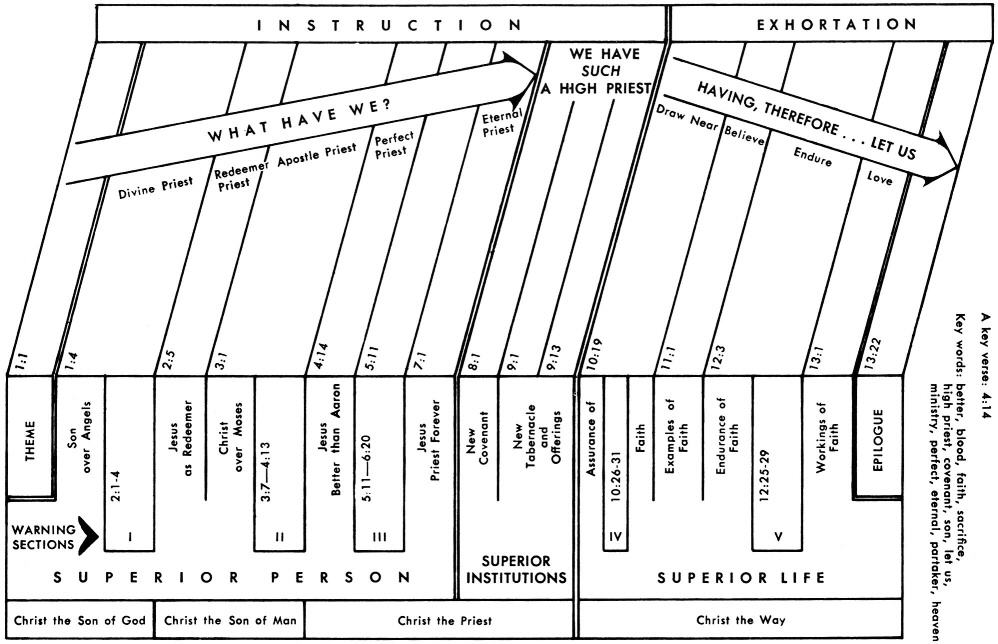
CONSIDER JESUS OUR GREAT HIGH PRIEST
Click chart to enlarge
Charts from Jensen's Survey of the NT - used by permission
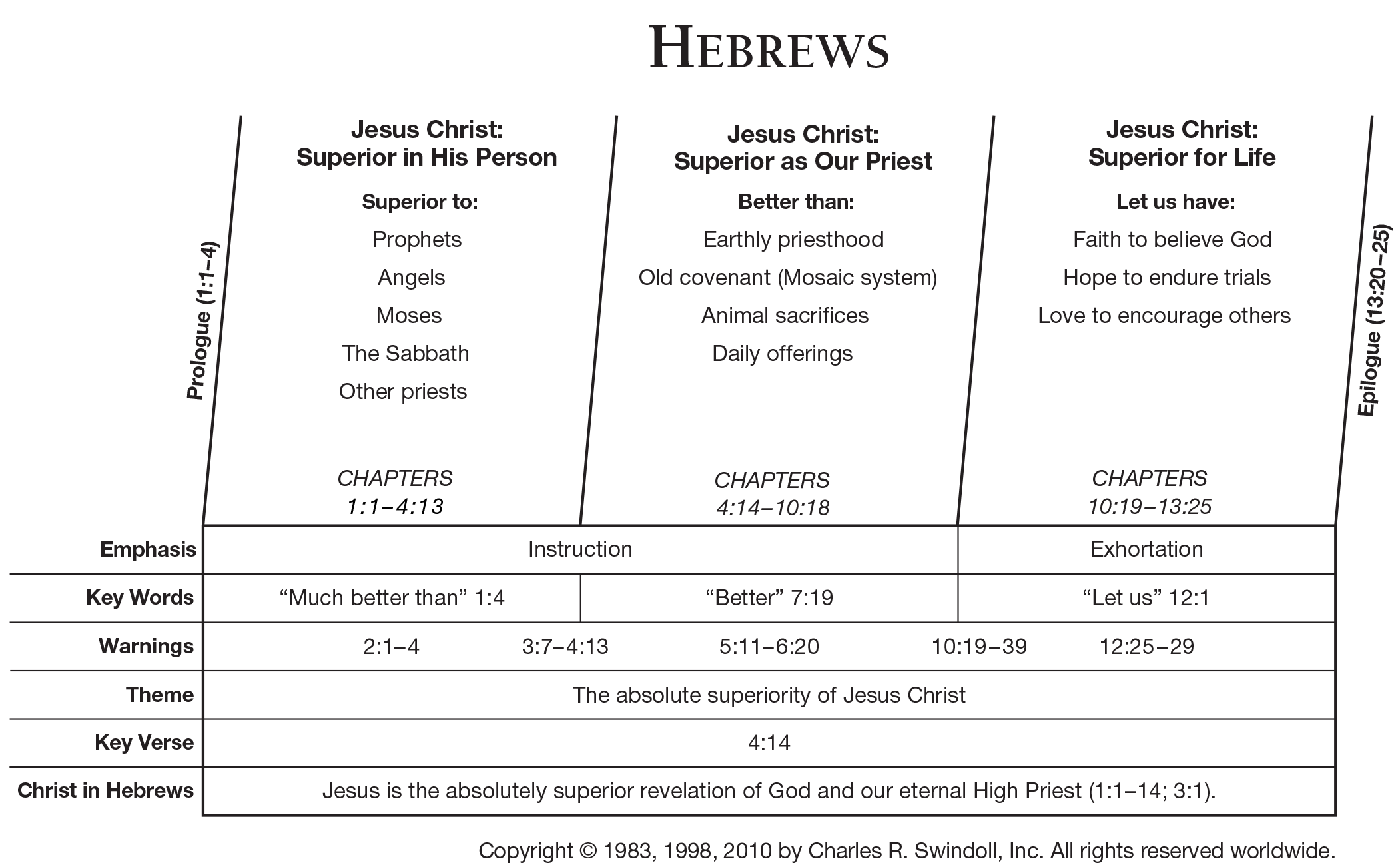
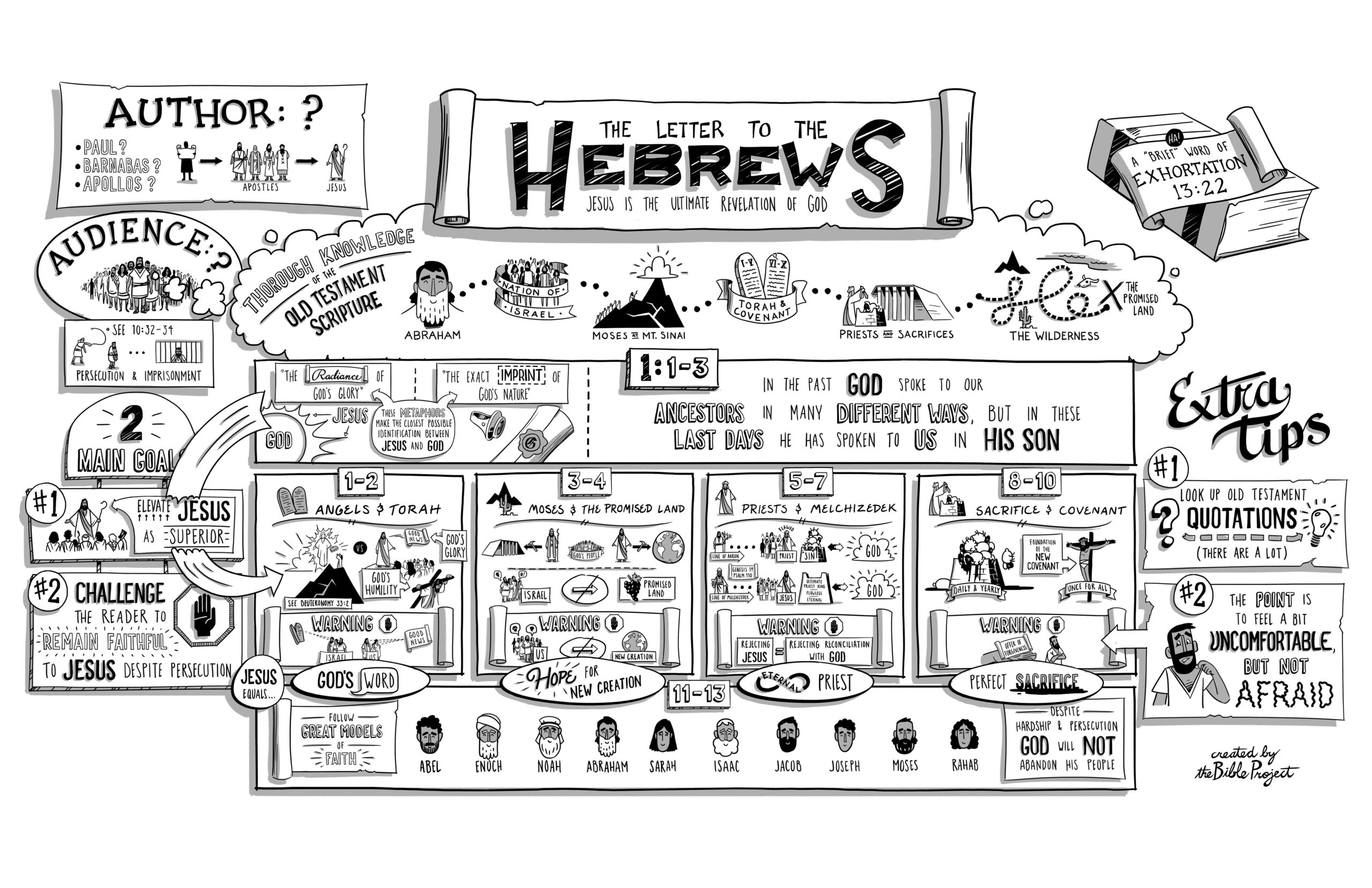
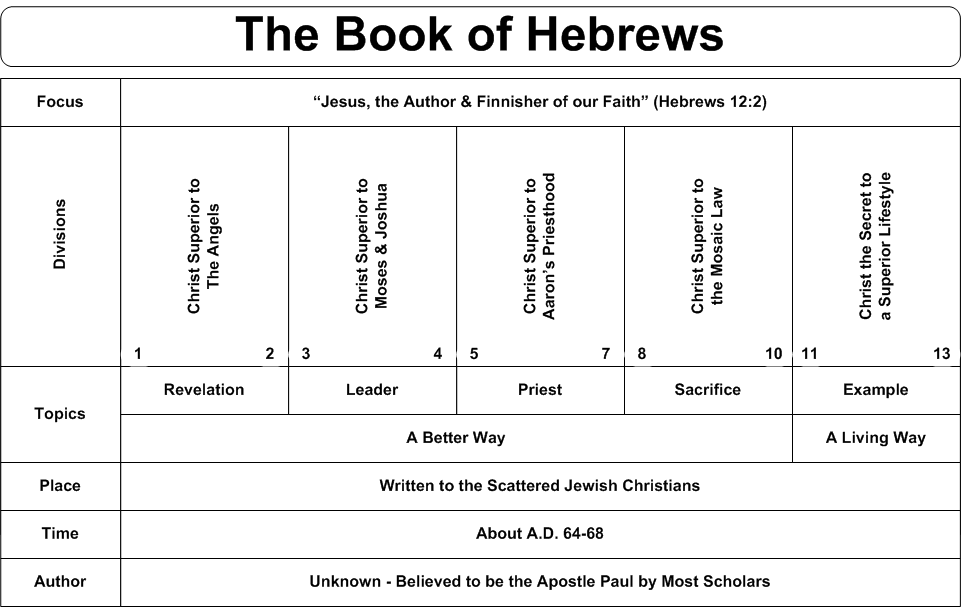
Swindoll's Chart, Interesting Pictorial Chart of Hebrews, Another Chart
|
The Epistle |
||||
| INSTRUCTION Hebrews 1-10:18 |
EXHORTATION Hebrews 10:19-13:25 |
|||
| Superior Person of Christ Hebrews 1:1-4:13 |
Superior Priest in Christ Hebrews 4:14-10:18 |
Superior Life In Christ Hebrews 10:19-13:25 |
||
| BETTER THAN PERSON Hebrews 1:1-4:13 |
BETTER PRIESTHOOD Heb 4:14-7:28 |
BETTER COVENANT Heb 8:1-13 |
BETTER SACRIFICE Heb 9:1-10:18 |
BETTER LIFE |
| MAJESTY OF CHRIST |
MINISTRY OF CHRIST |
MINISTERS FOR CHRIST |
||
|
DOCTRINE |
DUTY |
|||
|
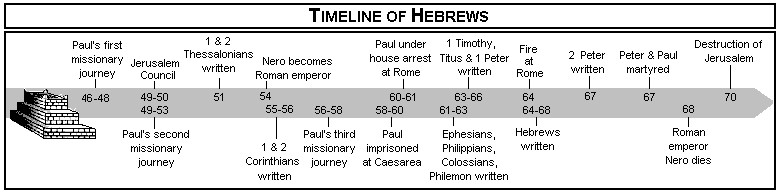
DATE WRITTEN: |
||||

See ESV Study Bible "Introduction to Hebrews"
(See also MacArthur's Introduction to Hebrews)
Borrow Ryrie Study Bible
Hebrews 11:1 Now faith is the assurance of things hoped for, the conviction of things not seen. (NASB: Lockman)
Greek: Estin (3SPAI) de pistis elpizomenon (PPPNSG) upostasis, pragmaton elegchos ou blepomenon. (PPPNSG)
BGT Ἔστιν δὲ πίστις ἐλπιζομένων ὑπόστασις, πραγμάτων ἔλεγχος οὐ βλεπομένων.
Amplified: NOW FAITH is the assurance (the confirmation, the title deed) of the things [we] hope for, being the proof of things [we] do not see and the conviction of their reality [faith perceiving as real fact what is not revealed to the senses]. (Amplified Bible - Lockman)
Jerusalem Bible: Only faith can guarantee the blessings that we hope for, or prove the existence of the realities that at present remain unseen.
KJV: Now faith is the substance of things hoped for, the evidence of things not seen.
NKJ Now faith is the substance of things hoped for, the evidence of things not seen.
NET Now faith is being sure of what we hope for, being convinced of what we do not see.
CSB Now faith is the reality of what is hoped for, the proof of what is not seen.
ESV Now faith is the assurance of things hoped for, the conviction of things not seen.
NIV Now faith is being sure of what we hope for and certain of what we do not see.
NLT: What is faith? It is the confident assurance that what we hope for is going to happen. It is the evidence of things we cannot yet see. (NLT - Tyndale House)
Phillips: Now faith means putting our full confidence in the things we hope for, it means being certain of things we cannot see. (Phillips: Touchstone)
Wuest: Now faith is the title deed of things hoped for, the proof of things which are not being seen.
Young's Literal: And faith is of things hoped for a confidence, of matters not seen a conviction,
- Now faith - He 11:13; 10:22,39; Acts 20:21; 1 Co 13:13; Gal 5:6; Titus 1:1; 1Pe 1:7; 2Pe 1:1
- Is the Ps 27:13; 42:11
- Assurance - He 2:3; 3:14; 2 Co 9:4; 11:17
- Hoped for - Heb 6:12,18,19
- Hebrews 11 Resources - Multiple Sermons and Commentaries

From keepbelieving.com
INTRODUCTION TO
HEBREWS "HALL OF FAITH"
THOUGHT - Faith is a Key Word in Hebrews - Dear child of God, let me encourage you to take a moment and observe each of the following Hebrews passages that mention faith or faithful, taking care to observe the associations, actions, etc (you might also consider recording your observations and using them to offer a prayer of praise and thanksgiving to the Most High God) (your faith will be thereby be increased just as God promises in Romans 10:17. Do you believe that Paul's inspired declaration?)…
(pistis) Faith - 33 times in 31 verses - Heb 4:2; 6:1, 12; 10:22, 38, 39; 11:1, 3, 4 (2x), He 11:5, 6, 7 (2x), He 11:8, 9, 11, 13, 17, 20, 21, 22, 23, 24, 27, 28, 29, 30, 31, 33, 39; 12:2; 13:7
Faithful (pistos) - 6 times in 6 verses - Heb 2:17; 3:2, 5, 6; 10:23; 11:11
Related verb pisteuo = believe - Heb 4:3, Heb 11:6.
Now - Now (de) is a transitional conjunction can be temporal ("at this moment") but is more likely logical in this context, connecting what has just been stated in Hebrews 10:38 ("MY RIGHTEOUS ONE SHALL LIVE BY FAITH") and in Hebrews 10:39 ("those who have faith to the preserving of the soul.") In other words, NOW connects the writer’s continuing explanation of living by faith (Heb 10:38-39) with what follows, which illustrates what such a "living faith" lives like! To say it another way, the NOW in Hebrews 11:1 does not point to the clock but to the context. NOW ties the call to endure by faith (Hebrews 10:38-39) to the examples of enduring faith that follow in Hebrews 11:1-40. It is as if the writer says, ‘You must live by faith and here are examples of men and women who will show you what real faith looks like in action.’”
Faith is introduced because
the flip side of apostasy is faith
-- Thomas Schreiner
Faith (pistis) is (estin = present tense, first in Greek for emphasis) the assurance (hupostasis/hypostasis - that which stands under ~ foundation) of things hoped (elpizo in present tense = continually hoped) for ("hope sure," not "hope so"), the conviction (elegchos - evidence~inward certainty produced by the Spirit) of things (pragma) not (ou - absolutely not) seen (blepo) - Amplified = "NOW FAITH is the assurance (the confirmation, the title deed) of the things [we] hope for, being the proof of things [we] do not see and the conviction of their reality [faith perceiving as real fact what is not revealed to the senses]." Hope looks forward while faith makes it real in the present, even though it is not yet seen. As someone has said faith is like our title deed and so guarantees our future possession. The unseen becomes certain, not by sight but by spiritual perception. True faith is not wishful thinking but Spirit-wrought assurance. In short, faith demonstrates to the eye of the mind the reality of those things that cannot be discerned by the eye of the body. Faith treats the future as present and the invisible as seen because God has said so.
The world says, “Seeing is believing.”
Faith answers, “Believing is seeing.”
Kenneth Wuest - The mention of a FAITH that is answered by salvation (Heb 10:39), leads the writer to speak about it now in detail. The word “faith” occurs without the article here, indicating that it is treated in its abstract conception, not particularly as New Testament faith. (Hebrews Commentary online)
Faith must be more than mental assent to a few religious propositions.
Faith lives, breathes, and exercises in dependence upon the living Lord.
Phil Newton - Faith is the most prominent word in religion. Often used to describe one's entire religious persuasion, faith can get lost in the shuffle of religious jargon and have little meaning in daily life. One's faith might vaguely refer to his conception of spiritual realities but have nothing to do with the way he lives his life. Not so with our text. Here the writer shows that faith must be more than mental assent to a few religious propositions. Faith lives, breathes, and exercises in dependence upon the living Lord. Hebrews 11 is known as "the faith chapter," and rightly so. But it is not disconnected with the teaching before and after-or its context. Chapter divisions are sometimes helpful and sometimes an obstacle to understanding what the biblical writer intends (ED: CHAPTER DIVISIONS WERE ADDED BY STEPHEN LANGTON IN ABOUT 1227 AD). In this case, to chop off Hebrews 11 from its context is to lose some of the practical luster of rich application it offers. We can profit from reading it apart from context; but we cannot understand the full implications of it without the context. The idea of perseverance in the exercise of faith dominates the emphasis of this chapter, coming as an explanation of what the writer states in Heb 10:39, that we are "of those who have faith to the preserving of the soul." Keep in mind the struggles the first century audience faced, as they were in the throes of opposition and imminent persecution. How would they be able to make it through without abandoning their faith for that which had no power to eternally save them? They might escape immediate danger but their souls would suffer the fate of those who reject the gospel. So our writer calls for the kind of faith that preserves the soul through the most demanding circumstances. Such faith enables the believer in the midst of trials to "run with endurance the race that is set before" him (Heb 12:1). We know very well the opening words of chapter 12 and the crescendo that sets our attention upon our exalted Lord. Exercising faith fixes the eyes on Jesus and endures even hostility in view of the surpassing value of knowing Christ. Faith aims for soul preservation-that's perseverance in concept; and it runs with endurance-that's perseverance in process. Exercising faith in Christ stands at the heart of persevering as Christians. (Hebrews 11:1-3 What Is Faith?)
Faith in practice is living today
as though God’s tomorrow is already here.
The Bible Background Commentary - In form, the chapter is a literary masterpiece. It follows the frequent literary practice called historical retrospective, a summary of Jewish history to make a particular point, as in texts like Acts 7, 1 Macc. 2:49-69 and Sirach 44-50. The retrospective consists of encomiastic biographies (favorable accounts of virtuous lives). (Ancient moralists normally used examples of people who embodied the virtue they advocated, and sometimes wrote biographies for this purpose.) The writer builds the chapter around a literary device called anaphora, beginning each new account with the same Greek word, “by faith." (SEE The IVP Bible Background Commentary: New Testament - Page 673)
Simon Kistemaker has an interesting comment that "Although the brief statement on faith consists of only two phrases, they are perfectly balanced. Note the structure (table below)… In short, assurance is balanced by certainty.
|
Faith is |
||
|
being sure of what we hope for |
certain of what we do not see |
Kistemaker explains that "These two nouns are in this text synonymous. Certainty, then, means “inner conviction.” The believer is convinced that the things he is unable to see are real. Not every conviction, however, is equal to faith. Conviction is the equivalent of faith when certainty prevails, even though the evidence is lacking. The things we do not see are those that pertain to the future, that in time will become the present. Even things of the present, and certainly those of the past, that are beyond our reach belong to the category of “what we do not see.” Comments B. F. Westcott, “Hope includes that which is internal as well as that which is external.” Hope centers in the mind and spirit of man; sight relates to one of his senses (Ro 8:24–25). Faith, therefore, radiates from man’s inner being where hope resides to riches that are beyond his purview. Faith demonstrates itself in confident assurance and convincing certainty. (BORROW Exposition of the Epistle to the Hebrews PAGE 310)
Another way to look at this verse is by seeing the two lines in parallel...
|
FAITH IS... |
|
|
the ASSURANCE... |
of THINGS HOPED FOR, |
|
the CONVICTION... |
of THINGS NOT SEEN. |
Faith enables the believing soul to treat
the future as present and the invisible as seen.
-- J Oswald Sanders
Charles Pfeiffer rightly notes that "The guiding principle of the Christian life is faith. This is not simply a psychological factor, however. To some people faith means believing that you can do a job better than you have done it in the past, or believing that a loved one will rise from his bed of sickness. There may be real value in such “positive thinking,” but this is not the meaning of faith. True Biblical faith has God as its object. We believe God and trust His Word. That Word does not tell us that we have any reason to expect to be the richest merchant on Main Street. It tells us, on the contrary, that we will have tribulations and that as Jesus’ disciples we will have crosses to bear. It assures us, however, of grace to bear them. Faith has a backward look. It declares that God has done mighty acts in days gone by. Faith also has a forward look. It declares that He can be trusted for the future… Faith is the firm assurance, the conviction, that God will do what He has promised to do. It would, of course, be presumption to insist that He must do what we want done. Many Christians grow disillusioned in their Christian lives because God does not conform to their wills. Faith takes God at His word; faith does not insist that He conform to our ideas." (BORROW The Epistle to the Hebrews)
Charles Swindoll observes that "Before he documents the journey of the faithful throughout biblical history, the writer of Hebrews provides a simple but rich definition of faith (He 11:1–2). Faith isn’t a blind shot in the dark, positive thinking, arrogant presumption, or gullible naïveté. Faith is confidence in God, a firm conviction that what He says is true and that what He promises He will do. (See Insights on Hebrews - Page 168)
Warren Wiersbe feels that Hebrews 11:1 is "not a definition of faith but a description of what faith does and how it works. True Bible faith is not blind optimism or a manufactured "hope-so" feeling. Neither is it an intellectual assent to a doctrine. It is certainly not believing in spite of evidence! That would be superstition. (Bible Exposition Commentary )
True Bible faith is confident obedience to God's Word
in spite of circumstances and consequences.
Read that last sentence again and let it soak into your mind and heart. This faith operates quite simply. God speaks and we hear His Word. We trust His Word and act on it no matter what the circumstances are or what the consequences may be. The circumstances may be impossible, and the consequences frightening and unknown; but we obey God's Word just the same and believe Him to do what is right and what is best. The unsaved world does not understand true Bible faith, probably because it sees so little faith in action in the church today. The cynical editor H.L. Mencken defined faith as "illogical belief in the occurrence of the impossible." The world fails to realize that faith is only as good as its object, and the object of our faith is God. Faith is not some "feeling" that we manufacture. It is our total response to what God has revealed in His Word. (Bible Exposition Commentary)
ILLUSTRATION - Perhaps you are here today and you say, why sure I would believe in Jesus if I saw Him today or saw Him do a miracle like the people did in the first century. Really? Are you sure? In John 2:23 we read "Now when He was in Jerusalem at the Passover, during the feast, many believed (pisteuo) in His Name, observing His signs which He was doing." Okay, now why did "many" believe? They observed the signs He was doing. You are saying, "You see there it is, they saw miracles and they believed! So if I see some miracles today I will believe in Jesus too!" O really? Well, we always have to be careful not to take a text out of context lest we misinterpret the meaning of the text. That's just a basic rule of good inductive Bible study, don't you agree? Okay let's keep reading the following context (John 2:24-25) "But Jesus, on His part, was not entrusting (pisteuo) Himself to them, for He knew all men, and because He did not need anyone to testify concerning man, for He Himself knew what was in man." What does John say? He is saying that Jesus absolutely did not "believe" in them! He knew their hearts and therefore knew what they had expressed was intellectual, emotional belief but not genuine heart belief (Ro 10:9-10)
The famous Baptist preacher W A Criswell put it this way "The contrast is between people who put their trust (pisteuo, Gk.) in Jesus, and Jesus, who does not put His trust in people because He knows their motives and thoughts. Enthusiasm for the spectacular is present in them, but Jesus looks for genuine faith."
The Bible Knowledge Commentary (Edwin Blum) agrees - "This was not necessarily saving faith as the next verse implies. They believed He was a great Healer, but not necessarily a great Savior from sin." (See Bible Knowledge Commentary - Page 280)
Faith must go beyond fact to commitment. Even demons believe (Jas 2:19) and love to promote the dangerous teaching of "Easy-believism."
Marvin Vincent on faith - Without the article, indicating that it is treated in its abstract conception, and not merely as Christian faith. It is important that the preliminary definition should be clearly understood, since the following examples illustrate it. The key is furnished by Heb 11:27, as seeing him who is invisible. Faith apprehends as a real fact what is not revealed to the senses. It rests on that fact, acts upon it, and is upheld by it in the face of all that seems to contradict it. Faith is a real seeing.
Cathers follows up Vincent's statement - Keep this in mind as we study the various examples of faith. We're not talking about men who had some spiritual force called faith, but we're talking about men who trusted in the unseen, who trusted in God's promises, who based their lives on hope. Faith is more than just being sure about God's promises, but it is an awareness of the entire invisible realm all around us. 2Co 5:7 For we walk by faith, not by sight: We need to learn to not depend as much on what we see in our circumstances, but more and more on trusting in the unseen, in the great hand of God. Looks can be deceiving. Our problem is we don't like to go where we don't see where we're going.
Illustration: The African impala can jump to a height of over 10 feet and cover a distance of greater than 30 feet. Yet these magnificent creatures can be kept in an enclosure in any zoo with a 3 foot wall. The animals will not jump it they cannot see where their feet will fall. Faith is the ability to trust what we cannot see, and with faith we are freed from the flimsy enclosures of life that only fear allows to entrap us.
R W Dale gives us an interesting cultural/historical comment - Hitherto the Jewish Christians had continued to celebrate the ancient ritual, and their presence in the temple and the synagogue had been tolerated by their unbelieving countrymen; but now they were in danger of excommunication, and it is hardly possible for us to conceive their distress and dismay. Their veneration for the institutions of Moses had not been diminished by their acknowledgment of the Messiahship of the Lord Jesus; for them, as well as for the rest of their race, an awful sanctity rested on the ceremonies from which they were threatened with exclusion. Therefore, the writer of this Epistle calls up the most glorious names of Jewish history to confirm his vacillating brethren in their fidelity to the Lord Jesus Christ. It was not by offering sacrifices, nor by attending festivals, nor by the pomp and exactness with which they had celebrated any external rites and ceremonies, that the noblest of their forefathers had won their greatness, but by their firm and steadfast trust in God.
The ESV Study Bible has an excellent comment on Biblical faith - By defining faith (Gk. pistis) as “assurance” and “conviction,” the author indicates that biblical faith is not a vague hope grounded in imaginary, wishful thinking. Instead, faith is a settled confidence that something in the future—something that is not yet seen but has been promised by God—will actually come to pass because God will bring it about. Thus biblical faith is not blind trust in the face of contrary evidence, not an unknowable “leap in the dark”; rather, biblical faith is a confident trust in the eternal God who is all-powerful, infinitely wise, eternally trustworthy—the God who has revealed himself in his word and in the person of Jesus Christ, whose promises have proven true from generation to generation, and who will “never leave nor forsake” his own (Heb 13:5). (Crossway)
Brian Bell introduces his sermon on the Hebrews "hall of faith" chapter with two illustrations…
The mighty Niagara River plummets some 180 feet at the American and Horseshoe Falls. Before the falls, there are violent, turbulent rapids. Farther upstream, however, where the river's current flows more gently, boats are able to navigate. Just before the Welland River empties into the Niagara, a pedestrian walkway spans the river. Posted on this bridge's pylons is a warning sign for all boaters: "Do you have an anchor?" followed by, "Do you know how to use it?" Faith, like an anchor, is something we need to have and use to avoid spiritual catastrophe!
For centuries the islands of New Zealand were unpopulated. No human had ever set foot on them. Then the first settlers arrived. They were Polynesians from other Pacific islands who had sailed a thousand miles in outrigger canoes (Maori). The Polynesians came with the purpose of settling in New Zealand. How did they know the land was there? How did they know they would not simply sail across empty seas until food and water ran out and they perished? - The Polynesians had known for generations that land was there because their voyagers had seen a long white cloud on the distant horizon. They knew that when a cloud stayed in one place over a very long period of time, there was land beneath it. They called New Zealand the Land of the Long White Cloud. Faith is like that. It is voyaging to an unseen land, journeying to an unknown future (Ed: Albeit believers know a number of truths about their glorious future!). But it is not mere guesswork, or chance, or superstition. There are facts behind faith, facts that suggest conclusions!
Some give as a definition of faith, “just take it on faith!” What they’re really saying is “trust me”, “put your faith in me & what I tell you, w/o any reason for believing what I tell you.” They are admitting, “I can’t really tell you why to repent & believe on Christ.” This is credulity! {A disposition to believe too readily, gullible}. This is “blind faith”, “a superstitious faith”, “a faith w/o any rational to it!” Example: This “type of faith” is most blatantly & unashamedly promoted w/the “faith healers” today who tell us, “that you are to believe you are healed, before you are healed!” You claim the promise! – “You believe you can see when you can’t see.” Did God ever ask people to believe they were healed when they really weren’t? “Believe you have an arm when you don’t”? - “Believe your cold is gone, even though you still have a runny nose & cough.” (just symptoms) No folks, Faith is trust…not magic! (Hebrews:11:1-7 Sermon Notes)
Henry Alford opens this great chapter with the following comments - ‘We are of FAITH,’ concluded the last chapter (Heb 10:39). And now this great word comes before the mind of the Writer for its definition, its exemplification, its triumphs. By this, all the servants of God from the first have been upheld, and stimulated, and carried through their glorious course (Ed: This begs the question - Is this true in your life? Are you learning more and more to walk by faith, not sight, fixated on the things unseen, not the things seen? You can dear child of God for that is our Father's will for your life. May He by His spirit make it an ever increasing reality in your life through Christ Jesus. Amen). By this exemplification the Writer evermore warmed and carried forward breaks out at last into a strain of sublime eloquence, in which he gathers together in one (chapter) the many noble deeds of faith which time and space would not allow of his specifying severally. That this word (pistis) ‘describes’ is perhaps more strictly correct than ‘defines:’ for the words which follow are not a definition of that in which faith consists, but of that which faith serves as and secures to us. A definition would approach rather from the side of the subjective phenomena of faith. Yet when speaking broadly and not strictly, we may well call this the definition of faith.
Marvin Vincent observes that the writer "has just said that “we are of faith” (Heb 10:39), not of apostasy. Now he proceeds in a chapter of great eloquence and passion to illustrate his point by a recital of the heroes of faith whose example should spur them to like loyalty now.
Our senses may lie; God cannot (Titus 1:2). People fail; God does not (Nu 23:19). Circumstances change; God never does (Mal 3:6). So the faith described in Hebrews 11 is focused on an infinitely more dependable object than any of the day-to-day varieties of faith. Real faith, however, is a divinely implanted assurance that rises above the natural functioning of the human mind. After all, the natural man cannot see Him who is unseen (v. 27).
If we commit ourselves to Christ
And follow in His way,
He'll give us life that satisfies
With purpose for each day. --Sper
Max Alderman…
“Now faith is.” How much more can be given, in such few words, the meaning of faith than by just simply stating that “faith is”? We are destined for spiritual ruin when we live as though faith is not. Strong’s said this about faith as it is used in this first verse: “conviction of the truth of anything, belief; in the NT of a conviction or belief respecting man's relationship to God and divine things, generally with the included idea of trust and holy fervor born of faith and joined with it.” We shall build upon that definition, complementing as we do the Holy Scriptures definition of faith. “Now faith is the substance of things hoped for, the evidence of things not seen.”(V.1). We could just as accurately say that “faith is actuality” or perhaps, we could say that “faith is reality.” We can say this because faith is real. It is not real in the sense that it can be tested or proven in a laboratory. It is real in the sense that it is something that God can detect and recognize. He approves when one has it and does not approve when one does not have it. (Heb 11:6)
Faith is the result of teaching (Romans 10:14-17). Knowledge is an essential element in all faith, and is sometimes spoken of as an equivalent to faith (John 10:38; 1 John 2:3). Yet the two are distinguished in this respect, that faith includes in it assent, which is an act of the will in addition to the act of the understanding. Assent to the truth is of the essence of faith, and the ultimate ground on which our assent to any revealed truth rests is the veracity (truthfulness or accuracy) of God. Faith in Christ secures for the believer freedom from condemnation, or justification before God; a participation in the life that is in Christ, the divine life (John 14:19; Romans 6:4-10; Ephesians 4:15-16); "peace with God" (Romans 5:1); and sanctification (Acts 26:18; Galatians 5:6; Acts 15:9). (Hebrews 11 Faith's Hall of Fame go to page 298)
J Ligon Duncan explains Hebrews 11 in light of what the writer has just stated in chapter 10…
Turn with me to Hebrews 11. In Hebrews 11 we begin to have illustrations given of a point that was made back in Hebrews 10:39. Hebrews 10:26-39 begins with another one of the warnings in the book of Hebrews. The warning against defecting from our allegiance to the Lord Jesus Christ, the warning against our turning our backs on Christ and seeking to fellowship with God in some other way. A warning against our taking lightly the person and work of Christ, a warning against our spurning the blood of the covenant.
But the end of that passage ends rather optimistically. Having given a very stern warning to the congregation, the preacher then says, “But look, I am hoping, I am expecting better things of you.” And as he explains that if you will cast your eyes on Hebrews 10:39, he says this. “We are not of those who shrink back to destruction.” He is expressing his hope for the congregation. “We are not the ones who are going to fall away from the faith along the way.” He goes on to say, “But of those who have faith to the persevering of the soul.” And it is phrase that he is going to spend a chapter illustrating. He is saying,
Now, look, I’m not just talking about some abstract concept that ever existed in real humanity. I am going to show you person after person from the Old Testament, from the time before the Flood, from the times of the Patriarchs, from the times of Moses, and from the times after Moses, in the Old Testament, of people who lived by faith, persevering to the end of their course, even though they didn’t have some of the advantages that you and I have as Christians.
So Hebrews 11:1 and everything that follows in that chapter is directly connected to Hebrews 10:39. The author is going to give you a gigantic illustration of that phrase, “those who have faith to the persevering of the soul.” And simultaneously, it is an exhortation for us to exercise that faith which perseveres to the end. So let’s see God’s holy and inspired word in Hebrews 11… But first I would direct your attention to verses 1 and 2. And in those passages, the author teaches us that we must know what faith means and realize how important a role it has in our perseverance. Look at those words again: “Faith is the assurance of things hoped for, the conviction of things not seen. For by it men of old gained approval.”
That passage is as close as any passage in the New Testament to a definition of faith. But it is really not a definition. It is more of a description of one aspect of saving faith. If we were going to give a fuller definition of saving faith, we would actually have to go to several different passages in the New Testament and put them together to speak about the different aspects of saving faith. Those aspects include a knowledge of the truth, a sure, a firm embrace of that knowledge; in other words, it is not just knowing the truths of the gospel so that you could list them. It is a real, personal embrace of those truths. You are not just saying, “Oh, I know that the church says that.” You are embracing those truths as something which you do not merely give ascent to, but which you believe with conviction…
The author takes us back to the Old Testament and makes it clear that these saints are precursors of us as believers in Christ. That is important because you remember throughout the Book of Hebrews, the concern is that some of these people are considering, like other friends of theirs, remitting their faith in Christ and going back to some form of Judaism. You see, in their minds they could say, “Okay, we are going to lay down this particular belief that we have had in Jesus as the Messiah and we are going to go back to the faith of our fathers.” The author of Hebrews in this chapter pulls that argument out from under them. He says that if you go back to the faith of your fathers, you will find that that faith is in the Lord Jesus Christ. If you depart from Christ, you are not departing from Christ to the patriarchs, you are departing from Christ and the patriarchs to something else. He is going to argue in all these passages that these believers believed in the promises of God which were ultimately fulfilled in Jesus Christ. He says, you can’t say I am departing from Christ and going back to the Old Testament. If you do that you are departing from the Old Testament too. Because Old Testament believers believed in the promises of God for the Messiah. It’s a brilliant argument for people who are wavering in this area. (Hebrews 11:1-7)
Comment: Notice that Duncan rightly emphasizes the saints of the OT were saved by faith in the Messiah (what they knew and understood of Him and the Gospel at their time - eg, see the "father of faith" Abraham, Gal 3:8, 16). OT believers were saved by faith not works or keeping the law or carrying out the prescribed sacrifices and offerings. Don't miss this truth. Many in the church today misunderstand and think that because the event of the crucifixion had not yet occurred, the OT saints could not have been saved by faith in the Messiah. To reiterate, there has always been only one Name under heaven by which men must be saved and that name is Jesus!
Charles Simeon observes that "CONSIDERING how much the Scriptures speak of faith, one is surprised that the subject of faith so little occupies the attention of the world at large, or even of the religious world. But the truth is, that the nature of faith is but little known. The world at large consider it as no more than assent upon evidence; whilst the religious world confine their views of it almost exclusively to the office of justifying the soul before God. But faith is of a far more comprehensive nature than even good men generally suppose. It extends to every thing that has been revealed; and is the one principle that actuates the Christian in every part of the divine life. (The Nature of Faith - Hebrews 11:1)
John Phillips explains that "Faith gives substance to the unseen realities. The believer hopes in these things and proves their reality in his personal experience by faith. Faith is a kind of spiritual "sixth sense" that enables the believer to take a firm hold upon the unseen world and bring it into the realm of experience. All our senses do this. The eye takes hold upon the light waves that pulsate through space and make real to a person the things he sees. The ear picks up the sound waves and translates them into hearing. But there is a whole spectrum of waves beyond the range of the senses. We cannot see them or hear them or taste them or smell them or feel them. But they are real, nevertheless, and, with the aid of modern instruments, we can pick them up and translate them into phenomena that our senses can handle. Faith reaches out into the spiritual dimension and gives form and substance to heavenly and spiritual realities in such a way that the soul can appreciate them and grasp them and live in the enjoyment of them. (The John Phillips Commentary Series)
James Smith writes that faith "is the substance or ground of things hoped for; it is neither a shadow nor a feeling; it is the evidence of things not seen. Jacob exercised it when he prized the birthright and sold the pottage. He laid hold on the promise, and made no provision for the flesh, so by faith he obtained a good report. Faith gives a good report of God, and gains a good report for the believer (Heb 11:2). (Handfuls on Purpose)
FAITH…
Sees the invisible
Believes the incredible
Receives the impossible
Faith (4102)(pistis) is synonymous with trust or belief and is the conviction of the truth of anything, but in Scripture speaks of belief respecting man's relationship to God and divine things, generally with the included idea of trust and holy fervor born of faith and joined with it. As pistis relates to God, it is the conviction that God exists and is the Creator and Ruler of all things well as the Provider and Bestower of eternal salvation through Christ. As faith relates to Christ it represents a strong and welcome conviction or belief that Jesus is the Messiah, through Whom we obtain eternal salvation and entrance into the Kingdom of Heaven. Stated another way, eternal salvation comes only through belief in Jesus Christ and no other way. Faith is founded on divine truth (God’s promise) and is witnessed to by the Spirit in the heart. It has both objective and subjective aspects, and both are essential!
Forsaking All I Trust Him
Acrostic: F-A-I-T-H
For more discussion of faith see commentary on Hebrews 11:1-2.
Faith is believing that God will keep His promises, despite circumstances that seem to be to the contrary! True faith that saves one's soul includes at least three main elements - (1) firm persuasion or firm conviction, (2) a surrender to that truth and (3) a conduct emanating from that surrender. In sum, faith shows itself genuine by a changed life. (Click for W E Vine's definition of faith)
Faith in simple terms is believing that God will keep His promises, despite circumstances that seem to be to the contrary! In short, "looks can be deceiving!" We have not seen the end of the story. More specifically and more personally, we have not see the end of God's story in our life (cp Php 1:6). Faith takes God at His Word, even when the odds seemed to be stacked against His Word. However, keep in mind that faith is NOT faith in faith, but is faith in God and in His Word. Faith is resting one's heart and mind on God's immutable, faithful (trustworthy) character. Faith is seeing the eternal in the now and choosing to live accordingly, doing so in dependence on the enabling power of the Holy Spirit (cp Our Responsibility in Php 2:12 and God's Provision in Php 2:13).
Subjectively faith is firm persuasion, conviction, belief in the truth, veracity, reality or faithfulness (though rare). Objectively faith is that which is believed (usually designated as "the faith"), doctrine, the received articles of faith. Click separate study of "the faith (pistis)"
Biblical faith is not based on empirical evidence but on divine assurance.
Faith is that deep assurance inside you that
God is going to keep His promises to You.
--Rich Cathers
Faith, like grace, is not static. Saving faith is more than just understanding the facts and mentally acquiescing. It is inseparable from repentance, surrender, and a supernatural longing to obey. None of those responses can be classified exclusively as a human work, any more than believing itself is solely a human effort.
True faith that saves one's soul includes at least three main elements - (1) firm persuasion or firm conviction, (2) a surrender to that truth and (3) a conduct emanating from that surrender. In sum, faith shows itself genuine by a changed life. (Click for W E Vine's definition of faith)
Respected theologian Louis Berkhof defines genuine faith in essentially the same way noting that it includes an intellectual element (notitia), which is "a positive recognition of the truth”; an emotional element (assensus), which includes “a deep conviction of the truth”; and a volitional element (fiducia), which involves “a personal trust in Christ as Savior and Lord, including a surrender … to Christ.” (Systematic Theology. Grand Rapids: Eerdmans, 1939)
Faith is relying on what God has done rather than on one’s own efforts. In the Old Testament, faith is rarely mentioned. The word trust is used frequently, and verbs like believe and rely are used to express the right attitude to God. The classic example is Abraham, whose faith was reckoned as righteousness (Ge 15:6). At the heart of the Christian message is the story of the cross: Christ’s dying to bring salvation. Faith is an attitude of trust in which a believer receives God’s good gift of salvation (Acts 16:30,31) and lives in that awareness thereafter (Gal 2:20; cf. Heb 11:1).
Spurgeon - Faith is the foot of the soul by which it can march along the road of the commandments. Faith is reason at rest in God.
A H Strong - Faith is the grip which connects us with the moving energy of God.
Faith is to the soul what a mainspring is to a watch.
John Calvin defined faith as “a steady and certain knowledge of the Divine benevolence towards us, which, being founded on the truth of the gratuitous promise in Christ, is both revealed to our minds, and confirmed to our hearts, by the Holy Spirit.”
I like Jerry Bridges practical definition of faith as that which "involves both a renunciation and a reliance. First, we must renounce any trust in our own performance as the basis of our acceptance before God. We trust in our own performance when we believe we’ve earned God’s acceptance by our good works. But we also trust in our own performance when we believe we’ve lost God’s acceptance by our bad works—by our sin. So we must renounce any consideration of either our bad works or our good works as the means of relating to God. Second, we must place our reliance entirely on the perfect obedience and sin-bearing death of Christ as the sole basis of our standing before God—on our best days as well as our worst. (The Bookends of the Christian Life).
Bridges goes on to emphasize that faith is dynamic, and just as we needed faith to be saved the first time (justification), we need faith to be saved every day (sanctification) - (In regard to justification) The gospel of justification by faith in Christ is the mainspring of the Christian life. And like the mainspring in old watches, it must be wound every day. Because we have a natural tendency to look within ourselves for the basis of God’s approval or disapproval, we must make a conscious daily effort to look outside ourselves to the righteousness of Christ, then to stand in the present reality of our justification… (In regard to sanctification) Faith involves both renunciation and reliance. We have to first renounce all confidence in our own power and then rely entirely on the power of the Holy Spirit. We must be enabled, not merely helped. What’s the difference? The word help implies we have some ability but not enough; we need someone else to supplement our partially adequate ability. By contrast, enablement implies that we have no ability whatsoever. We’re entirely powerless. We can do nothing. But when by faith we renounce self-sufficiency and embrace reliance on the power of the Holy Spirit, we receive divine empowerment, enablement, and strength for personal transformation and ministry. (I highly recommend his book The Bookends of the Christian Life).
Maclaren (in a sermon on "work of faith" in 1Thes 1:3) writes that "Faith is the hand that grasps. It is the means of communication, it is the channel through which the grace which is the life, or, rather, I should say, the life which is the grace, comes to us. It is the open door by which the angel of God comes in with his gifts. It is like the petals of the flowers, opening when the sunshine kisses them, and, by opening, laying bare the depths of their calyxes to be illuminated and coloured, and made to grow by the sunshine which itself has opened them, and without the presence of which, within the cup, there would have been neither life nor beauty. So faith is the basis of everything; the first shoot from which all the others ascend… Faith works. It is the foundation of all true work; even in the lowest sense of the word we might almost say that. But in the Christian scheme it is eminently the underlying requisite for all work which God does not consider as busy idleness… Your work of faith. There is the whole of the thorny subject of the relation of faith and works packed into a nutshell. It is exactly what James said and it is exactly what a better than James said. When the Jews came to Him with their externalism, and thought that God was to be pleased by a whole rabble of separate good actions, and so said, ‘What shall we do that we might work the works of God?' Jesus said, ‘Never mind about Works. This is the work of God, that ye believe on Him whom He hath sent,' and out of that will come all the rest. That is the mother tincture; everything will flow from that. So Paul says, ‘Your work of faith.' Does your faith work? Perhaps I should ask other people rather than you. Do men see that your faith works; that its output is different from the output of men who are not possessors of a ‘like precious faith'? Ask yourselves the question, and God help you to answer it. (Read full sermon on 1 Thessalonians 1:3)
It is notable that only the book of Romans surpasses the book of Hebrews (He 4:2; 6:1, 12; 10:22, 38, 39; 11:1, 3, 4, 5, 6, 11, 13, 17, 20, 21, 22, 23, 24, 27, 28, 29, 30, 31, 33, 39; 12:2; 13:7) in the number of uses of pistis (Romans = 35, Hebrews = 31, out of 243 NT uses)
Faith is relying on what God has done rather than on our own efforts. It may surprise you that the word faith is rarely mentioned in the Old Testament (only 4x in NAS = Dt 32:51 Job 39:12 Ps 146:6 Hab 2:4). The word trust is used frequently (79x in 78v in NAS). In addition, and verbs like believe (39x in 38v in NAS) and rely (14x in 11v in NAS) are used to express the right attitude to God. The classic example is Abraham, whose faith was reckoned as righteousness (Ge 15:6 - See word study on Hebrew word for "believe" = 'aman [word study]). At the heart of the Christian message is the story of the cross: Christ's dying to bring salvation. Faith is an attitude of trust in which a believer receives God's good gift of salvation (Acts 16:30,31) and lives in that awareness thereafter (Gal 2:20; cp He 11:1).
J Vernon McGee - Faith is not something which is added to good works. Some folk in our churches today treat faith like it is the dressing which is added to the salad of good works.
Bob Utley comments that Hebrews 11:1 "is not a theological definition of faith, but a picture of the practical outworking of it. The term (pistis) is used twenty four times in this chapter. From the OT the primary idea is “faithfulness” or “trustworthy.” This is the opposite of apostasy (Ed: Literally a "standing away from" - An abandonment of what one has professed; a total desertion, or departure from one’s faith). The Greek term for “faith” (pistis) is translated by three English terms: “faith,” “belief,” and “trust.” Faith is a human response to God’s faithfulness and His promise. We trust His trustworthiness, not our own. His character is the key. (Hebrews 11 Commentary)
Steven Cole - It is essential for every believer to understand the nature of enduring faith. As we saw last week, there is a type of faith that does not endure trials and temptations. The seed sown on the rocky ground sprang up quickly, but it also quickly withered and died when trials hit. The seed on the thorny ground may have lasted a bit longer, but eventually it was strangled by the temptations of worries, riches, and the pleasures of this life. Neither type of faith brought forth fruit to maturity. Only the seed on the good ground bore fruit with perseverance (Luke 8:11-15). That parable serves as a useful backdrop to our text last week (10:32-29), where the author urges his readers on to enduring faith. He cites Habakkuk 2:4, “But My righteous one shall live by faith, and if he shrinks back, My soul has no pleasure in him.” Then he expresses his confidence in his readers (Heb 10:39), “But we are not of those who shrink back to destruction, but of those who have faith to the preserving of the soul.” His subject is “enduring faith.” Some of his readers were in danger of shrinking back to destruction. With the threat of persecution looming over them, the Hebrew believers needed to be steeled to endure the coming trials by faith. He wants them to become “imitators of those who through faith and patience inherit the promises” (Heb 6:12). To that end, he devotes chapter 11 to an explanation and illustration of genuine faith that endures. He is not focusing on the aspect of justification by faith, as Paul does in Romans 3. Rather, his emphasis is more on the operation and outworking of justifying faith in the face of trials (John Owen, An Exposition of Hebrews [The National Foundation for Christian Education], VII:5, 7). This faith lays hold of God’s promises and the reality of the unseen world, obediently applying those realities to present trials. (By Faith Hebrews 11:1-3)
Cole goes on to add summarize the first 3 verses - Faith is the means of realizing spiritual reality, of gaining God’s approval, and of understanding the origin of all that is. Before we look at these three aspects of faith, it may be helpful to explain something about the nature of faith with reference to relationships. What I am about to say will probably sound obvious (“Duh!”). But I often see people violate this principle in their personal relationships, causing much damage. The principle is this: Trust is essential for close personal relationships. If you do not trust someone, you will not allow yourself to get close to that person. You will not share personal information because you are afraid that the person will use it in a way that damages you. You will not believe the personal information that the person shares with you, because you think, “I don’t trust this guy!” Here is a second principle for close relationships: Truth is the basis for trust. If someone lies to you or deceives you, you will not trust what he says or does. You will always be on guard. If you sense that the person is a hypocrite, conveying that he is something that he really is not, you will keep your distance. A lack of truth erodes trust and causes distance in relationships. There is a third principle for close relationships: Truth must be expressed in love. By love, I mean, “seeking the highest good of the other person.” The highest good for every person is to be conformed to the image of Jesus Christ. This motive of love must undergird all verbal expressions of truth (Eph. 4:15). To blast a person may be truthful, but it is not loving. You may say, “That’s just the way I feel,” and that’s true. But you have not said it to build the other person in Christ, and so it is not loving. On the other hand, to deceive someone under the guise of love is to deny truth. Ultimately, this will undermine the relationship, because it erodes trust. How does all of this relate to Hebrews 11? These elements of relationships also apply to our relationship with God. Faith or trust in God is at the foundation of a relationship with Him. “Without faith it is impossible to please God” (Heb 11:6). You are calling God a liar if you do not trust Him, and you cannot be close to a liar. Truth is the basis for trust. If you doubt the truth of God’s Word, including His promises for the future, you cannot trust Him and thus will be distant from Him. Some of the things that God says are not easy to accept. For example, God confronts our unbelief and sin. But He always relates to us in love. When He sends difficult trials into our lives, whether persecution, the loss of our health, or the loss of a loved one, we have to trust Him, believing that He is acting in love to form Christ in us. If the enemy can get us to doubt God’s love in a time of trials, we will draw away from God and disobey His Word of truth. To draw near to God, we “must believe that He is and that He is a rewarder of those who seek Him” (11:6). Understanding these principles—trust is essential for close personal relationships; truth is the basis for trust; and, truth must be expressed in love, which means, “seeking the highest good of the other person”—shows why faith (trust) is at the heart of a relationship with God. (By Faith Hebrews 11:1-3)
F B Meyer - Faith is the power of putting self aside that God may work unhindered. (In Meyer's Commentary he goes on to add) SOCIETY rests on the faith which man has in man. The workman, toiling through the week for the wage which he believes he will receive; the passenger, procuring a ticket for a distant town, because he believes the statements of the time-tables; the sailor, steering his bark with unerring accuracy in murky weather, because he believes in the mercantile charts and tables; the entire system of monetary credit, by which vast sums circulate from hand to hand without the use of a single coin-all these are illustrations of the immense importance of faith in the affairs of men. Nothing, therefore, is more disastrous for an individual or a community than for its credit to be impaired, or its confidence shaken. There seem to be three necessary preliminaries in order to faith. First, some one must make an engagement or promise. Second, there must be good reason for believing in the integrity and sufficiency of the person by whom the engagement has been made. Third, there follows a comfortable assurance that it will be even so; in fact, the believer is able to count on the object promised as being not less sure than if it had already come into actual possession. And this latter frame of mind is precisely the one indicated by the writer of this Epistle, when, guided by the Holy Spirit, he affirms that faith is the assurance of things hoped for, the persuasion or conviction of things not seen. In other words, faith is the faculty of realizing the unseen. These three conditions are fulfilled in Christian faith. (Way Into the Holiest)
A Few Quotes on Faith:
- True faith is ever connected with hope. John Calvin
- Believing and obeying always run side by side. C. H. Spurgeon
- Faith and obedience are bound up in the same bundle. He that obeys God, trusts God; and he that trusts God, obeys God. C. H. Spurgeon
- Obedience is the hallmark of faith. C. H. Spurgeon
- What saves is faith alone, but the faith that saves is never alone. J. I. Packer
- Faith that saves has one distinguishing quality; saving faith is a faith that produces obedience, it is a faith that brings about a way of life. Billy Graham
- Trusting means drawing on the inexhaustible resources of God.
- What is faith, unless it is to believe what you do not see? Augustine
- Walking by faith means being prepared to trust where we are not permitted to see. John Blanchard
- Faith is a living, daring confidence in God’s grace. It is so sure and certain that a man could stake his life on it a thousand times. Martin Luther
- Faith is our acceptance of God’s acceptance of us. Adrian Rogers
William Newell - "Hoping for something is not yet faith! Faith says, "I have it!" Things not seen shows there is no consulting of human faculties or "feelings." The ark is the test of faith. When Noah entered the ark, there was the same conviction of the fact of the coming flood that he had during the years of building the ark. God had spoken! That was all that was before his mind. He never looked at the sky. Faith is a conviction of things when they are not seen! a giving-substance-to (Greek, = hupostasis) things hoped for. (Hebrews 11 Commentary)
Andrew Murray emphasizes that… The previous chapter closed with the solemn lesson: There is no alternative, believing or drawing back; there is no safety or strength for the Christian, but to be strong in faith; there is no way of pleasing God, of abiding in His presence and favour, but by faith. If any man draw back, My soul hath no pleasure in him. And so, after the teaching of the Epistle as to what God hath done, we are now to see that for our enjoyment of its power and blessing but one thing is needed--the fulness of faith. The writer begins by a general statement of what faith really is in its nature and action. Now faith is the assurance of things hoped for, the proving of things not seen. Faith is the spiritual faculty of the soul which deals with the spiritual realities of the future and the unseen. Just as we have our senses, through which we hold communication with the physical universe, so faith is the spiritual sense or organ through which the soul comes into contact with and is affected by the spiritual world. Just as the sense of seeing or hearing is a dormant power till the objective reality, the light or the sound, strikes it, so faith in itself is a sense with no power beyond the possibility or capacity of receiving the impressions of the eternal. It is as an empty vessel which wants to be filled with its unseen contents. (The Holiest of All - Hebrews 11 "Faith - The Sense for the Unseen")
It is notable that only the book of Romans surpasses the book of Hebrews (click to study the uses of pistis in Hebrews) in the number of uses of pistis (Romans = 35, Hebrews = 31, out of 243 NT uses) Click for links to all 243 uses of pistis (NAS) which is translated: faith, 238; faithfulness, 3; pledge, 1; proof, 1.
As pistis relates to God, it is the conviction that God exists and is the Creator and Ruler of all things well as the Provider and Bestower of eternal salvation through Christ. As faith relates to Christ it represents a strong and welcome conviction or belief that Jesus is the Messiah, through Whom we obtain eternal salvation and entrance into the Kingdom of Heaven. Stated another way, eternal salvation comes only through belief in Jesus Christ and no other way.
Illustration - A mother once asked her six-year old son what he had learned in Sunday School. He said the teacher had talked about 'faith.' "And what is faith?" the mother asked. And her son responded, "I think it's believing in what you know ain't so." Of course that is not what Hebrews 11:1 is saying but it is largely what the skeptical world says about our Christian beliefs -- "Are you kidding! A dead man coming back to life? Ridiculous!" (cp 1Cor 15:19, 20, 21, 22 is the truth!)
Related Resources:
- "the faith"
- the "obedience of faith".
- Study on pistos
J. B. Lightfoot discusses the concept of faith in his commentary on Galatians. He notes that in Hebrew, Greek, and Latin, the definition of the word for faith "hovers between two meanings: trustfulness, the frame of mind which relies on another; and trustworthiness, the frame of mind which can be relied upon… the senses will at times be so blended together that they can only be separated by some arbitrary distinction. The loss in grammatical precision is often more than compensated by the gain in theological depth… They who have faith in God are steadfast and immovable in the path of duty."
Faith is manifest by not believing in spite of evidence but obeying in spite of consequence. John uses the related verb pisteuo to demonstrate the relationship between genuine faith and obedience writing ""He who believes (present tense = continuous) in the Son has eternal life; but he who does not obey the Son shall not see life, but the wrath of God abides on him." (John 3:36)
Charles Swindoll commenting on faith and obedience in John 3:36 concludes that "In Jn 3:36 the one who “believes in the Son has eternal life” as a present possession. But the one who “does not obey the Son shall not see life.” To disbelieve Christ is to disobey Him. And logically, to believe in Christ is to obey Him. As I have noted elsewhere, “This verse clearly indicates that belief is not a matter of passive opinion, but decisive and obedient action.” (quoting J. Carl Laney)… Tragically many people are convinced that it doesn’t really matter what you believe, so long as you are sincere. This reminds me of a Peanuts cartoon in which Charlie Brown is returning from a disastrous baseball game. The caption read, “174 to nothing! How could we lose when we were so sincere?” The reality is, Charlie Brown, that it takes more than sincerity to win the game of life. Many people are sincere about their beliefs, but they are sincerely wrong!" (Swindoll, C. R., & Zuck, R. B. Understanding Christian Theology.: Thomas Nelson Publishers) (This book is recommended if you are looking for a very readable, non-compromising work on "systematic theology". Wayne Grudem's Systematic Theology is comparable. Click for Grudem's online outline of Conversion and/or Listen to the Mp3 of Conversion)
Easton’s 1897 Bible Dictionary - Faith is in general the persuasion of the mind that a certain statement is true (Phil 1:27; 2Th 2:13). Its primary idea is trust. A thing is true, and therefore worthy of trust. It admits of many degrees up to full assurance of faith, in accordance with the evidence on which it rests. (Ed: Trust is defined as "a reliance or resting of the mind on the integrity, veracity, justice, friendship or other sound principle of another person" in this case the Person is God, Who cannot lie - from Webster's 1828 Dictionary).
Related Resources:
- What is the definition of faith?
- What does the Bible say about faith?
- What is a leap of faith?
- What is faith in God?
- What does it mean that salvation is by grace through faith?
- What does it mean that the righteous will live by faith (Habakkuk 2:4)?
- What does it mean to have faith in Jesus?
- How can you believe in salvation by faith alone when the only occurrence of ‘faith alone’ in the Bible (Jas 2:24) says salvation is not by faith alone?
- Why is faith without works dead?
- Why do so many people struggle with a lack of faith?
- How can I overcome the fact that I am struggling with faith?
- Where does faith come from?
- How can I keep the faith?
- What is a profession of faith?
- Does God expect us to have blind faith?
- What is the shield of faith (Ephesians 6:16)?
- What is the difference between faith and hope?
- Is salvation by faith alone, or by faith plus works?
- What is the relationship of faith, works, and security in salvation?
- What does it mean to have mustard seed faith?
- Faith vs. fear - what does the Bible say?
- Does the Bible instruct us to have childlike faith?
- How can I increase my faith?
- Can faith really move mountains?
- What does it mean to walk by faith not by sight?
O YE OF LITTLE FAITH
Perhaps you feel your faith is too little. Do not be discouraged for that is still powerful truth if your "little faith" is genuine faith. And we can (and should) all pray like the apostles who said to the Lord Jesus "Increase our faith!" (Lk 17:5) or the man in Mark 9:24 who cried out saying "I do believe; help my unbelief." And remember that none of us have arrived at perfect faith and won't until our faith becomes sight (1Jn 3:2, cf 1Co 13:12, Rev 22:4) and we see Jesus face to face. In the meantime we can certainly ask God (in faith) "Lord, strengthen my faith to see the unseen, to trust the future promise more than the present reality (2Co 4:18), and to live today as one who is certain of tomorrow. In Jesus' Saving Name. Amen"
One other suggestion to supplement and sustain and grow your faith is provided by Paul who teaches "So faith comes from hearing, and hearing by the word of Christ." (Romans 10:17) Faith grows only in proportion to our exposure to and dependence upon God’s revealed truth. The Spirit of God uses the Word of God to build the faith of the child of God.
The hearing of the Word is the channel through which God most commonly conveys His grace to men’s hearts. Faith never grows in barren soil; it springs up where the seed of the Word is sown. True faith is always anchored in divine revelation. It is not believing in spite of evidence but because of it and specifically because God has spoken. Thus, the believer who wishes to walk by faith must feed continually on the Word. Hearing, reading, and meditating on Scripture are not peripheral disciplines—they are the very lifeline of living faith. Faith lives upon the Word of God. Faith grows as truth is applied so that the more we hear and heed the Word, the stronger our confidence in the God who speaks the Word. Like Israel in the desert, it gathers manna daily and if we attempt to live on yesterday’s bread, our faith begins to grow faint. In other words, just as the body weakens without bread, faith falters and become faint without the Word.
It was Charles Spurgeon who said "A little faith will bring your soul to heaven; a great faith will bring heaven to your soul.” Lord, give us that kind of faith which brings heaven to our soul for our good and Your glory. In Jesus' trustworthy Name. Amen
Faith feeds upon the Word it hears,
And finds its strength through grace, not years.
It trusts what sight cannot define,
For every promise bears God’s sign.
When hearts grow faint, His truth sustains;
When doubts arise, His voice remains.
For faith comes living, sure, and bright,
From hearing Christ—the Word of Light.
Simon Kistemaker on FAITH - The word faith in the New Testament has many aspects. For example, when the Judean Christians, whom Paul had sought to destroy, spoke of their belief in Christ, they said, “The man who formerly persecuted us is now preaching the faith he once tried to destroy” (Gal. 1:23). Faith, then, is a confession, much the same as we call the Apostles’ Creed the articles of our Christian faith. However, this is not the meaning of faith that the writer of Hebrews conveys.
For the evangelists who wrote the Gospels, Jesus Christ is the object of faith. John summarizes this emphasis when he states the purpose of his Gospel, namely, “that you may believe that Jesus is the Christ, the Son of God, and that by believing you may have life in his name” (John 20:31). Also, the Acts show that in the first century, “a personal faith in Jesus was a hallmark of the early Christians.” (Donald Guthrie, New Testament Theology )
Still another aspect of faith is Paul’s emphasis on appropriating, that is, claiming salvation in Jesus Christ. Paul contends that God puts the sinner right with him through faith: “This righteousness from God comes through faith in Jesus Christ to all who believe” (Rom. 3:22). And Paul explains that faith comes from hearing the Word proclaimed (Rom. 10:17).
Faith is adhering to the promises of God, depending on the Word of God,
and remaining faithful to the Son of God.
The author of Hebrews recognizes these same aspects of faith featured by other writers of the New Testament. However, his use of the concept faith must be understood primarily in the context of the eleventh chapter of his epistle. The heroes of faith have one thing in common: they put their undivided confidence in God. In spite of all their trials and difficult circumstances, they triumphed because of their trust in God. For the author, faith is adhering to the promises of God, depending on the Word of God, and remaining faithful to the Son of God.
When we see chapter 11 in the context of Hebrews, the author’s design to contrast faith with the sin of unbelief (3:12, 19; 4:2; 10:38–39) becomes clear. Over against the sin of falling away from the living God, the writer squarely places the virtue of faith.2 Those people who shrink from putting their trust in God are destroyed, but those who believe are saved (10:39). (BORROW Exposition of the Epistle to the Hebrews PAGE 310)
ILLUSTRATION OF FAITH - When missionary John Paton was translating the Scripture for the South Sea islanders (New Hebrides islands), he was unable to find a word in their vocabulary for the concept of believing, trusting, or having faith. He had no idea how he would convey that to them. One day while he was in his hut translating, a native came running up the stairs into Paton's study and flopped in a chair, exhausted after a long jungle hunting excursion. He said to Paton something like this…
“It’s so good to stretch myself out and rest my whole weight in this chair.”
John Paton had his word: Faith is resting your whole weight on God. That word went into the translation of their New Testament and helped bring that civilization of natives to Christ. Believing is putting your whole weight on God. If God said it, then it’s true, and we’re to believe it. By faith, the weary sinner stretches out to rest on Jesus Christ, upheld by His glorious gospel. Substituting Paton's translation, the loose paraphrase would sound something like this…
"Stretch yourself out" on the Lord Jesus, and you will be saved (Acts 16:31).
For God so loved the world that he gave his one and only Son, that whoever "stretches out" on Him shall not perish but have eternal life (John 3:16)
Nothing before, nothing behind,
The steps of faith
Fall on the seeming void, and find
The rock beneath
-- Whittier
FAITH IN THE BOOK OF HEBREWS - Clearly faith is a key word in Hebrews. Study the 31 uses of pistis in Hebrews in context …
Hebrews 4:2 - For indeed we have had good news preached to us, just as they also; but the word they heard did not profit them, because it was not united by faith in those who heard.
Hebrews 6:1 - Therefore leaving the elementary teaching about the Christ, let us press on to maturity, not laying again a foundation of repentance from dead works and of faith toward God,
Hebrews 6:12 -so that you will not be sluggish, but imitators of those who through faith and patience inherit the promises.
Hebrews 10:2 - let us draw near with a sincere heart in full assurance of faith, having our hearts sprinkled clean from an evil conscience and our bodies washed with pure water.
Hebrews 10:38 - BUT MY RIGHTEOUS ONE SHALL LIVE BY FAITH; AND IF HE SHRINKS BACK, MY SOUL HAS NO PLEASURE IN
Hebrews 10:39 - But we are not of those who shrink back to destruction, but of those who have faith to the preserving of the soul.
Hebrews 11:1 - Now faith is the assurance of things hoped for, the conviction of things not seen.
Hebrews 11:3 - By faith we understand that the worlds were prepared by the word of God, so that what is seen was not made out of things which are visible.
Hebrews 11:4 - By faith Abel offered to God a better sacrifice than Cain, through which he obtained the testimony that he was righteous, God testifying about his gifts, and through faith, though he is dead, he still speaks.
Hebrews 11:5 - By faith Enoch was taken up so that he would not see death; AND HE WAS NOT FOUND BECAUSE GOD TOOK HIM UP; for he obtained the witness that before his being taken up he was pleasing to God.
Hebrews 11:6 - And without faith it is impossible to please Him, for he who comes to God must believe that He is and that He is a rewarder of those who seek Him.
Hebrews 11:7 - By faith Noah, being warned by God about things not yet seen, in reverence prepared an ark for the salvation of his household, by which he condemned the world, and became an heir of the righteousness which is according to faith.
Hebrews 11:8 - By faith Abraham, when he was called, obeyed by going out to a place which he was to receive for an inheritance; and he went out, not knowing where he was going.
Hebrews 11:9 - By faith he lived as an alien in the land of promise, as in a foreign land, dwelling in tents with Isaac and Jacob, fellow heirs of the same promise;
Hebrews 11:11 - By faith even Sarah herself received ability to conceive, even beyond the proper time of life, since she considered Him faithful who had promised.
Hebrews 11:13 - All these died in faith, without receiving the promises, but having seen them and having welcomed them from a distance, and having confessed that they were strangers and exiles on the earth.
Hebrews 11:17 - By faith Abraham, when he was tested, offered up Isaac, and he who had received the promises was offering up his only begotten son;
Hebrews 11:20 - By faith Isaac blessed Jacob and Esau, even regarding things to come.
Hebrews 11:21 - By faith Jacob, as he was dying, blessed each of the sons of Joseph, and worshiped, leaning on the top of his staff.
Hebrews 11:22 - By faith Joseph, when he was dying, made mention of the exodus of the sons of Israel, and gave orders concerning his bones.
Hebrews 11:23 - By faith Moses, when he was born, was hidden for three months by his parents, because they saw he was a beautiful child; and they were not afraid of the king's edict.
Hebrews 11:24 - By faith Moses, when he had grown up, refused to be called the son of Pharaoh's daughter,
Hebrews 11:27 - By faith he left Egypt, not fearing the wrath of the king; for he endured, as seeing Him who is unseen.
Hebrews 11:28 - By faith he kept the Passover and the sprinkling of the blood, so that he who destroyed the firstborn would not touch them.
Hebrews 11:29 -By faith they passed through the Red Sea as though they were passing through dry land; and the Egyptians, when they attempted it, were drowned.
Hebrews 11:30 - By faith the walls of Jericho fell down after they had been encircled for seven days.
Hebrews 11:31 - By faith Rahab the harlot did not perish along with those who were disobedient, after she had welcomed the spies in peace.
Hebrews 11:33 -who by faith conquered kingdoms, performed acts of righteousness, obtained promises, shut the mouths of lions,
Hebrews 11:39 - And all these, having gained approval through their faith, did not receive what was promised,
Hebrews 12:2 - fixing our eyes on Jesus, the author and perfecter of faith, who for the joy set before Him endured the cross, despising the shame, and has sat down at the right hand of the throne of God.
Hebrews 13:7 - Remember those who led you, who spoke the word of God to you; and considering the result of their conduct, imitate their faith.
James McConkey - “Faith is dependence upon God. And this God-dependence only begins when self-dependence ends. And self-dependence only comes to its end, with some of us, when sorrow, suffering, affliction, broken plans and hopes bring us to that place of self-helplessness and defeat. And only then do we find that we have learned the lesson of faith; to find our tiny craft of life rushing onward to a blessed victory of life and power and service undreamt of in the days of fleshly strength and self-reliance.” (SEE James H. McConkey A Man of God)
J. B. Stoney - “It is a great thing to learn faith: that is, simple dependence upon God. It will comfort you much to be assured that the Lord is teaching you dependence upon Himself, and it is very remarkable that faith is necessary in everything. ‘The just shall live by faith,’ not only in your circumstances, but in everything. I believe the Lord allows many things to happen on purpose to make us feel our need of Him. The more you find Him in your sorrows or wants, the more you will be attached to Him and drawn away from this place where the sorrows are, to Him in the place where He is.” “Set your affection on things above” (see Col 3:2). (SEE The Green Letters: Principles of Spiritual Growth - Page 11)
John MacArthur explains that the phrase "Conviction of things not seen carries the same truth (assurance of things hoped for) a bit further, because it implies a response, an outward manifestation of the inward assurance. The person of faith lives his belief. His life is committed to what his mind and his spirit are convinced is true. Noah, for example, truly believed God. He could not possibly have embarked on the stupendous, demanding, and humanly ridiculous task God gave him without having had absolute faith. When God predicted rain, Noah had no concept of what rain was, because rain did not exist before the Flood. It is possible that Noah did not even know how to construct a boat, much less a gigantic ark. But Noah believed God and acted on His instructions. He had both assurance and conviction—true faith. His outward building of the ark bore out his inward belief that the rain was coming and that God's plan was correct for constructing a boat that would float. His faith was based on God's word, not on what he could see or on what he had experienced. For 120 years he preached in faith, hoped in faith, and built in faith. The natural man cannot comprehend that kind of spiritual faith. We see Him who is invisible (Heb 11:27), but the unsaved man does not, because he has no means of perception. Because he has no spiritual senses, he does not believe in God or the realities of God's realm. He is like a blind man who refuses to believe there is such a thing as light because he has never seen light. ( Hebrews. Moody Press)
John Henry Jowett says…
I LIKE the marginal rendering of the introductory sentence of this great chapter. “Faith is the giving substance to things hoped for.”
Faith converts cloudy castles into substantial homes.
Faith substantiates the unseen.
Faith sucks the energy out of splendid ideals, and incorporates it in present and immediate life.
Faith unfolds the eternal in the moment, the infinite in the trifle, the divine in the commonplace.
Faith incorporates God and man.
Yes, faith gives substance to “things hoped for,” it brings them out of the air, and gives them reality and movement in the hard and common ways of earth and time.
And faith is also “the test (see note on cognate noun elegcho) of things not seen.” By a test faith gains a conquest. By an experiment faith acquires an experience. By a great speculation faith makes a great discovery. “Try me now herewith, and prove Me!” It is an invitation to humble and sincere assumption. Try if it works! Make a hallowed experiment with the powers of grace.
Lord, incline me to make the gracious test! Let me stake my all upon the venture! Let me dare all in order that I may gain all! Let me sow bountifully, and so reap a bountiful harvest. (Daily Meditation)
John Stevenson notes that…
It was following the American War Between the States that a day was instituted as the American Memorial Day. It is a time for remembering those who have fallen. There is something good and noble about remembering. Hebrews 11 is a Christian memorial. It stands as a memorial to those who took a stand in faith.
The Christian life is a life of faith. But it is not an ethereal faith in nothing or a faith in faith. The faith to which we hold is anchored in reality. It is a faith which is rooted and centered in the person of Jesus.
Throughout the previous chapter, we have been impressed with the importance of holding on to Jesus rather than submitting to the temptation to turn away from Him. It is in this vein that the author says that we are not of those who shrink back to destruction, but of those who have FAITH to the preserving of the soul (Hebrews 10:39). He now goes on to define and to illustrate that faith.
There is an unseen quality about faith. You don’t use faith when you can use your senses. If I hear your voice behind me, I am not exercising faith when I come to the conclusion that you are there.
Remember the case of Thomas? He had been away picking up hamburgers when Jesus made His first appearance to the disciples following the resurrection. Thomas had come back to find the other disciples excited about having seen Jesus. But he did not believe. He was more sophisticated than that. He would not be swayed by an optical illusion. He would not believe unless he felt the nail holes and the wound in the side of Jesus.
And then, a week later, Jesus was standing there. And Thomas saw. And Thomas believed. But was it real faith? Not in the sense that we have described here.
Jesus said to him, "Because you have seen Me, have you believed? Blessed are they who did not see, and yet believed." (John 20:29).
Once you have seen, it is easy to believe. Real faith is believing without seeing. It is the conviction of things not seen. And it is living on the basis of that conviction. That is going to be the message which we shall see throughout this chapter. Christians believe God to the point of banking their lives upon His promises. (The Hall of Faith)
The Heidelberg Catechism (as quoted by Kistemaker) has this answer to the question of what is true faith…
True faith—
created in me by the Holy Spirit through the Gospel—
is not only a knowledge and conviction
that everything that God reveals in his Word is true,
but also a deep-rooted assurance
that not only others, but I too,
have had my sins forgiven,
have been made forever right with God,
and have been granted salvation.
These are gifts of sheer grace
earned for us by Christ.
Dr. Harry A Ironside wrote these notes on faith in the margin of his Bible…
Saving faith—
not:
1—A mere historical faith.
2—Faith in ordinances or sacramental observances.
3—In the Church.
4—In one's self.
5—In experiences.
but:
Confidence in what God has revealed.
It is grounded in repentance.
Christ is its Object.
The Word of God is its authority.
It is a personal interest in the Lord Jesus Christ.
Steven Cole on Hebrews 11:1 - The difficulty of the verse lies in the meaning of the words translated (NASB) as “assurance” (“being certain of,” NIV) and (NASB) “conviction” (“certain,” NIV). The KJV and NKJV translate these words as “substance” and “evidence.” The NASB and NIV understand the words as subjective, whereas the KJV and NKJV take them as objective. The subjective understanding is, “faith means being confident of what we hope for, convinced of what we do not see.” An objective understanding is, faith means “the reality of the goods hoped for,” (Helmut Koster, Theological Dictionary of the New Testament, ed. by Gerhard Friedrich [Eerdmans], VIII:586), “the proof of things unseen.” The Bauer, Arndt, & Gingrich Greek-English Lexicon of the New Testament [University of Chicago Press, 2nd ed.] takes both words in an objective sense. It renders the first phrase (p. 847), “in faith things hoped for become realized” (or, “reality”). The second is (p. 249), “a proving of (or conviction about) unseen things.” All of the patristic and medieval scholars understood the words in the objective sense, but Melanchthon advised Luther to render it, “sure confidence.” Luther’s interpretation has influenced most scholarship since the Reformation (Koster, ibid.). The Greek word, hypostasis, occurs twice in Paul in the sense of “confidence” (2 Cor. 9:4; 11:17), and three times in Hebrews (Heb 1:3; 3:14; and here). All scholars agree that the word is used objectively in 1:3, which states that Christ is the exact representation of God’s nature (essence, or reality). Most scholars take the second instance (Heb. 3:14) as subjective, “hold fast the beginning of our assurance firm until the end.” But the respected Theological Dictionary of the New Testament (ibid., VII:587) argues that it does not refer there to subjective assurance, which rests within us, but to the objective reality of the faith. In this sense, the phrase is parallel to “our confession” (Active sense in Heb 11:1: “faith is the reality of the goods hoped for.” “Faith is the reality of what is hoped for in exactly the sense in which Jesus is called the [exact representation] of the reality of the transcendent God in Heb 1:3” (ibid.). Since the two halves of Heb 11:1 seem to be parallel, “conviction” (Greek, elenchos) would need to be taken in an objective sense, also, as “proof of things one cannot see” (ibid., VII:586). Donald Hagner puts it this way (Encountering the Book of Hebrews [Baker], p. 142): "From the examples of faith lifted up in this chapter it seems clear that what is not primarily in view is what we feel or possess—assurance, confidence—but rather, how faith substantiates, or gives substance to, what is promised, how it provides evidence of what is believed about unseen and hoped-for realities. Faith, indeed, has a way of making the future present and the unseen visible." There is, of course, overlap between the objective and subjective senses of these words. Our faith substantiates what we hope for, thus giving us assurance that they are true. Faith provesor gives evidence for the things that we cannot see, thus giving us a conviction that these unseen things are true. I suggest this expanded paraphrase of Heb 11:1, “Faith makes real in our experience the promises that God has given about the future. Faith proves to us the fact that the things we presently cannot see—God, angels, demons, heaven, hell—are very much true and real.” In other words, faith applies the reality of God’s promises and the unseen world to life in the present, visible world. A. W. Pink (An Exposition of Hebrews) uses the analogy of two men standing on the deck of a ship, looking in the same direction. One sees nothing, but the other man sees a distant steamer. The difference is, the first man is looking with his unaided eye, whereas the second man is looking through a telescope. Faith is the telescope that brings the future promises of God into present focus. Faith enables us to see the unseen world that the natural man cannot see. (By Faith Hebrews 11:1-3)
Scott Grant - The word for "assurance" was used in legal circles of a "guarantee" and of a "title deed" to property. We already have seen the author use it as describing the "nature," or substance, of God. Faith provides a guarantee that the things it hopes for are real, and the guarantee in itself is the substance of those things. The guarantee is similar to the function of a down payment. A down payment guarantees that more will be coming - more of the same. The writer is saying that those who have faith already have a percentage, so to speak, of the "things hoped for" and that this possession serves as a guarantee that 100 percent of the things will one day be possessed. The word "hope" implies goodness. One only hopes for good things. The things hoped for concern our eternal inheritance, the heavenly and eternal country that is filled with the presence of God (Heb 9:15, 10:34, 11:16). The "things hoped for" will enable us to enjoy God forever. To some degree we can enjoy God now, and that enjoyment is a guarantee that one day we will enjoy him completely. In this sense, the writer agrees with Paul, who says the Holy Spirit, who reveals God to us and nurtures our relationship with God, has been given to us as a pledge, or a down payment, of our inheritance (Ephesians 1:13-14). (Sermon)
Assurance (5287) (hupostasis/hypostasis from hupo/hypo = under + histemi = stand) is a literally a standing or setting under and thus describes a support, a confidence, a steadiness, a foundation (refers to ground on which something is built = the foundation of things for which we hope) and as used in Scripture represents a solid, unshakable confidence in God (that He Who has promised is faithful). Stated another way hupostasis is that which underlies the apparent and which therefore is the reality, the essence or the substance. It refers to the essence or substance of something—that which stands under something as its foundation or support. It came to denote essence, and as discussed below is used with that meaning in Hebrews 1:3.
Philip E Hughes writes that - The term hypostasis… is susceptible of a variety of connotations, but, despite the different interpretations proposed, there is in all cases, as Moulton and Milligan point out, "the same central idea of something that underlies visible conditions and guarantees a future possession." (A Commentary On The Epistle To The Hebrews)
Hupostasis is a very common word from Aristotle on and was used in Greek to describe that which stands under anything such as a building, a contract, a promise. It is common in the papyri in business documents as the basis or guarantee of transactions or with the meaning of a title deed. Thus one translation renders it "Faith is the title-deed of things hoped for."
A T Robertson on hupostasis - It is common in the papyri in business documents as the basis or guarantee of transactions."
George Brooks adds that "Faith does not put all its confidence in the present and the visible. Faith is to our hopes what a deed is to a piece of property. The deed guarantees ownership for the owner."
Warren Wiersbe - The word translated "substance" (assurance) means literally "to stand under, to support." Faith is to a Christian what a foundation is to a house: it gives confidence and assurance that he will stand. (Bible Exposition Commentary)
IVP Background Commentary- This hope is, however, an unshakable conviction in the present: “assurance” (NASB, NRSV; “being sure”—NIV) appears in Greek business documents with the meaning “title deed.” (SEE The IVP Bible Background Commentary: New Testament - Page 673)
Hupostasis is used 19 times in the Septuagint (LXX) and 5 times in the NT…
2Cor 9:4 (3 But I have sent the brethren, that our boasting about you may not be made empty in this case, that, as I was saying, you may be prepared) 4 lest if any Macedonians come with me and find you unprepared, we (not to speak of you) should be put to shame by this confidence.
2Cor 11:17 That which I am speaking, I am not speaking as the Lord would, but as in foolishness, in this confidence of boasting.
Hebrews 1:3 And He is the radiance of His glory and the exact representation of His nature (hupostasis, and upholds all things by the word of His power. When He had made purification of sins, He sat down at the right hand of the Majesty on high;
Hebrews 3:14 For we have become partakers of Christ, if we hold fast the beginning of our assurance firm until the end;
Hebrews 11:1 Now faith is the assurance of things hoped for, the conviction of things not seen.
HUPOSTASIS IN SEPTUAGINT - Deut. 1:12; Deut. 11:6; Jdg. 6:4; Ruth 1:12; 1 Sam. 13:21; 1 Sam. 13:23; 1 Sam. 14:4; Job 22:20; Ps. 39:5; Ps. 39:7; Ps. 69:2; Ps. 89:47; Ps. 139:15; Jer. 10:17; Jer. 23:22; Ezek. 19:5; Ezek. 26:11; Ezek. 43:11; Nah. 2:7;
Considering the preceding definitions of hupostasis in one might paraphrase Hebrews 11:1 as follows…
Faith is the title-deed of things hoped for.
Faith is the foundation, the quality of confidence which leads one to stand under, endure, or undertake anything.
Faith involves the most solid possible conviction, the God-given present assurance of a future reality.
Thus hupostasis has as it's etymological equivalent in English the word "substance" which describes that which stands under a thing or that which makes it what it is.
In Hebrews 1:3 the Son is such a revelation of the Father that when we see Jesus, we see what God's real being is.
Hebrews 1:3 And He is the radiance of His glory and the exact representation of His nature, and upholds all things by the word of His power. When He had made purification of sins, He sat down at the right hand of the Majesty on high.
Comment: Christ is the very representation of the divine essence. The author is conveying the truth that whatever the divine essence is, Jesus is said to be its perfect expression and in so doing affirms the deity of Jesus Christ. The etymological equivalent of hupostasis in English is "substance" or that which stands under a thing and which makes it what it is. The Son is such a revelation of the Father that when we see Jesus, we see what God's real being is.
A T Robertson commenting on the use of hupostasis in Hebrews 1:3 says that "hupostasis for the being or essence of God “is a philosophical rather than a religious term” (Moffatt). Etymologically it is the sediment or foundation under a building (for instance). In Hebrews 11:1 hupostasis is like the “title-deed” idea found in the papyri. Athanasius rightly used Heb. 1:1-4 in his controversy with Arius.
Faith is the title-deed
of things hoped for.
Kenneth Wuest writes that "The word “substance” deserves careful treatment. It is hupostasis, made up of stasis “to stand,” and hupo “under,” thus “that which stands under, a foundation.” Thus it speaks of the ground on which one builds a hope. Moulton and Milligan report its use as a legal term. They say that it stands for “the whole body of documents bearing on the ownership of a person’s property, deposited in archives, and forming the evidence of ownership.” They suggest the translation, “Faith is the title-deed of things hoped for.” The Holy Spirit energized act of faith which a believer exercises in the Lord Jesus is the title-deed which God puts in his hand, guaranteeing to him the possession of the thing for which he trusted Him. In the case of this first-century Jew, his act of faith in Messiah as High Priest would be the title-deed which God would give him, guaranteeing to him the possession of the salvation for which he trusted God. Thus, he would have assurance. Marvin Vincent translates, “Faith is the assurance of things hoped for.” He says that “It is the firm grasp of faith on unseen fact.” (Hebrews Commentary)
Marvin Vincent commenting on hupostasis in Hebrews 1:3 notes that… The primary sense of hupostasis or substance is something which stands underneath; foundation, ground of hope or confidence, and so, assurance itself. In a philosophical sense, substantial nature; the real nature of anything which underlies and supports its outward form and properties. In N. T., 2 Cor. 9:4; 11:17; Heb. 3:14; 11:1, signifying in every instance ground of confidence or confidence. In LXX, it represents fifteen different words, and, in some cases, it is hard to understand its meaning, notably 1Sa 13:21. In Ruth 1:12 ("Return, my daughters! Go, for I am too old to have a husband. If I said I have hope, if I should even have a husband tonight and also bear sons"); Ps. 39:7 ("And now, Lord, for what do I wait? My hope [my ground, my foundation… for hope] is in Thee."); Ezek. 19:5, it means ground of hope: in Jdg. 6:4 ("So they would camp against them and destroy the produce of the earth as far as Gaza, and leave no sustenance [Lxx - hupostasis + zoe ~ no support or foundation of life] in Israel as well as no sheep, ox, or donkey."); Wisd. 16:21, sustenance: in Ps. 39:5 ("Behold, Thou hast made my days as handbreadths, And my lifetime [Lxx = hupostasis ~ my existence] as nothing in Thy sight, Surely every man at his best is a mere breath. Selah."); Ps 139:15, the substance or material of the human frame: in 1Sa 13:23 ("and the garrison of the Philistines"); Ezek. 26:11, an outpost or garrison: in Deut. 11:6; Job 22:20 ("and their abundance the fire has consumed"), possessions. The theological sense, person, is later than the apostolic age. In Hebrews 1:3, substantial nature, essence. (Adapted and amplified from Vincent's Word Studies in the New Testament)
Rich Cathers on phrase of things hoped for - Things like the promises of God. Having that deep assurance that the things God has promised, He will do. See Ro 8:24-25. Here's the hard thing about faith. We aren't supposed to be trusting only in things we can see and things that have already happened, but also in things that haven't yet happened. We not only trust in the finished, completed work of Jesus Christ on the cross for our sins, but we are also trusting that He will come again to judge the living and the dead! Summary: Faith is that deep assurance inside you that God is going to keep His promises to You.
Scott Grant - Faith not only provides a guarantee of things hoped for, it provides evidence of things not seen. The word translated "things" here is different from the word that implies "things" in the first part of the verse. The word is used of "events" later on in this passage, in Heb 11:7. The events not seen are those that will bring about the things hoped for. Faith provides the evidence that those events are real, and that they will happen. (Sermon)
Simon Kistemaker on ASSURANCE (hypostasis) - What is true faith? In 1563 a German theology professor, Zacharias Ursinus, formulated his personal faith:
True faith—
created in me by the Holy Spirit through the gospel—
is not only a knowledge and conviction
that everything that God reveals in his Word is true,
but also a deep-rooted assurance
that not only others, but I too,
have had my sins forgiven,
have been made forever right with God,
and have been granted salvation.
These are gifts of sheer grace
earned for us by Christ.
(Heidelberg Catechism, answer 21)The author of Hebrews expresses that same assurance in much more concise wording: “Faith is being sure of what we hope for.” The expression being sure of is given as “substance” in other translations. The difference between these translations arises from understanding the original Greek word hypostasis subjectively or objectively. If I am sure of something, I have certainty in my heart. This is a subjective knowledge because it is within me. Assurance, then, is a subjective quality. By contrast, the word substance is objective because it refers to something that is not part of me. Rather, substance is something on which I can rely. As one translation has it, “Faith is the title-deed of things hoped for.” That, in fact, is objective.
To come to a clear-cut choice in the matter is not easy, for the one translation does not rule out the other. The translation confidence or assurance has gained prominence, perhaps because Heb 3:14 also has the same word: “We have come to share in Christ if we hold firmly till the end the confidence we had at first.” In the case of Heb 11:1, even though the objective sense has validity, the subjective meaning is commended.
The author teaches the virtue of hope wherever he is able to introduce the topic (Heb 3:6; 6:11, 18; 7:19; 10:23). Hope is not an inactive hidden quality. Hope is active and progressive. It relates to all the things God has promised to believers: “all things of present grace and future glory.”(John Owen). (BORROW Exposition of the Epistle to the Hebrews PAGE 310)
Things (4229) (pragma from prásso = to do, perform where suffix –ma = the result of; English = pragmatic [dealing with things in a way that is based on practical rather than theoretical considerations: practical as opposed to idealistic]; derivative words = pragmateia = affairs in 2Ti 2:4, pragmateuomai = trade, do business, put capital to work, Lu 19:13) describes that which has been done or that which happens (a happening), and thus a deed, a thing, an event, an occurrence or an accomplished fact. In this meaning pragma speaks of something in the past. When speaking of something in the present or future, pragma means that which occurs as a result of activity -- the thing being done or to be done (in secular Greek in the phrase "great undertakings", "the tasks of everyday life"), matter, business, affair.
Marvin Vincent adds that pragma "is, strictly, a thing done; an accomplished fact. It introduces a wider conception than things hoped for; embracing not only future realities, but all that does not fall under the cognizance of the senses, whether past, present, or future.
Spurgeon - Though the “things” are only “hoped for” and “not seen” at present, the eye of faith can see them, and the hand of faith can grasp them. Faith is more mighty than any of our senses, or than all our senses combined. We do see by faith. We see by faith what cannot be seen by our eyes; we grasp by faith what cannot be grasped with our hands. A strange mystery is the simple act of faith.
PRAGMA - 11V - Matt. 18:19; Lk. 1:1; Acts 5:4; Rom. 16:2; 1 Co. 6:1; 2 Co. 7:11; 1 Thess. 4:6; Heb. 6:18; Heb. 10:1; Heb. 11:1; Jas. 3:16
Hebrews 6:18 so that by two unchangeable things in which it is impossible for God to lie, we who have taken refuge would have strong encouragement to take hold of the hope set before us.
Hebrews 10:1 or the Law, since it has only a shadow of the good things to come and not the very form of things, can never, by the same sacrifices which they offer continually year by year, make perfect those who draw near.
Hoped (1679) (elpizo from elpis = hope) means to look forward w confidence to that which is good and beneficial. It means to to expect, with implication of some benefit. Note hope is in the present tense which speaks of a continuous action, or better a continual attitude of hoping (realizing that attitudes always precede actions).
Related Resources:
- Our Blessed Hope - 2 part study - in depth
- Quotes by C H Spurgeon on Hope
- Our Daily Bread Devotionals on Hope
- Devotionals on Hope by F B Meyer
Hope in Scripture is not the world's definition of "I hope so", with a few rare exceptions (e.g., Acts 27:20.) Hope is defined as a desire for some future good with the expectation of obtaining it. Hope is confident expectancy. Hope is the looking forward to something with some reason for confidence respecting fulfillment. Peter encouraged suffering saints writing
"Therefore (on the basis of the salvation and the "living hope" they now possessed) (to) gird your minds for action, keep sober in spirit, fix your hope (elpizo - verb form of elpis - in the aorist imperative = Do this now, without delay. It is urgent! See our need to depend on the Holy Spirit to obey) completely on the grace to be brought to you at the revelation of Jesus Christ." (1Pe 1:131 Peter 1:13)
Hope as the world typically defines it is a desire for some future occurrence of which one is not assured of attaining. The ancient world did not generally regard hope as a virtue, but merely as a temporary illusion. Historians tell us that a great cloud of hopelessness covered the ancient world. Philosophies were empty; traditions were disappearing; religions were powerless to help men face either life or death. People longed to pierce the veil and get some message of hope from the other side, but there is none outside of Christ.
The hope we have in Jesus Christ
Replaces all despair;
He fills us with His joy and peace
And shows His love and care.
--Sper
A study of concentration camp survivors found that those prisoners who were able to hold onto their sense of hope (‘things are going to get better’ or ‘we’re going to get out of here one day’ ) were much more likely to survive. Hope then is not optional but for these prisoners proved to be a matter of life and death.
Hope is for the soul what breathing is for the living organism.
--Gabriel Marcel
Marvin Vincent writes that hope "in classical Greek, has the general signification of expectancy, relating to evil as well as to good. Thus Plato speaks of living in evil hope (“Republic,” i., 330); i.e., in the apprehension of evil; and Thucydides, of the hope of evils to come; i.e., the expectation or apprehension. In the New Testament the word always relates to a future good." (Vincent, M. R. Word Studies in the New Testament Vol. 1)
Seneca, Rome's leading intellectual figure, tutor of the depraved emperor Nero (who forced Seneca to commit suicide!) and contemporary of Paul tragically defined hope as “an uncertain good”, the antithesis of Biblical hope! What a difference the new birth in Christ makes in one's perspective.
The cynical editor H. L. Mencken also inaccurately defined hope as “a pathological belief in the occurrence of the impossible.” His cynical definition does not even agree with the secular Webster's Collegiate dictionary which defines "Hope" much like the NT declaring that hope means "to cherish a desire with anticipation, desire with expectation of obtainment, expect with confidence."
Biblical hope is not "finger crossing", but is alive and certain because of the resurrection of Jesus Christ from the dead. Life without Christ is a hopeless end whereas life in Christ is an endless hope.
A living hope should motivate a "looking" hope, so that we are waiting anxiously for Christ's return at any time, this event providing great incentive to "discipline (one's self) for the purpose of godliness" (1Ti 4:7) knowing that godliness "is profitable for all things, since it holds promise for the present life and also for the life to come." (1Ti 4:8)
Alan Carr - THE FALLACIES SURROUNDING FAITH
A. Faith Is Not A Blind Leap - There are those who feel that a life lived by faith is the life of a fool. They speculate that faith is nothing more than a leap into the dark. However, faith is much more than just walking around blind waiting for providence to bump into you. Faith is your response to the promises of God for your life. (God says, "I will lead you." Faith responds, "I will follow." God says, "I will feed you." Faith says, "I will eat." God says, "I will meet your need." Faith says. "It is done.") Faith is never a leap into the dark, it is always a based upon the firmest of foundations, The Word Of God. The person who really walks in faith never walks through life blind. He always knows what is ahead
B. Faith Is Not A Blank Check - (Ill. The "Name it and claim it" philosophy that permeates much of the church in our day. People have been taught that if they want something from God, then they are to pray about it and believe it than look for it to happen.) (Ill. There are many who have become discouraged in their faith and disappointed with God because He didn’t do it like they were told He would.) Faith is not a blank check! God is not our little cosmic Santa Clause just waiting for us to place our orders and then drive away with anything and everything we desire.
(Ill. The implications of this way of thinking! If this is true then God is not more than a genie who has no other purpose than to grant our wishes by the thousands. May I remind you that this Charismatic, Name and Claim it crowd have missed the mark! God’s is about far larger and greater things than just waiting for me to come up with a new want for my wish list)
C. Faith Is Not A Bad Choice - Ill. There are those who would say that it is foolish to walk in total and utter dependence upon the Lord. These people argue that God is an unknown. That He is an unseen force with which man cannot interact and have fellowship. They call the Christian who lives by faith a fool! However, the Christian who determines to truly live his life by total faith in his Heavenly Father will never be disappointed with God, nor will he struggle through life blindly. There will be a deep settled assurance that God is in absolute control of all situations and the His will shall always be accomplished in the life of the believer. (Ill. As believers, we can either choose to please the Lord, or we can choose to please ourselves. If we are determined that we are going to please the Lord, then we are going to have to walk by faith in Him and in His Word and will.)
D. These are a few of the things that faith is not. Allow me to take just a few minutes to look at what faith is. We have seen the Fallacies
surrounding faith, now let’s look for a moment at the Facts surrounding faith.
In verse 2, the writer speaks of the elders and says that by their faith, they earned a good report from God. Then, he goes on the speak of their faith and in every instance, either stated, or implied is the promise of God. Notice:
1. V. 3 The Creation account is reliable because it is based upon the Word of God.
2. V. 4 Abel offered a more pleasing sacrifice because of faith in a promise.
3. V. 5-6 Enoch received the first plain air ride because he had faith in the promises of God.
4. V. 7 Noah built the Ark and survived the flood because his faith floated on the promise of the Lord.
5. V. 8-19 Abraham left home and country, sojourned in a foreign land, offered his son as a sacrifice to God and looked or an eternal city. His faith was based on the unshakeable foundation of the Word of God.
6. V. 20-22 Isaac, Jacob and Joseph all died in faith looking to the fulfillment of the promises of the Lord.
7. V. 23-29 Moses forsook Egypt, led Israel, did the will of the Lord, all in response to the promises of God.
8. V. 30 Israel conquered Jericho because of faith in a promise from God.
9. V. 31 Rahab was saved because of her faith in the Lord’s promises.
10. V. 32-40 Thousands down through the ages have responded to God’s promises with faith and they have seen Him do great wonders.
C. With these facts in mind, what is faith? Faith is the assurance that God will do exactly what He has promised to do! (Ill. Anything based on guesswork, peace of heart, wishful thinking ECT., will end in failure. God is a God who responds to a people’s faith in Himself and His promises.
(Ill. If you climbed up on top of this building and said, "I am going to jump off of here and not hit the ground. I believe that God is going to make me fly. I have prayed for it and asked Him to hold me up. I have peace in my heart that He will make me fly. I believe that this is His will, so I am going to leap off this building and He will make me fly." Before you jump, please tell us what to do with the body, because you are probably going to die!)
(Ill. Many people have become disappointed with God because He didn’t do something they told Him to do. We must remember that faith is not a lasso which we throw around God’s neck to make Him do our will. It is not some button we push to force God into doing what we want. Many have prayed for things they wanted or thought they needed and their requests were denied. Many of these people become bitter against God and cease to follow Him. Sometimes, the things they prayed for were legitimate, like the healing of a relative, a new job, some problem, etc. However, when they forget that they haven’t been given a clear promise from God concerning that situation, they are in for disappointment. We can pray about anything we want to, then we can hope that it will come to pass, but we can only have faith in those things which God has already promised to bring to pass. When I expect God to do as He has promised, that is faith. When I expect Him to do as I wish, then that is presumption! God will honor the first and ignore the second!)
(Ill. Our prayers of hope versus the prayer of faith!When I pray that my neighbor will be saved, I can have faith that God will save him, if he will turn to Jesus. However, I can only hope that he will be saved, because he may decide not to receive Christ.
When I pray that my need might be met, I can believe that it will be met because God has promised to meet it - Phil. 4:19.
When I pray that a person will be healed, I can hope that it will happen. I know God has the power to heal, but I do not know that it is His will. I do not have His promise in the matter.
When I pray for the safety of my children, I can hope they will be safe, but I cannot have the absolute assurance that they will be safe, because I do not have the Lord’s Word on it!
However, when God says it will be a certain way in His Word, then you can count on it being just as He has said. Therefore, anything that is promised in the Book can serve as the basis for genuine faith.)
D. So, what is faith? Faith is simply the deep settled assurance that God will do exactly what He has promised to do.
THE FUNCTION OF FAITH What exactly will faith do for you? After we are saved, there are certain functions which faith performs in our lives. As I look at these things, I cannot help but be encouraged.
A. Faith Calms Our Fears - I am not sheltered from bad things, but in the midst of them I have His promise - Rom. 8:28; 1 Cor. 15:57; 2 Cor. 4:17. (Ill. Phil. 4:6-7)
B. Faith Cushions Our Falls - I am not immune from sin and temptations, but when and if I fall, I have His promise! It is possible for the Child of God to fall down, but we can never fall out - John 10:28. If we do fall, we have His Word that we will be forgiven when we turn to Him in repentance, 1 John 1:9. This is not an excuse to fall, but it is an encouragement to those who have and those who will!
C. Faith Confirms Our Future - I do not know what I will face tomorrow, but I know that when all my tomorrow’s are finished, I have a future secured in the Lord Jesus Christ, John 14:1-3.
D. Faith Claims God’s Finest - Faith doesn’t gorge itself on the slop of the world. It sets it’s sights higher. Faith believes that God will be true to His Word and there, faith responds to that Word, acts upon that Word and receives the fulfillment of that Word, Rom. 4:21; Heb. 6:18. (Ill. There are many who never learn what God can do because they are never willing to believe that God can do!)
E. Faith Challenges Our Failures - What I mean by that is that faith believes Phil. 4:13. Faith says that we can be all that God wants us to be. Faith accepts the notion that we do not have to settle for second best. Faith says that we can have everything that God has for us and that we can have it right now. Faith says that we do not have to live to the lower standard of the world. Faith just takes God at His Word and serves Him.
F. Faith Calls Our Friends - Faith says to those around us that what god has done here, He can do in your life too. Faith reaches out to those in sin because it knows that everyone who turns to Jesus for salvation will be saved. Faith believes God’s promises concerning salvation by faith
God’s will is that we live by faith! Not the blind leap of the foolish, not the blank check of misinformed, but the deep settled assurance that what God has said He would do, He is more than able and willing to do. Does that describe your life? (Sermon)
HERE ARE SOME COMMON SAYINGS THAT ARE NOT FAITH
(1) Biblical faith is not simply INTELLECTUAL ASSENT TO A DOCTRINE.
For example: Most everyone in America has some intellectual knowledge of Who Jesus is but they don’t really know Him in the sense of having a relationship with Him by grace through faith. As Spurgeon said "It will not save me to know that Christ is a Saviour; but it will save me to trust him to be my Saviour."
(2) Biblical faith is not BELIEVING IN SPITE OF EVIDENCE! That would be superstition.
(3) Biblical faith is not BLIND OPTIMISM or a MANUFACTURED "HOPE-SO" FEELING.
(4) “FAITH IS A LEAP INTO THE DARK” (or the unknown).
Nothing could be further from the truth. Faith is not a leap into the dark or unknown - If you take a leap in the dark or a leap into the unknown, you do something without having any knowledge of it. To the contrary, genuine Biblical faith is a leap into the light, and the Light is Jesus, who said (John 8:12) ““I am the Light of the world; he who follows Me will not walk in the darkness, but will have the Light of life.”
(5) “JUST TAKE IT ON FAITH”
The dictionary of idioms defines “take it on faith” as “to accept something without further verifying or investigating, to believe something on the basis of little or no evidence.
“JUST TAKE IT ON FAITH!” What they’re really saying is “trust me”, “put your faith in me and what I tell you, w/o any reason for believing what I tell you.” They are admitting, “I can’t really tell you why to repent & believe on Christ.” This is credulity! CREDULITY is a disposition to believe on little evidence, too readily. A synonym is gullible or gullibility which describes a person who is easily tricked or deceived because they are too trusting.
This is “BLIND FAITH”, “A SUPERSTITIOUS FAITH”, “A FAITH W/O ANY RATIONALE TO IT!”
The faith that will shut the mouth of lions must be more than a pious hope that they will not bite.
Example: This “type of faith” is most blatantly & unashamedly promoted w/the “FAITH HEALERS” today who tell us, “that you are to believe you are healed, before you are healed!” You claim the promise! – “You believe you can see when you can’t see.” Did God ever ask people to believe they were healed when they really weren’t? “Believe you have an arm when you don’t”? - “Believe your cold is gone, even though you still have a runny nose & cough.” (just symptoms) No folks,FAITH IS TRUST…NOT MAGIC! As Spurgeon warned "Never make a Christ out of your faith, nor think of it as if it were the independent source of your salvation." A H Strong adds that "What saves us is faith in Christ, not faith in our faith, or faith in the faith."
(6) FAITH IS NOT A FEELING – There are even times when I don’t feel very loved by God for example, but is that true? Of course not. God loves me unconditionally. Now if I sin He may discipline me, but He still loves me. So Biblical faith is not based on our FEELINGS but on God’s FAITHFULNESS.
Steven Cole Illustration - Before we leave verse 1, let’s apply it by illustrating how faith worked in the lives of three Hebrew young men, Shadrach, Meshach, and Abed-nego (Daniel 3). The author refers to them, although not by name, in 11:34 (“quenched the power of fire”). They refused to bow down to Nebuchadnezzar’s idol, which caused the offended king to threaten to throw them into the blazing furnace. Their response shows that by faith, they were making real in their present crisis the future promises of God regarding eternal life. By faith they saw the unseen God as more real than the enraged king standing in front of them, threatening to roast them alive. Their answer (Dan. 3:16-18) oozes with faith in the unseen God: “O Nebuchadnezzar, we do not need to give you an answer concerning this matter. If it be so, our God whom we serve is able to deliver us from the furnace of blazing fire; and He will deliver us out of your hand, O king. But even if He does not, let it be known to you, O king, that we are not going to serve your gods or worship the golden image that you have set up.” You may think, “That’s a great story, but what if God hadn’t delivered them? What if they had been burned to death?” The answer is, they would have died in faith and God would reward them abundantly throughout eternity in heaven. Many martyrs have died at the stake because of their faith. The Roman Catholic Church promised Jan Hus (see youtube video or another video) (Watch John MacArthur speak of John Hus), the brave Czech martyr, safe passage to a hearing. After he arrived, they said, “We promised you safe passage here, but not a safe return.” They threw him in prison and condemned him to death because he condemned many of their corrupt practices, which were contrary to Scripture. As they burned him at the stake, he died singing! How could he do that? His faith made real in the present the future promises of God. His faith proved the reality of the unseen God as greater than the reality of the flames that burned him to death.
George Muller (biographical movie) was another man who made God’s promises real by faith, and proved in a visible way the reality of the invisible God. He literally gave away all of his money and possessions and, by faith, founded an orphanage in Bristol, England. Eventually that orphanage grew to 2,000 children who needed food, clothing, and shelter every day. Muller had no savings accounts and he refused to make the needs of the ministry known, even to potential donors. He wanted to prove to the world that there is reality in dealing with the living God. He saw thousands of specific answers to prayer, which he carefully recorded and later published. Concerning faith, he wrote (George Muller of Bristol, A. T. Pierson online book): It is the very time for faith to work, when sight ceases. The greater the difficulties, the easier for faith. As long as there remain certain natural prospects, faith does not get on even as easily (if I may say so), as when all natural prospects fail." So in developing the theme of enduring faith, our author’s first point is that faith is the means of realizing spiritual reality. (By Faith Hebrews 11:1-3)
G K Chesterton said that "Hope means hoping when things are hopeless or it is no virtue at all… As long as matters are really hopeful, hope is mere flattery or platitude. It is only when everything is hopeless that hope begins to be a strength."
Lord, give us grace to trust You when
Life's burdens seem too much to bear;
Dispel the darkness with new hope
And help us rise above despair.
--Sper
Illustration - Years ago the captain of a large vessel set sail with his family from Liverpool. His destination was New York. One night when everyone was asleep, a sudden squall arose. The wind came sweeping over the water, struck the vessel and almost capsized it. Everything movable was sent tumbling and crashing, and the passengers became aware that they were in imminent peril. Everyone was alarmed, and many sprang from their berths and began to dress. The captain's little daughter, just 8 years old, was awakened and cried with fright, "What's the matter?" When they told her about the storm she asked, "Is Father on deck?" Assured that he was, the little one dropped back onto her pillow without a fear. In spite of the howling winds and crashing waves, she was soon fast asleep. This ought to be the attitude of every Christian as we face the rough seas and stormy days of life. The Bible tells us that we are to "live by faith." (An Anatomy of Faith-Alan Carr)
MAILBOX FAITH - Whenever I mail a letter, it's an exercise of trust. Let me explain what I mean. When I write to a distant friend, it’s impossible to deliver the letter myself. I need the help of the postal service. But for them to do their part, I have to drop my letter in the mailbox first. I can’t hang on to it. I have to place it in the mail slot and let go. Then I must trust the postal service to take over until my letter is delivered to my friend’s home. Although I can’t see what happens to it, my faith in the postal service assures me that my letter is as good as there!
Likewise, whenever we’re faced with a problem, our faith is challenged. Knowing that it’s impossible to resolve the difficulty ourselves, we recognize our need of God’s help. First, though, we must go to Him in prayer. Until that moment, we’re still holding on to our problem. We know the situation won’t get resolved until we let go and commit it into God’s hands. Once we let go, we then must trust God to take over until the problem is resolved in His way. Although we can’t see what He’s doing, our faith is “the evidence of things not seen” (Heb. 11:1), the assurance that His work is as good as done!
Have you exercised trust in Him today? (Our Daily Bread, Copyright RBC Ministries, Grand Rapids, MI. — Reprinted by permission. All rights reserved)
Help us, Lord, to give our burdens
To Your tender, loving care;
Grant us faith to trust You fully,
Knowing that each one You bear.
—DJD
Trusting God
turns problems into opportunities.
WHAT FAITH IS AND DOES - When I was in my mid-teens, I sometimes wondered if my faith was real. I had sincerely placed my trust in Jesus Christ, yet the injustices in society and writings of unbelievers raised doubts in my mind. I didn't dare mention this to anybody. However, I repeatedly committed myself anew to Christ and to His teachings for my life.
Since then, many have told me that they are troubled by the description of faith in Hebrews 11:1. To them it defines faith as absolute intellectual certainty—something they do not always have. But in its context, this verse explains both what faith is and what it does. It affirms the certainty that comes as we continue in our commitment to trust Jesus and His Word. As we do, we become assured of the reality of God and the heaven that awaits us.
To test the validity of this statement, consider the steadfast faith of elderly believers who have continued trusting Jesus through great trials, sorrow, and pain. They will tell you that Jesus has become so real and precious to them that they are absolutely sure of Him and the truthfulness of His promises.
Don't let times of doubt discourage you. Keep trusting and obeying the Lord Jesus and His Word. As you do, your confidence will grow. —Herbert Vander Lugt (Our Daily Bread, Copyright RBC Ministries, Grand Rapids, MI. — Reprinted by permission. All rights reserved)
There can be those times when our minds are in doubt,
Times when we ask what our faith is about;
But we can believe Him, we know that He cares
For our God is real, as the Bible declares.
—Fitzhugh
Feed your faith
and your doubts will starve.
AMEN!
SEEING THE UNSEEN - In a materialistic world like ours, we are tempted to conclude that the only real things are those we experience with our five senses. Yet “there are things we cannot see: things behind our backs or far away and all things in the dark,” said C. S. Lewis.
There is another realm of reality, just as actual, just as factual, just as substantial as anything we see, hear, touch, taste, or smell in this world. It exists all around us—not out there “somewhere,” but “here.” There are legions of angels helping us, for which the world has no counter-measures (Hebrews 1:14). The psalmist David referred to them as a force of thousands of thousands of chariots (Psalm 68:17). We cannot see God nor His angels with our natural eyes. But they are there, whether we see them or not. I believe the world is filled with them.
Faith is the means by which we are able to “see” this invisible world. That is belief’s true function. Faith is to the spiritual realm what the five senses are to the natural realm. The writer of Hebrews says that faith is “the evidence of things not seen” (Hebrews 11:1). By faith we recognize the existence of the spiritual world and learn to depend on the Lord for His help in our daily life. Our goal, then, as George MacDonald once said, is to “grow eyes” to see the unseen. (Our Daily Bread, Copyright RBC Ministries, Grand Rapids, MI. — Reprinted by permission. All rights reserved)
At times our fears may loom so large,
We long for proof that God is near;
It's then our Father says to us,
"Have faith, My child, and do not fear."
—DJD
Faith sees things that are out of sight.
THE FRUIT OF THE SPIRIT-FAITH (F B Meyer - Our Daily Walk) - FAITH IS an attribute of the heart, rather than of the head. It is largely intuitive in its first promptings. It is impossible to argue men into faith. Do not think, discuss, or reason too much about Faith, or you will miss it. It is like Love in this, that when you turn the dissecting knife on it for the purpose of analysis, its spirit and life vanish, leaving only the faded relics of what was once a thing of beauty and a joy for ever. If, however, turning from Faith to any object which is worthy of it, you concentrate heart and mind there, almost unconsciously Faith will have arisen and thriven to Maturity.
Faith has two kinds of objective, first a person, and secondly a statement. When we are drawn powerfully towards a person, so as to feel able to entrust our soul, our destiny, our most precious possessions to His care, with an inward feeling of tranquility and certainty that all is safe with Him, and that He will do better for us than we could do for ourselves, that is faith.
We may be attracted by a statement, which appeals to our moral sense; it is consistent with the decisions of our conscience; or perhaps, as the utterance of One in whom we repose utter confidence, it commends itself to us for His sake. We accept that statement; we rest on it. We believe that what it attests as fact either did happen or will happen. We are as sure of it as though we have been able to attest it by our senses of sight, hearing, or touch. That also is faith.
Faith is a well grounded assurance of that for which we hope, and a conviction of the reality of the unseen (Heb 11:1 Weymouth).
We must indicate a difference between this faith and "the faith once delivered to the saints." The former is the heart that accepts, and the hand that reaches out to obtain; the latter is the body of Truth to be accepted.
Out of faith comes faithfulness. Faith is your trust in another; faithfulness is your worthiness to be trusted. A faithful soul, one that can be absolutely relied upon, is of great price. Nothing so quickens our faith as to meditate on God's absolute trustworthiness.
"Blessed is the man that trusteth in Him."
Psalm 34:8KJV
PRAYER - Give us faith in Thy love that never wearies or faints. Whatever else we doubt, may we never question the perfectness of Thy lovingkindness. Fulfil in US the good pleasure of Thy will, and the work of faith with power. AMEN.
A new poll has discovered that while eight in ten Americans claim to believe in God, only three out of five can say they are “absolutely certain” that God exists. Specifically, the Harris Interactive Poll found 59 percent of Americans are “absolutely certain” there is a God, and 15 percent claim to be “somewhat certain” God exists. The strongest “absolutely certain” belief in God and other areas came from respondents who claimed to be born again Christians. Overall, the survey also found 13 percent of Americans believe there is no God, and 7 percent said they were “absolutely certain” about those beliefs. Most Americans say God exists; fewer are ‘ absolutely certain’, (Jim L. Wilson and Jim Sandell)
In his book, What Bothers Me Most about Christianity Honest Reflections from an Open-Minded Christ Follower pastor Ed Gungor asks the question, “why would God hide?” As he reflects on the question, Gungor explores the possibility that this is part of God’s plan regarding faith. Gungor writes, “Perhaps God hides because he has chosen to establish a relationship with humanity through the pathway of faith. In order for faith to be faith, God must remain invisible and unprovable to the senses. If God could be seen as plainly as the sun or experienced as unquestionably as gravity, faith would not be required. God’s existence would be an undisputed fact. The pathway of faith insists that relationship with God is a matter of human free will and not forced or involuntary. Faith can only exist in freedom, where we can choose to believe or not to believe. Because God uses faith as the only modality for connection with him, any relational connection between us has to be the result of choice or free will. He wants authentic relationship with us, so he honors our right to ignore him. Authentic relationships require choice.” (Jim L. Wilson and Jim Sandell)
C H. Spurgeon – Faith and obedience are bound up in the same bundle; he that obeys God trusts God; and he that trusts God obeys God.
PLEASING GOD, NOT MEN - Andy Warhol, the pop-art painter of such American images as the Campbell’s soup can, once said, “In the future everyone will be famous for 15 minutes.” But he was wrong. There are millions of people who will never grab their moment in the spotlight. Some of them are the men and women who spend their lives doing things like working hard, raising godly children, faithfully praying for others, sharing their faith with those who don’t yet know Jesus. They teach Sunday school, bring meals to the sick, drive senior citizens to doctors’ appointments, and do countless other kindnesses.
These people may never be recognized outside their circle of family and friends. Certainly, their names aren’t well known. And although they willingly, and often sacrificially, give of themselves, they may not receive a whole lot of thanks or praise for their service. Yet God knows of their faithfulness and is pleased by their obedience.
God’s approval is always sweeter
than the applause of the crowd.
2Co 5:9 teaches us to “make it our aim… to be well pleasing” to God. As we, by faith, believe in Him and give our lives in service to Him, He is pleased (Heb 11:6). That’s our reward, because God’s approval is always sweeter than the applause of the crowd. - by Cindy Hess Kasper (Reprinted by permission from Our Daily Bread Ministries. Please do not repost the full devotional without their permission.)
Look not to the people around you,
Nor wait for their laurels of praise;
Enough that the Savior has found you
And calls you to serve all your days.
—Hess
The deeds God finds pleasing
are those done in service for Him.
(Ed: As initiated & enabled by His Spirit!)
Scott Grant - In Psalm 34:8, David says, "O taste and see that the Lord is good." He compares the Lord to a good meal. The first bite is a good sign that the entire meal will be delicious. People with faith have tasted of the Lord, and they have seen that he is good. Having seen that he is good, they want the whole meal, so to speak. They want all of the Lord. Although they taste the Lord now, they know that the entire meal is yet to be served, and they await a heavenly feast. The fact that they have tasted of the Lord proves that there is more to come, just like an appetizer is the advertisement for more to come. So they live their lives on this earth based on that future reality. This is the message of Hebrews 11:1-7, which describes the function and strength of faith. By faith we taste of the Lord, and that taste is the guarantee of more to come, (Sermon)
YOU'RE NOT HOME YET - The idea that we are not home yet is one we all would do well to keep foremost in our mind as illustrated by the true story of Henry C. Morrison a little known "hardworking farmer" (2Ti 2:6) in God's missionary fields, toiling some forty years in the difficult fields of Africa. As the story is told, he became sick and had to return home to America, and as providence would have it, the boat he returned on was also carrying a well known guest. As the great ocean liner docked in New York Harbor there was a great crowd gathered to greet President Teddy Roosevelt who received a grand welcome-home-party after his widely publicized African Safari. Two men in Africa, one hunting to kill wild animals, the other seeking to save wicked men! Resentment seized the "hardworking farmer", Henry Morrison, and he turned to God saying "I have come back home after all this time and service to the church and there is no one, not even one person here to welcome me home." Then a still small voice (cp Elijah's experience = 1Ki 19:12, 13, 14, 15ff) came to Morrison reminding him "You're not home yet." Our ultimate harvest is yet future and our future reward is "out of this world!" Ready to be revealed in the last time(1Pe 1:5)! Praise the Lord.
Live today for that great tomorrow!
WAITING EAGERLY - Our citizenship is in heaven, from which we also eagerly wait for the Savior, the Lord Jesus Christ. --Php 3:20 (Dearly beloved, member of the Bride of Christ, are you "eagerly waiting" for your Bridegroom, keeping your garments spotless and blameless [2Pe 3:14, cp Rev 19:7, Rev 19:8]? )
In the 1940s, Samuel Beckett wrote a play called Waiting for Godot which is now regarded as a classic. Two men stand on an empty stage, hands in their pockets, staring at each other. All they do is stand and stare. There is no action, no plot, they just stand there waiting for Godot to come.
But who is Godot? Is he a person? Does he represent God? Christian ethicist Lewis Smedes suggests, Godot "stands for the pipe dreams that a lot of people hang on to as an escape." As the play ends, those men are still standing on the stage doing nothing, just waiting.
When the 50th anniversary of that play was celebrated, someone asked Beckett, "Now will you tell us who Godot is?" He answered, "How should I know?"
Waiting for Godot is a parable of many people's lives--empty and meaningless, a pointless matter of waiting. And if there's no God of love, grace, and wisdom, then life really is a hopeless waiting for empty time to pass. (cp King Solomon's words - Eccl 1:1,2, 3, 4, 9)
How totally different, though, is Christian hope! We're waiting and "looking for the blessed hope and glorious appearing of our great God and Savior Jesus Christ" (Titus 2:13). That hope sustains us--a hope that beyond this world lies a life of indescribable blessing. —Vernon C Grounds (Reprinted by permission from Our Daily Bread Ministries. Please do not repost the full devotional without their permission.)
We're waiting for You, Lord, to come
And take us home to be with You;
Your promise to return for us
Gives hope because we know it's true. --Sper
The greatest joy on earth is to have
the sure hope of heaven.
NEVER HOPELESS - William Wordsworth wrote, "The world is too much with us." He meant that too often we get caught up in the world's mad rush and fail to appreciate God's creation. But it's also easy to feel that the world is too much with us when we see people suffer for their faith in God.
The world is too much with us when we read the tragic story of a missionary family in India devastated by the murder of the father and two sons at the hands of people who hate Christians. And this world can overwhelm us when we think of the three missionary families in Colombia whose fathers and husbands were kidnapped and held for years. Added to these stories could be your own account of unjust treatment because of your faith. It happens in every country of the world.
Despite these sad situations, though, we have hope. We have the hope that comes from being God's children (Ro 8:16, 17). We can call our Creator, "Abba, Father" (Ro 8:15). We have His promise of future glory--a glory that far overshadows "the sufferings of this present time" (Ro 8:18).
Are the burdens of this world too much with you? Look to your heavenly Father. He lovingly offers help and hope to His struggling children. —Dave Branon (Reprinted by permission from Our Daily Bread Ministries. Please do not repost the full devotional without their permission.)
There is coming a day when no heartaches shall come,
No more clouds in the sky, no more tears to dim the eye;
All is peace forevermore on that happy golden shore--
What a day, glorious day that will be! --Hill
No one is hopeless
who knows the God of hope.
THE CURE FOR FUTILITY - A terminally ill man in the hospital told me that life had given him a raw deal. He felt cheated because he had worked hard but would not be able to enjoy retirement. Besides, he was lonely. He and his wife didn't have a good relationship, and his children and grandchildren seldom visited him. His former business associates ignored him. He was bitter and didn't want to hear about God.
The writer of Ecclesiastes also felt a sense of futility. He observed hardworking people caught up in a monotonous and pointless cycle, only to die and be forgotten. He wrote, "Vanity of vanities, all is vanity." (Eccl 1:2). But he recognized that this was not the whole picture. Throughout the book he said that life gains meaning when God is acknowledged.
And the writer of Hebrews, penning his words after the life, death, burial, resurrection, and ascension of Jesus Christ, declared that faith instills hope and helps us to understand the truths that give meaning and purpose to life.
Do you feel as if life has cheated you? If you do, look in faith to Jesus. He was unjustly nailed to a cross so you could be forgiven of your sin and have a life that is fulfilling (Jn 3:16; 10:10). As you choose to live by faith for Him, He will deliver you from those feelings of futility.-- Herbert Vander Lugt (Reprinted by permission from Our Daily Bread Ministries. Please do not repost the full devotional without their permission.)
Jesus is all the world to me,
My life, my joy, my all;
He is my strength from day to day,
Without Him I would fall
- Thompson
Christ turns life right-side-up
in an upside-down-world.
Heb 11:1 James Gray wrote about a tourist in Portugal who saw a fisherman's wife at the water's edge holding a small child by the hand. Just beyond where they were walking was a sharp drop off. Still the mother kept leading the boy toward the brink. The frightened youngster clung to her, but with affectionate words she led him to the same spot again and again. Finally, encouraged by her reassurances, he toddled along the edge by himself. Gray said, "The traveler trembled at the risk, . . . a few feet farther the water deepened dangerously. But there was no real cause for alarm. The mother's eye was on the boy, and her hand was ready to catch him before he went too far. `What are you doing?' the traveler asked. `Drawing out his fear,' the woman answered."
If God asks us to walk on dangerous paths, we can count on His presence and unfailing help. As we cling by faith to His promises, we will find that His unfailing presence will "draw out" our fear. —H. G. B.
FAITH LOOKS BEYOND THE SHADOW TO SEE THE SAVIOR.
Unlikely Heroes
Faith is the substance of things hoped for, the evidence of things not seen. --Hebrews 11:1
The Lord makes heroes out of very unlikely people. One such person is Angie Garber. She was born with a severe facial deformity. The surgery to correct her appearance left her deaf in one ear.
In her teens, Angie contracted polio. She survived, but after months of agonizing therapy and exercise her left leg and arm remained weak. During this difficult time her mother became ill. Angie and one of her sisters cared for their mom till she died.
Her brother George, who had done more to encourage Angie than any other person, died in an accident. And then crop failure made it necessary to sell the family farm.
But through it all, Angie kept praying that she could someday serve the Lord as a missionary-teacher. God honored her desire, and about 5 years after her mother's death Angie began her life's work as a teacher for the Navajo Mission. She became such an effective Christian worker that two books have been written about her. Today her happy face reflects her inner joy. Angie faced incredible obstacles in her walk of faith. Yet, like the heroes of faith listed in Hebrews 11, she continued to trust God.
If you're discouraged and feel like giving up, remember, God makes spiritual heroes out of unlikely people. --HVL (Reprinted by permission from Our Daily Bread Ministries. Please do not repost the full devotional without their permission.)
All God's testings have a purpose--
Someday you will see the light;
All He asks is that you trust Him,
Walk by faith and not by sight.
-Zoller
Suffering can prepare ordinary Christians for extraordinary service.
Warren Wiersbe - FAITH AND CONSEQUENCES
True biblical faith is confident obedience to God's Word in spite of circumstances and consequences. This faith operates quite simply. God speaks and we hear His Word. We trust His Word and act on it no matter what the circumstances are or what the consequences may be. The circumstances may be impossible, and the consequences frightening and unknown; but we obey God's Word just the same and believe He will do what is right and what is best.
The unsaved world does not understand true biblical faith, probably because it sees so little faith in action in the church today. The cynical editor H.L. Mencken defined faith as "illogical belief in the occurrence of the impossible." The world failed to realize that faith is only as good as its object, and the object of faith is God. Faith is not some "feeling" that we manufacture. It is our total response to what God has revealed in His Word.
The writer of Hebrews makes it clear that faith is a very practical thing (v. 3), in spite of what unbelievers say. Faith enables us to understand what God does. Faith enables us to see what others cannot see. As a result, faith enables us to do what others cannot do! Dr. J. Oswald Sanders put it perfectly: "Faith enables the believing soul to treat the future as present and the invisible as seen." (Bible Exposition Commentary)
Dave Roper - Becoming A Legend A Burden Shared - Page 178
Warm-up: Hebrews 11:1–40
Faith is being sure of what we hope for and certain of what we do not see. Hebrews 11:1
Be honest now. Is there a flyfisher alive who never once wanted to become a legend; who never fantasized about walking into a fly shop and putting a hush on the assembled crowd? “That’s old Double-Haul Dave,” they would say with a nudge.
Unfortunately, it hasn’t worked out that way for me. I’ve never achieved even that fifteen minutes of fame that Andy Warhol promised each of us. If, like Ogden Nash, one defines achievement as progress toward perfection, most of my progress has been in the other direction. If I am famous at all, it is for the number of times I’ve fallen into the South Fork of the Boise River instead of the number of fish I’ve taken out of it.
I did meet a legend once—a certain Polly Roseborough whom I chanced upon in a shop in Oregon. He autographed one of his books for me and gave me a fly that he had tied—one of his “fuzzy nymphs.” It still hangs over my fly-tying table in a place of honor. No one else knows what it is, but it has special meaning for me: It represents my closest brush with a celebrity.
All of this set me to thinking about the stuff of which legends are made. Then I thought of some words in the book of Hebrews: “Faith is being sure of what we hope for and certain of what we do not see. This is what the ancients were commended for” (Hebrews 11:1–2). Following this recipe we find a list of ingredients—men and women who became legends in their time. So who were these people and what did they do to become legends?
To make their long stories short, we’re told in summary that they “conquered kingdoms, administered justice, and gained what was promised . . . shut the mouths of lions, quenched the fury of the flames, and escaped the edge of the sword . . . became powerful in battle and routed foreign armies” (11:33–34). Not bad for a bunch of ordinary people!
When we read about men and women in the Bible we should be aware that they’re in our league. If they made something of themselves it’s because there was another dynamic at work. The writer of Hebrews calls it faith.
Hebrews 11 isn’t about people who believed things that were hard to believe. It’s about men and women who were willing to do things that were hard to do. Abel offered an appropriate sacrifice and put his life on the line—because God asked him to; Enoch sought out God and began to walk with him when no one else would go along—because God asked him to; Noah began to build his embarrassing, monstrous supership miles from sea or stream, with no rain in sight—because God asked him to; Abraham left his home and his friends and moved to Canaan—because God asked him to. The list goes on.
In other words, faith doesn’t begin in the intellect, but in the will. So we can begin to do what He is asking us to do. And when we do, we get His resources to carry on. I don’t know if that means we’ll ever become legends among our peers, but like those old-timers of faith, we’ll become legendary in God’s eyes. He never promised more or less.
And so the question for each of us is, “What is God now asking me to do?” for we all know in one way or another what He wants us to do. Perhaps the issue is withheld forgiveness, impurity of mind or body, or an act of kindness long delayed. Perhaps it’s a ministry in which we’re called to invest ourselves though the way seems weary and long. No one has to tell us what it is. We know.
As Jesus said, “Now that you know these things, you will be blessed if you do them” (John 13:17).
Hebrews 11:1-6
Faith Is the Victory
Scripture Background: Hebrews 11:1–40; Text: Heb. 11:1–6
What is faith?
(1) Saying ‘Amen’ to God.
(2) Forsaking All I Take Him. Acrostic: F-A-I-T-H.
(3) Famous definitions:
• “Faith is to believe what we do not see, and the reward of this faith is to see what we believe.”—AUGUSTINE.
• “If the blind put their hand in God’s, they find their way more surely than those who see but have not faith or purpose.” —HELEN KELLER. II Cor. 5:7.
• “Faith is the title—deed of things hoped for, the evidence of things not seen.” Heb. 11:1—HARRY RIMMER.
(4) The snowflake said to the mountain below, “Can you hold me up?” 1 John 5:4–5, “and this is the victory that overcometh the world, even our faith.”
(5) This great “Faith” chapter emphasizes what faith does, with only v. 1, telling what faith is, and the other 39 verses demonstrating what real faith accomplishes.
Faith: The Evidence of Things Unseen (Hebrews 11:1)
Now faith is the substance of things hoped for, the evidence of things not seen (Heb. 11:1). It was rumored that underneath a certain piece of ground there was iron to be found, and two men were appointed to go and inspect the land and see whether there was really iron there. One man, a scientist and mineralogist, was very conscious of his own limitations; and knowing his own weaknesses, he took with him some scientific instruments. The other man, who was buoyant and self-confident, said, “I believe what I can see, and what I can’t see I won’t believe”; and so he walked over the field, and got over it in no time. He said, “Iron? nonsense! I see no iron; there is no iron here.” This man went to the syndicate and said, “There is no iron there: I walked all over the field and I could not see a trace of it.” The other man did not trust to his eye at all. He carried in his hand a little crystal box, and in that little crystal box there was a needle, and he kept watching that needle. He paused, for the needle in that crystal box had pointed down like the very finger of God, and he said, “There is iron there.” He passed on, until again that needle pointed down, and he said, “There is iron there,” and when he handed in this report he said, “From one end of the field to the other there is iron.” “Oh!” said one of the adherents of the first man, “how do you know, when you did not see it?” “Because,” he said, “that which cannot be seen with the eye can be magnetically discerned.”
TRUSTING GOD - David Jeremiah
Faith is the substance of things hoped for, the evidence of things not seen. HEBREWS 11:1
The American Heritage Dictionary says faith is (among other things) “belief that does not rest on logical proof or material evidence.” Is Christianity illogical, or is there material evidence for our faith? We didn’t see Jesus’ empty tomb, but His disciples did —and more than five hundred others saw the risen Lord (1 Corinthians 15:6). So there is material evidence on which to base our faith.
But, if we’re honest, we have to admit that the Christian life is a walk based on what is unseen rather than seen. So how do we strengthen our faith? We do so by reading and taking to heart the promises of God. The same God who performed and provided for eyewitnesses in the past has promised to perform and provide for us. His “exceedingly great and precious promises” are the basis of our partaking of His “divine nature” (2 Peter 1:4). Faith in promises not based on evidence is truly blind faith; faith in promises based on evidence is biblical faith.
Maintain your familiarity with God’s promises to strengthen your faith and prepare for life’s next challenge.
A W Tozer - The Gloomy Voice of Unbelief Tozer on Christian Leadership: A 366-Day Devotional - Page 15
Now faith is the substance of things hoped for, the evidence of things not seen. —Hebrews 11:1
The voice of unbelief says, “Yes, I’m a believer. I believe the Bible. I don’t like those modernists, liberals and modern scientists who deny the Bible. I would not do that for the world. I believe in God, and I believe that God will bless.” That is, He will bless at some other time, in some other place and some other people. Those are three sleepers that bring the work of God to a halt. We are believers and we can quote the creed with approval. We believe it, but we believe that God will bless some other people, some other place, some other time—but not now, not here and not us.…
If we allow the gloomy voice of unbelief to whisper to us that God will bless some other time but not now, some other place but not here, some other people but not us, we might as well turn off the lights because nobody will get anywhere.…
The average evangelical church lies under a shadow of quiet doubting. The doubt is not the unbelief that argues against Scripture, but worse than that. It is the chronic unbelief that does not know what faith means.
Charles Stanley -Faith Defined On Holy Ground: A Daily Devotional - Page 3
SCRIPTURE READING: Psalm 24
KEY VERSE: Hebrews 11:1 Faith is the substance of things hoped for, the evidence of things not seen.
What is faith? Faith is not a power or force that we can use to manipulate God to fit into our agenda. We’re not that smart. Faith is not just confidence. It is not believing in yourself or feeling sure about the outcome of a certain event.
For example, you could visit the bleachers in a ball game, and each side would be confident its team would win. This is not biblical faith.
Faith is not confusing or complicated. It is not the domain of educated men but is meant to be sought and applied by everyday folk in everyday life. Faith is not connected to circumstance. When all is well, we often think our faith is intact. But when foul conditions set in, what happens to our trust? As long as our faith is no deeper than our circumstance, we’re set up for failure.
Authentic faith is simply this: God is who He says He is and will do what He says He will do. Our faith is in the person of Jesus Christ, in His character and attributes. It is completely trusting in the faithfulness of God to do what is right.
Is this the kind of faith that is deposited in your heart? If not, rid yourself of all false notions, and tell God that you are trusting Him as your all-sufficient Savior, Lord, and Life. It doesn’t necessarily mean all will go well, but it will be very well with your soul.
“NOW THE LORD SAID UNTO Abram, Get thee out of thy country, and from the kindred, and from the father's house, unto the land that I will show thee: and I will make of thee a great nation, and I will bless thee and make thy name great; and thou shalt be a blessing; and I will bless them that bless thee, and curse him that curseth thee and in thee shall all the families of the earth be blessed." (Gen. 12:1-3) That was the call Abraham heard, a call to leave kith and kin and country, and all the conditions there, that ultimately by going from those conditions he might be a blessing to all the world.
Now obedience to that call was only possible to faith, and in the surrender to that call faith was operating. We may ask, How did he know it was God's voice speaking to him, as if he heard the voice of a friend, and not the voice of any Chaldean? I do not know, and I am not caring to know, or to find out. What I do know is that Abraham was convinced that the call had come to him to turn his back upon Ur, and that it was God's call. Of that he was perfectly sure. What process of mind and thought in Abraham may have preceded this we can only infer. We can infer that he had come to an hour of disillusionment, of bitter dissatisfaction with life as it was being lived; and the order of life which is contrary to the high, and the noble and true. Somehow he had come to a consciousness of God, had come to know God; and there in the midst of the conditions that obtained in Ur, he had known it was God speaking to him. That one thing is certain, that a man knew God had spoken. When we see that, the wonder of his action fades away. It is the kind of action one would expect; yet it was only possible to faith.
Billy Graham - WHAT IS FAITH? Unto the Hills: A Daily Devotional - Page 30
Faith is the substance of things hoped for . . . HEBREWS 11:1
Faith must have an object. Faith in faith is meaningless. Telling a person to believe without giving him any evidence or reason for belief is like asking a person to believe that the moon is made of green cheese.
God wants us to know certain facts about Him so that we will have faith in Him and trust Him for the rest.
A child does not repeatedly ask his parents whether he will be taken to a doctor if he becomes ill or whether there will be another meal to eat (at least, not very often in our culture). The reason he does not ask such questions is that his parents have proven to him over and over again that they love him enough to take care of his needs.
It is the same with God. God has proven His love for us in that even while we were yet sinners, He sent Christ to die for us. And He continually proves how much He loves us by providing for our daily needs.
God also wants us to trust that He will continue to provide for us. This is faith. How happy would a parent be if his child constantly questioned him as to whether his needs would be met? The parent would feel frustrated and sad, perhaps angry that the child did not trust him.
There are scores of references to faith, about what it can do for us and how much it pleases God. Jesus was amazed that the Roman soldier expressed great faith when he told Jesus just to “say the word” and his servant would be healed. Christ also told a blind man and a sick woman, “Thy faith hath made thee whole.”
God values faith, our trust in Him, above every other character quality that a Christian can develop. And how do we develop faith? We do it by spending time in the presence of God through prayer and by applying His Word and His promises to our everyday lives. That way, our faith grows and God is well pleased. And when God is pleased, so are we.
Our Father and our God, I put my faith in You and You alone. I know that You are faithful to protect and provide for me and that I can trust You and Your timing. Help my faith to grow, O God. Make me spiritually whole through my faith in You and Your Son, in whose name I pray. Amen.
Lee Strobel - FAITH IS . . . The Case for Christ Daily Moment of Truth: Devotions- Page 94
Now faith is confidence in what we hope for and assurance about what we do not see. . . . And without faith it is impossible to please God, because anyone who comes to him must believe that he exists and that he rewards those who earnestly seek him.HEBREWS 11:1, 6
“FAITH IS,” DECLARED ATHEIST SAM HARRIS, “GENERALLY NOTHING more than the permission religious people give one another to believe things strongly without evidence.”1
I once heard Christian author Jay Kesler say that he often says this to atheists: “Tell me what God you don’t believe in. Maybe I don’t believe in him either.”
He makes a good point. Often what people reject is not the biblical concept of God at all. Rather, it’s a caricature of God that has been concocted by culture or even in the person’s own mind.
The same is true of faith. Many people accept the caricature of faith presented by Harris and other God-deniers—that it is belief “without evidence.” Or, as Mark Twain quipped a century earlier, “Faith is believing what you know ain’t so.”2
Paraphrasing Kesler, my response is this: “Tell me what kind of faith you don’t believe in. Maybe I don’t believe in it either.” Biblical faith is not irrational trust. It’s not a blind leap in the dark nor a willful rejection of evidence in order to cling to a sentimental superstition or tradition.
What is faith? Probably the best synonym for faith is trust—we put our trust in something we’re convinced is real or true. And how are we convinced as to what we should put our trust in? By reliable information and evidence.
Jesus challenged his listeners to consider the evidence of his miraculous actions: “Do not believe me unless I do the works of my Father. But if I do them, even though you do not believe me, believe the works, that you may know and understand that the Father is in me, and I in the Father” (John 10:37–38, emphasis mine).
Later, Jesus convinced the disciples of his resurrection when he “presented himself to them and gave many convincing proofs that he was alive. He appeared to them over a period of forty days and spoke about the kingdom of God” (Acts 1:3, emphasis mine). And he was willing to show Thomas the scars in his hands and side in order to give him confidence that he was indeed Jesus, risen from the dead (John 20:26–27).
Truth for Today We should be careful to trust only in things proven trustworthy. The Bible tells us to “test everything. . . . Hold on to what is good” (1 Thessalonians 5:21 NLT).
Daily Light on the Daily Path - But since we belong to the day, let us be sober, having put on the breastplate of faith and love, and for a helmet the hope of salvation.
Therefore, preparing your minds for action, and being sober-minded, set your hope fully on the grace that will be brought to you at the revelation of Jesus Christ.—Stand therefore, having fastened on the belt of truth, and having put on the breastplate of righteousness. . . . In all circumstances take up the shield of faith, with which you can extinguish all the flaming darts of the evil one; and take the helmet of salvation, and the sword of the Spirit, which is the word of God.
He will swallow up death forever; and the Lord God will wipe away tears from all faces, and the reproach of his people he will take away from all the earth, for the Lord has spoken. It will be said on that day, “Behold, this is our God; we have waited for him, that he might save us. This is the Lord; . . . let us be glad and rejoice in his salvation.”
Now faith is the assurance of things hoped for, the conviction of things not seen.
1 Thess. 5:8; 1 Pet. 1:13; Eph. 6:14, 16–17; Isa. 25:8–9; Heb. 11:1
Daily Light on the Daily Path -Now faith is the assurance of things hoped for, the conviction of things not seen.
If in Christ we have hope in this life only, we are of all people most to be pitied.
“What no eye has seen, nor ear heard, nor the heart of man imagined, what God has prepared for those who love him”—these things God has revealed to us through the Spirit.—When you . . . believed in him, [you] were sealed with the promised Holy Spirit, who is the guarantee of our inheritance until we acquire possession of it.
Jesus said to him, “Have you believed because you have seen me? Blessed are those who have not seen and yet have believed.”—Though you have not seen him, you love him. Though you do not now see him, you believe in him and rejoice with joy that is inexpressible and filled with glory, obtaining the outcome of your faith, the salvation of your souls.
We walk by faith, not by sight.—Therefore do not throw away your confidence, which has a great reward.
Heb. 11:1; 1 Cor. 15:19; 1 Cor. 2:9–10; Eph. 1:13–14; John 20:29; 1 Pet. 1:8–9; 2 Cor. 5:7; Heb. 10:35
FAITH: SEEING WITH THE EYES OF THE SOUL Closer Walk New Testament - Page 784
Now faith is confidence in what we hope for and assurance about what we do not see. HEBREWS 11:1
Contrary to popular belief, faith is not a blind leap in the dark, an attempt to believe something regardless of the evidence, or a hope and a prayer.
Faith. How could something that appears so uncertain be the basis for something the Scripture communicates as certain? Either the world is wrong or the Bible is wrong. Matthew Henry explores the Biblical definition of faith.
WALK WITH MATTHEW HENRY
“Here we have a twofold definition of faith. First, it ‘is confidence in what we hope for.’
“Faith and hope go together. Faith is a firm persuasion and expectation that God will perform all that he has promised to us in Christ. And this persuasion is so strong that it gives the soul a kind of possession and present fruition of those things, gives them a subsistence in the soul by the firstfruits and foretastes of them, so that believers in the exercise of faith are filled with joy unspeakable and full of glory.
“Second, it is … ‘assurance about what we do not see.’ Faith demonstrates to the eye of the mind the reality of those things that cannot be discerned by the eye of the body. It is the firm assent of the soul to the divine revelation and every part of it, and sets to its seal that God is true. It is a full approval of all that God has revealed as holy, just, and good; and so it is designed to serve the believer instead of sight, and to be to the soul all that the senses are to the body.”
WALK CLOSER TO GOD
In the physical realm, one can say, “I’ll believe it when I see it!” But on the spiritual level, one must turn that idea around and say, “I’ll see it when I believe it!”
For example, Noah and Abraham—along with many others—are enshrined in God’s “Hall of Faith” (that is, Hebrews 11). They saw God at work in their lives—when they believed.
Their spiritual vision was 20/20. How’s yours?
D L Moody - TRUSTING IN THE DARKNESS Moody's Anecdotes
“Now faith is the substance of things hoped for, the evidence of things not seen.” HEBREWS 11:1
Suppose I have a sick boy. I know nothing about medicine; but I call in the doctor, and put that boy’s life and everything into his hands. I do not fail to believe in him; and I do not interfere at all. Do you call that trusting in the dark? Not at all! I used my best judgment and I put that boy’s life into the hands of a good physician.
You have a soul diseased. Put it into the hand of the Great Physician! Trust Him, and He will take care of it. He has had some of the most hopeless cases. He was able to heal all that came to Him while on earth. He is the same today.
Take another illustration. Suppose you have one thousand dollars, and there are forty thieves who want to rob you of it. I tell you that there is a bank here, and that I will introduce you to the president so that you can deposit the money. You do not know anything of the bank, save by repute; you know nothing about how the books are kept but you take my word, and you believe my testimony, that if you deposit the money it will be safe; and you go in and place the thousand dollars there.
We must trust God in time of trouble, in time of bereavement. You can trust Him with your soul until your dying day, if you will. Will you not do it?
A W Tozer - FAITH’S FOUNDATION That Incredible Christian: How Heaven's Children Live on Earth - Page 5
Now faith is the substance of things hoped for, the evidence of things not seen. —Hebrews 11:1
If our faith is to have a firm foundation we must be convinced beyond any possible doubt that God is altogether worthy of our trust….
As long as we question the wisdom of any of God’s ways our faith is still tentative and uncertain. While we are able to understand, we are not quite believing. Faith enters when there is no supporting evidence to corroborate God’s word of promise and we must put our confidence blindly in the character of the One who made the promise….
Remember that faith is not a noble quality found only in superior men. It is not a virtue attainable by a limited few. It is not the ability to persuade ourselves that black is white or that something we desire will come to pass if we only wish hard enough. Faith is simply the bringing of our minds into accord with the truth. It is adjusting our expectations to the promises of God in complete assurance that the God of the whole earth cannot lie….
A promise is only as good as the one who made it, but it is as good, and from this knowledge springs our assurance. By cultivating the knowledge of God we at the same time cultivate our faith.
David Jeremiah - DO I HAVE FAITH? Journey: Moments of Guidance in the Presence of God - Page 29
Now faith is the substance of things hoped for, the evidence of things not seen.HEBREWS 11:1
The African impala is one of the most powerful and graceful animals in Africa. It can jump to a height of more than ten feet and cover a distance of more than thirty feet in one jump. In spite of its great ability, an impala can be kept in an enclosure with a solid fence no more than three feet high. Impalas will not jump if they can’t see where their feet will land. Impalas walk by sight, not faith.
Don’t laugh—there are many Christians who walk the same way. Faith is “the evidence of things not seen,” not the evidence of things seen. As a believer, if we are willing to take steps in life only when we can see exactly what’s on the path, we don’t have biblical faith.
Abraham was a man who had true faith. God called him from his home in Mesopotamia and directed him to he knew not where. Abraham just obeyed God, left his home, and walked one step at a time. Eventually he arrived at his destination—not because he saw Canaan but because he saw the will of God for his life.
The future can only be faced in two ways: with faith or with fear. How small is the enclosure that has you penned in? If you have to see the next step before you’ll move ahead, you’re trusting your sight instead of your Savior.
A W Tozer - Feeling versus Faith Tozer on the Holy Spirit: A 365-Day Devotional - Page 23
Now faith is the substance of things hoped for, the evidence of things not seen. —Hebrews 11:1
If God wills to pour out His Spirit upon us, why do not more Christians and more churches receive an experience of power like that of the early Church? That some have so received is joyfully admitted, but why is the number so few? When the provision is so broad and the promise so sure, what doth hinder us?…
One obstacle to the reception of power is a widespread fear of our emotions wherever they touch the religious life.…
This anti-emotionalism … is an unwarranted inference, not a scriptural doctrine, and is in violent opposition to psychology and common sense. Where in the Bible are feeling and faith said to be at odds?
The fact is that faith engenders feeling.… We can have feeling without faith, it is true, but we can never have faith without feeling. Faith as a cold, unemotional light is wholly unknown in the Scriptures. The faith of those Bible heroes listed in the Book of Hebrews invariably aroused emotion and led to positive action in the direction of their faith.
Biblical Definitions of Faith
• Believing there will be a fulfillment of those things that are told us by the Lord—Luke 1:45
• Believing that it will be just as was told us—Acts 27:25
• Not wavering at the promise of God, but being fully convinced that what He has promised He is able to perform—Romans 4:20–21
• Judging Him faithful who has promised—Hebrews 11:11
• The substance of things hoped for, the evidence of things not seen—Hebrews 11:1
Adrian Rogers - You know. of course, what the word “substance” means. Actually, the Greek word translated as “substance” in Hebrews 11:1 is much like our English word. It implies something that is underneath you, something you can stand on.
When you’re living by faith, you’re not walking around on eggshells and Jello. Friend, faith is not Jello. Why? Because it is the “substance” of things that we hope for, things that God has said and promised in His Word.
The root of faith is the Word of God. You can know it’s a sure, substantial place to stand.
William MacDonald - “Now faith is the substance of things hoped for, the evidence of things not seen.” (Heb. 11:1)
Faith is implicit trust in the Word of God. It is confidence in the trustworthiness of God. It is the conviction that what God says is true and that what He promises will come to pass. It deals primarily in the realm of the future (“things hoped for”) and the realm of the invisible (“things not seen”).
Whittier said that “the steps of faith fall on the seeming void, and find the rock beneath.” But not so! Faith is no leap in the dark. It demands the surest evidence, and finds that evidence in the Word of God.
Some people have the misconception that if you just believe a thing strongly enough it will come to pass. But that is credulity, not faith. Faith must have some revelation of God to lean on, some promise of God to cling to. If God promises something, then it is as sure as if it had already happened. If He foretells the future, then it is certain to be fulfilled. In other words, faith brings the future within the present and makes the invisible seen.
There is no risk in believing God. God cannot lie, He would not deceive, and He cannot be deceived. To believe God is the most rational, sane, logical thing a person can do. What is more reasonable than that the creature should believe the Creator?
Faith is not limited to possibilities but invades the realm of the impossible. Someone has said, “Faith begins where possibilities end. If it’s possible then there’s no glory for God in it. If it’s impossible, it can be done.”
Faith, mighty faith the promise sees
And looks to God alone;
Laughs at impossibilities
And cries, “It shall be done.”
Admittedly there are difficulties and problems in the life of faith. God tests our faith in the crucible of trial and affliction to see if it is genuine (1 Pet. 1:7). We often have to wait long years to see the fulfilment of His promises, and sometimes we have to wait till we reach the other side. But “difficulties are food for faith to feed on” (George Muller).
“Without faith it is impossible to please him” (Heb. 11:6). When we refuse to believe Him, we are saying that He is a liar (1 John 5:10), and how can God be pleased by people who call Him a liar?
Responding to Failure - James Scudder
Now faith is the substance of things hoped for, the evidence of things not seen. Hebrews 11:1
The president of a bank once announced to a younger vice-president his intention to retire. He had selected the young man to replace him as president. The vice-president was overwhelmed by the responsibility and honor of the position. After recovering from the shock, he asked the former president his key to successful leadership.
The President stroked his chin and then came up with an answer, "Making good decisions."
"But sir, how did you learn how to make good decisions?" the successor said.
"By making bad decisions." the bank president replied.
Failure is an inescapable part of life. No one is so great as to have succeeded at every venture they undertake. Reaction to failure, however, divides the great from the not so great.
A common, but wrong, reaction is inaction. After we've recovered from failure, we're hesitant to pick up the pieces and move on with our life. Fear and doubt cripple us, and we search for an error-free zone so we can move about without tripping or falling.
Failure shouldn't paralyze the believer, because our strength is not in ourselves, but in Christ. Instead it should remind us of our weak and frail condition and our need for the guiding hand of the Savior.
We have all made our share of poor, ill-advised, and downright stupid decisions. They could fill volumes of pages in an endless library. But, failures don't have to be dead ends on the road of life, they can be new avenues of learning and growth.
A man is not finished when he is defeated. He is finished when he quits. Richard M. Nixon
Afraid to Fail - James Scudder
Now faith is the substance of things hoped for, the evidence of things not seen. Hebrews 11:1
The heroes in the Bible that we read about are often thought of as great stoic figures who were blessed with some kind of special ability to follow God. In reality, they were every bit as real and human as you and I are. Upon a thorough examination of their lives, you'll discover failures, doubts, and terrible mistakes. Often, they went directly against the will of God.
Why did Noah, Abraham, and David succeed? They were faithful. Faithfulness is not perfection. In fact, it is enduring through failure. Does this mean God condones sin? Absolutely not. He detests it. Sin brings terrible consequences. However, God knows that we are frail and imperfect.
God wants faithfulness. He wants us to press on, growing more and more holy in the process. Did you notice that in Hebrews 11, God never mentions the errors of the great men He describes? There are no asterisks next to their names.
Don't be afraid to fail. God will never give up on you. Until you die, He has a plan for your life. We should use each failure and sin as a learning experience. Don't dwell on your mistakes. Confess your sin to God, accept the consequences and move on.
You too could be mentioned in the same breath as Abraham, David, Noah, and the others. If you are faithful to God, your life will have just as much significance. That is God's promise to you.
Failure is the path of least resistance.
Vance Havner - The Seeming Void"
Faith is... the evidence of things not seen. Hebrews 11:1.
Nothing before, nothing behind,
The steps of faith
Fall on the seeming void
And find the rock beneath.
How often have we seemed to "step out on nothing," to find underneath the Everlasting Arms. Well, God hangs the earth on nothing (Job 26:7), and surely He will sustain us on what seems a void.
"The Rock beneath" is Christ, "whom having not seen" we love, and in whom, though now we see Him not, we rejoice with joy unspeakable and full of glory. We cannot see Him now, and yet by faith we do see Jesus (Heb. 2:9). What seems a void is oft the darkness that veils His lovely face, but faith rests on His unchanging grace.
How is it that "though now we see him not" we can still say, "But we see Jesus"? The answer is in two little words we left out above on purpose—"yet believing." Faith walks out on the seeming void in the assurance of the Rock beneath. We have God's Word for it. Stand on the Verse while you step on the Void!
Vance Havner - Eternal Truth, Present Fact
Faith is the substance of things hoped for, the evidence of things not seen. Hebrews 11:1.
Faith sometimes means a calm, quiet, passive, humble confidence that goes on its way, resting not in itself but in the Faithful One. But there is the other aspect, when faith becomes "an affirmation and an act that bids eternal truth be present fact." There is a reckless, almost fierce, faith that laughs in the teeth of circumstance and shouts, like Paul in the storm, "I believe God," and affirms, though a legion of demons mock, "Let God be true but every man a liar."
The affirmation and act that bids eternal truth be present fact is no dainty, hothouse sort of thing. Present fact can be awfully stubborn, and things as they are look woefully unlike what God says they may be. "A sense of things real comes doubly strong" sometimes. Bidding eternal truth be present fact may seem the wildest of fancies. But all children of Abraham do well to remember that he "hoped against hope" and considered not the impossible.
If present fact looks hopeless and eternal truth seems far removed, remember that Abraham saw them become one because "he believed God."
CLOSED GATES - Songwriter Oscar Eliason wrote,
Got any rivers you think are uncrossable?
Got any mountains you can't tunnel through?
He responded to these questions by saying,
God specializes in things thought impossible.
Every Christian faces obstacles along life's pathway, and walking in God's will doesn't guarantee that our way will be easy. But no matter how difficult, we can trust God and go forward in faith.
At the entrance to a local hospital is an automatic gate designed to rise when a car activates a hidden sensor near the entrance. When I drive up the ramp toward the gate, it remains down, blocking the entrance. But as I get closer, the arm swings up, allowing me to proceed. If I were to park my car a few yards from the entrance, the gate would stay closed. Only when I move forward does it open.
Someone said, "If God built a bridge a yard ahead, it could not be a bridge of faith." It's the first step into the unseen that proves we have faith. Abraham, for example, "went out, not knowing where he was going" (Heb. 11:8). He obeyed God and relied on Him to clear the path.
When we walk in obedience to the Lord and come upon a closed gate, we can confidently take the next step of faith. As we move forward we will see God open the way. —P. R. Van Gorder (Reprinted by permission from Our Daily Bread Ministries. Please do not repost the full devotional without their permission.)
Faith is the gate between
our peril and God's power.
THE CONVICTION OF THINGS NOT SEEN: pragmaton elegchos ou blepomenon (PPPNSG):
- He 11:7, He 11:27; Ro 8:24,25; 2Co 4:18; 2Co 5:17; 1Pe 1:8
- Hebrews 11 Resources - Multiple Sermons and Commentaries
FAITH'S PERSUASION
OF THE UNSEEN
Rich Cathers - The writer is going to show these Jewish believers that faith is nothing new, that even their own forefathers had to learn to walk by faith. That's what the rest of this chapter is all about.
Henry Alford notes that "There is no ground whatever for saying that our Writer makes faith identical with hope. Faith is the confidence of things hoped for: Hope exists independently of it, but derives its reality, and is ripened into confidence, by its means. And faith is the demonstration to us of that which we do not see: cf. the beautiful words of Calvin: Eternal life is promised to us, but after death: we are told of a blessed resurrection, but we meantime become the prey of decay: we are pronounced righteous, and yet sin dwells in us: we hear ourselves called blessed, and meantime are overwhelmed with infinite miseries: we are promised affluence of all good things, but we are all our days in hunger and thirst: God proclaims that He will be ever present to help us, but seems deaf to our miseries. What would become of us if we leant not on hope, and unless our mind, guided by the Word and Spirit of God, emerged through the midst of the shades, above this present world?
True faith is NOT based on empirical evidence but on divine assurance, and is a gift of God (Eph 2:8 ''faith… is the gift of God'')
Our goal as George MacDonald once said, is to "grow eyes" to see the unseen (cp 2Cor 4:18).
This verse is written in a style of Hebrew poetry (cf. Psalms), in which two parallel and nearly identical phrases are used to state the same thing ("Parallelism"). Cf. 1Peter 1:7—God tests our faith in the crucible of life with a mixture of trials and afflictions, divinely calculated to remove the "dross" from our character and make us more like His Son.
Conviction (1650) (elegchos from elegcho = bringing to the light, to expose, to convict [Jn 3:20, Ep 5:11, 13], to convict) strictly speaking is a "bringing to the light." Elegchos indicates an inner conviction that is not based on visible matters. In this passage the believer is convinced that the things he or she is unable to see are real. In secular Greek it referred to “the ‘test’ or ‘trial’ which shows a thing as it really is.”
Elegchos in Hebrews 11:1 translated variously: "proof" (HCSB, Wuest), "evidence" (Geneva, Wesley), "to be certain" (TEV), "being certain" (Phillips), "prove the existence" (NJB), "certain" (NIV), "being convinced of" (NET), "persuasion" (Mace NT), "convinces us" (GWT), "the putting to the proof" (Centenary Translation of the NT), "the proof of the reality of the things" ( Williams)
Aristotle wrote that "Elegchos is the proof that a thing cannot be otherwise than we say."
A T Robertson on elegchos - Old and common word from elegchō (Mt 18:15) for “proof” and then for “conviction.” Both uses occur in the papyri and either makes sense here, perhaps “conviction” suiting better though not in the older Greek.
Wuest adds that "The word “evidence” is the translation of elegchos which means, “a proof, that by which a thing is proved or tested.” Thayer in commenting on its use here defines it as follows: “that by which invisible things are proved and we are convinced of their reality.” His second definition of the word is “conviction.”
Marvin Vincent on elegchos - Quite often in LXX for יָבַֽח to reprove, rebuke, punish, blame. See Pr. 1:23; Wisd 2:14; Sir. 16:12. See especially on the kindred verb elegcho, John 3:20. Rend. conviction. Observe that hupostasis and elegchos are not two distinct and independent conceptions, in which case kai (and) would have been added; but they stand in apposition. Elegchos is really included in hupostasis, but adds to the simple idea of assurance a suggestion of influences operating to produce conviction which carry the force of demonstration. The word often signifies a process of proof or demonstration. So yon Soden: “a being convinced. Therefore not a rash, feebly-grounded hypothesis, a dream of hope, the child of a wish.”
Leon Morris writes that the exact meaning of elegchos in the present context is somewhat ambiguous for it "usually signifies a “proof” or “test.” It may be used as a legal term with a meaning like “cross examining” (Liddell-Scott). Some take it here as “test” and some see its legal use, while many prefer to understand it in much the same sense as the preceding expression (e.g., NIV "certain of what we do not see"). This may well be the right way to take it, though “test” is far from impossible. The meaning would then be that faith, in addition to being the basis of all that we hope for, is that by which we test things unseen. We have no material way of assessing the significance of the immaterial. But Christians are not helpless. They have faith and by this they test all things. (See The Expositor's Bible Commentary - Abridged Edition- Page 1325)
Gromacki writes that elegchos describes "the inner conviction of the heart whereby one knows that God, heaven, hell, sin, and forgiveness are just as real as rocks and trees. Biblical faith fosters this intrinsic certainty. (Stand Bold in Grace: An Exposition of Hebrews)
P E Hughes comments that elegchos conveys the idea "Though the blessings promised are not yet revealed, the man of faith is convinced of their reality… the "conviction" of this phrase has a dynamic quality. It is not a static emotion of complacency but something lively and active, not just a state of immovable dogmatism but a vital certainty which impels the believer to stretch out his hand, as it were, and lay hold of those realities on which his hope is fixed and which, though unseen, are already his in Christ. In striking contrast to the man whose values are entirely those of this present world, the Christian is animated by the conviction that it is the very things which are not (yet) seen, those things which he appropriates by faith, that are real and permanent; he walks by faith, not sight (2Cor 4:18; 2Cor 5:7). (A Commentary On The Epistle To The Hebrews)
BDAG gives three basic meanings of elegchos… (1) the act of presenting evidence for the truth of something… (Here in Hebrews 11:1) faith is a proving (or conviction about) unseen things = faith means to be sure about things unseen (in contrast to confidence in the temporal) (2) the act of charging a person with wrongdoing (Lxx of Hab 2:1) (3) expression of strong disapproval, reproof, censure, correction (Lxx of Job 6:26, variant reading of NA26 of 2Ti 3:16).
Elegchos is used only here in the NT if one examines the Nestle-Aland Greek Text. However the Textus Receptus (used for the KJV) and a variant reading of the Nestle-Aland uses elegchos in 2Ti 3:16 describing Scripture as profitable for "reproof."
Conviction is a firmly held belief which implies a deeper manifestation of the inward assurance. People of faith are prepared to live out their belief. If you believe truth, your behavior should manifest your belief. In other words, our lives should reflect a commitment to what our minds and hearts are assured is true. We should be so sure of God's promises and blessings which are future that we behave as if those promises were already realized (see Heb 11:7-13; cf. Ro 4:17-21).
Wiersbe adds that elegchos…is the inward conviction from God that what He has promised, He will perform. The presence of God-given faith in one's heart is conviction enough that He will keep His Word. (Ibid)
As Butler emphasizes that…Those who walk by faith in the Word of God will be people of conviction. Not surprisingly, unbelief, which walks in uncertainly, mocks conviction, telling us we cannot know for certain, etc. (Analytical Bible Expositor – Hebrews to Revelation)
F F Bruce adds that…Physical eyesight produces conviction or evidence of visible things; faith is the organ which enables people (like Moses in Heb 11:27) to see the invisible order. (See The Epistle to the Hebrews - Page 277)
Marvin Vincent has a lengthy discussion of the meaning of the root verb elegcho explaining that it has several phases of meaning. In earlier classical Greek it signifies to disgrace or put to shame. Thus Ulysses, having succeeded in the trial of the bow, says to Telemachus, “the stranger who sits in thy halls disgraces (elegchei) thee not” (“Odyssey, xxi., 424). Then, to cross-examine or question, for the purpose of convincing, convicting, or refuting; to censure, accuse. So Herodotus: “In his reply Alexander became confused, and diverged from the truth, whereon the slaves interposed, confuted his statements (elegchon, cross-questioned and caught him in falsehood), and told the whole history of the crime” (1:115). The messenger in the “Antigone” of Sophocles, describing the consternation of the watchmen at finding Polynices’ body buried, says: “Evil words were bandied among them, guard accusing (elegchon) guard” (260). Of arguments, to bring to the proof; prove; prove by a chain of reasoning. It occurs in Pindar in the general sense of to conquer or surpass. “Having descended into the naked race they surpassed (elegzan) the Grecian band in speed (“Pythia,” xi., 75).
Elegchos - 11x in the non-apocryphal Septuagint - Lev 19:17; Nu 5:18, 19, 23, 24, 27; 2 Kgs 19:3; Ps 38:14; 39:11; 149:7; Isa 37:3. Most of these uses are to convey the idea of reproof (BDAG meaning #3 above).
Albert Barnes on elegchos…It means, properly, proof, or means of proving, to wit, evidence; then proof which convinces another of error or guilt; then vindication or defense; then summary or contents. The idea of evidence which goes to demonstrate the thing under consideration, or which is adapted to produce conviction in the mind, seems to be the elementary idea in the word. So when a proposition is demonstrated; when a man is arraigned, and evidence is furnished of his guilt, or when he establishes his innocence; or when one by argument refutes his adversaries, the idea of convincing argument enters into the use of the word in each case. This, I think, is clearly the meaning of the word here. "Faith in the Divine declarations answers all the purposes of a convincing argument, or is itself a convincing argument to the mind, of the real existence of those things which are not seen." But is it a good argument? Is it rational to rely on such a means of being convinced? Is mere faith a consideration which should ever convince a rational mind? The infidel says no; and we know there may be a faith which is no argument of the truth of what is believed. But when a man who has never seen it believes that there is such a place as London, his belief in the numerous testimonies respecting it which he has heard and read is, to his mind, a good and rational proof of its existence, and he would act on that belief without hesitation. When a son credits the declaration or the promise of a father who has never deceived him, and acts as though that declaration and promise were true, his faith is to him a ground of conviction and of action, and he will act as if these things were so. In like manner the Christian believes what God says. He has never seen heaven; he has never seen an angel; he has never seen the Redeemer; he has never seen a body raised from the grave; but he has evidence which is satisfactory to his mind that God has spoken on these subjects, and his very nature prompts him to confide in the declarations of his Creator. Those declarations are, to his mind, more convincing proof than anything else would be. They are more conclusive evidence than would be the deductions on his own reason; far better and more rational than all the reasonings and declarations of the infidel to the contrary. He feels and acts, therefore, as if these things were so-for his faith in the declarations of God has convinced him that they are so. The object of the apostle, in this chapter, is not to illustrate the nature of what is called saving faith, but to show the power of unwavering confidence in God in sustaining the soul, especially in times of trial; and particularly in leading us to act, in view of promises and of things not seen, as if they were so. "Saving faith" is the same kind of confidence directed to the Messiah-the Lord Jesus-as the Saviour of the soul. Notes on the New Testament Explanatory and Practical.
Brian Bell on the phrase "faith is the… conviction of things not seen"…Faith is learning to live by insight rather than by sight… “For we walk by faith, not by sight.” (2Cor 5:7) Some see faith contrasted by sight, or contrasted with empirical evidence (something based on experiment or experience). We have a saying, “Seeing is what?… believing!” Don’t see faith as the opposite of sight, or in contrast to it. Then what’s he saying here? It is dealing with future issues! – What we have seen in the past gives us faith to believe in the future, though we haven’t seen it.. Example: How visible was God to the children of Israel? God showed Himself visible through: “the 10 plagues, the parting of the red Sea, the drowning of Pharaoh’s men, the manna, earth opening, the shining face of Moses, etc.” Now, all that happened yesterday!… Now, here’s what’s going to happen tomorrow! – “You will possess the land, it will be flowing with milk & honey, it will be your inheritance, etc.” I know you saw giants but have faith! Could any Jew see tomorrow, look into the future? Can you? Now we are confident these things WILL come to pass, because we have faith, we trust God, & we trust God will honor His word! “So, true biblical faith is believing what has already been shown in the past; which causes us to have faith in His future promises, though we haven’t seen them yet!”… Faith is confidence in God that leads to obedience to God. As seen in the rest of the chapter! To illustrate true faith, the writer points to some Old & New testament believers, showing how they trusted God to bless, provide, protect, lead, conquer, & give life…even in the most dire circumstances. (Hebrews:11:1-7 Sermon Notes)
Augustine asked "What is faith, unless it is to believe what you do not see?"
Someone wrote that "The best definition I ever saw outside the Bible is: Dependence on the veracity of another. In other words, Faith says Amen to everything that God says. Faith takes God without any “If’s.” If God says it, Faith says, “I believe it”; Faith says “Amen” to it."
Not seen - "Not" is Greek word "ou" signifying absolute negation. Faith has absolutely not yet seen what it will one day possess (Jesus, His Kingdom, etc).
Holman New Testament Commentary Eyesight produces a conviction about objects in the physical world. Faith produces the same convictions for the invisible order.
Seen (991) (blepo) basically means to have sight, to see, to look at, then to observe, to discern, to perceive with the eye, and frequently implies special contemplation.
The Wycliffe Bible Commentary…Faith is trust in the unseen. It is not trust in the unknown, for we may know by faith what we cannot see with the eye.
Scott Grant - In putting together the entire verse, we can say that faith provides the evidence that events that we cannot yet see will in fact happen. We can also say that those events will bring about our complete enjoyment of God, the partial enjoyment of whom guarantees that we will one day completely enjoy him. Faith provides the guarantee of things hoped for and the evidence of things not seen. Faith believes in things that are real, and faith is, in fact, evidence of the reality of those things. We can also say that faith is forward-looking. It banks on things hoped for and things not seen - things that haven't happened yet. The forward-looking faith the writer speaks of gives us a taste of what it will be like to be with God forever. When we taste something good, we want more of it. Tasting the guarantee and seeing the evidence, we are motivated to pursue God, the one who satisfies in the deep and eternal places of our souls - the one who will do so forever. The more we "taste and see that the Lord is good," the more we long to dwell in the better country. The more we long to dwell in the better country, the more we are able to suffer loss in this country. In fact, the more we are liable to make radical decisions to intentionally let go of seemingly invaluable earthly possessions, dispositions and relationships. The examples that the writer highlights in Hebrews 11 show people doing precisely that. Earthly loss is nothing in comparison to heavenly gain, and those who have faith know that and are thereby liberated to live outrageous lives of obedience to the heavenly call of God. We'll see numerous examples of such obedience as we move through Hebrews 11, beginning in verse 4. It's important to understand that faith does not create reality; faith responds to reality. Something exists or something will happen; therefore, we believe it exists or will happen. Faith is not believing that something exists or that something will happen and thereby compelling something to exist or to happen. That is a pagan understanding of faith, one that the current New Age movement holds, but one that has also infiltrated the church. (Sermon)
David Jeremiah - In a day of material prosperity, when it seems that we have no lack of anything, there is one thing we are missing: heroes. Too often, those we traditionally look to as heroes end up being tarnished in some way—leaving us to search again. Some people are designated as heroes during their lifetimes for achieving great things. But those enshrined in Hebrews 11 are remembered for their faith—faith by which they changed the world of their day. The most compelling thing about the people listed in Hebrews 11 is that they were ordinary people—people like you and me. The only thing they had going for them is the same thing available to us: faith. (See David Jeremiah Morning and Evening Devotions: Holy Moments)
J C Philpot - Wherever there is faith, there is desire; and as faith embraces heavenly realities, desire embraces that of which faith testifies. Now as the soul is wrought upon by a divine power, and faith is drawn forth into blessed exercise upon the promises of which it is persuaded and which it embraces, desire is kindled for their enjoyment. Religion is not a burdensome, painful, melancholy, wearisome, and toilsome task or employment as many think. It has indeed its trials, temptations, afflictions, cutting griefs, and depressing sorrows; but it has its sweetness, its peace, its delights, and its enjoyments. And it is the sweetness that we feel, the enjoyment that we have, and the delighting ourselves in the things of God, which hold our head up and encourage us still to persevere and travel on through the wilderness. It is not all bondage, nor distress of mind, nor sorrow of heart, nor perplexity of soul which the heirs of promise feel. There are sips and tastes, drops and crumbs, and momentary enjoyments, if not long nor lasting, yet sweet when they come, sweet while they last, and sweet in the recollection when they are gone. The Lord gives that which encourages, strengthens, comforts, and delights, and enables us to see that there is that beauty, blessedness, and glory in Him which we have tested, felt, and handled, and which we would not part with for a thousand worlds.
D L Moody on Hebrews 11:1 - THIS is the Bible definition of Faith. The best definition I ever saw outside the Bible is: Dependence on the veracity of another. In other words, Faith says Amen to everything that God says. Faith takes God without any “If’s.” If God says it, Faith says, “I believe it”; Faith says “Amen” to it.
A FAITH THAT WILL NOT SHRINK Hebrews 11:1
1. A Faith That Holds under Pressure
2. A Faith That Seeks a Closer Relationship
3. A Faith That Sustains Our Highest Hope
Optimism
They have a saying in Vienna, Austria: "The situation is hopeless, but not serious." It's an interesting contradiction in terms. Yet life is truly a mixture of optimism and pessimism, of hope and despair, of sunshine and shadow. Sometimes the same situation can have both elements in it at the same time! But faith is finer than optimism. It has none of the distortions of optimism. It is more lasting; less fragile. It's fine for us to be optimistic but far better to be believers.
Hebrews 11:1–3
In his New York Times opinion piece entitled, “Taking Science on Faith,” author and researcher Paul Davies questioned the premise that scientists believe only in the facts that can be proved by physical evidence. He asserted that scientists blindly trust the impersonal, mathematical laws of physics to behave in an orderly, consistent fashion without any explanation as to why that is the case. He concluded, “Until science comes up with a testable theory of the laws of the universe, its claim to be free of faith is manifestly bogus.”
In a similar way, Christians who claim to have incontrovertible proof of all that we believe do not really reflect what Scripture teaches. The reason we call it faith is that, as today’s passage explains clearly, for us believing does not require seeing. That is not to say that our beliefs aren’t supported by the facts we have at our disposal. But ultimately, we put our trust in the invisible, even when the visible might discourage us.
Let’s work backwards through these three verses, because the third points to the explanation for the very earliest event in which we believe: the creation of the visible universe by a being we cannot see. What evidence, apart from the testimony of those to whom God has spoken, could prove that in our current context? We understand it to be true in part because of the undeniable difference we have experienced in our lives.
The testimony of those who have gone before us speaks loudly and authoritatively to us (v. 2). While we do not have proof in the specific scientific sense, we do have assurance. And while our hopes in the future resurrection cannot be tested in a laboratory, we do have confidence that our hope is not misplaced. We have the examples of many believers who share our faith, even those who died waiting to see the fulfillment of what was promised to them. The reason we have that assurance: the person of Jesus Christ our Savior. Those before Christ had faith He would come to enact salvation, and we have faith that He did. Even now, we continue to have faith that He will come again and lead us into our eternal inheritance.
Apply the Word
However sincere their convictions, everyone accepts some of their most basic beliefs on faith. While apologetic arguments for our faith can serve to strengthen and encourage us, the best evidence in support of our faith is faithful obedience to God, which includes being loving and humble in your treatment of those who disagree. If you have people in your life whom you long to see accept the truth of salvation, resist the urge to argue and instead seek to love and serve them.
Hebrews 11:1 Genesis 22:1-19 TODAY IN THE WORD
Now faith is confidence in what we hope for and assurance about what we do not see. - Hebrews 11:1
The Bible is full of mystery. Of course we’ve got our theologians and pastors to untangle some of the knots, but certain stories seem to defy what we know and understand about who God is and how He works in this world. Today’s narrative of Abraham’s willingness to sacrifice Isaac has been described as one of the Bible’s most challenging passages. In Eugene Peterson’s words, “God seems to us to behave outrageously out of character.”
For all of our shock, surprise, and even outrage as readers, Abraham himself seemed to have no hesitation when God asked him to sacrifice his son. Although it seemed utterly at odds with everything that God had yet revealed of Himself and His plans, Abraham obeyed, making thorough preparation for an unthinkable act.
The narrative is remarkably tight-lipped. We don’t know Abraham’s thoughts; we hear only one simple exchange between Isaac and Abraham. But what is clear is the cost of the sacrifice. Four times, in a single sentence, it crescendoes: “your son, your only son, whom you love—Isaac” (v. 2). Abraham must give up, indeed must kill, the person whom he loves most.
It’s not simply that Abraham loved Isaac. It’s that Isaac embodied the very promises of God. God had promised to bless Abraham and to build him a family through Isaac. What would now become of the promise? What if God meant for Isaac to die? What if the promise failed? What if God failed?
Fear is faith’s hungry predator. Fear threatens to devour our resolve to trust God and to risk obeying Him. For Abraham, the stakes were infinitely high. He had already forsaken his native land and sacrificed time and again before he began the climb up Mount Moriah. Was it for nothing?
Abraham models for us what it means to fear the Lord: we readily obey and willingly sacrifice. We reject the “what ifs” of fear, and we keep on believing that God is good even when life doesn’t make sense.
APPLY THE WORD
Fear is an opportunity for each of us to grow a deeper, more persevering faith. The question underneath our fears is simply this: who is God? Is God big enough, good enough, and faithful enough to handle what I fear? Are His intentions towards me ultimately for my good? Will I continue believing the promises of God, or will I believe somehow that He’s failed? Our battle with fear requires us to be deeply rooted in the truth of Scripture.
Hebrews 11:1; Genesis 22:1-14; 35:27-29; TODAY IN THE WORD
Believe it or not, engineers are spending hundreds of hours attempting to improve the design of a humble tool that has been around for ages--the hammer. These revisionists have tweaked the handle and experimented with shock-damping systems.
Why all the fuss? The boom in home renovation has tool manufacturers tinkering with this tried-and-true product, and marketers report that some of the new designs are catching on with consumers.
Leave it to the folks in marketing to fix what isn't broken! The hammer is unspectacular, to be sure. But it gets the job done, even while surrounded by fancier, costlier and more potent tools such as power saws.
If the patriarchs of Israel were likened to tools, Isaac would probably be the hammer. Sandwiched between a dad who was the ""father of the faithful, the friend of God,"" and a son who bore the namesakes of the twelve tribes of Israel, Isaac tends to disappear in our memories. Ask the average believer to name three events from Isaac's life, and the result may be prolonged silence.
Despite this fact, Isaac is important because he was important to God. In today's verses as well as in many other places in Scripture, God identified Himself with Abraham's son of promise.
Isaac got off to an excellent start. As in the case of Samson, John the Baptist and Jesus Himself, Isaac's birth was announced ahead of time by heaven (Gen. 17:19-22; 18:10). In Isaac's case, God even came in bodily form to make the announcement Himself!
Isaac is also justly famous for being the willing sacrifice in God's monumental test of Abraham's faith. If Isaac was as old as some Bible teachers believe, he likely could have overpowered his aged father when Abraham began tying him up.
TODAY ALONG THE WAY
Most of us would find it easier to identify with Isaac than with Abraham or Jacob.
There's nothing wrong with being an everyday sort of ""Isaac."" God calls very few of His people to bring nations to birth! Besides, as we were reminded earlier this month, the size or scope of our calling is God's business. Obedience to Him is our proper response.
Hebrews 11:1 TODAY IN THE WORD
Pointing to Hebrews 11--12, Dr. Joseph Stowell gives us this vivid word picture of the Christian life: “The Bible defines the race we are to run as a relay race. This means we are connected to all those who come before and after us in the contest of faith. The Holy Spirit hands us the baton, we hear the crack of the starter’s pistol, and we suddenly realize, 'It’s my turn!’ The goal is to run our leg of the race faithfully and hand the baton to the next generation.”
What a great challenge for us to accept here at the beginning of summer. It may be time to haul out the vacation gear, or just enjoy a change of pace. But summer is not the time to let down or slack off in running the race of faith.
As Dr. Stowell suggests, we are connected to the people of God who have already completed their race. Hebrews 11 reviews many of those faithful runners, and we’ll spend this month looking at their real-life examples--including their exploits. Then we’ll finish with a cross-section of Jesus’ teaching on faith.
In the process, we’ll discover why these men and women were “commended” for their faith (Heb. 11:2), and how we can imitate their faith in our lives. Today’s reading lays the groundwork for this trip through biblical history. Faith is far more than a religious sentiment. It is a way of looking at all of life, a mindset that guides every decision we make.
Seen through the eyes of faith, our daily circumstances are part of a larger plan by which God is working out “the hope to which he has called [us]” (Eph. 1:18). Because our hope is anchored in Christ, we can hold to it by faith and be sure of our future. Even though spiritual reality is unseen, faith counts it as certain.
TODAY ALONG THE WAY
Here’s a challenge to consider today. Through the prophet Jeremiah, God asked, “I am the Lord, the God of all mankind. Is anything too hard for me?” (Jer. 32:27)
Hebrews 11:1 TODAY IN THE WORD
You may be aware that a debate is currently raging in scientific circles over whether the complexity of the universe allows for the possibility that it is the product of ""intelligent design."" Interestingly, the argument has revealed that many scientists hold to their presuppositions about the origin of life with the same fervor as the most passionate Bible believers.
That should not surprise us, because Paul says belief is a matter of the human will, not simply a question of evidence (Rom. 1:18-20). The problem is not that people can't believe; it's that they refuse to believe.
Hebrews 11 is one of those great New Testament passages that has come to have a life of its own. We are so familiar with it that we almost forget that this wonderful chapter has a definite context. Setting Hebrews 11 in its proper frame only enhances its blessing.
Yesterday we read that these Hebrew believers needed to hold on to their faith in the face of opposition. If they were faithful, God would richly reward their confidence in Him.
Chapter 10 ended on a mixed note of warning and hope (vv. 38-39). Those who shrink back fall under God's displeasure and are destroyed. That's a strong word; but remember that the writer was not talking about the loss of eternal life, but rather God's stern discipline of saints who shrink back.
That is the context for Hebrews 11. The best antidote for unbelief is faith, and a wonderful way to encourage the fainthearted is to remind them of those who ran the race well and were richly rewarded by God. Put these two thoughts together, and the result is the chapter often called ""God's Hall of Faith.""
Verses 1-3 are a prologue to the chapter, showing that faith involves a comprehensive world view that sees God as the Author and Creator of everything.
Verse 6 reminds us that faith is not the sort of dreamy, make-believe fluff that secular minds often make it out to be. Faith is real-life stuff, the core of a life that pleases God. Abel took faith very seriously, as did Noah. And Enoch was such a person of faith that God took him straight home without his ever experiencing death!
TODAY ALONG THE WAY
God often asks His people to do things that don't make much sense from a human perspective. But He richly rewards faith.
Maybe you're facing a Hebrews 11 kind of challenge today. Here's a simple exercise that may encourage you. Write on a card: ""By faith, I can..."" Then fill in the step of faith you believe God is asking you to make. Write Hebrews 11:1 after your statement, and use the card as your Bible bookmark and a prayer reminder for the next few days as we study this great chapter.
The little baby in Tom Armstrong's "Marvin" comic strip sometimes shows great insight. Daddy is pushing him down the street in a stroller. They pass a bearded man in sandals wearing the sign: "REPENT! There's sort of a possibility that the end of the world might be somewhat near, maybe." Marvin is thinking, "Nobody seems to have any real convictions anymore."
When Michael Faraday, the great English physicist, was dying, friends gathered at his bedside. As was often the case in the nineteenth century, they sought some final words from the dying man."What are your speculations?" they asked. His answer was firm: "Speculations! I have none. I am resting on certainties."
London, England is farther north than Saint John's, Newfoundland, yet London has a very mild climate and Newfoundland a very harsh climate. The difference is caused by the Gulf Stream, that ever- flowing current of warm water from the Gulf of Mexico. We see two people going through exactly the same difficulties. One seems to be destroyed by them; the other faces them heroically. The difference may be due to a spiritual current of faith that warms the soul of one but is not present in the other.
It has been said that only man comprehends what he cannot see and believes what he cannot comprehend. Much of what we comprehend we cannot see: atoms, germs, love, hate, loyalty, sacrifice. He who lives by sight lives poorly indeed. Faith is learning to live by insight rather than by sight.
For centuries the islands of New Zealand were unpopulated. No human had ever set foot on them. Then the first settlers arrived. They were Polynesians from other Pacific islands who had sailed a thousand miles in outrigger canoes. The Polynesians came with the purpose of settling in New Zealand. How did they know the land was there? How did they know they would not simply sail across empty seas until food and water ran out and they perished? The Polynesians had known for generations that land was there because their voyagers had seen a long white cloud on the distant horizon. They knew that when a cloud stayed in one place over a very long period of time, there was land beneath it. They called New Zealand the Land of the Long White Cloud. Faith is like that. It is voyaging to an unseen land, journeying to an unknown future. But it is not mere guesswork, or chance, or superstition. There are facts behind faith, facts that suggest conclusions.
The Baseball Hall of Fame is in Cooperstown, New York. The Football Hall of Fame is in Canton, Ohio. The Cowboy Hall of Fame is in Oklahoma City, Oklahoma. Chapter eleven of Hebrews is faith's Hall of Fame.
The doldrums is a belt near the equator where winds seldom blow and where sailing ships were often becalmed. The word has come to mean inactivity, stagnation, boredom. Doubt kept Israel in the doldrums. They spent forty years in the monotony of the wilderness because of a lack of faith.
One time a man was the guest speaker at the local Kiwanis Club. He noted that in front of the podium there was a little bank of flags that included a tiny American flag. When it came time to pledge allegiance to the flag, the lectern completely obscured the flag from those at the head table. Everyone else could see the flag, but those at the head table had to pledge in faith, believing a flag was really there. We pray in faith. We cannot see God, but he rewards our faith and responds to our prayers.
Believing that Isaiah 11:10-12 predicted it, Christopher Columbus believed that he wouldn't die until he'd found a westward passage to Asia.
When Francis P. Church wrote his now famous article, "Yes, Virginia, there is a Santa Claus," in the New York Sun, he was, of course, not really writing to children at all. He was writing to all of us. In his famous answer to a little girl's letter is this line: "The most real things in the world are those that neither children nor men can see." Who can deny that? Is love real? Is hatred real? Whether or not you have faith, you know that faith exists. Doubt, unseen, exists. Even when men go to war, they go not to die for visible material things but for the unseen values of patriotism, loyalty, and love. Francis P. Church was right. "The most real things in the world are those that neither children nor men can see."
Trust
In America there is a section of business law that is commonly called Chapter Eleven. The law provides protection from creditors for businesses that are failing and need to be reorganized. When a business applies for this protection, it is said to be "filing under Chapter Eleven." Everyone who has read Hebrews 11, the great chapter on faith, understands that believers are "filing under Chapter Eleven."
Perspective
Visitors to the Kennedy Space Center are a little disappointed at the Vehicle Assembly Building. Touted as the largest building in the world, it does not seem too impressive at first. One approaches it over the flat scrub of Merritt Island. There are no nearby structures for comparison. With no sense of perspective, it seems quite ordinary. Then one goes inside. There is a man on a scaffold. He seems no bigger than a fly. There are clouds that form at the top, sometimes making it rain inside the building. Once he has acquired a sense of perspective, the visitor is able to grasp the immensity of the structure. Our faith gives us a sense of perspective. With it we can distinguish the large things in life from the small. We can see how really large the spiritual issues are that confront us!
Faith and Works It has been said that separating faith and works is like separating the heat and light from a candle. You know both are produced by the candle. You know they are not the same thing. You also know you cannot separate them.
Streams in the Desert - “Faith is … the evidence of things not seen”(Heb. 11:1.)
TRUE faith drops its letter in the post office box, and lets it go Distrust holds on to a corner of it, and wonders that the answer never comes. I have some letters in my desk that have been written for weeks, but there was some slight uncertainty about the address or the contents, so they are yet unmailed. They have not done either me or anybody else any good yet. They will never accomplish anything until I let them go out of my hands and trust them tothe postman and the mail.
This the way with true faith. It hands its case over to God, and then He works. That is a fine verse in the Thirty-seventh Psalm: “Commit thy way unto the Lord, trust also in Him, and He worketh.” But He never worketh till we commit. Faith is a receiving or still better, a taking of God’s proffered gifts. We may believe, and come, and commit, and rest; but we will not fully realize all our blessing until we begin to receive and come into the attitude of abiding and taking.—Days of Heaven upon Earth.
Dr. Payson, when a young man, wrote as follows, to an aged mother, burdened with intense anxiety on account of the condition of her son: “You give yourself too much trouble about him. After you have prayed for him, as you have done, and committed him to God, should you not cease to feel anxious respecting him? The command, ‘Be careful for nothing,’ is unlimited; and so is the expression, ‘Casting all your care on him.’ If we cast our burdens upon another, can they continue to press upon us? If we bring them away with us from the Throne of Grace, it is evident we do not leave them there. With respect to myself, I have made this one test of my prayers: if after committing anything to God, I can, like Hannah, come away and have my mind no more sad, my heart no more pained or anxious, I look upon it as one proof that I have prayed in faith; but, if I bring away my burden, I conclude that faith was not in exercise.”
Norman Geisler - HEBREWS 11:1—Does this verse indicate that faith is an actual substance that God used to create the universe, as Word-Faith teachers argue?
MISINTERPRETATION: Hebrews 11:1 says, “Now faith is the substance of things hoped for, the evidence of things not seen” (KJV). Word-Faith teachers think this means that faith is an actual substance. Kenneth Copeland says that faith is a substance and “has the ability to effect natural substance” (“Forces of the Recreated Human Spirit,” 1982, 8). Moreover, “faith was the raw material substance that the Spirit of God used to form the universe” (“Authority of the Believer II,” 1987, audio tape).
ED: Some other things Copeland said - Here's a phrase that's currently being shredded by the "faith teachers". They say, "There you have it, faith is a substance!" Copeland: "Faith is a power force. It is a tangible force. It is a conductive force." Copeland again: "Faith was the raw material substance that the Spirit of God use to form the universe."
CORRECTING THE MISINTERPRETATION: This verse does not indicate that faith is an actual substance. The Greek word translated “substance” in the King James Version is hypostasis, and literally means “assurance,” “confidence,” “confident expectation,” or “being sure.” Hence, Hebrews 11:1 teaches that faith is the certainty or assurance that God will do as he promises. Our hope for those things is a certainty in the person with faith (2 Peter 1:4). (See When Cultist Ask)
Hebrews 11:2 For by it the men of old gained approval. (NASB: Lockman)
Greek: en taute gar emarturethesan (3PAPI) oi presbuteroi.
BGT ἐν ταύτῃ γὰρ ἐμαρτυρήθησαν οἱ πρεσβύτεροι.
Amplified: For by [faith—trust and holy fervor born of faith] the men of old had divine testimony borne to them and obtained a good report. (Amplified Bible - Lockman)
KJV: For by it the elders obtained a good report.
NKJ For by it the elders obtained a good testimony.
NET For by it the people of old received God's commendation.
CSB For our ancestors won God's approval by it.
ESV For by it the people of old received their commendation.
NEB It is for their faith that the men of old [the elders] stand on record
NIV This is what the ancients were commended for.
NLT: God gave his approval to people in days of old because of their faith. (NLT - Tyndale House)
Phillips: It was this kind of faith that won their reputation for the saints of old. (Phillips: Touchstone)
Wuest: For by means of this the elders had witness borne to them.
Young's Literal: for in this were the elders testified of;
- Hebrews 11 Resources - Multiple Sermons and Commentaries
MEN OF OLD WHO
WERE A.U.G.
A.U.G. abbreviates Approved Unto God. Approval - Isn't this an issue so many of us wrestle with, and the goal that motivates so many of our words and actions. We say things we think others would like to hear so they will approve us. We do things for the same reason. Not always, but this is certainly an underlying "current" flowing from our hearts (cf Pr 4:23)! So if you are prone to the seeking of men's approval (who are visible) over God's approval (who is not visible) this verse may be short, but it is worth memorizing, so that our Teacher the Spirit can illuminate the truth and renew our minds as we meditate on the passage. In so doing we will be able to think more with the "mind of Christ" which Paul says we have been given. (1 Cor 2:16).
For (1063) (gar) introduces proof of the preceding statement regarding the nature of faith. In other words the writer provides further evidence for the validity of faith. For is a term of explanation and should always prompt one to interrogate the text asking questions like "What is the author explaining?", etc.
Scott Grant - The evidence for the validity of faith is the way these people lived, which received God's endorsement. Where do we find evidence of God? We find it in creation (Psalm 19:1), and we find it in the scriptures. We also find it in people of faith. The way they live speaks of the reality - and of the greatness - of what they believe. The evidence of the reality and greatness of God is the faith that another has. (APPLICATION) This encourages us on several fronts. First, if the people in the scriptures provide evidence for faith, it behooves us to become familiar with them. Study them. Feel with them. Live with them. Make them your friends. Their faith will become your faith. Second, do the same thing with living people of faith. Find some people of faith to observe. Watch how they live, and for the evidence of faith. If possible, become their friends. Third, this tells us how our lives can have lasting impact, and that it isn't so complicated as we make it out to be. The men of old in the scriptures were commended for their faith, and their faith had a lasting impact. It endures to this day. So, if you want to have a lasting impact, what should you do? Have faith! Believe God's promise of heaven and live based on that promise. Others will notice. (Sermon)
Marvin Vincent - For introduces a proof of the preceding statement concerning the nature of faith. Faith has power to see and realise the unseen, for the experience of the fathers proves it.
Wuest - The word “for” introduces proof of the preceding statement regarding the nature of faith. Faith has power to see and realize the unseen, for the experience of the fathers proves it.
For by it the men of old (presbuteros) gained approval (martureo) - By it begs the question by what? Clearly faith. By it (en tautei) is more literally “in this” that is, in the sphere and exercise of faith. The preposition IN introduces a construction referred to as the locative of sphere. However, in this context, “in this,” is better seen as an instrumental of means, “by means of.” “It was by means of faith that the men of old received God’s approval.” By it means by faith, the human response to divine revelation. God spoke; they trusted. Faith was the conduit by which they received His commendation.
Men of old (presbuteros) refers to those who lived before (the patriarchs, prophets, faithful saints of old - Abel, Enoch, Noah, Abraham, Sarah, Moses, etc.).
Faith gives a good report of God,
and gains a good report for the believer.
-- James Smith
Gained approval (martureo - divine passive - God was giving the approval) means were commended and in context means they were declared righteous by God. Literally gained approval could be rendered "they were witnessed", "were testified to” or “had witness given about them”. God bore witness about them — that their faith pleased Him. It’s divine commendation, not self-attained merit. This passage teaches that faith is the key by which God’s people of every age receive divine approval—not by works, but by faith shown to be genuine by their obedience. In simple terms, faith has always been the means by which God declares a person righteous. Faith is the divine credential by which every saint is recognized. Heaven’s Hall of Fame has one entrance—faith—and one inscription over its door: ‘Approved by God.’ (A.U.G.)!
This should be a convicting passage for us today because the men of old did not have what we possess, the completed Word, the indwelling Spirit, the cross of Christ and yet they believed, and God bore witness that they were His. They believed looking forward to the Cross, while we believe looking back to the Cross.
The writer uses martureo 4 times in Hebrews 11 to make his point that faith pleases God and gains His approval…
Hebrews 11:4 By faith Abel offered to God a better sacrifice than Cain, through which he obtained the testimony (martureo) that he was righteous, God testifying about his gifts, and through faith, though he is dead, he still speaks.
Hebrews 11:5 By faith Enoch was taken up so that he should not see death; AND HE WAS NOT FOUND BECAUSE GOD TOOK HIM UP; for he obtained the witness (martureo) that before his being taken up he was pleasing to God.
Hebrews 11:39 And all these (Who? [Always remember to pause and interrogate with the 5W/H'S] Especially refers to Heb 11:32-38), having gained approval (martureo) through their faith (Which was manifest by their obedience, sometimes even unto death - see Obedience of faith), did not receive what was promised (They looked with eyes of faith and thus had a "conviction of things not yet seen.)"
PRAYER - Father, give our wandering eyes, which are so prone to look at the temporal and worldly, Spirit enabled vision to see the unseen, the eternal, the blessed, sure, stabilizing hope found only in Christ Jesus our Lord. Amen (cp 2Cor 4:18)
Thomas Schreiner - Clearly, the author’s desire is for the readers to imitate the example of their illustrious ancestors so they will obtain favor before God on the last day. (See Commentary on Hebrews - Volume 36 - Page 340)
John Phillips writes "The explanation (OF FAITH) is followed by an example. The “elders,” the great heroes of the Old Testament, were men of faith who “obtained a good report” (11:2). The heroes, from the ranks of which the writer makes his selection of illustrations, all put their faith to the test, reached out, grasped the unseen world, and found it real. Many people believe faith is vague and unreal—a kind of make-believe—trying to convince themselves that fairy stories are actually true. Nothing could be further from the truth. Faith is a reality, and it reaches out to facts that are more solid, more real, more substantial, and more eternal than anything registered by our physical senses. These Old Testament worthies all proved it true. We must prove it true as well. For the object of our faith is the most glorious, wonderful, magnificent Person in the universe. (BORROW Exploring Hebrews)
Gareth Cockerill - The term we have translated “people of old” or “elders” is a respectful way of honoring the examples of faith that follow. Like the wilderness generation described in Heb 3:7–4:11, they were among the “fathers” to whom “of old” God spoke (Heb 1:1). Unlike that generation, they lived “by faith” and thus received divine approval at the end of their lives rather than exclusion from the divine “rest.” The Scriptural record is testimony to this ultimate divine acceptance. Their “attestation” by God is also their validation as examples worthy of emulation by the pastor’s hearers if they too would receive that ultimate divine commendation. (See The Epistle to the Hebrews - Page 523)
R Kent Hughes - Having given us faith’s character in verse 1, the writer now calls to mind faith’s activism in verse 2: “This is what the ancients were commended for.” All the ancients in Israel who received divine commendation received it because of the character of their faith—their faith’s future certitude as they were sure of what they hoped for—and their faith’s visual certitude as they were certain of the invisible. This certitude produced a dynamic activism. Think of Shadrach, Meshach and Abednego (alluded to in Heb 11:34). They had nothing but God’s word to rest on. They had no visible evidence that they would be delivered in this life. But they knew they would ultimately be delivered—they knew it so well that it was a present reality. Shadrach, Meshach and Abednego replied to the king, “O Nebuchadnezzar, we do not need to defend ourselves before you in this matter. If we are thrown into the blazing furnace, the God we serve is able to save us from it, and he will rescue us from your hand, O king. But even if he does not, we want you to know, O king, that we will not serve your gods or worship the image of gold you have set up.” (Daniel 3:16–18) There is no evidence that any of them had ever seen the invisible world at work around them, but they did see it by faith and were certain of it. Graciously, God did let them see it with their physical eyes when he delivered them. Remember Nebuchadnezzar’s astonished words as he watched the trio in the flaming furnace: Then King Nebuchadnezzar leaped to his feet in amazement and asked his advisers, “Wasn’t it three men that we tied up and threw into the fire?” They replied, “Certainly, O king.” He said, “Look! I see four men walking around in the fire, unbound and unharmed, and the fourth looks like a son of the gods.” (Daniel 3:24, 25) The faith of the trio consisted simply in taking God at his word and living their lives accordingly. Things yet future, as far as their experience went, were present to their faith. Things unseen were visible to their individual eyes of faith. (See Hebrews: An Anchor for the Soul)
Steven Cole - “For by it the men of old gained approval.” The clear implication is that the approval comes from God, as the rest of the chapter shows (Heb 11:4, 5, 6, 39). The world often ridicules or despises the person who lives by faith. The author mentions Moses (Heb 11:24-26), who “refused to be called the son of Pharaoh’s daughter, choosing rather to endure ill-treatment with the people of God.” He considered “the reproach of Christ greater riches than the treasures of Egypt; ….” Imagine what those in the Egyptian court must have said about Moses: “He walked away from the wealth and prestige of being the son of Pharaoh’s daughter to lead a ragtag bunch of common slaves out into the Judean wilderness! Why? Because he believes that God has called him to do it! Ha! Ha! What a loony tune!” Why did Moses do what he did? Because “he was looking to the reward” (Heb 11:26). “By faith …he endured, as seeing Him who is unseen” (Heb 11:27). By faith Moses gained God’s approval, even though he received the world’s scorn. And it is God’s approval that counts, since He is the judge of the living and the dead! We need to recognize that faith is not a meritorious work that we do to gain rewards from God. That would conflict with the entire teaching of the New Testament, that faith is simply the channel through which God’s blessings flow. Two seemingly paradoxical things are true of faith: On the one hand, it is our responsibility to believe the gospel, because God commands us to believe (Mark 1:15). On the other hand, sinners are unable to believe because of spiritual blindness (2 Cor. 4:4). Saving faith comes as God’s gift, not as a human effort (Eph. 2:8-9). Jesus is both the author and perfecter of faith (Heb. 12:2). Good works flow from saving faith as their source and give proof of genuine faith (Eph. 2:10; James 2:14-26). Both faith and works come from God. (Sermon)
Faith has power to see and realize the unseen,
for the experience of the fathers proves it.
In other words faith of the fathers turned revelation into reality, and promise into possession. The fathers did not merely define faith—they demonstrated it giving us an example to imitate. Their lives are God’s exhibit that what cannot be seen can certainly be known. The men of old are examples that faith enables believers to endure as though the invisible were visible. As he says later the fathers lived for a city whose foundations were invisible to everyone else. The fathers could not see the outcome, yet they lived as if the promises were present. Their eyes beheld what others denied, because their hearts trusted the word of the unseen God. Faith "sees" what sense cannot, "holds" what hands cannot, and proves what time will one day reveal.
The men of old gained Heaven’s praise,
By the faith that marked their pilgrim days.
Though their sight was dim, their hearts were bright—
They walked by faith and not by sight.
Wuest - Men of old used here instead of the more common expression, “the fathers,” refers to the saints of the Old Testament dispensation, many of whose names are recorded in this chapter. (Hebrews Commentary)
Gained approval (martureo) - The NET Note says they "were attested" or "received commendation". Hebrews 11:4-6 goes on to explain that this approval was not from men but from God Almighty.
🙏 THOUGHT - Beloved, is this not the desire of your heart to gain the approval of the King of kings and hear "Well done my good and faithful servant?" If not then you might ask God to make that the desire of your heart and then by His Spirit to cause you to delight in Him and in His approval not in the approval of men. (cp Gal 1:10, 1Th 2:4, 2Ti 2:4, 2Cor 5:9 , 2Cor 5:10)The psalmist explains that if we "delight ourselves in the LORD He will give us the desires of our heart." (Ps 37:4 read Spurgeon's excellent note). (See related devotional)
As Butler observes "Faith brings praise from God. If you want praise from God, believe His Word. You may be praised to the skies by men in your unbelief, but God will not praise you unless you believe His Word, for "without faith it is impossible to please him" (Hebrews 11:6). (Ibid)
Spurgeon - So it was written, in the olden time, that believers “were approved.” This second verse shows that they were approved by their faith. The best part of the report about them is that they believed their God, and believed all that was revealed to them by His Word and His Spirit.
In summary, as used in Hebrews 11:2, martureo means to be well–testified about, to have good witness, to be spoken well of or in a manner of speaking to be "applauded". God Himself bears witness on the behalf of these saints that they lived by faith and divine approval is granted to them. God bore witness to them that their faith gained victory for them over all obstacles (cp the definition of an "Overcomer" in 1Jn 5:4,5).
It is notable in Hebrews 12:1 the writer calls our attention to a "great cloud of witnesses" (witnesses = root noun = martus). Where do we see the teaching about those witnesses? Is he (as it is often interpreted) referring to the saints in the heavenlies looking down as we run the our spiritual race? Remember that in inductive Bible study one of the key "tools" to facilitate accurate Interpretation is to observe the word or phrase in question (in this case "cloud of witnesses") in it's proper context. The context for Hebrews 12:1 is clearly Hebrews 11 (remember that the original Greek texts had no chapter breaks-these uninspired divisions were added by men) where we find that the verb martureo is used 4 times in chapter 11, the so called Hebrew's "hall of faith". Clearly in context the witnesses in Hebrews 12:1 refer to the saints who have run the race successfully, leaving us a clear and vibrant witness by their obedient lives that their faith was genuine. Some of the witnesses in Hebrews 11 in fact were literally martyred for their faith.
So let our lips and lives express
The holy Gospel we profess;
So let our works and virtues shine
To prove the doctrine all divine.
—Watts
The Christian’s life is the world’s Bible.
Men of old (4245) (presbuteros is a comparative of présbus = an old man) refers first to older men, those with seniority but in this context is in the plural which refers to the ancients, the fathers, ancestors. Used on one time in Hebrews.
In context "men of old" refers to all saints, genuine believers, who lived in the old covenant times, a select few of whom are described to encourage us to run the race with endurance and not to shrink back to destruction but maintain a faith that preserves our soul. It was difficult to be a true believer for the first century Jew, and it is becoming more and more difficult to be a true follower of Christ for the 21st century Gentile, especially in post-Christian America! Read through these "snippets of OT saints" and expand them by going back to read their full stories. Remember that faith comes by hearing and hearing by the Word of Christ (Ro 10:17) in the Old and New Testaments. As you read and study the saints of the OT, your faith will grow and be encouraged.
Gained approval (3140) (martureo from mártus = witness = one who has information or knowledge of something and can bring to light or confirm something. English = martyr) in its most basic sense refers to a legal witness. Thus the verb martureo means to be a witness, to testify, to give evidence, to give testimony, to bear record, to affirm that one has seen or heard or experienced something. The words testified related to fact, not opinion, as in a courtroom setting. Gained approval in the passive voice gives the sense of to be well testified of or to have a good report.
Steven Cole - The clear implication is that the approval comes from God, as the rest of the chapter shows (Heb 11:4, 5, 6, 39). The world often ridicules or despises the person who lives by faith.
Wuest notes that martureo "is in the passive voice. Literally “for by it the elders were borne witness to.” God bore witness to them that their faith gained victory for them over all obstacles. It is well to notice that the statement in this verse does not begin the list of examples which starts in verse four, but is still attached to the definition of faith in verse one, and is a justification of it (cp "For by it (faith)… "). (Hebrews Commentary)
F F Bruce - It was for faith of this kind (Heb 11:1) that men and women of old received the divine commendation, and this has been placed on permanent record as an example to their descendants. (Ibid)
Marvin Vincent notes that literally martureo in this passage means were borne witness to… God bore witness to them in the victory of their faith over all obstacles, and their characters and deeds as men of faith were recorded in Scripture. For this use of marturein in the passive, see Acts 6:3; 10:22; 16:12; Ro 3:21; Heb. 7:8, 17. Notice that the statement in this verse does not begin the list of examples, which commences with Heb 11:4, but is closely attached to the definition in Heb 11:1 as a comprehensive justification of it.
TDNT discusses the etymology of this word group (martus, martureo, marturia) and notes that… The root would seem to be smer, “to bear in mind,” “to be concerned.” The mártus would thus be one who remembers and can tell about something, i.e., a witness.
Wayne Detzler notes that… In ancient Greek literature the bearing of witness was related to the confirmation of an event. One bore witness to support the truth of an event. The term was connected to the verb merimnao (that which requires the agreement of many minds). As many minds were brought to bear on a subject, the truth was established. Later on a witness was seen as presenting valid legal evidence. Plato insisted that such evidence must be given freely, without coercion. In the writings of the Stoics, this word came to mean evidence for certain beliefs and convictions. Thus the root of religious testimony was planted. (New Testament Words in Today's Language)
Lawrence Richards makes the point that… The emphasis in Greek culture and in the Bible on one’s personal experience of objective reality as a basis for one’s witness or testimony, makes an important statement about Christian faith. Our faith is based on historic events. The resurrection of Jesus was not some subjective experience but an objective event that took place in the real world. (Richards, L O: Expository Dictionary of Bible Words: Regency)
This word group (martus, martureo, marturia, derivative verb = diamarturomai = to solemnly testify - 15x = Acts 2:40 8:25 10:42 18:5 20:21 20:23 20:24 23:11 28:23 1Th 4:6 1Ti 5:21 2Ti 2:14 4:1 Heb 2:6) gives us our English word martyr which in the Christian context is defined as one who witnesses or bears testimony especially by his or her death because of their faith in Christ. In other words, when commanded to recant (withdraw or repudiate a belief formally and publicly) Christ or die, they choose to die, giving the ultimate testimony that Jesus is Who He said He was (is)! A man named Saul was a firsthand witness to the ultimate testimony of Stephen, a martyrdom (see Acts 7:57, 58, 59, 60 and compare Acts 8:1) which undoubtedly impacted Saul, who in turn became the greatest witness for the Gospel of Jesus Christ ultimately laying down His life as a martyr (2Ti 4:6). Beloved follower of Christ, you may not literally become a martyr, but you can rest assured that when you stand for Christ, the world will stand against your testimony and will vilify you. However you can also be assured that your witness for Jesus will have the effect God intended (cp 2Cor 2:14, 15, 16). Let your life be nothing but a visible representation (and fragrance) of Christ! In light of that truth don't compromise your witness but remain continually "steadfast, immovable, always abounding in the work of the Lord, knowing that your toil is not in vain in the Lord." (1Cor 15:58).
Martureo is used with two basic meanings depending on the context…
(1) To confirm or attest something on the basis of personal knowledge or belief. To make a "declaration of ascertainable facts based on firsthand knowledge or experience" (Friberg). To bear witness (Ro 10:2). To confirm. To be a witness. All of the uses of martureo in the Gospel of John fall into this category of meaning.
Webster's 1828 says that to testify means "To make a solemn declaration, verbal or written, to establish some fact; to give testimony for the purpose of communicating to others a knowledge of something not known to them."
A witness in a court of law has to give evidence; a Christian witness has to be evidence. It is the difference between law and grace! (G R King)
When a witness is summoned to court but refuses to testify, he is held in contempt by the judge. When you stand before Jesus Christ, will He hold you in contempt of court because you refused to testify? (Tony Evans)
Theological Lexicon of the New Testament - "A witness is a person who was present at a material fact or at the accomplishment of a legal action. He is informed because he was there; he saw or heard… it is not only oral testimony; actions also are part of the act of testifying— (see "works" in Jn 10:25). The supreme testimony, leaving no room for discussion, is the “testimony” of the self, the giving up of life: martyrdom. At the end of the first century, the name martus was given to the Christian who had sealed his profession of faith with his blood; for example, at Pergamum, there was “Antipas, my faithful witness, who was killed among you.”
The apostle John uses martureo 33 times in his Gospel for his main purpose is to give a clear witness or testimony that Jesus is the Messiah so that the reader would believe in Him and receive eternal life (Jn 20:31). Let me encourage you to read through the uses of martureo in the passages below and observe how many different ways (or "witnesses") John presents to his readers in order to make his case for Christ absolutely "watertight"! (At the end of the list is a summary to help you "check your observations.") One can read John's Gospel and deny Christ and not believe in Him, but he cannot honestly read John and argue that the testimony was unclear! It follows that John's Gospel is one of the best books for your unsaved friends or relatives to read that the Spirit of God might open the eyes of their heart to see and then believe that Jesus is the promised Redeemer and that they might be saved eternally.
Illustration of the Importance of Being a Witness - WHEN the Titanic went under, three messages had been sent that said to watch out for the icebergs. Because everything looked all right, the folks taking the message never passed it on. They never sent the warning out to people who needed to hear and, as a result, over fifteen hundred people lost their lives. The folks who knew kept quiet. Another tragedy of the Titanic was that the lifeboats, designed to carry people away from the sinking ship, were only half full. People who had made it to safety in the lifeboats didn’t want to turn around and go pick up people who were dying. They didn’t want to take the risk of panicking people flipping over their boat. So the people who were saved and safe kept on going. Fifteen hundred people didn’t have to die, but they did. The folks who were saved didn’t want to go back because it was risky. Sharing the Gospel has risks—the risk of rejection, the risk of being made fun of, the risk of being called “holier than thou,” the risk of being called “Reverend,” the risk of being avoided, the risk of being asked questions you don’t know the answer to. Yes, there are risks, but when someone is dying, offering them the gift of salvation is worth the risk. (Tony Evans)
To quote the words of St. Francis of Assisi "Preach the gospel at all times. When necessary use words." But in truth we should always use words. No one is saved with hearing the Gospel. So a better way to say it would be live the Gospel, so you can proclaim the Gospel.
(2) To affirm in a supportive manner. To testify favorably. To speak well of or give a good report (Of Jesus in Lk 4:22). To approve. A description of those who are approved (as here in Hebrews 11:2). Good reputation (Qualification of men who were to serve widows = Acts 6:3, Description of the Gentile Cornelius = Acts 10:22; Acts 22:12).
Exegetical Dictionary of the New Testament adds that "The frequent passive voice in Acts means that someone “has received a good witness” or “has a good reputation” (Acts 6:3, the seven; Acts 10:22, Cornelius; Acts 16:2, Timothy; Acts 22:12, Ananias).
Martureo - 76x in 74v. NAS translates it as follows: add… testimony(1), attested(1), bear… witness(1), bear witness(1), continued to testify(1), gained approval(2), given(1), gives(1), good reputation(1), having a reputation(1), obtained the testimony(1), obtained the witness(1), received a good testimony(1), speaking well(1), testified(17), testifies(7), testify(25), testifying(5), testimony(5), well spoken(3), witness(1), witnessed(2), witnesses(1).
Martureo is used in 8 verses in the Non-apocryphal Septuagint - Gen 31:46, 48; Num 35:30; Deut 19:15, 18; 31:21; 2Chr 28:10; Lam 2:13.
Genesis 31:48 Laban said, "This heap is a witness between you and me this day." Therefore it was named Galeed,
Comment: In cutting a covenant with Jacob, Laban followed the custom in the ancient world of using an object to testify that the binding agreement had been consummated. In this case it was a pile of rocks that indicated the ratification of the covenant (See Ge 31:46, 48, 51, 52). (Related Resource: Covenant in the Bible - see especially the column labeled "Is There a Sign or Witness?")
Here are all the NT uses of martureo…
Matthew 23:31 "So you testify against yourselves, that you are sons of those who murdered the prophets.
Comment: Here martureo has a legal significance: "The scribes witness against themselves that they are the sons of those who murdered the prophets" (Exegetical Dictionary of the New Testament). Jesus implication of course is that these unbelieving religious leaders were guilty by virtue of their own testimony!
Luke 4:22 And all were speaking well of Him, and wondering at the gracious words which were falling from His lips; and they were saying, "Is this not Joseph's son?"
A T Robertson: (Martureo is in the) Imperfect active, perhaps inchoative. They all began to bear witness that the rumors were not exaggerations (Lk 4:14) as they had supposed, but had foundation in fact if this discourse or its start was a fair sample of his teaching.
John 1:7 He (John the Baptist) came as a witness (marturia), to testify about the Light, so that (What is the purpose?) all might believe through him. 8 He was not the Light, but he came to testify about the Light.
Comment: It is worth noting that not only does the apostle John uses the verb martureo more than any other NT writer, he also uses the related (cognate) noun marturia (testimony) 26 out of 33 uses in the NT (14x in John's Gospel, 4x in his epistles and 8x in his final work, the Revelation - Jn 1:7,19 3:11,32,33 5:31,32, 34, 36 8:13, 14, 17 19:35 21:24 1Jn 5:9,10,11 3Jn 1:12 Rev 1:2, Re 1:9, Re 6:9 Re 11:7 Re 12:11, Re 12:17 Re 19:10 Re 20:4 - observe the five fold repetition of the phrase "testimony of Jesus" in the Revelation.). Clearly, the concept of bearing witness or giving an accurate testimony is of paramount importance to John and rightly so, for the eternal destiny of every man and woman hangs in the balance, depending on how they respond to the testimony of the truth about Jesus Christ. And as alluded to earlier don't miss the fact that John, like a good lawyer who desires to leave no doubt as to the truth regarding his client, calls a number of "witnesses to the stand"
THOUGHT - Who or what were they? Read the uses of Martureo in John's Gospel and make a list of those who "testified." At the end of this note on "martureo" you will find Vine's definition which gives us a list of "witnesses" - but make your observations before looking at his!).
A T Robertson notes that the phrase "Through him" (through John the Baptist) means "As the intermediate agent in winning men to believe in Christ (the Logos) as the Light and the Life of men. This is likewise the purpose of the author (John the Apostle) of this book (Jn 20:31). The preacher is merely the herald to point men to Christ."
THOUGHT - Dear Christ follower, to whom has your life pointed this past week? When others know Whose we are (1Cor 6:19, 20), we are continually witnesses of Christ's life within us - may the witness of our lives open doors to witness with our lips! Remember that every Christian occupies some kind of pulpit and preaches some kind of Gospel. We are not Christ's lawyers. We are his witnesses, so if we want the lost around us to know what Christ can do for them, we need to let them see what Christ has done for us.
John 1:15 John testified about Him and cried out, saying, "This was He of whom I said, 'He who comes after me has a higher rank than I, for He existed before me.'"
John 1:32 John testified saying, "I have seen the Spirit descending as a dove out of heaven, and He remained upon Him.
John 1:34 "I myself have seen, and have testified that this is the Son of God."
John 2:25 and because He did not need anyone to testify concerning man, for He Himself knew what was in man.
John 3:11 "Truly, truly, I say to you, we speak of what we know and testify of what we have seen, and you do not accept our testimony (marturia).
John 3:26 And they came to John and said to him, "Rabbi, He who was with you beyond the Jordan, to whom you have testified, behold, He is baptizing and all are coming to Him."
John 3:28 "You yourselves are my witnesses that I said, 'I am not the Christ,' but, 'I have been sent ahead of Him.'
John 3:32 "What He has seen and heard, of that He testifies; and no one receives His testimony (marturia).
John 4:39 From that city many of the Samaritans believed in Him because of the word of the woman who testified, "He told me all the things that I have done."
John 4:44 For Jesus Himself testified that a prophet has no honor in his own country.
John 5:31 "If I alone testify (martureo) about Myself, My testimony (marturia) is not true. 32 "There is another who testifies (martureo) of Me, and I know that the testimony (marturia) which He gives about Me is true. 33 "You have sent to John, and he has testified (martureo) to the truth.
John 5:36 "But the testimony (marturia) which I have is greater than the testimony (marturia) of John (referring to John the Baptist); for the works which the Father has given Me to accomplish-- the very works that I do (e.g., His miracles)-- testify about Me, that the Father has sent Me. 37 "And the Father who sent Me, He has testified of Me. You have neither heard His voice at any time nor seen His form… 39 "You search the Scriptures because you think that in them you have eternal life; it is these that testify about Me;
Comment - Observe that the Scripture is personified as one who witnesses of Christ. It follows that when we have an opportunity to witness with our lips, we stay close to the Word. Donald S. Whitney wrote that "The most powerful ongoing Christian witness has always been the speaking of God's Word by one who is living in God's Word."
John 7:7 "The world cannot hate you, but it hates Me because I testify of it, that its deeds are evil.
John 8:13 So the Pharisees said to Him, "You are testifying about Yourself; Your testimony (marturia) is not true." 14 Jesus answered and said to them, "Even if I testify about Myself, My testimony (marturia) is true, for I know where I came from and where I am going; but you do not know where I come from or where I am going… 18 "I am He who testifies about Myself, and the Father who sent Me testifies about Me."
John 10:25 Jesus answered them, "I told you, and you do not believe; the works that I do in My Father's name, these testify of Me.
John 12:17 So the people, who were with Him when He called Lazarus out of the tomb and raised him from the dead, continued to testify about Him.
John 13:21 When Jesus had said this, He became troubled in spirit, and testified and said, "Truly, truly, I say to you, that one of you will betray Me."
John 15:26 "When the Helper (the Holy Spirit, the Spirit of Christ) comes, Whom I will send to you from the Father, that is the Spirit of truth Who proceeds from the Father, He will testify about Me, 27 and you will testify also, because you have been with Me from the beginning.
Comment: Beloved, praise God for the Divine Person of the Holy Spirit Who not only testifies that Jesus is the Christ but also opens the eyes of our heart to see and that life saving Truth! Jesus' statement that "you will testify also" parallels His final instructions to the disciples in Acts 1:8 that they would "receive power when the Holy Spirit has come upon (them); and (they were to) be My witnesses (martus) both in Jerusalem, and in all Judea and Samaria, and even to the remotest part of the earth." Notice that Jesus teaches that witnessing is not something we do; it is something we are. Augustine alluded to this when he said "What I live by, I impart."
The famous preacher Donald Grey Barnhouse once said that "Men may not read the gospel in seal-skin, or the gospel in morocco, or the gospel in cloth covers; but they can't get away from the Gospel in shoe leather!"
John 18:23 Jesus answered him, "If I have spoken wrongly, testify of the wrong; but if rightly, why do you strike Me?"
John 18:37 Therefore Pilate said to Him, "So You are a king?" Jesus answered, "You say correctly that I am a king. For this I have been born, and for this I have come into the world, to testify to the truth (He was the personification of Truth - Jn 14:6!). Everyone who is of the truth hears (Not just physically hears but hears with understanding, belief and obedience) My voice."
John 19:35 And he who has seen (John the writer of this Gospel) has testified, and his testimony (marturia) is true; and he knows that he is telling the truth, so that (purpose statement - compare the purpose statement in John 20:31 below) you also may believe.
John 21:24 This is the disciple who is testifying to these things and wrote these things, and we know that his testimony is true.
Comment: John is the disciple who is referred to in this passage. And like a witness on the stand where a life or death verdict was in the balance, John used martureo more than any other Gospel writer clearly giving an accurate testimony about Jesus stating that "these (the things that bear witness) have been written (and remain written) that (Here is the reason, so that) you may believe that Jesus is the Christ, the Son of God; and that believing you may have life in His name." (Jn 20:31)
Acts 6:3 "Therefore, brethren, select from among you seven men of good reputation (present tense = describes their reputation as their lifestyle!), full of the Spirit and of wisdom, whom we may put in charge of this task.
Comment: Reputation is what other men think about you. Character is what God knows to be true about you. H W Beecher said that "Reputation is sometimes as wide as the horizon when character is the point of a needle."
1828 Webster's says Reputation is a valuable species of property or right, which should never be violated. With the loss of reputation, a man and especially a woman, loses most of the enjoyments of life."
Nelson New Illustrated Bible Dictionary says reputation is - the general estimation in which a person is held by others. A person’s reputation may be ruined by careless deeds or words (Pr 25:8-10).
Acts 10:22 They said, "Cornelius, a centurion, a righteous and God-fearing man well spoken of by the entire nation of the Jews, was divinely directed by a holy angel to send for you to come to his house and hear a message from you."
NET Note: The long introduction of Cornelius by his messengers is an attempt to commend this Gentile to his Jewish counterpart, which would normally be important to do in the culture of the time.
Acts 10:43 "Of Him (Jesus) all the prophets bear witness that through His name everyone who believes in Him receives forgiveness of sins."
Comment: All the Old Testament prophets testified through Messianic prophecies that Messiah would come and pay the redemption price (His precious blood) that men might be set free from the guilt and condemnation of power of sin. In fact the entire OT was like a giant "finger" pointing to the "Lamb of God Who takes away the sin of the world." (Jn 1:29). Dear reader, make sure you do not miss the clear Old Testament testimony of Jesus, lest you miss heaven!
Acts 13:22 "After He had removed him, He raised up David to be their king, concerning whom He also testified and said, 'I HAVE FOUND DAVID the son of Jesse, A MAN AFTER MY HEART, who will do all My will.'
Acts 14:3 Therefore they spent a long time there speaking boldly with reliance upon the Lord, who was testifying to the word of His grace, granting that signs and wonders be done by their hands.
Acts 15:8 "And God, who knows the heart, testified to them giving them the Holy Spirit, just as He also did to us;
Acts 16:2 and he was well spoken of by the brethren who were in Lystra and Iconium.
Acts 22:5 as also the high priest and all the Council of the elders can testify. From them I also received letters to the brethren, and started off for Damascus in order to bring even those who were there to Jerusalem as prisoners to be punished.
Acts 22:12 "A certain Ananias, a man who was devout by the standard of the Law, and well spoken of by all the Jews who lived there,
Acts 23:11 But on the night immediately following, the Lord stood at his side and said, "Take courage; for as you have solemnly witnessed to My cause at Jerusalem, so you must witness at Rome also."
Acts 26:5 since they have known about me for a long time, if they are willing to testify, that I lived as a Pharisee according to the strictest sect of our religion.
Romans 3:21 But now apart from the Law the righteousness of God has been manifested, being witnessed by the Law and the Prophets,
Romans 10:2 For I testify about them that they have a zeal for God, but not in accordance with knowledge.
1 Corinthians 15:15 Moreover we are even found to be false witnesses of God, because we testified against God that He raised Christ, whom He did not raise, if in fact the dead are not raised.
2 Corinthians 8:3 For I testify that according to their ability, and beyond their ability, they gave of their own accord
Comment: Paul’s use of martureo indicates that he had firsthand experience of the generous giving of the Macedonians (cp Php 4:15–18). They gave not a portion of but in proportion to what they had, according to their ability (dunamis = power - see similar use in Mt 25:14).
Galatians 4:15 Where then is that sense of blessing you had? For I bear you witness that, if possible, you would have plucked out your eyes and given them to me.
Colossians 4:13 For I testify for him that he has a deep concern for you and for those who are in Laodicea and Hierapolis.
1 Timothy 5:10 having a reputation for good works; and if she has brought up children, if she has shown hospitality to strangers, if she has washed the saints' feet, if she has assisted those in distress, and if she has devoted herself to every good work.
1 Timothy 6:13 I charge you in the presence of God, who gives life to all things, and of Christ Jesus, who testified the good confession before Pontius Pilate,
Hebrews 7:8 (note) And in this case mortal men receive tithes, but in that case one receives them, of whom it is witnessed that he lives on.
Hebrews 7:17 (note) For it is witnessed of Him, "THOU ART A PRIEST FOREVER ACCORDING TO THE ORDER OF MELCHIZEDEK."
Hebrews 10:15 (note) And the Holy Spirit also bears witness to us; for after saying,
Hebrews 11:2 For by it the men of old gained approval.
Hebrews 11:4 (note) By faith Abel offered to God a better sacrifice than Cain, through which he obtained the testimony that he was righteous, God testifying about his gifts, and through faith, though he is dead, he still speaks.
Hebrews 11:5 (note) By faith Enoch was taken up so that he should not see death; AND HE WAS NOT FOUND BECAUSE GOD TOOK HIM UP; for he obtained the witness that before his being taken up he was pleasing to God.
Hebrews 11:39 (note) And all these, having gained approval through their faith, did not receive what was promised
1 John 1:2 and the life was manifested, and we have seen and testify and proclaim to you the eternal life, which was with the Father and was manifested to us--
Comment: John was a first hand witness and as a result gives personal testimony of existence and actual events that related to Jesus Christ.
1 John 4:14 We have seen and testify that the Father has sent the Son to be the Savior of the world.
1 John 5:6 This is the One who came by water and blood, Jesus Christ; not with the water only, but with the water and with the blood. It is the Spirit who testifies, because the Spirit is the truth. 7 For there are three that testify:… 9 If we receive the testimony (marturia) of men, the testimony (marturia) of God is greater; for the testimony (marturia) of God is this, that He has testified concerning His Son. 10 The one who believes in the Son of God has the testimony (marturia) in himself; the one who does not believe God has made Him a liar, because he has not believed in the testimony (marturia) that God has given (literally "has testified" = martureo) concerning His Son.
3 John 1:3 For I was very glad when brethren came and testified to your truth, that is, how you are walking in truth… 6 and they have testified to your love before the church. You will do well to send them on their way in a manner worthy of God… 12 Demetrius has received a good testimony (martureo) from everyone, and from the truth itself; and we add our testimony (martureo), and you know that our testimony is true.
Revelation 1:2 (The apostle John) who testified to the word of God and to the testimony (marturia) of Jesus Christ, even to all that he saw.
Revelation 22:16 "I, Jesus, have sent My angel to testify to you these things for the churches. I am the root and the descendant of David, the bright morning star."
Revelation 22:18 I testify to everyone who hears the words of the prophecy of this book: if anyone adds to them, God will add to him the plagues which are written in this book;
Revelation 22:20 He (Jesus) who testifies to these things says, "Yes, I am coming quickly." Amen. Come, Lord Jesus.
Comment: How fitting that the Bible ends with the greatest Witness Himself giving us the last and greatest promise of His Second Coming. And all the saints echo John's prayer "Amen. Come, Lord Jesus."
Below is Vine's (modified) summary of martureo (Vine's Expository Dictionary of New Testament Words online)…
(I) To be a martus, to bear witness to, to testify. Martureo is used of both divine and human witnesses who bear witness or testify to the truth, especially to the truth of Jesus Christ..
(a) God the Father…
to Christ, John 5:32, 5:37; John 8:18 (2nd part); 1 John 5:9-10;
to others, Acts 13:22; Acts 15:8; Hebrews 11:2,Hebrews 11:4, Hebrews 11:5,Hebrews 11:39;
(b1) Christ, John 3:11,John 3:32; John 4:44; John 5:31; John 7:7; John 8:13-John 8:14,John 8:18 (1st part); John 13:21; John 18:37; Acts 14:3; 1 Timothy 6:13; Revelation 22:18,Revelation 22:20;
(b2) The Holy Spirit to Christ, John 15:26; Hebrews 10:15; 1 John 5:7-8
(c) The Scriptures to Christ, John 5:39; Hebrews 7:8,Hebrews 7:17;
(d) The works of Christ to Himself, an of the circumstances connected with His Death, John 5:36; John 10:25; 1 John 5:8;
(e) The prophets and apostles…
to the righteousness of God, Romans 3:21
to Christ, John 1:7-8,John 1:15,John 1:32,John 1:34; John 3:26; John 5:33, John 15:27; John 19:35; John 21:24; Acts 10:43; Acts 23:11; 1 Corinthians 15:15; 1 John 1:2; 1 John 4:14; Revelation 1:2
to doctrine; to the Word of God, Revelation 1:2;
(f) Others, concerning Christ, Luke 4:22; John 4:39; John 12:17;
(g) Believers to one another, John 3:28; 2 Corinthians 8:3; Galatians 4:15; Colossians 4:13; 3 John 1:3,3 John 1:6,3
(h) Apostle Paul concerning Israel, Romans 10:2;
(i) An angel, to the churches, Revelation 22:16;
(j) Unbelievers…
concerning themselves, Matthew 23:31;
concerning Christ, John 18:23;
concerning others, John 2:25; Acts 22:5; Acts 26:5;
(II) "To give a good report, to approve of," - Acts 6:3; Acts 10:22; Acts 16:2; Acts 22:12; 1 Timothy 5:10; 3 John 1:12 (1st part); some would put Luke 4:22 here.
Utley summarizes the various witnesses to Jesus in the Gospel of John (this list includes both the noun and verb)…
The noun (marturia) and its verb (martureo) “witness” is a key term in John. There are many witnesses to Jesus: 1. John the Baptist (cf. John1:7, 8, 15; 3:26, 28; 5:33) 2. Jesus Himself (cf. John 3:11; 5:31; 8:13–14) 3. the Samaritan woman (cf. John 4:39) 4. God the Father (cf. John 5:32, 34, 37; 8:18; 1John 5:9) 5. Scripture (cf. John 5:39) 6. the crowd at Lazarus’ raising (cf. John 12:17) 7. the Spirit (cf. John 15:26, 27; 1John 5:10, 11) 8. the disciples (cf. John 15:27; 19:35; 1John 1:2; 4:14) 9. the author himself (cf. John 21:24)
David Jeremiah - Your Daily Journey with God: 365 Daily Devotions - Page 105
By it the elders obtained a good testimony. HEBREWS 11:2
Some of our best mentors are dead people. They are like the elders mentioned in Hebrews 11, who obtained a good testimony and went on to heaven, leaving us an example to follow.
In addition to those heroes of the faith listed in Hebrews 11, we find other mentors in the Bible, such as the faithful Christians of Smyrna whom Jesus commended in Revelation 2:8-11.
Mentors of the faith also hail from the pages of church history. Some have called Christian history the “Third Testament,” for it leaves us a chronicle of faithful witnesses who, for two thousand years, have handed the gospel down to us. In every stage of the church and in every generation, a faithful few have borne the challenges, kept the faith, and finished the work. Their biographies and autobiographies are among the most powerful books on our shelves. We learn from their lives, from their faithfulness, and even from their failures.
Now it’s our turn to be faithful and to pass along a legacy to those to come. Today let’s thank God for His faithful people who have gone before, and let’s rededicate ourselves to obtaining a good testimony for the sake of those yet to come.
To study the lives, to meditate the sorrows, to commune with the thoughts, of the great and holy men and women of this rich world is a sacred discipline. JAMES MARTINEAU
GAINING GOD’S APPROVAL Drawing Near: Daily Readings for a Deeper Faith - Page 4
“By [faith] the men of old gained approval” (Heb. 11:2).
God makes His approval known
to those who trust in Him.
The book Catch-22 tells of a squadron of World War II fliers stationed on the fictitious island of Pianos in the Mediterranean. Before a flier could transfer off the island, he had to complete twenty-five extremely dangerous missions over southern Europe.
One flier, Yosarian, was especially anxious to leave. After completing his twenty-fifth mission, his commanding officer began raising the number of qualifying missions. Insanity became the only justification for a transfer. But the commander decided that whoever feigned insanity to obtain a transfer proved his sanity by that sane act!
Realizing it was all a cruel game with no way out, Yosarian devised a plan to build a raft and float to Sweden. Even though there was a whole continent between him and Sweden and the ocean currents would take him in the opposite direction, he couldn’t be dissuaded. He took a leap into the absurd with a hopeless and impossible plan to escape a hopeless and impossible situation.
In their relentless quest for meaning in life, many people become spiritual Yosarians. Rejecting God, who is the only sure and rational answer to life, they jump headlong into alcohol, drugs, witchcraft, astrology, reincarnation, or countless other absurdities.
Many acknowledge God but try to gain His approval through self-righteous deeds apart from true faith. In either case the results are the same: no faith, no salvation, no hope, no peace, and no assurance.
But those who take God at His word and approach Him in true faith receive His approval and enjoy His blessings. Theirs isn’t a blind leap into the absurd but a living hope in the God who made man and who alone can fulfill man’s deepest longings. They know the joy and satisfaction of a life spent in service to Christ and have the peace and assurance that all is well—both now and for eternity.
✧✧✧
Suggestions for Prayer: Pray for those you know who have rejected God or are trying to gain His approval on their own. Explain to them the meaning and purpose Christ alone can bring to their lives.
For Further Study: According to 2 Timothy 2:24–26, what is the spiritual state of those who oppose the gospel, and how are we to approach them?
James Smith -FAITH: AS EXHIBITED IN HEBREWS 11. FAITH.
STUDY 1
1. Nature of faith (vs. 1, 2). It is the substance or ground of things hoped for; it is neither a shadow nor a feeling; it is the evidence of things not seen. Jacob exercised it when he prized the birthright and sold the pottage. He laid hold on the promise, and made no provision for the flesh, so by faith he obtained a good report. Faith gives a good report of God, and gains a good report for the believer. I believe, and therefore have I spoken.
2. Knowledge of faith (v. 3). “Through faith we understand.” Seeing is believing, says the world. Believe, and thou shalt see, says the Word. By faith we understand that Christ has died, that sin has been put away, that we have eternal life, and are accepted in the Beloved. Unbelief cannot understand this; no unbeliever ever knew it. Do you know these things? “These things have I written unto you that believe that you may know” (1 John 5:13).
3. Worship of faith (v. 4). “By faith Abel offered unto God.” He that cometh to God must believe. God is a Spirit. Faith enters within the veil and adores. Of the outside worshippers it may be said they worship they know not what. Remember the three musts. The first lies at the door of the kingdom: “Ye must be born again” (John 3:7); the next at the door of prayer: “must believe” (v. 6); the third at the door of worship: “must worship in the Spirit” (John 4:24).
4. Translation of faith (v. 5). “By faith Enoch was translated.” We often speak of justification by faith, but seldom of translation by faith; every believer has been translated by faith into the kingdom of His dear Son (Col. 1:13), and seated with Christ in heavenly places, far above all principality, and power, and might, and dominion, and every name that is named, not only in this world. This is the victory that overcometh the world. You often think about the higher Christian life, and long to be delivered from the stifling atmosphere and deadening influences of the present world. Did you ever try Enoch’s way? Have faith in God.
5. Preciousness of faith (v. 6). “Without faith it is impossible to please God.” Faith is precious because it pleases God. There are two great things that please God: (1) The precious Blood of Christ. Are you pleased with that? (2) Faith in that Blood. God is pleased with that. Here are two truths, grasp them by faith, then all things are possible: 1st, believe that He is; 2nd, that He is what He says He is—a Rewarder. Many believe in His existence who practically deny His gracious character. Have you received like precious faith?
6. Testimony of faith (v. 7). “Noah prepared an ark, by the which He condemned the world.” The works of every believer should condemn the world. The building of the ark was Noah’s everyday work for 120 years. Every stroke of the hammer said, salvation to his house, but the echo whispered, condemnation to the world. Every conversation and every transaction of the Christian should have this testimony.
7. Obedience of faith (v. 8). “Abraham when he was called went, not knowing whither he went.” Faith does not question, but follows. To the Israelites God said, “Go forward.” They obeyed, and step by step the waters fled from before them. He always makes a way of escape for the faithful. The Lord called Peter on to the troubled waters with Himself, and he obeyed, although he had not gone that way heretofore. The obedient follow Jesus anywhere. The Master hath come and calleth for thee. To the questioning ones He says, “What is that to thee? Follow thou Me.”
8. Walk of faith (v. 9). “By faith he sojourned in the land of promise.” Every believer has been called out from the world to be a sojourner with God in the land that is His (Lev. 25:23). With such a companion you need take no thought for your life. “My God shall supply all your need; be not afraid, only believe.”
FAITH.—STUDY 2
1. Aspiration of faith (v. 10). “Looks for a city whose Builder and Maker is God.” Faith will not be satisfied with temples made with hands. It looks higher up for God’s building, and sees the Holy City, the New Jerusalem, coming down from God. Faith seeks eternal realities; only the things unseen are eternal. Lord, increase our faith.
2. Fruit of faith (vs. 11, 12). “Through faith Sara conceived seed.” Many as well as Sara have at first laughed at God’s exceeding great and precious promises, but afterwards have judged Him faithful, and, like Isaac, have sown the seed and received in the same year an hundredfold (Gen. 26:12). Unbelief is barren. Have you not been glorifying the Father in bearing much fruit, O ye of little faith?
3. Vision of faith (v. 13). “Having seen them afar off.” It is only the anointed eyes that can see at all. Faith climbs to Pisgah’s top and views the land that is afar off. It is the privilege of faith not only to dream of a ladder that reaches to Heaven, but to gaze on it continually. Unbelief is blind. “The pure in heart shall see God.”
4. Confession of faith (vs. 13, 14). “Confessed and declared plainly.” The faithful are not ashamed to confess that they are strangers and pilgrims on the earth. There was no ambiguity about the declarations of Ruth (chap. 1:16). The plain, practical confession of the young widow is much wanted among present-day saints with regard to Christ.
5. Devotedness of faith (vs. 15, 16). “If they had been mindful they might have returned, but now they desire a better country.” Faith has but one hand, and it reaches forth to those things which are before, forgetting the things that are behind, The language of faith is, “One thing I do” (Phil. 3:13).
6. Trial of faith (vs. 17–19). “By faith Abraham offered up Isaac.” The trial of faith is more precious than gold. Your faith will be tried if it is real it will stand the fire, like the Hebrew youths. The young ruler’s faith was tried and found wanting; but Abraham was ready to sell all that he had. Are you? Our Lord and Master sold all that He had and bought the field—the field is the world.
7. Blessings of faith (vs. 20, 21). “By faith Isaac and Jacob blessed.” The promise is to you and to your children. The believing parent receives it by faith, and lays it on the head of his offspring. Faith is able to claim blessing for others (Matt. 8:13). Are others blessed through our faith? The prayers of the righteous availeth much. How much?
8. Remembrance of faith (v. 22, margin). “By faith Joseph remembered the departing of Israel.” We often talk about realising the promise, but all faith needs is to remember it. The butler said, “I do remember my faults this day.” So did Peter when the Lord looked on him. Remember the words of the Lord Jesus.
9. Secrets of faith (v. 23). “By faith Moses was hid three months.” Some read this as if by fear Moses was hid; but they were “not afraid of the king’s command.” Like the parents of Moses, every believer has his hidden hopes and secret expectations that no stranger can intermeddle with; every child of faith is a “goodly child.”
FAITH.—STUDY 3
1. Choice of faith (vs. 24, 25). “By faith Moses refused, … choosing rather to suffer.” Lot chose the well-watered plains, which were just pleasures for a season. Esau preferred the pottage; this also was pleasure for a season. Sense chooses in the light of the present; faith in the light of Eternity. Faith refuses the honours of the world at the cost of Christ, and such faith never blunders.
2. Estimate of faith (v. 26). Faith esteems the “reproach of Christ greater riches than all the treasures of Egypt.” If you are reproached for the Name of Christ, happy are ye, your position is to be coveted. Why? Because the Spirit of glory and of God resteth upon you (1 Peter 4:14). If we believe this, would we not more willingly go forth without the camp bearing His reproach?
3. Flight of faith (v. 27). “By faith he forsook Egypt.” This may look like cowardice, but faith never fears. “Not fearing the wrath of the king.” We are constantly surrounded with those temptations and snares, and hurtful lusts which drown men, but Paul sounds the note of warning, “O man of God, flee these things.” Are you living with any lust acquired in your youth? “Flee also youthful lusts.” Are you often tempted to sin? Have the courage, like Joseph, to flee (Gen. 39:12).
4. Means of faith (v. 28). “Through faith he kept … the sprinkling of blood.” Human means can only accomplish a human purpose. Faith uses, with all confidence, the divinely appointed means, no matter how feeble or ridiculous they appear to the world. God has no faith in rods, small stones, ram’s horns, jawbones, or broken pitchers; but God has faith in His own Word, and faith lays hold on that as the means omnipotent.
5. Boldness of faith (v. 29). “By faith they passed through the Red Sea.” Faith has boldness to enter anywhere if invited, even into the Holiest. Faith is Divine authority, and is more mighty than any of David’s three mighty men. It marches courageously through the foe, the furnace, and the flood, and speaks as one having authority. The word of faith is with power.
6. Victory of faith (v. 30). “By faith the walls of Jericho fell.” Jacob heard of Esau’s 400 men, and was greatly afraid, but at Penuel he got the victory through faith. Those who would win open victories for God must first conquer in the closet (Matt. 6:6). We have this treasure (the light of the knowledge of the glory of God) in the earthen vessel; that our light may shine the pitcher must be broken. Broken pitchers precede victory. “I tell you even weeping.” This is light from a broken pitcher.
7. Salvation of faith (v. 31). “By faith Rahab perished not.” “Whosoever believeth in Him should not perish.” Israel would have been unjust if they had forgotten Rahab. The butler forgot Joseph. We have a just God and a Saviour who is faithful that hath promised. Rahab was willing and obedient because she believed. If ye be willing and obedient ye shall eat the good of the land. “By grace are ye saved through faith, and that not of yourselves, it is the gift of God” (Eph. 2:8), but “faith without works is dead” (James 2:17).
8. All-sufficiency of faith (vs. 32–35). “What shall I say more, time would fail me to tell of … who through faith.” Faith is one of the three that never faileth. If thou canst believe, all things are possible to him that believeth. What wilt thou that I should do unto thee? According to your faith be it unto you.
9. Sufferings of faith (vs. 36–38). Mocked, scourged, imprisoned, stoned, sawn, destitute, afflicted, tormented. We have left all and followed Thee. What shall we have? An hundredfold now in this life, with persecutions, and in the world to come eternal life; but the “with persecutions” is accompanied with the blessedness of Matthew 5:10: “He for the joy that was set before Him endured the Cross, despising the shame.” If we suffer with Him we shall also reign with Him. “In the world ye shall have tribulation, but be of good cheer, I have overcome the world” (John 16:33).
A GOOD REPORT - David Wilkerson
By [faith] the elders obtained a good testimony” (Hebrews 11:2).
The Greek word for obtained here means “to bear witness, to become a testimony.” Our ancestors in the Lord had a settled, unwavering faith that became a testimony to God’s faithfulness in troubled times.
They had trusted God through floods, mockery, bonds, imprisonment, torture, warfare, lions’ dens, fires. After it all, they knew the Lord was smiling at them and saying, “Well done! You believed and trusted Me.”
“Without faith it is impossible to please Him, for he who comes to God must believe that He is, and that He is a rewarder of those who diligently seek Him” (verse 6). Whenever we hold our faith position through hard times, we have the same affirmation from the Holy Spirit: “Well done!”
Indeed, Scripture says that when I cast every burden on Christ, I obtain a “good report.” Those who watch my life may not respond openly, but they will know there is hope and redemption available to them. They can look at me in my hour of crisis and say, “There is hope! There stands someone who has not lost faith in his God.”
As calamities increase and the world falls into great distress, the believer’s response must be a testimony of unwavering faith. We have the Holy Spirit abiding in us, and we have the Bible as the fully revealed Word of God. We cannot boast in our own flesh, but we can lean on His Word.
Over the years, I have gone out fully armed, determining, “I will set my heart and I will not fear. I will not listen to the doubts and fears of my flesh. I will not waver and I will not turn back. I will not pout, fret or wallow in self-pity.” I still have so much to learn, but I have tasted the victory that comes when I trust the Lord and lay all my burdens on Christ.
Steven Cole in his sermon on Heb 11:1-3 comments on the phrase "by faith men of old gained approval" explaining that…
the approval comes from God, as the rest of the chapter shows (He 11:4, 5, 6, 39)…
Let me apply verse 2 in two ways.
First, have you gained God’s approval by putting your trust in Christ alone as your only hope of heaven? As we saw in chapter 10, Christ’s sacrifice on the cross is the only basis for forgiveness of sins. Don’t hope in your good works, because all the good works in the world can never erase the debt of sin that you owe. Don’t hope in your faith, be-cause faith in your faith can’t save you. Put your faith in Jesus Christ! He will save all that come to Him in faith.
Second, if you have trusted in Christ as Savior, live each day to seek His approval. “Without faith it is impossible to please Him” (He 11:6). While we should never be needlessly offensive toward people, our focus should not be on pleasing people, but on pleasing God, who examines our hearts (1Th 2:4).
Although I am not an example of great faith, I can share a personal example. Just after I became here, I had to take a stand on a matter that resulted in a lot of conflict. I did what I did because I believed it to be biblical and thus pleasing to God, but it resulted in a number of people trying to get me fired. At one point before we knew how things would turn out, I said to Marla, “I am at peace that even if I get fired, God will take care of us, because I did the right thing.” Live to please God and you will know His peace, even if people angrily oppose you.
A W Tozer - Faith Must Be Demonstrated
For by [faith] the elders obtained a good report. —Hebrews 11:2
The lesson that comes to us through the many dramatic illustrations of faith in Hebrews 11 brings us back to my earlier statement: Faith in God is to be demonstrated, not defined. Just as God’s church demonstrates Christian love, this demonstration of godly, humble faith is God’s ideal for His church.
It is not enough for preachers in their pulpits to try to define love. The love that God has promised must be demonstrated in the lives of the believers in the pews. It must be practiced as well by the man who occupies the pulpit.
We should put the matter of faith in that same category. God wants His people, including the ministers, to demonstrate all of the outworking of faith in their daily lives and practices